EP1584619A1 - Derivatives of quinoline as inhibitors for MEK - Google Patents
Derivatives of quinoline as inhibitors for MEK Download PDFInfo
- Publication number
- EP1584619A1 EP1584619A1 EP05013587A EP05013587A EP1584619A1 EP 1584619 A1 EP1584619 A1 EP 1584619A1 EP 05013587 A EP05013587 A EP 05013587A EP 05013587 A EP05013587 A EP 05013587A EP 1584619 A1 EP1584619 A1 EP 1584619A1
- Authority
- EP
- European Patent Office
- Prior art keywords
- alkyl
- carbon atoms
- group
- formula
- compound
- Prior art date
- Legal status (The legal status is an assumption and is not a legal conclusion. Google has not performed a legal analysis and makes no representation as to the accuracy of the status listed.)
- Withdrawn
Links
- 239000003112 inhibitor Substances 0.000 title description 9
- 125000002943 quinolinyl group Chemical class N1=C(C=CC2=CC=CC=C12)* 0.000 title 1
- -1 pyimidinyl Chemical group 0.000 claims abstract description 207
- 125000004432 carbon atom Chemical group C* 0.000 claims abstract description 96
- 150000001875 compounds Chemical class 0.000 claims abstract description 90
- 239000001257 hydrogen Substances 0.000 claims abstract description 50
- 229910052739 hydrogen Inorganic materials 0.000 claims abstract description 50
- 125000000623 heterocyclic group Chemical group 0.000 claims abstract description 22
- 102000004232 Mitogen-Activated Protein Kinase Kinases Human genes 0.000 claims abstract description 21
- 108090000744 Mitogen-Activated Protein Kinase Kinases Proteins 0.000 claims abstract description 21
- 125000001997 phenyl group Chemical group [H]C1=C([H])C([H])=C(*)C([H])=C1[H] 0.000 claims abstract description 21
- 125000000217 alkyl group Chemical group 0.000 claims abstract description 18
- UFHFLCQGNIYNRP-UHFFFAOYSA-N Hydrogen Chemical compound [H][H] UFHFLCQGNIYNRP-UHFFFAOYSA-N 0.000 claims abstract description 17
- 150000003839 salts Chemical class 0.000 claims abstract description 13
- 125000004076 pyridyl group Chemical group 0.000 claims abstract description 10
- 125000000753 cycloalkyl group Chemical group 0.000 claims abstract description 7
- 239000003814 drug Substances 0.000 claims abstract description 7
- 230000005764 inhibitory process Effects 0.000 claims abstract description 6
- 125000000714 pyrimidinyl group Chemical group 0.000 claims abstract description 5
- 125000005346 substituted cycloalkyl group Chemical group 0.000 claims abstract description 4
- 125000006273 (C1-C3) alkyl group Chemical group 0.000 claims description 40
- 125000001424 substituent group Chemical group 0.000 claims description 39
- 150000002431 hydrogen Chemical class 0.000 claims description 32
- 125000005843 halogen group Chemical group 0.000 claims description 30
- 238000002360 preparation method Methods 0.000 claims description 24
- 125000004043 oxo group Chemical group O=* 0.000 claims description 21
- 238000000034 method Methods 0.000 claims description 17
- 125000002924 primary amino group Chemical group [H]N([H])* 0.000 claims description 17
- 125000004093 cyano group Chemical group *C#N 0.000 claims description 15
- 229910052757 nitrogen Inorganic materials 0.000 claims description 15
- 125000005842 heteroatom Chemical group 0.000 claims description 13
- 125000004169 (C1-C6) alkyl group Chemical group 0.000 claims description 12
- 229910052760 oxygen Inorganic materials 0.000 claims description 12
- 125000004178 (C1-C4) alkyl group Chemical group 0.000 claims description 11
- 229910052717 sulfur Inorganic materials 0.000 claims description 11
- 125000003178 carboxy group Chemical group [H]OC(*)=O 0.000 claims description 10
- 239000002243 precursor Substances 0.000 claims description 10
- 125000003342 alkenyl group Chemical group 0.000 claims description 9
- 125000000304 alkynyl group Chemical group 0.000 claims description 9
- 125000001153 fluoro group Chemical group F* 0.000 claims description 9
- 125000002023 trifluoromethyl group Chemical group FC(F)(F)* 0.000 claims description 9
- 125000000229 (C1-C4)alkoxy group Chemical group 0.000 claims description 8
- 125000003545 alkoxy group Chemical group 0.000 claims description 8
- 125000006615 aromatic heterocyclic group Chemical group 0.000 claims description 8
- 125000001797 benzyl group Chemical group [H]C1=C([H])C([H])=C(C([H])=C1[H])C([H])([H])* 0.000 claims description 8
- 239000000546 pharmaceutical excipient Substances 0.000 claims description 8
- UBQKCCHYAOITMY-UHFFFAOYSA-N pyridin-2-ol Chemical group OC1=CC=CC=N1 UBQKCCHYAOITMY-UHFFFAOYSA-N 0.000 claims description 8
- 125000000113 cyclohexyl group Chemical group [H]C1([H])C([H])([H])C([H])([H])C([H])(*)C([H])([H])C1([H])[H] 0.000 claims description 7
- 125000001511 cyclopentyl group Chemical group [H]C1([H])C([H])([H])C([H])([H])C([H])(*)C1([H])[H] 0.000 claims description 7
- 125000000449 nitro group Chemical group [O-][N+](*)=O 0.000 claims description 7
- 125000002853 C1-C4 hydroxyalkyl group Chemical group 0.000 claims description 6
- 125000005042 acyloxymethyl group Chemical group 0.000 claims description 6
- 125000004849 alkoxymethyl group Chemical group 0.000 claims description 6
- 229910052736 halogen Inorganic materials 0.000 claims description 6
- 150000002367 halogens Chemical class 0.000 claims description 6
- 239000008194 pharmaceutical composition Substances 0.000 claims description 6
- 125000002915 carbonyl group Chemical group [*:2]C([*:1])=O 0.000 claims description 5
- 125000002768 hydroxyalkyl group Chemical group 0.000 claims description 5
- 125000005236 alkanoylamino group Chemical group 0.000 claims description 4
- 125000003282 alkyl amino group Chemical group 0.000 claims description 4
- 125000004414 alkyl thio group Chemical group 0.000 claims description 4
- 125000000852 azido group Chemical group *N=[N+]=[N-] 0.000 claims description 4
- 125000000043 benzamido group Chemical group [H]N([*])C(=O)C1=C([H])C([H])=C([H])C([H])=C1[H] 0.000 claims description 4
- 125000003236 benzoyl group Chemical group [H]C1=C([H])C([H])=C(C([H])=C1[H])C(*)=O 0.000 claims description 4
- 125000004663 dialkyl amino group Chemical group 0.000 claims description 4
- 125000004970 halomethyl group Chemical group 0.000 claims description 4
- 125000000956 methoxy group Chemical group [H]C([H])([H])O* 0.000 claims description 4
- 125000004122 cyclic group Chemical group 0.000 claims description 3
- 239000003937 drug carrier Substances 0.000 claims description 2
- LVWZTYCIRDMTEY-UHFFFAOYSA-N metamizole Chemical compound O=C1C(N(CS(O)(=O)=O)C)=C(C)N(C)N1C1=CC=CC=C1 LVWZTYCIRDMTEY-UHFFFAOYSA-N 0.000 claims description 2
- 125000002887 hydroxy group Chemical group [H]O* 0.000 claims 9
- 238000002560 therapeutic procedure Methods 0.000 claims 1
- 230000000694 effects Effects 0.000 abstract description 14
- 125000003107 substituted aryl group Chemical group 0.000 abstract description 3
- 150000001204 N-oxides Chemical class 0.000 abstract description 2
- QJGQUHMNIGDVPM-UHFFFAOYSA-N nitrogen group Chemical group [N] QJGQUHMNIGDVPM-UHFFFAOYSA-N 0.000 abstract description 2
- 125000000962 organic group Chemical group 0.000 abstract 1
- 125000004356 hydroxy functional group Chemical group O* 0.000 description 33
- 239000000203 mixture Substances 0.000 description 30
- 238000001819 mass spectrum Methods 0.000 description 22
- 238000006243 chemical reaction Methods 0.000 description 18
- 239000000543 intermediate Substances 0.000 description 17
- BDERNNFJNOPAEC-UHFFFAOYSA-N propan-1-ol Chemical compound CCCO BDERNNFJNOPAEC-UHFFFAOYSA-N 0.000 description 16
- ZWEHNKRNPOVVGH-UHFFFAOYSA-N 2-Butanone Chemical compound CCC(C)=O ZWEHNKRNPOVVGH-UHFFFAOYSA-N 0.000 description 15
- HEDRZPFGACZZDS-MICDWDOJSA-N Trichloro(2H)methane Chemical compound [2H]C(Cl)(Cl)Cl HEDRZPFGACZZDS-MICDWDOJSA-N 0.000 description 14
- 239000004480 active ingredient Substances 0.000 description 14
- XLYOFNOQVPJJNP-UHFFFAOYSA-N water Substances O XLYOFNOQVPJJNP-UHFFFAOYSA-N 0.000 description 14
- IAZDPXIOMUYVGZ-UHFFFAOYSA-N DMSO Substances CS(C)=O IAZDPXIOMUYVGZ-UHFFFAOYSA-N 0.000 description 13
- 210000004027 cell Anatomy 0.000 description 13
- 108091054455 MAP kinase family Proteins 0.000 description 12
- 102000043136 MAP kinase family Human genes 0.000 description 12
- OKKJLVBELUTLKV-UHFFFAOYSA-N Methanol Chemical compound OC OKKJLVBELUTLKV-UHFFFAOYSA-N 0.000 description 12
- 238000000655 nuclear magnetic resonance spectrum Methods 0.000 description 12
- XHXFXVLFKHQFAL-UHFFFAOYSA-N phosphoryl trichloride Chemical compound ClP(Cl)(Cl)=O XHXFXVLFKHQFAL-UHFFFAOYSA-N 0.000 description 12
- 239000007787 solid Substances 0.000 description 12
- 239000000725 suspension Substances 0.000 description 12
- 206010028980 Neoplasm Diseases 0.000 description 11
- 201000011510 cancer Diseases 0.000 description 10
- 239000000243 solution Substances 0.000 description 10
- XEKOWRVHYACXOJ-UHFFFAOYSA-N Ethyl acetate Chemical compound CCOC(C)=O XEKOWRVHYACXOJ-UHFFFAOYSA-N 0.000 description 9
- 125000001495 ethyl group Chemical group [H]C([H])([H])C([H])([H])* 0.000 description 9
- 229910052799 carbon Inorganic materials 0.000 description 8
- 201000010099 disease Diseases 0.000 description 8
- 208000037265 diseases, disorders, signs and symptoms Diseases 0.000 description 8
- 125000002496 methyl group Chemical group [H]C([H])([H])* 0.000 description 8
- YMWUJEATGCHHMB-UHFFFAOYSA-N Dichloromethane Chemical compound ClCCl YMWUJEATGCHHMB-UHFFFAOYSA-N 0.000 description 7
- LFQSCWFLJHTTHZ-UHFFFAOYSA-N Ethanol Chemical compound CCO LFQSCWFLJHTTHZ-UHFFFAOYSA-N 0.000 description 7
- 238000003556 assay Methods 0.000 description 7
- 239000007859 condensation product Substances 0.000 description 7
- 150000002148 esters Chemical class 0.000 description 7
- 125000004433 nitrogen atom Chemical group N* 0.000 description 7
- 125000003386 piperidinyl group Chemical group 0.000 description 7
- 239000000843 powder Substances 0.000 description 7
- 230000002062 proliferating effect Effects 0.000 description 7
- 108090000623 proteins and genes Proteins 0.000 description 7
- 102000016914 ras Proteins Human genes 0.000 description 7
- 108010014186 ras Proteins Proteins 0.000 description 7
- 239000000758 substrate Substances 0.000 description 7
- 125000005913 (C3-C6) cycloalkyl group Chemical group 0.000 description 6
- KISWVXRQTGLFGD-UHFFFAOYSA-N 2-[[2-[[6-amino-2-[[2-[[2-[[5-amino-2-[[2-[[1-[2-[[6-amino-2-[(2,5-diamino-5-oxopentanoyl)amino]hexanoyl]amino]-5-(diaminomethylideneamino)pentanoyl]pyrrolidine-2-carbonyl]amino]-3-hydroxypropanoyl]amino]-5-oxopentanoyl]amino]-5-(diaminomethylideneamino)p Chemical compound C1CCN(C(=O)C(CCCN=C(N)N)NC(=O)C(CCCCN)NC(=O)C(N)CCC(N)=O)C1C(=O)NC(CO)C(=O)NC(CCC(N)=O)C(=O)NC(CCCN=C(N)N)C(=O)NC(CO)C(=O)NC(CCCCN)C(=O)NC(C(=O)NC(CC(C)C)C(O)=O)CC1=CC=C(O)C=C1 KISWVXRQTGLFGD-UHFFFAOYSA-N 0.000 description 6
- CSCPPACGZOOCGX-UHFFFAOYSA-N Acetone Chemical compound CC(C)=O CSCPPACGZOOCGX-UHFFFAOYSA-N 0.000 description 6
- CIWBSHSKHKDKBQ-JLAZNSOCSA-N Ascorbic acid Chemical compound OC[C@H](O)[C@H]1OC(=O)C(O)=C1O CIWBSHSKHKDKBQ-JLAZNSOCSA-N 0.000 description 6
- 0 C*(**)*c(c(c(*)c(*)c(*)c1*)c1nc1)c1C#N Chemical compound C*(**)*c(c(c(*)c(*)c(*)c1*)c1nc1)c1C#N 0.000 description 6
- RTZKZFJDLAIYFH-UHFFFAOYSA-N Diethyl ether Chemical compound CCOCC RTZKZFJDLAIYFH-UHFFFAOYSA-N 0.000 description 6
- IAYPIBMASNFSPL-UHFFFAOYSA-N Ethylene oxide Chemical compound C1CO1 IAYPIBMASNFSPL-UHFFFAOYSA-N 0.000 description 6
- 229940124647 MEK inhibitor Drugs 0.000 description 6
- NBIIXXVUZAFLBC-UHFFFAOYSA-N Phosphoric acid Chemical compound OP(O)(O)=O NBIIXXVUZAFLBC-UHFFFAOYSA-N 0.000 description 6
- SMWDFEZZVXVKRB-UHFFFAOYSA-N Quinoline Chemical compound N1=CC=CC2=CC=CC=C21 SMWDFEZZVXVKRB-UHFFFAOYSA-N 0.000 description 6
- 150000001721 carbon Chemical group 0.000 description 6
- 125000001309 chloro group Chemical group Cl* 0.000 description 6
- BWHMMNNQKKPAPP-UHFFFAOYSA-L potassium carbonate Chemical compound [K+].[K+].[O-]C([O-])=O BWHMMNNQKKPAPP-UHFFFAOYSA-L 0.000 description 6
- 239000003755 preservative agent Substances 0.000 description 6
- 125000000719 pyrrolidinyl group Chemical group 0.000 description 6
- 239000003765 sweetening agent Substances 0.000 description 6
- OKTJSMMVPCPJKN-UHFFFAOYSA-N Carbon Chemical group [C] OKTJSMMVPCPJKN-UHFFFAOYSA-N 0.000 description 5
- XKMLYUALXHKNFT-UUOKFMHZSA-N Guanosine-5'-triphosphate Chemical compound C1=2NC(N)=NC(=O)C=2N=CN1[C@@H]1O[C@H](COP(O)(=O)OP(O)(=O)OP(O)(O)=O)[C@@H](O)[C@H]1O XKMLYUALXHKNFT-UUOKFMHZSA-N 0.000 description 5
- 102000047918 Myelin Basic Human genes 0.000 description 5
- 101710107068 Myelin basic protein Proteins 0.000 description 5
- 230000004913 activation Effects 0.000 description 5
- 125000001246 bromo group Chemical group Br* 0.000 description 5
- 235000014113 dietary fatty acids Nutrition 0.000 description 5
- 239000000194 fatty acid Substances 0.000 description 5
- 229930195729 fatty acid Natural products 0.000 description 5
- 150000004665 fatty acids Chemical class 0.000 description 5
- 239000000796 flavoring agent Substances 0.000 description 5
- 230000036961 partial effect Effects 0.000 description 5
- 230000037361 pathway Effects 0.000 description 5
- 102000004169 proteins and genes Human genes 0.000 description 5
- 239000007858 starting material Substances 0.000 description 5
- 125000006274 (C1-C3)alkoxy group Chemical group 0.000 description 4
- 125000004191 (C1-C6) alkoxy group Chemical group 0.000 description 4
- VHUUQVKOLVNVRT-UHFFFAOYSA-N Ammonium hydroxide Chemical compound [NH4+].[OH-] VHUUQVKOLVNVRT-UHFFFAOYSA-N 0.000 description 4
- PAYRUJLWNCNPSJ-UHFFFAOYSA-N Aniline Chemical compound NC1=CC=CC=C1 PAYRUJLWNCNPSJ-UHFFFAOYSA-N 0.000 description 4
- VTYYLEPIZMXCLO-UHFFFAOYSA-L Calcium carbonate Chemical compound [Ca+2].[O-]C([O-])=O VTYYLEPIZMXCLO-UHFFFAOYSA-L 0.000 description 4
- VEXZGXHMUGYJMC-UHFFFAOYSA-N Hydrochloric acid Chemical compound Cl VEXZGXHMUGYJMC-UHFFFAOYSA-N 0.000 description 4
- SJRJJKPEHAURKC-UHFFFAOYSA-N N-Methylmorpholine Chemical compound CN1CCOCC1 SJRJJKPEHAURKC-UHFFFAOYSA-N 0.000 description 4
- 108091000080 Phosphotransferase Proteins 0.000 description 4
- 102000001253 Protein Kinase Human genes 0.000 description 4
- DTQVDTLACAAQTR-UHFFFAOYSA-N Trifluoroacetic acid Chemical compound OC(=O)C(F)(F)F DTQVDTLACAAQTR-UHFFFAOYSA-N 0.000 description 4
- QGZKDVFQNNGYKY-UHFFFAOYSA-N ammonia Natural products N QGZKDVFQNNGYKY-UHFFFAOYSA-N 0.000 description 4
- 230000010261 cell growth Effects 0.000 description 4
- 238000001816 cooling Methods 0.000 description 4
- 239000002270 dispersing agent Substances 0.000 description 4
- 238000004949 mass spectrometry Methods 0.000 description 4
- 102000020233 phosphotransferase Human genes 0.000 description 4
- 125000004193 piperazinyl group Chemical group 0.000 description 4
- 239000000047 product Substances 0.000 description 4
- 108060006633 protein kinase Proteins 0.000 description 4
- 102000005962 receptors Human genes 0.000 description 4
- 108020003175 receptors Proteins 0.000 description 4
- 230000019491 signal transduction Effects 0.000 description 4
- 239000000375 suspending agent Substances 0.000 description 4
- FYSNRJHAOHDILO-UHFFFAOYSA-N thionyl chloride Chemical compound ClS(Cl)=O FYSNRJHAOHDILO-UHFFFAOYSA-N 0.000 description 4
- 239000000080 wetting agent Substances 0.000 description 4
- 125000004206 2,2,2-trifluoroethyl group Chemical group [H]C([H])(*)C(F)(F)F 0.000 description 3
- 125000000954 2-hydroxyethyl group Chemical group [H]C([*])([H])C([H])([H])O[H] 0.000 description 3
- 125000004200 2-methoxyethyl group Chemical group [H]C([H])([H])OC([H])([H])C([H])([H])* 0.000 description 3
- QOXOZONBQWIKDA-UHFFFAOYSA-N 3-hydroxypropyl Chemical group [CH2]CCO QOXOZONBQWIKDA-UHFFFAOYSA-N 0.000 description 3
- HMLOMVBFQJAMCN-UHFFFAOYSA-N 4-chloro-6,7-dimethoxyquinoline-3-carbonitrile Chemical compound C1=C(C#N)C(Cl)=C2C=C(OC)C(OC)=CC2=N1 HMLOMVBFQJAMCN-UHFFFAOYSA-N 0.000 description 3
- CPELXLSAUQHCOX-UHFFFAOYSA-M Bromide Chemical compound [Br-] CPELXLSAUQHCOX-UHFFFAOYSA-M 0.000 description 3
- 102100031480 Dual specificity mitogen-activated protein kinase kinase 1 Human genes 0.000 description 3
- 101710146526 Dual specificity mitogen-activated protein kinase kinase 1 Proteins 0.000 description 3
- 102100023266 Dual specificity mitogen-activated protein kinase kinase 2 Human genes 0.000 description 3
- 101710146529 Dual specificity mitogen-activated protein kinase kinase 2 Proteins 0.000 description 3
- 239000004150 EU approved colour Substances 0.000 description 3
- QGWNDRXFNXRZMB-UUOKFMHZSA-N GDP Chemical compound C1=2NC(N)=NC(=O)C=2N=CN1[C@@H]1O[C@H](COP(O)(=O)OP(O)(O)=O)[C@@H](O)[C@H]1O QGWNDRXFNXRZMB-UUOKFMHZSA-N 0.000 description 3
- PEDCQBHIVMGVHV-UHFFFAOYSA-N Glycerine Chemical compound OCC(O)CO PEDCQBHIVMGVHV-UHFFFAOYSA-N 0.000 description 3
- AFVFQIVMOAPDHO-UHFFFAOYSA-N Methanesulfonic acid Chemical compound CS(O)(=O)=O AFVFQIVMOAPDHO-UHFFFAOYSA-N 0.000 description 3
- YNAVUWVOSKDBBP-UHFFFAOYSA-N Morpholine Chemical group C1COCCN1 YNAVUWVOSKDBBP-UHFFFAOYSA-N 0.000 description 3
- ZMXDDKWLCZADIW-UHFFFAOYSA-N N,N-dimethylformamide Substances CN(C)C=O ZMXDDKWLCZADIW-UHFFFAOYSA-N 0.000 description 3
- DNIAPMSPPWPWGF-UHFFFAOYSA-N Propylene glycol Chemical compound CC(O)CO DNIAPMSPPWPWGF-UHFFFAOYSA-N 0.000 description 3
- HEMHJVSKTPXQMS-UHFFFAOYSA-M Sodium hydroxide Chemical compound [OH-].[Na+] HEMHJVSKTPXQMS-UHFFFAOYSA-M 0.000 description 3
- YXFVVABEGXRONW-UHFFFAOYSA-N Toluene Chemical compound CC1=CC=CC=C1 YXFVVABEGXRONW-UHFFFAOYSA-N 0.000 description 3
- DGYIJVNZSDYBOE-UHFFFAOYSA-N [CH2]C1=CC=NC=C1 Chemical group [CH2]C1=CC=NC=C1 DGYIJVNZSDYBOE-UHFFFAOYSA-N 0.000 description 3
- 239000002253 acid Substances 0.000 description 3
- 239000000443 aerosol Substances 0.000 description 3
- 239000003963 antioxidant agent Substances 0.000 description 3
- 235000006708 antioxidants Nutrition 0.000 description 3
- 239000007900 aqueous suspension Substances 0.000 description 3
- 235000010323 ascorbic acid Nutrition 0.000 description 3
- 229960005070 ascorbic acid Drugs 0.000 description 3
- 239000011668 ascorbic acid Substances 0.000 description 3
- 230000037396 body weight Effects 0.000 description 3
- 239000003795 chemical substances by application Substances 0.000 description 3
- 238000007796 conventional method Methods 0.000 description 3
- 239000006071 cream Substances 0.000 description 3
- 239000003085 diluting agent Substances 0.000 description 3
- 239000000839 emulsion Substances 0.000 description 3
- 235000019439 ethyl acetate Nutrition 0.000 description 3
- 235000003599 food sweetener Nutrition 0.000 description 3
- 238000009472 formulation Methods 0.000 description 3
- 108020001507 fusion proteins Proteins 0.000 description 3
- 102000037865 fusion proteins Human genes 0.000 description 3
- 239000003102 growth factor Substances 0.000 description 3
- QGWNDRXFNXRZMB-UHFFFAOYSA-N guanidine diphosphate Natural products C1=2NC(N)=NC(=O)C=2N=CN1C1OC(COP(O)(=O)OP(O)(O)=O)C(O)C1O QGWNDRXFNXRZMB-UHFFFAOYSA-N 0.000 description 3
- 229940057995 liquid paraffin Drugs 0.000 description 3
- 239000003921 oil Substances 0.000 description 3
- 235000019198 oils Nutrition 0.000 description 3
- 239000004006 olive oil Substances 0.000 description 3
- 235000008390 olive oil Nutrition 0.000 description 3
- 230000026731 phosphorylation Effects 0.000 description 3
- 238000006366 phosphorylation reaction Methods 0.000 description 3
- 229910000027 potassium carbonate Inorganic materials 0.000 description 3
- LPNYRYFBWFDTMA-UHFFFAOYSA-N potassium tert-butoxide Chemical compound [K+].CC(C)(C)[O-] LPNYRYFBWFDTMA-UHFFFAOYSA-N 0.000 description 3
- 150000003254 radicals Chemical class 0.000 description 3
- 238000002390 rotary evaporation Methods 0.000 description 3
- 230000011664 signaling Effects 0.000 description 3
- 125000000335 thiazolyl group Chemical group 0.000 description 3
- PUPZLCDOIYMWBV-UHFFFAOYSA-N (+/-)-1,3-Butanediol Chemical compound CC(O)CCO PUPZLCDOIYMWBV-UHFFFAOYSA-N 0.000 description 2
- ZORQXIQZAOLNGE-UHFFFAOYSA-N 1,1-difluorocyclohexane Chemical compound FC1(F)CCCCC1 ZORQXIQZAOLNGE-UHFFFAOYSA-N 0.000 description 2
- WSLDOOZREJYCGB-UHFFFAOYSA-N 1,2-Dichloroethane Chemical compound ClCCCl WSLDOOZREJYCGB-UHFFFAOYSA-N 0.000 description 2
- IIZPXYDJLKNOIY-JXPKJXOSSA-N 1-palmitoyl-2-arachidonoyl-sn-glycero-3-phosphocholine Chemical compound CCCCCCCCCCCCCCCC(=O)OC[C@H](COP([O-])(=O)OCC[N+](C)(C)C)OC(=O)CCC\C=C/C\C=C/C\C=C/C\C=C/CCCCC IIZPXYDJLKNOIY-JXPKJXOSSA-N 0.000 description 2
- PLIKAWJENQZMHA-UHFFFAOYSA-N 4-aminophenol Chemical compound NC1=CC=C(O)C=C1 PLIKAWJENQZMHA-UHFFFAOYSA-N 0.000 description 2
- 244000215068 Acacia senegal Species 0.000 description 2
- 235000006491 Acacia senegal Nutrition 0.000 description 2
- 235000003911 Arachis Nutrition 0.000 description 2
- 244000105624 Arachis hypogaea Species 0.000 description 2
- 108010011485 Aspartame Proteins 0.000 description 2
- 241000416162 Astragalus gummifer Species 0.000 description 2
- IJGRMHOSHXDMSA-UHFFFAOYSA-N Atomic nitrogen Chemical compound N#N IJGRMHOSHXDMSA-UHFFFAOYSA-N 0.000 description 2
- 125000000882 C2-C6 alkenyl group Chemical group 0.000 description 2
- 125000003601 C2-C6 alkynyl group Chemical group 0.000 description 2
- 101000876610 Dictyostelium discoideum Extracellular signal-regulated kinase 2 Proteins 0.000 description 2
- 101100342473 Drosophila melanogaster Raf gene Proteins 0.000 description 2
- 102100029974 GTPase HRas Human genes 0.000 description 2
- 101710091881 GTPase HRas Proteins 0.000 description 2
- 102000005720 Glutathione transferase Human genes 0.000 description 2
- 108010070675 Glutathione transferase Proteins 0.000 description 2
- 229920000084 Gum arabic Polymers 0.000 description 2
- 101001052493 Homo sapiens Mitogen-activated protein kinase 1 Proteins 0.000 description 2
- GUBGYTABKSRVRQ-QKKXKWKRSA-N Lactose Natural products OC[C@H]1O[C@@H](O[C@H]2[C@H](O)[C@@H](O)C(O)O[C@@H]2CO)[C@H](O)[C@@H](O)[C@H]1O GUBGYTABKSRVRQ-QKKXKWKRSA-N 0.000 description 2
- WMFOQBRAJBCJND-UHFFFAOYSA-M Lithium hydroxide Chemical compound [Li+].[OH-] WMFOQBRAJBCJND-UHFFFAOYSA-M 0.000 description 2
- 108040008097 MAP kinase activity proteins Proteins 0.000 description 2
- 102000019149 MAP kinase activity proteins Human genes 0.000 description 2
- BAVYZALUXZFZLV-UHFFFAOYSA-N Methylamine Chemical compound NC BAVYZALUXZFZLV-UHFFFAOYSA-N 0.000 description 2
- 102100024193 Mitogen-activated protein kinase 1 Human genes 0.000 description 2
- KDLHZDBZIXYQEI-UHFFFAOYSA-N Palladium Chemical compound [Pd] KDLHZDBZIXYQEI-UHFFFAOYSA-N 0.000 description 2
- 229920003171 Poly (ethylene oxide) Polymers 0.000 description 2
- 102000009516 Protein Serine-Threonine Kinases Human genes 0.000 description 2
- 108010009341 Protein Serine-Threonine Kinases Proteins 0.000 description 2
- 102000001788 Proto-Oncogene Proteins c-raf Human genes 0.000 description 2
- 108010029869 Proto-Oncogene Proteins c-raf Proteins 0.000 description 2
- 101100523543 Rattus norvegicus Raf1 gene Proteins 0.000 description 2
- CDBYLPFSWZWCQE-UHFFFAOYSA-L Sodium Carbonate Chemical compound [Na+].[Na+].[O-]C([O-])=O CDBYLPFSWZWCQE-UHFFFAOYSA-L 0.000 description 2
- CZMRCDWAGMRECN-UGDNZRGBSA-N Sucrose Chemical compound O[C@H]1[C@H](O)[C@@H](CO)O[C@@]1(CO)O[C@@H]1[C@H](O)[C@@H](O)[C@H](O)[C@@H](CO)O1 CZMRCDWAGMRECN-UGDNZRGBSA-N 0.000 description 2
- 229930006000 Sucrose Natural products 0.000 description 2
- DKGAVHZHDRPRBM-UHFFFAOYSA-N Tert-Butanol Chemical compound CC(C)(C)O DKGAVHZHDRPRBM-UHFFFAOYSA-N 0.000 description 2
- 229920001615 Tragacanth Polymers 0.000 description 2
- 102000040945 Transcription factor Human genes 0.000 description 2
- 108091023040 Transcription factor Proteins 0.000 description 2
- 239000007983 Tris buffer Substances 0.000 description 2
- 101100523549 Xenopus laevis raf1 gene Proteins 0.000 description 2
- 101150037250 Zhx2 gene Proteins 0.000 description 2
- WERKSKAQRVDLDW-ANOHMWSOSA-N [(2s,3r,4r,5r)-2,3,4,5,6-pentahydroxyhexyl] (z)-octadec-9-enoate Chemical compound CCCCCCCC\C=C/CCCCCCCC(=O)OC[C@H](O)[C@@H](O)[C@H](O)[C@H](O)CO WERKSKAQRVDLDW-ANOHMWSOSA-N 0.000 description 2
- 235000010489 acacia gum Nutrition 0.000 description 2
- 239000012190 activator Substances 0.000 description 2
- 125000004423 acyloxy group Chemical group 0.000 description 2
- 125000005422 alkyl sulfonamido group Chemical group 0.000 description 2
- 125000004390 alkyl sulfonyl group Chemical group 0.000 description 2
- 229910000147 aluminium phosphate Inorganic materials 0.000 description 2
- 150000001408 amides Chemical class 0.000 description 2
- 229940027991 antiseptic and disinfectant quinoline derivative Drugs 0.000 description 2
- 125000003118 aryl group Chemical group 0.000 description 2
- IAOZJIPTCAWIRG-QWRGUYRKSA-N aspartame Chemical compound OC(=O)C[C@H](N)C(=O)N[C@H](C(=O)OC)CC1=CC=CC=C1 IAOZJIPTCAWIRG-QWRGUYRKSA-N 0.000 description 2
- 239000000605 aspartame Substances 0.000 description 2
- 229960003438 aspartame Drugs 0.000 description 2
- 235000010357 aspartame Nutrition 0.000 description 2
- 229910000019 calcium carbonate Inorganic materials 0.000 description 2
- 239000001506 calcium phosphate Substances 0.000 description 2
- 235000011010 calcium phosphates Nutrition 0.000 description 2
- 210000000170 cell membrane Anatomy 0.000 description 2
- 230000010307 cell transformation Effects 0.000 description 2
- 238000004587 chromatography analysis Methods 0.000 description 2
- 210000001072 colon Anatomy 0.000 description 2
- 238000004040 coloring Methods 0.000 description 2
- 239000013078 crystal Substances 0.000 description 2
- HGCIXCUEYOPUTN-UHFFFAOYSA-N cyclohexene Chemical compound C1CCC=CC1 HGCIXCUEYOPUTN-UHFFFAOYSA-N 0.000 description 2
- 239000004403 ethyl p-hydroxybenzoate Substances 0.000 description 2
- 235000010228 ethyl p-hydroxybenzoate Nutrition 0.000 description 2
- DEFVIWRASFVYLL-UHFFFAOYSA-N ethylene glycol bis(2-aminoethyl)tetraacetic acid Chemical compound OC(=O)CN(CC(O)=O)CCOCCOCCN(CC(O)=O)CC(O)=O DEFVIWRASFVYLL-UHFFFAOYSA-N 0.000 description 2
- 235000013355 food flavoring agent Nutrition 0.000 description 2
- 239000000499 gel Substances 0.000 description 2
- 239000007903 gelatin capsule Substances 0.000 description 2
- 230000014509 gene expression Effects 0.000 description 2
- 239000008187 granular material Substances 0.000 description 2
- 230000012010 growth Effects 0.000 description 2
- BXWNKGSJHAJOGX-UHFFFAOYSA-N hexadecan-1-ol Chemical compound CCCCCCCCCCCCCCCCO BXWNKGSJHAJOGX-UHFFFAOYSA-N 0.000 description 2
- FBPFZTCFMRRESA-UHFFFAOYSA-N hexane-1,2,3,4,5,6-hexol Chemical compound OCC(O)C(O)C(O)C(O)CO FBPFZTCFMRRESA-UHFFFAOYSA-N 0.000 description 2
- 229930195733 hydrocarbon Natural products 0.000 description 2
- 150000002430 hydrocarbons Chemical class 0.000 description 2
- 125000002883 imidazolyl group Chemical group 0.000 description 2
- 238000010348 incorporation Methods 0.000 description 2
- 238000007918 intramuscular administration Methods 0.000 description 2
- 238000001990 intravenous administration Methods 0.000 description 2
- 239000008101 lactose Substances 0.000 description 2
- 235000010445 lecithin Nutrition 0.000 description 2
- 239000000787 lecithin Substances 0.000 description 2
- 229940067606 lecithin Drugs 0.000 description 2
- 239000007788 liquid Substances 0.000 description 2
- 239000011777 magnesium Substances 0.000 description 2
- HQKMJHAJHXVSDF-UHFFFAOYSA-L magnesium stearate Chemical compound [Mg+2].CCCCCCCCCCCCCCCCCC([O-])=O.CCCCCCCCCCCCCCCCCC([O-])=O HQKMJHAJHXVSDF-UHFFFAOYSA-L 0.000 description 2
- 239000002480 mineral oil Substances 0.000 description 2
- 235000010446 mineral oil Nutrition 0.000 description 2
- 210000004940 nucleus Anatomy 0.000 description 2
- 239000002674 ointment Substances 0.000 description 2
- 229940006093 opthalmologic coloring agent diagnostic Drugs 0.000 description 2
- 239000003960 organic solvent Substances 0.000 description 2
- 125000004430 oxygen atom Chemical group O* 0.000 description 2
- 230000000069 prophylactic effect Effects 0.000 description 2
- 239000004405 propyl p-hydroxybenzoate Substances 0.000 description 2
- 235000010232 propyl p-hydroxybenzoate Nutrition 0.000 description 2
- QELSKZZBTMNZEB-UHFFFAOYSA-N propylparaben Chemical compound CCCOC(=O)C1=CC=C(O)C=C1 QELSKZZBTMNZEB-UHFFFAOYSA-N 0.000 description 2
- 150000003248 quinolines Chemical class 0.000 description 2
- 108700042226 ras Genes Proteins 0.000 description 2
- 230000001105 regulatory effect Effects 0.000 description 2
- 239000012265 solid product Substances 0.000 description 2
- 235000011069 sorbitan monooleate Nutrition 0.000 description 2
- 239000001593 sorbitan monooleate Substances 0.000 description 2
- 229940035049 sorbitan monooleate Drugs 0.000 description 2
- 238000003756 stirring Methods 0.000 description 2
- 125000005415 substituted alkoxy group Chemical group 0.000 description 2
- 239000005720 sucrose Substances 0.000 description 2
- 239000000829 suppository Substances 0.000 description 2
- 239000006188 syrup Substances 0.000 description 2
- 235000020357 syrup Nutrition 0.000 description 2
- 239000007916 tablet composition Substances 0.000 description 2
- 230000001225 therapeutic effect Effects 0.000 description 2
- 125000005490 tosylate group Chemical group 0.000 description 2
- VZCYOOQTPOCHFL-UHFFFAOYSA-N trans-butenedioic acid Natural products OC(=O)C=CC(O)=O VZCYOOQTPOCHFL-UHFFFAOYSA-N 0.000 description 2
- 230000001131 transforming effect Effects 0.000 description 2
- 125000001425 triazolyl group Chemical group 0.000 description 2
- QORWJWZARLRLPR-UHFFFAOYSA-H tricalcium bis(phosphate) Chemical compound [Ca+2].[Ca+2].[Ca+2].[O-]P([O-])([O-])=O.[O-]P([O-])([O-])=O QORWJWZARLRLPR-UHFFFAOYSA-H 0.000 description 2
- LENZDBCJOHFCAS-UHFFFAOYSA-N tris Chemical compound OCC(N)(CO)CO LENZDBCJOHFCAS-UHFFFAOYSA-N 0.000 description 2
- IHIXIJGXTJIKRB-UHFFFAOYSA-N trisodium vanadate Chemical compound [Na+].[Na+].[Na+].[O-][V]([O-])([O-])=O IHIXIJGXTJIKRB-UHFFFAOYSA-N 0.000 description 2
- 210000004881 tumor cell Anatomy 0.000 description 2
- 238000011144 upstream manufacturing Methods 0.000 description 2
- 235000015112 vegetable and seed oil Nutrition 0.000 description 2
- 239000008158 vegetable oil Substances 0.000 description 2
- 238000005406 washing Methods 0.000 description 2
- MTCFGRXMJLQNBG-REOHCLBHSA-N (2S)-2-Amino-3-hydroxypropansäure Chemical compound OC[C@H](N)C(O)=O MTCFGRXMJLQNBG-REOHCLBHSA-N 0.000 description 1
- LNAZSHAWQACDHT-XIYTZBAFSA-N (2r,3r,4s,5r,6s)-4,5-dimethoxy-2-(methoxymethyl)-3-[(2s,3r,4s,5r,6r)-3,4,5-trimethoxy-6-(methoxymethyl)oxan-2-yl]oxy-6-[(2r,3r,4s,5r,6r)-4,5,6-trimethoxy-2-(methoxymethyl)oxan-3-yl]oxyoxane Chemical compound CO[C@@H]1[C@@H](OC)[C@H](OC)[C@@H](COC)O[C@H]1O[C@H]1[C@H](OC)[C@@H](OC)[C@H](O[C@H]2[C@@H]([C@@H](OC)[C@H](OC)O[C@@H]2COC)OC)O[C@@H]1COC LNAZSHAWQACDHT-XIYTZBAFSA-N 0.000 description 1
- 125000003161 (C1-C6) alkylene group Chemical group 0.000 description 1
- 125000006590 (C2-C6) alkenylene group Chemical group 0.000 description 1
- 125000006591 (C2-C6) alkynylene group Chemical group 0.000 description 1
- 125000001140 1,4-phenylene group Chemical group [H]C1=C([H])C([*:2])=C([H])C([H])=C1[*:1] 0.000 description 1
- FYWDEEUCCVRSPL-UHFFFAOYSA-N 1-chloro-2h-quinoline Chemical compound C1=CC=C2N(Cl)CC=CC2=C1 FYWDEEUCCVRSPL-UHFFFAOYSA-N 0.000 description 1
- PJUPKRYGDFTMTM-UHFFFAOYSA-N 1-hydroxybenzotriazole;hydrate Chemical compound O.C1=CC=C2N(O)N=NC2=C1 PJUPKRYGDFTMTM-UHFFFAOYSA-N 0.000 description 1
- IXPNQXFRVYWDDI-UHFFFAOYSA-N 1-methyl-2,4-dioxo-1,3-diazinane-5-carboximidamide Chemical compound CN1CC(C(N)=N)C(=O)NC1=O IXPNQXFRVYWDDI-UHFFFAOYSA-N 0.000 description 1
- 125000004214 1-pyrrolidinyl group Chemical group [H]C1([H])N(*)C([H])([H])C([H])([H])C1([H])[H] 0.000 description 1
- XEZNGIUYQVAUSS-UHFFFAOYSA-N 18-crown-6 Chemical compound C1COCCOCCOCCOCCOCCO1 XEZNGIUYQVAUSS-UHFFFAOYSA-N 0.000 description 1
- 238000005160 1H NMR spectroscopy Methods 0.000 description 1
- MAQLAURHIDSERO-UHFFFAOYSA-N 2-(3-chloropropoxy)quinoline Chemical compound C1=CC=CC2=NC(OCCCCl)=CC=C21 MAQLAURHIDSERO-UHFFFAOYSA-N 0.000 description 1
- CKIIJIDEWWXQEA-UHFFFAOYSA-N 2-(bromomethyl)-1,3-dioxolane Chemical compound BrCC1OCCO1 CKIIJIDEWWXQEA-UHFFFAOYSA-N 0.000 description 1
- MHNWCBOXPOLLIB-UHFFFAOYSA-N 2-(bromomethyl)oxane Chemical compound BrCC1CCCCO1 MHNWCBOXPOLLIB-UHFFFAOYSA-N 0.000 description 1
- VOHILFSOWRNVJJ-UHFFFAOYSA-N 2-(bromomethyl)oxolane Chemical compound BrCC1CCCO1 VOHILFSOWRNVJJ-UHFFFAOYSA-N 0.000 description 1
- QTMAZYGAVHCKKX-UHFFFAOYSA-N 2-[(4-amino-5-bromopyrrolo[2,3-d]pyrimidin-7-yl)methoxy]propane-1,3-diol Chemical compound NC1=NC=NC2=C1C(Br)=CN2COC(CO)CO QTMAZYGAVHCKKX-UHFFFAOYSA-N 0.000 description 1
- OFUFXTHGZWIDDB-UHFFFAOYSA-N 2-chloroquinoline Chemical compound C1=CC=CC2=NC(Cl)=CC=C21 OFUFXTHGZWIDDB-UHFFFAOYSA-N 0.000 description 1
- YEDUAINPPJYDJZ-UHFFFAOYSA-N 2-hydroxybenzothiazole Chemical compound C1=CC=C2SC(O)=NC2=C1 YEDUAINPPJYDJZ-UHFFFAOYSA-N 0.000 description 1
- XFOFRBMGVDBINH-UHFFFAOYSA-N 4-(2-methoxyphenoxy)aniline Chemical compound COC1=CC=CC=C1OC1=CC=C(N)C=C1 XFOFRBMGVDBINH-UHFFFAOYSA-N 0.000 description 1
- QCQCHGYLTSGIGX-GHXANHINSA-N 4-[[(3ar,5ar,5br,7ar,9s,11ar,11br,13as)-5a,5b,8,8,11a-pentamethyl-3a-[(5-methylpyridine-3-carbonyl)amino]-2-oxo-1-propan-2-yl-4,5,6,7,7a,9,10,11,11b,12,13,13a-dodecahydro-3h-cyclopenta[a]chrysen-9-yl]oxy]-2,2-dimethyl-4-oxobutanoic acid Chemical group N([C@@]12CC[C@@]3(C)[C@]4(C)CC[C@H]5C(C)(C)[C@@H](OC(=O)CC(C)(C)C(O)=O)CC[C@]5(C)[C@H]4CC[C@@H]3C1=C(C(C2)=O)C(C)C)C(=O)C1=CN=CC(C)=C1 QCQCHGYLTSGIGX-GHXANHINSA-N 0.000 description 1
- JVVRCYWZTJLJSG-UHFFFAOYSA-N 4-dimethylaminophenol Chemical compound CN(C)C1=CC=C(O)C=C1 JVVRCYWZTJLJSG-UHFFFAOYSA-N 0.000 description 1
- 229960000549 4-dimethylaminophenol Drugs 0.000 description 1
- VHYFNPMBLIVWCW-UHFFFAOYSA-N 4-dimethylaminopyridine Substances CN(C)C1=CC=NC=C1 VHYFNPMBLIVWCW-UHFFFAOYSA-N 0.000 description 1
- MAUPNSHNWPEWOF-UHFFFAOYSA-N 6,7-dimethoxy-2-[4-(2-methoxyphenoxy)anilino]quinoline-3-carbonitrile Chemical compound COC1=CC=CC=C1OC(C=C1)=CC=C1NC1=NC2=CC(OC)=C(OC)C=C2C=C1C#N MAUPNSHNWPEWOF-UHFFFAOYSA-N 0.000 description 1
- GUBGYTABKSRVRQ-XLOQQCSPSA-N Alpha-Lactose Chemical compound O[C@@H]1[C@@H](O)[C@@H](O)[C@@H](CO)O[C@H]1O[C@@H]1[C@@H](CO)O[C@H](O)[C@H](O)[C@H]1O GUBGYTABKSRVRQ-XLOQQCSPSA-N 0.000 description 1
- 239000005995 Aluminium silicate Substances 0.000 description 1
- 125000003320 C2-C6 alkenyloxy group Chemical group 0.000 description 1
- KNZJMAOIFHKXEK-UHFFFAOYSA-N COCCCN1CCOCC1 Chemical compound COCCCN1CCOCC1 KNZJMAOIFHKXEK-UHFFFAOYSA-N 0.000 description 1
- WPFDXKQLRQPNAN-UHFFFAOYSA-N COc(c(OC)cc1ncc2C#N)cc1c2Nc(cc1)ccc1Oc(cccc1)c1OCC(NCC1CC1)=O Chemical compound COc(c(OC)cc1ncc2C#N)cc1c2Nc(cc1)ccc1Oc(cccc1)c1OCC(NCC1CC1)=O WPFDXKQLRQPNAN-UHFFFAOYSA-N 0.000 description 1
- HDPYDFMXPIIZNP-UHFFFAOYSA-N COc(c(OCCCCl)cc1ncc2C#N)cc1c2Nc(cc1)ccc1Oc1ccccc1OCC(O)=O Chemical compound COc(c(OCCCCl)cc1ncc2C#N)cc1c2Nc(cc1)ccc1Oc1ccccc1OCC(O)=O HDPYDFMXPIIZNP-UHFFFAOYSA-N 0.000 description 1
- 108010001857 Cell Surface Receptors Proteins 0.000 description 1
- 102000000844 Cell Surface Receptors Human genes 0.000 description 1
- HEDRZPFGACZZDS-UHFFFAOYSA-N Chloroform Chemical compound ClC(Cl)Cl HEDRZPFGACZZDS-UHFFFAOYSA-N 0.000 description 1
- KRKNYBCHXYNGOX-UHFFFAOYSA-K Citrate Chemical compound [O-]C(=O)CC(O)(CC([O-])=O)C([O-])=O KRKNYBCHXYNGOX-UHFFFAOYSA-K 0.000 description 1
- 229920002261 Corn starch Polymers 0.000 description 1
- HTJDQJBWANPRPF-UHFFFAOYSA-N Cyclopropylamine Chemical compound NC1CC1 HTJDQJBWANPRPF-UHFFFAOYSA-N 0.000 description 1
- FBPFZTCFMRRESA-FSIIMWSLSA-N D-Glucitol Natural products OC[C@H](O)[C@H](O)[C@@H](O)[C@H](O)CO FBPFZTCFMRRESA-FSIIMWSLSA-N 0.000 description 1
- FBPFZTCFMRRESA-JGWLITMVSA-N D-glucitol Chemical compound OC[C@H](O)[C@@H](O)[C@H](O)[C@H](O)CO FBPFZTCFMRRESA-JGWLITMVSA-N 0.000 description 1
- KCXVZYZYPLLWCC-UHFFFAOYSA-N EDTA Chemical compound OC(=O)CN(CC(O)=O)CCN(CC(O)=O)CC(O)=O KCXVZYZYPLLWCC-UHFFFAOYSA-N 0.000 description 1
- 102000001301 EGF receptor Human genes 0.000 description 1
- 108060006698 EGF receptor Proteins 0.000 description 1
- 102000004190 Enzymes Human genes 0.000 description 1
- 108090000790 Enzymes Proteins 0.000 description 1
- VZCYOOQTPOCHFL-OWOJBTEDSA-N Fumaric acid Chemical compound OC(=O)\C=C\C(O)=O VZCYOOQTPOCHFL-OWOJBTEDSA-N 0.000 description 1
- 102000034286 G proteins Human genes 0.000 description 1
- 108091006027 G proteins Proteins 0.000 description 1
- 102000013446 GTP Phosphohydrolases Human genes 0.000 description 1
- 108091006109 GTPases Proteins 0.000 description 1
- 244000068988 Glycine max Species 0.000 description 1
- 235000010469 Glycine max Nutrition 0.000 description 1
- 102000009465 Growth Factor Receptors Human genes 0.000 description 1
- 108010009202 Growth Factor Receptors Proteins 0.000 description 1
- 241000238631 Hexapoda Species 0.000 description 1
- 241000282412 Homo Species 0.000 description 1
- CPELXLSAUQHCOX-UHFFFAOYSA-N Hydrogen bromide Chemical compound Br CPELXLSAUQHCOX-UHFFFAOYSA-N 0.000 description 1
- MFESCIUQSIBMSM-UHFFFAOYSA-N I-BCP Chemical compound ClCCCBr MFESCIUQSIBMSM-UHFFFAOYSA-N 0.000 description 1
- ONIBWKKTOPOVIA-BYPYZUCNSA-N L-Proline Chemical compound OC(=O)[C@@H]1CCCN1 ONIBWKKTOPOVIA-BYPYZUCNSA-N 0.000 description 1
- AYFVYJQAPQTCCC-GBXIJSLDSA-N L-threonine Chemical compound C[C@@H](O)[C@H](N)C(O)=O AYFVYJQAPQTCCC-GBXIJSLDSA-N 0.000 description 1
- 102000001291 MAP Kinase Kinase Kinase Human genes 0.000 description 1
- 108010075654 MAP Kinase Kinase Kinase 1 Proteins 0.000 description 1
- 108060006687 MAP kinase kinase kinase Proteins 0.000 description 1
- 241001465754 Metazoa Species 0.000 description 1
- 102100033115 Mitogen-activated protein kinase kinase kinase 1 Human genes 0.000 description 1
- 101001058457 Mus musculus Glycosylation-dependent cell adhesion molecule 1 Proteins 0.000 description 1
- 125000005118 N-alkylcarbamoyl group Chemical group 0.000 description 1
- 229910003827 NRaRb Inorganic materials 0.000 description 1
- 239000007832 Na2SO4 Substances 0.000 description 1
- SCCSUFYXEYCWJZ-UHFFFAOYSA-N Nc(cc1)ccc1Oc1ccccc1OCC(NCC1CC1)=O Chemical compound Nc(cc1)ccc1Oc1ccccc1OCC(NCC1CC1)=O SCCSUFYXEYCWJZ-UHFFFAOYSA-N 0.000 description 1
- 108700020796 Oncogene Proteins 0.000 description 1
- 102000043276 Oncogene Human genes 0.000 description 1
- 235000019483 Peanut oil Nutrition 0.000 description 1
- 239000004698 Polyethylene Substances 0.000 description 1
- ONIBWKKTOPOVIA-UHFFFAOYSA-N Proline Natural products OC(=O)C1CCCN1 ONIBWKKTOPOVIA-UHFFFAOYSA-N 0.000 description 1
- 102000001708 Protein Isoforms Human genes 0.000 description 1
- 108010029485 Protein Isoforms Proteins 0.000 description 1
- 102000003923 Protein Kinase C Human genes 0.000 description 1
- 108090000315 Protein Kinase C Proteins 0.000 description 1
- 108700020978 Proto-Oncogene Proteins 0.000 description 1
- 102000052575 Proto-Oncogene Human genes 0.000 description 1
- 108010071563 Proto-Oncogene Proteins c-fos Proteins 0.000 description 1
- 102000007568 Proto-Oncogene Proteins c-fos Human genes 0.000 description 1
- 229940124639 Selective inhibitor Drugs 0.000 description 1
- MTCFGRXMJLQNBG-UHFFFAOYSA-N Serine Natural products OCC(N)C(O)=O MTCFGRXMJLQNBG-UHFFFAOYSA-N 0.000 description 1
- PMZURENOXWZQFD-UHFFFAOYSA-L Sodium Sulfate Chemical compound [Na+].[Na+].[O-]S([O-])(=O)=O PMZURENOXWZQFD-UHFFFAOYSA-L 0.000 description 1
- 229920002472 Starch Polymers 0.000 description 1
- 235000021355 Stearic acid Nutrition 0.000 description 1
- QAOWNCQODCNURD-UHFFFAOYSA-N Sulfuric acid Chemical compound OS(O)(=O)=O QAOWNCQODCNURD-UHFFFAOYSA-N 0.000 description 1
- AYFVYJQAPQTCCC-UHFFFAOYSA-N Threonine Natural products CC(O)C(N)C(O)=O AYFVYJQAPQTCCC-UHFFFAOYSA-N 0.000 description 1
- 239000004473 Threonine Substances 0.000 description 1
- ZMANZCXQSJIPKH-UHFFFAOYSA-N Triethylamine Chemical compound CCN(CC)CC ZMANZCXQSJIPKH-UHFFFAOYSA-N 0.000 description 1
- 102000004142 Trypsin Human genes 0.000 description 1
- 108090000631 Trypsin Proteins 0.000 description 1
- 102000005789 Vascular Endothelial Growth Factors Human genes 0.000 description 1
- 108010019530 Vascular Endothelial Growth Factors Proteins 0.000 description 1
- WFQDTOYDVUWQMS-UHFFFAOYSA-N [O-][N+](c(cc1)ccc1F)=O Chemical compound [O-][N+](c(cc1)ccc1F)=O WFQDTOYDVUWQMS-UHFFFAOYSA-N 0.000 description 1
- 230000002159 abnormal effect Effects 0.000 description 1
- 230000005856 abnormality Effects 0.000 description 1
- 238000010521 absorption reaction Methods 0.000 description 1
- DPXJVFZANSGRMM-UHFFFAOYSA-N acetic acid;2,3,4,5,6-pentahydroxyhexanal;sodium Chemical compound [Na].CC(O)=O.OCC(O)C(O)C(O)C(O)C=O DPXJVFZANSGRMM-UHFFFAOYSA-N 0.000 description 1
- 150000007513 acids Chemical class 0.000 description 1
- 239000013543 active substance Substances 0.000 description 1
- 125000003302 alkenyloxy group Chemical group 0.000 description 1
- 125000000278 alkyl amino alkyl group Chemical group 0.000 description 1
- 125000004644 alkyl sulfinyl group Chemical group 0.000 description 1
- 125000002947 alkylene group Chemical group 0.000 description 1
- 125000005133 alkynyloxy group Chemical group 0.000 description 1
- PNEYBMLMFCGWSK-UHFFFAOYSA-N aluminium oxide Inorganic materials [O-2].[O-2].[O-2].[Al+3].[Al+3] PNEYBMLMFCGWSK-UHFFFAOYSA-N 0.000 description 1
- 235000012211 aluminium silicate Nutrition 0.000 description 1
- 150000001448 anilines Chemical class 0.000 description 1
- 230000000692 anti-sense effect Effects 0.000 description 1
- 230000003078 antioxidant effect Effects 0.000 description 1
- 229940111121 antirheumatic drug quinolines Drugs 0.000 description 1
- 239000008346 aqueous phase Substances 0.000 description 1
- 239000012298 atmosphere Substances 0.000 description 1
- 125000004429 atom Chemical group 0.000 description 1
- QVGXLLKOCUKJST-UHFFFAOYSA-N atomic oxygen Chemical group [O] QVGXLLKOCUKJST-UHFFFAOYSA-N 0.000 description 1
- 230000003305 autocrine Effects 0.000 description 1
- 235000013871 bee wax Nutrition 0.000 description 1
- 239000012166 beeswax Substances 0.000 description 1
- 239000011230 binding agent Substances 0.000 description 1
- 230000033228 biological regulation Effects 0.000 description 1
- 230000015572 biosynthetic process Effects 0.000 description 1
- 239000012267 brine Substances 0.000 description 1
- 235000010216 calcium carbonate Nutrition 0.000 description 1
- 229910000389 calcium phosphate Inorganic materials 0.000 description 1
- 239000002775 capsule Substances 0.000 description 1
- 125000002837 carbocyclic group Chemical group 0.000 description 1
- 239000001768 carboxy methyl cellulose Substances 0.000 description 1
- 239000000969 carrier Substances 0.000 description 1
- 230000003197 catalytic effect Effects 0.000 description 1
- 230000032823 cell division Effects 0.000 description 1
- 239000013592 cell lysate Substances 0.000 description 1
- 210000003855 cell nucleus Anatomy 0.000 description 1
- 230000004663 cell proliferation Effects 0.000 description 1
- 238000001516 cell proliferation assay Methods 0.000 description 1
- 230000001413 cellular effect Effects 0.000 description 1
- 229960000541 cetyl alcohol Drugs 0.000 description 1
- 229960001701 chloroform Drugs 0.000 description 1
- 239000011248 coating agent Substances 0.000 description 1
- 229940110456 cocoa butter Drugs 0.000 description 1
- 235000019868 cocoa butter Nutrition 0.000 description 1
- 239000003240 coconut oil Substances 0.000 description 1
- 235000019864 coconut oil Nutrition 0.000 description 1
- 238000004440 column chromatography Methods 0.000 description 1
- 229940125904 compound 1 Drugs 0.000 description 1
- 230000006552 constitutive activation Effects 0.000 description 1
- 239000008120 corn starch Substances 0.000 description 1
- 229960000265 cromoglicic acid Drugs 0.000 description 1
- HPXRVTGHNJAIIH-UHFFFAOYSA-N cyclohexanol Chemical compound OC1CCCCC1 HPXRVTGHNJAIIH-UHFFFAOYSA-N 0.000 description 1
- IGSKHXTUVXSOMB-UHFFFAOYSA-N cyclopropylmethanamine Chemical compound NCC1CC1 IGSKHXTUVXSOMB-UHFFFAOYSA-N 0.000 description 1
- DEZRYPDIMOWBDS-UHFFFAOYSA-N dcm dichloromethane Chemical compound ClCCl.ClCCl DEZRYPDIMOWBDS-UHFFFAOYSA-N 0.000 description 1
- 230000007547 defect Effects 0.000 description 1
- 230000002950 deficient Effects 0.000 description 1
- 230000001419 dependent effect Effects 0.000 description 1
- 238000001212 derivatisation Methods 0.000 description 1
- LTMHNWPUDSTBKD-UHFFFAOYSA-N diethyl 2-(ethoxymethylidene)propanedioate Chemical compound CCOC=C(C(=O)OCC)C(=O)OCC LTMHNWPUDSTBKD-UHFFFAOYSA-N 0.000 description 1
- UXGNZZKBCMGWAZ-UHFFFAOYSA-N dimethylformamide dmf Chemical compound CN(C)C=O.CN(C)C=O UXGNZZKBCMGWAZ-UHFFFAOYSA-N 0.000 description 1
- MKRTXPORKIRPDG-UHFFFAOYSA-N diphenylphosphoryl azide Chemical compound C=1C=CC=CC=1P(=O)(N=[N+]=[N-])C1=CC=CC=C1 MKRTXPORKIRPDG-UHFFFAOYSA-N 0.000 description 1
- VLARUOGDXDTHEH-UHFFFAOYSA-L disodium cromoglycate Chemical compound [Na+].[Na+].O1C(C([O-])=O)=CC(=O)C2=C1C=CC=C2OCC(O)COC1=CC=CC2=C1C(=O)C=C(C([O-])=O)O2 VLARUOGDXDTHEH-UHFFFAOYSA-L 0.000 description 1
- CETRZFQIITUQQL-UHFFFAOYSA-N dmso dimethylsulfoxide Chemical compound CS(C)=O.CS(C)=O CETRZFQIITUQQL-UHFFFAOYSA-N 0.000 description 1
- 239000002552 dosage form Substances 0.000 description 1
- 230000007783 downstream signaling Effects 0.000 description 1
- 229940079593 drug Drugs 0.000 description 1
- 230000009977 dual effect Effects 0.000 description 1
- 239000012636 effector Substances 0.000 description 1
- 239000003480 eluent Substances 0.000 description 1
- 239000003974 emollient agent Substances 0.000 description 1
- 239000003995 emulsifying agent Substances 0.000 description 1
- UVCJGUGAGLDPAA-UHFFFAOYSA-N ensulizole Chemical compound N1C2=CC(S(=O)(=O)O)=CC=C2N=C1C1=CC=CC=C1 UVCJGUGAGLDPAA-UHFFFAOYSA-N 0.000 description 1
- OCLXJTCGWSSVOE-UHFFFAOYSA-N ethanol etoh Chemical compound CCO.CCO OCLXJTCGWSSVOE-UHFFFAOYSA-N 0.000 description 1
- DQYBDCGIPTYXML-UHFFFAOYSA-N ethoxyethane;hydrate Chemical compound O.CCOCC DQYBDCGIPTYXML-UHFFFAOYSA-N 0.000 description 1
- OJCSPXHYDFONPU-UHFFFAOYSA-N etoac etoac Chemical compound CCOC(C)=O.CCOC(C)=O OJCSPXHYDFONPU-UHFFFAOYSA-N 0.000 description 1
- 239000000284 extract Substances 0.000 description 1
- 210000002950 fibroblast Anatomy 0.000 description 1
- 239000000706 filtrate Substances 0.000 description 1
- 239000012737 fresh medium Substances 0.000 description 1
- 210000001035 gastrointestinal tract Anatomy 0.000 description 1
- 239000001963 growth medium Substances 0.000 description 1
- UYTPUPDQBNUYGX-UHFFFAOYSA-N guanine Chemical group O=C1NC(N)=NC2=C1N=CN2 UYTPUPDQBNUYGX-UHFFFAOYSA-N 0.000 description 1
- 239000007902 hard capsule Substances 0.000 description 1
- 238000010438 heat treatment Methods 0.000 description 1
- 125000004435 hydrogen atom Chemical group [H]* 0.000 description 1
- NPZTUJOABDZTLV-UHFFFAOYSA-N hydroxybenzotriazole Substances O=C1C=CC=C2NNN=C12 NPZTUJOABDZTLV-UHFFFAOYSA-N 0.000 description 1
- 235000010979 hydroxypropyl methyl cellulose Nutrition 0.000 description 1
- 239000001866 hydroxypropyl methyl cellulose Substances 0.000 description 1
- 229920003088 hydroxypropyl methyl cellulose Polymers 0.000 description 1
- UFVKGYZPFZQRLF-UHFFFAOYSA-N hydroxypropyl methyl cellulose Chemical compound OC1C(O)C(OC)OC(CO)C1OC1C(O)C(O)C(OC2C(C(O)C(OC3C(C(O)C(O)C(CO)O3)O)C(CO)O2)O)C(CO)O1 UFVKGYZPFZQRLF-UHFFFAOYSA-N 0.000 description 1
- 238000000338 in vitro Methods 0.000 description 1
- 238000011065 in-situ storage Methods 0.000 description 1
- 239000003701 inert diluent Substances 0.000 description 1
- 208000015181 infectious disease Diseases 0.000 description 1
- 230000002401 inhibitory effect Effects 0.000 description 1
- 229940102223 injectable solution Drugs 0.000 description 1
- 229940102213 injectable suspension Drugs 0.000 description 1
- 230000003993 interaction Effects 0.000 description 1
- 125000000959 isobutyl group Chemical group [H]C([H])([H])C([H])(C([H])([H])[H])C([H])([H])* 0.000 description 1
- 125000001449 isopropyl group Chemical group [H]C([H])([H])C([H])(*)C([H])([H])[H] 0.000 description 1
- NLYAJNPCOHFWQQ-UHFFFAOYSA-N kaolin Chemical compound O.O.O=[Al]O[Si](=O)O[Si](=O)O[Al]=O NLYAJNPCOHFWQQ-UHFFFAOYSA-N 0.000 description 1
- 238000000021 kinase assay Methods 0.000 description 1
- 239000003446 ligand Substances 0.000 description 1
- 239000008263 liquid aerosol Substances 0.000 description 1
- GLXDVVHUTZTUQK-UHFFFAOYSA-M lithium;hydroxide;hydrate Chemical compound [Li+].O.[OH-] GLXDVVHUTZTUQK-UHFFFAOYSA-M 0.000 description 1
- 239000007937 lozenge Substances 0.000 description 1
- 239000000314 lubricant Substances 0.000 description 1
- 235000019359 magnesium stearate Nutrition 0.000 description 1
- VZCYOOQTPOCHFL-UPHRSURJSA-N maleic acid Chemical compound OC(=O)\C=C/C(O)=O VZCYOOQTPOCHFL-UPHRSURJSA-N 0.000 description 1
- 230000007246 mechanism Effects 0.000 description 1
- 230000001404 mediated effect Effects 0.000 description 1
- COTNUBDHGSIOTA-UHFFFAOYSA-N meoh methanol Chemical compound OC.OC COTNUBDHGSIOTA-UHFFFAOYSA-N 0.000 description 1
- 229920000609 methyl cellulose Polymers 0.000 description 1
- 235000010981 methylcellulose Nutrition 0.000 description 1
- 239000001923 methylcellulose Substances 0.000 description 1
- 239000002829 mitogen activated protein kinase inhibitor Substances 0.000 description 1
- 230000002297 mitogenic effect Effects 0.000 description 1
- 230000008747 mitogenic response Effects 0.000 description 1
- 238000002156 mixing Methods 0.000 description 1
- 125000002911 monocyclic heterocycle group Chemical group 0.000 description 1
- 230000006740 morphological transformation Effects 0.000 description 1
- 230000035772 mutation Effects 0.000 description 1
- 125000004108 n-butyl group Chemical group [H]C([H])([H])C([H])([H])C([H])([H])C([H])([H])* 0.000 description 1
- 125000004123 n-propyl group Chemical group [H]C([H])([H])C([H])([H])C([H])([H])* 0.000 description 1
- 150000002828 nitro derivatives Chemical class 0.000 description 1
- 125000006502 nitrobenzyl group Chemical group 0.000 description 1
- 239000012299 nitrogen atmosphere Substances 0.000 description 1
- PSACHCMMPFMFAJ-UHFFFAOYSA-N nmm n-methylmorpholine Chemical compound CN1CCOCC1.CN1CCOCC1 PSACHCMMPFMFAJ-UHFFFAOYSA-N 0.000 description 1
- 231100000344 non-irritating Toxicity 0.000 description 1
- 231100000252 nontoxic Toxicity 0.000 description 1
- 230000003000 nontoxic effect Effects 0.000 description 1
- 230000009701 normal cell proliferation Effects 0.000 description 1
- QIQXTHQIDYTFRH-UHFFFAOYSA-N octadecanoic acid Chemical compound CCCCCCCCCCCCCCCCCC(O)=O QIQXTHQIDYTFRH-UHFFFAOYSA-N 0.000 description 1
- OQCDKBAXFALNLD-UHFFFAOYSA-N octadecanoic acid Natural products CCCCCCCC(C)CCCCCCCCC(O)=O OQCDKBAXFALNLD-UHFFFAOYSA-N 0.000 description 1
- 230000003287 optical effect Effects 0.000 description 1
- WCPAKWJPBJAGKN-UHFFFAOYSA-N oxadiazole Chemical compound C1=CON=N1 WCPAKWJPBJAGKN-UHFFFAOYSA-N 0.000 description 1
- 239000001301 oxygen Substances 0.000 description 1
- 239000012188 paraffin wax Substances 0.000 description 1
- 238000007911 parenteral administration Methods 0.000 description 1
- 239000002245 particle Substances 0.000 description 1
- 239000000312 peanut oil Substances 0.000 description 1
- 229940124531 pharmaceutical excipient Drugs 0.000 description 1
- 239000012071 phase Substances 0.000 description 1
- 125000000951 phenoxy group Chemical group [H]C1=C([H])C([H])=C(O*)C([H])=C1[H] 0.000 description 1
- 125000004194 piperazin-1-yl group Chemical group [H]N1C([H])([H])C([H])([H])N(*)C([H])([H])C1([H])[H] 0.000 description 1
- 125000000587 piperidin-1-yl group Chemical group [H]C1([H])N(*)C([H])([H])C([H])([H])C([H])([H])C1([H])[H] 0.000 description 1
- 229920009537 polybutylene succinate adipate Polymers 0.000 description 1
- 229920000573 polyethylene Polymers 0.000 description 1
- 229920001223 polyethylene glycol Polymers 0.000 description 1
- 235000010482 polyoxyethylene sorbitan monooleate Nutrition 0.000 description 1
- 239000000244 polyoxyethylene sorbitan monooleate Substances 0.000 description 1
- 229920000053 polysorbate 80 Polymers 0.000 description 1
- 239000001267 polyvinylpyrrolidone Substances 0.000 description 1
- 235000013855 polyvinylpyrrolidone Nutrition 0.000 description 1
- 239000002244 precipitate Substances 0.000 description 1
- 230000002335 preservative effect Effects 0.000 description 1
- 230000008569 process Effects 0.000 description 1
- 230000001737 promoting effect Effects 0.000 description 1
- 239000003380 propellant Substances 0.000 description 1
- 125000002572 propoxy group Chemical group [*]OC([H])([H])C(C([H])([H])[H])([H])[H] 0.000 description 1
- 238000000746 purification Methods 0.000 description 1
- 125000003373 pyrazinyl group Chemical group 0.000 description 1
- 125000002098 pyridazinyl group Chemical group 0.000 description 1
- MCJGNVYPOGVAJF-UHFFFAOYSA-N quinolin-8-ol Chemical compound C1=CN=C2C(O)=CC=CC2=C1 MCJGNVYPOGVAJF-UHFFFAOYSA-N 0.000 description 1
- QZZYYBQGTSGDPP-UHFFFAOYSA-N quinoline-3-carbonitrile Chemical class C1=CC=CC2=CC(C#N)=CN=C21 QZZYYBQGTSGDPP-UHFFFAOYSA-N 0.000 description 1
- 102000027426 receptor tyrosine kinases Human genes 0.000 description 1
- 108091008598 receptor tyrosine kinases Proteins 0.000 description 1
- 210000000664 rectum Anatomy 0.000 description 1
- 230000009467 reduction Effects 0.000 description 1
- 230000004044 response Effects 0.000 description 1
- 230000000717 retained effect Effects 0.000 description 1
- CVHZOJJKTDOEJC-UHFFFAOYSA-N saccharin Chemical compound C1=CC=C2C(=O)NS(=O)(=O)C2=C1 CVHZOJJKTDOEJC-UHFFFAOYSA-N 0.000 description 1
- 125000002914 sec-butyl group Chemical group [H]C([H])([H])C([H])([H])C([H])(*)C([H])([H])[H] 0.000 description 1
- 125000003607 serino group Chemical group [H]N([H])[C@]([H])(C(=O)[*])C(O[H])([H])[H] 0.000 description 1
- 239000008159 sesame oil Substances 0.000 description 1
- 235000011803 sesame oil Nutrition 0.000 description 1
- 230000008054 signal transmission Effects 0.000 description 1
- 235000010413 sodium alginate Nutrition 0.000 description 1
- 239000000661 sodium alginate Substances 0.000 description 1
- 229940005550 sodium alginate Drugs 0.000 description 1
- 229910001467 sodium calcium phosphate Inorganic materials 0.000 description 1
- 229910000029 sodium carbonate Inorganic materials 0.000 description 1
- 235000019812 sodium carboxymethyl cellulose Nutrition 0.000 description 1
- 229920001027 sodium carboxymethylcellulose Polymers 0.000 description 1
- 229910052938 sodium sulfate Inorganic materials 0.000 description 1
- HPALAKNZSZLMCH-UHFFFAOYSA-M sodium;chloride;hydrate Chemical compound O.[Na+].[Cl-] HPALAKNZSZLMCH-UHFFFAOYSA-M 0.000 description 1
- 239000007901 soft capsule Substances 0.000 description 1
- 239000002904 solvent Substances 0.000 description 1
- 239000000600 sorbitol Substances 0.000 description 1
- 239000008107 starch Substances 0.000 description 1
- 235000019698 starch Nutrition 0.000 description 1
- 239000008117 stearic acid Substances 0.000 description 1
- 238000007920 subcutaneous administration Methods 0.000 description 1
- 238000006467 substitution reaction Methods 0.000 description 1
- 239000001117 sulphuric acid Substances 0.000 description 1
- 235000011149 sulphuric acid Nutrition 0.000 description 1
- 239000003826 tablet Substances 0.000 description 1
- 239000000454 talc Substances 0.000 description 1
- 235000012222 talc Nutrition 0.000 description 1
- 229910052623 talc Inorganic materials 0.000 description 1
- 125000000999 tert-butyl group Chemical group [H]C([H])([H])C(*)(C([H])([H])[H])C([H])([H])[H] 0.000 description 1
- DPKBAXPHAYBPRL-UHFFFAOYSA-M tetrabutylazanium;iodide Chemical compound [I-].CCCC[N+](CCCC)(CCCC)CCCC DPKBAXPHAYBPRL-UHFFFAOYSA-M 0.000 description 1
- CZDYPVPMEAXLPK-UHFFFAOYSA-N tetramethylsilane Chemical compound C[Si](C)(C)C CZDYPVPMEAXLPK-UHFFFAOYSA-N 0.000 description 1
- WROMPOXWARCANT-UHFFFAOYSA-N tfa trifluoroacetic acid Chemical compound OC(=O)C(F)(F)F.OC(=O)C(F)(F)F WROMPOXWARCANT-UHFFFAOYSA-N 0.000 description 1
- 229940124597 therapeutic agent Drugs 0.000 description 1
- 239000002562 thickening agent Substances 0.000 description 1
- 125000001544 thienyl group Chemical group 0.000 description 1
- HNKJADCVZUBCPG-UHFFFAOYSA-N thioanisole Chemical compound CSC1=CC=CC=C1 HNKJADCVZUBCPG-UHFFFAOYSA-N 0.000 description 1
- 210000001519 tissue Anatomy 0.000 description 1
- JOXIMZWYDAKGHI-UHFFFAOYSA-N toluene-4-sulfonic acid Chemical compound CC1=CC=C(S(O)(=O)=O)C=C1 JOXIMZWYDAKGHI-UHFFFAOYSA-N 0.000 description 1
- 230000000699 topical effect Effects 0.000 description 1
- 239000012049 topical pharmaceutical composition Substances 0.000 description 1
- 230000009466 transformation Effects 0.000 description 1
- 239000012588 trypsin Substances 0.000 description 1
- 125000001493 tyrosinyl group Chemical group [H]OC1=C([H])C([H])=C(C([H])=C1[H])C([H])([H])C([H])(N([H])[H])C(*)=O 0.000 description 1
- 230000004222 uncontrolled growth Effects 0.000 description 1
- 239000003981 vehicle Substances 0.000 description 1
Classifications
-
- C—CHEMISTRY; METALLURGY
- C07—ORGANIC CHEMISTRY
- C07D—HETEROCYCLIC COMPOUNDS
- C07D401/00—Heterocyclic compounds containing two or more hetero rings, having nitrogen atoms as the only ring hetero atoms, at least one ring being a six-membered ring with only one nitrogen atom
- C07D401/02—Heterocyclic compounds containing two or more hetero rings, having nitrogen atoms as the only ring hetero atoms, at least one ring being a six-membered ring with only one nitrogen atom containing two hetero rings
- C07D401/12—Heterocyclic compounds containing two or more hetero rings, having nitrogen atoms as the only ring hetero atoms, at least one ring being a six-membered ring with only one nitrogen atom containing two hetero rings linked by a chain containing hetero atoms as chain links
-
- A—HUMAN NECESSITIES
- A61—MEDICAL OR VETERINARY SCIENCE; HYGIENE
- A61P—SPECIFIC THERAPEUTIC ACTIVITY OF CHEMICAL COMPOUNDS OR MEDICINAL PREPARATIONS
- A61P35/00—Antineoplastic agents
-
- A—HUMAN NECESSITIES
- A61—MEDICAL OR VETERINARY SCIENCE; HYGIENE
- A61P—SPECIFIC THERAPEUTIC ACTIVITY OF CHEMICAL COMPOUNDS OR MEDICINAL PREPARATIONS
- A61P43/00—Drugs for specific purposes, not provided for in groups A61P1/00-A61P41/00
-
- C—CHEMISTRY; METALLURGY
- C07—ORGANIC CHEMISTRY
- C07D—HETEROCYCLIC COMPOUNDS
- C07D215/00—Heterocyclic compounds containing quinoline or hydrogenated quinoline ring systems
- C07D215/02—Heterocyclic compounds containing quinoline or hydrogenated quinoline ring systems having no bond between the ring nitrogen atom and a non-ring member or having only hydrogen atoms or carbon atoms directly attached to the ring nitrogen atom
- C07D215/16—Heterocyclic compounds containing quinoline or hydrogenated quinoline ring systems having no bond between the ring nitrogen atom and a non-ring member or having only hydrogen atoms or carbon atoms directly attached to the ring nitrogen atom with hetero atoms or with carbon atoms having three bonds to hetero atoms with at the most one bond to halogen, e.g. ester or nitrile radicals, directly attached to ring carbon atoms
- C07D215/48—Carbon atoms having three bonds to hetero atoms with at the most one bond to halogen
- C07D215/54—Carbon atoms having three bonds to hetero atoms with at the most one bond to halogen attached in position 3
-
- C—CHEMISTRY; METALLURGY
- C07—ORGANIC CHEMISTRY
- C07D—HETEROCYCLIC COMPOUNDS
- C07D405/00—Heterocyclic compounds containing both one or more hetero rings having oxygen atoms as the only ring hetero atoms, and one or more rings having nitrogen as the only ring hetero atom
- C07D405/02—Heterocyclic compounds containing both one or more hetero rings having oxygen atoms as the only ring hetero atoms, and one or more rings having nitrogen as the only ring hetero atom containing two hetero rings
- C07D405/12—Heterocyclic compounds containing both one or more hetero rings having oxygen atoms as the only ring hetero atoms, and one or more rings having nitrogen as the only ring hetero atom containing two hetero rings linked by a chain containing hetero atoms as chain links
-
- C—CHEMISTRY; METALLURGY
- C07—ORGANIC CHEMISTRY
- C07D—HETEROCYCLIC COMPOUNDS
- C07D409/00—Heterocyclic compounds containing two or more hetero rings, at least one ring having sulfur atoms as the only ring hetero atoms
- C07D409/02—Heterocyclic compounds containing two or more hetero rings, at least one ring having sulfur atoms as the only ring hetero atoms containing two hetero rings
- C07D409/12—Heterocyclic compounds containing two or more hetero rings, at least one ring having sulfur atoms as the only ring hetero atoms containing two hetero rings linked by a chain containing hetero atoms as chain links
-
- C—CHEMISTRY; METALLURGY
- C07—ORGANIC CHEMISTRY
- C07D—HETEROCYCLIC COMPOUNDS
- C07D413/00—Heterocyclic compounds containing two or more hetero rings, at least one ring having nitrogen and oxygen atoms as the only ring hetero atoms
- C07D413/02—Heterocyclic compounds containing two or more hetero rings, at least one ring having nitrogen and oxygen atoms as the only ring hetero atoms containing two hetero rings
- C07D413/12—Heterocyclic compounds containing two or more hetero rings, at least one ring having nitrogen and oxygen atoms as the only ring hetero atoms containing two hetero rings linked by a chain containing hetero atoms as chain links
-
- C—CHEMISTRY; METALLURGY
- C07—ORGANIC CHEMISTRY
- C07D—HETEROCYCLIC COMPOUNDS
- C07D417/00—Heterocyclic compounds containing two or more hetero rings, at least one ring having nitrogen and sulfur atoms as the only ring hetero atoms, not provided for by group C07D415/00
- C07D417/02—Heterocyclic compounds containing two or more hetero rings, at least one ring having nitrogen and sulfur atoms as the only ring hetero atoms, not provided for by group C07D415/00 containing two hetero rings
- C07D417/12—Heterocyclic compounds containing two or more hetero rings, at least one ring having nitrogen and sulfur atoms as the only ring hetero atoms, not provided for by group C07D415/00 containing two hetero rings linked by a chain containing hetero atoms as chain links
Definitions
- the present invention relates to certain novel quinoline derivatives as well as to their use as pharmaceuticals, in particular as inhibitors of specific kinase enzymes, such as MEK enzymes. Further aspects of the invention include pharmaceutical compositions and methods of treatment of proliferative disease such as cancer using said compounds.
- Cancer is a disease in which cells grow and divide in an uncontrolled fashion. This uncontrolled growth arises from abnormalities in signal transduction pathways that are used by normal cells to regulate cell growth and division in response to various signalling molecules. Normal cells do not proliferate unless stimulated to do so by specific signal molecules located outside the cell derived from nearby cells or tissues. Growth factors bind to the cell membrane via specific receptors which have intrinsic enzyme activity. These receptors relay the growth signal to the cell nucleus via a series of signalling proteins. In cancer, a number of defects in signal pathways are apparent. For example, cancer cells may produce their own growth factors which bind to their cognate receptors, resulting in an autocrine loop, or receptors may be mutated or overexpressed leading to an increased, continuous signal to proliferate. In addition, negative regulators of cell growth may be lost.
- Oncogenes are cancer related genes which often encode abnormal versions of signal pathway components, such as receptor tyrosine kinases, serine-threonine kinases, or downstream signaling molecules such as the ras genes, which code for closely related small guanine nucleotide binding proteins which hydrolyse bound guanosine triphosphate (GTP) to guanosine diphosphate (GDP). Ras proteins are active in promoting cell growth and transformation when they are bound to GTP and inactive when they are bound to GDP. Transforming mutants of p21ras are defective in their GTPase activity and hence remain in the active GTP bound state.
- the ras oncogene is known to play an integral role in certain cancers, and has been found to contribute to the formation of over 20% of all cases of human cancer.
- guanine nucleotide exchange activity When activated by ligand, cell surface receptors which are coupled to the mitogenic response, such as growth factor receptors, initiate a chain of reactions which leads to the activation of guanine nucleotide exchange activity on ras.
- cell surface receptors which are coupled to the mitogenic response, such as growth factor receptors, initiate a chain of reactions which leads to the activation of guanine nucleotide exchange activity on ras.
- a number of proteins When in its active GTP-bound state, a number of proteins interact directly with ras at the plasma membrane resulting in signal transmission through several distinct pathways.
- the best characterised effector protein is the product of the raf proto-oncogene. The interaction of raf and ras is a key regulatory step in the control of cell proliferation.
- MEK1 and MEK2 are the immediate upstream activator of mitogen activated protein kinase (MAPKs known as extracellular signal regulated protein kinases or ERK1 and ERK2).
- MAPKs mitogen activated protein kinase
- ERK1 and ERK2 mitogen activated protein kinase
- MAPK mitogen activated protein kinase
- Activated MAPK translocates and accumulates in the nucleus, where it can phosphorylate and activate transcription factors such as Elk-1 and Sapla, leading to the enhanced expression of genes such as that for c-fos.
- the ras-dependent raf-MEK-MAPK cascade is one of the key signalling pathways responsible for transmitting and amplifying mitogenic signals from cell surface to the nucleus resulting in changes in gene expression and cell fate. This ubiquitous pathway appears essential for normal cell proliferation and constitutive activation of this pathway is sufficient to induce cellular transformation. Transforming mutants of p21ras are constitutively active, resulting in raf, MEK and MAPK activity and cell transformation. Inhibition of MEK activity using either antisense raf, a dominant negative MEK mutant or the selective inhibitor PD098059 have been shown to block the growth and morphological transformation of ras-transformed fibroblasts.
- the mechanism of activation of raf, MEK and MAPK is through phosphorylation on specific serine, threonine or tyrosine residues.
- Activated raf and other kinases phosphorylate MEK1 on S218 and S222 and MEK2 on S222 and S226. This results in MEK activation and subsequent phosphorylation and activation of ERK1 on T190 and Y192 and ERK2 on T183 and Y185 by the dual specificity MEKs.
- MEK can be activated by a number of protein kinases, and active MAPKs phosphorylate and activate a number of substrate proteins including transcription factors and other protein kinases
- MEKs appear specific and sole activators of MAPKs and could act as a focal point for cross-cascade regulation.
- MEK1 and MEK2 isoforms show unusual specificity and also contain a proline-rich insert between catalytic subdomains IX and X which is not present in any of the other known MEK family members.
- WO 98/43960 discloses a range of 3-cyano quinoline compounds and their use in the treatment of cancer. Certain of the compounds are demonstrated as being inhibitors of Epidermal Growth Factor Receptor Kinase, and to inhibit cancer cell growth. Other quinoline derivatives which inhibit the effect of growth factors such as VEGF are described in WO98/13350.
- This invention provides compounds which are inhibitors of the kinase activity of MEK and as a result, can produce therapeutically useful effects in the treatment of proliferative disease and in particular cancer.
- Suitable pharmaceutically acceptable salts of compounds of formula (I) include acid addition salts such as methanesulfonate, fumarate, hydrochloride, hydrobromide, citrate, maleate and salts formed with phosphoric and sulphuric acid.
- a preferred pharmaceutically acceptable salt is a hydrochloride salt.
- alkyl portion of the alkyl, alkoxy, alkanoyloxy, alkoxymethyl, alkanoyloxymethyl, alkylsuphinyl, alkylsulphonyl, alkylsulfonamido, carboalkoxy, carboalkyl, alkanoylamino aminoalkyl, alkylaminoalkyl, N,N-dicycloalkylaminoalkyl, hydroxyalkyl, and alkoxyalkyl substituents include both straight chain as well as branched carbon chains.
- the cycloalkyl portions of N-cycloalkyl-N-alkylaminoalkyl and N,N-dicycloalkylaminoalkyl substituents include both simple carbocycles as well as carbocycles containing alkyl substituents.
- the alkenyl portion of the alkenyl, alkenoyloxymethyl, alkenyloxy, alkenylsulfonamido, substituents include both straight chain as well as branched carbon chains and one or more sites of unsaturation.
- alkynyl portion of the alkynyl, alkynoyloxymethyl, alkynylsulfonamido, alkynyloxy, substituents include both straight chain as well as branched carbon chains and one or more sites of unsaturation.
- Carboxy is defined as a -CO 2 H radical.
- Carboalkoxy of 2-7 carbon atoms is defined as a -CO 2 R" radical, where R" is an alkyl radical of 1-6 carbon atoms.
- Carboalkyl is defined as a -COR" radical, where R" is an alkyl radical of 1-6 carbon atoms.
- Alkanoyloxy is defined as a -OCOR" radical, where R" is an alkyl radical of 1-6 carbon atoms.
- Alkanoyloxymethyl is defined as R"CO 2 CH 2 - radical, where R" is an alkyl radical of 1-6 carbon atoms.
- Alkoxymethyl is defined at R"OCH 2 - radical, where R" is an alkyl radical of 1-6 carbon atoms.
- Alkylsulphinyl is defined as R"SO- radical, where R" is an alkyl radical of 1-6 carbon atoms.
- Alkylsulphonyl is defined as R"SO 2 - radical, where R" is alkyl radical of 1-6 carbon atoms.
- Alkylsulfonamido, alkenylsulfonamido, alkynylsulfonamido are defined as R"SO 2 NH- radical, where R" is an alkyl radical of 1-6 carbon atoms, an alkenyl radical of 2-6 carbon atoms, or an alkynyl radical of 2-6 carbon atoms, respectively.
- N-alkylcarbamoyl is defined as R"NHCO- radical, where R" is an alkyl radical of 1-6 carbon atoms.
- N,N-dialkylcarbamoyl is defined as R" R'NCO- radical, where R" is an alkyl radical of 1-6 carbon atoms, R' is an alkyl radical of 1-6 carbon atoms and R', and R" may be the same or different.
- R 1 , R 2 , R 3 and R 4 at least one is hydrogen and it is most preferred that two or three be hydrogen.
- An azacycloalkyl-N-alkyl substituent refers to a monocyclic heterocycle that contains a nitrogen atom on which is substituted a straight or branched chain alkyl radical.
- a morpholino-N-alkyl substituent is a morpholine ring substituted on the nitrogen atom with a straight or branch chain alkyl radical.
- a pipeazino-N-alkyl substituent is a piperazine ring substituted on one of the nitrogen atoms with a straight or branch chain alkyl radical.
- a N-alkyl-piperidino-N-alkyl substituent is a piperidine ring substituted on one of the nitrogen atoms with a straight or branched chain alkyl group and on the other nitrogen atom with a straight or branch chain alkyl radical.
- the alkyl portion contains preferably 1-6 carbon atoms, more preferably 1-4 carbon atoms, particularly methyl, ethyl, n-propyl, isopropyl, n-butyl, iso-butyl, sec-butyl or tert-butyl.
- the alkenyl or alkynyl portion contains preferably 2-6 carbon atoms, more preferably 2-4 carbon atoms.
- the compounds of this invention may contain an asymmetric carbon; in such cases, the compounds of this invention cover the racemate and the individual R and S entantiomers, and in the case were more than one asymmetric carbon exists, the individual diasteromers, their racemates and individual entantiomers.
- substituents for aryl groups R 9 or optional substituents for carbocyclic or heterocyclic groups R 9 include one or more groups selected from hydroxy; halo; nitro; cyano; carboxy; C 1-6 alkoxy; C 1-6 alkyl; C 2-6 alkenyl; C 2-6 alkynyl; C 2-6 alkenyloxy; C 2-6 alkynyloxy; C 3-6 cycloalkyl; amino; mono- or di-C 1-6 alkyl amino; heterocyclyl optionally substituted with C 1-6 alkyl or oxo; C(O)R a , C(O)OR a , S(O) d R a; NR a C(O)R b ; C(O)NR a S(O) d R b , C(O)NR a R b; ; NR a C(O)NR b R c ; NR a S(O) d R b or N(S(S
- two substituents on adjacent atoms may be joined to form the second ring of a bicyclic ring system wherein the said second ring is optionally substituted with one or more of the groups listed above for R 9 and optionally contains one or more heteroatoms.
- the level of substitution on the group R 9 is a chain substituted with complex.
- a substituent may comprise an subsituted alkyl chain which is optionally interposed with heteroatoms such as groups of sub-formula (i) -X a -R 70 -(X b -R 71 ) q -(X c ) s -R 72 where X a , X b and X c are independently selected from any of the groups listed above for X 1 , R 70 and R 71 are independently selected from C 1-6 alkylene, C 2-6 alkenylene or C 2-6 alkynylene groups any of which may be optionally substituted with hydroxy; cyano; nitro; halo; carboxy, carboalkoxy of 2-7 carbon atoms or C 3-6 cycloalkyl; R 72 is hydrogen or an C 1-6 alkyl, C 2-6 alkenyl or C 2-6 alkynyl group any of which may be
- R 9 is an optionally substituted alkoxy group and most preferably, R 9 is a substituted alkoxy group.
- a particular example of compounds of formula (I) are compounds of formula (IA) which are compounds of formula (I) as defined above provided that R 7 is a group (CH 2 ) m R 9 where m is 0,or an integer of from 1-3 and R 9 is a substituted aryl or substituted cycloalkyl ring of up to 10 carbon atoms, wherein the substituents comprise at least one alkoxy group of 1-6 carbon atoms and optionally one or more further substituents, or R 9 is a heterocyclic ring containing 1 or 2 oxygen atoms and optionally one or more substituents, and where R 1 , R 2 , R 3 or R 4 are a group R 13 -X 1 -(CH 2 ) x wherein x is 0 to 3, X 1 represents -O-, -CH 2 -, -OCO-, carbonyl, -S-, -SO-, -SO 2 -, -NR 14 CO-, SO 2 NR 16 -, -
- Suitable examples of groups Y are -NH-.
- X is oxygen.
- n 0.
- groups R 9 include phenyl or cycloalkyl of from 3-8 and preferably of 6 carbon atoms which are substituted at the position alpha with a alkoxy group, in particular methoxy.
- m is preferably 0.
- heterocyclic rings R 9 include 3- 7 membered rings, up to two of which may be oxygen atoms.
- Such groups include: where each R 65 is independently selected from hydrogen or C 1-6 alkyl and especially methyl. In such compounds, m is suitably 1, 2 or 3.
- heterocyclic groups R 9 include pyridyl, thiazolyl, pyrazinyl, pyrimidinyl, oxadiazole.
- Suitable further substituents for R 7 include those listed above for pyridyl, pyrimidinyl and phenyl groups R 6.
- R 1 , R 2 , R 3 and R 4 are as defined above and R 66 is C 1-6 alkyl in particular methyl and R 67 is selected from hydrogen, halogen, alkyl of 1-6 carbon atoms, alkenyl of 2-6 carbon atoms, alkynyl of 2-6 carbon atoms, azido, hydroxyalkyl of 1-6 carbon atoms, halomethyl, alkoxymethyl of 2-7 carbon atoms, alkanoyloxymethyl of 2-7 carbon atoms, alkoxy of 1-6 carbon atoms, alkylthio of 1-6 carbon atoms, hydroxy, trifluoromethyl, cyano, nitro, carboxy, carboalkoxy of 2-7 carbon atoms, carboalkyl of 2-7 carbon atoms, phenoxy, phenyl, thiophenoxy, benzoyl, benzyl, amino, alkylamino of
- R 66 is C 1-6 alkyl such as methyl.
- R 66 is a substituted C 1-4 alkyl group, wherein the substitutents are selected from hydroxy, NR d R e , S(O) e R d , NR d C(O)R e ; C(O)NR d R e ; NR d C(O)NR e R f ; NR d S(O) e R e where e, R d , R e and R f are as defined above.
- R 67 is hydrogen
- R 1 , R 2 , R 3 and R 4 are set out in WO 98/43960.
- x is 0.
- R 13 is selected from one of the following sixteen groups:
- R 13 is selected from one of the following eleven groups:
- R 13 is selected from one of the following nine groups:
- R 13 represents methyl, ethyl, trifluoromethyl, 2,2,2-trifluoroethyl, 2-hydroxyethyl, 3-hydroxypropyl, 2-methoxyethyl, 3-methoxypropyl, 2-(methylsulphinyl)ethyl, 2-(methylsulphonyl)ethyl, 2-( N , N -dimethylsulphamoyl)ethyl, 2-( N -methylsulphamoyl)ethyl, 2-sulphamoylethyl, 2-(N,N-dimethylamino)ethyl, 3-(N,N-dimethylamino)propyl, 2-morpholinoethyl, 3-morpholinopropyl, 2-piperidinoethyl, 3-piperidinopropyl, 2-(piperazin-1-yl)ethyl, 3-(piperazin-1-yl)propyl, 2-(pyrrolidin-1-yl)ethy
- R 13 represents methyl, ethyl, trifluoromethyl, 2,2,2-trifluoroethyl, 2-hydroxyethyl, 3-hydroxypropyl, 2-methoxyethyl, 3-methoxypropyl, 2-(methylsulphinyl)ethyl, 2-(methylsulphonyl)ethyl, 2-( N , N -dimethylsulphamoyl)ethyl, 2-( N -methylsulphamoyl)ethyl, 2-sulphamoylethyl, 2-(N,N-dimethylamino)ethyl, 3-(N,N-dimethylamino)propyl, 2-morpholinoethyl, 3-morpholinopropyl, 2-piperidinoethyl, 3-piperidinopropyl, 2-(piperazin-1-yl)ethyl, 3-(piperazin-1-yl)propyl, 2-(pyrrolidin-1-yl)ethy
- R 1 and R 4 are suitably hydrogen.
- R 2 examples include C 1-6 alkoxy such as methoxy.
- the group R 3 is suitably selected from hydrogen or C 1-6 alkoxy.
- both R 2 and R 3 are C 1-6 alkoxy and are preferably methoxy.
- a further preferred group for R 2 or R 3 is 3-morpholinopropyloxy.
- Compounds of formula (I) are suitably prepared by reacting a compound of formula (III) where R 1' , R 2' , R 3' , R 4' represent R 1 , R 2 , R 3 and R 4 respectively as defined in relation to formula (I) or a precursor thereof, and Z' is a leaving group, with a compound of formula (IV) H- Y(CH 2 ) n R 6 XR 7' where R 6 , Y, X, and n are as defined in relation to formula (I), and R 7' is a group R 7 or a precursor thereof; and thereafter if necessary or desired converting precursor groups R 1' , R 2' , R 3' , R 4' and R 7' to groups of formula R 1 , R 2 , R 3 , R 4 and R 7 respectively, or converting a group R 1 , R 2 , R 3 , R 4 and R 7 to a different such group.
- Suitable leaving groups for Z' include halogen such as bromo or chloro, or a mesylate or tosylate group or a substituted phenoxy group.
- the reaction is suitably carried out in an organic solvent such as an alcohol for example propanol or cyclohexanol at elevated temperatures, for example of from 50 to 150°C, for example at about 105°C.
- an organic solvent such as an alcohol for example propanol or cyclohexanol at elevated temperatures, for example of from 50 to 150°C, for example at about 105°C.
- Conversion reactions in which precursor groups R 1' , R 2' , R 3' , R 4' are converted to groups of formula R 1 , R 2 , R 3 and R 4 respectively, or groups R 1 , R 2 , R 3 and R 4 are converted to different such group can be carried out using conventional chemistry as outlined hereinafter.
- Particular precursor groups R 1' , R 2' , R 3' , R 4' are groups of formula R 13 '-X 1 -(CH 2 ) x wherein x and X 1 are as defined hereinafter, and R 13' is C 1-5 alkyl which is substituted with halo other than fluoro, and in particular chloro or bromo.
- the chloro or bromo group may readily be converted into many other groups R 13 as defined in relation to claim 1.
- Such compounds are novel and form a further aspect of the invention. They may have activity similar to that of compounds of formula (I) in their own right and therefore may be used in place of a compound of formula (I).
- the invention further provides a compound of formula (IB) where Y, n, R 6 , X and R 7 are as defined in claim 1 and at least one of R 1" , R 2" , R 3" or R 4" is a group R 13' -X 1 -(CH 2 ) x wherein X 1 and x are as defined in claim 1 and R 13' is alkyl substituted by chloro or bromo; and the remainder are groups R 1 , R 2 , R 3 and R 4 respectively.
- conversion reactions involving groups R 7 may be effected using conventional chemistry.
- substitutent groups on a group R 9 within the group R 7 may be changed, for example by changing acids to esters or amides etc.
- compounds of formula (I) are prepared by reacting a compound of formula (V) where R 1' , R 2' , R 3' , R 4' are as defined in relation to fomula (III) R 6 , X, Y and n are as defined in relation to formula (I), with a compound of formula (VI) R 7' -Z" where R 7 is as defined in relation to formula (IV) and Z" is a leaving group; and thereafter if necessary or desired converting precursor groups R 1' , R 2' , R 3' , R 4' and R 7' to groups of formula R 1 , R 2 , R 3 , R 4 and R 7 respectively, or converting a group R 1 , R 2 , R 3 , R 4 and R 7 to a different such group.
- the reaction is suitably carried out in an organic solvent such as DMF at elevated temperatures, for example of from 40 to 120°C, for example at about 80°C.
- organic solvent such as DMF at elevated temperatures, for example of from 40 to 120°C, for example at about 80°C.
- Compounds of formula (IV) are also known compounds (see for example Rev. Chim. (Bucharest) (1988), 39(6), 477-82 and DD 110651: 74.01.05) or they can be prepared from known compounds using conventional methods.
- Y is NH
- compounds of formula (IV) are suitably prepared by reduction of a compound of formula (VII) O 2 N(CH 2 ) n R 6 XR 7' where X, R 6 , R 7' and n are as defined above. It may be convenient to convert precursor groups R 7' to groups R 7 or groups R 7 to other such groups at the level of compound of formula (VII) or (IV) using conventional chemistry.
- Compounds of formula (VI) are also known compounds or they can be prepared from known compounds by conventional methods.
- Compounds of the invention are useful in the inhibition of MEK enzyme activity and can be used in the treatment of proliferative disease. They will suitably be in the form of a pharmaceutical composition, in combination with a pharmaceutically acceptable carrier. Such compositions form a further aspect of the invention.
- compositions of the invention may be in a form suitable for oral use (for example as tablets, lozenges, hard or soft capsules, aqueous or oily suspensions, emulsions, dispersible powders or granules, syrups or elixirs), for topical use (for example as creams, ointments, gels, or aqueous or oily solutions or suspensions), for administration by inhalation (for example as a finely divided powder or a liquid aerosol), for administration by insufflation (for example as a finely divided powder) or for parenteral administration (for example as a sterile aqueous or oily solution for intravenous, subcutaneous, intramuscular or intramuscular dosing or as a suppository for rectal dosing).
- oral use for example as tablets, lozenges, hard or soft capsules, aqueous or oily suspensions, emulsions, dispersible powders or granules, syrups or elixir
- compositions of the invention may be obtained by conventional procedures using conventional pharmaceutical excipients, well known in the art.
- compositions intended for oral use may contain, for example, one or more colouring, sweetening, flavouring and/or preservative agents.
- Suitable pharmaceutically acceptable excipients for a tablet formulation include, for example, inert diluents such as lactose, sodium carbonate, calcium phosphate or calcium carbonate, granulating and disintegrating agents such as corn starch or algenic acid; binding agents such as starch; lubricating agents such as magnesium stearate, stearic acid or talc; preservative agents such as ethyl or propyl p -hydroxybenzoate, and anti-oxidants, such as ascorbic acid. Tablet formulations may be uncoated or coated either to modify their disintegration and the subsequent absorption of the active ingredient within the gastrointestinal tract, or to improve their stability and/or appearance, in either case, using conventional coating agents and procedures well known in the art.
- inert diluents such as lactose, sodium carbonate, calcium phosphate or calcium carbonate
- granulating and disintegrating agents such as corn starch or algenic acid
- binding agents such as starch
- Compositions for oral use may be in the form of hard gelatin capsules in which the active ingredient is mixed with an inert solid diluent, for example, calcium carbonate, calcium phosphate or kaolin, or as soft gelatin capsules in which the active ingredient is mixed with water or an oil such as peanut oil, liquid paraffin, or olive oil.
- an inert solid diluent for example, calcium carbonate, calcium phosphate or kaolin
- water or an oil such as peanut oil, liquid paraffin, or olive oil.
- Aqueous suspensions generally contain the active ingredient in finely powdered form together with one or more suspending agents, such as sodium carboxymethylcellulose, methylcellulose, hydroxypropylmethylcellulose, sodium alginate, polyvinyl-pyrrolidone, gum tragacanth and gum acacia; dispersing or wetting agents such as lecithin or condensation products of an alkylene oxide with fatty acids (for example polyoxyethylene stearate), or condensation products of ethylene oxide with long chain aliphatic alcohols, for example heptadecaethyleneoxycetanol, or condensation products of ethylene oxide with partial esters derived from fatty acids and a hexitol such as polyoxyethylene sorbitol monooleate, or condensation products of ethylene oxide with long chain aliphatic alcohols, for example heptadecaethyleneoxycetanol, or condensation products of ethylene oxide with partial esters derived from fatty acids and a hexitol such as polyoxyethylene sorbitol mono
- the aqueous suspensions may also contain one or more preservatives (such as ethyl or propyl p -hydroxybenzoate, anti-oxidants (such as ascorbic acid), colouring agents, flavouring agents, and/or sweetening agents (such as sucrose, saccharine or aspartame).
- preservatives such as ethyl or propyl p -hydroxybenzoate, anti-oxidants (such as ascorbic acid), colouring agents, flavouring agents, and/or sweetening agents (such as sucrose, saccharine or aspartame).
- Oily suspensions may be formulated by suspending the active ingredient in a vegetable oil (such as arachis oil, olive oil, sesame oil or coconut oil) or in a mineral oil (such as liquid paraffin).
- the oily suspensions may also contain a thickening agent such as beeswax, hard paraffin or cetyl alcohol. Sweetening agents such as those set out above, and flavouring agents may be added to provide a palatable oral preparation. These compositions may be preserved by the addition of an anti-oxidant such as ascorbic acid.
- Dispersible powders and granules suitable for preparation of an aqueous suspension by the addition of water generally contain the active ingredient together with a dispersing or wetting agent, suspending agent and one or more preservatives. Suitable dispersing or wetting agents and suspending agents are exemplified by those already mentioned above. Additional excipients such as sweetening, flavouring and colouring agents, may also be present.
- the pharmaceutical compositions of the invention may also be in the form of oil-in-water emulsions.
- the oily phase may be a vegetable oil, such as olive oil or arachis oil, or a mineral oil, such as for example liquid paraffin or a mixture of any of these.
- Suitable emulsifying agents may be, for example, naturally-occurnng gums such as gum acacia or gum tragacanth, naturally-occurring phosphatides such as soya bean, lecithin, and esters or partial esters derived from fatty acids and hexitol anhydrides (for example sorbitan monooleate) and condensation products of the said partial esters with ethylene oxide such as polyoxyethylene sorbitan monooleate.
- the emulsions may also contain sweetening, flavouring and preservative agents.
- Syrups and elixirs may be formulated with sweetening agents such as glycerol, propylene glycol, sorbitol, aspartame or sucrose, and may also contain a demulcent, preservative, flavouring and/or colouring agent.
- sweetening agents such as glycerol, propylene glycol, sorbitol, aspartame or sucrose, and may also contain a demulcent, preservative, flavouring and/or colouring agent.
- compositions may also be in the form of a sterile injectable aqueous or oily suspension, which may be formulated according to known procedures using one or more of the appropriate dispersing or wetting agents and suspending agents, which have been mentioned above.
- a sterile injectable preparation may also be a sterile injectable solution or suspension in a non-toxic parenterally-acceptable diluent or solvent, for example a solution in 1,3-butanediol.
- Suppository formulations may be prepared by mixing the active ingredient with a suitable non-irritating excipient which is solid at ordinary temperatures but liquid at the rectal temperature and will therefore melt in the rectum to release the drug.
- suitable excipients include, for example, cocoa butter and polyethylene glycols.
- Topical formulations such as creams, ointments, gels and aqueous or oily solutions or suspensions, may generally be obtained by formulating an active ingredient with a conventional, topically acceptable, vehicle or diluent using conventional procedure well known in the art.
- compositions for administration by insufflation may be in the form of a finely divided powder containing particles of average diameter of, for example, 30 ⁇ or much less, the powder itself comprising either active ingredient alone or diluted with one or more physiologically acceptable carriers such as lactose.
- the powder for insufflation is then conveniently retained in a capsule containing, for example, 1 to 50mg of active ingredient for use with a turbo-inhaler device, such as is used for insufflation of the known agent sodium cromoglycate.
- Compositions for administration by inhalation may be in the form of a conventional pressurised aerosol arranged to dispense the active ingredient either as an aerosol containing finely divided solid or liquid droplets.
- Conventional aerosol propellants such as volatile fluorinated hydrocarbons or hydrocarbons may be used and the aerosol device is conveniently arranged to dispense a metered quantity of active ingredient.
- the amount of active ingredient that is combined with one or more excipients to produce a single dosage form will necessarily vary depending upon the host treated and the particular route of administration.
- a formulation intended for oral administration to humans will generally contain, for example, from 0.5 mg to 2 g of active agent compounded with an appropriate and convenient amount of excipients which may vary from about 5 to about 98 percent by weight of the total composition.
- Dosage unit forms will generally contain about 1 mg to about 500 mg of an active ingredient.
- the size of the dose for therapeutic or prophylactic purposes of a compound of the Formula I will naturally vary according to the nature and severity of the conditions, the age and sex of the animal or patient and the route of administration, according to well known principles of medicine. As mentioned above, compounds of the Formula I are useful in treating diseases or medical conditions which are due alone or in part to the effects MEK enzymes.
- a daily dose in the range for example, 0.5 mg to 75 mg per kg body weight is received, given if required in divided doses.
- lower doses will be administered when a parenteral route is employed.
- a dose in the range for example, 0.5 mg to 30 mg per kg body weight will generally be used.
- a dose in the range for example, 0.5 mg to 25 mg per kg body weight will be used.
- Oral administration is however preferred.
- the invention provides a method of treating proliferative disease by administering a compound of formula (I) as described above, or a pharmaceutical composition as described above.
- Yet a further aspect of the invention provides the use of a compound of formula (I) as defined above, in the preparation of a medicament for use in the inhibition of MEK enzyme activitiy and in particular for the treatment of proliferative disease such as cancer.
- Table I4 is a compound of structure which had been prepared by a method analogous to that described in Example 1, but using reaction conditions of 100°C/2hr/1-PrOH. Mass Spectrum m/e 577.45,579.46 (M + +H).
- the chloropropoxyquinoline intermediate (Mass Spectrum m/e 311.2 (M+H) + ) was prepared by reacting the corresponding hydroxy quinoline with 1-bromo-3- chloropropane at room temperature for 16hr in the presence of nBu4NI/18-crown-6
- the aniline starting material (1) was prepared as described above in relation to Intermediate I5.
- a coupled assay was carried out which measures phosphorylation of serine/threonine residues present in the substrate in the presence or absence of inhibitor.
- Recombinant glutathione S-transferase fusion protein containing human p45MEK1 (GST-MEK) was activated by c-raf (Sf9 insect cell lysate from triple baculoviral infection with c-raf/ras/lck) and used for the assay.
- Active GST-MEK was first used to activate a recombinant glutathione S-transferase fusion protein containing p44MAP kinase (GST-MAPK) in the presence of ATP and Mg 2+ for 60min at room temperature in the presence or absence of potential inhibitors.
- GST-MAPK was then incubated with myelin basic protein (MBP) as substrate for 10min at room temperature in the presence of ATP, Mg 2+ and 33 P-ATP.
- MBP myelin basic protein
- the reaction was stopped by addition of 20% v/v phosphoric acid.
- Incorporation of 33 P into the myelin basic protein was determined by capture of the substrate on a filter mat, washing and counting using scintillation methods. The extent of inhibition was determined by comparison with untreated controls.
- the final assay solution contained 10mM Tris, pH 7.5, 0.05mM EGTA, 8.33 ⁇ M [ ⁇ 33 P]ATP, 8.33mM Mg(OAc) 2 , 0.5mM sodium orthovanadate, 0.05%w/v BSA, 6.5ng GST-MEK, 1 ⁇ g GST-MAPK and 16.5 ⁇ g MBP in a reaction volume of 60 ⁇ l.
- Compounds tested of the present invention had IC 50 results typically less than 0.5 ⁇ M.
- Compound No 252 gave an IC 50 of 0.15 ⁇ M.
- GST-MAPK was activated by a constitutively active GST-MEK fusion protein containing two point mutations (S217E, S221E) and used for the assay in the presence and absence of potential inhibitors.
- the activated GST-MAPK was incubated with substrate (MBP) for 60min at room temperature in the presence of ATP, Mg 2+ and 33 P-ATP. The reaction was stopped by addition of 20% v/v phosphoric acid. Incorporation of 33 P into the myelin basic protein was determined by capture of the substrate on a filter mat, washing and counting using scintillation methods.
- the final assay solution contained 12mM Tris, pH 7.5, 0.06mM EGTA, 30 ⁇ M [ ⁇ 33 P]ATP, 10mM Mg(OAc) 2 , 0.6mM sodium orthovanadate, 0.06%w/v BSA, 28ng GST-MAPK and 16.5 ⁇ g MBP in a reaction volume of 60 ⁇ l.
- Cells were seeded into multi-well plates at 20 000 - 40 000 cells/ml in growth medium containing 5% FCS and incubated overnight at 37°C. The compounds were prepared in fresh medium at an appropriate concentration and added to the wells containing the cells. These were then incubated for a further 72 hours. Cells were then either removed from the wells by incubating with trypsin/EDTA and counted using a Coulter counter, or treated with XTT/PMS in PBSA and optical densities read at 450nm. Compounds tested of the present invention had IC 50 results typically less than 30 ⁇ M.
- Compound No 250 gave an IC50 of 7.76 mM in HT29 human colon tumour cells; Compound No 32 gave an IC50 of 1.5 ⁇ M in HT29 cells and an IC50 of 0.6 ⁇ M in MC26 mouse colon tumour cells.
Landscapes
- Organic Chemistry (AREA)
- Chemical & Material Sciences (AREA)
- Health & Medical Sciences (AREA)
- General Health & Medical Sciences (AREA)
- Veterinary Medicine (AREA)
- Nuclear Medicine, Radiotherapy & Molecular Imaging (AREA)
- General Chemical & Material Sciences (AREA)
- Pharmacology & Pharmacy (AREA)
- Life Sciences & Earth Sciences (AREA)
- Animal Behavior & Ethology (AREA)
- Chemical Kinetics & Catalysis (AREA)
- Public Health (AREA)
- Medicinal Chemistry (AREA)
- Engineering & Computer Science (AREA)
- Bioinformatics & Cheminformatics (AREA)
- Pharmaceuticals Containing Other Organic And Inorganic Compounds (AREA)
- Plural Heterocyclic Compounds (AREA)
- Enzymes And Modification Thereof (AREA)
- Organic Low-Molecular-Weight Compounds And Preparation Thereof (AREA)
- Heterocyclic Carbon Compounds Containing A Hetero Ring Having Nitrogen And Oxygen As The Only Ring Hetero Atoms (AREA)
- Quinoline Compounds (AREA)
- Luminescent Compositions (AREA)
- Saccharide Compounds (AREA)
Abstract
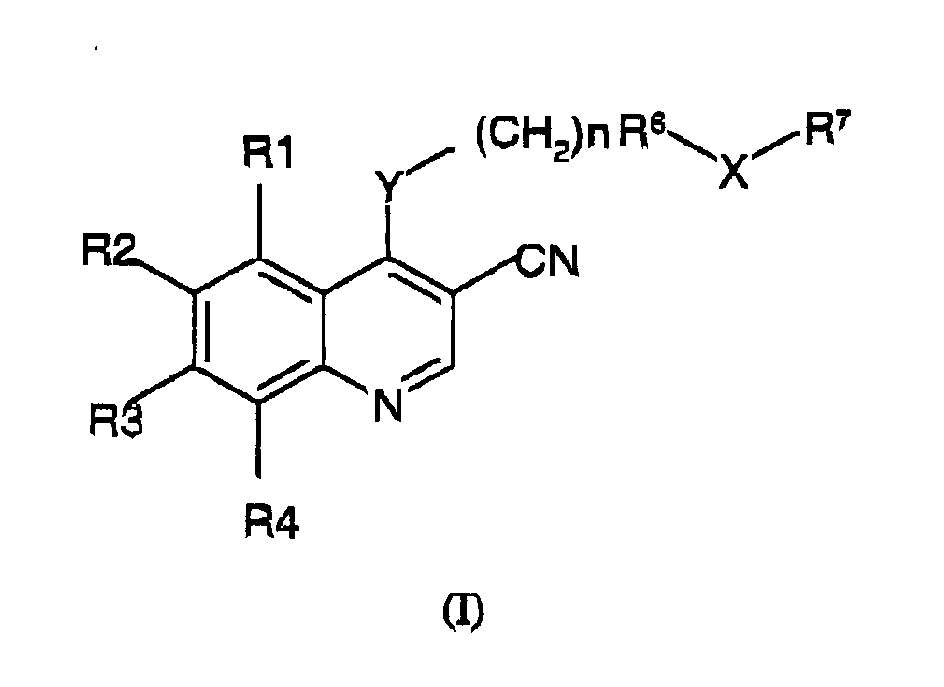
wherein:
n is 0-1;
X and Y are independently selected from -NH-, -O-, -S-, or -NR8- where R8 is alkyl of 1-6 carbon atoms and X may additionally comprise a CH2 group;
R7 is a group (CH2)mR9 where m is 0,or an integer of from 1-3 and R9 is a substituted aryl group, an optionally substituted cycloalkyl ring of up to 10 carbon atoms, or an optionally substituted heterocyclic ring or an N-oxide of any nitrogen containing ring;
R6 is a divalent cycloalkyl of 3 to 7 carbon atoms, which may be optionally further substituted with one or more alkyl of 1 to 6 carbon atom groups; or is a divalent pyridinyl, pyimidinyl, or phenyl ring; wherein the pyridinyl, pyrimidinyl, or phenyl ring may be optionally further substituted with one or more specified groups;
R1, R2, R3 and R4 are each independently selected from hydrogen or various specified organic groups.
Description
- The present invention relates to certain novel quinoline derivatives as well as to their use as pharmaceuticals, in particular as inhibitors of specific kinase enzymes, such as MEK enzymes. Further aspects of the invention include pharmaceutical compositions and methods of treatment of proliferative disease such as cancer using said compounds.
- Cancer is a disease in which cells grow and divide in an uncontrolled fashion. This uncontrolled growth arises from abnormalities in signal transduction pathways that are used by normal cells to regulate cell growth and division in response to various signalling molecules. Normal cells do not proliferate unless stimulated to do so by specific signal molecules located outside the cell derived from nearby cells or tissues. Growth factors bind to the cell membrane via specific receptors which have intrinsic enzyme activity. These receptors relay the growth signal to the cell nucleus via a series of signalling proteins. In cancer, a number of defects in signal pathways are apparent. For example, cancer cells may produce their own growth factors which bind to their cognate receptors, resulting in an autocrine loop, or receptors may be mutated or overexpressed leading to an increased, continuous signal to proliferate. In addition, negative regulators of cell growth may be lost.
- Oncogenes are cancer related genes which often encode abnormal versions of signal pathway components, such as receptor tyrosine kinases, serine-threonine kinases, or downstream signaling molecules such as the ras genes, which code for closely related small guanine nucleotide binding proteins which hydrolyse bound guanosine triphosphate (GTP) to guanosine diphosphate (GDP). Ras proteins are active in promoting cell growth and transformation when they are bound to GTP and inactive when they are bound to GDP. Transforming mutants of p21ras are defective in their GTPase activity and hence remain in the active GTP bound state. The ras oncogene is known to play an integral role in certain cancers, and has been found to contribute to the formation of over 20% of all cases of human cancer.
- When activated by ligand, cell surface receptors which are coupled to the mitogenic response, such as growth factor receptors, initiate a chain of reactions which leads to the activation of guanine nucleotide exchange activity on ras. When in its active GTP-bound state, a number of proteins interact directly with ras at the plasma membrane resulting in signal transmission through several distinct pathways. The best characterised effector protein is the product of the raf proto-oncogene. The interaction of raf and ras is a key regulatory step in the control of cell proliferation. Ras-mediated activation of the raf serine-threonine kinase in turn activates the dual-specificity MEK (MEK1 and MEK2), which is the immediate upstream activator of mitogen activated protein kinase (MAPKs known as extracellular signal regulated protein kinases or ERK1 and ERK2). To date, no substrates of MEK other than MAPK have been identified, though recent reports indicate that MEK may also be activated by other upstream signal proteins such as MEK kinase or MEKK1 and PKC. Activated MAPK translocates and accumulates in the nucleus, where it can phosphorylate and activate transcription factors such as Elk-1 and Sapla, leading to the enhanced expression of genes such as that for c-fos.
- The ras-dependent raf-MEK-MAPK cascade is one of the key signalling pathways responsible for transmitting and amplifying mitogenic signals from cell surface to the nucleus resulting in changes in gene expression and cell fate. This ubiquitous pathway appears essential for normal cell proliferation and constitutive activation of this pathway is sufficient to induce cellular transformation. Transforming mutants of p21ras are constitutively active, resulting in raf, MEK and MAPK activity and cell transformation. Inhibition of MEK activity using either antisense raf, a dominant negative MEK mutant or the selective inhibitor PD098059 have been shown to block the growth and morphological transformation of ras-transformed fibroblasts.
- The mechanism of activation of raf, MEK and MAPK is through phosphorylation on specific serine, threonine or tyrosine residues. Activated raf and other kinases phosphorylate MEK1 on S218 and S222 and MEK2 on S222 and S226. This results in MEK activation and subsequent phosphorylation and activation of ERK1 on T190 and Y192 and ERK2 on T183 and Y185 by the dual specificity MEKs. Whilst MEK can be activated by a number of protein kinases, and active MAPKs phosphorylate and activate a number of substrate proteins including transcription factors and other protein kinases, MEKs appear specific and sole activators of MAPKs and could act as a focal point for cross-cascade regulation. MEK1 and MEK2 isoforms show unusual specificity and also contain a proline-rich insert between catalytic subdomains IX and X which is not present in any of the other known MEK family members. These differences between MEK and other protein kinases, together with the known role of MEK in proliferative signalling suggest that it may be possible to discover and employ selective MEK inhibitors as therapeutic agents for use in proliferative disease.
- WO 98/43960 discloses a range of 3-cyano quinoline compounds and their use in the treatment of cancer. Certain of the compounds are demonstrated as being inhibitors of Epidermal Growth Factor Receptor Kinase, and to inhibit cancer cell growth. Other quinoline derivatives which inhibit the effect of growth factors such as VEGF are described in WO98/13350.
- This invention provides compounds which are inhibitors of the kinase activity of MEK and as a result, can produce therapeutically useful effects in the treatment of proliferative disease and in particular cancer.
- According to the present invention there is provided a compound of formula (I)or a pharmaceutically acceptable salt thereof.

wherein: - n is 0-1;
- X and Y are independently selected from -NH-, -O-, -S-, or -NR8- where R8 is alkyl of 1-6 carbon atoms and X may additionally comprise a CH2 group;
- R7 is a group (CH2)mR9 where m is 0,or an integer of from 1-3 and R9 is a substituted aryl group, an optionally substituted cycloalkyl ring of up to 10 carbon atoms, or an optionally substituted heterocyclic ring or an N-oxide of any nitrogen containing ring;
- R6 is a divalent cycloalkyl of 3 to 7 carbon atoms, which may be optionally further substituted with one or more alkyl of 1 to 6 carbon atom groups; or is a divalent pyridinyl, pyimidinyl, or phenyl ring; wherein the pyridinyl, pyrimidinyl, or phenyl ring may be optionally further substituted with one or more groups selected from halogen, alkyl of 1-6 carbon atoms, alkenyl of 2-6 carbon atoms, alkynyl of 2-6 carbon atoms, azido, hydroxyalkyl of 1-6 carbon atoms, halomethyl, alkoxymethyl of 2-7 carbon atoms, alkanoyloxymethyl of 2-7 carbon atoms, alkoxy of 1-6 carbon atoms, alkylthio of 1-6 carbon atoms, hydroxy, trifluoromethyl, cyano, nitro, carboxy, carboalkoxy of 2-7 carbon atoms, carboalkyl of 2-7 carbon atoms, phenoxy, phenyl, thiophenoxy, benzoyl, benzyl, amino, alkylamino of 1-6 carbon atoms, dialkylamino of 2 to 12 carbon atoms, phenylamino, benzylamino, alkanoylamino of 1-6 carbon atoms, alkenoylamino of 3-8 carbon atoms, alkynoylamino of 3-8 carbon atoms, and benzoylamino;
- R1, R2, R3 and R4 are each independently selected from hydrogen, hydroxy, halogeno, cyano,
nitro, trifluoromethyl, C1-3alkyl, -NR11R12 (wherein R11 and R12, which may be the same or
different, each represents hydrogen or C1-3alkyl), or a group R13-X1-(CH2)x wherein x is 0 to 3,
X1 represents -O-, -CH2-, -OCO-, carbonyl, -S-, -SO-, -SO2-, -NR14CO-, -CONR15-,
-SO2NR16-, -NR17SO2- or -NR18- (wherein R14, R15, R16, R17 and R18 each independently
represents hydrogen, C1-3alkyl or C1-3alkoxyC2-3alkyl) and R13 is selected from one of the
following sixteen groups:
- 1) C1-5alkyl which may be unsubstituted or which may be substituted with one or more groups selected from hydroxy, fluoro and amino;
- 2) C1-5alkylX2COR19 (wherein X2 represents -O- or -NR20- (wherein R20 represents hydrogen, C1-3alkyl or C1-3alkoxyC2-3alkyl) and R19 represents -NR21R22- or -OR23- (wherein R21, R22 and R23 which may be the same or different each represents hydrogen, C1-3alkyl or C1-3alkoxyC2-3alkyl));
- 3) C1-5alkylX3R24 (wherein X3 represents -O-, -S-, -SO-, -SO2-, -OCO-, -NR25CO-, -CONR26-, -SO2NR27-, -NR28SO2- or -NR29- (wherein R25, R26, R27, R28 and R29 each independently represents hydrogen, C1-3alkyl or C1-3alkoxyC2-3alkyl) and R24 represents hydrogen, C1-3alkyl, cyclopentyl, cyclohexyl or a 5 or 6 membered saturated heterocyclic group with one or two heteroatoms, selected independently from O, S and N, which C1-3alkyl group may bear one or two substituents selected from oxo, hydroxy, halogeno and C1-4alkoxy and which cyclic group may bear one or two substituents selected from oxo, hydroxy, halogeno, C1-4alkyl, C1-4hydroxyalkyl and C1-4alkoxy);
- 4) C1-5alkylX4C1-5alkylX5R30 (wherein X4 and X5 which may be the same or different are each -O-, -S-, -SO-, -SO2-, -NR31CO-, -CONR32-, -SO2NR33-, -NR34SO2- or -NR35- (wherein R31, R32, R33, R34 and R35 each independently represents hydrogen, C1-3alkyl or C1-3alkoxyC2-3alkyl) and R30 represents hydrogen or C1-3alkyl);
- 5) C1-5alkylR36 (wherein R36 is a 5 or 6 membered saturated heterocyclic group with one or two heteroatoms, selected independently from O, S and N, which heterocyclic group may bear one or two substituents selected from oxo, hydroxy, halogeno, C1-4alkyl, C1-4hydroxyalkyl and C1-4alkoxy);
- 6) (CH2)qX6R37 (wherein q is an integer from 0 to 5, X6 represents a direct bond, -O-, -S-, -SO-, -SO2-, -NR38CO-, -CONR39-, -SO2NR40-, -NR41SO2- or -NR42- (wherein R38, R39, R40, R41 and R42 each independently represents hydrogen, C1-3alkyl or C1-3alkoxyC2-3alkyl) and R37 is a phenyl group, a pyridone group or a 5 or 6 membered aromatic heterocyclic group with 1 to 3 heteroatoms selected from O, N and S, which phenyl, pyridone or aromatic heterocyclic group may carry up to 5 substituents selected from hydroxy, halogeno, amino, C1-4alkyl, C1-4alkoxy, C1-4hydroxyalkyl, C1-4hydroxyalkoxy, C1-4aminoalkyl, C1-4alkylamino, carboxy, cyano, -CONR43R44 and -NR45COR46 (wherein R43, R44, R45 and R46, which may be the same or different, each represents hydrogen, C1-4alkyl or C1-3alkoxyC2-3alkyl));
- 7) C2-6alkenylR36 (wherein R36 is as defined hereinbefore);
- 8) C2-6alkynylR36 (wherein R36 is as defined hereinbefore);
- 9) X7R47 (wherein X7 is -SO2-, -O- or -CONR48R49- (wherein R48 and R49, which may be the same or different, each represents hydrogen, C1-3alkyl or C1-3alkoxyC2-3alkyl) and R47 represents C1-5alkyl which may be unsubstituted or which may be substituted with one or more groups selected from hydroxy, fluoro and amino) with the provisos that when X7 is -SO2-, X1 is -O-, when X7 is -O-, X1 is carbonyl, when X7 is -CONR48R49-, X1 is -O- or NR18 (wherein R48, R49 and R18 are as defined hereinbefore);
- 10) C2-6alkenylR37 (wherein R37 is as defined hereinbefore);
- 11) C2-6alkynylR37 (wherein R37 is as defined hereinbefore);
- 12) C2-6alkenylX8R37 (wherein X8 represents -O-, -S-, -SO-, -SO2-, -NR50CO-, -CONR51-, -SO2NR52-, -NR53SO2- or -NR54- (wherein R50, R51, R52, R53 and R54 each independently represents hydrogen, C1-3alkyl or C1-3alkoxyC2-3alkyl) and R37 is as defined hereinbefore);
- 13) C2-6alkynylX9R37 (wherein X9 represents -O-, -S-, -SO-, -SO2-, -NR55CO-, -CONR56-, -SO2NR57-, -NR58SO2- or -NR59- (wherein R55, R56, R57, R58 and R59 each independently represents hydrogen, C1-3alkyl or C1-3alkoxyC2-3alkyl) and R37 is as defined hereinbefore);
- 14) C1-3alkylX10C1-3alkylR37 (wherein X10 represents -O-, -S-, -SO-, -SO2-, -NR60CO-, -CONR61-, -SO2NR62-, -NR63SO2- or -NR64- (wherein R60, R61, R62, R63 and R64 each independently represents hydrogen, C1-3alkyl or C1-3alkoxyC2-3alkyl) and R37 is as defined hereinbefore);
- 15) R36 (wherein R36 is as defined hereinbefore); and
- 16) C1-3alkylX10C1-3alkylR36 (wherein X10 and R36 are as defined hereinbefore).
-
- Suitable pharmaceutically acceptable salts of compounds of formula (I) include acid addition salts such as methanesulfonate, fumarate, hydrochloride, hydrobromide, citrate, maleate and salts formed with phosphoric and sulphuric acid. A preferred pharmaceutically acceptable salt is a hydrochloride salt.
- The alkyl portion of the alkyl, alkoxy, alkanoyloxy, alkoxymethyl, alkanoyloxymethyl, alkylsuphinyl, alkylsulphonyl, alkylsulfonamido, carboalkoxy, carboalkyl, alkanoylamino aminoalkyl, alkylaminoalkyl, N,N-dicycloalkylaminoalkyl, hydroxyalkyl, and alkoxyalkyl substituents include both straight chain as well as branched carbon chains. The cycloalkyl portions of N-cycloalkyl-N-alkylaminoalkyl and N,N-dicycloalkylaminoalkyl substituents include both simple carbocycles as well as carbocycles containing alkyl substituents. The alkenyl portion of the alkenyl, alkenoyloxymethyl, alkenyloxy, alkenylsulfonamido, substituents include both straight chain as well as branched carbon chains and one or more sites of unsaturation. The alkynyl portion of the alkynyl, alkynoyloxymethyl, alkynylsulfonamido, alkynyloxy, substituents include both straight chain as well as branched carbon chains and one or more sites of unsaturation. Carboxy is defined as a -CO2H radical. Carboalkoxy of 2-7 carbon atoms is defined as a -CO2R" radical, where R" is an alkyl radical of 1-6 carbon atoms. Carboalkyl is defined as a -COR" radical, where R" is an alkyl radical of 1-6 carbon atoms. Alkanoyloxy is defined as a -OCOR" radical, where R" is an alkyl radical of 1-6 carbon atoms. Alkanoyloxymethyl is defined as R"CO2CH2- radical, where R" is an alkyl radical of 1-6 carbon atoms. Alkoxymethyl is defined at R"OCH2- radical, where R" is an alkyl radical of 1-6 carbon atoms. Alkylsulphinyl is defined as R"SO- radical, where R" is an alkyl radical of 1-6 carbon atoms. Alkylsulphonyl is defined as R"SO2- radical, where R" is alkyl radical of 1-6 carbon atoms. Alkylsulfonamido, alkenylsulfonamido, alkynylsulfonamido are defined as R"SO2NH- radical, where R" is an alkyl radical of 1-6 carbon atoms, an alkenyl radical of 2-6 carbon atoms, or an alkynyl radical of 2-6 carbon atoms, respectively. N-alkylcarbamoyl is defined as R"NHCO- radical, where R" is an alkyl radical of 1-6 carbon atoms. N,N-dialkylcarbamoyl is defined as R" R'NCO- radical, where R" is an alkyl radical of 1-6 carbon atoms, R' is an alkyl radical of 1-6 carbon atoms and R', and R" may be the same or different. When X is substituted, it is preferred that it is mono-, di-, or tri-substituted, with monosubstituted being most preferred. It is preferred that of the substituents, R1, R2, R3 and R4 at least one is hydrogen and it is most preferred that two or three be hydrogen. An azacycloalkyl-N-alkyl substituent refers to a monocyclic heterocycle that contains a nitrogen atom on which is substituted a straight or branched chain alkyl radical. A morpholino-N-alkyl substituent is a morpholine ring substituted on the nitrogen atom with a straight or branch chain alkyl radical. A pipeazino-N-alkyl substituent is a piperazine ring substituted on one of the nitrogen atoms with a straight or branch chain alkyl radical. A N-alkyl-piperidino-N-alkyl substituent is a piperidine ring substituted on one of the nitrogen atoms with a straight or branched chain alkyl group and on the other nitrogen atom with a straight or branch chain alkyl radical.
- When any group contains an alkyl portion, the alkyl portion contains preferably 1-6 carbon atoms, more preferably 1-4 carbon atoms, particularly methyl, ethyl, n-propyl, isopropyl, n-butyl, iso-butyl, sec-butyl or tert-butyl. When any group contains an alkenyl or alkynyl portion, the alkenyl or alkynyl portion contains preferably 2-6 carbon atoms, more preferably 2-4 carbon atoms.
- The compounds of this invention may contain an asymmetric carbon; in such cases, the compounds of this invention cover the racemate and the individual R and S entantiomers, and in the case were more than one asymmetric carbon exists, the individual diasteromers, their racemates and individual entantiomers.
- Examples of substituents for aryl groups R9 or optional substituents for carbocyclic or heterocyclic groups R9 include one or more groups selected from hydroxy; halo; nitro; cyano; carboxy; C1-6alkoxy; C1-6alkyl; C2-6alkenyl; C2-6alkynyl; C2-6alkenyloxy; C2-6alkynyloxy; C3-6cycloalkyl; amino; mono- or di-C1-6alkyl amino; heterocyclyl optionally substituted with C1-6alkyl or oxo; C(O)Ra, C(O)ORa, S(O)dRa; NRaC(O)Rb; C(O)NRaS(O)dRb, C(O)NRaRb;; NRaC(O)NRbRc; NRaS(O)dRb or N(S(O)dRb)S(O)dRc where d is 0, 1 or 2 and Ra, Rb and Rc are independently selected from hydrogen, C1-6alkyl, aryl, C3-6cycloalkyl or heterocylcyl, and wherein any alkyl, alkenyl or alkynyl group or moiety contained within the substituent one R9 may themselves be optionally substituted with one or more groups selected from hydroxy; cyano; nitro; halo; carboxy; carboalkoxy of 2-7 carbon atoms, C3-6cycloalkyl, heterocyclyl optionally substituted with C1-6alkyl or oxo; C(O)Rd, C(O)ORd NRdRe, S(O)eRd, NRdC(O)Re; C(O)NRdRe; NRdC(O)NReRf; NRdS(O)eRe where e is 0, 1 or 2 and Rd, Re and Rf are independently selected from hydrogen or C1-6alkyl optionally substituted with one or more groups selected from hydroxy; cyano; nitro; halo; carboxy; carboalkoxy of 2-7 carbon atoms, C3-6cycloalkyl, heterocyclyl optionally substituted with C1-6alkyl or oxo; C(O)Rg, C(O)ORg NRgRh, S(O)eRg, NRhC(O)Rg; C(O)NRgRh; NRgC(O)NRhRi; NRgS(O)eRh where e is as defined above and Rg, Rh and Ri are independently selected from hydrogen or C1-6alkyl. Alternatively, two substituents on adjacent atoms may be joined to form the second ring of a bicyclic ring system wherein the said second ring is optionally substituted with one or more of the groups listed above for R9 and optionally contains one or more heteroatoms.
- In some embodiments, the level of substitution on the group R9 is a chain substituted with complex. Thus, for example, a substituent may comprise an subsituted alkyl chain which is optionally interposed with heteroatoms such as groups of sub-formula (i)
R70 and R71 are independently selected from C1-6alkylene, C2-6alkenylene or C2-6alkynylene groups any of which may be optionally substituted with hydroxy; cyano; nitro; halo; carboxy, carboalkoxy of 2-7 carbon atoms or C3-6cycloalkyl;
R72 is hydrogen or an C1-6alkyl, C2-6 alkenyl or C2-6alkynyl group any of which may be optionally substituted with hydroxy; cyano; nitro; halo; carboxy or C3-6cycloalkyl;
and q and s are independently 0 or 1. - Preferably R9 is an optionally substituted alkoxy group and most preferably, R9 is a substituted alkoxy group.
- A particular example of compounds of formula (I) are compounds of formula (IA) which are compounds of formula (I) as defined above provided that R7 is a group (CH2)mR9 where m is 0,or an integer of from 1-3 and R9 is a substituted aryl or substituted cycloalkyl ring of up to 10 carbon atoms, wherein the substituents comprise at least one alkoxy group of 1-6 carbon atoms and optionally one or more further substituents, or R9 is a heterocyclic ring containing 1 or 2 oxygen atoms and optionally one or more substituents, and where R1, R2, R3 or R4 are a group R13-X1-(CH2)x wherein x is 0 to 3, X1 represents -O-, -CH2-, -OCO-, carbonyl, -S-, -SO-, -SO2-, -NR14CO-, SO2NR16-, -NR17SO2- or -NR18- (wherein R14, R15, R16, R17, R18 and R13 are as defined above).
- Suitable examples of groups Y are -NH-. Suitably X is oxygen.
- Preferably n is 0.
- Particular examples of groups R9 include phenyl or cycloalkyl of from 3-8 and preferably of 6 carbon atoms which are substituted at the position alpha with a alkoxy group, in particular methoxy.
- When R9 is subsituted phenyl or cycloalkyl, m is preferably 0.
- Examples of heterocyclic rings R9 include 3- 7 membered rings, up to two of which may be oxygen atoms. Such groups include:
 where each R65 is independently selected from hydrogen or C1-6alkyl and especially methyl. In such compounds, m is suitably 1, 2 or 3.
- Other examples of heterocyclic groups R9 include pyridyl, thiazolyl, pyrazinyl, pyrimidinyl, oxadiazole.
- Suitable further substituents for R7 include those listed above for pyridyl, pyrimidinyl and phenyl groups R6.
- Thus a preferred sub-group of compounds of formula (I) are compounds of formula (II)where R1, R2, R3 and R4 are as defined above and R66 is C1-6 alkyl in particular methyl and R67 is selected from hydrogen, halogen, alkyl of 1-6 carbon atoms, alkenyl of 2-6 carbon atoms, alkynyl of 2-6 carbon atoms, azido, hydroxyalkyl of 1-6 carbon atoms, halomethyl, alkoxymethyl of 2-7 carbon atoms, alkanoyloxymethyl of 2-7 carbon atoms, alkoxy of 1-6 carbon atoms, alkylthio of 1-6 carbon atoms, hydroxy, trifluoromethyl, cyano, nitro, carboxy, carboalkoxy of 2-7 carbon atoms, carboalkyl of 2-7 carbon atoms, phenoxy, phenyl, thiophenoxy, benzoyl, benzyl, amino, alkylamino of 1-6 carbon atoms, dialkylamino of 2 to 12 carbon atoms, phenylamino, benzylamino, alkanoylamino of 1-6 carbon atoms, alkenoylamino of 3-8 carbon atoms, alkynoylamino of 3-8 carbon atoms, and benzoylamino.

- Suitably R66 is C1-6 alkyl such as methyl. Preferably however it is a substituted C1-4 alkyl group, wherein the substitutents are selected from hydroxy, NRdRe, S(O)eRd, NRdC(O)Re; C(O)NRdRe; NRdC(O)NReRf; NRdS(O)eRe where e, Rd, Re and Rf are as defined above.
- Preferably R67 is hydrogen.
- Examples of preferred groups for R1, R2, R3 and R4 are set out in WO 98/43960. Preferably x is 0. Conveniently R13 is selected from one of the following sixteen groups:
- 1) C1-5alkyl which may be unsubstituted or substituted with one or more fluorine atoms, or C2-5alkyl which may be unsubstituted or substituted with one or more groups selected from hydroxy and amino;
- 2) C2-3alkylX2COR19 (wherein X2 is as defined hereinbefore and R19 represents -NR21R22- or -OR23- (wherein R21, R22 and R23 which may be the same or different each represents hydrogen, C1-2alkyl or C1-2alkoxyethyl));
- 3) C2-4alkylX3R24 (wherein X3 is as defined hereinbefore and R24 represents hydrogen, C1-3alkyl, cyclopentyl, cyclohexyl or a 5 or 6 membered saturated heterocyclic group with one or two heteroatoms, selected independently from O, S and N, which C1-3alkyl group may bear one or two substituents selected from oxo, hydroxy, halogeno and C1-3alkoxy and which cyclic group may bear one or two substituents selected from oxo, hydroxy, halogeno, C1-3alkyl, C1-3hydroxyalkyl and C1-3alkoxy);
- 4) C2-3alkylX4C2-3alkylX5R30 (wherein X4 and X5 are as defined hereinbefore and R30 represents hydrogen or C1-3alkyl);
- 5) C1-5alkylR70 (wherein R70 is a 5 or 6 membered saturated heterocyclic group with one or two heteroatoms, selected independently from O, S and N, which heterocyclic group is linked to C1-5alkyl through a carbon atom and which heterocyclic group may bear one or two substituents selected from oxo, hydroxy, halogeno, C1-3alkyl, C1-3hydroxyalkyl and C1-3alkoxy) or C2-5alkylR71 (wherein R71 is a 5 or 6 membered saturated heterocyclic group with one or two heteroatoms of which one is N and the other is selected independently from O, S and N, which heterocyclic group is linked to C2-5alkyl through a nitrogen atom and which heterocyclic group may bear one or two substituents selected from oxo, hydroxy, halogeno, C1-3alkyl, C1-3hydroxyalkyl and C1-3alkoxy);
- 6) (CH2)qX6R37 (wherein X6 is as defined hereinbefore; q is an integer from 0 to 4 if X6 is a direct bond and q is 0, 2 or 3 if X6 is other than a direct bond; and R37 is a phenyl group, a pyridone group or a 5 or 6 membered aromatic heterocyclic group with 1 to 3 heteroatoms selected from O, N and S, of which preferably one is N, which phenyl group, pyridone group or aromatic heterocyclic group may be substituted as hereinbefore defined, advantageously substituted with up to 2 substituents as hereinbefore defined, more preferably substituted with one substituent selected from the group of substituents as hereinbefore defined);
- 7) C4-5alkenylR72 (wherein R72 represents R70 or R71 as defined hereinbefore);
- 8) C4-5alkynylR72 (wherein R72 represents R70 or R71 as defined hereinbefore);
- 9) X7R47 (wherein X7 is as defined hereinbefore and R47 represents C1-3alkyl which may be unsubstituted or which may be substituted with one or more groups selected from hydroxy, fluoro and amino);
- 10) C3-5alkenylR37 (wherein R37 is as defined hereinbefore);
- 11) C3-5alkynylR37 (wherein R37 is as defined hereinbefore);
- 12) C4-5alkenylX8R37 (wherein X8 and R37 are as defined hereinbefore);
- 13) C4-5alkynylX9R30 (wherein X9 and R30 are as defined hereinbefore);
- 14) C1-3alkylX10C1-3alkylR37 (wherein X10 and R37 are as defined hereinbefore);
- 15) R36 (wherein R36 is as defined hereinbefore); and
- 16) C1-3alkylX11C1-3alkylR36 (wherein X11 and R36 are as defined hereinbefore).
-
- Advantageously R13 is selected from one of the following eleven groups:
- 1) C1-4alkyl which may be unsubstituted or substituted with one or more fluorine atoms, or C2-4alkyl which may be unsubstituted or substituted with one or two groups selected from hydroxy and amino;
- 2) C2-3alkylX2COR19 (wherein X2 is as defined hereinbefore and R19 represents -NR21R22- or -OR23- (wherein R21, R22 and R23 which may be the same or different each represents hydrogen, C1-2alkyl or C1-2alkoxyethyl));
- 3) C2-3alkylX3R24 (wherein X3 is as defined hereinbefore and R24 is a group selected from C1-3alkyl, cyclopentyl, cyclohexyl, pyrrolidinyl and piperidinyl which group is linked to X3 through a carbon atom and which C1-3alkyl group may bear one or two substituents selected from oxo, hydroxy, halogeno and C1-2alkoxy and which cyclopentyl, cyclohexyl, pyrrolidinyl or piperidinyl group may carry one substituent selected from oxo, hydroxy, halogeno, C1-2alkyl, C1-2hydroxyalkyl and C1-2alkoxy);
- 4) C2-3alkylX4C2-3alkylX5R30 (wherein X4 and X5 are as defined hereinbefore) and R30 represents hydrogen or C1-2alkyl);
- 5) C1-4alkylR70 (wherein R70 is a group selected from pyrrolidinyl, piperazinyl, piperidinyl, 1,3-dioxolan-2-yl, 1,3-dioxan-2-yl, 1,3-dithiolan-2-yl and 1,3-dithian-2-yl, which group is linked to C1-4alkyl through a carbon atom and which group may carry one or two substituents selected from oxo, hydroxy, halogeno, C1-2alkyl, C1-2hydroxyalkyl and C1-2alkoxy) or C2-4alkylR71 (wherein R71 is a group selected from morpholino, thiomorpholino, pyrrolidin-1-yl, piperazin-1-yl and piperidino which group may carry one or two substituents selected from oxo, hydroxy, halogeno, C1-2alkyl, C1-2hydroxyalkyl and C1-2alkoxy); and
- 6) (CH2)qX6R37 (wherein X6 is as defined hereinbefore; q is an integer from 1 to 3 if X6 is a direct bond and q is 2 or 3 if X6 is other than a direct bond; and R37 is a phenyl group, a pyridone group or a 5 or 6 membered aromatic heterocyclic group with 1 to 2 heteroatoms selected from O, N and S, of which preferably one is N, which phenyl group, pyridone group or aromatic heterocyclic group may be substituted as hereinbefore defined, preferably substituted with one substituent selected from hydroxy, halogeno, C1-2alkyl, C1-2alkoxy, C1-2hydroxyalkyl, C1-2hydroxyalkoxy, carboxy, cyano, -CONR43R44 and -NR45COR46 (wherein R43, R44, R45 and R46, which may be the same or different, each represents hydrogen or C1-2alkyl));
- 7) C4-5alkenylR71 (wherein R71 is as defined hereinbefore);
- 8) C4-5alkynylR71 (wherein R71 is as defined hereinbefore);
- 9) C1-3alkylX10C1-3alkylR37 (wherein X10 and R37 are as defined hereinbefore);
- 10) R36 (wherein R36 is as defined hereinbefore); and
- 11) C1-3alkylX11C1-3alkylR36 (wherein X11 and R36 are as defined hereinbefore).
-
- Preferably R13 is selected from one of the following nine groups:
- 1) C1-3alkyl which may be unsubstituted or substituted with one or more fluorine atoms, or C2-3alkyl which may be unsubstituted or substituted with one or two groups selected from hydroxy and amino;
- 2) 2-(3,3-dimethylureido)ethyl, 3-(3,3-dimethylureido)propyl, 2-(3-methylureido)ethyl, 3-(3-methylureido)propyl, 2-ureidoethyl, 3-ureidopropyl, 2-(N,N-dimethylcarbamoyloxy)ethyl, 3-(N,N-dimethylcarbamoyloxy)propyl, 2-(N-methylcarbamoyloxy)ethyl, 3-(N-methylcarbamoyloxy)propyl, 2-(carbamoyloxy)ethyl, 3-(carbamoyloxy)propyl;
- 3) C2-3alkylX3R24 (wherein X3 is as defined hereinbefore and R24 is a group selected from C1-2alkyl, cyclopentyl, cyclohexyl, pyrrolidinyl and piperidinyl which group is linked to X3 through a carbon atom and which C1-2alkyl group may bear one or two substituents selected from oxo, hydroxy, halogeno and C1-2alkoxy and which cyclopentyl, cyclohexyl, pyrrolidinyl or piperidinyl group may carry one substituent selected from oxo, hydroxy, halogeno, C1-2alkyl, C1-2hydroxyalkyl and C1-2alkoxy);
- 4) C2-3alkylX4C2-3alkylX5R32 (wherein X4 and X5 are as defined hereinbefore) and R30 represents hydrogen or C1-2alkyl);
- 5) C1-2alkylR70 (wherein R70 is a group selected from pyrrolidinyl, piperazinyl, piperidinyl, 1,3-dioxolan-2-yl, 1,3-dioxan-2-yl, 1,3-dithiolan-2-yl and 1,3-dithian-2-yl, which group is linked to C1-2alkyl through a carbon atom and which group may carry one substituent selected from oxo, hydroxy, halogeno, C1-2alkyl, C1-2hydroxyalkyl and C1-2alkoxy) or C2-3alkylR59 (wherein R59 is a group selected from morpholino, thiomorpholino, piperidino, piperazin-1-yl and pyrrolidin-1-yl which group may carry one or two substituents selected from oxo, hydroxy, halogeno, C1-2alkyl, C1-2hydroxyalkyl and C1-2alkoxy);
- 6) (CH2)qX6R37 (wherein X6 is as defined hereinbefore; q is an integer from 1 to 3 if X6 is a direct bond and q is 2 or 3 if X6 is other than a direct bond; and R37 is a group selected from phenyl, a pyridone group, pyridyl, imidazolyl, thiazolyl, thienyl, triazolyl and pyridazinyl, preferably selected from phenyl, a pyridone group, pyridyl, imidazolyl, thiazolyl and triazolyl which group may be substituted with one substituent selected from hydroxy, halogeno, C1-2alkyl, C1-2alkoxy, C1-2hydroxyalkyl, C1-2hydroxyalkoxy, carboxy, cyano, -CONR43R44 and -NR45COR46 (wherein R43, R44, R45 and R46 are as defined hereinbefore);
- 7) C1-3alkylX10C1-3alkylR37 (wherein X10 and R37 are as defined hereinbefore);
- 8) R36 (wherein R36 is as defined hereinbefore); and
- 9) C1-3alkylX11C1-3alkylR36 (wherein X11 and R36 are as defined hereinbefore). More preferably R13 represents 2-methylthiazol-4-ylmethyl, 2-acetamidothiazol-4-ylmethyl, 1-methylimidazol-2-ylmethyl, 4-pyridylmethyl, 2-(4-pyridyl)ethyl, 3-(4-pyridyl)propyl, 2-((N-(1-methylimidazol-4-ylsulphonyl)-N-methyl)amino)ethyl, 2-((N-(3-morpholinopropylsulphonyl)-N-methyl)amino)ethyl, 2-((N-methyl-N-4-pyridyl)amino)ethyl, 2-(4-oxidomorpholino)ethyl, 3-(4-oxidomorpholino)propyl, 2-(4-oxo-1,4-dihydro-1-pyridyl)ethyl, 3-(4-oxo-1,4-dihydro-1-pyridyl)propyl, methyl, ethyl, trifluoromethyl, 2,2,2-trifluoroethyl, 2-hydroxyethyl, 3-hydroxypropyl, 2-(N,N-dimethylsulphamoyl)ethyl, 2-(N-methylsulphamoyl)ethyl, (1,3-dioxolan-2-yl)methyl, 2-(1,3-dioxolan-2-yl)ethyl, 2-(2-methoxyethylamino)ethyl, 2-(2-hydroxyethylamino)ethyl, 3-(2-methoxyethylamino)propyl, 3-(2-hydroxyethylamino)propyl, 2-(1,2,4-triazol-1-yl)ethyl, 2-(1,2,4-triazol-4-yl)ethyl, 3-(1,2,4-triazol-1-yl)propyl, 3-(1,2,4-triazol-4-yl)propyl, 2-(4-pyridyloxy)ethyl, 3-(4-pyridyloxy)propyl, 2-(4-pyridylamino)ethyl, 3-(4-pyridylamino)propyl, 2-(2-methylimidazol-1-yl)ethyl, 3-(2-methylimidazol-1-yl)propyl, 2-(5-methyl-1,2,4-triazol-1-yl)ethyl, 3-(5-methyl-1,2,4-triazol-1-yl)propyl, morpholino, N-methylpiperazinyl, piperazinyl, 2-(N,N-dimethylamino)ethyl, 3-(N,N-dimethylamino)propyl, 2-morpholinoethyl, 3-morpholinopropyl, 2-piperidinoethyl, 3-piperidinopropyl, 2-(piperazin-1-yl)ethyl, 3-(piperazin-1-yl)propyl, 2-(pyrrolidin-1-yl)ethyl, 3-(pyrrolidin-1-yl)propyl, 2-methoxyethyl, 3-methoxypropyl, 2-(imidazol-1-yl)ethyl, 2-(1,2,3-triazol-1-yl)ethyl, 2-(1,2,3-triazol-2-yl)ethyl, 3-(imidazol-1-yl)propyl, 3-(1,2,3-triazol-1-yl)propyl, 3-(1,2,3-triazol-2-yl)propyl, 2-thiomorpholinoethyl, 3-thiomorpholinopropyl, 2-(1,1-dioxothiomorpholino)ethyl, 3-(1,1-dioxothiomorpholino)propyl, 2-(2-methoxyethoxy)ethyl, 2-(4-methylpiperazin-1-yl)ethyl, 3-(4-methylpiperazin-1-yl)propyl, 3-(methylsulphinyl)propyl, 3-(methylsulphonyl)propyl, 2-(methylsulphinyl)ethyl, benzyl, 2-sulphamoylethyl or 2-(methylsulphonyl)ethyl.
-
- Especially R13 represents methyl, ethyl, trifluoromethyl, 2,2,2-trifluoroethyl, 2-hydroxyethyl, 3-hydroxypropyl, 2-methoxyethyl, 3-methoxypropyl, 2-(methylsulphinyl)ethyl, 2-(methylsulphonyl)ethyl, 2-(N,N-dimethylsulphamoyl)ethyl, 2-(N-methylsulphamoyl)ethyl, 2-sulphamoylethyl, 2-(N,N-dimethylamino)ethyl, 3-(N,N-dimethylamino)propyl, 2-morpholinoethyl, 3-morpholinopropyl, 2-piperidinoethyl, 3-piperidinopropyl, 2-(piperazin-1-yl)ethyl, 3-(piperazin-1-yl)propyl, 2-(pyrrolidin-1-yl)ethyl, 3-(pyrrolidin-1-yl)propyl, (1,3-dioxolan-2-yl)methyl, 2-(1,3-dioxolan-2-yl)ethyl, 2-(2-methoxyethylamino)ethyl, 2-(2-hydroxyethylamino)ethyl, 3-(2-methoxyethylamino)propyl, 3-(2-hydroxyethylamino)propyl, 2-methylthiazol-4-ylmethyl, 2-acetamidothiazol-4-ylmethyl, 1-methylimidazol-2-ylmethyl, 2-(imidazol-1-yl)ethyl, 2-(1,2,3-triazol-1-yl)ethyl, 2-(1,2,3-triazol-2-yl)ethyl, 2-(1,2,4-triazol-1-yl)ethyl, 2-(1,2,4-triazol-4-yl)ethyl, 4-pyridylmethyl, 2-(4-pyridyl)ethyl, 3-(4-pyridyl)propyl, 3-(3-pyridyl)propyl, benzyl, 2-(4-pyridyloxy)ethyl, 2-(4-pyridylamino)ethyl, or 2-(4-oxo-1,4-dihydro-1-pyridyl)ethyl.
- More especially R13 represents methyl, ethyl, trifluoromethyl, 2,2,2-trifluoroethyl, 2-hydroxyethyl, 3-hydroxypropyl, 2-methoxyethyl, 3-methoxypropyl, 2-(methylsulphinyl)ethyl, 2-(methylsulphonyl)ethyl, 2-(N,N-dimethylsulphamoyl)ethyl, 2-(N-methylsulphamoyl)ethyl, 2-sulphamoylethyl, 2-(N,N-dimethylamino)ethyl, 3-(N,N-dimethylamino)propyl, 2-morpholinoethyl, 3-morpholinopropyl, 2-piperidinoethyl, 3-piperidinopropyl, 2-(piperazin-1-yl)ethyl, 3-(piperazin-1-yl)propyl, 2-(pyrrolidin-1-yl)ethyl, 3-(pyrrolidin-1-yl)propyl, (1,3-dioxolan-2-yl)methyl, 2-(1,3-dioxolan-2-yl)ethyl, 2-(2-methoxyethylamino)ethyl, 2-(2-hydroxyethylamino)ethyl, 3-(2-methoxyethylamino)propyl, 3-(2-hydroxyethylamino)propyl, 2-methylthiazol-4-ylmethyl, 2-acetamidothiazol-4-ylmethyl, 1-methylimidazol-2-ylmethyl, 2-(imidazol-1-yl)ethyl, 2-(1,2,3-triazol-1-yl)ethyl, 2-(1,2,3-triazol-2-yl)ethyl, 2-(1,2,4-triazol-1-yl)ethyl, 2-(1,2,4-triazol-4-yl)ethyl, 4-pyridylmethyl, 2-(4-pyridyl)ethyl, 3-(4-pyridyl)propyl, benzyl, 2-(4-pyridyloxy)ethyl, 2-(4-pyridylamino)ethyl, or 2-(4-oxo-1,4-dihydro-1-pyridyl)ethyl.
- In particular R1 and R4 are suitably hydrogen.
- Examples of preferred groups for R2 include C1-6 alkoxy such as methoxy.
- The group R3 is suitably selected from hydrogen or C1-6alkoxy.
- Preferably both R2 and R3 are C1-6 alkoxy and are preferably methoxy.
- A further preferred group for R2 or R3 is 3-morpholinopropyloxy.
- Particular examples of compounds of formula (I) are listed in Tables 1, 2 and 3. In these tables "DMMPO" indicates a 1,6-dimethylmorpholinopropoxy group of formula:"MPO" is morpholinopropoxy group of formula:
 "MEO" is a morpholinoethoxygroup of formula:
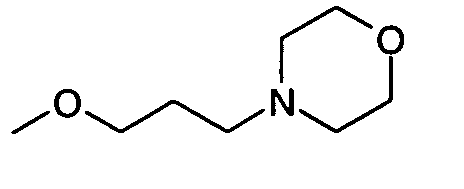 and Me is CH3


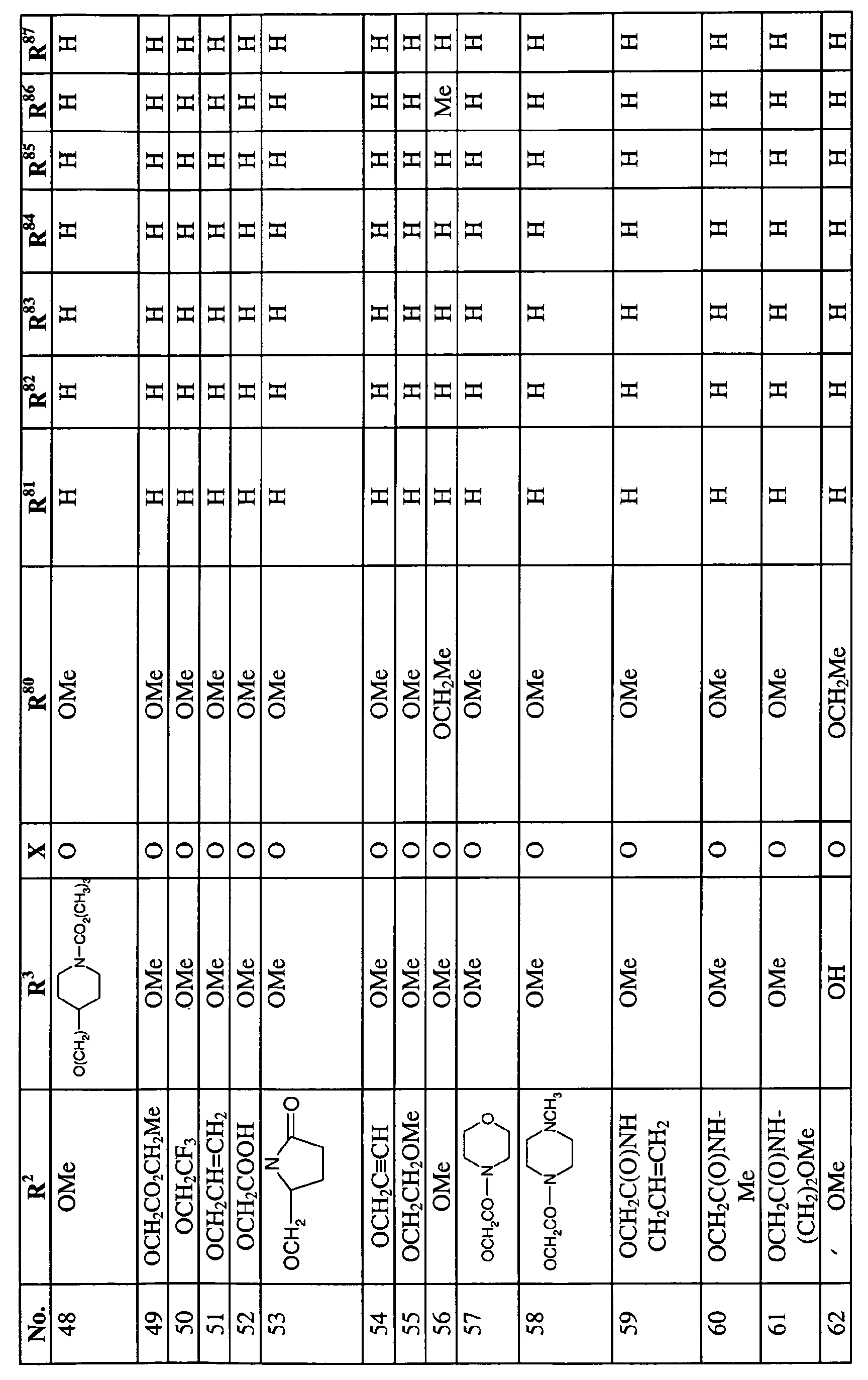


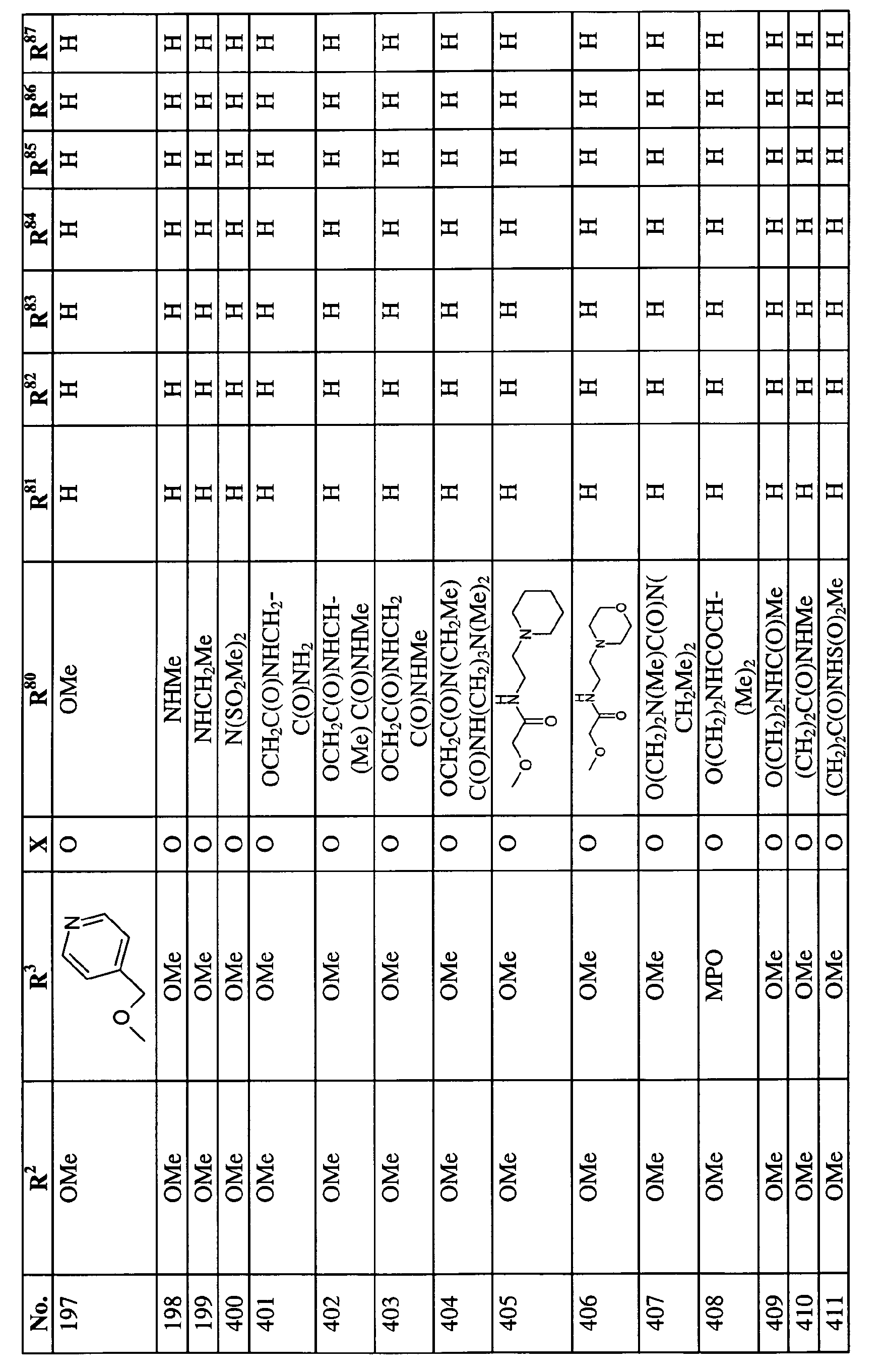


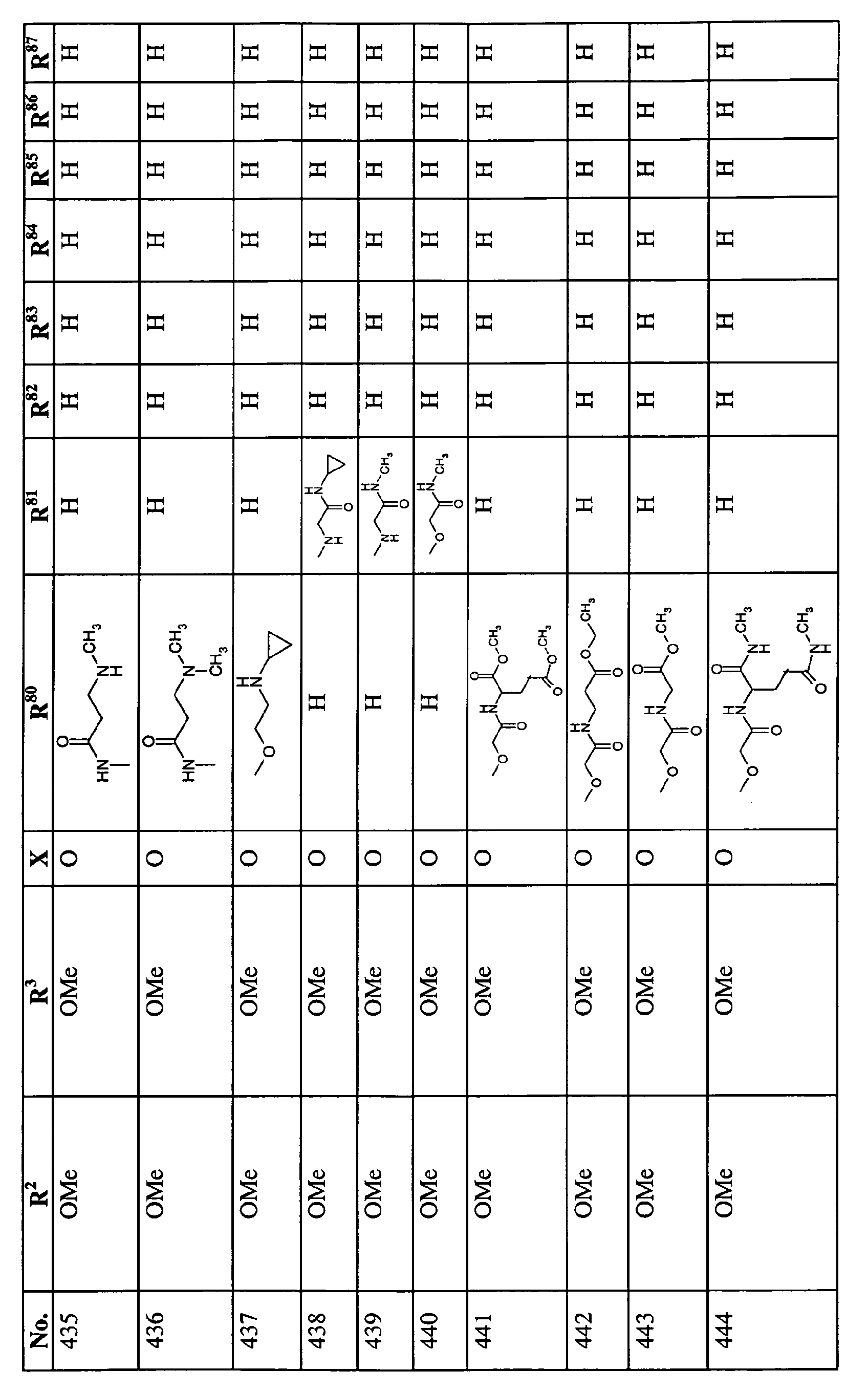
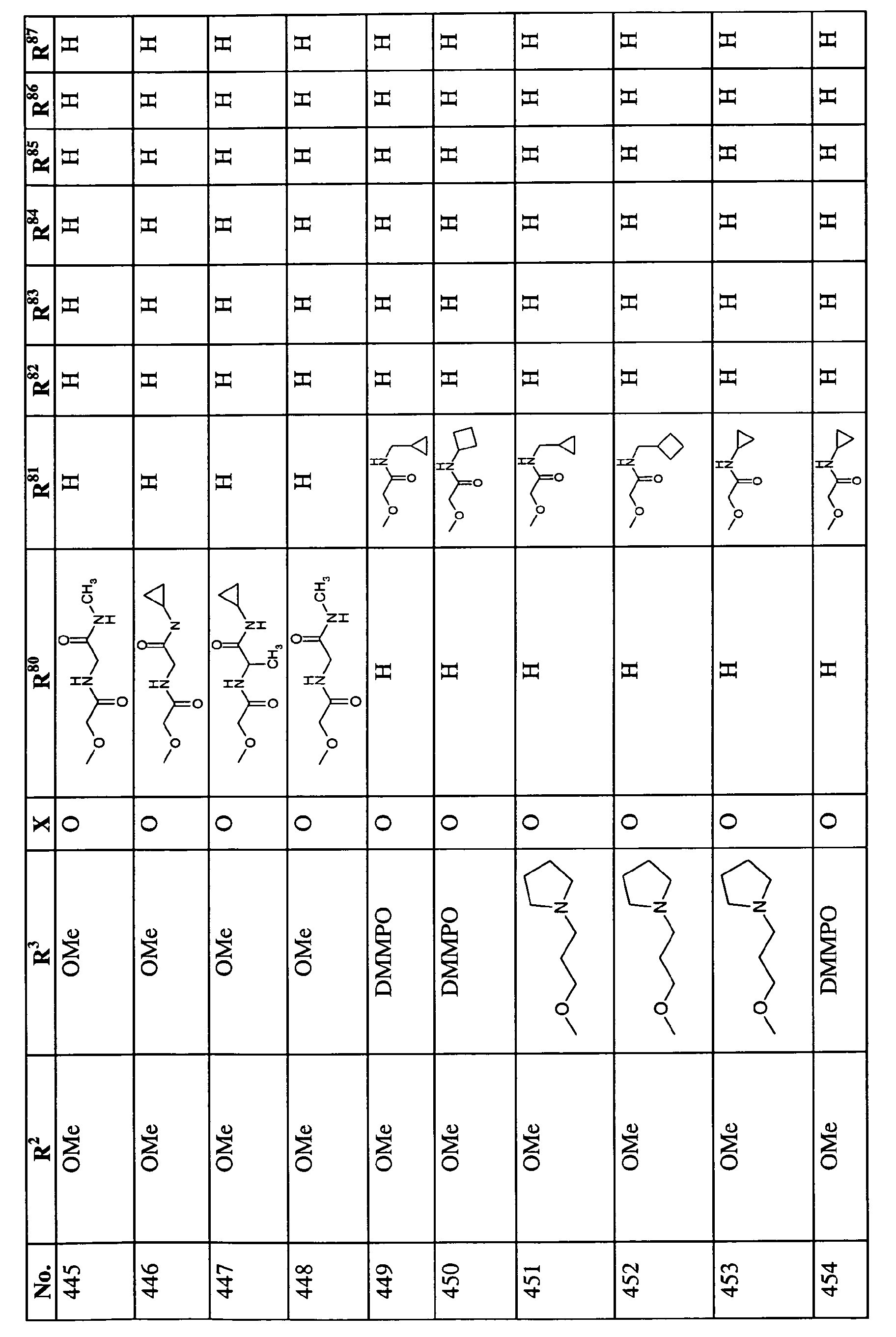


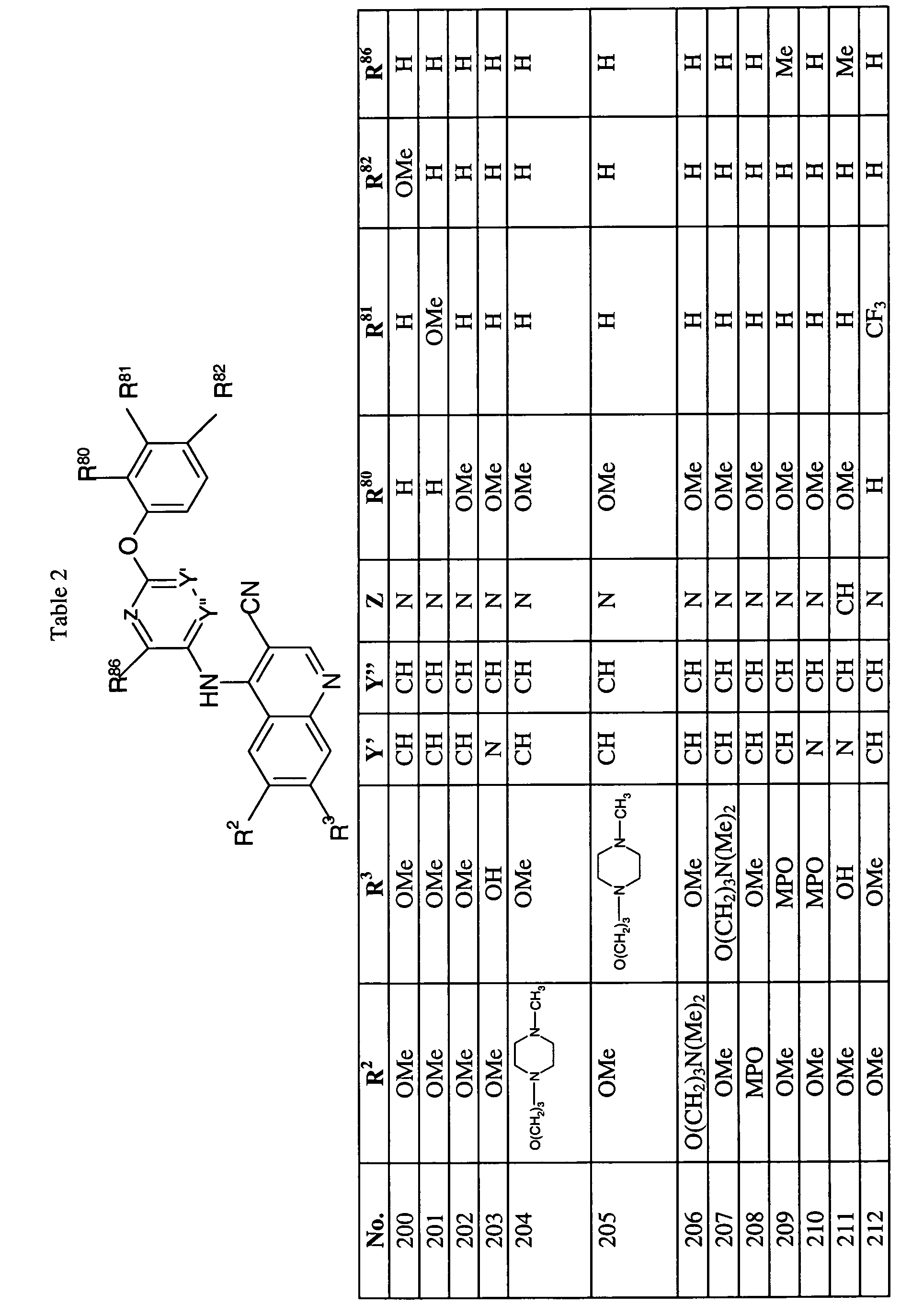
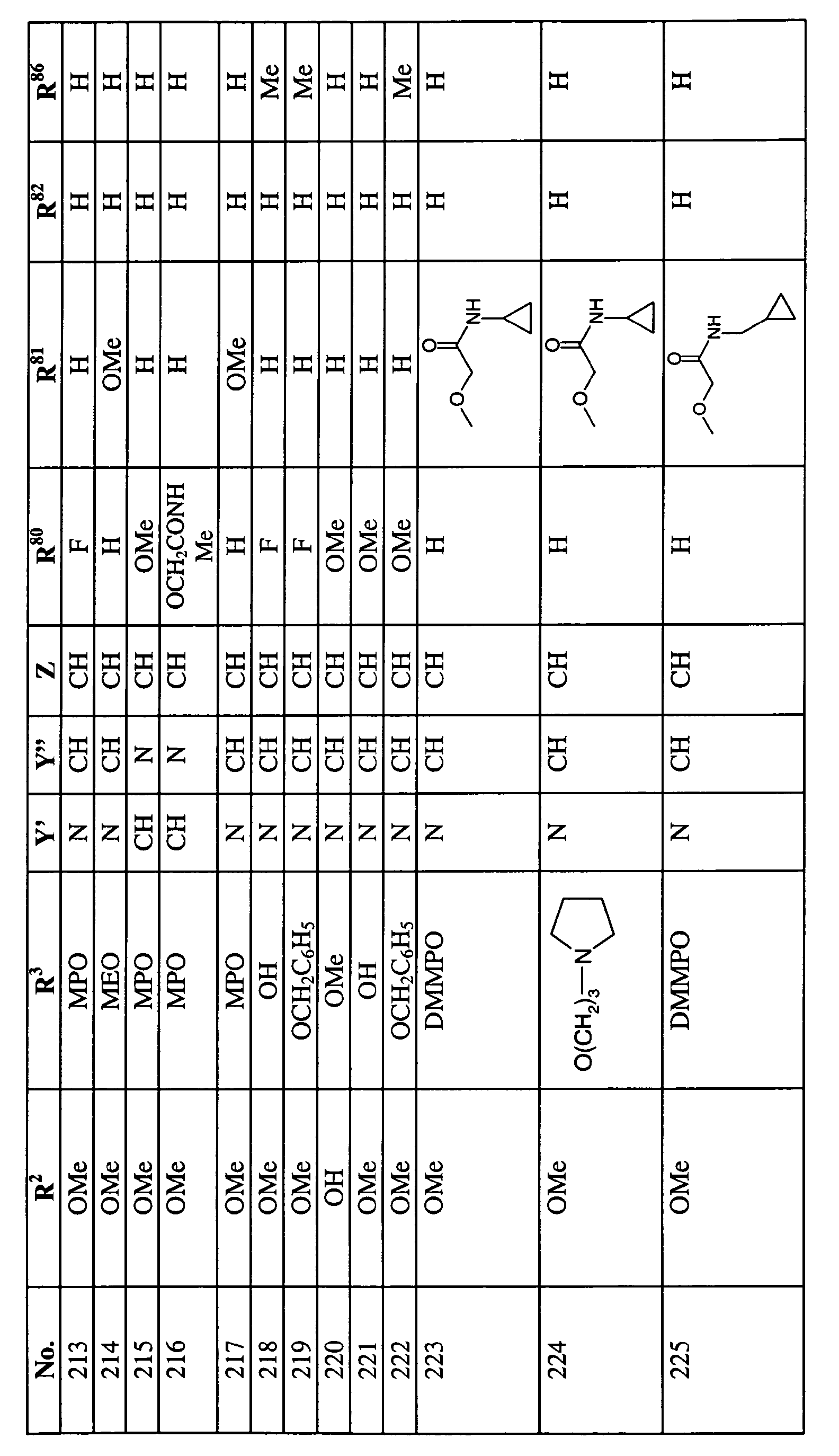


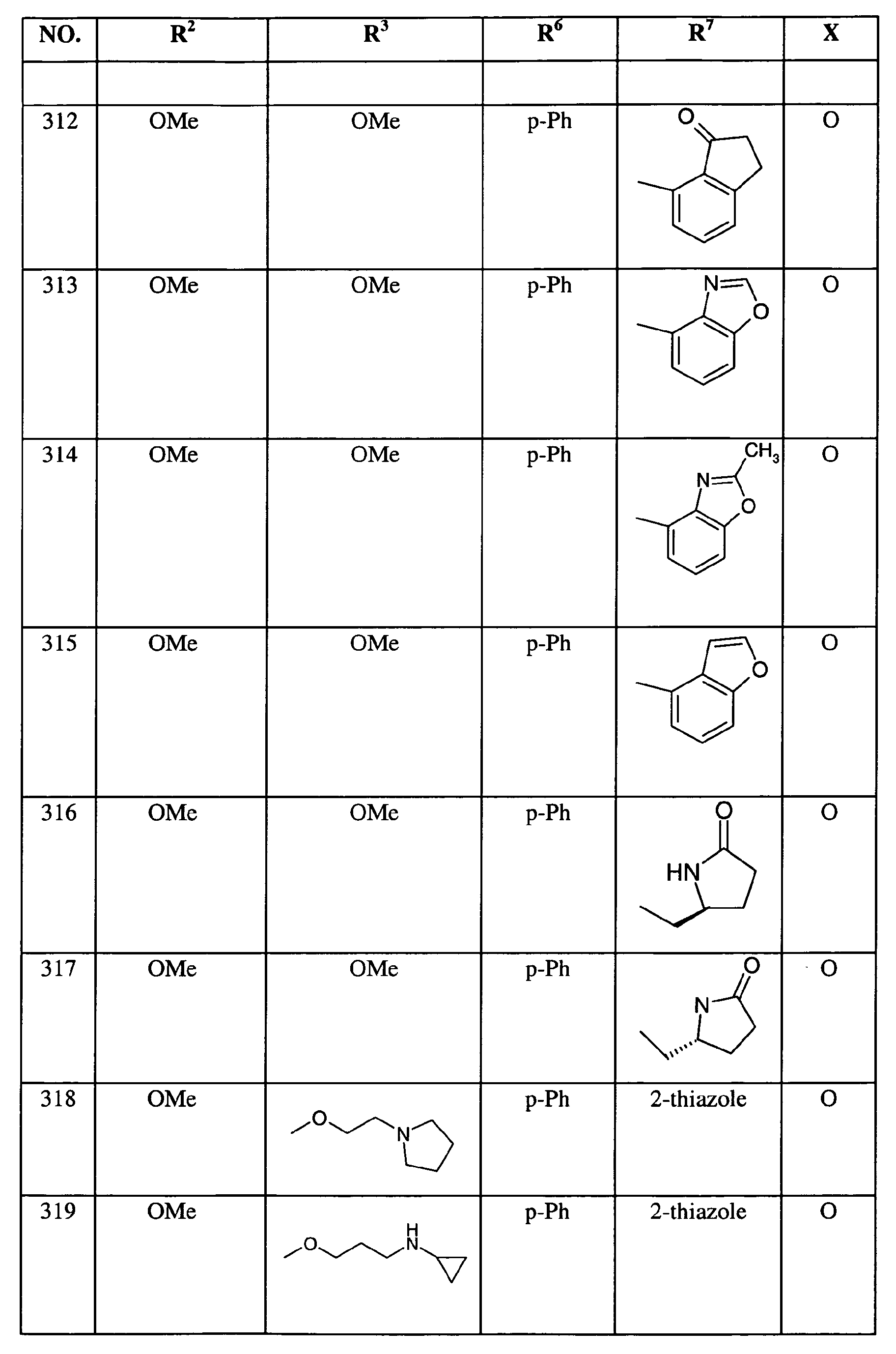 where p-Ph represents a para-phenylene group of formula

- Compounds of formula (I) are suitably prepared by reacting a compound of formula (III)where R1', R2', R3', R4' represent R1, R2, R3 and R4 respectively as defined in relation to formula (I) or a precursor thereof, and Z' is a leaving group, with a compound of formula (IV)
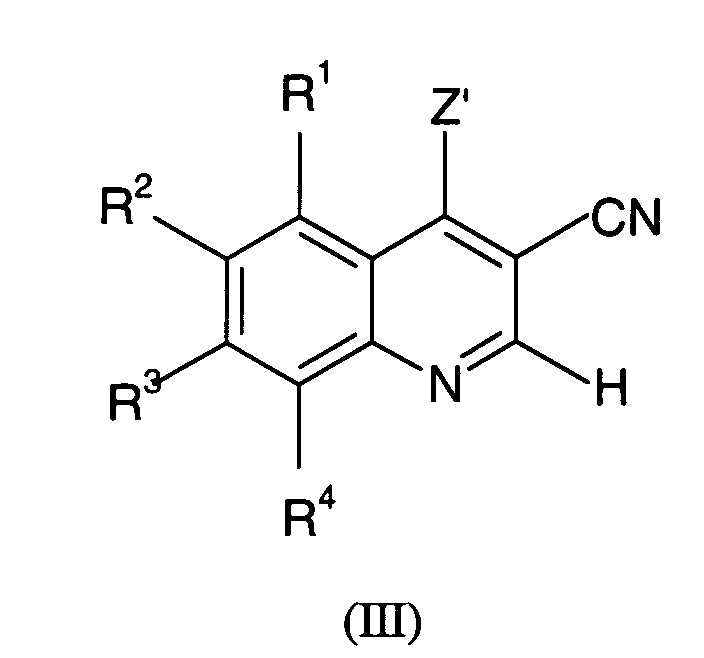
- Suitable leaving groups for Z' include halogen such as bromo or chloro, or a mesylate or tosylate group or a substituted phenoxy group.
- The reaction is suitably carried out in an organic solvent such as an alcohol for example propanol or cyclohexanol at elevated temperatures, for example of from 50 to 150°C, for example at about 105°C.
- Conversion reactions in which precursor groups R1', R2', R3', R4' are converted to groups of formula R1, R2, R3 and R4 respectively, or groups R1, R2, R3 and R4 are converted to different such group can be carried out using conventional chemistry as outlined hereinafter. Particular precursor groups R1', R2', R3', R4' are groups of formula R13'-X1-(CH2)x wherein x and X1 are as defined hereinafter, and R13' is C1-5alkyl which is substituted with halo other than fluoro, and in particular chloro or bromo. The chloro or bromo group may readily be converted into many other groups R13 as defined in relation to claim 1. Such compounds are novel and form a further aspect of the invention. They may have activity similar to that of compounds of formula (I) in their own right and therefore may be used in place of a compound of formula (I).
- Thus the invention further provides a compound of formula (IB)where Y, n, R6, X and R7 are as defined in claim 1 and at least one of R1", R2", R3" or R4" is a group R13'-X1-(CH2)x wherein X1 and x are as defined in claim 1 and R13' is alkyl substituted by chloro or bromo; and the remainder are groups R1, R2, R3 and R4 respectively.

- Similarly conversion reactions involving groups R7 may be effected using conventional chemistry. For example substitutent groups on a group R9 within the group R7 may be changed, for example by changing acids to esters or amides etc. Alternatively, compounds of formula (I) are prepared by reacting a compound of formula (V)where R1', R2', R3', R4' are as defined in relation to fomula (III) R6, X, Y and n are as defined in relation to formula (I), with a compound of formula (VI)

- The reaction is suitably carried out in an organic solvent such as DMF at elevated temperatures, for example of from 40 to 120°C, for example at about 80°C.
- Compounds of formula (III) and (V) are either known compounds or they can be prepared from known compounds by conventional methods, for example as described in WO 98/43960, WO 98/13350. Exemplary preparations of compounds of formula (III) are included hereinafter.
- Compounds of formula (IV) are also known compounds (see for example Rev. Chim. (Bucharest) (1988), 39(6), 477-82 and DD 110651: 74.01.05) or they can be prepared from known compounds using conventional methods. For example, where Y is NH, compounds of formula (IV) are suitably prepared by reduction of a compound of formula (VII)
- Compounds of formula (VI) are also known compounds or they can be prepared from known compounds by conventional methods.
- Compounds of the invention are useful in the inhibition of MEK enzyme activity and can be used in the treatment of proliferative disease. They will suitably be in the form of a pharmaceutical composition, in combination with a pharmaceutically acceptable carrier. Such compositions form a further aspect of the invention.
- The compositions of the invention may be in a form suitable for oral use (for example as tablets, lozenges, hard or soft capsules, aqueous or oily suspensions, emulsions, dispersible powders or granules, syrups or elixirs), for topical use (for example as creams, ointments, gels, or aqueous or oily solutions or suspensions), for administration by inhalation (for example as a finely divided powder or a liquid aerosol), for administration by insufflation (for example as a finely divided powder) or for parenteral administration (for example as a sterile aqueous or oily solution for intravenous, subcutaneous, intramuscular or intramuscular dosing or as a suppository for rectal dosing).
- The compositions of the invention may be obtained by conventional procedures using conventional pharmaceutical excipients, well known in the art. Thus, compositions intended for oral use may contain, for example, one or more colouring, sweetening, flavouring and/or preservative agents.
- Suitable pharmaceutically acceptable excipients for a tablet formulation include, for example, inert diluents such as lactose, sodium carbonate, calcium phosphate or calcium carbonate, granulating and disintegrating agents such as corn starch or algenic acid; binding agents such as starch; lubricating agents such as magnesium stearate, stearic acid or talc; preservative agents such as ethyl or propyl p-hydroxybenzoate, and anti-oxidants, such as ascorbic acid. Tablet formulations may be uncoated or coated either to modify their disintegration and the subsequent absorption of the active ingredient within the gastrointestinal tract, or to improve their stability and/or appearance, in either case, using conventional coating agents and procedures well known in the art.
- Compositions for oral use may be in the form of hard gelatin capsules in which the active ingredient is mixed with an inert solid diluent, for example, calcium carbonate, calcium phosphate or kaolin, or as soft gelatin capsules in which the active ingredient is mixed with water or an oil such as peanut oil, liquid paraffin, or olive oil.
- Aqueous suspensions generally contain the active ingredient in finely powdered form together with one or more suspending agents, such as sodium carboxymethylcellulose, methylcellulose, hydroxypropylmethylcellulose, sodium alginate, polyvinyl-pyrrolidone, gum tragacanth and gum acacia; dispersing or wetting agents such as lecithin or condensation products of an alkylene oxide with fatty acids (for example polyoxyethylene stearate), or condensation products of ethylene oxide with long chain aliphatic alcohols, for example heptadecaethyleneoxycetanol, or condensation products of ethylene oxide with partial esters derived from fatty acids and a hexitol such as polyoxyethylene sorbitol monooleate, or condensation products of ethylene oxide with long chain aliphatic alcohols, for example heptadecaethyleneoxycetanol, or condensation products of ethylene oxide with partial esters derived from fatty acids and a hexitol such as polyoxyethylene sorbitol monooleate, or condensation products of ethylene oxide with partial esters derived from fatty acids and hexitol anhydrides, for example polyethylene sorbitan monooleate. The aqueous suspensions may also contain one or more preservatives (such as ethyl or propyl p-hydroxybenzoate, anti-oxidants (such as ascorbic acid), colouring agents, flavouring agents, and/or sweetening agents (such as sucrose, saccharine or aspartame).
- Oily suspensions may be formulated by suspending the active ingredient in a vegetable oil (such as arachis oil, olive oil, sesame oil or coconut oil) or in a mineral oil (such as liquid paraffin). The oily suspensions may also contain a thickening agent such as beeswax, hard paraffin or cetyl alcohol. Sweetening agents such as those set out above, and flavouring agents may be added to provide a palatable oral preparation. These compositions may be preserved by the addition of an anti-oxidant such as ascorbic acid.
- Dispersible powders and granules suitable for preparation of an aqueous suspension by the addition of water generally contain the active ingredient together with a dispersing or wetting agent, suspending agent and one or more preservatives. Suitable dispersing or wetting agents and suspending agents are exemplified by those already mentioned above. Additional excipients such as sweetening, flavouring and colouring agents, may also be present.
- The pharmaceutical compositions of the invention may also be in the form of oil-in-water emulsions. The oily phase may be a vegetable oil, such as olive oil or arachis oil, or a mineral oil, such as for example liquid paraffin or a mixture of any of these. Suitable emulsifying agents may be, for example, naturally-occurnng gums such as gum acacia or gum tragacanth, naturally-occurring phosphatides such as soya bean, lecithin, and esters or partial esters derived from fatty acids and hexitol anhydrides (for example sorbitan monooleate) and condensation products of the said partial esters with ethylene oxide such as polyoxyethylene sorbitan monooleate. The emulsions may also contain sweetening, flavouring and preservative agents.
- Syrups and elixirs may be formulated with sweetening agents such as glycerol, propylene glycol, sorbitol, aspartame or sucrose, and may also contain a demulcent, preservative, flavouring and/or colouring agent.
- The pharmaceutical compositions may also be in the form of a sterile injectable aqueous or oily suspension, which may be formulated according to known procedures using one or more of the appropriate dispersing or wetting agents and suspending agents, which have been mentioned above. A sterile injectable preparation may also be a sterile injectable solution or suspension in a non-toxic parenterally-acceptable diluent or solvent, for example a solution in 1,3-butanediol.
- Suppository formulations may be prepared by mixing the active ingredient with a suitable non-irritating excipient which is solid at ordinary temperatures but liquid at the rectal temperature and will therefore melt in the rectum to release the drug. Suitable excipients include, for example, cocoa butter and polyethylene glycols.
- Topical formulations, such as creams, ointments, gels and aqueous or oily solutions or suspensions, may generally be obtained by formulating an active ingredient with a conventional, topically acceptable, vehicle or diluent using conventional procedure well known in the art.
- Compositions for administration by insufflation may be in the form of a finely divided powder containing particles of average diameter of, for example, 30µ or much less, the powder itself comprising either active ingredient alone or diluted with one or more physiologically acceptable carriers such as lactose. The powder for insufflation is then conveniently retained in a capsule containing, for example, 1 to 50mg of active ingredient for use with a turbo-inhaler device, such as is used for insufflation of the known agent sodium cromoglycate.
- Compositions for administration by inhalation may be in the form of a conventional pressurised aerosol arranged to dispense the active ingredient either as an aerosol containing finely divided solid or liquid droplets. Conventional aerosol propellants such as volatile fluorinated hydrocarbons or hydrocarbons may be used and the aerosol device is conveniently arranged to dispense a metered quantity of active ingredient.
- For further information on Formulation the reader is referred to Chapter 25.2 in Volume 5 of Comprehensive Medicinal Chemistry (Corwin Hansch; Chairman of Editorial Board), Pergamon Press 1990.
- The amount of active ingredient that is combined with one or more excipients to produce a single dosage form will necessarily vary depending upon the host treated and the particular route of administration. For example, a formulation intended for oral administration to humans will generally contain, for example, from 0.5 mg to 2 g of active agent compounded with an appropriate and convenient amount of excipients which may vary from about 5 to about 98 percent by weight of the total composition. Dosage unit forms will generally contain about 1 mg to about 500 mg of an active ingredient. For further information on Routes of Administration and Dosage Regimes the reader is referred to Chapter 25.3 in Volume 5 of Comprehensive Medicinal Chemistry (Corwin Hansch; Chairman of Editorial Board), Pergamon Press 1990.
- The size of the dose for therapeutic or prophylactic purposes of a compound of the Formula I will naturally vary according to the nature and severity of the conditions, the age and sex of the animal or patient and the route of administration, according to well known principles of medicine. As mentioned above, compounds of the Formula I are useful in treating diseases or medical conditions which are due alone or in part to the effects MEK enzymes.
- In using a compound of the Formula I for therapeutic or prophylactic purposes it will generally be administered so that a daily dose in the range, for example, 0.5 mg to 75 mg per kg body weight is received, given if required in divided doses. In general lower doses will be administered when a parenteral route is employed. Thus, for example, for intravenous administration, a dose in the range, for example, 0.5 mg to 30 mg per kg body weight will generally be used. Similarly, for administration by inhalation, a dose in the range, for example, 0.5 mg to 25 mg per kg body weight will be used. Oral administration is however preferred.
- In a further aspect, the invention provides a method of treating proliferative disease by administering a compound of formula (I) as described above, or a pharmaceutical composition as described above.
- Yet a further aspect of the invention provides the use of a compound of formula (I) as defined above, in the preparation of a medicament for use in the inhibition of MEK enzyme activitiy and in particular for the treatment of proliferative disease such as cancer.
- The invention will now be particularly described by way of Example. The preparation of various intermediates used in the Examples is described in the Preparations.
- These can be prepared for example using the following scheme where "Bz" represents benzyl.

- A mixture of (1) (10.36g., 45.3 mmole) and diethylethoxymethylene malonate (9mL, 45.3 mmole) was heated at 110°C for 1 hour and then allowed to cool overnight. The mixture was evaporated and the product (2) used in the next step without further purification.
Mass Spectrum m/e 400 (M++H). - A mixture of (2) (assumed 45.3 mmole) and phosphoryl chloride (83.3mL, 906 mmole) was heated at 115°C for 18 hours. After cooling, the solution was evaporated to remove excess phosphoryl chloride. The residue was treated with ice and aqueous ammonia to hydrolyse the remaining phosphoryl chloride. The solid product was filtered off and dried in a vacuum oven to give a cream coloured solid, 9.0g (53% yield).
Mass Spectrum m/e 372 (M++H). - A mixture of (3) (9.0g, 24.2 mmole) was stirred in ethanol (48.3mL) for 15 minutes at ambient temperature to give a smooth suspension. Aqueous sodium hydroxide solution (2.0M, 48.3mL, 96.7 mmole) was added and the mixture stirred for 18 hours at ambient temperature. The ethanol was removed by rotary evaporation and the resulting solution was acidified to pH 2 with hydrochloric acid while stirring. The precipitate was filtered off and dried in a vacuum oven to give an orange solid, 7.19g (86% yield).
Mass Spectrum m/e 344 (M++H). - A mixture of (4) (7.18g, 20.9 mmole) and thionyl chloride (90 mL) was refluxed for 2 hours. After cooling the excess thionyl chloride was removed by rotary evaporation and the residue was suspended in acetone (175mL) and the resulting suspension cooled in an ice-bath. Aqueous ammonia (S.G. 0.880, 20mL) was added gradually, keeping the temperature below 10°C. The resulting suspension was filtered off, washed with water and air-dried to give a solid, 5.15g (75% yield).
Mass Spectrum m/e 343 (M++H). - A mixture of (5) (20.55g, 60 mmole) and phosphoryl chloride (250mL) was heated and stirred at 120°C for 4 hours when the starting material had dissolved. Heating and stirring was continued at 110°C for 18 hours. After cooling, the solution was evaporated to remove excess phosphoryl chloride. Last traces of phosphoryl chloride were removed by azeotroping with toluene. The residue was treated with ice and aqueous ammonia to remove acidity. The solid product was filtered off and dried in a vacuum oven to give a grey solid, 19.23g (99% yield).
(This may also be prepared as described in WO 9843960)
Mass Spectrum m/e 325 (M++H). - A mixture of (6) (19.23g, 60.0 mmole) and trifluoroacetic acid (300 mL) and thioanisole (35mL) was refluxed in a nitrogen atmosphere for 3 hours. After cooling the trifluoroacetic acid was removed by rotary evaporation and the oily residue was stirred with ice and water and basified with aqueous ammonia (S.G. 0.880). The resulting suspension was filtered and the solid was washed successively with water, ethyl acetate and diethyl ether and then dried to give a khaki solid, 13.74g (97% yield).
Mass Spectrum m/e 235 (M++H). - A mixture of (7) (2.34g, 10.0 mmole) and 1-(3-chloropropyl)morpholine (2.45g, 15.0 mmole) and anhydrous potassium carbonate (2.07g, 15.0 mmole) suspended in butanone (150mL) was stirred in a oil-bath at 88°C for 96 hours. The suspension was filtered hot to remove inorganics and the filtrate was allowed to cool and then evaporated to ca. 100mL. A solid precipitated on standing for 72 hours. The solid was filtered off and washed with a little acetone and then dried to give a white solid, 0.54g (15% yield).
Mass Spectrum m/e 362 (M++H). - By similar processes the following analogues were also prepared:-
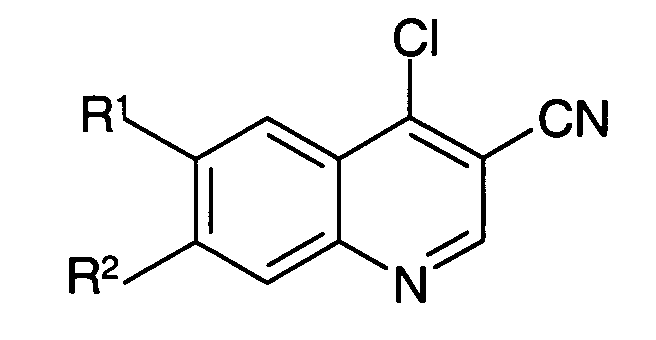


- A mixture of 4-chloro-3-cyano-6,7-dimethoxyquinoline (1.5 g), prepared as described in WO 9843960, and 4-(2-methoxyphenoxy)-aniline (2.58 g), prepared as described in Rev. Chim. (Bucharest) (1988), 39(6),477-82, in 1-propanol (90 ml) was stirred and heated at 105°C for 6 hours. The mixture was cooled to ambient temperature and then filtered. The crystals were washed with a small volume of 1-propanol and then dried to give 4-(2-methoxyphenoxy)-anilino-3-cyano-6,7-dimethoxyquinoline (Compound 1 in Table 1) (2.19 g, 85%).
Mass Spectrum m/e 428 (M++H).
NMR Spectrum (d-6-DMSO, d values) 3.75 (s, 3H), 4.00 (s, 6H), 6.95 (m, 3H), 7.05 (m, 1H), 7.20 (m, 2H), 7.40 (d, 2H), 7.50 (s, 1H), 8.20 (s, 1H), 8.85 (s, 1H), 11.10 (broad, 1H). - A mixture of 4-chloro-3-cyano-6,7-dimethoxy-quinoline (2.49 g) and 4-aminophenol (2.4 g) in n-propanol (150 ml) was stirred and heated at 110°C for 4 hours. The mixture was cooled to ambient temperature and then filtered. The crystals were washed with a small volume of diethyl ether and then dried to give 3-cyano-6,7-dimethoxy-4-(4-hydroxy)-anilino-quinoline (2.68 g, 83%).
Mass Spectrum m/e 322 (M++H).
NMR Spectrum (d-6-DMSO, d values) 3.85 (s, 3H), 3.9 (s, 3H), 6.8 (d, 2H), 7.1 (d, 2H), 7.25 (s, 1H), 7.8 (s, 1H), 8.3 (s, 1H), 9.3 (broad s, 1H). - 3-Cyano-6,7-dimethoxy-4-(4-hydroxy)-anilino-quinoline (160.5 mg) was dissolved in DMF (5 ml) and potassium carbonate (138 mg) was added. The mixture was stirred under an atmosphere of nitrogen for 5 minutes and then 2-bromomethyl-tetrahydrofuran (180 ml) was added. The mixture was stirred and heated at 80°C for 18 hours. The mixture was cooled to ambient temperature and then diluted with ethyl acetate and then extracted with water. The aqueous phase was re-extracted with ethyl acetate and the combined organic extracts were washed with brine, dried (Na2SO4) and evaporated. The residue was then purified by column chromatography using 2-3% methanol/dichloromethane mixtures as eluent. There was thus obtained 3-cyano-6,7-dimethoxy-4-(2-tetrahyrofuranyl-methoxy)-anilino-quinoline (70 mg, 34%).
Mass Spectrum m/e 406 (M++H).
NMR Spectrum (CDCl3, d values) 1.8 (m, 1H), 1.95 (m, 2H), 2.05 (m, 1H), 3.6 (s, 3H), 3.85 (dd, 1H), 3.9 (m, 1H), 3.95 (m, 1H), 4.0 (s, 3H), 4.25 (m, 1H), 6.8 (broad s, 1H), 6.85 (s, 1H), 6.95 (d, 2H), 7.1 (d, 2H), 7.35 (s, 1H), 8.6 (s, 1H). - By an analogous procedure to that described for Example 2, step 2, but using an alternative bromide, the compounds listed in Table 5 were prepared:
No bromide mass spec nmr Notes 250 2-bromomethyltetrahydropyran m/e 420 (M++H) (d-6-DMSO, d values) 1.2-1.7 (m, 6H), 3.40 (m, 1H), 3.60 (m, 1H), 3.90 (s, 3H), 3.90 (s, 3H), 3.9 (m, 3H), 6.95 (d, 2H), 7.20 (d, 2H), 7.25 (d, 1H), 7.75 (d, 1H), 8.30 (d, 1H), 9.35 (broad s, 1H). 251 epibromohydr in m/e 378 (M++H) (d-6-DMSO, d values) 2.70 (dd, 1H), 2.83 (dd, 1H), 3.35 (m, 1H), 3.85 (dd, 1H), 3.90 (s, 3H), 3.95 (s, 3H), 4.35 (dd, 1H), 7.00 (d, 2H), 7.20 (d, 2H), 7.26 (s, 1H), 7.75 (s, 1H), 8.30 (s, 1H), 9.35 (broad s, 1H). RT/ 48hrs/ DMF/ K2CO3 252 2-bromomethyl-1,3-dioxolane m/e 408 (M++H) (CDCl3, d values) 3.60 (s, 3H), 3.95 (m, 3H), 4.00 (s, 3H), 4.05 (m, 3H), 5.30 (t, 1H), 6.80 (broad s, 1H), 6.85 (s, 1H), - 6.95 (d, 2H), 7.15 (d, 2H), 7.35 (s, 1H), 8.60 (s, 1H). - By an analogous procedure to that described for Example 2, step 2, but using a tosylate instead of a bromide, the following compounds were prepared.
No intermediate mass nmr 254 2,2-dimethyl-4-(4-toluenesulphonylo xymethyl)-1,3-dioxolane m/e 436 (M++H) . (CDCl3, d values) 1.4 (s, 3H), 1.45 (s, 3H), 3.65 (s, 3H), 3.90 (dd, 1H), 3.95 (m, 1H), 4.00 (s, 3H), 4.05 (m, 1H), 4.15 (dd, 1H), 4.50 (m, 1H), 6.80 (broad s, 1H), 6.90 (s, 1H), 6.95 (d, 2H), 7.10 (d, 2H), 7.35 (s, 1H), 8.60 (s, 1H). 255 4-(4-toluenesulphonylo xymethyl)-1,3-dioxolane m/e 408 (M++H) (CDCl3, d values) 3.60 (s, 3H), 3.85 (m, 1H), 3.95 (m, 1H), 4.00 (s, 3H), 4.05 (m, 2H), 4.40 (m, 1H), 4.95 (s, 1H), 5.10 (s, 1H), 6.80 (broad s, 1H), 6.85 (s, 1H), 6.95 (d, 2H), 7.10 (d, 2H), 7.35 (s, 1H), 8.60 (s, 1H). 256 5-bromo-5-(4-toluenesulphonylo xymethyl)-1,3-dioxane m/e 436 (M++H) (CDCl3, d values) 0.95 (s, 3H), 3.50 (d, 2H), 3.65 (s, 3H), 4.00 (d, 2H), 4.00 (s, 3H), 4.10 (s, 1H), 4.70 (d, 1H), 5.00 (d, 1H), 6.80 (broad s, 1H), 6.85 (s, 1H), 6.95 (d, 2H), 7.15 (d, 2H), 7.35 (s, 1H), 8.60 (s, 1H). - Using a method analogous to that described in Example 1 (except that in some instances, intermediates (1) and (2) were modified prior to further reaction as described in Examples 14 and 15 hereinafter) i.e. as set out in the following scheme:but with the appropriate aniline intermediate (2) (where (R30)m are substitutents R20, R21, R22, R23 and R24 are as set out in Table 1) and quinoline where R2 and R3 are as defined in Table 1, the following compounds set out in Table 7 were prepared.


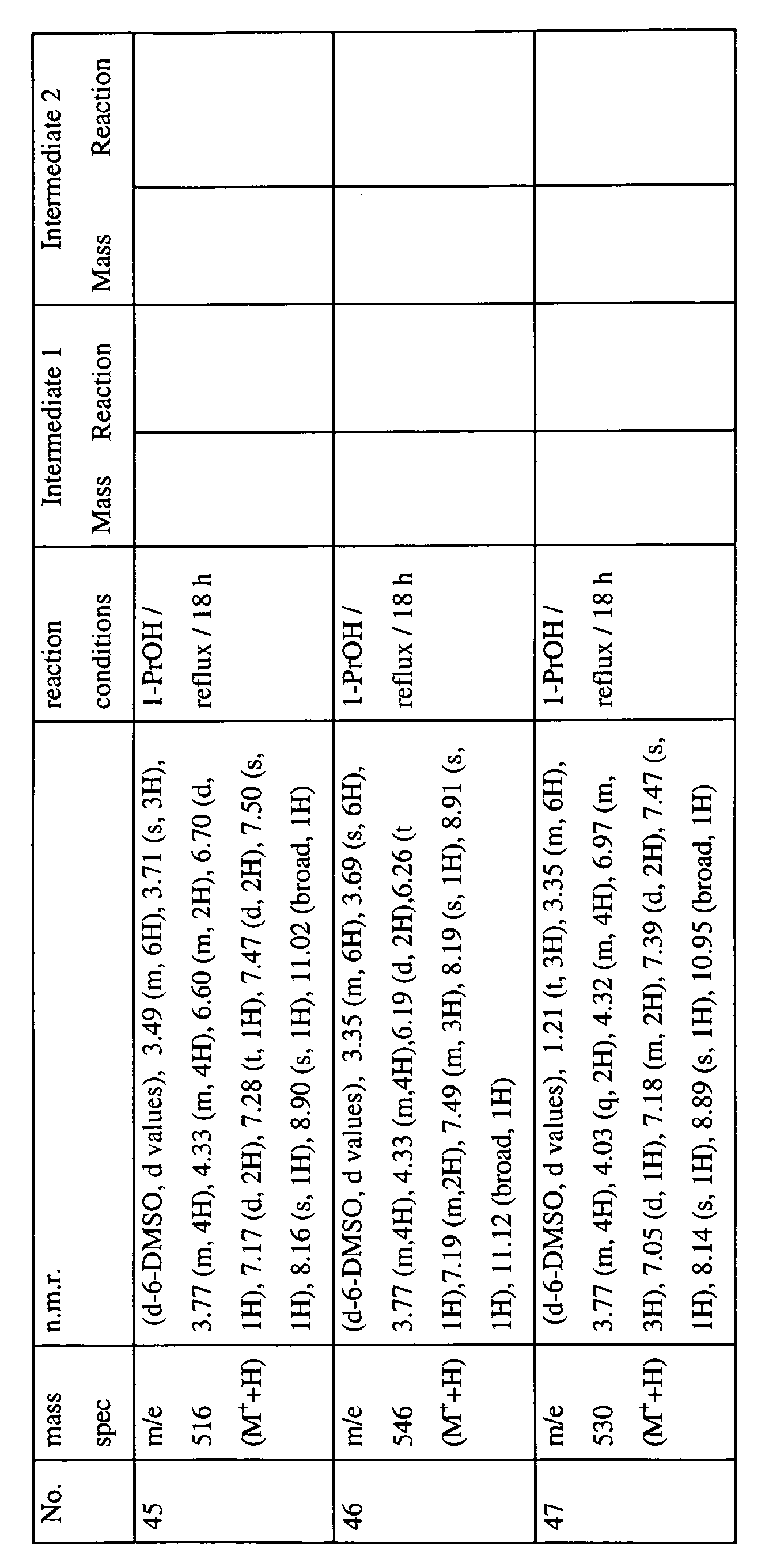
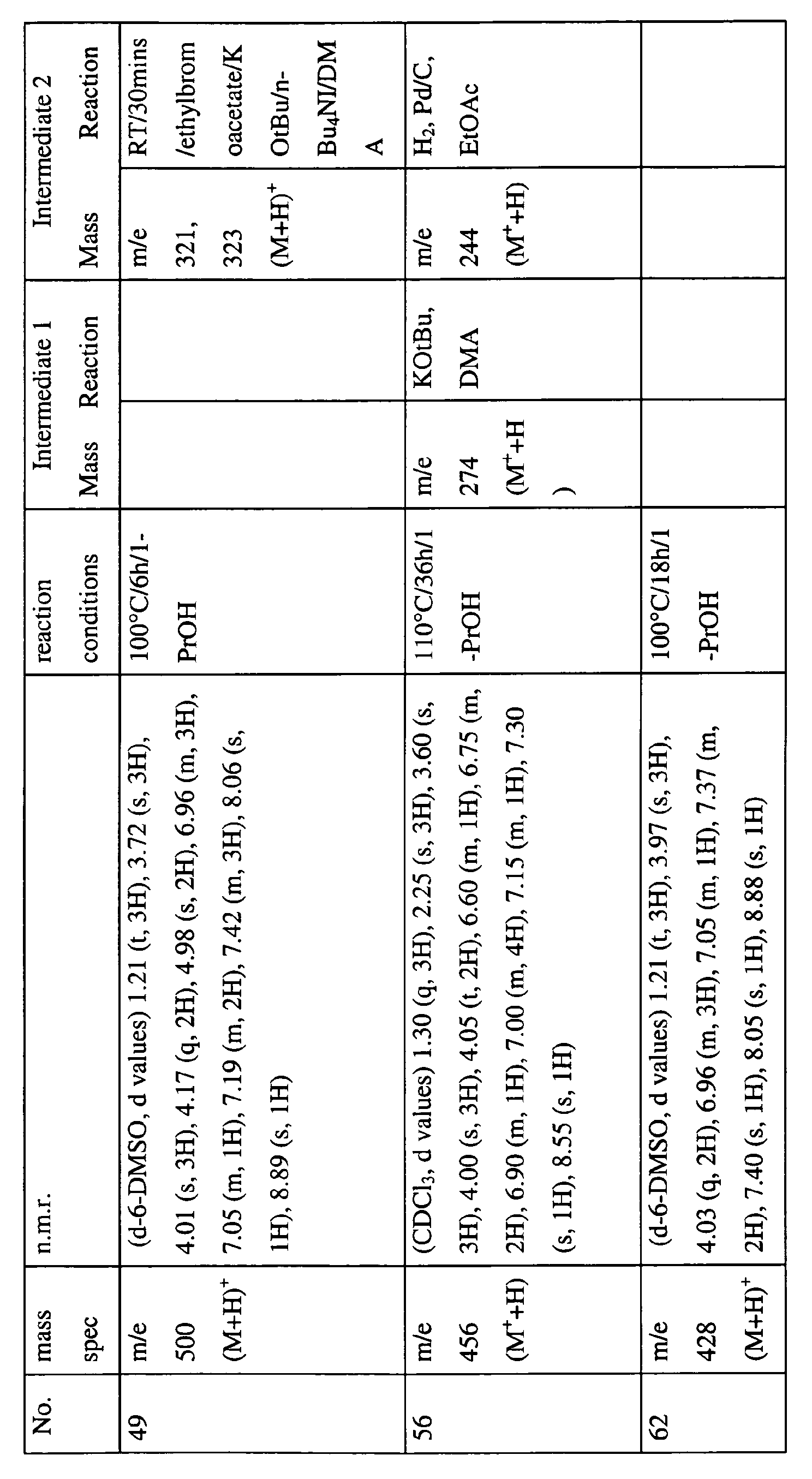
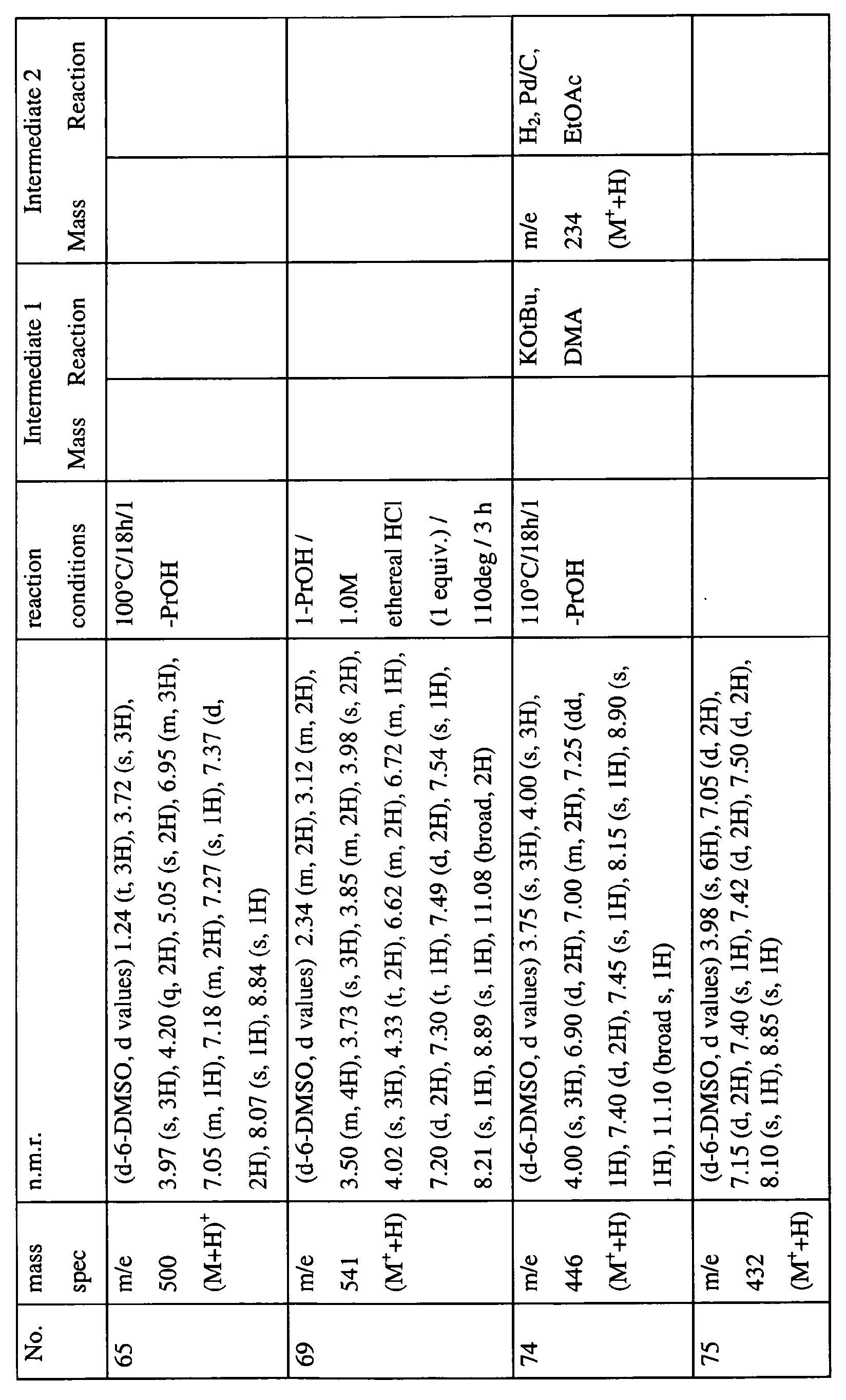


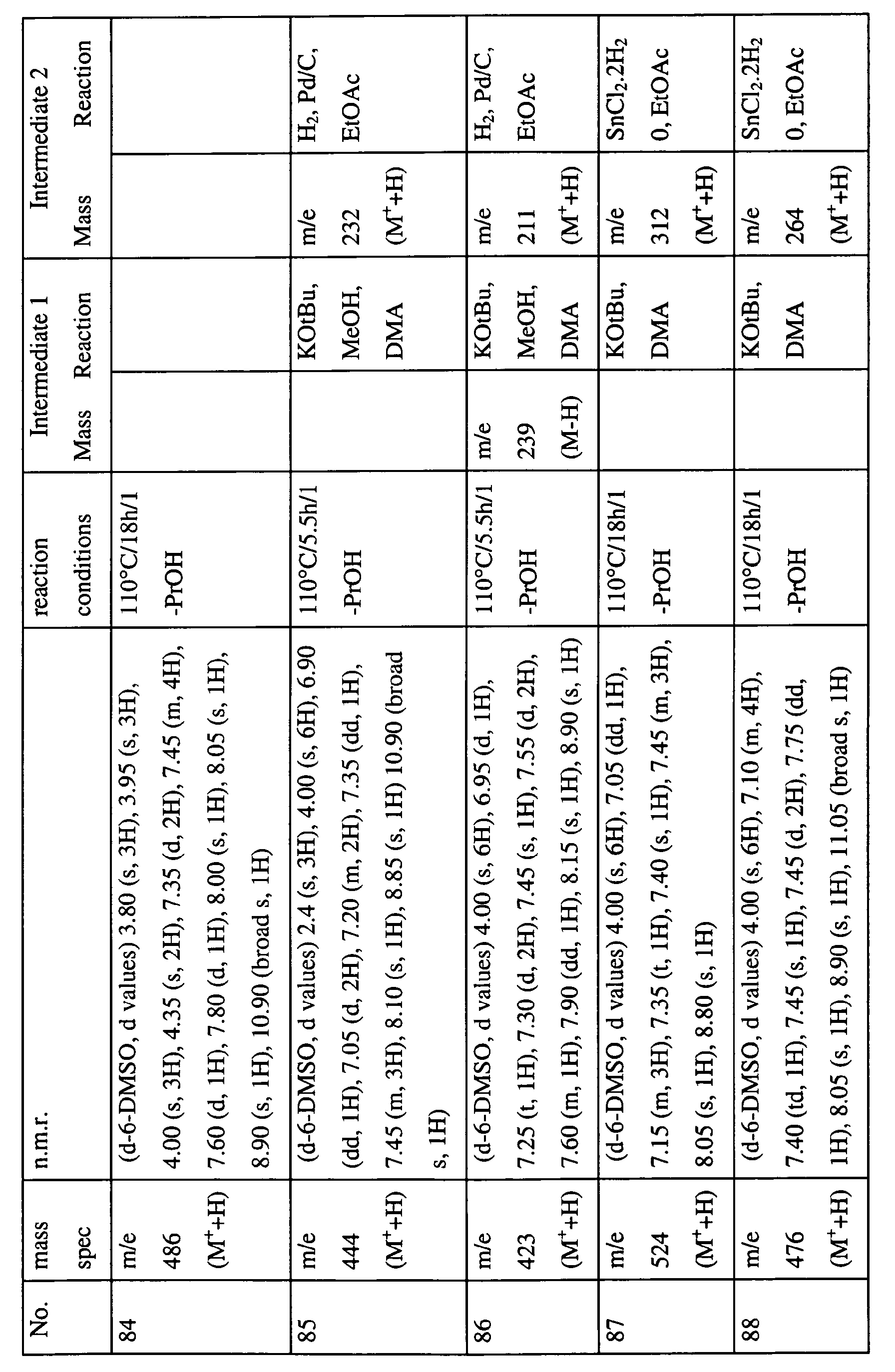


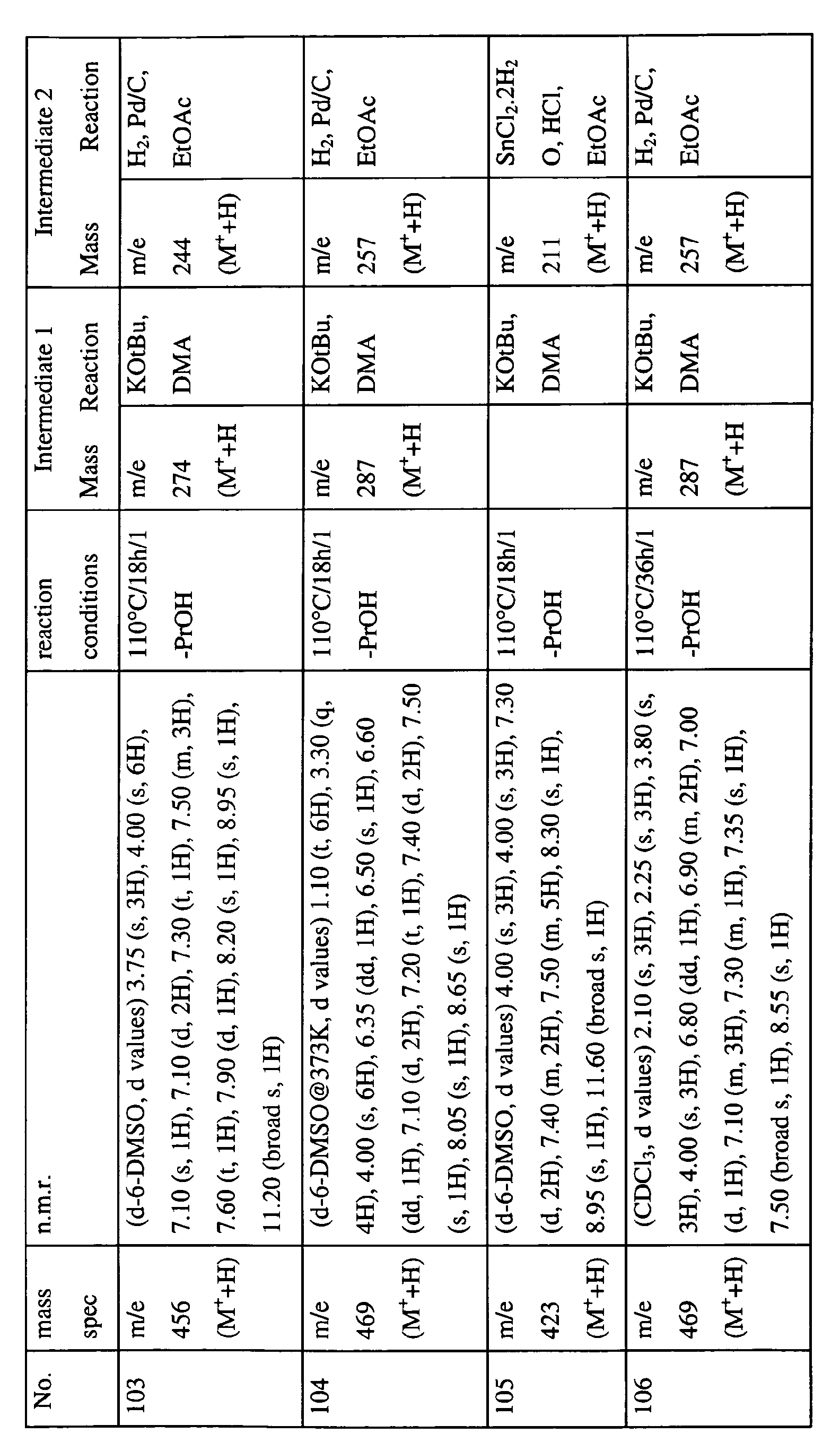


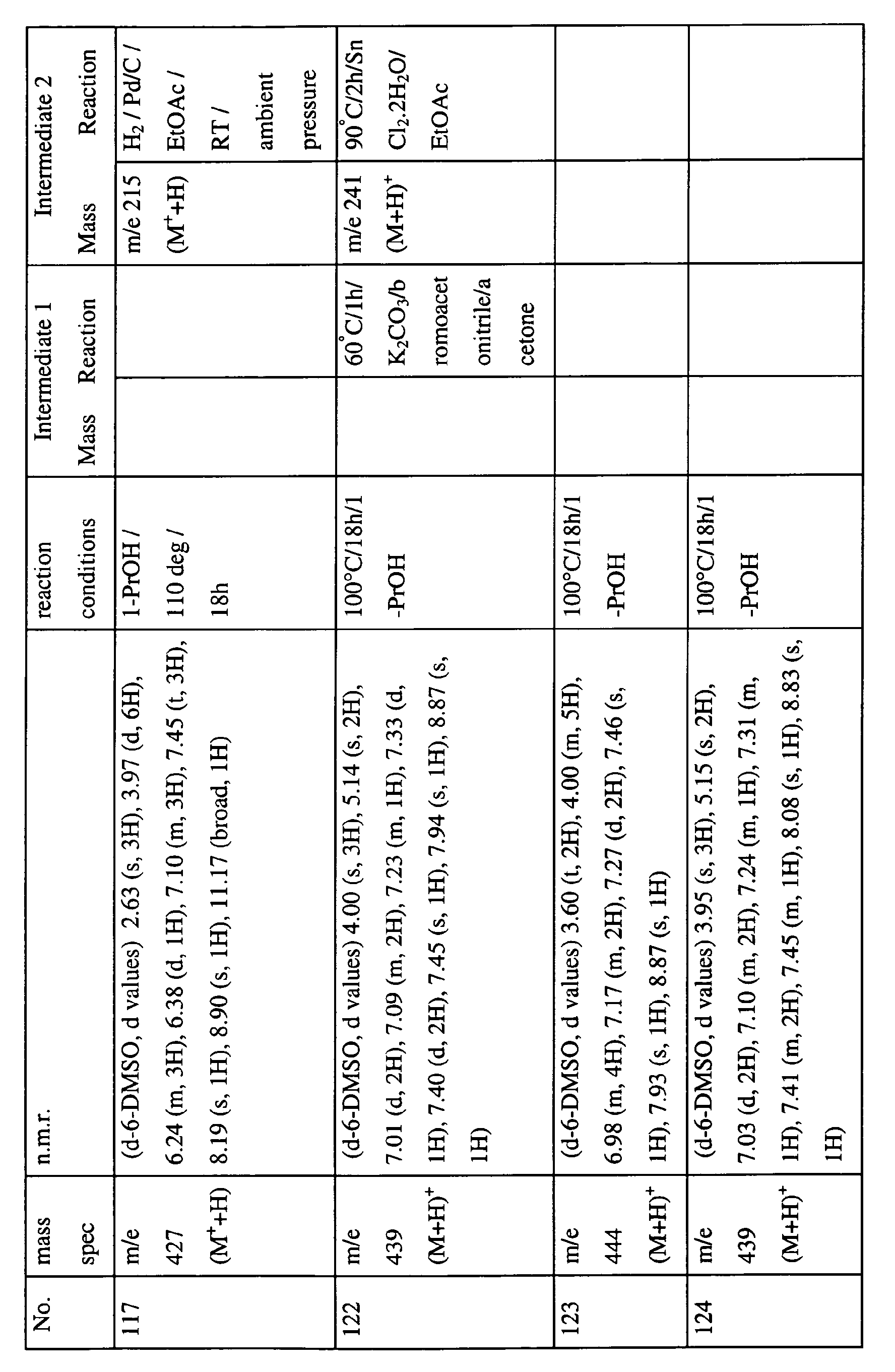
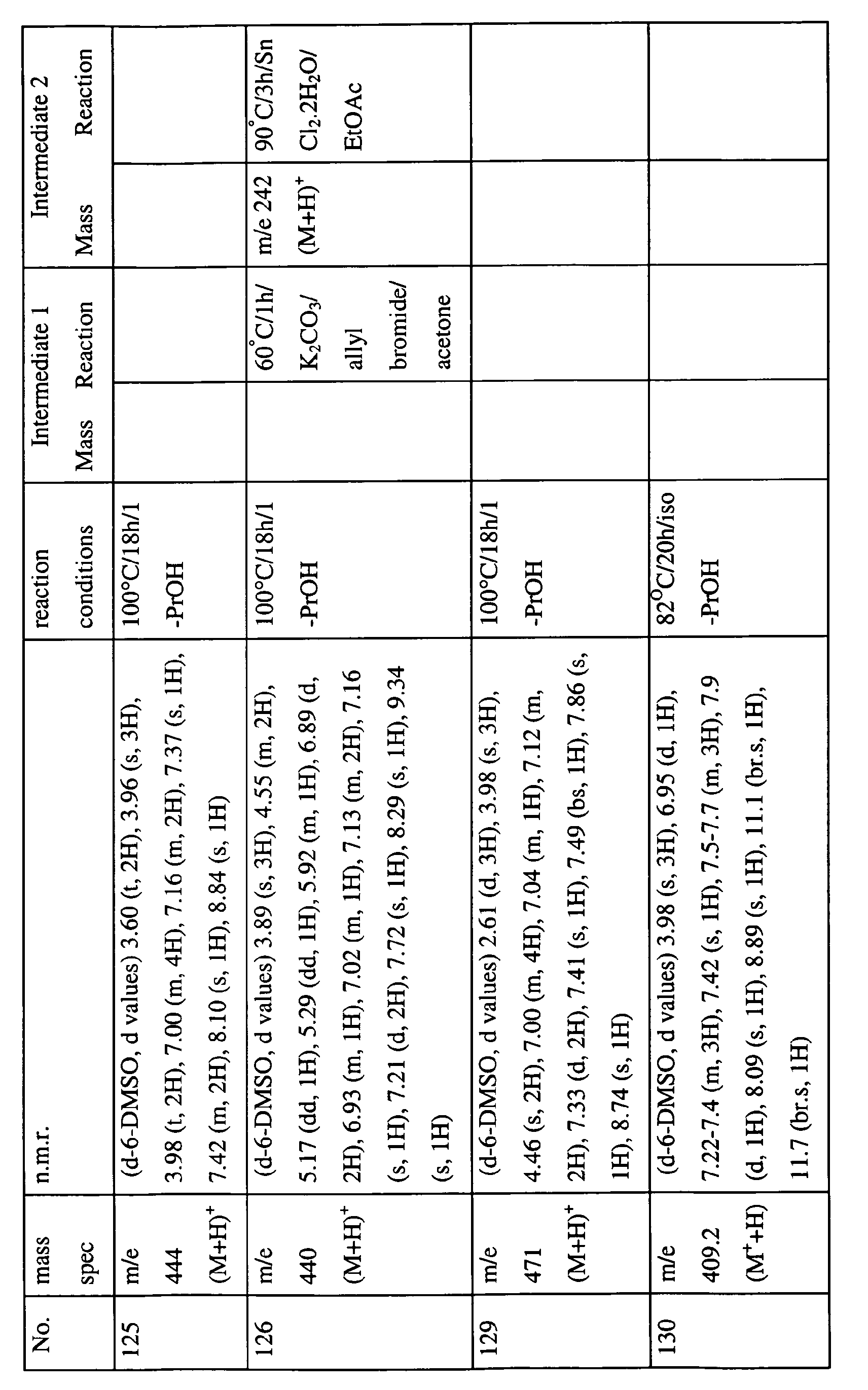
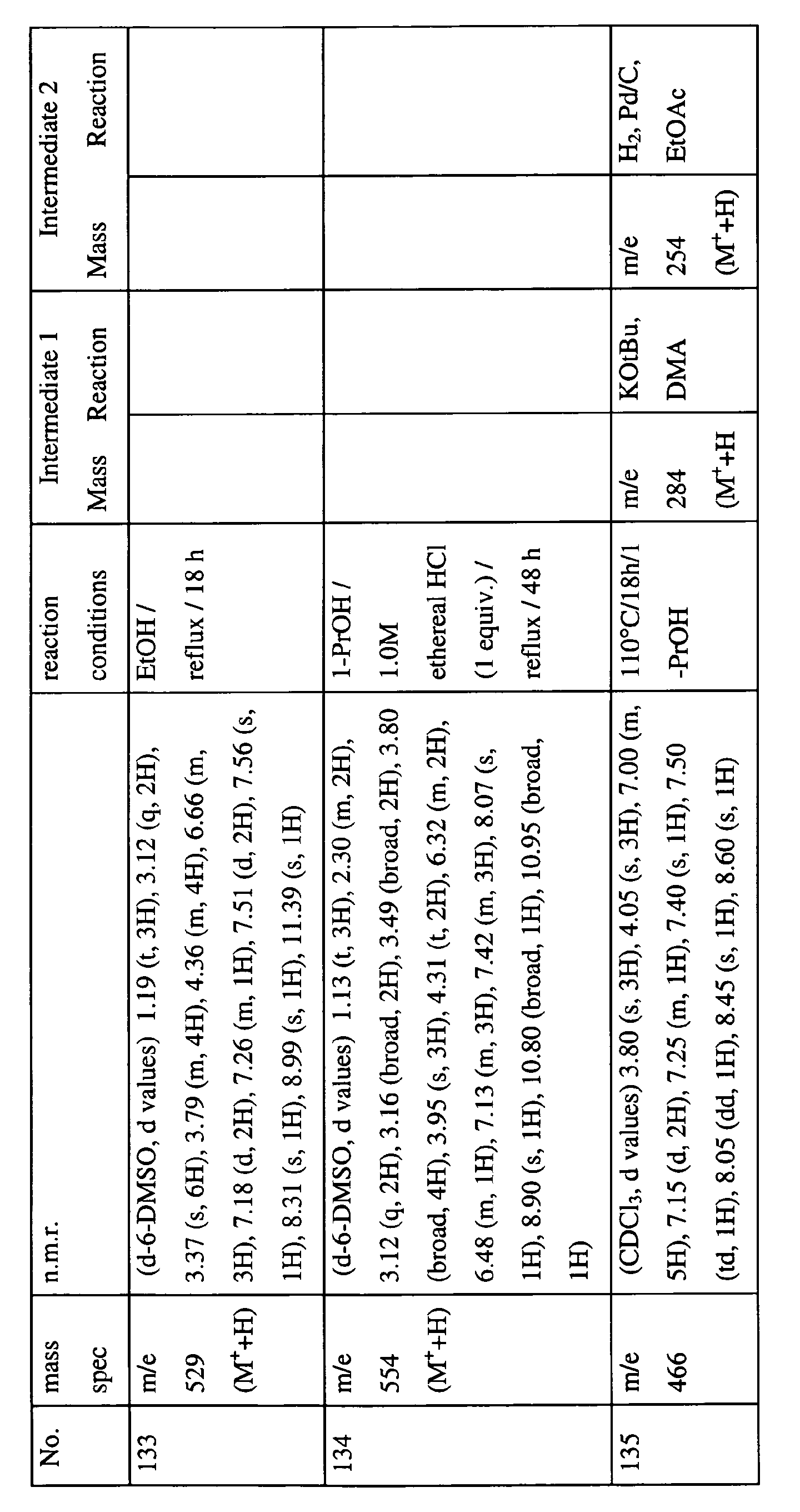
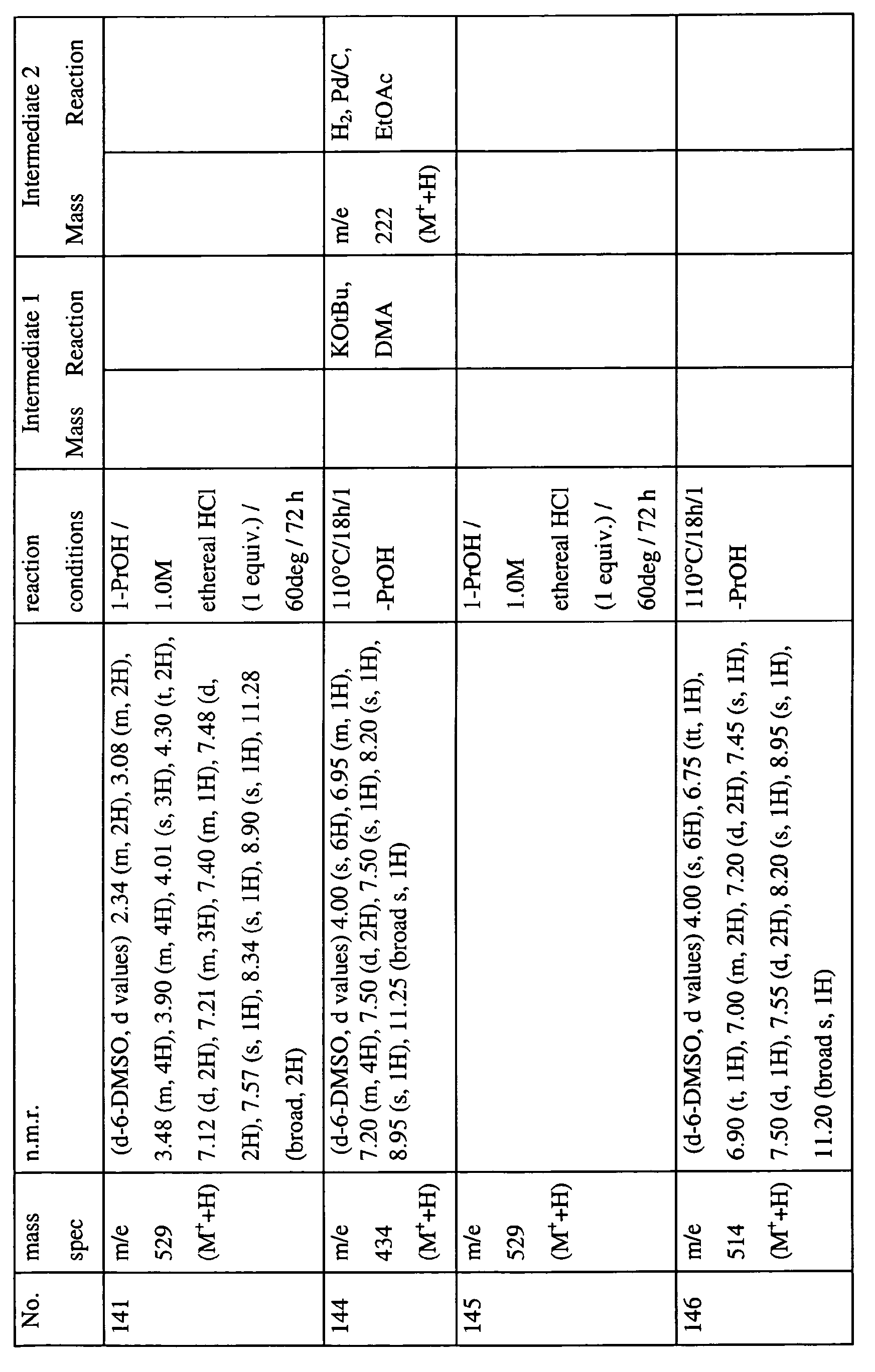
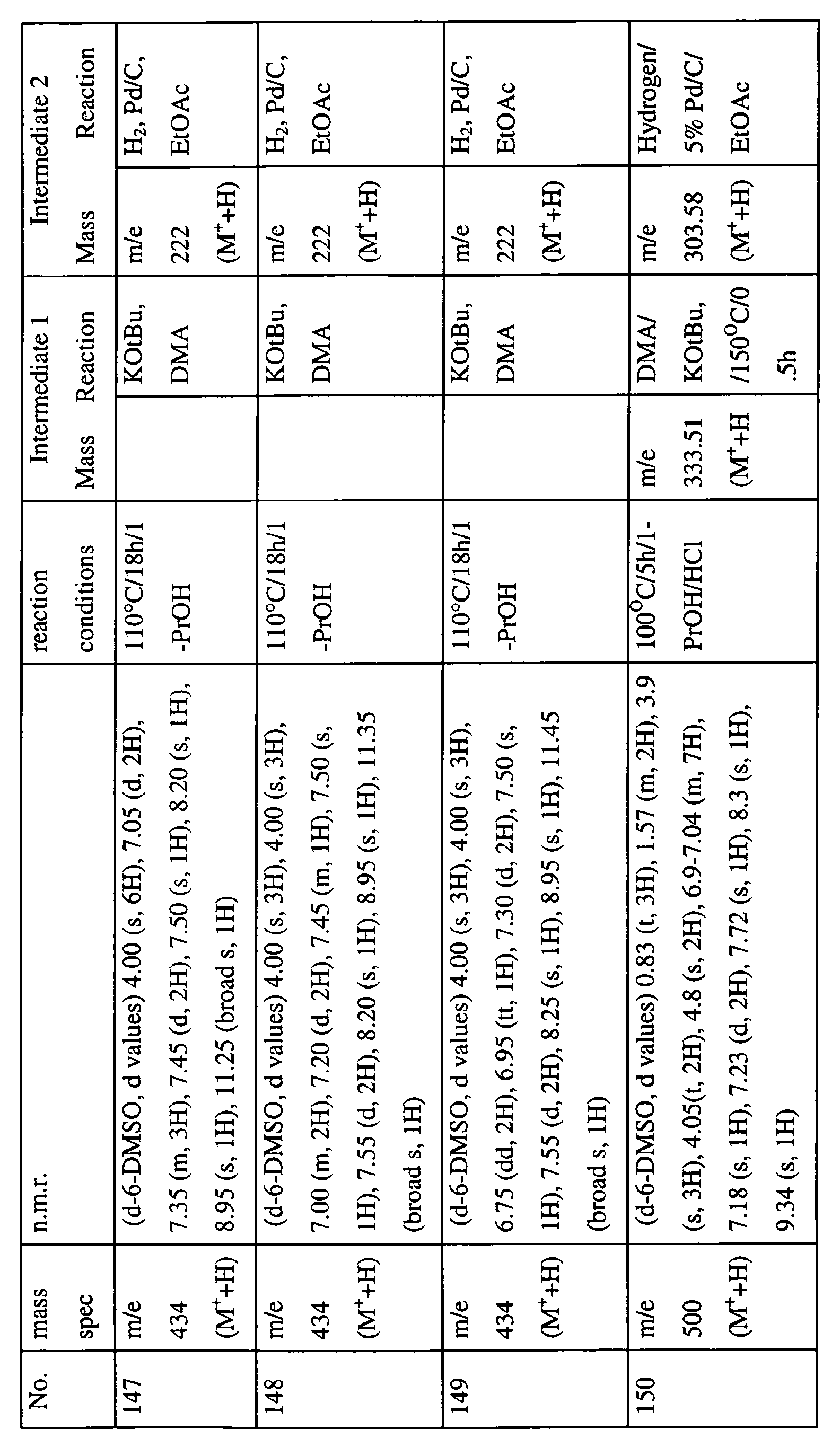
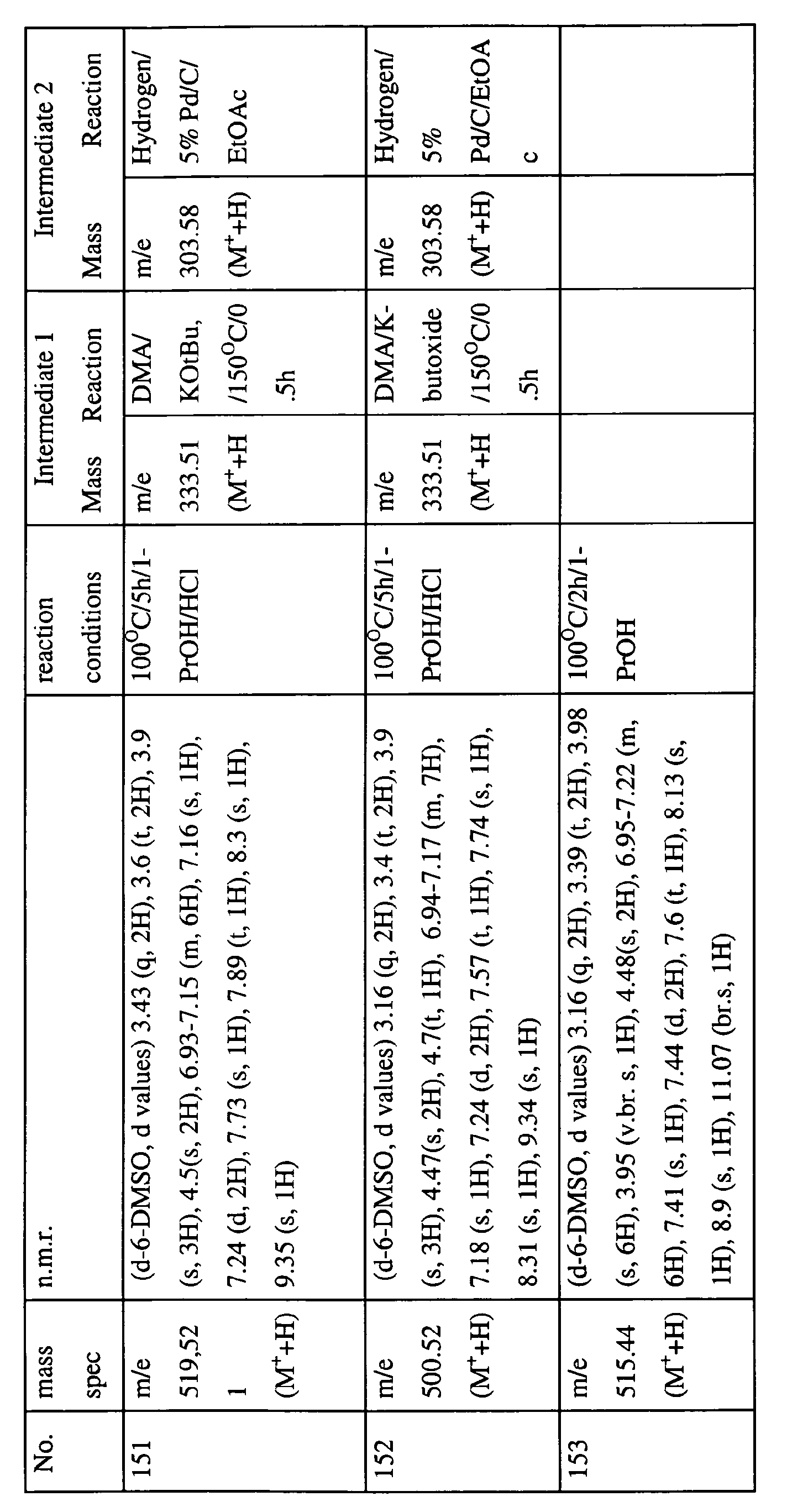


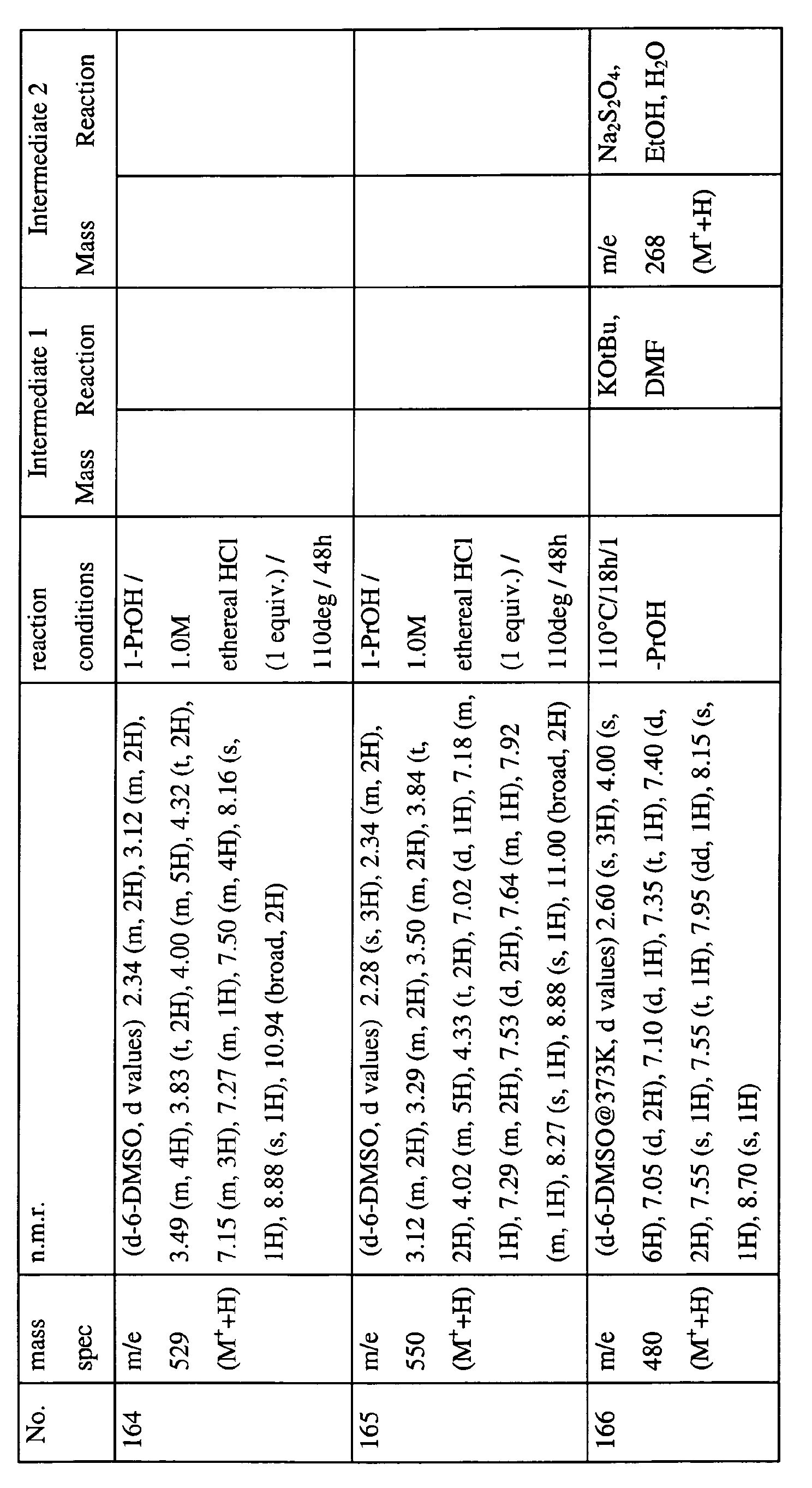

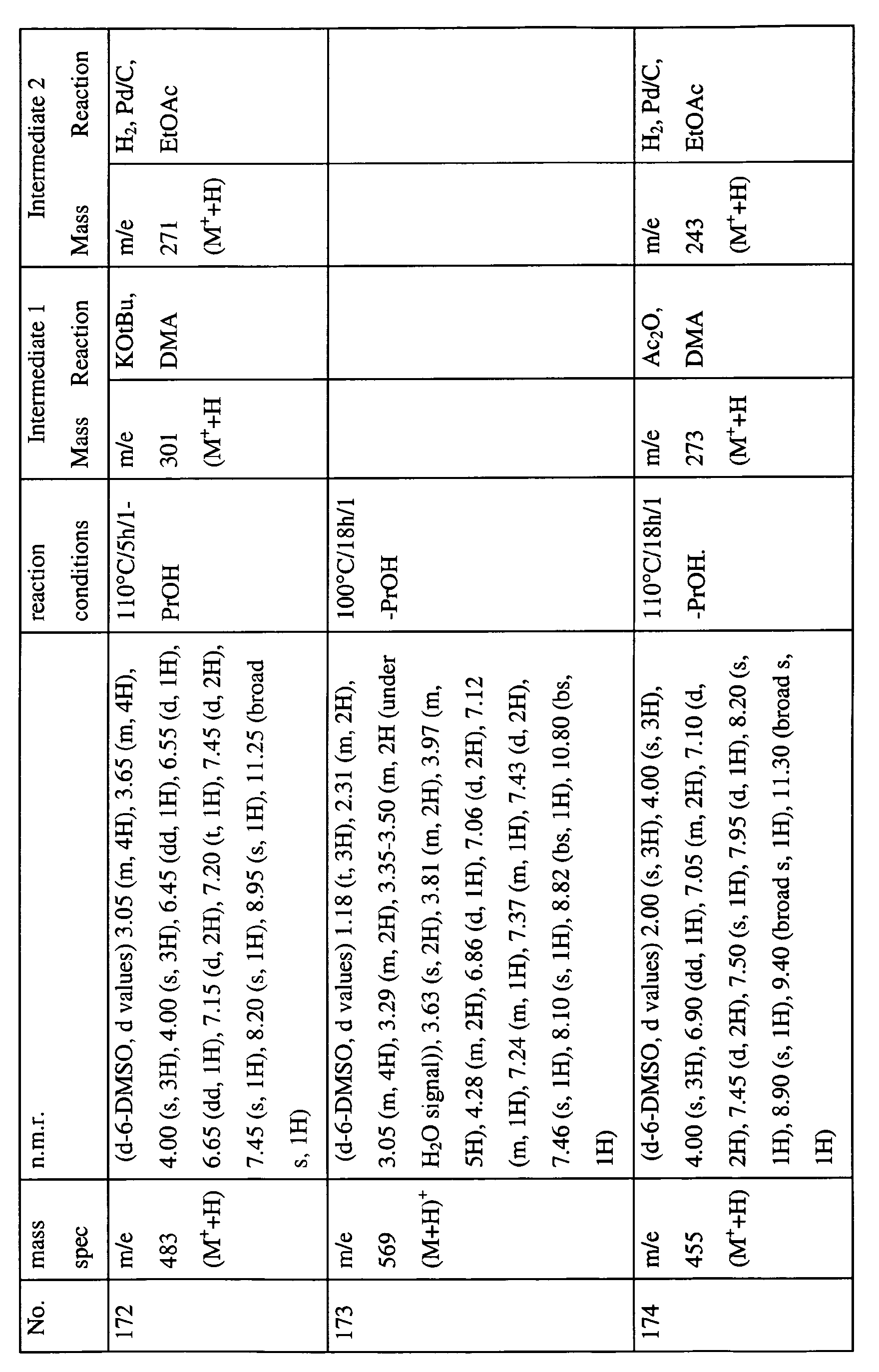
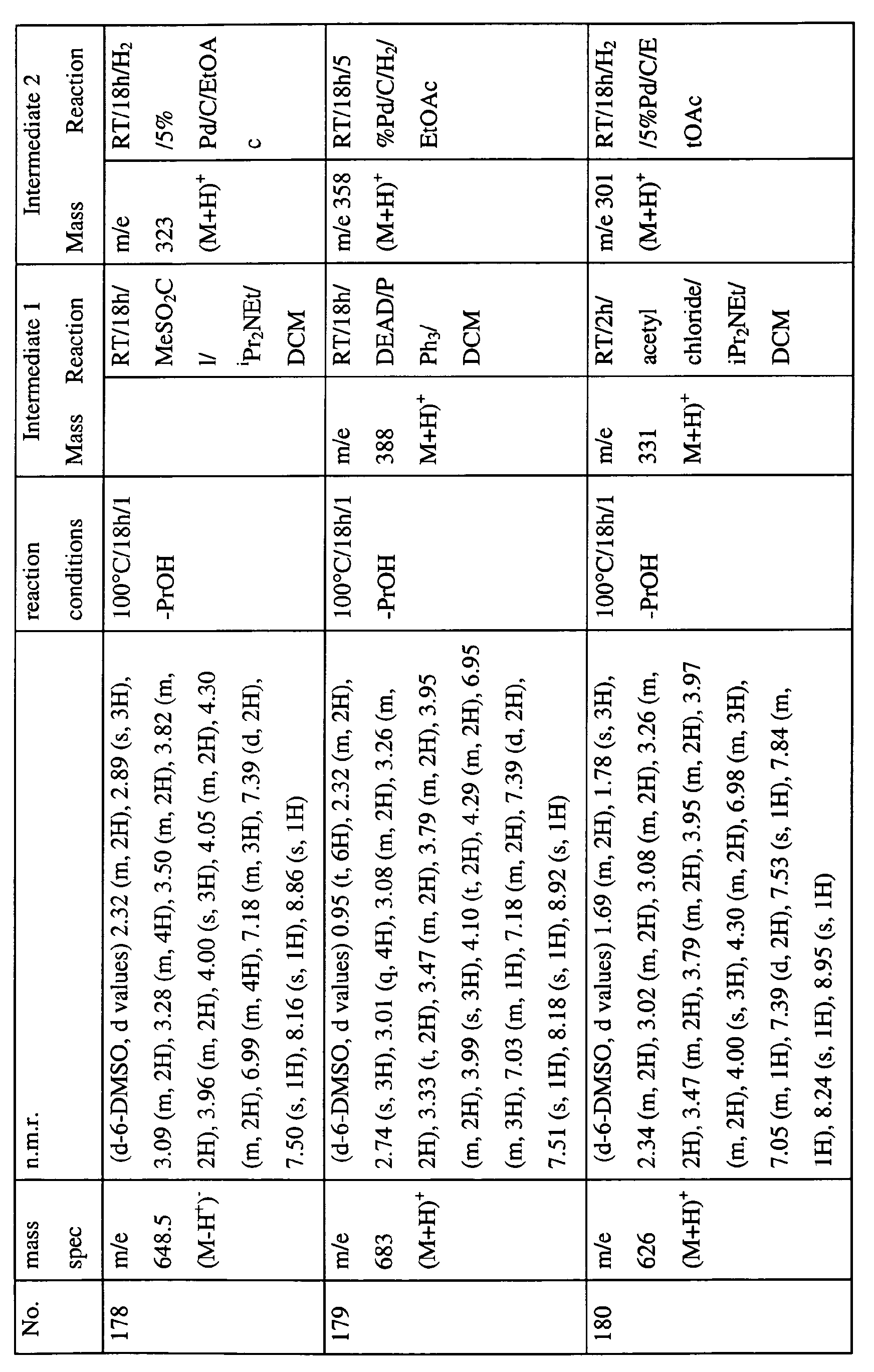
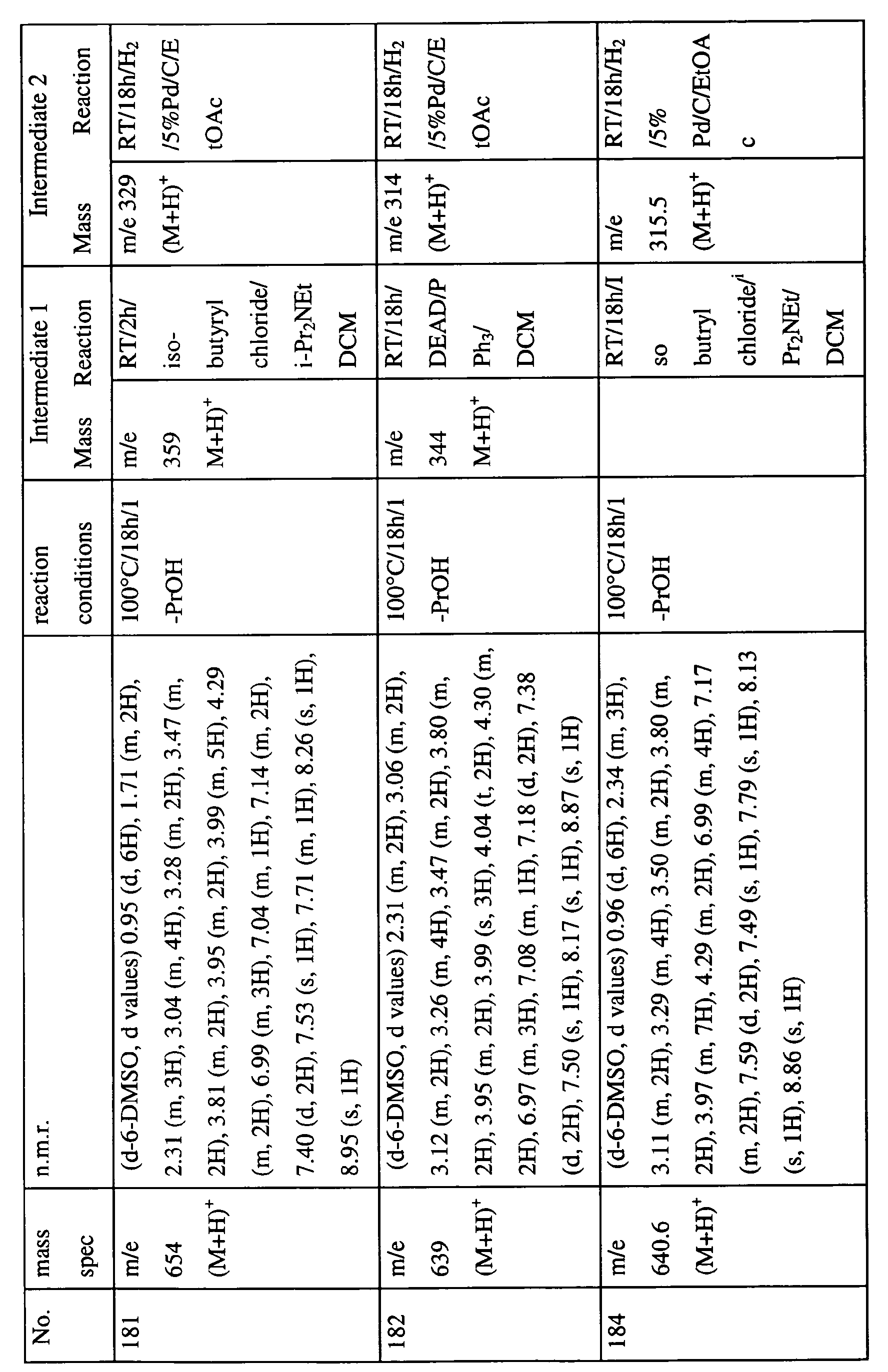
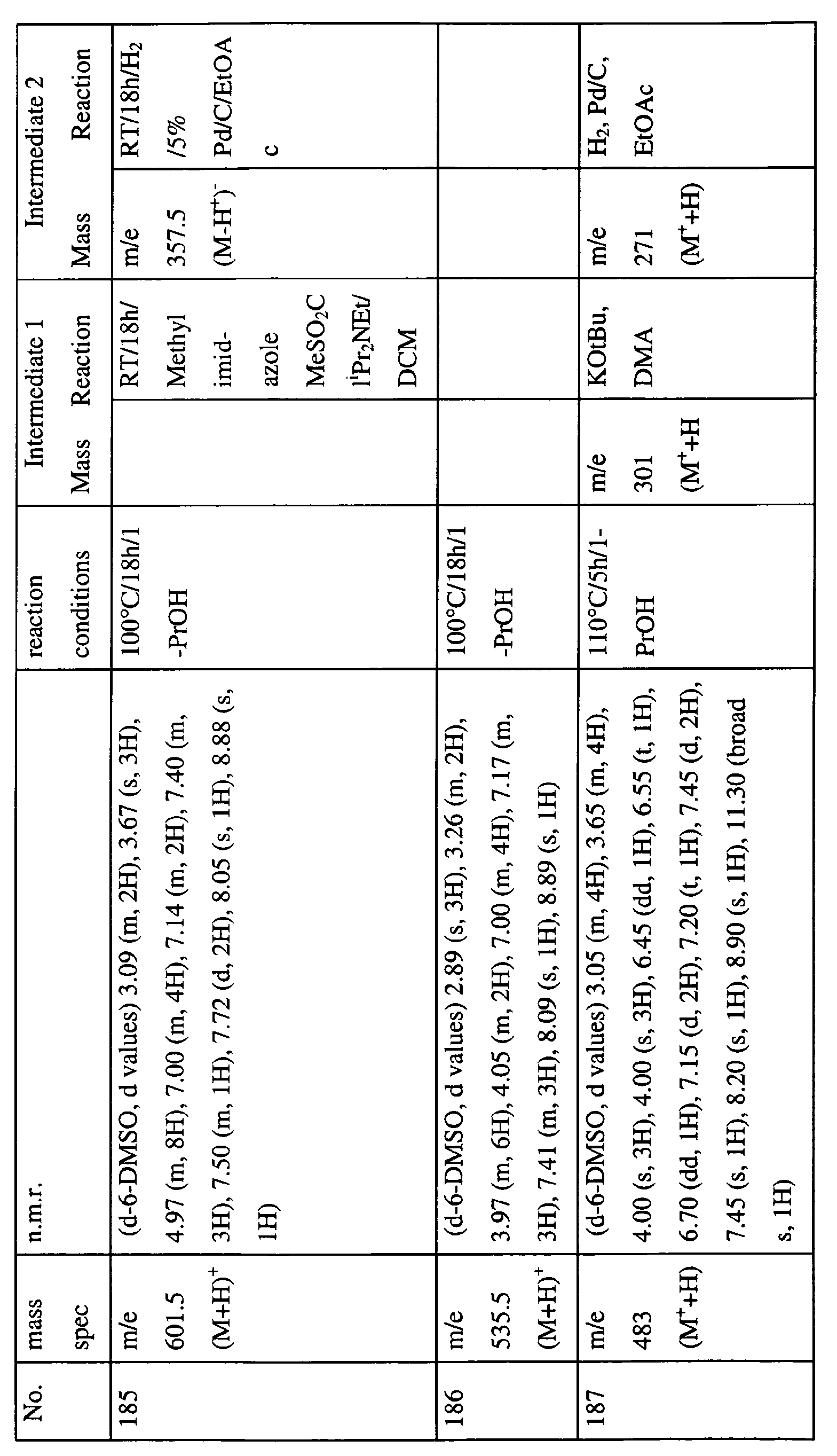


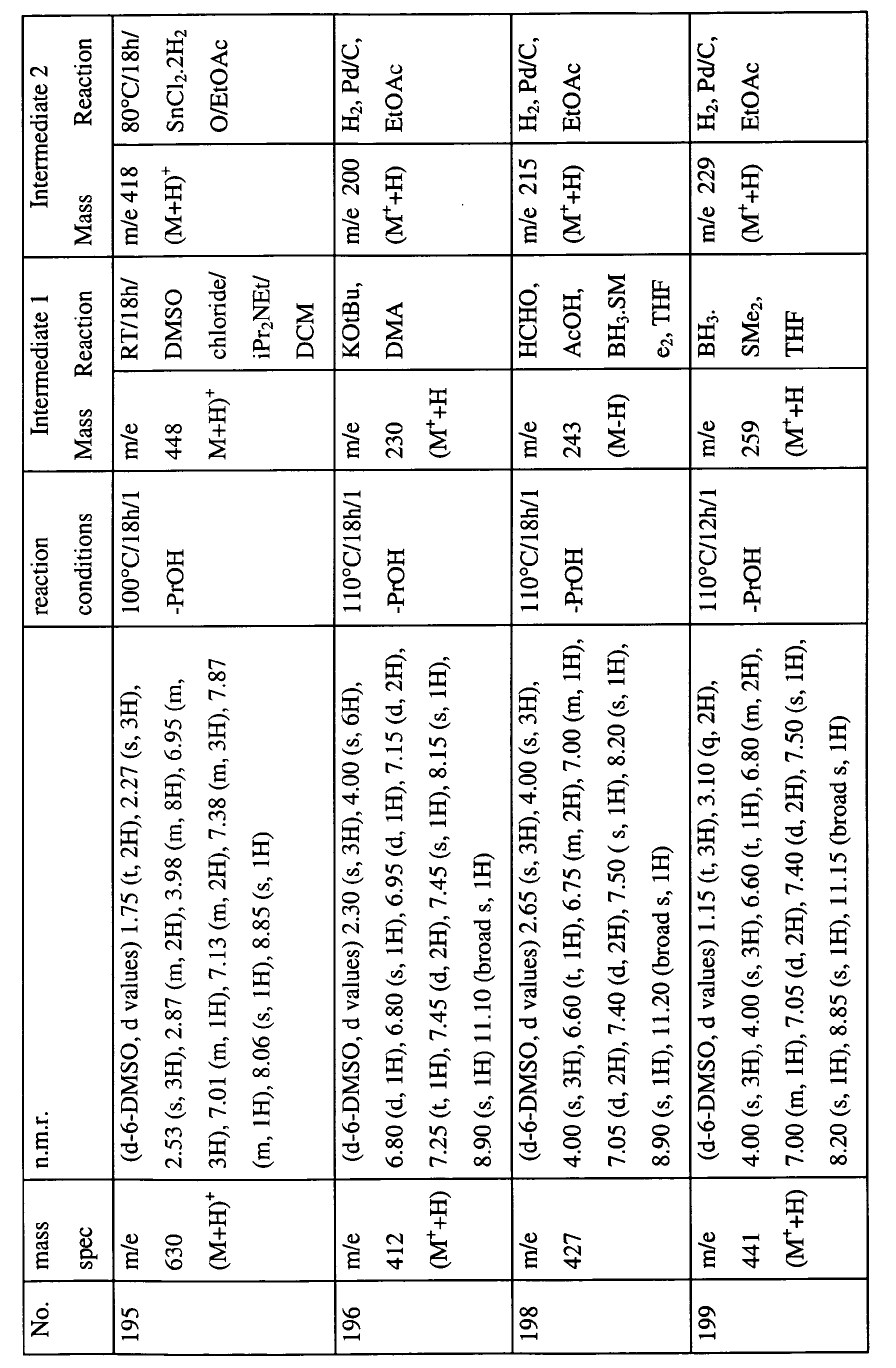

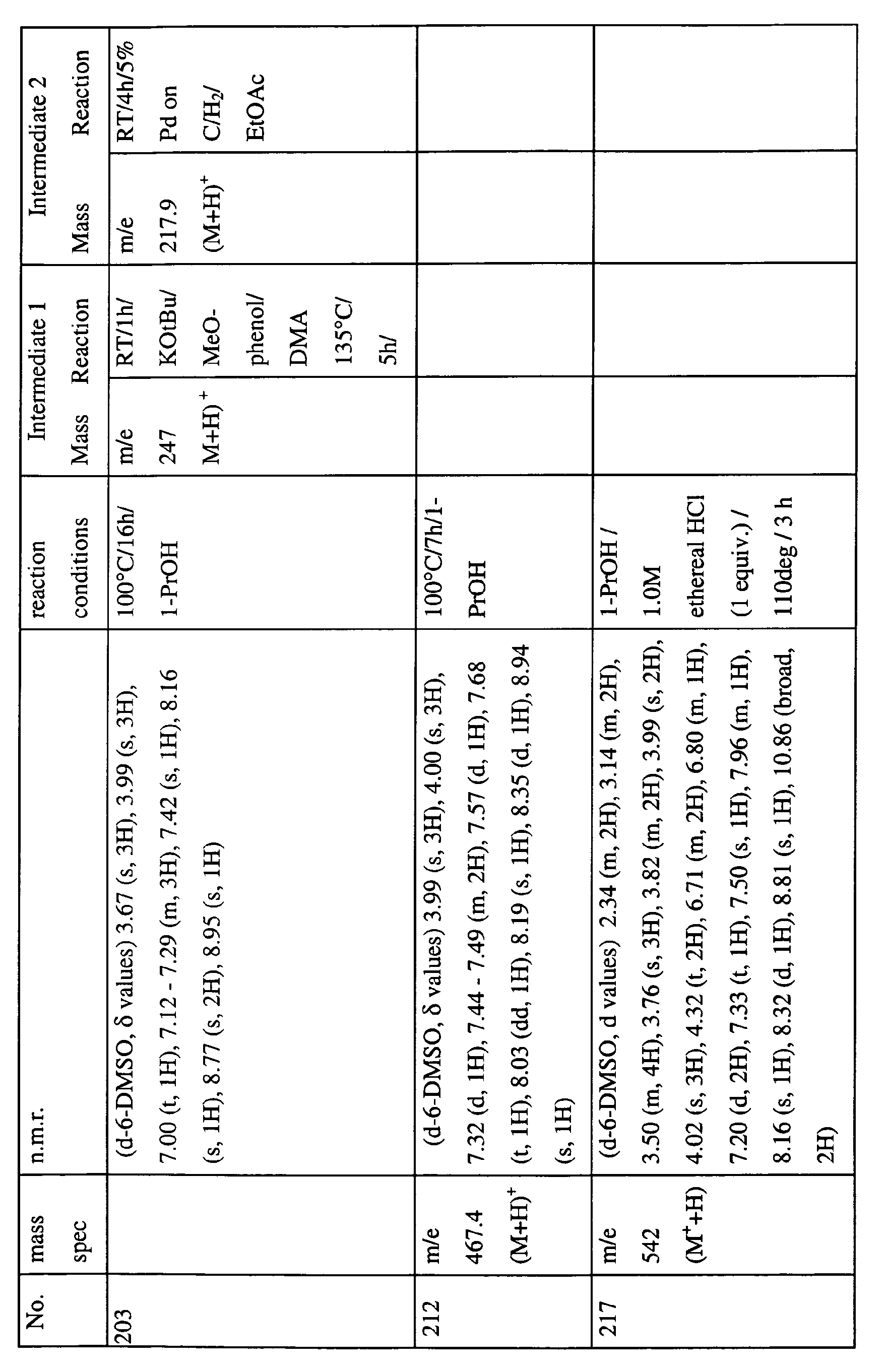


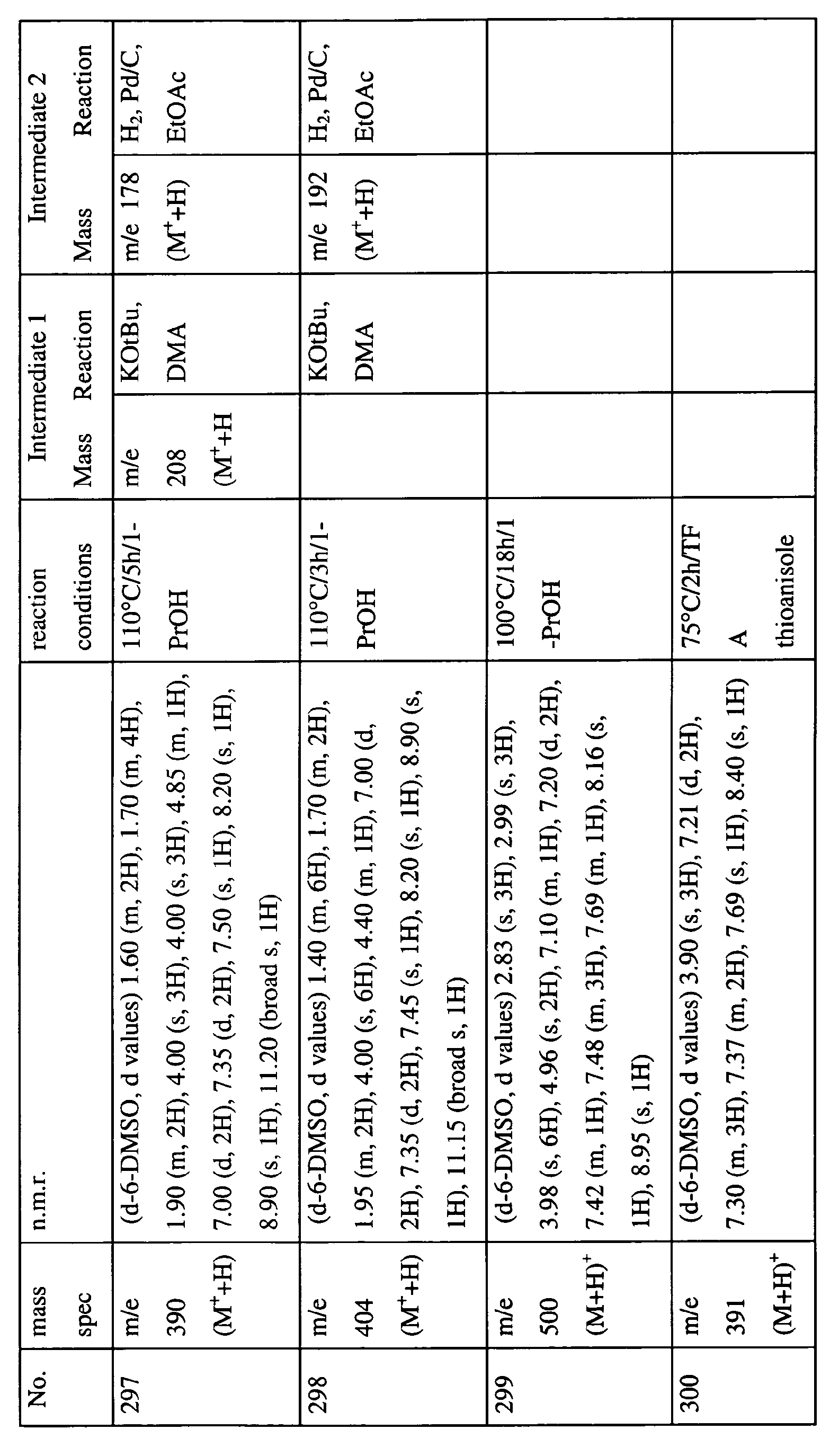

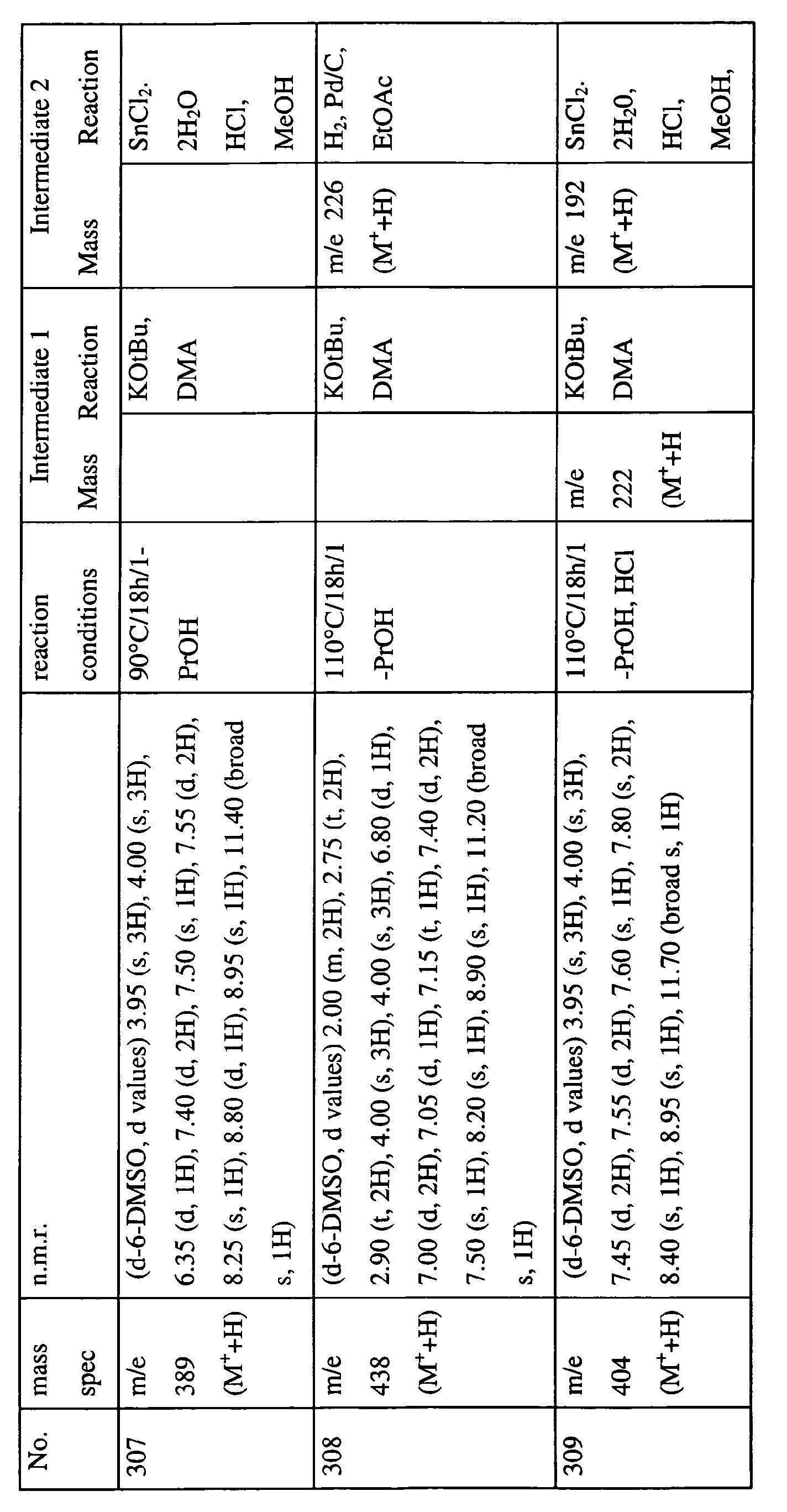
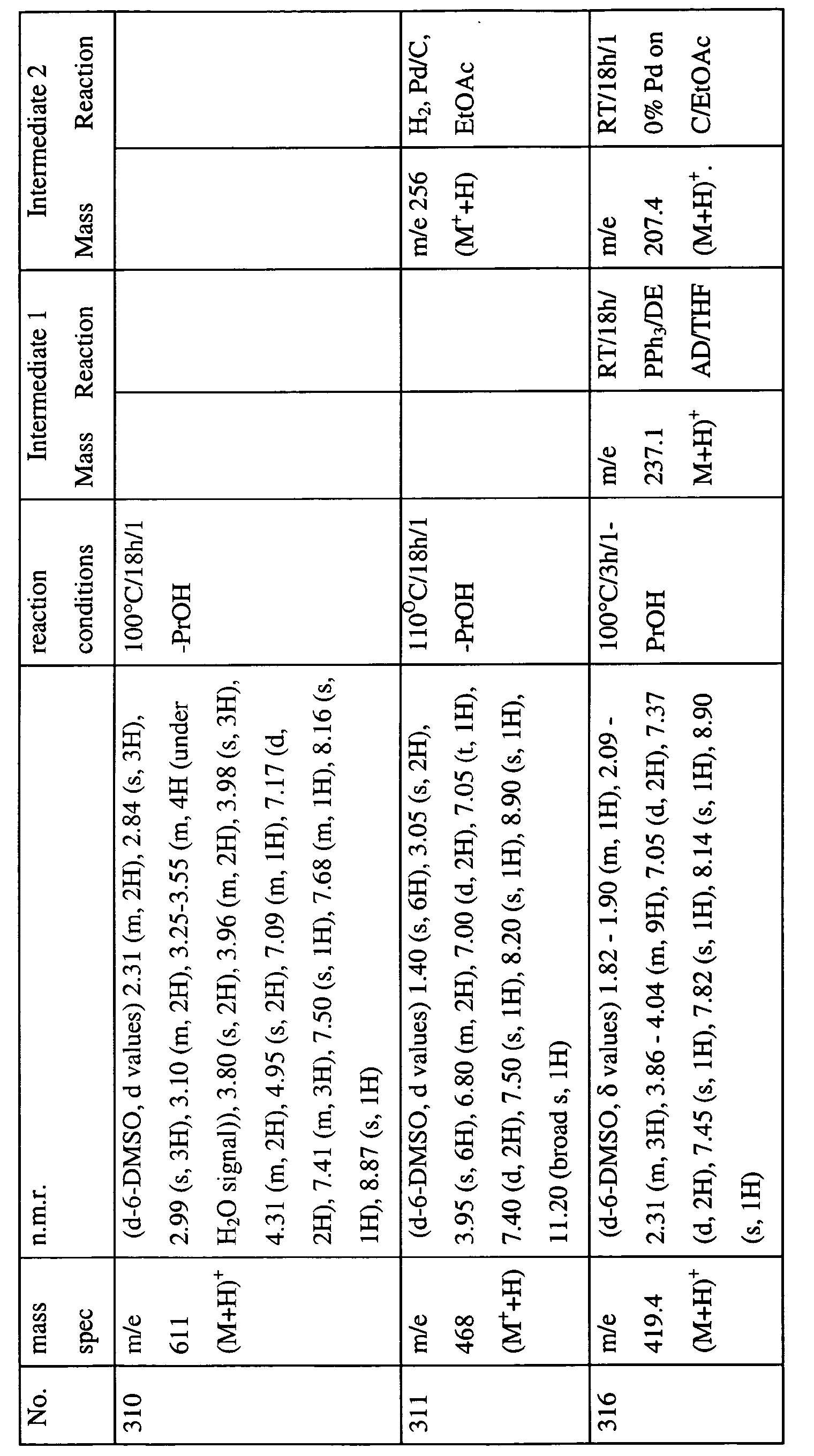

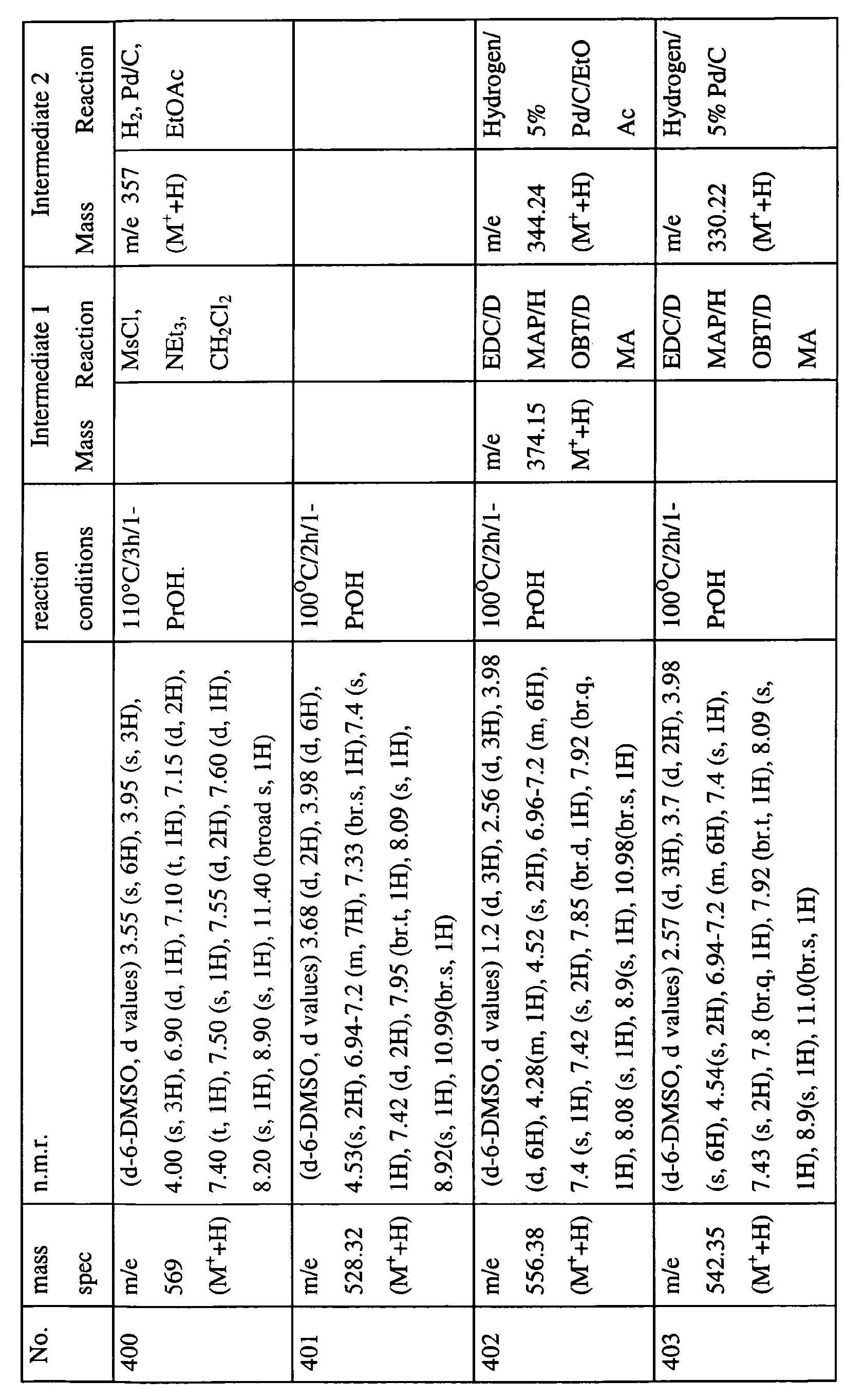


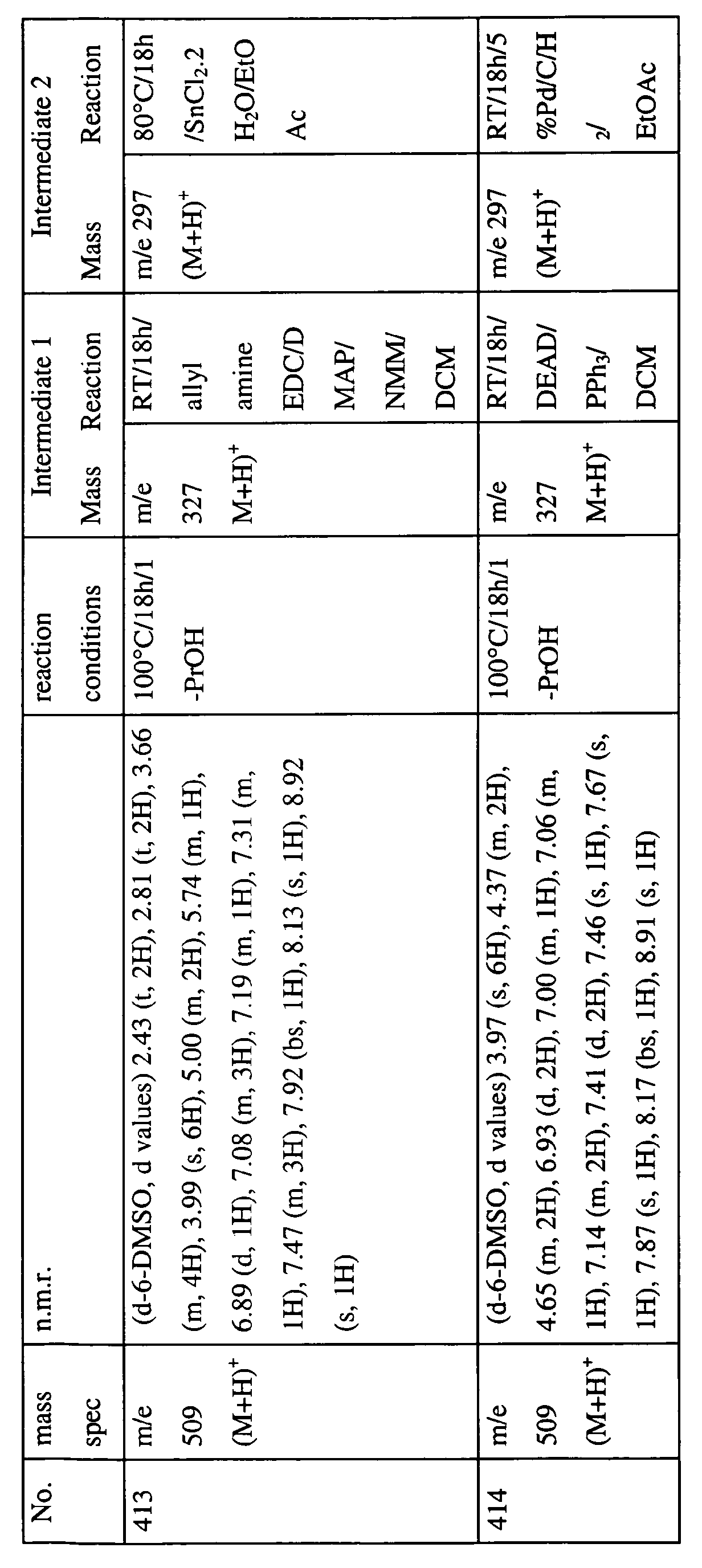

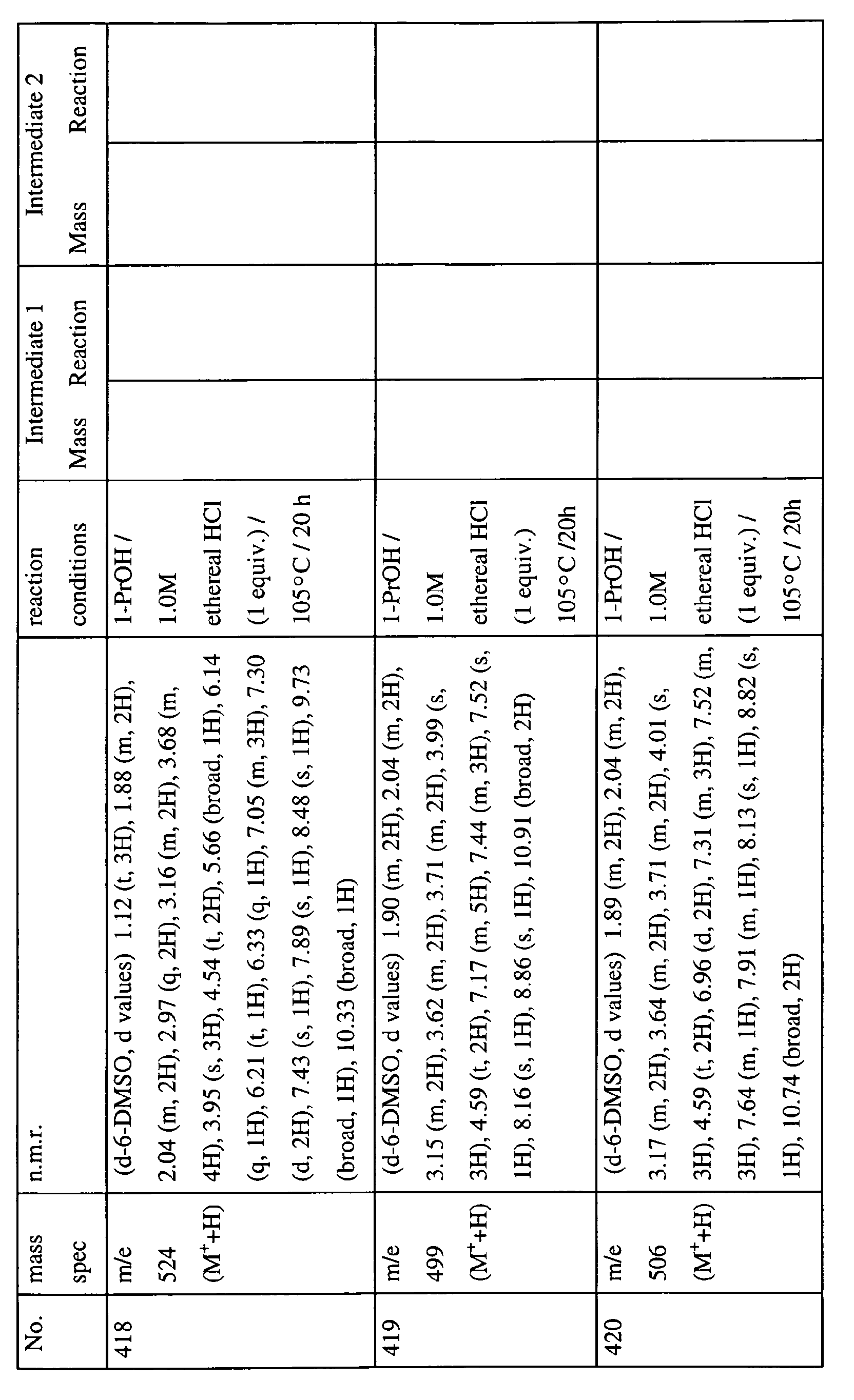


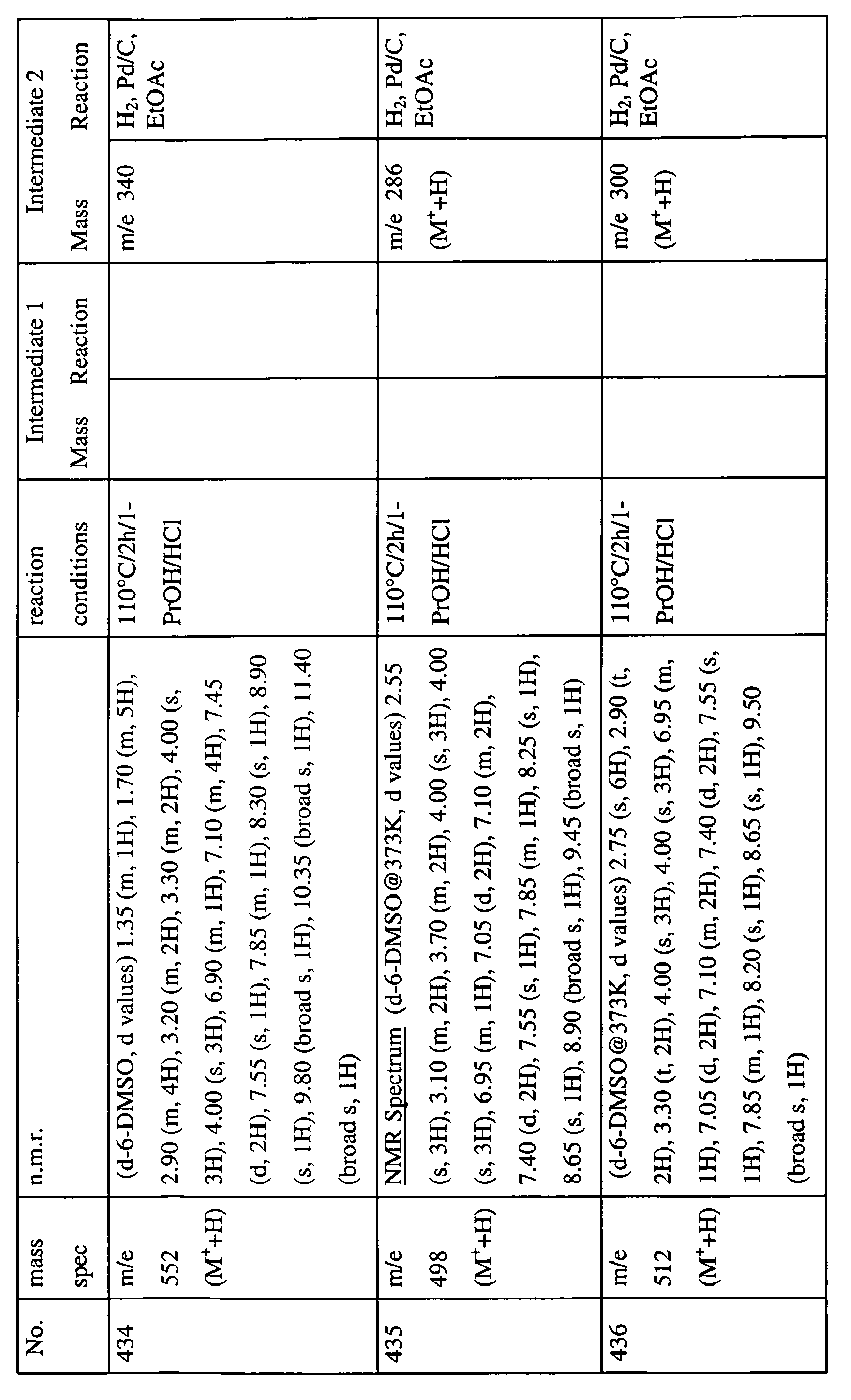
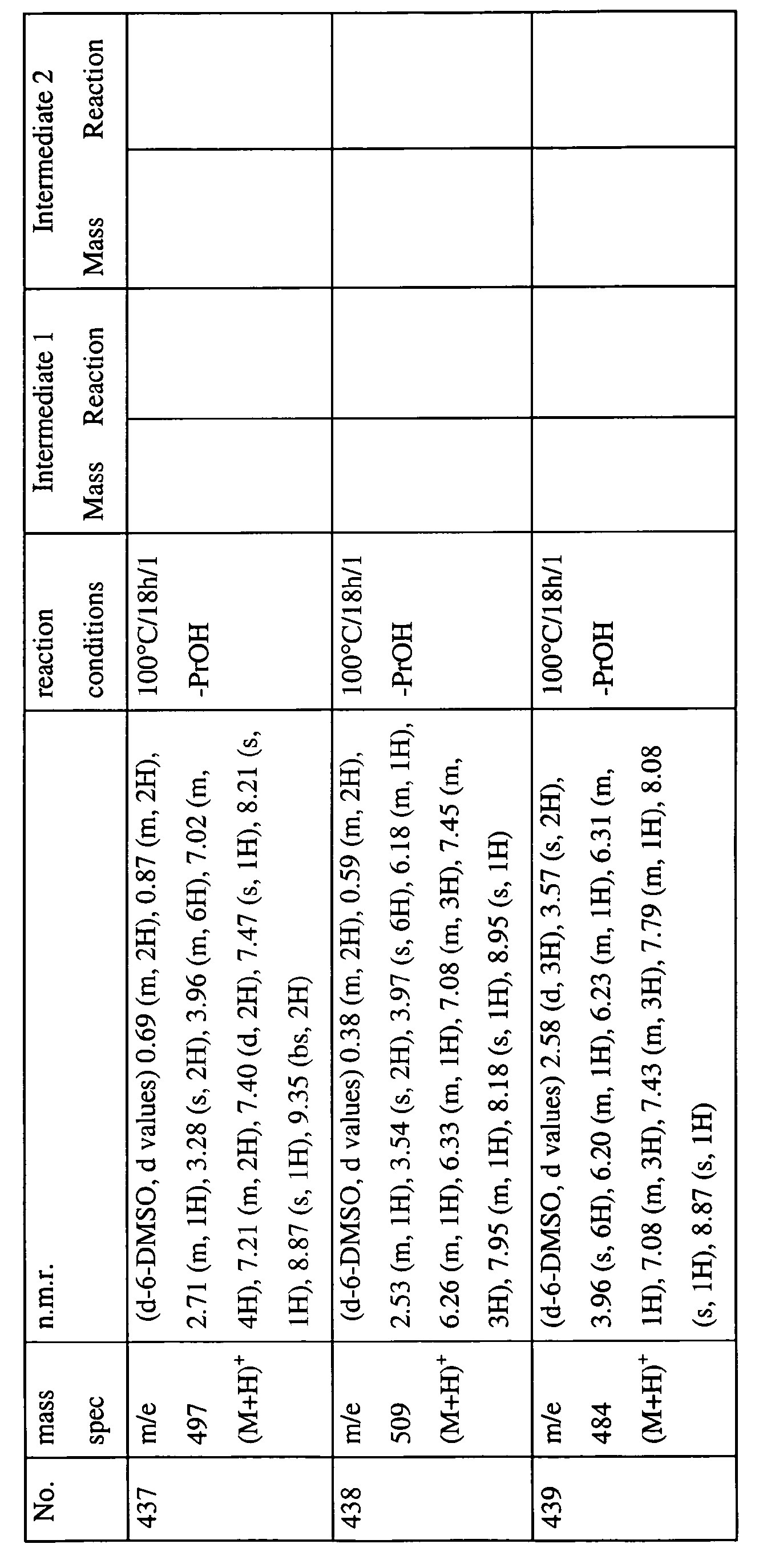

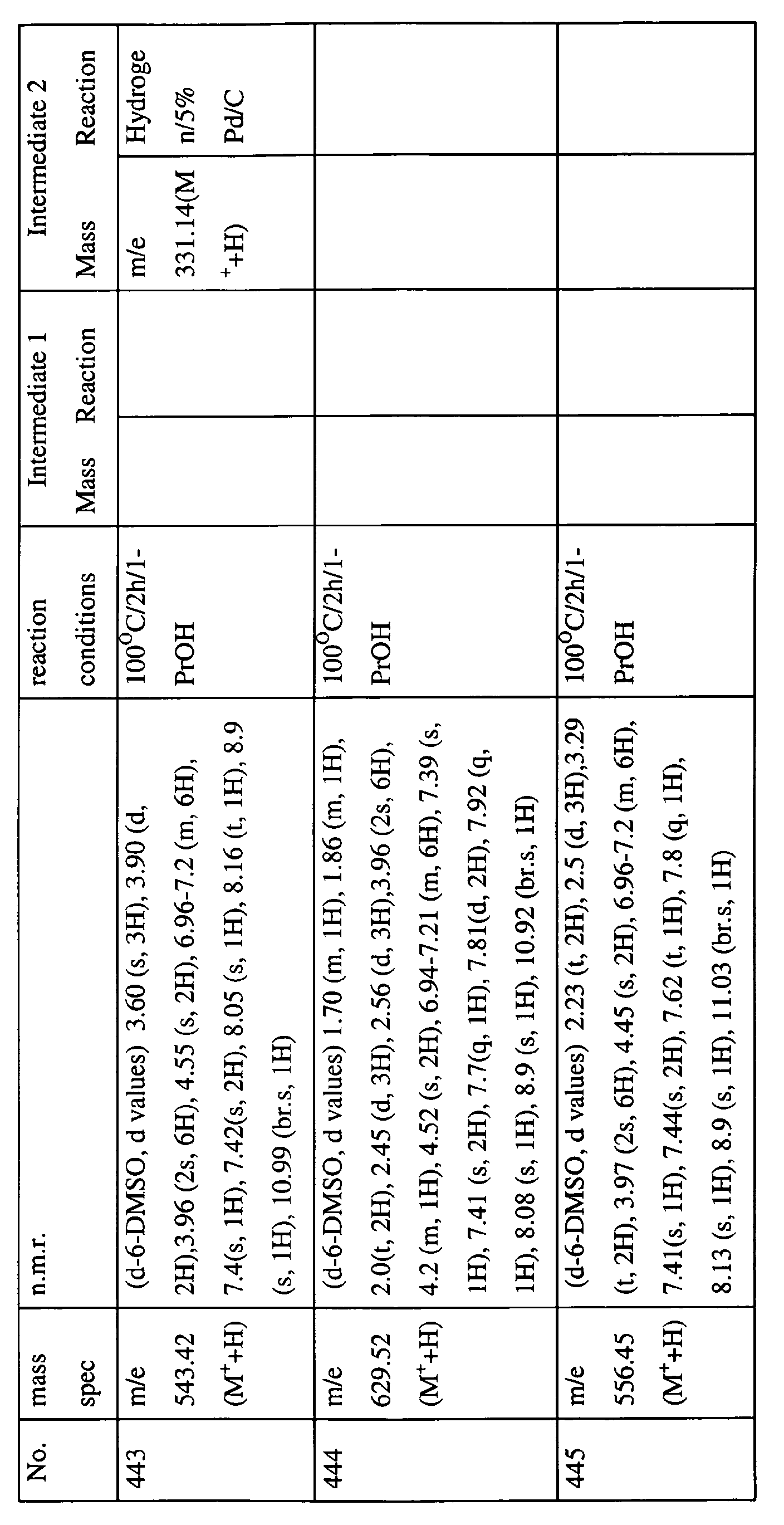


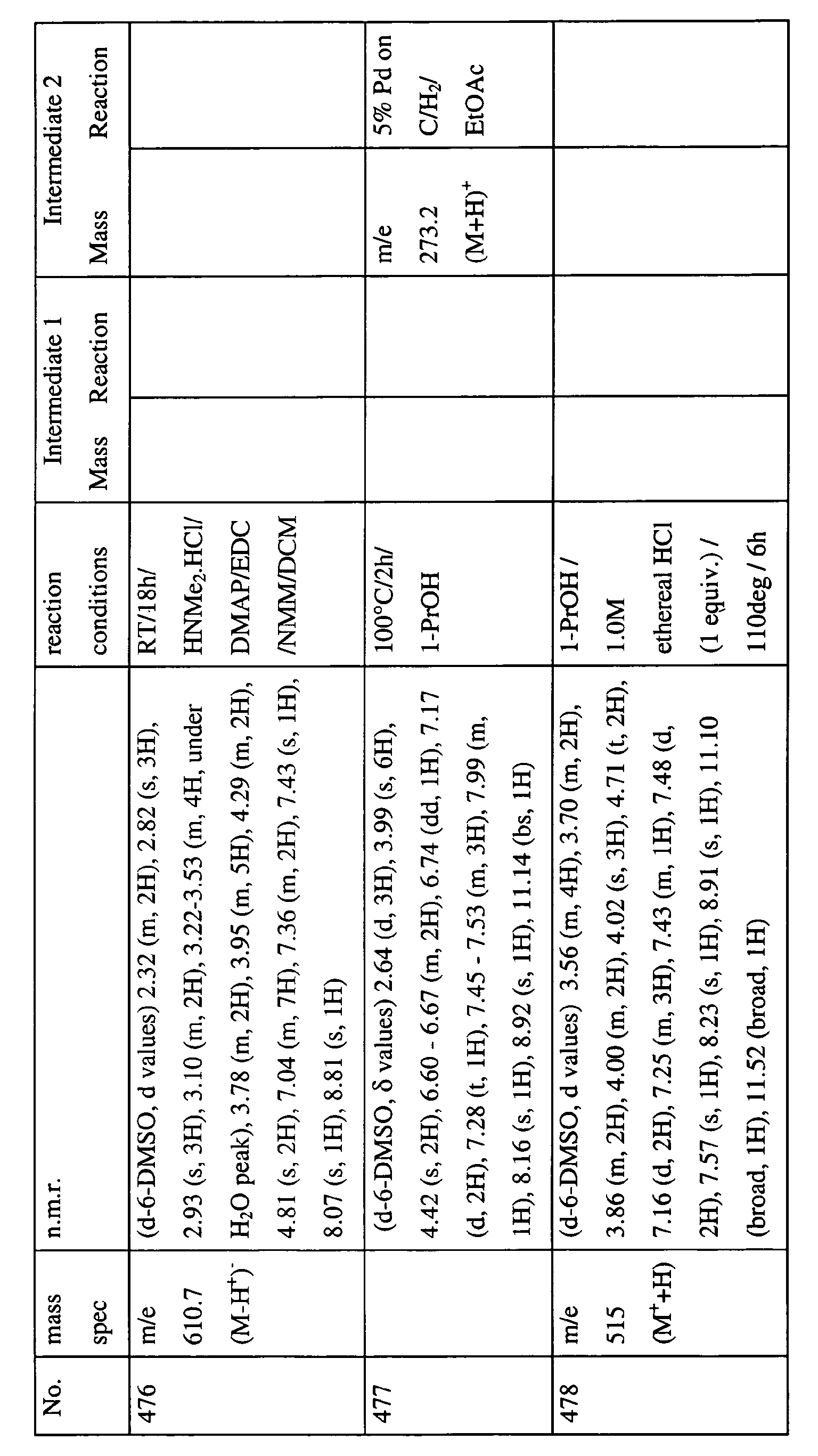

- In the above and other Examples, the following abbreviations have been been used:
- 1H NMR data is quoted and is in the form of delta values for major diagnostic protons, given in parts per million (ppm) relative to tetramethylsilane (TMS) as an internal standard;
- nitrogen atoms which are shown as less than trivalent are H substituted to complete the trivalency;
- the following abbreviations are used:
- DMSO
- dimethyl sulphoxide;
- DMF
- N,N-dimethylformamide;
- DCM
- dichloromethane;
- EtOAc
- ethyl acetate;
- HOBT
- N-hydroxybenzotriazole hydrate ;
- NMM
- N-Methylmorpholine;
- TFA
- Trifluoroacetic acid;
- 1-Pr-OH
- propan-1-ol;
- MeOH
- methanol;
- EtOH
- ethanol;
- KOtBu
- potassium tert-butoxide;
- RT
- room/ambient temperature.
- Compounds of formula (I) were also converted to different such compounds by reacting appropriate derivatisation reactions, either directly or by way of certain chloro substituted intermediates. These can be summarised in the following Table 8 with the Intermediates listed in the Intermediate Table 9 below.


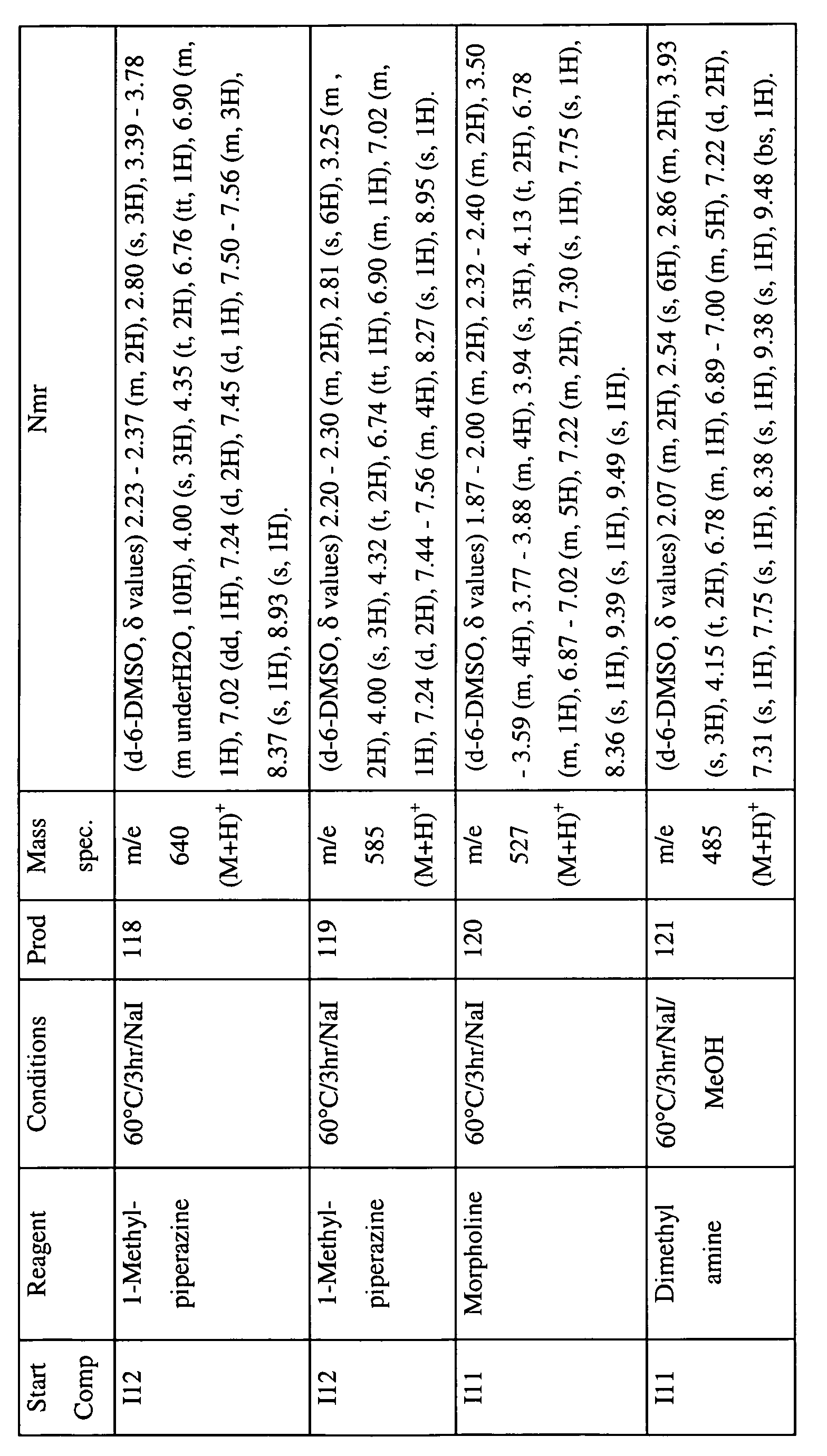

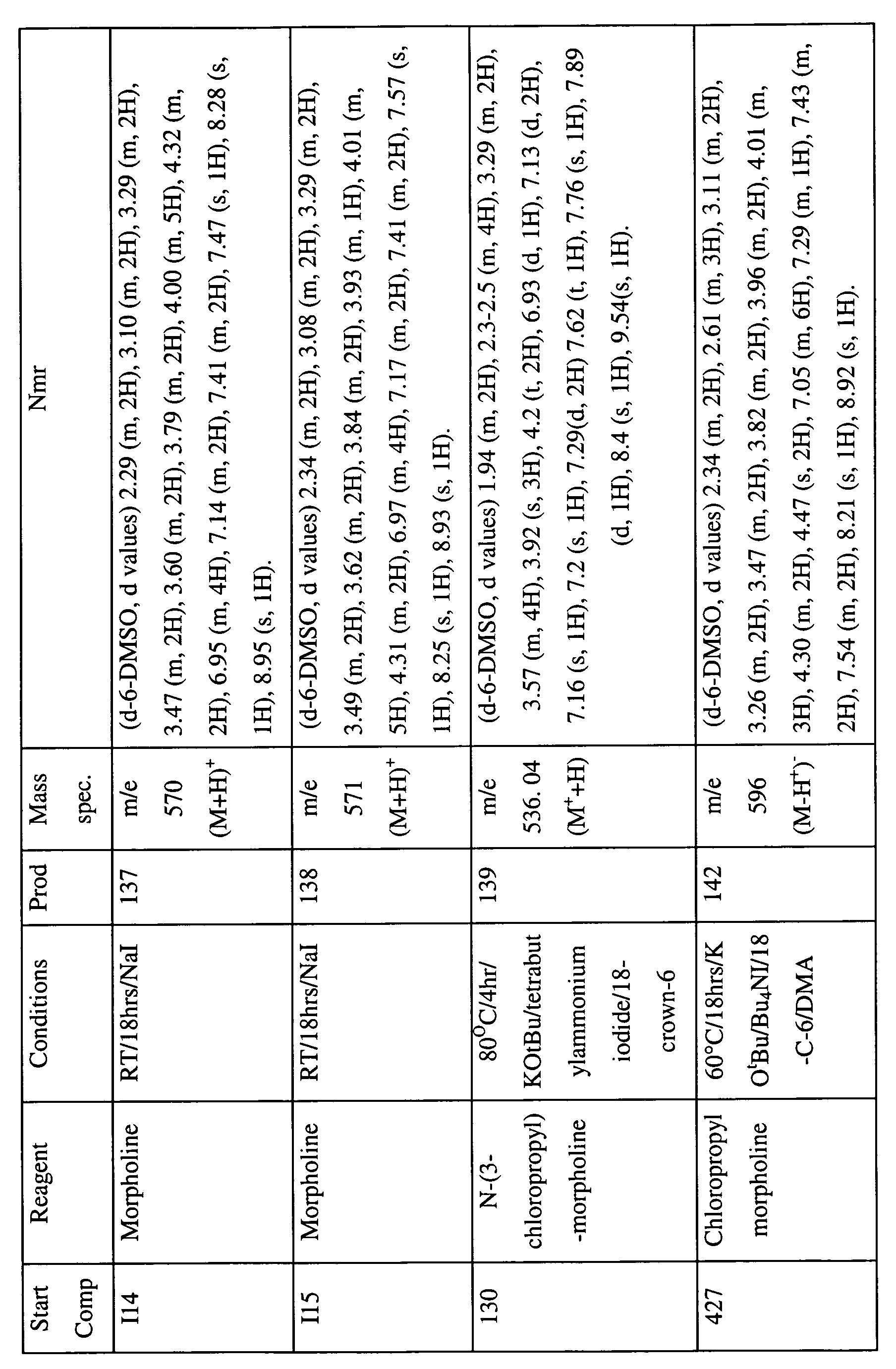


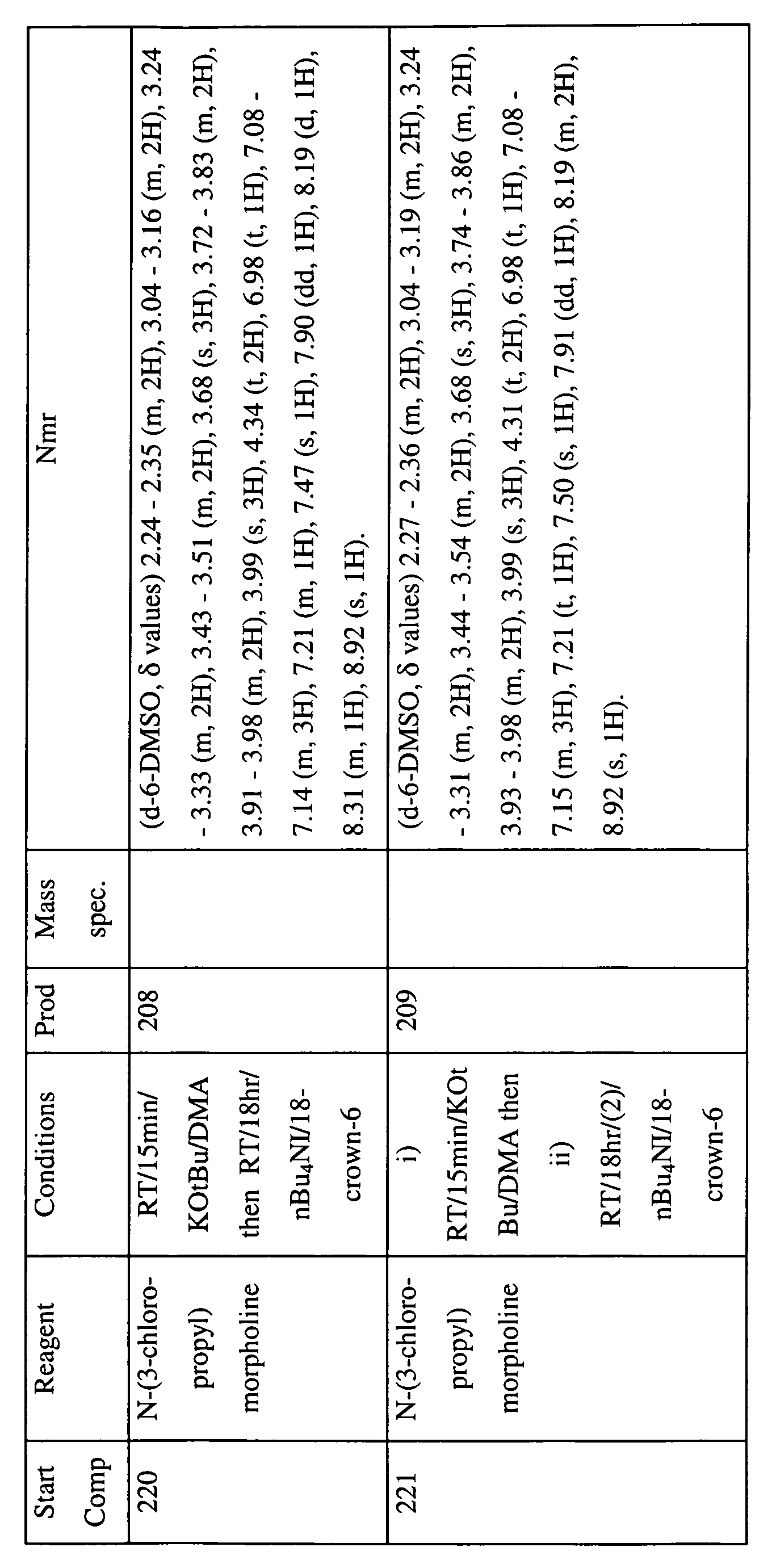
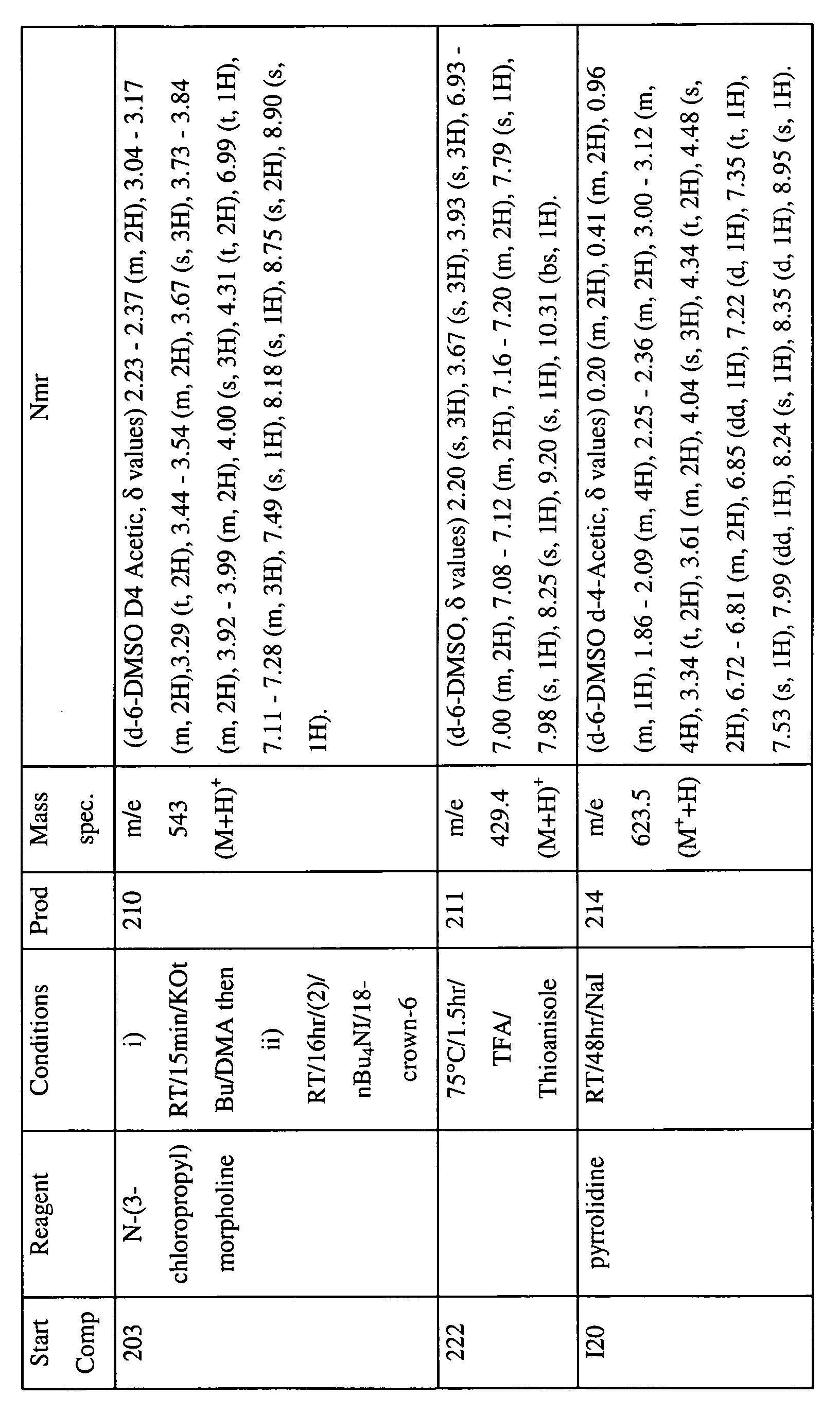


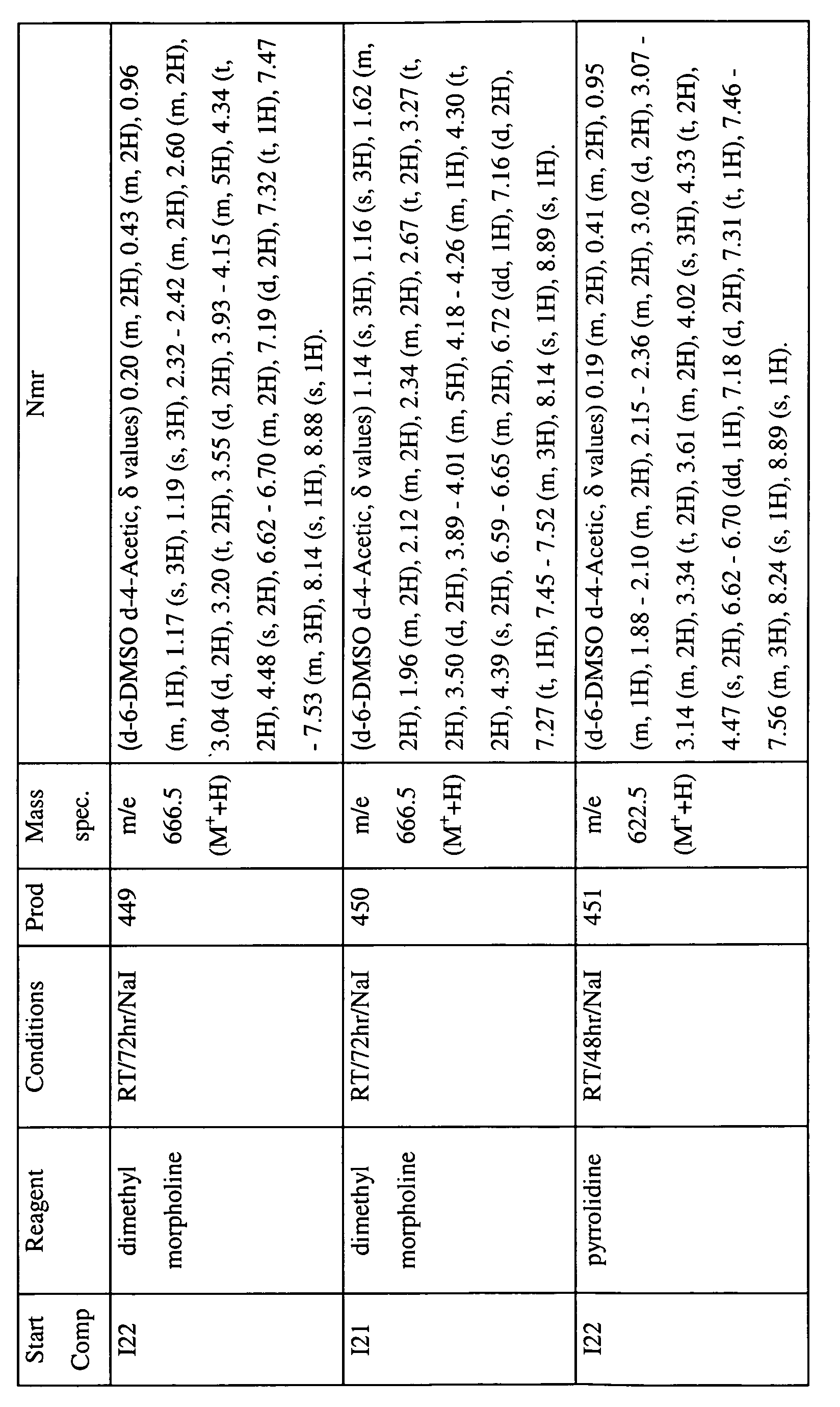
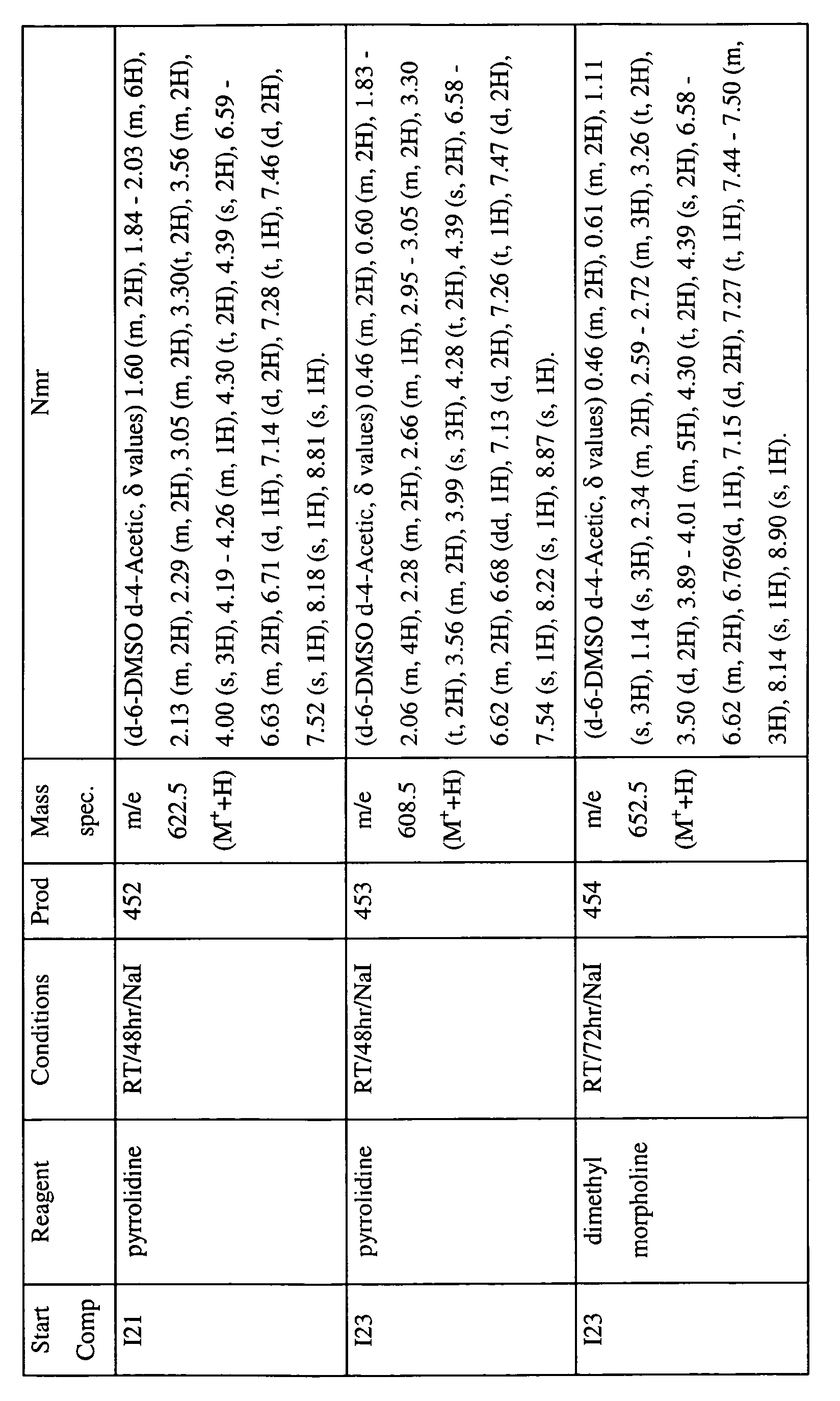
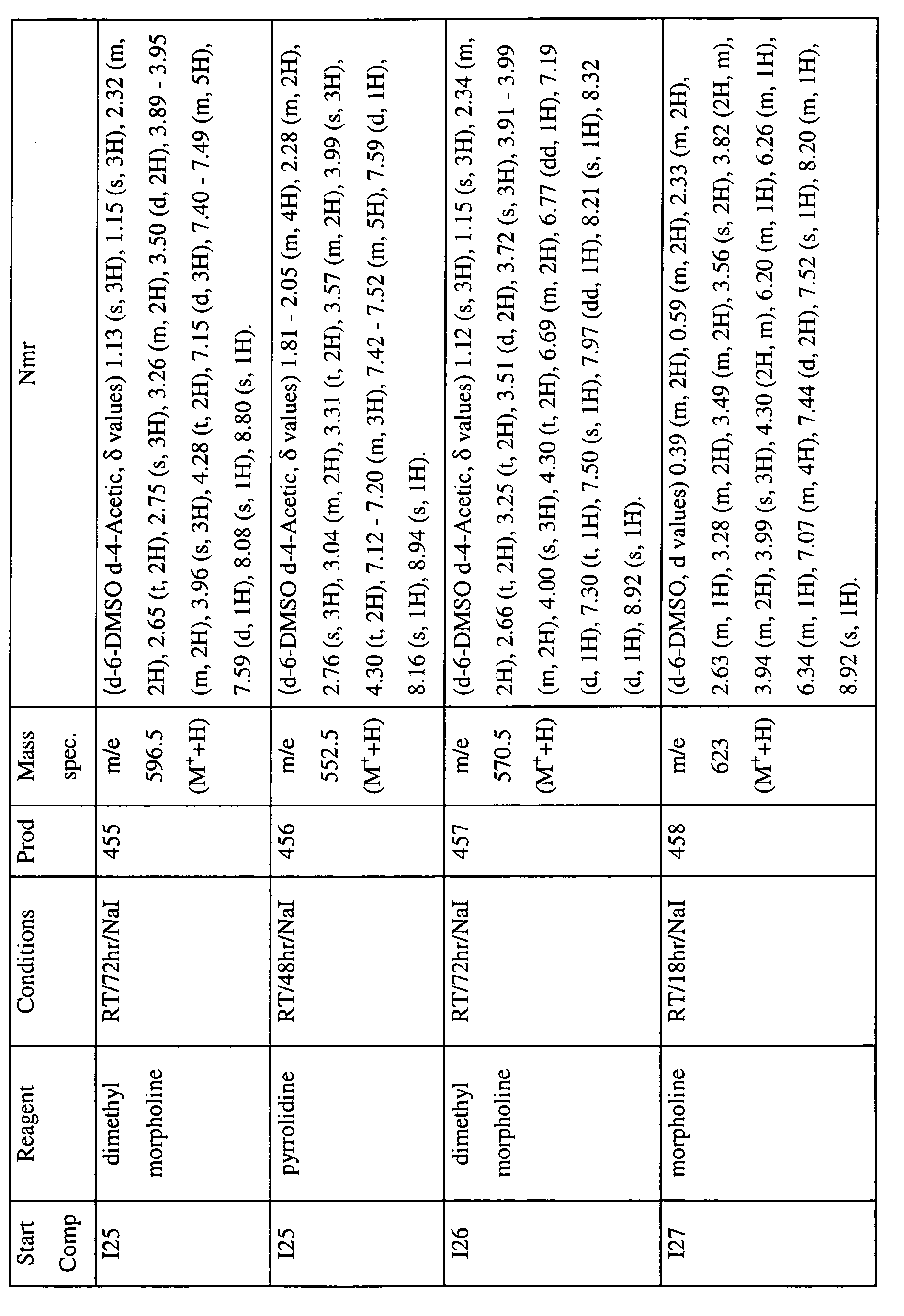


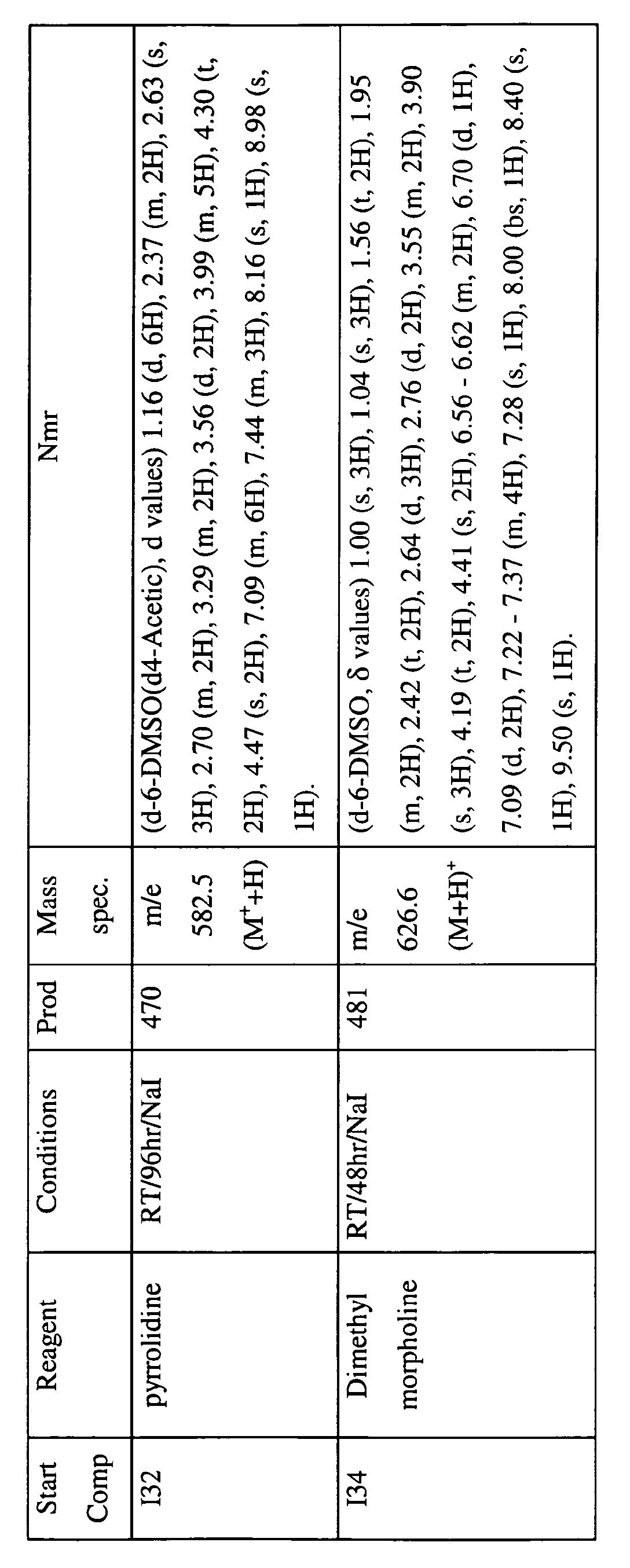
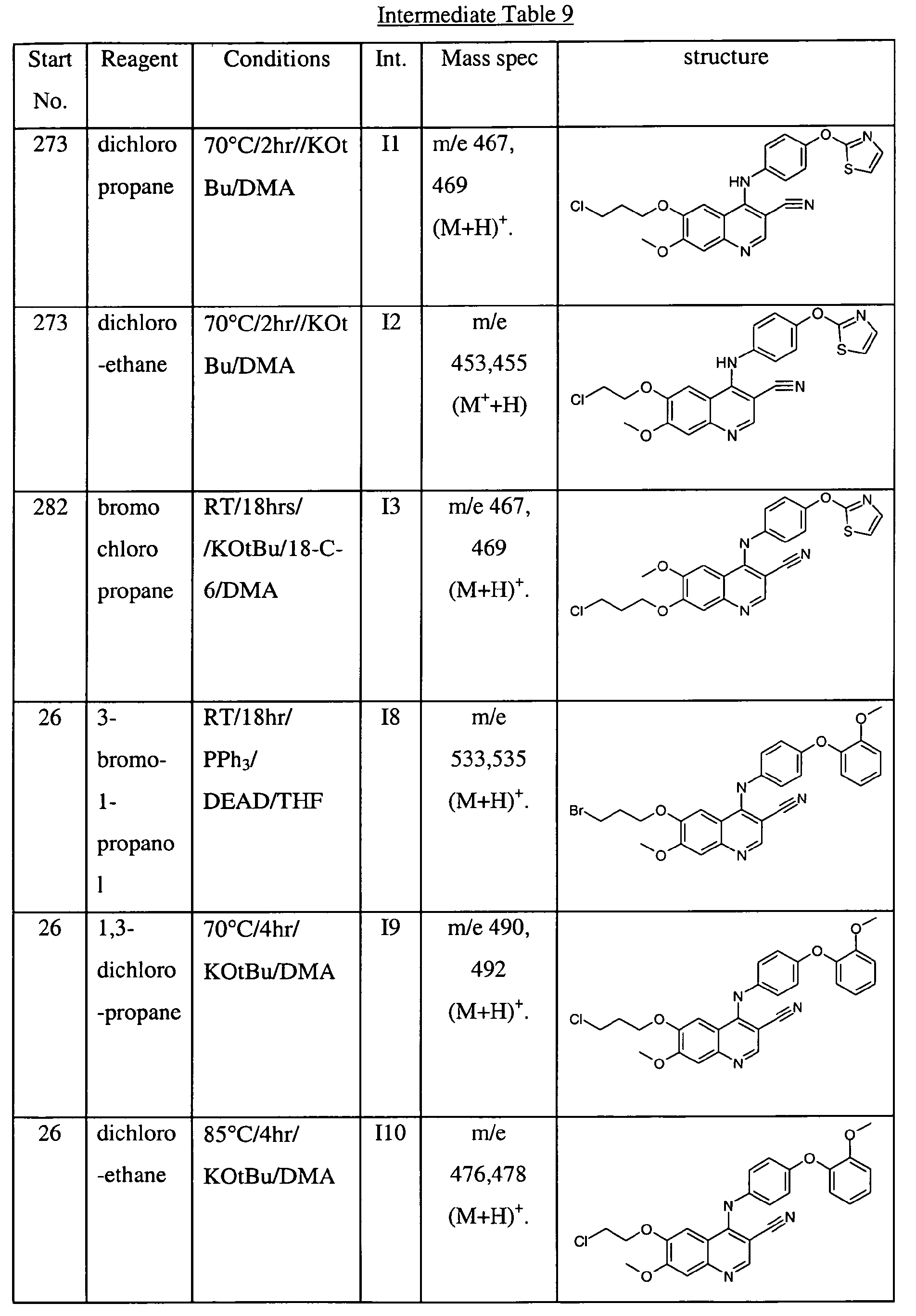

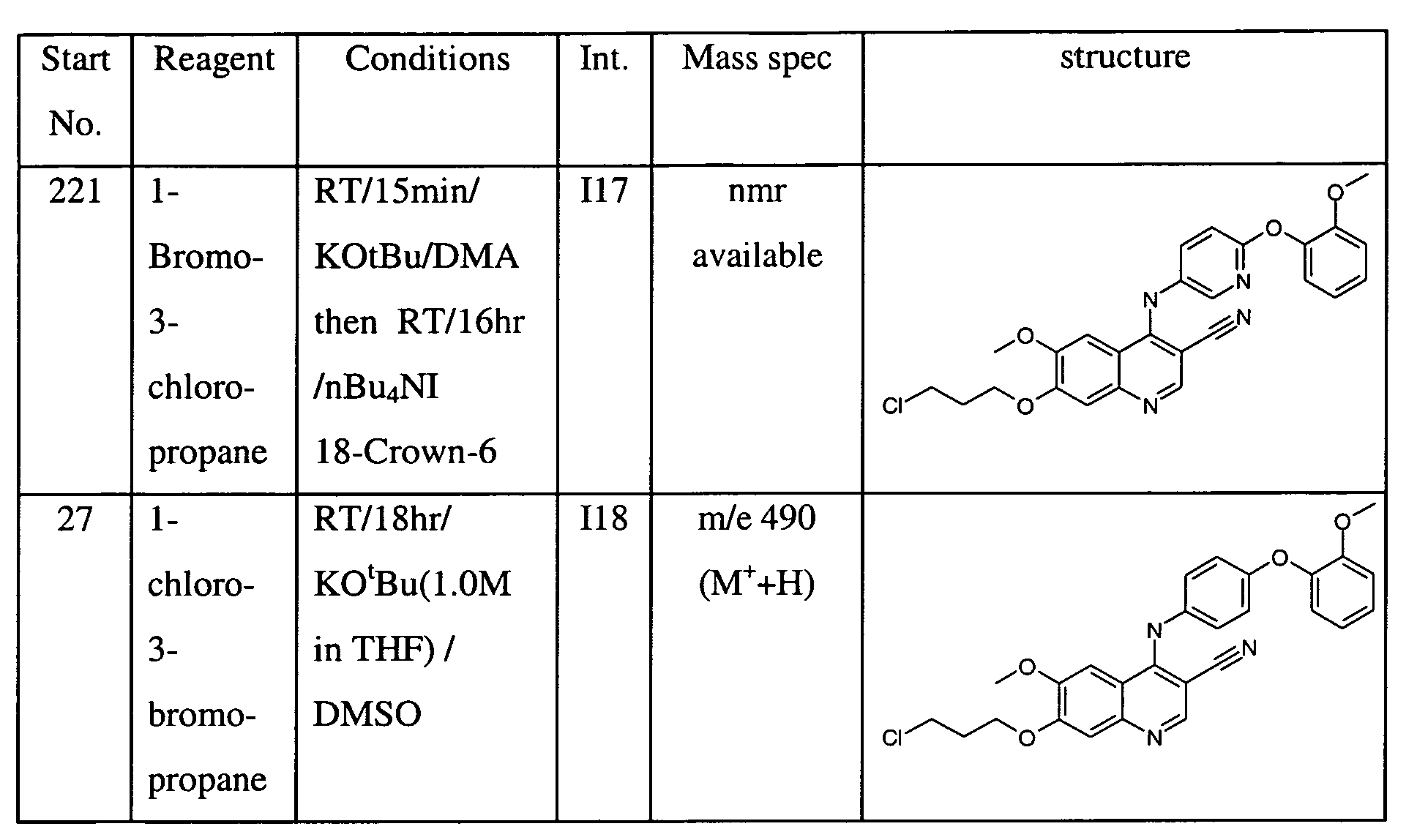
- In the above Table I4 is a compound of structurewhich had been prepared by a method analogous to that described in Example 1, but using reaction conditions of 100°C/2hr/1-PrOH.

Mass Spectrum m/e 577.45,579.46 (M++H).
NMR Spectrum (d-6-DMSO, d values) 2.28 (m, 2H), 3.16 (q, 2H), 3.4 (t, 2H), 3.82 (t, 2H), 3.98 (s, 3H), 4.3 (t, 2H), 4.48(s, 2H), 6.95-7.22 (m, 6H), 7.4 (d, 2H), 7.46 (s, 1H), 7.6 (t, 1H), 8.09 (s, 1H), 8.9 (s, 1H), 11.07 (br.s, 1H). - The chloropropoxyquinoline intermediate (Mass Spectrum m/e 311.2 (M+H)+) was prepared by reacting the corresponding hydroxy quinoline with 1-bromo-3- chloropropane at room temperature for 16hr in the presence of nBu4NI/18-crown-6
- The following haloalkoxy quinolines were prepared by analogous routes:

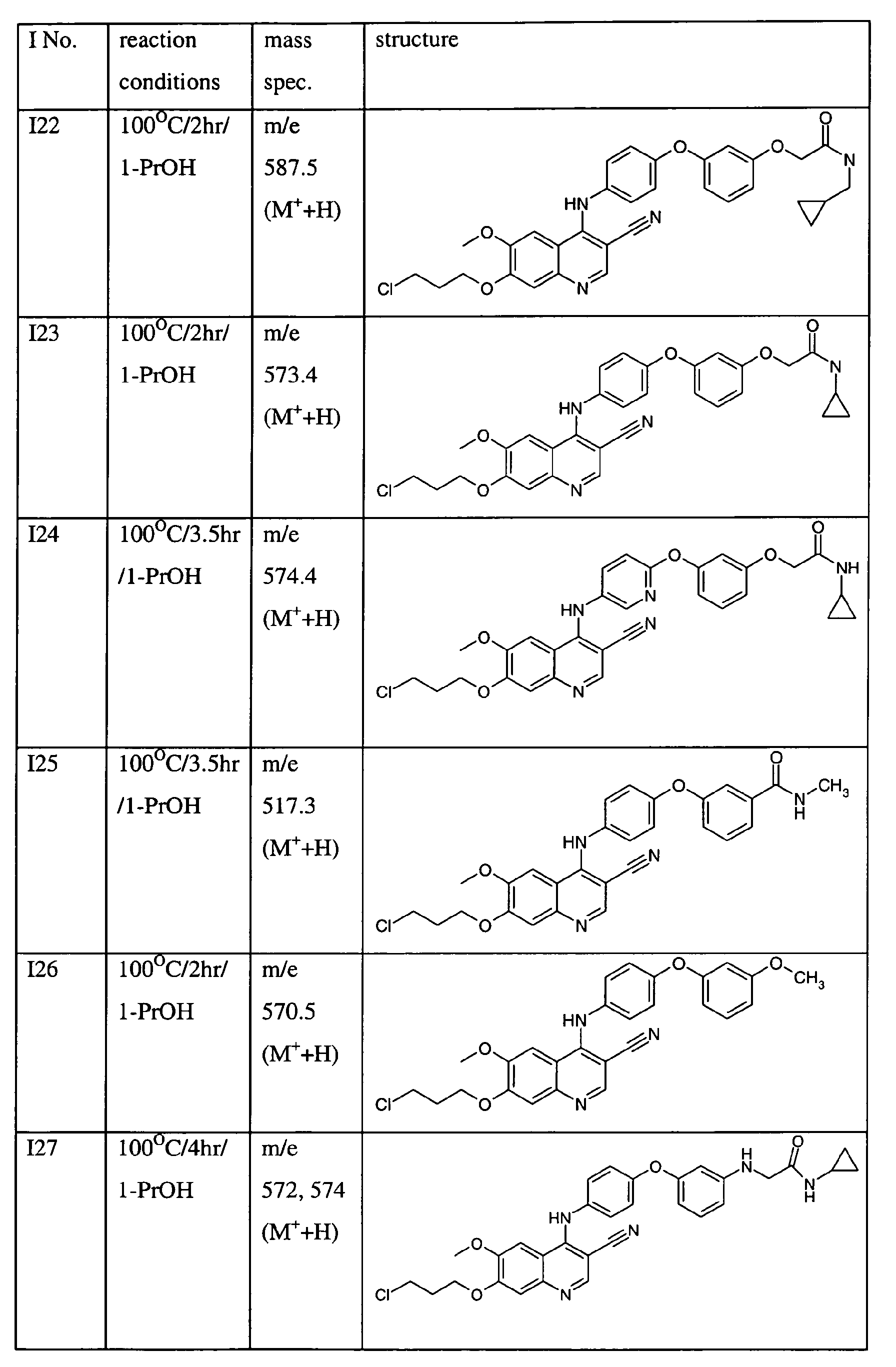
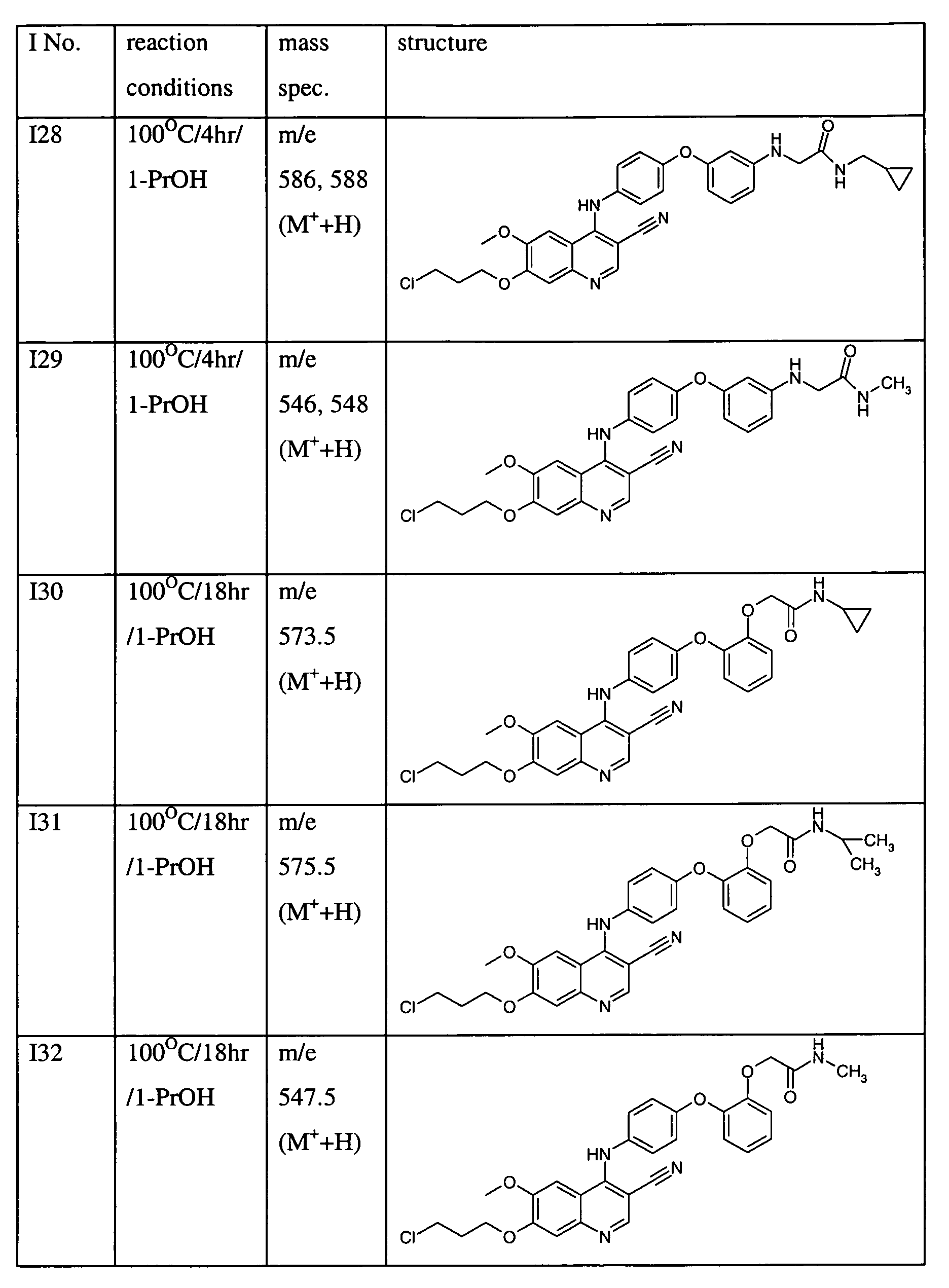

- In addition I5 was converted to I7using the following reaction conditions: RT/3hrs/LiOH.H2O/MeOH/H2O

Mass Spectrum m/e 534.5 (M+H)+
NMR Spectrum (d-6-DMSO, d values) 2.26 (m, 2H), 3.82 (m, 2H), 3.93 (s, 3H), 4.26 (t, 2H), 4.68 (s, 2H), 7.04 (m, 6H), 7.29 (m, 2H), 7.39 (s, 1H), 7.93 (s, 1H), 8.55 (s, 1H). - In this example, an intermediate nitro compound of formula (2) was reacted in situ with a chloroquinoline intermediate to produce compound 312, (a compound of formula (I)) directly in accordance with the following scheme:
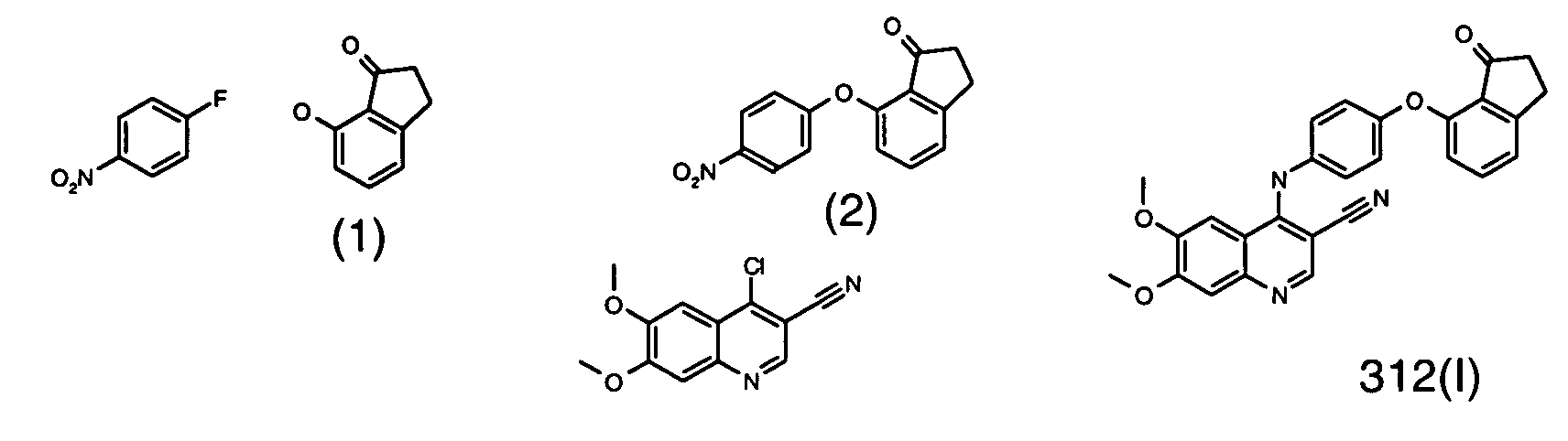
- The reaction conditions were: Cyclohexene, 1-propanol, Pd/C, filter then add quinoline to obtain the desired product
Mass Spectrum m/e 452 (M++H)
NMR Spectrum (CDCl3, d values) 2.70 (m 2H), 3.15 (m 2H), 3.75 (s, 3H), 4.00 (s, 3H), 6.70 (d, 1H), 6.80 (broad s, 1H), 6.95 (s, 1H), 7.05 (d, 2H), 7.15 (d, 2H), 7.15 (m, 1H), 7.35 (s, 1H), 7.45 (t, 1H), 8.60 (s, 1H).
Quinoline SM: WO 9843960 - The reaction conditions used to obtain Intermediate labelled (2) was KOtBu, DMA.
Mass Spectrum m/e 270 (M++H) - Using an analogous method, the following compounds were also produced
No. Mass spec N.M.R 313 m/e 429 (M++H) (CDCl3, d values) 3.70 (s, 3H), 4.00 (s, 3H), 6.85 (broad s, 1H), 6.90 (m, 2H), 7.10 (d, 2H), 7.15 (d, 2H), 7.35 (m, 3H), 8.00 (s, 1H), 8.60 (s, 1H). 314 m/e 453 (M++H) (d-6-DMSO@373K, d values) 3.60 (s, 3H), 3.95 (s, 3H), 4.00 (s, 3H), 6.90 (d, 1H), 7.15 (d, 2H), 7.25 (t, 1H), 7.40 (m, 3H), 7.45 (s, 1H), 8.00 (s, 1H), 8.70 (s, 1H). 315 m/e 438 (M++H) (d-6-DMSO, d values) 4.00 (s, 3H), 4.00 (s, 3H), 6.75 (d, 1H), 6.85 (d, 1H), 7.20 (d, 2H), 7.30 (t, 1H), 7.40 (d, 1H), 7.50 (d, 2H), 7.50 (s, 1H), 7.95 (d, 1H), 8.20 (s, 1H), 8.95 (s, 1H), 11.30 (broad s, 1H). - Compound 85 prepared as described above, was dissolved in trichloromethane and reacted with oxone in the presence of wet alumina to yield the title compounds.
Compound 136
Mass Spectrum m/e 460 (M++H)
NMR Spectrum (d-6-DMSO, d values) 2.80 (s, 3H), 3.90 (s, 3H), 3.95 (s, 3H), 6.85 (d, 1H), 7.20 (d, 2H), 7.35 (m, 4H), 7.45 (m, 1H), 7.75 (m, 2H), 8.40 (s, 1H), 9.55 (broad s, 1H).
Compound 140
Mass spec m/e 476 (M++H)
NMR Spectrum (d-6-DMSO, d values) 3.40 (s, 3H), 3.95 (s, 3H), 4.00 (s, 3H), 6.95 (d, 1H), 7.20 (d, 2H), 7.35 (m, 2H), 7.40 (d, 2H), 7.65 (m, 1H), 7.80 (s, 1H), 7.90 (dd, 1H), 8.45 (s, 1H), 9.65 (broad s, 1H). - Compound 173 in Table 1 was reacted with methylamine for 18 hours at room temperature in the presence of HCl, EDC, NMM and DCM to yield the desired amide.
Mass spec. m/e 582 (M+H)+.
NMR Spectrum (d-6-DMSO, d values) 2.33 (m, 2H), 2.55 (d, 3H), 3.12 (m, 2H), 3.22-3.45 (m, 4H (under H2O signal)), 3.43 (s, 2H), 3.78 (m, 2H), 3.97 (m, 5H), 4.28 (m, 2H), 6.83 (d, 1H), 7.05 (d, 2H), 7.10 (m, 1H), 7.21 (m, 1H), 7.33 (m, 1H), 7.41 (d, 2H), 7.47 (s, 1H), 7.75 (m, 1H), 8.12 (s, 1H), 8.81 (s, 1H). - This compound was prepared using the following scheme:Reaction conditions: 100°C/4hrs/NEt3/Diphenylphosphorylazide/t-BuOH
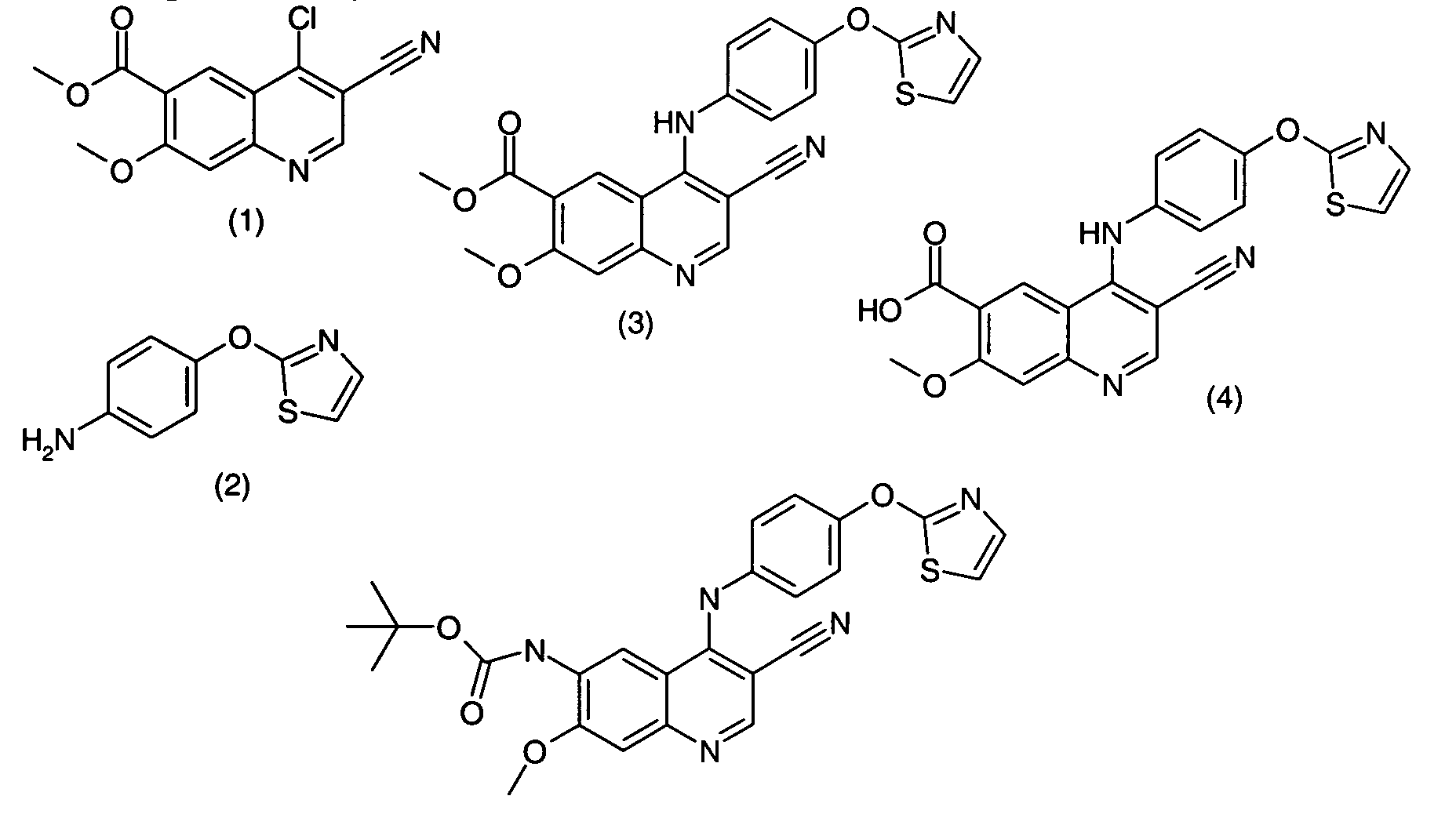
Chromatography: yes
Mass Spectrum m/e 490 (M+H)+.
NMR Spectrum (d-6-DMSO, d values) 1.48 (s, 9H), 4.01 (s, 3H), 7.26 (d, 1H), 7.33 (d, 1H), 7.45 (m, 1H), 7.49 (m, 2H), 7.53 (d, 2H), 8.70 (s, 1H), 8.82 (s, 1H), 8.97 (s, 1H).
Intermediate (3)
Reaction conditions: 100°C/18hrs/n-PrOH
Mass Spectrum m/e 433 (M+H)+.
Intermediate (4)
Reaction conditions: RT/36hrs/LiOH/MeOH/water
Mass Spectrum m/e 418 (M+H)+. - Intermediate 17 in Table 1 was reacted with cyclopropylamine and N-methylmorpholine at room temperature for 48hours in the presence of DMAP, EDC and DCM to yield the desired product.
Mass Spectrum m/e 624.5 (M+H)+
NMR Spectrum (d-6-DMSO, d values) 0.42 (m, 2H), 0.61 (m, 2H), 2.30 (m, 2H), 2.63 (m, 1H), 3.11 (m, 2H), 3.35 (2H under H2O peak), 3.49 (m, 2H), 3.79 (m, 2H), 3.97 (m, 5H), 4.30 (m, 2H), 7.08 (m, 7H), 7.40 (d, 2H), 7.45 (s, 1H), 7.78 (s, 1H), 8.08 (s, 1H), 8.84 (s, 1H). - This compound was prepared using the following scheme:100°C/18hrs/n-PrOH

Chromatography: yes
Mass Spectrum m/e 525 (M+H)+
NMR Spectrum (d-6-DMSO, d values) 0.182 (m, 2H), 0.41 (m, 2H), 0.94 (m, 1H), 3.02 (t, 2H), 4.00 (m, 6H), 4.52 (s, 2H), 7.14 (m, 6H), 7.47 (m, 3H), 7.70 (t, 1H), 8.16 (s, 1H), 8.94 (s, 1H). - The aniline starting material (1) was prepared as described above in relation to Intermediate I5.
- This was converted to Intermediate (2) above by reaction with cyclopropanemethylamine in methanol at room temperature for 18hrs.
Mass Spectrum m/e 313.5 (M+H)+ - Using a method analogous to that of Example 13, the R7' group was modified to form a different group R7 in the anilines used as starting materials in accordance with the following general scheme:prior to conversion to the corresponding compound of formula (I) as summarised in the following Table 12.
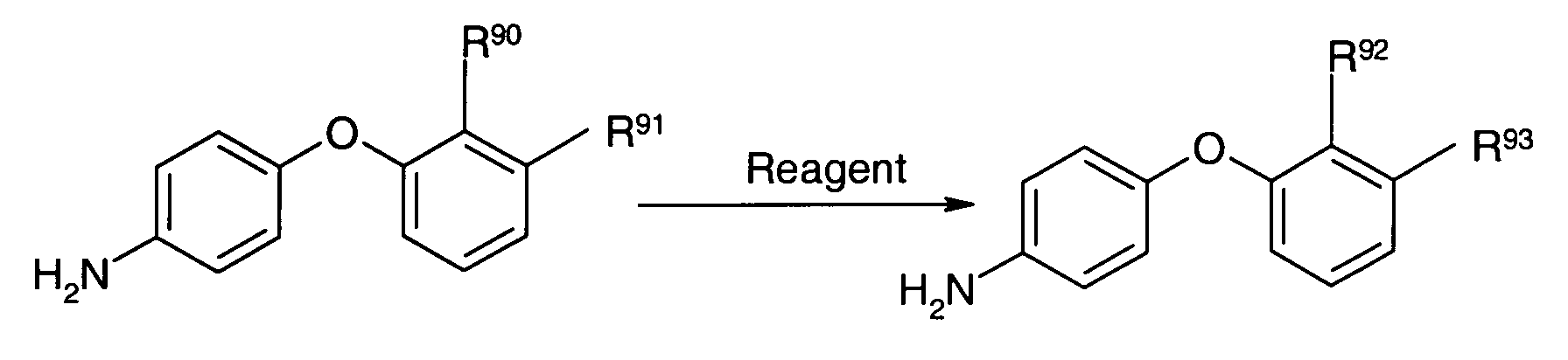

- In the preparation of other compounds of formula (I) the R7' group was modified to form a different group R7 in the nitrobenzyl compounds of formula (VII) used as starting materials in accordance with the following general scheme:


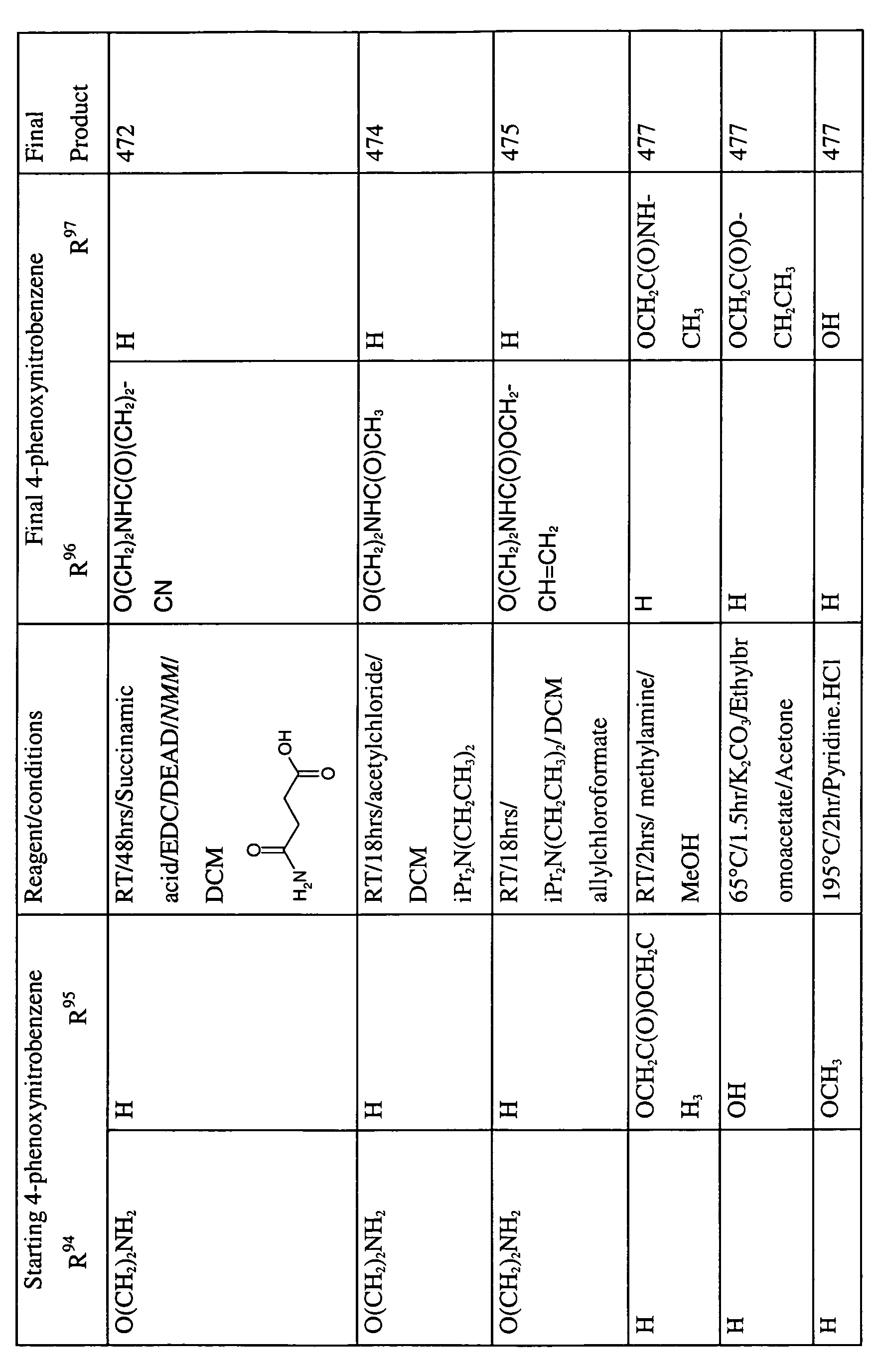

- To evaluate inhibitors of the MAPK pathway a coupled assay was carried out which measures phosphorylation of serine/threonine residues present in the substrate in the presence or absence of inhibitor. Recombinant glutathione S-transferase fusion protein containing human p45MEK1 (GST-MEK) was activated by c-raf (Sf9 insect cell lysate from triple baculoviral infection with c-raf/ras/lck) and used for the assay. Active GST-MEK was first used to activate a recombinant glutathione S-transferase fusion protein containing p44MAP kinase (GST-MAPK) in the presence of ATP and Mg2+ for 60min at room temperature in the presence or absence of potential inhibitors. The activated GST-MAPK was then incubated with myelin basic protein (MBP) as substrate for 10min at room temperature in the presence of ATP, Mg2+ and 33P-ATP. The reaction was stopped by addition of 20% v/v phosphoric acid. Incorporation of 33P into the myelin basic protein was determined by capture of the substrate on a filter mat, washing and counting using scintillation methods. The extent of inhibition was determined by comparison with untreated controls.
- The final assay solution contained 10mM Tris, pH 7.5, 0.05mM EGTA, 8.33µM [γ33P]ATP, 8.33mM Mg(OAc)2, 0.5mM sodium orthovanadate, 0.05%w/v BSA, 6.5ng GST-MEK, 1µg GST-MAPK and 16.5µg MBP in a reaction volume of 60µl.
- Compounds tested of the present invention had IC50 results typically less than 0.5µM. For example, Compound No 252 gave an IC50 of 0.15µM.
- To determine whether compounds were inhibiting GST-MEK or GST-MAPK, a direct assay of MAPK activity was employed. GST-MAPK was activated by a constitutively active GST-MEK fusion protein containing two point mutations (S217E, S221E) and used for the assay in the presence and absence of potential inhibitors. The activated GST-MAPK was incubated with substrate (MBP) for 60min at room temperature in the presence of ATP, Mg2+ and 33P-ATP. The reaction was stopped by addition of 20% v/v phosphoric acid. Incorporation of 33P into the myelin basic protein was determined by capture of the substrate on a filter mat, washing and counting using scintillation methods.
- The final assay solution contained 12mM Tris, pH 7.5, 0.06mM EGTA, 30µM [γ33P]ATP, 10mM Mg(OAc)2, 0.6mM sodium orthovanadate, 0.06%w/v BSA, 28ng GST-MAPK and 16.5µg MBP in a reaction volume of 60µl.
- Compounds of the invention showed activity in this screen.
- Cells were seeded into multi-well plates at 20 000 - 40 000 cells/ml in growth medium containing 5% FCS and incubated overnight at 37°C. The compounds were prepared in fresh medium at an appropriate concentration and added to the wells containing the cells. These were then incubated for a further 72 hours. Cells were then either removed from the wells by incubating with trypsin/EDTA and counted using a Coulter counter, or treated with XTT/PMS in PBSA and optical densities read at 450nm. Compounds tested of the present invention had IC50 results typically less than 30µM. For example, Compound No 250 gave an IC50 of 7.76 mM in HT29 human colon tumour cells; Compound No 32 gave an IC50 of 1.5µM in HT29 cells and an IC50 of 0.6µM in MC26 mouse colon tumour cells.
Claims (8)
- A compound of formula (I)or a pharmaceutically acceptable salt thereof.
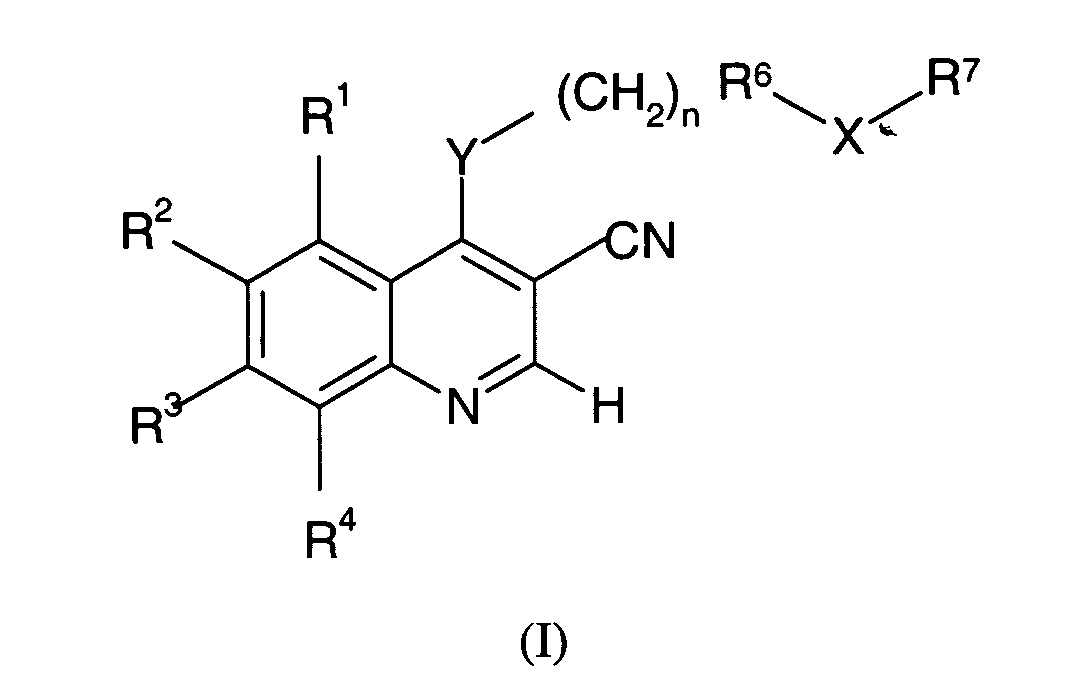
wherein:n is 0-1;X and Y are independently selected from -NH-, -O-, -S-, or -NR8- where R8 is alkyl of 1-6 carbon atoms and X may additionally comprise a CH2 group;R7 is a group (CH2)mR9 where m is 0,or an integer of from 1-3 and R9 is a substituted phenyl ring or substituted cycloalkyl ring from 3 to 8 carbon atoms, wherein the substituents comprise at least one alkoxy group of 1-6 carbon atoms at the alpha position and optionally one or more further substitutents;R6 is a divalent cycloalkyl of 3 to 7 carbon atoms, which may be optionally further substituted with one or more alkyl of 1 to 6 carbon atom groups; or is a divalent pyridinyl, pyimidinyl, or phenyl ring; wherein the pyridinyl, pyrimidinyl, or phenyl ring may be optionally further substituted with one or more groups selected from halogen, alkyl of 1-6 carbon atoms, alkenyl of 2-6 carbon atoms, alkynyl of 2-6 carbon atoms, azido, hydroxyalkyl of 1-6 carbon atoms, halomethyl, alkoxymethyl of 2-7 carbon atoms, alkanoyloxymethyl of 2-7 carbon atoms, alkoxy of 1-6 carbon atoms, alkylthio of 1-6 carbon atoms, hydroxy, trifluoromethyl, cyano, nitro, carboxy, carboalkoxy of 2-7 carbon atoms, carboalkyl of 2-7 carbon atoms, phenoxy, phenyl, thiophenoxy, benzoyl, benzyl, amino, alkylamino of 1-6 carbon atoms, dialkylamino of 2 to 12 carbon atoms, phenylamino, benzylamino, alkanoylamino of 1-6 carbon atoms, alkenoylamino of 3-8 carbon atoms, alkynoylamino of 3-8 carbon atoms, and benzoylamino;R1, R2, R3 and R4 are each independently selected from hydrogen, hydroxy, halogeno, cyano, nitro, trifluoromethyl, C1-3alkyl, -NR11R12 (wherein R11 and R12, which may be the same or different, each represents hydrogen or C1-3alkyl), or a group R13-X1-(CH2)x wherein x is 0 to 3, X1 represents -O-, -CH2-, -OCO-, carbonyl, -S-, -SO-, -SO2-, -NR14CO-, -SO2NR16-, -NR17SO2- or -NR18- (wherein R14, R16, R17 and R18 each independently represents hydrogen, C1-3alkyl or C1-3alkoxyC2-3alkyl) and R13 is selected from one of the following sixteen groups:1) C1-5alkyl which may be unsubstituted or which may be substituted with one or more groups selected from hydroxy, fluoro and amino;2) C1-5alkylX2COR19 (wherein X2 represents -O- or -NR20- (wherein R20 represents hydrogen, C1-3alkyl or C1-3alkoxyC2-3alkyl) and R19 represents -NR21R22- or -OR23- (wherein R21, R22 and R23 which may be the same or different each represents hydrogen, C1-3alkyl or C1-3alkoxyC2-3alkyl));3) C1-5alkylX3R24 (wherein X3 represents -O-, -S-, -SO-, -SO2-, -OCO-, -NR25CO-, -CONR26-, -SO2NR27-, -NR28SO2- or -NR29- (wherein R25, R26, R27, R28 and R29 each independently represents hydrogen, C1-3alkyl or C1-3alkoxyC2-3alkyl) and R24 represents hydrogen, C1-3alkyl, cyclopentyl, cyclohexyl or a 5 or 6 membered saturated heterocyclic group with one or two heteroatoms, selected independently from O, S and N, which C1-3alkyl group may bear one or two substituents selected from oxo, hydroxy, halogeno and C1-4alkoxy and which cyclic group may bear one or two substituents selected from oxo, hydroxy, halogeno, C1-4alkyl, C1-4hydroxyalkyl and C1-4alkoxy);4) C1-5alkylX4C1-5alkylX5R30 (wherein X4 and X5 which may be the same or different are each -O-, -S-, -SO-, -SO2-, -NR31CO-, -CONR32-, -SO2NR33-, -NR34SO2- or -NR35- (wherein R31, R32, R33, R34 and R35 each independently represents hydrogen, C1-3alkyl or C1-3alkoxyC2-3alkyl) and R30 represents hydrogen or C1-3alkyl);5) C1-5alkylR36 (wherein R36 is a 5 or 6 membered saturated heterocyclic group with one or two heteroatoms, selected independently from O, S and N, which heterocyclic group may bear one or two substituents selected from oxo, hydroxy, halogeno, C1-4alkyl, C1-4hydroxyalkyl and C1-4alkoxy);6) (CH2)qX6R37 (wherein q is an integer from 0 to 5, X6 represents a direct bond, -O-, -S-, -SO-, -SO2-, -NR38CO-, -CONR39-, -SO2NR40-, -NR41SO2- or -NR42- (wherein R38, R39, R40, R41 and R42 each independently represents hydrogen, C1-3alkyl or C1-3alkoxyC2-3alkyl) and R37 is a phenyl group, a pyridone group or a 5 or 6 membered aromatic heterocyclic group with 1 to 3 heteroatoms selected from O, N and S, which phenyl, pyridone or aromatic heterocyclic group may carry up to 5 substituents selected from hydroxy, halogeno, amino, C1-4alkyl, C1-4alkoxy, C1-4hydroxyalkyl, C1-4hydroxyalkoxy, C1-4aminoalkyl, C1-4alkylamino, carboxy, cyano, -CONR43R44 and -NR45COR46 (wherein R43, R44, R45 and R46, which may be the same or different, each represents hydrogen, C1-4alkyl or C1-3alkoxyC2-3alkyl));7) C2-6alkenylR36 (wherein R36 is as defined hereinbefore);8) C2-6alkynylR36 (wherein R36 is as defined hereinbefore);9) X7R47 (wherein X7 is -SO2-, -O- or -CONR48R49- (wherein R48 and R49, which may be the same or different, each represents hydrogen, C1-3alkyl or C1-3alkoxyC2-3alkyl) and R47 represents C1-5alkyl which may be unsubstituted or which may be substituted with one or more groups selected from hydroxy, fluoro and amino) with the provisos that when X7 is -SO2-, X1 is -O-, when X7 is -O-, X1 is carbonyl, when X7 is -CONR48R49-, X1 is -O- or NR18 (wherein R48, R49 and R18 are as defined hereinbefore);10) C2-6alkenylR37 (wherein R37 is as defined hereinbefore);11) C2-6alkynylR37 (wherein R37 is as defined hereinbefore);12) C2-6alkenylX8R37 (wherein X8 represents -O-, -S-, -SO-, -SO2-, -NR50CO-, -CONR51-, -SO2NR52-, -NR53SO2- or -NR54- (wherein R50, R51, R52, R53 and R54 each independently represents hydrogen, C1-3alkyl or C1-3alkoxyC2-3alkyl) and R37 is as defined hereinbefore);13) C2-6alkynylX9R37 (wherein X9 represents -O-, -S-, -SO-, -SO2-, -NR55CO-, -CONR56-, -SO2NR57-, -NR58SO2- or -NR59- (wherein R55, R56, R57, R58 and R59 each independently represents hydrogen, C1-3alkyl or C1-3alkoxyC2-3alkyl) and R37 is as defined hereinbefore);14) C1-3alkylX10C1-3alkylR37 (wherein X10 represents -O-, -S-, -SO-, -SO2-, -NR60CO-, -CONR61-, -SO2NR62-, -NR63SO2- or -NR64- (wherein R60, R61, R62, R63 and R64 each independently represents hydrogen, C1-3alkyl or C1-3alkoxyC2-3alkyl) and R37 is as defined hereinbefore);15) R36 (wherein R36 is as defined hereinbefore); and16) C1-3alkylX10C1-3alkylR36 (wherein X10 and R36 are as defined hereinbefore). - A compound according to claim 1 of formula (II)or a pharmaceutically acceptable salt thereof.

where R1, R2, R3 and R4 are as defined in claim 1, R66 is an optionally substituted C1-6 alkyl and R67 is selected from hydrogen, halogen, alkyl of 1-6 carbon atoms, alkenyl of 2-6 carbon atoms, alkynyl of 2-6 carbon atoms, azido, hydroxyalkyl of 1-6 carbon atoms, halomethyl, alkoxymethyl of 2-7 carbon atoms, alkanoyloxymethyl of 2-7 carbon atoms, alkoxy of 1-6 carbon atoms, alkylthio of 1-6 carbon atoms, hydroxy, trifluoromethyl, cyano, nitro, carboxy, carboalkoxy of 2-7 carbon atoms, carboalkyl of 2-7 carbon atoms, phenoxy, phenyl, thiophenoxy, benzoyl, benzyl, amino, alkylamino of 1-6 carbon atoms, dialkylamino of 2 to 12 carbon atoms, phenylamino, benzylamino, alkanoylamino of 1-6 carbon atoms, alkenoylamino of 3-8 carbon atoms, alkynoylamino of 3-8 carbon atoms, and benzoylamino. - A compound according to claim 1 or a pharmaceutically acceptable salt thereof, wherein R9 is a phenyl ring or a cycloalkyl ring which is substituted at the alpha position with a methoxy group.
- A compound according to claim 1 or a pharmaceutically acceptable salt thereof, of the formula:
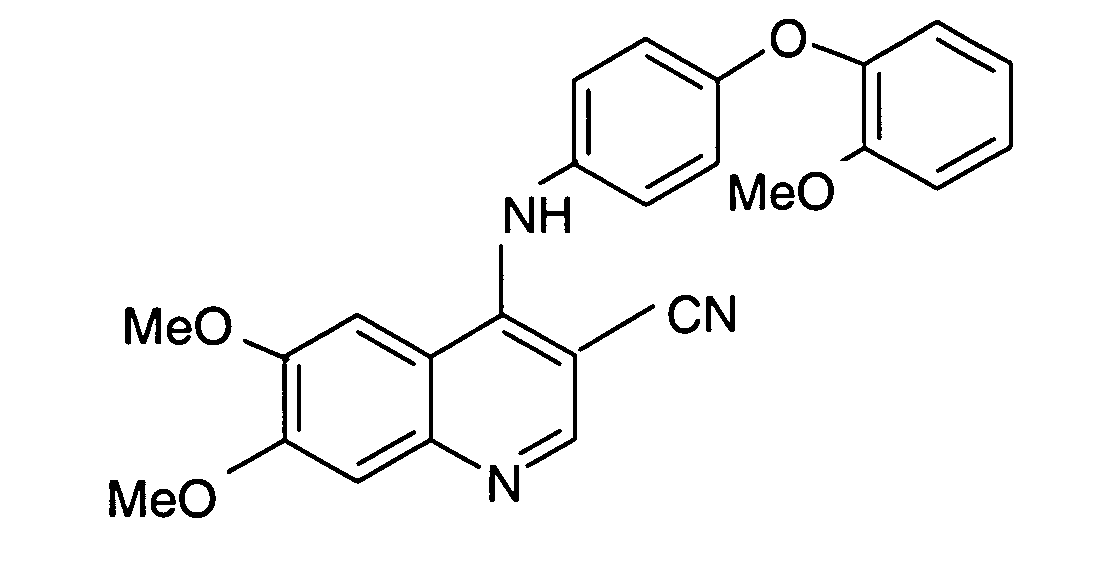
- A pharmaceutical composition comprising a compound of formula (I) as defined in claim 1 or a pharmaceutically acceptable salt thereof in combination with a pharmaceutically acceptable carrier or excipient.
- A method of preparing a compound of formula (I) as defined in claim 1 which method comprises either(a) reacting a compound of formula (III)where R1', R2', R3', R4' represent R1, R2, R3 and R4 respectively as defined in relation to formula (I) or a precursor thereof, and Z' is a leaving group, with a compound of formula (IV)
 (b) reacting a compound of formula (V)where R1', R2', R3', R4' are as defined in relation to fomula (III) R6, X, Y and n are as defined in relation to formula (I), with a compound of formula (VI)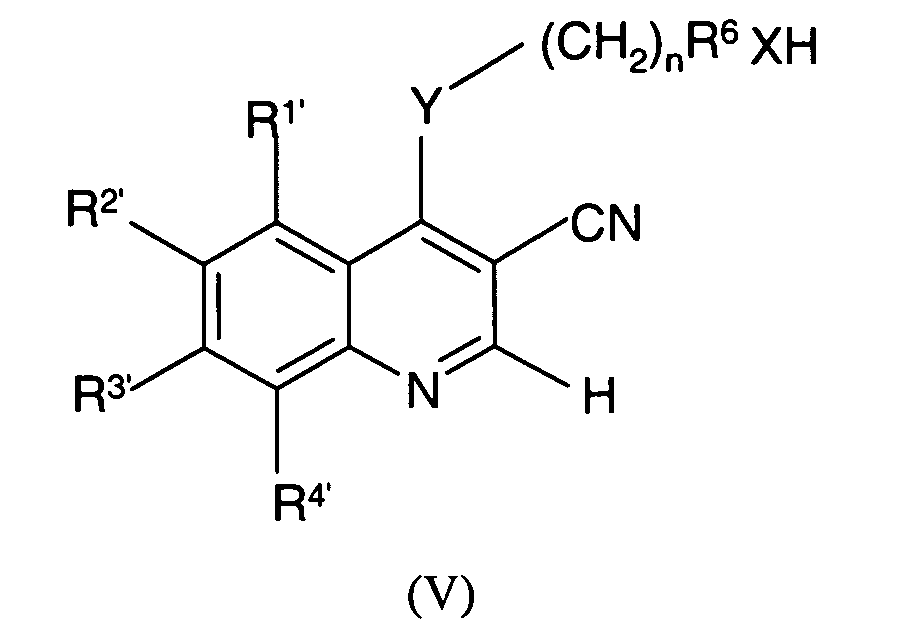
- A compound for use in therapy comprising a compound of formula (I) as defined in claim 1, or a pharmaceutically acceptable salt thereof.
- The use of a compound of formula (I) as defined in claim 1 or a pharmaceutical acceptable salt thereof in the preparation of a medicament for use in the inhibition of MEK enzymes.
Applications Claiming Priority (3)
| Application Number | Priority Date | Filing Date | Title |
|---|---|---|---|
| GB9910577 | 1999-05-08 | ||
| GBGB9910577.7A GB9910577D0 (en) | 1999-05-08 | 1999-05-08 | Chemical compounds |
| EP00927491A EP1178967B1 (en) | 1999-05-08 | 2000-05-03 | Quinoline derivatives as inhibitors of mek enzymes |
Related Parent Applications (1)
| Application Number | Title | Priority Date | Filing Date |
|---|---|---|---|
| EP00927491A Division EP1178967B1 (en) | 1999-05-08 | 2000-05-03 | Quinoline derivatives as inhibitors of mek enzymes |
Publications (1)
| Publication Number | Publication Date |
|---|---|
| EP1584619A1 true EP1584619A1 (en) | 2005-10-12 |
Family
ID=10852987
Family Applications (2)
| Application Number | Title | Priority Date | Filing Date |
|---|---|---|---|
| EP05013587A Withdrawn EP1584619A1 (en) | 1999-05-08 | 2000-05-03 | Derivatives of quinoline as inhibitors for MEK |
| EP00927491A Expired - Lifetime EP1178967B1 (en) | 1999-05-08 | 2000-05-03 | Quinoline derivatives as inhibitors of mek enzymes |
Family Applications After (1)
| Application Number | Title | Priority Date | Filing Date |
|---|---|---|---|
| EP00927491A Expired - Lifetime EP1178967B1 (en) | 1999-05-08 | 2000-05-03 | Quinoline derivatives as inhibitors of mek enzymes |
Country Status (26)
| Country | Link |
|---|---|
| EP (2) | EP1584619A1 (en) |
| JP (1) | JP2002544196A (en) |
| KR (1) | KR100667719B1 (en) |
| CN (1) | CN1219768C (en) |
| AT (1) | ATE319688T1 (en) |
| AU (1) | AU772846B2 (en) |
| BG (1) | BG106073A (en) |
| BR (1) | BR0010391A (en) |
| CA (1) | CA2372663A1 (en) |
| CZ (1) | CZ20013997A3 (en) |
| DE (1) | DE60026509T2 (en) |
| DK (1) | DK1178967T3 (en) |
| EE (1) | EE200100589A (en) |
| ES (1) | ES2258455T3 (en) |
| GB (2) | GB9910577D0 (en) |
| HU (1) | HUP0201219A3 (en) |
| IL (1) | IL146317A0 (en) |
| IS (1) | IS6138A (en) |
| NO (1) | NO321696B1 (en) |
| NZ (1) | NZ514980A (en) |
| PL (1) | PL352413A1 (en) |
| PT (1) | PT1178967E (en) |
| SK (1) | SK16102001A3 (en) |
| TR (1) | TR200103186T2 (en) |
| WO (1) | WO2000068201A1 (en) |
| ZA (1) | ZA200108971B (en) |
Cited By (3)
| Publication number | Priority date | Publication date | Assignee | Title |
|---|---|---|---|---|
| WO2007015809A3 (en) * | 2005-07-22 | 2007-03-29 | Merck & Co Inc | Hiv reverse transcriptase inhibitors |
| EP1969932A1 (en) * | 2007-03-12 | 2008-09-17 | Bayer CropScience AG | Phenoxy substituted phenylamidine derivatives and their use as fungicides |
| WO2008110280A3 (en) * | 2007-03-12 | 2009-01-08 | Bayer Cropscience Ag | Phenoxy substituted phenylamidine derivatives and their use as fungicides |
Families Citing this family (80)
| Publication number | Priority date | Publication date | Assignee | Title |
|---|---|---|---|---|
| EP1365796A2 (en) | 2000-09-01 | 2003-12-03 | Van Andel Institute | Inhibition of mitogen-activated protein kinase (mapk) pathway: a selective therapeutic strategy against melanoma |
| US7067532B2 (en) | 2000-11-02 | 2006-06-27 | Astrazeneca | Substituted quinolines as antitumor agents |
| WO2002036570A1 (en) * | 2000-11-02 | 2002-05-10 | Astrazeneca Ab | 4-substituted quinolines as antitumor agents |
| WO2002053528A1 (en) | 2000-12-29 | 2002-07-11 | Wyeth | Method for the regioselective preparation of substituted benzo[g]quinoline-3-carbonitriles and benzo[g]quinazolines |
| WO2002076496A1 (en) * | 2001-03-22 | 2002-10-03 | Van Andel Institute | Anthrax lethal factor inhibits tumor growth and angiogenesis |
| GB0112834D0 (en) | 2001-05-25 | 2001-07-18 | Smithkline Beecham Plc | Medicaments |
| WO2003000705A1 (en) | 2001-06-21 | 2003-01-03 | Ariad Pharmaceuticals, Inc. | Novel quinolines and uses thereof |
| ES2272737T3 (en) | 2001-07-16 | 2007-05-01 | Astrazeneca Ab | DERIVATIVES OF QUINOLINA AND ITS USE AS INHIBITORS OF THYROSINE KINASES. |
| US6821988B2 (en) * | 2001-11-27 | 2004-11-23 | Wyeth Holdings Corporation | 3-cyanoquinolines as inhibitors of EGF-R and HER2 kinases |
| AU2002365664A1 (en) * | 2001-12-05 | 2003-06-17 | Astrazeneca Ab | Quinoline derivatives as antitumour agents |
| AU2002347359A1 (en) * | 2001-12-05 | 2003-06-17 | Astrazeneca Ab | Quinoline derivatives |
| AU2002347336A1 (en) * | 2001-12-05 | 2003-06-17 | Astrazeneca Ab | Quinoline derivatives |
| SG2013013339A (en) | 2002-03-13 | 2014-12-30 | Array Biopharma Inc | N3 alkylated benzimidazole derivatives as mek inhibitors |
| US7235537B2 (en) | 2002-03-13 | 2007-06-26 | Array Biopharma, Inc. | N3 alkylated benzimidazole derivatives as MEK inhibitors |
| NZ536114A (en) * | 2002-03-30 | 2007-11-30 | Boehringer Ingelheim Pharma | 4-(N-phenylamino)-quinazolines / quinolines as tyrosine kinase inhibitors |
| US6924285B2 (en) | 2002-03-30 | 2005-08-02 | Boehringer Ingelheim Pharma Gmbh & Co. | Bicyclic heterocyclic compounds, pharmaceutical compositions containing these compounds, their use and process for preparing them |
| GB0215823D0 (en) | 2002-07-09 | 2002-08-14 | Astrazeneca Ab | Quinazoline derivatives |
| EP1521747B1 (en) | 2002-07-15 | 2018-09-05 | Symphony Evolution, Inc. | Receptor-type kinase modulators and methods of use |
| GB0225579D0 (en) | 2002-11-02 | 2002-12-11 | Astrazeneca Ab | Chemical compounds |
| WO2004069249A1 (en) * | 2003-02-03 | 2004-08-19 | Astrazeneca Ab | 3-cyano-quinoline derivatives as non-receptor tyrosine kinase inhibitors |
| WO2004069250A1 (en) * | 2003-02-03 | 2004-08-19 | Astrazeneca Ab | 3-cyano-quinoline derivatives as non-receptor tyrosine kinase inhibitors |
| EP1636195A1 (en) * | 2003-05-27 | 2006-03-22 | Pfizer Products Inc. | Quinazolines and pyrido[3,4-d]pyrimidines as receptor tyrosine kinase inhibitors |
| US7538120B2 (en) | 2003-09-03 | 2009-05-26 | Array Biopharma Inc. | Method of treating inflammatory diseases |
| US7144907B2 (en) | 2003-09-03 | 2006-12-05 | Array Biopharma Inc. | Heterocyclic inhibitors of MEK and methods of use thereof |
| EP2210607B1 (en) | 2003-09-26 | 2011-08-17 | Exelixis Inc. | N-[3-fluoro-4-({6-(methyloxy)-7-[(3-morpholin-4-ylpropyl)oxy]quinolin-4-yl}oxy)phenyl]-N'-(4-fluorophenyl)cyclopropane-1,1-dicarboxamide for the treatment of cancer |
| US7517994B2 (en) | 2003-11-19 | 2009-04-14 | Array Biopharma Inc. | Heterocyclic inhibitors of MEK and methods of use thereof |
| KR101190912B1 (en) | 2003-11-19 | 2012-10-12 | 어레이 바이오파마 인크. | Heterocyclic inhibitors of mek and methods of use thereof |
| US7732616B2 (en) | 2003-11-19 | 2010-06-08 | Array Biopharma Inc. | Dihydropyridine and dihydropyridazine derivatives as inhibitors of MEK and methods of use thereof |
| AU2004293026B2 (en) | 2003-11-21 | 2012-01-19 | Array Biopharma Inc. | AKT protein kinase inhibitors |
| CN1930128A (en) | 2004-01-16 | 2007-03-14 | 惠氏公司 | Quinoline Intermediates of Receptor Tyrosine Kinase Inhibitors and Their Synthesis |
| TW200529846A (en) | 2004-02-20 | 2005-09-16 | Wyeth Corp | 3-quinolinecarbonitrile protein kinase inhibitors |
| ES2444866T3 (en) | 2004-10-20 | 2014-02-27 | Merck Serono Sa | 3-arylamino pyridine derivatives |
| FR2884516B1 (en) * | 2005-04-15 | 2007-06-22 | Cerep Sa | NPY ANTAGONISTS, PREPARATION AND USES |
| TWI441637B (en) | 2005-05-18 | 2014-06-21 | Array Biopharma Inc | Heterocyclic inhibitors of mek and methods of use thereof |
| DE602006021645D1 (en) | 2005-11-15 | 2011-06-09 | Array Biopharma Inc | Process and intermediates for the preparation of N4-phenyl quinazoline-4-amine derivatives |
| US20090239936A1 (en) | 2006-05-15 | 2009-09-24 | Yoshikazu Sugimoto | Prophylactic and Therapeutic Agent for Cancer |
| WO2008006039A1 (en) | 2006-07-06 | 2008-01-10 | Array Biopharma Inc. | Dihydrothieno pyrimidines as akt protein kinase inhibitors |
| US8063050B2 (en) | 2006-07-06 | 2011-11-22 | Array Biopharma Inc. | Hydroxylated and methoxylated pyrimidyl cyclopentanes as AKT protein kinase inhibitors |
| RU2481336C2 (en) | 2006-07-06 | 2013-05-10 | Эррэй Биофарма Инк. | Cyclopenta(d)pyrimidines as protein kinase akt inhibitors |
| DE602007011628D1 (en) | 2006-07-06 | 2011-02-10 | Array Biopharma Inc | DIHYDROFUROPYRIMIDINES AS ACT PROTEIN KINASE INHIBITORS |
| EP1921070A1 (en) | 2006-11-10 | 2008-05-14 | Boehringer Ingelheim Pharma GmbH & Co. KG | Bicyclic heterocycles, medicaments comprising them, their use and process for their preparation |
| JP5377332B2 (en) | 2007-02-06 | 2013-12-25 | ベーリンガー インゲルハイム インターナショナル ゲゼルシャフト ミット ベシュレンクテル ハフツング | Bicyclic heterocycles, drugs containing these compounds, their use and their preparation |
| US8846683B2 (en) | 2007-07-05 | 2014-09-30 | Array Biopharma, Inc. | Pyrimidyl cyclopentanes as Akt protein kinase inhibitors |
| MX2009014013A (en) | 2007-07-05 | 2010-01-28 | Array Biopharma Inc | Pyrimidyl cyclopentanes as akt protein kinase inhibitors. |
| CA2692502C (en) | 2007-07-05 | 2016-03-01 | Array Biopharma Inc. | Pyrimidyl cyclopentanes as akt protein kinase inhibitors |
| US9409886B2 (en) | 2007-07-05 | 2016-08-09 | Array Biopharma Inc. | Pyrimidyl cyclopentanes as AKT protein kinase inhibitors |
| EP2220047B1 (en) | 2007-11-15 | 2015-05-06 | ClanoTech AB | Quinoline derivatives, pharmaceutical compositions comprising them, and use thereof |
| CN101952274A (en) | 2007-11-20 | 2011-01-19 | 默沙东公司 | Non-nucleoside reverse transcriptase inhibitor |
| US8853216B2 (en) | 2008-01-09 | 2014-10-07 | Array Biopharma, Inc. | Hydroxylated pyrimidyl cyclopentane as AKT protein kinase inhibitor |
| US8835434B2 (en) | 2008-01-09 | 2014-09-16 | Array Biopharma, Inc. | Hydroxylated pyrimidyl cyclopentanes as akt protein kinase inhibitors |
| WO2009098061A1 (en) | 2008-02-07 | 2009-08-13 | Boehringer Ingelheim International Gmbh | Spirocyclic heterocycles, medicaments containing said compounds, use thereof and method for their production |
| AU2009279940B2 (en) | 2008-08-04 | 2014-01-16 | Merck Patent Gmbh | Novel phenylamino isonicotinamide compounds |
| EP2313397B1 (en) | 2008-08-08 | 2016-04-20 | Boehringer Ingelheim International GmbH | Cyclohexyloxy substituted heterocycles, medicine containing these connections, their application and production method |
| EP2346818B1 (en) | 2008-11-10 | 2012-12-05 | Bayer Intellectual Property GmbH | Substituted sulphonamido phenoxybenzamides |
| TW201920110A (en) | 2009-01-16 | 2019-06-01 | 美商艾克塞里克斯公司 | Containing N-(4-{[6,7-bis(methoxy)quinolin-4-yl]oxy}phenyl)-N'-(4-fluorophenyl)cyclopropane-1,1-di Pharmaceutical composition of methotrexate malate and use thereof |
| UA108618C2 (en) | 2009-08-07 | 2015-05-25 | APPLICATION OF C-MET-MODULATORS IN COMBINATION WITH THEMOSOLOMID AND / OR RADIATION THERAPY FOR CANCER TREATMENT | |
| US8962606B2 (en) | 2009-10-21 | 2015-02-24 | Bayer Intellectual Property Gmbh | Substituted benzosulphonamides |
| CN102574782B (en) | 2009-10-21 | 2014-10-08 | 拜耳知识产权有限责任公司 | Substituted halophenoxybenzamide derivatives |
| CA2777430A1 (en) | 2009-10-21 | 2011-04-28 | Bayer Pharma Aktiengesellschaft | Substituted benzosulphonamides |
| EP2509961B1 (en) * | 2009-12-11 | 2016-03-09 | Autifony Therapeutics Limited | Imidazolidinedione derivatives |
| US9187458B2 (en) | 2010-06-09 | 2015-11-17 | Tianjin Hemay Bio-Tech Co., Ltd. | Cyanoquinoline derivatives |
| WO2012055953A1 (en) | 2010-10-29 | 2012-05-03 | Bayer Pharma Aktiengesellschaft | Substituted phenoxypyridines |
| CN102020651B (en) | 2010-11-02 | 2012-07-18 | 北京赛林泰医药技术有限公司 | 6-aryl amino pyridone formamide MEK (methyl ethyl ketone) inhibitor |
| FI2694072T4 (en) | 2011-04-01 | 2024-09-30 | Genentech Inc | Combination of akt inhibitor compound and abiraterone for use in therapeutic treatments |
| TR201815685T4 (en) | 2011-04-01 | 2018-11-21 | Genentech Inc | Combinations of act and mec inhibitory compounds for the treatment of cancer. |
| EP2714037B1 (en) | 2011-05-25 | 2016-07-13 | Université Paris Descartes | Erk inhibitors for use in treating spinal muscular atrophy |
| CN103204825B (en) | 2012-01-17 | 2015-03-04 | 上海科州药物研发有限公司 | Benzothiazole compounds as protein kinase inhibitors, and preparation method and application thereof |
| WO2015038704A1 (en) | 2013-09-11 | 2015-03-19 | The J. David Gladstone Institutes, A Testamentary Trust Established Under The Will Of J. David Gladstone | Compositions for preparing cardiomyocytes |
| WO2015108907A2 (en) | 2014-01-14 | 2015-07-23 | Dana-Farber Cancer Institute, Inc. | Compositions and methods for identification, assessment, prevention, and treatment of melanoma using pd-l1 isoforms |
| US20170248603A1 (en) | 2014-10-06 | 2017-08-31 | Dana-Farber Cancer Institute, Inc. | Angiopoiten-2 biomarkers predictive of anti-immune checkpoint response |
| MA41866A (en) | 2015-03-31 | 2018-02-06 | Massachusetts Gen Hospital | SELF-ASSEMBLING MOLECULES FOR TARGETED DRUG DELIVERY |
| WO2017040982A1 (en) * | 2015-09-02 | 2017-03-09 | The Regents Of The University Of California | Her3 ligands and uses thereof |
| US20190112317A1 (en) | 2015-10-05 | 2019-04-18 | The Trustees Of Columbia University In The City Of New York | Activators of autophagic flux and phospholipase d and clearance of protein aggregates including tau and treatment of proteinopathies |
| CN109422755B (en) * | 2017-09-01 | 2023-07-04 | 上海医药集团股份有限公司 | Nitrogen-containing heterocyclic compound, preparation method, intermediate, composition and application |
| CA3129665A1 (en) | 2019-03-21 | 2020-09-24 | Onxeo | A dbait molecule in combination with kinase inhibitor for the treatment of cancer |
| KR20220098759A (en) | 2019-11-08 | 2022-07-12 | 인쎄름 (엥스띠뛰 나씨오날 드 라 쌍떼 에 드 라 흐쉐르슈 메디깔) | A method of treating cancer that has acquired resistance to a kinase inhibitor |
| WO2021148581A1 (en) | 2020-01-22 | 2021-07-29 | Onxeo | Novel dbait molecule and its use |
| TW202342018A (en) | 2022-03-04 | 2023-11-01 | 美商奇奈特生物製藥公司 | Inhibitors of mek kinase |
| EP4788839A1 (en) | 2023-10-03 | 2026-08-12 | Institut National de la Santé et de la Recherche Médicale | Methods of prognosis and treatment of patients suffering from melanoma |
| WO2026017799A1 (en) * | 2024-07-18 | 2026-01-22 | Centre Hospitalier Universitaire Vaudois | Substituted 3-cyanoquinolines for the prevention and treatment of sexually transmitted diseases |
Citations (3)
| Publication number | Priority date | Publication date | Assignee | Title |
|---|---|---|---|---|
| WO1998043960A1 (en) * | 1997-04-03 | 1998-10-08 | American Cyanamid Company | Substituted 3-cyano quinolines |
| WO1999001426A1 (en) * | 1997-07-01 | 1999-01-14 | Warner-Lambert Company | 4-bromo or 4-iodo phenylamino benzhydroxamic acid derivatives and their use as mek inhibitors |
| WO2000018761A1 (en) * | 1998-09-29 | 2000-04-06 | American Cyanamid Company | Substituted 3-cyanoquinolines as protein tyrosine kinases inhibitors |
Family Cites Families (2)
| Publication number | Priority date | Publication date | Assignee | Title |
|---|---|---|---|---|
| CN1252054C (en) * | 1996-09-25 | 2006-04-19 | 曾尼卡有限公司 | Qinoline derivatives inhibiting effect of growth factors such as VEGF |
| HU230728B1 (en) * | 1998-09-29 | 2017-12-28 | Wyeth Holdings Llc | Substituted 3-cyanoquinolines as protein tyrosine kinases inhibitors |
-
1999
- 1999-05-08 GB GBGB9910577.7A patent/GB9910577D0/en not_active Ceased
-
2000
- 2000-04-19 GB GBGB0009532.3A patent/GB0009532D0/en not_active Ceased
- 2000-05-03 IL IL14631700A patent/IL146317A0/en unknown
- 2000-05-03 CN CNB008099596A patent/CN1219768C/en not_active Expired - Fee Related
- 2000-05-03 ES ES00927491T patent/ES2258455T3/en not_active Expired - Lifetime
- 2000-05-03 KR KR1020017014244A patent/KR100667719B1/en not_active Expired - Fee Related
- 2000-05-03 AU AU45891/00A patent/AU772846B2/en not_active Ceased
- 2000-05-03 CZ CZ20013997A patent/CZ20013997A3/en unknown
- 2000-05-03 DK DK00927491T patent/DK1178967T3/en active
- 2000-05-03 EP EP05013587A patent/EP1584619A1/en not_active Withdrawn
- 2000-05-03 BR BR0010391-8A patent/BR0010391A/en not_active Application Discontinuation
- 2000-05-03 HU HU0201219A patent/HUP0201219A3/en unknown
- 2000-05-03 DE DE60026509T patent/DE60026509T2/en not_active Expired - Fee Related
- 2000-05-03 EP EP00927491A patent/EP1178967B1/en not_active Expired - Lifetime
- 2000-05-03 EE EEP200100589A patent/EE200100589A/en unknown
- 2000-05-03 WO PCT/GB2000/001697 patent/WO2000068201A1/en not_active Ceased
- 2000-05-03 NZ NZ514980A patent/NZ514980A/en unknown
- 2000-05-03 AT AT00927491T patent/ATE319688T1/en not_active IP Right Cessation
- 2000-05-03 TR TR2001/03186T patent/TR200103186T2/en unknown
- 2000-05-03 PT PT00927491T patent/PT1178967E/en unknown
- 2000-05-03 PL PL00352413A patent/PL352413A1/en not_active Application Discontinuation
- 2000-05-03 CA CA002372663A patent/CA2372663A1/en not_active Abandoned
- 2000-05-03 JP JP2000617181A patent/JP2002544196A/en active Pending
- 2000-05-03 SK SK1610-2001A patent/SK16102001A3/en unknown
-
2001
- 2001-10-30 IS IS6138A patent/IS6138A/en unknown
- 2001-10-30 ZA ZA200108971A patent/ZA200108971B/en unknown
- 2001-11-01 BG BG106073A patent/BG106073A/en unknown
- 2001-11-07 NO NO20015448A patent/NO321696B1/en unknown
Patent Citations (3)
| Publication number | Priority date | Publication date | Assignee | Title |
|---|---|---|---|---|
| WO1998043960A1 (en) * | 1997-04-03 | 1998-10-08 | American Cyanamid Company | Substituted 3-cyano quinolines |
| WO1999001426A1 (en) * | 1997-07-01 | 1999-01-14 | Warner-Lambert Company | 4-bromo or 4-iodo phenylamino benzhydroxamic acid derivatives and their use as mek inhibitors |
| WO2000018761A1 (en) * | 1998-09-29 | 2000-04-06 | American Cyanamid Company | Substituted 3-cyanoquinolines as protein tyrosine kinases inhibitors |
Cited By (5)
| Publication number | Priority date | Publication date | Assignee | Title |
|---|---|---|---|---|
| WO2007015809A3 (en) * | 2005-07-22 | 2007-03-29 | Merck & Co Inc | Hiv reverse transcriptase inhibitors |
| US7807684B2 (en) | 2005-07-22 | 2010-10-05 | Merck Sharp & Dohme Corp. | HIV reverse transcriptase inhibitors |
| EP1969932A1 (en) * | 2007-03-12 | 2008-09-17 | Bayer CropScience AG | Phenoxy substituted phenylamidine derivatives and their use as fungicides |
| WO2008110280A3 (en) * | 2007-03-12 | 2009-01-08 | Bayer Cropscience Ag | Phenoxy substituted phenylamidine derivatives and their use as fungicides |
| US8394991B2 (en) | 2007-03-12 | 2013-03-12 | Bayer Cropscience Ag | Phenoxy substituted phenylamidine derivatives and their use as fungicides |
Also Published As
Similar Documents
| Publication | Publication Date | Title |
|---|---|---|
| EP1178967B1 (en) | Quinoline derivatives as inhibitors of mek enzymes | |
| EP1178965B1 (en) | Quinoline derivatives as inhibitors of mek enzymes | |
| EP1178966B1 (en) | Quinoline derivatives as inhibitors of mek enzymes | |
| ES2457396T3 (en) | 3-Substituted cyanoquinolines as protein tyrosine kinase inhibitors | |
| SK284846B6 (en) | Substituted 3-cyanoquinolines derivatives, method for the preparation thereof, their use and pharmaceutical preparation containing thereof | |
| JP2004517059A (en) | 4-Substituted quinolines for antitumor agents | |
| MXPA01011360A (en) | Quinoline derivatives asinhibitors of mek enzymes | |
| AU2010227057B2 (en) | Substituted 3-cyanoquinolines as protein tyrosine kinases inhibitors | |
| MXPA01011361A (en) | Quinoline derivatives as inhibitors of mek enzymes | |
| MXPA01011362A (en) | Quinoline derivatives as inhibitors of mek enzymes | |
| HU230095B1 (en) | Substituted 3-cyanoquinolines with inhibitory activity against protein tyrosine kinases | |
| MXPA01003227A (en) | Substituted 3-cyanoquinolines as protein tyrosine kinases inhibitors | |
| BRPI9917841B1 (en) | substituted 3-cyano quinoline compounds and compositions comprising the same |
Legal Events
| Date | Code | Title | Description |
|---|---|---|---|
| PUAI | Public reference made under article 153(3) epc to a published international application that has entered the european phase |
Free format text: ORIGINAL CODE: 0009012 |
|
| AC | Divisional application: reference to earlier application |
Ref document number: 1178967 Country of ref document: EP Kind code of ref document: P |
|
| AK | Designated contracting states |
Kind code of ref document: A1 Designated state(s): AT BE CH CY DE DK ES FI FR GB GR IE IT LI LU MC NL PT SE |
|
| AX | Request for extension of the european patent |
Extension state: AL LV MK |
|
| 17P | Request for examination filed |
Effective date: 20060412 |
|
| AKX | Designation fees paid |
Designated state(s): AT BE CH CY DE DK ES FI FR GB GR IE IT LI LU MC NL PT SE |
|
| AXX | Extension fees paid |
Extension state: MK Payment date: 20060412 Extension state: LV Payment date: 20060412 Extension state: AL Payment date: 20060412 |
|
| 17Q | First examination report despatched |
Effective date: 20060803 |
|
| STAA | Information on the status of an ep patent application or granted ep patent |
Free format text: STATUS: THE APPLICATION IS DEEMED TO BE WITHDRAWN |
|
| 18D | Application deemed to be withdrawn |
Effective date: 20070214 |