EP1583342A1 - Procédé et système d'activation d'une téléconférence vocale à partir d'un message électronique écrit - Google Patents
Procédé et système d'activation d'une téléconférence vocale à partir d'un message électronique écrit Download PDFInfo
- Publication number
- EP1583342A1 EP1583342A1 EP05290668A EP05290668A EP1583342A1 EP 1583342 A1 EP1583342 A1 EP 1583342A1 EP 05290668 A EP05290668 A EP 05290668A EP 05290668 A EP05290668 A EP 05290668A EP 1583342 A1 EP1583342 A1 EP 1583342A1
- Authority
- EP
- European Patent Office
- Prior art keywords
- teleconference
- organizer
- participants
- telephone
- date
- Prior art date
- Legal status (The legal status is an assumption and is not a legal conclusion. Google has not performed a legal analysis and makes no representation as to the accuracy of the status listed.)
- Withdrawn
Links
Images

Classifications
-
- H—ELECTRICITY
- H04—ELECTRIC COMMUNICATION TECHNIQUE
- H04M—TELEPHONIC COMMUNICATION
- H04M3/00—Automatic or semi-automatic exchanges
- H04M3/42—Systems providing special services or facilities to subscribers
- H04M3/56—Arrangements for connecting several subscribers to a common circuit, i.e. affording conference facilities
-
- H—ELECTRICITY
- H04—ELECTRIC COMMUNICATION TECHNIQUE
- H04M—TELEPHONIC COMMUNICATION
- H04M2203/00—Aspects of automatic or semi-automatic exchanges
- H04M2203/50—Aspects of automatic or semi-automatic exchanges related to audio conference
- H04M2203/5063—Centrally initiated conference, i.e. conference server dials participants
-
- H—ELECTRICITY
- H04—ELECTRIC COMMUNICATION TECHNIQUE
- H04M—TELEPHONIC COMMUNICATION
- H04M2203/00—Aspects of automatic or semi-automatic exchanges
- H04M2203/65—Aspects of automatic or semi-automatic exchanges related to applications where calls are combined with other types of communication
- H04M2203/652—Call initiation triggered by text message
-
- H—ELECTRICITY
- H04—ELECTRIC COMMUNICATION TECHNIQUE
- H04M—TELEPHONIC COMMUNICATION
- H04M3/00—Automatic or semi-automatic exchanges
- H04M3/42—Systems providing special services or facilities to subscribers
- H04M3/42382—Text-based messaging services in telephone networks such as PSTN/ISDN, e.g. User-to-User Signalling or Short Message Service for fixed networks
Definitions
- the present invention relates to a method and a system for activating a voice or audio meeting.
- a specific telephone number is assigned to the teleconference organizer, either temporarily or for a specified duration.
- This phone number can also be associated with a PIN that must be entered by participants to allow them to access the meeting.
- the organizer forwards to the other participants in the teleconference, the specific phone number, the date and time of the teleconference, and, if applicable, the PIN.
- participants At the scheduled time of the meeting, participants must dial the telephone number and, where applicable, the PIN. This procedure is relatively long.
- Some telephone operators or private telephone equipment also offer a three-way conference service, allowing for a communication between two people (point-to-point) to integrate a third interlocutor. For this purpose, one of the two persons in communication must compose on his phone keypad a DTMF (Dual Tone Multi) Frequency) containing the phone number of the third party.
- DTMF Dual Tone Multi
- Patent FR 2 792 480 filed by the Applicant describes a system for controlling a PBX from a system computer to implement telephone services. This document not describe teleconferencing means.
- the present invention aims to eliminate these disadvantages. This goal is achieved by predicting a method of activating a voice teleconference via at least one telephone network.
- the identifiers extracted from the electronic message are e-mail box addresses, the organizer's identifier being extracted from a field specifying the sender of the e-mail message, and identifiers of participants being extracted from fields specifying recipients the e-mail message.
- the electronic message received contains information about the date and time of the teleconference, as desired by the organizer.
- the date and time information of the teleconference indicates whether the conference must be activated immediately or deferred.
- the activation server of teleconferencing determines the date and time of the conference call based on respective availability information of the organizer and the participants, this information being accessible via a calendar server and / or presence management servers giving information about the reachability of participants by their respective telephone numbers.
- this method further comprises a step of providing the organizer with a specification interface of teleconference settings, allowing the organizer to modify the said parameters before and / or during the teleconference.
- the specification interface makes it possible to add a participant to the teleconference.
- the activation server of teleconferences sends the organizer an e-mail message confirmation containing the address of a parameter specification interface of the teleconference and listing the participants and the date and time of the teleconference.
- the invention also relates to a system for activating a teleconference voice through at least one telephone network.
- this system comprises a server Web site that allows an organizer of a conference call to edit teleconference settings.
- the activation server of teleconferencing also includes means for ordering the institution during a teleconference of a telephone call between the line assigned to the teleconference and the telephone line of a new telephone participant.
- the telephone lines of at least some of the participants in the teleconference are telephone lines terrestrial and / or mobile and / or voice over IP.
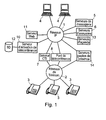
- FIG. 1 represents a telecommunication system comprising telecommunication networks, telephone networks 2 and IP 1, IP networks being able to be private (Intranet) or public (Internet) and connected to terminals of users 4, messaging servers 5 delayed or instantaneous allowing user terminals to exchange electronic messages, and directory servers 6 associating the names of the users respectively with their email addresses and their phone numbers.
- IP networks being able to be private (Intranet) or public (Internet) and connected to terminals of users 4
- messaging servers 5 delayed or instantaneous allowing user terminals to exchange electronic messages
- directory servers 6 associating the names of the users respectively with their email addresses and their phone numbers.
- IP networks 1 can also be connected to calendar servers 13 memorizing the schedules of the users, and the management servers of presence connected to networks 1, 2 and providing information on accessibility of the users vis-à-vis one or more means of telecommunication 3, 4.
- the telephone networks 2 may be terrestrial telephone networks analogue (RTC) or digital (ISDN), or telephone networks mobiles, such as GSM or UMTS. They can also be IP networks with voice over IP (VoIP) telecommunication channels.
- RTC terrestrial telephone networks analogue
- ISDN digital
- VoIP voice over IP
- An exemplary embodiment of the CTI server 7 is for example described in the patent FR 2 792 480.
- Teleconference Bridge 8 provides users with multiple physical or logical voice telephony (VoIP) lines, each of which is assigned on demand to a conference call. To enter into a teleconference with each other, the users must dial the telephone number corresponding to the line assigned to them, each user then being in communication with the other users having previously dialed this number.
- the management and control interface of the teleconference bridge can be accessible via an IP network 1 or a telephone network 2. In the latter case, the teleconference activation server 10 is also connected to a telephone network to access this management and control interface.
- the teleconference activation server 10 has an e-mail address for receiving users of teleconferencing requests.
- the server 10 is further adapted to perform the procedures 20 and 30 shown in Figs. 2a and 2b respectively upon receipt of a conference call message and upon initiation of a conference call.
- the procedure 20 that is initiated following receipt of a teleconference request email message includes a first step 21 of recording the teleconference request thus received and assigning an identifier. (number) at this request.
- the server 10 analyzes the message to determine the identities of the organizer and the participants of the teleconference. This information can indeed be extracted respectively from the "sender" field and the "recipient” (direct and copy) fields of the message. In this case, the identities of the organizer and the participants are in the form of e-mail box addresses.
- the server 10 can also extract from the message the desired date and time of the teleconference, which can be simply specified in the form of keywords such as "immediate” or “deferred”, for example in the "subject” field of the message .
- the retrieved information is stored in a database 12 in association with the teleconference request number.
- the server 10 searches for the telephone numbers of the organizer and the participants in the teleconference, from the identifiers of the latter extracts of the message.
- the server 10 may have access to a directory server 6, in particular matching e-mail addresses with telephone numbers. If the server 10 does not find in the directory at least the identifier of the organizer and a participant identifier, it sends an error message in electronic form to the organizer of the meeting.
- the server 10 can further determine one or more dates and times of the meeting according to the availability and / or presence of the participants, by accessing the calendar server 13 and / or the management server. presence of 14 participants.
- the server 10 may generate a preformatted message to the organizer and participants to request their availability.
- the server 10 searches whether a teleconference line is available at the date and time of the teleconference, as specified in the e-mail received from the organizer or determined from the availability of participants. If a conference call number is not available on the scheduled date and time, it will search for a date and time available from the scheduled time.
- the server 10 queries the teleconferencing bridge 8 if the latter offers this possibility. Otherwise, the server 10 manages the availability of teleconferencing lines offered by the teleconference bridge. The server 10 then reserves the teleconference line available for the first date and time possible, either by making the request to the teleconferencing bridge 8, or by memorizing the information locally as part of its management of availability of teleconferencing lines. It also stores the number of the teleconference line in its database 12 in association with the teleconference request number.
- the server 10 transmits an electronic message of response to the teleconference organizer and eventually to the participants, this message containing the acceptance of the teleconference request, the date and the scheduled time of the teleconference, the identifiers of the other participants, that a link to a web page published by the web server 11 providing information and to specify or modify certain teleconference settings.
- the webpage is designed to allow the organizer of a teleconference to change the start and end dates and times of the teleconference, as well as the list of participants.
- the server 10 executes the procedure 30 illustrated in Figure 2b.
- This procedure includes a first step 31 during which the server 10 searches the parameters of the teleconference to be triggered, ie the teleconference number, and the phone numbers of the organizer and participants.
- the server 10 initiates the teleconference by asking the CTI server 7 establish a communication between the teleconference number and each of the participants (and organizer).
- the organizer can change the list of meeting participants at any time (before and during the meeting) by accessing the web page assigned to the meeting by the web server 11, or by sending a new message to the server 10. It can delete a participant before the conference call and add a participant before or during the conference call.
- the server 10 Upon receiving an order to add a participant during the teleconference, via an electronic message or the web server 11, the server 10 possibly searches for the number of the participant to add and transmits to the CTI server 7 a call setup order associated with the conference call number and the new participant's telephone number.
Landscapes
- Engineering & Computer Science (AREA)
- Multimedia (AREA)
- Signal Processing (AREA)
- Telephonic Communication Services (AREA)
- Data Exchanges In Wide-Area Networks (AREA)
Abstract
Description
L'organisateur transmet aux autres participants de la téléconférence, le numéro de téléphone spécifique, la date et l'heure de la téléconférence, et le cas échéant, le code confidentiel. A l'heure prévue de la téléconférence, les participants doivent composer le numéro de téléphone et le cas échéant le code confidentiel.
Cette procédure s'avère relativement longue.
- un serveur d'activation de téléconférences reçoit d'un organisateur d'une téléconférence un message électronique non formaté adressé également à des participants d'une téléconférence, et analyse le message pour en extraire des identifiants de l'organisateur et des participants à la téléconférence,
- le serveur d'activation de téléconférences détermine à partir des identifiants extraits des numéros de téléphones respectifs grâce auxquels l'organisateur et les participants peuvent être appelés,
- le serveur d'activation de téléconférences détermine une date et heure d'activation d'une téléconférence entre l'organisateur et les participants identifiés dans le message reçu, et attribue à la téléconférence une ligne téléphonique parmi un ensemble de lignes téléphoniques disponibles d'un pont de téléconférence, pour la date et heure d'activation déterminée,
- à la date et heure déterminées de la téléconférence, le serveur d'activation de téléconférences commande l'établissement d'une communication téléphonique entre la ligne téléphonique attribuée à la téléconférence d'une part et d'autre part, l'organisateur et chaque participant.
- des moyens pour recevoir d'un organisateur de téléconférence un message électronique non formaté, adressé également à des participants d'une téléconférence, et pour analyser le message afin d'en extraire des identifiants de l'organisateur et des participants à la téléconférence,
- des moyens pour déterminer à partir des identifiants extraits des numéros de téléphones respectifs grâce auxquels l'organisateur et les participants peuvent être appelés, et
- des moyens pour déterminer une date et heure d'activation d'une téléconférence entre l'organisateur et les participants identifiés dans le message reçu, et pour attribuer à la téléconférence une ligne téléphonique parmi un ensemble de lignes téléphoniques disponibles d'un pont de téléconférence, pour la date et heure d'activation déterminée,
- des moyens pour commander l'établissement à la date et heure déterminée de la téléconférence d'une communication téléphonique entre la ligne téléphonique attribuée à la téléconférence d'une part et d'autre part, des lignes téléphoniques de l'organisateur et de chaque participant,
- le système comprenant des moyens connectés à au moins un réseau téléphonique pour établir sur demande du serveur d'activation de téléconférences une communication téléphonique entre les lignes téléphoniques du pont de téléconférence et des lignes téléphoniques d'utilisateurs.
- un serveur de couplage téléphonique informatique (CTI) 7 connecté à la fois à au moins un réseau IP 1 et au moins un réseau téléphonique 2 (par exemple par l'intermédiaire d'un autocommutateur téléphonique (PABX) et permettant d'établir des télécommunications avec le réseau téléphonique sur ordres reçus via un réseau IP ;
- un pont de téléconférence 8 connecté à au moins un réseau téléphonique 2 et offrant aux utilisateurs un service de téléconférence ;
- un serveur d'activation de téléconférences 10 connecté à un réseau IP 1 et éventuellement ayant accès à une interface de gestion et de commande du pont de téléconférence 8 ; et
- un serveur WEB 11 auquel les utilisateurs peuvent accéder pour gérer une téléconférence mise en oeuvre grâce au serveur d'activation 10 et au pont de téléconférence 8.
L'interface de gestion et de commande du pont de téléconférence peut être accessible par l'intermédiaire d'un réseau IP 1 ou d'un réseau téléphonique 2. Dans ce dernier cas, le serveur d'activation de téléconférences 10 est également connecté à un réseau téléphonique pour avoir accès à cette interface de gestion et de commande.
Le serveur 10 est en outre conçu pour exécuter les procédures 20 et 30 représentées par les figures 2a et 2b, respectivement à la réception d'un message de demande de téléconférence et au moment du déclenchement d'une téléconférence.
Les informations extraites sont enregistrées dans une base de données 12 en association avec le numéro de demande de téléconférence.
A cet effet, le serveur 10 peut avoir accès à un serveur d'annuaire 6 mettant en correspondance notamment des adresses de messagerie électronique avec des numéros de téléphones. Si le serveur 10 ne trouve pas dans l'annuaire au moins l'identifiant de l'organisateur et un identifiant de participant, il émet un message d'erreur sous forme électronique à destination de l'organisateur de la téléconférence.
Le serveur 10 recherche ensuite si une ligne de téléconférence est disponible à la date et heure de la téléconférence, telle que spécifiée dans le message électronique reçu de l'organisateur ou bien déterminée à partir des disponibilités des participants. Si aucun numéro de téléconférence n'est disponible à la date et heure prévue, il recherche une date et heure disponible à partir de l'heure prévue.
Le serveur 10 réserve alors la ligne de téléconférence disponible pour la première date et heure possible, soit en en faisant la demande au pont de téléconférence 8, soit en mémorisant l'information localement dans le cadre de sa gestion des disponibilités des lignes de téléconférence. Il mémorise également le numéro de la ligne de téléconférence dans sa base de données 12 en association avec le numéro de la demande de téléconférence.
A la réception d'un ordre d'ajout d'un participant pendant la téléconférence, par l'intermédiaire d'un message électronique ou du serveur Web 11, le serveur 10 recherche éventuellement le numéro du participant à ajouter et transmet au serveur CTI 7 un ordre d'établissement de communication téléphonique associé au numéro de la téléconférence et au numéro de téléphone du nouveau participant.
Claims (12)
- Procédé d'activation d'une téléconférence vocale par l'intermédiaire d'au moins un réseau téléphonique,
caractérisé en ce qu'il comprend des étapes au cours desquelles :un serveur d'activation de téléconférences (10) reçoit d'un organisateur d'une téléconférence un message électronique non formaté adressé également à des participants d'une téléconférence, et analyse le message pour en extraire des identifiants de l'organisateur et des participants à la téléconférence,le serveur d'activation de téléconférences (10) détermine à partir des identifiants extraits des numéros de téléphones respectifs grâce auxquels l'organisateur et les participants peuvent être appelés,le serveur d'activation de téléconférences (10) détermine une date et heure d'activation d'une téléconférence entre l'organisateur et les participants identifiés dans le message reçu, et attribue à la téléconférence une ligne téléphonique parmi un ensemble de lignes téléphoniques disponibles d'un pont de téléconférence (8), pour la date et heure d'activation déterminée,à la date et heure déterminées de la téléconférence, le serveur d'activation de téléconférences (10) commande l'établissement d'une communication téléphonique entre la ligne téléphonique attribuée à la téléconférence d'une part et d'autre part, l'organisateur et chaque participant. - Procédé selon la revendication 1,
caractérisé en ce que les identifiants extraits du message électronique sont des adresses de boítes de messagerie électronique, l'identifiant de l'organisateur étant extrait d'un champ spécifiant l'émetteur du message électronique, et les identifiants des participants étant extraits de champs spécifiant des destinataires du message électronique. - Procédé selon la revendication 1 ou 2,
caractérisé en ce que le message électronique reçu contient une information sur la date et heure de la téléconférence, souhaitée par l'organisateur. - Procédé selon la revendication 3,
caractérisé en ce que l'information sur la date et heure de la téléconférence indique si la conférence doit être activée immédiatement ou en différé. - Procédé selon l'une des revendications 1 à 4,
caractérisé en ce que le serveur d'activation de téléconférences (10) détermine la date et heure de la téléconférence en fonction d'informations de disponibilité respectives de l'organisateur et des participants, ces informations étant accessibles par l'intermédiaire d'un serveur d'agenda (13) et/ou de serveurs de gestion de présence (14) donnant des informations sur la joignabilité des participants par leur numéro de téléphones respectifs. - Procédé selon l'une des revendications 1 à 5,
caractérisé en ce qu'il comprend une étape de mise à disposition de l'organisateur d'une interface de spécification de paramètres de la téléconférence, permettant à l'organisateur de modifier lesdits paramètres avant et/ou pendant la téléconférence. - Procédé selon la revendication 6,
caractérisé en ce que l'interface de spécification permet d'ajouter un participant à la téléconférence. - Procédé selon l'une des revendications 1 à 7,
caractérisé en ce que le serveur d'activation de téléconférences (10) transmet à l'organisateur un message électronique de confirmation contenant l'adresse d'une interface de spécification de paramètres de la téléconférence et donnant la liste des participants et la date et heure prévue de la téléconférence. - Système d'activation d'une téléconférence vocale par l'intermédiaire d'au moins un réseau téléphonique,
caractérisé en ce qu'il comprend un serveur d'activation de téléconférences (10) connecté à au moins un réseau IP (1) et comprenant :des moyens pour recevoir d'un organisateur de téléconférence un message électronique non formaté, adressé également à des participants d'une téléconférence, et pour analyser le message afin d'en extraire des identifiants de l'organisateur et des participants à la téléconférence,des moyens pour déterminer à partir des identifiants extraits des numéros de téléphones respectifs grâce auxquels l'organisateur et les participants peuvent être appelés, etdes moyens pour déterminer une date et heure d'activation d'une téléconférence entre l'organisateur et les participants identifiés dans le message reçu, et pour attribuer à la téléconférence une ligne téléphonique parmi un ensemble de lignes téléphoniques disponibles d'un pont de téléconférence (8), pour la date et heure d'activation déterminée,des moyens pour commander l'établissement à la date et heure déterminée de la téléconférence d'une communication téléphonique entre la ligne téléphonique attribuée à la téléconférence d'une part et d'autre part, des lignes téléphoniques de l'organisateur et de chaque participant,le système comprenant des moyens (7) connectés à au moins un réseau téléphonique (2) pour établir sur demande du serveur d'activation de téléconférences une communication téléphonique entre les lignes téléphoniques du pont de téléconférence (8) et des lignes téléphoniques d'utilisateurs. - Système selon la revendication 9,
caractérisé en ce qu'il comprend un serveur Web (11) permettant à un organisateur d'une téléconférence de modifier des paramètres de la téléconférence. - Système selon la revendication 9 ou 10,
caractérisé en ce que le serveur d'activation de téléconférences (10) comprend en outre des moyens pour commander l'établissement pendant une téléconférence d'une communication téléphonique entre la ligne téléphonique attribuée à la téléconférence et la ligne téléphonique d'un nouveau participant. - Système selon l'une des revendications 9 à 11,
caractérisé en ce que les lignes téléphoniques d'au moins une partie des participants à la téléconférence sont des lignes de téléphonie terrestre et/ou mobile et/ou de voix sur IP.
Applications Claiming Priority (2)
| Application Number | Priority Date | Filing Date | Title |
|---|---|---|---|
| FR0403290A FR2868649A1 (fr) | 2004-03-30 | 2004-03-30 | Procede et systeme d'activation d'une teleconference vocale a partir d'un message electronique ecrit |
| FR0403290 | 2004-03-30 |
Publications (1)
| Publication Number | Publication Date |
|---|---|
| EP1583342A1 true EP1583342A1 (fr) | 2005-10-05 |
Family
ID=34878467
Family Applications (1)
| Application Number | Title | Priority Date | Filing Date |
|---|---|---|---|
| EP05290668A Withdrawn EP1583342A1 (fr) | 2004-03-30 | 2005-03-25 | Procédé et système d'activation d'une téléconférence vocale à partir d'un message électronique écrit |
Country Status (2)
| Country | Link |
|---|---|
| EP (1) | EP1583342A1 (fr) |
| FR (1) | FR2868649A1 (fr) |
Citations (3)
| Publication number | Priority date | Publication date | Assignee | Title |
|---|---|---|---|---|
| US20030016805A1 (en) * | 2001-07-19 | 2003-01-23 | International Business Machines Corporation | E-mail with voice / phone conference feature |
| WO2003055187A1 (fr) * | 2001-12-19 | 2003-07-03 | Bellsouth Intellectual Property Corporation | Automatisation d'etablissement de communications de conference |
| EP1372328A1 (fr) * | 2002-06-12 | 2003-12-17 | Siemens AG | Système et methode de construire une voie de conférence aux réseaux de télécommunication |
-
2004
- 2004-03-30 FR FR0403290A patent/FR2868649A1/fr active Pending
-
2005
- 2005-03-25 EP EP05290668A patent/EP1583342A1/fr not_active Withdrawn
Patent Citations (3)
| Publication number | Priority date | Publication date | Assignee | Title |
|---|---|---|---|---|
| US20030016805A1 (en) * | 2001-07-19 | 2003-01-23 | International Business Machines Corporation | E-mail with voice / phone conference feature |
| WO2003055187A1 (fr) * | 2001-12-19 | 2003-07-03 | Bellsouth Intellectual Property Corporation | Automatisation d'etablissement de communications de conference |
| EP1372328A1 (fr) * | 2002-06-12 | 2003-12-17 | Siemens AG | Système et methode de construire une voie de conférence aux réseaux de télécommunication |
Also Published As
| Publication number | Publication date |
|---|---|
| FR2868649A1 (fr) | 2005-10-07 |
Similar Documents
| Publication | Publication Date | Title |
|---|---|---|
| US8755503B1 (en) | Methods and systems for call processing and for providing call progress status over a network | |
| US9706029B1 (en) | Methods and systems for call processing | |
| US7567662B1 (en) | Conference calls via electronic messaging interface | |
| US8402088B2 (en) | Establishing telephone calls at a specified future time using a URI and a web-based telephony application | |
| US8218736B1 (en) | Methods and systems for confirming message delivery | |
| US9294627B1 (en) | Methods and systems for providing telecommunications services | |
| US7499537B2 (en) | Technique for providing personalized information and communications services | |
| US7418090B2 (en) | Methods and systems for conference call buffering | |
| US7489679B2 (en) | Providing telephony services using proxies | |
| JP4874994B2 (ja) | 会議電話を確立するための方法およびシステム | |
| US7822186B1 (en) | Methods and systems for time-based delivery of calls | |
| US20090147778A1 (en) | Method and system for targeted advertising in a communication system for mediating voice and text communications | |
| US20020181670A1 (en) | Telephony call control using a data network and a graphical user interface and exchanging datagrams between parties to a telephone call | |
| WO1998013995A1 (fr) | Systeme de teleconference a base de reseau | |
| US8855287B1 (en) | Voice over internet protocol call handling applications | |
| EP2283610A2 (fr) | Procédé et système d'enregistrement automatique d'une session de communication | |
| EP2715724A1 (fr) | Analyse de conversation vocale à l'aide de mots clés | |
| USRE46168E1 (en) | Voice over internet protocol application development framework | |
| EP1583342A1 (fr) | Procédé et système d'activation d'une téléconférence vocale à partir d'un message électronique écrit | |
| EP1501272B1 (fr) | Procédé d'organisation de conférence | |
| EP1501271A1 (fr) | Procédé d'organisation de conférence | |
| GB2424142A (en) | Call handling in a telecommunications network |
Legal Events
| Date | Code | Title | Description |
|---|---|---|---|
| PUAI | Public reference made under article 153(3) epc to a published international application that has entered the european phase |
Free format text: ORIGINAL CODE: 0009012 |
|
| AK | Designated contracting states |
Kind code of ref document: A1 Designated state(s): AT BE BG CH CY CZ DE DK EE ES FI FR GB GR HU IE IS IT LI LT LU MC NL PL PT RO SE SI SK TR |
|
| AX | Request for extension of the european patent |
Extension state: AL BA HR LV MK YU |
|
| 17P | Request for examination filed |
Effective date: 20060329 |
|
| AKX | Designation fees paid |
Designated state(s): AT BE BG CH CY CZ DE DK EE ES FI FR GB GR HU IE IS IT LI LT LU MC NL PL PT RO SE SI SK TR |
|
| GRAP | Despatch of communication of intention to grant a patent |
Free format text: ORIGINAL CODE: EPIDOSNIGR1 |
|
| STAA | Information on the status of an ep patent application or granted ep patent |
Free format text: STATUS: THE APPLICATION IS DEEMED TO BE WITHDRAWN |
|
| 18D | Application deemed to be withdrawn |
Effective date: 20080209 |