EP1583281A1 - High-speed traffic measurement and analysis methodologies and protocols - Google Patents
High-speed traffic measurement and analysis methodologies and protocols Download PDFInfo
- Publication number
- EP1583281A1 EP1583281A1 EP05251556A EP05251556A EP1583281A1 EP 1583281 A1 EP1583281 A1 EP 1583281A1 EP 05251556 A EP05251556 A EP 05251556A EP 05251556 A EP05251556 A EP 05251556A EP 1583281 A1 EP1583281 A1 EP 1583281A1
- Authority
- EP
- European Patent Office
- Prior art keywords
- traffic
- network
- packet
- digests
- nodes
- Prior art date
- Legal status (The legal status is an assumption and is not a legal conclusion. Google has not performed a legal analysis and makes no representation as to the accuracy of the status listed.)
- Granted
Links
Images
Classifications
-
- H—ELECTRICITY
- H04—ELECTRIC COMMUNICATION TECHNIQUE
- H04L—TRANSMISSION OF DIGITAL INFORMATION, e.g. TELEGRAPHIC COMMUNICATION
- H04L41/00—Arrangements for maintenance, administration or management of data switching networks, e.g. of packet switching networks
- H04L41/14—Network analysis or design
-
- H—ELECTRICITY
- H04—ELECTRIC COMMUNICATION TECHNIQUE
- H04L—TRANSMISSION OF DIGITAL INFORMATION, e.g. TELEGRAPHIC COMMUNICATION
- H04L9/00—Cryptographic mechanisms or cryptographic arrangements for secret or secure communications; Network security protocols
- H04L9/40—Network security protocols
-
- H—ELECTRICITY
- H04—ELECTRIC COMMUNICATION TECHNIQUE
- H04L—TRANSMISSION OF DIGITAL INFORMATION, e.g. TELEGRAPHIC COMMUNICATION
- H04L43/00—Arrangements for monitoring or testing data switching networks
- H04L43/08—Monitoring or testing based on specific metrics, e.g. QoS, energy consumption or environmental parameters
- H04L43/0852—Delays
-
- H—ELECTRICITY
- H04—ELECTRIC COMMUNICATION TECHNIQUE
- H04L—TRANSMISSION OF DIGITAL INFORMATION, e.g. TELEGRAPHIC COMMUNICATION
- H04L43/00—Arrangements for monitoring or testing data switching networks
- H04L43/50—Testing arrangements
Definitions
- the present invention relates generally to communications networks and more particularly to measurement and analysis of data packet communications networks.
- Such events include network component failures, nondeterministic load-balancing schemes (e.g. Equal Cost Multiple Path (ECMP)), software/hardware bugs and protocol mis-configurations.
- ECMP Equal Cost Multiple Path
- traceroute rudimentary diagnostic tools
- each node maintains a compressed summary, or a digest, of all the packets it recently handled.
- the digest is in the form of a Bloom filter, see, for example, B. Bloom, "Space/Time trade-offs in hash coding with allowable errors," Communications of the ACM 13, July 1970, pp.422-426, [Bloo 70] and , A. Broder, M.
- the Bloom filter has to be big enough to store sufficient information for every individual incoming packet. Even with the efficient memory vs. false-positive-trade-off of a Bloom filter, it still requires O(N) bits of memory to capture and correctly distinguish the signatures ofN different packets with high probability. In [Snoe 01], it is estimated that such a system requires approximately 0.5% of link capacity of the node per unit time in storage. For a 10Gbps link, this translates to 50Mbits of storage for every one second of monitoring time. Such a heavy-weight traffic digest approach not only stresses the memory storage and communication requirements of the system but also scales poorly as the link speed and/or monitoring duration increases.
- TMA Traffic Measurement and Analysis
- TD's Given the small size of the TD's, it is possible to distribute nodal TD's to all routers within a domain by piggybacking them as opaque data objects inside existing control messages, such as OSPF link-state packets (LSPs) or I-BGP control messages.
- LSPs OSPF link-state packets
- I-BGP control messages Once the required TD's are received, a router can estimate the traffic measurements of interest for each of its local link by solving a series of set-cardinality-determination problems.
- the traffic measurements of interest are typically in form of per-link, per-traffic-aggregate packet counts (or flow counts) where an aggregate is defined by the group of packets sharing the same originating and/or destination nodes (or links) and/or some intermediate nodes (or links).
- each router can construct a network-wide view of routes/ flow patterns of different traffic commodities where a commodity is defined as a group of packets sharing the same origination and/or termination nodes or links.
- each router can further reduce the associated measurement/estimation errors by locally conducting a minimum square error (MSE) optimization based on network-wide commodity-flow conservation constraints.
- MSE minimum square error
- DATALITE In addition to the support of the "broadcast” mode where the network is periodically flooded with light-weight TD's and resultant local traffic estimates, DATALITE also supports traffic measurements/analysis via a "query-and-answer" mode in which the distribution of TD's and local traffic estimates are conducted in an on-demand, need-to-know basis by a relevant subset of nodes within the network.
- the query-and-answer mode is particularly useful for supporting occasional special traffic studies where extra fine-grain, high-precision traffic measurements/ analysis is needed.
- DATALITE avoids the problems caused by invalid traffic modeling or operational assumptions which plague the network tomography approaches.
- high-level commonalities between the DATALITE scheme and the existing trajectory-based ones there are key differences between them: First, by formulating the traffic measurement problem as a series of set-cardinality-determination problems, we can leverage recent advances in distinct sample counting to perform traffic analysis in a distributed manner with minimal communications overhead. Second, by focusing on the measurements and analysis of traffic aggregate behavior instead of individual packet ones, the system memory and communication bandwidth requirements for DATALITE are much reduced. As a result, it is possible for DATALITE to adopt a distributed computational model as opposed to the heavy-weight, centralized approach taken by existing trajectory-based systems.
- the present invention is a methodology for providing improved efficiency for network measurement and analysis in data packet networks.
- an exemplary embodiment of the invention is described in connection with conventional high speed networks, it would be apparent to those skilled in the art that the present invention is applicable to other networks such as wireless networks and transportation networks.
- TMA traffic measurement/analysis
- the proposed DATALITE infrastructure also supports more fine-grain traffic aggregates which are subsets of the primary ones, e.g. group of packets of a given protocol-type and/or port number
- TMA traffic measurement/analysis
- ISCD intersection-set-cardinality-determination
- time-indexed traffic digests can be used to support network path delay measurements.
- O i or D i
- time-indexed traffic digests can be used to support network path delay measurements.
- the objective of this task is to determine the route pattern and volume of traffic between all O-D node-pair in the network.
- the basic idea of DATALITE is to provide an infrastructure to support the distributed computation/estimation of
- the present invention takes a new approach to solve the distributed ISCD problem: We first transform the ISCD problem to one or more union-set cardinality determination (USCD) problems. We then apply recent O (loglog
- USCD union-set cardinality determination
- a key advantage of such technique is that it only requires one to maintain an O(loglog N max )-bit digest to summarize the necessary information in the packet set L i,j , where N max is the maximal number of distinct samples in L i,j .
- this digest we will refer to this digest as the traffic digest (TD) of L i,j , denoted by TD L i,j .
- TD L i,j Besides maintaining TD L i,j , we also introduce a simple packet counter C i,j for every link ( i , j) ⁇ E to track the simple count of packets (including duplicates) passing through the link during the same measurement period.
- the aforementioned O (loglog N max ) distinct sample counting technique can be used to determine the cardinalities of the union-sets in the R.H.S. of Eq.(2).
- the TMA problem can be transformed to the determination of the cardinalities of the unions of some specific packet sets. More importantly, this approach only requires a single light-weight TD per link, (plus one simple packet counter per link) to determine the network-wide route-patterns and per-link traffic volumes for the
- Eq.(3) will become useful when we apply additional set intersections to refine the definition of the traffic aggregate of interest, e.g. all 40-byte TCP packets with O-D pair ( s,d ) traversing link l i,j .
- an ISCD problem can always be transformed to the computation of the cardinalities of the union of sets in the R.H.S. of Eq. (3). This, in turn, can be done in a distributed manner using the distinct sample counting technique.
- the solution approach of the present invention consists of the following steps:
- the identifier of each sample is used as the input to a hash function h ( ⁇ ) , which outputs a random non-negative integer uniformly distributed over the range of [0, 2 R max -1] where 2 R max should be greater than N max .
- h ( ⁇ ) the binary representation of the hash output as a random binary string of R max ⁇ bits long.
- n l 2 k of them will have an output from h( ⁇ ) with (k-1) consecutive leading zeroes followed by a bit of "1". (Since duplicate samples will have the same output in h(), they will collectively contribute to 1 random trial only.)
- R(S) should therefore give a rough indication on the value of log 2 n . In fact, R is precisely distributed in the same way as 1 plus the maximum of n independent geometric variables of parameter 1/2.
- R estimates log 2 n with an additive bias of 1.33 and a standard deviation of 1.87.
- SAA Stochastic Averaging Algorithm
- N max is the maximal number of distinct samples in S. Since the average number of distinct samples within each bucket is about N max / m , we should therefore provision for the maximum value of R j 's, denoted by R max so that 2 R max > N max / m.
- sample sets 10 become the samples to be examined and the sample (or packet) identifier is constructed from the concatenation of some selected fields in the packet header, and possibly some specific parts of the payload as shown at step 20.
- a key requirement of the packet identifier is that it should remain unchanged as a packet traverses through the network.
- some fields such as the TTL-field in an IP-header preferably should not be included as part of the packet identifier.
- the collection of m R j 's becomes the traffic digest (TD) of the packet-set.
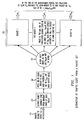
- Figure 1 summarizes how the TD of a packet-set can be extracted from its packets.
- the packet identifier (PID) of each packet is input to a hash function to get an R max - bit hash output h(PID).
- the output from step 30 is input to an m-way splitter at step 40.
- an m-way split occurs based on the last log 2 m bits of h (PID).
- R i is tracked, where the maximum number of consecutive leading zeroes in the first R max - log 2 m) bits of all hash outputs h(PID)s assigned to the i th bucket by using the function r( ).
- the collection of R1 to Rm becomes the light-weight TD of the packet set of interest S p , where size of the TD is m log 2 R max bits.
- each node i ⁇ V maintains a light-weight traffic digest (TD) (in form of the collection of the m R j 's in the SAA) for each of its local packet sets of interest, namely, the set of packets it originates, ( O i ), the set of packets it terminates ( D i ), and the set of packets ( L i,j ) traversing each of its link ( i,j ) ⁇ E .
- TD light-weight traffic digest
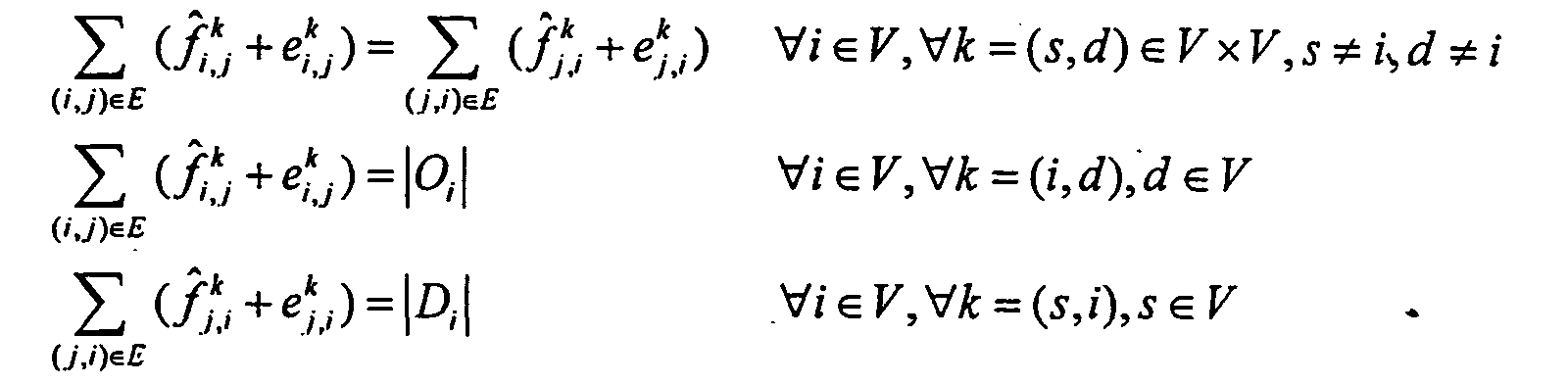
- each router tracks the local distinct packet counts of interest, i.e. the
- node i can estimate the values of
- each node can then construct the network-wide view of the traffic aggregates of interest based on the knowledge of
- each node can optionally perform a minimum square error (MSE) optimization based on nodal and network-wide flow conservation constraints expressed in terms of the
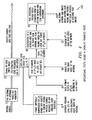
- Figure 2 summarizes the above operational steps performed by a DATALITE-enable node.
- a flow diagram is shown for a node 100 having a processor or processors for implementing the methodology of the present invention.
- incoming packets enter the node 100 and are pre-filtered to determine packet set interest.
- a traffic digest e.g. an O(loglog N) sized TD is extracted in a manner previously explained. Packets then continue on their data path.
- TDs are distributed to other relevant nodes within the network, e.g., within the packet set of interest.
- the TDs may be optionally compressed in a known manner and/or formatted as data objects of an existing routing protocol control message or as a new dedicated query protocol.
- remote TDs from other relevant nodes within the network are received at node 100.
- is determined based on local TDs and remote TDs that have been distributed. The local estimate of the given aggregate flow is then also distributed to the other relevant nodes.
- from other relevant nodes within the network is received at node 100.
- construction of a network wide view on traffic flow pattern and volumes is determined based on the local and remote aggregate flow estimates.
- post processing occurs, to , for example, further reduce the estimation error by applying network wide flow conservation constraints.
- a final output is provided for, for example, network-wide traffic route patterns, flow volumes and/or possible path delay statistics. The output may also detect changes to one or more of the above parameters.
- the memory requirement M m log 2 R max (bits) of each TD is dictated by the value of m.
- m 2048, which corresponds to a standard error of 2% for the corresponding distinct sample count estimate, the size of a TD is about 1.7KByte.
- this is a lower bound on the memory requirement of each TD in order to account for possible estimation error accumulation and/or "amplification" during the evaluation of the ultimate metric of interest, e.g., the
- Eq.(3) is the sum of the estimation errors of each term on the R.H.S..
- the more stages of set-intersection in the L.H.S. term the larger the estimation errors as the estimation errors for the union-set cardinalities on the R.H.S. of Eq.(3) accumulate.
- the corresponding relative estimation error i.e. percentage-wise, for the intersection-term on the L.H.S. of Eq.(3) can get "amplified” especially when the cardinality of the intersection set on the L.H.S. of Eq.(3), is, in absolute terms, much smaller than that of the union-set terms on the R.H.S..
- the actual value of m is determined based on the estimation error requirements of the TMA application.
- m the memory-size per TD
- this type of TMA applications include route failure/ mis-configuration/change detection as well as DDoS attack traceback where the event of interest will typically cause drastic changes in traffic flow pattern.
- 's would deviate substantially from their nominal values and the estimation error is insignificant with respect to the sudden deviation.
- the typical amount of memory for a 10Gbps line-card is about 2 Gbits. This is to provide a 200msec-worth of buffering. Using 10% of this amount of memory, i.e. 25MBytes, for traffic measurement/ analysis purpose, it means each line-card can accommodate more than 28 0.87MByte TD's. In this research, we will investigate the means to support multiple sizes of TD's in parallel.
- some TMA applications may demand finer-grain definitions of packet sets, e.g. based on the protocol-type and/or port number of the packets.
- Another interesting use of multiple finer-grain packet sets per link is the use of "time-indexed" packet sets in which the original measurement period is divided into multiple smaller intervals so that one can estimate, admittedly with limited resolution, the path delay within a network by computing the cardinality of the intersection of the time-indexed packet sets belonging to different links within the network.
- the total TD memory requirement per line-card for such configuration is less than 21MByte or 8.4% of the amount memory (2Gbits, or 200msec-worth of buffering) found in a typical 10Gbps line-card today.
- Another way to conserve TD memory is by reducing the effective estimation errors in the
- a node After a node receives the initial estimates of the
- MSE minimum square error
- DATALITE The dominant controlling factors on communication bandwidth requirement of the present invention DATALITE include:
- the dual periodic broadcast and on-demand query-and-answer modes of operations supported by DATALITE also help to control (2).
- the frequency of exchange of the TD's and resultant traffic flow estimators is largely dictated by the need of the application.
- the exchange-frequency should be much higher in order to reduce detection time.
- lower-precision measurements/estimates i.e. smaller TD's, may be sufficient because the resultant changes on flow patterns and per-link flow values caused by the event of interest tend to be significant.
- the TMA applications which require higher precision measurements/ estimates (and thus larger TD's) tend to be meaningful only over a longer measurement interval, which in turn, helps to reduce the bandwidth requirement.
- Another advantage of the DATALITE scheme is that the TD memory requirement grows very slowly ( O (loglogT)) with measurement period T. As stated above, we can effectively keep the size of TD constant for measurement period up to 8000 seconds long, which should be adequate for most traffic measurement applications.
- the distribution pattern of the TD's should be decided based on the number and size of the TD's as well as the required distribution frequency.
- the 1.7KByte TD's are used in traffic-pattern-change/failure detection applications or DDoS traceback. Even if the uncompressed TD oi and TD Di of a each node are distributed to all other nodes every one second using flooding (the most expensive option bandwidth-wise), the total TD-traffic generated on every link in the network will not exceed 2*1.7*8*
- the present invention DATALITE avoids the problems caused by invalid traffic modeling or operational assumptions which plague the network tomography approaches.
- DATALITE scheme and the existing trajectory-based ones, there are key differences between them:
- any element expressed as a means for performing a specified function is intended to encompass any way of performing that function including, for example, a) a combination of circuit elements which performs that function or b) software in any form, including, therefore, firmware, microcode or the like, combined with appropriate circuitry for executing that software to perform the function.
- the invention as defined by such claims resides in the fact that the functionalities provided by the various recited means are combined and brought together in the manner which the claims call for. Applicant thus regards any means which can provide those functionalities as equivalent as those shown herein. Many other modifications and applications of the principles of the invention will be apparent to those skilled in the art and are contemplated by the teachings herein. Accordingly, the scope of the invention is limited only by the claims appended hereto.
Landscapes
- Engineering & Computer Science (AREA)
- Computer Networks & Wireless Communication (AREA)
- Signal Processing (AREA)
- Computer Security & Cryptography (AREA)
- Environmental & Geological Engineering (AREA)
- Data Exchanges In Wide-Area Networks (AREA)
Abstract
Description
[Vard 95], a Poissonian assumption is used to relate the 2nd order link-load statistics with O-D pair traffic distribution. Similar Gaussian assumption is made by J. Cao, D. Davis, S.V. Wiel and B. Yu, "Time-varying network tomography,'" Journal of American Statistics Association, 95, pp. 1063―1075, 2000 [Cao 00] as well. In fact, the problem of estimating the O-D traffic matrix given only link-load measurements has led to the formation of a new field research called "Network Tomography". Unfortunately, most of the network tomography-based solutions proposed to-date are highly sensitive, i.e. not robust, with respect to the validity of their traffic distribution assumptions. The tomography-based approach also heavily relies on the correctness, synchronization and consistency amongst multiple operational databases from which measurements/configuration information have to be extracted and collated. (Such databases include forwarding tables in the routers, the router configuration files, as well as SNMP MIBs for the link-load.) The aforementioned modeling and operational assumptions also render the tomography-based traffic measurement/estimation schemes of little use for network failure detection/diagnosis where neither the proper functioning of network elements/ databases nor the normality of traffic distribution can be assumed.
- Traffic flow pattern/ route monitoring, diagnosis and network forensic ;
- Estimation of Origination-to-Destination (OD) traffic load matrix for capacity planning and traffic engineering purposes ;
- Traffic measurements for end-user accounting/ billing as well as Inter-ISP (ASes) charge-settlement purposes ;
- Traceback on the origin(s) of attacking packets in a distributed denial of service (DDoS) attacks.


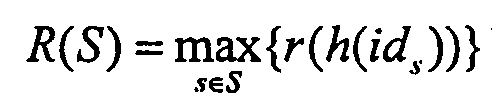


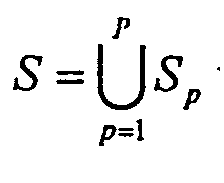
Recall that N max is the maximal number of distinct samples in S. Since the average number of distinct samples within each bucket is about N max / m , we should therefore provision for the maximum value of R j 's, denoted by R max so that 2 Rmax > N max / m. In [Dura 03], it has been shown that the number of bits required for the binary representation of each of the m R j 's is equal to:



Claims (10)
- A method of performing analysis of traffic within a packet communications network, said method comprising:measuring a traffic aggregate at specified nodes within said network with regard to a packet set of interest;formulating an intersection set cardinality determination for a parameter to be measured in said network utilizing said traffic aggregates; andsolving said set cardinality determination for said parameter to be measured.
- The method of Claim 1, further including formulating said intersection set cardinality determination into a series of union set cardinality determinations.
- The method of Claim 2, further including applying one or more O(loglog|A|) distinct sample counting algorithms to solve said union set cardinality determination in a distributed manner.
- The method of Claim 3, wherein an essentially O(loglog N max )-bit digest is used to summarize necessary information in a packet set L i,j , where N max is a maximal number of distinct samples in L i,j .
- The method of Claim 1, wherein said analysis of traffic is selected from the group consisting of analysis of traffic route patterns, analysis of traffic flow patterns and tracing an origination, destination as well as intermediate nodes and links traversed by a given group of packet of interest.
- A method of performing analysis of traffic within a packet communications network, said method comprising:extracting aggregation based traffic digests from selected nodes within said network based on a given packet-set member ship;distributing relevant local traffic digests to others of said selected nodes within said network;receiving relevant remote traffic digests from others of said selected nodes within said network;providing a local estimation of a specified traffic flow based on said local traffic digests and said remote traffic digests;receiving remote estimations of said specified traffic flow from said other selected nodes;solving a set cardinality determination problem for a given parameter in said network based on said local and remote specified traffic flows.
- The method of Claim 6, wherein said step of extracting traffic digests includes the steps of:extracting a packet identifier from each packet belonging to a specified packet set;inputting each packet identifier to a hash function to receive a Rmax- bit hash output, log2 m bits of said Rmax -bit hash output being used to determine a bucket index;splitting said hash output into m buckets based on said bucket index;for each bucket i of said m buckets track R i , the maximum number of consecutive leading zeros in the first (Rmax -log2 m) bits of all hash outputs assigned to the ith bucket by using r( );utilizing R, through R m as the traffic digest for said specified packet set.
- The method of Claim 6, wherein a packet counter C i,j for every link (i, j) ∈ E is maintained to track a count of packets passing through a link during a same measurement period as a traffic digest measurement period, wherein a large discrepancy between the values of C i,j and |L i,j | indicate a potential routing problem.
- The method of Claim 6, further including using "time-indexed" packet sets in which an original measurement period is divided into multiple smaller intervals to estimate a path delay within a network by computing the cardinality of the intersection of the time-indexed packet sets belonging to different links within the network through the use of Q artificial sets.
- A method of performing analysis of traffic within a packet communications network, said method comprising:extracting aggregation based traffic digests from selected nodes within said network based on a given packet-set member ship;distributing relevant local traffic digests to others of said selected nodes within said network;distributing relevant remote traffic digests from others of said selected nodes within said network;providing a local estimation of a specified traffic flow based on said local traffic digests and said remote traffic digests;distributing remote estimations of said specified traffic flow from said other selected nodes;solving a set cardinality determination problem for a given parameter in said network based on said local and remote specified traffic flows.
Applications Claiming Priority (4)
| Application Number | Priority Date | Filing Date | Title |
|---|---|---|---|
| US909908 | 1997-08-16 | ||
| US55823004P | 2004-03-31 | 2004-03-31 | |
| US558230P | 2004-03-31 | ||
| US10/909,908 US7397766B2 (en) | 2004-03-31 | 2004-08-02 | High-speed traffic measurement and analysis methodologies and protocols |
Publications (2)
| Publication Number | Publication Date |
|---|---|
| EP1583281A1 true EP1583281A1 (en) | 2005-10-05 |
| EP1583281B1 EP1583281B1 (en) | 2007-08-15 |
Family
ID=34890592
Family Applications (1)
| Application Number | Title | Priority Date | Filing Date |
|---|---|---|---|
| EP05251556A Expired - Lifetime EP1583281B1 (en) | 2004-03-31 | 2005-03-15 | High-speed traffic measurement and analysis methodologies and protocols |
Country Status (6)
| Country | Link |
|---|---|
| US (2) | US7397766B2 (en) |
| EP (1) | EP1583281B1 (en) |
| JP (1) | JP4727275B2 (en) |
| KR (1) | KR101123020B1 (en) |
| CN (1) | CN1677940B (en) |
| DE (1) | DE602005001965T2 (en) |
Cited By (3)
| Publication number | Priority date | Publication date | Assignee | Title |
|---|---|---|---|---|
| WO2010140003A3 (en) * | 2009-06-04 | 2011-01-27 | Bae Systems Plc | System and method of analysing transfer of data over at least one network |
| CN102611626A (en) * | 2012-03-30 | 2012-07-25 | 北京英诺威尔科技股份有限公司 | System and method for analyzing network flow |
| CN103716211A (en) * | 2014-01-20 | 2014-04-09 | 西安电子科技大学 | Data traffic measuring method and system of network terminal |
Families Citing this family (27)
| Publication number | Priority date | Publication date | Assignee | Title |
|---|---|---|---|---|
| US8261062B2 (en) | 2003-03-27 | 2012-09-04 | Microsoft Corporation | Non-cryptographic addressing |
| US7929689B2 (en) * | 2004-06-30 | 2011-04-19 | Microsoft Corporation | Call signs |
| US8086842B2 (en) | 2006-04-21 | 2011-12-27 | Microsoft Corporation | Peer-to-peer contact exchange |
| ITMI20071141A1 (en) * | 2007-06-04 | 2008-12-05 | Torino Politecnico | METHOD FOR DETECTING A SINGLE FLOW DATA INSIDE AN AGGREGATE FLOW OF DATA TO PACKAGES AND TO IDENTIFY THE GENERATOR APPLICATION OF THE SINGLE DATA FLOW. |
| US7808898B2 (en) * | 2007-08-14 | 2010-10-05 | Hewlett-Packard Development Company, L.P. | Flow estimator |
| CN102007727B (en) * | 2008-04-14 | 2014-03-12 | 皇家飞利浦电子股份有限公司 | Method for distributing encryption means |
| US8400933B2 (en) * | 2008-04-28 | 2013-03-19 | Alcatel Lucent | Efficient probabilistic counting scheme for stream-expression cardinalities |
| US8204985B2 (en) * | 2008-04-28 | 2012-06-19 | Alcatel Lucent | Probabilistic aggregation over distributed data streams |
| US8406132B2 (en) * | 2008-05-30 | 2013-03-26 | Alcatel Lucent | Estimating cardinality distributions in network traffic |
| US8681628B2 (en) * | 2008-09-30 | 2014-03-25 | The Chinese University Of Hong Kong | Systems and methods for determining top spreaders |
| CN101572908B (en) * | 2009-05-26 | 2011-03-16 | 中兴通讯股份有限公司 | Processing method and system of UE for measuring MC message based on UTRAN service amount |
| US8918365B2 (en) | 2009-06-19 | 2014-12-23 | Blekko, Inc. | Dedicating disks to reading or writing |
| CN103488680B (en) * | 2009-06-19 | 2017-09-29 | 国际商业机器公司 | Fallen into a trap several purpose methods in Database Systems |
| US8310922B2 (en) * | 2010-04-15 | 2012-11-13 | International Business Machines Corporation | Summarizing internet traffic patterns |
| US8458326B2 (en) * | 2010-06-30 | 2013-06-04 | At&T Intellecutal Property I, L.P. | Sampling from distributed streams of data |
| US9167463B2 (en) * | 2011-09-02 | 2015-10-20 | Telcordia Technologies, Inc. | Communication node operable to estimate faults in an ad hoc network and method of performing the same |
| US9935831B1 (en) * | 2014-06-03 | 2018-04-03 | Big Switch Networks, Inc. | Systems and methods for controlling network switches using a switch modeling interface at a controller |
| US9838421B2 (en) * | 2014-10-01 | 2017-12-05 | Ciena Corporation | Systems and methods utilizing peer measurements to detect and defend against distributed denial of service attacks |
| US10044583B2 (en) * | 2015-08-21 | 2018-08-07 | Barefoot Networks, Inc. | Fast detection and identification of lost packets |
| US10291632B2 (en) * | 2016-03-31 | 2019-05-14 | Fortinet, Inc. | Filtering of metadata signatures |
| US10447597B1 (en) | 2016-05-23 | 2019-10-15 | Barefoot Networks, Inc. | Path and latency tracking |
| EP3485612B1 (en) | 2016-07-18 | 2020-12-09 | Telecom Italia S.p.A. | Traffic monitoring in a packet-switched communication network |
| JP6813527B2 (en) * | 2018-03-27 | 2021-01-13 | 日本電信電話株式会社 | Estimator, estimation method and program |
| PL3618355T3 (en) | 2018-08-27 | 2021-02-08 | Ovh | Systems and methods for operating a networking device |
| PL3618389T3 (en) | 2018-08-27 | 2021-04-06 | Ovh | SYSTEMS AND METHODS OF OPERATING A NETWORK DEVICE |
| IT201800010791A1 (en) * | 2018-12-04 | 2020-06-04 | Telecom Italia Spa | Performance measurement in a packet-switched communications network |
| CN113990075B (en) * | 2021-12-30 | 2022-03-18 | 广州市交通规划研究院 | Traffic survey data and track data fused flow distribution method and system |
Citations (1)
| Publication number | Priority date | Publication date | Assignee | Title |
|---|---|---|---|---|
| WO2003075508A2 (en) * | 2002-03-01 | 2003-09-12 | Parc Technologies Limited | Method of estimating traffic data |
Family Cites Families (14)
| Publication number | Priority date | Publication date | Assignee | Title |
|---|---|---|---|---|
| CA2190425A1 (en) * | 1995-11-16 | 1997-05-17 | Nicholas W. Dawes | Method of determining the topology of a network of objects |
| US5999961A (en) * | 1997-09-15 | 1999-12-07 | California Institute Of Technology | Parallel prefix operations in asynchronous processors |
| FR2790348B1 (en) * | 1999-02-26 | 2001-05-25 | Thierry Grenot | SYSTEM AND METHOD FOR MEASURING HANDOVER TIMES AND LOSS RATES IN HIGH-SPEED TELECOMMUNICATIONS NETWORKS |
| US6873600B1 (en) * | 2000-02-04 | 2005-03-29 | At&T Corp. | Consistent sampling for network traffic measurement |
| JP3994614B2 (en) * | 2000-03-13 | 2007-10-24 | 株式会社日立製作所 | Packet switch, network monitoring system, and network monitoring method |
| JP3805205B2 (en) * | 2000-04-06 | 2006-08-02 | 株式会社エヌ・ティ・ティ・ドコモ | Method and apparatus for measuring communication quality in CDMA cellular system |
| US7146416B1 (en) * | 2000-09-01 | 2006-12-05 | Yahoo! Inc. | Web site activity monitoring system with tracking by categories and terms |
| US20030097439A1 (en) * | 2000-10-23 | 2003-05-22 | Strayer William Timothy | Systems and methods for identifying anomalies in network data streams |
| US7379994B2 (en) * | 2000-10-26 | 2008-05-27 | Metilinx | Aggregate system resource analysis including correlation matrix and metric-based analysis |
| US20020143929A1 (en) * | 2000-12-07 | 2002-10-03 | Maltz David A. | Method and system for collection and storage of traffic data from heterogeneous network elements in a computer network |
| US7221663B2 (en) | 2001-12-31 | 2007-05-22 | Polycom, Inc. | Method and apparatus for wideband conferencing |
| US7047297B2 (en) * | 2001-07-17 | 2006-05-16 | Mcafee, Inc. | Hierarchically organizing network data collected from full time recording machines and efficiently filtering the same |
| US7213264B2 (en) * | 2002-01-31 | 2007-05-01 | Mazu Networks, Inc. | Architecture to thwart denial of service attacks |
| US7257081B2 (en) * | 2002-04-19 | 2007-08-14 | Iptivia, Inc. | Method and system for traffic monitoring in a packet communication network |
-
2004
- 2004-08-02 US US10/909,908 patent/US7397766B2/en not_active Expired - Fee Related
-
2005
- 2005-03-15 DE DE602005001965T patent/DE602005001965T2/en not_active Expired - Lifetime
- 2005-03-15 EP EP05251556A patent/EP1583281B1/en not_active Expired - Lifetime
- 2005-03-28 KR KR1020050025487A patent/KR101123020B1/en not_active Expired - Fee Related
- 2005-03-30 CN CN200510059593XA patent/CN1677940B/en not_active Expired - Fee Related
- 2005-03-31 JP JP2005103284A patent/JP4727275B2/en not_active Expired - Lifetime
-
2008
- 2008-05-23 US US12/125,972 patent/US7808923B2/en not_active Expired - Fee Related
Patent Citations (1)
| Publication number | Priority date | Publication date | Assignee | Title |
|---|---|---|---|---|
| WO2003075508A2 (en) * | 2002-03-01 | 2003-09-12 | Parc Technologies Limited | Method of estimating traffic data |
Non-Patent Citations (3)
| Title |
|---|
| DUFFIELD N G ET AL: "TRAJECTORY SAMPLING FOR DIRECT TRAFFIC OBSERVATION", IEEE / ACM TRANSACTIONS ON NETWORKING, IEEE INC. NEW YORK, US, vol. 9, no. 3, June 2001 (2001-06-01), pages 280 - 292, XP001053992, ISSN: 1063-6692 * |
| M. DURAND AND P. FLAJOLET: "Loglog Counting of Large Cardinalities", EUROPEAN SYMPOSIUM ON ALGORITHMS 2003, April 2003 (2003-04-01), pages 605 - 617, XP002335034, Retrieved from the Internet <URL:http://algo.inria.fr/flajolet/Publications/DuFl03-LNCS.pdf> [retrieved on 20050707] * |
| WEI-MING LIN ET AL: "Look-ahead traffic distribution in wormhole-routed networks", RELIABLE DISTRIBUTED SYSTEMS, 1998. PROCEEDINGS. SEVENTEENTH IEEE SYMPOSIUM ON WEST LAFAYETTE, IN, USA 20-23 OCT. 1998, LOS ALAMITOS, CA, USA,IEEE COMPUT. SOC, US, 20 October 1998 (1998-10-20), pages 318 - 323, XP010319124, ISBN: 0-8186-9218-9 * |
Cited By (6)
| Publication number | Priority date | Publication date | Assignee | Title |
|---|---|---|---|---|
| WO2010140003A3 (en) * | 2009-06-04 | 2011-01-27 | Bae Systems Plc | System and method of analysing transfer of data over at least one network |
| US9294560B2 (en) | 2009-06-04 | 2016-03-22 | Bae Systems Plc | System and method of analysing transfer of data over at least one network |
| CN102611626A (en) * | 2012-03-30 | 2012-07-25 | 北京英诺威尔科技股份有限公司 | System and method for analyzing network flow |
| CN102611626B (en) * | 2012-03-30 | 2014-11-26 | 北京英诺威尔科技股份有限公司 | System and method for analyzing network flow |
| CN103716211A (en) * | 2014-01-20 | 2014-04-09 | 西安电子科技大学 | Data traffic measuring method and system of network terminal |
| CN103716211B (en) * | 2014-01-20 | 2016-10-12 | 西安电子科技大学 | The data traffic measuring method of the network terminal |
Also Published As
| Publication number | Publication date |
|---|---|
| US20050220023A1 (en) | 2005-10-06 |
| CN1677940A (en) | 2005-10-05 |
| US7808923B2 (en) | 2010-10-05 |
| CN1677940B (en) | 2010-08-11 |
| JP2005295562A (en) | 2005-10-20 |
| KR20060044844A (en) | 2006-05-16 |
| EP1583281B1 (en) | 2007-08-15 |
| KR101123020B1 (en) | 2012-03-16 |
| DE602005001965D1 (en) | 2007-09-27 |
| JP4727275B2 (en) | 2011-07-20 |
| US7397766B2 (en) | 2008-07-08 |
| DE602005001965T2 (en) | 2008-05-08 |
| US20080219181A1 (en) | 2008-09-11 |
Similar Documents
| Publication | Publication Date | Title |
|---|---|---|
| US7808923B2 (en) | High-speed traffic measurement and analysis methodologies and protocols | |
| EP1418705B1 (en) | Network monitoring system using packet sequence numbers | |
| US7483379B2 (en) | Passive network monitoring system | |
| Teixeira et al. | Traffic matrix reloaded: Impact of routing changes | |
| US8601155B2 (en) | Telemetry stream performance analysis and optimization | |
| US6836466B1 (en) | Method and system for measuring IP performance metrics | |
| US20080159287A1 (en) | EFFICIENT PERFORMANCE MONITORING USING IPv6 CAPABILITIES | |
| US20130064079A1 (en) | Network-Wide Flow Monitoring in Split Architecture Networks | |
| US8176175B2 (en) | Network response time measurements in an asymmetric routing environment | |
| EP2589183B1 (en) | A method and an apparatus for evaluating network performance | |
| Duffield et al. | Trajectory sampling with unreliable reporting | |
| CN119484328B (en) | Network measurement system and method irrelevant to route | |
| US8331246B2 (en) | Measurement system and method of measuring a transit metric | |
| US11784895B2 (en) | Performance measurement in a packet-switched communication network | |
| Lau et al. | Datalite: a distributed architecture for traffic analysis via light-weight traffic digest | |
| Agrawal et al. | Monitoring infrastructure for converged networks and services | |
| EP1826947A2 (en) | Method and apparatus for the assessment and optimization of network traffic | |
| CN120128500A (en) | A network quality detection method and detection device | |
| Viken et al. | Traffic measurements in IP networks |
Legal Events
| Date | Code | Title | Description |
|---|---|---|---|
| PUAI | Public reference made under article 153(3) epc to a published international application that has entered the european phase |
Free format text: ORIGINAL CODE: 0009012 |
|
| 17P | Request for examination filed |
Effective date: 20050404 |
|
| AK | Designated contracting states |
Kind code of ref document: A1 Designated state(s): AT BE BG CH CY CZ DE DK EE ES FI FR GB GR HU IE IS IT LI LT LU MC NL PL PT RO SE SI SK TR |
|
| AX | Request for extension of the european patent |
Extension state: AL BA HR LV MK YU |
|
| AKX | Designation fees paid |
Designated state(s): DE FR GB |
|
| GRAP | Despatch of communication of intention to grant a patent |
Free format text: ORIGINAL CODE: EPIDOSNIGR1 |
|
| GRAS | Grant fee paid |
Free format text: ORIGINAL CODE: EPIDOSNIGR3 |
|
| GRAA | (expected) grant |
Free format text: ORIGINAL CODE: 0009210 |
|
| AK | Designated contracting states |
Kind code of ref document: B1 Designated state(s): DE FR GB |
|
| REG | Reference to a national code |
Ref country code: GB Ref legal event code: FG4D |
|
| REF | Corresponds to: |
Ref document number: 602005001965 Country of ref document: DE Date of ref document: 20070927 Kind code of ref document: P |
|
| ET | Fr: translation filed | ||
| PLBE | No opposition filed within time limit |
Free format text: ORIGINAL CODE: 0009261 |
|
| STAA | Information on the status of an ep patent application or granted ep patent |
Free format text: STATUS: NO OPPOSITION FILED WITHIN TIME LIMIT |
|
| 26N | No opposition filed |
Effective date: 20080516 |
|
| REG | Reference to a national code |
Ref country code: GB Ref legal event code: 732E Free format text: REGISTERED BETWEEN 20131031 AND 20131106 |
|
| REG | Reference to a national code |
Ref country code: FR Ref legal event code: CD Owner name: ALCATEL-LUCENT USA INC. Effective date: 20131122 |
|
| REG | Reference to a national code |
Ref country code: FR Ref legal event code: GC Effective date: 20140410 |
|
| REG | Reference to a national code |
Ref country code: FR Ref legal event code: RG Effective date: 20141015 |
|
| REG | Reference to a national code |
Ref country code: FR Ref legal event code: PLFP Year of fee payment: 11 |
|
| REG | Reference to a national code |
Ref country code: FR Ref legal event code: PLFP Year of fee payment: 12 |
|
| REG | Reference to a national code |
Ref country code: FR Ref legal event code: PLFP Year of fee payment: 13 |
|
| REG | Reference to a national code |
Ref country code: FR Ref legal event code: PLFP Year of fee payment: 14 |
|
| PGFP | Annual fee paid to national office [announced via postgrant information from national office to epo] |
Ref country code: DE Payment date: 20190305 Year of fee payment: 15 Ref country code: GB Payment date: 20190313 Year of fee payment: 15 |
|
| PGFP | Annual fee paid to national office [announced via postgrant information from national office to epo] |
Ref country code: FR Payment date: 20190213 Year of fee payment: 15 |
|
| REG | Reference to a national code |
Ref country code: DE Ref legal event code: R119 Ref document number: 602005001965 Country of ref document: DE |
|
| PG25 | Lapsed in a contracting state [announced via postgrant information from national office to epo] |
Ref country code: FR Free format text: LAPSE BECAUSE OF NON-PAYMENT OF DUE FEES Effective date: 20200331 Ref country code: DE Free format text: LAPSE BECAUSE OF NON-PAYMENT OF DUE FEES Effective date: 20201001 |
|
| GBPC | Gb: european patent ceased through non-payment of renewal fee |
Effective date: 20200315 |
|
| PG25 | Lapsed in a contracting state [announced via postgrant information from national office to epo] |
Ref country code: GB Free format text: LAPSE BECAUSE OF NON-PAYMENT OF DUE FEES Effective date: 20200315 |