EP1583060A2 - Multisensory system for language learning - Google Patents
Multisensory system for language learning Download PDFInfo
- Publication number
- EP1583060A2 EP1583060A2 EP05006877A EP05006877A EP1583060A2 EP 1583060 A2 EP1583060 A2 EP 1583060A2 EP 05006877 A EP05006877 A EP 05006877A EP 05006877 A EP05006877 A EP 05006877A EP 1583060 A2 EP1583060 A2 EP 1583060A2
- Authority
- EP
- European Patent Office
- Prior art keywords
- recreational
- general
- educational system
- learning
- symmetrically
- Prior art date
- Legal status (The legal status is an assumption and is not a legal conclusion. Google has not performed a legal analysis and makes no representation as to the accuracy of the status listed.)
- Withdrawn
Links
Images



Classifications
-
- G—PHYSICS
- G06—COMPUTING OR CALCULATING; COUNTING
- G06Q—INFORMATION AND COMMUNICATION TECHNOLOGY [ICT] SPECIALLY ADAPTED FOR ADMINISTRATIVE, COMMERCIAL, FINANCIAL, MANAGERIAL OR SUPERVISORY PURPOSES; SYSTEMS OR METHODS SPECIALLY ADAPTED FOR ADMINISTRATIVE, COMMERCIAL, FINANCIAL, MANAGERIAL OR SUPERVISORY PURPOSES, NOT OTHERWISE PROVIDED FOR
- G06Q50/00—Information and communication technology [ICT] specially adapted for implementation of business processes of specific business sectors, e.g. utilities or tourism
- G06Q50/10—Services
- G06Q50/20—Education
-
- G—PHYSICS
- G09—EDUCATION; CRYPTOGRAPHY; DISPLAY; ADVERTISING; SEALS
- G09B—EDUCATIONAL OR DEMONSTRATION APPLIANCES; APPLIANCES FOR TEACHING, OR COMMUNICATING WITH, THE BLIND, DEAF OR MUTE; MODELS; PLANETARIA; GLOBES; MAPS; DIAGRAMS
- G09B1/00—Manually or mechanically operated educational appliances using elements forming, or bearing, symbols, signs, pictures, or the like which are arranged or adapted to be arranged in one or more particular ways
-
- G—PHYSICS
- G09—EDUCATION; CRYPTOGRAPHY; DISPLAY; ADVERTISING; SEALS
- G09B—EDUCATIONAL OR DEMONSTRATION APPLIANCES; APPLIANCES FOR TEACHING, OR COMMUNICATING WITH, THE BLIND, DEAF OR MUTE; MODELS; PLANETARIA; GLOBES; MAPS; DIAGRAMS
- G09B19/00—Teaching not covered by other main groups of this subclass
- G09B19/06—Foreign languages
-
- G—PHYSICS
- G09—EDUCATION; CRYPTOGRAPHY; DISPLAY; ADVERTISING; SEALS
- G09B—EDUCATIONAL OR DEMONSTRATION APPLIANCES; APPLIANCES FOR TEACHING, OR COMMUNICATING WITH, THE BLIND, DEAF OR MUTE; MODELS; PLANETARIA; GLOBES; MAPS; DIAGRAMS
- G09B5/00—Electrically-operated educational appliances
- G09B5/06—Electrically-operated educational appliances with both visual and audible presentation of the material to be studied
Definitions
- the present patent relates to recreational and educational systems in general, more specifically to a recreational and educational system for language learning in general which, according to the characteristics thereof, possesses as a basic principle to provide the formation of a recreational and educational system with a proprietary and specific structure directly based on the perfect and harmonious interaction between a proprietary central unit with a set of specific auxiliary materials and a computer with a set of particular computer programs, in order to provide a practical and multi-sensory approach to the learning of several different languages, whether it is one's own language or a foreign language, by means of a proper and unlimited interaction between the target audience, basically children and beginners with a different alphabet system, and the subject to be approached and having as a basis a didactic, approachable and versatile recreational and educational system.
- a specific design and shape easily accessible for a better adaptation and safety for the users, practical handling, functionality, and accessible cost and due to its general characteristics and dimensions, is easily adaptable to several different languages, users, places and computers in general, regardless of the characteristics thereof.
- the patent in question is characterized in that it aggregates components and processes in a differentiated concept to meet the various requirements the nature of its use demands, that is, encourage and develop activities related to language learning in general.
- Such concept provides a recreational and educational system having great efficiency, functionality, durability, versatility, education, didactics and recreation due to its excellent technical qualities, thereby providing advantages and improvements to the recreational and educational systems involving languages, the general characteristics of which differ from the other shapes and models known in the current state of the art.
- the present patent consists in the utilization of a modem, efficient, safe and functional recreational and educational system for language learning in general, formed by an assembly of properly incorporated educational, linguistic and computer-related solutions comprising a complete and differentiated recreational and education system with an exclusive design, optimum finish details and proprietary characteristics, incorporating a proprietary structure of high durability and strength and possessing a properly integrated and symmetrically arranged central unit forming the system central element, a set of didactic blocks constituting elements of interaction with the system, a support mat as an aid to the system, an identifying computer program as an element of identification of the didactic blocks and a set of computer programs with particular activities as the system management elements, so as to provide the formation of a learning and/or recreational assembly which is unique, complete and didactic and whose shape and internal and external arrangements provide the proper and direct connection to a computer and its accessories with the specific purpose of providing a physical, didactic and pleasant interaction with a language directly generated by the computer program and from the individualized work or the collaborative work with other group fellow students.
- the recreational and educational system for language learning in general is a hands-on, innovative method for children between five and ten years old, basically true beginners in the learning of languages with a different alphabet system, since it is based on the well-known premise that children learn by doing, i.e., it provides unlimited interaction between the child and the subject matter, and can be used in any place such as kindergarten schools (private or public), elementary schools (private or public), language schools, teaching training centers, hospitals, among several other places where people wish to learn a language or have fun with it.
- the present educational system is based on the application of components and processes in a differentiated concept providing initial literacy exposure and that can bring users to an exit level of thousands of words and expressions in a direct manner through different learning levels and based on international standards that allow it to be used either as a stand-alone course or together with commercially produced language learning books.
- Language is the set of words and expressions used by a group of individuals or a nation, that is, the set of rules of its grammar.
- Figure (1) shows the same in a general manner, comprising a complete recreational and educational system (1) with proprietary characteristics, and incorporating a proprietary structure of high durability and strength, internal and external shapes and arrangements that provide the proper and direct connection to a computer and its accessories in general and possessing a properly integrated, customized and symmetrically arranged central unit (2) having a general prismatic shape and possessing a front frame (2A) having a parallelepipedal shape horizontally and symmetrically centered along the front face to lodge the didactic blocks (3), a CPU (central processing unit) plate (2B) symmetrically installed on the inner side as a control manager, a set of sensor plates (2C) having rectangular shapes horizontally and symmetrically centered and aligned along the inner periphery of the front frame (2A), each with a set of sensor plates symmetrically aligned as automatic identifiers of the didactic blocks (3) and a USB
- CPU central processing unit
- the recreational and educational system for language learning in general can comprise a set of textbooks to be used as topic presentation or learning consolidation.
- the recreational and educational system for language learning in general can comprise a set of flash cards with words and pictures to be used as a visual pedagogic material.
- TPR Total Physical Response
- the recreational and educational system for language learning in general provides the users training on letter-sound correspondence, i.e., phonemic awareness; visual practice of words, letters, numbers and symbols; initial reading mechanics; reading comprehension skills; basic sentence structure awareness; extended listening comprehension practice; active vocabulary of thousands of words and expressions; large passive vocabulary, for recognition purposes only; and exposure to authentic accents of the most diverse languages.
- letter-sound correspondence i.e., phonemic awareness; visual practice of words, letters, numbers and symbols; initial reading mechanics; reading comprehension skills; basic sentence structure awareness; extended listening comprehension practice; active vocabulary of thousands of words and expressions; large passive vocabulary, for recognition purposes only; and exposure to authentic accents of the most diverse languages.
- the utilization of the recreational and educational system (1) is directly based on group work, although it can also be individualized, in which the users, with or without an instructor, sit around a table containing the central unit (2) connected to the computer.
- the instructor initially establishes the learning environment by dividing the class into groups each with a unique symbol (represented by a picture easily recognizable for those who cannot read) and by deciding on how the group will be composed, in an heterogeneous way or not, depending on the needs of each class.
- the users carry out the activities around the central unit (2) that includes: topic presentation through letters, numbers, symbols and words or the like introduced in a visually exciting format including sound and animation; educational practice through interactive activities including pictures, animations and sounds that reinforce the learning; learning consolidation through games, songs and rhymes; and learning revision through games.
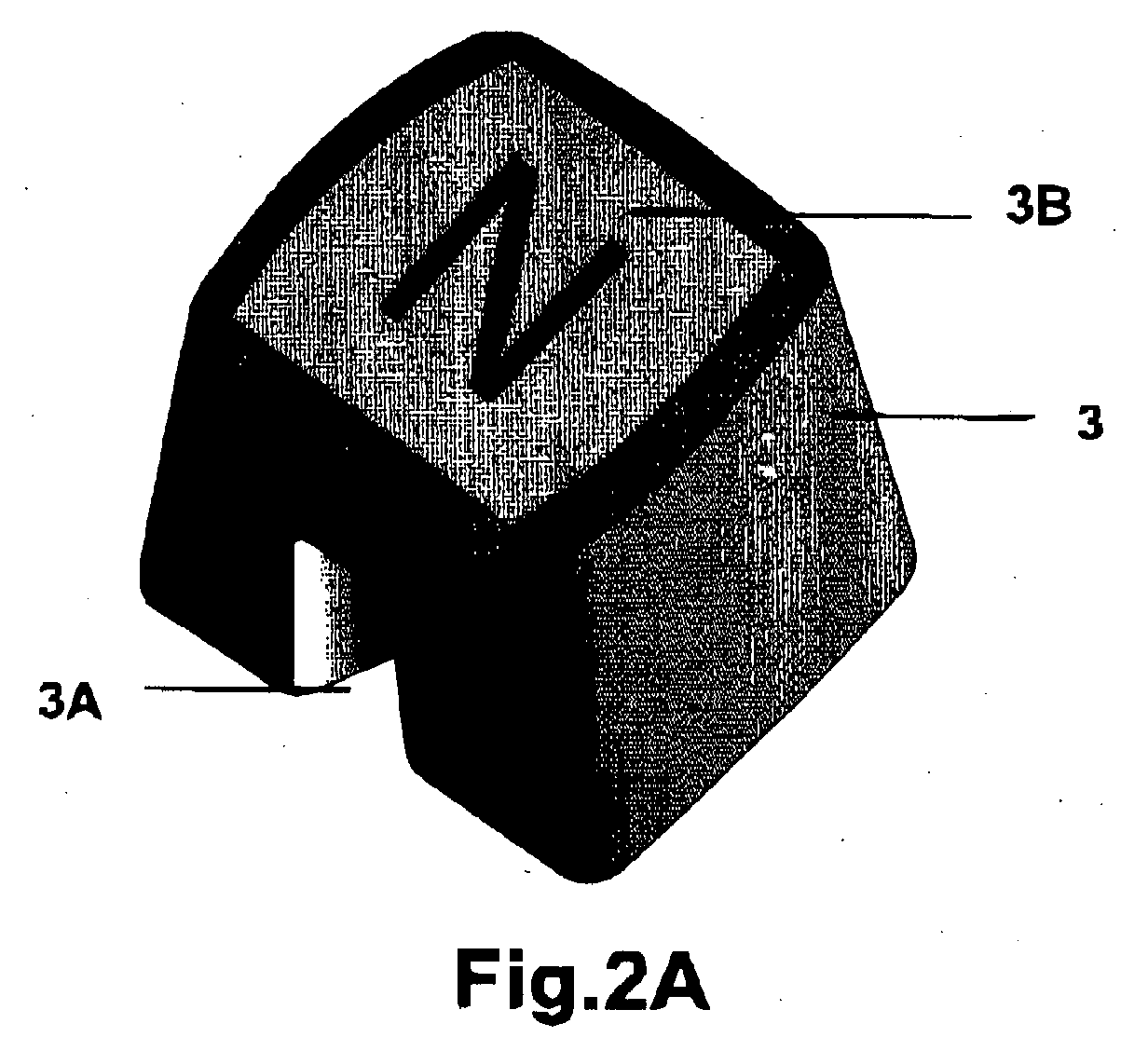
- the operation of the educational system (1) is based on the placement of the didactic blocks (3) symmetrically inside the front frame (2A) facing each of the sensor plates (2C) sensor pockets, so that the code stamp (3C) is in permanent contact with the sensor pockets and a picture (3B) representing letters, numbers, words and symbols or the like is arranged facing the users.
- the code stamp (3C) is in permanent contact with the sensor pockets and a picture (3B) representing letters, numbers, words and symbols or the like is arranged facing the users.
- the response to the stimuli and questions presented is generated on the computer monitor screen.
- exciting pictures, music, animation and games directly generated by the set of computer programs encourage cooperative interaction and make language learning a concrete social experience.
- the educational system assembly (1) requires no technical knowledge from instructors or users - everything is clearly indicated and users registration is extremely straightforward. Furthermore, the recreational and educational system (1) provides an invaluable tool for instructors whose language being taught is not their native one by presenting it and allowing its practice through modeling and listening to native voices. For those who are not familiar with group work, the use of educational technology and the presentation of songs and chants are introduced simultaneously so as to facilitate its operation.
- the components of the recreational and educational system for language learning are fully fitted and attached, do not present any distorting or breakable parts, is highly resistant and completely safe. After fitted and attached, the components are locked, thus preventing them from getting loose or breaking when in use, thus making the assembly fully available to users for a pleasant and funny learning of different languages.
- the recreational and educational system (1) can, therefore, be easily used for different kinds of users without worries of any nature as regarding durability and safety.
- the recreational and educational system for language learning is proper for group work, since in each central unit (2) a group of users can sit and learn how to work together; has a hands-on approach, for the use of didactic blocks (3) to create answers appeals to the tactile senses and reinforces learning; is intellectually stimulating, as the product is based on problem-solving and not on mechanical learning; is interesting and relevant, since it is based on themes and subjects that are part of the universe of a child, organized in the order most appropriate for successful language acquisition; includes multiple activities using the same structure, for the set of computer programs presents a large number of different activities that use the same central unit (2) and didactic bloks (3); provides immediate feedback; encourages discussion and interaction, since users work together to find the right answer; and it is also thematic, since it is based on topics providing a familiar and relevant context.
- the recreational and educational system for language learning can be used as a fully versatile, efficient, practical, safe and, mainly didactical and recreational means in which, by means of challenging activities, both concrete and virtual, a fully appropriate environment to dialogue and interaction among participants is created, and at the same time encourages development and the fundamental concepts in the learning process of different languages, regardless of the general characteristics thereof, being easily installed and handled, as well as having a great performance and excellent general characteristics; the sizes, dimensions and quantities may vary, depending on the use needs.
Landscapes
- Engineering & Computer Science (AREA)
- Business, Economics & Management (AREA)
- Theoretical Computer Science (AREA)
- Physics & Mathematics (AREA)
- Educational Administration (AREA)
- Educational Technology (AREA)
- General Physics & Mathematics (AREA)
- Tourism & Hospitality (AREA)
- Entrepreneurship & Innovation (AREA)
- Health & Medical Sciences (AREA)
- Economics (AREA)
- General Health & Medical Sciences (AREA)
- Human Resources & Organizations (AREA)
- Marketing (AREA)
- Primary Health Care (AREA)
- Strategic Management (AREA)
- General Business, Economics & Management (AREA)
- Electrically Operated Instructional Devices (AREA)
Abstract
Description
Claims (3)
- "RECREATIONAL AND EDUCATIONAL SYSTEM FOR LANGUAGE LEARNING IN GENERAL", characterized in that it comprises a complete educational system (1) incorporating a proprietary structure whose shape and internal and external arrangements provide direct connection to a computer and its accessories and possessing a properly integrated, customized and symmetrically arranged central unit (2) having a general prismatic shape and possessing a front frame (2A) having a parallelepipedal shape horizontally and symmetrically centered along the front face to lodge the didactic blocks (3), a CPU (central processing unit) plate (2B) symmetrically installed on the inner side as a control manager, a set of sensor plates (2C) having rectangular shapes horizontally and symmetrically centered and aligned along the inner periphery of the front frame (2A), each with a set of sensor pockets symmetrically aligned as identifiers of the didactic blocks (3) and a USB cable (2D) interconnecting the central unit (2) to the computer as a power, controls and data conductor; a set of didactic blocks (3) each having a general prismatic shape and possessing a curved recess (3A) symmetrically centered along one of the lateral faces thereof, a picture (3B) representing letters, numbers, words and symbols or the like symmetrically centered on the front face and a code stamp (3B) symmetrically centered on the rear face to be used as interaction between the user and the educational system (1); a support mat (4) having a rectangular shape horizontally and symmetrically arranged on the front side of the central unit (2); an identification computer program to identify the didactic blocks (3); and a set of computer programs with particular activities containing sound and image based on the Microsoft Windows operational platform as an activity manager.
- "RECREATIONAL AND EDUCATIONAL SYSTEM FOR LANGUAGE LEARNING IN GENERAL", in accordance with claim 1, characterized in that it comprises a set of textbooks as topic presentation or learning consolidation.
- "RECREATIONAL AND EDUCATIONAL SYSTEM FOR LANGUAGEG LEARNING IN GENERAL", in accordance with 1, characterized in that it comprises a set of flash cards with words and pictures as a material for visual application.
Applications Claiming Priority (2)
| Application Number | Priority Date | Filing Date | Title |
|---|---|---|---|
| BRPI0400095-1A BRPI0400095B1 (en) | 2004-03-31 | 2004-03-31 | Educational and recreational system for general language learning |
| BR0400095 | 2004-03-31 |
Publications (2)
| Publication Number | Publication Date |
|---|---|
| EP1583060A2 true EP1583060A2 (en) | 2005-10-05 |
| EP1583060A3 EP1583060A3 (en) | 2008-04-23 |
Family
ID=37149163
Family Applications (1)
| Application Number | Title | Priority Date | Filing Date |
|---|---|---|---|
| EP05006877A Withdrawn EP1583060A3 (en) | 2004-03-31 | 2005-03-30 | Multisensory system for language learning |
Country Status (7)
| Country | Link |
|---|---|
| US (1) | US20050227209A1 (en) |
| EP (1) | EP1583060A3 (en) |
| JP (1) | JP2005292830A (en) |
| KR (1) | KR20060045051A (en) |
| CN (1) | CN1677454A (en) |
| BR (1) | BRPI0400095B1 (en) |
| SG (1) | SG115826A1 (en) |
Cited By (1)
| Publication number | Priority date | Publication date | Assignee | Title |
|---|---|---|---|---|
| WO2008038934A1 (en) * | 2006-09-26 | 2008-04-03 | Joon Eon Chung | Equipment for language education |
Families Citing this family (3)
| Publication number | Priority date | Publication date | Assignee | Title |
|---|---|---|---|---|
| US7351062B2 (en) * | 2004-12-17 | 2008-04-01 | Learning Resources, Inc. | Educational devices, systems and methods using optical character recognition |
| US8251701B2 (en) | 2007-10-16 | 2012-08-28 | Cieo Creative Inc. | Interactive language apparatus |
| BRMU8900527Y1 (en) * | 2009-03-27 | 2017-06-27 | Positivo Informática S.a. | IMPROVEMENTS INTRODUCED IN EDUCATIONAL TABLE |
Family Cites Families (23)
| Publication number | Priority date | Publication date | Assignee | Title |
|---|---|---|---|---|
| US4403965A (en) * | 1980-10-01 | 1983-09-13 | Texas Instruments Incorporated | Electronic teaching apparatus |
| US4609356A (en) * | 1985-03-20 | 1986-09-02 | Gilden Deborah B | Rearrangeable form board with sensory feedback |
| US4731027A (en) * | 1986-10-17 | 1988-03-15 | The Quaker Oats Company | Educational teaching toy |
| GB2210722B (en) * | 1987-10-08 | 1992-03-25 | Video Technology Electronics L | Electronic instructional apparatus |
| US5088928A (en) * | 1988-11-15 | 1992-02-18 | Chan James K | Educational/board game apparatus |
| US5188533B1 (en) * | 1990-06-01 | 1997-09-09 | Leapfrog Rbt Llc | Speech synthesizing indicia for interactive learning |
| GB9200643D0 (en) * | 1992-01-13 | 1992-03-11 | Tectron Manufacturing Hk Limit | Educational toys |
| US5618180A (en) * | 1993-07-09 | 1997-04-08 | Nathanson; Tedd | Method of teaching using a computer |
| US5364272A (en) * | 1993-08-09 | 1994-11-15 | Texas Instruments Incorporated | Apparatus and method for teaching |
| US5511980A (en) * | 1994-02-23 | 1996-04-30 | Leapfrog Rbt, L.L.C. | Talking phonics interactive learning device |
| US5813861A (en) * | 1994-02-23 | 1998-09-29 | Knowledge Kids Enterprises, Inc. | Talking phonics interactive learning device |
| US5556283A (en) * | 1994-09-08 | 1996-09-17 | Stendardo; William | Card type of electronic learning aid/teaching apparatus |
| US6413603B1 (en) * | 1995-05-30 | 2002-07-02 | Ncr Corporation | Placemats having integrated adhesive stickers or labels |
| US5823782A (en) * | 1995-12-29 | 1998-10-20 | Tinkers & Chance | Character recognition educational system |
| US5735693A (en) * | 1996-03-29 | 1998-04-07 | Multi Lingua Ltd.. | Method and device for learning a foreign language |
| US5657992A (en) * | 1996-07-19 | 1997-08-19 | Bellizzi; Anthony | Entertainment device and method for developing acting, thinking, writing and public speaking ability |
| US5997304A (en) * | 1997-01-31 | 1999-12-07 | Knowledge Kids Enterprises, Inc. | Interactive phonics learning mat |
| KR100224618B1 (en) * | 1997-03-27 | 1999-10-15 | 윤종용 | View changing method for multi-purpose educational device |
| US6258428B1 (en) * | 1997-08-15 | 2001-07-10 | Ncr Corporation | Method of using an entertainment placement product having storage pocket |
| US6356255B1 (en) * | 1998-04-07 | 2002-03-12 | Interval Research Corporation | Methods and systems for providing programmable computerized interactors |
| US6056549A (en) * | 1998-05-01 | 2000-05-02 | Fletcher; Cheri | Communication system and associated apparatus |
| US6190174B1 (en) * | 1999-06-03 | 2001-02-20 | Kader Industrial Company Limited | Electronic story board |
| US6491523B1 (en) * | 2000-04-28 | 2002-12-10 | Janice Altman | Sign language instruction system and method |
-
2004
- 2004-03-31 BR BRPI0400095-1A patent/BRPI0400095B1/en not_active IP Right Cessation
- 2004-11-29 US US10/904,773 patent/US20050227209A1/en not_active Abandoned
-
2005
- 2005-03-30 JP JP2005096975A patent/JP2005292830A/en active Pending
- 2005-03-30 SG SG200502051A patent/SG115826A1/en unknown
- 2005-03-30 EP EP05006877A patent/EP1583060A3/en not_active Withdrawn
- 2005-03-30 CN CNA2005100596608A patent/CN1677454A/en active Pending
- 2005-03-30 KR KR1020050026797A patent/KR20060045051A/en not_active Withdrawn
Cited By (1)
| Publication number | Priority date | Publication date | Assignee | Title |
|---|---|---|---|---|
| WO2008038934A1 (en) * | 2006-09-26 | 2008-04-03 | Joon Eon Chung | Equipment for language education |
Also Published As
| Publication number | Publication date |
|---|---|
| CN1677454A (en) | 2005-10-05 |
| JP2005292830A (en) | 2005-10-20 |
| BRPI0400095B1 (en) | 2015-06-30 |
| SG115826A1 (en) | 2005-10-28 |
| US20050227209A1 (en) | 2005-10-13 |
| BRPI0400095A (en) | 2005-12-13 |
| KR20060045051A (en) | 2006-05-16 |
| EP1583060A3 (en) | 2008-04-23 |
Similar Documents
| Publication | Publication Date | Title |
|---|---|---|
| Katz | Teaching to diversity: The three-block model of universal design for learning | |
| Cole | Can cultural psychology help us think about diversity? | |
| Serrano-López et al. | Materializing linguistic concepts through 3-D clay modeling: A tool-and-result approach to mediating L2 Spanish development | |
| Bryen et al. | Sign language with students with severe/profound mental retardation: How effective is it? | |
| Langone et al. | Technology solutions for young children with developmental concerns | |
| US20110195391A1 (en) | Method of learning arithmetic | |
| Hamdan et al. | Robot technology impact on dyslexic students’ English learning | |
| Golan et al. | Assistive technology as an aid in reducing social impairments in autism | |
| EP1583060A2 (en) | Multisensory system for language learning | |
| Li | An investigation of the application of multimodal teaching in chinese middle school EFL reading classes | |
| Alexakos | Inclusive classrooms | |
| Swenson | Using an integrated literacy curriculum with beginning braille readers | |
| Gregg et al. | The relation between sense of audience and specific learning disabilities: An exploration | |
| Muñoz et al. | Teaching English vocabulary to third graders through the application of the Total Physical Response Method | |
| Urakovna | Language teachers who use various methods of teaching English are those who take care of their own value to self and to a larger community of the world | |
| Nave | Computer technology for the handicapped in special education and rehabilitation: A resource guide | |
| Хариков et al. | INNOVATIVE METHOD FOR TEACHING FOREIGN LANGUAGES | |
| Guntermann | Factors in targeting proficiency levels and an approach to “real” and “realistic” practice | |
| Sukeemok | Effects of using multiple intelligence theory based activities on English reading comprehension and students' interest in learning English of matthayomsuksa III students at Taweethapisek School | |
| Drobot | THE ADVANTAGES OF USING APPLICATIONS TO LEARN FOREIGN LANGUAGES | |
| Orlando | Using Music To Reinforce Basic Money Skills Taught in the TMH Classroom. | |
| Prajothanta | Promoted and Developed to Physical Capability of Preschool Children as Aged 3 Years’ Old in First Child Development Center | |
| Całus et al. | INTERSEMIOTIC TRANSLATION AS A METHOD OF TEACHING ENGLISH TO MENTALLY HANDICAPPED STUDENTS | |
| Wood | Designing microcomputer programs for disabled students | |
| Homolová | Methodology of Teaching English 1 |
Legal Events
| Date | Code | Title | Description |
|---|---|---|---|
| PUAI | Public reference made under article 153(3) epc to a published international application that has entered the european phase |
Free format text: ORIGINAL CODE: 0009012 |
|
| AK | Designated contracting states |
Kind code of ref document: A2 Designated state(s): AT BE BG CH CY CZ DE DK EE ES FI FR GB GR HU IE IS IT LI LT LU MC NL PL PT RO SE SI SK TR |
|
| AX | Request for extension of the european patent |
Extension state: AL BA HR LV MK YU |
|
| 17P | Request for examination filed |
Effective date: 20060405 |
|
| PUAL | Search report despatched |
Free format text: ORIGINAL CODE: 0009013 |
|
| AK | Designated contracting states |
Kind code of ref document: A3 Designated state(s): AT BE BG CH CY CZ DE DK EE ES FI FR GB GR HU IE IS IT LI LT LU MC NL PL PT RO SE SI SK TR |
|
| AX | Request for extension of the european patent |
Extension state: AL BA HR LV MK YU |
|
| AKX | Designation fees paid |
Designated state(s): AT BE BG CH CY CZ DE DK EE ES FI FR GB GR HU IE IS IT LI LT LU MC NL PL PT RO SE SI SK TR |
|
| 17Q | First examination report despatched |
Effective date: 20150401 |
|
| STAA | Information on the status of an ep patent application or granted ep patent |
Free format text: STATUS: THE APPLICATION IS DEEMED TO BE WITHDRAWN |
|
| 18D | Application deemed to be withdrawn |
Effective date: 20150812 |