EP1582581A2 - Saccharide composition synthesizer - Google Patents
Saccharide composition synthesizer Download PDFInfo
- Publication number
- EP1582581A2 EP1582581A2 EP05003191A EP05003191A EP1582581A2 EP 1582581 A2 EP1582581 A2 EP 1582581A2 EP 05003191 A EP05003191 A EP 05003191A EP 05003191 A EP05003191 A EP 05003191A EP 1582581 A2 EP1582581 A2 EP 1582581A2
- Authority
- EP
- European Patent Office
- Prior art keywords
- ultrafilter
- flow channel
- reactor
- effluent
- sugar
- Prior art date
- Legal status (The legal status is an assumption and is not a legal conclusion. Google has not performed a legal analysis and makes no representation as to the accuracy of the status listed.)
- Granted
Links
Images

Classifications
-
- C—CHEMISTRY; METALLURGY
- C12—BIOCHEMISTRY; BEER; SPIRITS; WINE; VINEGAR; MICROBIOLOGY; ENZYMOLOGY; MUTATION OR GENETIC ENGINEERING
- C12P—FERMENTATION OR ENZYME-USING PROCESSES TO SYNTHESISE A DESIRED CHEMICAL COMPOUND OR COMPOSITION OR TO SEPARATE OPTICAL ISOMERS FROM A RACEMIC MIXTURE
- C12P19/00—Preparation of compounds containing saccharide radicals
- C12P19/18—Preparation of compounds containing saccharide radicals produced by the action of a glycosyl transferase, e.g. alpha-, beta- or gamma-cyclodextrins
Definitions
- the present invention relates to a technique of synthesizing and separating a sugar chain.
- the present invention relates to a sugar chain synthesizer used to automatically performing such processes.
- the method in (1) above is complicated and has many reaction steps because sugar chains of interest are successively synthesized while protecting OH groups other than the OH group to be chemically bound.
- the method in (2) above enables the mass production of sugar chains of interest, but the following purification process becomes complicated.
- the method in (3) above has been developed to overcome the complexity of the methods in (1) and (2) above, and it is disclosed in JP-A-11-42096 (Patent Document 1) for example.
- Patent Document 1 Patent Document 1
- the method in (3) above involves a selective synthesis using glycosyltransferase, differing from the method in (1) above, it is not necessary to protect OH groups.
- this method causes only small quantities of by-products, the purification process following the synthesis is easy.
- a sugar chain synthesizer is disclosed in JP-A-5-500905 (Patent Document 2).
- Patent Document 2 In the case of the synthesizer disclosed in the aforementioned Patent Document 2, it is necessary to continuously connect reaction columns with separation and purification means in series, depending on the order of sugars to be reacted. That is to say, this synthesizer is problematic in that although the sugars to be reacted are of the same type, reaction columns and separation and purification means are required depending on the number of the sugars to be reacted, and in that the synthesizer should be large-scale equipment. In addition, Patent Document 2 does not describe a method for automatically and continuously synthesizing sugar chains.
- the sugar chain synthesizer of the present invention is characterized in that it comprises: a pump for supplying a buffer solution; a plurality of vessels containing respective sugar nucleotide solutions; a plurality of vessels containing respective glycosyltransferases; a reactor containing a primer that is a water-soluble polymer, into which the above described sugar nucleotide solutions and glycosyltransferases are introduced; a sampling means for sampling the solution contained in the above described reactor and introducing it into a flow channel through which the above described buffer solution flows; a first ultrafilter for subjecting the solution introduced by the above described sampling means to ultrafiltration; a second ultrafilter for subjecting an effluent from the above described first ultrafilter to ultrafiltration; a first selector valve, which is provided between the above described first and second ultrafilters and comprises a flow channel for returning the effluent from the above described first ultrafilter to the above described reactor and a flow channel for supplying the effluent to the above
- the sugar chain synthesizer of the present invention is further characterized in that it comprises: a pump for supplying a buffer solution; a plurality of vessels containing respective sugar nucleotide solutions; a plurality of vessels containing respective glycosyltransferases; a reactor containing a primer that is a water-soluble polymer, into which the above described sugar nucleotide solutions and glycosyltransferases are introduced; a sampling means for sampling the solution contained in the above described reactor and introducing it into a flow channel through which the above described buffer solution flows; a GPC column for separating the solution introduced by the above described sampling means depending on the molecular weight; first and second ultrafilters, into which an eluant from the above described GPC column is introduced; a first selector valve, which is provided between the above described GPC column and the above described first and second ultrafilters, and selectively supplies the eluant from the above described GPC column to the above described first ultrafilter or the above described second ultrafilter; a
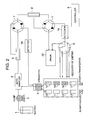
- Fig. 1 shows the system configuration of flow channels in the present embodiment.
- the sugar chain synthesizer is composed of: a pump 2 for supplying a buffer solution 1; a plurality of storage vessels containing various types of sugar nucleotide solutions 10 to 13; a plurality of storage vessels containing various types of glycosyltransferases 14 to 17; an autosampler 3 equipped with a single reactor 5; an ultrafilter (1) 6 for separating an effluent from the autosampler 3; a hexagonal valve 7 for introducing an effluent from the ultrafilter (1) 6 into the reactor 5 or an ultrafilter (2) 6'; another ultrafilter (2) 6' for filtrating glycosyltransferase from the mixture of glycosyltransferase, sugar nucleotide, and nucleotide eluted from the ultrafilter (1) 6; a hexagonal valve 7' for introducing an effluent from the ultrafilter (2) 6' into a drain 20 or a flow channel selector valve 8; the flow channel selector valve 8 for introducing the glycosyltransferase after filtration
- a primer 4 has previously been stored in the reactor 5.
- the above autosampler 3 initiates a catalytic reaction, when any one of the sugar nucleotide solutions 10 to 13 and any one of the glycosyltransferases 14 to 17 are added to the reactor 5, and then, it samples a solution obtained as a result of the reaction and supplies it to a flow channel. All of the reactor 5, the sugar nucleotide solutions 10 to 13, and the glycosyltransferases 14 to 17 are adjusted at their optimal temperatures and maintained.
- the round portions indicate ports connecting with external flow channels
- the filled square portions indicate ports that are blocked against flow channels.
- the solid-line flow channels and the broken-lines flow channels can alternatively be changed to one another.
- hydrolase can be used instead of the aforementioned glycosyltransferase.
- glycosyltransferases 14 to 17 used in the present synthesizer may include galactose transferase, N-acetylglucosamine transferase, N-acetylgalactosamine transferase, fucose transferase, sialic acid transferase, and mannose transferase.
- reaction product is used herein to mean a product formed by binding one or more monosaccharides or sugar chains to the primer 4 that is a water-soluble polymer (a water-soluble polymer having a molecular weight distribution), or a product formed by binding one or more monosaccharides or sugar chains to a monodisperse dendrimer.
- reaction product may include biopolymers such as a protein, glycoprotein, glycopeptide, lipid, glycolipid, oligosaccharide, or polysaccharide, synthetic polymers such as a polyacrylamide derivative described in the aforementioned Patent Document 1, and dendrimers. Those having a molecular weight of 5,000 or greater are more preferable.
- a reaction product means a product (hereinafter referred to as a primer (P-Sn)) formed by chemically binding a primer (hereinafter referred to as P) with a sugar (Sn).
- sugar nucleotide solutions 10 to 13 may include uridine-5'-diphosphogalactose, uridine-5'-diphos-N-acetylglucosamine, uridine-5'-diphos-N-acetylgalactosamine, guanosine-5'-diphosphofucose, guanosine-5'-diphosphomannose, and cytidine-5'-monophospho-N-acetylneuraminic acid.
- Xn-Sn sugar nucleotide solution
- the sugar nucleotide 10 contains (X 1 -S 1 ), the sugar nucleotide 11 contains (X 2 -S 2 ), and the sugar nucleotide 13 contains (X 3 -S 3 ).
- the primer P and the sugars S 1 , S 2 , and S 3 are reacted in the order of P-S 1 -S 2 -S 3 .
- the order of the sugars S 1 , S 2 , and S 3 is not limited, and S 1 can also be repeated such that the order becomes P-S 1 -S 2 -S 1 -S 3 .
- the present synthesizer basically includes the following 3 steps:
- Step 1 mixing of samples: A certain amount of the sugar nucleotide 10 (X 1 -S 1 ) is measured and sampled with the autosampler 3, and it is then introduced into the reactor 5. Subsequently, the glycosyltransferase 14 was also introduced into the reactor 5. Thereafter, these components were reacted with the primer (P) 4 at a certain temperature for a certain period of time by stirring with a stirring bar or magnet stirrer. During this step, it is also possible to stir the mixture by repeatedly aspirating and discharging the solution contained in the reactor 5 with a nozzle for the aforementioned measuring sampling.
- Step 2 After completion of the reaction, the total solution contained in the reactor is sampled with the autosampler 3, and it is introduced into a flow channel system and then introduced into the ultrafilter (1) 6.
- the solution contains the reaction product primer (P-S 1 ), the glycosyltransferase 14, an unreacted sugar nucleotide (X 1 -S 1 ), and a nucleotide (X 1 ) as a reaction by-product.
- the flow rate of the pump 2 is increased, so as to filtrate (separate) the reaction product primer (P-S 1 ) from other components (the glycosyltransferase, the unreacted sugar nucleotide (X 1 -S 1 ), and the nucleotide (X 1 ) as a reaction by-product).
- the reaction product primer (P-S 1 ) is eluted from the bottom of the ultrafilter (1) 6, and other components are eluted from the lateral portion of the ultrafilter (1) 6.
- a filter that separates only the reaction product primer that is a water-soluble polymer but filtrates other components including glycosyltransferase is selected as a filter used in the ultrafilter (1) 6. That is to say, the water-soluble polymer used herein needs to have a molecular weight that is 2 times or more the molecular weight of glycosyltransferase.
- the hexagonal valves 7 and 7' have flow channels indicated with the solid lines.
- the glycosyltransferase, the unreacted sugar nucleotide (X 1 -S 1 ), and the nucleotide (X 1 ) as a reaction by-product that are eluted from the ultrafilter (1) 6 are introduced into another ultrafilter (2) 6' via the flow channels of the hexagonal valve 7 indicated with the solid lines.
- the reaction product primer (P-S 1 ) remains at the position of the hexagonal valve 7.
- the glycosyltransferase is filtrated (separated) from other components (the unreacted sugar nucleotide (X 1 -S 1 ) and the nucleotide (X 1 ) as a reaction by-product.
- the unreacted sugar nucleotide (X 1 -S 1 ) and the nucleotide (X 1 ) as a reaction by-product are eluted from the lateral portion of the ultrafilter (2) 6', and these components are then discharged to the drain 20 via the flow channels of the hexagonal valve 7' indicated with the solid lines.
- the glycosyltransferase 14 remains at the position of the hexagonal valve 7' located at the bottom of the ultrafilter (2) 6'.
- a filter which can filtrate and separate glycosyltransferase that is a polymeric protein from low molecular weight compounds, the unreacted sugar nucleotide (X 1 -S 1 ) and the nucleotide (X 1 ) as a reaction by-product, is selected as a filter used in the ultrafilter (2) 6'.
- Step 3 After completion of sufficient filtration, the flow channels indicated with the solid lines are switched to the flow channels indicated with the broken lines in the hexagonal valve 7, so as to recover the reaction product primer (P-S 1 ) to the reactor 5. Thereafter, the flow channels are again switched to the original flow channels in the hexagonal valve 7. Subsequently, the flow channels indicated with the solid lines are switched to the flow channels indicated with the broken lines in the hexagonal valve 7', and the flow channel selector valve 8 is actuated, so as to recover glycosyltransferase to the original storage vessel. Thereafter, in the hexagonal valves 7 and 7', the flow channels are again switched to the original flow channels, and the flow rate of the pump 2 is decreased.
- the aforementioned steps 1 to 3 are successively repeatedly carried out on a sugar nucleotide (X 2 -S 2 ) and a sugar nucleotide (X 3 -S 3 ), so that a reaction product primer (P-S 1 -S 2 -S 3 ) can be obtained in the reactor 5. Then, the reaction product primer (P-S 1 -S 2 -S 3 ) is captured from the reactor 5, so as to obtain a final reaction product primer.
- a dendrimer having a molecular weight smaller than that of glycosyltransferase is used as a primer P (4), in the solution contained in the reactor 5 obtained after the reaction by the aforementioned step 1, are present the glycosyltransferase 14, the reaction product primer (P-S 1 ), the unreacted sugar nucleotide (X 1 -S 1 ), and the nucleotide (X 1 ) as a reaction by-product, in the order of decreasing the molecular weight.
- the reaction product primer (P-S 1 ) since it becomes impossible to filtrate only the reaction product primer (P-S 1 ) to return to the reactor 5, such a dendrimer cannot be used as a primer P (4) in the present embodiment.
- the ultrafilter (2) 6', the hexagonal valve 7', and the flow channel selector valve 8 are not necessary, and the operations in which these units are used are also not necessary in the aforementioned steps.
- Fig. 2 shows a modified embodiment of Example 1.
- the figure shows the case where a detector (1) 18 and a detector (2) 19 are added.
- Any one selected from the group consisting of a refractive index detector (RI), an ultraviolet-visible detector (UV), and a diode array detector (DAD) can be used as each of the above detectors.
- RI refractive index detector
- UV ultraviolet-visible detector
- DAD diode array detector
- the detector (1) 18 and the detector (2) 19 are used to monitor whether or not the recovery is normally carried out, or to calculate the recovery rate. These detectors are useful in that in case that the recovery is not normally carried out for a certain reason, the subsequent synthetic reaction is suspended, and the waste of sugar nucleotides, glycosyltransferases, and time can be prevented.
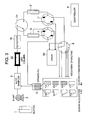
- Fig. 3 shows the configuration of a synthesizer and flow channels in another embodiment.
- the components identical to those in Example 1 have the same numerical symbols as those in Example 1.
- a filter that separates only a reaction product primer (P-S 1 ) that is a water-soluble polymer but filtrates other components is selected as a filter used in an ultrafilter (1) 6 in the present embodiment.
- a filter that separates only glycosyltransferase but filtrates other components is selected as a filter used in an ultrafilter (2) 6'.
- the present synthesizer basically includes the 4 steps described below.
- the steps applied are different depending on whether the molecular weight of a component used as a primer (P) 4 is larger or smaller than that of glycosyltransferase.
- a dendrimer is an example of the component used as a primer (P) 4 having a molecular weight smaller than that of glycosyltransferase.
- Other components generally have a molecular weight larger than that of glycosyltransferase.
- Step 1 mixing of samples: A certain amount of a sugar nucleotide (X 1 -S 1 ) 10 is measured and sampled with an autosampler 3, and it is then introduced into a reactor 5. Subsequently, a glycosyltransferase 14 was also introduced into the reactor 5. Thereafter, these components were reacted with a primer (P) 4 at a certain temperature for a certain period of time by stirring with a stirring bar or magnet stirrer. During this step, it is also possible to stir the mixture by repeatedly aspirating and discharging the solution contained in the reactor 5 with a nozzle for the aforementioned measuring sampling.
- P primer
- Step 2 (Separation with GPC column): After completion of the reaction, the total solution contained in the reactor 5 is sampled and then introduced into a flow channel system. The flow rate of a pump is increased, and the solution is introduced into a GPC column 22.
- the solution contains the reaction product primer (P-S 1 ), the glycosyltransferase, an unreacted sugar nucleotide (X 1 -S 1 ), and a nucleotide (X 1 ) as a reaction by-product.
- GPC column is an abbreviated name of a high performance gel permeation chromatography column, and the inside of the GPC column is filled with a filler.
- a column that can sufficiently separate the reaction product primer (P-S 1 ), the glycosyltransferase, and the unreacted sugar nucleotide (X 1 -S 1 ), depending on the difference of their molecular weights, is selected.
- the components are eluted from the GPC column 22 in the order of decreasing the molecular weight. That is, the components are eluted in the order of the reaction product primer (P-S 1 ), the glycosyltransferase, the unreacted sugar nucleotide (X 1 -S 1 ), and the nucleotide (X 1 ) as a reaction by-product. Such elution is monitored with a detector 18.
- Step 3 (Ultrafiltration): At this point, a flow channel selector valve 21 is connected with the side of the ultrafilter (1) 6. Moreover, hexagonal valves 7 and 7' have flow channel indicated with the solid lines.
- the flow channel selector valve 21 is connected with the side of the ultrafilter (1) 6 and continuously introduces the obtained effluent into the ultrafilter (1) 6. Since the flow channels of the hexagonal valve 7 are those indicated with the solid lines at the time, the reaction product primer (P-S 1 ) is blocked. However, other components are filtrated and delivered to a drain 20.
- any one selected from the group consisting of a refractive index detector (RI), an ultraviolet-visible detector (UV), and a diode array detector (DAD) can be used as such a detector 18.
- the flow channel selector valve 21 is switched, so that the glycosyltransferase is introduced into an ultrafilter (2) 6'. Since the flow channels of the hexagonal valve 7' are those indicated with the solid lines at the time, the glycosyltransferase is blocked. However, other components are filtrated and supplied to the drain 20.
- the solution (buffer) is continuously flown until the unreacted sugar nucleotide (X 1 -S 1 ) and the nucleotide (X 1 ) as a reaction by-product are all discharged to the drain 20.
- the glycosyltransferase and other components can sufficiently be filtrated with the ultrafilter (2) 6'.
- reaction product primer (P-S 1 ) and the glycosyltransferase are eluted from the bottoms of the ultrafilters (1) 6 and (2) 6', the flow channels are blocked.
- the unreacted sugar nucleotide (X 1 -S 1 ) and the nucleotide (X 1 ) as a reaction by-product that have been eluted from the lateral portions of the ultrafilters (1) 6 and (2) 6' are flown to the drain 20.
- Step 4 (Recovery): After the reaction product primer (P-S 1 ) has sufficiently been filtrated, the hexagonal valve 7 is switched, so as to recover the reaction product primer (P-S 1 ) 4 to the reactor 5. Thereafter, the flow channel selector valve 21 is again switched to the side of the ultrafilter (2) 6', and further, the hexagonal valve 7' and the flow channel selector valve 8 are switched, so as to recover the glycosyltransferase to the original storage vessel. Thereafter, the flow channel valve 21 and the hexagonal valves 7 and 7' are returned to the original positions, and the flow rate of the pump 2 is decreased.
- steps 1 to 4 are successively repeatedly carried out on a sugar nucleotide (X 2 -S 2 ) and a sugar nucleotide (X 3 -S 3 ), so as to obtain a final reaction product primer (P-S 1 -S 2 -S 3 ) in the reactor 5.
- step 3 in this case differs from step 3 in the above embodiment.
- step 3 in this case will be described below. It is to be noted that steps 1, 2, and 4 are the same as those in the above embodiment, the descriptions of these steps are omitted.
- Step 3 (Ultrafiltration): When an eluant from the GPC column 22 is detected with a detector 18, a flow channel selector valve 21 is connected with the side of an ultrafilter (2) 6'. Hexagonal valves 7 and 7' are those indicated with the solid lines.
- the flow channel selector valve 21 is connected with the side of the ultrafilter (2) 6' and continuously introduces the obtained effluent into the ultrafilter (2) 6'. Since the flow channels of the hexagonal valve 7' are those indicated with the solid lines at the time, the glycosyltransferase is blocked. However, other components are filtrated and supplied to a drain 20.
- the flow channel selector valve 21 is switched, so that the reaction product primer (P-S 1 ) is introduced into an ultrafilter (1) 6. Since the flow channels of the hexagonal valve 7 are those indicated with the solid lines at the time, the reaction product primer (P-S 1 ) is blocked. However, other components are filtrated and supplied to the drain 20.
- the solution (buffer) is continuously flown until the unreacted sugar nucleotide (X 1 -S 1 ), and the nucleotide (X 1 ) as a reaction by-product are all discharged to the drain 20.
- the reaction product primer (P-S 1 ) and other components can sufficiently be filtrated with the ultrafilter (1) 6.
- the flow channel selector valve 21 is returned to the side of the ultrafilter (2) 6'.
- the buffer is flown, and the glycosyltransferase is filtrated again.
- Step 3 in the case of using a primer (P) 4 (dendrimer) having a molecular weight smaller than that of glycosyltransferase is as described above.
Landscapes
- Organic Chemistry (AREA)
- Chemical & Material Sciences (AREA)
- Engineering & Computer Science (AREA)
- Zoology (AREA)
- Life Sciences & Earth Sciences (AREA)
- Wood Science & Technology (AREA)
- Chemical Kinetics & Catalysis (AREA)
- Microbiology (AREA)
- General Chemical & Material Sciences (AREA)
- Biotechnology (AREA)
- Health & Medical Sciences (AREA)
- Biochemistry (AREA)
- Bioinformatics & Cheminformatics (AREA)
- General Engineering & Computer Science (AREA)
- General Health & Medical Sciences (AREA)
- Genetics & Genomics (AREA)
- Preparation Of Compounds By Using Micro-Organisms (AREA)
- Measuring Or Testing Involving Enzymes Or Micro-Organisms (AREA)
- Apparatus Associated With Microorganisms And Enzymes (AREA)
Abstract
Description
Those having a molecular weight of 5,000 or greater are more preferable. In the present embodiment, such a reaction product means a product (hereinafter referred to as a primer (P-Sn)) formed by chemically binding a primer (hereinafter referred to as P) with a sugar (Sn). Examples of the
Claims (9)
- A sugar chain synthesizer, which comprises:a pump for supplying a buffer solution;a plurality of vessels containing respective sugar nucleotide solutions;a plurality of vessels containing respective glycosyltransferases;a reactor containing a primer that is a water-soluble polymer, for introducing said sugar nucleotide solutions and glycosyltransferases;a sampling means for sampling a solution contained in said reactor and introducing it into a flow channel through which said buffer solution flows;a first ultrafilter for subjecting the solution introduced by said sampling means to ultrafiltration;a second ultrafilter for subjecting an effluent from said first ultrafilter to ultrafiltration;a first selector valve, which is provided between said first and second ultrafilters and comprises a flow channel for returning the effluent from said first ultrafilter to said reactor and a flow channel for supplying the effluent to said second ultrafilter; anda second selector valve, which is provided downstream of said second ultrafilter and comprises a flow channel for delivering the effluent from said second ultrafilter to a drain and a flow channel for supplying the effluent to one of said vessels containing respective glycosyltransferases.
- The sugar chain synthesizer according to claim 1, wherein the solution sampled from said reactor comprises a reaction product primer, a glycosyltransferase, an unreacted sugar nucleotide, and a nucleotide by-product, and wherein, in said first ultrafilter, the reaction product primer is separated from other components.
- The sugar chain synthesizer according to claim 2, wherein the solution introduced into said second ultrafilter comprises the glycosyltransferase, the unreacted sugar nucleotide, and the nucleotide by-product, and wherein, in said second ultrafiltration column, the glycosyltransferase is separated from other components.
- The sugar chain synthesizer according to claim 1, wherein a third switching flow channel for returning the effluent from said first selector valve to any one of the vessels containing respective glycosyltransferases is provided in a flow channel between said second selector valve and said vessels containing respective glycosyltransferases.
- The sugar chain synthesizer according to claim 1, wherein a first detector is provided in a flow channel between said first selector valve and said reactor, and a second detector is provided in a flow channel between said second selector valve and said vessels containing respective glycosyltransferases.
- The sugar chain synthesizer according to claim 5, wherein each of said first and second detectors is any one selected from the group consisting of a refractive index detector (RI), an ultraviolet-visible detector (UV), and a diode array detector (DAD).
- A sugar chain synthesizer, which comprises:a pump for supplying a buffer solution;a plurality of vessels containing respective sugar nucleotide solutions;a plurality of vessels containing respective glycosyltransferases;a reactor containing a primer that is a water-soluble polymer, for introducing said sugar nucleotide solutions and glycosyltransferases;a sampling means for sampling the solution contained in said reactor and introducing it into a flow channel through which said buffer solution flows;a GPC column for separating the components in the solution introduced by said sampling means depending on the molecular weights thereof;first and second ultrafilters, into which an eluant from said GPC column is introduced;a first selector valve, which is provided between said GPC column and said first and second ultrafilters, and selectively supplies the eluant from said GPC column to said first ultrafilter or said second ultrafilter;a second selector valve, which is provided downstream of said first ultrafilter and comprises a flow channel for supplying an effluent from said first ultrafilter to said reactor and a flow channel for delivering the effluent to a drain; anda third selector valve, which is provided downstream of said second ultrafilter and comprises a flow channel for delivering the effluent from said first ultrafilter to said drain and a flow channel for delivering the effluent to one of said vessels containing respective glycosyltransferase.
- The sugar chain synthesizer according to claim 7, wherein a third switching flow channel for returning the effluent from said second ultrafilter to any one of the vessels containing respective glycosyltransferases is provided between said third selector valve and said vessels containing respective glycosyltransferase.
- The sugar chain synthesizer according to claim 7, wherein any detector selected from the group consisting of a refractive index detector (RI), an ultraviolet-visible detector (UV), and a diode array detector (DAD) is provided between said GPC column and said first selector valve.
Applications Claiming Priority (2)
| Application Number | Priority Date | Filing Date | Title |
|---|---|---|---|
| JP2004105562A JP4252922B2 (en) | 2004-03-31 | 2004-03-31 | Sugar chain synthesizer |
| JP2004105562 | 2004-03-31 |
Publications (3)
| Publication Number | Publication Date |
|---|---|
| EP1582581A2 true EP1582581A2 (en) | 2005-10-05 |
| EP1582581A3 EP1582581A3 (en) | 2007-03-07 |
| EP1582581B1 EP1582581B1 (en) | 2013-07-03 |
Family
ID=34880072
Family Applications (1)
| Application Number | Title | Priority Date | Filing Date |
|---|---|---|---|
| EP05003191.3A Expired - Lifetime EP1582581B1 (en) | 2004-03-31 | 2005-02-15 | Saccharide composition synthesizer |
Country Status (3)
| Country | Link |
|---|---|
| US (1) | US7883873B2 (en) |
| EP (1) | EP1582581B1 (en) |
| JP (1) | JP4252922B2 (en) |
Family Cites Families (9)
| Publication number | Priority date | Publication date | Assignee | Title |
|---|---|---|---|---|
| JPS6054398A (en) | 1983-09-02 | 1985-03-28 | Nippon Zeon Co Ltd | polynucleotide synthesizer |
| HU216881B (en) | 1990-04-16 | 1999-09-28 | Trustees Of The University Of Pennsylvania | Process and device for preparation of saccharide compositions produced by catalyzing with glycosyltransferase |
| WO1991016449A1 (en) * | 1990-04-16 | 1991-10-31 | The Trustees Of The University Of Pennsylvania | Saccharide compositions, methods and apparatus for their synthesis |
| US5651943A (en) * | 1991-11-19 | 1997-07-29 | Arizona Board Of Regents, On Behalf Of The University Of Arizona | Apparatus and method for random polymer synthesis |
| JP4003093B2 (en) | 1997-07-29 | 2007-11-07 | 東洋紡績株式会社 | Method for producing saccharides |
| EP1076716A1 (en) * | 1998-05-05 | 2001-02-21 | McNeil Speciality Products Company Division of McNeil-PPC Inc. | Functional sugar polymers from inexpensive sugar sources and apparatus for preparing same |
| DE60110094T2 (en) * | 2000-08-18 | 2009-10-01 | Massachusetts Institute Of Technology, Cambridge | DEVICE AND METHOD FOR THE AUTOMATED SYNTHESIS OF OLIGOSACCHARIDES |
| EP1405905B1 (en) * | 2001-07-02 | 2007-02-07 | Hitachi, Ltd. | Sugar chain synthesizer |
| FR2838452B1 (en) * | 2002-04-10 | 2004-07-09 | Eurodia Ind | PROCESS FOR THE CONTINUOUS PRODUCTION OF GALACTO OLIGOSACCHARIDES |
-
2004
- 2004-03-31 JP JP2004105562A patent/JP4252922B2/en not_active Expired - Fee Related
-
2005
- 2005-02-15 EP EP05003191.3A patent/EP1582581B1/en not_active Expired - Lifetime
- 2005-02-18 US US11/060,810 patent/US7883873B2/en not_active Expired - Fee Related
Also Published As
| Publication number | Publication date |
|---|---|
| JP4252922B2 (en) | 2009-04-08 |
| US7883873B2 (en) | 2011-02-08 |
| EP1582581A3 (en) | 2007-03-07 |
| EP1582581B1 (en) | 2013-07-03 |
| US20050221472A1 (en) | 2005-10-06 |
| JP2005287372A (en) | 2005-10-20 |
Similar Documents
| Publication | Publication Date | Title |
|---|---|---|
| JP4006385B2 (en) | Sugar chain synthesizer | |
| CA1221649A (en) | Process for the simultaneous synthesis of several oligonucleotides on a solid phase | |
| EP3445770B1 (en) | Separation of oligosaccharides from fermentation broth | |
| EP2489671B1 (en) | Programmable oligonucleotide synthesis | |
| US5807525A (en) | Apparatus and process for multi stage solid phase synthesis of long chained organic molecules | |
| EP1153127A1 (en) | Method for producing polymers | |
| EP3681637A1 (en) | Biopolymer synthesis system and method | |
| Kruse et al. | An alternative downstream process based on aqueous two-phase extraction for the purification of monoclonal antibodies | |
| WO2000075368A2 (en) | Method for the synthesis of dna fragments | |
| EP1685261A2 (en) | Highly parallel dna synthesiser based on matrices | |
| EP3456836A1 (en) | Separation of sialylated oligosaccharides from fermentation broth | |
| AU3785899A (en) | Functional sugar polymers from inexpensive sugar sources and apparatus for preparing same | |
| DK181061B1 (en) | Purification of sialooligosaccharides | |
| DE3415014A1 (en) | DEVICE FOR SYNTHESIS OF CHEMICAL COMPOUNDS | |
| US7883873B2 (en) | Saccharide composition synthesizer | |
| JP4005557B2 (en) | Sugar chain synthesizer | |
| WO1997007126A1 (en) | Apparatus and process for multi-stage solid-phase synthesis of long-chained organic molecules | |
| KR20210105385A (en) | Separation of oligosaccharides | |
| JP2006038674A (en) | Analysis method of glycoprotein sugar chain, and manufacturing method of unlabeled sugar chain | |
| JP2005287372A6 (en) | Sugar chain synthesizer | |
| US20240124509A1 (en) | Separation of charged oligosaccharides | |
| Kröck et al. | Automated synthesis of oligosaccharides provides access to chemical tools and vaccine candidates | |
| JP2005279599A (en) | High pressure resistant ultrafiltration membrane unit | |
| Hurevich et al. | Automated oligosaccharide synthesis: techniques and applications | |
| WO2022182388A1 (en) | Separation apparatus and method |
Legal Events
| Date | Code | Title | Description |
|---|---|---|---|
| PUAI | Public reference made under article 153(3) epc to a published international application that has entered the european phase |
Free format text: ORIGINAL CODE: 0009012 |
|
| AK | Designated contracting states |
Kind code of ref document: A2 Designated state(s): AT BE BG CH CY CZ DE DK EE ES FI FR GB GR HU IE IS IT LI LT LU MC NL PL PT RO SE SI SK TR |
|
| AX | Request for extension of the european patent |
Extension state: AL BA HR LV MK YU |
|
| 17P | Request for examination filed |
Effective date: 20060331 |
|
| PUAL | Search report despatched |
Free format text: ORIGINAL CODE: 0009013 |
|
| AK | Designated contracting states |
Kind code of ref document: A3 Designated state(s): AT BE BG CH CY CZ DE DK EE ES FI FR GB GR HU IE IS IT LI LT LU MC NL PL PT RO SE SI SK TR |
|
| AX | Request for extension of the european patent |
Extension state: AL BA HR LV MK YU |
|
| AKX | Designation fees paid |
Designated state(s): DE GB |
|
| GRAP | Despatch of communication of intention to grant a patent |
Free format text: ORIGINAL CODE: EPIDOSNIGR1 |
|
| GRAS | Grant fee paid |
Free format text: ORIGINAL CODE: EPIDOSNIGR3 |
|
| GRAA | (expected) grant |
Free format text: ORIGINAL CODE: 0009210 |
|
| RIN1 | Information on inventor provided before grant (corrected) |
Inventor name: YAMADA, KURIKO Inventor name: TAKAKI, MASANORI Inventor name: NAKAGAWA, HIROAKI Inventor name: NISHIMURA, SHINICHIRO Inventor name: DEGUCHI, KISABURO |
|
| AK | Designated contracting states |
Kind code of ref document: B1 Designated state(s): DE GB |
|
| REG | Reference to a national code |
Ref country code: GB Ref legal event code: FG4D |
|
| REG | Reference to a national code |
Ref country code: DE Ref legal event code: R096 Ref document number: 602005040214 Country of ref document: DE Effective date: 20130829 |
|
| PLBE | No opposition filed within time limit |
Free format text: ORIGINAL CODE: 0009261 |
|
| STAA | Information on the status of an ep patent application or granted ep patent |
Free format text: STATUS: NO OPPOSITION FILED WITHIN TIME LIMIT |
|
| 26N | No opposition filed |
Effective date: 20140404 |
|
| REG | Reference to a national code |
Ref country code: DE Ref legal event code: R097 Ref document number: 602005040214 Country of ref document: DE Effective date: 20140404 |
|
| PGFP | Annual fee paid to national office [announced via postgrant information from national office to epo] |
Ref country code: DE Payment date: 20150210 Year of fee payment: 11 |
|
| PGFP | Annual fee paid to national office [announced via postgrant information from national office to epo] |
Ref country code: GB Payment date: 20150211 Year of fee payment: 11 |
|
| REG | Reference to a national code |
Ref country code: DE Ref legal event code: R119 Ref document number: 602005040214 Country of ref document: DE |
|
| GBPC | Gb: european patent ceased through non-payment of renewal fee |
Effective date: 20160215 |
|
| PG25 | Lapsed in a contracting state [announced via postgrant information from national office to epo] |
Ref country code: GB Free format text: LAPSE BECAUSE OF NON-PAYMENT OF DUE FEES Effective date: 20160215 Ref country code: DE Free format text: LAPSE BECAUSE OF NON-PAYMENT OF DUE FEES Effective date: 20160901 |