EP1582532A1 - Process for hydrolyzing poly(vinylbenzyl acetate) - Google Patents
Process for hydrolyzing poly(vinylbenzyl acetate) Download PDFInfo
- Publication number
- EP1582532A1 EP1582532A1 EP05102149A EP05102149A EP1582532A1 EP 1582532 A1 EP1582532 A1 EP 1582532A1 EP 05102149 A EP05102149 A EP 05102149A EP 05102149 A EP05102149 A EP 05102149A EP 1582532 A1 EP1582532 A1 EP 1582532A1
- Authority
- EP
- European Patent Office
- Prior art keywords
- poly
- vinylbenzyl
- acetate
- alcohol
- organic solvent
- Prior art date
- Legal status (The legal status is an assumption and is not a legal conclusion. Google has not performed a legal analysis and makes no representation as to the accuracy of the status listed.)
- Granted
Links
- -1 poly(vinylbenzyl acetate) Polymers 0.000 title claims abstract description 154
- 238000000034 method Methods 0.000 title claims abstract description 70
- 230000008569 process Effects 0.000 title claims abstract description 65
- 230000003301 hydrolyzing effect Effects 0.000 title claims description 7
- 239000003054 catalyst Substances 0.000 claims abstract description 32
- 238000006460 hydrolysis reaction Methods 0.000 claims abstract description 27
- 239000003960 organic solvent Substances 0.000 claims abstract description 27
- 230000007062 hydrolysis Effects 0.000 claims abstract description 18
- WYURNTSHIVDZCO-UHFFFAOYSA-N Tetrahydrofuran Chemical group C1CCOC1 WYURNTSHIVDZCO-UHFFFAOYSA-N 0.000 claims description 25
- 125000000217 alkyl group Chemical group 0.000 claims description 13
- 125000004432 carbon atom Chemical group C* 0.000 claims description 13
- 150000003242 quaternary ammonium salts Chemical group 0.000 claims description 13
- 150000005622 tetraalkylammonium hydroxides Chemical group 0.000 claims description 12
- YLQBMQCUIZJEEH-UHFFFAOYSA-N tetrahydrofuran Natural products C=1C=COC=1 YLQBMQCUIZJEEH-UHFFFAOYSA-N 0.000 claims description 12
- JUJWROOIHBZHMG-UHFFFAOYSA-N Pyridine Chemical group C1=CC=NC=C1 JUJWROOIHBZHMG-UHFFFAOYSA-N 0.000 claims description 10
- 229920003060 Poly(vinyl benzyl chloride) Polymers 0.000 claims description 9
- 238000003384 imaging method Methods 0.000 claims description 7
- 230000000903 blocking effect Effects 0.000 claims description 6
- UMJSCPRVCHMLSP-UHFFFAOYSA-N pyridine Natural products COC1=CC=CN=C1 UMJSCPRVCHMLSP-UHFFFAOYSA-N 0.000 claims description 5
- 238000002360 preparation method Methods 0.000 abstract description 10
- 239000010410 layer Substances 0.000 description 27
- 238000006243 chemical reaction Methods 0.000 description 23
- YMWUJEATGCHHMB-UHFFFAOYSA-N Dichloromethane Chemical compound ClCCl YMWUJEATGCHHMB-UHFFFAOYSA-N 0.000 description 21
- OKKJLVBELUTLKV-UHFFFAOYSA-N Methanol Chemical compound OC OKKJLVBELUTLKV-UHFFFAOYSA-N 0.000 description 21
- 229920000642 polymer Polymers 0.000 description 18
- XLYOFNOQVPJJNP-UHFFFAOYSA-N water Substances O XLYOFNOQVPJJNP-UHFFFAOYSA-N 0.000 description 16
- 229910052751 metal Inorganic materials 0.000 description 15
- 239000002184 metal Substances 0.000 description 15
- WQDUMFSSJAZKTM-UHFFFAOYSA-N Sodium methoxide Chemical group [Na+].[O-]C WQDUMFSSJAZKTM-UHFFFAOYSA-N 0.000 description 14
- 150000004703 alkoxides Chemical class 0.000 description 13
- LFQSCWFLJHTTHZ-UHFFFAOYSA-N Ethanol Chemical compound CCO LFQSCWFLJHTTHZ-UHFFFAOYSA-N 0.000 description 12
- XLYOFNOQVPJJNP-UHFFFAOYSA-M hydroxide Chemical compound [OH-] XLYOFNOQVPJJNP-UHFFFAOYSA-M 0.000 description 12
- 108091008695 photoreceptors Proteins 0.000 description 12
- VDZOOKBUILJEDG-UHFFFAOYSA-M tetrabutylammonium hydroxide Chemical group [OH-].CCCC[N+](CCCC)(CCCC)CCCC VDZOOKBUILJEDG-UHFFFAOYSA-M 0.000 description 12
- 239000000203 mixture Substances 0.000 description 10
- NDKBVBUGCNGSJJ-UHFFFAOYSA-M benzyltrimethylammonium hydroxide Chemical group [OH-].C[N+](C)(C)CC1=CC=CC=C1 NDKBVBUGCNGSJJ-UHFFFAOYSA-M 0.000 description 8
- WVDDGKGOMKODPV-UHFFFAOYSA-N Benzyl alcohol Chemical group OCC1=CC=CC=C1 WVDDGKGOMKODPV-UHFFFAOYSA-N 0.000 description 7
- 239000011541 reaction mixture Substances 0.000 description 7
- 238000010992 reflux Methods 0.000 description 7
- XKRFYHLGVUSROY-UHFFFAOYSA-N Argon Chemical compound [Ar] XKRFYHLGVUSROY-UHFFFAOYSA-N 0.000 description 6
- UORVGPXVDQYIDP-UHFFFAOYSA-N borane Chemical compound B UORVGPXVDQYIDP-UHFFFAOYSA-N 0.000 description 6
- 235000019441 ethanol Nutrition 0.000 description 6
- QTBSBXVTEAMEQO-UHFFFAOYSA-M Acetate Chemical compound CC([O-])=O QTBSBXVTEAMEQO-UHFFFAOYSA-M 0.000 description 5
- 229940022663 acetate Drugs 0.000 description 5
- 239000012790 adhesive layer Substances 0.000 description 5
- 239000011248 coating agent Substances 0.000 description 5
- 238000000576 coating method Methods 0.000 description 5
- 238000001816 cooling Methods 0.000 description 5
- 230000035484 reaction time Effects 0.000 description 5
- 238000013341 scale-up Methods 0.000 description 5
- SLBOQBILGNEPEB-UHFFFAOYSA-N 1-chloroprop-2-enylbenzene Chemical compound C=CC(Cl)C1=CC=CC=C1 SLBOQBILGNEPEB-UHFFFAOYSA-N 0.000 description 4
- VMHLLURERBWHNL-UHFFFAOYSA-M Sodium acetate Chemical compound [Na+].CC([O-])=O VMHLLURERBWHNL-UHFFFAOYSA-M 0.000 description 4
- 239000003513 alkali Substances 0.000 description 4
- 125000003710 aryl alkyl group Chemical group 0.000 description 4
- 125000001797 benzyl group Chemical group [H]C1=C([H])C([H])=C(C([H])=C1[H])C([H])([H])* 0.000 description 4
- 230000015572 biosynthetic process Effects 0.000 description 4
- 229920001577 copolymer Polymers 0.000 description 4
- 230000009477 glass transition Effects 0.000 description 4
- 238000004519 manufacturing process Methods 0.000 description 4
- 239000001632 sodium acetate Substances 0.000 description 4
- 235000017281 sodium acetate Nutrition 0.000 description 4
- 239000002904 solvent Substances 0.000 description 4
- 239000000758 substrate Substances 0.000 description 4
- MHHJQVRGRPHIMR-UHFFFAOYSA-N 1-phenylprop-2-en-1-ol Chemical compound C=CC(O)C1=CC=CC=C1 MHHJQVRGRPHIMR-UHFFFAOYSA-N 0.000 description 3
- 229920002799 BoPET Polymers 0.000 description 3
- 239000005041 Mylar™ Substances 0.000 description 3
- FXHOOIRPVKKKFG-UHFFFAOYSA-N N,N-Dimethylacetamide Chemical compound CN(C)C(C)=O FXHOOIRPVKKKFG-UHFFFAOYSA-N 0.000 description 3
- ZMXDDKWLCZADIW-UHFFFAOYSA-N N,N-Dimethylformamide Chemical compound CN(C)C=O ZMXDDKWLCZADIW-UHFFFAOYSA-N 0.000 description 3
- YXFVVABEGXRONW-UHFFFAOYSA-N Toluene Chemical compound CC1=CC=CC=C1 YXFVVABEGXRONW-UHFFFAOYSA-N 0.000 description 3
- 238000005904 alkaline hydrolysis reaction Methods 0.000 description 3
- 229910052786 argon Inorganic materials 0.000 description 3
- 229910000085 borane Inorganic materials 0.000 description 3
- 239000000047 product Substances 0.000 description 3
- 230000009467 reduction Effects 0.000 description 3
- ARXJGSRGQADJSQ-UHFFFAOYSA-N 1-methoxypropan-2-ol Chemical compound COCC(C)O ARXJGSRGQADJSQ-UHFFFAOYSA-N 0.000 description 2
- 238000005160 1H NMR spectroscopy Methods 0.000 description 2
- QTBSBXVTEAMEQO-UHFFFAOYSA-N Acetic acid Chemical compound CC(O)=O QTBSBXVTEAMEQO-UHFFFAOYSA-N 0.000 description 2
- IAZDPXIOMUYVGZ-UHFFFAOYSA-N Dimethylsulphoxide Chemical compound CS(C)=O IAZDPXIOMUYVGZ-UHFFFAOYSA-N 0.000 description 2
- IMNFDUFMRHMDMM-UHFFFAOYSA-N N-Heptane Chemical compound CCCCCCC IMNFDUFMRHMDMM-UHFFFAOYSA-N 0.000 description 2
- GWEVSGVZZGPLCZ-UHFFFAOYSA-N Titan oxide Chemical compound O=[Ti]=O GWEVSGVZZGPLCZ-UHFFFAOYSA-N 0.000 description 2
- 239000000853 adhesive Substances 0.000 description 2
- 230000001070 adhesive effect Effects 0.000 description 2
- 239000006227 byproduct Substances 0.000 description 2
- 239000003153 chemical reaction reagent Substances 0.000 description 2
- 239000008367 deionised water Substances 0.000 description 2
- 229910021641 deionized water Inorganic materials 0.000 description 2
- 239000006185 dispersion Substances 0.000 description 2
- 238000001914 filtration Methods 0.000 description 2
- 239000000843 powder Substances 0.000 description 2
- 239000002244 precipitate Substances 0.000 description 2
- 239000000376 reactant Substances 0.000 description 2
- 229920002545 silicone oil Polymers 0.000 description 2
- 238000003756 stirring Methods 0.000 description 2
- WGTYBPLFGIVFAS-UHFFFAOYSA-M tetramethylammonium hydroxide Chemical compound [OH-].C[N+](C)(C)C WGTYBPLFGIVFAS-UHFFFAOYSA-M 0.000 description 2
- WYTZZXDRDKSJID-UHFFFAOYSA-N (3-aminopropyl)triethoxysilane Chemical compound CCO[Si](OCC)(OCC)CCCN WYTZZXDRDKSJID-UHFFFAOYSA-N 0.000 description 1
- WAUKBOOEPYNAGU-UHFFFAOYSA-N 1-phenylprop-2-enyl acetate Chemical compound CC(=O)OC(C=C)C1=CC=CC=C1 WAUKBOOEPYNAGU-UHFFFAOYSA-N 0.000 description 1
- ZYMOKRVQKMAIBA-UHFFFAOYSA-N 3-(3-phenylpenta-1,4-dien-3-yloxy)penta-1,4-dien-3-ylbenzene Chemical compound C=1C=CC=CC=1C(C=C)(C=C)OC(C=C)(C=C)C1=CC=CC=C1 ZYMOKRVQKMAIBA-UHFFFAOYSA-N 0.000 description 1
- SECXISVLQFMRJM-UHFFFAOYSA-N N-Methylpyrrolidone Chemical compound CN1CCCC1=O SECXISVLQFMRJM-UHFFFAOYSA-N 0.000 description 1
- 239000004793 Polystyrene Substances 0.000 description 1
- 229910000831 Steel Inorganic materials 0.000 description 1
- 229960000583 acetic acid Drugs 0.000 description 1
- 125000003158 alcohol group Chemical group 0.000 description 1
- 150000001298 alcohols Chemical class 0.000 description 1
- 239000002585 base Substances 0.000 description 1
- QUKGYYKBILRGFE-VJJZLTLGSA-N benzyl acetate Chemical group C[13C](=O)OCC1=CC=CC=C1 QUKGYYKBILRGFE-VJJZLTLGSA-N 0.000 description 1
- 235000019445 benzyl alcohol Nutrition 0.000 description 1
- FKPSBYZGRQJIMO-UHFFFAOYSA-M benzyl(triethyl)azanium;hydroxide Chemical compound [OH-].CC[N+](CC)(CC)CC1=CC=CC=C1 FKPSBYZGRQJIMO-UHFFFAOYSA-M 0.000 description 1
- 239000011230 binding agent Substances 0.000 description 1
- 230000008859 change Effects 0.000 description 1
- 239000007795 chemical reaction product Substances 0.000 description 1
- 125000004218 chloromethyl group Chemical group [H]C([H])(Cl)* 0.000 description 1
- 238000004132 cross linking Methods 0.000 description 1
- XPYVMSINJBJOQD-UHFFFAOYSA-N dimethyl(3-phenylpropanoyl)azanium;hydroxide Chemical compound [OH-].C[NH+](C)C(=O)CCC1=CC=CC=C1 XPYVMSINJBJOQD-UHFFFAOYSA-N 0.000 description 1
- 238000001035 drying Methods 0.000 description 1
- AZDCYKCDXXPQIK-UHFFFAOYSA-N ethenoxymethylbenzene Chemical compound C=COCC1=CC=CC=C1 AZDCYKCDXXPQIK-UHFFFAOYSA-N 0.000 description 1
- 238000009472 formulation Methods 0.000 description 1
- 239000012362 glacial acetic acid Substances 0.000 description 1
- 239000011521 glass Substances 0.000 description 1
- 238000010438 heat treatment Methods 0.000 description 1
- 239000012535 impurity Substances 0.000 description 1
- 239000011261 inert gas Substances 0.000 description 1
- 238000003760 magnetic stirring Methods 0.000 description 1
- 239000000463 material Substances 0.000 description 1
- 238000002156 mixing Methods 0.000 description 1
- 238000012986 modification Methods 0.000 description 1
- 230000004048 modification Effects 0.000 description 1
- 150000007530 organic bases Chemical class 0.000 description 1
- 239000003973 paint Substances 0.000 description 1
- 229920002120 photoresistant polymer Polymers 0.000 description 1
- 239000003880 polar aprotic solvent Substances 0.000 description 1
- 229920000515 polycarbonate Polymers 0.000 description 1
- 239000004417 polycarbonate Substances 0.000 description 1
- 229920000728 polyester Polymers 0.000 description 1
- 238000006116 polymerization reaction Methods 0.000 description 1
- 229920002223 polystyrene Polymers 0.000 description 1
- BDAWXSQJJCIFIK-UHFFFAOYSA-N potassium methoxide Chemical compound [K+].[O-]C BDAWXSQJJCIFIK-UHFFFAOYSA-N 0.000 description 1
- LPNYRYFBWFDTMA-UHFFFAOYSA-N potassium tert-butoxide Chemical compound [K+].CC(C)(C)[O-] LPNYRYFBWFDTMA-UHFFFAOYSA-N 0.000 description 1
- 238000001556 precipitation Methods 0.000 description 1
- BDERNNFJNOPAEC-UHFFFAOYSA-N propan-1-ol Chemical compound CCCO BDERNNFJNOPAEC-UHFFFAOYSA-N 0.000 description 1
- 238000010526 radical polymerization reaction Methods 0.000 description 1
- 238000011084 recovery Methods 0.000 description 1
- 238000001226 reprecipitation Methods 0.000 description 1
- 150000003839 salts Chemical class 0.000 description 1
- QDRKDTQENPPHOJ-UHFFFAOYSA-N sodium ethoxide Chemical compound [Na+].CC[O-] QDRKDTQENPPHOJ-UHFFFAOYSA-N 0.000 description 1
- 239000007858 starting material Substances 0.000 description 1
- 239000010959 steel Substances 0.000 description 1
- 238000001308 synthesis method Methods 0.000 description 1
- 238000003786 synthesis reaction Methods 0.000 description 1
- 229940073455 tetraethylammonium hydroxide Drugs 0.000 description 1
- LRGJRHZIDJQFCL-UHFFFAOYSA-M tetraethylazanium;hydroxide Chemical compound [OH-].CC[N+](CC)(CC)CC LRGJRHZIDJQFCL-UHFFFAOYSA-M 0.000 description 1
- LPSKDVINWQNWFE-UHFFFAOYSA-M tetrapropylazanium;hydroxide Chemical compound [OH-].CCC[N+](CCC)(CCC)CCC LPSKDVINWQNWFE-UHFFFAOYSA-M 0.000 description 1
- 239000004408 titanium dioxide Substances 0.000 description 1
- OLNCQUXQEJCISO-UHFFFAOYSA-M trimethyl(propyl)azanium;hydroxide Chemical compound [OH-].CCC[N+](C)(C)C OLNCQUXQEJCISO-UHFFFAOYSA-M 0.000 description 1
- 238000005406 washing Methods 0.000 description 1
Classifications
-
- C—CHEMISTRY; METALLURGY
- C08—ORGANIC MACROMOLECULAR COMPOUNDS; THEIR PREPARATION OR CHEMICAL WORKING-UP; COMPOSITIONS BASED THEREON
- C08F—MACROMOLECULAR COMPOUNDS OBTAINED BY REACTIONS ONLY INVOLVING CARBON-TO-CARBON UNSATURATED BONDS
- C08F8/00—Chemical modification by after-treatment
- C08F8/12—Hydrolysis
-
- C—CHEMISTRY; METALLURGY
- C08—ORGANIC MACROMOLECULAR COMPOUNDS; THEIR PREPARATION OR CHEMICAL WORKING-UP; COMPOSITIONS BASED THEREON
- C08J—WORKING-UP; GENERAL PROCESSES OF COMPOUNDING; AFTER-TREATMENT NOT COVERED BY SUBCLASSES C08B, C08C, C08F, C08G or C08H
- C08J5/00—Manufacture of articles or shaped materials containing macromolecular substances
- C08J5/18—Manufacture of films or sheets
-
- C—CHEMISTRY; METALLURGY
- C08—ORGANIC MACROMOLECULAR COMPOUNDS; THEIR PREPARATION OR CHEMICAL WORKING-UP; COMPOSITIONS BASED THEREON
- C08J—WORKING-UP; GENERAL PROCESSES OF COMPOUNDING; AFTER-TREATMENT NOT COVERED BY SUBCLASSES C08B, C08C, C08F, C08G or C08H
- C08J2331/00—Characterised by the use of copolymers of compounds having one or more unsaturated aliphatic radicals, each having only one carbon-to-carbon double bond, and at least one being terminated by an acyloxy radical of a saturated carboxylic acid, or carbonic acid, or of a haloformic acid
- C08J2331/02—Characterised by the use of omopolymers or copolymers of esters of monocarboxylic acids
- C08J2331/04—Homopolymers or copolymers of vinyl acetate
Definitions
- the present invention relates to a process for the preparation of polymeric alcohols, such as poly(vinylbenzyl alcohol) via for example the alkaline hydrolysis of poly(vinylbenzyl acetate).
- Poly(vinylbenzyl alcohol) can be used in several applications, for example as an adhesive in bonding non-adhering layers, in photoresist formulations and as an undercoat layer in imaging members.
- poly(vinylbenzyl alcohol) is formed by the polymerization of vinylbenzyl alcohol which is prepared from the hydrolysis of vinylbenzyl chloride.
- One drawback of the method may be that the overall yield is low at about 5%, due primarily to the low yield of formation of vinyl benzyl alcohol from vinyl benzyl chloride.
- poly(vinylbenzyl alcohol) and poly(vinylbenzyl alcohol-vinylbenzyl acetate) can be formed by the borane reduction of poly(vinylbenzyl acetate) which itself was formed by the reaction of poly(vinylbenzyl chloride) with sodium acetate.
- Poly(vinylbenzyl acetate) is hydrolyzed or reduced to form poly(vinylbenzyl alcohol). Partial reduction of the acetate produces copolymers of the poly(vinylbenzyl alcoholvinylbenzyl acetate).
- borane reduction affords control of macromolecular structure, a drawback of the method may be that the yield is low. Another drawback is that borane is difficult to handle, and the process is expensive and difficult to scale up.
- the present invention provides:
- aspects disclosed herein include a process comprising hydrolyzing poly(vinylbenzyl acetate) in the presence of a basic catalyst.
- the process comprising converting poly(vinylbenzyl chloride) to poly(vinylbenzyl acetate) and hydrolyzing the poly(vinylbenzyl acetate) in the presence of a basic catalyst.
- the hydrolysis is conducted in an organic solvent.
- the organic solvent is a pyridine.
- the organic solvent is tetrahydrofuran.
- the molar ratio of organic solvent to poly(vinylbenzyl actetate) is from about 100:1 to about 4:1, the hydrolysis temperature of from about 40 °C to about 100 °C and the hydrolysis reaction time is from about 1 hour to about 6 hours.
- the basic catalyst can be a quaternary ammonium salt.
- the quaternary ammonium salt can be a tetraalkylammonium hydroxide.
- the tetraalkylammonium hydroxide is tetrabutylammonium hydroxide.
- the quaternary ammonium salt can also be an aralkyltrialkylammonium hydroxide.
- the aralkyltrialkylammonium hydroxide is benzyltrimethylammonium hydroxide.
- the basic catalyst can also be a metal alkoxide.
- the metal alkoxide is sodium methoxide.
- the process comprises cooling the reaction mixture comprising the hydrolyzed poly(vinylbenzyl acetate) to a temperature of from about 10 °C to about 30 °C, adding water to precipitate the poly(vinylbenzyl alcohol) and recovering the poly(vinylbenzyl alcohol).
- an imaging member containing a charge blocking layer comprising poly(vinylbenzyl alcohol) generated by the process of the invention containing a charge blocking layer comprising poly(vinylbenzyl alcohol) generated by the process of the invention.
- the present invention provides for a process for the preparation of poly(vinylbenzyl alcohol) using readily available reagents which in embodiments do not require any special handling.
- the process is amenable to scale-up without the production of environmentally harmful by-products.
- the preparation of poly(vinylbenzyl alcohol) is accomplished by the hydrolysis of poly(vinylbenzyl acetate) in the presence of a basic catalyst.
- the hydrolysis is conducted in an organic solvent in which the poly(vinylbenzyl acetate), the basic catalyst and the poly(vinylbenzyl alcohol) are soluble.
- the poly(vinylbenzyl acetate) is obtained from the conversion of poly(vinylbenzyl chloride).
- a specific organic solvent is tetrahydrofuran.
- the molar ratio of the organic solvent to the poly(vinylbenzyl acetate) is from about 100:1 to about 4:1.
- the hydrolysis reaction is accomplished at a temperature from about 40 °C to about 100 °C, and the hydrolysis reaction time is from about 1 hour to about 6 hours.
- the basic catalyst can be any catalyst.
- a basic catalyst include quaternary ammonium salts such as tetraalkylammonium hydroxide, wherein optionally the alkyl is linear or branched and with from about 1 to about 20 carbon atoms, and aralkyltrialkylammonium hydroxide, wherein optionally the aralkyl is a benzyl group and the alkyl is linear or branched with from about 1 to about 20 carbon atoms.
- a basic catalyst also include a metal alkoxide, wherein optionally the metal is an alkali and the alkyl group of the alkoxide is linear or branched and with from about 1 to about 20 carbon atoms.
- a specific tetraalkylammonium hydroxide is tetrabutylammonium hydroxide, a specific aralkyltrialkylammonium hydroxide is benzyltrimethylammonium hydroxide, and a specific metal alkoxide is sodium methoxide.
- the basic catalyst can be added at any moment, preferably at the beginning of the hydrolysis reaction.
- the amount of basis catalyst is not particularly critical, and can be controlled alongside the reaction conditions so that a homogeneous phase is obtained at the end of the hydrolysis reaction.
- poly(vinylbenzyl alcohol) can be recovered by cooling the mixture containing the poly(vinylbenzyl alcohol) to a temperature from about 10 °C to about 30 °C and adding water to precipitate and recover the poly(vinylbenzyl alcohol).
- the recovered poly(vinylbenzyl alcohol) has a glass transition temperature (T 9 ) of from about 110°C to about 160 °C, preferably from about 120°C to about 140 °C depending on the extent of conversion of the acetate.
- T 9 glass transition temperature
- the poly(vinylbenzyl alcohol) of the invention can be incorporated into the charge blocking layer of an imaging member.
- cycle-up and charge entrapment are minimal due to the presence of poly(vinylbenzyl alcohol).
- This invention describes a process for the preparation of poly(vinylbenzyl alcohol) according to the scheme shown in Fig. 1.
- poly(vinylbenzyl alcohol) can be recovered with an overall yield of the process is greater than about 90%.
- the recovered poly(vinylbenzyl alcohol) has a glass transition temperature (T 9 ) of from about 110°C to about 160 °C, preferably from about 120 °C to about 140 °C depending on the extent of conversion of the acetate.
- a poly(vinylbenzyl ester) of an organic carboxylic such as poly(vinylbenzyl acetate) is hydrolyzed in the presence of a basic catalyst in an organic solvent.
- a basic catalyst in an organic solvent.
- poly(vinylbenzyl acetate) can be formed by the reaction of poly(vinylbenzyl chloride) with sodium acetate in a polar aprotic solvent such as N,N-dimethylacetamide, N,N-dimethylformamide, N-methylpyrolidinone, dimethylsulfoxide, and the like.
- the basic catalyst useful in the process of the invention can be any catalyst which is able to solubilize in the organic solvent of the invention.
- a basic catalyst include quaternary ammonium salts such as tetraalkylammonium hydroxide, wherein optionally the alkyl is linear or branched and with from about 1 to about 20 carbon atoms, and aralkyltrialkylammonium hydroxide, wherein optionally the aralkyl is a benzyl group and the alkyl is linear or branched and with from about 1 to about 20 carbon atoms.
- Examples of a basic catalyst also include a metal alkoxide, wherein optionally the metal is an alkali and the alkyl group of the alkoxide is linear or branched and with from about 1 to about 20 carbon atoms.
- Examples of a tetraalkylammonium hydroxide include tetramethylammonium hydroxide, tetraethylammonium hydroxide, tetrapropylammonium hydroxide, tetrabutylammonium hydroxide, trimethylpropylammonium hydroxide and the like.
- a specific tetraalkylammonium hydroxide is tetrabutylammonium hydroxide.
- Examples of an aralkyltrialkylammonium hydroxide include benzyltrimethylammonium hydroxide, benzyltriethylammonium hydroxide, benzyldiniethylhexadecylammonium hydroxide, benzylacetyldimethylammonium hydroxide and the like.
- a specific aralkyltrialkylammonium hydroxide is benzyltrimethylammonium hydroxide.
- Examples of a metal alkoxide include sodium methoxide, sodium ethoxide, potassium methoxide, potassium tertbutoxide and the like.
- a specific metal alkoxide is sodium methoxide.
- the amount of basic catalyst is not particularly critical. A person skilled in the art will be able to determine the optimum amount of the basic catalyst to be added in a simple manner on the basis of the desired reaction rate, the homogeneity of the system and the desired degree of conversion.
- the basic catalyst can be added at any moment, preferably at the beginning of the hydrolysis reaction, and the amount of basic catalyst used and the chosen reaction conditions can be controlled so that a homogeneous phase is obtained at the end of the hydrolysis.
- the hydrolysis is conducted in an organic solvent.
- organic solvent is determined by the ability of the poly(vinylbenzyl acetate), the basic catalyst and the poly(vinylbenzyl alcohol) to solubilize in the organic solvent.
- organic solvent include a pyridine or tetrahydrofuran.
- a specific organic solvent is tetrahydrofuran.
- the hydrolysis of poly(vinylbenzyl acetate) proceeds according to an equilibrium reaction, and the hydrolysis reaction can be performed with a high degree of conversion of the poly(vinylbenzyl acetate), for example, a degree of conversion of more than about 85%, preferably more than about 95%.
- a process stream can be obtained from which very pure poly(vinylbenzyl alcohol) can be recovered in a simple manner.
- Polymers produced with more than about 77 mole % benzyl alcohol groups are soluble in methanol, ethanol, propanol and 1-methoxy-2-propanol. Polymers produced with less than about 77 mole % benzyl alcohol groups are soluble in tetrahydrofuran and alcohol-tetrahydrofuran mixtures. All polymers are insoluble in water. Poly(vinylbenzyl alcohol) which is insoluble in methylene chloride and tetrahydrofuran can be solubilized in these solvents by the addition or a small amount of alcohol.
- the weight average molecular weights (Mws) of the polymer and copolymer are between about 30,000 and about 50,000.
- the total hydrolysis time is from about 1 to about 6 hours, preferably from about 2 to about 3 hours.
- the molar ratio of solvent to poly(vinylbenzyl acetate) can vary of from about 100:1 to about 4:1, preferably of from about 20:1 to about 8:1.
- the temperature and pressure at which the alkaline hydrolysis reaction takes place may also vary within a wide range. The temperature may for example vary of from about 40 °C to about 100 °C, preferably of from about 60 °C to about 70 °C.
- the reaction mixture can be cooled to a temperature of from about 10°C to about 30 °C, preferably of from about 18°C to about 22 °C, for example by means of an external heat exchanger.
- Poly(vinylbenzyl alcohol) can be recovered from the reaction mixture by the addition of water to precipitate the poly(vinylbenzyl alcohol). Standard washing followed by drying yields usable polymer.
- the recovered poly(vinylbenzyl alcohol) has a glass transition temperature (T 9 ) of from about 110 °C to about 160 °C, preferably from about 120°C to about 140°C depending on the extent of conversion of the acetate.
- T 9 glass transition temperature
- the process of the invention is amenable to scale-up and can be carried out in different types of reactors.
- reactors include a batch reactor, a plugflow reactor, a continuously stirred tank reactor or combinations of different reactors.
- the residence time in the reactor depends strongly on the type of reactor, the temperature and the pressure, the miscibility and degree of mixing of the system, the organic solventlpoly(vinylbenzyl acetate) molar ratio and the composition of the feed.
- the residence time in the reactor may vary within a wide range, depending on the parameters chosen. A person skilled in the art will be able to determine the optimum residence time on the basis of the desired degree of conversion of poly(vinylbenzyl acetate) and the selectivity to the poly(vinylbenzyl alcohol).
- the molar ratio of solvent to poly(vinylbenzyl acetate) can be of from about 100:1 to about 4:1, preferably of from about 20:1 to about 8:1, which allows the reaction to proceed to completion in about 2 to about 3 hours at a reflux temperature of from about 65 °C to about 70 °C. More concentrated solutions can lead to highly viscous, difficult to air solutions with the possibility of poor heat transfer within the reactor. Moreover, concentrated mixtures can lead to re-precipitation being less efficient with the resulting impurities becoming entrained in the finished product.
- the poly(vinylbenzyl alcohol) of the invention with or without poly(vinylbenzyl alcohol- vinylbenzyl acetate) can be incorporated in the charge blocking layer of an imaging member such as a photoreceptor.
- a representative photoreceptor includes an anti-curl layer, a supporting substrate, an electrically conductive ground plane, a charge blocking layer, an adhesive layer, a charge generating layer, a charge transport layer, an overcoating layer, and a ground strip.
- Poly(vinylbenzyl chloride) was obtained from Aldrich Chemical Co. or Scientific Polymer Products, Ontario, N.Y., with a weight average molecular weight (MW) of approximately 50,000. Because the polymer is typically prepared by the free radical polymerization of vinylbenzyl chloride, the polydispersity (the ratio of the weight average molecular weight to the number average molecular weight) is generally between 3 and 6.
- Poly(vinylbenzyl chloride) 200 grams and 200 grams of sodium acetate in 4 liters of in N,N-dimethylacetamide were heated in a 5-liter, 3-neck flask under argon equipped with a mechanical stirrer, reflux condenser, argon inlet and stopper for 24 hours, using a silicone oil bath at 90 °C.
- the resultant solution was decanted and separated from the salts that crystallized on cooling and was added to water at a ratio of 25 ml of polymer solution for every 1 liter of water using a Waring blender that was speed controlled with a variable transformer (Variac).
- the precipitated polymer was collected by filtration, washed with water and then with methanol (2 gallons).
- the aggregated lump that formed was vacuum dried to yield poly(vinylbenzyl acetate) with a glass transition temperature (Tg) of about 38 °C.
- Tg glass transition temperature
- the lump was broken with a hammer and pulverized to a fine powder with a Waring blender. Although the conversion of chloromethyl groups to acetyl methyl groups was 100% as determined using proton NMR spectrometry, the recovered yield of poly(vinylbenzyl acetate) was about 50% from poly(vinylbenzyl chloride).
- Poly(vinylbenzyl acetate) (10 g) in anhydrous tetrahydrofuran (Aldrich, 100 grams) was stirred in a 500 ml, 3-neck round-bottom flask.
- the reaction vessel was equipped with a mechanical stirrer, reflux condenser and argon inlet and was situated in a silicone oil bath.
- the solution was heated at reflux until a solution is effectuated. Heating and reflux begin before addition of the organic base as provided below and continue until the polymer was completely dissolved.
- Benzyltrimethylammonium hydroxide (5 ml at 40 wt% in methanol) was then added. On addition of the base, the polymer precipitated.
- a control photoreceptor device was made with hydrolyzed gammaaminopropyltriethoxysilane ( ⁇ -APS) as the undercoat layer in accordance with U.S. Patent No. 4,464,450.
- y-APS (1.0 gram, obtained from Aldrich Chemical Co.) was added into deionized water (4.0 grams) with magnetic stirring for 4 hours. Glacial acetic acid (0.3 grams) was added. After stirring for 10 minutes, the solution was mixed with ethanol (74.7 grams) and heptane (20.0 grams) to form a coating solution which was applied to a titanium-metallized Mylar substrate using a 0.5 mil Bird applicator bar. The resulting coating was dried for 3 minutes at 135 °C to form the undercoat layer. To the undercoat layer, a 0.5 weight percent solution of 49,000 polyester adhesive in methylene chloride was applied with a 0.5 mil Bird applicator. The coated film was then dried for 3 minutes at 140 °C to form the adhesive layer.
- a dispersion of hydroxygallium phtalocyanine (1.33 grams) in toluene (37.5 grams) with a binder consisting of polyvinylpyridine-block-polystyrene (1.5 grams) was applied using a 0.5 mil Bird applicator.
- the coated film was then dried for 5 minutes at about 135 °C to form the charge generation layer.
- a coating of m-TBD (1.2g) and Makroton polycarbonate (1.2 g) in 13.45 g of methylene chloride was then applied using a 4 mil Bird applicator.
- the resultant film was damp dried from about 40 °C to about 100 °C over 30 minutes to form the charge transport layer.
- the resultant dried charge transport layer had a thickness of about 25 ⁇ m.
- the control photoreceptor device was analyzed using an electrical scanner for 50,000 cycles of charge, expose and erase.
- the initial charging potential was V 0 798 volts.
- Copolymers (1.0 gram) of poly(vinylbenzyl alcohol) and poly(vinylbenzyl alcohol-vinylbenzyl acetate) with 85 mol percent of benzyl alcohol groups were dissolved into a mixture of tetrahydrofuran (2.0 grams) and ethanol (7.0 grams). The resultant solution was applied to a titanium-metallized Mylar substrate using a 0.5 mil gap Bird applicator bar. The resultant coating was dried for 8 mm at about 140 °C to form a 2 pm thick undercoat layer. An adhesive layer, a charge generation layer and a charge transport layer were formed as in Example 4. The photoreceptor device of this Example was analyzed using an electrical scanner for 50,000 cycles of charge, expose and erase.
- Table 1 shows that although the undercoat layer thickness of Example 4 is thinner than the undercoat layer thickness of Examples 5 and 6, the residual voltage is substantially of the same magnitude. In Examples 5 and 6, cycle-up and charge entrapment are minimal due to the presence of poly(vinylbenzyl alcohol). Sample Thickness of Undercoat Layer Residual Voltage Cycle-up 10, 000 cycles Example 4 0.05 microns 0 volts 0 volts Example 5 2.0 microns 19.3 volts 6.5 volts Example 6 2.0 microns 33 volts 0.8 volt
Landscapes
- Chemical & Material Sciences (AREA)
- Health & Medical Sciences (AREA)
- Chemical Kinetics & Catalysis (AREA)
- Medicinal Chemistry (AREA)
- Polymers & Plastics (AREA)
- Organic Chemistry (AREA)
- Engineering & Computer Science (AREA)
- Manufacturing & Machinery (AREA)
- General Chemical & Material Sciences (AREA)
- Materials Engineering (AREA)
- Addition Polymer Or Copolymer, Post-Treatments, Or Chemical Modifications (AREA)
- Organic Low-Molecular-Weight Compounds And Preparation Thereof (AREA)
Abstract
Description
- The present invention relates to a process for the preparation of polymeric alcohols, such as poly(vinylbenzyl alcohol) via for example the alkaline hydrolysis of poly(vinylbenzyl acetate).
- Poly(vinylbenzyl alcohol) can be used in several applications, for example as an adhesive in bonding non-adhering layers, in photoresist formulations and as an undercoat layer in imaging members.
- Several attempts have been made to synthesize poly(vinylbenzyl alcohol). One synthesis method is described in U.S. Pat. No. 3,879,328. According to the method, poly(vinylbenzyl alcohol) is formed by the polymerization of vinylbenzyl alcohol which is prepared from the hydrolysis of vinylbenzyl chloride. One drawback of the method may be that the overall yield is low at about 5%, due primarily to the low yield of formation of vinyl benzyl alcohol from vinyl benzyl chloride. Other disadvantages may include the difficulty in separating vinylbenzyl chloride as a starting material from vinylbenzyl alcohol and vinylbenzyl ether, and the formation of residual divinylbenzyl ether which may lead to the crosslinking of poly(vinylbenzyl alcohol) and gel formation.
- According to the method of U.S. Pat. No. 6,200,716, poly(vinylbenzyl alcohol) and poly(vinylbenzyl alcohol-vinylbenzyl acetate) can be formed by the borane reduction of poly(vinylbenzyl acetate) which itself was formed by the reaction of poly(vinylbenzyl chloride) with sodium acetate. Poly(vinylbenzyl acetate) is hydrolyzed or reduced to form poly(vinylbenzyl alcohol). Partial reduction of the acetate produces copolymers of the poly(vinylbenzyl alcoholvinylbenzyl acetate). Although borane reduction affords control of macromolecular structure, a drawback of the method may be that the yield is low. Another drawback is that borane is difficult to handle, and the process is expensive and difficult to scale up.
- It is therefore desirable to provide a process for the preparation of poly(vinylbenzyl alcohol) using readily available reagents which may not require any special handling. Furthermore, it is desirable to provide a process for the preparation of poly(vinylbenzyl alcohol) in high purity of at least about 90%. The process is amenable to scale-up without the production of environmentally harmful by-products.
- The present invention provides:
- (1) a process comprising hydrolyzing poly(vinylbenzyl acetate) in the presence of a basic catalyst;
- (2) the process of (1), wherein the hydrolysis is conducted in an organic solvent;
- (3) the process of (2), wherein the organic solvent is a pyridine;
- (4) the process of (2), wherein the organic solvent is tetrahydrofuran;
- (5) the process of (2), wherein the molar ratio of organic solvent to poly(vinylbenzyl actetate) is from about 100:1 to about 4:1;
- (6) the process of (1), wherein the hydrolysis is conducted at a temperature of from about 40 °C to about 100°C;
- (7) the process of (1), wherein the hydrolysis reaction time is from about 1 hour to about 6 hours;
- (8) the process of (1), wherein the basic catalyst is a quaternary ammonium salt;
- (9) the process of (8), wherein the quaternary ammonium salt is a tetraalkylammonium hydroxide, wherein optionally the alkyl is linear or branched with from 1 to about 20 carbon atoms;
- (10) the process of (9), wherein the tetraalkylammonium hydroxide is tetrabutylammonium hydroxide;
- (11) the process of (8), wherein the quaternary ammonium salt is an aralkyltrialkylammonium hydroxide, wherein optionally the aralkyl is a benzyl and the alkyl is linear or branched with from 1 to about 20 carbon atoms;
- (12) the process of (11), wherein the aralkyltrialkylammonium hydroxide is benzyltrimethylammonium hydroxide;
- (13) the process of (1), wherein the basic catalyst is a metal alkoxide, wherein optionally the metal is an alkali and the alkyl group is linear or branched with from 1 to about 20 carbon atoms;
- (14) the process of (13), wherein the metal alkoxide is sodium methoxide;
- (15) the process of (1), further comprising cooling the reaction mixture comprising the hydrolyzed poly(vinylbenzyl acetate) to a temperature of from about 10 °C to about 30 °C, adding water to precipitate the poly(vinylbenzyl alcohol) and recovering the poly(vinylbenzyl alcohol);
- (16) a process comprising converting poly(vinylbenzyl chloride) to poly(vinylbenzyl acetate); and hydrolyzing the poly(vinylbenzyl acetate) in the presence of a basic catalyst;
- (17) the process of (16), wherein the hydrolysis is conducted in an organic solvent;
- (18) the process of (17), wherein the organic solvent is a pyridine;
- (19) the process of (17), wherein the organic solvent is tetrahydrofuran;
- (20) the process of (17), wherein the molar ratio of the organic solvent to the poly(vinylbenzyl acetate) is from about 100:1 to about 4:1;
- (21) the process of (16), wherein the hydrolysis is conducted at a temperature of from about 40 °C to about 100 °C;
- (22) the process of (16), wherein the hydrolysis reaction time is from about 1 hour to about 6 hours;
- (23) the process of (16), wherein the basic catalyst is a quaternary ammonium salt;
- (24) the process of (23), wherein the quaternary ammonium salt is a tetraalkylammonium hydroxide, wherein optionally the alkyl is linear or branched with from 1 to about 20 carbon atoms;
- (25) the process of (24), wherein the tetraalkylammonium hydroxide is tetrabutylammonium hydroxide;
- (26) the process of (23), wherein the quaternary ammonium salt is an aralkyltrialkylammonium hydroxide, wherein optionally the aralkyl is a benzyl and the alkyl is linear or branched with from about 1 to about 20 carbon atoms;
- (27) the process of (26), wherein the aralkyltrialkylammonium hydroxide is benzyltrimethylammonium hydroxide;
- (28) the process of (16), wherein the basic catalyst is a metal alkoxide, wherein optionally the metal is an alkali and the alkyl group is linear or branched with from 1 to about 20 carbon atoms;
- (29) the process of (28), wherein the metal alkoxide is sodium methoxide;
- (30) the process of (16), further comprising cooling the reaction mixture comprising the hydrolyzed poly(vinylbenzyl acetate) to a temperature from about 10 °C to about 30 °C, adding water to precipitate the poly(vinylbenzyl alcohol) and recovering the poly(vinylbenzyl alcohol);
- (31) poly(vinylbenzyl alcohol) made by the process of (1); and
- (32) an imaging member containing a charge blocking layer comprising poly(vinylbenzyl alcohol) generated by the process of(1).
-
- Aspects disclosed herein include a process comprising hydrolyzing poly(vinylbenzyl acetate) in the presence of a basic catalyst. In one aspect, the process comprising converting poly(vinylbenzyl chloride) to poly(vinylbenzyl acetate) and hydrolyzing the poly(vinylbenzyl acetate) in the presence of a basic catalyst. In one aspect, the hydrolysis is conducted in an organic solvent. In one aspect the organic solvent is a pyridine. In another aspect the organic solvent is tetrahydrofuran. The molar ratio of organic solvent to poly(vinylbenzyl actetate) is from about 100:1 to about 4:1, the hydrolysis temperature of from about 40 °C to about 100 °C and the hydrolysis reaction time is from about 1 hour to about 6 hours.
- In one aspect, the basic catalyst can be a quaternary ammonium salt. The quaternary ammonium salt can be a tetraalkylammonium hydroxide. In another aspect, the tetraalkylammonium hydroxide is tetrabutylammonium hydroxide. The quaternary ammonium salt can also be an aralkyltrialkylammonium hydroxide. In another aspect, the aralkyltrialkylammonium hydroxide is benzyltrimethylammonium hydroxide. Yet in another aspect, the basic catalyst can also be a metal alkoxide. The metal alkoxide is sodium methoxide.
- In one aspect, the process comprises cooling the reaction mixture comprising the hydrolyzed poly(vinylbenzyl acetate) to a temperature of from about 10 °C to about 30 °C, adding water to precipitate the poly(vinylbenzyl alcohol) and recovering the poly(vinylbenzyl alcohol).
- In one aspect, an imaging member containing a charge blocking layer comprising poly(vinylbenzyl alcohol) generated by the process of the invention.
- The present invention provides for a process for the preparation of poly(vinylbenzyl alcohol) using readily available reagents which in embodiments do not require any special handling. The process is amenable to scale-up without the production of environmentally harmful by-products.
- The preparation of poly(vinylbenzyl alcohol) is accomplished by the hydrolysis of poly(vinylbenzyl acetate) in the presence of a basic catalyst. The hydrolysis is conducted in an organic solvent in which the poly(vinylbenzyl acetate), the basic catalyst and the poly(vinylbenzyl alcohol) are soluble. In one embodiment, the poly(vinylbenzyl acetate) is obtained from the conversion of poly(vinylbenzyl chloride). A specific organic solvent is tetrahydrofuran. The molar ratio of the organic solvent to the poly(vinylbenzyl acetate) is from about 100:1 to about 4:1. The hydrolysis reaction is accomplished at a temperature from about 40 °C to about 100 °C, and the hydrolysis reaction time is from about 1 hour to about 6 hours.
- The basic catalyst can be any catalyst. Examples of a basic catalyst include quaternary ammonium salts such as tetraalkylammonium hydroxide, wherein optionally the alkyl is linear or branched and with from about 1 to about 20 carbon atoms, and aralkyltrialkylammonium hydroxide, wherein optionally the aralkyl is a benzyl group and the alkyl is linear or branched with from about 1 to about 20 carbon atoms. Examples of a basic catalyst also include a metal alkoxide, wherein optionally the metal is an alkali and the alkyl group of the alkoxide is linear or branched and with from about 1 to about 20 carbon atoms. A specific tetraalkylammonium hydroxide is tetrabutylammonium hydroxide, a specific aralkyltrialkylammonium hydroxide is benzyltrimethylammonium hydroxide, and a specific metal alkoxide is sodium methoxide. The basic catalyst can be added at any moment, preferably at the beginning of the hydrolysis reaction. The amount of basis catalyst is not particularly critical, and can be controlled alongside the reaction conditions so that a homogeneous phase is obtained at the end of the hydrolysis reaction.
- Following alkaline hydrolysis, poly(vinylbenzyl alcohol) can be recovered by cooling the mixture containing the poly(vinylbenzyl alcohol) to a temperature from about 10 °C to about 30 °C and adding water to precipitate and recover the poly(vinylbenzyl alcohol). The recovered poly(vinylbenzyl alcohol) has a glass transition temperature (T9) of from about 110°C to about 160 °C, preferably from about 120°C to about 140 °C depending on the extent of conversion of the acetate. The overall yield is greater than about 90%.
- The poly(vinylbenzyl alcohol) of the invention can be incorporated into the charge blocking layer of an imaging member. For the imaging members containing the poly(vinylbenzyl alcohol) of the invention, cycle-up and charge entrapment are minimal due to the presence of poly(vinylbenzyl alcohol).
- These and other features and advantages of the invention will be more readily apparent in view of the detailed description which follows.
- A more complete understanding of the process of the present invention can be obtained by reference to the accompanying figure wherein:
- Fig. 1 shows the synthesis scheme of the present invention.
-
- The Figure is referred to in greater detail in the following detailed description.
- This invention describes a process for the preparation of poly(vinylbenzyl alcohol) according to the scheme shown in Fig. 1. By the process of the invention, poly(vinylbenzyl alcohol) can be recovered with an overall yield of the process is greater than about 90%. The recovered poly(vinylbenzyl alcohol) has a glass transition temperature (T9) of from about 110°C to about 160 °C, preferably from about 120 °C to about 140 °C depending on the extent of conversion of the acetate.
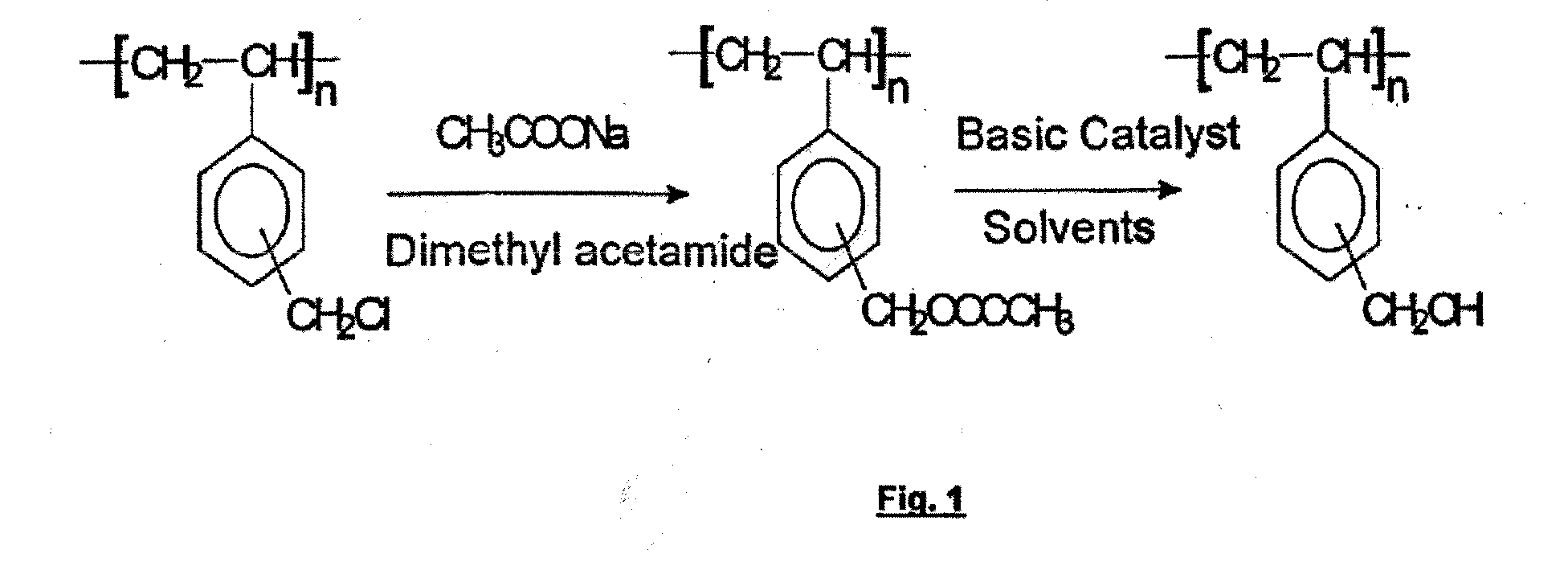
- As shown in Fig. 1, a poly(vinylbenzyl ester) of an organic carboxylic such as poly(vinylbenzyl acetate) is hydrolyzed in the presence of a basic catalyst in an organic solvent. Prior to hydrolysis, poly(vinylbenzyl acetate) can be formed by the reaction of poly(vinylbenzyl chloride) with sodium acetate in a polar aprotic solvent such as N,N-dimethylacetamide, N,N-dimethylformamide, N-methylpyrolidinone, dimethylsulfoxide, and the like.
- The basic catalyst useful in the process of the invention can be any catalyst which is able to solubilize in the organic solvent of the invention. Examples of a basic catalyst include quaternary ammonium salts such as tetraalkylammonium hydroxide, wherein optionally the alkyl is linear or branched and with from about 1 to about 20 carbon atoms, and aralkyltrialkylammonium hydroxide, wherein optionally the aralkyl is a benzyl group and the alkyl is linear or branched and with from about 1 to about 20 carbon atoms. Examples of a basic catalyst also include a metal alkoxide, wherein optionally the metal is an alkali and the alkyl group of the alkoxide is linear or branched and with from about 1 to about 20 carbon atoms. Examples of a tetraalkylammonium hydroxide include tetramethylammonium hydroxide, tetraethylammonium hydroxide, tetrapropylammonium hydroxide, tetrabutylammonium hydroxide, trimethylpropylammonium hydroxide and the like. A specific tetraalkylammonium hydroxide is tetrabutylammonium hydroxide. Examples of an aralkyltrialkylammonium hydroxide include benzyltrimethylammonium hydroxide, benzyltriethylammonium hydroxide, benzyldiniethylhexadecylammonium hydroxide, benzylacetyldimethylammonium hydroxide and the like. A specific aralkyltrialkylammonium hydroxide is benzyltrimethylammonium hydroxide. Examples of a metal alkoxide include sodium methoxide, sodium ethoxide, potassium methoxide, potassium tertbutoxide and the like. A specific metal alkoxide is sodium methoxide.
- The amount of basic catalyst is not particularly critical. A person skilled in the art will be able to determine the optimum amount of the basic catalyst to be added in a simple manner on the basis of the desired reaction rate, the homogeneity of the system and the desired degree of conversion. The basic catalyst can be added at any moment, preferably at the beginning of the hydrolysis reaction, and the amount of basic catalyst used and the chosen reaction conditions can be controlled so that a homogeneous phase is obtained at the end of the hydrolysis.
- By the process of the invention, the hydrolysis is conducted in an organic solvent. The choice of organic solvent is determined by the ability of the poly(vinylbenzyl acetate), the basic catalyst and the poly(vinylbenzyl alcohol) to solubilize in the organic solvent. Examples of such organic solvent include a pyridine or tetrahydrofuran. A specific organic solvent is tetrahydrofuran.
- The hydrolysis of poly(vinylbenzyl acetate) proceeds according to an equilibrium reaction, and the hydrolysis reaction can be performed with a high degree of conversion of the poly(vinylbenzyl acetate), for example, a degree of conversion of more than about 85%, preferably more than about 95%. By using an optimal ratio of reactants or the removal of reaction products, a process stream can be obtained from which very pure poly(vinylbenzyl alcohol) can be recovered in a simple manner. Thus, it is possible to precisely control and tailor the number of alcohol groups in the poly(vinylbenzyl alcohol) and any poly(vinylbenzyl alcohol-vinylbenzyl acetate) copolymer formed. Polymers produced with more than about 77 mole % benzyl alcohol groups are soluble in methanol, ethanol, propanol and 1-methoxy-2-propanol. Polymers produced with less than about 77 mole % benzyl alcohol groups are soluble in tetrahydrofuran and alcohol-tetrahydrofuran mixtures. All polymers are insoluble in water. Poly(vinylbenzyl alcohol) which is insoluble in methylene chloride and tetrahydrofuran can be solubilized in these solvents by the addition or a small amount of alcohol. The weight average molecular weights (Mws) of the polymer and copolymer are between about 30,000 and about 50,000.
- For a conversion rate of more than about 85%, preferably more than about 95%, the total hydrolysis time is from about 1 to about 6 hours, preferably from about 2 to about 3 hours. For an optimum rate of hydrolysis, the molar ratio of solvent to poly(vinylbenzyl acetate) can vary of from about 100:1 to about 4:1, preferably of from about 20:1 to about 8:1. The temperature and pressure at which the alkaline hydrolysis reaction takes place may also vary within a wide range. The temperature may for example vary of from about 40 °C to about 100 °C, preferably of from about 60 °C to about 70 °C. Following hydrolysis, the reaction mixture can be cooled to a temperature of from about 10°C to about 30 °C, preferably of from about 18°C to about 22 °C, for example by means of an external heat exchanger. Poly(vinylbenzyl alcohol) can be recovered from the reaction mixture by the addition of water to precipitate the poly(vinylbenzyl alcohol). Standard washing followed by drying yields usable polymer. The recovered poly(vinylbenzyl alcohol) has a glass transition temperature (T9) of from about 110 °C to about 160 °C, preferably from about 120°C to about 140°C depending on the extent of conversion of the acetate. The overall yield of the process is greater than about 90%.
- The process of the invention is amenable to scale-up and can be carried out in different types of reactors. Such reactors include a batch reactor, a plugflow reactor, a continuously stirred tank reactor or combinations of different reactors. The residence time in the reactor depends strongly on the type of reactor, the temperature and the pressure, the miscibility and degree of mixing of the system, the organic solventlpoly(vinylbenzyl acetate) molar ratio and the composition of the feed. The residence time in the reactor may vary within a wide range, depending on the parameters chosen. A person skilled in the art will be able to determine the optimum residence time on the basis of the desired degree of conversion of poly(vinylbenzyl acetate) and the selectivity to the poly(vinylbenzyl alcohol). For example, at the manufacturing level, accommodating a reaction time to an eight-hour plant shift is often desirable. If the reaction mixture is too dilute, the reactants will react more slowly, hence the rate of reaction will decrease. Similarly, under equal reaction conditions, higher temperatures will typically increase the reaction rate, while lower temperatures decrease the reaction rate. Furthermore, highly dilute polymer solutions require larger quantities of non-solvents necessary for efficient precipitation and recovery of the desired products. The molar ratio of solvent to poly(vinylbenzyl acetate) can be of from about 100:1 to about 4:1, preferably of from about 20:1 to about 8:1, which allows the reaction to proceed to completion in about 2 to about 3 hours at a reflux temperature of from about 65 °C to about 70 °C. More concentrated solutions can lead to highly viscous, difficult to air solutions with the possibility of poor heat transfer within the reactor. Moreover, concentrated mixtures can lead to re-precipitation being less efficient with the resulting impurities becoming entrained in the finished product.
- The poly(vinylbenzyl alcohol) of the invention with or without poly(vinylbenzyl alcohol- vinylbenzyl acetate) can be incorporated in the charge blocking layer of an imaging member such as a photoreceptor. A representative photoreceptor includes an anti-curl layer, a supporting substrate, an electrically conductive ground plane, a charge blocking layer, an adhesive layer, a charge generating layer, a charge transport layer, an overcoating layer, and a ground strip. A detailed description of the photoreceptor and its elements is provided in U.S. Patent No. 6,200,716 which is incorporated herein by reference in its entirety and made a part of this patent application. The methods set forth in U.S. Patent No. 6,200,716 which are incorporated herein by reference were used to manufacture the photoreceptors and evaluate their performance. The results indicate that the benzyl alcohol containing polymers of the invention are excellent undercoat layers for photoreceptors.
- A number of examples set forth below are illustrative of the different compositions and conditions that can be utilized in practicing the invention, It will be apparent, however, that the invention can be practiced with many types of compositions and processes and can have many different uses in accordance with the disclosure above and as pointed out hereinafter.
- Poly(vinylbenzyl chloride) was obtained from Aldrich Chemical Co. or Scientific Polymer Products, Ontario, N.Y., with a weight average molecular weight (MW) of approximately 50,000. Because the polymer is typically prepared by the free radical polymerization of vinylbenzyl chloride, the polydispersity (the ratio of the weight average molecular weight to the number average molecular weight) is generally between 3 and 6.
- Sodium acetate and anhydrous N,N-dimethylacetamide were obtained from Aldrich Chemical Co. Methanol and methylene chloride were obtained from Fisher Scientific. Benzyltrimethylammonium hydroxide (40% solution) was obtained from Aldrich Chemical Co.
- Poly(vinylbenzyl chloride) (200 grams) and 200 grams of sodium acetate in 4 liters of in N,N-dimethylacetamide were heated in a 5-liter, 3-neck flask under argon equipped with a mechanical stirrer, reflux condenser, argon inlet and stopper for 24 hours, using a silicone oil bath at 90 °C. The resultant solution was decanted and separated from the salts that crystallized on cooling and was added to water at a ratio of 25 ml of polymer solution for every 1 liter of water using a Waring blender that was speed controlled with a variable transformer (Variac). The precipitated polymer was collected by filtration, washed with water and then with methanol (2 gallons). The aggregated lump that formed was vacuum dried to yield poly(vinylbenzyl acetate) with a glass transition temperature (Tg) of about 38 °C. The lump was broken with a hammer and pulverized to a fine powder with a Waring blender. Although the conversion of chloromethyl groups to acetyl methyl groups was 100% as determined using proton NMR spectrometry, the recovered yield of poly(vinylbenzyl acetate) was about 50% from poly(vinylbenzyl chloride).
- Poly(vinylbenzyl acetate) (10 g) in anhydrous tetrahydrofuran (Aldrich, 100 grams) was stirred in a 500 ml, 3-neck round-bottom flask. The reaction vessel was equipped with a mechanical stirrer, reflux condenser and argon inlet and was situated in a silicone oil bath. The solution was heated at reflux until a solution is effectuated. Heating and reflux begin before addition of the organic base as provided below and continue until the polymer was completely dissolved. Benzyltrimethylammonium hydroxide (5 ml at 40 wt% in methanol) was then added. On addition of the base, the polymer precipitated. Water (5 ml) was added and there was no change of the appearance of the precipitate. Methanol (50 ml) was added to the mixture and the precipitate immediately dissolved. After 2.5 hours at reflux with stirring, the reaction mixture was added to water at a ratio of 25 ml of polymer solution for every 1 liter of water using a Waring blender controlled with a variable transformer (Variac). The precipitated white polymer was collected by filtration, washed with water and then vacuum dried. The polymer was then washed with methylene chloride or was reprecipitated into methylene chloride and was vacuum dried. The conversion of benzyl acetate groups to benzyl alcohol groups was quantitative as determined by proton NMR spectrometry. The recovered yield of poly(vinylbenzyl alcohol) with a glass temperature (Tg) of about 136 °C was about 7.0 grams (94% on a weight basis with poly(vinylbenzyl acetate).
- Poly(vinylbenzyl acetate) (1520 grams or 8.64 moles) and tetrahydrofuran (10 kg) were placed in a 22 liters, 3-necked round-bottom flask equipped with a mechanical stirrer, an addition funnel (1 liter), and an inert gas inlet. The mixture was heated to reflux for 15 mm and 750 grams of 5% sodium methoxide in methanol was added over a period of 10 minutes. To redissolve the precipitated polymer, 2000 grams of methanol were added to the flask and refluxed for an additional 3 hours. The solution was precipitated into lOx excess deionized water, washed 3 times with additional water and dried at about 50°C under vacuum for about 48 hours. The polymer was then washed with methylene chloride and dried. The yield was 1138 grams of an off-white powder (about 98 % of a weight basis with poly(vinylbenzyl acetate).
- A control photoreceptor device was made with hydrolyzed gammaaminopropyltriethoxysilane (γ-APS) as the undercoat layer in accordance with U.S. Patent No. 4,464,450. y-APS (1.0 gram, obtained from Aldrich Chemical Co.) was added into deionized water (4.0 grams) with magnetic stirring for 4 hours. Glacial acetic acid (0.3 grams) was added. After stirring for 10 minutes, the solution was mixed with ethanol (74.7 grams) and heptane (20.0 grams) to form a coating solution which was applied to a titanium-metallized Mylar substrate using a 0.5 mil Bird applicator bar. The resulting coating was dried for 3 minutes at 135 °C to form the undercoat layer. To the undercoat layer, a 0.5 weight percent solution of 49,000 polyester adhesive in methylene chloride was applied with a 0.5 mil Bird applicator. The coated film was then dried for 3 minutes at 140 °C to form the adhesive layer.
- To the adhesive layer, a dispersion of hydroxygallium phtalocyanine (1.33 grams) in toluene (37.5 grams) with a binder consisting of polyvinylpyridine-block-polystyrene (1.5 grams) was applied using a 0.5 mil Bird applicator. The coated film was then dried for 5 minutes at about 135 °C to form the charge generation layer. A coating of m-TBD (1.2g) and Makroton polycarbonate (1.2 g) in 13.45 g of methylene chloride was then applied using a 4 mil Bird applicator. The resultant film was damp dried from about 40 °C to about 100 °C over 30 minutes to form the charge transport layer. The resultant dried charge transport layer had a thickness of about 25 µm.
- The control photoreceptor device was analyzed using an electrical scanner for 50,000 cycles of charge, expose and erase. The initial charging potential was V0 798 volts. The dark decay was Vdd/sec = 98 volts per second. The initial slope of the photo-induced discharge curve (PIDC) was S = 309 ergs./(volts.cm2). The surface residual potential after erase was Vr = 20 volts. The depletion voltage (from the charging characteristics) was Vdepl = 26 volts. The rise in surface residual potential after 10,000 cycles was Vcycle-up = 0 volts.
- Poly(vinylbenzyl alcohol) (1 g) and titanium dioxide (1 g) in 14 g of ethyl alcohol were mixed with 30 g of steel shot on a paint shaker for 24 hours. The resultant dispersion was applied to a titanium-metallized Mylar substrate using a 0.5 mil Bird applicator bar. The resulting coating was dried for 3 mm at about 140 °C to form a 2 µm thick undercoat layer. An adhesive layer, a charge generation layer and a charge transport layer were formed consequently as in Example 4. The photoreceptor device of this Example was analyzed using a motionless scanner for 50,000 cycles of charge, expose and erase. The initial charging potential V0 = 802 volts. The dark decay was Vdd/sec = 129.5 in volts per second. The initial slope of the photo-induced discharge curve (PIDC) was S = 286 in ergsi(volts.cm2). The surface residual potential after erase was Vr = 19.3 volts. The depletion voltage (from the charging characteristics) was Vdepl = 34.5 volts. The rise in surface residual potential after 10,000 cycles was Vcycle-up = 6.5 volts.
- Copolymers (1.0 gram) of poly(vinylbenzyl alcohol) and poly(vinylbenzyl alcohol-vinylbenzyl acetate) with 85 mol percent of benzyl alcohol groups were dissolved into a mixture of tetrahydrofuran (2.0 grams) and ethanol (7.0 grams). The resultant solution was applied to a titanium-metallized Mylar substrate using a 0.5 mil gap Bird applicator bar. The resultant coating was dried for 8 mm at about 140 °C to form a 2 pm thick undercoat layer. An adhesive layer, a charge generation layer and a charge transport layer were formed as in Example 4. The photoreceptor device of this Example was analyzed using an electrical scanner for 50,000 cycles of charge, expose and erase. The initial charging potential was V0 = 799 volts. The dark decay was Vdd/sec = 116 volts per second. The initial slope of the photo-induced discharge curve (PIDC) was S = 268 in ergs/(volts.cm2). The surface residual potential after erase was Vr = 33 volts. The depletion voltage (from the charging characteristics) was Vdepl = 2.5 volts. The rise in surface residual potential after 10,000 cycles was Vcycle-up = 0.8 volts.
- Table 1 shows that although the undercoat layer thickness of Example 4 is thinner than the undercoat layer thickness of Examples 5 and 6, the residual voltage is substantially of the same magnitude. In Examples 5 and 6, cycle-up and charge entrapment are minimal due to the presence of poly(vinylbenzyl alcohol).
Sample Thickness of Undercoat Layer Residual Voltage Cycle-up 10, 000 cycles Example 4 0.05 microns 0 volts 0 volts Example 5 2.0 microns 19.3 volts 6.5 volts Example 6 2.0 microns 33 volts 0.8 volt - Although the invention has been described with reference to specific preferred embodiments, it is not intended to be limited thereto. Those skilled in the art will recognize that variations and modifications may be made therein which are within the spirit of the invention and within the scope of the claims.
Claims (10)
- A process comprising hydrolyzing poly(vinylbenzyl acetate) in the presence of a basic catalyst.
- The process of claim 1, wherein the hydrolysis is conducted in an organic solvent.
- The process of claim 2, wherein the organic solvent is a pyridine.
- The process of claim 2, wherein the organic solvent is tetrahydrofuran.
- The process of claim 2, wherein the molar ratio of organic solvent to poly(vinylbenzyl actetate) is from about 100:1 to about 4:1.
- The process of claim 1, wherein the basic catalyst is a quaternary ammonium salt.
- The process of claim 6, wherein the quaternary ammonium salt is a tetraalkylammonium hydroxide, wherein optionally the alkyl is linear or branched with from 1 to about 20 carbon atoms.
- A process comprising converting poly(vinylbenzyl chloride) to poly(vinylbenzyl acetate); and hydrolyzing the poly(vinylbenzyl acetate) in the presence of a basic catalyst.
- Poly(vinylbenzyl alcohol) made by the process of claim 1.
- An imaging member containing a charge blocking layer comprising poly(vinylbenzyl alcohol) generated by the process of claim 1.
Applications Claiming Priority (2)
| Application Number | Priority Date | Filing Date | Title |
|---|---|---|---|
| US808679 | 2001-03-15 | ||
| US10/808,679 US7851551B2 (en) | 2004-03-25 | 2004-03-25 | Polymer processes |
Publications (2)
| Publication Number | Publication Date |
|---|---|
| EP1582532A1 true EP1582532A1 (en) | 2005-10-05 |
| EP1582532B1 EP1582532B1 (en) | 2008-09-03 |
Family
ID=34887656
Family Applications (1)
| Application Number | Title | Priority Date | Filing Date |
|---|---|---|---|
| EP05102149A Ceased EP1582532B1 (en) | 2004-03-25 | 2005-03-18 | Process for hydrolyzing poly(vinylbenzyl acetate) |
Country Status (4)
| Country | Link |
|---|---|
| US (1) | US7851551B2 (en) |
| EP (1) | EP1582532B1 (en) |
| JP (1) | JP2005272837A (en) |
| DE (1) | DE602005009421D1 (en) |
Families Citing this family (3)
| Publication number | Priority date | Publication date | Assignee | Title |
|---|---|---|---|---|
| WO2015197647A1 (en) | 2014-06-24 | 2015-12-30 | Byk-Chemie Gmbh | Epoxy resin-epoxy curing systems with a latent thickening tendency |
| WO2016013467A1 (en) * | 2014-07-25 | 2016-01-28 | 富士フイルム株式会社 | Resin production method, resin produced thereby, and resin composition containing same |
| KR102730917B1 (en) * | 2020-01-08 | 2024-11-18 | 동우 화인켐 주식회사 | A polymer compound and a composition for cleaning of semiconductor substrate comprising the same |
Citations (6)
| Publication number | Priority date | Publication date | Assignee | Title |
|---|---|---|---|---|
| GB631590A (en) * | 1946-05-24 | 1949-11-07 | Du Pont | Improved synthetic resins |
| US2581832A (en) * | 1947-09-05 | 1952-01-08 | Du Pont | Heterogeneous, basic hydrolysis of carboxylic acid esters of polyvinyl alcohol with quaternary ammonium bases |
| GB1102771A (en) * | 1964-04-08 | 1968-02-07 | Monsanto Co | Preparation of stereoregular polyvinyl alcohol fibres or filaments |
| EP0007791A1 (en) * | 1978-07-24 | 1980-02-06 | Rohm And Haas Company | Polymer beads containing vinylbenzyl alcohol units, their production, processes for thermally crosslinking them, the thermally crosslinked beads and adsorbents and ion exchange resin formed therefrom |
| EP0630912A2 (en) * | 1993-06-25 | 1994-12-28 | Shin-Etsu Chemical Co., Ltd. | Vinyl acetylsalicylate-vinyl alcohol based copolymer |
| US6200716B1 (en) * | 1999-11-15 | 2001-03-13 | Xerox Corporation | Photoreceptor with poly (vinylbenzyl alcohol) |
Family Cites Families (19)
| Publication number | Priority date | Publication date | Assignee | Title |
|---|---|---|---|---|
| US2642419A (en) * | 1950-01-31 | 1953-06-16 | Eastman Kodak Co | Preparation of polyvinyl alcohol |
| US3879328A (en) * | 1972-07-17 | 1975-04-22 | Dow Chemical Co | Curable compositions of polymers containing labile hydroxyl groups |
| US4384095A (en) | 1978-07-24 | 1983-05-17 | Rohm And Haas Company | Vinylbenzyl alcohol polymer beads and thermally crosslinked derivatives thereof |
| GB2056997B (en) * | 1979-07-12 | 1983-04-07 | Kuraray Co | Copolymers containing cationic groups |
| US4542165A (en) * | 1983-09-08 | 1985-09-17 | Sanyo Chemical Industries, Ltd. | Polyurethane based on epoxy-containing polymer polyol and process for making the same |
| JPH0688763B2 (en) * | 1986-05-26 | 1994-11-09 | 多摩化学工業株式会社 | Hydrolysis of metal alkoxide |
| US4689371A (en) * | 1986-07-07 | 1987-08-25 | Celanese Corporation | Process for the preparation of poly (vinylphenol) from poly (acetoxystyrene) |
| JP2847308B2 (en) * | 1989-12-22 | 1999-01-20 | 日東化学工業株式会社 | Radical curable polyvinyl alcohol derivative |
| AU631985B2 (en) * | 1990-04-05 | 1992-12-10 | Kuraray Co., Ltd. | Suspension polymerization of vinylic compound |
| JPH04304204A (en) * | 1991-03-29 | 1992-10-27 | Kuraray Co Ltd | Production of macromonomer and graft polymer |
| DE4426003A1 (en) * | 1994-07-22 | 1996-01-25 | Basf Ag | Reaction products of polyolefins with vinyl esters and their use as fuel and lubricant additives |
| US5710211A (en) * | 1995-08-01 | 1998-01-20 | Kuraray Co., Ltd. | Process for producing vinyl alcohol polymer |
| JP3805427B2 (en) * | 1996-05-31 | 2006-08-02 | 株式会社クラレ | Polyvinyl alcohol powder |
| NL1007829C2 (en) | 1997-12-18 | 1999-06-21 | Dsm Nv | Process for the preparation of benzyl alcohol. |
| DE19810803A1 (en) * | 1998-03-12 | 1999-09-16 | Wacker Chemie Gmbh | Process for the production of microencapsulated products with organopolysiloxane walls |
| US6391992B1 (en) * | 1998-09-18 | 2002-05-21 | Celanese International Corporation | Sulfonate-terminated oligomers of vinyl esters and their vinyl alcohol oligomer derivatives |
| JP2001072720A (en) * | 1999-07-02 | 2001-03-21 | Kuraray Co Ltd | Polyvinyl alcohol copolymer having double bond in side chain and method for producing the same |
| JP2001081130A (en) * | 1999-09-20 | 2001-03-27 | Unitika Ltd | Production of polyvinyl alcohol-based polymer |
| US6287373B1 (en) | 2000-06-22 | 2001-09-11 | Xerox Corporation | Ink compositions |
-
2004
- 2004-03-25 US US10/808,679 patent/US7851551B2/en not_active Expired - Fee Related
-
2005
- 2005-03-17 JP JP2005078158A patent/JP2005272837A/en active Pending
- 2005-03-18 DE DE602005009421T patent/DE602005009421D1/en not_active Expired - Lifetime
- 2005-03-18 EP EP05102149A patent/EP1582532B1/en not_active Ceased
Patent Citations (6)
| Publication number | Priority date | Publication date | Assignee | Title |
|---|---|---|---|---|
| GB631590A (en) * | 1946-05-24 | 1949-11-07 | Du Pont | Improved synthetic resins |
| US2581832A (en) * | 1947-09-05 | 1952-01-08 | Du Pont | Heterogeneous, basic hydrolysis of carboxylic acid esters of polyvinyl alcohol with quaternary ammonium bases |
| GB1102771A (en) * | 1964-04-08 | 1968-02-07 | Monsanto Co | Preparation of stereoregular polyvinyl alcohol fibres or filaments |
| EP0007791A1 (en) * | 1978-07-24 | 1980-02-06 | Rohm And Haas Company | Polymer beads containing vinylbenzyl alcohol units, their production, processes for thermally crosslinking them, the thermally crosslinked beads and adsorbents and ion exchange resin formed therefrom |
| EP0630912A2 (en) * | 1993-06-25 | 1994-12-28 | Shin-Etsu Chemical Co., Ltd. | Vinyl acetylsalicylate-vinyl alcohol based copolymer |
| US6200716B1 (en) * | 1999-11-15 | 2001-03-13 | Xerox Corporation | Photoreceptor with poly (vinylbenzyl alcohol) |
Also Published As
| Publication number | Publication date |
|---|---|
| US7851551B2 (en) | 2010-12-14 |
| EP1582532B1 (en) | 2008-09-03 |
| JP2005272837A (en) | 2005-10-06 |
| US20050250027A1 (en) | 2005-11-10 |
| DE602005009421D1 (en) | 2008-10-16 |
Similar Documents
| Publication | Publication Date | Title |
|---|---|---|
| CA2042319C (en) | Amine functional polymers containing acetal groups | |
| US4064161A (en) | Polymers having pendant acrylate and methacrylate functionality | |
| US4487893A (en) | Process for producing carboxyl group-containing fluoropolymer | |
| US4208313A (en) | Novel methacrylic polymers having pendant acrylate and methacrylate functionality | |
| US4898916A (en) | Process for the preparation of poly(vinylphenol) from poly(acetoxystyrene) by acid catalyzed transesterification | |
| US5155167A (en) | Vinyl alcohol copolymers containing allylamine functionality | |
| US7851551B2 (en) | Polymer processes | |
| Hurduc et al. | Microwave effects in the synthesis of polyethers by phase transfer catalysis | |
| US6107401A (en) | Process for producing amine functional derivatives of poly (vinyl alcohol) | |
| CA2045107C (en) | Process for preparing organic esters and amides and catalyst system therefor | |
| US4857601A (en) | Selective hydrolysis of copolymers of para-acetoxy styrene and dialkyl muconates or alkyl sorbates | |
| CA1139484A (en) | Graft polymers containing silicon | |
| KR100191126B1 (en) | Vinyl 4-t-butoxycarbonyloxybenzal-vinyl alcohol-vinyl acetate copolymer and vinyl 4-t-butoxycarbonyloxybenzal-vinyl 4-hydroxybenzal-vinyl alcohol-vinyl acetate copolymer and a manufacturing method thereof | |
| DE69915819T2 (en) | PREPARATION OF CO AND TERPOLYMERS OF P-HYDROXYSTYRENE AND ALKYLACRYLATES | |
| US2694697A (en) | Interpolymerization of maleic anhydride and vinyl isobutyl ether | |
| KR0135400B1 (en) | Curable fluorocopolymer in powder form, process for its | |
| EP0805166B1 (en) | Low-temperature cure polyvinylbutyral | |
| JP2620295B2 (en) | Composition for electrodeposition coating | |
| JPS643218B2 (en) | ||
| CN119875442B (en) | Fluorocarbon powder coating and preparation method thereof | |
| JP2002516362A (en) | Method for producing allylic copolymer resin | |
| JP3004948B2 (en) | Method for preparing polyhydroxystyrene derivative | |
| US2865889A (en) | Reduced copolymers | |
| Cohen | The conversion of halogen‐containing polymers to the corresponding hydroxyl derivatives | |
| US2833743A (en) | Polycyanohydrins produced by reacting hydrocyanic acid with a styrenemethacrolein copolymer |
Legal Events
| Date | Code | Title | Description |
|---|---|---|---|
| PUAI | Public reference made under article 153(3) epc to a published international application that has entered the european phase |
Free format text: ORIGINAL CODE: 0009012 |
|
| AK | Designated contracting states |
Kind code of ref document: A1 Designated state(s): AT BE BG CH CY CZ DE DK EE ES FI FR GB GR HU IE IS IT LI LT LU MC NL PL PT RO SE SI SK TR |
|
| AX | Request for extension of the european patent |
Extension state: AL BA HR LV MK YU |
|
| 17P | Request for examination filed |
Effective date: 20060405 |
|
| AKX | Designation fees paid |
Designated state(s): DE FR GB |
|
| 17Q | First examination report despatched |
Effective date: 20061227 |
|
| GRAP | Despatch of communication of intention to grant a patent |
Free format text: ORIGINAL CODE: EPIDOSNIGR1 |
|
| GRAS | Grant fee paid |
Free format text: ORIGINAL CODE: EPIDOSNIGR3 |
|
| GRAA | (expected) grant |
Free format text: ORIGINAL CODE: 0009210 |
|
| AK | Designated contracting states |
Kind code of ref document: B1 Designated state(s): DE FR GB |
|
| REG | Reference to a national code |
Ref country code: GB Ref legal event code: FG4D |
|
| REF | Corresponds to: |
Ref document number: 602005009421 Country of ref document: DE Date of ref document: 20081016 Kind code of ref document: P |
|
| PLBE | No opposition filed within time limit |
Free format text: ORIGINAL CODE: 0009261 |
|
| STAA | Information on the status of an ep patent application or granted ep patent |
Free format text: STATUS: NO OPPOSITION FILED WITHIN TIME LIMIT |
|
| 26N | No opposition filed |
Effective date: 20090604 |
|
| REG | Reference to a national code |
Ref country code: FR Ref legal event code: PLFP Year of fee payment: 12 |
|
| REG | Reference to a national code |
Ref country code: FR Ref legal event code: PLFP Year of fee payment: 13 |
|
| REG | Reference to a national code |
Ref country code: FR Ref legal event code: PLFP Year of fee payment: 14 |
|
| PGFP | Annual fee paid to national office [announced via postgrant information from national office to epo] |
Ref country code: DE Payment date: 20200218 Year of fee payment: 16 Ref country code: GB Payment date: 20200221 Year of fee payment: 16 |
|
| PGFP | Annual fee paid to national office [announced via postgrant information from national office to epo] |
Ref country code: FR Payment date: 20200220 Year of fee payment: 16 |
|
| REG | Reference to a national code |
Ref country code: DE Ref legal event code: R119 Ref document number: 602005009421 Country of ref document: DE |
|
| GBPC | Gb: european patent ceased through non-payment of renewal fee |
Effective date: 20210318 |
|
| PG25 | Lapsed in a contracting state [announced via postgrant information from national office to epo] |
Ref country code: DE Free format text: LAPSE BECAUSE OF NON-PAYMENT OF DUE FEES Effective date: 20211001 Ref country code: GB Free format text: LAPSE BECAUSE OF NON-PAYMENT OF DUE FEES Effective date: 20210318 Ref country code: FR Free format text: LAPSE BECAUSE OF NON-PAYMENT OF DUE FEES Effective date: 20210331 |