EP1582519A2 - Heteropolycyclic compounds and their use as metabotropic glutamate receptor antagonists - Google Patents

Heteropolycyclic compounds and their use as metabotropic glutamate receptor antagonists Download PDF

Info

Publication number
EP1582519A2
EP1582519A2 EP05014788A EP05014788A EP1582519A2 EP 1582519 A2 EP1582519 A2 EP 1582519A2 EP 05014788 A EP05014788 A EP 05014788A EP 05014788 A EP05014788 A EP 05014788A EP 1582519 A2 EP1582519 A2 EP 1582519A2
Authority
EP
European Patent Office
Prior art keywords
pyridyl
oxadiazole
oxazole
group
cyanophenyl
Prior art date
Legal status (The legal status is an assumption and is not a legal conclusion. Google has not performed a legal analysis and makes no representation as to the accuracy of the status listed.)
Withdrawn
Application number
EP05014788A
Other languages
German (de)
French (fr)
Other versions
EP1582519A3 (en
Inventor
designation of the inventor has not yet been filed The
Current Assignee (The listed assignees may be inaccurate. Google has not performed a legal analysis and makes no representation or warranty as to the accuracy of the list.)
AstraZeneca AB
Original Assignee
NPS Pharmaceuticals Inc
Priority date (The priority date is an assumption and is not a legal conclusion. Google has not performed a legal analysis and makes no representation as to the accuracy of the date listed.)
Filing date
Publication date
Application filed by NPS Pharmaceuticals Inc filed Critical NPS Pharmaceuticals Inc
Priority claimed from EP00955657A external-priority patent/EP1210344B1/en
Publication of EP1582519A2 publication Critical patent/EP1582519A2/en
Publication of EP1582519A3 publication Critical patent/EP1582519A3/en
Withdrawn legal-status Critical Current

Links

Images

Classifications

    • CCHEMISTRY; METALLURGY
    • C07ORGANIC CHEMISTRY
    • C07DHETEROCYCLIC COMPOUNDS
    • C07D401/00Heterocyclic compounds containing two or more hetero rings, having nitrogen atoms as the only ring hetero atoms, at least one ring being a six-membered ring with only one nitrogen atom
    • C07D401/02Heterocyclic compounds containing two or more hetero rings, having nitrogen atoms as the only ring hetero atoms, at least one ring being a six-membered ring with only one nitrogen atom containing two hetero rings
    • C07D401/04Heterocyclic compounds containing two or more hetero rings, having nitrogen atoms as the only ring hetero atoms, at least one ring being a six-membered ring with only one nitrogen atom containing two hetero rings directly linked by a ring-member-to-ring-member bond
    • AHUMAN NECESSITIES
    • A61MEDICAL OR VETERINARY SCIENCE; HYGIENE
    • A61PSPECIFIC THERAPEUTIC ACTIVITY OF CHEMICAL COMPOUNDS OR MEDICINAL PREPARATIONS
    • A61P25/00Drugs for disorders of the nervous system
    • CCHEMISTRY; METALLURGY
    • C07ORGANIC CHEMISTRY
    • C07DHETEROCYCLIC COMPOUNDS
    • C07D413/00Heterocyclic compounds containing two or more hetero rings, at least one ring having nitrogen and oxygen atoms as the only ring hetero atoms
    • C07D413/02Heterocyclic compounds containing two or more hetero rings, at least one ring having nitrogen and oxygen atoms as the only ring hetero atoms containing two hetero rings
    • C07D413/04Heterocyclic compounds containing two or more hetero rings, at least one ring having nitrogen and oxygen atoms as the only ring hetero atoms containing two hetero rings directly linked by a ring-member-to-ring-member bond

Definitions

  • the invention provides compounds active at metabotropic glutamate receptors and that are useful for treating neurological and psychiatric diseases and disorders.
  • metabotropic glutamate receptors Recent advances in the elucidation of the neurophysiological roles of metabotropic glutamate receptors have established these receptors as promising drug targets in the therapy of acute and chronic neurological and psychiatric disorders and diseases.
  • metabotropic glutamate receptor subtype-selective compounds have been developed.
  • Glutamate is the major excitatory neurotransmitter in the mammalian central nervous system (CNS). Glutamate produces its effects on central neurons by binding to and thereby activating cell surface receptors. These receptors have been divided into two major classes, the ionotropic and metabotropic glutamate receptors, based on the structural features of the receptor proteins, the means by which the receptors transduce signals into the cell, and pharmacological profiles.
  • mGluRs metabotropic glutamate receptors
  • PI phosphoinositide
  • intracellular calcium release activation of phospholipase D
  • activation or inhibition of adenyl cyclase increases or decreases in the formation of cyclic adenosine monophosphate (cAMP)
  • activation of guanylyl cyclase increases in the formation of cyclic guanosine monophosphate (cGMP)
  • phospholipase A 2 increases in arachidonic acid release; and increases or decreases in the activity of voltage- and ligand-gated ion channels.
  • mGluR1 through mGluR8 Eight distinct mGluR subtypes, termed mGluR1 through mGluR8, have been identified by molecular cloning. See, for example, Nakanishi, Neuron 13 :1031 (1994); Pin et al ., Neuropharmacology 34 :1 (1995); Knopfel et al. , J. Med. Chem. 38 :1417 (1995). Further receptor diversity occurs via expression of alternatively spliced forms of certain mGluR subtypes. Pin et al ., PNAS 89 :10331 (1992); Minakami et al., BBRC 199 :1136 (1994); Joly et al ., J. Neurosci. 15 :3970 (1995).
  • Metabotropic glutamate receptor subtypes may be subdivided into three groups, Group I, Group II, and Group III mGluRs, based on amino acid sequence homology, the second messenger systems utilized by the receptors, and by their pharmacological characteristics. Nakanishi, Neuron 13 :1031 (1994); Pin et al., Neuropharmacology 34 :1 (1995); Knopfel et al ., J. Med. Chem. 38 :1417 (1995).
  • Group I mGluRs comprise mGluR1, mGluR5, and their alternatively spliced variants.
  • the binding of agonists to these receptors results in the activation of phospholipase C and the subsequent mobilization of intracellular calcium.
  • Electrophysiological measurements have been used to, demonstrate these effects, for example, in Xenopus oocytes that express recombinant mGluR1 receptors. See, for example, Masu et al., Nature 349 :760 (1991); Pin et al., PNAS 89 :10331 (1992). Similar results have been achieved with oocytes expressing recombinant mGluR5 receptors. Abe et al ., J. Biol. Chem .
  • agonist activation of recombinant mGluR1 receptors expressed in Chinese hamster ovary (CHO) cells stimulates PI hydrolysis, cAMP formation, and arachidonic acid release as measured by standard biochemical assays. Aramori et al. , Neuron 8 :757 (1992).
  • mGluR5 receptors By comparison, the activation of mGluR5 receptors, expressed in CHO cells, stimulates PI hydrolysis and subsequent intracellular calcium transients, but no stimulation of cAMP formation or arachidonic acid release is observed. Abe et al ., J. Biol. Chem . 267 :13361 (1992). However, activation of mGluR5 receptors expressed in LLC-PK1 cells results in PI hydrolysis and increased cAMP formation. Joly et al ., J. Neurosci. 15 :3970 (1995).
  • Quisqualate is relatively selective for Group I receptors, as compared to Group II and Group III mGluRs, but it also is a potent activator of ionotropic AMPA receptors. Pin et al ., Neuropharmacology 34 :1, Knopfel et al. , J. Med. Chem. 38 :1417 (1995).
  • Metabotropic glutamate receptors have been implicated in a number of normal processes in the mammalian CNS. Activation of mGluRs has been shown to be required for induction of hippocampal long-term potentiation and cerebellar long-term depression. Bashir et al ., Nature 363 :347 (1993); Bortolotto et al ., Nature 368 :740 (1994); Aiba et al ., Cell 79 :365 (1994); Aiba et al., Cell 79 :377 (1994). A role for mGluR activation in nociception and analgesia also has been demonstrated. Meller et al ., Neuroreport 4 : 879 (1993).
  • mGluR activation has been suggested to play a modulatory role in a variety of other normal processes including synaptic transmission, neuronal development, apoptotic neuronal death, synaptic plasticity, spatial learning, olfactory memory, central control of cardiac activity, waking, motor control, and control of the vestibulo-ocular reflex.
  • neuron 13 1031 (1994); Pin et al ., Neuropharmacology 34 :1; Knopfel et al ., J. Med. Chem. 38 :1417 (1995).
  • Metabotropic glutamate receptors also have been suggested to play roles in a variety of pathophysiological processes and disease states affecting the CNS. These include stroke, head trauma, anoxic and ischemic injuries, hypoglycemia, epilepsy, and neurodegenerative diseases such as Alzheimer's disease. Schoepp et al. , Trends Pharmacol. Sci. 14 :13 (1993); Cunningham et al., Life Sci. 54 :135 (1994); Hollman et al., Ann. Rev. Neurosci . 17 :31 (1994); Pin et al ., Neuropharmacology 34 :1 (1995); Knopfel et al., J. Med. Chem. 38 :1417 (1995).
  • Group I mGluRs appear to increase glutamate-mediated neuronal excitation via postsynaptic mechanisms and enhanced presynaptic glutamate release, their activation probably contributes to the pathology. Accordingly, selective antagonists of Group I mGluR receptors could be therapeutically beneficial, specifically as neuroprotective agents, analgesics, or anticonvulsants.
  • mGluR agonists and antagonists have limited value, due to their lack of potency and selectivity.
  • most currently available compounds are amino acids or amino acid derivatives that have limited bioavailabilities, thereby hampering in vivo studies to assess mGluR physiology, pharmacology and their therapeutic potential.
  • Compounds that selectively inhibit activation of metabotropic glutamate receptor Group I subtypes should be useful for treatment of neurological disorders and diseases such as senile dementia, Parkinson's disease, Alzheimer's disease, Huntington's Chorea, pain, migraine headaches, epilepsy, head trauma, anoxic and ischemic injuries, psychiatric disorders such as schizophrenia, depression, and anxiety, ophthalmological disorders such as various retinopathies, for example, diabetic retinopathies, glaucoma, and neurological disorders of a auditory nature such as tinnitus, and neuropathic pain disorders, including neuropathic diseases states such as diabetic neuropathies, chemotherapy induced neuropathies, post-herpetic neuralgia, and trigeminal neuralgia.
  • neurological disorders and diseases such as senile dementia, Parkinson's disease, Alzheimer's disease, Huntington's Chorea, pain, migraine headaches, epilepsy, head trauma, anoxic and ischemic injuries, psychiatric disorders such
  • the present invention provides potent antagonists of Group I mGluRs, specifically, mGluR5.
  • These antagonists may be represented by the formula I, Ar 1 -G-Ar 2 wherein Ar 1 is an optionally substituted heteroaromatic moiety and Ar 2 is an optionally substituted benzene ring.
  • the G moiety is a group that not only covalently binds to the Ar 1 and Ar 2 moieties, and facilitates adoption of the correct spatial orientation of Ar 1 and Ar 2 , but also itself may interact with the protein, to effect receptor binding.
  • Ar 1 is selected from the group consisting of phenyl, benzyl, naphthyl, fluorenyl, anthrenyl, indenyl, phenanthrenyl, and benzonaphthenyl
  • Ar 2 is selected from the group consisting of thiazoyl, furyl, pyranyl, 2H-pyrrolyl, thienyl, pyrroyl, imidazoyl, pyrazoyl, pyridyl, pyrazinyl, pyrimidinyl, pyridazinyl, benzothiazole, benzimidazole, 3H-indolyl, indolyl, indazoyl, purinyl, quinolizinyl, isoquinolyl, quinolyl, phthalizinyl, naphthyridinyl, quinazolinyl, cinnolinyl, isothiazolyl, quinoxalin
  • compounds of the present invention can be represented by formula II: wherein X, Y, and Z are independently selected from the group consisting of N, O, S, C, and CO wherein at least one of X, Y, and Z is a heteroatom; Ar 1 and Ar 2 are independently selected from the group consisting of a heterocyclic or fused heterocyclic moiety containing 1 to 4 heteroatoms selected from the group consisting of N, O, and S and an aromatic moiety selected from the group consisting of phenyl, benzyl, 1-naphthyl, 2-naphthyl, fluorenyl, anthrenyl, indenyl, phenanthrenyl, and benzonaphthenyl, wherein the Ar 1 and Ar 2 moieties are optionally substituted with one or more moieties selected from the group consisting of -F, -Cl, -Br, -I, -OR, -SR, -SOR, -SO 2
  • heterocyclic or fused heterocylic moiety preferably is selected from the group consisting of quinolyl, quinazolyl, quinoxalyl, 2-pyrimidyl, 4-pyrimidyl, 5-pyrimidyl, 2-pyridyl, 3-pyridyl, 4-pyridyl, and pyrazyl.
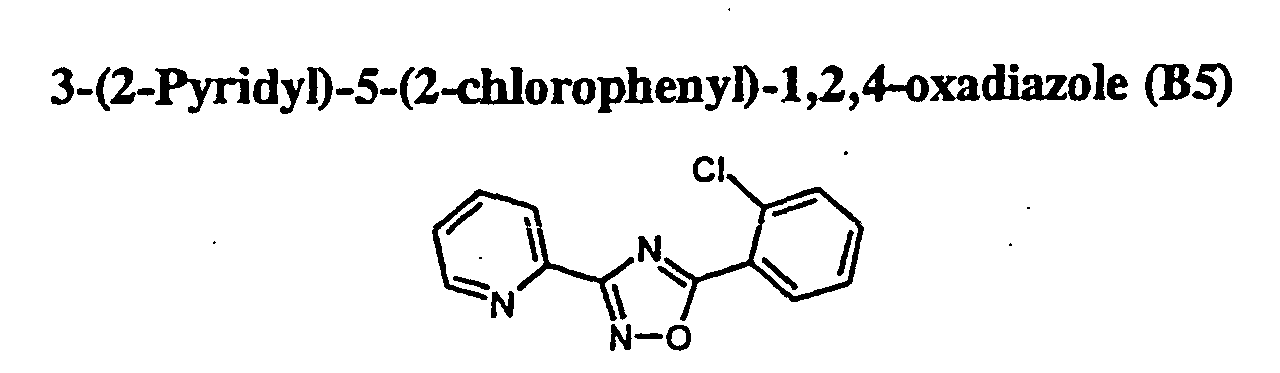
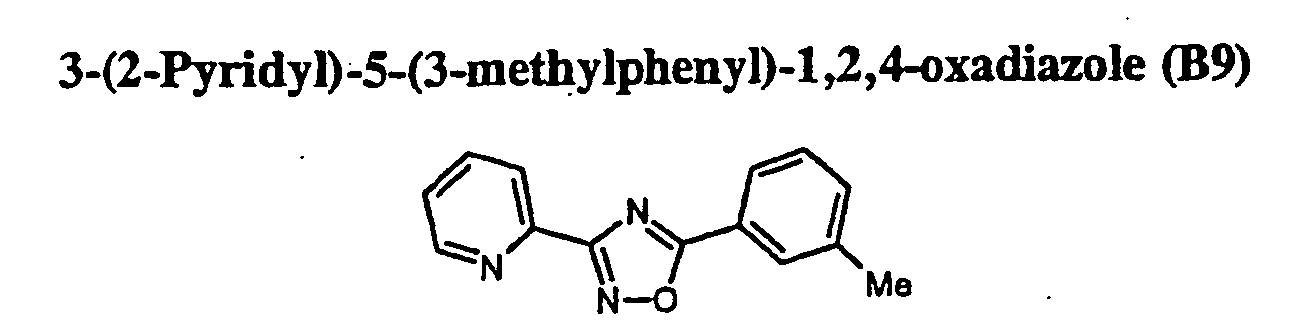
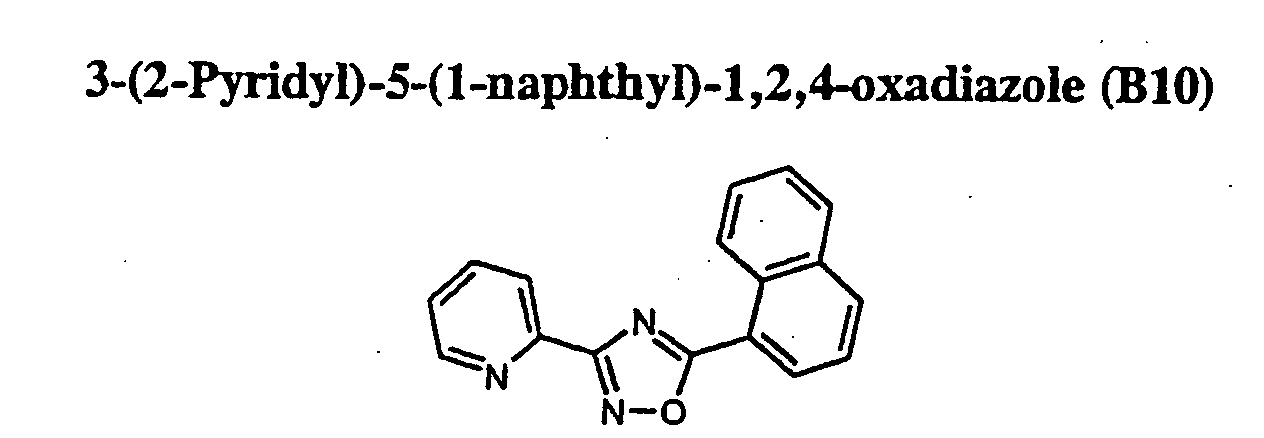
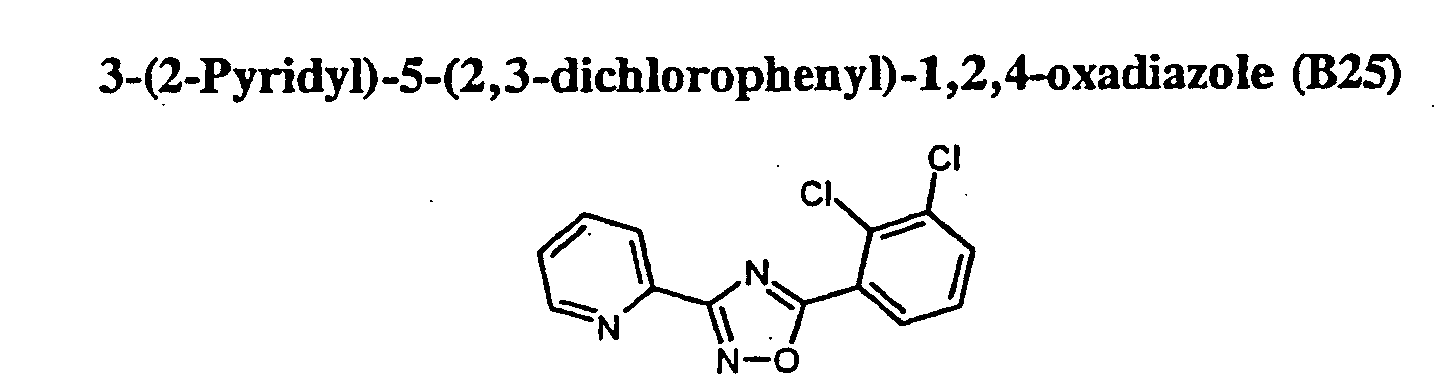
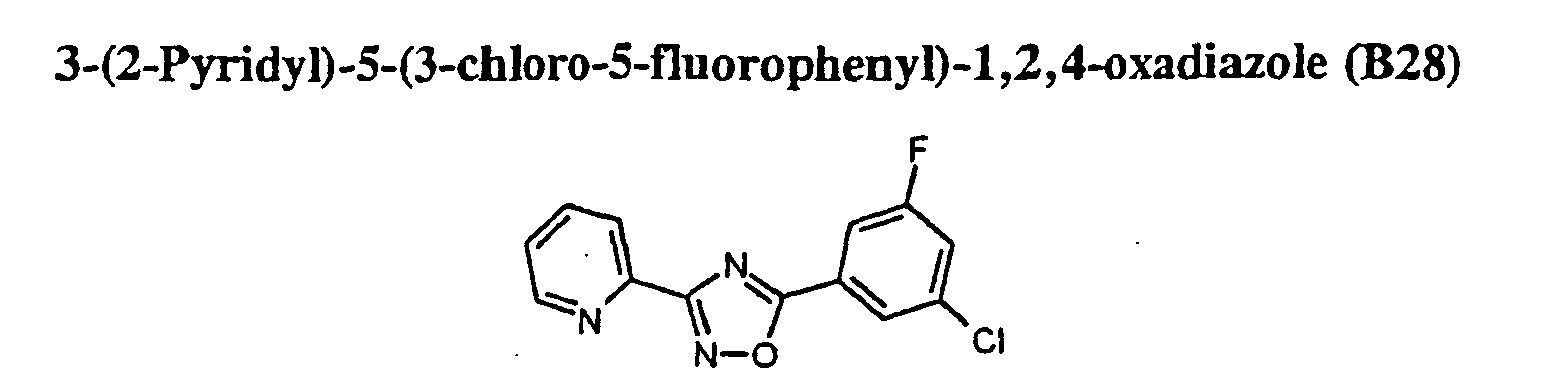
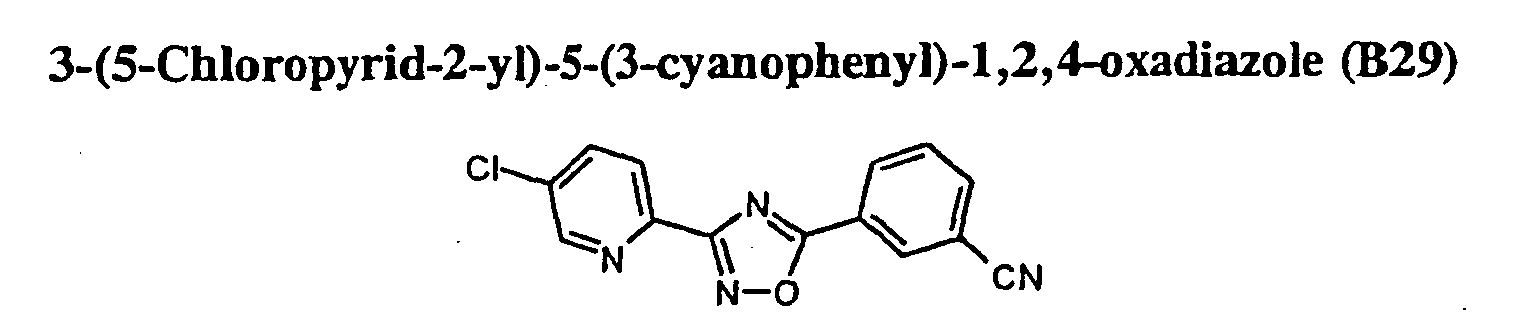
  • the compound is selected from the group consisting of 3-(2-pyridyl)-5-(3,5-dichlorophenyl)-1,2,4-oxadiazole, 3-(2-pyridyl)-5-(3-chlorophenyl)-1,2,4-oxadiazole, 3-(2-pyridyl)-5-(3-methoxyphenyl)-1,2,4-oxadiazole, 3-(2-pyridyl)-5-(2-chlorophenyl)-1,2,4-oxadiazole, 3-(2-pyridyl)-5-[3-(trifluoromethyl)phenyl]-1,2,4-oxadiazole, 3-(2-pyridyl)-5-(3-methylphenyl)-1,2,4-oxadiazole, 3-(2-pyridyl)-5-(1-naphthyl)-1,2,4-oxadiazole, 3-(2-pyridyl)-5-(1-na
  • the compound is selected from the group consisting of 2-(3,5-dichlorophenyl)-4-(2-pyridyl)-1,3-oxazole, 2-(3-chlorophenyl)-4-(2-pyridyl)-1,3-oxazole, 2-(3-methoxyphenyl)-4-(2-pyridyl)-1,3-oxazole, 2-(2-chlorophenyl)-4-(2-pyridyl)-1,3-oxazole, 2-(3-trifluorophenyl)-4-(2-pyridyl)-1,3-oxazole, 2-(3-methylphenyl)-4-(2-pyridyl)-1,3-oxazole, 2-(1-naphthyl)-4-(2-pyridyl)-1,3-oxazole, 2-(3-trifluoromethoxyphenyl)-4-(2-pyridyl)-1,3-oxazole,
  • a pharmaceutical composition comprising a compound as set forth above in Formula I and formula II, together with a pharmaceutically acceptable diluent or excipient.
  • compounds of the invention generally can be prepared by formation of the G moiety between two precursor compounds containing suitable Ar 1 and Ar 2 moieties.
  • the linker contains an 1,2,4-oxadiazole
  • the heterocycle may be formed using well known techniques, such as reaction between an amidoxime and an acid chloride, or by the reaction of an amidoxime and an acylimidazole. An illustration of such a transformation is provided in Examples 3 through 6, below.
  • Amidoximes can be prepared using well known techniques by the reaction of an Ar 1 substituted nitrile with hydroxylamine. An illustration of such a transformation is provided below in Example 1.
  • the precursor Ar 2 carbonyl chlorides are readily available, or may be prepared using straightforward techniques of organic chemistry.
  • carboxylic acids may be converted into the corresponding acid chlorides by reaction with, for example, thionyl chloride or oxalyl chloride.
  • linker contains a 1,3-oxazole
  • compounds were prepared from the procedure similar to that given by Kelly et al ., J. Org. Chem. 61 , 4623-4633 (1996).
  • 3,5-Disubstituted-1,3-Oxazoles were prepared by reacting a haloketone with carboxamide in refluxing toluene for 3 days. The resulting mixture was allowed to cool to room temperature, the solvent was removed and the residue was purified.
  • a method of inhibiting activation of an mGluR Group I receptor, specifically mGluR5, comprising treating a cell containing said mGluR Group I receptor with an effective amount of a compound as set forth above.
  • a method of treating a disease or disorder associated with glutamate-induced neuronal damage or a method of treating a disease or disorder associated with Group I mGluR activation or amenable to therapeutic intervention with a mGluR Group I antagonist, comprising administering to a patient suffering from said disease or disorder an effective amount of a composition as set forth above, wherein said disease or disorder is selected from the group consisting of as senile dementia, Parkinson's disease, Alzheimer's disease, Huntington's Chorea, pain, migraine headaches, epilepsy, head trauma, anoxic and ischemic injuries, psychiatric disorders such as schizophrenia, depression, anxiety, diabetic retinopathies, glaucoma, tinnitus, diabetic neuropathies, chemotherapy induced neuropathies, post-herpetic neuralgia, and trigeminal neuralgia.
  • the present invention provides compounds that are potent and selective antagonists of mGluR5.
  • the compounds contemplated by the invention can be represented by the general formula I: Ar 1 -G-Ar 2 where Ar 1 is an optionally substituted heterocyclic moiety and Ar 2 is an optionally substituted carbocyclic moiety.
  • the G moiety is a group that not only covalently binds to the Ar 1 and Ar 2 moieties and facilitates adoption of the correct spatial orientation of Ar 1 and-Ar 2 , but may itself interact with the protein to allow receptor binding.
  • the Ar 1 moiety is generally defined as a heterocyclic moiety, and the Ar 2 moiety is generally defined as a carbocylic moiety.
  • Ar 1 and Ar 2 can be monocyclic or fused bicyclic groups.
  • Ar 2 is preferably defined as an aryl or alkaryl moiety.
  • Ar 1 is preferably defined as a heterocyclic, heteroaryl or heteroarylalkyl moiety.
  • the ring systems encompassed by Ar 1 can contain up to four heteroatoms, independently selected from the group consisting of N, S, and O. When Ar 1 is a heteroaryl ring or ring system, it preferably contains one or two heteroatoms. At least one of the heteroatoms preferably is nitrogen (N).
  • heterocyclic or fused heterocylic moiety preferably is selected from the group consisting of quinolyl, quinazolyl, quinoxalyl, 2-pyrimidyl, 4-pyrimidyl, 5-pyrimidyl, 2-pyridyl, 3-pyridyl, 4-pyridyl, and pyrazyl.
  • Monocyclic Ar 1 groups include, but are not limited to: thiazoyl, furyl, pyranyl, 2H-pyrrolyl, thienyl, pyrroyl, imidazoyl, pyrazoyl, pyridyl, pyrazinyl, pyrimidinyl, and pyridazinyl moieties.
  • Monocyclic Ar 2 group include but are not limited to phenyl and benzyl.
  • Fused bicyclic Ar 2 include, but are not limited to, naphthyl, fluorenyl, anthrenyl, indenyl, phenanthrenyl, and benzonaphthenyl.
  • Ar 1 groups include, but are not limited to: benzothiazole, benzimidazole, 3H-indolyl, indolyl, indazoyl, purinyl, quinolizinyl, isoquinolyl, quinolyl, phthalizinyl, naphthyridinyl, quinazolinyl, cinnolinyl, isothiazolyl, quinoxalinyl indolizinyl, isoindolyl, benzothienyl, benzofuranyl, isobenzofuranyl, and chromenyl moieties.
  • Ar 1 preferably is a 2-pyridyl moiety.
  • Ar 2 preferably is a substituted phenyl moiety.
  • the Ar 1 and Ar 2 moieties optionally may independently be substituted with one or more moieties selected from the group consisting of halogen, C 1 -C 3 alkyl, C 1 -C 3 O-alkyl, -OH, -OCF 3 , -COOR, -COR, -SOR, -SO 2 NRR', -NRR', -CN, -CF 3 , -CO-NRR', -A-(CH 2 ) n -NRR', wherein A is C, O, N, SO, SO 2 , and R and R' are independently selected from the group consisting of C 1 -C 3 alkyl, H , cycloalkyl, heterocycloalkyl, aryl, and n is 1, 2, 3, or 4.
  • the G moiety is generally made up of 1-14 atoms. G can be independently selected from the group of atoms: C, H, N, O, and S.
  • the G moiety can thus be made of a non-cyclic moiety.
  • the atomic arrangement in the G moiety can also be made to form a five-membered ring.
  • Several examples of these are cyclopentane, cyclopentadiene, furan, thiofuran, pyrrolidine, pyrrole, 2-imidazoline, 3-imidazoline, 4-imidazoline, imidazole, pyrazoline, pyrazolidine, imidazolidine, oxazole, 2-oxazole, thiazole, isoxazole, isothiazole, 1 H -1,2,4-triazole, 1 H -1,2,3-triazole, 1,2,4-oxathiazole, 1,3,4-oxathiazole, 1,4,2-dioxazole, 1,4,2-oxathiazole, 1,2,4-oxadiazole, 1,2,4-thiadiazole, 1,2,5-oxadiazole, 1,2,5-thiadiazole, 1,3,4-oxadiazole, 1,3,4-
  • the atomic arrangement in the G moiety can also be made to form a six-membered ring.
  • Several examples of these are cyclohexane, piperidine, tetrahydropyridine, 1,4-dihydropyridine, pyridine, benzene, tetrahydropyran, 3,4-dihydro-2 H -pyran, 2 H -pyran, 4 H -pyran, tetrahydrothiopyran, 3,4-dihydro-2 H -thiopyran, 2 H -thiin, 4 H -thiopyran, morpholine, thiomorpholine, piperazine, pyridazine, pyrimidine, pyrazine, 1,2,4-triazine, 1,2,3-triazine, 1,3,5-triazine, and 1,2,4,5-tetrazine, for example.
  • the atomic arrangement in the G moiety can also be made to form a five- or six-membered ring containing one or more carbonyl groups.
  • these are 2-azetidinone, 1,2-diazetidin-3-one, cyclopentanone, 2-cyclopentenone, 2-pyrrolidinone, 3-pyrrolin-2-one, succinimide, maleimide, 3-pyrazolidinone, 2-imidazolidone, 4-imidazolin-2-one, 2 H -imidazol-2-one, 4-imidazolinone, 3-pyrazolin-5-one, hydantoin, 1 H -imidazole-2,5-dione, 2-oxazoline-4-one, 2-oxazolidinone, 3-oxazolin-5-one, 3(2 H )-isoxazolone, 2,4-oxazolidinedione, 1,2,4-triazoline-3,5-dione, 2,4-dihydro-3 H
  • G comprises a heterocyclic 5-membered ring system.
  • G is an oxazole or an 1,2,4-oxadiazole ring.
  • the G moiety may have either one of two-possible orientations with respect to the Ar 1 and Ar 2 groups.
  • the invention prefers compounds having the configuration 4-(Ar 1 )-2-(Ar 2 )-oxazole or 3-(Ar 1 )-5-(Ar 2 )-1,2,4-oxadiazole.
  • compounds of the present invention can be represented by formula II: wherein X, Y, and Z are independently selected from the group consisting of N, O, S, C, and CO wherein at least one of X, Y, and Z is a heteroatom; Ar 1 and Ar 2 are independently selected from the group consisting of a heterocyclic or fused heterocyclic moiety containing 1 to 4 heteroatoms selected from the group consisting of N, O, and S and an aromatic moiety selected from the group consisting of phenyl, benzyl, 1-naphthyl, 2-naphthyl, fluorenyl, anthrenyl, indenyl, phenanthrenyl, and benzonaphthenyl, wherein the Ar 1 and Ar 2 moieties are optionally substituted with one or more moieties selected from the group consisting of -F, -Cl, -Br, -I, -OR, -SR, -SOR, -SO 2
  • the compound is selected from the group consisting of 3-(2-pyridyl)-5-(3,5-dichlorophenyl)-1,2,4-oxadiazole, 3-(2-pyridyl)-5-(3-chlorophenyl)-1,2,4-oxadiazole, 3-(2-pyridyl)-5-(3-methoxyphenyl)-1,2,4-oxadiazole, 3-(2-pyridyl)-5-(2-chlorophenyl)-1,2,4-oxadiazole, 3-(2-pyridyl)-5-[3-(trifluoromethyl)phenyl]-1,2,4-oxadiazole, 3-(2-pyridyl)-5-(3-methylphenyl)-1,2,4-oxadiazole, 3-(2-pyridyl)-5-(1-naphthyl)-1,2,4-oxadiazole, 3-(2-pyridyl)-5-(1-na
  • the compound is selected from the group consisting of 2-(3,5-dichlorophenyl)-4-(2-pyridyl)-1,3-oxazole, 2-(3-chlorophenyl)-4-(2-pyridyl)-1,3-oxazole, 2-(3-methoxyphenyl)-4-(2-pyridyl)-1,3-oxazole, 2-(2-chlorophenyl)-4-(2-pyridyl)-1,3-oxazole, 2-(3-trifluorophenyl)-4-(2-pyridyl)-1,3-oxazole, 2-(3-methylphenyl)-4-(2-pyridyl)-1,3-oxazole, 2-(1-naphthyl)-4-(2-pyridyl)-1,3-oxazole, 2-(3-trifluoromethoxyphenyl)-4-(2-pyridyl)-1,3-oxazole,
  • mGluR Group I antagonists can be prepared via methodology that is well known, using widely recognized techniques of organic chemistry. Suitable reactions are described in standard textbooks of organic chemistry. For example, see March, ADVANCED ORGANIC CHEMISTRY, 2d ed., McGraw Hill (1977).
  • compounds of the invention generally can be prepared by formation of the G moiety between two precursor compounds containing suitable Ar 1 and Ar 2 moieties.
  • the linker contains a 1,2,4-oxadiazole
  • the heterocycle may be formed using well known techniques, such as reaction between an amidoxime and an acid chloride, or by the reaction of an amidoxime and an acylimidazole. An illustration of such a transformation is provided in Examples 3 through 6, below.
  • Amidoximes can be prepared using well known techniques by the reaction of an Ar 1 substituted nitrile with hydroxylamine. An illustration of such a transformation is provided below in Example 1.
  • the precursor Ar 2 acid chlorides are readily available, or may be prepared using straightforward techniques of organic chemistry.
  • carboxylic acids may be converted into the corresponding acid chlorides by reaction with, for example, thionyl chloride or oxalyl chloride.
  • the pharmacological properties of the compounds of the invention can be analyzed using standard assays for functional activity.
  • glutamate receptor assays are well known in the art, for example, see Aramori et al ., Neuron 8:757 (1992); Tanabe et al., Neuron 8:169 (1992); Miller et al., J. Neuroscience 15: 6103 (1995); Balazs, et al., J. Neurochemistry 69:151 (1997).
  • the methodology described in those publications is incorporated herein by reference.
  • the compounds of the invention can be studied by means of an assay that measures the mobilization intracellular calcium, [Ca 2+ ] i in cells expressing mGluR5 that can bind the compounds.
  • a well-known cell line which is suitable for this purpose is described in Miller et al ., J. Neuroscience 15: 6103 (1995), the contents of which are hereby incorporated by reference. It has been shown that exposure of rat astrocytes to the growth factors basic fibroblast growth factor, EGF, or transforming growth factor- ⁇ markedly increased the protein expression and functional activity of endogenous mGluR5 (Miller et al., J. Neuroscience, 15(9) : 6103-6109, 1995).
  • astrocyte cultures were prepared from 3-5 day old Sprague-Dawley rat pups using a modification of Miller et al . and were plated on poly-L lysine coated flasks in Dulbecco's modified Eagle's medium (DMEM) containing fetal calf serum (FCS). For cuvette analysis, cultures were up-regulated with growth factors in flasks for 3-5 days, then harvested and prepared for measurement of [Ca 2+ ] i mobilization as previously described (Nemeth et al., 1998).
  • DMEM Dulbecco's modified Eagle's medium
  • FCS fetal calf serum
  • FLIPR fluorescent imaging plate reader
  • FLIPR experiments were carried out using a laser setting of 0.800 W and a 0.4 second CCD camera shutter speed. Each FLIPR experiment was initiated with 180 ⁇ L of buffer present in each well of the cell plate. After each addition of compound, the fluorescence signal was sampled 50 times at 1 second intervals followed by 3 samples at 5 second intervals. Responses were measured as the peak height of the response within the sample period.
  • EC 50 and IC 50 determinations were made from data obtained from 8 point concentration response curves (CRC) performed in duplicate.
  • Agonist CRC were generated by scaling all responses to the maximal response observed for the plate.
  • Antagonist block of the agonist challenge was normalized to the average response of the agonist challenge in 14 control wells on the same plate.
  • a detailed protocol for testing the compounds of the invention is provided below at Example 4.
  • the compounds of the present invention are useful for treating neurological disorders or diseases. While these compounds typically will be used in therapy for human patients, they also can be used in veterinary medicine, to treat similar or identical diseases.
  • the compounds of the invention can be formulated for a variety of modes of administration, including systemic and topical or localized administration. Techniques and formulations generally may be found in REMINGTON'S PHARMACEUTICAL SCIENCES (18th ed.), Mack Publishing Co. (1990).
  • the compounds according to the invention are effective over a wide dosage range.
  • dosages from about 0.01 to about 1000 mg per 60-70 kg adult, preferably from about 0.5 to about 100 mg per 60-70 kg adult, per [day] dose may be used.
  • a more preferable dosage is about 2 mg to about 70 mg per 60-70 kg adult per [day] dose.
  • the exact dosage will depend upon the route of administration, the form in which the compound is administered, the subject to be treated, the body weight of the subject to be treated, and the preference and experience of the attending physician.
  • salts are generally well known to those of ordinary skill in the art, and may include, by way of example but not limitation, acetate, benzenesulfonate, besylate, benzoate, bicarbonate, bitartrate, bromide, calcium edetate, camsylate, carbonate, citrate, edetate, edisylate, estolate, esylate, fumarate, gluceptate, gluconate, glutamate, glycollylarsanilate, hexylresorcinate, hydrabamine, hydrobromide, hydrochloride, hydroxynaphthoate, iodide, isethionate, lactate, lactobionate, malate, maleate, mandelate, mesylate, mucate, napsylate, nitrate, pamoate (embonate), pantothenate, phosphate/disphosphate, polygalacturonate, salicylate, stea
  • Preferred pharmaceutically acceptable salts include, for example, acetate, benzoate, bromide, carbonate, citrate, gluconate, hydrobromide, hydrochloride, maleate, mesylate, napsylate, pamoate (embonate), phosphate, salicylate, succinate, sulfate, or tartrate.
  • agents may be formulated into liquid or solid dosage forms and administered systemically or locally.
  • the agents may be delivered, for example, in a timed- or sustained-release form as is known to those skilled in the art. Techniques for formulation and administration may be found in REMINGTON'S PHARMACEUTICAL SCIENCES; (18th ed.), supra.
  • Suitable routes may include oral, buccal, sublingual, rectal, transdermal, vaginal, transmucosal, nasal or intestinal administration; parenteral delivery, including intramuscular, subcutaneous, intramedullary injections, as well as intrathecal, direct intraventricular, intravenous, intraperitoneal, intranasal, or intraocular injections, inter alia.
  • the agents of the invention may be formulated in aqueous solutions, preferably in physiologically compatible buffers such as Hank's solution, Ringer's solution, or physiological saline buffer.
  • physiologically compatible buffers such as Hank's solution, Ringer's solution, or physiological saline buffer.
  • penetrants appropriate to the barrier to be permeated are used in the formulation. Such penetrants generally are known in the art.
  • compositions of the present invention in particular, those formulated as solutions, may be administered parenterally, such as by intravenous injection.
  • the compounds can be formulated readily using pharmaceutically acceptable carriers well known in the art into dosages suitable for oral administration.
  • Such carriers enable the compounds of the invention to be formulated as tablets, pills, capsules, liquids, gels, syrups, slurries, suspensions and the like, for oral ingestion by a patient to be treated.
  • compositions suitable for use in the present invention include compositions wherein the active ingredients are contained in an effective amount to achieve its intended purpose. Determination of the effective amounts is well within the capability of those skilled in the art, especially in light of the detailed disclosure provided herein.
  • these pharmaceutical compositions may contain suitable pharmaceutically acceptable carriers comprising excipients and auxiliaries which facilitate processing of the active compounds into preparations which can be used pharmaceutically.
  • suitable pharmaceutically acceptable carriers comprising excipients and auxiliaries which facilitate processing of the active compounds into preparations which can be used pharmaceutically.
  • the preparations formulated for oral administration may be in the form of tablets, dragees, capsules, or solutions.
  • compositions for oral use can be obtained by combining the active compounds with solid excipients, optionally grinding a resulting mixture, and processing the mixture of granules, after adding suitable auxiliaries, if desired, to obtain tablets or dragee cores.
  • suitable excipients are, in particular, fillers such as sugars, including lactose, sucrose, mannitol, or sorbitol; cellulose preparations, for example, maize starch, wheat starch, rice starch, potato starch, gelatin, gum tragacanth, methyl cellulose, hydroxypropylmethyl-cellulose, sodium carboxymethyl-cellulose (CMC), and/or polyvinylpyrrolidone (PVP: povidone).
  • disintegrating agents may be added, such as the cross-linked polyvinylpyrrolidone, agar, or alginic acid or a salt thereof such as sodium alginate.
  • Dragee cores are provided with suitable coatings.
  • suitable coatings may be used, which may optionally contain gum arabic, talc, polyvinylpyrrolidone, carbopol gel, polyethylene glycol (PEG), and/or titanium dioxide, lacquer solutions, and suitable organic solvents or solvent mixtures.
  • Dye-stuffs or pigments may be added to the tablets or dragee coatings for identification or to characterize different combinations of active compound doses.
  • compositions which can be used orally include push-fit capsules made of gelatin, as well as soft, sealed capsules made of gelatin, and a plasticizer, such as glycerol or sorbitol.
  • the push-fit capsules can contain the active ingredients in admixture with filler such as lactose, binders such as starches, and/or lubricants such as talc or magnesium stearate and, optionally, stabilizers.
  • the active compounds may be dissolved or suspended in suitable liquids, such as fatty oils, liquid paraffin, or liquid polyethylene glycols (PEGs).
  • PEGs liquid polyethylene glycols
  • stabilizers may be added.
  • Capillary gas chromatographic and mass spectral data were obtained using a Hewlett-Packard (HP) 5890 Series II Gas Chromatograph coupled to an HP 5971 Series Mass Selective Detector [Ultra-2 Ultra Performance Capillary Column (crosslinked 5% PhMe silicone); column length, 25 m; column i.d., 0.20 mm; helium flow rate, 60 mL/min; injector temp., 250 °C; temperature program, 20 °C/min from 125 to 325 °C for 10 min, then held constant at 325 °C for 6 min]. Thin-layer chromatography was performed using Analtech Uniplate 250- ⁇ m silica gel HF TLC plates.
  • UV light sometimes in conjunction with ninhydrin and Dragendorff's spray reagents (Sigma Chemical Co.) were used for detecting compounds on the TLC plates.
  • Most reagents used in reactions were purchased from the Aldrich Chemical Co. (Milwaukee, WI), Sigma Chemical Co. (Saint Louis, MO), Fluka Chemical Corp. (Milwaukee, WI), Fisher Scientific (Pittsburgh, PA), TCI America (Portland, OR), or Lancaster Synthesis (Windham, NH).
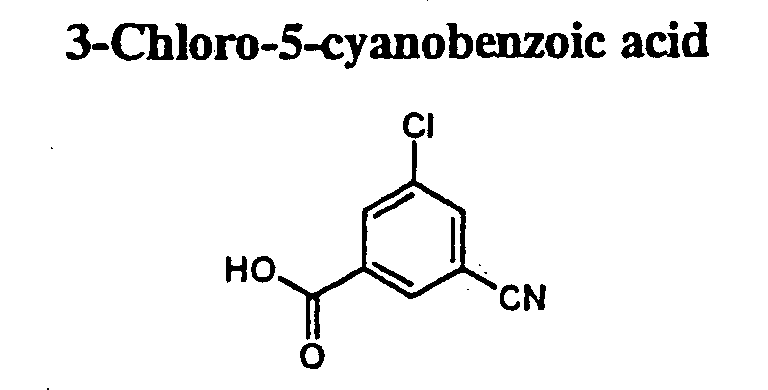
  • the intermediate ester was treated with a solution of sodium hydroxide (7.5 mL of 4 N solution, 30 mmol) in methanol (50 mL) and stirred at ambient temperature for 18 hours. The solvent was removed in vacuo and the residue dissolved in ethyl acetate. The organic solution was washed with 5% HCl and brine. Removal of the solvent afforded 1.8 g (83 %) of 3-chloro-5-cyanobenzoic acid.
  • 3,5-Disubstituted-1,2,4-oxadiazoles were typically made by adding an acylchloride to a solution of an amidoxime in pyridine after which the reaction mixture was either heated to reflux or placed in a sealed tube and heated.
  • the oxadiazoles were isolated by precipitating with cold water and filtering or by extraction with an organic solvent. If necessary, the oxadiazoles were purified by chromatography or recrystallization.
  • 3-Chloro-5-cyanobenzoic acid (0.82 g, 4.97 mmol ) was treated with a solution of oxalyl chloride (10 mL of 2.5 M in dichloromethane, 25 mmol) and a catalytic amount of N,N -dimethylformamide. The reaction was stirred at ambient temperature for 2.5 hours.-The excess oxalyl chloride was removed in vacuo to afford 3-chloro-5-cyanobenzoyl chloride.
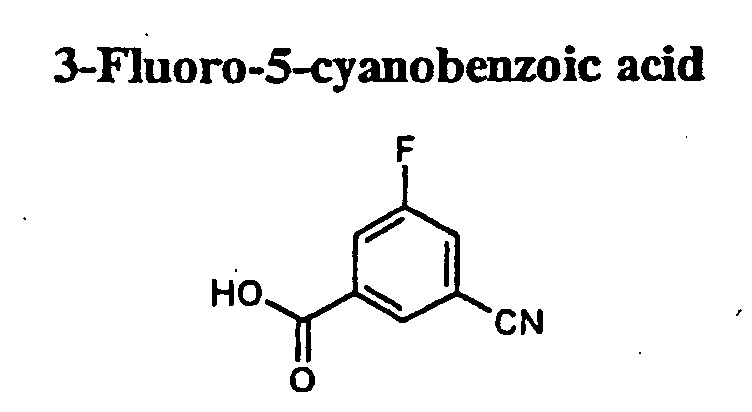
  • 3-Fluoro-5-cyanobenzoic acid (2.5 g, 15.14 mmol ) was treated with a solution of oxalyl chloride (30 mL of 2.5 M in dichloromethane, 75 mmol) and a catalytic amount of N,N -dimethylformamide. The reaction was stirred at ambient temperature for 2.5 hours. The excess oxalyl chloride was removed in vacuo to afford 3-fluoro-5-cyanobenzoyl chloride.
  • 3-Chloro-5-fluorobenzoic acid 400 mg, 2.3 mmol was treated with a solution of oxalyl chloride (4.6 mL of 2.5 M in dichloromethane, 11.5 mmol) and a catalytic amount of N,N -dimethylformamide. The reaction was stirred at ambient temperature for 2.5 hours. The excess oxalyl chloride was removed in vacuo to afford 3-chloro-5-fluorobenzoyl chloride.
  • 3-Fluoro-5-cyanobenzoic acid (1.0 g, 6 mmol) was treated with a solution of oxalyl chloride (12 mL of 2.5 M in dichloromethane, 30 mmol) and a catalytic amount of N,N -dimethylformamide. The reaction was stirred at ambient temperature for 2.5 hours. The excess oxalyl chloride was removed in vacuo to afford 3-fluoro-5-cyanbenzoyl chloride.
  • 5-Chloro- O -anisic acid (187 mg, 1 mmol) was treated with a solution of oxalyl chloride (1.5 mL of 2 M in dichloromethane, 3 mmol) and a catalytic amount of N,N -dimethylformamide. The reaction was stirred at ambient temperature for 2 hours. The excess oxalyl chloride was removed in vacuo to afford 5-chloro-2-methoxybenzoyl chloride.
  • 2,3-Dimethoxybenzoic acid (182 mg, 1 mmol) was treated with a solution of oxalyl chloride (1.5 mL of 2 M in dichloromethane, 3 mmol) and a catalytic amount of N,N -dimethylformamide. The reaction was stirred at ambient temperature for 2 hours. The excess oxalyl chloride was removed in vacuo to afford 2,3-dimethoxybenzoyl chloride.
  • 3-Phenoxybenzoic acid (214 mg, 1.0 mmol) was treated with a solution of oxalyl chloride (1.5 mL of 2 M in dichloromethane, 3 mmol) and a catalytic amount of N,N -dimethylformamide. The reaction was stirred overnight at ambient temperature. The excess oxalyl chloride was removed in vacuo to afford 3-phenoxybenzoyl chloride.
  • 3,4,5-Trifluorobenzoic acid (0.176 g, 1.0 mmol) in dichloromethane (1.5 mL) was treated with a solution of oxalyl chloride (1.5 mL of 2 M in dichloromethane, 3 mmol) and a catalytic amount of N,N -dimethylformamide. The reaction was stirred overnight at ambient temperature. The excess oxalyl chloride was removed in vacuo to afford 3,4,5-trifluorobenzoyl chloride.
  • 2,5,6-Trifluorolbenzoic acid (176 mg, 1 mmol) was treated with a solution of oxalyl chloride (1.5 mL of 2 M in dichloromethane, 3 mmol) and a catalytic amount of N,N -dimethylformamide. The reaction was stirred at ambient temperature for 16 hours. The excess oxalyl chloride was removed in vacuo to afford 2,5,6-trifluorolbenzoyl chloride.
  • astrocyte cultures were prepared from 3-5 day old Sprague-Dawley rat pups using a modification of Miller (Miller et al , J. Neuroscience, 15(9): 6103-6109, 1995). In brief, primary cultures were plated on poly-L lysine coated flasks in Dulbecco's modified Eagle's medium (DMEM) containing fetal calf serum (FCS). After 6 days, cell cultures were shaken over night at 280 rpm, then transferred to astrocyte-defined media (ADM) containing growth factors that up-regulate the expression of mGluR5 (Miller et al., 1995). For cuvette analysis, cultures were up-regulated with growth factors in flasks for 3-5 days, then harvested and prepared for measurement of [Ca 2+ ] i mobilization as previously described (Nemeth et al., 1998).
  • DMEM Dulbecco's modified Eagle's medium
  • FCS fetal calf serum
  • FLIPR experiments were done using a laser setting of 0.800 W and a 0.4 second CCD camera shutter speed. Each FLIPR experiment was initiated with 180 ⁇ L of buffer present in each well of the cell plate. A 20 ⁇ L addition from the antagonist plate was followed by a 50 ⁇ L addition from the agonist plate. After each addition the fluorescence signal was sampled 50 times at 1 second intervals followed by 3 samples at 5 second intervals. Responses were measured as the peak height of the response within the sample period.
  • EC 50 /IC 50 determinations were made from data obtained from 8 point concentration response curves (CRC) performed in duplicate. Agonist CRC were generated by scaling all responses to the maximal response observed for the plate. Antagonist block of the agonist challenge was normalized to the average response of the agonist challenge in 14 control wells on the same plate.
  • HEK 293 cells expressing the chimeric CaR/mGluR5d receptor (clonal cell line hCaR/hmGluR5d_hek6) are plated 24 hours prior to assay at a density of 100,000 cells per well in Collagen I-coated 96-well black, clear bottom plates (Becton Dickenson) in DMEM supplemented with 10% FBS (Hyclone).
  • the plate is loaded into a FLIPR robotic device (Molecular Devices) with the laser setting at 0.8 Watts.
  • 40 ⁇ L of Assay Buffer containing 62.5 ⁇ M test substance and 2 % DMSO is added to the 160 ⁇ L of Assay Buffer in each well of the plate to yield a final concentration of 12 ⁇ M test substance and 0.4 % DMSO.
  • 50 ⁇ L of Assay Buffer containing 6 mM CaCl 2 is added to the 200 ⁇ L present in each well to yield a final Ca 2+ concentration of 2.0 mM, and a final concentration of test substance of 10 nM.
  • a 1,2,4-oxadiazole disclosed above designated “B21” (see Example 3), had an IC 50 value of 43 nM in relation to CaR/mGluR 5d and an IC 50 value of 121 nM on the native receptor, mGluR 5d .
  • a corresponding 1,3 oxazole, designated “B52” (see Example 7) was found to be equipotent on the CaR/mGluR 5d chimera, with an IC 50 value of 45 nM, but displayed increased potency on the native mGluR 5d receptor, with an IC 50 value of 74 nM.

Landscapes

  • Chemical & Material Sciences (AREA)
  • Organic Chemistry (AREA)
  • Health & Medical Sciences (AREA)
  • Engineering & Computer Science (AREA)
  • Bioinformatics & Cheminformatics (AREA)
  • Biomedical Technology (AREA)
  • Neurology (AREA)
  • Neurosurgery (AREA)
  • Chemical Kinetics & Catalysis (AREA)
  • General Chemical & Material Sciences (AREA)
  • Medicinal Chemistry (AREA)
  • Nuclear Medicine, Radiotherapy & Molecular Imaging (AREA)
  • Pharmacology & Pharmacy (AREA)
  • Life Sciences & Earth Sciences (AREA)
  • Animal Behavior & Ethology (AREA)
  • General Health & Medical Sciences (AREA)
  • Public Health (AREA)
  • Veterinary Medicine (AREA)
  • Pharmaceuticals Containing Other Organic And Inorganic Compounds (AREA)
  • Thiazole And Isothizaole Compounds (AREA)

Abstract

Figure 80000001
Compound of formula (II) wherein X, Y, and Z are independently selected form the group consisting of N, O, S, C, and CO wherein at least one of X, Y, and Z is a heteroatom; Ar1 and Ar2 are independently selected from the group consisting of a heterocyclic or fused heterocyclic moiety and an aromatic moiety; act as antagonist at metabotropic glutamate receptors, and are useful for treating neurological diseases and disorders.

Description

FIELD OF THE INVENTION
The invention provides compounds active at metabotropic glutamate receptors and that are useful for treating neurological and psychiatric diseases and disorders.
BACKGROUND OF THE INVENTION
Recent advances in the elucidation of the neurophysiological roles of metabotropic glutamate receptors have established these receptors as promising drug targets in the therapy of acute and chronic neurological and psychiatric disorders and diseases. However, the major challenge to the realization of this promise has been the development of metabotropic glutamate receptor subtype-selective compounds.
Glutamate is the major excitatory neurotransmitter in the mammalian central nervous system (CNS). Glutamate produces its effects on central neurons by binding to and thereby activating cell surface receptors. These receptors have been divided into two major classes, the ionotropic and metabotropic glutamate receptors, based on the structural features of the receptor proteins, the means by which the receptors transduce signals into the cell, and pharmacological profiles.
The metabotropic glutamate receptors (mGluRs) are G protein-coupled receptors that activate a variety of intracellular second messenger systems following the binding of glutamate. Activation of mGluRs in intact mammalian neurons elicits one or more of the following responses: activation of phospholipase C; increases in phosphoinositide (PI) hydrolysis; intracellular calcium release; activation of phospholipase D; activation or inhibition of adenyl cyclase; increases or decreases in the formation of cyclic adenosine monophosphate (cAMP); activation of guanylyl cyclase; increases in the formation of cyclic guanosine monophosphate (cGMP); activation of phospholipase A2; increases in arachidonic acid release; and increases or decreases in the activity of voltage- and ligand-gated ion channels. Schoepp et al., Trends Pharmacol. Sci. 14:13 (1993); Schoepp, Neurochem. Int. 24:439 (1994); Pin et al., Neuropharmacology 34:1 (1995).
Eight distinct mGluR subtypes, termed mGluR1 through mGluR8, have been identified by molecular cloning. See, for example, Nakanishi, Neuron 13:1031 (1994); Pin et al., Neuropharmacology 34:1 (1995); Knopfel et al. , J. Med. Chem. 38:1417 (1995). Further receptor diversity occurs via expression of alternatively spliced forms of certain mGluR subtypes. Pin et al., PNAS 89:10331 (1992); Minakami et al., BBRC 199:1136 (1994); Joly et al., J. Neurosci. 15:3970 (1995).
Metabotropic glutamate receptor subtypes may be subdivided into three groups, Group I, Group II, and Group III mGluRs, based on amino acid sequence homology, the second messenger systems utilized by the receptors, and by their pharmacological characteristics. Nakanishi, Neuron 13:1031 (1994); Pin et al., Neuropharmacology 34:1 (1995); Knopfel et al., J. Med. Chem. 38:1417 (1995).
Group I mGluRs comprise mGluR1, mGluR5, and their alternatively spliced variants. The binding of agonists to these receptors results in the activation of phospholipase C and the subsequent mobilization of intracellular calcium. Electrophysiological measurements have been used to, demonstrate these effects, for example, in Xenopus oocytes that express recombinant mGluR1 receptors. See, for example, Masu et al., Nature 349:760 (1991); Pin et al., PNAS 89:10331 (1992). Similar results have been achieved with oocytes expressing recombinant mGluR5 receptors. Abe et al., J. Biol. Chem. 267:13361 (1992); Minakami et al., BBRC 199:1136 (1994); Joly et al., J. Neurosci. 15:3970 (1995). Alternatively, agonist activation of recombinant mGluR1 receptors expressed in Chinese hamster ovary (CHO) cells stimulates PI hydrolysis, cAMP formation, and arachidonic acid release as measured by standard biochemical assays. Aramori et al. , Neuron 8:757 (1992).
By comparison, the activation of mGluR5 receptors, expressed in CHO cells, stimulates PI hydrolysis and subsequent intracellular calcium transients, but no stimulation of cAMP formation or arachidonic acid release is observed. Abe et al., J. Biol. Chem. 267:13361 (1992). However, activation of mGluR5 receptors expressed in LLC-PK1 cells results in PI hydrolysis and increased cAMP formation. Joly et al., J. Neurosci. 15:3970 (1995). The agonist potency profile for Group I mGluRs is quisqualate > glutamate = ibotenate > (2S,1'S,2'S)-2-carboxycyclopropyl)glycine (L-CCG-I) > (1S,3R)-1-aminocyclopentane-1,3-dicarboxylic acid (ACPD). Quisqualate is relatively selective for Group I receptors, as compared to Group II and Group III mGluRs, but it also is a potent activator of ionotropic AMPA receptors. Pin et al., Neuropharmacology 34:1, Knopfel et al. , J. Med. Chem. 38:1417 (1995).
The lack of subtype-specific mGluR agonists and antagonists has impeded elucidation of the physiological roles of particular mGluRs, and the mGluR-associated pathophysiological processes that affect the CNS have yet to be defined. However, work with the available non-specific agonists and antagonists has yielded some general insights about the Group I mGluRs as compared to the Group II and Group III mGluRs.
Attempts at elucidating the physiological roles of Group I mGluRs suggest that activation of these receptors elicits neuronal excitation. Various studies have demonstrated that ACPD can produce postsynaptic excitation upon application to neurons in the hippocampus, cerebral cortex, cerebellum, and thalamus, as well as other brain regions. Evidence indicates that this excitation is due to direct activation of postsynaptic mGluRs, but it also has been suggested that activation of presynaptic mGluRs occurs, resulting in increased neurotransmitter release. Baskys, Trends Pharmacol. Sci. 15:92 (1992); Schoepp, Neurochem. Int. 24:439 (1994); Pin et al., Neuropharmacology 34:1(1995).
Pharmacological experiments implicate Group I mGluRs as the mediators of this excitatory mechanism. The effects of ACPD can be reproduced by low concentrations of quisqualate in the presence of iGluR antagonists. Hu et al., Brain Res. 568:339 (1991); Greene et al., Eur. J. Pharmacol. 226:279 (1992). Two phenylglycine compounds known to activate mGluR1, namely (S)-3-hydroxyphenylglycine ((S)-3HPG) and (S)-3,5-dihydroxyphenylglycine ((S)-DHPG), also produce excitation. Watkins et al., Trends Pharmacol. Sci. 15:33 (1994). In addition, the excitation can be blocked by (S)-4-carboxyphenylglycine ((S)-4CPG), (S)-4-carboxy-3-hydroxyphenylglycine ((S)-4C3HPG), and (+)-alpha-methyl-4-carboxyphenylglycine ((+)-MCPG), compounds known to be mGluR1 antagonists. Eaton et al., Eur. J. Pharmacol. 244:195 (1993); Watkins et al., Trends Pharmacol. Sci. 15:333 (1994).
Metabotropic glutamate receptors have been implicated in a number of normal processes in the mammalian CNS. Activation of mGluRs has been shown to be required for induction of hippocampal long-term potentiation and cerebellar long-term depression. Bashir et al., Nature 363:347 (1993); Bortolotto et al., Nature 368:740 (1994); Aiba et al., Cell 79:365 (1994); Aiba et al., Cell 79:377 (1994). A role for mGluR activation in nociception and analgesia also has been demonstrated. Meller et al., Neuroreport 4: 879 (1993). In addition, mGluR activation has been suggested to play a modulatory role in a variety of other normal processes including synaptic transmission, neuronal development, apoptotic neuronal death, synaptic plasticity, spatial learning, olfactory memory, central control of cardiac activity, waking, motor control, and control of the vestibulo-ocular reflex. Generally, see Nakanishi, Neuron 13: 1031 (1994); Pin et al., Neuropharmacology 34:1; Knopfel et al., J. Med. Chem. 38:1417 (1995).
Metabotropic glutamate receptors also have been suggested to play roles in a variety of pathophysiological processes and disease states affecting the CNS. These include stroke, head trauma, anoxic and ischemic injuries, hypoglycemia, epilepsy, and neurodegenerative diseases such as Alzheimer's disease. Schoepp et al. , Trends Pharmacol. Sci. 14:13 (1993); Cunningham et al., Life Sci. 54:135 (1994); Hollman et al., Ann. Rev. Neurosci. 17:31 (1994); Pin et al., Neuropharmacology 34:1 (1995); Knopfel et al., J. Med. Chem. 38:1417 (1995). Much of the pathology in these conditions is thought to be due to excessive glutamate-induced excitation of CNS neurons. Because Group I mGluRs appear to increase glutamate-mediated neuronal excitation via postsynaptic mechanisms and enhanced presynaptic glutamate release, their activation probably contributes to the pathology. Accordingly, selective antagonists of Group I mGluR receptors could be therapeutically beneficial, specifically as neuroprotective agents, analgesics, or anticonvulsants.
Preliminary studies assessing therapeutic potentials with the available mGluR agonists and antagonists have yielded seemingly contradictory results. For example, it has been reported that application of ACPD onto hippocampal neurons leads to seizures and neuronal damage (Sacaan et al. , Neurosci. Lett. 139:77 (1992); Lipparti et al., Life Sci. 52:85 (1993). Other studies indicate, however, that ACPD inhibits epileptiform activity, and also can exhibit neuroprotective properties. Taschenberger et al., Neuroreport 3:629 (1992); Sheardown, Neuroreport 3 :916 (1992); Koh et al. , Proc. Natl. Acad. Sci. USA 88:9431 (1991); Chiamulera et al., Eur. J. Pharmacol. 216:335 (1992); Siliprandi et al., Eur. J. Pharmacol. 219:173 (1992); Pizzi et al., J. Neurochem. 61:683 (1993).
It is likely that these conflicting results are due to the lack of selectivity of ACPD, which causes activation of several different mGluR subtypes. In the studies finding neuronal damage it appears that Group I mGluRs were activated, thereby enhancing undesirable excitatory neurotransmission. In the studies showing neuroprotective effects it appears that activation of Group II and/or Group III mGluRs occurred, inhibiting presynaptic glutamate release, and diminishing excitatory neurotransmission.
This interpretation is consistent with the observation that (S)-4C3HPG, a Group I mGluR antagonist and Group II mGluR agonist, protects against audiogenic seizures in DBA/2 mice, while the Group II mGluR selective agonists DCG-IV and L-CCG-I protect neurons from NMDA- and KA-induced toxicity. Thomsen et al., J. Neurochem. 62:2492 (1994); Bruno et al., Eur. J. Pharmacol. 256:109 (1994); Pizzi et al., J. Neurochem. 61:683 (1993).
Based on the foregoing, it is clear that currently available mGluR agonists and antagonists have limited value, due to their lack of potency and selectivity. In addition, most currently available compounds are amino acids or amino acid derivatives that have limited bioavailabilities, thereby hampering in vivo studies to assess mGluR physiology, pharmacology and their therapeutic potential. Compounds that selectively inhibit activation of metabotropic glutamate receptor Group I subtypes should be useful for treatment of neurological disorders and diseases such as senile dementia, Parkinson's disease, Alzheimer's disease, Huntington's Chorea, pain, migraine headaches, epilepsy, head trauma, anoxic and ischemic injuries, psychiatric disorders such as schizophrenia, depression, and anxiety, ophthalmological disorders such as various retinopathies, for example, diabetic retinopathies, glaucoma, and neurological disorders of a auditory nature such as tinnitus, and neuropathic pain disorders, including neuropathic diseases states such as diabetic neuropathies, chemotherapy induced neuropathies, post-herpetic neuralgia, and trigeminal neuralgia.
Accordingly, a need exists for potent mGluR agonists and antagonists that display a high selectivity for a mGluR subtype, particularly a Group I receptor subtype.
SUMMARY OF THE INVENTION
It is an object of the present invention, therefore, to identify metabotopic glutamate receptor-active compounds which exhibit a high degree of potency and selectivity for individual metabotropic glutamate receptor subtypes, and to provide methods of making these compounds.
It is a further object of this invention to provide pharmaceutical compositions containing compounds which exhibit a high degree of potency and selectivity for individual metabotropic glutamate receptor subtypes, and to provide methods of making these pharmaceutical compositions.
It is yet another object of this invention to provide methods of inhibiting activation of an mGluR Group I receptor, and of inhibiting neuronal damage caused by excitatory activation of an mGluR Group I receptor, specifically mGluR5.
It is still another object of the invention to provide methods of treating a disease associated with excitatory activation of an mGluR Group I receptor, specifically mGluR5.
To accomplish these and other objectives, the present invention provides potent antagonists of Group I mGluRs, specifically, mGluR5. These antagonists may be represented by the formula I, Ar1-G-Ar2    wherein Ar1 is an optionally substituted heteroaromatic moiety and Ar2 is an optionally substituted benzene ring. The G moiety is a group that not only covalently binds to the Ar1 and Ar2 moieties, and facilitates adoption of the correct spatial orientation of Ar1 and Ar2, but also itself may interact with the protein, to effect receptor binding.
In one embodiment of the invention, G is selected from the group consisting of - NH-, -S-, -O-, -CO-, -CONH-, -CONHCH2-, -CH2CONH-, -CNHNH-, -CNHNHCH2-, -C=NO-CH2-, -CH2NHCH2-, -CH2CH2NH-, -NHCH2CO-, -NHCH2CHOH-, - NHCNHNH.-, -NHCONH-, cyclopentane, cyclopentadiene, furan, thiofuran, pyrrolidine, pyrrole, 2-imidazoline, 3-imidazoline, 4-imidazoline, imidazole, pyrazoline, pyrazolidine, imidazolidine, oxazole, 2-oxazole, thiazole, isoxazole, isothiazole, 1H-1,2,4-triazole, 1H-1,2,3-triazole, 1,2,4-oxathiazole, 1,3,4-oxathiazole, 1,4,2-dioxazole, 1,4,2-oxathiazole, 1,2,4-oxadiazole, 1,2,4-thiadiazole, 1,2,5-oxadiazole, 1,2,5-thiadiazole, 1,3,4-oxadiazole, 1,3,4-thiadiazole, 1H-tetrazole, cyclohexane, piperidine, tetrahydropyridine, 1,4-dihydropyridine, pyridine, benzene, tetrahydropyran, 3,4-dihydro-2H-pyran, 2H-pyran, 4H-pyran, tetrahydrothiopyran, 3,4-dihydro-2H-thiopyran, 2H-thiin, 4H-thiopyran, morpholine, thiomorpholine, piperazine, pyridazine, pyrimidine, pyrazine, 1,2,4-triazine, 1,2,3-triazine, 1,3,5-triazine, and 1,2,4,5-tetrazine.
In another embodiment of the invention, Ar1 is selected from the group consisting of phenyl, benzyl, naphthyl, fluorenyl, anthrenyl, indenyl, phenanthrenyl, and benzonaphthenyl, and Ar2 is selected from the group consisting of thiazoyl, furyl, pyranyl, 2H-pyrrolyl, thienyl, pyrroyl, imidazoyl, pyrazoyl, pyridyl, pyrazinyl, pyrimidinyl, pyridazinyl, benzothiazole, benzimidazole, 3H-indolyl, indolyl, indazoyl, purinyl, quinolizinyl, isoquinolyl, quinolyl, phthalizinyl, naphthyridinyl, quinazolinyl, cinnolinyl, isothiazolyl, quinoxalinyl indolizinyl, isoindolyl, benzothienyl, benzofuranyl, isobenzofuranyl, and chromenyl.
In yet another embodiment, compounds of the present invention can be represented by formula II:
Figure 00070001
wherein X, Y, and Z are independently selected from the group consisting of N, O, S, C, and CO wherein at least one of X, Y, and Z is a heteroatom;
Ar1 and Ar2 are independently selected from the group consisting of a heterocyclic or fused heterocyclic moiety containing 1 to 4 heteroatoms selected from the group consisting of N, O, and S and an aromatic moiety selected from the group consisting of phenyl, benzyl, 1-naphthyl, 2-naphthyl, fluorenyl, anthrenyl, indenyl, phenanthrenyl, and benzonaphthenyl, wherein the Ar1 and Ar2 moieties are optionally substituted with one or more moieties selected from the group consisting of -F, -Cl, -Br, -I, -OR, -SR, -SOR, -SO2R, -SO2NRR', -OCOR, -OCONRR', -NRCOR', -NRCO2R', -CN, -NO2, -CO2R, -CONRR', -C(O)R, - CH(OR)R', -CH2(OR), -R, and -A-(CH2)n-NRR'; wherein R or R' is selected from the group consisting of H, CF3, C1-C10 alkyl, cycloalkyl' alkyl-aryl, alkyl-heteroaryl, heterocycloalkyl, aryl and where R and R' may combine to form a ring, and A is defined as CH2, O, NH, S, SO, SO2 and n is 1, 2, 3, or 4. The heterocyclic or fused heterocylic moiety preferably is selected from the group consisting of quinolyl, quinazolyl, quinoxalyl, 2-pyrimidyl, 4-pyrimidyl, 5-pyrimidyl, 2-pyridyl, 3-pyridyl, 4-pyridyl, and pyrazyl.
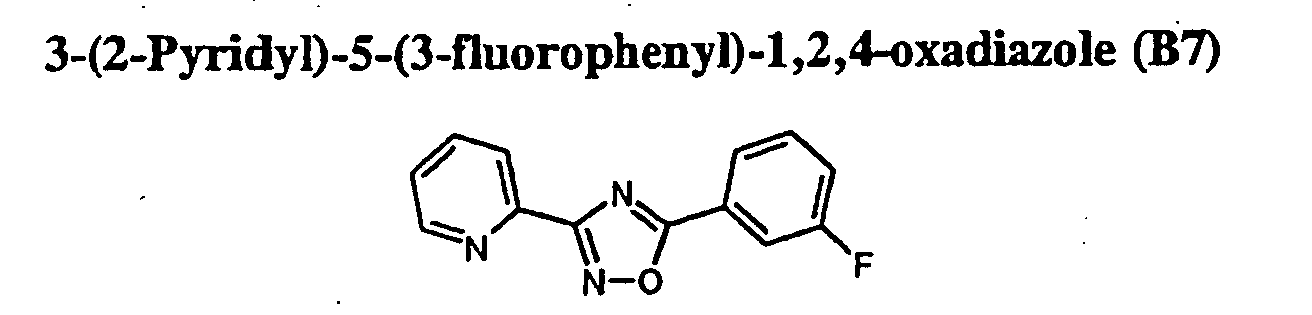
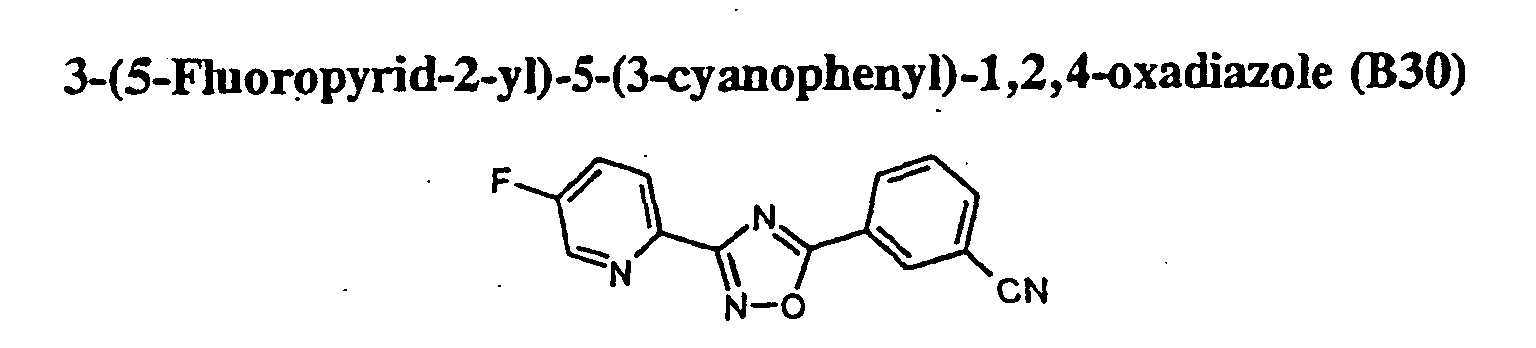
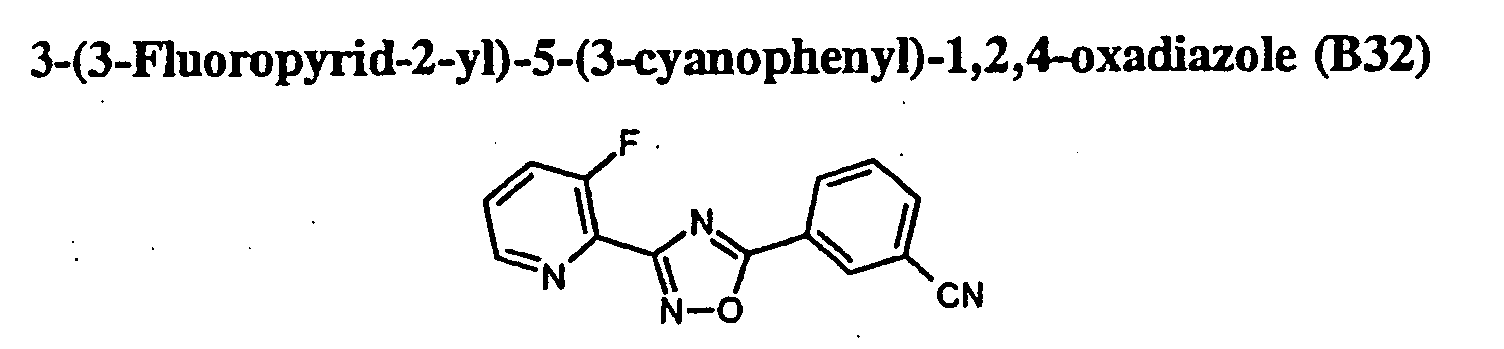
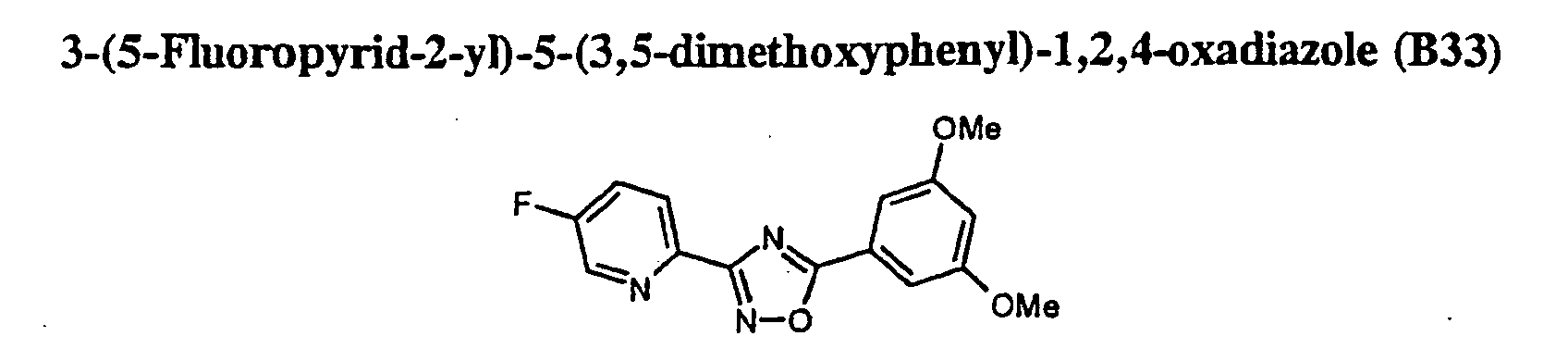
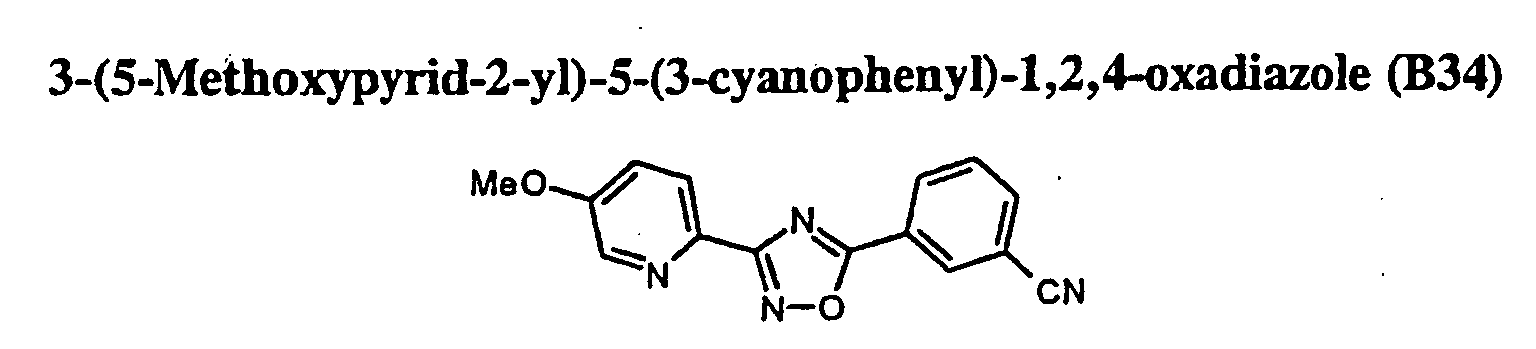
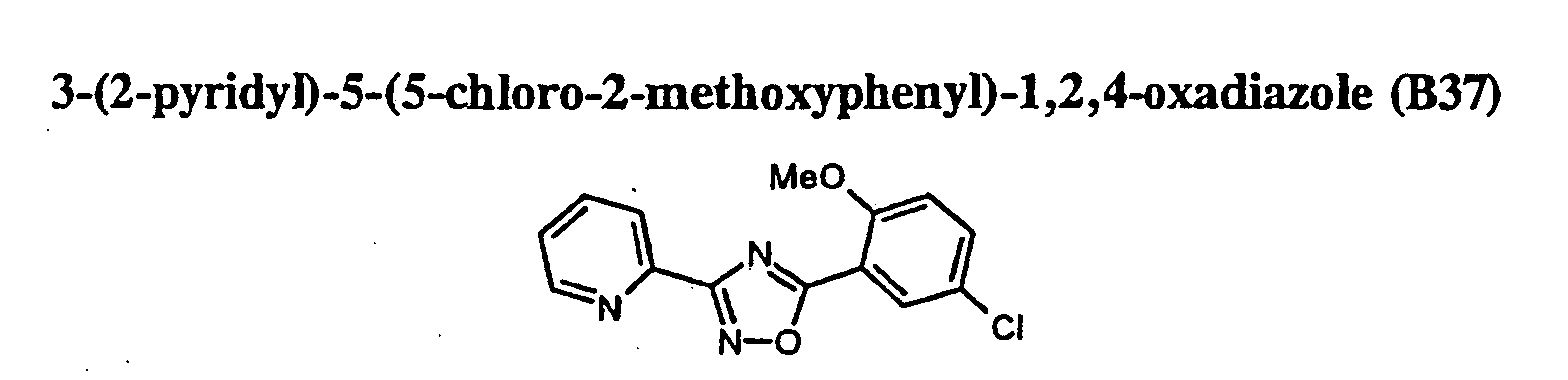
In a preferred embodiment of the invention, the compound is selected from the group consisting of 3-(2-pyridyl)-5-(3,5-dichlorophenyl)-1,2,4-oxadiazole, 3-(2-pyridyl)-5-(3-chlorophenyl)-1,2,4-oxadiazole, 3-(2-pyridyl)-5-(3-methoxyphenyl)-1,2,4-oxadiazole, 3-(2-pyridyl)-5-(2-chlorophenyl)-1,2,4-oxadiazole, 3-(2-pyridyl)-5-[3-(trifluoromethyl)phenyl]-1,2,4-oxadiazole, 3-(2-pyridyl)-5-(3-methylphenyl)-1,2,4-oxadiazole, 3-(2-pyridyl)-5-(1-naphthyl)-1,2,4-oxadiazole, 3-(2-pyridyl)-5-[3-(trifluoromethoxy)phenyl]-1,2,4-oxadiazole, 3-(2-pyridyl)-5-(2,3-difluorophenyl)-1,2,4-oxadiazole, 3-(2-pyridyl)-5-(2,5-difluorophenyl)-1,2,4-oxadiazole, 3-(2-pyridyl)-5-(3,5-difluorophenyl)-1,2,4-oxadiazole, 3-(2-pyridyl)-5-(3-cyanophenyl)-1,2,4-oxadiazole, 3-(2-pyridyl)-5-(3,5-dimethoxyphenyl)-1,2,4-oxadiazol, 3-(2-pyridyl)-5-(2,3-dichlorophenyl)-1,2,4-oxadiazole, 3-(2-pyridyl)-5-(3-chloro-5-cyanophenyl)-1,2,4-oxadiazole, 3-(2-pyridyl)-5-(3-fluoro-5-cyanophenyl)-1,2,4-oxadiazole, 3-(2-pyridyl)-5-(3-chloro-5-fluorophenyl)-1,2,4-oxadiazole, 3-(5-chloropyrid-2-yl)-5-(3-cyanophenyl)-1,2,4-oxadiazole, 3-(5-fluoropyrid-2-yl)-5-(3-cyanophenyl)-1,2,4-oxadiazole, 3-(5-fluoropyrid-2-yl)-5-(3-cyano-5-fluorophenyl)-1,2,4-oxadiazole, 3-(3-fluoropyrid-2-yl)-5-(3-cyanophenyl)-1,2,4-oxadiazole, 3-(5-fluoropyrid-2-yl)-5-(3,5-dimethoxyphenyl)-1,2,4-oxadiazole, 3-(5-methoxypyrid-2-yl)-5-(3-cyanophenyl)-1,2,4-oxadiazole, 3-(2-quinolinyl)-5-(3-cyanophenyl)-1,2,4-oxadiazole, 3-(3-chloro-5-trifluoromethylpyrid-2-yl)-5-(3-cyanophenyl)-1,2,4-oxadiazole, 3-(2-pyridyl)-5-(5-chloro-2-methoxyphenyl)-1,2,4-oxadiazole, 3-(2-pyridyl)-5-(2-chloro-5-methylthiophenyl)-1,2,4-oxadiazole, 3-(2-pyridyl)-5-(2-bromo-5-methoxyphenyl)-1,2,4-oxadiazole, 3-(2-pyridyl)-5-(2,5,6-trifluorophenyl)-1,2,4-oxadiaiole, 2-[3-chlorophenyl]-4-[pyridin-2-yl]-1,3-oxazole and 3-(2-pyridyl)-5-(2,5,6-trifluorophenyl)-1,2,4-oxadiazole, 3-(2-pyridyl)-5-(3-nitrophenyl)-1,2,4-oxadiazole, 3-(2-pyridyl)-5-(3-bromophenyl)-1,2,4-oxadiazole and pharmaceutically acceptable salts thereof.
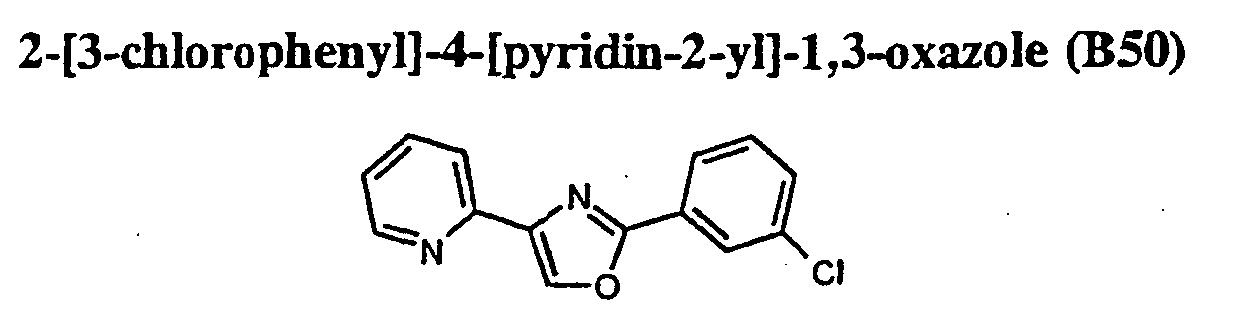
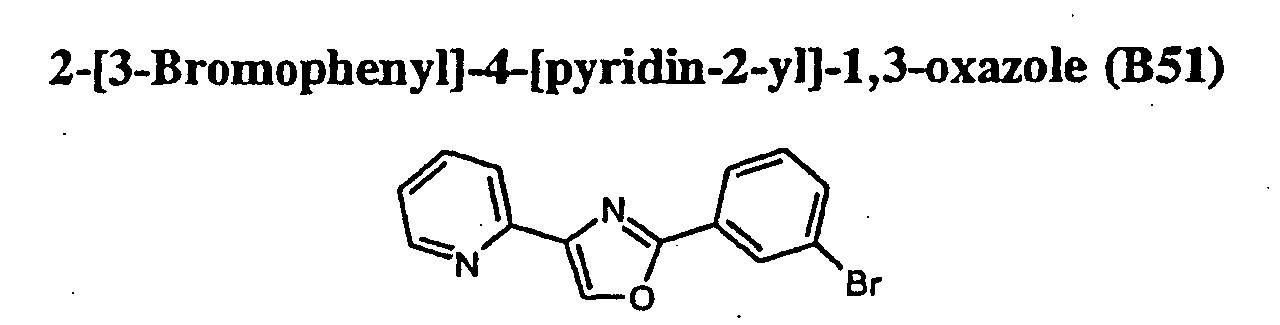
In another embodiment of the invention, the compound is selected from the group consisting of 2-(3,5-dichlorophenyl)-4-(2-pyridyl)-1,3-oxazole, 2-(3-chlorophenyl)-4-(2-pyridyl)-1,3-oxazole, 2-(3-methoxyphenyl)-4-(2-pyridyl)-1,3-oxazole, 2-(2-chlorophenyl)-4-(2-pyridyl)-1,3-oxazole, 2-(3-trifluorophenyl)-4-(2-pyridyl)-1,3-oxazole, 2-(3-methylphenyl)-4-(2-pyridyl)-1,3-oxazole, 2-(1-naphthyl)-4-(2-pyridyl)-1,3-oxazole, 2-(3-trifluoromethoxyphenyl)-4-(2-pyridyl)-1,3-oxazole, 2-(2,3-difluorophenyl)-4-(2-pyridyl)-1,3-oxazole, 2-(2,5-difluorophenyl)-4-(2-pyridyl)-1,3-oxazole, 2-(3,5-difluorophenyl)-4-(2-pyridyl)-1,3-oxazole, 2-(3-cyanophenyl)-4-(2-pyridyl)-1,3-oxazole, 2-(3,5-dimethoxyphenyl)-4-(2-pyridyl)-1,3-oxazole, 2-(2,3-dichlorophenyl)-4-(2-pyridyl)-1,3-oxazole, 2-(3-chloro-5-cyanophenyl)-4-(2-pyridyl)-1,3-oxazole, 2-(3-fluoro-5-cyanophenyl)-4-(2-pyridyl)-1,3-oxazole, 2-(3-chloro-5-fluorophenyl)-4-(2-pyridyl)-1,3-oxazole, 2-(3-cyanophenyl)-4-(5-chloropyrid-2-yl)-1,3-oxazole, 2-(3-cyanophenyl)-4-(5-fluoropyrid-2-yl)-1,3-oxazole, 2-(3-cyano-5-fluorophenyl)-4-(5-fluoropyrid-2-yl)-1,3-oxazole, 2-(3-cyanophenyl)-4-(3-fluoropyrid-2-yl)-1,3-oxazole, 2-(3,5-dimethoxyphenyl)-4-(5-fluoropyrid-2-yl)-1,3-oxazole, 2-(3-cyanophenyl)-4-(5-methoxypyrid-2-yl)-1,3-oxazole, 2-(3-cyanophenyl)-4-(2-quinolinyl)-1,3-oxazole, 2-(3-cyanophenyl)-4-(3-chloro-5-trifluoromethylpyrid-2-yl)-1,3-oxazole, 2-(5-chloro-2-methoxyphenyl)-4-(2-pyridyl)-1,3-oxazole, 2-(2-chloro-5-methylthiophenyl)-4-(2-pyridyl)-1,3-oxazole, 2-(2-bromo-5-methoxyphenyl)-4-(2-pyridyl)-1,3-oxazole, 2-(2,5,6-trifluorophenyl)-4-(2-pyridyl)-1,3-oxazole, 2-[3-chlorophenyl]-4-[pyridin-2-yl]-1,3-oxazole and 2-(2,5,6-trifluorophenyl)-4-(2-pyridyl)-1,3-oxazole, 2-(3-nitrophenyl)-4-(2-pyridyl-1,3-oxazole, 2-(3-bromophenyl)-4-(2-pyridyl)-1,3-oxazole and pharmaceutically acceptable salts thereof.
In accordance with another embodiment of the invention, there has been provided a pharmaceutical composition comprising a compound as set forth above in Formula I and formula II, together with a pharmaceutically acceptable diluent or excipient.
In accordance with still another embodiment of the invention, there has been provided a method of making a compound as set forth above. Specifically, compounds of the invention generally can be prepared by formation of the G moiety between two precursor compounds containing suitable Ar1 and Ar2 moieties. When the linker contains an 1,2,4-oxadiazole, the heterocycle may be formed using well known techniques, such as reaction between an amidoxime and an acid chloride, or by the reaction of an amidoxime and an acylimidazole. An illustration of such a transformation is provided in Examples 3 through 6, below.
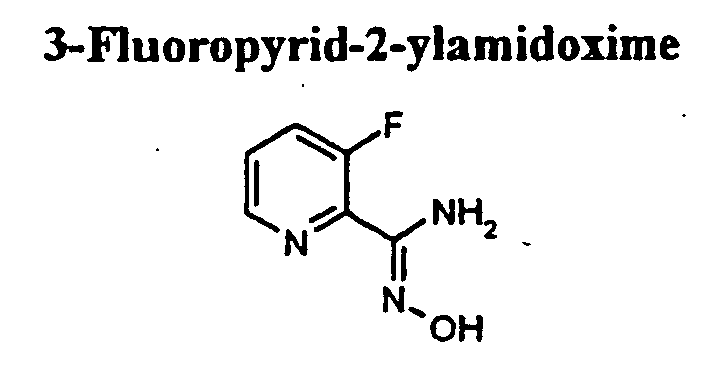
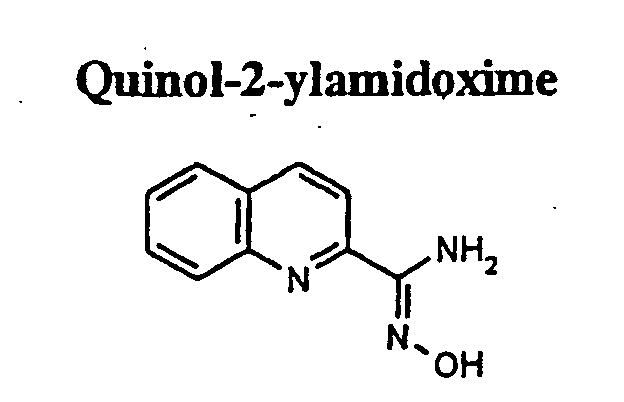
Amidoximes can be prepared using well known techniques by the reaction of an Ar1 substituted nitrile with hydroxylamine. An illustration of such a transformation is provided below in Example 1.
In most cases, the precursor Ar2 carbonyl chlorides are readily available, or may be prepared using straightforward techniques of organic chemistry. For example, carboxylic acids may be converted into the corresponding acid chlorides by reaction with, for example, thionyl chloride or oxalyl chloride.
In the case where the linker contains a 1,3-oxazole, compounds were prepared from the procedure similar to that given by Kelly et al., J. Org. Chem. 61, 4623-4633 (1996). 3,5-Disubstituted-1,3-Oxazoles were prepared by reacting a haloketone with carboxamide in refluxing toluene for 3 days. The resulting mixture was allowed to cool to room temperature, the solvent was removed and the residue was purified.
In accordance with a still further embodiment of the invention, there has been provided a method of inhibiting activation of an mGluR Group I receptor, specifically mGluR5, comprising treating a cell containing said mGluR Group I receptor with an effective amount of a compound as set forth above.
In yet another embodiment of the invention, there has been provided a method of inhibiting neuronal damage caused by excitatory activation of an mGluR Group I receptor, comprising treating neurons with an effective amount of a compound as set forth above.
In accordance with a further embodiment of the invention, there has been provided a method of treating a disease or disorder associated with glutamate-induced neuronal damage, or a method of treating a disease or disorder associated with Group I mGluR activation or amenable to therapeutic intervention with a mGluR Group I antagonist, comprising administering to a patient suffering from said disease or disorder an effective amount of a composition as set forth above, wherein said disease or disorder is selected from the group consisting of as senile dementia, Parkinson's disease, Alzheimer's disease, Huntington's Chorea, pain, migraine headaches, epilepsy, head trauma, anoxic and ischemic injuries, psychiatric disorders such as schizophrenia, depression, anxiety, diabetic retinopathies, glaucoma, tinnitus, diabetic neuropathies, chemotherapy induced neuropathies, post-herpetic neuralgia, and trigeminal neuralgia.
Other objects, features and advantages of the present invention will become apparent from the following detailed description. It should be understood, however, that the detailed description and the specific examples, while indicating preferred embodiments of the invention, are given by way of illustration only, since various changes and modifications within the spirit and scope of the invention will become apparent to those skilled in the art from this detailed description.
BRIEF DESCRIPTION OF THE DRAWINGS
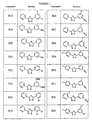
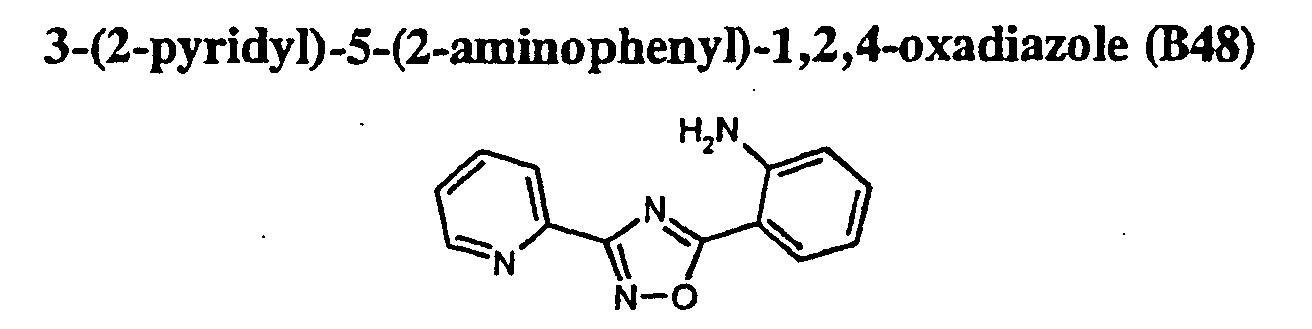
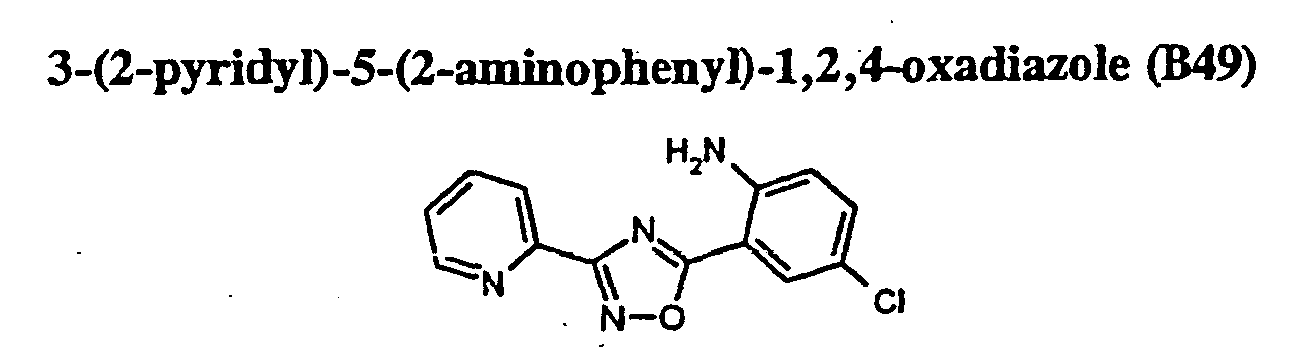
  • Figure 1 shows illustrative compounds of the invention.
  • DETAILED DESCRIPTION OF THE INVENTION
    The present invention provides compounds that are potent and selective antagonists of mGluR5. The compounds contemplated by the invention can be represented by the general formula I: Ar1-G-Ar2 where Ar1 is an optionally substituted heterocyclic moiety and Ar2 is an optionally substituted carbocyclic moiety. The G moiety is a group that not only covalently binds to the Ar1 and Ar2 moieties and facilitates adoption of the correct spatial orientation of Ar1 and-Ar2, but may itself interact with the protein to allow receptor binding.
    Structure of the Ar 1 and Ar 2 moieties
    The Ar1 moiety is generally defined as a heterocyclic moiety, and the Ar2 moiety is generally defined as a carbocylic moiety. Ar1 and Ar2 can be monocyclic or fused bicyclic groups. Ar2 is preferably defined as an aryl or alkaryl moiety. Ar1 is preferably defined as a heterocyclic, heteroaryl or heteroarylalkyl moiety. The ring systems encompassed by Ar1 can contain up to four heteroatoms, independently selected from the group consisting of N, S, and O. When Ar1 is a heteroaryl ring or ring system, it preferably contains one or two heteroatoms. At least one of the heteroatoms preferably is nitrogen (N). The heterocyclic or fused heterocylic moiety preferably is selected from the group consisting of quinolyl, quinazolyl, quinoxalyl, 2-pyrimidyl, 4-pyrimidyl, 5-pyrimidyl, 2-pyridyl, 3-pyridyl, 4-pyridyl, and pyrazyl.
    Monocyclic Ar1 groups include, but are not limited to: thiazoyl, furyl, pyranyl, 2H-pyrrolyl, thienyl, pyrroyl, imidazoyl, pyrazoyl, pyridyl, pyrazinyl, pyrimidinyl, and pyridazinyl moieties. Monocyclic Ar2 group include but are not limited to phenyl and benzyl. Fused bicyclic Ar2 include, but are not limited to, naphthyl, fluorenyl, anthrenyl, indenyl, phenanthrenyl, and benzonaphthenyl. Fused bicyclic Ar1 groups include, but are not limited to: benzothiazole, benzimidazole, 3H-indolyl, indolyl, indazoyl, purinyl, quinolizinyl, isoquinolyl, quinolyl, phthalizinyl, naphthyridinyl, quinazolinyl, cinnolinyl, isothiazolyl, quinoxalinyl indolizinyl, isoindolyl, benzothienyl, benzofuranyl, isobenzofuranyl, and chromenyl moieties. Ar1 preferably is a 2-pyridyl moiety. Ar2 preferably is a substituted phenyl moiety.
    The Ar1 and Ar2 moieties optionally may independently be substituted with one or more moieties selected from the group consisting of halogen, C1-C3 alkyl, C1-C3 O-alkyl, -OH, -OCF3, -COOR, -COR, -SOR, -SO2NRR', -NRR', -CN, -CF3, -CO-NRR', -A-(CH2)n-NRR', wherein A is C, O, N, SO, SO2, and R and R' are independently selected from the group consisting of C1-C3 alkyl, H , cycloalkyl, heterocycloalkyl, aryl, and n is 1, 2, 3, or 4.
    Structure of the G moiety
    The G moiety is generally made up of 1-14 atoms. G can be independently selected from the group of atoms: C, H, N, O, and S.
    The G moiety can thus be made of a non-cyclic moiety. Several examples of these are -NH- (amine), -S- (thioether), -O- (ether), -CO- (ketone), -CONH- (amide), - CONHCH2-, -CH2CONH-, -CNHNH- (amidine), -CNHNHCH2-, -C=NO-CH2-(methoxime), -CH2NHCH2-, -CH2CH2NH-, -NHCH2CO-, -NHCH2CHOH-, -NHCNHNH.- (guanidine), and -NHCONH- (urea), for example.
    The atomic arrangement in the G moiety can also be made to form a five-membered ring. Several examples of these are cyclopentane, cyclopentadiene, furan, thiofuran, pyrrolidine, pyrrole, 2-imidazoline, 3-imidazoline, 4-imidazoline, imidazole, pyrazoline, pyrazolidine, imidazolidine, oxazole, 2-oxazole, thiazole, isoxazole, isothiazole, 1H-1,2,4-triazole, 1H-1,2,3-triazole, 1,2,4-oxathiazole, 1,3,4-oxathiazole, 1,4,2-dioxazole, 1,4,2-oxathiazole, 1,2,4-oxadiazole, 1,2,4-thiadiazole, 1,2,5-oxadiazole, 1,2,5-thiadiazole, 1,3,4-oxadiazole, 1,3,4-thiadiazole, and 1H-tetrazole, for example. The 1,2,4-oxadiazole is most preferred.
    The atomic arrangement in the G moiety can also be made to form a six-membered ring. Several examples of these are cyclohexane, piperidine, tetrahydropyridine, 1,4-dihydropyridine, pyridine, benzene, tetrahydropyran, 3,4-dihydro-2H-pyran, 2H-pyran, 4H-pyran, tetrahydrothiopyran, 3,4-dihydro-2H-thiopyran, 2H-thiin, 4H-thiopyran, morpholine, thiomorpholine, piperazine, pyridazine, pyrimidine, pyrazine, 1,2,4-triazine, 1,2,3-triazine, 1,3,5-triazine, and 1,2,4,5-tetrazine, for example.
    The atomic arrangement in the G moiety can also be made to form a five- or six-membered ring containing one or more carbonyl groups. Several examples of these are 2-azetidinone, 1,2-diazetidin-3-one, cyclopentanone, 2-cyclopentenone, 2-pyrrolidinone, 3-pyrrolin-2-one, succinimide, maleimide, 3-pyrazolidinone, 2-imidazolidone, 4-imidazolin-2-one, 2H-imidazol-2-one, 4-imidazolinone, 3-pyrazolin-5-one, hydantoin, 1H-imidazole-2,5-dione, 2-oxazoline-4-one, 2-oxazolidinone, 3-oxazolin-5-one, 3(2H)-isoxazolone, 2,4-oxazolidinedione, 1,2,4-triazoline-3,5-dione, 2,4-dihydro-3H-1,2,4-triazol-3-one, 2H-pyran-2-one, 2(1H)-pyridone, 2(1H)-pyrazinone, 4(3H)-pyrimidone, 3,4-dihydropyrimidin-4-one, glutarimide, 4,6-(1H,5H)-pyrimidinedione, 1,3,5-triazin-2(1H)-one, and cyanuric acid, for example.
    In a preferred embodiment, G comprises a heterocyclic 5-membered ring system.-Preferably, G is an oxazole or an 1,2,4-oxadiazole ring. The G moiety may have either one of two-possible orientations with respect to the Ar1 and Ar2 groups. Thus, for example, the invention prefers compounds having the configuration 4-(Ar1)-2-(Ar2)-oxazole or 3-(Ar1)-5-(Ar2)-1,2,4-oxadiazole.
    In yet another embodiment, compounds of the present invention can be represented by formula II:
    Figure 00130001
    wherein X, Y, and Z are independently selected from the group consisting of N, O, S, C, and CO wherein at least one of X, Y, and Z is a heteroatom;
    Ar1 and Ar2 are independently selected from the group consisting of a heterocyclic or fused heterocyclic moiety containing 1 to 4 heteroatoms selected from the group consisting of N, O, and S and an aromatic moiety selected from the group consisting of phenyl, benzyl, 1-naphthyl, 2-naphthyl, fluorenyl, anthrenyl, indenyl, phenanthrenyl, and benzonaphthenyl, wherein the Ar1 and Ar2 moieties are optionally substituted with one or more moieties selected from the group consisting of -F, -Cl, -Br, -I, -OR, -SR, -SOR, -SO2R, -SO2NRR', -OCOR, -OCONRR', -NRCOR', -NRCO2R', -CN, -NO2, -CO2R, -CONRR', -C(O)R, - CH(OR)R', -CH2(OR), -R, and -A-(CH2)n-NRR'; wherein R or R' is selected from the group consisting of H, CF3, C1-C10 alkyl, cycloalkyl' alkyl-aryl, alkyl-heteroaryl, heterocycloalkyl, aryl and where R and R' may combine to form a ring, and A is defined as CH2, O, NH, S, SO, SO2 and n is 1, 2, 3, or 4.
    In a preferred embodiment of the invention, the compound is selected from the group consisting of 3-(2-pyridyl)-5-(3,5-dichlorophenyl)-1,2,4-oxadiazole, 3-(2-pyridyl)-5-(3-chlorophenyl)-1,2,4-oxadiazole, 3-(2-pyridyl)-5-(3-methoxyphenyl)-1,2,4-oxadiazole, 3-(2-pyridyl)-5-(2-chlorophenyl)-1,2,4-oxadiazole, 3-(2-pyridyl)-5-[3-(trifluoromethyl)phenyl]-1,2,4-oxadiazole, 3-(2-pyridyl)-5-(3-methylphenyl)-1,2,4-oxadiazole, 3-(2-pyridyl)-5-(1-naphthyl)-1,2,4-oxadiazole, 3-(2-pyridyl)-5-[3-(trifluoromethoxy)phenyl]-1,2,4-oxadiazole, 3-(2-pyridyl)-5-(2,3-difluorophenyl)-1,2,4-oxadiazole, 3-(2-pyridyl)-5-(2,5-difluorophenyl)-1,2,4-oxadiazole, 3-(2-pyridyl)-5-(3,5-difluorophenyl)-1,2,4-oxadiazole, 3-(2-pyridyl)-5-(3-cyanophenyl)-1,2,4-oxadiazole, 3-(2-pyridyl)-5-(3,5-dimethoxyphenyl)-1,2,4-oxadiazol, 3-(2-pyridyl)-5-(2,3-dichlorophenyl)- - 1,2,4-oxadiazole, 3-(2-pyridyl)-5-(3-chloro-5-cyanophenyl)-1,2,4-oxadiazole, 3-(2-pyridyl)-5-(3-fluoro-5-cyanophenyl)-1,2,4-oxadiazole, 3-(2-pyridyl)-5-(3-chloro-5-fluorophenyl)-1,2,4-oxadiazole, 3-(5-chloropyrid-2-yl)-5-(3-cyanophenyl)-1,2,4-oxadiazole, 3-(5-fluoropyrid-2-yl)-5-(3-cyanophenyl)-1,2,4-oxadiazole, 3-(5-fluoropyrid-2-yl)-5-(3-cyano-5-fluorophenyl)-1,2,4-oxadiazole, 3-(3-fluoropyrid-2-yl)-5-(3-cyanophenyl)-1,2,4-oxadiazole, 3-(5-fluoropyrid-2-yl)-5-(3,5-dimethoxyphenyl)-1,2,4-oxadiazole, 3-(5-methoxypyrid-2-yl)-5-(3-cyanophenyl)-1,2,4-oxadiazole, 3-(2-quinolinyl)-5-(3-cyanophenyl)-1,2,4-oxadiazole, 3-(3-chloro-5-trifluoromethylpyrid-2-yl)-5-(3-cyanophenyl)-1,2,4-oxadiazole, 3-(2-pyridyl)-5-(5-chloro-2-methoxyphenyl)-1,2,4-oxadiazole, 3-(2-pyridyl)-5-(2-chloro-5-methylthiophenyl)-1,2,4-oxadiazole, 3-(2-pyridyl)-5-(2-bromo-5-methoxyphenyl)-1,2,4-oxadiazole, 3-(2-pyridyl)-5-(2,5,6-trifluorophenyl)-1,2,4-oxadiazole, 2-[3-chlorophenyl]-4-[pyridin-2-yl]-1,3-oxazole and 3-(2-pyridyl)-5-(2,5,6-trifluorophenyl)-1,2,4-oxadiazole, 3-(2-pyridyl)-5-(3-nitrophenyl)-1,2,4-oxadiazole, 3-(2-pyridyl)-5-(3-bromophenyl)-1,2,4-oxadiazole and pharmaceutically acceptable salts thereof.
    In another embodiment of the invention, the compound is selected from the group consisting of 2-(3,5-dichlorophenyl)-4-(2-pyridyl)-1,3-oxazole, 2-(3-chlorophenyl)-4-(2-pyridyl)-1,3-oxazole, 2-(3-methoxyphenyl)-4-(2-pyridyl)-1,3-oxazole, 2-(2-chlorophenyl)-4-(2-pyridyl)-1,3-oxazole, 2-(3-trifluorophenyl)-4-(2-pyridyl)-1,3-oxazole, 2-(3-methylphenyl)-4-(2-pyridyl)-1,3-oxazole, 2-(1-naphthyl)-4-(2-pyridyl)-1,3-oxazole, 2-(3-trifluoromethoxyphenyl)-4-(2-pyridyl)-1,3-oxazole, 2-(2,3-difluorophenyl)-4-(2-pyridyl)-1,3-oxazole, 2-(2,5-difluorophenyl)-4-(2-pyridyl)-1,3-oxazole, 2-(3,5-difluorophenyl)-4-(2-pyridyl)-1,3-oxazole, 2-(3-cyanophenyl)-4-(2-pyridyl)-1,3-oxazole, 2-(3,5-dimethoxyphenyl)-4-(2-pyridyl)-1,3-oxazole, 2-(2,3-dichlorophenyl)-4-(2-pyridyl)-1,3-oxazole, 2-(3-chloro-5-cyanophenyl)-4-(2-pyridyl)-1,3-oxazole, 2-(3-fluoro-5-cyanophenyl)-4-(2-pyridyl)-1,3-oxazole, 2-(3-chloro-5-fluorophenyl)-4-(2-pyridyl)-1,3-oxazole, 2-(3-cyanophenyl)-4-(5-chloropyrid-2-yl)-1,3-oxazole, 2-(3-cyanophenyl)-4-(5-fluoropyrid-2-yl)-1,3-oxazole, 2-(3-cyano-5-fluorophenyl)-4-(5-fluoropyrid-2-yl)-1,3-oxazole, 2-(3-cyanophenyl)-4-(3-fluoropyrid-2-yl)-1,3-oxazole, 2-(3,5-dimethoxyphenyl)-4-(5-fluoropyrid-2-yl)-1,3-oxazole, 2-(3-cyanophenyl)-4-(5-methoxypyrid-2-yl)-1,3-oxazole, 2-(3-cyanophenyl)-4-(2-quinolinyl)-1,3-oxazole, 2-(3-cyanophenyl)-4-(3-chloro-5-trifluoromethylpyrid-2-yl)-1,3-oxazole, 2-(5-chloro-2-methoxyphenyl)-4-(2-pyridyl)-1,3-oxazole, 2-(2-chloro-5-methylthiophenyl)-4-(2-pyridyl)-1,3-oxazole, 2-(2-bromo-5-methoxyphenyl)-4-(2-pyridyl)-1,3-oxazole, 2-(2,5,6-trifluorophenyl)-4-(2-pyridyl)-1,3-oxazole, 2-[3-chlorophenyl]-4-[pyridin-2-yl]-1,3-oxazole and 2-(2,5,6-trifluorophenyl)-4-(2-pyridyl)-1,3-oxazole, 2-(3-nitrophenyl)-4-(2-pyridyl-1,3-oxazole, 2-(3-bromophenyl)-4-(2-pyridyl)-1,3-oxazole and pharmaceutically acceptable salts thereof.
    Preparation of mGluR Group I antagonists
    Many starting materials for preparing the compounds of the present invention are available from commercial sources, such as Aldrich Chemical Company (Milwaukee, WI). Moreover, compounds of the invention are readily prepared, from available precursors, using straightforward transformations which are well known in the art. The skilled artisan will recognize that mGluR Group I antagonists, according to the invention, can be prepared via methodology that is well known, using widely recognized techniques of organic chemistry. Suitable reactions are described in standard textbooks of organic chemistry. For example, see March, ADVANCED ORGANIC CHEMISTRY, 2d ed., McGraw Hill (1977).
    More specifically, compounds of the invention generally can be prepared by formation of the G moiety between two precursor compounds containing suitable Ar1 and Ar2 moieties. When the linker contains a 1,2,4-oxadiazole, the heterocycle may be formed using well known techniques, such as reaction between an amidoxime and an acid chloride, or by the reaction of an amidoxime and an acylimidazole. An illustration of such a transformation is provided in Examples 3 through 6, below.
    Amidoximes can be prepared using well known techniques by the reaction of an Ar1 substituted nitrile with hydroxylamine. An illustration of such a transformation is provided below in Example 1.
    In most cases, the precursor Ar2 acid chlorides are readily available, or may be prepared using straightforward techniques of organic chemistry. For example, carboxylic acids may be converted into the corresponding acid chlorides by reaction with, for example, thionyl chloride or oxalyl chloride.
    In the case where the linker contains a 1,3-oxazole, compounds were prepared using a procedure similar to that given by Kelly et al., J. Org. Chem. 61, 4623-4633 (1996). Thus, 3,5-Disubstituted-1,3-Oxazoles were prepared by mixing a haloketone with carboxamide in refluxing toluene for 3 days. The resulting mixture was allowed to cool to room temperature, the solvent was removed and the residue was purified.
    Testing of compounds for mGluR Group I antagonist activity
    The pharmacological properties of the compounds of the invention can be analyzed using standard assays for functional activity. Examples of glutamate receptor assays are well known in the art, for example, see Aramori et al., Neuron 8:757 (1992); Tanabe et al., Neuron 8:169 (1992); Miller et al., J. Neuroscience 15: 6103 (1995); Balazs, et al., J. Neurochemistry 69:151 (1997). The methodology described in those publications is incorporated herein by reference.
    Conveniently, the compounds of the invention can be studied by means of an assay that measures the mobilization intracellular calcium, [Ca2+]i in cells expressing mGluR5 that can bind the compounds. A well-known cell line which is suitable for this purpose is described in Miller et al., J. Neuroscience 15: 6103 (1995), the contents of which are hereby incorporated by reference. It has been shown that exposure of rat astrocytes to the growth factors basic fibroblast growth factor, EGF, or transforming growth factor-α markedly increased the protein expression and functional activity of endogenous mGluR5 (Miller et al., J. Neuroscience, 15(9): 6103-6109, 1995).
    In brief, primary astrocyte cultures were prepared from 3-5 day old Sprague-Dawley rat pups using a modification of Miller et al. and were plated on poly-L lysine coated flasks in Dulbecco's modified Eagle's medium (DMEM) containing fetal calf serum (FCS). For cuvette analysis, cultures were up-regulated with growth factors in flasks for 3-5 days, then harvested and prepared for measurement of [Ca2+]i mobilization as previously described (Nemeth et al., 1998).
    For fluorescent imaging plate reader (FLIPR) analysis, cells were seeded on poly-D lysine coated clear bottom 96-well plates with black sides and analysis of [Ca2+]i mobilization was performed 3 days following the growth factor up-regulation.
    FLIPR experiments were carried out using a laser setting of 0.800 W and a 0.4 second CCD camera shutter speed. Each FLIPR experiment was initiated with 180 µL of buffer present in each well of the cell plate. After each addition of compound, the fluorescence signal was sampled 50 times at 1 second intervals followed by 3 samples at 5 second intervals. Responses were measured as the peak height of the response within the sample period.
    EC50 and IC50 determinations were made from data obtained from 8 point concentration response curves (CRC) performed in duplicate. Agonist CRC were generated by scaling all responses to the maximal response observed for the plate. Antagonist block of the agonist challenge was normalized to the average response of the agonist challenge in 14 control wells on the same plate. A detailed protocol for testing the compounds of the invention is provided below at Example 4.
    Preparation of pharmaceutical compositions containing mGluR antagonists, and their use in treating neurological disorders
    The compounds of the present invention are useful for treating neurological disorders or diseases. While these compounds typically will be used in therapy for human patients, they also can be used in veterinary medicine, to treat similar or identical diseases.
    In therapeutic and/or diagnostic applications, the compounds of the invention can be formulated for a variety of modes of administration, including systemic and topical or localized administration. Techniques and formulations generally may be found in REMINGTON'S PHARMACEUTICAL SCIENCES (18th ed.), Mack Publishing Co. (1990).
    The compounds according to the invention are effective over a wide dosage range. For example, in the treatment of adult humans, dosages from about 0.01 to about 1000 mg per 60-70 kg adult, preferably from about 0.5 to about 100 mg per 60-70 kg adult, per [day] dose may be used. A more preferable dosage is about 2 mg to about 70 mg per 60-70 kg adult per [day] dose. The exact dosage will depend upon the route of administration, the form in which the compound is administered, the subject to be treated, the body weight of the subject to be treated, and the preference and experience of the attending physician.
    Pharmaceutically acceptable salts are generally well known to those of ordinary skill in the art, and may include, by way of example but not limitation, acetate, benzenesulfonate, besylate, benzoate, bicarbonate, bitartrate, bromide, calcium edetate, camsylate, carbonate, citrate, edetate, edisylate, estolate, esylate, fumarate, gluceptate, gluconate, glutamate, glycollylarsanilate, hexylresorcinate, hydrabamine, hydrobromide, hydrochloride, hydroxynaphthoate, iodide, isethionate, lactate, lactobionate, malate, maleate, mandelate, mesylate, mucate, napsylate, nitrate, pamoate (embonate), pantothenate, phosphate/disphosphate, polygalacturonate, salicylate, stearate, subacetate, succinate, sulfate, tannate, tartrate, or teoclate. Other pharmaceutically acceptable salts may be found, for example, in REMINGTON'S PHARMACEUTICAL SCIENCES (18th ed.), supra.
    Preferred pharmaceutically acceptable salts include, for example, acetate, benzoate, bromide, carbonate, citrate, gluconate, hydrobromide, hydrochloride, maleate, mesylate, napsylate, pamoate (embonate), phosphate, salicylate, succinate, sulfate, or tartrate.
    Depending on the specific conditions being treated, such agents may be formulated into liquid or solid dosage forms and administered systemically or locally. The agents may be delivered, for example, in a timed- or sustained-release form as is known to those skilled in the art. Techniques for formulation and administration may be found in REMINGTON'S PHARMACEUTICAL SCIENCES; (18th ed.), supra. Suitable routes may include oral, buccal, sublingual, rectal, transdermal, vaginal, transmucosal, nasal or intestinal administration; parenteral delivery, including intramuscular, subcutaneous, intramedullary injections, as well as intrathecal, direct intraventricular, intravenous, intraperitoneal, intranasal, or intraocular injections, inter alia.
    For injection, the agents of the invention may be formulated in aqueous solutions, preferably in physiologically compatible buffers such as Hank's solution, Ringer's solution, or physiological saline buffer. For transmucosal administration, penetrants appropriate to the barrier to be permeated are used in the formulation. Such penetrants generally are known in the art.
    Use of pharmaceutically acceptable carriers to formulate the compounds herein disclosed for the practice of the invention into dosages suitable for systemic administration is within the scope of the invention. With proper choice of carrier and suitable manufacturing practice, the compositions of the present invention, in particular, those formulated as solutions, may be administered parenterally, such as by intravenous injection. The compounds can be formulated readily using pharmaceutically acceptable carriers well known in the art into dosages suitable for oral administration. Such carriers enable the compounds of the invention to be formulated as tablets, pills, capsules, liquids, gels, syrups, slurries, suspensions and the like, for oral ingestion by a patient to be treated.
    Pharmaceutical compositions suitable for use in the present invention include compositions wherein the active ingredients are contained in an effective amount to achieve its intended purpose. Determination of the effective amounts is well within the capability of those skilled in the art, especially in light of the detailed disclosure provided herein.
    In addition to the active ingredients, these pharmaceutical compositions may contain suitable pharmaceutically acceptable carriers comprising excipients and auxiliaries which facilitate processing of the active compounds into preparations which can be used pharmaceutically. The preparations formulated for oral administration may be in the form of tablets, dragees, capsules, or solutions.
    Pharmaceutical preparations for oral use can be obtained by combining the active compounds with solid excipients, optionally grinding a resulting mixture, and processing the mixture of granules, after adding suitable auxiliaries, if desired, to obtain tablets or dragee cores. Suitable excipients are, in particular, fillers such as sugars, including lactose, sucrose, mannitol, or sorbitol; cellulose preparations, for example, maize starch, wheat starch, rice starch, potato starch, gelatin, gum tragacanth, methyl cellulose, hydroxypropylmethyl-cellulose, sodium carboxymethyl-cellulose (CMC), and/or polyvinylpyrrolidone (PVP: povidone). If desired, disintegrating agents may be added, such as the cross-linked polyvinylpyrrolidone, agar, or alginic acid or a salt thereof such as sodium alginate.
    Dragee cores are provided with suitable coatings. For this purpose, concentrated sugar solutions may be used, which may optionally contain gum arabic, talc, polyvinylpyrrolidone, carbopol gel, polyethylene glycol (PEG), and/or titanium dioxide, lacquer solutions, and suitable organic solvents or solvent mixtures. Dye-stuffs or pigments may be added to the tablets or dragee coatings for identification or to characterize different combinations of active compound doses.
    Pharmaceutical preparations which can be used orally include push-fit capsules made of gelatin, as well as soft, sealed capsules made of gelatin, and a plasticizer, such as glycerol or sorbitol. The push-fit capsules can contain the active ingredients in admixture with filler such as lactose, binders such as starches, and/or lubricants such as talc or magnesium stearate and, optionally, stabilizers. In soft capsules, the active compounds may be dissolved or suspended in suitable liquids, such as fatty oils, liquid paraffin, or liquid polyethylene glycols (PEGs). In addition, stabilizers may be added.
    The present invention, thus generally described, will be understood more readily by reference to the following examples, which are provided by way of illustration and are not intended to be limiting of the present invention.
    EXAMPLES General Experimental Methods
    Capillary gas chromatographic and mass spectral data were obtained using a Hewlett-Packard (HP) 5890 Series II Gas Chromatograph coupled to an HP 5971 Series Mass Selective Detector [Ultra-2 Ultra Performance Capillary Column (crosslinked 5% PhMe silicone); column length, 25 m; column i.d., 0.20 mm; helium flow rate, 60 mL/min; injector temp., 250 °C; temperature program, 20 °C/min from 125 to 325 °C for 10 min, then held constant at 325 °C for 6 min]. Thin-layer chromatography was performed using Analtech Uniplate 250-µm silica gel HF TLC plates. UV light sometimes in conjunction with ninhydrin and Dragendorff's spray reagents (Sigma Chemical Co.) were used for detecting compounds on the TLC plates. Most reagents used in reactions were purchased from the Aldrich Chemical Co. (Milwaukee, WI), Sigma Chemical Co. (Saint Louis, MO), Fluka Chemical Corp. (Milwaukee, WI), Fisher Scientific (Pittsburgh, PA), TCI America (Portland, OR), or Lancaster Synthesis (Windham, NH).
    Example 1: Synthesis of amidoxime intermediates
    Figure 00200001
    Using the procedure of Shine et al., J. Heterocyclic Chem. (1989) 26:125-128, hydroxylamine hydrochloride (7.65 g, 110 mmol) in ethanol (100 mL) was treated with a solution of sodium hydroxide (11 mL of 10 N, 110 mmol). A precipitate quickly formed and the reaction mixture was stirred at ambient temperature for 30 min. The inorganic precipitate was filtered and rinsed with ethanol (100 mL). The filtrate and ethanol washings were combined and treated with 2-cyanopyridine (10.4 g, 100 mmol). The reaction mixture was heated at reflux for 20 hours. The volatiles were then removed in vacuo to afford 13.3 g (97%) of pyrid-2-ylamidoxime.
    Figure 00210001
    Using the general procedure for the synthesis of amidoximes, hydroxylamine hydrochloride (7.65 g, 110 mmol), sodium hydroxide (11 mL of 10 N, 110 mmol), and 3-methoxybenzylnitrile (12.2 mL, 100 mmol) afforded 9.9 g (60%) of 3-methoxybenzamidoxime.
    Figure 00210002
    A mixture of 2,5-dichloropyridine (1.48 g, 10 mmol), zinc cyanide (705 mg, 6 mmol), zinc (dust, 29 mg, 0.45 mmol), [1,1'-bis(diphenylphosphino)ferrocene] dichloropalladium(II), complex with dichloromethane (1:1) (0.18 g, 0.22 mmol) in N,N-dimethylformamide (10 mL) was heated at reflux for 5 hours. After cooling, the reaction was diluted with ethyl acetate and extracted with water and brine. Silica gel chromatography afforded 735 mg (53 %) of 2-cyano-5-chloropyridine.
    Using the general procedure for the synthesis of amidoximes, 2-cyano-5-chloropyridine (735 mg, 5.3 mmol), a solution of hydroxylamine hydrochloride (1.2 mL of 5 M, 6 mmol) in ethanol (7 mL), and sodium hydroxide (0.61 mL of 10 N, 6.1 mmol), were heated at reflux for 24 hours. Standard work up afforded 707 mg (77%) of 5-chloropyrid-2-ylamidoxime.
    Figure 00210003
    A mixture of 2-cyano-5-chloropyridine (1 g, 7.22 mmol) and potassium fluoride (1.26 g, 21.68 mmol) in 1-methyl-2-pyrrolidinone (25 mL) was heated at reflux 18 hours. After cooling, the reaction was diluted with ethyl acetate and extracted with water and brine. The organic solvents were then removed in vacuo. Silica gel chromatography of the residue afforded 425 mg (48 %) of 2-cyano-5-fluoropyridine.
    Using the general procedure for the synthesis of amidoximes, 2-cyano-5-fluoropyridine (425 mg, 3.48 mmol), a solution of hydroxylamine hydrochloride (0.79 ml of 5 M, 3.95 mmol) in ethanol (5 mL), and sodium hydroxide (0.398 mL of 10 N, 3.98 mmol) were heated at reflux for 24 hours. Standard work up afforded 330 mg (61%) of 5-fluoropyrid-2-ylamidoxime.
    Figure 00220001
    A solution of 2-cyano-5-fluoropyridine (0.65 g, 5.3 mmol) in sodium methoxide (1.83 mL of 25% wt. solution in methanol, 7.95 mmol) was stirred at 0 °C for 1.5 hours and 2 hours at ambient temperature. The reaction was then diluted with ethyl acetate and washed with water and brine. Removal of the solvent in vacuo afforded 304 mg (43%) of 2-cyano-5-methoxypyridine.
    Using the general procedure for the synthesis of amidoximes, 2-cyano-5-methoxypyridine (270 mg, 2.01 mmol), a solution of hydroxylamine hydrochloride (0.457 ml of 5 M, 2.28 mmol) in ethanol (4 mL), and sodium hydroxide (0.230 mL of 10 N, 2.30 mmol) were heated at reflux for 24 hours. Standard work up afforded 79 mg (24%) of 5-methoxypyrid-2-ylamidoxime.
    Figure 00220002
    A mixture of 2,3-dichloropyridine (1.48 g, 10 mmol), zinc cyanide (705 mg, 6 mmol,), zinc (dust, 29 mg, 0.45 mmol), [1,1'-bis(diphenylphosphino)ferrocene] dichloropalladium(II), complex with dichlorometharie (1:1) (0.18 g, 0.22 mol) in N,N-dimethylformamide (10 mL) was heated at reflux for 5 hours. After cooling, the reaction was diluted with ethyl acetate and extracted with water and brine. Removal of the solvent and silica gel chromatography afforded 1.05 g (76%) of 2-cyano-3-chloropyridine.
    A solution of 2-cyano-3-chloropyridine (1 g, 7.22 mmol) in 1-methyl-2-pyrrolidinone (25 mL) was treated with potassium fluoride (1.26 g, 21.68 mmol) and heated at reflux for 18 hours. After cooling, the reaction was diluted with ethyl acetate and extracted with water and brine. Silica gel chromatography afforded 442 mg (50%) of 2-cyano-3-fluoropyridine.
    Using the general procedure for the synthesis of amidoximes, 2-cyano-3-fluoropyridine (442 mg, 3.62 mmol), a solution of hydroxylamine hydrochloride (0.82 mL of 5 M, 4.1 mmol) in ethanol (5 mL), and sodium hydroxide (0.415 ml of 10 N, 4.15 mmol) were heated at reflux for 24 hours. Standard work up afforded 368 mg (66%) of 3-fluoropyrid-2-ylamidoxime.
    Figure 00230001
    Using the general procedure for the synthesis of amidoximes, 2-quinolinecarbonitrile (1.02 g, 6.6 mmol), a solution of hydroxylamine hydrochloride (1.44 mL of 5 N solution, 7.2 mmol) in ethanol (10 mL), and sodium hydroxide (0.72 mL of 10 N solution, 7.2 mmol) were heated at reflux for 18 hours. Standard work up afforded 990 mg (80%) of quinol-2-ylamidoxime.
    Example 2: Synthesis of carboxylic acid intermediates
    Figure 00230002
    A mixture of methyl 3,5-dichlorobenzoate (14.66 g, 71.5 mmol), zinc cyanide (5.04 g, 42.9 mmol) zinc (dust, 0.21 g, 3.21mmol), [1,1'Bis(diphenylphosphino)ferrocene] dichloropalladium(II), complex with dichloromethane (1:1) (1.3 g, 1.57 mmol) in N,N-dimethylformamide (70 mL) was heated at reflux for 5 hours. After cooling the reaction was diluted with ethyl acetate and extracted with water and brine. Silica gel chromatography afforded 2.34g (17%) methyl 2-chloro-5-cyanobenzoate.
    The intermediate ester was treated with a solution of sodium hydroxide (7.5 mL of 4 N solution, 30 mmol) in methanol (50 mL) and stirred at ambient temperature for 18 hours. The solvent was removed in vacuo and the residue dissolved in ethyl acetate. The organic solution was washed with 5% HCl and brine. Removal of the solvent afforded 1.8 g (83 %) of 3-chloro-5-cyanobenzoic acid.
    Figure 00240001
    A mixture of 1-bromo-3-chloro-5-fluorobenzene (25.0 g, 120 mmol), zinc cyanide (8.45 g, 72 mmol) zinc (dust, 235 mg, 3.6 mmol), [1,1'Bis(diphenylphosphino)ferrocene] dichloropalladium(II), complex with dichloromethane (1:1) (1.5 g, 1.8 mmol) in N,N-dimethylformamide (70 ml) was heated at reflux for 1 hour. After cooling the reaction was diluted with ethyl acetate and extracted with water and brine. Silica gel chromatography afforded 15.9g (85%) 3-chloro-5-fluorobenzonitrile.
    The intermediate nitrile was treated with a solution of sodium hydroxide (100 mL of 10 N solution, 1 mol) in 100 mL water and heated at reflux for 2 hours. After this time the solution was cooled and acidified with concentrated hydrochloric acid. Extraction with dichloromethane and evaporation of the solvent, afforded 15.14g (85%) of 3-chloro-5-fluorobenzoic acid.
    Figure 00240002
    3-Chloro-5-fluorobenzoic acid (13.74g, 78.7 mmol) was treated with 50 ml thionyl chloride and heated at reflux for 2 hours. The excess thionyl chloride was removed in vacuo and the residue treated with 100 ml dry methanol to afford 13. 6g (92 %) of methyl 3-chloro-5-fluorobenzoate.
    A mixture of the methyl 3-chloro-5-fluorobenzoate, zinc cyanide (8.46g, 72.3 mmol) zinc (dust, 235 mg, 3.6mmol), [1,1'bis(diphenylphosphino)ferrocene] dichloropalladium(II), complex with dichloromethane (1:1) (1.5 g, 1.8 mmol) in N,N-dimethylformamide (70 ml) was heated at reflux for 1 hour. The reaction was cooled to ambient temperature and diluted with ethyl acetate. The organic solution was extracted with water and brine and concentrated in vacuo, to afford crude methyl 3-chloro-5-cyanobenzoate.
    The crude methyl 3-chloro-5-cyanobenzoate was treated with a solution of sodium hydroxide (45 ml of 4 N solution, 180 mmol) in methanol (350 mL) at ambient temperature for 4 hours. The solvent was removed in vacuo and the residue dissolved in ethyl acetate. The organic solution was washed with 5% aqueous HCl and brine. Silica gel chromatography afforded 7.0 g (54%) of 3-fluoro-5-cyanobenzoic acid.
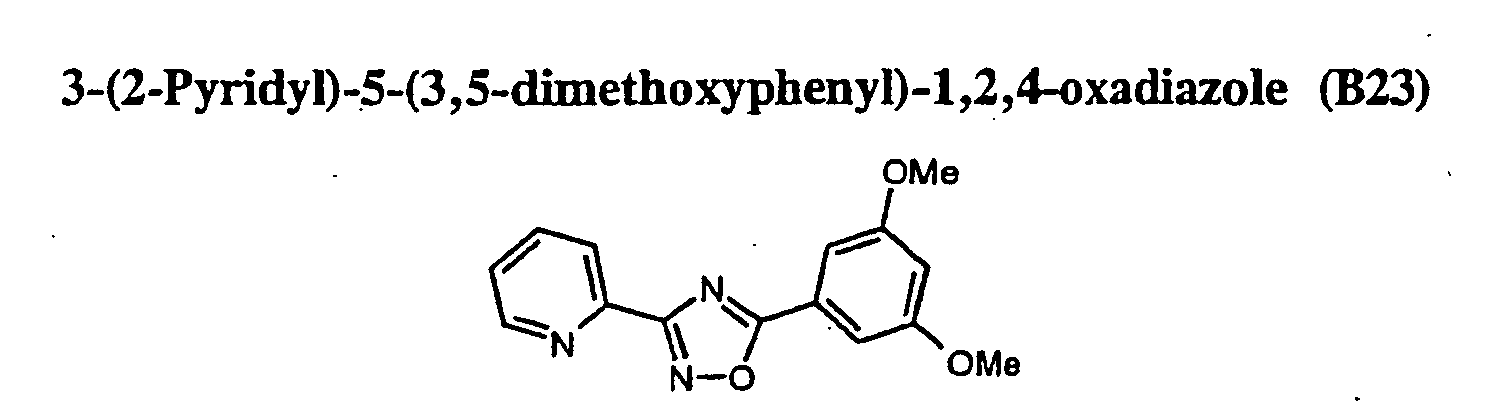
    Example 3: Synthesis of 3,5-disubstituted-1,2,4-oxadiazoles from acid chlorides
    In general, modifications were made from the procedures given Shine et al., J. Heterocyclic Chem. (1989) 26:125-128. 3,5-Disubstituted-1,2,4-oxadiazoles were typically made by adding an acylchloride to a solution of an amidoxime in pyridine after which the reaction mixture was either heated to reflux or placed in a sealed tube and heated. Typically, the oxadiazoles were isolated by precipitating with cold water and filtering or by extraction with an organic solvent. If necessary, the oxadiazoles were purified by chromatography or recrystallization.
    Figure 00250001
    A mixture of 3,5-dichlorobenzoyl chloride (2.1 g, 10 mmol) and pyrid-2-ylamidoxime (1.37 g, 10 mmol) in pyridine (5 mL) was heated in sealed tube at 190 °C for 2 hours. After this time, the reaction mixture was added to ice cold water to precipitate the oxadiazole. The solid was collected by filtration, washed with water and then recrystallized from ethanol to yield 2.1 g (72%) of 3-(2-pyridyl)-5-(3,5-dichlorophenyl)-1,2,4-oxadiazole: mp 162-166 °C; GC/EI-MS gave m/z (rel. int.) 291 (M+, 38), 293 (25), 261 (1), 173 (6), 145 (13), 120 (100), 90 (20), 78 (28), 51 (15).
    Figure 00260001
    Using the general procedure for the synthesis of 1,2,4-oxadiazoles, 3-chlorobenzoyl chloride (127 µL, 1 mmol) and pyrid-2-ylamidoxime (137 mg, 1 mmol) in pyridine (1 mL) were heated at reflux for 4 hours. Standard work up afforded 156 mg (61 %) of 3-(2-pyridyl)-5-(3-chlorophenyl)-1,2,4-oxadiazole: mp 136-140 °C; GC/EI-MS gave m/z (rel. int.) 257 (M+, 64), 259 (21), 227 (3), 120 (100), 111 (22), 90 (24), 78 (32), 75 (26), 51 (20).
    Figure 00260002
    Using the general procedure for the synthesis of 1,2,4-oxadiazoles, 3-anisoyl chloride (151 µL, 1 mmol) and pyrid-2-ylamidoxime (137 mg, 1 mmol) in pyridine (1 mL) were heated at reflux for 4 hours. Standard work up afforded 200 mg (79%) of 3-(2-pyridyl)-5-(3-methoxyphenyl)-1,2,4-oxadiazole: mp 96-99 °C; GC/EI-MS gave m/z (rel. int.) 253 (M+, 100), 223 (3), 179 (3), 135 (74), 133 (90), 92 (27), 78 (29), 77 (32), 64 (23), 63 (23).
    Figure 00260003
    Using the general procedure for the synthesis of 1,2,4-oxadiazoles, 2-chlorobenzoyl chloride (127 µL, 1 mmol) and pyrid-2-ylamidoxime (137 mg, 1 mmol) in pyridine (1 mL) were heated at reflux for 4 hours. Standard work up afforded 157 mg (61 %) of 3-(2-pyridyl)-5-(2-chlorophenyl)-1,2,4-oxadiazole: mp 93-94 °C; GC/EI-MS gave m/z (rel. int.) 257 (M+, 76), 259 (26), 227 (4), 139 (11), 120 (100), 111 (21), 90 (27), 78 (35), 75-(29), 51 (21).
    Figure 00270001
    Using the general procedure for the synthesis of 1,2,4-oxadiazoles, 3-(trifluoromethyl)benzoyl chloride (151 µL, 1 mmol) and pyrid-2-ylamidoxime (137 mg, 1 mmol) in pyridine (1 mL) were heated at reflux for 16 hours. Standard work up afforded 233 mg (80%) of 3-(2-pyridyl)-5-[3-(trifluoromethyl)phenyl]-1,2,4-oxadiazole: mp 116-118 °C; GC/EI-MS gave m/z (rel. int.) 291 (M+, 81), 272 (7), 173 (6), 145 (25), 120 (100), 90 (20), 78 (23), 51 (11).
    Figure 00270002
    Using the general procedure for the synthesis of 1,2,4-oxadiazoles, 3-fluorobenzoyl chloride (122 µL, 1 mmol) and pyrid-2-ylamidoxime (137 mg, 1 mmol) in pyridine (1 mL) were heated at reflux for 16 hours. Standard work up afforded 176 mg (73%) of 3-(2-pyridyl)-5-(3-fluorophenyl)-1,2,4-oxadiazole: mp 88-98 °C; GC/EI-MS gave m/z (rel. int.) 241 (M+, 95), 211 (5), 120 (100), 107 (13), 95 (30), 90 (21), 78 (27), 75 (19), 51 (15).
    Figure 00270003
    Using the general procedure for the synthesis of 1,2,4-oxadiazoles, 3-toluoyl chloride (264 µL, 2 mmol) and pyrid-2-ylamidoxime (274 mg, 2 mmol) in pyridine (1 mL) were heated in a sealed tube at 200 °C for 2 hours. Standard work up afforded 387 mg (82%) of 3-(2-pyridyl)-5-(3-toluoyl)-1,2,4-oxadiazole: mp 127-128 °C; GC/EI-MS gave m/z (rel. int.) 237 (M+, 100), 222 (2), 207 (8), 120 (68), 117 (24), 91 (29), 90 (29), 78-(32), 65 (26), 51 (23).
    Figure 00280001
    Using the general procedure for the synthesis of 1,2,4-oxadiazoles, 1-naphthoyl chloride (150 µL, 1 mmol) and pyrid-2-ylamidoxime (137 mg, 1 mmol) in pyridine (1 mL) were heated in a sealed tube at 200 °C for 3 hours. Standard work up afforded 50 mg (18%) of 3-(2-pyridyl)-5-(1-naphthyl)-1,2,4-oxadiazole: mp 132-136 °C; GC/EI-MS gave m/z (rel. int.) 273 (M+, 75), 195 (5), 169 (88), 153 (100), 139 (12), 127 (66), 126 (29), 105 (23), 78 (14), 51 (14).
    Figure 00280002
    Using the general procedure for the synthesis of 1,2,4-oxadiazoles, 3-(trifluoromethoxy)benzoyl chloride (220 mg, 1 mmol), and pyrid-2-ylamidoxime (137 mg, 1 mmol) in pyridine (1 mL) were heated in a sealed tube at 200 °C for 3 hours. Standard work up afforded 175 mg (57%) of 3-(2-pyridyl)-5-[3-(trifluoromethoxy)phenyl]-1,2,4-oxadiazole: mp 86-88 °C; GC/EI-MS gave m/z (rel. int.) 307 (M+, 73), 277 (3), 222 (3), 189 (6), 161 (5), 120 (100), 78 (21), 69 (17), 51 (10).
    Figure 00280003
    Using the general procedure for the synthesis of 1,2,4-oxadiazoles, 2,3-difluorobenzoyl chloride (124 µL, 1 mmol) and pyrid-2-ylamidoxime (137 mg, 1 mmol) in pyridine (1 mL) were heated at 100 °C for 16 hours. Standard work up afforded 158 mg (61 %) of 3-(2-pyridyl)-5-(2,3-difluorophenyl)-1,2,4-oxadiazole: mp 120-121 °C; GC/EI-MS gave m/z (rel. int) 259 (M+, 97), 229 (5), 228 (4), 141 (11), 120 (100), 113 (26), 90 (27), 78 (34), 51 (17).
    Figure 00290001
    Using the general procedure for the synthesis of 1,2,4-oxadiazoles, 2,5-difluorobenzoyl chloride (124 µL, 1 mmol) and pyrid-2-ylamidoxime (137 mg, 1 mmol) in pyridine (1 mL) were heated at 100 °C for 16 hours. Standard work up afforded 3-(2-pyridyl)-5-(2,5-difluorophenyl)-1,2,4-oxadiazole: mp 120-126 °C; GC/EI-MS gave m/z (rel. int) 259 (M+, 91), 229 (5), 228 (4), 141 (13), 120 (100), 113 (25), 90 (23), 78 (27), 51 (14).
    Figure 00290002
    Using the general procedure for the synthesis of 1,2,4-oxadiazoles, 3,5-difluorobenzoyl chloride (1.25 mL, 10 mmol) and pyrid-2-ylamidoxime (1.37 g, 10 mmol) in pyridine (5 mL) were heated in a sealed tube at 200 °C for 4 hours. Standard work up afforded 1.2 g (46%) of 3-(2-pyridyl)-5-(3,5-difluorophenyl)-1,2,4-oxadiazole: mp 115-119 °C; GC/EI-MS gave m/z (rel. int) 259 (M+, 100), 229 (4), 228 (5), 141 (9), 125 (13), 113 (30), 90 (19), 78 (27), 63 (23), 51 (15).
    Figure 00290003
    Using the general procedure for the synthesis of 1,2,4-oxadiazoles, 3-cyanobenzoyl chloride (165 mg, 1 mmol) and pyrid-2-ylamidoxime (137 mg, 1 mmol) in pyridine (1 mL) were heated at 100 °C for 72 hours. Standard work up afforded 158 mg (64%) of 3-(2-pyridyl)-5-(3-cyanophenyl)-1,2,4-oxadiazole: mp 148-149 °C; GC/EI-MS gave m/z (rel. int.) 248 (M+, 85), 218 (5), 130 (6), 120 (100), 114 (9), 102 (28), 90 (26), 78 (37), 75 (19), 51 (30).
    Figure 00300001
    Using the general procedure for the synthesis of 1,2,4-oxadiazoles, 3,5-dimethoxybenzoyl chloride (200 mg, 1 mmol) and pyrid-2-ylamidoxime (137 mg, 1 mmol) in pyridine (1 mL) were heated at 100 °C for 72 hours. Standard work up afforded 210 mg (74%) of 3-(2-pyridyl)-5-(3,5-dimethoxyphenyl)-1,2,4-oxadiazole: mp 145-148 °C; GC/EI-MS gave m/z (rel. int.) 283 (M+, 100), 253 (3), 165 (69), 163 (19), 137 (36), 122 (33), 107 (17), 90 (10), 78 (25), 63 (19), 51 (19).
    Figure 00300002
    Using the general procedure for the synthesis of 1,2,4-oxadiazoles, 2,3-dichlorobenzoyl chloride (209 mg, 1 mmol) and pyrid-2-ylamidoxime (137 mg, 1 mmol) in pyridine (1 mL) were heated at 100 °C for 48 hours. Standard work up afforded 236 mg (81%) of 3-(2-pyridyl)-5-(2,3-dichlorophenyl)-1,2,4-oxadiazole: mp 128-133 °C; GC/EI-MS gave m/z (rel. int.) 291 (M+, 66), 293 (43), 256 (6), 173 (10), 145 (11), 120 (100), 90 (19), 78 (27), 51 (14).
    Figure 00300003
    3-Chloro-5-cyanobenzoic acid (0.82 g, 4.97 mmol ) was treated with a solution of oxalyl chloride (10 mL of 2.5 M in dichloromethane, 25 mmol) and a catalytic amount of N,N-dimethylformamide. The reaction was stirred at ambient temperature for 2.5 hours.-The excess oxalyl chloride was removed in vacuo to afford 3-chloro-5-cyanobenzoyl chloride.
    Using the general procedure for the synthesis of 1,2,4-oxadiazoles, the 3-chloro-5-cyanobenzoyl chloride and pyrid-2-ylamidoxime (682 mg, 5 mmol, 1 equivalent) in pyridine (5 mL) were heated in a sealed tube at 175 °C for 4 hours. Standard work up and recrystallization from 2-propanol afforded 250 mg (19%) of 3-(2-pyridyl)-5-(3-chloro-5-cyanophenyl)-1,2,4-oxadiazole: GC/EI-MS gave m/z (rel. int.) 282 (M+, 100), 283 (18), 284 (34), 251 (4), 136 (10), 120 (53), 100 (10), 78 (15), 51 (6).
    Figure 00310001
    3-Fluoro-5-cyanobenzoic acid (2.5 g, 15.14 mmol ) was treated with a solution of oxalyl chloride (30 mL of 2.5 M in dichloromethane, 75 mmol) and a catalytic amount of N,N-dimethylformamide. The reaction was stirred at ambient temperature for 2.5 hours. The excess oxalyl chloride was removed in vacuo to afford 3-fluoro-5-cyanobenzoyl chloride.
    Using the general procedure for the synthesis of 1,2,4-oxadiazoles, the 3-fluoro-5-cyanobenzoyl chloride and pyrid-2-ylamidoxime (2.076 g, 15.15 mmol, 1 equivalent) in pyridine (5 mL) were heated in a sealed tube at 175 °C for 4 hours. Standard work up and recrystallization from 2-propanol afforded 1.5 g (37%) of 3-(2-pyridyl)-5-(3-fluoro-5-cyanophenyl)-1,2,4-oxadiazole: GC/EI-MS gave m/z (rel. int.) 266 (M+, 81), 267 (13), 235 (5), 132 (12), 120 (100), 100 (18), 90 (18), 78 (35), 51 (20).
    Figure 00320001
    3-Chloro-5-fluorobenzoic acid (400 mg, 2.3 mmol) was treated with a solution of oxalyl chloride (4.6 mL of 2.5 M in dichloromethane, 11.5 mmol) and a catalytic amount of N,N-dimethylformamide. The reaction was stirred at ambient temperature for 2.5 hours. The excess oxalyl chloride was removed in vacuo to afford 3-chloro-5-fluorobenzoyl chloride.
    Using the general procedure for the synthesis of 1,2,4-oxadiazoles, the 3-chloro-5-fluorobenzoyl chloride and pyrid-2-ylamidoxime (314 mg, 2.3 mmol, 1 equivalent) in pyridine (5 mL) were heated in a sealed tube at 175 °C for 4 hours. Standard work up and recrystallization from 2-propanol afforded 250 mg (39%) of 3-(2-pyridyl)-5-(3-chloro-5-fluorophenyl)-1,2,4-oxadiazole: GC/EI-MS gave m/z (rel. int.) 275(M+, 89), 276 (14), 277 (29), 129 (26), 120 (100), 109 (7), 90 (20), 78 (31), 51 (14).
    Figure 00320002
    Using the general procedure for the synthesis of 1,2,4-oxadiazoles, 3-cyanobenzoyl chloride (675 mg, 4mmol) and 5-chloropyrid-2-ylamidoxime (686 mg, 4 mmol) in pyridine (5 mL) were heated in a sealed tube at 175 °C for 4 hours. Standard work up and recrystallization from 2-propanol afforded 357 mg (32%) of 3-(5-chloropyrid-2-yl)-5-(3-cyanophenyl)-1,2,4-oxadiazole: GC/EI-MS gave m/z (rel. int.) 282 (M+, 85), 283 (14), 284 (27), 156 (31), 154 (100), 112 (19), 102 (30), 76 (28), 64 (13).
    Figure 00320003
    Using the general procedure for the synthesis of 1,2,4-oxadiazoles, 3-cyanobenzoyl chloride (0.534 g, 3.2 mmol) and 5-fluoropyrid-2-ylamidoxime (0.5 g, 3.2 mmol) in pyridine (5 mL) were heated in a sealed tube at 175 °C for 4 hours. Standard work up and recrystallization from 2-propanol afforded 370 mg (43%) of 3-(5-fluoropyrid-2-yl)-5-(3-cyanophenyl)-1,2,4-oxadiazole: GC/EI-MS gave m/z (rel. int.) 266 (M+, 100), 267 (10), 138 (80), 114 (8), 102 (19), 96 (22), 76 (17), 57 (8).
    Figure 00330001
    3-Fluoro-5-cyanobenzoic acid (1.0 g, 6 mmol) was treated with a solution of oxalyl chloride (12 mL of 2.5 M in dichloromethane, 30 mmol) and a catalytic amount of N,N-dimethylformamide. The reaction was stirred at ambient temperature for 2.5 hours. The excess oxalyl chloride was removed in vacuo to afford 3-fluoro-5-cyanbenzoyl chloride.
    Using the general procedure for the synthesis of 1,2,4-oxadiazoles, the 3-fluoro-5-cyanbenzoyl chloride (1.1 g, 6 mmol) and 5-fluoropyrid-2-ylamidoxime (0.93 g, 6 mmol) in pyridine (5 mL) were heated in a sealed tube at 175 °C for 4 hours. Standard work up and recrystallization from 2-propanol afforded 0.41 g (24%) of 3-(5-fluoropyrid-2-yl)-5-(3-cyano-5-fluorophenyl)-1,2,4-oxadiazole: GC/EI-MS gave m/z (rel. int.) 284 (M+, 100), 285 (16), 253 (2), 138 (99), 120 (23), 108 (16), 96 (25), 82 (15), 57 (11).
    Figure 00330002
    Using the general procedure for the synthesis of 1,2,4-oxadiazoles, 3-cyanobenzoyl chloride (107 mg, 0.64 mmol) and 3-fluoropyrid-2-ylamidoxime (0.1 g, 0.64 mmol) in pyridine (5 mL) were heated in a sealed tube at 175 °C for 4 hours. Standard work up, silica gel chromatography, and recrystallization from 2-propanol, afforded 32 mg (19%) of 3-(3-fluoropyrid-2-yl)-5-(3-cyanophenyl)-1,2,4-oxadiazole: GC/EI-MS gave m/z (rel. int.) 266 (M+, 75), 267 (12), 138 (100), 114 (11), 102 (19), 96 (17), 76 (16), 57 (5), 51 (5).
    Figure 00340001
    Using the general procedure for the synthesis of 1,2,4-oxadiazoles, 3,5-dimethoxybenzoyl chloride (0.10 g, 0.5 mmol) and 5-fluoropyrid-2-ylamidoxime (78 mg, 0.5 mmol) in pyridine (3 mL) were heated in a sealed tube at 175 °C for 4 hours. Standard work up, silica gel chromatography, and recrystallization from 2-propanol afforded 94 mg (62%) of 3-(5-fluoropyrid-2-yl)-5-(3,5-dimethoxyphenyl)-1,2,4-oxadiazole: GC/EI-MS gave m/z (rel. int.) 301 (M+, 100), 302 (17), 165 (41), 137 (23), 122 (27), 96 (15), 77 (11), 63 (12).
    Figure 00340002
    Using the general procedure for the synthesis of 1,2,4-oxadiazoles, 3-cyanobenzoyl chloride (79 mg, 0.47 mmol) and 5-methoxypyrid-2-ylamidoxime (79 mg, 0.47 mmol) in pyridine (2.5 mL) were heated in a sealed tube at 175 °C for 4 hours. Standard work up, silica gel chromatography, and recrystallization from 2-propanol afforded 59 mg (45%) of 3-(5-methoxypyrid-2-yl)-5-(3-cyanophenyl)-1,2,4-oxadiazole: GC/EI-MS gave m/z (rel. int.) 278 (M+, 100), 279 (16), 150 (56), 128 (7), 107 (21), 102 (17), 80 (12), 64 (5).
    Figure 00340003
    Using the general procedure for the synthesis of 1,2,4-oxadiazoles, 3-cyanobenzoyl chloride (68 mg, 0.41 mmol) and quinol-2-ylamidoxime (75.9 mg, 0.405 mmol) in pyridine (0.5 mL) were heated in a sealed tube at 165 °C for 22 hours. Standard work up, recrystallization from ethanol, and solid phase extraction (SPE) afforded 23.7 mg (20%) of 3-(2-quinolinyl)-5-(3-cyanophenyl)-1,2,4-oxadiazole. 1H-NMR (CDCl3), δ (ppm): 8.62 (s, 1H), 8.54 (d, 1H), 8.36 (d, 2H), 8.28 (d, 1H), 7.90 (d, 2H), 7.80 (t, 1H), 7.72 (t, 1H), 7.64 (t, 1H).
    Figure 00350001
    Using the general procedure for the synthesis of 1,2,4-oxadiazoles, 3-cyanobenzoyl chloride (66 mg, 0.40 mmol) and 3-chloro-5-trifluoromethylpyrid-2-ylamidoxime (96.5 mg, 0.403 mmol) in pyridine (0.5 mL) were heated in a seated tube at 165 °C for 22 hours. Standard work up and solid phase extraction (SPE) afforded 45.9 mg (33%) of 3-(3-chloro-5-trifluoromethylpyrid-2-yl)-5-(3-cyanophenyl)-1,2,4-oxadiazole. 1H-NMR (CDCl3), δ (ppm): 8.99 (s, 1H), 8.57 (s, 1H), 8.49 (d, 1H), 8.19 (s, 1H), 7.92 (d, 1H), 7.72 (t, 1H).
    Figure 00350002
    5-Chloro-O-anisic acid (187 mg, 1 mmol) was treated with a solution of oxalyl chloride (1.5 mL of 2 M in dichloromethane, 3 mmol) and a catalytic amount of N,N-dimethylformamide. The reaction was stirred at ambient temperature for 2 hours. The excess oxalyl chloride was removed in vacuo to afford 5-chloro-2-methoxybenzoyl chloride.
    Using the general procedure for the synthesis of 1,2,4-oxadiazoles, the 5-chloro-2-methoxybenzoyl chloride and pyrid-2-ylamidoxime (137 mg, 1 mmol) in pyridine (1 mL) were heated at 115 °C for 17 hours. Standard work up, and silica gel chromatography afforded 49 mg (17%) of 3-(2-pyridyl)-5-(5-chloro-2-methoxyphenyl)-1,2,4-oxadiazole. 1H-NMR (CDCl3), δ (ppm): 4.00(s, 3H), 7.03 (d, J= 8.9 Hz, 1H), 7.42-7.47 (m, 1H), 7.50 (dd, J=8.9 Hz, 2.8 Hz, 1H), 7.87 (ddd, J= 1.4 Hz, 7.4 Hz, 8.2 Hz, 1H), 8.22 (d, J= 8.2 Hz, 1H ), 8.28 ( d, J = 2.4 Hz, 1H), 8.84 (m, 1H).
    Figure 00360001
    2,3-Dimethoxybenzoic acid (182 mg, 1 mmol) was treated with a solution of oxalyl chloride (1.5 mL of 2 M in dichloromethane, 3 mmol) and a catalytic amount of N,N-dimethylformamide. The reaction was stirred at ambient temperature for 2 hours. The excess oxalyl chloride was removed in vacuo to afford 2,3-dimethoxybenzoyl chloride.
    Using the general procedure for the synthesis of 1,2,4-oxadiazoles, the 2,3-dimethoxybenzoyl chloride and pyrid-2-ylamidoxime (137 mg, 1 mmol) in pyridine (1 mL) were heated at 115 °C for 17 hours. Standard work up and silica gel chromatography afforded 120 mg (42%) of 3-(2-pyridyl)-5-(2,3-dimethoxyxyphenyl)-1,2,4-oxadiazole.
    Figure 00360002
    2-Chloro-5-methylthiobenzoic acid (182 mg, 1 mmol) was treated with a solution of oxalyl chloride (1.5 mL of 2 M in dichloromethane, 3 mmol) and a catalytic amount of N,N-dimethylformamide. The reaction was stirred at ambient temperature for 2 hours. The excess oxalyl chloride was removed in vacuo to afford 2-chloro-5-methylthiobenzoyl chloride.
    Using the general procedure for the synthesis of 1,2,4-oxadiazoles, the 2-chloro-5-methylthiobenzoyl chloride and pyrid-2-ylamidoxime (137 mg, 1 mmol) in pyridine (1 mL) were heated at 115 °C for 17 hours. Standard work up and silica gel chromatography afforded 250 mg (82%) of 3-(2-pyridyl)-5-(2-chloro-5-methylthiophenyl)-1,2,4-oxadiazole. 1H-NMR (CDCl3), δ (ppm): 7.37( dd, J= 2.4Hz, 8.2 Hz, 1H), 7.40-7.50 (m, 2H), 7.89 (ddd, J= 1.4 Hz, 7.4 Hz, 8.2 Hz, 1H ), 8.05 (d, J=2.4 Hz, 1H), 8.23 (dd, J=2.2 Hz, 8.0 Hz, 1 x H ), 8.85 (m, 1H).
    Figure 00370001
    3-Phenoxybenzoic acid (214 mg, 1.0 mmol) was treated with a solution of oxalyl chloride (1.5 mL of 2 M in dichloromethane, 3 mmol) and a catalytic amount of N,N-dimethylformamide. The reaction was stirred overnight at ambient temperature. The excess oxalyl chloride was removed in vacuo to afford 3-phenoxybenzoyl chloride.
    Using the general procedure for the synthesis of 1,2,4-oxadiazoles, the 3-phenoxybenzoyl chloride and pyrid-2-ylamidoxime (137 mg, 1 mmol) in pyridine (1 mL) were heated in a sealed vial overnight at 110 °C. Standard work up afforded 118 mg (37%) of 3-(2-pyridyl)-5-(3-phenoxyphenyl)-1,2,4-oxadiazole as a white solid.
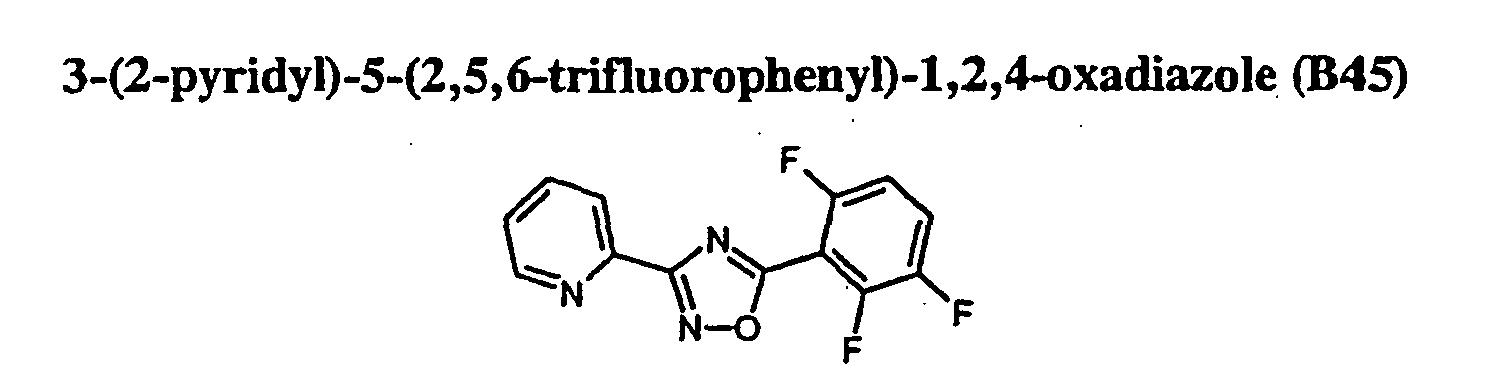
    Figure 00370002
    3-Benzoylbenzoic acid (226 mg, 1.0 mmol) in dichloromethane (1.5 mL) was treated with a solution of oxalyl chloride (1.5 mL of 2 M in dichloromethane, 3 mmol) and a catalytic amount of N,N-dimethylformamide. The reaction was stirred overnight at ambient temperature. The excess oxalyl chloride was removed in vacuo to afford 3-benzoylbenzoyl chloride.
    Using the general procedure for the synthesis of 1,2,4-oxadiazoles, the 3-benzoylbenzoyl chloride and pyrid-2-ylamidoxime (137 mg, 1 mmol) in pyridine (1 mL) were heated in a sealed vial overnight at 110 °C. Standard work up and filtration through silica gel (with dichloromethane) afforded 200 mg (61%) of 3-(2-pyridyl)-5-(3-benzoylphenyl)-1,2,4-oxadiazole as a white solid. 1H NMR (CDCl3), δ (ppm): 8.85 (d, 1H), 8.68 (m, 1H), 8.53 (dd, 1H), 8.23 (d, 1H), 8.07 (m, 1H), 7.88 (m, 3H), 7.70 (m, 2H), 7.49 (m, 3H).
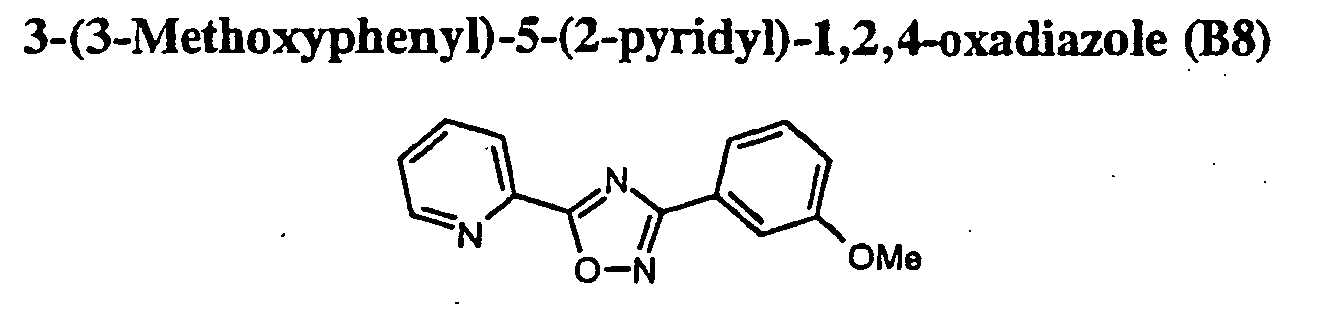
    Figure 00380001
    2-Bromo-5-methoxybenzoic acid (231 mg, 1.0 mmol) in dichloromethane (1.5 mL) was treated with a solution of oxalyl chloride (1.5 mL of 2 M in dichloromethane, 3 mmol) and a catalytic amount of N,N-dimethylformamide. The reaction was stirred overnight at ambient temperature. The excess oxalyl chloride was removed in vacuo to afford 2-bromo-5-methoxybenzoyl chloride.
    Using the general procedure for the synthesis of 1,2,4-oxadiazoles, the 2-bromo-5-methoxybenzoyl chloride and pyrid-2-ylamidoxime (137 mg, 1 mmol) in pyridine (1 mL) were heated in a sealed vial overnight at 110 °C. Standard work up and filtration through silica gel (with dichloromethane) afforded 147 mg (44%) of 3-(2-pyridyl)-5-(2-bromo-5-methoxyphenyl)-1,2,4-oxadiazole. 1H NMR (CDCl3), δ (ppm): 8.85 (d, 1H), 8.24 (d, 1H), 7.89 (m, 1H), 7.65 (m, 2H), 7.47 (m, 1H), 6.99 (m, 1H), 3.89 (s, 3H).
    Figure 00380002
    2-Chloro-5-(trifluoromethyl)benzoic acid (224 mg, 1.0 mmol) in dichloromethane (1.5 mL) was treated with a solution of oxalyl chloride (1.5 mL of 2 M in dichloromethane, 3 mmol) and a catalytic amount of N,N-dimethylformamide. The reaction was stirred overnight at ambient temperature. The excess oxalyl chloride was removed in vacuo to afford 2-chloro-5-(trifluoromethyl)benzoyl chloride.
    Using the general procedure for the synthesis of 1,2,4-oxadiazoles, the 2-chloro-5-(trifluoromethyl)benzoyl chloride and pyrid-2-ylamidoxime (137 mg, 1 mmol) in pyridine (1 mL) were heated in a sealed vial overnight at 110 °C. Standard work up and filtration through silica gel (with dichloromethane) afforded 136 mg (42%) of 3-(2-pyridyl)-5-(2-chloro-5-(trifluoromethyl)phenyl)-1,2,4-oxadiazole as a beige solid. 1H NMR (CDCl3), δ (ppm): 8.87 (d, 1H), 8.56 (s, 1H), 8.25 (d, 1H), 7.89 (m, 1H), 7.78 (m, 2H), 7.50 (m, 1H).
    Figure 00390001
    3,4,5-Trifluorobenzoic acid (0.176 g, 1.0 mmol) in dichloromethane (1.5 mL) was treated with a solution of oxalyl chloride (1.5 mL of 2 M in dichloromethane, 3 mmol) and a catalytic amount of N,N-dimethylformamide. The reaction was stirred overnight at ambient temperature. The excess oxalyl chloride was removed in vacuo to afford 3,4,5-trifluorobenzoyl chloride.
    Using the general procedure for the synthesis of 1,2,4-oxadiazoles, the 3,4,5-trifluorobenzoyl chloride and pyrid-2-ylamidoxime (137 mg, 1 mmol) in pyridine (1 mL) were heated in a sealed vial overnight at 110 °C. Standard work up and silica gel chromatography (with 10-30% ethyl acetate in hexane) afforded 15 mg (5%) of 3-(2-pyridyl)-5-(3,4,5-trifluorophenyl)-1,2,4-oxadiazole as a white solid.
    Figure 00390002
    2,5,6-Trifluorolbenzoic acid (176 mg, 1 mmol) was treated with a solution of oxalyl chloride (1.5 mL of 2 M in dichloromethane, 3 mmol) and a catalytic amount of N,N-dimethylformamide. The reaction was stirred at ambient temperature for 16 hours. The excess oxalyl chloride was removed in vacuo to afford 2,5,6-trifluorolbenzoyl chloride.
    A solution of the intermediate 2,5,6-trifluorolbenzoyl chloride and pyrid-2-ylamidoxime (137 mg, 1 mmol) in dichloromethane was stirred at ambient temperature for 0.5 hours. Silica gel chromatography afforded 151 mg (51%) of N-[(2,5,6-trifluorobenzoyl) oxy]pyridine-2-carboximidamide.
    A solution of N-[(2,5,6- trifluorobenzoyl)oxy]pyridine-2-carboximidamide (50 mg, 0.169 mmol) in pyridine (0.3 mL) was heated at 115 °C for 17 hours. Standard work up, and silica gel chromatography, afforded 9.5 mg (20%) of 3-(2-pyridyl)-5-(2,5,6-trifluorophenyl)-1,2,4-oxadiazole.
    Example 4: Synthesis of 3,5-disubstituted-1,2,4-oxadiazoles from acylimidazoles
    Figure 00400001
    Using modifications of the method of Shine et al., J. Heterocyclic Chem. (1989) 26:125-128, a solution of picolinic acid (123 mg, 1 mmol) in pyridine (1 mL) was treated with 1,1'-carbonyldiimidazole (162 mg, 1 mmol) and the reaction stirred at ambient temperature until the evolution of carbon dioxide ceased (30 min). The intermediate acylimidazole was then treated with 3-methoxybenzamidoxime (166 mg, 1 mmol) and the reaction heated at reflux for 1 hour. Ice cold water was added to the reaction mixture to precipitate the oxadiazole. The solid was collected by filtration, washed with water and dried to afford 80 mg (32%) of 3-(3-methoxyphenyl)-5-(2-pyridyl)-1,2,4-oxadiazole: mp 90-94 °C; GC/EI-MS gave m/z (rel. int.) 253 (M+, 100), 254 (17), 179 (2), 175 (2), 149 (77), 133 (33), 119 (4), 106 (29), 78 (45), 51 (18).
    Example 5: Synthesis of 3,5-disubstituted-1,2,4-oxadiazoles from esters
    Figure 00400002
    Using the method of Korbonits et al., J. Chem. Soc. Perkin Trans. I (1982) 759-766, a mixture of ethyl salicylate (200 mg, 1.2 mmol), pyrid-2-ylamidoxime (82.5 mg, 0.6 mmol), 21 % sodium ethoxide (19.4 mL, 6 mmol) in ethanol (12mL) was heated at reflux for 16 hours. After cooling, the reaction mixture was diluted with dichloromethane (50 mL) and washed with water and saturated sodium hydrocarbonate. The organic layer was dried with sodium sulfate and concentrated in vacuo. Recrystallization from diethyl ether afforded 15 mg (5%) of 3-(Pyrid-2-yl)-5-(2-hydroxyphenyl)-1,2,4-oxadiazole.
    Figure 00410001
    In a similar fashion, methyl 5-chloro-2-hydroxybenzoate (372 mg, 2 mmol), pyrid-2-ylamidoxime (137 mg, 1 mmol), 21 % sodium ethoxide (32.4 mL, 10 mmol) in ethanol (20 mL) were heated at reflux for 16 hours. Standard work up and recrystallization from diethyl ether afforded 14.2 mg (5%) of 3-(2-pyridyl)-5-(5-chloro-2-hydroxyphenyl)-1,2,4-oxadiazole.
    Example 6: Synthesis of 3,5-disubstituted-1,2,4-oxadiazoles from isatoic anhydrides
    Figure 00410002
    Using modifications from the procedure of Nagahara et al., Chem. Pharm. Bull., (1975) 23:3178-3183, a mixture of isatoic anhydride (163 mg, 1 mmol) and pyrid-2-ylamidoxime (137 mg, 1 mmol) in pyridine (1 mL) was heated at 115 °C for 17 hours. After cooling the reaction, the mixture was diluted with 50 mL of dichloromethane and washed with water and saturated sodium hydrocarbonate. The organic layer was dried over sodium sulfate, filtered through silica gel and concentrated in vacuo. Recrystallization from diethyl ether afforded 45.6 mg (19%) of 3-(2-pyridyl)-5-(2-aminophenyl)-1,2,4-oxadiazole.
    Figure 00410003
    In a similar fashion, 5-chloroisatoic anhydride (197 mg, 1 mmol) and pyrid-2-ylamidoxime (137 mg, 1 mmol) in pyridine (1 mL) was heated at 115 °C for 17 hours. Work up afforded 138 mg (51 %) of 3-(2-pyridyl)-5-(2-aminophenyl)-1,2,4-oxadiazole.
    Example 7: Synthesis of 2,4-disubstituted-1,3-oxazoles
    Figure 00420001
    Using the procedures of Kelly et al., J. Org. Chem., (1996) 61:4623-4633, a solution of 2-bromoacetylpyridine (120 mg, 0.6 mmol) in toluene (5mL) was treated with 3-chlorobenzamide (300 mg, 1.9 mmol) and the mixture heated in a sealed vial at reflux for 60 hours. The mixture was then cooled and the solvent was removed in vacuo. Silica gel chromatography using a gradient of hexane to ethyl acetate afforded 38 mg (9%) of 2-[3-chlorophenyl]-4-[pyridin-2-yl]-1,3-oxazole as a pale yellow solid. 1H-NMR (CDCl3), δ (ppm): 8.62 (d, 1H), 8.35 (s, 1H), 8.15 (m, 1H), 8.00 (m, 2H), 7.80 (td, 1H), 7.42 (m, 2H), 7.23 (m, 1H).
    Figure 00420002
    In a similar fashion 2-bromoacetylpyridine (500 mg, 2.5 mmol) and 3-chlorobenzamide (1.2g, 6 mmol) in toluene (10 mL) was heated in a sealed vial at reflux for 60 hours. Work up and silica gel chromatography using a gradient of hexane to ethyl acetate afforded 50 mg (7%) of 2-[3-bromophenyl]-4-[pyridin-2-yl]-1,3-oxazole as a white solid. 1H-NMR (CDCl3), δ (ppm): 8.60 (d, 1H), 8.34 (s, 1H), 8.30 (t, 1H), 8.00 (m, 2H), 7.80 (td, 1H), 7.60 (dd, 1H), 7.35 (t, 1H), 7.23 (m, 1H).
    Figure 00420003
    A mixture of 2-[3-bromophenyl]-4-[pyridin-2-yl]-1,3-oxazole (23 mg, 0.076 mmol) and zinc cyanide (112 mg, 0.96 mmol) in N,N-dimethylformamide (2 mL) was treated with Pd(PPh3)4 (74 mg, 0.064 mmol) and heated overnight at 80°C. Standard work up and chromatography afforded 6 mg (32 %) of 2-[3-cyanophenyl]-4-[pyridin-2-yl]-1,3-oxazole as a white solid. 1H-NMR (CDCl3), δ (ppm): 8.61 (d, 1H), 8.45 (s, 1H), 8.38 (s, 1H), 8.36 (m, 1H),8.00 (d, 1H), 7.80 (m, 2H), 7.61 (t, 1H), 7.23 (m, 1H).
    Example 8: Synthesis of 3,5-disubstituted-1,2-oxazoles
    Figure 00430001
    A stirred solution of pyridine-2-carbohydroximoyl chloride (300 mg, 1.9 mmol) and 3-hydroxyphenylacetylene (760 mg, 6.4 mmol) in a 1:1 mixture of THF/CH2Cl2 (10 mL) at 0 °C was treated with triethylamine (2 mL, 1.45 g, 15 mmol). The mixture was allowed to warm to room temperature overnight. The solvent was removed in vacuo. The residue was dissolved in dichloromethane, washed with brine and dried over anhydrous sodium sulphate. Removal of the solvent in vacuo followed by trituation with 10% ethylacetate in hexane afforded 200 mg (44%) of 5-[3-hydroxyphenyl]-3-[pyridin-2-yl]-1,2-oxazole as a beige solid.
    Figure 00430002
    A mixture of 5-[3-trifluoromethanesulfonylphenyl]-3-[pyridin-2-yl]-1,2-oxazole (98 mg, 0.26 mmol), KCN (230 mg, 4 mmol), NiBr2(PPh3)2 (52.4 mg, 0.07 mmol), and PPh3 (42 mg, 0.16 mmol) in acetonitrile (1 mL) was treated with zinc powder (20 mg, 0.3 mmol) and the mixture was heated overnight at 60 °C. Silica gel chromatography of the resulting mixture using a gradient of hexane to ethyl acetate afforded 15 mg (23 %) of 5-[3-cyanophenyl]-3-[pyridin-2-yl]-1,2-oxazole as a white solid.
    Example 9: Synthesis of 3,5-disubstituted-1,2,4-triazoles
    Figure 00440001
    A mixture of 3-chlorobenzoic acid (0.5 g, 3.19 mmol), 1,3-diccyclohexylcarbodiimide (0.72 g, 3.51 mmol), 4-dimethylaminopyridine (0.04 g, 0.32 mmol) in ethanol was stirred at ambient temperature for 1.5 hour. The white solid was filtered off and the filtrate diluted with dichloromethane (100 mL). The organic solution was washed with 1 N sodium hydrogen sulfate (100 mL), saturated sodium bicarbonate (100 mL), water (100 mL) and brine (100 mL). The organic phase was dried over anhydrous magnesium sulfate and filtered. The filtrate was concentrated in vacuo. The crude residue was dissolved in ethanol (15 mL) and treated with hydrazine monohydrate (0.46 mL, 9.58 mmol). The resulting clear solution was stirred overnight at ambient temperature. The reaction mixture was then concentrated to dryness in vacuo. Silica gel chromatography of the residue, using 3% methanol in dichloromethane, afforded 0.29 g (53%) of 3-chlorobenzhydrazide as a white solid.
    Figure 00440002
    Using the procedures of Browne et al., Aust. J. Chem., (1975) 28:2543-2546, a solution of 2-cyanopyridine (0.1 mL, 1.00 mmol) in methanol (5 mL) was treated with sodium metal (6.9 mg, 0.30 mmol) and stirred for at ambient temperature for 1 hour. After this time, a solution of 3-chlorobenzhyrazide (0.17 g, 1.0 mmol) in methanol (5 mL) was added and the resulting solution heated at reflux for 3 hours. The reaction mixture was concentrated in vacuo, and the resulting yellow solid (100 mg) dissolved in toluene (2 mL). The mixture was heated at 175 °C for 3 hours and then stirred overnight at ambient temperature. Evaporation of the solvent in vacuo and silica gel chromatography using 1 % methanol in dichloromethane afforded 29 mg (11%) of 3-(2-pyridyl)-5-(3-chlorophenyl)-1,2,4-triazole as an off-white solid.
    Figure 00450001
    In a similar fashion, 2-cyanopyridine (0.15 mL, 1.53 mmol), sodium metal (10.5 mg, 0.46 mmol) and 3-iodobenzhydrazide (0.40 g, 1.53 mmol) afforded, after work up and chromatography, 210 mg (40%) of 3-(2-pyridyl)-5-(3-iodophenyl)-1,2,4-triazole as a white solid.
    Example 10: Assays of Group I receptor antagonist activity Astrocyte Screening Assay
    Primary astrocyte cultures were prepared from 3-5 day old Sprague-Dawley rat pups using a modification of Miller (Miller et al, J. Neuroscience, 15(9): 6103-6109, 1995). In brief, primary cultures were plated on poly-L lysine coated flasks in Dulbecco's modified Eagle's medium (DMEM) containing fetal calf serum (FCS). After 6 days, cell cultures were shaken over night at 280 rpm, then transferred to astrocyte-defined media (ADM) containing growth factors that up-regulate the expression of mGluR5 (Miller et al., 1995). For cuvette analysis, cultures were up-regulated with growth factors in flasks for 3-5 days, then harvested and prepared for measurement of [Ca2+]i mobilization as previously described (Nemeth et al., 1998).
    For FLIPR analysis, cells were seeded on poly-D lysine coated clear bottom 96-well plates with black sides and analysis of [Ca2+]i mobilization was performed 3 days following the growth factor up-regulation. Cell cultures in the 96-well plates were loaded with a 4 µM solution of acetoxymethyl ester form of the fluorescent calcium indicator fluo-3 (Molecular Probes, Eugene, Oregon) in 0.01 % pluronic. All assays were performed in a buffer containing 127 mM NaCl, 5 mM KCl, 2 mM MgCl2, 0.7 mM NaH2PO4, 2 mM CaCl2, 0.422 mg/ml NaHCO3, 2.4 mg/ml HEPES, 1.8 mg/ml glucose and 1 mg/ml BSA Fraction IV (pH 7.4).
    FLIPR experiments were done using a laser setting of 0.800 W and a 0.4 second CCD camera shutter speed. Each FLIPR experiment was initiated with 180 µL of buffer present in each well of the cell plate. A 20 µL addition from the antagonist plate was followed by a 50 µL addition from the agonist plate. After each addition the fluorescence signal was sampled 50 times at 1 second intervals followed by 3 samples at 5 second intervals. Responses were measured as the peak height of the response within the sample period.
    EC50/IC50 determinations were made from data obtained from 8 point concentration response curves (CRC) performed in duplicate. Agonist CRC were generated by scaling all responses to the maximal response observed for the plate. Antagonist block of the agonist challenge was normalized to the average response of the agonist challenge in 14 control wells on the same plate.
    CaR/mGluR5d Screening Assay
    HEK 293 cells expressing the chimeric CaR/mGluR5d receptor (clonal cell line hCaR/hmGluR5d_hek6) are plated 24 hours prior to assay at a density of 100,000 cells per well in Collagen I-coated 96-well black, clear bottom plates (Becton Dickenson) in DMEM supplemented with 10% FBS (Hyclone).
    On the day of the assay, tissue culture medium is aspirated from the wells of a plate and 80 µL of Assay Buffer (Assay Buffer is: 20 mM HEPES, 146 mM NaCl, 5 mM KCl, 1 mM MgCl2, 1 mM CaCl2, 1 mg/ml BSA, 1 mg/ml glucose, pH 7.4) supplemented with 6 µM of the Ca2+-sensitive dye, Fluo-3 AM (Molecular Probes) and 0.025% Pluronic (Molecular Probes) is added to each well. The plate is then incubated in the dark for 1 hour at room temperature to efficiently load the cells with Fluo-3. At the end of the incubation, extracellular Fluo-3 is removed by washing the plate with Assay buffer. Assay Buffer is added back to each well (final volume = 160 µL) prior to beginning the assay.
    The plate is loaded into a FLIPR robotic device (Molecular Devices) with the laser setting at 0.8 Watts. At a time of 10 seconds after initiation of the assay, 40 µL of Assay Buffer containing 62.5 µM test substance and 2 % DMSO is added to the 160 µL of Assay Buffer in each well of the plate to yield a final concentration of 12 µM test substance and 0.4 % DMSO. At a time of 75 seconds after initiation of the assay, 50 µL of Assay Buffer containing 6 mM CaCl2 is added to the 200 µL present in each well to yield a final Ca2+ concentration of 2.0 mM, and a final concentration of test substance of 10 nM. Relative fluorescence intensity (excitation λ = 488 nm / emission λ = 510 nM) is monitored at relevant time intervals throughout the assay period to measure receptor activation and/or inhibition.
    By way of illustration, a 1,2,4-oxadiazole disclosed above, designated "B21" (see Example 3), had an IC50 value of 43 nM in relation to CaR/mGluR5d and an IC50 value of 121 nM on the native receptor, mGluR5d. A corresponding 1,3 oxazole, designated "B52" (see Example 7), was found to be equipotent on the CaR/mGluR5d chimera, with an IC50 value of 45 nM, but displayed increased potency on the native mGluR5d receptor, with an IC50 value of 74 nM.
    The invention thus has been disclosed broadly and illustrated in reference to representative embodiments described above. Those skilled in the art will recognize that various modifications can be made to the present invention without departing from the spirit and scope thereof.

    Claims (30)

    1. A compound of Formula II:
      Figure 00480001
      wherein X, Y, and Z are independently selected from the group consisting of N, O, S, C, and CO wherein at least one of X, Y, and Z is a heteroatom;
      Ar1 and Ar2 are independently selected from the group consisting of a heterocyclic or fused heterocyclic moiety containing 1 to 4 heteroatoms selected from the group consisting of N, O, and S and an aromatic moiety selected from the group consisting of phenyl, benzyl, 1-naphthyl, 2-naphthyl, fluorenyl, anthrenyl, indenyl, phenanthrenyl, and benzonaphthenyl, wherein the Ar1 and Ar2 moieties are optionally substituted with one or more moieties selected from the group consisting of -F, -Cl, -Br, -I, -OR, -SR, -SOR, -SO2R, -SO2NRR', -OCOR, -OCONRR', -NRCOR', -NRCO2R', -CN, -NO2, -CO2R, -CONRR', -C(O)R, - CH(OR)R', -CH2(OR), -R, and -A-(CH2)n-NRR'; wherein R or R' is selected from the group consisting of H, CF3, C1-C10 alkyl, cycloalkyl alkyl-aryl, alkyl-heteroaryl, heterocycloalkyl, aryl and where R and R' may combine to form a ring, and A is defined as CH2, O, NH, S, SO, SO2 and n is 1, 2, 3, or 4,
         with the proviso that the compound is not 3-(2-Pyridyl)-5-(2-nitrophenyl)-1,2,4-oxadiazole, 3-(2-Pyridyl)-5-(2-chlorophenyl)-1,2,4-oxadiazole, 3-(2-Pyridyl)-5-(3-methoxyphenyl)-1,2,4-oxadiazole, 3-(2-Pyridyl)-5-[3-(trifluoromethyl)phenyl]-1,2,4-oxadiazole, or 3-(2-Pyridyl)-5-(2-bromo-5-methoxyphenyl)-1,2,4-oxadiazole.
    2. The compound of claim 1, wherein X is N, Y is N, and Z is O.
    3. The compound of claim 2, wherein Ar1 is 2-pyridyl and Ar2 is phenyl.
    4. The compound of claim 3, wherein Ar2 is substituted with one or more moieties selected from the group consisting of OCH3, CF3, Cl, F, Br, CH3, NO2, OCF3, SCH3, and CN.
    5. The compound of claim 3, wherein Ar1 is 2-pyridyl and substituted with one or more moieties selected from the group consisting of OCH3, CF3, F, and Cl.
    6. The compound of claim 2, wherein Ar1 is 2-pyridyl and Ar2 is 1-naphthyl.
    7. The compound of claim 1, wherein X is N, Y is C, and Z is O.
    8. The compound of claim 7, wherein Ar1 is 2-pyridyl and is substituted with one or more moieties selected from the group consisting of OCH3, CF3, F, and Cl. Ar2 is phenyl and is substituted with one or more moieties selected from the group consisting of OCH3, CF3, Cl, F, Br, CH3, NO2, OCF3, SCH3, and CN.
    9. A pharmaceutical composition comprising a compound of Formula II:
      Figure 00490001
      wherein X, Y, and Z are independently selected from the group consisting of N, O, S, C, and CO wherein at least one of X, Y, and Z is a heteroatom;
      Ar1 and Ar2 are independently selected from the group consisting of a heterocyclic or fused heterocyclic moiety containing 1 to 4 heteroatoms selected from the group consisting of N, O, and S and an aromatic moiety selected from the group consisting of phenyl, benzyl, 1-naphthyl, 2-naphthyl, fluorenyl, anthrenyl, indenyl, phenanthrenyl, and benzonaphthenyl, wherein the Ar1 and Ar2 moieties are optionally substituted with one or more moieties selected from the group consisting of -F, -Cl, -Br, -I, -OR, -SR, -SOR, -SO2R, -SO2NRR', -OCOR, -OCONRR', -NRCOR', -NRCO2R', -CN, -NO2, -CO2R, -CONRR', -C(O)R, - CH(OR)R', -CH2(OR), -R, and -A-(CH2)n-NRR'; wherein R or R' is selected from the group consisting of H, CF3, C1-C10 alkyl, cycloalkyl' alkyl-aryl, alkyl-heteroaryl, heterocycloalkyl, aryl and where R and R' may combine to form a ring, and A is defined as CH2, O, NH, S, SO, SO2 and n is 1, 2, 3, or 4, and a pharmaceutically acceptable excipient, with the proviso that the compound is not 3-(2-Pyridyl)-5-(2-nitrophenyl)-1,2,4-oxadiazole or 3-(2-Pyridyl)-5-(2-chlorophenyl)-1,2,4-oxadiazole.
    10. The composition of claim 9, wherein X is N, Y is N, and Z is O.
    11. The composition of claim 10, wherein Ar1 is 2-pyridyl and Ar2 is phenyl.
    12. The composition of claim 11, wherein Ar2 is substituted with one or more moieties selected from the group consisting of OMe, CF3, Cl, F, Br, CH3, NO2, CN, OCF3, and SCH3.
    13. The composition of claim 10, wherein Ar1 is 2-pyridyl and substituted with one or more moieties selected from the group consisting of OCH3, CF3, F, and Cl.
    14. The composition of claim 10, wherein Ar1 is 2-pyridyl and Ar2 is 1-naphthyl.
    15. The composition of claim 9 wherein X is N, Y is C, and Z is O.
    16. The composition of claim 15, wherein Ar1 is 2-pyridyl and substituted with one or more moieties selected from the group consisting of OCH3, CF3, F, Cl. Ar2 is phenyl and substituted with one or more moieties selected from the group consisting of OCH3, CF3, Cl, F, Br, CH3, NO2, CN, OCF3, and SCH3.
    17. Use of a pharmaceutically acceptable amount of a compound of formula II:
      Figure 00500001
      wherein X, Y, and Z are independently selected from the group consisting of N, O, S, C, and CO wherein at least one of X, Y, and Z is a heteroatom;
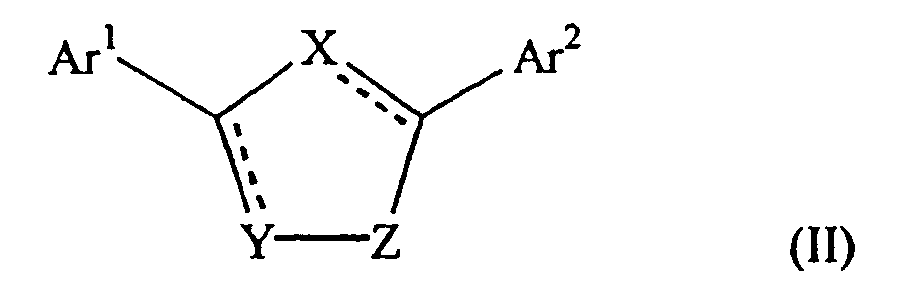
      Ar1 and Ar2 are independently selected from the group consisting of a heterocyclic or fused heterocyclic moiety containing 1 to 4 heteroatoms selected from the group consisting of N, O, and S and an aromatic moiety selected from the group consisting of phenyl, benzyl, 1-naphthyl, 2-naphthyl, fluorenyl, anthrenyl, indenyl, phenanthrenyl, and benzonaphthenyl, wherein the Ar1 and Ar2 moieties are optionally substituted with one or more moieties selected from the group consisting of -F, -Cl, -Br, -I, -OR, -SR, -SOR, -SO2R, -SO2NRR', -OCOR, -OCONRR', -NRCOR', -NRCO2R', -CN, -NO2, -CO2R, -CONRR', -C(O)R, - CH(OR)R', -CH2(OR), -R, and -A-(CH2)n-NRR'; wherein R or R' is selected from the group consisting of H, CF3, C1-C10 alkyl, cycloalkyl' alkyl-aryl, alkyl-heteroaryl, heterocycloalkyl, aryl and where R and R' may combine to form a ring, and A is defined as CH2, O, NH, S, SO, SO2 and n is 1, 2, 3, or 4, with the proviso that the compound is not 3-(2-Pyridyl)-5-(2-chlorophenyl)-1,2,4-oxadiazole, for the preparation of a medicament for the treatment of diseases associated with metabotropic glutamate receptors.
    18. The use according to claim 17, wherein X is N, Y is N, and Z is O.
    19. The use according to claim 18, wherein Ar1 is 2-pyridyl and Ar2 is phenyl.
    20. The use according to claim 18, wherein Ar2 is substituted with one or more moieties selected from the group consisting of OMe, CF3, Cl, F, Br, CH3, NO2, CN, OCF3, and SCH3.
    21. The use according to claim 18, wherein Ar1 is 2-pyridyl and substituted with one or more moieties selected from the group consisting of OCH3, CF3, F, and Cl.
    22. The use according to claim 18, wherein Ar1 is 2-pyridyl and Ar2 is 1-naphthyl
    23. The use according to claim 17, wherein X is N, Y is C, and Z is O.
    24. The use according to claim 23, wherein Ar1 is 2-pyridyl and substituted with one or more moieties selected from the group consisting of OCH3, CF3, F, and Cl. Ar2 is phenyl and substituted with one or more moieties selected from the group consisting of OCH3, CF3, Cl, F, Br, CH3, NO2, CN, OCF3, and SCH3.
    25. The use according to claim 17, wherein the disease associated with metabotropic glutamate receptors is a neurological disease or disorder.
    26. The use according to claim 17, wherein the disease associated with metabotropic glutamate receptors is a psychiatric disease.
    27. The use according to claim 17, wherein the disease or disorder is selected from the group consisting of stroke, head trauma, anoxic injury, ischemic injury, hypoglycemia, epilesy, pain, migraine headaches, Parkinson's disease, senile dementia, Huntington's Chorea and Alzheimer's disease.
    28. The use according to claim 17, wherein the disease or disorder is selected from the group consisting of schizophrenia and depression.
    29. A compound selected from the group consisting of 3-(2-pyridyl)-5-(3,5-dichlorophenyl)-1,2,4-oxadiazole, 3-(2-pyridyl)-5-(3-chlorophenyl)-1,2,4-oxadiazole, 3-(2-pyridyl)-5-(3-methylphenyl)-1,2,4-oxadiazole, 3-(2-pyridyl)-5-(1-naphthyl)-1,2,4-oxadiazole, 3-(2-pyridyl)-5-[3-(trifluoromethoxy)phenyl]-1,2,4-oxadiazole, 3-(2-pyridyl)-5-(2,3-difluorophenyl)-1,2,4-oxadiazole, 3-(2-pyridyl)-5-(2,5-difluorophenyl)-1,2,4-oxadiazole, 3-(2-pyridyl)-5-(3,5-difluorophenyl)-1,2,4-oxadiazole, 3-(2-pyridyl)-5-(3-cyanophenyl)-1,2,4-oxadiazole, 3-(2-pyridyl)-5-(3,5-dimethoxyphenyl)-1,2,4-oxadiazol, 3-(2-pyridyl)-5-(2,3-dichlorophenyl)-1,2,4-oxadiazole, 3-(2-pyridyl)-5-(3-chloro-5-cyanophenyl)-1,2,4-oxadiazole, 3-(2-pyridyl)-5-(3-fluoro-5-cyanophenyl)-1,2,4-oxadiazole, 3-(2-pyridyl)-5-(3-chloro-5-fluorophenyl)-1,2,4-oxadiazole, 3-(5-chloropyrid-2-yl)-5-(3-cyanophenyl)-1,2,4-oxadiazole, 3-(5-fluoropyrid-2-yl)-5-(3-cyanophenyl)-1,2,4-oxadiazole, 3-(5-fluoropyrid-2-yl)-5-(3-cyano-5-fluorophenyl)-1,2,4-oxadiazole, 3-(3-fluoropyrid-2-yl)-5-(3-cyanophenyl)-1,2,4-oxadiazole, 3-(5-fluoropyrid-2-yl)-5-(3,5-dimethoxyphenyl)-1,2,4-oxadiazole, 3-(5-methoxypyrid-2-yl)-5-(3-cyanophenyl)-1,2,4-oxadiazole, 3-(2-quinolinyl)-5-(3-cyanophenyl)-1,2,4-oxadiazole, 3-(3-chloro-5-trifluoromethylpyrid-2-yl)-5-(3-cyanophenyl)-1,2,4-oxadiazole, 3-(2-pyridyl)-5-(5-chloro-2-methoxyphenyl)-1,2,4-oxadiazole, 3-(2-pyridyl)-5-(2-chloro-5-methylthiophenyl)-1,2,4-oxadiazole, 3-(2-pyridyl)-5-(2,5,6-trifluorophenyl)-1,2,4-oxadiazole, 2-[3-chlorophenyl]-4-[pyridin-2-yl]-1,3-oxazole and 3-(2-pyridyl)-5-(2,5,6-trifluorophenyl)-1,2,4-oxadiazole, 3-(2-pyridyl)-5-(3-nitrophenyl)-1,2,4-oxadiazole, 3-(2-pyridyl)-5-(3-bromophenyl)-1,2,4-oxadiazole and pharmaceutically acceptable salts thereof.
    30. A compound selected from the group consisting of 2-(3,5-dichlorophenyl)-4-(2-pyridyl)-1,3-oxazole, 2-(3-chlorophenyl)-4-(2-pyridyl)-1,3-oxazole, 2-(3-methoxyphenyl)-4-(2-pyridyl)-1,3-oxazole, 2-(2-chlorophenyl)-4-(2-pyridyl)-1,3-oxazole, 2-(3-trifluorophenyl)-4-(2-pyridyl)-1,3-oxazole, 2-(3-methylphenyl)-4-(2-pyridyl)-1,3-oxazole, 2-(1-naphthyl)-4-(2-pyridyl)-1,3-oxazole, 2-(3-trifluoromethoxyphenyl)-4-(2-pyridyl)-1,3-oxazole, 2-(2,3-difluorophenyl)-4-(2-pyridyl)-1,3-oxazole, 2-(2,5-difluorophenyl)-4-(2-pyridyl)-1,3-oxazole, 2-(3,5-difluorophenyl)-4-(2-pyridyl)-1,3-oxazole, 2-(3-cyanophenyl)-4-(2-pyridyl)-1,3-oxazole, 2-(3,5-dimethoxyphenyl)-4-(2-pyridyl)-1,3-oxazole, 2-(2,3-dichlorophenyl)-4-(2-pyridyl)-1,3-oxazole, 2-(3-chloro-5-cyanophenyl)-4-(2-pyridyl)-1,3-oxazole, 2-(3-fluoro-5-cyanophenyl)-4-(2-pyridyl)-1,3-oxazole, 2-(3-chloro-5-fluorophenyl)-4-(2-pyridyl)-1,3-oxazole, 2-(3-cyanophenyl)-4-(5-chloropyrid-2-yl)-1,3-oxazole, 2-(3-cyanophenyl)-4-(5-fluoropyrid-2-yl)-1,3-oxazole, 2-(3-cyano-5-fluorophenyl)-4-(5-fluoropyrid-2-yl)-1,3-oxazole, 2-(3-cyanophenyl)-4-(3-fluoropyrid-2-yl)-1,3-oxazole, 2-(3,5-dimethoxyphenyl)-4-(5-fluoropyrid-2-yl)-1,3-oxazole, 2-(3-cyanophenyl)-4-(5-methoxypyrid-2-yl)-1,3-oxazole, 2-(3-cyanophenyl)-4-(2-quinolinyl)-1,3-oxazole, 2-(3-cyanophenyl)-4-(3-chloro-5-trifluoromethylpyrid-2-yl)-1,3-oxazole, 2-(5-chloro-2-methoxyphenyl)-4-(2-pyridyl)-1,3-oxazole, 2-(2-chloro-5-methylthiophenyl)-4-(2-pyridyl)-1,3-oxazole, 2-(2-bromo-5-methoxyphenyl)-4-(2-pyridyl)-1,3-oxazole, 2-(2,5,6-trifluorophenyl)-4-(2-pyridyl)-1,3-oxazole, 2-[3-chlorophenyl]-4-[pyridin-2-yl]-1,3-oxazole and 2-(2,5,6-trifluorophenyl)-4-(2-pyridyl)-1,3-oxazole, 2-(3-nitrophenyl)-4-(2-pyridyl-1,3-oxazole, 2-(3-bromophenyl)-4-(2-pyridyl)-1,3-oxazole and pharmaceutically acceptable salts thereof.
    EP05014788A 1999-08-19 2000-08-18 Heteropolycyclic compounds and their use as metabotropic glutamate receptor antagonists Withdrawn EP1582519A3 (en)

    Applications Claiming Priority (3)

    Application Number Priority Date Filing Date Title
    US14946499P 1999-08-19 1999-08-19
    US149464P 1999-08-19
    EP00955657A EP1210344B1 (en) 1999-08-19 2000-08-18 Heteropolycyclic compounds and their use as metabotropic glutamate receptor antagonists

    Related Parent Applications (2)

    Application Number Title Priority Date Filing Date
    EP00955657.2 Division 2000-08-18
    EP00955657A Division EP1210344B1 (en) 1999-08-19 2000-08-18 Heteropolycyclic compounds and their use as metabotropic glutamate receptor antagonists

    Publications (2)

    Publication Number Publication Date
    EP1582519A2 true EP1582519A2 (en) 2005-10-05
    EP1582519A3 EP1582519A3 (en) 2005-12-21

    Family

    ID=34888875

    Family Applications (1)

    Application Number Title Priority Date Filing Date
    EP05014788A Withdrawn EP1582519A3 (en) 1999-08-19 2000-08-18 Heteropolycyclic compounds and their use as metabotropic glutamate receptor antagonists

    Country Status (1)

    Country Link
    EP (1) EP1582519A3 (en)

    Family Cites Families (9)

    * Cited by examiner, † Cited by third party
    Publication number Priority date Publication date Assignee Title
    DE1149011B (en) * 1960-04-05 1963-05-22 Hoechst Ag Process for the preparation of 3, 5-disubstituted 1, 2, 4-oxdiazoles
    US3647809A (en) * 1968-04-26 1972-03-07 Chinoin Gyogyszer Es Vegyeszet Certain pyridyl-1 2 4-oxadiazole derivatives
    US4003909A (en) * 1974-07-22 1977-01-18 E. R. Squibb & Sons, Inc. [(1,2,4-Oxadiazol-3-yl)phenyl]carbamic or thiocarbamic acid esters
    US4022901A (en) * 1975-03-05 1977-05-10 E. R. Squibb & Sons, Inc. 3-Pyridinyl-5-isothiocyanophenyl oxadiazoles
    US5554630A (en) * 1993-03-24 1996-09-10 Neurosearch A/S Benzimidazole compounds
    WO1994022846A1 (en) * 1993-03-30 1994-10-13 Pfizer Inc. Compounds enhancing antitumor activity of other cytotoxic agents
    AU6526896A (en) * 1995-07-22 1997-02-18 Rhone-Poulenc Rorer Limited Substituted aromatic compounds and their pharmaceutical use
    DE19643037A1 (en) * 1996-10-18 1998-04-23 Boehringer Ingelheim Kg New oxadiazoles, processes for their preparation and their use as medicines
    CN1158264C (en) * 1997-11-21 2004-07-21 Nps药物有限公司 Metabotropic glutamate receptor antagonists for the treatment of central nervous system disorders

    Also Published As

    Publication number Publication date
    EP1582519A3 (en) 2005-12-21

    Similar Documents

    Publication Publication Date Title
    AU780191B2 (en) Heteropolycyclic compounds and their use as metabotropic glutamate receptor antagonists
    ES2292830T3 (en) HETEROPOLICICLIC COMPOUNDS AND THEIR USE AS ANTAGONISTS OF THE METABOTROPIC GLUTAMATE RECEIVER.
    US6660753B2 (en) Heteropolycyclic compounds and their use as metabotropic glutamate receptor antagonists
    AU2002306517A1 (en) Heteropolycyclic compounds and their use as metabotropic glutamate receptor antagonists
    EP1582519A2 (en) Heteropolycyclic compounds and their use as metabotropic glutamate receptor antagonists
    RU2412181C2 (en) Heteroaryl-substituted amides containing saturated binding group and use thereof as pharmaceutical agents
    US20060189661A1 (en) Heteropolycyclic compounds and their use as metabotropic glutamate receptor antagonists
    HK1047929B (en) Heteropolycyclic compounds and their use as metabotropic glutamate receptor antagonists
    HK1093734A (en) Heteropolycyclic compounds and their use as metabotropic glutamate receptor antagonists
    HK1060559B (en) Heteropolycyclic compounds and their use as metabotropic glutamate receptor antagonists
    JP2004155731A (en) Agent for treating diseases caused by circulatory disorders

    Legal Events

    Date Code Title Description
    PUAI Public reference made under article 153(3) epc to a published international application that has entered the european phase

    Free format text: ORIGINAL CODE: 0009012

    17P Request for examination filed

    Effective date: 20050707

    AC Divisional application: reference to earlier application

    Ref document number: 1210344

    Country of ref document: EP

    Kind code of ref document: P

    AK Designated contracting states

    Kind code of ref document: A2

    Designated state(s): AT BE CH CY DE DK ES FI FR GB GR IE IT LI LU MC NL PT SE

    PUAL Search report despatched

    Free format text: ORIGINAL CODE: 0009013

    AK Designated contracting states

    Kind code of ref document: A3

    Designated state(s): AT BE CH CY DE DK ES FI FR GB GR IE IT LI LU MC NL PT SE

    RIN1 Information on inventor provided before grant (corrected)

    Inventor name: ISAAC, METHVIN BENJAMIN

    Inventor name: MOE, SCOTT T.

    Inventor name: SMITH, DARYL L.

    Inventor name: STORMANN, THOMAS M.

    Inventor name: SHEEHAN, SUSAN M.

    Inventor name: VAN WAGENEN, BRADFORD C.

    Inventor name: MCLEOD, DONALD A.

    Inventor name: SLASSI, ABDELMALIK

    RAP1 Party data changed (applicant data changed or rights of an application transferred)

    Owner name: NPS PHARMACEUTICALS, INC.

    RIN1 Information on inventor provided before grant (corrected)

    Inventor name: STORMANN, THOMAS M.

    Inventor name: MOE, SCOTT T.

    Inventor name: SLASSI, ABDELMALIK

    Inventor name: SMITH, DARYL L.

    Inventor name: ISAAC, METHVIN BENJAMINC/O NPS ALLELIX CORP.

    Inventor name: SHEEHAN, SUSAN M.

    Inventor name: VAN WAGENEN, BRADFORD C.

    Inventor name: MCLEOD, DONALD A.

    17Q First examination report despatched

    Effective date: 20060721

    AKX Designation fees paid

    Designated state(s): AT BE CH CY DE DK ES FI FR GB GR IE IT LI LU MC NL PT SE

    17Q First examination report despatched

    Effective date: 20060721

    RAP1 Party data changed (applicant data changed or rights of an application transferred)

    Owner name: ASTRAZENECA AB

    GRAP Despatch of communication of intention to grant a patent

    Free format text: ORIGINAL CODE: EPIDOSNIGR1

    STAA Information on the status of an ep patent application or granted ep patent

    Free format text: STATUS: THE APPLICATION IS DEEMED TO BE WITHDRAWN

    18D Application deemed to be withdrawn

    Effective date: 20080826