EP1582380A2 - Tire deflation warning system - Google Patents
Tire deflation warning system Download PDFInfo
- Publication number
- EP1582380A2 EP1582380A2 EP05004353A EP05004353A EP1582380A2 EP 1582380 A2 EP1582380 A2 EP 1582380A2 EP 05004353 A EP05004353 A EP 05004353A EP 05004353 A EP05004353 A EP 05004353A EP 1582380 A2 EP1582380 A2 EP 1582380A2
- Authority
- EP
- European Patent Office
- Prior art keywords
- tire
- threshold value
- vehicle
- determining
- air pressure
- Prior art date
- Legal status (The legal status is an assumption and is not a legal conclusion. Google has not performed a legal analysis and makes no representation as to the accuracy of the status listed.)
- Granted
Links
Images





Classifications
-
- B—PERFORMING OPERATIONS; TRANSPORTING
- B60—VEHICLES IN GENERAL
- B60C—VEHICLE TYRES; TYRE INFLATION; TYRE CHANGING; CONNECTING VALVES TO INFLATABLE ELASTIC BODIES IN GENERAL; DEVICES OR ARRANGEMENTS RELATED TO TYRES
- B60C23/00—Devices for measuring, signalling, controlling, or distributing tyre pressure or temperature, specially adapted for mounting on vehicles; Arrangement of tyre inflating devices on vehicles, e.g. of pumps or of tanks; Tyre cooling arrangements
- B60C23/06—Signalling devices actuated by deformation of the tyre, e.g. tyre mounted deformation sensors or indirect determination of tyre deformation based on wheel speed, wheel-centre to ground distance or inclination of wheel axle
- B60C23/061—Signalling devices actuated by deformation of the tyre, e.g. tyre mounted deformation sensors or indirect determination of tyre deformation based on wheel speed, wheel-centre to ground distance or inclination of wheel axle by monitoring wheel speed
Definitions
- the present invention relates to a system for issuing a warning through detecting a deflated tire on vehicles such as passenger cars and trucks.
- a determination is made by comparing a difference between 1 on wheel speed ratio of left and right wheels of respective front wheel and rear wheel with a threshold value.
- Vfr is wheel speed of a front right tire
- Vfl is wheel speed of a front left tire
- Vrr is wheel speed of a rear right tire
- Vrl is wheel speed of a rear left tire.
- Rf 1 - Vfr/ Vfl
- Rr 1 - Vrr/ Vrl
- Rfrlp Rf - Rr
- the above-mentioned three threshold values are decided in such a manner that determination can be certainly made within a speed range by referring to the three values, Rf, Rr and Rfrlp, with respective states in which front wheel is -30 % and rear wheel is -30 %.
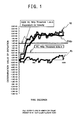
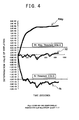
- Graphs (Figs. 1, 2, 3 and 4) indicate the above-mentioned three values for low velocity travel (56 to 72 km/h) and high velocity travel (104 km/h) at the respective states, the 30 % deflation of the front left tire and 30 % deflation of the rear right tire with standard load. From those graphs, threshold values can be decided as follows:
- the vehicle BUICK RENDEZVOUS CXL is front-wheel drive.
- Rf of the front wheel being in a deflation state is smaller at high velocity (Fig. 2) than low velocity (Fig. 1) because of an effect of centrifugal force.
- the threshold value of Rf is to be 6.0 ⁇ 10 -4 (6.0e - 4 in Figs. 1 and 2), thereby determination can be certainly made even at high velocity.
- the value for determining whether a tire is deflated changes in accordance with the speed of the vehicle.
- methods for determining the decrease in tire pressure may be changed in accordance with the speed of the vehicle.
- determination step for low velocity is employed when the vehicle speed is lower than the threshold value
- determination step for high velocity is employed when the vehicle speed is higher than the threshold value and the vehicle is in motion.
- Japanese Unexamined Patent Publication No. 216637/ 1996 it is described that there are provided a plurality of determination means, and a warning is issued based on at least one of the plurality of determination means when the loss of air pressure is determined.
- the warning is issued only when the vehicle speed is higher than the threshold value and the brakes are in effect.
- Japanese Unexamined Patent Publication No. 144518/1995 there is described a method to stop the collection of data when the vehicle is in predetermined driving conditions, and narrower the range of the predetermined driving conditions being stopped for data collection in accordance with increase in the vehicle speed.
- the threshold value for determining a deflation is modulated in accordance with the vehicle speed after determining the position of a tire having a possible deflation. Accordingly, the vehicle speed in which a deflation can be determined is limited, and there is a possibility of an error in determining the position of a tire having a possible deflation.
- a tire deflation detection system for determining loss of air pressure in a tire through comparing a determination value, which determines the loss of air pressure in the tire based on information of wheel speed of a vehicle, with a threshold value, wherein a determination threshold value for determining a position of the tire in low air pressure is modulated in accordance with velocity of said vehicle.
- the above-mentioned determination value for determining a position of the tire in low air pressure is wheel speed ratio of left and right wheels on a same axle.
- the present invention it is possible to determine the position of a deflated wheel on a vehicle with high accuracy and in a wide range of velocity through modulating determination threshold value for determining the position of a deflated tire in accordance with vehicle speed.
- a tire deflation warning system of the present invention is explained by showing examples through employing Fig. 8.
- the tire deflation warning system 1 of the present Embodiment is connected to a detection means 2 for detecting wheel speeds of respective wheels and is connected to a tire deflation warning display.
- the tire deflation warning system 1 includes a processing unit, a memory for storing programs and processed data, an input device for inputting wheel speeds by way of wheel speed detecting means, an output device for outputting warning to the tire deflation warning display. Other than wheel speed, speed of the vehicle may be detected and inputted. In addition, warning for tire deflation may be outputted to other vehicle controlling system.
- the program for determining tire deflation and data are stored in the same memory.
- the program for determining tire deflation may be stored in a ROM (read only memory) and data may be stored in a RAM (random access memory).
- Fig. 9 threshold values are underlined. Threshold values being accompanied with (v) indicate that threshold values are modulated in accordance with velocity.
- step S1 the input device is ordered to input data, and information of wheel speed is inputted to the memory.
- the speed of the vehicle is calculated as an average wheel speed of respective wheels.
- the threshold values for Rf, Rr and Rfrlp are determined in accordance with the speed of the vehicle.
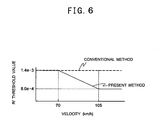
- the threshold values are successively modulated in accordance with the speed of the vehicle as shown in the method of Fig. 6. It may be employed a method that a table having a plurality of ranges of speed is provided, and threshold values for the respective ranges are memorized and referred by the table. In addition, other than a linear expression, an approximate expression can be employed even if the threshold values are successively modulated.
- the threshold values can be experimentally set for respective vehicles.
- Step S2 It is determined that no deflation exists when the absolute value of Rfrlp is less than or equal to the determined threshold value.
- Rfrlp When the absolute value of Rfrlp is above the threshold value, Rf is compared with the threshold value at first. If Rf is above the threshold value and the absolute value of Rr is less than or equal to the threshold value, it is determined that the front left tire is deflated (Steps S3, S4 and S5).
- Rr When the absolute value of Rf is less than or equal to the threshold value, Rr is compared with the threshold value. When Rr is above the threshold value, it is determined that rear left tire is deflated. (Steps S9 and S10) When Rr is below the threshold value whose sign is converted to have minus sign (that is, Rr is a negative value and its absolute value is above the threshold value), it is determined that the rear right tire is deflated (Steps S11 and S12).
- the result of the determined position of the deflated wheel is stored in the memory and transmitted to the deflation warning program.
- a program for determining the position of deflated wheel (a subroutine or function) is called by a main program, and the result of the determination is returned as a parameter or address of the memory. Then, the deflation warning program is called by the main program.
- the threshold value for determining deflation for DEL value may be lowered for driving wheels when the driving wheel is deflated.
- the threshold value is modulated only when deflation of the driving wheel is determined through the above-mentioned algorithm for determining a position of deflation. Accordingly, the above-mentioned algorithm for determining a position of deflation does not directly issue a warning for a deflation. However, improvement in accuracy of the present algorithm contributes to the improvement in accuracy of the warning system by avoiding false warnings.
- BUICK RENDEZVOUS CXL is employed as an example.
- BUICK RENDEZVOUS CXL is used and as for tires, Goodyear Fortera P225/60R17 is used. It is assumed that deflation warnings are issued in the range of velocity up to 104 km/h.
- Fig. 1 shows changes of determination value of deflated position for a vehicle driving at 56 to 72 km/h with the left front tire being deflated by 30 % than normal pressure with a certain load.
- Fig. 2 shows changes of determination value of deflated position for a vehicle driving at 104 km/h with the left front tire being deflated by 30 % than normal pressure with a certain load.
- Fig. 3 shows changes of determination value of deflated position for a vehicle driving at 56 to 72 km/h with the right rear tire being deflated by 30 % than normal pressure with a certain load.
- Fig. 4 shows changes of determination value of deflated position for a vehicle driving at 104 km/h with the right rear tire being deflated by 30 % than normal pressure with a certain load.
- Fig. 5 shows changes of determination value of deflated position for a vehicle driving at 56 to 72 km/h with the right front tire being deflated by 10 % than normal pressure with a certain load. This condition is not enough to be in a deflation state.
- the vehicle drove a straight course.
- the vehicle drove a course with bumps and curves compared with the examples as shown in Figs. 1 to 4.
- the threshold values of Rf and Rfrlp were 6.0 ⁇ 10 -4 (6.0e - 4 in Fig. 1) and the threshold value of Rf was 2.0 ⁇ 10 -3 (2.0e - 3 in Fig. 1) for all above-mentioned five conditions.
- the threshold values of Rf and Rfrlp were 1.4 ⁇ 10 -3 (1.4e - 3 in Figs. 1, 3 and 5) for Embodiments as shown in Figs. 1, 3 and 5, and the threshold value of Rr was 2.0 ⁇ 10 -3 (2.0e - 3 in Figs. 1, 3 and 5).
- the threshold values of Rf and Rfrlp were 6.0 ⁇ 10 -4 (6.0e - 4 in Figs. 2 and 4) for Embodiments as shown in Figs. 2 and 4, and the threshold value of Rr was 2.0 ⁇ 10 -3 (2.0e - 3 in Figs. 2 and 4).
- the threshold value of the comparative examples is shown as a dashed line, Rf, Rfrlp Threshold 6.0 ⁇ 10 -4 (6.0e - 4 in Figs. 1 and 2) of Figs. 1 and 2.
- the threshold value of Embodiments is shown as a solid line, NEW Rf, Rfrlp Threshold 1.4 ⁇ 10 -3 (1.4e - 3 in Figs. 1, 3 and 5) of Figs. 1, 3 and 5.
- the position of the deflated wheel is determined even if the wheel is deflated by 10 % in the condition of Fig. 5 in the comparative example.
- the position of the deflated wheel is not determined in the condition of Fig. 5 of Embodiment, and the position of the deflated wheel can be accurately determined in the deflated states of Figs. 1 to 4.
- the threshold value of the difference between front and rear wheels, Rfrlp becomes the same value as the threshold value of driving wheel side (Rf in the present Embodiment) as a result, the threshold value of Rfrlp may be successively modulated in accordance with velocity.
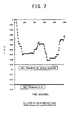
- the warning threshold value (absolute value) of DEL value is 0.13 (solid line) in Fig. 7.
- the warning threshold value of DEL value is switched to 0.09 (dashed line) for the driving wheel.
- the warning threshold value of DEL value is reduced to 0.09 from 0.13 in the 200 to 400 sec. interval. Since the DEL value at the time is 0.07 and close to the threshold value, it becomes close to the issue of false warnings.
- threshold values of Rf and Rfrlp are enlarged in the low velocity range, false determinations in determining the position of deflation when wheels are not at enough deflation are avoided. Accordingly, there are fewer possibilities of false warnings, and the accuracy of the warning system is improved (See Figs. 1 to 5 and 7).
- the threshold value of Rf in low velocity is to be 1.4 ⁇ 10 -3 (1.4e - 3 in Fig. 1) and the threshold value of Rf in high velocity is maintained to be 6.0 ⁇ 10 -4 (6.0e - 4 in Fig. 1) through successively modulating the value in accordance with velocity as shown in Fig. 6 for example thereby, it is possible to certainly determine the position of deflated wheel within the velocity range up to 104 km/h.
- threshold values for determining the position of the tire in low air pressure are modulated in accordance with velocity of the above-mentioned vehicle, it is possible to accurately determine the position of deflated wheel for substantially whole ranges of vehicle speed.
Landscapes
- Engineering & Computer Science (AREA)
- Mechanical Engineering (AREA)
- Measuring Fluid Pressure (AREA)
Abstract
Description
Claims (6)
- A tire deflation detection system for determining loss of air pressure in a tire through comparing a determination value, which determines the loss of air pressure in the tire based on information of wheel speed of a vehicle, with a threshold value, wherein a determination threshold value for determining a position of the tire in low air pressure is modulated in accordance with speed of said vehicle.
- A tire deflation detection system of Claim 1, wherein said determination value for determining a position of the tire in low air pressure is wheel speed ratio of left and right wheels on a same axle.
- A method for determining loss of air pressure in a tire through comparing a determination value, which determines the loss of air pressure in the tire based on information of wheel speed of the vehicle, with the threshold value, wherein the determination threshold value for determining a position of the tire in low air pressure is modulated in accordance with speed of said vehicle.
- A method for determining loss of air pressure in a tire according to Claim 3, wherein said determination value for determining a position of the tire in low air pressure is wheel speed ratio of left and right wheels on a same axle.
- A tire deflation detection program for determining loss of air pressure in a tire through comparing a determination value, which determines the loss of air pressure in the tire based on information of wheel speed of a vehicle, with a threshold value, wherein a determination threshold value for determining a position of the tire in low air pressure is modulated in accordance with speed of said vehicle.
- A tire deflation detection program of Claim 5, wherein said determination value for determining a position of the tire in low air pressure is wheel speed ratio of left and right wheels on a same axle.
Applications Claiming Priority (2)
| Application Number | Priority Date | Filing Date | Title |
|---|---|---|---|
| JP2004107441 | 2004-03-31 | ||
| JP2004107441A JP3993576B2 (en) | 2004-03-31 | 2004-03-31 | Tire pressure alarm device |
Publications (3)
| Publication Number | Publication Date |
|---|---|
| EP1582380A2 true EP1582380A2 (en) | 2005-10-05 |
| EP1582380A3 EP1582380A3 (en) | 2007-05-02 |
| EP1582380B1 EP1582380B1 (en) | 2008-10-08 |
Family
ID=34880101
Family Applications (1)
| Application Number | Title | Priority Date | Filing Date |
|---|---|---|---|
| EP05004353A Expired - Lifetime EP1582380B1 (en) | 2004-03-31 | 2005-02-28 | Tire deflation warning system |
Country Status (4)
| Country | Link |
|---|---|
| US (1) | US20050231345A1 (en) |
| EP (1) | EP1582380B1 (en) |
| JP (1) | JP3993576B2 (en) |
| DE (1) | DE602005010138D1 (en) |
Families Citing this family (3)
| Publication number | Priority date | Publication date | Assignee | Title |
|---|---|---|---|---|
| JP5074533B2 (en) * | 2007-03-16 | 2012-11-14 | ニラ・ダイナミクス・エイビイ | Method, system, and computer program for detecting tire pressure deviation |
| WO2014083625A1 (en) * | 2012-11-28 | 2014-06-05 | トヨタ自動車株式会社 | Air pressure monitoring device and abnormality determination threshold decision method |
| CN105644279B (en) * | 2016-03-24 | 2019-02-15 | 邹红斌 | Tire pressure detection method and device |
Family Cites Families (11)
| Publication number | Priority date | Publication date | Assignee | Title |
|---|---|---|---|---|
| GB9026558D0 (en) * | 1990-12-06 | 1991-01-23 | Sumitomo Rubber Ind | Method of detecting a deflated tyre on a vehicle |
| JP3569926B2 (en) * | 1993-03-03 | 2004-09-29 | 株式会社デンソー | Vehicle travel control device |
| JP3724892B2 (en) * | 1996-09-27 | 2005-12-07 | 住友電気工業株式会社 | Tire pressure drop detection method and apparatus |
| JP3605026B2 (en) * | 2000-10-31 | 2004-12-22 | 住友ゴム工業株式会社 | Tire pressure drop warning device and method |
| EP1364813A4 (en) * | 2001-02-08 | 2004-12-15 | Nippon Soken | TIRE PRESSURE SENSOR |
| DE60205340T2 (en) * | 2001-02-26 | 2006-03-23 | Toyota Jidosha Kabushiki Kaisha, Toyota | TIRE STATE APPRAISAL APPARATUS AND DEVICE FOR DETECTING AN ABNORMAL TIRE CONDITION |
| JP2003054230A (en) * | 2001-08-16 | 2003-02-26 | Sumitomo Rubber Ind Ltd | Tire pressure drop detection method and apparatus, and tire pressure reduction determination threshold selection program |
| JP2003220811A (en) * | 2002-01-30 | 2003-08-05 | Sumitomo Rubber Ind Ltd | Method and apparatus for detecting decrease in tire air pressure, and program for determining tire pressure reduction |
| JP3801945B2 (en) * | 2002-04-02 | 2006-07-26 | 住友ゴム工業株式会社 | Tire pressure drop detection method and apparatus, and tire decompression determination program |
| JP3834261B2 (en) * | 2002-05-10 | 2006-10-18 | 住友ゴム工業株式会社 | Tire pressure drop detection method and apparatus, and tire decompression determination program |
| JP2004148910A (en) * | 2002-10-29 | 2004-05-27 | Honda Motor Co Ltd | Air pressure drop detection device and sensor correction method performed using the same |
-
2004
- 2004-03-31 JP JP2004107441A patent/JP3993576B2/en not_active Expired - Fee Related
-
2005
- 2005-02-28 EP EP05004353A patent/EP1582380B1/en not_active Expired - Lifetime
- 2005-02-28 DE DE602005010138T patent/DE602005010138D1/en not_active Expired - Fee Related
- 2005-03-09 US US11/075,422 patent/US20050231345A1/en not_active Abandoned
Also Published As
| Publication number | Publication date |
|---|---|
| JP2005289214A (en) | 2005-10-20 |
| EP1582380A3 (en) | 2007-05-02 |
| US20050231345A1 (en) | 2005-10-20 |
| JP3993576B2 (en) | 2007-10-17 |
| DE602005010138D1 (en) | 2008-11-20 |
| EP1582380B1 (en) | 2008-10-08 |
Similar Documents
| Publication | Publication Date | Title |
|---|---|---|
| US5712616A (en) | System for monitoring the condition of tires | |
| US5343741A (en) | System for determining pneumatic tire pressure for motor vehicle by comparing actual to adequate wheel rotational speed | |
| US6137400A (en) | Apparatus and method for detecting decrease in tire air-pressure | |
| JPH08258684A (en) | ABS control device and / or ASC control device for automobile | |
| EP0826968A1 (en) | Initial correction factor computing apparatus and apparatus utilizing the same | |
| EP1190874A2 (en) | Apparatus and method for alarming decrease in tyre air pressure | |
| CN100430246C (en) | Method and device for detecting tire pressure loss | |
| US6501373B2 (en) | Apparatus and method for alarming decrease in tire air-pressure | |
| EP1145875A2 (en) | Apparatus and method for alarming decrease in tyre air pressure | |
| JP4159516B2 (en) | Improvement of speed sensitivity correction method for decompression judgment value in tire pressure drop warning device | |
| EP1582380A2 (en) | Tire deflation warning system | |
| EP1332895B1 (en) | Method and apparatus for detecting decrease in tire air-pressure | |
| JP2002079928A (en) | Method and apparatus for detecting lane change | |
| JP4217197B2 (en) | Judgment method of vehicle loading conditions | |
| US6918290B2 (en) | Method and device for regulating at least one vehicle dynamics variable | |
| EP1616725B1 (en) | Tire deflation warning system and method thereof, and judgement program of tire with reduced pressures | |
| US20040246116A1 (en) | Tire pressure loss recognition during trailer operation | |
| KR100273592B1 (en) | Tire pressure warning device | |
| KR100471248B1 (en) | Wheel shaft diagnosis controlling device of vehicle and method thereof | |
| CN100478198C (en) | Apparatus and method for alarming abnormality in tire air-pressure | |
| JP2004203302A (en) | Tire air pressure drop detection method and apparatus, and reduced pressure tire identification program | |
| KR20000026718A (en) | Method for preventing false detection of tire abnormality | |
| CN101011922A (en) | Apparatus, method and program for alarming abnormality in tire air-pressure |
Legal Events
| Date | Code | Title | Description |
|---|---|---|---|
| PUAI | Public reference made under article 153(3) epc to a published international application that has entered the european phase |
Free format text: ORIGINAL CODE: 0009012 |
|
| AK | Designated contracting states |
Kind code of ref document: A2 Designated state(s): AT BE BG CH CY CZ DE DK EE ES FI FR GB GR HU IE IS IT LI LT LU MC NL PL PT RO SE SI SK TR |
|
| AX | Request for extension of the european patent |
Extension state: AL BA HR LV MK YU |
|
| PUAL | Search report despatched |
Free format text: ORIGINAL CODE: 0009013 |
|
| AK | Designated contracting states |
Kind code of ref document: A3 Designated state(s): AT BE BG CH CY CZ DE DK EE ES FI FR GB GR HU IE IS IT LI LT LU MC NL PL PT RO SE SI SK TR |
|
| AX | Request for extension of the european patent |
Extension state: AL BA HR LV MK YU |
|
| 17P | Request for examination filed |
Effective date: 20070601 |
|
| 17Q | First examination report despatched |
Effective date: 20070731 |
|
| AKX | Designation fees paid |
Designated state(s): DE FR GB |
|
| GRAP | Despatch of communication of intention to grant a patent |
Free format text: ORIGINAL CODE: EPIDOSNIGR1 |
|
| GRAS | Grant fee paid |
Free format text: ORIGINAL CODE: EPIDOSNIGR3 |
|
| GRAA | (expected) grant |
Free format text: ORIGINAL CODE: 0009210 |
|
| AK | Designated contracting states |
Kind code of ref document: B1 Designated state(s): DE FR GB |
|
| REG | Reference to a national code |
Ref country code: GB Ref legal event code: FG4D |
|
| REF | Corresponds to: |
Ref document number: 602005010138 Country of ref document: DE Date of ref document: 20081120 Kind code of ref document: P |
|
| PGFP | Annual fee paid to national office [announced via postgrant information from national office to epo] |
Ref country code: GB Payment date: 20090219 Year of fee payment: 5 |
|
| PLBE | No opposition filed within time limit |
Free format text: ORIGINAL CODE: 0009261 |
|
| STAA | Information on the status of an ep patent application or granted ep patent |
Free format text: STATUS: NO OPPOSITION FILED WITHIN TIME LIMIT |
|
| PGFP | Annual fee paid to national office [announced via postgrant information from national office to epo] |
Ref country code: DE Payment date: 20090430 Year of fee payment: 5 |
|
| 26N | No opposition filed |
Effective date: 20090709 |
|
| PGFP | Annual fee paid to national office [announced via postgrant information from national office to epo] |
Ref country code: FR Payment date: 20090128 Year of fee payment: 5 |
|
| GBPC | Gb: european patent ceased through non-payment of renewal fee |
Effective date: 20100228 |
|
| REG | Reference to a national code |
Ref country code: FR Ref legal event code: ST Effective date: 20101029 |
|
| PG25 | Lapsed in a contracting state [announced via postgrant information from national office to epo] |
Ref country code: FR Free format text: LAPSE BECAUSE OF NON-PAYMENT OF DUE FEES Effective date: 20100301 |
|
| PG25 | Lapsed in a contracting state [announced via postgrant information from national office to epo] |
Ref country code: DE Free format text: LAPSE BECAUSE OF NON-PAYMENT OF DUE FEES Effective date: 20100901 |
|
| PG25 | Lapsed in a contracting state [announced via postgrant information from national office to epo] |
Ref country code: GB Free format text: LAPSE BECAUSE OF NON-PAYMENT OF DUE FEES Effective date: 20100228 |