EP1580196A1 - Monitor protein for measuring processing of protein - Google Patents
Monitor protein for measuring processing of protein Download PDFInfo
- Publication number
- EP1580196A1 EP1580196A1 EP03780713A EP03780713A EP1580196A1 EP 1580196 A1 EP1580196 A1 EP 1580196A1 EP 03780713 A EP03780713 A EP 03780713A EP 03780713 A EP03780713 A EP 03780713A EP 1580196 A1 EP1580196 A1 EP 1580196A1
- Authority
- EP
- European Patent Office
- Prior art keywords
- protein
- processing
- monitor
- luminescent
- monitor protein
- Prior art date
- Legal status (The legal status is an assumption and is not a legal conclusion. Google has not performed a legal analysis and makes no representation as to the accuracy of the status listed.)
- Granted
Links
Images



Classifications
-
- C—CHEMISTRY; METALLURGY
- C12—BIOCHEMISTRY; BEER; SPIRITS; WINE; VINEGAR; MICROBIOLOGY; ENZYMOLOGY; MUTATION OR GENETIC ENGINEERING
- C12N—MICROORGANISMS OR ENZYMES; COMPOSITIONS THEREOF; PROPAGATING, PRESERVING, OR MAINTAINING MICROORGANISMS; MUTATION OR GENETIC ENGINEERING; CULTURE MEDIA
- C12N15/00—Mutation or genetic engineering; DNA or RNA concerning genetic engineering, vectors, e.g. plasmids, or their isolation, preparation or purification; Use of hosts therefor
- C12N15/09—Recombinant DNA-technology
- C12N15/11—DNA or RNA fragments; Modified forms thereof; Non-coding nucleic acids having a biological activity
- C12N15/62—DNA sequences coding for fusion proteins
-
- C—CHEMISTRY; METALLURGY
- C12—BIOCHEMISTRY; BEER; SPIRITS; WINE; VINEGAR; MICROBIOLOGY; ENZYMOLOGY; MUTATION OR GENETIC ENGINEERING
- C12Q—MEASURING OR TESTING PROCESSES INVOLVING ENZYMES, NUCLEIC ACIDS OR MICROORGANISMS; COMPOSITIONS OR TEST PAPERS THEREFOR; PROCESSES OF PREPARING SUCH COMPOSITIONS; CONDITION-RESPONSIVE CONTROL IN MICROBIOLOGICAL OR ENZYMOLOGICAL PROCESSES
- C12Q1/00—Measuring or testing processes involving enzymes, nucleic acids or microorganisms; Compositions therefor; Processes of preparing such compositions
- C12Q1/34—Measuring or testing processes involving enzymes, nucleic acids or microorganisms; Compositions therefor; Processes of preparing such compositions involving hydrolase
- C12Q1/37—Measuring or testing processes involving enzymes, nucleic acids or microorganisms; Compositions therefor; Processes of preparing such compositions involving hydrolase involving peptidase or proteinase
-
- G—PHYSICS
- G01—MEASURING; TESTING
- G01N—INVESTIGATING OR ANALYSING MATERIALS BY DETERMINING THEIR CHEMICAL OR PHYSICAL PROPERTIES
- G01N33/00—Investigating or analysing materials by specific methods not covered by groups G01N1/00 - G01N31/00
- G01N33/48—Biological material, e.g. blood, urine; Haemocytometers
- G01N33/50—Chemical analysis of biological material, e.g. blood, urine; Testing involving biospecific ligand binding methods; Immunological testing
- G01N33/58—Chemical analysis of biological material, e.g. blood, urine; Testing involving biospecific ligand binding methods; Immunological testing involving labelled substances
- G01N33/582—Chemical analysis of biological material, e.g. blood, urine; Testing involving biospecific ligand binding methods; Immunological testing involving labelled substances with fluorescent label
-
- C—CHEMISTRY; METALLURGY
- C07—ORGANIC CHEMISTRY
- C07K—PEPTIDES
- C07K2319/00—Fusion polypeptide
- C07K2319/01—Fusion polypeptide containing a localisation/targetting motif
- C07K2319/09—Fusion polypeptide containing a localisation/targetting motif containing a nuclear localisation signal
-
- C—CHEMISTRY; METALLURGY
- C07—ORGANIC CHEMISTRY
- C07K—PEPTIDES
- C07K2319/00—Fusion polypeptide
- C07K2319/60—Fusion polypeptide containing spectroscopic/fluorescent detection, e.g. green fluorescent protein [GFP]
-
- G—PHYSICS
- G01—MEASURING; TESTING
- G01N—INVESTIGATING OR ANALYSING MATERIALS BY DETERMINING THEIR CHEMICAL OR PHYSICAL PROPERTIES
- G01N2500/00—Screening for compounds of potential therapeutic value
Definitions
- the present invention relates to a monitor protein comprising a region at which the protein is cleaved by processing and a property variable region in which an energy transfer property is changed by the cleavage, a gene encoding the same, a processing cell and protein using the produced monitor protein or a method for screening a compound which facilitates or inhibits the processing.
- a protein which is a transcription product of a gene has sometimes a function directly, but in many cases, a protein which is a posttranslational product is activated through various modification processes such as sugar addition phosphorylation and processing. Among them, in a processing process, an active peptide is cut off from a preproprotein by being cleaved at a given site.
- the processing process in which the active peptide is cut off from the preproprotein has been conventionally detected by an antibody specific for the active peptide after the cleavage or a direct change of molecular weights by electrophoresis or mass spectrometry.
- these methods are not simple, and are not procedures by which the processing is directly observed.
- Light-emitting enzymes are effective as procedures to directly observe an intracellular transcription activity of a gene, and have been utilized as monitor proteins for detecting the gene expression.
- a fluorescent protein has a fluorescent activity without need of a cofactor nearly simultaneously with its intracellular expression.
- the fluorescent protein has been utilized as a monitor protein for intracellular localization of a protein using its fluorescent activity as an indicator.
- a technique to track the changes of intermolecular or intramolecular interaction has been developed using energy transfer between a fluorescent protein and a fluorescent protein or a light-emitting enzyme and a fluorescent protein which are distinct proteins as an indicator.
- Monitor proteins have been constructed for analyzing the change of intracellular calcium using the energy transfer between the fluorescent protein and the fluorescent protein as the indicator and for analyzing phosphorylation of the protein using the energy transfer between the light-emitting enzyme and the fluorescent protein as the indicator.
- monitor proteins which visualizes and quantifies the processing process using the energy transfer as the indicator.
- a monitor protein construct where a processing region is inserted between a light-emitting enzyme and a fluorescent protein which can transfer energy is made, energy transfer is changed before and after the processing and a luminescence spectrum is also changed therewith.
- this spectral change as an indicator, it is possible to quantify an active peptide after the processing, quantify a processing enzyme activity and analyze the localization of a processing site, further screen a gene and a protein which control the processing enzyme activity as well as it becomes possible to utilize them for the treatment of various diseases and new drug development (development of medicaments which facilitate or inhibit the processing) using the processing as the indicator.
- the present inventor has made a monitor protein which has a processing cleavage region cleaved by the processing and a property variable region which exhibits a change in luminescent and fluorescent energy property by the processing.
- the present invention relates to the following monitor proteins, genes encoding the same, processing cells and proteins using the produced monitor proteins, or methods for screening compounds which facilitate or inhibit the processing.
- the luminescent protein and the fluorescent protein are arranged at both termini of the property variable region, respectively.
- either one may be present at the N-terminus, but it is more preferable that the luminescent protein and the fluorescent protein are present in this order from the N-terminus.
- the monitor protein having the luminescent protein and the fluorescent protein when the processing does not occur, the monitor protein emits yellow-green light by the energy transfer of blue light emitted from the luminescent protein (secretory Cypridina noctiluca, light-emitting enzyme) to the fluorescent protein mutant (EYFP).
- EYFP fluorescent protein mutant
- the processing has occurred, the energy transfer is not effected and only the blue light is emitted from the monitor protein.
- the processing can be analyzed using this color change of the emitted light in the property variable region as the indicator.
- monitor proteins by which intracellular phosphorylation and calcium dynamics can be observed.
- the present inventor has demonstrated the monitor protein capable of visualizing and quantifying the processing process for the first time.
- a system for analyzing cellular functions has been designed using the change in the energy transfer between the fluorescent protein and the fluorescent protein or between the luminescent protein and the fluorescent protein as the indicator.
- the present researcher has utilized it for a system which analyzes the processing for the first time.
- the monitor protein of the present invention is characterized by comprising the processing cleavage region and the property variable region.
- the processing cleavage region is a region comprising two or more amino acids, which is cleaved by the processing enzyme, and the amino acid sequence thereof is changed depending on a type of the processing enzyme subjected to be monitored.
- the processing cleavage region is the region comprising the amino acid sequence capable of being recognized and cleaved by the processing enzyme, comprises one or more amino acids, and the amino acid sequence thereof is changed depending on the type of the processing enzyme subjected to be monitored.
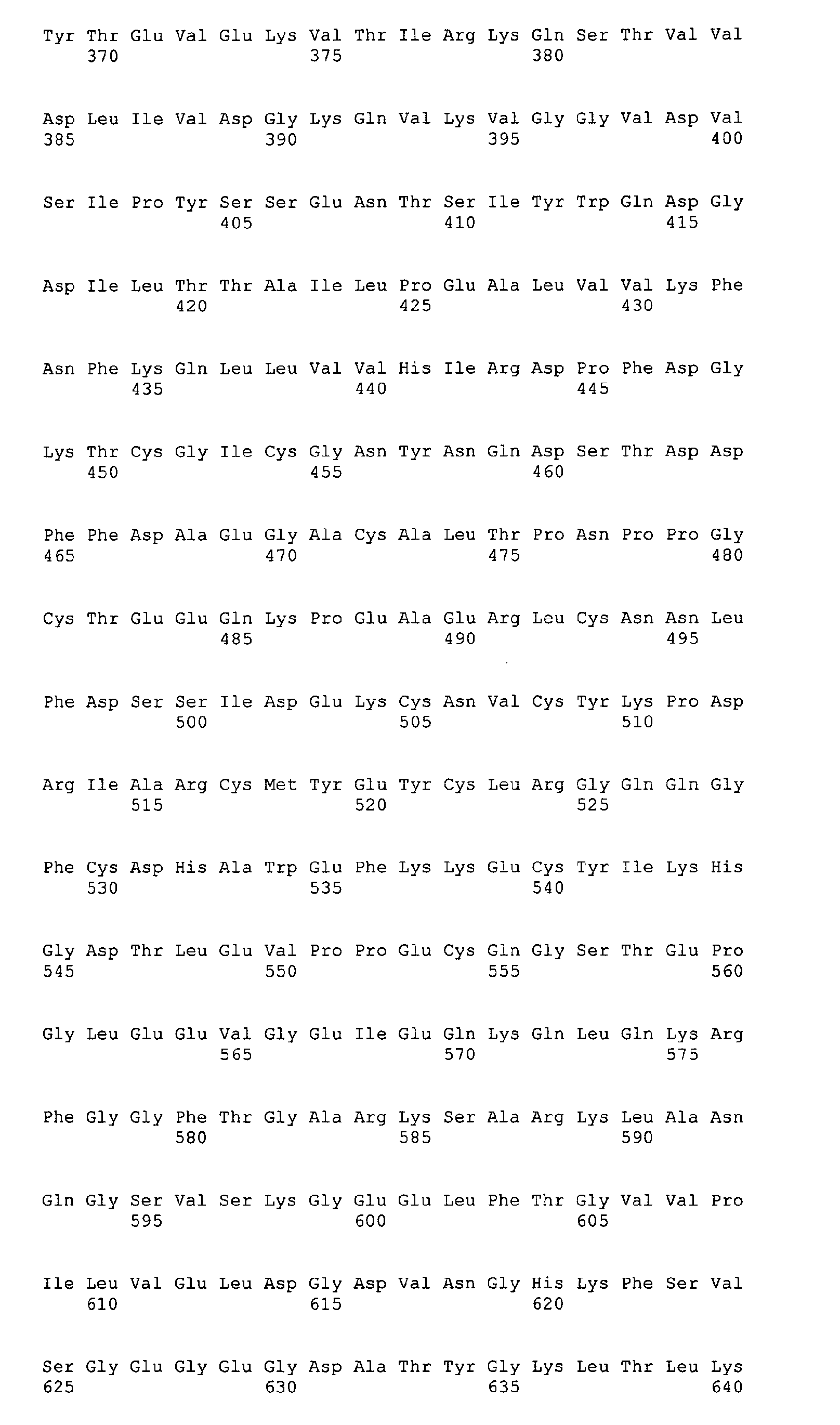
- PC1 which is the processing enzyme recognizes and cleaves a cleavage point, "KR”, but the cleavage occurs at only the processing cleavage region although there are four "KR" in SEQ ID NO:2 (two in a luciferase moiety, one in the processing cleavage region, and one in YFP).
- the processing cleavage region may comprise not only the cleavage point (KR) but also further an additional sequence having an auxiliary portion for the enzyme to recognize and be able to cleave the cleavage point, which scarcely or does not affect the cleavage at all.
- KR cleavage point
- One example of the processing cleavage region includes "SEQKQLQKRFGGFTGG" for the processing enzyme (PC1).
- the processing cleavage region will be illustrated with reference to PC1 as the processing enzyme.
- the cleavage recognition sequence of PC1 is Lys-Arg
- the processing cleavage region contains Lys-Arg and further links 3 to 50, preferably 4 to 40 and more preferably 5 to 20 amino acids at the C-terminus and the N-terminus.
- the amino acids used for the processing cleavage region are preferably usual amino acids such as Gly, Ala, His, Arg, Lys, Ser, Cys (including cystine), Thr, Met, Phe, Tyr, Trp, Leu, Ile, Val, Glu, Asp, Gln, Asp, Pro which constitute proteins, but may be other natural or synthetic amino acids such as Sar, ⁇ -alanine, norvaline, ornithine and cysteic acid.
- processing enzyme is PC1
- processing cleavage region for the other processing enzyme can be also designed in a similar manner.
- the total number of the amino acids in the cleavage region is about 6 to 100, preferably about 8 to 50, and more preferably about 10 to 40.
- the processing enzyme is not particularly limited as long as it exclusively degrades a protein precursor synthesized in vivo and converts into a mature protein, and for example, PC1, PC2, furin, proteasome, cathepsin and thrombin are exemplified.
- processing enzymes and the cleavage regions thereof in addition to PC1 are exemplified below.
- PC1, PC2 and furin cleave a C-terminal protein of KR, and a particular processing enzyme becomes possible to cleave by changing a structure of the sequence in the vicinity of KR or a structure of a whole protein.
- one cleavage recognition sequence may be included.
- multiple processing enzymes are simultaneously monitored, it is possible to introduce different cleavage recognition sequences corresponding to two or more processing enzymes into the cleavage region.
- a compounds which regulates only a particular processing enzyme activity can be screened by constructing the cleavage region having only the cleavage recognition sequence of the particular processing enzyme and having no cleavage recognition sequence of the other processing enzyme.
- a compound which facilitates or inhibits the processing of the particular substrate can be screened by selecting the cleavage recognition sequence or the sequence in the vicinity thereof in accordance with the sequence of the particular substrate.
- the energy transfer property may be changed when cleaved by the processing enzyme, and for example, the combination of the luminescent protein with the fluorescent protein and the combination of the luminescent protein with a colored protein can be included.
- the luminescent protein and the fluorescent protein are linked through the processing cleavage region, before the processing cleavage region is cleaved, the energy transfer from the luminescent protein to the fluorescent protein occurs, but after being cleaved, this energy transfer does not occur. Thus, it is advantageous in that the presence or absence of the cleavage can be easily quantified by measuring the energy transfer. It is preferable that the luminescent protein and the processing cleavage region and the fluorescent protein are linked in the order of the luminescent protein-the processing cleavage region-the fluorescent protein, but may be linked in the order of the fluorescent protein-the processing cleavage region-the luminescent protein as long as a luminescent/fluorescent property is changed by the cleavage by the processing enzyme.
- the processing cleavage region may also be introduced into a site which does not crucially affect the luminescent property in the luminescent protein.
- the luminescent protein may lose the luminescent property after the processing.
- the processing cleavage region may also be introduced into a site which does not crucially affect the fluorescent property in the fluorescent protein.
- the fluorescent protein may lose the fluorescent property after the processing.
- luciferases derived from various luminescent organisms such as Cypridina noctiluca, Acanthephya purpurea, luminescent insects (firefly, headlight beetle, etc.), luminescent earthworm, Latia neritoides, Renilla, and Aequorea victoria (aequorin) are exemplified.
- the Cypridina noctiluca luciferase is a secretory type, and is preferable because the monitor protein also becomes secretory when this is used.
- the secretory monitor protein When the secretory monitor protein is used, a level of the processing which occurs in living cells can be evaluated without disrupting the cells.
- non-secretory luciferase such as luciferase derived from Renilla, it can be utilized as a secretory luminescent protein by introducing a secretory protein into the N-terminal side.
- fluorescent protein a green fluorescent protein (GFP), a yellow fluorescent protein (YFP), a blue fluorescent protein (BFP), a cyan fluorescent protein (CFP), DsRED and a red fluorescent protein (RFP) are exemplified.
- fluorescent protein a green fluorescent protein (GFP), a yellow fluorescent protein (YFP), a blue fluorescent protein (BFP), a cyan fluorescent protein (CFP), DsRED and a red fluorescent protein (RFP) are exemplified.
- fluorescent protein a green fluorescent protein (GFP), a yellow fluorescent protein (YFP), a blue fluorescent protein (BFP), a cyan fluorescent protein (CFP), DsRED and a red fluorescent protein (RFP) are exemplified.
- fluorescent protein a colored blue protein (phycocyanin) and a red colored protein (phycoerythrin) are exemplified. Phycocyanin and phycoerythrin can absorb the light of firefly luciferase.
- the fluorescent protein of the present invention is selected so that the light released from the biological luminescent protein is an excitation wavelength of the fluorescent protein.
- a combination includes, for example, the followings.
- RFP Firefly luciferase DsRED, Phycocyanin, Phycoerythrin Luminescent Pyrocystis lunula luciferase GFP, YFP, BFP, CFP, DsRED, RFP Headlight beetle luciferase DsRED Renilla luciferase GFP, YFP, BFP, CFP, DsRED, RFP Aequorin GFP, YFP, BFP, CFP, DsRED, RFP,
- the proteins shown in the following (1) to (3) are exemplified.
- the protein (2) is the protein where mutations to an extent that the light-emitting enzyme activity, the fluorescent protein activity and the energy transfer activity are not lost are introduced into the protein (1). Such mutations naturally occur and further encompass artificial mutations. Procedures by which induce the artificial mutation include, but are not limited to site-directed mutagenesis (Nucleic Acids Res., 10:6487-6500, 1982).
- the number of mutated amino acids are not limited as long as the secretion, the luminescence, the fluorescent activity and the energy transfer property are not lost, and is typically within 20 amino acids, preferably within 15 amino acids, more preferably within 10 amino acids and most preferably within 5 amino acids. Whether the protein into which the mutation is introduced keeps the luminescent/fluorescent activity can be determined by examining the luminescent/fluorescent activity of the protein.
- the protein (3) is the monitor protein obtained by utilizing the hybridization of DNA, and which has the secretory type light-emitting enzyme activity, the fluorescent protein activity and the energy transfer activity.
- the "stringent condition" in the protein (3) refers to the condition where only the specific hybridization occurs whereas no non-specific hybridization occurs. Such a condition is typically the condition of "1 x SSC and 0.1% SDS at 37°C", preferably "0.5 x SSC and 0.1% SDS at 42°C", and more preferably "0.2 x SSC and 0.1% SDS at 65°C".
- the DNA obtained by the hybridization typically has high homology to the DNA represented by the base sequence in SEQ ID NO:1. The high homology indicates 60% or more homology, preferably 75% or more homology and more preferably 90% or more homology.
- the protein of the present invention can be obtained by incorporating a gene of the present invention described later into an expression vector and expressing it in appropriate host cells.
- an expression vector for example, pBT-VL-b-YFP and the like can be used.
- the host cell Escherichia coli BL21 strain and the like can be used.
- the gene of the present invention includes the genes represented by the following (1) and (2).
- the protein encoded by the above DNA is the protein obtained by utilizing the hybridization of DNA one another, and which has the secretory type light-emitting enzyme activity, the fluorescent protein activity and the energy transfer activity.
- the "stringent condition” herein refers to the condition where only the specific hybridization occurs whereas no non-specific hybridization occurs. Such a condition is typically the condition of "1 x SSC and 0.1% SDS at 37°C", preferably "0.5 x SSC and 0.1% SDS at 42°C", and more preferably "0.2 x SSC and 0.1% SDS at 65°C”.
- the DNA obtained by the hybridization typically has high homology to the DNA represented by the base sequence in SEQ ID NO:1 or 2.
- the high homology indicates 60% or more homology, preferably 75% or more homology, more preferably 90% or more homology, and particularly 95% or more homology.
- the protein of the present invention can be obtained by incorporating the gene of the present invention described later into the expression vector and expressing it in appropriate host cells.
- the expression vector for example, pBT-VL-mp-YFP (VL, mp and YFP indicate Cypridina noctiluca luciferase, a monitor peptide and the yellow fluorescent protein, respectively) and the like can be used.
- the host cells include eukaryotic cells such as mammalian cells and yeast cells, and prokaryotic cells such as Escherichia coli, Bacillus subtilis , algal and fungal cells, and any of them may be used.
- mammalian cultured cell COS7 cell line in this system, it is important to go through protein synthesis and protein modification processes of a mammalian system, i.e., this process will be monitored) and the like can be used.
- a gene (polynucleotide) encoding a preferable chimera protein of the present invention is
- the change in the energy transfer property of the monitor protein is quantitatively evaluated by introducing any of the monitor protein, the DNA sequence or the expression vector into certain cells.
- the method enables to quantitatively evaluate the processing ability of the cell.
- the processing ability of a subject protein is quantitatively evaluated by reacting the subject protein with the monitor protein of the present invention and measuring the change in the energy transfer property of the monitor protein.
- what processing enzyme the subject protein is or what processing enzyme activity is strong can be quantitatively measured by typically preparing multiple monitor proteins and analyzing what monitor protein changes the energy transfer property by the subject protein.
- a new processing enzyme can be screened by performing a step of reacting a subject protein with the monitor protein of the present invention and a step of selecting the subject protein which changes the property of the monitor protein by measuring the change in the energy transfer property of the monitor protein before and after the reaction with the subject protein.
- the method for screening a compound which facilitates or inhibits the processing in a cell free system comprising a step of contacting a subject sample, the processing enzyme and the monitor protein of the present invention, and a step of selecting the sample which facilitates or inhibits the property by measuring the change in the energy transfer property of the monitor protein before and after the contact with the subject sample.
- the compound which facilitates or inhibits the processing can be screened without considering factors such as migration into the cells.
- the method for screening a compound which facilitates or inhibits the processing (enzyme activity), comprising a step of preparing cells into which any of the monitor protein, the DNA sequence encoding the monitor protein and the expression vector comprising the DNA sequence of the present invention has been introduced, and a step of selecting the sample which facilitates or inhibits the property by measuring the change in the energy transfer property of the monitor protein expressed in the cells in the presence or absence of the subject sample.
- the compound which exerts medicinal efficacy by migrating into blood by oral administration can be screened.
- the present invention provides the monitor protein capable of quantifying the novel processing, the gene encoding the same, and the gene which controls the expression of the present enzyme.
- the processing process which occurs in the cell can be visualized without disrupting the cell. These can be utilized for the treatment of diseases, the examination and the new drug development.
- Nocistatin and nociceptin are hormone peptides cleaved off from the same preproprotein by a cleavage enzyme in the processing process, and are known to control reciprocal effects when pain runs in the body.
- a monitor protein where a peptide sequence Lys-Arg which was essential for cleavage recognition and was cleaved had been mutated to Gly-Gly (Fig. 1 (B))
- a monitor protein where the peptide sequence was deleted (Fig, 1 (C))
- Vluc-NST/Noc-EYFP mut-Vluc-NST/Noc-EYFP
- del-Vluc-NST/Noc-EYFP respectively.
- a BamHI site which was an insertion restriction enzyme site of the monitor protein was cleaved, and subsequently chemically synthesized DNA sequences shown in Fig. 2 were ligated by a ligase reaction. The insertion was confirmed by DNA sequencing.
- NG108-15 cells derived from nervous cells were transfected with gene vectors containing three monitor proteins, Vluc-NST/Noc-EYFP, mut-Vluc-NST/Noc-EYFP and del-Vluc-NST/Noc-EYFP using a commercially available transfection reagent. Proteins secreted in culture media were analyzed by a Western blotting method (Fig. 3). Vluc-EYFP which had no insertion sequence was used as a control. An anti- Cypridina noctiluca luciferase antibody (ant-Vluc) recognizes a light-emitting enzyme at the N-terminal side of the monitor protein, and four types of the monitor proteins have a molecular weight of 95 kDa.
- anti-GFP anti-green fluorescent protein antibody
- monitor protein Vluc-NST/Noc-EYFP
- a processing enzyme was expressed in NG108-15 cells derived from the nervous cells, and cleaved the monitor protein, the antibody recognized EYFP at the C-terminal side after the cleavage and consequently this band was produced.
- NG108-15 cells derived from nervous cells were transfected with gene vectors containing the monitor protein, Vluc-NST/Noc-EYFP and Vluc using a commercially available transfection reagent.
- the processing enzyme, PC1 or PC2 was forcibly expressed in the cells which had expressed the monitor protein, Vluc-NST/Noc-EYFP.
- Luminescence spectra in culture media secreted by these four types of the cells were measured (Fig. 4).
- the monitor protein, Vluc-NST/Noc-EYFP a peak at 525 nm caused by the energy transfer which had occurred in the monitor protein could be observed in addition to a peak at 460 nm conformed to that of the luminescence spectrum from Vluc alone.
- the cleavage efficiency of the monitor protein, Vluc-NST/Noc-EYFP transfected into NG108-15 cells derived from the nervous cells was detected by the Western blotting, and a mass of non-cleaved protein was quantified by an image analysis (Fig. 5B).
- Subtracted spectra were obtained by comparing the luminescence spectra of the monitor protein, Vluc-NST/Noc-EYFP with the spectrum of Vluc alone (inner figure in Fig. 4), and spectral areas were evaluated as energy transfer effects (BRET signal)(Fig. 5A).
- both the non-cleaved protein mass and the BRET signal shows that the cleavage did not occur.
- both the non-cleaved protein mass and the BRET signal shows that 60% monitor protein was cleaved.
Landscapes
- Life Sciences & Earth Sciences (AREA)
- Health & Medical Sciences (AREA)
- Engineering & Computer Science (AREA)
- Chemical & Material Sciences (AREA)
- Genetics & Genomics (AREA)
- Biomedical Technology (AREA)
- Organic Chemistry (AREA)
- Molecular Biology (AREA)
- Biotechnology (AREA)
- Zoology (AREA)
- Wood Science & Technology (AREA)
- Biochemistry (AREA)
- General Engineering & Computer Science (AREA)
- Immunology (AREA)
- Physics & Mathematics (AREA)
- Bioinformatics & Cheminformatics (AREA)
- Microbiology (AREA)
- General Health & Medical Sciences (AREA)
- Analytical Chemistry (AREA)
- Proteomics, Peptides & Aminoacids (AREA)
- Urology & Nephrology (AREA)
- Biophysics (AREA)
- Hematology (AREA)
- Food Science & Technology (AREA)
- Pathology (AREA)
- Plant Pathology (AREA)
- General Physics & Mathematics (AREA)
- Cell Biology (AREA)
- Medicinal Chemistry (AREA)
- Measuring Or Testing Involving Enzymes Or Micro-Organisms (AREA)
- Enzymes And Modification Thereof (AREA)
- Peptides Or Proteins (AREA)
- Micro-Organisms Or Cultivation Processes Thereof (AREA)
Abstract
Description
| Processing enzyme | Amino acid sequence at cleavage point of processing |
| PC1 | KR↓ |
| PC2 | KR↓ |
| Furin | RRKR↓ |
| Proteasome | KM↓ |
| Cathepsin | KM↓ |
| Thrombin | LVPR↓ |
| Biological luminescent protein | Fluorescent protein or colored protein |
| Cypridina noctiluca luciferase | GFP, YFP, BFP, CFP, DsRED. RFP, |
| Firefly luciferase | DsRED, Phycocyanin, Phycoerythrin |
| Luminescent Pyrocystis lunula luciferase | GFP, YFP, BFP, CFP, DsRED, RFP |
| Headlight beetle luciferase | DsRED |
| Renilla luciferase | GFP, YFP, BFP, CFP, DsRED, RFP |
| Aequorin | GFP, YFP, BFP, CFP, DsRED, RFP, |




Claims (21)
- A monitor protein capable of measuring processing of a protein, comprising one or more processing cleavage regions containing an amino acid residue or an amino acid sequence to be processed and one or more property variable regions which exhibit a change in luminescent and fluorescent energy property by the processing.
- The monitor protein according to claim 1 wherein the property variable region comprises a luminescent protein and a fluorescent protein.
- The monitor protein according to claim 1 wherein the monitor protein is a secretory protein.
- The monitor protein according to claim 1 wherein a processing enzyme which cleaves the processing cleavage region is any one selected from the group consisting of PC1, PC2, furin, proteasome, cathepsin and thrombin.
- The monitor protein according to claim 4 wherein the processing enzyme is PC1.
- The monitor protein according to claim 1 wherein the processing cleavage region is located between the luminescent protein and the fluorescent protein which constitute the property variable region.
- The monitor protein according to claim 1 wherein the luminescent protein is luciferase derived from any one selected from the group consisting of Cypridina noctiluca, Acanthephya purpurea, luminescent insects (firefly, headlight beetle, etc.), luminescent Pyrocystis lunula, luminescent earthworm, Latia neritoides, Renilla, and Aequorea victoria (aequorin).
- The monitor protein according to claim 1 wherein the fluorescent protein is derived from any one selected from the group consisting of a green fluorescent protein (GFP), a yellow fluorescent protein (YFP), a blue fluorescent protein (BFP), a cyan fluorescent protein (CFP), DsRED and a red fluorescent protein (RFP).
- The monitor protein according to claim 2 characterized in that the luminescent protein in the property variable region is a light-emitting enzyme from secretory Cypridina noctiluca and the fluorescent protein in the property variable region is a yellow fluorescent protein from a mutant derived from luminescent Aequorea victoria.
- The monitor protein according to claim 1 wherein the processing cleavage region is composed of a sequence of 6 to 100 amino acids including a cleavage point cleaved by the processing enzyme.
- The monitor protein according to claim 1 having any of the following amino acid sequences (a) and (b):(a) the monitor protein represented by an amino acid sequence in SEQ ID NO:2; and(b) the monitor protein having one or more amino acid substitutions, additions, deletions or insertions in the amino acid sequence in SEQ ID NO:2, wherein the energy transfer property between the luminescent protein and the fluorescent protein and the cleavage activity by the processing enzyme in the processing cleavage region are retained.
- The monitor protein according to claim 1 wherein the processing cleavage region is SEQKQLQKRFGGFTGG.
- DNA encoding the monitor protein according to any of claims 1 to 12.
- The DNA according to claim 13, having any of the following DNA sequences (c) and (d):(c) the DNA represented by a base sequence in SEQ ID NO:1; and(d) the DNA which hybridizes with the DNA represented by the base sequence in SEQ ID NO:1 or DNA complementary thereto under a stringent condition, wherein the protein encoded by the DNA retains the energy transfer property between the luminescent protein and the fluorescent protein and the cleavage activity by the processing enzyme in the processing cleavage region.
- An expression vector comprising the DNA according to claim 13.
- A method for measuring a processing ability of a certain cell characterized by introducing any of the monitor protein according to any of claims 1 to 12, the DNA according to claim 13 to 14 and the expression vector according to claim 15 into the cell, and quantitatively evaluating a change in energy transfer property of the monitor protein.
- The method according to claim 16 wherein said cell is a cell derived from human.
- A method for measuring a processing ability of a subject protein comprising a step of reacting the subject protein with the monitor protein according to any of claims 1 to 12 and a step of measuring a change in energy transfer property of the monitor protein.
- A method for screening a processing enzyme, comprising a step of reacting a subject protein with the monitor protein according to any of claims 1 to 12 and a step of selecting the subject protein which changes a property of the monitor protein by measuring a change in energy transfer property of the monitor protein before and after the reaction with the subject protein.
- A method for screening a compound which facilitates or inhibits processing, comprising a step of contacting a subject sample and a processing enzyme and the monitor protein according to any of claims 1 to 12 and a step of selecting a sample which facilitates or inhibits the property by measuring a change in energy transfer property of the monitor protein before and after the contact with the subject sample.
- A method for screening a compound which facilitates or inhibits processing (enzyme activity), comprising a step of preparing a cell into which any of the monitor protein according to any of claims 1 to 12, the DNA according to claims 13 to 14 and the expression vector according to claim 15 is introduced, and a step of selecting a sample which facilitates or inhibits a property change by measuring the property change in energy transfer of the monitor protein expressed in the cell in the presence or absence of the subject sample.
Applications Claiming Priority (3)
| Application Number | Priority Date | Filing Date | Title |
|---|---|---|---|
| JP2002360744 | 2002-12-12 | ||
| JP2002360744 | 2002-12-12 | ||
| PCT/JP2003/015828 WO2004052934A1 (en) | 2002-12-12 | 2003-12-11 | Monitor protein for measuring processing of protein |
Publications (3)
| Publication Number | Publication Date |
|---|---|
| EP1580196A1 true EP1580196A1 (en) | 2005-09-28 |
| EP1580196A4 EP1580196A4 (en) | 2006-06-21 |
| EP1580196B1 EP1580196B1 (en) | 2010-08-04 |
Family
ID=32501001
Family Applications (1)
| Application Number | Title | Priority Date | Filing Date |
|---|---|---|---|
| EP03780713A Expired - Lifetime EP1580196B1 (en) | 2002-12-12 | 2003-12-11 | Monitor protein for measuring processing of protein |
Country Status (7)
| Country | Link |
|---|---|
| US (1) | US20070224647A2 (en) |
| EP (1) | EP1580196B1 (en) |
| JP (1) | JP4427671B2 (en) |
| CN (1) | CN1726228B (en) |
| AU (1) | AU2003289316A1 (en) |
| DE (1) | DE60333673D1 (en) |
| WO (1) | WO2004052934A1 (en) |
Families Citing this family (7)
| Publication number | Priority date | Publication date | Assignee | Title |
|---|---|---|---|---|
| CN102532143B (en) | 2005-09-26 | 2015-06-24 | 独立行政法人产业技术综合研究所 | Cypridina luciferin stabilization composition and method for storing cypridina luciferin |
| WO2007114056A1 (en) | 2006-03-30 | 2007-10-11 | Asahi Kasei Chemicals Corporation | Resin composition and molded product thereof |
| JP5224457B2 (en) * | 2006-06-12 | 2013-07-03 | 独立行政法人産業技術総合研究所 | Mutant luciferase |
| EP2686424B1 (en) * | 2011-03-15 | 2015-06-03 | Olympus Corporation | Star-worm luciferase |
| CN103562719B (en) | 2011-03-16 | 2016-01-13 | 国立大学法人东北大学 | Probe for biological tissue analysis and method of use thereof |
| WO2016152882A1 (en) * | 2015-03-20 | 2016-09-29 | 国立大学法人東京工業大学 | Collagen fusion protein and drug screening method using same |
| CN115011621A (en) * | 2022-06-27 | 2022-09-06 | 齐鲁工业大学 | Recombinant protein and method for detecting substrate through fluorescence |
Family Cites Families (5)
| Publication number | Priority date | Publication date | Assignee | Title |
|---|---|---|---|---|
| US6228604B1 (en) * | 1996-04-10 | 2001-05-08 | Loma Linda University | Secreted renilla luciferase |
| EP1088233B9 (en) * | 1998-06-16 | 2006-05-17 | PerkinElmer BioSignal Inc. | A bioluminescence resonance energy transfer (bret) system and its use |
| CA2403327C (en) * | 2000-03-15 | 2012-05-29 | Prolume, Ltd. | Renilla reniformis fluorescent proteins, nucleic acids encoding the fluorescent proteins and the use thereof in diagnostics, high throughput screening and novelty items |
| ATE378596T1 (en) * | 2000-09-25 | 2007-11-15 | U S Medical Res Inst Of Infect | HIGH-THROUGHPUT ASSAY FOR PROTEOLYTIC ACTIVITIES OF CLOSTRIDIUM NEUROTOXINS |
| AU2003261922A1 (en) * | 2002-09-06 | 2004-03-29 | National Institute Of Advanced Industrial Science And Technology | Secretory or membrane-binding chimeric protein |
-
2003
- 2003-12-11 AU AU2003289316A patent/AU2003289316A1/en not_active Abandoned
- 2003-12-11 WO PCT/JP2003/015828 patent/WO2004052934A1/en not_active Ceased
- 2003-12-11 CN CN2003801060052A patent/CN1726228B/en not_active Expired - Fee Related
- 2003-12-11 EP EP03780713A patent/EP1580196B1/en not_active Expired - Lifetime
- 2003-12-11 DE DE60333673T patent/DE60333673D1/en not_active Expired - Lifetime
- 2003-12-11 JP JP2004558466A patent/JP4427671B2/en not_active Expired - Lifetime
-
2005
- 2005-06-09 US US10/537,971 patent/US20070224647A2/en not_active Abandoned
Also Published As
| Publication number | Publication date |
|---|---|
| EP1580196A4 (en) | 2006-06-21 |
| AU2003289316A8 (en) | 2004-06-30 |
| CN1726228B (en) | 2010-05-26 |
| JPWO2004052934A1 (en) | 2006-04-13 |
| AU2003289316A1 (en) | 2004-06-30 |
| EP1580196B1 (en) | 2010-08-04 |
| US20070224647A2 (en) | 2007-09-27 |
| WO2004052934A1 (en) | 2004-06-24 |
| JP4427671B2 (en) | 2010-03-10 |
| CN1726228A (en) | 2006-01-25 |
| DE60333673D1 (en) | 2010-09-16 |
| US20060035286A1 (en) | 2006-02-16 |
Similar Documents
| Publication | Publication Date | Title |
|---|---|---|
| US5958713A (en) | Method of detecting biologically active substances by using green fluorescent protein | |
| EP0815257B1 (en) | A method of detecting biologically active substances | |
| RU2340629C2 (en) | Photoprotein with increased bioluminescence | |
| EP1088233B9 (en) | A bioluminescence resonance energy transfer (bret) system and its use | |
| EP1580196B1 (en) | Monitor protein for measuring processing of protein | |
| US9354240B2 (en) | Probe for analyzing biological tissue and method for utilizing same | |
| KR20070121689A (en) | Bioluminescence-enhanced photoproteins and their use as intracellular calcium indicators | |
| JP2005518180A (en) | Novel fluorescent protein | |
| CN109486800A (en) | A kind of novel lysyl endopeptidase and preparation method thereof | |
| US8921045B2 (en) | Fluorescent color markers | |
| US7544484B2 (en) | Nucleic acids encoding membrane-binding proteins and methods of using same | |
| KR20070029630A (en) | Isolated photoprotein matrices and uses thereof | |
| US6759524B2 (en) | Photoprotein derived from okinawan squid and gene encoding the photoprotein | |
| EP1143011B1 (en) | A method of detecting biologically active substances | |
| CA3145920A1 (en) | Biosensors for detecting arrestin signaling | |
| US20240043943A1 (en) | Methods and compositions for protease reporter assays and modulators | |
| CN121794397A (en) | Complementarity-based tag and reporter genes for bimodal labeling | |
| KR20080021018A (en) | Isolated photoprotein Adadecike and uses thereof | |
| CN112194729A (en) | Biological probe for detecting degradation activity of ubiquitin-proteasome system | |
| JP2014018191A (en) | Luciferase derived from pyrocoelia matsumurai | |
| NZ614600B2 (en) | Probe for analyzing biological tissue and method for utilizing same | |
| KR20110026965A (en) | Beta-glucosidase that can be used as a reporter and a method for producing a cloning vector using the same as an indicator |
Legal Events
| Date | Code | Title | Description |
|---|---|---|---|
| PUAI | Public reference made under article 153(3) epc to a published international application that has entered the european phase |
Free format text: ORIGINAL CODE: 0009012 |
|
| 17P | Request for examination filed |
Effective date: 20050712 |
|
| AK | Designated contracting states |
Kind code of ref document: A1 Designated state(s): AT BE BG CH CY CZ DE DK EE ES FI FR GB GR HU IE IT LI LU MC NL PT RO SE SI SK TR |
|
| AX | Request for extension of the european patent |
Extension state: AL LT LV MK |
|
| DAX | Request for extension of the european patent (deleted) | ||
| RBV | Designated contracting states (corrected) |
Designated state(s): CH DE FR GB IT LI NL |
|
| A4 | Supplementary search report drawn up and despatched |
Effective date: 20060524 |
|
| 17Q | First examination report despatched |
Effective date: 20070320 |
|
| GRAP | Despatch of communication of intention to grant a patent |
Free format text: ORIGINAL CODE: EPIDOSNIGR1 |
|
| RAP1 | Party data changed (applicant data changed or rights of an application transferred) |
Owner name: JAPAN SCIENCE AND TECHNOLOGY AGENCY |
|
| GRAS | Grant fee paid |
Free format text: ORIGINAL CODE: EPIDOSNIGR3 |
|
| GRAA | (expected) grant |
Free format text: ORIGINAL CODE: 0009210 |
|
| AK | Designated contracting states |
Kind code of ref document: B1 Designated state(s): CH DE FR GB IT LI NL |
|
| REG | Reference to a national code |
Ref country code: GB Ref legal event code: FG4D |
|
| REG | Reference to a national code |
Ref country code: CH Ref legal event code: EP |
|
| REG | Reference to a national code |
Ref country code: CH Ref legal event code: NV Representative=s name: SERVOPATENT GMBH |
|
| REF | Corresponds to: |
Ref document number: 60333673 Country of ref document: DE Date of ref document: 20100916 Kind code of ref document: P |
|
| REG | Reference to a national code |
Ref country code: NL Ref legal event code: VDEP Effective date: 20100804 |
|
| PG25 | Lapsed in a contracting state [announced via postgrant information from national office to epo] |
Ref country code: NL Free format text: LAPSE BECAUSE OF FAILURE TO SUBMIT A TRANSLATION OF THE DESCRIPTION OR TO PAY THE FEE WITHIN THE PRESCRIBED TIME-LIMIT Effective date: 20100804 |
|
| PGFP | Annual fee paid to national office [announced via postgrant information from national office to epo] |
Ref country code: CH Payment date: 20101202 Year of fee payment: 8 |
|
| PG25 | Lapsed in a contracting state [announced via postgrant information from national office to epo] |
Ref country code: IT Free format text: LAPSE BECAUSE OF FAILURE TO SUBMIT A TRANSLATION OF THE DESCRIPTION OR TO PAY THE FEE WITHIN THE PRESCRIBED TIME-LIMIT Effective date: 20100804 |
|
| PGFP | Annual fee paid to national office [announced via postgrant information from national office to epo] |
Ref country code: DE Payment date: 20101220 Year of fee payment: 8 |
|
| PLBE | No opposition filed within time limit |
Free format text: ORIGINAL CODE: 0009261 |
|
| STAA | Information on the status of an ep patent application or granted ep patent |
Free format text: STATUS: NO OPPOSITION FILED WITHIN TIME LIMIT |
|
| 26N | No opposition filed |
Effective date: 20110506 |
|
| GBPC | Gb: european patent ceased through non-payment of renewal fee |
Effective date: 20101211 |
|
| REG | Reference to a national code |
Ref country code: DE Ref legal event code: R097 Ref document number: 60333673 Country of ref document: DE Effective date: 20110506 |
|
| REG | Reference to a national code |
Ref country code: FR Ref legal event code: ST Effective date: 20110831 |
|
| PG25 | Lapsed in a contracting state [announced via postgrant information from national office to epo] |
Ref country code: FR Free format text: LAPSE BECAUSE OF NON-PAYMENT OF DUE FEES Effective date: 20110103 |
|
| PG25 | Lapsed in a contracting state [announced via postgrant information from national office to epo] |
Ref country code: GB Free format text: LAPSE BECAUSE OF NON-PAYMENT OF DUE FEES Effective date: 20101211 |
|
| REG | Reference to a national code |
Ref country code: CH Ref legal event code: PL |
|
| REG | Reference to a national code |
Ref country code: DE Ref legal event code: R119 Ref document number: 60333673 Country of ref document: DE Effective date: 20120703 |
|
| PG25 | Lapsed in a contracting state [announced via postgrant information from national office to epo] |
Ref country code: DE Free format text: LAPSE BECAUSE OF NON-PAYMENT OF DUE FEES Effective date: 20120703 Ref country code: CH Free format text: LAPSE BECAUSE OF NON-PAYMENT OF DUE FEES Effective date: 20111231 Ref country code: LI Free format text: LAPSE BECAUSE OF NON-PAYMENT OF DUE FEES Effective date: 20111231 |