EP1578750B1 - Cationic porphyrin derivatives as antibacterial agents - Google Patents
Cationic porphyrin derivatives as antibacterial agents Download PDFInfo
- Publication number
- EP1578750B1 EP1578750B1 EP03786158A EP03786158A EP1578750B1 EP 1578750 B1 EP1578750 B1 EP 1578750B1 EP 03786158 A EP03786158 A EP 03786158A EP 03786158 A EP03786158 A EP 03786158A EP 1578750 B1 EP1578750 B1 EP 1578750B1
- Authority
- EP
- European Patent Office
- Prior art keywords
- compound
- compound according
- phenyl
- group
- porphyrin
- Prior art date
- Legal status (The legal status is an assumption and is not a legal conclusion. Google has not performed a legal analysis and makes no representation as to the accuracy of the status listed.)
- Expired - Lifetime
Links
- 0 CNCc1cc(C*)cc(C*)c1C1C(CCCOc(cc2)ccc2C(c2ccc(C=C3N=C4C=C3)[n]2)=C(C=C2)N=C2C=C(C=C2)NC2=C4c2ccc(*)cc2)*C1 Chemical compound CNCc1cc(C*)cc(C*)c1C1C(CCCOc(cc2)ccc2C(c2ccc(C=C3N=C4C=C3)[n]2)=C(C=C2)N=C2C=C(C=C2)NC2=C4c2ccc(*)cc2)*C1 0.000 description 2
- DDCFTCVVKUKHCE-VHQFOFSESA-O CN(C)CCCN(C)CCCOc(cc1)ccc1/C(/c1ccc(/C=C2\N=C3C=C2)[nH]1)=C(\C=C1)/[NH+]=C1/C=C(/C=C1)\N/C1=C3/c(cc1)ccc1OCCC[N](C)(C)CCCN(C)C Chemical compound CN(C)CCCN(C)CCCOc(cc1)ccc1/C(/c1ccc(/C=C2\N=C3C=C2)[nH]1)=C(\C=C1)/[NH+]=C1/C=C(/C=C1)\N/C1=C3/c(cc1)ccc1OCCC[N](C)(C)CCCN(C)C DDCFTCVVKUKHCE-VHQFOFSESA-O 0.000 description 1
Images


Classifications
-
- C—CHEMISTRY; METALLURGY
- C07—ORGANIC CHEMISTRY
- C07D—HETEROCYCLIC COMPOUNDS
- C07D487/00—Heterocyclic compounds containing nitrogen atoms as the only ring hetero atoms in the condensed system, not provided for by groups C07D451/00 - C07D477/00
- C07D487/22—Heterocyclic compounds containing nitrogen atoms as the only ring hetero atoms in the condensed system, not provided for by groups C07D451/00 - C07D477/00 in which the condensed system contains four or more hetero rings
-
- A—HUMAN NECESSITIES
- A61—MEDICAL OR VETERINARY SCIENCE; HYGIENE
- A61P—SPECIFIC THERAPEUTIC ACTIVITY OF CHEMICAL COMPOUNDS OR MEDICINAL PREPARATIONS
- A61P11/00—Drugs for disorders of the respiratory system
-
- A—HUMAN NECESSITIES
- A61—MEDICAL OR VETERINARY SCIENCE; HYGIENE
- A61P—SPECIFIC THERAPEUTIC ACTIVITY OF CHEMICAL COMPOUNDS OR MEDICINAL PREPARATIONS
- A61P17/00—Drugs for dermatological disorders
- A61P17/02—Drugs for dermatological disorders for treating wounds, ulcers, burns, scars, keloids, or the like
-
- A—HUMAN NECESSITIES
- A61—MEDICAL OR VETERINARY SCIENCE; HYGIENE
- A61P—SPECIFIC THERAPEUTIC ACTIVITY OF CHEMICAL COMPOUNDS OR MEDICINAL PREPARATIONS
- A61P19/00—Drugs for skeletal disorders
- A61P19/02—Drugs for skeletal disorders for joint disorders, e.g. arthritis, arthrosis
-
- A—HUMAN NECESSITIES
- A61—MEDICAL OR VETERINARY SCIENCE; HYGIENE
- A61P—SPECIFIC THERAPEUTIC ACTIVITY OF CHEMICAL COMPOUNDS OR MEDICINAL PREPARATIONS
- A61P29/00—Non-central analgesic, antipyretic or antiinflammatory agents, e.g. antirheumatic agents; Non-steroidal antiinflammatory drugs [NSAID]
-
- A—HUMAN NECESSITIES
- A61—MEDICAL OR VETERINARY SCIENCE; HYGIENE
- A61P—SPECIFIC THERAPEUTIC ACTIVITY OF CHEMICAL COMPOUNDS OR MEDICINAL PREPARATIONS
- A61P31/00—Antiinfectives, i.e. antibiotics, antiseptics, chemotherapeutics
-
- A—HUMAN NECESSITIES
- A61—MEDICAL OR VETERINARY SCIENCE; HYGIENE
- A61P—SPECIFIC THERAPEUTIC ACTIVITY OF CHEMICAL COMPOUNDS OR MEDICINAL PREPARATIONS
- A61P31/00—Antiinfectives, i.e. antibiotics, antiseptics, chemotherapeutics
- A61P31/04—Antibacterial agents
-
- A—HUMAN NECESSITIES
- A61—MEDICAL OR VETERINARY SCIENCE; HYGIENE
- A61P—SPECIFIC THERAPEUTIC ACTIVITY OF CHEMICAL COMPOUNDS OR MEDICINAL PREPARATIONS
- A61P31/00—Antiinfectives, i.e. antibiotics, antiseptics, chemotherapeutics
- A61P31/10—Antimycotics
-
- A—HUMAN NECESSITIES
- A61—MEDICAL OR VETERINARY SCIENCE; HYGIENE
- A61P—SPECIFIC THERAPEUTIC ACTIVITY OF CHEMICAL COMPOUNDS OR MEDICINAL PREPARATIONS
- A61P31/00—Antiinfectives, i.e. antibiotics, antiseptics, chemotherapeutics
- A61P31/12—Antivirals
-
- A—HUMAN NECESSITIES
- A61—MEDICAL OR VETERINARY SCIENCE; HYGIENE
- A61P—SPECIFIC THERAPEUTIC ACTIVITY OF CHEMICAL COMPOUNDS OR MEDICINAL PREPARATIONS
- A61P31/00—Antiinfectives, i.e. antibiotics, antiseptics, chemotherapeutics
- A61P31/12—Antivirals
- A61P31/14—Antivirals for RNA viruses
- A61P31/18—Antivirals for RNA viruses for HIV
-
- A—HUMAN NECESSITIES
- A61—MEDICAL OR VETERINARY SCIENCE; HYGIENE
- A61P—SPECIFIC THERAPEUTIC ACTIVITY OF CHEMICAL COMPOUNDS OR MEDICINAL PREPARATIONS
- A61P31/00—Antiinfectives, i.e. antibiotics, antiseptics, chemotherapeutics
- A61P31/12—Antivirals
- A61P31/20—Antivirals for DNA viruses
- A61P31/22—Antivirals for DNA viruses for herpes viruses
-
- A—HUMAN NECESSITIES
- A61—MEDICAL OR VETERINARY SCIENCE; HYGIENE
- A61P—SPECIFIC THERAPEUTIC ACTIVITY OF CHEMICAL COMPOUNDS OR MEDICINAL PREPARATIONS
- A61P33/00—Antiparasitic agents
- A61P33/02—Antiprotozoals, e.g. for leishmaniasis, trichomoniasis, toxoplasmosis
-
- A—HUMAN NECESSITIES
- A61—MEDICAL OR VETERINARY SCIENCE; HYGIENE
- A61P—SPECIFIC THERAPEUTIC ACTIVITY OF CHEMICAL COMPOUNDS OR MEDICINAL PREPARATIONS
- A61P33/00—Antiparasitic agents
- A61P33/02—Antiprotozoals, e.g. for leishmaniasis, trichomoniasis, toxoplasmosis
- A61P33/04—Amoebicides
-
- A—HUMAN NECESSITIES
- A61—MEDICAL OR VETERINARY SCIENCE; HYGIENE
- A61P—SPECIFIC THERAPEUTIC ACTIVITY OF CHEMICAL COMPOUNDS OR MEDICINAL PREPARATIONS
- A61P33/00—Antiparasitic agents
- A61P33/02—Antiprotozoals, e.g. for leishmaniasis, trichomoniasis, toxoplasmosis
- A61P33/06—Antimalarials
-
- A—HUMAN NECESSITIES
- A61—MEDICAL OR VETERINARY SCIENCE; HYGIENE
- A61P—SPECIFIC THERAPEUTIC ACTIVITY OF CHEMICAL COMPOUNDS OR MEDICINAL PREPARATIONS
- A61P33/00—Antiparasitic agents
- A61P33/10—Anthelmintics
-
- A—HUMAN NECESSITIES
- A61—MEDICAL OR VETERINARY SCIENCE; HYGIENE
- A61P—SPECIFIC THERAPEUTIC ACTIVITY OF CHEMICAL COMPOUNDS OR MEDICINAL PREPARATIONS
- A61P33/00—Antiparasitic agents
- A61P33/10—Anthelmintics
- A61P33/12—Schistosomicides
Definitions
- the present invention relates to compounds and uses thereof in the treatment of a medical condition for which a photodynamic compound is indicated and, in particular, in the curative or prophylactic treatment of microbial colonisation and infection.
- PDT photodynamic therapy
- positively charged (cationic) photosensitising agents including porphyrins and phthalocyanines, promote efficient inactivation of Gram negative bacteria without the need for modifying the natural structure of the cellular envelope ( Merchat et al., 1996, J. Photochem. Photobiol. B. Biol. 32:153-157 ; Minnock et al., 1996, J. Photochem. Photobiol. B. Biol. 32:159-164 ). It appears that the positive charge favours the binding of the photosensitising agent at critical cellular sites that, once damaged by exposure to light, cause the loss of cell viability ( Merchat et al., 1996, J. Photochem. Photobiol. B. Biol. 35:149-157 ).
- porphyrin-based photodynamic therapy agents are limited due to their toxicity against mammalian host tissue cells, i.e. the compounds are unable to differentiate between target microbial cells and host cells.
- the utility of known porphyrin-based photodynamic therapy agents is further limited by their relatively low potency for target microbial cells.
- porphyrin-based compounds with improved toxicity profiles and high potency, which can be used in PDT to preferentially kill microbial cells.
- lower alkyl means linear or branched, cyclic or acyclic, C 1 -C 20 alkyl which may be interrupted by oxygen (preferably no more than five oxygen atoms are present in each alkyl chain).
- Lower alkyl groups which R 1 , R 2 , R 3 , R 4 , R 5 , R 6 , R 7 , R 8 , R 9 , R 10 , R 11 , R 12 , R 13 and R 14 may represent include C 1 -C 18 alkyl, C 1 -C 16 alkyl, C 1 -C 14 alkyl, C 1 -C 12 alkyl, C 1 -C 10 alkyl, C 1 -C 9 alkyl, C 1 -C 8 alkyl, C 1 -C 7 alkyl, C 1 -C 6 alkyl, C 1 -C 5 alkyl, C 1 -C 4 alkyl, C 1 -C 3 alkyl and C 1 -C 2 alkyl.
- Preferred lower alkyl groups which R 1 , R 2 , R 3 , R 4 , R 5 , R 6 , R 7 , R 8 , R 9 , R 10 and R 11 may represent include C 1 , C 2 , C 3 , C 4 , C 5 , C 6 , C 7 , C 8 , C 9 , C 10 , C 11 , C 12 , C 13 , C 14 , C 15 and C 16 alkyl.
- lower alkylene is to be construed accordingly.
- lower alkenyl and “lower alkynyl” mean linear or branched, cyclic or acyclic, C 2 -C 20 alkenyl and alkynyl, respectively, each of which may be interrupted by oxygen (preferably no more than five oxygen atoms are present in each alkenyl or alkynyl chain).
- lower alkenyl also includes both the cis and trans geometric isomers.
- Lower alkenyl groups which R 1 , R 2 , R 3 , R 4 , R 5 , R 6 , R 7 , R 8 , R 9 , R 10 , R 11 , R 12 , R 13 and R 14 may represent include C 2 -C 18 alkenyl, C 2 -C 17 alkenyl, C 2 -C 16 alkenyl, C 2 -C 14 alkenyl, C 2 -C 12 alkenyl, C 2 -C 10 alkenyl, C 2 -C 8 alkenyl, C 2 -C 7 alkenyl, C 2 -C 6 alkenyl, C 2 -C 5 alkenyl, C 2 -C 4 alkenyl, C 2 -C 3 alkenyl and C 3 -C 4 alkenyl.
- Preferred lower alkenyl groups which R 1 , R 2 , R 3 , R 4 , R 5 , R 6 , R 7 , R 8 , R 9 , R 10 and R 11 may represent include C 2 , C 3 , C 4 , C 5 , C 6 , C 7 , C 8 , C 9 , C 10 , C 11 , C 12 , C 13 and C 14 alkenyl.
- “Lower alkynyl” groups which R 1 , R 2 , R 3 , R 4 , R 5 , R 6 , R 7 , R 8 , R 9 , R 10 , R 11 , R 12 , R 13 and R 14 may represent include C 2 -C 18 alkynyl, C 2 -C 16 alkynyl, C 2 -C 14 alkynyl, C 2 -C 12 alkynyl, C 2 -C 10 alkynyl, C 2 -C 9 alkynyl, C 2- C 8 alkynyl, C 2 -C 7 alkynyl, C 2 -C 6 alkynyl, C 2 -C 5 alkynyl, C 2 -C 4 alkynyl, C 2 -C 3 alkynyl and C 3 -C 4 alkynyl.
- Preferred lower alkynyl groups which R 1 , R 2 , R 3 , R 4 , R 5 , R 6 , R 7 , R 8 , R 9 , R 10 and R 11 may represent include C 2 , C 3 , C 4 , C 5 , C 6 , C 7 , C 8 , C 9 , C 10 , C 11 , C 12 , C 13 and C 14 alkynyl.
- lower alkynylene is to be construed accordingly.
- aryl means six to ten-membered carbocyclic aromatic groups, such as phenyl and naphthyl, which groups are optionally substituted by one or more substituents selected from fluoro, cyano, nitro, lower alkyl ( i.e . alkaryl), OR 5 , C(O)R 6 , C(O)OR 7 , C(O)NR 8 R 9 and NR 10 R 11 .
- aralkyl includes aryl groups joined to the porphyrin ring via a lower alkyl group.
- a second aspect of the invention provides a compound of formula II: wherein M is a diamagnetic metallic element or a metalloid element and X 1 , X 2 , X 3 , and X 4 are as defined above.
- metallic element is intended to include a divalent or trivalent metallic element.
- the metallic element is diamagnetic. More preferably, the metallic element is selected from Zn (II), La (III), Lu (III), Y (III), in (III) Cd (II), Mg (II), Al(III), and Pd(II). Most preferably, the metallic element is Ni(II), Mn(III), Fe(III) or Pd(II).
- metal is intended to include an element having physical and chemical properties, such as the ability to conduct electricity, that are intermediate to those of both metals and non-metals.
- metalloid element includes silicon (Si) and germanium (Ge) atoms which are optionally substituted with one or more ligands.
- metallic element and metalloid element include a metal element or a metalloid element having a positive oxidation state, all of which may be substituted by one or more ligands selected from fluoro, OH, OR 15 wherein R 15 is lower alkyl, lower alkenyl, lower alkynyl, aralkyl, aryl or alkaryl as defined above (wherein aryl and alkaryl are mono-substituted).
- the compounds of formulae I and II comprise at least one cationic group.
- the compounds of the invention may carry a net positive charge, for example a charge of +1, +2, +3, +4, +5, +6 or more.
- the compounds carry a net charge of less than +4, for example +1, +2 or +3.
- the compounds carry a net charge of +2.
- counter-anions include, but are not limited to, halides (e.g. fluoride, chloride and bromide), sulfates (e.g. decylsulfate), nitrates, perchlorates, sulfonates (e.g. methane sulfonate) and trifluoroacetate.
- halides e.g. fluoride, chloride and bromide
- sulfates e.g. decylsulfate
- nitrates e.g. decylsulfate
- perchlorates e.g. methane sulfonate
- trifluoroacetate e.g. methane sulfonate
- Salts which may be mentioned include: acid addition salts, for example, salts formed with inorganic acids such as hydrochloric, hydrobromic, sulfuric and phosphoric acid, with carboxylic acids or with organo-sulfonic acids; base addition salts; metal salts formed with bases, for example, the sodium and potassium salts.
- acid addition salts for example, salts formed with inorganic acids such as hydrochloric, hydrobromic, sulfuric and phosphoric acid, with carboxylic acids or with organo-sulfonic acids
- base addition salts for example, the sodium and potassium salts.
- Compounds of formulae I and II may also contain one or more asymmetric carbon atoms and may therefore exhibit optical and/or diastereoisomerism.
- Diastereoisomers may be separated using conventional techniques, e.g. chromatography or fractional crystallisation. The various stereoisomers may be isolated by separation of a racemic or other mixture of the compounds using conventional, e.g. fractional crystallisation or HPLC, techniques.
- the desired optical isomers may be made by reaction of the appropriate optically active starting materials under conditions which will not cause racemisation or epimerisation, or by derivatisation, for example with a homochiral acid followed by separation of the diastereomeric esters by conventional means (e.g. HPLC, chromatography over silica). All stereoisomers are included within the scope of the invention.
- a characterising feature of the compounds of the first and second aspects of the invention is that at least one of substituent groups X 1 , X 2 , X 3 and X 4 is a quaternary ammonium cationic group of the formula -L-R 1 -N + (R 2 )(R 3 )R 4 , as defined above.
- substituent groups X 1 , X 2 , X 3 and X 4 is a quaternary ammonium cationic group of the formula -L-R 1 -N + (R 2 )(R 3 )R 4 , as defined above.
- none of X 1 , X 2 , X 3 and X 4 is an anilinium or a pyridinium cationic group.
- R 1 is an unsubstituted lower alkylene, lower alkenylene or lower alkynylene group.
- R 1 is a straight-chain lower alkylene group of formula: - (CH 2 ) m -.
- 'm' is an integer between 1 and 20. More preferably, 'm' is an integer between 1 and 10, for example between 1 and 6, between 1 and 5, between 1 and 4 or between 1 and 3.
- Preferred straight-chain lower alkylene groups which R 1 may represent include groups of the above formula wherein m is 2, 3, 4, 5, 6, 7, 8, 9 or 10. Most preferably, 'm' is 2 or 3.
- R 2 , R 3 and R 4 may be the same or different and are selected from H, lower alkyl, lower alkenyl or lower alkynyl, the latter three of which are optionally substituted by one or more substituents selected from lower alkyl, OR 5 , C(O)R 6 , C(O)OR 7 , C(O)NR 8 R 9 , NR 10 R 11 and N + R 12 R 13 R 14 .
- R 2 , R 3 and/or R 4 are lower alkyl, lower alkenyl or lower alkynyl group.
- R 2 , R 3 and/or R 4 are unsubstituted lower alkyl groups.
- At least one of R 2 , R 3 and R 4 is an alkyl group which is substituted with a primary, secondary or tertiary amine group or a quaternary ammonium group.
- R 1 is -(CH 2 ) 3 -
- R 2 and R 3 are CH 3
- R 4 is -(CH 2 ) 3 -N(CH 3 ) 2 .
- R 1 is -(CH 2 ) 3 -, and R 2 , R 3 and R 4 are each CH 3 .
- R 1 is -(CH 2 ) 3 -, and R 2 , R 3 and R 4 are each C 2 H 5 .
- At least one of X 1 , X 2 , X 3 and X 4 is a cationic group as defined above and at least one of X 1 , X 2 , X 3 and X 4 is a hydrogen atom.
- each of X 1 , X 2 , X 3 and X 4 is a hydrogen atom or a cationic group as defined above.
- the pK values of any primary, secondary or tertiary amine groups, if present in the compounds of the invention is greater than 8 to ensure that the group is protonated when in a physiological environment.
- the quaternary ammonium cationic group is optionally joined to the porphyrin ring via a linking moiety, L, selected from the group consisting of
- the quaternary ammonium cationic group is joined to the porphyrin ring via a phenoxy linker.
- X 1 , X 2 , X 3 and/or X 4 may have the following formula: wherein R is R 1 - N + (R 2 )(R 3 )R 4 , as defined above, and 'n' is an integer between 1 and 3.
- the quaternary ammonium cationic group is joined to the porphyrin ring via a phenylene linker.
- X 1 , X 2 , X 3 and/or X 4 may have the following formula: wherein R is R 1 - N + (R 2 )(R 3 )R 4 , as defined above, and 'm' is an integer between 1 and 3.
- 'm' is 2, and most preferably 1.
- X 1 , X 2 , X 3 and/or X 4 may have the following formula: wherein R is R 1 - N + (R 2 )(R 3 )R 4 , 'n' and 'm' are as defined above, and 'n + m' is between 1 and 3.
- L comprises a benzene ring (e.g . phenoxy, phenylene, phenylsulfonylamido or phenylamino-sulfonyl) mono-substituted at the para -position.
- L may be mono- or di-substituted at meta- or ortho -positions. L may also be both para- and ortho -substituted.
- the quaternary ammonium cationic group is joined directly to the porphyrin ring, i.e. L is absent.
- the compound comprises two cationic groups, as defined above, on opposite sides of the porphyrin ring, i.e. at ring positions 5 and 15 or ring positions 10 and 20.
- X 1 and X 3 may be a hydrogen atom, a lipophilic moiety, a phenyl group, a lower alkyl, alkaryl or aralkyl group, and X 2 and X 4 may be cationic groups, or vice versa.
- X 1 and X 3 are both a hydrogen atom and X 2 and X 4 are both a cationic group, or vice versa.
- the compound of the invention may comprise two cationic groups, as defined above, on neighbouring positions of the porphyrin ring, i.e. at ring positions 5 and 10, or ring positions 10 and 15, or ring positions 15 and 20 or ring positions 20 and 5.
- X 1 and X 2 may be hydrogen and X 3 and X 4 may be cationic groups
- X 2 and X 3 may be hydrogen and X 4 and X 1 may be cationic groups, etc.
- At least one of X 1 , X 2 , X 3 and X 4 is or comprises a lipophilic moiety.
- 'lipophilic moiety we include moieties having a partition coefficient between 1-n-octanol and water expressed as log P of greater than 1.0 at physiological pH and 25°C.
- the lipophilic moiety is a saturated, straight-chain alkyl group of formula - (CH 2 ) p CH 3 , wherein 'p' is an integer between 1 and 22, for example between 1 and 18.
- 'p' is between 1 and 18, more preferably between 2 and 16, between 4 and 16, between 6 and 18, between 8 and 16 or between 4 and 12.
- 'p' is between 10 and 12.
- X 1 , X 2 , X 3 and/or X 4 may be a cationic group, as defined above, which also comprises a lipophilic moiety.
- none of X 1 , X 2 , X 3 and X 4 is a lipophilic moiety.
- the compounds of the invention are soluble in water.
- the compounds may be dissolved in water to a concentration of at least 5 ⁇ g/l, for example at least 10 ⁇ g/l, 15 ⁇ g/l or 20 ⁇ g/l. More preferably, the compounds may be dissolved in water to a concentration of at least 100 ⁇ g/l, for example 200 ⁇ g/l, 300 ⁇ g/l, 400 ⁇ g/l, 500 ⁇ g/l, 1 mg/ml, 5 mg/ml, 10 mg/ml, 20 mg/ml, 50 mg/ml or 100 mg/ml.
- the compounds of the invention exhibit greater toxicity to a target microorganism (e.g . a bacterium) upon illumination/irradiation than in the absence of activating illumination/irradiation, i.e. they exhibit greater photodynamic activity ('light toxicity') than dark toxicity (see below). It will be appreciated that such toxicity may be determined using cell cultures.
- the photodynamic activity of a compound is at least two-fold greater than the dark toxicity of that compound, more preferably at least three-fold, at least four-fold, at least five-fold, at least six-fold, at least eight-fold, at least ten-fold, at least fifteen-fold or at least twenty fold.
- the compound of the invention is substantially non-toxic in the absence of illumination/irradiation.
- the compound of the invention is toxic to the target microorganism (e.g . bacterial cells) at low doses.
- the compound is toxic to the target microorganism at a concentration of less than 10 ⁇ M, for example less than 1 ⁇ M, less than 0.1 ⁇ M, less than 0.01 ⁇ M, less than 0.005 ⁇ M or less than 0.001 ⁇ M (see Example B).
- Preferred compounds of the invention include the following:
- the above compounds may alternatively be in a metallated form, i.e. they may comprise a chelated metallic element or metalloid element within the porphyrin ring.
- a third aspect of the invention provides a compound for use as a selective photodynamic therapy agent, i.e. for selectively killing microorganisms, wherein the compound is a compound according to the first or second aspect of the invention.
- the photodynamic therapy agent is preferentially toxic to one or more microorganisms (such as bacteria, mycoplasmas, yeasts, fungi and/or viruses) compared to mammalian, e.g. human, host cells.
- the toxicity of the compound to a target microorganism is at least two-fold greater than the toxicity of that compound to mammalian cells (such as human skin cells), more preferably at least three-fold, at least four-fold, at least five-fold, at least six-fold, at least eight-fold, at least ten-fold, at least fifteen-fold or at least twenty fold.
- the compound of the invention is substantially non-toxic to mammalian cells.
- the photodynamic therapy agents preferably exhibit a 'therapeutic window'.
- a fourth aspect of the invention provides a pharmaceutical formulation comprising a compound according to the first or second aspect of the invention in admixture with a pharmaceutically or veterinarily acceptable adjuvant, diluent or carrier.
- the compounds of the invention can be formulated at various concentrations, depending on the efficacy/toxicity of the compound being used and the indication for which it is being used.
- the formulation comprises the compound of the invention at a concentration of between 0.1 ⁇ M and 1 mM, more preferably between 1 ⁇ M and 100 ⁇ M, between 5 ⁇ M and 50 ⁇ M, between 10 ⁇ M and 50 ⁇ M, between 20 ⁇ M and 40 ⁇ M and most preferably about 30 ⁇ M.
- formulations may comprise a lower concentration of a compound of the invention, for example between 0.0025 ⁇ M and 1 ⁇ M.
- the compounds of the invention will generally be administered in admixture with a suitable pharmaceutical excipient diluent or carrier selected with regard to the intended route of administration and standard pharmaceutical practice (for example, see Remington: The Science and Practice of Pharmacy, 19th edition, 1995, Ed. Alfonso Gennaro, Mack Publishing Company, Pennysylvania, USA ).
- the compounds of the invention can be administered in the form of a lotion, solution, cream, gel, ointment or dusting powder (for example, see Remington, supra, pages 1586 to 1597).
- the compounds of the invention can be formulated as a suitable ointment containing the active compound suspended or dissolved in, for example, a mixture with one or more of the following: mineral oil, liquid petrolatum, white petrolatum, propylene glycol, polyoxyethylene polyoxypropylene compound, emulsifying wax and water.
- a suitable lotion or cream suspended or dissolved in, for example, a mixture of one or more of the following: mineral oil, sorbitan monostearate, a polyethylene glycol, liquid paraffin, polysorbate 60, cetyl esters wax, e-lauryl sulphate, an alcohol (e.g. ethanol, cetearyl alcohol, 2-octyldodecanol, benzyl alcohol) and water.
- mineral oil sorbitan monostearate
- a polyethylene glycol liquid paraffin
- polysorbate 60 e.g. sorbate 60
- cetyl esters wax e-lauryl sulphate
- an alcohol e.g. ethanol, cetearyl alcohol, 2-octyldodecanol, benzyl alcohol
- water e.g. ethanol, cetearyl alcohol, 2-octyldodecanol, benzyl alcohol
- the formulation e.g. lotion, solution, cream, gel or ointment
- the formulation is water-based.
- Formulations suitable for topical administration in the mouth further include lozenges comprising the active ingredient in a flavoured basis, usually sucrose and acacia or tragacanth; pastilles comprising the active ingredient in an inert basis such as gelatin and glycerin, or sucrose and acacia; and mouth-washes comprising the active ingredient in a suitable liquid carrier.
- lozenges comprising the active ingredient in a flavoured basis, usually sucrose and acacia or tragacanth
- pastilles comprising the active ingredient in an inert basis such as gelatin and glycerin, or sucrose and acacia
- mouth-washes comprising the active ingredient in a suitable liquid carrier.
- the compounds of the invention can also be administered intranasally or by inhalation and are conveniently delivered in the form of a dry powder inhaler or an aerosol spray presentation from a pressurised container, pump, spray or nebuliser with the use of a suitable propellant, e.g. dichlorodifluoromethane, trichlorofluoromethane, dichlorotetrafluoroethane, a hydrofluoroalkane such as 1,1,1,2-tetrafluoroethane (HFA 134A 3 or 1,1,1,2,3,3,3-heptafluoropropane (HFA 227EA 3 ), carbon dioxide or other suitable gas.
- a suitable propellant e.g. dichlorodifluoromethane, trichlorofluoromethane, dichlorotetrafluoroethane, a hydrofluoroalkane such as 1,1,1,2-tetrafluoroethane (HFA 134A 3 or 1,1,
- the dosage unit may be determined by providing a valve to deliver a metered amount.
- the pressurised container, pump, spray or nebuliser may contain a solution or suspension of the active compound, e.g. using a mixture of ethanol and the propellant as the solvent, which may additionally contain a lubricant, e.g. sorbitan trioleate.
- a lubricant e.g. sorbitan trioleate.
- Capsules and cartridges (made, for example, from gelatin) for use in an inhaler or insufflator may be formulated to contain a powder mix of a compound of the invention and a suitable powder base such as lactose or starch.
- Aerosol or dry powder formulations are preferably arranged so that each metered dose or "puff" contains at least 1 mg of a compound of the invention for delivery to the patient. It will be appreciated that he overall dose with an aerosol will vary from patient to patient and from indication to indication, and may be administered in a single dose or, more usually, in divided doses throughout the day.
- the compounds of the invention may be delivered orally, buccally or sublingually in the form of tablets, capsules, ovules, elixirs, solutions or suspensions, which may contain flavouring or colouring agents, for immediate-, delayed- or controlled-release applications.
- the compounds of invention may also be administered intra-ocularly (see below), intra-aurally or via intracavernosal injection.
- the compounds of the invention can also be administered parenterally, for example, intravenously, intra-arterially, intraperitoneally, intrathecally, intraventricularly, intrasternally, intracranially, intramuscularly or subcutaneously (including via an array of fine needles or using needle-free Powderject ® technology), or they may be administered by infusion techniques. They are best used in the form of a sterile aqueous solution which may contain other substances, for example, enough salts or glucose to make the solution isotonic with blood. The aqueous solutions should be suitably buffered (preferably to a pH of from 3 to 9), if necessary. The preparation of suitable parenteral formulations under sterile conditions is readily accomplished by standard pharmaceutical techniques well-known to those skilled in the art.
- Formulations suitable for parenteral administration include aqueous and non-aqueous sterile injection solutions which may contain anti-oxidants, buffers, bacteriostats and solutes which render the formulation isotonic with the blood of the intended recipient; and aqueous and non-aqueous sterile suspensions which may include suspending agents and thickening agents.
- the formulations may be presented in unit-dose or multi-dose containers, for example sealed ampoules and vials, and may be stored in a freeze-dried (lyophilised) condition requiring only the addition of the sterile liquid carrier, for example water for injections, immediately prior to use.
- Extemporaneous injection solutions and suspensions may be prepared from sterile powders, granules and tablets of the kind previously described.
- the compounds of the invention may also be administered by the ocular route, particularly for treating diseases of the eye.
- the compounds of the invention can be formulated as micronised suspensions in isotonic, pH adjusted, sterile saline, or, preferably, as solutions in isotonic, pH adjusted, sterile saline, optionally in combination with a preservative such as a benzylalkonium chloride.
- they may be formulated in an ointment such as petrolatum.
- a compound of the invention is administered as a suitably acceptable formulation in accordance with normal veterinary practice and the veterinary surgeon will determine the dosing regimen and route of administration which will be most appropriate for a particular animal.
- the compounds and/or formulations of the invention may be stored in any suitable container or vessel known in the art. It will be appreciated by persons skilled in the art that the container or vessel should preferably be airtight and/or sterilised.
- the container or vessel is made of a plastics material, such as polyethylene.
- a fifth aspect of the invention provides a compound according to the first or second aspects of the invention for use in medicine and, in particular, in the curative and/or prophylactic treatment of microbial infections.
- the compounds of the invention are photosensitive (photodynamic) as they emit reactive oxygen species, such as singlet oxygen or oxygen free radicals, following illumination/irradiation in the presence of oxygen with light of an appropriate wavelength (typically 400 nm to 800 nm; see below). Consequently, the compounds of the invention are suitable for use as photodynamic therapy agents in the curative and/or prophylactic treatment of a medical condition for which a photodynamic agent is indicated (for example, see Smith, 2002, Curr Probl Cancer. 26(2):67-108 ; Hopper, 2000, Lancet Oncol. 1:212-9 ; Dougherty, 2002, J Clin Laser Med Surg. 20(1):3-7 ; Ceburkov & Gollnick, 2000, Eur J Dermatol. 10(7):568-75 ).
- reactive oxygen species such as singlet oxygen or oxygen free radicals
- the compounds of the invention are for use in the curative and/or prophylactic treatment of bacterial infections such as Gram positive cocci (e.g. Streptococcus), Gram negative cocci (e.g. Neisseria), Gram positive bacilli (e.g. Corynebacterium species), Gram negative bacilli ( e.g. Escherichia coli ) , acid-fast bacilli ( e.g.
- Gram positive cocci e.g. Streptococcus
- Gram negative cocci e.g. Neisseria
- Gram positive bacilli e.g. Corynebacterium species
- Gram negative bacilli e.g. Escherichia coli
- acid-fast bacilli e.g.
- a typical Mycobacterium and including infections causing abscesses, cysts, dermatological infections, wound infections, arthritis, urinary tract infections, pancreatitis, pelvic inflammatory disease, peritonitis, prostatitis, infections of the vagina, oral cavity (including dental infections), eye and/or ear, ulcers and other localised infections; actinomyces infections; fungal infections such as Candida albicans, Aspergillus and Blastomyces; viral infections such as HIV, encephalitis, gastro-enteritis, haemorrhagic fever, hantavirus, viral hepatitis, herpesvirus (e.g.
- cytomegalovirus Epstein-Barr, herpesvirus simiae, herpes simplex and varicella-zoster
- protozoal infections such as amoebiasis, babesiosis, coccidiosis, cryptosporidiosis, giardiasis, Leishmaniasis, Trichomoniasis, toxoplasmosis and malaria
- helminthic infections such as caused by nematodes, cestodes and trematodes, e.g.
- ascariasis hookworm, lymphatic filariasis, onchocerciasis, schistosomiasis and toxocariasis; and inflammatory diseases such as soft-tissue rheumatism, osteoarthritis, rheumatoid arthritis and spondyloarthropathies.
- the compounds of the invention are for use in the curative and/or prophylactic treatment of infections by Gram positive bacteria and/or Gram negative bacteria. Most preferably, the compounds of the invention are for use in the curative and/or prophylactic treatment of infections by Gram positive bacteria.
- the compounds of the invention are preferably used to kill microorganisms, e.g. bacteria, mycoplasmas, yeasts, fungi and viruses.
- the compounds of the invention are particularly suitable for killing bacteria which have developed resistance to conventional antibiotic treatments, such as methicillin-resistant Staphylococcus aureus (MRSA).
- MRSA methicillin-resistant Staphylococcus aureus
- the compounds of the invention are suitable to treat all infections where target microorganisms can be found on a light-accessible surface or in a light accessible area (e.g. epidermis, oral cavity, nasal cavity, sinuses, ears, eyes, lungs, uro-genital tract, and gastrointestinal tract).
- the compounds of the invention are suitable to treat infections on surfaces or areas which are made accessible to light transiently, such as infected bones temporarily exposed during surgical procedures. Infections of the peritoneal cavity, such as those resulting from burst appendicitis are light-accessible via at least laparoscopic devices.
- Dosages of the compound of the invention will depend on several factors; including the particular compound used, the formulation, route of administration and the indication for which the compound is used. Typically, however, dosages will range from 0.01 to 20 mg of compound per kilogram of body weight, preferably from 0.1 to 15 mg/kg, for example from 1 to 10 mg/kg of body weight.
- the compounds of the invention are used in combination with conventional antimicrobial agents.
- the compounds may be used in combination with one or more of the following conventional antibiotics: anti-bacterial agents, for example natural and synthetic penicillins and cephalosporins, sulphonamides, erythromycin, kanomycin, tetracycline, chloramphenicol, rifampicin and including gentamicin, ampicillin, benzypenicillin, benethamine penicillin, benzathine penicillin, phenethicillin, phenoxy-methyl penicillin, procaine penicillin, cloxacillin, flucloxacillin, methicillin sodium, amoxicillin, bacampicillin hydrochloride, ciclacillin, mezlocillin, pivampicillin, talampicillin hydrochloride, carfecillin sodium, piperacillin, ticarcillin, mecillinam, pirmecillinan, cefaclor, cefadroxil, ce
- anti-bacterial agents
- the compounds of the invention are co-administered with penetration enhancing agents, such as poly-(ethyleneimine), or antibiotic agents which exhibit such penetration-enhancing capability (e.g. polymyxin or colistin).
- penetration enhancing agents such as poly-(ethyleneimine), or antibiotic agents which exhibit such penetration-enhancing capability (e.g. polymyxin or colistin).
- the compounds of the invention are particularly suited for use in the curative or prophylactic treatment of one or more of the following indications:
- Impetigo is a highly communicable infection. It is the most common infection in children.
- Impetigo have two classic forms nonbullous and bullous.
- the nonbullous impetigo also named impetigo contagiosa accounts for approximately 70% of cases. -Lesions normally resolve in 2 to 3 weeks without treatment. Impetigo also may complicate other skin diseases such as scabies, varicella, atopic dermatitis, and Darier's disease.
- Nonbullous is an infection caused principally by Group A beta-haemolytic streptococci (Streptococcus pyogenes), Staphylococcus aureus, or a combination of these two organisms (see Andrews' diseases of the skin: clinical dermatology 9th ed. (2000) edited by Odom RB editor Saunders p. 312-4 ).
- Non-Group A (Group B, C, and G) streptococci may be responsible for rare cases of impetigo, and Group B streptococci are associated with impetigo in the newborn.
- Nonbullous is a superficial, intraepidermal, unilocular vesiculopustular infection.
- Nonbullous impetigo is a superficial streptococcal or staphylococcal infection which is localised to the subcorneal (just beneath the stratum corneum) layer of the skin (see Figure 1). More particularly, infection in impetigo is confined histopathogically to highly differentiated, upper epidermal keratinocytes. Once the bacteria invade a break in the skin, they begin to multiply.
- the histopathology is that of an extremely superficial inflammation about the funnel-shaped upper portion of the pilosebaceous follicles.
- a subcorneal vesicopustule is formed, containing a few scattered cocci, together with debris of polymorphonuclear leukocytes and epidermal cells.
- Bullous impetigo is histologically characterised by subcorneal cleavage and infiltrate with polymorphonuclear leucocytes migrating through the epidermis and accumulating between granular and stratum corneum skin layers. Small or large superficial fragile bullae are present on the trunk and extremities.
- Flaccid bullae and moist erosions with surrounding erythema are characteristic of this subcorneal infections. Often, only the remnants of ruptured bullae are seen at the time of presentation. The separation of the epidermis is due to an exotoxin produced by Staphylococcus aureus.
- Bullous impetigo is a superficial staphylococcal infection that occurs in and just beneath the stratum corneum (see figure 1). Bullous impetigo is considered due to exfoliative toxin produced by some Staphylococcus aureus attached to stratum corneum cells.
- AD Atopic dermatitis
- Atopic dermatitis also named atopic eczema
- atopic eczema is a chronic inflammation of the skin resulting in an itchy rash, especially in the flexures i.e. behind the knees, in front of the elbows, wrists, neck, and eyelids. Infection of the rash is common, and causes further inflammation and itch.
- Eczema typically manifests in those aged 1-6 months. Approximately 60% of patients have their first outbreak by 1 year and 90% by 5 years. Onset of atopic dermatitis in adolescence or later is uncommon and should prompt consideration of another diagnosis. Disease manifestations vary with age.
- Staphylococcus aureus colonises the skin of 90% of AD patients (chronic eczematous lesions) and only 5% of non-atopic patients.
- the colonisation density of Staphylococcus aureus can reach up to 10 7 colony forming units cm -2 without clinical signs of infection in patients with AD.
- the apparently normal non-lesional skin of atopic patients contains increased numbers of Staphylococcus aureus.
- Superantigens are a unique group of proteins produced by bacteria and viruses that bypass certain elements of the conventional, antigen-mediated immune sequence. Whereas conventional antigens activate approximately 0.01 % to 0.1 % of the body's T cells, a superantigen has the ability to stimulate 5% to 30% of the T-cell population. S . aureus may exacerbate or maintain skin inflammation in AD by secreting a group of exotoxins that act as superantigens. AD patients possess an altered skin barrier secondary to an insufficiency of ceramides within the stratum corneum. It has been proposed that penetration of the skin by these exotoxins may cause activation of T cells, macrophages, LCs, and mast cells, thereby leading to the release of cytokines and mast cell mediators.
- Cutaneous viral, fungal, and bacterial infections occur more commonly in AD patients. Viral infections are consistent with a T cell defect and include herpes simplex (local or generalised, i.e . eczema herpeticum), molluscum contagiosum, and human papilloma virus. Superficial fungal infections with Trichophyton rubrum and Pityrosporon ovale also occur frequently. Bacterial infections, specifically those with S . aureus, are extremely common. Superinfection results in honey-coloured crusting, extensive serous weeping or folliculitis.
- Acute lesions appear as erythematous papules, vesicles, and erosions; chronic disease consists of fibrotic papules and thickened, lichenified skin.
- a finding of increasing numbers of pathogenic staphylococci is frequently associated with weeping, crusting, folliculitis and adenopathy. Secondary staphylococcal infection is frequent and local oedema and regional adenopathy commonly occur during atopic dermatitis. Impetigo can be a sort of secondary infection of atopic dermatitis.
- the histology of atopic dermatitis ranges from acute spongiotic dermatitis to lichen simplex chronicus, depending on the morphology of the skin lesion biopsied.
- Staphylococcus aureus cell walls exhibit receptors, the so-called adhesins, for epidermal and dermal fibronectin and fibrinogen. It has been demonstrated that the binding of Staphylococcus aureus was mediated by fibrinogen and fibronectin in AD patients. As the skin of AD patients lacks an intact stratum corneum, dermal fibronectin might be uncovered and increase the adherence of Staphylococcus aureus. Fibrillar and amorphous structures have been traced between Staphylococcus aureus cells and corneocytes and may results in a bacterial biofilm.
- Skin ulcers such as diabetic foot ulcers, pressure ulcers, and chronic venous ulcers, are open sores or lesions of the skin characterised by the wasting away of tissue and sometimes accompanied by formation of pus. Skin ulcers may have different causes, and affect different populations, but they all tend to heal very slowly, if at all, and can be quite difficult and expensive to treat.
- Superficial pressure ulcers are not associated with major infection problems. Aerobic microorganisms at low levels will contaminate pressure ulcers, but will not impede timely healing. However, deep full-thickness pressure ulcers can become secondarily infected, and osteomyelitis can occur. Those pressure ulcers with necrotic tissue contain high levels of aerobic and anaerobic microorganisms as compared to non-necrotic ulcers; foul smell is usually present when anaerobes invade the tissues. Thus, a treatment strategy is to clear necrotic tissue from the wound, producing a decrease in anaerobe presence.
- the infections of pressure ulcers are typically polymicrobial and can contain Streptococcus pyogenes, enterococci, anaerobic streptococci, Enterobacteriaece, Pseudomonas aeruginosa, Bacteroides fragilis and Staphylococcus aureus.
- Stage I pressure ulcer Nonblanchable erythema of intact skin, considered to be heralding lesion of skin ulceration.
- Stage II pressure ulcer Partial thickness skin loss involving the epidermis and/or dermis.
- the ulcer is superficial and presents clinically as an abrasion, blister, or shallow crater. Because the epidermis may be interrupted by an abrasion, blister, or shallow crater, the ulcer should be evaluated for signs of secondary infections.
- Stage III Full thickness skin loss involving damage or necrosis of subcutaneous tissue which may extend down to, but not through, underlying fascia.
- the ulcer presents clinically as a deep crater with or without undermining of adjacent tissue.
- Stage IV Full thickness skin loss with extensive destruction, tissue necrosis, or damage to muscle, bone, or supporting structures, such as tendons or joint capsules.
- Contamination is characterised as the simple presence of microorganisms in the wound but without proliferation. It is generally accepted that all wounds, regardless of aetiology, are contaminated.
- Colonisation is characterised as the presence and proliferation of microorganisms in the wound but without host reaction. Colonisation is a common condition in chronic wounds such as venous ulcers and pressure ulcers and does not necessarily delay the healing process. When bacteria invade healthy tissues and continue to proliferate to the extent that their presence and by-products elicit or overwhelm the host immune response, this microbial state is known as infection.
- the classic signs and symptoms of infection include local redness, pain and swelling, fever and changes in the amount and character of wound exudates.
- the compounds of the invention are also suitable for treating a patient having an infectious disease of the lung, by administering to the subject a compound of the invention and irradiating (i.e. illuminating) the lung with light having a wavelength that causes the compound to produce an anti-microbial effect.
- Lung infection can occur with a variety of bacterial genera and species, which include Mycobacterium tuberculosis (tuberculosis), Pseudomonas (primary cause of death of cystic fibrosis patients), Streptococcus, Staphylococcus pneumoniae, Klebsiella, Toxoplasma, etc. Lung infection can also occur with a variety of virus strains and opportunistic pathogens (fungi, parasites). As pathogens of the lung are increasingly resistant to classical antibiotic therapies, photodynamic therapy offers an alternative method for eliminating these harmful organisms.
- the compound of the invention can be administered to the lung in a variety of ways.
- the compound can be administered by the respiratory tract (i.e. intra-tracheally, intra-bronchially, or intra-alveolarly) or through the body wall of the chest.
- the light source can be applied through these routes as well with the help of flexible fibre optics for example.
- the illumination/irradiation can be directed to the base of the lung, to the apex of the lung, or both.
- the compounds of the invention are also suitable for the curative and/or prophylactic treatment of the following:
- the photosensitive compounds of the invention are illuminated/irradiated, i.e. activated, using conventional techniques known in the field of photodynamic therapy.
- the compounds are illuminated/irradiated at a wavelength of between 400 nm and 800 nm. More preferably, the compounds are illuminated/irradiated at a wavelength corresponding to one or more of the absorption windows for porphyrin, which lie at around 417 nm (Soret band), 485 nm, 515 nm, 550 nm, 590 nm and 650 nm. Most preferably, the compounds are illuminated/irradiated at a wavelength of about 417 nm.
- the optimal wavelength will depend on the particular compound and the indication for which is being used. For example, for impetigo, a wavelength of 510 to 560 nm is preferred due to the lesion colour. For open wounds, a wavelength of 560 to 700 is preferred, with preference towards the higher wavelength, in order to minimise activation of haemoglobin (minimum at 690 nm).
- illumination/irradiation may take place at various time points after application of the compound of the invention.
- the compound is illuminated/irradiated between 5 minutes and 24 hours after application, for example, between 5 minutes and 2 hours or between 10 minutes and 1 hour.
- Optimal illumination times may be determined by experimentation.
- the wavelength of light can be selected so as to control the depth of penetration. For example, for deep penetration longer wavelengths are preferred. Light intensity and overall light dose may also be varied to control the depth of penetration.
- the photodynamic therapy agent only penetrates the stratum corneum.
- the optimal duration of the exposure of the compound to illumination/radiation will depend on the particular compound and the indication for which is being used. Typically, however, the illumination time is between 1 and 30 minutes, more preferably between 5 and 20 minutes, for example 10 minutes.
- the total amount of illumination/radiation will vary according to the treatment and localisation of the tissues to be treated. Generally, the amount of illumination/radiation is between 10 and 1000 J/cm 2 , preferably between 10 and 350 J/cm 2 .
- Suitable light sources include the PDT 450L, PDT 650L and PDT 1200 lamps from Waldmann AG, Germany. Alternatively, white light may be used for compound activation.
- the compounds of the invention may also be used to kill microorganisms in vitro.
- a further aspect of the invention provides a sterilising solution comprising a compound according to the first and/or second aspects of the invention.
- the solution may also take the form of a handwash or a concentrate to be diluted prior to use.
- the compound of the invention is present in solution at a concentration of 1 to 100 ⁇ g/ml.
- the solution further comprises a surface-active agent or surfactant.
- Suitable surfactants include anionic surfactants (e.g. an aliphatic sulphonate), amphoteric and/or zwitterionic surfactants (e.g. derivatives of aliphatic quaternary ammonium, phosphonium and sulfonium compounds) and nonionic surfactants (e.g. aliphatic alcohols, acids, amides or alkyl phenols with alkylene oxides)
- the surface-active agent is present at a concentration of 0.5 to 5 weight percent.
- the sterilising solutions of the invention are particularly suited for use in hospital environments.
- the sterilising solutions may be used to sterilise surgical instruments and surgical theatre surfaces, as well as the hands and gloves of theatre personnel.
- the sterilising solutions may be used during surgery, for example to sterilise exposed bones.
- the solution is applied to the surface to be sterilised and then illuminated/irradiated so as to produce a reactive oxygen species (see above)
- a further aspect of the invention provides a method for killing microorganisms in vitro comprising contacting the microorganisms to be killed with a compound of the invention and illuminating/irradiating the compound.
- Dipyrrolmethane was prepared as described by C. Brücker et al., J. Porphyrins Phthalocyanines, 2 455 (1998 ).
- the residue obtained is dissolved in methanol (5 mL) and filtered through a pad of silica gel (depth 2 cm) supported on a steel frit (diameter 3.5 cm). After washing with methanol (1L), the pad is eluted with acetic acid. After evaporation of solvent from the eluate, the residue obtained is purified by chromatography on a column (2.5 ⁇ 40 cm) of Sephadex LH20 eluting with n-butanol:water:acetic acid (4:5:1, by vol., upper phase).
- the raw product obtained is dissolved in methanol (5 mL) and further purified by chromatography on a column (2.5 x 40 cm) of Sephadex LH-20 using n-butanol:water:acetic acid (4:5:1, by vol., upper phase) as the developing phase.
- the first fraction eluted is the desired product.
- the residue obtained is dissolved in methanol (5 mL) and passed through a short column (3.5 x 20 cm) of anion exchange resin (Amberlite IRA 400, chloride form). After removal of solvent under reduced pressure from the eluate, the residue is crystallised from diethylether and dried under high vacuum to give the product as violet crystals.
- the raw product obtained is dissolved in methanol (5 mL) and purified by chromatography on a column (2.5 x 40 cm) of Sephadex LH-20 eluting with n-butanol:water:acetic acid (4:5:1, by vol., upper phase).
- the solvents are removed under reduced pressure from appropriate fractions, the residue obtained is dissolved in methanol (5 mL) and the solution is passed through a short column (3.5 x 20 cm) of anion exchange resin (Amberlite IRA 400, chloride form) to yield the product as a violet solid after evaporation of solvent.
- 3-Hydroxybenzaldehyde (1.8 g, -14.8 mmol, 3 eqv.) and 3-dodecyloxybenzaldehyde (1.35 g, 4.9 mmol, 1 eqv.) are dissolved in a mixture of acetic acid (145 mL) and nitrobenzene (98 mL, 960 mmol) and heated to 120°C.
- Pyrrole (1.35 mL, 19.6 mmol, 4 eqv.) is added in one portion and the mixture is stirred at 120°C for 1h. After cooling to room temperature, solvents are removed in vacuo at 50°C.
- the product is isolated by chromatography on a column (500g) of silica using toluene as eluent.
- the desired product is obtained as the fifth fraction from the column and is re-chromatographed using a smaller (200 g) silica coulmn eluted with toluene.
- the product is obtained as a violet solid, after evaporation of the solvent.
- n-undecylbromide (6.58 g, 71 mmol) in ether (6 mL) added dropwise via syringe.
- the mixture is cooled to 7-10 °C and, after 5 min, when the suspension becomes slightly cloudy and bright spots appear on the lithium metal, the remainder of the n-undecylbromide solution is added at an even rate over a period of 30 min while the internal temperature is maintained at below 10°C.
- the mixture is stirred further for 1h at 10 °C.
- the suspension is filtered under argon to remove excess lithium and lithium bromide.
- the residue obtained is dissolved in acetic acid and purified by column chromatography on Sephadex LH-20 eluting with acetic acid. After evaporation of solvent from appropriate pooled fractions and drying the residue obtained under high vacuum, the residue is dissolved in methanol and passed through a small column (3.5 x 20 cm) of anion exchange resin (Amberlite IRA 400, chloride form). After evaporation of solvent from the eluate, the product is dried under high vacuum.
- anion exchange resin Amberlite IRA 400, chloride form
- porphyrins are extracted with ethyl acetate (100 mL) and the extract washed with brine (3 x 50 mL) and dried (Na 2 SO 4 ). After evaporation of solvent, the residue is dissolved in toluene:ethanol (1:1, by vol., ca. 10 mL) and purified by chromatography using a column (200g) of silica gel (Merck 60) with toluene as the eluent. After the elution of the first three compounds, the eluent is changed to toluene:ethyl acetate (2:1, by vol.). The fifth compound eluted is collected and dried under high vacuum to yield product as violet crystals. 1 H-NMR:
- the fourth fraction (di-substituted compound, cis-isomer) is eluted with toluene:ethyl acetate (10:1 by vol.) and the desired product (mono-alkylated compound) is eluted with toluene:ethylacetate (5:1 by vol.).
- the solvent is removed under reduced pressure and the residue dried under high vacuum to give the product as a violet solid.
- Tetra-alkylated and tri-alkylated compounds are eluted with toluene:ethyl acetate (30:1 by vol.), di-substituted compound (trans-isomer) with toluene:ethyl acetate (15:1 by vol.), di-substituted compound (cis-isomer) with toluene:ethyl acetate (10:1 by vol.) and the desired product (mono-alkylated compound) with toluene:ethyl acetate (5:1 by vol). Solvent is removed in vacuo and the residue dried at high vacuum to give product as a violet solid. 1 H-NMR:
- the product is eluted with acetic acid:methanol:water (3:2:1 by vol.).
- the solvents are removed under reduced pressure and the crude product further purified by chromatography on a column (100g) of Sephadex LH-20 using n-butanol:water:acetic acid (4:5:1 by vol., upper phase) as eluent.
- the solvents are removed under reduced pressure, the residue re-dissolved in a little methanol and the solution passed through a short column of anion exchange resin (Amberlite IRC 400, chloride form) using methanol as eluent.
- anion exchange resin Amberlite IRC 400, chloride form
- the product is eluted with acetic acid:methanol:water (3:2:1 by vol.).
- the solvents are removed under reduced pressure and the product further purified by chromatography on a column (100g) of Sephadex LH-20 eluting with n-butanol:water:acetic acid (4:5:1 by vol., upper phase).
- the solvents are removed under reduced pressure, the residue re-dissolved in a little methanol and the solution is passed through a short column of anion exchange resin (Amberlite IRC 400, chloride form) using methanol as eluent. After removal of solvent, the product is dried at high vacuum to give a violet solid.
- Solvents are removed under reduced pressure and the product further purified by chromatography on a column (100g) of Sephadex LH-20 eluting with n-butanol:water:acetic acid (4:5:1 by vol., upper phase). Solvents are removed under reduced pressure, the residue re-dissolved in the minimum of methanol and the solution passed through a short column of anion exchange resin (Amberlite IRC 400) with methanol as eluent. The complete purification process is repeated if impurities remain in the product. After removal of solvent, the residue is dried at high vacuum to give the product as a violet solid. 1 H-NMR:
- EXAMPLE B NON-SPECIFIC (DARK TOXICITY) PROFILES AND PHOTODYNAMIC ACTIVITY (LIGHT TOXICITY) PROFILES OF EXEMPLARY COMPOUNDS ON BACTERIAL CELLS
- exemplary compounds of the invention against two bacterial strains were evaluated by measuring the extent of growth inhibition (bacteriostatic effect) and growth inhibition (cytocidal effect) in the dark and upon light exposure.
- Initial compound screening was undertaken using white light [390 - 740nm] (150 mW/cm 2 ) for various timepoints at a concentration of 3 ⁇ M (see Table 1).
- the percent of growth inhibition in the treated cells was calculated by the following equation: [ 1 - ( A x - A 0 ) / A c - A 0 ] ⁇ 100 where A x and A c are the absorbances measured after 3 hours incubation, for the treated and control cell suspensions, respectively, and A 0 represents the initial absorbance.
- CFU colony forming unit
- Compounds 8 and 10 exhibit a dose-dependent and light-dependent toxicity against bacterial cells, even at very low doses.
- Compound 10 exhibits photodynamic activity (i.e. light toxicity) against a broad range of gram positive and gram negative bacteria.
- Excised porcine skin was cut into 3(4) x 3(4) cm 2 pieces under sterile conditions and incubated in 70% ethanol for 5 minutes to reduce background of colonised bacteria. After three washing steps in PBS, the skin pieces were fixed in petri dishes with Hepes-Agar. The epidermis (stratum corneum) was then inoculated with S. aureus ATCC BAA-44 ( ⁇ 10 8 , Volume: 100 ⁇ l) and the skin surface dried under laminar flow cabinet until visible dry. The regions of interest were determined using a "pap" pen (1 cm 2 diameter). A sterile solution of Compound 10 (10 ⁇ M) was applied onto the skin for 10 minutes.
- the ex vivo porcine skin was placed under the Waldmann light source 236 and illuminated for 15 min (15.2 mW/cm 2 , 13.7 J/cm 2 ).
- a colony forming unit assay was performed to determine viable bacterial cell number immediately after irradiation using a sterile cotton rod to remove bacteria from the stratum corneum.
- the sterile cotton rod was moistened in sampling solution (0.1 % Tween80 in 0.0075 M phosphate buffer pH 7.9) before swabbing the skin surface (3 times) and vortexed in sampling solution before undertaking serial dilutions to determine the bacterial recovery.
- Figure 5 shows the effect of incubation with Compound 10 and quencher or Compound 10 and D 2 O after illumination.
- Cell killing by Compound 10 was reduced in the presence of sodium azide, as indicated by an increase of the cell viability, whereas the addition of D 2 O revealed a dramatic decrease of cell viability.
- Compound 10 was used at a million times antibacterial dose (3.2 mM) in a topical formulation in a standard acute toxicity test to determine if any clinical or histological toxicity for the compound could be detected. The compound was applied to both intact and abraded rat skin for 24 hours.
- the acute toxicity protocol was based on OECD Guidelines for the testing of chemicals /Section 4 - Health Effects Test Number 402: Acute Dermal Toxicity.
- Compound 10 does not result in any acute toxic or allergic effect: in fact, no significant clinical or pathological signs related to the substance and its vehicle application were observed.
- the photo-toxicity protocol was based on OECD Guidelines for the testing of chemicals /Section 4 Health Effects - Test Number 406: Skin sensitisation.
- Preliminary experiments determined that a light exposure of 30 minutes did not result in any damage to the surface of the skin caused by the light source. Similarly, control experiments demonstrated that Compound 10 when applied at a concentration of 32 ⁇ M in the absence of light did not result in any damage to the surface of the skin.
- the photo-toxicity of the Compound 10 in the topical formulation was studied when applied onto 14 Guinea Pig skin (intact and abraded) for 24 hours, followed by a 30 minute light exposure. Compound 10 was tested at two different concentrations 32 ⁇ M and 0.32 ⁇ M. Clinical and histological examination of the skin test sites was conducted at 24 and 72 hours post illumination in classical photo-toxicity testing fashion. Biopsies were not done from contiguous sites to prevent any interaction in case of suture.
- EXAMPLE C BINDING OF EXEMPLARY COMPOUNDS OF THE INVENTION WITH BACTERIAL CELLS
- E. coli cells were incubated for 5 min with Compound 8, 10 or 12 at various concentrations (1-7.5 ⁇ M). At the end of the incubation period, the cells were sedimented by centrifugation to remove the fraction of unbound test compound and the cell pellet was resuspended in 2 ml of 2% SDS to obtain cell lysates. After overnight incubation with SDS, the amount of cell-bound test compound was estimated by spectrofluorimetric analysis of the cell lysates. The concentration of the compounds in the cell lysates was calculated by measuring the intensities at the maximum of the emission fluorescence spectrum and interpolating the data on a calibration plot. The amount of cell-bound test compound was expressed as nmoles of compound per mg of cell protein. The protein concentration was determined by the method of Lowry ( Lowry et al., 1951, J. Biol. Chem. 193:265-275 ).
- Table 4 show that the three test compounds bind to E. coli with similar efficiency and that about 50% of the compound that is associated to the cells at the end of the incubation period (5 min) is removed by 3 washings with PBS.
- EXAMPLE D TESTING OF EXEMPLARY COMPOUNDS FOR EMERGENCE OF BACTERIAL RESISTANCE TO PDT
- the potential build up of resistance of the bacterial cells to the exemplary compounds of the invention was tested in the multi-drug resistant (including methicillin) gram positive bacterium Staphylococcus aureus BAA-44, using Compound 10 as the photodynamic agent.
- the survival of S. aureus BAA-44 after the second treatment was again compared to the survival of S . aureus BAA-44 cells that had not been treated with PDT.
- the same treatment was repeated for a total of 10 times in order to assess if the sensitivity of S. aureus BAA-44 cells to PDT remained constant or whether some resistance was observed to develop after repeated treatments.
- Test compounds were screened for toxicity against cultured human skin cells using normal human epidermal keratinocytes (NHEK) and normal human dermal fibroblasts (NHDF), purchased from CellSystems Biotechnologie GmbH, Germany.
- NHEK normal human epidermal keratinocytes
- NHDF normal human dermal fibroblasts
- the NHEK and NHDF cells were used between passages 3 and 10.
- the cells were seeded with 7.5 and/or 15 x 10 4 cells/ well (microtitreplate) and were allowed to attach overnight in an incubator (37°C, 5% CO 2 ). After incubation with different concentrations of the selected photosensitisers, the cells were illuminated for fifteen minutes (Light source 236, Waldmann; 15.2 mW/cm 2 , 13.7 J/cm 2 ) and then incubated for 24 hours in the dark.
- MTT is an indicator of metabolically active cells.
- Dependent on enzyme activity in mitochondria a colour reaction can be visualised, which can be measured by ELISA reader (540 nm).
- the cell viability data were normalised, i.e. the OD values of cells after PDT without photosensitisers were adjusted to one. Each experiment was repeated three times.
- Figure 8 shows the toxicity of Compound 8 against human fibroblasts and S. aureus BAA-44 at varying doses.
- reference Compound 1 exhibits equal toxicity to bacterial and human cells.
- a bespoke light source capable of delivering light of an appropriate wavelength (417 nm) was developed to activate the test compounds (Waldmann light source 236).
- the light source has a light intensity of 15 mW/cm 2 after 3 minutes at room temperature (25°C), yielding a light dose of 14 J/cm 2 . It consists of a light box (493mm length x 278mm width x 93.3 mm height) where the samples to be tested are placed on the top surface of the light box and illuminated from below.
- the photostability of the exemplary compounds was investigated using standard photodynamic procedures.
- a 10 ⁇ M solution of Compound 10 was prepared in phosphate-buffered saline/ethanol, as described above, and illuminated with blue light (15 mW/cm 2 ) using a light source with an absorbance maximum of 417 nm. The solution was illuminated for various periods: 10, 20 and 30 minutes. After each predetermined illumination period, the absorbance at 404 nm corresponding to the maximum absorption peak of the compound was measured. Parallel experiments were undertaken where the absorbance of Compound 10 solutions that had been kept in the dark for the same time periods as the illumination time periods were measured. Over the 30 minutes period of illumination a small loss in the absorbance value at 404 nm was observed (see Figure 10A).
- the method involves detection by UV at a wavelength of 420 nm, which is very specific for these compounds.
- UV spectra of the whole chromatograms were also recorded between 200 nm and 700 nm by DAD (diode array detector) in certain experiments.
- Typical retention time of the exemplary compounds was approximately 8 minutes (18 minute runtime).
- the plot in Figure 12 shows the sample after 21 days in PBS buffer, which showed the largest degradation effect.
- the results demonstrated minimal degradation on analysis of solid drug and drug in solution heated to 80°C for a number of weeks.
- Compounds 10 and 12 were both found to exhibit good stability and were very stable even under the stressed conditions of the test protocol. Although Compound 8 was less stable than Compounds 10 and 12, the stability demonstrated was found to be sufficient for practical use.
- UV spectra were recorded over the range 350-700 nm over a period of 7 weeks and a visual evaluation of the samples made at 8 weeks.
- EXAMPLE G DISTRIBUTION STUDIES
- Human skin (intact) in Franz cell system was used to examine the distribution of Compounds 10 and 12 within skin compartments after 22 hours incubation at high concentration. Three separate experiments, each using one skin sample (from the same donor) was undertaken per formulation. 250 ⁇ l of each formulation was applied under occlusion and removed after 22 hours. Skin was separated and the compound content in stratum corneum, epidermis and dermis, and receiver solution determined using HPLC.
- HPLC system details TSP SCM1000 membrane degasser, P4000 quaternary pump, AS3000 autosampler, UV6000LP W/Vis PDA detector, SN4000 controller, PC1000 Ver. 3.5.1 software.
- Mobile phase 550 mL water; 450 mL tetrahydrofuran; 1.5 g sodium dodecyl sulfate and 1 mL formic acid at a flow rate of 0.8 mL/min.
- Injection volume was 50 ⁇ L (full loop injection) and operating temperature was 25°C.
- Detector was set at a wavelength of 409 nm plus UV/Vis scan (240-752 nm, step 4 nm). Typical retention time of the exemplary compounds was approximately 8 minutes (18 minute runtime).
- NHDF human dermal fibroblasts
- NHEK human dermal keratinocytes
- NHDF cells were grown overnight on microscope slides. After that, the cells were incubated with 1 ⁇ M Compound 10 (green fluorescence) for 1 hour and co-stained with (A) organelle-specific dyes for mitochondria (Rhodamine G6; 50 ng/ml, 5 minutes; red fluorescence) and nucleus (Hoechst 33342; blue fluorescence) or (B) organelle-specific dyes for lysosomes (LysoTrackerGreen; 10 ⁇ M, 2 h; green fluorescence) and nucleus (Hoechst 33342; blue fluorescence). Sub-cellular localisation was examined by fluorescence microscopy (Zeiss Vario AxioTech, Germany) using an appropriate dual band filter set (Omega Optical) for excitation and emission. Co-localisation is merged in yellow fluorescence.
- Figure 16 shows the intracellular fluorescence distribution of NHDF cells incubated with 1 ⁇ M Compound 10 for 1 hour.
- the Compound 10 fluorescence is localised extra-nuclearly and co-staining with mitochondria-specific Rhodamine G6 resulted in co-localisation of Compound 10 (green) and fluorescence of mitochondria (red). Co-localisation-is merged in yellow fluorescence ( Figure 16).
Landscapes
- Health & Medical Sciences (AREA)
- Life Sciences & Earth Sciences (AREA)
- Chemical & Material Sciences (AREA)
- Organic Chemistry (AREA)
- Veterinary Medicine (AREA)
- Medicinal Chemistry (AREA)
- General Chemical & Material Sciences (AREA)
- Nuclear Medicine, Radiotherapy & Molecular Imaging (AREA)
- Chemical Kinetics & Catalysis (AREA)
- Pharmacology & Pharmacy (AREA)
- Animal Behavior & Ethology (AREA)
- General Health & Medical Sciences (AREA)
- Public Health (AREA)
- Tropical Medicine & Parasitology (AREA)
- Virology (AREA)
- Communicable Diseases (AREA)
- Oncology (AREA)
- Engineering & Computer Science (AREA)
- Bioinformatics & Cheminformatics (AREA)
- Rheumatology (AREA)
- Molecular Biology (AREA)
- Immunology (AREA)
- Pain & Pain Management (AREA)
- AIDS & HIV (AREA)
- Dermatology (AREA)
- Biotechnology (AREA)
- Orthopedic Medicine & Surgery (AREA)
- Physical Education & Sports Medicine (AREA)
- Pulmonology (AREA)
- Pharmaceuticals Containing Other Organic And Inorganic Compounds (AREA)
- Nitrogen Condensed Heterocyclic Rings (AREA)
- Medicines That Contain Protein Lipid Enzymes And Other Medicines (AREA)
Abstract
Description
- The present invention relates to compounds and uses thereof in the treatment of a medical condition for which a photodynamic compound is indicated and, in particular, in the curative or prophylactic treatment of microbial colonisation and infection.
- The resistance to antibiotics developed by an increasing number of microorganisms is recognised to be a worldwide health problem (Tunger et al., 2000, Int. J. Microb. Agents 15:131-135; Jorgensen et al., 2000, Clin. Infect. Dis. 30:799-808). Thus, the development of non-antibiotic approaches for killing microorganisms is urgently required for controlling antibiotic-untreatable infections and limiting the development of additional antibiotic-resistant strains.
- The treatment of microbial infections by photodynamic therapy (PDT) represents a valuable alternative method for eradicating bacteria since it involves a mechanism which is markedly different from that typical of most antibiotics. Thus, PDT is based on the use of a photosensitising molecule that, once activated by light, generates oxygen reactive species that are toxic for a large variety of prokaryotic and eukaryotic cells including bacteria, mycoplasmas and yeasts ( Malik et al., 1990, J. Photochem. Photobiol. B Biol. 5:281-293; Bertoloni et al., 1992, Microbios 71:33-46). Importantly, the photosensitising activity of many photodynamic agents against bacteria is not impaired by the resistance to antibiotics but, instead, depends mainly on their chemical structure (Malik et al., 1992, J. Photochem. Photobiol. B Biol. 14:262-266).
- Various types of neutral and anionic photosensitising agents exhibit a pronounced phototoxic activity against Gram positive bacteria. However, such photosensitising agents exert no appreciable cytotoxic activity against Gram negative bacteria unless the permeability of the outer membrane is altered by treatment with ethylene diamine tetra-acetic acid (EDTA) or polycations (Bertoloni et al., 1990, FEMS Microbiol. Lett. 71: 149-156; Nitzan et al., 1992, Photochem. Photobiol. 55:89-97). It is believed that the cellular envelope of Gram negative bacteria, which is more complex and thicker than that of Gram positive bacteria, prevents an efficient binding of the photosensitising agent or intercepts and deactivates the cytotoxic reactive species photogenerated by the photosensitising agent (Ehrenberg et al., 1985, Photochem. Photobiol. 41:429-435; Valduga et al., 1993, J. Photochem. Photobiol. B. Biol. 21:81-86).
- In contrast, positively charged (cationic) photosensitising agents, including porphyrins and phthalocyanines, promote efficient inactivation of Gram negative bacteria without the need for modifying the natural structure of the cellular envelope (Merchat et al., 1996, J. Photochem. Photobiol. B. Biol. 32:153-157; Minnock et al., 1996, J. Photochem. Photobiol. B. Biol. 32:159-164). It appears that the positive charge favours the binding of the photosensitising agent at critical cellular sites that, once damaged by exposure to light, cause the loss of cell viability (Merchat et al., 1996, J. Photochem. Photobiol. B. Biol. 35:149-157).
- Thus, it has been reported that Escherichia coli is efficiently inactivated by visible light after incubation with the cationic 5,10,15,20-tetrakis-(4-N-methylpyridyl)-porphine (T4MPyP) (Valduga et al., 1999, Biochem. Biophys. Res. Commun. 256:84-88). The phototoxic activity of this porphyrin is mainly mediated by the impairment of the enzymic and transport functions of both the outer and cytoplasmic membranes, rather than by binding to DNA.
- However, the utility of known porphyrin-based photodynamic therapy agents is limited due to their toxicity against mammalian host tissue cells, i.e. the compounds are unable to differentiate between target microbial cells and host cells. In addition, the utility of known porphyrin-based photodynamic therapy agents is further limited by their relatively low potency for target microbial cells.
- Hence, there is a need for porphyrin-based compounds with improved toxicity profiles and high potency, which can be used in PDT to preferentially kill microbial cells.
- According to a first aspect of the invention, there is provided a compound of formula I

- X1, X2, X3 and X4 independently represent (i.e. are the same or different) a hydrogen atom, a lipophilic moiety, a phenyl group, a lower alkyl, alkaryl or aralkyl group, or a cationic group of the following formula;
-L-R1-N+(R2)(R3)R4
wherein:- L is a linking moiety as defined below or is absent;
- R1 represents lower alkylene, lower allcenylene or lower alkynylene, which is optionally substituted by one or more substituents selected from lower alkyl, lower alkylene (optionally interrupted with oxygen), fluoro, OR5, C(O)R6, C(O)OR7, C(O)NR8R9, NR10R11 and N+R12R13R14; and
- R2, R3 and R4 independently represent (i.e. are the same or different) H, aryl, lower alkyl, lower alkenyl or lower alkynyl, the latter three of which are optionally substituted by one or more substituents selected from lower alkyl, lower alkylene (optionally interrupted with oxygen), aryl, OR5, C(O)R6, C(O)OR7, C(O)NR8R9, NR10R11 and N+R12R13R14
- R5, R6, R7, R8, R9, R10, R11, R12, R13 and R14 independently represent H or lower alkyl
- provided that at least one of X1, X2, X3 and X4 is a cationic group as defined above and at least one of X1, X2, X3 and X4 is a hydrogen atom.
- The term "lower alkyl" means linear or branched, cyclic or acyclic, C1-C20 alkyl which may be interrupted by oxygen (preferably no more than five oxygen atoms are present in each alkyl chain). Lower alkyl groups which R1, R2, R3, R4, R5, R6, R7, R8, R9, R10, R11, R12, R13 and R14 may represent include C1-C18 alkyl, C1-C16 alkyl, C1-C14 alkyl, C1-C12 alkyl, C1-C10 alkyl, C1-C9 alkyl, C1-C8 alkyl, C1-C7 alkyl, C1-C6 alkyl, C1-C5 alkyl, C1-C4 alkyl, C1-C3 alkyl and C1-C2 alkyl. Preferred lower alkyl groups which R1, R2, R3, R4, R5, R6, R7, R8, R9, R10 and R11 may represent include C1, C2, C3, C4, C5, C6, C7, C8, C9, C10, C11, C12, C13, C14, C15 and C16 alkyl.
- The term "lower alkylene" is to be construed accordingly.
- The terms "lower alkenyl" and "lower alkynyl" mean linear or branched, cyclic or acyclic, C2-C20 alkenyl and alkynyl, respectively, each of which may be interrupted by oxygen (preferably no more than five oxygen atoms are present in each alkenyl or alkynyl chain).
- The term "lower alkenyl" also includes both the cis and trans geometric isomers. Lower alkenyl groups which R1, R2, R3, R4, R5, R6, R7, R8, R9, R10, R11, R12, R13 and R14 may represent include C2-C18 alkenyl, C2-C17 alkenyl, C2-C16 alkenyl, C2-C14 alkenyl, C2-C12 alkenyl, C2-C10 alkenyl, C2-C8 alkenyl, C2-C7 alkenyl, C2-C6 alkenyl, C2-C5 alkenyl, C2-C4 alkenyl, C2-C3 alkenyl and C3-C4 alkenyl. Preferred lower alkenyl groups which R1, R2, R3, R4, R5, R6, R7, R8, R9, R10 and R11 may represent include C2, C3, C4, C5, C6, C7, C8, C9, C10, C11, C12, C13 and C14 alkenyl.
- The term "lower alkenylene" is to be construed accordingly.
- "Lower alkynyl" groups which R1, R2, R3, R4, R5, R6, R7, R8, R9, R10, R11, R12, R13 and R14 may represent include C2-C18 alkynyl, C2-C16 alkynyl, C2-C14 alkynyl, C2-C12 alkynyl, C2-C10 alkynyl, C2-C9 alkynyl, C2-C8 alkynyl, C2-C7 alkynyl, C2-C6 alkynyl, C2-C5 alkynyl, C2-C4 alkynyl, C2-C3 alkynyl and C3-C4 alkynyl. Preferred lower alkynyl groups which R1, R2, R3, R4, R5, R6, R7, R8, R9, R10 and R11 may represent include C2, C3, C4, C5, C6, C7, C8, C9, C10, C11, C12, C13 and C14 alkynyl.
- The term "lower alkynylene" is to be construed accordingly.
- The term "aryl" means six to ten-membered carbocyclic aromatic groups, such as phenyl and naphthyl, which groups are optionally substituted by one or more substituents selected from fluoro, cyano, nitro, lower alkyl (i.e. alkaryl), OR5, C(O)R6, C(O)OR7, C(O)NR8R9 and NR10R11.
- The term "aralkyl" includes aryl groups joined to the porphyrin ring via a lower alkyl group.
- A second aspect of the invention provides a compound of formula II:

- The term "metallic element" is intended to include a divalent or trivalent metallic element. Preferably, the metallic element is diamagnetic. More preferably, the metallic element is selected from Zn (II), La (III), Lu (III), Y (III), in (III) Cd (II), Mg (II), Al(III), and Pd(II). Most preferably, the metallic element is Ni(II), Mn(III), Fe(III) or Pd(II).
- The term "metalloid" is intended to include an element having physical and chemical properties, such as the ability to conduct electricity, that are intermediate to those of both metals and non-metals. The term metalloid element includes silicon (Si) and germanium (Ge) atoms which are optionally substituted with one or more ligands.
- It will be appreciated that the terms metallic element and metalloid element include a metal element or a metalloid element having a positive oxidation state, all of which may be substituted by one or more ligands selected from fluoro, OH, OR15 wherein R15 is lower alkyl, lower alkenyl, lower alkynyl, aralkyl, aryl or alkaryl as defined above (wherein aryl and alkaryl are mono-substituted).
- The compounds of formulae I and II comprise at least one cationic group. Thus, the compounds of the invention may carry a net positive charge, for example a charge of +1, +2, +3, +4, +5, +6 or more. In a preferred embodiment, the compounds carry a net charge of less than +4, for example +1, +2 or +3. In a particularly preferred embodiment, the compounds carry a net charge of +2.
- It will be appreciated by persons skilled in the art that compounds of formulae I and II may be counterbalanced by counter-anions. Exemplary counter-anions include, but are not limited to, halides (e.g. fluoride, chloride and bromide), sulfates (e.g. decylsulfate), nitrates, perchlorates, sulfonates (e.g. methane sulfonate) and trifluoroacetate. Other suitable counter-anions will be well known to persons skilled in the art. Thus, pharmaceutically, and/or veterinarily, acceptable derivatives of the compounds of formulae I and II, such as salts and solvates, are also included within the scope of the invention. Salts which may be mentioned include: acid addition salts, for example, salts formed with inorganic acids such as hydrochloric, hydrobromic, sulfuric and phosphoric acid, with carboxylic acids or with organo-sulfonic acids; base addition salts; metal salts formed with bases, for example, the sodium and potassium salts.
- It will be further appreciated by skilled persons that the compounds of formula I may exhibit tautomerism. All tautomeric forms and mixtures thereof are included within the scope of the invention.
- Compounds of formulae I and II may also contain one or more asymmetric carbon atoms and may therefore exhibit optical and/or diastereoisomerism. Diastereoisomers may be separated using conventional techniques, e.g. chromatography or fractional crystallisation. The various stereoisomers may be isolated by separation of a racemic or other mixture of the compounds using conventional, e.g. fractional crystallisation or HPLC, techniques. Alternatively, the desired optical isomers may be made by reaction of the appropriate optically active starting materials under conditions which will not cause racemisation or epimerisation, or by derivatisation, for example with a homochiral acid followed by separation of the diastereomeric esters by conventional means (e.g. HPLC, chromatography over silica). All stereoisomers are included within the scope of the invention.
- A characterising feature of the compounds of the first and second aspects of the invention is that at least one of substituent groups X1, X2, X3 and X4 is a quaternary ammonium cationic group of the formula -L-R1-N+(R2)(R3)R4, as defined above. Preferably, none of X1, X2, X3 and X4 is an anilinium or a pyridinium cationic group.
- In a preferred embodiment, R1 is an unsubstituted lower alkylene, lower alkenylene or lower alkynylene group.
- Advantageously, R1 is a straight-chain lower alkylene group of formula:
- (CH2)m-.
- Preferably, 'm' is an integer between 1 and 20. More preferably, 'm' is an integer between 1 and 10, for example between 1 and 6, between 1 and 5, between 1 and 4 or between 1 and 3. Preferred straight-chain lower alkylene groups which R1 may represent include groups of the above formula wherein m is 2, 3, 4, 5, 6, 7, 8, 9 or 10. Most preferably, 'm' is 2 or 3.
- The remaining three substituent groups of the quaternary ammonium moiety, i.e. R2, R3 and R4, may be the same or different and are selected from H, lower alkyl, lower alkenyl or lower alkynyl, the latter three of which are optionally substituted by one or more substituents selected from lower alkyl, OR5, C(O)R6, C(O)OR7, C(O)NR8R9, NR10R11 and N+R12R13R14.
- In a preferred embodiment, R2, R3 and/or R4 are lower alkyl, lower alkenyl or lower alkynyl group.
- Preferably, R2, R3 and/or R4 are unsubstituted lower alkyl groups.
- Optionally, at least one of R2, R3 and R4 is an alkyl group which is substituted with a primary, secondary or tertiary amine group or a quaternary ammonium group.
- In a preferred embodiment of the compounds of the first and second aspects of the invention, R1 is -(CH2)3-, R2 and R3 are CH3 and R4 is -(CH2)3-N(CH3)2.
- In an alternative preferred embodiment of the compounds of the first and second aspects of the invention, R1 is -(CH2)3-, and R2, R3 and R4 are each CH3.
- In a further alternative preferred embodiment of the compounds of the first and second aspects of the invention, R1 is -(CH2)3-, and R2, R3 and R4 are each C2H5.
- Advantageously, at least one of X1, X2, X3 and X4 is a cationic group as defined above and at least one of X1, X2, X3 and X4 is a hydrogen atom.
- Preferably, each of X1, X2, X3 and X4 is a hydrogen atom or a cationic group as defined above.
- Conveniently, the pK values of any primary, secondary or tertiary amine groups, if present in the compounds of the invention, is greater than 8 to ensure that the group is protonated when in a physiological environment.
- The quaternary ammonium cationic group is optionally joined to the porphyrin ring via a linking moiety, L, selected from the group consisting of
- phenoxy, phenylene, sulfonyl amido, aminosulfonyl, sulfonylimino, phenylsulfonylamido, phenyl-aminosulfonyl, urea, urethane and carbamate linking moieties.
- In a preferred embodiment, the quaternary ammonium cationic group is joined to the porphyrin ring via a phenoxy linker.
- Thus, X1, X2, X3 and/or X4 may have the following formula:

- In an alternative preferred embodiment, the quaternary ammonium cationic group is joined to the porphyrin ring via a phenylene linker.
- Thus, X1, X2, X3 and/or X4 may have the following formula:

- Preferably, 'm' is 2, and most preferably 1.
- In an alternative preferred embodiment, X1, X2, X3 and/or X4 may have the following formula:

- Advantageously, L comprises a benzene ring (e.g. phenoxy, phenylene, phenylsulfonylamido or phenylamino-sulfonyl) mono-substituted at the para-position. Alternatively, L may be mono- or di-substituted at meta- or ortho-positions. L may also be both para- and ortho-substituted.
- In an alternative preferred embodiment, the quaternary ammonium cationic group is joined directly to the porphyrin ring, i.e. L is absent.
- In a preferred embodiment of the first and second aspects of the invention, the compound comprises two cationic groups, as defined above, on opposite sides of the porphyrin ring, i.e. at
ring positions 5 and 15 orring positions - Alternatively, the compound of the invention may comprise two cationic groups, as defined above, on neighbouring positions of the porphyrin ring, i.e. at
ring positions ring positions 10 and 15, orring positions 15 and 20 orring positions - In a further preferred embodiment of the compounds of the first and second aspects of the invention, at least one of X1, X2, X3 and X4 is or comprises a lipophilic moiety.
- By 'lipophilic moiety' we include moieties having a partition coefficient between 1-n-octanol and water expressed as log P of greater than 1.0 at physiological pH and 25°C.
- The lipophilic moiety is a saturated, straight-chain alkyl group of formula - (CH2)pCH3, wherein 'p' is an integer between 1 and 22, for example between 1 and 18. Preferably, 'p' is between 1 and 18, more preferably between 2 and 16, between 4 and 16, between 6 and 18, between 8 and 16 or between 4 and 12. Most preferably, 'p' is between 10 and 12.
- It will be appreciated that X1, X2, X3 and/or X4 may be a cationic group, as defined above, which also comprises a lipophilic moiety.
- In an alternative preferred embodiment of the first and second aspects of the invention, none of X1, X2, X3 and X4 is a lipophilic moiety.
- Advantageously, the compounds of the invention are soluble in water. Preferably, the compounds may be dissolved in water to a concentration of at least 5 µg/l, for example at least 10 µg/l, 15 µg/l or 20 µg/l. More preferably, the compounds may be dissolved in water to a concentration of at least 100 µg/l, for example 200 µg/l, 300 µg/l, 400 µg/l, 500 µg/l, 1 mg/ml, 5 mg/ml, 10 mg/ml, 20 mg/ml, 50 mg/ml or 100 mg/ml.
- Conveniently, the compounds of the invention exhibit greater toxicity to a target microorganism (e.g. a bacterium) upon illumination/irradiation than in the absence of activating illumination/irradiation, i.e. they exhibit greater photodynamic activity ('light toxicity') than dark toxicity (see below). It will be appreciated that such toxicity may be determined using cell cultures. Preferably, the photodynamic activity of a compound is at least two-fold greater than the dark toxicity of that compound, more preferably at least three-fold, at least four-fold, at least five-fold, at least six-fold, at least eight-fold, at least ten-fold, at least fifteen-fold or at least twenty fold. Most preferably, the compound of the invention is substantially non-toxic in the absence of illumination/irradiation.
- In a preferred embodiment, the compound of the invention is toxic to the target microorganism (e.g. bacterial cells) at low doses. Preferably, the compound is toxic to the target microorganism at a concentration of less than 10 µM, for example less than 1 µM, less than 0.1 µM, less than 0.01 µM, less than 0.005 µM or less than 0.001 µM (see Example B).
- Preferred compounds of the invention include the following:
- (a) 5,15-bis-(4-{3-[(3-Dimethylamino-propyl)-dimethyl-ammonio]-propyloxy}-phenyl)-porphyrin dichloride ("
Compound 8")
- (b) 5,15-bis-[4-(3-Triethylammonio-propyloxy)-phenyl]-porphyrin dichloride ("
Compound 9");
- (c) 5,15-bis-[3-(3-Trimethylammonio-propyloxy)-phenyl]-porphyrin dichloride ("
Compound 12");
- (d) 5,15-bis-[4-(3-Trimethylammonio-propyloxy)-phenyl]-porphyrin dichloride ("
Compound 10");
- (e) 5-[3,5-bis-(3-Trimethylammonio-propyloxy)-phenyl]-15-undecyl-porphyrin dichloride ("
Compound 6");
- (f) 5- {4-[3-Dimethyl-(3-dimethylaminopropyl)-ammonio-propyloxy]phenyl}-15-(4-dodecyloxy-phenyl)-porphyrin chloride ("Compound 23");

- (g) 3-[({3-[(3-{4-[15-(4-Dodecyloxy-phenyl)-porphyrin-5-yl]-phenopxy}-propyl)-dimethyl-ammonio]-propyl}-dimethyl-ammonio)-propyl]-trimethyl-ammonium trichloride ("Compound 25");

- (h) 5,15-bis-[3-(3-Trimethylammmonio-propyloxy)-phenyl]-10-undecyl-porphyrin dichloride ("
Compound 28");
- (i) 5-{4-[3-Dimethyl-(3-trimethylammonio-propyl)-ammonio-propyloxy]-phenyl}-15-(4-dodecyloxy-phenyl)-porphyrin dichloride ("
Compound 31"); and
- (j) 5-[4-(3-Dimethyldecyl-ammoniopropyloxy)-phenyl]-15-{4-[3-dimethyl-(3-dimethylaminopropyl)-ammoniopropyloxy]-phenyl}-porphyrin dichloride ("
Compound 32").
- It will be appreciated that the above compounds may alternatively be in a metallated form, i.e. they may comprise a chelated metallic element or metalloid element within the porphyrin ring.
- A third aspect of the invention provides a compound for use as a selective photodynamic therapy agent, i.e. for selectively killing microorganisms, wherein the compound is a compound according to the first or second aspect of the invention.
- By 'selective' we mean the photodynamic therapy agent is preferentially toxic to one or more microorganisms (such as bacteria, mycoplasmas, yeasts, fungi and/or viruses) compared to mammalian, e.g. human, host cells. Preferably, the toxicity of the compound to a target microorganism is at least two-fold greater than the toxicity of that compound to mammalian cells (such as human skin cells), more preferably at least three-fold, at least four-fold, at least five-fold, at least six-fold, at least eight-fold, at least ten-fold, at least fifteen-fold or at least twenty fold. Most preferably, the compound of the invention is substantially non-toxic to mammalian cells.
- In this way, when the compounds of the invention are used to treat bacterial infections, for example, dosing regimes can be selected such that bacterial cells are destroyed with minimal damage to healthy host tissue (e.g. skin cells). Thus, the photodynamic therapy agents preferably exhibit a 'therapeutic window'.
- A fourth aspect of the invention provides a pharmaceutical formulation comprising a compound according to the first or second aspect of the invention in admixture with a pharmaceutically or veterinarily acceptable adjuvant, diluent or carrier.
- The compounds of the invention can be formulated at various concentrations, depending on the efficacy/toxicity of the compound being used and the indication for which it is being used. Preferably, the formulation comprises the compound of the invention at a concentration of between 0.1 µM and 1 mM, more preferably between 1 µM and 100 µM, between 5 µM and 50 µM, between 10 µM and 50 µM, between 20 µM and 40 µM and most preferably about 30 µM. For in vitro applications, formulations may comprise a lower concentration of a compound of the invention, for example between 0.0025 µM and 1 µM.
- It will be appreciated by persons skilled in the art that the compounds of the invention will generally be administered in admixture with a suitable pharmaceutical excipient diluent or carrier selected with regard to the intended route of administration and standard pharmaceutical practice (for example, see Remington: The Science and Practice of Pharmacy, 19th edition, 1995, Ed. Alfonso Gennaro, Mack Publishing Company, Pennysylvania, USA).
- For example, for application topically, e.g. to the skin or a wound site, the compounds of the invention can be administered in the form of a lotion, solution, cream, gel, ointment or dusting powder (for example, see Remington, supra, pages 1586 to 1597). Thus, the compounds of the invention can be formulated as a suitable ointment containing the active compound suspended or dissolved in, for example, a mixture with one or more of the following: mineral oil, liquid petrolatum, white petrolatum, propylene glycol, polyoxyethylene polyoxypropylene compound, emulsifying wax and water. Alternatively, they can be formulated as a suitable lotion or cream, suspended or dissolved in, for example, a mixture of one or more of the following: mineral oil, sorbitan monostearate, a polyethylene glycol, liquid paraffin,
polysorbate 60, cetyl esters wax, e-lauryl sulphate, an alcohol (e.g. ethanol, cetearyl alcohol, 2-octyldodecanol, benzyl alcohol) and water. - In a preferred embodiment, the formulation (e.g. lotion, solution, cream, gel or ointment) is water-based.
- Formulations suitable for topical administration in the mouth further include lozenges comprising the active ingredient in a flavoured basis, usually sucrose and acacia or tragacanth; pastilles comprising the active ingredient in an inert basis such as gelatin and glycerin, or sucrose and acacia; and mouth-washes comprising the active ingredient in a suitable liquid carrier.
- The compounds of the invention can also be administered intranasally or by inhalation and are conveniently delivered in the form of a dry powder inhaler or an aerosol spray presentation from a pressurised container, pump, spray or nebuliser with the use of a suitable propellant, e.g. dichlorodifluoromethane, trichlorofluoromethane, dichlorotetrafluoroethane, a hydrofluoroalkane such as 1,1,1,2-tetrafluoroethane (
HFA - Aerosol or dry powder formulations are preferably arranged so that each metered dose or "puff" contains at least 1 mg of a compound of the invention for delivery to the patient. It will be appreciated that he overall dose with an aerosol will vary from patient to patient and from indication to indication, and may be administered in a single dose or, more usually, in divided doses throughout the day.
- Alternatively, other conventional administration routes known in the art may also be employed; for example the compounds of the invention may be delivered orally, buccally or sublingually in the form of tablets, capsules, ovules, elixirs, solutions or suspensions, which may contain flavouring or colouring agents, for immediate-, delayed- or controlled-release applications. The compounds of invention may also be administered intra-ocularly (see below), intra-aurally or via intracavernosal injection.
- The compounds of the invention can also be administered parenterally, for example, intravenously, intra-arterially, intraperitoneally, intrathecally, intraventricularly, intrasternally, intracranially, intramuscularly or subcutaneously (including via an array of fine needles or using needle-free Powderject® technology), or they may be administered by infusion techniques. They are best used in the form of a sterile aqueous solution which may contain other substances, for example, enough salts or glucose to make the solution isotonic with blood. The aqueous solutions should be suitably buffered (preferably to a pH of from 3 to 9), if necessary. The preparation of suitable parenteral formulations under sterile conditions is readily accomplished by standard pharmaceutical techniques well-known to those skilled in the art.
- Formulations suitable for parenteral administration include aqueous and non-aqueous sterile injection solutions which may contain anti-oxidants, buffers, bacteriostats and solutes which render the formulation isotonic with the blood of the intended recipient; and aqueous and non-aqueous sterile suspensions which may include suspending agents and thickening agents. The formulations may be presented in unit-dose or multi-dose containers, for example sealed ampoules and vials, and may be stored in a freeze-dried (lyophilised) condition requiring only the addition of the sterile liquid carrier, for example water for injections, immediately prior to use. Extemporaneous injection solutions and suspensions may be prepared from sterile powders, granules and tablets of the kind previously described.
- The compounds of the invention may also be administered by the ocular route, particularly for treating diseases of the eye. For ophthalmic use, the compounds of the invention can be formulated as micronised suspensions in isotonic, pH adjusted, sterile saline, or, preferably, as solutions in isotonic, pH adjusted, sterile saline, optionally in combination with a preservative such as a benzylalkonium chloride. Alternatively, they may be formulated in an ointment such as petrolatum.
- For veterinary use, a compound of the invention is administered as a suitably acceptable formulation in accordance with normal veterinary practice and the veterinary surgeon will determine the dosing regimen and route of administration which will be most appropriate for a particular animal.
- The compounds and/or formulations of the invention may be stored in any suitable container or vessel known in the art. It will be appreciated by persons skilled in the art that the container or vessel should preferably be airtight and/or sterilised. Advantageously, the container or vessel is made of a plastics material, such as polyethylene.
- A fifth aspect of the invention provides a compound according to the first or second aspects of the invention for use in medicine and, in particular, in the curative and/or prophylactic treatment of microbial infections.
- The compounds of the invention are photosensitive (photodynamic) as they emit reactive oxygen species, such as singlet oxygen or oxygen free radicals, following illumination/irradiation in the presence of oxygen with light of an appropriate wavelength (typically 400 nm to 800 nm; see below). Consequently, the compounds of the invention are suitable for use as photodynamic therapy agents in the curative and/or prophylactic treatment of a medical condition for which a photodynamic agent is indicated (for example, see Smith, 2002, Curr Probl Cancer. 26(2):67-108; Hopper, 2000, Lancet Oncol. 1:212-9; Dougherty, 2002, J Clin Laser Med Surg. 20(1):3-7; Ceburkov & Gollnick, 2000, Eur J Dermatol. 10(7):568-75).
- Preferably, the compounds of the invention are for use in the curative and/or prophylactic treatment of bacterial infections such as Gram positive cocci (e.g. Streptococcus), Gram negative cocci (e.g. Neisseria), Gram positive bacilli (e.g. Corynebacterium species), Gram negative bacilli (e.g. Escherichia coli), acid-fast bacilli (e.g. a typical Mycobacterium) and including infections causing abscesses, cysts, dermatological infections, wound infections, arthritis, urinary tract infections, pancreatitis, pelvic inflammatory disease, peritonitis, prostatitis, infections of the vagina, oral cavity (including dental infections), eye and/or ear, ulcers and other localised infections; actinomyces infections; fungal infections such as Candida albicans, Aspergillus and Blastomyces; viral infections such as HIV, encephalitis, gastro-enteritis, haemorrhagic fever, hantavirus, viral hepatitis, herpesvirus (e.g. cytomegalovirus, Epstein-Barr, herpesvirus simiae, herpes simplex and varicella-zoster); protozoal infections such as amoebiasis, babesiosis, coccidiosis, cryptosporidiosis, giardiasis, Leishmaniasis, Trichomoniasis, toxoplasmosis and malaria; helminthic infections such as caused by nematodes, cestodes and trematodes, e.g. ascariasis, hookworm, lymphatic filariasis, onchocerciasis, schistosomiasis and toxocariasis; and inflammatory diseases such as soft-tissue rheumatism, osteoarthritis, rheumatoid arthritis and spondyloarthropathies.
- More preferably, the compounds of the invention are for use in the curative and/or prophylactic treatment of infections by Gram positive bacteria and/or Gram negative bacteria. Most preferably, the compounds of the invention are for use in the curative and/or prophylactic treatment of infections by Gram positive bacteria.
- The compounds of the invention are preferably used to kill microorganisms, e.g. bacteria, mycoplasmas, yeasts, fungi and viruses. The compounds of the invention are particularly suitable for killing bacteria which have developed resistance to conventional antibiotic treatments, such as methicillin-resistant Staphylococcus aureus (MRSA).
- It will be appreciated by persons skilled in the art that the compounds of the invention are suitable to treat all infections where target microorganisms can be found on a light-accessible surface or in a light accessible area (e.g. epidermis, oral cavity, nasal cavity, sinuses, ears, eyes, lungs, uro-genital tract, and gastrointestinal tract). In addition, the compounds of the invention are suitable to treat infections on surfaces or areas which are made accessible to light transiently, such as infected bones temporarily exposed during surgical procedures. Infections of the peritoneal cavity, such as those resulting from burst appendicitis are light-accessible via at least laparoscopic devices.
- Dosages of the compound of the invention will depend on several factors; including the particular compound used, the formulation, route of administration and the indication for which the compound is used. Typically, however, dosages will range from 0.01 to 20 mg of compound per kilogram of body weight, preferably from 0.1 to 15 mg/kg, for example from 1 to 10 mg/kg of body weight.
- In a preferred embodiment, the compounds of the invention are used in combination with conventional antimicrobial agents. For example, the compounds may be used in combination with one or more of the following conventional antibiotics: anti-bacterial agents, for example natural and synthetic penicillins and cephalosporins, sulphonamides, erythromycin, kanomycin, tetracycline, chloramphenicol, rifampicin and including gentamicin, ampicillin, benzypenicillin, benethamine penicillin, benzathine penicillin, phenethicillin, phenoxy-methyl penicillin, procaine penicillin, cloxacillin, flucloxacillin, methicillin sodium, amoxicillin, bacampicillin hydrochloride, ciclacillin, mezlocillin, pivampicillin, talampicillin hydrochloride, carfecillin sodium, piperacillin, ticarcillin, mecillinam, pirmecillinan, cefaclor, cefadroxil, cefotaxime, cefoxitin, cefsulodin sodium, ceftazidime, ceftizoxime, cefuroxime, cephalexin, cephalothin, cephamandole, cephazolin, cephradine, latamoxef disodium, aztreonam, chlortetracycline hydrochloride, clomocycline sodium, demeclocydine hydrochloride, doxycycline, lymecycline, minocycline, oxytetracycline, amikacin, framycetin sulphate, neomycin sulphate, netilmicin, tobramycin, colistin, sodium fusidate, polymyxin B sulphate, spectinomycin, vancomycin, calcium sulphaloxate, sulfametopyrazine, sulphadiazine, sulphadimidine, sulphaguanidine, sulphaurea, capreomycin, metronidazole, tinidazole, cinoxacin, ciprofloxacin, nitrofurantoin, hexamine, streptomycin, carbenicillin, colistimethate, polymyxin B, furazolidone, nalidixic acid, trimethoprim-sulfamethoxazole, clindamycin, lincomycin, cycloserine, isoniazid, ethambutol, ethionamide, pyrazinamide and the like; anti-fungal agents, for example miconazole, ketoconazole, itraconazole, fluconazole, amphotericin, flucytosine, griseofulvin, natamycin, nystatin, and the like; and anti-viral agents such as acyclovir, AZT, ddI, amantadine hydrochloride, inosine pranobex, vidarabine, and the like.
- In a further preferred embodiment, the compounds of the invention are co-administered with penetration enhancing agents, such as poly-(ethyleneimine), or antibiotic agents which exhibit such penetration-enhancing capability (e.g. polymyxin or colistin).
- The compounds of the invention are particularly suited for use in the curative or prophylactic treatment of one or more of the following indications:
- Impetigo is a highly communicable infection. It is the most common infection in children.
- Impetigo have two classic forms nonbullous and bullous. The nonbullous impetigo, also named impetigo contagiosa accounts for approximately 70% of cases. -Lesions normally resolve in 2 to 3 weeks without treatment. Impetigo also may complicate other skin diseases such as scabies, varicella, atopic dermatitis, and Darier's disease.
- Nonbullous is an infection caused principally by Group A beta-haemolytic streptococci (Streptococcus pyogenes), Staphylococcus aureus, or a combination of these two organisms (see Andrews' diseases of the skin: clinical dermatology 9th ed. (2000) edited by Odom RB editor Saunders p. 312-4). Non-Group A (Group B, C, and G) streptococci may be responsible for rare cases of impetigo, and Group B streptococci are associated with impetigo in the newborn.
- Nonbullous is a superficial, intraepidermal, unilocular vesiculopustular infection.
- Lesions of non bullous impetigo commonly begin on the skin of the face or extremities following trauma. As a rule, intact skin is resistant to impetiginazation.
- The clinical presentation of impetigo evolves in an orderly fashion from a small vesicle or pustule, which progresses into honey-coloured crusted plaque. Lesions usually are less than 2 cm in diameter. Lesions tend to dry, leaving fine crusts without cicatrisation. Lesions are usually minimally symptomatic. Rarely, erythema associated with mild pain or slight pruritus may be present. The infection spreads to contiguous and distal areas through the inoculation of other wound from scratching.
- Nonbullous impetigo is a superficial streptococcal or staphylococcal infection which is localised to the subcorneal (just beneath the stratum corneum) layer of the skin (see Figure 1). More particularly, infection in impetigo is confined histopathogically to highly differentiated, upper epidermal keratinocytes. Once the bacteria invade a break in the skin, they begin to multiply.
- The histopathology is that of an extremely superficial inflammation about the funnel-shaped upper portion of the pilosebaceous follicles. A subcorneal vesicopustule is formed, containing a few scattered cocci, together with debris of polymorphonuclear leukocytes and epidermal cells. In the dermis, there is a mild inflammatory reaction - vascular dilatation, oedema, and infiltration of polymorphonuclear leukocytes (Andrews' diseases of the skin, supra., p.312-4).
- Bullous impetigo is caused primarily by strains of Staphylococcus aureus which produce exfoliative toxins (Sadick et al., 1997, Dermatologic Clinics 15(2): 341-9).
- Bullous impetigo is histologically characterised by subcorneal cleavage and infiltrate with polymorphonuclear leucocytes migrating through the epidermis and accumulating between granular and stratum corneum skin layers. Small or large superficial fragile bullae are present on the trunk and extremities.
- Flaccid bullae and moist erosions with surrounding erythema are characteristic of this subcorneal infections. Often, only the remnants of ruptured bullae are seen at the time of presentation. The separation of the epidermis is due to an exotoxin produced by Staphylococcus aureus.
- Bullous impetigo is a superficial staphylococcal infection that occurs in and just beneath the stratum corneum (see figure 1). Bullous impetigo is considered due to exfoliative toxin produced by some Staphylococcus aureus attached to stratum corneum cells.
- Atopic dermatitis, also named atopic eczema, is a chronic inflammation of the skin resulting in an itchy rash, especially in the flexures i.e. behind the knees, in front of the elbows, wrists, neck, and eyelids. Infection of the rash is common, and causes further inflammation and itch.
- Eczema typically manifests in those aged 1-6 months. Approximately 60% of patients have their first outbreak by 1 year and 90% by 5 years. Onset of atopic dermatitis in adolescence or later is uncommon and should prompt consideration of another diagnosis. Disease manifestations vary with age.
- Bacteria and their superantigens contribute to the pathogenesis of AD.
- Staphylococcus aureus colonises the skin of 90% of AD patients (chronic eczematous lesions) and only 5% of non-atopic patients. The colonisation density of Staphylococcus aureus can reach up to 107 colony forming units cm-2 without clinical signs of infection in patients with AD. In addition, the apparently normal non-lesional skin of atopic patients contains increased numbers of Staphylococcus aureus.
- The reason for the overgrowth of Staphylococcus aureus in atopic dermatitis, though much less severely or not at all in diseases such as psoriasis, is not known. Protein A elicits a much less vigorous response in atopics than in normals or psoriatics, but this may be the result rather than a cause of colonisation. Attention has recently turned to the skin lipids and there is some evidence that fatty acids which may control staphylococcal colonisation are deficient in atopics.
- Superantigens are a unique group of proteins produced by bacteria and viruses that bypass certain elements of the conventional, antigen-mediated immune sequence. Whereas conventional antigens activate approximately 0.01 % to 0.1 % of the body's T cells, a superantigen has the ability to stimulate 5% to 30% of the T-cell population. S. aureus may exacerbate or maintain skin inflammation in AD by secreting a group of exotoxins that act as superantigens. AD patients possess an altered skin barrier secondary to an insufficiency of ceramides within the stratum corneum. It has been proposed that penetration of the skin by these exotoxins may cause activation of T cells, macrophages, LCs, and mast cells, thereby leading to the release of cytokines and mast cell mediators. It is conceivable that these events may provide the basis for inflammation in chronic AD. Speculation remains whether S. aureus colonisation and local superantigen secretion is a primary or secondary phenomenon in AD (Andrews' diseases of skin, Chap. 5, Atopic Dermatitis, Eczema, and non-infectious immunodeficiency disorders, p.69-76).
- Cutaneous viral, fungal, and bacterial infections occur more commonly in AD patients. Viral infections are consistent with a T cell defect and include herpes simplex (local or generalised, i.e. eczema herpeticum), molluscum contagiosum, and human papilloma virus. Superficial fungal infections with Trichophyton rubrum and Pityrosporon ovale also occur frequently. Bacterial infections, specifically those with S. aureus, are extremely common. Superinfection results in honey-coloured crusting, extensive serous weeping or folliculitis.
- Acute lesions appear as erythematous papules, vesicles, and erosions; chronic disease consists of fibrotic papules and thickened, lichenified skin.
- A finding of increasing numbers of pathogenic staphylococci is frequently associated with weeping, crusting, folliculitis and adenopathy. Secondary staphylococcal infection is frequent and local oedema and regional adenopathy commonly occur during atopic dermatitis. Impetigo can be a sort of secondary infection of atopic dermatitis.
- The histology of atopic dermatitis ranges from acute spongiotic dermatitis to lichen simplex chronicus, depending on the morphology of the skin lesion biopsied.
- Staphylococcus aureus cell walls exhibit receptors, the so-called adhesins, for epidermal and dermal fibronectin and fibrinogen. It has been demonstrated that the binding of Staphylococcus aureus was mediated by fibrinogen and fibronectin in AD patients. As the skin of AD patients lacks an intact stratum corneum, dermal fibronectin might be uncovered and increase the adherence of Staphylococcus aureus. Fibrillar and amorphous structures have been traced between Staphylococcus aureus cells and corneocytes and may results in a bacterial biofilm. It has been observed that Staphylococcus aureus penetrates into intracellular spaces suggesting that the skin surface lipids are deteriorated in AD patients (see Breuer K et al., 2002, British Journal of Dermatology 147: 55-61) .
- Skin ulcers, such as diabetic foot ulcers, pressure ulcers, and chronic venous ulcers, are open sores or lesions of the skin characterised by the wasting away of tissue and sometimes accompanied by formation of pus. Skin ulcers may have different causes, and affect different populations, but they all tend to heal very slowly, if at all, and can be quite difficult and expensive to treat.
- Superficial pressure ulcers are not associated with major infection problems. Aerobic microorganisms at low levels will contaminate pressure ulcers, but will not impede timely healing. However, deep full-thickness pressure ulcers can become secondarily infected, and osteomyelitis can occur. Those pressure ulcers with necrotic tissue contain high levels of aerobic and anaerobic microorganisms as compared to non-necrotic ulcers; foul smell is usually present when anaerobes invade the tissues. Thus, a treatment strategy is to clear necrotic tissue from the wound, producing a decrease in anaerobe presence.
- The infections of pressure ulcers are typically polymicrobial and can contain Streptococcus pyogenes, enterococci, anaerobic streptococci, Enterobacteriaece, Pseudomonas aeruginosa, Bacteroides fragilis and Staphylococcus aureus.
- Stage I pressure ulcer: Nonblanchable erythema of intact skin, considered to be heralding lesion of skin ulceration.
- Stage II pressure ulcer: Partial thickness skin loss involving the epidermis and/or dermis. The ulcer is superficial and presents clinically as an abrasion, blister, or shallow crater. Because the epidermis may be interrupted by an abrasion, blister, or shallow crater, the ulcer should be evaluated for signs of secondary infections.
- Stage III: Full thickness skin loss involving damage or necrosis of subcutaneous tissue which may extend down to, but not through, underlying fascia. The ulcer presents clinically as a deep crater with or without undermining of adjacent tissue.
- Stage IV: Full thickness skin loss with extensive destruction, tissue necrosis, or damage to muscle, bone, or supporting structures, such as tendons or joint capsules.
- There are three microbiological states that are possible in a wound: contamination, colonisation and infection. Contamination is characterised as the simple presence of microorganisms in the wound but without proliferation. It is generally accepted that all wounds, regardless of aetiology, are contaminated. Colonisation is characterised as the presence and proliferation of microorganisms in the wound but without host reaction. Colonisation is a common condition in chronic wounds such as venous ulcers and pressure ulcers and does not necessarily delay the healing process. When bacteria invade healthy tissues and continue to proliferate to the extent that their presence and by-products elicit or overwhelm the host immune response, this microbial state is known as infection. The classic signs and symptoms of infection include local redness, pain and swelling, fever and changes in the amount and character of wound exudates.
- The compounds of the invention are also suitable for treating a patient having an infectious disease of the lung, by administering to the subject a compound of the invention and irradiating (i.e. illuminating) the lung with light having a wavelength that causes the compound to produce an anti-microbial effect. Lung infection can occur with a variety of bacterial genera and species, which include Mycobacterium tuberculosis (tuberculosis), Pseudomonas (primary cause of death of cystic fibrosis patients), Streptococcus, Staphylococcus pneumoniae, Klebsiella, Toxoplasma, etc. Lung infection can also occur with a variety of virus strains and opportunistic pathogens (fungi, parasites). As pathogens of the lung are increasingly resistant to classical antibiotic therapies, photodynamic therapy offers an alternative method for eliminating these harmful organisms.
- The compound of the invention can be administered to the lung in a variety of ways. For example the compound can be administered by the respiratory tract (i.e. intra-tracheally, intra-bronchially, or intra-alveolarly) or through the body wall of the chest. The light source can be applied through these routes as well with the help of flexible fibre optics for example. The illumination/irradiation can be directed to the base of the lung, to the apex of the lung, or both.
- The compounds of the invention are also suitable for the curative and/or prophylactic treatment of the following:
- Infections of burn sites and skin grafts; otitis (ear infection), bacterial conjunctivitis and other eye infections, periodontitis and other dental infections, and infected bones exposed during surgical procedures.
- Thus, further aspects of the invention provide the following:
- (i) Use of a compound of the invention in the preparation of a medicament for use in photodynamic therapy;
- (ii) Use of a compound of the invention in the preparation of a medicament for killing and/or preventing growth of microorganisms, such as bacteria, yeasts, fungi and viruses (for example, the medicament may be used to prevent or reduce the spread or transfer of that pathogen to other subjects, e.g. patients, healthcare workers, etc.);
- (iii) Use of a compound of the invention in the preparation of a medicament for the curative and/or prophylactic treatment of a dermatological infection;
- (iv) Use of a compound of the invention in the preparation of a medicament for the curative and/or prophylactic treatment of an infection of the lungs; and
- (v) Use of a compound of the invention in the preparation of a medicament for the curative and/or prophylactic treatment of a wound infection and/or an ulcer,
- Also described herein is :
- (i) A method for treating a patient in need of treatment with a photodynamic therapy agent comprising administering to the patient a compound of the invention and illuminating/irradiating the compound; and
- (ii) A method for preventing wound infection comprising contacting the wound with a compound of the invention and illuminating/irradiating the compound (such that a reactive oxygen species is generated).
- In use, the photosensitive compounds of the invention are illuminated/irradiated, i.e. activated, using conventional techniques known in the field of photodynamic therapy. Preferably, the compounds are illuminated/irradiated at a wavelength of between 400 nm and 800 nm. More preferably, the compounds are illuminated/irradiated at a wavelength corresponding to one or more of the absorption windows for porphyrin, which lie at around 417 nm (Soret band), 485 nm, 515 nm, 550 nm, 590 nm and 650 nm. Most preferably, the compounds are illuminated/irradiated at a wavelength of about 417 nm.
- The optimal wavelength will depend on the particular compound and the indication for which is being used. For example, for impetigo, a wavelength of 510 to 560 nm is preferred due to the lesion colour. For open wounds, a wavelength of 560 to 700 is preferred, with preference towards the higher wavelength, in order to minimise activation of haemoglobin (minimum at 690 nm).
- It will be appreciated by persons skilled in the art that illumination/irradiation may take place at various time points after application of the compound of the invention. Typically, the compound is illuminated/irradiated between 5 minutes and 24 hours after application, for example, between 5 minutes and 2 hours or between 10 minutes and 1 hour. Optimal illumination times may be determined by experimentation.
- Where the compound of the invention is applied to the skin, the wavelength of light can be selected so as to control the depth of penetration. For example, for deep penetration longer wavelengths are preferred. Light intensity and overall light dose may also be varied to control the depth of penetration.
- Preferably, the photodynamic therapy agent only penetrates the stratum corneum.
- Likewise, the optimal duration of the exposure of the compound to illumination/radiation will depend on the particular compound and the indication for which is being used. Typically, however, the illumination time is between 1 and 30 minutes, more preferably between 5 and 20 minutes, for example 10 minutes.
- The total amount of illumination/radiation will vary according to the treatment and localisation of the tissues to be treated. Generally, the amount of illumination/radiation is between 10 and 1000 J/cm2, preferably between 10 and 350 J/cm2.
- Suitable light sources include the PDT 450L, PDT 650L and PDT 1200 lamps from Waldmann AG, Germany. Alternatively, white light may be used for compound activation.
- The compounds of the invention may also be used to kill microorganisms in vitro. Thus, a further aspect of the invention provides a sterilising solution comprising a compound according to the first and/or second aspects of the invention. The solution may also take the form of a handwash or a concentrate to be diluted prior to use.
- Preferably, the compound of the invention is present in solution at a concentration of 1 to 100 µg/ml.
- Preferably, the solution further comprises a surface-active agent or surfactant. Suitable surfactants include anionic surfactants (e.g. an aliphatic sulphonate), amphoteric and/or zwitterionic surfactants (e.g. derivatives of aliphatic quaternary ammonium, phosphonium and sulfonium compounds) and nonionic surfactants (e.g. aliphatic alcohols, acids, amides or alkyl phenols with alkylene oxides)
- Conveniently, the surface-active agent is present at a concentration of 0.5 to 5 weight percent.
- The sterilising solutions of the invention are particularly suited for use in hospital environments. For example, the sterilising solutions may be used to sterilise surgical instruments and surgical theatre surfaces, as well as the hands and gloves of theatre personnel. In addition, the sterilising solutions may be used during surgery, for example to sterilise exposed bones. In all cases, the solution is applied to the surface to be sterilised and then illuminated/irradiated so as to produce a reactive oxygen species (see above)
- Thus, a further aspect of the invention provides a method for killing microorganisms in vitro comprising contacting the microorganisms to be killed with a compound of the invention and illuminating/irradiating the compound.
- Preferred, non-limiting embodiments of the invention will now be described by way of example, with reference to the accompanying drawings in which:
- Figure 1 shows a schematic diagram of the structure of skin:
- Figure 2 shows the growth inhibition (%) of (A) S. aureus BAA-44 cells and (B) E. coli ATCC 25922 cells illuminated with white light (150 mW/cm2) for 0 or 30 minutes following pre-incubation for 5 minutes with a test compound at a concentration of 3 µM.
- Figure 3 shows bacterial survival (cell number) of (A) S. aureus BAA-44 and (B) E. coli ATCC 25922 cells after incubation with a test compound at a concentration of 0.1 µM and illumination with light ('light toxicity', i.e. photodynamic activity) or no illumination ('dark toxicity').
- Figure 4 shows the photodynamic activity (open bars) and dark toxicity (shaded bars) of (A) 'Compound 8' and (B) 'Compound 10' against S. aureus BAA-44 at varying doses.
- Figure 5 shows the effects of sodium azide (50 mM) and D2O on human dermal fibroblast (NHDF) cells incubated with
Compound 10, with and without illumination using a light source (236, Waldmann). Triangles/solid line:Compound 10 + PBS buffer + light; Squares/solid line:Compound 10 + D2O + light; Circles/solid line:Compound 10 + sodium azide + light; Triangles/dotted line:Compound 10 + PBS buffer w/o light; Squares /dotted line:Compound 10 + D2O w/o light; Circles /dotted line:Compound 10 + sodium azide w/o light. (n=3, mean ± Std). - Figure 6 shows the absence of resistance build-up by S. aureus BAA-44 following repeated treatments with
Compound 10. Data shown as mean with 95% confidence limit error bars. - Figure 7 shows a comparison of survival of clones exposed nine times to PDT treatments with
Compound 10 and naïve, untreated clones. - Figure 8 shows the toxicity of 'Compound 8' against human fibroblasts (shaded bars) and S. aureus BAA-44 (open bars) at varying doses.
- Figure 9 shows a dimensional drawing of a 236 light source (Waldmann).
- Figure 10 shows photobleaching of 10
µM Compound 10 illuminated for various times with blue light at (A) 15 mW/cm2 and (B) 150 mW/cm2. - Figure 11 shows the chemical stability of
Compound 10 formulated (A) as a solid, (B) in water and (C) in PBS. - Figure 12 shows a 3D plot of the stability (measured by HPLC) of
Compound 10 after 21 days in PBS buffer. - Figure 13 shows the stability over 8 weeks of various formulations of (A)
Compound 1, (B)Compound 8, (C)Compound 12 and (D)Compound 10. - Figure 14 shows the extended stability over 17 weeks of various formulations of (A)
Compound 10 and (B)Compound 8. - Figure 15 shows the intracellular fluorescence distribution of NHDF cells incubated following co-staining with (A) lysosomal-specific dye LysoTracker Green (green) and (B) mitochondrial-specific dye Rhodamine G6 (red).
- Figure 16 shows the intracellular fluorescence distribution of NHDF cells incubated with 1
µM Compound 10 for 1 hour following co-staining with (A) mitochondria-specific Rhodamine G6 and (B) lysosomal-specific dye LysoTrackerCrreen.Compound 10 fluorescence is localised extra-nuclearly and co-staining with mitochondria-specific Rhodamine G6 resulted in co-localisation ofCompound 10 and fluorescence of mitochondria. Co-localisation is merged in yellow fluorescence. Co-staining with lysosomal-specific dye LysoTrackerGreen resulted in different localization of Compound 10 (red) and lysosomal fluorescence (green) (Figure 16B). Co-localisation is represented by yellow fluorescence. - Proton NMR spectra were recorded on a Broker B-ACS60 (300 MHz) instrument using TMS as internal standard. The chemical shifts are given in ppm and coupling constants in Hz in the indicated solvent. Some abbreviation for NMR: singlet (s), broad singlet (bs), doublet (d), triplet (t), quartet (q), quintet (quint), multiplet (m).
- All solvents and reagents were purchased from Aldrich, Fluka, Merck and Lancaster and used without further purification.
- Dipyrrolmethane was prepared as described by C. Brücker et al., J. Porphyrins Phthalocyanines, 2 455 (1998).
- Column chromatography was carried out using silica gel (
Merck Silicagel 60,Fluka 60, 0.040-0.063 mm) and Sephadex LH-20 (Pharmacia). All solvents (Synopharm) for chromatography were technical pure grade. -
- DDQ:
- 2,3-dichloro-5,6-dicyano-p-benzoquinone
- DMF:
- N,N-dimethylformamide
- TFA:
- trifluoroacetic acid
- The following test compounds were synthesised:
-
Compounds -
Compounds -
Compounds -

- To a vigorously-stirred suspension of 5,10,15,20-tetrakis-(4-hydroxyphenyl)-porphyrin (50 mg, 0.07 mmol) and K2CO3 (230 mg, 1.7 mmol) in DMF (20 mL), a solution of (1-bromopropyl)-trimethylammonium bromide (0.27 g, 1.05 mmol) in DMF (5 mL) is added dropwise at 50°C during 30 mins. The mixture is stirred at 50°C for 15 h. After removal of DMF under reduced pressure, the residue obtained is dissolved in methanol (5 mL) and filtered through a pad of silica gel (
depth 2 cm) supported on a steel frit (diameter 3.5 cm). After washing with methanol (1L), the pad is eluted with acetic acid. After evaporation of solvent from the eluate, the residue obtained is purified by chromatography on a column (2.5 × 40 cm) of Sephadex LH20 eluting with n-butanol:water:acetic acid (4:5:1, by vol., upper phase). The recovered material is dissolved in the minimum volume of methanol and the solution is passed through a short column (3.5 x 20 cm) of anion exchange resin (Amberlite IRA 400, chloride form). The recovered tetrachloride salt is dried under high vacuum and obtained as violet crystals.
1H-NMR: - δH (300MHz, CD3OD): 2.35-2.50 (bs, 8 H), 3.25-3.35 (bs, 36 H), 3.65-3.75 (bs, 8 H), 4.35 (m, 8 H), 7.30, 8.10 (2 x d, 3J 8.5 Hz, 16 H), 8.80-9.00 (bs, 8 H).
-

- To a vigorously-stirred suspension of 5,10,15,20-tetrakis-(4-hydroxyphenyl)-porphyrin (400 mg, 0.59 mmol) and K2CO3 (1.0 g, 7.1 mmol) in DMF (75 mL), a solution of 1-bromoundecane (0.1 mL, 0.45 mmol) in DMF (10 mL) is added dropwise at 50°C during 30 mins and the mixture is stirred at the same temperature for 1.5 h. After removal by filtration of K2CO3 and removal under reduced pressure of DMF, the residue obtained is dissolved in dichloromethane (200 mL), washed with water (3x150 mL) and the solution dried (Na2SO4). The solvent is evaporated under reduced pressure and the residue obtained is dissolved in toluene:ethanol (5:1 by vol., ca. 10 mL) and purified by chromatography using a column (5 X 50 cm) of silica gel (Merck 60). The column is eluted with toluene followed by toluene:ethyl acetate (2:1 by vol.) and the desired material recovered by evaporation of solvent from the appropriate fractions is dried under high vacuum. The product is obtained as violet crystals.
1H-NMR: - δH (300Mz, d6-acetone): 0.95 (t, 3 J 7.5 Hz, 3 H), 1.25-1.55 (m, 14 H), 1.58 (quint, 3 J 7.5 Hz, 2 H), 1.85 (quint, 3 J 7.5 Hz, 2 H), 4.16 (t, 3 J 7.5 Hz, 2 H), 7.20 (d, 3 J 8.1 Hz, 2 H), 7.25 (d, 3 J 8.2 Hz, 6 H), 8.00-8.15 (m, 8 H), 8.80-9.10 (m, 8 H).
-

- To a vigorously-stirred suspension of Compound 2 (100 mg, 0.12 mmol) and K2CO3 (230 mg, 1.7 mmol) in DMF (30 mL), a solution of (1-bromopropyl)-trimethylammonium bromide (0.3 g, 16.6 mmol) in DMF (10 mL) is added at 50°C and the mixture is stirred at this temperature for 12 h. After removal of the DMF under reduced pressure, the residue obtained is dissolved in methanol (5 mL) and filtered through a pad of silica gel (
depth 2 cm) supported on a steel frit (diameter 3.5 cm). After washing with methanol (ca. 1L), the pad is eluted with acetic acid:methanol:water (3:2:1, by vol.). After evaporation of the solvent from the eluate under reduced pressure, the residue obtained is purified by chromatography on a column (2.5 x 40 cm) of Sephadex LH-20 eluting with n-butanol:water:acetic acid (5:4:1, by vol., upper phase). After removal of the solvent from appropriate fractions of the eluate under reduced pressure, the residue obtained is dissolved in methanol (5 mL) and the solution is passed through a short column (3.5 x 20 cm) of anion exchange resin (Amberlite IRA 400, chloride form). The final product is obtained as the trichloride salt, after removal of solvent and drying under high vacuum, as violet crystals.
1H-NMR: - δH (300MHz, CD3OD): 0.80 (t, 3 J 7.5 Hz, 3 H), 1.15-1.45 (m, 16 H), 1.50-1.60 (bs, 2 H), 2.25-2.45 (bs, 6 H), 3.25-3.35 (bs, 27 H), 3.75-3.85 (bs, , 6 H), 4.18 (t, 3J 7.5 Hz, 2 H), 4.40-4.45 (bs, 6 H), 7.20-7.40, 7.95-8.15 (2 x m, 16 H), 8.60-9.00 (bs, 8 H).
-

- To a stirred solution of dipyrrolemethane (0.62 g, 4.2 mmol) in dichloromethane (5 mL) is added 3,5-dimethoxybenzaldehyde (0.35 g, 2.1 mmol) and dodecanal (0.464 g, 2.52 mmol) in degassed dichloromethane (1L). TFA (0.07 mL, 3.0 mmol) is added dropwise. The solution is stirred at room temperature in the dark for 17 h under argon. After addition of DDQ (2.7 g, 12 mmol), the mixture is stirred at room temperature for a further hour. Purification of material recovered after removal of solvent under reduced-pressure by chromatography on a column (400 g) of silica gel (Merck 60) with toluene for elution yields the product as violet crystals.
1H-NMR: - δH (300Mz, CDCl3): 0.80 (t, 3 J 7.5 Hz, 3 H), 1.10-1.25 (m, 12 H), 1.40 (m, 2H), 1.75 (quint,, 3 J 7.5 Hz, 2 H), 2.45 (quint, 3 J 7.5 Hz, 2 H), 3.90 (s, 6H), 4.90 (t, 3 J 7.5 Hz, 2 H), 6.80 (m, 1H), 7.35 (m, 2 H), 9.00, 9.25, 9.30, 9.50 (4 x d,, 3 J 4.7 Hz, 4 x 2 H), 10.15 (s, 2H).
-

- To a solution of Compound 4 (80 mg, 0.133 mmol) in anhydrous dichloromethane (80 mL) under an argon atmosphere, BBr3 (5 mL, 1M in dichloromethane) is added dropwise at -70°C and the mixture is stirred for 1 h at this temperature and then warmed to room temperature and stirred overnight. The mixture is cooled to -10°C and hydrolysed by the addition of water (2 mL) and stirring for 1 h. NaHCO3 (3 g) is added directly for neutralisation. The mixture is stirred for a further 12 h and after filtration of NaHCO3 and removal of dichoromethane under vacuum the residue obtained is purified by column chromatography using silica gel eluting with dichloromethane. After evaporation of solvent from appropriate combined fractions and drying of the residue obtained under high vacuum the product is obtained as violet crystals
1H-NMR: - δH (300Mz, d6-acetone): 0.75 (t, 3 J 7.5 Hz, 3 H), 1.05-1.25 (m, 12 H), 1.30-1.40 (m, 2H), 1.45-1.50 (m, 2 H), 2.40 (quint, 3 J 7.5 Hz, 2 H), 4.90 (t, 3 J 7.5 Hz, 2 H), 6.65 (m, 1 H), 7.18 (m, 2 H), 8.60-8.65, 9.00-9.05, 9.35-9.40, 9.55-9.60 (4 x m, 8 H), 10.25 (s, 2H).
-

- To a vigorously-stirred suspension of Compound 5 (80 mg, 0.14 mmol) and K2CO3 (230 mg, 1.7 mmol) in DMF (30 mL) is added (1-bromopropyl)-trimethylammonium bromide (0.3 g, 16.6 mmol) at 50 °C. The mixture is stirred at this temperature for 18 h. After removal of the DMF under reduced pressure, the residue obtained is dissolved in methanol (5 mL) and filtered through a pad of silica gel (
depth 2 cm) supported on a steel frit (diameter 3.5 cm). After washing the pad with methanol (ca. 1L) the crude product is eluted with acetic acid:methanol:water (3:2:1, by vol.). Appropriate fractions are collected and, after evaporation of the solvent under reduced pressure, the residue obtained is purified by chromatography on a column (2.5 x 40 cm) of Sephadex LH-20 eluting with n-butanol:water:acetic acid (5:4:1, by vol., upper phase). After removal of the solvent from appropriate fractions under reduced pressure, the residue obtained is dissolved in methanol (5 mL) and the solution is passed through a short column (3.5 x 20 cm) of anion exchange resin (Amberlite IRA 400, chloride form). After collection of the eluate, solvent is removed under reduced pressure and the residue obtained is dried under high vacuum to yield the dichloride salt as violet crystals.
1H-NMR: - δH (300Mz, CD3OD): 0.75 (t, 3J 7.5 Hz, 3 H), 1.05-1.20 (m, 14 H), 1.45-1.50 (m, 2 H), 2.05-2.15 (m, 4 H), 2.15-2.20 (m, 2H), 2.95 (s, 18 H), 3.35-3.45 (m, 4 H), 3.95 (t, 3J 7.5 Hz, 4 H), 4.55 (t, 3J 7.5 Hz, 2 H), 6.85 (m, 1 H), 7.35 (m, 2 H), 8.85-8.90, 9.15-9.20, (3 x m, 8 H), 10.10 (s, 2 H).
-

- To a stirred solution of dipyrrolemethane (0.61 g, 4.1 mmol) and 4-(3-bromopropyloxy)-benzaldehyde (1.03 g, 4.2 mmol) in degassed dichloromethane (1L), TFA (0.07 mL, 1.5 mmol) is added dropwise. The solution is stirred at room temperature in the dark under argon for 17 h. After addition of DDQ (2.76 g, 0.012 mol), the mixture is stirred at room temperature for a further hour. Filtration through silica gel (
Fluka 60, 100 g) using dichloromethane for elution gives raw product which, after recrystallisation from dichloromethane:n-hexane, yields pure product as violet crystals.
1H-NMR: - δH (300Mz, C6D6): -3.15 (2 H, s), 2.00 (quint, 3 J7.5 Hz, 4 H), 3.30 (t, 3 J 7.5 Hz, 4 H), 3.90 (t, 3J 7.5 Hz, 4 H), 7.15-7.18, 7.95-8.15 (2 x m, 2 x 4 H), 9.15-9.20,(m, 8 H), 10.05 (s, 2H).
-

- Compound 7 (200 mg, 0.27 mmol) is dissolved in absolute DMF (40 mL) with N,N,N',N'-tetramethyl-1,3-propanediamine (5 mL, 13,9 mmol) and the solution is stirred at 50°C under argon overnight. After evaporation of the solvent under reduced pressure, the residue obtained is dissolved in methanol (5 mL) and the solution is filtered through a pad of silica gel (
depth 2 cm) supported on a steel frit (diameter 3.5 cm). The pad is eluted with methanol (ca. 1L) followed by acetic acid:methanol:water (3:2:1, by vol.). After evaporation of the solvent from appropriate fractions, the raw product obtained is dissolved in methanol (5 mL) and further purified by chromatography on a column (2.5 x 40 cm) of Sephadex LH-20 using n-butanol:water:acetic acid (4:5:1, by vol., upper phase) as the developing phase. The first fraction eluted is the desired product. After removal of solvent under reduced pressure the residue obtained is dissolved in methanol (5 mL) and passed through a short column (3.5 x 20 cm) of anion exchange resin (Amberlite IRA 400, chloride form). After removal of solvent under reduced pressure from the eluate, the residue is crystallised from diethylether and dried under high vacuum to give the product as violet crystals.
1H-NMR: - δH (300MHz, CD3OD): 2.20-2.35 (m, 4 H), 2.40-2.50 (m, 4 H), 2.80 (s, 12 H), 3.05 (4 H, t, 3J 7.8, 2 H), 3.25 (s, 12 H), 3.45-3.55 (bs, 4 H), 3.65-3.75 (m, 4 H), 4.30 (t, 3 J 4.2 Hz, 4 H), 7.40, 8,10 (2 x d, 3 J 7.5 Hz, 2 x 4 H), 8.95, 9.45 (2x d, 3 J 4.2 Hz , 8 H), 10.40 (s, 2 H).
-

- To a solution of Compound 7 (50 mg, 0.068 mmol) in absolute DMF (20 mL) is added triethylamine (4,7 mL, 0.034 mol, 500 eq.). The mixture is stirred at 60°C for 24 h. The solvent is removed under reduced pressure and the residue obtained is dissolved in methanol (5 mL) and filtered through a pad of silica gel (
depth 2 cm) supported on a steel frit (diameter 3.5 cm). After washing with methanol (ca. 1L) the pad is eluted with acetic acid:methanol:water (3:2:1, by vol.). After evaporation of the solvent from the eluted fraction, the raw product obtained is dissolved in methanol (5 mL) and purified by chromatography on a column (2.5 x 40 cm) of Sephadex LH-20 eluting with n-butanol:water:acetic acid (4:5:1, by vol., upper phase). The solvents are removed under reduced pressure from appropriate fractions, the residue obtained is dissolved in methanol (5 mL) and the solution is passed through a short column (3.5 x 20 cm) of anion exchange resin (Amberlite IRA 400, chloride form) to yield the product as a violet solid after evaporation of solvent.
1H-NMR: - δH (300Mz, CD3OD): 1.25 (m, 18H), 2.13 (m, 4H), the signals for - CH2NCH2 (16H) are in the area 3.00-3.40 as a part of the multiplet covered by the solvent signals, 4.15 (t, 4H, 3 J = 7.5 Hz), 7.36 (d, 4H, 3 J = 7.5 Hz ), 8.15 (d, 4H, 3 J = 7.5 Hz), 9.05 (d, 4H, 3 J = 7.5 Hz), 9.54 (d, 4H, 3 J = 7.5 Hz), 10.45 (s, 2H)
-

- A solution of Compound 7 (300 mg, 0.41 mmol) in absolute DMF (50 mL) is transferred into a 100 mL autoclave. After addition of trimethylamine (4.5 g ), the mixture is stirred at 50°C for 16 h. After evaporation of the solvent, the residue obtained is dissolved in methanol (5 mL) and the solution is filtered through a pad of silica gel (
depth 2 cm) supported on a steel frit (diameter 3.5 cm). After washing with methanol (ca. 1L) the pad is eluted with acetic acid:methanol:water (3:2:1, by vol.). After evaporation of the solvent from appropriate fractions, the residue obtained is dissolved in methanol (5 mL) and purified by chromatography on a column (2.5 x 40 cm) of Sephadex LH-20, eluting with n-butanol:water:acetic acid (4:5:1, by vol., upper phase). Two fractions are obtained, the first-eluting of which is the desired product. The solvent is removed under reduced pressure and the residue obtained is redissolved in methanol (5 mL) and the solution is passed through a short column (3.5 x 20 cm) of anion exchange resin (Amberlite IRA 400, chloride form). After evaporation of the solvent under reduced pressure, the residue is crystallised from methanol:diethylether and dried under high vacuum to give the product as violet crystals.
1H-NMR: - δH (300Mz, CD3OD): 2.40-2.60 (m, 4 H), 3.30-3.25 (bs, 18 H), 3.75-3.80 (m, 4 H), 4.40(t, 3J 7.5 Hz, 4 H), 7.40, 8.20 (2 x d, 3 J 8.5 Hz, 8 H), 9.05, 9.50 (2 x d, 3J 4.5 Hz, 8 H), 10.45 (s, 2 H).
-

- To a stirred solution of dipyrrolemethane (1.22 g, 8.2 mmol) and 3-(3-bromo-propyloxy)- benzaldehyde (2.06 g, 8.2 mmol) in degassed dichloromethane (2 L), TFA (0.14 mL, 3 mmol) is added dropwise. The solution is stirred at room temperature in the dark for 17 h under argon. After addition of DDQ (5.4 g, 0.024 mol), the mixture is stirred at room temperature for a further 1h. After removal of solvents under reduced pressure, the residue obtained is dissolved in dichloromethane (5 mL) and passed through a column (300 g) of silica (Fluka 60) using dichloromethane as eluent to give raw product which is crystallised from dichloromethane:methanol to yield pure material as violet crystals.
1H-NMR: - δH (300Mz, CDCl3): -3.20 (2 H, s), 2.40 (quint, 3 J 7.5 Hz, 4 H), 3.65 (t, 3 J 7.5 Hz, 4H), 4.25 (t, 3 J 7.5 Hz, 4 H), 7.20-7.25, 7.60-7.65, 7.75-7.80 (3 x m, 8 H), 9.05, 9.25,(2 x d, 3 J 4.2 Hz, 8 H), 10.25 (s, 2 H).
-

- A solution of Compound 11 (400 mg, 0.543 mmol) in DMF (50 mL) is transferred into a 100 mL autoclave. After addition of trimethylamine (6.3g), the mixture is stirred at 50°C for 8 h. After evaporation of the solvent under reduced pressure, the residue obtained is dissolved in methanol (5 mL) and the solution is filtered through a pad of silica gel (
depth 2 cm) supported on a steel frit (diameter 3.5 cm). After washing the pad with methanol (ca.1L), elution with acetic acid:methanol:water (3:2:1, by vol.) affords fractions which, after evaporation of the solvent under reduced pressure, gives a solid residue. This is dissolved in methanol (5 mL) and purified by chromatography on a column (2.5 x 40 cm) of Sephadex LH-20 eluting with n-butanol:water:acetic acid (4:5:1, by vol., upper phase). - Two fractions are eluted from the column, the first of which is the desired product. After removal of the solvent under reduced pressure, the residue obtained is dissolved in methanol (5 mL). - The solution is passed through a short column (3.5 x 20 cm) of anion exchange resin (Amberlite IRA 400, chloride form), the solvent is removed under reduced pressure and the raw product is crystallised from methanol:diethylether to give violet crystals which are dried under high vacuum.
1H-NMR: - δH (300Mz, CD3OD): 2.30-2.35 (m, 4 H), 3.15 (s, 18 H), 3.95-4.05 (m, 4 H), 4.20-4.25 (m, 4 H), 7.40-7.45, 7.65-7.70, 7.80-7.85 (3 x m, 8 H), 9.00-9.05, 9.40-9.45,(2 x m, 8 H), 10.40 (m, 2 H).
-

- The third fraction eluted from the column during the chromatographic separation described for the synthesis of
Compound 2 is characterised as 5,15-bis-(4-hydroxy-phenyl)-10,20-bis-(4-undecyloxy-phenyl)-porphyrin
1H-NMR: - δH (300MHz, CDCl3): -2.88 (2 H, s), 0.85 (t, 3 J 7.5 Hz, 6 H), 1.20-1.40 (m, 28 H), 1.55 (br m, 4 H), 1.80 (quint, 3 J 7.5 Hz, 4 H), 4.15 (t, 3 J 7.5 Hz, 4 H), 6.65, 7.15 (d, 3 J 8.1 Hz, 8 H), 7.80, 8.00 (d, 3 J 8.1 Hz , 8 H), 8.75-8.80 (m, 8 H).
- trans-Regioisomer geometry is assigned by 1H-13C-2D-NMR in d-acetic acid.
-

- The fourth fraction eluted from the column during the chromatographic separation described for the synthesis of
Compound 2 is characterised as 5,10-bis-(4-hydroxyphenyl)-15,20-bis-(4-undecyloxy-phenyl)-porphyrin
1H-NMR: - δH (300MHz, CDCl3): -2.80 (2 H, s), 0.90 (t, 3 J 7.5 Hz, 6 H), 1.20-1.60 (m, 28 H), 1.65 (quint, 3 J 7.5 Hz, 4 H), 2.00 (quint, 3 J 7.5 Hz, 4 H), 4.22 (t, 3 J 7.5 Hz, 4 H), 7.15 (d, 3 J 8.1 Hz, 4 H), 7.25 (d, 3 J 8.2 Hz, 4 H), 8.10 (d, 3 J 8.2 Hz, 4 H ), 8.15 (d, 3 J 8.2 Hz, 4 H), 8.80-8.90 (m, 8 H).
- cis-Regioisomer geometry is assigned by 1H-13C-2D-NMR in d-acetic acid.
-

- Under an argon atmosphere, Compound 2 (200 mg, 0.24 mmol) is dissolved in absolute DMF (40 mL) in the presence of K2CO3 (500 mg) and 1,3-dibromopropane (1.02 mL, 10 mmol). The mixture is heated overnight at 80°C. Work-up is as the procedure given for
Compound 2 described above. The product is purified by column chromatography on silica gel (Merck 60) eluting with hexane:ethyl acetate (5:1, by vol.).
1H-NMR: - δH (300MHz, CDCl3): -2.75 (2 H, s), 0.85 (t, 3 J 7.5 Hz, 3 H), 1.20-1.45 (m, 14 H), 1.50 (quint, 3 J 7.5 Hz, 2 H), 1.90 (quint, 3 J 7.5 Hz, 2 H), 2.40 (quint, 3 J 7.4 Hz, 6 H), 3.65 (t, 3 J 7.4 Hz, 6 H), 4.16 (t, 3 J 7.5 Hz, 2 H), 4.25 (t, 3 J 7.5 Hz, 6 H), 7.18-7.20 (m, 8 H), 8.00-8.05 (m, 8 H), 8.75-8.85 (m, 8 H).
-

- Compound 15 (200 mg, 0.17 mmol) is dissolved in absolute DMF (40 mL) with triethylamine (5 mL, 34.5 mmol, 208 eq.). The mixture is heated to 50°C for 48 h. After removal of DMF under vacuum, the residue obtained is dissolved in methanol and purified by column chromatography using silica gel (Merck, 60) eluting with methanol:water:acetic acid (2:1:3, by vol.) and then acetic acid:pyridine (1:1, by vol.). Removal of solvent from appropriate fractions under vacuum affords raw product which is dissolved in methanol:aqueous NaCl (1M) (5 mL. 1:1, by vol.). The mixture is stirred for 30 mins and filtered through a pad of silica gel (
depth 2 cm) supported on a steel frit (diameter 3.5 cm). After washing the pad with methanol (200 mL) it is eluted with methanol:water:acetic acid (2:1:3, by vol.). After evaporation of solvent from appropriate combined fractions, the residue obtained is dissolved in methanol (2mL) and dichloromethane (5 mL) is added dropwise. The precipitated white gel is collected by filtration and the solvent is removed under high vacuum.
1H-NMR: - δH (300MHz, CD3OD): 0.90 (t, 3 J 7.5 Hz, 3 H), 1.20-1.45 (m, 43H), 1.45-1.65 (bs, 2 H), 2.25-2.40 (bs, 6 H), 3.35-3.45 (bs, 24 H), 3.50-3.60 (bs, , 6 H), 4.25 (t, 3 J 7.5 Hz, 2 H), 4.40-4.45 (bs, 6 H), 7.25-7.40, 8.10-8.20 (m, 16 H), 8.80-9.10 (bs, 8 H).
-

- 5-15-bis-(3-Hydroxy-phenyl)-porphyrin (Wiehe, A., Simonenko, E. J., Senge, M. O. and Roeder, B. Journal of Porphyrins and ) (86 mg, 0.17 mmol) is dissolved and K2CO3 (250 mg, 7.1 mmol) is suspended in DMF (40 mL). To the vigorously-stirred mixture a solution of 1-bromoundecane (0.04 mL, 0.17 mmol) in DMF (5 mL) is added dropwise at 50 °C during 30 mins and the mixture is heated at that temperature for 1h. After removal by filtration of K2CO3, DMF is removed under high vacuum. The residue obtained is purified by column chromatography using silica gel (Merck 60) eluting with n-hexane:ethyl acetate (10:1, by vol.). The 2nd fraction is collected and dried under high vacuum to give the product.
1H-NMR: - δH (300Mz, CDCl3): -3.15 (2 H, s), 0.75 (t, 3 J7.5 Hz, 3 H), 1.10-1.30 (m, 14 H), 1.35 (m, 2 H), 1.80 (quint, 3 J7.5 Hz, 2 H), 4.05 (t, 3 J7.5 Hz, 2 H), 6.85-6.90, 7.20-7.25, 7.35-7.45, 7.50-7.65, 7.75-7.80 (5 x m, 8 H), 8.85, 8.95, 9.10, 9.20 (4 x d, 3 J 4.9 Hz, 4 x 2 H), 10.15 (s, 2 H).
- 3-Hydroxybenzaldehyde (1.8 g, -14.8 mmol, 3 eqv.) and 3-dodecyloxybenzaldehyde (1.35 g, 4.9 mmol, 1 eqv.) are dissolved in a mixture of acetic acid (145 mL) and nitrobenzene (98 mL, 960 mmol) and heated to 120°C. Pyrrole (1.35 mL, 19.6 mmol, 4 eqv.) is added in one portion and the mixture is stirred at 120°C for 1h. After cooling to room temperature, solvents are removed in vacuo at 50°C. The product is isolated by chromatography on a column (500g) of silica using toluene as eluent. The desired product is obtained as the fifth fraction from the column and is re-chromatographed using a smaller (200 g) silica coulmn eluted with toluene. The product is obtained as a violet solid, after evaporation of the solvent.
1H-NMR: - δH (300 MHz, CDCl3): 0.64 (t, 3 H, 3 J 6.8 Hz), 0.94-1.15 (m, 16 H), 1.25 (bs, 2 H), 1.62 (bs, 2 H), 3.90 (bs, 2 H), 6.33-6.95 (m, 8 H), 7.08-7.60 (m, 8 H), 8.20-8.47 (m, 4 H), 8.51-8.70 (m, 4 H)
-

- Compound 17 (50 mg, 0.065 mmol) is dissolved with N,N,N',N'-tetraethyldiethylenetriamine (1mL, 39 mmol) in THF(10 mL) and the mixture is stirred at room temperature for 4 days. After evaporation of the solvent, the residue is dissolved in diethyl ether (20mL) and the solution is washed with water (5 x 30 mL). The organic phase is dried (Na2SO4) and concentrated under high vacuum. The mixture is purified by column chromatography (silica gel, Merck 60) eluting with n-hexane:ethyl acetate (5:1, by vol.) followed by n-hexane:ethyl acetate:triethyl amine (10:10:1, by vol.). After collection of appropriate fractions and removal of solvent under reduced pressure, pure product is obtained by crystallisation of the residue from diethyl ether:methanol.
1H-NMR: - δH (300Mz, CDCl3): 0.80 (t, 3 J 7.5 Hz, 3 H), 0.9 (t, 3J 7.5 Hz, 12 H), 1.20-1.40 (m, 14 H), 1.45 (quint, 3 J 7.5 Hz, 2 H),1.80 (quint, 3J 7.5 Hz, 2 H), 1.95 (quint, 3 J 7.5 Hz, 2 H),2.40-2.60 (m, 16 H), 2.65 (t, 3 J 7.5 Hz, 2 H), 4.10 (t, 3 J 7.5 Hz, 2 H), 4.20 (t, 3 J 7.5 Hz, 2 H), 7.30-7.40, 7.55-7.65, 7.75-7.80 (3 x m, 8 H), 9.10-9.15, 9.20-9.25 (2 x m, 2 x 4 H), 10.15 (s, 2 H).
-

- To a stirred solution of dipyrrolemethane (0.31 g, 2.1 mmol), 4-(3-bromo-proyloxy)-benzaldehyde (0.27 g, 1.1 mmol) and 4-dodecyloxybenzaldehyde (0.32 g, 1.1 mmol) in degassed dichloromethane (500 mL). TFA (0.035 mL, 1.5 mmol) is added dropwise. The solution is stirred at room temperature in the dark for 17 h under argon. After addition of DDQ (1.38 g, 6 mmol), the mixture is stirred at room temperature for a further hour. Purification by column chromatography using silica gel (
Merck 60, 400 g) with toluene as eluent affords the product (2nd fraction) together with Compound 7 (3rd fraction).
1H-NMR: - δH (300Mz, CDCl3): -3.15 (2 H, s), 0.90 (t, 3 J 7.5 Hz, 3 H), 1.20-1.40 (m, 16 H), 1.55 (quint, 3 J 7.5 Hz, 2 H), 1.90 (quint, 3J 7.5 Hz, 2 H), 2.40 (quint, 3 J 7.5Hz, 2H), 3.75 (t, 3 J 7.5 Hz, 2 H), 4.20 (t, 3 J 7.5 Hz, 2 H), 4.35 (t, 3 J 7.5 Hz, 2 H), 7.20-7.30, 8.10-8.15 (2 x m, 8 H), 9.10-9.15, 9.25-9.30 (2 x m, 2 x 4 H), 10.20 (s, 2 H).
- 3-Hydroxybenzaldehyde (0.910 g, 7.45 mmol) is dissolved in propionic acid (50 mL) and heated to 140°C. Pyrrole (0.52 mL, 7.45 mmol) is added in one portion and the mixture heated at reflux for 2h. Stirring is continued for an additional 12 h at room temperature. Propionic acid is removed in vacuo and the residue dissolved in acetone and purified by chromatography on a column (250 g) of silica which is eluted with toluene containing a continuously increasing proportion of ethyl acetate. The product is eluted with toluene:ethyl acetate (6:1 by vol.). Solvent is removed in vacuo to afford the product as a violet solid.
1H-NMR: - δH (300 MHz, d6-acetone): 7.18 (d, 4H, 3 J= 8.25 Hz), 7.49 (t, 4H, 3 J= 8.25 Hz), 7.56-7.62 (m, 8H), 8.81 (m, 8 H)
-

- To a stirred solution of pyrrole (0.7 ml, 10 mmol), 4-(3-bromoproyloxy)-benzaldehyde (1.8 g, 7.5 mmol) and 4-(n-dodecyloxy)-benzaldehyde (0.725 g, 2.5 mmol) in degassed dichloromethane (1 L) is added TFA (0.085 ml, 10 mmol) dropwise. The reaction solution is stirred under argon at room temperature in the dark for 17 h. After addition of DDQ (6.9 g, 30 mmol), the reaction mixture is stirred at room temperature for a further 1h. The solvents are removed under reduced pressure and the residue re-dissolved in toluene. Chromatographic purification on a column (3.5 x 30 cm ) of silica gel (Merck 60) using toluene:n-hexane (1:4 by vol.) as eluent gives crude product which is purified by recrystallisation from methanol:dichloromethane, giving violet crystals.
1H-NMR: - δH (300MHz, CDCl3): 0.90 (t, 3 J7.5 Hz, 3 H), 1.20-1.45 (m, 16 H), 1.60 (quint, 3 J 7.5 Hz, 2 H), 1.90 (quint, 3 J 7.5 Hz, 2 H), 2.50 (quint, 3 J 7.4 Hz, 6 H), 3.75 (t, 3 J 7.4 Hz, 6 H), 4.20 (t, 3 J 7.5 Hz, 2 H), 4.35 (t, 3 J 7.5 Hz, 6 H), 7.25-7.30 (m, 8 H), 8.15-8.30 (m, 8 H), 8.80-8.85 (m, 8 H).
-

- Compound 20 (30 mg, 0.038 mmol) is dissolved with N,N,N',N'-tetramethyl-1,3-propanediamine (156 mg, 1.2 mmol) in THF:DMF(1:1 by vol., 20 mL) and stirred at 50 °C for 18 h. After evaporation of the solvent under reduced pressure, the residue is dissolved in dichloromethane and purified by column chromatography (silica gel Merck 60) eluting with acetic acid:methanol:water (3:2:1, by vol.). After combining appropriate fractions and removal of solvent under reduced pressure, the residue is crystallised from dichloromethane:hexane to afford the product as violet crystals.
1H-NMR: - δH (300Mz, CDCl3+1 % acetic acid ): 0.85 (m, 3 H), 1.20-1.40 (m, 18 H), 1.55-1.60 (m, 2 H), 1.60-1.65 (m, 4H), 2.10-2.20 (bs, 8 H), 3.15-3.25 (m, 8 H), 3.75 (bs, 2 H), 4.20 (bs, 2 H), 4.35 (bs, 2 H), 7.15-7.20, 8.10-8.15 (2 x m, 8 H), 8.95-9.00, 9.10-9.15, 9.25-9.30 (3 x bs, 8 H), 10.20 (s, 2H).
-

- Into a 50 mL flask containing lithium (500 mg, 71 mmol) is added freshly distilled diethyl ether (15 mL) under an argon atmosphere. The suspension is refluxed for 1 hour, cooled to 15 °C and treated with a solution of n-undecylbromide (6.58 g, 71 mmol) in ether (6 mL) added dropwise via syringe. The mixture is cooled to 7-10 °C and, after 5 min, when the suspension becomes slightly cloudy and bright spots appear on the lithium metal, the remainder of the n-undecylbromide solution is added at an even rate over a period of 30 min while the internal temperature is maintained at below 10°C. Upon completion of addition, the mixture is stirred further for 1h at 10 °C. The suspension is filtered under argon to remove excess lithium and lithium bromide.
- 5,15-bis-(3-Methoxy-phenyl)-porphyrin (100 mg, 0.19 mmol) is dissolved in anhydrous THF (30 mL) at -50 °C under an argon atmosphere. The organolithium reagent described above (5 mL) is added dropwise to the mixture. After 5 min the cooling bath is removed and the mixture is warmed to room temperature. After stirring at room temperature for 15 min the reaction is quenched by slow addition of water (2 mL). After 15 min the mixture is oxidized by the addition of DDQ (4 mL, 0.4 mmol, 0.1 M in THF) and stirred for a further 15 min. The mixture is filtered through alumna (neutral, Brockman grade +) and purified by column chromatography on silica gel eluting with hexane:dichloromethane (4:1 by vol.). The first fraction is collected and crystallised from methanol:dichloromethane.
1H-NMR: - δH (300Mz, CDCl3): -3.05 (bs, 2 H, s), 0.80 (t, 3 J 7.5 Hz, 3 H), 1.10-1.20 (m, 12 H), 1.25 (m, 2 H), 1.70 (quint, 3 J 7.5 Hz, 2 H), 2.40 (quint, 3 J 7.5 Hz, 2 H), 3.85 (s, 6H), 4.95 (t, 3 J 7.5 Hz, 2 H), 7.20-7.23, 7.50-7.60, 7.65-7.75 (3x m, 8 H), 8.85-8.90, 9.10-9.15, 9.35-9.40 (3 x m, 8 H), 9.95 (s, 1H).
-

- Compound 23 (20 mg, 0.022 mmol) and (1-bromopropyl)-trimethyl-ammonium bromide (26 mg, 0.1 mmol) are dissolved in DMF(15 ml) and stirred overnight at 50°C. After evaporation of the solvent under reduced pressure, the residue is dissolved in methanol (5 ml) and applied to a pad (3 cm deep) of silica gel which is washed with methanol (500 ml) followed by acetic acid:methanol:water (3:2:1 by vol.). After evaporation of the solvent the residue is purified by column chromatography (silica gel Merck 60) using at first acetic acid:methanol:water (3:2:1 by vol.) and then pyridine:acetic acid (1:1 by vol.). The second fraction eluted is collected and dried under vacuum. The residue is dissolved in methanol (2 ml) and purified by chromatography on a column (2.5 x 40 cm) of Sephadex LH-20 which is eluted with n-butanol:acetic acid:water (5:1:4 by vol., upper phase). After removal of solvent under reduced pressure, the residue is dried under vacuum at 80 °C. NMR spectroscopy indicates the product is contaminated with a small proportion of elimination products.
-

- Compound 22 (50 mg, 0.06 mmol) and freshly distilled diethylamine (5 ml) are dissolved in absolute DMF (30 ml) under argon. The reaction mixture is stirred at room temperature for 20 h and poured into ethyl acetate (50 ml). The mixture is washed with water (4 x 50 ml) and, after drying the combined organic phases (Na2SO4), evaporation of solvent affords a residue which is purified by chromatography on a column (2.5 x 30 cm) of silica (Merck 60) which is eluted with ethyl acetate:n-hexane:triethyl amine (10: 10: 1, by vol.). Fractions are combined as appropriate, the solvent evaporated under reduced pressure and the residue dried under high vacuum. Recrystallisation from dichloromethane:n-hexane affords pure product.
1H-NMR: - δH (300MHz, CDCl3): 0.85 (t, 3 J 7.5 Hz, 3 H), 1.05 (m, 18 H), 1.20-1.45 (m, 18 H), 1.55 (quint, 3 J 7.5 Hz, 2 H), 2.15 (quint, 3 J 7.5 Hz, 6 H), 2.75 (quint, , 3 J 7.4 Hz, 6 H), 3.15-3.25 (m, 12 H), 4.15 (t, 3 J 7.5 Hz, 2 H), 4.25 (t, 3 J 7.5 Hz, 6 H), 7.15-7.20 (m, 8 H), 8.00-8.05 (m, 8 H), 7.95-8.05 (m, 8 H).
-

- To a solution of Compound 24 (95 mg, 0.14 mmol) in anhydrous dichloromethane (80 mL) under an argon atmosphere BBr3, (6 mL, 1M in dichloromethane) is added dropwise at -70 °C and the mixture is stirred for 1h. The mixture is warmed to room temperature and stirred overnight then cooled to -10°C and hydrolysed by addition of 2 mL water during 1h. NaHCO3 (3 g) is added directly to neutralisation. The mixture is stirred for a further 12 h. After removal of NaHCO3 by filtration and of dichoromethane under vacuum, the residue obtained is purified by column chromatography using silica gel eluting with dichloromethane. After removal of solvent from appropriate combined fractions and drying under high vacuum the product is obtained as violet crystals.
1H-NMR: - δH (300Mz, CDCl3): -3.05 (bs, 2 H, s), 0.85 (t, 3J7.5 Hz, 3H), 1.20-1.40 (m, 12 H), 1.50 (m, 2 H), 1.80 (quint, 3J7.5 Hz, 2 H), 2.55 (quint, 3 J7.5 Hz, 2 H), 5.00 (t, 3 J7.5 Hz, 2 H), 7.15-7.25, 7.50-7.60, 7.80-7.90 (3x m, 8 H), 8.95-9.00, 9.20-9.25, 9.50-9.60 (3 x m, 8 H), 10.15 (s, 1H).
-

- To a solution of Compound 27 (50 mg, 0.08 mmol) in DMF (20 mL) under an argon atmosphere K2CO3 (100 mg, 0.72 mmol) and (3-bromopropyl)-trimethylammonium bromide (300 mg, 1.2 mmol) are added and the mixture is stirred at 50°C for 18 h. After removal of solvent under high vacuum the residue obtained is dissolved in methanol (5 mL) and filtered through a pad of silica gel (
depth 2 cm) supported on a steel frit (diameter 3.5 cm). After washing the pad with methanol (500 mL) it is eluted with acetic acid:methanol:water (3:2:1, v:v). After drying of appropriate combined fractions under high vacuum the residue is dissolved in methanol and purified by column chromatography on Sephadex LH-20 eluting with n-butanol:acetic acid:water (5:1:4, by vol., upper phase). After evaporation of solvent the residue obtained from the first fraction eluted is dissolved in methanol and passed through a short column of anion exchange resin (Amberlite IRA 400, chloride form) to give, after evaporation of solvent, the pure product.
1H-NMR: - δH (300Mz, CD3OD): 0.85 (t, 3 J 7.5 Hz, 3 H), 1.20-1.40 (m, 12 H), 1.50 (m, 2 H), 1.80 (m, 2 H), 2.40 (bs, 4 H), 2.55 (m, 2 H), 3.20 (bs, 18 H), 3.65 (bs, 4 H), 4.35 (bs, 4 H), 5.10 (m, 2 H), 7.50-7.55, 7.70-7.85 (2 x m, 8 H), 8.95-9.00, 9.25-9.24, 9.50-9.70 (3 x bs, 8 H), 10.15 (bs, 1H).
-

- Compound 14 (50 mg, 0.05 mmol) is dissolved and K2CO3 (150 mg, 1.1 mmol) is suspended in DMF (30 mL). To the vigorously-stirred mixture a solution of (1-bromopropyl)-trimethylammonium bromide (0.3 g, 16.6 mmol) in DMF (10 mL) is added dropwise at 50°C and the mixture is heated for 18 h. After removal of DMF under high vacuum, the residue obtained is dissolved in methanol (5 mL) and filtered through a pad of silica gel (
depth 2 cm) supported on a steel frit (diameter 3.5 cm). After washing the pad with methanol (ca. 500 mL) it is eluted with acetic acid:methanol:water (3:2:1, by vol.). After evaporation of solvent from appropriate combined fractions the residue obtained is purified by chromatography on a column (2.5 x 40 cm) of Sephadex LH-20 eluting with n-butanol:water:acetic acid (5:4:1, by vol., upper phase) for further separation from the excess ammonium salt and other by-products. After removal of solvent under reduced pressure the residue obtained is dissolved in methanol and passed through a short column (3.5 x 20 cm) of anion exchange resin (Amberlite IRA 400, chloride form). After evaporation of solvent under reduced pressure, the product is dried under high vacuum.
1H-NMR: - δH (300MHz, CD3OD): 0.80 (t, 3 J 7.5 Hz, 6 H), 1.15-1.35 (m, 28 H), 1.35-1.45 (bs, 4 H), 1.70-1.80 (bs, 4 H), 2.30-2.40 (bs, 4 H), 3.15-3.30 (bs, 18 H), 3.65-3.75 (bs, 4 H), 4.00-4.05 (m, 4 H), 4.30-4.40 (bs, 4 H), 7.00-7.15, 7.20-7.30, 7.80-95, 7.95-8.15 (4 x m, 4 x 4 H), 8.60-9.00 (bs, 8 H).
-
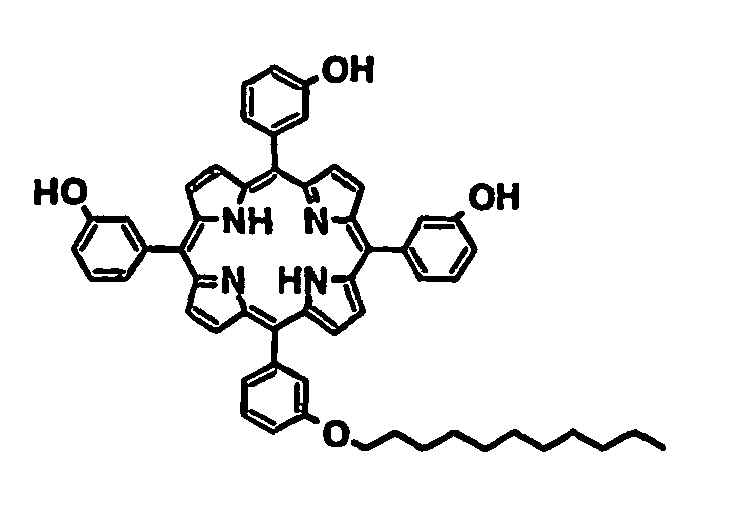
- Pyrrole (1.31 g, 19.6 mmol) is added in one portion to a mixture of 3-hydroxybenzaldehyde (1.8 g, 14.8 mmol) and 3-undecyloxybenzaldehyde (1.36 g, 4.9 mmol) in acetic acid (145 mL) and nitrobenzene (118 g, 960 mmol) preheated to 130°C and the mixture is stirred for 1 hour at 120°C. The mixture is cooled and solvent removed under high vacuum. The residue is dissolved in dichloromethane (5 mL) and purified by column chromatography using silica gel (Merck 60) eluting with hexane:toluene (4:1, by vol.). The product is obtained after removal of solvent from the eluate under reduced pressure and drying the obtained residue under vacuum.
1H-NMR: - δH (300Mz, CDCl3): 0.75-0.80 (m, 3 H), 1.05-1.35 (m, 14 H), 1.40-1.50 (m, 2 H), 1.75-1.85 (m, 2 H), 3.90-4.10 (m,2 H), 6.90- 7.70 (m, 16 H), 8.45-8.80 (m, 8 H).
-

- Compound 23 (50 mg, 0.055 mmol) is dissolved with methyl iodide (5 mL, 80 mmol) in absolute DMF(30 mL) and the mixture is stirred at 40°C for 3h. After evaporation of solvent the residue obtained is dissolved in methanol (5 mL) and filtered through a pad of silica gel (
depth 2 cm) supported on a steel frit (diameter 3.5 cm). After washing the pad with methanol (ca. 1 L) it is eluted with dichloromethane:methanol (2:3 by vol., 500 mL) and then acetic acid:water:methanol (3:1:2, by vol.). After removal of solvent from appropriate pooled fractions the residue obtained is dissolved in acetic acid and purified by column chromatography on Sephadex LH-20 eluting with acetic acid. After evaporation of solvent from appropriate pooled fractions and drying the residue obtained under high vacuum, the residue is dissolved in methanol and passed through a small column (3.5 x 20 cm) of anion exchange resin (Amberlite IRA 400, chloride form). After evaporation of solvent from the eluate, the product is dried under high vacuum. -

- Compound 23 (50 mg, 0.068 mmol) is dissolved with N,N,N',N'-tetramethyl-1,3-propanediamine (354 mg, 1.36 mmol) and N,N-dimethyldecylamine (1 g, 2.72 mmol) in DMF:THF(30 mL, 1:1, by vol.) and the mixture is stirred at 50°C overnight. After evaporation of the solvent under reduced pressure the residue obtained is dissolved in methanol (10 mL) and filtered through a pad of silica gel (
depth 2 cm) supported on a steel frit (diameter 3.5 cm). After washing the pad with methanol (ca. 500 mL) it is eluted with acetic acid:methanol:water (3:2:1, by vol.). The first two fractions eluted are combined and after evaporation of the solvent under reduced pressure the residue obtained is dissolved in methanol and purified by chromatography on a column (2.5 x 40 cm) of Sephadex LH-20 eluting with n-butanol:water:acetic acid (4:5:1, by vol.). After removal of solvent under reduced pressure from the second fraction eluted, the residue is dissolved in methanol (5 mL) and passed through a short column (3.5 x 20 cm) of anion exchange resin (Amberlite IRA 400, chloride form). The eluate is evaporated to dryness and the residue obtained is dried under high vacuum to afford the product.
1H-NMR: - δH (300MHz, CD3OD): 0.80 (m, 3 H), 1.05-1.25 (m, 10 H), 1.25-1.40 (bs, 2 H), 1.80-1.90 (bs, 4 H), 2.15-2.30 (bs, 2 H), 2.80-3.60 (m, 20 H), 3.80-3.95 (bs, 4 H), 7.05-7.15, 7.85-8.00 (2 x m, 2 x 4 H), 8.75-8.90, 9.20-9.35 (2×bs,2×4H), 10.15 (bs, 2 H).
-

- Compound 30 (100 mg, 0.12 mmol) is dissolved and K2CO3 (230 mg, 1.7 mmol) is suspended in DMF (30 mL). To the vigorously-stirred mixture a solution of (1-bromopropyl)-trimethylammonium bromide (0.3 g, 16.6 mmol) in DMF (10 mL) is added dropwise at 50°C during 30 mins and the mixture is heated for 18 h. After removal of DMF under reduced pressure, the residue obtained is dissolved in methanol (5 mL) and filtered through a pad of silica gel (
depth 2 cm) supported on a steel frit (diameter 3.5 cm). After washing the pad with methanol (ca. 500 mL) it is eluted with acetic acid:methanol:water (3:2:1, by vol.). After evaporation of solvent from appropriate combined fractions under reduced pressure, the residue is purified by chromatography on a column (2.5 x 40 cm) of Sephadex LH-20 eluting with n-butanol:water:acetic acid (5:4: 1, by vol., upper phase). After removal of solvent under reduced pressure from the eluate, the residue obtained is dissolved in methanol and the solution is passed through a short column (3.5 x 20 cm) of anion exchange resin (Amberlite IRA 400, chloride form). Evaporation of solvent from the eluate gives the product which is dried under high vacuum.
1H-NMR: - δH (300MHz, CD3OD): 0.75-0.80 (m, 3 H), 1.00-1.40 (m, 18 H), 1.60-1.80 (bs, 2 H), 2.25-2.40 (bs, 6 H), 3.29 (bs, 27 H), 3.40-3.60 (m, 6 H), 3.90-4.00 (m, 2 H), 4.05-4.25 (m, 6 H), 7.10-7.20, 7.25-7.40, 7.60-7.80, 7.80-7.90 (4 x m, 16H), 8.70-9.00 (bs, 8 H).
-

- This is prepared as described by Wiehe, A., Simonenko, E. J., Senge, M. O. and Roeder, B. Journal of Porphyrins and ).
-

- 5,10,15,20-tetrakis-(4-Hydroxy-phenyl)-porphyrin (170 mg, 0.25 mmol) is dissolved and K2CO3 (0.65 g, mmol) is suspended in DMF (30 mL). To the vigorously stirred reaction mixture a solution of 1-bromotetradecane (0.1 mL, 0.45 mmol) in DMF (10 mL) is added dropwise at 50°C during 30 mins and the mixture is heated for 1.5h. After evaporation of solvent, the residue is dissolved in toluene:ethanol (1:1 by vol., ca. 5 mL) and purified by chromatography using a column (5 x 25 cm) of silica gel (Merck 60) which is washed with toluene. After the elution of the first 3 fractions, elution is continued using toluene:ethyl acetate (2:1 by vol.). The fifth compound eluted is collected, the solvent evaporated and the residue dried under high vacuum to afford product as violet crystals.
1H-NMR : - δH (300MHz, d6-acetone): 0.85 (t, 3 J 7.5 Hz, 3 H), 1.15-1.55 (m, 20 H), 1.45 (quint, 3 J 7.5 Hz, 2 H), 1.75 (quint, 3 J 7.5 Hz, 2 H), 4.10 (t, 3 J 7.5 Hz, 2 H), 7.20 (d, 3 J 8.5 Hz, 2 H), 7.25 (d, 3 J 8.5 Hz, 6 H), 8.00-8.15 (m, 8 H), 8.80-9.10 (m, 8 H).
-

- The n-tetradecyloxy-analogue of
Compound 2, prepared similarly as described above forCompound 2 but using 1-bromotetradecane in place of 1-bromoundecane, (50 mg, 0.057 mmol) and (1-bromopropyl)-trimethylammonium bromide (210 mg, 0.8 mmol) are dissolved and K2CO3 (230 mg, 1.7 mmol) is suspended in DMF (20 mL). The vigorously stirred mixture is stirred at this temperature for 18 h. After removal of DMF under reduced pressure the residue obtained is dissolved in methanol (5 mL) and filtered through a pad of silica gel (depth 2 cm) supported on a steel frit (diameter 3.5 cm). After washing the pad with methanol (ca. 500 mL) it is eluted with acetic acid:methanol:water (3:2:1, by vol.). After evaporation of the solvent from appropriately combined fractions, the residue obtained is purified by chromatography on a column (2.5 x 40 cm) of Sephadex LH-20 eluting with n-butanol:water:acetic acid (4:5:1, by vol., upper phase) for separation from the excess of ammonium salt and other contaminating materials. After elution and removal of the solvent from appropriate fractions, the residue obtained is dissolved in methanol (5 mL) and passed through a short column (3.5 x 20 cm) of anion exchange resin (Amberlite IRA 400, chloride form). Solvent is removed under reduced pressure and the residue obtained is dried under high vacuum to afford the product as violet crystals.
1H-NMR: - δH (300MHz, CD3OD): 0.75 (t, 3 J 7.5 Hz, 3 H), 0.95-1.25 (m, 22 H), 1.50-1.65 (bs, 2 H), 2.20-2.40 (bs, 6 H), 3.05-3.15 (bs, 27 H), 3.45-3.60 (bs, 6 H), 3.60-3.80 (bs, 2 H), 4.05-4.25 (bs, 6 H), 6.80-7.25, 7.65-8.05, (2 x m, 16 H), 8.45-8.95 (bs, 8 H).
-

- Compound 20 (50 mg, 0.063 mmol) is dissolved in DMF (20 mL) in the presence of 2,4,6-tris-(dimethylaminomethyl)-phenol (1 mL, 3.7 mmol) and stirred at 50°C overnight. After evaporation of the solvent, the residue is crystallised from dichloromethane:methanol to remove the excess of amine. After filtration, the porphyrins are re-dissolved in dichloromethane and purified by chromatography on a column of silica gel (Merck 60) which is washed with dichloromethane. Evaporation of solvent under reduced pressure and recrystallisation of the residue from dichloromethane:methanol gives the product as violet crystals.
1H-NMR: - δH (300Mz, CDCl3): -3.15 (2 H, s), 0.85 (t, 3 J 4.5 Hz, 3 H), 1.20-1.40 (m, 18 H), 1.55 (quint, 3 J 4.5 Hz, 2 H), 1.90 (quint, 3 J 4.5 Hz, 2 H), 2.20 (s, 18 H), 2.55 (t, 3J 5.2 Hz, 2 H), 3.45 (s, 6 H), 4.15 (t, 3 J 5.5 Hz, 2 H), 4.20 (t, 3 J 5.5 Hz, 2 H), 4.35 (t, 3 J 7.5 Hz, 2 H), 6.85 (2 x s, 2 H), 7.20-7.30, 8.10-8.15 (2 x m, 8 H), 9.00-9.05, 9.25-9.30 (2 x m, 2 x 4 H), 10.20 (s, 2 H).
-

- 5,10,15,20-tetrakis-(4-Hydroxy-phenyl)-porphyrin (100 mg, 0.15 mmol) is dissolved and K2CO3 (230 mg) is suspended in DMF (30 mL). To the vigorously stirred reaction mixture a solution of 1-bromodecane (0.016 mL, 0.11 mmol) in DMF (10 mL) is added dropwise at 70°C during 30 mins and the mixture is stirred for 1.5h. After evaporation of solvent, the residue is dissolved in toluene:ethanol (1:1 by vol., ca. 3 mL) and purified by chromatography on a column (150 g) of silica gel (Merck 60) using toluene as eluent. After elution of the first 3 fractions, the column is eluted with toluene:ethyl acetate (2:1 by vol.) and the 5th fraction eluted is collected, the solvent removed and the residue dried under high vacuum to give the product as violet crystals.
1H-NMR: - δH (300Mz, d6-acetone): 0.95 (t, 3 J 7.5 Hz, 3 H), 1.25-1.55 (m, 12 H), 1.55 (quint, 3J 7.5 Hz, 2 H), 1.85 (quint, 3 J 7.5 Hz, 2 H), 4.15 (t, 3 J 7.5 Hz, 2 H), 7.20 (d, 3 J 8.5 Hz, 2 H), 7.25 (d, 3 J 8.5 Hz, 6 H), 8.00-8.15 (m, 8 H), 8.80-9.10 (m, 8 H).
-

- Compound 38 (50 mg, 0.061 mmol) and (1-bromopropyl)-trimethylammonium bromide (210 mg, 0.8 mmol) are dissolved and K2CO3 (230 mg, 1.7 mmol) is suspended in DMF (20 mL). The vigorously stirred reaction mixture is heated at 50°C for 18 h. After evaporation of solvent, the raw product is dissolved in methanol and purified by chromatography on a column (2.5 x 40 cm) of Sephadex, eluting with n-butanol:water:acetic acid (4:5:1, by vol., upper phase). After removal of the solvent, the residue is dissolved in methanol and passed through a column (3.5 x 20 cm) of Amberlite IRA-400 (chloride form). After evaporation of solvent, the product is dried under high vacuum and yields violet crystals.
1H-NMR: - δH (300MHz, CD3OD): 0.90 (t, 3 J 7.5 Hz, 3 H), 1.20-1.40 (m, 12 H), 1.45-1.60 (bs, 2 H), 1.80-1.90 (bs, 2 H), 2.45-2.55 (bs, 6 H), 3.25-3.35 (bs, 27 H), 3.75-3.85 (bs, , 6 H), 4.05-4.25 (m, 2 H), 4.35-4.40 (bs, 6 H), 7.10-7.40, 7.95-8.15 (2 x m, 16 H), 8.60-9.00 (bs, 8 H).
-
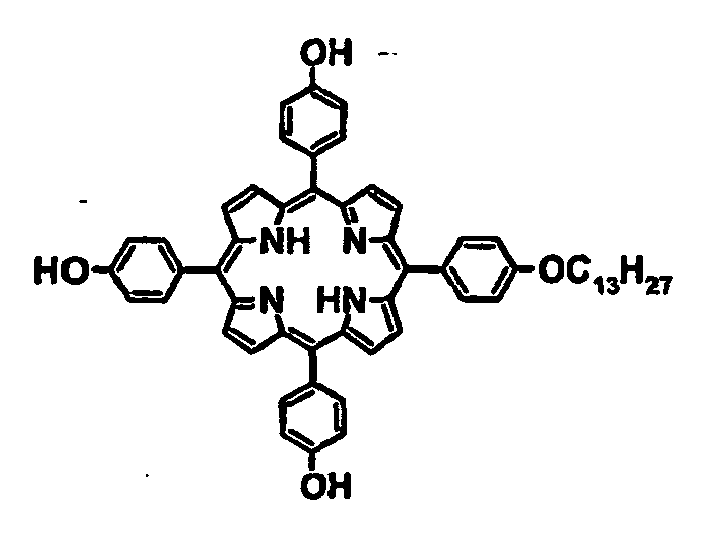
- 5,10,15,20-tetrakis-(4-Hydroxy-phenyl)-porphyrin (400 mg, 0.59 mmol) is dissolved and K2CO3 (1.0 g, 7.1 mmol) is suspended in DMF (75 mL). To the vigorously stirred reaction mixture a solution of 1-bromotridecane, (0.1 mL, 0.45 mmol) in DMF (10 mL) is added dropwise at 50°C during 30 mins and the mixture is then heated for 1.5h. The reaction mixture is cooled to room temperature and poured into water (150 mL). The porphyrins are extracted with ethyl acetate (100 mL) and the extract washed with brine (3 x 50 mL) and dried (Na2SO4). After evaporation of solvent, the residue is dissolved in toluene:ethanol (1:1, by vol., ca. 10 mL) and purified by chromatography using a column (200g) of silica gel (Merck 60) with toluene as the eluent. After the elution of the first three compounds, the eluent is changed to toluene:ethyl acetate (2:1, by vol.). The fifth compound eluted is collected and dried under high vacuum to yield product as violet crystals.
1H-NMR: - δH (300Mz, d6-acetone): 0.85 (t, 3 J7.5 Hz, 3 H), 1.20-1.60 (m, 18 H), 1.50 (quint, 3 J7.5 Hz, 2 H), 1.80 (quint, 3 J7.5 Hz, 2 H), 4.14 (t, 3 J7.5 Hz, 2 H), 7.20 (d, 3 J 8.5 Hz, 2 H), 7.25 (d, 3 J 8.5 Hz, 6 H), 8.00-8.15 (m, 8 H), 8.80-9.10 (m, 8 H).
-

- Compound 40 (50 mg, 0.057 mmol) and (1-bromopropyl)-trimethylammonium bromide (210 mg, 0.8 mmol) are dissolved and K2CO3 (230 mg, 1.7 mmol) is suspended in DMF (20 mL). The vigorously stirred reaction mixture is heated at 50°C for 18 h. After removal of DMF, the residue is dissolved in methanol (5mL) and applied to a pad (2 cm thick) of silica gel which is washed with methanol (ca. 1000 mL) and then eluted with acetic acid:methanol:water (3:2:1 by vol.). After evaporation of the solvent the residue is dissolved in methanol and further purified by chromatography on a column (2.5 x 40 cm) of Sephadex LH-20 which is eluted with n-butanol:water:acetic acid (4:5:1 by vol., upper phase). After removal of solvent, the residue is dissolved in methanol and passed through a short column (3.5 x 20 cm) of anion exchange resin (Amberlite IRC 400, chloride form). After evaporation of solvent, the product is dried under high vacuum to afford violet crystals.
1H-NMR: - δH (300MHz, CD3OD): 0.90 (t, 3 J 7.5 Hz, 3 H), 1.20-1.40 (m, 18 H), 1.45-1.60 (m, 2 H), 1.80-1.90 (bs, 2 H), 2.40-2.55 (bs, 6 H), 3.25-3.35 (bs, 27 H), 3.75-3.85 (bs, 6 H), 4.05-4.25 (m, 2 H), 4.35-4.40 (bs, 6 H), 7.10-7.40, 7.90-8.15 (2 x m, 16 H), 8.60-9.00 (bs, 8 H).
-

- This is prepared as described by Mehta, Goverdhan; Muthusamy, Sengodagounder; Maiya, Bhaskar G.; Arounaguiri, S., J. Chem. Soc. Perkin Trans. 1 ; 2177 - 2182 (1999).
-

- 5,10,15,20-tetrakis-(4-Hydroxy-phenyl)-porphyrin (200 mg, 0.294 mmol) is dissolved and potassium carbonate (487 mg, 3.53 mmol, 12 eqv.) is suspended under argon in absolute DMF (50 mL) and the mixture is heated to 55°C. A solution of octyl bromide (35.8µl, 0.206 mmol, 0.7 eqv.) in absolute DMF (10 mL) is added dropwise during 30 min. and the mixture is stirred at 55°C for 2 h. The solvent is removed in vacuo at 50°C, water (80 mL) is added and the mixture is extracted with ethyl acetate (3 x 40 mL). The combined organic fraction is dried (Na2SO4) and the solvent evaporated. The residue is purified by chromatography on a column (300g) of silica gel. Tetra-alkylated and tri-alkylated compounds are eluted with toluene:ethyl acetate (30:1 by vol.). The third fraction (di-substituted compound, trans-isomer) is eluted with toluene:ethylacetate (15:1 by vol.). The fourth fraction (di-substituted compound, cis-isomer) is eluted with toluene:ethyl acetate (10:1 by vol.) and the desired product (mono-alkylated compound) is eluted with toluene:ethylacetate (5:1 by vol.). The solvent is removed under reduced pressure and the residue dried under high vacuum to give the product as a violet solid.
1H-NMR: - δH (300 MHz, d6-acetone): 0.75 (t, 3H, 3 J= 6.8 Hz), 1.13-1.25 (m, 8H), 1.43 (quint, 2H, 3 J= 7.5 Hz), 1.73 (quint, 2 H, 3 J= 7.5 Hz), 3.50 (t, 2H, 3 J = 8 Hz), 7.11 (d, 2H, 3 J = 7.5 Hz), 7.16 (d, 6 H, 3 J = 7.5 Hz), 7.90-7.94 (m, 8H), 8.80-8.90 (m, 8 H)
-

- 5,10,15,20-tetrakis-(4-Hydroxy-phenyl)-porphyrin (200 mg, 0.294 mmol) is dissolved and potassium carbonate (487 mg, 3.53 mmol, 12 eqv.) in suspended under argon in absolute DMF (50 mL) and the mixture is heated to 55°C. A solution of dodecyl bromide (49.4µl, 0.206 mmol, 0.7 eqv.) in absolute DMF (10 mL) is added dropwise during 30 min. The mixture is stirred at 55°C for 2 h. The solvent is removed in vacuo at 50°C, water (80 mL) is added and the mixture extracted with ethyl acetate (3 x 40 mL). The combined organic fractions are dried (Na2SO4) and the solvent evaporated. The product is isolated by chromatography on a column (300g) of silica. Tetra-alkylated and tri-alkylated compounds are eluted with toluene:ethyl acetate (30:1 by vol.), di-substituted compound (trans-isomer) with toluene:ethyl acetate (15:1 by vol.), di-substituted compound (cis-isomer) with toluene:ethyl acetate (10:1 by vol.) and the desired product (mono-alkylated compound) with toluene:ethyl acetate (5:1 by vol). Solvent is removed in vacuo and the residue dried at high vacuum to give product as a violet solid.
1H-NMR: - δH (300 MHz, d6-acetone): 0.75 (t, 3H, 3 J= 6.8 Hz), 1.13-1.25 (m, 16H), 1.41 (quint, 2H, 3 J= 7.5 Hz), 1.63 (quint, 2 H, 3 J= 7.5 Hz), 3.89 (t, 2H, 3 J = 6 Hz), 7.11 (d, 2H, 3 J = 7.5 Hz), 7.16 (d, 6H, 3 J = 7.5 Hz), 7.9-7.94 (m, 8H), 8.78-8,83 (m, 8 H)
-

- 5,10,15,20-tetrakis-(4-Hydroxy-phenyl)-porphyrin (200 mg, 0.294 mmol) is dissolved and potassium carbonate (487 mg, 3.53 mmol, 12 eqv.) is suspended under argon in absolute DMF (50 mL) and the mixture heated to 55°C. A solution of nonyl bromide (49.4µl, 0.206 mmol, 0.7 eqv.) in absolute DMF (10 mL) is added dropwise during 30 min. The mixture is stirred at 55°C for 2 h. The solvent is removed in vacuo at 50°C, water (80 mL) is added and the mixture extracted with ethyl acetate (3 x 40 mL). The combined organic extracts are dried (Na2SO4) and solvent removed under reduced pressure. The product is isolated by chromatography on a column (300g) of silica. Tetra-alkylated and tri-alkylated compounds are eluted with toluene:ethyl acetate (30:1 by vol.), di-substituted compound (trans-isomer) with toluene:ethyl acetate (15:1 by vol.). di-substituted compound (cis-isomer) with toluene:ethyl acetate (10:1 by vol.) and the desired product (mono-alkylated compound) is eluted with toluene:ethyl acetate (5:1 by vol.). The solvent is removed under reduced pressure and the residue dried at high vacuum to afford the product as a violet solid.
1H-NMR: - δH (300 MHz, d6-acetone): 0.87 (t, 3H, 3 J = 7.5 Hz), 1.14-1.26 (m, 10H), 1.41 (quint, 2H), 1.70 (quint, 2H, 3 J = 7.5 Hz), 3.92 (t, 2H, 3 J = 7.5 Hz), 7.02 (d, 2H, 3 J = 8.25 Hz,), 7.15 (d, 6H, 3 J = 7.5 Hz,), 7.85 (d, 2H, 3 J = 8.25 Hz), 7.91 (d, 3 J = 7.5Hz), 8.76-8,84 (m, 8 H)
-

- Compound 43 (50 mg, 0.063 mmol) and (3-bromopropyl)-trimethylammonium bromide (164mg, 0.63 mmol, 10eqv.) are dissolved and potassium carbonate (130 mg, 0.95 mmol, 15 eqv.) is suspended under argon in absolute DMF (30 mL) and the mixture is stirred at 55°C for 12 h. The solvent is removed in vacuo at 50°C and the residue applied to a pad (2 cm deep) of silica. The unreacted ammonium salts are washed off with methanol (1000mL) and the product is eluted with acetic acid:methanol:water (3:2:1 by vol.). The solvent is removed under reduced pressure and the residue further purified by chromatography on a column (100g) of Sephadex LH-20 using n-butanol:water:acetic acid (4:5:1 by vol., upper phase) as the eluent. The solvents are removed under reduced pressure and the residue dissolved in methanol and passed through a small column of anion exchange resin (Amberlite IRA 400, chloride form) using methanol as eluent. After evaporation of solvent, the crude product is dissolved in the minimum amount of methanol and diethylether (50 mL) added. The solution is centrifuged for 15 min. The supernatant liquid is evaporated to dryness and the residue dried at high vacuum to give the product as a violet solid.
1H-NMR: - δH (300MHz, CD3OD): 0.90 (t, 3H, 3 J= 7.5 Hz), 1.25-1.41 (m, 8H), 1.45 (bs, 2H), 1.87 (bs, 2H), 2.38 (bs, 6H); 3,29 (bs, 27H), 3.67 (t, 6H, 3 J= 7.5 Hz), 4.01 (t, 2H, 3 J= 7.5 Hz), 4.30 (t, 6H, 3 J= 7.5 Hz), 7.11 (d, 2H, 3 J= 7:5 Hz), 7.38 (d, 6H, 3 J= 7.5 Hz), 7.95 (d, 2H, 3 J= 7.5 Hz), 8.11 (d, 6H, 3J= 7.5 Hz), 8.93 (bs, 8H)
-

- Compound 44 (50 mg, 0.059 mmol) and (3-bromopropyl)-trimethylammonium bromide (154mg, 0.59 mmol, 10eqv.) are dissolved and potassium carbonate (122 mg, 0.885 mmol, 15 eqv.) is suspended under argon in absolute DMF (30 mL) and the mixture is stirred at 55°C for 12 h. The solvent is removed in vacuo at 50°C and the residue re-dissolved in a little methanol and applied to a pad of silica (2 cm deep). The unreacted ammonium salts are washed off with methanol (1000mL). The product is eluted with acetic acid:methanol:water (3:2:1 by vol.). The solvents are removed under reduced pressure and the crude product further purified by chromatography on a column (100g) of Sephadex LH-20 using n-butanol:water:acetic acid (4:5:1 by vol., upper phase) as eluent. The solvents are removed under reduced pressure, the residue re-dissolved in a little methanol and the solution passed through a short column of anion exchange resin (Amberlite IRC 400, chloride form) using methanol as eluent. After removal of solvent the crude product is re-dissolved in the minimum amount of methanol and diethyl ether (50 mL) added. The solution is centrifuged for 15 min. The supernatant liquid is evaporated to dryness and the product dried at high vacuum to give a violet solid.
1H-NMR: - δH (300MHz, CD3OD): 0.88 (t, 3H, 3J= 7.5 Hz), 1.25-1.37 (m, 16H), 1.48 (bs, 2H), 1.93 (bs, 2H), 2.42 (bs, 6H), 3,28 (bs, 27H), 3.68-3.75 (m, 6H), 4.05 (t, 2H), 4.33 (t, 6H), 7.17 (d, 2H, 3 J = 7.5 Hz), 7.33 (d, 6H, 3 J = 7.5 Hz), 7.99 (d, 2H, 3 J = 7.5 Hz), 8.08 (d, 6H, 3 J = 7.5 Hz), 8.85 (bs, 8H)
-

- Compound 45 (50 mg, 0.062 mmol) and (3-bromopropyl)-trimethylammonium bromide (162mg, 0.62 mmol, 10eqv.) are dissolved and potassium carbonate (128 mg, 0.93 mmol, 15 eqv.) is suspended under argon in absolute DMF (30 mL) and the mixture is stirred at 55°C for 12 h. The solvent is removed in vacuo at 50°C and the residue re-dissolved in a little methanol and applied to a pad of silica (2 cm deep). The unreacted ammonium salts are washed off with methanol (1000mL). The product is eluted with acetic acid:methanol:water (3:2:1 by vol.). The solvents are removed under reduced pressure and the product further purified by chromatography on a column (100g) of Sephadex LH-20 eluting with n-butanol:water:acetic acid (4:5:1 by vol., upper phase). The solvents are removed under reduced pressure, the residue re-dissolved in a little methanol and the solution is passed through a short column of anion exchange resin (Amberlite IRC 400, chloride form) using methanol as eluent. After removal of solvent, the product is dried at high vacuum to give a violet solid.
1H-NMR: - δH (300MHz, CD3OD) 0.89 (t, 3H, 3 J = 7.5 Hz), 1.18-1.34 (m, 10H), 1.41 (bs, 2H), 1.73 (quint, 2H, 3 J= 7.5 Hz), 2.30-2.44 (m, 6H), 3,31 (bs, 27H), 3.65-3.73 (m, 6H), 3.93 (t, 2H, 3 J= 7.5 Hz), 4.25-4.42 (m, 6H), 7.08 (d, 2H, 3 J= 7.5 Hz), 7.30 (d, 6H, 3 J= 7.5 Hz), 7.93 (d, 2H, 3 J= 7.5 Hz), 8.05 (d, 6H, 3 J= 7.5 Hz), 8.94 (bs, 8H)
-

- Compound 43 (23 mg, 0.03 mmol) and (5-bromopentyl)-trimethylammonium bromide (84 mg, 0.3 mmol, 10eqv.) are dissolved and potassium carbonate (62 mg, 0.45 mmol, 15 eqv.) is suspended under argon in absolute DMF (15 mL) and the mixture is stirred at 55°C for 12 h. The solvent is removed in vacuo at 50°C and the residue re-dissolved in a little methanol and applied to a pad (2 cm deep) of silica. The unreacted ammonium salts are washed off with methanol (1000mL). The product is eluted with acetic acid:methanol:water (3:2:1 by vol.). The solvents are removed under reduced pressure and the product further purified by chromatography on a column (100g) of Sephadex LH-20 using n-butanol:water:acetic acid (4:5:1 by vol., upper phase) as eluent. The solvents are removed under reduced pressure, the residue re-dissolved in a little methanol and the solution passed though a short column of anion exchange resin (Amberlite IRC 400, chloride form) with methanol as eluent. The complete purification process is repeated if impurities remain in the product. After removal of solvent, the residue is dried at high vacuum to give the product as a violet solid.
1H-NMR: - δH (300MHz, CD3OD): 0.78 (bs, 3H), 1.08-1.35 (m, 10H), 1.45-1.59 (m, 6H), 1.63-1.93 (m, 14H), 3.17-3.32 (m, 6H), 3,31 (bs, 33H), 3.84 (bs, 2H), 4.07 (bs, 6H), 6.93 (bs, 2H), 7.09 (d, 2H, 3 J= 7.5 Hz), 7.74 (bs, 2H), 7.88 (d, 2H, 3 J= 7.5 Hz), 8.71 (bs, 8H)
-

- Compound 2 (50 mg, 0.06 mmol) and (5-bromopentyl)-trimethylammonium bromide (174 mg, 0.6 mmol, 10eqv.) are dissolved and potassium carbonate (124 mg, 0.9 mmol, 15 eqv.) is suspended under argon in absolute DMF (30 mL) and the mixture is stirred at 55°C for 12 h. The solvent is removed in vacuo at 50°C and the residue re-dissolved in a little methanol and applied to a pad (2 cm deep) of silica. The unreacted ammonium salts are washed off with methanol (1000mL). The product is eluted with acetic acid:methanol:water (3:2:1 by vol.). Solvents are removed under reduced pressure and the product further purified by chromatography on a column (100g) of Sephadex LH-20 eluting with n-butanol:water:acetic acid (4:5:1 by vol., upper phase). Solvents are removed under reduced pressure, the residue re-dissolved in the minimum of methanol and the solution passed through a short column of anion exchange resin (Amberlite IRC 400) with methanol as eluent. The complete purification process is repeated if impurities remain in the product. After removal of solvent, the residue is dried at high vacuum to give the product as a violet solid.
1H-NMR: - δH (300MHz, MeOD): 0.71-0,88 (m, 13H), 0.91-1.38 (m, 14H), 1.48-1.81 (m, 12H), signals for -CH2NCH2 and OCH2-long alkyl chain are part of the multiplet together with the signals for solvent in the area 2.8 - 3.3, 3.91 (bs, 6H), 6.33 (bs, 2H), 6.86 (bs, 6H), 7.35 (bs, 2H), 7.70 (bs, 6H), 8.65 (bs, 8H)
-

- Pyrrole (0.7 mL, 10 mmol) and 3-dodecyloxybenzaldehyde (2.91 g, 10 mmol) are dissolved in degassed dichloromethane (1000 mL) and TFA (0.77 mL, 10 mmol) is added dropwise. The mixture is stirred for 17h at room temperature in the dark. DDQ (6.81 g, 30 mmol) is added in one portion and the mixture is stirred for a further 1h at room temperature. The mixture is filtered through a column (400g) of silica using dichloromethane as eluent followed by dichloromethane to which triethylamine is added to adjust the pH value to 8. This purification process is repeated if impurities remain in the product until the pure product is obtained.
1H-NMR: - δH (300 MHz, d6-acetone): 0.80 (bs, 12H), 1.03-1.45 (m, 80H), 1.78 (quint., 8H, 3 J= 7.5 Hz), 4.05 (t, 8H, 3 J= 7.5 Hz), 7.24 (d, 4H, 3 J= 7.5 Hz), 7.49-7.55 (m, 4H), 7.68-7.71 (m, 8H), 8.80 (m, 8 H)
- The toxic effects of exemplary compounds of the invention against two bacterial strains, the Gram negative bacterium Escherichia coli (strain ATCC 25922) and the Gram positive bacterium Staphylococcus aureus (methicillin-resistant strain ATCC BAA-44), were evaluated by measuring the extent of growth inhibition (bacteriostatic effect) and growth inhibition (cytocidal effect) in the dark and upon light exposure. Initial compound screening was undertaken using white light [390 - 740nm] (150 mW/cm2) for various timepoints at a concentration of 3µM (see Table 1). Further experiments were undertaken on those compounds identified from this initial screen using a light source emitting light at a wavelength between 417 - 420 nm at 15.2 mW/cm2, 13.68 J/cm2 (Waldmann Eclairage SA, France) (see Table 2).
- The following protocol was used for the initial screening of the exemplary compounds (Table 1) (see Reddi et al., 2002, Photochem. Photobiol. 75(5):462-470):
- (i) E. coli and S. aureus cells were grown overnight on brain heart infusion agar, resuspended in brain heart infusion broth, harvested by centrifugation (3000 g for 15 minutes) and washed once with phosphate buffered saline (PBS) at pH 7.4 containing 2.7 mM KCl and 0.14 M NaCl.
- (ii) The cells were then resuspended in PBS to an optical density at 650 nm of 0.7, which corresponds to a density of 108 to 109 cells/ml.
- (iii) Next, the cells were incubated in PBS in the dark for 5 minutes with 3.0 µM of the compound to be tested.
- (iv) After dark incubation, cells were illuminated with white light (wavelength: 390 to 740 nm) (150 mW/cm2) for up to 30 minutes. During illumination, the cells were kept at 37°C and magnetically stirred.
- (v) Finally, treated and untreated (control) cells were diluted in brain heart infusion broth and maintained at 37°C while the absorbance of the suspension at 650 nm was monitored at predetermined time points for determining growth curves.
- The percent of growth inhibition in the treated cells was calculated by the following equation:

where Ax and Ac are the absorbances measured after 3 hours incubation, for the treated and control cell suspensions, respectively, and A0 represents the initial absorbance. - For the further investigation of the exemplary compounds (Table 2), the following protocol was adopted:
- (i) Bacteria (S. aureus BAA-44 and E. coli 25922) were grown in brain heart infusion (BHI) broth until they reached the stationary phase of growth.
- (ii) The cells were harvested by centrifugation (3000 g for 15 min) with a table centrifuge, washed with 10 mM PBS at pH 7.4 containing 2.7 mM KCl and 0.14 M NaCl and suspended in PBS at an optical density of 0.7 at 650 nm corresponding to 108-109 cells/ml.
- (iii) The bacteria, at the desired cell density (~108cells/ml) were incubated for 5 min in the dark with various concentrations of the exemplary compounds.
- (iv) At the end of the incubation period the cells were washed three times with PBS, suspended in PBS, transferred into a 96-well microtitre plate (200 µl/well) and illuminated for 15 min with the Waldmann light source (15.2 mW/cm2; 13.7 J/cm2). The cells were illuminated from the bottom of the plate laying it on the glass cover of the lamp.
- (v) After illumination, cell survival was determined by plating serially diluted aliquots of treated and untreated (i.e. no exemplary compound or light present) cells onto brain heart agar (BHA) and counting the number of colonies after 18-24 h incubation at 37°C.

- Results of the toxicity studies in E. coli and S. aureus are shown in Tables 1 and 2, together with Figures 2 and 3 (see Example A for compound, 'Cpd', structures).
Table 2 Survival of E. coli and S. aureus cells after incubation with selected test compounds and illumination with white light ('photodynamic activity' or light toxicity) or no illumination ('dark toxicity') (A) PHOTODYNAMIC ACTIVITY (a) S. aureus Compound 3 Compound 6 Compound 8 concn illumination Log reduction concn illumination Log reduction concn illumination Log reduction 10µM 15min >6 (>10-6) 1µM 15 min 6 (10-6) 1µM 15 min 6 (10-6) 1µM 15min >3 (>10-3) 0.1 µM 15 min 3 (10-3) 0.1µM 15 min 3 (10-3) (b) E. Coli Compound 3 Compound 6 Compound 8 Concn illumination Log reduction concn illumination Log reduction concn illumination Log reduction ND - ND 10µM 15min >6 (>10-6) ND ND 0.01µM 15min <1 (<10-1) DARK TOXICITY (a) S. aureus Compound 3 Compound 6 Compound 8 Concn illumination Log reduction concn illumination Log reduction concn illumination Log reduction 10µM N/A >3 (>10-3) 10µM 15min 2 (10-2) 1µM N/A <1 (<10-1) 1µM N/A <1 (<10-1) 1µM 15min 1 (<10-1) 10µM N/A <1 (<10-1) (b) E. coli Compound 3 Compound 6 Compound 8 Concn illumination Log reduction concn illumination Log reduction concn illumination Log reduction ND ND 10µM N/A 2(10-2) ND ND 0.01µM N/A <1 (<10-1) PHOTODYNAMIC ACTIVITY (a) S. aureus Compound 1 Compound 12 Compound 10 concn illumination Log reduction concn illumination Log reduction concn illumination Log reduction 1µM 15 min >6(>10-6) 1µM 15 min >6 (>10-6) 0.01µM 15min >4 (>10-4) 0.1µM 15min <1 (<10-1) 0.1µM 15 min >3 (>10-3) 0.005 µM 15 min >3 (>10-3) 0.005µM 15 min <2 (<10-2) (b) E. coli Compound 1 Compound 12 Compound 10 concn illumination Log reduction concn illumination Log reduction concn illumination Log reduction ND 1µM 15 min >6 (>10-6) 1 µM 15 min >6 (>10-6) ND 0.5µM 15 min <1 (<10-1) 0.5µM 15 min <3 (<10-1) DARK TOXICITY (a) S. aureus Compound 1 Compound 12 Compound 10 concn illumination Log reduction concn illumination Log reduction concn illumination Log reduction 10µM N/A <1 (<10-1) 1µM N/A <1 (<10-1) 0.01µM N/A <1 (<10-1) (b) E. coli Compound 1 Compound 12 Compound 10 concn illumination Log reduction concn illumination Log reduction concn illumination Log reduction ND 1µM N/A <1 (<10-1) 1µM N/A <1 (<10-1) - The results demonstrate that the compounds of the invention, when illuminated with light, are capable of killing both gram positive and gram negative bacterial cells at the low concentrations investigated.
- The above colony forming unit (CFU) protocol was also used to investigate the photodynamic activity of very low concentrations of the compounds of the invention. For example, figure 4 demonstrates the results obtained using (A)
Compound 8 and (B)Compound 10 in the presence (photodynamic properties) and in the absence (inherent toxicity properties) of light. -
- (i) Compounds 8 and 10 both exhibited negligible dark toxicity against BAA-44 at the concentrations tested.
- (ii)
Compound 8 exhibited a potent antibacterial effect at concentrations as low as 0.01 µM, where a 3 log reduction in BAA-44 was achieved. - (iii)
Compound 10 exhibited an even more potent antibacterial effect, causing a 3 log reduction in BAA-44 at a concentration of 0.005 µM and capable of killing 90% of the bacteria at a 0.0025 µM concentration. -
Compounds - The antibacterial activity of
Compound 10 was tested against a range of bacterial strains: - S. aureus ATCC BAA-44 (a methicillin resistant S. aureus)
- Ps. aeruginosa ATCC 25668
- S. epidermidis ATCC 700565
- Streptococcus pyogenes ATCC 49117
- E. coli ATCC 25922
-
Compound 10 exhibits photodynamic activity (i.e. light toxicity) against a broad range of gram positive and gram negative bacteria. - Excised porcine skin was cut into 3(4) x 3(4) cm2 pieces under sterile conditions and incubated in 70% ethanol for 5 minutes to reduce background of colonised bacteria. After three washing steps in PBS, the skin pieces were fixed in petri dishes with Hepes-Agar. The epidermis (stratum corneum) was then inoculated with S. aureus ATCC BAA-44 (~108, Volume: 100µl) and the skin surface dried under laminar flow cabinet until visible dry. The regions of interest were determined using a "pap" pen (1 cm2 diameter). A sterile solution of Compound 10 (10 µM) was applied onto the skin for 10 minutes. Post application, the ex vivo porcine skin was placed under the Waldmann light source 236 and illuminated for 15 min (15.2 mW/cm2, 13.7 J/cm2). A colony forming unit assay was performed to determine viable bacterial cell number immediately after irradiation using a sterile cotton rod to remove bacteria from the stratum corneum. The sterile cotton rod was moistened in sampling solution (0.1 % Tween80 in 0.0075 M phosphate buffer pH 7.9) before swabbing the skin surface (3 times) and vortexed in sampling solution before undertaking serial dilutions to determine the bacterial recovery.
- Incubation with Compound 10 (10 µM) followed by 15 minutes irradiation resulted in a 3.2 log10 growth reduction (mean value of three target areas). In contrast, control experiments (irradiation of applied bacteria without
Compound 10 incubation) did not show a decrease of bacteria cell number. - Thus, these data demonstrate photodynamic activity of
Compound 10 against MRSA on the surface of porcine skin, even in the presence of skin lipids and enzymes. - Quenching studies using D2O and azide were performed with
Compound 10 and light against keratinocytes in vitro. In order to investigate whether phototoxicity of the test compound against NHDF, NHEK and bacteria follows the photo-oxidation type II, sodium azide, a physical quencher of singlet oxygen as well as D2O, an enhancer of reactive oxygen species were used (Lin et al., 1991, Cancer Res. 51:1109-1116; Moan et al.,1979, Brit. J. Cancer 39:398-407). - Figure 5 shows the effect of incubation with
Compound 10 and quencher orCompound 10 and D2O after illumination. Cell killing byCompound 10 was reduced in the presence of sodium azide, as indicated by an increase of the cell viability, whereas the addition of D2O revealed a dramatic decrease of cell viability. - In conclusion, the killing of NHDF by
Compound 10 with illumination appears to be mediated mainly by singlet oxygen and not by the compound itself. -
Compound 10 was used at a million times antibacterial dose (3.2 mM) in a topical formulation in a standard acute toxicity test to determine if any clinical or histological toxicity for the compound could be detected. The compound was applied to both intact and abraded rat skin for 24 hours. - The acute toxicity protocol was based on OECD Guidelines for the testing of chemicals /Section 4 - Health Effects Test Number 402: Acute Dermal Toxicity.
- After clinical, macroscopic and microscopic observation, no clinical toxicology was observed. No histological toxicology of any major organ (including the skin) was observed. No cell infiltrates, including mast cells, were noted, neither was irritancy.
- In conclusion,
Compound 10 does not result in any acute toxic or allergic effect: in fact, no significant clinical or pathological signs related to the substance and its vehicle application were observed. - The photo-toxicity protocol was based on OECD Guidelines for the testing of chemicals /
Section 4 Health Effects - Test Number 406: Skin sensitisation. - Preliminary experiments determined that a light exposure of 30 minutes did not result in any damage to the surface of the skin caused by the light source. Similarly, control experiments demonstrated that
Compound 10 when applied at a concentration of 32 µM in the absence of light did not result in any damage to the surface of the skin. The photo-toxicity of theCompound 10 in the topical formulation was studied when applied onto 14 Guinea Pig skin (intact and abraded) for 24 hours, followed by a 30 minute light exposure.Compound 10 was tested at twodifferent concentrations 32 µM and 0.32 µM. Clinical and histological examination of the skin test sites was conducted at 24 and 72 hours post illumination in classical photo-toxicity testing fashion. Biopsies were not done from contiguous sites to prevent any interaction in case of suture. Gross findings were evaluated at the moment of the biopsy. Before giving a score to each endpoint (erythema, oedema and inflammation), data for each subject were compared to the data from the other animals and to control data. A score from 0 to 4 was given for each site and for each endpoint according to the Draize Scale (for inflammation, a scale similar to the Draize Scale was created after microscopic observation of all skin sections, comparing with normal skin and with findings of step-1). A mean score was then calculated for each animal and for each sampling point. - On analysing the results and comparing the experimental data with the data from the control animals, it was concluded that there were no clinical signs or symptoms or histological findings that suggested any photo-toxic potential of
Compound 10. - E. coli cells were incubated for 5 min with
Compound - All experiments were run in triplicate and the results represent the average of 3 determinations with standard deviations.
- The amount of porphyrin recovered from the cells is shown in Table 4.
Table 4 Concentration of compound (µM) Bound compound (nmoles/mg cell proteins) (a) 0 washings Compound 8 Compound 12Compound 100.01 0.024 ± 0.01 0.041 ± 0.02 0.026 ± 0.005 0.1 0.056 ± 0.02 0.151 ± 0.02 0.274 ± 0.05 0.5 0.522 ± 0.2 0.806 ± 0.14 1.542 ± 0.350 1 3.670 ± 0.7 2.70 ± 0.30 2.70 ± 0.354 (b) 3 washings Compound 8 Compound 12Compound 100.01 0.009 ± 0.001 0.021 ± 0.005 0.015 ± 0.0004 0.1 0.030 ± 0.02 0.089 ± 0.02 0.078 ± 0.02 0.5 0.274 ± 0.15 0.622 ± 0.10 0.334 ± 0.092 1 2.230 ± 0.8 1.930 ± 0.20 1.278 ± 0.102 - The results shown in Table 4 show that the three test compounds bind to E. coli with similar efficiency and that about 50% of the compound that is associated to the cells at the end of the incubation period (5 min) is removed by 3 washings with PBS.
- The potential build up of resistance of the bacterial cells to the exemplary compounds of the invention was tested in the multi-drug resistant (including methicillin) gram positive bacterium Staphylococcus aureus BAA-44, using
Compound 10 as the photodynamic agent. The survival of S. aureus BAA-44 after the second treatment was again compared to the survival of S. aureus BAA-44 cells that had not been treated with PDT. The same treatment was repeated for a total of 10 times in order to assess if the sensitivity of S. aureus BAA-44 cells to PDT remained constant or whether some resistance was observed to develop after repeated treatments. In an additional experiment, clones which had been exposed nine times to PDT treatment by the above methodology were treated for a tenth time and the results compared to the cell kill observed in a parallel experiment where naïve cultures (i.e. which had not been exposed to PDT) were subjected to PDT treatment under exactly the same conditions. The results obtained after 10 subsequent PDT treatments are shown in Figure 6. - The results obtained from comparing cell kill obtained from cultures that had been exposed to 10 consecutive PDT treatments with naïve cultures (i.e. which had not been exposed to PDT) are shown in Figure 7. The survival was expressed as log N0/N, where N0 and N represent the number of CFU/ml of the untreated and treated cell suspensions. Statistical analysis by T test demonstrated that the differences between the 2 values were not significant (P > 10%):
- The photosensitization of S. aureus ATCC BAA-44 by
Compound 10 induced no appreciable development of resistance. In fact, the efficiency of photodynamic activity ofCompound 10 remained unchanged in ten subsequent photodynamic sequence sessions, even though bacterial cells, which were exposed in the previous treatments, were cultivated and re-exposed to Compound 10 and light. Therefore, treatment ofbacteria using Compound 10 in a photodynamic fashion is further enhanced by the apparent lack of induction of bacterial resistance, unlike antibiotic therapies, where multi-drug resistance is a significant issue. - Test compounds were screened for toxicity against cultured human skin cells using normal human epidermal keratinocytes (NHEK) and normal human dermal fibroblasts (NHDF), purchased from CellSystems Biotechnologie GmbH, Germany.
- The NHEK and NHDF cells were used between
passages - Phototoxicity was tested by standard MTT-assay (Mossman et al., 1983, Immunological Methods 65:55-63). MTT is an indicator of metabolically active cells. Dependent on enzyme activity in mitochondria a colour reaction can be visualised, which can be measured by ELISA reader (540 nm). The cell viability data were normalised, i.e. the OD values of cells after PDT without photosensitisers were adjusted to one. Each experiment was repeated three times.
- Results of the toxicity studies in keratinocytes and fibroblasts are shown in Table 5.
TABLE 5 Survival of keratinocyte and fibroblast cells after incubation with selected test compounds and illumination ('photodynamic activity') or no illumination ('dark toxicity') (A) PHOTODYNAMIC ACTIVITY (a) Fibroblasts Compound 8 Compound 1 Concn illumination Survival Concn illumination Survival 0.01µM 15 min 100% 0.01µM 15 min 100% 0.1µM 15 min 12% 0.1µM 15 min 39% 1 µM 15 min 3% 1 µM 15 min 2% (b) Keratinocytes Compound 8 Compound 1 Concn illumination Survival Concn illumination Survival 0.01 µM 15 min 98% 0.01µM 15 min 94% 0.1µM 15 min 33% 0.1µM 15 min 52% 1µM 15 min 0.5% 1µM 15 min 0.4% DARK TOXICITY (a) Fibroblasts Compound 8 Compound 1 Concn illumination Survival Concn illumination survival 10µM N/A 68% 10µM N/A 92% 1µM N/A 100% 1 µM N/A 100% (b) Keratinocytes Compound 8 Compound 1 Concn illumination Survival Concn illumination Survival 10µM N/A 97% 10µM N/A 83% 1µM N/A 100% LIGHT TOXICITY (a) Fibroblasts Compound 12 Compound 10 Concn illumination Survival Concn illumination Survival 0.01µM 15min 100% 0.01µM 15 min 80% 0.1µM 15min 85% 0.1µM 15min 8% 1µM 15min 1.0% 1µM 15min 0.5% (b) Keratinocytes Compound 12 Compound 10 Concn illumination survival Concn illumination Survival 0.01µM 15 min 97% 0.01µM 15 min 62% 0.1µM 15 min 75% 0.1µM 15 min 1.0% 1µM 15min 0.5% DARK TOXICITY (a) Fibroblasts Compound 12 Compound 10 Concn illumination survival Concn illumination Survival 10µM N/A 95% 10µM N/A 91% 1µM N/A 100% 1 µM N/A 100% (b) Keratinocytes Compound 12 Compound 10 Concn illumination survival Concn illumination Survival 10µM N/A 92% 10µM N/A 51% 1µM N/A 100% 1µM N/A 100% - Figure 8 shows the toxicity of
Compound 8 against human fibroblasts and S. aureus BAA-44 at varying doses. - The above data demonstrate that compounds of the invention, for example Compound 8 (at a dose of 0.01 µM), Compound 12 (at a dose of 0.1 µM) and Compound 10 (at a dose of 0.01 µM), are preferentially toxic to bacterial cells compared to human skin cells.
- In contrast,
reference Compound 1 exhibits equal toxicity to bacterial and human cells. - A bespoke light source capable of delivering light of an appropriate wavelength (417 nm) was developed to activate the test compounds (Waldmann light source 236). The light source has a light intensity of 15 mW/cm2 after 3 minutes at room temperature (25°C), yielding a light dose of 14 J/cm2. It consists of a light box (493mm length x 278mm width x 93.3 mm height) where the samples to be tested are placed on the top surface of the light box and illuminated from below.
- The photostability of the exemplary compounds was investigated using standard photodynamic procedures. A 10 µM solution of
Compound 10 was prepared in phosphate-buffered saline/ethanol, as described above, and illuminated with blue light (15 mW/cm2) using a light source with an absorbance maximum of 417 nm. The solution was illuminated for various periods: 10, 20 and 30 minutes. After each predetermined illumination period, the absorbance at 404 nm corresponding to the maximum absorption peak of the compound was measured. Parallel experiments were undertaken where the absorbance ofCompound 10 solutions that had been kept in the dark for the same time periods as the illumination time periods were measured. Over the 30 minutes period of illumination a small loss in the absorbance value at 404 nm was observed (see Figure 10A). - The susceptibility of the
Compound 10 to photobleaching when subjected to a light at a higher fluence rate (150 mW/cm2; i.e. ten times that used normally) was investigated. With this illumination system, the solution was kept in a quartz cuvette during illumination while an equivalent solution was kept in the dark. The reduction of absorbance caused by photobleaching was found to be approximately 15-20 % at a concentration of 10 µM after 30 minutes illumination (see Figure 10B). - The above results indicate that
Compound 10 undergoes photobleaching much less than other porphyrins known in the literature (for example, see Reddi et al., 2002, Photochem. Photobiol. 75:462-470). - The following HPLC methodology was established for the analysis of the exemplary compounds of the invention.
- The method involves detection by UV at a wavelength of 420 nm, which is very specific for these compounds. In order to monitor impurities not related to the porphyrin structure (and therefore not absorbing at 420 nm) UV spectra of the whole chromatograms were also recorded between 200 nm and 700 nm by DAD (diode array detector) in certain experiments.
Column: Zorbax Phenyl, 250 x 4.6 mm, 5 µm
Eluent A: 1.5 g sodium dodecylsulfate + 1 mL formic acid in 1000 mL water
Eluent B: 1.5 g sodium dodecylsulfate + 1 mL formic acid in 200 mL water + 800 mL tetrahydrofurane
Gradient:Time [min] Eluent B [%] 0 50 31 65 32 90 33 50 43 50
Flow rate: 0.4 mL/min
Detection: 420 nm
Column temperature: 25 °C
Injection volume: 10 µl
Solutions: Porphyrin derivatives were dissolved in eluent A to give a final concentration of approximately 0.3 mg/ml. - Typical retention time of the exemplary compounds was approximately 8 minutes (18 minute runtime).
- Qualitative stress tests were undertaken on the exemplary compounds of the invention. Analysis was undertaken by HPLC & LC-MS. The compounds were stress tested in solid form, in an aqueous solution and a solution made up in phosphate-buffered saline buffer. The samples were initially incubated for 7 days at 50 °C and a sample removed for testing. The samples were then incubated for a further 7 days at 70 °C, samples removed as before and the samples incubated further for 7 days at 90 °C. HPLC analysis of freshly prepared solutions was undertaken and compared to the samples after 7, 14 and 21 days incubation. A visual comparison of the chromatograms was then undertaken and the content of the main products and by-products as area percentage values determined (see Figure 11).
- The 3D plots of the chromatograms show no indications for additional formation of fragments (no signals at lower wavelengths)
- The plot in Figure 12 shows the sample after 21 days in PBS buffer, which showed the largest degradation effect. The results demonstrated minimal degradation on analysis of solid drug and drug in solution heated to 80°C for a number of weeks.
-
Compounds Compound 8 was less stable thanCompounds - The stability of three exemplary compounds of the invention (
Compounds - Sodium laureth sulphate (SLES) + water
- 9:1 water:ethanol
- SLES + 9:1 water:ethanol
- UV spectra were recorded over the range 350-700 nm over a period of 7 weeks and a visual evaluation of the samples made at 8 weeks.
- The results indicate that all compounds tested exhibited good stability over an eight-week period (see Figure 13).
- For
Compounds - Human skin (intact) in Franz cell system was used to examine the distribution of
Compounds - The following HPLC methodology was established for the analysis of the exemplary compounds of the invention:
- HPLC system details: TSP SCM1000 membrane degasser, P4000 quaternary pump, AS3000 autosampler, UV6000LP W/Vis PDA detector, SN4000 controller, PC1000 Ver. 3.5.1 software. Zorbax SB-Phenyl, 5 µm, 250 x 4.6 mm column plus a Phenyl security guard cartridge (Phenomenex). Mobile phase: 550 mL water; 450 mL tetrahydrofuran; 1.5 g sodium dodecyl sulfate and 1 mL formic acid at a flow rate of 0.8 mL/min. Injection volume was 50 µL (full loop injection) and operating temperature was 25°C. Detector was set at a wavelength of 409 nm plus UV/Vis scan (240-752 nm,
step 4 nm). Typical retention time of the exemplary compounds was approximately 8 minutes (18 minute runtime). - The majority of the compounds associated with the skin were found to reside in stratum corneum. Low concentrations were detected in the epidermis (approx. 0.01 µM) - i.e. potentially anti-bacterial concentration. Lower concentrations were detected in the dermis (approx. 0.002 µM). Compounds were not detected in the receiver solution


- Results of the human skin distribution studies are shown above in Tables 6 and 7.
- The key findings are as follows:
- (i) The vast majority of
Compound 10 was recovered from the surface of the stratum corneum. - (ii) Much lower, yet potentially antibacterial, concentrations of
Compound 10 were recovered within the stratum corneum. - (iii) In the absence of ethanol, sub-therapeutic concentrations of
Compound 10 were found in the epidermis and dermis. - (iv) In the presence of ethanol, higher concentrations of
Compound 10 were found in the epidermis. - (v) No formulation led to a potentially antibacterial concentration of
Compound 10 reaching the dermis. - (vi) The formulations containing SLES were the only ones in which
Compound 10 was detected at very low concentration in the receptor phase. - (vii)
Compound 10 distribution in the skin can, to a certain degree, be manipulated by the formulation used. - The sub-cellular distribution of the dyes in human dermal fibroblasts (NHDF) and human dermal keratinocytes (NHEK) has been investigated. NHDF were grown on microscope slides overnight and the cells were then incubated with
Compound 10 for 5 minutes, 1 and 4 hours alone or incubated cells were co-stained with organelle-specific dyes. For labelling of lysosomes and mitochondria LysoTrackerGreen (Molecular Probes) and Rhodamine G6 (Sigma) were used, respectively. Immediately after incubation sub-cellular localisation was examined by fluorescence microscopy (Zeiss Vario AxioTech, Germany) using an appropriate dual band filter set (Omega Optical) for excitation and emission. Using a suitable software application, it is possible to overlay digital photographs (fluorescence) onto light microscopy photographs transparently. Therefore distribution of the dyes can be localized by one image. In addition, overlay of several digital photographs using different colour-images is also possible. - NHDF cells were grown overnight on microscope slides. After that, the cells were incubated with 1 µM Compound 10 (green fluorescence) for 1 hour and co-stained with (A) organelle-specific dyes for mitochondria (Rhodamine G6; 50 ng/ml, 5 minutes; red fluorescence) and nucleus (Hoechst 33342; blue fluorescence) or (B) organelle-specific dyes for lysosomes (LysoTrackerGreen; 10 µM, 2 h; green fluorescence) and nucleus (Hoechst 33342; blue fluorescence). Sub-cellular localisation was examined by fluorescence microscopy (Zeiss Vario AxioTech, Germany) using an appropriate dual band filter set (Omega Optical) for excitation and emission. Co-localisation is merged in yellow fluorescence.
- Staining of (A) lysosymes and (B) mitochondria without co-staining is shown in Figure 15.
- Figure 16 shows the intracellular fluorescence distribution of NHDF cells incubated with 1
µM Compound 10 for 1 hour. - The
Compound 10 fluorescence is localised extra-nuclearly and co-staining with mitochondria-specific Rhodamine G6 resulted in co-localisation of Compound 10 (green) and fluorescence of mitochondria (red). Co-localisation-is merged in yellow fluorescence (Figure 16). - Co-staining with lysosomal-specific dye (LysoTrackerGreen) resulted in different localization of Compound 10 (red) and lysosomal fluorescence (green) (Figure 16).
- No nuclear association of
Compound 10 was observed in nuclear material in these studied which may indicate that there is a low possibility of compound activity against DNA.
| Strain | Concentration of |
| Staphylococcus aureus ATCC BAA-44 | 0.005 |
| Pseudomonas aeruginosa ATCC 25668 | 5.0 |
| Staphylococcus epidermidis ATCC 700565 | 0.0025 |
| Streptococcus pyogenes ATCC 49117 | 0.01 |
| E. coli ATCC 25922 | 0.1 |
Claims (55)
- A compound of formula I
 X1, X2, X3 and X4 independently represent a hydrogen atom, a lipophilic moiety, a phenyl group, a lower alkyl, alkaryl or aralkyl group, or a cationic group of the following formula;
-L-R1-N+(R2)(R3)R4
wherein:L is absent or is a linking moiety selected from the group consisting of phenoxy, phenylene, sulfonyl amido, aminosulfonyl, sulfonylimino, phenylsulfonylamido, phenyl-aminosulfonyl, urea, urethane and carbamate linking moieties;R1 represents lower alkylene, lower alkenylene or lower alkynylene, which is optionally substituted by one or more substituents selected from lower alkyl, lower alkylene (optionally interrupted with oxygen), fluoro, OR5, C(O)R6, C(O)OR7, C(O)NR8 R9, NR10R11 and N+R12R13R14; andR2, R3 and R4 independently represent H, aryl, lower alkyl, lower alkenyl or lower alkynyl, the latter three of which are optionally substituted by one or more substituents selected from lower alkyl, lower alkylene (optionally interrupted with oxygen), aryl, OR5, C(O)R6, C(O)OR7, C(O)NR8R9, NR10R11 and N+R12R13R14R5, R6, R7, R8, R9, R10, R11, R12, R13 and R14 independently represent H or lower alkyland wherein:the lipophilic moiety is a saturated, straight-chain alkyl group of formula - (CH2)pCH3, wherein 'p' is an integer between 1 and 22;the lower alkyl groups are independently selected from the group consisting of linear or branched, cyclic or acyclic, C1-C20 alkyl groups which may be interrupted by oxygen;the lower alkylene groups are independently selected from the group consisting of linear or branched, cyclic or acyclic, C1-C20 alkylene groups, which may be interrupted by oxygen;the lower alkenyl groups are independently selected from the group consisting of linear or branched, cyclic or acyclic, C2-C20 alkenyl groups, which may be interrupted by oxygen;the lower alkenylene groups are independently selected from the group consisting of linear or branched, cyclic or acyclic, C2-C20 alkenylene groups, which may be interrupted by oxygen;the lower alkynyl groups are independently selected from the group consisting of linear or branched, cyclic or acyclic, C2-C20 alkynyl groups, which may be interrupted by oxygen;the lower alkynylene groups are independently selected from the group consisting of linear or branched, cyclic or acyclic, C2-C20 alkynylene groups, which may be interrupted by oxygen;the aryl groups are independently selected from the group consisting of six to ten-membered carbocyclic aromatic groups, which groups are optionally substituted by one or more substituents selected from fluoro, cyano, nitro, lower alkyl (as defined above; i.e. alkaryl), OR5, C(O)R6, C(O)OR7, C(O)NR8 R9 and NR10R11; andthe aralkyl groups are independently selected from the group consisting of aryl groups (as defined above) joined to the porphyrin ring via a lower alkyl group (as defined above)provided that at least one of X1, X2, X3 and X4 is a cationic group as defined above, counterbalanced by a counteranion, and at least one of X1, X2, X3 and X4 is a hydrogen atom. - A compound of formula II

and X1, X2, X3 and X4 are as defined in Claim 1. - A compound according to Claim 2 wherein M is a divalent or trivalent metallic element.
- A compound according to Claim 2 or 3 wherein M is selected from Zn (II), La (III), Lu (III), Y (III), In (III) Cd (II), Mg (II), Al(III), and Pd(II).
- A compound according to Claim 2 wherein M is a metalloid element.
- A compound according to Claim 5 wherein the metalloid element is silicon (Si) or germanium (Ge).
- A compound according to any one of the preceding claims wherein R1 is an unsubstituted lower alkylene, lower alkenylene or lower alkynylene group.
- A compound according to any one of the preceding claims wherein
R1 is -(CH2)m-
and 'm' is an integer between 1 and 20. - A compound according to Claim 8 wherein 'm' is an integer between 1 and 10.
- A compound according to Claim 9 wherein 'm' is an integer between 1 and 3.
- A compound according to Claim 10 wherein 'm' is 3.
- A compound according to any one of the preceding claims wherein R2, R3 and/or R4 are lower alkyl, lower alkenyl or lower alkynyl groups.
- A compound according to Claim 12 wherein R2, R3 and/or R4 are unsubstituted lower alkyl groups.
- A compound according to Claim 12 or 13 wherein at least one of R2, R3 and R4 is an alkyl group which is substituted with a primary, secondary or tertiary amine group or a quaternary ammonium group.
- A compound according to any one of the preceding claims wherein R1 is -(CH2)3-, R2 and R3 are CH3 and R4 is - (CH2)3-N(CH3)2.
- A compound according to any one of Claims 1 to 14 wherein R1 is -(CH2)3-, and R2, R3 and R4 are each CH3.
- A compound according to any one of Claims 1 to 14 wherein R1 is -(CH2)3-, and R2, R3 and R4 are each C2H5.
- A compound according to any one of the preceding claims wherein X1, X2, X3 and/or X4 are

- A compound according to any one of the preceding claims wherein X1, X2, X3 and/or X4 are

- A compound according to any one of the preceding claims wherein X1, X2, X3 and/or X4 are

- A compound according to any one of Claims 18 to 20 wherein 'n' or 'm' is 3.
- A compound according to any one of Claims 18 to 20 wherein 'n' or 'm' is 2.
- A compound according to any one of Claims 18 to 20 or 22 wherein 'n' and/or 'm' is 1.
- A compound according to any one of the preceding claims wherein the compound comprises two cationic groups, as defined in Claim 1, on opposite sides of the porphyrin ring, i.e. at ring positions 5 and 15 or ring positions 10 and 20.
- A compound according to Claim 24 wherein X1 and X3 are a hydrogen atom, a lipophilic moiety, a phenyl group, a lower alkyl, alkaryl or aralkyl group and X2 and X4 are cationic groups, or vice versa.
- A compound according to any one of Claims 1 to 24 wherein the compound comprises two cationic groups, as defined in Claim 1, on neighbouring positions of the porphyrin ring, i.e. at ring positions 5 and 10, or ring positions 10 and 15, or ring positions 15 and 20 or ring positions 20 and 5
- A compound according to Claim 26 wherein X1 and X2 are hydrogen and X3 and X4 are cationic groups, or X2 and X3 are hydrogen and X4 and X1 are cationic groups.
- A compound according to any one of the preceding claims wherein at least one of X1, X2, X3 and X4 is a lipophilic moiety.
- A compound according to Claim 28 wherein the lipophilic moiety is a saturated, straight-chain alkyl group of formula - (CH2)pCH3 wherein 'p' is an integer between 1 and 18.
- A compound according to Claim 29 wherein 'p' is between 2 and 16.
- A compound according to Claim 30 wherein 'p' is between 4 and 12.
- A compound according to any one of Claims 1 to 27 wherein none of X1, X2, X3 and X4 is a lipophilic moiety.
- A compound according to any one of the preceding claims wherein none of X1, X2, X3 and X4 is a phenyl group.
- A compound according to any one of the preceding claims wherein the compound is water-soluble.
- A compound according to Claim 1 wherein the compound is selected from the group consisting of:5,15-bis-(4-{3-[(3-Dimethylamino-propyl)-dimethyl-ainmonio]-propyl-oxy} -phenyl)-porphyrin dichloride;5,15-bis-[4-(3-Triethylammonio-propyloxy)-phenyl]-porphyrin dichloride;5,15-bis-[3-(3-Trimethylammonio-propyloxy)-phenyl]-porphyrin dichloride;5,15-bis-[4-(3-Trimethylammonio-propyloxy)-phenyl]-porphyrin dichloride;5-[3,5-bis-(3-Trimethylammonio-propyloxy)-phenyl]-15-undecylporphyrin dichloride;5- {4-[3-Dimethyl-(3-dimethylaminopropyl)-ammonio-propyloxy]-phenyl}-15-(4-dodecyloxy-phenyl)-porphyrin chloride;3-[({3-[(3-{4-[15-(4-Dodecyloxy-phenyl)-porphyrin-5-yl]-phenoxy}-propyl)-dimethyl-ammonio]-propyl}-dimethyl-ammonio)-propyl]-trimethyl-ammonium trichloride;5,15-bis-[3-(3-Trimethylammmonio-propyloxy)-phenyl]-10-undecyl-porphyrin dichloride;5- {4-[3-Dimethyl-(3-trimethylammonio-propyl)-ammonio-propyloxy]-phenyl}15-(4-dodecyloxy-phenyl)-porphyrin dichloride;5-[4-(3-Dimethyldecyl-ammoniopropyloxy)-phenyl]-15-{4-[3-dimethyl-(3-dimethylaminopropyl)-ammoniopropyloxy]-phenyl}-porphyrin dichloride; and metallated forms thereof.
- A compound according to any one of the preceding claims for use as a selective photodynamic therapy agent.
- A compound according to Claim 36 wherein the toxicity of the compound against a target microorganism is at least two-fold greater than the toxicity of that compound to mammalian cells.
- A compound according to Claim 37 wherein the toxicity of the compound against a target microorganism is at least ten-fold greater than the toxicity of that compound to mammalian cells.
- A compound according to Claim 37 or 38 wherein the compound is substantially non-toxic to mammalian cells.
- A compound according to any one of the preceding claims wherein the counteranion is selected from the group consisting of halides, sulfates, nitrates, perchlorates, sulfonates and trifluoroacetate.
- A compound according to Claim 40 wherein the counteranion is a halide.
- A compound according to Claim 41 wherein the halide is selected from the group consisting of fluoride, chloride and bromide.
- A pharmaceutical formulation comprising a compound according to any one of Claims 1 to 42 in admixture with a pharmaceutically or veterinarily acceptable adjuvant, diluent or carrier.
- A compound according to any one of Claims 1 to 42 for use in medicine.
- Use of a compound according to any one of Claims 1 to 42 in the preparation of a medicament for use in photodynamic therapy.
- Use of a compound according to any one of Claims 1 to 42 in the preparation of a medicament for use in the curative and/or prophylactic treatment of microbial infections.
- Use of a compound according to any one of Claims 1 to 42 in the preparation of a medicament for killing microorganisms.
- The use according to Claim 46 or 47 wherein the microorganisms are selected from the group consisting of bacteria, mycoplasmas, yeasts, fungi and viruses.
- The use according to Claim 46 or 47 wherein the microorganisms are bacteria which are resistant to one or more conventional antibiotic agents.
- Use of a compound according to any one of Claims 1 to 42 in the preparation of a medicament for preventing and/or treating dermatological infection, infection of the lungs, wound infection and/or ulcers.
- A sterilising solution comprising a compound according to any one of Claims 1 to 42.
- A sterilising solution according to Claim 51 further comprising a surface-active agent.
- A method for killing microorganisms in vitro comprising contacting the microorganisms with a compound according to any one of Claims 1 to 42 and illuminating the compound to kill the microorganisms.
- A method for producing 5-[3,5-bis-(3-Trimethylammonio-propyloxy)-phenyl]-15-undecyl-porphyrin, the method comprising reacting 5-(15-Undecyl-porphyrin-5-yl)-benzene-1,3-diol with (1-bromopropyl)-trimethylammonium bromide.
- A method for producing 5,15-bis-[4-(3-Trimethylammonio-propyloxy)-phenyl]-porphyrin dichloride, the method comprising reacting 5,15-bis-[4-(3-Bromo-propyloxy)-phenyl]-porphyrin with trimethylamine.
Priority Applications (3)
| Application Number | Priority Date | Filing Date | Title |
|---|---|---|---|
| EP07075885A EP1897883A3 (en) | 2002-12-23 | 2003-12-23 | Cationic porphyrin derivatives as antibacterial agents |
| SI200331111T SI1578750T1 (en) | 2002-12-23 | 2003-12-23 | Cationic porphyrin derivatives as antibacterial agents |
| CY20081100157T CY1107882T1 (en) | 2002-12-23 | 2008-02-11 | CORTIONAL PORPHYRINE PRODUCERS AS ANTI-BACTERIAL AGENTS |
Applications Claiming Priority (3)
| Application Number | Priority Date | Filing Date | Title |
|---|---|---|---|
| GB0229742A GB2397067B (en) | 2002-12-23 | 2002-12-23 | Porphin & azaporphin derivatives with at least one cationic-nitrogen-containing meso-substituent for use in photodynamic therapy & in vitro sterilisation |
| GB0229742 | 2002-12-23 | ||
| PCT/GB2003/005649 WO2004056828A2 (en) | 2002-12-23 | 2003-12-23 | Novel compounds and uses thereof |
Related Child Applications (1)
| Application Number | Title | Priority Date | Filing Date |
|---|---|---|---|
| EP07075885A Division EP1897883A3 (en) | 2002-12-23 | 2003-12-23 | Cationic porphyrin derivatives as antibacterial agents |
Publications (2)
| Publication Number | Publication Date |
|---|---|
| EP1578750A2 EP1578750A2 (en) | 2005-09-28 |
| EP1578750B1 true EP1578750B1 (en) | 2007-11-21 |
Family
ID=9950107
Family Applications (2)
| Application Number | Title | Priority Date | Filing Date |
|---|---|---|---|
| EP03786158A Expired - Lifetime EP1578750B1 (en) | 2002-12-23 | 2003-12-23 | Cationic porphyrin derivatives as antibacterial agents |
| EP07075885A Withdrawn EP1897883A3 (en) | 2002-12-23 | 2003-12-23 | Cationic porphyrin derivatives as antibacterial agents |
Family Applications After (1)
| Application Number | Title | Priority Date | Filing Date |
|---|---|---|---|
| EP07075885A Withdrawn EP1897883A3 (en) | 2002-12-23 | 2003-12-23 | Cationic porphyrin derivatives as antibacterial agents |
Country Status (14)
| Country | Link |
|---|---|
| US (2) | US7244841B2 (en) |
| EP (2) | EP1578750B1 (en) |
| JP (2) | JP4786182B2 (en) |
| CN (2) | CN100360536C (en) |
| AU (1) | AU2003295157B8 (en) |
| CA (1) | CA2527155C (en) |
| CY (1) | CY1107882T1 (en) |
| DE (1) | DE60317711T2 (en) |
| DK (1) | DK1578750T3 (en) |
| ES (1) | ES2301864T3 (en) |
| GB (1) | GB2397067B (en) |
| NZ (1) | NZ540918A (en) |
| PT (1) | PT1578750E (en) |
| WO (1) | WO2004056828A2 (en) |
Cited By (1)
| Publication number | Priority date | Publication date | Assignee | Title |
|---|---|---|---|---|
| EP1897883A3 (en) * | 2002-12-23 | 2008-03-26 | Destiny Pharma Limited | Cationic porphyrin derivatives as antibacterial agents |
Families Citing this family (31)
| Publication number | Priority date | Publication date | Assignee | Title |
|---|---|---|---|---|
| ITFI20020200A1 (en) * | 2002-10-21 | 2004-04-22 | Molteni & C Dei Flii Alitti S P A Societa L | MESO-REPLACED PORPHYRINES. |
| WO2005000854A2 (en) * | 2003-06-06 | 2005-01-06 | Eukarion, Inc. | Orally bioavailable low molecular weight metalloporphyrins as antioxidants |
| GB2415372A (en) * | 2004-06-23 | 2005-12-28 | Destiny Pharma Ltd | Non photodynamical or sonodynamical antimicrobial use of porphyrins and azaporphyrins containing at least one cationic-nitrogen-containing substituent |
| GB2415373A (en) * | 2004-06-23 | 2005-12-28 | Destiny Pharma Ltd | Porphyrins for sonodynamic therapy |
| JP2008505936A (en) * | 2004-07-15 | 2008-02-28 | ザ・ユニバーシティ・オブ・シドニー | Porphyrin-bound metronidazole against periodontal disease, Porphyromonas gingivalis |
| US20070110788A1 (en) * | 2005-11-14 | 2007-05-17 | Hissong James B | Injectable formulation capable of forming a drug-releasing device |
| GB0526474D0 (en) * | 2005-12-24 | 2006-02-08 | Destiny Pharma Ltd | Novel process |
| GB0602125D0 (en) | 2006-02-03 | 2006-03-15 | Univ Belfast | Sensitizer-incorporated biomaterials |
| US8882267B2 (en) | 2006-03-20 | 2014-11-11 | High Performance Optics, Inc. | High energy visible light filter systems with yellowness index values |
| US20120075577A1 (en) | 2006-03-20 | 2012-03-29 | Ishak Andrew W | High performance selective light wavelength filtering providing improved contrast sensitivity |
| AU2007244735B2 (en) * | 2006-04-28 | 2012-02-09 | Ondine International Ltd. | Photodisinfection delivery devices and methods |
| US7959943B2 (en) * | 2006-05-10 | 2011-06-14 | Medtronics Xomed, Inc. | Solvating system and sealant for medical use in the middle or inner ear |
| US20070264296A1 (en) * | 2006-05-10 | 2007-11-15 | Myntti Matthew F | Biofilm extracellular polysachharide solvating system |
| US7976873B2 (en) * | 2006-05-10 | 2011-07-12 | Medtronic Xomed, Inc. | Extracellular polysaccharide solvating system for treatment of bacterial ear conditions |
| US7993675B2 (en) | 2006-05-10 | 2011-08-09 | Medtronic Xomed, Inc. | Solvating system and sealant for medical use in the sinuses and nasal passages |
| US8088095B2 (en) * | 2007-02-08 | 2012-01-03 | Medtronic Xomed, Inc. | Polymeric sealant for medical use |
| US8784790B2 (en) | 2008-06-12 | 2014-07-22 | Medtronic Xomed, Inc. | Method for treating chronic wounds with an extracellular polymeric substance solvating system |
| JP2012504553A (en) | 2008-07-29 | 2012-02-23 | フロンティア サイエンティフィック インコーポレイテッド | Use of tetrakis (N-alkylpyridinium) -porphyrin derivatives for killing or inhibiting the growth of microorganisms |
| US8859760B2 (en) | 2008-07-29 | 2014-10-14 | Frontier Scientific, Inc. | Compositions for killing or preventing the growth of microbes |
| US20100086576A1 (en) * | 2008-10-06 | 2010-04-08 | Myntti Matthew F | Antimicrobial composition and methods of making and using same |
| RU2011120796A (en) * | 2008-10-24 | 2012-11-27 | Дестини Фарма Лимитед | NEW APPLICATIONS |
| WO2012085257A1 (en) * | 2010-12-22 | 2012-06-28 | Ortner Cleanroom Engineering Gmbh | Photodynamic control of microbial growth on surfaces |
| US10653133B2 (en) | 2011-05-10 | 2020-05-19 | Next Science IP Holdings Pty Ltd | Antimicrobial solid and methods of making and using same |
| CN103601727A (en) * | 2013-10-23 | 2014-02-26 | 中国医学科学院生物医学工程研究所 | Use of novel amine compound modified protoporphyrin |
| CN104151386B (en) * | 2013-11-12 | 2017-01-11 | 毕毅良 | Swainsonine derivative and preparation method of research reagent of swainsonine derivative |
| AU2017211392A1 (en) * | 2016-01-29 | 2018-09-13 | Wichita State University | Compounds for inhibiting bacterial growth via phosphatidylglycerol binding |
| US10722582B2 (en) * | 2018-04-12 | 2020-07-28 | Purdue Research Foundation | Targeted antimicrobial photodynamic therapy |
| CN110713603B (en) * | 2019-09-18 | 2020-12-01 | 山东大学 | A kind of polymer, its preparation method and application as detecting bacteria and antibacterial material |
| CN111777616B (en) * | 2020-08-11 | 2023-04-07 | 湖南科技大学 | Porphyrin derivative capable of detecting hyaluronidase based on self-assembly, preparation method and application thereof |
| GB202102556D0 (en) | 2021-02-23 | 2021-04-07 | Destiny Pharma Ltd | Method for reducing antibiotic resistance emergence |
| CN115260204A (en) * | 2022-05-17 | 2022-11-01 | 滨州医学院 | Quaternized porphyrin derivative used as photodynamic antibacterial agent and preparation method and application thereof |
Family Cites Families (170)
| Publication number | Priority date | Publication date | Assignee | Title |
|---|---|---|---|---|
| FR2387658A1 (en) * | 1977-03-25 | 1978-11-17 | Ciba Geigy Ag | PROCEDURE FOR FIGHTING MICROORGANISMS |
| SU721442A1 (en) | 1977-09-12 | 1980-03-15 | Московский Ордена Трудового Красного Знамени Институт Тонкой Химической Технологии Им. М.В. Ломоносова | Method of preparing beta-unsubstituted porphyrins |
| EP0330801A1 (en) * | 1983-02-08 | 1989-09-06 | Schering Aktiengesellschaft | Ferromagnetic, diamagnetic or paramagnetic particles useful in the diagnosis and treatment of disease |
| FR2566766A1 (en) | 1984-07-02 | 1986-01-03 | Rataud Pierre | Process for decorative silvering on a mirror |
| US4986256A (en) * | 1985-02-28 | 1991-01-22 | The United States Of America As Represented By The Department Of Health And Human Services | Use of paramagnetic metalloporphyrins as contrast agents for tumors in MRI imaging |
| JPS61275228A (en) | 1985-03-14 | 1986-12-05 | バクスタ−、トラベノ−ル、ラボラトリ−ズ、インコ−ポレイテツド | Photodynamic inactivity of virus in therapeutical protein composition |
| US4775625A (en) * | 1986-11-21 | 1988-10-04 | The Medical College Of Wisconsin, Inc. | Inactivating enveloped viruses with a merocyanine dye |
| US5571908A (en) * | 1987-01-02 | 1996-11-05 | Sun Company, Inc. (R&M) | Porphyrins |
| US5990363A (en) | 1987-01-02 | 1999-11-23 | Sun Company, Inc. | Method for oxidizing alkanes using novel porphyrins synthesized from dipyrromethanes and aldehydes |
| US5489716A (en) * | 1987-01-02 | 1996-02-06 | Sun Company, Inc. (R&M) | Reactions catalyzed by haloporphyrins |
| US5663328A (en) * | 1987-01-02 | 1997-09-02 | Sun Company, Inc. (R&M) | Haloporphyrins and their preparation and use as catalysts |
| US4892941A (en) * | 1987-04-17 | 1990-01-09 | Dolphin David H | Porphyrins |
| US5077394A (en) | 1987-04-17 | 1991-12-31 | Sandoz Ltd. | Porphyrins and uses thereof |
| US4851403A (en) * | 1987-04-21 | 1989-07-25 | Johnson Matthey, Inc. | Radiation sensitizers |
| US4878891A (en) * | 1987-06-25 | 1989-11-07 | Baylor Research Foundation | Method for eradicating infectious biological contaminants in body tissues |
| DE3731689A1 (en) * | 1987-09-21 | 1989-03-30 | Degussa | RHENIUM-OXO-PORPHYRIN COMPLEXES |
| US4962197A (en) * | 1988-02-12 | 1990-10-09 | Rowland Institute For Science | Photo-inactivation of cancer cells |
| US5284647A (en) * | 1988-03-18 | 1994-02-08 | Schering Aktiengesellschaft | Mesotetraphenylporphyrin complex compounds, process for their production and pharmaceutical agents containing them |
| US5192788A (en) * | 1988-05-23 | 1993-03-09 | Georgia State University Foundation, Inc. | Porphyrin antiviral compositions |
| US5109016A (en) * | 1988-05-23 | 1992-04-28 | Georgia State University Foundation, Inc. | Method for inhibiting infection or replication of human immunodeficiency virus with porphyrin and phthalocyanine antiviral compositions |
| FR2632187B1 (en) * | 1988-06-02 | 1990-09-14 | Centre Nat Rech Scient | METALLOPORPHYRIN DERIVATIVES, THEIR PREPARATION, THEIR THERAPEUTIC APPLICATION AND THEIR USE FOR THE PREPARATION OF HYBRID MOLECULES |
| FR2633925B1 (en) | 1988-07-06 | 1990-10-26 | Elf Aquitaine | PROCESS FOR OXIDATION BY BIOMIMETIC CATALYSIS OF BENZYL ALCOHOLS AND RELATED COMPOUNDS |
| DE68928607T2 (en) | 1988-07-14 | 1998-07-23 | Toyohakka Kogyo K K | Porphyrin derivatives |
| US5041209A (en) * | 1989-07-12 | 1991-08-20 | Western Research Institute | Process for removing heavy metal compounds from heavy crude oil |
| FR2650761B1 (en) * | 1989-08-10 | 1994-03-04 | Elf Aquitaine Ste Nale | SUPPORTED METALLOPORPHYRIN OXIDATION CATALYST |
| US5223494A (en) * | 1989-09-25 | 1993-06-29 | The Rockefeller University | Orally administered porphyrins to control intestinal iron absorption |
| US4917784A (en) * | 1989-09-26 | 1990-04-17 | The United States Of America As Represented By The United States Department Of Energy | Process for light-driven hydrocarbon oxidation at ambient temperatures |
| FR2656866B1 (en) | 1990-01-10 | 1992-05-15 | Cis Bio Int | PORPHYRIN DERIVATIVES AND METALLOPORPHYRINS POTENTIALLY COUPLED TO A BIOLOGICALLY ACTIVE MOLECULE, AND PHARMACEUTICAL COMPOSITION CONTAINING THEM. |
| US6187572B1 (en) * | 1990-04-16 | 2001-02-13 | Baxter International Inc. | Method of inactivation of viral and bacterial blood contaminants |
| US5545516A (en) * | 1990-05-01 | 1996-08-13 | The American National Red Cross | Inactivation of extracellular enveloped viruses in blood and blood components by phenthiazin-5-ium dyes plus light |
| US5236915A (en) * | 1990-05-31 | 1993-08-17 | Health Research, Inc. | Meso poly(4-sulfonatophenyl) porphines as MRI image enhancing agents |
| DE69103968T2 (en) * | 1990-06-15 | 1995-03-23 | Synthelabo | 2- (aminoalkyl) -5- (arylalkyl) 1,3-dioxane derivatives, their preparation and their use in therapeutics. |
| EP0484027B1 (en) * | 1990-11-02 | 1996-12-18 | Zeneca Limited | Polysubstituted phthalocyanines |
| US5149697A (en) * | 1991-04-18 | 1992-09-22 | Glaxo Inc. | Cobalt porphyrin pharmaceutical compositions |
| US5179120A (en) * | 1991-06-28 | 1993-01-12 | Cytopharm, Inc. | Porphycene compounds for photodynamic therapy |
| US5262401A (en) * | 1991-06-28 | 1993-11-16 | Cytopharm, Inc. | Porphycene compounds for photodynamic therapy |
| US5262532A (en) | 1991-07-22 | 1993-11-16 | E.R. Squibb & Sons, Inc. | Paramagnetic metalloporphyrins as contrast agents for magnetic resonance imaging |
| CA2113837A1 (en) * | 1991-08-02 | 1993-02-18 | Kenji Mizumoto | Anti-hiv agent |
| US5280115A (en) * | 1991-09-12 | 1994-01-18 | Sun Company, Inc. (R&M) | Nitrated metalloporphyrins as catalysts for alkane oxidation |
| US5212300A (en) * | 1991-09-12 | 1993-05-18 | Sun Company, Inc. (R&M) | Cyano- and polycyanometallo-porphyrins as catalysts for alkane oxidation |
| US6362175B1 (en) * | 1991-09-20 | 2002-03-26 | The Trustees Of The University Of Pennsylvania | Porphyrin compounds for imaging tissue oxygen |
| US5603820A (en) * | 1992-04-21 | 1997-02-18 | The United States Of America As Represented By The Department Of Health And Human Services | Nitric oxide sensor |
| US5371199B1 (en) * | 1992-08-14 | 1995-12-26 | Univ Pennsylvania | Substituted porphyrins porphyrin-containing polymers and synthetic methods therefor |
| US5493017A (en) * | 1992-08-14 | 1996-02-20 | The Trustees Of The University Of Pennsylvania | Ring-metalated porphyrins |
| US5599924A (en) * | 1992-08-14 | 1997-02-04 | Trustees Of The University Of Pennsylvania | Electron-deficient porphyrins and processes and intermediates for preparing same |
| US5471162A (en) | 1992-09-08 | 1995-11-28 | The Regents Of The University Of California | High speed transient sampler |
| DE4232925A1 (en) | 1992-09-28 | 1994-03-31 | Diagnostikforschung Inst | 3-, 8-substituted deuteroporphyrin derivatives, pharmaceutical compositions containing them and process for their preparation |
| US5312896A (en) * | 1992-10-09 | 1994-05-17 | Sri International | Metal ion porphyrin-containing poly(imide) |
| DE4305523A1 (en) | 1993-02-17 | 1994-08-18 | Diagnostikforschung Inst | Meso-tetraphenylporphyrin complexes, processes for their preparation and pharmaceutical compositions containing them |
| US5345008A (en) * | 1993-06-09 | 1994-09-06 | Sun Company, Inc. (R&M) | Decomposition of organic hydroperoxides with nitrated porphyrin complexes |
| US5994339A (en) | 1993-10-15 | 1999-11-30 | University Of Alabama At Birmingham Research Foundation | Oxidant scavengers |
| US6127356A (en) * | 1993-10-15 | 2000-10-03 | Duke University | Oxidant scavengers |
| TW247876B (en) * | 1993-12-28 | 1995-05-21 | New York Blood Ct Inc | Pharmaceutical compositions for prevention or treating HIV-1 or HIV-2 infection |
| US5608054A (en) * | 1993-12-29 | 1997-03-04 | Sun Company, Inc. (R&M) | Porphyrins and metal complexes thereof having haloalkyl side chains |
| AU2816195A (en) | 1994-06-02 | 1996-01-04 | Bar-Ilan University | Synergistic antibiotic compositions containing a perphyrin and an antibiotic |
| US5563132A (en) | 1994-06-21 | 1996-10-08 | Bodaness; Richard S. | Two-step cancer treatment method |
| CA2195630A1 (en) * | 1994-07-22 | 1996-02-08 | Joseph Bonaventura | Human serum albumin-porphyrin complexes with the ability to bind oxygen and therapeutic uses thereof |
| FR2723694B1 (en) | 1994-08-19 | 1996-09-27 | Oreal | USE OF SALTS OF CATIONIC PORPHINE DERIVATIVES AS PHOTOSENSITIZERS OF GRAM-NEGATIVE BACTERIA |
| US5703230A (en) * | 1994-12-02 | 1997-12-30 | University Of British Columbia | Meso-monoiodo-substituted tetramacrocyclic compounds and methods for making and using the same |
| US6013241A (en) * | 1995-01-23 | 2000-01-11 | Schering Aktiengesellschaft | Use of porphyrin-complex or expanded porphyrin-complex compounds as an infarction localization diagnosticum |
| US5637608A (en) * | 1995-04-06 | 1997-06-10 | Cytopharm, Inc. | 9-substituted porphycenes |
| US5610175A (en) | 1995-04-06 | 1997-03-11 | Cytopharm, Inc. | 9-Substituted porphycenes |
| US5929064A (en) * | 1995-08-02 | 1999-07-27 | Warner-Lambert Company | Amino acid complexes of cobalt (III) mesoporphyrin IX and cobalt (III) protoporphyrin IX |
| US5877165A (en) * | 1995-11-02 | 1999-03-02 | Brookhaven Science Associates | Boronated porhyrins and methods for their use |
| US6620805B1 (en) * | 1996-03-14 | 2003-09-16 | Yale University | Delivery of nucleic acids by porphyrins |
| US6004530A (en) | 1996-06-04 | 1999-12-21 | Roche Diagnostics Gmbh | Use of metallo-porphyrin conjugates for the detection of biological substances |
| EP0812920A1 (en) | 1996-06-14 | 1997-12-17 | Packard Instrument B.V. | Use of porphyrins in instrumental detection methods |
| US6002026A (en) | 1996-07-26 | 1999-12-14 | The Trustees Of Princeton University | Catalytic oxygenation of hydrocarbons by metalloporphyrin and metallosalen complexes |
| US5756492A (en) * | 1996-09-09 | 1998-05-26 | Sangstat Medical Corporation | Graft survival prolongation with porphyrins |
| US6104714A (en) * | 1996-09-26 | 2000-08-15 | International Business Machines Corporation | Method and apparatus for allowing communication in an isochronous traffic of asynchronous transfer mode (ATM) cells in a ring network |
| US6028025A (en) * | 1996-10-21 | 2000-02-22 | Massachusetts Institute Of Technology | Metalloporphyrin oxidation catalyst covalently coupled to an inorganic surface and method making same |
| US6124452A (en) * | 1997-12-19 | 2000-09-26 | University Of Nebraska-Lincoln | Octafluoro-meso-tetraarylporphyrins and methods for making these compounds |
| AU6028598A (en) * | 1997-01-09 | 1998-08-03 | Emory University | Non-iron metalloporphyrins and methods of use |
| EP0973383A4 (en) | 1997-01-21 | 2001-08-22 | American Nat Red Cross | INTRACELLULAR AND EXTRACELLULAR DECONTAMINATION OF TOTAL BLOOD AND BLOOD COMPONENTS USING AMPHIPHILIC DYES PHENOTIAZIN-5-IUM AND LIGHT |
| CA2283057A1 (en) | 1997-02-05 | 1998-08-06 | Board Of Regents, The University Of Texas System | Porphyrin compounds as telomerase inhibitors |
| WO2000000204A1 (en) * | 1997-02-14 | 2000-01-06 | Miravant Pharmaceuticals, Inc. | Indium photosensitizers for pdt |
| US6462070B1 (en) * | 1997-03-06 | 2002-10-08 | The General Hospital Corporation | Photosensitizer conjugates for pathogen targeting |
| IL120891A0 (en) | 1997-05-22 | 1997-09-30 | Technion Res & Dev Foundation | Photodynamic and sonodynamic therapy and agents for use therefor |
| DE19743903A1 (en) * | 1997-07-16 | 1999-04-15 | Deutsch Zentr Luft & Raumfahrt | Use of metallized and / or unmetallated polymer-bound porphyrins |
| US5864044A (en) * | 1997-07-24 | 1999-01-26 | Universite De Sherbrooke | Syntheses of trisulfonated phthalocyanines and their derivatatives using boron (111) subphthalocyanines as intermediates |
| IT1294325B1 (en) | 1997-08-14 | 1999-03-24 | Molteni L E C Dei Fratelli Ali | ZINC-PHTHALOCYANINS AND THEIR CONJUGATES, PREPARATION AND USE IN PHOTODYNAMIC THERAPY AND AS DIAGNOSTIC |
| US6524379B2 (en) * | 1997-08-15 | 2003-02-25 | Kimberly-Clark Worldwide, Inc. | Colorants, colorant stabilizers, ink compositions, and improved methods of making the same |
| JP2001521939A (en) * | 1997-11-03 | 2001-11-13 | デューク・ユニバーシティー | Substituted porphyrins |
| US6194566B1 (en) * | 1997-12-02 | 2001-02-27 | Schering Aktiengesellschaft | Process for the production of metalloporphyrin-metal complex conjugates |
| US6399769B1 (en) * | 1998-01-20 | 2002-06-04 | Kimberly-Clark Worldwide, Inc. | Method of making sulfanatophenyl substituted porphines |
| JP3673888B2 (en) * | 1998-03-09 | 2005-07-20 | 独立行政法人科学技術振興機構 | Method for producing porphyrin metal complex |
| US6103892A (en) * | 1998-04-08 | 2000-08-15 | The Trustees Of Columbia University In The City Of New York | Catalyst that oxidizes steroids and other substrates with catalytic turnover |
| DE69928655T2 (en) | 1998-04-24 | 2006-08-24 | Duke University | SUBSTITUTED PORPHYRINE |
| US6136841A (en) | 1998-06-02 | 2000-10-24 | Schering Aktiengesellschaft | 3-, 8-substituted deuteroporphyrin derivatives, pharmaceutical agents that contain the latter, process for their production and their use in photodynamic therapy and MRI diagnosis |
| US6147070A (en) | 1998-06-05 | 2000-11-14 | Facchini; Francesco | Methods and compositions for controlling iron stores to treat and cure disease states |
| NL1009472C2 (en) | 1998-06-23 | 1999-12-27 | Univ Leiden | Method for inactivating viruses. |
| US6251367B1 (en) * | 1998-07-24 | 2001-06-26 | Schering Aktiengesellschaft | Paramagnetic 3-,8-substituted deuteroporphyrin derivatives, pharmaceutical agents that contain the latter, process for their production, and their use for MR imaging of necrosis and infarction |
| WO2000009111A2 (en) | 1998-08-11 | 2000-02-24 | The Government Of The United States Of America, Represented By The Secretary, Department Of Health And Human Services | Inhibitors of amyloid formation |
| AU765509B2 (en) | 1998-08-28 | 2003-09-18 | Destiny Pharma Limited | Porphyrin derivatives, their use in photodynamic therapy and medical devices containing them |
| FI982422A0 (en) * | 1998-11-09 | 1998-11-09 | Arctic Diagnostics Oy | Porphyrin compounds, their conjugates and assay methods based on the use of said conjugate |
| WO2000042110A1 (en) * | 1999-01-19 | 2000-07-20 | Kimberly-Clark Worldwide, Inc. | Novel colorants, colorant stabilizers, ink compositions, and improved methods of making the same |
| EP1155019B1 (en) * | 1999-01-25 | 2005-12-07 | National Jewish Medical and Research Center | Substituted porphyrins and their therapeutic use |
| WO2000052012A2 (en) | 1999-03-05 | 2000-09-08 | Emory University | A method for synthesizing porphyrin compounds |
| US6107326A (en) * | 1999-04-12 | 2000-08-22 | Cytopharm, Inc. | Porphycenes for treatment of microbial populations |
| US6448239B1 (en) * | 1999-06-03 | 2002-09-10 | Trustees Of Princeton University | Peroxynitrite decomposition catalysts and methods of use thereof |
| WO2000074674A1 (en) | 1999-06-03 | 2000-12-14 | Research Foundation Of The City University Of New York | Novel porphyrin derivatives for photodynamic therapy |
| US6324091B1 (en) * | 2000-01-14 | 2001-11-27 | The Regents Of The University Of California | Tightly coupled porphyrin macrocycles for molecular memory storage |
| US6208553B1 (en) * | 1999-07-01 | 2001-03-27 | The Regents Of The University Of California | High density non-volatile memory device incorporating thiol-derivatized porphyrins |
| US6436171B1 (en) * | 1999-07-22 | 2002-08-20 | The Boc Group, Inc. | Oxygen-selective adsorbents |
| AU1087401A (en) * | 1999-10-13 | 2001-04-23 | Uab Research Foundation | Metalloporphyrin treatment of neurologic disease |
| US6245707B1 (en) * | 1999-10-28 | 2001-06-12 | The United States Of America As Represented By The Secretary Of The Army | Methanol tolerant catalyst material |
| US20040208855A1 (en) | 1999-11-17 | 2004-10-21 | Allison Beth Anne | Use of PDT to inhibit intimal hyperplasia |
| AU771600B2 (en) | 1999-11-30 | 2004-03-25 | Photochemical Co., Ltd. | Nitroimidazole-supporting porphyrin complex |
| US6212093B1 (en) * | 2000-01-14 | 2001-04-03 | North Carolina State University | High-density non-volatile memory devices incorporating sandwich coordination compounds |
| US6272038B1 (en) * | 2000-01-14 | 2001-08-07 | North Carolina State University | High-density non-volatile memory devices incorporating thiol-derivatized porphyrin trimers |
| US6368558B1 (en) | 2000-03-21 | 2002-04-09 | The Board Of Trustees Of The University Of Illinois | Colorimetric artificial nose having an array of dyes and method for artificial olfaction |
| WO2001071318A1 (en) * | 2000-03-21 | 2001-09-27 | The Board Of Trustees Of The University Of Illinois | Colorimetric artificial nose having an array of dyes and method for artificial olfaction |
| ATE259814T1 (en) | 2000-06-15 | 2004-03-15 | Molteni & C | SUBSTITUTED METALLPHTHALOCYANINES, THEIR PRODUCTION AND USE |
| US6857926B1 (en) * | 2000-06-19 | 2005-02-22 | Advanced Lighting Technologies, Inc. | Method of making arc tubes |
| US6403788B1 (en) * | 2000-07-11 | 2002-06-11 | Eukarion, Inc. | Non-genotoxic metalloporphyrins as synthetic catalytic scavengers of reactive oxygen species |
| US6407330B1 (en) * | 2000-07-21 | 2002-06-18 | North Carolina State University | Solar cells incorporating light harvesting arrays |
| US6420648B1 (en) * | 2000-07-21 | 2002-07-16 | North Carolina State University | Light harvesting arrays |
| FR2812637B1 (en) | 2000-08-01 | 2002-10-25 | Anulm Ass Nantaise Pour L Util | NOVEL DIHYDROPORPHYRIN DERIVATIVES AND APPLICATIONS THEREOF |
| JP4049357B2 (en) * | 2000-08-11 | 2008-02-20 | 独立行政法人科学技術振興機構 | Porphyrin compound in which porphyrin rings are condensed in one direction by three bonds of a meso-meso carbon bond and two β-β carbon bonds, and a method for synthesizing the same |
| WO2002013820A1 (en) | 2000-08-11 | 2002-02-21 | Ceramoptec Industries, Inc. | Photosensitizing ointment |
| US6573258B2 (en) * | 2000-09-27 | 2003-06-03 | Frontier Scientific, Inc. | Photodynamic porphyrin antimicrobial agents |
| EP1197147A1 (en) | 2000-10-13 | 2002-04-17 | Boston Clinics PDT B.V. | Method of inactivating viral particles in a blood product |
| EP1197229A1 (en) | 2000-10-13 | 2002-04-17 | Boston Clinics PDT B.V. | Method of inactivating microorganisms |
| EP1349865A2 (en) * | 2000-12-15 | 2003-10-08 | Mitokor | Cobalt-porphyrin complexes and use thereof as an anti-obesity agent |
| JP2004520380A (en) * | 2001-01-19 | 2004-07-08 | ナショナル・ジュウィッシュ・メディカル・アンド・リサーチ・センター | This application claims priority of Provisional Application No. 60 / 262,390, filed Jan. 19, 2001, the entire contents of which are incorporated herein by reference. |
| GB0104177D0 (en) * | 2001-02-20 | 2001-04-11 | Isis Innovation | Aryl-aryl dendrimers |
| PT102572B (en) | 2001-03-05 | 2004-01-30 | Univ Aveiro | SYNTHESIS AND APPLICATION OF PORFYRINES IN AINTIVIRAL FORMULATIONS |
| PT102581B (en) | 2001-03-14 | 2004-01-30 | Univ Aveiro | APPLICATION OF PORFYRINES IN ANTIFUNGAL FORMULATIONS |
| EP1255167B1 (en) | 2001-04-12 | 2013-11-13 | Canon Kabushiki Kaisha | Porphyrin compound, and electrophotographic photosensitive member, process-cartridge and apparatus using the compound |
| US6642376B2 (en) * | 2001-04-30 | 2003-11-04 | North Carolina State University | Rational synthesis of heteroleptic lanthanide sandwich coordination complexes |
| US6827926B2 (en) * | 2001-05-31 | 2004-12-07 | Miravant Pharmaceuticals, Inc. | Metallotetrapyrrolic photosensitizing agents for use in photodynamic therapy |
| US6906050B2 (en) * | 2001-05-31 | 2005-06-14 | Miravant Pharmaceuticals, Inc. | Substituted porphyrin and azaporphyrin derivatives and their use in photodynamic therapy, radioimaging and MRI diagnosis |
| JP2005508864A (en) * | 2001-06-01 | 2005-04-07 | ナショナル・ジュウィッシュ・メディカル・アンド・リサーチ・センター | Oxidant scavengers for the treatment of diabetes or for use in transplantation or for induction of immune tolerance |
| US6566517B2 (en) * | 2001-06-06 | 2003-05-20 | Brookhaven Science Associates, Llc | Metalloporphyrins and their uses as imageable tumor-targeting agents for radiation therapy |
| GB0114155D0 (en) * | 2001-06-11 | 2001-08-01 | Unilever Plc | Complex for catalytically bleaching a substrate |
| DE10132490B4 (en) | 2001-07-03 | 2007-04-12 | Hahn-Meitner-Institut Berlin Gmbh | Platinum-free chelate catalyst material for selective oxygen reduction and process for its preparation |
| EP1279676A1 (en) | 2001-07-19 | 2003-01-29 | Institut Curie | Porphyrin derivatives for photodynamic therapy |
| JP5000050B2 (en) | 2001-08-31 | 2012-08-15 | 浩 前田 | Antitumor agent and method for producing the same |
| US7025734B1 (en) * | 2001-09-28 | 2006-04-11 | Advanced Cardiovascular Systmes, Inc. | Guidewire with chemical sensing capabilities |
| CA2472583A1 (en) * | 2002-01-08 | 2003-07-17 | Richard W. Compans | Porphyrins with virucidal activity |
| IL147898A (en) * | 2002-01-30 | 2007-05-15 | Yuval Golan | Auger effect-based cancer therapy method |
| US20030176326A1 (en) * | 2002-03-15 | 2003-09-18 | Ceramoptec Industries Inc. | Photosensitzers for photodynamic therapy of microbial infections |
| US7417142B2 (en) * | 2002-03-28 | 2008-08-26 | The University Of Tennessee Research Foundation, Inc. | Chiral porphyrins, chiral metalloporphyrins, and methods for synthesis of the same |
| US6951935B2 (en) * | 2002-03-28 | 2005-10-04 | University Of Tennessee Research Foundation | Heteroatom-substituted porphyrins and methods for synthesis of same |
| US20060030718A1 (en) * | 2002-03-28 | 2006-02-09 | University Of Tennessee Research Foundation | Cobalt-based catalysts for the cyclization of alkenes |
| NL1020336C2 (en) | 2002-04-09 | 2003-10-13 | Photobiochem Leiden N V | Use of a compound for the preparation of a pharmaceutical preparation for treating burns, and a method for treating burns. |
| RU2238950C2 (en) | 2002-04-25 | 2004-10-27 | Небольсин Владимир Евгеньевич | Derivatives of hemin and their pharmaceutically acceptable salts, method for preparing, application and pharmaceutical composition |
| US6818763B2 (en) | 2002-06-04 | 2004-11-16 | Wellspring Pharmaceutical Corporation | Preparation of metal mesoporphyrin halide compounds |
| US7375216B2 (en) | 2002-06-04 | 2008-05-20 | Infacare Pharmaceutical Corporation | Preparation of metal mesoporphyrin compounds |
| US7462181B2 (en) | 2002-06-04 | 2008-12-09 | Stanford Office Of Technology Licensing | Device and method for rapid aspiration and collection of body tissue from within an enclosed body space |
| EP1513537A4 (en) * | 2002-06-07 | 2006-09-06 | Univ Duke | SUBSTITUTED PORPHYRINS |
| US20040019204A1 (en) * | 2002-07-23 | 2004-01-29 | Chi-Ming Che | Intramolecular amidation of sulfamate esters catalyzed by metalloporphyrins |
| US20040127479A1 (en) * | 2002-08-27 | 2004-07-01 | Merck Patent Gmbh | Peroxynitrite rearrangement catalysts |
| AU2003269670A1 (en) * | 2002-09-16 | 2004-04-30 | The University Of Hong Kong | Methods for using gold (iii) complexes as anti-tumor and anti-hiv agents |
| ITFI20020200A1 (en) | 2002-10-21 | 2004-04-22 | Molteni & C Dei Flii Alitti S P A Societa L | MESO-REPLACED PORPHYRINES. |
| DE60312110T2 (en) * | 2002-11-19 | 2007-10-11 | Hitachi Tool Engineering Ltd. | Hard material layer and coated tool |
| GB0227259D0 (en) | 2002-11-21 | 2002-12-31 | Photobiotics Ltd | Porphyrin derivatives |
| BR0317026A (en) * | 2002-12-06 | 2005-10-25 | Alcon Inc | Superoxide dismutase mimics for the treatment of eye disorders and diseases |
| GB2397067B (en) * | 2002-12-23 | 2005-05-11 | Destiny Pharma Ltd | Porphin & azaporphin derivatives with at least one cationic-nitrogen-containing meso-substituent for use in photodynamic therapy & in vitro sterilisation |
| NL1022597C2 (en) | 2003-02-05 | 2004-08-06 | Photobiochem N V | Use of a photosensitizer compound for the preparation of a pharmaceutical preparation, a method for preparing a pharmaceutical preparation and a method for treating a mammal. |
| FR2854633B1 (en) * | 2003-05-07 | 2005-06-24 | Sanofi Synthelabo | PIPERIDINYL-AND PIPERAZINYL-ALKYLCARBAMATES DERIVATIVES, THEIR PREPARATION AND THEIR THERAPEUTIC USE |
| US7008937B2 (en) * | 2003-06-10 | 2006-03-07 | Frontier Scientific, Inc. | Porphyrins and metalloporphyrins for inhibiting heme iron uptake |
| US20050008687A1 (en) * | 2003-07-07 | 2005-01-13 | Makoto Yuasa | Metal-porphyrin-complex-embedded liposomes, production process thereof, and medicines making use of the same |
| DE10335457B4 (en) * | 2003-08-02 | 2005-08-18 | Schott Ag | Method for the quantitative determination of the suitability of optical materials for optical elements at high energy densities, certain optical materials and their use |
| NL1025049C2 (en) | 2003-12-18 | 2005-06-21 | Photobiochem N V | Process for the preparation of porphyrin derivatives. |
| FR2867473B1 (en) * | 2004-03-12 | 2006-06-23 | Guerbet Sa | PORPHYRINE COMPOUND AND HIGH FIELD USE IN MRI |
| KR20060135922A (en) * | 2004-03-29 | 2006-12-29 | 이노텍 파마슈티컬스 코포레이션 | Pyridyl substituted porphyrin compounds and methods of using the same |
| US6995260B2 (en) * | 2004-05-20 | 2006-02-07 | Brookhaven Science Associates, Llc | Carboranylporphyrins and uses thereof |
| US7738423B2 (en) * | 2004-07-09 | 2010-06-15 | Alcatel-Lucent Usa Inc. | Cell switching and packet combining in a wireless communication system |
| US7582750B2 (en) * | 2004-08-17 | 2009-09-01 | University Of Hong Kong | Method for conversion of terminal alkenes to aldehydes using ruthenium (IV) porphyrin catalysts |
-
2002
- 2002-12-23 GB GB0229742A patent/GB2397067B/en not_active Expired - Fee Related
-
2003
- 2003-12-23 EP EP03786158A patent/EP1578750B1/en not_active Expired - Lifetime
- 2003-12-23 NZ NZ540918A patent/NZ540918A/en not_active IP Right Cessation
- 2003-12-23 EP EP07075885A patent/EP1897883A3/en not_active Withdrawn
- 2003-12-23 JP JP2004561687A patent/JP4786182B2/en not_active Expired - Lifetime
- 2003-12-23 CN CNB2003801099372A patent/CN100360536C/en not_active Expired - Lifetime
- 2003-12-23 ES ES03786158T patent/ES2301864T3/en not_active Expired - Lifetime
- 2003-12-23 CN CN2007101866783A patent/CN101200468B/en not_active Expired - Fee Related
- 2003-12-23 DK DK03786158T patent/DK1578750T3/en active
- 2003-12-23 AU AU2003295157A patent/AU2003295157B8/en not_active Expired
- 2003-12-23 PT PT03786158T patent/PT1578750E/en unknown
- 2003-12-23 US US10/744,863 patent/US7244841B2/en not_active Expired - Lifetime
- 2003-12-23 DE DE60317711T patent/DE60317711T2/en not_active Expired - Lifetime
- 2003-12-23 CA CA2527155A patent/CA2527155C/en not_active Expired - Lifetime
- 2003-12-23 WO PCT/GB2003/005649 patent/WO2004056828A2/en not_active Ceased
-
2006
- 2006-11-21 US US11/562,183 patent/US8084602B2/en active Active
-
2008
- 2008-02-11 CY CY20081100157T patent/CY1107882T1/en unknown
-
2011
- 2011-02-23 JP JP2011037116A patent/JP2011116766A/en active Pending
Non-Patent Citations (4)
| Title |
|---|
| DATABASE REGISTRY [online] Chemical Abstracts Service, Columbus, Ohio, US; Database accession no. 210231-72-4 (CAS-RN) * |
| Decision T 0190/99 of the Boards of Appeal of the European Patent Office, 6 March 2001. * |
| DREXLER, CATHY ET AL, CHEMICAL COMMUNICATIONS (CAMBRIDGE), 1998, pages 1343 - 1344 * |
| LEWIS, R. J.: "Hawley's Condensed Chemical Dictionary", 1997, JOHN WILEY & SONS, INC. * |
Cited By (1)
| Publication number | Priority date | Publication date | Assignee | Title |
|---|---|---|---|---|
| EP1897883A3 (en) * | 2002-12-23 | 2008-03-26 | Destiny Pharma Limited | Cationic porphyrin derivatives as antibacterial agents |
Also Published As
| Publication number | Publication date |
|---|---|
| CN100360536C (en) | 2008-01-09 |
| AU2003295157B8 (en) | 2010-12-02 |
| CN1753896A (en) | 2006-03-29 |
| WO2004056828A3 (en) | 2004-08-19 |
| ES2301864T3 (en) | 2008-07-01 |
| AU2003295157A1 (en) | 2004-07-14 |
| DK1578750T3 (en) | 2008-03-17 |
| EP1897883A3 (en) | 2008-03-26 |
| US8084602B2 (en) | 2011-12-27 |
| WO2004056828A2 (en) | 2004-07-08 |
| EP1897883A2 (en) | 2008-03-12 |
| AU2003295157A8 (en) | 2004-07-14 |
| EP1578750A2 (en) | 2005-09-28 |
| DE60317711D1 (en) | 2008-01-03 |
| CA2527155C (en) | 2011-06-21 |
| JP2011116766A (en) | 2011-06-16 |
| GB2397067A (en) | 2004-07-14 |
| CA2527155A1 (en) | 2004-07-08 |
| PT1578750E (en) | 2008-02-22 |
| CN101200468B (en) | 2012-06-13 |
| US20070281915A1 (en) | 2007-12-06 |
| NZ540918A (en) | 2008-05-30 |
| GB2397067B (en) | 2005-05-11 |
| CN101200468A (en) | 2008-06-18 |
| US20040143001A1 (en) | 2004-07-22 |
| JP2006515296A (en) | 2006-05-25 |
| AU2003295157B2 (en) | 2010-10-28 |
| US7244841B2 (en) | 2007-07-17 |
| GB0229742D0 (en) | 2003-01-29 |
| CY1107882T1 (en) | 2013-06-19 |
| JP4786182B2 (en) | 2011-10-05 |
| DE60317711T2 (en) | 2008-10-30 |
Similar Documents
| Publication | Publication Date | Title |
|---|---|---|
| AU2003295157B8 (en) | Cationic Porphyrin Derivatives as Antibacterial Agents | |
| JP5933983B2 (en) | New uses of porphyrin compounds | |
| Akbiyik et al. | The antibacterial activity of photodynamic agents against multidrug resistant bacteria causing wound infection | |
| GB2415373A (en) | Porphyrins for sonodynamic therapy | |
| WO2020250207A1 (en) | Small cationic ortho-5,15-di-heteroaryl-porphyrins derivatives and their applications in photoinactivation of microorganisms | |
| Daramola et al. | Antibacterial photodynamic therapeutic studies of metallated porphyrin against chronic wound colonising bacterial isolates | |
| Maronde et al. | Harnessing light for antimicrobial action: light-driven inactivation of Gram-positive bacteria by boronic acid-based zinc (II) phthalocyanines |
Legal Events
| Date | Code | Title | Description |
|---|---|---|---|
| PUAI | Public reference made under article 153(3) epc to a published international application that has entered the european phase |
Free format text: ORIGINAL CODE: 0009012 |
|
| 17P | Request for examination filed |
Effective date: 20050721 |
|
| AK | Designated contracting states |
Kind code of ref document: A2 Designated state(s): AT BE BG CH CY CZ DE DK EE ES FI FR GB GR HU IE IT LI LU MC NL PT RO SE SI SK TR |
|
| AX | Request for extension of the european patent |
Extension state: AL LT LV MK |
|
| DAX | Request for extension of the european patent (deleted) | ||
| RIN1 | Information on inventor provided before grant (corrected) |
Inventor name: PUGIN, BENOIT Inventor name: BRUNDISH, DEREK Inventor name: FENG, XIANGDONG Inventor name: LOVE, WILLIAM Inventor name: RHYS-WILLIAMS, WILLIAM |
|
| GRAP | Despatch of communication of intention to grant a patent |
Free format text: ORIGINAL CODE: EPIDOSNIGR1 |
|
| GRAS | Grant fee paid |
Free format text: ORIGINAL CODE: EPIDOSNIGR3 |
|
| GRAA | (expected) grant |
Free format text: ORIGINAL CODE: 0009210 |
|
| AK | Designated contracting states |
Kind code of ref document: B1 Designated state(s): AT BE BG CH CY CZ DE DK EE ES FI FR GB GR HU IE IT LI LU MC NL PT RO SE SI SK TR |
|
| REG | Reference to a national code |
Ref country code: GB Ref legal event code: FG4D |
|
| REG | Reference to a national code |
Ref country code: IE Ref legal event code: FG4D |
|
| REG | Reference to a national code |
Ref country code: CH Ref legal event code: EP |
|
| REF | Corresponds to: |
Ref document number: 60317711 Country of ref document: DE Date of ref document: 20080103 Kind code of ref document: P |
|
| REG | Reference to a national code |
Ref country code: RO Ref legal event code: EPE |
|
| REG | Reference to a national code |
Ref country code: PT Ref legal event code: SC4A Free format text: AVAILABILITY OF NATIONAL TRANSLATION Effective date: 20080212 |
|
| REG | Reference to a national code |
Ref country code: GR Ref legal event code: EP Ref document number: 20080400213 Country of ref document: GR |
|
| REG | Reference to a national code |
Ref country code: SE Ref legal event code: TRGR |
|
| REG | Reference to a national code |
Ref country code: DK Ref legal event code: T3 |
|
| REG | Reference to a national code |
Ref country code: CH Ref legal event code: NV Representative=s name: R. A. EGLI & CO. PATENTANWAELTE |
|
| REG | Reference to a national code |
Ref country code: ES Ref legal event code: FG2A Ref document number: 2301864 Country of ref document: ES Kind code of ref document: T3 |
|
| REG | Reference to a national code |
Ref country code: HU Ref legal event code: AG4A Ref document number: E003076 Country of ref document: HU |
|
| ET | Fr: translation filed | ||
| PLBI | Opposition filed |
Free format text: ORIGINAL CODE: 0009260 |
|
| 26 | Opposition filed |
Opponent name: L. MOLTENI & C. DEI FRATELLI ALITTI S.P.A Effective date: 20080806 |
|
| PLAX | Notice of opposition and request to file observation + time limit sent |
Free format text: ORIGINAL CODE: EPIDOSNOBS2 |
|
| NLR1 | Nl: opposition has been filed with the epo |
Opponent name: L. MOLTENI & C. DEI FRATELLI ALITTI S.P.A |
|
| PLAF | Information modified related to communication of a notice of opposition and request to file observations + time limit |
Free format text: ORIGINAL CODE: EPIDOSCOBS2 |
|
| PLBB | Reply of patent proprietor to notice(s) of opposition received |
Free format text: ORIGINAL CODE: EPIDOSNOBS3 |
|
| PLAB | Opposition data, opponent's data or that of the opponent's representative modified |
Free format text: ORIGINAL CODE: 0009299OPPO |
|
| PLAY | Examination report in opposition despatched + time limit |
Free format text: ORIGINAL CODE: EPIDOSNORE2 |
|
| PLAH | Information related to despatch of examination report in opposition + time limit modified |
Free format text: ORIGINAL CODE: EPIDOSCORE2 |
|
| PLBP | Opposition withdrawn |
Free format text: ORIGINAL CODE: 0009264 |
|
| PLBD | Termination of opposition procedure: decision despatched |
Free format text: ORIGINAL CODE: EPIDOSNOPC1 |
|
| PLBC | Reply to examination report in opposition received |
Free format text: ORIGINAL CODE: EPIDOSNORE3 |
|
| PLBM | Termination of opposition procedure: date of legal effect published |
Free format text: ORIGINAL CODE: 0009276 |
|
| STAA | Information on the status of an ep patent application or granted ep patent |
Free format text: STATUS: OPPOSITION PROCEDURE CLOSED |
|
| 27C | Opposition proceedings terminated |
Effective date: 20100605 |
|
| REG | Reference to a national code |
Ref country code: FR Ref legal event code: PLFP Year of fee payment: 13 |
|
| REG | Reference to a national code |
Ref country code: FR Ref legal event code: PLFP Year of fee payment: 14 |
|
| REG | Reference to a national code |
Ref country code: FR Ref legal event code: PLFP Year of fee payment: 15 |
|
| PGFP | Annual fee paid to national office [announced via postgrant information from national office to epo] |
Ref country code: TR Payment date: 20171129 Year of fee payment: 15 |
|
| PGFP | Annual fee paid to national office [announced via postgrant information from national office to epo] |
Ref country code: SK Payment date: 20181129 Year of fee payment: 16 Ref country code: CZ Payment date: 20181130 Year of fee payment: 16 Ref country code: RO Payment date: 20181212 Year of fee payment: 16 Ref country code: HU Payment date: 20181206 Year of fee payment: 16 |
|
| PGFP | Annual fee paid to national office [announced via postgrant information from national office to epo] |
Ref country code: LV Payment date: 20181129 Year of fee payment: 7 Ref country code: BG Payment date: 20181130 Year of fee payment: 16 |
|
| PGFP | Annual fee paid to national office [announced via postgrant information from national office to epo] |
Ref country code: CY Payment date: 20181120 Year of fee payment: 16 |
|
| REG | Reference to a national code |
Ref country code: EE Ref legal event code: MM4A Ref document number: E001837 Country of ref document: EE Effective date: 20191231 |
|
| PG25 | Lapsed in a contracting state [announced via postgrant information from national office to epo] |
Ref country code: CY Free format text: LAPSE BECAUSE OF NON-PAYMENT OF DUE FEES Effective date: 20191223 Ref country code: CZ Free format text: LAPSE BECAUSE OF NON-PAYMENT OF DUE FEES Effective date: 20191223 Ref country code: RO Free format text: LAPSE BECAUSE OF NON-PAYMENT OF DUE FEES Effective date: 20191223 |
|
| PG25 | Lapsed in a contracting state [announced via postgrant information from national office to epo] |
Ref country code: MC Free format text: LAPSE BECAUSE OF NON-PAYMENT OF DUE FEES Effective date: 20200102 |
|
| REG | Reference to a national code |
Ref country code: SK Ref legal event code: MM4A Ref document number: E 3049 Country of ref document: SK Effective date: 20191223 |
|
| PG25 | Lapsed in a contracting state [announced via postgrant information from national office to epo] |
Ref country code: EE Free format text: LAPSE BECAUSE OF NON-PAYMENT OF DUE FEES Effective date: 20191231 Ref country code: SK Free format text: LAPSE BECAUSE OF NON-PAYMENT OF DUE FEES Effective date: 20191223 |
|
| PG25 | Lapsed in a contracting state [announced via postgrant information from national office to epo] |
Ref country code: SI Free format text: LAPSE BECAUSE OF NON-PAYMENT OF DUE FEES Effective date: 20191224 Ref country code: BG Free format text: LAPSE BECAUSE OF NON-PAYMENT OF DUE FEES Effective date: 20200630 Ref country code: HU Free format text: LAPSE BECAUSE OF NON-PAYMENT OF DUE FEES Effective date: 20191224 |
|
| REG | Reference to a national code |
Ref country code: SI Ref legal event code: KO00 Effective date: 20201015 |
|
| PG25 | Lapsed in a contracting state [announced via postgrant information from national office to epo] |
Ref country code: TR Free format text: LAPSE BECAUSE OF NON-PAYMENT OF DUE FEES Effective date: 20191223 |
|
| PGFP | Annual fee paid to national office [announced via postgrant information from national office to epo] |
Ref country code: SE Payment date: 20221221 Year of fee payment: 20 Ref country code: NL Payment date: 20221220 Year of fee payment: 20 Ref country code: LU Payment date: 20221219 Year of fee payment: 20 Ref country code: IE Payment date: 20221219 Year of fee payment: 20 Ref country code: GB Payment date: 20221207 Year of fee payment: 20 Ref country code: FR Payment date: 20221219 Year of fee payment: 20 Ref country code: FI Payment date: 20221216 Year of fee payment: 20 Ref country code: DK Payment date: 20221221 Year of fee payment: 20 Ref country code: AT Payment date: 20221216 Year of fee payment: 20 |
|
| PGFP | Annual fee paid to national office [announced via postgrant information from national office to epo] |
Ref country code: PT Payment date: 20221219 Year of fee payment: 20 Ref country code: GR Payment date: 20221219 Year of fee payment: 20 Ref country code: BE Payment date: 20221220 Year of fee payment: 20 |
|
| PGFP | Annual fee paid to national office [announced via postgrant information from national office to epo] |
Ref country code: ES Payment date: 20230119 Year of fee payment: 20 Ref country code: CH Payment date: 20230103 Year of fee payment: 20 |
|
| PGFP | Annual fee paid to national office [announced via postgrant information from national office to epo] |
Ref country code: IT Payment date: 20221230 Year of fee payment: 20 Ref country code: DE Payment date: 20221221 Year of fee payment: 20 |
|
| REG | Reference to a national code |
Ref country code: DE Ref legal event code: R071 Ref document number: 60317711 Country of ref document: DE |
|
| REG | Reference to a national code |
Ref country code: NL Ref legal event code: MK Effective date: 20231222 |
|
| REG | Reference to a national code |
Ref country code: CH Ref legal event code: PL |
|
| REG | Reference to a national code |
Ref country code: ES Ref legal event code: FD2A Effective date: 20240102 Ref country code: DK Ref legal event code: EUP Expiry date: 20231223 |
|
| REG | Reference to a national code |
Ref country code: GB Ref legal event code: PE20 Expiry date: 20231222 |
|
| PG25 | Lapsed in a contracting state [announced via postgrant information from national office to epo] |
Ref country code: GB Free format text: LAPSE BECAUSE OF EXPIRATION OF PROTECTION Effective date: 20231222 |
|
| REG | Reference to a national code |
Ref country code: BE Ref legal event code: MK Effective date: 20231223 |
|
| PG25 | Lapsed in a contracting state [announced via postgrant information from national office to epo] |
Ref country code: ES Free format text: LAPSE BECAUSE OF EXPIRATION OF PROTECTION Effective date: 20231224 |
|
| REG | Reference to a national code |
Ref country code: SE Ref legal event code: EUG |
|
| PG25 | Lapsed in a contracting state [announced via postgrant information from national office to epo] |
Ref country code: GB Free format text: LAPSE BECAUSE OF EXPIRATION OF PROTECTION Effective date: 20231222 Ref country code: ES Free format text: LAPSE BECAUSE OF EXPIRATION OF PROTECTION Effective date: 20231224 |
|
| REG | Reference to a national code |
Ref country code: IE Ref legal event code: MK9A |
|
| REG | Reference to a national code |
Ref country code: AT Ref legal event code: MK07 Ref document number: 379030 Country of ref document: AT Kind code of ref document: T Effective date: 20231223 |
|
| PG25 | Lapsed in a contracting state [announced via postgrant information from national office to epo] |
Ref country code: IE Free format text: LAPSE BECAUSE OF EXPIRATION OF PROTECTION Effective date: 20231223 |
|
| PG25 | Lapsed in a contracting state [announced via postgrant information from national office to epo] |
Ref country code: IE Free format text: LAPSE BECAUSE OF EXPIRATION OF PROTECTION Effective date: 20231223 Ref country code: PT Free format text: LAPSE BECAUSE OF EXPIRATION OF PROTECTION Effective date: 20240105 |