EP1577743A2 - Method and apparatus for two-dimensional scrolling in a graphical display window - Google Patents
Method and apparatus for two-dimensional scrolling in a graphical display window Download PDFInfo
- Publication number
- EP1577743A2 EP1577743A2 EP05101602A EP05101602A EP1577743A2 EP 1577743 A2 EP1577743 A2 EP 1577743A2 EP 05101602 A EP05101602 A EP 05101602A EP 05101602 A EP05101602 A EP 05101602A EP 1577743 A2 EP1577743 A2 EP 1577743A2
- Authority
- EP
- European Patent Office
- Prior art keywords
- scroll bar
- movement
- pointer device
- slider
- window
- Prior art date
- Legal status (The legal status is an assumption and is not a legal conclusion. Google has not performed a legal analysis and makes no representation as to the accuracy of the status listed.)
- Withdrawn
Links
Images



Classifications
-
- G—PHYSICS
- G06—COMPUTING OR CALCULATING; COUNTING
- G06F—ELECTRIC DIGITAL DATA PROCESSING
- G06F3/00—Input arrangements for transferring data to be processed into a form capable of being handled by the computer; Output arrangements for transferring data from processing unit to output unit, e.g. interface arrangements
- G06F3/01—Input arrangements or combined input and output arrangements for interaction between user and computer
- G06F3/048—Interaction techniques based on graphical user interfaces [GUI]
- G06F3/0484—Interaction techniques based on graphical user interfaces [GUI] for the control of specific functions or operations, e.g. selecting or manipulating an object, an image or a displayed text element, setting a parameter value or selecting a range
- G06F3/0485—Scrolling or panning
- G06F3/04855—Interaction with scrollbars
Definitions
- This invention relates to the field of two-dimensional scrolling in a graphical display window.
- the invention relates to graphical display windows in data processing systems with vertical and horizontal scroll bars providing orientation in a data item.
- User interfaces on data processing systems typically provide a screen for displaying data.
- a common format for presenting items of data on the screen is by rectangular graphical displays, which may be referred to as windows, panels or boxes.
- window is used for such rectangular displays.
- a data item to be displayed may be larger than the viewable area of the window, so that a user only views part of the data item at any one time.
- the proportion of the data item that can be viewed can be changed by the user by zooming in and out of the data item or changing the viewable area position on the data item.
- a large scale is needed in order to provide a detailed view of the data item in which case only a small portion of the whole data item may be viewed in a window.
- the user may need to scroll in only one dimension, namely vertically in the y direction. In this way, a word processing document can be scrolled from the beginning or top of the document to the end or the bottom. However, the user may wish to scroll in two dimensions to move horizontally as well as vertically around the data item. This is particularly common when the data item contains graphical information.
- Scrolling is generally accomplished using scroll bars.
- a window is provided with a vertical scroll bar usually located on the right hand side of the window and a horizontal scroll bar usually located at the bottom of the window.
- each of the scroll bars only appears in the window when the data item exceeds the size of the window in that direction.
- a user typically interacts with a scroll bar using a pointer device, such as a mouse, roller ball, touch pad, etc.
- a pointer device may be controlled by voice commands.
- the pointer device is represented on the screen by a cursor in the form of an arrow or other form of icon and enables the user to move around the screen of the user interface and to select and move objects displayed on the screen. Selecting an object using a pointer device is achieved by pointing at the desired object and depressing or "clicking" a button on the pointer device, tapping a touch pad, or by any other means appropriate to the type of pointer device.
- An object can be "dragged" on the screen by pointing the arrow cursor at it, selecting the object and moving the arrow cursor whilst having the object selected. For example, this can be done by holding down a button on a pointer device whilst moving the pointer device.
- Each scroll bar usually has an outwardly pointing arrow at each end and a slide button or slider movable along a track between the two ends.
- the user interacts with the respective scroll bar by selecting one of the end arrows for incremental movement in the given direction, by selecting the track area between the desired end arrow and the slider, or by dragging the slider along the track.
- Some pointer devices also have wheels operated by the user's finger for scrolling movement once an object has been selected.
- a method for two-dimensional scrolling in a graphical display window comprising: providing a scroll bar associated with a display window enabled to move data displayed in the window relative to a first direction; responsive to user selection of the scroll bar with a pointer device and responsive to movement of the pointer device in a second direction, moving data displayed in the window relative to the second direction.
- the first direction is the direction of the scroll bar and the second direction is perpendicular to the first direction.
- the user selection of the scroll bar may be by selection of a slide button on the scroll bar.
- the method may include representing the position of the display widow in the first direction in a data item being viewed by the position of the slide button in the scroll bar.
- the method may also include providing a second scroll bar in the second direction and wherein movement of the pointer device in the second direction with user selection of the first scroll bar may be represented by the position of a slide button in the second scroll bar.
- the method may include optionally activating the scroll bar to be responsive to movement in the second direction.
- the feature of two-dimensional scrolling may be optionally activated by a user.
- the feature of two-dimensional scrolling may be continuously activated.
- the user selection of the scroll bar for activating movement in the second direction may be different to the user section of the scroll bar for activating movement in the first direction.
- different buttons may be used on a pointer device when selecting a slide button of the scroll bar.
- the method may include sending movement messages of a pointer device associated with a slider control to a first scroll bar owning the slider control and to a second scroll bar.
- the step of sending movement messages may include sending them to an owning window control to route them to the first and second scroll bars for processing.
- a system for two-dimensional scrolling in a graphical display window in a user interface comprising: a scroll bar associated with a display window enabled to move data displayed in the window relative to a first direction; a pointer device for selecting objects in the user interface; means for selecting the scroll bar with the pointer device; and means for moving the data displayed in the window relative to a second direction responsive to movement of the pointer device in the second direction.
- the first direction may be the direction of the scroll bar and the second direction may be perpendicular to the first direction.
- the means for selecting the scroll bar may be a slide button on the scroll bar.
- the position of the display widow in the first direction in a data item being viewed may be represented the by the position of the slide button in the scroll bar.
- the system may include a second scroll bar in the second direction, wherein movement of the pointer device in the second direction with selection of the first scroll bar may be represented by the position of a slide button in the second scroll bar.
- Means may be provided for optionally activating the scroll bar to be responsive to movement in the second direction.
- Means for selecting the scroll bar for activating movement in the second direction may also be distinct from means for selecting the scroll bar for activating movement in the first direction.
- the system may include means for interpreting pointer device movement in the first and second directions and means for sending corresponding movement signals to the display window. This may be by the system including means for sending movement messages of a pointer device associated with a slider control to a first scroll bar owning the slider control and to a second scroll bar.
- the means for sending movement messages may send the movement messages to an owning window control to route them to the first and second scroll bars for processing.
- a computer program product stored on a computer readable storage medium, comprising computer readable storage code means for performing the steps of: receiving a pointer device movement message relating to selection of a scroll bar control; interpreting the message in both x and y directions; and sending the appropriate movement signals to move a data item being displayed in each of the x and y directions.
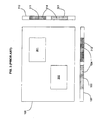
- Figure 1 is a diagram showing a graphical display window as known from the prior art
- Figure 2 is a diagram showing a data item with sections to be displayed in a graphical display window of Figure 1;
- Figure 3 is a diagram showing a data item with sections to be displayed in a graphical display window of Figure 1 with vertical and horizontal scroll bars showing the position of the viewable section;
- Figure 4 is a diagram showing a data item corresponding to that of Figure 3 by with vertical and horizontal scroll bars in accordance with the present invention.
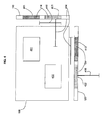
- Figure 5 is a diagram showing a graphical display window in accordance with the present invention.
- Figure 1 shows a user interface of a data processing system in the form of a screen 100 on which a window 102 is displayed.
- the window 102 has a vertical scroll bar 110 and a horizontal scroll bar 120.
- a scroll bar control 112, 122 is provided on each scroll bar 110, 120.
- the control 112, 122 indicates to the user that more of the data item is available beyond the current extent (horizontal and/or vertical) of the view in the window 102.
- the horizontal and vertical scroll bar controls 112, 122 each contain a slider 114, 124, which enables the user to manipulate the view to make visible the user desired part of the data item.
- a slider 114, 124 occupies a proportion of the scroll bar control 112, 122 commensurate with the ratio of the data item visible to that which is not currently visible.
- the location of the slider 114, 124 within the scroll bar control 112, 122 indicates the placement of the view relative to the extent of the data item (left to right, or, bottom to top, respectively).
- a slider 114 in a vertical scroll bar 110 can be moved up or down in only one direction between a lower bound 111 and an upper bound 113.
- the lower bound 111 is the bottom or maximum position and the upper bound 113 is the top or minimum position.
- the slider 114 moves in a +y or a -y direction only.
- a slider 124 in a horizontal scroll bar 120 can be moved left or right in only one direction between a left bound 121 and a right bound 123.
- the left bound 121 is the left-most or zero position and the right bound 123 is the right-most or maximum position.
- the slider 124 moves in a +x or a -x direction only.
- the user can manipulate the view by dragging a slider 114, 124 to some position in the scroll bar control 112, 122.
- An arrow cursor 104 on the screen 100 is controlled by a pointer device operated by the user.
- the user manipulates the pointer device to move the arrow cursor 104 to point to and select a slider 114, 124.
- the selection of the slider 114, 124 is activated, for example, by depressing a button on the pointer device, and the pointer device is moved by the user to drag the slider 114, 124 along the scroll bar control 112, 122. In this way the user can move the slider 114, 124 to a desired position between the end bounds 111, 113 or 121, 123 of the scroll bars 110, 120 respectively.
- the only permitted movement for the data item as controlled by the pointing device is in the +/- x direction for the horizontal scroll bar 120 and the +/- y direction for the vertical scroll bar 110.
- Scroll bars 110, 120 with one dimensional operation allow noisy input. This means that if a pointer device is operated in an inexact fashion, the operation is still carried out. This enables a user to carry out an operation quickly without requiring exact manual skill.
- a user may point the arrow cursor 104 controlled by the pointer device at the slider 114 in a vertical scroll bar 110. The user selects and drags the slider 114 downwards in the -y direction in the scroll bar control 112. However, if the user drags the arrow cursor 104 downwards such that it moves off the slider 114 and the scroll bar control 112 whilst the slider 114 is selected, the operation of vertical downward scrolling is continued until the pointer device is released.
- the arrow cursor 104 can move to the right or left (+/- x directions) without affecting the operation as well as in the downward direction. Any movement of the pointer device in a direction apart from that required by the slider 114 is ignored. noisy input can therefore be translated into linear output.
- a user can also operate the one dimensional movement of scroll bars 110, 120 by using end tabs 117, 118 and 127, 128.
- Each scroll bar 110, 120 usually has an end tab 117, 118 and 127, 128 with an outwardly pointing arrow at each end.
- the user interacts with the respective scroll bar by selecting one of the end tabs 117, 118, 127, 128 for incremental movement in the given direction.
- the incremental movement can be in units of a row/column or in grosser units e.g. page sized or the horizontal view dimension. This increment is usually established by the application.
- the major user of a scroll bar is to position the viewable area over a larger data item when only fractional areas of the data item can be viewed.
- Figure 2 shows a data item 106.
- the complete data item 106 is too large to be viewed in its entirety on a screen 100 as shown in Figure 1 whilst allowing sufficient detail for a user to work on the data item 106. Therefore, the data item 106 must be viewed one section of viewable area at a time.
- a viewable area is displayed in a window 102 on a screen as shown in Figure 1.
- Figure 2 shows four sections 201, 202, 203, 204 of the data item 106 as each of them would be displayed in a window 102.
- Scroll bars 110, 120 with sliders 114, 124 are shown for each section 201, 202, 203, 204 showing how the sliders 114, 124 represent the position of the section shown in a window 102 in relation to the entire data item 106.
- a first section 201 is the top left hand corner section of the data item 106. If this section 201 is the section viewed in a window 102, the vertical slider 114 would be at the top bound of the vertical scroll bar 110 and the horizontal slider 124 would be at the left bound of the horizontal scroll bar 120.
- the scroll bars 110, 120 are used to control the selection of the section of the data item 106 which is viewable in the window 102.
- Figure 3 shows a data item 106 with scroll bars 110, 120 of a window 102 (see Figure 1) shown adjacent the whole data item 106 for the purposes of illustration.
- a first section 301 is displayed in a window.
- the vertical scroll bar 110 has a slider 114 in first position 311 and the horizontal scroll bar 120 has a slider 124 in first position 312.
- the user wishes to view a second section 302 of the data item 106. Therefore, the viewable area must be moved from the position over the first section 301 to a position over the second section 302.
- the slider 114 of the vertical scroll bar 110 is moved to a second position 321 and the slider 124 of the horizontal scroll bar 120 is moved to a second position 322.
- the described system is now described which provides two-dimensional scrolling using existing scroll bars 110, 120.
- the sequence of steps given above required for positioning can be greatly reduced by enhancing scroll bars with two-dimensional operation. This is achieved by linking the operation of the vertical and horizontal scroll bars 110, 120.
- the described system enables a user to operate a single scroll bar to position the viewable area in a data item.
- a vertical scroll bar 110 interacts with a horizontal scroll bar 120 by means of its slider 114.
- the converse also applies in that a horizontal scroll bar 120 interacts with a vertical scroll bar 110 via its slider 124.
- Movement of a vertical scroll bar slider 114 will respond to a pointing device movement to the left (the -x direction) or to the right (the +x direction).
- the response to the pointer device movement is to move the slider 124 of the linked horizontal scroll bar 120 as if the horizontal scroll bar slider 124 had been selected and moved by the pointer device.
- movement of a horizontal scroll bar slider 124 will respond to a pointing device movement up (the +y direction) or down (the -y direction).
- the response to the pointer device movement is to move the slider 114 of the linked vertical scroll bar 110 as if the vertical scroll bar slider 114 had been selected and moved by the pointer device.
- only one scroll bar can be provided and all movement is achieved by selecting the single slider and moving the pointer device in the required direction. However, the position in the data item of the viewable area will only be shown in the direction of the single scroll bar.
- the linking of the vertical and horizontal scroll bars 110, 120 to provide two-dimensional movement can be optionally selected or can be continuously activated.
- the optional selection of the two-dimensional movement can be by selecting a button on the pointer device, by selecting an icon on the screen, by setting a preference in a tool bar, or by other means.
- a pointer device may have two buttons, a preferred button and a non-preferred button such as the left and right buttons on a mouse.
- a preferred button may have two buttons, a preferred button and a non-preferred button such as the left and right buttons on a mouse.
- One dimensional, linear movement is provided when a slider is selected using a preferred button and two-dimensional movement is provided when a slider is selected using a non-preferred button.
- buttons on a pointer device could be used to control the granularity of the movement required to activate the linked scroll bar movement.
- two buttons on a pointer device could be held down or a left button could be held whilst clicking with a right button to activate the second dimension of movement.
- the described system does not alter the operations of selecting end tabs 117, 118 and 127, 128 or the selecting of the area between the end tabs and a slider 114, 124 in order to activate incremental scrolling of a data item.
- a data item 106 is shown corresponding to that shown in Figure 3.
- the whole data item 106 is shown with scroll bars 110, 120 of a window 102 shown adjacent the whole data item 106 for the purposes of illustration.
- a first section 401 is displayed in a window.
- the vertical scroll bar 110 has a slider 114 in first position 411 and the horizontal scroll bar 120 has a slider 124 in first position 412.
- the user wishes to view a second section 402 of the data item 106. Therefore, the viewable area must be moved from the position over the first section 401 to a position over the second section 402.
- the slider 114 of the vertical scroll bar 110 must move to a second position 421 and the slider 124 of the horizontal scroll bar 120 must move to a second position 422.
- this movement can be achieved using only the vertical scroll bar 110 by the following operations:
- the linked slider 124 of the horizontal scroll bar 120 stays in its initial first position 412. However, when the pointing device moves in the -x direction, the selected slider 114 does not move but the linked slider 124 moves in the -x direction an amount corresponding to the movement of the pointer device.
- the slider 124 of the horizontal scroll bar 120 is not selected, the slider 124 moves position in the horizontal scroll bar 120 as step 3 above is carried out. This ensures that the slider 124 remains representative of the position of the viewable area in the whole data item.
- the linked slider 114 of the vertical scroll bar 110 stays in its initial first position 411. However, when the pointing device moves in the -y direction, the selected slider 124 does not move but the linked slider 114 moves in the -y direction an amount corresponding to the movement of the pointer device.
- the slider 114 of the vertical scroll bar 110 is not selected, the slider 114 moves position in the vertical scroll bar 110 as step 3 above is carried out. This ensures that the slider 114 remains representative of the position of the viewable area in the whole data item.
- Movement of the pointer device does not need to be made in discreet steps in a +/- x direction and a +/- y direction.
- the movement can be in a diagonal direction and this is resolved into x and y movements applied to the appropriate sliders 124, 114 of the horizontal and vertical scroll bars 120, 110.
- Figure 5 shows a screen 100 as shown in Figure 1, with a window 102 showing a viewable area of a data item.
- a arrow cursor 104 is shown in a first position 501 pointing to the slider 114 of the vertical scroll bar 110.
- the slider 114 is in a first position 511 in the vertical scroll bar 110.
- the arrow cursor 104 is moved to a second position 502 which is a distance 513 in the -y direction and a distance 514 in the +x direction.
- the slider 114 of the vertical scroll bar 110 moves to a second position 512 a distance 513 from the first position 511.
- the slider 124 of the horizontal scroll bar 120 moves from a first position 515 to a second position 516 which is a distance 514 from the first position 515.
- the viewable area of the data item is changed accordingly as the sliders 114, 124 move.
- the implementation of the linking of the scroll bars 110, 120 is by interpretation of pointer device messages in both x and y directions, flattening them and sending the appropriate movement signal directly to the relevant slider 114, 124. Any movement of a pointer device in the x direction interpreted from a pointer device message is sent to the slider 124 of the horizontal scroll bar 120. Any movement of a pointer device in the y direction interpreted from a pointer device message is sent to the slider 114 of the vertical scroll bar 110. These messages are interpreted by both scroll bars 110, 120 regardless of which of the sliders 114, 124 has been selected.
- GUIME GNU Network Model Environment
- a window control contains scroll bar controls and scroll bar controls contain a slider control.
- pointer device movements (such as mouse movements) are sent to the control (window, scroll bar, slider etc.) that is currently associated with that device. Consequently, when the arrow cursor 104 is associated with slider 114 or positioned on end markers 117,118, the pointer device movement messages are sent to the owning scroll bar 110 by the windowing software.
- movement of the arrow cursor 104 by the pointer device when associated with the slider 114 in the vertical scroll bar 110 sends movement messages in the +/- y direction which are processed and also in the +/-x direction which are ignored.
- the described system extends the processing so that the +/-x movements for the arrow cursor 104 as controlled by the pointer device when associated with the slider 114 in the vertical scroll bar 110 are not ignored but treated as movements for the associated slider 124 in horizontal scroll bar 120.
- +/-y movements for of the arrow cursor 104 as controlled by the pointer device associated with the slider 124 in the horizontal scroll bar 120 cause movements for the slider 114 of the vertical scroll bar 110.
- one implementation of the described system is for +/-x movements when received by the slider 114 of the vertical scroll bar 110 to generate pointer device movement messages directed to the slider 124 of the horizontal scroll bar 120.
- +/-y movements of slider 124 in the horizontal scroll bar 120 are sent to the slider 114 of the vertical scroll bar 110. This is done by formatting up the relevant movement flows and sending them to the owning window 102 which then routes them to the relevant scroll bars 110,120 where they are processed as if they came directly from the pointer device.
- the amount of latitude in moving a pointer device to activate the second dimensional movement can be altered.
- a user who has a low level of skill in positioning a pointer device may require more latitude in moving in the second dimension compared to a more skilled user.
- a configuration can be set for the required movement width of movement which activates the movement of the linked scroll bar.
Landscapes
- Engineering & Computer Science (AREA)
- General Engineering & Computer Science (AREA)
- Theoretical Computer Science (AREA)
- Human Computer Interaction (AREA)
- Physics & Mathematics (AREA)
- General Physics & Mathematics (AREA)
- User Interface Of Digital Computer (AREA)
Abstract
Description
Claims (11)
- Method for two-dimensional scrolling in a graphical display window (102), comprising: providing a scroll bar (110, 120) associated with a display window (102) enabled to move data displayed in the window relative to a first direction; responsive to user selection of the scroll bar (110, 120) with a pointer device and responsive to movement of the pointer device in a second direction, moving data displayed in the window (102) relative to the second direction.
- A method as claimed in claim 1, wherein the first direction is the direction of the scroll bar (110, 120) and the second direction is perpendicular to the first direction.
- A method as claimed in claim 1 or claim 2, wherein the user selection of the scroll bar (110, 120) is by selection of a slide button (114, 124) on the scroll bar (110, 120).
- A method as claimed in claim 3, wherein the method includes representing the position of the display window (102) in the first direction in a data item (106) being viewed by the position of the slide button (114, 124) in the scroll bar (110, 120).
- A method as claimed in any one of the preceding claims, wherein the method includes providing a second scroll bar (120, 110) in the second direction and wherein movement of the pointer device in the second direction with user selection of the first scroll bar (110, 120) is represented by the position of a slide button (124, 114) in the second scroll bar (120, 110).
- A method as claimed in any one of the preceding claims, wherein the method includes optionally activating the scroll bar (110, 120) to be responsive to movement in the second direction.
- A method as claimed in any one of the preceding claims, wherein the user selection of the scroll bar (110, 120) for activating movement in the second direction is different to the user section of the scroll bar (110, 120) for activating movement in the first direction.
- A method as claimed in any one of the preceding claims, including sending movement messages of a pointer device associated with a slider control to a first scroll bar (110, 120) owning the slider control and to a second scroll bar (120, 110).
- A method as claimed in claim 8, including sending movement messages to an owning window control to route them to the first and second scroll bars (110, 120) for processing.
- A system for two-dimensional scrolling in a graphical display window (102) in a user interface, comprising: a scroll bar (110, 120) associated with a display window (102) enabled to move data displayed in the window relative to a first direction; a pointer device for selecting objects in the user interface; means for selecting the scroll bar (110, 120) with the pointer device; and means for moving the data displayed in the window (102) relative to a second direction responsive to movement of the pointer device in the second direction.
- A computer program product stored on a computer readable storage medium, comprising computer readable storage code means for performing the steps of: receiving a pointer device movement message relating to selection of a scroll bar control; interpreting the message in both x and y directions; and sending the appropriate movement signals to move a data item (106) being displayed in each of the x and y directions.
Applications Claiming Priority (2)
| Application Number | Priority Date | Filing Date | Title |
|---|---|---|---|
| GB0406056 | 2004-03-18 | ||
| GBGB0406056.2A GB0406056D0 (en) | 2004-03-18 | 2004-03-18 | Method and apparatus for two-dimensional scrolling in a graphical display window |
Publications (2)
| Publication Number | Publication Date |
|---|---|
| EP1577743A2 true EP1577743A2 (en) | 2005-09-21 |
| EP1577743A3 EP1577743A3 (en) | 2008-06-04 |
Family
ID=32117910
Family Applications (1)
| Application Number | Title | Priority Date | Filing Date |
|---|---|---|---|
| EP05101602A Withdrawn EP1577743A3 (en) | 2004-03-18 | 2005-03-02 | Method and apparatus for two-dimensional scrolling in a graphical display window |
Country Status (4)
| Country | Link |
|---|---|
| US (1) | US8402386B2 (en) |
| EP (1) | EP1577743A3 (en) |
| CN (1) | CN1670680A (en) |
| GB (1) | GB0406056D0 (en) |
Cited By (2)
| Publication number | Priority date | Publication date | Assignee | Title |
|---|---|---|---|---|
| US20120072865A1 (en) * | 2008-08-29 | 2012-03-22 | Microsoft Corporation | Scrollable area multi-scale viewing |
| EP2166445A3 (en) * | 2008-09-03 | 2012-09-19 | LG Electronics Inc. | Terminal, controlling method thereof and recordable medium thereof |
Families Citing this family (22)
| Publication number | Priority date | Publication date | Assignee | Title |
|---|---|---|---|---|
| US7987433B2 (en) * | 2003-04-15 | 2011-07-26 | International Business Machines Corporation | Methods, systems and computer program products for multidimensional movement in a display window |
| US8001487B2 (en) * | 2006-04-12 | 2011-08-16 | Laas & Sonder Pty Ltd | Method and system for organizing and displaying data |
| US20080034316A1 (en) * | 2006-08-01 | 2008-02-07 | Johan Thoresson | Scalable scrollbar markers |
| JP5003377B2 (en) * | 2007-09-21 | 2012-08-15 | パナソニック株式会社 | Mark alignment method for electronic devices |
| US8769430B2 (en) * | 2007-12-05 | 2014-07-01 | International Business Machines Corporation | Multi-column formatted page scrolling |
| KR101387527B1 (en) * | 2007-12-06 | 2014-04-23 | 엘지전자 주식회사 | Terminal and method for displaying menu icon therefor |
| KR101451999B1 (en) * | 2009-07-28 | 2014-10-21 | 삼성전자주식회사 | Data scroll method and apparatus |
| US20110138321A1 (en) * | 2009-12-04 | 2011-06-09 | International Business Machines Corporation | Zone-based functions in a user interface |
| US20120066638A1 (en) * | 2010-09-09 | 2012-03-15 | Microsoft Corporation | Multi-dimensional auto-scrolling |
| US9134899B2 (en) | 2011-03-14 | 2015-09-15 | Microsoft Technology Licensing, Llc | Touch gesture indicating a scroll on a touch-sensitive display in a single direction |
| EP2690536A4 (en) | 2011-03-23 | 2014-08-27 | Nec Casio Mobile Comm Ltd | Information processing device, method for controlling information processing device, and program |
| US9299083B2 (en) * | 2011-07-15 | 2016-03-29 | Roy Morgan Research Pty Ltd | Electronic data generation methods |
| TWI451320B (en) * | 2011-09-09 | 2014-09-01 | Primax Electronics Ltd | Computer peripheral device and method for controlling scroll bars in different windows |
| US9323440B2 (en) | 2011-12-16 | 2016-04-26 | International Business Machines Corporation | Scroll focus |
| US9268475B2 (en) | 2013-03-08 | 2016-02-23 | International Business Machines Corporation | Graphical user interface control for scrolling content |
| US20150070399A1 (en) * | 2013-09-09 | 2015-03-12 | Apple Inc. | Managing Partially Out-of-Frame View Areas |
| CN104461306B (en) * | 2013-09-23 | 2017-12-01 | 博雅网络游戏开发(深圳)有限公司 | rolling assembly control method and device |
| US20160070455A1 (en) * | 2014-09-10 | 2016-03-10 | International Business Machines Corporation | Toggle graphic object |
| CN106484274A (en) * | 2015-08-31 | 2017-03-08 | 阿里巴巴集团控股有限公司 | A kind of touch control device cursor positioning method and device |
| DE102015011648B4 (en) * | 2015-09-11 | 2017-05-18 | Audi Ag | Motor vehicle operating device with sliders and method for operating an operating device |
| US10209871B2 (en) | 2015-10-21 | 2019-02-19 | International Business Machines Corporation | Two-dimensional indication in contents |
| US10540075B2 (en) * | 2016-09-16 | 2020-01-21 | The Toronto-Dominion Bank | System and method to perform an allocation using a continuous two direction swipe gesture |
Family Cites Families (8)
| Publication number | Priority date | Publication date | Assignee | Title |
|---|---|---|---|---|
| US5196838A (en) * | 1990-12-28 | 1993-03-23 | Apple Computer, Inc. | Intelligent scrolling |
| JPH04263295A (en) | 1991-02-18 | 1992-09-18 | Matsushita Electric Ind Co Ltd | Image processor |
| US5864330A (en) * | 1993-06-29 | 1999-01-26 | International Business Machines Corp. | Method and apparatus for providing a two-dimensional position-sensitive scroll icon in a data processing system user interface |
| US5495566A (en) * | 1994-11-22 | 1996-02-27 | Microsoft Corporation | Scrolling contents of a window |
| US5655094A (en) * | 1995-09-29 | 1997-08-05 | International Business Machines Corporation | Pop up scroll bar |
| JP2001255978A (en) | 2000-03-08 | 2001-09-21 | Hitachi Ltd | Window scrolling device |
| US6657639B2 (en) * | 2001-09-20 | 2003-12-02 | International Business Machines Corporation | Apparatus and method for improved scrolling |
| US7958455B2 (en) * | 2002-08-01 | 2011-06-07 | Apple Inc. | Mode activated scrolling |
-
2004
- 2004-03-18 GB GBGB0406056.2A patent/GB0406056D0/en not_active Ceased
-
2005
- 2005-03-02 EP EP05101602A patent/EP1577743A3/en not_active Withdrawn
- 2005-03-03 US US11/071,396 patent/US8402386B2/en not_active Expired - Fee Related
- 2005-03-18 CN CN200510056508.4A patent/CN1670680A/en active Pending
Cited By (4)
| Publication number | Priority date | Publication date | Assignee | Title |
|---|---|---|---|---|
| US20120072865A1 (en) * | 2008-08-29 | 2012-03-22 | Microsoft Corporation | Scrollable area multi-scale viewing |
| US9417779B2 (en) * | 2008-08-29 | 2016-08-16 | Microsoft Technology Licensing, Llc | Scrollable area multi-scale viewing |
| EP2166445A3 (en) * | 2008-09-03 | 2012-09-19 | LG Electronics Inc. | Terminal, controlling method thereof and recordable medium thereof |
| US8522157B2 (en) | 2008-09-03 | 2013-08-27 | Lg Electronics Inc. | Terminal, controlling method thereof and recordable medium thereof |
Also Published As
| Publication number | Publication date |
|---|---|
| GB0406056D0 (en) | 2004-04-21 |
| EP1577743A3 (en) | 2008-06-04 |
| US8402386B2 (en) | 2013-03-19 |
| CN1670680A (en) | 2005-09-21 |
| US20050210404A1 (en) | 2005-09-22 |
Similar Documents
| Publication | Publication Date | Title |
|---|---|---|
| US8402386B2 (en) | Method and apparatus for two-dimensional scrolling in a graphical display window | |
| US5864330A (en) | Method and apparatus for providing a two-dimensional position-sensitive scroll icon in a data processing system user interface | |
| US7296243B2 (en) | Animating display motion | |
| EP0677803B1 (en) | A method and system for facilitating the selection of icons | |
| US9213477B2 (en) | Apparatus and method for touch screen user interface for handheld electric devices part II | |
| US20050223342A1 (en) | Method of navigating in application views, electronic device, graphical user interface and computer program product | |
| US5602981A (en) | Quickselect icon button on a computer display which redisplays the last view style activated by the icon button | |
| US6396487B1 (en) | User interface enhancement for windows-based operating systems | |
| JPH06203136A (en) | Selective operation method of data collection display and data processing system | |
| US9557828B2 (en) | Input information processing system, input information processing method, program and computer-readable recording medium | |
| CN105930045A (en) | Card metaphor for activities in a computing device | |
| US20080082909A1 (en) | Form magnifier | |
| WO2006045530A2 (en) | An apparatus and a method of providing information to a user | |
| US20090015568A1 (en) | Method and Apparatus for Implementing Slider Detents | |
| US5526018A (en) | Stretching scales for computer documents or drawings | |
| JP2000172398A (en) | Interface control for switching between display areas on a display device | |
| JPH0916362A (en) | Menu item selection / display method and function description display method | |
| KR100795590B1 (en) | How to navigate, electronic devices, user interfaces, and computer program products | |
| JPH08249148A (en) | Alignment control method for multiple window screens | |
| JP2005267630A (en) | Method and apparatus for two-dimensional scrolling in a graphical display window | |
| Mishra | 10 Inventions on scrolling and scrollbars in Graphical User Interface | |
| US7696979B1 (en) | Method and system for manipulating a plurality of graphical pointers | |
| JP2005251074A (en) | Numerical input device | |
| JPH05224865A (en) | Window system | |
| JPH07200522A (en) | Document processor |
Legal Events
| Date | Code | Title | Description |
|---|---|---|---|
| PUAI | Public reference made under article 153(3) epc to a published international application that has entered the european phase |
Free format text: ORIGINAL CODE: 0009012 |
|
| AK | Designated contracting states |
Kind code of ref document: A2 Designated state(s): AT BE BG CH CY CZ DE DK EE ES FI FR GB GR HU IE IS IT LI LT LU MC NL PL PT RO SE SI SK TR |
|
| AX | Request for extension of the european patent |
Extension state: AL BA HR LV MK YU |
|
| PUAL | Search report despatched |
Free format text: ORIGINAL CODE: 0009013 |
|
| AK | Designated contracting states |
Kind code of ref document: A3 Designated state(s): AT BE BG CH CY CZ DE DK EE ES FI FR GB GR HU IE IS IT LI LT LU MC NL PL PT RO SE SI SK TR |
|
| AX | Request for extension of the european patent |
Extension state: AL BA HR LV MK YU |
|
| AKX | Designation fees paid | ||
| REG | Reference to a national code |
Ref country code: DE Ref legal event code: 8566 |
|
| STAA | Information on the status of an ep patent application or granted ep patent |
Free format text: STATUS: THE APPLICATION IS DEEMED TO BE WITHDRAWN |
|
| 18D | Application deemed to be withdrawn |
Effective date: 20081205 |