EP1577721A2 - Model predictive controller with life extending control - Google Patents
Model predictive controller with life extending control Download PDFInfo
- Publication number
- EP1577721A2 EP1577721A2 EP05251602A EP05251602A EP1577721A2 EP 1577721 A2 EP1577721 A2 EP 1577721A2 EP 05251602 A EP05251602 A EP 05251602A EP 05251602 A EP05251602 A EP 05251602A EP 1577721 A2 EP1577721 A2 EP 1577721A2
- Authority
- EP
- European Patent Office
- Prior art keywords
- model predictive
- changing
- further including
- life
- maintenance
- Prior art date
- Legal status (The legal status is an assumption and is not a legal conclusion. Google has not performed a legal analysis and makes no representation as to the accuracy of the status listed.)
- Withdrawn
Links
- 238000012423 maintenance Methods 0.000 claims abstract description 33
- 238000000034 method Methods 0.000 claims description 15
- 230000004044 response Effects 0.000 claims description 10
- 238000004590 computer program Methods 0.000 claims description 4
- 230000006870 function Effects 0.000 abstract description 24
- 238000005457 optimization Methods 0.000 description 5
- 238000001514 detection method Methods 0.000 description 3
- 239000013598 vector Substances 0.000 description 3
- 230000003247 decreasing effect Effects 0.000 description 2
- 239000011159 matrix material Substances 0.000 description 2
- 230000001419 dependent effect Effects 0.000 description 1
- 230000000694 effects Effects 0.000 description 1
- 230000003287 optical effect Effects 0.000 description 1
Images
Classifications
-
- G—PHYSICS
- G05—CONTROLLING; REGULATING
- G05B—CONTROL OR REGULATING SYSTEMS IN GENERAL; FUNCTIONAL ELEMENTS OF SUCH SYSTEMS; MONITORING OR TESTING ARRANGEMENTS FOR SUCH SYSTEMS OR ELEMENTS
- G05B13/00—Adaptive control systems, i.e. systems automatically adjusting themselves to have a performance which is optimum according to some preassigned criterion
- G05B13/02—Adaptive control systems, i.e. systems automatically adjusting themselves to have a performance which is optimum according to some preassigned criterion electric
- G05B13/04—Adaptive control systems, i.e. systems automatically adjusting themselves to have a performance which is optimum according to some preassigned criterion electric involving the use of models or simulators
- G05B13/048—Adaptive control systems, i.e. systems automatically adjusting themselves to have a performance which is optimum according to some preassigned criterion electric involving the use of models or simulators using a predictor
Definitions
- the present invention relates generally to control systems and more particularly to a model predictive control system with life extending control.
- Model predictive controllers can operate multivariable systems to provide uncoupled command responses while meeting various physical and operational limits.
- MPC controllers mathematically optimize a performance index in realtime in order to determine the actuator commands. It is also known that the relative weights in a MPC performance index and the limit values can be changed in the field. However, MPC controllers have not been implemented with explicit life-extending functions in the performance index or limit equations.
- the present invention provides a life extending control that performs the normal functions of a control system for a physical system, such as a gas turbine engine, but does so in a manner that extends the life or time-to-next maintenance or reduces the number of parts that need to be replaced.
- the life-extending functions are implemented in an MPC controller for the system by explicitly including life-extending functions in the performance index and life oriented limits in the inequality equations.
- the life-extending functions can be varied on the fly, can be tailored to the specific situation (such as a failure of a specific component), and are continuously variable because they are implemented in terms of weighting factors in the MPC performance index and/or limits in the MPC inequality equations.
- life extending functions do not degrade other control functions, they can always be enabled, making the system less expensive to maintain. If the life extending functions degrade some other control functions, they can be adjusted in-the-field or on-the-fly to stretch the time-until-maintenance until it is more convenient, but with some impact on performance.
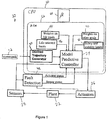
- a model predictive control system 20 is shown schematically in Figure 1.
- the system 20 includes a Model Predictive Controller (MPC) 24 for controlling a plant 22 with actuators 26 based upon feedback from sensors 28 and based upon a desired trajectory.
- the desired trajectory generator 30 determines a desired trajectory based upon input commands 32, such as from a user.
- Model predictive control is a type of digital controller.
- Digital controllers are based on a computer that periodically samples operator commands and measured responses. As a consequence of each sample, the digital controller specifies new actuator settings, which is referred to as a controller update. These settings are most often held until the next update.
- MPC specifies these settings as the first time point of an actuator trajectory.
- the trajectory specifies u(n), for controller update times numbered with integer n, where n varies from L to N+L-1. That is, for N time points. The current sample time is enumerated L.
- This actuator trajectory is determined as the unique trajectory that minimizes the performance index, PI, where and where the summation is over the N future time points.
- x n is a vector of the states of a system dynamic model and u n are the actuator commands at each of the N time points.
- the matrices C and D are coefficients of linearized output equations, which relate system outputs for which there are goals to the dynamic model states and actuator settings.
- Q and R are lower triangular weighting matrices, and vectors f and g are driving terms that are functions of a desired trajectory for the system output, desired or nominal actuator values, and weighting matrices Q and R.
- Lower triangular matrix M is a terminal-weighting matrix and may be present for a variety of control theoretic reasons.
- the equality represents a model of how the limited variables are linked to the state dynamics model.
- the inequality indicates the limited variable should remain less than the limit, Y.
- the explicit inclusion of the limit equation in the theory and resulting logic design is a key advantage of MPC.
- the MPC designer specifies the control algorithm by determining the state dynamics model, the limit model, and the performance index. Performance index design involves selecting the variables to include in output vector, y, and choosing the weighting matrices Q, R, and M.
- the control software designer must also provide reusable software for solving the optimization problems in real time.
- One specific implementation of an MPC control system 20 and an MPC controller 24 that could be used in the present invention is disclosed in more detail in co-pending application U.S. Serial No. 10/620,569, filed July 16, 2003, (published as US 2005/0015421 A1) which is co-owned and which has the same inventor as the present application and which is hereby incorporated by reference in its entirety.
- the weighting matrices Q, R and M in the MPC controller 24 reflect the weighting on goals such as stability, safety, performance, etc stored in "weights on other goals" 40, which are implemented in the performance index of the MPC controller 24.
- Limits for purposes of maintaining stability and safety are stored in "safety and stability limits" 42 and implemented in the MPC controller 24 as inequality equations.
- the system 20 further, optionally, includes fault detection circuitry and feedback 48 which monitors the sensors 28 and actuators 26.
- the fault detection circuitry and feedback 48 sends signals to the MPC controller 24 indicating the current states of the sensors 28 and actuators 26, including whether they are operating normally, have partially failed, or have completely failed.
- the MPC controller 24 In operation, in the case where the life-extending functions do not degrade the other control system functions, the MPC controller 24 always uses a performance index and inequality equations that take into account the life-extending weights 44 and limits 46. In that case, the plant 22 will simply require less maintenance.
- the performance index of the MPC controller 24 normally does not include nominal life-extending weights 44 and the inequality equations include nominal life-oriented limits 46. While operating normally, it may be determined that maintenance of a particular component of the plant 22 is required. This may be a regularly scheduled maintenance reminder (based upon time in operation or time since the last maintenance) or a specific manual request for maintenance (either by the operator or by a central maintenance facility). The life-extending weights 44 can then be increased and the life limits 46 are then decreased, as implemented in the MPC controller 24, in order to stretch the time until maintenance for that component of the plant 22 until the maintenance can be performed. This may be a known time in the future, like when the replacement part will be available, when maintenance resources will be available, or when the plant 22 is already scheduled for maintenance. Stretching the time-to-maintenance can provide continued operation of the plant 22 until the time for maintenance.
- a system such as a aircraft engine might increase overall safety if its output were increase in speed or magnitude.
- the life of the plant is secondary to the need for safety and the weight on the life goals can be reduced and the life limits increased.
- the fault detection circuitry and feedback 48 may determine that one or more of the actuators 26 and sensors 28 requires maintenance (including complete replacement of the actuator 26 or sensor 28). This actuator status and sensor status is indicated to the MPC controller 24, which then adopts or changes at least some of the weights 44 and limits 46 in the performance index and inequality equations
- the weights 44 and limits 46 may also be altered (increased or decreased) based upon the actuator status, sensor status, regular maintenance schedule or specifically-scheduled maintenance.
- the life-extending functions are not simply on or off, but a continuously variable factor that depends upon the severity of the failure of the component of the plant 22 and upon the expected time-to-maintenance. More severe problems would invoke higher weights 44 and lower limits 46, to the extent that it is necessary to degrade other system functions during the extended time-to-maintenance.
- the life extending goals (weights 44 and limits 46) are balanced with performance, energy use, stability, robustness and the scope or cost of the maintenance. In the event that the scheduled maintenance cannot be performed at the scheduled time, the MPC controller 24 continues to implement and adjust (if necessary) the life-extending weights 44 and limits 46 until maintenance can be obtained.
- the MPC controller 24 is preferable implemented on a CPU 60 having storage and memory 62 (such as RAM, ROM, hard drives, or any other optical, magnetic, electronic or other media for storing computer data and computer programs).
- storage and memory 62 such as RAM, ROM, hard drives, or any other optical, magnetic, electronic or other media for storing computer data and computer programs.
- the weights on life goals 44, life-oriented limits 46, weights on other goals 40, safety and stability limits 42 are preferably stored in the storage and memory 62, as is the program module for the model predictive controller 24 and the desired trajectory generator 30.
- these computer programs and data When executed by a processor 64, these computer programs and data perform the functions described above.
- the particular implementation will depend upon the particular application and the particular plant 22 to be controlled, one of skill in the art could write the necessary computer programs and provide suitable hardware based upon the description herein.
Landscapes
- Engineering & Computer Science (AREA)
- Health & Medical Sciences (AREA)
- Artificial Intelligence (AREA)
- Computer Vision & Pattern Recognition (AREA)
- Evolutionary Computation (AREA)
- Medical Informatics (AREA)
- Software Systems (AREA)
- Physics & Mathematics (AREA)
- General Physics & Mathematics (AREA)
- Automation & Control Theory (AREA)
- Feedback Control In General (AREA)
- Testing And Monitoring For Control Systems (AREA)
Abstract
Description

Claims (19)
- A model predictive control system (20) comprising
a plurality of sensors (28) indicating a current state of the system;
a desired trajectory generator (30) for creating a desired dynamic response based upon commands;
a model of plant dynamics
starting with the current state of the system, a nonlinear programming module (24) receiving the desired dynamic response and at least one system life goal (44) and formulating a problem of achieving the desired dynamic response and the at least one system life goal for a window spanning one or more time steps as a solution to a nonlinear program problem using methods of model predictive control; and
a nonlinear programming solver solving the nonlinear programming problem in each time step using an iterative algorithm based upon the model predictive control problem and a nonlinear programming algorithm. - The model predictive control system of claim 1 wherein the at least one system life goal includes at least one limit.
- The model predictive control system of claim 1 or 2 wherein the plant dynamic model and limit equation are linear and the performance index is quadratic so as to form a quadratic programming problem and the nonlinear programming solver is replaced with a quadratic programming solver.
- The model predictive control system of claim 3 wherein the at least one system life goal changes based upon a change in a status signal.
- The model predictive control system of claim 4 wherein the status signal is generated by a sensor.
- The model predictive control system of claim 4 wherein the status signal indicates the status of an actuator.
- A method for controlling a multivariable system including the steps of:a) receiving a plurality of sensor signals indicating current conditions of the system;b) receiving a plurality of commands;c) receiving at least one system life goal;d) determining a desired dynamic response of the system based upon the commands; ande) implementing a balance between the desired dynamic response and the at least one system life goal in a model predictive controller to generate a plurality of actuator commands.
- The method of claim 7 wherein said step e) is performed by weighting in a performance index for the model predictive controller.
- The method of claim 8 further including the step of changing the balance between the desired dynamic response and the at least one system life goal.
- The method of claim 9 further including the step of changing the weighting in the performance index to change the balance.
- The method of claim 10 further including the step of changing the weighting based upon an indication of a failure of a component in the system.
- The method of claim 11 further including the step of changing the limit based upon an indication of a time-to-maintenance of the system.
- The method of claim 10 wherein said step e) further includes the step of setting a limit in a set of inequality equations for the model predictive controller.
- The method of claim 13 further including the step of changing the limit based upon an indication of a time-to-maintenance.
- The method of claim 13 further including the step of changing the limit based upon an indication of a failure of a component in the system or the declaration of an emergency.
- The method of claim 7 wherein said step e) further includes the step of setting a limit in a set of inequality equations for the model predictive controller.
- The method of claim 16 further including the step of changing the limit based upon an indication of a time-to-maintenance.
- The method of claim 16 further including the step of changing the limit based upon an indication of a failure of a component in the system or the declaration of an emergency.
- A computer readable medium storing a computer program, which when executed by a computer performs the steps of:a) receiving a plurality of sensor signals indicating current conditions of the system;b) receiving a plurality of commands;c) receiving at least one system life goal;d) determining a desired dynamic response of the system based upon the commands; ande) implementing a balance between the desired dynamic response and the at least one system life goal in a model predictive controller to generate a plurality of actuator commands.
Applications Claiming Priority (2)
| Application Number | Priority Date | Filing Date | Title |
|---|---|---|---|
| US801235 | 2004-03-16 | ||
| US10/801,235 US7203554B2 (en) | 2004-03-16 | 2004-03-16 | Model predictive controller with life extending control |
Publications (2)
| Publication Number | Publication Date |
|---|---|
| EP1577721A2 true EP1577721A2 (en) | 2005-09-21 |
| EP1577721A3 EP1577721A3 (en) | 2006-10-18 |
Family
ID=34838879
Family Applications (1)
| Application Number | Title | Priority Date | Filing Date |
|---|---|---|---|
| EP05251602A Withdrawn EP1577721A3 (en) | 2004-03-16 | 2005-03-16 | Model predictive controller with life extending control |
Country Status (3)
| Country | Link |
|---|---|
| US (1) | US7203554B2 (en) |
| EP (1) | EP1577721A3 (en) |
| JP (1) | JP2005267633A (en) |
Cited By (4)
| Publication number | Priority date | Publication date | Assignee | Title |
|---|---|---|---|---|
| CN102841538A (en) * | 2005-09-30 | 2012-12-26 | 费舍-柔斯芒特系统股份有限公司 | Method and system for controlling a batch process |
| EP2151905A3 (en) * | 2008-08-05 | 2013-03-13 | The Boeing Company | Optimizing usage of powered systems |
| EP3151175A1 (en) * | 2015-09-30 | 2017-04-05 | The Boeing Company | System for maintenance of a manufactured product |
| CN112327669A (en) * | 2020-11-14 | 2021-02-05 | 大连理工大学 | A Design Method of Explicit Predictive Controller for Aeroengine |
Families Citing this family (91)
| Publication number | Priority date | Publication date | Assignee | Title |
|---|---|---|---|---|
| US7203555B2 (en) * | 2004-05-14 | 2007-04-10 | University Of Delaware | Predictive regulatory controller |
| US20060111881A1 (en) * | 2004-11-23 | 2006-05-25 | Warren Jackson | Specialized processor for solving optimization problems |
| US7330345B2 (en) * | 2005-05-09 | 2008-02-12 | Honeywell International, Inc. | Valve control method for circuitry for power generation systems |
| US8005575B2 (en) | 2006-06-01 | 2011-08-23 | General Electric Company | Methods and apparatus for model predictive control in a real time controller |
| US7844352B2 (en) * | 2006-10-20 | 2010-11-30 | Lehigh University | Iterative matrix processor based implementation of real-time model predictive control |
| EP2269122A4 (en) * | 2008-03-20 | 2012-07-18 | Univ New Brunswick | NON-LINEAR MULTIDIMENSIONAL CONTROL METHOD |
| US7949416B2 (en) * | 2008-05-06 | 2011-05-24 | United Technologies Corporation | Multivariable control system |
| US8073555B2 (en) * | 2008-05-06 | 2011-12-06 | United Technologies Corporation | Basepoint estimator |
| US20090287320A1 (en) * | 2008-05-13 | 2009-11-19 | Macgregor John | System and Method for the Model Predictive Control of Batch Processes using Latent Variable Dynamic Models |
| US8078292B2 (en) * | 2008-07-08 | 2011-12-13 | United Technologies Corporation | Basepoint estimator |
| EP2267305B1 (en) * | 2009-06-24 | 2016-01-13 | Vestas Wind Systems A/S | A method and a system for controlling operation of a wind turbine |
| US8573949B2 (en) * | 2009-09-30 | 2013-11-05 | General Electric Company | Method and system for focused energy brazing |
| US20110106747A1 (en) * | 2009-10-30 | 2011-05-05 | General Electric Company | Turbine life assessment and inspection system and methods |
| US8437880B2 (en) * | 2010-05-17 | 2013-05-07 | General Electric Company | System and method for enhancement of power generation facilities |
| US8682454B2 (en) | 2011-02-28 | 2014-03-25 | United Technologies Corporation | Method and system for controlling a multivariable system with limits |
| US8899488B2 (en) | 2011-05-31 | 2014-12-02 | United Technologies Corporation | RFID tag system |
| US9436179B1 (en) | 2013-03-13 | 2016-09-06 | Johnson Controls Technology Company | Systems and methods for energy cost optimization in a building system |
| US10418833B2 (en) | 2015-10-08 | 2019-09-17 | Con Edison Battery Storage, Llc | Electrical energy storage system with cascaded frequency response optimization |
| US9852481B1 (en) * | 2013-03-13 | 2017-12-26 | Johnson Controls Technology Company | Systems and methods for cascaded model predictive control |
| US9235657B1 (en) | 2013-03-13 | 2016-01-12 | Johnson Controls Technology Company | System identification and model development |
| US9481473B2 (en) | 2013-03-15 | 2016-11-01 | Rolls-Royce North American Technologies, Inc. | Distributed control system with smart actuators and sensors |
| US9853581B2 (en) * | 2013-03-15 | 2017-12-26 | Rolls-Royce Corporation | Lifing and performance optimization limit management for turbine engine |
| WO2014143707A1 (en) | 2013-03-15 | 2014-09-18 | United Technologies Corporation | Compact aero-thermo model based control system estimator starting algorithm |
| US20140365199A1 (en) * | 2013-06-11 | 2014-12-11 | The Mathworks, Inc. | Pairing a physical device with a model element |
| US9476361B2 (en) * | 2013-07-08 | 2016-10-25 | General Electric Company | Systems and methods for control of operating life of a gas turbine |
| US10360052B1 (en) | 2013-08-08 | 2019-07-23 | The Mathworks, Inc. | Automatic generation of models from detected hardware |
| AU2013406720A1 (en) * | 2013-12-06 | 2016-06-02 | Halliburton Energy Services, Inc. | Controlling wellbore operations |
| EP2889711B1 (en) | 2013-12-30 | 2020-07-01 | Rolls-Royce Corporation | System and method for optimizing component life in a power system |
| US10175681B2 (en) | 2014-05-01 | 2019-01-08 | Johnson Controls Technology Company | High level central plant optimization |
| US10025301B2 (en) * | 2014-08-29 | 2018-07-17 | General Electric Company | Method and system of adaptive model-based control for multiple-input multiple-output plants |
| US9771875B2 (en) | 2014-11-18 | 2017-09-26 | General Electric Company | Application of probabilistic control in gas turbine tuning, related control systems, computer program products and methods |
| US9771877B2 (en) | 2014-11-18 | 2017-09-26 | General Electric Company | Power output and fuel flow based probabilistic control in part load gas turbine tuning, related control systems, computer program products and methods |
| US9803561B2 (en) | 2014-11-18 | 2017-10-31 | General Electric Company | Power output and emissions based degraded gas turbine tuning and control systems, computer program products and related methods |
| US9784183B2 (en) | 2014-11-18 | 2017-10-10 | General Electric Company | Power outlet, emissions, fuel flow and water flow based probabilistic control in liquid-fueled gas turbine tuning, related control systems, computer program products and methods |
| US9771874B2 (en) | 2014-11-18 | 2017-09-26 | General Electric Company | Power output and fuel flow based probabilistic control in gas turbine tuning, related control systems, computer program products and methods |
| US9771876B2 (en) | 2014-11-18 | 2017-09-26 | General Electric Compnay | Application of probabilistic control in gas turbine tuning with measurement error, related control systems, computer program products and methods |
| US10626748B2 (en) * | 2014-12-08 | 2020-04-21 | General Electric Company | System and method for predicting and managing life consumption of gas turbine parts |
| US9909507B2 (en) | 2015-01-27 | 2018-03-06 | General Electric Company | Control system for can-to-can variation in combustor system and related method |
| US9599033B2 (en) | 2015-04-14 | 2017-03-21 | General Electric Company | Application of probabilistic control in gas turbine tuning for fuel flow-exhaust energy parameters, related control systems, computer program products and methods |
| US9599027B2 (en) | 2015-04-14 | 2017-03-21 | General Electric Company | Application of probabilistic control in gas turbine tuning for emissions-exhaust energy parameters, related control systems, computer program products and methods |
| US9599031B2 (en) | 2015-04-14 | 2017-03-21 | General Electric Company | Application of probabilistic control in gas turbine tuning for power output-emissions parameters, related control systems, computer program products and methods |
| US9599025B2 (en) | 2015-04-14 | 2017-03-21 | General Electric Company | Application of probabilistic control in gas turbine tuning for power output-exhaust energy parameters, related control systems, computer program products and methods |
| US9599032B2 (en) | 2015-04-14 | 2017-03-21 | General Electric Company | Application of probabilistic control in gas turbine tuning for emissions-fuel flow parameters, related control systems, computer program products and methods |
| US9599030B2 (en) | 2015-04-14 | 2017-03-21 | General Electric Company | Application of probabilistic control in gas turbine tuning for exhaust energy-fuel flow parameters, related control systems, computer program products and methods |
| US9599026B2 (en) | 2015-04-14 | 2017-03-21 | General Electric Company | Application of probabilistic control in gas turbine tuning for exhaust energy-power output parameters, related control systems, computer program products and methods |
| US9611791B2 (en) | 2015-04-14 | 2017-04-04 | General Electric Company | Application of probabilistic control in gas turbine tuning for fuel flow-power output parameters, related control systems, computer program products and methods |
| US9599029B2 (en) | 2015-04-14 | 2017-03-21 | General Electric Company | Application of probabilistic control in gas turbine tuning for fuel flow-emissions parameters, related control systems, computer program products and methods |
| US9599024B2 (en) | 2015-04-14 | 2017-03-21 | General Electric Company | Application of probabilistic control in gas turbine tuning for exhaust energy-emissions parameters, related control systems, computer program products and methods |
| WO2016196746A1 (en) * | 2015-06-05 | 2016-12-08 | Shell Oil Company | System and method for background element switching for models in model predictive estimation and control applications |
| EP3317526B1 (en) | 2015-06-30 | 2021-09-22 | Vestas Wind Systems A/S | Methods and systems for generating wind turbine control schedules |
| US10746160B2 (en) * | 2015-06-30 | 2020-08-18 | Vestas Wind Systems A/S | Methods and systems for generating wind turbine control schedules |
| WO2017000952A1 (en) | 2015-06-30 | 2017-01-05 | Vestas Wind Systems A/S | Methods and systems for generating wind turbine control schedules |
| US10871146B2 (en) | 2015-06-30 | 2020-12-22 | Vestas Wind Systems A/S | Methods and systems for generating wind turbine control schedules |
| DK201570559A1 (en) * | 2015-08-28 | 2017-03-27 | Vestas Wind Sys As | Methods and Systems for Generating Wind Turbine Control Schedules |
| US10928816B2 (en) | 2015-06-30 | 2021-02-23 | Vestas Wind Systems A/S | Methods and systems for generating wind turbine control schedules |
| US10190789B2 (en) | 2015-09-30 | 2019-01-29 | Johnson Controls Technology Company | Central plant with coordinated HVAC equipment staging across multiple subplants |
| US10190793B2 (en) | 2015-10-08 | 2019-01-29 | Johnson Controls Technology Company | Building management system with electrical energy storage optimization based on statistical estimates of IBDR event probabilities |
| US10564610B2 (en) | 2015-10-08 | 2020-02-18 | Con Edison Battery Storage, Llc | Photovoltaic energy system with preemptive ramp rate control |
| US10389136B2 (en) | 2015-10-08 | 2019-08-20 | Con Edison Battery Storage, Llc | Photovoltaic energy system with value function optimization |
| US10742055B2 (en) | 2015-10-08 | 2020-08-11 | Con Edison Battery Storage, Llc | Renewable energy system with simultaneous ramp rate control and frequency regulation |
| US10418832B2 (en) | 2015-10-08 | 2019-09-17 | Con Edison Battery Storage, Llc | Electrical energy storage system with constant state-of charge frequency response optimization |
| US10700541B2 (en) | 2015-10-08 | 2020-06-30 | Con Edison Battery Storage, Llc | Power control system with battery power setpoint optimization using one-step-ahead prediction |
| US10250039B2 (en) | 2015-10-08 | 2019-04-02 | Con Edison Battery Storage, Llc | Energy storage controller with battery life model |
| US10197632B2 (en) | 2015-10-08 | 2019-02-05 | Taurus Des, Llc | Electrical energy storage system with battery power setpoint optimization using predicted values of a frequency regulation signal |
| US10554170B2 (en) | 2015-10-08 | 2020-02-04 | Con Edison Battery Storage, Llc | Photovoltaic energy system with solar intensity prediction |
| US10283968B2 (en) | 2015-10-08 | 2019-05-07 | Con Edison Battery Storage, Llc | Power control system with power setpoint adjustment based on POI power limits |
| US11210617B2 (en) | 2015-10-08 | 2021-12-28 | Johnson Controls Technology Company | Building management system with electrical energy storage optimization based on benefits and costs of participating in PDBR and IBDR programs |
| US10222427B2 (en) | 2015-10-08 | 2019-03-05 | Con Edison Battery Storage, Llc | Electrical energy storage system with battery power setpoint optimization based on battery degradation costs and expected frequency response revenue |
| US10222083B2 (en) | 2015-10-08 | 2019-03-05 | Johnson Controls Technology Company | Building control systems with optimization of equipment life cycle economic value while participating in IBDR and PBDR programs |
| US9856796B2 (en) | 2015-12-07 | 2018-01-02 | General Electric Company | Application of probabilistic control in gas turbine tuning for power output-emissions parameters with scaling factor, related control systems, computer program products and methods |
| US9856797B2 (en) | 2015-12-16 | 2018-01-02 | General Electric Company | Application of combined probabilistic control in gas turbine tuning for power output-emissions parameters with scaling factor, related control systems, computer program products and methods |
| US9879615B2 (en) | 2015-12-16 | 2018-01-30 | General Electric Company | Machine-specific probabilistic control in gas turbine tuning for power output-emissions parameters, related control systems, computer program products and methods |
| US9797315B2 (en) | 2015-12-16 | 2017-10-24 | General Electric Company | Probabilistic control in gas turbine tuning for power output-emissions parameters, related control systems, computer program products and methods |
| US9879612B2 (en) | 2015-12-16 | 2018-01-30 | General Electric Company | Combined probabilistic control in gas turbine tuning for power output-emissions parameters with scaling factor, related control systems, computer program products and methods |
| US9790865B2 (en) | 2015-12-16 | 2017-10-17 | General Electric Company | Modelling probabilistic control in gas turbine tuning for power output-emissions parameters, related control systems, computer program products and methods |
| US9879613B2 (en) | 2015-12-16 | 2018-01-30 | General Electric Company | Application of combined probabilistic control in gas turbine tuning for power output-emissions parameters with scaling factor, related control systems, computer program products and methods |
| US9879614B2 (en) | 2015-12-16 | 2018-01-30 | General Electric Company | Machine-specific combined probabilistic control in gas turbine tuning for power output-emissions parameters with scaling factor, related control systems, computer program products and methods |
| US9882454B2 (en) | 2015-12-16 | 2018-01-30 | General Electric Company | Application of combined probabilistic control in gas turbine tuning for power output-emissions parameters with scaling factor, related control systems, computer program products and methods |
| US10539116B2 (en) | 2016-07-13 | 2020-01-21 | General Electric Company | Systems and methods to correct induction for LIDAR-assisted wind turbine control |
| US10778012B2 (en) | 2016-07-29 | 2020-09-15 | Con Edison Battery Storage, Llc | Battery optimization control system with data fusion systems and methods |
| US10594153B2 (en) | 2016-07-29 | 2020-03-17 | Con Edison Battery Storage, Llc | Frequency response optimization control system |
| US10372120B2 (en) | 2016-10-06 | 2019-08-06 | General Electric Company | Multi-layer anomaly detection framework |
| US10641185B2 (en) * | 2016-12-14 | 2020-05-05 | General Electric Company | System and method for monitoring hot gas path hardware life |
| US10452041B2 (en) | 2017-03-31 | 2019-10-22 | General Electric Company | Gas turbine dispatch optimizer real-time command and operations |
| US11181898B2 (en) * | 2017-11-10 | 2021-11-23 | General Electric Company | Methods and apparatus to generate a predictive asset health quantifier of a turbine engine |
| US10838440B2 (en) | 2017-11-28 | 2020-11-17 | Johnson Controls Technology Company | Multistage HVAC system with discrete device selection prioritization |
| US10838441B2 (en) | 2017-11-28 | 2020-11-17 | Johnson Controls Technology Company | Multistage HVAC system with modulating device demand control |
| US11159022B2 (en) | 2018-08-28 | 2021-10-26 | Johnson Controls Tyco IP Holdings LLP | Building energy optimization system with a dynamically trained load prediction model |
| US11163271B2 (en) | 2018-08-28 | 2021-11-02 | Johnson Controls Technology Company | Cloud based building energy optimization system with a dynamically trained load prediction model |
| CN111425304B (en) * | 2020-04-23 | 2021-01-12 | 南京航空航天大学 | Aero-engine direct thrust control method based on composite model predictive control |
| CN113268000B (en) * | 2021-05-20 | 2022-08-09 | 大连理工大学 | Soft switching method for multi-model predictive control of aircraft engine |
Citations (1)
| Publication number | Priority date | Publication date | Assignee | Title |
|---|---|---|---|---|
| EP0524317A1 (en) | 1991-02-08 | 1993-01-27 | Kabushiki Kaisha Toshiba | Model forecasting controller |
Family Cites Families (14)
| Publication number | Priority date | Publication date | Assignee | Title |
|---|---|---|---|---|
| US5541833A (en) * | 1987-03-30 | 1996-07-30 | The Foxboro Company | Multivariable feedforward adaptive controller |
| JP3042066B2 (en) * | 1991-09-05 | 2000-05-15 | 株式会社日立製作所 | Plant control system |
| US5351184A (en) * | 1993-01-26 | 1994-09-27 | Honeywell Inc. | Method of multivariable predictive control utilizing range control |
| JP3956057B2 (en) * | 1996-01-31 | 2007-08-08 | エイエスエム アメリカ インコーポレイテッド | Model reference predictive control of heat treatment |
| US6493596B1 (en) * | 1996-05-06 | 2002-12-10 | Pavilion Technologies, Inc. | Method and apparatus for controlling a non-linear mill |
| US6041172A (en) * | 1997-11-26 | 2000-03-21 | Voyan Technology | Multiple scale signal processing and control system |
| US8044793B2 (en) * | 2001-03-01 | 2011-10-25 | Fisher-Rosemount Systems, Inc. | Integrated device alerts in a process control system |
| BR0112379A (en) * | 2000-06-30 | 2003-04-29 | Dow Chemical Co | Multivariate Matrix Process Control |
| EP1174762A1 (en) * | 2000-07-17 | 2002-01-23 | SAN MARCO IMAGING s.r.l. | Leader card for a photographic film and attaching/detaching devices therefor |
| CN1186700C (en) * | 2000-09-15 | 2005-01-26 | 先进微装置公司 | Adaptive sampling method for improved control in semiconductor manufacturing |
| DE60232711D1 (en) * | 2001-03-01 | 2009-08-06 | Fisher Rosemount Systems Inc | REFERENCE MARKING TECHNOLOGY FOR ESTIMATING AND USING REMOTE NIVEAUX IN A PROCESS PLANT |
| EP1316866B1 (en) | 2001-11-29 | 2006-05-31 | Abb Research Ltd. | Optimal operation of a power plant |
| US6970857B2 (en) * | 2002-09-05 | 2005-11-29 | Ibex Process Technology, Inc. | Intelligent control for process optimization and parts maintenance |
| US6823675B2 (en) * | 2002-11-13 | 2004-11-30 | General Electric Company | Adaptive model-based control systems and methods for controlling a gas turbine |
-
2004
- 2004-03-16 US US10/801,235 patent/US7203554B2/en not_active Expired - Lifetime
-
2005
- 2005-03-09 JP JP2005066210A patent/JP2005267633A/en active Pending
- 2005-03-16 EP EP05251602A patent/EP1577721A3/en not_active Withdrawn
Patent Citations (1)
| Publication number | Priority date | Publication date | Assignee | Title |
|---|---|---|---|---|
| EP0524317A1 (en) | 1991-02-08 | 1993-01-27 | Kabushiki Kaisha Toshiba | Model forecasting controller |
Cited By (7)
| Publication number | Priority date | Publication date | Assignee | Title |
|---|---|---|---|---|
| CN102841538A (en) * | 2005-09-30 | 2012-12-26 | 费舍-柔斯芒特系统股份有限公司 | Method and system for controlling a batch process |
| CN102841538B (en) * | 2005-09-30 | 2015-09-23 | 费舍-柔斯芒特系统股份有限公司 | For controlling the method and system of batch process |
| EP2151905A3 (en) * | 2008-08-05 | 2013-03-13 | The Boeing Company | Optimizing usage of powered systems |
| EP3151175A1 (en) * | 2015-09-30 | 2017-04-05 | The Boeing Company | System for maintenance of a manufactured product |
| US10339461B2 (en) | 2015-09-30 | 2019-07-02 | The Boeing Company | System for maintenance of a manufactured product |
| CN112327669A (en) * | 2020-11-14 | 2021-02-05 | 大连理工大学 | A Design Method of Explicit Predictive Controller for Aeroengine |
| CN112327669B (en) * | 2020-11-14 | 2022-02-18 | 大连理工大学 | Design method of explicit prediction controller of aircraft engine |
Also Published As
| Publication number | Publication date |
|---|---|
| JP2005267633A (en) | 2005-09-29 |
| EP1577721A3 (en) | 2006-10-18 |
| US20050209713A1 (en) | 2005-09-22 |
| US7203554B2 (en) | 2007-04-10 |
Similar Documents
| Publication | Publication Date | Title |
|---|---|---|
| US7203554B2 (en) | Model predictive controller with life extending control | |
| EP2492762B1 (en) | Method and system for controlling a multivariable system with limits | |
| US9725187B2 (en) | Vehicle health management systems and methods | |
| Ma et al. | Multiple environment integral reinforcement learning-based fault-tolerant control for affine nonlinear systems | |
| US8112163B2 (en) | Embedded dynamic alarm control system | |
| US9342060B2 (en) | Adaptive control for a gas turbine engine | |
| US6882889B2 (en) | Constrained dynamic inversion control algorithm | |
| CN105388859A (en) | Method and system of adaptive model-based control for multiple-input multiple-output plants | |
| US12187418B2 (en) | Scenario-based control system | |
| WO2003001431A9 (en) | Sensor fusion using self evaluating process sensors | |
| CN116661307B (en) | Nonlinear system actuator fault PPB-SIADP fault-tolerant control method | |
| US6745169B1 (en) | Learning process for a neural network | |
| CN120116215B (en) | Heavy-load mechanical arm track tracking and controlling method and system under dynamic working condition | |
| JP4555562B2 (en) | Method and apparatus for model predictive control of aircraft gas turbines | |
| Liu et al. | Optimal design of fault‐tolerant controller for an electric power steering system with sensor failures using genetic algorithm | |
| US11878428B2 (en) | Control apparatus and control method for robot | |
| CN121276987A (en) | Self-adaptive dynamic pressure-regulating energy-saving system and method based on pneumatic equipment | |
| CN117539227A (en) | Fault diagnosis method for actuator of attitude control system of aircraft | |
| KR102955782B1 (en) | Human-in-the-loop and database-based safety-validated specialized language model construction method and system for air-gapped networks | |
| CN120447593B (en) | Manned flying saucer attitude control method and system | |
| CN120820847B (en) | Method and device for measuring the adaptive minimum starting torque of aerospace motors in orbit | |
| KR102883483B1 (en) | Method for in-situ virtual sensing using validation and calibration of virtual sensor | |
| Brown et al. | A prognostics enhanced reconfigurable control architecture | |
| US20250047132A1 (en) | Load sharing techniques for electric power sources | |
| CN121900133A (en) | Fuzzy PID synchronous control system for intelligent prestressing force stretching |
Legal Events
| Date | Code | Title | Description |
|---|---|---|---|
| PUAI | Public reference made under article 153(3) epc to a published international application that has entered the european phase |
Free format text: ORIGINAL CODE: 0009012 |
|
| AK | Designated contracting states |
Kind code of ref document: A2 Designated state(s): AT BE BG CH CY CZ DE DK EE ES FI FR GB GR HU IE IS IT LI LT LU MC NL PL PT RO SE SI SK TR |
|
| AX | Request for extension of the european patent |
Extension state: AL BA HR LV MK YU |
|
| PUAL | Search report despatched |
Free format text: ORIGINAL CODE: 0009013 |
|
| AK | Designated contracting states |
Kind code of ref document: A3 Designated state(s): AT BE BG CH CY CZ DE DK EE ES FI FR GB GR HU IE IS IT LI LT LU MC NL PL PT RO SE SI SK TR |
|
| AX | Request for extension of the european patent |
Extension state: AL BA HR LV MK YU |
|
| PUAF | Information related to the publication of a search report (a3 document) modified or deleted |
Free format text: ORIGINAL CODE: 0009199SEPU |
|
| D17D | Deferred search report published (deleted) | ||
| PUAL | Search report despatched |
Free format text: ORIGINAL CODE: 0009013 |
|
| AK | Designated contracting states |
Kind code of ref document: A3 Designated state(s): AT BE BG CH CY CZ DE DK EE ES FI FR GB GR HU IE IS IT LI LT LU MC NL PL PT RO SE SI SK TR |
|
| AX | Request for extension of the european patent |
Extension state: AL BA HR LV MK YU |
|
| 17P | Request for examination filed |
Effective date: 20070104 |
|
| AKX | Designation fees paid |
Designated state(s): AT BE BG CH CY CZ DE DK EE ES FI FR GB GR HU IE IS IT LI LT LU MC NL PL PT RO SE SI SK TR |
|
| 17Q | First examination report despatched |
Effective date: 20091102 |
|
| RAP1 | Party data changed (applicant data changed or rights of an application transferred) |
Owner name: UNITED TECHNOLOGIES CORPORATION |
|
| GRAP | Despatch of communication of intention to grant a patent |
Free format text: ORIGINAL CODE: EPIDOSNIGR1 |
|
| STAA | Information on the status of an ep patent application or granted ep patent |
Free format text: STATUS: GRANT OF PATENT IS INTENDED |
|
| INTG | Intention to grant announced |
Effective date: 20180316 |
|
| STAA | Information on the status of an ep patent application or granted ep patent |
Free format text: STATUS: THE APPLICATION IS DEEMED TO BE WITHDRAWN |
|
| 18D | Application deemed to be withdrawn |
Effective date: 20180727 |