EP1577099A2 - Image forming apparatus, image processing method, program and recording medium - Google Patents
Image forming apparatus, image processing method, program and recording medium Download PDFInfo
- Publication number
- EP1577099A2 EP1577099A2 EP05005864A EP05005864A EP1577099A2 EP 1577099 A2 EP1577099 A2 EP 1577099A2 EP 05005864 A EP05005864 A EP 05005864A EP 05005864 A EP05005864 A EP 05005864A EP 1577099 A2 EP1577099 A2 EP 1577099A2
- Authority
- EP
- European Patent Office
- Prior art keywords
- folding
- image
- image data
- copy sheet
- rotated
- Prior art date
- Legal status (The legal status is an assumption and is not a legal conclusion. Google has not performed a legal analysis and makes no representation as to the accuracy of the status listed.)
- Granted
Links
- 238000003672 processing method Methods 0.000 title claims description 14
- 238000012545 processing Methods 0.000 claims abstract description 39
- 238000007639 printing Methods 0.000 claims description 61
- 238000000034 method Methods 0.000 description 10
- 238000010586 diagram Methods 0.000 description 8
- 230000003287 optical effect Effects 0.000 description 8
- 230000006870 function Effects 0.000 description 5
- 239000013589 supplement Substances 0.000 description 5
- 238000012546 transfer Methods 0.000 description 5
- 238000012805 post-processing Methods 0.000 description 2
- 230000015572 biosynthetic process Effects 0.000 description 1
- 238000011161 development Methods 0.000 description 1
- 238000007641 inkjet printing Methods 0.000 description 1
- 230000007246 mechanism Effects 0.000 description 1
- 238000012986 modification Methods 0.000 description 1
- 230000004048 modification Effects 0.000 description 1
- 230000002093 peripheral effect Effects 0.000 description 1
- 239000004065 semiconductor Substances 0.000 description 1
- 230000007480 spreading Effects 0.000 description 1
Images



Classifications
-
- H—ELECTRICITY
- H04—ELECTRIC COMMUNICATION TECHNIQUE
- H04N—PICTORIAL COMMUNICATION, e.g. TELEVISION
- H04N1/00—Scanning, transmission or reproduction of documents or the like, e.g. facsimile transmission; Details thereof
- H04N1/387—Composing, repositioning or otherwise geometrically modifying originals
- H04N1/3877—Image rotation
-
- B—PERFORMING OPERATIONS; TRANSPORTING
- B65—CONVEYING; PACKING; STORING; HANDLING THIN OR FILAMENTARY MATERIAL
- B65H—HANDLING THIN OR FILAMENTARY MATERIAL, e.g. SHEETS, WEBS, CABLES
- B65H45/00—Folding thin material
- B65H45/12—Folding articles or webs with application of pressure to define or form crease lines
Definitions
- the present invention relates to the image forming apparatus, the image processing method, the program and the recording medium, and more particularly to the image forming apparatus, such as the laser beam printer, the digital copier or the digital multi-function peripheral, which is equipped with the Z-folding device.
- Japanese Laid-Open Patent Application No. 2003-020163 discloses the Z folding mechanism in which the sheet folding position can be easily changed and the sheets are folded certainly at the desired folding position.
- Japanese Laid-Open Patent Application No. 2000-141793 discloses the print card creation device which uses the roll in which the continuous paper extending in the direction of the length and having the fixed width is wounded around the cylindrical core, and forms the image on the card-like medium such as the greeting card. With the print card creation device, the print card suitable for the double folding or triple folding can be provided.
- Japanese Laid-Open Patent Application No. 2000-092307 discloses the image processing device in which the size of the output sheet form and the folding setting are inputted, the position of the folding line or frame is set up based on the input folding setting, and the size of the output image and/or the arrangement of the folding are set up based on the line or the frame.
- An object of the present invention is to provide an improved image forming apparatus in which the above-described problems are eliminated.
- Another object of the present invention is to provide an image forming apparatus with which the user can easily specify the folding direction with respect to the direction of the image being printed.
- Another object of the present invention is to provide an image processing method in which the folding direction can be specified in the easy-to-use manner.
- the present invention provides an image forming apparatus comprising: an image-processing unit performing a predetermined image processing of an input image data; an output unit printing an image on a copy sheet based on the image data after the image processing; a Z-folding device connected to the output unit and performing a Z folding of the copy sheet; and a control unit controlling the image-processing unit and the Z-folding device so that the image data is rotated in a direction conforming to a Z-folding direction specified by a user, and the Z folding of the copy sheet is controlled with the rotated image data.
- the present invention provides an image processing method for use in an image forming apparatus including an image-processing unit, an output unit, and a Z-folding device connected to the output unit, the image processing method comprising the steps of: performing a predetermined image processing of an input image data; performing a Z folding of the copy sheet; and controlling the image-processing unit and the Z-folding device so that the image data is rotated in a direction conforming to a Z-folding direction specified by a user, and the Z folding of the copy sheet is controlled with the rotated image data.
- the user can easily specify the Z folding direction with respect to the direction of the image being printed. It is possible for the present invention to provide the image forming apparatus and the image processing method in which the Z folding direction can be specified in the easy-to-use manner.
- FIG. 1 is a block diagram showing the composition of the image forming apparatus in the preferred embodiment of the invention.
- FIG. 2 is a diagram for explaining the staple possible position which is assumed in the preferred embodiment of the invention.
- FIG. 3 is a diagram for explaining the punch possible position which is assumed in the preferred embodiment of the invention.
- FIG. 4A and FIG. 4B are diagrams for explaining the Z folding and the Z folding direction which are defined according to the preferred embodiment.
- FIG. 5A and FIG. 5B are diagrams for explaining the definition of the bottom folding and the right side folding.
- FIG. 6 is a flowchart for explaining the control procedure which is performed by the image forming apparatus of the present embodiment.
- FIG. 7 is a diagram for explaining the case where the A4 size and the portrait mode are specified for the 1 st page, the A3 size and the landscape mode are specified for the 2nd page, and the right side folding is specified.
- FIG. 8 is a diagram for explaining the case where the A4 size and the portrait mode are specified for the 1st page, the A3 size and the portrait mode are specified for the 2nd page, and the right side folding is specified.
- FIG. 9 is a diagram for explaining the case where the A4 size and the portrait mode are specified for the 1st page, the A5 size and the portrait mode are specified for the 2nd page, and the bottom folding is specified.
- FIG. 10 is a flowchart for explaining the variation of the control procedure which is performed by the image forming apparatus of the present embodiment.
- FIG. 1 shows the composition of the image forming apparatus in the preferred embodiment of the invention.
- the image forming apparatus comprises the CPU (central processing unit) 1 which controls operation of this image forming apparatus according to the program which is stored in the external storage 3 of the image forming apparatus and loaded to the memory 2 at the time of execution.
- CPU central processing unit
- the image forming apparatus comprises the memory 2 for storing the image data for the display device 7, the printing image data processing, the image data for the working of the image processing, etc.
- the image forming apparatus comprises the external storage 3 for storing the program, the data for performing the program, and the data under the execution.
- the image forming apparatus comprises the output device (the image formation unit) 5 which prints the image on the copy sheet based on the image data in which the image processing is carried out.
- the image forming apparatus comprises the image-processing unit 4 which performs various kinds of processings for the image data.
- the input device 6 which inputs the data, the command, etc. to the CPU 1
- the display device 7 which displays the various kinds of inputs, the results, the warning, etc. are connected to the bus 10.
- the output device 5 is equipped with the Z-folding device 9 and the finisher device 8.
- the Z folding device 9 folds the copy sheet in the Z-shaped manner, and the finisher device 8 fastens the staples to or forms the punch holes in the copy sheet.
- the finisher device 8 and the Z-folding device 9 may be provided in a part of the image forming apparatus or in the post-processing device which constitutes a part of the image forming apparatus.
- the finisher device 8, the Z-folding device 9, and the Z folding which are the prerequisites for the following explanation will be explained.
- the finisher device 8 (which may be integrally formed with the Z-folding device 9) is capable of forming the staples or the punch holes at the rear end portions of the copy sheet in the conveyance direction of the copy sheet as shown in FIG. 2 and FIG. 3.
- the staples and the punch holes can be formed for each of the SEF (Short Edge Feed; the copy sheet is conveyed in the direction such that the copy sheet short edge becomes the front edge) mode and the LEF (Long Edge Feed; the copy sheet is conveyed in the direction such that the copy sheet long edge becomes the front edge) mode.
- the image forming apparatus of this embodiment is provided so that passing through the output device 5 the copy sheet having a width larger than the width of the long edge of the copy sheet of A4 size in the LEF mode is not allowed.
- the image forming apparatus of this embodiment is provided so that passing through the output device 5 the copy sheets of B4 size and A3 size is allowed only in the SEF mode.
- the Z-folding device 9 is capable of performing the Z folding of the copy sheet in which the front-end portion of the copy sheet in the conveyance direction is folded in the Z-shaped manner as shown in FIG. 4B.
- the image forming apparatus of this embodiment is provided so that the Z folding is allowed for only the three kinds (A4, B4 and A3) of the sheet size of the copy sheet when the copy sheet conveyance is in the SEF mode.
- the Z folding in this example is performed as shown in FIG. 4A by folding down the copy sheet along the centerline of the copy sheet in the conveyance direction and further folding down the half portion of the copy sheet along the first quarter line of the copy sheet in the conveyance direction.
- the "bottom folding” is defined as being the way of folding the copy sheet in which the bottom-end portion of the copy sheet with respect to the image transferred to the sheet is folded. It is supposed in this case that the copy sheet is the first page.
- the "right side folding” is defined as being the way of folding the copy sheet in which the right-end portion of the copy sheet with respect to the image transferred to the sheet is folded.
- the "top folding” and the “left side folding” are also defined as being the way of folding the copy sheet in the directions opposite to those of the "bottom folding” and the "right side folding", respectively.
- the image forming apparatus receives the image data from the host computer in the printing buffer of the memory 2, and develops the received image data of the printing buffer to the printing image data.
- the printing image data is acquired from the image data of the printing buffer of the memory 2, so that the image processing of the printing image data is performed.
- the image processing unit 4 performs the DMA data transfer of the printing image data after the image processing to the optical writing unit of the output device 5.
- this electrostatic latent image is formed into the visible image with the toner.
- This toner image is transferred to the copy sheet, and it is fixed to the copy sheet so that the printing is carried out.
- the output device 5 When the output device 5 is the image forming unit of the electrophotographic printing type, the output device 5 is equipped with the optical writing unit, the photoconductor, the charging unit, the transferring unit, and the fixing unit. When the output device 5 is the recording unit of the ink jet printing type or others, the output device 5 performs the printing according to the printing signal.
- the CPU 1 controls the image-processing unit 4 so that the image data of the printing buffer is rotated in the direction conforming to the specified Z-folding direction, and the image data created after the rotation is transferred to the output device 5.
- the CPU 4 may be configured so that the printing image data after the development is transferred to the output device 5, and the output device 5 is controlled so that the printing image data is rotated in the direction conforming to the specified Z-folding direction while the rotated image data is printed to the copy sheet.
- the CPU 1 may be configured so that the received image data is developed in the printing buffer in the direction conforming to the specified Z-folding direction beforehand such that it is not necessary to rotate the image data when writing it to the printing buffer.
- the image forming apparatus If the image forming apparatus is capable of automatically selecting the paper tray when printing the image data rotated in the direction conforming to the specified Z-folding direction, the image forming apparatus detects whether there is the paper tray containing the copy sheets conforming to the sheet size and the direction of the image data being printed. When there is the conforming paper tray, the image forming apparatus selects the paper tray and carries out the printing with the selected paper tray. Thereby, the copy sheet with which the printing and the specified Z folding can be performed is chosen.
- the alert indication is displayed on the display device 7 so that the user is requested to exchange the paper tray or supplement the copy sheets.
- the alert display etc. is displayed on the display device 7 so that the user is requested to exchange the paper tray.
- the image forming apparatus of the present embodiment performs the above-described operation to each copy sheet for all the pages of the document.
- the image forming apparatus of the present embodiment is provided so that the Z folding is not performed and the printing is performed without rotating the image data.
- the image forming apparatus of the present embodiment is provided so that the Z folding is not performed for the copy sheet. It is not necessary to determine whether the rotation of the image data should be performed in such a case, and the determination may be made depending on the priority of the automatic tray selection etc.
- the CPU of the image forming apparatus receives the image data from the host computer in the printing buffer of the memory 2 (step S10), and develops the received image data of the printing buffer of the memory 2 to the printing image data (step S11).
- step S12 the CPU determines whether the user specifies the Z folding direction using the input device 6.
- the CPU controls the image-processing unit 4 so that the DMA data transfer of the printing image data to the optical writing unit of the output device 5 is performed, and controls the output device 5 so that the normal sheet selection is performed (step S 13).
- the CPU controls the output device 5 so that the printing is performed with the copy sheet from the selected paper tray (step S 14).
- step S12 determines whether the specified Z folding direction is the right side folding or the bottom folding (step S 15).
- the CPU obtains the size of the image data when the image is rotated in the direction such that the right edge of the image printed on the sheet becomes the front edge in the conveyance direction of the copy sheet (step S16).
- the CPU obtains the size of the image data when the image is rotated in the direction such that the bottom edge of the image printed on the sheet becomes the front edge in the conveyance direction of the copy sheet (step S 18).
- step S16 or step S 18 the CPU checks the paper tray of the copy sheet having the size that is the same as the sheet size obtained (step S 17). After step S 17 is performed, the control is transferred to step S 19.
- step S 19 the CPU determines whether there is the paper tray of the copy sheet having the same size.
- the CPU controls the image processing unit 4 so that the direction of the image is determined and the image data of the image buffer is actually rotated in the direction determined (step S20).
- step S20 is performed after step S16 or step S 18 is performed, the image data is actually rotated in the direction conforming to the specified Z-folding direction.
- step S20 is performed after step S24 is performed, the image data is not rotated since the direction of the image remains unchanged.
- step S21 the CPU determines whether the Z folding is allowed for the copy sheet of the paper tray detected at step S 17.
- the CPU specifies the Z folding to the corresponding page of the copy sheet (step S22).
- the DMA data transfer of the image data rotated is carried out to the optical writing unit of the output device 5, and the printing and the Z folding will be carried out with the copy sheet of the selected paper tray (step S 14).
- step S 19 the CPU determines whether the sheet feeding is allowed for the sheet size obtained at step S16 or step S 18 (step S23).
- step S23 the CPU checks the paper tray of the sheet size which allows the printing of the image which is not rotated (step S24). After step S24 is performed, the control is transferred to step S 19.
- step S23 the CPU controls the display device 7 so that the alert indication is displayed on the display device 7 so that the user is requested to exchange the paper tray or supplement the copy sheet (step S25). After the exchange of the paper tray or the supplement of the copy sheet is performed by the user, the control is transferred to step S 19.
- the user can easily specify the folding direction with respect to the direction of the image being printed. It is possible to provide the image processing method in which the folding direction can be specified in the easy-to-use manner.
- the direction of the image conforming to the Z folding direction is determined, the copy sheet according to the direction determined is selected, and the image is rotated. It is possible to easily carry out the Z folding in the direction as specified by the user.
- the image forming apparatus of the present embodiment can carry out the folding and the printing certainly by rotating the image for each page in the direction conforming to the specified folding direction. At this time, when it does not conform to the folding position and the direction of the image, the copy sheet is ejected without being folded. It is possible to prevent the folding inconvenient for the user from being performed.
- the copy sheet of A4 size is printed in the LEF mode, and the Z folding and the printing is performed for the copy sheet of A3 size so as to match with the A4 size, so that the output is suitable for the post-processing, the filing, etc. (the staples and the punch).
- the user can specify the folding direction with respect to the image direction of the first page, so that the printing of the mixed-loading document can be carried out correctly.
- the case where the A4 size and the portrait mode are specified for the 1 st page, the A3 size and the landscape mode are specified for the 2nd page, and the right side folding is specified is considered (see FIG. 7).
- the Z folding is performed only at the front-end portion in the conveyance direction.
- the image is rotated in the direction such that the right-hand side of the rotated image becomes the front edge in the conveyance direction. Therefore, the copy sheet of A4 size will be used in the LEF mode.
- the 1 st page is the A4 portrait mode, and the image in which the copy sheet is set in the LEF mode is created.
- the Z-folding device 9 of the present embodiment is not capable of performing the Z folding of the A4 size copy sheet in the LEF mode, and the printing is performed without folding the copy sheet.
- the image is rotated so that it has the same width and the same direction as those of the 1st page.
- the image of the 2nd page in the A3 landscape mode must be created, and the copy sheet is conveyed in the SEF mode.
- the sheet feeding is allowed for the size of the image created, and the printing and the Z folding are performed.
- the case where the A4 size and the portrait mode are specified for the 1st page, the A3 size and the portrait mode are specified for the 2nd page, and the right side folding is specified is considered (see FIG. 8).
- the 1st page is the A4 portrait mode
- the image in which the copy sheet is set in the LEF mode (the copy sheet long edge becomes the front edge in the conveyance direction) is created.
- the image is rotated counterclockwise by 90 degrees so that it has the same width as that of the 1st-page image. If the Z folding is allowed for the size of the rotated image, the printing and the Z folding are performed. If the Z folding is not allowed, the printing is performed without performing the Z folding.
- the direction of the 1st-page image and the direction of the 2nd-page image are not set such that they can be read from the same direction.
- the printing is performed by rotating the 2nd-page image in the direction conforming to the predetermined relation with respect to the 1st page image. Specifically, in this case, the 2nd-page image is rotated counterclockwise by 90 degrees to the direction of the 1st-page image.
- the case where the A4 size and the portrait mode are specified for the 1st page, the A5 size and the portrait mode are specified for the 2nd page, and the bottom folding is specified is considered (see FIG. 9).
- the 1st page is the A4 portrait mode and the bottom folding is specified, and the 1st-page image is rotated in the direction such that the bottom edge of the 1st-page image rotated becomes the front edge. Since the Z folding is allowed for the size of the 1st-page image rotated, the printing and the Z folding are performed.
- the image is rotated so that it has the same width as that of the 1st-page image, and the copy sheet of A5 size in the LEF mode is selected. Since the Z folding is not allowed for the copy sheet of A5 size in the LEF mode, and the printing is performed without folding the copy sheet of A5 size.
- the stacking of the mixed-size copy sheets can be correctly carried out in accordance with the following rules.
- the Z-folding device 9 of the present embodiment if the A3 portrait mode and the right side folding are specified, the specified Z-folding direction is allowed but the sheet feeding is not allowed. Moreover, if the A5 portrait mode and the bottom folding are specified, the Z folding is not allowed for the size of the copy sheet of the first page. Also the Z folding is not allowed for the copy sheets of the same size and different widths.
- the printing is suspended, and an error message indicating that the specified folding direction is incorrect is displayed on the display device 7 so that the user is requested to specify the Z folding direction again.
- the CPU of the image forming apparatus receives the image data of one page from the host computer in the printing buffer of the memory 2 (step S30), and develops the received image data of the printing buffer of the memory 2 to the printing image data (step S31).
- the CPU determines whether the user specifies the Z folding direction using the input device 6 (step S32).
- the CPU controls the image-processing unit 4 so that the DMA data transfer of the printing image data to the optical writing unit of the output device 5 is performed, and controls the output device 5 so that the normal sheet selection is performed (step S33).
- the CPU controls the output device 5 so that the printing is performed with the copy sheet from the selected paper tray (step S34).
- step S32 determines whether the received image data is the first page (step S35).
- step S35 the CPU determines whether the specified Z folding direction is the right side folding or the bottom folding (step S36).
- step S36 When the specified Z folding direction is the right side folding ("right" of step S36), the CPU obtains the size of the image data when the image is rotated in the direction such that the right edge of the image printed on the sheet becomes the front edge in the conveyance direction of the copy sheet (step S37). The control progresses to step S40.
- step S36 When the specified Z folding direction is the bottom folding ("bottom" of step S36), the CPU obtains the size of the image data when the image is rotated in the direction such that the bottom edge of the image printed on the sheet becomes the front edge in the conveyance direction of the copy sheet (step S38). The control progresses to step S40.
- step S35 When the received image data is not the first page (NO of step S35), the CPU obtains the image size when the image is rotated such that the rotated image has the width that is the same as the width of the first-page image (step S39). The control progresses to step S40.
- step S40 the control is transferred to step S41.
- step S41 the CPU determines whether there is the paper tray of the copy sheet having the same size.
- the CPU controls the image processing unit 4 so that the direction of the image is determined and the image data of the image buffer is actually rotated in the direction determined (step S42).
- step S42 is performed after step S37 or step S38 is performed, the image data is actually rotated in the direction conforming to the specified Z-folding direction.
- step S42 is performed after step S46 is performed, the image data is not rotated since the direction of the image remains unchanged.
- step S43 the CPU determines whether the Z folding is allowed for the copy sheet of the paper tray detected at step S40.
- the CPU specifies the Z folding to the corresponding page of the copy sheet (step S44).
- the DMA data transfer of the image data rotated is carried out to the optical writing unit of the output device 5, and the printing and the Z folding will be carried out with the copy sheet of the selected paper tray (step S34).
- step S41 determines whether the sheet feeding is allowed for the sheet size obtained at any of steps S37 to S39 (step S45).
- step S45 the CPU checks the paper tray of the sheet size which allows the printing of the image which is not rotated (step S46). After step S46 is performed, the control is transferred to step S41.
- step S45 the CPU controls the display device 7 so that the alert indication is displayed on the display device 7 so that the user is requested to exchange the paper tray or supplement the copy sheet (step S47). After the exchange of the paper tray or the supplement of the copy sheet is performed by the user, the control is transferred to step S41.
- step S34 the CPU determines whether the received image data is the final page (S48). When the received image data is not the final page, the control is transferred to the above S30 and the same procedure is repeated and performed. When it is the final page, the procedure of FIG. 10 is finished.
- the user can easily specify the folding direction with respect to the direction of the first-page image being printed. It is possible to provide the image processing method in which the folding direction can be specified in the easy-to-use manner.
- the image processing method in which the output which meets the final sheet size specified by the user can be offered only by determining whether the Z folding is allowed for the size of the image. At this time, when the sheet feeding is not allowed for the folding direction, the undesired consumption of the copy sheet can be prevented by suspending the printing and the folding.
- the program can be recorded in the recording medium, such as a ROM, beforehand, the image forming apparatus can be provided with the ROM, and the program that achieves the objective of the invention can be executed.
- a recording medium which stores the program it is possible to use any of the semiconductor media (for example, ROM, non-volatile memory, etc.), the optical media (for example, DVD, MO, MD, CD, etc.), and the magnetic media, (for example, the magnetic tape, the flexible disk, etc.).
- the semiconductor media for example, ROM, non-volatile memory, etc.
- the optical media for example, DVD, MO, MD, CD, etc.
- the magnetic media for example, the magnetic tape, the flexible disk, etc.
- the program stored in the server storage device connected through the network may be made to be supplied directly.
- the server storage device is also contained in the recording medium of the present invention.
Landscapes
- Engineering & Computer Science (AREA)
- Multimedia (AREA)
- Signal Processing (AREA)
- Paper Feeding For Electrophotography (AREA)
- Editing Of Facsimile Originals (AREA)
- Folding Of Thin Sheet-Like Materials, Special Discharging Devices, And Others (AREA)
- Record Information Processing For Printing (AREA)
- Facsimiles In General (AREA)
- Accessory Devices And Overall Control Thereof (AREA)
- Control Or Security For Electrophotography (AREA)
Abstract
Description
- The present invention relates to the image forming apparatus, the image processing method, the program and the recording medium, and more particularly to the image forming apparatus, such as the laser beam printer, the digital copier or the digital multi-function peripheral, which is equipped with the Z-folding device.
- In recent years, with the spreading of the computers and the printers, abundant document data are created individually. And the sheet forms of various sizes, such as A4, A3, B4, and B5, are used for printing the created data.
- To bind up the two or more sheets of such various sizes carrying the printed data into one volume, it is necessary that the sheets of the reference size are set up, the sheets of the size larger than the reference size are folded to match the reference size, and the punch holes are formed and the staplers are fastened.
- On the other hand, Japanese Laid-Open Patent Application No. 2003-020163 discloses the Z folding mechanism in which the sheet folding position can be easily changed and the sheets are folded certainly at the desired folding position.
- Moreover, Japanese Laid-Open Patent Application No. 2000-141793 discloses the print card creation device which uses the roll in which the continuous paper extending in the direction of the length and having the fixed width is wounded around the cylindrical core, and forms the image on the card-like medium such as the greeting card. With the print card creation device, the print card suitable for the double folding or triple folding can be provided.
- Moreover, Japanese Laid-Open Patent Application No. 2000-092307 discloses the image processing device in which the size of the output sheet form and the folding setting are inputted, the position of the folding line or frame is set up based on the input folding setting, and the size of the output image and/or the arrangement of the folding are set up based on the line or the frame.
- In the conventional Z-folding device described above, only the folding of the sheet sizes A3 and B4 is possible and all the sheets in which the sheet feeding is possible are folded. However, when the printing is performed with the sheets of various sizes, or when the copy sheets of various sizes in which the data is printed are created, the user is not uncertain at which position the sheets being printed or copied are folded, where the punch holes or the staplers are formed, and in which direction the paper is delivered.
- An object of the present invention is to provide an improved image forming apparatus in which the above-described problems are eliminated.
- Another object of the present invention is to provide an image forming apparatus with which the user can easily specify the folding direction with respect to the direction of the image being printed.
- Another object of the present invention is to provide an image processing method in which the folding direction can be specified in the easy-to-use manner.
- In order to achieve the above-mentioned objects, the present invention provides an image forming apparatus comprising: an image-processing unit performing a predetermined image processing of an input image data; an output unit printing an image on a copy sheet based on the image data after the image processing; a Z-folding device connected to the output unit and performing a Z folding of the copy sheet; and a control unit controlling the image-processing unit and the Z-folding device so that the image data is rotated in a direction conforming to a Z-folding direction specified by a user, and the Z folding of the copy sheet is controlled with the rotated image data.
- In order to achieve the above-mentioned objects, the present invention provides an image processing method for use in an image forming apparatus including an image-processing unit, an output unit, and a Z-folding device connected to the output unit, the image processing method comprising the steps of: performing a predetermined image processing of an input image data; performing a Z folding of the copy sheet; and controlling the image-processing unit and the Z-folding device so that the image data is rotated in a direction conforming to a Z-folding direction specified by a user, and the Z folding of the copy sheet is controlled with the rotated image data.
- According to the present invention, the user can easily specify the Z folding direction with respect to the direction of the image being printed. It is possible for the present invention to provide the image forming apparatus and the image processing method in which the Z folding direction can be specified in the easy-to-use manner.
- Other objects, features and advantages of the present invention will be apparent from the following detailed description when reading in conjunction with the accompanying drawings.
- FIG. 1 is a block diagram showing the composition of the image forming apparatus in the preferred embodiment of the invention.
- FIG. 2 is a diagram for explaining the staple possible position which is assumed in the preferred embodiment of the invention.
- FIG. 3 is a diagram for explaining the punch possible position which is assumed in the preferred embodiment of the invention.
- FIG. 4A and FIG. 4B are diagrams for explaining the Z folding and the Z folding direction which are defined according to the preferred embodiment.
- FIG. 5A and FIG. 5B are diagrams for explaining the definition of the bottom folding and the right side folding.
- FIG. 6 is a flowchart for explaining the control procedure which is performed by the image forming apparatus of the present embodiment.
- FIG. 7 is a diagram for explaining the case where the A4 size and the portrait mode are specified for the 1 st page, the A3 size and the landscape mode are specified for the 2nd page, and the right side folding is specified.
- FIG. 8 is a diagram for explaining the case where the A4 size and the portrait mode are specified for the 1st page, the A3 size and the portrait mode are specified for the 2nd page, and the right side folding is specified.
- FIG. 9 is a diagram for explaining the case where the A4 size and the portrait mode are specified for the 1st page, the A5 size and the portrait mode are specified for the 2nd page, and the bottom folding is specified.
- FIG. 10 is a flowchart for explaining the variation of the control procedure which is performed by the image forming apparatus of the present embodiment.
- A description will now be given of the preferred embodiments of the invention with reference to the accompanying drawings.
- FIG. 1 shows the composition of the image forming apparatus in the preferred embodiment of the invention.
- As shown in FIG. 1, the image forming apparatus comprises the CPU (central processing unit) 1 which controls operation of this image forming apparatus according to the program which is stored in the
external storage 3 of the image forming apparatus and loaded to thememory 2 at the time of execution. - The image forming apparatus comprises the
memory 2 for storing the image data for thedisplay device 7, the printing image data processing, the image data for the working of the image processing, etc. - The image forming apparatus comprises the
external storage 3 for storing the program, the data for performing the program, and the data under the execution. The image forming apparatus comprises the output device (the image formation unit) 5 which prints the image on the copy sheet based on the image data in which the image processing is carried out. The image forming apparatus comprises the image-processing unit 4 which performs various kinds of processings for the image data. - These components of the image forming apparatus are interconnected by the
bus 10. - Moreover, the
input device 6 which inputs the data, the command, etc. to the CPU 1, and thedisplay device 7 which displays the various kinds of inputs, the results, the warning, etc. are connected to thebus 10. - Moreover, the
output device 5 is equipped with the Z-folding device 9 and thefinisher device 8. TheZ folding device 9 folds the copy sheet in the Z-shaped manner, and thefinisher device 8 fastens the staples to or forms the punch holes in the copy sheet. Alternatively, thefinisher device 8 and the Z-folding device 9 may be provided in a part of the image forming apparatus or in the post-processing device which constitutes a part of the image forming apparatus. - The
finisher device 8, the Z-folding device 9, and the Z folding which are the prerequisites for the following explanation will be explained. - The finisher device 8 (which may be integrally formed with the Z-folding device 9) is capable of forming the staples or the punch holes at the rear end portions of the copy sheet in the conveyance direction of the copy sheet as shown in FIG. 2 and FIG. 3. The staples and the punch holes can be formed for each of the SEF (Short Edge Feed; the copy sheet is conveyed in the direction such that the copy sheet short edge becomes the front edge) mode and the LEF (Long Edge Feed; the copy sheet is conveyed in the direction such that the copy sheet long edge becomes the front edge) mode.
- The image forming apparatus of this embodiment is provided so that passing through the
output device 5 the copy sheet having a width larger than the width of the long edge of the copy sheet of A4 size in the LEF mode is not allowed. The image forming apparatus of this embodiment is provided so that passing through theoutput device 5 the copy sheets of B4 size and A3 size is allowed only in the SEF mode. - The Z-
folding device 9 is capable of performing the Z folding of the copy sheet in which the front-end portion of the copy sheet in the conveyance direction is folded in the Z-shaped manner as shown in FIG. 4B. The image forming apparatus of this embodiment is provided so that the Z folding is allowed for only the three kinds (A4, B4 and A3) of the sheet size of the copy sheet when the copy sheet conveyance is in the SEF mode. - The Z folding in this example is performed as shown in FIG. 4A by folding down the copy sheet along the centerline of the copy sheet in the conveyance direction and further folding down the half portion of the copy sheet along the first quarter line of the copy sheet in the conveyance direction.
- As for the
output device 5 equipped with the Z-folding device 9, the "bottom folding" (see FIG. 5A) is defined as being the way of folding the copy sheet in which the bottom-end portion of the copy sheet with respect to the image transferred to the sheet is folded. It is supposed in this case that the copy sheet is the first page. The "right side folding" (see FIG. 5B) is defined as being the way of folding the copy sheet in which the right-end portion of the copy sheet with respect to the image transferred to the sheet is folded. Similarly, the "top folding" and the "left side folding" are also defined as being the way of folding the copy sheet in the directions opposite to those of the "bottom folding" and the "right side folding", respectively. - The image forming apparatus receives the image data from the host computer in the printing buffer of the
memory 2, and develops the received image data of the printing buffer to the printing image data. - In the image-
processing unit 4, the printing image data is acquired from the image data of the printing buffer of thememory 2, so that the image processing of the printing image data is performed. Theimage processing unit 4 performs the DMA data transfer of the printing image data after the image processing to the optical writing unit of theoutput device 5. - After the image information is optically written to the photoconductor (which is not illustrated) by the optical writing unit to form the electrostatic latent image thereon, this electrostatic latent image is formed into the visible image with the toner. This toner image is transferred to the copy sheet, and it is fixed to the copy sheet so that the printing is carried out.
- When the
output device 5 is the image forming unit of the electrophotographic printing type, theoutput device 5 is equipped with the optical writing unit, the photoconductor, the charging unit, the transferring unit, and the fixing unit. When theoutput device 5 is the recording unit of the ink jet printing type or others, theoutput device 5 performs the printing according to the printing signal. - In the present embodiment, if the user specifies the Z-folding direction (any of the bottom folding, the right side folding, the top folding, or the left side folding) using the
input device 6, the CPU 1 controls the image-processing unit 4 so that the image data of the printing buffer is rotated in the direction conforming to the specified Z-folding direction, and the image data created after the rotation is transferred to theoutput device 5. - Alternatively, the
CPU 4 may be configured so that the printing image data after the development is transferred to theoutput device 5, and theoutput device 5 is controlled so that the printing image data is rotated in the direction conforming to the specified Z-folding direction while the rotated image data is printed to the copy sheet. - Furthermore, if the Z-folding direction specified by the user is known before the image data received from the host computer in the printing buffer is developed, the CPU 1 may be configured so that the received image data is developed in the printing buffer in the direction conforming to the specified Z-folding direction beforehand such that it is not necessary to rotate the image data when writing it to the printing buffer.
- If the image forming apparatus is capable of automatically selecting the paper tray when printing the image data rotated in the direction conforming to the specified Z-folding direction, the image forming apparatus detects whether there is the paper tray containing the copy sheets conforming to the sheet size and the direction of the image data being printed. When there is the conforming paper tray, the image forming apparatus selects the paper tray and carries out the printing with the selected paper tray. Thereby, the copy sheet with which the printing and the specified Z folding can be performed is chosen.
- On the other hand, when there is no paper tray which conforms to the sheet size and the direction of the image data being printed, or when there is the conforming paper tray but the paper tray contains no copy sheet, the alert indication is displayed on the
display device 7 so that the user is requested to exchange the paper tray or supplement the copy sheets. - Furthermore, when the copy sheet of the paper tray specified by the user is not the copy sheet with which the Z folding can be performed in the specified direction, the alert display etc. is displayed on the
display device 7 so that the user is requested to exchange the paper tray. - The image forming apparatus of the present embodiment performs the above-described operation to each copy sheet for all the pages of the document.
- However, when the sheet size of the copy sheet for printing the image data rotated in the direction conforming to the specified Z folding direction is improper for the feeding of the copy sheet (for example, when the portrait mode of the copy sheet of A3 size and the right side folding are specified), the image forming apparatus of the present embodiment is provided so that the Z folding is not performed and the printing is performed without rotating the image data.
- Moreover, when the sheet size of the copy sheet for printing the image data rotated in the direction conforming to the specified Z folding direction is improper for the Z folding, the image forming apparatus of the present embodiment is provided so that the Z folding is not performed for the copy sheet. It is not necessary to determine whether the rotation of the image data should be performed in such a case, and the determination may be made depending on the priority of the automatic tray selection etc.
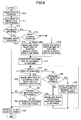
- Next, the control procedure which is performed by the image forming apparatus of the present embodiment will be explained using FIG. 6.
- In the procedure of FIG. 6, the CPU of the image forming apparatus receives the image data from the host computer in the printing buffer of the memory 2 (step S10), and develops the received image data of the printing buffer of the
memory 2 to the printing image data (step S11). - In step S12, the CPU determines whether the user specifies the Z folding direction using the
input device 6. - When the user does not specify the Z-folding direction using the input device 6 (NO of step S12), the CPU controls the image-
processing unit 4 so that the DMA data transfer of the printing image data to the optical writing unit of theoutput device 5 is performed, and controls theoutput device 5 so that the normal sheet selection is performed (step S 13). The CPU controls theoutput device 5 so that the printing is performed with the copy sheet from the selected paper tray (step S 14). - On the other hand, when the user specifies the Z-folding direction using the input device 6 (YES of step S12), the CPU determines whether the specified Z folding direction is the right side folding or the bottom folding (step S 15).
- When the specified Z folding direction is the right side folding ("right" of step S 15), the CPU obtains the size of the image data when the image is rotated in the direction such that the right edge of the image printed on the sheet becomes the front edge in the conveyance direction of the copy sheet (step S16).
- When the specified Z folding direction is the bottom folding ("bottom" of step S15), the CPU obtains the size of the image data when the image is rotated in the direction such that the bottom edge of the image printed on the sheet becomes the front edge in the conveyance direction of the copy sheet (step S 18).
- After step S16 or step S 18 is performed, the CPU checks the paper tray of the copy sheet having the size that is the same as the sheet size obtained (step S 17). After step S 17 is performed, the control is transferred to step
S 19. - In
step S 19, the CPU determines whether there is the paper tray of the copy sheet having the same size. - When there is the paper tray (YES of step S 19), the CPU controls the
image processing unit 4 so that the direction of the image is determined and the image data of the image buffer is actually rotated in the direction determined (step S20). - In the case where step S20 is performed after step S16 or step S 18 is performed, the image data is actually rotated in the direction conforming to the specified Z-folding direction. However, in the case where step S20 is performed after step S24 is performed, the image data is not rotated since the direction of the image remains unchanged.
- In step S21, the CPU determines whether the Z folding is allowed for the copy sheet of the paper tray detected at step S 17.
- When the Z folding is allowed for the copy sheet of the paper tray detected (YES of step S21), the CPU specifies the Z folding to the corresponding page of the copy sheet (step S22). The DMA data transfer of the image data rotated is carried out to the optical writing unit of the
output device 5, and the printing and the Z folding will be carried out with the copy sheet of the selected paper tray (step S 14). - On the other hand, when there is no paper tray (NO of step S 19), the CPU determines whether the sheet feeding is allowed for the sheet size obtained at step S16 or step S 18 (step S23).
- When the sheet feeding is not allowed (NO of step S23), the CPU checks the paper tray of the sheet size which allows the printing of the image which is not rotated (step S24). After step S24 is performed, the control is transferred to step
S 19. - On the other hand, when the sheet feeding is allowed (YES of step S23), the CPU controls the
display device 7 so that the alert indication is displayed on thedisplay device 7 so that the user is requested to exchange the paper tray or supplement the copy sheet (step S25). After the exchange of the paper tray or the supplement of the copy sheet is performed by the user, the control is transferred to stepS 19. - According to the above-described control procedure, the user can easily specify the folding direction with respect to the direction of the image being printed. It is possible to provide the image processing method in which the folding direction can be specified in the easy-to-use manner.
- Moreover, the direction of the image conforming to the Z folding direction is determined, the copy sheet according to the direction determined is selected, and the image is rotated. It is possible to easily carry out the Z folding in the direction as specified by the user.
- Moreover, the image forming apparatus of the present embodiment can carry out the folding and the printing certainly by rotating the image for each page in the direction conforming to the specified folding direction. At this time, when it does not conform to the folding position and the direction of the image, the copy sheet is ejected without being folded. It is possible to prevent the folding inconvenient for the user from being performed.
- Next, the cases where the copy sheets of different paper sizes, such as A4/A3 and A5/A4, are printed will be explained.
- For example, when the printing is performed with the mixed copy sheets of A4/A3 sizes, the copy sheet of A4 size is printed in the LEF mode, and the Z folding and the printing is performed for the copy sheet of A3 size so as to match with the A4 size, so that the output is suitable for the post-processing, the filing, etc. (the staples and the punch). At this time, the user can specify the folding direction with respect to the image direction of the first page, so that the printing of the mixed-loading document can be carried out correctly.
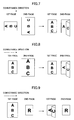
- For example, the case where the A4 size and the portrait mode are specified for the 1 st page, the A3 size and the landscape mode are specified for the 2nd page, and the right side folding is specified is considered (see FIG. 7).
- In this case, it is required that the Z folding is performed only at the front-end portion in the conveyance direction. The image is rotated in the direction such that the right-hand side of the rotated image becomes the front edge in the conveyance direction. Therefore, the copy sheet of A4 size will be used in the LEF mode. In this case, the 1 st page is the A4 portrait mode, and the image in which the copy sheet is set in the LEF mode is created.
- However, the Z-folding
device 9 of the present embodiment is not capable of performing the Z folding of the A4 size copy sheet in the LEF mode, and the printing is performed without folding the copy sheet. - Next, for the 2nd or subsequent page, the image is rotated so that it has the same width and the same direction as those of the 1st page. In this case, the image of the 2nd page in the A3 landscape mode must be created, and the copy sheet is conveyed in the SEF mode. The sheet feeding is allowed for the size of the image created, and the printing and the Z folding are performed.
- Moreover, the case where the A4 size and the portrait mode are specified for the 1st page, the A3 size and the portrait mode are specified for the 2nd page, and the right side folding is specified is considered (see FIG. 8).
- Similar to the above case, in this case, the 1st page is the A4 portrait mode, and the image in which the copy sheet is set in the LEF mode (the copy sheet long edge becomes the front edge in the conveyance direction) is created.
- Next, for the 2nd or subsequent page, the image is rotated counterclockwise by 90 degrees so that it has the same width as that of the 1st-page image. If the Z folding is allowed for the size of the rotated image, the printing and the Z folding are performed. If the Z folding is not allowed, the printing is performed without performing the Z folding.
- In the case of FIG. 8, the direction of the 1st-page image and the direction of the 2nd-page image are not set such that they can be read from the same direction. In such a case, the printing is performed by rotating the 2nd-page image in the direction conforming to the predetermined relation with respect to the 1st page image. Specifically, in this case, the 2nd-page image is rotated counterclockwise by 90 degrees to the direction of the 1st-page image.
- Moreover, the case where the A4 size and the portrait mode are specified for the 1st page, the A5 size and the portrait mode are specified for the 2nd page, and the bottom folding is specified is considered (see FIG. 9).
- Similar to the above case, in this case, the 1st page is the A4 portrait mode and the bottom folding is specified, and the 1st-page image is rotated in the direction such that the bottom edge of the 1st-page image rotated becomes the front edge. Since the Z folding is allowed for the size of the 1st-page image rotated, the printing and the Z folding are performed.
- As for the 2nd or subsequent page, the image is rotated so that it has the same width as that of the 1st-page image, and the copy sheet of A5 size in the LEF mode is selected. Since the Z folding is not allowed for the copy sheet of A5 size in the LEF mode, and the printing is performed without folding the copy sheet of A5 size.
- Therefore, according to the present embodiment, the stacking of the mixed-size copy sheets can be correctly carried out in accordance with the following rules.
- (1) The image of the first page is rotated in the direction conforming to the specified Z folding direction by the image-processing unit, such that the right-side or bottom edge of the image rotated, conforming to the specified Z folding direction, becomes the front edge in the conveyance direction.
- (2) The second or subsequent page image is rotated so that it may have the same width as that of the first-page image.
- (3) The printing and the Z folding are performed when the Z folding is allowed for the size of the image, and when the Z folding is not allowed, the printing is performed without performing the Z folding.
-
- Next, the case where the Z-folding as specified is not allowed for the copy sheet of the 1st page is considered.
- In the Z-folding
device 9 of the present embodiment, if the A3 portrait mode and the right side folding are specified, the specified Z-folding direction is allowed but the sheet feeding is not allowed. Moreover, if the A5 portrait mode and the bottom folding are specified, the Z folding is not allowed for the size of the copy sheet of the first page. Also the Z folding is not allowed for the copy sheets of the same size and different widths. - In such a case, the printing is suspended, and an error message indicating that the specified folding direction is incorrect is displayed on the
display device 7 so that the user is requested to specify the Z folding direction again. - Next, the variation of the control procedure which is performed by the image forming apparatus of the present embodiment will be explained using FIG. 10.
- In the procedure of FIG. 10, the CPU of the image forming apparatus receives the image data of one page from the host computer in the printing buffer of the memory 2 (step S30), and develops the received image data of the printing buffer of the
memory 2 to the printing image data (step S31). - Next, the CPU determines whether the user specifies the Z folding direction using the input device 6 (step S32). When the user does not specify the Z-folding direction using the input device 6 (NO of step S32), the CPU controls the image-
processing unit 4 so that the DMA data transfer of the printing image data to the optical writing unit of theoutput device 5 is performed, and controls theoutput device 5 so that the normal sheet selection is performed (step S33). The CPU controls theoutput device 5 so that the printing is performed with the copy sheet from the selected paper tray (step S34). - On the other hand, when the user specifies the Z-folding direction using the input device 6 (YES of step S32), the CPU determines whether the received image data is the first page (step S35).
- When the received image data is the first page (YES of step S35), the CPU determines whether the specified Z folding direction is the right side folding or the bottom folding (step S36).
- When the specified Z folding direction is the right side folding ("right" of step S36), the CPU obtains the size of the image data when the image is rotated in the direction such that the right edge of the image printed on the sheet becomes the front edge in the conveyance direction of the copy sheet (step S37). The control progresses to step S40.
- When the specified Z folding direction is the bottom folding ("bottom" of step S36), the CPU obtains the size of the image data when the image is rotated in the direction such that the bottom edge of the image printed on the sheet becomes the front edge in the conveyance direction of the copy sheet (step S38). The control progresses to step S40.
- When the received image data is not the first page (NO of step S35), the CPU obtains the image size when the image is rotated such that the rotated image has the width that is the same as the width of the first-page image (step S39). The control progresses to step S40.
- After any of steps S37 to S39 is performed, the CPU checks the paper tray of the copy sheet having the size that is the same as the sheet size obtained (step S40). After step S40 is performed, the control is transferred to step S41.
- In step S41, the CPU determines whether there is the paper tray of the copy sheet having the same size.
- When there is the paper tray (YES of step S41), the CPU controls the
image processing unit 4 so that the direction of the image is determined and the image data of the image buffer is actually rotated in the direction determined (step S42). - In the case where step S42 is performed after step S37 or step S38 is performed, the image data is actually rotated in the direction conforming to the specified Z-folding direction. However, in the case where step S42 is performed after step S46 is performed, the image data is not rotated since the direction of the image remains unchanged.
- In step S43, the CPU determines whether the Z folding is allowed for the copy sheet of the paper tray detected at step S40.
- When the Z folding is allowed for the copy sheet of the paper tray detected (YES of step S43), the CPU specifies the Z folding to the corresponding page of the copy sheet (step S44). The DMA data transfer of the image data rotated is carried out to the optical writing unit of the
output device 5, and the printing and the Z folding will be carried out with the copy sheet of the selected paper tray (step S34). - On the other hand, when there is no paper tray (NO of step S41), the CPU determines whether the sheet feeding is allowed for the sheet size obtained at any of steps S37 to S39 (step S45).
- When the sheet feeding is not allowed (NO of step S45), the CPU checks the paper tray of the sheet size which allows the printing of the image which is not rotated (step S46). After step S46 is performed, the control is transferred to step S41.
- On the other hand, when the sheet feeding is allowed (YES of step S45), the CPU controls the
display device 7 so that the alert indication is displayed on thedisplay device 7 so that the user is requested to exchange the paper tray or supplement the copy sheet (step S47). After the exchange of the paper tray or the supplement of the copy sheet is performed by the user, the control is transferred to step S41. - After step S34 is performed, the CPU determines whether the received image data is the final page (S48). When the received image data is not the final page, the control is transferred to the above S30 and the same procedure is repeated and performed. When it is the final page, the procedure of FIG. 10 is finished.
- According to the above-mentioned control procedure, the user can easily specify the folding direction with respect to the direction of the first-page image being printed. It is possible to provide the image processing method in which the folding direction can be specified in the easy-to-use manner.
- Moreover, it is possible to provide the image processing method in which the output which meets with the sheet size specified by the user can be offered by arranging the width of the copy sheet to choose.
- Moreover, it is possible to provide the image processing method in which the output which meets the final sheet size specified by the user can be offered only by determining whether the Z folding is allowed for the size of the image. At this time, when the sheet feeding is not allowed for the folding direction, the undesired consumption of the copy sheet can be prevented by suspending the printing and the folding.
- It is a matter of course that each function which constitutes the preferred embodiment mentioned above can be programmed respectively, the program can be recorded in the recording medium, such as a ROM, beforehand, the image forming apparatus can be provided with the ROM, and the program that achieves the objective of the invention can be executed.
- In such embodiment, the function of the preferred embodiment which the program itself read from the recording medium mentioned above will be realized, and the recording medium which recorded the program and its program will also constitute the present invention.
- In addition, as a recording medium which stores the program, it is possible to use any of the semiconductor media (for example, ROM, non-volatile memory, etc.), the optical media (for example, DVD, MO, MD, CD, etc.), and the magnetic media, (for example, the magnetic tape, the flexible disk, etc.).
- Or the program stored in the server storage device connected through the network may be made to be supplied directly. In such embodiment, the server storage device is also contained in the recording medium of the present invention.
- Moreover, it is contained when the function of the preferred embodiment mentioned above by the function of the preferred embodiment mentioned above by performing the loaded program is not only realizing, but processing in collaboration with the operating system or other application programs based on the instructions of the program is realized. Thus, the cost effectiveness, the portability, and the versatility can be raised by programming the function of the preferred embodiment and distributing the recording medium.
- The present invention is not limited to the above-described embodiments, and variations and modifications may be made without departing from the scope of the present invention.
Claims (10)
- An image forming apparatus comprising:characterized in further comprising a control unit (1) controlling the image-processing unit and the Z-folding device so that the image data is rotated in a direction conforming to a Z-folding direction specified by a user, and the Z folding of the copy sheet is controlled with the rotated image data.an image-processing unit (4) performing a predetermined image processing of an input image data;an output unit (5) printing an image on a copy sheet based on the image data after the image processing; anda Z-folding device (9) connected to the output unit and performing a Z folding of the copy sheet;
- The image forming apparatus according to claim 1 wherein the control unit (1) selects a paper tray containing copy sheets of a size that matches with a size of the image data rotated in the direction conforming to the specified Z-folding direction.
- The image forming apparatus according to claim 1 wherein the control unit (1) is provided so that, when passing of the copy sheet through the output unit is not allowed for a size of the image data rotated in the direction conforming to the specified Z-folding direction, the rotation of the image data is canceled and the image is printed on the copy sheet without performing the Z folding.
- The image forming apparatus according to claim 1 wherein the Z-folding direction specified by the user is applied to each of a plurality of images.
- The image forming apparatus according to claim 1 wherein the control unit (1) is provided so that, when the printing of a plurality of images of different sizes is performed continuously, the image data is rotated in a direction conforming to a Z-folding direction specified by the user for a first-page image of the plurality of images.
- The image forming apparatus according to claim 5 wherein the control unit (1) is provided so that image data of a second or subsequent image of the plurality of images is rotated such that the rotated image data has a width which is equal to a width of the first-page image.
- The image forming apparatus according to claim 6 wherein the control unit (1) is provided so that the printing and the Z folding are performed when the Z folding is allowed for a size of the rotated image data, and the printing is performed without performing the Z folding when the Z folding is not allowed.
- The image forming apparatus according to claim 5 wherein the control unit (1) is provided so that, when there is no paper tray containing copy sheets of a size that matches with a size of the image data rotated in the direction conforming to the specified Z-folding direction, the printing is suspended and an error message indicating that the folding direction specified is incorrect is displayed.
- An image processing method for use in an image forming apparatus including an image-processing unit (4), an output unit (5), and a Z-folding device (9) connected to the output unit, the image processing method comprising the steps of:performing a predetermined image processing of an input image data;performing a Z folding of the copy sheet; andcontrolling the image-processing unit and the Z-folding device so that the image data is rotated in a direction conforming to a Z-folding direction specified by a user, and the Z folding of the copy sheet is controlled with the rotated image data.
- A computer-readable recording medium embodied therein for causing a computer to execute an image processing method in an image forming apparatus including an image-processing unit (4), an output unit (5), and a Z-folding device (9) connected to the output unit, the image processing method comprising:performing a predetermined image processing of an input image data;performing a Z folding of the copy sheet; andcontrolling the image-processing unit and the Z-folding device so that the image data is rotated in a direction conforming to a Z-folding direction specified by a user, and the Z folding of the copy sheet is controlled with the rotated image data.
Applications Claiming Priority (2)
| Application Number | Priority Date | Filing Date | Title |
|---|---|---|---|
| JP2004077918 | 2004-03-18 | ||
| JP2004077918A JP2005269174A (en) | 2004-03-18 | 2004-03-18 | Image forming apparatus, image processing method, program, and recording medium |
Publications (3)
| Publication Number | Publication Date |
|---|---|
| EP1577099A2 true EP1577099A2 (en) | 2005-09-21 |
| EP1577099A3 EP1577099A3 (en) | 2005-11-16 |
| EP1577099B1 EP1577099B1 (en) | 2009-12-16 |
Family
ID=34836570
Family Applications (1)
| Application Number | Title | Priority Date | Filing Date |
|---|---|---|---|
| EP05005864A Expired - Lifetime EP1577099B1 (en) | 2004-03-18 | 2005-03-17 | Image forming apparatus, image processing method, program and recording medium |
Country Status (4)
| Country | Link |
|---|---|
| US (1) | US7386269B2 (en) |
| EP (1) | EP1577099B1 (en) |
| JP (1) | JP2005269174A (en) |
| DE (1) | DE602005018282D1 (en) |
Cited By (2)
| Publication number | Priority date | Publication date | Assignee | Title |
|---|---|---|---|---|
| EP2139698A4 (en) * | 2007-03-25 | 2012-04-04 | Avery Dennison Corp | METHOD FOR VISUALIZING AND PRINTING DOUBLE-SIDED ELEMENTS |
| EP2455816A3 (en) * | 2010-11-17 | 2014-08-27 | Ricoh Company, Ltd. | Information processing apparatus, computer program product, and information processing method |
Families Citing this family (16)
| Publication number | Priority date | Publication date | Assignee | Title |
|---|---|---|---|---|
| JP4303139B2 (en) * | 2004-02-03 | 2009-07-29 | 株式会社リコー | Image forming apparatus and Z-fold method |
| JP2005269174A (en) * | 2004-03-18 | 2005-09-29 | Ricoh Co Ltd | Image forming apparatus, image processing method, program, and recording medium |
| JP4229102B2 (en) * | 2005-08-18 | 2009-02-25 | コニカミノルタビジネステクノロジーズ株式会社 | Recording system and recording method |
| JP2007091465A (en) * | 2005-09-01 | 2007-04-12 | Konica Minolta Business Technologies Inc | Image forming system, image forming device, and program |
| JP4816311B2 (en) * | 2005-10-26 | 2011-11-16 | セイコーエプソン株式会社 | Print support system, print support program and storage medium, and print support method |
| JP4953831B2 (en) | 2007-01-15 | 2012-06-13 | キヤノン株式会社 | Printing system and control method thereof |
| JP4433033B2 (en) * | 2007-10-22 | 2010-03-17 | コニカミノルタビジネステクノロジーズ株式会社 | Image forming apparatus |
| JP5359076B2 (en) * | 2008-07-11 | 2013-12-04 | 株式会社リコー | Image forming apparatus, program, and recording medium |
| US8705087B2 (en) * | 2009-01-29 | 2014-04-22 | Kyocera Document Solutions Inc. | Image forming apparatus and image forming method for rotating image data |
| JP5377027B2 (en) * | 2009-03-30 | 2013-12-25 | キヤノン株式会社 | Print control apparatus, print control method, and program |
| JP5717456B2 (en) * | 2011-01-31 | 2015-05-13 | 理想科学工業株式会社 | Image processing apparatus and program |
| JP2012254608A (en) * | 2011-06-10 | 2012-12-27 | Mimaki Engineering Co Ltd | Medium processing device |
| JP6010994B2 (en) * | 2012-04-16 | 2016-10-19 | コニカミノルタ株式会社 | Image forming apparatus, image forming apparatus control method, and image forming apparatus control program |
| EP3002131B1 (en) * | 2014-10-01 | 2018-01-31 | OCE-Technologies B.V. | Folding method and folding device and document processing system |
| JP6574633B2 (en) * | 2015-07-31 | 2019-09-11 | キヤノン株式会社 | Printing system, control method therefor, program, printing apparatus, and paper discharge apparatus |
| JP2025156849A (en) * | 2024-04-02 | 2025-10-15 | 東芝テック株式会社 | Image forming device |
Citations (3)
| Publication number | Priority date | Publication date | Assignee | Title |
|---|---|---|---|---|
| JP2000092307A (en) | 1998-09-11 | 2000-03-31 | Ricoh Co Ltd | Image processing device |
| JP2000141793A (en) | 1998-11-05 | 2000-05-23 | Minolta Co Ltd | Print card production system and roll |
| JP2003020163A (en) | 2001-07-11 | 2003-01-21 | Toshiba Corp | Paper folding mechanism and paper folding method |
Family Cites Families (16)
| Publication number | Priority date | Publication date | Assignee | Title |
|---|---|---|---|---|
| US4917366A (en) * | 1986-02-25 | 1990-04-17 | Canon Kabushiki Kaisha | Sheet handling apparatus |
| JP3294598B2 (en) * | 1990-11-30 | 2002-06-24 | 株式会社リコー | Image forming device |
| JPH05119556A (en) | 1991-10-29 | 1993-05-18 | Ricoh Co Ltd | Image forming device |
| EP0608685B1 (en) * | 1993-01-28 | 1998-07-08 | Eastman Kodak Company | Production of signatures wherein original image information is manipulated to fit on receiver sheets |
| JP3414108B2 (en) * | 1996-02-22 | 2003-06-09 | ミノルタ株式会社 | Image forming device |
| JPH10194565A (en) * | 1997-01-16 | 1998-07-28 | Minolta Co Ltd | Finisher |
| US6947167B1 (en) * | 1997-07-23 | 2005-09-20 | Canon Kabushiki Kaisha | Image formation apparatus which forms images of four page on both faces of sheet in such a manner as images of two pages are formed on each face |
| JP2001211309A (en) * | 2000-01-26 | 2001-08-03 | Ricoh Co Ltd | Facsimile machine |
| JP4235369B2 (en) | 2000-06-23 | 2009-03-11 | キヤノン株式会社 | Information processing apparatus, method, program, and storage medium |
| JP4535597B2 (en) * | 2000-10-24 | 2010-09-01 | トッパン・フォームズ株式会社 | Booklet production processing method and booklet produced thereby |
| JP3850220B2 (en) | 2000-11-30 | 2006-11-29 | 株式会社リコー | Image forming method, recording medium, and image forming apparatus |
| JP2003060823A (en) * | 2001-06-06 | 2003-02-28 | Canon Inc | Image forming apparatus, image forming method, medium for providing control program, and control program |
| JP2003101748A (en) * | 2001-09-20 | 2003-04-04 | Ricoh Co Ltd | Image forming device |
| JP4378103B2 (en) | 2002-06-06 | 2009-12-02 | キヤノン株式会社 | PRINT CONTROL DEVICE, PRINT CONTROL METHOD, PROGRAM, AND STORAGE MEDIUM |
| JP4303139B2 (en) * | 2004-02-03 | 2009-07-29 | 株式会社リコー | Image forming apparatus and Z-fold method |
| JP2005269174A (en) * | 2004-03-18 | 2005-09-29 | Ricoh Co Ltd | Image forming apparatus, image processing method, program, and recording medium |
-
2004
- 2004-03-18 JP JP2004077918A patent/JP2005269174A/en active Pending
-
2005
- 2005-03-16 US US11/081,985 patent/US7386269B2/en not_active Expired - Lifetime
- 2005-03-17 EP EP05005864A patent/EP1577099B1/en not_active Expired - Lifetime
- 2005-03-17 DE DE602005018282T patent/DE602005018282D1/en not_active Expired - Lifetime
Patent Citations (3)
| Publication number | Priority date | Publication date | Assignee | Title |
|---|---|---|---|---|
| JP2000092307A (en) | 1998-09-11 | 2000-03-31 | Ricoh Co Ltd | Image processing device |
| JP2000141793A (en) | 1998-11-05 | 2000-05-23 | Minolta Co Ltd | Print card production system and roll |
| JP2003020163A (en) | 2001-07-11 | 2003-01-21 | Toshiba Corp | Paper folding mechanism and paper folding method |
Cited By (3)
| Publication number | Priority date | Publication date | Assignee | Title |
|---|---|---|---|---|
| EP2139698A4 (en) * | 2007-03-25 | 2012-04-04 | Avery Dennison Corp | METHOD FOR VISUALIZING AND PRINTING DOUBLE-SIDED ELEMENTS |
| US9875070B2 (en) | 2007-03-25 | 2018-01-23 | Ccl Label, Inc. | Method for viewing and printing double-sided items |
| EP2455816A3 (en) * | 2010-11-17 | 2014-08-27 | Ricoh Company, Ltd. | Information processing apparatus, computer program product, and information processing method |
Also Published As
| Publication number | Publication date |
|---|---|
| DE602005018282D1 (en) | 2010-01-28 |
| EP1577099A3 (en) | 2005-11-16 |
| US7386269B2 (en) | 2008-06-10 |
| JP2005269174A (en) | 2005-09-29 |
| EP1577099B1 (en) | 2009-12-16 |
| US20050207812A1 (en) | 2005-09-22 |
Similar Documents
| Publication | Publication Date | Title |
|---|---|---|
| EP1577099B1 (en) | Image forming apparatus, image processing method, program and recording medium | |
| US6567621B2 (en) | Tandem printers system | |
| JP4777475B2 (en) | Information processing apparatus, control method, and storage medium storing computer-readable program | |
| JP2000025277A (en) | Printing control method and apparatus | |
| JP2002333795A (en) | Image forming apparatus and method of controlling image forming apparatus | |
| JP7826001B2 (en) | Information processing device, program, and method for controlling information processing device | |
| JP6288005B2 (en) | Image forming apparatus, image forming management apparatus, and image forming method | |
| JP2003008875A (en) | Image forming apparatus, image forming system, image forming method, storage medium, and control program | |
| US7756437B2 (en) | Image forming system and display control method therefor | |
| US9008569B2 (en) | Image forming system having function to permit staple processing for job including small size sheet based on page position of small size sheet in a job, and image forming method for the same | |
| JP2003320740A (en) | Image processor | |
| US20090317122A1 (en) | Image forming apparatus and control method thereof | |
| US8237979B2 (en) | System and method of utilizing tab attributes as job ticket attributes for printing | |
| JP2008269324A (en) | Printer driver | |
| CN100445100C (en) | Printing apparatus, information processing apparatus, and control method therefor | |
| JP4733528B2 (en) | Image forming apparatus, image forming system, and control program | |
| US20070017397A1 (en) | Image printing system, image printing method, and image printing program | |
| CN101162373B (en) | Image forming apparatus device and image setting method | |
| JP4816062B2 (en) | Image forming apparatus | |
| JP2006263970A (en) | Image editing device, and image forming device equipped with image editing device | |
| JP2020118938A (en) | Image forming apparatus | |
| JP2025027274A (en) | Image forming apparatus and image processing method | |
| JP4446351B2 (en) | Image forming apparatus | |
| JP2002284379A (en) | Image forming device | |
| JP3581704B2 (en) | Print control apparatus and method |
Legal Events
| Date | Code | Title | Description |
|---|---|---|---|
| PUAI | Public reference made under article 153(3) epc to a published international application that has entered the european phase |
Free format text: ORIGINAL CODE: 0009012 |
|
| 17P | Request for examination filed |
Effective date: 20050317 |
|
| AK | Designated contracting states |
Kind code of ref document: A2 Designated state(s): AT BE BG CH CY CZ DE DK EE ES FI FR GB GR HU IE IS IT LI LT LU MC NL PL PT RO SE SI SK TR |
|
| AX | Request for extension of the european patent |
Extension state: AL BA HR LV MK YU |
|
| PUAL | Search report despatched |
Free format text: ORIGINAL CODE: 0009013 |
|
| AK | Designated contracting states |
Kind code of ref document: A3 Designated state(s): AT BE BG CH CY CZ DE DK EE ES FI FR GB GR HU IE IS IT LI LT LU MC NL PL PT RO SE SI SK TR |
|
| AX | Request for extension of the european patent |
Extension state: AL BA HR LV MK YU |
|
| RIC1 | Information provided on ipc code assigned before grant |
Ipc: 7H 04N 1/387 B Ipc: 7B 41J 13/00 B Ipc: 7B 65H 45/00 B Ipc: 7B 41J 11/00 B Ipc: 7B 41J 3/37 A |
|
| AKX | Designation fees paid |
Designated state(s): DE ES FR GB IT NL |
|
| 17Q | First examination report despatched |
Effective date: 20071102 |
|
| GRAP | Despatch of communication of intention to grant a patent |
Free format text: ORIGINAL CODE: EPIDOSNIGR1 |
|
| GRAS | Grant fee paid |
Free format text: ORIGINAL CODE: EPIDOSNIGR3 |
|
| GRAA | (expected) grant |
Free format text: ORIGINAL CODE: 0009210 |
|
| AK | Designated contracting states |
Kind code of ref document: B1 Designated state(s): DE ES FR GB IT NL |
|
| REG | Reference to a national code |
Ref country code: GB Ref legal event code: FG4D |
|
| REF | Corresponds to: |
Ref document number: 602005018282 Country of ref document: DE Date of ref document: 20100128 Kind code of ref document: P |
|
| REG | Reference to a national code |
Ref country code: NL Ref legal event code: VDEP Effective date: 20091216 |
|
| PG25 | Lapsed in a contracting state [announced via postgrant information from national office to epo] |
Ref country code: ES Free format text: LAPSE BECAUSE OF FAILURE TO SUBMIT A TRANSLATION OF THE DESCRIPTION OR TO PAY THE FEE WITHIN THE PRESCRIBED TIME-LIMIT Effective date: 20100327 Ref country code: NL Free format text: LAPSE BECAUSE OF FAILURE TO SUBMIT A TRANSLATION OF THE DESCRIPTION OR TO PAY THE FEE WITHIN THE PRESCRIBED TIME-LIMIT Effective date: 20091216 |
|
| PLBE | No opposition filed within time limit |
Free format text: ORIGINAL CODE: 0009261 |
|
| STAA | Information on the status of an ep patent application or granted ep patent |
Free format text: STATUS: NO OPPOSITION FILED WITHIN TIME LIMIT |
|
| 26N | No opposition filed |
Effective date: 20100917 |
|
| PG25 | Lapsed in a contracting state [announced via postgrant information from national office to epo] |
Ref country code: IT Free format text: LAPSE BECAUSE OF FAILURE TO SUBMIT A TRANSLATION OF THE DESCRIPTION OR TO PAY THE FEE WITHIN THE PRESCRIBED TIME-LIMIT Effective date: 20091216 |
|
| REG | Reference to a national code |
Ref country code: FR Ref legal event code: PLFP Year of fee payment: 12 |
|
| REG | Reference to a national code |
Ref country code: FR Ref legal event code: PLFP Year of fee payment: 13 |
|
| REG | Reference to a national code |
Ref country code: FR Ref legal event code: PLFP Year of fee payment: 14 |
|
| P01 | Opt-out of the competence of the unified patent court (upc) registered |
Effective date: 20230522 |
|
| PGFP | Annual fee paid to national office [announced via postgrant information from national office to epo] |
Ref country code: DE Payment date: 20240320 Year of fee payment: 20 Ref country code: GB Payment date: 20240320 Year of fee payment: 20 |
|
| PGFP | Annual fee paid to national office [announced via postgrant information from national office to epo] |
Ref country code: FR Payment date: 20240321 Year of fee payment: 20 |
|
| REG | Reference to a national code |
Ref country code: DE Ref legal event code: R071 Ref document number: 602005018282 Country of ref document: DE |
|
| REG | Reference to a national code |
Ref country code: GB Ref legal event code: PE20 Expiry date: 20250316 |
|
| PG25 | Lapsed in a contracting state [announced via postgrant information from national office to epo] |
Ref country code: GB Free format text: LAPSE BECAUSE OF EXPIRATION OF PROTECTION Effective date: 20250316 |