EP1574968A1 - Information processing device, information processing method, and information processing program - Google Patents
Information processing device, information processing method, and information processing program Download PDFInfo
- Publication number
- EP1574968A1 EP1574968A1 EP03778809A EP03778809A EP1574968A1 EP 1574968 A1 EP1574968 A1 EP 1574968A1 EP 03778809 A EP03778809 A EP 03778809A EP 03778809 A EP03778809 A EP 03778809A EP 1574968 A1 EP1574968 A1 EP 1574968A1
- Authority
- EP
- European Patent Office
- Prior art keywords
- thesaurus
- correlation
- coefficient
- unit
- sorting
- Prior art date
- Legal status (The legal status is an assumption and is not a legal conclusion. Google has not performed a legal analysis and makes no representation as to the accuracy of the status listed.)
- Withdrawn
Links
Images



Classifications
-
- G—PHYSICS
- G06—COMPUTING OR CALCULATING; COUNTING
- G06F—ELECTRIC DIGITAL DATA PROCESSING
- G06F16/00—Information retrieval; Database structures therefor; File system structures therefor
- G06F16/30—Information retrieval; Database structures therefor; File system structures therefor of unstructured textual data
- G06F16/36—Creation of semantic tools, e.g. ontology or thesauri
- G06F16/374—Thesaurus
-
- G—PHYSICS
- G06—COMPUTING OR CALCULATING; COUNTING
- G06F—ELECTRIC DIGITAL DATA PROCESSING
- G06F40/00—Handling natural language data
- G06F40/20—Natural language analysis
- G06F40/237—Lexical tools
- G06F40/247—Thesauruses; Synonyms
Definitions
- This invention relates to an information-processing apparatus, information-processing method and information-processing program, and more particularly to an information-processing apparatus, information-processing method and information-processing program that creates thesauruses based on text data and finds the correlation between thesauruses.
- the present invention takes into consideration the condition described above and makes it possible to detect the characteristics of the text data based on the correlation between keywords extracted from the text data.
- the information-processing apparatus of claim 1 comprises: an input unit that inputs text data; a text-data-memory unit that stores text data; a word-cutting unit that executes a word-cutting process on text data; a syntax-analysis unit that performs a syntax-analysis process on the text data on which the word-cutting process was performed; a thesaurus-creation unit that creates thesauruses from the text data on which the syntax-analysis process was performed; a thesaurus-memory unit that stores the thesauruses created by the thesaurus-creation unit; a thesaurus-sorting unit that performs a sorting process on the text data on which word-cutting and syntax-analysis were performed; a sorting-results-memory unit that stores the sorting results from the thesaurus-sorting unit; a frequency-of appearance-calculation unit that calculates the frequency of appearance for each thesaurus based on the sorting results stored by the sorting-results-
- the information-processing method of claim 2 comprises: an input step of inputting text data; a text-data-memory step of storing text data; a word-cutting step of executing a word-cutting process on text data; a syntax-analysis step of performing a syntax-analysis process on the text data on which the word-cutting process was performed; a thesaurus-creation step of creating thesauruses from the text data on which the syntax-analysis process was performed; a thesaurus-memory step of storing the thesauruses created in the thesaurus-creation step; a word-cutting and syntax-analysis step of performing the word-cutting process and syntax-analysis process again based on the thesauruses stored in the thesaurus-memory step; a thesaurus-sorting step of performing a sorting process on the text data on which word-cutting and syntax-analysis were performed; a sorting-results-memory step of storing the sorting results from the thesau
- the information-processing program of claim 3 is executed on a computer to perform: an input step of inputting text data; a text-data-memory step of storing text data; a word-cutting step of executing a word-cutting process on text data; a syntax-analysis step of performing a syntax-analysis process on the text data on which the word-cutting process was performed; a thesaurus-creation step of creating thesauruses from the text data on which the syntax-analysis process was performed; a thesaurus-memory step of storing the thesauruses created in the thesaurus-creation step; a word-cutting and syntax-analysis step of performing the word-cutting process and syntax-analysis process again based on the thesauruses stored in the thesaurus-memory step; a thesaurus-sorting step of performing a sorting process on the text data on which word-cutting and syntax-analysis were performed; a sorting-results-memory step of storing the
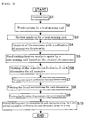
- Fig. 1 is a block diagram showing the function of an embodiment of the information-processing apparatus of the invention.
- This embodiment comprises a personal computer or the like. As shown in the same figure, the embodiment is functionally constructed of the following blocks. The processing of each block is actually executed by a specified application program, and each memory unit is made possible by a hard disc that is not shown in the figure.
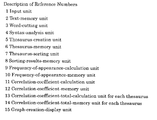
- the input unit 1 is used to input text data that is then stored in the text-memory 2.
- the word-cutting unit 3 executes a word-cutting process on the text data stored in the text-memory unit 2.
- the syntax-analysis unit 4 performs syntax analysis on the text data for which the word cutting process was performed.
- the thesaurus-creation unit 5 creates a thesaurus from the text data stored in the text-memory unit 2.
- the thesaurus-memory unit 6 stores the created thesaurus.
- the thesaurus-sorting unit 7 performs the sorting process on all samples for each thesaurus.
- the sorting-results-memory unit 8 stores the sorting results.
- the frequency-of appearance-calculation unit 9 calculates the frequency of appearance in each thesaurus based on the data stored in the sorting-results-memory unit 8.
- the frequency-of-appearance-memory unit 10 stores the result calculated by the frequency-of-appearance-calculation unit 9.
- the correlation-coefficient-calculation unit 11 calculates the correlation coefficient between thesauruses.
- the correlation-coefficient-memory unit 12 stores the correlation coefficient calculated by the correlation-coefficient-calculation unit 11.
- the correlation-coefficient-total-calculation unit 13 for each thesaurus totals the found correlation coefficients for each thesaurus.
- the correlation-coefficient-total-memory unit 14 for each thesaurus stores the correlation-coefficient total for each thesaurus that was calculated by the correlation-coefficient-total-calculation unit 13 for each thesaurus.
- the graph-creation-display unit 15 creates and displays a graph based on the frequency of appearance stored in the frequency-of-appearance-memory unit 10 and the correlation-coefficient totals for each thesaurus that are stored in the correlation-coefficient-total-memory unit 14 for each thesaurus.
- step S1 text data from each customer is input from the input unit 1. For example, suppose that the complaint from one customer, 'Last week, I ordered a part, but it has not been delivered yet.' is input.
- the input text data is stored in the text-memory unit 2.
- step S2 the word-cutting unit 3 performs a word-cutting process using a specified text-mining tool (application software). For example, the text above becomes 'Last week I ordered a part, but it has not been delivered yet .'
- step S3 the syntax-analysis unit 4 performs a syntax-analysis process using a text-mining tool. For example, the text above becomes ' Last week I ordered a part but, it has not been delivered yet .'
- the thesaurus-creation unit 5 creates a thesaurus with a collection of synonyms (keywords). For example, as shown in Fig. 3, synonyms or keywords such as 'one week ' are collected in the 'last week' thesaurus. Also, keywords such as 'ordered, but' are collected in the 'order' thesaurus. Also, keywords such as 'deliver' are collected in the 'deliver' thesaurus. Also, keywords such as 'parts' are collected in the 'parts' thesaurus. Also, keywords such as 'information' are collected in the 'contact' thesaurus. The created thesauruses are stored in the thesaurus-memory unit 6.
- step S5 the word-cutting unit 3 performs the word-cutting process again based on the thesauruses created now and stored in the thesaurus-memory unit 6, and the syntax-analysis unit 4 performs the syntax-analysis process again.
- step S6 the thesaurus-sorting unit 7 performs sorting of the contents of the text data from all customers for each thesaurus. For example, '1' is set for all of the thesauruses that are contained in text data such as a complaint from a user, for each user, and sets '0' for the thesauruses that are not contained.
- the sorting results are stored in the sorting-results-memory unit 8.
- Fig. 4 shows the sorting results that are stored in the sorting-results-memory unit 8.
- 'K-1', 'K-2', 'K-3', ... 'K-n' indicate ID numbers that identify the customer.
- text data containing keywords contained in the 'order' and 'parts' thesauruses was input by customer K-1.
- step S7 the correlation-coefficient-calculation unit 11 finds correlation coefficients between thesauruses.
- the correlation coefficient for 'order' and 'deliver' is expressed by the following equation.
- Correlation coefficient r order - delivery (S order - delivery )/(S order ⁇ S delivery ) Where S order - delivery is the covariance, and S order and S delivery are each standard deviations.
- Standard deviation S order ((order 1 - order) 2 + (order 2 - order) 2 + ... + (order n - order) 2 )/(n - 1)
- Standard deviation S delivery ((delivery 1 - delivery) 2 + (delivery 2 - delivery) 2 + ... + (delivery n - delivery) 2 )/(n - 1)
- Fig. 5 shows the correlation coefficients between the thesauruses.
- the correlation coefficient between the thesaurus 'last week' and the thesaurus 'order' is 0.025.
- the correlation coefficient between identical thesauruses is 1.
- step S8 the correlation-coefficient-total-calculation unit 13 for each thesaurus totals the correlation coefficients stored in the correlation-coefficient-memory unit 12 for each thesaurus.
- the total is 1 + 0.025 + 0.038 + 0.001 + ...
- the correlation coefficient 1 between identical thesauruses is omitted.
- the correlation-coefficient totals are found for the other thesauruses such as 'order', 'deliver', 'parts', etc.
- the correlation-coefficient totals that were found for each of the thesauruses are stored in the correlation-coefficient-total-memory unit 14 for each thesaurus.
- step S9 the frequency-of-appearance-calculation unit 9 finds the frequency of appearance for each thesaurus. That is, as shown in Fig. 6, the frequency of appearance for each thesaurus is found based on the sorting results (Fig. 4) for each thesaurus. In the example of Fig. 6, for example, for the thesaurus 'last week', it is seen that that thesaurus 'last week' is contained in the text data of the complaints from customers K-2, K-3, ... K-n. By totaling the values for each customer for the thesaurus 'last week', the number of appearances A is calculated.
- the number of appearances for thesaurus 'order' is B
- the number of appearances for thesaurus 'deliver' is C
- the number of appearances for thesaurus 'parts' is D.
- the total number of appearances for all of the thesauruses ⁇ (A + B + C + D + ...) is found, and the frequency of appearance for each thesaurus is expressed as a percentage.
- the frequency of appearance of the thesaurus 'last week' is (A/ ⁇ (A + B + C + D + ...)) * 100(%).
- the calculated frequencies of appearance for each of thesauruses are stored in the frequency-of appearance-memory unit 10.
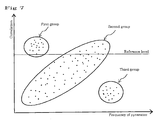
- step S10 the graph-creation-display unit 15 plots the frequency of appearance (%) for each thesaurus along the x-axis, and the correlation coefficient totals for each thesaurus along the y-axis, to create a graph.
- Fig. 7 shows the created graph.
- significance is not found based on the size of the value of the correlation coefficient, but a fixed level is set as a reference, and it is determined that there is a strong connection when the correlation exceeds that reference level, and it is determined that the connection is weak when the correlation is below that level.
- the information-processing apparatus, information-processing method and information-processing program of this invention are such that: an input step inputs text data; a text-data-memory step stores text data; a word-cutting step executes a word-cutting process on text data; a syntax-analysis step performs a syntax-analysis process on the text data on which the word-cutting process was performed; a thesaurus-creation step creates thesauruses from the text data on which the syntax-analysis process was performed; a thesaurus-memory step stores the thesauruses created in the thesaurus-creation step; a word-cutting and syntax-analysis step performs the word-cutting process and syntax-analysis process again based on the thesauruses stored in the thesaurus-memory step; a thesaurus-sorting step performs a sorting process on the text data on which word-cutting and syntax-analysis were performed; a sorting-results-memory step stores the sort
Landscapes
- Engineering & Computer Science (AREA)
- Theoretical Computer Science (AREA)
- General Physics & Mathematics (AREA)
- Computational Linguistics (AREA)
- Physics & Mathematics (AREA)
- General Engineering & Computer Science (AREA)
- Databases & Information Systems (AREA)
- Data Mining & Analysis (AREA)
- Health & Medical Sciences (AREA)
- Artificial Intelligence (AREA)
- Audiology, Speech & Language Pathology (AREA)
- General Health & Medical Sciences (AREA)
- Information Retrieval, Db Structures And Fs Structures Therefor (AREA)
- Machine Translation (AREA)
Abstract
The invention makes it possible to detect the characteristics of text
data, and to analogize potential hidden meaning in the text data.
A word-cutting unit 3 performs a word-cutting process on the text data
input from the input unit 1, a syntax-analysis unit 4 performs syntax
analysis and a thesaurus-creation unit 5 creates thesauruses from the
results, then after performing word cutting and syntax analysis again, a
thesaurus-sorting unit 7 performs sorting, and a frequency-of-appearance
unit calculates the frequency of appearance of the thesauruses, a
correlation-coefficient-calculation unit 11 calculates correlation coefficients
between thesauruses, a correlation-coefficient-total-calculation unit 13 for
each thesaurus calculates the total of the correlation coefficients for each
thesaurus, the graph-creation-display unit 15 creates a graph based on the
frequency of appearance and total of the correlation coefficients for each
thesaurus.
Description
This invention relates to an information-processing apparatus,
information-processing method and information-processing program, and
more particularly to an information-processing apparatus, information-processing
method and information-processing program that creates
thesauruses based on text data and finds the correlation between
thesauruses.
There is a method in which the results of the total number of times
words appear is referenced, and words whose frequency of appearance
exceed a set value are extracted from among the cut out words, then the
correlation between the extracted words is evaluated and a cluster of co-occurring
words, whose correlation is greater than a set value, is created.
When doing this, by creating a category dictionary that corresponds to the
text that is the object of analysis, it is possible to display the analysis results
of that text. (For example, refer to Japanese patent Publication No. 2001-101194
(Fig. 1).)
However, there was a problem in that it was not possible to detect the
characteristics of the text data based on the correlation between keywords
extracted from the text data.
The present invention takes into consideration the condition described
above and makes it possible to detect the characteristics of the text data
based on the correlation between keywords extracted from the text data.
The information-processing apparatus of claim 1 comprises: an input
unit that inputs text data; a text-data-memory unit that stores text data; a
word-cutting unit that executes a word-cutting process on text data; a
syntax-analysis unit that performs a syntax-analysis process on the text
data on which the word-cutting process was performed; a thesaurus-creation
unit that creates thesauruses from the text data on which the syntax-analysis
process was performed; a thesaurus-memory unit that stores the
thesauruses created by the thesaurus-creation unit; a thesaurus-sorting unit
that performs a sorting process on the text data on which word-cutting and
syntax-analysis were performed; a sorting-results-memory unit that stores
the sorting results from the thesaurus-sorting unit; a frequency-of
appearance-calculation unit that calculates the frequency of appearance for
each thesaurus based on the sorting results stored by the sorting-results-memory
unit; a frequency-of appearance-memory unit that stores the results
calculated by the frequency-of appearance-calculation unit; a correlation-coefficient-calculation
unit that calculates correlation coefficients between
thesauruses; a correlation-coefficient-memory unit that stores the
correlation coefficients between thesauruses that were calculated by the
correlation-coefficient-calculation unit; a correlation-coefficient-total-calculation
unit for each thesaurus that calculates the total of the correlation
coefficients for each thesaurus; a correlation-coefficient-total-memory unit
for each thesaurus that stores the total of the correlation coefficients for each
thesaurus calculated by the correlation-coefficient-total-calculation unit for
each thesaurus; and a graph-creation-display unit that creates and displays
a graph based on the frequency of appearance stored by the frequency-of-appearance-memory
unit and the correlation-coefficient totals for each
thesaurus stored by the correlation-coefficient-total-memory unit for each
thesaurus; and wherein the word-cutting unit and syntax-analysis unit
perform the word-cutting process and syntax-analysis process again based
on the thesauruses created by the thesaurus-creation unit.
The information-processing method of claim 2 comprises: an input step
of inputting text data; a text-data-memory step of storing text data; a word-cutting
step of executing a word-cutting process on text data; a syntax-analysis
step of performing a syntax-analysis process on the text data on
which the word-cutting process was performed; a thesaurus-creation step of
creating thesauruses from the text data on which the syntax-analysis
process was performed; a thesaurus-memory step of storing the thesauruses
created in the thesaurus-creation step; a word-cutting and syntax-analysis
step of performing the word-cutting process and syntax-analysis process
again based on the thesauruses stored in the thesaurus-memory step; a
thesaurus-sorting step of performing a sorting process on the text data on
which word-cutting and syntax-analysis were performed; a sorting-results-memory
step of storing the sorting results from the thesaurus-sorting step; a
frequency-of-appearance-calculation step of calculating the frequency of
appearance for each thesaurus based on the sorting results stored in the
sorting-results-memory step; a frequency-of-appearance-memory step of
storing the results calculated in the frequency-of appearance-calculation
step; a correlation-coefficient-calculation step of calculating correlation
coefficients between thesauruses; a correlation-coefficient-memory step of
storing the correlation coefficients between thesauruses that were calculated
in the correlation-coefficient-calculation step; a correlation-coefficient-total-calculation
step for each thesaurus of calculating the total of the correlation
coefficients for each thesaurus; a correlation-coefficient-total-memory step
for each thesaurus of storing the total of the correlation coefficients for each
thesaurus calculated in the correlation-coefficient-total-calculation step for
each thesaurus; and a graph-creation-display step of creating and displaying
a graph based on the frequency of appearance stored in the frequency-of
appearance-memory step and the correlation-coefficient totals for each
thesaurus stored in the correlation-coefficient-total-memory step for each
thesaurus.
The information-processing program of claim 3 is executed on a
computer to perform: an input step of inputting text data; a text-data-memory
step of storing text data; a word-cutting step of executing a word-cutting
process on text data; a syntax-analysis step of performing a syntax-analysis
process on the text data on which the word-cutting process was
performed; a thesaurus-creation step of creating thesauruses from the text
data on which the syntax-analysis process was performed; a thesaurus-memory
step of storing the thesauruses created in the thesaurus-creation
step; a word-cutting and syntax-analysis step of performing the word-cutting
process and syntax-analysis process again based on the thesauruses stored
in the thesaurus-memory step; a thesaurus-sorting step of performing a
sorting process on the text data on which word-cutting and syntax-analysis
were performed; a sorting-results-memory step of storing the sorting results
from the thesaurus-sorting step; a frequency-of-appearance-calculation step
of calculating the frequency of appearance for each thesaurus based on the
sorting results stored in the sorting-results-memory step; a frequency-of-appearance-memory
step of storing the results calculated in the frequency-of
appearance-calculation step; a correlation-coefficient-calculation step of
calculating correlation coefficients between thesauruses; a correlation-coefficient-memory
step of storing the correlation coefficients between
thesauruses that were calculated in the correlation-coefficient-calculation
step; a correlation-coefficient-total-calculation step for each thesaurus of
calculating the total of the correlation coefficients for each thesaurus; a
correlation-coefficient-total-memory step for each thesaurus of storing the
total of the correlation coefficients for each thesaurus calculated in the
correlation-coefficient-total-calculation step for each thesaurus; and a
graph-creation-display step of creating and displaying a graph based on the
frequency of appearance stored in the frequency-of-appearance-memory step
and the correlation-coefficient totals for each thesaurus stored in the
correlation-coefficient-total-memory step for each thesaurus.
Fig. 1 is a block diagram showing the function of an embodiment of the
information-processing apparatus of the invention. This embodiment
comprises a personal computer or the like. As shown in the same figure, the
embodiment is functionally constructed of the following blocks. The
processing of each block is actually executed by a specified application
program, and each memory unit is made possible by a hard disc that is not
shown in the figure.
The function of each of the blocks will be briefly explained. The input
unit 1 is used to input text data that is then stored in the text-memory 2.
The word-cutting unit 3 executes a word-cutting process on the text data
stored in the text-memory unit 2. The syntax-analysis unit 4 performs
syntax analysis on the text data for which the word cutting process was
performed.
The thesaurus-creation unit 5 creates a thesaurus from the text data
stored in the text-memory unit 2. The thesaurus-memory unit 6 stores the
created thesaurus. The thesaurus-sorting unit 7 performs the sorting
process on all samples for each thesaurus. The sorting-results-memory unit
8 stores the sorting results. The frequency-of appearance-calculation unit 9
calculates the frequency of appearance in each thesaurus based on the data
stored in the sorting-results-memory unit 8. The frequency-of-appearance-memory
unit 10 stores the result calculated by the frequency-of-appearance-calculation
unit 9.
The correlation-coefficient-calculation unit 11 calculates the correlation
coefficient between thesauruses. The correlation-coefficient-memory unit
12 stores the correlation coefficient calculated by the correlation-coefficient-calculation
unit 11. The correlation-coefficient-total-calculation unit 13 for
each thesaurus totals the found correlation coefficients for each thesaurus.
The correlation-coefficient-total-memory unit 14 for each thesaurus stores
the correlation-coefficient total for each thesaurus that was calculated by the
correlation-coefficient-total-calculation unit 13 for each thesaurus. The
graph-creation-display unit 15 creates and displays a graph based on the
frequency of appearance stored in the frequency-of-appearance-memory unit
10 and the correlation-coefficient totals for each thesaurus that are stored in
the correlation-coefficient-total-memory unit 14 for each thesaurus.
Next, the processing procedure of this embodiment will be explained
with reference to the flowchart shown in Fig. 2. Here, the case of analyzing
text data of complaints or demands from customers will be explained. First,
in step S1, text data from each customer is input from the input unit 1. For
example, suppose that the complaint from one customer, 'Last week, I
ordered a part, but it has not been delivered yet.' is input. The input text
data is stored in the text-memory unit 2.
Next, in step S2, the word-cutting unit 3 performs a word-cutting
process using a specified text-mining tool (application software). For
example, the text above becomes 'Last week I ordered a part, but it has not
been delivered yet.'
Next, in step S3, the syntax-analysis unit 4 performs a syntax-analysis
process using a text-mining tool. For example, the text above becomes 'Last
week I ordered a part but, it has not been delivered yet.'
Next, in step S4, the thesaurus-creation unit 5, creates a thesaurus
with a collection of synonyms (keywords). For example, as shown in Fig. 3,
synonyms or keywords such as 'one week ' are collected in the 'last week'
thesaurus. Also, keywords such as 'ordered, but' are collected in the 'order'
thesaurus. Also, keywords such as 'deliver' are collected in the 'deliver'
thesaurus. Also, keywords such as 'parts' are collected in the 'parts'
thesaurus. Also, keywords such as 'information' are collected in the
'contact' thesaurus. The created thesauruses are stored in the thesaurus-memory
unit 6.
Next, in step S5, the word-cutting unit 3 performs the word-cutting
process again based on the thesauruses created now and stored in the
thesaurus-memory unit 6, and the syntax-analysis unit 4 performs the
syntax-analysis process again.
Next, in step S6, the thesaurus-sorting unit 7 performs sorting of the
contents of the text data from all customers for each thesaurus. For
example, '1' is set for all of the thesauruses that are contained in text data
such as a complaint from a user, for each user, and sets '0' for the
thesauruses that are not contained. The sorting results are stored in the
sorting-results-memory unit 8.
Fig. 4 shows the sorting results that are stored in the sorting-results-memory
unit 8. In the figure, 'K-1', 'K-2', 'K-3', ... 'K-n' indicate ID numbers
that identify the customer. In this example, it can be seen that text data
containing keywords contained in the 'order' and 'parts' thesauruses was
input by customer K-1.
Next, in step S7, the correlation-coefficient-calculation unit 11 finds
correlation coefficients between thesauruses. For example, the correlation
coefficient for 'order' and 'deliver' is expressed by the following equation.
Correlation coefficient rorder - delivery = (Sorder - delivery)/(Sorder · Sdelivery)
Where Sorder - delivery is the covariance, and Sorder and Sdelivery are each
standard deviations.
Covariance Sorder - delivery = ((order 1 - order)(delivery 1 - delivery) + (order 2
- order)(delivery 2 - delivery) + ... + (order n - order)(delivery n - delivery))/(n -
1)
Standard deviation S order = ((order 1 - order)2 + (order 2 - order)2 + ... +
(order n - order) 2)/(n - 1)
Standard deviation S delivery = ((delivery 1 - delivery)2 + (delivery 2 -
delivery)2 + ... + (delivery n - delivery) 2)/(n - 1)
Similarly, correlation coefficients are found between all of the
thesauruses, and stored in the correlation-coefficient-memory unit 12. Fig.
5 shows the correlation coefficients between the thesauruses. For example,
the correlation coefficient between the thesaurus 'last week' and the
thesaurus 'order' is 0.025. The correlation coefficient between identical
thesauruses is 1.
Next, in step S8, the correlation-coefficient-total-calculation unit 13 for
each thesaurus totals the correlation coefficients stored in the correlation-coefficient-memory
unit 12 for each thesaurus. For example, in the case of
the thesaurus 'last week', the total is 1 + 0.025 + 0.038 + 0.001 + ... When
doing this, the correlation coefficient 1 between identical thesauruses is
omitted. Similarly, the correlation-coefficient totals are found for the other
thesauruses such as 'order', 'deliver', 'parts', etc. The correlation-coefficient
totals that were found for each of the thesauruses are stored in the
correlation-coefficient-total-memory unit 14 for each thesaurus.
Next, in step S9, the frequency-of-appearance-calculation unit 9 finds
the frequency of appearance for each thesaurus. That is, as shown in Fig. 6,
the frequency of appearance for each thesaurus is found based on the sorting
results (Fig. 4) for each thesaurus. In the example of Fig. 6, for example, for
the thesaurus 'last week', it is seen that that thesaurus 'last week' is
contained in the text data of the complaints from customers K-2, K-3, ... K-n.
By totaling the values for each customer for the thesaurus 'last week', the
number of appearances A is calculated. Similarly, the number of
appearances for thesaurus 'order' is B, the number of appearances for
thesaurus 'deliver' is C and the number of appearances for thesaurus 'parts'
is D. The total number of appearances for all of the thesauruses Σ (A + B +
C + D + ...) is found, and the frequency of appearance for each thesaurus is
expressed as a percentage.
For example, the frequency of appearance of the thesaurus 'last week'
is (A/ Σ (A + B + C + D + ...)) * 100(%). The calculated frequencies of
appearance for each of thesauruses are stored in the frequency-of
appearance-memory unit 10.
Next, in step S10, the graph-creation-display unit 15 plots the
frequency of appearance (%) for each thesaurus along the x-axis, and the
correlation coefficient totals for each thesaurus along the y-axis, to create a
graph. Fig. 7 shows the created graph.
As shown in Fig. 7, in the complaints from customers, thesauruses
whose number of appearances is not so large but whose connection (some
kind of relationship) with other thesauruses is large appear in the first
group.
Also, thesauruses that do not have such a strong connection with other
thesauruses but whose number of appearances is large, or in other words,
thesauruses that cannot be ignored because they are mentioned frequently,
appear in the third group.
Here, significance is not found based on the size of the value of the
correlation coefficient, but a fixed level is set as a reference, and it is
determined that there is a strong connection when the correlation exceeds
that reference level, and it is determined that the connection is weak when
the correlation is below that level.
Whether or not the y-coordinate value exceed a fixed level is important,
and for thesauruses that exceed a fixed level, there is a high possibility that
there is some significance when connected with other keywords. In this
case, since the text is a complaint from a customer concerning a part, this
'significance' is a complaint, or in other words, it can be analogized that it
indicates a 'potential dissatisfaction'.
The construction and operation of the embodiment described above are
examples, and needless to say, can be suitably changed within a range that
does not deviate from the object of the invention.
The information-processing apparatus, information-processing method
and information-processing program of this invention are such that: an input
step inputs text data; a text-data-memory step stores text data; a word-cutting
step executes a word-cutting process on text data; a syntax-analysis
step performs a syntax-analysis process on the text data on which the word-cutting
process was performed; a thesaurus-creation step creates
thesauruses from the text data on which the syntax-analysis process was
performed; a thesaurus-memory step stores the thesauruses created in the
thesaurus-creation step; a word-cutting and syntax-analysis step performs
the word-cutting process and syntax-analysis process again based on the
thesauruses stored in the thesaurus-memory step; a thesaurus-sorting step
performs a sorting process on the text data on which word-cutting and
syntax-analysis were performed; a sorting-results-memory step stores the
sorting results from the thesaurus-sorting step; a frequency-of-appearance-calculation
step calculates the frequency of appearance for each thesaurus
based on the sorting results stored in the sorting-results-memory step; a
frequency-of appearance-memory step stores the results calculated in the
frequency-of appearance-calculation step; a correlation-coefficient-calculation
step calculates correlation coefficients between thesauruses; a
correlation-coefficient-memory step stores the correlation coefficients
between thesauruses that were calculated in the correlation-coefficient-calculation
step; a correlation-coefficient-total-calculation step for each
thesaurus calculates the total of the correlation coefficients for each
thesaurus; a correlation-coefficient-total-memory step for each thesaurus
stores the total of the correlation coefficients for each thesaurus calculated in
the correlation-coefficient-total-calculation step for each thesaurus; and a
graph-creation-display step creates and displays a graph based on the
frequency of appearance stored in the frequency-of-appearance-memory step
and the correlation-coefficient totals for each thesaurus stored in the
correlation-coefficient-total-memory step for each thesaurus, so it is possible
to extract the characteristics of text data based on the frequency of
appearance of and correlation between thesauruses created from keywords
extracted from the text data, and to analogize potential hidden meaning in
the text data.
Claims (3)
- An information-processing apparatus comprising:an input unit that inputs text data;a text-data-memory unit that stores said text data;a word-cutting unit that executes a word-cutting process on said text data;a syntax-analysis unit that performs a syntax-analysis process on said text data on which said word-cutting process was performed;a thesaurus-creation unit that creates thesauruses from said text data on which said syntax-analysis process was performed;a thesaurus-memory unit that stores said thesauruses created by said thesaurus-creation unit;a thesaurus-sorting unit that performs a sorting process on said text data on which said word-cutting and said syntax-analysis were performed;a sorting-results-memory unit that stores the sorting results from said thesaurus-sorting unit;a frequency-of-appearance-calculation unit that calculates the frequency of appearance for each thesaurus based on said sorting results stored by said sorting-results-memory unit;a frequency-of-appearance-memory unit that stores the results calculated by said frequency-of appearance-calculation unit;a correlation-coefficient-calculation unit that calculates correlation coefficients between thesauruses;a correlation-coefficient-memory unit that stores the correlation coefficients between thesauruses that were calculated by said correlation-coefficient-calculation unit;a correlation-coefficient-total-calculation unit for each thesaurus that calculates the total of the correlation coefficients for each thesaurus;a correlation-coefficient-total-memory unit for each thesaurus that stores the total of the correlation coefficients for each thesaurus calculated by the correlation-coefficient-total-calculation unit for each thesaurus; anda graph-creation-display unit that creates and displays a graph based on the frequency of appearance stored by the frequency-of-appearance-memory unit and the correlation-coefficient totals for each thesaurus stored by the correlation-coefficient-total-memory unit for each thesaurus; and whereinsaid word-cutting unit and said syntax-analysis unit perform said word-cutting process and said syntax-analysis process again based on said thesauruses created by said thesaurus-creation unit.
- An information-processing method comprising:an input step of inputting text data;a text-data-memory step of storing said text data;a word-cutting step of executing a word-cutting process on said text data;a syntax-analysis step of performing a syntax-analysis process on said text data on which said word-cutting process was performed;a thesaurus-creation step of creating thesauruses from said text data on which said syntax-analysis process was performed;a thesaurus-memory step of storing said thesauruses created in said thesaurus-creation step;a word-cutting and syntax-analysis step of performing said word-cutting process and said syntax-analysis process again based on said thesauruses stored in said thesaurus-memory step;a thesaurus-sorting step of performing a sorting process on said text data on which said word-cutting and said syntax-analysis were performed;a sorting-results-memory step of storing the sorting results from said thesaurus-sorting step;a frequency-of appearance-calculation step of calculating the frequency of appearance for each thesaurus based on said sorting results stored in said sorting-results-memory step;a frequency-of-appearance-memory step of storing the results calculated in said frequency-of appearance-calculation step;a correlation-coefficient-calculation step of calculating correlation coefficients between thesauruses;a correlation-coefficient-memory step of storing the correlation coefficients between thesauruses that were calculated in the correlation-coefficient-calculation step;a correlation-coefficient-total-calculation step for each thesaurus of calculating the total of the correlation coefficients for each thesaurus;a correlation-coefficient-total-memory step for each thesaurus of storing the total of the correlation coefficients for each thesaurus calculated in the correlation-coefficient-total-calculation step for each thesaurus; anda graph-creation-display step of creating and displaying a graph based on the frequency of appearance stored in the frequency-of-appearance-memory step and the correlation-coefficient totals for each thesaurus stored in the correlation-coefficient-total-memory step for each thesaurus.
- An information-processing program that is executed on a computer to perform:an input step of inputting text data;a text-data-memory step of storing said text data;a word-cutting step of executing a word-cutting process on said text data;a syntax-analysis step of performing a syntax-analysis process on said text data on which said word-cutting process was performed;a thesaurus-creation step of creating thesauruses from said text data on which said syntax-analysis process was performed;a thesaurus-memory step of storing said thesauruses created in said thesaurus-creation step;a word-cutting and syntax-analysis step of performing said word-cutting process and said syntax-analysis process again based on said thesauruses stored in said thesaurus-memory step;a thesaurus-sorting step of performing a sorting process on said text data on which said word-cutting and said syntax-analysis were performed;a sorting-results-memory step of storing the sorting results from said thesaurus-sorting step;a frequency-of-appearance-calculation step of calculating the frequency of appearance for each thesaurus based on said sorting results stored in said sorting-results-memory step;a frequency-of-appearance-memory step of storing the results calculated in said frequency-of appearance-calculation step;a correlation-coefficient-calculation step of calculating correlation coefficients between thesauruses;a correlation-coefficient-memory step of storing the correlation coefficients between thesauruses that were calculated in the correlation-coefficient-calculation step;a correlation-coefficient-total-calculation step for each thesaurus of calculating the total of the correlation coefficients for each thesaurus;a correlation-coefficient-total-memory step for each thesaurus of storing the total of the correlation coefficients for each thesaurus calculated in the correlation-coefficient-total-calculation step for each thesaurus; anda graph-creation-display step of creating and displaying a graph based on the frequency of appearance stored in the frequency-of-appearance-memory step and the correlation-coefficient totals for each thesaurus stored in the correlation-coefficient-total-memory step for each thesaurus.
Applications Claiming Priority (3)
| Application Number | Priority Date | Filing Date | Title |
|---|---|---|---|
| JP2002360352 | 2002-12-12 | ||
| JP2002360352A JP3600611B2 (en) | 2002-12-12 | 2002-12-12 | Information processing apparatus, information processing method, and information processing program |
| PCT/JP2003/015865 WO2004053735A1 (en) | 2002-12-12 | 2003-12-11 | Information processing device, information processing method, and information processing program |
Publications (2)
| Publication Number | Publication Date |
|---|---|
| EP1574968A1 true EP1574968A1 (en) | 2005-09-14 |
| EP1574968A4 EP1574968A4 (en) | 2010-03-17 |
Family
ID=32500983
Family Applications (1)
| Application Number | Title | Priority Date | Filing Date |
|---|---|---|---|
| EP03778809A Withdrawn EP1574968A4 (en) | 2002-12-12 | 2003-12-11 | Information processing device, information processing method, and information processing program |
Country Status (6)
| Country | Link |
|---|---|
| US (1) | US7398202B2 (en) |
| EP (1) | EP1574968A4 (en) |
| JP (1) | JP3600611B2 (en) |
| CN (1) | CN1723457A (en) |
| BR (1) | BR0317260A (en) |
| WO (1) | WO2004053735A1 (en) |
Cited By (1)
| Publication number | Priority date | Publication date | Assignee | Title |
|---|---|---|---|---|
| EP2788894A4 (en) * | 2011-12-05 | 2015-11-11 | Nexalogy Environics Inc | System and method for performing analysis on information, such as social media |
Families Citing this family (18)
| Publication number | Priority date | Publication date | Assignee | Title |
|---|---|---|---|---|
| US9311676B2 (en) * | 2003-09-04 | 2016-04-12 | Hartford Fire Insurance Company | Systems and methods for analyzing sensor data |
| US7711584B2 (en) | 2003-09-04 | 2010-05-04 | Hartford Fire Insurance Company | System for reducing the risk associated with an insured building structure through the incorporation of selected technologies |
| JP4189369B2 (en) * | 2004-09-24 | 2008-12-03 | 株式会社東芝 | Structured document search apparatus and structured document search method |
| US20070219987A1 (en) * | 2005-10-14 | 2007-09-20 | Leviathan Entertainment, Llc | Self Teaching Thesaurus |
| US20080077451A1 (en) * | 2006-09-22 | 2008-03-27 | Hartford Fire Insurance Company | System for synergistic data processing |
| US8359209B2 (en) * | 2006-12-19 | 2013-01-22 | Hartford Fire Insurance Company | System and method for predicting and responding to likelihood of volatility |
| US7945497B2 (en) * | 2006-12-22 | 2011-05-17 | Hartford Fire Insurance Company | System and method for utilizing interrelated computerized predictive models |
| US20090043615A1 (en) * | 2007-08-07 | 2009-02-12 | Hartford Fire Insurance Company | Systems and methods for predictive data analysis |
| JP5309537B2 (en) * | 2007-11-19 | 2013-10-09 | 富士ゼロックス株式会社 | Graph display device and program |
| US9665910B2 (en) | 2008-02-20 | 2017-05-30 | Hartford Fire Insurance Company | System and method for providing customized safety feedback |
| JP5526396B2 (en) * | 2008-03-11 | 2014-06-18 | クラリオン株式会社 | Information search apparatus, information search system, and information search method |
| JP2009277183A (en) * | 2008-05-19 | 2009-11-26 | Hitachi Ltd | Information identification device and information identification system |
| JP5387577B2 (en) * | 2008-09-25 | 2014-01-15 | 日本電気株式会社 | Information analysis apparatus, information analysis method, and program |
| US20110137845A1 (en) * | 2009-12-09 | 2011-06-09 | Zemoga, Inc. | Method and apparatus for real time semantic filtering of posts to an internet social network |
| US8355934B2 (en) * | 2010-01-25 | 2013-01-15 | Hartford Fire Insurance Company | Systems and methods for prospecting business insurance customers |
| US9460471B2 (en) | 2010-07-16 | 2016-10-04 | Hartford Fire Insurance Company | System and method for an automated validation system |
| US10394871B2 (en) | 2016-10-18 | 2019-08-27 | Hartford Fire Insurance Company | System to predict future performance characteristic for an electronic record |
| CN113204620A (en) * | 2021-05-12 | 2021-08-03 | 首都师范大学 | Method, system, equipment and computer storage medium for automatically constructing narrative table |
Family Cites Families (19)
| Publication number | Priority date | Publication date | Assignee | Title |
|---|---|---|---|---|
| US5099426A (en) * | 1989-01-19 | 1992-03-24 | International Business Machines Corporation | Method for use of morphological information to cross reference keywords used for information retrieval |
| US5056021A (en) * | 1989-06-08 | 1991-10-08 | Carolyn Ausborn | Method and apparatus for abstracting concepts from natural language |
| JP2527817B2 (en) * | 1989-07-14 | 1996-08-28 | シャープ株式会社 | Subject association device and word association device |
| US5384703A (en) * | 1993-07-02 | 1995-01-24 | Xerox Corporation | Method and apparatus for summarizing documents according to theme |
| US5675819A (en) * | 1994-06-16 | 1997-10-07 | Xerox Corporation | Document information retrieval using global word co-occurrence patterns |
| AU6849196A (en) * | 1995-08-16 | 1997-03-19 | Syracuse University | Multilingual document retrieval system and method using semantic vector matching |
| JP3583631B2 (en) * | 1998-12-03 | 2004-11-04 | 三菱電機株式会社 | Information mining method, information mining device, and computer-readable recording medium recording information mining program |
| JP4037001B2 (en) | 1999-02-23 | 2008-01-23 | 三菱電機株式会社 | Database creation device and database search device |
| US6845354B1 (en) * | 1999-09-09 | 2005-01-18 | Institute For Information Industry | Information retrieval system with a neuro-fuzzy structure |
| JP2001101194A (en) * | 1999-09-27 | 2001-04-13 | Mitsubishi Electric Corp | Text mining method, text mining device, and recording medium on which text mining program is recorded |
| US20020026435A1 (en) * | 2000-08-26 | 2002-02-28 | Wyss Felix Immanuel | Knowledge-base system and method |
| US7813915B2 (en) * | 2000-09-25 | 2010-10-12 | Fujitsu Limited | Apparatus for reading a plurality of documents and a method thereof |
| JP2002117035A (en) * | 2000-10-10 | 2002-04-19 | Citation Japan:Kk | Device and method for analysis using free word and storage medium |
| JP2002230006A (en) | 2000-11-28 | 2002-08-16 | Sadanobu Takane | Method for analyzing free descriptive answer, method for extracting keyword from free descriptive document, and method for supporting analysis of the document |
| JP2002183175A (en) | 2000-12-08 | 2002-06-28 | Hitachi Ltd | Text mining method |
| WO2002054279A1 (en) * | 2001-01-04 | 2002-07-11 | Agency For Science, Technology And Research | Improved method of text similarity measurement |
| EP1239459A1 (en) * | 2001-03-07 | 2002-09-11 | Sony International (Europe) GmbH | Adaptation of a speech recognizer to a non native speaker pronunciation |
| US7031910B2 (en) * | 2001-10-16 | 2006-04-18 | Xerox Corporation | Method and system for encoding and accessing linguistic frequency data |
| WO2003067471A1 (en) * | 2002-02-04 | 2003-08-14 | Celestar Lexico-Sciences, Inc. | Document knowledge management apparatus and method |
-
2002
- 2002-12-12 JP JP2002360352A patent/JP3600611B2/en not_active Expired - Lifetime
-
2003
- 2003-12-09 US US10/730,287 patent/US7398202B2/en not_active Expired - Fee Related
- 2003-12-11 CN CNA2003801054367A patent/CN1723457A/en active Pending
- 2003-12-11 BR BRPI0317260-0A patent/BR0317260A/en unknown
- 2003-12-11 WO PCT/JP2003/015865 patent/WO2004053735A1/en not_active Ceased
- 2003-12-11 EP EP03778809A patent/EP1574968A4/en not_active Withdrawn
Cited By (1)
| Publication number | Priority date | Publication date | Assignee | Title |
|---|---|---|---|---|
| EP2788894A4 (en) * | 2011-12-05 | 2015-11-11 | Nexalogy Environics Inc | System and method for performing analysis on information, such as social media |
Also Published As
| Publication number | Publication date |
|---|---|
| JP3600611B2 (en) | 2004-12-15 |
| US20050060141A1 (en) | 2005-03-17 |
| BR0317260A (en) | 2006-04-18 |
| WO2004053735A1 (en) | 2004-06-24 |
| JP2004192398A (en) | 2004-07-08 |
| EP1574968A4 (en) | 2010-03-17 |
| CN1723457A (en) | 2006-01-18 |
| US7398202B2 (en) | 2008-07-08 |
Similar Documents
| Publication | Publication Date | Title |
|---|---|---|
| US7398202B2 (en) | Information processing apparatus, information processing method and information processing program | |
| JP5160601B2 (en) | System, method and apparatus for phrase mining based on relative frequency | |
| US20180107945A1 (en) | Emoji recommendation method and device thereof | |
| US9934293B2 (en) | Generating search results | |
| EP1650680B1 (en) | Device, method, processor arrangement and computer-readable medium storing program for document classification | |
| US20030028566A1 (en) | Text comparison apparatus | |
| US9251249B2 (en) | Entity summarization and comparison | |
| CN110362601B (en) | Metadata standard mapping method, device, equipment and storage medium | |
| US8140337B2 (en) | Apparatus, method and program for text mining | |
| CN109299235B (en) | Knowledge base searching method, device and computer readable storage medium | |
| US20100004923A1 (en) | Method and an apparatus for clustering process models | |
| CA2453412C (en) | Computer based system and method of determining a satisfaction index of a text | |
| CN112199588A (en) | Method and device for screening public opinion texts | |
| CN104933044B (en) | Using the classification method and sorter of unloading reason | |
| JP2003288362A (en) | Specific element vector generation device, character string vector generation device, similarity calculation device, specific element vector generation program, character string vector generation program and similarity calculation program, and specific element vector generation method, character string vector generation method and similarity calculation Method | |
| CN109815499B (en) | Information association method and system | |
| CN105608069A (en) | Information extraction supporting apparatus and method | |
| CN113127621A (en) | Dialogue module pushing method, device, equipment and storage medium | |
| CN111666757A (en) | Product review sentiment analysis method, apparatus, device and readable storage medium | |
| US6311198B1 (en) | Method and system for threading documents | |
| CN114116736A (en) | Knowledge base updating method and device, knowledge base updating verification method and device, and knowledge base-based searching method and device | |
| US20050283357A1 (en) | Text mining method | |
| Hisamitsu et al. | Topic-Word Selection Based on Combinatorial Probability. | |
| JP2020154512A (en) | Sentence classification device, sentence classification method and sentence classification program | |
| JP2000172691A (en) | Information mining method, information mining device, and computer-readable recording medium recording information mining program |
Legal Events
| Date | Code | Title | Description |
|---|---|---|---|
| PUAI | Public reference made under article 153(3) epc to a published international application that has entered the european phase |
Free format text: ORIGINAL CODE: 0009012 |
|
| 17P | Request for examination filed |
Effective date: 20050511 |
|
| AK | Designated contracting states |
Kind code of ref document: A1 Designated state(s): BE |
|
| RIN1 | Information on inventor provided before grant (corrected) |
Inventor name: TAKANE, SADANOBU Inventor name: SUZUKI, MASAHARU,C/O HONDA MOTOR CO., LTD. |
|
| STAA | Information on the status of an ep patent application or granted ep patent |
Free format text: STATUS: THE APPLICATION HAS BEEN WITHDRAWN |
|
| A4 | Supplementary search report drawn up and despatched |
Effective date: 20100211 |
|
| 18W | Application withdrawn |
Effective date: 20100217 |