EP1574852A1 - Method of measuring biodegradation rate of unnatural organic compound - Google Patents
Method of measuring biodegradation rate of unnatural organic compound Download PDFInfo
- Publication number
- EP1574852A1 EP1574852A1 EP03778911A EP03778911A EP1574852A1 EP 1574852 A1 EP1574852 A1 EP 1574852A1 EP 03778911 A EP03778911 A EP 03778911A EP 03778911 A EP03778911 A EP 03778911A EP 1574852 A1 EP1574852 A1 EP 1574852A1
- Authority
- EP
- European Patent Office
- Prior art keywords
- biodegradation
- organic compound
- medium
- measuring
- concentration
- Prior art date
- Legal status (The legal status is an assumption and is not a legal conclusion. Google has not performed a legal analysis and makes no representation as to the accuracy of the status listed.)
- Withdrawn
Links
Images
Classifications
-
- G—PHYSICS
- G01—MEASURING; TESTING
- G01N—INVESTIGATING OR ANALYSING MATERIALS BY DETERMINING THEIR CHEMICAL OR PHYSICAL PROPERTIES
- G01N33/00—Investigating or analysing materials by specific methods not covered by groups G01N1/00 - G01N31/00
- G01N33/24—Earth materials
-
- Y—GENERAL TAGGING OF NEW TECHNOLOGICAL DEVELOPMENTS; GENERAL TAGGING OF CROSS-SECTIONAL TECHNOLOGIES SPANNING OVER SEVERAL SECTIONS OF THE IPC; TECHNICAL SUBJECTS COVERED BY FORMER USPC CROSS-REFERENCE ART COLLECTIONS [XRACs] AND DIGESTS
- Y10—TECHNICAL SUBJECTS COVERED BY FORMER USPC
- Y10T—TECHNICAL SUBJECTS COVERED BY FORMER US CLASSIFICATION
- Y10T436/00—Chemistry: analytical and immunological testing
- Y10T436/10—Composition for standardization, calibration, simulation, stabilization, preparation or preservation; processes of use in preparation for chemical testing
- Y10T436/109163—Inorganic standards or controls
Definitions
- the present invention relates to a method of measuring a biodegradation rate of a non-natural organic compound.
- the present invention more specifically relates to a method of measuring a biodegradation rate of a non-natural organic compound safely, simply, rapidly, and accurately by utilizing change in a concentration of a radioactive carbon isotope 14 C from the modern carbon.
- a radioactive carbon isotope 14 C In order to measure directly a biodegradation rate of an organic compound, a radioactive carbon isotope 14 C must be organochemically enriched in a sample first. Next, the sample enriched with the radioactive carbon isotope 14 C is subjected to biodegradation, and a radiation dose of carbon dioxide generated in biodegradation is measured with a scintillation counter to determine an absolute amount of the radioactive carbon isotope 14 C in carbon dioxide generated in biodegradation of the organic compound. A ratio of the absolute amount of the radioactive carbon isotope 14 C in carbon dioxide to an absolute amount of the radioactive carbon isotope 14 C in the 14 C-enriched sample used is calculated, to thereby determine the biodegradation rate of the organic compound.
- the measurement method has problems in that measurement of a radiation dose of carbon dioxide generated in biodegradation requires a long period of time, and that measurement errors are observed by disturbance of background radioactivity or the like in measurement of the radiation dose.
- the inventors of the present invention have conducted intensive studies for attaining the above-described object, and have found that a biodegradation rate of a non-natural organic compound can be measured by utilizing a fact that a decaying radioactive carbon isotope 14 C decays completely in a non-natural organic compound and no 14 C remains therein, and by measuring a difference between a concentration of 14 C in carbon dioxide from a medium mixed with a measurement sample for biodegradation and a concentration of 14 C in modern carbon. Further, the inventors of the present invention have found that a biodegradation rate can be measured in an open field, which was hitherto impossible, by using as an internal standard a metal in a biodegradation medium, to thereby complete the present invention based on the findings.
- the method of measuring a biodegradation rate of a non-natural organic compound of the present invention includes : in the presence of a biodegradation medium, measuring a concentration of a radioactive carbon isotope 14 C in a biodegradation medium; and measuring a biodegradation rate of a non-natural organic compound from a difference between the concentration of 14 C in the biodegradation medium and a concentration of 14 C in modern carbon.
- the non-natural organic compound used for measurement of a biodegradation rate in the present invention includes various organic compounds such petrochemicals and coal chemicals synthesized from raw materials of fossil fuels such as petroleum, coal, and natural gas.
- organic compounds such petrochemicals and coal chemicals synthesized from raw materials of fossil fuels such as petroleum, coal, and natural gas.
- substances likely providing adverse effects on natural environment such as a synthetic detergent, which flows out to natural world after use with waste water and contaminates water in rivers and lakes, must be investigated on progress of biodegradation by microorganisms in the natural world, in particular.
- 1 mole of carbon In a natural carbon-containing substance such as carbon dioxide in atmosphere or plants, 1 mole of carbon represents 6. 0 ⁇ 10 23 carbon atoms. Since a concentration of 14 C in carbon is 1/10 12 of that of 12 C in abundance ratio, 1 mole of carbon represents 6 ⁇ 10 11 radioactive carbon isotope 14 C atoms. A half-life of the radioactive carbon isotope 14 C is 5, 730 ⁇ 40 years, and a time period required for decay of all the 6 ⁇ 10 11 radioactive carbon isotope 14 C atoms is 226,000 years.
- the present invention allows measurement of a biodegradation rate by microorganisms or the like of various non-natural organic compounds such as petrochemicals and coal chemicals synthesized from raw materials of fossil fuels containing no radioactive carbon isotope 14 C, which already decayed.
- the results of the measurement allow tracking of a biodegradation process of the substances in the natural world.
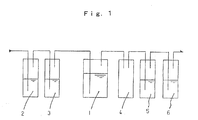
- a sample for measuring a biodegradation rate of a non-natural organic compound such as a petrochemical product synthesized from a raw material of a fossil fuel and a substance which is a natural substance containing a radioactive carbon isotope 14 C and has a function of causing biodegradation of the non-natural organic compound such as compost, active sludge, or soil suspension are mixed and charged into a reaction tank 1 of a biodegradation reaction apparatus constituted as shown in Fig. 1.
- a biodegradation reaction of the sample is carried out at a predetermined temperature while an air having carbon dioxide in atmosphere completely removed therefrom is introduced into a vicinity of a bottom of the reaction tank 1.
- the air is introduced in to the reaction tank 1 through a carbon dioxide absorption tank 2 containing an aqueous solution of sodium hydroxide or the like and a water washing tank 3, to thereby inhibit carbon dioxide in atmosphere to enter a reaction system.
- the air introduced into the reaction tank 1 except air partly consumed in the biodegradation reaction is introduced into a reservoir tank 4, a first-stage trap 5, and a second-stage trap 6 from a vicinity of a top of the reaction tank 1 with carbon dioxide generated in the biodegradation reaction.
- the biodegradation reaction is carried out for a predetermined period of time such as for 10 days.
- a medium containing non-natural organic compound of the biodegraded sample is burned in air having carbon dioxide similarly removed therefrom or in pure oxygen, to thereby convert the medium into carbon dioxide.
- Carbon dioxide is passed through an aqueous solution of sodium hydroxide or the like in the same manner as described above, and absorbed and trapped therein.
- a content (pMC) of a radioactive carbon isotope 14 C in carbon dioxide can be measured by using a scintillation counter or an accelerator-mass spectrometer.
- a biodegradation rate of a measurement sample can be obtained by: determining pMC of a medium containing a sample obtained as described above before and after biodegradation and a content (pMC of control medium) of a radioactive carbon isotope 14 C obtained in the same manner by using a medium formed of a natural substance alone such as a fertilizer without addition of the non-natural organic compound in the sample; and using the values for the following calculation formulae.
- the medium subjected to biodegradation contains a metal species such as iron, copper, or manganese.
- the metal species does not biodegrade even in a biodegradation operation, evaporate, or the like, and a total content of the metal species hardly changes before and after the biodegradation operation.
- the metal species in the biodegradation medium can be used as an internal standard, and a biodegradation rate can be determined by the following calculation formulae.
- H F G ⁇ D
- the method has advantages in that: carbon dioxide generated in biodegradation need not be trapped; biodegradation need not be carried out in a closed reaction tank; and a biodegradation rate can be measured with an apparatus in open atmosphere.
- a biodegradation test of polycaprolactone in compost was performed by using an apparatus schematically shown in Fig. 1 as a biodegradation reaction apparatus.
- reaction tank 1 was placed into a thermostatic bath at 58°C.
- a low-pressure air was passed through the carbon dioxide absorption tank 2 and the water washing tank 3 to remove carbon dioxide in atmosphere, and was introduced into the reaction tank 1 from an air introduction tube inserted into the vicinity of the bottom of the reaction tank 1.
- the carbon dioxide absorption tank 2 included a 2 N aqueous solution of sodium hydroxide to absorb carbon dioxide in atmosphere.
- An air flow rate was 30 ml/minute.
- Excess air and carbon dioxide generated in a biodegradation reaction in the reaction tank 1 were introduced into the reservoir tank 4 from the vicinity of the top of the reaction tank 1 through an introductiontube.
- An introduction tube from an exit of the reservoir tank 4 was introduced into an aqueous solution of sodium hydroxide in the first-stage trap 5.
- the second-stage trap 6 was provided downstream of the first-stage trap 5, to thereby discharge excess air alone.
- PCL was subjected to biodegradation in compost for 11 days.
- the medium after biodegradation was burned in a combustion furnace by using air passed through a carbon dioxide absorption tank similar to that in the above-described biodegradation reaction apparatus to remove carbon dioxide.
- a combustion gas was trapped in a trap containing an aqueous solution of sodium hydroxide, to thereby determine an amount of carbon dioxide in the aqueous solution and a pMC value thereof.
- a medium sampled before biodegradation was burned in a combustion furnace, to thereby determine a pMC value of carbon dioxide. Further, an iron (Fe) concentration and a total carbon concentration were measured for the medium sampled before biodegradation and the medium after biodegradation.
- a biodegradation reaction of compost alone was carried out for 11 days using a biodegradation reaction apparatus having the same constitution as that of the above-described biodegradation reaction apparatus under the same conditions as for the above-described biodegradation reaction except that PCL as a non-natural organic compound was not added to the reaction tank 1 of the apparatus. Also in this case, an amount of carbon dioxide and a pMC value for the medium sampled before biodegradation and the medium after biodegradation were determined in the same manner as in Example 1.
- Example Comparative Example pMC in medium before biodegradation (%) 105.19 115.82 pMC in medium after biodegradation (%) 113.01 Fe concentration in medium before biodegradation (ppm) 50 - Fe concentration in medium after biodegradation (ppm) 66 - Carbon concentration in medium before biodegradation (%) 6.87 - Carbon concentration in medium after biodegradation (%) 5.22 -
- a biodegradation rate based on an amount of carbon dioxide discharged from the medium was determined by using the above results and the calculation formulae (1) to (6), and a biodegradation rate based on an internal standard was determined by using the calculation formulae (7) and (8).
- Table 2 shows the results. Calculation method Biodegradation rate (%) Based on discharged amount of CO 2 77 Based on internal standard 80
- the present invention allows safe, simple, rapid, and accurate measurement of a biodegradation rate of a non-natural organic compound.
- the present invention can provide a method of measuring a biodegradation rate of a non-natural organic compound having an effect allowing measurement with an apparatus in open atmosphere.
Landscapes
- Life Sciences & Earth Sciences (AREA)
- Health & Medical Sciences (AREA)
- Engineering & Computer Science (AREA)
- Chemical & Material Sciences (AREA)
- Physics & Mathematics (AREA)
- Analytical Chemistry (AREA)
- Geology (AREA)
- General Life Sciences & Earth Sciences (AREA)
- Food Science & Technology (AREA)
- Medicinal Chemistry (AREA)
- Environmental & Geological Engineering (AREA)
- Remote Sensing (AREA)
- Biochemistry (AREA)
- General Health & Medical Sciences (AREA)
- General Physics & Mathematics (AREA)
- Immunology (AREA)
- Pathology (AREA)
- Other Investigation Or Analysis Of Materials By Electrical Means (AREA)
- Measurement Of Radiation (AREA)
- Sampling And Sample Adjustment (AREA)
Abstract
Provided is a method of measuring a biodegradation rate of a non-natural organic compound in the presence of a biodegradation medium, characterized by including: measuring a concentration of a radioactive carbon isotope <14>C in a biodegradation medium; and measuring a biodegradation rate of a non-natural organic compound from a difference between the concentration of <14>C in the biodegradation medium and a concentration of <14>C in modern carbon. Further, a metal such as iron in the medium can be used as an internal standard. According to the method, a biodegradation rate of a non-natural organic compound can be measured safely, simply, rapidly, and accurately without providing any special measures against radiation.
Description
The present invention relates to a method of measuring a
biodegradation rate of a non-natural organic compound. The present
invention more specifically relates to a method of measuring a
biodegradation rate of a non-natural organic compound safely, simply,
rapidly, and accurately by utilizing change in a concentration of
a radioactive carbon isotope 14C from the modern carbon.
In order to measure directly a biodegradation rate of an organic
compound, a radioactive carbon isotope 14C must be organochemically
enriched in a sample first. Next, the sample enriched with the
radioactive carbon isotope 14C is subjected to biodegradation, and
a radiation dose of carbon dioxide generated in biodegradation is
measured with a scintillation counter to determine an absolute amount
of the radioactive carbon isotope 14C in carbon dioxide generated
in biodegradation of the organic compound. A ratio of the absolute
amount of the radioactive carbon isotope 14C in carbon dioxide to
an absolute amount of the radioactive carbon isotope 14C in the
14C-enriched sample used is calculated, to thereby determine the
biodegradation rate of the organic compound.
However, in the measurement method, a series of measuring
operations must be performed in a space provided with measures against
radiation because radioactive 14C is used. Thus, the measurement
method has problems in that measurement of a radiation dose of carbon
dioxide generated in biodegradation requires a long period of time,
and that measurement errors are observed by disturbance of background
radioactivity or the like in measurement of the radiation dose.
Therefore, development of a method of measuring a
biodegradation rate of a non-natural organic compound rapidly and
accurately without enriching a measurement sample with an expensive
radioactive carbon isotope 14C and without providing any special
measures against radiation has been desired.
It is an object of the present invention to provide a method
of measuring a biodegradation rate of a non-natural organic compound
safely, simply, rapidly, and accurately with little measurement
error without providing any special measures against radiation.
The inventors of the present invention have conducted intensive
studies for attaining the above-described object, and have found
that a biodegradation rate of a non-natural organic compound can
be measured by utilizing a fact that a decaying radioactive carbon
isotope 14C decays completely in a non-natural organic compound and
no 14C remains therein, and by measuring a difference between a
concentration of 14C in carbon dioxide from a medium mixed with a
measurement sample for biodegradation and a concentration of 14C
in modern carbon. Further, the inventors of the present invention
have found that a biodegradation rate can be measured in an open
field, which was hitherto impossible, by using as an internal standard
a metal in a biodegradation medium, to thereby complete the present
invention based on the findings.
That is, the gist of the present invention is described below.
The method of measuring a biodegradation rate of a non-natural
organic compound of the present invention includes : in the presence
of a biodegradation medium, measuring a concentration of a
radioactive carbon isotope 14C in a biodegradation medium; and
measuring a biodegradation rate of a non-natural organic compound
from a difference between the concentration of 14C in the
biodegradation medium and a concentration of 14C in modern carbon.
The non-natural organic compound used for measurement of a
biodegradation rate in the present invention includes various
organic compounds such petrochemicals and coal chemicals synthesized
from raw materials of fossil fuels such as petroleum, coal, and
natural gas. Of the non-natural organic compounds, substances
likely providing adverse effects on natural environment such as
a synthetic detergent, which flows out to natural world after use
with waste water and contaminates water in rivers and lakes, must
be investigated on progress of biodegradation by microorganisms
in the natural world, in particular.
In a natural carbon-containing substance such as carbon dioxide
in atmosphere or plants, 1 mole of carbon represents 6. 0 × 1023 carbon
atoms. Since a concentration of 14C in carbon is 1/1012 of that of
12C in abundance ratio, 1 mole of carbon represents 6×10¹¹ radioactive
carbon isotope 14C atoms. A half-life of the radioactive carbon
isotope 14C is 5, 730±40 years, and a time period required for decay
of all the 6 × 10¹¹ radioactive carbon isotope 14C atoms is 226,000
years. Thus, in fossil fuels such as coal, natural gas, and petroleum
obtained by incorporating and fixing carbon dioxide in atmosphere
into living bodies such as plants and being stored underground for
226,000 years or more, all the radioactive carbon isotope 14C atoms
in carbon have already decayed.
The present invention allows measurement of a biodegradation
rate by microorganisms or the like of various non-natural organic
compounds such as petrochemicals and coal chemicals synthesized
from raw materials of fossil fuels containing no radioactive carbon
isotope 14C, which already decayed. The results of the measurement
allow tracking of a biodegradation process of the substances in
the natural world.
Here, a value so-called percent Modern Carbon (pMC) calculated
based on a concentration of 14C in circulating carbon as of 1950
as 100% has been used as a notation for the concentration of 14C
under an international agreement. A concentration of the
radioactive carbon isotope 19C in carbon dioxide in atmosphere has
varied after 1950, and a concentration of 14C at present (2002) falls
within a range of 110 to 111%.
Next, the following operations are performed for the method
of the present invention. For example, a sample for measuring a
biodegradation rate of a non-natural organic compound such as a
petrochemical product synthesized from a raw material of a fossil
fuel and a substance which is a natural substance containing a
radioactive carbon isotope 14C and has a function of causing
biodegradation of the non-natural organic compound such as compost,
active sludge, or soil suspension are mixed and charged into a reaction
tank 1 of a biodegradation reaction apparatus constituted as shown
in Fig. 1. Then, a biodegradation reaction of the sample is carried
out at a predetermined temperature while an air having carbon dioxide
in atmosphere completely removed therefrom is introduced into a
vicinity of a bottom of the reaction tank 1.
As shown in Fig. 1, the air is introduced in to the reaction
tank 1 through a carbon dioxide absorption tank 2 containing an
aqueous solution of sodium hydroxide or the like and a water washing
tank 3, to thereby inhibit carbon dioxide in atmosphere to enter
a reaction system. The air introduced into the reaction tank 1 except
air partly consumed in the biodegradation reaction is introduced
into a reservoir tank 4, a first-stage trap 5, and a second-stage
trap 6 from a vicinity of a top of the reaction tank 1 with carbon
dioxide generated in the biodegradation reaction.
In this way, the biodegradation reaction is carried out for
a predetermined period of time such as for 10 days. Then a medium
containing non-natural organic compound of the biodegraded sample
is burned in air having carbon dioxide similarly removed therefrom
or in pure oxygen, to thereby convert the medium into carbon dioxide.
Carbon dioxide is passed through an aqueous solution of sodium
hydroxide or the like in the same manner as described above, and
absorbed and trapped therein. Then, a content (pMC) of a radioactive
carbon isotope 14C in carbon dioxide can be measured by using a
scintillation counter or an accelerator-mass spectrometer.
A biodegradation rate of a measurement sample can be obtained
by: determining pMC of a medium containing a sample obtained as
described above before and after biodegradation and a content (pMC
of control medium) of a radioactive carbon isotope 14C obtained in
the same manner by using a medium formed of a natural substance
alone such as a fertilizer without addition of the non-natural organic
compound in the sample; and using the values for the following
calculation formulae.
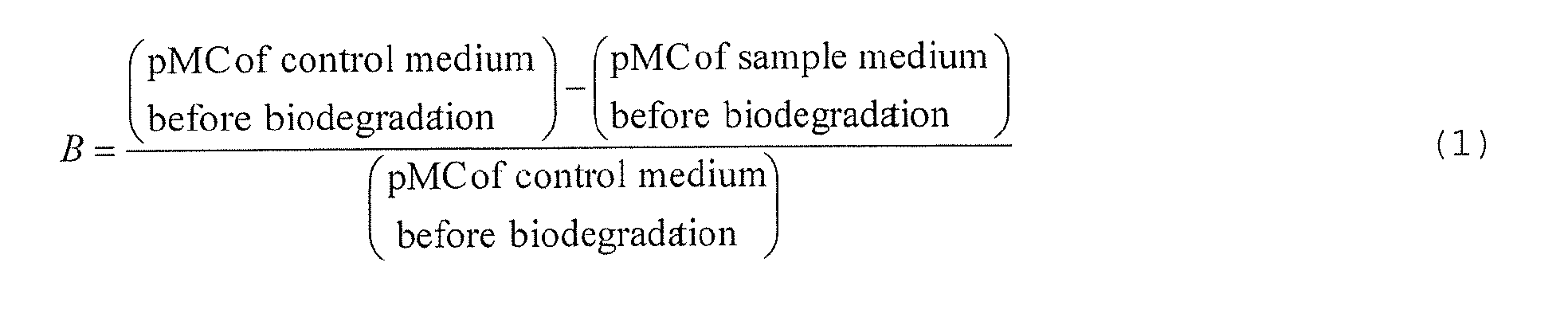

Note that, pMC of the control medium does not change before
and after biodegradation.
Carbon content in sample medium before biodegradation (D) D = Carbon content derived from sample (g) B
Carbon content in sample medium after biodegradation (E)
E = D - Amount of carbon dioxide discharged from sample medium (g) × 1244


Carbon content in sample medium before biodegradation (D)
In the method of the present invention, the medium subjected
to biodegradation contains a metal species such as iron, copper,
or manganese. The metal species does not biodegrade even in a
biodegradation operation, evaporate, or the like, and a total content
of the metal species hardly changes before and after the
biodegradation operation. Thus, by taking advantage of the property,
the metal species in the biodegradation medium can be used as an
internal standard, and a biodegradation rate can be determined by
the following calculation formulae.
H= F G ×D
E= J I ×K= J I × F G ×D
Symbols in the above calculation formulae are defined as
described below.
The method has advantages in that: carbon dioxide generated
in biodegradation need not be trapped; biodegradation need not be
carried out in a closed reaction tank; and a biodegradation rate
can be measured with an apparatus in open atmosphere.
Next, the present invent ion will be described more specifically
by way of examples.
A biodegradation test of polycaprolactone in compost was
performed by using an apparatus schematically shown in Fig. 1 as
a biodegradation reaction apparatus.
One hundred and seventy one point four g of compost (water
content: 65 mass%) and 400.0 g of sea sand (25 to 35 mesh, water
content: 20 mass%) washed with water as natural substances, and
5.0 g of polycaprolactone (hereinafter, referred to as "PCL") as
a non-natural organic compound were sufficiently mixed, to thereby
prepare a biodegradation medium. Four mass% of the biodegradation
medium was sampled for analysis, and the remainder was filled into
the reaction tank 1.
Next, the reaction tank 1 was placed into a thermostatic bath
at 58°C. A low-pressure air was passed through the carbon dioxide
absorption tank 2 and the water washing tank 3 to remove carbon
dioxide in atmosphere, and was introduced into the reaction tank
1 from an air introduction tube inserted into the vicinity of the
bottom of the reaction tank 1. The carbon dioxide absorption tank
2 included a 2 N aqueous solution of sodium hydroxide to absorb
carbon dioxide in atmosphere. An air flow rate was 30 ml/minute.
Excess air and carbon dioxide generated in a biodegradation reaction
in the reaction tank 1 were introduced into the reservoir tank 4
from the vicinity of the top of the reaction tank 1 through an
introductiontube. An introduction tube from an exit of the reservoir
tank 4 was introduced into an aqueous solution of sodium hydroxide
in the first-stage trap 5. The second-stage trap 6 was provided
downstream of the first-stage trap 5, to thereby discharge excess
air alone.
In this way, PCL was subjected to biodegradation in compost
for 11 days. The medium after biodegradation was burned in a
combustion furnace by using air passed through a carbon dioxide
absorption tank similar to that in the above-described
biodegradation reaction apparatus to remove carbon dioxide. A
combustion gas was trapped in a trap containing an aqueous solution
of sodium hydroxide, to thereby determine an amount of carbon dioxide
in the aqueous solution and a pMC value thereof.
Similarly, a medium sampled before biodegradation was burned
in a combustion furnace, to thereby determine a pMC value of carbon
dioxide. Further, an iron (Fe) concentration and a total carbon
concentration were measured for the medium sampled before
biodegradation and the medium after biodegradation.
As a comparative example, a biodegradation reaction of compost
alone was carried out for 11 days using a biodegradation reaction
apparatus having the same constitution as that of the above-described
biodegradation reaction apparatus under the same conditions as for
the above-described biodegradation reaction except that PCL as a
non-natural organic compound was not added to the reaction tank
1 of the apparatus. Also in this case, an amount of carbon dioxide
and a pMC value for the medium sampled before biodegradation and
the medium after biodegradation were determined in the same manner
as in Example 1.
Table 1 shows the results.
| Example | Comparative Example | |
| pMC in medium before biodegradation (%) | 105.19 | 115.82 |
| pMC in medium after biodegradation (%) | 113.01 | |
| Fe concentration in medium before biodegradation (ppm) | 50 | - |
| Fe concentration in medium after biodegradation (ppm) | 66 | - |
| Carbon concentration in medium before biodegradation (%) | 6.87 | - |
| Carbon concentration in medium after biodegradation (%) | 5.22 | - |
A biodegradation rate based on an amount of carbon dioxide
discharged from the medium was determined by using the above results
and the calculation formulae (1) to (6), and a biodegradation rate
based on an internal standard was determined by using the calculation
formulae (7) and (8). Table 2 shows the results.
| Calculation method | Biodegradation rate (%) |
| Based on discharged amount of CO2 | 77 |
| Based on internal standard | 80 |
The present invention allows safe, simple, rapid, and accurate
measurement of a biodegradation rate of a non-natural organic
compound. In addition, when an internal standard is used, the present
invention can provide a method of measuring a biodegradation rate
of a non-natural organic compound having an effect allowing
measurement with an apparatus in open atmosphere.
Claims (3)
- A method of measuring a biodegradation rate of a non-natural organic compound in the presence of a biodegradation medium, characterized by comprising:measuring a concentration of a radioactive carbon isotope 14C in a biodegradation medium; andmeasuring a biodegradation rate of a non-natural organic compound from a difference between the concentration of 14C in the biodegradation medium and a concentration of 14C in modern carbon.
- A method of measuring a biodegradation rate of a non-natural organic compound according to Claim 1, characterized in that the biodegradation rate is measured by using an internal standard.
- A method of measuring a biodegradation rate of a non-natural organic compound according to Claim 2, characterized in that the internal standard comprises a metal selected from the group consisting of bioessential metals such as iron, copper, and manganese.
Applications Claiming Priority (3)
| Application Number | Priority Date | Filing Date | Title |
|---|---|---|---|
| JP2002366721A JP4233863B2 (en) | 2002-12-18 | 2002-12-18 | Method for measuring biodegradation rate of non-natural organic compounds |
| JP2002366721 | 2002-12-18 | ||
| PCT/JP2003/015992 WO2004055511A1 (en) | 2002-12-18 | 2003-12-12 | Method of measuring biodegradation rate of unnatural organic compound |
Publications (2)
| Publication Number | Publication Date |
|---|---|
| EP1574852A1 true EP1574852A1 (en) | 2005-09-14 |
| EP1574852A4 EP1574852A4 (en) | 2008-08-06 |
Family
ID=32588321
Family Applications (1)
| Application Number | Title | Priority Date | Filing Date |
|---|---|---|---|
| EP03778911A Withdrawn EP1574852A4 (en) | 2002-12-18 | 2003-12-12 | METHOD FOR MEASURING THE BIODEGRADATION RATE OF AN ARTIFICIAL ORGANIC COMPOUND |
Country Status (5)
| Country | Link |
|---|---|
| US (1) | US7642094B2 (en) |
| EP (1) | EP1574852A4 (en) |
| JP (1) | JP4233863B2 (en) |
| CA (1) | CA2510757A1 (en) |
| WO (1) | WO2004055511A1 (en) |
Families Citing this family (3)
| Publication number | Priority date | Publication date | Assignee | Title |
|---|---|---|---|---|
| JP2007085874A (en) | 2005-09-21 | 2007-04-05 | Idemitsu Kosan Co Ltd | Method for measuring the content of circulating carbon in a sample and method for measuring the content of circulating carbon material in a sample |
| DE102016116767B4 (en) | 2016-09-07 | 2018-04-05 | Rainer Meckenstock | Method for determining the biodegradation of organic substances to carbon dioxide |
| CN116519579B (en) * | 2023-04-28 | 2025-11-28 | 国高材高分子材料产业创新中心有限公司 | Degradation analysis device for biodegradable material |
Family Cites Families (3)
| Publication number | Priority date | Publication date | Assignee | Title |
|---|---|---|---|---|
| JPH05180830A (en) | 1991-12-26 | 1993-07-23 | Showa Shell Sekiyu Kk | Biodegradation testing of oil matter |
| US5284995A (en) * | 1993-03-08 | 1994-02-08 | The United States Of America As Represented By The Secretary Of The Army | Method to extract and recover nitramine oxidizers from solid propellants using liquid ammonia |
| GB2314078B (en) * | 1996-06-14 | 2000-06-07 | British Gas Plc | Biodegradation of iron cyanide complexes |
-
2002
- 2002-12-18 JP JP2002366721A patent/JP4233863B2/en not_active Expired - Fee Related
-
2003
- 2003-12-12 EP EP03778911A patent/EP1574852A4/en not_active Withdrawn
- 2003-12-12 WO PCT/JP2003/015992 patent/WO2004055511A1/en not_active Ceased
- 2003-12-12 US US10/539,805 patent/US7642094B2/en not_active Expired - Fee Related
- 2003-12-12 CA CA002510757A patent/CA2510757A1/en not_active Abandoned
Non-Patent Citations (2)
| Title |
|---|
| No further relevant documents disclosed * |
| See also references of WO2004055511A1 * |
Also Published As
| Publication number | Publication date |
|---|---|
| JP2004198239A (en) | 2004-07-15 |
| WO2004055511A1 (en) | 2004-07-01 |
| EP1574852A4 (en) | 2008-08-06 |
| JP4233863B2 (en) | 2009-03-04 |
| US7642094B2 (en) | 2010-01-05 |
| US20060160228A1 (en) | 2006-07-20 |
| CA2510757A1 (en) | 2004-07-01 |
Similar Documents
| Publication | Publication Date | Title |
|---|---|---|
| Eppley et al. | Chlorine reactions with seawater constituents and the inhibition of photosynthesis of natural marine phytoplankton | |
| Williams | Handbook of anion determination | |
| Wong et al. | Dissolved organic iodine in marine waters: Determination, occurrence and analytical implications | |
| Franklin et al. | Trace metal and rare earth elements in a sediment profile from the Rio Grande Reservoir, Sao Paulo, Brazil: determination of anthropogenic contamination, dating, and sedimentation rates | |
| Turner et al. | Toward a quality-controlled and accessible Pitzer model for seawater and related systems | |
| Guo et al. | Deciphering the link between particulate organic matter molecular composition and lake eutrophication by FT-ICR MS analysis | |
| Adesina et al. | Photochemically generated nitric oxide in seawater: The peroxynitrite sink and its implications for daytime air quality | |
| Tsuji et al. | Effects of temperature and oxygen on 137Cs desorption from bottom sediment of a dam lake | |
| US7642094B2 (en) | Method of measuring biodegradation rate of unnatural organic compound | |
| JP4050051B2 (en) | Method for measuring biodegradation rate of non-natural organic compounds | |
| Gerike et al. | A test for detecting recalcitrant metabolites | |
| Schulte et al. | Applying reverse stable isotope labeling analysis by mid-infrared laser spectroscopy to monitor BDOC in recycled wastewater | |
| Merino et al. | The dark side of the soil carbon cycle: Hydroxyl radicals and abiotic CO2 production | |
| Fujita et al. | Tracking the movement of recharge water after infiltration | |
| Katz | The stability of turbidity in raw water and its relationship to chlorine demand | |
| Kirishima et al. | Determination of the phenolic-group capacities of humic substances by non-aqueous titration technique | |
| Klein | Some general and analytical aspects of environmental mercury contamination | |
| Richter et al. | Metabolic fate modeling of selected human pharmaceuticals in soils | |
| Heaton et al. | Isotope and dissolved gas evidence for nitrogen attenuation in landfill leachate dispersing into a chalk aquifer | |
| Matthews et al. | The hydrolysis of zectran in buffered and natural waters | |
| Bucur et al. | 14C release from TRIGA irradiated graphite | |
| Manley | Influence of dissolved organic matter (DOM) on mercury speciation and reactivity in rainwater | |
| Harvey et al. | The application of photo-oxidation to the determination of stable cobalt in sea water | |
| Haasler et al. | EVALUATIONS OF EXISTING METHODS Evaluation of a modified sequential P extraction protocol: Quantification of Fe (II)-P as a separate phase in seven different freshwater sediments | |
| Ishii et al. | Partitioning of 14C into solid, liquid, and gas phases in various paddy soils in Japan |
Legal Events
| Date | Code | Title | Description |
|---|---|---|---|
| PUAI | Public reference made under article 153(3) epc to a published international application that has entered the european phase |
Free format text: ORIGINAL CODE: 0009012 |
|
| 17P | Request for examination filed |
Effective date: 20050617 |
|
| AK | Designated contracting states |
Kind code of ref document: A1 Designated state(s): AT BE BG CH CY CZ DE DK EE ES FI FR GB GR HU IE IT LI LU MC NL PT RO SE SI SK TR |
|
| AX | Request for extension of the european patent |
Extension state: AL LT LV MK |
|
| DAX | Request for extension of the european patent (deleted) | ||
| RBV | Designated contracting states (corrected) |
Designated state(s): DE FR GB |
|
| A4 | Supplementary search report drawn up and despatched |
Effective date: 20080704 |
|
| STAA | Information on the status of an ep patent application or granted ep patent |
Free format text: STATUS: THE APPLICATION HAS BEEN WITHDRAWN |
|
| 18W | Application withdrawn |
Effective date: 20091202 |