EP1574406A1 - Airbag module - Google Patents

Airbag module Download PDF

Info

Publication number
EP1574406A1
EP1574406A1 EP05005378A EP05005378A EP1574406A1 EP 1574406 A1 EP1574406 A1 EP 1574406A1 EP 05005378 A EP05005378 A EP 05005378A EP 05005378 A EP05005378 A EP 05005378A EP 1574406 A1 EP1574406 A1 EP 1574406A1
Authority
EP
European Patent Office
Prior art keywords
airbag
module
displacement member
inflator
volume
Prior art date
Legal status (The legal status is an assumption and is not a legal conclusion. Google has not performed a legal analysis and makes no representation as to the accuracy of the status listed.)
Withdrawn
Application number
EP05005378A
Other languages
German (de)
French (fr)
Inventor
Akira Kokeguchi
Current Assignee (The listed assignees may be inaccurate. Google has not performed a legal analysis and makes no representation or warranty as to the accuracy of the list.)
Takata Corp
Original Assignee
Takata Corp
Priority date (The priority date is an assumption and is not a legal conclusion. Google has not performed a legal analysis and makes no representation as to the accuracy of the date listed.)
Filing date
Publication date
Application filed by Takata Corp filed Critical Takata Corp
Publication of EP1574406A1 publication Critical patent/EP1574406A1/en
Withdrawn legal-status Critical Current

Links

Images

Classifications

    • BPERFORMING OPERATIONS; TRANSPORTING
    • B60VEHICLES IN GENERAL
    • B60RVEHICLES, VEHICLE FITTINGS, OR VEHICLE PARTS, NOT OTHERWISE PROVIDED FOR
    • B60R21/00Arrangements or fittings on vehicles for protecting or preventing injuries to occupants or pedestrians in case of accidents or other traffic risks
    • B60R21/02Occupant safety arrangements or fittings, e.g. crash pads
    • B60R21/16Inflatable occupant restraints or confinements designed to inflate upon impact or impending impact, e.g. air bags
    • B60R21/20Arrangements for storing inflatable members in their non-use or deflated condition; Arrangement or mounting of air bag modules or components
    • B60R21/217Inflation fluid source retainers, e.g. reaction canisters; Connection of bags, covers, diffusers or inflation fluid sources therewith or together

Definitions

  • the present invention relates to an airbag device in which an airbag is inflated to protect a vehicle occupant in the event of a vehicle emergency, such as a collision. More particularly, the present invention relates to an airbag device in which unoccupied space within an airbag module is reduced to improve an internal pressure rise of the airbag module during inflation so the airbag can deploy more quickly.
  • An airbag device is usually stored within a recess in a vehicle steering wheel or dashboard.
  • the airbag device includes an airbag module, an airbag, and an inflator for inflating the airbag.
  • the airbag module has a module cover and a retainer.
  • the airbag and inflator are typically mounted to the retainer and are enclosed between the module cover and the retainer.
  • the module cover faces into a vehicle passenger compartment and includes pre-weakened breaking points.
  • the airbag is inflated by gas produced by the inflator. As the airbag inflates, the internal pressure of the airbag module increases until the pre-weakened breaking points fail thereby enabling the airbag to deploy into the passenger compartment.
  • the inflated airbag receives and retains the vehicle occupant.
  • the amount of space available within the airbag module for storing the airbag and inflator is determined by the dimensions of the airbag module, which are governed by vehicle size and configuration.
  • a particular airbag module may be standardized to enable the same airbag module to be used in a variety of vehicles. Standardized airbag modules also decrease manufacturing costs and increase production throughput. Thus, the dimensions of an airbag module may be tailored for vehicle application versatility and manufacturability rather than for optimal packaging and/or operability of a particular airbag and inflator.
  • the inflator and folded airbag may occupy thirty percent or less of the total space within the airbag module.
  • the amount of free (empty) space within the airbag module can be greater than seventy percent.
  • the amount of time required for airbag deployment is increased because the airbag must inflate into the large volume of empty space within the airbag module before developing sufficient internal pressure to burst through the module cover into the passenger compartment.
  • the ability of the airbag to rapidly inflate to efficiently protect the vehicle occupant is diminished.
  • the present invention relates to an airbag device for protecting an occupant of a vehicle.
  • the airbag device includes an airbag, an inflator, and an airbag module.
  • the airbag and inflator are disposed within an enclosure formed by the airbag module.
  • a ratio of a volume of the enclosure to a volume occupied by components within the airbag module is 100:40 to 100:100.
  • an airbag device 1 is provided. As shown in Figs. 1 and 2, the airbag device 1 includes an airbag 10, an inflator 20, and an airbag module 30.
  • the airbag 10 and the inflator 20 are disposed within the airbag module 30.
  • the airbag 10 is stored in the airbag module 30 in a folded state, and the inflator 20 is operatively connected to the airbag 10.
  • the inflator 20 generates inflation gas, which flows into the airbag 10 to inflate the airbag 10.
  • the airbag module 30 encloses the airbag 10 and the inflator 20.
  • the airbag module 30 includes a module cover 35 and a retainer 40.
  • the module cover 35 has a cover member 3 5 a and wall members 35b extending from the cover member 35a.
  • the cover member 35a has pre-weakened breaking points (not shown) to enable the inflating airbag 10 to burst through the cover member 35a into a vehicle passenger compartment when sufficient pressure develops within the airbag module 30.
  • the retainer 40 supports the airbag 10 and the inflator 20 within the airbag module 30.
  • the retainer 40 is connected to the wall members 35b of the module cover 35 so that the module cover 35 and the retainer 40 form an enclosure, as shown in Fig. 3.
  • the enclosure defines an enclosure volume 50, which is a volume of space within the airbag module 30 available for storing the folded airbag 10 and the inflator 20.
  • the folded airbag 10 and the inflator 20 occupy a portion of the enclosure volume 50 when the folded airbag 10 and the inflator 20 are stored within the enclosure.
  • the portion of the enclosure volume 50 occupied by the folded airbag 10 and the inflator 20 comprises an occupied volume.
  • the occupied volume can also include a volume of space within the enclosure occupied by other components of the airbag module 30, such as mounting hardware.
  • the remaining free (or empty) space within the enclosure comprises an unoccupied volume 52.
  • a ratio of the enclosure volume 50 to the occupied volume is 100:40 to 100:100 (packaging ratio).
  • the unoccupied volume 52 within the enclosure is sixty percent or less of the enclosure volume 50.
  • deployment time of the airbag 10 in a vehicle emergency is improved over a conventional airbag device.
  • the inflating airbag 10 is able to deploy from the airbag module 30 more rapidly because the reduction in empty space (unoccupied volume 52) permits internal pressure within the enclosure (A in Fig. 9) to build up more quickly than internal pressure in a conventional airbag device (B in Fig. 9).
  • the airbag 10 is able to deploy into the passenger compartment more rapidly than a conventional airbag.
  • the airbag module 30 can be configured to achieve the packaging ratio of 100:40 to 100:100.
  • a height H shown in Fig. 1
  • a first width W1 shown in Figs. 1 and 2)
  • a second width W 2 shown in Fig. 2
  • the airbag device 1 can also include at least one displacement member 70 disposed within the airbag module 30.
  • the displacement member 70 enables the airbag device 1 to achieve the desired packaging ratio by occupying a portion of the enclosure volume 50 so that the enclosure volume 50 is effectively reduced.
  • the airbag device 1 includes the displacement member 70, the enclosure volume 50 is reduced by the volume of space occupied by the displacement member 70.
  • the displacement member 70 can be configured to be attached to an inner surface of the airbag module 30, as shown in Fig. 1.
  • the displacement member 70 can be attached to a wall member 35b of the module cover 35 with conventional mounting hardware (such as bolts or screws), with adhesives, or by welding.
  • the displacement member 70 can also be attached to the retainer 40.
  • the displacement member 70 can be formed integrally with the module cover 35 and/or the retainer 40.
  • the displacement member 70 can be formed in a shape that enables the displacement member 70 to displace a sufficient volume of space while at the same time keeping the weight of the displacement member 70 down (so that an overall weight of the vehicle can be kept down).
  • the displacement member 70 can be formed as an elongated member having a central hollow portion 72, such as a channel.
  • a displacement member 170 could be formed to have a rounded cup-shape, as shown in Fig. 7.
  • the displacement member 70 can be disposed within the airbag module 30 so that the hollow portion 72 faces toward an inner surface of the airbag module 30.
  • the hollow portion 72 is isolated from the airbag 10 so that the airbag 10 is precluded from entering the hollow portion 72.
  • the displacement member 70 reduces the available storage volume for the airbag 10 and the inflator 20 thereby reducing the amount of empty space 52 in the airbag module 30.
  • the displacement member 70 can also include at least one opening 74 to further reduce the weight of the displacement member 70.
  • the opening 74 can comprise a through hole or a plurality of through holes.
  • the displacement member 70, 170 can be formed as a rigid web, mesh, screen, or lattice structure having openings 172, as shown in Fig. 7.
  • the displacement member 70 can be made from a material configured to withstand the temperature and pressure generated within the airbag module 30 during airbag inflation.
  • the displacement member 70 can comprise a metal or polymer.
  • a displacement member 270 can comprise a spray-on foam configured to be sprayed onto an inner surface of the airbag module 30 and to harden into a rigid state, as shown in Fig. 8.
  • an airbag device in which unoccupied space within the airbag device is reduced to improve the internal pressure rise of the airbag device during inflation so that the airbag can deploy rapidly to efficiently protect a vehicle occupant.
  • Figure 10 illustrates a method of calculating the volume of an airbag according to the present invention.
  • cross sections of the airbag are selected, the volume of the cross section is calculated by multiplying the thickness of the airbag by the area of the airbag fabric, and adding the volume of the selected cross sections to calculate a volume.
  • One of ordinary skill in the art would also recognize other methods of calculating the volume of the airbag. For example, the volume for each of the various components of the airbag could be calculated separately and summed.

Landscapes

  • Engineering & Computer Science (AREA)
  • Mechanical Engineering (AREA)
  • Air Bags (AREA)

Abstract

An airbag module (30) includes a module cover (35), an airbag (10) configured to inflate in an event of a vehicle emergency, and an inflator (20) configured to provide gas for inflating the airbag (10). The inflator (20) and the airbag (10) are connected to a retainer (40), and the module cover (35) and the retainer (40) are connected to form an enclosure volume (50). A ratio of the enclosure volume (50) to a portion of the enclosure volume (50) that is occupied by components of the airbag module (30) is 100:40 to 100:100. A displacement member (70) is disposed within the enclosure volume (50).

Description

BACKGROUND
The present invention relates to an airbag device in which an airbag is inflated to protect a vehicle occupant in the event of a vehicle emergency, such as a collision. More particularly, the present invention relates to an airbag device in which unoccupied space within an airbag module is reduced to improve an internal pressure rise of the airbag module during inflation so the airbag can deploy more quickly.
An airbag device is usually stored within a recess in a vehicle steering wheel or dashboard. The airbag device includes an airbag module, an airbag, and an inflator for inflating the airbag. The airbag module has a module cover and a retainer. The airbag and inflator are typically mounted to the retainer and are enclosed between the module cover and the retainer. The module cover faces into a vehicle passenger compartment and includes pre-weakened breaking points. In the event of a vehicle emergency, the airbag is inflated by gas produced by the inflator. As the airbag inflates, the internal pressure of the airbag module increases until the pre-weakened breaking points fail thereby enabling the airbag to deploy into the passenger compartment. The inflated airbag receives and retains the vehicle occupant.
The amount of space available within the airbag module for storing the airbag and inflator is determined by the dimensions of the airbag module, which are governed by vehicle size and configuration. A particular airbag module may be standardized to enable the same airbag module to be used in a variety of vehicles. Standardized airbag modules also decrease manufacturing costs and increase production throughput. Thus, the dimensions of an airbag module may be tailored for vehicle application versatility and manufacturability rather than for optimal packaging and/or operability of a particular airbag and inflator.
Additionally, efforts to reduce overall vehicle weight have resulted in thinner airbag fabrics and downsized inflators. Thinner airbag fabrics are also desirable because such fabrics have improved foldability and deployment characteristics. However, use of thinner fabrics and downsized inflators decreases the amount of space occupied by the folded airbag and the inflator. If the airbag module is not resized accordingly, the dimensions of the airbag module may be disproportionately large relative to the amount of space required to efficiently package and/or operate the airbag and inflator.
In conventional airbag devices, for example, the inflator and folded airbag may occupy thirty percent or less of the total space within the airbag module. Thus, the amount of free (empty) space within the airbag module can be greater than seventy percent. As a result, the amount of time required for airbag deployment is increased because the airbag must inflate into the large volume of empty space within the airbag module before developing sufficient internal pressure to burst through the module cover into the passenger compartment. Thus, the ability of the airbag to rapidly inflate to efficiently protect the vehicle occupant is diminished.
SUMMARY OF THE INVENTION
The above problems are overcome by an airbag module according to claim 1, by an airbag device according to claim 13, and by an airbag device according to claim 14. The dependent claims define preferred and advantageous embodiments of the invention.
The present invention relates to an airbag device for protecting an occupant of a vehicle. The airbag device includes an airbag, an inflator, and an airbag module. The airbag and inflator are disposed within an enclosure formed by the airbag module. A ratio of a volume of the enclosure to a volume occupied by components within the airbag module is 100:40 to 100:100. Thus, an internal pressure rise of the airbag module during inflation is improved so that the airbag can deploy more quickly to efficiently protect the vehicle occupant.
BRIEF DESCRIPTION OF THE DRAWINGS
The accompanying drawings, which are incorporated in and constitute a part of this specification, illustrate embodiments of the invention, and together with the description serve to explain principles of the invention.
  • Figure 1 is a cross sectional side view of an embodiment of an airbag device according to the present invention.
  • Figure 2 is a rear view of the airbag device of Fig. 1.
  • Figure 3 is a cross sectional side view of an airbag module of Fig. 1 with an airbag and an inflator removed.
  • Figure 4 is a cross sectional side view of the airbag device of Fig. 1 including a displacement member.
  • Figure 5 is a perspective view of the displacement member of Fig. 4.
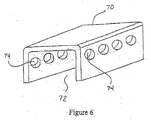
  • Figure 6 is a perspective view of an embodiment of a displacement member according to the present invention.
  • Figure 7 is a perspective view of an embodiment of a displacement member according to the present invention.
  • Figure 8 is a cross sectional side view of an embodiment of a displacement member according to the present invention.
  • Figure 9 is a graph illustrating internal pressure versus time for an airbag device according to an embodiment of the present invention as compared to a conventional airbag device.
  • Figure 10 illustrates a method of determining the volume of an airbag according to the present invention.
  • DETAILED DESCRIPTION
    Reference will now be made in detail to embodiments of the invention, examples of which are illustrated in the accompanying drawings. An effort has been made to use the same reference numbers throughout the drawings to refer to the same or like parts.
    According to an embodiment of the present invention, an airbag device 1 is provided. As shown in Figs. 1 and 2, the airbag device 1 includes an airbag 10, an inflator 20, and an airbag module 30.
    The airbag 10 and the inflator 20 are disposed within the airbag module 30. The airbag 10 is stored in the airbag module 30 in a folded state, and the inflator 20 is operatively connected to the airbag 10. During a vehicle emergency, the inflator 20 generates inflation gas, which flows into the airbag 10 to inflate the airbag 10.
    The airbag module 30 encloses the airbag 10 and the inflator 20. The airbag module 30 includes a module cover 35 and a retainer 40. The module cover 35 has a cover member 3 5 a and wall members 35b extending from the cover member 35a. The cover member 35a has pre-weakened breaking points (not shown) to enable the inflating airbag 10 to burst through the cover member 35a into a vehicle passenger compartment when sufficient pressure develops within the airbag module 30.
    The retainer 40 supports the airbag 10 and the inflator 20 within the airbag module 30. The retainer 40 is connected to the wall members 35b of the module cover 35 so that the module cover 35 and the retainer 40 form an enclosure, as shown in Fig. 3. The enclosure defines an enclosure volume 50, which is a volume of space within the airbag module 30 available for storing the folded airbag 10 and the inflator 20.
    As shown in Fig. 1, the folded airbag 10 and the inflator 20 occupy a portion of the enclosure volume 50 when the folded airbag 10 and the inflator 20 are stored within the enclosure. The portion of the enclosure volume 50 occupied by the folded airbag 10 and the inflator 20 comprises an occupied volume. The occupied volume can also include a volume of space within the enclosure occupied by other components of the airbag module 30, such as mounting hardware. The remaining free (or empty) space within the enclosure comprises an unoccupied volume 52.
    According to an embodiment of the present invention, a ratio of the enclosure volume 50 to the occupied volume is 100:40 to 100:100 (packaging ratio). Thus, the unoccupied volume 52 within the enclosure is sixty percent or less of the enclosure volume 50. In this manner, deployment time of the airbag 10 in a vehicle emergency is improved over a conventional airbag device. For example, the inflating airbag 10 is able to deploy from the airbag module 30 more rapidly because the reduction in empty space (unoccupied volume 52) permits internal pressure within the enclosure (A in Fig. 9) to build up more quickly than internal pressure in a conventional airbag device (B in Fig. 9). In other words, there is less empty space (unoccupied volume 52) to be filled by the inflating airbag 10 before sufficient pressure is exerted on the cover member 35a to burst the cover member 35a. Thus, the airbag 10 is able to deploy into the passenger compartment more rapidly than a conventional airbag.
    According to an embodiment of the present invention, the airbag module 30 can be configured to achieve the packaging ratio of 100:40 to 100:100. For example, a height H (shown in Fig. 1), a first width W1 (shown in Figs. 1 and 2), and/or a second width W 2 (shown in Fig. 2) can be varied to achieve the desired packing ratio for a particular airbag 10 and inflator 20.
    As shown in Fig. 4, the airbag device 1 can also include at least one displacement member 70 disposed within the airbag module 30. The displacement member 70 enables the airbag device 1 to achieve the desired packaging ratio by occupying a portion of the enclosure volume 50 so that the enclosure volume 50 is effectively reduced. Thus, when the airbag device 1 includes the displacement member 70, the enclosure volume 50 is reduced by the volume of space occupied by the displacement member 70.
    The displacement member 70 can be configured to be attached to an inner surface of the airbag module 30, as shown in Fig. 1. For example, the displacement member 70 can be attached to a wall member 35b of the module cover 35 with conventional mounting hardware (such as bolts or screws), with adhesives, or by welding. The displacement member 70 can also be attached to the retainer 40. Alternatively, the displacement member 70 can be formed integrally with the module cover 35 and/or the retainer 40.
    The displacement member 70 can be formed in a shape that enables the displacement member 70 to displace a sufficient volume of space while at the same time keeping the weight of the displacement member 70 down (so that an overall weight of the vehicle can be kept down). For example, as shown in Fig. 5, the displacement member 70 can be formed as an elongated member having a central hollow portion 72, such as a channel. Alternatively, a displacement member 170 could be formed to have a rounded cup-shape, as shown in Fig. 7.
    As shown in Fig. 4, the displacement member 70 can be disposed within the airbag module 30 so that the hollow portion 72 faces toward an inner surface of the airbag module 30.
    Thus, the hollow portion 72 is isolated from the airbag 10 so that the airbag 10 is precluded from entering the hollow portion 72. In this manner, the displacement member 70 reduces the available storage volume for the airbag 10 and the inflator 20 thereby reducing the amount of empty space 52 in the airbag module 30.
    The displacement member 70 can also include at least one opening 74 to further reduce the weight of the displacement member 70. For example, as shown in Fig. 6, the opening 74 can comprise a through hole or a plurality of through holes. Alternatively, the displacement member 70, 170 can be formed as a rigid web, mesh, screen, or lattice structure having openings 172, as shown in Fig. 7.
    The displacement member 70 can be made from a material configured to withstand the temperature and pressure generated within the airbag module 30 during airbag inflation. For example, the displacement member 70 can comprise a metal or polymer. Alternatively, a displacement member 270 can comprise a spray-on foam configured to be sprayed onto an inner surface of the airbag module 30 and to harden into a rigid state, as shown in Fig. 8.
    Thus, according to embodiments of the present invention, an airbag device is provided in which unoccupied space within the airbag device is reduced to improve the internal pressure rise of the airbag device during inflation so that the airbag can deploy rapidly to efficiently protect a vehicle occupant.
    Figure 10 illustrates a method of calculating the volume of an airbag according to the present invention. In the example shown in Figure 10, cross sections of the airbag are selected, the volume of the cross section is calculated by multiplying the thickness of the airbag by the area of the airbag fabric, and adding the volume of the selected cross sections to calculate a volume. One of ordinary skill in the art would also recognize other methods of calculating the volume of the airbag. For example, the volume for each of the various components of the airbag could be calculated separately and summed.
    Other embodiments of the invention will be apparent to those skilled in the art from consideration of the specification and practice of the invention disclosed herein. It is intended that the specification and examples be considered as exemplary only.

    Claims (14)

    1. An airbag module comprising:
      a module cover (35);
      an airbag (10) configured to inflate in an event of a vehicle emergency; and
      an inflator (20) configured to provide gas for inflating the airbag (10),
         wherein the inflator (20) and the airbag (10) are connected to a retainer (40),
         wherein the module cover (35) and the retainer (40) are connected to form an enclosure volume (50), and
         wherein a ratio of the enclosure volume (50) to a portion of the enclosure volume (50) that is occupied by components of the airbag module (30) is 100:40 to 100:100.
    2. The airbag module according to claim 1, further comprising a displacement member (70; 170) disposed within the enclosure volume (50).
    3. The airbag module according to claim 2, wherein the displacement member (70;170) comprises metal.
    4. The airbag module according to claim 2 or claim 3, wherein the displacement member (70; 170) comprises a polymer.
    5. The airbag module according to any one of claims 2 to 4, wherein the displacement member (70; 170) comprises wire mesh.
    6. The airbag module according to any one of claims 2 to 5, wherein the displacement member (70; 170) is connected to an inner surface of the airbag module.
    7. The airbag module according to any one of claims 2 to 6, wherein the displacement member (70; 170) is formed integrally with the module cover.
    8. The airbag module according to any one of claims 2 to 7, wherein the displacement member (70; 170) is connected to the retainer.
    9. The airbag module according to any one of claims 2 to 6, wherein the displacement member (70; 170) is formed integrally with the retainer.
    10. The airbag module according to any one of claims 2 to 5, wherein the displacement member (70; 170) includes a hollow portion and is configured to be attached to an inner surface of the airbag module.
    11. The airbag module according to claim 10, wherein the displacement member (70; 170) includes at least one opening (74; 172).
    12. The airbag module according to claim 11, wherein the opening (74; 172) comprises a through hole.
    13. An airbag device for protecting an occupant of a vehicle, comprising:
      an airbag module (30) including an airbag (10), an inflator (20) for inflating the airbag, and a retainer (40),
         wherein the airbag (10) and the inflator (20) are disposed within an enclosed portion (50) of the module (30), and
         wherein a volume of unoccupied space within the enclosed portion (50) of the module is no greater than 60 percent of a volume of the enclosed portion (50) of the module.
    14. An airbag device for protecting an occupant of a vehicle, comprising:
      an airbag module (30) including an airbag (10), an inflator (20) for inflating the airbag, and a retainer (40),
         wherein the airbag (10) and the inflator (20) are disposed within an enclosed portion (50) of the module (30), and
         wherein a ratio of a volume of the enclosed portion (50) of the module to a volume occupied by the airbag (10) and the inflator (20) is 100:40 to 100:100.
    EP05005378A 2004-03-12 2005-03-11 Airbag module Withdrawn EP1574406A1 (en)

    Applications Claiming Priority (2)

    Application Number Priority Date Filing Date Title
    US55243604P 2004-03-12 2004-03-12
    US552436P 2004-03-12

    Publications (1)

    Publication Number Publication Date
    EP1574406A1 true EP1574406A1 (en) 2005-09-14

    Family

    ID=34826269

    Family Applications (1)

    Application Number Title Priority Date Filing Date
    EP05005378A Withdrawn EP1574406A1 (en) 2004-03-12 2005-03-11 Airbag module

    Country Status (4)

    Country Link
    US (1) US20050200102A1 (en)
    EP (1) EP1574406A1 (en)
    JP (1) JP2005255153A (en)
    CN (1) CN1743210A (en)

    Citations (6)

    * Cited by examiner, † Cited by third party
    Publication number Priority date Publication date Assignee Title
    US5342085A (en) * 1990-12-19 1994-08-30 Mazda Motor Corporation Air bag apparatus for automotive vehicle
    EP0841221A1 (en) * 1996-11-07 1998-05-13 Toyota Jidosha Kabushiki Kaisha Structure for arrangement of occupant protective apparatus for vehicle
    US6042147A (en) * 1996-09-30 2000-03-28 Nihon Plast Co., Ltd. Air-bag device
    US6068286A (en) * 1997-12-08 2000-05-30 Trw Occupant Restraint Systems Gmbh & Co. Kg Gas bag module for a vehicle occupant restraint system
    US6183003B1 (en) * 1994-03-22 2001-02-06 Nippondenso Co., Ltd. Air bag mounting and vent hole arrangement
    EP1211146A1 (en) * 1996-10-18 2002-06-05 Toyoda Gosei Co., Ltd. Air bag apparatus

    Family Cites Families (26)

    * Cited by examiner, † Cited by third party
    Publication number Priority date Publication date Assignee Title
    DE3630685C2 (en) * 1986-07-22 1994-03-10 Trw Repa Gmbh Gas cushion impact protection device for a motor vehicle occupant
    US4915410A (en) * 1988-11-28 1990-04-10 Trw Vehicle Safety Systems Inc. Vehicle air bag module and method of assembly
    US5174601A (en) * 1991-08-29 1992-12-29 General Motors Corporation Inflation gas flow directing member for air bag system
    US5501473A (en) * 1993-08-13 1996-03-26 Power Tool Holders Incorporated Chuck
    US5454586A (en) * 1993-12-06 1995-10-03 Alliedsignal Inc. Driver side air bag module with extruded housing
    DE4447045A1 (en) * 1994-12-29 1996-07-04 Ks Automobil Sicherheitstech Attachment of an airbag module
    US6224087B1 (en) * 1996-02-23 2001-05-01 Trw Occupant Restraint Systems Gmbh & Co. Kg Side impact protective device for vehicle occupants
    DE29616914U1 (en) * 1996-09-27 1997-01-30 Trw Occupant Restraint Systems Gmbh, 73551 Alfdorf Device for attaching an airbag cover
    DE19645373A1 (en) * 1996-10-22 1998-04-30 Petri Ag Method for securing a vehicle occupant and airbag module for carrying out the method
    DE19645217A1 (en) * 1996-11-02 1998-05-07 Mst Automotive Gmbh Airbag module for motor vehicle steering wheels
    DE19653147A1 (en) * 1996-12-19 1998-06-25 Bayerische Motoren Werke Ag Vehicle steering wheel with airbag module
    US5762363A (en) * 1997-01-21 1998-06-09 Ford Global Technologies, Inc. Seamless side inflatable restraint deployment system
    DE19743304A1 (en) * 1997-09-30 1999-04-08 Siemens Ag Method for controlling the inflation of an airbag and airbag accident protection device
    DE19829755B4 (en) * 1998-07-03 2004-07-22 Daimlerchrysler Ag Airbag device for a motor vehicle
    DE29816923U1 (en) * 1998-09-16 1998-11-26 Petri Ag, 63743 Aschaffenburg Steering wheel with airbag module
    GB2343418B (en) * 1998-11-06 2002-06-05 Autoliv Dev Improvements in or relating to an air-bag arrangement
    JP4581244B2 (en) * 2000-01-14 2010-11-17 タカタ株式会社 Airbag device and steering wheel
    US6220624B1 (en) * 2000-02-10 2001-04-24 Trw Vehicle Safety Systems Inc. Mounting bracket for seat mounted air bag
    JP3406277B2 (en) * 2000-05-29 2003-05-12 本田技研工業株式会社 Airbag device
    US6439598B1 (en) * 2000-10-24 2002-08-27 Trw Vehicle Safety Systems Inc. Housing for inflatable vehicle occupant protection device
    US6481744B2 (en) * 2000-12-15 2002-11-19 Delphi Technologies, Inc. Detachable support system for inflatable air bag cushion
    DE20105002U1 (en) * 2001-03-22 2001-07-26 TRW Automotive Safety Systems GmbH & Co. KG, 63743 Aschaffenburg Vehicle steering device
    DE20114507U1 (en) * 2001-09-03 2002-01-24 Trw Automotive Safety Sys Gmbh Airbag module
    US7017942B2 (en) * 2002-10-01 2006-03-28 Trw Inc. Inflatable vehicle occupant protection device with grab handle
    JP3759496B2 (en) * 2002-12-20 2006-03-22 本田技研工業株式会社 Crew restraint system
    US7000945B2 (en) * 2003-09-10 2006-02-21 Trw Vehicle Safety Systems Inc. Inflatable windshield curtain

    Patent Citations (6)

    * Cited by examiner, † Cited by third party
    Publication number Priority date Publication date Assignee Title
    US5342085A (en) * 1990-12-19 1994-08-30 Mazda Motor Corporation Air bag apparatus for automotive vehicle
    US6183003B1 (en) * 1994-03-22 2001-02-06 Nippondenso Co., Ltd. Air bag mounting and vent hole arrangement
    US6042147A (en) * 1996-09-30 2000-03-28 Nihon Plast Co., Ltd. Air-bag device
    EP1211146A1 (en) * 1996-10-18 2002-06-05 Toyoda Gosei Co., Ltd. Air bag apparatus
    EP0841221A1 (en) * 1996-11-07 1998-05-13 Toyota Jidosha Kabushiki Kaisha Structure for arrangement of occupant protective apparatus for vehicle
    US6068286A (en) * 1997-12-08 2000-05-30 Trw Occupant Restraint Systems Gmbh & Co. Kg Gas bag module for a vehicle occupant restraint system

    Also Published As

    Publication number Publication date
    JP2005255153A (en) 2005-09-22
    CN1743210A (en) 2006-03-08
    US20050200102A1 (en) 2005-09-15

    Similar Documents

    Publication Publication Date Title
    JP4332183B2 (en) Knee airbag device with column and method of assembling a steering column having the same to a vehicle
    US7384065B2 (en) Knee protection airbag device
    JP5662813B2 (en) Airbag device
    JP4827046B2 (en) Airbag device
    US8430425B2 (en) Airbag assembly
    JP2007161167A (en) Crew protection device
    JPWO2006049101A1 (en) Side airbag device and side airbag system
    EP1558471B1 (en) An air-bag arrangement and a method of preparing and mounting an air-bag
    US10518734B2 (en) Side airbag device
    JP6604707B2 (en) Side airbag with internal diffuser
    US10723307B2 (en) Airbag module
    JP4475832B2 (en) Airbag
    US6802528B2 (en) Air bag cushion energy diverter
    KR100574758B1 (en) Air bag module assembly and its assembly method
    EP1574406A1 (en) Airbag module
    JP4229887B2 (en) Side airbag device
    JP2011056992A (en) Airbag device for front passenger seat
    WO2024024473A1 (en) Vehicle side airbag device and airbag cushion production method
    JP7831343B2 (en) Side airbag system
    JP4640325B2 (en) Side airbag device for vehicle
    KR101263034B1 (en) Air bag assembly
    US12128847B2 (en) Roof airbag and roof airbag device having the same
    JP2010264788A (en) Knee airbag device for vehicle
    US9440613B1 (en) Active bolster with directional vent into concealed buffer zone
    CN111332243A (en) Airbag assembly with reinforced inflatable airbag cushion

    Legal Events

    Date Code Title Description
    PUAI Public reference made under article 153(3) epc to a published international application that has entered the european phase

    Free format text: ORIGINAL CODE: 0009012

    AK Designated contracting states

    Kind code of ref document: A1

    Designated state(s): AT BE BG CH CY CZ DE DK EE ES FI FR GB GR HU IE IS IT LI LT LU MC NL PL PT RO SE SI SK TR

    AX Request for extension of the european patent

    Extension state: AL BA HR LV MK YU

    17P Request for examination filed

    Effective date: 20060222

    AKX Designation fees paid

    Designated state(s): DE FR GB SE

    17Q First examination report despatched

    Effective date: 20060626

    STAA Information on the status of an ep patent application or granted ep patent

    Free format text: STATUS: THE APPLICATION IS DEEMED TO BE WITHDRAWN

    18D Application deemed to be withdrawn

    Effective date: 20090904