EP1572211B1 - Therapeutic applications of 2-substituted 4-heteroarylpyrimidines - Google Patents
Therapeutic applications of 2-substituted 4-heteroarylpyrimidines Download PDFInfo
- Publication number
- EP1572211B1 EP1572211B1 EP03768023A EP03768023A EP1572211B1 EP 1572211 B1 EP1572211 B1 EP 1572211B1 EP 03768023 A EP03768023 A EP 03768023A EP 03768023 A EP03768023 A EP 03768023A EP 1572211 B1 EP1572211 B1 EP 1572211B1
- Authority
- EP
- European Patent Office
- Prior art keywords
- pyrimidin
- dimethyl
- alkyl
- phenylamino
- pyrrole
- Prior art date
- Legal status (The legal status is an assumption and is not a legal conclusion. Google has not performed a legal analysis and makes no representation as to the accuracy of the status listed.)
- Expired - Lifetime
Links
- 0 *c1c(-c2nc(Nc3ccc(*)c(*)c3)ncc2)nc(*)[s]1 Chemical compound *c1c(-c2nc(Nc3ccc(*)c(*)c3)ncc2)nc(*)[s]1 0.000 description 4
- YHLSZUUVZWIUKE-UHFFFAOYSA-N CC(N1C)=C(c2ccnc(Nc(cc3)ccc3OC)n2)SC1=O Chemical compound CC(N1C)=C(c2ccnc(Nc(cc3)ccc3OC)n2)SC1=O YHLSZUUVZWIUKE-UHFFFAOYSA-N 0.000 description 1
- QRXPIPWIGBYIFY-UHFFFAOYSA-N Cc(c(-c1ccnc(Nc(cc2)ccc2F)n1)c(C)[nH]1)c1Cl Chemical compound Cc(c(-c1ccnc(Nc(cc2)ccc2F)n1)c(C)[nH]1)c1Cl QRXPIPWIGBYIFY-UHFFFAOYSA-N 0.000 description 1
- IJIHKBKIAXXWCC-UHFFFAOYSA-N Cc(c(-c1nc(Nc(cc2)ccc2F)ncc1)c(C)[nH]1)c1[N+]([O-])=O Chemical compound Cc(c(-c1nc(Nc(cc2)ccc2F)ncc1)c(C)[nH]1)c1[N+]([O-])=O IJIHKBKIAXXWCC-UHFFFAOYSA-N 0.000 description 1
- CBUCUYZHVGOSDV-UHFFFAOYSA-N Cc1c(C#N)[n](C)c(C)c1-c1ccnc(Nc(cc2)cc([N+]([O-])=O)c2N(C)C)n1 Chemical compound Cc1c(C#N)[n](C)c(C)c1-c1ccnc(Nc(cc2)cc([N+]([O-])=O)c2N(C)C)n1 CBUCUYZHVGOSDV-UHFFFAOYSA-N 0.000 description 1
Images

Classifications
-
- A—HUMAN NECESSITIES
- A61—MEDICAL OR VETERINARY SCIENCE; HYGIENE
- A61K—PREPARATIONS FOR MEDICAL, DENTAL OR TOILETRY PURPOSES
- A61K31/00—Medicinal preparations containing organic active ingredients
- A61K31/33—Heterocyclic compounds
- A61K31/395—Heterocyclic compounds having nitrogen as a ring hetero atom, e.g. guanethidine or rifamycins
- A61K31/495—Heterocyclic compounds having nitrogen as a ring hetero atom, e.g. guanethidine or rifamycins having six-membered rings with two or more nitrogen atoms as the only ring heteroatoms, e.g. piperazine or tetrazines
- A61K31/505—Pyrimidines; Hydrogenated pyrimidines, e.g. trimethoprim
- A61K31/506—Pyrimidines; Hydrogenated pyrimidines, e.g. trimethoprim not condensed and containing further heterocyclic rings
-
- A—HUMAN NECESSITIES
- A61—MEDICAL OR VETERINARY SCIENCE; HYGIENE
- A61P—SPECIFIC THERAPEUTIC ACTIVITY OF CHEMICAL COMPOUNDS OR MEDICINAL PREPARATIONS
- A61P17/00—Drugs for dermatological disorders
- A61P17/14—Drugs for dermatological disorders for baldness or alopecia
-
- A—HUMAN NECESSITIES
- A61—MEDICAL OR VETERINARY SCIENCE; HYGIENE
- A61P—SPECIFIC THERAPEUTIC ACTIVITY OF CHEMICAL COMPOUNDS OR MEDICINAL PREPARATIONS
- A61P25/00—Drugs for disorders of the nervous system
-
- A—HUMAN NECESSITIES
- A61—MEDICAL OR VETERINARY SCIENCE; HYGIENE
- A61P—SPECIFIC THERAPEUTIC ACTIVITY OF CHEMICAL COMPOUNDS OR MEDICINAL PREPARATIONS
- A61P25/00—Drugs for disorders of the nervous system
- A61P25/28—Drugs for disorders of the nervous system for treating neurodegenerative disorders of the central nervous system, e.g. nootropic agents, cognition enhancers, drugs for treating Alzheimer's disease or other forms of dementia
-
- A—HUMAN NECESSITIES
- A61—MEDICAL OR VETERINARY SCIENCE; HYGIENE
- A61P—SPECIFIC THERAPEUTIC ACTIVITY OF CHEMICAL COMPOUNDS OR MEDICINAL PREPARATIONS
- A61P3/00—Drugs for disorders of the metabolism
- A61P3/08—Drugs for disorders of the metabolism for glucose homeostasis
- A61P3/10—Drugs for disorders of the metabolism for glucose homeostasis for hyperglycaemia, e.g. antidiabetics
-
- A—HUMAN NECESSITIES
- A61—MEDICAL OR VETERINARY SCIENCE; HYGIENE
- A61P—SPECIFIC THERAPEUTIC ACTIVITY OF CHEMICAL COMPOUNDS OR MEDICINAL PREPARATIONS
- A61P43/00—Drugs for specific purposes, not provided for in groups A61P1/00-A61P41/00
-
- A—HUMAN NECESSITIES
- A61—MEDICAL OR VETERINARY SCIENCE; HYGIENE
- A61P—SPECIFIC THERAPEUTIC ACTIVITY OF CHEMICAL COMPOUNDS OR MEDICINAL PREPARATIONS
- A61P5/00—Drugs for disorders of the endocrine system
- A61P5/48—Drugs for disorders of the endocrine system of the pancreatic hormones
-
- A—HUMAN NECESSITIES
- A61—MEDICAL OR VETERINARY SCIENCE; HYGIENE
- A61P—SPECIFIC THERAPEUTIC ACTIVITY OF CHEMICAL COMPOUNDS OR MEDICINAL PREPARATIONS
- A61P9/00—Drugs for disorders of the cardiovascular system
-
- A—HUMAN NECESSITIES
- A61—MEDICAL OR VETERINARY SCIENCE; HYGIENE
- A61P—SPECIFIC THERAPEUTIC ACTIVITY OF CHEMICAL COMPOUNDS OR MEDICINAL PREPARATIONS
- A61P9/00—Drugs for disorders of the cardiovascular system
- A61P9/10—Drugs for disorders of the cardiovascular system for treating ischaemic or atherosclerotic diseases, e.g. antianginal drugs, coronary vasodilators, drugs for myocardial infarction, retinopathy, cerebrovascula insufficiency, renal arteriosclerosis
Definitions
- the present invention relates to new therapeutic applications of 2-substituted 4-heteroaryl-pyrimidines.
- Certain 4,5,6-substituted-N-(substituted-phenyl)-2-pyrimidineamines having anti-asthmatic properties are disclosed in EP-A-233,461 .
- Certain 4-heteroaryl-N-(3-substituted-phenyl)-2-pyridineamines possessing anti-proliferative properties and inhibiting protein kinase C, epidermal growth factor receptor-associated tyrosine protein kinase (EGF-R-TPK), as well as CDKl/cycli.n B have been disclosed in WO95/09847 wherein the exemplified heteroaryl groups are pyridyl and indolyl.
- J. Med. Chem. (1993) Vol. 36, pages 2716-2725, Paul, R. et al discloses a further class of phenyl amino-pyrimidines possessing anti-inflammatory activity. These compounds include mono-substituted 2-thienyl groups at the 4-position of the pyrimidine ring and dimethyl-3-furyl groups at this position.
- the present invention relates to previously undisclosed therapeutic applications of 2-substituted 4-heteroaryl-pyrimidines.
- a first aspect of the invention relates to the use of a compound of formula I, or a pharmaceutically acceptable salt thereof, wherein
- alkyl includes both saturated straight chain and branched alkyl groups which may be substituted (mono- or poly-) or unsubstituted.
- the alkyl group is a C 1-20 alkyl group, more preferably a C 1-15 , more preferably still a C 1-12 alkyl group, more preferably still, a C 1-6 alkyl group, more preferably a C 1-3 alkyl group.
- Particularly preferred alkyl groups include, for example, methyl, ethyl, propyl, isopropyl, butyl, isobutyl, tert-butyl, pentyl and hexyl.
- aryl refers to a substituted (mono- or poly-) or unsubstituted monoaromatic or polyaromatic system, wherein said polyaromatic system may be fused or unfused.
- aryl is includes groups having from 6 to 10 carbon atoms, e.g. phenyl, naphthyl etc. More preferably, the aryl group contains 6 carbons, for example, a phenyl group.
- aryl is synonymous with the term "aromatic”.
- heteroaryl refers to five- and six-membered aromatic rings containing up to 4 heteroatoms, each independently selected from N, O, and S.
- Preferred heteroaryl groups include pyrrole, pyrazole, pyrimidine, pyrazine, pyridine, quinoline, thiazole, thiophene and furan.
- heterocycloalkyl refers to saturated or unsaturated five- and six-membered cyclic systems containing up to 4 heteroatoms each independently selected from N, O, and S.
- the invention relates to the use of a compound of formula Ia, or a pharmaceutically acceptable salt thereof, wherein
- Preferred compounds of the invention include those of formula Id, Ie, If, Ig, Ih and Ii shown below.
- X is N and Y is S; or X is NH or N-R 5 and Y is C-R 6 .
- X is NH or N-R 5 and Y is C-R 6 .
- X is N and Y is S.
- Another alternative preferred embodiment of the invention relates to the use of a compound of formula Ib, or a pharmaceutically acceptable salt thereof, wherein one of X and Y is S, and the other is NH or N-R 5 ; and R 2-5 are as defined above for formula I; in the preparation of a medicament for treating diabetes.
- Y is S and X is NH or NR 5 .
- the compound of formula I is selected from compounds [1]-[26] and [28]-[39] listed below.
- Another aspect of the invention relates to the use of one or more of the following compounds in the preparation of a medicament for the treatment of a GSK-dependent disorder:
- said compound of formula I is selected from the following:
- said compound of formula I is selected from the following:
- said compound of formula I is selected from the following:
- the compound of formula I is capable of inhibiting GSK3 ⁇ .
- said compound of formula I exhibits an IC 50 value of less than 1 ⁇ M as measured by a GSK3 ⁇ kinase assay. Details of a suitable GSK3 ⁇ kinase assay-are described in the accompanying Examples section.
- said compound is selected from [1]-[3], [6], [7], [10], [11], [13]-[15], [17], [20]-[23] and [25]-[29]. More preferably, said compound of formula I exhibits an IC 50 value of less than 0.1 ⁇ M.
- the compound is selected from [7], [13], [20], [21], [23], [25], [28], [32], [33], [34], [35], [36], [37] and [39]. Even more preferably, said compound of formula I exhibits an IC 50 value less than 0.01 ⁇ M. Even more preferably, the compound is selected from [20], [28], [32] and [35]. More preferably still, said compound of formula I exhibits an IC 50 value of less than 0.001 ⁇ M. More preferably still, the compound is selected from [32] and [35].
- the compound of formula exhibits selectivity for inhibiting GSK3 ⁇ over CDKs, for example CDK2/E, as measured by the appropriate kinase assays.
- the compound exhibits a selectivity, IC 50 (CDK2/E)/(GSK3 ⁇ ), of 2 or more.
- the compound is selected from [7], [13], [20]-[23], [25]-[28], [32], [33] and [35]-[39]. More preferably, the compound exhibits a selectivity, IC 50 (CDK2/E)/(GSK3 ⁇ ), of 5 or more.
- the compound is selected from [7], [20], [23], [27], [28], [32], [33], [35], [38] and [39]. More preferably still, the compound exhibits a selectivity, IC 50 (CDK2/E)/(GSK3 ⁇ ), of 10 or more. More preferably still, the compound is selected from [7], [20], [23], [27], [28], [32] and [35].
- the compound of formula I is capable of inducing cellular glycogen synthase (GS) activity as measured by an appropriate assay.
- the compound is selected from [1]-[3], [6], [7], [11]-[13], [20]-[22], [27], [32], [34] and [36]-[39]. More preferably, said compound exhibits a 3-fold or more increase in cellular GS activity over control samples. More preferably, the compound is selected from [1], [2], [6], [7], [21], [32], [36], [37] and [39].
- preparation of a medicament includes the use of compounds of formula I directly as the medicament in addition to their use in a screening programme for identifying further therapeutic agents or in any stage of the manufacture of such a medicament.
- the compounds of formula I have therapeutic applications in the treatment of diabetes
- Glycogen synthase kinase 3 is a Ser/Thr protein kinase composed of two isoforms ( ⁇ and ⁇ ), which are highly homologous within the catalytic domain.
- GSK3 biology refer to Frame, S.; Cohen, P. Biochem. J., 2001, 359, 1 .
- CDK inhibitors including eg. hymenialdisine ( Meijer, L.; Thcoussen, A.-M.W.H.; White, AW.; Garnier, M.; Nikolic, M.; Tsai, L.-H.; Waiter, J.; Cleverley, K.E.; Salinas. P.C.; Wu, Y.-Z.; Biernat, J.; Mandelkow, E.M.; Kim, S.-H.; Pettit, G.R Chem.
- roscovitine Havlicek, L.; Hanus, J.; Vesely, J.; Leclerc, S.; Meijer, L.; Shaw, G.; Stmad, M. J. Med Chem., 1997, 40, 408
- other purine-based inhibitors Chang, Y.T.; Gray, N.S.; Rosania, G.R.; Sutherlin, D.P.; Kwon, S.; Norman, T.C.; Sarohia, R.; Leost, M.; Meijer, L.; Schultz, P.G. Chem. Biol., 1999, 6, 361 ).
- One aspect of the invention relates to the use of compounds of formula I, or pharmaceutically accetable salts thereof, in the preparation of a medicament for treating diabetes.
- the diabetes is type II diabetes.
- GSK3 is one of several protein kinases that phosphorylate glycogen synthase (GS).
- GS glycogen synthase
- the stimulation of glycogen synthesis by insulin in skeletal muscle results from the dephosphorylation and activation of GS.
- the action of GSK3 on GS thus results in GS deactivation and thus suppression of the conversion of glucose into glycogen in muscles.
- Type II diabetes non-insulin dependent diabetes mellitus
- Hyperglycaemia is due to insulin resistance in the liver, muscles, and other tissues, coupled with impaired secretion of insulin.
- Skeletal muscle is the main site for insulin-stimulated glucose uptake, there it is either removed from circulation or converted to glycogen.
- Muscle glycogen deposition is the main determinant in glucose homeostasis and type II diabetics have defective muscle glycogen storage.
- GSK3 activity is important in type II diabetes ( Chen, Y.H.; Hansen, L.; Chen, M.X.; Bjorbaek, C.; Vestergaard, H.; Hansen, T.; Cohen, P.T.; Pedersen, O. Diabetes, 1994, 43, 1234 ). Furthermore, it has been demonstrated that GSK3 is over-expressed in muscle cells of type II diabetics and that an inverse correlation exists between skeletal muscle GSK3 activity and insulin action ( Nikoulina, S.E.; Ciaraldi, T.P.; Mudaliar, S.; Mohideen, P.; Carter, L.; Henry, R.R. Diabetes, 2000, 49, 263 ).
- GSK3 inhibition is therefore of therapeutic significance in the treatment of diabetes, particularly type II, and diabetic neuropathy.
- a further aspect of the invention relates to a method of treating diabetes comprising inhibiting GSK3 by administering to a subject in need thereof, a therapeutically effective amount of a compound of formula I, or a pharmaceutically acceptable salt thereof, such that treatment of diabetes occurs.
- the compounds used in the present invention can be present as salts or esters, in particular pharmaceutically acceptable salts or esters.
- compositions of the invention include suitable acid addition or base salts thereof
- suitable pharmaceutical salts may be found in Berge et al, J Pharm Sci, 66 1-19 (1977) . Salts are formed, for example with strong inorganic acids such as mineral acids, e.g.
- sulphuric acid, phosphoric acid or hydrohalic acids with strong organic carboxylic acids, such as alkanecarboxylic acids of 1 to 4 carbon atoms which are unsubstituted or substituted (e.g., by halogen), such as acetic acid; with saturated or unsaturated dicarboxylic acids, for example oxalic, malonic, succinic, maleic, fumaric, phthalic or tetraphthalic; with hydroxycarboxylic acids, for example ascorbic, glycolic, lactic, malic, tartaric or citric acid; with aminoacids, for example aspartic or glutamic acid; with benzoic acid; or with organic sulfonic acids, such as (C 1 -C 4 )-alkyl- or aryl-sulfonic acids which are unsubstituted or substituted (for example, by a halogen) such as methane- or p-toluene sulfonic acid.
- Esters are formed either using organic acids or alcohols/hydroxides, depending on the functional group being esterified.
- Organic acids include carboxylic acids, such as alkanecarboxylic acids of 1 to 12 carbon atoms which are unsubstituted or substituted (e.g., by halogen), such as acetic acid; with saturated or unsaturated dicarboxylic acid, for example oxalic, malonic, succinic, maleic, fumaric, phthalic or tetraphthalic; with hydroxycarboxylic acids, for example ascorbic, glycolic, lactic, malic, tartaric or citric acid; with aminoacids, for example aspartic or glutamic acid; with benzoic acid; or with organic sulfonic acids, such as (C 1 -C 4 )-alkyl- or aryl-sulfonic acids which are unsubstituted or substituted (for example, by a halogen) such as methane- or p-to
- Suitable hydroxides include inorganic hydroxides, such as sodium hydroxide, potassium hydroxide, calcium hydroxide, aluminium hydroxide.
- Alcohols include alkanealcohols of 1-12 carbon atoms which may be unsubstituted or substituted, e.g. by a halogen).
- the invention includes, where appropriate the use of all enantiomers and tautomers of compounds of formula I.
- the man skilled in the art will recognise compounds that possess an optical properties (one or more chiral carbon atoms) or tautomeric characteristics.
- the corresponding enantiomers and/or tautomers may be isolated/prepared by methods known in the art.
- the invention furthermore relates to the compounds of use in the present invention in their various crystalline forms, polymorphic forms and (an)hydrous forms. It is well established within the pharmaceutical industry that chemical compounds may be isolated in any of such forms by slightly varying the method of purification and or isolation form the solvents used in the synthetic preparation of such compounds.
- the invention further includes the compounds of use in the present invention in prodrug form.
- prodrugs are generally compounds of formula I wherein one or more appropriate groups have been modified such that the modification may be reversed upon administration to a human or mammalian subject.
- Such reversion is usually performed by an enzyme naturally present in such subject, though it is possible for a second agent to be administered together with such a prodrug in order to perform the reversion in vivo.
- Examples of such modifications include ester (for example, any of those described above), wherein the reversion may be carried out be an esterase etc.
- Other such systems will be well known to those skilled in the art.
- the present invention also encompasses the use of pharmaceutical compositions comprising the compounds of the invention.
- pharmaceutical compositions comprising the compounds of the invention.
- the compounds of the present invention including their pharmaceutically acceptable salts, esters and pharmaceutically acceptable solvates
- they will generally be administered in admixture with a pharmaceutical carrier, excipient or diluent selected with regard to the intended route of administration and standard pharmaceutical practice.
- the present invention also relates to the use of pharmaceutical compositions comprising one or more compounds of formula I or pharmaceutically acceptable salts or esters thereof, together with at least one pharmaceutically acceptable excipient, diluent or carrier.
- the compounds of use in the invention may be admixed with any suitable binder(s), lubricant(s), suspending agent(s), coating agent(s), and/or solubilising agent(s).
- suitable excipients for the various different forms of pharmaceutical compositions described herein may be found in the " Handbook of Pharmaceutical Excipients, 2nd Edition, (1994), Edited by A Wade and PJ Weller .
- compositions of the present invention may be adapted for oral, rectal, vaginal, parenteral, intramuscular, intraperitoneal, intraarterial, intrathecal, intrabronchial, subcutaneous, intradermal, intravenous, nasal, buccal or sublingual routes of administration.
- compositions For oral administration, particular use is made of compressed tablets, pills, tablets, gellules, drops, and capsules. Preferably, these compositions contain from 1 to 250 mg and more preferably from 10-100 mg, of active ingredient per dose.
- compositions of the present invention may also be in form of suppositories, pessaries, suspensions, emulsions, lotions, ointments, creams, gels, sprays, solutions or dusting powders.
- the active ingredient can be incorporated into a cream consisting of an aqueous emulsion of polyethylene glycols or liquid paraffin.
- the active ingredient can also be incorporated, at a concentration of between 1 and 10% by weight, into an ointment consisting of a white wax or white soft paraffin base together with such stabilisers and preservatives as may be required.
- Injectable forms may contain between 10 - 1000 mg, preferably between 10 - 250 mg, of active ingredient per dose.
- compositions may be formulated in unit dosage form, i.e., in the form of discrete portions containing a unit dose, or a multiple or sub-unit of a unit dose.
- a person of ordinary skill in the art can easily determine an appropriate dose of one of the instant compositions to administer to a subject without undue experimentation.
- a physician will determine the actual dosage which will be most suitable for an individual patient and it will vary with the age, weight and response of the particular patient.
- the dosages disclosed herein are exemplary of the average case. There can of course be individual instances where higher or lower dosage ranges are merited, and such are within the scope of this invention.
- one or more doses of 10 to 150 mg/day will be administered to the patient for the treatment of a viral disorder.
- said compound of formula I is administered in an amount sufficient to inhibit GSK3.
- said compound of formula I is administered in an amount sufficient to inhibit GSK3 ⁇ .
- the one or more compounds of the invention are administered in combination with one or more other pharmacologically active agents.
- the compounds of the invention may be administered consecutively, simultaneously or sequentially with the one or more other pharmacologically active agents.
- combination therapy is desirable in order to avoid an overlap of major toxicities, mechanism of action and resistance mechanism(s). Furthermore, it is also desirable to administer most drugs at their maximum tolerated doses with minimum time intervals between such doses.
- the major advantages of combining drugs are that it may promote additive or possible synergistic effects through biochemical interactions and also may decrease the emergence of drug resistance which would have been otherwise responsive to initial treatment with a single agent.
- Beneficial combinations may be suggested by studying the pharmacological activity of the test compounds with agents known or suspected of being valuable in the treatment of a particular disorder. This procedure can also be used to determine the order of administration of the agents, i.e. before, simultaneously, or after delivery.
- Table 1 shows the structures and chemical names of the exemplified compounds.
- Pentane-2,4-dione (10.6 mL, 103 mmol) was added and the mixture heated to ⁇ 75°C.
- Zn powder (6.9 g, 105 mmol) was added in portions over a period of 30 min at such a rate as to maintain the internal temperature ⁇ 90°C.
- the reaction mixture was then heated for a further 30 min before pouring into H 2 O (1 L). From the reaction mixture title compound (3.67 g) was filtered as an off-white solid. The filtrate was extracted with EtOAc (3 x 500 mL). The combined organic extracts were washed (brine) and dried (MgSO 4 ).
- GSK-3 was obtained from New England Biolabs (UK) Ltd., Hitchin, Herts.
- the recombinant enzyme was isolated from a strain of E. coli that carries a clone expressing GSK-3 ⁇ derived from a rabbit skeletal muscle cDNA library [ Wang, Q.M.; Fiol, C.J.; DePaoli-Roach, A.A.; Roach, P.J. J. Biol. Chem., 1994, 269, 14566 ].
- Inhibition of GSK-3 function was assessed by measurement of phosphorylation of CREB phosphopeptide KRREILSRRPphosphoSYR in the presence of test compounds.
- GSK3 (7.5U) was incubated for 30 min at 30 °C in a total volume of 25 ⁇ L in 20 mM MOPS pH 7.2, 25 mM ⁇ -glycerophosphate, 5 mM EGTA, 1 mM DTT, 1 mM Na 3 VO 3 , 40 ⁇ M CREB peptide, 15 mM MgCl 2 and 100 ⁇ M ATP (containing 0.25 ⁇ Ci [ ⁇ - 32 P]-ATP) in the presence of varying concentrations of test compound.
- CDK2/cyclin E Compounds were investigated for their CDK2/cyclin E, CDK2/cyclin A, CDK1/cyclin B, and CDK4/cyclin D1 inhibitory activity. His 6 -tagged recombinant human cyclin-dependent kinases CDK1/cyclin B1, CDK2/cyclin E, CDK2/cyclin A, and CDK4 were expressed in sf9 insect cells using a baculovirus expression system. Recombinant cyclin D1 was expressed in E. coli. Proteins were purified by metal chelate affinity chromatography, to greater than 90 % homogeneity. Kinase assays were performed in 96-well plates using recombinant CDK/cyclins.
- Assays were performed in assay buffer (25 mM ⁇ -glycerophosphate, 20 mM MOPS, 5 mM EGTA, 1 mM DTT, 1 mM Na 3 VO 3 , pH 7.4), into which were added 2 - 4 ⁇ g of active enzyme with appropriate substrates (purified histone H1 for CDK1 and CDK2, recombinant GST-retinoblastoma protein (residues 773-928) for CDK4).
- substrates purified histone H1 for CDK1 and CDK2, recombinant GST-retinoblastoma protein (residues 773-928) for CDK4
- reaction was initiated by addition of Mg/ATP mix (15 mM MgCl 2 + 100 ⁇ M ATP with 30-50 kBq per well of [ ⁇ - 32 P]-ATP) and mixtures incubated for 10 - 45 min, as required, at 30 °C. Reactions were stopped on ice, followed by filtration through p81 or GF/C filterplates (for CDK4) (Whatman Polyfiltronics, Kent, UK). After washing 3 times with 75 mM aq orthophosphoric acid, plates were dried, scintillant added and incorporated radioactivity measured in a scintillation counter (TopCount, Packard Instruments, Pangbourne, Berks, UK). Compounds for kinase assays.
- Rat skeletal muscle myoblasts L6/G8.C5 were seeded at 2.4 x 10 5 cells per 10 cm dish in DMEM 10 % foetal calf serum (FCS), containing penicillin/streptomycin. When 90 % confluence was reached the medium was exchanged with ⁇ MEM, supplemented with 2 % FCS and penicillin/streptomycin. Medium was refreshed every 48 hours and 4-7 days later the myocytes were formed.
- FCS foetal calf serum
- Mouse pre-adipocytes 3T3-F442A were seeded at 9 x 10 5 cells per 10 cm dish in DMEM 10 % FCS, containing penicillin/streptomycin. When 90 % confluent, the same medium was supplemented with 1 ⁇ g/mL insulin. After 3-5 days (when most cells were differentiated) insulin was removed and 4 days later the cells were ready to use.
- HEK Human Embryonic Kidney
- DMSO DMSO
- Incubation medium was removed and cells were washed with ice-cold phosphate-buffered saline (PBS) prior to lysis on ice in 50 mM HEPES, pH 7.5, 10 mM EDTA, 100 mM NaF, 5 mM DTT, protease inhibitor cocktail (Sigma). After a freeze/thaw cycle the samples are sonicated for 10 sec and centrifuged at 15,000 g for 10 min at 4 °C.
- PBS ice-cold phosphate-buffered saline
- Lysate supernatants were snap-frozen on liquid nitrogen and stored at -80 °C. Lysates were assayed for glycogen synthase activity in buffer (50 mM Tris-HCI, pH 7.8, 20 mM EDTA, 25 mM NaF, 5 mM DTT, 1% glycogen, 0.3 mM UDP-glucose and 0.06 ⁇ Ci of [ 14 C]-UDP-glucose in the presence of 0.1 or 10 mM glucose-6-phosphate. The reaction was carried out for 30 min at 30°C.
- Compounds [20] and [21] increased the activity of glycogen synthase in HEK293, rat myocyte, and mouse adipocyte cells, measured by the fractional reaction velocity of the enzyme (the ratio between the activity at 0.1 and 10 mM glucose-6 phosphate substrate concentrations). Both compounds increased the activity of GS in a dose-dependent manner. At 1 ⁇ M both compounds induced 2- and 4-fold activation of GS in myocytes and adipocytes, respectively.
- Compound [20] improved the glucose tolerance in ZDF rats significantly.
- Compound [20] decreased the reactive and absolute AUC by 39 and 22 %, respectively.
- Insulin levels also decreased after treatment with compound [20], suggesting that the glucose lowering effect is due to the improvement of the insulin resistance rather than increase of the insulin level. This confirms the proposed mechanism of action for GSK3 inhibitors.
- Table 1 Exemplified compounds Number Structure Name 1 3,5-Dhnethyl-4-[2-(3-nitro-phenylamino)-pyrimidin-4-yl]-1H-pyrrole-2-carbonitrile 2 4-[2-(4-Fluoro-phenylamino)-pyri.midin-4-yl]-3,5-dimethyl-1 H-pyrrole-2-carbonitrile 3 4-[2-(4-Hydroxy-phenylamino)-pyrimidin-4-yl]-3,5-dimethyl-1H-pyrrole-2-carbonitrile 4 3,5-Dimethyl-4-[2-(4-trifluoromethyl-phenylami.no)-pyrimidin-4-yl]-1H-pyrrole-2-carbonitrile 5 4-[2-(4-Iodo-phenylamino)-pyrimidin-4-yl]-3,5-dimethyl-1H-pyrrole-2-carbonitrile 6 4-[2-(3-Hydroxy-phen
Landscapes
- Health & Medical Sciences (AREA)
- Veterinary Medicine (AREA)
- Medicinal Chemistry (AREA)
- Public Health (AREA)
- Pharmacology & Pharmacy (AREA)
- Chemical & Material Sciences (AREA)
- General Health & Medical Sciences (AREA)
- Animal Behavior & Ethology (AREA)
- Engineering & Computer Science (AREA)
- Life Sciences & Earth Sciences (AREA)
- Bioinformatics & Cheminformatics (AREA)
- Organic Chemistry (AREA)
- Nuclear Medicine, Radiotherapy & Molecular Imaging (AREA)
- General Chemical & Material Sciences (AREA)
- Chemical Kinetics & Catalysis (AREA)
- Diabetes (AREA)
- Neurology (AREA)
- Biomedical Technology (AREA)
- Neurosurgery (AREA)
- Epidemiology (AREA)
- Endocrinology (AREA)
- Heart & Thoracic Surgery (AREA)
- Cardiology (AREA)
- Emergency Medicine (AREA)
- Vascular Medicine (AREA)
- Hospice & Palliative Care (AREA)
- Urology & Nephrology (AREA)
- Hematology (AREA)
- Psychiatry (AREA)
- Obesity (AREA)
- Dermatology (AREA)
- Pharmaceuticals Containing Other Organic And Inorganic Compounds (AREA)
- Plural Heterocyclic Compounds (AREA)
- Medicines That Contain Protein Lipid Enzymes And Other Medicines (AREA)
- Lubricants (AREA)
Abstract
Description
- The present invention relates to new therapeutic applications of 2-substituted 4-heteroaryl-pyrimidines.
- Certain 4,5,6-substituted-N-(substituted-phenyl)-2-pyrimidineamines having anti-asthmatic properties are disclosed in
EP-A-233,461 WO95/09847 - J. Med. Chem. (1993) Vol. 36, pages 2716-2725, Paul, R. et al discloses a further class of phenyl amino-pyrimidines possessing anti-inflammatory activity. These compounds include mono-substituted 2-thienyl groups at the 4-position of the pyrimidine ring and dimethyl-3-furyl groups at this position.
- We have previously disclosed certain anti-proliferative thiazolo- and pyrrolo-anilinopyrimidines (
WO 01/072745WO 02/079193 - The present invention relates to previously undisclosed therapeutic applications of 2-substituted 4-heteroaryl-pyrimidines.
- A first aspect of the invention relates to the use of a compound of formula I, or a pharmaceutically acceptable salt thereof,

- (A) one of X and Y is S, and the other is N; or
one of X and Y is NH or N-R5, and the other is C-R6;
"a" is a single bond;
"b", "c", "d", "e" and "f are single or double bonds so as to form a heteroaryl ring;
R1 is R7with the proviso that R1 is other than H or Me; or - (B) one of X and Y is S, and the other is NH or N-R5;
"a" and "d" are each double bonds;
"b", "c", "e" and "f" are each single bonds;
R1 is oxo; and - As used herein, the term "alkyl" includes both saturated straight chain and branched alkyl groups which may be substituted (mono- or poly-) or unsubstituted. Preferably, the alkyl group is a C1-20 alkyl group, more preferably a C1-15, more preferably still a C1-12 alkyl group, more preferably still, a C1-6 alkyl group, more preferably a C1-3 alkyl group. Particularly preferred alkyl groups include, for example, methyl, ethyl, propyl, isopropyl, butyl, isobutyl, tert-butyl, pentyl and hexyl.
- As used herein, the term "aryl" refers to a substituted (mono- or poly-) or unsubstituted monoaromatic or polyaromatic system, wherein said polyaromatic system may be fused or unfused. Preferably, the term "aryl" is includes groups having from 6 to 10 carbon atoms, e.g. phenyl, naphthyl etc. More preferably, the aryl group contains 6 carbons, for example, a phenyl group. The term "aryl" is synonymous with the term "aromatic".
- As used herein, the term "heteroaryl" refers to five- and six-membered aromatic rings containing up to 4 heteroatoms, each independently selected from N, O, and S. Preferred heteroaryl groups include pyrrole, pyrazole, pyrimidine, pyrazine, pyridine, quinoline, thiazole, thiophene and furan.
- As used herein, the term "heterocycloalkyl" refers to saturated or unsaturated five- and six-membered cyclic systems containing up to 4 heteroatoms each independently selected from N, O, and S.
- In one preferred embodiment, the invention relates to the use of a compound of formula Ia, or a pharmaceutically acceptable salt thereof,

- one of X and Y is N and the other is S; or
- one of X and Y is NH orN-R5 and the other is C-R6;
- R1 is R7 with the proviso that R1 is other than H or Me.
- R2, R3, R4, R5, and R6 are each independently H or R7;
- R7 is a group (CH2)n-R8, wherein n is 0, 1, 2, 3 or 4 and wherein R8 is selected from alkyl, aryl, heteroaryl, heterocycloalkyl, F, Cl, Br, I, CF3; NO2, CN, OH, O-alkyl, O-aryl, O-heteroaryl, O-heterocycloalkyl, CO-alkyl, CO-aryl, CO-heteroaryl, CO-heterocycloalkyl, COO-alkyl, NH2, NH-alkyl, NH-aryl, N(alkyl)2, NH-heteroaryl, NH-heterocycloalkyl, COOH, CONH2, CONH-alkyl, CON(alkyl)2, CONH-aryl, CONH-heteroaryl, CONH-heterocycloallcyl, SO3H, SO2-alkyl, SO2-aryl, SO2-heteroaryl, SO2-heterocycloalkyl, SO2NH2, SO2NH-alkyl, SO2N(alkyl)2, SO2NH-aryl, SO2NH-heteroaryl, or SO2NH-heterocycloalkyl, wherein said alkyl, aryl, heteroaryl, and heterocycloalkyl groups are optionally substituted with one or more groups selected from halogeno, NO2, OH, O-methyl, NH2, COOH, CONH2 and CF3;
- Preferred compounds of the invention include those of formula Id, Ie, If, Ig, Ih and Ii shown below.

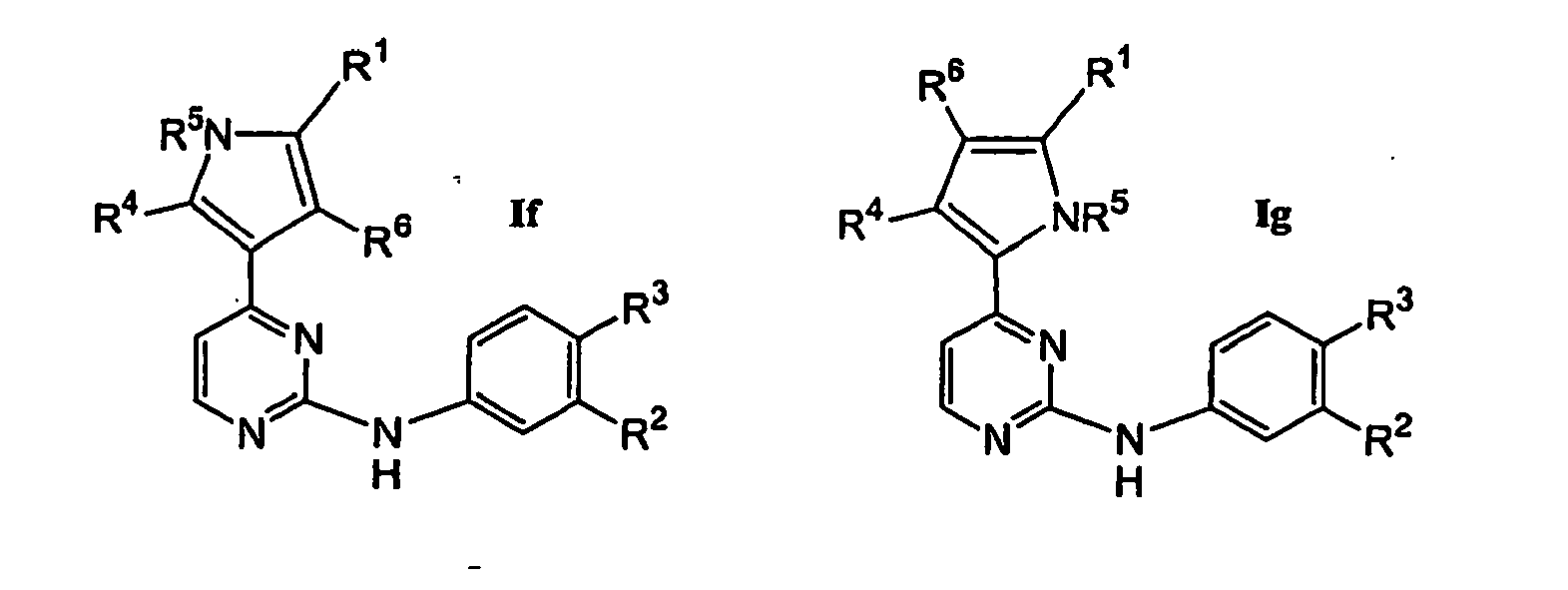

- For compounds of formula Ia, in a first preferred embodiment, X is N and Y is S; or X is NH or N-R5 and Y is C-R6.
- Preferably, for said first preferred embodiment:
- R1 is selected from CN, CONH2, NO2, halo, CH2N(alkyl)2, O-alkyl, NH2 and NH-alkyl;
- R2 is selected from NO2, H, OH, halo and alkyl;
- R3 is selected from H, halo, OH, CF3, alkyl, N(alkyl)2, O-alkyl, heterocycloalkyl and COO-alkyl;
- R4 is alkyl;
- R5 is H or alkyl; and
- R6 is alkyl.
- Even more preferably, for said first preferred embodiment:
- R1 is selected from CN, CONH2, NO2, Br, Cl, CH2NMe2, OMe, NH2 and NHMe;
- R2 is selected from NO2, H, OH, I, Me, F and Cl;
- R3 is selected from H, F, OH, CF3, I, Me, Cl, NMe2, OMe, morpholino and COOEt;
- R4 is Me;
- R5 is H or Me; and
- R6 is Me.
- For compounds of formula Ia, in a second preferred embodiment, X is NH or N-R5 and Y is C-R6.
- Preferably, in said second preferred embodiment,
- R1 is selected from CN, CONH2, NO2, halo and CH2N(alkyl)2;
- R2 is selected from NO2, H, OH, halo and alkyl;
- R3 is selected from H, halo, OH, CF3, alkyl and N(alkyl)2;
- R4 is alkyl;
- R5 is H or alkyl; and
- R6 is alkyl.
- Even more preferably, in said second preferred embodiment,
- R1 is selected from CN, CONH2, NO2, Br, Cl and CH2NMe2;
- R2 is selected from NO2, H, OH, I, Me and F;
- R3 is selected from H, F, OH, CF3, I, Me, Cl and NMe2;
- R4 is Me;
- R5 is H or Me; and
- R6 is Me.
- More preferably still, in said second preferred embodiment,
- R1 is CN or CONH2;
- R2 is NO2 or H; and
- R3 is F or Me.
- In a third preferred embodiment of the invention, X is N and Y is S.
- For said third preferred embodiment, preferably,
- R1 is selected from halo, NH2 and NH-alkyl;
- R2 is selected from NO2, H, OH, halo and alkyl;
- R3 is selected from H, halo, OH, alkyl, N(alkyl)2, O-alkyl, heterocycloalkyl and COO-alkyl.;
- R4 is alkyl.
- More preferably, in said third preferred embodiment,
- R1 is selected from Cl, NH2 and NHMe;
- R2 is selected from NO2, H, OH, Me and Cl; and
- R3 is selected from H, F, OH, Me, Cl, NMe2, OMe, morpholino and COOEt;
- R4 is Me.
- More preferably still, in said third preferred embodiment,
- R2 is H or NO2; and
- R3 is Cl or F.
- Another alternative preferred embodiment of the invention relates to the use of a compound of formula Ib, or a pharmaceutically acceptable salt thereof,

R2-5 are as defined above for formula I;
in the preparation of a medicament for treating diabetes. - In one particularly preferred embodiment, Y is S and X is NH or NR5.
- Preferably, for compounds of formula Ib:
- R2 is selected from H, OH, NO2 and alkyl;
- R3 is selected from H, halogen, alkoxy, alkyl, N-(alkyl)2 and OH; and
- R4 and R5 are-each independently alkyl.
- More preferably, for compounds of formula Ib:
- R2 is selected from H, OH, NO2 and Me;
- R3 is selected from H, Cl, F, OMe, Me, NMe2 and OH; and
- R4 and R5 are both Me.
- In one especially preferred embodiment of the invention, the compound of formula I is selected from compounds [1]-[26] and [28]-[39] listed below.
- Another aspect of the invention relates to the use of one or more of the following compounds in the preparation of a medicament for the treatment of a GSK-dependent disorder:
- 3,5-Dimethyl-4-[2-(3-nitro-phenylamino)-pyrimidin-4-yl]-1H-pyrrole-2-carbonitrile [1];
- 4-[2-(4-Fluoro-phenylamino)-pyrimidin-4-yl]-3,5-dimethyl-1H-pyrrole-2-carbonitrile [2];
- 4-[2-(4-Hydroxy-phenylamino)-pyrimidin-4-yl]-3,5-dimethyl-1H-pyrrole-2-carbonitrile [3];
- 3,5-Dimethyl-4-[2-(4-trifluoromethyl-phenylamino)-pyrimidin-4-yl]-1H-pyrrole-2-cathonitrile [4];
- 4-[2-(4-lodo-phenylamino)-pyrimidin-4-yl]-3,5-dimethyl-1H-pyrrole-2-carbonitrile [5];
- 4-[2-(3-Hydroxy-phenylamino)-pyrimidin-4-yl]-3,5-dimethyl-1H-pyrrole-2-carbonitrile [6];
- 3,5-Dimethyl-4-[2-(4-methyl-3-nitro-phenylamino)-pyrimidin-4-yl]-1H-pyrrole-2-carbonitrile [7];
- 4-[2-(3-Iodo-4-methyl-phenylamino)-pyrimidin-4-yl-3,5-dimethyl-1H pyrrole-2-carbonitrile [8];
- 4-[2-(4-Chloro-3-methyl-phenylamino)-pyrimidin-4-yl]-3,5-dimethyl-1H-pyrrole-2-carbonitrile [9];
- 4-[2-(3-Hydroxy-4-methyl-phenylamino)-pyrimidin-4-yl]-3,5-dimethyl-1H pyrrole-2-carbonitrile [10];
- 4-[2-(4-Fluoro-3-methyl-phenylamino)-pyrimidin-4-yl]-3,5-dimethyl-1H-pyrrole-2-carbonitrile [11];
- 4-[2-(4-Dimethylamino-phenylamino)-pyrimidin-4-yl]-3,5-dimethyl-1H- pyrrole-2-carbonitrile [12];
- 4-[2-(4-Fluoro-phenylamino)-pyrimidin-4-yl]-3,5-dimethyl-1H-pyrrole-2-carboxylic acid amide [13];
- [4-(2,4-Dimethyl-5-nitro-1H-pyrrol-3-yl)-pyrimidin-2-yl]-(4-fluoro-phenyl)-amine [14];
- N-[4-(2,4-Dimethyl-5-nitro-1H-pyrrol-3-yl)-pyrimidin-2-yl]-N',N'-dimethyl-benzene-1,4-diamine [15];
- [4-(5-Bromo-2,4-dimethyl-1H-pyrrol-3-yl)-pyrimidin-2-yl]-(4-fluoro-phenyl)-amine [16] ;
- [4-(5- Bromo-2,4-dimethyl-1H -pyrrol- 3-yl)-pyrimidin-2-yl]-(3 -nitro-phenyl)-amine [17];
- [4-(5-Chloro-2,4-dimethyl-1H-pyrrol-3-yl)-pyrimidin-2-yl]-(4-fluoro-phenyl)-amine [18];
- [4-(5-Dimethylaminomethyl-2,4-dimethyl-1H-pyrrol-3-yl)-pyrimidin-2-yl]-(4-fluorophenyl)-amine [19];
- 4-[2-(4-Dimethylamino-3-nitro-phenylamino)-pyrimidin-4-yl]-3,5-dimethyl-1H-pyrrole-2-carbonitrile [20];
- N4-[4-(2,4-Dimethyl-5-nitro-1H-pyrrol-3-yl)-pyrimidin-2-yl]-N1,N1-dimethyl-2-nitrobenzene-1,4-diamine [21];
- 4-[2-(3-Fluoro-4-methyl-phenylamino)-pyrimidin-4-yl]-3,5-dimethyl-1H-pyrrole-2-carbonitrile [22];
- 5-[2-(4-Chloro-phenylamino)-pyrimidin-4-yl]-3,4-dimethyl-3H-thiazol-2-one [23];
- 5-[2-(4-Methoxy-phenylamino)-pyrimidin-4-yl]-3,4-dimethyl-3H-thiazol-2-one [24];
- S-[2-(3-Hydroxy-phenylamino)-pyrimidin-4-yl]-3,4-dimethyl-3H-thiazol-2-one [25];
- 5-[2-(4- Dimethylamino-phenylamino )-pyrimidin-4-yl]-3,4-dimethyl-3H -thiazol-2-one [26];
- 5-[2-(4-Fluoro-3-nitro-phenylamino)-pyrimidin-4-yl]-3,4-dimethyl-3H-thiazol-2-one [28];
- 2-Chloro-4-[4-(4-methyl-2-methylatnino-thiazol-5-yl)-pyrimidin-2-ylamino]-benzoic acid ethyl ester [29];
- [4-(2-Amino-4-methyl-thiazol-5-yl)-pyrimidin-2-yl]-(3-nitro-phenyl)-amine [30];
- 3,4-Dimethyl-5-[2-(3-nitro-phenylamino)-pyrimidin-4-yl]-3H-thiazol-2-one [32];
- 5-[2-(4-Fluoro-phenylamino)-pyrimidin-4-yl]-3,4-dimethyl-3H-thiazol-2-one [33];
- 5-[2-(4-Hydroxy-phenylamino)-pyrimidin-4-yl]-3,4-dimethyl-3H-thiazol-2-one [34];
- [4-(2-Chloro-4-methyl-thiazol-5-yl)-pyrimidin-2-yl]-(3-nitro-phenyl)-amine [35];
- 3,4-Dimethyl-5-[2-(4-methyl-3-nit<o-phenylamino)-pyrimidin-4-yl]-3H-thiazol-2-one [36];
- 5-[2-(4-Fluoro-3-methyl-phenylamino)-pyrimidin-4-yl]-3,4-dimethyl-3H-thiazol-2-one [37];
- 4-[2-(4-Dimethylamino-phenylamino)-pyrimidin-4-yl]-1,3,5-trimethyl-1H-pyrrole-2-carbonitrile [38]; and
- 4-[2-(4-Diinethylamino-3-nitro-phenylamino)-pyrimidin-4-yl]-1,3,5-trimethyl-1H-pyrrole-2-carbonitrile [39].
- More preferably, said compound of formula I is selected from the following:
- 3,5-Dimethyl-4-[2-(3-nitro-phenylanvno)-pyrimidin-4-yl]-1H-pyrrole-2-carbonitrile [1];
- 4-[2-(4-Fluoro-phenylamino)-pyrimidin-4-yl]-3,5-dimethyl-1H-pyrrole-2-carbonitrile[2];
- 4-[2-(3-Hydroxy-phenylamino)-pyrimidin-4-yl]-3,5-dimethyl-1H-pyrrole-2-carbonitrile [6];
- 3,5-Dimethyl-4-[2-(4-methyl-3-nitro-phenylamino)-pyrimidin-4-yl]-1H-pyrrole-2-carbonitrile [7];
- 4-[2-(4-Fluoro-3-methyl-phenylainino)-pyrimidin-4.-yl]-3,5-dimethyl-1H pyrrole-2-carbonitrile [11];
- 4-[2-(4-Dimethylamino-phenylamino)-pyrimidin-4-yl]-3,5-dimethyl-1H-pyrrole-2-carbonitrile [12];
- 4-[2-(4-Fluoro-phenylamino)-pyrimidin-4-yl]-3,5-dimethyl-1H-pyrrole-2-carboxylic acid amide [13];
- 4-[2-(3-Fluoro-4-methyl-phenylamino)-pyrimidin-4-yl]-3,5-dimethyl-1H-pyrrole-2-carbonitrile [22];
- (4-Fluoro-phenyl)-[4-(2-methyl-4-phenyl-1H-pyrrol-3-yl)-pyrimidin-2-yl]-amine [27];
- 3,4-Dimethyl-5-[2-(3-nitro-phenylamino)-pyrimidin-4-yl]-3H-thiazol-2-one [32];
- 5-[2-(4-Hydroxy-phenylamino)-pyrimidin-4-yl]-3,4-dimethyl-3H-thiazol-2-one [34];
- 3,4-Dimethyl-5-[2-(4-methyl-3-nitro-phenylamino)-pyrinudin-4-yl]-3H-thiazol-2-one [36];
- S-[2-(4-Fluoro-3-methyl-phenylami.no)-pyrimidin-4-yl]-3,4-dimethyl-3H-thiazol-2-one [37];
- 4-[2-(4-Dimethylamino-phenylamino)-pynmidin-4-yl] - 1,3,5-trimethyl- 1H-pyrrole-2-carbonitrile [38]; and
- 4-[2-(4-Dimethylamino-3-nitro-phenylamino)-pyrimidin-4-yl]-1,3,5-trimethyl-1H-pyrrole-2-carbonitrile [39].
- Even more preferably, said compound of formula I is selected from the following:
- 3,5-Dimethyl-4-[2-(4-methyl-3-nitro-phenylamino)-pyiimidin-4-yl]-1H-pyrrole-2-carbonitrile [7];
- 4-[2-(4-Fluoro-phenylamino)-pyrimidin-4-yl]-3,5-dimethyl-1H-pyrrole-2-carboxylic acid amide [13];
- (4-Fluoro-phenyl)-[4-(2-methyl-4-phenyl-1H-pyrrol-3-yl)-pyrimidin-2-yl]-amine [27];
- 3,4-Dimethyl-5-[2-(3-nitro-phenylamino)-pyrimidin-4-yl]-3H-thiazol-2-one [32];
- 3,4-Dimethyl-5-[2-(4-methyl-3-nitro-phenylamino)-pyrimidin-4-yl]-3H-thiazol-2-one [36];
- 5-[2-(4-Fluoro-3-methyl-phenylamino)-pyrimidin-4-yl]-3,4-dimethyl-3H-thiazol-2-one [37];
- 4-[2-(4-Dimethylamino-phenylamino)-pyrimidin-4-yl]-1 ,3,5-trimethyl-1H -pyrrole-2-carbonitrile [38]; and
- 4-[2-(4-Dimethylamino-3-nitro-phenylamino)-pyrimidin-4-yl]-1,3,5-trimethyl-1H-pyrrole-2-carbonitrile [39].
- Most preferably, said compound of formula I is selected from the following:
- 4-[2-(4-Dimethylamino-3-nitro-phenylamino)-pyrimidin-4-yl]-3,5-dimethyl-1H-pyrrole-2-carbonitrile [20]; and
- N4-[4-(2,4-Dimethyl-5-nitro-1H-pyrrol-3-yl)-pyrimidin-2-yl]-N1,N1-dimethyl-2-nitrobenzene-1,4-diamine [21].
- In one particularly preferred embodiment of the invention, the compound of formula I is capable of inhibiting GSK3β. Preferably, said compound of formula I exhibits an IC50 value of less than 1 µM as measured by a GSK3β kinase assay. Details of a suitable GSK3β kinase assay-are described in the accompanying Examples section. Preferably, said compound is selected from [1]-[3], [6], [7], [10], [11], [13]-[15], [17], [20]-[23] and [25]-[29]. More preferably, said compound of formula I exhibits an IC50 value of less than 0.1 µM. More preferably, the compound is selected from [7], [13], [20], [21], [23], [25], [28], [32], [33], [34], [35], [36], [37] and [39]. Even more preferably, said compound of formula I exhibits an IC50 value less than 0.01 µM. Even more preferably, the compound is selected from [20], [28], [32] and [35]. More preferably still, said compound of formula I exhibits an IC50 value of less than 0.001 µM. More preferably still, the compound is selected from [32] and [35].
- In another preferred embodiment, the compound of formula exhibits selectivity for inhibiting GSK3β over CDKs, for example CDK2/E, as measured by the appropriate kinase assays. Preferably, the compound exhibits a selectivity, IC50 (CDK2/E)/(GSK3β), of 2 or more. Preferably, the compound is selected from [7], [13], [20]-[23], [25]-[28], [32], [33] and [35]-[39]. More preferably, the compound exhibits a selectivity, IC50 (CDK2/E)/(GSK3β), of 5 or more. More preferably, the compound is selected from [7], [20], [23], [27], [28], [32], [33], [35], [38] and [39]. More preferably still, the compound exhibits a selectivity, IC50 (CDK2/E)/(GSK3β), of 10 or more. More preferably still, the compound is selected from [7], [20], [23], [27], [28], [32] and [35].
- In another preferred embodiment, the compound of formula I is capable of inducing cellular glycogen synthase (GS) activity as measured by an appropriate assay. Preferably, the compound is selected from [1]-[3], [6], [7], [11]-[13], [20]-[22], [27], [32], [34] and [36]-[39]. More preferably, said compound exhibits a 3-fold or more increase in cellular GS activity over control samples. More preferably, the compound is selected from [1], [2], [6], [7], [21], [32], [36], [37] and [39].
- As used herein the phrase "preparation of a medicament" includes the use of compounds of formula I directly as the medicament in addition to their use in a screening programme for identifying further therapeutic agents or in any stage of the manufacture of such a medicament.
- The compounds of formula I have therapeutic applications in the treatment of diabetes,
- Experiments undertaken by the applicant have demonstrated that compounds of formula I are capable of inhibiting glycogen synthase kinase 3 (GSK3).
Glycogen synthase kinase 3 is a Ser/Thr protein kinase composed of two isoforms (α and β), which are highly homologous within the catalytic domain. For a recent review on GSK3 biology refer to Frame, S.; Cohen, P. Biochem. J., 2001, 359, 1. - It is known that some CDK inhibitors, including eg. hymenialdisine (Meijer, L.; Thunuissen, A.-M.W.H.; White, AW.; Garnier, M.; Nikolic, M.; Tsai, L.-H.; Waiter, J.; Cleverley, K.E.; Salinas. P.C.; Wu, Y.-Z.; Biernat, J.; Mandelkow, E.M.; Kim, S.-H.; Pettit, G.R Chem. Biol., 2000, 7, 51), paullones (Leost, M.; Schultz, C.; Link A.; Wu, Y.-Z.; Biemat, J.; Mandelkow, B. M; Bibb, J.A.; Snyder, G.L.; Greengaid, P.; Zaharevitz, D.W.; Gussio, R; Senderowicz, A.M.; Sausville. E.A.; Kunick, C.; Meijer, L. Eur. J. Biochem., 2000, 267, 5983), and indirubins (Leclerc, S.; Garnier, M.; Hoessel, R.; Marko, D.; Bibb, J.A..; Snyder, G.L.; Greengard, P.; Biernat, J.; Wu, Y.-Z.; Mandelkow, E.-M.; Eisenbrand, G.; Meijer, L. J. Biol. Chem., 2001, 276,251) also inhibit GSK3. On the other hand, other CDK inhibitor molecules that do not inhibit GSK3, e.g. roscovitine (Havlicek, L.; Hanus, J.; Vesely, J.; Leclerc, S.; Meijer, L.; Shaw, G.; Stmad, M. J. Med Chem., 1997, 40, 408) and other purine-based inhibitors (Chang, Y.T.; Gray, N.S.; Rosania, G.R.; Sutherlin, D.P.; Kwon, S.; Norman, T.C.; Sarohia, R.; Leost, M.; Meijer, L.; Schultz, P.G. Chem. Biol., 1999, 6, 361).
- One aspect of the invention relates to the use of compounds of formula I, or pharmaceutically accetable salts thereof, in the preparation of a medicament for treating diabetes.
- In a particularly preferred embodiment, the diabetes is type II diabetes.
- GSK3 is one of several protein kinases that phosphorylate glycogen synthase (GS). The stimulation of glycogen synthesis by insulin in skeletal muscle results from the dephosphorylation and activation of GS. The action of GSK3 on GS thus results in GS deactivation and thus suppression of the conversion of glucose into glycogen in muscles.
- Type II diabetes (non-insulin dependent diabetes mellitus) is a multi-factorial disease. Hyperglycaemia is due to insulin resistance in the liver, muscles, and other tissues, coupled with impaired secretion of insulin. Skeletal muscle is the main site for insulin-stimulated glucose uptake, there it is either removed from circulation or converted to glycogen. Muscle glycogen deposition is the main determinant in glucose homeostasis and type II diabetics have defective muscle glycogen storage. There is evidence that an increase in GSK3 activity is important in type II diabetes (Chen, Y.H.; Hansen, L.; Chen, M.X.; Bjorbaek, C.; Vestergaard, H.; Hansen, T.; Cohen, P.T.; Pedersen, O. Diabetes, 1994, 43, 1234). Furthermore, it has been demonstrated that GSK3 is over-expressed in muscle cells of type II diabetics and that an inverse correlation exists between skeletal muscle GSK3 activity and insulin action (Nikoulina, S.E.; Ciaraldi, T.P.; Mudaliar, S.; Mohideen, P.; Carter, L.; Henry, R.R. Diabetes, 2000, 49, 263).
- GSK3 inhibition is therefore of therapeutic significance in the treatment of diabetes, particularly type II, and diabetic neuropathy.
- A further aspect of the invention relates to a method of treating diabetes comprising inhibiting GSK3 by administering to a subject in need thereof, a therapeutically effective amount of a compound of formula I, or a pharmaceutically acceptable salt thereof, such that treatment of diabetes occurs.
- The compounds used in the present invention can be present as salts or esters, in particular pharmaceutically acceptable salts or esters.
- Pharmaceutically acceptable salts of the compounds of the invention (first and seconds aspects) include suitable acid addition or base salts thereof A review of suitable pharmaceutical salts may be found in Berge et al, J Pharm Sci, 66 1-19 (1977). Salts are formed, for example with strong inorganic acids such as mineral acids, e.g. sulphuric acid, phosphoric acid or hydrohalic acids; with strong organic carboxylic acids, such as alkanecarboxylic acids of 1 to 4 carbon atoms which are unsubstituted or substituted (e.g., by halogen), such as acetic acid; with saturated or unsaturated dicarboxylic acids, for example oxalic, malonic, succinic, maleic, fumaric, phthalic or tetraphthalic; with hydroxycarboxylic acids, for example ascorbic, glycolic, lactic, malic, tartaric or citric acid; with aminoacids, for example aspartic or glutamic acid; with benzoic acid; or with organic sulfonic acids, such as (C1-C4)-alkyl- or aryl-sulfonic acids which are unsubstituted or substituted (for example, by a halogen) such as methane- or p-toluene sulfonic acid.
- Esters are formed either using organic acids or alcohols/hydroxides, depending on the functional group being esterified. Organic acids include carboxylic acids, such as alkanecarboxylic acids of 1 to 12 carbon atoms which are unsubstituted or substituted (e.g., by halogen), such as acetic acid; with saturated or unsaturated dicarboxylic acid, for example oxalic, malonic, succinic, maleic, fumaric, phthalic or tetraphthalic; with hydroxycarboxylic acids, for example ascorbic, glycolic, lactic, malic, tartaric or citric acid; with aminoacids, for example aspartic or glutamic acid; with benzoic acid; or with organic sulfonic acids, such as (C1-C4)-alkyl- or aryl-sulfonic acids which are unsubstituted or substituted (for example, by a halogen) such as methane- or p-toluene sulfonic acid. Suitable hydroxides include inorganic hydroxides, such as sodium hydroxide, potassium hydroxide, calcium hydroxide, aluminium hydroxide. Alcohols include alkanealcohols of 1-12 carbon atoms which may be unsubstituted or substituted, e.g. by a halogen).
- In all aspects of the present invention previously discussed, the invention includes, where appropriate the use of all enantiomers and tautomers of compounds of formula I. The man skilled in the art will recognise compounds that possess an optical properties (one or more chiral carbon atoms) or tautomeric characteristics. The corresponding enantiomers and/or tautomers may be isolated/prepared by methods known in the art.
- The invention furthermore relates to the compounds of use in the present invention in their various crystalline forms, polymorphic forms and (an)hydrous forms. It is well established within the pharmaceutical industry that chemical compounds may be isolated in any of such forms by slightly varying the method of purification and or isolation form the solvents used in the synthetic preparation of such compounds.
- The invention further includes the compounds of use in the present invention in prodrug form. Such prodrugs are generally compounds of formula I wherein one or more appropriate groups have been modified such that the modification may be reversed upon administration to a human or mammalian subject. Such reversion is usually performed by an enzyme naturally present in such subject, though it is possible for a second agent to be administered together with such a prodrug in order to perform the reversion in vivo. Examples of such modifications include ester (for example, any of those described above), wherein the reversion may be carried out be an esterase etc. Other such systems will be well known to those skilled in the art.
- The present invention also encompasses the use of pharmaceutical compositions comprising the compounds of the invention. In this regard, and in particular for human therapy, even though the compounds of the present invention (including their pharmaceutically acceptable salts, esters and pharmaceutically acceptable solvates) can be administered alone, they will generally be administered in admixture with a pharmaceutical carrier, excipient or diluent selected with regard to the intended route of administration and standard pharmaceutical practice.
- Thus, the present invention also relates to the use of pharmaceutical compositions comprising one or more compounds of formula I or pharmaceutically acceptable salts or esters thereof, together with at least one pharmaceutically acceptable excipient, diluent or carrier.
- By way of example, in the pharmaceutical compositions of the present invention, the compounds of use in the invention may be admixed with any suitable binder(s), lubricant(s), suspending agent(s), coating agent(s), and/or solubilising agent(s). Examples of such suitable excipients for the various different forms of pharmaceutical compositions described herein may be found in the "Handbook of Pharmaceutical Excipients, 2nd Edition, (1994), Edited by A Wade and PJ Weller.
- The pharmaceutical compositions of the present invention may be adapted for oral, rectal, vaginal, parenteral, intramuscular, intraperitoneal, intraarterial, intrathecal, intrabronchial, subcutaneous, intradermal, intravenous, nasal, buccal or sublingual routes of administration.
- For oral administration, particular use is made of compressed tablets, pills, tablets, gellules, drops, and capsules. Preferably, these compositions contain from 1 to 250 mg and more preferably from 10-100 mg, of active ingredient per dose.
- Other forms of administration comprise solutions or emulsions which may be injected intravenously, intraarterially, intrathecally, subcutaneously, intradermally, intraperitoneally or intramuscularly, and which are prepared from sterile or sterilisable solutions. The pharmaceutical compositions of the present invention may also be in form of suppositories, pessaries, suspensions, emulsions, lotions, ointments, creams, gels, sprays, solutions or dusting powders.
- An alternative means of transdermal administration is by use of a skin patch. For example, the active ingredient can be incorporated into a cream consisting of an aqueous emulsion of polyethylene glycols or liquid paraffin. The active ingredient can also be incorporated, at a concentration of between 1 and 10% by weight, into an ointment consisting of a white wax or white soft paraffin base together with such stabilisers and preservatives as may be required.
- Injectable forms may contain between 10 - 1000 mg, preferably between 10 - 250 mg, of active ingredient per dose.
- Compositions may be formulated in unit dosage form, i.e., in the form of discrete portions containing a unit dose, or a multiple or sub-unit of a unit dose.
- A person of ordinary skill in the art can easily determine an appropriate dose of one of the instant compositions to administer to a subject without undue experimentation. Typically, a physician will determine the actual dosage which will be most suitable for an individual patient and it will vary with the age, weight and response of the particular patient. The dosages disclosed herein are exemplary of the average case. There can of course be individual instances where higher or lower dosage ranges are merited, and such are within the scope of this invention.
- In an exemplary embodiment, one or more doses of 10 to 150 mg/day will be administered to the patient for the treatment of a viral disorder.
- Preferably, said compound of formula I is administered in an amount sufficient to inhibit GSK3.
- Even more preferably, said compound of formula I is administered in an amount sufficient to inhibit GSK3β.
- In a particularly preferred embodiment, the one or more compounds of the invention are administered in combination with one or more other pharmacologically active agents. In such cases, the compounds of the invention may be administered consecutively, simultaneously or sequentially with the one or more other pharmacologically active agents.
- It is known in the art that many drugs are more effective when used in combination. In particular, combination therapy is desirable in order to avoid an overlap of major toxicities, mechanism of action and resistance mechanism(s). Furthermore, it is also desirable to administer most drugs at their maximum tolerated doses with minimum time intervals between such doses. The major advantages of combining drugs are that it may promote additive or possible synergistic effects through biochemical interactions and also may decrease the emergence of drug resistance which would have been otherwise responsive to initial treatment with a single agent.
- Beneficial combinations may be suggested by studying the pharmacological activity of the test compounds with agents known or suspected of being valuable in the treatment of a particular disorder. This procedure can also be used to determine the order of administration of the agents, i.e. before, simultaneously, or after delivery.
- The present invention is now described by way of example, and with reference to the accompanying figures, wherein:
-
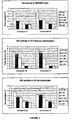
Figure 1 shows the activation of cellular glycogen synthase activity by example compounds [20] and [21] in HEK293 cells (top), 3T3 mouse adipocyte cells (middle) and L6 rat myocyte cells (bottom), as measured by the fractional reaction velocity of the enzyme (the ratio between the activity at 0.1 and 10 mM glucose-6 phosphate substrate concentrations). -
Figure 2 shows blood glucose levels (mmol/L) against time (minutes) for compound [20] in ZDF rats. - Table 1 shows the structures and chemical names of the exemplified compounds.
- Ethyl cyanoacetate (10 mL, 94 mmol) was diluted with AcOH (20 mL) and the solution was cooled to -10°C (ice-MeOH bath). NaNO2 (6.5 g, 94 mmol) was dissolved in H2O (10 mL) and the solution was added dropwise over a period of 40 min, keeping the internal temperature < 0° C. After completion of the addition, the reaction mixture was stirred for 1 h with cooling. It was then warmed to room temperature and stirred for a further 3 h. The mixture was diluted with AcOH (50 mL) and H2O (50 mL). Pentane-2,4-dione (10.6 mL, 103 mmol) was added and the mixture heated to~75°C. To this reaction mixture Zn powder (6.9 g, 105 mmol) was added in portions over a period of 30 min at such a rate as to maintain the internal temperature < 90°C. The reaction mixture was then heated for a further 30 min before pouring into H2O (1 L). From the reaction mixture title compound (3.67 g) was filtered as an off-white solid. The filtrate was extracted with EtOAc (3 x 500 mL). The combined organic extracts were washed (brine) and dried (MgSO4). The solvent was evaporated to a brown oil, which was purified by chromatography (100 g SiO2' eluted with 4:1 heptane / EtOAc) to afford a further crop (4.41 g) of this product as a pale yellow solid (total yield 72 %).
- 3,5-Dimethyl-1H pyrrole-2-carbonitrile (1.2 g, 10 mmol) was dissolved in
anhydrous 1,2-dichloroethane (15 mL) and AlCl3 (2.93 g, 22 mmol) was added in portions. The reaction vessel was purged with N2 and was cooled in an ice-water bath. AcCl (0.71 mL, 10 mmol) was added dropwise and the mixture was stirred for 1 h with cooling and for a further 3 h at room temperature. The reaction mixture was quenched by careful addition of 2 M aq HCl. The acidity of the mixture was adjusted to approximatelypH 6 by addition of NaHCO3. After separation of the organic phase, the aqueous phase was extracted with EtOAc (3 x 100mL). The combined organic phases were washed (H2O, then brine), dried (MgSO4), and filtered. The solvent was evaporated to afford the title compound (1.42 g, 88 %) as a pale tan solid. 1H-NMR (CDCl3) δ: 2.44 (s, 3H, CH3), 2.45 (s, 3H, CH3), 2.54 (s, 3H, CH3), 8.75 (br. s, 1H, NH). - 4-Acetyl-3,5-dimethyl-1H pyrrole-2-carbonitrile (1.38 g, 8.51 mmol) was suspended in 1,1-bis-dimethylamino-3,3-dimethyl-butan-2-one (1.3 mL) and heated at 75°C for 42 h. The reaction mixture was evaporated to dryness and the residue was purified by SiO2 chromatography (heptane / EtOAc) to afford the title compound (1.2 g, 65 %) as a pale tan solid.1H-NMR (DMSO-d6) δ: 2.21 (s, 3H, CH3), 2.31 (s, 3H, CH3), 3.32 (s, 6H, CH3), 5.22 (d, 1H, J=12.4 Hz, CH), 7.47 (d 1H, J= 12.4 Hz, CH), 11.96 (br. s, 1H, NH).
- To a mixture of 4-(3-dimethylamino-acryloyl)-3,5-dimethyl-1H-pyrrole-2-carbonitrile (1.0 mmol, 0.22 g) and 3-nitrophenyl guanidine nitrate (1.5 mmol, 0.36 g) in 2-methoxyethanol (5 mL) was added K2CO3 (138 mg, 1.0 mmol). The reaction mixture was heated at 120 °C under N2 for 18 h. The solvent was evaporated to dryness and the residue was purified by flash chromatography (1:2 EtOAc / heptane) to afford the title compound as a light-yellow solid. M.p. 258-259 °C. MS: [M+H]+ = 336.1 (C17H14N6O2 requires 334.3). 1H-NMR (CD3OD) δ: 2.39 (s, 3H, CH3), 2.49 (s, 3H, CH3), 6.94 (d, 1H, J= 5.1 Hz, pyrimidinyl-H), 7.50 (t, 1H, J = 8.3 Hz, Ph-H), 7.81 (m, 1H, Ph-H), 7.94 (m, 1H, Ph-H), 8.45 (d, 1H, J= 5.1 Hz, pyrimidinyl-H), 8.94 (t, 1H, J= 2.2 Hz, Ph-H).
- The following compounds were prepared in a manner analogous to that described above:
- MS: [M+H]+ = 307.7 (C17H14FN5 requires 307.3). 1H-NMR (DMSO-d6) δ: 2.30 (s, 3H, CH3), 2.40 (s, 3H, CH3), 6.84 (d, 1H, J = 5.0 Hz, pyrimidinyl -H), 7.00 (m, 2H, Ph-H), 7.73 (m, 2H, Ph-H), 8.40 (d, 1H, J=5.5Hz, pyrimidinyl -H), 9.46 (s, 1H, NH), 12.19 (br. s, 1H.NH).
- M.p. 272-276 °C. MS: [M+H]+ =305.8 (C17H15N5O requires 305.3).1H-NMR (CD3OD) δ: 2.33 (s, 3H, CH3), 2.41 (s, 3H, CH3), 6.74-6.56 (m, 3H, pyrimidinyl-H/Ph-H), 7.36 (d, 2H, J= 8.5 Hz, Ph-H), 8.25 (d, 1H, J= 5.4 Hz, pyrimidinyl-H).
- M.p. 195.6-198.9 °C. MS: [M+H]+ = 357.7 (C18H14F3N5 requires 357.3). 1H-NMR (CDCl3)δ: 2.33 (s, 3H, CH3), 2.44 (s, 3H, CH3), 6.75 (d, 1H, J= 5.1 Hz, pyrimidinyl-H, 7.20 (br. s, 1H, NH), 7.50 (d, 2H, J= 8.8 Hz, Ph-H), 7.71 (d, 2H, J= 8:8 Hz, Ph-H), 8.39 (d, 1H, J= 5.1 Hz, pyrimidinyl), 8.40 (br. s, 1H, NH).
- M.p. 178.3-181.2 °C. MS: [M+H]+ = 416.6 (C18H14IN5 requires 415.2). 1H-NMR (CDCl3) δ: 2.39 (s, 3H, CH3), 2.49 (s, 3H, CH3), 6.76 (d, 1H, J = 5.1 Hz, pyrimidinyl-H), 7.10 (br. s, 1H, NH), 7.44 (d, 2H, J= 8.8 Hz, Ph-H), 7.61 (d, 2H, J= 8.8 Hz, Ph-H), 8.42 (d, 1H, J= 5.1 Hz, pyrimidinyl-H), 8.45 (br. s, 1H, NH).
- M.p. 247-250 °C. MS: [M+H]+ =305.8 (C17H15N5O requires 305.3). 1H-NMR (DMSO-d6) δ: 2.31 (s, 3H, CH3), 2.41 (s, 3H, CH3), 6.33 (m, 1H, Ph-H), 6.82 (d, 1H, J = 5.1 Hz, pyrimidinyl-H), 7.01 (t, 1H, J = 8.1 Hz, Ph-H), 7.11 (m, 1H, Ph-H), 7.33 (t, 1H, J = 2.1 Hz, Ph-H), 8.40 (d, 1H, J= 5.4 Hz, pyrimidinyl-H), 9.18 (s, 1H), 9.30 (s, 1H), 12.20 (br. s, 1H, NH).
- M.p. 233-237 °C. MS: [M+H]+ = 350.0 (C18H16N6O2 requires 348.6). 1H-NMR (DMSO-d6) δ: 2.31 (s, 3H, CH3), 2.42 (s, 3H, CH3), 2.44 (s, 3H, CH3), 6.92 (d, 1H, J = 5.4 Hz, pyrimidinyl-H), 7.39 (d, 1H, J= 8.5 Hz, Ph-H), 7.87 (dd, 1H, J= 8.1, 1.7 Hz, Ph-H), 8.48 (d, 1H, J = 5.1 Hz, pyrimidinyl-H), 8.63 (d, 1H, J =1.7 Hz, Ph-H), 9.87 (s, 1H, NH), 12.21 (br. s, 1H, NH).
- M.p. 189.5-191.7 °C. MS: [M+H]+ = 431.5 (C18H16IN5 requires.429.6). 1H-NMR (DMSO-d6) δ: 2.29 (s, 3H, CH3), 2.32 (s, 3H, CH3), 2.43 (s, 3H, CH3), 6.85 (d, 1H, J= 5.1 Hz, pyrimidinyl-H), 7.20 (d, 1H, J = 8.1 Hz, Ph-H), 7.57 (m, 1H, Ph-H), 8.41-8.43 (m, 2H, Ph-H, pyrimidinyl-H), 9.48 (s, 1H, NH), 12.20-(br. s; 1H, NH).
- M.p. 194.2-197.9 °C. MS: [M+H]+= 338.0 (C18H16ClN5 requires 337.8). 1H-NMR (DMSO-d6) δ: 2.27 (s, 3H, CH3), 2.31 (s, 3H, CH3), 2.41 (s, 3H, CH3), 6.86 (d, 1H, J= 5.4 Hz, pyrimidinyl-H), 7.2 8 (d, 1H, J = 8.5 Hz, Ph-H), 7.61 (dd, 1H, J = 8.8, 2.4 Hz, Ph-H), 7.73 (d, 1H, J= 2.7 Hz, Ph-H), 8.43 (d, 1H, J= 5.1 Hz, pyrimidinyl-H), 9.51 (s, 1H, NH), 12.21 (br. s, 1H, NH).
- M.p. 221-225 °C. MS: [M+H]+ = 320.9 (C18H17N5O requires 319.4). 1H-NMR (DMSO-d6) δ: 2.03 (s, 3H, CH3), 2.29 (s, 3H, CH3), 2.40 (s, 3H, CH3), 6.78 (d, 1H, J = 5.1 Hz, pyrimidinyl-H), 6.89 (d, 1H, J= 8.1 Hz, Ph-H), 7.02 (dd, 1H, J= 8.3, 1.7Hz, Ph-H), 7.29 (d, 1H, J = 0.7 Hz, Ph-H), 8.37 (d, 1H, J= 4.9 Hz, pyrimidinyl-H), 9.08 (s, 1H), 9.20 (s, 1H), 12.17 (br. s, 1H, NH).
- M.p. 161.3-164.1 °C. MS: [M+H]+ = 321.6 (C18H16FN5 requires 321.4). 1H-NMR. (DMSO-d6) δ: 2.19 (s, 3H, CH3), 2.30 (s, 3H, CH3), 2.42 (s, 3H, CH3), 6.82 (d, 1H, J = 5.1 Hz, pyrimidinyl-H), 7.03 (t, 1H, J = 9.3 Hz, Ph-H), 7.53 (m, 1H, Ph-H), 7.61 (dd, 1H, J = 7.1, 2.4 Hz, Ph-H), 8.39 (d, 1H, J= 5.1 Hz, pyrimidinyl-H), 9.36 (s, 1H, NH), 12.20 (br. s, 1H, NH).
- M.p. 190.6-193.7 °C. MS: [M+H]+ = 334.7 (C19H20N6 requires 332.4). 1H-NMR (CDCl3) 8: 2.36 (s, 3H, CH3), 2.46 (s, 3H, CH3), 2.94 (br. s, 6H, CH3), 6.66 (d, 1H, J = 5.6 Hz, pyrimidinyl-H), 6.79-6.80 (m, 2H, Ph-H), 7.05 (br. s, 1H, NH), 7.40-7.43 (m, 2H, Ph-H), 8.34 (d, 1H, J = 5.1Hz, pyrimidinyl-H), 8.52 (br.s, 1H, NH).
- 1-(2,4-Dimethyl-1H pyrrol-3-yl)-ethanone (1.1 g, 10 mmol) was partially dissolved in a 2 M solution of NH3 in MeOH and H2O2 (10 mL of a 27 % w/w solution in H2O) was added dropwise over a period of 40 min at such a rate as to maintain the internal temperature ≤ 30 °C. The mixture was stirred for 18 h at room temperature. The resulting suspended white solid was filtered and recrystallised from EtOAc to afford 4-acetyl-3,5-dimethyl-1H-pyrrole-2-carboxylic acid amide (1.06 g). An aliquot (720 mg, 4 mmol) was suspended in 1,1-bis-dimethylamino-3,3-dimethyl-butan-2-one (2 mL, 9.6mmol) in a N2-flushed flask and heated at 75°C for 48 h. The crude mixture was cooled and purified by SiO2 chromatography (EtOAc / MeOH gradient elution). The title compound (449 mg) was obtained as a buff solid. 1H-NMR (DMSO-d6) δ: 2.30 (s, 3H, CH3), 2.46 (s, 3H, CH3), 2.90 (br. s, 2H, NH). 3.09 (s, 3H, CH3), 3.13 (s, 3H, CH3), 5.23 (d, 1H, J = 12.4 Hz, CH), 7.38 (d, 1H, J =12.7 Hz, CH), 10.97 (br. s, 1H, NH).
- 4-(3-Dimethylamino-acryloyl)-3,5-dimethyl-1H-pyrrole-2-carboxylic acid amide (100 mg, 0.43 mmol), 4-fluorophenylguanidine nitrate (139 mg, 0.65 mmol) and K2CO3 (94 mg, 0.68 mmol) were partially dissolved in 2-methoxyethanol (5 mL) and heated at 120°C for 18 h. The mixture was concentrated in vacuo and purified by SiO2 chromatography (EtOAc / MeOH gradient elution). The crude product was triturated in iPr2O to afford the title compound (31 mg) as a buff solid. M.p. 93.5-96.8 °C. MS: [M+H+] = 326.9 (C17H16FN5O requires 325.3). 1H-NMR (DMSO-d6) δ: 2.36 (s, 3H, CH3), 2.39 (s, 3H, CH3), 6.79 (d, 1H, J = 5.4 Hz, pyrimidinyl-H), 6.92 (br. s, 2H, NH), 7.07 (t, 2H, J = 8.5 Hz, Ph-H), 7.76-7.78 (m, 2H, Ph-H), 8.36 (d, 1H, J= 5.4 Hz, pyrimidinyl-H) 9.41 (s, 1H, NH),11.24 (br. s, 1H, NH).
- HNO3 (0.28 mL of a 69 % w/v aq solution, 4.37 mmol) was added dropwise to Ac2O (5 mL) at room temperature, keeping the internal temperature ≤ 25 °C. The nitrating mixture was stirred at room temperature for 15 min before cooling to -40 °C. 1-(2,4-Dimethyl-1H-pyrrol-3-yl)-ethanone (500 mg, 3.64 mmol) was dissolved in Ac2O (6 mL) and added dropwise, keeping the internal temperature s -30 °C. The mixture was stirred at -40 °C for 30 min then at -10 °C for a further 30 min. The mixture was poured into ice-water (50 mL) and was extracted with Et2O (3 × 60 mL). The combined organic extracts were washed (brine), dried (Na2SO4), filtered, and evaporated in vacuo to give a dark brown solid. This was recrystallised from MeOH to afford 1-(2,4-dimethyl-5-nitro-1H-pyrrol-3-yl)-ethanone (158 mg). An aliquot (150 mg, 0.82 mmol) was suspended in 1,1-bis-dimethylamino-3,3-dimethyl-butan-2-one (0.42 mL, 2.02 mmol) in a N2-flushed flask and was heated at 70 °C for 18 h. The mixture was triturated in EtOAc to afford the title compound (119 mg) as a brown solid. 1H-NMR (DMSO-d6) δ: 2.30 (s, 3H, CH3), 2.40 (s, 3H, CH3), 2.80 (br. s, 3H, CH3), 3.07 (br. s, 3H, CH3), 5.19 (d, 1H, J=12.7 Hz, CH), 7.45 (d, 1H, J=12.4 Hz, CH), 12.76 (br, 1H, NH).
- 3-Dimethylamino-1-(2,4-dimethyl-5-nitro-1H-pyrrol-3-yl)-propenone (110 mg, 0.46 mmol), 4-fluorophenyl guanidine nitrate (150 mg, 0.7 mmol), and K2CO3 (193 mg, 1.4 mmol) were partially dissolved in 2-methoxyethanol and heated at 120 °C for 18 h. The mixture was concentrated in vacuo and purified by SiO2 chromatography (heptane l EtOAc gradient elution). The crude product was triturated in iPr2O to afford the title compound (22 mg) as a pale orange solid. M.p. 166.3-170.1 °C. MS: [M+H]+ = 329.3 (C16H14FN5O2 requires 327.3). 1H-NMR (DMSO-d6) δ: 2.49 (s, 3H, CH3), 2.59 (s, 3H, CH3), 6.73 (d, 1H, J= 5.1 Hz, pyrimidinyl-H), 7.04 (t, 2H, J= 8.8 Hz, Ph-H), 7.07 (br. s, 1H, NH), 7.55-7.58 (m, 2H, Ph-H), 8.44 (d, 1H, J= 5.1 Hz, pyrimidinyl-H), 9.40 (br. s, 1H, NH).
- The following compound was prepared in analogous manner:
- M.p. 265-268 °C. MS: [M+H]+ = 353.0 (C18H20N6O2 requires 352.4). 1H-NMR (DMSO-d6) δ: 2.39 (s, 3H, CH3), 2.48 (br. s, 6H, CH3), 2.82 (s, 3H, CH3), 6.69 (d, 2H, J= 9.0 Hz, Ph-H), 6.74 (d, 1H, J= 5.1 Hz, pyrimidinyl-H), 7.50 (d, 2H, J= 9.0 Hz, Ph-H), 8.38 (d, 1H, J = 5.1 Hz, pyrimidinyl-H), 9.18 (s, 1H, NH), 13.00 (br. s, 1H, NH).
- [4-(2,4-Dimethyl-1H-pyrrol-3-yl)-pyrimidin-2-yl]-(4-fluoro-phenyl)-amine (80 mg, 0.28 mmol) was dissolved in THF (4 mL) and cooled to -50 °C. N Bromosuccinimide (55 mg, 0.31 mmol) was dissolved in THF (2 mL) and added dropwise, keeping the internal temperature ≤ -40 °C. The mixture was stirred for 1h with cooling then evaporated in vacuo. The residue was treated with H2O (10 mL) and extracted with EtOAc (3 x 10mL). The combined organic extracts were washed (brine), dried (MgSO4), filtered, and evaporated in vacuo. The crude product was purified by SiO2 chromatography heptane / EtOAc gradient elution) to afford the title compound (19 mg) as an orange solid after recrystallisation from iPr2O. M.p. 181.4-183.3 °C. MS: [M+H]+ = 362.9 (C16H14BrFN4 requires 361.2).1H-NMR (CDCl3) δ: 2.10 (s, 3H, CH3), 2.36 (s, 3H, CH3) 6.56 (d, 1H, J= 5.1 Hz, pyrimidinyl-H), 6.97 (t, 2H, J= 8.3Hz, Ph-H), 7.00 (br. s, 1H, NH), 7.79-7.52 (m, 2H, Ph-H), 8.85 (br. s, 1H, NH), 8.26 (d, 1H, J= 5.1 Hz, pyrimidinyl-H).
- The following compound was prepared in analogous manner:
- M.p. 198.1-203 °C. MS: [M+H]+ =389.3 (C16H14BrN5O4 requires 361.2). 1H-NMR (CDCl3) δ: 2.49 (s, 3H, CH3), 2.59 (s, 3H, CH3) 6.73 (d, 1H, J= 5.1 Hz, pyrimidinyl-H), 7.04 (t, 2H, J= 8.8 Hz, Ph-H), 7.57 (m, 2H, Ph-H), 7.90 (br. s, 1H, NH), 8.44 (d, 1H, J= 5.1 Hz, pyrimidinyl-H), 9.40 (br. s, 1H, NH).
- [4-(2,4-Dimethyl-1H-pyrrol-3-yl)-pyrimidin-2-yl]-(4-fluoro-phenyl)-amine (80 mg, 0.28 mmol) was dissolved in THF (4 mL) and cooled to -60 °C. N-Chlorosuccinimide (41 mg, 0.31 mmol) was dissolved in THF (2 mL) and added dropwise, keeping the internal temperature ≤ -50 °C. The mixture was stirred for 30min with cooling then evaporated in vacuo. The residue was treated with H2O (10 mL) and extracted with EtOAc (3 x 10 mL). The combined organic extracts were washed (brine), dried (MgSO4), filtered, and evaporated in vacuo. The crude product was purified by SiO2 chromatography (heptane / EtOAc gradient elution) to afford the title compound (37 mg) as an orange solid after recrystallisation from iPr2O. M.p. 200-203 °C. MS: [M+H]+ = 317.7 (C16H14CIFN4 requires 316.8). 1H-NMR (CDCl3) δ:2.17 (s, 3H, CH3), 2.42 (s, 3H, CH3) 6.77 (d, 1H, J = 5.9 Hz, pyrinudinyl-H), 7.02-7.06 (m, 3H, Ph-h, NH), 7.54-7.56 (m, 2H, Ph-H), 7.95 (br. s, 1H, NH), 8.25 (d, 1H, J= 5.4 Hz, pyrimidinyl-H).
- Dimethylamine (40 µL, 0.31 mmol) was diluted with methanol (0.5 mL) and formaldehyde (30 µL of a 37 % w/w aq solution, 0.37 mmol) was added. [4-(2,4-Dimethyl-1H-pyrrol-3-yl)-pyrimidin-2-yl]-(4-fluoro-phenyl)-amine (87 mg, 0.31 mmol) was added in small portions and the mixture was heated to reflux. After 1.5 h the mixture was diluted with H2O (10 mL). The resulting precipitate was filtered and triturated in 2 M aq HCl. The mixture was filtered and the filtrate was washed with 2 M aq NaOH. The filtrate was extracted with EtOAc (3 × 15 mL). The combined organic extracts were washed (brine), dried (MgSO4), filtered, and evaporated in vacuo. The crude product was purified by SiO2 chromatography (heptane / EtOAc gradient elution) to afford the title compound (36 mg) as an orange solid after recrystallisation from iPr2O. M.p. 88.4-91.6 °C. MS: [M+H]+= 340.6 (C19H22FN5 requires 339.4).1H-NMR (CDCl3) δ: 2.18 (s, 3H, CH3), 2.56 (s, 6H, CH3), 2.42 (s, 3H, CH3), 3.38 (s, 2H, CH2), 6.75 (d, 1H, J= 5.4 Hz, pyrimidinyl-H), 7.00 (t, 2H, J= 8.6 Hz, Ph-H), 7.13 (br. s, 1H, NH), 7.56-7.59 (m, 2H, Ph-H), 8.31 (d, 1H, J= 5.1 Hz, pyrimidinyl-H), 8.55 (br. s, 1H, NH).
- This was obtained by reaction of 4-(3-dimethylamino-acryloyl)-3,5-dimethyl-1H- pyrrole-2-carbonitrile and N (4-dimethylamino-3-nitro-phenyl)-guanidine nitrate. The crude product was recrystallised from PhMe (21 %) as a yellow solid. 1H NMR (CD3OD) δ: 2.38 (s, 3H, CH3), 2.51 (s, 3H, CH3), 2.86 (s, 6H, CH3), 6.76 (d, 1H, J = 5.1 Hz, pyrimidinyl-H), 7.02 (s, 1H, Ph-H), 7.04 (m, 1H, Ph-H), 7.49 (m, 1H, Ph-H), 8.29 (d, 1H, J = 2.7Hz, Ph-H), 8.40 (d, 1H, J = 5.4 Hz, pyrimidinyl-H), 8.94 (t, 1H, J = 2.2 Hz, Ph-H). MS m/z 378.71 (M+H)+ (C19H19N7O2 requires 377.40).
- This was prepared by reaction of 3-dimethylamino-1-(2,4-dimethyl-5-nitro-1H-pyrrol-3-yl)-propenone and N-(4-dimethylamino-3-nitro-phenyl)-guanidine nitrate. 1H-NMR (CDCl3) δ: 2.52 (s, 3H, CH3), 2.59 (s, 3H, CH3), 2.87 (s, 6H, CH3), 6.76 (d, 1H, J = 5.1 Hz, pyrimidinyl-H), 7.05 (m, 2H, Ph-H & NH), 7.48 (m, 1H, Ph-H), 8.32 (br. s, 1H, Ph-H), 8.44 (d, 1H, J = 5.1 Hz, pyrimidinyl-H).
- This compounds was prepared according to the general methods described in Example 1. M.p. 177.7-179.9 °C. MS: [M+H]+ = 322.5 (C18H16FN5 requires 321.3). 1H-NMR (DMSO-d6) δ: 2.15 (s, 3H, CH3), 2.30 (s, 3H, CH3), 2.43 (s, 3H, CH3), 6.86 (d, 1H, J = 5.1 Hz, pyrimidinyl-H), 7.13 (t, 1H, J= 9.0 Hz, Ph-H), 7.36 (dd, 1H, J= 8.1, 1.7 Hz, Ph-H), 7.75 (dd, 1H, J= 12.9, 1.5 Fiz, Ph-H), 8.43 (d, 1H, J = 5.4Hz, pyrimidinyl-H), 9.56 (s, 1H, NH), 12.21 (br. s, 1H, NH).
- To an ice-cooled solution of potassium thiocyanate (5.67 g, 58 mmol) in Me-2CO (45 mL) was added 3-chloro-pentane-2,4-dione (6.95 mL, 58 mmol) dropwise. After completion of the addition the reaction mixture was warmed to room temperature and stirred for a further 6 h. The solvent was evaporated to dryness. The residue was dissolved in EtOH (30 mL) and HCl (conc. aq, 15 mL) was added. The mixture was heated to reflux for 14 h. It was concentrated and the precipitate was collected, washed with cold MeOH and then Et2O to afford 9.1 g of a pale solid. This compound was treated with N,N- dimethylformamide dimethylacetal (13 mL) at 100 -110 °C for 8 h. The reaction mixture was concentrated and the residue was purified by SiO2 flash chromatography (EtOAc/PE) to afford 5-(3-dimethylamino-acryloyl)-3,4-dimethyl-3H-thiazol-2-one. 1H-NMR (CDCl3) δ: 2.50 (s, 3H, CH3), 3.07 (s, 3H, CH3), 3.21 (s, 6H, CH3), 5.09 (d, 1H, J= 12.0 Hz, CH), 7.59 (d, 1H, J= 12.0 Hz, CH).
- A solution of 5-(3-dimethylamino-acryloyl)-3,4-dimethyl-3H-thiazol-2-one (0.23 g, 1.0 mmol) in 2-methoxylethanol (3 mL) was treated with N-(4-hydroxy-phenyl)-guanidine nitrate (0.42 g, 2.0 mmol). After refluxing for 20 h the reaction mixture was concentrated and purified by SiO2 flash chromatography (EtOAc). Recrystallisation from EtOAc afforded the tilted compound (25 mg) as brown crystals. Anal. RP-HPLC: tR = 11.8 min (0 - 60 % MeCN in 0.1 % aq CF3COOH over 20 min, 1 mL/mi.n, purity > 95%). 1H-NMR (DMSO-d6) δ: 2.52 (s, 3H, CH3), 3.27 (s, 3H, CH3), 6.68 (d, 2H, J= 8.9 Hz, Ph-H), 6.81 (d, 1H, J= 5.5 Hz, pyrimidinyl-H), 7.44 (d, 2H, J= 8.9 Hz, Ph-H), 8.34 (d, 1H, J= 5.5 Hz, pyrimidinyl-H), 9.12 (br. s, 1H, OH/NH), 9.24 (br. s, 1H, NH/OH).
- The following compounds were prepared in a similar manner to the procedures described above:
- Light yellow solid; 1H-NMR (DMSO-d6) δ: 2.55 (s, 3H, CH3), 3.29 (s, 3H, CH3), 6.97 (d, 1H, J = 5.0 Hz, pyrimidinyl-H), 7.32 (d, 2H, J = 8.5 Hz, Ph-H), 7.76 (d, 2H, J = 9.0 Hz, Ph-H), 8.44 (d, 1H, J= 5.0 Hz, pyrimidinyl-H), 9.75 (br. s, 1H, NH).
- Light yellow solid; 1H-NMR (DMSO-d6) δ: 2.54 (s, 3H, CH3), 3.28 (s, 3H, CH3), 3.71 (s, 3H, CH3), 6.86 (m, 3H, pyrimidinyl-H & Ph-H), 7.59 (d, 2H, J= 9.0 Hz, Ph-H), 8.37 (d, 1H, J = 5.0 Hz, pyrimidinyl-H), 9.39 (br. s, 1H, NH).
- Light yellow solid; anal. RP-HPLC: t R = 15.4 min (0 - 60 % MeCN in 0.1 % aq VF3COOH over 20 min, 1 mL/min, purity > 95 %). 1H-NMR (DMSO-d6) δ: 2.55 (s, 3H, CH3), 3.26 (s, 3H, CH3), 6.36 (m, 1H, Ph-H), 6.90 (d, 1H, J= 5.5 Hz, pyrimidinyl-H), 7.03 (t, 1H, J= 8.5 Hz, Ph-H), 7.16 (m, 1H, Ph-H), 7.22 (s, 1H, Ph-H), 8.40 (d, 1H, J= 5.5 Hz, pyrimidinyl-H), 9.39 (br. s, 1H, NH).
- Yellow solid; anal. RP-HPLC: t R =19.6 min (0 - 60 % MeCN in 0.1 % aq CF3COOH over 20 min, 1 mL/min, purity > 95 %). 1H-NMR (DMSO-d6) δ. 2.83 (s, 3H, CH3), 2.90 (s, 6H, CH3), 3.08 (s, 3H, CH3), 6.73 (m, 2H, Ph-H), 6.81 (d, 1H, J= 5.5 Hz, pyrimidinyl-H), 7.03 (m, 1H, Ph-H), 7.50 (m, 1H, Ph-H), 8.32 (d, 1H, J= 5.5 Hz, pyrimidinyl-H), 9.24 (br. s, 1H, NH).
- Brown solid; 1H-NMR (DMSO-d6) δ: 2.42 (s, 3H, CH3), 2.81 (s, 3H, CH3), 6.36 (m, 1H, Ph-H), 6.91 (d, 1H, J = 5.5 Hz, pyrimidinyl-H), 7.31 (m, 1H, Ph-H), 8.33 (m, 1H, Ph-H), 8.48 (d, 1H, J= 5.5 Hz, pyrimidinyl-H), 8.52 & 9.68 (br. s, 1H, NH).
- Brown crystals. Anal. RP-HPLC: t R = 17.8 min (0 - 60 % MeCN in 0.1 % aq CF3COOH over 20 min, 1 mL/min, purity > 97%). 1H-NMR (DMSO-d6) δ: 2.42 (s, 3H, CH3), 3.16 (s, 3H, CH3), 6.92 (d, 1H, J= 5.0 Hz, pyrimidinyl-H), 7.42 (d, 1H, J= 8.0 Hz, Ph-H) 7.65 (m, 1H, Ph-H), 7.88 (m, 1H, Ph-H), 8.37 (d, 1H, J= 5.0Hz, pyrimidinyl-H), 8.72 (br. s, 1H, NH).
- Gray solid; 1H-NMR (DMSO-d 6 ) δ: 2.92 (s, 3H, CH3), 3.67 (s, 3H, CH3), 7.32 (d, 1H, J = 5.0 Hz, pyrimidinyl-H), 7.51 (m, 2H, Ph-H), 8.11 (m, 2H, Ph-H), 8.80 (d, 1H, J= 5.0 Hz, pyrimidinyl-H).
- Yellow solid; 1H-NMR (DMSO-d6) δ: 2.44 (s, 3H, CH3), 2.55 (s, 3H, CH3), 3.27 (s, 3H, CH3), 7.03 (d, 1H, J = 5.0 Hz, pyrimidinyl-H), 7.40 (t, 1H, J= 8.5 Hz, Ph-H), 7.84 (m, 1H, Ph-H), 8.48 (d, 1H, J= 5.0 Hz, pyrimidinyl-H), 8.59 (s, 1H, Ph-H), 9.99 (br. s, 1H, NH).
- Grey solid; 1H-NMR (DMSO-d6) δ: 2.21 (s, 3H, CH3), 2.55 (s, 3H, CH3), 3.26 (s, 3H, CH3), 6.92 (d, 1H, J= 5.0 Hz, pyrimidinyl-H), 7.04 (t, 1H, J= 9.0 Hz, Ph-H), 7.48 (m, 1H, Ph-H), 7.68 (m, 1H, Ph-H), 8.40 (d, 1H, J= 5.5 Hz, pyrimidinyl-H), 9.54 (br. s, 1H, NH).
- A solution of 2-chloro-4-phenylguanidino-benzoic acid (1.17g, 4.0 mmol) in absolute EtOH (4 mL) was treated with conc. H2SO4 (1 mL). After refluxing for 2 h the reaction mixture was cooled and poured into ice water (5 mL). This solution was treated with ammonia solution (1 mL). The resulting precipitates were collected and washed with Et2O to afford the title compound as an off white solid. 1H-NMR (DMSO-d6) δ: 1.31 (t, 3H, J = 7.1 Hz, CH3), 4.31 (m, 2H, CH2), 7.29 (m, 1H, Ph-H), 7.43 (s, 1H, Ph-H), 7.68 (br. s, 2H, NH2) and 7.85 (m, 1H, Ph-H).
- A mixture of 2-chloro-4-guanidino-benzoic acid ethyl ester (0.76 g, 3.0 mmol) and 3-Dimethylamino-1-(4-methyl-2-methylamino-thiazol-5-yl)-propenonc (0.43 g, 2.0 mmol) in 2-methoxylethanol (5 mL) was treated with NaOH 180 mg). After refluxing for 24 h the reaction mixture was concentrated. The resulting precipitates were collected and recrystallised from MeOH to afford the title compound (149 mg) as a gray solid. 1H-NMR (DMSO-d6) δ: 1.35 (t, 3H, J= 7.1 Hz, CH3), 4.36 (m, 2H, CH2), 6.94 (d, 1H, J= 5.5 Hz, pyrimidinyl-H), 7.41-7.51 (m, 2H, Ph-H), 7.90 (s, 1H, Ph-H), 9.36 (d, 1H, J = 5.5 Hz, pyrimidinyl-H) and 9.56 (br. s, 1H, NH).
- A mixture of thiourea (5.18 g, 0.068 mol) in dry MeOH (20 mL) was stirred and cooled on an ice bath. Pyridine (2 mL) was added, followed by 3-chloro-2,4-pentadione (9.15 g, 0.068 mol) dropwise. After completion of the addition the reaction mixture was allowed to warm to room temperature and stirring was continued for 4 h. The precipitates were filtered and washed with EtOAc to afford the title compound as a white solid.
- A solution of 1-(2-amino-4-methyl-thiazol-5-yl)-ethanone (3.35 g, 0.021 mol) in N,N-dimethylformamide dimethylacetal (10 mL) was refluxed under N2 for 4 - 6h. The reaction mixture was evaporated to dryness. EtOAc was added to the residue and the precipitates were collected by filtration and were washed with EtOAc/PE (5:1, v/v) to afford the title compound as an orange solid (50 - 79 %). 1H-NMR (CDCl3) δ: 2.64 (s, 3H, CH3), 3.08 (s, 6H, CH3), 3.11 (s, 6H, CH3), 5.35 (d, 1H, J= 12.2 Hz, CH), 7.67 (d, 1H, J= 12.2 Hz, CH), 8.23 (s, 1H, N=CH). DE MALDI-TOF MS: [M+H]+ = 267.49 (C12H18N6OS requires 266.36).
- A mixture of N-[5-(3-dimethylamino-acryloyl)-4-methyl-thiazol-2-yl] N,N dimethyl-formamidine (2.19 g, 8.2 mmol) and 3-nitrophenyl guanidine nitrate (2.00 g 8.2 mmol) in 2-methoxyethanol (10 mL) was treated with NaOH (0.33 g). After refluxing under N2 for 20 h the reaction mixture was concentrated and purified by silica-gel chromatography using EtOAc/PE (7:1) to elute the title compound as a light-yellow solid (1.95 g, 72 %), which was then recrystallised from EtOAc/MeOH. 1H-NMR (DMSO-d6) δ: 3.13 (s, 3H, CH3), 7.02 (d, 1H, J= 5.5 Hz, pyrimidinyl-H), 7.59 (m, 4H, Ph-H and NH2), 7.82 (m, 1H, Ph-H), 8.16 (m, 1H, Ph-H), 8.44 (d, 1H, J= 5.5 Hz, pyrimidinyl-H), 8.86 (br. s, 1H, NH).
- A solution of [4-(2-methoxy 4-methyl-thiazol-5-yl)-pyrimidin-2-yl]-(3-nitro-phenyl)-amine (0.71 g, 2.0 mmol) in CHCl3 (2 mL) and DMF (0.14 mL) was cooled on an ice bath and was treated with SOCl2 (1.5 mL). The reaction mixture was warmed to room temperature and then heated at reflux for 1.5 h. The reaction mixture was concentrated, poured into ice water (3 mL), and extracted with CH2Cl2. The organic phase was washed with brine, dried on MgSO4, and filtered. The solvent was evaporated and the residue was recrystallised from CH2Cl2 to afford the title compound (61 mg) as a light yellow solid. Anal. RP-HPLC: t R = 22.7 min (0 - 60 % MeCN in 0.1 % aq CF3COOH over 20 min, 1 mL/min, purity > 95 %). 1H-NMR (DMSO-d6) δ: 3.56 (s, 3H, CH3), 6.61 (d, 1H, J= 5.5 Hz, pyrimidinyl-H), 7.31 (t, 1H, J= 8.2 Hz, Ph-H), 7.54 (m, 1H, Ph-H), 7.81 (m, 1H, Ph-H) and 8.32 (m, 2H, pyrimidinyl-H and Ph-H).
- Chlorosulfonyl isocyanate (1.60 mL, 18.38 mmol) in acetonitrile (10 mL) was slowly added to a suspension of 1-(2,4-dimethyl-1H-pyrrol-3-yl)-ethanone (1.87 g, 13.63 mmol) in anhydrous acetonitrile (15 mL) and dimethylformamide (5.0 mL) at -5 °C. The reaction mixture was stirred for 2 h before allowing to warm to room temperature overnight. The reaction mixture was then extracted from ice/water (100 mL) into ethyl acetate (4 x 100 mL). The organics were combined, washed with brine, dried over anhydrous magnesium sulfate and concentrated to yield a light brown solid, which was re-crystallised from diethyl ether to afford the title compound (1.52 g, 72 %). 1H-NMR (d6 -DMSO) δ: 2.29 (3H, s, CH3), 2.34 (3H, s, CH3), 2.41 (3H, s, COCH3), 12.34 (1H, s, NH).
- A solution of 4-Acetyl-3,5-dimethyl-1H pyrrole-2-carbonitrile (0.567 g, 3.5 mmol) in tetrahydrofuran (5 mL) was added to a cooled (0 °C) slurry of sodium hydride (0.168 g, 7.0 mmol) in tetrahydrofuran (5mL): The reaction mixture was heated to 40°C and methyl iodide (350 µL, 5.25 mmol) was added and the reaction mixture stirred for 2 h. After cooling, the reaction was quenched with saturated aqueous sodium carbonate solution (50 mL) and extracted into ethyl acetate (3 x 50 mL) before drying over anhydrous magnesium sulfate to afford the title compound as a yellow oil (0.443 g, 72 %) after removal of solvent. 1H-NMR (d6 -DMSO) δ: 2.32 (3H, s, CH3), 2.37 (3H, s, CH3), 2.45 (3H, s; COCH3), 3.58 (3H, s, NCH3).
- 4-Acetyl-1,3,5-trimethyl-1H pyrrole-2-carbonitrile (0.352 g, 2 mmol) was taken up in tert-butoxybis(dimethylamino)methane (496 µL, 2.40 mmol) and heated at 75°C for 22 h. The reaction mixture was dissolved in methanol (10 mL) and concentrated to yield a dark coloured oil. After addition of diethyl ether (20 mL), the dark brown solid product (0.442 g, 95 %) was filtered off to afford the title compound. 1H NMR (d 6-DMSO) δ: 2.20 (3H, s, CH3), 2.32 (3H, s, CH3), 2.80 & 3.07 (6H, s, N(CH3)2), 3.54 (3H, s, NCH3), 5.17 (1H, d, C=CH, J= 12.5 Hz), 7.45 (1H, d, C=CH, J= 12.5 Hz) .
- 4-(3-Dimethylamino-acryloyl)-1,3,5-trimethyl-1H-pyrrole-2-carbonitrile (0.115 g, 0.5 mmol), N-(4-dimethylamino-phenyl)-guanidine nitrate (0.120 g, 0.5 mmol), and potassium carbonate (0.139 g, 1.0 mmol) were combined in 2-methoxyethanol (4 mL) and the mixture was heated at 115 °C for 22 h. After cooling, the inorganics were filtered off and the filtrate was concentrated to dryness. The crude product was purified by silica gel column chromatography to afford the title compound (53 mg, 31 %). 1H-NMR (d6-DMSO) δ 2.27 (3H, s, CH3), 2.42 (3H, s, CH3), 2.83 (6H, s, N(CH3)2), 3.63 (3H, s, NCH3), 6.68 (2H, d, ArH, J = 8.8 Hz), 6.71 (1H, d, ArH, J = 5.4 Hz), 7.51 (2H, d, ArH, J = 8.8 Hz), 8.35 (1H, d, ArH, J= 5.4 Hz), 9.11 (1H, s, NH). ESI-MS: m/z 347 (M++1).
- 4-(3-Dimethylamino-acryloyl)-1,3,5-trimethyl-1H-pyrrole-2-carbonitrile (0.115 g, 0.5 mmol), N-(4-dimethylamino-3-nitro-phenyl)-guanidine nitrate (0.143 g, 0.5 mmol), and potassium carbonate (0.139 g, 1.0 mmol) were combined in 2-methoxyethanol (4 mL) and the mixture was heated at 115 °C for 22 h. After cooling, the inorganics were filtered off and the filtrate was concentrated to dryness. The crude product was purified by silica gel column column to afford the title compound (76 mg, 39 %). 1H-NMR (d 6 -DMSO) δ: 2.29 (3H, s, CH3), 2.43 (3H, s, CH3), 2.74 (6H, s, N(CH3)2), 3.64 (3H, s, NCH3), 6.84 (1H, d, ArH, J = 4.9 Hz), 7.23 (1H, d, ArH, J= 8.8 Hz), 7.78 (1H, dd, ArH, J = 8.8, 2.9 Hz), 8.38 (1H, d, ArH, J = 2.9 Hz), 8.45 (1H, d, ArH, J = 4.9 Hz), 9.66 (1H, s, NH). ESI-MS: m/z 392 (M+ + 1).
- GSK-3 was obtained from New England Biolabs (UK) Ltd., Hitchin, Herts. The recombinant enzyme was isolated from a strain of E. coli that carries a clone expressing GSK-3β derived from a rabbit skeletal muscle cDNA library [Wang, Q.M.; Fiol, C.J.; DePaoli-Roach, A.A.; Roach, P.J. J. Biol. Chem., 1994, 269, 14566]. Inhibition of GSK-3 function was assessed by measurement of phosphorylation of CREB phosphopeptide KRREILSRRPphosphoSYR in the presence of test compounds. Using a 96-well assay format, GSK3 (7.5U) was incubated for 30 min at 30 °C in a total volume of 25 µL in 20 mM MOPS pH 7.2, 25 mM β-glycerophosphate, 5 mM EGTA, 1 mM DTT, 1 mM Na3VO3, 40 µM CREB peptide, 15 mM MgCl2 and 100 µM ATP (containing 0.25 µCi [γ-32P]-ATP) in the presence of varying concentrations of test compound. The samples were transferred to 96-well p81 filter plates (Whatman Polyfiltronics, Kent, UK), and the plates were washed 4 times with 200 µL/well of 75 mM aq orthophosphoric acid. Scintillation liquid (50 µL) was added to each well, and incorporated radioactivity for each sample was determined using a scintillation counter (TopCount, Packard Instruments, Pangbourne, Berks, UK).
- Compounds were investigated for their CDK2/cyclin E, CDK2/cyclin A, CDK1/cyclin B, and CDK4/cyclin D1 inhibitory activity. His6-tagged recombinant human cyclin-dependent kinases CDK1/cyclin B1, CDK2/cyclin E, CDK2/cyclin A, and CDK4 were expressed in sf9 insect cells using a baculovirus expression system. Recombinant cyclin D1 was expressed in E. coli. Proteins were purified by metal chelate affinity chromatography, to greater than 90 % homogeneity. Kinase assays were performed in 96-well plates using recombinant CDK/cyclins. Assays were performed in assay buffer (25 mM β-glycerophosphate, 20 mM MOPS, 5 mM EGTA, 1 mM DTT, 1 mM Na3VO3, pH 7.4), into which were added 2 - 4 µg of active enzyme with appropriate substrates (purified histone H1 for CDK1 and CDK2, recombinant GST-retinoblastoma protein (residues 773-928) for CDK4). The reaction was initiated by addition of Mg/ATP mix (15 mM MgCl2 + 100 µM ATP with 30-50 kBq per well of [γ-32P]-ATP) and mixtures incubated for 10 - 45 min, as required, at 30 °C. Reactions were stopped on ice, followed by filtration through p81 or GF/C filterplates (for CDK4) (Whatman Polyfiltronics, Kent, UK). After washing 3 times with 75 mM aq orthophosphoric acid, plates were dried, scintillant added and incorporated radioactivity measured in a scintillation counter (TopCount, Packard Instruments, Pangbourne, Berks, UK). Compounds for kinase assays. were made up as 10 mM stocks in DMSO and diluted into 10 % DMSO in assay buffer. Data was analysed using curve-fitting software (GraphPad Prism version 3.00 for Windows, GraphPad Software, San Diego California USA) to determine IC50 values (concentration of test compound which inhibits kinase activity by 50 %.).
- Rat skeletal muscle myoblasts L6/G8.C5 were seeded at 2.4 x 10⁵ cells per 10 cm dish in
DMEM 10 % foetal calf serum (FCS), containing penicillin/streptomycin. When 90 % confluence was reached the medium was exchanged with α MEM, supplemented with 2 % FCS and penicillin/streptomycin. Medium was refreshed every 48 hours and 4-7 days later the myocytes were formed. - Mouse pre-adipocytes 3T3-F442A were seeded at 9 x 10⁵ cells per 10 cm dish in
DMEM 10 % FCS, containing penicillin/streptomycin. When 90 % confluent, the same medium was supplemented with 1 µg/mL insulin. After 3-5 days (when most cells were differentiated) insulin was removed and 4 days later the cells were ready to use. - Cells on 10 cm dishes (Human Embryonic Kidney (HEK) 293 cells, L6 rat myocytes, or 3T3 mouse adipocytes) were treated with different concentrations of GSK3-inhibitors or DMSO vehicle for 90 min. Incubation medium was removed and cells were washed with ice-cold phosphate-buffered saline (PBS) prior to lysis on ice in 50 mM HEPES, pH 7.5, 10 mM EDTA, 100 mM NaF, 5 mM DTT, protease inhibitor cocktail (Sigma). After a freeze/thaw cycle the samples are sonicated for 10 sec and centrifuged at 15,000 g for 10 min at 4 °C. Lysate supernatants were snap-frozen on liquid nitrogen and stored at -80 °C. Lysates were assayed for glycogen synthase activity in buffer (50 mM Tris-HCI, pH 7.8, 20 mM EDTA, 25 mM NaF, 5 mM DTT, 1% glycogen, 0.3 mM UDP-glucose and 0.06 µCi of [14C]-UDP-glucose in the presence of 0.1 or 10 mM glucose-6-phosphate. The reaction was carried out for 30 min at 30°C. 70 µL of the reaction mixture (
total volume 90 µL) were transferred to a GFC 96-well filter plate (bottom sealed with foil), containing 140 µL 96 % ethanol. The GFC plate was incubated for 1 h on ice and than washed with 66 % ethanol. To each well 100 µL scintillant liquid was added and the radioactivity of the samples was measured using a scintillation counter (Topcount, HP). Data are expressed as -fold increase in glycogen synthase activity ratios over those of control samples. - The biological activity of the exemplified compounds are summarised in Table 2. Activation of cellular glycogen synthase activity by example compounds [20] and [21] is shown in
Figure 1 . - Compounds [20] and [21] increased the activity of glycogen synthase in HEK293, rat myocyte, and mouse adipocyte cells, measured by the fractional reaction velocity of the enzyme (the ratio between the activity at 0.1 and 10 mM glucose-6 phosphate substrate concentrations). Both compounds increased the activity of GS in a dose-dependent manner. At 1 µM both compounds induced 2- and 4-fold activation of GS in myocytes and adipocytes, respectively.
- For the OGTT male ZDF fa/fa rats (Charles River, USA), 10-11 weeks old, were used. After 15 h fasting the animals were dosed intravenously with 5 mg/kg test compound in dosing vehicle, or with dosing vehicle (10 % DMSO, 90 % PEG-400) only at -270 and-30 min. At 0 min the rats were given 2 g/kg glucose by oral gavage. Plasma samples were taken before and every 15 min after the OGTT for determination of blood glucose. The results are shown in
Figure 2 . - Compound [20] improved the glucose tolerance in ZDF rats significantly. Compound [20] decreased the reactive and absolute AUC by 39 and 22 %, respectively. Insulin levels also decreased after treatment with compound [20], suggesting that the glucose lowering effect is due to the improvement of the insulin resistance rather than increase of the insulin level. This confirms the proposed mechanism of action for GSK3 inhibitors.
- Various modifications and variations of the described methods of the invention will be apparent to those skilled in the art without departing from the scope and spirit of the invention. Although the invention has been described in connection with specific preferred embodiments, various modifications of the described modes for carrying out the invention which are obvious to those skilled in chemistry or related fields are intended to be within the scope of the following claims.
Table 1: Exemplified compounds Number Structure Name 1 
3,5-Dhnethyl-4-[2-(3-nitro-phenylamino)-pyrimidin-4-yl]-1H-pyrrole-2-carbonitrile 2 
4-[2-(4-Fluoro-phenylamino)-pyri.midin-4-yl]-3,5-dimethyl-1 H-pyrrole-2-carbonitrile 3 
4-[2-(4-Hydroxy-phenylamino)-pyrimidin-4-yl]-3,5-dimethyl-1H-pyrrole-2-carbonitrile 4 
3,5-Dimethyl-4-[2-(4-trifluoromethyl-phenylami.no)-pyrimidin-4-yl]-1H-pyrrole-2-carbonitrile 5 
4-[2-(4-Iodo-phenylamino)-pyrimidin-4-yl]-3,5-dimethyl-1H-pyrrole-2-carbonitrile 6 
4-[2-(3-Hydroxy-phenylamino)-pyrimidin-4-yl]-3,5-dimethyl-1H-pyrrole-2-carbonitrile 7 
3,5-Dimethyl-4-[2-(4-methyl-3-nitro-phenylamino)-pyrimidin-4-yl]-1H-pyrrole-2-carbonitrile 8 
4-[2-(3-Iodo-4-methyl-phenylamino)-pyrimidin-4-yl]-3,5-dimethyl-1H-pyrrole-2-carbonitrile 9 
4-[2-(4-Chloro-3-methyl-phenylamino)-pyrimidin-4-yl]-3,5-dimethyl-1H-pyrrole-2-carbonitrile 10 
4-[2-(3-Hydroxy-4-methyl-phenylamino)-pyrimidin-4-yl]-3,5-dimethyl-1 H-pyaole-2-carbonitrile 11 
4-[2-(4-Fluoro-3-methyl-phenylamino)-pyrimidin-4-yl]-3,5-dimethyl-1H-pyrrole-2-carbonitrile 12 
4-[2-(4-Dimethylamino-phenylamino)-pyrimidin-4- yl]-3,5-dimethyl-1H -pyrrole-2-carbonitrile 13 
4-[2-(4-Fluoro-phenylamino)-pyrimidin-4-yl]-3,5-dimethyl-1H-pyirole-2-carboxylic acid amide 14 
[4-(2,4-Ditnethyl-5 -nitro- 1H-pyzrol-3-yl)-pyrimidin-2-yl]-(4-fluoro-phenyl)-amine 15 
N-[4-(2,4-Dimethyl-5-nitro-1H-pyrrol-3-yl)-pyrimidin-2-yl]-N',N'-dimethyl-benzene-1,4-diamine 16 
[4-(5-Bromo-2,4-dimethyl-1H-pyrrol-3-yl)-pyrimidin-2-yl]-(4-fluoro-phenyl)-amine 17 
[4-(5-Bromo-2,4-dimethyl-1H-pyrrol-3-yl)-pyrimidin-2-yl]-(3-nitro-phenyl)-amine 18 
[4-(5-Chloro-2,4-dimethyl-1H-pyrrol-3-yl)-pyrimidin-2-yl]-(4-fluoro-phenyl)-amine 19 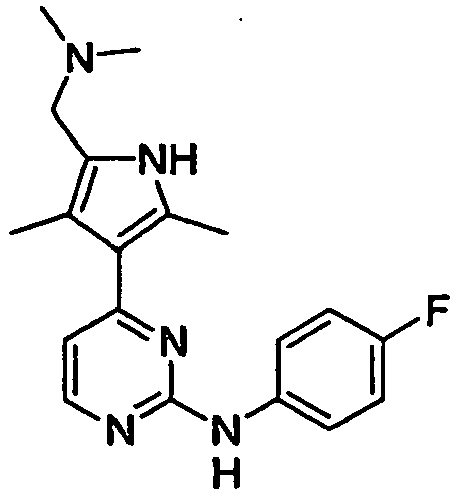
[4-(5-Dimethylammomethyl-2,4-dimethyl-1H-pyrrol-3-yl)-pyrimidin-2-yl]-(4-fluoro-phenyl)-amine 20 
4-[2-(4-Dimethylamino-3-nitro-phenylamino)-pyrimidin-4-yl]-3,5-dimethyl-1H-pyaole-2-carbonitrile 21 
N4-[4-(2,4-Dimethyl-5-nitro-1H-pyrrol-3-yl)-pyrimidin-2-yl]-N1,N1-dimethyl-2-nitro-ben zene-1,4-diamine 22 
4-[2-(3-Fluoro-4-methyl-phenylamino)-pyrimidin-4-yl]-3,5-dimethyl-1H-pyrrole-2-carbonitrile 23 
5-[2-(4-Chloro-phenylamino)-pyrimidin-4-yl]-3,4-dimethyl-3H-thiazol-2-one 24 
5-[2-(4-Methoxy-phenylamino)-pyrimidin-4-yl]-3,4-dimethyl-3H-thiazol-2-one 25 
5-[2-(3-Hydroxy-phenylamino)-pyrimidin-4-yl]-3,4-dimethyl-3H-thiazol-2-one 26 
5-[2-(4-Dimethylamino-phenylamino)-pyrimidin-4-yl]-3,4-dimethyl-3H-thiazol-2-one 27 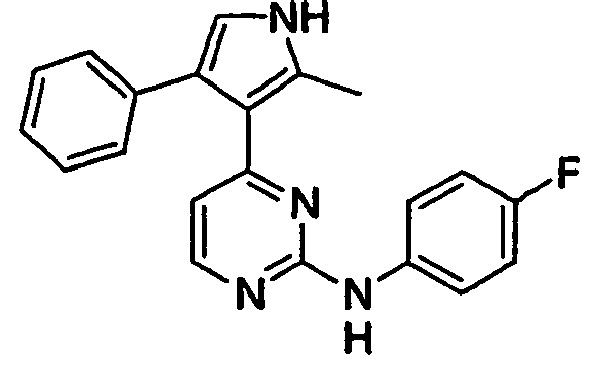
(4-Fluoro-phenyl)-[4-(2-methyl-4-phenyl-1H-pyrrol-3-yl)-pyrimidin-2-yl]-amine 28 
5-[2-(4-Fluoro-3-nitro-phenylamino)-pyrimidin-4-yl]-3,4-dimethyl-3H-thiazol-2-one 29 
2-Chloro-4-[4-(4-methyl-2-methylamino-thiazol-5-yl)-pynmidin-2-ylamino]-benzoic acid ethyl ester 30 
[4-(2-Amino-4-methyl-thiazol-5-yl)-pyrimidin-2-yl]-(3-nitro-phenyl)-amine 32 
3,4-Dimethyl-5-[2-(3-nitro-phenylamino)-pyrimidin-4-yl]-3H-thiazol-2-one 33 
5-[2-(4-Fluoro-phenylamino)-pyrimidin-4-yl]-3,4-dimethyl-3H-thiazol-2-one 34 
5-[2-(4-Hydroxy-phenylamino)-pyrimidin-4-yl]-3,4-dimethyl-3H-thiazol-2-one 35 
[4-(5-Chloro-2,4-dimethyl-1H-pyrrol-3-yl)-pyrimidin-2-yl]-(3-nitro-phenyl)-amine 36 
3,4-Dimethyl-5-[2-(4-methyl-3-nitro-phenylamino)-pyrimidin-4-yl]-3H-thiazol-2-one 37 
5-[2-(4-Fluoro-3-methyl-phenylamino)-pyrimidin-4-yl]-3,4-dimethyl-3H-thiazol-2-one 38 
4-[2-(4-Dimethylamino-phenylamino)-pyrimidin-4-yl]-1,3,5-timethyl-1H-pyrrole-2-carbonitrile 39 
4-[2-(4-Dimethylamino-3-nitro-phenylamino)-pyrimidin-4-yl]-1,3,5-trimethyl-1H-pyrrole-2-carbonitrile 

R1 is a group (CH2)n-R8, wherein n is 0, 1, 2, 3 or 4 and wherein R8 is selected from alkyl aryl, heteroaryl, heterocycloalkyl, F, Cl, Br, I, CF3, NO2, CN, OR, O-alkyl, O-aryl, O-heteroaryl, O-heterocycloalkyl, CO-alkyl, CO-aryl, CO-heteroaryl, CO-heterocycloalkyl, COO-akyl, NH2, NH-alkyl, NH-aryl, N(alkyl)2, NH-heteroaryl, NH-heterocycloalkyl, COOH, CONH2, CONH-alkyl, CON(alkyl)2, CONH-aryl, CONH-heteroaryl, CONH-heterocycloalkyl, SO3H, SO1-alkyl, SO2-aryl, SO2-heteroaryl, SO2-heterocycloalkyl, SO2NH2, SO2NH-alkyl, SO2N(alkyl)2; SO2NH-aryl, SO2NH heteroaryl, or SO2NH-heterocycloalkyl, wherein said alkyl, aryl, heteroaryl, and heterocycloalkyl groups are optionally substituted with one or more groups selected from halogeno, NO2, OH, O-methyl, NH2, COOH, CONH2 and CF3; in the preparation of a medicament for treating diabetes.
Claims (22)
- Use of a compound of formula I, or a pharmaceutically acceptable salt thereof,
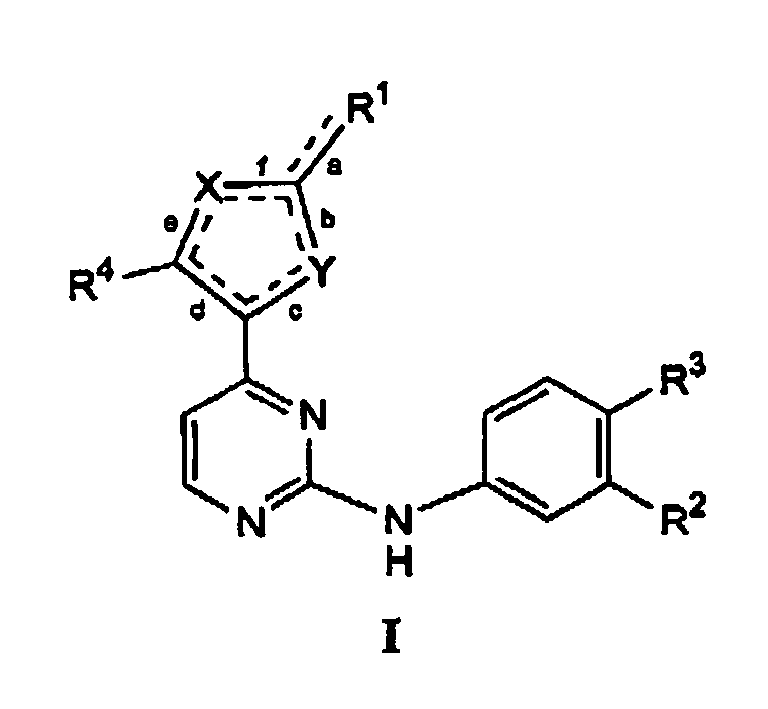 (A) one of X and Y is S, and the other is N; or
one of X and Y is NH or N-R5, and the other is C-R6;
"a" is a single bond;
"b", "c", "d", "e" and "f" are single or double bonds so as to form a heteroaryl ring;
R1 is R7 with the proviso that R1 is other than H or Me; or(B) one of X and Y is S, and the other is NH or N-R5;R2, R3, R4, R5, and R6 are each independently H or R7;
"a" and "d" are each double bonds;
"b", "c", "e" and "f" are each single bonds;
R1 is oxo; and
R7 is a group (CH2)n-R8, wherein n is 0,1,2, 3 or 4 and wherein R8 is selected from alkyl, aryl, heteroaryl, heterocycloalkyl, F, Cl, Br, I, CF3, NO2, CN, OH, O-alkyl, O-aryl, O-heteroaryl, O-hetcrocycloalkyl, CO-alkyl, CO-aryl, CO-heteroaryl, CO-heterocycloalkyl, COO-alkyl, NH2, NH-alkyl, NH-aryl, N(alkyl)2, NH-heteroaryl, NH-heterocycloalkyl, COOH, CONH2, CONH-alkyl, CON(alkyl)2, CONH-aryl, CONH-heteroaryl, CONH-heterocycloalkyl, SO3H, SO2-allcyl, SO2-aryl, SO2-heteroaryl, SO2-heterocycloalkyl, SO2NH2, SO2NH-alkyl, SO2N(alkyl)2, SO2NH-aryl, SO2NH-heteroaryl, or SO2NH-heterocycloalkyl, wherein said alkyl, aryl, heteroaryl, and heterocycloalkyl groups are optionally substituted with one or more groups selected from halogeno, NO2, OH, O-methyl, NH2, COOH, CONH2 and CF3;
in the preparation of a medicament for treating diabetes. - Use according to claim 1 wherein said compound is of formula Ia,

one of X and Y is N and the other is S; or
one of X and Y is NH or N-R5 and the other is C-R6;
R1 is R7 with the proviso that R1 is other than H or Me.
R1-7 are as defined in claim 1. - Use according to claim 2 wherein X is N and Y is S; or X is NH or N-R5 and Y is C-R6.
- Use according to claim 2 or claim 3 wherein:R1 is selected from CN, CONH2, NO2, halo, CH2N(alkyl)2, O-alkyl, NH2 and NH-alkyl;R2 is selected from NO2, H, OH, halo and alkyl;R3 is selected from H, halo, OH, CF3, alkyl, N(alkyl)2, O-alkyl, heterocycloalkyl and COO-alkyl;R4 is alkyl;R5 is H or alkyl; andR6 is alkyl.
- Use according to any one of claims 2 to 4 wherein:R1 is selected from CN, CONH2, NO2, Br, Cl, OMe, CH2NMe2, NH2 and NHMe;R2 is selected from NO2, H, OH, I, Me, F and Cl;R3 is selected from H, F, OH, CF3, I, Me, Cl, NMe2, OMe, morpholino and COOEt;R4 is Me;R5 is H or Me; andR6 is Me.
- Use according to any one of claims 2 to 5 wherein X is NH or N-R5 and Y is C-R6.
- Use according to claim 6 wherein:R1 is selected from CN, CONH2, NO2, halo and CH2N(alkyl)2;R2 is selected from NO2, H, OH, halo and alkyl;R3 is selected from H, halo, OH, CF3, alkyl and N(alkyl)2;R4 is alkyl;R5 is H or alkyl; andR6 is alkyl.
- Use according to claim 7 wherein:R1 is selected from CN, CONH2, NO2, Br, Cl and CH2NMe2;R2 is selected from NO2, H, OH, I, Me and F;R3 is selected from H, F, OH, CF3, I, Me, Cl and NMe2;R4 is Me;R5 is H or Me; andR6 is Me.
- Use according to claim 8 wherein:R1 is CN or CONH2;R2 is NO2 or H; andR3 is F or Me.
- Use according to any one of claims 2 to 5 wherein X is N and Y is S.
- Use according to claim 10 wherein:R1 is selected from halo, NH2 and NH-alkyl;R2 is selected from NO2, H, OH, halo and alkyl;R3 is selected from H, halo, OH, alkyl, N(alkyl)2, O-alkyl, heterocycloalkyl andCOO-alkyl; andR4 is alkyl.
- Use according to 11 wherein:R1 is selected from Cl, NH2 and NHMe;R2 is selected from NO2, H, OH, Me and Cl; andR3 is selected from H, F, OH, Me, Cl, NMe2, OMe, morpholino and COOEt; andR4 is methyl.
- Use according to claim 12 wherein:R2 is H or NO2; andR3 is Cl or F.
- Use according to claim 1 wherein said compound is of formula Ib

R2-5 are as defined in claim 1. - Use according to claim 14 wherein:R2 is selected from H, OH, NO2 and alkyl;R3 is selected from H, halogen, alkoxy, alkyl, N-(alkyl)2 and OH; andR4 and R5 are each independently alkyl.
- Use according to claim 15 wherein:R2 is selected from H, OH, NO2 and Me;R3 is selected from H, Cl, F, OMe, Me, NMe2 and OH; andR4 and R5 are both Me.
- Use according to any one of claims 1 to 16 wherein said compound of formula I is selected from the following:3,5-Dimethyl-4-[2-(3-nitro-phenylamino)-pyrimidin-4-yl]-1H-pyrrole-2-carbonitrile [1];4-[2-(4-Fluoro-phenylamino)-pyrimidin-4-yl]-3,5-dimethyl-1H-pyrrole-2-carbonitrile [2];4-[2-(4-Hydioxy-phenylanuno)-pyrinudin-4-yl]-3,5-dimethyl-1H-pyrrole-2-carbonitrile [3];3,5-Dimethyl-4-[2-(4-trifluoromethyl-phenylamino )-pyrimidin-4-yl]-1H-pyrrole-2-carbonilrile [4];4-[2-(4-Iodo-phenylamino)-pyrimidin-4-yl]-3,5-dimethyl-1H-pyrrole-2-carbonitrile [5];4-[2-(3-Hydroxy-phenylamino)-pyrimidin-4-yl]-3,5-dimethyl-1H-pyrrole-2-carbonitrile [6];3,5-Dimethyl-4-[2-(4-methyl-3-nitro-phenylamino)-pyrimidin-4-yl]-1H-pyrrole-2-carbonatrile [7];4-[2-(3-Iodo-4-methyl-phenylamino)-pyrimidin-4-yl]-3,5-dimethyl-1H-pyrrole-2-carbonitrile [8];4-[2-(4-Chloro-3-methyl-phenylamino)-pyrimidin-4-yl]-3,5-dimethyl-1H-pyrrole-2-carbonitrile [9];4-[2-(3-Hydroxy-4-methyl-phenylamino)-pyrimidin-4-yl]-3,5-dimethyl-1H-pyrrole-2-carbonitrile [10];4-[2-(4-Fluoro-3-methyl-phenylamino)-pyrimidin-4-yl]-3,5-dimethyl-1H- pyrrole-2-carbonitrile [11];4-[2-(4-Dimethylamino-phenylamino)-pyrimidin4-yl]-3,5-dimethyl-1H-pyrrole-2-carbonitrile [12];4-[2-(4-Fluoro-phenylaniino)-pyrimidin4-yl]-3,5-dimethyl-1H-pyrrole-2-carboxylic acid amide [13];[4-(2,4-Dimethyl-5-nitro-1H-pyrrol-3-yl)-pyrimidin-2-yl]-(4-fluoro-phenyl)-amine [14];N-[4-(2,4-Dimethyl-5-nitro-1H-pyrrol-3-yl)-pyrimidin-2-yl]-N',N'-dimethyl-benzene-1,4-diamine [15];[4-(5-Bromo-2,4-dimethyl-1H-pyrrol-3-yl)-pyrimidin-2-yl]-(4-fluoro-phenyl)-amine [16];[4-(5-Bromo-2,4-dimethyl-1H-pyrrol-3-yl)-pyrimidin-2-yl]-(3-nitro-phenyl)-amme [17];[4-(5-Chloro-2,4-dimethyl-1H-pyrrol-3-yl)-pyrimidin-2-yl]-(4-fluoro-phenyl)-amine [18];[4-(5-Dimethylanunomethyl-2,4-dimethyl-1H-pyrrol-1H-3-yl)-pyrimidin-2-yl]-(4-fluorophenyl)-amine [19];4-[2-(4-Dimethylamino-3-nitro-phenylamino)-pyrimidin-4-yl]-3,5-dimethyl-1H-pyrrole-2-carbonitrile [20];N4-[4-(2,4-Dimethyl-5-nitro-1H-pyrrol-3-yl)-pyrimidin-2-yl]-N1,N1-dimethyl-2-nitrobenzene- 1,4-diamine [21];4-[2-(3-Fluoro-4-methyl-phenylamino)-pyrimidin-4-yl]-3,5-dimethyl-1H-pyrrole-2-carbonitrile [22];5-[2-(4-Chloro-phenylamino)-pyrimidin-4-yl]-3,4-dimethyl-3H-thiazol-2-one [23];5-[2-(4-Methoxy-phenylamino)-pyrimidm-4-yl]-3,4-dimethyl-3H-thiazol-2-one [24];5-(2-(3-Hydroxy-phenylamino)-pyrimidin-4-yl]-3,4-dimethyl-3H-thiazol-2-one [25];5-[2-(4-Dimethylamino-phenylammo)-pyrimidin-4-yl]-3,4-dimethyl-3H-thiazol-2-one [26];5-[2-(4-Fluoro-3-nitro-phenylamino)-pyrimidin-4-yl]-3,4-dimethyl-3H-thiazol-2-one [28];2-Chloro-4-[4-(4-methyl-2-methylamino-thiazol-5-yl)-pyrimidin-2-ylamino]-benzoic acid ethyl ester [29];[4-(2-Amino-4-methyl-thiazol-5-yl)-pyrimidin-2-yl]-(3-nitro-phenyl)-amine [30];3,4-Dimethyl-5-[2-(3-nitro-phenylamino)-pyrimidin-4-yl]-3H-thiazol-2-one [32];5-(2-(4-Fluom-phenylamino)-pyrimidin-4-yl]-3,4-dimethyl-3H-thiazol-2-one [33];5-[2-(4-Hydroxy-phenylamino)-pyrimidin-4-y1]-3,4-dxmethyl-3H-thiazol-2-one [34];[4-(2-Chloro-4-methyl-thiazol-5-yl)-pyrimidm-2-yl]-(3-nitro-phenyl)-amine [35];3,4-Dimethyl-5-[2-(4-methyl-3-nitro-phenylamino)-pyrimidin-4-yl]-3H-thiazol-2-one [36];(4-Fluoro-3-methyl-phenyl)-[4-(2-methoxy-4-methyl-thiazol-5-yl)-pyrimidin-2-yl]-amine [37];4-[2-(4-Dimethylamino-phenylamino)-pyrimidin-4-yl]-1,3,5-trimethyl-1H-pyrrole-2-carbonitrile [38]; and4-[2-(4-Dimethylamino-3-nitro-phenylamino)-pyrimidin-4-yl]-1,3,5-trimethyl-1H-pyrrole-2-carbonitrile [39].
- Use according to claim 17 wherein said compound is selected from the following:3,5-Dimethyl-4-[2-(3-nitro-phenylamino)-pyrimidin-4-yl]-1H-pyrrole-2-carbonitrile [1];4-[2-(4-Fluoro-phenylamino)-pyrimidin-4-yl]-3,5-dimethyl-1H-pyrrole-2-carbonitrile [2];4-[2-(3-Hydroxy-phenylamino)-pyrimidin-4-yl]-3,5-dimethyl-1H-pynrole-2-carbonitnle [6];3,5-Dimethyl-4-[2-(4-methyl-3-nitro-phenylamino)-pyrimidin-4-yl]-1H-pyrrole-2-carbonitrile [7];4-[2-(4-Fluoro-3-methyl-phenylamino)-pyrimidin-4-yl]-3,5-dimethyl-1H-pyrrole-2-carbonitrile [11];4-[2-(4-Dimethylamino-phenylamino)-pyrimidin-4-yl]-3,5-dimethyl-1H-pyrrole- 2-carbonitrile [12];4-[2-(4-Fluoro-phenylmnino)-pyrimidin-4-yl]-3,5-dimethyl-1H-pyrrole-2-carboxylic acid amide [13];4-(2-(3-Fluoro-4-methyl-phenylamino)-pyrimidin-a-yl]-3,5-dimethyl-1H-pyrrole-2-carbonitrile [22];3,4-Dimethyl-5-(2-(3-nitro-phenylamino)-pyrimidin-4-yl]-3H-thiazol-2-one [32];3-p-(4-Hydroxy-phenylamino)-pyrimidin-4-yl]-3,4-dimethyl-3H-thiazol-2-one [34];3,4-Dimethyl-5-[2-(4-methyl-3-nitro-phenylamino)-pyrimidin-4-yl]-3H-thiazol-2-one [36];5-[2-(4-Fluoro-3-methyl-phenylammo)-pyrimidin-4-yl]-3,4-dimethyl-3H-thiazol-2-one [37];4-[2-(4-Dimethylamino-phenylamino)-pynmidin-4-yl]-1,3,5-trimethyl-1 H-pyrrole-2-carbonitrile [38]; and4-[2-(4-Dimethylamnno-3-nitro-phenylamino)-pyrimidin-4-yl]-1,3,5-trimethyl-1H-pyrrole-2-carbonitrile [39].
- Use according to claim 17 wherein said compound is selected from the following:3,5-Dimethyl-4-[2-(4-methyl-3-nitro-phenylamino)-pyrimidin-4-yl]-1H-pyrrole-2-carbonitrile [7];4-[2-(4-Fluoxo-phenylamino)-pyrimidin-4-yl]-3,5-dimethyl-1H-pytxole-2-caxboxylic acid amide [13];3,4-Dimethyl-5-(2-(3 -nitro-phenylamino)-pyrimidin-4-yl]-3H-thiazol-2-one [32];3,4-Dimethyl-5-[2-(4-methyl-3-nitro-phenylamino)-pyrimidin-4-yl]-3H-thiazol-2-one [36];5-[2-(4-Fluoro-3-methyl-phenylamino)-pyrimidin4-yl]-3,4-dimethyl-3H-thiazol-2-one [37];4-[2-(4-Dimethylamino-pheuylannino)-pyrimidin-4-yl]-1,3,5-trimethyl-1H-pyrrole-2-carbonitrile [38]; and4-[2-(4-Dimethylamino-3-nitro-phenylamino)-pyrimidin-4-yl]-1,3,5-tximethyl-1H-pyrrole-2-carbonitrile [39].
- Use according to any preceding claim wherein the diabetes is Type II diabetes.
- Use according to any preceding claim wherein said compound of formula I, or pharmaceutically acceptable salt thereof, is admixed with a pharmaceutically acceptable diluent, excipient or carrier.
- Use according to any preceding claim wherein said compound of formula I is administered in combination with one or more other active agents.
Applications Claiming Priority (3)
| Application Number | Priority Date | Filing Date | Title |
|---|---|---|---|
| GBGB0229581.4A GB0229581D0 (en) | 2002-12-19 | 2002-12-19 | Use |
| GB0229581 | 2002-12-19 | ||
| PCT/GB2003/005558 WO2004056368A1 (en) | 2002-12-19 | 2003-12-18 | Therapeutic applications of 2-substituted 4-heteroarylryrimidines |
Publications (2)
| Publication Number | Publication Date |
|---|---|
| EP1572211A1 EP1572211A1 (en) | 2005-09-14 |
| EP1572211B1 true EP1572211B1 (en) | 2008-02-20 |
Family
ID=9949983
Family Applications (1)
| Application Number | Title | Priority Date | Filing Date |
|---|---|---|---|
| EP03768023A Expired - Lifetime EP1572211B1 (en) | 2002-12-19 | 2003-12-18 | Therapeutic applications of 2-substituted 4-heteroarylpyrimidines |
Country Status (14)
| Country | Link |
|---|---|
| US (1) | US20050282843A1 (en) |
| EP (1) | EP1572211B1 (en) |
| JP (1) | JP2006515588A (en) |
| CN (1) | CN100425239C (en) |
| AT (1) | ATE386529T1 (en) |
| AU (1) | AU2003292444A1 (en) |
| BR (1) | BR0316703A (en) |
| CA (1) | CA2502138A1 (en) |
| DE (1) | DE60319269T2 (en) |
| ES (1) | ES2300617T3 (en) |
| GB (1) | GB0229581D0 (en) |
| MX (1) | MXPA05006515A (en) |
| NZ (1) | NZ539671A (en) |
| WO (1) | WO2004056368A1 (en) |
Families Citing this family (32)
| Publication number | Priority date | Publication date | Assignee | Title |
|---|---|---|---|---|
| GB0012528D0 (en) * | 2000-05-23 | 2000-07-12 | Univ Palackeho | Triterpenoid derivatives |
| GB0219052D0 (en) * | 2002-08-15 | 2002-09-25 | Cyclacel Ltd | New puring derivatives |
| GB0226583D0 (en) * | 2002-11-14 | 2002-12-18 | Cyclacel Ltd | Compounds |
| US7456190B2 (en) * | 2003-03-13 | 2008-11-25 | Vertex Pharmaceuticals Incorporated | Compositions useful as protein kinase inhibitors |
| KR100932169B1 (en) | 2003-06-06 | 2009-12-16 | 피브로겐, 인크. | Nitrogen-containing heteroaryl compounds and their use in the increase of endogenous erythropoiesis |
| CA2542880A1 (en) * | 2003-10-21 | 2005-05-12 | Cyclacel Limited | Pyrimidin-4-yl-3, 4-thione compounds and their use in therapy |
| GB0402653D0 (en) * | 2004-02-06 | 2004-03-10 | Cyclacel Ltd | Compounds |
| GB0411791D0 (en) * | 2004-05-26 | 2004-06-30 | Cyclacel Ltd | Compounds |
| PL1799230T3 (en) | 2004-08-27 | 2013-05-31 | Cyclacel Ltd | Purine and pyrimidine cdk inhibitors and their use for the treatment of autoimmune diseases |
| FR2881742B1 (en) * | 2005-02-10 | 2007-09-07 | Aventis Pharma Sa | SUBSTITUTED PYRROLES, COMPOSITIONS CONTAINING SAME, METHOD OF MANUFACTURE AND USE |
| EP2258359A3 (en) | 2005-08-26 | 2011-04-06 | Braincells, Inc. | Neurogenesis by muscarinic receptor modulation with sabcomelin |
| JP2009506069A (en) | 2005-08-26 | 2009-02-12 | ブレインセルス,インコーポレイティド | Neurogenesis through modulation of muscarinic receptors |
| US8492428B2 (en) | 2005-09-20 | 2013-07-23 | Mayo Foundation For Medical Education And Research | Small-molecule botulinum toxin inhibitors |
| DE102005048072A1 (en) * | 2005-09-24 | 2007-04-05 | Bayer Cropscience Ag | Thiazoles as fungicides |
| CN101321531A (en) * | 2005-10-03 | 2008-12-10 | 阿斯利康(瑞典)有限公司 | Use of pyrimidine derivatives in the preparation of medicines for preventing and/or treating Alzheimer's disease |
| AR058073A1 (en) * | 2005-10-03 | 2008-01-23 | Astrazeneca Ab | IMIDAZOL 5-IL-PYRIMIDINE DERIVATIVES, OBTAINING PROCESSES, PHARMACEUTICAL COMPOSITIONS AND USES |
| GB0520955D0 (en) * | 2005-10-14 | 2005-11-23 | Cyclacel Ltd | Compound |
| GB0520958D0 (en) * | 2005-10-14 | 2005-11-23 | Cyclacel Ltd | Compound |
| US7985756B2 (en) | 2005-10-21 | 2011-07-26 | Braincells Inc. | Modulation of neurogenesis by PDE inhibition |
| WO2007053596A1 (en) | 2005-10-31 | 2007-05-10 | Braincells, Inc. | Gaba receptor mediated modulation of neurogenesis |
| DE102006001161A1 (en) * | 2006-01-06 | 2007-07-12 | Qiagen Gmbh | Method for the detection of cytosine methylations |
| US20100216734A1 (en) | 2006-03-08 | 2010-08-26 | Braincells, Inc. | Modulation of neurogenesis by nootropic agents |
| WO2007134136A2 (en) | 2006-05-09 | 2007-11-22 | Braincells, Inc. | Neurogenesis by modulating angiotensin |
| US20100184806A1 (en) | 2006-09-19 | 2010-07-22 | Braincells, Inc. | Modulation of neurogenesis by ppar agents |
| GB0805477D0 (en) * | 2008-03-26 | 2008-04-30 | Univ Nottingham | Pyrimidines triazines and their use as pharmaceutical agents |
| HUE031580T2 (en) | 2008-08-15 | 2017-07-28 | Nivalis Therapeutics Inc | New pyrrole inhibitors of S-nitrosoglutathion reductase as therapeutic agents |
| DK2318007T3 (en) | 2008-08-15 | 2013-03-25 | N30 Pharmaceuticals Inc | Novel pyrrole inhibitors of s-nitrosoglutathione reductase as therapeutic agents |
| EP2315590B1 (en) | 2008-08-15 | 2012-09-26 | N30 Pharmaceuticals, LLC | Pyrrole inhibitors of s-nitrosoglutathione reductase |
| WO2010099217A1 (en) | 2009-02-25 | 2010-09-02 | Braincells, Inc. | Modulation of neurogenesis using d-cycloserine combinations |
| RU2011140238A (en) | 2009-04-15 | 2013-05-20 | Астразенека Аб | Imidazole-substituted pyrimidines useful in the treatment of diseases associated with kinase-3 glycogen synthase, such as Alzheimer's disease |
| US9340511B2 (en) * | 2012-07-16 | 2016-05-17 | Fibrogen, Inc. | Process for making isoquinoline compounds |
| WO2014199164A1 (en) * | 2013-06-12 | 2014-12-18 | Ampla Pharmaceuticals, Inc. | Diaryl substituted heteroaromatic compounds |
Family Cites Families (18)
| Publication number | Priority date | Publication date | Assignee | Title |
|---|---|---|---|---|
| ATE135699T1 (en) * | 1986-01-13 | 1996-04-15 | American Cyanamid Co | 4,5,6-SUBSTITUTED 2-PYRIMIDINAMINES |
| ES2160597T3 (en) * | 1992-03-06 | 2001-11-16 | Lica Pharmaceuticals As | TREATMENT AND PROPHYLAXIS OF DISEASES PRODUCED BY PARASITES OR BACTERIA. |
| GB9523675D0 (en) * | 1995-11-20 | 1996-01-24 | Celltech Therapeutics Ltd | Chemical compounds |
| US6417185B1 (en) * | 1998-06-19 | 2002-07-09 | Chiron Corporation | Inhibitors of glycogen synthase kinase 3 |
| AU2001242629B2 (en) * | 2000-03-29 | 2005-08-11 | Cyclacel Limited | 2-substituted 4-heteroaryl-pyrimidines and their use in the treatment of proliferative disorders |
| MY130778A (en) * | 2001-02-09 | 2007-07-31 | Vertex Pharma | Heterocyclic inhibitiors of erk2 and uses thereof |
| BR0207096A (en) * | 2001-02-20 | 2004-01-20 | Astrazeneca Ab | Use of a compound, compounds, pharmaceutical formulation, and method of treatment and / or prophylaxis of conditions associated with glycogen synthase kinase-3 inhibition |
| GB0107901D0 (en) * | 2001-03-29 | 2001-05-23 | Cyclacel Ltd | Anti-cancer compounds |
| CA2446756C (en) * | 2001-06-01 | 2011-03-08 | Vertex Pharmaceuticals Incorporated | Thiazole compounds useful as inhibitors of protein kinase |
| ATE349443T1 (en) * | 2001-09-28 | 2007-01-15 | Cyclacel Ltd | N-(4-(4-METHYLTHIAZOLE-5-YL)PYRIMIDINE-2-YL)-N-PHENYLAMINES AS ANTIPROLIFERATIVE COMPOUNDS |
| GB0226583D0 (en) * | 2002-11-14 | 2002-12-18 | Cyclacel Ltd | Compounds |
| GB0226582D0 (en) * | 2002-11-14 | 2002-12-18 | Cyclacel Ltd | Anti-viral compounds |
| GB0315966D0 (en) * | 2003-07-08 | 2003-08-13 | Cyclacel Ltd | Compounds |
| CA2533870A1 (en) * | 2003-07-30 | 2005-02-10 | Shudong Wang | Pyridinylamino-pyrimidine derivatives as protein kinase inhibitors |
| EP1648875A1 (en) * | 2003-07-30 | 2006-04-26 | Cyclacel Limited | 2-aminophenyl-4-phenylpyrimidines as kinase inhibitors |
| CA2542880A1 (en) * | 2003-10-21 | 2005-05-12 | Cyclacel Limited | Pyrimidin-4-yl-3, 4-thione compounds and their use in therapy |
| GB0328180D0 (en) * | 2003-12-04 | 2004-01-07 | Cyclacel Ltd | Combination |
| PL1799230T3 (en) * | 2004-08-27 | 2013-05-31 | Cyclacel Ltd | Purine and pyrimidine cdk inhibitors and their use for the treatment of autoimmune diseases |
-
2002
- 2002-12-19 GB GBGB0229581.4A patent/GB0229581D0/en not_active Ceased
-
2003
- 2003-12-18 NZ NZ539671A patent/NZ539671A/en unknown
- 2003-12-18 DE DE60319269T patent/DE60319269T2/en not_active Expired - Fee Related
- 2003-12-18 CA CA002502138A patent/CA2502138A1/en not_active Abandoned
- 2003-12-18 JP JP2004561646A patent/JP2006515588A/en active Pending
- 2003-12-18 AT AT03768023T patent/ATE386529T1/en not_active IP Right Cessation
- 2003-12-18 BR BR0316703-8A patent/BR0316703A/en not_active IP Right Cessation
- 2003-12-18 CN CNB2003801046977A patent/CN100425239C/en not_active Expired - Fee Related
- 2003-12-18 EP EP03768023A patent/EP1572211B1/en not_active Expired - Lifetime
- 2003-12-18 ES ES03768023T patent/ES2300617T3/en not_active Expired - Lifetime
- 2003-12-18 WO PCT/GB2003/005558 patent/WO2004056368A1/en not_active Ceased
- 2003-12-18 AU AU2003292444A patent/AU2003292444A1/en not_active Abandoned
- 2003-12-18 MX MXPA05006515A patent/MXPA05006515A/en active IP Right Grant
-
2005
- 2005-05-26 US US11/140,136 patent/US20050282843A1/en not_active Abandoned
Also Published As
| Publication number | Publication date |
|---|---|
| CA2502138A1 (en) | 2004-07-08 |
| NZ539671A (en) | 2007-04-27 |
| WO2004056368A1 (en) | 2004-07-08 |
| CN100425239C (en) | 2008-10-15 |
| MXPA05006515A (en) | 2005-09-08 |
| ATE386529T1 (en) | 2008-03-15 |
| AU2003292444A1 (en) | 2004-07-14 |
| DE60319269D1 (en) | 2008-04-03 |
| BR0316703A (en) | 2005-10-18 |
| EP1572211A1 (en) | 2005-09-14 |
| GB0229581D0 (en) | 2003-01-22 |
| US20050282843A1 (en) | 2005-12-22 |
| ES2300617T3 (en) | 2008-06-16 |
| JP2006515588A (en) | 2006-06-01 |
| CN1720049A (en) | 2006-01-11 |
| DE60319269T2 (en) | 2009-02-26 |
Similar Documents
| Publication | Publication Date | Title |
|---|---|---|
| US20050282843A1 (en) | Therapeutic applications of 2-substituted 4-heteroarylpyrimidines | |
| EP1751146B1 (en) | Pyridinyl- or pyrimidinyl thiazoles with protein kinase inhibiting activity | |
| EP1678171B1 (en) | 2-amino-4-thiazolone-pyrimidine derivatives as protein kinase inhibitors | |
| CN101723936B (en) | Kinase suppressor and pharmaceutical application thereof | |
| US20220096450A1 (en) | Compounds and Methods for Treating or Preventing Heart Failure | |
| EP2035385B1 (en) | Inhibitors of akt (protein kinase b) | |
| US11168075B2 (en) | Compounds and their use for reducing uric acid levels | |
| EP1373253B1 (en) | Inhibitors of cyclin dependent kinases as anti-cancer agent | |
| US20210236495A1 (en) | Compounds and Their Use for Reducing Uric Acid Levels | |
| US20050288307A1 (en) | Anti-viral compounds | |
| JP2012530726A (en) | Dihydropyrimidine compounds and methods of synthesis, pharmaceutical compositions and uses thereof | |
| JP2010248205A (en) | Benzazole derivative for treating scleroderma | |
| US10093631B2 (en) | Bifunctional compounds and use for reducing uric acid levels | |
| CN101289444B (en) | Pyrimidine derivate and medicinal use thereof | |
| US20090018130A1 (en) | Derivatives of 5-Aryl-1H-Pyrrolo [2, 3B] Pyridine-3-Carboxamide or 5-Aryl-1H-Pyrrolo [2, 3B] Pyridine-3-Carboxylic Acid | |
| KR20110111300A (en) | Phenylimidazole Compounds | |
| CN113214230B (en) | 2-substituted pyrazol amino-4-substituted amino-5-pyrimidine formamide compound, composition and application thereof | |
| US12594261B2 (en) | Use of heterocyclic derivatives with cardiomyocyte proliferation activity for treatment of heart diseases | |
| CZ313091A3 (en) | novel pharmacologically active catechol derivatives | |
| HK1183867B (en) | Benzazole derivatives as histamine h4 receptor ligands |
Legal Events
| Date | Code | Title | Description |
|---|---|---|---|
| PUAI | Public reference made under article 153(3) epc to a published international application that has entered the european phase |
Free format text: ORIGINAL CODE: 0009012 |
|
| 17P | Request for examination filed |
Effective date: 20050608 |
|
| AK | Designated contracting states |
Kind code of ref document: A1 Designated state(s): AT BE BG CH CY CZ DE DK EE ES FI FR GB GR HU IE IT LI LU MC NL PT RO SE SI SK TR |
|
| AX | Request for extension of the european patent |
Extension state: AL LT LV MK |
|
| DAX | Request for extension of the european patent (deleted) | ||
| R17C | First examination report despatched (corrected) |
Effective date: 20051207 |
|
| RIC1 | Information provided on ipc code assigned before grant |
Ipc: A61P 5/48 20060101ALI20070514BHEP Ipc: A61K 31/506 20060101AFI20070514BHEP |
|
| RAP1 | Party data changed (applicant data changed or rights of an application transferred) |
Owner name: CYCLACEL LIMITED |
|
| GRAP | Despatch of communication of intention to grant a patent |
Free format text: ORIGINAL CODE: EPIDOSNIGR1 |
|
| GRAS | Grant fee paid |
Free format text: ORIGINAL CODE: EPIDOSNIGR3 |
|
| GRAA | (expected) grant |
Free format text: ORIGINAL CODE: 0009210 |
|
| AK | Designated contracting states |
Kind code of ref document: B1 Designated state(s): AT BE BG CH CY CZ DE DK EE ES FI FR GB GR HU IE IT LI LU MC NL PT RO SE SI SK TR |
|
| REG | Reference to a national code |
Ref country code: GB Ref legal event code: FG4D |
|
| REG | Reference to a national code |
Ref country code: CH Ref legal event code: EP |
|
| REG | Reference to a national code |
Ref country code: IE Ref legal event code: FG4D |
|
| REF | Corresponds to: |
Ref document number: 60319269 Country of ref document: DE Date of ref document: 20080403 Kind code of ref document: P |
|
| REG | Reference to a national code |
Ref country code: CH Ref legal event code: NV Representative=s name: MICHELI & CIE SA |
|
| REG | Reference to a national code |
Ref country code: ES Ref legal event code: FG2A Ref document number: 2300617 Country of ref document: ES Kind code of ref document: T3 |
|
| REG | Reference to a national code |
Ref country code: GR Ref legal event code: EP Ref document number: 20080401158 Country of ref document: GR |
|
| PG25 | Lapsed in a contracting state [announced via postgrant information from national office to epo] |
Ref country code: FI Free format text: LAPSE BECAUSE OF FAILURE TO SUBMIT A TRANSLATION OF THE DESCRIPTION OR TO PAY THE FEE WITHIN THE PRESCRIBED TIME-LIMIT Effective date: 20080220 |
|
| NLV1 | Nl: lapsed or annulled due to failure to fulfill the requirements of art. 29p and 29m of the patents act | ||
| PG25 | Lapsed in a contracting state [announced via postgrant information from national office to epo] |
Ref country code: BE Free format text: LAPSE BECAUSE OF FAILURE TO SUBMIT A TRANSLATION OF THE DESCRIPTION OR TO PAY THE FEE WITHIN THE PRESCRIBED TIME-LIMIT Effective date: 20080220 Ref country code: SI Free format text: LAPSE BECAUSE OF FAILURE TO SUBMIT A TRANSLATION OF THE DESCRIPTION OR TO PAY THE FEE WITHIN THE PRESCRIBED TIME-LIMIT Effective date: 20080220 |
|
| PG25 | Lapsed in a contracting state [announced via postgrant information from national office to epo] |
Ref country code: SE Free format text: LAPSE BECAUSE OF FAILURE TO SUBMIT A TRANSLATION OF THE DESCRIPTION OR TO PAY THE FEE WITHIN THE PRESCRIBED TIME-LIMIT Effective date: 20080520 Ref country code: SK Free format text: LAPSE BECAUSE OF FAILURE TO SUBMIT A TRANSLATION OF THE DESCRIPTION OR TO PAY THE FEE WITHIN THE PRESCRIBED TIME-LIMIT Effective date: 20080220 Ref country code: PT Free format text: LAPSE BECAUSE OF FAILURE TO SUBMIT A TRANSLATION OF THE DESCRIPTION OR TO PAY THE FEE WITHIN THE PRESCRIBED TIME-LIMIT Effective date: 20080721 Ref country code: NL Free format text: LAPSE BECAUSE OF FAILURE TO SUBMIT A TRANSLATION OF THE DESCRIPTION OR TO PAY THE FEE WITHIN THE PRESCRIBED TIME-LIMIT Effective date: 20080220 Ref country code: CZ Free format text: LAPSE BECAUSE OF FAILURE TO SUBMIT A TRANSLATION OF THE DESCRIPTION OR TO PAY THE FEE WITHIN THE PRESCRIBED TIME-LIMIT Effective date: 20080220 Ref country code: DK Free format text: LAPSE BECAUSE OF FAILURE TO SUBMIT A TRANSLATION OF THE DESCRIPTION OR TO PAY THE FEE WITHIN THE PRESCRIBED TIME-LIMIT Effective date: 20080220 |
|
| ET | Fr: translation filed | ||
| PG25 | Lapsed in a contracting state [announced via postgrant information from national office to epo] |
Ref country code: RO Free format text: LAPSE BECAUSE OF FAILURE TO SUBMIT A TRANSLATION OF THE DESCRIPTION OR TO PAY THE FEE WITHIN THE PRESCRIBED TIME-LIMIT Effective date: 20080220 |
|
| PLBE | No opposition filed within time limit |
Free format text: ORIGINAL CODE: 0009261 |
|
| STAA | Information on the status of an ep patent application or granted ep patent |
Free format text: STATUS: NO OPPOSITION FILED WITHIN TIME LIMIT |
|
| 26N | No opposition filed |
Effective date: 20081121 |
|
| PGFP | Annual fee paid to national office [announced via postgrant information from national office to epo] |
Ref country code: CH Payment date: 20081215 Year of fee payment: 6 Ref country code: IE Payment date: 20081209 Year of fee payment: 6 |
|
| PGFP | Annual fee paid to national office [announced via postgrant information from national office to epo] |
Ref country code: AT Payment date: 20081215 Year of fee payment: 6 Ref country code: ES Payment date: 20081215 Year of fee payment: 6 |
|
| PGFP | Annual fee paid to national office [announced via postgrant information from national office to epo] |
Ref country code: IT Payment date: 20081219 Year of fee payment: 6 |
|
| PG25 | Lapsed in a contracting state [announced via postgrant information from national office to epo] |
Ref country code: BG Free format text: LAPSE BECAUSE OF FAILURE TO SUBMIT A TRANSLATION OF THE DESCRIPTION OR TO PAY THE FEE WITHIN THE PRESCRIBED TIME-LIMIT Effective date: 20080520 Ref country code: EE Free format text: LAPSE BECAUSE OF FAILURE TO SUBMIT A TRANSLATION OF THE DESCRIPTION OR TO PAY THE FEE WITHIN THE PRESCRIBED TIME-LIMIT Effective date: 20080220 |
|
| PGFP | Annual fee paid to national office [announced via postgrant information from national office to epo] |
Ref country code: DE Payment date: 20090225 Year of fee payment: 6 |
|
| PGFP | Annual fee paid to national office [announced via postgrant information from national office to epo] |
Ref country code: GB Payment date: 20081211 Year of fee payment: 6 Ref country code: GR Payment date: 20081215 Year of fee payment: 6 |
|
| PG25 | Lapsed in a contracting state [announced via postgrant information from national office to epo] |
Ref country code: CY Free format text: LAPSE BECAUSE OF FAILURE TO SUBMIT A TRANSLATION OF THE DESCRIPTION OR TO PAY THE FEE WITHIN THE PRESCRIBED TIME-LIMIT Effective date: 20080220 Ref country code: MC Free format text: LAPSE BECAUSE OF NON-PAYMENT OF DUE FEES Effective date: 20081231 |
|
| PGFP | Annual fee paid to national office [announced via postgrant information from national office to epo] |
Ref country code: FR Payment date: 20081217 Year of fee payment: 6 |
|
| PG25 | Lapsed in a contracting state [announced via postgrant information from national office to epo] |
Ref country code: LU Free format text: LAPSE BECAUSE OF NON-PAYMENT OF DUE FEES Effective date: 20081218 Ref country code: HU Free format text: LAPSE BECAUSE OF FAILURE TO SUBMIT A TRANSLATION OF THE DESCRIPTION OR TO PAY THE FEE WITHIN THE PRESCRIBED TIME-LIMIT Effective date: 20080821 |
|
| REG | Reference to a national code |
Ref country code: CH Ref legal event code: PL |
|
| GBPC | Gb: european patent ceased through non-payment of renewal fee |
Effective date: 20091218 |
|
| PG25 | Lapsed in a contracting state [announced via postgrant information from national office to epo] |
Ref country code: AT Free format text: LAPSE BECAUSE OF NON-PAYMENT OF DUE FEES Effective date: 20091218 Ref country code: TR Free format text: LAPSE BECAUSE OF FAILURE TO SUBMIT A TRANSLATION OF THE DESCRIPTION OR TO PAY THE FEE WITHIN THE PRESCRIBED TIME-LIMIT Effective date: 20080220 |
|
| REG | Reference to a national code |
Ref country code: FR Ref legal event code: ST Effective date: 20100831 |
|
| PG25 | Lapsed in a contracting state [announced via postgrant information from national office to epo] |
Ref country code: CH Free format text: LAPSE BECAUSE OF NON-PAYMENT OF DUE FEES Effective date: 20091231 Ref country code: IE Free format text: LAPSE BECAUSE OF NON-PAYMENT OF DUE FEES Effective date: 20091218 Ref country code: LI Free format text: LAPSE BECAUSE OF NON-PAYMENT OF DUE FEES Effective date: 20091231 Ref country code: FR Free format text: LAPSE BECAUSE OF NON-PAYMENT OF DUE FEES Effective date: 20091231 |
|
| PG25 | Lapsed in a contracting state [announced via postgrant information from national office to epo] |
Ref country code: DE Free format text: LAPSE BECAUSE OF NON-PAYMENT OF DUE FEES Effective date: 20100701 |
|
| PG25 | Lapsed in a contracting state [announced via postgrant information from national office to epo] |
Ref country code: GB Free format text: LAPSE BECAUSE OF NON-PAYMENT OF DUE FEES Effective date: 20091218 |
|
| REG | Reference to a national code |
Ref country code: ES Ref legal event code: FD2A Effective date: 20110310 |
|
| PG25 | Lapsed in a contracting state [announced via postgrant information from national office to epo] |
Ref country code: IT Free format text: LAPSE BECAUSE OF NON-PAYMENT OF DUE FEES Effective date: 20091218 |
|
| PG25 | Lapsed in a contracting state [announced via postgrant information from national office to epo] |
Ref country code: ES Free format text: LAPSE BECAUSE OF NON-PAYMENT OF DUE FEES Effective date: 20110309 |
|
| PG25 | Lapsed in a contracting state [announced via postgrant information from national office to epo] |
Ref country code: ES Free format text: LAPSE BECAUSE OF NON-PAYMENT OF DUE FEES Effective date: 20091219 |