EP1571226A2 - Gene chip technology for determining memory genes - Google Patents
Gene chip technology for determining memory genes Download PDFInfo
- Publication number
- EP1571226A2 EP1571226A2 EP05005342A EP05005342A EP1571226A2 EP 1571226 A2 EP1571226 A2 EP 1571226A2 EP 05005342 A EP05005342 A EP 05005342A EP 05005342 A EP05005342 A EP 05005342A EP 1571226 A2 EP1571226 A2 EP 1571226A2
- Authority
- EP
- European Patent Office
- Prior art keywords
- transcription
- training
- animals
- memory formation
- dependent memory
- Prior art date
- Legal status (The legal status is an assumption and is not a legal conclusion. Google has not performed a legal analysis and makes no representation as to the accuracy of the status listed.)
- Granted
Links
Images



Classifications
-
- C—CHEMISTRY; METALLURGY
- C12—BIOCHEMISTRY; BEER; SPIRITS; WINE; VINEGAR; MICROBIOLOGY; ENZYMOLOGY; MUTATION OR GENETIC ENGINEERING
- C12Q—MEASURING OR TESTING PROCESSES INVOLVING ENZYMES, NUCLEIC ACIDS OR MICROORGANISMS; COMPOSITIONS OR TEST PAPERS THEREFOR; PROCESSES OF PREPARING SUCH COMPOSITIONS; CONDITION-RESPONSIVE CONTROL IN MICROBIOLOGICAL OR ENZYMOLOGICAL PROCESSES
- C12Q1/00—Measuring or testing processes involving enzymes, nucleic acids or microorganisms; Compositions therefor; Processes of preparing such compositions
- C12Q1/68—Measuring or testing processes involving enzymes, nucleic acids or microorganisms; Compositions therefor; Processes of preparing such compositions involving nucleic acids
- C12Q1/6813—Hybridisation assays
- C12Q1/6834—Enzymatic or biochemical coupling of nucleic acids to a solid phase
- C12Q1/6837—Enzymatic or biochemical coupling of nucleic acids to a solid phase using probe arrays or probe chips
-
- C—CHEMISTRY; METALLURGY
- C12—BIOCHEMISTRY; BEER; SPIRITS; WINE; VINEGAR; MICROBIOLOGY; ENZYMOLOGY; MUTATION OR GENETIC ENGINEERING
- C12Q—MEASURING OR TESTING PROCESSES INVOLVING ENZYMES, NUCLEIC ACIDS OR MICROORGANISMS; COMPOSITIONS OR TEST PAPERS THEREFOR; PROCESSES OF PREPARING SUCH COMPOSITIONS; CONDITION-RESPONSIVE CONTROL IN MICROBIOLOGICAL OR ENZYMOLOGICAL PROCESSES
- C12Q1/00—Measuring or testing processes involving enzymes, nucleic acids or microorganisms; Compositions therefor; Processes of preparing such compositions
- C12Q1/68—Measuring or testing processes involving enzymes, nucleic acids or microorganisms; Compositions therefor; Processes of preparing such compositions involving nucleic acids
- C12Q1/6809—Methods for determination or identification of nucleic acids involving differential detection
-
- C—CHEMISTRY; METALLURGY
- C12—BIOCHEMISTRY; BEER; SPIRITS; WINE; VINEGAR; MICROBIOLOGY; ENZYMOLOGY; MUTATION OR GENETIC ENGINEERING
- C12Q—MEASURING OR TESTING PROCESSES INVOLVING ENZYMES, NUCLEIC ACIDS OR MICROORGANISMS; COMPOSITIONS OR TEST PAPERS THEREFOR; PROCESSES OF PREPARING SUCH COMPOSITIONS; CONDITION-RESPONSIVE CONTROL IN MICROBIOLOGICAL OR ENZYMOLOGICAL PROCESSES
- C12Q1/00—Measuring or testing processes involving enzymes, nucleic acids or microorganisms; Compositions therefor; Processes of preparing such compositions
- C12Q1/68—Measuring or testing processes involving enzymes, nucleic acids or microorganisms; Compositions therefor; Processes of preparing such compositions involving nucleic acids
- C12Q1/6876—Nucleic acid products used in the analysis of nucleic acids, e.g. primers or probes
- C12Q1/6883—Nucleic acid products used in the analysis of nucleic acids, e.g. primers or probes for diseases caused by alterations of genetic material
Definitions
- transcription-independent memory which includes short term memory
- transcription-dependent memory which includes long term memory
- the present invention is related to Applicants' discovery that the differential effects on memory formation produced by certain experimental protocols can be used to identify genes involved in transcription-dependent memory formation, particularly long term memory formation.
- the significant difference between any two experimental protocols is in the induction of transcription-dependent memory.
- the significant difference between any particular two experimental protocols to be compared is the induction of transcription-dependent memory in the experimental group and the absence of transcription-dependent memory in the control group.
- Transcription-independent memory includes various "memory phases", such as short-term memory, intermediate-(or middle-) term memory and (in flies) anesthesia-resistant memory. In common to these forms is that pharmacological inhibitors of RNA transcription do not disrupt these memories. Transcription-dependent memory usually is referred to as long-term memory and inhibitors of RNA synthesis block its appearance.
- Applicants' invention relates to methods of identifying a gene or genes involved in transcription-dependent memory (particularly long term memory) comprising (a) training non-human animals (particularly non-human mammals, other vertebrates and invertebrates) under conditions sufficient to induce transcription-dependent memory formation in the animals; (b) extracting RNA from brain tissue of the animals trained in step (a); (c) synthesizing DNA probes using the RNA extracted in step (b); (d) exposing the DNA probes synthesized in step (c) to microarray chips containing DNA sequences from genes of the genome of the animals under conditions appropriate for hybridization of the DNA probes to complementary DNA sequences on the microarray chips, wherein a signal is produced upon hybridization of the probes to complementary DNA sequences; (e) detecting the signal produced in step (d); and (f) performing a statistical comparison between the signal detected in step (e) and the signal detected in a control.
- control is obtained according to a method comprising (i) training non-human control animals (particularly, non-human mammals, other vertebrates and invertebrates) under appropriate conditions, wherein the conditions are insufficient to induce transcription-dependent memory formation in the control animals; (ii) extracting RNA from brain tissue of the control animals trained in step (i); (iii) synthesizing DNA probes using the RNA extracted in step (ii); and (iv) exposing the DNA probes synthesized in step (iii) to microarray chips containing DNA sequences from genes of the genome of the animals under conditions appropriate for hybridization of the DNA probes to complementary DNA sequences on the microarray chips, wherein a signal is produced upon hybridization of the probes to complementary DNA sequences.
- the experimental conditions of step (a) and step (i) constitute an (experimental) treatment pair. The significant difference between the experimental conditions of step (a) and step (i) is in the induction of transcription-dependent memory.
- control is obtained according to a method comprising (i) extracting RNA from brain tissue of non-human control animals; (ii) synthesizing DNA probes using the RNA extracted in step (i); and (iii) exposing the DNA probes synthesized in step (ii) to microarray chips containing DNA sequences from genes of the genome of the animals under conditions appropriate for hybridization of the DNA probes to complementary DNA sequences on the microarray chips, wherein a signal is produced upon hybridization of the probes to complementary DNA sequences.
- the control animals are naive (untrained) animals.
- a control animal is an animal that is of the same species as, and otherwise comparable to (e.g., similar age, sex), the animal that is trained under conditions sufficient to induce transcription-dependent memory formation in that animal.
- RNA is extracted from the amygdala of trained or control animals. In another embodiment, RNA is extracted from the hippocampus of trained or control animals. In still another embodiment, the signal from hybridized probes is amplified prior to detection. In another embodiment, a statistical comparison is made (performed, conducted) between the signal detected in step (e) and the signal detected in a control that is obtained by training control animals under conditions sufficient to induce transcription-independent memory but not transcription-dependent memory.
- Transcription-dependent memory can be induced using specific experimental conditions.
- transcription-dependent memory is induced in a non-human animal using a spaced training protocol for the fear-potentiated startle response.
- transcription-dependent memory is induced in a non-human animal using a shuttle-box avoidance protocol.
- transcription-dependent memory is induced in a non-human animal using a contextual fear conditioning protocol.
- the invention also relates to a method of identifying a gene or genes involved in transcription-dependent memory in Drosophila comprising (a) training Drosophila under conditions appropriate to induce transcription-dependent memory formation in the Drosophila; (b) extracting RNA from head tissue of Drosophila trained in step (a); (c) synthesizing DNA probes using the RNA extracted in step (b); (d) exposing the DNA probes synthesized in step (c) to microarray chips containing DNA sequences from genes of the Drosophila genome under conditions appropriate for hybridization of the DNA probes to complementary DNA sequences on the microarray chips, wherein a signal is produced upon hybridization of the probes to complementary DNA sequences; (e) detecting the signal produced in step (d); and (f) performing a statistical comparison between the signal detected in step (e) and the signal detected in a control.
- control is obtained according to a method comprising (i) training control Drosophila under appropriate conditions, wherein the conditions are insufficient to induce transcription-dependent memory formation in the control Drosophila; (ii) extracting RNA from head tissue of the control Drosophila trained in step (i); (iii) synthesizing DNA probes using the RNA extracted in step (ii); and (iv) exposing the DNA probes synthesized in step (iii) to microarray chips containing DNA sequences from genes of the Drosophila genome under conditions appropriate for hybridization of the DNA probes to complementary DNA sequences on the microarray chips, wherein a signal is produced upon hybridization of the probes to complementary DNA sequences.
- the experimental conditions of step (a) and step (i) constitute an (experimental) treatment pair. The significant difference between the experimental conditions of step (a) and step (i) is in the induction of transcription-dependent memory.
- control is obtained according to a method comprising (i) extracting RNA from head tissue of control Drosophila; (ii) synthesizing DNA probes using the RNA extracted in step (i); and (iii) exposing the DNA probes synthesized in step (ii) to microarray chips containing DNA sequences from genes of the Drosophila genome under conditions appropriate for hybridization of the DNA probes to complementary DNA sequences on the microarray chips, wherein a signal is produced upon hybridization of the probes to complementary DNA sequences.
- control Drosophila are naive (untrained) flies.
- a control Drosophila is a Drosophila that is of the same species as, and otherwise comparable to, the Drosophila that is trained under conditions sufficient to induce transcription-dependent memory in that Drosophila.
- the DNA probes are labeled with a fluorescent marker and the signal is detected using a fluorescence assay.
- the signal from hybridized probes is amplified prior to detection.
- a statistical comparison is performed between the signal detected in step (e) and the signal detected in a control that is obtained by training control Drosophila under conditions sufficient to induce transcription-independent memory but not transcription-dependent memory.
- Transcription-dependent memory can be induced in Drosophila using a spaced training protocol (e.g., spaced training of olfactory Pavlovian conditioning). Transcription-independent memory can be induced in Drosophila using a massed training protocol (massed training of olfactory Pavlovian conditioning).
- spaced training protocol e.g., spaced training of olfactory Pavlovian conditioning
- massed training protocol massed training protocol
- a statistically significant difference in transcript level for a specific gene between animals trained under conditions sufficient to induce transcription-dependent memory and control animals trained under appropriate conditions that are not sufficient to induce transcription-dependent memory identifies that gene as a candidate memory gene (CMG).
- CMG candidate memory gene
- a statistically significant difference in transcript level between spaced- and massed-trained groups for a specific gene identifies that gene as a candidate memory gene.
- a statistically significant difference in transcript level for a specific gene between animals trained under conditions sufficient to induce transcription-dependent memory and naive (untrained) control animals identifies that gene as a candidate plasticity gene (CPG).
- CPG candidate plasticity gene
- a statistically significant difference in transcript level between spaced-trained and untrained groups for a specific gene identifies that gene as a candidate plasticity gene.
- CS-US conditioned stimulus
- US unconditioned stimulus
- RNA transcription-independent form Memory formation of this specific, experimental experience can exist in two general forms: a transcription-independent form and a transcription-dependent form.
- the former includes various "memory phases," such as short-term memory, intermediate-(or middle-) term memory and (in flies) anesthesia-resistant memory.
- memory phases such as short-term memory, intermediate-(or middle-) term memory and (in flies) anesthesia-resistant memory.
- pharmacological inhibitors of RNA transcription do not disrupt these memories.
- the latter form usually is referred to as long-term memory and inhibitors of RNA synthesis block its appearance.
- CMGs Candidate Memory Genes
- LTM requires spaced training; even 48 massed training sessions fails to induce LTM (Tully et al., Cell, 79 :35-47 (1994)).
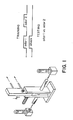
- Protein synthesis-dependent LTM induced by spaced training is blocked completely via overexpression of CREB repressor ( Figure 1) (Yin et al., Cell, 79 :49-58 (1994)).
- Figure 1 Yin et al., Cell, 79 :49-58 (1994)
- the resulting memory curve after spaced training, where protein synthesis- and CREB-dependent LTM is blocked, is similar to that produced by massed training in normal flies.
- overexpression of CREB activator induces LTM with less training (one training session) or with massed training (Figure 2) (Yin et al., Cell, 81 :107-115 (1995)).
- Figure 2 Yin et al., Cell, 81 :107-115 (1995)
- the induction of LTM is both protein
- DNA probes were synthesized using RNA extracted from the heads of spaced- or massed-trained flies according to methods generally known in the art (see, e.g., Sambrook et al ., Eds., Molecular Cloning: A Laboratory Manual , 2nd edition, Cold Spring Harbor University Press, New York (1989); and Ausubel et al ., Eds., Current Protocols In Molecular Biology , John Wiley & Sons, New York (1997)).
- cDNA Complementary DNA
- the complex cDNA probe mixture then was hybridized onto microarray chips containing DNA sequences (target DNA sequences) of 1542 Drosophila genes (Affymetrix, Inc., Santa Clara, CA; see also, e.g., U.S. Patent No.
- the DNA probes are labeled with a detectable marker (e.g., fluorescent marker).
- a detectable marker e.g., fluorescent marker.
- the signal from hybridized DNA probes was amplified and detected according to methods generally known in the art (see, e.g., Sambrook et al., Eds., Molecular Cloning: A Laboratory Manual , 2nd edition, Cold Spring Harbor University Press, New York (1989); and Ausubel et al ., Eds., Current Protocols In Molecular Biology , John Wiley & Sons, New York (1997)).
- hybridization was detected using a fluorescence assay.
- a statistical comparison DNA chip comparison was made (performed) by comparing the signal detected between spaced- and massed- trained groups.
- a sample size and signal transformation algorithm has been determined that improves the statistical reliability to detect small differences in transcript levels between spaced- and massed-trained groups.
- statistical comparison (DNA chip comparison) is made using the following signal transformation algorithm:
- Signal transformation algorithms can be used in performing a statistical comparison (DNA chip comparison) of signal detected between spaced- and massed-trained groups.
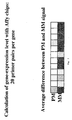
- CMGs Candidate memory genes (CMGs) (not including transposable elements or mitochondrial genes), which are transcriptionally regulated during transcription-dependent memory formation, were identified from the DNA chip comparisons (statistical comparisons) between spaced- and massed-trained groups. Transcripts that are differentially regulated represent those involved specifically in "associative" LTM induced by a Pavlovian odor-shock learning paradigm.
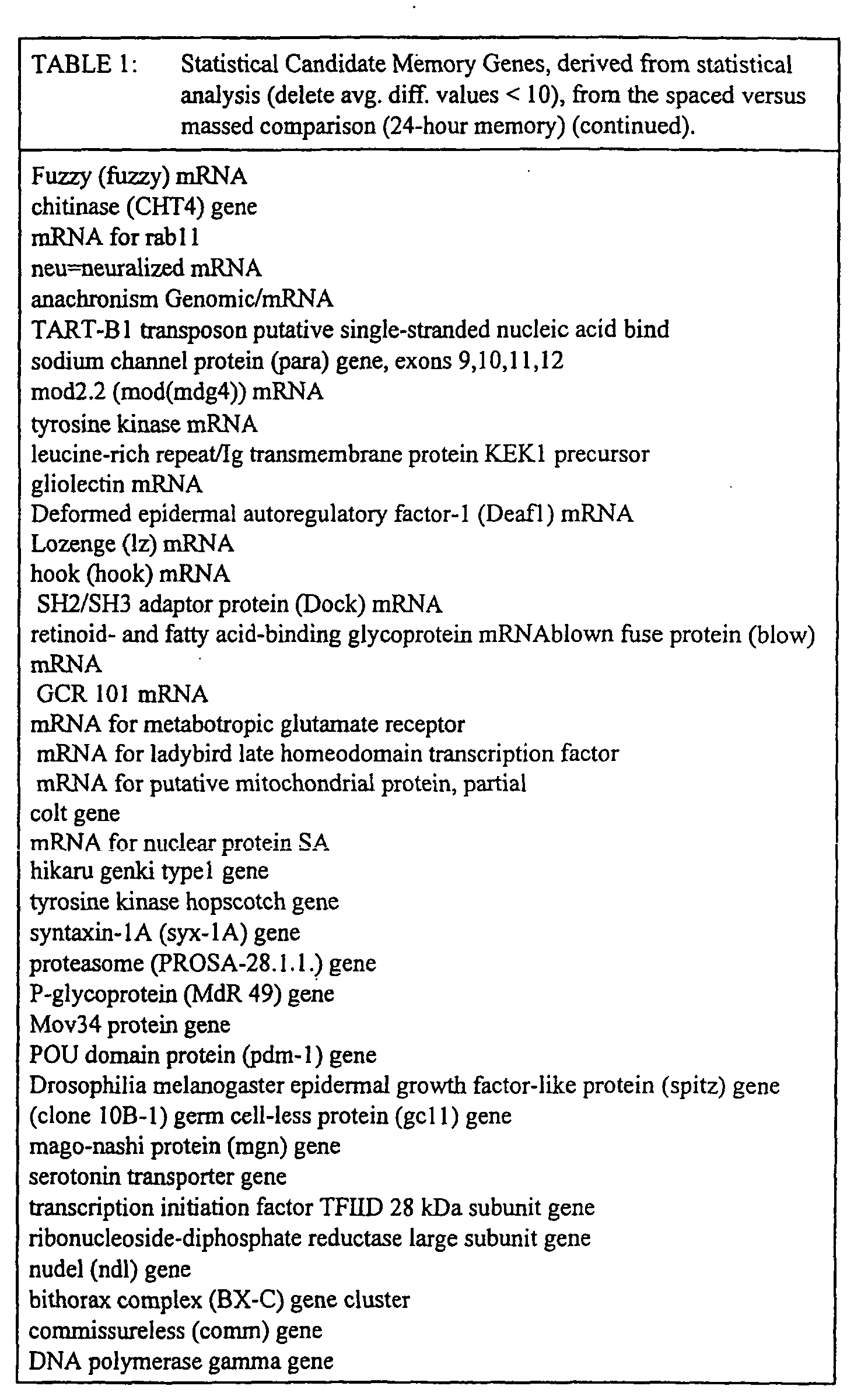
- CMGs from Drosophila determined from statistical analysis using the signal transformation algorithm in which an average difference value below 10 for a given gene is deleted, from the spaced versus massed comparison (24-hour memory), are presented in Table 1.
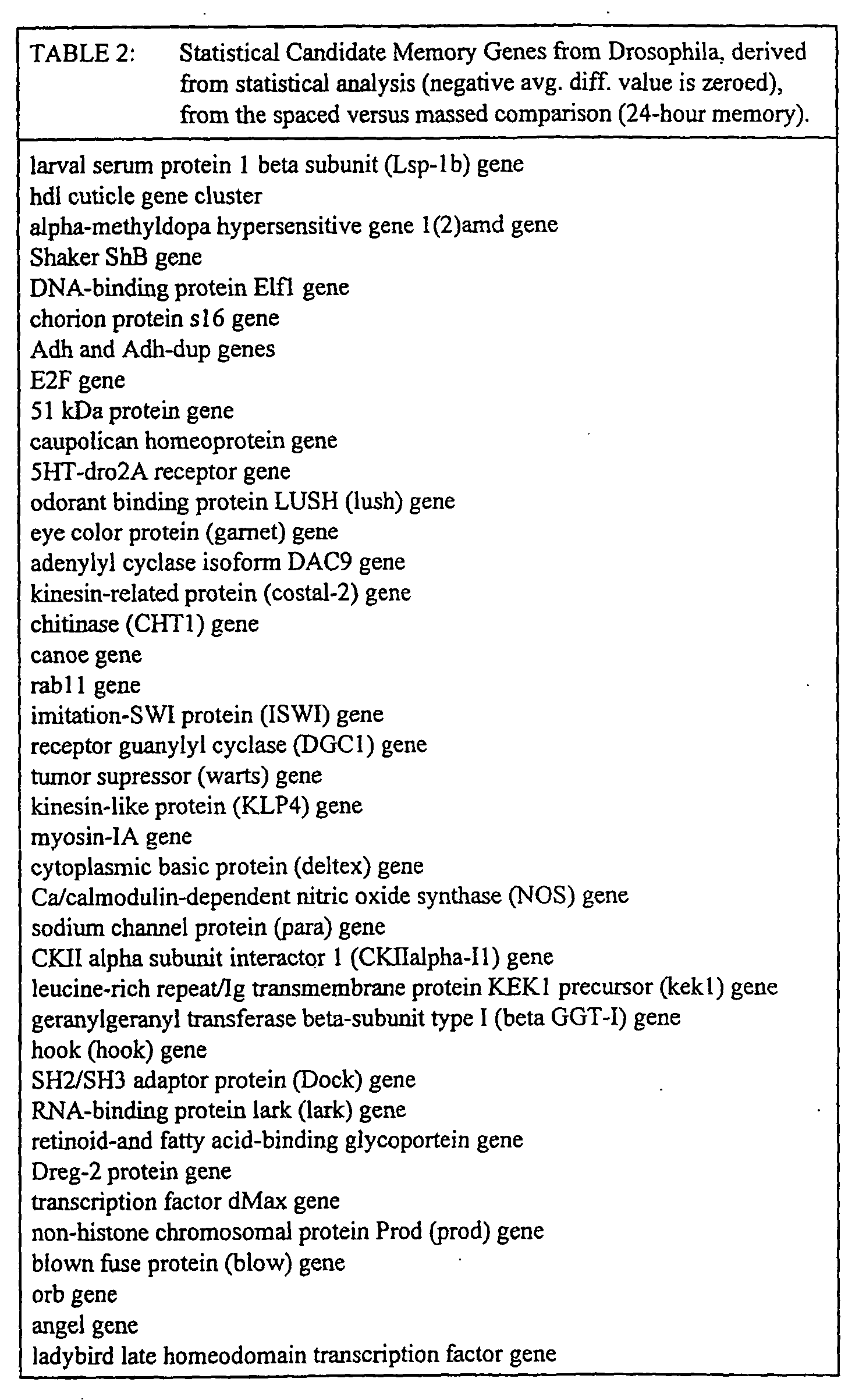
- CMGs from Drosophila determined from statistical analysis using the signal transformation algorithm in which a negative average difference value for a given gene is zeroed, from the spaced versus massed comparison (24-hour memory), are presented in Table 2.
- Chip data provide confirmatory information, gene-by-gene, as to which transcripts are involved with memory. Chip data also provide exact coordinated transcriptional response to different stimuli across all gene transcripts. In particular, chip data provide information as to the coordinated effect a gene transcript has on memory.
- the differential effects on long-lasting memory produced by spaced versus massed training is a phenomenon widely observed in the animal kingdom.
- a spaced-massed differential effect on long-lasting memory recently has been established for the conditioned fear-potentiated startle effect in rats (a mammalian model system).
- memory is inferred from an increase in startle amplitude in the presence of a conditioned stimulus (CS) that has been previously paired with footshock.
- CS conditioned stimulus
- animal includes mammals, as well as other animals, vertebrate and invertebrate (e.g., birds, fish, reptiles, insects (e.g., Drosophila species), Aplysia).
- vertebrate and invertebrate e.g., birds, fish, reptiles, insects (e.g., Drosophila species), Aplysia.
- mammals as well as other animals, vertebrate and invertebrate (e.g., birds, fish, reptiles, insects (e.g., Drosophila species), Aplysia).
- mamammal and “mammalian”, as used herein refer to any vertebrate animal, including monotremes, marsupials and placental, that suckle their young and either give birth to living young (eutharian or placental mammals) or are egg-laying (metatharian or nonplacental mammals).
- mammalian species include humans and other primates (e.g., monkeys, chimpanzees), rodents (e.g., rats, mice, guinea pigs) and ruminents (e.g., cows, pigs, horses).
- primates e.g., monkeys, chimpanzees
- rodents e.g., rats, mice, guinea pigs
- ruminents e.g., cows, pigs, horses.
- DNA probes are synthesized using RNA extracted from brain tissues of spaced- or massed-trained non-human animals according to methods generally known in the art (see, e.g., Sambrook et al ., Eds., Molecular Cloning: A Laboratory Manual , 2nd edition, Cold Spring Harbor University Press, New York (1989); and Ausubel et al ., Eds., Current Protocols In Molecular Biology , John Wiley & Sons, New York (1997)). These probes can be labeled with a detectable marker.
- DNA probes are synthesized using RNA extracted from the amygdala of spaced- or massed-trained animals and, if required, labeled with a detectable marker.
- detectable markers and labeling methods are known in the art, including fluorescent, chemiluminescent, biotin, radioactive, enzymatically detected and immunologically detected markers (see, e.g., Sambrook et al ., Eds., Molecular Cloning: A Laboratory Manual , 2nd edition, Cold Spring Harbor University Press, New York (1989); and Ausubel et al ., Eds., Current Protocols In Molecular Biology , John Wiley & Sons, New York (1997)).
- RNA is extracted from brain tissues, such as the amygdala, according to methods available in the art. Spaced- and massed-training of animals are conducted using methods generally known in the art (see, e.g., Josselyn et al., Society for Neurosci., 24 : 926, Abstract 365.10 (1998); Cassella and Davis, Physiol. Behav ., 36 :377-383 (1986); Guzowski et al., Proc. Natl. Acad. Sci. USA, 94 :2693-2698 (1997); Lamprecht et al., J.
- This complex probe mixture then is hybridized onto microarray chips containing DNA sequences (target DNA sequences) of genes of the genome of the animals (see, e.g., U.S. Patent No. 5,445,934; and Ramsay, Nature Biotechnology, 16 :40-44 (1998), which are incorporated herein by reference).
- hybridization the signal from the hybridized probe
- hybridization can be detected using fluorescence assays or mass spectrometry.
- Methods using optical fibers, diode array detection, chemiluminescence/luminescence, latex bead agglutination, direct electrical charge change detection (CCD) and piezoelectric readout can also be used.
- the signal transformation algorithm described above is used to calculate gene expression levels between spaced- and massed-trained groups. A statistically significant difference in transcript level between spaced- and massed-trained groups for a specific gene identifies a candidate memory gene.
- Statistical comparison DNA chip comparison between spaced- and massed- trained groups can be made using the signal transformation algorithms described above.
- CMGs can be identified from DNA chip comparisons (statistical comparisons) between animals trained using other pairs of experimental protocols.
- the experimental group is trained under conditions sufficient to induce transcription-dependent memory and the control group is trained under conditions that are not sufficient to induce transcription-dependent memory.
- the significant difference between any two experimental protocols is in the induction of transcription-dependent memory.
- the significant difference between any two experimental protocols to be compared is the induction of transcription-dependent memory in the experimental group and the absence of transcription-dependent memory in the control group.
- Pairs of experimental protocols that primarily differ in the induction of transcription-dependent memory are known the art.
- a pair of experimental protocols that primarily differ in the induction of transcription-dependent memory can consist of a spaced training protocol and a massed training protocol.
- training an animal using a spaced training protocol is sufficient to induce transcription-dependent memory in the animal.
- Training an animal using a massed training protocol is not sufficient to induce transcription-dependent memory.
- a pair of experimental protocols that primarily differ in the induction of transcription-dependent memory can consist of training a normal (wildtype) animal using a shuttle-box avoidance protocol (particularly a one-trial shuttle-box avoidance protocol) and training an animal in which the fornix is surgically lesioned using the shuttle-box avoidance protocol (Taubenfeld et al., Nat. Neurosci., 2(4):309-310 (1999)).
- transcription-dependent memory is induced in the normal (wildtype) animal.
- Transcription-dependent memory is not induced in the animal in which the fornix is surgically lesioned.
- a pair of experimental protocols that primarily differ in the induction of transcription-dependent memory can consist of training an animal using a contextual fear conditioning protocol (particularly a one-trial contextual fear conditioning protocol) and training an animal habituated to the training chamber before contextual fear conditioning using the contextual fear conditioning protocol (Imprey et al., Nat. Neurosci., 1(7):595-601 (1998)).
- transcription-dependent memory is induced in the animal that had not been habituated to the training chamber prior to contextual fear conditioning.
- Transcription-dependent memory is not induced in the animal habituated to the training chamber before contextual fear conditioning.
- Other pairs of experimental protocols can readily be identified by those skilled in the art.
- DNA probes are synthesized using RNA extracted from the brain tissues, such as the amygdala and hippocampus, of animals trained using pairs of experimental protocols, as described herein, and, if required, labeled with a detectable marker.
- the DNA probe mixtures then are hybridized onto microarray chips containing DNA sequences (target DNA sequences) of genes of the genome of the animals. A statistical comparison is made by comparing the DNA chip data between the two experimental protocols using the signal transformation algorithms described above.
- CPGs candidate plasticity genes
- Transcripts that are differentially regulated in this class will include the CMGs, along with any other genes that are transcriptionally responsive in a "nonassociative" manner to the general training conditions (e.g., presentations of odors, electroshock or any other experiential aspects of the training protocol).
- Some nonspecific transcriptional responses occur simply when an animal is placed in a novel environment or when the animal is exposed to a stimulus alone or unpaired in time. These transcriptional changes may result from general (nonspecific) increases in neuronal activity or reflect other forms of learning/memory formation that are not related to the general training conditions.
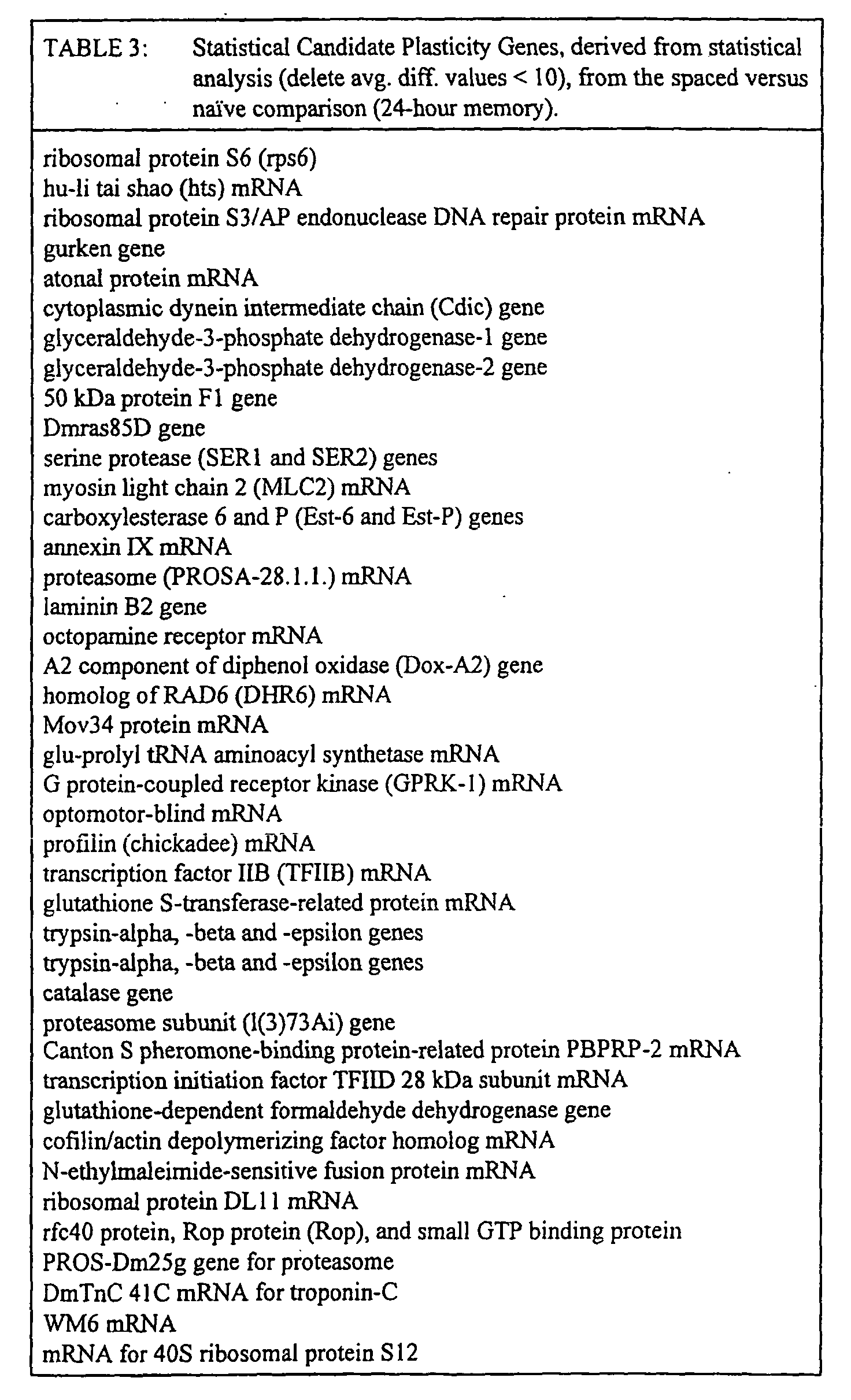
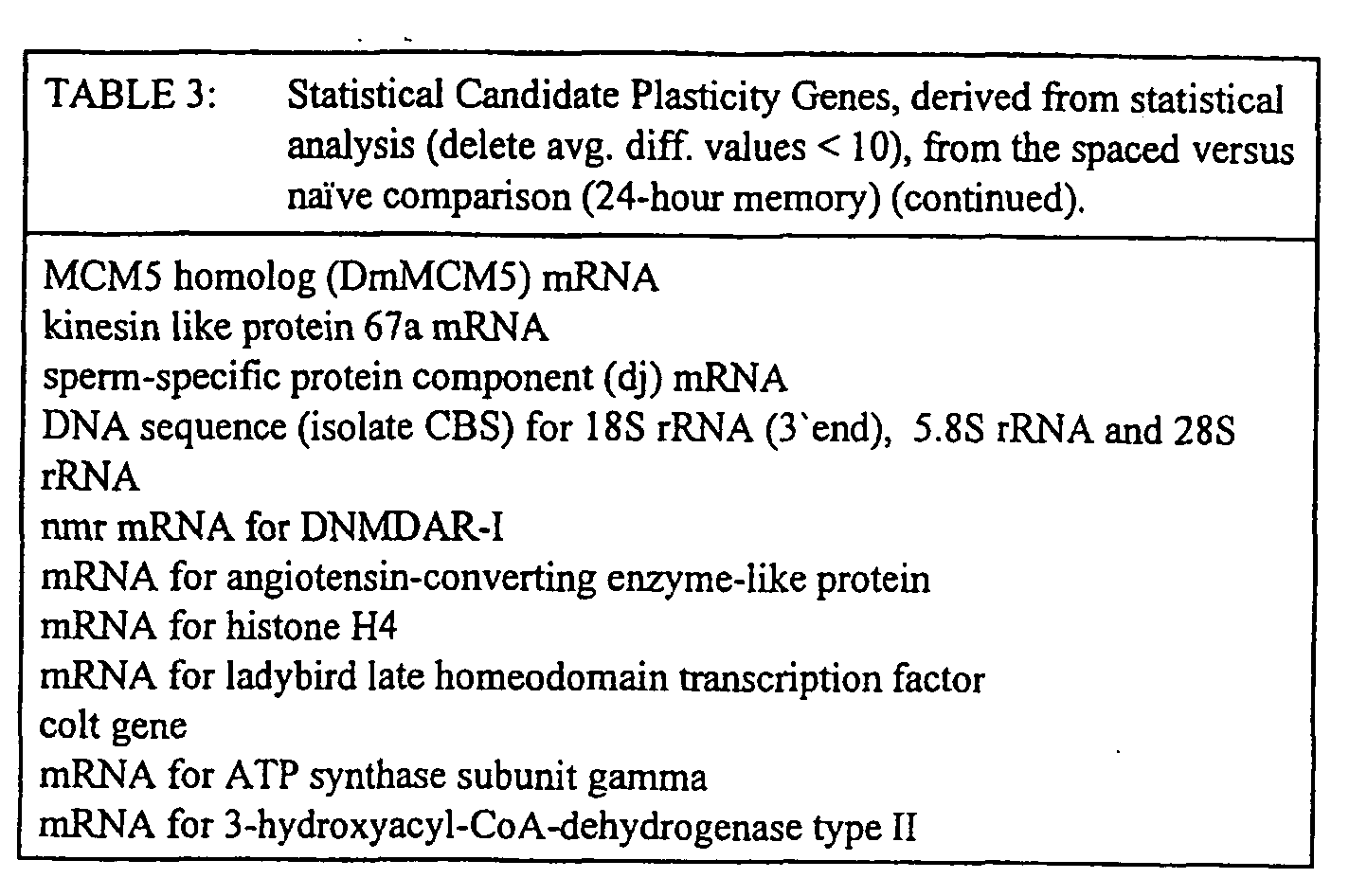
- CPGs from Drosophila determined from statistical analysis using the signal transformation algorithm in which an average difference value below 10 for a given gene is deleted, from the spaced versus na ⁇ ve comparison (24-hour memory), are presented in Table 3.
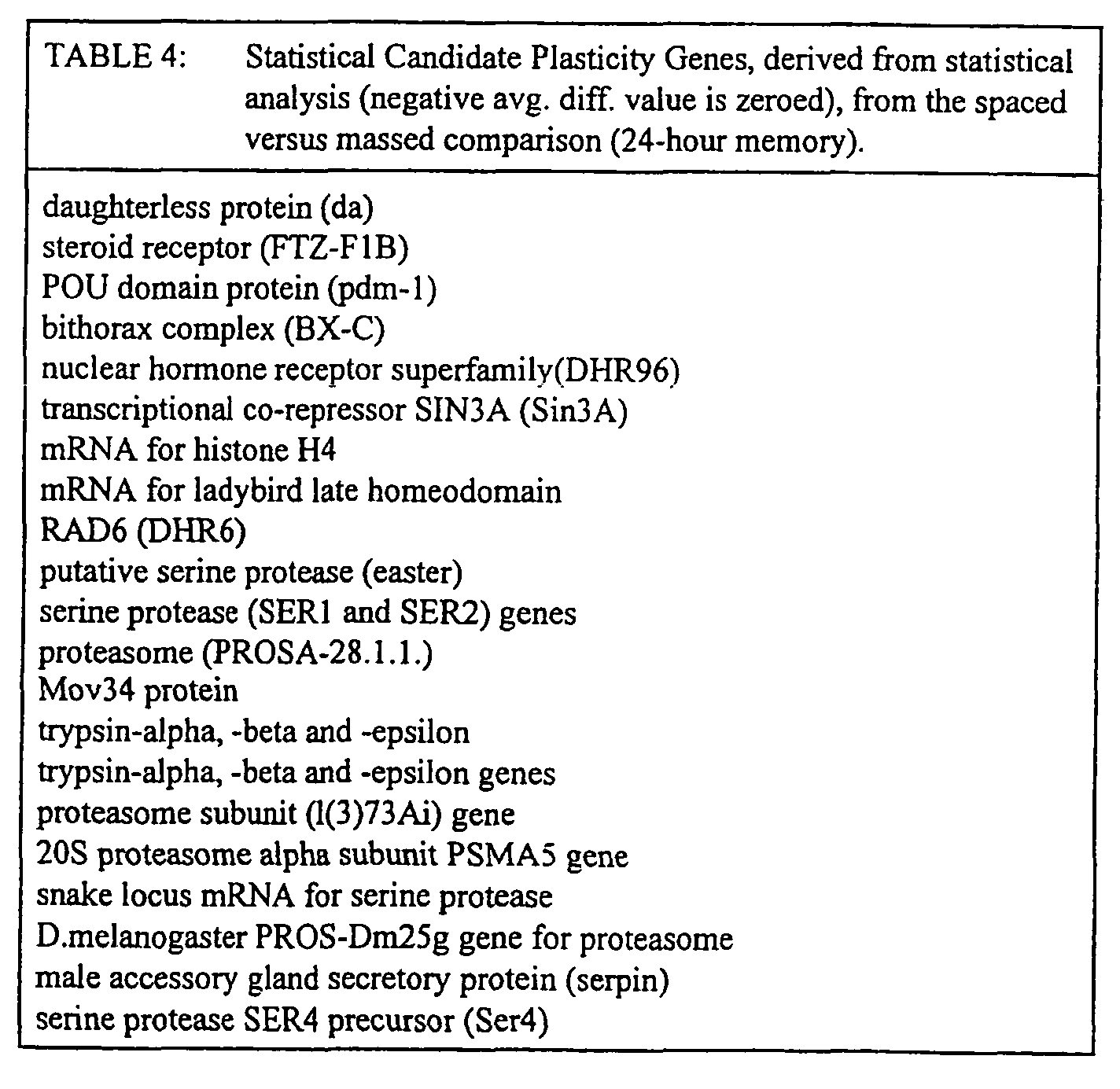
- CPGs from Drosophila determined from statistical analysis using the signal transformation algorithm in which a negative average difference value for a given gene is zeroed, from the spaced versus naive comparison (24-hour memory), are presented in Table 4.
- the present invention provides methods of identifying a gene or genes involved in transcription-dependent memory (particularly long term memory) comprising (a) training non-human animals (particularly non-human mammals, other vertebrates and invertebrates) under conditions sufficient to induce transcription-dependent memory (particularly long term memory) in the animals; (b) extracting RNA from brain tissue (such as from amydala, hippocampus) of the animals trained in step (a); (c) synthesizing DNA probes using the RNA extracted in step (b); (d) exposing the DNA probes synthesized in step (c) to microarray chips containing DNA sequences from genes of the genome of the animals under conditions appropriate for hybridization of the DNA probes to complementary DNA sequences on the microarray chips, wherein a signal is produced upon hybridization of the probes to complementary DNA sequences; (e) detecting the signal produced in step (d); and (f) performing a statistical comparison between the signal detected in step (e) and the signal detected in a control.
- control is obtained according to a method comprising (i) training non-human control animals (particularly non-human mammals, other vertebrates and invertebrates) under appropriate conditions, wherein the conditions are insufficient to induce transcription-dependent memory in the control animals; (ii) extracting RNA from brain tissue of the control animals trained in step (i); (iii) synthesizing DNA probes using the RNA extracted in step (ii); and (iv) exposing the DNA probes synthesized in step (iii) to microarray chips containing DNA sequences from genes of the genome of the animals under conditions appropriate for hybridization of the DNA probes to complementary DNA sequences on the microarray chips, wherein a signal is produced upon hybridization of the probes to complementary DNA sequences.
- the experimental conditions of step (a) and step (i) constitute an (experimental) treatment pair. The significant difference between the experimental conditions of step (a) and step (i) is in the induction of transcription-dependent memory.
- control is obtained according to a method comprising (i) extracting RNA from brain tissue of non-human control animals; (ii) synthesizing DNA probes using the RNA extracted in step (i); and (iii) exposing the DNA probes synthesized in step (ii) to microarray chips containing DNA sequences from genes of the genome of the animals under conditions appropriate for hybridization of the DNA probes to complementary DNA sequences on the microarray chips, wherein a signal is produced upon hybridization of the probes to complementary DNA sequences.
- the control animals are na ⁇ ve (untrained) animals.
- a control animal is an animal that is of the same species as, and otherwise comparable to (e.g., similar age, sex), the animal that is trained under conditions sufficient to induce transcription-dependent memory formation in that animal.
- Transcription-dependent memory can be induced using specific experimental conditions.
- transcription-dependent memory is induced in a non-human animal using a spaced training protocol for the fear-potentiated startle response.
- transcription-dependent memory is induced in a non-human animal using a shuttle-box avoidance protocol.
- transcription-dependent memory is induced in a non-human animal using a contextual fear conditioning protocol.
- the PlacW transposon includes a unique SacII restriction site followed by the bacterial origin of replication and ampicillin resistance gene ( Figure 8).
- the radiolabeled rescue fragments were used to screen one million plaques of a lambda-DashII Drosophila Can-S genomic library (Stratagene). Isolation, subcloning and restriction analysis of 10 independent genomic clones led to the construction of a 35 kb map spanning the genomic region around the P-element insertion site ( Figure 8).
- Intron/exon maps of the adf1 and cn20 transcription units are shown in Figure 8.
- the nal P1 element (arrow) is inserted within an intron of the adf1 transcription unit, 147 bp downstream of the splice donor site.
- the adf1 gene encodes a transcription factor distantly related to the myb family (England et al., Proc. Natl. Acad. Sci. USA , 89:683-687 (1992)) and is alternatively spliced into (at least) two mRNAs.
- i1 and i2 correspond to two potential translation start sites.
- Two additional introns of about 3.5 kb and 59 bp appear to be spliced constitutively and separate the remainder of the adf1 transcription unit into 274 bp and 1,013 bp exons.
- the cn 20 gene is novel and produces a single, unspliced transcript that can encode a 395 amino acid protein. The extent of the genomic deletion in nal le60 is indicated. Restriction sites: B, BamHI; E, EcoRI; H, HindIII; S, SacII.
- RNA from whole adult flies, adult heads or adult bodies was isolated with the TriZOL reagent (BRL).
- the poly(A) fraction was subsequently purified with oligo(dT) cellulose (Collaborative Research) or magnetized oligo(dT) beads (Dynal).
- Purified poly(A) RNA was fractionated by formaldehyde-agarose gel electrophoresis and transferred to a ZetaProbe nylon membrane (BioRad) in 10xSSC. The RNA on the dried membrane was fixed by UV-crosslinking at 2,500 ujoules (Stratalinker). For initial identification of transcript classes, membrane strips were probed overnight with radiolabeled genomic DNA fragments in high stringency Church and Gilbert Buffer, washed extensively and exposed to Kodak BioMax film.
- RNA rp49 To quantify the effect of the P-insertion on adf1 and cn 20 RNA levels, Northern blots derived from nal P1 and wildtype heads or bodies were analyzed as above with radiolabeled probes corresponding to adf1, cn20 and a control RNA rp49.
- the entire ADF1 open reading frame was inserted into the pET30(a) expression vector (Novagen) as a C-terminal fusion.
- Robust IPTG induction of ADF1 fusion protein was obtained in transformed BL21 bacteria.
- the majority of induced protein was in the insoluble, inclusion body fraction and this fraction (isolated 3 hours after induction) was enriched nearly 85% for the ADF1 fusion protein.
- This fraction was washed extensively with PBS and used directly as antigen.
- Mouse polyclonal and monoclonal antibodies were obtained by standard procedures (Harlow and Lane, Antibodies. A Laboratory Manual , Cold Spring Harbor Laboratory Press, Plainview, NY (1998)).
- mice were inoculated with 50 ⁇ g of the inclusion body fraction (in complete Freund's adjuvant), then boosted every two weeks with 50 ⁇ g of inclusion body fraction in incomplete Freund's adjuvant. All three mice showed robust immune responses; one was sacrificed for hybridoma fusions. Of 800 candidate hybridoma lines, 17 showed a response in ADF1 dot-blot analyses. Subsequent evaluation of the 17 lines by western blotting and immunochemical assays led to the isolation of ten monoclonal lines, including MAb ADF1-8 and MAb ADF1-17.
- Frozen heads or bodies were isolated as previously described (Yin et al., Cell, 79:49-58 (1994)), and extracts were prepared by homogenizing 100 ⁇ l of frozen head powder in 500 ⁇ l of RIPA buffer. Protein concentrations were determined by the Bio-Rad protein assay. Protein samples were denatured in standard loading dye, separated by SDS-PAGE and transferred electrophoretically at 100 mA for 2 hours to a nitrocellulose membrane (Bio-Rad). Each membrane was blocked overnight at 4°C in PBST + 5% milk, then incubated for 1-2 hours with primary antibody in PBST + 5% milk.
- the membrane was washed extensively in PBST and incubated for 1-2 hours with HRP-conjugated anti-IgG secondary antibody (Bio-Rad; 1:500). Following extensive washing in PBST, the conjugated products were visualized by enhanced chemiluminescence (Pierce SuperSignal ULTRA Substrate) and autoradiography.
- ADF1 expression was reduced at least two-fold in mutant flies.
- DNA chip data sets between normal (wildtype) flies and a single-gene mutant, nalyot were compared.
- the nalyot mutant was shown to have normal memory after massed training, but LTM was not induced by spaced training.
- the nalyot mutation was identified as a transposon insertion in the Adf1 gene, the effect of which is to reduce the amount of Adf1 transcript and protein in mutant fly heads.
- a given group of flies is subjected to a particular training protocol (spaced or massed) and stored in regular food vials after training. Twenty four hours after training, flies from different groups of a given training protocol (spaced or massed) are collected into a single 50 ml Falcon tube and quick-frozen in liquid nitrogen. The heads of frozen flies are separated from their bodies by vigorous mechanical shaking. Frozen and separated body parts then are sifted through a series of sieves, ultimately to obtain a homogeneous population of fly heads.
- Combined heads from a training group are separated into eight groups. Each group of heads then is ground into a powder with mortar and pestal. The powder is transferred to 5 ml of Trizol solution (Gibco) and stored at -70°C overnight.
- the frozen Trizol/ fly powder solution then is thawed. 2 ml of chloroform is added. The mixture is centrifuged at 3,500 rpm for 10 minutes at 4°C. The extracted RNA (in aqueous layer) is decanted to a fresh tube, and 1.4 ml of isopropanol is added.
- RNA concentration is determined.
- First-strand cDNAs then are synthesized from 1 ⁇ g of the DNAse-free RNA samples, and the QPCR assay is performed according to Perkin Elmer Biosystems protocols, using the 7700 ABI Prism with "CYBR" cybergreen flourescence detection.
- C/EBP primers designed by Quantagene (Paris, France), were used in QPCR experiments: 5'-AGACTACCGATGCGAACAAC-3' (SEQ ID NO:1) and 3'-GTCCCTGAACTGGTCGTCTA-5' (SEQ ID NO:2), yielding an expected fragment of 221 bp in size.
- RNA extractions were obtained from approximately 10,000 heads of flies 24 hours after they were subjected to spaced or to massed training.
- QPCR reactions for each RNA extraction were run in triplicate in accordance with the method outlined in Example 7.
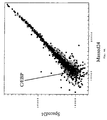
- the mean number of cycles required for C/EBP amplification to reach the critical value was 21.86 ⁇ 0.56 for the spaced group and 23.78 ⁇ 0.56 for the massed group. It took fewer amplification cycles for the spaced group to reach the critical value, indicating a higher concentration of C/EBP at the beginning of the PCR amplification.
- rats Forty-eight hours following training, rats were placed in the startle apparatus and received 30 startle-eliciting stimuli alone followed by 60 startle-eliciting stimuli, half of which occurred 3.2 seconds after the onset of the 3.7 seconds light (Light-Noise trial) and half of which were presented in darkness (Noise Alone trial). The order of the two trial types was irregular. All startle stimuli were presented at an interstimulus interval of 30 seconds. Fear-potentiated startle difference scores, used as an index of LTM, were calculated by subtracting the average startle amplitudes produced by the 30 Noise Alone trials from the average startle amplitudes produced by the 30 Light-Noise trials.
- Short term memory (STM) testing was similar to LTM testing except that it occurred 15 or 40 minutes following training. Twenty Noise Alone stimuli were followed by 15 Light-Noise stimuli and 15 Noise Alone stimuli intermixed. Fear-potentiated startle scores were calculated by subtracting the average Noise Alone score from the average Light-Noise score and used as an index of STM.
- Rats were pre-treated with atropine sulfate (0.4 mg/kg, ip), anesthetized with sodium pentobarbital (60 mg/kg, ip) and placed in a standard stereotaxic instrument.
- a Hamilton microsyringe (10 ⁇ l) mounted in an infusion pump was used for infusions.
- CREB and mCREB cDNAs were inserted into the HSV amplicon HSV-PrpUC and packed using the helper 5dl 1.2 (Lim et al., Biotechniques, 20:460-469 (1996); Keve et al., Neuroscience, 79:435-447 (1997)).
- Virus was purified on a sucrose gradient, pelleted and resuspended in 10% sucrose. The average titer of the recombinant virus stocks was 4.0 x 10 7 infectious units/ml and was similar for HSV-CREB and HSV-mCREB. Transgene expression was regulated by the constitutive promoter for the HSV immediate-early gene IE 4/5.
- Rats were overdosed with chloral hydrate and perfused with 50 ml PBS followed by 250 ml 4% paraformaldehyde in PBS.
- the brains were cryoprotected and cut on a microtome (40 ⁇ m sections), and immunocytochemistry was performed on free-floating sections. Brains infected with HSV-LacZ were reacted for ⁇ -galactosidase and counterstained with neutral red (according to Lim et al., Biotechniques, 20:460-469 (1996); Keve et al., Neuroscience, 79:435-447 (1997)).
- brain slices were allowed to react for 2 hours in a solution comprised of 3.1 mM potassium ferrocyanide, 3.1 mM potassium ferricyanide, 20 mM MgCl 2 , 0.1 M PBS and 0.2 mg/ml X-gal (Boehringer-Mannheim).
- Massed training (3 seconds, 5 seconds, 10 seconds) produces very weak LTM (roughly 50 units). Increasing the rest interval from 10 seconds to 8 minutes yields an increase in LTM as post-hoc Duncan comparisons reveals that 8 min ITI (spaced) produced significantly greater LTM than 10 seconds, 5 seconds and 3 seconds (massed). The results are depicted in Figure 6.
- Post-hoc analysis revealed that the level of LTM in rats that received HSV-CREB infusion into the basolateral amygdala was significantly higher than all other groups.
- a method of identifying a gene or genes involved in transcription-dependent memory comprising the steps of:
- step (f)(i) are those according to a massed training protocol.
- step (f)(i) are those sufficient to induce transcription-independent memory formation but not transcription-dependent memory formation.
- step (f)(i) have a surgical lesion of the fornix and the conditions of step (f)(i) are those according to the shuttle-box avoidance training protocol.
- step (f)(i) transcription-dependent memory formation is induced using a contextual fear conditioning training protocol
- the control animals of step (f)(i) are habituated to the training chamber before training and the conditions of step (f)(i) are those according to the contextual fear conditioning training protocol.
- a method of identifying a gene or genes involved in transcription-dependent memory comprising the steps of:
- transcription-dependent memory formation is induced using a contextual fear conditioning training protocol.
- a method of identifying a gene or genes involved in transcription-dependent memory comprising the steps of:
- step (f)(i) are those according to a massed training protocol.
- step (f)(i) are those sufficient to induce transcription-independent memory formation but not transcription-dependent memory formation.
- a method of identifying a gene or genes involved in transcription-dependent memory comprising the steps of:
Landscapes
- Chemical & Material Sciences (AREA)
- Life Sciences & Earth Sciences (AREA)
- Organic Chemistry (AREA)
- Proteomics, Peptides & Aminoacids (AREA)
- Health & Medical Sciences (AREA)
- Engineering & Computer Science (AREA)
- Zoology (AREA)
- Wood Science & Technology (AREA)
- Analytical Chemistry (AREA)
- Genetics & Genomics (AREA)
- Microbiology (AREA)
- Molecular Biology (AREA)
- Physics & Mathematics (AREA)
- Immunology (AREA)
- Biotechnology (AREA)
- Biochemistry (AREA)
- Bioinformatics & Cheminformatics (AREA)
- General Engineering & Computer Science (AREA)
- General Health & Medical Sciences (AREA)
- Biophysics (AREA)
- Pathology (AREA)
- Measuring Or Testing Involving Enzymes Or Micro-Organisms (AREA)
Abstract
Description
Any negative average difference for a given gene is zeroed. The "average difference zeroed" (Avg. Diff. 0) for each gene on each chip is normalized by the overall "average difference" for that entire chip.
= 0, if Avg. Diff. < 0



Claims (9)
- A method of identifying a candidate gene or genes involved in transcription-dependent memory of associative learning comprising the steps of:(a) training non-human animals to induce transcription-dependent memory formation of a specific experimental task in said animals;(b) extracting RNA from brain tissue of said animals trained in step (a);(c) synthesizing DNA probes using the RNA extracted in step (b);(d) hybridizing the DNA probes synthesized in step (c) to complementary DNA sequences on microarray chips containing DNA sequences from genes of the genome of said animals, wherein a signal is produced upon hybridization of said probes to complementary DNA sequences;(e) detecting the signal produced in step (d); and(f) performing a statistical comparison between the signal detected in step (e) and the signal detected in a control for each gene using a signal transformation algorithm, wherein said control is obtained according to a method comprising the steps of:(i) extracting RNA from brain tissue of non-human control animals;(ii) synthesizing DNA probes using the RNA extracted in step (f)(i); and(iii) hybridizing the DNA probes synthesized in step (f)(ii) to complementary DNA sequences on microarray chips containing DNA sequences from genes of the genome of control animals, wherein a signal is produced upon hybridization of said probes to complementary DNA sequences.
- The method of Claim 1 wherein said non-human control animals are trained to induce transcription-independent memory formation but not transcription-dependent memory formation in said control animals prior to extraction of RNA from brain tissue of said control animals.
- The method of Claim 1 or Claim 2 wherein said non-human animals are non-human mammals and RNA is extracted from brain tissue (e.g., amygdala, hippocampus) of said mammals.
- The method of Claim 3 wherein (a) transcription-dependent memory formation is induced using a shuttle-box avoidance training protocol; or (b) transcription-dependent memory formation is induced using a contextual fear conditioning training protocol.
- The method of Claim 3 wherein (a) transcription-dependent memory formation is induced using a shuttle-box avoidance training protocol and the control animals have a surgical lesion of the fornix; or (b) transcription-dependent memory formation is induced using a contextual fear conditioning training protocol and the control animals are habituated to the training chamber before training.
- The method of Claim 1 or Claim 2 wherein said non-human animals are Drosophila and RNA is extracted from head tissue of said Drosophila.
- The method of any one of the preceding claims wherein (a) said transcription-dependent memory formation is long term memory formation; or (b) said transcription-dependent memory formation is induced using a spaced training protocol.
- The method of Claim 7 wherein transcription-independent memory formation is induced using a massed training protocol.
- The method claimed in claim 1 wherein; said training in step (a) is spaced to yield learning and transcription-independent memories and wherein said control is obtained in a method further comprising the step of training non-human control animals to induce maximal learning and transcriptional-independent memories, wherein the training is massed and the non-human animals of step (a) and the non-human control animals constitute an experimental pair.
Priority Applications (1)
| Application Number | Priority Date | Filing Date | Title |
|---|---|---|---|
| CY20111100562T CY1111554T1 (en) | 1999-03-10 | 2011-06-14 | GENE CHIP TECHNOLOGY FOR MEMORY GENE IDENTIFICATION |
Applications Claiming Priority (3)
| Application Number | Priority Date | Filing Date | Title |
|---|---|---|---|
| US12408599P | 1999-03-10 | 1999-03-10 | |
| US124085P | 1999-03-10 | ||
| EP00914897A EP1196627B1 (en) | 1999-03-10 | 2000-03-10 | Gene chip technology for determining memory genes |
Related Parent Applications (1)
| Application Number | Title | Priority Date | Filing Date |
|---|---|---|---|
| EP00914897A Division EP1196627B1 (en) | 1999-03-10 | 2000-03-10 | Gene chip technology for determining memory genes |
Publications (3)
| Publication Number | Publication Date |
|---|---|
| EP1571226A2 true EP1571226A2 (en) | 2005-09-07 |
| EP1571226A3 EP1571226A3 (en) | 2007-11-21 |
| EP1571226B1 EP1571226B1 (en) | 2011-04-27 |
Family
ID=22412679
Family Applications (2)
| Application Number | Title | Priority Date | Filing Date |
|---|---|---|---|
| EP00914897A Expired - Lifetime EP1196627B1 (en) | 1999-03-10 | 2000-03-10 | Gene chip technology for determining memory genes |
| EP05005342A Expired - Lifetime EP1571226B1 (en) | 1999-03-10 | 2000-03-10 | Gene chip technology for determining memory genes |
Family Applications Before (1)
| Application Number | Title | Priority Date | Filing Date |
|---|---|---|---|
| EP00914897A Expired - Lifetime EP1196627B1 (en) | 1999-03-10 | 2000-03-10 | Gene chip technology for determining memory genes |
Country Status (11)
| Country | Link |
|---|---|
| EP (2) | EP1196627B1 (en) |
| JP (1) | JP4594532B2 (en) |
| AT (2) | ATE507303T1 (en) |
| AU (1) | AU782926B2 (en) |
| CA (1) | CA2364877C (en) |
| CY (1) | CY1111554T1 (en) |
| DE (2) | DE60024629T2 (en) |
| DK (1) | DK1571226T3 (en) |
| ES (1) | ES2363142T3 (en) |
| PT (1) | PT1571226E (en) |
| WO (1) | WO2000053810A2 (en) |
Families Citing this family (2)
| Publication number | Priority date | Publication date | Assignee | Title |
|---|---|---|---|---|
| US7005256B1 (en) | 1999-03-10 | 2006-02-28 | Cold Spring Harbor Laboratory | Gene chip technology for determining memory genes |
| CN111291640B (en) * | 2020-01-20 | 2023-02-17 | 北京百度网讯科技有限公司 | Method and apparatus for recognizing gait |
Family Cites Families (4)
| Publication number | Priority date | Publication date | Assignee | Title |
|---|---|---|---|---|
| DE69132905T2 (en) * | 1990-12-06 | 2002-08-01 | Affymetrix, Inc. (N.D.Ges.D.Staates Delaware) | Detection of nucleic acid sequences |
| EP0781335A1 (en) * | 1994-10-07 | 1997-07-02 | Cold Spring Harbor Laboratory | Cloning and characterizing of genes associated with long-term memory |
| US5831057A (en) * | 1995-10-05 | 1998-11-03 | Cold Spring Harbor Laboratory | Associative learning and the linotte gene |
| NO972006D0 (en) * | 1997-04-30 | 1997-04-30 | Forskningsparken I Aas As | New method for diagnosis of diseases |
-
2000
- 2000-03-10 AU AU36225/00A patent/AU782926B2/en not_active Ceased
- 2000-03-10 JP JP2000603431A patent/JP4594532B2/en not_active Expired - Fee Related
- 2000-03-10 ES ES05005342T patent/ES2363142T3/en not_active Expired - Lifetime
- 2000-03-10 WO PCT/US2000/006234 patent/WO2000053810A2/en not_active Ceased
- 2000-03-10 DE DE60024629T patent/DE60024629T2/en not_active Expired - Lifetime
- 2000-03-10 DK DK05005342.0T patent/DK1571226T3/en active
- 2000-03-10 PT PT05005342T patent/PT1571226E/en unknown
- 2000-03-10 DE DE60045900T patent/DE60045900D1/en not_active Expired - Lifetime
- 2000-03-10 EP EP00914897A patent/EP1196627B1/en not_active Expired - Lifetime
- 2000-03-10 EP EP05005342A patent/EP1571226B1/en not_active Expired - Lifetime
- 2000-03-10 CA CA2364877A patent/CA2364877C/en not_active Expired - Fee Related
- 2000-03-10 AT AT05005342T patent/ATE507303T1/en active
- 2000-03-10 AT AT00914897T patent/ATE312201T1/en not_active IP Right Cessation
-
2011
- 2011-06-14 CY CY20111100562T patent/CY1111554T1/en unknown
Also Published As
| Publication number | Publication date |
|---|---|
| JP2002537859A (en) | 2002-11-12 |
| DK1571226T3 (en) | 2011-07-11 |
| AU782926B2 (en) | 2005-09-08 |
| ATE312201T1 (en) | 2005-12-15 |
| WO2000053810A3 (en) | 2002-02-14 |
| DE60024629T2 (en) | 2006-09-07 |
| DE60024629D1 (en) | 2006-01-12 |
| ES2363142T3 (en) | 2011-07-21 |
| WO2000053810A2 (en) | 2000-09-14 |
| CA2364877A1 (en) | 2000-09-14 |
| HK1081237A1 (en) | 2006-05-12 |
| CA2364877C (en) | 2013-01-08 |
| CY1111554T1 (en) | 2015-08-05 |
| EP1196627B1 (en) | 2005-12-07 |
| JP4594532B2 (en) | 2010-12-08 |
| PT1571226E (en) | 2011-06-29 |
| EP1571226A3 (en) | 2007-11-21 |
| ATE507303T1 (en) | 2011-05-15 |
| EP1196627A2 (en) | 2002-04-17 |
| EP1571226B1 (en) | 2011-04-27 |
| DE60045900D1 (en) | 2011-06-09 |
| AU3622500A (en) | 2000-09-28 |
Similar Documents
| Publication | Publication Date | Title |
|---|---|---|
| DE69333043T2 (en) | TRANSFERRATION OF THE CYCLIN COMPLEX AND ITS RELATED APPLICATIONS | |
| Cryderman et al. | Silencing at Drosophila telomeres: nuclear organization and chromatin structure play critical roles | |
| Alekseyenko et al. | High-resolution ChIP–chip analysis reveals that the Drosophila MSL complex selectively identifies active genes on the male X chromosome | |
| Orlando et al. | Mapping Polycomb-repressed domains in the bithorax complex using in vivo formaldehyde cross-linked chromatin | |
| US5858679A (en) | Method for determining the presence of functional p53 by measuring GADD45 protein expression | |
| US6258536B1 (en) | Expression monitoring of downstream genes in the BRCA1 pathway | |
| US20090215089A1 (en) | Compositions and methods for identifying and targeting cancer cells of alimentary canal origin | |
| US20020022222A1 (en) | Method of preparing a standard diagnostic gene transcript pattern | |
| JPH08511158A (en) | Von Hippel-Lindau (VHL) disease gene and corresponding cDNA and method for detecting VHL disease gene carrier | |
| Pereira et al. | Genetic analysis of a Drosophila microtubule-associated protein. | |
| JP2001524311A (en) | Methods for identifying the toxic / pathological effects of environmental irritants on gene transcription | |
| US20040158879A1 (en) | Polynucleotide and polypeptide fat metabolism regulators and uses thereof | |
| US7005256B1 (en) | Gene chip technology for determining memory genes | |
| EP1196627B1 (en) | Gene chip technology for determining memory genes | |
| Pittoggi et al. | Specific localization of transcription factors in the chromatin of mouse mature spermatozoa | |
| US7094889B2 (en) | AGE-1 polypeptides and related molecules and methods | |
| US20040076978A1 (en) | Method to identify genes associated with chronic myelogenous leukemia | |
| JP2001501809A (en) | Novel TFIIB transcription factor from Candida albicans, nucleic acid sequence encoding the same, and screening method for inhibiting Candida albicans growth | |
| HK1081237B (en) | Gene chip technology for determining memory genes | |
| JP2004508288A (en) | Methods and compositions for adjusting memory consolidation | |
| EP0948646A1 (en) | Methods for identifying genes essential to the growth of an organism | |
| US20080115235A1 (en) | Drugs For Diseases Accompanying Changes In Total Bile Acid Pool Or Lipid Metabolism Disorders And Method Of Screening These Drugs | |
| US20080076672A1 (en) | Methods for Identifying Genes Essential to the Growth of an Organism | |
| CN1276832A (en) | Composition and method for identifying PKB kinase inhibitors | |
| Chen | Regulatory mechanisms in the hedgehog signaling pathway |
Legal Events
| Date | Code | Title | Description |
|---|---|---|---|
| PUAI | Public reference made under article 153(3) epc to a published international application that has entered the european phase |
Free format text: ORIGINAL CODE: 0009012 |
|
| AC | Divisional application: reference to earlier application |
Ref document number: 1196627 Country of ref document: EP Kind code of ref document: P |
|
| AK | Designated contracting states |
Kind code of ref document: A2 Designated state(s): AT BE CH CY DE DK ES FI FR GB GR IE IT LI LU MC NL PT SE |
|
| REG | Reference to a national code |
Ref country code: HK Ref legal event code: DE Ref document number: 1081237 Country of ref document: HK |
|
| PUAL | Search report despatched |
Free format text: ORIGINAL CODE: 0009013 |
|
| AK | Designated contracting states |
Kind code of ref document: A3 Designated state(s): AT BE CH CY DE DK ES FI FR GB GR IE IT LI LU MC NL PT SE |
|
| 17P | Request for examination filed |
Effective date: 20080521 |
|
| AKX | Designation fees paid |
Designated state(s): AT BE CH CY DE DK ES FI FR GB GR IE IT LI LU MC NL PT SE |
|
| 17Q | First examination report despatched |
Effective date: 20081023 |
|
| GRAP | Despatch of communication of intention to grant a patent |
Free format text: ORIGINAL CODE: EPIDOSNIGR1 |
|
| GRAS | Grant fee paid |
Free format text: ORIGINAL CODE: EPIDOSNIGR3 |
|
| GRAA | (expected) grant |
Free format text: ORIGINAL CODE: 0009210 |
|
| AC | Divisional application: reference to earlier application |
Ref document number: 1196627 Country of ref document: EP Kind code of ref document: P |
|
| AK | Designated contracting states |
Kind code of ref document: B1 Designated state(s): AT BE CH CY DE DK ES FI FR GB GR IE IT LI LU MC NL PT SE |
|
| REG | Reference to a national code |
Ref country code: GB Ref legal event code: FG4D |
|
| REG | Reference to a national code |
Ref country code: CH Ref legal event code: EP |
|
| REG | Reference to a national code |
Ref country code: IE Ref legal event code: FG4D |
|
| REF | Corresponds to: |
Ref document number: 60045900 Country of ref document: DE Date of ref document: 20110609 Kind code of ref document: P |
|
| REG | Reference to a national code |
Ref country code: DE Ref legal event code: R096 Ref document number: 60045900 Country of ref document: DE Effective date: 20110609 |
|
| REG | Reference to a national code |
Ref country code: PT Ref legal event code: SC4A Free format text: AVAILABILITY OF NATIONAL TRANSLATION Effective date: 20110614 |
|
| REG | Reference to a national code |
Ref country code: DK Ref legal event code: T3 |
|
| REG | Reference to a national code |
Ref country code: ES Ref legal event code: FG2A Ref document number: 2363142 Country of ref document: ES Kind code of ref document: T3 Effective date: 20110721 |
|
| REG | Reference to a national code |
Ref country code: CH Ref legal event code: PCOW Free format text: F. HOFFMANN-LA ROCHE AG;GRENZACHERSTRASSE 124;4070 BASEL (CH) $ COLD SPRING HARBOR LABORATORY;1 BUNGTOWN ROAD;COLD SPRING HARBOR, NY 11724 (US) $ EMORY UNIVERSITY;OFFICE OF TECHNOLOGY TRANSFER 1599 CLIFTON ROAD NE 4TH FLOOR;ATLANTA, GEORGIA 30322 (US) Ref country code: CH Ref legal event code: NV Representative=s name: PATENTANWAELTE SCHAAD, BALASS, MENZL & PARTNER AG |
|
| REG | Reference to a national code |
Ref country code: NL Ref legal event code: T3 |
|
| REG | Reference to a national code |
Ref country code: SE Ref legal event code: TRGR |
|
| RAP2 | Party data changed (patent owner data changed or rights of a patent transferred) |
Owner name: EMORY UNIVERSITY Owner name: F. HOFFMANN-LA ROCHE AG Owner name: COLD SPRING HARBOR LABORATORY |
|
| REG | Reference to a national code |
Ref country code: GR Ref legal event code: EP Ref document number: 20110401773 Country of ref document: GR Effective date: 20110829 |
|
| REG | Reference to a national code |
Ref country code: HK Ref legal event code: GR Ref document number: 1081237 Country of ref document: HK |
|
| PLBE | No opposition filed within time limit |
Free format text: ORIGINAL CODE: 0009261 |
|
| STAA | Information on the status of an ep patent application or granted ep patent |
Free format text: STATUS: NO OPPOSITION FILED WITHIN TIME LIMIT |
|
| 26N | No opposition filed |
Effective date: 20120130 |
|
| REG | Reference to a national code |
Ref country code: DE Ref legal event code: R097 Ref document number: 60045900 Country of ref document: DE Effective date: 20120130 |
|
| PGFP | Annual fee paid to national office [announced via postgrant information from national office to epo] |
Ref country code: IT Payment date: 20120323 Year of fee payment: 13 |
|
| PGFP | Annual fee paid to national office [announced via postgrant information from national office to epo] |
Ref country code: DK Payment date: 20130312 Year of fee payment: 14 Ref country code: GB Payment date: 20130306 Year of fee payment: 14 Ref country code: IE Payment date: 20130312 Year of fee payment: 14 Ref country code: SE Payment date: 20130312 Year of fee payment: 14 Ref country code: FI Payment date: 20130312 Year of fee payment: 14 Ref country code: CH Payment date: 20130312 Year of fee payment: 14 Ref country code: LU Payment date: 20130318 Year of fee payment: 14 Ref country code: ES Payment date: 20130313 Year of fee payment: 14 Ref country code: DE Payment date: 20130306 Year of fee payment: 14 Ref country code: FR Payment date: 20130325 Year of fee payment: 14 Ref country code: MC Payment date: 20130128 Year of fee payment: 14 |
|
| PGFP | Annual fee paid to national office [announced via postgrant information from national office to epo] |
Ref country code: GR Payment date: 20130215 Year of fee payment: 14 Ref country code: CY Payment date: 20130206 Year of fee payment: 14 Ref country code: NL Payment date: 20130309 Year of fee payment: 14 |
|
| PGFP | Annual fee paid to national office [announced via postgrant information from national office to epo] |
Ref country code: AT Payment date: 20130226 Year of fee payment: 14 Ref country code: PT Payment date: 20130311 Year of fee payment: 14 |
|
| PGFP | Annual fee paid to national office [announced via postgrant information from national office to epo] |
Ref country code: BE Payment date: 20130312 Year of fee payment: 14 |
|
| REG | Reference to a national code |
Ref country code: PT Ref legal event code: MM4A Free format text: LAPSE DUE TO NON-PAYMENT OF FEES Effective date: 20140910 |
|
| REG | Reference to a national code |
Ref country code: DE Ref legal event code: R119 Ref document number: 60045900 Country of ref document: DE |
|
| REG | Reference to a national code |
Ref country code: DK Ref legal event code: EBP Effective date: 20140331 |
|
| REG | Reference to a national code |
Ref country code: NL Ref legal event code: V1 Effective date: 20141001 |
|
| PG25 | Lapsed in a contracting state [announced via postgrant information from national office to epo] |
Ref country code: CY Free format text: LAPSE BECAUSE OF NON-PAYMENT OF DUE FEES Effective date: 20140310 Ref country code: LU Free format text: LAPSE BECAUSE OF NON-PAYMENT OF DUE FEES Effective date: 20140310 Ref country code: FI Free format text: LAPSE BECAUSE OF NON-PAYMENT OF DUE FEES Effective date: 20140310 |
|
| REG | Reference to a national code |
Ref country code: CH Ref legal event code: PL |
|
| REG | Reference to a national code |
Ref country code: SE Ref legal event code: EUG |
|
| REG | Reference to a national code |
Ref country code: AT Ref legal event code: MM01 Ref document number: 507303 Country of ref document: AT Kind code of ref document: T Effective date: 20140310 |
|
| GBPC | Gb: european patent ceased through non-payment of renewal fee |
Effective date: 20140310 |
|
| REG | Reference to a national code |
Ref country code: GR Ref legal event code: ML Ref document number: 20110401773 Country of ref document: GR Effective date: 20141002 |
|
| PG25 | Lapsed in a contracting state [announced via postgrant information from national office to epo] |
Ref country code: SE Free format text: LAPSE BECAUSE OF NON-PAYMENT OF DUE FEES Effective date: 20140311 |
|
| REG | Reference to a national code |
Ref country code: FR Ref legal event code: ST Effective date: 20141128 |
|
| PG25 | Lapsed in a contracting state [announced via postgrant information from national office to epo] |
Ref country code: PT Free format text: LAPSE BECAUSE OF NON-PAYMENT OF DUE FEES Effective date: 20140910 |
|
| REG | Reference to a national code |
Ref country code: IE Ref legal event code: MM4A |
|
| REG | Reference to a national code |
Ref country code: DE Ref legal event code: R119 Ref document number: 60045900 Country of ref document: DE Effective date: 20141001 |
|
| PG25 | Lapsed in a contracting state [announced via postgrant information from national office to epo] |
Ref country code: CH Free format text: LAPSE BECAUSE OF NON-PAYMENT OF DUE FEES Effective date: 20140331 Ref country code: FR Free format text: LAPSE BECAUSE OF NON-PAYMENT OF DUE FEES Effective date: 20140331 Ref country code: GR Free format text: LAPSE BECAUSE OF NON-PAYMENT OF DUE FEES Effective date: 20141002 Ref country code: GB Free format text: LAPSE BECAUSE OF NON-PAYMENT OF DUE FEES Effective date: 20140310 Ref country code: DE Free format text: LAPSE BECAUSE OF NON-PAYMENT OF DUE FEES Effective date: 20141001 Ref country code: IE Free format text: LAPSE BECAUSE OF NON-PAYMENT OF DUE FEES Effective date: 20140310 Ref country code: LI Free format text: LAPSE BECAUSE OF NON-PAYMENT OF DUE FEES Effective date: 20140331 |
|
| PG25 | Lapsed in a contracting state [announced via postgrant information from national office to epo] |
Ref country code: NL Free format text: LAPSE BECAUSE OF NON-PAYMENT OF DUE FEES Effective date: 20141001 Ref country code: AT Free format text: LAPSE BECAUSE OF NON-PAYMENT OF DUE FEES Effective date: 20140310 |
|
| PG25 | Lapsed in a contracting state [announced via postgrant information from national office to epo] |
Ref country code: IT Free format text: LAPSE BECAUSE OF NON-PAYMENT OF DUE FEES Effective date: 20140310 |
|
| PG25 | Lapsed in a contracting state [announced via postgrant information from national office to epo] |
Ref country code: DK Free format text: LAPSE BECAUSE OF NON-PAYMENT OF DUE FEES Effective date: 20140331 |
|
| REG | Reference to a national code |
Ref country code: ES Ref legal event code: FD2A Effective date: 20150504 |
|
| PG25 | Lapsed in a contracting state [announced via postgrant information from national office to epo] |
Ref country code: ES Free format text: LAPSE BECAUSE OF NON-PAYMENT OF DUE FEES Effective date: 20140311 |
|
| PG25 | Lapsed in a contracting state [announced via postgrant information from national office to epo] |
Ref country code: MC Free format text: LAPSE BECAUSE OF NON-PAYMENT OF DUE FEES Effective date: 20140331 |
|
| PG25 | Lapsed in a contracting state [announced via postgrant information from national office to epo] |
Ref country code: BE Free format text: LAPSE BECAUSE OF NON-PAYMENT OF DUE FEES Effective date: 20140331 |