EP1571153B1 - A process for the preparation of drospirenone - Google Patents
A process for the preparation of drospirenone Download PDFInfo
- Publication number
- EP1571153B1 EP1571153B1 EP05101511A EP05101511A EP1571153B1 EP 1571153 B1 EP1571153 B1 EP 1571153B1 EP 05101511 A EP05101511 A EP 05101511A EP 05101511 A EP05101511 A EP 05101511A EP 1571153 B1 EP1571153 B1 EP 1571153B1
- Authority
- EP
- European Patent Office
- Prior art keywords
- formula
- dimethylene
- drospirenone
- pregn
- oxo
- Prior art date
- Legal status (The legal status is an assumption and is not a legal conclusion. Google has not performed a legal analysis and makes no representation as to the accuracy of the status listed.)
- Expired - Lifetime
Links
- METQSPRSQINEEU-HXCATZOESA-N drospirenone Chemical compound C([C@]12[C@H]3C[C@H]3[C@H]3[C@H]4[C@@H]([C@]5(CCC(=O)C=C5[C@@H]5C[C@@H]54)C)CC[C@@]31C)CC(=O)O2 METQSPRSQINEEU-HXCATZOESA-N 0.000 title claims abstract description 83
- METQSPRSQINEEU-UHFFFAOYSA-N dihydrospirorenone Natural products CC12CCC(C3(CCC(=O)C=C3C3CC33)C)C3C1C1CC1C21CCC(=O)O1 METQSPRSQINEEU-UHFFFAOYSA-N 0.000 title claims abstract description 81
- 229960004845 drospirenone Drugs 0.000 title claims abstract description 73
- 238000000034 method Methods 0.000 title claims abstract description 60
- 238000002360 preparation method Methods 0.000 title claims abstract description 30
- 239000000203 mixture Substances 0.000 claims abstract description 71
- YXFVVABEGXRONW-UHFFFAOYSA-N Toluene Chemical compound CC1=CC=CC=C1 YXFVVABEGXRONW-UHFFFAOYSA-N 0.000 claims description 75
- YMWUJEATGCHHMB-UHFFFAOYSA-N Dichloromethane Chemical compound ClCCl YMWUJEATGCHHMB-UHFFFAOYSA-N 0.000 claims description 53
- XEKOWRVHYACXOJ-UHFFFAOYSA-N Ethyl acetate Chemical compound CCOC(C)=O XEKOWRVHYACXOJ-UHFFFAOYSA-N 0.000 claims description 39
- 238000006243 chemical reaction Methods 0.000 claims description 37
- RTZKZFJDLAIYFH-UHFFFAOYSA-N Diethyl ether Chemical compound CCOCC RTZKZFJDLAIYFH-UHFFFAOYSA-N 0.000 claims description 34
- CSCPPACGZOOCGX-UHFFFAOYSA-N Acetone Chemical compound CC(C)=O CSCPPACGZOOCGX-UHFFFAOYSA-N 0.000 claims description 33
- 238000007254 oxidation reaction Methods 0.000 claims description 33
- WEVYAHXRMPXWCK-UHFFFAOYSA-N Acetonitrile Chemical compound CC#N WEVYAHXRMPXWCK-UHFFFAOYSA-N 0.000 claims description 30
- JUJWROOIHBZHMG-UHFFFAOYSA-N Pyridine Chemical compound C1=CC=NC=C1 JUJWROOIHBZHMG-UHFFFAOYSA-N 0.000 claims description 30
- 230000003647 oxidation Effects 0.000 claims description 29
- XLYOFNOQVPJJNP-UHFFFAOYSA-N water Substances O XLYOFNOQVPJJNP-UHFFFAOYSA-N 0.000 claims description 26
- 239000003960 organic solvent Substances 0.000 claims description 25
- OKKJLVBELUTLKV-UHFFFAOYSA-N Methanol Chemical compound OC OKKJLVBELUTLKV-UHFFFAOYSA-N 0.000 claims description 24
- WYURNTSHIVDZCO-UHFFFAOYSA-N Tetrahydrofuran Chemical compound C1CCOC1 WYURNTSHIVDZCO-UHFFFAOYSA-N 0.000 claims description 21
- VYPSYNLAJGMNEJ-UHFFFAOYSA-N Silicium dioxide Chemical compound O=[Si]=O VYPSYNLAJGMNEJ-UHFFFAOYSA-N 0.000 claims description 19
- 239000002904 solvent Substances 0.000 claims description 17
- -1 4-methoxy-2,2,6,6-tetramethylpiperidine-1-oxyl radical Chemical class 0.000 claims description 16
- JHIVVAPYMSGYDF-UHFFFAOYSA-N cyclohexanone Chemical compound O=C1CCCCC1 JHIVVAPYMSGYDF-UHFFFAOYSA-N 0.000 claims description 16
- JMMWKPVZQRWMSS-UHFFFAOYSA-N isopropanol acetate Natural products CC(C)OC(C)=O JMMWKPVZQRWMSS-UHFFFAOYSA-N 0.000 claims description 16
- 229940011051 isopropyl acetate Drugs 0.000 claims description 16
- UMJSCPRVCHMLSP-UHFFFAOYSA-N pyridine Natural products COC1=CC=CN=C1 UMJSCPRVCHMLSP-UHFFFAOYSA-N 0.000 claims description 15
- WQDUMFSSJAZKTM-UHFFFAOYSA-N Sodium methoxide Chemical compound [Na+].[O-]C WQDUMFSSJAZKTM-UHFFFAOYSA-N 0.000 claims description 14
- 239000003153 chemical reaction reagent Substances 0.000 claims description 13
- 239000000741 silica gel Substances 0.000 claims description 13
- 229910002027 silica gel Inorganic materials 0.000 claims description 13
- IMNFDUFMRHMDMM-UHFFFAOYSA-N N-Heptane Chemical compound CCCCCCC IMNFDUFMRHMDMM-UHFFFAOYSA-N 0.000 claims description 12
- ZMANZCXQSJIPKH-UHFFFAOYSA-N Triethylamine Chemical compound CCN(CC)CC ZMANZCXQSJIPKH-UHFFFAOYSA-N 0.000 claims description 12
- AMXOYNBUYSYVKV-UHFFFAOYSA-M lithium bromide Chemical compound [Li+].[Br-] AMXOYNBUYSYVKV-UHFFFAOYSA-M 0.000 claims description 12
- NUJOXMJBOLGQSY-UHFFFAOYSA-N manganese dioxide Chemical compound O=[Mn]=O NUJOXMJBOLGQSY-UHFFFAOYSA-N 0.000 claims description 12
- LPNYRYFBWFDTMA-UHFFFAOYSA-N potassium tert-butoxide Chemical compound [K+].CC(C)(C)[O-] LPNYRYFBWFDTMA-UHFFFAOYSA-N 0.000 claims description 12
- 238000009631 Broth culture Methods 0.000 claims description 11
- 239000000725 suspension Substances 0.000 claims description 11
- 239000000499 gel Substances 0.000 claims description 10
- VLKZOEOYAKHREP-UHFFFAOYSA-N n-Hexane Chemical compound CCCCCC VLKZOEOYAKHREP-UHFFFAOYSA-N 0.000 claims description 10
- 238000000746 purification Methods 0.000 claims description 10
- YLQBMQCUIZJEEH-UHFFFAOYSA-N tetrahydrofuran Natural products C=1C=COC=1 YLQBMQCUIZJEEH-UHFFFAOYSA-N 0.000 claims description 10
- LFQSCWFLJHTTHZ-UHFFFAOYSA-N Ethanol Chemical compound CCO LFQSCWFLJHTTHZ-UHFFFAOYSA-N 0.000 claims description 9
- 150000001875 compounds Chemical class 0.000 claims description 9
- GQHTUMJGOHRCHB-UHFFFAOYSA-N 2,3,4,6,7,8,9,10-octahydropyrimido[1,2-a]azepine Chemical compound C1CCCCN2CCCN=C21 GQHTUMJGOHRCHB-UHFFFAOYSA-N 0.000 claims description 8
- ZKQDCIXGCQPQNV-UHFFFAOYSA-N Calcium hypochlorite Chemical compound [Ca+2].Cl[O-].Cl[O-] ZKQDCIXGCQPQNV-UHFFFAOYSA-N 0.000 claims description 8
- KFZMGEQAYNKOFK-UHFFFAOYSA-N Isopropanol Chemical compound CC(C)O KFZMGEQAYNKOFK-UHFFFAOYSA-N 0.000 claims description 8
- BZLVMXJERCGZMT-UHFFFAOYSA-N Methyl tert-butyl ether Chemical compound COC(C)(C)C BZLVMXJERCGZMT-UHFFFAOYSA-N 0.000 claims description 8
- UIIMBOGNXHQVGW-UHFFFAOYSA-M Sodium bicarbonate Chemical compound [Na+].OC([O-])=O UIIMBOGNXHQVGW-UHFFFAOYSA-M 0.000 claims description 8
- GNFTZDOKVXKIBK-UHFFFAOYSA-N 3-(2-methoxyethoxy)benzohydrazide Chemical compound COCCOC1=CC=CC(C(=O)NN)=C1 GNFTZDOKVXKIBK-UHFFFAOYSA-N 0.000 claims description 7
- NTIZESTWPVYFNL-UHFFFAOYSA-N Methyl isobutyl ketone Chemical compound CC(C)CC(C)=O NTIZESTWPVYFNL-UHFFFAOYSA-N 0.000 claims description 7
- UIHCLUNTQKBZGK-UHFFFAOYSA-N Methyl isobutyl ketone Natural products CCC(C)C(C)=O UIHCLUNTQKBZGK-UHFFFAOYSA-N 0.000 claims description 7
- 239000007864 aqueous solution Substances 0.000 claims description 7
- 229940043265 methyl isobutyl ketone Drugs 0.000 claims description 7
- IYCDFUCBUZDDIU-MBYPHNFESA-N 82543-15-5 Chemical compound C1[C@@H](O)CC[C@]2(C)[C@H]3CC[C@](C)(C([C@H]4C[C@H]44)=O)[C@@H]4[C@@H]3C=C[C@@]21O IYCDFUCBUZDDIU-MBYPHNFESA-N 0.000 claims description 6
- ZMXDDKWLCZADIW-UHFFFAOYSA-N N,N-Dimethylformamide Chemical compound CN(C)C=O ZMXDDKWLCZADIW-UHFFFAOYSA-N 0.000 claims description 6
- CTQNGGLPUBDAKN-UHFFFAOYSA-N O-Xylene Chemical compound CC1=CC=CC=C1C CTQNGGLPUBDAKN-UHFFFAOYSA-N 0.000 claims description 6
- WLKSETNDPGMVPB-LDXXCXQDSA-N [(1S,2R,5S,7S,9R,10R,11R,12S,13S,15S,17S)-10-hydroxy-2,17-dimethyl-16-oxo-8-oxahexacyclo[9.8.0.02,7.07,9.012,17.013,15]nonadecan-5-yl] 2,2-dimethylpropanoate Chemical compound C([C@@H]1[C@@]2(C)CC[C@@H](C3)OC(=O)C(C)(C)C)C[C@]4(C)C(=O)[C@H]5C[C@H]5[C@H]4[C@@H]1[C@@H](O)[C@@H]1[C@@]23O1 WLKSETNDPGMVPB-LDXXCXQDSA-N 0.000 claims description 6
- 239000004411 aluminium Substances 0.000 claims description 6
- XAGFODPZIPBFFR-UHFFFAOYSA-N aluminium Chemical compound [Al] XAGFODPZIPBFFR-UHFFFAOYSA-N 0.000 claims description 6
- 229910052782 aluminium Inorganic materials 0.000 claims description 6
- 150000002576 ketones Chemical class 0.000 claims description 6
- LMHHRCOWPQNFTF-UHFFFAOYSA-N s-propan-2-yl azepane-1-carbothioate Chemical compound CC(C)SC(=O)N1CCCCCC1 LMHHRCOWPQNFTF-UHFFFAOYSA-N 0.000 claims description 6
- 239000008096 xylene Substances 0.000 claims description 6
- AFVFQIVMOAPDHO-UHFFFAOYSA-N Methanesulfonic acid Chemical compound CS(O)(=O)=O AFVFQIVMOAPDHO-UHFFFAOYSA-N 0.000 claims description 5
- 239000012359 Methanesulfonyl chloride Substances 0.000 claims description 5
- 239000005708 Sodium hypochlorite Substances 0.000 claims description 5
- 238000002425 crystallisation Methods 0.000 claims description 5
- 238000004821 distillation Methods 0.000 claims description 5
- 239000003480 eluent Substances 0.000 claims description 5
- 238000005227 gel permeation chromatography Methods 0.000 claims description 5
- QARBMVPHQWIHKH-UHFFFAOYSA-N methanesulfonyl chloride Chemical compound CS(Cl)(=O)=O QARBMVPHQWIHKH-UHFFFAOYSA-N 0.000 claims description 5
- SUKJFIGYRHOWBL-UHFFFAOYSA-N sodium hypochlorite Chemical compound [Na+].Cl[O-] SUKJFIGYRHOWBL-UHFFFAOYSA-N 0.000 claims description 5
- SGUVLZREKBPKCE-UHFFFAOYSA-N 1,5-diazabicyclo[4.3.0]-non-5-ene Chemical compound C1CCN=C2CCCN21 SGUVLZREKBPKCE-UHFFFAOYSA-N 0.000 claims description 4
- 241000894006 Bacteria Species 0.000 claims description 4
- ZAFNJMIOTHYJRJ-UHFFFAOYSA-N Diisopropyl ether Chemical compound CC(C)OC(C)C ZAFNJMIOTHYJRJ-UHFFFAOYSA-N 0.000 claims description 4
- IAZDPXIOMUYVGZ-UHFFFAOYSA-N Dimethylsulphoxide Chemical compound CS(C)=O IAZDPXIOMUYVGZ-UHFFFAOYSA-N 0.000 claims description 4
- DKGAVHZHDRPRBM-UHFFFAOYSA-N Tert-Butanol Chemical compound CC(C)(C)O DKGAVHZHDRPRBM-UHFFFAOYSA-N 0.000 claims description 4
- 238000005119 centrifugation Methods 0.000 claims description 4
- 239000002274 desiccant Substances 0.000 claims description 4
- AMWRITDGCCNYAT-UHFFFAOYSA-L hydroxy(oxo)manganese;manganese Chemical compound [Mn].O[Mn]=O.O[Mn]=O AMWRITDGCCNYAT-UHFFFAOYSA-L 0.000 claims description 4
- SYSQUGFVNFXIIT-UHFFFAOYSA-N n-[4-(1,3-benzoxazol-2-yl)phenyl]-4-nitrobenzenesulfonamide Chemical class C1=CC([N+](=O)[O-])=CC=C1S(=O)(=O)NC1=CC=C(C=2OC3=CC=CC=C3N=2)C=C1 SYSQUGFVNFXIIT-UHFFFAOYSA-N 0.000 claims description 4
- 150000007530 organic bases Chemical class 0.000 claims description 4
- CTSLXHKWHWQRSH-UHFFFAOYSA-N oxalyl chloride Chemical compound ClC(=O)C(Cl)=O CTSLXHKWHWQRSH-UHFFFAOYSA-N 0.000 claims description 4
- 229910000030 sodium bicarbonate Inorganic materials 0.000 claims description 4
- 235000017557 sodium bicarbonate Nutrition 0.000 claims description 4
- 244000283763 Acetobacter aceti Species 0.000 claims description 3
- 235000007847 Acetobacter aceti Nutrition 0.000 claims description 3
- LFTLOKWAGJYHHR-UHFFFAOYSA-N N-methylmorpholine N-oxide Chemical group CN1(=O)CCOCC1 LFTLOKWAGJYHHR-UHFFFAOYSA-N 0.000 claims description 3
- 230000002378 acidificating effect Effects 0.000 claims description 3
- 238000005893 bromination reaction Methods 0.000 claims description 3
- 230000002906 microbiologic effect Effects 0.000 claims description 3
- 239000002808 molecular sieve Substances 0.000 claims description 3
- TVDSBUOJIPERQY-UHFFFAOYSA-N prop-2-yn-1-ol Chemical compound OCC#C TVDSBUOJIPERQY-UHFFFAOYSA-N 0.000 claims description 3
- 150000003303 ruthenium Chemical class 0.000 claims description 3
- URGAHOPLAPQHLN-UHFFFAOYSA-N sodium aluminosilicate Chemical group [Na+].[Al+3].[O-][Si]([O-])=O.[O-][Si]([O-])=O URGAHOPLAPQHLN-UHFFFAOYSA-N 0.000 claims description 3
- 239000007858 starting material Substances 0.000 claims description 3
- OSBSFAARYOCBHB-UHFFFAOYSA-N tetrapropylammonium Chemical group CCC[N+](CCC)(CCC)CCC OSBSFAARYOCBHB-UHFFFAOYSA-N 0.000 claims description 3
- YQTCQNIPQMJNTI-UHFFFAOYSA-N 2,2-dimethylpropan-1-one Chemical group CC(C)(C)[C]=O YQTCQNIPQMJNTI-UHFFFAOYSA-N 0.000 claims description 2
- WKBOTKDWSSQWDR-UHFFFAOYSA-N Bromine atom Chemical compound [Br] WKBOTKDWSSQWDR-UHFFFAOYSA-N 0.000 claims description 2
- 229920002307 Dextran Polymers 0.000 claims description 2
- XTHFKEDIFFGKHM-UHFFFAOYSA-N Dimethoxyethane Chemical compound COCCOC XTHFKEDIFFGKHM-UHFFFAOYSA-N 0.000 claims description 2
- 239000004593 Epoxy Substances 0.000 claims description 2
- FXHOOIRPVKKKFG-UHFFFAOYSA-N N,N-Dimethylacetamide Chemical compound CN(C)C(C)=O FXHOOIRPVKKKFG-UHFFFAOYSA-N 0.000 claims description 2
- XBDQKXXYIPTUBI-UHFFFAOYSA-M Propionate Chemical compound CCC([O-])=O XBDQKXXYIPTUBI-UHFFFAOYSA-M 0.000 claims description 2
- KXKVLQRXCPHEJC-UHFFFAOYSA-N acetic acid trimethyl ester Natural products COC(C)=O KXKVLQRXCPHEJC-UHFFFAOYSA-N 0.000 claims description 2
- PNEYBMLMFCGWSK-UHFFFAOYSA-N aluminium oxide Inorganic materials [O-2].[O-2].[O-2].[Al+3].[Al+3] PNEYBMLMFCGWSK-UHFFFAOYSA-N 0.000 claims description 2
- GDTBXPJZTBHREO-UHFFFAOYSA-N bromine Substances BrBr GDTBXPJZTBHREO-UHFFFAOYSA-N 0.000 claims description 2
- 229910052794 bromium Inorganic materials 0.000 claims description 2
- ORPJQSFBLBHKPN-UHFFFAOYSA-N dichloromethane;methylsulfinylmethane Chemical compound ClCCl.CS(C)=O ORPJQSFBLBHKPN-UHFFFAOYSA-N 0.000 claims description 2
- 238000010828 elution Methods 0.000 claims description 2
- 239000012156 elution solvent Substances 0.000 claims description 2
- 230000007062 hydrolysis Effects 0.000 claims description 2
- 238000006460 hydrolysis reaction Methods 0.000 claims description 2
- HCWCAKKEBCNQJP-UHFFFAOYSA-N magnesium orthosilicate Chemical compound [Mg+2].[Mg+2].[O-][Si]([O-])([O-])[O-] HCWCAKKEBCNQJP-UHFFFAOYSA-N 0.000 claims description 2
- 239000000391 magnesium silicate Substances 0.000 claims description 2
- 229910052919 magnesium silicate Inorganic materials 0.000 claims description 2
- 235000019792 magnesium silicate Nutrition 0.000 claims description 2
- 238000005822 methylenation reaction Methods 0.000 claims description 2
- 239000002245 particle Substances 0.000 claims description 2
- 150000003385 sodium Chemical class 0.000 claims description 2
- GWYFCOCPABKNJV-UHFFFAOYSA-N isovaleric acid Chemical compound CC(C)CC(O)=O GWYFCOCPABKNJV-UHFFFAOYSA-N 0.000 claims 3
- RKMGAJGJIURJSJ-UHFFFAOYSA-N 2,2,6,6-tetramethylpiperidine Chemical compound CC1(C)CCCC(C)(C)N1 RKMGAJGJIURJSJ-UHFFFAOYSA-N 0.000 claims 2
- ZYBWTEQKHIADDQ-UHFFFAOYSA-N ethanol;methanol Chemical compound OC.CCO ZYBWTEQKHIADDQ-UHFFFAOYSA-N 0.000 claims 1
- 150000003254 radicals Chemical class 0.000 claims 1
- 238000001179 sorption measurement Methods 0.000 claims 1
- 239000008194 pharmaceutical composition Substances 0.000 abstract description 3
- 150000003431 steroids Chemical class 0.000 abstract description 3
- 229940083712 aldosterone antagonist Drugs 0.000 abstract description 2
- 230000002280 anti-androgenic effect Effects 0.000 abstract description 2
- 230000001327 anti-mineralocorticoid effect Effects 0.000 abstract description 2
- 230000002254 contraceptive effect Effects 0.000 abstract description 2
- 239000002394 mineralocorticoid antagonist Substances 0.000 abstract description 2
- 230000000757 progestagenic effect Effects 0.000 abstract description 2
- IJGRMHOSHXDMSA-UHFFFAOYSA-N Atomic nitrogen Chemical compound N#N IJGRMHOSHXDMSA-UHFFFAOYSA-N 0.000 description 28
- 239000000047 product Substances 0.000 description 25
- 238000004587 chromatography analysis Methods 0.000 description 15
- 239000007787 solid Substances 0.000 description 15
- 239000000243 solution Substances 0.000 description 15
- 229910052757 nitrogen Inorganic materials 0.000 description 14
- GWYFCOCPABKNJV-UHFFFAOYSA-M isovalerate Chemical compound CC(C)CC([O-])=O GWYFCOCPABKNJV-UHFFFAOYSA-M 0.000 description 13
- QTBSBXVTEAMEQO-UHFFFAOYSA-N Acetic acid Chemical compound CC(O)=O QTBSBXVTEAMEQO-UHFFFAOYSA-N 0.000 description 11
- 238000004809 thin layer chromatography Methods 0.000 description 11
- 238000001035 drying Methods 0.000 description 10
- 238000003756 stirring Methods 0.000 description 10
- 239000007795 chemical reaction product Substances 0.000 description 9
- 238000005160 1H NMR spectroscopy Methods 0.000 description 7
- 230000015572 biosynthetic process Effects 0.000 description 7
- 239000011541 reaction mixture Substances 0.000 description 7
- PMZURENOXWZQFD-UHFFFAOYSA-L Sodium Sulfate Chemical compound [Na+].[Na+].[O-]S([O-])(=O)=O PMZURENOXWZQFD-UHFFFAOYSA-L 0.000 description 6
- HEDRZPFGACZZDS-MICDWDOJSA-N Trichloro(2H)methane Chemical compound [2H]C(Cl)(Cl)Cl HEDRZPFGACZZDS-MICDWDOJSA-N 0.000 description 6
- WGLPBDUCMAPZCE-UHFFFAOYSA-N Trioxochromium Chemical compound O=[Cr](=O)=O WGLPBDUCMAPZCE-UHFFFAOYSA-N 0.000 description 6
- 239000012074 organic phase Substances 0.000 description 6
- 229910052938 sodium sulfate Inorganic materials 0.000 description 5
- 235000011152 sodium sulphate Nutrition 0.000 description 5
- QAOWNCQODCNURD-UHFFFAOYSA-N Sulfuric acid Chemical compound OS(O)(=O)=O QAOWNCQODCNURD-UHFFFAOYSA-N 0.000 description 4
- 229960000583 acetic acid Drugs 0.000 description 4
- 238000004458 analytical method Methods 0.000 description 4
- 230000000711 cancerogenic effect Effects 0.000 description 4
- 239000012043 crude product Substances 0.000 description 4
- 239000001963 growth medium Substances 0.000 description 4
- 239000012535 impurity Substances 0.000 description 4
- PEDCQBHIVMGVHV-UHFFFAOYSA-N Glycerine Chemical compound OCC(O)CO PEDCQBHIVMGVHV-UHFFFAOYSA-N 0.000 description 3
- KWYUFKZDYYNOTN-UHFFFAOYSA-M Potassium hydroxide Chemical compound [OH-].[K+] KWYUFKZDYYNOTN-UHFFFAOYSA-M 0.000 description 3
- HCHKCACWOHOZIP-UHFFFAOYSA-N Zinc Chemical compound [Zn] HCHKCACWOHOZIP-UHFFFAOYSA-N 0.000 description 3
- 238000013019 agitation Methods 0.000 description 3
- QVGXLLKOCUKJST-UHFFFAOYSA-N atomic oxygen Chemical compound [O] QVGXLLKOCUKJST-UHFFFAOYSA-N 0.000 description 3
- 231100000315 carcinogenic Toxicity 0.000 description 3
- 229910052760 oxygen Inorganic materials 0.000 description 3
- 239000001301 oxygen Substances 0.000 description 3
- 239000012071 phase Substances 0.000 description 3
- 231100000331 toxic Toxicity 0.000 description 3
- 230000002588 toxic effect Effects 0.000 description 3
- 239000011701 zinc Substances 0.000 description 3
- 229910052725 zinc Inorganic materials 0.000 description 3
- KDLHZDBZIXYQEI-UHFFFAOYSA-N Palladium Chemical compound [Pd] KDLHZDBZIXYQEI-UHFFFAOYSA-N 0.000 description 2
- 229950005499 carbon tetrachloride Drugs 0.000 description 2
- 239000012467 final product Substances 0.000 description 2
- 239000002054 inoculum Substances 0.000 description 2
- 150000002596 lactones Chemical class 0.000 description 2
- 239000002244 precipitate Substances 0.000 description 2
- 238000010992 reflux Methods 0.000 description 2
- 238000003786 synthesis reaction Methods 0.000 description 2
- VZGDMQKNWNREIO-UHFFFAOYSA-N tetrachloromethane Chemical compound ClC(Cl)(Cl)Cl VZGDMQKNWNREIO-UHFFFAOYSA-N 0.000 description 2
- XVMSFILGAMDHEY-UHFFFAOYSA-N 6-(4-aminophenyl)sulfonylpyridin-3-amine Chemical compound C1=CC(N)=CC=C1S(=O)(=O)C1=CC=C(N)C=N1 XVMSFILGAMDHEY-UHFFFAOYSA-N 0.000 description 1
- IYCDFUCBUZDDIU-WWYXNATPSA-N CC(CCC1C2(C)CCC(C3)O)(C([C@H]4[C@@H]5C4)C1C=CC23O)C5=O Chemical compound CC(CCC1C2(C)CCC(C3)O)(C([C@H]4[C@@H]5C4)C1C=CC23O)C5=O IYCDFUCBUZDDIU-WWYXNATPSA-N 0.000 description 1
- BWUMJLNLUNQSKW-AFIKQBIBSA-N C[C@@H]([C@H]1C2[C@]3(C)CCC4[C@@](C)(CC[C@@H](COO)O)C[C@H](C)[C@@H](C)C24)[C@@H]1[C@]3(CCCO)O Chemical compound C[C@@H]([C@H]1C2[C@]3(C)CCC4[C@@](C)(CC[C@@H](COO)O)C[C@H](C)[C@@H](C)C24)[C@@H]1[C@]3(CCCO)O BWUMJLNLUNQSKW-AFIKQBIBSA-N 0.000 description 1
- HCZDQBLONCNGCB-UDOWTMDNSA-N C[C@](CCC1[C@@]2(C)CCC(C3)O)(C([C@H]4C5=C4)C1C=C[C@@]23O)C5=O Chemical compound C[C@](CCC1[C@@]2(C)CCC(C3)O)(C([C@H]4C5=C4)C1C=C[C@@]23O)C5=O HCZDQBLONCNGCB-UDOWTMDNSA-N 0.000 description 1
- 229920005654 Sephadex Polymers 0.000 description 1
- 239000012507 Sephadex™ Substances 0.000 description 1
- XSTXAVWGXDQKEL-UHFFFAOYSA-N Trichloroethylene Chemical compound ClC=C(Cl)Cl XSTXAVWGXDQKEL-UHFFFAOYSA-N 0.000 description 1
- 238000010521 absorption reaction Methods 0.000 description 1
- PQLVXDKIJBQVDF-UHFFFAOYSA-N acetic acid;hydrate Chemical compound O.CC(O)=O PQLVXDKIJBQVDF-UHFFFAOYSA-N 0.000 description 1
- 239000002253 acid Substances 0.000 description 1
- 239000008346 aqueous phase Substances 0.000 description 1
- 230000001580 bacterial effect Effects 0.000 description 1
- 230000036983 biotransformation Effects 0.000 description 1
- 230000031709 bromination Effects 0.000 description 1
- 229940041514 candida albicans extract Drugs 0.000 description 1
- 125000003178 carboxy group Chemical group [H]OC(*)=O 0.000 description 1
- 231100000357 carcinogen Toxicity 0.000 description 1
- 239000003183 carcinogenic agent Substances 0.000 description 1
- 239000003054 catalyst Substances 0.000 description 1
- 239000007810 chemical reaction solvent Substances 0.000 description 1
- JOPOVCBBYLSVDA-UHFFFAOYSA-N chromium(6+) Chemical class [Cr+6] JOPOVCBBYLSVDA-UHFFFAOYSA-N 0.000 description 1
- 238000001816 cooling Methods 0.000 description 1
- NWFNSTOSIVLCJA-UHFFFAOYSA-L copper;diacetate;hydrate Chemical compound O.[Cu+2].CC([O-])=O.CC([O-])=O NWFNSTOSIVLCJA-UHFFFAOYSA-L 0.000 description 1
- FMGSKLZLMKYGDP-USOAJAOKSA-N dehydroepiandrosterone Chemical compound C1[C@@H](O)CC[C@]2(C)[C@H]3CC[C@](C)(C(CC4)=O)[C@@H]4[C@@H]3CC=C21 FMGSKLZLMKYGDP-USOAJAOKSA-N 0.000 description 1
- FJBFPHVGVWTDIP-UHFFFAOYSA-N dibromomethane Chemical compound BrCBr FJBFPHVGVWTDIP-UHFFFAOYSA-N 0.000 description 1
- 230000008034 disappearance Effects 0.000 description 1
- 238000004090 dissolution Methods 0.000 description 1
- 239000012153 distilled water Substances 0.000 description 1
- 238000000605 extraction Methods 0.000 description 1
- 230000002349 favourable effect Effects 0.000 description 1
- 238000001914 filtration Methods 0.000 description 1
- 239000012362 glacial acetic acid Substances 0.000 description 1
- 238000005984 hydrogenation reaction Methods 0.000 description 1
- 125000002887 hydroxy group Chemical group [H]O* 0.000 description 1
- 239000007788 liquid Substances 0.000 description 1
- 238000012544 monitoring process Methods 0.000 description 1
- 230000007935 neutral effect Effects 0.000 description 1
- 239000003921 oil Substances 0.000 description 1
- 239000008363 phosphate buffer Substances 0.000 description 1
- BDAWXSQJJCIFIK-UHFFFAOYSA-N potassium methoxide Chemical compound [K+].[O-]C BDAWXSQJJCIFIK-UHFFFAOYSA-N 0.000 description 1
- BAZAXWOYCMUHIX-UHFFFAOYSA-M sodium perchlorate Chemical compound [Na+].[O-]Cl(=O)(=O)=O BAZAXWOYCMUHIX-UHFFFAOYSA-M 0.000 description 1
- 229910001488 sodium perchlorate Inorganic materials 0.000 description 1
- 239000012265 solid product Substances 0.000 description 1
- 239000000126 substance Substances 0.000 description 1
- FKHIFSZMMVMEQY-UHFFFAOYSA-N talc Chemical compound [Mg+2].[O-][Si]([O-])=O FKHIFSZMMVMEQY-UHFFFAOYSA-N 0.000 description 1
- 239000012138 yeast extract Substances 0.000 description 1
Classifications
-
- C—CHEMISTRY; METALLURGY
- C07—ORGANIC CHEMISTRY
- C07J—STEROIDS
- C07J53/00—Steroids in which the cyclopenta(a)hydrophenanthrene skeleton has been modified by condensation with a carbocyclic rings or by formation of an additional ring by means of a direct link between two ring carbon atoms, including carboxyclic rings fused to the cyclopenta(a)hydrophenanthrene skeleton are included in this class
- C07J53/002—Carbocyclic rings fused
- C07J53/004—3 membered carbocyclic rings
- C07J53/008—3 membered carbocyclic rings in position 15/16
Definitions
- the present invention relates to the field of processes for synthesising steroids, and in particular to a process for the industrial-scale preparation of drospirenone.
- this intermediate is then transformed into 7 ⁇ -chloro-5,6 ⁇ -epoxy-15 ⁇ ,16 ⁇ -methylene-3 ⁇ -pivaloyloxy-5 ⁇ -androstan-17-one with a reaction that proposes the use of tetrachloromethane both as reagent and as reaction solvent.
- tetrachloromethane both as reagent and as reaction solvent.
- the use of this, highly toxic, solvent in relatively large quantities, constitutes one of the unfavourable aspects of this process.
- the Applicant has now found a new process to enable drospirenone with a high degree of purity to be obtained, suitable for use for the preparation of pharmaceutical compositions, which overcomes the disadvantages highlighted above related to the use of toxic and carcinogenic reagents and to the formation of many impurities in the final step of drospirenone formation.
- the starting compound of the present process i.e. 5,6 ⁇ -epoxy-7 ⁇ -hydroxy-15 ⁇ ,16 ⁇ -methylene-3 ⁇ -pivaloyloxy-5 ⁇ -androstan-17-one, can be easily obtained from commercially available products in accordance with processes well known to those skilled of the art, for example from 3 ⁇ -hydroxy-5-androsten-17-one as described in European Patent No. 0 075 189 .
- the bromination reaction of step a) is achieved by adding mesyl chloride and pyridine to the starting compound at room temperature with the formation of the corresponding mesylate, then adding lithium bromide dissolved in water and bringing the temperature to values ranging from 70 to 75°C.
- 17 ⁇ -(3-hydroxypropyl)-6 ⁇ ,7 ⁇ ;15 ⁇ ,16 ⁇ -dimethylene-5 ⁇ -androstan-3 ⁇ ,5,17 ⁇ -triol is oxidised to drospirenone directly, or by passing via the intermediate, 6 ⁇ ,7 ⁇ ;15 ⁇ ,16 ⁇ -dimethylene-5 ⁇ -hydroxy-3-oxo-17 ⁇ -pregn-21,17-carbolactol, which can in turn be oxidised to drospirenone directly or by passing via an intermediate, 6 ⁇ ,7 ⁇ ;15 ⁇ ,16 ⁇ -dimethylene-3-oxo-17 ⁇ -pregn-4-en-21,17-carbolactol, which is then oxidised to drospirenone.
- 17 ⁇ -(3-hydroxypropyl)-6 ⁇ ,7 ⁇ ;15 ⁇ ,16 ⁇ -dimethylene-5 ⁇ -androstan-3 ⁇ ,5,17 ⁇ -triol can be oxidised to drospirenone directly by reaction with manganese oxide in toluene at a temperature between 40 and 110°C; or by reaction with a base chosen from aluminium isopropylate, potassium tert-butylate and sodium methylate in an organic solvent chosen from toluene and xylene, in the presence of a ketone selected from methylisobutylketone, acetone and cyclohexanone, at a temperature between 80 and 110°C.
- the intermediate 6 ⁇ ,7 ⁇ ;15 ⁇ ,16 ⁇ -dimethylene-5 ⁇ -hydroxy-3-oxo-17 ⁇ -pregn-21,17-carbolactol having been obtained in this manner in the form of an isomeric mixture, can then be subjected to oxidation to obtain drospirenone, for example by reaction with manganese dioxide in toluene at a temperature between 40 and 110°C; or by reaction with a base selected from aluminium isopropylate, potassium tert-butylate and methylated sodium in an organic solvent selected from toluene and xylene, in the presence of a ketone selected from methylisobutylketone, acetone and cyclohexanone, at a temperature between 80 and 110°C.
- drospirenone for example by reaction with manganese dioxide in toluene at a temperature between 40 and 110°C; or by reaction with a base selected from aluminium isopropylate, potassium tert-butylate and
- oxidation of 6 ⁇ ,7 ⁇ ;15 ⁇ ,16 ⁇ -dimethylene-5 ⁇ -hydroxy-3-oxo-17 ⁇ -pregn-21,17-carbolactol to drospirenone is carried out by reaction with sodium hypochlorite or calcium hypochlorite in an organic solvent selected from ethyl acetate, acetonitrile, toluene and methylene chloride at a temperature between 0 and 110°C in the presence of an organic base selected from pyridine, 1,8-diazabicyclo[5.4.0]undec-7-ene and 1,5-diazabicyclo[4.3.0]non-5-ene, in the presence of a basic aqueous solution, and in the presence of a reagent selected from the 4-methoxy-2,2,6,6-tetramethylpiperidine-1-oxyl radical, the 4-(benzoyloxy)-2,2,6,6-tetramethylpiperidine-1-oxyl radical,
- oxidation of 6 ⁇ ,7 ⁇ ;15 ⁇ ,16 ⁇ -dimethylene-5 ⁇ -hydroxy-3-oxo-17 ⁇ -pregn-21,17-carbolactol to drospirenone can be undertaken directly as said above, or by passing via the intermediate 6 ⁇ ,7 ⁇ ;15 ⁇ ,16 ⁇ -dimethylene-3-oxo-17 ⁇ -pregn-4-en-21,17-carbolactol; in this latter case, 6 ⁇ ,7 ⁇ ;15 ⁇ ,16 ⁇ -dimethylene-5 ⁇ -hydroxy-3-oxo-17 ⁇ -pregn-21,17-carbolactol prepared in the form of an isomeric mixture as described above is reacted with a reagent selected from sodium methylate in methanol, potassium tert-butylate in tert-butanol, pyridine and a mixture of water and pyridine, at a temperature between 15 and 65°C to obtain 6 ⁇ ,7 ⁇ ;15 ⁇ ,16 ⁇ -dimethylene-3-oxo-17 ⁇ -pregnen-21,17
- Oxidation of 6 ⁇ ,7 ⁇ ;15 ⁇ ,16 ⁇ -dimethylene-3-oxo-17 ⁇ -pregn-4-en-21,17-carbolactol to drospirenone can be carried out for example with manganese dioxide in toluene at a temperature between 40 and 110°C; or with a base selected from aluminium isopropylate, potassium tert-butylate and sodium methylate in an organic solvent selected from toluene and xylene, in the presence of a ketone selected from methylisobutylketone, acetone and cyclohexanone, at a temperature between 80 and 110°C.
- said oxidation of 6 ⁇ ,7 ⁇ ;15 ⁇ ,16 ⁇ -dimethylene-3-oxo-17 ⁇ -pregn-4-en-21,17-carbolactol in the form of an isomeric mixture to drospirenone is carried out by reaction with sodium hypochlorite or calcium hypochlorite in an organic solvent selected from ethyl acetate, acetonitrile, toluene and methylene chloride, at a temperature between 0 and 110°C, in the presence of an organic base selected from pyridine, 1,8-diazabicyclo[5.4.0]undec-7-ene and 1,5-diazabicyclo[4.3.0]non-5-ene, in the presence of a basic aqueous solution, and in the presence of a reagent selected from the 4-methoxy-2,2,6,6-tetramethylpiperidine-1-oxyl radical, the 4-(benzoyloxy)-2,2,6,6-te
- this oxidation of 6 ⁇ ,7 ⁇ ;15 ⁇ ,16 ⁇ -dimethylene-3-oxo-17 ⁇ -pregn-4-en-21,17-carbolactol to drospirenone is carried out by reaction with calcium hypochlorite in methylene chloride at a temperature between 0 and 20°C in the presence of the 2,2,6,6-tetramethylpiperidine-1-oxyl radical and in the presence of an aqueous sodium bicarbonate solution.
- said oxidation of 6 ⁇ ,7 ⁇ ;15 ⁇ ,16 ⁇ -dimethylene-3-oxo-17 ⁇ -pregn-4-en-21,17-carbolactol in the form of an isomeric mixture to drospirenone is carried out by reaction with a ruthenium salt in the presence of a base and a drying agent in an organic solvent selected from ethyl acetate, acetonitrile, toluene and methylene chloride, at a temperature between 0 and 110°C.
- said oxidation reaction is carried out at a temperature between 15 and 30°C by reaction with tetrapropylammonium perruthenate, using N-methylmorpholine N-oxide as the base, molecular sieves as drying agent and acetonitrile as organic solvent.
- this oxidation reaction of 6 ⁇ ,7 ⁇ ;15 ⁇ ,16 ⁇ -dimethylene-3-oxo-17 ⁇ -pregn-4-en-21,17-carbolactol in form of isomeric mixture to drospirenone is carried out by microbiological route using acetic bacteria, preferably belonging to the strain classified as Acetobacter aceti MIM ANTO.
- the brothculture When the brothculture is used, it is typically used the culture of cells submerged in a flask in a suitable culture medium for a growth time of 24 hours after inoculum at 28°C.
- the culture medium may be sterilised at 115°C for 20 minutes at a pressure of 0.75 atm.
- the above said carbolactol in the form of isomeric mixture is added so that its concentration in the brothculture, or in the suspension of the cells obtained by centrifugation of the brothculture, is equal to 2 g/l.
- the drospirenone obtained with the present process as described above has a high degree of purity which could be still increased by subjecting the crude product coming from the oxidation in step g) to a purification process, comprising gel chromatography with an organic solvent as eluent, possibly followed by crystallisation.
- the gel used according to the invention can be selected from the group consisting of silica gel, alumina, Magnesium silicate (for example that marketed as Florisil®), and dextran (for example that marketed as Sephadex®), and can have a particle size distribution ranging from 5 to 200 ⁇ m, while the eluent can for example be selected from the group consisting of ethyl ether, isopropyl ether, ethyl acetate, isopropyl acetate, methylene chloride, acetone, tetrahydrofuran, methanol, ethanol, isopropanol, hexane (n-hexane or mixture of isomers), heptane (n-heptane or a mixture of isomers) and their mixtures.
- the gel is silica gel and the eluent is ethyl ether.
- the weight ratio gel to drospirenone can be comprised for example between 5:1 and 25:1.
- the weight ratio gel to drospirenone is equal to 10:1 and the eluent is pure ethyl ether.
- the drospirenone to be purified can be loaded after absorption onto dry gel or dissolved in the elution solvent.
- Column preparation and elution are preferably carried out at a temperature comprised between 0 and 50°C, and at a pressure between 0 and 2000 psi.
- the drospirenone coming from chromatography can possibly be subjected to crystallisation with a solvent selected for example from the group consisting of ethyl ether, isopropyl ether, methyl tert-butyl ether, ethyl acetate, isopropyl acetate, methyl acetate, dimethoxyethane, methanol, ethanol, isopropanol, methylene chloride, acetone, dimethylacetamide, dimethylformamide, and their mixtures; preferably the crystallisation solvent is isopropyl acetate.
- a solvent selected for example from the group consisting of ethyl ether, isopropyl ether, methyl tert-butyl ether, ethyl acetate, isopropyl acetate, methyl acetate, dimethoxyethane, methanol, ethanol, isopropanol, methylene chloride, acetone, dimethylacet
- the present process for the preparation of drospirenone as described above has proved to be favourable because it enables the preparation of an intermediate, 7 ⁇ -bromo-5,6 ⁇ -epoxy-15 ⁇ ,16 ⁇ -methylene-3 ⁇ -pivaloyloxy-5 ⁇ -androstan-17-one, useful for the synthesis of drospirenone, avoiding however the use of toxic solvents and reagents such as tetrachloromethane used in the process as given in EP 0 075 189 .
- the preparation of this brominated intermediate while passing via the formation of a mesylated intermediate, does not involve an additional step in the process, in that the mesylate is not isolated but brominated directly.
- the purification process by gel chromatography enables the invert lactone fraction that is always present in the crude product and identified as ZK35096 in US Patent 6,121,465 , to be completely eliminated.
- This purification process is applicable to and is useful for the purification of not only drospirenone prepared in accordance with the present process, but also products obtained with other processes in which the aforementioned invert lactone is present as an impurity.
- the mixture is stirred for 1 hour at 20°C to obtain a thick orange suspension.
- the temperature is brought to 60°C and 700 ml of water are added; it is left to cool to 15/20°C, stirring for 1 hour at this temperature.
- the solid is filtered off and washed with 500 ml of water.
- the suspension is heated to 40/45°C and 19.9 ml of glacial acetic acid are slowly added dropwise, maintaining the temperature under 60°C during the addition.
- the suspension is stirred for 15 minutes at 40°C after which a solution, preheated to 45°C, of 67.5 g of -7 ⁇ -bromo-5,6 ⁇ -epoxy-15 ⁇ ,16 ⁇ -methylene-3 ⁇ -pivaloyloxy-5 ⁇ androstan-17-one in 277 ml of THF, prepared as described in example 1, is added.
- the temperature is maintained at 48/50°C during the addition.
- the reaction mixture is stirred for 3 hours at 59/60°C.
- the filtered solution is brought to pH 9 with 60 ml of triethylamine.
- the suspension is brought to pH 7 with 20% sulfuric acid (about 25 ml) then stirred for 1 hour at 0/5°C.
- the solid is filtered off, washed with water and dried for 12 hours under reduced pressure at 50°C to obtain 30.6 g of the title compound.
- the mixture is further agitated for 30 minutes at 20°C then heated to 50°C; 32.3 ml of methylene bromide are then added and it is refluxed for 2 hours.
- the mixture is filtered through dicalite and the panel is washed with 600 ml toluene.
- the phases are separated and the aqueous phase is extracted with 200 ml toluene.
- the pooled organic phases are washed with 350 ml water.
- the solid is taken up with 60 ml t-butylmethylether, filtered off and washed with a further 20 ml of t-butylmethylether.
- a further 150 ml of THF are added when the density of the solution renders stirring impossible.
- the solution is stirred for 12 hours at 0/5°C.
- the very thick suspension is poured into 2 litres of water and ice (an orange solid precipitates) and the pH is adjusted to 7 with 62% sulfuric acid (about 60 ml).
- the solid obtained is filtered off and washed with 300 ml of water.
- the filtered liquid is extracted with 1.5 litres of isopropylacetate.
- the organic phase is dried over sodium sulfate, filtered and concentrated under reduced pressure at 50°C to obtain a solid.
- the suspension is filtered through dicalite and the filter is washed with methylene chloride.
- the product is concentrated under reduced pressure at 50°C to obtain 32 g of the title compound.
- the crude title product contained small quantities of the two 6 ⁇ ,7 ⁇ ;15 ⁇ ,16 ⁇ -dimethylene-3 ⁇ ,5 ⁇ -dihydroxy-17 ⁇ -pregn-21,17-carbolactols. It was nevertheless advantageously used for the subsequent reaction, without further purification.
- the mixture is stirred for 40 minutes at 20/25°C then heated to 50/60°C for a further 2 hours, checking the progress of the reaction by TLC.
- the product is filtered off, washed with a 5% sodium hypochlorite solution and then with water and dried for 24 hours under reduced pressure at 45°C obtaining finally 8.5 g of a product consisting of a mixture of the two possible 6 ⁇ ,7 ⁇ ;15 ⁇ ,16 ⁇ -dimethylene-5 ⁇ -hydroxy-3-oxo-17 ⁇ -pregn-21,17-carbolactols, which is used directly in the next step without any purification.
- the analytical data of the product obtained correspond to those obtained from the sample of aforesaid Example 8.
- the mixture obtained is used directly in the next step without additional purification.
- the mixture is left under stirring for 1 hour while maintaining the temperature at 20/25°C, then the phases are separated and the solvent is removed under reduced pressure.
- the crude reaction product is chromatographed over 100 g of silica gel, eluting with ethyl ether.
- the product obtained from the chromatography is crystallised from isopropyl acetate.
- the product obtained from the chromatography is crystallised from isopropyl acetate.
- reaction mixture is then cooled to 80°C and, after adding 10 g of potassium tert-butylate, refluxed for 2 hours.
- the mixture is cooled to 40°C and the solvent is removed under reduced pressure, to obtain a crude reaction product which is then chromatographed over 50 g of silica gel eluting with ethyl ether.
- the product obtained from the chromatography is crystallised from isopropyl acetate.
- reaction mixture is cooled to 80°C and, after adding 12 g of potassium tert-butylate, refluxed for 5 hours.
- the product obtained from the chromatography is crystallised from isopropyl acetate.
- reaction mixture is cooled to 80°C, and after adding 10 g of potassium tert-butylate, refluxed for six hours.
- the mixture is cooled to 40°C and the solvent is removed under reduced pressure by distilling excess oils with water.
- the crude reaction product is chromatographed over 100 g of silica gel eluting with ethyl ether.
- the product obtained from the chromatography is crystallised from isopropyl acetate.
- the mixture is heated to reflux, and 40 g of manganese dioxide are added in portions.
- the reaction mixture is cooled to 80°C, then maintained under stirring at this temperature for 16 hours.
- the mixture is cooled, the solid is filtered off through dicalite and the solvent removed under reduced pressure.
- the crude reaction product is chromatographed over 120 g of silica gel eluting with ethyl ether.
- the product obtained from the chromatography is crystallised from isopropyl acetate.
- the mixture is heated to reflux and 20 g of manganese dioxide are added in portions.
- the reaction mixture is cooled to 80°C and maintained under stirring at this temperature for 16 hours.
- the mixture is cooled, the solid is filtered off through dicalite and the solvent removed under reduced pressure.
- the crude reaction product is chromatographed over 120 g of silica gel eluting with ethyl ether.
- the product obtained from the chromatography is crystallised from isopropyl acetate.
- the phases are separated, the organic phase is dried over sodium sulfate, filtered off and the solvent removed under reduced pressure.
- the crude reaction product is chromatographed over 120 g of silica gel eluting with ethyl ether.
- the product obtained from the chromatography is then crystallised from isopropyl acetate.
- the brothculture is extracted with ethyl acetate, the organic phase is dehydrated on sodium sulphate and the solvent is eliminated at reduced pressure.
- the raw product is chromatographed on 20 g of silica gel eluting with ethyl ether.
- the product coming from chromatography is then crystallised using isopropyl acetate.
Landscapes
- Chemical & Material Sciences (AREA)
- Organic Chemistry (AREA)
- Health & Medical Sciences (AREA)
- General Health & Medical Sciences (AREA)
- Steroid Compounds (AREA)
- Pharmaceuticals Containing Other Organic And Inorganic Compounds (AREA)
Abstract
Description
- The present invention relates to the field of processes for synthesising steroids, and in particular to a process for the industrial-scale preparation of drospirenone.
- The compound of formula (I) given hereinafter, whose chemical name is 6β,7β; 15β,16β-dimethyiene-3-oxo-17α-pregn-4-ene-21,17-carboiactone, is commonly known as drospirenone:
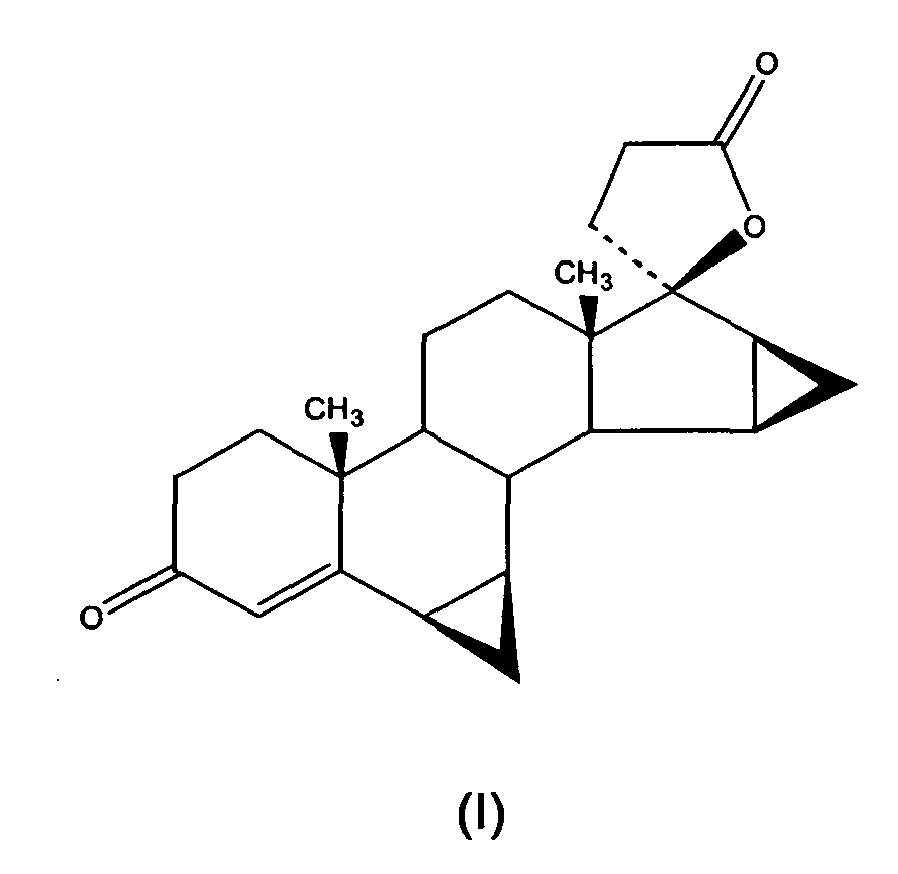
- It is a synthetic steroid with progestogenic, antimineralocorticoid and antiandrogenic activity; by virtue of these characteristics drospirenone has long been used for preparing pharmaceutical compositions with contraceptive action for oral administration.
- Many processes are known in the literature for preparing drospirenone, for example the process described in
European Patent No. 0 075 189 , starting from 3β,7α,15α-trihydroxy-5-androsten-17-one passing via the intermediate 5,6β-epoxy-7β-hydroxy-15β,16 β-methylene-3β-pivaloyloxy-5β-androstan-17-one. - As described in
EP 0 075 189 , this intermediate is then transformed into 7α-chloro-5,6β-epoxy-15β,16β-methylene-3β-pivaloyloxy-5β-androstan-17-one with a reaction that proposes the use of tetrachloromethane both as reagent and as reaction solvent. The use of this, highly toxic, solvent in relatively large quantities, constitutes one of the unfavourable aspects of this process. - In the process described in
EP 0 075 189 , from the intermediate 7α-chloro-5,6β-epoxy-15β,16β-methylene-3β-pivaloyloxy-5 β-androstan-17-one, via several passages, the intermediate 17α-(3-hydroxypropyl)-6β,7β;15β,16β-dimethylene-5β-androstan-3β3,5,17β-triol is arrived at, from which the final product drospirenone is obtained by oxidation with a pyridine/water/chromic anhydride mixture under hot conditions. This passage constitutes a further disadvantage of the known process: chromic anhydride, as all Cr(VI) compounds, is actually a known carcinogen whose use is subject to legislative restrictions such that the precautions required during the use and disposal of these products, render them practically unusable. - Moreover, the formation of drospirenone in an acid environment unavoidably generates a range of impurities, as was highlighted in
European Patent No. 0 918 791 and in Tetrahedron Letters 27(45), 5463-5466, 1986. - The need was therefore felt for a process that enables high purity drospirenone to be prepared, without however presenting the aforesaid disadvantages of processes of the known art.
- The Applicant has now found a new process to enable drospirenone with a high degree of purity to be obtained, suitable for use for the preparation of pharmaceutical compositions, which overcomes the disadvantages highlighted above related to the use of toxic and carcinogenic reagents and to the formation of many impurities in the final step of drospirenone formation.
- Subject of the present invention is the following synthesis step (a), in particular in the context of an overall process for the preparation of drospirenone, comprising the following steps (a) to (g) :
- a) bromination of 5,6β-epoxy-7β-hydroxy-15β,16β-methylene-3β-pivaloyloxy-5β-androstan-17-one of formula (II), in position 7α, to obtain 7α-bromo-5,6β-epoxy-15β,16β-methylene-3β-pivaloyloxy-5β-androstan-17-one of formula (III)

- b) opening the epoxy ring of, and removing bromine from, 7α-bromo-5,6β-epoxy-15β,16β-methylene-3β-pivaloyloxy-5β-androstan-17-one of formula (III) to obtain 5-hydroxy-15β,16β-methylene-3β-pivaloyloxy-5β-androst-6-en-17-one of formula (IV)
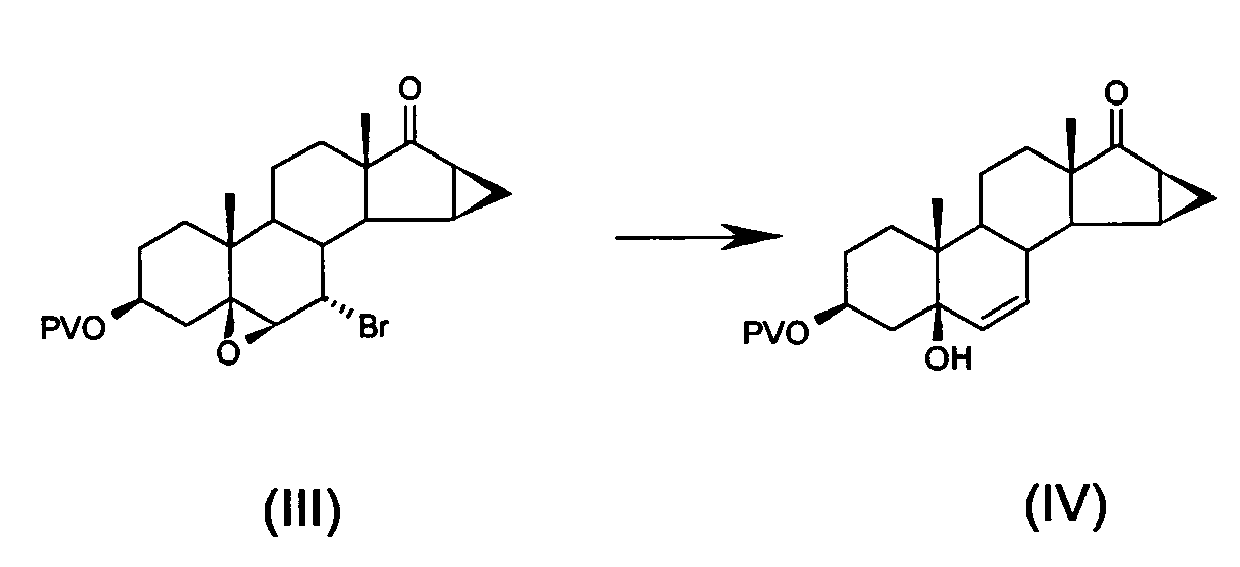
- c) hydrolysis of the pivaloyl group of 5-hydroxy-15β,16β-methylene-3β-pivaloyloxy-5β-androst-6-en-17-one of formula (IV) to obtain 3β,5-dihydroxy-15β,16β-methylene-5β-androst-6-en-17-one of formula (V)

- d) methylenation of 3β,5-dihydroxy-15β,16β-methylene-5β-androst-6-en-17-one of formula (V), at the Δ6 double bond, to obtain 3β,5-dihydroxy-6β,7β;15β,16β-dimethylene-5β-androst-17-one of formula (VI)

- e) reacting 3β,5-dihydroxy-6β,7β;15β,16β-dimethylene-5β-androst-17-one of formula (VI) with propargyl alcohol to obtain 17α-(3-hydroxy-1-propinyl)-6 β,7β;15β,16β-dimethylene-5β-androstan-3β,5,17β-triol of formula (VII)

- f) hydrogenating 17α-(3-hydroxy-1-propinyl)-6 β,7 β;15 β,16 β-dimethylene-5 β-androstan-3 β,5,17 β-triol of formula (VII) to obtain 17 α-(3-hydroxypropyl)-6 β,7 β;15 β,16 β-dimethylene-5 β-androstan-3 β,5,17 β-triol of formula (VIII)
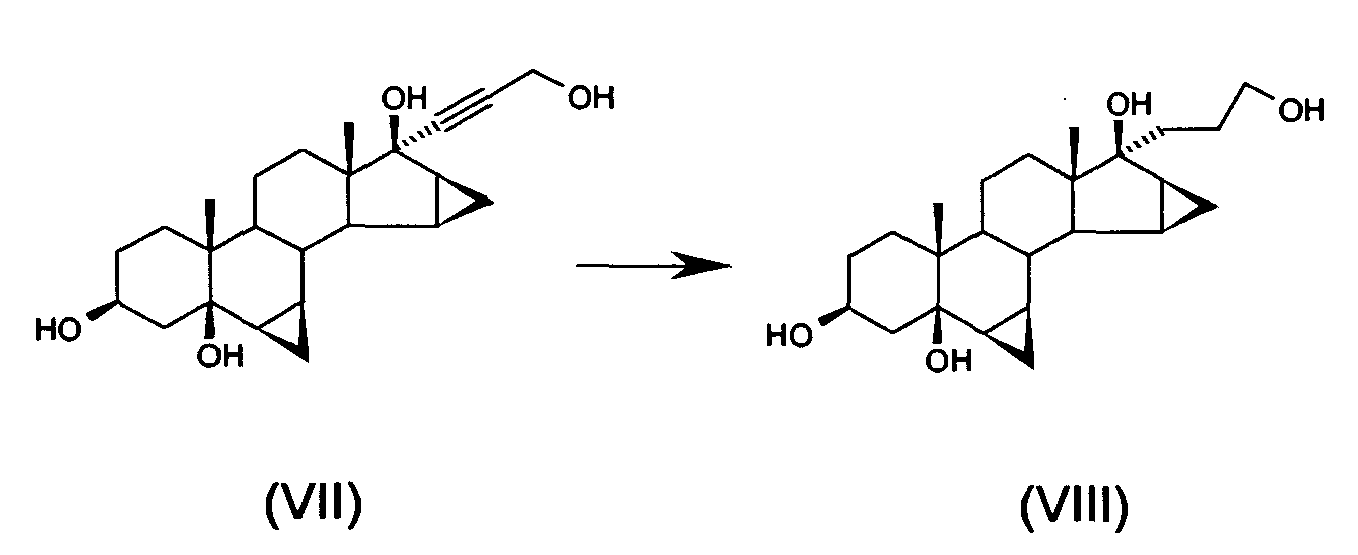
- g) oxidising 17α-(3-hydroxypropyl)-6β,7β; 15β,16β-dimethyiene-5β-androstan-3β,5,17β-triol of formula (VIII) to obtain drospirenone of formula (I)
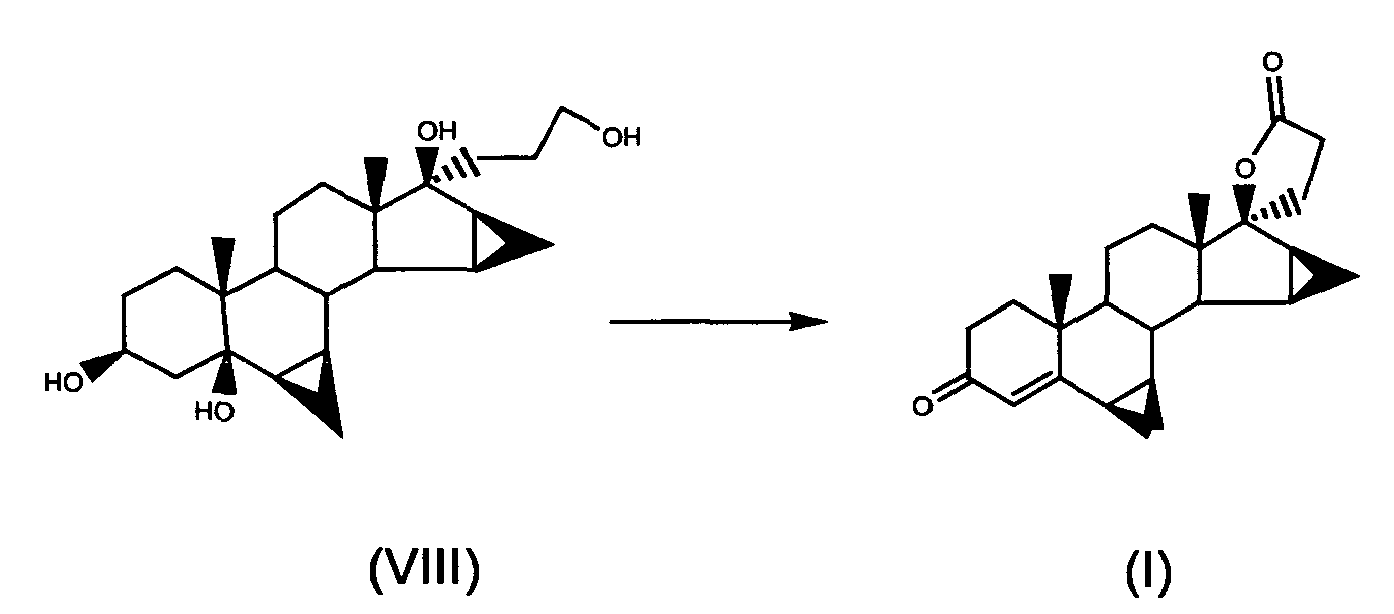
- i) the 5,6β-epoxy-7β-hydroxy-15β,16β-methylene-3 β-pivaloyloxy-5β-androstan-17-one of formula (II) in step a) is reacted with mesyl chloride to obtain the corresponding mesylate of formula (II-Ms), which is not isolated and from which 7α-bromo-5,6β-epoxy-15β,16β-methylene-3β-pivaloyloxy-5β-androstan-17-one of formula (III) is obtained by adding lithium bromide

- ii) said oxidation in step g) is carried out under such conditions that drospirenone forms under non-acidic pH conditions.
- i) the 5,6β-epoxy-7β-hydroxy-15β,16β-methylene-3 β-pivaloyloxy-5β-androstan-17-one of formula (II) in step a) is reacted with mesyl chloride to obtain the corresponding mesylate of formula (II-Ms), which is not isolated and from which 7α-bromo-5,6β-epoxy-15β,16β-methylene-3β-pivaloyloxy-5β-androstan-17-one of formula (III) is obtained by adding lithium bromide
- Characteristics and advantages of the invention will be illustrated in detail in the description that follows.
- The starting compound of the present process, i.e. 5,6β-epoxy-7β-hydroxy-15β,16β-methylene-3β-pivaloyloxy-5β-androstan-17-one, can be easily obtained from commercially available products in accordance with processes well known to those skilled of the art, for example from 3β-hydroxy-5-androsten-17-one as described in
European Patent No. 0 075 189 . - According to a preferred embodiment of the present process, the bromination reaction of step a) is achieved by adding mesyl chloride and pyridine to the starting compound at room temperature with the formation of the corresponding mesylate, then adding lithium bromide dissolved in water and bringing the temperature to values ranging from 70 to 75°C.
- At step g) of the present process, 17α-(3-hydroxypropyl)-6β,7β;15β,16β-dimethylene-5β-androstan-3β,5,17β-triol is oxidised to drospirenone directly, or by passing via the intermediate, 6β,7β;15β,16 β-dimethylene-5β-hydroxy-3-oxo-17α-pregn-21,17-carbolactol, which can in turn be oxidised to drospirenone directly or by passing via an intermediate, 6β,7β;15β,16 β-dimethylene-3-oxo-17α-pregn-4-en-21,17-carbolactol, which is then oxidised to drospirenone.
- According to the present process, 17α-(3-hydroxypropyl)-6β,7β;15β,16β-dimethylene-5β-androstan-3β,5,17β-triol can be oxidised to drospirenone directly by reaction with manganese oxide in toluene at a temperature between 40 and 110°C; or by reaction with a base chosen from aluminium isopropylate, potassium tert-butylate and sodium methylate in an organic solvent chosen from toluene and xylene, in the presence of a ketone selected from methylisobutylketone, acetone and cyclohexanone, at a temperature between 80 and 110°C.
- When the oxidation reaction of 17α-(3-hydroxypropyl)-6 β,7 β;15 β,16 β-dimethylene-5 β-androstan-3 β,5,17 β-triol to drospirenone passes via 6β,7β; 15β, 16 β-dimethylene-5β-hydroxy-3-oxo-17α-pregn-21,17-carbolactol, this latter is prepared in the form of an isomeric mixture by reacting the aforesaid triol with a reagent selected from oxalyl chloride and pyridine-SO3 in an organic solvent selected from dimethylsulfoxide and a dimethylsulfoxide-methylene chloride mixture, in the presence of triethylamine. The intermediate 6β,7β;15β,16β-dimethylene-5β-hydroxy-3-oxo-17α-pregn-21,17-carbolactol, having been obtained in this manner in the form of an isomeric mixture, can then be subjected to oxidation to obtain drospirenone, for example by reaction with manganese dioxide in toluene at a temperature between 40 and 110°C; or by reaction with a base selected from aluminium isopropylate, potassium tert-butylate and methylated sodium in an organic solvent selected from toluene and xylene, in the presence of a ketone selected from methylisobutylketone, acetone and cyclohexanone, at a temperature between 80 and 110°C.
- According to a further embodiment of the present process, oxidation of 6β,7β;15β,16β-dimethylene-5β-hydroxy-3-oxo-17α-pregn-21,17-carbolactol to drospirenone is carried out by reaction with sodium hypochlorite or calcium hypochlorite in an organic solvent selected from ethyl acetate, acetonitrile, toluene and methylene chloride at a temperature between 0 and 110°C in the presence of an organic base selected from pyridine, 1,8-diazabicyclo[5.4.0]undec-7-ene and 1,5-diazabicyclo[4.3.0]non-5-ene, in the presence of a basic aqueous solution, and in the presence of a reagent selected from the 4-methoxy-2,2,6,6-tetramethylpiperidine-1-oxyl radical, the 4-(benzoyloxy)-2,2,6,6-tetramethylpiperidine-1-oxyl radical, the 4-hydroxy-2,2,6,6-tetramethylpiperidine-1-oxyl radical and the 2,2,6,6-tetramethylpiperidine-1-oxyl radical, said reaction being followed by distillation of the organic solvent.
- According to the present process, oxidation of 6β,7β;15β,16β-dimethylene-5β-hydroxy-3-oxo-17α-pregn-21,17-carbolactol to drospirenone can be undertaken directly as said above, or by passing via the intermediate 6β,7β;15β,16β-dimethylene-3-oxo-17α-pregn-4-en-21,17-carbolactol; in this latter case, 6β,7β;15β,16β-dimethylene-5β-hydroxy-3-oxo-17α-pregn-21,17-carbolactol prepared in the form of an isomeric mixture as described above is reacted with a reagent selected from sodium methylate in methanol, potassium tert-butylate in tert-butanol, pyridine and a mixture of water and pyridine, at a temperature between 15 and 65°C to obtain 6β,7β;15β,16β-dimethylene-3-oxo-17α-pregn-4-en-21,17-carbolactol in the form of an isomeric mixture, which is then subjected to oxidation to obtain drospirenone.
- Oxidation of 6β,7β;15β,16β-dimethylene-3-oxo-17α-pregn-4-en-21,17-carbolactol to drospirenone can be carried out for example with manganese dioxide in toluene at a temperature between 40 and 110°C; or with a base selected from aluminium isopropylate, potassium tert-butylate and sodium methylate in an organic solvent selected from toluene and xylene, in the presence of a ketone selected from methylisobutylketone, acetone and cyclohexanone, at a temperature between 80 and 110°C.
- According to a further embodiment of the present invention, said oxidation of 6β,7β;15β,16β-dimethylene-3-oxo-17α-pregn-4-en-21,17-carbolactol in the form of an isomeric mixture to drospirenone is carried out by reaction with sodium hypochlorite or calcium hypochlorite in an organic solvent selected from ethyl acetate, acetonitrile, toluene and methylene chloride, at a temperature between 0 and 110°C, in the presence of an organic base selected from pyridine, 1,8-diazabicyclo[5.4.0]undec-7-ene and 1,5-diazabicyclo[4.3.0]non-5-ene, in the presence of a basic aqueous solution, and in the presence of a reagent selected from the 4-methoxy-2,2,6,6-tetramethylpiperidine-1-oxyl radical, the 4-(benzoyloxy)-2,2,6,6-tetramethylpiperidine-1-oxyl radical, the 4-hydroxy-2,2,6,6-tetramethylpiperidine-1-oxyl radical and the 2,2,6,6-tetramethylpiperidine-1-oxyl radical, said reaction being followed by distillation of the organic solvent. Preferably this oxidation of 6β,7β;15β,16β-dimethylene-3-oxo-17α-pregn-4-en-21,17-carbolactol to drospirenone is carried out by reaction with calcium hypochlorite in methylene chloride at a temperature between 0 and 20°C in the presence of the 2,2,6,6-tetramethylpiperidine-1-oxyl radical and in the presence of an aqueous sodium bicarbonate solution.
- According to a further embodiment of the present process, said oxidation of 6β,7β;15β,16β-dimethylene-3-oxo-17α-pregn-4-en-21,17-carbolactol in the form of an isomeric mixture to drospirenone is carried out by reaction with a ruthenium salt in the presence of a base and a drying agent in an organic solvent selected from ethyl acetate, acetonitrile, toluene and methylene chloride, at a temperature between 0 and 110°C. Preferably, said oxidation reaction is carried out at a temperature between 15 and 30°C by reaction with tetrapropylammonium perruthenate, using N-methylmorpholine N-oxide as the base, molecular sieves as drying agent and acetonitrile as organic solvent.
- According to a further embodiment of the present process, this oxidation reaction of 6β,7β;15β,16β-dimethylene-3-oxo-17α-pregn-4-en-21,17-carbolactol in form of isomeric mixture to drospirenone is carried out by microbiological route using acetic bacteria, preferably belonging to the strain classified as Acetobacter aceti MIM ANTO.
- The bio-transformation occurs with analogous yields by adding the 6β,7β;15β,16β-dimethylene-3-oxo-17α-pregn-4-en-21,17-carbolactol in form of isomeric mixture both to the brothculture 24 hours after inoculum, and to the bacterial cells obtained following to centrifugation of the same brothculture and re-suspended in phosphate buffer at pH = 6.
- When the brothculture is used, it is typically used the culture of cells submerged in a flask in a suitable culture medium for a growth time of 24 hours after inoculum at 28°C. As the culture medium it is preferably used a culture medium called GLY, composed of glycerol (25 g/I) and yeast extract (10 g/l) and distilled water, brought to pH = 5. The culture medium may be sterilised at 115°C for 20 minutes at a pressure of 0.75 atm.
- According to a preferred embodiment of the present microbiological oxidation, the above said carbolactol in the form of isomeric mixture is added so that its concentration in the brothculture, or in the suspension of the cells obtained by centrifugation of the brothculture, is equal to 2 g/l.
- The drospirenone obtained with the present process as described above, has a high degree of purity which could be still increased by subjecting the crude product coming from the oxidation in step g) to a purification process, comprising gel chromatography with an organic solvent as eluent, possibly followed by crystallisation.
- The gel used according to the invention can be selected from the group consisting of silica gel, alumina, Magnesium silicate (for example that marketed as Florisil®), and dextran (for example that marketed as Sephadex®), and can have a particle size distribution ranging from 5 to 200 µm, while the eluent can for example be selected from the group consisting of ethyl ether, isopropyl ether, ethyl acetate, isopropyl acetate, methylene chloride, acetone, tetrahydrofuran, methanol, ethanol, isopropanol, hexane (n-hexane or mixture of isomers), heptane (n-heptane or a mixture of isomers) and their mixtures. Preferably the gel is silica gel and the eluent is ethyl ether.
- The weight ratio gel to drospirenone can be comprised for example between 5:1 and 25:1. Preferably, the weight ratio gel to drospirenone is equal to 10:1 and the eluent is pure ethyl ether.
- The drospirenone to be purified can be loaded after absorption onto dry gel or dissolved in the elution solvent.
- Column preparation and elution are preferably carried out at a temperature comprised between 0 and 50°C, and at a pressure between 0 and 2000 psi.
- The drospirenone coming from chromatography can possibly be subjected to crystallisation with a solvent selected for example from the group consisting of ethyl ether, isopropyl ether, methyl tert-butyl ether, ethyl acetate, isopropyl acetate, methyl acetate, dimethoxyethane, methanol, ethanol, isopropanol, methylene chloride, acetone, dimethylacetamide, dimethylformamide, and their mixtures; preferably the crystallisation solvent is isopropyl acetate.
- The present process for the preparation of drospirenone as described above, has proved to be favourable because it enables the preparation of an intermediate, 7α-bromo-5,6β-epoxy-15β,16β-methylene-3β-pivaloyloxy-5β-androstan-17-one, useful for the synthesis of drospirenone, avoiding however the use of toxic solvents and reagents such as tetrachloromethane used in the process as given in
EP 0 075 189 . Moreover, the preparation of this brominated intermediate, while passing via the formation of a mesylated intermediate, does not involve an additional step in the process, in that the mesylate is not isolated but brominated directly. - The use of carcinogenic reagents is also avoided in the oxidation step g) which, in addition to not requiring carcinogenic reagents, is even more efficient than the oxidation with chromic anhydride described in
EP 0 075 189 . Moreover, by virtue of the fact that drospirenone is formed in a basic environment, a final product is obtained which lacks the impurities that drospirenone gives rise to in an acidic environment, as described inEP 0 918 791 . - Finally, the purification process by gel chromatography enables the invert lactone fraction that is always present in the crude product and identified as ZK35096 in
US Patent 6,121,465 , to be completely eliminated. This purification process is applicable to and is useful for the purification of not only drospirenone prepared in accordance with the present process, but also products obtained with other processes in which the aforementioned invert lactone is present as an impurity. - The following examples are given as non-limiting illustrations of the present invention.
- 67.5 g of 5,6β-epoxy-7β-hydroxy-15β,16β-methylene-3β-pivaloyloxy-5β-androstan-17-one are dissolved in 205 ml of pyridine in a 2 litre flask, under nitrogen. 17.5 ml of mesyl chloride are added from a dropping funnel, at a temperature of 20/25°C.
- The mixture is stirred for 1 hour at 20°C to obtain a thick orange suspension.
- The progress of the reaction is checked by TLC. At the end of the reaction 83.2 g of lithium bromide dissolved in 54 ml of water are added and the temperature is brought to 70/75°C. After 3 hours 8 g of lithium bromide dissolved in 50 ml of pyridine are further added.
- At the end of the reaction (checked by TLC) the temperature is brought to 60°C and 700 ml of water are added; it is left to cool to 15/20°C, stirring for 1 hour at this temperature.
- The solid is filtered off and washed with 500 ml of water.
- The solid is dried for 24 hours under reduced pressure at 45°C to obtain 69.5 g of the compound of the title.
- On the product thus obtained, purified by chromatographic means, 1H-NMR and mass spectroscopic analyses were carried out, and the following results were obtained:
1H-NMR (300 MHz, CDCl3): d (ppm) 0.92 (18-Me, s, 3H); 1.04 (19-Me, s, 3H); 1.08-1.16 (m, 1H); 1.16 (t-But, s, 9H); 1.18-1.28 (m, 1H); 1.36-1.60 (m, 8H); 1.62-1.68 (m, 1H); 1.72-1.76 (m, 1H); 1.84-1.96 (m, 3H); 2.04-2.16 (m, 3H); 3.46 (6-H, broad s, 1H); 4.73 (7-H, broad s, 1H); 4.76-4.84 (3-H, m, 1H).
Mass by electron impact: m/z [376] and [378]= M+-C(CH3)3-COOH; [297] and [299]= M+-C(CH3)3-COOH-Br - 27 g of powdered zinc suspended in 91 ml of THF (tetrahydrofuran) are fed into a 1 litre flask, under nitrogen.
- The suspension is heated to 40/45°C and 19.9 ml of glacial acetic acid are slowly added dropwise, maintaining the temperature under 60°C during the addition.
- The suspension is stirred for 15 minutes at 40°C after which a solution, preheated to 45°C, of 67.5 g of -7α-bromo-5,6β-epoxy-15β,16β-methylene-3β-pivaloyloxy-5β androstan-17-one in 277 ml of THF, prepared as described in example 1, is added. The temperature is maintained at 48/50°C during the addition.
- The reaction mixture is stirred for 3 hours at 59/60°C.
- At the end of the reaction (checked by TLC) it is cooled to 50°C and the zinc is filtered off through dicalite; the filter is washed with 200 ml of THF.
- The filtered solution is brought to pH 9 with 60 ml of triethylamine.
- The solution is concentrated under reduced pressure at 50°C to obtain about 180 g of a semisolid product which is taken up in 500 ml of a 5% acetic acid-water solution (pH=4 with a precipitate).
- It is stirred for 1 hour at 10/15°C, the solid is filtered off and washed with 500 ml of water then dried under reduced pressure for 12 hours at 50°C to obtain 57 g of crude product.
- The crude product is refluxed for 1 hour in a mixture of t-butylmethylether = 115 115 ml and ethyl acetate = 114 ml (partial dissolution).
- It is cooled for 1 hour at 0/5°C, the solid is filtered off and washed with t-butylmethylether and dried under reduced pressure for 1 hour at 60°C. 44.6 g of the title compound are obtained.
- The analytical data obtained from a sample purified by chromatography correspond to those given in
EP 0 075 189 . - 43 g of 5-hydroxy-15 β,16 β-methylene-3 β-pivaloyloxy-5 β-androst-6-en-17-one prepared as described above in Example 2, 430 ml of THF, 215 ml of methanol, 12.9 g of potassium hydroxide and 4.3 g of sodium perchlorate are fed into a 2 litre flask, under nitrogen at 20°C. The suspension is stirred at 20°C for 3 hours.
- At the end of the reaction (checked by TLC), the entirety is poured into 2 litres of water.
- The suspension is brought to pH 7 with 20% sulfuric acid (about 25 ml) then stirred for 1 hour at 0/5°C. The solid is filtered off, washed with water and dried for 12 hours under reduced pressure at 50°C to obtain 30.6 g of the title compound.
- The analytical data obtained for a sample purified by chromatography correspond to those given in
EP 0 075 189 . - 29 g of 3 β,5-dihydroxy-15β,16β-methylene-5 β-androst-6-en-17-one prepared as described above in Example 3 are fed into a 2 litre flask under nitrogen at 20°C with 410 ml of THF.
- 0.6 g of copper (II) acetate hydrate are added and the mixture is stirred until a clear (green) solution appears.
- 37.9 g of finely powered zinc are added followed, after stirring for 15 minutes, by 1.7 ml of acetic acid.
- The mixture is further agitated for 30 minutes at 20°C then heated to 50°C; 32.3 ml of methylene bromide are then added and it is refluxed for 2 hours.
- At the end of the reaction (checked by TLC) it is cooled to 20°C and a mixture of acetic acid = 26.8 ml in 450 ml water is added slowly while cooling.
- The mixture is filtered through dicalite and the panel is washed with 600 ml toluene.
- The phases are separated and the aqueous phase is extracted with 200 ml toluene.
- The pooled organic phases are washed with 350 ml water.
- The organic phase is dried over sodium sulfate, filtered and concentrated under reduced pressure at 60°C until a solid is obtained.
- The solid is taken up with 60 ml t-butylmethylether, filtered off and washed with a further 20 ml of t-butylmethylether.
- The solid is dried for 12 hours under reduced pressure at 45°C to obtain 25.5 g of the title compound.
- The analytical data obtained from a sample purified by chromatography correspond to those given in
EP 0 075 189 . - 24 g of 3β,5-dihydroxy-6β,7β;15β,16β-dimethylene-5β-androst-17-one prepared as described above in Example 4 are fed into a 1 litre flask, under nitrogen at 20°C, with 480 ml THF.
- The mixture is cooled to 0/5°C and 72 g of potassium methylate are added (yellow suspension).
- While maintaining the temperature at 0/5°C 48 ml of propargyl alcohol diluted with 90 ml THF are added slowly (thick orange solution).
- A further 150 ml of THF are added when the density of the solution renders stirring impossible. The solution is stirred for 12 hours at 0/5°C.
- At the end of the reaction (checked by TLC) the very thick suspension is poured into 2 litres of water and ice (an orange solid precipitates) and the pH is adjusted to 7 with 62% sulfuric acid (about 60 ml).
- The solid obtained is filtered off and washed with 300 ml of water.
- The filtered liquid is extracted with 1.5 litres of isopropylacetate.
- The organic phase is dried over sodium sulfate, filtered and concentrated under reduced pressure at 50°C to obtain a solid.
- The solid is filtered off from heptane and dried for 12 hours at 45°C under reduced pressure to obtain 27.1 g of the title compound.
- The analytical data obtained from a sample purified by chromatography correspond to those given in
EP 0 075 189 . - A solution of 25.1 g of 17α-(3-hydroxy-1-propinyl)-6β,7β;15β,16β-dimethylene-5β-androstan-3β,5,17β-triol prepared as described above in Example 5, in 930 ml of a mixture prepared with 750 ml THF, 375 ml methanol and 1.5 ml of pyridine is fed into an autoclave.
- 5g of 5% Pd/C catalyst are added and hydrogenation takes place at atmospheric pressure (20/25°C) for 2 hours.
- At the end of the reaction (checked by TLC) the suspension is filtered through dicalite and the filter is washed with methylene chloride.
- The product is concentrated under reduced pressure at 50°C to obtain 32 g of the title compound.
- The crude title product contained small quantities of the two 6β,7β;15β,16β-dimethylene-3β,5β-dihydroxy-17α-pregn-21,17-carbolactols. It was nevertheless advantageously used for the subsequent reaction, without further purification.
- A sample of the title product purified by chromatography gave the following results with 1H-NMR analysis:
1H-NMR (300 MHz, CDCl3): δ (ppm) 0.84 (18-Me, s, 3H); 0.88 (19-Me, s, 3H); 1.72 (s, -OH); 2.32-2.40 (m, -OH); 2.6(s,-OH); 3.38-3.40 (m, -OH); 3.64-3.76 (-CH2OH, m, 2H); 4.0 (3-H, m, 1H). - The signals of the hydroxyl protons were identified by deuteration.
- The crude reaction product used for the subsequent reaction also showed the following signals:
1H-NMR (300 MHz, CDCl3): δ (ppm) 5.50 (17-O-CHOH-21, t, 1H); 5.58 (17-0-CHOH-21, t, 1H). - 10 g of 17α-(3-hydroxypropyl)-6β,7β;15β,16β-dimethylene-5β-androstan-3β,5,17β-triol prepared as described above in Example 6 are dissolved in 250 ml of demethyl sulfoxide and 450 ml triethylamine, in a 2 litre flask under nitrogen.
- 30 g of pyridine-SO3 complex are added in portions to the solution thus obtained while under stirring, maintaining the temperature at 20/25°C.
- The mixture is stirred for 40 minutes at 20/25°C then heated to 50/60°C for a further 2 hours, checking the progress of the reaction by TLC.
- At the end of the reaction 250 ml of water are added and the temperature brought to 0/5°C.
- After 1 hour, the product is filtered off, washed with a 5% sodium hypochlorite solution and then with water and dried for 24 hours under reduced pressure at 45°C obtaining finally 8.5 g of a product consisting of a mixture of the two possible 6β,7β;15β,16 β-dimethylene-5β-hydroxy-3-oxo-17α-pregn-21,17-carbolactols, which is used directly in the next step without any purification.
1H-NMR analysis carried out on the mixture highlights the appearance of two signals at 5.5 ppm and 5.58 ppm the sum of whose areas is equivalent to a proton (protons adjacent to oxygen of the carbolactol ring), and the disappearance of both the signal at 3.72 ppm (two protons of the free chain adjacent to oxygen) and the signal at 4 ppm (proton in position 3).
Mass by electron impact: m/z [386] = M+
IR(KBr) = 1707 cm-1 - 7.5 g of the mixture of the two 6β,7β;15β,16 β-dimethylene-5β-hydroxy-3-oxo-17α-pregn-21,17-carbolactols obtained as aforedescribed in example 7 are dissolved in 300 ml of methanol and 750 mg of sodium methylate, in a 1 litre flask under nitrogen.
- The solution thus obtained is left under agitation for 12 hours maintaining the temperature at 20/25°C, then 300 ml of water are added and the temperature is brought to 0/5°C.
- After 1 hour the solid product which has formed is recovered by filtration, then the product is washed with water and dried for 24 hours under reduced pressure at 45°C, to obtain 6.5 g of a product shown to consist of a mixture of the two possible 6β,7β; 15β, 16β-dimethylene-3-oxo-17α-pregn-4-en-21,17-carbolactols.
- Said mixture is then used directly in the subsequent step with no further purification.
- In the 1H-NMR analysis of the mixture of carbolactols prepared as described above, the two signals at 5.5 ppm and 5.58 ppm are maintained (protons adjacent to oxygen of the carbolactol ring), with the appearance of a signal at 6 ppm (proton in position 4).
Mass by electron impact: m/z[368] = M+
IR(KBr) = 1665, 1595 cm-1 - 7.5 g of the mixture of the two 6β,7β;15β,16 β-dimethylene-5β-hydroxy-3-oxo-17α-pregn-21,17-carbolactols obtained as described above in Example 7 are dissolved in 300 ml of pyridine and 50 ml of water in a 1 litre flask under nitrogen.
- The solution thus obtained is left under stirring for 12 hours maintaining the temperature at 45/50°C, then 300 ml of water are added followed by extraction with ethyl acetate.
- The organic phase containing the product is recovered, then washed with aqueous acetic acid and water until the pH is neutral. After drying over sodium sulfate and concentrating to dryness under reduced pressure, 6.4 g of a product, shown to consist of a mixture of the two possible 6β,7β;15β,16 β-dimethylene-3-oxo-17α-pregn-4-en-21,17-carbolactols, are obtained.
- The analytical data of the product obtained correspond to those obtained from the sample of aforesaid Example 8.
- The mixture obtained is used directly in the next step without additional purification.
- 10 g of a mixture of the two 6β,7β;15β,16 β-dimethylene-3-oxo-17α-pregn-4-en-21,17-carbolactols obtained as described above in Example 9, previously dissolved in 280 ml of methylene chloride, are added to a 1 litre flask containing 280 ml of a 5% aqueous solution of sodium bicarbonate.
- 0.5 g of the 2,2,6,6-tetramethylpiperidine-1-oxyl radical and 16 g of calcium hypochlorite are added in portions under agitation at a temperature of 0/5°C.
- The mixture is left under stirring for 1 hour while maintaining the temperature at 20/25°C, then the phases are separated and the solvent is removed under reduced pressure.
- The crude reaction product is chromatographed over 100 g of silica gel, eluting with ethyl ether.
- The product obtained from the chromatography is crystallised from isopropyl acetate.
- After drying for 24 hours under reduced pressure at 45°C, 7.9 g of drospirenone are obtained whose analytical characteristics correspond to those given in the literature.
- 10 g of a mixture of the two 6β,7β;15β,16 β-dimethylene-5β-hydroxy-3-oxo-17α-pregn-21,17-carbolactols obtained as described above in Example 7, previously dissolved in 200 ml of methylene chloride, are added to a 1 litre flask containing 280 ml of a 5% aqueous solution of sodium bicarbonate.
- 0.5 g of the 2,2,6,6-tetramethylpiperidine-1-oxyl radical and 24 g of calcium hypochlorite are added in portions over a period of 3 hours under stirring at a temperature of 0/5°C.
- 100 ml of pyridine are added and the methylene chloride is distilled at room pressure.
- When the distillation is finished the mixture is kept hot until the end of the reaction, then the solvent is concentrated under reduced pressure, and the crude reaction product is chromatographed over 250 g of silica gel eluting with ethyl ether.
- The product obtained from the chromatography is crystallised from isopropyl acetate.
- After drying for 24 hours under reduced pressure at 45°C, 6.9 g of drospirenone are obtained whose analytical characteristics correspond to those given in the literature.
- 5 g of the mixture of the two 6β,7β;15β,16 β-dimethylene-3-oxo-17α-pregn-4-en-21,17-carbolactols obtained as described above in Example 8 are dissolved in 500 ml of toluene in a 1 litre flask under nitrogen. 50 ml of cyclohexanone are added to the solution thus obtained and then a total of 50 ml of overheads are distilled off.
- The reaction mixture is then cooled to 80°C and, after adding 10 g of potassium tert-butylate, refluxed for 2 hours.
- At the end of the reaction the mixture is cooled to 40°C and the solvent is removed under reduced pressure, to obtain a crude reaction product which is then chromatographed over 50 g of silica gel eluting with ethyl ether.
- The product obtained from the chromatography is crystallised from isopropyl acetate.
- After drying for 24 hours under reduced pressure at 45°C, 2.5 g of drospirenone are obtained whose analytical characteristics correspond to those reported in the literature.
- 5 g of the mixture of the two 6β,7β;15β,16 β-dimethylene-5β-hydroxy-3-oxo-17α-pregn-21,17-carbolactols obtained as described in the aforesaid Example 7 are dissolved in 500 ml of toluene in a 1 litre flask under nitrogen.
- 60 ml of methylisobutylketone are added and then a total of 50 ml of overheads are distilled off.
- The reaction mixture is cooled to 80°C and, after adding 12 g of potassium tert-butylate, refluxed for 5 hours.
- At the end of the reaction, the mixture is cooled 40°C and the solvent is removed under reduced pressure. The crude reaction product thus obtained is chromatographed over 50 g of silica gel eluting with ethyl ether.
- The product obtained from the chromatography is crystallised from isopropyl acetate.
- After drying for 24 hours under reduced pressure at 45°C, 1.2 g of drospirenone are obtained whose analytical characteristics correspond to those given in the literature.
- 10 g of 17α-(3-hydroxy-1-propyl)-6β,7β;15β,16β-dimethylene-5β-androstan-3β,5,17β-triol prepared as described above in Example 6 are dissolved in 300 ml of toluene in a 2 litre flask under nitrogen.
- 60 ml of cyclohexanone are added then a total of 50 ml of overheads are distilled off.
- The reaction mixture is cooled to 80°C, and after adding 10 g of potassium tert-butylate, refluxed for six hours.
- Another 20 g of potassium tert-butylate are added in two portions and refluxed for a further 12 hours.
- At the end of the reaction the mixture is cooled to 40°C and the solvent is removed under reduced pressure by distilling excess oils with water.
- The crude reaction product is chromatographed over 100 g of silica gel eluting with ethyl ether.
- The product obtained from the chromatography is crystallised from isopropyl acetate.
- After drying for 24 hours under reduced pressure at 45°C, 2,6 g of drospirenone are obtained whose analytical characteristics correspond to those given in the literature.
- 10 g of 17α-(3-hydroxy-1-propyl)-6 β,7 β;15 β,16 β-dimethylene-5 β-androstan-3 β,5,17 β-triol prepared as described above in Example 6 are dissolved in 400 ml of toluene in a 2 litre flask under nitrogen.
- The mixture is heated to reflux, and 40 g of manganese dioxide are added in portions. The reaction mixture is cooled to 80°C, then maintained under stirring at this temperature for 16 hours.
- At the end of the reaction the mixture is cooled, the solid is filtered off through dicalite and the solvent removed under reduced pressure.
- The crude reaction product is chromatographed over 120 g of silica gel eluting with ethyl ether. The product obtained from the chromatography is crystallised from isopropyl acetate.
- After drying for 24 hours under reduced pressure at 45°C, 3.3 g of drospirenone are obtained whose analytical characteristics correspond to those given in the literature.
- 5g of the mixture of the two 6β,7β;15β,16 β-dimethylene-3-oxo-17α-pregn-4-en-21,17-carbolactols obtained as described above in Example 8 are dissolved in 280 ml of toluene in a 1 litre flask under nitrogen.
- The mixture is heated to reflux and 20 g of manganese dioxide are added in portions.
- The reaction mixture is cooled to 80°C and maintained under stirring at this temperature for 16 hours.
- At the end of the reaction the mixture is cooled, the solid is filtered off through dicalite and the solvent removed under reduced pressure.
- The crude reaction product is chromatographed over 120 g of silica gel eluting with ethyl ether. The product obtained from the chromatography is crystallised from isopropyl acetate.
- After drying for 24 hours under reduced pressure at 45°C, 2.5 g of drospirenone are obtained whose analytical characteristics correspond to those given in the literature.
- 300 ml of acetonitrile, 10 g of N-methylmorpholine N-oxide, 13 g of 4 Angstrom molecular sieves, 500 mg of tetrapropylammonium perruthenate and 10 g of the mixture of the two 6β,7β;15β,16 β-dimethylene-3-oxo-17α-pregn-4-en-21,17-carbolactols obtained as described above in Example 8 are fed into a 1 litre flask under nitrogen. This reaction mixture is maintained for 2 hours at 22°C under agitation, monitoring the reaction with thin layer chromatography (TLC).
- At the end of the reaction the mixture is filtered through dicalite, the filter is washed with acetonitrile, then the solvent is removed under reduced pressure. The solid is redissolved in methylene chloride and washed with water until the pH = 7.
- The phases are separated, the organic phase is dried over sodium sulfate, filtered off and the solvent removed under reduced pressure.
- The crude reaction product is chromatographed over 120 g of silica gel eluting with ethyl ether. The product obtained from the chromatography is then crystallised from isopropyl acetate.
- After drying for 24 hours under reduced pressure at 45°C, 5.1 g of drospirenone are obtained, whose analytical characteristics correspond to those given in the literature.
- In a 500 ml flask, placed on an alternate stirrer with speed of 100 rpm and run of 4 cm, containing 50 ml of a brothculture of Acetobacter aceti MIM ANTO, the mixture of the two 6β,7β;15β,16 β-dimethylene-3-oxo-17α-pregn-4-en-21,17-carbolactols obtained as described above in Example 8 is added, so to attain a concentration of 2 g/l.
- The flask is maintained under stirring for 24 hours at 28°C checking the reaction progress by TLC (CH2Cl2/acetone 9/1).
- Once the reaction is terminated, the brothculture is extracted with ethyl acetate, the organic phase is dehydrated on sodium sulphate and the solvent is eliminated at reduced pressure.
- The raw product is chromatographed on 20 g of silica gel eluting with ethyl ether. The product coming from chromatography is then crystallised using isopropyl acetate.
- After drying for 24 hours at reduced pressure and 45°C, 65 mg of drospirenone are obtained, whose analytical characteristics coincide with what reported in literature.
Claims (29)
- Process for the preparation of 7-α-bromo-5,6-β-epoxy-15β,16β-methylene-3β-pivaloyloxy-5β-androstan-17-one of formula (III), comprising a bromination reaction in position 7α of 5,6β-epoxy-7β-hydrvxy-15β,16β-methylene-3β-pivaloyloxy-5β-androstan-17-one of formula (II), according to the following step a):


- Process according to claim 1, wherein the mesylate of formula (II-Ms) is obtained by adding mesyl chloride and pyridine to the starting compound of formula (II) at room temperature, then the compound of formula (III) is obtained by adding lithium bromide dissolved in water to the compound of formula (II-Ms) and bringing the temperature to values between 70 and 75 °C.
- Process according to claim 1, further comprising the following steps leading to the preparation of drospirenone:b) opening the epoxy ring of, and removing bromine from, 7α-bromo-5,6β-epoxy-15β,16β-methylene-3β-pivaloyloxy-5β-androstan-17-one of formula (III) to obtain 5-hydroxy-15β,16β-methylene-3β-pivaloyloxy-5β-androst-6-en-17-one of formula (IV):
 c) hydrolysis of the pivaloyl group of 5-hydroxy-15β,16β-methylene-3β-pivaloyloxy-5β-androst-6-en-17-one of formula (IV) to obtain 3β,5-dihydroxy-15β,16β-methylene-5β-androst-6-en-17-one of formula (V):
 d) methylenation of 3β,5-dihydroxy-15β,16β-methylene-5β-androst-6-en-17-one of formula (V), at the Δ6 double bond, to obtain 3β,5-dihydroxy-6β;7β;15β,16β-dimethylene-5β-androst-17-one of formula (VI):
 e) reacting 3β,5-dihydroxy-6β,7β;15β,16β-dimethylene-5β-androst-17-one of formula (VI) with propargyl alcohol to obtain 17α-(3-hydroxy-1-propinyl)-6β,7β;15β,16β-dimethylene-5β-androstan-3β,5,17β-triol of formula (VII):
 f) hydrogenating 17α-(3-hydroxy-1-propinyl)-6β,7β;15β,16β-dimethylene-5β-androstan-3β,5,17β-triol of formula (VII) to obtain 17α-(3-hydroxypropyl)-6β,7β;15β,16β-dimethylene-5β-androstan-3β,5,17β-triol of formula (VIII):
 g) oxidising 17α-(3-hydroxypropyl)-6β,7β;15β,16β-dimethylene-5β-androstan-3β,5,17β-triol of formula (VIII) to obtain drospirenone of formula (I), under such conditions that drospirenone forms under non-acidic pH conditions:
- Process according to claim 3, wherein said oxidation reaction at step g) is carried out by reacting 17α-(3-hydroxypropyl)-6β,7β;15β,16β-dimethylene-5β-androstan-3β,5,17β-triol of formula (VIII) with manganese oxide in toluene at a temperature between 40 and 110 °C.
- Process according to claim 3, said oxidation at step g) is carried out by reacting 17α-(3-hydroxypropyl)-6β,7β;15β,16β-dimethylene-5β-androstan-3β,5,17β-triol of formula (VIII) with a base selected from aluminium isopropylate, potassium tert-butylate and sodium methylate in an organic solvent selected from toluene and xylene, in the presence of a ketone selected from methylisobutylketone, acetone and cyclohexanone, at a temperature between 80 and 110 °C.
- Process according to claim 3, wherein said oxidation at step g) is carried out by reacting 17α-(3-hydroxypropyl)-6β,7β;15β;16β-dimethylene-5β-androstan-3β,5,17β-triol of formula (VIII) with a reagent selected from oxalyl chloride and pyridine-SO3 in an organic solvent selected from dimethylsulfoxide and a dimethylsulfoxide-methylene chloride mixture, in the presence of triethylamine, to obtain 6β,7β;15β,16β-dimethylene-5β-hydroxy-3-oxo-17α-pregn-21,17-carbolactol in the form of an isomeric mixture of formula (IX):
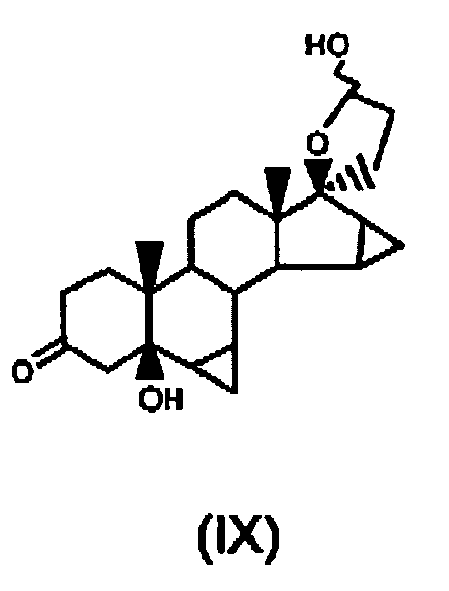
- Process according to claim 6, wherein said oxidation of 6β,7β;15β,16β-dimethylene-5β-hydroxy-3-oxo-17α-pregn-21,17-carbolactol in the form of an isomeric mixture of formula (IX) to drospirenone of formula (I) is carried out with manganese dioxide in toluene at a temperature between 40 and 110 °C.
- Process according to claim 6, wherein said oxidation of 6β,7β;15β,16β-dimethylene-5β-hydroxy-3-oxo-17α-pregn-21,17-carbolactol in the form of an isomeric mixture of formula (IX) to drospirenone of formula (I) is carried out with a base selected from aluminium isopropylate, potassium tert-butylate and sodium methylate in an organic solvent selected from toluene and xylene, in the presence of a ketone selected from methylisobutylketone, acetone and cyclohexanone, at a temperature between 80 and 110 °C.
- Process according to claim 6, wherein said oxidation of 6β,7β;15β,16β-dimethylene-5β-hydraxy-3-oxo-17α-pregn-21,17-carbolactol in the form of an isomeric mixture of formula (IX) to drospirenone of formula (I) is carried out by reacting with sodium hypochlorite or calcium hypochlorite in an organic solvent selected from ethyl acetate, acetonitrile, toluene and methylene chloride at a temperature between 0 and 110 °C in the presence of an organic base selected from pyridine, 1,8-diazabicyclo[5.4.0]undec-7-ene and 1,5-diazabicyclo[4.3.0]non-5-ene, in the presence of a basic aqueous solution, and in the presence of a reagent selected from the 4-methoxy-2,2,6,6-tetramethylpiperidine-1-oxyl radical, the 4-(benzoyloxy)-2,2,6,6-tetramethylpiperidine-1-oxyl radical, the 4-hydroxy-2,2,6,6-tetramethylpiperidine-1-oxyl radical and the 2,2,6,6-tetramethylpiperidine-1-oxyl radical, said reaction being followed by distillation of the organic solvent.
- Process according to claim 6, wherein said oxidation of 6β,7β;15β,16β-dimethylene-5β,-hydroxy-3-oxo-17α-pregn-21,17-carbolactol in the form of an isomeric mixture of formula (IX) is carried out with a reagent selected from methylated sodium in methanol, potassium tert-butylate in tert-butanol, pyridine and a mixture of water and pyridine, at a temperature between 15 and 65 °C to obtain 6β,7β;15β,16β-dimethylene-3-oxo-17α-pregn-4-en-21,17-carbolactol in the form of an isomeric mixture of formula (X):

- Process according to claim 10, wherein said oxidation of 6β,7β;15β,16β-dimethylene-3-oxo-17α-pregn-4-en-21,17-carbolactol in the form of an isomeric mixture of formula (X) to drospirenone of formula (I) is carried out with manganese dioxide in toluene at a temperature between 40 and 110 °C.
- Process according to claim 10, wherein said oxidation of 6β,7β;15β,16β-dimethylene-3-oxo-17α-pregn-4-en-21,17-carbolactol in the form of an isomeric mixture of formula (X) to drospirenone of formula (I) is carried out with a base selected from aluminium isopropylate, potassium tert-butylate and sodium methylate in an organic solvent selected from toluene and xylene, in the presence of a ketone chosen from methylisobutylketone, acetone and cyclohexanone, at a temperature between 80 and 110 °C.
- Process according to claim 10, wherein said oxidation of 6β,7β;15β,16β-dimethylene-3-oxo-17α-pregn-4-en-21,17-carbolactol in the form of an isomeric mixture of formula (X) to drospirenone of formula (I) is carried out by reacting with sodium hypochlorite or calcium hypochlorite in an organic solvent selected from ethyl acetate, acetonitrile, toluene and methylene chloride at a temperature between 0 and 110 °C in the presence of an organic base selected from pyridine, 1,8-diazabicyclo[5.4.0]undec-7-ene and 1,5-diazabicyclo[4.3.0]non-5-ene, in the presence of a basic aqueous solution, and in the presence of a reagent selected from the 4-methoxy-2,2,6,6-tetramethylpiperidine-1-oxyl radical, the 4-(benzoyloxy)-2,2,6,6-tetramethylpiperidine-1-oxyl radical, the 4-hydroxy-2,2,6,6-tetramethylpiperidine-1-oxyl radical and the 2,2,6,6-tetramethylpiperidine,1-oxyl radical, said reaction being followed by distillation of the organic solvent.
- Process according to claim 13, wherein said oxidation of 6β,7β;15β,16β-dimethylene-3-oxo-17α-pregn-4-en-21,17-carbolactol in the form of an isomeric mixture of formula (X) to drospirenone of formula (I) is carried out by reacting with calcium hypochlorite in methylene chloride at a temperature between 0 and 20 °C, in the presence of 2,2,6,6-tetramethylpiperidine-1-oxyl radical in the presence of an aqueous solution of sodium bicarbonate.
- Process according to claim 10 wherein said oxidation of 6β,7β;15β,16β-dimethylene-3-oxo-17α-pregn-4-en-21,17-carbolactol in the form of an isomeric mixture of formula (X) to drospirenone of formula (I) is carried out by reacting with a ruthenium salt in the presence of a base and a drying agent in an organic solvent selected from ethyl acetate, acetonitrile, toluene and methylene chloride, at a temperature between 0 and 110 °C.
- Process as claimed in claim 15, wherein said ruthenium salt is tetrapropylammonium perruthenate, said base is N-methylmorpholine N-oxide, said drying agent is molecular sieves, said organic solvent is acetonitrile, and said temperature is between 15 and 30 °C.
- Process according to claim 10, wherein said oxidation of 6β,7β;15β,16β-dimethylene-3-oxo-17α-pregn-4-en-21,17-carbolactol in the form of an isomeric mixture of formula (X) to drospirenone of formula (I) is carried out by microbiological route by adding said carbolactol to a brothculture of cells of acetic bacteria or to a suspension of the same bacteria cells obtained by centrifugation of the brothculture.
- Process according to claim 17, wherein said acetic bacteria belong to the strain Acetobacter aceti MIM ANTO.
- Process according to claim 17, wherein said oxidation is carried out by adding said carbolactol so that its concentration in the brothculture, or in the suspension of cells obtained by centrifugation of the brothculture, is 2 g/l.
- Process as claimed in claim 3, further comprising a process for the purification of drospirenone of formula (I) comprising gel chromatography with an organic solvent as eluent.
- Process as claimed in claim 20, wherein said gel is selected from the group consisting of silica gel, alumina, magnesium silicate and dextran, having a particle size distribution ranging from 5 to 200 µm, and said organic solvent is selected from the group consisting of ethyl ether, isopropyl ether, ethyl acetate, isopropyl acetate, methylene chloride, acetone, tetrahydrofuran, methanol ethanol, isopropanol, hexane being n-hexane or a mixture of isomers, heptane being n-heptane or a mixture of isomers and their mixtures.
- Process as claimed in claim 20, wherein said gel is silica gel and said organic solvent is ethyl ether.
- Process as claimed in claim 20, wherein the weight ratio of said gel to drospirenone (I) is between 5:1 and 25:1.
- Process as claimed in claim 20, wherein the weight ratio of said gel to drospirenone (I) is equal to 10:1 and said organic solvent is pure ethyl ether.
- Process as claimed in claim 20, wherein the drospirenone (I) is loaded after adsorption onto dry gel or dissolved in the elution solvent.
- Process as claimed in claim 20, wherein in said gel chromatography column preparation and elution are carried out at a temperature between 0 and 50 °C and at a pressure between 0 and 1.38x10⁷ Pa.
- Process as claimed in claim 20, wherein said purification process of drospirenone (I) further comprises the crystallisation from a solvent of the product obtained from the gel chromatography.
- Process as claimed in claim 27, wherein said crystallisation is carried out from a solvent selected from the group consisting of ethyl ether, isopropyl ether, methyl tertbutyl ether, ethyl acetate, isopropyl acetate, methyl acetate, dimethoxyethane, methanol, ethanol, isopropanol, methylene chloride, acetone, dimethylacetamide, dimethylformamide, and their mixtures.
- Process as claimed in claim 28, wherein said solvent is isopropyl acetate.
Priority Applications (1)
| Application Number | Priority Date | Filing Date | Title |
|---|---|---|---|
| EP10176845.5A EP2433951A3 (en) | 2004-03-01 | 2005-02-28 | A process for the preparation of drospirenone |
Applications Claiming Priority (2)
| Application Number | Priority Date | Filing Date | Title |
|---|---|---|---|
| IT000367A ITMI20040367A1 (en) | 2004-03-01 | 2004-03-01 | PROCESS FOR THE PREPARATION OF DROSPIRENONE |
| ITMI20040367 | 2004-03-01 |
Related Child Applications (1)
| Application Number | Title | Priority Date | Filing Date |
|---|---|---|---|
| EP10176845.5 Division-Into | 2010-09-15 |
Publications (3)
| Publication Number | Publication Date |
|---|---|
| EP1571153A2 EP1571153A2 (en) | 2005-09-07 |
| EP1571153A3 EP1571153A3 (en) | 2005-12-07 |
| EP1571153B1 true EP1571153B1 (en) | 2010-11-03 |
Family
ID=34746713
Family Applications (2)
| Application Number | Title | Priority Date | Filing Date |
|---|---|---|---|
| EP10176845.5A Withdrawn EP2433951A3 (en) | 2004-03-01 | 2005-02-28 | A process for the preparation of drospirenone |
| EP05101511A Expired - Lifetime EP1571153B1 (en) | 2004-03-01 | 2005-02-28 | A process for the preparation of drospirenone |
Family Applications Before (1)
| Application Number | Title | Priority Date | Filing Date |
|---|---|---|---|
| EP10176845.5A Withdrawn EP2433951A3 (en) | 2004-03-01 | 2005-02-28 | A process for the preparation of drospirenone |
Country Status (6)
| Country | Link |
|---|---|
| US (1) | US7585971B2 (en) |
| EP (2) | EP2433951A3 (en) |
| AT (1) | ATE486885T1 (en) |
| CA (2) | CA2498634C (en) |
| DE (1) | DE602005024470D1 (en) |
| IT (1) | ITMI20040367A1 (en) |
Cited By (1)
| Publication number | Priority date | Publication date | Assignee | Title |
|---|---|---|---|---|
| WO2013076118A1 (en) | 2011-11-22 | 2013-05-30 | Industriale Chimica S.R.L. | Process for the preparation of drospirenone |
Families Citing this family (23)
| Publication number | Priority date | Publication date | Assignee | Title |
|---|---|---|---|---|
| ITMI20040367A1 (en) | 2004-03-01 | 2004-06-01 | Ind Chimica Srl | PROCESS FOR THE PREPARATION OF DROSPIRENONE |
| ITMI20042338A1 (en) * | 2004-12-06 | 2005-03-06 | Ind Chimica Srl | PROCESS FOR THE PREPARATION OF DROSPIRENONE |
| US7319154B2 (en) | 2005-07-21 | 2008-01-15 | Bayer Schering Pharma Ag | Process for the production of 3-oxo-pregn-4-ene-21, 17-carbolactones by the metal free oxidation of 17-(3-hydroxypropyl)-3, 17-dihydroxyandrostanes |
| PL1910403T3 (en) * | 2005-07-21 | 2016-10-31 | Process for the production of 3-oxo-pregn-4-ene-21,17-carbolactones by the metal-free oxidation of 17-(3-hydroxypropyl)-3,17-dihydroxyandrostanes | |
| EP1746101B2 (en) | 2005-07-21 | 2014-05-14 | Bayer Pharma Aktiengesellschaft | Process for the production of Oxo-pregn-4-en-21,17-carbolactonen by metal free oxidation of 17-(3-hydroxypropyl)-3,17-dihydroxyandrostanes |
| EP2253641A2 (en) * | 2007-05-01 | 2010-11-24 | Sicor, Inc. | A process for preparing drospirenone and intermediate thereof |
| DE102007030596B3 (en) * | 2007-06-28 | 2009-03-12 | Bayer Schering Pharma Aktiengesellschaft | Process for the preparation of 17- (3-hydroxypropyl) -17-hydroxysteroids |
| CN101343306B (en) * | 2007-07-12 | 2011-06-08 | 江苏希迪制药有限公司 | Method for synthesis of 6,7-methylene sterides |
| CN101343308B (en) * | 2007-07-12 | 2012-05-02 | 江苏希迪制药有限公司 | Method for preparing 7 alpha-bromo steroid compound |
| SI2019114T1 (en) * | 2007-07-26 | 2011-04-29 | Newchem S P A | Process for the preparation of Drospirenone |
| EP2265629B1 (en) * | 2008-03-05 | 2015-06-24 | Evestra, Inc. | Bismethylene-17 carbolactones and related uses |
| US8222237B2 (en) * | 2008-11-25 | 2012-07-17 | Evestra, Inc. | Progestational 3-(6,6-ethylene-17B-hydroxy-3-oxo-17A-pregna-4-ene-17A-yl)propionic acid G-lactones |
| US8334375B2 (en) * | 2009-04-10 | 2012-12-18 | Evestra, Inc. | Methods for the preparation of drospirenone |
| ES2432063T3 (en) | 2009-06-16 | 2013-11-29 | Crystal Pharma, S.A.U. | Procedure for obtaining 17-spirolactones in steroids |
| DE102009031908B4 (en) | 2009-07-01 | 2017-02-09 | Heyl Chemisch-Pharmazeutische Fabrik Gmbh & Co. Kg | Process for the preparation of drospirenone from 15-hydroxyandrostenedione |
| DE102009031907B4 (en) | 2009-07-01 | 2017-02-09 | Heyl Chemisch-Pharmazeutische Fabrik Gmbh & Co. Kg | Process for the preparation of drospirenone from androstenedione |
| ES2419663T3 (en) | 2010-08-03 | 2013-08-21 | Newchem S.P.A. | Methods for the preparation of Drospirenone and intermediate products thereof |
| WO2012107513A1 (en) | 2011-02-10 | 2012-08-16 | Crystal Pharma, S.A.U. | Process for obtaining drospirenone |
| ITMI20120146A1 (en) * | 2012-02-03 | 2013-08-04 | Ind Chimica Srl | PROCESS FOR THE PREPARATION OF INSULATED POLYCYCLIC COMPOUNDS EQUIPPED WITH PHARMACOLOGICAL ACTIVITY |
| US9556220B2 (en) * | 2013-04-12 | 2017-01-31 | Industriale Chimica S.R.L. | Process for the preparation of drospirenone |
| CN110407905B (en) * | 2019-08-22 | 2021-09-28 | 武汉九珑人福药业有限责任公司 | Preparation method of drospirenone and intermediate thereof |
| CN110780001B (en) * | 2019-11-05 | 2022-04-08 | 兰州东立龙信息技术有限公司 | Gas chromatographic column and preparation method thereof |
| CN115850359B (en) * | 2022-12-14 | 2024-06-11 | 梯尔希(南京)药物研发有限公司 | Preparation method of gestodene impurity I |
Family Cites Families (6)
| Publication number | Priority date | Publication date | Assignee | Title |
|---|---|---|---|---|
| DE2652761C2 (en) * | 1976-11-16 | 1985-11-21 | Schering AG, 1000 Berlin und 4709 Bergkamen | 15,16-methylene-spirolactones, processes for their preparation and pharmaceuticals containing them |
| DE3111950A1 (en) * | 1981-03-23 | 1982-09-30 | Schering Ag, 1000 Berlin Und 4619 Bergkamen | 7 alpha -Alkoxycarbonyl-15 beta ,16 beta -methylene-4-androsten-3-ones, process for their preparation and use as pharmaceuticals |
| ATE15206T1 (en) * | 1981-09-21 | 1985-09-15 | Schering Ag | 3-BETA,7-BETA,15-ALPHA-TRIHYDROXY-5-ANDROSTENE-1 - ONE, THEIR 3,15-TRIMETHYLACETIC ACID ESTERS AND THEIR PRODUCTION. |
| DE3481707D1 (en) * | 1983-08-17 | 1990-04-26 | Schering Ag | 7-ALPHA-SUBSTITUTED 3-OXO-17ALPHA-PREGN-4-EN-21.17-CARBOLACTONE, METHOD FOR THE PRODUCTION THEREOF AND PHARMACEUTICAL PREPARATIONS CONTAINING THEM. |
| DE19633685C1 (en) * | 1996-08-12 | 1997-10-09 | Schering Ag | Production of drospirenone useful as steroidal agent |
| ITMI20040367A1 (en) | 2004-03-01 | 2004-06-01 | Ind Chimica Srl | PROCESS FOR THE PREPARATION OF DROSPIRENONE |
-
2004
- 2004-03-01 IT IT000367A patent/ITMI20040367A1/en unknown
-
2005
- 2005-02-28 EP EP10176845.5A patent/EP2433951A3/en not_active Withdrawn
- 2005-02-28 DE DE602005024470T patent/DE602005024470D1/en not_active Expired - Lifetime
- 2005-02-28 AT AT05101511T patent/ATE486885T1/en not_active IP Right Cessation
- 2005-02-28 CA CA2498634A patent/CA2498634C/en not_active Expired - Fee Related
- 2005-02-28 CA CA2761534A patent/CA2761534C/en not_active Expired - Fee Related
- 2005-02-28 EP EP05101511A patent/EP1571153B1/en not_active Expired - Lifetime
- 2005-02-28 US US11/067,769 patent/US7585971B2/en active Active
Cited By (1)
| Publication number | Priority date | Publication date | Assignee | Title |
|---|---|---|---|---|
| WO2013076118A1 (en) | 2011-11-22 | 2013-05-30 | Industriale Chimica S.R.L. | Process for the preparation of drospirenone |
Also Published As
| Publication number | Publication date |
|---|---|
| EP2433951A2 (en) | 2012-03-28 |
| CA2761534A1 (en) | 2005-09-01 |
| ITMI20040367A1 (en) | 2004-06-01 |
| ATE486885T1 (en) | 2010-11-15 |
| CA2498634A1 (en) | 2005-09-01 |
| CA2498634C (en) | 2012-03-20 |
| EP2433951A3 (en) | 2013-07-03 |
| US20050192450A1 (en) | 2005-09-01 |
| DE602005024470D1 (en) | 2010-12-16 |
| EP1571153A2 (en) | 2005-09-07 |
| CA2761534C (en) | 2013-03-26 |
| EP1571153A3 (en) | 2005-12-07 |
| US7585971B2 (en) | 2009-09-08 |
Similar Documents
| Publication | Publication Date | Title |
|---|---|---|
| EP1571153B1 (en) | A process for the preparation of drospirenone | |
| EP2108652B1 (en) | Process for the preparation of drospirenone | |
| EP2019114B1 (en) | Process for the preparation of Drospirenone | |
| WO2022053937A1 (en) | PROCESS FOR PREPARING (3α,5α)-3-HYDROX Y -3-METHYL-PREGNAN -20- ONE (GANAXOLONE) | |
| JP4971179B2 (en) | 17-Hydroxy-6β, 7β; 15β, 16β-Bismethylene-3-oxo-17α-pregne-4-ene-21-carboxylic acid γ-lactone and a key intermediate for this method | |
| US8450476B2 (en) | Process for the preparation of 17-hydroxy-6β,7β;15β,16β-bismethylene-17α-pregn-4-ene-3-one-21-carboxylic acid γ-lactone and key intermediates for this process | |
| US4457925A (en) | Androstane derivatives, process for their production, and pharmaceutical preparations containing them | |
| JP2953665B2 (en) | Method for producing steroid derivative | |
| AU764034B2 (en) | Method for producing 4,4-dimethyl-3beta-hydroxypregna-8,14-diene-21-carboxylic acid esters and intermediate products obtained by said method | |
| HK1107354B (en) | INDUSTRIAL PROCESS FOR THE PREPARATION OF 17-HYDROXY-6β,7β;15β,16β-BISMETHYLENE-3-OXO-17α-PREGN-4-ENE-21-CARBOXYLIC ACIDγ-LACTONE AND KEY-INTERMEDIATES FOR THIS PROCESS | |
| HK1111168B (en) | A PROCESS FOR THE PREPARATION OF 17-HYDROXY-6 ß,7ß,15 ß,16 ß -BISMETHYLENE-17α-PREGN-4-ENE-3-ONE-21-CARBOXYLIC ACID γ-LACTONE AND KEY-INTERMEDIATES FOR THIS PROCESS |
Legal Events
| Date | Code | Title | Description |
|---|---|---|---|
| PUAI | Public reference made under article 153(3) epc to a published international application that has entered the european phase |
Free format text: ORIGINAL CODE: 0009012 |
|
| AK | Designated contracting states |
Kind code of ref document: A2 Designated state(s): AT BE BG CH CY CZ DE DK EE ES FI FR GB GR HU IE IS IT LI LT LU MC NL PL PT RO SE SI SK TR |
|
| AX | Request for extension of the european patent |
Extension state: AL BA HR LV MK YU |
|
| PUAL | Search report despatched |
Free format text: ORIGINAL CODE: 0009013 |
|
| AK | Designated contracting states |
Kind code of ref document: A3 Designated state(s): AT BE BG CH CY CZ DE DK EE ES FI FR GB GR HU IE IS IT LI LT LU MC NL PL PT RO SE SI SK TR |
|
| AX | Request for extension of the european patent |
Extension state: AL BA HR LV MK YU |
|
| 17P | Request for examination filed |
Effective date: 20060328 |
|
| AKX | Designation fees paid |
Designated state(s): AT BE BG CH CY CZ DE DK EE ES FI FR GB GR HU IE IS IT LI LT LU MC NL PL PT RO SE SI SK TR |
|
| 17Q | First examination report despatched |
Effective date: 20090722 |
|
| GRAP | Despatch of communication of intention to grant a patent |
Free format text: ORIGINAL CODE: EPIDOSNIGR1 |
|
| GRAS | Grant fee paid |
Free format text: ORIGINAL CODE: EPIDOSNIGR3 |
|
| GRAA | (expected) grant |
Free format text: ORIGINAL CODE: 0009210 |
|
| AK | Designated contracting states |
Kind code of ref document: B1 Designated state(s): AT BE BG CH CY CZ DE DK EE ES FI FR GB GR HU IE IS IT LI LT LU MC NL PL PT RO SE SI SK TR |
|
| REG | Reference to a national code |
Ref country code: GB Ref legal event code: FG4D |
|
| REG | Reference to a national code |
Ref country code: CH Ref legal event code: EP |
|
| REG | Reference to a national code |
Ref country code: IE Ref legal event code: FG4D |
|
| REF | Corresponds to: |
Ref document number: 602005024470 Country of ref document: DE Date of ref document: 20101216 Kind code of ref document: P |
|
| REG | Reference to a national code |
Ref country code: CH Ref legal event code: NV Representative=s name: N&G PATENT SERVICES SA |
|
| REG | Reference to a national code |
Ref country code: NL Ref legal event code: VDEP Effective date: 20101103 |
|
| LTIE | Lt: invalidation of european patent or patent extension |
Effective date: 20101103 |
|
| PG25 | Lapsed in a contracting state [announced via postgrant information from national office to epo] |
Ref country code: LT Free format text: LAPSE BECAUSE OF FAILURE TO SUBMIT A TRANSLATION OF THE DESCRIPTION OR TO PAY THE FEE WITHIN THE PRESCRIBED TIME-LIMIT Effective date: 20101103 |
|
| PG25 | Lapsed in a contracting state [announced via postgrant information from national office to epo] |
Ref country code: SE Free format text: LAPSE BECAUSE OF FAILURE TO SUBMIT A TRANSLATION OF THE DESCRIPTION OR TO PAY THE FEE WITHIN THE PRESCRIBED TIME-LIMIT Effective date: 20101103 Ref country code: BG Free format text: LAPSE BECAUSE OF FAILURE TO SUBMIT A TRANSLATION OF THE DESCRIPTION OR TO PAY THE FEE WITHIN THE PRESCRIBED TIME-LIMIT Effective date: 20110203 Ref country code: NL Free format text: LAPSE BECAUSE OF FAILURE TO SUBMIT A TRANSLATION OF THE DESCRIPTION OR TO PAY THE FEE WITHIN THE PRESCRIBED TIME-LIMIT Effective date: 20101103 Ref country code: FI Free format text: LAPSE BECAUSE OF FAILURE TO SUBMIT A TRANSLATION OF THE DESCRIPTION OR TO PAY THE FEE WITHIN THE PRESCRIBED TIME-LIMIT Effective date: 20101103 Ref country code: AT Free format text: LAPSE BECAUSE OF FAILURE TO SUBMIT A TRANSLATION OF THE DESCRIPTION OR TO PAY THE FEE WITHIN THE PRESCRIBED TIME-LIMIT Effective date: 20101103 Ref country code: SI Free format text: LAPSE BECAUSE OF FAILURE TO SUBMIT A TRANSLATION OF THE DESCRIPTION OR TO PAY THE FEE WITHIN THE PRESCRIBED TIME-LIMIT Effective date: 20101103 Ref country code: PT Free format text: LAPSE BECAUSE OF FAILURE TO SUBMIT A TRANSLATION OF THE DESCRIPTION OR TO PAY THE FEE WITHIN THE PRESCRIBED TIME-LIMIT Effective date: 20110303 Ref country code: IS Free format text: LAPSE BECAUSE OF FAILURE TO SUBMIT A TRANSLATION OF THE DESCRIPTION OR TO PAY THE FEE WITHIN THE PRESCRIBED TIME-LIMIT Effective date: 20110303 |
|
| PG25 | Lapsed in a contracting state [announced via postgrant information from national office to epo] |
Ref country code: GR Free format text: LAPSE BECAUSE OF FAILURE TO SUBMIT A TRANSLATION OF THE DESCRIPTION OR TO PAY THE FEE WITHIN THE PRESCRIBED TIME-LIMIT Effective date: 20110204 |
|
| PG25 | Lapsed in a contracting state [announced via postgrant information from national office to epo] |
Ref country code: EE Free format text: LAPSE BECAUSE OF FAILURE TO SUBMIT A TRANSLATION OF THE DESCRIPTION OR TO PAY THE FEE WITHIN THE PRESCRIBED TIME-LIMIT Effective date: 20101103 Ref country code: ES Free format text: LAPSE BECAUSE OF FAILURE TO SUBMIT A TRANSLATION OF THE DESCRIPTION OR TO PAY THE FEE WITHIN THE PRESCRIBED TIME-LIMIT Effective date: 20110214 Ref country code: CZ Free format text: LAPSE BECAUSE OF FAILURE TO SUBMIT A TRANSLATION OF THE DESCRIPTION OR TO PAY THE FEE WITHIN THE PRESCRIBED TIME-LIMIT Effective date: 20101103 |
|
| PG25 | Lapsed in a contracting state [announced via postgrant information from national office to epo] |
Ref country code: RO Free format text: LAPSE BECAUSE OF FAILURE TO SUBMIT A TRANSLATION OF THE DESCRIPTION OR TO PAY THE FEE WITHIN THE PRESCRIBED TIME-LIMIT Effective date: 20101103 Ref country code: SK Free format text: LAPSE BECAUSE OF FAILURE TO SUBMIT A TRANSLATION OF THE DESCRIPTION OR TO PAY THE FEE WITHIN THE PRESCRIBED TIME-LIMIT Effective date: 20101103 Ref country code: PL Free format text: LAPSE BECAUSE OF FAILURE TO SUBMIT A TRANSLATION OF THE DESCRIPTION OR TO PAY THE FEE WITHIN THE PRESCRIBED TIME-LIMIT Effective date: 20101103 Ref country code: DK Free format text: LAPSE BECAUSE OF FAILURE TO SUBMIT A TRANSLATION OF THE DESCRIPTION OR TO PAY THE FEE WITHIN THE PRESCRIBED TIME-LIMIT Effective date: 20101103 |
|
| PLBE | No opposition filed within time limit |
Free format text: ORIGINAL CODE: 0009261 |
|
| STAA | Information on the status of an ep patent application or granted ep patent |
Free format text: STATUS: NO OPPOSITION FILED WITHIN TIME LIMIT |
|
| PG25 | Lapsed in a contracting state [announced via postgrant information from national office to epo] |
Ref country code: MC Free format text: LAPSE BECAUSE OF NON-PAYMENT OF DUE FEES Effective date: 20110228 |
|
| 26N | No opposition filed |
Effective date: 20110804 |
|
| REG | Reference to a national code |
Ref country code: IE Ref legal event code: MM4A |
|
| REG | Reference to a national code |
Ref country code: DE Ref legal event code: R097 Ref document number: 602005024470 Country of ref document: DE Effective date: 20110804 |
|
| PG25 | Lapsed in a contracting state [announced via postgrant information from national office to epo] |
Ref country code: IE Free format text: LAPSE BECAUSE OF NON-PAYMENT OF DUE FEES Effective date: 20110228 |
|
| PGFP | Annual fee paid to national office [announced via postgrant information from national office to epo] |
Ref country code: IT Payment date: 20120206 Year of fee payment: 8 |
|
| PGFP | Annual fee paid to national office [announced via postgrant information from national office to epo] |
Ref country code: CH Payment date: 20130117 Year of fee payment: 9 Ref country code: DE Payment date: 20130118 Year of fee payment: 9 Ref country code: FR Payment date: 20130215 Year of fee payment: 9 Ref country code: GB Payment date: 20130109 Year of fee payment: 9 |
|
| PG25 | Lapsed in a contracting state [announced via postgrant information from national office to epo] |
Ref country code: LU Free format text: LAPSE BECAUSE OF NON-PAYMENT OF DUE FEES Effective date: 20110228 Ref country code: CY Free format text: LAPSE BECAUSE OF FAILURE TO SUBMIT A TRANSLATION OF THE DESCRIPTION OR TO PAY THE FEE WITHIN THE PRESCRIBED TIME-LIMIT Effective date: 20101103 |
|
| PGFP | Annual fee paid to national office [announced via postgrant information from national office to epo] |
Ref country code: BE Payment date: 20130122 Year of fee payment: 9 |
|
| PG25 | Lapsed in a contracting state [announced via postgrant information from national office to epo] |
Ref country code: TR Free format text: LAPSE BECAUSE OF FAILURE TO SUBMIT A TRANSLATION OF THE DESCRIPTION OR TO PAY THE FEE WITHIN THE PRESCRIBED TIME-LIMIT Effective date: 20101103 |
|
| PG25 | Lapsed in a contracting state [announced via postgrant information from national office to epo] |
Ref country code: HU Free format text: LAPSE BECAUSE OF FAILURE TO SUBMIT A TRANSLATION OF THE DESCRIPTION OR TO PAY THE FEE WITHIN THE PRESCRIBED TIME-LIMIT Effective date: 20101103 |
|
| BERE | Be: lapsed |
Owner name: INDUSTRIALE CHIMICA S.R.L. Effective date: 20140228 |
|
| REG | Reference to a national code |
Ref country code: DE Ref legal event code: R119 Ref document number: 602005024470 Country of ref document: DE |
|
| REG | Reference to a national code |
Ref country code: CH Ref legal event code: PL |
|
| GBPC | Gb: european patent ceased through non-payment of renewal fee |
Effective date: 20140228 |
|
| PG25 | Lapsed in a contracting state [announced via postgrant information from national office to epo] |
Ref country code: CH Free format text: LAPSE BECAUSE OF NON-PAYMENT OF DUE FEES Effective date: 20140228 Ref country code: LI Free format text: LAPSE BECAUSE OF NON-PAYMENT OF DUE FEES Effective date: 20140228 |
|
| REG | Reference to a national code |
Ref country code: FR Ref legal event code: ST Effective date: 20141031 |
|
| REG | Reference to a national code |
Ref country code: DE Ref legal event code: R119 Ref document number: 602005024470 Country of ref document: DE Effective date: 20140902 |
|
| PG25 | Lapsed in a contracting state [announced via postgrant information from national office to epo] |
Ref country code: BE Free format text: LAPSE BECAUSE OF NON-PAYMENT OF DUE FEES Effective date: 20140228 Ref country code: GB Free format text: LAPSE BECAUSE OF NON-PAYMENT OF DUE FEES Effective date: 20140228 Ref country code: FR Free format text: LAPSE BECAUSE OF NON-PAYMENT OF DUE FEES Effective date: 20140228 Ref country code: DE Free format text: LAPSE BECAUSE OF NON-PAYMENT OF DUE FEES Effective date: 20140902 |
|
| PG25 | Lapsed in a contracting state [announced via postgrant information from national office to epo] |
Ref country code: IT Free format text: LAPSE BECAUSE OF NON-PAYMENT OF DUE FEES Effective date: 20140228 |