EP1571148A1 - 3-phenyl-cinnoline homologue and antitumor agent containing the same - Google Patents
3-phenyl-cinnoline homologue and antitumor agent containing the same Download PDFInfo
- Publication number
- EP1571148A1 EP1571148A1 EP03778763A EP03778763A EP1571148A1 EP 1571148 A1 EP1571148 A1 EP 1571148A1 EP 03778763 A EP03778763 A EP 03778763A EP 03778763 A EP03778763 A EP 03778763A EP 1571148 A1 EP1571148 A1 EP 1571148A1
- Authority
- EP
- European Patent Office
- Prior art keywords
- group
- methyl
- hydrogen atom
- phenyl
- trifluoromethyl
- Prior art date
- Legal status (The legal status is an assumption and is not a legal conclusion. Google has not performed a legal analysis and makes no representation as to the accuracy of the status listed.)
- Withdrawn
Links
- 239000002246 antineoplastic agent Substances 0.000 title claims abstract description 37
- AJUMVVYEUXGKQU-UHFFFAOYSA-N 3-phenylcinnoline Chemical compound C1=CC=CC=C1C1=CC2=CC=CC=C2N=N1 AJUMVVYEUXGKQU-UHFFFAOYSA-N 0.000 title claims abstract description 30
- 150000003839 salts Chemical class 0.000 claims abstract description 22
- 239000004480 active ingredient Substances 0.000 claims abstract description 14
- 230000004663 cell proliferation Effects 0.000 claims abstract description 8
- 239000003112 inhibitor Substances 0.000 claims abstract description 6
- 150000001875 compounds Chemical class 0.000 claims description 167
- 125000002023 trifluoromethyl group Chemical group FC(F)(F)* 0.000 claims description 92
- 125000000217 alkyl group Chemical group 0.000 claims description 70
- 125000004435 hydrogen atom Chemical group [H]* 0.000 claims description 65
- 229910052721 tungsten Inorganic materials 0.000 claims description 41
- 125000001997 phenyl group Chemical group [H]C1=C([H])C([H])=C(*)C([H])=C1[H] 0.000 claims description 37
- 125000003545 alkoxy group Chemical group 0.000 claims description 35
- 125000001424 substituent group Chemical group 0.000 claims description 27
- 125000002887 hydroxy group Chemical group [H]O* 0.000 claims description 22
- 125000004453 alkoxycarbonyl group Chemical group 0.000 claims description 20
- 125000005843 halogen group Chemical group 0.000 claims description 19
- 125000002496 methyl group Chemical group [H]C([H])([H])* 0.000 claims description 19
- 125000004093 cyano group Chemical group *C#N 0.000 claims description 16
- 125000004430 oxygen atom Chemical group O* 0.000 claims description 16
- 125000000449 nitro group Chemical group [O-][N+](*)=O 0.000 claims description 15
- 125000002252 acyl group Chemical group 0.000 claims description 14
- 125000004442 acylamino group Chemical group 0.000 claims description 12
- 125000003178 carboxy group Chemical group [H]OC(*)=O 0.000 claims description 12
- QSKIZYRUCOIXGJ-UHFFFAOYSA-N 7-methyl-3-[3-(trifluoromethyl)phenyl]cinnolin-5-ol Chemical compound N1=NC2=CC(C)=CC(O)=C2C=C1C1=CC=CC(C(F)(F)F)=C1 QSKIZYRUCOIXGJ-UHFFFAOYSA-N 0.000 claims description 9
- 229910052799 carbon Inorganic materials 0.000 claims description 9
- 125000003282 alkyl amino group Chemical group 0.000 claims description 8
- 125000000539 amino acid group Chemical group 0.000 claims description 8
- 125000003277 amino group Chemical group 0.000 claims description 8
- 125000001841 imino group Chemical group [H]N=* 0.000 claims description 8
- 125000002915 carbonyl group Chemical group [*:2]C([*:1])=O 0.000 claims description 7
- 229910052757 nitrogen Inorganic materials 0.000 claims description 7
- XMVJITFPVVRMHC-UHFFFAOYSA-N roxarsone Chemical group OC1=CC=C([As](O)(O)=O)C=C1[N+]([O-])=O XMVJITFPVVRMHC-UHFFFAOYSA-N 0.000 claims description 6
- 125000004432 carbon atom Chemical group C* 0.000 claims description 5
- 125000003630 glycyl group Chemical group [H]N([H])C([H])([H])C(*)=O 0.000 claims description 5
- 125000004433 nitrogen atom Chemical group N* 0.000 claims description 5
- 229910052727 yttrium Inorganic materials 0.000 claims description 4
- 125000001980 alanyl group Chemical group 0.000 claims description 3
- 125000000337 alpha-glutamyl group Chemical group 0.000 claims description 3
- 125000002114 valyl group Chemical group 0.000 claims description 3
- XEKOWRVHYACXOJ-UHFFFAOYSA-N Ethyl acetate Chemical compound CCOC(C)=O XEKOWRVHYACXOJ-UHFFFAOYSA-N 0.000 description 126
- 230000015572 biosynthetic process Effects 0.000 description 83
- 238000003786 synthesis reaction Methods 0.000 description 83
- OKKJLVBELUTLKV-UHFFFAOYSA-N Methanol Chemical compound OC OKKJLVBELUTLKV-UHFFFAOYSA-N 0.000 description 63
- 238000012545 processing Methods 0.000 description 61
- LFQSCWFLJHTTHZ-UHFFFAOYSA-N Ethanol Chemical compound CCO LFQSCWFLJHTTHZ-UHFFFAOYSA-N 0.000 description 54
- VLKZOEOYAKHREP-UHFFFAOYSA-N n-Hexane Chemical compound CCCCCC VLKZOEOYAKHREP-UHFFFAOYSA-N 0.000 description 54
- 101100043731 Caenorhabditis elegans syx-3 gene Proteins 0.000 description 38
- 101100535673 Drosophila melanogaster Syn gene Proteins 0.000 description 38
- 101100368134 Mus musculus Syn1 gene Proteins 0.000 description 38
- 239000000243 solution Substances 0.000 description 35
- HEDRZPFGACZZDS-MICDWDOJSA-N Trichloro(2H)methane Chemical compound [2H]C(Cl)(Cl)Cl HEDRZPFGACZZDS-MICDWDOJSA-N 0.000 description 34
- 238000006243 chemical reaction Methods 0.000 description 31
- YMWUJEATGCHHMB-UHFFFAOYSA-N Dichloromethane Chemical compound ClCCl YMWUJEATGCHHMB-UHFFFAOYSA-N 0.000 description 30
- -1 isobutyryl group Chemical group 0.000 description 29
- 230000002829 reductive effect Effects 0.000 description 28
- ZMANZCXQSJIPKH-UHFFFAOYSA-N Triethylamine Chemical compound CCN(CC)CC ZMANZCXQSJIPKH-UHFFFAOYSA-N 0.000 description 27
- WYURNTSHIVDZCO-UHFFFAOYSA-N Tetrahydrofuran Chemical compound C1CCOC1 WYURNTSHIVDZCO-UHFFFAOYSA-N 0.000 description 26
- 239000012295 chemical reaction liquid Substances 0.000 description 26
- CZDYPVPMEAXLPK-UHFFFAOYSA-N tetramethylsilane Chemical compound C[Si](C)(C)C CZDYPVPMEAXLPK-UHFFFAOYSA-N 0.000 description 24
- 239000007787 solid Substances 0.000 description 21
- XLYOFNOQVPJJNP-UHFFFAOYSA-N water Substances O XLYOFNOQVPJJNP-UHFFFAOYSA-N 0.000 description 20
- ZMXDDKWLCZADIW-UHFFFAOYSA-N N,N-Dimethylformamide Chemical compound CN(C)C=O ZMXDDKWLCZADIW-UHFFFAOYSA-N 0.000 description 18
- JUJWROOIHBZHMG-UHFFFAOYSA-N Pyridine Chemical compound C1=CC=NC=C1 JUJWROOIHBZHMG-UHFFFAOYSA-N 0.000 description 18
- 239000012044 organic layer Substances 0.000 description 17
- 238000000746 purification Methods 0.000 description 17
- 238000010898 silica gel chromatography Methods 0.000 description 17
- BWHMMNNQKKPAPP-UHFFFAOYSA-L potassium carbonate Chemical compound [K+].[K+].[O-]C([O-])=O BWHMMNNQKKPAPP-UHFFFAOYSA-L 0.000 description 16
- HEMHJVSKTPXQMS-UHFFFAOYSA-M Sodium hydroxide Chemical compound [OH-].[Na+] HEMHJVSKTPXQMS-UHFFFAOYSA-M 0.000 description 15
- 239000003960 organic solvent Substances 0.000 description 15
- 239000000047 product Substances 0.000 description 15
- UPPYKNLSSLIIAZ-UHFFFAOYSA-N 5-phenylcyclohexane-1,3-dione Chemical compound C1C(=O)CC(=O)CC1C1=CC=CC=C1 UPPYKNLSSLIIAZ-UHFFFAOYSA-N 0.000 description 14
- 239000000203 mixture Substances 0.000 description 14
- YLQBMQCUIZJEEH-UHFFFAOYSA-N tetrahydrofuran Natural products C=1C=COC=1 YLQBMQCUIZJEEH-UHFFFAOYSA-N 0.000 description 13
- TZIYNLSEBAYCBZ-UHFFFAOYSA-N 2-bromo-1-[3-(trifluoromethyl)phenyl]ethanone Chemical compound FC(F)(F)C1=CC=CC(C(=O)CBr)=C1 TZIYNLSEBAYCBZ-UHFFFAOYSA-N 0.000 description 12
- DMIIMPQQPXUKOO-UHFFFAOYSA-N 5-methylcyclohexane-1,3-dione Chemical compound CC1CC(=O)CC(=O)C1 DMIIMPQQPXUKOO-UHFFFAOYSA-N 0.000 description 12
- QVHJQCGUWFKTSE-YFKPBYRVSA-N (2s)-2-[(2-methylpropan-2-yl)oxycarbonylamino]propanoic acid Chemical compound OC(=O)[C@H](C)NC(=O)OC(C)(C)C QVHJQCGUWFKTSE-YFKPBYRVSA-N 0.000 description 11
- 206010028980 Neoplasm Diseases 0.000 description 11
- UIIMBOGNXHQVGW-UHFFFAOYSA-M Sodium bicarbonate Chemical compound [Na+].OC([O-])=O UIIMBOGNXHQVGW-UHFFFAOYSA-M 0.000 description 11
- 239000007864 aqueous solution Substances 0.000 description 11
- 239000012153 distilled water Substances 0.000 description 11
- 238000010992 reflux Methods 0.000 description 11
- 238000003756 stirring Methods 0.000 description 11
- JGEKYWPZONHOTN-UHFFFAOYSA-N 7-methyl-3-[3-(trifluoromethyl)phenyl]-5,6,7,8-tetrahydrocinnolin-5-ol Chemical compound N=1N=C2CC(C)CC(O)C2=CC=1C1=CC=CC(C(F)(F)F)=C1 JGEKYWPZONHOTN-UHFFFAOYSA-N 0.000 description 10
- HEDRZPFGACZZDS-UHFFFAOYSA-N Chloroform Chemical compound ClC(Cl)Cl HEDRZPFGACZZDS-UHFFFAOYSA-N 0.000 description 10
- IAZDPXIOMUYVGZ-WFGJKAKNSA-N Dimethyl sulfoxide Chemical compound [2H]C([2H])([2H])S(=O)C([2H])([2H])[2H] IAZDPXIOMUYVGZ-WFGJKAKNSA-N 0.000 description 10
- IAZDPXIOMUYVGZ-UHFFFAOYSA-N Dimethylsulphoxide Chemical compound CS(C)=O IAZDPXIOMUYVGZ-UHFFFAOYSA-N 0.000 description 10
- VEXZGXHMUGYJMC-UHFFFAOYSA-N Hydrochloric acid Chemical compound Cl VEXZGXHMUGYJMC-UHFFFAOYSA-N 0.000 description 10
- 230000000259 anti-tumor effect Effects 0.000 description 10
- 238000000605 extraction Methods 0.000 description 10
- 238000002360 preparation method Methods 0.000 description 10
- YXFVVABEGXRONW-UHFFFAOYSA-N Toluene Chemical compound CC1=CC=CC=C1 YXFVVABEGXRONW-UHFFFAOYSA-N 0.000 description 9
- 238000001035 drying Methods 0.000 description 9
- UMJSCPRVCHMLSP-UHFFFAOYSA-N pyridine Natural products COC1=CC=CN=C1 UMJSCPRVCHMLSP-UHFFFAOYSA-N 0.000 description 9
- 150000001854 cinnolines Chemical class 0.000 description 8
- 239000007788 liquid Substances 0.000 description 8
- 229910000027 potassium carbonate Inorganic materials 0.000 description 8
- 229910052938 sodium sulfate Inorganic materials 0.000 description 8
- 235000011152 sodium sulphate Nutrition 0.000 description 8
- QTBSBXVTEAMEQO-UHFFFAOYSA-N Acetic acid Chemical compound CC(O)=O QTBSBXVTEAMEQO-UHFFFAOYSA-N 0.000 description 7
- 206010006187 Breast cancer Diseases 0.000 description 7
- 125000001797 benzyl group Chemical group [H]C1=C([H])C([H])=C(C([H])=C1[H])C([H])([H])* 0.000 description 7
- 238000001816 cooling Methods 0.000 description 7
- 238000010438 heat treatment Methods 0.000 description 7
- 238000000034 method Methods 0.000 description 7
- 239000000725 suspension Substances 0.000 description 7
- 210000004881 tumor cell Anatomy 0.000 description 7
- WFDIJRYMOXRFFG-UHFFFAOYSA-N Acetic anhydride Chemical compound CC(=O)OC(C)=O WFDIJRYMOXRFFG-UHFFFAOYSA-N 0.000 description 6
- CSCPPACGZOOCGX-UHFFFAOYSA-N Acetone Chemical compound CC(C)=O CSCPPACGZOOCGX-UHFFFAOYSA-N 0.000 description 6
- KDLHZDBZIXYQEI-UHFFFAOYSA-N Palladium Chemical compound [Pd] KDLHZDBZIXYQEI-UHFFFAOYSA-N 0.000 description 6
- KWYUFKZDYYNOTN-UHFFFAOYSA-M Potassium hydroxide Chemical compound [OH-].[K+] KWYUFKZDYYNOTN-UHFFFAOYSA-M 0.000 description 6
- FAPWRFPIFSIZLT-UHFFFAOYSA-M Sodium chloride Chemical compound [Na+].[Cl-] FAPWRFPIFSIZLT-UHFFFAOYSA-M 0.000 description 6
- WQDUMFSSJAZKTM-UHFFFAOYSA-N Sodium methoxide Chemical compound [Na+].[O-]C WQDUMFSSJAZKTM-UHFFFAOYSA-N 0.000 description 6
- 201000011510 cancer Diseases 0.000 description 6
- 150000001721 carbon Chemical group 0.000 description 6
- 239000013078 crystal Substances 0.000 description 6
- 238000001914 filtration Methods 0.000 description 6
- 125000001449 isopropyl group Chemical group [H]C([H])([H])C([H])(*)C([H])([H])[H] 0.000 description 6
- SZXBQTSZISFIAO-ZETCQYMHSA-N (2s)-3-methyl-2-[(2-methylpropan-2-yl)oxycarbonylamino]butanoic acid Chemical compound CC(C)[C@@H](C(O)=O)NC(=O)OC(C)(C)C SZXBQTSZISFIAO-ZETCQYMHSA-N 0.000 description 5
- WKBOTKDWSSQWDR-UHFFFAOYSA-N Bromine atom Chemical group [Br] WKBOTKDWSSQWDR-UHFFFAOYSA-N 0.000 description 5
- BIVUUOPIAYRCAP-UHFFFAOYSA-N aminoazanium;chloride Chemical compound Cl.NN BIVUUOPIAYRCAP-UHFFFAOYSA-N 0.000 description 5
- 210000004027 cell Anatomy 0.000 description 5
- 125000001495 ethyl group Chemical group [H]C([H])([H])C([H])([H])* 0.000 description 5
- 235000017557 sodium bicarbonate Nutrition 0.000 description 5
- 229910000030 sodium bicarbonate Inorganic materials 0.000 description 5
- 238000011282 treatment Methods 0.000 description 5
- 238000005406 washing Methods 0.000 description 5
- YMKPQNKUAXLTIO-UHFFFAOYSA-N 3-[3-(trifluoromethyl)phenyl]-7,8-dihydro-6h-cinnolin-5-one Chemical compound FC(F)(F)C1=CC=CC(C=2N=NC=3CCCC(=O)C=3C=2)=C1 YMKPQNKUAXLTIO-UHFFFAOYSA-N 0.000 description 4
- PVEDHYQWCMJOBJ-UHFFFAOYSA-N 7-methyl-3-[3-(trifluoromethyl)phenyl]-4,6,7,8-tetrahydro-1h-cinnolin-5-one Chemical compound C1C(C)CC(=O)C(C2)=C1NN=C2C1=CC=CC(C(F)(F)F)=C1 PVEDHYQWCMJOBJ-UHFFFAOYSA-N 0.000 description 4
- JGFZNNIVVJXRND-UHFFFAOYSA-N N,N-Diisopropylethylamine (DIPEA) Chemical compound CCN(C(C)C)C(C)C JGFZNNIVVJXRND-UHFFFAOYSA-N 0.000 description 4
- KEAYESYHFKHZAL-UHFFFAOYSA-N Sodium Chemical compound [Na] KEAYESYHFKHZAL-UHFFFAOYSA-N 0.000 description 4
- QAOWNCQODCNURD-UHFFFAOYSA-N Sulfuric acid Chemical compound OS(O)(=O)=O QAOWNCQODCNURD-UHFFFAOYSA-N 0.000 description 4
- DKGAVHZHDRPRBM-UHFFFAOYSA-N Tert-Butanol Chemical compound CC(C)(C)O DKGAVHZHDRPRBM-UHFFFAOYSA-N 0.000 description 4
- 125000002777 acetyl group Chemical group [H]C([H])([H])C(*)=O 0.000 description 4
- AGEZXYOZHKGVCM-UHFFFAOYSA-N benzyl bromide Chemical compound BrCC1=CC=CC=C1 AGEZXYOZHKGVCM-UHFFFAOYSA-N 0.000 description 4
- 238000002512 chemotherapy Methods 0.000 description 4
- 125000003754 ethoxycarbonyl group Chemical group C(=O)(OCC)* 0.000 description 4
- 238000004128 high performance liquid chromatography Methods 0.000 description 4
- 239000010410 layer Substances 0.000 description 4
- 238000004519 manufacturing process Methods 0.000 description 4
- 125000000956 methoxy group Chemical group [H]C([H])([H])O* 0.000 description 4
- PSHKMPUSSFXUIA-UHFFFAOYSA-N n,n-dimethylpyridin-2-amine Chemical compound CN(C)C1=CC=CC=N1 PSHKMPUSSFXUIA-UHFFFAOYSA-N 0.000 description 4
- 238000007254 oxidation reaction Methods 0.000 description 4
- BASFCYQUMIYNBI-UHFFFAOYSA-N platinum Chemical compound [Pt] BASFCYQUMIYNBI-UHFFFAOYSA-N 0.000 description 4
- LPNYRYFBWFDTMA-UHFFFAOYSA-N potassium tert-butoxide Chemical compound [K+].CC(C)(C)[O-] LPNYRYFBWFDTMA-UHFFFAOYSA-N 0.000 description 4
- 230000035755 proliferation Effects 0.000 description 4
- 239000012312 sodium hydride Substances 0.000 description 4
- 229910000104 sodium hydride Inorganic materials 0.000 description 4
- 239000002904 solvent Substances 0.000 description 4
- 125000004213 tert-butoxy group Chemical group [H]C([H])([H])C(O*)(C([H])([H])[H])C([H])([H])[H] 0.000 description 4
- 125000000999 tert-butyl group Chemical group [H]C([H])([H])C(*)(C([H])([H])[H])C([H])([H])[H] 0.000 description 4
- 238000012360 testing method Methods 0.000 description 4
- RYHBNJHYFVUHQT-UHFFFAOYSA-N 1,4-Dioxane Chemical compound C1COCCO1 RYHBNJHYFVUHQT-UHFFFAOYSA-N 0.000 description 3
- OTLNPYWUJOZPPA-UHFFFAOYSA-N 4-nitrobenzoic acid Chemical compound OC(=O)C1=CC=C([N+]([O-])=O)C=C1 OTLNPYWUJOZPPA-UHFFFAOYSA-N 0.000 description 3
- QAMXKRWGYCDVPY-UHFFFAOYSA-N 5-methoxy-7-methyl-3-[3-(trifluoromethyl)phenyl]cinnoline Chemical compound C1=C2C(OC)=CC(C)=CC2=NN=C1C1=CC=CC(C(F)(F)F)=C1 QAMXKRWGYCDVPY-UHFFFAOYSA-N 0.000 description 3
- PWNRGDMVYWOFME-UHFFFAOYSA-N 7-methyl-5-phenylmethoxy-3-[3-(trifluoromethyl)phenyl]cinnoline Chemical compound C=12C=C(C=3C=C(C=CC=3)C(F)(F)F)N=NC2=CC(C)=CC=1OCC1=CC=CC=C1 PWNRGDMVYWOFME-UHFFFAOYSA-N 0.000 description 3
- UHOVQNZJYSORNB-UHFFFAOYSA-N Benzene Chemical compound C1=CC=CC=C1 UHOVQNZJYSORNB-UHFFFAOYSA-N 0.000 description 3
- IYXGSMUGOJNHAZ-UHFFFAOYSA-N Ethyl malonate Chemical class CCOC(=O)CC(=O)OCC IYXGSMUGOJNHAZ-UHFFFAOYSA-N 0.000 description 3
- JNHJPIKYHNLAJD-UHFFFAOYSA-N [7-methyl-3-[3-(trifluoromethyl)phenyl]cinnolin-5-yl] acetate Chemical compound C1=C2C(OC(=O)C)=CC(C)=CC2=NN=C1C1=CC=CC(C(F)(F)F)=C1 JNHJPIKYHNLAJD-UHFFFAOYSA-N 0.000 description 3
- 239000000654 additive Substances 0.000 description 3
- 229940024606 amino acid Drugs 0.000 description 3
- 235000001014 amino acid Nutrition 0.000 description 3
- 150000001413 amino acids Chemical class 0.000 description 3
- 239000002775 capsule Substances 0.000 description 3
- 239000003054 catalyst Substances 0.000 description 3
- 239000003795 chemical substances by application Substances 0.000 description 3
- KRKNYBCHXYNGOX-UHFFFAOYSA-N citric acid Chemical compound OC(=O)CC(O)(C(O)=O)CC(O)=O KRKNYBCHXYNGOX-UHFFFAOYSA-N 0.000 description 3
- 239000012043 crude product Substances 0.000 description 3
- HJSLFCCWAKVHIW-UHFFFAOYSA-N cyclohexane-1,3-dione Chemical class O=C1CCCC(=O)C1 HJSLFCCWAKVHIW-UHFFFAOYSA-N 0.000 description 3
- 239000002274 desiccant Substances 0.000 description 3
- 230000003028 elevating effect Effects 0.000 description 3
- GFYMKIZGZIMOOP-UHFFFAOYSA-N ethyl 5-oxo-3-[3-(trifluoromethyl)phenyl]-7,8-dihydro-6h-cinnoline-7-carboxylate Chemical compound N=1N=C2CC(C(=O)OCC)CC(=O)C2=CC=1C1=CC=CC(C(F)(F)F)=C1 GFYMKIZGZIMOOP-UHFFFAOYSA-N 0.000 description 3
- 238000004992 fast atom bombardment mass spectroscopy Methods 0.000 description 3
- 229910052731 fluorine Inorganic materials 0.000 description 3
- 125000001153 fluoro group Chemical group F* 0.000 description 3
- 238000005194 fractionation Methods 0.000 description 3
- 239000008187 granular material Substances 0.000 description 3
- 125000004029 hydroxymethyl group Chemical group [H]OC([H])([H])* 0.000 description 3
- 238000001727 in vivo Methods 0.000 description 3
- 230000002401 inhibitory effect Effects 0.000 description 3
- 230000005764 inhibitory process Effects 0.000 description 3
- 230000000977 initiatory effect Effects 0.000 description 3
- 238000002347 injection Methods 0.000 description 3
- 239000007924 injection Substances 0.000 description 3
- INQOMBQAUSQDDS-UHFFFAOYSA-N iodomethane Chemical compound IC INQOMBQAUSQDDS-UHFFFAOYSA-N 0.000 description 3
- 238000005259 measurement Methods 0.000 description 3
- 150000007530 organic bases Chemical class 0.000 description 3
- 239000000843 powder Substances 0.000 description 3
- 125000006239 protecting group Chemical group 0.000 description 3
- WBHQBSYUUJJSRZ-UHFFFAOYSA-M sodium bisulfate Chemical compound [Na+].OS([O-])(=O)=O WBHQBSYUUJJSRZ-UHFFFAOYSA-M 0.000 description 3
- 229910000342 sodium bisulfate Inorganic materials 0.000 description 3
- 239000000126 substance Substances 0.000 description 3
- 238000006467 substitution reaction Methods 0.000 description 3
- 239000003826 tablet Substances 0.000 description 3
- YACQYJZYLGZRAP-OHHHJHMUSA-N (2r)-2-tert-butyl-2-[(2-methylpropan-2-yl)oxycarbonylamino]-5-[[7-methyl-3-[3-(trifluoromethyl)phenyl]-5,6,7,8-tetrahydrocinnolin-5-yl]oxy]-5-oxopentanoic acid Chemical compound N=1N=C2CC(C)CC(OC(=O)CC[C@](NC(=O)OC(C)(C)C)(C(O)=O)C(C)(C)C)C2=CC=1C1=CC=CC(C(F)(F)F)=C1 YACQYJZYLGZRAP-OHHHJHMUSA-N 0.000 description 2
- ZYJPUMXJBDHSIF-NSHDSACASA-N (2s)-2-[(2-methylpropan-2-yl)oxycarbonylamino]-3-phenylpropanoic acid Chemical compound CC(C)(C)OC(=O)N[C@H](C(O)=O)CC1=CC=CC=C1 ZYJPUMXJBDHSIF-NSHDSACASA-N 0.000 description 2
- IGNMERNRYRGNBL-SQTKTLBCSA-N (3s)-2-tert-butyl-3-[(2-methylpropan-2-yl)oxycarbonylamino]-4-[[7-methyl-3-[3-(trifluoromethyl)phenyl]-5,6,7,8-tetrahydrocinnolin-5-yl]oxy]-4-oxobutanoic acid Chemical compound N=1N=C2CC(C)CC(OC(=O)[C@@H](NC(=O)OC(C)(C)C)C(C(O)=O)C(C)(C)C)C2=CC=1C1=CC=CC(C(F)(F)F)=C1 IGNMERNRYRGNBL-SQTKTLBCSA-N 0.000 description 2
- IPBCZLJYOPTNJZ-PHJGPOTASA-N (4s)-2-tert-butyl-4-[(2-methylpropan-2-yl)oxycarbonylamino]-5-[[7-methyl-3-[3-(trifluoromethyl)phenyl]-5,6,7,8-tetrahydrocinnolin-5-yl]oxy]-5-oxopentanoic acid Chemical compound N=1N=C2CC(C)CC(OC(=O)[C@H](CC(C(O)=O)C(C)(C)C)NC(=O)OC(C)(C)C)C2=CC=1C1=CC=CC(C(F)(F)F)=C1 IPBCZLJYOPTNJZ-PHJGPOTASA-N 0.000 description 2
- JGEKYWPZONHOTN-RFAUZJTJSA-N (5r,7r)-7-methyl-3-[3-(trifluoromethyl)phenyl]-5,6,7,8-tetrahydrocinnolin-5-ol Chemical compound C1([C@H](O)C[C@@H](CC1=NN=1)C)=CC=1C1=CC=CC(C(F)(F)F)=C1 JGEKYWPZONHOTN-RFAUZJTJSA-N 0.000 description 2
- JGEKYWPZONHOTN-VFZGTOFNSA-N (5s,7s)-7-methyl-3-[3-(trifluoromethyl)phenyl]-5,6,7,8-tetrahydrocinnolin-5-ol Chemical compound C1([C@@H](O)C[C@H](CC1=NN=1)C)=CC=1C1=CC=CC(C(F)(F)F)=C1 JGEKYWPZONHOTN-VFZGTOFNSA-N 0.000 description 2
- YZNHGFBTNUJVQD-UHFFFAOYSA-N 1-benzyl-5-hydroxy-2,6-dihydropyridin-3-one Chemical compound C1C(O)=CC(=O)CN1CC1=CC=CC=C1 YZNHGFBTNUJVQD-UHFFFAOYSA-N 0.000 description 2
- HZNVUJQVZSTENZ-UHFFFAOYSA-N 2,3-dichloro-5,6-dicyano-1,4-benzoquinone Chemical compound ClC1=C(Cl)C(=O)C(C#N)=C(C#N)C1=O HZNVUJQVZSTENZ-UHFFFAOYSA-N 0.000 description 2
- NGNBDVOYPDDBFK-UHFFFAOYSA-N 2-[2,4-di(pentan-2-yl)phenoxy]acetyl chloride Chemical compound CCCC(C)C1=CC=C(OCC(Cl)=O)C(C(C)CCC)=C1 NGNBDVOYPDDBFK-UHFFFAOYSA-N 0.000 description 2
- UYEMGAFJOZZIFP-UHFFFAOYSA-N 3,5-dihydroxybenzoic acid Chemical compound OC(=O)C1=CC(O)=CC(O)=C1 UYEMGAFJOZZIFP-UHFFFAOYSA-N 0.000 description 2
- WKARJAYTXBLSIY-UHFFFAOYSA-N 3-(7-methyl-5-oxo-7,8-dihydro-6h-cinnolin-3-yl)benzonitrile Chemical compound N=1N=C2CC(C)CC(=O)C2=CC=1C1=CC=CC(C#N)=C1 WKARJAYTXBLSIY-UHFFFAOYSA-N 0.000 description 2
- NHQDETIJWKXCTC-UHFFFAOYSA-N 3-chloroperbenzoic acid Chemical compound OOC(=O)C1=CC=CC(Cl)=C1 NHQDETIJWKXCTC-UHFFFAOYSA-N 0.000 description 2
- NRFZFXONTULOCW-UHFFFAOYSA-N 3-hydroxy-2-[2-oxo-2-[3-(trifluoromethyl)phenyl]ethyl]-5-phenylcyclohex-2-en-1-one Chemical compound O=C1CC(C=2C=CC=CC=2)CC(O)=C1CC(=O)C1=CC=CC(C(F)(F)F)=C1 NRFZFXONTULOCW-UHFFFAOYSA-N 0.000 description 2
- RAQOLDNSTKNMGA-UHFFFAOYSA-N 3-hydroxy-5-methyl-2-[2-oxo-2-[3-(trifluoromethyl)phenyl]ethyl]cyclohex-2-en-1-one Chemical compound O=C1CC(C)CC(O)=C1CC(=O)C1=CC=CC(C(F)(F)F)=C1 RAQOLDNSTKNMGA-UHFFFAOYSA-N 0.000 description 2
- CRDVRHCUAQLAMR-UHFFFAOYSA-N 4,6,7,8-tetrahydro-1h-cinnolin-5-one Chemical class C1C=NNC2=C1C(=O)CCC2 CRDVRHCUAQLAMR-UHFFFAOYSA-N 0.000 description 2
- GBXGDMCQXYKFPL-UHFFFAOYSA-N 7-methyl-3-[3-(trifluoromethyl)phenyl]-7,8-dihydro-6h-cinnolin-5-one Chemical compound N=1N=C2CC(C)CC(=O)C2=CC=1C1=CC=CC(C(F)(F)F)=C1 GBXGDMCQXYKFPL-UHFFFAOYSA-N 0.000 description 2
- KORPDEURNZTAMO-UHFFFAOYSA-N 7-phenyl-3-[3-(trifluoromethyl)phenyl]-4,6,7,8-tetrahydro-1h-cinnolin-5-one Chemical compound FC(F)(F)C1=CC=CC(C=2CC3=C(CC(CC3=O)C=3C=CC=CC=3)NN=2)=C1 KORPDEURNZTAMO-UHFFFAOYSA-N 0.000 description 2
- ZCYVEMRRCGMTRW-UHFFFAOYSA-N 7553-56-2 Chemical group [I] ZCYVEMRRCGMTRW-UHFFFAOYSA-N 0.000 description 2
- IJGRMHOSHXDMSA-UHFFFAOYSA-N Atomic nitrogen Chemical compound N#N IJGRMHOSHXDMSA-UHFFFAOYSA-N 0.000 description 2
- OKTJSMMVPCPJKN-UHFFFAOYSA-N Carbon Chemical group [C] OKTJSMMVPCPJKN-UHFFFAOYSA-N 0.000 description 2
- QOSSAOTZNIDXMA-UHFFFAOYSA-N Dicylcohexylcarbodiimide Chemical compound C1CCCCC1N=C=NC1CCCCC1 QOSSAOTZNIDXMA-UHFFFAOYSA-N 0.000 description 2
- VZCYOOQTPOCHFL-OWOJBTEDSA-N Fumaric acid Chemical compound OC(=O)\C=C\C(O)=O VZCYOOQTPOCHFL-OWOJBTEDSA-N 0.000 description 2
- WTDHULULXKLSOZ-UHFFFAOYSA-N Hydroxylamine hydrochloride Chemical compound Cl.ON WTDHULULXKLSOZ-UHFFFAOYSA-N 0.000 description 2
- 229930194542 Keto Natural products 0.000 description 2
- 125000003412 L-alanyl group Chemical group [H]N([H])[C@@](C([H])([H])[H])(C(=O)[*])[H] 0.000 description 2
- 125000000899 L-alpha-glutamyl group Chemical group [H]N([H])[C@]([H])(C(=O)[*])C([H])([H])C([H])([H])C(O[H])=O 0.000 description 2
- 125000003580 L-valyl group Chemical group [H]N([H])[C@]([H])(C(=O)[*])C(C([H])([H])[H])(C([H])([H])[H])[H] 0.000 description 2
- AFVFQIVMOAPDHO-UHFFFAOYSA-N Methanesulfonic acid Chemical compound CS(O)(=O)=O AFVFQIVMOAPDHO-UHFFFAOYSA-N 0.000 description 2
- 238000006751 Mitsunobu reaction Methods 0.000 description 2
- 102000010909 Monoamine Oxidase Human genes 0.000 description 2
- 108010062431 Monoamine oxidase Proteins 0.000 description 2
- FZERHIULMFGESH-UHFFFAOYSA-N N-phenylacetamide Chemical compound CC(=O)NC1=CC=CC=C1 FZERHIULMFGESH-UHFFFAOYSA-N 0.000 description 2
- KFSLWBXXFJQRDL-UHFFFAOYSA-N Peracetic acid Chemical compound CC(=O)OO KFSLWBXXFJQRDL-UHFFFAOYSA-N 0.000 description 2
- VYPSYNLAJGMNEJ-UHFFFAOYSA-N Silicium dioxide Chemical compound O=[Si]=O VYPSYNLAJGMNEJ-UHFFFAOYSA-N 0.000 description 2
- VIEOUWPUQGSTBI-DMAKZNTKSA-N [7-methyl-3-[3-(trifluoromethyl)phenyl]-5,6,7,8-tetrahydrocinnolin-5-yl] (2s)-2-[(2-methylpropan-2-yl)oxycarbonylamino]propanoate Chemical compound C1=C2C(OC(=O)[C@@H](NC(=O)OC(C)(C)C)C)CC(C)CC2=NN=C1C1=CC=CC(C(F)(F)F)=C1 VIEOUWPUQGSTBI-DMAKZNTKSA-N 0.000 description 2
- KUOJGLCSBAKNGI-UHFFFAOYSA-N [7-methyl-3-[3-(trifluoromethyl)phenyl]-5,6,7,8-tetrahydrocinnolin-5-yl] 2-[(2-methylpropan-2-yl)oxycarbonylamino]acetate Chemical compound N=1N=C2CC(C)CC(OC(=O)CNC(=O)OC(C)(C)C)C2=CC=1C1=CC=CC(C(F)(F)F)=C1 KUOJGLCSBAKNGI-UHFFFAOYSA-N 0.000 description 2
- 238000002835 absorbance Methods 0.000 description 2
- 125000000738 acetamido group Chemical group [H]C([H])([H])C(=O)N([H])[*] 0.000 description 2
- 150000008062 acetophenones Chemical class 0.000 description 2
- WETWJCDKMRHUPV-UHFFFAOYSA-N acetyl chloride Chemical compound CC(Cl)=O WETWJCDKMRHUPV-UHFFFAOYSA-N 0.000 description 2
- 239000012346 acetyl chloride Substances 0.000 description 2
- 239000002253 acid Substances 0.000 description 2
- 150000001350 alkyl halides Chemical class 0.000 description 2
- WPYMKLBDIGXBTP-UHFFFAOYSA-N benzoic acid Chemical compound OC(=O)C1=CC=CC=C1 WPYMKLBDIGXBTP-UHFFFAOYSA-N 0.000 description 2
- VQFAIAKCILWQPZ-UHFFFAOYSA-N bromoacetone Chemical compound CC(=O)CBr VQFAIAKCILWQPZ-UHFFFAOYSA-N 0.000 description 2
- FUSUHKVFWTUUBE-UHFFFAOYSA-N buten-2-one Chemical class CC(=O)C=C FUSUHKVFWTUUBE-UHFFFAOYSA-N 0.000 description 2
- FJDQFPXHSGXQBY-UHFFFAOYSA-L caesium carbonate Chemical compound [Cs+].[Cs+].[O-]C([O-])=O FJDQFPXHSGXQBY-UHFFFAOYSA-L 0.000 description 2
- 229910000024 caesium carbonate Inorganic materials 0.000 description 2
- 230000003197 catalytic effect Effects 0.000 description 2
- 210000003169 central nervous system Anatomy 0.000 description 2
- 229910052801 chlorine Inorganic materials 0.000 description 2
- 125000001309 chloro group Chemical group Cl* 0.000 description 2
- 238000004440 column chromatography Methods 0.000 description 2
- 238000007796 conventional method Methods 0.000 description 2
- QTMDXZNDVAMKGV-UHFFFAOYSA-L copper(ii) bromide Chemical compound [Cu+2].[Br-].[Br-] QTMDXZNDVAMKGV-UHFFFAOYSA-L 0.000 description 2
- BADXJIPKFRBFOT-UHFFFAOYSA-N dimedone Chemical compound CC1(C)CC(=O)CC(=O)C1 BADXJIPKFRBFOT-UHFFFAOYSA-N 0.000 description 2
- 238000004821 distillation Methods 0.000 description 2
- 239000003814 drug Substances 0.000 description 2
- 230000000694 effects Effects 0.000 description 2
- 238000010828 elution Methods 0.000 description 2
- 125000001301 ethoxy group Chemical group [H]C([H])([H])C([H])([H])O* 0.000 description 2
- NIDZUMSLERGAON-UHFFFAOYSA-N ethyl 2-(methylamino)acetate;hydron;chloride Chemical compound Cl.CCOC(=O)CNC NIDZUMSLERGAON-UHFFFAOYSA-N 0.000 description 2
- APHYVLPIZUVDTK-UHFFFAOYSA-N ethyl 3,5-dihydroxybenzoate Chemical compound CCOC(=O)C1=CC(O)=CC(O)=C1 APHYVLPIZUVDTK-UHFFFAOYSA-N 0.000 description 2
- SSXUXPNPVFUMDJ-UHFFFAOYSA-N ethyl 3-hydroxy-5-oxocyclohex-3-ene-1-carboxylate Chemical compound CCOC(=O)C1CC(O)=CC(=O)C1 SSXUXPNPVFUMDJ-UHFFFAOYSA-N 0.000 description 2
- FSALVLWSKAIBQJ-UHFFFAOYSA-N ethyl 5-hydroxy-3-[3-(trifluoromethyl)phenyl]-5,6,7,8-tetrahydrocinnoline-7-carboxylate Chemical compound N=1N=C2CC(C(=O)OCC)CC(O)C2=CC=1C1=CC=CC(C(F)(F)F)=C1 FSALVLWSKAIBQJ-UHFFFAOYSA-N 0.000 description 2
- 125000000031 ethylamino group Chemical group [H]C([H])([H])C([H])([H])N([H])[*] 0.000 description 2
- 238000010265 fast atom bombardment Methods 0.000 description 2
- PNDPGZBMCMUPRI-UHFFFAOYSA-N iodine Chemical compound II PNDPGZBMCMUPRI-UHFFFAOYSA-N 0.000 description 2
- 229910052740 iodine Inorganic materials 0.000 description 2
- KWGKDLIKAYFUFQ-UHFFFAOYSA-M lithium chloride Chemical compound [Li+].[Cl-] KWGKDLIKAYFUFQ-UHFFFAOYSA-M 0.000 description 2
- HQKMJHAJHXVSDF-UHFFFAOYSA-L magnesium stearate Chemical compound [Mg+2].CCCCCCCCCCCCCCCCCC([O-])=O.CCCCCCCCCCCCCCCCCC([O-])=O HQKMJHAJHXVSDF-UHFFFAOYSA-L 0.000 description 2
- 229910052943 magnesium sulfate Inorganic materials 0.000 description 2
- CSNNHWWHGAXBCP-UHFFFAOYSA-L magnesium sulphate Substances [Mg+2].[O-][S+2]([O-])([O-])[O-] CSNNHWWHGAXBCP-UHFFFAOYSA-L 0.000 description 2
- 235000019341 magnesium sulphate Nutrition 0.000 description 2
- 229910052751 metal Inorganic materials 0.000 description 2
- 239000002184 metal Substances 0.000 description 2
- 125000001160 methoxycarbonyl group Chemical group [H]C([H])([H])OC(*)=O 0.000 description 2
- 239000012046 mixed solvent Substances 0.000 description 2
- VDCLSGXZVUDARN-UHFFFAOYSA-N molecular bromine;pyridine;hydrobromide Chemical compound Br.BrBr.C1=CC=NC=C1 VDCLSGXZVUDARN-UHFFFAOYSA-N 0.000 description 2
- 238000006386 neutralization reaction Methods 0.000 description 2
- 239000007800 oxidant agent Substances 0.000 description 2
- 230000003647 oxidation Effects 0.000 description 2
- 229910052763 palladium Inorganic materials 0.000 description 2
- 125000006340 pentafluoro ethyl group Chemical group FC(F)(F)C(F)(F)* 0.000 description 2
- 239000000546 pharmaceutical excipient Substances 0.000 description 2
- 230000004962 physiological condition Effects 0.000 description 2
- 229910052697 platinum Inorganic materials 0.000 description 2
- CHKVPAROMQMJNQ-UHFFFAOYSA-M potassium bisulfate Chemical compound [K+].OS([O-])(=O)=O CHKVPAROMQMJNQ-UHFFFAOYSA-M 0.000 description 2
- 229910000343 potassium bisulfate Inorganic materials 0.000 description 2
- RIBFXMJCUYXJDZ-UHFFFAOYSA-N propanoyl bromide Chemical compound CCC(Br)=O RIBFXMJCUYXJDZ-UHFFFAOYSA-N 0.000 description 2
- PBMFSQRYOILNGV-UHFFFAOYSA-N pyridazine Chemical group C1=CC=NN=C1 PBMFSQRYOILNGV-UHFFFAOYSA-N 0.000 description 2
- 238000010791 quenching Methods 0.000 description 2
- 229920006395 saturated elastomer Polymers 0.000 description 2
- 239000000741 silica gel Substances 0.000 description 2
- 229910002027 silica gel Inorganic materials 0.000 description 2
- 239000012279 sodium borohydride Substances 0.000 description 2
- 229910000033 sodium borohydride Inorganic materials 0.000 description 2
- QDRKDTQENPPHOJ-UHFFFAOYSA-N sodium ethoxide Chemical compound [Na+].CC[O-] QDRKDTQENPPHOJ-UHFFFAOYSA-N 0.000 description 2
- 125000005931 tert-butyloxycarbonyl group Chemical group [H]C([H])([H])C(OC(*)=O)(C([H])([H])[H])C([H])([H])[H] 0.000 description 2
- 230000001225 therapeutic effect Effects 0.000 description 2
- JOXIMZWYDAKGHI-UHFFFAOYSA-N toluene-4-sulfonic acid Chemical compound CC1=CC=C(S(O)(=O)=O)C=C1 JOXIMZWYDAKGHI-UHFFFAOYSA-N 0.000 description 2
- VZCYOOQTPOCHFL-UHFFFAOYSA-N trans-butenedioic acid Natural products OC(=O)C=CC(O)=O VZCYOOQTPOCHFL-UHFFFAOYSA-N 0.000 description 2
- RIOQSEWOXXDEQQ-UHFFFAOYSA-N triphenylphosphine Chemical compound C1=CC=CC=C1P(C=1C=CC=CC=1)C1=CC=CC=C1 RIOQSEWOXXDEQQ-UHFFFAOYSA-N 0.000 description 2
- JXGVXCZADZNAMJ-LLVKDONJSA-N (2r)-1-phenylmethoxycarbonylpyrrolidine-2-carboxylic acid Chemical compound OC(=O)[C@H]1CCCN1C(=O)OCC1=CC=CC=C1 JXGVXCZADZNAMJ-LLVKDONJSA-N 0.000 description 1
- ZYJPUMXJBDHSIF-LLVKDONJSA-N (2r)-2-[(2-methylpropan-2-yl)oxycarbonylamino]-3-phenylpropanoic acid Chemical compound CC(C)(C)OC(=O)N[C@@H](C(O)=O)CC1=CC=CC=C1 ZYJPUMXJBDHSIF-LLVKDONJSA-N 0.000 description 1
- HZLLCJNOQBRMFP-JNQAAEGMSA-N (2r)-3,3-dimethyl-2-[(2-methylpropan-2-yl)oxycarbonylamino]-2-[2-[[7-methyl-3-[3-(trifluoromethyl)phenyl]-5,6,7,8-tetrahydrocinnolin-5-yl]oxy]-2-oxoethyl]butanoic acid Chemical compound N=1N=C2CC(C)CC(OC(=O)C[C@](NC(=O)OC(C)(C)C)(C(O)=O)C(C)(C)C)C2=CC=1C1=CC=CC(C(F)(F)F)=C1 HZLLCJNOQBRMFP-JNQAAEGMSA-N 0.000 description 1
- ZQEBQGAAWMOMAI-ZETCQYMHSA-N (2s)-1-[(2-methylpropan-2-yl)oxycarbonyl]pyrrolidine-2-carboxylic acid Chemical compound CC(C)(C)OC(=O)N1CCC[C@H]1C(O)=O ZQEBQGAAWMOMAI-ZETCQYMHSA-N 0.000 description 1
- IMUSLIHRIYOHEV-ZETCQYMHSA-N (2s)-2-[(2-methylpropan-2-yl)oxycarbonylamino]-4-methylsulfanylbutanoic acid Chemical compound CSCC[C@@H](C(O)=O)NC(=O)OC(C)(C)C IMUSLIHRIYOHEV-ZETCQYMHSA-N 0.000 description 1
- DQQWVWRSBVIOPE-DXMOFOOVSA-N (2s)-2-amino-4-[[7-methyl-3-[3-(trifluoromethyl)phenyl]-5,6,7,8-tetrahydrocinnolin-5-yl]oxy]-4-oxobutanoic acid;dihydrochloride Chemical compound Cl.Cl.N=1N=C2CC(C)CC(OC(=O)C[C@H](N)C(O)=O)C2=CC=1C1=CC=CC(C(F)(F)F)=C1 DQQWVWRSBVIOPE-DXMOFOOVSA-N 0.000 description 1
- CUVVWPCTAORYDM-GDWMSURQSA-N (2s)-2-amino-5-[[7-methyl-3-[3-(trifluoromethyl)phenyl]-5,6,7,8-tetrahydrocinnolin-5-yl]oxy]-5-oxopentanoic acid;dihydrochloride Chemical compound Cl.Cl.N=1N=C2CC(C)CC(OC(=O)CC[C@H](N)C(O)=O)C2=CC=1C1=CC=CC(C(F)(F)F)=C1 CUVVWPCTAORYDM-GDWMSURQSA-N 0.000 description 1
- KFKJLTHJDRSYTC-SQTKTLBCSA-N (2s)-4,4-dimethyl-2-[(2-methylpropan-2-yl)oxycarbonylamino]-3-[[7-methyl-3-[3-(trifluoromethyl)phenyl]-5,6,7,8-tetrahydrocinnolin-5-yl]oxycarbonyl]pentanoic acid Chemical compound N=1N=C2CC(C)CC(OC(=O)C([C@H](NC(=O)OC(C)(C)C)C(O)=O)C(C)(C)C)C2=CC=1C1=CC=CC(C(F)(F)F)=C1 KFKJLTHJDRSYTC-SQTKTLBCSA-N 0.000 description 1
- DBCRWGXKUANZIB-DXMOFOOVSA-N (3s)-3-amino-4-[[7-methyl-3-[3-(trifluoromethyl)phenyl]-5,6,7,8-tetrahydrocinnolin-5-yl]oxy]-4-oxobutanoic acid;dihydrochloride Chemical compound Cl.Cl.N=1N=C2CC(C)CC(OC(=O)[C@@H](N)CC(O)=O)C2=CC=1C1=CC=CC(C(F)(F)F)=C1 DBCRWGXKUANZIB-DXMOFOOVSA-N 0.000 description 1
- XUBJPXWMYIXQHK-GDWMSURQSA-N (4s)-4-amino-5-[[7-methyl-3-[3-(trifluoromethyl)phenyl]-5,6,7,8-tetrahydrocinnolin-5-yl]oxy]-5-oxopentanoic acid;dihydrochloride Chemical compound Cl.Cl.N=1N=C2CC(C)CC(OC(=O)[C@@H](N)CCC(O)=O)C2=CC=1C1=CC=CC(C(F)(F)F)=C1 XUBJPXWMYIXQHK-GDWMSURQSA-N 0.000 description 1
- JGEKYWPZONHOTN-BJOHPYRUSA-N (5r,7s)-7-methyl-3-[3-(trifluoromethyl)phenyl]-5,6,7,8-tetrahydrocinnolin-5-ol Chemical compound C1([C@H](O)C[C@H](CC1=NN=1)C)=CC=1C1=CC=CC(C(F)(F)F)=C1 JGEKYWPZONHOTN-BJOHPYRUSA-N 0.000 description 1
- JGEKYWPZONHOTN-PSLIRLAXSA-N (5s,7r)-7-methyl-3-[3-(trifluoromethyl)phenyl]-5,6,7,8-tetrahydrocinnolin-5-ol Chemical compound C1([C@@H](O)C[C@@H](CC1=NN=1)C)=CC=1C1=CC=CC(C(F)(F)F)=C1 JGEKYWPZONHOTN-PSLIRLAXSA-N 0.000 description 1
- 150000005207 1,3-dihydroxybenzenes Chemical class 0.000 description 1
- ABXGMGUHGLQMAW-UHFFFAOYSA-N 1-[3-(trifluoromethyl)phenyl]ethanone Chemical compound CC(=O)C1=CC=CC(C(F)(F)F)=C1 ABXGMGUHGLQMAW-UHFFFAOYSA-N 0.000 description 1
- LMDZBCPBFSXMTL-UHFFFAOYSA-N 1-ethyl-3-(3-dimethylaminopropyl)carbodiimide Chemical compound CCN=C=NCCCN(C)C LMDZBCPBFSXMTL-UHFFFAOYSA-N 0.000 description 1
- 125000004343 1-phenylethyl group Chemical group [H]C1=C([H])C([H])=C(C([H])=C1[H])C([H])(*)C([H])([H])[H] 0.000 description 1
- YQTCQNIPQMJNTI-UHFFFAOYSA-N 2,2-dimethylpropan-1-one Chemical group CC(C)(C)[C]=O YQTCQNIPQMJNTI-UHFFFAOYSA-N 0.000 description 1
- GQHTUMJGOHRCHB-UHFFFAOYSA-N 2,3,4,6,7,8,9,10-octahydropyrimido[1,2-a]azepine Chemical compound C1CCCCN2CCCN=C21 GQHTUMJGOHRCHB-UHFFFAOYSA-N 0.000 description 1
- VRPJIFMKZZEXLR-UHFFFAOYSA-N 2-[(2-methylpropan-2-yl)oxycarbonylamino]acetic acid Chemical compound CC(C)(C)OC(=O)NCC(O)=O VRPJIFMKZZEXLR-UHFFFAOYSA-N 0.000 description 1
- MZBXSQBQPJWECM-UHFFFAOYSA-N 2-bromo-1-(3-bromophenyl)ethanone Chemical compound BrCC(=O)C1=CC=CC(Br)=C1 MZBXSQBQPJWECM-UHFFFAOYSA-N 0.000 description 1
- ITAQNNGDCNFGID-UHFFFAOYSA-N 2-bromo-1-(3-fluorophenyl)ethanone Chemical compound FC1=CC=CC(C(=O)CBr)=C1 ITAQNNGDCNFGID-UHFFFAOYSA-N 0.000 description 1
- IOOHBIFQNQQUFI-UHFFFAOYSA-N 2-bromo-1-(3-methoxyphenyl)ethanone Chemical compound COC1=CC=CC(C(=O)CBr)=C1 IOOHBIFQNQQUFI-UHFFFAOYSA-N 0.000 description 1
- BANFRNTVKCHZDE-UHFFFAOYSA-N 2-bromo-1-(3-methylphenyl)ethanone Chemical compound CC1=CC=CC(C(=O)CBr)=C1 BANFRNTVKCHZDE-UHFFFAOYSA-N 0.000 description 1
- GZHPNIQBPGUSSX-UHFFFAOYSA-N 2-bromo-1-(3-nitrophenyl)ethanone Chemical compound [O-][N+](=O)C1=CC=CC(C(=O)CBr)=C1 GZHPNIQBPGUSSX-UHFFFAOYSA-N 0.000 description 1
- LQPAQYQHUGXFED-UHFFFAOYSA-N 2-bromo-1-[2-fluoro-5-(trifluoromethyl)phenyl]ethanone Chemical compound FC1=CC=C(C(F)(F)F)C=C1C(=O)CBr LQPAQYQHUGXFED-UHFFFAOYSA-N 0.000 description 1
- 125000000094 2-phenylethyl group Chemical group [H]C1=C([H])C([H])=C(C([H])=C1[H])C([H])([H])C([H])([H])* 0.000 description 1
- XWCGNFLHRINYCE-UHFFFAOYSA-N 3-(2-bromoacetyl)benzonitrile Chemical compound BrCC(=O)C1=CC=CC(C#N)=C1 XWCGNFLHRINYCE-UHFFFAOYSA-N 0.000 description 1
- KSJJHDGPIZPJTH-UHFFFAOYSA-N 3-(2-ethylphenyl)-7-methylcinnolin-5-ol Chemical compound CCC1=CC=CC=C1C1=CC2=C(O)C=C(C)C=C2N=N1 KSJJHDGPIZPJTH-UHFFFAOYSA-N 0.000 description 1
- DPUGNCHGCXLDQO-UHFFFAOYSA-N 3-(2-fluorophenyl)-5-methoxy-7-propan-2-ylcinnoline Chemical compound C1=C2C(OC)=CC(C(C)C)=CC2=NN=C1C1=CC=CC=C1F DPUGNCHGCXLDQO-UHFFFAOYSA-N 0.000 description 1
- OETXHUNWAJTBLW-UHFFFAOYSA-N 3-(3-bromophenyl)-7-methyl-7,8-dihydro-6h-cinnolin-5-one Chemical compound N=1N=C2CC(C)CC(=O)C2=CC=1C1=CC=CC(Br)=C1 OETXHUNWAJTBLW-UHFFFAOYSA-N 0.000 description 1
- MYXOKWSBZYBEOV-UHFFFAOYSA-N 3-(3-ethoxyphenyl)-7-methylcinnolin-5-ol Chemical compound CCOC1=CC=CC(C=2N=NC3=CC(C)=CC(O)=C3C=2)=C1 MYXOKWSBZYBEOV-UHFFFAOYSA-N 0.000 description 1
- OYCUJYKRNPDASB-UHFFFAOYSA-N 3-(3-fluorophenyl)-7-methyl-7,8-dihydro-6h-cinnolin-5-one Chemical compound N=1N=C2CC(C)CC(=O)C2=CC=1C1=CC=CC(F)=C1 OYCUJYKRNPDASB-UHFFFAOYSA-N 0.000 description 1
- QPXQRPMAQYOGBE-UHFFFAOYSA-N 3-(3-methoxyphenyl)-7-methyl-7,8-dihydro-6h-cinnolin-5-one Chemical compound COC1=CC=CC(C=2N=NC=3CC(C)CC(=O)C=3C=2)=C1 QPXQRPMAQYOGBE-UHFFFAOYSA-N 0.000 description 1
- CYDZZOPXQYIEJY-UHFFFAOYSA-N 3-(5-hydroxy-7-methyl-5,6,7,8-tetrahydrocinnolin-3-yl)benzonitrile Chemical compound N=1N=C2CC(C)CC(O)C2=CC=1C1=CC=CC(C#N)=C1 CYDZZOPXQYIEJY-UHFFFAOYSA-N 0.000 description 1
- GXCGSXROERSQII-UHFFFAOYSA-N 3-(5-hydroxy-7-methylcinnolin-3-yl)benzonitrile Chemical compound N1=NC2=CC(C)=CC(O)=C2C=C1C1=CC=CC(C#N)=C1 GXCGSXROERSQII-UHFFFAOYSA-N 0.000 description 1
- FPQQSJJWHUJYPU-UHFFFAOYSA-N 3-(dimethylamino)propyliminomethylidene-ethylazanium;chloride Chemical compound Cl.CCN=C=NCCCN(C)C FPQQSJJWHUJYPU-UHFFFAOYSA-N 0.000 description 1
- WMXZCJXOPWJMJJ-UHFFFAOYSA-N 3-[2-chloro-5-(trifluoromethyl)phenyl]-5-hydroxycinnoline-7-carboxylic acid Chemical compound N1=NC2=CC(C(=O)O)=CC(O)=C2C=C1C1=CC(C(F)(F)F)=CC=C1Cl WMXZCJXOPWJMJJ-UHFFFAOYSA-N 0.000 description 1
- MBUZBRCYSRKLEF-UHFFFAOYSA-N 3-[2-fluoro-5-(trifluoromethyl)phenyl]-5-hydroxycinnoline-7-carboxylic acid Chemical compound N1=NC2=CC(C(=O)O)=CC(O)=C2C=C1C1=CC(C(F)(F)F)=CC=C1F MBUZBRCYSRKLEF-UHFFFAOYSA-N 0.000 description 1
- BPVHJJBTCNISJR-UHFFFAOYSA-N 3-[3,5-bis(trifluoromethyl)phenyl]-7-(hydroxymethyl)cinnolin-5-ol Chemical compound N1=NC2=CC(CO)=CC(O)=C2C=C1C1=CC(C(F)(F)F)=CC(C(F)(F)F)=C1 BPVHJJBTCNISJR-UHFFFAOYSA-N 0.000 description 1
- PGDYNSXQGYYSOA-UHFFFAOYSA-N 3-[3-(trifluoromethyl)phenyl]-4,6,7,8-tetrahydro-1h-cinnolin-5-one Chemical compound FC(F)(F)C1=CC=CC(C=2CC3=C(CCCC3=O)NN=2)=C1 PGDYNSXQGYYSOA-UHFFFAOYSA-N 0.000 description 1
- FZUNOPQLVQMNTQ-UHFFFAOYSA-N 3-[3-(trifluoromethyl)phenyl]-5,6,7,8-tetrahydrocinnolin-5-ol Chemical compound C1=C2C(O)CCCC2=NN=C1C1=CC=CC(C(F)(F)F)=C1 FZUNOPQLVQMNTQ-UHFFFAOYSA-N 0.000 description 1
- TZULGGKQGKCNGD-UHFFFAOYSA-N 3-[3-(trifluoromethyl)phenyl]cinnolin-5-ol Chemical compound C1=C2C(O)=CC=CC2=NN=C1C1=CC=CC(C(F)(F)F)=C1 TZULGGKQGKCNGD-UHFFFAOYSA-N 0.000 description 1
- CFOPYUBOVHRQFY-UHFFFAOYSA-N 3-[4-(chloromethyl)phenyl]-7-methyl-4,6,7,8-tetrahydro-1h-cinnolin-5-one Chemical compound C1C(C)CC(=O)C(C2)=C1NN=C2C1=CC=C(CCl)C=C1 CFOPYUBOVHRQFY-UHFFFAOYSA-N 0.000 description 1
- ZNNXJRURXWWGLN-UHFFFAOYSA-N 3-oxopentanal Chemical compound CCC(=O)CC=O ZNNXJRURXWWGLN-UHFFFAOYSA-N 0.000 description 1
- AFSUPRFYWAFUIS-UHFFFAOYSA-N 5,7-dimethyl-3-[3-(trifluoromethyl)phenyl]-7,8-dihydro-6h-cinnolin-5-ol Chemical compound C1=C2C(C)(O)CC(C)CC2=NN=C1C1=CC=CC(C(F)(F)F)=C1 AFSUPRFYWAFUIS-UHFFFAOYSA-N 0.000 description 1
- QXJDJDJVOLAJBA-UHFFFAOYSA-N 5-hydroxy-1-methyl-2,6-dihydropyridin-3-one Chemical compound CN1CC(O)=CC(=O)C1 QXJDJDJVOLAJBA-UHFFFAOYSA-N 0.000 description 1
- SBTGLWQPBJSHGZ-UHFFFAOYSA-N 5-hydroxy-3-[3-(trifluoromethyl)phenyl]-5,6,7,8-tetrahydrocinnoline-7-carboxylic acid Chemical compound C1=C2C(O)CC(C(O)=O)CC2=NN=C1C1=CC=CC(C(F)(F)F)=C1 SBTGLWQPBJSHGZ-UHFFFAOYSA-N 0.000 description 1
- DHASMAMPDVZIMP-UHFFFAOYSA-N 5-oxo-3-[3-(trifluoromethyl)phenyl]-7,8-dihydro-6h-cinnoline-7-carboxylic acid Chemical compound N=1N=C2CC(C(=O)O)CC(=O)C2=CC=1C1=CC=CC(C(F)(F)F)=C1 DHASMAMPDVZIMP-UHFFFAOYSA-N 0.000 description 1
- WDYVUKGVKRZQNM-UHFFFAOYSA-N 6-phosphonohexylphosphonic acid Chemical compound OP(O)(=O)CCCCCCP(O)(O)=O WDYVUKGVKRZQNM-UHFFFAOYSA-N 0.000 description 1
- GRNOOERFCKRNFM-UHFFFAOYSA-N 7,7-dimethyl-3-[3-(trifluoromethyl)phenyl]-1,4,6,8-tetrahydrocinnolin-5-one Chemical compound C1C(C)(C)CC(=O)C(C2)=C1NN=C2C1=CC=CC(C(F)(F)F)=C1 GRNOOERFCKRNFM-UHFFFAOYSA-N 0.000 description 1
- UGMLZQGILUEVNH-UHFFFAOYSA-N 7,7-dimethyl-3-[3-(trifluoromethyl)phenyl]-6,8-dihydro-5h-cinnolin-5-ol Chemical compound N=1N=C2CC(C)(C)CC(O)C2=CC=1C1=CC=CC(C(F)(F)F)=C1 UGMLZQGILUEVNH-UHFFFAOYSA-N 0.000 description 1
- DCCAMWJTDFUYHQ-UHFFFAOYSA-N 7,7-dimethyl-3-[3-(trifluoromethyl)phenyl]-6,8-dihydrocinnolin-5-one Chemical compound N=1N=C2CC(C)(C)CC(=O)C2=CC=1C1=CC=CC(C(F)(F)F)=C1 DCCAMWJTDFUYHQ-UHFFFAOYSA-N 0.000 description 1
- CIVGQQWLCUFMEQ-UHFFFAOYSA-N 7-(2-hydroxypropan-2-yl)-3-[3-(trifluoromethyl)phenyl]-5,6,7,8-tetrahydrocinnolin-5-ol Chemical compound N=1N=C2CC(C(C)(O)C)CC(O)C2=CC=1C1=CC=CC(C(F)(F)F)=C1 CIVGQQWLCUFMEQ-UHFFFAOYSA-N 0.000 description 1
- NKVUODRUYFZBSF-UHFFFAOYSA-N 7-(2-methoxyethyl)-3-[3-(trifluoromethyl)phenyl]cinnolin-5-ol Chemical compound N1=NC2=CC(CCOC)=CC(O)=C2C=C1C1=CC=CC(C(F)(F)F)=C1 NKVUODRUYFZBSF-UHFFFAOYSA-N 0.000 description 1
- SWWLPBXJUAEMKF-UHFFFAOYSA-N 7-(hydroxymethyl)-3-[3-(trifluoromethyl)phenyl]-5,6,7,8-tetrahydrocinnolin-5-ol Chemical compound N=1N=C2CC(CO)CC(O)C2=CC=1C1=CC=CC(C(F)(F)F)=C1 SWWLPBXJUAEMKF-UHFFFAOYSA-N 0.000 description 1
- GFGNGVWXBQSSKN-UHFFFAOYSA-N 7-methyl-3-(3-methylphenyl)-7,8-dihydro-6h-cinnolin-5-one Chemical compound N=1N=C2CC(C)CC(=O)C2=CC=1C1=CC=CC(C)=C1 GFGNGVWXBQSSKN-UHFFFAOYSA-N 0.000 description 1
- UBZNTRFXQQADLO-UHFFFAOYSA-N 7-methyl-3-(3-nitrophenyl)-7,8-dihydro-6h-cinnolin-5-one Chemical compound N=1N=C2CC(C)CC(=O)C2=CC=1C1=CC=CC([N+]([O-])=O)=C1 UBZNTRFXQQADLO-UHFFFAOYSA-N 0.000 description 1
- RGTZIPXTCUJMJU-UHFFFAOYSA-N 7-phenyl-3-[3-(trifluoromethyl)phenyl]-7,8-dihydro-6h-cinnolin-5-one Chemical compound FC(F)(F)C1=CC=CC(C=2N=NC=3CC(CC(=O)C=3C=2)C=2C=CC=CC=2)=C1 RGTZIPXTCUJMJU-UHFFFAOYSA-N 0.000 description 1
- VDBYPQKOTIHEFZ-UHFFFAOYSA-N 7-phenyl-3-[3-(trifluoromethyl)phenyl]cinnolin-5-ol Chemical compound C1=C2C(O)=CC(C=3C=CC=CC=3)=CC2=NN=C1C1=CC=CC(C(F)(F)F)=C1 VDBYPQKOTIHEFZ-UHFFFAOYSA-N 0.000 description 1
- VHUUQVKOLVNVRT-UHFFFAOYSA-N Ammonium hydroxide Chemical compound [NH4+].[OH-] VHUUQVKOLVNVRT-UHFFFAOYSA-N 0.000 description 1
- 239000005711 Benzoic acid Substances 0.000 description 1
- CPELXLSAUQHCOX-UHFFFAOYSA-M Bromide Chemical compound [Br-] CPELXLSAUQHCOX-UHFFFAOYSA-M 0.000 description 1
- 229910014033 C-OH Inorganic materials 0.000 description 1
- 229910021590 Copper(II) bromide Inorganic materials 0.000 description 1
- 229910014570 C—OH Inorganic materials 0.000 description 1
- FBPFZTCFMRRESA-KVTDHHQDSA-N D-Mannitol Chemical compound OC[C@@H](O)[C@@H](O)[C@H](O)[C@H](O)CO FBPFZTCFMRRESA-KVTDHHQDSA-N 0.000 description 1
- FEWJPZIEWOKRBE-JCYAYHJZSA-N Dextrotartaric acid Chemical compound OC(=O)[C@H](O)[C@@H](O)C(O)=O FEWJPZIEWOKRBE-JCYAYHJZSA-N 0.000 description 1
- WQZGKKKJIJFFOK-GASJEMHNSA-N Glucose Natural products OC[C@H]1OC(O)[C@H](O)[C@@H](O)[C@@H]1O WQZGKKKJIJFFOK-GASJEMHNSA-N 0.000 description 1
- GUBGYTABKSRVRQ-QKKXKWKRSA-N Lactose Natural products OC[C@H]1O[C@@H](O[C@H]2[C@H](O)[C@@H](O)C(O)O[C@@H]2CO)[C@H](O)[C@@H](O)[C@H]1O GUBGYTABKSRVRQ-QKKXKWKRSA-N 0.000 description 1
- WHXSMMKQMYFTQS-UHFFFAOYSA-N Lithium Chemical compound [Li] WHXSMMKQMYFTQS-UHFFFAOYSA-N 0.000 description 1
- 239000004472 Lysine Substances 0.000 description 1
- 229930195725 Mannitol Natural products 0.000 description 1
- GIKDYMRZQQJQFB-UHFFFAOYSA-N Methylhydrazine hydrochloride Chemical compound Cl.CNN GIKDYMRZQQJQFB-UHFFFAOYSA-N 0.000 description 1
- 241000699660 Mus musculus Species 0.000 description 1
- MDXGYYOJGPFFJL-QMMMGPOBSA-N N(alpha)-t-butoxycarbonyl-L-leucine Chemical compound CC(C)C[C@@H](C(O)=O)NC(=O)OC(C)(C)C MDXGYYOJGPFFJL-QMMMGPOBSA-N 0.000 description 1
- SECXISVLQFMRJM-UHFFFAOYSA-N N-Methylpyrrolidone Chemical compound CN1CCCC1=O SECXISVLQFMRJM-UHFFFAOYSA-N 0.000 description 1
- SKWDUKJWPNLXIF-UHFFFAOYSA-N N-[3-(5-hydroxycinnolin-3-yl)phenyl]acetamide Chemical compound CC(=O)NC1=CC=CC(C=2N=NC3=CC=CC(O)=C3C=2)=C1 SKWDUKJWPNLXIF-UHFFFAOYSA-N 0.000 description 1
- 150000001204 N-oxides Chemical class 0.000 description 1
- 208000002193 Pain Diseases 0.000 description 1
- OFOBLEOULBTSOW-UHFFFAOYSA-N Propanedioic acid Natural products OC(=O)CC(O)=O OFOBLEOULBTSOW-UHFFFAOYSA-N 0.000 description 1
- 239000012980 RPMI-1640 medium Substances 0.000 description 1
- PMZURENOXWZQFD-UHFFFAOYSA-L Sodium Sulfate Chemical compound [Na+].[Na+].[O-]S([O-])(=O)=O PMZURENOXWZQFD-UHFFFAOYSA-L 0.000 description 1
- UIIMBOGNXHQVGW-DEQYMQKBSA-M Sodium bicarbonate-14C Chemical compound [Na+].O[14C]([O-])=O UIIMBOGNXHQVGW-DEQYMQKBSA-M 0.000 description 1
- 239000004280 Sodium formate Substances 0.000 description 1
- 229920002472 Starch Polymers 0.000 description 1
- KDYFGRWQOYBRFD-UHFFFAOYSA-N Succinic acid Natural products OC(=O)CCC(O)=O KDYFGRWQOYBRFD-UHFFFAOYSA-N 0.000 description 1
- FEWJPZIEWOKRBE-UHFFFAOYSA-N Tartaric acid Natural products [H+].[H+].[O-]C(=O)C(O)C(O)C([O-])=O FEWJPZIEWOKRBE-UHFFFAOYSA-N 0.000 description 1
- LWYNRTPPKOFQHM-ANAPBCJJSA-N [(5r,7r)-7-methyl-3-[3-(trifluoromethyl)phenyl]-5,6,7,8-tetrahydrocinnolin-5-yl] (2s)-2-amino-3-methylbutanoate;dihydrochloride Chemical compound Cl.Cl.C([C@@H](C)C[C@H](C1=C2)OC(=O)[C@@H](N)C(C)C)C1=NN=C2C1=CC=CC(C(F)(F)F)=C1 LWYNRTPPKOFQHM-ANAPBCJJSA-N 0.000 description 1
- LWYNRTPPKOFQHM-ONQJKBRLSA-N [(5r,7s)-7-methyl-3-[3-(trifluoromethyl)phenyl]-5,6,7,8-tetrahydrocinnolin-5-yl] (2s)-2-amino-3-methylbutanoate;dihydrochloride Chemical compound Cl.Cl.C([C@H](C)C[C@H](C1=C2)OC(=O)[C@@H](N)C(C)C)C1=NN=C2C1=CC=CC(C(F)(F)F)=C1 LWYNRTPPKOFQHM-ONQJKBRLSA-N 0.000 description 1
- LWYNRTPPKOFQHM-NKGQSNTBSA-N [(5s,7r)-7-methyl-3-[3-(trifluoromethyl)phenyl]-5,6,7,8-tetrahydrocinnolin-5-yl] (2s)-2-amino-3-methylbutanoate;dihydrochloride Chemical compound Cl.Cl.C([C@@H](C)C[C@@H](C1=C2)OC(=O)[C@@H](N)C(C)C)C1=NN=C2C1=CC=CC(C(F)(F)F)=C1 LWYNRTPPKOFQHM-NKGQSNTBSA-N 0.000 description 1
- YEJQWKXVBKNPCV-IMDCKVJKSA-N [(5s,7s)-7-methyl-3-[3-(trifluoromethyl)phenyl]-5,6,7,8-tetrahydrocinnolin-5-yl] (2r)-2-[(2-methylpropan-2-yl)oxycarbonylamino]-3-phenylpropanoate Chemical compound C([C@H](C(=O)O[C@H]1C[C@H](CC2=NN=C(C=C21)C=1C=C(C=CC=1)C(F)(F)F)C)NC(=O)OC(C)(C)C)C1=CC=CC=C1 YEJQWKXVBKNPCV-IMDCKVJKSA-N 0.000 description 1
- IBAVQRDWLKQVGM-UHFFFAOYSA-N [3-(3-acetamidophenyl)-7-methylcinnolin-5-yl] acetate Chemical compound CC(=O)NC1=CC=CC(C=2N=NC3=CC(C)=CC(OC(C)=O)=C3C=2)=C1 IBAVQRDWLKQVGM-UHFFFAOYSA-N 0.000 description 1
- SDUSVBDMXUGOOG-UHFFFAOYSA-N [7-methyl-3-(3-nitrophenyl)cinnolin-5-yl] acetate Chemical compound C1=C2C(OC(=O)C)=CC(C)=CC2=NN=C1C1=CC=CC([N+]([O-])=O)=C1 SDUSVBDMXUGOOG-UHFFFAOYSA-N 0.000 description 1
- UOONMDIWOJPYSQ-FHQOWCFXSA-N [7-methyl-3-[3-(trifluoromethyl)phenyl]-5,6,7,8-tetrahydrocinnolin-5-yl] (2S)-2,6-diaminohexanoate trihydrochloride Chemical compound Cl.Cl.Cl.N=1N=C2CC(C)CC(OC(=O)[C@@H](N)CCCCN)C2=CC=1C1=CC=CC(C(F)(F)F)=C1 UOONMDIWOJPYSQ-FHQOWCFXSA-N 0.000 description 1
- LWYNRTPPKOFQHM-WPBFEUINSA-N [7-methyl-3-[3-(trifluoromethyl)phenyl]-5,6,7,8-tetrahydrocinnolin-5-yl] (2s)-2-amino-3-methylbutanoate;dihydrochloride Chemical compound Cl.Cl.C1=C2C(OC(=O)[C@@H](N)C(C)C)CC(C)CC2=NN=C1C1=CC=CC(C(F)(F)F)=C1 LWYNRTPPKOFQHM-WPBFEUINSA-N 0.000 description 1
- RUQJZLOEGDNMJH-JKUIEQJDSA-N [7-methyl-3-[3-(trifluoromethyl)phenyl]-5,6,7,8-tetrahydrocinnolin-5-yl] (2s)-2-amino-3-phenylpropanoate;dihydrochloride Chemical compound Cl.Cl.C([C@H](N)C(=O)OC1CC(CC2=NN=C(C=C21)C=1C=C(C=CC=1)C(F)(F)F)C)C1=CC=CC=C1 RUQJZLOEGDNMJH-JKUIEQJDSA-N 0.000 description 1
- LSUHTOLBYRXMQV-XGVWEHJBSA-N [7-methyl-3-[3-(trifluoromethyl)phenyl]-5,6,7,8-tetrahydrocinnolin-5-yl] (2s)-2-amino-4-methylpentanoate;dihydrochloride Chemical compound Cl.Cl.C1=C2C(OC(=O)[C@@H](N)CC(C)C)CC(C)CC2=NN=C1C1=CC=CC(C(F)(F)F)=C1 LSUHTOLBYRXMQV-XGVWEHJBSA-N 0.000 description 1
- FXHMHJWNRASTRW-JUWFHQQSSA-N [7-methyl-3-[3-(trifluoromethyl)phenyl]-5,6,7,8-tetrahydrocinnolin-5-yl] (2s)-2-amino-4-methylsulfanylbutanoate;dihydrochloride Chemical compound Cl.Cl.C1=C2C(OC(=O)[C@@H](N)CCSC)CC(C)CC2=NN=C1C1=CC=CC(C(F)(F)F)=C1 FXHMHJWNRASTRW-JUWFHQQSSA-N 0.000 description 1
- YGSJNPNTCJAJBA-YVCASSJKSA-N [7-methyl-3-[3-(trifluoromethyl)phenyl]-5,6,7,8-tetrahydrocinnolin-5-yl] (2s)-2-aminopropanoate;dihydrochloride Chemical compound Cl.Cl.C1=C2C(OC(=O)[C@@H](N)C)CC(C)CC2=NN=C1C1=CC=CC(C(F)(F)F)=C1 YGSJNPNTCJAJBA-YVCASSJKSA-N 0.000 description 1
- HXWUKHVHLUSDCG-JUWFHQQSSA-N [7-methyl-3-[3-(trifluoromethyl)phenyl]-5,6,7,8-tetrahydrocinnolin-5-yl] (2s)-pyrrolidine-2-carboxylate;dihydrochloride Chemical compound Cl.Cl.C12=CC(C=3C=C(C=CC=3)C(F)(F)F)=NN=C2CC(C)CC1OC(=O)[C@@H]1CCCN1 HXWUKHVHLUSDCG-JUWFHQQSSA-N 0.000 description 1
- MYLWXHFSGGFELJ-UHFFFAOYSA-N [7-methyl-3-[3-(trifluoromethyl)phenyl]-5,6,7,8-tetrahydrocinnolin-5-yl] 2-aminoacetate;dihydrochloride Chemical compound Cl.Cl.N=1N=C2CC(C)CC(OC(=O)CN)C2=CC=1C1=CC=CC(C(F)(F)F)=C1 MYLWXHFSGGFELJ-UHFFFAOYSA-N 0.000 description 1
- PVMGNQZKGILTKL-UHFFFAOYSA-N [7-methyl-3-[3-(trifluoromethyl)phenyl]-5,6,7,8-tetrahydrocinnolin-5-yl] acetate Chemical compound N=1N=C2CC(C)CC(OC(C)=O)C2=CC=1C1=CC=CC(C(F)(F)F)=C1 PVMGNQZKGILTKL-UHFFFAOYSA-N 0.000 description 1
- MWAXBZKVYPOQJP-UHFFFAOYSA-N [7-methyl-3-[3-(trifluoromethyl)phenyl]-7,8-dihydro-6h-cinnolin-5-ylidene]hydrazine Chemical compound N=1N=C2CC(C)CC(=NN)C2=CC=1C1=CC=CC(C(F)(F)F)=C1 MWAXBZKVYPOQJP-UHFFFAOYSA-N 0.000 description 1
- 238000010521 absorption reaction Methods 0.000 description 1
- 229960001413 acetanilide Drugs 0.000 description 1
- 238000005903 acid hydrolysis reaction Methods 0.000 description 1
- 150000007513 acids Chemical class 0.000 description 1
- 230000000996 additive effect Effects 0.000 description 1
- 239000002671 adjuvant Substances 0.000 description 1
- 230000002411 adverse Effects 0.000 description 1
- 125000001931 aliphatic group Chemical group 0.000 description 1
- 150000004703 alkoxides Chemical class 0.000 description 1
- 125000003275 alpha amino acid group Chemical group 0.000 description 1
- 235000011114 ammonium hydroxide Nutrition 0.000 description 1
- HOPRXXXSABQWAV-UHFFFAOYSA-N anhydrous collidine Natural products CC1=CC=NC(C)=C1C HOPRXXXSABQWAV-UHFFFAOYSA-N 0.000 description 1
- 235000010233 benzoic acid Nutrition 0.000 description 1
- 125000003236 benzoyl group Chemical group [H]C1=C([H])C([H])=C(C([H])=C1[H])C(*)=O 0.000 description 1
- 125000001584 benzyloxycarbonyl group Chemical group C(=O)(OCC1=CC=CC=C1)* 0.000 description 1
- WQZGKKKJIJFFOK-VFUOTHLCSA-N beta-D-glucose Chemical compound OC[C@H]1O[C@@H](O)[C@H](O)[C@@H](O)[C@@H]1O WQZGKKKJIJFFOK-VFUOTHLCSA-N 0.000 description 1
- 230000007321 biological mechanism Effects 0.000 description 1
- 230000037396 body weight Effects 0.000 description 1
- GDTBXPJZTBHREO-UHFFFAOYSA-N bromine Substances BrBr GDTBXPJZTBHREO-UHFFFAOYSA-N 0.000 description 1
- 229910052794 bromium Inorganic materials 0.000 description 1
- 125000001246 bromo group Chemical group Br* 0.000 description 1
- 239000000872 buffer Substances 0.000 description 1
- KDYFGRWQOYBRFD-NUQCWPJISA-N butanedioic acid Chemical compound O[14C](=O)CC[14C](O)=O KDYFGRWQOYBRFD-NUQCWPJISA-N 0.000 description 1
- 150000001720 carbohydrates Chemical class 0.000 description 1
- 125000002843 carboxylic acid group Chemical group 0.000 description 1
- 239000001913 cellulose Substances 0.000 description 1
- 229920002678 cellulose Polymers 0.000 description 1
- XMPZTFVPEKAKFH-UHFFFAOYSA-P ceric ammonium nitrate Chemical compound [NH4+].[NH4+].[Ce+4].[O-][N+]([O-])=O.[O-][N+]([O-])=O.[O-][N+]([O-])=O.[O-][N+]([O-])=O.[O-][N+]([O-])=O.[O-][N+]([O-])=O XMPZTFVPEKAKFH-UHFFFAOYSA-P 0.000 description 1
- 239000003153 chemical reaction reagent Substances 0.000 description 1
- 239000007810 chemical reaction solvent Substances 0.000 description 1
- 239000003638 chemical reducing agent Substances 0.000 description 1
- 238000004587 chromatography analysis Methods 0.000 description 1
- 125000000259 cinnolinyl group Chemical group N1=NC(=CC2=CC=CC=C12)* 0.000 description 1
- 235000015165 citric acid Nutrition 0.000 description 1
- UTBIMNXEDGNJFE-UHFFFAOYSA-N collidine Natural products CC1=CC=C(C)C(C)=N1 UTBIMNXEDGNJFE-UHFFFAOYSA-N 0.000 description 1
- 230000000052 comparative effect Effects 0.000 description 1
- 238000013461 design Methods 0.000 description 1
- 238000011161 development Methods 0.000 description 1
- FAMRKDQNMBBFBR-BQYQJAHWSA-N diethyl azodicarboxylate Substances CCOC(=O)\N=N\C(=O)OCC FAMRKDQNMBBFBR-BQYQJAHWSA-N 0.000 description 1
- 125000001664 diethylamino group Chemical group [H]C([H])([H])C([H])([H])N(*)C([H])([H])C([H])([H])[H] 0.000 description 1
- 125000006266 dimethyl hydroxy methyl group Chemical group [H]OC(*)(C([H])([H])[H])C([H])([H])[H] 0.000 description 1
- 125000002147 dimethylamino group Chemical group [H]C([H])([H])N(*)C([H])([H])[H] 0.000 description 1
- 229940079593 drug Drugs 0.000 description 1
- 239000003995 emulsifying agent Substances 0.000 description 1
- 239000000839 emulsion Substances 0.000 description 1
- 230000002255 enzymatic effect Effects 0.000 description 1
- 239000003797 essential amino acid Substances 0.000 description 1
- 235000020776 essential amino acid Nutrition 0.000 description 1
- ZYCCGXGBRHRRLQ-UHFFFAOYSA-N ethyl 2-(benzylamino)acetate;hydrochloride Chemical compound Cl.CCOC(=O)CNCC1=CC=CC=C1 ZYCCGXGBRHRRLQ-UHFFFAOYSA-N 0.000 description 1
- SABXKINWOSDFAJ-UHFFFAOYSA-N ethyl 2-[methyl(2-oxopropyl)amino]acetate Chemical compound CCOC(=O)CN(C)CC(C)=O SABXKINWOSDFAJ-UHFFFAOYSA-N 0.000 description 1
- JZOKFVOGDQZBBW-UHFFFAOYSA-N ethyl 5-hydroxy-3-[3-(trifluoromethyl)phenyl]cinnoline-7-carboxylate Chemical compound N1=NC2=CC(C(=O)OCC)=CC(O)=C2C=C1C1=CC=CC(C(F)(F)F)=C1 JZOKFVOGDQZBBW-UHFFFAOYSA-N 0.000 description 1
- FAMRKDQNMBBFBR-UHFFFAOYSA-N ethyl n-ethoxycarbonyliminocarbamate Chemical compound CCOC(=O)N=NC(=O)OCC FAMRKDQNMBBFBR-UHFFFAOYSA-N 0.000 description 1
- SKEHVMZPBBGBAO-UHFFFAOYSA-N ethylhydrazine;hydrochloride Chemical compound Cl.CCNN SKEHVMZPBBGBAO-UHFFFAOYSA-N 0.000 description 1
- 239000004503 fine granule Substances 0.000 description 1
- 125000002485 formyl group Chemical group [H]C(*)=O 0.000 description 1
- 239000001530 fumaric acid Substances 0.000 description 1
- 125000000524 functional group Chemical group 0.000 description 1
- 210000004051 gastric juice Anatomy 0.000 description 1
- 239000008103 glucose Substances 0.000 description 1
- 239000004220 glutamic acid Substances 0.000 description 1
- 150000002332 glycine derivatives Chemical class 0.000 description 1
- 125000002795 guanidino group Chemical group C(N)(=N)N* 0.000 description 1
- 229910052736 halogen Inorganic materials 0.000 description 1
- 230000002140 halogenating effect Effects 0.000 description 1
- 230000026030 halogenation Effects 0.000 description 1
- 238000005658 halogenation reaction Methods 0.000 description 1
- 150000002367 halogens Chemical class 0.000 description 1
- 125000003104 hexanoyl group Chemical group O=C([*])C([H])([H])C([H])([H])C([H])([H])C([H])([H])C([H])([H])[H] 0.000 description 1
- 150000004678 hydrides Chemical class 0.000 description 1
- 238000005984 hydrogenation reaction Methods 0.000 description 1
- 238000007327 hydrogenolysis reaction Methods 0.000 description 1
- 230000003301 hydrolyzing effect Effects 0.000 description 1
- XNXVOSBNFZWHBV-UHFFFAOYSA-N hydron;o-methylhydroxylamine;chloride Chemical compound Cl.CON XNXVOSBNFZWHBV-UHFFFAOYSA-N 0.000 description 1
- XLYOFNOQVPJJNP-UHFFFAOYSA-M hydroxide Chemical compound [OH-] XLYOFNOQVPJJNP-UHFFFAOYSA-M 0.000 description 1
- CBOIHMRHGLHBPB-UHFFFAOYSA-N hydroxymethyl Chemical compound O[CH2] CBOIHMRHGLHBPB-UHFFFAOYSA-N 0.000 description 1
- 239000005457 ice water Substances 0.000 description 1
- 238000000338 in vitro Methods 0.000 description 1
- 229910052500 inorganic mineral Inorganic materials 0.000 description 1
- 238000000752 ionisation method Methods 0.000 description 1
- 125000002510 isobutoxy group Chemical group [H]C([H])([H])C([H])(C([H])([H])[H])C([H])([H])O* 0.000 description 1
- 125000005921 isopentoxy group Chemical group 0.000 description 1
- 125000001972 isopentyl group Chemical group [H]C([H])([H])C([H])(C([H])([H])[H])C([H])([H])C([H])([H])* 0.000 description 1
- 125000003253 isopropoxy group Chemical group [H]C([H])([H])C([H])(O*)C([H])([H])[H] 0.000 description 1
- 239000008101 lactose Substances 0.000 description 1
- 229910052744 lithium Inorganic materials 0.000 description 1
- 239000012280 lithium aluminium hydride Substances 0.000 description 1
- 235000019359 magnesium stearate Nutrition 0.000 description 1
- NXPHGHWWQRMDIA-UHFFFAOYSA-M magnesium;carbanide;bromide Chemical compound [CH3-].[Mg+2].[Br-] NXPHGHWWQRMDIA-UHFFFAOYSA-M 0.000 description 1
- CCERQOYLJJULMD-UHFFFAOYSA-M magnesium;carbanide;chloride Chemical compound [CH3-].[Mg+2].[Cl-] CCERQOYLJJULMD-UHFFFAOYSA-M 0.000 description 1
- LVKCSZQWLOVUGB-UHFFFAOYSA-M magnesium;propane;bromide Chemical compound [Mg+2].[Br-].C[CH-]C LVKCSZQWLOVUGB-UHFFFAOYSA-M 0.000 description 1
- VZCYOOQTPOCHFL-UPHRSURJSA-N maleic acid Chemical compound OC(=O)\C=C/C(O)=O VZCYOOQTPOCHFL-UPHRSURJSA-N 0.000 description 1
- 239000011976 maleic acid Substances 0.000 description 1
- 239000000594 mannitol Substances 0.000 description 1
- 235000010355 mannitol Nutrition 0.000 description 1
- 238000004949 mass spectrometry Methods 0.000 description 1
- 230000003340 mental effect Effects 0.000 description 1
- 229940098779 methanesulfonic acid Drugs 0.000 description 1
- 125000004184 methoxymethyl group Chemical group [H]C([H])([H])OC([H])([H])* 0.000 description 1
- CQKUGTLGFVIJEE-UHFFFAOYSA-N methyl 2-(7-benzyl-5-ethoxycinnolin-3-yl)benzoate Chemical compound C=1C2=NN=C(C=3C(=CC=CC=3)C(=O)OC)C=C2C(OCC)=CC=1CC1=CC=CC=C1 CQKUGTLGFVIJEE-UHFFFAOYSA-N 0.000 description 1
- QOUUCORIWWWPLU-UHFFFAOYSA-N methyl 3-(2-bromoacetyl)benzoate Chemical compound COC(=O)C1=CC=CC(C(=O)CBr)=C1 QOUUCORIWWWPLU-UHFFFAOYSA-N 0.000 description 1
- RSPQXHGEUQGXFS-UHFFFAOYSA-N methyl 3-(7-methyl-5-oxo-7,8-dihydro-6h-cinnolin-3-yl)benzoate Chemical compound COC(=O)C1=CC=CC(C=2N=NC=3CC(C)CC(=O)C=3C=2)=C1 RSPQXHGEUQGXFS-UHFFFAOYSA-N 0.000 description 1
- 125000000250 methylamino group Chemical group [H]N(*)C([H])([H])[H] 0.000 description 1
- CXKWCBBOMKCUKX-UHFFFAOYSA-M methylene blue Chemical compound [Cl-].C1=CC(N(C)C)=CC2=[S+]C3=CC(N(C)C)=CC=C3N=C21 CXKWCBBOMKCUKX-UHFFFAOYSA-M 0.000 description 1
- DVSDBMFJEQPWNO-UHFFFAOYSA-N methyllithium Chemical compound C[Li] DVSDBMFJEQPWNO-UHFFFAOYSA-N 0.000 description 1
- 229960000907 methylthioninium chloride Drugs 0.000 description 1
- 235000010755 mineral Nutrition 0.000 description 1
- 239000011707 mineral Substances 0.000 description 1
- 238000002156 mixing Methods 0.000 description 1
- ZJNSVUZUFKCPOI-UHFFFAOYSA-N n-[3-(7-methyl-5-oxo-7,8-dihydro-6h-cinnolin-3-yl)phenyl]acetamide Chemical compound N=1N=C2CC(C)CC(=O)C2=CC=1C1=CC=CC(NC(C)=O)=C1 ZJNSVUZUFKCPOI-UHFFFAOYSA-N 0.000 description 1
- 125000006606 n-butoxy group Chemical group 0.000 description 1
- 125000004108 n-butyl group Chemical group [H]C([H])([H])C([H])([H])C([H])([H])C([H])([H])* 0.000 description 1
- 125000001298 n-hexoxy group Chemical group [H]C([H])([H])C([H])([H])C([H])([H])C([H])([H])C([H])([H])C([H])([H])O* 0.000 description 1
- 125000001280 n-hexyl group Chemical group C(CCCCC)* 0.000 description 1
- 125000003935 n-pentoxy group Chemical group [H]C([H])([H])C([H])([H])C([H])([H])C([H])([H])C([H])([H])O* 0.000 description 1
- 125000000740 n-pentyl group Chemical group [H]C([H])([H])C([H])([H])C([H])([H])C([H])([H])C([H])([H])* 0.000 description 1
- 125000003506 n-propoxy group Chemical group [H]C([H])([H])C([H])([H])C([H])([H])O* 0.000 description 1
- 125000004888 n-propyl amino group Chemical group [H]N(*)C([H])([H])C([H])([H])C([H])([H])[H] 0.000 description 1
- 125000004123 n-propyl group Chemical group [H]C([H])([H])C([H])([H])C([H])([H])* 0.000 description 1
- 125000006256 n-propyloxycarbonyl group Chemical group [H]C([H])([H])C([H])([H])C([H])([H])OC(*)=O 0.000 description 1
- 125000001971 neopentyl group Chemical group [H]C([*])([H])C(C([H])([H])[H])(C([H])([H])[H])C([H])([H])[H] 0.000 description 1
- 150000002829 nitrogen Chemical group 0.000 description 1
- 238000000655 nuclear magnetic resonance spectrum Methods 0.000 description 1
- 238000011580 nude mouse model Methods 0.000 description 1
- NUXCOKIYARRTDC-UHFFFAOYSA-N o-ethylhydroxylamine;hydron;chloride Chemical compound Cl.CCON NUXCOKIYARRTDC-UHFFFAOYSA-N 0.000 description 1
- 239000002674 ointment Substances 0.000 description 1
- 230000003287 optical effect Effects 0.000 description 1
- 150000007524 organic acids Chemical class 0.000 description 1
- 235000005985 organic acids Nutrition 0.000 description 1
- KJIFKLIQANRMOU-UHFFFAOYSA-N oxidanium;4-methylbenzenesulfonate Chemical compound O.CC1=CC=C(S(O)(=O)=O)C=C1 KJIFKLIQANRMOU-UHFFFAOYSA-N 0.000 description 1
- 230000001590 oxidative effect Effects 0.000 description 1
- 230000036407 pain Effects 0.000 description 1
- 238000007911 parenteral administration Methods 0.000 description 1
- 238000010647 peptide synthesis reaction Methods 0.000 description 1
- LIGACIXOYTUXAW-UHFFFAOYSA-N phenacyl bromide Chemical compound BrCC(=O)C1=CC=CC=C1 LIGACIXOYTUXAW-UHFFFAOYSA-N 0.000 description 1
- ISWSIDIOOBJBQZ-UHFFFAOYSA-N phenol group Chemical group C1(=CC=CC=C1)O ISWSIDIOOBJBQZ-UHFFFAOYSA-N 0.000 description 1
- 239000006187 pill Substances 0.000 description 1
- KIBFBTVPDRASNT-UHFFFAOYSA-N piperidine-3,5-dione Chemical class O=C1CNCC(=O)C1 KIBFBTVPDRASNT-UHFFFAOYSA-N 0.000 description 1
- 230000002980 postoperative effect Effects 0.000 description 1
- 230000002265 prevention Effects 0.000 description 1
- 125000001501 propionyl group Chemical group O=C([*])C([H])([H])C([H])([H])[H] 0.000 description 1
- 150000004892 pyridazines Chemical class 0.000 description 1
- 150000003230 pyrimidines Chemical class 0.000 description 1
- 230000005855 radiation Effects 0.000 description 1
- 238000001959 radiotherapy Methods 0.000 description 1
- 239000011541 reaction mixture Substances 0.000 description 1
- 238000001953 recrystallisation Methods 0.000 description 1
- 125000002914 sec-butyl group Chemical group [H]C([H])([H])C([H])([H])C([H])(*)C([H])([H])[H] 0.000 description 1
- 210000002966 serum Anatomy 0.000 description 1
- 239000011780 sodium chloride Substances 0.000 description 1
- HLBBKKJFGFRGMU-UHFFFAOYSA-M sodium formate Chemical compound [Na+].[O-]C=O HLBBKKJFGFRGMU-UHFFFAOYSA-M 0.000 description 1
- 235000019254 sodium formate Nutrition 0.000 description 1
- 239000012453 solvate Substances 0.000 description 1
- 238000000638 solvent extraction Methods 0.000 description 1
- 238000003892 spreading Methods 0.000 description 1
- 239000003381 stabilizer Substances 0.000 description 1
- 239000008107 starch Substances 0.000 description 1
- 235000019698 starch Nutrition 0.000 description 1
- 238000005556 structure-activity relationship Methods 0.000 description 1
- 238000007920 subcutaneous administration Methods 0.000 description 1
- 230000000153 supplemental effect Effects 0.000 description 1
- 239000000829 suppository Substances 0.000 description 1
- GFYHSKONPJXCDE-UHFFFAOYSA-N sym-collidine Natural products CC1=CN=C(C)C(C)=C1 GFYHSKONPJXCDE-UHFFFAOYSA-N 0.000 description 1
- 208000024891 symptom Diseases 0.000 description 1
- 239000006188 syrup Substances 0.000 description 1
- 235000020357 syrup Nutrition 0.000 description 1
- 239000011975 tartaric acid Substances 0.000 description 1
- 235000002906 tartaric acid Nutrition 0.000 description 1
- 238000011287 therapeutic dose Methods 0.000 description 1
- 238000002560 therapeutic procedure Methods 0.000 description 1
- 125000003396 thiol group Chemical group [H]S* 0.000 description 1
- 230000036962 time dependent Effects 0.000 description 1
- 125000003866 trichloromethyl group Chemical group ClC(Cl)(Cl)* 0.000 description 1
- ITMCEJHCFYSIIV-UHFFFAOYSA-N triflic acid Chemical compound OS(=O)(=O)C(F)(F)F ITMCEJHCFYSIIV-UHFFFAOYSA-N 0.000 description 1
- 230000004614 tumor growth Effects 0.000 description 1
- 125000003774 valeryl group Chemical group O=C([*])C([H])([H])C([H])([H])C([H])([H])C([H])([H])[H] 0.000 description 1
Classifications
-
- C—CHEMISTRY; METALLURGY
- C07—ORGANIC CHEMISTRY
- C07D—HETEROCYCLIC COMPOUNDS
- C07D471/00—Heterocyclic compounds containing nitrogen atoms as the only ring hetero atoms in the condensed system, at least one ring being a six-membered ring with one nitrogen atom, not provided for by groups C07D451/00 - C07D463/00
- C07D471/02—Heterocyclic compounds containing nitrogen atoms as the only ring hetero atoms in the condensed system, at least one ring being a six-membered ring with one nitrogen atom, not provided for by groups C07D451/00 - C07D463/00 in which the condensed system contains two hetero rings
- C07D471/04—Ortho-condensed systems
-
- A—HUMAN NECESSITIES
- A61—MEDICAL OR VETERINARY SCIENCE; HYGIENE
- A61K—PREPARATIONS FOR MEDICAL, DENTAL OR TOILETRY PURPOSES
- A61K31/00—Medicinal preparations containing organic active ingredients
- A61K31/33—Heterocyclic compounds
- A61K31/395—Heterocyclic compounds having nitrogen as a ring hetero atom, e.g. guanethidine or rifamycins
- A61K31/495—Heterocyclic compounds having nitrogen as a ring hetero atom, e.g. guanethidine or rifamycins having six-membered rings with two or more nitrogen atoms as the only ring heteroatoms, e.g. piperazine or tetrazines
- A61K31/50—Pyridazines; Hydrogenated pyridazines
- A61K31/5025—Pyridazines; Hydrogenated pyridazines ortho- or peri-condensed with heterocyclic ring systems
-
- A—HUMAN NECESSITIES
- A61—MEDICAL OR VETERINARY SCIENCE; HYGIENE
- A61P—SPECIFIC THERAPEUTIC ACTIVITY OF CHEMICAL COMPOUNDS OR MEDICINAL PREPARATIONS
- A61P35/00—Antineoplastic agents
-
- C—CHEMISTRY; METALLURGY
- C07—ORGANIC CHEMISTRY
- C07D—HETEROCYCLIC COMPOUNDS
- C07D237/00—Heterocyclic compounds containing 1,2-diazine or hydrogenated 1,2-diazine rings
- C07D237/26—Heterocyclic compounds containing 1,2-diazine or hydrogenated 1,2-diazine rings condensed with carbocyclic rings or ring systems
- C07D237/28—Cinnolines
-
- C—CHEMISTRY; METALLURGY
- C07—ORGANIC CHEMISTRY
- C07D—HETEROCYCLIC COMPOUNDS
- C07D403/00—Heterocyclic compounds containing two or more hetero rings, having nitrogen atoms as the only ring hetero atoms, not provided for by group C07D401/00
- C07D403/02—Heterocyclic compounds containing two or more hetero rings, having nitrogen atoms as the only ring hetero atoms, not provided for by group C07D401/00 containing two hetero rings
- C07D403/12—Heterocyclic compounds containing two or more hetero rings, having nitrogen atoms as the only ring hetero atoms, not provided for by group C07D401/00 containing two hetero rings linked by a chain containing hetero atoms as chain links
Definitions
- the present invention relates to a 3-phenyl-cinnoline analogue or a physiologically acceptable salt thereof, and an antitumor agent comprising the same as an active ingredient.
- Malignant tumor is a cell group which continues to proliferate in vivo deviated from normal biological mechanism and causes death of a host unless proper treatment is given.
- Treatment of malignant tumor is generally surgical excision, radiation irradiation, hormonotherapy or chemotherapy, and especially surgical operation is the first choice for treatment of malignant solid tumor.
- Radiotherapy, hormonotherapy and chemotherapy are generally used for preoperative or postoperative supplemental therapy or for treatment of malignant solid tumor which was judged impossible to treat surgically.
- Hormonotherapy and chemotherapy are used for narrowing area of surgical excision, or for degenerating and disappearing tumor, which can not be excisable completely by surgical operation, and preventing recurrence.
- Inventors of the present invention have found that a 3-phenyl-cinnoline analogue or a pharmaceutically acceptable salt thereof has cell proliferation inhibitory action and antitumor activity and have thus completed the present invention.
- the present invention relates to 1) - 14) aspects below.
- An antitumor agent of the present invention contains a 3-phenyl-cinnoline analogue represented by the above general formula (1) or (2) or a physiologically acceptable salt thereof as an active ingredient.
- a "lower alkyl group" in a substituent of the general formula (1) or (2) means, if not otherwise defined, a straight chain or branched chain alkyl group having 1 to 6 carbon atoms, for example, a methyl group, an ethyl group, a n-propyl group, an isopropyl group, a n-butyl group, a sec-butyl group, a tert-butyl group, a n-pentyl group, an isopentyl group, a neopentyl group, a n-hexyl group, etc.
- a preferable group includes a methyl group, an ethyl group and an isopropyl group, and particularly preferable group is a methyl group.
- a "lower acyl group" in a substituent of the general formula (1) or (2) means a non-substituted straight chain or branched chain acyl group having 1 to 6 carbon atoms, for example, a formyl group, an acetyl group, a propionyl group, a n-butyryl group, an isobutyryl group, a valeryl group, an isovaleryl group, a pivaloyl group, a hexanoyl group, etc., a preferable group is an acetyl group.
- an "optionally protected amino acid residue” includes an ⁇ -amino acid residue generally known as an essential amino acid, in which the side chain and/or N terminal may be protected, proviso that absolute conformation may be L or D.
- a bond with an oxygen atom is preferably an ester bond with a carboxylic acid group at the main chain or side chain.
- An example of a protected functional group includes an amino group, a carboxyl group, a guanidino group, a hydroxyl group, a thiol group, etc.
- a protective group is not especially limited and such one as used in common peptide synthesis reaction, etc. can be included.
- An example of a representative protective group includes specifically alkoxycarbonyl groups such as a tert-butoxycarbonyl group and a benzyloxycarbonyl group; alkyl groups such as a methyl group, a tert-butyl group and a benzyl group; and acyl groups such as an acetyl group and a benzoyl group.
- amino acid residues which may be protected include an N-(tert-butoxycarbonyl)-L-valyl group, an O-benzyl-D-tyrosyl group, an N-(tert-butoxycarbonyl)-L-prolyl group, an N-(tert-butoxycarbonyl)-L-phenylalanyl group, a L-alanyl group, a L-valyl group, a L- ⁇ -glutamyl group, a glycyl group, etc.
- the preferable groups include a L-alanyl group, a L-valyl group, a L- ⁇ -glutamyl group, a glycyl group, etc.
- An example of a lower alkyl group substituted with a phenyl group in a substituent of the general formula (1) includes specifically, a benzyl group, a 1-phenylethyl group, a 2-phenylethyl group, a benzyl group, etc., and a benzyl group, etc., is preferable.
- a "lower alkoxyl group” means a straight chain or branched chain alkoxyl group having 1 to 6 carbon atoms, for example, a methoxy group, an ethoxy group, a n-propoxy group, an isopropoxy group, a n-butoxy group, an isobutoxy group, a tert-butoxy group, a n-pentyloxy group, an isopentyloxy group, a n-hexyloxy group, etc., and a methoxy group and an ethoxy group are preferable groups among them.
- a lower alkyl group having a substituent selected from a group consisting of a hydroxyl group, a lower alkoxyl group and a phenyl group, means a lower alkyl group having one or more same or different substituent, and includes specifically, a hydroxymethyl group, a 2-hydroxy-2-propyl group, a benzyl group, a methoxymethyl group, etc, and preferably a hydroxymethyl group and a benzyl group, etc.
- L is N (a nitrogen atom)-W
- L means an aliphatic heterocycle containing a nitrogen atom substituted with W.
- a specific example of L includes an N-methyl group, an N-benzyl group, an N-methoxymethy group, an N-(2-hydroxy)methyl group, etc., and preferably an N-benzyl group and an N-methyl group.
- L is W-C (a carbon atom)-W'
- W means an aliphatic carbon ring substituted with W and W'.
- W and W' is that W is a hydrogen atom and W' is a methyl group, an ethyl group, an isopropyl group, an ethoxycarbonyl group, a carboxyl group, a hydroxymethyl group, a 2-hydroxy-2-propyl group, a phenyl group or a hydrogen atom, etc., or W and W' are both methyl groups, etc.
- W is a hydrogen atom and W' is a methyl group or an isopropyl group.
- a "lower alkoxycarbonyl group” means a group wherein the above lower alkoxyl group is bound with a carbonyl group, and includes specifically, a methoxycarbonyl group, an ethoxycaybonyl group and n-propyloxycarbonyl group, and preferably a methoxycarbonyl group and an ethoxycarbonyl group.
- a "lower alkylamino group” means a group wherein one or two of the above lower alkyl groups is bound to a nitrogen atom, and includes specifically, a methylamino group, a dimethylamino group, an ethylamino group, a diethylamino group, a n-propylamino group and a di(n-propyl)amino group, etc.
- An example of a substituent in a substituted imino group is an amino group, a lower alkylamino group, a hydroxyl group or a lower alkoxyl group, etc.
- halogen atom is a fluorine atom, a chlorine atom, a bromine atom or an iodine atom, and is preferably a bromine atom or a fluorine atom.
- a "lower acylamino group” includes an amino group bound with the above lower acyl group, and specifically, for example, a formylamino group, an acetylamino group, a propanoylamino group, etc., and preferably an acetylamino group.
- a lower alkyl group in a "halogenated lower alkyl group” is the same group as the above lower alkyl group, and a preferable group is also the same as above.
- a halogen atom in a "halogenated lower alkyl group” includes similar one as above, i.e. a fluorine atom, a chlorine atom, a bromine atom or an iodine atom.
- Substitution number of halogen atoms which are included in the present invention is from one to the maximum substitutable number, and in case of plural substitutions, substituting halogen atoms can be the same or different.
- a 1-chloropropyl group, a trichloromethyl group, a trifluoromethyl group, a 1,1,1-trifluoroethyl group, a pentafluoroethyl group and a 1,1-difluoro-1-chloroethyl group are included, and preferably a pentafluoroethyl group, a trifluoromethyl group, etc., and particularly preferably a trifluoromethyl group.
- Y and W indicate the same meanings as above
- X and X' are positioned on a benzene ring as substituents, and positions thereof are not specifically limited. Consequently, all isomers thereof are included within the scope of the present invention, and a mono-substituent at position-3 is preferable.
- a preferable substituent includes a trifluoromethyl group, a nitro group, a cyano group, a bromine atom, and a 3-trifluoromethyl group is especially preferable.
- each of m and q is independently an integer of 0 to 3, to provide a 4 - 10 membered ring, forming a condensed ring with a pyridazine ring, preferably a 5 - 7 membered ring, more preferably a 6 membered ring, in which both m and q represent 1.
- n, n' is 1
- n and n' are 0, or any one of n and n' is 1.
- a 3-phenyl-cinnoline analogue, of an antitumor agent of the present invention a compound represented by the general formula (3) hereinbefore is also included.
- a compound of the general formula (3) a lower alkyl group which may be substituted with a phenyl group, a lower acyl group, an amino acid residue which may be protected, a lower alkyl group, a lower alkoxy group, a phenyl group, a lower alkoxycarbonyl group, a lower acylamino group, a halogen atom and a substituted imino group have the same meaning as each substituent in the general formula (1), and preferable groups are also the same as mentioned hereinbefore.
- m, q, n and n' are the same as eash m, q, n and n' in the general formula (1), and preferable range is also the same.
- B is a hydrogen atom
- L is W-C-W'
- W and W' each independently is a lower alkyl group, which may optionally have a substitution group selected from a group consisting of a hydroxyl group, a lower alkoxyl group and a phenyl group, or a hydrogen atom
- X is a 3-trifluoromethyl group, a 3-nitro group, a 3-cyano group or a 3-bromo group
- X' is a hydrogen atom
- m and q are both 1
- n is 0 or 1 ; and n' is 0.
- W and W' each independently is a hydrogen atom or a lower alkyl group; and X is a 3-trifluoromethyl group.
- Y is a glycyl group, an alanyl group, a valyl group or an ⁇ -glutamyl group; and B is a hydrogen atom; L is H-C-CH 3 ; X is a 3-trifluoromethyl group; X' is a hydrogen atom; m and q are both 1; n is 0 or 1; and n' is 0.
- An example of a compound of the general formula (3) includes such a compound as specifically shown in Table 1.
- Ph represents a phenyl group, Et an ethyl group, Me a methyl group, Ac an acetyl group, Bn a benzyl group, Boc a tert-butoxycarbonyl group and t-Bu a tert-butyl group; mix means a mixture of syn form and anti form; and amino acids are expressed by commonly used abbreviations.
- An active ingredient, a 3-phenyl-cinnoline analogue, of an antitumor agent of the present invention includes also a compound represented by the above general formula (4).
- a compound of the general formula (4) a lower alkyl group, a lower alkoxycarbonyl group, a lower acylamino group, a lower alkoxyl group, a trifluoromethyl group, a nitro group, a cyano group, a halogen atom, a lower alkyl group which may be subsutituted with a phenyl group, a lower acyl group, a phenyl group and a carboxyl group have the same meaning as each substituent in the general formula (1), and a preferable group also is the same as hereinbefore mentioned.
- X is a trifluoromethyl group, a nitro group, a cyano group or a halogen atom
- X' is a hydrogen atom
- W is a lower alkyl group which may have a substituent selected from a group consisting of a hydroxyl group, a lower alkoxyl group and a phenyl group.
- X is a 3-trifluoromethyl group, a 3-nitro group, a 3-cyano group or a 3-halogen atom
- W is a non-substituted lower alkyl group.
- An example of a compound of the general formula (4) includes specifically, 3-(3-trifluoromethylphenyl)cinnolin-5-ol, 7-methyl-3-(3-trifluoromethylphenyl)cinnolin-5-ol, 7-phenyl-3-(3-trifluoromethylphenyl)cinnolin-5-ol, 7-(2-methoxyethyl)-3-(3-trifluoromethylphenyl)cinnolin-5-ol, 7-ethoxycarbonyl-3-(3-trifluoromethylphenyl)cinnolin-5-ol, 3-(3-cyanophenyl)-7-methylcinnolin-5-ol, 3-(2-ethylphenyl)-7-methylcinnolin-5-ol, 3-(3-ethoxyphenyl)-7-methylcinnolin-5-ol, 3-(3-acetylaminophenyl)-5-acetyloxy-7-methylcinnoline
- An active ingredient, a 3-phenyl-cinnoline analogue, of an antitumor agent of the present invention includes a compound represented by the above general formula (5).
- a compound of the general formula (5) a lower alkyl group, a halogenated lower alkyl group, a lower alkylamino group and a lower alkoxyl group have the same meaning as each substituent in the general formula (1) or (2), and a preferable group is also the same as hereinbefore mentioned.
- W is a hydrogen atom or a methyl group
- W' is a hydrogen atom or a methyl group
- X is a 3-trifluoromethyl group
- Z is an oxygen atom or N-NH 2 .
- An example of a compound of the general formula (5) includes specifically,7-methyl-3-(3-trifluoromethylphenyl)-4,6,7,8-tetrahydro-1H-cinnolin-5-one, 7,7-dimethyl-3-(3-trifluoromethylphenyl)-4,6,7,8-tetrahydro-1H-cinnolin-5-one, 7-methyl-3-(4-chloromethylphenyl)-4,6,7,8-tetrahydro-1H-cinnolin-5-one, and 3-(3-trifluoromethylphenyl)-4,6,7,8-tetrahydro-1H-cinnolin-5-one, etc.
- a preferable example of a 3-phenyl-cinnoline analogue represented by the above general formula (1) includes specifically, 7-methyl-3-(3-trifluoromethyl)-7,8-dihydro-6H-cinnolin-5-one, 7-methyl-3-(3-trifluoromethyl)-5,6,7,8-tetrahydrocinnolin-5-ol, 7-methyl-3-(3-trifluoromethylphenyl)cinnolin-5-ol, 7-methyl-1-oxy-3-(3-trifluoromethyl)-5,6,7,8-tetrahydrocinnolin-5-ol, 5-glycyloxy-7-methyl-3-(3-trifluoromethyl)-5,6,7,8-tetrahydrocinnoline, 5-(L-alanyloxy)-7-methyl-3-(3-trifluoromethyl)-5,6,7,8-tetrahydrocinnoline, 5-(L-valyloxy)-7-methyl
- a 3-phenyl-cinnoline analogue used in the present invention when the compound has an asymmetric carbon and is present as an optically active compound or a racemate, such an optically active compound thereof, a mixture thereof and a racemate thereof are all included. Furthermore, a hydrate or a solvate thereof is also included.
- An example of a physiologically acceptable salt in the present invention includes salts of mineral acids such as hydrochloric acid, sulfuric acid, etc.; salts of organic acids such as acetic acid, succinic acid, fumaric acid, maleic acid, citric acid, benzoic acid, tartaric acid, methanesulfonic acid, p-toluenesulfonic acid, etc.
- a salt thereof can easily be prepared by a conventional salt-forming reaction.
- an antitumor agent of the present invention included a 3-phenyl-cinnoline analogue, which can exhibit antitumor activity results from conversion by an oxidative reaction, reductive reaction, hydrolytic reaction, etc., by means of enzymatic action or gastric juice under physiological conditions in a body (e.g. physiological conditions described in "Development of Pharmaceuticals, Vol. 7, Molecular Design", Hirokawa Publishing Co., Tokyo, 1990, p.163-198).
- An antitumor agent of the present invention is administered orally or parenterally in a form of preparation such as suspension, emulsion, injection, inhalation, tablet, pill, granule, fine granule, powder, capsule, liquid preparation for oral use, suppository, liquid preparation for percutaneous use, patch for percutaneous use, ointment, liquid preparation for transmucosal use, patch for transmucosal use, etc., as a 3-phenyl-cinnoline analogue or a physiologically acceptable salt thereof, alone or as prepared by mixing with a excipient or a carrier.
- a form of preparation such as suspension, emulsion, injection, inhalation, tablet, pill, granule, fine granule, powder, capsule, liquid preparation for oral use, suppository, liquid preparation for percutaneous use, patch for percutaneous use, ointment, liquid preparation for transmucosal use, patch for transmucosal use, etc., as a 3-phen
- An additive such as a excipient or a carrier is selected from pharmaceutically acceptable substances, and a type and a composition thereof are determined by considering an administration route or a method for administration.
- an administration route or a method for administration generally sodium chloride, saccharide such as glucose, mannitol, etc. are preferable.
- saccharide such as glucose, mannitol, etc.
- starch, lactose, crystalline cellulose, magnesium stearate, etc. are preferable.
- adjuvant such as an auxiliary, a stabilizing agent, a moistening agent or an emulsifier, a buffer and other conventionally used additives may optionally be contained in the above preparation.
- Amount of the present compound in a preparation of the present invention varies depending on the preparation, however, is generally 0.1 - 100% by weight, preferably 1 - 98% by weight.
- an active ingredient may be contained generally 0.1 - 30% by weight, preferably 1 - 10% by weight.
- oral preparations such forms as tablet, capsule, powder, granule, liquid preparation, dry syrup, etc. are used together with additives.
- a capsule, tablet, granule or powder contains generally 5 - 100% by weight, preferably 25 - 98% by weight of an active ingredient.
- Dose level can be determined depending on age, sex, body weight, symptom and therapeutic objects, and therapeutic dose is generally 0.001 - 100 mg/kg/day for parenteral administration, while for oral administration, 0.01 - 500 mg/kg/day, preferably 0.1 - 100 mg/kg/day, is administered once or dividing into 2 to 4 times.
- a 3-phenyl-cinnoline analogue used in the present invention can be produced by a method, for example, according to one described in the non-patent document 3 hereinbefore, and synthesis examples will be shown in the following Examples, however, a method is not especially limited to these Examples.
- a compound, an ⁇ -halogenated substituted acetophenone derivative represented by the following general formula (6) can be purchased from Tokyo Kasei Kogyo Co. Ltd., etc., or can also be obtained by a method as follows: an acetophenone derivative, easily available commercially or obtainable by a production method in accordance with known reference, is easily halogenated by reaction at room temperature to a refluxing temperature, using N-halogenosuccinimide or a halogen alone such as bromine, iodine, etc., or a salt such as pyridinium bromide perbromide as a halogenation reagent, in a reaction solvent such as toluene, tetrahydrofuran, etc. wherein E is a halogen atom; and X and X' have the same meanings hereinbefore.
- 1,3-cycloalkanediones used for production of a compound, wherein L is W-C-W' in the above general formula (1) for example 1,3-pentanedione or 1,3-cycloheptannedione can be purchased from Sigma-Aldrich Co.
- a compound among 1,3-cyclohexanedione derivatives represented by the general formula (7) hereinbelow can be commercially available, it can also be prepared, if necessary, as illustrated in the scheme below: A mixture of a methyl vinyl ketone derivative (8) and a malonic ester derivative (9) is reacted at room temperature to a refluxing temperature in a solvent such as water, methanol, ethanol, etc.
- a metal alkoxide such as sodium methoxide, sodium ethoxide, etc. or a hydroxide such as sodium hydroxide, potassium hydroxide, etc.: wherein R represents a lower alkyl group; and W and W' have the same meanings hereinabove.
- resorcinol derivative (10) in the presence of a catalyst such as platinum, palladium, etc. in an organic solvent such as methanol, tetrahydrofuran, etc.; wherein W has the same meaning hereinabove.
- a 5-aza-1,3-cyclohexanedione derivative (7b), which can be used for production of a compound of the general formula (1) wherein L is N-W, can be prepared in accordance with a method described in Archiv der Pharmazie, 1967, No. 300, p.91-94. That is, an objective compound (7b) can be obtained as follows: A glycine derivative represented by the general formula (11) and bromoacetophenone are reacted at room temperature to a refluxing temperature in an organic solvent such as ethanol, dimethyl sulfoxide, tetrahydrofuran, etc. in the presence of a base such as sodium hydrogen carbonate, potassium carbonate, cesium carbonate, etc. to obtain a keto ester (12).
- an organic solvent such as ethanol, dimethyl sulfoxide, tetrahydrofuran, etc.
- a base such as sodium hydrogen carbonate, potassium carbonate, cesium carbonate, etc.
- keto ester (12) is then reacted in an organic solvent such as ethanol, tert-butanol or dimethyl sulfoxide at 0°C to room temperature in the presence of a base such as sodium methoxide, potassium tert-butoxide, sodium hydride, etc. wherein R is a lower alkyl group and W has the same meaning hereinabove.
- organic solvent such as ethanol, tert-butanol or dimethyl sulfoxide at 0°C to room temperature
- a base such as sodium methoxide, potassium tert-butoxide, sodium hydride, etc.
- a 1,3-cyclohalkanedione derivative hereinabove and a compound of the above general formula (6) are reacted at room temperature to a refluxing temperature in an organic solvent such as dimethylsulfoxide, dichloromethane, chloroform, tetrahydrofuran, methanol, ethanol, etc. and in the presence of a base such as sodium hydride, sodium hydroxide, potassium hydroxide, potassium carbonate, cesium carbonate, sodium methoxide, sodium ethoxide, etc., to derivatize a compound represented by the general formula (13).
- K, L, M, X and X' have the same meanings hereinabove.
- a compound represented by the general formula (13) is reacted with hydrazine hydrochloride in an organic solvent such as methanol, ethanol, etc. in the presence of a base such as triethylamine, pyridine, etc. at room temperature to a temperature of refluxing the organic solvent, to obtain a 4,6,7,8-hexahydro-1H-cinnolin-5-one derivative represented by the general formula (14).
- an organic solvent such as methanol, ethanol, etc.
- a base such as triethylamine, pyridine, etc.
- a compound represented by the general formula (1a) hereinbelow can be obtained by air oxidation of said compound (14) by refluxing while heating in a basic solvent such as pyridine, triethylamine, etc., or by oxidation of the compound (14) by refluxing while heating in an organic solvent such as methanol, ethanol, tetrahydrofuran or mixed solvent thereof in the presence of metal catalyst such as palladium, platinum, etc., or by treating the compound (14) with an oxidizing agent such as cerium(IV) ammonium nitrate, 2,3-dichloro-5,6-dicyano-p-benzoquinone, etc. wherein K, L, M, X and X' have the same meanings hereinabove.
- a compound represented by the general formula (1) wherein J is H-C-OH, and n and n' are 0 can be derivatized by reaction of a compound represented by the general formula (1a) with a reducing agent such as sodium borohydride, lithium aluminum hydride, lithium tri-tert-butoxyaluminum hydride, etc.; or an alkyl metal compound such as methyl lithium, isopropyl magnesium bromide, etc., in an organic solvent such as tetrahydrofuran, methanol, ethanol, etc., at ice-cooling temperature to room temperature.
- a reducing agent such as sodium borohydride, lithium aluminum hydride, lithium tri-tert-butoxyaluminum hydride, etc.
- an alkyl metal compound such as methyl lithium, isopropyl magnesium bromide, etc.
- a compound of the general formula (1) with various Y groups can be produced by reaction of an acid chloride such as acetyl chloride, propanoyl bromide, etc. in an organic solvent such as dichloromethane, tetrahydrofuran, N,N-dimethyl formamide, ethyl acetate, etc., and in the presence or absence of an organic base such as pyridine, triethylamine, etc; or by reaction of a proteted amino acid such as N-tert-butoxycarbonyl-L-valine, N-benzyloxycarbonyl-D-proline or the like using a condensing agent such as dicyclohexylcarbodiimide, N-ethyl-N'-3-dimethylaminopropyl carbodiimide, etc.
- an acid chloride such as acetyl chloride, propanoyl bromide, etc.
- organic solvent such as dichloromethane, tetrahydrofur
- an oxidizing agent such as m-chloroperbenzoic acid, peracetic acid, etc.
- an organic solvent such as methylene chloride, chloroform, etc.
- a compound represented by the above general formula (4) can also be derivatized by reaction of a compound represented by the general formula (1a) (wherein any of W and W' is a hydrogen atom) with a halogenating agent such as cupric bromide, lithium chloride, iodine, etc. in the presence or absence of an organic solvent such as acetic acid, N,N-dimethylformamide, etc. at room temperature to a refluxing temperature, and if necessary, utilizing a base such as collidine, triethylamine, 1,8-diazabicyclo[5.4.0]-7-undecene, etc.
- a compound represented by the general formula (4) hereinbefore can be derivatized by subjecting a compound represented by the general formula (1a) (wherein any of W and W' is a hydrogen atom) to direct oxidation reaction.
- various derivatives can be produced by subjecting thus obtained compound to a conventional conversion reaction of a phenolic hydroxyl group.
- various acyl groups can be introduced by reaction of an acid chloride such as acetyl chloride, propanoyl bromide, etc. in an organic solvent such as dichloromethane, tetrahydrofuran, N,N-dimethylformamide, ethyl acetate, etc. in the presence or absence of an organic base such as pyridine, triethylamine, etc.
- an alkyl groups can be introduced by reaction of an alkyl halide such as methyl iodide, benzyl bromide, etc.
- a derivative having an imino bond can also be obtained by heating at room temperature to a refluxing temperature a compound represented by the general formula (14) or (1a) with lower alkylhydrazines such as hydrazine hydrochloride, ethylhydrazine hydrochloride and methylhydrazine hydrochloride or lower alkyl hydroxylamines such as hydroxylamine hydrochloride, methoxylamine hydrochloride, O-ethyl hydroxylamine hydrochloride, etc. in an organic solvent such as methanol, ethanol, etc. in the presence of an organic base such as pyridine, triethylamine, etc., and, if necessary, by subjecting to oxidation reaction.
- lower alkylhydrazines such as hydrazine hydrochloride, ethylhydrazine hydrochloride and methylhydrazine hydrochloride or lower alkyl hydroxylamines
- the present invention includes a cell proliferation inhibitor comprising a 3-phenyl-cinnoline analogue represented by the above general formula (1), general formula (2), general formula (3), general formula (4) or general formula (5) or a physiologically acceptable salt thereof as an active ingredient.
- a compound similar to the above compound represented by the general formula (1), general formula (2), general formula (3), general formula (4) or general formula (5) can be used as a cell proliferation inhibitor, an antitumor agent, and a specific compound is also the same as above.
- the present invention further includes a 3-phenyl-cinnoline analogue represented by the general formula (1) or (2) hereinbefore, excluding a compound wherein Z is an oxygen atom, or a physiologically acceptable salt thereof.
- the present invention includes a 3-phenyl-cinnoline analogue represented by the following general formula (1) or (2): wherein J is A-C-B (C is a carbon atom); A is an O-Y group (O is an oxygen atom; Y is a hydrogen atom, a lower alkyl group which may optionally be substituted with a phenyl group, a lower acyl group or an amino acid residue which may be protected); B is a hydrogen atom, a lower alkyl group, or a carbonyl group or a substituted imino group together with A; K is (CH 2 ) q ; L is N-W (N is a nitrogen atom) or W-C-W' (C is a carbon atom); W and W' each independently is a
- the present invention includes a 3-phenyl-cinnoline analogue represented by the general formula (3), general formula (4) or general formula (5), excluding a compound represented by the general formula (5) wherein Z is an oxygen atom, or a physiologically acceptable salt thereof.
- ESI is abbreviation of "Electron Spray Ionization”
- FAB is abbreviation of "Fast Atom Bombardment”, each of which is an ionization method in mass spectrometry for molecular weight measurement.
- Hydrogen atom nuclear magnetic resonance spectra ( 1 H-NMR) is expressed by ⁇ based on TMS (tetramethylsilane).
- MS(ESI) m/z 339 [M+H] +
- methanol 5 ml
- 2N NaOH solution 1 ml
- distilled water 2 ml
- ethyl acetate 5 ml
- MS (ESI) m/z 506 [M+H] +
- Example 6 To a methylene chloride solution of 7-methyl-3-(3-trifluoromethylphenyl)-5,6,7,8-tetrahydro-cinnolin-5-ol (90 mg, 0.294 mmol) obtained in Example 6 was added 3-chloroperbenzoic acid (122.5 mg, 0.71 mmol) under ice cooling and subjected to reaction for 2 hours.
- An objective compound was obtained by processing similarly as in Reference Example 1 using 2-bromo-3'- methoxyacetophenone instead of 2-bromo-3'-trifluoromethylacetophenone, and 5-methyl-1,3-cyclohexanedione instead of 5-phenyl-1,3-cyclohexanedione, followed by processing thus obtained product similarly as in Reference Example 2 and Example 1.
- a tetrahydrofran solution (1 mL) of ethyl 5-hyroxy-3-(3-trifluoromethylphenyl)-5,6,7,8-tetrahydrocinnoline-7-carboxylate (5 mg, 0.01 mmol) obtained in Example 3 was cooled to -20°C, followed by adding a tetrahydrofran solution (0.3 mL, 0.9 mmol) of 3N methylmagnesium bromide and stirring over night while elevating temperature.
- Example 66 5-Oxo-3-(3-trifluoromethylphenyl)-7,8-dihydro-6H-cinnoline (200 mg, 0.65 mmol) obtained in Example 66 was dissolved in tetrahydrofuran (1 mL) and cooled to -20°C, followed by adding a tetrahydrofuran solution (0.26 mL, 0.78 mmol) of 3N methylmagnesium chloride to the reaction liquid and reacting for 3 hours while elevating temperature.
- Example 31 5-(N-(tert-butoxycarbonyl)-L-alanyl)oxy-7-methyl-3-(3-trifluoromethylphenyl)-5,6,7,8-tetrahydrocinnoline obtained in Example 31 was dissolved in dioxane (0.5 mL, followed by adding a 4N HCl solution/dioxane (0.5 mL) under ice cooling and reacting over night. The reaction liquid was concentrated to dryness to obtain an objective compound as white solid. MS(ESI) m/z 380 [M+H] +
- An objective compound was obtained as white solid by processing 5-(N-(tert-butoxycarbonyl)-L-valyl)oxy-7-methyl-3-(3-trifluoromethylphenyl)-5,6,7,8-tetrahydrocinnoline obtained in Example 52, similarly as in Example 32.
- Example 54 To a methanol solution (1.2 L) of (5S,7S)-5-(N-(tert-butoxycarbinyl)-D-phenylalanyl)oxy-7-methyl-3-(3-trifluoromethylphenyl)-5,6,7,8-tetrahydrocinnoline (280 g, 0.5 mol)obtained in Example 54 was added a 1N NaOH aqueous solution (0.6 L) at room temperature, followed by reaction at 40°C over night. The reaction liquid was cooled to 10°C, followed by adding distilled water (1.8 L), stirring under suspension for 4 hours and filtering crystal to obtain the titled compound. Thus obtained compound was the same one obtained in Example 10.
- the titled objective compound was obtained by processing (5R,7R)-5-(N-(tert-butoxycarbonyl)-L-valyl)oxy-7-methyl-3-(3-trifluoromethylphenyl)-5,6,7,8-tetrahydrocinnoline obtained in Example 56, similarly as in Example 55.
- Thus obtained compound was the same one obtained in Example 9.
- the titled objective compound was obtained as white solid by processing (5R,7R)-5-(N-(tert-butoxycarbonyl)-L-valyl)oxy-7-methyl-3-(3-trifluoromethylphenyl)-5,6,7,8-tetrahydrocinnoline obtained in Example 56, similarly as in Example 32.
- the titled compound was obtained by Mitsunobu reaction using N-(tert-butoxycarbonyl)-L-valine instead of 4-nitrobenzoic acid, and (5R,7R)-7-methyl-3-(3-trifluoromethylphenyl)-5,6,7,8-tetrahydrocinnolin-5-ol of 7-methyl-3-(3-trifluoromethylphenyl)-5,6,7,8-tetrahydrocinnolin-5-ol, in Example 7.
- the titled objective compound was obtained by processing (5S,7R)-5-(N-(tert-butoxycarbonyl)-L-valyl)oxy-7-methyl-3-(3-trifluoromethylphenyl)-5,6,7,8-tetrahydrocinnoline obtained in Example 59, similarly as in Example 55.
- the titled objective compound was obtained by processing (5S,7R)-5-(N-(tert-butoxycarbonyl)-L-valyl)oxy-7-methyl-3-(3-trifluoromethylphenyl)-5,6,7,8-tetrahydrocinnoline obtained in Example 59, similarly as in Example 32.
- the titled compound was obtained by Mitsunobu reaction using N-(tert-butoxycarbonyl)-L-valine instead of 4-nitrobenzoic acid, and (5S,7S)-7-methyl-3-(3-trifluoromethylphenyl)-5,6,7,8-tetrahydrocinnolin-5-ol instead of 7-methyl-3-(3-trifluoromethylphenyl)-5,6,7,8-tetrahydro-cinnolin-5-ol, in Example 7.
- the titled objective compound was obtained by processing (5R,7S)-5-(N-(tert-butoxycarbonyl)-L-valyl)oxy-7-methyl-3-(3-trifluoromethylphenyl)-5,6,7,8-tetrahydrocinnoline obtained in Example 62, similarly as in Example 55.
- the titled objective compound was obtained by processing (5R,7S)-5-(N-(tert-butoxycarbonyl)-L-valyl)oxy-7-methyl-3-(3-trifluoromethylphenyl)-5,6,7,8-tetrahydrocinnoline obtained in Example 62, similarly as in Example 32.
- the reaction liquid was filtered and white solid obtained, which was suspended in distilled water (300 mL), followed by dropwise adding a concentrated HCl solution (300 mL) under ice cooling, extracting with ethyl acetate (700 mL) and ethanol (50 mL), drying with sodium sulfate anhydride, concentration of thus obtained organic layer under reduced pressure, adding ethyl acetate (200 mL) to residue obtained, stirring in suspension at room temperature for 4 hours and filtering off crystal to obtain an objective compound (25.7 mg, 34.6%).
- Example 66 To an ethyl acetate solution (1 mL)of 7-methyl-3-(3-trifluoromethylphenyl)-7,8-dihydro-6H-cinnolin-5-one (306 mg, 1.0 mmol) obtained in Example 66 was added cupuric bromide (446 mg, 2.0 mmol), followed by reaction under heating and refluxing for 8 hours, adding saturated sodium bicarbonate aqueous solution (2 mL) to the reaction liquid and extraction with ethyl acetate. To residue obtained after concentration of an organic layer under reduced pressure was added ethyl acetate (1 mL) and filtered off solid obtained to get an objective product (17 mg, 5.5%) as yellow solid.
- Example 70 To an acetone solution (5 mL) of 7-methyl-3-(3-trifluoromethylphenyl)cinnolin-5-ol (69 mg, 0.2 mmol) obtained in Example 70 were added benzyl bromide (0.024 mL) and potassium carbonate (28 mg, 0.2 mmol), followed by stirring at room temperature over night and refluxing under heating for 3 hours.
- MS(ESI) m/z 395 [M+H] +
- Each MCF-7, 2000 cells, and MDA-MB-453, 4000 cells was inoculated using 10% serum added RPMI 1640 medium (Asahi Technoclass Inc.) into a 96 well plate. After incubating these cells at 37°C, under atmosphere of 5% CO 2 /95% air for 24 hours, each of the compounds of Examples 1, 2, 6, 9 - 13, 20, 24, 26, 27, 65, 66, 70, 71, 72 and 73 was added and incubated for further 3 days. Cells were stained with a 0.05% methylene blue solution and measured using a microplate reader (Benchmark Plus, Bio-Rad Laboratories) by absorption at 660 nm.
- RPMI 1640 medium Asahi Technoclass Inc.
- Proliferation inhibition rate was calculated by the following equation, and 50% cell proliferation inhibitory concentrations of the compounds of Examples 1, 2, 6, 9 - 13, 20, 24, 26, 27, 65, 66, 70, 71, 72 and 73 were shown in Table 2.
- Proliferation inhibition rate (1 - absorbance with drug addition ⁇ absorbance in control) ⁇ 100 IC 50 ( ⁇ g/ml) MCF-7 MDA-MB-453 Compound of Example 1 0.0388 0.0395 Compound of Example 2 1.9600 1.5700 Compound of Example 6 0.0499 1.4700 Compound of Example 9 0.0772 0.3390 Compound of Example 10 0.0982 1.5400 Compound of Example 11 0.0455 0.8480 Compound of Example 13 0.0671 0.9510 Compound of Example 20 1.4060 9.3500 Compound of Example 24 3.5700 4.9500 Compound of Example 26 0.3610 8.9300 Compound of Example 27 0.2710 4.7200 Compound of Example 65 0.10 1.64 Compound of Example 66 0.05 1.26 Compound of Example 70 0.181 0.551 Compound of Example 71
- the compounds of Examples 1, 2, 6, 9 - 13, 20, 24, 26, 27, 65, 66, 70, 71, 72 and 73 have antitumor effect to inhibit proliferation of mammary tumor cells.
- IC 50 value was 0.67 ⁇ g/ml and 0.28 ⁇ g/ml, respectively, and the compound also exhibited antitumor effect against mammary tumor cell T-47D.
- Mammary tumor cells ZR-75-1 were inoculated in dorsal subcutaneous region of female nude mice.
- the compound of example 66 and example 53 was administered orally at dose level of 500 mg/kg, once a day, for 14 days consecutively from the point of initiating logarithmic growth of tumor cells.
- Conjugate axis and transverse axis of tumor were measured in the time dependent manner, and tumor volume was calculated by the following equation. Relative tumor volume, wherein tumor volume at the time of initiating administration was set as 1, was calculated. Effectiveness was judged by value (T/C) wherein tumor volume in the treated group is divided by tumor volume in the control group.
- tumor volume conjugate axis ⁇ conjugate axis ⁇ transverse axis/2
- T/C values on day 15 after initiating administration of the compounds of Example 66 and example 53 are 30.3% and 34.0%, respectively. Consequently, the compounds of Example 66 and example 53 were also shown to have antitumor effect which inhibited proliferation of mammary tumor in vivo.
- a cinnoline analogue or a physiologically acceptable salt thereof which can be used effectively for prevention or treatment of tumor, and an antitumor agent and a cell proliferation inhibitor comprising a cinnoline analogue or a physiologically acceptable salt thereof, as an active ingredient, are provided.
Landscapes
- Chemical & Material Sciences (AREA)
- Organic Chemistry (AREA)
- Health & Medical Sciences (AREA)
- Veterinary Medicine (AREA)
- General Health & Medical Sciences (AREA)
- Medicinal Chemistry (AREA)
- Public Health (AREA)
- Pharmacology & Pharmacy (AREA)
- Life Sciences & Earth Sciences (AREA)
- Animal Behavior & Ethology (AREA)
- General Chemical & Material Sciences (AREA)
- Nuclear Medicine, Radiotherapy & Molecular Imaging (AREA)
- Chemical Kinetics & Catalysis (AREA)
- Epidemiology (AREA)
- Pharmaceuticals Containing Other Organic And Inorganic Compounds (AREA)
- Nitrogen Condensed Heterocyclic Rings (AREA)
- Acyclic And Carbocyclic Compounds In Medicinal Compositions (AREA)
Abstract
The present invention relates to a 3-phenyl-cinnoline analogue or a physiologically acceptable salt thereof, and a cell proliferation inhibitor and an antitumor agent comprising the same, as an active ingredient.
Description
The present invention relates to a 3-phenyl-cinnoline
analogue or a physiologically acceptable salt
thereof, and an antitumor agent comprising the same as
an active ingredient.
Malignant tumor is a cell group which
continues to proliferate in vivo deviated from normal
biological mechanism and causes death of a host unless
proper treatment is given. Treatment of malignant tumor
is generally surgical excision, radiation irradiation,
hormonotherapy or chemotherapy, and especially surgical
operation is the first choice for treatment of
malignant solid tumor. Radiotherapy, hormonotherapy and
chemotherapy are generally used for preoperative or
postoperative supplemental therapy or for treatment of
malignant solid tumor which was judged impossible to
treat surgically. Hormonotherapy and chemotherapy are
used for narrowing area of surgical excision, or for
degenerating and disappearing tumor, which can not be
excisable completely by surgical operation, and
preventing recurrence. However, at present, these
operations cause patients with cancer physical and
mental pains, and further when tumor metastasizes,
excision area has to be broadened, and more difficult
operational technique is required. Reason why
chemotherapy is not major therapeutic means is that
such an antitumor agent has not been developed as does
not causes serious adverse effects and exhibits
clinical effectiveness. Consequently, an antitumor
agent having excellent antitumor effect against
malignant solid tumor has been required.
In the non-patent document 1 hereinbelow,
cinnoline derivatives acting on a central nervous
system, and in the non-patent document 2, cinnoline
derivatives having monoamine oxidase inhibitory action
are reported. However, there are neither descriptions
on a cinnoline analogue represented by the following
general formula (1) of the present invention nor
descriptions on antitumor activities of a cinnoline
analogue.
In the following non-patent document 3,
synthesis and reaction of cinnoline derivatives are
described, however there is no description on antitumor
actions of a cinnoline analogue.
Rashmi K. Shah et al., Central Nervous System Active 5-Oxo-1,4,5,6,7,8-Hexahydrocinnolines, Journal of Medicinal Chemistry, 1976, vol. 19, p. 508-511
Angelo Carotti et al., Inhibition of Monoamine Oxidase-B by Condensed Pyridazines and Pyrimidines : Effects of Lipophilicity and Structure-Activity Relationships, Jounal of Medicinal Chemistry, 1998, vol. 41, p. 3812-3820
K.Nagarajan et al., Synthesis & Reactions of 4,6,7,8-Tetrahydro-5(1H)-cinnolinones, Indian Journal of Chemistry, 1986, vol. 25B, p. 697-708
Inventors of the present invention have found
that a 3-phenyl-cinnoline analogue or a
pharmaceutically acceptable salt thereof has cell
proliferation inhibitory action and antitumor activity
and have thus completed the present invention.
The present invention relates to 1) - 14)
aspects below.


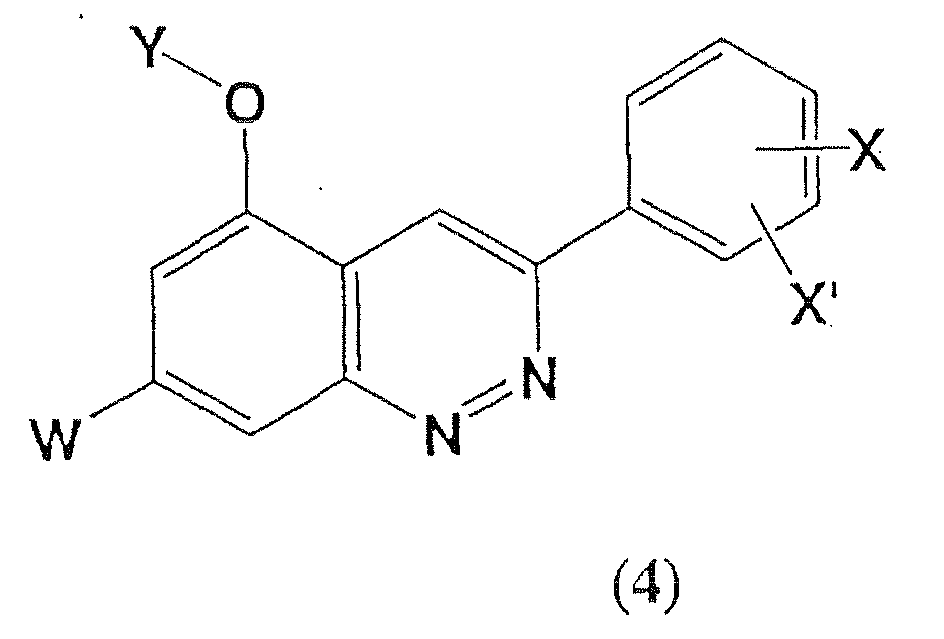
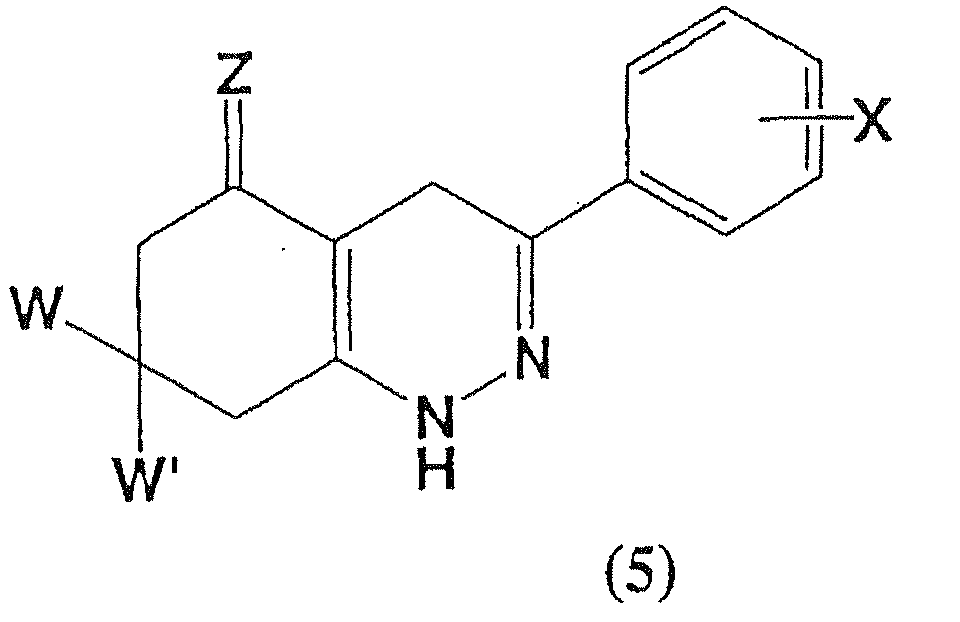
An antitumor agent of the present invention
contains a 3-phenyl-cinnoline analogue represented by
the above general formula (1) or (2) or a
physiologically acceptable salt thereof as an active
ingredient.
A "lower alkyl group" in a substituent of the
general formula (1) or (2) means, if not otherwise
defined, a straight chain or branched chain alkyl group
having 1 to 6 carbon atoms, for example, a methyl
group, an ethyl group, a n-propyl group, an isopropyl
group, a n-butyl group, a sec-butyl group, a tert-butyl
group, a n-pentyl group, an isopentyl group, a
neopentyl group, a n-hexyl group, etc., a preferable
group includes a methyl group, an ethyl group and an
isopropyl group, and particularly preferable group is a
methyl group.
A "lower acyl group" in a substituent of the
general formula (1) or (2) means a non-substituted
straight chain or branched chain acyl group having 1 to
6 carbon atoms, for example, a formyl group, an acetyl
group, a propionyl group, a n-butyryl group, an
isobutyryl group, a valeryl group, an isovaleryl group,
a pivaloyl group, a hexanoyl group, etc., a preferable
group is an acetyl group.
Further, in a substituent of the general
formula (1), an "optionally protected amino acid
residue" includes an α-amino acid residue generally
known as an essential amino acid, in which the side
chain and/or N terminal may be protected, proviso that
absolute conformation may be L or D. A bond with an
oxygen atom is preferably an ester bond with a
carboxylic acid group at the main chain or side chain.
An example of a protected functional group includes an
amino group, a carboxyl group, a guanidino group, a
hydroxyl group, a thiol group, etc. A protective group
is not especially limited and such one as used in
common peptide synthesis reaction, etc. can be
included. An example of a representative protective
group includes specifically alkoxycarbonyl groups such
as a tert-butoxycarbonyl group and a benzyloxycarbonyl
group; alkyl groups such as a methyl group, a tert-butyl
group and a benzyl group; and acyl groups such as
an acetyl group and a benzoyl group. That is amino acid
residues which may be protected include an N-(tert-butoxycarbonyl)-L-valyl
group, an O-benzyl-D-tyrosyl
group, an N-(tert-butoxycarbonyl)-L-prolyl group, an N-(tert-butoxycarbonyl)-L-phenylalanyl
group, a L-alanyl
group, a L-valyl group, a L-α-glutamyl group, a glycyl
group, etc. The preferable groups include a L-alanyl
group, a L-valyl group, a L-α-glutamyl group, a glycyl
group, etc.
An example of a lower alkyl group substituted
with a phenyl group in a substituent of the general
formula (1) includes specifically, a benzyl group, a 1-phenylethyl
group, a 2-phenylethyl group, a benzyl
group, etc., and a benzyl group, etc., is preferable.
In a substituent of the general formula (1)
or (2), a "lower alkoxyl group" means a straight chain
or branched chain alkoxyl group having 1 to 6 carbon
atoms, for example, a methoxy group, an ethoxy group, a
n-propoxy group, an isopropoxy group, a n-butoxy group,
an isobutoxy group, a tert-butoxy group, a n-pentyloxy
group, an isopentyloxy group, a n-hexyloxy group, etc.,
and a methoxy group and an ethoxy group are preferable
groups among them.
In a substituent of the general formula (1)
or (2), "a lower alkyl group", having a substituent
selected from a group consisting of a hydroxyl group, a
lower alkoxyl group and a phenyl group, means a lower
alkyl group having one or more same or different
substituent, and includes specifically, a hydroxymethyl
group, a 2-hydroxy-2-propyl group, a benzyl group, a
methoxymethyl group, etc, and preferably a
hydroxymethyl group and a benzyl group, etc.
In the general formula (1) or (2), "L is N (a
nitrogen atom)-W" means an aliphatic heterocycle
containing a nitrogen atom substituted with W. A
specific example of L includes an N-methyl group, an N-benzyl
group, an N-methoxymethy group, an N-(2-hydroxy)methyl
group, etc., and preferably an N-benzyl
group and an N-methyl group.
In the general formula (1) or (2), "L is W-C
(a carbon atom)-W'" means an aliphatic carbon ring
substituted with W and W'. A specific example of W and
W' is that W is a hydrogen atom and W' is a methyl
group, an ethyl group, an isopropyl group, an
ethoxycarbonyl group, a carboxyl group, a hydroxymethyl
group, a 2-hydroxy-2-propyl group, a phenyl group or a
hydrogen atom, etc., or W and W' are both methyl
groups, etc. Preferably, W is a hydrogen atom and W' is
a methyl group or an isopropyl group.
In the general formula (1) or (2), a "lower
alkoxycarbonyl group" means a group wherein the above
lower alkoxyl group is bound with a carbonyl group, and
includes specifically, a methoxycarbonyl group, an
ethoxycaybonyl group and n-propyloxycarbonyl group, and
preferably a methoxycarbonyl group and an
ethoxycarbonyl group.
In the general formula (1) or (2), a "lower
alkylamino group" means a group wherein one or two of
the above lower alkyl groups is bound to a nitrogen
atom, and includes specifically, a methylamino group, a
dimethylamino group, an ethylamino group, a
diethylamino group, a n-propylamino group and a di(n-propyl)amino
group, etc.
In the general formula (1), J represents "A-C
(a carbon atom)-B", wherein A and B may form a carbonyl
group (C=O) or a substituted imino group (C=N-(a
substituent)). An example of a substituent in a
substituted imino group is an amino group, a lower
alkylamino group, a hydroxyl group or a lower alkoxyl
group, etc.
In the general formula (1) or (2), an example
of a "halogen atom" is a fluorine atom, a chlorine
atom, a bromine atom or an iodine atom, and is
preferably a bromine atom or a fluorine atom.
In the general formula (1) or (2), a "lower
acylamino group" includes an amino group bound with the
above lower acyl group, and specifically, for example,
a formylamino group, an acetylamino group, a
propanoylamino group, etc., and preferably an
acetylamino group.
In the general formula (1) or (2), a lower
alkyl group in a "halogenated lower alkyl group" is the
same group as the above lower alkyl group, and a
preferable group is also the same as above. A halogen
atom in a "halogenated lower alkyl group" includes
similar one as above, i.e. a fluorine atom, a chlorine
atom, a bromine atom or an iodine atom. Substitution
number of halogen atoms which are included in the
present invention is from one to the maximum
substitutable number, and in case of plural
substitutions, substituting halogen atoms can be the
same or different. Specifically, a 1-chloropropyl
group, a trichloromethyl group, a trifluoromethyl
group, a 1,1,1-trifluoroethyl group, a pentafluoroethyl
group and a 1,1-difluoro-1-chloroethyl group are
included, and preferably a pentafluoroethyl group, a
trifluoromethyl group, etc., and particularly
preferably a trifluoromethyl group.
"J-K-L-M is C(O-Y)=CH-C(W)=CH (Y and W
indicate the same meanings as above)" means cinnoline
skeleton structure, in which a benzene ring condensed
with a pyridazine ring. Specifically, for example, it
is a compound represented by the above general formula
(4).
In the general formula (1) or (2), X and X'
are positioned on a benzene ring as substituents, and
positions thereof are not specifically limited.
Consequently, all isomers thereof are included within
the scope of the present invention, and a mono-substituent
at position-3 is preferable. A preferable
substituent includes a trifluoromethyl group, a nitro
group, a cyano group, a bromine atom, and a 3-trifluoromethyl
group is especially preferable.
In the general formula (1) of the present
invention, each of m and q is independently an integer
of 0 to 3, to provide a 4 - 10 membered ring, forming a
condensed ring with a pyridazine ring, preferably a 5 -
7 membered ring, more preferably a 6 membered ring, in
which both m and q represent 1.
In the general formula (1) of the present
invention, "n, n' is 1" means N-oxide, and preferably
both n and n' are 0, or any one of n and n' is 1.
As an active ingredient, a 3-phenyl-cinnoline
analogue, of an antitumor agent of the present invention,
a compound represented by the general formula (3)
hereinbefore is also included. In a compound of the
general formula (3), a lower alkyl group which may be
substituted with a phenyl group, a lower acyl group, an
amino acid residue which may be protected, a lower
alkyl group, a lower alkoxy group, a phenyl group, a
lower alkoxycarbonyl group, a lower acylamino group, a
halogen atom and a substituted imino group have the
same meaning as each substituent in the general formula
(1), and preferable groups are also the same as
mentioned hereinbefore. Further, m, q, n and n' are the
same as eash m, q, n and n' in the general formula (1),
and preferable range is also the same.
In the most preferable compound of the
general formula (3), B is a hydrogen atom; L is W-C-W';
W and W' each independently is a lower alkyl group,
which may optionally have a substitution group selected
from a group consisting of a hydroxyl group, a lower
alkoxyl group and a phenyl group, or a hydrogen atom; X
is a 3-trifluoromethyl group, a 3-nitro group, a 3-cyano
group or a 3-bromo group; X' is a hydrogen atom;
m and q are both 1; n is 0 or 1 ; and n' is 0. In a
more preferable compound, W and W' each independently
is a hydrogen atom or a lower alkyl group; and X is a
3-trifluoromethyl group. Also in a preferable compound,
Y is a glycyl group, an alanyl group, a valyl group or
an α-glutamyl group; and B is a hydrogen atom; L is H-C-CH3;
X is a 3-trifluoromethyl group; X' is a hydrogen
atom; m and q are both 1; n is 0 or 1; and n' is 0.
An example of a compound of the general
formula (3) includes such a compound as specifically
shown in Table 1. In the Table, Ph represents a phenyl
group, Et an ethyl group, Me a methyl group, Ac an
acetyl group, Bn a benzyl group, Boc a tert-butoxycarbonyl
group and t-Bu a tert-butyl group; mix
means a mixture of syn form and anti form; and amino
acids are expressed by commonly used abbreviations.
| Comp No. | A, B | L | Isomer Type | q | m | n | n' | X | X' | optical |
| 1 | =O | C(H)Ph | - | 1 | 1 | 0 | 0 | 3-CF3 | H | (±) |
| 2 | =O | COOEt | - | 1 | 1 | 0 | 0 | 3-CF3 | H | (±) |
| 3 | -OH,H | COOEt | syn | 1 | 1 | 0 | 0 | 3-CF3 | H | (±) |
| 4 | -OH,H | COOH | syn | 1 | 1 | 0 | 0 | 3-CF3 | H | (±) |
| 5 | =O | COOH | - | 1 | 1 | 0 | 0 | 3-CF3 | H | (±) |
| 6 | -OH,H | C(H)Me | syn | 1 | 1 | 0 | 0 | 3-CF3 | H | (±) |
| 7 | -OH,H | C(H)Me | anti | 1 | 1 | 0 | 0 | 3-CF3 | H | (±) |
| 8 | -O-Pro(Boc),H | C(H)Me | anti | 1 | 1 | 0 | 0 | 3-CF3 | H | (±) |
| syn | 1 | 1 | 0 | 0 | 3-CF3 | H | (+),(-) | |||
| 9 | -OH,H | C(H)Me | syn | 1 | 1 | 0 | 0 | 3-CF3 | H | (5R,7R) |
| 10 | -OH,H | C(H)Me | syn | 1 | 1 | 0 | 0 | 3-CF3 | H | (5S,7S) |
| 11 | -OAc,H | C(H)Me | syn | 1 | 1 | 0 | 0 | 3-CF3 | H | (±) |
| 12 | -OH,H | C(H)Me | syn | 1 | 1 | 1 | 0 | 3-CF3 | H | (±) |
| 13 | =O | C(H)Me | - | 1 | 1 | 1 | 0 | 3-CF3 | H | (±) |
| 14 | -OH,H | C(H)CH2OH | mix | 1 | 1 | 0 | 0 | 3-CF3 | H | (±) |
| 15 | =O | C(H)Me | 1 | 1 | 0 | 0 | 3-CN | H | (±) | |
| 16 | -OH,H | C(H)Me | syn | 1 | 1 | 0 | 0 | 3-CN | H | (±) |
| 17 | -OH,H | C(Me)2 | - | 1 | 1 | 0 | 0 | 3-CF3 | H | (±) |
| 18 | -OH,H | CH2 | - | 1 | 1 | 0 | 0 | 3-CF3 | H | (±) |
| 19 | =O | C(H)Me | - | 1 | 1 | 0 | 0 | 3-Br | H | (±) |
| 20 | =O | C(H)Me | - | 1 | 1 | 0 | 0 | 3-NO2 | H | (±) |
| 21 | =O | C(H)Me | - | 1 | 1 | 0 | 0 | 3-Me | H | (±) |
| 22 | =O | C(H)Me | - | 1 | 1 | 0 | 0 | 3-CO2Me | H | (±) |
| 23 | =O | C(H)Me | - | 1 | 1 | 0 | 0 | 3-NHAc | H | (±) |
| 24 | =O | C(H)Me | - | 1 | 1 | 0 | 0 | 3-F | H | (±) |
| 25 | =O | C(H)Me | - | 1 | 1 | 0 | 0 | 3-OMe | H | (±) |
| 26 | =O | NBn | - | 1 | 1 | 0 | 0 | 3-CF3 | H | - |
| 27 | -OH,Me | CH-C(Me)2OH | mix | 1 | 1 | 0 | 0 | 3-CF3 | H | (±) |
| 28 | =O | C(H)Me | - | 1 | 1 | 0 | 0 | 3-F | 5-CF3 | (±) |
| 29 | -OH,H | C(H)Me | syn | 1 | 1 | 0 | 0 | 3-F | 5-CF3 | (±) |
| 30 | -OH,Me | C(H)Me | mix | 1 | 1 | 0 | 0 | 3-CF3 | H | (±) |
| 31 | -O-Ala(Boc),H | C(H)Me | syn | 1 | 1 | 0 | 0 | 3-CF3 | H | single isomer |
| 32 | -O-Ala,H | C(H)Me | syn | 1 | 1 | 0 | 0 | 3-CF3 | H | single isomer |
| 33 | -O-Asp(α)(Boc) (β)(OtBu),H | C(H)Me | syn | 1 | 1 | 0 | 0 | 3-CF3 | H | single isomer |
| 34 | -O-Asp(α),H | C(H)Me | syn | 1 | 1 | 0 | 0 | 3-CF3 | H | single isomer |
| 35 | -O-Asp(β)(Boc)(α) (OtBu),H | C(H)Me | syn | 1 | 1 | 0 | 0 | 3-CF3 | H | single isomer |
| 36 | -O-Asp(β),H | C(H)Me | syn | 1 | 1 | 0 | 0 | 3-CF3 | H | single isomer |
| 37 | -O-Glu(α)(Boc)(γ) (OtBu),H | C(H)Me | syn | 1 | 1 | 0 | 0 | 3-CF3 | H | single isomer |
| 38 | -O-Glu(α),H | C(H)Me | syn | 1 | 1 | 0 | 0 | 3-CF3 | H | single isomer |
| 39 | -O-Glu(γ)(Boc)(α)(Ot Bu),H | C(H)Me | syn | 1 | 1 | 0 | 0 | 3-CF3 | H | single isomer |
| 40 | -O-Glu(γ),H | C(H)Me | syn | 1 | 1 | 0 | 0 | 3-CF3 | H | single isomer |
| 41 | -O-Gly(Boc),H | C(H)Me | syn | 1 | 1 | 0 | 0 | 3-CF3 | H | single isomer |
| 42 | -O-Gly,H | C(H)Me | syn | 1 | 1 | 0 | 0 | 3-CF3 | H | single isomer |
| 43 | -O-Leu(Boc),H | C(H)Me | syn | 1 | 1 | 0 | 0 | 3-CF3 | H | single isomer |
| 44 | -O-Leu,H | C(H)Me | syn | 1 | 1 | 0 | 0 | 3-CF3 | H | single isomer |
| 45 | -O-Lys(Boc),H | C(H)Me | syn | 1 | 1 | 0 | 0 | 3-CF3 | H | single isomer |
| 46 | -O-Lys,H | C(H)Me | syn | 1 | 1 | 0 | 0 | 3-CF3 | H | single isomer |
| 47 | -O-Met(Boc),H | C(H)Me | syn | 1 | 1 | 0 | 0 | 3-CF3 | H | single isomer |
| 48 | -O-Met,H | C(H)Me | syn | 1 | 1 | 0 | 0 | 3-CF3 | H | single isomer |
| 49 | -O-Phe(Boc),H | C(H)Me | syn | 1 | 1 | 0 | 0 | 3-CF3 | H | single isomer |
| 50 | -O-Phe,H | C(H)Me | syn | 1 | 1 | 0 | 0 | 3-CF3 | H | single isomer |
| 51 | -O-Pro,H | C(H)Me | syn | 1 | 1 | 0 | 0 | 3-CF3 | H | single isomer |
| 52 | -O-Val(Boc),H | C(H)Me | syn | 1 | 1 | 0 | 0 | 3-CF3 | H | (5S,7S) |
| 53 | -O-Val,H | C(H)Me | syn | 1 | 1 | 0 | 0 | 3-CF3 | H | (5S,7S) |
| 54 | -OH,H | CH2 | - | 1 | 0 | 0 | 0 | 3-CF3 | H | (±) |
| 55 | -OH,H | CH2 | - | 0 | 1 | 0 | 0 | 3-CF3 | H | (±) |
| 56 | -OH,H | CH2 | - | 1 | 2 | 0 | 0 | 3-CF3 | H | (±) |
| 57 | -OH,H | CH2 | - | 2 | 1 | 0 | 0 | 3-CF3 | H | (±) |
| 58 | -OH,H | CH2 | - | 2 | 2 | 0 | 0 | 3-CF3 | H | (±) |
| 59 | -OH,H | CH2 | - | 0 | 3 | 0 | 0 | 3-CF3 | H | (±) |
| 60 | -OH,H | C(H)Me | mix | 1 | 1 | 0 | 1 | 3-CF3 | H | (±) |
| 61 | -OH,H | CH2 | - | 1 | 1 | 0 | 0 | 3-CF3 | H | (±) |
| 62 | -OH,H | C(H)Me | syn | 1 | 1 | 0 | 0 | 3-CF3 | 5-CF3 | (±) |
| 63 | -OBn,H | C(H)Me | syn | 1 | 1 | 0 | 0 | 3-CF3 | H | (±) |
| 64 | =O | NPh | - | 1 | 1 | 0 | 0 | 3-CF3 | H | - |
| 65 | =O | NCO2Me | - | 1 | 1 | 0 | 0 | 3-CF3 | H | - |
| 66 | -OH,H | C(H)CH2OMe | mix | 1 | 1 | 0 | 0 | 3-CF3 | H | (±) |
| 67 | -O-(D)-Phe(Boc),H | C(H)Me | syn | 1 | 1 | 0 | 0 | 3-CF3 | H | (5S,7S) |
| 68 | -O-Val(Boc),H | C(H)Me | syn | 1 | 1 | 0 | 0 | 3-CF3 | H | (5R,7R) |
| 69 | -O-Val,H | C(H)Me | syn | 1 | 1 | 0 | 0 | 3-CF3 | H | (5R,7R) |
| 70 | -O-Val(Boc),H | C(H)Me | anti | 1 | 1 | 0 | 0 | 3-CF3 | H | (5S,7R) |
| 71 | -OH,H | C(H)Me | anti | 1 | 1 | 0 | 0 | 3-CF3 | H | (5S,7R) |
| 72 | -O-Val,H | C(H)Me | anti | 1 | 1 | 0 | 0 | 3-CF3 | H | (5S,7R) |
| 73 | -O-Val(Boc),H | C(H)Me | anti | 1 | 1 | 0 | 0 | 3-CF3 | H | (5R,7S) |
| 74 | -OH,H | C(H)Me | anti | 1 | 1 | 0 | 0 | 3-CF3 | H | (5R,7S) |
| 75 | -O-Val,H | C(H)Me | anti | 1 | 1 | 0 | 0 | 3-CF3 | H | (5R,7S) |
| 76 | =O | C(Me)2 | - | 1 | 1 | 0 | 0 | 3-CF3 | H | - |
| 77 | =O | CH2 | - | 1 | 1 | 0 | 0 | 3-CF3 | H | - |
| 78 | =O | C(H)Me | - | 1 | 1 | 0 | 0 | 3-CH2Cl | H | (±) |
| 79 | =O | C(H)Me | - | 1 | 1 | 0 | 0 | 3-CF3 | H | (±) |
| 80 | =O | C(H)Et | - | 1 | 1 | 0 | 0 | 2-CH2Br | H | (±) |
| 81 | =O | C(H)Me | - | 1 | 1 | 0 | 0 | 4-C2F5 | H | (±) |
| 82 | =O | C(Me)2 | - | 1 | 1 | 0 | 0 | 3-CF3 | H | - |
| 83 | =N-NH2 | C(H)Me | - | 1 | 1 | 0 | 0 | 3-CF3 | H | (±) |
| 84 | =N-NHEt | C(H)iPr | - | 1 | 1 | 0 | 0 | 4-CH2Cl | H | (±) |
| 85 | =N-OMe | C(H)iPr | - | 1 | 1 | 0 | 0 | 2-CH2Cl | H | (±) |
| 86 | =N-OEt | C(Me)Et | - | 1 | 1 | 0 | 0 | 4-CF3 | H | (±) |
| 87 | -OH,H | C(H)Me | mix | 2 | 0 | 0 | 0 | 3-CF3 | H | (±) |
| 88 | =O | NMe | - | 1 | 1 | 0 | 0 | 3-CF3 | H | (±) |
| 89 | =O | NH | - | 1 | 1 | 0 | 0 | 3-CF3 | H | (±) |
| 90 | -OH,H | C(H)Me | mix | 1 | 1 | 1 | 1 | 3-CF3 | H | (±) |
An active ingredient, a 3-phenyl-cinnoline
analogue, of an antitumor agent of the present
invention includes also a compound represented by the
above general formula (4). In a compound of the general
formula (4), a lower alkyl group, a lower
alkoxycarbonyl group, a lower acylamino group, a lower
alkoxyl group, a trifluoromethyl group, a nitro group,
a cyano group, a halogen atom, a lower alkyl group
which may be subsutituted with a phenyl group, a lower
acyl group, a phenyl group and a carboxyl group have
the same meaning as each substituent in the general
formula (1), and a preferable group also is the same as
hereinbefore mentioned.
In a particularly preferable compound of the
general formula (4), X is a trifluoromethyl group, a
nitro group, a cyano group or a halogen atom; X' is a
hydrogen atom; and W is a lower alkyl group which may
have a substituent selected from a group consisting of
a hydroxyl group, a lower alkoxyl group and a phenyl
group. In a more preferable compound, X is a 3-trifluoromethyl
group, a 3-nitro group, a 3-cyano group
or a 3-halogen atom, and W is a non-substituted lower
alkyl group.
An example of a compound of the general
formula (4) includes specifically, 3-(3-trifluoromethylphenyl)cinnolin-5-ol,
7-methyl-3-(3-trifluoromethylphenyl)cinnolin-5-ol,
7-phenyl-3-(3-trifluoromethylphenyl)cinnolin-5-ol,
7-(2-methoxyethyl)-3-(3-trifluoromethylphenyl)cinnolin-5-ol,
7-ethoxycarbonyl-3-(3-trifluoromethylphenyl)cinnolin-5-ol,
3-(3-cyanophenyl)-7-methylcinnolin-5-ol, 3-(2-ethylphenyl)-7-methylcinnolin-5-ol,
3-(3-ethoxyphenyl)-7-methylcinnolin-5-ol,
3-(3-acetylaminophenyl)-5-acetyloxy-7-methylcinnoline,
5-methoxy-7-methyl-3-(3-trifluoromethylphenyl)cinnoline,
5-acetyloxy-7-methyl-3-(3-trifluoromethylphenyl)cinnoline,
5-benzyloxy-7-methyl-3-(3-trifluoromethylphenyl)cinnoline,
5-acetyloxy-7-methyl-3-(3-nitrophenyl)cinnoline,
3-(2-fluorophenyl)-7-isopropyl-5-methoxycinnoline,
3-(3,5-bis-trifluoromethylphenyl)-7-hydroxymethylcinnolin-5-ol,
7-benzyl-5-ethoxy-3-(2-methoxycarbonylphenyl)-cinnoline,
3-(3-acetylaminophenyl)cinnolin-5-ol, 3-(2-chloro-5-trifluoromethylphenyl)-5-hydroxycinnoline-7-carboxylic
acid, and 3-(2-fluoro-5-trifluoromethylphenyl)-5-hydroxycinnoline-7-carboxylic
acid, etc. and preferably 7-methyl-3-(3-trifluoromethylphenyl)cinnolin-5-ol,
5-methoxy-7-methyl-3-(3-trifluoromethylphenyl)cinnoline,
5-acetyloxy-7-methyl-3-(3-trifluoromethylphenyl)-cinnoline,
and 5-benzyloxy-7-methyl-3-(3-trifluoromethylphenyl)cinnoline.
An active ingredient, a 3-phenyl-cinnoline
analogue, of an antitumor agent of the present
invention includes a compound represented by the above
general formula (5). In a compound of the general
formula (5), a lower alkyl group, a halogenated lower
alkyl group, a lower alkylamino group and a lower
alkoxyl group have the same meaning as each substituent
in the general formula (1) or (2), and a preferable
group is also the same as hereinbefore mentioned.
In a more preferable compound, W is a
hydrogen atom or a methyl group; W' is a hydrogen atom
or a methyl group; X is a 3-trifluoromethyl group; and
Z is an oxygen atom or N-NH2.
An example of a compound of the general
formula (5) includes specifically,7-methyl-3-(3-trifluoromethylphenyl)-4,6,7,8-tetrahydro-1H-cinnolin-5-one,
7,7-dimethyl-3-(3-trifluoromethylphenyl)-4,6,7,8-tetrahydro-1H-cinnolin-5-one,
7-methyl-3-(4-chloromethylphenyl)-4,6,7,8-tetrahydro-1H-cinnolin-5-one,
and 3-(3-trifluoromethylphenyl)-4,6,7,8-tetrahydro-1H-cinnolin-5-one,
etc.
A preferable example of a 3-phenyl-cinnoline
analogue represented by the above general formula (1)
includes specifically, 7-methyl-3-(3-trifluoromethyl)-7,8-dihydro-6H-cinnolin-5-one,
7-methyl-3-(3-trifluoromethyl)-5,6,7,8-tetrahydrocinnolin-5-ol,
7-methyl-3-(3-trifluoromethylphenyl)cinnolin-5-ol,
7-methyl-1-oxy-3-(3-trifluoromethyl)-5,6,7,8-tetrahydrocinnolin-5-ol,
5-glycyloxy-7-methyl-3-(3-trifluoromethyl)-5,6,7,8-tetrahydrocinnoline,
5-(L-alanyloxy)-7-methyl-3-(3-trifluoromethyl)-5,6,7,8-tetrahydrocinnoline,
5-(L-valyloxy)-7-methyl-3-(3-trifluoromethyl)-5,6,7,8-tetrahydrocinnoline,
5-(L-α-glutamyloxy)-7-methyl-3-(3-trifluoromethyl)-5,6,7,8-tetrahydrocinnoline,
etc.
In a 3-phenyl-cinnoline analogue used in the
present invention, when the compound has an asymmetric
carbon and is present as an optically active compound
or a racemate, such an optically active compound
thereof, a mixture thereof and a racemate thereof are
all included. Furthermore, a hydrate or a solvate
thereof is also included.
In addition, a stereoisomer and a mixture
thereof based on an imino bond (C=N) are all included
within the above 3-phenyl-cinnoline analogue.
An example of a physiologically acceptable
salt in the present invention includes salts of mineral
acids such as hydrochloric acid, sulfuric acid, etc.;
salts of organic acids such as acetic acid, succinic
acid, fumaric acid, maleic acid, citric acid, benzoic
acid, tartaric acid, methanesulfonic acid, p-toluenesulfonic
acid, etc. A salt thereof can easily be
prepared by a conventional salt-forming reaction.
As an antitumor agent of the present
invention, included a 3-phenyl-cinnoline analogue,
which can exhibit antitumor activity results from
conversion by an oxidative reaction, reductive
reaction, hydrolytic reaction, etc., by means of
enzymatic action or gastric juice under physiological
conditions in a body (e.g. physiological conditions
described in "Development of Pharmaceuticals, Vol. 7,
Molecular Design", Hirokawa Publishing Co., Tokyo,
1990, p.163-198).
An antitumor agent of the present invention
is administered orally or parenterally in a form of
preparation such as suspension, emulsion, injection,
inhalation, tablet, pill, granule, fine granule,
powder, capsule, liquid preparation for oral use,
suppository, liquid preparation for percutaneous use,
patch for percutaneous use, ointment, liquid
preparation for transmucosal use, patch for
transmucosal use, etc., as a 3-phenyl-cinnoline
analogue or a physiologically acceptable salt thereof,
alone or as prepared by mixing with a excipient or a
carrier. An additive such as a excipient or a carrier
is selected from pharmaceutically acceptable
substances, and a type and a composition thereof are
determined by considering an administration route or a
method for administration. For example, in case of
injection, generally sodium chloride, saccharide such
as glucose, mannitol, etc. are preferable. In case of
oral preparation, starch, lactose, crystalline
cellulose, magnesium stearate, etc., are preferable. If
necessary, adjuvant such as an auxiliary, a stabilizing
agent, a moistening agent or an emulsifier, a buffer
and other conventionally used additives may optionally
be contained in the above preparation.
Amount of the present compound in a
preparation of the present invention varies depending
on the preparation, however, is generally 0.1 - 100% by
weight, preferably 1 - 98% by weight. For example, in
case of injection, an active ingredient may be
contained generally 0.1 - 30% by weight, preferably 1 -
10% by weight. In case of oral preparations, such forms
as tablet, capsule, powder, granule, liquid
preparation, dry syrup, etc. are used together with
additives. A capsule, tablet, granule or powder
contains generally 5 - 100% by weight, preferably 25 -
98% by weight of an active ingredient.
Dose level can be determined depending on
age, sex, body weight, symptom and therapeutic objects,
and therapeutic dose is generally 0.001 - 100 mg/kg/day
for parenteral administration, while for oral
administration, 0.01 - 500 mg/kg/day, preferably 0.1 -
100 mg/kg/day, is administered once or dividing into 2
to 4 times.
A 3-phenyl-cinnoline analogue used in the
present invention can be produced by a method, for
example, according to one described in the non-patent
document 3 hereinbefore, and synthesis examples will be
shown in the following Examples, however, a method is
not especially limited to these Examples.
Specifically, for example, a compound, an α-halogenated
substituted acetophenone derivative
represented by the following general formula (6), can
be purchased from Tokyo Kasei Kogyo Co. Ltd., etc., or
can also be obtained by a method as follows: an
acetophenone derivative, easily available commercially
or obtainable by a production method in accordance with
known reference, is easily halogenated by reaction at
room temperature to a refluxing temperature, using N-halogenosuccinimide
or a halogen alone such as bromine,
iodine, etc., or a salt such as pyridinium bromide
perbromide as a halogenation reagent, in a reaction
solvent such as toluene, tetrahydrofuran, etc.
 wherein E is a halogen atom; and X and X' have the same
meanings hereinbefore.
wherein E is a halogen atom; and X and X' have the same
meanings hereinbefore.
As for 1,3-cycloalkanediones used for
production of a compound, wherein L is W-C-W' in the
above general formula (1), for example 1,3-pentanedione
or 1,3-cycloheptannedione can be purchased from Sigma-Aldrich
Co. Further, although a compound among 1,3-cyclohexanedione
derivatives represented by the general
formula (7) hereinbelow can be commercially available,
it can also be prepared, if necessary, as illustrated
in the scheme below: A mixture of a methyl vinyl ketone
derivative (8) and a malonic ester derivative (9) is
reacted at room temperature to a refluxing temperature
in a solvent such as water, methanol, ethanol, etc. in
the presence of a metal alkoxide such as sodium
methoxide, sodium ethoxide, etc. or a hydroxide such as
sodium hydroxide, potassium hydroxide, etc.:
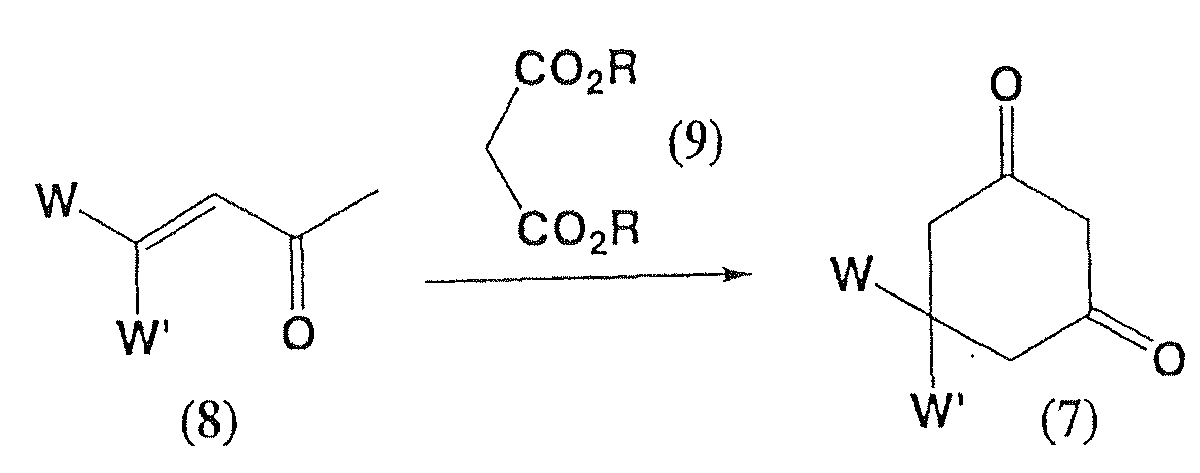 wherein R represents a lower alkyl group; and W and W'
have the same meanings hereinabove.
wherein R represents a lower alkyl group; and W and W'
have the same meanings hereinabove.
Alternatively, as illustrated below, it can
be prepared by hydrogenation of a resorcinol derivative
(10) in the presence of a catalyst such as platinum,
palladium, etc. in an organic solvent such as methanol,
tetrahydrofuran, etc.;
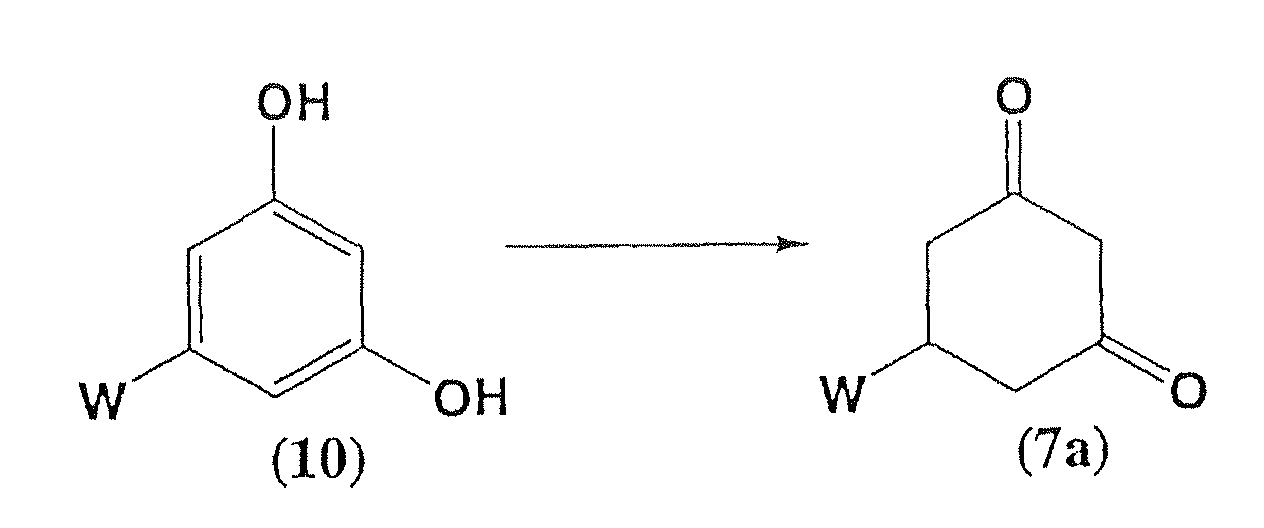 wherein W has the same meaning hereinabove.
A 5-aza-1,3-cyclohexanedione derivative (7b),
which can be used for production of a compound of the
general formula (1) wherein L is N-W, can be prepared
in accordance with a method described in Archiv der
Pharmazie, 1967, No. 300, p.91-94. That is, an
objective compound (7b) can be obtained as follows: A
glycine derivative represented by the general formula
(11) and bromoacetophenone are reacted at room
temperature to a refluxing temperature in an organic
solvent such as ethanol, dimethyl sulfoxide,
tetrahydrofuran, etc. in the presence of a base such as
sodium hydrogen carbonate, potassium carbonate, cesium
carbonate, etc. to obtain a keto ester (12). The keto
ester (12) is then reacted in an organic solvent such
as ethanol, tert-butanol or dimethyl sulfoxide at 0°C
to room temperature in the presence of a base such as
sodium methoxide, potassium tert-butoxide, sodium
hydride, etc.
 wherein R is a lower alkyl group and W has the same
meaning hereinabove.
wherein R is a lower alkyl group and W has the same
meaning hereinabove.
A 1,3-cyclohalkanedione derivative
hereinabove and a compound of the above general formula
(6) are reacted at room temperature to a refluxing
temperature in an organic solvent such as
dimethylsulfoxide, dichloromethane, chloroform,
tetrahydrofuran, methanol, ethanol, etc. and in the
presence of a base such as sodium hydride, sodium
hydroxide, potassium hydroxide, potassium carbonate,
cesium carbonate, sodium methoxide, sodium ethoxide,
etc., to derivatize a compound represented by the
general formula (13).
 wherein K, L, M, X and X' have the same meanings
hereinabove.
wherein K, L, M, X and X' have the same meanings
hereinabove.
A compound represented by the general formula
(13) is reacted with hydrazine hydrochloride in an
organic solvent such as methanol, ethanol, etc. in the
presence of a base such as triethylamine, pyridine,
etc. at room temperature to a temperature of refluxing
the organic solvent, to obtain a 4,6,7,8-hexahydro-1H-cinnolin-5-one
derivative represented by the general
formula (14).
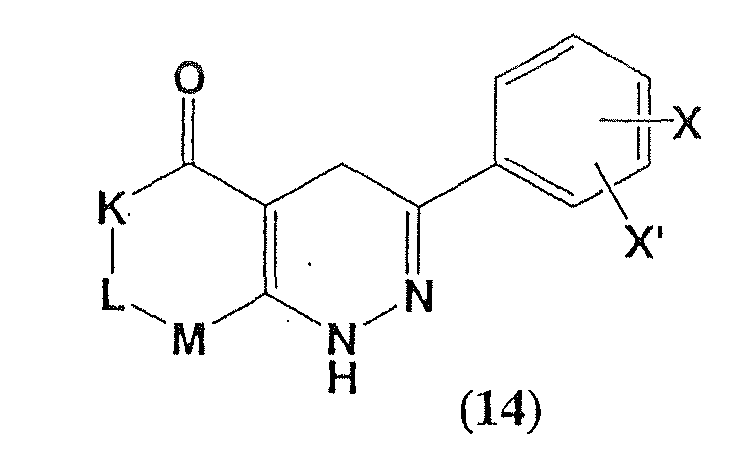 wherein K, L, M, X and X' have the same meanings
hereinabove.
wherein K, L, M, X and X' have the same meanings
hereinabove.
Further, a compound represented by the
general formula (1a) hereinbelow can be obtained by air
oxidation of said compound (14) by refluxing while
heating in a basic solvent such as pyridine,
triethylamine, etc., or by oxidation of the compound
(14) by refluxing while heating in an organic solvent
such as methanol, ethanol, tetrahydrofuran or mixed
solvent thereof in the presence of metal catalyst such
as palladium, platinum, etc., or by treating the
compound (14) with an oxidizing agent such as
cerium(IV) ammonium nitrate, 2,3-dichloro-5,6-dicyano-p-benzoquinone,
etc.
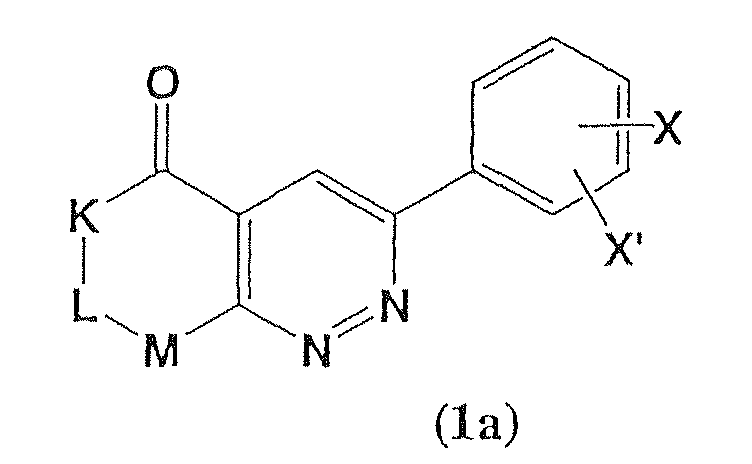 wherein K, L, M, X and X' have the same meanings
hereinabove.
wherein K, L, M, X and X' have the same meanings
hereinabove.
Further, a compound represented by the
general formula (1) wherein J is H-C-OH, and n and n'
are 0 can be derivatized by reaction of a compound
represented by the general formula (1a) with a reducing
agent such as sodium borohydride, lithium aluminum
hydride, lithium tri-tert-butoxyaluminum hydride, etc.;
or an alkyl metal compound such as methyl lithium,
isopropyl magnesium bromide, etc., in an organic
solvent such as tetrahydrofuran, methanol, ethanol,
etc., at ice-cooling temperature to room temperature.
Further, a compound of the general formula
(1) with various Y groups can be produced by reaction
of an acid chloride such as acetyl chloride, propanoyl
bromide, etc. in an organic solvent such as
dichloromethane, tetrahydrofuran, N,N-dimethyl
formamide, ethyl acetate, etc., and in the presence or
absence of an organic base such as pyridine,
triethylamine, etc; or by reaction of a proteted amino
acid such as N-tert-butoxycarbonyl-L-valine, N-benzyloxycarbonyl-D-proline
or the like using a
condensing agent such as dicyclohexylcarbodiimide, N-ethyl-N'-3-dimethylaminopropyl
carbodiimide, etc. in
the presence of dimethylaminopyridine; and by removing
a protecting group for an amino acid in accordance with
a conventional method such as the use of
trifluoromethanesulfonic acid, hydrochloric acid,
hydrogenolysis, etc.; or by reaction of an alkyl halide
such as methyl iodide, benzyl bromide, etc. in an
organic solvent such as N,N-dimethylformamide,
dimethylsulfoxide, tetrahydrofuran, etc. in the
presence of a base such as potassium tert-butoxide,
sodium hydride and N,N-diisopropylethylamine.
Further, an N-oxide compound represented by
the general formula (1) (n and/or n'=1) can be
derivatized by reaction of an oxidizing agent such as
m-chloroperbenzoic acid, peracetic acid, etc. with a
compound of the general formula (1) wherein n and n'
are 0, in an organic solvent such as methylene
chloride, chloroform, etc.
A compound represented by the above general
formula (4) can also be derivatized by reaction of a
compound represented by the general formula (1a)
(wherein any of W and W' is a hydrogen atom) with a
halogenating agent such as cupric bromide, lithium
chloride, iodine, etc. in the presence or absence of an
organic solvent such as acetic acid, N,N-dimethylformamide,
etc. at room temperature to a
refluxing temperature, and if necessary, utilizing a
base such as collidine, triethylamine, 1,8-diazabicyclo[5.4.0]-7-undecene,
etc. Further, a
compound represented by the general formula (4)
hereinbefore can be derivatized by subjecting a
compound represented by the general formula (1a)
(wherein any of W and W' is a hydrogen atom) to direct
oxidation reaction.
Further various derivatives can be produced
by subjecting thus obtained compound to a conventional
conversion reaction of a phenolic hydroxyl group. For
example, various acyl groups can be introduced by
reaction of an acid chloride such as acetyl chloride,
propanoyl bromide, etc. in an organic solvent such as
dichloromethane, tetrahydrofuran, N,N-dimethylformamide,
ethyl acetate, etc. in the presence
or absence of an organic base such as pyridine,
triethylamine, etc., or various alkyl groups can be
introduced by reaction of an alkyl halide such as
methyl iodide, benzyl bromide, etc. in an organic
solvent such as N,N-dimethylformamide,
dimethylsulfoxide, tetrahydrofuran, etc. in the
presence of a base such as potassium tert-butoxide,
sodium hydride, N,N-diisopropylethylamine, etc.
Further, a derivative having an imino bond
can also be obtained by heating at room temperature to
a refluxing temperature a compound represented by the
general formula (14) or (1a) with lower alkylhydrazines
such as hydrazine hydrochloride, ethylhydrazine
hydrochloride and methylhydrazine hydrochloride or
lower alkyl hydroxylamines such as hydroxylamine
hydrochloride, methoxylamine hydrochloride, O-ethyl
hydroxylamine hydrochloride, etc. in an organic solvent
such as methanol, ethanol, etc. in the presence of an
organic base such as pyridine, triethylamine, etc.,
and, if necessary, by subjecting to oxidation reaction.
To isolate and purify an objective compound
from a reaction mixture obtained by various methods for
production hereinabove, conventional methods including
solvent extraction, concentration, distillation,
recrystallization, chromatography, etc. can be used, as
appropriate.
The present invention includes a cell
proliferation inhibitor comprising a 3-phenyl-cinnoline
analogue represented by the above general formula (1),
general formula (2), general formula (3), general
formula (4) or general formula (5) or a physiologically
acceptable salt thereof as an active ingredient. A
compound similar to the above compound represented by
the general formula (1), general formula (2), general
formula (3), general formula (4) or general formula (5)
can be used as a cell proliferation inhibitor, an
antitumor agent, and a specific compound is also the
same as above.
The present invention further includes a 3-phenyl-cinnoline
analogue represented by the general
formula (1) or (2) hereinbefore, excluding a compound
wherein Z is an oxygen atom, or a physiologically
acceptable salt thereof. Namely, the present invention
includes a 3-phenyl-cinnoline analogue represented by
the following general formula (1) or (2):
 wherein J is A-C-B (C is a carbon atom); A is an O-Y
group (O is an oxygen atom; Y is a hydrogen atom, a
lower alkyl group which may optionally be substituted
with a phenyl group, a lower acyl group or an amino
acid residue which may be protected); B is a hydrogen
atom, a lower alkyl group, or a carbonyl group or a
substituted imino group together with A; K is (CH2)q; L
is N-W (N is a nitrogen atom) or W-C-W' (C is a carbon
atom); W and W' each independently is a lower alkyl
group which may have a substituent selected from a
group consisting of a hydroxyl group, a lower alkoxyl
group and a phenyl group, a phenyl group, a carboxyl
group, a lower alkoxycarbonyl group or a hydrogen atom;
M is (CH2)m; or J-K-L-M is C(O-Y)=CH-C(W)=CH (Y and W
have the same meanings hereinabove); Z is N-Q (Q is an
amino group, a lower alkylamino group, a hydroxyl group
or a lower alkoxyl group); X and X' each independently
is a lower alkyl group, a lower alkoxycarbonyl group, a
lower acylamino group, a lower alkoxyl group, a
halogenated lower alkyl group, a nitro group, a cyano
group, a halogen atom or a hydrogen atom; m and q each
independently is an integer of 0 to 3; and n and n'
each independently is 0 or 1, or a physiologically
acceptable salt thereof.
wherein J is A-C-B (C is a carbon atom); A is an O-Y
group (O is an oxygen atom; Y is a hydrogen atom, a
lower alkyl group which may optionally be substituted
with a phenyl group, a lower acyl group or an amino
acid residue which may be protected); B is a hydrogen
atom, a lower alkyl group, or a carbonyl group or a
substituted imino group together with A; K is (CH2)q; L
is N-W (N is a nitrogen atom) or W-C-W' (C is a carbon
atom); W and W' each independently is a lower alkyl
group which may have a substituent selected from a
group consisting of a hydroxyl group, a lower alkoxyl
group and a phenyl group, a phenyl group, a carboxyl
group, a lower alkoxycarbonyl group or a hydrogen atom;
M is (CH2)m; or J-K-L-M is C(O-Y)=CH-C(W)=CH (Y and W
have the same meanings hereinabove); Z is N-Q (Q is an
amino group, a lower alkylamino group, a hydroxyl group
or a lower alkoxyl group); X and X' each independently
is a lower alkyl group, a lower alkoxycarbonyl group, a
lower acylamino group, a lower alkoxyl group, a
halogenated lower alkyl group, a nitro group, a cyano
group, a halogen atom or a hydrogen atom; m and q each
independently is an integer of 0 to 3; and n and n'
each independently is 0 or 1, or a physiologically
acceptable salt thereof.
Further, the present invention includes a 3-phenyl-cinnoline
analogue represented by the general
formula (3), general formula (4) or general formula
(5), excluding a compound represented by the general
formula (5) wherein Z is an oxygen atom, or a
physiologically acceptable salt thereof.
Specifically, all of the compounds
illustrated in the above general formulae (1) to (5),
excluding a compound represented by the general formula
(2) or the general formula (5) wherein Z is an oxygen
atom, can be included.
The present invention will be explained
typically with Examples, Test Examples and Reference
Examples, however, the present invention should not be
limited thereto.
In the present invention, ESI is abbreviation
of "Electron Spray Ionization" and FAB is abbreviation
of "Fast Atom Bombardment", each of which is an
ionization method in mass spectrometry for molecular
weight measurement.
Hydrogen atom nuclear magnetic resonance
spectra (1H-NMR) is expressed by δ based on TMS
(tetramethylsilane).
A pyridine (5 ml) solution of 7-phenyl-3-(3-trifluoromethylphenyl)-4,6,7,8-tetrahydro-1H-cinnolin-5-one
obtained in Reference Example 2 was
stirred at 70°C for 3 days. Residue obtained by
concentration of the reaction liquid under reduced
pressure was subjected to purification using silica gel
column chromatography (hexane/ethyl acetate=3/1) to
obtain a yellow crude product, which was further
purified by suspension (hexane/ethyl acetate=3 ml/0.5
ml) to obtain an objective compound (124.0 mg, 48.9% in
2 steps).
1H-NMR (200 MHzFT, TMS, CDCl3)
2.93-3.23(2H,complex), 3.51-3.75(2H,complex), 3.76-3.97(1H,m), 7.20-7.49(5H,m),7.70(1H,t,J=7.8Hz), 7.80(1H,d,J=7.8Hz), 8.31-8.42(1H,m), 8.46(1H,brs)
MS (ESI)
m/z 369 [M+H]+
1H-NMR (200 MHzFT, TMS, CDCl3)
2.93-3.23(2H,complex), 3.51-3.75(2H,complex), 3.76-3.97(1H,m), 7.20-7.49(5H,m),7.70(1H,t,J=7.8Hz), 7.80(1H,d,J=7.8Hz), 8.31-8.42(1H,m), 8.46(1H,brs)
MS (ESI)
m/z 369 [M+H]+
An objective compound was obtained by
reaction similarly as in Reference Example 1 except
that ethyl 3-hydroxy-5-oxo-cyclohex-3-ene carboxylate
obtained in Reference Example 3 was used instead of 5-phenyl-1,3-cyclohexanedione,
followed by processing
similarly as in Reference Example 2 and Example 1.
1H-NMR (200 MHzFT,TMS,CDCl3)
1.26(3H,dt,J=1.8,7.1Hz), 3.04(2H,d,J=6.4Hz), 3.62-3.87(2H,m), 4.19(1H,q,J=7.1Hz), 7.69(1H,t,J=7.7Hz), 7.80(1H,d,J=8.0Hz), 8.31(1H,s), 8.34(1H,d,J=7.7Hz), 8.44(1H,s)
MS(ESI)
m/z 365 [M+H]+
1H-NMR (200 MHzFT,TMS,CDCl3)
1.26(3H,dt,J=1.8,7.1Hz), 3.04(2H,d,J=6.4Hz), 3.62-3.87(2H,m), 4.19(1H,q,J=7.1Hz), 7.69(1H,t,J=7.7Hz), 7.80(1H,d,J=8.0Hz), 8.31(1H,s), 8.34(1H,d,J=7.7Hz), 8.44(1H,s)
MS(ESI)
m/z 365 [M+H]+
To an ethanol solution (0.5 mL) of 5-oxo-3-(3-trifluoro-methylphenyl)-7,8-dihydro-6H-
cinnoline-7-carboxylic
acid ethyl ester (100 mg, 0.274
mmol)obtained in Example 2 was added sodium borohydride
(10.4 mg, 0.274 mmol) and stirred at room temperature
for 1 hour. After completion of reaction, the reaction
liquid was quenched with a 1N aqueous solution of
potassium hydrogen sulfate (1 mL) and extracted with
ethyl acetate (3 ml), followed by drying with sodium
sulfate, filtering of the drying agent, concentration
of an organic layer under reduced pressure, and
purification of residue using silica gel column
chromatography (hexane/ethyl acetate=1/1 to 1/2) to
obtain an objective compound (65 mg, 64.8%) as pale
yellow solid.
1H-NMR (200 MHzFT,TMS,CDCl3)
1.30(3H,t,J=7.1Hz), 2.11(1H,ddd,J=8.2,9.5,13.5Hz), 2.56(1H,dq,J=3.1,13.5Hz), 3.00-3.18(2H,complex), 3.38-3.63(2H,m), 4.21(2H,q,J=7.1Hz), 4.92(1H,brt,J=7.2Hz), 7.65(1H,t,J=7.7Hz), 7.75(1H,brd,J=7.8Hz), 8.09(1H,s), 8.32(1H,d,J=7.7Hz), 8.37(1H,brs)
MS(ESI)
m/z 367 [M+H]+
1H-NMR (200 MHzFT,TMS,CDCl3)
1.30(3H,t,J=7.1Hz), 2.11(1H,ddd,J=8.2,9.5,13.5Hz), 2.56(1H,dq,J=3.1,13.5Hz), 3.00-3.18(2H,complex), 3.38-3.63(2H,m), 4.21(2H,q,J=7.1Hz), 4.92(1H,brt,J=7.2Hz), 7.65(1H,t,J=7.7Hz), 7.75(1H,brd,J=7.8Hz), 8.09(1H,s), 8.32(1H,d,J=7.7Hz), 8.37(1H,brs)
MS(ESI)
m/z 367 [M+H]+
Ethyl 5-hydroxy-3-(3-trifluoromethylphenyl)-5,6,7,8-tetrahydrocinnoline-7-carboxylate
(60 mg, 0.164
mmol) obtained in Example 3 was dissolved in dioxane
(1mL), followed by adding 0.1 ml of a concentrated HCl
solution and stirring over night. The reaction liquid
was concentrated, followed by neutralization with an
aqueous solution of sodium hydrogen carbonate, making
weak acid using a 1N aqueous solution of sodium
hydrogen sulfate, extraction with ethyl acetate, drying
with sodium sulfate anhydride, filtration,
concentration of thus obtained organic layer under
reduced pressure and purification of residue using
silica gel column chromatography (methylene
chloride/methanol=10/1) to obtain an objective compound
(3 mg, 5.4%).
MS(ESI)
m/z 339 [M+H]+
MS(ESI)
m/z 339 [M+H]+
An objective compound (67.7 mg, 73.5%) was
obtained by acid hydrolysis of ethyl 5-oxo-3-(3-trifluoromethylphenyl)-7,8-dihydro-6H-cinnoline-7-carboxylate
(100 mg, 0.274 mmol) obtained in Example 2,
similarly as in Example 4.
MS (ESI)
m/z 337 [M+H]+
MS (ESI)
m/z 337 [M+H]+
An objective compound (917.9 mg, 90.9%) was
obtained as white solid by processing of 5-oxo-3-(3-trifluoromethylphenyl)-7,8-dihydro-6H-
cinnoline (1 g,
3.28 mmol) obtained in Example 66, similarly as in
Example 3. Syn/anti ratio thereof was found to be about
9/1 by HPLC measurement.
1H-NMR (200 MHzFT,TMS,CDCl3)
1.22(3H,d,J=6.6Hz), 1.51(1H,q,J=12.2Hz), 1.88-2.44 (1H,m), 2.24-2.42(1H,m), 2.73(1H,ddd,J=1.1,11.7, 18.0Hz), 3.41(1H,ddd,J=1.8,5.2,17.8Hz), 4.90(1H,q, J=5.8,11.3Hz), 7.62(1H,t,J=7.7Hz), 7.73(1H,d,J=7.8Hz), 8.14(1H,d,J=1.1Hz), 8.29(1H,d,J=8.0Hz), 8.34(1H,s)
MS (ESI)
m/z 309 [M+H]+
1H-NMR (200 MHzFT,TMS,CDCl3)
1.22(3H,d,J=6.6Hz), 1.51(1H,q,J=12.2Hz), 1.88-2.44 (1H,m), 2.24-2.42(1H,m), 2.73(1H,ddd,J=1.1,11.7, 18.0Hz), 3.41(1H,ddd,J=1.8,5.2,17.8Hz), 4.90(1H,q, J=5.8,11.3Hz), 7.62(1H,t,J=7.7Hz), 7.73(1H,d,J=7.8Hz), 8.14(1H,d,J=1.1Hz), 8.29(1H,d,J=8.0Hz), 8.34(1H,s)
MS (ESI)
m/z 309 [M+H]+
To a benzene solution (16 mL) of 7-methyl-3-(3-trifluoromethylphenyl)-5,6,7,8-tetrahydro-cinnolin-5-ol
(92.5 mg, 0.3 mmol) obtained in Example 6
were added triphenylphosphine (480 mg, 1.47 mmol),
4-nitrobenzoic acid (221 mg, 1.32 mmol) and diethyl
azodicarboxylate (0.23 mL, 1.47 mmol) and stirred at
room temperature for 1 hour. The reaction liquid was
purified as it is using silica gel column
chromatography (hexane/ethyl acetate=2:1) to obtain
anti-(±)-7-methyl-5-(4-nitrophenylcarbonyloxy)-3-(3-trifluoromethylphenyl)-5,6,7,8-tetrahydrocinnoline.
Thus obtained compound was dissolved in methanol (5
ml), to which a 2N NaOH solution (1 ml) was added,
followed by reaction at room temperature for 1 hour,
adding distilled water (2 ml) and ethyl acetate (5 ml)
for extraction and washing an organic layer obtained by
the extraction with a saturated saline solution. After
drying using sodium sulfate anhydride, the organic
layer was concentrated under reduced pressure, followed
by purification of residue using silica gel column
chromatography (hexane/ethyl acetate=3/1) to obtain an
objective compound (45 mg, 48.7%) as white solid.
Syn/anti ratio thereof was found to be about 7/93 by
HPLC measurement.
1H-NMR (200 MHzFT,TMS,CDCl3)
1.20(3H,d,J=6.7Hz),1.78(1H,ddd,J=4.5,10.7,14.0Hz),2.01-2.15(1H,m), 2.20-2.45(1H,m), 2.71(1H,dd,J=10.1,17.6Hz), 3.41(1H,ddd,J=1.3,4.9,17.6Hz), 4.97(1H,t,J=4.3Hz), 7.63(1H,t,J=7.7Hz), 7.73(1H,d,J=7.7Hz), 7.92(1H,s), 8.25-8.36(2H,complex)
MS (ESI)
m/z 309 [M+H]+
1H-NMR (200 MHzFT,TMS,CDCl3)
1.20(3H,d,J=6.7Hz),1.78(1H,ddd,J=4.5,10.7,14.0Hz),2.01-2.15(1H,m), 2.20-2.45(1H,m), 2.71(1H,dd,J=10.1,17.6Hz), 3.41(1H,ddd,J=1.3,4.9,17.6Hz), 4.97(1H,t,J=4.3Hz), 7.63(1H,t,J=7.7Hz), 7.73(1H,d,J=7.7Hz), 7.92(1H,s), 8.25-8.36(2H,complex)
MS (ESI)
m/z 309 [M+H]+
To a tetrahydrofran solution (0.5 mL) of N-(tert-
butyloxycarbonyl)-L-proline (21 mg, 0.098 mmol),
7-methyl-3-(3-trifluoromethylphenyl)-5,6,7,8-tetrahydrocinnolin-5-ol
(23.4 mg, 0.076 mmol) and N,N-dimethylaminopyridine
(catalytic amount) was added
dicyclohexylcarbodiimide (24 mg, 0.114 mmol)
and stirred at room temperature over night. The
reaction liquid was added with hexane/ethyl acetate
(1/1, 1 ml), followed by spreading on silica gel column
with diameter of 10 mm and length of 15 mm, elution
with ethyl acetate, concentration of the eluted liquid
under reduced pressure and purification of residue
using preparative thin-layer TLC (0.5 mm thickness, 20
cm×20 cm, 2 pieces, hexane/ethyl acetate=2/1) to obtain
two kinds of diastereomers of objective compounds, as a
low polarity component (17.4 mg) and a high polarity
component (17.5 mg). A diastereomer mixture of 5.1 mg
consisting of anti-substances was also obtained
simultaneously.
MS (ESI)
m/z 506 [M+H]+
MS (ESI)
m/z 506 [M+H]+
To a methanol solution (1 mL) of syn-diastereomer,
as a low polarity component, obtained in
Example 8 was added a 3N aqueous solution of NaOH (3
drops) and stirred at room temperature for 3.25 hours.
The reaction liquid was concentrated under reduced
pressure and thus obtained residue was spread on silica
gel column with diameter of 10 mm and length of 15 mm,
followed by elution with ethyl acetate and
concentration of the eluted liquid under reduced
pressure and purification of residue using preparative
thin-layer TLC (0.5 mm thickness, 20 cm×10 cm, 2
pieces, hexane/ethyl acetate=1/1) to obtain an
objective compound (10.1 mg).
MS(ESI)
m/z 309 [M+H]+
[α]D 25 -131° (c0.51, methanol)
MS(ESI)
m/z 309 [M+H]+
[α]D 25 -131° (c0.51, methanol)
An objective compound (9.8 mg) was obtained
by processing similarly as in Example 9, using a highly
polar component, syn-diastereomer (17.5 mg), obtained
in Example 8.
MS(ESI)
m/z 309 [M+H]+
[α]D 25 +135° (c0.49, methanol)
MS(ESI)
m/z 309 [M+H]+
[α]D 25 +135° (c0.49, methanol)
To a pyridine solution (1 mL) of 7-methyl-3-(3-trifluoromethylphenyl)-5,6,7,8-tetrahydro-cinnolin-5-ol
(61.6 mg,0.2 mmol) obtained in Example 6
was added acetic anhydride (0.027 mL, 0.24 mmol)
under ice cooling and subjected to reaction at room
temperature for 2 hours. The reaction solution was
concentrated as it is under reduced pressure, followed
by purification of thus obtained residue using silica
gel column chromatography (hexane/ethyl acetate=3/1) to
obtain an objective compound (57.6 mg, 82.3%).
1H-NMR (200 MHzFT,TMS,CDCl3)
1.23(3H,d,J=6.6Hz), 1.51(1H,q,J=12.3Hz), 2.07-2.27 (1H,m), 2.24(3H,s), 2.32-2.46(1H,m), 2.80(1H,ddd, J=1.4,11.5,17.8Hz), 3.44(1H,ddd,J=1.8,5.1,17.9Hz), 6.03(1H,dd,J=6.1,10.8Hz), 7.65(1H,t,J=7.7Hz), 7.68(1H,s), 7.75(1H,d,J=7.6Hz), 8.23(1H,d,J=7.7Hz), 8.33(1H,brs)
MS(ESI)
m/z 351 [M+H]+,291 [M+H-CH3COOH]+
1H-NMR (200 MHzFT,TMS,CDCl3)
1.23(3H,d,J=6.6Hz), 1.51(1H,q,J=12.3Hz), 2.07-2.27 (1H,m), 2.24(3H,s), 2.32-2.46(1H,m), 2.80(1H,ddd, J=1.4,11.5,17.8Hz), 3.44(1H,ddd,J=1.8,5.1,17.9Hz), 6.03(1H,dd,J=6.1,10.8Hz), 7.65(1H,t,J=7.7Hz), 7.68(1H,s), 7.75(1H,d,J=7.6Hz), 8.23(1H,d,J=7.7Hz), 8.33(1H,brs)
MS(ESI)
m/z 351 [M+H]+,291 [M+H-CH3COOH]+
To a methylene chloride solution of 7-methyl-3-(3-trifluoromethylphenyl)-5,6,7,8-tetrahydro-cinnolin-5-ol
(90 mg, 0.294 mmol) obtained in Example 6
was added 3-chloroperbenzoic acid (122.5 mg, 0.71 mmol)
under ice cooling and subjected to reaction for 2
hours. The solvent was concentrated, followed by adding
a 3% aqueous solution of potassium carbonate (1 mL) and
ethyl acetate (3 mL) for extraction, drying with sodium
sulfate anhydride, removing the solvent under reduced
pressure and purification of thus obtained residue
using silica gel column chromatography (hexane/ethyl
acetate=1/1 to 0/1) to obtain an objective compound
(49.2 mg, 51.6%).
1H-NMR (200 MHzFT,TMS,CDCl3)
1.22(3H,d,J=6.6Hz), 1.51(1H,dd,J=12.3Hz), 1.66-2.20 (2H,complex), 2.21-2.36(1H,m)2.40(1H,dd,J=11.3,19.3Hz), 3.24(1H,dd,J=5.3,19.3Hz), 4.88(1H,dd,J=5.5,11.4Hz), 7.60(1H,t,J=7.8Hz), 7.69(1H,d,J=7.7Hz), 8.19(1H,d,
J=7.8Hz), 8.25(1H,brs)
MS(ESI)
m/z 325 [M+H]+
1H-NMR (200 MHzFT,TMS,CDCl3)
1.22(3H,d,J=6.6Hz), 1.51(1H,dd,J=12.3Hz), 1.66-2.20 (2H,complex), 2.21-2.36(1H,m)2.40(1H,dd,J=11.3,19.3Hz), 3.24(1H,dd,J=5.3,19.3Hz), 4.88(1H,dd,J=5.5,11.4Hz), 7.60(1H,t,J=7.8Hz), 7.69(1H,d,J=7.7Hz), 8.19(1H,d,
J=7.8Hz), 8.25(1H,brs)
MS(ESI)
m/z 325 [M+H]+
An objective compound (124 mg, 38%) was
obtained by processing 5-oxo-3-(3-trifluoromethylphenyl)-7,8-dihydro-6H-cinnoline
(306
mg, 1 mmol) obtained in Example 66, similarly as in
Example 12.
MS (ESI)
m/z 323 [M+H]+
MS (ESI)
m/z 323 [M+H]+
To a suspension of lithium alminum hydride
(14.5 mg, 0.38 mmol) in tetrahydrofran (1 mL) was added
ethyl 5-oxo-3-(3-trifluoromethylphenyl)-7,8-dihydro-6H-cinnoline-7-carboxylate
(92.8 mg, 0.25 mmol) obtained
in Example 2 at -40°C, followed by stirring as it is
for 1 hour and gradually elevating temperature up to
room temperature. Ethyl acetate (3 mL) and a 1N HCl
solution (0.5 mL) were added to quench the reaction,
followed by further adding distilled water (2 mL) for
extraction. An organic layer obtained by washing with a
saturated saline solution was dried with sodium sulfate
anhydride, followed by filtering the drying agent,
concentrating the organic layer under reduced pressure
and purification of thus obtained residue using silica
gel column chromatography (methylene
chloride/methanol=10/1) to obtain an objective compound
(29.9 mg, 36.3%).
MS(ESI)
m/z 325 [M+H]+
MS(ESI)
m/z 325 [M+H]+
An objective compound was obtained by
processing similarly as in Reference Example 1, using
2-bromo-3'-cyanoacetophenone instead of 2-bromo-3'-trifluoromethylacetophenone,
and 5-methyl-1,3-cyclohexanedione
instead of 5-phenyl-1,3-cyclohexanedione,
followed by processing thus obtained product similarly
as in Reference Example 2 and Example 1.
MS (ESI)
m/z 264 [M+H]+
MS (ESI)
m/z 264 [M+H]+
An objective compound was obtained by
processing 3-(3-cyanophenyl)-7-methyl-7,8-dihydro-6H-cinnolin-5-one
obtained in Example 15, similarly as in
Reference Example 3.
MS (ESI)
m/z 266 [M+H]+
MS (ESI)
m/z 266 [M+H]+
An objective compound was obtained by
processing similarly as in Reference Example 1, using
5,5-dimethyl-1,3-cyclohexanedione instead of 5-phenyl-1,3-cyclohexanedione,
followed by processing thus
obtained product, similarly as in Reference Example 2,
Example 1 and Example 3.
MS (ESI)
m/z 323 [M+H]+
MS (ESI)
m/z 323 [M+H]+
An objective compound was obtained by
processing similarly as in Reference Example 1 using
1,3-cyclohexanedione instead of 5-phenyl-1,3-cyclohexanedione,
followed by processing thus obtained
product similarly as in Reference Example 2, Example 1
and Example 3.
MS (ESI)
m/z 295[M+H]+
MS (ESI)
m/z 295[M+H]+
An objective compound was obtained by
processing similarly as in Reference Example 1 using
2,3'- dibromoacetophenone instead of 2-bromo-3'-trifluoromethylacetophenone
and 5-methyl-1,3-cyclohexanedione
instead of 5-phenyl-1,3-cyclohexanedione,
followed by processing thus obtained
product similarly as in Reference Example 2 and Example
1.
MS(ESI)
m/z 317,319 [M+H]+
MS(ESI)
m/z 317,319 [M+H]+
An objective compound was obtained by
processing similarly as in Reference Example 1 using 2-bromo-3'-nitroacetophenone
instead of 2-bromo-3'-trifluoromethylacetophenone,
and 5-methyl-1,3-cyclohexanedione
instead of 5-phenyl-1,3-cyclohexanedione,
followed by processing thus obtained product similarly
as in Reference Example 2 and Example 1.
MS (ESI)
m/z 284 [M+H]+
MS (ESI)
m/z 284 [M+H]+
An objective compound was obtained by
processing similarly as in Reference Example 1 using 2-bromo-3'-
methylacetophenone instead of 2-bromo-3'-trifluoromethylacetophenone,
and 5-methyl-1,3-cyclohexanedione
instead of 5-phenyl-1,3-cyclohexanedione,
followed by processing thus obtained
product similarly as in Reference Example 2 and Example
1.
MS (ESI)
m/z 253 [M+H]+
MS (ESI)
m/z 253 [M+H]+
An objective compound was obtained by
processing similarly as in Reference Example 1 using
methyl 3-(2'-bromoacetyl)benzoate instead of 2-bromo-3'-trifluoromethylacetophenone,
and 5-methyl-1,3-cyclohexanedione
instead of 5-phenyl-1,3-cyclohexanedione,
followed by processing thus obtained product similarly
as in Reference Example 2 and Example 1.
MS (ESI)
m/z 297 [M+H]+
MS (ESI)
m/z 297 [M+H]+
An objective compound was obtained by
processing similarly as in Reference Example 1 using 3-(2'-bromoacetyl)acetanilide
instead of 2-bromo-3'-trifluoromethylacetophenone,
and 5-methyl-1,3-cyclohexanedione
instead of 5-phenyl-1,3-cyclohexanedione,
followed by processing thus obtained
product similarly as in Reference Example 2 and Example
1.
MS (ESI)
m/z 296 [M+H]+
MS (ESI)
m/z 296 [M+H]+
An objective compound was obtained by
processing similarly as in Reference Example 1 using 2-bromo-3'-fluoroacetophenone
instead of 2-bromo-3'-trifluoromethylacetophenone,
and 5-methyl-1,3-cyclohexanedione
instead of 5-phenyl-1,3-cyclohexanedione,
followed by processing thus obtained
product similarly as in Reference Example 2 and Example
1.
MS (ESI)
m/z 257 [M+H]+
MS (ESI)
m/z 257 [M+H]+
An objective compound was obtained by
processing similarly as in Reference Example 1 using 2-bromo-3'-
methoxyacetophenone instead of 2-bromo-3'-trifluoromethylacetophenone,
and 5-methyl-1,3-cyclohexanedione
instead of 5-phenyl-1,3-cyclohexanedione,
followed by processing thus obtained
product similarly as in Reference Example 2 and Example
1.
1H-NMR (200 MHzFT,TMS,CDCl3)
1.27(3H,d,J=6.2Hz), 2.37-2.59(2H,complex), 2.78-3.14(2H,complex), 3.51-3.67(1H,m), 3.92(3H,s), 7.07(1H,ddd,J=1.0,2.6,8.2Hz), 7.45(1H,t,J=8.0Hz), 7.66(1H,ddd,J=1.1,1.5,7.7Hz), 7.78(1H,dd,J=1.6,2.6Hz), 8.25(1H,s)
MS(ESI)
m/z 269 [M+H]+
1H-NMR (200 MHzFT,TMS,CDCl3)
1.27(3H,d,J=6.2Hz), 2.37-2.59(2H,complex), 2.78-3.14(2H,complex), 3.51-3.67(1H,m), 3.92(3H,s), 7.07(1H,ddd,J=1.0,2.6,8.2Hz), 7.45(1H,t,J=8.0Hz), 7.66(1H,ddd,J=1.1,1.5,7.7Hz), 7.78(1H,dd,J=1.6,2.6Hz), 8.25(1H,s)
MS(ESI)
m/z 269 [M+H]+
An objective compound was obtained by
processing similarly as in Reference Example 1 using 1-benzyl-5-hydroxy-1,6-dihydro-2H-pyridin-3-one
instead
of 5-phenyl-1,3-cyclohexanedione, followed by
processing thus obtained product similarly as in
Reference Example 2 and Example 1.
MS(ESI)
m/z 384 [M+H]+
MS(ESI)
m/z 384 [M+H]+
A tetrahydrofran solution (1 mL) of ethyl 5-hyroxy-3-(3-trifluoromethylphenyl)-5,6,7,8-tetrahydrocinnoline-7-carboxylate
(5 mg, 0.01 mmol) obtained
in Example 3 was cooled to -20°C, followed by adding a
tetrahydrofran solution (0.3 mL, 0.9 mmol) of 3N
methylmagnesium bromide and stirring over night while
elevating temperature. To the reaction liquid were
added ethyl acetate (3 mL) and an acqueous solution of
sodium hydrogen sulfate (1 mL), followed by
fractionation, drying an organic layer thus obtained
with sodium sulfate anhydride, filtering the drying
agent and concentration of thus obtained organic layer
under reduced pressure to obtain an objective compound
(4.5 mg, 93.9%).
1H-NMR (200 MHzFT,TMS,CDCl3)
1.21(3H,s), 1.24(3H,s), 1.58-1.74(1H,m), 1.94-2.14(1H,m), 2.42-2.56(1H,m), 3.03(1H,dd,J=11.0,17.6Hz), 3.41(1H,dd,J=5.2,17.6Hz), 4.88(1H,dd,J=5.3,10.4Hz), 7.62(1H,t,J=7.7Hz), 7.73(1H,d,J=7.7Hz), 8.08(1H,brs), 8.28(1H,d,J=7.7Hz), 8.34(1H,brs)
MS(ESI)
m/z 353 [M+H]+
1H-NMR (200 MHzFT,TMS,CDCl3)
1.21(3H,s), 1.24(3H,s), 1.58-1.74(1H,m), 1.94-2.14(1H,m), 2.42-2.56(1H,m), 3.03(1H,dd,J=11.0,17.6Hz), 3.41(1H,dd,J=5.2,17.6Hz), 4.88(1H,dd,J=5.3,10.4Hz), 7.62(1H,t,J=7.7Hz), 7.73(1H,d,J=7.7Hz), 8.08(1H,brs), 8.28(1H,d,J=7.7Hz), 8.34(1H,brs)
MS(ESI)
m/z 353 [M+H]+
An objective compound was obtained by
processing similarly as in Reference Example 1 using 2-bromo-2'-fluoro-5'-trifluoromethylacetophenone
instead
of 2-bromo-3'-trifluoromethylacetophenone, and 5-methyl-1,3-cyclohexanedione
instead of 5-phenyl-1,3-cyclohexanedione,
followed by processing thus obtained
product similarly as in Reference Example 2 and Example
1.
MS(ESI)
m/z 325 [M+H]+
MS(ESI)
m/z 325 [M+H]+
An objective compound was obtained by
processing 3-((2-fluoro-5-trifluoromethyl)phenyl)-7-methyl-7,3-dihydro-6H-cinnolin-5-one
obtained in
Example 28 similarly as in Example 3.
MS(ESI)
m/z 327 [M+H]+
MS(ESI)
m/z 327 [M+H]+
5-Oxo-3-(3-trifluoromethylphenyl)-7,8-dihydro-6H-cinnoline
(200 mg, 0.65 mmol) obtained in
Example 66 was dissolved in tetrahydrofuran (1 mL) and
cooled to -20°C, followed by adding a tetrahydrofuran
solution (0.26 mL, 0.78 mmol) of 3N methylmagnesium
chloride to the reaction liquid and reacting for 3
hours while elevating temperature. To the reaction
liquid was added distilled water (1 mL) to quench,
followed by adding ethyl acetate (5 mL) and a 1N
aqueous solution of sodium hydrogen sulfate (5 mL) for
extraction, washing an organic layer with a saturated
saline solution (3 ml), drying with sodium sulfate
anhydride and purification of residue obtained by
concentration using silica gel column chromatography
(hexane/ethyl acetate=2/1 to 1/1) to obtain an
objective compound (74.1 mg, 35%) as pale yellow
crystal.
MS (ESI)
m/z 323 [M+H]+
MS (ESI)
m/z 323 [M+H]+
7-Methyl-3-(3-trifluoromethylphenyl)-5,6,7,8-tetrahydrocinnolin-5-ol
(10 mg, 0.03 mmol) obtained in
Example 6 was dissolved in a mixed solvent of
tetrahydrofuran and dichloromethane (0.5 mL.0.5 mL),
followed by adding N-ethyl-N'-(3-dimethylaminopropyl)carbodiimide
(9 mg, 0.045 mmol), N,N-dimethylaminopyridine
(catalytic amount) and N-(tert-butoxycarbonyl)-L-alanine
(9 mg, 0.045 mmol)and
stirring at room temperature over night. After
completion of the reaction, the reaction liquid was
concentrated and thus obtained residue was purified
using silica gel column chromatography (hexane/ethyl
acetate= 1/1) to obtain an objective compound.
MS(ESI)
m/z 480 [M+H]+
MS(ESI)
m/z 480 [M+H]+
5-(N-(tert-butoxycarbonyl)-L-alanyl)oxy-7-methyl-3-(3-trifluoromethylphenyl)-5,6,7,8-tetrahydrocinnoline
obtained in Example 31 was
dissolved in dioxane (0.5 mL, followed by adding a 4N
HCl solution/dioxane (0.5 mL) under ice cooling and
reacting over night. The reaction liquid was
concentrated to dryness to obtain an objective compound
as white solid.
MS(ESI)
m/z 380 [M+H]+
MS(ESI)
m/z 380 [M+H]+
An objective compound was obtained by
processing similarly as in Example 31 using N-(tert-butoxycarbonyl)-β-(tert-butyl)-α-aspartic
acid instead
of N-(tert-butoxycarbonyl)-L-alanine.
MS(ESI)
m/z 580 [M+H]+
MS(ESI)
m/z 580 [M+H]+
An objective compound was obtained as white
solid by processing 5-(N-(tert-butoxycarbonyl)-β-(tert-butyl)-α-aspartyl)oxy-7-methyl-3-(3-trifluoromethylphenyl)-5,6,7,8-tetrahydrocinnoline
obtained in Example 33 similarly as in Example 32.
MS(ESI)
m/z 424 [M+H]+
MS(ESI)
m/z 424 [M+H]+
An objective compound was obtained as white
solid by processing similarly as in Example 31, using
N-(tert-butoxycarbonyl)-α-(tert-butyl)-β-aspartic acid
instead of N-(tert-butoxycarbonyl)-L-alanine.
MS (ESI)
m/z 580 [M+H]+
MS (ESI)
m/z 580 [M+H]+
An objective compound was obtained as white
solid by processing 5-(N-(tert-butoxycarbonyl)-β-(tert-butyl)-β-aspartyl)oxy-7-methyl-3-(3-trifluoromethylphenyl)-5,6,7,8-tetrahydrocinnoline
obtained in Example 35 similarly as in Example 32.
MS (ESI)
m/z 424 [M+H]+
MS (ESI)
m/z 424 [M+H]+
An objective compound was obtained by
processing similarly as in Example 31, using N-(tert-butoxycarbonyl)-γ-(tert-butyl)-α-glutamic
acid instead
of N-(tert-butoxycarbonyl)-L-alanine.
MS(ESI)
m/z 594 [M+H]+
MS(ESI)
m/z 594 [M+H]+
An objective compound was obtained as white
solid by processing 5-(N-(tert-butoxycarbonyl)-γ-(tert-butyl)-α-glutamyl)oxy-7-methyl-3-(3-trifluoromethylphenyl)-5,6,7,8-tetrahydrocinnoline
obtained in Example 37, similarly as in Example 32.
MS (ESI)
m/z 438 [M+H]+
MS (ESI)
m/z 438 [M+H]+
An objective compound was obtained by
processing similarly as in Example 31, using N-(tert-butoxycarbonyl)-α-(tert-butyl)-γ-glutamic
acid instead
of N-(tert-butoxycarbonyl)-L-alanine.
MS(ESI)
m/z 594 [M+H]+
MS(ESI)
m/z 594 [M+H]+
An objective compound was obtained as white
solid by processing 5-(N-(tert-butoxycarbonyl)-α-(tert-butyl)-γ-glutamyl)oxy-7-methyl-3-(3-trifluoromethylphenyl)-5,6,7,8-tetrahydrocinnoline
obtained in Example 39, similarly as in Example 32.
MS(ESI)
m/z 438 [M+H]+
MS(ESI)
m/z 438 [M+H]+
An objective compound was obtained by
processing similarly as in Example 31, using N-(tert-butoxycarbonyl)glycine
instead of N-(tert-butoxycarbonyl)-L-alanine.
MS(ESI)
m/z 466 [M+H]+
MS(ESI)
m/z 466 [M+H]+
An objective compound was obtained by
processing 5-(N-(tert-butoxycarbonyl)glycyl)oxy-7-methyl-3-(3-trifluoromethylphenyl)-5,6,7,8-tetrahydrocinnoline
obtained in Example 41, similarly
as in Example 32.
MS (ESI)
m/z 366 [M+H]+
MS (ESI)
m/z 366 [M+H]+
An objective compound was obtained by
processing similarly as in Example 31, using N-(tert-butoxycarbonyl)-L-leucine
instead of N-(tert-butoxycarbonyl)-L-alanine.
MS(ESI)
m/z 480 [M+H]+
MS(ESI)
m/z 480 [M+H]+
An objective compound was obtained as white
solid by processing 5-(N-(tert-butoxycarbonyl)-L-leucyl)oxy-7-methyl-3-(3-trifluoromethylphenyl)-5,6,7,8-tetrahydrocinnoline
obtained in Example 43,
similarly as in Example 32.
MS(ESI)
m/z 380 [M+H]+
MS(ESI)
m/z 380 [M+H]+
An objective compound was obtained by
processing similarly as in Example 31, using N(α),
N(ε)-(di-tert-butoxycarbonyl)-L-lysine instead of N-(tert-butoxycarbonyl)-L-alanine.
MS(ESI)
m/z 637 [M+H]+
MS(ESI)
m/z 637 [M+H]+
An objective compound was obtained as white
solid by processing 5-(N(α),N(ε)-(di-tert-butoxycarbonyl)-L-lysyl)oxy-7-methyl-3-(3-trifluoromethylphenyl)-5,6,7,8-tetrahydrocinnoline
obtained in Example 45, similarly as in Example 32.
MS(ESI)
m/z 437 [M+H]+
MS(ESI)
m/z 437 [M+H]+
An objective compound was obtained by
processing similarly as in Example 31, using N-(tert-butoxycarbonyl)-L-methionine
instead of N-(tert-butoxycarbonyl)-L-alanine.
MS(ESI)
m/z 539 [M+H]+
MS(ESI)
m/z 539 [M+H]+
An objective compound was obtained as white
solid by processing 5-(N-(tert-butoxycarbonyl)-L-methionyl)oxy-7-methyl-3-(3-trifluoromethylphenyl)-5,6,7,8-tetrahydrocinnoline
obtained in Example 47,
similarly as in Example 32.
MS(ESI)
m/z 439 [M+H]+
MS(ESI)
m/z 439 [M+H]+
An objective compound was obtained by
processing similarly as in Example 31, using N-(tert-butoxycarbonyl)-L-phenylalanine
instead of N-(tert-butoxycarbonyl)-L-alanine.
MS(ESI)
m/z 556 [M+H]+
MS(ESI)
m/z 556 [M+H]+
An objective compound was obtained as white
solid by processing 5-(N-(tert-butoxycarbonyl)-L-phenylalanyl)oxy-7-methyl-3-(3-trifluoromethylphenyl)-5,6,7,8-tetrahydrocinnoline
obtained in Example
49, similarly as in Example 32.
MS(ESI)
m/z 456 [M+H]+
MS(ESI)
m/z 456 [M+H]+
An objective compound was obtained as white
solid by processing syn-5-(N-(tert-butoxycarbonyl)-L-prolyl)oxy-7-methyl-3-(3-trifluoromethylphenyl)-5,6,7,8-tetrahydrocinnoline
obtained in Example 8, as a
highly polar component, similarly as in Example 32.
MS(ESI)
m/z 406 [M+H]+
MS(ESI)
m/z 406 [M+H]+
An objective compound was obtained by
processing similarly as in Example 31, using N-(tert-butoxycarbonyl)-L-valine
instead of N-(tert-butoxycarbonyl)-L-alanine.
MS(ESI)
m/z 508 [M+H]+
MS(ESI)
m/z 508 [M+H]+
An objective compound was obtained as white
solid by processing 5-(N-(tert-butoxycarbonyl)-L-valyl)oxy-7-methyl-3-(3-trifluoromethylphenyl)-5,6,7,8-tetrahydrocinnoline
obtained in Example 52, similarly
as in Example 32.
1H-NMR (200 MHzFT,TMS,DMSO-d6)
1.02(3H,d,J=6.9Hz), 1.07(3H,d,J=6.9Hz), 1.17(3H,d,J=6.4Hz), 1.54(1H,q,J=11.6Hz), 2.10-2.45(3H,complex), 2.81(1H,dd,J=11.1,17.5Hz), 2.37-2.59(2H,complex), 2.78-3.14(2H,complex), 3.51-3.67(1H,m), 3.92(3H,s), 6.11(1H,dd,J=6.1,10.1Hz), 7.82(1H,t,J=7.7Hz), 7.92(1H,d,J=7.9Hz), 8.55(1H,s), 8.63(1H,d,J=7.7Hz), 8.68(1H,s), 8.85-9.03(2H,br)
[α]D 25 +105.2°(c1.016,MeOH)
m.p.201-3°C
MS(ESI)
m/z 408 [M+H]+
1H-NMR (200 MHzFT,TMS,DMSO-d6)
1.02(3H,d,J=6.9Hz), 1.07(3H,d,J=6.9Hz), 1.17(3H,d,J=6.4Hz), 1.54(1H,q,J=11.6Hz), 2.10-2.45(3H,complex), 2.81(1H,dd,J=11.1,17.5Hz), 2.37-2.59(2H,complex), 2.78-3.14(2H,complex), 3.51-3.67(1H,m), 3.92(3H,s), 6.11(1H,dd,J=6.1,10.1Hz), 7.82(1H,t,J=7.7Hz), 7.92(1H,d,J=7.9Hz), 8.55(1H,s), 8.63(1H,d,J=7.7Hz), 8.68(1H,s), 8.85-9.03(2H,br)
[α]D 25 +105.2°(c1.016,MeOH)
m.p.201-3°C
MS(ESI)
m/z 408 [M+H]+
To a N,N-dimethylformamide solution (181 mL)
of 7-methyl-3-(3-trifluoromethylphenyl)-5,6,7,8-tetrahydrocinnolin-5-ol
(27.8 g, 90.4 mmol) obtained in
Example 6 were added 1-[3-(dimethylamino)propyl]-3-ethylcarbodiimide
hydrochloride (26 g, 135.7 mmol)
and N-(tert-butoxycarbonyl)-D-phenylalanine (31.2 g,
117.6 mmol) with washing in N-methylpyrrolidone (36
ml), followed by adding N,N-dimethylaminopyridine (1.2
mg, 9.0 mmol) to the mixed liquid under ice cooling,
stirring over night, adding ethyl acetate (0.6 mL) and
distilled water (0.3 L) and washing thus extracted
organic layer with a 5% by weight aqueous solution of
potassium hydrogen sulfate (400 mL), a saturated
aqueous solution of sodium bicarbonate (300 mL) and a
10% saline solution (300 mL) sequentially. To residue
obtained after concentration of the organic layer was
added ethanol (187 mL) and stirred over night at room
temperature. Crystal generated was filtered and washed
with ethanol (35 mL) to obtain the titled objective
compound (14.8 g).
1H-NMR (200 MHzFT,TMS,CDCl3)
1.18(3H,d,J=6.5Hz), 1.22-1.38(1H,m), 71(9H,s), 1.90-2.23(2H,complex), 2.72(1H,dd,J=11.5,17.9Hz), 3.10(2H,d,J=7.1Hz), 3.40(1H,ddd,J=1.4,5.0,17.7Hz), 4.52(1H,q,J=7.1Hz), 5.02(1H,d,J=6.5Hz), 6.07(1H,dd,J=5.9,11.1Hz), 7.01-7.40(5H,complex), 7.60(1H,t,J=7.8Hz), 7.92(1H,s), 8.32(1H,d,J=7.7Hz), 8.55(1H,s)
MS (ESI)
m/z 556 [M+H]+
1H-NMR (200 MHzFT,TMS,CDCl3)
1.18(3H,d,J=6.5Hz), 1.22-1.38(1H,m), 71(9H,s), 1.90-2.23(2H,complex), 2.72(1H,dd,J=11.5,17.9Hz), 3.10(2H,d,J=7.1Hz), 3.40(1H,ddd,J=1.4,5.0,17.7Hz), 4.52(1H,q,J=7.1Hz), 5.02(1H,d,J=6.5Hz), 6.07(1H,dd,J=5.9,11.1Hz), 7.01-7.40(5H,complex), 7.60(1H,t,J=7.8Hz), 7.92(1H,s), 8.32(1H,d,J=7.7Hz), 8.55(1H,s)
MS (ESI)
m/z 556 [M+H]+
To a methanol solution (1.2 L) of (5S,7S)-5-(N-(tert-butoxycarbinyl)-D-phenylalanyl)oxy-7-methyl-3-(3-trifluoromethylphenyl)-5,6,7,8-tetrahydrocinnoline
(280 g, 0.5 mol)obtained in Example 54
was added a 1N NaOH aqueous solution (0.6 L) at room
temperature, followed by reaction at 40°C over night.
The reaction liquid was cooled to 10°C, followed by
adding distilled water (1.8 L), stirring under
suspension for 4 hours and filtering crystal to obtain
the titled compound. Thus obtained compound was the
same one obtained in Example 10.
An objective compound was obtained by
processing similarly as in Example 54, using N-(tert-butoxycarbonyl)-L-valine
instead of N-(tert-butoxycarbonyl)-L-phenylalanine.
1H-NMR (200 MHzFT,TMS,CDCl3)
1.03(6H,dd,J=5.7,6.8Hz), 1.24(3H,d,J=6.6Hz), 1.48(9H,s), 1.51-1.69(1H,m), 2.04-2.37(3H,complex), 2.79(1H,dd,J=11.4,17.9Hz), 3.44(1H,ddd, J=1.7,4.9,17.9Hz), 4.15(1H,dd,J=6.0,7.9Hz), 5.01(1H,d, J=7.8Hz), 6.18(1H,dd,J=4.7Hz), 7.61(1H,t,J=7.8Hz), 7.73(1H,d), 8.00(1H,s), 8.35(1H,d,J=7.4Hz), 8.56(1H,s)
MS (ESI)
m/z 508 [M+H]+
1H-NMR (200 MHzFT,TMS,CDCl3)
1.03(6H,dd,J=5.7,6.8Hz), 1.24(3H,d,J=6.6Hz), 1.48(9H,s), 1.51-1.69(1H,m), 2.04-2.37(3H,complex), 2.79(1H,dd,J=11.4,17.9Hz), 3.44(1H,ddd, J=1.7,4.9,17.9Hz), 4.15(1H,dd,J=6.0,7.9Hz), 5.01(1H,d, J=7.8Hz), 6.18(1H,dd,J=4.7Hz), 7.61(1H,t,J=7.8Hz), 7.73(1H,d), 8.00(1H,s), 8.35(1H,d,J=7.4Hz), 8.56(1H,s)
MS (ESI)
m/z 508 [M+H]+
The titled objective compound was obtained by
processing (5R,7R)-5-(N-(tert-butoxycarbonyl)-L-valyl)oxy-7-methyl-3-(3-trifluoromethylphenyl)-5,6,7,8-tetrahydrocinnoline
obtained in Example 56,
similarly as in Example 55. Thus obtained compound was
the same one obtained in Example 9.
The titled objective compound was obtained as
white solid by processing (5R,7R)-5-(N-(tert-butoxycarbonyl)-L-valyl)oxy-7-methyl-3-(3-trifluoromethylphenyl)-5,6,7,8-tetrahydrocinnoline
obtained in Example
56, similarly as in Example 32.
1H-NMR (200 MHzFT,TMS,DMSO-d6)
0.87-1.22(10H,complex), 1.60(1H,q,J=12.0Hz), 2.12-2.40(3H,complex), 2.81(1H,dd,J=11.4,17.6Hz), 3.30(1H,dd,J=4.3,17.6Hz), 4.04(1H,t,J=4.8Hz), 6.22(1H,dd,J=5.9,10.6Hz), 7.81(1H,t,J=7.8Hz), 7.92(1H,d,J=8.0Hz), 8.46-8.70(2H,complex), 8.82-9.04(2H,br)
[α]D 25 -68.8°(c0.999, MeOH)
m.p.162-5°C
MS(FAB)
m/z 408 [M+H]+
1H-NMR (200 MHzFT,TMS,DMSO-d6)
0.87-1.22(10H,complex), 1.60(1H,q,J=12.0Hz), 2.12-2.40(3H,complex), 2.81(1H,dd,J=11.4,17.6Hz), 3.30(1H,dd,J=4.3,17.6Hz), 4.04(1H,t,J=4.8Hz), 6.22(1H,dd,J=5.9,10.6Hz), 7.81(1H,t,J=7.8Hz), 7.92(1H,d,J=8.0Hz), 8.46-8.70(2H,complex), 8.82-9.04(2H,br)
[α]D 25 -68.8°(c0.999, MeOH)
m.p.162-5°C
MS(FAB)
m/z 408 [M+H]+
The titled compound was obtained by Mitsunobu
reaction using N-(tert-butoxycarbonyl)-L-valine instead
of 4-nitrobenzoic acid, and (5R,7R)-7-methyl-3-(3-trifluoromethylphenyl)-5,6,7,8-tetrahydrocinnolin-5-ol
of 7-methyl-3-(3-trifluoromethylphenyl)-5,6,7,8-tetrahydrocinnolin-5-ol,
in Example 7.
MS(ESI)
m/z 508 [M+H]+
MS(ESI)
m/z 508 [M+H]+
The titled objective compound was obtained by
processing (5S,7R)-5-(N-(tert-butoxycarbonyl)-L-valyl)oxy-7-methyl-3-(3-trifluoromethylphenyl)-5,6,7,8-tetrahydrocinnoline
obtained in Example 59,
similarly as in Example 55.
The titled objective compound was obtained by
processing (5S,7R)-5-(N-(tert-butoxycarbonyl)-L-valyl)oxy-7-methyl-3-(3-trifluoromethylphenyl)-5,6,7,8-tetrahydrocinnoline
obtained in Example 59,
similarly as in Example 32.
1H-NMR (200 MHzFT,TMS,DMSO-d6)
0.92(3H,d,J=3.7Hz), 0.96(3H,d,J=3.7Hz), 1.13(3H,d, J=6.6Hz), 1.72-1.92(1H,m), 2.02-2.36(3H,complex), 2.72(1H,dd,J=11.4,17.6Hz), 3.36(1H,dd,J=4.3,17.6Hz), 3.79(1H,brt,J=4.5Hz), 6.12(1H,brs), 7.82(1H,t,J=7.6Hz), 7.92(1H,d,J=8.0Hz), 7.98-8.50(1H,br), 8.52(1H,d, J=8.5Hz), 8.60(1H,s),8.70-8.88(2H,br)
[α]D 25 +36.9°(c0.975,MeOH)
m.p.186-9°C
MS (FAB)
m/z 408 [M+H]+
1H-NMR (200 MHzFT,TMS,DMSO-d6)
0.92(3H,d,J=3.7Hz), 0.96(3H,d,J=3.7Hz), 1.13(3H,d, J=6.6Hz), 1.72-1.92(1H,m), 2.02-2.36(3H,complex), 2.72(1H,dd,J=11.4,17.6Hz), 3.36(1H,dd,J=4.3,17.6Hz), 3.79(1H,brt,J=4.5Hz), 6.12(1H,brs), 7.82(1H,t,J=7.6Hz), 7.92(1H,d,J=8.0Hz), 7.98-8.50(1H,br), 8.52(1H,d, J=8.5Hz), 8.60(1H,s),8.70-8.88(2H,br)
[α]D 25 +36.9°(c0.975,MeOH)
m.p.186-9°C
MS (FAB)
m/z 408 [M+H]+
The titled compound was obtained by Mitsunobu
reaction using N-(tert-butoxycarbonyl)-L-valine instead
of 4-nitrobenzoic acid, and (5S,7S)-7-methyl-3-(3-trifluoromethylphenyl)-5,6,7,8-tetrahydrocinnolin-5-ol
instead of 7-methyl-3-(3-trifluoromethylphenyl)-5,6,7,8-tetrahydro-cinnolin-5-ol,
in Example 7.
MS(ESI)
m/z 508 [M+H]+
MS(ESI)
m/z 508 [M+H]+
The titled objective compound was obtained by
processing (5R,7S)-5-(N-(tert-butoxycarbonyl)-L-valyl)oxy-7-methyl-3-(3-trifluoromethylphenyl)-5,6,7,8-tetrahydrocinnoline
obtained in Example 62,
similarly as in Example 55.
The titled objective compound was obtained by
processing (5R,7S)-5-(N-(tert-butoxycarbonyl)-L-valyl)oxy-7-methyl-3-(3-trifluoromethylphenyl)-5,6,7,8-tetrahydrocinnoline
obtained in Example 62,
similarly as in Example 32.
1H-NMR (200 MHzFT,TMS,DMSO-d6)
0.95-1.06(6H,complex), 1.15(3H,d,J=6.6Hz), 1.77-2.34(4H,complex), 2.74(1H,dd,J=10.9,17.4Hz), 3.37(1H,dd,J=4.2,17.5Hz), 3.75-3.90(1H,m), 6.20(1H,brt, J=3.3Hz),7.82(1H,t,J=7.7Hz), 7.93(1H,t,J=7.7Hz), 8.50-8.59(2H,complex), 8.70-8.88(3H,complex)
[α]D 25 -15.8°(c1.010,MeOH)
m.p.181-5°C
MS(FAB)
m/z 408 [M+H]+
1H-NMR (200 MHzFT,TMS,DMSO-d6)
0.95-1.06(6H,complex), 1.15(3H,d,J=6.6Hz), 1.77-2.34(4H,complex), 2.74(1H,dd,J=10.9,17.4Hz), 3.37(1H,dd,J=4.2,17.5Hz), 3.75-3.90(1H,m), 6.20(1H,brt, J=3.3Hz),7.82(1H,t,J=7.7Hz), 7.93(1H,t,J=7.7Hz), 8.50-8.59(2H,complex), 8.70-8.88(3H,complex)
[α]D 25 -15.8°(c1.010,MeOH)
m.p.181-5°C
MS(FAB)
m/z 408 [M+H]+
To a chloroform solution (2 mL) of 2-bromo-3'-trifluoromethylacetophenone
(534.1 mg, 2 mmol) and
5-phenyl-1,3-cyclohexanedione (376.5 mg, 2 mmol) was
added potassium carbonate (276.4 mg, 2 mmol) and
stirred under suspension at room temperature over
night. The reaction liquid was added with ethyl acetate
(5 mL), to filter off undissolved substance, followed
by concentration of thus obtained organic layer under
reduced pressure and purification of concentrated
residue using silica gel column chromatography
(hexane/ethyl acetate=1/1) to obtain a crude product,
which was further purified by suspension (hexane 1 ml/ethyl
acetate about 0.2 ml) to obtain an objective
compound (257.8 mg, 35.0%).
MS (ESI)
m/z 375 [M+H]+
MS (ESI)
m/z 375 [M+H]+
To an ethanol solution(1 mL) of 3-hydroxy-2-[2-oxo-2-(3-trifluoromethylphenyl)-ethyl]-5-phenylcyclohex-2-enone
(257.8 mg, 0.69 mmol) obtained in
Reference Example 1 were added hydrazine hydrochloride
(72.3 mg, 0.69 mmol) and triethylamine (0.19 mL, 1.38
mmol) and stirred at room temperature for 1 hour. The
reaction liquid was added with distilled water (3 mL)
and filtered off yellow crystal generated to obtain an
objective crude product (603 mg).
MS (ESI)
m/z 375 [M+H]+
MS (ESI)
m/z 375 [M+H]+
To an ethanol solution (200 mL) of 3,5-dihydroxybenzoic
acid (25 g, 162.2 mmol) was added
sulfuric acid (3 mL) and stirred over night at room
temperature and then under heating at 65°C for 4 days.
The reaction liquid was concentrated under reduced
pressure and poured into ice water (about 300 mL) while
stirring to filter off white crystal, 3,5-dihydroxybenzoic
acid ethyl ester (22.8 g, 77.2%).
3,5-Dihydroxybenzoic acid ethyl ester (10 g,
54.89 mmol) was dissolved in ethanol (15 mL), followed
by adding sodium formate (4.48 g, 65.87 mmol),
replacing inside a reactor with nitrogen at 30°C for 15
minutes, adding palladium on carbon (364 mg) and
reacting at 30°C for 3 hours then at 40°C over night.
Catalyst was filtered off, followed by neutralization
with a 1N HCl solution, concentration under reduced
pressure and purification of thus obtained residue with
silica gel column chromatography (hexane/ethyl
acetate=1/1 to 0/1) to obtain an objective compound
(1.53 g, 15.1%).
1H-NMR (200 MHzFT,TMS,CDCl3)
1.26(3H,dt,J=1.8,7.1Hz), 2.66(2H,d,J=2.7Hz), 2.83(1H,dd,J=1.8,6.6Hz), 3.01-3.19(1H,m), 3.32-3.55(1H,m), 4.18(2H,q,J=7.2Hz), 5.51(1H,s), 5.80-6.10(1H,br)
MS(ESI)
m/z 185 [M+H]+
1H-NMR (200 MHzFT,TMS,CDCl3)
1.26(3H,dt,J=1.8,7.1Hz), 2.66(2H,d,J=2.7Hz), 2.83(1H,dd,J=1.8,6.6Hz), 3.01-3.19(1H,m), 3.32-3.55(1H,m), 4.18(2H,q,J=7.2Hz), 5.51(1H,s), 5.80-6.10(1H,br)
MS(ESI)
m/z 185 [M+H]+
To an ethanol solution (30 mL) of N-methylglycine
ethyl ester hydrochloride (3.06 g, 20
mmol) were added sodium hydrogen carbonate (3.36 g, 40
mmol) and bromoacetone (1.68 mL, 20 mmol) and stirred
over night at 60°C. The reaction liquid was filtered,
followed by concentration under reduced pressure and
adding to residue thus obtained a 10% HCl solution (250
mL) and ethyl acetate (250 mL) for fractionation. To
thus obtained water layer was added sodium hydrogen
carbonate till pH>7, followed by extraction with ethyl
acetate , drying with magnesium sulfate anhydride and
concentration under reduced pressure to obtain an
objective compound, ethyl N-methyl-N-(2-oxopropyl)-glycinate
(2.58 g, 74%). Thus obtained compound was
dissolved in tert-butanol (40 mL), followed by adding
potassium tert-butoxide (1.67 g, 14.9 mmol) and
stirring at room temperature for 30 minutes. The
reacting liquid was concentrated under reduced pressure
and residue thus obtained was purified with silica gel
column chromatography (chloroform/methanol/30% ammonia
water=6/2.5/0.5) to obtain an objective compound (1.83
g, 96%).
MS(ESI)
m/z 128 [M+H]+
MS(ESI)
m/z 128 [M+H]+
An objective compound was obtained by
processing similarly as in Reference Example 4, using
ethyl N-methylglycinate hydrochloride instead of ethyl
N-benzylglycinate hydrochloride.
MS(ESI)
m/z 2.04 [M+H]+
MS(ESI)
m/z 2.04 [M+H]+
To an ethanol solution (14 mL) of 3-hydroxy-5-methyl-2-[2-oxo-2-(3-trifluoromethylphenyl)-ethyl]-cyclohex-2-enone
(438.7 mg, 1.4 mmol) obtained in
Reference Example 7 were added hydrazine hydrochloride
(177 mg, 1.7 mmol) and triethylamine (0.49 mL, 35 mmol)
and stirred at room temperature for 3 hours. The
reaction liquid was concentrated, followed by
purification of residue with silica gel column
chromatography (methylene chloride/methanol =30/1) to
obtain an objective compound (100.9 mg, 23.3%).
1H-NMR (200 MHzFT,TMS,CDCl3)
1.13(3H,d,J=5.9Hz), 2.00-2.60(5H,complex), 3.27(1H,d, J=9.3Hz), 3.57(1H,d,J=9.3Hz), 7.49(1H,brs), 7.54(1H,brd,J=7.9Hz),7.65(1H,brd,J=7.7Hz), 7.94(1H,brd, J=7.8Hz), 8.08(1H,brs)
MS(ESI)
m/z 309 [M+H]+
1H-NMR (200 MHzFT,TMS,CDCl3)
1.13(3H,d,J=5.9Hz), 2.00-2.60(5H,complex), 3.27(1H,d, J=9.3Hz), 3.57(1H,d,J=9.3Hz), 7.49(1H,brs), 7.54(1H,brd,J=7.9Hz),7.65(1H,brd,J=7.7Hz), 7.94(1H,brd, J=7.8Hz), 8.08(1H,brs)
MS(ESI)
m/z 309 [M+H]+
To a pyridine solution (1 mL) of 7-methyl-3-(3-trifluoromethylphenyl)-4,6,7,8-tetrahydro-1H-cinnolin-5-one
(136.2 mg, 0.44 mmol) obtained in
Example 65 was added p-toluenesulfonic acid hydrate (84
mg, 0.44 mmol) and stirred at room temperature for 3
days. The reaction liquid was concentrated, followed by
purification of residue obtained with silica gel column
chromatography (methylene chloride/methanol =30/1) to
obtain an objective compound (89.0 mg, 66.1%).
1H-NMR (200 MHzFT,TMS,CDCl3)
1.28(3H,d,J=1.3Hz), 2.40-2.62(2H,complex), 2.80-2.89(1H,m), 2.90-3.19(1H,m), 3.55-3.70(1H,m), 7.68(1H,brt,J=7.7Hz), 7.74(1H,brd,J=7.7Hz), 8.29(1H,s), 8.34(1H,brd,J=7.3Hz), 8.44(1H,brs)
MS(ESI)
m/z 307 [M+H]+
1H-NMR (200 MHzFT,TMS,CDCl3)
1.28(3H,d,J=1.3Hz), 2.40-2.62(2H,complex), 2.80-2.89(1H,m), 2.90-3.19(1H,m), 3.55-3.70(1H,m), 7.68(1H,brt,J=7.7Hz), 7.74(1H,brd,J=7.7Hz), 8.29(1H,s), 8.34(1H,brd,J=7.3Hz), 8.44(1H,brs)
MS(ESI)
m/z 307 [M+H]+
To an ethanol solution (3 mL) of 7-methyl-3-(3-
trifluoromethylphenyl)-4,6,7,8-terahydro-1H-cinnolin-5-one
(230 mg, 0.74 mmol) obtained in Example
65 were added hydrazine hydrochloride (77.3 mg, 0.74
mmol) and triethylamine (0.206 mL, 1.48 mmol)and
stirred at room temperature over night. The reaction
liquid was concentrated, followed by purification of
residue with silica gel column chromatography
(hexane/ethyl acetate=1/1) to obtain an objective
compound (29.5 mg, 12.5%).
1H-NMR (200 MHzFT,TMS,CDCl3)
1.26(3H,d,J=1.3Hz), 2.03(1H,dd,J=10.6,16.4Hz), 2.06-2.36(1H,m), 2.75(1H,ddd,J=1.6,4.4,16.4Hz), 2.83(1H,dd, J=10.8,16.5Hz), 3.49(1H,ddd,J=1.5,3.6,16.5Hz), 4.5-6.5(2H,m), 7.65(1H,t,J=7.7Hz), 7.75(1H,d,J=7.8Hz), 8.26-8.47(3H,complex)
MS(ESI)
m/z 321 [M+H]+
1H-NMR (200 MHzFT,TMS,CDCl3)
1.26(3H,d,J=1.3Hz), 2.03(1H,dd,J=10.6,16.4Hz), 2.06-2.36(1H,m), 2.75(1H,ddd,J=1.6,4.4,16.4Hz), 2.83(1H,dd, J=10.8,16.5Hz), 3.49(1H,ddd,J=1.5,3.6,16.5Hz), 4.5-6.5(2H,m), 7.65(1H,t,J=7.7Hz), 7.75(1H,d,J=7.8Hz), 8.26-8.47(3H,complex)
MS(ESI)
m/z 321 [M+H]+
An objective compound was obtained by
reaction using 1,3-cyclohexanedione instead of 5-methyl-1,3-cyclohexanedione
used in Reference Example
7, followed by processing thus obtained product
similarly as in Example 65 and then Example 66.
MS(ESI)
m/z 293 [M+H]+
MS(ESI)
m/z 293 [M+H]+
An objective compound was obtained by
reaction using 5,5-dimethyl-1,3-cyclohexanedione
instead of 5-methyl-1,3-cyclohexanedione used in
Reference Example 7, followed by processing thus
obtained product similarly as in Example 65 and then
Example 66.
MS(ESI)
m/z 321 [M+H]+
MS(ESI)
m/z 321 [M+H]+
To a toluene solution (423 mL) of
commercially available 3'-trifluoromethylacetophenone
(79.6 g, 0.423 mol) was added pyridinium bromide
perbromide (135.4 g, 0.423 mol) under ice cooling and
stirred for 5 hours while heating up to room
temperature. The reaction liquid was ice cooled again,
followed by dropwise adding 400 mL of distilled water
to stop reaction and fractionation. A toluene layer was
washed with 400 mL of a saturated aqueous solution of
sodium bicarbonate, followed by drying with magnesium
sulfate anhydride and concentration under reduced
pressure and distillation under reduced pressure to
obtain an objective compound (92.35 g, 81.7%).
1H-NMR (200 MHzFT,TMS,CDCl3)
4.46(2H,s), 7.66(1H,brt,J=7.9Hz), 7.88(1H,brd,J=7.6Hz), 8.19(1H,brd,J=7.5Hz), 8.25(1H,brs)
b.p. 92°C /3 mmHg
1H-NMR (200 MHzFT,TMS,CDCl3)
4.46(2H,s), 7.66(1H,brt,J=7.9Hz), 7.88(1H,brd,J=7.6Hz), 8.19(1H,brd,J=7.5Hz), 8.25(1H,brs)
b.p. 92°C /3 mmHg
To a chloroform solution (240 mL) of 2-bromo-3'-trifluoromethylacetophenone
(63.5 g, 0.238 mol)
obtained in Reference Example 6 and 5-methyl-1,3-cyclohexanedione
(30 g, 0.238 mol) was added potassium
carbonate (32.9 g, 0.238 mol) and stirred at room
temperature over night. The reaction liquid was
filtered and white solid obtained, which was suspended
in distilled water (300 mL), followed by dropwise
adding a concentrated HCl solution (300 mL) under ice
cooling, extracting with ethyl acetate (700 mL) and
ethanol (50 mL), drying with sodium sulfate anhydride,
concentration of thus obtained organic layer under
reduced pressure, adding ethyl acetate (200 mL) to
residue obtained, stirring in suspension at room
temperature for 4 hours and filtering off crystal to
obtain an objective compound (25.7 mg, 34.6%).
1H-NMR (200 MHzFT,TMS,CDCl3)
1.06(3H,d,J=5.9Hz), 1.98-2.63(5H,complex), 3.77(1H,d, J=13.6Hz), 4.29(1H,d,J=13.6Hz), 7.63(1H,brt,J=7.6Hz), 7.87(1H,brd,J=7.8Hz), 8.43-8.52(2H,complex), 9.64(1H,s)
MS(ESI)
m/z 31.3 [M+H]+
1H-NMR (200 MHzFT,TMS,CDCl3)
1.06(3H,d,J=5.9Hz), 1.98-2.63(5H,complex), 3.77(1H,d, J=13.6Hz), 4.29(1H,d,J=13.6Hz), 7.63(1H,brt,J=7.6Hz), 7.87(1H,brd,J=7.8Hz), 8.43-8.52(2H,complex), 9.64(1H,s)
MS(ESI)
m/z 31.3 [M+H]+
To an ethyl acetate solution (1 mL)of 7-methyl-3-(3-trifluoromethylphenyl)-7,8-dihydro-6H-cinnolin-5-one
(306 mg, 1.0 mmol) obtained in Example
66 was added cupuric bromide (446 mg, 2.0 mmol),
followed by reaction under heating and refluxing for 8
hours, adding saturated sodium bicarbonate aqueous
solution (2 mL) to the reaction liquid and extraction
with ethyl acetate. To residue obtained after
concentration of an organic layer under reduced
pressure was added ethyl acetate (1 mL) and filtered
off solid obtained to get an objective product (17 mg,
5.5%) as yellow solid.
1H-NMR (200 MHzFT,TMS,DMSO-d6)
2.54(3H,s), 7.02(1H,s), 7.79(1H,s), 7.80-7.95 (2H,complex), 8.52-8.69(2H,complex), 11.1(1H,s)
MS(ESI)
m/z 305 [M+H]+
1H-NMR (200 MHzFT,TMS,DMSO-d6)
2.54(3H,s), 7.02(1H,s), 7.79(1H,s), 7.80-7.95 (2H,complex), 8.52-8.69(2H,complex), 11.1(1H,s)
MS(ESI)
m/z 305 [M+H]+
To an acetone solution (5 mL) of 7-methyl-3-(3-trifluoromethylphenyl)cinnolin-5-ol
(30.4 mg, 0.1
mmol)obtained in Example 70 were added methyl iodide
(0.006 mL, 0.11 mmol) and potassium carbonate (13.8 mg,
0.11 mmol), followed by reaction at room temperature
over night. To residue obtained by concentration of the
reaction liquid under reduced pressure was added
distilled water (1 mL) and extracted with ethyl
acetate. Residue obtained after concentration of an
organic layer under reduced pressure was purified with
silica gel column chromatography (hexane/ethyl
acetate=1/1) to obtain an objective compound (5 mg,
15%) as white solid.
MS (ESI)
m/z 319 [M+H]+
MS (ESI)
m/z 319 [M+H]+
To a pyridine solution (2 mL) of 7-methyl-3-(3-trifluoromethylphenyl)cinnolin-5-ol
(60 mg, 0.2
mmol) obtained in Example 70 was added acetic anhydride
(3 mL), followed by reaction at room temperature over
night. The reaction liquid was concentrated under
reduced pressure, followed by adding distilled water (1
mL), extraction with ethyl acetate and purification of
residue obtained after concentration of an organic
layer under reduced pressure, with HPLC column
chromatography (hexane/ethyl acetate=3/1) to obtain an
objective compound (25 mg, 36%) as pale yellow solid.
MS(ESI)
m/z 347 [M+H]+
MS(ESI)
m/z 347 [M+H]+
To an acetone solution (5 mL) of 7-methyl-3-(3-trifluoromethylphenyl)cinnolin-5-ol
(69 mg, 0.2
mmol) obtained in Example 70 were added benzyl bromide
(0.024 mL) and potassium carbonate (28 mg, 0.2 mmol),
followed by stirring at room temperature over night and
refluxing under heating for 3 hours. The reaction
liquid was further added with benzyl bromide (0.024 mL)
and potassium carbonate (28 mg, 0.2 mmol), followed by
stirring at room temperature over night, concentration
of the reaction liquid under reduced pressure, adding
distilled water (1 mL), extraction with ethyl acetate
and purification of residue obtained after
concentration of an organic layer under reduced
pressure, with HPLC column chromatography (hexane/ethyl
acetate=3/1) to obtain an objective compound (8 mg,
10%).
MS(ESI)
m/z 395 [M+H]+
MS(ESI)
m/z 395 [M+H]+
Each MCF-7, 2000 cells, and MDA-MB-453, 4000
cells, was inoculated using 10% serum added RPMI 1640
medium (Asahi Technoclass Inc.) into a 96 well plate.
After incubating these cells at 37°C, under atmosphere
of 5% CO2/95% air for 24 hours, each of the compounds of
Examples 1, 2, 6, 9 - 13, 20, 24, 26, 27, 65, 66, 70,
71, 72 and 73 was added and incubated for further 3
days. Cells were stained with a 0.05% methylene blue
solution and measured using a microplate reader
(Benchmark Plus, Bio-Rad Laboratories) by absorption at
660 nm. Proliferation inhibition rate was calculated by
the following equation, and 50% cell proliferation
inhibitory concentrations of the compounds of Examples
1, 2, 6, 9 - 13, 20, 24, 26, 27, 65, 66, 70, 71, 72 and
73 were shown in Table 2.
Proliferation inhibition rate = (1 - absorbance with
drug addition ÷ absorbance in control) × 100
| IC50(µg/ml) | ||
| MCF-7 | MDA-MB-453 | |
| Compound of Example 1 | 0.0388 | 0.0395 |
| Compound of Example 2 | 1.9600 | 1.5700 |
| Compound of Example 6 | 0.0499 | 1.4700 |
| Compound of Example 9 | 0.0772 | 0.3390 |
| Compound of Example 10 | 0.0982 | 1.5400 |
| Compound of Example 11 | 0.0455 | 0.8480 |
| Compound of Example 13 | 0.0671 | 0.9510 |
| Compound of Example 20 | 1.4060 | 9.3500 |
| Compound of Example 24 | 3.5700 | 4.9500 |
| Compound of Example 26 | 0.3610 | 8.9300 |
| Compound of Example 27 | 0.2710 | 4.7200 |
| Compound of Example 65 | 0.10 | 1.64 |
| Compound of Example 66 | 0.05 | 1.26 |
| Compound of Example 70 | 0.181 | 0.551 |
| Compound of Example 71 | 0.158 | 3.360 |
| Compound of Example 72 | 0.138 | 0.420 |
| Compound of Example 73 | 0.399 | 2.600 |
As obvious from Table 1, the compounds of
Examples 1, 2, 6, 9 - 13, 20, 24, 26, 27, 65, 66, 70,
71, 72 and 73 have antitumor effect to inhibit
proliferation of mammary tumor cells.
Further, a test was conducted by using 4000
mammary tumor cells, T-47D, by adding a compound of
example 65 or 66 under the same condition hereinabove.
IC50 value was 0.67 µg/ml and 0.28 µg/ml, respectively,
and the compound also exhibited antitumor effect
against mammary tumor cell T-47D.
Mammary tumor cells ZR-75-1 were inoculated
in dorsal subcutaneous region of female nude mice. The
compound of example 66 and example 53 was administered
orally at dose level of 500 mg/kg, once a day, for 14
days consecutively from the point of initiating
logarithmic growth of tumor cells. Conjugate axis and
transverse axis of tumor were measured in the time
dependent manner, and tumor volume was calculated by
the following equation. Relative tumor volume, wherein
tumor volume at the time of initiating administration
was set as 1, was calculated. Effectiveness was judged
by value (T/C) wherein tumor volume in the treated
group is divided by tumor volume in the control group.
tumor volume = conjugate axis ×conjugate axis
×transverse axis/2
T/C values on day 15 after initiating
administration of the compounds of Example 66 and
example 53 are 30.3% and 34.0%, respectively.
Consequently, the compounds of Example 66 and example
53 were also shown to have antitumor effect which
inhibited proliferation of mammary tumor in vivo.
According to the present invention, a
cinnoline analogue or a physiologically acceptable salt
thereof, which can be used effectively for prevention
or treatment of tumor, and an antitumor agent and a
cell proliferation inhibitor comprising a cinnoline
analogue or a physiologically acceptable salt thereof,
as an active ingredient, are provided.
Claims (14)
- An antitumor agent comprising a 3-phenyl-cinnoline analogue represented by the following general formula (1) or (2):wherein J is A-C-B (C is a carbon atom); A is an O-Y group (O is an oxygen atom; Y is a hydrogen atom, a lower alkyl group which may be substituted by a phenyl group, a lower acyl group or an amino acid residue which may be protected); B is a hydrogen atom, a lower alkyl group, or a carbonyl group or a substituted imino group together with A; K is (CH2)q; L is N-W (N is a nitrogen atom) or W-C-W' (C is a carbon atom); W and W' each independently is a lower alkyl group which may have a substituent selected from a group consisting of a hydroxyl group, a lower alkoxyl group and a phenyl group, a phenyl group, a carboxyl group, a lower alkoxycarbonyl group or a hydrogen atom; M is (CH2)m, or J-K-L-M is C(O-Y)=CH-C(W)=CH (Y and W have the same meanings hereinabove); Z is an oxygen atom or N-Q (Q is an amino group, a lower alkylamino group, a hydroxyl group or a lower alkoxyl group); X and X' each independently is a lower alkyl group, a lower alkoxycarbonyl group, a lower acylamino group, a lower alkoxyl group, a halogenated lower alkyl group, a nitro group, a cyano group, a halogen atom or a hydrogen atom; m and q each independently is an integer of 0 to 3; and n and n' each independently is 0 or 1, or a physiologically acceptable salt thereof as an active ingredient.
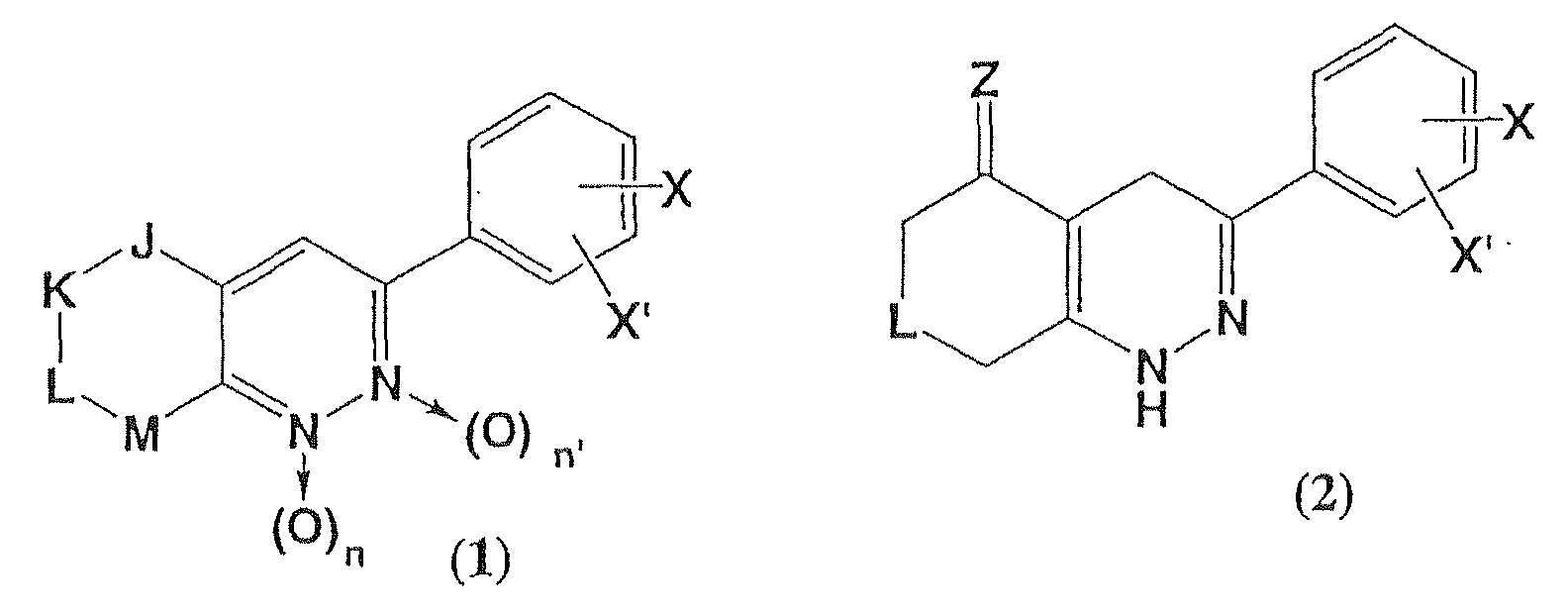
- The antitumor agent according to claim 1 wherein the 3-phenyl-cinnoline analogue is a compound represented by the following general formula (3):wherein A is O-Y group (Y is a hydrogen atom, a lower alkyl group which may be substituted by a phenyl group, a lower acyl group or an amino acid residue which may be protected); B is a hydrogen atom, a lower alkyl group, or a carbonyl group or a substituted imino group together with A; L is N-W or W-C-W'; W and W' each independently is a lower alkyl group which may have a substituent selected from a group consisting of a hydroxyl group, a lower alkoxyl group and a phenyl group, a phenyl group, a carboxyl group, a lower alkoxycarbonyl group or a hydrogen atom; X is a lower alkyl group, a lower alkoxycarbonyl group, a lower acylamino group, a lower alkoxyl group, a trifluoromethyl group, a nitro group, a cyano group or a halogen atom; X' is a lower alkyl group, a lower alkoxycarbonyl group, a lower acylamino group, a lower alkoxyl group, a trifluoromethyl group, a nitro group, a cyano group, a halogen atom or a hydrogen atom; m and q each independently is an integer of 0 to 3; and n and n' each independently is 0 or 1.

- The antitumor agent according to claim 2, wherein B is a hydrogen atom; L is W-C-W'; W and W' each independently is a lower alkyl group which may have a substituent selected from a group consisting of a hydroxyl group, a lower alkoxyl group and a phenyl group, or a hydrogen atom; X is a 3-trifluoromethyl group, a 3-nitro group, a 3-cyano group or a 3-bromo group; X' is a hydrogen atom; m and q each individually is 1; n is 0 or 1; and n' is 0.
- The antitumor agent according to claim 3, wherein W and W' each independently is a hydrogen atom or a lower alkyl group, and X is a 3-trifluoromethyl group.
- The antitumor agent according to claim 2, wherein Y is a glycyl group, an alanyl group, a valyl group or an α-glutamyl group; B is a hydrogen atom; L is H-C-CH3; X is a 3-trifluoromethyl group; X' is a hydrogen atom; m and q each individually is 1; n is 0 or 1; and n' is 0.
- The antitumor agent according to claim 1, wherein the 3-phneyl-cinnoline analogue is a compound represented by the following general formula (4):wherein X and X' each independently is a lower alkyl group, a lower alkoxycarbonyl group, a lower acylamino group, a lower alkoxyl group, a trifluoromethyl group, a nitro group, a cyano group, a halogen atom or a hydrogen atom; Y is a lower alkyl group which may be substituted by a phenyl group, a lower acyl group or a hydrogen atom; and W is a lower alkyl group which may have a substituent selected from a group consisting of a hydroxyl group, a lower alkoxyl group and a phenyl group, a phenyl group, a carboxyl group, a lower alkoxycarbonyl group or a hydrogen atom.

- The antitumor agent according to claim 6, wherein X is a trifluoromethyl group, a nitro group, a cyano group or a halogen atom; X' is a hydrogen atom; and W is a lower alkyl group which may have a substituent selected from a group consisting of a hydroxyl group, a lower alkoxyl group and a phenyl group.
- The antitumor agent according to claim 7, wherein X is a 3-trifluoromethyl group, a 3-nitro group, a 3-cyano group or a 3-halogen atom; and W is a non-substituted lower alkyl group.
- The antitumor agent according to claim 1 wherein a 3-phenyl-cinnoline analogue is a compound represented by the following general formula (5):wherein W and W' each independently is a hydrogen atom or a lower alkyl group; X is a halogenated lower alkyl group; Z is an oxygen atom or N-Q; Q is an amino group, a lower alkylamino group, a hydroxyl group or a lower alkoxyl group.

- The antitumor agent according to claim 9, wherein W is a hydrogen atom or a methyl group; W' is a hydrogen atom or a methyl group; X is a 3-trifluoromethyl group; and Z is an oxygen atom.
- The antitumor agent according to claim 9, wherein W is a hydrogen atom or a methyl group; W' is a hydrogen atom or a methyl group; X is a 3-trifluoromethyl group; and Z is N-NH2.
- The antitumor agent according to claim 1 wherein the 3-phenylcinnoline analogue is 7-methyl-3-(3-trifluoromethyl)-7,8-dihydro-6H-cinnolin-5-one, 7-methyl-3-(3-trifluoromethyl)-5,6,7,8-tetrahydrocinnolin-5-ol, 7-methyl-3-(3-trifluoromethylphenyl)cinnolin-5-ol, 7-methyl-1-oxy-3-(3-trifluoromethyl)-5,6,7,8-tetrahydrocinnolin-5-ol, 5-glycyloxy-7-methyl-3-(3-trifluoromethyl)-5,6,7,8-tetrahydrocinnoline, 5-(L-alanyl)oxy-7-methyl-3-(3-trifluoromethyl)-5,6,7,8-tetrahydrocinnoline, 5-(L-valyl)oxy-7-methyl-3-(3-trifluoromethyl)-5,6,7,8-tetrahydrocinnoline, 5-(L-α-glutamyl)oxy-7-methyl-3-(3-trifluoromethyl)-5,6,7,8-tetrahydrocinnoline.
- A cell proliferation inhibitor comprising the 3-phenyl-cinnoline analogue according to any one of claims 1 - 12 or the physiologically acceptable salt thereof as an active ingredient.
- The 3-phenyl-cinnoline analogue according to any one of claims 1 - 12 or the physiologically acceptable salt thereof, proviso that a compound wherein Z is an oxygen atom is excluded.
Applications Claiming Priority (7)
| Application Number | Priority Date | Filing Date | Title |
|---|---|---|---|
| JP2002357556 | 2002-12-10 | ||
| JP2002357556 | 2002-12-10 | ||
| JP2003166082 | 2003-06-11 | ||
| JP2003166082 | 2003-06-11 | ||
| JP2003183766 | 2003-06-27 | ||
| JP2003183766 | 2003-06-27 | ||
| PCT/JP2003/015767 WO2004052866A1 (en) | 2002-12-10 | 2003-12-10 | 3-phenyl-cinnoline homologue and antitumor agent containing the same |
Publications (2)
| Publication Number | Publication Date |
|---|---|
| EP1571148A1 true EP1571148A1 (en) | 2005-09-07 |
| EP1571148A4 EP1571148A4 (en) | 2007-08-22 |
Family
ID=32512120
Family Applications (1)
| Application Number | Title | Priority Date | Filing Date |
|---|---|---|---|
| EP03778763A Withdrawn EP1571148A4 (en) | 2002-12-10 | 2003-12-10 | 3-phenyl-cinnoline homologue and antitumor agent containing the same |
Country Status (9)
| Country | Link |
|---|---|
| US (1) | US7563893B2 (en) |
| EP (1) | EP1571148A4 (en) |
| JP (1) | JPWO2004052866A1 (en) |
| KR (1) | KR20050085474A (en) |
| AU (1) | AU2003289002B2 (en) |
| BR (1) | BR0317119A (en) |
| CA (1) | CA2508010A1 (en) |
| TW (1) | TWI314455B (en) |
| WO (1) | WO2004052866A1 (en) |
Cited By (1)
| Publication number | Priority date | Publication date | Assignee | Title |
|---|---|---|---|---|
| WO2008016132A1 (en) | 2006-08-04 | 2008-02-07 | Daiichi Sankyo Company, Limited | Benzyl phenyl glucopyranoside derivative |
Families Citing this family (4)
| Publication number | Priority date | Publication date | Assignee | Title |
|---|---|---|---|---|
| TW200606156A (en) * | 2004-06-09 | 2006-02-16 | Nippon Kayaku Kk | Novel 3-phenyltetrahydrocinnoline-5-ol derivative and medical use thereof |
| JP2006225333A (en) * | 2005-02-18 | 2006-08-31 | Nippon Kayaku Co Ltd | Novel pyranopyridazine derivative and its use |
| JP4787321B2 (en) * | 2005-07-05 | 2011-10-05 | エフ.ホフマン−ラ ロシュ アーゲー | Pyridazine derivatives |
| JP2010070452A (en) * | 2007-01-23 | 2010-04-02 | Nippon Kayaku Co Ltd | New trifluoromethylphenyltetrahydrocinnoline derivative and its use |
Family Cites Families (3)
| Publication number | Priority date | Publication date | Assignee | Title |
|---|---|---|---|---|
| DK0628550T3 (en) | 1993-06-08 | 1998-09-28 | Vertex Pharma | Pyridazine as interleukin-1 beta-converted enzyme inhibitors |
| US6008208A (en) * | 1995-10-23 | 1999-12-28 | Osteoscreen, Inc. | Compositions and methods for treating bone deficit conditions |
| US5919808A (en) * | 1996-10-23 | 1999-07-06 | Zymogenetics, Inc. | Compositions and methods for treating bone deficit conditions |
-
2003
- 2003-12-09 TW TW092134662A patent/TWI314455B/en not_active IP Right Cessation
- 2003-12-10 CA CA002508010A patent/CA2508010A1/en not_active Abandoned
- 2003-12-10 US US10/538,126 patent/US7563893B2/en not_active Expired - Fee Related
- 2003-12-10 AU AU2003289002A patent/AU2003289002B2/en not_active Ceased
- 2003-12-10 EP EP03778763A patent/EP1571148A4/en not_active Withdrawn
- 2003-12-10 KR KR1020057010446A patent/KR20050085474A/en not_active Ceased
- 2003-12-10 JP JP2005502366A patent/JPWO2004052866A1/en not_active Ceased
- 2003-12-10 WO PCT/JP2003/015767 patent/WO2004052866A1/en not_active Ceased
- 2003-12-10 BR BR0317119-1A patent/BR0317119A/en not_active IP Right Cessation
Non-Patent Citations (2)
| Title |
|---|
| DATABASE CAPLUS [Online] CHEMICAL ABSTRACTS SERVICE, COLUMBUS, OHIO, US; RAMADAS, SUKURU RAGHU ET AL: "Condensed nitrogen heterocycles derived from indan-1,3-dione" XP002441182 retrieved from STN Database accession no. 1985:95684 & IN 152 484 A1 (INDIAN INSTITUTE OF TECHNOLOGY, INDIA) 28 January 1984 (1984-01-28) * |
| See also references of WO2004052866A1 * |
Cited By (1)
| Publication number | Priority date | Publication date | Assignee | Title |
|---|---|---|---|---|
| WO2008016132A1 (en) | 2006-08-04 | 2008-02-07 | Daiichi Sankyo Company, Limited | Benzyl phenyl glucopyranoside derivative |
Also Published As
| Publication number | Publication date |
|---|---|
| TW200412965A (en) | 2004-08-01 |
| KR20050085474A (en) | 2005-08-29 |
| AU2003289002A1 (en) | 2004-06-30 |
| WO2004052866A1 (en) | 2004-06-24 |
| TWI314455B (en) | 2009-09-11 |
| US20060058305A1 (en) | 2006-03-16 |
| CA2508010A1 (en) | 2004-06-24 |
| AU2003289002B2 (en) | 2009-11-05 |
| US7563893B2 (en) | 2009-07-21 |
| BR0317119A (en) | 2005-10-25 |
| JPWO2004052866A1 (en) | 2006-04-13 |
| EP1571148A4 (en) | 2007-08-22 |
Similar Documents
| Publication | Publication Date | Title |
|---|---|---|
| KR20230124582A (en) | Novel spiropyrrolidine-derived antiviral agent | |
| CN116157400B (en) | Heterocyclic derivative and preparation method and application thereof | |
| CN116390923B (en) | Heterocyclic derivatives and their preparation methods and uses | |
| WO2006015263A2 (en) | Lonidamine analogs | |
| KR102894005B1 (en) | Antiviral 1,3-di-oxo-indene compounds | |
| WO2023274246A1 (en) | Amide compound and use thereof | |
| EP3564242B1 (en) | Compound for selectively inhibiting kinase and use thereof | |
| CN101268084A (en) | Caspase inhibitor prodrugs | |
| CN116903581B (en) | SHP2/HDAC double-target inhibitor and preparation method and application thereof | |
| US7563893B2 (en) | 3-Phenyl-cinnoline analogue and antitumor agent using the same | |
| US6147073A (en) | Substituted tetralymethylen-Oxindoles analogues as tyrosine kinase inhibitors | |
| Zhan et al. | Design and synthesis of a gossypol derivative with improved antitumor activities | |
| CN117327057A (en) | Triazine diketone compound as thyroid hormone receptor agonist and synthesis and application thereof | |
| CN105732643A (en) | Conjugate and preparation method thereof and application to preparation of IDO enzyme inhibitor and non-steroidal anti-inflammatory drugs | |
| EP3197452B1 (en) | Inhibitors of hif prolyl hydroxylase | |
| RU2324683C2 (en) | 3-phenylcinnolin analogue and based on it anti-tumor agent | |
| TW202426437A (en) | Cyclin k degraders and uses thereof | |
| CN118146197A (en) | Alkyne compound and preparation method, pharmaceutical composition and application thereof | |
| CN100497317C (en) | 3-phenyl-cinnoline homologue and antitumor agent containing the same | |
| KR20240079589A (en) | Compounds and methods for degrading stat3 | |
| KR102964218B1 (en) | Treatment of obesity | |
| WO2023116763A1 (en) | Pyridazine compound, and pharmaceutical composition and use thereof | |
| US20170240511A1 (en) | Substituted pyridine inhibitors of hif prolyl hydroxylase | |
| AU2020241709B2 (en) | Compositions and methods for treating androgen receptor positive forms of cancer | |
| CN108341837A (en) | It is a kind of to inhibit kinases compound and its purposes medically |
Legal Events
| Date | Code | Title | Description |
|---|---|---|---|
| PUAI | Public reference made under article 153(3) epc to a published international application that has entered the european phase |
Free format text: ORIGINAL CODE: 0009012 |
|
| 17P | Request for examination filed |
Effective date: 20050531 |
|
| AK | Designated contracting states |
Kind code of ref document: A1 Designated state(s): AT BE BG CH CY CZ DE DK EE ES FI FR GB GR HU IE IT LI LU MC NL PT RO SE SI SK TR |
|
| AX | Request for extension of the european patent |
Extension state: AL LT LV MK |
|
| DAX | Request for extension of the european patent (deleted) | ||
| A4 | Supplementary search report drawn up and despatched |
Effective date: 20070719 |
|
| 17Q | First examination report despatched |
Effective date: 20080911 |
|
| STAA | Information on the status of an ep patent application or granted ep patent |
Free format text: STATUS: THE APPLICATION IS DEEMED TO BE WITHDRAWN |
|
| 18D | Application deemed to be withdrawn |
Effective date: 20101027 |