EP1569904B1 - Substituted arylalcanoic acid derivatives as ppar pan agonists with potent antihyperglycemic and antihyperlipidemic activity - Google Patents
Substituted arylalcanoic acid derivatives as ppar pan agonists with potent antihyperglycemic and antihyperlipidemic activity Download PDFInfo
- Publication number
- EP1569904B1 EP1569904B1 EP03772525A EP03772525A EP1569904B1 EP 1569904 B1 EP1569904 B1 EP 1569904B1 EP 03772525 A EP03772525 A EP 03772525A EP 03772525 A EP03772525 A EP 03772525A EP 1569904 B1 EP1569904 B1 EP 1569904B1
- Authority
- EP
- European Patent Office
- Prior art keywords
- ring
- alkyl
- aryl
- amino
- alk
- Prior art date
- Legal status (The legal status is an assumption and is not a legal conclusion. Google has not performed a legal analysis and makes no representation as to the accuracy of the status listed.)
- Expired - Lifetime
Links
- 0 *1c(cccc2)c2NC2C1CCCCC2 Chemical compound *1c(cccc2)c2NC2C1CCCCC2 0.000 description 6
- VKESNJCVJXNVTC-UHFFFAOYSA-O CC1C=C(C(C2=C(C)C(C)CC=C2)=O)C([NH2+]C(Cc(cc2)ccc2OCCNc(cccc2)c2-c2c(C)cccc2)C(O)=O)=CC1 Chemical compound CC1C=C(C(C2=C(C)C(C)CC=C2)=O)C([NH2+]C(Cc(cc2)ccc2OCCNc(cccc2)c2-c2c(C)cccc2)C(O)=O)=CC1 VKESNJCVJXNVTC-UHFFFAOYSA-O 0.000 description 1
- FBLPJKZSQKPPRD-UHFFFAOYSA-N COC(C(Cc(cc1)ccc1O)Nc(cccc1)c1C(c1cnccc1)=O)=O Chemical compound COC(C(Cc(cc1)ccc1O)Nc(cccc1)c1C(c1cnccc1)=O)=O FBLPJKZSQKPPRD-UHFFFAOYSA-N 0.000 description 1
Images


Classifications
-
- C—CHEMISTRY; METALLURGY
- C07—ORGANIC CHEMISTRY
- C07D—HETEROCYCLIC COMPOUNDS
- C07D401/00—Heterocyclic compounds containing two or more hetero rings, having nitrogen atoms as the only ring hetero atoms, at least one ring being a six-membered ring with only one nitrogen atom
- C07D401/02—Heterocyclic compounds containing two or more hetero rings, having nitrogen atoms as the only ring hetero atoms, at least one ring being a six-membered ring with only one nitrogen atom containing two hetero rings
- C07D401/12—Heterocyclic compounds containing two or more hetero rings, having nitrogen atoms as the only ring hetero atoms, at least one ring being a six-membered ring with only one nitrogen atom containing two hetero rings linked by a chain containing hetero atoms as chain links
-
- A—HUMAN NECESSITIES
- A61—MEDICAL OR VETERINARY SCIENCE; HYGIENE
- A61K—PREPARATIONS FOR MEDICAL, DENTAL OR TOILETRY PURPOSES
- A61K31/00—Medicinal preparations containing organic active ingredients
- A61K31/185—Acids; Anhydrides, halides or salts thereof, e.g. sulfur acids, imidic, hydrazonic or hydroximic acids
-
- A—HUMAN NECESSITIES
- A61—MEDICAL OR VETERINARY SCIENCE; HYGIENE
- A61K—PREPARATIONS FOR MEDICAL, DENTAL OR TOILETRY PURPOSES
- A61K31/00—Medicinal preparations containing organic active ingredients
- A61K31/33—Heterocyclic compounds
- A61K31/335—Heterocyclic compounds having oxygen as the only ring hetero atom, e.g. fungichromin
-
- A—HUMAN NECESSITIES
- A61—MEDICAL OR VETERINARY SCIENCE; HYGIENE
- A61K—PREPARATIONS FOR MEDICAL, DENTAL OR TOILETRY PURPOSES
- A61K31/00—Medicinal preparations containing organic active ingredients
- A61K31/33—Heterocyclic compounds
- A61K31/395—Heterocyclic compounds having nitrogen as a ring hetero atom, e.g. guanethidine or rifamycins
- A61K31/40—Heterocyclic compounds having nitrogen as a ring hetero atom, e.g. guanethidine or rifamycins having five-membered rings with one nitrogen as the only ring hetero atom, e.g. sulpiride, succinimide, tolmetin, buflomedil
- A61K31/403—Heterocyclic compounds having nitrogen as a ring hetero atom, e.g. guanethidine or rifamycins having five-membered rings with one nitrogen as the only ring hetero atom, e.g. sulpiride, succinimide, tolmetin, buflomedil condensed with carbocyclic rings, e.g. carbazole
-
- A—HUMAN NECESSITIES
- A61—MEDICAL OR VETERINARY SCIENCE; HYGIENE
- A61K—PREPARATIONS FOR MEDICAL, DENTAL OR TOILETRY PURPOSES
- A61K31/00—Medicinal preparations containing organic active ingredients
- A61K31/33—Heterocyclic compounds
- A61K31/395—Heterocyclic compounds having nitrogen as a ring hetero atom, e.g. guanethidine or rifamycins
- A61K31/41—Heterocyclic compounds having nitrogen as a ring hetero atom, e.g. guanethidine or rifamycins having five-membered rings with two or more ring hetero atoms, at least one of which being nitrogen, e.g. tetrazole
- A61K31/42—Oxazoles
- A61K31/422—Oxazoles not condensed and containing further heterocyclic rings
-
- A—HUMAN NECESSITIES
- A61—MEDICAL OR VETERINARY SCIENCE; HYGIENE
- A61K—PREPARATIONS FOR MEDICAL, DENTAL OR TOILETRY PURPOSES
- A61K31/00—Medicinal preparations containing organic active ingredients
- A61K31/33—Heterocyclic compounds
- A61K31/395—Heterocyclic compounds having nitrogen as a ring hetero atom, e.g. guanethidine or rifamycins
- A61K31/41—Heterocyclic compounds having nitrogen as a ring hetero atom, e.g. guanethidine or rifamycins having five-membered rings with two or more ring hetero atoms, at least one of which being nitrogen, e.g. tetrazole
- A61K31/425—Thiazoles
- A61K31/426—1,3-Thiazoles
-
- A—HUMAN NECESSITIES
- A61—MEDICAL OR VETERINARY SCIENCE; HYGIENE
- A61K—PREPARATIONS FOR MEDICAL, DENTAL OR TOILETRY PURPOSES
- A61K31/00—Medicinal preparations containing organic active ingredients
- A61K31/33—Heterocyclic compounds
- A61K31/395—Heterocyclic compounds having nitrogen as a ring hetero atom, e.g. guanethidine or rifamycins
- A61K31/535—Heterocyclic compounds having nitrogen as a ring hetero atom, e.g. guanethidine or rifamycins having six-membered rings with at least one nitrogen and one oxygen as the ring hetero atoms, e.g. 1,2-oxazines
- A61K31/5375—1,4-Oxazines, e.g. morpholine
- A61K31/538—1,4-Oxazines, e.g. morpholine ortho- or peri-condensed with carbocyclic ring systems
-
- A—HUMAN NECESSITIES
- A61—MEDICAL OR VETERINARY SCIENCE; HYGIENE
- A61K—PREPARATIONS FOR MEDICAL, DENTAL OR TOILETRY PURPOSES
- A61K31/00—Medicinal preparations containing organic active ingredients
- A61K31/33—Heterocyclic compounds
- A61K31/395—Heterocyclic compounds having nitrogen as a ring hetero atom, e.g. guanethidine or rifamycins
- A61K31/54—Heterocyclic compounds having nitrogen as a ring hetero atom, e.g. guanethidine or rifamycins having six-membered rings with at least one nitrogen and one sulfur as the ring hetero atoms, e.g. sulthiame
- A61K31/5415—Heterocyclic compounds having nitrogen as a ring hetero atom, e.g. guanethidine or rifamycins having six-membered rings with at least one nitrogen and one sulfur as the ring hetero atoms, e.g. sulthiame ortho- or peri-condensed with carbocyclic ring systems, e.g. phenothiazine, chlorpromazine, piroxicam
-
- A—HUMAN NECESSITIES
- A61—MEDICAL OR VETERINARY SCIENCE; HYGIENE
- A61K—PREPARATIONS FOR MEDICAL, DENTAL OR TOILETRY PURPOSES
- A61K31/00—Medicinal preparations containing organic active ingredients
- A61K31/33—Heterocyclic compounds
- A61K31/395—Heterocyclic compounds having nitrogen as a ring hetero atom, e.g. guanethidine or rifamycins
- A61K31/55—Heterocyclic compounds having nitrogen as a ring hetero atom, e.g. guanethidine or rifamycins having seven-membered rings, e.g. azelastine, pentylenetetrazole
-
- A—HUMAN NECESSITIES
- A61—MEDICAL OR VETERINARY SCIENCE; HYGIENE
- A61K—PREPARATIONS FOR MEDICAL, DENTAL OR TOILETRY PURPOSES
- A61K45/00—Medicinal preparations containing active ingredients not provided for in groups A61K31/00 - A61K41/00
- A61K45/06—Mixtures of active ingredients without chemical characterisation, e.g. antiphlogistics and cardiaca
-
- A—HUMAN NECESSITIES
- A61—MEDICAL OR VETERINARY SCIENCE; HYGIENE
- A61P—SPECIFIC THERAPEUTIC ACTIVITY OF CHEMICAL COMPOUNDS OR MEDICINAL PREPARATIONS
- A61P1/00—Drugs for disorders of the alimentary tract or the digestive system
- A61P1/18—Drugs for disorders of the alimentary tract or the digestive system for pancreatic disorders, e.g. pancreatic enzymes
-
- A—HUMAN NECESSITIES
- A61—MEDICAL OR VETERINARY SCIENCE; HYGIENE
- A61P—SPECIFIC THERAPEUTIC ACTIVITY OF CHEMICAL COMPOUNDS OR MEDICINAL PREPARATIONS
- A61P3/00—Drugs for disorders of the metabolism
-
- A—HUMAN NECESSITIES
- A61—MEDICAL OR VETERINARY SCIENCE; HYGIENE
- A61P—SPECIFIC THERAPEUTIC ACTIVITY OF CHEMICAL COMPOUNDS OR MEDICINAL PREPARATIONS
- A61P3/00—Drugs for disorders of the metabolism
- A61P3/04—Anorexiants; Antiobesity agents
-
- A—HUMAN NECESSITIES
- A61—MEDICAL OR VETERINARY SCIENCE; HYGIENE
- A61P—SPECIFIC THERAPEUTIC ACTIVITY OF CHEMICAL COMPOUNDS OR MEDICINAL PREPARATIONS
- A61P3/00—Drugs for disorders of the metabolism
- A61P3/06—Antihyperlipidemics
-
- A—HUMAN NECESSITIES
- A61—MEDICAL OR VETERINARY SCIENCE; HYGIENE
- A61P—SPECIFIC THERAPEUTIC ACTIVITY OF CHEMICAL COMPOUNDS OR MEDICINAL PREPARATIONS
- A61P3/00—Drugs for disorders of the metabolism
- A61P3/08—Drugs for disorders of the metabolism for glucose homeostasis
- A61P3/10—Drugs for disorders of the metabolism for glucose homeostasis for hyperglycaemia, e.g. antidiabetics
-
- A—HUMAN NECESSITIES
- A61—MEDICAL OR VETERINARY SCIENCE; HYGIENE
- A61P—SPECIFIC THERAPEUTIC ACTIVITY OF CHEMICAL COMPOUNDS OR MEDICINAL PREPARATIONS
- A61P43/00—Drugs for specific purposes, not provided for in groups A61P1/00-A61P41/00
-
- A—HUMAN NECESSITIES
- A61—MEDICAL OR VETERINARY SCIENCE; HYGIENE
- A61P—SPECIFIC THERAPEUTIC ACTIVITY OF CHEMICAL COMPOUNDS OR MEDICINAL PREPARATIONS
- A61P7/00—Drugs for disorders of the blood or the extracellular fluid
- A61P7/12—Antidiuretics, e.g. drugs for diabetes insipidus
-
- A—HUMAN NECESSITIES
- A61—MEDICAL OR VETERINARY SCIENCE; HYGIENE
- A61P—SPECIFIC THERAPEUTIC ACTIVITY OF CHEMICAL COMPOUNDS OR MEDICINAL PREPARATIONS
- A61P9/00—Drugs for disorders of the cardiovascular system
-
- A—HUMAN NECESSITIES
- A61—MEDICAL OR VETERINARY SCIENCE; HYGIENE
- A61P—SPECIFIC THERAPEUTIC ACTIVITY OF CHEMICAL COMPOUNDS OR MEDICINAL PREPARATIONS
- A61P9/00—Drugs for disorders of the cardiovascular system
- A61P9/10—Drugs for disorders of the cardiovascular system for treating ischaemic or atherosclerotic diseases, e.g. antianginal drugs, coronary vasodilators, drugs for myocardial infarction, retinopathy, cerebrovascula insufficiency, renal arteriosclerosis
-
- C—CHEMISTRY; METALLURGY
- C07—ORGANIC CHEMISTRY
- C07D—HETEROCYCLIC COMPOUNDS
- C07D209/00—Heterocyclic compounds containing five-membered rings, condensed with other rings, with one nitrogen atom as the only ring hetero atom
- C07D209/56—Ring systems containing three or more rings
- C07D209/80—[b, c]- or [b, d]-condensed
- C07D209/82—Carbazoles; Hydrogenated carbazoles
- C07D209/86—Carbazoles; Hydrogenated carbazoles with only hydrogen atoms, hydrocarbon or substituted hydrocarbon radicals, directly attached to carbon atoms of the ring system
-
- C—CHEMISTRY; METALLURGY
- C07—ORGANIC CHEMISTRY
- C07D—HETEROCYCLIC COMPOUNDS
- C07D213/00—Heterocyclic compounds containing six-membered rings, not condensed with other rings, with one nitrogen atom as the only ring hetero atom and three or more double bonds between ring members or between ring members and non-ring members
- C07D213/02—Heterocyclic compounds containing six-membered rings, not condensed with other rings, with one nitrogen atom as the only ring hetero atom and three or more double bonds between ring members or between ring members and non-ring members having three double bonds between ring members or between ring members and non-ring members
- C07D213/04—Heterocyclic compounds containing six-membered rings, not condensed with other rings, with one nitrogen atom as the only ring hetero atom and three or more double bonds between ring members or between ring members and non-ring members having three double bonds between ring members or between ring members and non-ring members having no bond between the ring nitrogen atom and a non-ring member or having only hydrogen or carbon atoms directly attached to the ring nitrogen atom
- C07D213/24—Heterocyclic compounds containing six-membered rings, not condensed with other rings, with one nitrogen atom as the only ring hetero atom and three or more double bonds between ring members or between ring members and non-ring members having three double bonds between ring members or between ring members and non-ring members having no bond between the ring nitrogen atom and a non-ring member or having only hydrogen or carbon atoms directly attached to the ring nitrogen atom with substituted hydrocarbon radicals attached to ring carbon atoms
- C07D213/44—Radicals substituted by doubly-bound oxygen, sulfur, or nitrogen atoms, or by two such atoms singly-bound to the same carbon atom
- C07D213/46—Oxygen atoms
- C07D213/50—Ketonic radicals
-
- A—HUMAN NECESSITIES
- A61—MEDICAL OR VETERINARY SCIENCE; HYGIENE
- A61K—PREPARATIONS FOR MEDICAL, DENTAL OR TOILETRY PURPOSES
- A61K2300/00—Mixtures or combinations of active ingredients, wherein at least one active ingredient is fully defined in groups A61K31/00 - A61K41/00
Definitions
- the present invention relates to the preparation and pharmaceutical use of novel substituted arylalcanoic acid derivatives. More particularly, the present invention relates to novel compounds of the general Formula (I), their preparation methods, their pharmaceutical compositions and their use for treatment and/or prevention of conditions mediated by nuclear receptors, in particular the RXR and PPAR heterodimers.
- the present compounds are useful in treatment and/or prevention of type 2 diabetes and associated metabolic syndrome such as hypertension, obesity, insulin resistance, hyperlipidemia, hyperglycemia, hypercholesterolemia, atherosclerosis, coronary artery disease, and other cardiovascular disorders with improved side effects profile commonly associated with conventional PPARgamma agonists.
- Metabolic syndrome including type 2 diabetes and associated complications such as obesity, cardiovascular symptoms, and dyslipidemia, are of major impact on social and economic significance. Although anti-diabetic treatments improve insulin resistance, they offer little protection from eminent cardiovascular risk associated with type 2 diabetes. Therefore, development of new treatments that have insulin sensitizing and cholesterol / triglycerides-lowering effects are of general interest.
- Diabetes mellitus is a polygenic disorder affecting a significant portion of the people in the world. It is divided into two types. In type 1 diabetes, or insulin-dependent diabetes mellitus (IDDM), patients produce little or no insulin, the hormone that regulates glucose utilization. In type 2 diabetes, or noninsulin dependent diabetes mellitus (NIDDM), patients often have plasma insulin levels that are at the same compared to nondiabetic humans; however, these patients have developed a resistance to the insulin stimulating effect on glucose and lipid metabolism in the main insulin-sensitive tissues, i.e., muscle, liver and adipose tissues, and the plasma insulin levels are insufficient to overcome the pronounced insulin resistance. Type 2 diabetes consists of over 90% of all diabetes. It is a metabolic disorder characterized by hyperglycemia leading to secondary complications such as neuropathy, nephropathy, retinopathy, hypertriglyceridemia, obesity, and other cardiovascular diseases generally referred as metabolic syndrome.
- the treatment generally prescribed for type 2 diabetes has been a combination of diet, exercise, and oral hypoglycemic agents, commonly sulfonylurea and biguanides.
- sulfonylurea therapy has many problems associated with primary and secondary failure of efficacy, incidence of hypoglycemia, and obesity.
- the biguanides therapy can induce lactic acidosis, nausea and diarrhea.
- a drug that can control plasma glucose tightly without significant side effects would be an important addition to diabetes therapy.
- thiazolidinediones has been shown to reduce hyperglycemia by promoting insulin action without additional insulin secretion, and without causing undesirable hypoglycemia, even at elevated doses.
- PPARgamma-selective ligands induce adipocyte differentiation and white fat accumulation that leads to obesity, an important factor linking directly to the onset or the consequence of type 2 diabetes. Such unwanted effects will eventually compromise the insulin-sensitizing benefit of PPARgamma ligands.
- PPARgamma is a member of ligand-activated nuclear hormone receptor superfamily and expressed primarily in adipose tissues.
- a class of ligands named fibrates that are known to have triglyceride- and cholesterol-lowering activity activates another member of this family, the PPARalpha, which is mainly expressed in tissues such as liver.
- PPARalpha stimulates peroxisomal proliferation that enhances fatty acid oxidation, leading to reduced fatty acids level in blood ( Keller and Wahli: Trends Endocrin Metab 1993, 4:291-296 ).
- PPARdelta was reported to modulate lipid metabolism in which PPARdelta serves as a widespread regulator of fat burning.
- PPARdelta-deficient mice challenged with high-fat diet show reduced energy uncoupling and are prone to obesity ( Wang YX et al., Cell 2003 Apr 18;113(2):159-70 ).
- the transcriptional repression of atherogenic inflammation by ligand-activated PPARdelta was also reported, which further indicates the importance of PPARdelta in combating cardiovascular diseases ( Lee, CH et al., Science 302:453-457, 2003 ).
- PPARalpha, gamma, and delta form heterodimers with Retinoid X Receptor The RXR/PPAR heterodimers thus play an essential role in controlling and regulating cellular events such as lipid, glucose homeostasis, and adipocyte differentiation.
- RXR/PPAR heterodimers thus play an essential role in controlling and regulating cellular events such as lipid, glucose homeostasis, and adipocyte differentiation.
- Several new chemical compounds were reported to have either PPARgamma activity or PPAR alpha and gamma dual activities that are beneficial in the treatment and/or prevention of metabolic syndromes in animal and in men ( WO 00/08002 , WO 01/57001 A1 , US 6054453 , EP 088317 B1 , WO97/25042 , WO02/26729 A2 , and US 6,353,018 B1 ).
- PPAR gamma agonists WO 03/011834 , Collins J L et al. Journal of Medicinal and Pharmaceutical Chemistry, vol. 41, 1998, pages 5037-5054 and WO 97/31907 .
- Dual PPAR alpha and gamma agonists are disclose in: WO 00/63190 , WO/00 23425 , WO 01/55085 , WO 99/19313 , WO 00/23451 and WO 00/23415 .
- PPAR alpha, gamma and delta agonists are known from Liu K G et al, Bioorganic and Medicinal Chemistry Letters vol. 11, no. 17, 2001, pages 2385-2388 .
- novel pan agonists that activate PPAR alpha, gamma, and delta should therefore be a very important addition to bring comprehensive management for metabolic syndrome X such as diabetes, hypertension, obesity, insulin resistance, hyperlipidemia, hyperglycemia, hypercholesterolemia, atherosclerosis, coronary artery disease, and other cardiovascular disorders.
- Ar 2 represents an aryl group substituted with one or more halogen, C 1-6 alkyl, amino, hydroxy, C 1-6 alkoxyl or aryl; a hetero aryl, or a heterocyclic group optionally substituted with one or more halogen, C 1-6 alkyl, amino, hydroxy, C 1-6 alkoxyl or aryl.
- Another aspect of the present invention relates to a pharmaceutical composition containing an active ingredient, at least one of the compounds of the general Formula (I), and/or a pharmaceutically acceptable salt thereof together with a pharmaceutically acceptable carrier or diluent for treatment and/or prevention of type 2 diabetes and associated metabolic syndrome such as hypertension, obesity, insulin resistance, hyperlipidemia, hyperglycemia, hypercholesterolemia, atherosclerosis, coronary artery disease, and other cardiovascular disorders.
- a pharmaceutically acceptable carrier or diluent such as hypertension, obesity, insulin resistance, hyperlipidemia, hyperglycemia, hypercholesterolemia, atherosclerosis, coronary artery disease, and other cardiovascular disorders.
- the compounds of Formula I are able to decrease hyperglycemia and hypertriglyceremia associated with type 2 diabetes. It was also unexpectedly discovered that the compounds of Formula I can be used as pan agonists for RXR/PPARalpha, RXR/PPARgamma, and RXR/PPARdelta heterodimers, as well as agents for lowering both glucose and triglycerides levels for treatment and/or prevention of type 2 diabetes and associated metabolic syndrome.
- the pharmaceutical composition may be in the forms normally employed, such as tablets, capsules, powders, syrups, solutions, suspensions, aerosols, and the like, may contain flavourants, sweeteners etc. in suitable solids or liquid carriers or diluents, or in suitable sterile media to form injectable solutions or suspensions.
- the pharmaceutical composition contains up to about 65% of the compounds of Formula I by weight, preferably from about 0.5 to about 40%, more preferably from about 1 to about 20%, and most preferably from about 1 to 10% with the remainder of the composition being pharmaceutically acceptable carriers, diluents or solvents or salt solutions.
- the term "pharmaceutically acceptable carrier” or “diluent” includes, but is not limited to those disclosed in " Handbook of Pharmaceutical Excipients” published in October, 1986 by American Pharmaceutical Association , the content of which is incorporated herein by reference to the extent permitted.
- the compounds of the Formula (I) as defined above are clinically administered to mammals, including man and animals, via oral, nasal, transdermal, pulmonary, or parenteral routes. Administration by the oral route is preferred, being more convenient and avoiding the possible pain and irritation of injection.
- the dosage is in the range from about 0.01 to about 200 mg/kg body weight per day administered singly or as a divided dose, preferably from about 0.01 to about 100 mg/kg and more preferably from about 0.1 to about 50 mg/kg.
- the optimal dosage for the individual subject being treated will be determined by the person responsible for treatment, generally a smaller dose being administered initially and thereafter increments made to determine the most suitable dosage.
- any range of numbers recited in the specification or paragraphs hereinafter describing or claiming various aspects of the invention, such as that representing a particular set of properties, units of measure, conditions, physical states or percentages, is intended to literally incorporate expressly herein by reference or otherwise, any number falling within such range, including any subset of numbers or ranges subsumed within any range so recited.
- the term "about” when used as a modifier for, or in conjunction with, a variable, is intended to convey that the numbers and ranges disclosed herein are flexible and that practice of the present invention by those skilled in the art using temperatures, concentrations, amounts, contents, carbon numbers, and properties that are outside of the range or different from a single value, will achieve the desired result.
- the solid is filtered and washed with hexane (5 ⁇ 200 ml) to yield the crude 2-((2-benzoylphenyl)- amino)-3-(4-hydroxyphenyl) -propionic acid methyl ester.
- the crude product is mixed with 250 ml of methanol and is refluxed for 30 min. After cooled to 0 °C, the product is filtered, washed with methanol (2 ⁇ 50, ml), and dried under a vacuum to give the title compound (60.2 g, 40.1 %).
- the solid is filtered and washed with hexane (5 ⁇ 200 ml) to yield the crude 2-[(2-(4-fluorobenzoyl)phenyl)amino]-3-(4-hydroxyphenyl) -propionic acid methyl ester.
- the crude product is mixed with 250 ml of methanol and is refluxed for 30 min. After cooled to 0 °C, the product is filtered, washed with methanol (2 ⁇ 50 ml), and dried under a vacuum to give the title compound (75.6 g, 48.1%).
- the solid is filtered and washed with hexane (5 ⁇ 200 ml) to yield the crude 2-((2-nicotinoylphenyl)amino)-3-(4-hydroxyphenyl) -propionic acid methyl ester.
- the crude product is mixed with 250 ml of methanol and is refluxed for 30 min. After cooled to 0 °C, the product is filtered, washed with methanol (2x50 ml), and dried under a vacuum to give the title compound (58.6 g, 39.0%).
- the crude product is purified by silica gel chromatography using hexane/EtOAc (4: 1) as eluent to give 2-[(2-(4-fluorobenzoyl)phenyl)amino]-3-[4-(2-bromoethoxy)-phenyl] -propionic acid methyl ester (429 g, 58%).
- the solid is filtered and washed with hexane (5 ⁇ 200 ml) to yield the crude 2-[(2-(4-tert-butylbenzoyl)phenyl)-amino]-3-(4-hydroxyphenyl)-propionic acid methyl ester.
- the crude product is mixed with 250 ml of methanol and is refluxed for 30 min. After cooled to 0 °C, the product is filtered, washed with methanol (2 ⁇ 50 ml), and dried under a vacuum to give the title compound (70.7 g, 41.0%).
- the solid is filtered and washed with hexane (5 ⁇ 200 ml) to yield the crude 2-[(2-(4-methyl benzoyl)phenyl)-amino]-3-(4-hydroxyphenyl)-propionic acid methyl ester.
- the crude product is mixed with 250 ml of methanol and is refluxed for 30 min. After cooled to 0 °C, the product is filtered, washed with methanol (2 ⁇ 50 ml), and dried under a vacuum to give the title compound (59.1 g, 38%).
- the solid is filtered and washed with hexane (5 ⁇ 200 ml) to yield the crude 2-[(2-(2-methyl benzoyl)phenyl)-amino]-3-(4-hydroxyphenyl)-propionic acid methyl ester.
- the crude product is mixed with 250 ml of methanol and is refluxed for 30 min. After cooled to 0 °C, the product is filtered, washed with methanol (2 ⁇ 50 ml), and dried under a vacuum to give the title compound (52.9 g, 34%).
- Activation of RXR/PPARalpha heterodimer by indicated compounds was measured by luciferase reporter assay. Briefly, full length PPARalpha was cloned by PCR using oligonucleotide primers (5'- acgtgcttcctgcttcataga -3' (SEQ ID NO:1) and 5'-cctgagattagccacctccc -3' (SEQ ID NO:2)) from HepG2 cell. The amplified cDNA was cloned into an expression vector and sequenced.
- the reporter was constructed by insertion of an annealed oligonucleotide containing three copies of the PPAR response element (5'-gatcctctcctttgacctattgaactattacctacatttga-3' (SEQ ID NO:3)) to the upstream of the luceferase gene in pHD(X3)Luc vector.
- CV-1 cells were transfected in 96-well plates with the RXR and PPARalpha expression vectors together with the reporter construct. Cells were cultured in media containing the delipidized serum for 24 hours after transfection, then added with tested compounds and positive control WY (WY14643) dissolved in DMSO.
- DMSO fetal sulfate
- Activation of RXR/PPARgamma heterodimer was measured by luciferase reporter assay. Briefly, full length PPARgamma was cloned by PCR using oligonucleotide primers (5'-ggggtacctgcttcagcagcgtgttcga-3' (SEQ ID NO:4) and 5'-gctctagatgttggcagtggctcaggac-3' (SEQ ID NO:5)) from adipose tissue. The amplified cDNA was cloned into an expression vector and sequenced.
- the reporter was constructed by insertion of an annealed oligonucleotide containing 1 copy of the PPAR response element (5'-cgcgttcctttccgaacgtgacctttgtcctggtccccttttgct-3' (SEQ ID NO:6)) to the upstream of the luceferase gene.
- CV-1 cells were transfected in 96-well plates with the RXR and PPARgamma expression vectors together with the reporter construct. Cells were cultured in media containing the delipidized serum for 24 hours after transfection, then added with tested compounds and positive control Ros (Rosiglitazone) dissolved in DMSO.
- DMSO fetal sulfate
- Activation of RXR/PPARdelta heterodimer was measured by luciferase reporter assay. Briefly, full length PPARdelta was cloned by PCR using oligonucleotide primers (5'-ggggtacctgcttcagcagcgtgttcga-3' (SEQ ID NO:4) and 5'-gctctagatgttggcagtggctcaggac-3' (SEQ ID NO:5)) from adipose tissue. The amplified cDNA was cloned into an expression vector and sequenced.
- the reporter was constructed by insertion of an annealed oligonucleotide containing 1 copy of the PPAR response element (5'-cgcgttcctttccgaacgtgacctttgtcctggtcccctlttgct-3' (SEQ ID NO:6)) to the upstream of the luceferase gene.
- CV-1 cells were transfected in 96-well plates with the RXR and PPARdelta expression vectors together with the reporter construct. Cells were cultured in media containing the delipidized serum for 24 hours after transfection, then added with tested compounds and positive control 2-Bro (2-Bromohexadecanoic acid) dissolved in DMSO.
- DMSO fetal sulfate
- Table 1 Animal Group Dose (mg/kg) Triglyceride (mg/dl) Cholesterol (mg/dl) Normal - 149.6 ⁇ 39.8* 73.1 ⁇ 7.8** Control - 233.9 ⁇ 101.6 109.4 ⁇ 26.7 CS038 4 150.3 ⁇ 52.1* 98.4 ⁇ 29.4 CS038 30 143.2 ⁇ 61.8* 86.6 ⁇ 37.7 Ros 4 273.3 ⁇ 87.4 112.7 ⁇ 25.5 Compared with the Normal group: *P ⁇ 0.05, **P ⁇ 0.01
- Table 2 Animal Group Dose (mg/kg) Body Weight (g) Abdomen Fat Weight (g) 0 day 6 days 9 days 15 days Con - 576.5 ⁇ 138.0 569.4 ⁇ 142.1 568.5 ⁇ 145.3 562.7 ⁇ 136.5 60.4 ⁇ 21.0 CS038 4 591.5 ⁇ 130.0 580.8 ⁇ 130.2 575.2 ⁇ 130.6 569.4 ⁇ 122.9 55.8 ⁇ 16.8 CS038 30 580.5 ⁇ 134.9 586.1 ⁇ 143.2 586.5 ⁇ 144.2 578.3 ⁇ 176.8 56.6 ⁇ 21.1 Ros 4 594.9 ⁇ 169.3 604.5 ⁇ 181.4 601.6 ⁇ 183.9 596.4 ⁇ 176.8 63.1 ⁇ 31.4
Landscapes
- Health & Medical Sciences (AREA)
- Chemical & Material Sciences (AREA)
- Organic Chemistry (AREA)
- Animal Behavior & Ethology (AREA)
- Medicinal Chemistry (AREA)
- Veterinary Medicine (AREA)
- Public Health (AREA)
- General Health & Medical Sciences (AREA)
- Life Sciences & Earth Sciences (AREA)
- Pharmacology & Pharmacy (AREA)
- Epidemiology (AREA)
- Bioinformatics & Cheminformatics (AREA)
- Engineering & Computer Science (AREA)
- General Chemical & Material Sciences (AREA)
- Nuclear Medicine, Radiotherapy & Molecular Imaging (AREA)
- Chemical Kinetics & Catalysis (AREA)
- Diabetes (AREA)
- Hematology (AREA)
- Obesity (AREA)
- Heart & Thoracic Surgery (AREA)
- Cardiology (AREA)
- Vascular Medicine (AREA)
- Urology & Nephrology (AREA)
- Endocrinology (AREA)
- Child & Adolescent Psychology (AREA)
- Emergency Medicine (AREA)
- Pharmaceuticals Containing Other Organic And Inorganic Compounds (AREA)
- Acyclic And Carbocyclic Compounds In Medicinal Compositions (AREA)
- Peptides Or Proteins (AREA)
- Indole Compounds (AREA)
- Plural Heterocyclic Compounds (AREA)
- Medicines That Contain Protein Lipid Enzymes And Other Medicines (AREA)
Abstract
Description
- The present invention relates to the preparation and pharmaceutical use of novel substituted arylalcanoic acid derivatives. More particularly, the present invention relates to novel compounds of the general Formula (I), their preparation methods, their pharmaceutical compositions and their use for treatment and/or prevention of conditions mediated by nuclear receptors, in particular the RXR and PPAR heterodimers.
- The present compounds are useful in treatment and/or prevention of
type 2 diabetes and associated metabolic syndrome such as hypertension, obesity, insulin resistance, hyperlipidemia, hyperglycemia, hypercholesterolemia, atherosclerosis, coronary artery disease, and other cardiovascular disorders with improved side effects profile commonly associated with conventional PPARgamma agonists. - Metabolic syndrome, including
type 2 diabetes and associated complications such as obesity, cardiovascular symptoms, and dyslipidemia, are of major impact on social and economic significance. Although anti-diabetic treatments improve insulin resistance, they offer little protection from eminent cardiovascular risk associated withtype 2 diabetes. Therefore, development of new treatments that have insulin sensitizing and cholesterol / triglycerides-lowering effects are of general interest. - Diabetes mellitus is a polygenic disorder affecting a significant portion of the people in the world. It is divided into two types. In
type 1 diabetes, or insulin-dependent diabetes mellitus (IDDM), patients produce little or no insulin, the hormone that regulates glucose utilization. Intype 2 diabetes, or noninsulin dependent diabetes mellitus (NIDDM), patients often have plasma insulin levels that are at the same compared to nondiabetic humans; however, these patients have developed a resistance to the insulin stimulating effect on glucose and lipid metabolism in the main insulin-sensitive tissues, i.e., muscle, liver and adipose tissues, and the plasma insulin levels are insufficient to overcome the pronounced insulin resistance.Type 2 diabetes consists of over 90% of all diabetes. It is a metabolic disorder characterized by hyperglycemia leading to secondary complications such as neuropathy, nephropathy, retinopathy, hypertriglyceridemia, obesity, and other cardiovascular diseases generally referred as metabolic syndrome. - The treatment generally prescribed for
type 2 diabetes has been a combination of diet, exercise, and oral hypoglycemic agents, commonly sulfonylurea and biguanides. However, sulfonylurea therapy has many problems associated with primary and secondary failure of efficacy, incidence of hypoglycemia, and obesity. The biguanides therapy can induce lactic acidosis, nausea and diarrhea. Hence, a drug that can control plasma glucose tightly without significant side effects would be an important addition to diabetes therapy. Recently, a class of compounds termed thiazolidinediones has been shown to reduce hyperglycemia by promoting insulin action without additional insulin secretion, and without causing undesirable hypoglycemia, even at elevated doses. Their effect is proposed to be a result of initiation and modulation of adipocyte differentiation by agonist activity of PPARgamma. This class of compounds that is able to activate PPARgamma has been demonstrated clinically effective in treatment oftype 2 diabetes (AVANDIA from GSK and ACTOS from Lilly/Tekada). Although the exact link from activation of PPARgamma to change in glucose metabolism, most notably a decrease in insulin resistance in muscle, have not yet been clarified. The link is via free fatty acids in such that activation of PPARgamma induces lipoprotein lipase, fatty acid transport protein and acyl-CoA synthetase in adipose tissue but not in muscle cells. This effect, in turn, reduces the concentration of free fatty acids in plasma dramatically, leading to eventual switch from fatty acid oxidation to glucose oxidation in high metabolic state of tissues, such as skeletal muscle and other tissues, due to substrate competition and pathway compensation. That results in a decreased insulin resistance in those tissues. Further, activation of PPARgamma modulates a subset of genes in controlling glucose and energy homeostasis, which leads to decrease blood glucose level (T. M. Wilson et al. "The PPARs: from orphan receptors to drug discovery" J. Med. Chem. 2000 43:527-50; A. Chawla et al. "Nuclear receptors and lipid physiology: Opening the X-files", Science 2001 294:1866-70). - Despite the advances made with the thiazolidinedione class of antidiabetes agents, serious unacceptable side effects including cardiac hypertrophy, hemodilution and liver toxicity have limited their clinical use. In the United States and Japan, several cases of liver damage and drug-related deaths due to liver damage have been reported. Further, PPARgamma-selective ligands induce adipocyte differentiation and white fat accumulation that leads to obesity, an important factor linking directly to the onset or the consequence of
type 2 diabetes. Such unwanted effects will eventually compromise the insulin-sensitizing benefit of PPARgamma ligands. Hence, there is a definite need for a safe and efficacious agent for the treatment oftype 2 diabetic patients that possesses dual activities of insulin-sensitizing as well as lowering white adipose deposition by regulating free fatty acids and triglycerides contents. - PPARgamma is a member of ligand-activated nuclear hormone receptor superfamily and expressed primarily in adipose tissues. A class of ligands named fibrates that are known to have triglyceride- and cholesterol-lowering activity activates another member of this family, the PPARalpha, which is mainly expressed in tissues such as liver. PPARalpha stimulates peroxisomal proliferation that enhances fatty acid oxidation, leading to reduced fatty acids level in blood (Keller and Wahli: Trends Endocrin Metab 1993, 4:291-296). Most recently, PPARdelta was reported to modulate lipid metabolism in which PPARdelta serves as a widespread regulator of fat burning. In vitro, activation of PPARdelta in adipocytes and skeletal muscle cells promotes fatty acid oxidation and utilization. Targeted activation of PPARdelta in adipose tissue in animals where PPARalpha is much less expressed, specifically induces expression of genes required for fatty acid oxidation and energy dissipation, which in turn leads to improved lipid profiles and reduced adiposity. Importantly, these animals are completely resistant to both high-fat diet-induced and genetically predisposed (Lepr(db/db)) obesity. Acute treatment of Lepr(db/db) mice with a PPARdelta agonist depletes lipid accumulation. In parallel, PPARdelta-deficient mice challenged with high-fat diet show reduced energy uncoupling and are prone to obesity (Wang YX et al., Cell 2003 Apr 18;113(2):159-70). The transcriptional repression of atherogenic inflammation by ligand-activated PPARdelta was also reported, which further indicates the importance of PPARdelta in combating cardiovascular diseases (Lee, CH et al., Science 302:453-457, 2003).
- PPARalpha, gamma, and delta form heterodimers with Retinoid X Receptor (RXR). The RXR/PPAR heterodimers thus play an essential role in controlling and regulating cellular events such as lipid, glucose homeostasis, and adipocyte differentiation. Several new chemical compounds were reported to have either PPARgamma activity or PPAR alpha and gamma dual activities that are beneficial in the treatment and/or prevention of metabolic syndromes in animal and in men (
WO 00/08002 WO 01/57001 A1 US 6054453 ,EP 088317 B1 WO97/25042 WO02/26729 A2 US 6,353,018 B1 ). The following documents disclose PPAR gamma agonists:WO 03/011834 WO 97/31907 WO 00/63190 WO/00 23425 WO 01/55085 WO 99/19313 WO 00/23451 WO 00/23415 - One aspect of the present invention provides compounds of the Formula I:

ring A and ring B, fused to the ring containing X and N, independently of each other represents a 5-6 membered cyclic ring, which may optionally contain one or more heteroatoms selected from oxygen, sulfur or nitrogen atoms and optionally may be substituted with one or more halogen, hydroxy, nitro, cyano, alkyl, alkenyl, alkenynyl, aralkyl, heteroarylalkyl, aminoalkyl, alkoxyalkyl, aryloxyalkyl, aralkoxyalkyl, hydroxyalkyl, thioalkyl, heterocyclyl, alkoxy, aryl, aryloxy, aralkoxy, heteroaryl, heteroaryloxy, heteroaralkoxy, acyl, acyloxy, amino, alkylamino, arylamino, or aralkylamino; the ring A and ring B may be saturated or contain one or more double bonds or may be aromatic;
X is a valence bond, CH2CH2, CH=CH, O, S, or NR6 wherein R6 represents H, alkyl, alkenyl, alkenynyl, aralkyl, heteroarylalkyl, heterocyclyl, aryl, or heteroaryl;
R1 is H, alkyl, alkenyl, alkenynyl, aralkyl, heteroarylalkyl, aminoalkyl, alkoxyalkyl, aryloxyalkyl, aralkoxyalkyl, hydroxyalkyl, thioalkyl, heterocyclyl, OH, halogen, alkoxy, aryl, aryloxy, aralkoxy, heteroaryl, heteroaryloxy, heteroaralkoxy, acyl, acyloxy, amino, alkylamino, arylamino, or aralkylamino;
R2 is H, alkyl, alkenyl, alkenynyl, aralkyl, heteroarylalkyl, heterocyclyl, aryl, or heteroaryl;
R3 is H, alkyl, alkenyl, alkenynyl, aralkyl, heteroarylalkyl, heterocyclyl, aryl, or heteroaryl;
R4 and R5 are independently H, alkyl, alkenyl, alkenynyl, aralkyl, heteroarylalkyl, aminoalkyl, alkoxyalkyl, aryloxyalkyl, aralkoxyalkyl, hydroxyalkyl, thioalkyl, heterocyclyl, OH, halogen, alkoxy, aryl, aryloxy, aralkoxy, heteroaryl, heteroaryloxy, heteroaralkoxy, acyl, acyloxy, amino, alkylamino, arylamino, or aralkylamino; R4 and R5 may form a 5 or 6 membered ring optionally substituted with one or more halogen, hydroxy, nitro, cyano, alkyl, alkenyl, alkenynyl, aralkyl, heteroarylalkyl, aminoalkyl, alkoxyalkyl, aryloxyalkyl, aralkoxyalkyl, hydroxyalkyl, thioalkyl, heterocyclyl, alkoxy, aryl, aryloxy, aralkoxy, heteroaryl, heteroaryloxy, heteroaralkoxy, acyl, acyloxy, amino, alkylamino, arylamino, or aralkylamino;
Alk1 represents C1-6alkylene;
Alk2 represents C1-2alkylene;
Ar1 represents arylene, hetero arylene, or a divalent heterocyclic group optionally substituted with one or more halogen, C1-6alkyl, amino, hydroxy, C1-6alkoxyl or aryl.
Ar2 represents an aryl group substituted with one or more halogen, C1-6alkyl, amino, hydroxy, C1-6alkoxyl or aryl; a hetero aryl, or a heterocyclic group optionally substituted with one or more halogen, C1-6alkyl, amino, hydroxy, C1-6alkoxyl or aryl. - Another aspect of the present invention relates to a pharmaceutical composition containing an active ingredient, at least one of the compounds of the general Formula (I), and/or a pharmaceutically acceptable salt thereof together with a pharmaceutically acceptable carrier or diluent for treatment and/or prevention of
type 2 diabetes and associated metabolic syndrome such as hypertension, obesity, insulin resistance, hyperlipidemia, hyperglycemia, hypercholesterolemia, atherosclerosis, coronary artery disease, and other cardiovascular disorders. - It was unexpectedly discovered that the compounds of Formula I are able to decrease hyperglycemia and hypertriglyceremia associated with
type 2 diabetes. It was also unexpectedly discovered that the compounds of Formula I can be used as pan agonists for RXR/PPARalpha, RXR/PPARgamma, and RXR/PPARdelta heterodimers, as well as agents for lowering both glucose and triglycerides levels for treatment and/or prevention oftype 2 diabetes and associated metabolic syndrome. - The contents of the patents and publications cited herein and contents of documents cited in these patents and publications are hereby incorporated herein by reference to the extent permitted.
-
-
Figure 1 graphically illustrates comparative activation of RXR/PPAR alpha heterodimers by compounds of the present invention (Example 30). -
Figure 2 shows comparative activation of RXR/PPAR gamma heterodimers by compounds of the present invention (Example 31). -
Figure 3 graphically illustrates comparative activation of RXR/PPAR delta heterodimers by compounds of the present invention (Example 32). -
Figure 4 shows comparative activation of RXR/PPAR alpha heterodimers by compounds of the present invention (Example 33). -
Figure 5 shows comparative activation of RXR/PPAR gamma heterodimers by compounds of the present invention (Example 33). -
Figure 6 shows comparative activation of RXR/PPAR delta heterodimers by compounds of the present invention (Example 33). -
Figure 7 graphically illustrates in vivo blood glucose lowering affected by a compound of the present invention (Example 34). -
Figure 8 graphically illustrates increased insulin sensitivity affected in vivo by a compound of the present invention (Example 35). -
Figure 9 graphically illustrates increased glucose tolerance affected in vivo by a compound of the present invention (Example 36). - Unless defined otherwise, all technical and scientific terms used herein have the same meaning as is commonly understood by one of skill in the art to which this invention belongs. All publications and patents referred to herein are incorporated by reference.
- In the preferred embodiment, the compounds of this invention are those of the Formula I, wherein
ring A is a 6 membered aromatic ring;
ring B is a 6 membered aromatic ring;
X is a valence bond, CH2CH2, CH=CH, O or S;
R1 is H or alkyl;
R2 is H or alkyl;
R3 is H or alkyl;
R4 and R5 are independently H or alkyl;
Alk1 is C2-3alkylene;
Alk2 is C1-2alkylene;
Ar1 is an arylene group
Ar2 is a substituted aryl group. - In another preferred embodiment, the compounds of this invention are those of the Formula I, wherein
ring A is a 6 membered aromatic ring;
ring B is a 6 membered aromatic ring;
X is a valence bond, CH2CH2, CH=CH, O or S;
R1 is H or alkyl;
R2 is H or alkyl;
R3 is H or alkyl;
R4 and R5 form a 6 membered aromatic ring;
Alk1 is C2-3alkylene;
Alk2 is C1-2alkylene;
Ar1 is 6 membered aromatic ring
Ar2 is a substituted aryl group. - In another preferred embodiment, the compounds of this invention are those of the Formula I, wherein
ring A is a benzene ring;
ring B is a benzene ring;
X is a valence bond, CH2CH2, CH=CH, O or S;
R1 is H;
R2 is H;
R3 is H;
R4 is methyl; R5 is H;
Alk1 is CH2CH2;
Alk2 is CH2;
Ar1 is benzene ring;
Ar2 is benzene ring substituted with one or more fluorine. - In a further preferred embodiment, the compounds of this invention are those of the Formula I, wherein
ring A is a benzene ring;
ring B is a benzene ring;
X is a valence bond, CH2CH2, CH=CH, O or S;
R1 is H;
R2 is H;
R3 is H;
R4 and R5 form a benzene ring;
Alk1 is CH2CH2;
Alk2 is CH2;
Ar1 is benzene ring;
Ar2 is benzene ring substituted with one or more fluorine. - In another preferred embodiment, the compounds of this invention are those of the Formula I, wherein
ring A is a benzene ring;
ring B is a benzene ring;
X is a valence bond, CH2CH2, CH=CH, O or S;
R1 is H;
R2 is H;
R3 is H;
R4 is methyl; R5 is H;
Alk1 is CH2CH2;
Alk2 is CH2;
Ar1 is benzene ring;
Ar2 is pyridine ring substituted with none, one or more halogen. - In a further preferred embodiment, the compounds of this invention are those of the Formula I, wherein
ring A is a benzene ring;
ring B is a benzene ring;
X is a valence bond, CH2CH2, CH=CH, O or S;
R1 is H;
R2 is H;
R3 is H;
R4 and R5 form a benzene ring;
Alk1 is CH2CH2;
Alk2 is CH2;
Ar1 is benzene ring;
Ar2 is pyridine ring substituted with none, one or more fluorine. - As used herein, the following terms have the indicated meaning:
- The term "alkyl" as used herein is intended to include those alkyl groups in either a linear or branched or cyclic configuration. Typical alkyl groups include, but are not limited to, methyl, ethyl, n-propyl, iso-propyl, butyl, iso-butyl, sec-butyl, tert-butyl, penyl, iso-pentyl, hexyl, iso-hexyl, cyclopropyl, cyclobutyl, cyclopentyl, cyclohexyl and the like.
- The term "aralkyl" as used herein refers to a straight or branched saturated carbon chain containing from 1 to 6 carbons substituted with an aromatic carbohydride, such as benzyl, phenethyl, 3-phenylpropyl, 1-naphtylmethyl and the like.
- The term "heteroaralkyl" as used herein refers to a strait or branched saturated carbon chain containing from 1 to 6 carbons substituted with a heteroaryl as defined herein, such as (2-furyl)methyl, (3-furyl)methyl, (2-pyridyl)methyl and the like.
- The term "aminoalkyl" as used herein refers to an alkyl as defined herein whereto is attached an amino group, such as aminoethyl, 1-aminopropyl, 2-aminopropyl and the like.
- The term "alkoxyalkyl" as used herein refers to an alkyl as defined herein whereto is attached an alkoxy as defined herein, such as methoxymethyl, ethoxymethyl, methoxyethyl, ethoxyethyl and the like.
- The term "aryloxyalkyl" as used herein refers to an alkyl as defined herein whereto is attached an aryloxy as defined herein, such as phenoxymethyl, phenoxydodecyl, 1-naphthyloxyethyl and the like.
- The term "aralkoxyalkyl" as used herein refers to an alkyl as defined herein whereto is attached an aralkoxy as defined herein, such as benzyloxymethyl, 3-phenylpropoxyethyl and the like.
- The term "hydroxyalkyl" as used herein refers to an alkyl as defined herein whereto is attached a hydroxy group, such as hydroxyethyl, 1-hydroxypropyl, 2-hydroxypropyl and the like.
- The term "thioalkyl" as used herein refers to an alkyl as defined herein whereto is attached a group of Formula of -SR' wherein R' is H, alkyl or aryl, such as thiomethyl, methylthiomethyl, phenylthioethyl and the like.
- The term "heterocyclyl" as used herein means a monovalent saturated or unsaturated group being monocyclic and containing one or more heteroatoms, such as pyrrolidine, pyrroline, pyrazoline, imidazolidine, imidazoline, piperidine, morpholine and the like.
- The term "halogen" as used herein means fluorine, chlorine, bromine or iodine.
- The term "alkoxy" as used herein is intended to include those alkyl groups in either a linear or branched or cyclic configuration linked through an ether oxygen having its free valence bond from the ether oxygen, such as methoxy, ethoxy, propoxy, butoxy, pentoxy, isopropoxy, sec-butoxy, cyclopropyloxy, cyclohexyloxy and the like.
- The term "aryl" as used herein is intended to include aromatic rings optionally substituted with halogen, amino, hydroxy, alkyl or alkoxy, such as phenyl, naphthyl and the like.
- The term "aryloxy" as used herein refers to phenoxy, 1-naphthyloxy, 2- naphthyloxy and the like.
- The term "aralkoxy" as used herein refers to an alkyl as defined herein substituted with an aromatic carbohydride, such as benzyloxy, phenethoxy, 1-naphthylmethoxy and the like.
- The term "heteroaryl" as used herein refers to a monovalent substituent comprising a 5-6 membered monocyclic aromatic system or a 9-10 membered bicyclic aromatic system containing one or more heteroatoms selected from nitrogen, oxygen and sulfur, such as furan, thiophene, pyrrole, imidazole, triazole, pyridine, pyrazine, pyrimidine, oxazole, quinoline, indole, benzimidazole and the like.
- The term "heteroaryloxy" as used herein refers to a heteroaryl as defined herein linked to an oxygen atom having its free valence bond from the oxygen atom, such as pyrrole, imidazole, triazole, pyridine, pyrazine, pyrimidine, oxazole, quinoline, indole, benzimidazole linked to oxygen.
- The term "heteroaralkoxy" as used herein refers to a heteroaralkyl as defined herein linked to an oxygen atom having its free valence bond from the oxygen atom, such as (2-furyl)methyl, (3-furyl)methyl, (2-pyridyl)methyl linked to oxygen.
- The term "acyl" as used herein refers to a monovalent substituent comprising an alkyl group linked through a carbonyl group, such as acetyl, propionyl, butyryl, isobutyryl, pivaloyl, valeryl and the like.
- The term "acyloxy" as used herein refers to an acyl as defined herein linked to an oxygen atom having its free valence bond from the oxygen atom, such as acetyloxy, propionyloxy, butyryloxy, isobutyryloxy, pivaloyloxy, valeryloxy and the like.
- The term "alkylamino" as used herein refers to a straight or branched or cyclic monovalent substituent comprising an alkyl group linked through amino having a free valence bond from the nitrogen atom, such as methylamino, ethylamino, propylamino, butylamino, cyclopropylamino, cyclopentylamino, cyclohexylamino and the like.
- The term "arylamino" as used herein refers to an aryl as defined herein linked through amino having a free valence bond from the nitrogen atom, such as phenylamino, naphthylamino and the like.
- The term "aralkylamino" as used herein refers to an aralkyl as defined herein linked through amino having a free valence bond from the nitrogen atom, such as benzylamino, phenethylamino, 3-phenylpropylamino, 1-naphtylmethylamino and the like.
- The compounds of Formula (I) can be prepared by the synthetic route shown in Scheme 1:

-
Compound 1 upon reaction with the β-diketone 2 gave thevinylogous amide analogues 3 in 95-98% yield. O-Alkylation of 3 in a routine manner by treatment with KOH and the corresponding dibromoalkane in ethanol gave theether 4 in 15-20% yield. N-Alkylation of 4 by treatment with NaOH andcompound 5 in the presence of tetrabutyl ammonium bromide gave the substitutedarylalcanoic acid derivatives 6 in 20-25%. - The synthetic route shown in
Scheme 1 is also suitable for the preparation of the compounds of Formula (I) where Ar2 is benzene ring. - The pharmaceutical composition may be in the forms normally employed, such as tablets, capsules, powders, syrups, solutions, suspensions, aerosols, and the like, may contain flavourants, sweeteners etc. in suitable solids or liquid carriers or diluents, or in suitable sterile media to form injectable solutions or suspensions. In a preferred embodiment, the pharmaceutical composition contains up to about 65% of the compounds of Formula I by weight, preferably from about 0.5 to about 40%, more preferably from about 1 to about 20%, and most preferably from about 1 to 10% with the remainder of the composition being pharmaceutically acceptable carriers, diluents or solvents or salt solutions.
- As used herein, the term "pharmaceutically acceptable carrier" or "diluent" includes, but is not limited to those disclosed in "Handbook of Pharmaceutical Excipients" published in October, 1986 by American Pharmaceutical Association, the content of which is incorporated herein by reference to the extent permitted.
- The compounds of the Formula (I) as defined above are clinically administered to mammals, including man and animals, via oral, nasal, transdermal, pulmonary, or parenteral routes. Administration by the oral route is preferred, being more convenient and avoiding the possible pain and irritation of injection. In a preferred embodiment, the dosage is in the range from about 0.01 to about 200 mg/kg body weight per day administered singly or as a divided dose, preferably from about 0.01 to about 100 mg/kg and more preferably from about 0.1 to about 50 mg/kg. However, the optimal dosage for the individual subject being treated will be determined by the person responsible for treatment, generally a smaller dose being administered initially and thereafter increments made to determine the most suitable dosage.
- Without intending to be bound by any particular theory of operation, it is believed that the administration of compounds of Formula I to patient treats diabetes and complications associated with it by lowering the patient's glucose and triglyceride levels. Such dual activities, for example, would help the patient to circumvent hyperglycemia and hypertriglyceremia associated with
type 2 diabetes. It is also believed that treatment oftype 2 diabetic patients and associated complications can be more effective and desirable if the glucose lowering and triglycerides lowering properties of treatment can be achieved by the treatment. - The following examples are given as specific illustrations of the invention. It should be understood, however, that the invention is not limited to the specific details set forth in the examples. All parts and percentages in the examples, as well as in the remainder of the specification, are by weight unless otherwise specified.
- Further, any range of numbers recited in the specification or paragraphs hereinafter describing or claiming various aspects of the invention, such as that representing a particular set of properties, units of measure, conditions, physical states or percentages, is intended to literally incorporate expressly herein by reference or otherwise, any number falling within such range, including any subset of numbers or ranges subsumed within any range so recited. The term "about" when used as a modifier for, or in conjunction with, a variable, is intended to convey that the numbers and ranges disclosed herein are flexible and that practice of the present invention by those skilled in the art using temperatures, concentrations, amounts, contents, carbon numbers, and properties that are outside of the range or different from a single value, will achieve the desired result.
-

- To a solution of L-tyrosine methyl ester (4.00 g, 20.51 mmol) in methanol (150 ml) is added 1-benzoylacetone (3.66 g, 22.56 mmol), then the mixture is heated to reflux for 24 h. The solvent is evaporated under a vacuum. To the residue is added ethanol (50 ml), then the ethanol is distilled off under atmospheric pressure. The crude product is purified by silica gel chromatography using hexane/EtOAc (4:1) as eluent to give the title compound (6.80 g, 98%).
-
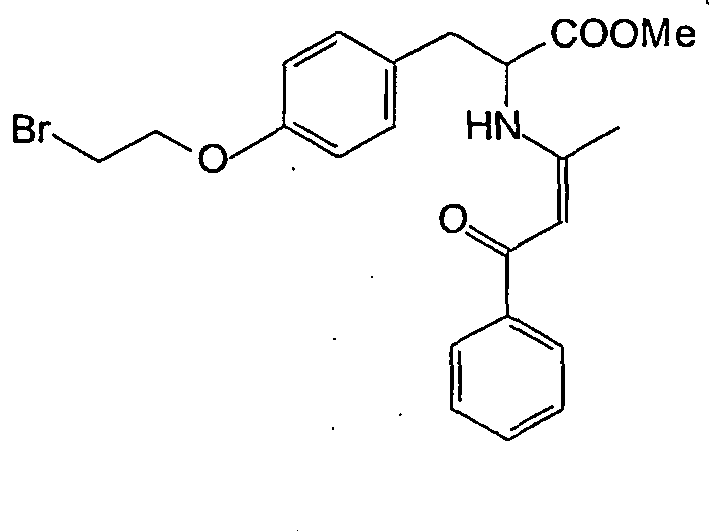
- To a solution of potassium hydroxide (0.17 g, 2.95 mmol) in ethanol (20 ml) is added 2-(1-methyl-3-oxo-3-phenyl-propenylamino)-3-(4-hydroxyphenyl)-propionic acid methyl ester (1.00 g, 2.95 mmol) and 1,2-dibromoethane (5.54 g, 29.50 mmol). Then the mixture is heated to reflux for 8 hours. After cooled, the reaction mixture is filtered to remove the solid formed, and then the filtrate is evaporated under a vacuum. The crude product is purified by silica gel chromatography using hexane/EtOAc (4:1) as eluent to give the title compound (0.22 g, 17%).
-

- To a solution of 2-(1-methyl-3-oxo-3-phenyl-propenylamino)-3-[4-(2-bromoethoxy)-phenyl] -propionic acid methyl ester (0.22 g, 0.49 mmol) and carbazole (0.082 g, 0.49 mmol) in benzene (10 ml) is added tetrabutyl ammonium bromide (0.08 g) and 50% NaOH aqueous solution (0.084 g, 1.08 mmol), then the mixture is heated to reflux for 10 h. After cooled, benzene (30ml) is added, and the mixture is washed with water(3x30 ml). Then the solvent is evaporated under a vacuum. The crude product is purified by silica gel chromatography using CHCl3/MeOH (4:1) as eluent to give the title compound (0.05 g, 20%). HRMS calcd for C33H30N2O4: 518.6123. Found: 518.6125. MA calcd for C33H30N2O4: C, 76.43%; H, 5.83%; N, 5.40%. Found: C, 76.21%; H, 5.85%; N, 5.39%.
-

- To a solution of L-tyrosine methyl ester (4.00 g, 20.51 mmol) in methanol (150 ml) is added 1-(4-fluorobenzoyl)acetone (4.06 g, 22.56 mmol), then the mixture is heated to reflux for 24 h. The solvent is evaporated under a vacuum. To the residue is added ethanol (50 ml), then the ethanol is distilled off under atmospheric pressure. The crude product is purified by silica gel chromatography using hexane/EtOAc (4:1) as eluent to give the title compound (7.03 g, 96%).
-

- To a solution of potassium hydroxide (0.17 g, 2.95 mmol) in ethanol (20 ml) is added 2-[1-methyl-3-oxo-3-(4-fluorophenyl)-propenylamino]-3-(4-hydroxyphenyl)-propionic acid methyl ester (1.05 g, 2.95 mmol) and 1,2-dibromoethane (5.54 g, 29.50 mmol). Then the mixture is heated to reflux for 8 hours. After cooled, the reaction mixture is filtered to remove the solid formed, and then the filtrate is evaporated under a vacuum. The crude product is purified by silica gel chromatography using hexane/EtOAc (4:1) as eluent to give the title compound (0.37 g, 27%).
-

- To a solution of 2-[1-methyl-3-oxo-3-(4-fluorophenyl)-propenylamino]-3-[4-(2-bromoethoxy)-phenyl] -propionic acid methyl ester (0.23 g, 0.49 mmol) and carbazole (0.082 g, 0.49 mmol) in benzene (10 ml) is added tetrabutyl ammonium bromide (0.08 g) and 50% NaOH aqueous solution (0.084 g, 1.08 mmol), then the mixture is heated to reflux for 10 h. After cooled, benzene (30ml) is added, and the mixture is washed with water(3×30 ml). Then the solvent is evaporated under a vacuum. The crude product is purified by silica gel chromatography using CHCl3/MeOH (4:1) as eluent to give the title compound (0.06 g, 23%). HRMS calcd for C33H29FN2O4: 536.6027. Found: 536.6025. MA calcd for C33H29FN2O4: C, 73.86%; H, 5.45%; N, 5.22%. Found: C, 73.63%; H, 5.46%; N, 5.20%.
-

- To a solution of L-tyrosine methyl ester (4.00 g, 20.51 mmol) in methanol (150 ml) is added 1-nicotinoylacetone (3.68 g, 22.56 mmol), then the mixture is heated to reflux for 24 h. The solvent is evaporated under a vacuum. To the residue is added ethanol (50 ml), then the ethanol is distilled off under atmospheric pressure. The crude product is purified by silica gel chromatography using hexarie/EtOAc (4:1) as eluent to give the title compound (5.51 g, 79%).
-
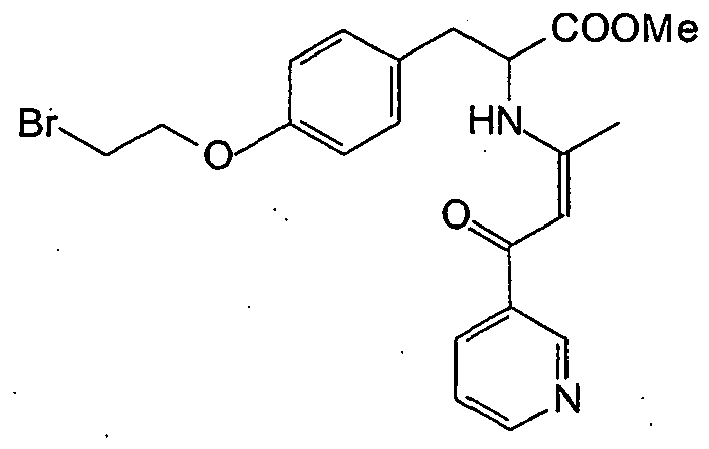
- To a solution of potassium hydroxide (0.17 g, 2.95 mmol) in ethanol (20 ml) is added 2-[1-methyl-3-oxo-3-(3-pyridyl)-propenylamino]-3-(4-hydroxyphenyl)-propionic acid methyl ester (1.00 g, 2.95 mmol) and 1,2-dibromoethane (5.54 g, 29.50 mmol). Then the mixture is heated to reflux for 8 hours. After cooled, the reaction mixture is filtered to remove the solid formed, and then the filtrate is evaporated under a vacuum. The crude product is purified by silica gel chromatography using hexane/EtOAc (4:1) as eluent to give the title compound (0.20 g, 15%).
-

- To a solution of 2-(1-methyl-3-oxo-3-(3-pyridyl)-propenylamino)-3-[4-(2-bromoethoxy)-phenyl] -propionic acid methyl ester (0.22 g, 0.49 mmol) and carbazole (0.082 g, 0.49 mmol) in benzene (10 ml) is added tetrabutyl ammonium bromide (0.08 g) and 50% NaOH aqueous solution (0.084 g, 1.08 mmol), then the mixture is heated to reflux for 10 h. After cooled, benzene (30ml) is added, and the mixture is washed with water(3×30 ml). Then the solvent is evaporated under a vacuum. The crude product is purified by silica gel chromatography using CHCl3/MeOH (4:1) as eluent to give the title compound (0.04 g, 16%). HRMS calcd for C32H29N3O4: 519.6001. Found: 519.6003. MA calcd for C32H29N3O4: C; 73.97%; H, 5.63%; N, 8.09%. Found: C, 73.84%; H, 5.65%; N, 8.11%.
-

- To a mixture of 2-benzoylcyclohexanone (90.9 g, 0.45 mol), L-tyrosine methyl ester (78.0 g, 0.40 mol) in anisole (1000 ml) is added 5% palladium on carbon (20 g), then the mixture is heated to reflux for 2 h while the resulting water is removed by a Dean-Stark apparatus. The mixture is cooled to 80 °C, and the Pd/C is filtered and washed with anisole (3x60 ml). The mixture is cooled to 40 °C, hexane (1000 ml) is added and the mixture kept at -20 °C for 48 h. The solid is filtered and washed with hexane (5×200 ml) to yield the crude 2-((2-benzoylphenyl)- amino)-3-(4-hydroxyphenyl) -propionic acid methyl ester. The crude product is mixed with 250 ml of methanol and is refluxed for 30 min. After cooled to 0 °C, the product is filtered, washed with methanol (2×50, ml), and dried under a vacuum to give the title compound (60.2 g, 40.1 %).
-

- To a solution of potassium hydroxide (0.17 g, 2.95 mmol) in ethanol (20 ml) is added 2-((2-benzoylphenyl)amino)-3-(4-hydroxyphenyl)-propionic acid methyl ester (1.11 g, 2.95 mmol) and 1,2-dibromoethane (5.54 g, 29.50 mmol). Then the mixture is heated to reflux for 8 hours. After cooled, the reaction mixture is filtered to remove the solid formed, and then the filtrate is evaporated under a vacuum. The crude product is purified by silica gel chromatography using hexane/EtOAc (4:1) as eluent to give the title compound (0.30 g, 21%).
-

- To a solution of 2-((2-benzoylphenyl)amino)-3-[4-(2-bromoethoxy)-phenyl] -propionic acid methyl ester (0.24 g, 0.49 mmol) and carbazole (0.082 g, 0.49 mmol) in benzene (10 ml) is added tetrabutyl ammonium bromide (0.08 g) and 50% NaOH aqueous solution (0.084 g, 1.08 mmol), then the mixture is heated to reflux for 10 h. After cooled, benzene (30ml) is added, and the mixture is washed with water(3x30 ml). Then the solvent is evaporated under a vacuum. The crude product is purified by silica gel chromatography using CHCl3/MeOH (4:1) as eluent to give the title compound (0.06 g, 22%). HRMS calcd for C36H30N2O4: 554.6453. Found: 554.6451. MA calcd for C36H30N2O4: C, 77.96%; H, 5.45%; N, 5.05%. Found: C, 77.83%; H, 5.46%; N, 5.07%.
-

- To a mixture of 2-(4-fluorobenzoyl)cyclohexanone (99.0 g, 0.45 mol), L-tyrosine methyl ester (78.0 g, 0.40 mol) in anisole (1000 ml) is added 5% palladium on carbon (20 g), then the mixture is heated to reflux for 2 h while the resulting water is removed by a Dean-Stark apparatus. The mixture is cooled to 80 °C, and the Pd/C is filtered and washed with anisole (3x60 ml). The mixture is cooled to 40 °C, hexane (1000 ml) is added and the mixture kept at -20 °C for 48 h. The solid is filtered and washed with hexane (5×200 ml) to yield the crude 2-[(2-(4-fluorobenzoyl)phenyl)amino]-3-(4-hydroxyphenyl) -propionic acid methyl ester. The crude product is mixed with 250 ml of methanol and is refluxed for 30 min. After cooled to 0 °C, the product is filtered, washed with methanol (2×50 ml), and dried under a vacuum to give the title compound (75.6 g, 48.1%).
-
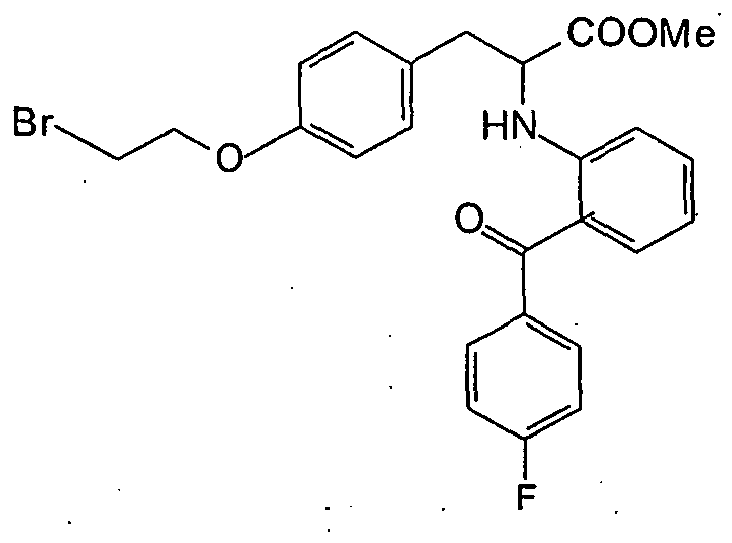
- To a solution of potassium hydroxide (0.17 g, 2.95 mmol) in ethanol (20 ml) is added 2-[(2-(4-fluorobenzoyl)phenyl)amino]-3-(4-hydroxyphenyl)-propionic acid methyl ester (1.16 g, 2.95 mmol) and 1,2-dibromoethane (5.54 g, 29.50 mmol). Then the mixture is heated to reflux for 8 hours. After cooled, the reaction mixture is filtered to remove the solid formed, and then the filtrate is evaporated under a vacuum. The crude product is purified by silica gel chromatography using hexane/EtOAc (4:1) as eluent to give the title compound (0.56 g, 38%).
-

- To a solution of 2-[(2-(4-fluorobenzoyl)phenyl)amino]-3-[4-(2-bromoethoxy)-phenyl] -propionic acid methyl ester (0.25 g, 0.49 mmol) and carbazole (0.082 g, 0.49 mmol) in benzene (10 ml) is added tetrabutyl ammonium bromide (0.08 g) and 50% NaOH aqueous solution (0.084 g, 1.08 mmol), then the mixture is heated to reflux for 10 h. After cooled, benzene (30ml) is added, and the mixture is washed with water (3x30 ml). Then the solvent is evaporated under a vacuum. The crude product is purified by silica gel chromatography using CHCl3/MeOH (4:1) as eluent to give the title compound (0.10 g, 36%). HRMS calcd for C36H29FN2O4: 572.6357. Found: 572.6354. MA calcd for C36H29FN2O4: C, 75.51%; H, 5.11%; N, 4.89%. Found: C, 75.83%; H, 5.10%; N, 4.90%.
-

- To a mixture of 2-nicotinoylcyclohexanone (914.0 g, 0.45 mol), L-tyrosine methyl ester (78.0 g, 0.40 mol) in anisole (1000 ml) is added 5% palladium on carbon (20 g), then the mixture is heated to reflux for 2 h while the resulting water is removed by a Dean-Stark apparatus. The mixture is cooled to 80 °C, and the Pd/C is filtered and washed with anisole (3x60 ml). The mixture is cooled to 40 °C, hexane (1000 ml) is added and the mixture kept at -20 °C for 48 h. The solid is filtered and washed with hexane (5×200 ml) to yield the crude 2-((2-nicotinoylphenyl)amino)-3-(4-hydroxyphenyl) -propionic acid methyl ester. The crude product is mixed with 250 ml of methanol and is refluxed for 30 min. After cooled to 0 °C, the product is filtered, washed with methanol (2x50 ml), and dried under a vacuum to give the title compound (58.6 g, 39.0%).
-

- To a solution of potassium hydroxide (0:17 g, 2.95 mmol) in ethanol (20 ml) is added 2-((2-nicotinoylphenyl)amino)-3-(4-hydroxyphenyl)-propionic acid methyl ester (1.10 g, 2.95 mmol) and 1,2-dibromoethane (5.54 g, 29.50 mmol). Then the mixture is heated to reflux for 8 hours. After cooled, the reaction mixture is filtered to remove the solid formed, and then the filtrate is evaporated under a vacuum. The crude product is purified by silica gel chromatography using hexane/EtOAc (4:1) as eluent to give the title compound (0.40 g, 28.2%).
-

- To a solution of 2-((2-nicotinoylphenyl)amino)-3-[4-(2-bromoethoxy)-phenyl] -propionic acid methyl ester (0.24 g, 0.49 mmol) and carbazole (0.082 g, 0.49 mmol) in benzene (10 ml) is added tetrabutyl ammonium bromide (0.08 g) and 50% NaOH aqueous solution (0.084 g, 1.08 mmol), then the mixture is heated to reflux for 10 h. After cooled, benzene (30ml) is added, and the mixture is washed with water (3 x30 ml). Then the solvent is evaporated under a vacuum. The crude product is purified by silica gel chromatography using CHCl3/MeOH (4:1) as eluent to give the title compound (0.05 g, 18%). HRMS calcd for C35H29N3O4: 555.6331. Found: 555.6329. MA calcd for C35H29N3O4: C, 75.66%; H, 5.26%; N, 7.56%. Found: C, 75.42%; H, 5.27%; N, 7.53%.
-

- To a solution of potassium carbonate (2 kg) in acetonitrile (5000 ml) is added 2-((2-benzoylphenyl)amino)-3-(4-hydroxyphenyl)-propionic acid methyl ester (555 g, 1.48 mol) and 1,2-dibromoethane (1000 ml). Then the mixture is stirred at room temperature for 24 hours. After that, the reaction mixture is filtered, and then the filtrate is evaporated under a vacuum. The crude product is purified by silica gel chromatography using hexane/EtOAc (4:1) as eluent to give 2-((2-benzoylphenyl)amino)-3-[4-(2-bromoethoxy)-phenyl] -propionic acid methyl ester (442 g, 62%).
- To a solution of 2-((2-benzoylphenyl)amino)-3-[4-(2-bromoethoxy)-phenyl] -propionic acid methyl ester (240 g, 0.49 mol) and carbazole (82 g, 0.49 mol) in benzene (3000 ml) is added tetrabutyl ammonium bromide (80 g) and 40% NaOH aqueous solution (105 g, 1.05 mol), then the mixture is heated to reflux for 10 h. After cooled, the upper organic layer is evaporated under a vacuum. The crude product is purified by silica gel chromatography using CHCl3/MeOH (8:1) as eluent to give the title compound (78 g, 28.7%).
-

- To a solution of potassium carbonate (2 kg) in acetonitrile (5000 ml) is added 2-[(2-(4-fluorobenzoyl)phenyl)amino]-3-(4-hydroxyphenyl)-propionic acid methyl ester (581 g, 1.48 mol) and 1,2-dibromoethane (1000 ml). Then the mixture is stirred at room temperature for 24 hours. After that, the reaction mixture is filtered, and then the filtrate is evaporated under a vacuum. The crude product is purified by silica gel chromatography using hexane/EtOAc (4: 1) as eluent to give 2-[(2-(4-fluorobenzoyl)phenyl)amino]-3-[4-(2-bromoethoxy)-phenyl] -propionic acid methyl ester (429 g, 58%).
- To a solution of 2-[(2-(4-fluorobenzoyl)phenyl)amino]-3-[4-(2-bromoethoxy)-phenyl] -propionic acid methyl ester (250 g, 0.50 mol) and carbazole (83.5 g, 0.50 mmol) in benzene (3000 ml) is added tetrabutyl ammonium bromide (80 g) and 40% NaOH aqueous solution (108 g, 1.08 mol), then the mixture is heated to reflux for 10 h. After cooled, the upper organic layer is evaporated under a vacuum. The crude product is purified by silica gel chromatography using CHCl3/MeOH (8: 1) as eluent to give the title compound (91.52 g, 32%).
-

- To a mixture of 2-(4-tert-butylbenzoyl)cyclohexanone (116.1 g, 0.45 mol), L-tyrosine methyl ester (78.0 g, 0.40 mol) in anisole (1000 ml) is added 5% palladium on carbon (20 g), then the mixture is heated to reflux for 2 h while the resulting water is removed by a Dean-Stark apparatus. The mixture is cooled to 80 °C, and the Pd/C is filtered and washed with anisole (3×60 ml). The mixture is cooled to 40 °C, hexane (1000 ml) is added and the mixture kept at -20 °C for 48 h. The solid is filtered and washed with hexane (5×200 ml) to yield the crude 2-[(2-(4-tert-butylbenzoyl)phenyl)-amino]-3-(4-hydroxyphenyl)-propionic acid methyl ester. The crude product is mixed with 250 ml of methanol and is refluxed for 30 min. After cooled to 0 °C, the product is filtered, washed with methanol (2×50 ml), and dried under a vacuum to give the title compound (70.7 g, 41.0%).
-

- To a solution of potassium hydroxide (0.17 g, 2.95 mmol) in ethanol (20 ml) is added 2-[(2-(4-tert-butylbenzoyl)phenyl)amino]-3-(4-hydroxyphenyl)-propionic acid methyl ester (1.27 g, 2.95 mmol) and 1,2-dibromoethane (5.54 g, 29.50 mmol). Then the mixture is heated to reflux for 8 hours. After cooled, the reaction mixture is filtered to remove the solid formed, and then the filtrate is evaporated under a vacuum. The crude product is purified by silica gel chromatography using hexane/EtOAc (4:1) as eluent to give the title compound (0.67 g, 42%).
-

- To a solution of 2-[(2-(4-tert-butylbenzoyl)plienyl)amino]-3-[4-(2-bromoethoxy)-phenyl] -propionic acid methyl ester (0.26 g, 0.49 mmol) and carbazole (0.082 g, 0.49 mmol) in benzene (10 ml) is added tetrabutyl ammonium bromide (0.08 g) and 50% NaOH aqueous solution (0.084 g, 1.08 mmol), then the mixture is heated to reflux for 10 h. After cooled, benzene (30ml) is added, and the mixture is washed with water (3×30 ml). Then the solvent is evaporated under a vacuum. The crude product is purified by silica gel chromatography using CHCl3/MeOH (4:1) as eluent to give the title compound (0.14 g, 47%). HRMS calcd for C40H38N2O4: 610.7496. Found: 610.7493. MA calcd for C40H38N2O4: C, 78.66%; H, 6.27%; N, 4.59%. Found: C, 78.85%; H, 6.24%; N, 4.61%.
-

- To a mixture of 2-(4-methylbenzoyl)cyclohexanone (97.2 g, 0.45 mol), L-tyrosine methyl ester (78.0 g, 0.40 mol) in anisole (1000 ml) is added 5% palladium on carbon (20 g), then the mixture is heated to reflux for 2 h while the resulting water is removed by a Dean-Stark apparatus. The mixture is cooled to 80 °C, and the Pd/C is filtered and washed with anisole (3x60 ml). The mixture is cooled to 40 °C, hexane (1000 ml) is added and the mixture kept at -20 °C for 48 h. The solid is filtered and washed with hexane (5×200 ml) to yield the crude 2-[(2-(4-methyl benzoyl)phenyl)-amino]-3-(4-hydroxyphenyl)-propionic acid methyl ester. The crude product is mixed with 250 ml of methanol and is refluxed for 30 min. After cooled to 0 °C, the product is filtered, washed with methanol (2×50 ml), and dried under a vacuum to give the title compound (59.1 g, 38%).
-

- To a solution of potassium hydroxide (0.17 g, 2.95 mmol) in ethanol (20 ml) is added 2-[(2-(4-methylbenzoyl)phenyl)amino]-3-(4-hydroxyphenyl)-propionic acid methyl ester (1.15 g, 2.95 mmol) and 1,2-dibromoethane (5.54 g, 29.50 mmol). Then the mixture is heated to reflux for 8 hours. After cooled, the reaction mixture is filtered to remove the solid formed, and then the filtrate is evaporated under a vacuum. The crude product is purified by silica gel chromatography using hexane/EtOAc (4:1) as eluent to give the title compound (0.78 g, 53%).
-
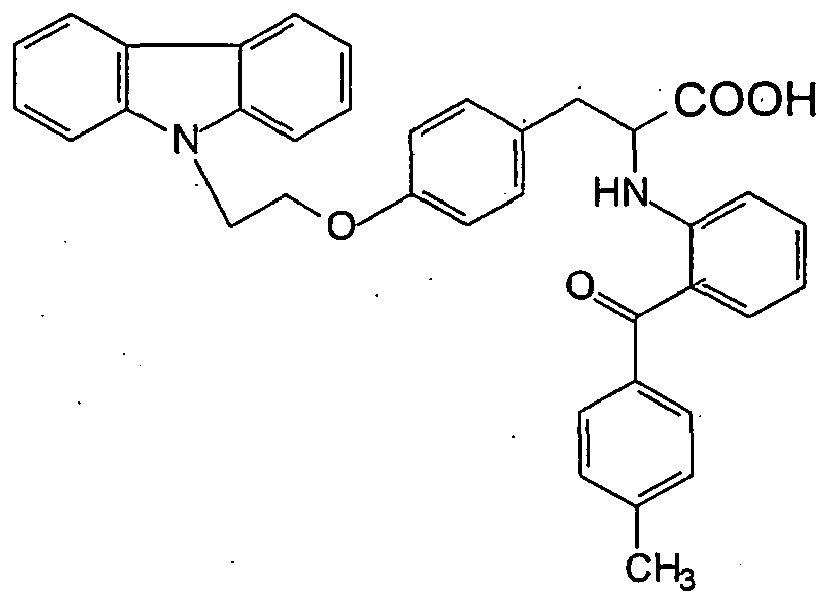
- To a solution of 2-[(2-(4-methylbenzoyl)phenyl)amino]-3-[4-(2-bromoethoxy)-phenyl] -propionic acid methyl ester (0.24 g, 0.49 mmol) and carbazole (0.082 g, 0.49 mmol) in benzene (10 ml) is added tetrabutyl ammonium bromide (0.08 g) and 50% NaOH aqueous solution (0.084 g, 1.08 mmol), then the mixture is heated to reflux for 10 h. After cooled, benzene (30ml) is added, and the mixture is washed with water (3×30 ml). Then the solvent is evaporated under a vacuum. The crude product is purified by silica gel chromatography using CHCl3/MeOH (4:1) as eluent to give the title compound (0.15g, 54%). HRMS calcd for C37H32N2O4: 568.6692. Found: 568.6693. MA calcd for C37H32N2O4: C, 78.15%; H, 5.67%; N, 4.93%. Found: C, 78.36%; H, 5.64%; N, 4.91%.
-

- To a mixture of 2-(2-methylbenzoyl)cyclohexanone (97.2 g, 0.45 mol), L-tyrosine methyl ester (78.0 g, 0.40 mol) in anisole (1000 ml) is added 5% palladium on carbon (20 g), then the mixture is heated to reflux for 2 h while the resulting water is removed by a Dean-Stark apparatus. The mixture is cooled to 80 °C, and the Pd/C is filtered and washed with anisole (3×60 ml). The mixture is cooled to 40 °C, hexane (1000 ml) is added and the mixture kept at -20 °C for 48 h. The solid is filtered and washed with hexane (5×200 ml) to yield the crude 2-[(2-(2-methyl benzoyl)phenyl)-amino]-3-(4-hydroxyphenyl)-propionic acid methyl ester. The crude product is mixed with 250 ml of methanol and is refluxed for 30 min. After cooled to 0 °C, the product is filtered, washed with methanol (2×50 ml), and dried under a vacuum to give the title compound (52.9 g, 34%).
-

- To a solution of potassium hydroxide (0.17 g, 2.95 mmol) in ethanol (20 ml) is added 2-[(2-(2-methylbenzoyl)phenyl)amino]-3-(4-hydroxyphenyl)-propionic acid methyl ester (1.15 g, 2.95 mmol) and 1,2-dibromoethane (5.54 g, 29.50 mmol). Then the mixture is heated to reflux for 8 hours. After cooled, the reaction mixture is filtered to remove the solid formed, and then the filtrate is evaporated under a vacuum. The crude product is purified by silica gel chromatography using hexane/EtOAc (4:1) as eluent to give the title compound (0.83 g, 57%).
-

- To a solution of 2-[(2-(2-methylbenzoyl)phenyl)amino]-3-[4-(2-bromoethoxy)-phenyl] -propionic acid methyl ester (0.24 g, 0.49 mmol) and carbazole (0.082 g, 0.49 mmol) in benzene (10 ml) is added tetrabutyl ammonium bromide (0.08 g) and 50% NaOH aqueous solution (0.084 g, 1.08 mmol), then the mixture is heated to reflux for 10 h. After cooled, benzene (30ml) is added, and the mixture is washed with water (3×30 ml). Then the solvent is evaporated under a vacuum. The crude product is purified by silica gel chromatography using CHCl3/MeOH (4:1) as eluent to give the title compound (0.11g, 39%). HRMS calcd for C37H32N2O4: 568.6692. Found: 568.6689. MA calcd for C37H32N2O4: C, 78.15%; H, 5.67%; N, 4.93%. Found: C, 77.96%; H, 5.68%; N, 4.90%.
- The example of compound 2-(1-methyl-3-oxo-3-phenyl-propenylamino)-3-[4-(2-carbazolylethoxy)-phenyl]-propionic acid (Reference Compound CS-023), 2-((2-benzoylphenyl) amino)- 3 - [4-(2-carbazolylethoxy)-phenyl]-propionic acid (Reference CS-0381), and 2-[(2-(4-fluorobenzoyl)phenyl)amino]-3-[4-(2-carbazolylethoxy)-phenyl]-propionic acid (CS-038) act as an RXR/PPARalpha heterodimer agonist in vitro. See,
FIG.1 . - Activation of RXR/PPARalpha heterodimer by indicated compounds was measured by luciferase reporter assay. Briefly, full length PPARalpha was cloned by PCR using oligonucleotide primers (5'- acgtgcttcctgcttcataga -3' (SEQ ID NO:1) and 5'-cctgagattagccacctccc -3' (SEQ ID NO:2)) from HepG2 cell. The amplified cDNA was cloned into an expression vector and sequenced. The reporter was constructed by insertion of an annealed oligonucleotide containing three copies of the PPAR response element (5'-gatcctctcctttgacctattgaactattacctacatttga-3' (SEQ ID NO:3)) to the upstream of the luceferase gene in pHD(X3)Luc vector. CV-1 cells were transfected in 96-well plates with the RXR and PPARalpha expression vectors together with the reporter construct. Cells were cultured in media containing the delipidized serum for 24 hours after transfection, then added with tested compounds and positive control WY (WY14643) dissolved in DMSO. The final concentration of DMSO in culture medium (200 ul) was 0.5%. Cells were treated with different compounds in different concentrations as indicated above for 24 hours, followed by luciferase assay in a plate reader (Fluoroscan, Thermo Life Sciences).
- The example of compound 2-(1-methyl-3-oxo-3-phenyl-propenylamino)-3-[4-(2-carbazolylethoxy)-phenyl]-propionic acid (Reference Compound CS-023), 2-((2-benzoylphenyl) amino)- 3 - [4-(2-carbazolylethoxy)-phenyl]-propionic acid (Reference CS-0381), and 2-[(2-(4-fluorobenzoyl)phenyl)amino]-3-[4-(2-carbazolylethoxy)-phenyl]-propionic acid (CS-038) act as an RXR/PPARgamma heterodimer agonist in vitro. See,
FIG.2 . - Activation of RXR/PPARgamma heterodimer was measured by luciferase reporter assay. Briefly, full length PPARgamma was cloned by PCR using oligonucleotide primers (5'-ggggtacctgcttcagcagcgtgttcga-3' (SEQ ID NO:4) and 5'-gctctagatgttggcagtggctcaggac-3' (SEQ ID NO:5)) from adipose tissue. The amplified cDNA was cloned into an expression vector and sequenced. The reporter was constructed by insertion of an annealed oligonucleotide containing 1 copy of the PPAR response element (5'-cgcgttcctttccgaacgtgacctttgtcctggtccccttttgct-3' (SEQ ID NO:6)) to the upstream of the luceferase gene. CV-1 cells were transfected in 96-well plates with the RXR and PPARgamma expression vectors together with the reporter construct. Cells were cultured in media containing the delipidized serum for 24 hours after transfection, then added with tested compounds and positive control Ros (Rosiglitazone) dissolved in DMSO. The final concentration of DMSO in culture medium (200 ul) was 0.5%. Cells were treated with different compounds in different concentrations as indicated above for 24 hours, followed by luciferase assay in a plate reader (Fluoroscan, Thermo Life Sciences).
- The example of compound 2-(1-methyl-3-oxo-3-phenyl-propenylamino)-3-[4-(2-carbazolylethoxy)-phenyl]-propionic acid (Reference Compound CS-023), 2-((2-benzoylphenyl) amino)- 3 - [4-(2-carbazolylethoxy)-phenyl]-propionic acid (Reference CS-0381), and 2-[(2-(4-fluorobenzoyl)phenyl)amino]-3-[4-(2-carbazolylethoxy)-phenyl]-propionic acid (CS-038) act as an RXR/PPARdelta heterodimer agonist in vitro. See,
FIG.3 . - Activation of RXR/PPARdelta heterodimer was measured by luciferase reporter assay. Briefly, full length PPARdelta was cloned by PCR using oligonucleotide primers (5'-ggggtacctgcttcagcagcgtgttcga-3' (SEQ ID NO:4) and 5'-gctctagatgttggcagtggctcaggac-3' (SEQ ID NO:5)) from adipose tissue. The amplified cDNA was cloned into an expression vector and sequenced. The reporter was constructed by insertion of an annealed oligonucleotide containing 1 copy of the PPAR response element (5'-cgcgttcctttccgaacgtgacctttgtcctggtcccctlttgct-3' (SEQ ID NO:6)) to the upstream of the luceferase gene. CV-1 cells were transfected in 96-well plates with the RXR and PPARdelta expression vectors together with the reporter construct. Cells were cultured in media containing the delipidized serum for 24 hours after transfection, then added with tested compounds and positive control 2-Bro (2-Bromohexadecanoic acid) dissolved in DMSO. The final concentration of DMSO in culture medium (200 ul) was 0.5%. Cells were treated with different compounds in different concentrations as indicated above for 24 hours, followed by luciferase assay in a plate reader (Fluoroscan, Thermo Life Sciences).
- The example of compound 2-[(2-(4-methylbenzoyl)phenyl)amino]-3-[4-(2-carbazolylethoxy)-phenyl]-propionic acid (Lab code CS0130080), and 2-[(2-(4-tert-butylbenzoyl)phenyl)amino]-3-[4-(2-carbazolylethoxy)-phenyl]-propionic acid (Lab code CS0130090) act as RXR/PPAR heterodimers agonist in vitro. See,
FIG.4 (RXR/PPARalpha),FIG.5 (RXR/PPARgamma), andFIG.6 (RXR/PPARdelta). - The example of compound 2-(1-methyl-3-oxo-3-phenyl-propenylamino)- 3-[4- (2-carbazolylethoxy)- phenyl]-propionic acid (Reference Compound CS-023, also named as CS-98 in the following figure), and 2-[(2-(4-fluorobenzoyl) phenyl)amino]-3 - [4-(2-carbazolylethoxy)-phenyl]-propionic acid (CS-038 at 30mg/kg/bw and Rosiglitazone at 4mg/kg/bw) lower blood glucose level in db/db mouse (animal number =10). See,
FIG.7 . - The example of treatment of experimental obese rat model by compound 2-[(2-(4-fluorobenzoyl)phenyl)amino]-3- [4-(2-carbazolylethoxy)-phenyl]- propionic acid (CS-038) increases insulin sensitivity in insulin tolerance test after 13-day drug treatment (doses indicated in following Figure as mg/kg/body weight, Ros means Rosiglitazone at 4mg/kg/bw, CS-4 means CS-038 at 4mg/kg/bw and CS-30 means CS-038 at 30mg/kg/bw; Norma means lean rat; Control is obese rat and all treatments were carried out in obese rats; animal number =10). See,
FIG. 8 . - The example of treatment of experimental obese rat model by compound 2-[(2-(4-fluorobenzoyl)phenyl)amino]-3- [4-(2-carbazolylethoxy)-phenyl]- propionic acid (CS-038) increases glucose tolerance in oral glucose tolerance test after 13-day drug treatment (doses indicated in following Figure as mg/kg/body weight, Ros means Rosiglitazone at 4mg/kg/bw, CS-4 means CS-038 at 4mg/kg/bw and CS-30 means CS-038 at 30mg/kg/bw; Norma means lean rat; Control is obese rat and all treatments were carried out in obese rats; animal number =10). See,
FIG.9 . - The example of treatment of experimental obese rats model by compound 2-[(2-(4-fluorobenzoyl)phenyl)amino]-3- [4-(2-carbazolylethoxy)- phenyl]- propionic acid (CS-038) lowers blood triglyceride after 13-day drug treatment (doses indicated in Fig. as mg/kg/body weight; Norma means lean rat; Control is obese rat and all treatments were carried out in obese rats; animal number =10).
Table 1: Animal Group Dose (mg/kg) Triglyceride (mg/dl) Cholesterol (mg/dl) Normal - 149.6±39.8* 73.1±7.8** Control - 233.9±101.6 109.4±26.7 CS038 4 150.3±52.1* 98.4±29.4 CS038 30 143.2±61.8* 86.6±37.7 Ros 4 273.3±87.4 112.7±25.5 Compared with the Normal group: *P<0.05, **P<0.01 - The example of treatment of experimental obese rats mode by compound 2-[(2-(4-fluorobenzoyl)phenyl)amino]-3- [4-(2-carbazolylethoxy)- phenyl]- propionic acid (CS-038) does not induce body weight and abdomen fat increases after 15-day drug treatment (doses indicated in following Figure as mg/kg/body weight; Control is obese rat and all treatments were carried out in obese rats; animal number =10).
Table 2: Animal Group Dose (mg/kg) Body Weight (g) Abdomen Fat Weight (g) 0 day 6 days 9 days 15 days Con - 576.5±138.0 569.4±142.1 568.5±145.3 562.7±136.5 60.4±21.0 CS038 4 591.5±130.0 580.8±130.2 575.2±130.6 569.4±122.9 55.8±16.8 CS038 30 580.5±134.9 586.1±143.2 586.5±144.2 578.3±176.8 56.6±21.1 Ros 4 594.9±169.3 604.5±181.4 601.6±183.9 596.4±176.8 63.1±31.4
Claims (26)
- A compound of Formula I

ring A and ring B, fused to the ring containing X and N, independently of each other represents a 5-6 membered cyclic ring, which may optionally contain one or more heteroatoms selected from oxygen, sulfur or nitrogen atoms and may optionally substituted with one or more halogen, hydroxy, nitro, cyano, alkyl, alkenyl, alkenynyl, aralkyl, heteroarylalkyl, aminoalkyl, alkoxyalkyl, aryloxyalkyl, aralkoxyalkyl, hydroxyalkyl, thioalkyl, heterocyclyl, alkoxy, aryl, aryloxy, aralkoxy, heteroaryl, heteroaryloxy, heteroaralkoxy, acyl, acyloxy, amino, alkylamino, arylamino, or aralkylamino; the ring A and
ring B may be saturated or contain one or more double bonds or may be aromatic;
X is a valence bond, CH2CH2, CH=CH, O, S, or NR6 wherein R6 represents H, alkyl, alkenyl, alkenynyl, aralkyl, heteroarylalkyl, heterocyclyl, aryl, or heteroaryl;
R1 is H, alkyl, alkenyl, alkenynyl, aralkyl, heteroarylalkyl, aminoalkyl, alkoxyalkyl,
aryloxyalkyl, aralkoxyalkyl, hydroxyalkyl, thioalkyl, heterocyclyl, OH, halogen, alkoxy, aryl, aryloxy, aralkoxy, heteroaryl, heteroaryloxy, heteroaralkoxy, acyl, acyloxy, amino, alkylamino, arylamino, or aralkylamino;
R2 is H, alkyl, alkenyl, alkenynyl, aralkyl, heteroarylalkyl, heterocyclyl, aryl, or heteroaryl;
R3 is H, alkyl, alkenyl, alkenynyl, aralkyl, heteroarylalkyl, heterocyclyl, aryl, or heteroaryl;
R4 and R5 are independently H, alkyl, alkenyl, alkenynyl, aralkyl, heteroarylalkyl, aminoalkyl, alkoxyalkyl aryloxyalkyl, aralkoxyalkyl, hydroxyalkyl, thioalkyl, heterocyclyl, OH, halogen, alkoxy, aryl, aryloxy, aralkoxy, heteroaryl, heteroaryloxy, heteroaralkoxy, acyl, acyloxy, amino, alkylamino, arylamino, or aralkylamino; R4 and R5 may form a 5 or 6 membered ring optionally substituted with one or more halogen, hydroxy, nitro, cyano, alkyl, alkenyl, alkenynyl, aralkyl, heteroarylakyl, aminoalkyl, alkoxyalkyl, aryloxyalkyl, aralkoxyalkyl, hydroxyalkyl, thioalkyl, heterocyclyl, alkoxy, aryl, aryloxy, aralkoxy, heteroaryl, heteroaryloxy, heteroaralkoxy, acyl, acyloxy, amino, alkylamino, arylamino, or aralkylamino;
Alk1 represents C1-6alkylene;
Alk2 represents C1-2alkylene;
Ar1 represents arylene, hetero arylene, or a divalent heterocyclic group optionally substituted with one or more halogen, C1-6alkyl, amino, hydroxy, C1-6alkoxyl or aryl.
Ar2 represents an aryl group substituted with one or more halogen, C1-6alkyl, amino, hydroxy, C1-6alkoxyl or aryl; a hetero aryl, or a heterocyclic group optionally substituted with one or more halogen, C1-6alkyl, amino, hydroxy, C1-6alkoxyl or aryl. - A compound according to claim 1, wherein
ring A is a 6 membered aromatic ring;
ring B is a 6 membered aromatic ring;
X is a valence bond, CH2CH2, CH=CH, O or S;
R1 is H or alkyl;
R2 is H or alkyl;
R3 is H or alkyl;
R4 and R5 are independently H or alkyl;
Alk1 is C2-3alkylene;
Alk2 is C1-2alkylene;
Ar1 is an arylene group
Ar2 is a substituted aryl group. - A compound according to claim 1, wherein
ring A is a 6 membered aromatic ring;
ring B is a 6 membered aromatic ring;
X is a valence bond, CH2CH2, CH=CH, O or S;
R1 is H or alkyl;
R2 is H or alkyl;
R3 is H or alkyl;
R4 and R5 form a 6 membered aromatic ring;
Alk1 is C2-3alkylene;
Alk2 is C1-2alkylene;
Ar1 is 6 membered aromatic ring
Ar2 is a substituted aryl group. - A compound according to claim 1, wherein
ring A is a benzene ring;
ring B is a benzene ring;
X is a valence bond, CH2CH2, CH=CH, O or S;
R1 is H;
R2 is H;
R3 is H;
R4 is methyl; R5 is H;
Alk1 is CH2CH2;
Alk2 is CH2;
Ar1 is benzene ring;
Ar2 is benzene ring substituted with one or more fluorine; - A compound according to claim 1, wherein
ring A is a benzene ring;
ring B is a benzene ring;
X is a valence bond, CH2CH2, CH=CH, O or S;
R1 is H;
R2 is H;
R3 is H;
R4 and R5 form a benzene ring;
Alk1 is CH2CH2;
Alk2 is CH2;
Ar1 is benzene ring;
Ar2 is benzene ring substituted with one or more fluorine; - A compound according to claim 1, wherein
ring A is a benzene ring;
ring B is a benzene ring;
X is a valence bond, CH2CH2, CH=CH, O or S;
R1 is H;
R2 is H;
R3 is H;
R4 is methyl; R5 is H;
Alk1 is CH2CH2;
Alk2 is CH2;
Ar1 is benzene ring;
Ar2 is pyridine ring substituted with none, one or more halogen. - A compound according to claim 1, wherein
ring A is a benzene ring;
ring B is a benzene ring;
X is a valence bond, CH2CH2, CH=CH, O or S;
R1 is H;
R2 is H;
R3 is H;
R4 and R5 form a benzene ring;
Alk1 is CH2CH2;
Alk2 is CH2;
Ar1 is benzene ring;
Ar2 is pyridine ring substituted with none, one or more fluorine. - A process for the preparation of a compound of Formula I

ring A and ring B, fused to the ring containing X and N, independently of each other represents a 5-6 membered cyclic ring, which may optionally contain one or more heteroatoms selected from oxygen, sulfur or nitrogen atoms and may optionally substituted with one or more halogen, hydroxy, nitro, cyano, alkyl, alkenyl, alkenynyl, aralkyl, heteroarylalkyl, aminoalkyl, alkoxyalkyl, aryloxyalkyl, aralkoxyalkyl, hydroxyalkyl, thioalkyl, heterocyclyl, alkoxy, aryl, aryloxy, aralkoxy, heteroaryl, heteroaryloxy, heteroaralkoxy, acyl, acyloxy, amino, alkylamino, arylamino, or aralkylamino; the ring A and ring B may be saturated or contain one or more double bonds or may be aromatic;
X is a valence bond, CH2CH2, CH=CH, O, S, or NR6 wherein R6 represents H, alkyl, alkenyl, alkenynyl, aralkyl, heteroarylalkyl, heterocyclyl, aryl, or heteroaryl;
R1 is H, alkyl, alkenyl, alkenynyl, aralkyl, heteroarylalkyl, aminoalkyl, alkoxyalkyl, aryloxyalkyl, aralkoxyalkyl, hydroxyalkyl, thioalkyl, heterocyclyl, OH, halogen, alkoxy, aryl, aryloxy, aralkoxy, heteroaryl, heteroaryloxy, heteroaralkoxy, acyl, acyloxy, amino, alkylamino, arylamino, or aralkylamino;
R2 is H, alkyl, alkenyl, alkenynyl, aralkyl, heteroarylalkyl, heterocyclyl, aryl, or heteroaryl;
R3 is H, alkyl, alkenyl, alkenynyl, aralkyl, heteroarylalkyl, heterocyclyl, aryl, or heteroaryl;
R4 and R5 are independently H, alkyl, alkenyl, alkenynyl, aralkyl, heteroarylalkyl, aminoalkyl, alkoxyalkyl, aryloxyalkyl, aralkoxyalkyl, hydroxyalkyl, thioalkyl, heterocyclyl, OH, halogen, alkoxy, aryl, aryloxy, aralkoxy, heteroaryl, heteroaryloxy, heteroaralkoxy, acyl, acyloxy, amino, alkylamino, arylamino, or aralkylamino; R4 and R5 may form a 5 or 6 membered ring optionally substituted with one or more halogen, hydroxy, nitro, cyano, alkyl, alkenyl, alkenynyl, aralkyl, heteroarylalkyl, aminoalkyl, alkoxyalkyl, aryloxyalkyl, aralkoxyalkyl, hydroxyalkyl, thioalkyl, heterocyclyl, alkoxy, aryl, aryloxy, aralkoxy, heteroaryl, heteroaryloxy, heteroaralkoxy, acyl, acyloxy, amino, alkylamino, arylamino, or aralkylamino;
Alk1 represents C1-6alkylene;
Alk2 represents C1-2alkylene;
Ar1 represents arylene, hetero arylene, or a divalent heterocyclic group optionally substituted with one or more halogen, C1-6alkyl, amino, hydroxy, C1-6alkoxyl or aryl.
Ar2 represents an aryl group substituted with one or more halogen, C1-6alkyl, amino, hydroxy, C 1-6alkoxyl or aryl; a hetero arylene, or a divalent heterocyclic group optionally substituted with non, one or more halogen, C1-6alkyl, amino, hydroxy, C 1-6alkoxyl or aryl,
a stereoisomer, enantiomer, diastereomer, hydrate or pharmaceutically acceptable salts thereof comprising the steps of:a) initiating a condensation reaction between compound I and β-diketone 2 to give the vinylogous amide analogues 3; b) performing O-Alkylation of 3 to gave compound 4;
 c) performing N-Alkylation of 4 gave the substituted arylalcanoic acid derivatives 6.
- A process according to claim 8 wherein:(a) the condensation reaction is carried out in ethanol at reflux temperature;(b) the O-alkylation is achieved by treatment of 3 with KOH and dibromoalkane in ethanol;(c) the N-alkylation is achieved by treating compound 4 with NaOH and compound 5 in the presence of tetrabutyl ammonium bromide.
- A pharmaceutical composition for activating nuclear receptors comprising an effective amount of a compound according to claim 1 or its pharmaceutically acceptable salt with at least one pharmaceutically acceptable carrier or diluent.
- The pharmaceutical composition according to claim 10 wherein the nuclear receptors comprise the Retinoid X Receptor (RXR) and the Peroxisome Proliferator-Activated Receptors (PPAR).
- The pharmaceutical composition of claim 10 in unit dosage form, comprising from about 0.05 to about 200 mg of the compound.
- The pharmaceutical composition of claim 12 in unit dosage form, comprising from about 0.1 to about 100 mg of the compound
- The pharmaceutical composition of claim 10 which is suitable for administration by an oral, nasal, transdermal, pulmonary, or parenteral route.
- Use of a compound according to any one of claims 1 to 7 in the manufacture of a medicament for treating or preventing a condition mediated by at least one nuclear receptor.
- A use according to claim 15, wherein the nuclear receptors comprise a Retinoid X Receptor (RXR) and Peroxisome Proliferator-Activated Receptors (PPAR).
- Use of a compound of any one of claims 1 to 7 in the manufacture of a medicament for treating or preventing a condition mediated by reduced activity of at least one nuclear receptor.
- A use according to claim 17 wherein said condition is selected from the group consisting of type 1 diabetes, type 2 diabetes, dyslipidemia, syndrome X, cardiovascular disease, atherosclerosis, hypercholesteremia, and obesity.
- The use according to claim 18, wherein the medicament is for administration of the compound in the range of from 0.05 to 200mg/kg body weight per day.
- The use according to claim 19, wherein the medicament is for administration of the compound in the range of from 0.1 to 100mg/kg body weight per day.
- The use according to claim 20, where in the medicament is for administration of the compound in the range of from 0.1 to 50mg/kg body weight per day.
- Use of a compound of any one of claims 1 to 7 in combination with at least one agent selected from the group consisting of a hypolipidemic agent, lipid-lowering agent, lipid modulating agent, antidiabetic agent, anti-obesity agent, antihypertensive agent, and a platelet aggregation inhibitor; for the manufacture of a medicament for treating at preventing a condition as defined in claims 19 or 20, wherein said compound and said at least one agent may be administered orally in the same dosage form, in a separate oral dosage form or by injection.
- A use according to claim 22 of treating or preventing a condition wherein the hypolipidemic agent or lipid-lowering agent or lipid modulating agent is selected from the group consisting of at least one: MTP inhibitor, HMG CoA reductase inhibitor, squalene synthetase inhibitor, fibric acid derivative, ACAT inhibitor, lipoxygenase inhibitor, cholesterol absorption inhibitor, ileal Na+/bile acid cotransporter inhibitor, upregulator of LDL receptor activity, bile acid sequestrant, and nicotinic acid or a derivative thereof.
- A use according to claim 22 of treating or preventing a condition wherein at least one antidiabetic agent is selected from the group consisting of an insulin secretagogue, an insulin sensitizer, a biguanide, a sulfonyl urea, a glucosidase inhibitor, a PPAR γ partial agonist or antagonist, a thiazolidinedione, a P2 inhibitor, a dipeptidyl peptidase IV (DP4) inhibitor, a SGLT2 inhibitor, a meglitinide, insulin, and a glucagon-like peptide-1 (GLP-1).
- A use according to claim 22 of treating or preventing a condition wherein at least one agent is selected from the group consisting of an anti-obesity agent, a beta 3 adrenergic agonist, a lipase inhibitor, a serotonin (and dopamine) reuptake inhibitor, a P2 inhibitor, a thyroid receptor agonist, and an anorectic agent.
- A use according to claim 22 of treating or preventing a condition wherein at least one antihypertensive agent is selected from the group consisting of an ACE inhibitor, an angiotensin II receptor antagonist, an NEP/ACE inhibitor, a calcium channel blocker, a β-adrenergic blocker and a diuretic.
Priority Applications (2)
| Application Number | Priority Date | Filing Date | Title |
|---|---|---|---|
| SI200332127T SI1569904T1 (en) | 2002-11-26 | 2003-11-21 | Substituted arylalcanoic acid derivatives as ppar pan agonists with potent antihyperglycemic and antihyperlipidemic activity |
| CY20121100349T CY1112622T1 (en) | 2002-11-26 | 2012-04-09 | Substituted arylalkanoic acid derivatives as PPAR PAN agonists with potent antipyretic and antipyretic action. |
Applications Claiming Priority (7)
| Application Number | Priority Date | Filing Date | Title |
|---|---|---|---|
| US42922102P | 2002-11-26 | 2002-11-26 | |
| US429221P | 2002-11-26 | ||
| US46936803P | 2003-05-09 | 2003-05-09 | |
| US469368P | 2003-05-09 | ||
| US715622 | 2003-11-18 | ||
| US10/715,622 US7268157B2 (en) | 2002-11-26 | 2003-11-18 | Substituted arylalcanoic acid derivatives as PPAR pan agonists with potent antihyperglycemic and antihyperlipidemic activity |
| PCT/IB2003/005371 WO2004048333A1 (en) | 2002-11-26 | 2003-11-21 | Substituted arylalcanoic acid derivatives as ppar pan agonists with potent antihyperglycemic and antihyperlipidemic activity |
Publications (3)
| Publication Number | Publication Date |
|---|---|
| EP1569904A1 EP1569904A1 (en) | 2005-09-07 |
| EP1569904A4 EP1569904A4 (en) | 2008-04-16 |
| EP1569904B1 true EP1569904B1 (en) | 2012-01-11 |
Family
ID=32397984
Family Applications (1)
| Application Number | Title | Priority Date | Filing Date |
|---|---|---|---|
| EP03772525A Expired - Lifetime EP1569904B1 (en) | 2002-11-26 | 2003-11-21 | Substituted arylalcanoic acid derivatives as ppar pan agonists with potent antihyperglycemic and antihyperlipidemic activity |
Country Status (13)
| Country | Link |
|---|---|
| US (2) | US7268157B2 (en) |
| EP (1) | EP1569904B1 (en) |
| JP (1) | JP4750556B2 (en) |
| KR (1) | KR20050075386A (en) |
| AT (1) | ATE540925T1 (en) |
| AU (1) | AU2003280154B2 (en) |
| CA (1) | CA2504718C (en) |
| CY (1) | CY1112622T1 (en) |
| DK (1) | DK1569904T3 (en) |
| ES (1) | ES2382312T3 (en) |
| PT (1) | PT1569904E (en) |
| SI (1) | SI1569904T1 (en) |
| WO (1) | WO2004048333A1 (en) |
Families Citing this family (9)
| Publication number | Priority date | Publication date | Assignee | Title |
|---|---|---|---|---|
| CA2568640C (en) | 2004-06-04 | 2011-08-09 | Teva Pharmaceutical Industries Ltd. | Pharmaceutical composition containing irbesartan |
| US8329913B2 (en) * | 2004-10-29 | 2012-12-11 | Zeria Pharmaceutical Co., Ltd. | Carbazole derivative, solvate thereof, or pharmaceutically acceptable salt thereof |
| US20090197947A1 (en) * | 2008-02-01 | 2009-08-06 | The Research Foundation Of State University Of New York | Medicaments and methods for lowering plasma lipid levels and screening drugs |
| CN105801468B (en) * | 2014-12-31 | 2018-08-17 | 深圳微芯生物科技股份有限公司 | A kind of salt and its amorphous body of phenylalanine class compound |
| CN107868032B (en) * | 2016-09-27 | 2020-12-15 | 深圳微芯生物科技股份有限公司 | A kind of substituted phenylpropionic acid compound enantiomer and its preparation method, composition and application |
| CN107868033B (en) * | 2016-09-27 | 2021-05-18 | 深圳微芯生物科技股份有限公司 | Preparation method of phenylalanine compound |
| CN110467560B (en) | 2018-05-09 | 2025-11-25 | 深圳微芯生物科技股份有限公司 | A sodium phenylaminopropionate derivative, its preparation method and application |
| CN112516137A (en) * | 2019-09-19 | 2021-03-19 | 深圳微芯生物科技股份有限公司 | Use of sitagliptin and derivatives thereof for the treatment of type 2 diabetes accompanied by lipid metabolism disorders |
| CN111437393B (en) * | 2020-04-30 | 2021-03-02 | 深圳微芯生物科技股份有限公司 | Combined medicine for treating diabetes and complications thereof and pharmaceutical composition thereof |
Family Cites Families (14)
| Publication number | Priority date | Publication date | Assignee | Title |
|---|---|---|---|---|
| GB9604242D0 (en) * | 1996-02-28 | 1996-05-01 | Glaxo Wellcome Inc | Chemical compounds |
| AU749505B2 (en) * | 1997-10-27 | 2002-06-27 | Dr. Reddy's Laboratories Limited | Novel tricyclic compounds and their use in medicine; process for their preparation and pharmaceutical compositions containing them |
| US6440961B1 (en) * | 1997-10-27 | 2002-08-27 | Dr. Reddy's Research Foundation | Tricyclic compounds and their use in medicine: process for their preparation and pharmaceutical compositions containing them |
| WO1999019313A1 (en) | 1997-10-27 | 1999-04-22 | Dr. Reddy's Research Foundation | Novel tricyclic compounds and their use in medicine; process for their preparation and pharmaceutical compositions containing them |
| GB9817118D0 (en) | 1998-08-07 | 1998-10-07 | Glaxo Group Ltd | Pharmaceutical compounds |
| AU6325799A (en) | 1998-10-21 | 2000-05-08 | Dr. Reddy's Research Foundation | New compounds, their preparation and use |
| US6353018B1 (en) * | 1998-10-21 | 2002-03-05 | Novo Nordisk A/S | Compounds, their preparation and use |
| EP1123279A1 (en) | 1998-10-21 | 2001-08-16 | Novo Nordisk A/S | New compounds, their preparation and use |
| JP2002542237A (en) | 1999-04-20 | 2002-12-10 | ノボ ノルディスク アクティーゼルスカブ | New compounds, their production and use |
| PL357010A1 (en) | 2000-01-28 | 2004-07-12 | Novo Nordisk A/S | Propionic acid derivatives and their use in the treatment of diabetes and obesity |
| US6632322B1 (en) | 2000-06-30 | 2003-10-14 | Lam Research Corporation | Switched uniformity control |
| ME01310B (en) * | 2001-05-15 | 2011-10-10 | Hoffmann La Roche | Carboxylic acid substituted oxazole derivatives for use as ppar-alpha and -gamma activators in the treatment of diabetes |
| US20030055076A1 (en) * | 2001-07-30 | 2003-03-20 | Lone Jeppesen | Novel compounds, their preparation and use |
| JP2005503377A (en) * | 2001-07-30 | 2005-02-03 | ノボ ノルディスク アクティーゼルスカブ | Novel vinyl N- (2-benzoylphenyl) -L-tyrosine derivatives and their use in antidiabetic agents, etc. |
-
2003
- 2003-11-18 US US10/715,622 patent/US7268157B2/en not_active Expired - Lifetime
- 2003-11-21 EP EP03772525A patent/EP1569904B1/en not_active Expired - Lifetime
- 2003-11-21 JP JP2005510266A patent/JP4750556B2/en not_active Expired - Fee Related
- 2003-11-21 SI SI200332127T patent/SI1569904T1/en unknown
- 2003-11-21 WO PCT/IB2003/005371 patent/WO2004048333A1/en not_active Ceased
- 2003-11-21 AU AU2003280154A patent/AU2003280154B2/en not_active Expired
- 2003-11-21 KR KR1020057008310A patent/KR20050075386A/en not_active Ceased
- 2003-11-21 CA CA2504718A patent/CA2504718C/en not_active Expired - Lifetime
- 2003-11-21 PT PT03772525T patent/PT1569904E/en unknown
- 2003-11-21 DK DK03772525.6T patent/DK1569904T3/en active
- 2003-11-21 ES ES03772525T patent/ES2382312T3/en not_active Expired - Lifetime
- 2003-11-21 AT AT03772525T patent/ATE540925T1/en active
-
2007
- 2007-08-01 US US11/882,417 patent/US20080051321A1/en not_active Abandoned
-
2012
- 2012-04-09 CY CY20121100349T patent/CY1112622T1/en unknown
Also Published As
| Publication number | Publication date |
|---|---|
| AU2003280154B2 (en) | 2009-04-02 |
| ATE540925T1 (en) | 2012-01-15 |
| CY1112622T1 (en) | 2016-02-10 |
| JP2006519171A (en) | 2006-08-24 |
| EP1569904A1 (en) | 2005-09-07 |
| WO2004048333A1 (en) | 2004-06-10 |
| HK1083021A1 (en) | 2006-06-23 |
| ES2382312T3 (en) | 2012-06-07 |
| US20040142921A1 (en) | 2004-07-22 |
| JP4750556B2 (en) | 2011-08-17 |
| KR20050075386A (en) | 2005-07-20 |
| PT1569904E (en) | 2012-04-19 |
| AU2003280154A1 (en) | 2004-06-18 |
| CA2504718C (en) | 2012-01-31 |
| DK1569904T3 (en) | 2012-04-30 |
| SI1569904T1 (en) | 2012-06-29 |
| US7268157B2 (en) | 2007-09-11 |
| CA2504718A1 (en) | 2004-06-10 |
| EP1569904A4 (en) | 2008-04-16 |
| US20080051321A1 (en) | 2008-02-28 |
Similar Documents
| Publication | Publication Date | Title |
|---|---|---|
| US20080051321A1 (en) | Substituted arylalcanoic acid derivatives as ppar pan agonists with potent antihyperglycemic and antihyperlipidemic activity | |
| US7749990B2 (en) | Compositions for the treatment of metabolic disorders | |
| KR101344392B1 (en) | Compounds for the treatment of metabolic disorders | |
| US8044243B2 (en) | Compounds for the treatment of metabolic disorders | |
| US7615575B2 (en) | Compounds for the treatment of metabolic disorders | |
| NZ570100A (en) | Compounds for the treatment of metabolic disorders | |
| CN101374415A (en) | Compounds for the treatment of metabolic disorders | |
| RU2349584C2 (en) | Compounds for metabolic disorder treatment | |
| US20070142427A1 (en) | Noncyclic 1,3-Dicarbonyl compounds as dual PPAR agonists with potent antihyperglycemic and antihyperlipidemic activity | |
| KR101391905B1 (en) | Compounds for the treatment of metabolic disorders | |
| CN101374414A (en) | Compounds for the treatment of metabolic disorders | |
| RU2342362C2 (en) | Substituted arylalkane acid derivatives as pan agonists rapp with high antihyperglycemic and antihyperlipidemic activity | |
| HK1083021B (en) | Substituted arylalcanoic acid derivatives as ppar pan agonists with potent antihyperglycemic and antihyperlipidemic activity | |
| CN102382036A (en) | Phenoxyacetic acid compound, preparation method thereof and drug application | |
| MX2008009594A (en) | Compounds for the treatment of metabolic disorders |
Legal Events
| Date | Code | Title | Description |
|---|---|---|---|
| PUAI | Public reference made under article 153(3) epc to a published international application that has entered the european phase |
Free format text: ORIGINAL CODE: 0009012 |
|
| 17P | Request for examination filed |
Effective date: 20050621 |
|
| AK | Designated contracting states |
Kind code of ref document: A1 Designated state(s): AT BE BG CH CY CZ DE DK EE ES FI FR GB GR HU IE IT LI LU MC NL PT RO SE SI SK TR |
|
| AX | Request for extension of the european patent |
Extension state: AL LT LV MK |
|
| DAX | Request for extension of the european patent (deleted) | ||
| REG | Reference to a national code |
Ref country code: HK Ref legal event code: DE Ref document number: 1083021 Country of ref document: HK |
|
| A4 | Supplementary search report drawn up and despatched |
Effective date: 20080318 |
|
| RIC1 | Information provided on ipc code assigned before grant |
Ipc: C07D 209/82 20060101AFI20040618BHEP Ipc: A61K 31/426 20060101ALI20080307BHEP Ipc: A61K 31/335 20060101ALI20080307BHEP Ipc: A61K 31/422 20060101ALI20080307BHEP Ipc: A61K 31/538 20060101ALI20080307BHEP Ipc: A61K 31/403 20060101ALI20080307BHEP Ipc: C07D 471/04 20060101ALI20080307BHEP Ipc: A61P 3/00 20060101ALI20080307BHEP Ipc: A61K 31/5415 20060101ALI20080307BHEP Ipc: A61K 31/55 20060101ALI20080307BHEP Ipc: C07D 279/22 20060101ALI20080307BHEP Ipc: A61K 31/185 20060101ALI20080307BHEP |
|
| 17Q | First examination report despatched |
Effective date: 20090310 |
|
| GRAP | Despatch of communication of intention to grant a patent |
Free format text: ORIGINAL CODE: EPIDOSNIGR1 |
|
| GRAS | Grant fee paid |
Free format text: ORIGINAL CODE: EPIDOSNIGR3 |
|
| GRAA | (expected) grant |
Free format text: ORIGINAL CODE: 0009210 |
|
| AK | Designated contracting states |
Kind code of ref document: B1 Designated state(s): AT BE BG CH CY CZ DE DK EE ES FI FR GB GR HU IE IT LI LU MC NL PT RO SE SI SK TR |
|
| REG | Reference to a national code |
Ref country code: GB Ref legal event code: FG4D |
|
| REG | Reference to a national code |
Ref country code: CH Ref legal event code: EP |
|
| REG | Reference to a national code |
Ref country code: AT Ref legal event code: REF Ref document number: 540925 Country of ref document: AT Kind code of ref document: T Effective date: 20120115 |
|
| RAP2 | Party data changed (patent owner data changed or rights of a patent transferred) |
Owner name: SHENZHEN CHIPSCREEN BIOSCIENCES LTD. |
|
| RIN2 | Information on inventor provided after grant (corrected) |
Inventor name: NING, ZHIQIANG Inventor name: SHI, LEMING Inventor name: MA, BAOSHUN Inventor name: LIAO, CHENZHONG Inventor name: LIU, ZHENDE Inventor name: LU, XIAN-PING Inventor name: LI, ZHIBIN Inventor name: SHAN, SONG Inventor name: DENG, TUO |
|
| REG | Reference to a national code |
Ref country code: IE Ref legal event code: FG4D |
|
| REG | Reference to a national code |
Ref country code: DE Ref legal event code: R096 Ref document number: 60339692 Country of ref document: DE Effective date: 20120308 |
|
| REG | Reference to a national code |
Ref country code: RO Ref legal event code: EPE |
|
| REG | Reference to a national code |
Ref country code: NL Ref legal event code: T3 |
|
| REG | Reference to a national code |
Ref country code: CH Ref legal event code: NV Representative=s name: E. BLUM & CO. AG PATENT- UND MARKENANWAELTE VSP |
|
| REG | Reference to a national code |
Ref country code: PT Ref legal event code: SC4A Free format text: AVAILABILITY OF NATIONAL TRANSLATION Effective date: 20120410 |
|
| REG | Reference to a national code |
Ref country code: DK Ref legal event code: T3 |
|
| REG | Reference to a national code |
Ref country code: SE Ref legal event code: TRGR |
|
| REG | Reference to a national code |
Ref country code: ES Ref legal event code: FG2A Ref document number: 2382312 Country of ref document: ES Kind code of ref document: T3 Effective date: 20120607 |
|
| REG | Reference to a national code |
Ref country code: EE Ref legal event code: FG4A Ref document number: E006505 Country of ref document: EE Effective date: 20120409 |
|
| REG | Reference to a national code |
Ref country code: GR Ref legal event code: EP Ref document number: 20120400788 Country of ref document: GR Effective date: 20120518 |
|
| REG | Reference to a national code |
Ref country code: HU Ref legal event code: AG4A Ref document number: E013540 Country of ref document: HU |
|
| REG | Reference to a national code |
Ref country code: SK Ref legal event code: T3 Ref document number: E 11964 Country of ref document: SK |
|
| REG | Reference to a national code |
Ref country code: HK Ref legal event code: GR Ref document number: 1083021 Country of ref document: HK |
|
| PLBE | No opposition filed within time limit |
Free format text: ORIGINAL CODE: 0009261 |
|
| STAA | Information on the status of an ep patent application or granted ep patent |
Free format text: STATUS: NO OPPOSITION FILED WITHIN TIME LIMIT |
|
| 26N | No opposition filed |
Effective date: 20121012 |
|
| REG | Reference to a national code |
Ref country code: DE Ref legal event code: R097 Ref document number: 60339692 Country of ref document: DE Effective date: 20121012 |
|
| REG | Reference to a national code |
Ref country code: FR Ref legal event code: PLFP Year of fee payment: 13 |
|
| REG | Reference to a national code |
Ref country code: FR Ref legal event code: PLFP Year of fee payment: 14 |
|
| REG | Reference to a national code |
Ref country code: FR Ref legal event code: PLFP Year of fee payment: 15 |
|
| PGFP | Annual fee paid to national office [announced via postgrant information from national office to epo] |
Ref country code: TR Payment date: 20221121 Year of fee payment: 20 Ref country code: SK Payment date: 20221102 Year of fee payment: 20 Ref country code: SE Payment date: 20221127 Year of fee payment: 20 Ref country code: RO Payment date: 20221103 Year of fee payment: 20 Ref country code: PT Payment date: 20221103 Year of fee payment: 20 Ref country code: NL Payment date: 20221126 Year of fee payment: 20 Ref country code: MC Payment date: 20221103 Year of fee payment: 20 Ref country code: LU Payment date: 20221128 Year of fee payment: 20 Ref country code: IT Payment date: 20221123 Year of fee payment: 20 Ref country code: IE Payment date: 20221128 Year of fee payment: 20 Ref country code: GB Payment date: 20221128 Year of fee payment: 20 Ref country code: FR Payment date: 20221123 Year of fee payment: 20 Ref country code: FI Payment date: 20221125 Year of fee payment: 20 Ref country code: ES Payment date: 20221201 Year of fee payment: 20 Ref country code: EE Payment date: 20221102 Year of fee payment: 20 Ref country code: DK Payment date: 20221125 Year of fee payment: 20 Ref country code: DE Payment date: 20221125 Year of fee payment: 20 Ref country code: CZ Payment date: 20221108 Year of fee payment: 20 Ref country code: BG Payment date: 20221109 Year of fee payment: 20 Ref country code: AT Payment date: 20221102 Year of fee payment: 20 |
|
| PGFP | Annual fee paid to national office [announced via postgrant information from national office to epo] |
Ref country code: SI Payment date: 20221102 Year of fee payment: 20 Ref country code: HU Payment date: 20221109 Year of fee payment: 20 Ref country code: GR Payment date: 20221129 Year of fee payment: 20 Ref country code: CH Payment date: 20221205 Year of fee payment: 20 Ref country code: BE Payment date: 20221128 Year of fee payment: 20 |
|
| PGFP | Annual fee paid to national office [announced via postgrant information from national office to epo] |
Ref country code: CY Payment date: 20221103 Year of fee payment: 20 |
|
| REG | Reference to a national code |
Ref country code: DE Ref legal event code: R071 Ref document number: 60339692 Country of ref document: DE |
|
| REG | Reference to a national code |
Ref country code: NL Ref legal event code: MK Effective date: 20231120 |
|
| REG | Reference to a national code |
Ref country code: DK Ref legal event code: EUP Expiry date: 20231121 |
|
| REG | Reference to a national code |
Ref country code: CH Ref legal event code: PL Ref country code: ES Ref legal event code: FD2A Effective date: 20231130 |
|
| REG | Reference to a national code |
Ref country code: BE Ref legal event code: MK Effective date: 20231121 |
|
| REG | Reference to a national code |
Ref country code: GB Ref legal event code: PE20 Expiry date: 20231120 |
|
| REG | Reference to a national code |
Ref country code: SK Ref legal event code: MK4A Ref document number: E 11964 Country of ref document: SK Expiry date: 20231121 |
|
| REG | Reference to a national code |
Ref country code: SE Ref legal event code: EUG |
|
| REG | Reference to a national code |
Ref country code: AT Ref legal event code: MK07 Ref document number: 540925 Country of ref document: AT Kind code of ref document: T Effective date: 20231121 |
|
| PG25 | Lapsed in a contracting state [announced via postgrant information from national office to epo] |
Ref country code: SK Free format text: LAPSE BECAUSE OF EXPIRATION OF PROTECTION Effective date: 20231121 |
|
| PG25 | Lapsed in a contracting state [announced via postgrant information from national office to epo] |
Ref country code: GB Free format text: LAPSE BECAUSE OF EXPIRATION OF PROTECTION Effective date: 20231120 |
|
| PG25 | Lapsed in a contracting state [announced via postgrant information from national office to epo] |
Ref country code: ES Free format text: LAPSE BECAUSE OF EXPIRATION OF PROTECTION Effective date: 20231122 |
|
| PG25 | Lapsed in a contracting state [announced via postgrant information from national office to epo] |
Ref country code: SK Free format text: LAPSE BECAUSE OF EXPIRATION OF PROTECTION Effective date: 20231121 Ref country code: SI Free format text: LAPSE BECAUSE OF EXPIRATION OF PROTECTION Effective date: 20231122 Ref country code: PT Free format text: LAPSE BECAUSE OF EXPIRATION OF PROTECTION Effective date: 20231130 Ref country code: IE Free format text: LAPSE BECAUSE OF EXPIRATION OF PROTECTION Effective date: 20231121 Ref country code: GB Free format text: LAPSE BECAUSE OF EXPIRATION OF PROTECTION Effective date: 20231120 Ref country code: ES Free format text: LAPSE BECAUSE OF EXPIRATION OF PROTECTION Effective date: 20231122 Ref country code: CZ Free format text: LAPSE BECAUSE OF EXPIRATION OF PROTECTION Effective date: 20231121 |