EP1569379A1 - Method of generating a cryptosync - Google Patents
Method of generating a cryptosync Download PDFInfo
- Publication number
- EP1569379A1 EP1569379A1 EP05250872A EP05250872A EP1569379A1 EP 1569379 A1 EP1569379 A1 EP 1569379A1 EP 05250872 A EP05250872 A EP 05250872A EP 05250872 A EP05250872 A EP 05250872A EP 1569379 A1 EP1569379 A1 EP 1569379A1
- Authority
- EP
- European Patent Office
- Prior art keywords
- cryptosync
- llcs
- communication
- slcs
- encryption
- Prior art date
- Legal status (The legal status is an assumption and is not a legal conclusion. Google has not performed a legal analysis and makes no representation as to the accuracy of the status listed.)
- Granted
Links
- 238000000034 method Methods 0.000 title claims abstract description 22
- UPLPHRJJTCUQAY-WIRWPRASSA-N 2,3-thioepoxy madol Chemical compound C([C@@H]1CC2)[C@@H]3S[C@@H]3C[C@]1(C)[C@@H]1[C@@H]2[C@@H]2CC[C@](C)(O)[C@@]2(C)CC1 UPLPHRJJTCUQAY-WIRWPRASSA-N 0.000 description 1
- 230000015572 biosynthetic process Effects 0.000 description 1
- 238000012986 modification Methods 0.000 description 1
- 230000004048 modification Effects 0.000 description 1
- 230000011664 signaling Effects 0.000 description 1
Images
Classifications
-
- A—HUMAN NECESSITIES
- A47—FURNITURE; DOMESTIC ARTICLES OR APPLIANCES; COFFEE MILLS; SPICE MILLS; SUCTION CLEANERS IN GENERAL
- A47G—HOUSEHOLD OR TABLE EQUIPMENT
- A47G1/00—Mirrors; Picture frames or the like, e.g. provided with heating, lighting or ventilating means
- A47G1/12—Frames or housings for storing medals, badges, or the like
-
- H—ELECTRICITY
- H04—ELECTRIC COMMUNICATION TECHNIQUE
- H04L—TRANSMISSION OF DIGITAL INFORMATION, e.g. TELEGRAPHIC COMMUNICATION
- H04L9/00—Cryptographic mechanisms or cryptographic arrangements for secret or secure communications; Network security protocols
- H04L9/12—Transmitting and receiving encryption devices synchronised or initially set up in a particular manner
-
- A—HUMAN NECESSITIES
- A47—FURNITURE; DOMESTIC ARTICLES OR APPLIANCES; COFFEE MILLS; SPICE MILLS; SUCTION CLEANERS IN GENERAL
- A47G—HOUSEHOLD OR TABLE EQUIPMENT
- A47G1/00—Mirrors; Picture frames or the like, e.g. provided with heating, lighting or ventilating means
- A47G1/16—Devices for hanging or supporting pictures, mirrors, or the like
- A47G1/1646—Devices for hanging or supporting pictures, mirrors, or the like for decorative plates
-
- H—ELECTRICITY
- H04—ELECTRIC COMMUNICATION TECHNIQUE
- H04L—TRANSMISSION OF DIGITAL INFORMATION, e.g. TELEGRAPHIC COMMUNICATION
- H04L2209/00—Additional information or applications relating to cryptographic mechanisms or cryptographic arrangements for secret or secure communication H04L9/00
- H04L2209/80—Wireless
Definitions
- Encryption has found wide spread use in numerous fields such as wireless communication, the internet, etc.
- the message, data, voice, etc. to be encrypted is usually referred to as the plaintext, and the result of the encryption process is referred to as the ciphertext.
- the encrypting process involves performing an encryption algorithm on the plaintext to obtain the ciphertext.
- Many encryption algorithms such as DES, AES, etc. involve the use of a key in the encryption process.
- the encryption key is a bit sequence used in the encryption algorithm to generate the ciphertext.
- the encryption key is known at both the send and receive sides of the communication, and at the receive side is used to decrypt the ciphertext into the plaintext.
- One example of encryption in the wireless communication environment involves encrypting frames of information sent between a base station and a mobile station. Unfortunately, if the same information (i.e., the same plaintext) is sent during two different frames, the same ciphertext is produced. As such information on the ciphertext is said to have leaked. This process also permits a replay attack wherein a malicious attacker sends previously sent ciphertext. Because the ciphertext will be decrypted into plaintext as opposed to meaningless text, a replay attack can reek havoc at the receiver side of the communication.
- the cryptosync for example, is a count value incremented after each use of the cryptosync for encryption. In this manner, the cryptosync changes over time.
- the encryption algorithm is applied to the cryptosync as if the cryptosync were plaintext.
- the resulting output is referred to as a mask.
- the mask then undergoes an exclusive-or operation with the information (e.g., voice, data, etc.) for encryption to generate the plaintext.
- the cryptosync is known at both the send and receive sides, and at the receive side is used to decrypt the ciphertext into the plaintext.
- the cryptosync changes with each use such that even if the information remains the same, for example, over different frames of a communication session, the resulting ciphertext does change.
- the present invention provides a method of generating a cryptosync such as for use in a communication session between two communication devices.
- the cryptosync may be reset.
- re-synchronizing a cryptosync by setting the cryptosync to a same value each time defeats the purpose behind using a cryptosync. For example, if for each new communication session, the cryptosync is reset to the same value or to a value that was used previously used while the encryption key remains unchanged and the same information is transmitted at the beginning of each communication session, then the same ciphertext may be generated.
- a cryptosync for use such as in a communication session is derived from a second cryptosync.
- the second cryptosync changes between communication sessions such that the derived cryptosync changes for each communication session.
- the cryptosync is derived as at least a portion of the second cryptosync.
- the cryptosync may be derived as at least a portion of the second cryptosync and a fixed bit sequence.
- a pseudo-random function is performed on the second cryptosync, and the derived cryptosync is derived from the output of the pseudo-random function.
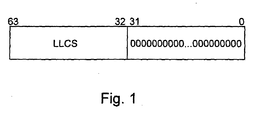
- Fig.1 illustrates the formation of a short-lived cryptosync from a long-lived cryptosync according to one embodiment of the present invention.
- a mobile station communicates with base stations over the air.
- a mobile station may be a mobile phone, wireless computer, etc.
- the base station services a geographic area; namely, services communication to and from mobile stations in the geographic area. Often this communication is encrypted.
- CDMA2000 for example, there exist several long lived keys such as a cipher key (CK) and an integrity key (IK) associated with a mobile station that are used in the encryption processes and messaging integrity protection processes, respectively.
- CK cipher key
- IK integrity key
- CDMA2000 also provides for, relatively speaking, a long lived cryptosync (e.g., TX_EXT_SSEQ and RX_EXT_SSEQ in CDMA2000).
- the long-lived cryptosync (LLCS) is used to encrypt and decrypt messages (e.g., signaling messages) between the base station and mobile station, to verify message integrity, or both.
- the LLCS is incremented in the usual fashion so that the ciphertext generated using the LLCS is resistant to replay attacks.
- the LLCS may be derived using any well-known authentication protocol such as set forth in CDMA2000.
- the communication channel for communicating information (e.g., voice, data, etc.) between the base station and mobile station is often referred to as the radio link, and one protocol for data communication, for example, is referred to as the radio link protocol (RLP).
- RLP radio link protocol
- a communication channel between the mobile station and base station is established in a well-known manner such as through message integrity using the LLCS.
- the communication channel is torn down.
- the time during which the communication channel existed for communication of information (e.g., voice, data, etc.) is referred to generally as the communication session.
- each frame is encrypted using what will be referred to herein as a short-lived cryptosync (SLCS).
- SLCS short-lived cryptosync
- the SLCS is short lived in comparison to the LLCS in that the life of the SLCS is limited to the duration of the communication session. Namely, as will be described in detail below, a value for the SLCS is newly derived for the next communication session.
- the life of the LLCS is not limited to a single RLP session.
- the natural life of the LLCS is tied to the duration of the cipher key (CK) and an integrity key (IK).
- CK cipher key
- IK integrity key
- certain types of registration e.g., registration at a new visiting location register VLR
- VLR new visiting location register
- IK integrity key
- events such as the mobile station powering down and losing the LLCS may terminate the life of the LLCS.
- the life of the LLCS extends over multiple communication sessions. Stated another way, the LLCS continues in use during and after expiration of an SLCS. As will be appreciated in detail below, the methodologies of the present invention exploit this difference between the SLCS and the LLCS.
- the LLCS changes between communication sessions in part because the message used to initiate a communication session is integrity protected using the LLCS. As such, the value of the LLCS is incremented after each use, and in at least this manner, the LLCS will have a different value for each communication session. It will be appreciated that as a result of other uses of the LLCS, further incrementing of the LLCS may occur between communication sessions Because, as described in detail below, the SLCS is derived from the LLCS, the SLCSs derived for different communication sessions will have different values; thus, helping to prevent a replay attack.
- the SLCS is derived using a portion of or the entirety of the LLCS.
- Fig. 1 illustrates an example of an SLCS according to this embodiment.
- the SLCS has a length greater than the length of the LLCS. More particularly, the example of Fig. 1 assumes the case of a 64 bit SLCS and a 32 bit LLCS.
- the most significant 32 bits of the SLCS are the 32 bits of the LLCS.
- the remaining, least significant 32 bits of the SLCS are a fixed bit stream.
- the fixed bit stream is a string of all 0s.
- the fixed bit stream need not be all 0s or all 1s.
- the entirety of the LLCS instead of using the entirety of the LLCS to form a portion of the SLCS, only a portion of the LLCS may be used; however, it will be appreciated that this may not offer the highest degree of protection against repeating the SLCS.
- any well-known pseudo-random function may be applied to the LLCS.
- the result is then used to generate the SLCS.
- the resulting pseudo-random number may be used in the same manner as the LLCS in the previously described embodiment to generate the SLCS.
- the resulting pseudo-random number may be used as the SLCS.
- the same SLCS is derived for the communication session therebetween.
- the derived SLCS is then used in the conventional manner to encrypt a frame of information at the send side (base station or mobile station) and decrypt the frame of information at the receive side (mobile station or base station). After each encryption and decryption, the value of the SLCS is incremented and used for encryption and decryption of the next frame.
- the SLCS is derived anew as described in detail above.
Landscapes
- Engineering & Computer Science (AREA)
- Computer Security & Cryptography (AREA)
- Computer Networks & Wireless Communication (AREA)
- Signal Processing (AREA)
- Mobile Radio Communication Systems (AREA)
- Data Exchanges In Wide-Area Networks (AREA)
Abstract
Description
Claims (10)
- A method of generating a cryptosync for a communication session between two communication devices, comprising:deriving a value of a first cryptosync for the communication session based on a value of a second cryptosync, the second cryptosync having a longer life than the first cryptosync.
- The method of claim 1, wherein the second cryptosync is used for message encryption by at least one of the two devices.
- The method of claim 1, wherein the second cryptosync is used for verifying message integrity by at least one of the two devices.
- The method of claim 1, wherein the second cryptosync changes between communication sessions.
- The method of claim 1, wherein the deriving step derives the first cryptosync as at least a portion of the second cryptosync.
- The method of claim 5, wherein the deriving step derives a first portion of the first cryptosync as the second cryptosync and derives a second portion of the first cryptosync as a fixed bit sequence.
- The method of claim 6, wherein the fixed bit sequence is a string of 0s.
- The method of claim 1, wherein the deriving step comprises:performing a pseudo-random function on the second cryptosync; andgenerating the first cryptosync from output of the pseudo-random function.
- The method of claim 8, wherein the generating step generates the first cryptosync as the output of the pseudo-random function.
- The method of claim 1, further comprising:one of encrypting and decrypting a frame of information using the first cryptosync.
Applications Claiming Priority (2)
| Application Number | Priority Date | Filing Date | Title |
|---|---|---|---|
| US10/786,454 US20050193197A1 (en) | 2004-02-26 | 2004-02-26 | Method of generating a cryptosync |
| US786454 | 2004-02-26 |
Publications (2)
| Publication Number | Publication Date |
|---|---|
| EP1569379A1 true EP1569379A1 (en) | 2005-08-31 |
| EP1569379B1 EP1569379B1 (en) | 2007-07-18 |
Family
ID=34750491
Family Applications (1)
| Application Number | Title | Priority Date | Filing Date |
|---|---|---|---|
| EP05250872A Expired - Lifetime EP1569379B1 (en) | 2004-02-26 | 2005-02-15 | Method of generating a cryptosync |
Country Status (6)
| Country | Link |
|---|---|
| US (1) | US20050193197A1 (en) |
| EP (1) | EP1569379B1 (en) |
| JP (1) | JP4856380B2 (en) |
| KR (1) | KR101150577B1 (en) |
| CN (1) | CN1661954B (en) |
| DE (1) | DE602005001637T2 (en) |
Families Citing this family (5)
| Publication number | Priority date | Publication date | Assignee | Title |
|---|---|---|---|---|
| AU2006300029B2 (en) * | 2005-10-14 | 2010-07-15 | Samsung Electronics Co., Ltd. | Roaming service method in a mobile broadcasting system, and system thereof |
| KR100856256B1 (en) * | 2005-10-14 | 2008-09-03 | 삼성전자주식회사 | Apparatus and method for supporting roaming service in mobile broadcasting system |
| US8122247B2 (en) * | 2006-10-23 | 2012-02-21 | Alcatel Lucent | Processing method for message integrity with tolerance for non-sequential arrival of message data |
| CN101529798B (en) * | 2006-10-23 | 2012-09-05 | 朗讯科技公司 | The processing method of message integrity under the condition that non-sequential arrival of message data is allowed |
| JP6376073B2 (en) * | 2015-08-07 | 2018-08-22 | 株式会社デンソー | COMMUNICATION SYSTEM, COUNT VALUE SYNCHRONIZATION METHOD, AND PROGRAM |
Citations (2)
| Publication number | Priority date | Publication date | Assignee | Title |
|---|---|---|---|---|
| US6249582B1 (en) * | 1997-12-31 | 2001-06-19 | Transcrypt International, Inc. | Apparatus for and method of overhead reduction in a block cipher |
| US20030206538A1 (en) * | 2002-01-14 | 2003-11-06 | Ramin Rezaiifar | Cryptosync design for a wireless communication system |
Family Cites Families (23)
| Publication number | Priority date | Publication date | Assignee | Title |
|---|---|---|---|---|
| JPH0389737A (en) * | 1989-08-25 | 1991-04-15 | Motorola Inc | Hierarchical key management system |
| US6301242B1 (en) * | 1998-07-24 | 2001-10-09 | Xircom Wireless, Inc. | Communication system with fast control traffic |
| JPH08335040A (en) * | 1995-06-02 | 1996-12-17 | Fujitsu Ltd | Encryption processing method |
| JP3459074B2 (en) * | 1997-04-14 | 2003-10-20 | ルーセント テクノロジーズ インコーポレーテッド | Method and apparatus for enhanced security enhancement of a private key to a lookup table to improve security of wireless telephone messages |
| US6134660A (en) * | 1997-06-30 | 2000-10-17 | Telcordia Technologies, Inc. | Method for revoking computer backup files using cryptographic techniques |
| JP3466204B2 (en) * | 1997-07-29 | 2003-11-10 | ルーセント テクノロジーズ インコーポレーテッド | Method and apparatus for enhanced CMEA using enhanced transformation |
| US5999623A (en) * | 1997-11-05 | 1999-12-07 | Globalstar L.P. | Broadcast data access controller communication system |
| US6266412B1 (en) * | 1998-06-15 | 2001-07-24 | Lucent Technologies Inc. | Encrypting speech coder |
| US6980658B1 (en) * | 1999-09-30 | 2005-12-27 | Qualcomm Incorporated | Method and apparatus for encrypting transmissions in a communication system |
| US6697490B1 (en) * | 1999-10-19 | 2004-02-24 | Lucent Technologies Inc. | Automatic resynchronization of crypto-sync information |
| US20020196935A1 (en) * | 2001-02-25 | 2002-12-26 | Storymail, Inc. | Common security protocol structure and mechanism and system and method for using |
| US7275155B1 (en) * | 2000-09-01 | 2007-09-25 | Northrop Grumman Corporation | Chain of trust processing |
| GB0027280D0 (en) * | 2000-11-08 | 2000-12-27 | Malcolm Peter | An information management system |
| US20020146127A1 (en) * | 2001-04-05 | 2002-10-10 | Marcus Wong | System and method for providing secure communications between wireless units using a common key |
| US20030188160A1 (en) * | 2001-08-02 | 2003-10-02 | Singam Sunder | Method and system to securely update files via a network |
| US7177658B2 (en) * | 2002-05-06 | 2007-02-13 | Qualcomm, Incorporated | Multi-media broadcast and multicast service (MBMS) in a wireless communications system |
| US6920504B2 (en) * | 2002-05-13 | 2005-07-19 | Qualcomm, Incorporated | Method and apparatus for controlling flow of data in a communication system |
| US7200115B2 (en) * | 2002-05-17 | 2007-04-03 | Lucent Technologies Inc. | Method of managing non-acknowledgement responses |
| US6965674B2 (en) * | 2002-05-21 | 2005-11-15 | Wavelink Corporation | System and method for providing WLAN security through synchronized update and rotation of WEP keys |
| EP1582024B1 (en) * | 2003-01-07 | 2009-09-30 | QUALCOMM Incorporated | System, apparatus and method for replacing a cryptographic key |
| US7316027B2 (en) * | 2004-02-03 | 2008-01-01 | Novell, Inc. | Techniques for dynamically establishing and managing trust relationships |
| US20050086468A1 (en) * | 2003-10-17 | 2005-04-21 | Branislav Meandzija | Digital certificate related to user terminal hardware in a wireless network |
| US20050177715A1 (en) * | 2004-02-09 | 2005-08-11 | Microsoft Corporation | Method and system for managing identities in a peer-to-peer networking environment |
-
2004
- 2004-02-26 US US10/786,454 patent/US20050193197A1/en not_active Abandoned
-
2005
- 2005-02-15 EP EP05250872A patent/EP1569379B1/en not_active Expired - Lifetime
- 2005-02-15 DE DE602005001637T patent/DE602005001637T2/en not_active Expired - Lifetime
- 2005-02-24 KR KR1020050015297A patent/KR101150577B1/en not_active Expired - Fee Related
- 2005-02-24 CN CN2005100509474A patent/CN1661954B/en not_active Expired - Fee Related
- 2005-02-25 JP JP2005049890A patent/JP4856380B2/en not_active Expired - Fee Related
Patent Citations (2)
| Publication number | Priority date | Publication date | Assignee | Title |
|---|---|---|---|---|
| US6249582B1 (en) * | 1997-12-31 | 2001-06-19 | Transcrypt International, Inc. | Apparatus for and method of overhead reduction in a block cipher |
| US20030206538A1 (en) * | 2002-01-14 | 2003-11-06 | Ramin Rezaiifar | Cryptosync design for a wireless communication system |
Also Published As
| Publication number | Publication date |
|---|---|
| US20050193197A1 (en) | 2005-09-01 |
| JP2005244986A (en) | 2005-09-08 |
| EP1569379B1 (en) | 2007-07-18 |
| KR20060043178A (en) | 2006-05-15 |
| CN1661954A (en) | 2005-08-31 |
| DE602005001637T2 (en) | 2008-06-05 |
| DE602005001637D1 (en) | 2007-08-30 |
| JP4856380B2 (en) | 2012-01-18 |
| CN1661954B (en) | 2010-09-08 |
| KR101150577B1 (en) | 2012-06-01 |
Similar Documents
| Publication | Publication Date | Title |
|---|---|---|
| US8121296B2 (en) | Method and apparatus for security in a data processing system | |
| CN102449974B (en) | Trust establishment from forward link only to non-forward link only devices | |
| US7352868B2 (en) | Method and apparatus for security in a data processing system | |
| JP4866909B2 (en) | Shared key encryption using a long keypad | |
| JP4927330B2 (en) | Method and apparatus for secure data transmission in a mobile communication system | |
| JP4094216B2 (en) | Automatic resynchronization of cryptographic synchronization information | |
| CA2377292C (en) | System and method for providing secure communications between wireless units using a common key | |
| JP2020513117A (en) | Method and system for improved authenticated encryption in a counter-based cryptosystem | |
| US7623656B2 (en) | Stream cipher encryption and message authentication | |
| EP1864425A1 (en) | Encryption and decryption device in wireless portable internet system, and method thereof | |
| JP2017085559A (en) | System and method for efficient and confidential symmetric encryption in channels with limited bandwidth | |
| EP1156694A1 (en) | Radio communication device and radio communication method | |
| US20030206538A1 (en) | Cryptosync design for a wireless communication system | |
| JP2010028747A (en) | Transmission device and reception device for ciphering process | |
| JP2006211687A (en) | Method for secure transmission of mobile communication subscriber identifier | |
| EP1569379B1 (en) | Method of generating a cryptosync | |
| KR20030027459A (en) | Method for encrypting and decrypting transmmited and received facket in wireless lan | |
| El Bakry et al. | Implementation of a hybrid encryption scheme for sms/multimedia messages on android | |
| Ying | Key Hopping™–A Security Enhancement Scheme for IEEE 802.11 WEP Standards | |
| Yu | An RC4 based lightweight security protocol. |
Legal Events
| Date | Code | Title | Description |
|---|---|---|---|
| PUAI | Public reference made under article 153(3) epc to a published international application that has entered the european phase |
Free format text: ORIGINAL CODE: 0009012 |
|
| 17P | Request for examination filed |
Effective date: 20050310 |
|
| AK | Designated contracting states |
Kind code of ref document: A1 Designated state(s): AT BE BG CH CY CZ DE DK EE ES FI FR GB GR HU IE IS IT LI LT LU MC NL PL PT RO SE SI SK TR |
|
| AX | Request for extension of the european patent |
Extension state: AL BA HR LV MK YU |
|
| AKX | Designation fees paid |
Designated state(s): DE FR GB |
|
| APBN | Date of receipt of notice of appeal recorded |
Free format text: ORIGINAL CODE: EPIDOSNNOA2E |
|
| APBR | Date of receipt of statement of grounds of appeal recorded |
Free format text: ORIGINAL CODE: EPIDOSNNOA3E |
|
| APBV | Interlocutory revision of appeal recorded |
Free format text: ORIGINAL CODE: EPIDOSNIRAPE |
|
| APBD | Information on interlocutory revision deleted |
Free format text: ORIGINAL CODE: EPIDOSDIRAPE |
|
| APBV | Interlocutory revision of appeal recorded |
Free format text: ORIGINAL CODE: EPIDOSNIRAPE |
|
| GRAP | Despatch of communication of intention to grant a patent |
Free format text: ORIGINAL CODE: EPIDOSNIGR1 |
|
| GRAS | Grant fee paid |
Free format text: ORIGINAL CODE: EPIDOSNIGR3 |
|
| GRAA | (expected) grant |
Free format text: ORIGINAL CODE: 0009210 |
|
| AK | Designated contracting states |
Kind code of ref document: B1 Designated state(s): DE FR GB |
|
| REG | Reference to a national code |
Ref country code: GB Ref legal event code: FG4D |
|
| REF | Corresponds to: |
Ref document number: 602005001637 Country of ref document: DE Date of ref document: 20070830 Kind code of ref document: P |
|
| ET | Fr: translation filed | ||
| PLBE | No opposition filed within time limit |
Free format text: ORIGINAL CODE: 0009261 |
|
| STAA | Information on the status of an ep patent application or granted ep patent |
Free format text: STATUS: NO OPPOSITION FILED WITHIN TIME LIMIT |
|
| 26N | No opposition filed |
Effective date: 20080421 |
|
| REG | Reference to a national code |
Ref country code: GB Ref legal event code: 732E Free format text: REGISTERED BETWEEN 20131031 AND 20131106 |
|
| REG | Reference to a national code |
Ref country code: FR Ref legal event code: CD Owner name: ALCATEL-LUCENT USA INC. Effective date: 20131122 |
|
| REG | Reference to a national code |
Ref country code: FR Ref legal event code: GC Effective date: 20140410 |
|
| REG | Reference to a national code |
Ref country code: FR Ref legal event code: RG Effective date: 20141015 |
|
| REG | Reference to a national code |
Ref country code: FR Ref legal event code: PLFP Year of fee payment: 11 |
|
| REG | Reference to a national code |
Ref country code: FR Ref legal event code: PLFP Year of fee payment: 12 |
|
| REG | Reference to a national code |
Ref country code: FR Ref legal event code: PLFP Year of fee payment: 13 |
|
| REG | Reference to a national code |
Ref country code: FR Ref legal event code: PLFP Year of fee payment: 14 |
|
| PGFP | Annual fee paid to national office [announced via postgrant information from national office to epo] |
Ref country code: DE Payment date: 20200204 Year of fee payment: 16 Ref country code: GB Payment date: 20200206 Year of fee payment: 16 |
|
| PGFP | Annual fee paid to national office [announced via postgrant information from national office to epo] |
Ref country code: FR Payment date: 20200113 Year of fee payment: 16 |
|
| REG | Reference to a national code |
Ref country code: DE Ref legal event code: R119 Ref document number: 602005001637 Country of ref document: DE |
|
| GBPC | Gb: european patent ceased through non-payment of renewal fee |
Effective date: 20210215 |
|
| PG25 | Lapsed in a contracting state [announced via postgrant information from national office to epo] |
Ref country code: DE Free format text: LAPSE BECAUSE OF NON-PAYMENT OF DUE FEES Effective date: 20210901 Ref country code: GB Free format text: LAPSE BECAUSE OF NON-PAYMENT OF DUE FEES Effective date: 20210215 Ref country code: FR Free format text: LAPSE BECAUSE OF NON-PAYMENT OF DUE FEES Effective date: 20210228 |