EP1568878A2 - Air intake system for engine - Google Patents
Air intake system for engine Download PDFInfo
- Publication number
- EP1568878A2 EP1568878A2 EP05002358A EP05002358A EP1568878A2 EP 1568878 A2 EP1568878 A2 EP 1568878A2 EP 05002358 A EP05002358 A EP 05002358A EP 05002358 A EP05002358 A EP 05002358A EP 1568878 A2 EP1568878 A2 EP 1568878A2
- Authority
- EP
- European Patent Office
- Prior art keywords
- engine
- intake
- vehicle
- air
- pipe
- Prior art date
- Legal status (The legal status is an assumption and is not a legal conclusion. Google has not performed a legal analysis and makes no representation as to the accuracy of the status listed.)
- Withdrawn
Links
- 230000005540 biological transmission Effects 0.000 claims abstract description 15
- 238000011144 upstream manufacturing Methods 0.000 claims description 37
- 239000010705 motor oil Substances 0.000 claims description 10
- 239000000945 filler Substances 0.000 claims description 9
- 238000010276 construction Methods 0.000 description 20
- 230000015572 biosynthetic process Effects 0.000 description 1
- 230000003247 decreasing effect Effects 0.000 description 1
- 230000007812 deficiency Effects 0.000 description 1
- 238000007599 discharging Methods 0.000 description 1
- 239000000446 fuel Substances 0.000 description 1
- 230000002452 interceptive effect Effects 0.000 description 1
- 230000002035 prolonged effect Effects 0.000 description 1
- 239000013585 weight reducing agent Substances 0.000 description 1
Images






Classifications
-
- F—MECHANICAL ENGINEERING; LIGHTING; HEATING; WEAPONS; BLASTING
- F02—COMBUSTION ENGINES; HOT-GAS OR COMBUSTION-PRODUCT ENGINE PLANTS
- F02M—SUPPLYING COMBUSTION ENGINES IN GENERAL WITH COMBUSTIBLE MIXTURES OR CONSTITUENTS THEREOF
- F02M35/00—Combustion-air cleaners, air intakes, intake silencers, or induction systems specially adapted for, or arranged on, internal-combustion engines
- F02M35/10—Air intakes; Induction systems
- F02M35/10006—Air intakes; Induction systems characterised by the position of elements of the air intake system in direction of the air intake flow, i.e. between ambient air inlet and supply to the combustion chamber
- F02M35/10026—Plenum chambers
- F02M35/10052—Plenum chambers special shapes or arrangements of plenum chambers; Constructional details
-
- F—MECHANICAL ENGINEERING; LIGHTING; HEATING; WEAPONS; BLASTING
- F02—COMBUSTION ENGINES; HOT-GAS OR COMBUSTION-PRODUCT ENGINE PLANTS
- F02B—INTERNAL-COMBUSTION PISTON ENGINES; COMBUSTION ENGINES IN GENERAL
- F02B27/00—Use of kinetic or wave energy of charge in induction systems, or of combustion residues in exhaust systems, for improving quantity of charge or for increasing removal of combustion residues
- F02B27/02—Use of kinetic or wave energy of charge in induction systems, or of combustion residues in exhaust systems, for improving quantity of charge or for increasing removal of combustion residues the systems having variable, i.e. adjustable, cross-sectional areas, chambers of variable volume, or like variable means
- F02B27/0205—Use of kinetic or wave energy of charge in induction systems, or of combustion residues in exhaust systems, for improving quantity of charge or for increasing removal of combustion residues the systems having variable, i.e. adjustable, cross-sectional areas, chambers of variable volume, or like variable means characterised by the charging effect
- F02B27/0215—Oscillating pipe charging, i.e. variable intake pipe length charging
-
- F—MECHANICAL ENGINEERING; LIGHTING; HEATING; WEAPONS; BLASTING
- F02—COMBUSTION ENGINES; HOT-GAS OR COMBUSTION-PRODUCT ENGINE PLANTS
- F02M—SUPPLYING COMBUSTION ENGINES IN GENERAL WITH COMBUSTIBLE MIXTURES OR CONSTITUENTS THEREOF
- F02M35/00—Combustion-air cleaners, air intakes, intake silencers, or induction systems specially adapted for, or arranged on, internal-combustion engines
- F02M35/10—Air intakes; Induction systems
- F02M35/10091—Air intakes; Induction systems characterised by details of intake ducts: shapes; connections; arrangements
- F02M35/10111—Substantially V-, C- or U-shaped ducts in direction of the flow path
-
- F—MECHANICAL ENGINEERING; LIGHTING; HEATING; WEAPONS; BLASTING
- F02—COMBUSTION ENGINES; HOT-GAS OR COMBUSTION-PRODUCT ENGINE PLANTS
- F02M—SUPPLYING COMBUSTION ENGINES IN GENERAL WITH COMBUSTIBLE MIXTURES OR CONSTITUENTS THEREOF
- F02M35/00—Combustion-air cleaners, air intakes, intake silencers, or induction systems specially adapted for, or arranged on, internal-combustion engines
- F02M35/10—Air intakes; Induction systems
- F02M35/104—Intake manifolds
- F02M35/112—Intake manifolds for engines with cylinders all in one line
-
- F—MECHANICAL ENGINEERING; LIGHTING; HEATING; WEAPONS; BLASTING
- F02—COMBUSTION ENGINES; HOT-GAS OR COMBUSTION-PRODUCT ENGINE PLANTS
- F02M—SUPPLYING COMBUSTION ENGINES IN GENERAL WITH COMBUSTIBLE MIXTURES OR CONSTITUENTS THEREOF
- F02M35/00—Combustion-air cleaners, air intakes, intake silencers, or induction systems specially adapted for, or arranged on, internal-combustion engines
- F02M35/16—Combustion-air cleaners, air intakes, intake silencers, or induction systems specially adapted for, or arranged on, internal-combustion engines characterised by use in vehicles
- F02M35/161—Arrangement of the air intake system in the engine compartment, e.g. with respect to the bonnet or the vehicle front face
-
- F—MECHANICAL ENGINEERING; LIGHTING; HEATING; WEAPONS; BLASTING
- F02—COMBUSTION ENGINES; HOT-GAS OR COMBUSTION-PRODUCT ENGINE PLANTS
- F02B—INTERNAL-COMBUSTION PISTON ENGINES; COMBUSTION ENGINES IN GENERAL
- F02B27/00—Use of kinetic or wave energy of charge in induction systems, or of combustion residues in exhaust systems, for improving quantity of charge or for increasing removal of combustion residues
- F02B27/02—Use of kinetic or wave energy of charge in induction systems, or of combustion residues in exhaust systems, for improving quantity of charge or for increasing removal of combustion residues the systems having variable, i.e. adjustable, cross-sectional areas, chambers of variable volume, or like variable means
- F02B27/0226—Use of kinetic or wave energy of charge in induction systems, or of combustion residues in exhaust systems, for improving quantity of charge or for increasing removal of combustion residues the systems having variable, i.e. adjustable, cross-sectional areas, chambers of variable volume, or like variable means characterised by the means generating the charging effect
- F02B27/0268—Valves
- F02B27/0273—Flap valves
-
- F—MECHANICAL ENGINEERING; LIGHTING; HEATING; WEAPONS; BLASTING
- F02—COMBUSTION ENGINES; HOT-GAS OR COMBUSTION-PRODUCT ENGINE PLANTS
- F02M—SUPPLYING COMBUSTION ENGINES IN GENERAL WITH COMBUSTIBLE MIXTURES OR CONSTITUENTS THEREOF
- F02M35/00—Combustion-air cleaners, air intakes, intake silencers, or induction systems specially adapted for, or arranged on, internal-combustion engines
- F02M35/02—Air cleaners
-
- Y—GENERAL TAGGING OF NEW TECHNOLOGICAL DEVELOPMENTS; GENERAL TAGGING OF CROSS-SECTIONAL TECHNOLOGIES SPANNING OVER SEVERAL SECTIONS OF THE IPC; TECHNICAL SUBJECTS COVERED BY FORMER USPC CROSS-REFERENCE ART COLLECTIONS [XRACs] AND DIGESTS
- Y02—TECHNOLOGIES OR APPLICATIONS FOR MITIGATION OR ADAPTATION AGAINST CLIMATE CHANGE
- Y02T—CLIMATE CHANGE MITIGATION TECHNOLOGIES RELATED TO TRANSPORTATION
- Y02T10/00—Road transport of goods or passengers
- Y02T10/10—Internal combustion engine [ICE] based vehicles
- Y02T10/12—Improving ICE efficiencies
Definitions
- the present invention relates to an air intake system for an engine.
- an intake manifold is usually arranged on the vehicle front side of the engine.
- the substantially entire part of the intake manifold projects from the engine body toward the vehicle front side and the engine itself is inclined rearward of the vehicle for ensuring a crushable zone in the small engine compartment.
- a space that the engine occupies shall be large in the longitudinal and vertical directions of the vehicle, while ensuring the crushable zone.
- an engine of front-intake/rear-exhaust type disposed transversely in an engine compartment is proposed in which each intake branch pipe of an intake manifold is extended from corresponding intake ports in the side face on the vehicle front side rearward of the vehicle over a cylinder head cover, as disclosed in U.S. Pat. No. 5,005,534.
- projection by the engine frontward of the vehicle is restricted and the space that the engine occupies in the engine compartment is reduced in the longitudinal direction of the vehicle, compared with a conventional construction in which an intake manifold is arranged on the vehicle front side of the engine.
- the overall height of the engine is increased by the height of the intake branch pipes protruding above the cylinder head cover because the crushable zone, which is required between the engine and a hood thereabove, as well as in front of the engine, must be ensured sufficiently.
- the intake branch pipes are offset rearward of the engine against spark plug units over the engine, respectively.
- Such a construction enables to overlap the intake branch pipes with the spark plug units when viewing the engine from the rear side, respectively, resulting in the reduction of the overall height of the engine.
- the present invention has been made in view of the above problems and has its object of arranging an intake manifold and an air cleaner unit compactly while restricting the overall width and overall height of an engine including the intake manifold by restricting projection by the intake manifold frontward of the vehicle and upward of the engine.
- the first invention directs to an air intake system an air intake system for a multi-cylinder in line engine mounted transversely in an engine compartment so that intake ports and exhaust ports are formed in a vehicle front side face and a vehicle rear side face, respectively.
- the air intake system includes: an intake manifold including a plurality of intake branch pipes which are extended rearward of a vehicle from the intake ports over a cylinder head cover of the engine, respectively, and an intake air collecting pipe which communicates with the intake branch pipes on a vehicle rear side of the engine and into which the intake branch pipes are gathered; and an air cleaner unit which is provided above a transmission on a rear side on the engine.
- the intake branch pipes are respectively offset frontward of the engine against the spark plug units respectively standing upright at central portions of the corresponding cylinders and projecting upward from an upper face of the cylinder head cover when viewing the engine in a plane, and at least each part of the intake branch pipes overlaps vertically with the spark plug unit when viewing the engine from the rear side.
- the engine is mounted transversely in the engine compartment and the intake ports for introducing intake air is arranged in the side face of the engine on the vehicle front side.
- the intake branch pipes of the intake manifold communicating with the intake ports are extended rearward of the vehicle from the intake ports, respectively, over the cylinder head cover of the engine.
- each spark plug unit standing in the middle of the corresponding cylinder of the engine protrudes from the upper face of the cylinder head cover, wherein the intake branch pipes are respectively offset against the spark plug units frontward of the engine when viewing the engine in a plane and at least parts thereof overlaps with one another vertically when viewing the engine from the rear side.
- the intake branch pipes can be avoided from interfering with the spark plug units and the overall height of the engine is reduced by the vertical overlap between the intake branch pipes and the spark plug units.
- the offset of the intake branch pipes against the spark plug units frontward of the engine creates a space at least a part on the rear side of a rearmost spark plug unit in the direction of the cylinder line of the engine and above the cylinder head cover.
- the air cleaner unit can be arranged above the transmission on the rear side of the engine by utilizing the thus created space.
- a space for arranging the air cleaner unit can be ensured in the small engine compartment.
- the intake branch pipes are extended from the intake ports rearward of the vehicle over the cylinder head cover, respectively.
- the intake manifold including the intake air collecting pipe is projected not substantially entirely from the engine toward the vehicle front side and the overall width of the engine including the air intake system is reduced.
- the intake branch pipes are offset frontward of the engine over the cylinder head cover for avoiding interference with the spark plug units projecting from the cylinder head cover, and are overlapped vertically at at least each part thereof with the spark plug units when viewing from the engine rear side, thereby reducing the overall height of the engine including the air intake system.
- the offset of the intake branch pipes frontward of the engine ensures a space for arranging the air cleaner unit in the space from a part above the transmission on the engine rear side to the rearmost intake branch pipe in the direction of the cylinder line of the engine, resulting in efficient space utilization in the small engine compartment.
- each intake branch pipe includes a curved portion which is extended frontward of the vehicle and upward from the corresponding intake port and is curved rearward of the vehicle, and an extended portion which continues to the curved portion and is extended substantially linearly and rearward of the vehicle over the cylinder head cover, and the curved portion is inclined frontward of the engine.
- each extended portion of the intake branch pipes is offset against the corresponding intake ports frontward of the engine by the offset thereof against the spark plug units frontward of the engine over the cylinder head cover, and each curved portion is inclined frontward of the engine so that the intake ports and the extended portions communicate with one another through the curved portions, respectively.
- Each intake branch pipe is extended from the corresponding intake port in the side face of the engine on the vehicle front side to the vehicle rear side of the engine over the cylinder head cover.
- each curved portion increases the radius of curvature of each curved portion, resulting in reduction of intake resistance in the intake manifold and increase in filling efficiency of intake air to each cylinder.
- the third invention provides an air intake system according to the first or second invention, wherein the air cleaner unit includes: an air cleaner case in which a dusty side room and a clean side room are divided transversely by an air cleaner element, a fresh air sucking port being formed in a vehicle rear side portion of the clean side room; a fresh air pipe which communicates at one end thereof with the fresh air sucking port and at the other end thereof with the intake air collecting pipe; and a throttle valve unit which is provided in the middle of the fresh air pipe.
- the air cleaner element is inclined so that the clean side room expands vertically as it goes rearward of the vehicle, and the fresh air pipe and the throttle valve unit have a same height as that of the intake manifold or are located lower than the intake manifold.
- the inclination of the air cleaner element in the air cleaner case increases the area of the air cleaner element, compared with the case where the air cleaner element is arranged perpendicular or horizontal to the air cleaner case.
- the air cleaner element is inclined so as to expand the clean side room as it goes rearward of the vehicle rear side, thereby ensuring a sufficient space for forming the fresh air sucking port on the vehicle rear side of the clean side room.
- the overall height of the air cleaner case must be increased for ensuring a sufficient area of the air cleaner element in the case where the air cleaner element is arranged perpendicularly, and the overall height of the air cleaner case must be also increased for ensuring a sufficient space for forming a fresh air sucking port on the vehicle rear side of the air cleaner case in the case where it is arranged horizontally.
- the air cleaner element is inclined so as to expand the clean side room as it goes rearward of the vehicle rear side in the above air intake system, with a result that the area of the air cleaner element is increased and a sufficient space is ensured for forming the fresh air sucking port on the vehicle rear side of the clean side room.
- the fresh air sucking port communicates with the intake air collecting pipe through the fresh air pipe having the throttle valve unit.
- fresh air introduced to the air cleaner unit flows into the clean side room from the dusty side room through the air cleaner element, flows into the fresh air pipe through the fresh air sucking port to be adjusted in the air amount thereof by the throttle valve unit, and then, is sent into the intake air collecting pipe.
- the fresh air pipe and the throttle valve unit do not project further than the intake manifold from the upper portion of the engine, thereby reducing the overall height of the engine including the air intake system such as the air cleaner unit and the like.
- the fourth invention provides an air intake system according to any one of first to third invention, wherein the air cleaner unit further includes a resonance chamber which is integrally arranged with the air cleaner case at a part where at least a part of the resonance chamber overlaps with the cylinder head cover when viewing the engine in a plane between a rearmost intake branch pipe in the direction of the cylinder line of the engine and the air cleaner case.
- the air cleaner case is arranged above the transmission at a part where the air cleaner case overlaps with the cylinder head cover and a cylinder head when viewing the engine from the rear side.
- the air cleaner unit including the air cleaner case and the resonance chamber is arranged in the space from a part above the transmission on the engine rear side to a part above the end portion on the engine rear side of the cylinder head cover.
- the offset of the rearmost intake branch pipe in the direction of the cylinder line of the engine frontward of the engine creates a space above the cylinder head cover and enables to arrange at least a part of the resonance chamber in the thus created space.
- the space in the small engine compartment is efficiently utilized.
- the air cleaner case is arranged at a part where it overlaps with the cylinder head cover and the cylinder head when viewing the engine from the rear side for reducing the height of the air cleaner case, thereby reducing the overall height of the engine.
- the fifth invention provides an air intake system according to any one of the first to fourth inventions, wherein in the engine compartment, a vacuum toggle for break and a battery are arranged on one side and on the other side in a widthwise direction of the vehicle, respectively, and the engine is arranged between the vacuum toggle and the battery in a widthwise direction of the vehicle in the engine compartment.
- the vacuum toggle for break and the battery are arranged on one side and on the other side in the vehicle transverse direction of the engine compartment with the engine interposed, respectively, when viewing the engine compartment in a plane.
- the functional engine elements including the vacuum toggle for break and the battery which occupy a comparatively large space, can be arranged in the engine compartment in balance.
- the sixth invention provides an air intake system according to any one of the first to fifth inventions, wherein the engine is mounted substantially perpendicular.
- the intake branch pipes of the intake manifold are respectively extended from the intake ports rearward of the vehicle over the cylinder head cover of the engine and are respectively offset against the spark plug units frontward of the engine when viewing the engine in a plane, while overlapping at at least parts thereof in the vertical direction when viewing the engine from the rear side, resulting in reduction of the overall width and the overall height of the engine.
- the engine having the thus reduced overall width and height necessitates no inclination of the engine rearward of the vehicle for reducing, in the vehicle longitudinal direction, the space that the engine occupies.
- the perpendicular arrangement that is, upright mounting of the engine reduces the space that the engine occupies in the engine compartment in the vehicle longitudinal direction, rather than inclined arrangement of the engine rearward of the vehicle.
- the seventh invention provides an air intake system according to the first invention, wherein the intake manifold further includes an intake pipe length exchanging device for exchanging an intake pipe length, the intake pipe length exchanging device includes: short pipes respectively communicating with the intake pipe branches; an expansion room communicating with the respective intake branch pipes through the respective short pipes; and switch valves for respectively communicating with and shutting off between the expansion room and the intake branch pipes, a bonnet which slants forward defines the engine compartment so as to reduce a height as it goes frontward of the vehicle, the engine is mounted substantially perpendicular, each intake branch pipe is inclined so as to increase a height thereof as it goes rearward of the vehicle along the bonnet that slants forward over the cylinder head cover, and the expansion room is arranged between a vehicle rear side end of the intake branch pipe and the cylinder head cover.
- the expansion room includes an expansion room disposed so that at least a part thereof is located in a space between the end portions on the vehicle rear side of the intake branch pipes and the cylinder head cover.
- the intake branch pipes extended over the cylinder head cover are inclined so as to increase their height on the vehicle rear side along the bonnet that slants forward. As a result, the crushable zone is ensured between the intake branch pipes and the bonnet.
- the intake pipe length exchanging device can be arranged by utilizing the space under the intake branch pipes and above the cylinder head cover.
- the intake pipe length exchanging device includes the expansion room arranged in the space between the vehicle rear side portions of the intake branch pipes and the cylinder head cover.
- the vehicle rear side of the engine means a whole part on the vehicle rear side farther rearward than the center of the engine in the vehicle longitudinal direction and includes the space on the vehicle rear side farther rearward than the rear end in the vehicle longitudinal direction of the engine, as well as the space on the vehicle rear side farther rearward than the center of the engine and above the engine.
- the expansion room communicates with the intake branch pipes through the short pipes.
- the switch valve provided in each short pipe switches the state between the communicating state and the intercepted state between the expansion room and the corresponding intake branch pipe.
- the intake pipe exchanging device may communicate, for example, the expansion room with the intake air collecting pipe and opens and closes the switch valves so as to exchange the passage between the high-speed intake passage having a short pipe length and passing through the expansion room, each short pipe and each intake branch pipe from the intake air collecting pipe and the low-speed intake passage having a long pipe length and passing through every pipe of the intake branch pipes from the intake air collecting pipe.
- the expansion room may communicate only with the short pipes of the intake branch pipes to function as a communication pipe for communicating the intake branch pipes in the middle of the passage.
- the inclination of the intake branch pipes so as to increase their height on the vehicle rear side along the bonnet that slants forward ensures the crushable zone between the intake branch pipes and the bonnet and enables efficient arrangement of the intake pipe exchanging device under the vehicle rear side portions of the intake branch pipes and above the cylinder head cover.
- the eighth invention provides an air intake system according to the seventh invention, wherein each intake branch pipe is curved downward at an upstream end thereof to form an upstream curved portion that communicates with the intake air collecting pipe, and the intake air collecting pipe and the expansion room are arranged side by side in a longitudinal direction of the vehicle at a part farther frontward of the vehicle than the upstream curved portion when viewing the engine from the rear side.
- each intake branch pipe includes at the upstream end thereof the curved portion that curves downward.
- the curved portion communicates with the intake air collecting pipe located below the curved portion.
- the expansion room located under the vehicle rear side portion of the intake branch pipes is arranged beside the intake air collecting pipe on the vehicle front side of the intake air collecting pipe.
- each intake branch pipe can have a longer length, to enhance the low-speed torque of the engine. Further, the intake branch pipes hide the expansion room and the intake air collecting pipe when viewing the engine in a plane, which enhance the appearance of the upper portion of the engine even with no engine cover provided.
- the ninth invention provides an air intake system according to the seventh or eighth invention, wherein the expansion room is arranged farther rearward of the vehicle than the spark plug units, while the switch valves being arranged farther frontward of the vehicle than the spark plug units, and a valve axis of each switch valve is extended in a direction of a cylinder line of the engine.
- the expansion room can be arranged by efficiently utilizing the space between the spark plug units and the intake air collecting pipe.
- valve axes of the switch valves which extend in the direction of the cylinder line is set farther frontward of the vehicle than the spark plug units. Therefore, a single shaft connecting with each switch valve of the intake branch pipes as a drive shaft for driving each switch valve can be provided so as to avoid interference with the spark plug units.
- the switch valves are provided farther frontward of the vehicle than the spark plug units, so that each communication portion between the corresponding short pipe and the corresponding intake branch pipe where the switch valves are provided is located farther frontward than the corresponding spark plug unit, resulting in increase in difference in intake pipe length which is caused by switching the switch valves.
- the intake air filing rate to the widely ranging number of rotation of the engine can be set optimally.
- the tenth invention provides an air intake system according to any one of the first to ninth inventions, wherein the engine includes: a timing chain for driving and connecting a camshaft and a crankshaft which are provided in the cylinder head; and a chain room defining a front portion of the engine and accommodating the timing chain.
- a front end portion of the cylinder head cover covers an upper portion of the chain room so as to form an upper face of the chain room, and an engine oil filler port is formed in the front end portion of the cylinder head cover.
- the camshaft is driven by the crankshaft through the timing chain, which is accommodated in the chain room defining at the front of the engine.
- the upper face of the chain room is defined by the front end portion of the cylinder head cover, and the engine oil filler port is formed in the front end portion of the cylinder head cover that covers the upper portion of the chain room thereover.
- the engine oil filler port is apart from the foremost spark plug unit in the direction of the cylinder line of the engine in the engine longitudinal direction, thereby ensuring a space for offsetting the intake branch pipes in a part farther frontward of the engine than the foremost spark plug unit.
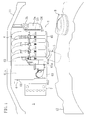
- FIG. 1 through FIG. 6 shows an engine according to the first embodiment of the present invention.
- Reference numeral 1 denotes an engine compartment located in the front part of a vehicle
- 2 denotes a four-cylinder in line engine mounted transversely in the engine compartment
- 11 denotes a shroud upper that defines the front end of the engine compartment
- 12 denotes a cowl upper panel arranged on the upper face of a dash panel (not shown) that defines the rear end of the engine compartment
- 13 denotes a bonnet that slants so as to reduce its height as it goes forward of the vehicle and defines the upper face of the engine compartment
- 14 denotes a radiator arranged in a part on the vehicle front side of the engine 2.
- 7 and 8 are a battery and a vacuum toggle for break, respectively.
- the engine compartment 1 is small especially in the longitudinal direction of the vehicle and the engine 2 is mounted transversely and substantially perpendicular in the engine compartment 1.
- An air cleaner unit 6 is provided on the rear side of the engine 2 (left side in vehicle transverse direction).
- the battery 7 is provided on the vehicle left side of the engine 2 and the vacuum toggle 8 is provided on the vehicle right side at the vehicle rear side of the engine 2. In this way, a space in the small engine compartment 1 is efficiently utilized with the engine 2 located in the main. Further, the battery 7 and the vacuum toggle 8, which are comparatively large in volume among the functional engine elements, are provided on the left and right sides in the transverse direction of the engine compartment 1, respectively, thereby balancing the layout in the engine compartment 1.
- the engine 2 is a four-cylinder in line engine in which four cylinders (not shown) are arranged in series in the longitudinal direction of the engine 2.
- two cam sprockets formed at the front end of a camshaft (not shown) provided in a cylinder head 22 and a crank sprocket formed at the engine front end of the crankshaft are provided and a timing chain 23 is wound around the cam sprockets and the crank sprocket.
- a chain room 24 is formed for accommodating each sprocket and the timing chain 23.
- a transmission 25 (shown only in FIG. 4 and FIG. 6 ) is provided behind the engine 2 (left side in FIG. 1 ) .
- Intake ports that communicate separately with the cylinders are formed in the left side face of the engine 2 (upper side in FIG. 1 ), and exhaust ports that communicate separately with the cylinders are formed in the right side face of the engine 2 (lower side in FIG. 1 ) . In this way, the engine 2 intakes air at the front portion and exhausts air at the rear portion.
- the cylinder head 22 is provided above a cylinder block 21 and the upper part of the cylinder head 22 is covered with a cylinder head cover 3.
- the front end portion 3a of the cylinder head cover 3 is extended frontward of the engine 2 farther than the front end of the cylinder head 22 to define the upper face of the chain room 24.
- An engine oil filler port 3b for injecting engine oil is formed in the front end portion 3a of the cylinder head cover 3.
- Spark plug units 31 stand in the central portion of the cylinders, respectively, so as to project upward from the cylinder head cover 3.
- the spark plug units 31 are arranged in a line with regular intervals left in the longitudinal direction of the engine 2 when viewing the engine 2 in a plane and are aligned with the intake ports and the exhaust ports in the widthwise direction of the engine 2.
- the spark plug units 31 are a first spark plug unit 31a, a second spark plug unit 31b, a third spark plug unit 31c and a fourth spark plug unit 31d in this order from the front side of the engine 2.
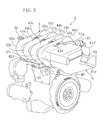
- An intake manifold 4 for sending intake air to the cylinders through the intake ports covers the upper portion of the engine 2, as shown in FIG. 3.
- the intake manifold 4 is composed of four independent intake branch pipes 41; an intake air collecting pipe 45 that communicates with the intake branch pipes 41; and an intake pipe length exchanging device 46 that optimizes intake air filling efficiency by exchanging the intake pipe length according to the number of rotation of the engine 2.
- the intake manifold 4 is mounted on the intake side of the engine 2 via an EGR distribution unit 49.
- an exhaust manifold 5 for discharging burnt gas in the cylinders through the exhaust ports is provided in the right side face of the engine 2.
- the exhaust manifold 5 is composed of exhaust branch pipes respectively communicating with the exhaust ports and an exhaust air collecting pipe into which the exhaust branch pipes are gathered. Part of exhaust gas is sent to the EGR distribution unit 49 through an EGR hose 51 to be re-circulated.
- Each intake branch pipe 41 includes a downstream curved portion 42 (curved portion) which is located farther frontward of the vehicle than the engine 2 and communicates with the corresponding intake port, an extended portion 43 which is located above the cylinder head cover 3 and continues to the downstream curved portion 42, and an upstream curved portion 44 which is located on the vehicle rear side and continues to the extended portion 43.
- An intake air collecting pipe 45 is arranged on the vehicle rear side of the engine 2 and communicates with the end portion of each upstream curved portion 44.
- the reference numerals 41a, 41b, 41c, 41d are assigned to a first intake branch pipe, a second intake branch pipe, a third intake branch pipe and a fourth intake branch pipe in this order from the engine front side, respectively, and the same references a to d are added to the reference numerals of the corresponding upstream curved portion 42, extended portion 43 and upstream curved portion 44 in the same manner, respectively.
- each extended portion 43 is a substantially straight pipe extending in the longitudinal direction of the vehicle and is offset frontward of the engine 2 against the corresponding spark plug unit 31 that stands upright at the corresponding cylinder.
- the first extended portion 43a is located between the first foremost spark plug unit 31a in the direction of the cylinder line of the engine 2 and the engine oil filler port 3b
- the second to fourth extended portion 43b to 43d are located between two corresponding adjacent spark plug units 31a to 31d.
- each extended portion 43 increases its height as it goes rearward of the vehicle along the bonnet 13 that slants forward, and is overlapped at a part thereof with the spark plug units 31 when viewing the engine 2 from the rear side.
- the downstream curved portions 42 extend frontward of the vehicle and upward from the intake ports, respectively, and curve rearward of the vehicle to communicate with the extended portions 43, respectively.
- the downstream curved portions 42 are inclined frontward of the engine 2 so that the upper portions of the downstream curved portions 42 are located farther frontward of the engine 2 than the lower portions thereof when viewing the engine 2 from the front side.
- the intake ports and the extended portions 43 which are offset in the longitudinal direction of the engine 2, communicate with one another.
- the upstream curved portions 44 continue to the extended portions 43 and curve downward, respectively, to communicate with the intake air collecting pipe 45.
- the intake air collecting pipe 45 is arranged above the engine 2 on the vehicle rear side thereof and under the intake branch pipes 41 so as to extend from the position of the first upstream curved portion 44a to the position of the fourth upstream curved portion 44d in the direction of the cylinder line.
- Each upstream cured portion 44 is connected at the end thereof to the upper surface portion of the intake air collecting pipe 45, and a manifold side fresh air pipe 45a is extended at the rear side end of the engine 2 rearward of the engine 2 substantially horizontally.
- a space is formed between a part on the vehicle rear side of the intake branch pipes 41, which increase their height on the vehicle rear side, and the cylinder head cover 3, and an intake pipe length exchanging device 46 is arranged in the space under the intake branch pipes 41 and above the cylinder head cover 3.
- the intake pipe length exchanging device 46 is composed of: an expansion room 46a extended in the direction of the cylinder line between the intake air collecting pipe 45 and the spark plug unites 31so as to intersect the extended portions 43 when viewing in a plane; an opening portion 46b formed at the substantial center in the longitudinal direction of each extended portion 43; a short pipe potion 46c extended from each opening portion 46b and passes under the corresponding extended portion 43 to communicate with the expansion room 46a from the vehicle front side; and a switch valve 46d provided in each short pipe portion 46c.
- the expansion room 46a is arranged beside the intake air collecting pipe 45 when viewing the engine 2 from the rear side, and the vehicle rear end of the expansion room 46a extends in the direction of the cylinder line to communicate with the intake air collecting pipe 45. In this way, the intake air collecting pipe 45 and the extended portions 43 also communicate with one another through the short pipe portions 46c, respectively.
- the switch valves 46d are opened and closed according to the number of rotation of the engine 2 to exchange the intake passage between a low-speed intake passage having a long passage length, which sends intake air from the intake air collecting pipe 45 to each intake port through each upstream curved portion 44, each extended portion 43 and each downstream curved portion 42, and a high-speed intake passage having a short passage length, which sends intake air from the intake air collecting pipe 45 to each intake port through the expansion room 46a, each short pipe portion 46c, the downstream portion of each extended portion 43 and each downstream curved portion 42.
- each switch valve 46d are located farther frontward of the vehicle than the spark plug units 31 and each valve axis 46e thereof extends in the direction of the cylinder line of the engine 2.
- a single shaft (not shown) for driving each switch valve 46d can be arranged in the direction of the cylinder line so as to avoid interference with each spark plug unit 31.
- the arrangement of each switch valve 46d farther frontward of the vehicle than each spark plug unit 31 necessarily leads to arrangement of each opening portion 46b farther frontward of the vehicle than each spark plug unit 31.
- the air cleaner unit 6 includes an air cleaner case 61 and two independently formed resonance chambers 62, 63, as shown in FIG. 1, Fig. 3 and FIG. 6, which are disposed integrally above the transmission 25.
- the air cleaner case 61 includes, as shown in FIG. 2, an upper dusty side room 61a and a lower clean side room 61b.
- the dusty side room 61a and the clean side room 61b are divided by an inclined air cleaner element 61c.
- the clean side room 61b includes a fresh air sucking port 61e on the vehicle rear side.
- the air cleaner element 61c is inclined so as to increase its height as it goes rearward of the vehicle.
- the area of the air cleaner element 61c in the air cleaner case 61 can be increased compared with the case where the air cleaner element 61c is arranged vertically or horizontally in the air cleaner case 61.
- the clean side room 61b is expanded in the vertical direction as it goes rearward of the vehicle, whereby a sufficient space for arranging the fresh air sucking port 61e can be ensured on the vehicle rear side portion of the clean side room 61b.
- the lower portion of the air cleaner case 61 overlaps with the cylinder head cover 3 and the cylinder head 22 when viewing the engine 2 from the rear side, so as to arrange the air cleaner unit 6 low as far as possible.
- the fresh air sucking port 61e is extended rearward of the vehicle and upward from the vehicle rear side of the clean side room 61b, and is connected to the upstream end of an air cleaner side fresh air pipe 61f.
- the downstream end of the air cleaner side fresh air pipe 61f curves toward the intake air collecting pipe 45 and is connected to the upstream side of a throttle valve unit 61g.
- the downstream side of the throttle valve unit 61g is connected to a manifold side fresh air pipe 45a.
- the manifold side fresh air pipe 45a is extended substantially horizontally from the intake air collecting pipe 45 so that the air cleaner side fresh air pipe 61f and the throttle valve unit 61g have substantially the same height as that of the intake manifold 4, thereby not projecting upward, as shown in FIG. 4. Therefore, no increase in the overall height of the engine is necessary.
- the resonance chamber 62 is arranged adjacent to the dusty side room 61a on the engine front side as shown in FIG. 1, and a part thereof is arranged so as to overlap with the cylinder head cover 3 when viewing the engine 2 in a plane in a space above the cylinder head cover 3, which is created by offsetting the fourth intake branch pipe 41d frontward of the engine 2.
- the other resonance chamber 63 is located adjacent to the clean side room 61b on the vehicle rear side and below the air cleaner side fresh air pipe 61f, as shown in FIG. 1, FIG. 2 and FIG. 3.
- Fresh air introduced in the dusty side room 61a is cleaned by the air cleaner element 61c and is introduced into the clean side room 61b. Then, after being sucked from the fresh air sucking port 61e on the vehicle rear side of the clean side room 61b, the fresh air is sent from the air cleaner side fresh air pipe 61f to the intake air collecting pipe 45 of the intake manifold 4 through the throttle valve unit 61g and the manifold side fresh air pipe 45a.
- the two resonance chambers 62, 63 restrict resonance vibration caused due to difference between two frequencies.
- the extended portions 43 of the intake manifold 4 are located above the engine 2 as shown in FIG. 3 and FIG. 5, so that only the downstream curved portions 42 project frontward of the vehicle from the left side of the engine 2, thereby reducing the width of the engine 2, that is, the dimension of the engine 2 in the longitudinal direction of the vehicle.
- FIG. 5 and FIG. 6 though the extended portions 43 are arranged above the cylinder head cover 3, the overall height of the engine 2 is reduced to the most because the extended portions 43 are respectively offset frontward of the engine against the spark plug units 31 projecting upward over the cylinder head cover 3 and respectively overlap with the spark plug units 31 when viewing the engine form the rear side.
- each extended portion 43 frontward of the engine is realized by inclining the upper portion of each downstream curved portion 42 frontward of the engine 2 when viewing the side of the engine 2 from the vehicle front side.
- the radius of curvature of each downstream curved portion 42 is increased even when difference in the height between the intake ports and the extended portions 43 is reduced by reducing the height of the extended portions 43, with a result that the intake air resistance in the intake manifold 4 is lowered and the intake air filling efficiency in each cylinder is increased.
- the extended portions 43 are respectively offset against the spark plug units 31 frontward of the engine 2, instead of rearward thereof, to ensure a space above the cylinder head cover 3 and farther rearward of the engine 2 than the fourth extended portion 43d.
- the formation of the engine oil filler port 3b in the front end portion 3a of the cylinder head cover 3 ensures the space in front of the foremost first spark plug unit 31a in the direction of the cylinder line of the engine 2 , thereby avoiding interference between the first extended potion 43a and the engine oil filler port 3b.
- the air cleaner unit 6 can be arranged above the transmission 25 by utilizing the space above the cylinder head cover 3 and farther rearward of the engine 2 than the rearmost spark plug unit 31d in the direction of the cylinder line of the engine 2, which is created by offsetting the extended portions 43 frontward of the engine 2.
- Each intake branch pipe 41 is arranged so as to increase its height as it goes rearward of the vehicle along the bonnet 13 that slants forward, so that the crushable zone is ensured between the intake branch pipes 41 and the bonnet 13 over the longitudinal direction of the intake branch pipes 41.
- the intake pipe length exchanging device 64 can be disposed compactly in a space defined by the intake branch pipes 41, the cylinder head cover 3 and the intake air collecting pipe 45, which is substantially triangular when viewing the vehicle from the side.
- the expansion room 46a and the intake air collecting pipe 45 are located below the intake branch pipes 41 with no vertical overlap and they are arranged side by side in the longitudinal direction of the vehicle, thereby reducing the overall height of the intake manifold 4.
- the expansion room 46a and the intake air collecting pipe 45 are hidden by the intake branch pipes 41 when viewing the engine 2 in a plane, with a result that the appearance of the upper portion of the engine 2 is improved even in the case with no engine cover provided.
- Each intake branch pipe 41 is extended long in the form of the downstream curved portion 42, the extended portion 43 and the upstream curved portion 44 from the vehicle front side to the vehicle rear side of the engine 2, resulting in increase in the low-speed torque of the engine 2.
- the engine 2 can be mounted compactly in the longitudinal direction of the vehicle in the small engine compartment 1 even with the radiator 14 provided on the vehicle front side of the engine 2 and with the crushable zone ensured.
- the engine 2 can be mounted compactly also in the vertical direction of the vehicle in the small engine compartment 1 even with the crushable zone ensured between the bonnet 13 and the engine 2.
- the functional engine elements can be arranged by efficiently utilizing the space in the small engine compartment 1.
- the intake manifold 4 having the intake pipe length exchanging device 46 is compactly arranged in the space expanding vertically as it goes rearward of the vehicle, which is formed between the vertically arranged engine 2 and the bonnet 13 thereabove.
- the intake manifold 4 having the low-speed intake passage and the high-speed intake passage is employed in the first embodiment, but is not limited thereto.
- An air cleaner unit having a construction different from that in the first embodiment may be employed.
- the second embodiment will be described below in which the intake manifold and the air cleaner unit have constructions different from those in the first embodiment. Wherein, the same reference numerals are assigned to members having the same constitutions in the following description and the description thereof is omitted.
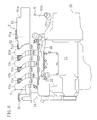
- An intake manifold 9 is composed of: four independent intake branch pipes 91; an intake air collecting pipe 95 which communicates with the intake branch pipes 91 and into which the intake branch pipes 91 are gathered; and an intake pipe length exchanging device 96 that optimizes the intake air filling efficiency by exchanging the pipe length according to the number of rotation of the engine 2, as shown in FIG. 7 to FIG. 10.
- Each intake branch pipe 91 is composed of a downstream curved portion 92 located farther frontward of the vehicle than the engine 2 and continuing to the corresponding intake port; an extended portion 93 located above the cylinder head cover 3 and continuing to the downstream curved portion 92; and the upstream curved portion 94 located on the vehicle rear side and continuing to the extended portion 93.
- the reference numerals 91a, 91b, 91c, 91d are assigned to a first intake branch pipe, a second intake branch pipe, a third intake branch pipe and a fourth intake branch pipe in this order from the engine front side, respectively, and the same references a to d are added to the reference numerals of the corresponding upstream curved portion 92, the extended portion 93 and the upstream curved portion 94 in the same manner, respectively.
- An intake air collecting pipe 95 is arranged at a part corresponding to the substantial center between the first intake branch pipe 91a and the fourth intake branch pipe 91d in the direction of the cylinder line on the vehicle rear side of the engine 2. The end portion of each upstream curved portion 94 communicates with the intake air collecting pipe 95.
- Each downstream curved portion 92 has the same construction as in the first embodiment and is curved at a part farther frontward of the vehicle than the engine 2 and is inclined frontward of the engine 2.
- the extended portions 93 are respectively offset frontward of the engine 2 against the spark plug units 31 standing upright at the corresponding cylinders, as shown in FIG. 7, so that each part thereof overlaps with the spark plug units 31 when viewing the engine 2 from the rear side (see FIG. 10).
- the first extended portion 93a is located between the foremost first spark plug unit 31a in the direction of the cylinder line of the engine 2 and the engine oil filler port 3b.
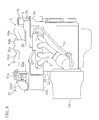
- the upstream curved portions 94 are curved and gathered toward the central part of the cylinder line of the engine 2 at a part farther rearward of the vehicle than the spark plug units 31 and are curved further downward on the vehicle rear side of the engine 2, as shown in FIG. 9 and FIG. 10.
- the intake air collecting pipe 95 is located below the second upstream curved portion 94b and the third upstream curved portion 94c at a part corresponding to the second upstream curved portion 94b and the third upstream curved portion 94c on the vehicle rear side of the engine 2, as shown in FIG. 7 and FIG. 8.
- the second upstream curved portion 94b and the third upstream curved portion 94c are connected to the upper portion of the intake air collecting pipe 95 from above, and the first upstream curved portion 94a and the fourth upstream curved portion 94d are connected to the upper portion of the intake air collecting pipe 95 from the right and left sides thereof, respectively, at respective parts farther frontward of the vehicle than the second upstream curved portion 94b and the third upstream curved portion 94c.
- the air intake system can be compacted, the lengths of the intake branch pipes 91 can be prolonged and equalized, the low-speed torque of the engine 2 is improved, and the respective filing efficiencies of the intake air from the respective intake branches pipes 91 to the respective cylinders can be uniformed.
- a manifold side fresh air pipe 95a is extended at the engine rear side of the intake air collecting pipe 95 substantially horizontally rearward of the engine 2 as shown in FIG. 8.
- the manifold side fresh air pipe 95a is connected to the throttle valve unit 61g.
- Each intake branch pipe 91 increases its height as it goes rearward of the vehicle along the bonnet 13 that slants forward, as shown in FIG. 9 and FIG. 10, and an intake pipe length exchanging device 96 is arranged in a space formed between a part on the vehicle rear side of the intake branch pipes 91 and the cylinder head cover 3.
- the intake pipe length exchanging device 96 is composed of: an expansion room 96a extended in the direction of the cylinder line between the intake air collecting pipe 95 and the spark plug units 31 so as to intersect the extended portions 93 when viewing the engine in a plane; an opening portion 96b formed at the substantial center in the longitudinal direction of each extended portion 93; a short pipe portion 96c extending from each opening portion 96b and passes under the corresponding extended portion 93 to communicate with the expansion room 96a from the vehicle front side; and a switch valve 96d provided in each short pipe portion 96c.
- the expansion room 96a does not communicate with the intake air collecting pipe 95, different from the expansion room 46a in the first embodiment, and only communicates with each short pipe portion 96c. Therefore, the expansion room 96a serves as a communication pipe for communicating the respective extended portions 93 with on another at the vicinities of the respective opening portions 96b.
- the switch valves 96d are opened and closed according to the number of rotation of the engine 2. Specifically, the switch valves 96d are closed when the number of rotation of the engine 2 is in a low speed range while being opened when the number of rotation thereof is in a high speed range so as to exchange the pressure inversion part where the basic pressure wave of the intake air is inverted, thereby optimizing the intake air filling efficiency.
- the switch valves 96d are located farther frontward of the vehicle than the spark plug units 31 and each valve axis 96e thereof extends in the direction of the cylinder line of the engine 2.
- a single shaft (not shown) for driving each switch valve 96d can be arranged in the direction of the cylinder line so as to avoid interference with each spark plug unit 31.
- the arrangement of each switch valve 96d farther frontward of the vehicle than each spark plug unit 31 necessarily leads to arrangement of each opening portion 96b farther frontward of the vehicle than each spark plug unit 31.
- the expansion room 96a and the intake air collecting pipe 95 are hidden by the intake branch pipes 91 when viewing the engine 2 in a plane, and therefore, the appearance of the upper portion of the engine 2 is improved even in the case with no engine cover provided.
- Each intake branch pipe 91 is extended long in the form of the downstream curved portion 92, the extended portion 93 and the upstream curved portion 94 from the vehicle front side to the vehicle rear side of the engine 2, resulting in increase in the low-speed torque of the engine 2.
- the air cleaner unit 10 includes an air cleaner case 101 and two independently formed resonance chambers 102, 103, as shown in FIG. 7 and FIG. 10, which are disposed integrally above the transmission 25 (not shown in the drawings).
- the air cleaner case 101 includes, as shown in FIG. 11, a lower dusty side room 101a and an upper clean side room 101b.
- the dusty side room 101a and the clean side room 101b are divided by an inclined air cleaner element 101c.
- the clean side room 101b includes a fresh air sucking port 101e on the vehicle rear side.
- the air cleaner element 101c is inclined so as to reduce its height as it goes rearward of the vehicle.
- the area of the air cleaner element 101c in the air cleaner case 101 can be increased, and the clean side room 101b is increased in its height as it goes rearward of the vehicle, whereby a sufficient space for arranging the fresh air sucking port 101e can be ensured in the vehicle rear side portion of the clean side room 101b.
- the fresh air sucking port 101e is extended from the vehicle rear side of the clean side room 101b rearward of the vehicle.
- the upstream end of an air cleaner side fresh pipe 101f is connected to the fresh air sucking port 101e, while the downstream end thereof is curved toward the intake air collecting pipe 95 and is connected to the upstream end of the throttle valve unit 61g.
- the downstream end of the throttle valve unit 61g is connected to a manifold side fresh air pipe 95a.
- the manifold side fresh air pipe 95a, the air cleaner side fresh air pipe 101f and the throttle valve unit 61g have substantially the same height as that of the intake manifold 9 so as not to project upward, as shown in FIG. 8 and FIG. 11. Therefore, no increase in the overall height of the engine 2 is necessary.
- the resonance chamber 102 is arranged adjacent to the air cleaner case 101 on the engine front side and a part thereof overlaps with the cylinder head cover 3 when viewing the engine 2 in a plane in a space above the cylinder head cover 3, which is created by offsetting the fourth intake branch pipe 91d frontward of the engine 2.
- the other resonance chamber 103 is located adjacent to the clean side room 101b on the vehicle rear side and below the air cleaner side fresh air pipe 101f. The two resonance chambers 102, 103 restrict resonance vibration caused due to difference between two frequencies.
- Fresh air introduced in the dusty side room 101a is cleaned by the air cleaner element 101c and is introduced into the clean side room 101b. Then, after being sucked from the fresh air sucking port 101e, the fresh air is sent from the air cleaner side fresh air pipe 101f to the intake air collecting pipe 95 of the intake manifold 9 through the throttle valve unit 61g and the manifold side fresh air pipe 95a.
- the intake manifold 9 and the air cleaner unit 10 are arranged in the small engine compartment 1, the engine 2 can be compactly mounted, the crushable zone can be ensured on the vehicle front side and above of the engine 2, and the intake pipe length exchanging device 96 can be arranged efficiently as in the first embodiment.
Landscapes
- Engineering & Computer Science (AREA)
- Chemical & Material Sciences (AREA)
- Combustion & Propulsion (AREA)
- Mechanical Engineering (AREA)
- General Engineering & Computer Science (AREA)
- Physics & Mathematics (AREA)
- Geometry (AREA)
- Characterised By The Charging Evacuation (AREA)
- Cylinder Crankcases Of Internal Combustion Engines (AREA)
Abstract
In an air intake system for a multi-cylinder in line engine (2)
mounted transversely in an engine compartment (1), intake branch pipes of
an intake manifold (4,9) extended rearward of the vehicle over the
cylinder head cover (3) from intake ports formed in the vehicle front
side face of the engine are respectively offset frontward of the engine
against spark plug units (31) projecting upward from the cylinder head
cover (3), and at least a part of each intake branch pipe (41,91)
overlaps vertically when viewing the engine form the rear side. An air
cleaner unit (6,10) is arranged above a transmission (2) on the rear side
of the engine (2).
Description
The present invention relates to an air intake system for an engine.
In recent years, weight reduction and downsizing of vehicles are promoted for
improving fuel consumption. In association, an engine compartment is decreased in
volume, with a result that an engine and functional engine elements are difficult to be
arranged in such a small engine compartment.
In an engine mounted transversely in an engine compartment, for example, an
intake manifold is usually arranged on the vehicle front side of the engine. In this engine,
the substantially entire part of the intake manifold projects from the engine body toward
the vehicle front side and the engine itself is inclined rearward of the vehicle for ensuring a
crushable zone in the small engine compartment. In such layout, however, a space that the
engine occupies shall be large in the longitudinal and vertical directions of the vehicle,
while ensuring the crushable zone.
For improving the above deficiency, an engine of front-intake/rear-exhaust type
disposed transversely in an engine compartment is proposed in which each intake branch
pipe of an intake manifold is extended from corresponding intake ports in the side face on
the vehicle front side rearward of the vehicle over a cylinder head cover, as disclosed in
U.S. Pat. No. 5,005,534. In such a construction, projection by the engine frontward of the
vehicle is restricted and the space that the engine occupies in the engine compartment is
reduced in the longitudinal direction of the vehicle, compared with a conventional
construction in which an intake manifold is arranged on the vehicle front side of the engine.
However, the overall height of the engine is increased by the height of the intake branch
pipes protruding above the cylinder head cover because the crushable zone, which is
required between the engine and a hood thereabove, as well as in front of the engine, must
be ensured sufficiently.
Therefore, in the engine disclosed in U.S. Pat. No. 5,005,534, the intake branch
pipes are offset rearward of the engine against spark plug units over the engine,
respectively. Such a construction enables to overlap the intake branch pipes with the spark
plug units when viewing the engine from the rear side, respectively, resulting in the
reduction of the overall height of the engine.
It is required to arrange various kinds of functional engine elements efficiently in a
small space of an engine compartment. If a space from a part above the transmission,
which is disposed under one side of the rear portion of the engine, to a part above the rear
portion of the cylinder head cover is increased, functional engine elements such as an air
cleaner unit and the like can be arranged efficiently. However, in the engine disclosed in
U.S. Pat. No. 5,005,534, the intake branch pipes are offset rearward of the engine against
the spark plug units, respectively, so that the intake branch pipes occupy the space above
the rear portion of the cylinder head cover located, resulting in reduction in the space.
The present invention has been made in view of the above problems and has its
object of arranging an intake manifold and an air cleaner unit compactly while restricting
the overall width and overall height of an engine including the intake manifold by
restricting projection by the intake manifold frontward of the vehicle and upward of the
engine.
The first invention directs to an air intake system an air intake system for a
multi-cylinder in line engine mounted transversely in an engine compartment so that intake
ports and exhaust ports are formed in a vehicle front side face and a vehicle rear side face,
respectively.
The air intake system includes: an intake manifold including a plurality of intake
branch pipes which are extended rearward of a vehicle from the intake ports over a
cylinder head cover of the engine, respectively, and an intake air collecting pipe which
communicates with the intake branch pipes on a vehicle rear side of the engine and into
which the intake branch pipes are gathered; and an air cleaner unit which is provided above
a transmission on a rear side on the engine.
Further, the intake branch pipes are respectively offset frontward of the engine
against the spark plug units respectively standing upright at central portions of the
corresponding cylinders and projecting upward from an upper face of the cylinder head
cover when viewing the engine in a plane, and at least each part of the intake branch pipes
overlaps vertically with the spark plug unit when viewing the engine from the rear side.
In the above construction, the engine is mounted transversely in the engine
compartment and the intake ports for introducing intake air is arranged in the side face of
the engine on the vehicle front side. The intake branch pipes of the intake manifold
communicating with the intake ports are extended rearward of the vehicle from the intake
ports, respectively, over the cylinder head cover of the engine.
In this connection, projection by the intake manifold frontward of the engine is
restricted and the overall width of the engine is reduced, compared with a construction in
which the intake manifold as a substantial whole including the intake branch pipes and the
intake air collecting pipe is arranged in front of the engine where the intake ports open.
Further, each spark plug unit standing in the middle of the corresponding cylinder
of the engine protrudes from the upper face of the cylinder head cover, wherein the intake
branch pipes are respectively offset against the spark plug units frontward of the engine
when viewing the engine in a plane and at least parts thereof overlaps with one another
vertically when viewing the engine from the rear side.
In this connection, the intake branch pipes can be avoided from interfering with the
spark plug units and the overall height of the engine is reduced by the vertical overlap
between the intake branch pipes and the spark plug units.
Furthermore, the offset of the intake branch pipes against the spark plug units
frontward of the engine creates a space at least a part on the rear side of a rearmost spark
plug unit in the direction of the cylinder line of the engine and above the cylinder head
cover. The air cleaner unit can be arranged above the transmission on the rear side of the
engine by utilizing the thus created space. Thus, a space for arranging the air cleaner unit
can be ensured in the small engine compartment.
As described above, according to the present invention, in the air intake system for
the multi-cylinder in line engine mounted transversely in the engine compartment so that
the intake ports are arranged in the side face at front of the vehicle, the intake branch pipes
are extended from the intake ports rearward of the vehicle over the cylinder head cover,
respectively. As a result, the intake manifold including the intake air collecting pipe is
projected not substantially entirely from the engine toward the vehicle front side and the
overall width of the engine including the air intake system is reduced.
Moreover, the intake branch pipes are offset frontward of the engine over the
cylinder head cover for avoiding interference with the spark plug units projecting from the
cylinder head cover, and are overlapped vertically at at least each part thereof with the
spark plug units when viewing from the engine rear side, thereby reducing the overall
height of the engine including the air intake system.
In addition, the offset of the intake branch pipes frontward of the engine ensures a
space for arranging the air cleaner unit in the space from a part above the transmission on
the engine rear side to the rearmost intake branch pipe in the direction of the cylinder line
of the engine, resulting in efficient space utilization in the small engine compartment.
The second invention provides an air intake system according to the first invention,
wherein each intake branch pipe includes a curved portion which is extended frontward of
the vehicle and upward from the corresponding intake port and is curved rearward of the
vehicle, and an extended portion which continues to the curved portion and is extended
substantially linearly and rearward of the vehicle over the cylinder head cover, and the
curved portion is inclined frontward of the engine.
In the above construction, each extended portion of the intake branch pipes is
offset against the corresponding intake ports frontward of the engine by the offset thereof
against the spark plug units frontward of the engine over the cylinder head cover, and each
curved portion is inclined frontward of the engine so that the intake ports and the extended
portions communicate with one another through the curved portions, respectively. Each
intake branch pipe is extended from the corresponding intake port in the side face of the
engine on the vehicle front side to the vehicle rear side of the engine over the cylinder head
cover.
Further, the inclination of each curved portion increases the radius of curvature of
each curved portion, resulting in reduction of intake resistance in the intake manifold and
increase in filling efficiency of intake air to each cylinder.
The third invention provides an air intake system according to the first or second
invention, wherein the air cleaner unit includes: an air cleaner case in which a dusty side
room and a clean side room are divided transversely by an air cleaner element, a fresh air
sucking port being formed in a vehicle rear side portion of the clean side room; a fresh air
pipe which communicates at one end thereof with the fresh air sucking port and at the other
end thereof with the intake air collecting pipe; and a throttle valve unit which is provided
in the middle of the fresh air pipe.
Further, the air cleaner element is inclined so that the clean side room expands
vertically as it goes rearward of the vehicle, and the fresh air pipe and the throttle valve
unit have a same height as that of the intake manifold or are located lower than the intake
manifold.
In the above construction, the inclination of the air cleaner element in the air
cleaner case increases the area of the air cleaner element, compared with the case where
the air cleaner element is arranged perpendicular or horizontal to the air cleaner case.
Further, the air cleaner element is inclined so as to expand the clean side room as it
goes rearward of the vehicle rear side, thereby ensuring a sufficient space for forming the
fresh air sucking port on the vehicle rear side of the clean side room.
In detail, the overall height of the air cleaner case must be increased for ensuring a
sufficient area of the air cleaner element in the case where the air cleaner element is
arranged perpendicularly, and the overall height of the air cleaner case must be also
increased for ensuring a sufficient space for forming a fresh air sucking port on the vehicle
rear side of the air cleaner case in the case where it is arranged horizontally. While, the air
cleaner element is inclined so as to expand the clean side room as it goes rearward of the
vehicle rear side in the above air intake system, with a result that the area of the air cleaner
element is increased and a sufficient space is ensured for forming the fresh air sucking port
on the vehicle rear side of the clean side room.
Moreover, the fresh air sucking port communicates with the intake air collecting
pipe through the fresh air pipe having the throttle valve unit. In detail, fresh air introduced
to the air cleaner unit flows into the clean side room from the dusty side room through the
air cleaner element, flows into the fresh air pipe through the fresh air sucking port to be
adjusted in the air amount thereof by the throttle valve unit, and then, is sent into the intake
air collecting pipe.
Furthermore, the fresh air pipe and the throttle valve unit do not project further
than the intake manifold from the upper portion of the engine, thereby reducing the overall
height of the engine including the air intake system such as the air cleaner unit and the like.
The fourth invention provides an air intake system according to any one of first to
third invention, wherein the air cleaner unit further includes a resonance chamber which is
integrally arranged with the air cleaner case at a part where at least a part of the resonance
chamber overlaps with the cylinder head cover when viewing the engine in a plane
between a rearmost intake branch pipe in the direction of the cylinder line of the engine
and the air cleaner case.
Further, the air cleaner case is arranged above the transmission at a part where the
air cleaner case overlaps with the cylinder head cover and a cylinder head when viewing
the engine from the rear side.
In the above construction, the air cleaner unit including the air cleaner case and the
resonance chamber is arranged in the space from a part above the transmission on the
engine rear side to a part above the end portion on the engine rear side of the cylinder head
cover. In other words, the offset of the rearmost intake branch pipe in the direction of the
cylinder line of the engine frontward of the engine creates a space above the cylinder head
cover and enables to arrange at least a part of the resonance chamber in the thus created
space. Thus, the space in the small engine compartment is efficiently utilized.
Further, the air cleaner case is arranged at a part where it overlaps with the
cylinder head cover and the cylinder head when viewing the engine from the rear side for
reducing the height of the air cleaner case, thereby reducing the overall height of the
engine.
The fifth invention provides an air intake system according to any one of the first
to fourth inventions, wherein in the engine compartment, a vacuum toggle for break and a
battery are arranged on one side and on the other side in a widthwise direction of the
vehicle, respectively, and the engine is arranged between the vacuum toggle and the
battery in a widthwise direction of the vehicle in the engine compartment.
In the above construction, the vacuum toggle for break and the battery are arranged
on one side and on the other side in the vehicle transverse direction of the engine
compartment with the engine interposed, respectively, when viewing the engine
compartment in a plane. For this reason, when the power unit including the engine and the
transmission, which are heavy, is arranged in the middle in the vehicle transverse direction,
the functional engine elements including the vacuum toggle for break and the battery,
which occupy a comparatively large space, can be arranged in the engine compartment in
balance.
The sixth invention provides an air intake system according to any one of the first
to fifth inventions, wherein the engine is mounted substantially perpendicular.
In the above construction, the intake branch pipes of the intake manifold are
respectively extended from the intake ports rearward of the vehicle over the cylinder head
cover of the engine and are respectively offset against the spark plug units frontward of the
engine when viewing the engine in a plane, while overlapping at at least parts thereof in
the vertical direction when viewing the engine from the rear side, resulting in reduction of
the overall width and the overall height of the engine. The engine having the thus reduced
overall width and height necessitates no inclination of the engine rearward of the vehicle
for reducing, in the vehicle longitudinal direction, the space that the engine occupies. The
perpendicular arrangement, that is, upright mounting of the engine reduces the space that
the engine occupies in the engine compartment in the vehicle longitudinal direction, rather
than inclined arrangement of the engine rearward of the vehicle. No necessity of the
inclination of the engine rearward of the vehicle enables the substantially upright mounting
of the engine. As a result, the space that the engine occupies in the engine compartment is
reduced in the vehicle longitudinal direction and the crushable zone is ensured on the
vehicle front side of the engine.
The seventh invention provides an air intake system according to the first
invention, wherein the intake manifold further includes an intake pipe length exchanging
device for exchanging an intake pipe length, the intake pipe length exchanging device
includes: short pipes respectively communicating with the intake pipe branches; an
expansion room communicating with the respective intake branch pipes through the
respective short pipes; and switch valves for respectively communicating with and shutting
off between the expansion room and the intake branch pipes, a bonnet which slants
forward defines the engine compartment so as to reduce a height as it goes frontward of the
vehicle, the engine is mounted substantially perpendicular, each intake branch pipe is
inclined so as to increase a height thereof as it goes rearward of the vehicle along the
bonnet that slants forward over the cylinder head cover, and the expansion room is
arranged between a vehicle rear side end of the intake branch pipe and the cylinder head
cover. It is noted that the expansion room includes an expansion room disposed so that at
least a part thereof is located in a space between the end portions on the vehicle rear side of
the intake branch pipes and the cylinder head cover.
In the above construction, the intake branch pipes extended over the cylinder head
cover are inclined so as to increase their height on the vehicle rear side along the bonnet
that slants forward. As a result, the crushable zone is ensured between the intake branch
pipes and the bonnet.
Further, the inclination of the intake branch pipes so as to increase their height on
the vehicle rear side creates a space between the vehicle rear side portions of the intake
branch pipes and the cylinder head cover, and therefore, the intake pipe length exchanging
device can be arranged by utilizing the space under the intake branch pipes and above the
cylinder head cover. The intake pipe length exchanging device includes the expansion
room arranged in the space between the vehicle rear side portions of the intake branch
pipes and the cylinder head cover. Herein, the vehicle rear side of the engine means a
whole part on the vehicle rear side farther rearward than the center of the engine in the
vehicle longitudinal direction and includes the space on the vehicle rear side farther
rearward than the rear end in the vehicle longitudinal direction of the engine, as well as the
space on the vehicle rear side farther rearward than the center of the engine and above the
engine. The expansion room communicates with the intake branch pipes through the short
pipes. The switch valve provided in each short pipe switches the state between the
communicating state and the intercepted state between the expansion room and the
corresponding intake branch pipe. The intake pipe exchanging device may communicate,
for example, the expansion room with the intake air collecting pipe and opens and closes
the switch valves so as to exchange the passage between the high-speed intake passage
having a short pipe length and passing through the expansion room, each short pipe and
each intake branch pipe from the intake air collecting pipe and the low-speed intake
passage having a long pipe length and passing through every pipe of the intake branch
pipes from the intake air collecting pipe. Also, the expansion room may communicate only
with the short pipes of the intake branch pipes to function as a communication pipe for
communicating the intake branch pipes in the middle of the passage. With this construction,
it is possible to switch the apparent intake pipe length in a manner that the switch valves
are opened and closed to exchange the pressure inversion part where the basic pressure
wave of intake air is inverted.
Hence, according to the seventh invention, the inclination of the intake branch
pipes so as to increase their height on the vehicle rear side along the bonnet that slants
forward ensures the crushable zone between the intake branch pipes and the bonnet and
enables efficient arrangement of the intake pipe exchanging device under the vehicle rear
side portions of the intake branch pipes and above the cylinder head cover.
The eighth invention provides an air intake system according to the seventh
invention, wherein each intake branch pipe is curved downward at an upstream end thereof
to form an upstream curved portion that communicates with the intake air collecting pipe,
and the intake air collecting pipe and the expansion room are arranged side by side in a
longitudinal direction of the vehicle at a part farther frontward of the vehicle than the
upstream curved portion when viewing the engine from the rear side.
In the above construction, each intake branch pipe includes at the upstream end
thereof the curved portion that curves downward. The curved portion communicates with
the intake air collecting pipe located below the curved portion. Also, the expansion room
located under the vehicle rear side portion of the intake branch pipes is arranged beside the
intake air collecting pipe on the vehicle front side of the intake air collecting pipe.
As a result, the expansion room and the intake air collecting pipe are located side
by side under the vehicle rear side portions of the intake branch pipes in the vehicle
longitudinal direction, rather than in the vertical direction. As a result, the height of the
intake manifold is reduced. With this construction, also, each intake branch pipe can have a
longer length, to enhance the low-speed torque of the engine. Further, the intake branch
pipes hide the expansion room and the intake air collecting pipe when viewing the engine
in a plane, which enhance the appearance of the upper portion of the engine even with no
engine cover provided.
The ninth invention provides an air intake system according to the seventh or
eighth invention, wherein the expansion room is arranged farther rearward of the vehicle
than the spark plug units, while the switch valves being arranged farther frontward of the
vehicle than the spark plug units, and a valve axis of each switch valve is extended in a
direction of a cylinder line of the engine.
In the above construction, the expansion room can be arranged by efficiently
utilizing the space between the spark plug units and the intake air collecting pipe.
The valve axes of the switch valves which extend in the direction of the cylinder
line is set farther frontward of the vehicle than the spark plug units. Therefore, a single
shaft connecting with each switch valve of the intake branch pipes as a drive shaft for
driving each switch valve can be provided so as to avoid interference with the spark plug
units.
Further, the switch valves are provided farther frontward of the vehicle than the
spark plug units, so that each communication portion between the corresponding short pipe
and the corresponding intake branch pipe where the switch valves are provided is located
farther frontward than the corresponding spark plug unit, resulting in increase in difference
in intake pipe length which is caused by switching the switch valves. Hence, the intake air
filing rate to the widely ranging number of rotation of the engine can be set optimally.
The tenth invention provides an air intake system according to any one of the first
to ninth inventions, wherein the engine includes: a timing chain for driving and connecting
a camshaft and a crankshaft which are provided in the cylinder head; and a chain room
defining a front portion of the engine and accommodating the timing chain.
Further, a front end portion of the cylinder head cover covers an upper portion of
the chain room so as to form an upper face of the chain room, and an engine oil filler port
is formed in the front end portion of the cylinder head cover.
In the above construction, the camshaft is driven by the crankshaft through the
timing chain, which is accommodated in the chain room defining at the front of the engine.
The upper face of the chain room is defined by the front end portion of the cylinder head
cover, and the engine oil filler port is formed in the front end portion of the cylinder head
cover that covers the upper portion of the chain room thereover. In this connection, the
engine oil filler port is apart from the foremost spark plug unit in the direction of the
cylinder line of the engine in the engine longitudinal direction, thereby ensuring a space for
offsetting the intake branch pipes in a part farther frontward of the engine than the
foremost spark plug unit.
The embodiments of the present invention will be described below in detail with
reference to the accompanying drawings.
FIG. 1 through FIG. 6 shows an engine according to the first embodiment of the
present invention. Reference numeral 1 denotes an engine compartment located in the front
part of a vehicle, 2 denotes a four-cylinder in line engine mounted transversely in the
engine compartment 1, 11 denotes a shroud upper that defines the front end of the engine
compartment 1, 12 denotes a cowl upper panel arranged on the upper face of a dash panel
(not shown) that defines the rear end of the engine compartment 1, 13 denotes a bonnet
that slants so as to reduce its height as it goes forward of the vehicle and defines the upper
face of the engine compartment 1, and 14 denotes a radiator arranged in a part on the
vehicle front side of the engine 2. 7 and 8 are a battery and a vacuum toggle for break,
respectively.
As shown in FIG. 1 and FIG. 2, the engine compartment 1 is small especially in
the longitudinal direction of the vehicle and the engine 2 is mounted transversely and
substantially perpendicular in the engine compartment 1. An air cleaner unit 6 is provided
on the rear side of the engine 2 (left side in vehicle transverse direction). The battery 7 is
provided on the vehicle left side of the engine 2 and the vacuum toggle 8 is provided on the
vehicle right side at the vehicle rear side of the engine 2. In this way, a space in the small
engine compartment 1 is efficiently utilized with the engine 2 located in the main. Further,
the battery 7 and the vacuum toggle 8, which are comparatively large in volume among the
functional engine elements, are provided on the left and right sides in the transverse
direction of the engine compartment 1, respectively, thereby balancing the layout in the
engine compartment 1.
The engine 2 is a four-cylinder in line engine in which four cylinders (not shown)
are arranged in series in the longitudinal direction of the engine 2. In front of the engine 2
(right side in FIG. 1), two cam sprockets formed at the front end of a camshaft (not shown)
provided in a cylinder head 22 and a crank sprocket formed at the engine front end of the
crankshaft are provided and a timing chain 23 is wound around the cam sprockets and the
crank sprocket. A chain room 24 is formed for accommodating each sprocket and the
timing chain 23. A transmission 25 (shown only in FIG. 4 and FIG. 6) is provided behind
the engine 2 (left side in FIG. 1). Intake ports that communicate separately with the
cylinders are formed in the left side face of the engine 2 (upper side in FIG. 1), and exhaust
ports that communicate separately with the cylinders are formed in the right side face of
the engine 2 (lower side in FIG. 1). In this way, the engine 2 intakes air at the front portion
and exhausts air at the rear portion.
In the engine 2, as shown in FIG. 4, the cylinder head 22 is provided above a
cylinder block 21 and the upper part of the cylinder head 22 is covered with a cylinder
head cover 3. The front end portion 3a of the cylinder head cover 3 is extended frontward
of the engine 2 farther than the front end of the cylinder head 22 to define the upper face of
the chain room 24. An engine oil filler port 3b for injecting engine oil is formed in the
front end portion 3a of the cylinder head cover 3. Spark plug units 31 stand in the central
portion of the cylinders, respectively, so as to project upward from the cylinder head cover
3. The spark plug units 31 are arranged in a line with regular intervals left in the
longitudinal direction of the engine 2 when viewing the engine 2 in a plane and are aligned
with the intake ports and the exhaust ports in the widthwise direction of the engine 2.
Wherein, the spark plug units 31 are a first spark plug unit 31a, a second spark plug unit
31b, a third spark plug unit 31c and a fourth spark plug unit 31d in this order from the
front side of the engine 2.
An intake manifold 4 for sending intake air to the cylinders through the intake
ports covers the upper portion of the engine 2, as shown in FIG. 3. The intake manifold 4 is
composed of four independent intake branch pipes 41; an intake air collecting pipe 45 that
communicates with the intake branch pipes 41; and an intake pipe length exchanging
device 46 that optimizes intake air filling efficiency by exchanging the intake pipe length
according to the number of rotation of the engine 2. Wherein, the intake manifold 4 is
mounted on the intake side of the engine 2 via an EGR distribution unit 49.
On the other hand, as shown in FIG. 4, an exhaust manifold 5 for discharging burnt
gas in the cylinders through the exhaust ports is provided in the right side face of the
engine 2. The exhaust manifold 5 is composed of exhaust branch pipes respectively
communicating with the exhaust ports and an exhaust air collecting pipe into which the
exhaust branch pipes are gathered. Part of exhaust gas is sent to the EGR distribution unit
49 through an EGR hose 51 to be re-circulated.
Each intake branch pipe 41 includes a downstream curved portion 42 (curved
portion) which is located farther frontward of the vehicle than the engine 2 and
communicates with the corresponding intake port, an extended portion 43 which is located
above the cylinder head cover 3 and continues to the downstream curved portion 42, and
an upstream curved portion 44 which is located on the vehicle rear side and continues to
the extended portion 43. An intake air collecting pipe 45 is arranged on the vehicle rear
side of the engine 2 and communicates with the end portion of each upstream curved
portion 44. It is noted that the reference numerals 41a, 41b, 41c, 41d are assigned to a first
intake branch pipe, a second intake branch pipe, a third intake branch pipe and a fourth
intake branch pipe in this order from the engine front side, respectively, and the same
references a to d are added to the reference numerals of the corresponding upstream curved
portion 42, extended portion 43 and upstream curved portion 44 in the same manner,
respectively.
As shown in FIG. 1 and FIG. 3, each extended portion 43 is a substantially straight
pipe extending in the longitudinal direction of the vehicle and is offset frontward of the
engine 2 against the corresponding spark plug unit 31 that stands upright at the
corresponding cylinder. In other words, the first extended portion 43a is located between
the first foremost spark plug unit 31a in the direction of the cylinder line of the engine 2
and the engine oil filler port 3b, and the second to fourth extended portion 43b to 43d are
located between two corresponding adjacent spark plug units 31a to 31d.
Further, as shown in FIG. 3 and FIG. 5, each extended portion 43 increases its
height as it goes rearward of the vehicle along the bonnet 13 that slants forward, and is
overlapped at a part thereof with the spark plug units 31 when viewing the engine 2 from
the rear side.
As shown in FIG. 3, FIG. 5 and FIG. 6, the downstream curved portions 42 extend
frontward of the vehicle and upward from the intake ports, respectively, and curve
rearward of the vehicle to communicate with the extended portions 43, respectively. The
downstream curved portions 42 are inclined frontward of the engine 2 so that the upper
portions of the downstream curved portions 42 are located farther frontward of the engine
2 than the lower portions thereof when viewing the engine 2 from the front side. Thus, the
intake ports and the extended portions 43, which are offset in the longitudinal direction of
the engine 2, communicate with one another.
As shown in FIG. 3 and FIG. 5, the upstream curved portions 44 continue to the
extended portions 43 and curve downward, respectively, to communicate with the intake
air collecting pipe 45.
As shown in FIG. 1 and FIG. 4, the intake air collecting pipe 45 is arranged above
the engine 2 on the vehicle rear side thereof and under the intake branch pipes 41 so as to
extend from the position of the first upstream curved portion 44a to the position of the
fourth upstream curved portion 44d in the direction of the cylinder line. Each upstream
cured portion 44 is connected at the end thereof to the upper surface portion of the intake
air collecting pipe 45, and a manifold side fresh air pipe 45a is extended at the rear side
end of the engine 2 rearward of the engine 2 substantially horizontally.
A space is formed between a part on the vehicle rear side of the intake branch
pipes 41, which increase their height on the vehicle rear side, and the cylinder head cover 3,
and an intake pipe length exchanging device 46 is arranged in the space under the intake
branch pipes 41 and above the cylinder head cover 3.
The intake pipe length exchanging device 46 is composed of: an expansion room
46a extended in the direction of the cylinder line between the intake air collecting pipe 45
and the spark plug unites 31so as to intersect the extended portions 43 when viewing in a
plane; an opening portion 46b formed at the substantial center in the longitudinal direction
of each extended portion 43; a short pipe potion 46c extended from each opening portion
46b and passes under the corresponding extended portion 43 to communicate with the
expansion room 46a from the vehicle front side; and a switch valve 46d provided in each
short pipe portion 46c. The expansion room 46a is arranged beside the intake air collecting
pipe 45 when viewing the engine 2 from the rear side, and the vehicle rear end of the
expansion room 46a extends in the direction of the cylinder line to communicate with the
intake air collecting pipe 45. In this way, the intake air collecting pipe 45 and the extended
portions 43 also communicate with one another through the short pipe portions 46c,
respectively.
The switch valves 46d are opened and closed according to the number of rotation
of the engine 2 to exchange the intake passage between a low-speed intake passage having
a long passage length, which sends intake air from the intake air collecting pipe 45 to each
intake port through each upstream curved portion 44, each extended portion 43 and each
downstream curved portion 42, and a high-speed intake passage having a short passage
length, which sends intake air from the intake air collecting pipe 45 to each intake port
through the expansion room 46a, each short pipe portion 46c, the downstream portion of
each extended portion 43 and each downstream curved portion 42.
Further, the switch valves 46d are located farther frontward of the vehicle than the
spark plug units 31 and each valve axis 46e thereof extends in the direction of the cylinder
line of the engine 2. In this connection, a single shaft (not shown) for driving each switch
valve 46d can be arranged in the direction of the cylinder line so as to avoid interference
with each spark plug unit 31. Further, the arrangement of each switch valve 46d farther
frontward of the vehicle than each spark plug unit 31 necessarily leads to arrangement of
each opening portion 46b farther frontward of the vehicle than each spark plug unit 31. As
a result, the difference in pipe length between the low-speed intake passage and the
high-speed intake passage can be set large and the intake air filling efficiency is optimized
for the widely ranging number of rotation of the engine 2.
The air cleaner unit 6 includes an air cleaner case 61 and two independently
formed resonance chambers 62, 63, as shown in FIG. 1, Fig. 3 and FIG. 6, which are
disposed integrally above the transmission 25.
The air cleaner case 61 includes, as shown in FIG. 2, an upper dusty side room
61a and a lower clean side room 61b. The dusty side room 61a and the clean side room
61b are divided by an inclined air cleaner element 61c. The clean side room 61b includes a
fresh air sucking port 61e on the vehicle rear side.
The air cleaner element 61c is inclined so as to increase its height as it goes
rearward of the vehicle. In this connection, the area of the air cleaner element 61c in the air
cleaner case 61 can be increased compared with the case where the air cleaner element 61c
is arranged vertically or horizontally in the air cleaner case 61. Further, the clean side room
61b is expanded in the vertical direction as it goes rearward of the vehicle, whereby a
sufficient space for arranging the fresh air sucking port 61e can be ensured on the vehicle
rear side portion of the clean side room 61b.
The lower portion of the air cleaner case 61 overlaps with the cylinder head cover
3 and the cylinder head 22 when viewing the engine 2 from the rear side, so as to arrange
the air cleaner unit 6 low as far as possible.
The fresh air sucking port 61e is extended rearward of the vehicle and upward
from the vehicle rear side of the clean side room 61b, and is connected to the upstream end
of an air cleaner side fresh air pipe 61f. The downstream end of the air cleaner side fresh
air pipe 61f curves toward the intake air collecting pipe 45 and is connected to the
upstream side of a throttle valve unit 61g. The downstream side of the throttle valve unit
61g is connected to a manifold side fresh air pipe 45a.
The manifold side fresh air pipe 45a is extended substantially horizontally from
the intake air collecting pipe 45 so that the air cleaner side fresh air pipe 61f and the
throttle valve unit 61g have substantially the same height as that of the intake manifold 4,
thereby not projecting upward, as shown in FIG. 4. Therefore, no increase in the overall
height of the engine is necessary.
The resonance chamber 62 is arranged adjacent to the dusty side room 61a on the
engine front side as shown in FIG. 1, and a part thereof is arranged so as to overlap with
the cylinder head cover 3 when viewing the engine 2 in a plane in a space above the
cylinder head cover 3, which is created by offsetting the fourth intake branch pipe 41d
frontward of the engine 2.
The other resonance chamber 63 is located adjacent to the clean side room 61b on
the vehicle rear side and below the air cleaner side fresh air pipe 61f, as shown in FIG. 1,
FIG. 2 and FIG. 3.
Fresh air introduced in the dusty side room 61a is cleaned by the air cleaner
element 61c and is introduced into the clean side room 61b. Then, after being sucked from
the fresh air sucking port 61e on the vehicle rear side of the clean side room 61b, the fresh
air is sent from the air cleaner side fresh air pipe 61f to the intake air collecting pipe 45 of
the intake manifold 4 through the throttle valve unit 61g and the manifold side fresh air
pipe 45a. The two resonance chambers 62, 63 restrict resonance vibration caused due to
difference between two frequencies.
With the above construction, the extended portions 43 of the intake manifold 4 are
located above the engine 2 as shown in FIG. 3 and FIG. 5, so that only the downstream
curved portions 42 project frontward of the vehicle from the left side of the engine 2,
thereby reducing the width of the engine 2, that is, the dimension of the engine 2 in the
longitudinal direction of the vehicle.
As shown in FIG. 3, FIG. 5 and FIG. 6, though the extended portions 43 are
arranged above the cylinder head cover 3, the overall height of the engine 2 is reduced to
the most because the extended portions 43 are respectively offset frontward of the engine
against the spark plug units 31 projecting upward over the cylinder head cover 3 and
respectively overlap with the spark plug units 31 when viewing the engine form the rear
side.
Further, as shown in FIG. 6, the offset of each extended portion 43 frontward of
the engine is realized by inclining the upper portion of each downstream curved portion 42
frontward of the engine 2 when viewing the side of the engine 2 from the vehicle front side.
In this connection, the radius of curvature of each downstream curved portion 42 is
increased even when difference in the height between the intake ports and the extended
portions 43 is reduced by reducing the height of the extended portions 43, with a result that
the intake air resistance in the intake manifold 4 is lowered and the intake air filling
efficiency in each cylinder is increased.
Moreover, the extended portions 43 are respectively offset against the spark plug
units 31 frontward of the engine 2, instead of rearward thereof, to ensure a space above the
cylinder head cover 3 and farther rearward of the engine 2 than the fourth extended portion
43d. The formation of the engine oil filler port 3b in the front end portion 3a of the
cylinder head cover 3 ensures the space in front of the foremost first spark plug unit 31a in
the direction of the cylinder line of the engine 2 , thereby avoiding interference between
the first extended potion 43a and the engine oil filler port 3b.
Furthermore, the air cleaner unit 6 can be arranged above the transmission 25 by
utilizing the space above the cylinder head cover 3 and farther rearward of the engine 2
than the rearmost spark plug unit 31d in the direction of the cylinder line of the engine 2,
which is created by offsetting the extended portions 43 frontward of the engine 2.
Reduction of the overall width of the engine 2 including the intake manifold 4, that
is, reduction of the outer dimension in the longitudinal direction of the vehicle necessitates
no inclination by the engine 2 rearward of the vehicle for reducing the space that the
engine occupies in the longitudinal direction of the vehicle. In this connection, even when
the engine 2 is arranged substantially perpendicular as shown in FIG. 2, the crushable zone
is ensured between the engine 2 and the radiator 14 located on the vehicle front side of the
engine 2.
Each intake branch pipe 41 is arranged so as to increase its height as it goes
rearward of the vehicle along the bonnet 13 that slants forward, so that the crushable zone
is ensured between the intake branch pipes 41 and the bonnet 13 over the longitudinal
direction of the intake branch pipes 41.
In association, the intake pipe length exchanging device 64 can be disposed
compactly in a space defined by the intake branch pipes 41, the cylinder head cover 3 and
the intake air collecting pipe 45, which is substantially triangular when viewing the vehicle
from the side. In other words, the expansion room 46a and the intake air collecting pipe 45
are located below the intake branch pipes 41 with no vertical overlap and they are arranged
side by side in the longitudinal direction of the vehicle, thereby reducing the overall height
of the intake manifold 4.
The expansion room 46a and the intake air collecting pipe 45 are hidden by the
intake branch pipes 41 when viewing the engine 2 in a plane, with a result that the
appearance of the upper portion of the engine 2 is improved even in the case with no
engine cover provided.
Each intake branch pipe 41 is extended long in the form of the downstream curved
portion 42, the extended portion 43 and the upstream curved portion 44 from the vehicle
front side to the vehicle rear side of the engine 2, resulting in increase in the low-speed
torque of the engine 2.
Hence, the engine 2 can be mounted compactly in the longitudinal direction of the
vehicle in the small engine compartment 1 even with the radiator 14 provided on the
vehicle front side of the engine 2 and with the crushable zone ensured.
Further, the engine 2 can be mounted compactly also in the vertical direction of
the vehicle in the small engine compartment 1 even with the crushable zone ensured
between the bonnet 13 and the engine 2.
Thus, the functional engine elements can be arranged by efficiently utilizing the
space in the small engine compartment 1.
In addition, the intake manifold 4 having the intake pipe length exchanging device
46 is compactly arranged in the space expanding vertically as it goes rearward of the
vehicle, which is formed between the vertically arranged engine 2 and the bonnet 13
thereabove.
The intake manifold 4 having the low-speed intake passage and the high-speed
intake passage is employed in the first embodiment, but is not limited thereto. An air
cleaner unit having a construction different from that in the first embodiment may be
employed. The second embodiment will be described below in which the intake manifold
and the air cleaner unit have constructions different from those in the first embodiment.
Wherein, the same reference numerals are assigned to members having the same
constitutions in the following description and the description thereof is omitted.
An intake manifold 9 according to the second embodiment is composed of: four
independent intake branch pipes 91; an intake air collecting pipe 95 which communicates
with the intake branch pipes 91 and into which the intake branch pipes 91 are gathered; and
an intake pipe length exchanging device 96 that optimizes the intake air filling efficiency
by exchanging the pipe length according to the number of rotation of the engine 2, as
shown in FIG. 7 to FIG. 10.
Each intake branch pipe 91 is composed of a downstream curved portion 92
located farther frontward of the vehicle than the engine 2 and continuing to the
corresponding intake port; an extended portion 93 located above the cylinder head cover 3
and continuing to the downstream curved portion 92; and the upstream curved portion 94
located on the vehicle rear side and continuing to the extended portion 93. Wherein, the
reference numerals 91a, 91b, 91c, 91d are assigned to a first intake branch pipe, a second
intake branch pipe, a third intake branch pipe and a fourth intake branch pipe in this order
from the engine front side, respectively, and the same references a to d are added to the
reference numerals of the corresponding upstream curved portion 92, the extended portion
93 and the upstream curved portion 94 in the same manner, respectively. An intake air
collecting pipe 95 is arranged at a part corresponding to the substantial center between the
first intake branch pipe 91a and the fourth intake branch pipe 91d in the direction of the
cylinder line on the vehicle rear side of the engine 2. The end portion of each upstream
curved portion 94 communicates with the intake air collecting pipe 95.
Each downstream curved portion 92 has the same construction as in the first
embodiment and is curved at a part farther frontward of the vehicle than the engine 2 and is
inclined frontward of the engine 2.
The extended portions 93 are respectively offset frontward of the engine 2 against
the spark plug units 31 standing upright at the corresponding cylinders, as shown in FIG. 7,
so that each part thereof overlaps with the spark plug units 31 when viewing the engine 2
from the rear side (see FIG. 10). The first extended portion 93a is located between the
foremost first spark plug unit 31a in the direction of the cylinder line of the engine 2 and
the engine oil filler port 3b.
The upstream curved portions 94 are curved and gathered toward the central part
of the cylinder line of the engine 2 at a part farther rearward of the vehicle than the spark
plug units 31 and are curved further downward on the vehicle rear side of the engine 2, as
shown in FIG. 9 and FIG. 10.
The intake air collecting pipe 95 is located below the second upstream curved
portion 94b and the third upstream curved portion 94c at a part corresponding to the
second upstream curved portion 94b and the third upstream curved portion 94c on the
vehicle rear side of the engine 2, as shown in FIG. 7 and FIG. 8. The second upstream
curved portion 94b and the third upstream curved portion 94c are connected to the upper
portion of the intake air collecting pipe 95 from above, and the first upstream curved
portion 94a and the fourth upstream curved portion 94d are connected to the upper portion
of the intake air collecting pipe 95 from the right and left sides thereof, respectively, at
respective parts farther frontward of the vehicle than the second upstream curved portion
94b and the third upstream curved portion 94c. With this arrangement, the air intake
system can be compacted, the lengths of the intake branch pipes 91 can be prolonged and
equalized, the low-speed torque of the engine 2 is improved, and the respective filing
efficiencies of the intake air from the respective intake branches pipes 91 to the respective
cylinders can be uniformed.
A manifold side fresh air pipe 95a is extended at the engine rear side of the intake
air collecting pipe 95 substantially horizontally rearward of the engine 2 as shown in FIG.
8. The manifold side fresh air pipe 95a is connected to the throttle valve unit 61g.
Each intake branch pipe 91 increases its height as it goes rearward of the vehicle
along the bonnet 13 that slants forward, as shown in FIG. 9 and FIG. 10, and an intake pipe
length exchanging device 96 is arranged in a space formed between a part on the vehicle
rear side of the intake branch pipes 91 and the cylinder head cover 3.
The intake pipe length exchanging device 96 is composed of: an expansion room
96a extended in the direction of the cylinder line between the intake air collecting pipe 95
and the spark plug units 31 so as to intersect the extended portions 93 when viewing the
engine in a plane; an opening portion 96b formed at the substantial center in the
longitudinal direction of each extended portion 93; a short pipe portion 96c extending from
each opening portion 96b and passes under the corresponding extended portion 93 to
communicate with the expansion room 96a from the vehicle front side; and a switch valve
96d provided in each short pipe portion 96c. The expansion room 96a does not
communicate with the intake air collecting pipe 95, different from the expansion room 46a
in the first embodiment, and only communicates with each short pipe portion 96c.
Therefore, the expansion room 96a serves as a communication pipe for communicating the
respective extended portions 93 with on another at the vicinities of the respective opening
portions 96b.
The switch valves 96d are opened and closed according to the number of rotation
of the engine 2. Specifically, the switch valves 96d are closed when the number of rotation
of the engine 2 is in a low speed range while being opened when the number of rotation
thereof is in a high speed range so as to exchange the pressure inversion part where the
basic pressure wave of the intake air is inverted, thereby optimizing the intake air filling
efficiency.
The switch valves 96d are located farther frontward of the vehicle than the spark
plug units 31 and each valve axis 96e thereof extends in the direction of the cylinder line of
the engine 2. In this connection, a single shaft (not shown) for driving each switch valve
96d can be arranged in the direction of the cylinder line so as to avoid interference with
each spark plug unit 31. Further, the arrangement of each switch valve 96d farther
frontward of the vehicle than each spark plug unit 31 necessarily leads to arrangement of
each opening portion 96b farther frontward of the vehicle than each spark plug unit 31. As
a result, the difference in pipe length between the low-speed intake passage and the
high-speed intake passage can be set large and the intake air filling efficiency can be
optimized for the widely ranged number of rotation of the engine 2.
Further, the expansion room 96a and the intake air collecting pipe 95 are hidden by
the intake branch pipes 91 when viewing the engine 2 in a plane, and therefore, the
appearance of the upper portion of the engine 2 is improved even in the case with no
engine cover provided.
Each intake branch pipe 91 is extended long in the form of the downstream curved
portion 92, the extended portion 93 and the upstream curved portion 94 from the vehicle
front side to the vehicle rear side of the engine 2, resulting in increase in the low-speed
torque of the engine 2.
The air cleaner unit 10 according to the second embodiment includes an air cleaner
case 101 and two independently formed resonance chambers 102, 103, as shown in FIG. 7
and FIG. 10, which are disposed integrally above the transmission 25 (not shown in the
drawings).
The air cleaner case 101 includes, as shown in FIG. 11, a lower dusty side room
101a and an upper clean side room 101b. The dusty side room 101a and the clean side
room 101b are divided by an inclined air cleaner element 101c. The clean side room 101b
includes a fresh air sucking port 101e on the vehicle rear side.
The air cleaner element 101c is inclined so as to reduce its height as it goes
rearward of the vehicle. In this connection, the area of the air cleaner element 101c in the
air cleaner case 101 can be increased, and the clean side room 101b is increased in its
height as it goes rearward of the vehicle, whereby a sufficient space for arranging the fresh
air sucking port 101e can be ensured in the vehicle rear side portion of the clean side room
101b.
The fresh air sucking port 101e is extended from the vehicle rear side of the clean
side room 101b rearward of the vehicle. The upstream end of an air cleaner side fresh pipe
101f is connected to the fresh air sucking port 101e, while the downstream end thereof is
curved toward the intake air collecting pipe 95 and is connected to the upstream end of the
throttle valve unit 61g. The downstream end of the throttle valve unit 61g is connected to a
manifold side fresh air pipe 95a.
Thus, the manifold side fresh air pipe 95a, the air cleaner side fresh air pipe 101f
and the throttle valve unit 61g have substantially the same height as that of the intake
manifold 9 so as not to project upward, as shown in FIG. 8 and FIG. 11. Therefore, no
increase in the overall height of the engine 2 is necessary.
The resonance chamber 102 is arranged adjacent to the air cleaner case 101 on the
engine front side and a part thereof overlaps with the cylinder head cover 3 when viewing
the engine 2 in a plane in a space above the cylinder head cover 3, which is created by
offsetting the fourth intake branch pipe 91d frontward of the engine 2. The other resonance
chamber 103 is located adjacent to the clean side room 101b on the vehicle rear side and
below the air cleaner side fresh air pipe 101f. The two resonance chambers 102, 103
restrict resonance vibration caused due to difference between two frequencies.
Fresh air introduced in the dusty side room 101a is cleaned by the air cleaner
element 101c and is introduced into the clean side room 101b. Then, after being sucked
from the fresh air sucking port 101e, the fresh air is sent from the air cleaner side fresh air
pipe 101f to the intake air collecting pipe 95 of the intake manifold 9 through the throttle
valve unit 61g and the manifold side fresh air pipe 95a.
Even though the intake manifold 9 and the air cleaner unit 10 are arranged in the
small engine compartment 1, the engine 2 can be compactly mounted, the crushable zone
can be ensured on the vehicle front side and above of the engine 2, and the intake pipe
length exchanging device 96 can be arranged efficiently as in the first embodiment.
In the present invention, any combinations of the intake manifolds 4, 9 and the air
cleaner units 6, 10 in the first and second embodiments are possible.
Claims (10)
- An air intake system for a multi-cylinder in line engine (2) which is mounted transversely in an engine compartment (1) so that intake ports and exhaust ports are formed in a vehicle front side face and a vehicle rear side face, respectively, and which has a cylinder head cover (3) and a transmission (2), characterized in that the air intake system comprises:wherein the intake branch pipes (41 or 91) are respectively offset frontward of the engine (2) against the spark plug units when viewing the engine (2) in a plane, andan intake manifold (4 or 9) including a plurality of intake branch pipes (41 or 91) which are extended rearward of a vehicle from the intake ports over the cylinder head cover (3) of the engine (2), respectively, and an intake air collecting pipe (45 or 95) which communicates with the intake branch pipes (41 or 91) on a vehicle rear side of the engine (2) and into which the intake branch pipes (41 or 91) are gathered;an air cleaner unit (6 or 10) which is provided above the transmission (25) on a rear side of the engine (2); andspark plug units (31) respectively standing upright at central portions of the corresponding cylinders and projecting upward from an upper face of the cylinder head cover (3),
at least each part of the intake branch pipes (41 or 91) overlaps vertically with the spark plug units (31) when viewing the engine (2) from the rear side. - The air intake system of Claim 1, wherein
each intake branch pipe (41 or 91) includes a curved portion (42 or 92) which is extended frontward of the vehicle and upward from the corresponding intake port and is curved rearward of the vehicle, and an extended portion (43 or 93) which continues to the curved portion (42 or 92) and is extended substantially linearly and rearward of the vehicle over the cylinder head cover (3), and
the curved portion (42 or 92) is inclined frontward of the engine (2). - The air intake system of Claim 1 or 2, wherein
the air cleaner unit (6 or 10) includes:the air cleaner element (61c or 101c) is inclined so that the clean side room (61b or 101b) expands vertically as it goes rearward of the vehicle, andan air cleaner case (61 or 101) in which a dusty side room (61a or 101a) and a clean side room (61b or 101b) are divided transversely by an air cleaner element (61c or 101c), a fresh air sucking port (61e or 101e) being formed in a vehicle rear side portion of the clean side room (61b or 101b);a fresh air pipe (61f or 101f) which communicates at one end thereof with the fresh air sucking port (61e or 101e) and at the other end thereof with the intake air collecting pipe (45 or 95); anda throttle valve unit (61g) which is provided in the middle of the fresh air pipe (61f or 101f),
the fresh air pipe (61f or 101f) and the throttle valve unit (61g) have a same height as that of the intake manifold (4 or 9) or are located lower than the intake manifold (4 or 9). - The air intake system of any one of Claim 1 to 3, wherein
the air cleaner unit (6 or 10) further includes a resonance chamber (62 or 102) which is integrally arranged with the air cleaner case (61 or 101) at a part where at least a part of the resonance chamber (62 or 102) overlaps with the cylinder head cover (3) when viewing the engine (2) in a plane between a rearmost intake branch pipe (41d or 91d) in a direction of a cylinder line of the engine (2) and the air cleaner case (61 or 101), and
the air cleaner case (61 or 101) is arranged above the transmission (25) at a part where the air cleaner case (61 or 101) overlaps with the cylinder head cover (3) and a cylinder head (22) when viewing the engine (2) from the rear side. - The air intake system of any one of Claims 1 to 4, wherein
in the engine compartment (1), a vacuum toggle (8) for break and a battery (7) are arranged on one side and on the other side in a widthwise direction of the vehicle, respectively, and
the engine (2) is arranged between the vacuum toggle (8) and the battery (7) in a widthwise direction of the vehicle in the engine compartment (1). - The air intake system of any one of Claim 1 to 5, wherein
the engine (2) is mounted substantially perpendicular. - The air intake system of Claim 1, wherein
the intake manifold (4 or 9) further includes an intake pipe length exchanging device (46 or 96) for exchanging an intake pipe length,
the intake pipe length exchanging device (46 or 96) includes: short pipes (46c or 96c) respectively communicating with the intake pipe branches (41 or 91); an expansion room (46a or 96a) communicating with the respective intake branch pipes (41 or 91) through the respective short pipes (46c or 96c); and switch valves (46d or 96d) for respectively communicating with and shutting off between the expansion room (46a or 96a) and the intake branch pipes (41 or 91),
a bonnet (13) which slants forward defines an upper surface of the engine compartment (1) so as to reduce a height as it goes frontward of the vehicle,
the engine (2) is mounted substantially perpendicular,
each intake branch pipe (41 or 91) is inclined so as to increase a height thereof as it goes rearward of the vehicle along the bonnet (13) that slants forward over the cylinder head cover (3), and
the expansion room (46a or 96a) is arranged between a vehicle rear side end of the intake branch pipe (41 or 91) and the cylinder head cover (3). - The air intake system of Claim 7, wherein
each intake branch pipe (41 or 91) is curved downward at an upstream end thereof to form an upstream curved portion (44 or 94) that communicates with the intake air collecting pipe (45 or 95), and
the intake air collecting pipe (45 or 95) and the expansion room (46a or 96a) are arranged side by side in a longitudinal direction of the vehicle at a part farther frontward of the vehicle than the upstream curved portion (44 or 94) when viewing the engine (2) from the rear side. - The air intake system of Claim 7 or 8, wherein
the expansion room (46a or 96a) is arranged farther rearward of the vehicle than the spark plug units (31), while the switch valves (46d or 96d) being arranged farther frontward of the vehicle than the spark plug units (31), and
a valve axis (46e or 96e) of each switch valve (46d or 96d) is extended in a direction of a cylinder line of the engine (2). - The air intake system of any one of Claim 1 to 9, wherein
the engine (2) includes: a timing chain (23) for driving and connecting a camshaft and a crankshaft which are provided in the cylinder head (22); and a chain room (24) defining a front portion of the engine (2) and accommodating the timing chain (23), and
a front end portion (3a) of the cylinder head cover (3) covers an upper portion of the chain room (24) so as to form an upper face of the chain room (24), and
an engine oil filler port (3b) is formed in the front end portion (3a) of the cylinder head cover (3).
Applications Claiming Priority (4)
| Application Number | Priority Date | Filing Date | Title |
|---|---|---|---|
| JP2004050974 | 2004-02-26 | ||
| JP2004050972 | 2004-02-26 | ||
| JP2004050972A JP3945490B2 (en) | 2004-02-26 | 2004-02-26 | Engine intake system |
| JP2004050974A JP3966297B2 (en) | 2004-02-26 | 2004-02-26 | Engine intake system |
Publications (1)
| Publication Number | Publication Date |
|---|---|
| EP1568878A2 true EP1568878A2 (en) | 2005-08-31 |
Family
ID=34752158
Family Applications (1)
| Application Number | Title | Priority Date | Filing Date |
|---|---|---|---|
| EP05002358A Withdrawn EP1568878A2 (en) | 2004-02-26 | 2005-02-04 | Air intake system for engine |
Country Status (1)
| Country | Link |
|---|---|
| EP (1) | EP1568878A2 (en) |
Citations (1)
| Publication number | Priority date | Publication date | Assignee | Title |
|---|---|---|---|---|
| US5005534A (en) | 1989-03-03 | 1991-04-09 | Yamaha Hatsudoki Kabushiki Kaisha | Intake system for automotive engine |
-
2005
- 2005-02-04 EP EP05002358A patent/EP1568878A2/en not_active Withdrawn
Patent Citations (1)
| Publication number | Priority date | Publication date | Assignee | Title |
|---|---|---|---|---|
| US5005534A (en) | 1989-03-03 | 1991-04-09 | Yamaha Hatsudoki Kabushiki Kaisha | Intake system for automotive engine |
Similar Documents
| Publication | Publication Date | Title |
|---|---|---|
| US4981115A (en) | Intake system for V-type engine | |
| JP4531101B2 (en) | Intake device for V-type multi-cylinder internal combustion engine | |
| JP6583368B2 (en) | Powertrain unit for vehicles | |
| CN104648598B (en) | Exhaust device of motorcycle | |
| JP6468326B1 (en) | Powertrain unit for vehicles | |
| EP1568878A2 (en) | Air intake system for engine | |
| JP3966297B2 (en) | Engine intake system | |
| JP7115884B2 (en) | vehicle internal combustion engine | |
| US7150256B2 (en) | Intake device of multi-cylinder engine | |
| JPH07107369B2 (en) | V type engine | |
| JP3945490B2 (en) | Engine intake system | |
| JP4461930B2 (en) | Engine intake system | |
| JP3832697B2 (en) | Turbocharged engine | |
| JP2021181772A (en) | Engine intake | |
| JP2807897B2 (en) | Automotive engine unit | |
| JP2005009380A (en) | V-type engine | |
| JP2520420B2 (en) | Engine intake system | |
| CA2359841C (en) | Intake system for horizontal opposed type internal combustion engine | |
| JP7380407B2 (en) | Internal combustion engine intake system | |
| JPH0418129B2 (en) | ||
| JP2842060B2 (en) | Variable intake system for automotive engine | |
| JP2501023B2 (en) | V-type engine intake device | |
| JP2501022B2 (en) | V-type engine intake device | |
| JP2973718B2 (en) | Intake device for internal combustion engine | |
| JP3669861B2 (en) | Engine inertia air supply duct structure |
Legal Events
| Date | Code | Title | Description |
|---|---|---|---|
| PUAI | Public reference made under article 153(3) epc to a published international application that has entered the european phase |
Free format text: ORIGINAL CODE: 0009012 |
|
| AK | Designated contracting states |
Kind code of ref document: A2 Designated state(s): AT BE BG CH CY CZ DE DK EE ES FI FR GB GR HU IE IS IT LI LT LU MC NL PL PT RO SE SI SK TR |
|
| AX | Request for extension of the european patent |
Extension state: AL BA HR LV MK YU |
|
| STAA | Information on the status of an ep patent application or granted ep patent |
Free format text: STATUS: THE APPLICATION IS DEEMED TO BE WITHDRAWN |
|
| 18D | Application deemed to be withdrawn |
Effective date: 20100901 |