FIELD OF THE INVENTION
-
The present invention relates to a solution for the synthesis
or preparation of CsBr:Eu phosphors, free from impurities, more
particularly free from oxygen, and to the preparation of screens or
panels making use of said phosphors, as well as to methods of image
formation with said screens or panels.
BACKGROUND OF THE INVENTION
-
A well known use of storage phosphors is in the production of
X-ray images. In US-A-3 859 527 a method for producing X-ray images
with a photostimulable phosphor, which are incorporated in a panel
is disclosed. The panel is exposed to an incident pattern-wise
modulated X-ray beam and as a result thereof the phosphor
temporarily stores energy contained in the X-ray radiation pattern.
At some interval after the exposure, a beam of visible or infra-red
light scans the panel in order to stimulate the release of stored
energy as light that is detected and converted to sequential
electrical signals which are processed to produce a visible image.
For this purpose, the phosphor should store as much as possible of
the incident X-ray energy and emit as little as possible of the
stored energy until stimulated by the scanning beam. This is called
"digital radiography" or "computed radiography".
-
The image quality that is produced by any radiographic system
using a phosphor screen, thus also by a digital radiographic system,
largely depends on the construction of the phosphor screen.
Generally, the thinner a phosphor screen at a given amount of
absorption of X-rays, the better the image quality will be.
-
This means that the lower the ratio of binder to phosphor of a
phosphor screen, the better the image quality, attainable with that
screen, will be. Optimum sharpness can thus be obtained when
screens without any binder are used. Such screens can be produced,
e.g., by physical vapour deposition, which may be thermal vapour
deposition, sputtering, electron beam deposition or other of
phosphor material on a substrate. However, this production method
can not be used to produce high quality screens with every arbitrary
phosphor available. The mentioned production method leads to the
best results when a phosphor is used the crystals of which melt
congruently.
-
The use of alkali metal halide phosphors in storage screens or
panels is well known in the art of storage phosphor radiology and
congruent melting of these phosphors makes it possible to
manufacture structured screens and binderless screens.
-
It has been disclosed that when binderless screens with an
alkali halide phosphors are produced it is beneficial to have the
phosphor crystal deposited as some kind of piles, needles, tiles, or
other related forms. So in US-A-4 769 549 it is disclosed that the
image quality of a binderless phosphor screen can be improved when
the phosphor layer has a block structure, shaped in fine pillars.
-
In US-A-5 055 681 a storage phosphor screen comprising an
alkali halide phosphor in a pile-like structure is disclosed. The
image quality of such screens still needs to be increased and in
JP-A-06/230 198 it is disclosed that the surface of the screen with
pillar like phosphors is rough and that a levelling of that surface
can increase the sharpness. In US-A-5 874 744 the attention is
drawn to the index of refraction of the phosphor used in order to
produce the storage phosphor screen with a needle-like or pillar-like
phosphor.
-
In EP-A-1 113 458 a binderless storage phosphor screen is
disclosed that comprises an alkali metal storage phosphor
characterised in that said screen shows an XRD-spectrum with a (100)
diffraction line having an intensity I100 and a (110) diffraction
line having an intensity I110, so that I100/I110 ≥ 1. Such a
phosphor screen shows a better compromise between speed and
sharpness.
-
Upon excitation with high energy radiation, excitons or
electron/hole pairs are created in prompt emitting phosphors and
scintillators. In the subsequent recombination of an electron and a
hole, energy is released which is used for the creation of a
luminescent photon, i.e. for the luminescence process. The presence
of defects in the phosphor material gives rise to additional energy
levels in the band gap. As a consequence, electrons can de-excite
in many small steps. The resulting energy packets are too small to
give rise to photon emission. Instead thereof the energy is
transformed in so-called phonons or lattice vibrations. I.e. the
excitation energy is lost in the form of heat.
-
In a similar way as in prompt emitting phosphors, high energy
radiation creates electron/hole pairs in storage phosphors. In
these materials, many electron/hole pairs do not recombine directly.
Instead thereof the electrons are trapped in electron traps and the
holes are trapped in hole traps. Upon subsequent stimulation of the
storage phosphor with light in the longer wavelength range as e.g.
red light, the trapped electrons can absorb a photon. The photon
supplies sufficient energy in order to escape from the trap. Such
an escape is followed by recombination with a hole and by stimulated
luminescence.
-
The traps in a storage phosphor are often intrinsic lattice
defects. E.g. in alkaline earth halide and alkali halide storage
phosphors, the electrons are trapped in halide vacancies, which are
thus transformed into F-centres. If the storage phosphor crystal
lattice is contaminated with foreign elements, additional defects
are created. These defects can poison the luminescence as in a
prompt emitting phosphor. In addition, these defects can compete
with the intrinsic lattice defects as electron trapping centres. The
additional defects are generally too unstable to be useful for long-term
energy storage or too stable, so that the electrons are not
released upon stimulation.
-
So, for prompt emitting phosphors and even more so for storage
phosphors, it is of the utmost importance to avoid contamination
with foreign elements.
-
Moreover high moisture content in the raw mix may cause
troubles as bumping of the evaporation source which may occur as
unacceptable inhomogeneities of the screens afterwards, while
evaluating the quality thereof.
-
Many contaminations can be avoided by using very pure
substances in the phosphor synthesis process. Other contaminations
are more difficult to prevent.
-
Alkali halide and alkaline earth halide phosphors are often
contaminated with oxides. The origin of this contaminating element
may be water, adsorbed at the surface of the often slightly
hygroscopic salt particles, more particularly at the surface of the
Eu-compound derivatives. In the synthesis of the CsBr:Eu storage
phosphor according to the state-of-the art methods the dopant
material is the source of oxygen contamination.
-
In EP-A 1 276 117, synthesis of CsBr:Eu starting from CsBr and
a Europium compound selected from the group consisting of
Eu(II)halides, Eu(III) halides and Eu-oxyhalides has been described
as an improvement over using Eu2O3 as dopant material. It is clear
that use of the above mentioned dopant compounds reduces the amount
of the oxygen in the reaction mixture.
-
Yet, even use of europium halide EuXn (2≤n≤3) or europium
oxyhalide (EuOX) may entail oxygen contamination. In the case
wherein EuOX (X representing a halide) is used it is clear that
oxide contamination will take place to a certain extent. As EuOX
decomposes at a temperature of 700°C or more (which represents a
temperature, exceeding the melting temperature of CsBr:Eu with at
least 100°C) it is clear that the vaporisation process lacks for a
"one phase" process from its initial step and that, when all of the
starting materials are mixed in only one crucible, a phase
separation occurs, further provoking instability in the vapour
deposition process, the more as this phenomenon also causes bumping
during said evaporation process and inhomogeneous deposit onto the
phosphor support. A solution could be sought by strict separation
of the raw stock materials in several (at least two) crucibles
followed by vaporisation of raw materials or precursors from 2
crucibles or boats for the preparation of the dedicated phosphor, in
such a manner that the resulting phosphor satisfies the
stoichiometric requirements. Such a solution however requires
strict geometrical arrangements within the vapour deposition
chamber, and this may lay burden on the reproducibility of the
process as the evaporation of the Cs-compounds and Eu-compounds
proceeds after melting at differing temperatures.
-
Furtheron, even if a EuXn (2≤n≤3) material, without
"structural" presence of oxygen at first sight, is used, oxygen
contamination will however take place unless very strict precautions
are taken.
-
EuXn (2≤n≤3) compounds are known to be very hygroscopic.
EuBr3 for instance is commercially available only as EuBr3.6-9H2O.
When this material is heated, hydrolysis will take place and EuOBr
is formed.
-
In order to avoid hydrolysis, dehydration must be complete,
because presence of 1 molecule of water per molecule of EuBr3 is
sufficient for complete transformation into EuOBr and HBr.
Similar problems exist with other europium halides.
-
Hydrolysis and subsequent transformation into europium
oxyhalide can be avoided if europium halide is heated to a
temperature not higher than 200°C under reduced pressure for a long
time. For significant quantities, however, this process may take
days or may even be impossible to complete.
-
The resulting dehydrated europium halide will take up water,
however, as soon as it is exposed to ambient atmosphere. This means
that mixing with the CsBr matrix material must take place in a glove
box or in a room with a conditioned, completely dry atmosphere.
Also during transfer of the material to the reaction environment as
e.g. a furnace to make powder CsBr:Eu or a vacuum chamber to make a
CsBr:Eu phosphor layer by vapour deposition, precautions should be
taken in order to avoid water take up.
-
Alternatively, the water containing raw mix, consisting of CsBr
and dehydrated EuXn (2≤n≤3) can be dried in the reaction
environment, i.e. in the furnace for production of CsBr:Eu powder or
in the vacuum chamber for the production of CsBr:Eu layers by vacuum
deposition.
-
However, drying a raw mix in a furnace is very time-consuming
or even impossible, because the water must diffuse through a thick
powder layer. Even for a limited thickness of the powder layer, the
drying process may require several days, making the phosphor
synthesis process very time consuming and inefficient.
-
When the raw mix is dried in the vacuum chamber in which vapour
deposition should take place, a large amount of water vapour will be
set free. This will disturb the vacuum and cause corrosion. Water
will be readily adsorbed at the vacuum chamber walls and removal of
the adsorbed water will again remain very time consuming.
-
In order to provide a method for manufacturing an europium
halide molten and solidified body of high purity useful as a raw
material for vapour deposition in particular, a method has been
described in JP-A 2003-201119, wherein in the method for
manufacturing the europium halide molten and solidified body,
europium halide is molten by heating and then is cooled in the
presence of a halogen source as e.g. ammonium halide, or a halogen
as such, preferably under an atmosphere of dried air. In the
presence of such compounds however corrosion may occur of
environmental materials. Dryness processing during a heating time
from 1 to 10 hours at temperatures up to 400°C under vacuum moreover
takes quite a lot of time.
-
As described in the Journal of Less-Common Materials, Vol. 127
(1987), p.155-160, the "ammonium bromide route to anhydrous rare
earth bromides", in a first step Eu2O3, after having been treated
with ammonium bromide following a "dry route ", delivers as complex
europium bromide salts (NH4)2EuBr5 and (NH4)3EuBr6, wherein, in a
competing reaction EuOBr is formed. As an alternative therefor, in
a wet preparation step, heating of a mixture of NH4Br and Eu2O3 in
concentrated HBr is performed. Hydrated EuBr3.6aq may be used but
NH4Br in an excessive amount is required in order to avoid
hydrolysis and formation of EuOBr.
-
(NH4)2EuBr5 and (NH4)3EuBr6 should be stored under "dry
atmospheric conditions" in order to avoid hydrolysis or hydrate
formation, leading to oxybromide contamination during subsequent
decomposition to tribromides. Decomposition of those ternary
complex salts at temperatures in the range from 350-400°C in vacuum
however leads, in a final decomposition step to the desired binary
EuBr3.
-
Otherwise, EuBr2 can be prepared, starting from Eu2O3 as
starting material, dissolved in diluted HBr and evaporated after
addition of NH4Br, wherein EuBr3, dissociates in EuBr2 and Br2 as
has been described in Mh. Chem., Bd 97, p.863-865.
-
More useful information about phase equilibria, vaporization
behaviour and thermodynamic properties of europium tribromide was
found in J. Chem. Thermodynamics, Vol. 5 (1973), p.283-290, wherein
it has unambiguously been illustrated that a reversible equilibrium
exists between tetragonally crystallised Eu-dibromide,
orthorhombically crystallised dark-rustbrown Eu-tribromide and
bromine and wherein a disproportionation process from Eu-tribromide
to Eu-dibromide and bromine is highly temperature dependent. So it
has been shown that the said disproportionation process starts from
a temperature of 200°C on and that an equilibrium between the more
hygroscopic Eu-tribromide and the less hygroscopic Eu-dibromide can
only be attained after a further calcination as the reaction is
distinctly endothermic. As a result condensed phases having a
varying composition are measured up, to a EuBr2.20 composition.
-
In US-A 2003/00424429 it is preferred that the europium
compound used in tablet form by compressing was first treated by a
reduction procedure of trivalent europium, isolation and degassing,
before compressing. Besides CsBr as a main component (in an amount
of at least 90 mol%) the tablets contain that europium compound in
an amount of at most 10 %.
-
Before starting said compression it is required to heat the
powder mixture in a nitrogen atmosphere and to fire it for 2 hours
at 525°C, wherein the fired powder should be dehydrated and degassed
at 200°C in an evacuated chamber in order to remove moisture as much
as possible. After compression of the powders to tablets (requiring
a high force of 800 kg/cm2), an evaporation process of the tablet
was performed by application of an electron beam.
-
Besides problems related with hygroscopy, corrosion, purity of
the starting materials is not unambiguously provided as many
undefined oxides may be present in differing ratio amounts and as
moreover presence in crucibles of differing undefined "phases" may
give rise to sputtering or bumping while vaporising the starting
materials so that an unstable vapour flow and a non-uniform
deposition may occur.
OBJECTS AND SUMMARY OF THE INVENTION
-
Therefore it is an object of the present invention to offer a
method, and more particularly a synthesis procedure, for the
manufacturing of CsBr:Eu as a powder phosphor or as a vapour
deposited CsBr:Eu phosphor in a layer, wherein said CsBr:Eu phosphor
has an excellent and reproducible quality.
-
More particularly it is an object to provide an efficient
method to prepare a CsBr:Eu phosphor in powder form or in needle-shaped
layer form, wherein said phosphor contains negligibly small
amounts of oxygen contaminant in the phosphor crystal lattice.
-
Said "efficient method" should be understood as "requiring no
special precautions in order to avoid water take-up by the raw mix
of starting materials" and "requiring no time consuming drying step
during phosphor synthesis", in that, within a temperature range
between the melting point of the eutectic composition of CsBr and
EuBrn and the melting point of the said component to which the
crucible is heated, the vapour phase can be held more constant.
-
The above mentioned object has been realised by making use as a
dopant material in the synthesis of CsBr:Eu of a compound having the
general formula CsxEuyX'x+αy or, wherein X' is a halide selected
from the group of Cl, Br and I, wherein α ≥ 2 and wherein x/y
exceeds a value of 0.25.
-
Specific features for preferred embodiments of the invention
are set out in the dependent claims.
-
Further advantages and embodiments of the present invention
will become apparent from the following description.
DETAILED DESCRIPTION OF THE INVENTION
-
In the present invention a more convenient, less moisture-sensitive
method has been found, in that an evaporation process has
been developed, starting, in one or more containers or crucibles
from a compound or a combination of compounds having as a
composition CsxEuyX'x+αy, wherein x/y > 0.25, wherein α ≥ 2 and
wherein X' is a halide selected from the group consisting of Cl, Br
and I and combinations thereof. As described in Rare Metals, Vol.
21 (1), March 2002, p. 36-42, molten salt phase diagram evaluation
by pattern recognition has lead to predict, without experimental
proof, of the existence of intermediate compounds as, e.g. CsEu3Br7
(wherein CsBr is present in an amount of less than 50%), perovskite
like CsEuBr3 (wherein CsBr is present in an equivalent amount as
EuBr2!), and Cs3EuBr5 (wherein CsBr is present in an amount of more
than 50%), and wherein, in all of the intermediate compounds,
divalent europium is present as an activator element or dopant.
-
Experimental evidence for the presence of those intermediates
has been derived from XRD-analysis of the salts obtained, as XRD-signals
appear, differing from the well-known signals as CsBr,
EuOBr, EuBr3, EuBr2, Eu3O4Br and Eu2O3.
-
Opposite to the requirement to first isolate and dry a
trivalent europium derivative, to reduce the dried trivalent product
in order to get europium in its divalent form, and to take a lot of
precaution in order to homogenise the europium salt (present in an
amount of less than 10 mol%) with the CsBr salt (present in an
amount of more than 90 mol%), the activator or dopant is present as
a stabilised divalent europium, embedded in a stable complex ternary
intermediate salt wherein the formation of such a complex and the
formation of bromine (Br2) shifts the equilibrium towards the
presence of divalent europium as a dopant or activator ion. The
term "stable" not only reflects herein presence as oxidation-resistant
divalent europium against air oxygen and other oxidants,
but also resistance to moisture and absence of any halide like
ammonium bromide or HBr gas.
-
As particularly stable complexes CsxEuyX'x+αy allow homogeneous
melts whether or not mixed together with CsBr and put in a crucible
for evaporation purposes: up to 600°C a partial melt is observed
yet. The first melting point observed is in the range of the
eutectic composition. A higher temperature is thus required to
integrally melt the stable complexes, mixtures thereof or mixtures
with CsBr and once melting starts, it is clear that a melt is formed
in a homogeneous way, without formation of differing phases, and
without occurrence of sputtering or bumping. It is clear furtheron
that this robust system as in the present invention shows advantages
for an evaporation system making use of one as well of as two
"boats" or "crucibles" as no differing, non-compatible phases of
components are present anymore.
-
Experimental evidence has further been found for the purity of
the stable complex ternary intermediate precursor salts by
thermographic analysis. Moreover embedding CsBr together with
EuBr2 in a matrix, clearly reduces its hygroscopic properties.
-
Advantages related with the present invention, as will be
explained hereinafter, are clearly related with stabilisation of
compounds, essential in the preparation method of the desired
CsBr:Eu phosphor, in that solid particles, when treated at
temperatures exceeding the temperature of the eutectic composition
are retained in a buffered state, not only for the desired
CsxEuyX'x+αy precursor compounds, but even for a mixture of a main
salt as CsBr and the said CsxEuyX'x+αy precursor compounds. A valid
interpretation of the phenomena observed is clearly related with
presence of solid core particles, acting as nuclei controlling
evaporation within evaporation temperatures in the range from 585 to
675°C and even up to 700°C. Interpretation of signals in XRD
spectra most probably indicates perovskite like CsEuBr3 besides
Cs2EuBr4 as divalent europium precursors in the case wherein X' is
Br as most desired halide.
-
The mentioned "buffered state" thus guarantees a constant
composition of the vapour deposited CsBr:Eu.
-
According to the method of the present invention, producing a
CsX:Eu stimulable phosphor, wherein X represents a halide selected
from the group consisting of Br, Cl and combinations thereof,
proceeds by following steps:
- adding to one or more crucibles (containers) a compound or a
combination of compounds having as a composition CsxEuyX'x+αy,
wherein x/y > 0.25, wherein α ≥ 2 and wherein X' is a halide
selected from the group consisting of Cl, Br and I and combinations
thereof;
- heating said compound or combination of compounds at a
temperature above 450°C,
- cooling said mixture, and
- optionally, recovering said CsX:Eu phosphor.
-
In a more preferred embodiment according to the method of the
present invention, a ratio x/y = 1; more preferably x/y > 1; still
more preferably a ratio x/y = 3 and even most preferably x/y > 3.
-
Moreover said method optionally comprises (as an additional
step) a step of annealing at a temperature T in the range between
25°C and 400°C in an inert atmosphere, in air or in an oxygen
atmosphere.
-
According to the method of the present invention as set forth
hereinbefore, between 10-3 mol % and 400 mol % of Europium is
present with respect to Cesium.
-
In a further preferrd embodiment of the method of the present
invention said CsxEuyX'x+αy compound is one of CsEu4Br9, CsEu2Br5,
CsEuBr3 and Cs3EuBr5.
-
In a further embodiment of the present invention as said forth
hereinbefore CsBr salt is added to one or more crucibles in order to
provide said one or more crucibles with a raw mix wherein between
10-3 and 400 mol % of Europium is present with respect to the total
Cesium amount. In a more preferred embodiment an amount of Europium
in the raw mix is in the range between 10-3 and 25 mol % with respect
to the total Cesium amount present, as e.g. in the range of 10 to 12
mol %. "Raw mix" should be understood as "mixture of salts
containing Eu-precursor and CsBr salt, wherein the said CsBr salt
has been added in order to obtain that raw mix".
-
Further according to the method of the present invention, the
raw mix is added to only one crucible, in order to provide said one
crucible with a raw mix between 10-3 and 33 mol % of Europium is
present with respect to the total Cesium amount. More preferably a
raw mix wherein between 10-3 and 10 mol %, and even most preferably
a raw mix wherein between 10-3 and 3 mol % of Europium is present
with respect to the total Cesium amount is provided.
-
In a particular embodiment according to the method of the
present invention, in one crucible only pure CsBr salt is present.
Furtheron according to the method of the present invention in at
least another crucible CsEuBr3 is present. According to the method
of the present invention in at least another crucible CsBr salt is
added in order to provide a raw mix, wherein between 10-3 and 400
mol % of Europium is present with respect to the total Cesium amount
in said another crucible.
-
According to the present invention a method is moreover
provided for producing a binderless phosphor screen or panel by the
steps of providing a CsX:Eu phosphor prepared according to one of
the methods according to the present invention given hereinbefore,
depositing said phosphor on a substrate after recovering, followed
by melting and cooling. In a preferred embodiment thereof,
according to the present invention, before depositing said phosphor
a milling or grinding step is included, followed by depositing said
phosphor on a substrate, melting said mixture up to a temperature T,
from Tmelt-100°C to Tmelt+100°C, wherein melting temperature Tmelt
represents the melting temperature of the desired phosphor.
-
In another embodiment according to the present invention a
method is further offered for producing a binderless phosphor screen
or panel comprising the steps of providing a CsX:Eu phosphor
prepared according to one of the methods disclosed hereinbefore, and
depositing said phosphor on a substrate by a method selected from
the group consisting of physical vapour deposition, chemical vapour
deposition and an atomisation technique.
-
In a preferred embodiment according to the present invention a
method is offered for producing a binderless phosphor screen or
panel comprising a substrate and a CsX:Eu stimulable phosphor,
wherein X represents a halide selected from the group consisting of
Br, Cl and combinations thereof, wherein said method comprises the
steps of:
- bringing in a deposition chamber, evacuated to 1 mbar or less
and further adding an inert gas thereto, together with said
substrate, one or more heatable containers (crucibles) containing a
compound or a combination of compounds having as a composition
CsxEuyX'x+αy, wherein x/y > 0.25, wherein α ≥ 2 and wherein X' is a
halide selected from the group consisting of Cl, Br and I and
combinations thereof,
- further depositing on said substrate, by a method selected
from the group consisting of physical vapour deposition, chemical
vapour deposition and an atomisation technique, said CsX:Eu
stimulable phosphor,
wherein said compound or a combination of compounds having as a
composition CsxEuyX'x+3y or CsxEuyX'x+2y is (are) present in such a
ratio to Cs that on said substrate a CsX:Eu storage phosphor is
formed, wherein Eu is present as a dopant in an amount between 10-5
and 5 mol %.
-
In a preferred embodiment according to the present invention,
said compound or a combination of compounds having as a composition
CsxEuyX'x+3y or CsxEuyX'x+2y is selected from the group of compounds
consisting of CsEu4Br9, CsEu2Br5, CsEuBr3 and Cs3EuBr5.
-
According to the present invention a binderless phosphor screen
thus contains a CsX:Eu phosphor, wherein said phosphor is
advantageously prepared according to the method of the present
invention as set forth hereinbefore. In a more preferred embodiment
thereof said Cs:X phosphor is a CsBr:Eu phosphor.
-
According to the present invention said phosphor screen
containing a CsX:Eu phosphor, and more preferably a CsBr:Eu
phosphor, is thus prepared according to the method of present
invention as set forth hereinbefore. In a more preferred embodiment
thereof the said binderless phosphor screen is provided with a
binderless molten phosphor layer or as a binderless needle-shaped
phosphor layer.
-
Moreoever according to the present invention a method for
recording and reproducing images of objects made by high energy
radiation is further offered, said method comprising as consecutive
steps:
- exposing an image storage panel with X-ray radiation, said
panel comprising a binderless phosphor screen prepared according to
the method disclosed hereinbefore;
- stimulating said panel with radiation having a wavelength
between 500 nm and 1100 nm, thereby releasing stimulated radiation;
and
- collecting said stimulated radiation.
EXAMPLES
-
While the present invention will hereinafter be described in
connection with preferred embodiments thereof, it will be understood
that it is not intended to limit the invention to those embodiments.
1.Preparation of activator element precursors CsxEuyBrz:
-
Differing amounts of EuBr3 and CsBr were weighed in order to
prepare the precursor (EUBLA). After homogenising the mixture
demineralised water was added until a clear solution was formed.
The solution was added to a ROTAVAP® unit in a glass butt installed
in a bath of triethylene glycol, heated up to 100°C under vacuum
(less than 50 mbar), until the solution was dried and coloured
white to yellow.
-
Then drying was continued under vacuum during 8 hours at 150°C.
The dried product was carefully weighed after cooling and stored in
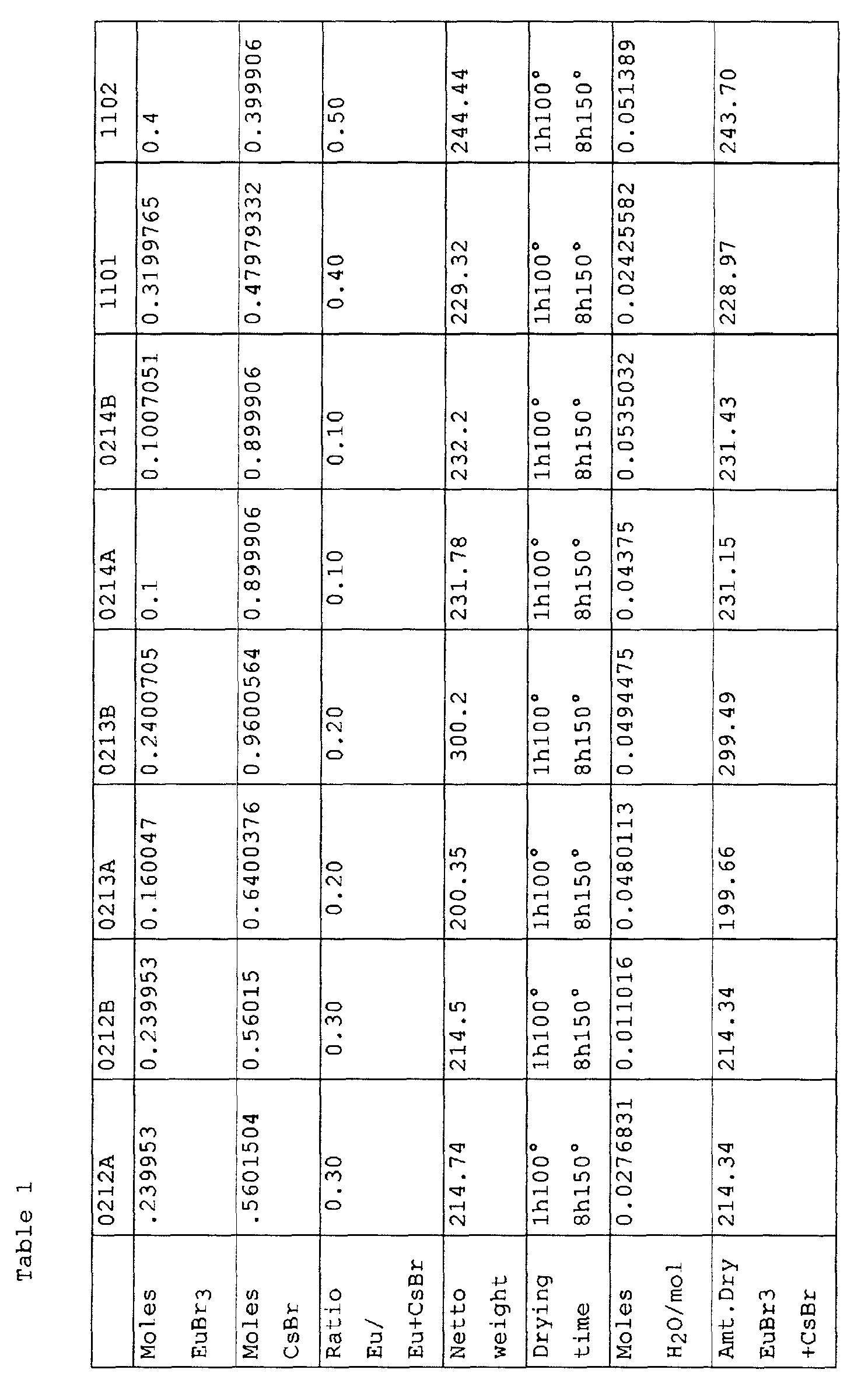
a gloovebox under an inert gas (nitrogen). In the Table 1
hereinafter data have been summarised of the different experiments,
giving the number of moles of EuBr3 and CsBr, ratio of Eu vs. the
total amount of Eu+CsBr, the netto weight obtained, the drying time
and the number of moles of water, still present in the powdery
mixture obtained by the procedure given hereinbefore.
-
From the Table 1 hereinafter it is concluded that less than 0.1
mole of water, present as "crystal water" is incorporated into the
crystals of the crystal mixture thus obtained.
2. Firing of activator element precursors CsxEuyBrz:
-
In these experiments 50 g of the precursor powder were treated
under nitrogen (1.5 l/min.), in an oven, and after 15 min. a firing
procedure was started as summarised in the Table 2, wherein the
firing conditions have been given, besides numbers of moles of CsBr
per mol, of EuBr3 per mol and of loss of weight, equivalent with
loss of bromine for divalent Eu and trivalent Eu.
-
Table 2 illustrates the results obtained from intermediate
compounds in the CsBr/EuBr
2 binary system in differing firing
conditions.
| Firing conditions CsBr/EuBr2 (30 mol% Eu) |
| | 0214/01/1 | 0214/02/1 | 0214/03/1 | 0214/04/1 | 0214/05/1 | 0214/07/1 |
| Firing cond. | 24h 150°
3h 200° | 24h 150°
3h 300° | 24h 150°
3h 400° | 24h 150°
3h 500° | 24h 150°
3h 600° | 24h 150°
3h 650°
1h 575° |
| Moles CsBr/mol | 0.7 | 0.7 | 0.7 | 0.7 | 0.7 | 0.7 |
| Moles EuBr3/ mol | 0.3 | 0.3 | 0.3 | 0.3 | 0.3 | 0.3 |
| Moles CsBr+ EuBr3 | 0.188 | 0.188 | 0.190 | 0.188 | 0.188 | 0.188 |
| Eq. Loss of Br (EuBr2) | 0.027 | 0.028 | 0.045 | 0.053 | 0.050 | 0.042 |
| Eq. Loss of Br (EuBr3) | 0.029 | 0.029 | 0.012 | 0.004 | 0.006 | 0.015 |
| Colour | yellow | dark yellow | very dark yellow | dark yellow | dark yellow | brown |
-
It is concluded from the weight balance in the Table 2 that the
precursor compound obtained by firing indeed is corresponding with
the binary CsBr/EuBr2 system and that the thus provided precursor is
CsxEuBr2+x. Analoguous results could be obtained for every ratio of
intermediate compounds as obtained hereinbefore for a 70/30 molar
ratio (further performed experiments were done for ratios 90/10;
80:20; 60/40 and 50/50. From the Table 2 at higher temperatures of
600°C, there is a loss in evaporating CsBr. The weight reduction
obtained is clearly equivalent with loss of bromine in the reduction
step wherein EuBr3 gets reduced to EuBr2 and wherein Br is lost.
-
In a summarising Table 3, melting temperatures have been given
for compounds obtained after firing of differing ratios of CsBr and
EuBr
3 precursor mixtures and % weight reduction between 100°C and
200°C (measured by thermogravimetrical analysis - TGA - and by
discontinue scanning calorimetry - DSC).
| Mol % of CsBr | Mol % of EuBr3 | Melting temperature Tmelt | Weight reduction % between 100-200°C |
| 100 | 0 | 640°C | 0 |
| 90 | 10 | 585°C | 0 |
| 80 | 20 | 635°C | 0 |
| 70 | 30 | 675°C | 0 |
| 60 | 40 |
| 0 | 100 | 680°C | >22,8
>9,23 |
-
It is concluded from the Table 3 that the precursor
compositions as obtained after firing are practically not
hygroscopic compared with the compounds EuBr3 and EuBr2. At low
temperatures, no increasing weight has been measured. The
CsxEuBr2+x precursor together with CsBr provides melting and
evaporation, even better if compared with the system CsBr/EuOBr.
Optimised evaporation circumstances should be experimentally
determined.
3. Characterisation of activator element precursors CsxEuyBrz by X-
ray diffraction (XRD)
-
From XRD-spectra of CsxEuBr2+x precursor as prepared above,
wherein the mixture was fired at 400°C, it is clear that the 2 α-peaks
in the diffraction spectrum of the fired CsxEuBr2+x precursor
unambiguously indicates that peaks as registrated are similar with
those known from of CsSmBr3 and that only extra peaks are found that
should correspond with CsBr and with EuOBr impurities. Furtheron it
has unambiguously been shown moreover that peaks of EuBr2, EuBr3,
Eu3O4Br and Eu2O3 do not appear, which is a further proof for the
unambiguously demonstrated presence of the CsxEuBr2+x precursor.
-
Having described in detail preferred embodiments of the current
invention, it will now be apparent to those skilled in the art that
numerous modifications can be made therein without departing from
the scope of the invention as defined in the appending claims.