EP1568691A1 - Erythropoietin production accelerator - Google Patents
Erythropoietin production accelerator Download PDFInfo
- Publication number
- EP1568691A1 EP1568691A1 EP03777283A EP03777283A EP1568691A1 EP 1568691 A1 EP1568691 A1 EP 1568691A1 EP 03777283 A EP03777283 A EP 03777283A EP 03777283 A EP03777283 A EP 03777283A EP 1568691 A1 EP1568691 A1 EP 1568691A1
- Authority
- EP
- European Patent Office
- Prior art keywords
- group
- methyl
- trimethoxyphenyl
- piperidine
- amino
- Prior art date
- Legal status (The legal status is an assumption and is not a legal conclusion. Google has not performed a legal analysis and makes no representation as to the accuracy of the status listed.)
- Withdrawn
Links
- 0 CCC1C=*C(CN(CC2)CCC2C(N)=O)=CC1c(cc1OC)cc(OC)c1OC Chemical compound CCC1C=*C(CN(CC2)CCC2C(N)=O)=CC1c(cc1OC)cc(OC)c1OC 0.000 description 3
- KUIGOIMHMKJGDD-UHFFFAOYSA-N CC(C(C(OC)=C1)OC)(C=C1c1cc(CN(CC2)CCC2N(Cc2ccnc(-c(cc3OC)cc(OC)c3OC)c2)S(c2ccccc2[N+]([O-])=O)(=O)=O)ccn1)OC Chemical compound CC(C(C(OC)=C1)OC)(C=C1c1cc(CN(CC2)CCC2N(Cc2ccnc(-c(cc3OC)cc(OC)c3OC)c2)S(c2ccccc2[N+]([O-])=O)(=O)=O)ccn1)OC KUIGOIMHMKJGDD-UHFFFAOYSA-N 0.000 description 1
- ZSOVAHQEPVAREK-UHFFFAOYSA-N CC(C(C=C1)OC)C=C1N(Cc1cc(-c(cc2OC)cc(OC)c2OC)ccc1)C1CCN(Cc2cc(-c(cc3OC)cc(OC)c3OC)ncc2)CC1 Chemical compound CC(C(C=C1)OC)C=C1N(Cc1cc(-c(cc2OC)cc(OC)c2OC)ccc1)C1CCN(Cc2cc(-c(cc3OC)cc(OC)c3OC)ncc2)CC1 ZSOVAHQEPVAREK-UHFFFAOYSA-N 0.000 description 1
- CPBDXRXCDRFOEY-UHFFFAOYSA-N CC(C)(C)OC(N(CC1)CCC1N(Cc1cccc(-c(cc2OC)cc(OC)c2OC)c1)c(cccc1)c1OC)=O Chemical compound CC(C)(C)OC(N(CC1)CCC1N(Cc1cccc(-c(cc2OC)cc(OC)c2OC)c1)c(cccc1)c1OC)=O CPBDXRXCDRFOEY-UHFFFAOYSA-N 0.000 description 1
- PPBACJYYIAETEI-UHFFFAOYSA-N CC(C)(C)OC(N(CC1)CCC1Nc(cccc1OC)c1OC)=O Chemical compound CC(C)(C)OC(N(CC1)CCC1Nc(cccc1OC)c1OC)=O PPBACJYYIAETEI-UHFFFAOYSA-N 0.000 description 1
- PHQUQAGWGDYFIW-UHFFFAOYSA-N CC(C)(C)OCC(C=O)N(CC1)CCC1N(Cc1cncc(-c(cc2OC)cc(OC)c2OC)c1)c(cc1)ccc1OC Chemical compound CC(C)(C)OCC(C=O)N(CC1)CCC1N(Cc1cncc(-c(cc2OC)cc(OC)c2OC)c1)c(cc1)ccc1OC PHQUQAGWGDYFIW-UHFFFAOYSA-N 0.000 description 1
- ISXCRFDULYERDM-UHFFFAOYSA-N CC(C1OC)C(c2nccc(CN(C(CC3)CCN3C(OC(C)(C)C)=O)c3ccccc3OC)c2)=CC(OC)=C1OC Chemical compound CC(C1OC)C(c2nccc(CN(C(CC3)CCN3C(OC(C)(C)C)=O)c3ccccc3OC)c2)=CC(OC)=C1OC ISXCRFDULYERDM-UHFFFAOYSA-N 0.000 description 1
- IQDUZZSQKDROAD-UHFFFAOYSA-N CC(C1OC)C(c2nccc(CN(C)C3CN(Cc4ccnc(-c(cc5OC)cc(OC)c5OC)c4)CC3)c2)=CC(OC)=C1OC Chemical compound CC(C1OC)C(c2nccc(CN(C)C3CN(Cc4ccnc(-c(cc5OC)cc(OC)c5OC)c4)CC3)c2)=CC(OC)=C1OC IQDUZZSQKDROAD-UHFFFAOYSA-N 0.000 description 1
- BMDYPUNDDQYDSS-UHFFFAOYSA-N CC1C(CN(C2CCN(Cc3ccnc(-c(cc4OC)cc(OC)c4OC)c3)CC2)c2cc(OC)cc(OC)c2)=CC=CC1c(cc1OC)cc(OC)c1OC Chemical compound CC1C(CN(C2CCN(Cc3ccnc(-c(cc4OC)cc(OC)c4OC)c3)CC2)c2cc(OC)cc(OC)c2)=CC=CC1c(cc1OC)cc(OC)c1OC BMDYPUNDDQYDSS-UHFFFAOYSA-N 0.000 description 1
- WFOKOXWNONRTDW-UHFFFAOYSA-N CC1C(c(cc2OC)cc(OC)c2OC)=NC=CC1CN(C1CN(Cc2cc(-c(cc3OC)cc(OC)c3[O](C)C)ncc2)CC1)S(c(cccc1)c1[N+]([O-])=O)(=O)=O Chemical compound CC1C(c(cc2OC)cc(OC)c2OC)=NC=CC1CN(C1CN(Cc2cc(-c(cc3OC)cc(OC)c3[O](C)C)ncc2)CC1)S(c(cccc1)c1[N+]([O-])=O)(=O)=O WFOKOXWNONRTDW-UHFFFAOYSA-N 0.000 description 1
- KKFNSAOTWAHBSW-UHFFFAOYSA-N CCC1C(c(cc2OC)cc(OC)c2OC)=CC(CN(C(CC2)CCN2C(OC(C)(C)C)=O)c(cc2)ccc2Br)=CC(C)C1 Chemical compound CCC1C(c(cc2OC)cc(OC)c2OC)=CC(CN(C(CC2)CCN2C(OC(C)(C)C)=O)c(cc2)ccc2Br)=CC(C)C1 KKFNSAOTWAHBSW-UHFFFAOYSA-N 0.000 description 1
- LKMTZNYTAQRKFZ-UHFFFAOYSA-N CCCCOc(cc1)ccc1N(Cc1cncc(-c(cc2OC)cc(OC)c2OC)c1)C(CC1)CCN1C(OC(C)(C)C)=O Chemical compound CCCCOc(cc1)ccc1N(Cc1cncc(-c(cc2OC)cc(OC)c2OC)c1)C(CC1)CCN1C(OC(C)(C)C)=O LKMTZNYTAQRKFZ-UHFFFAOYSA-N 0.000 description 1
- KPLWFBKXDUBNLL-UHFFFAOYSA-N CCOC(c1ccc(-c(cc2OC)cc(OC)c2OC)nc1)=O Chemical compound CCOC(c1ccc(-c(cc2OC)cc(OC)c2OC)nc1)=O KPLWFBKXDUBNLL-UHFFFAOYSA-N 0.000 description 1
- GJNZMHWGVRTEJD-UHFFFAOYSA-N COc(cc1)ccc1N(CC1=CCNC(c(cc2OC)cc(OC)c2Cl)=C1)C1CCN(Cc2cc(-c(cc3OC)cc(OC)c3Cl)ncc2)CC1 Chemical compound COc(cc1)ccc1N(CC1=CCNC(c(cc2OC)cc(OC)c2Cl)=C1)C1CCN(Cc2cc(-c(cc3OC)cc(OC)c3Cl)ncc2)CC1 GJNZMHWGVRTEJD-UHFFFAOYSA-N 0.000 description 1
- NSIOYBJFMFSELW-UHFFFAOYSA-N COc(cc1)ccc1N(Cc1ccnc(-c2cccc(F)c2)c1)C1CCNCC1 Chemical compound COc(cc1)ccc1N(Cc1ccnc(-c2cccc(F)c2)c1)C1CCNCC1 NSIOYBJFMFSELW-UHFFFAOYSA-N 0.000 description 1
- QXCPIZXXXWLQLP-UHFFFAOYSA-N COc(cc1)ccc1N(Cc1ccnc(-c2ccccc2)c1)C1CCNCC1 Chemical compound COc(cc1)ccc1N(Cc1ccnc(-c2ccccc2)c1)C1CCNCC1 QXCPIZXXXWLQLP-UHFFFAOYSA-N 0.000 description 1
- QCHPNUGXLJWBPH-UHFFFAOYSA-N COc1cc(-c2cc(C(O)=O)ccn2)cc(OC)c1Cl Chemical compound COc1cc(-c2cc(C(O)=O)ccn2)cc(OC)c1Cl QCHPNUGXLJWBPH-UHFFFAOYSA-N 0.000 description 1
- CAVYZHPMACLVAD-UHFFFAOYSA-N COc1cc(-c2cc(CN(C3CCNCC3)c(cc3)ccc3S(C)(=O)=O)ccc2)cc(OC)c1OC Chemical compound COc1cc(-c2cc(CN(C3CCNCC3)c(cc3)ccc3S(C)(=O)=O)ccc2)cc(OC)c1OC CAVYZHPMACLVAD-UHFFFAOYSA-N 0.000 description 1
- HMHCUOFUYRQYJO-UHFFFAOYSA-N COc1cc(-c2cc(CN(C3CCNCC3)c(cc3)ccc3SC)ccc2)cc(OC)c1OC Chemical compound COc1cc(-c2cc(CN(C3CCNCC3)c(cc3)ccc3SC)ccc2)cc(OC)c1OC HMHCUOFUYRQYJO-UHFFFAOYSA-N 0.000 description 1
- YCAYCRXQQJDZGJ-UHFFFAOYSA-N COc1cc(-c2cc(CN)ccn2)cc(OC)c1OC Chemical compound COc1cc(-c2cc(CN)ccn2)cc(OC)c1OC YCAYCRXQQJDZGJ-UHFFFAOYSA-N 0.000 description 1
- NBYPOZBUBUXYTO-UHFFFAOYSA-N COc1cc(-c2ccc(CN(C3CCN(Cc4ccnc(-c(cc5OC)cc(OC)c5OC)c4)CC3)c3cc(SC)ccc3)cc2)cc(OC)c1OC Chemical compound COc1cc(-c2ccc(CN(C3CCN(Cc4ccnc(-c(cc5OC)cc(OC)c5OC)c4)CC3)c3cc(SC)ccc3)cc2)cc(OC)c1OC NBYPOZBUBUXYTO-UHFFFAOYSA-N 0.000 description 1
- CHNOYAFXPRRXDK-UHFFFAOYSA-N COc1cc(C2=CNCC(CO)=C2)cc(OC)c1OC Chemical compound COc1cc(C2=CNCC(CO)=C2)cc(OC)c1OC CHNOYAFXPRRXDK-UHFFFAOYSA-N 0.000 description 1
- WCQNPRXILHBFLX-UHFFFAOYSA-N COc1cc(OC)cc(N(Cc2ccnc(-c(cc3OC)cc(OC)c3OC)c2)C2CCN(Cc3cc(-c(cc4OC)cc(OC)c4OC)ncc3)CC2)c1 Chemical compound COc1cc(OC)cc(N(Cc2ccnc(-c(cc3OC)cc(OC)c3OC)c2)C2CCN(Cc3cc(-c(cc4OC)cc(OC)c4OC)ncc3)CC2)c1 WCQNPRXILHBFLX-UHFFFAOYSA-N 0.000 description 1
- APOJTJNGLZFKRW-UHFFFAOYSA-N COc1cccc(-c2cc(CN(CC3)CCC3N(Cc3cncc(-c(cc4OC)cc(OC)c4OC)c3)C(CC3)=CC=C3F)ccn2)c1 Chemical compound COc1cccc(-c2cc(CN(CC3)CCC3N(Cc3cncc(-c(cc4OC)cc(OC)c4OC)c3)C(CC3)=CC=C3F)ccn2)c1 APOJTJNGLZFKRW-UHFFFAOYSA-N 0.000 description 1
Images




Classifications
-
- A—HUMAN NECESSITIES
- A61—MEDICAL OR VETERINARY SCIENCE; HYGIENE
- A61K—PREPARATIONS FOR MEDICAL, DENTAL OR TOILETRY PURPOSES
- A61K31/00—Medicinal preparations containing organic active ingredients
- A61K31/33—Heterocyclic compounds
- A61K31/395—Heterocyclic compounds having nitrogen as a ring hetero atom, e.g. guanethidine or rifamycins
- A61K31/435—Heterocyclic compounds having nitrogen as a ring hetero atom, e.g. guanethidine or rifamycins having six-membered rings with one nitrogen as the only ring hetero atom
- A61K31/44—Non condensed pyridines; Hydrogenated derivatives thereof
- A61K31/4427—Non condensed pyridines; Hydrogenated derivatives thereof containing further heterocyclic ring systems
- A61K31/444—Non condensed pyridines; Hydrogenated derivatives thereof containing further heterocyclic ring systems containing a six-membered ring with nitrogen as a ring heteroatom, e.g. amrinone
-
- A—HUMAN NECESSITIES
- A61—MEDICAL OR VETERINARY SCIENCE; HYGIENE
- A61K—PREPARATIONS FOR MEDICAL, DENTAL OR TOILETRY PURPOSES
- A61K31/00—Medicinal preparations containing organic active ingredients
- A61K31/33—Heterocyclic compounds
- A61K31/395—Heterocyclic compounds having nitrogen as a ring hetero atom, e.g. guanethidine or rifamycins
- A61K31/435—Heterocyclic compounds having nitrogen as a ring hetero atom, e.g. guanethidine or rifamycins having six-membered rings with one nitrogen as the only ring hetero atom
- A61K31/44—Non condensed pyridines; Hydrogenated derivatives thereof
- A61K31/445—Non condensed piperidines, e.g. piperocaine
- A61K31/4468—Non condensed piperidines, e.g. piperocaine having a nitrogen directly attached in position 4, e.g. clebopride, fentanyl
-
- A—HUMAN NECESSITIES
- A61—MEDICAL OR VETERINARY SCIENCE; HYGIENE
- A61K—PREPARATIONS FOR MEDICAL, DENTAL OR TOILETRY PURPOSES
- A61K31/00—Medicinal preparations containing organic active ingredients
- A61K31/33—Heterocyclic compounds
- A61K31/395—Heterocyclic compounds having nitrogen as a ring hetero atom, e.g. guanethidine or rifamycins
- A61K31/435—Heterocyclic compounds having nitrogen as a ring hetero atom, e.g. guanethidine or rifamycins having six-membered rings with one nitrogen as the only ring hetero atom
- A61K31/44—Non condensed pyridines; Hydrogenated derivatives thereof
- A61K31/445—Non condensed piperidines, e.g. piperocaine
- A61K31/4523—Non condensed piperidines, e.g. piperocaine containing further heterocyclic ring systems
- A61K31/4545—Non condensed piperidines, e.g. piperocaine containing further heterocyclic ring systems containing a six-membered ring with nitrogen as a ring hetero atom, e.g. pipamperone, anabasine
-
- A—HUMAN NECESSITIES
- A61—MEDICAL OR VETERINARY SCIENCE; HYGIENE
- A61P—SPECIFIC THERAPEUTIC ACTIVITY OF CHEMICAL COMPOUNDS OR MEDICINAL PREPARATIONS
- A61P43/00—Drugs for specific purposes, not provided for in groups A61P1/00-A61P41/00
-
- A—HUMAN NECESSITIES
- A61—MEDICAL OR VETERINARY SCIENCE; HYGIENE
- A61P—SPECIFIC THERAPEUTIC ACTIVITY OF CHEMICAL COMPOUNDS OR MEDICINAL PREPARATIONS
- A61P7/00—Drugs for disorders of the blood or the extracellular fluid
-
- A—HUMAN NECESSITIES
- A61—MEDICAL OR VETERINARY SCIENCE; HYGIENE
- A61P—SPECIFIC THERAPEUTIC ACTIVITY OF CHEMICAL COMPOUNDS OR MEDICINAL PREPARATIONS
- A61P7/00—Drugs for disorders of the blood or the extracellular fluid
- A61P7/06—Antianaemics
-
- C—CHEMISTRY; METALLURGY
- C07—ORGANIC CHEMISTRY
- C07D—HETEROCYCLIC COMPOUNDS
- C07D211/00—Heterocyclic compounds containing hydrogenated pyridine rings, not condensed with other rings
- C07D211/04—Heterocyclic compounds containing hydrogenated pyridine rings, not condensed with other rings with only hydrogen or carbon atoms directly attached to the ring nitrogen atom
- C07D211/06—Heterocyclic compounds containing hydrogenated pyridine rings, not condensed with other rings with only hydrogen or carbon atoms directly attached to the ring nitrogen atom having no double bonds between ring members or between ring members and non-ring members
- C07D211/36—Heterocyclic compounds containing hydrogenated pyridine rings, not condensed with other rings with only hydrogen or carbon atoms directly attached to the ring nitrogen atom having no double bonds between ring members or between ring members and non-ring members with hetero atoms or with carbon atoms having three bonds to hetero atoms with at the most one bond to halogen, e.g. ester or nitrile radicals, directly attached to ring carbon atoms
- C07D211/56—Nitrogen atoms
- C07D211/58—Nitrogen atoms attached in position 4
-
- C—CHEMISTRY; METALLURGY
- C07—ORGANIC CHEMISTRY
- C07D—HETEROCYCLIC COMPOUNDS
- C07D213/00—Heterocyclic compounds containing six-membered rings, not condensed with other rings, with one nitrogen atom as the only ring hetero atom and three or more double bonds between ring members or between ring members and non-ring members
- C07D213/02—Heterocyclic compounds containing six-membered rings, not condensed with other rings, with one nitrogen atom as the only ring hetero atom and three or more double bonds between ring members or between ring members and non-ring members having three double bonds between ring members or between ring members and non-ring members
- C07D213/04—Heterocyclic compounds containing six-membered rings, not condensed with other rings, with one nitrogen atom as the only ring hetero atom and three or more double bonds between ring members or between ring members and non-ring members having three double bonds between ring members or between ring members and non-ring members having no bond between the ring nitrogen atom and a non-ring member or having only hydrogen or carbon atoms directly attached to the ring nitrogen atom
- C07D213/24—Heterocyclic compounds containing six-membered rings, not condensed with other rings, with one nitrogen atom as the only ring hetero atom and three or more double bonds between ring members or between ring members and non-ring members having three double bonds between ring members or between ring members and non-ring members having no bond between the ring nitrogen atom and a non-ring member or having only hydrogen or carbon atoms directly attached to the ring nitrogen atom with substituted hydrocarbon radicals attached to ring carbon atoms
- C07D213/36—Radicals substituted by singly-bound nitrogen atoms
- C07D213/38—Radicals substituted by singly-bound nitrogen atoms having only hydrogen or hydrocarbon radicals attached to the substituent nitrogen atom
-
- C—CHEMISTRY; METALLURGY
- C07—ORGANIC CHEMISTRY
- C07D—HETEROCYCLIC COMPOUNDS
- C07D401/00—Heterocyclic compounds containing two or more hetero rings, having nitrogen atoms as the only ring hetero atoms, at least one ring being a six-membered ring with only one nitrogen atom
- C07D401/02—Heterocyclic compounds containing two or more hetero rings, having nitrogen atoms as the only ring hetero atoms, at least one ring being a six-membered ring with only one nitrogen atom containing two hetero rings
- C07D401/06—Heterocyclic compounds containing two or more hetero rings, having nitrogen atoms as the only ring hetero atoms, at least one ring being a six-membered ring with only one nitrogen atom containing two hetero rings linked by a carbon chain containing only aliphatic carbon atoms
-
- C—CHEMISTRY; METALLURGY
- C07—ORGANIC CHEMISTRY
- C07D—HETEROCYCLIC COMPOUNDS
- C07D401/00—Heterocyclic compounds containing two or more hetero rings, having nitrogen atoms as the only ring hetero atoms, at least one ring being a six-membered ring with only one nitrogen atom
- C07D401/02—Heterocyclic compounds containing two or more hetero rings, having nitrogen atoms as the only ring hetero atoms, at least one ring being a six-membered ring with only one nitrogen atom containing two hetero rings
- C07D401/12—Heterocyclic compounds containing two or more hetero rings, having nitrogen atoms as the only ring hetero atoms, at least one ring being a six-membered ring with only one nitrogen atom containing two hetero rings linked by a chain containing hetero atoms as chain links
-
- C—CHEMISTRY; METALLURGY
- C07—ORGANIC CHEMISTRY
- C07D—HETEROCYCLIC COMPOUNDS
- C07D401/00—Heterocyclic compounds containing two or more hetero rings, having nitrogen atoms as the only ring hetero atoms, at least one ring being a six-membered ring with only one nitrogen atom
- C07D401/14—Heterocyclic compounds containing two or more hetero rings, having nitrogen atoms as the only ring hetero atoms, at least one ring being a six-membered ring with only one nitrogen atom containing three or more hetero rings
Definitions
- the present invention relates to an erythropoietin production potentiator, and more particularly to a preventive or therapeutic agent for pathological conditions caused by reduced production of erythropoietin, such as anemia.
- EPO Erythropoietin
- EPO is a glycoprotein hormone, which participates in maturation and differentiation of an erythroid progenitor cell to a matured red blood cell.
- EPO is a 165-amino-acid polypeptide, which is found in nature in the form of a monomer [Lin, F-K. et al., Proc. Natl. Acad. Sci. USA 82:7580-7584 (1985)].
- EPO Human erythropoietin plays a key role in proliferation and differentiation of red blood cells. Therefore, the hormone is useful for treatment of blood diseases primarily involving reduced production of red blood cells.
- EPO is used in treatment of anemia associated with chronic renal failure (CRF), autologous blood storage, or anemia of prematurity (Eschbach JW, Egrie JC, Downing MR, et al., NEJM, 316:73-78 (1987); Eschbach JW, Abdulhadi MH, Browne JK et al., Ann. Intern.
- EPO is also used in treatment of patients suffering AIDS or patients having cancer and receiving chemotherapy (Danna RP, Rudnick SA, Abels RI, Garnick MB, Erythropoietin in Clinical Applications - An International Perspective, New York: Marcel Dekker; 1990, pp. 301-324). EPO has been found to be effective in treatment of chronic anemia.
- EPO protein used for therapy
- Some protein used for therapy such as EPO has a short plasma half-life and is susceptible to degradation in the presence of protease [Spivak JL and Hogans BB, Blood, 73:90 (1989); McMahon FG et al., Blood, 76:1718 (1990)]; i.e., EPO exhibits poor bioavailability.
- intravenous injection must be performed frequently in order to maintain the effective therapeutic blood level of the protein in circulation.
- Subcutaneous injection may be an alternative administration route.
- plasma level of the protein is significantly low as compared with the case of intravenous administration, although effect of sustained release may be appreciable. Therefore, in order to obtain a therapeutic effect of similar level, subcutaneous injection must be performed frequently as in the case of intravenous administration.
- the present invention provides a preventive or therapeutic agent for pathological conditions caused by reduced production of erythropoietin containing as an active ingredient, a cyclic amine compound represented by the following general formula (1): wherein, R 1 ,R 2 and R 3 each independently represent a hydrogen atom, a halogen atom, or hydroxy, alkyl, halogen-substituted alkyl, alkoxy, alkylthio, carboxyl, alkoxycarbonyl or alkanoyl group; W 1 and W 2 each independently represent N or CH ; X represents O, NR 4 , CONR 4 or NR 4 CO ; R 4 each represents a hydrogen atom, or an alkyl, alkenyl, alkynyl, substituted or unsubstituted aryl, substituted or unsubstituted heteroaryl, substituted or unsubstituted aralkyl, or substituted or unsubstituted heteroaralkyl group; and l, m
- the present invention also provides an erythropoietin production potentiator containing, as an active ingredient, the cyclic amino compound of formula (1), a salt thereof or solvates thereof.
- the present invention further provides use of the cyclic amino compound of formula (1), a salt thereof or solvates thereof for the preparation of an erythropoietin production potentiator.
- the present invention further provides use of the cyclic amino compound of formula (1), a salt thereof or solvates thereof for the preparation of a preventive or therapeutic agent for diseases caused by the lowering of an erythropoietin production.
- the present invention further provides a method of potentiating the erythropoietin production in a patient in need thereof, including administering an effective amount of the cyclic amino compound of formula (1), a salt thereof or solvates thereof.
- the present invention further provides a method of treating the diseases caused by the lowering of erythropoietin production, including administering to a patient in need thereof, an effective amount of the cyclic amino compound of formula (1), a salt thereof or solvates thereof.
- the present invention provides a novel erythropoietin production potentiator, and preventive or therapeutic agent for the diseases, such as anemia, caused by the lowering of erythropoietin production.
- the halogen atoms for R 1 ,R 2 and R 3 include fluorine, chlorine, bromine and iodine atoms.
- the alkyl group for R 1 , R 2 , R 3 and R 4 typically includes straight, branched or cyclic C 1 -C 8 alkyl groups, such as straight or branched C 1 -C 8 alkyl groups, for example, methyl, ethyl, propyl, butyl, pentyl, hexyl, heptyl and octyl groups, and C 3 -C 8 cycloalkyl groups, for example, cyclopropyl, cyclobutyl, cyclopentyl, cyclohexyl, cyclohexylmethyl and cyclohexylethyl groups.
- C 1 -C 6 alkyl groups such as methyl, ethyl, n-propyl, isopropyl, n-butyl and the like.
- the halogen-substituted alkyl group for R 1 , R 2 and R 3 typically includes C 1 -C 8 alkyl groups substituted with 1 to 3 halogen atoms. Among them, particularly preferred are C 1 -C 6 alkyl groups substituted with 1 to 3 halogen atoms, such as trifluoromethyl, 2,2,2-trifluoroethyl, etc.
- the alkoxy group typically includes straight, branched or cyclic C 1 -C 8 alkoxy groups, such as straight or branched C 1 -C 8 alkoxy groups, for example, methoxy, ethyoxy, n-propoxy, isopropoxy, n-butoxy, isobutoxy, sec-butoxy, tert-butoxy, pentyloxy and hexyloxy groups; and C 3 -C 8 cycloalkyloxy groups, for example, cyclopropyloxy, cyclobutyloxy, cyclopentyloxy, cyclohexyloxyl, cyclohexylmethyloxy and cyclohexylethyloxy groups.
- C 1 -C 6 alkoxy groups such as methoxy, ethoxy, n-propoxy, isopropoxy and n-butyloxy groups.
- the alkylthio group typically includes C 1 -C 8 alkylthio groups, and is preferably a C 1 -C 6 alkylthio group such as, for example, methylthio, ethylthio, n-propylthio, isopropylthio or the like.
- the alkoxycarbonyl group typically includes C 1 -C 6 alkoxycarbonyl groups, and is preferably a C 1 -C 4 alkoxycarbonyl group such as methoxycarbonyl, ethoxycarbonyl, tert-butoxycarbonyl or the like.
- the alkanoyl group typically includes C 1 -C 6 alkanoyl groups and is preferably a C 1 -C 4 alkanoyl group such as acetyl, propionyl, butyryl, isobutyryl or the like.
- the alkenyl group for R 4 typically includes C 3 -C 8 alkenyl groups and is preferably a C 3 -C 6 alkenyl group such as 2-propenyl, 3-butenyl or the like.
- the alkynyl group typically includes C 3 -C 8 alkynyl groups and is preferably a C 3 -C 6 alkynyl group such as 2-propynyl, 3-butynyl or the like.
- the aryl group for R 4 typically includes C 6 -C 14 aryl groups and is preferably phenyl, naphthyl, anthryl, indenyl, indanyl, 5,6,7,8-tetrahydronaphthyl or the like.
- the heteroaryl group for R 4 typically includes heteroaryl groups of 5- or 6-membered ring containing 1 to 4 nitrogen atoms in the ring, and is preferably imidazolyl, pyridyl, pyrimidinyl or the like.
- the aralkyl group typically includes C 6 -C 14 aryl-C 1 -C 6 alkyl groups such as phenyl C 1 -C 6 alkyl groups and naphthyl C 1 -C 6 alkyl groups, for example, benzyl, naphthylmethyl, phenylethyl, phenylpropyl, etc.
- the heteroaralkyl group for R 4 typically includes 5- or 6-membered ring heteroaryl containing 1 to 4 nitrogen atoms-C 1 -C 6 alkyl groups, such as imidazolyl-C 1 -C 6 alkyl, pyridyl-C 1 -C 6 alkyl, pyrimidinyl -C 1 -C 6 alkyl, etc.
- the groups which can substitute the above-mentioned aryl, heteroaryl, aralkyl or heteroaralkyl include 1 to 3 groups or atoms selected from alkyl, alkoxy, halogen-substituted alkoxy, alkylthio, alkylsulfinyl, alkylsulfonyl, halogen, nitro, amino, acetylamino, trifluoromethyl and alkylenedioxy, wherein said alkyl, alkoxy and alkylthio include those illustrated for R 1 ⁇ R 3 .
- the alkyl group contained in the alkylsulfinyl and alkylsulfonyl groups include C 1 -C 3 alkyl groups such as methyl, ethyl, n-propyl and isopropyl groups.
- the halogen-substituted alkoxy includes C 1 -C 8 alkoxy groups substituted by 1 to 3 halogen atoms, and is preferably a C 1 -C 4 alkoxy group substituted by 1 to 3 halogen atoms such as trifluoromethoxy or 2,2,2-trifluoroethoxy.
- the alkylenedioxy group typically includes C 1 -C 3 alkylenedioxy groups such as methylenedioxy, ethylenedioxy and propylenedioxy groups.
- X represents NR 4 .
- R 4 represents a C 1 -C 8 alkyl group or a substituted or unsubstituted C 6 -C 14 aryl group or a substituted or unsubstituted 5- or 6-membered ring heteroaryl group containing 1 to 4 nitrogen atoms in the ring or a substituted or unsubstituted C 6 -C 14 aryl -C 1 -C 6 alkyl group or a substituted or unsubstituted 5- or 6-membered ring heteroaryl -C 1 -C 6 alkyl group containing 1 to 4 nitrogen atoms in the ring.
- R 1 , R 2 and R 3 are attached to the phenyl group at the 3, 4 and 5-positions thereof.
- R 1 and R 3 are an alkoxy group or a halogen.
- R 2 is a hydrogen atom, a halogen atom, or a hydroxy, alkyl, halogen-substituted alkyl, alkoxy, alkylthio, carboxy, alkoxycarbonyl or alkanoyl group.
- I denotes 0 or 1, and is preferably 1.
- W 1 represents N.
- W 2 represents N.
- Preferable compounds include the compounds of the formula (1), wherein X represents NR 4 , and R 4 represents a C 1 -C 8 alkyl group or a substituted or unsubstituted C 6 -C 14 aryl group or a substituted or unsubstituted 5- or 6-membered ring heteroaryl group containing 1 to 4 nitrogen atoms in the ring ring or a substituted or unsubstituted C 6 -C 14 aryl -C 1 -C 6 alkyl group or a substituted or unsubstituted 5- or 6-membered ring heteroaryl -C 1 -C 6 alkyl group containing 1 to 4 nitrogen atoms in the ring.
- R 4 represents a phenyl or pyridyl group which may be substituted with one or two groups or atoms selected from halogen, alkyl, alkoxy, alkylthio, trifluoromethyl and alkylenedioxy.
- acid addition salts of the compounds (1) according to the invention are pharmaceutically acceptable salts.
- examples include the acid-addition salts of mineral acids, such as hydrochlorides, hydrobromides, hydroiodides, sulfates and phosphates; and acid-addition salts of organic acids, such as benzoates, methanesulfonates, ethanesulfonates, benzenesulfonates, p-toluenesulfonates, oxalates, maleates, fumarates, tartrates, citrates and acetates.
- mineral acids such as hydrochlorides, hydrobromides, hydroiodides, sulfates and phosphates
- organic acids such as benzoates, methanesulfonates, ethanesulfonates, benzenesulfonates, p-toluenesulfonates, oxalates, maleates, fumarates, tartrates
- the compounds of formula (1) may be present in the form of solvates typified by hydrates, and the solvates are embraced in the present invention.
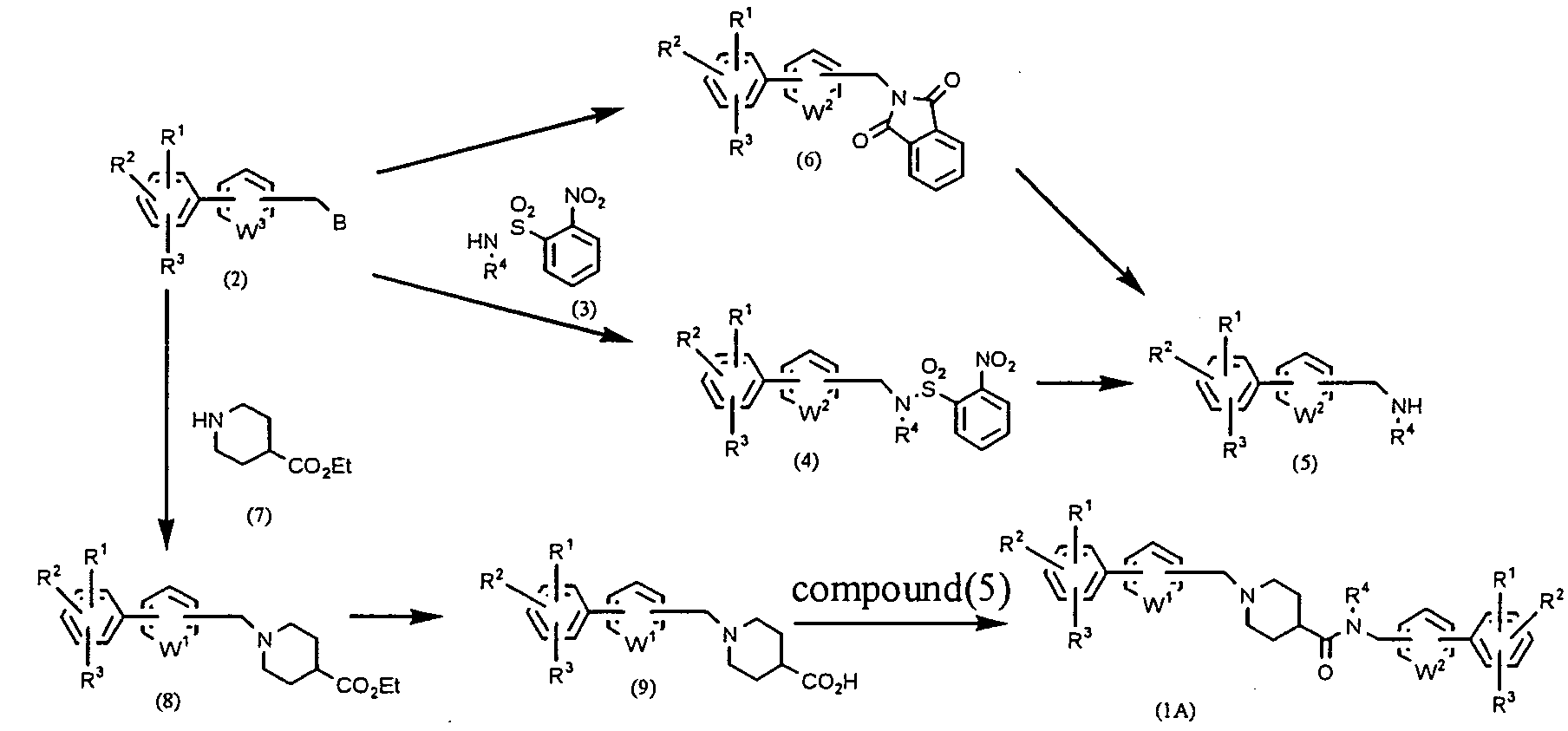
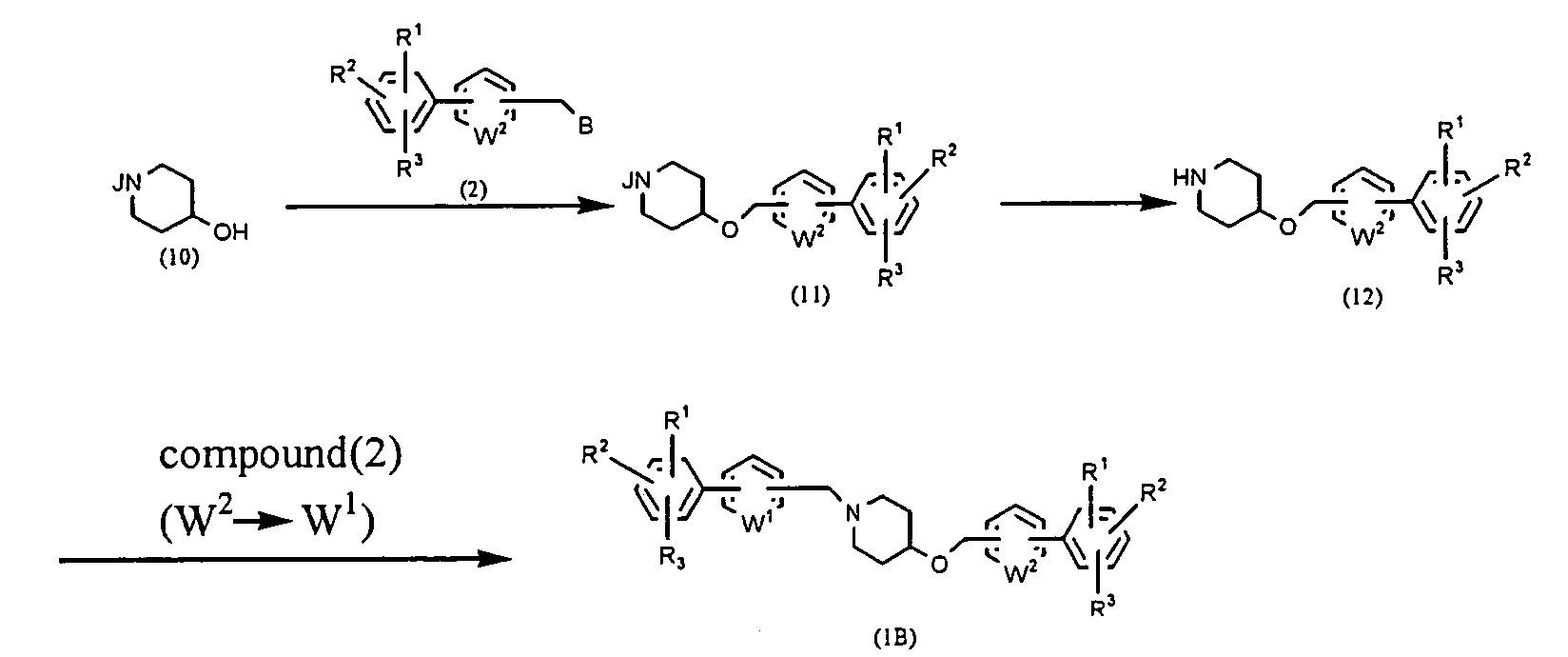
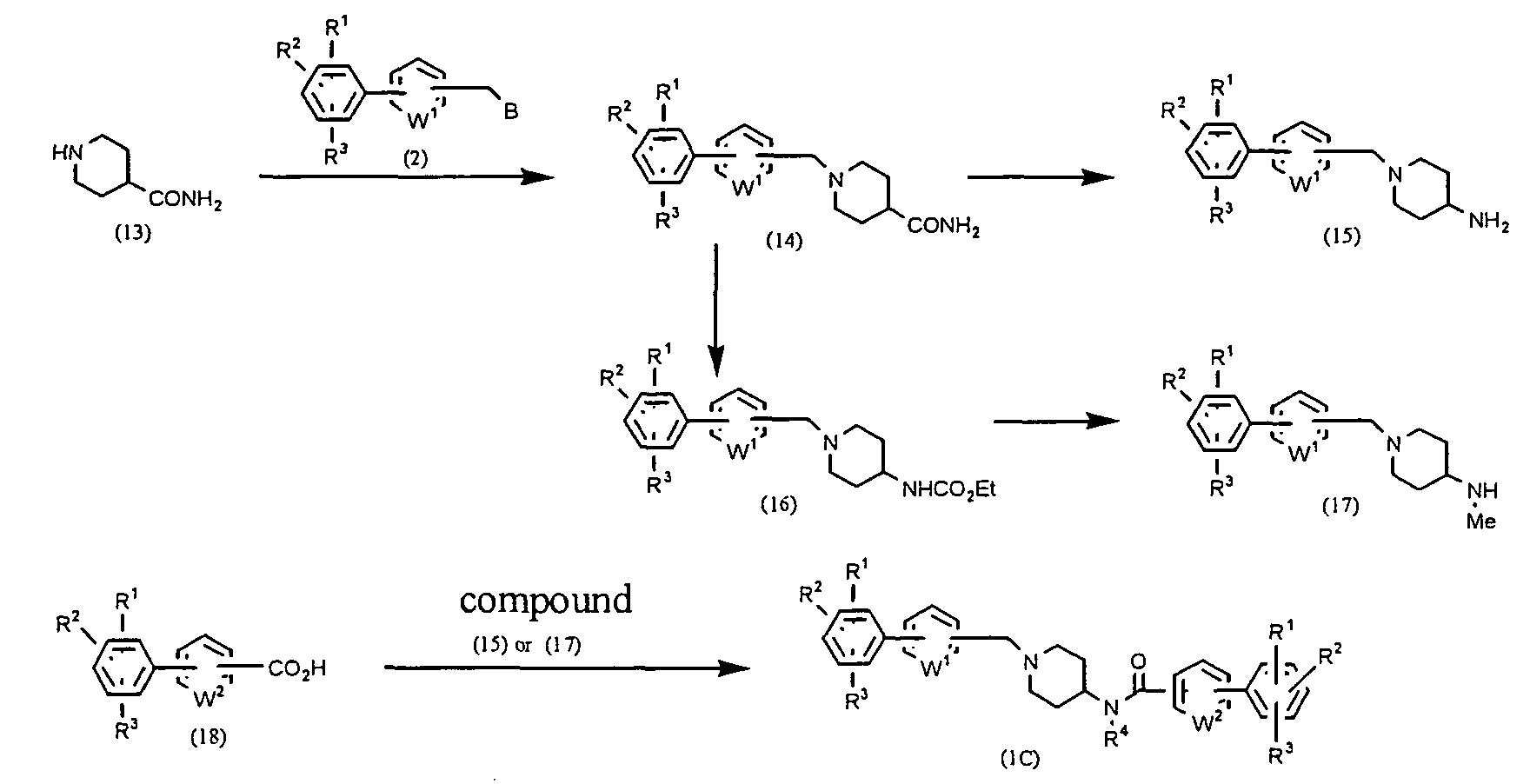
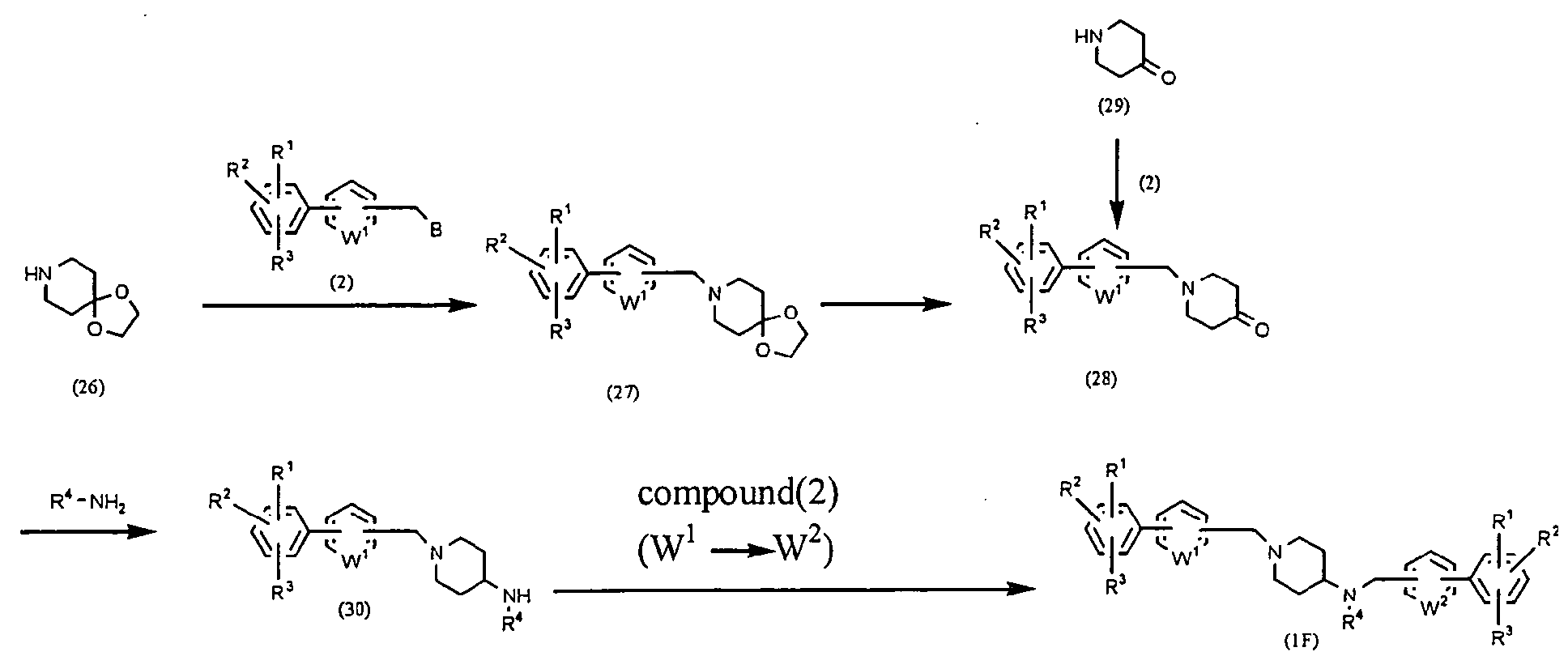
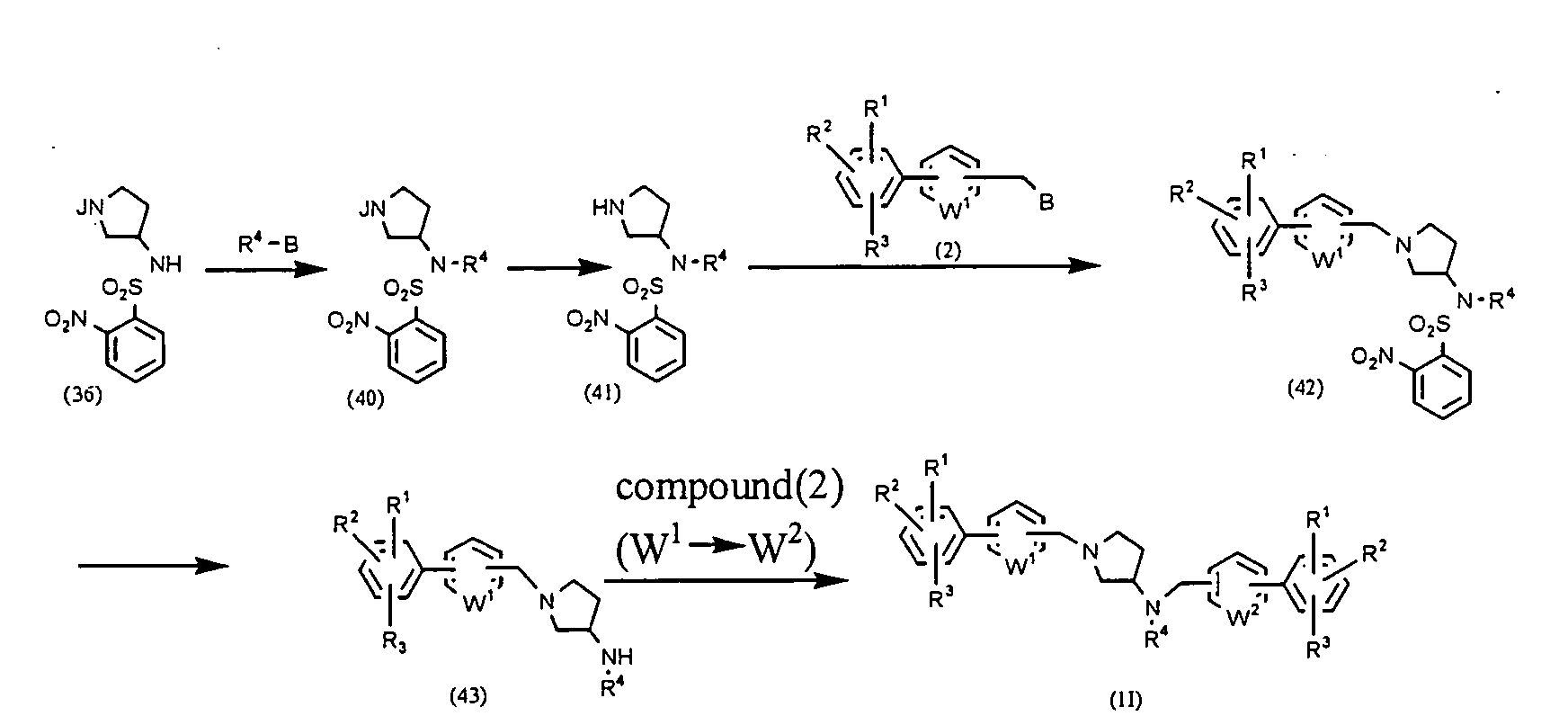
- the compounds of formula (1) can be prepared in accordance with the following processes A-L:
- the compounds (1) according to the present invention are obtained by any of the above-described processes and may further be purified by using an ordinary purification means such as recrystallization or column chromatography as needed. As needed, the compounds may also be converted into the desired salts or solvates in a method known per se in the art.
- the present invention includes any configurational isomers.
- the compounds (1) according to the present invention have an action for potentiating the production of erythropoietin strongly, and are useful as preventive or therapeutic agents for treating pathological conditions caused by reduced production of erythropoietin in mammalian including human, such as anemia, especially chronic anemia, renal anemia, aplastic anemia, or pure red cell aplasia.
- the medicine according to the present invention comprises a compound (1), a salt thereof, or a solvate thereof as an active ingredient.
- the form of administration may be suitably selected as necessary for the therapeutic application intended without any particular limitation, including oral preparations, injections, suppositories, ointments, inhalants, eye drops, nose drops and plasters.
- a composition suitable for use in these administration forms can be prepared by blending a pharmaceutically acceptable carrier in accordance with the conventional preparation method publicly known by those skilled in the art.
- an excipient When an oral solid preparation is formulated, an excipient, and optionally, a binder, disintegrator, lubricant, colorant, a taste corrigent, a smell corrigent and the like are added to compound (1) and the resulting composition can be formulated into tablets, coated tablets, granules, powders, capsules, etc. in accordance with methods known in the art. As such additives described above, any additives may be used which are generally used in the pharmaceutical field.
- excipients such as lactose, sucrose, sodium chloride, glucose, starch, calcium carbonate, kaolin, microcrystalline cellulose and silicic acid
- binders such as water, ethanol, propanol, simple syrup, glucose solution, starch solution, gelatin solution, carboxymethyl cellulose, hydroxypropyl cellulose, hydroxypropyl starch, methyl cellulose, ethyl cellulose, shellac, calcium phosphate and polyvinyl pyrrolidone
- disintegrators such as dry starch, sodium alginate, agar powder, sodium hydrogencarbonate, calcium carbonate, sodium lauryl sulfate, monoglyceryl stearate and lactose
- lubricants such as purified talc, stearic acid salts, borax and polyethylene glycol
- taste corrigents such as sucrose, orange peel, citric acid and tartaric acid.
- a taste corrigent, buffer, stabilizer, smell corrigent and/or the like are added to compound (1) and the resulting composition can be formulated into internal liquid preparations, syrup preparations, elixirs, etc. in accordance with methods known in the art.
- the taste corrigent may be used those as described above.
- the buffer sodium citrate may be mentioned.
- the stabilizer tragacanth, gum arabic and gelatin may be mentioned.
- a pH adjustor, buffer, stabilizer, isotonicity agent, local anesthetic and the like may be added to compound (1) according to the present invention, and the resultant composition can be formulated into subcutaneous, intramuscular and intravenous injections in accordance with methods known in the art.
- the pH adjustor and buffer in this case include sodium citrate, sodium acetate and sodium phosphate.
- the stabilizer include sodium pyrosulfite, EDTA, thioglycolic acid and thiolactic acid.
- the local anesthetic include procaine hydrochloride and lidocaine hydrochloride.
- the isotonicity agent include sodium chloride and glucose.
- a carrier for a preparation known in the art for example, polyethylene glycol, lanoline, cacao butter, fatty acid triglyceride or the like, and optionally, a surfactant such as Tween (registered trade mark) and the like are added to the compound (1), and the resultant composition can be formulated into suppositories in accordance with methods known in the art.
- a base material When an ointment is formulated, a base material, stabilizer, wetting agent, preservative and the like, which are generally used, are blended with compound (1) as needed, and the resulting blend is mixed and formulated into ointments in accordance with a known method.
- the base material include liquid paraffin, white vaseline, bleached beeswax, octyldodecyl alcohol and paraffin.
- the preservative include methyl p-hydroxybenzoate, ethyl p-hydroxybenzoate and propyl p-hydroxybenzoate.
- inhalants eye drops and nose drops may also be formulated in accordance with known methods.
- the dose of the medicine according to the present invention varies according to the age, sex, weight and condition of the patient to be treated, the administration method, the number of times of administration, and the like. It is however preferred that the medicine is generally orally or parenterally administered at once or in several portions in a dose of 0.01 to 1,000 mg per day, preferably, 0.1 to 100 mg per day in terms of compound (1), for an adult.
- Ethyl piperidine-4-carboxylate (514 mg), 4-chloromethyl-2-(3,4,5-trimethoxyphenyl)pyridine (969 mg) and potassium carbonate (452 mg) were suspended in acetonitrile (20 mL). The suspension was stirred at room temperature for 4 hours. The reaction mixture was concentrated under reduced pressure and then chloroform and water were added thereto to separate an organic layer. An aqueous layer was extracted with chloroform. Organic layers were combined, and dried over anhydrous magnesium sulfate.
Landscapes
- Chemical & Material Sciences (AREA)
- Organic Chemistry (AREA)
- Health & Medical Sciences (AREA)
- Pharmacology & Pharmacy (AREA)
- Veterinary Medicine (AREA)
- Public Health (AREA)
- General Health & Medical Sciences (AREA)
- Animal Behavior & Ethology (AREA)
- Life Sciences & Earth Sciences (AREA)
- Medicinal Chemistry (AREA)
- Epidemiology (AREA)
- Nuclear Medicine, Radiotherapy & Molecular Imaging (AREA)
- General Chemical & Material Sciences (AREA)
- Chemical Kinetics & Catalysis (AREA)
- Bioinformatics & Cheminformatics (AREA)
- Engineering & Computer Science (AREA)
- Hematology (AREA)
- Diabetes (AREA)
- Pharmaceuticals Containing Other Organic And Inorganic Compounds (AREA)
- Hydrogenated Pyridines (AREA)
- Pyridine Compounds (AREA)
- Plural Heterocyclic Compounds (AREA)
Abstract
Description
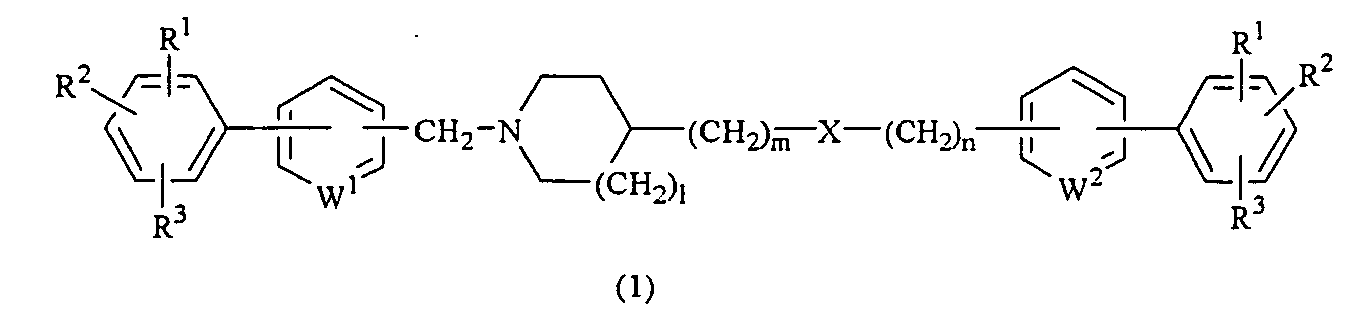
R1,R2 and R3 each independently represent a hydrogen atom, a halogen atom, or hydroxy, alkyl, halogen-substituted alkyl, alkoxy, alkylthio, carboxyl, alkoxycarbonyl or alkanoyl group;
W1 and W2 each independently represent N or CH ;
X represents O, NR4, CONR4 or NR4CO ;
R4 each represents a hydrogen atom, or an alkyl, alkenyl, alkynyl, substituted or unsubstituted aryl, substituted or unsubstituted heteroaryl, substituted or unsubstituted aralkyl, or substituted or unsubstituted heteroaralkyl group; and
l, m and n each represents a number of 0 or 1, or a salt thereof or a solvate thereof
I denotes 0 or 1, and is preferably 1.








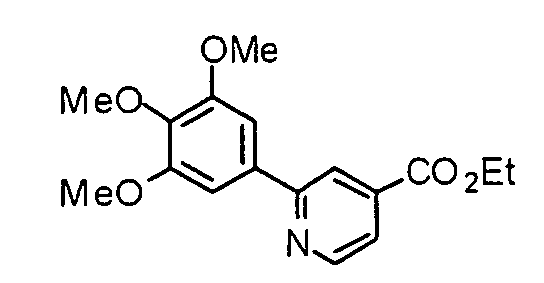
Yield: 27.99 g (88%).
1H-NMR (400 MHz, CDCl3) δ: 1.45 (t, 3H, J=7.0 Hz), 3.92 (s, 3H), 3.99 (s, 6H), 4.46 (q, 2H, J=7.0 Hz), 7.30 (s, 2H), 7.76 (dd, 1H, J=5.1 Hz, 1.6 Hz), 8.24 (dd, 1H, J=1.6 Hz, 0.8 Hz), 8.81 (dd, 1H, J=5.1 Hz, 0.8 Hz).
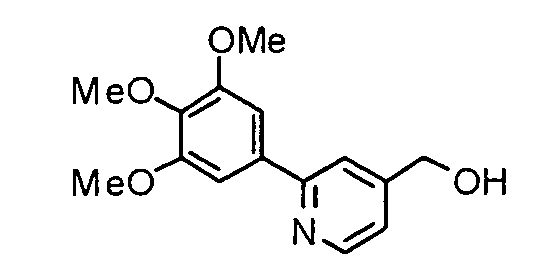
Yield: 17.53 g (82%).
1H-NMR (400 MHz, CDCl3) δ: 3.90 (s, 3H), 3.95 (s, 6H), 4.79 (s, 2H), 7.19 (d, 1H, J=5.1 Hz), 7.21 (s, 2H), 7.66 (s, 1H), 8.60 (d, 1H, J=5.1 Hz).
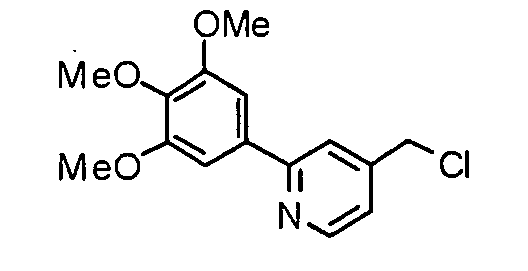
Yield: 18.24 g (89%).
1H-NMR (400 MHz, CDCl3) δ: 3.91 (s, 3H), 3.97 (s, 6H), 4.61 (s, 2H), 7.24 (s, 2H), 7.26 (d, 1H, J=5.1 Hz), 7.68 (s, 1H), 8.67 (d, 1H, J=5.1 Hz).
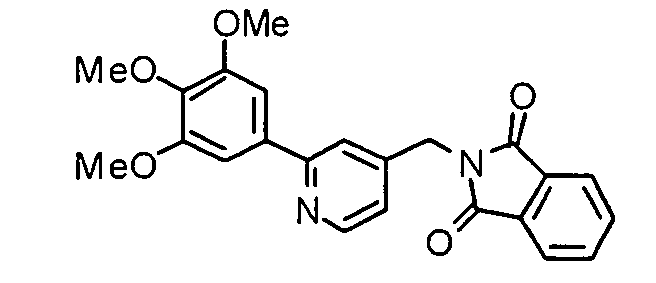
Yield: 1.16 g (96%).

The mixture was refluxed for 3 hours. After cooling, insoluble matters were filtered off. The filtrate was concentrated under reduced pressure and the residue was dissolved in chloroform. The solution was washed with saturated aqueous sodium hydrogen carbonate and brine, dried over anhydrous magnesium sulfate and concentrated under reduced pressure to give the title compound as pale yellow oil.
Yield: 418 mg (53%).

Yield: 1.20 g (88%).
1H-NMR (400 MHz, CDCl3) δ: 1.25 (t, 3H, J=7.0 Hz), 1.72-1.93 (m, 4H), 2.10 (t, 2H, J=9.8 Hz), 2.27-2.35 (m, 1H), 2.86 (d, 2H, J=11.3 Hz), 3.55 (s, 2H), 3.91 (s, 3H), 3.98 (s, 6H), 4.14 (q, 2H, J=7.0 Hz), 7.21 (d, 1H, J=4.9 Hz), 7.24 (s, 2H), 7.63 (s, 1H), 8.59 (d, 1H, J=5.1 Hz).

Yield: 779 mg (theoretical amount).
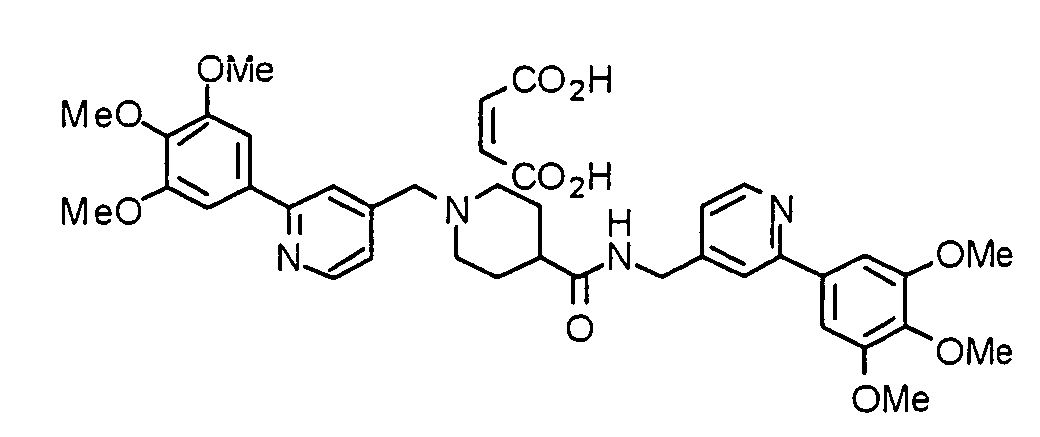
Yield: 93 mg (49%).
1H-NMR (400 MHz, measured as a maleate, DMSO-d6) δ: 1.87-2.01 (m, 4H), 2.48-2.56 (m, 1H), 2.78-2.86 (m, 2H), 3.26-3.31 (m, 2H), 3.78 (s, 3H), 3.79 (s, 3H), 3.87 (s, 6H), 3.90 (s, 6H), 4.15 (s, 2H), 4.39 (d, 2H, J=5.9 Hz), 6.16 (s, 2H), 7.16 (d, 1H, J=5.9 Hz), 7.35 (s, 2H), 7.39 (d, 1H, J=5.9 Hz), 7.39 (s, 2H), 7.73 (s, 1H), 7.95 (s, 1H), 8.15 (d, 1H, J=5.9 Hz), 8.54 (d, 1H, J=4.9 Hz), 8.68 (d, 1H, J=4.9 Hz).
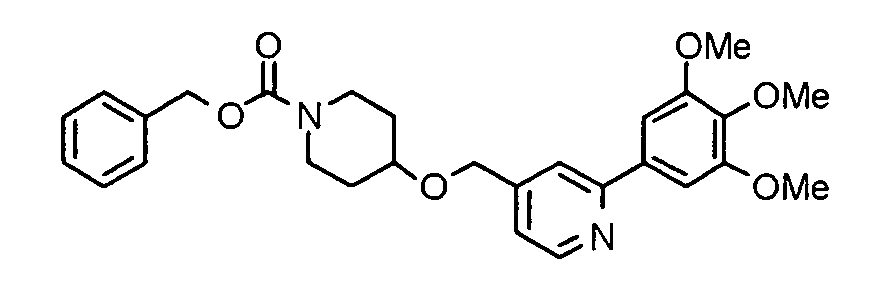
Yield: 213 mg (10%).
1H NMR (400MHz, CDCl3) δ: 1.63 (br, 2H), 1.89 (br, 2H), 3.20-3.35 (m, 2H), 3.57-3.68 (m, 1H), 3.84-3.92 (m, 5H), 3.94 (s, 6H), 4.62 (s, 2H), 5.11 (s, 2H), 7.21-7.35 (m, 8H), 7.61 (s, 1H), 8.61 (d, 1H, J=5.0Hz).

Yield: 93 mg (60%).
1H NMR (400MHz, CDCl3) δ: 1.55-1.68 (m, 2H), 2.01 (br, 2H), 2.67-2.72 (m, 2H), 3.13-3.18 (m, 2H), 3.50-3.60 (m, 1H), 3.91 (s, 3H), 3.97 (s, 6H), 4.64 (s, 2H), 7.22 (d, 1H, J=4.3 Hz), 7.24 (s, 2H), 7.64 (s, 1H), 8.63 (d, 1H, J=5.1 Hz).
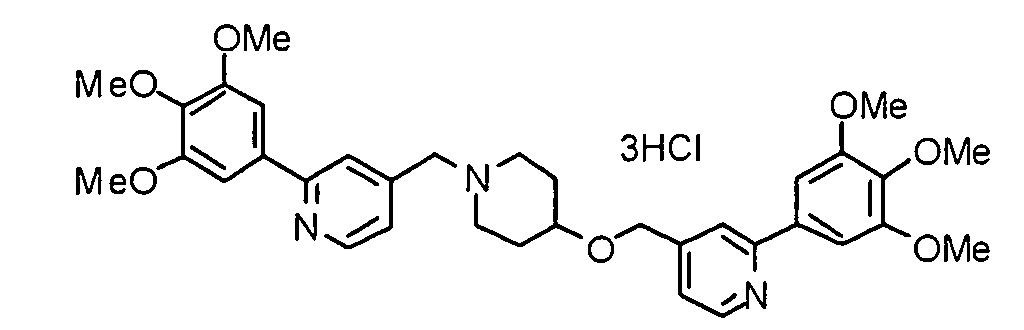
Yield: 42 mg (39%).
1H NMR (400MHz, measured as a free base, CDCl3) δ: 1.53-2.42 (m, 6H), 2.80 (br, 2H), 3.57 (br, 3H), 3.88 (s, 6H), 3.94 (s, 6H), 3.95 (s, 6H), 4.60 (s, 2H), 7.18-7.24(m, 6H), 7.61 (s, 2H), 8.58-8.61 (m, 2H).

Yield: 597 mg (74%).
1H-NMR (400 MHz, CDCl3) δ: 1.44 (s, 9H), 1.80-2.12 (m, 2H), 3.14-3.44 (m, 4H), 4.02 (br, 1H), 5.48 (d, 1H, J=7.2 Hz), 7.77 (t, 2H, J=4.4 Hz), 7.87-7.90 (m, 1H), 8.17-8.19 (m, 1H).
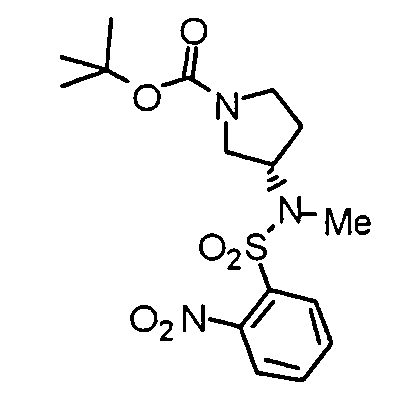
Yield: 365 mg (95%).
1H-NMR (400 MHz, CDCl3) δ: 1.44 (s, 9H), 1.95 (br, 1H), 2.09 (br, 1H), 2.87 (s, 3H), 3.20-3.31 (m, 2H), 3.53 (br, 2H), 4.58 (br, 1H), 7.65 (br, 1H), 7.71 (br, 2H), 8.04 (br, 1H).
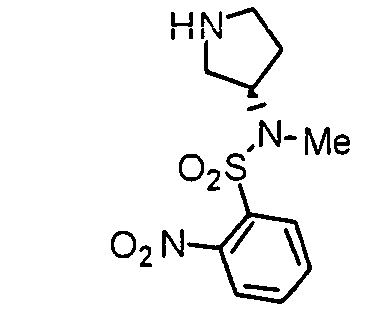
Yield: 135 mg (50%).
1H-NMR (400 MHz, CDCl3) δ: 1.69-1.74 (m, 1H), 1.87 (br, 1H), 1.95-2.02 (m, 1H), 2.80 (dd, 1H, J=11.7 Hz, 5.7 Hz), 2.84-2.91 (m, 4H), 2.96-3.05 (m, 1H), 3.10 (dd, 1H, J=11.7 Hz, 8.2 Hz), 4.48-4.56 (m, 1H), 7.61-7.63 (m, 1H), 7.66-7.73 (m, 2H), 8.01-8.04 (m, 1H).

Yield: 247 mg (96%).
1H-NMR (400 MHz, CDC13) δ: 1.80-1.87 (m, 1H), 2.15-2.30 (m, 2H), 2.52 (dd, 1H, J=10.5 Hz, 8.2 Hz), 2.71 (dd, 1H, J=10.5 Hz, 8.2 Hz), 2.90 (dt, 1H, J=8.8 Hz, 2.9 Hz), 2.96 (s, 3H), 3.53 (d, 1H, J=13.9 Hz), 3.58 (d, 1H, J=13.9 Hz), 3.90 (s, 3H), 3.96 (s, 6H), 4.61-4.68 (m, 1H), 7.16 (dd, 1H, J=4.9 Hz, 1.2 Hz), 7.21 (s, 2H), 7.58-7.60 (m, 2H), 7.64-7.69 (m, 2H), 7.99-8.02 (m, 1H), 8.58 (d, 1H, J=4.9 Hz,).
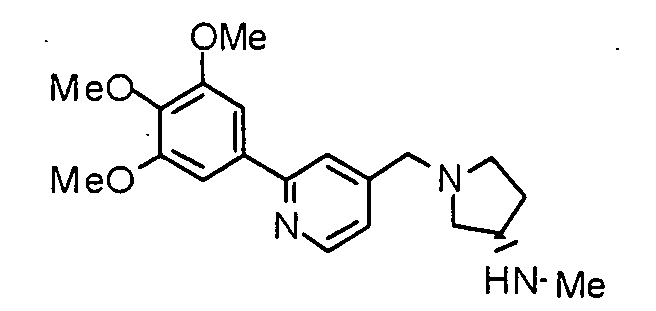
Yield: 104 mg (64%).
1H-NMR (400 MHz, CDCl3) δ: 1.32 (br, 1H), 1.56-1.64 (m, 1H), 2.11-2.17 (m, 1H), 2.38 (s, 3H), 2.44 (dd, 1H, J=7.4 Hz, 4.5 Hz), 2.50-2.55 (m, 1H), 2.66-2.75 (m, 2H), 3.20-3.26 (m, 1H), 3.66 (s, 2H), 3.90 (s, 3H), 3.97 (s, 6H), 7.21 (d, 1H, J=4.1 Hz), 7.25 (s, 2H), 7.64 (s, 1H), 8.59 (d, 1H, J=4.9 Hz).

Yield: 151 mg (68%).
1H-NMR (400 MHz, measured as a free base, CDCl3) δ: 1.89-1.92 (m, 1H), 2.04-2.08 (m, 1H), 2.18 (s, 3H), 2.60-2.76 (m, 4H), 3.25-3.29 (m, 1H), 3.53 (d, 1H, J=14.3 Hz), 3.62 (d, 1H, J=14.3 Hz), 3.64 (d, 1H, J=13.9 Hz), 3.73 (d, 1H, J=13.9 Hz), 3.89 (s, 6H), 3.95 (s, 6H), 3.96 (s, 6H), 7.20-7.21 (m, 2H), 7.23 (s, 2H), 7.24 (s, 2H), 7.61 (s, 1H), 7.65 (s, 1H), 8.59 (d, 1H, J=5.7 Hz), 8.60 (d, 1H, J=5.3 Hz).
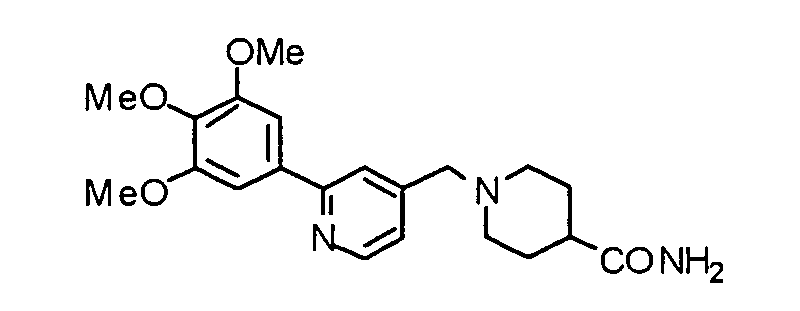
Yield: 1.01 g (87%).
1H-NMR (400 MHz, CDCl3) δ: 1.70-1.88 (m, 4H), 2.01-2.23 (m, 3H), 2.95 (d, 2H, J=11.0 Hz), 3.56 (s, 2H), 3.90 (s, 3H), 3.98 (s, 6H), 5.46 (d, 2H, J=16.3 Hz), 7.21 (d, 1H, J=5.0 Hz), 7.24 (s, 2H), 7.64 (s, 1H), 8.59 (d, 1H, J=5.0 Hz).

Yield: 201 mg (theoretical amount).
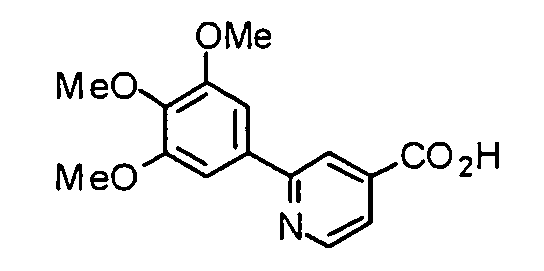
Water was added to the residue and the pH thereof was adjusted to 7. The resulting white precipitates were filtered. The resulting title compound was used for next step without further purification.
Yield: 2.60 g (90%).
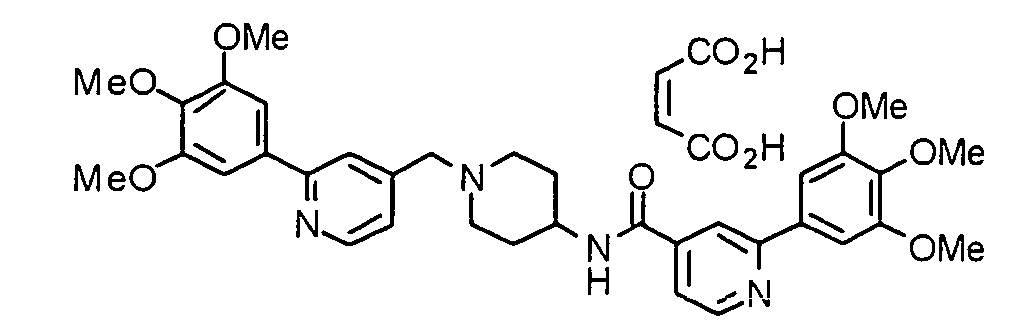
The resulting product was converted to a maleate to give the title compound.
Yield: 173 mg (93%).
1H-NMR (400 MHz, measured as a maleate, DMSO-d6) δ: 1.82-1.94 (m, 2H), 2.03-2.08 (m, 2H), 2.77-2.83 (m, 2H), 3.20-3.27 (m, 2H), 3.79 (s, 6H), 3.90 (s, 12H), 4.00 (br, 1H), 4.06 (s, 2H), 6.15 (s, 2H), 7.36-7.38 (m, 1H), 7.39 (s, 2H), 7.41 (s, 2H), 7.61-7.63 (m, 1H), 7.90 (s, 1H), 8.12 (s, 1H), 8.27-8.32 (m, 1H), 8.67 (d, 1H, J=4.9 Hz), 8.74 (d, 1H, J=5.1 Hz).
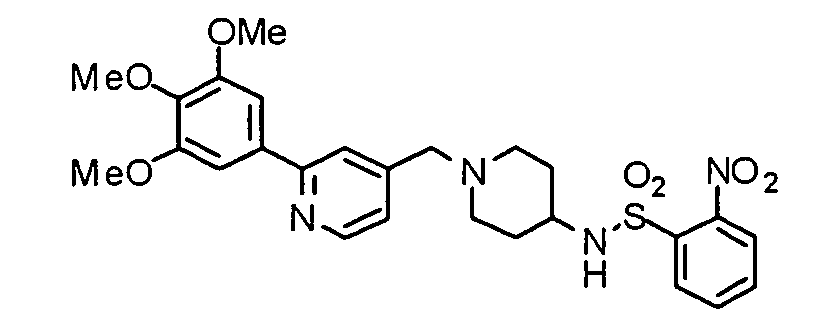
Yield: 494 mg (91%).

Yield: 443 mg (61%).

Yiled: 103 mg (24%).
1H-NMR (400 MHz, measured as a free base, DMSO-d6) δ: 1.44-1.53 (m, 2H), 1.87-1.91 (m, 2H), 2.15 (t, 2H, J=1.1 Hz), 2.57-2.64 (m, 1H), 2.82-2.85 (m, 2H), 3.59 (s, 2H), 3.78 (s, 6H), 3.89 (s, 12H), 3.90 (s, 2H), 6.63 (s, 4H), 7.24 (d, 1H, J=4.9 Hz), 7.29 (d, 1H, J=4.9 Hz), 7.35 (s, 2H), 7.37 (s, 2H), 7.76 (s, 1H), 7.85 (s, 1H), 8.53-8.56 (m, 2H).

Yield: 566 mg (96%).
1H-NMR (400 MHz, CDCl3) δ: 1.21 (t, 3H, J=7.0 Hz), 1.40-1.51 (m, 2H), 1.92 (d, 2H, J=10.9 Hz), 2.15 (t, 2H, J=10.9 Hz), 2.78 (d, 2H, J=11.6 Hz), 3.52 (br, 3H), 3.87 (s, 3H), 3.94 (s, 6H), 4.07 (q, 2H, J=7.0 Hz), 4.56 (br, 1H), 7.17 (d, 1H, J=4.9 Hz), 7.21 (s, 2H), 7.59 (s, 1H), 8.56 (d, 1H, J=5.1 Hz).

Yiled: 379 mg (78%).
1H-NMR (400 MHz, CDCl3) δ: 1.36-1.46 (m, 2H), 1.89 (d, 2H, J=12.5 Hz), 2.10 (dt, 2H, J=11.5 Hz, 1.1 Hz), 2.35-2.43 (m, 1H), 2.43 (s, 3H), 2.86 (d, 2H, J=11.6 Hz), 3.56 (s, 2H), 3.90 (s, 3H), 3.97 (s, 6H), 7.21 (d, 1H, J=5.1 Hz), 7.24 (s, 2H), 7.64 (s, 1H), 8.59(d, 1H, J=4.9 Hz).

Yield: 19.0 g (theoretical amount).
1H-NMR (400MHz, CDCl3) δ: 1.68 (t, 4H, J=5.6 Hz), 2.48 (br, 4H), 3.50 (s, 2H), 3.82 (s, 3H), 3.86 (s, 4H), 3.88 (s, 6H), 7.13 (d, 1H, J=4.9 Hz), 7.17 (s, 2H), 7.57 (s, 1H), 8.51 (d, 1H, J=4.9 Hz).

Yield: 15.0 g (75%).
1H-NMR (400MHz, CDCl3) δ : 2.48 (t, 4H, J=6.1 Hz), 2.79 (t, 4H, J=6.0 Hz), 3.69 (s, 2H), 3.89 (s, 3H), 3.96 (s, 6H), 7.24 (s, 2H), 7.26 (d, 1H, J=4.9 Hz), 7.66 (s, 1H), 8.62 (d, 1H, J=4.9 Hz).

. Yield: 3.55 g (99%).
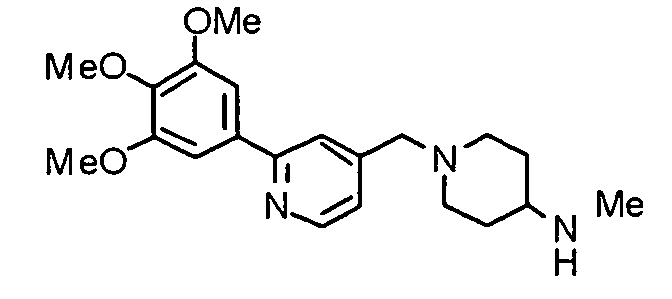
Yield: 640 mg (62%).

Yield: 5.09 g (92%).
1H-NMR (400MHz, CDCl3) δ: 1.42 (t, 3H, J=7.1 Hz), 3.90 (s, 3H), 3.94 (s, 6H), 4.41 (q, 2H, J=7.1 Hz), 6.79 (s, 2H), 7.50 (t, 1H, J=7.8 Hz), 7.73 (dt, 1H, J=7.1 Hz, 1.5 Hz), 8.01 (dt, 1H, J=7.8 Hz, 1.4 Hz), 8.23 (t, 1H, J=1.8 Hz).

Yield: 986 mg (91%).

Yield: 1.44 g (57%).
1H-NMR (400 MHz, measured as a dihydrochloride, DMSO-d6) δ: 1.89 (d, 2H, J=11.7 Hz), 2.54-2.62 (m, 2H), 2.89 (s, 3H), 3.09 (t, 2H, J=12.7 Hz), 3.43 (d, 2H, J=14.4 Hz), 3.76 (s, 3H), 3.78 (s, 3H), 3.88 (s, 6H), 3.91 (s, 6H), 4.34 (br, 3H), 6.91 (s, 2H), 7.33 (d, 1H, J=7.6 Hz), 7.47-7.51 (m, 2H), 7.54 (s, 2H), 7.60 (s, 1H), 7.71 (d, 1H, J=7.8 Hz), 8.55 (s, 1H), 8.68 (d, 1H, J=5.1 Hz).

Yield: 180 mg (58%).
1H-NMR (400 MHz, measured as a free base, CDCl3) δ: 1.69-1.73 (m, 2H), 1.82-1.85 (m, 2H), 2.03-2.08 (m, 2H), 2.25 (s, 3H), 2.48-2.51 (m, 1H), 2.97-2.99 (m, 2H), 3.56 (s, 2H), 3.67 (s, 2H), 3.90 (s, 3H), 3.91 (s, 3H), 3.94 (s, 6H), 3.98 (s, 6H), 6.76 (s, 2H), 7.22 (d, 1H, J=5.1 Hz), 7.24 (s, 2H), 7.62 (s, 1H), 7.80 (s, 1H), 8.50 (d, 1H, J=2.0 Hz), 8.60 (d, 1H, J=4.3 Hz), 8.69 (d, 1H, J=5.1 Hz).

Yield: 230 mg (92%).

Yield: 90 mg (66%).
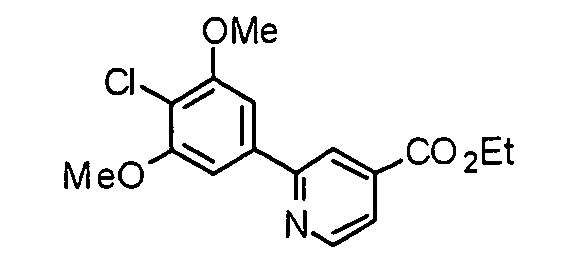
Yield: 8.55 g (77%).
1H-NMR (400 MHz, CDCl3) δ : 1.45 (t, 3H, J=7.3 Hz), 4.03 (s, 6H), 4.45 (q, 2H, J=7.3 Hz), 7.32 (s, 2H), 7.80 (d, 1H, J=5.1 Hz), 8.27 (s, 1H), 8.83 (d, 1H, J=5.0 Hz).
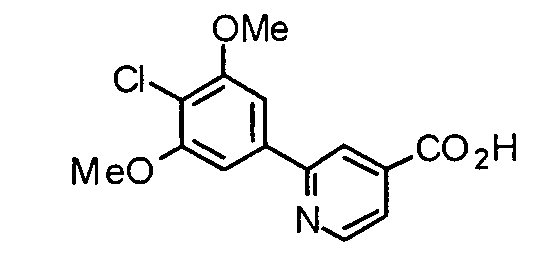
Yield: 7.20 g (92%).
1H-NMR (400 MHz, CDCl3) δ: 4.02 (s, 6H), 7.34 (s, 2H), 7.83 (d, 1H, J=4.9 Hz), 7.84 (s, 1H), 8.82 (d, 1H, J=4.9 Hz).

Yeld: 4.10 g (60%).
1H-NMR (400 MHz, CDCl3+DMSO-d6) δ: 4.01 (s, 6H), 4.76 (s, 2H), 7.20-7.35 (m, 3H), 7.78 (s, 1H), 8.62 (s,1H).

Yield: 4.20 g (96%).
1H-NMR (400 MHz, CDCl3) δ: 4.02 (s, 6H), 4.63 (s, 2H), 7.26 (s, 2H), 7.29 (d, 1H, J=4.9 Hz), 7.72 (s, 1H), 8.69 (d, 1H, J=4.9 Hz).

Yield: 743 mg (95%).
1H-NMR (400 MHz, CDCl3) δ: 1.75-1.90 (m, 4H), 2.07-2.25 (m, 3H), 2.94 (d, 2H, J=11.6 Hz), 3.57 (s, 2H), 4.02(s, 6H), 7.24-7.31 (m, 3H), 7.67 (s, 1H), 8.61 (d, 1H, J=5.1 Hz).

Yield: 887 mg (theoretical amount).
1H-NMR (400 MHz, CDCl3) δ: 1.24 (t, 3H, J=7.1 Hz), 1.43-1.59 (m, 2H), 1.96 (d, 2H, J=11.4 Hz), 2.19 (t, 2H, J=11.0 Hz), 2.82 (d, 2H, J=11.5 Hz), 3.56 (s, 2H), 4.02 (s, 6H), 4.10 (q, 2H, J=7.1 Hz), 7.26 (s, 2H), 7.66 (s, 1H), 7.71 (dd, 1H, J=5.6 Hz, 1.0 Hz), 8.6 (dd, 1H, J=4.9 Hz, 0.5 Hz).

Yield: 195 mg (27%).
1H-NMR (400 MHz, CDCl3) δ: 1.35-1.49 (m, 2H), 1.89 (d, 2H, J=12.3 Hz), 2.11 (t, 2H, J=9.4 Hz), 2.38-2.45 (m, 1H), 2.44 (s, 3H), 2.87 (d, 2H, J=10.7 Hz), 3.57 (s, 2H), 4.02 (s, 6H), 7.23-7.29 (m, 3H), 7.68 (s, 1H), 8.61 (d, 1H, J=4.9 Hz).
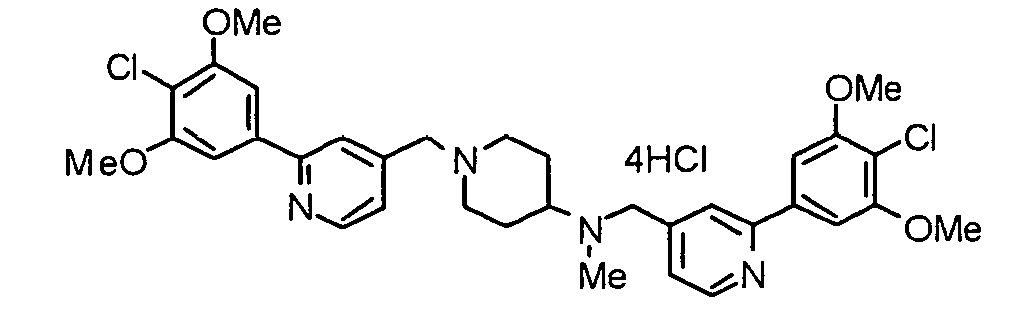
Yield: 300 mg (75%).
1H-NMR (400 MHz, measured as a free base, CDCl3) δ: 1.60-1.90 (m, 4H), 2.06 (t, 2H, J=11.7 Hz), 2.26 (s, 3H), 2.45-2.55 (m, 1H), 2.97 (d, 2H, J=11.3 Hz), 3.57 (s, 2H), 3.67 (s, 2H), 4.01 (s, 6H), 4.02 (s, 6H), 7.24-7.28 (m, 6H), 7.65 (s, 1H), 7.67 (s, 1H), 8.61 (d, 1H, J=5.4 Hz), 8.62 (d, 1H, J=5.4 Hz).
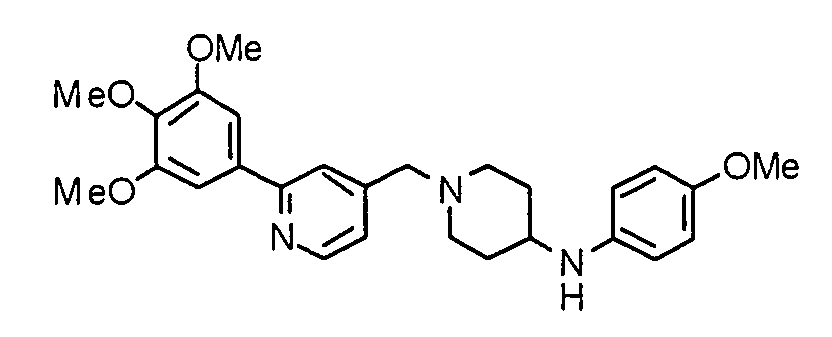
Yield: 1.56 g (55%).
1H-NMR (400MHz, CDCl3) δ: 1.48 (br, 2H), 2.05 (br, 2H), 2.20 (br, 2H), 2.86 (br, 2H), 3.23 (s, 1H), 3.58 (s, 2H), 3.74 (s, 3H), 3.91 (s, 3H), 3.97 (s, 6H), 6.58 (d, 2H, J=8.8 Hz), 6.77 (d, 2H, J=9.0 Hz), 7.22 (d, 1H, J=5.1 Hz), 7.26 (s, 2H), 7.64 (s, 1H), 8.59 (d, 1H, J=4.9 Hz).

Yield: 799 mg (77%).
1H-NMR (400MHz, CDCl3) δ: 1.10 (t, 3H, J=7.2 Hz), 3.89 (s, 9H), 4.19 (q, 2H, J=7.2 Hz), 6.79 (s, 2H), 7.34 (dd, 1H, J=7.8 Hz, 4.8 Hz), 8.06 (dd, 1H, J=7.8 Hz, 1.7 Hz), 8.75 (dd, 1H, J=4.8 Hz, 1.7 Hz).

Yield: 293 mg (72%).
1H-NMR (400MHz, CDCl3) δ: 3.90 (s, 9H), 4.72 (s, 2H), 6.83 (s, 2H), 7.32 (dd, 1H, J=7.9 Hz, 4.8 Hz), 7.92 (dd, 1H, J=7.9 Hz, 1.7 Hz), 8.62 (dd, 1H, J=4.8 Hz, 1.7 Hz).

Yield: 311 mg (theoretical amount).
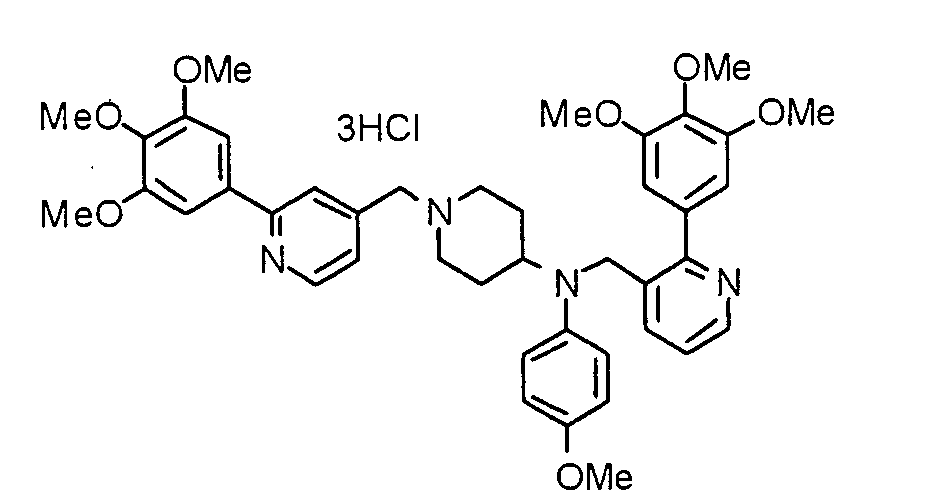
Yield: 16 mg, (8%).
1H-NMR (400MHz, measured as a free base, CDCl3) δ: 1.60 (br, 2H), 1.77 (br, 2H), 2.09 (br, 2H), 2.93 (br, 2H), 3.45 (br, 1H), 3.54 (s, 2H), 3.73 (s, 3H), 3.90 (s, 6H), 3.91 (s, 6H), 3.96 (s, 6H), 4.34 (s, 2H), 6.65 (d, 2H, J=9.0 Hz), 6.71 (s, 2H), 6.74 (d, 2H, J=9.0 Hz), 7.16-7.19 (m, 2H), 7.22 (s, 2H), 7.55 (s, 1H), 7.79 (d, 1H, J=7.0 Hz), 8.50 (br, 1H), 8.58 (d, 1H, J=4.9 Hz).
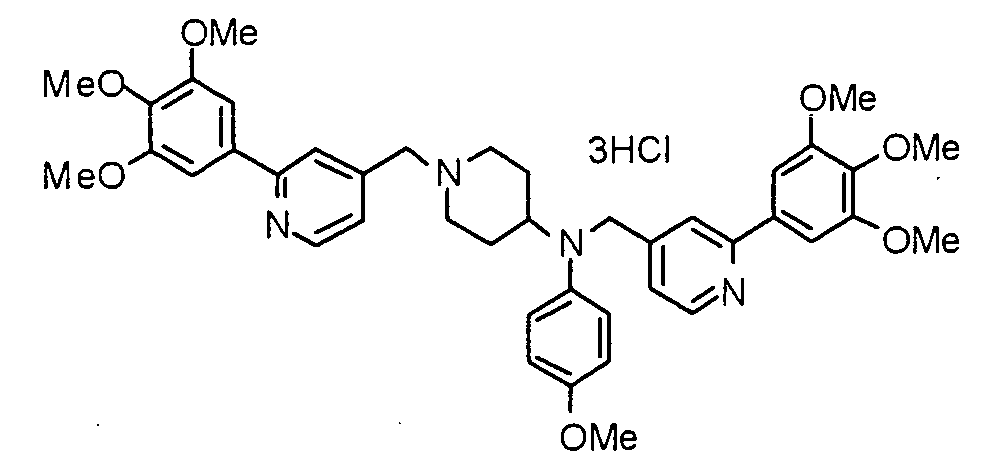
Yield: 1.17 g (40%).
1H-NMR (400MHz, measured as a free base, CDCl3) δ: 1.68-1.97 (m, 4H), 2.09-2.23 (m, 2H), 2.98 (br, 2H), 3.54-3.66 (m, 3H), 3.73 (s, 3H), 3.89 (s, 3H), 3.90 (s, 3H), 3.93 (s, 6H), 3.96 (s, 6H), 4.45 (s, 2H), 6.74 (d, 2H, J=9.2 Hz), 6.79 (d, 2H, J=9.2 Hz), 7.15 (s, 2H), 7.16-7.21 (m, 2H), 7.23 (s, 2H), 7.57 (s, 1H), 7.60 (s, 1H), 8.54 (d, 1H, J=5.1 Hz), 8.59 (d, 1H, J=4.9 Hz).
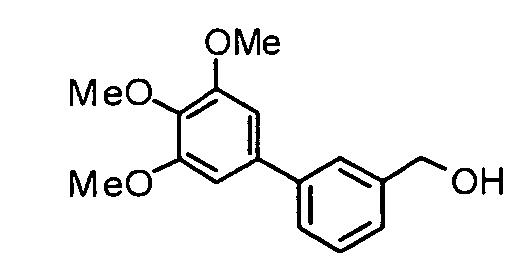
Yield: 4.25 g (97%).
1H-NMR (400MHz, CDCl3) δ: 1.87 (t, 1H, J=6.0 Hz), 3.89 (s, 3H), 3.92 (s, 6H), 4.76 (d, 1H, J=5.6 Hz), 6.77 (s, 2H), 7.34 (d, 1H, J=7.4 Hz), 7.42 (t, 1H, J=7.5 Hz), 7.48 (d, 1H, J=7.6 Hz), 7.55 (s, 1H).

Yield: 893 mg (69%).
1H-NMR (400MHz, CDCl3) δ: 3.87 (s, 3H), 3.90 (s, 6H), 4.62 (s, 2H), 6.75 (s, 2H), 7.33 (d, 1H, J=7.6 Hz), 7.39 (t, 1H, J=7.7 Hz), 7.48 (d, 1H, J=7.6 Hz), 7.54 (s, 1H).

Yield: 52 mg (22%).
1H-NMR (400MHz, measured as a free base, CDCl3) δ: 1.77-1.92 (m, 5H), 2.14-2.20 (m, 2H), 2.95-3.00 (m, 5H), 2.14-2.20 (m, 2H), 2.95-3.00 (m, 2H), 3.58 (s, 2H), 3.72 (s, 3H), 3.88 (s, 3H), 3.89 (s, 6H), 3.90 (s, 3H), 3.96 (s, 6H), 4.47 (s, 2H), 6.70 (s, 2H), 6.74-6.83 (m, 4H), 7.20 (d, 1H, J=7.4 Hz), 7.23 (s, 2H), 7.25-7.27 (m, 1H), 7.33 (t, 1H, J=7.4 Hz), 7.38 (d, 1H, J=8.7 Hz), 7.43 (s, 1H), 7.62 (s, 1H), 8.59 (d, 1H, J=5.1 Hz).

Yield: 1.42 g (82%)
1H-NMR (400MHz, CDCl3) δ: 1.43 (t, 3H, J=7.2 Hz), 3.92 (s, 3H), 3.98 (s, 6H), 4.44 (q, 2H, J=7.2 Hz), 7.32 (s, 2H), 7.76 (d, 1H, J=8.3 Hz), 8.33 (dd, 1H, J=8.2 Hz, 2.2 Hz), 9.26 (d, 1H, J=2.2 Hz).
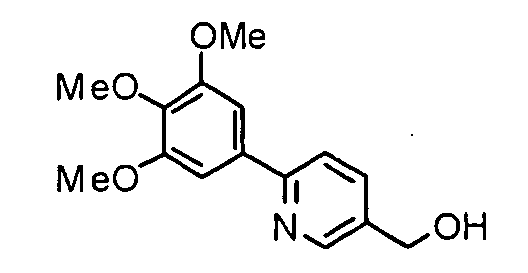
Yield: 482 mg (85%).
1H-NMR (400MHz, CDCl3) δ: 3.91 (s, 3H), 3.97 (s, 6H), 4.76 (s, 2H), 7.23 (s, 2H), 7.68 (d, 1H, J=7.4 Hz), 7.78 (dd, 1H, J=7.4 Hz, 2.3 Hz), 8.63 (d, 1H, J=2.3 Hz).


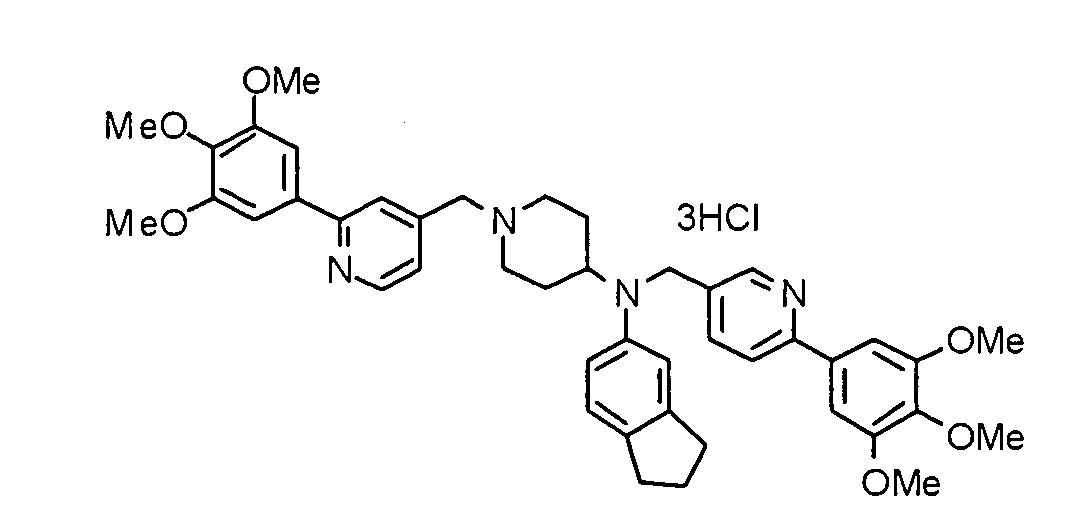
The resulting free base was converted to a trihydrochloride which gave the title compound as yellow powder.
Yield: 13 mg (5%).
1H-NMR (400MHz, measured as a free base, CDCl3) δ: 1.76 (br, 2H), 1.88 (br, 2H), 2.14 (br, 2H), 2.97 (br, 2H), 3.51 (br, 1H), 3.57 (s, 2H), 3.73 (s, 3H), 3.89 (s, 3H), 3.90 (s, 3H), 3.94 (s, 6H), 3.96 (s, 6H), 4.42 (s, 2H), 6.78 (br, 4H), 7.20 (br, 3H), 7.23 (s, 2H), 7.57-7.70 (m, 3H), 8.58-8.60 (m, 2H).
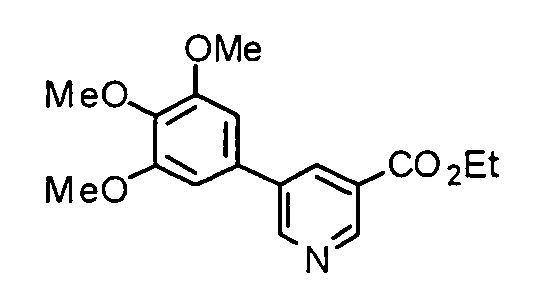
Yield: 7.19 g (76%).
1H-NMR (400MHz, CDCl3) δ: 1.44 (t, 3H, J=7.1 Hz), 3.91 (s, 3H), 3.95 (s, 6H), 4.46 (q, 2H, J=7.1 Hz), 6.79 (s, 2H), 8.44 (t, 1H, J=2.1 Hz), 8.96 (d, 1H, J=2.1 Hz), 9.18 (d, 1H, J=1.8 Hz).
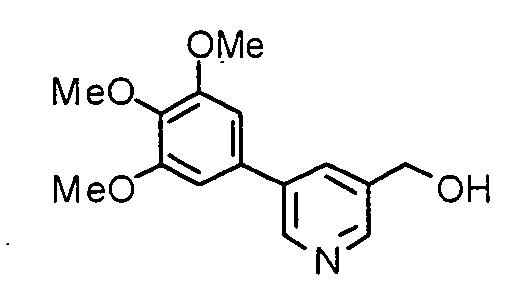
Yield; 3.83 g (61%).
1H-NMR (400MHz, CDCl3) δ: 3.88 (s, 3H), 3.89 (s, 6H), 4.39 (br, 1H), 4.80 (s, 2H), 6.72 (s, 2H), 7.89 (t, 1H, J=1.2 Hz), 8.47 (d, 1H, J=2.1 Hz), 8.63 (d, 1H, J=2.2 Hz).

Yield: 1.97 g (65%).
1H-NMR (400MHz, CDCl3) δ: 3.90 (s, 3H), 3.94 (s, 6H), 4.67 (s, 2H), 6.75 (s, 2H), 7.87 (t, 1H, J=2.1 Hz), 8.59 (d, 1H, J=2.0 Hz), 8.76 (d, 1H, J=2.1 Hz).
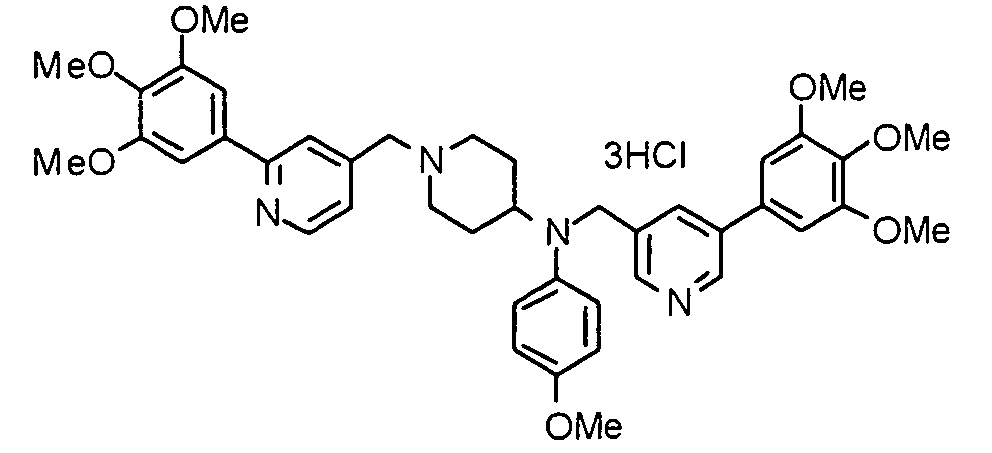
Yield: 14 mg (5%).
1H-NMR (400 MHz, measured as a free base, CDCl3) 5; 1.73-1.75 (m, 2H), 1.88 (d, 2H, J=11.3 Hz), 2.13 (t, 2H, J=11.3 Hz), 2.96 (d, 2H, J=11.5 Hz), 3.50 (br, 1H), 3.55 (s, 2H), 3.72 (s, 3H), 3.88 (s, 3H), 3.89 (s, 9H), 3.96 (s, 6H), 4.45 (s, 2H), 6.65 (s, 2H), 6.76 (d, 2H, J=9.6 Hz), 6.80 (d, 2H, J=9.4 Hz), 7.20 (d, 1H, J=5.3 Hz), 7.22 (s, 2H), 7.59 (s, 1H), 7.67 (s, 1H), 8.50 (s, 1H), 8.59 (d, 1H, J=4.7 Hz), 8.62 (s, 1H).
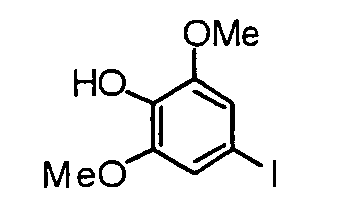
Yield: 1.0 g (31%)
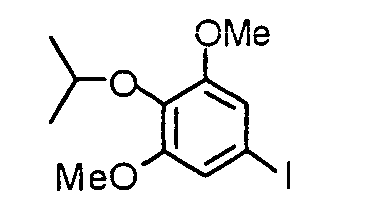
Yeld: 788 mg (72%).

Yield: 1.23 g (74%).

Yield: 1.57 g(89%).
1H-NMR (400 MHz, CDCl3) δ: 1.33 (d, 6H, J=4.9 Hz), 1.44 (t, 3H, J=7.1 Hz), 3.95 (s, 6H), 4.42-4.49 (m, 3H), 7.29 (s, 2H), 7.75 (dd, 1H, J=4.9 Hz, 1.4 Hz), 8.24 (s, 1H), 8.80 (d, 1H, J=4.9 Hz).

Yield: 1.31 g (95%).
1H-NMR (400 MHz, CDCl3) δ: 1.32 (d, 6H, J=6.1 Hz), 3.93 (s, 6H), 4.45 (quint, 1H, J=6.1 Hz), 4.81 (s, 2H), 7.20 (d, 1H, J=5.1 Hz), 7.23 (s, 2H), 7.68 (s, 1H), 8.62 (d, 1H, J=5.1 Hz).
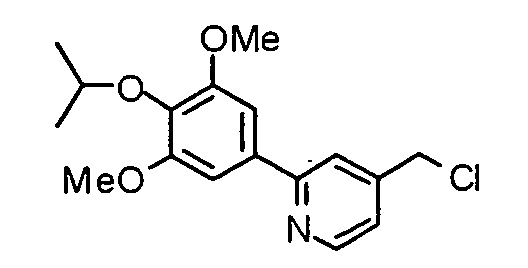
Yield: 1.33 g (84%).
1H-NMR (400 MHz, CDCl3) δ: 1.32 (d, 6H, J=6.2 Hz), 3.94 (s, 6H), 4.45 (quint, 1H, J=6.1 Hz), 4.61 (s, 2H), 7.23-7.26 (m, 3H), 7.69 (s, 1H), 8.66 (d, 1H, J=5.1 Hz).
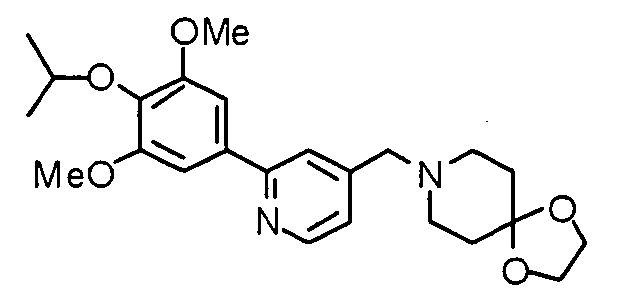
Yield: 818 mg (95%).
1H-NMR (400 MHz, CDCl3) δ: 1.32 (d, 6H, J=6.1 Hz), 1.78 (t, 4H, J=5.7 Hz), 2.57 (br, 4H), 3.49 (s, 4H), 3.59 (s, 2H), 3.94 (s, 6H), 4.44 (quint, 1H, J=6.1 Hz), 7.21 (d, 1H, J=5.1 Hz), 7.23 (s, 2H), 7.65 (s, 1H), 8.59 (d, 1H, J=5.1 Hz).
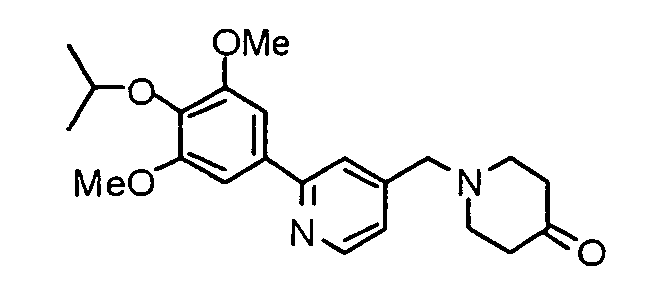
Yield: 717 mg (98%).
1H-NMR (400 MHz, CDCl3) δ: 1.32 (d, 6H, J=6.2 Hz), 2.50 (t, 4H, J=6.1 Hz), 2.81 (t, 4H, J=6.1 Hz), 3.69 (s, 2H), 3.95 (s, 6H), 4.45 (quint, 1H, J=6.2 Hz), 7.24 (s, 2H), 7.25-7.27 (m, 1H), 7.68 (s, 1H), 8.63 (d, 1H, J=5.1 Hz).

Yield: 307 mg (69%).
1H-NMR (400 MHz, CDCl3) δ: 1.32 (d, 6H, J=6.3 Hz), 1.46-1.52 (m, 2H), 2.00-2.24 (m, 2H), 2.22 (t, 2H, J=11.1 Hz), 2.86 (d, 2H, J=12.1 Hz), 3.18-3.28 (m, 1H), 3.58 (s, 2H), 3.74 (s, 3H), 3.94 (s, 6H), 4.40 (quint, 1H, J=6.3 Hz), 6.58 (d, 2H, J=6.6 Hz), 6.78 (d, 2H, J=6.6 Hz), 7.20 (d, 1H, J=5.1 Hz), 7.24 (s, 2H), 7.64 (s, 1H), 8.59 (d, 1H, J=5.1 Hz).

Yield: 230 mg (46%).
1H-NMR (400 MHz, measured as a free base, CDCl3) δ: 1.31 (d, 6H, J=3.3 Hz), 1.32 (d, 6H, J=6.8 Hz), 1.70-1.92 (m, 4H), 2.10-2.20 (m, 2H), 2.92-3.01 (m, 2H), 3.56 (s, 2H), 3.73 (s, 3H), 3.85-3.95 (m, 1H), 3.90 (s, 6H), 3.93 (s, 6H), 4.39-4.49 (m, 4H), 6.73 (d, 2H, J=4.8 Hz), 6.78 (d, 2H, J=4.8 Hz), 7.14 (s, 2H), 7.15-7.20 (m, 2H), 7.23 (s, 2H), 7.58 (s, 1H), 7.60 (s, 1H), 8.53 (d, 1H, J=5.1 Hz), 8.58 (d, 1H, J=5.1 Hz).

Yield: 1.20 g (68%).
1H-NMR (400MHz, CDCl3) δ: 1.40-1.60 (m, 2H), 1.88-2.09 (m, 5H), 2.54 (br, 1H), 2.82-2.85 (m, 2H), 3.52 (s, 2H), 3.80 (s, 2H), 3.89 (s, 2H), 3.95 (s, 6H), 7.18-7.31 (m, 8H), 7.64 (s, 1H), 8.57 (d, 1H, J=5.1 Hz).
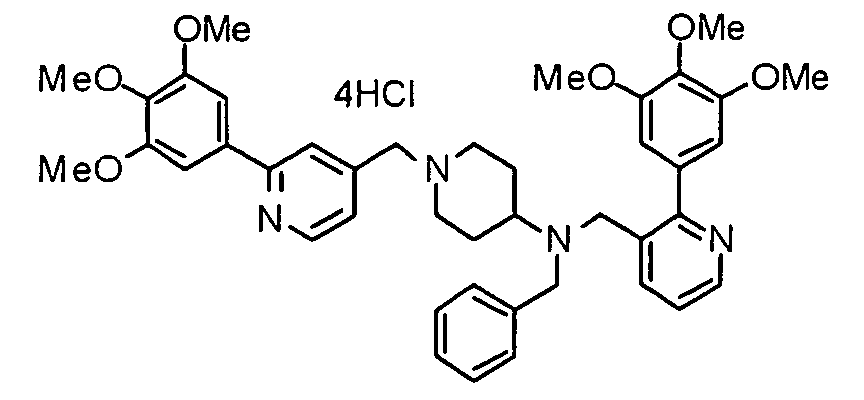
Yield: 43 mg, (17%).
1H-NMR (400MHz, measured as a free base, CDCl3) δ: 1.63 (br, 4H), 1.87 (br, 2H), 2.39 (br, 1H), 2.88 (br, 2H), 3.49 (s, 2H), 3.57 (s, 2H), 3.68 (s, 2H), 3.86 (s, 6H), 3.88 (s, 3H), 3.90 (s, 3H), 3.96 (s, 6H), 6.60 (s, 2H), 7.17 (d, 1H, J=5.1 Hz), 7.22-7.29 (m, 8H), 7.56 (s, 1H), 8.02 (d, 1H, J=8.0 Hz), 8.50 (d, 1H, J=6.4 Hz), 8.58 (d, 1H, J=5.1 Hz).
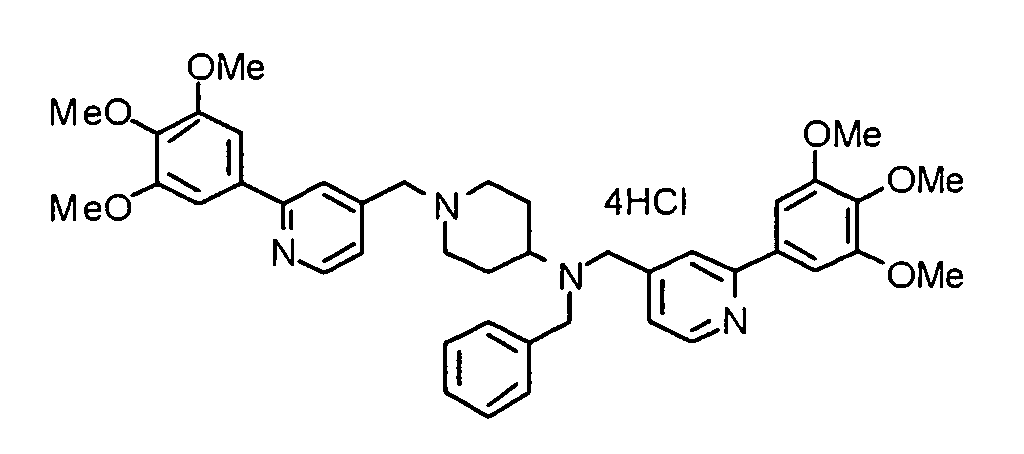
The resulting free base was converted to a tetrahydrochloride which gave the title compound as yellow powder.
Yield: 172 mg (47%).
1H-NMR (400MHz, measured as a free base, CDCl3) δ: 1.69-1.85 (m, 4H), 1.93-1.99 (m, 2H), 2.56 (br, 1H), 2.93-3.00 (m, 2H), 3.51 (s, 2H), 3.71 (s, 2H), 3.74 (s, 2H), 3.90 (s, 6H), 3.96 (s, 6H), 3.96 (s, 6H), 7.18-7.32 (m, 9H), 7.38 (d, 2H, J=7.1 Hz), 7.59 (s, 1H), 7.68 (s, 1H), 8.56 (d, 1H, J=5.1 Hz), 8.60 (d, 1H, J=5.1 Hz).

Yield: 47 mg (18%).
1H-NMR (400MHz, measured as a free base, CDCl3) δ: 1.70-1.86 (m, 4H), 1.96 (br, 2H), 2.59 (br, 1H), 2.94 (br, 2H), 3.51 (s, 2H), 3.70 (s, 2H), 3.74 (s, 2H), 3.89 (s, 3H), 3.90 (s, 3H), 3.92 (s, 6H), 3.96 (s, 6H), 6.75 (s, 2H), 7.18-7.30 (m, 6H), 7.35-7.40 (m, 5H), 7.56 (s, 1H), 7.60 (s, 1H), 8.58 (d, 1H, J=5.1 Hz).

The resulting free base was converted to a tetrahydrochloride which gave the title compound as yellow powder.
Yield: 44 mg (17%).
1H-NMR (400MHz, measured as a free base, CDCl3) δ: 1.81 (br, 4H), 1.96 (br, 2H), 2.55 (br, 1H), 2.96 (br, 2H), 3.52 (s, 2H), 3.69 (s, 4H), 3.89 (s, 6H), 3.95 (s, 6H), 3.96 (s, 6H), 7.19-7.32 (m, 8H), 7.36-7.38 (m, 2H), 7.61 (d, 2H, J=7.6 Hz), 7.69-7.73 (m, 1H), 8.59 (d, 1H, J=4.9 Hz), 8.63 (s, 1H).
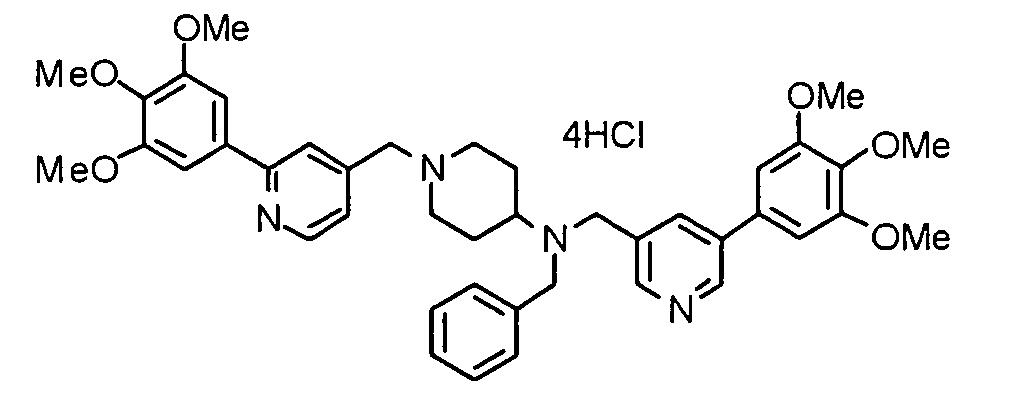
Yield: 26 mg (10%).
1H-NMR (400 MHz, measured as a free base, CDCl3) δ: 1.83 (br, 4H), 1.97 (br, 2H), 2.58 (br, 1H), 2.95 (br, 2H), 3.53 (s, 2H), 3.71 (s, 2H), 3.75 (s, 2H), 3.90 (s, 6H), 3.93 (s, 6H), 3.96 (s, 6H), 6.74 (s, 2H), 7.19-7.30 (m, 6H), 7.36 (d, 2H, J=6.8 Hz), 7.60 (s, 1H), 7.79 (s, 1H), 8.54 (s, 1H), 8.59 (d, 1H, J=5.1 Hz), 8.64 (s, 1H).
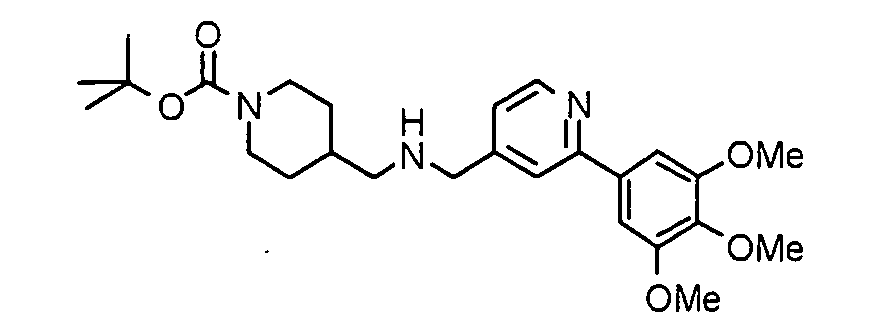
Yield: 264 mg (90%).
1H-NMR (400MHz, CDCl3) δ: 1.12-1.27 (m, 3H), 1.45 (s, 9H), 1.60 (br, 1H), 1.74 (d, 2H, J=12.9 Hz), 2.54 (d, 2H, J=6.6 Hz), 2.69 (br, 2H), 3.87 (s, 2H), 3.90 (s, 3H), 3.97 (s, 6H), 4.03-4.14 (m, 2H), 7.20 (d, 1H, J=3.9 Hz), 7.24 (s, 2H), 7.65 (s, 1H), 8.60 (d, 1H, J=4.9 Hz).
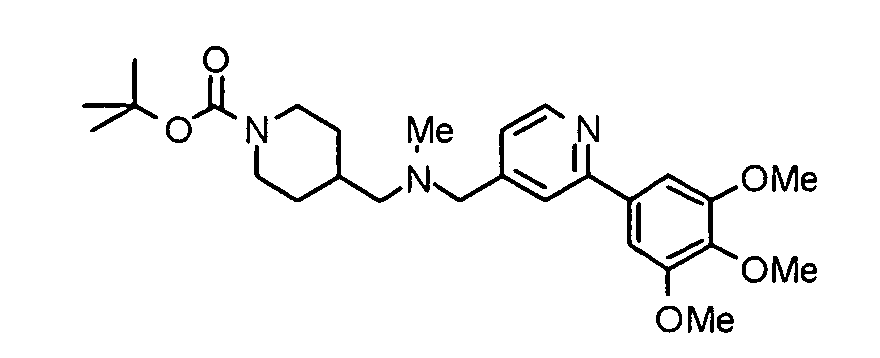
Yield: 157 mg (58%).
1H-NMR (400MHz, CDCl3) δ: 1.00-1.09 (m, 2H), 1.43 (s, 9H), 1.65-1.70 (m, 1H), 1.79 (d, 2H, J=12.7 Hz), 2.21 (d, 2H, J=7.4 Hz), 2.23 (s, 3H), 2.69 (br, 2H), 3.52 (s, 2H), 3.89 (s, 3H), 3.96 (s, 6H), 4.07-4.13 (m, 2H), 7.20 (d, 1H, J=4.9 Hz), 7.24 (s, 2H), 7.64 (s, 1H), 8.58 (d, 1H, J=5.1 Hz).

Yield: 105 mg (88%).
1H-NMR (400MHz, CDCl3) δ: 1.00-1.10 (m, 2H), 1.60-1.68 (m, 1H), 1.80 (d, 2H, J=12.5 Hz), 2.03 (br, 1H), 2.20 (d, 2H, J=8.4 Hz), 2.21 (s, 3H), 2.58 (dt, 2H, J=12.1 Hz, 2.1 Hz), 3.05 (d, 2H, J=12.1 Hz), 3.51 (s, 2H), 3.89 (s, 3H), 3.95 (s, 6H), 7.20 (d, 1H, J=5.1 Hz), 7.24 (s, 2H), 7.65 (s, 1H), 8.57 (d, 1H, J=5.9 Hz).

Yield: 109 mg (40%).
1H-NMR (400MHz, measured as a free base, CDCl3) δ: 1.19-1.27 (m, 2H), 1.56 (br, 1H), 1.81 (d, 2H, J=11.1 Hz), 1.99-2.04 (m, 2H), 2.23 (s, 5H), 2.88 (d, 2H, J=11.1 Hz), 3.53 (s, 4H), 3.89 (s, 3H), 3.90 (s, 3H), 3.94 (s, 6H), 3.96 (s, 6H), 7.20 (br, 2H), 7.23 (s, 4H), 7.61 (s, 1H), 7.64 (s, 1H), 8.58 (d, 2H, J=4.9 Hz).
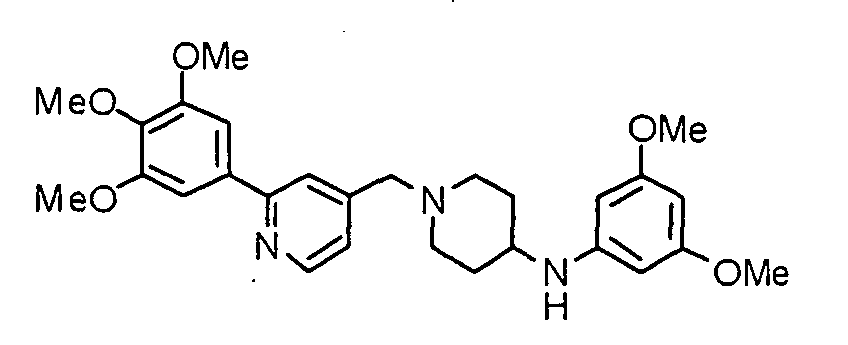
Yield: 800 mg (41%).
1H-NMR (400MHz, CDCl3) δ: 1.40-1.90 (m, 2H), 1.95-2.50 (m, 4H), 2.93 (br, 2H), 3.31 (br, 1H), 3.65 (br, 2H), 3.72 (s, 6H), 3.88 (s, 3H), 3.96 (s, 6H), 5.76 (s, 2H), 5.85 (s, 1H), 7.20-7.35 (m, 3H), 7.73 (br, 1H), 8.60 (d, 1H, J=4.9 Hz).

Yield: 29 mg, (11%).
1H-NMR (400MHz, measured as a free base, CDCl3) δ: 1.60-1.63 (m, 2H), 1.79 (d, 2H, J=11.7 Hz), 2.13 (t, 2H, J=11.4 Hz), 2.94 (d, 2H, J=11.3 Hz), 3.54 (s, 2H), 3.71 (s, 6H), 3.78-3.84 (m, 1H), 3.90 (s, 3H), 3.91 (s, 6H), 3.92 (s, 3H), 3.96 (s, 6H), 4.41 (s, 2H), 5.84 (s, 2H), 6.72 (s, 2H), 7.09-7.24 (m, 5H), 7.53 (s, 1H), 7.71 (d, 1H, J=6.6 Hz), 8.51 (dd, 1H, J=4.7 Hz, 1.6 Hz), 8.59 (d, 1H, J=4.9 Hz).
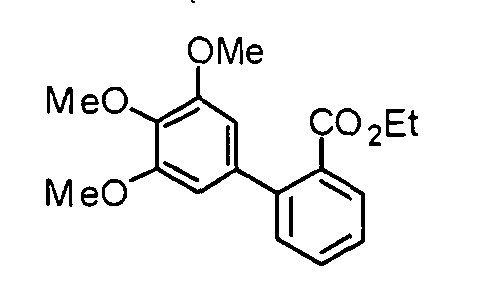
Yield: 655 mg (69%).
1H-NMR (400MHz, CDCl3) δ: 1.04 (t, 3H, J=7.2 Hz), 3.86 (s, 6H), 3.89 (s, 3H), 4.12 (q, 2H, J=7.2 Hz), 6.54 (s, 2H), 7.40-7.42 (m, 2H), 7.51 (t, 1H, J=7.8 Hz), 7.77 (d, 1H, J=6.8 Hz).
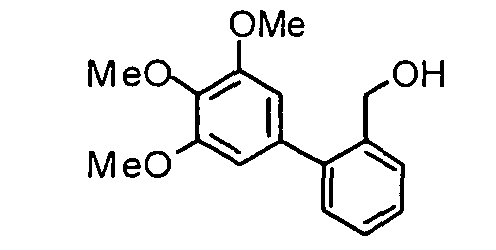
Yield: 630 mg (theoretical amount).
1H-NMR (400MHz, CDCl3) δ: 3.85 (s, 6H), 3.90 (s, 3H), 4.61 (s, 2H), 6.61 (s, 2H), 7.26-7.39 (m, 3H), 7.53 (d, 1H, J=6.8 Hz).
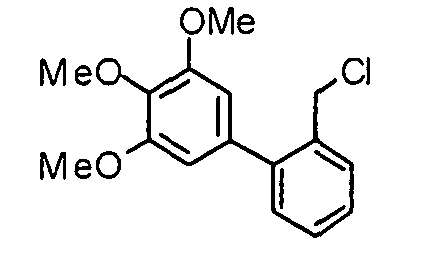
Yield: 615 mg (theoretical amount).
1H-NMR (400MHz, CDCl3) δ: 3.87 (s, 6H), 3.90 (s, 3H), 4.53 (s, 2H), 6.66 (s, 2H), 7.29-7.32 (m, 1H), 7.34-7.39 (m, 2H), 7.50-7.52 (m, 1H).

Yield: 20 mg, (8%).
1H-NMR (400MHz, measured as a free base, CDCl3) δ: 1.50-1.90 (m, 4H), 2.05-2.20 (m, 2H), 2.92 (br, 2H), 3.52 (br, 3H), 3.68 (s, 6H), 3.85 (s, 6H), 3.88 (s, 3H), 3.89 (s, 3H), 3.94 (s, 6H), 4.31 (s, 2H), 5.85 (br, 3H), 6.52 (s, 2H), 7.05-7.27 (m, 6H), 7.34 (s, 1H), 7.51(s, 1H), 8.56(s, 1H).

Yield: 40 mg (18%).
1H-NMR (400MHz, measured as a free base, CDCl3) δ: 1.68-1.90 (m, 4H), 2.12-2.22 (m, 2H), 2.94-3.02 (m, 2H), 3.57 (s, 2H), 3.71 (s, 6H), 3.81-3.83 (m, 1H), 3.89 (s, 3H), 3.90 (s, 3H), 3.93 (s, 6H), 3.96 (s, 6H), 4.52 (s, 2H), 5.89-5.94 (m, 3H), 7.14 (d, 1H, J=5.3 Hz), 7.16 (s, 2H), 7.20 (d, 1H, J=3.7 Hz), 7.22 (s, 2H), 7.54-7.60 (m, 2H), 8.55 (d, 1H, J=5.1 Hz), 8.59 (d, 1H, J=5.1 Hz).

Yield: 41 mg (16%).
1H-NMR (400MHz, measured as a free base, CDCl3) δ: 1.78-1.88 (m, 4H), 2.16 (t, 2H, J=10.7 Hz), 2.96 (d, 2H, J=11.3 Hz), 3.56 (s, 2H), 3.70 (s, 6H), 3.73-3.84 (m, 1H), 3.87 (s, 3H), 3.89 (s, 6H), 3.90 (s, 3H), 3.95 (s, 6H), 4.54 (s, 2H), 5.95 (s, 2H), 6.71 (s, 2H), 7.19-7.26 (m, 4H), 7.31-7.39 (m, 3H), 7.42 (s, 1H), 7.59 (s, 1H), 8.58 (d, 1H, J=4.9 Hz).

Yield: 23 mg (10%).
1H-NMR (400MHz, measured as a free base, CDCl3) δ: 1.64 (br, 2H), 1.82 (br, 2H), 2.10 (br, 2H), 2.94 (br, 2H), 3.48-3.60 (m, 3H), 3.64 (s, 6H), 3.82 (s, 3H), 3.83 (s, 3H), 3.87 (s, 6H), 3.90 (s, 6H), 4.46 (s, 2H), 5.85 (br, 3H), 7.05-7.24 (m, 6H), 7.53-7.54 (m, 2H), 8.51 (s, 1H), 8.54 (br, 1H).
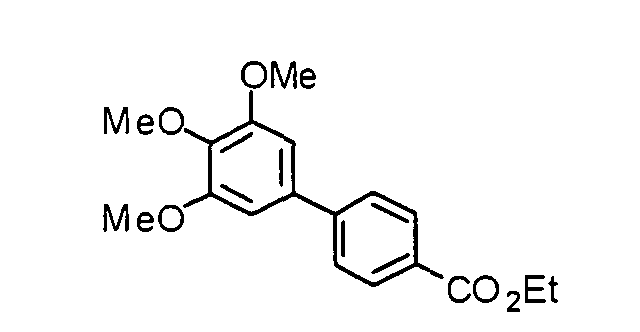
Yield: 2.99 g (95%).
1H-NMR (400MHz, CDCl3) δ: 1.42 (t, 3H, J=7.2 Hz), 3.90 (s, 3H), 3.94 (s, 6H), 4.38 (q, 2H, J=7.2 Hz), 6.81 (s, 2H), 7.62 (d, 2H, J=8.2 Hz), 8.10 (d, 2H, J=8.2 Hz).
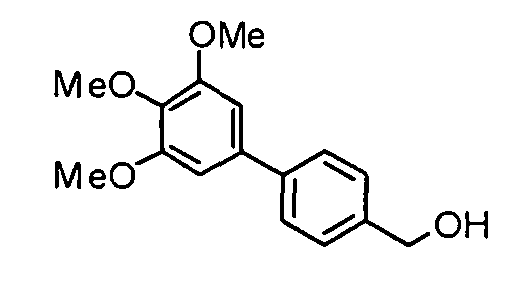
Yield: 1.83 g (71%)
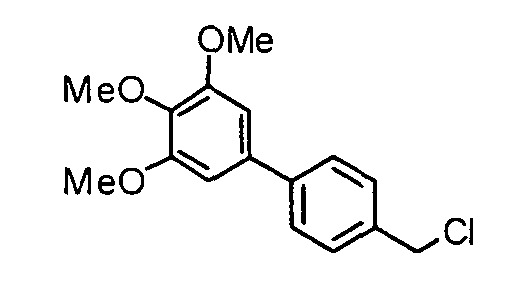
Yield: 1.65 g (84%)
1H-NMR (400MHz, CDCl3) δ: 3.90 (s, 3H), 3.93 (s, 6H), 4.65 (s, 2H), 6.77 (s, 2H), 7.46 (d, 2H, J=8.0 Hz), 7.55 (d, 2H, J=8.0 Hz).

Yield: 35 mg (14%).
1H-NMR (400 MHz, measured as a free base, CDCl3) δ; 1.80-1.89 (m, 4H), 2.17 (br, 2H), 2.97 (d, 2H, J=10.5 Hz), 3.57 (s, 2H), 3.70 (s, 6H), 3.77-3.84 (m, 1H), 3.87 (s, 3H), 3.90 (s, 3H), 3.91 (s, 6H), 3.96 (s, 6H), 4.52 (s, 2H), 5.93 (s, 2H), 6.74 (s, 2H), 7.19-7.22 (m, 4H), 7.31 (d, 2H, J=8.2 Hz), 7.46 (d, 2H, J=8.2 Hz), 7.60 (s, 1H), 8.59 (d, 1H, J=5.1 Hz).
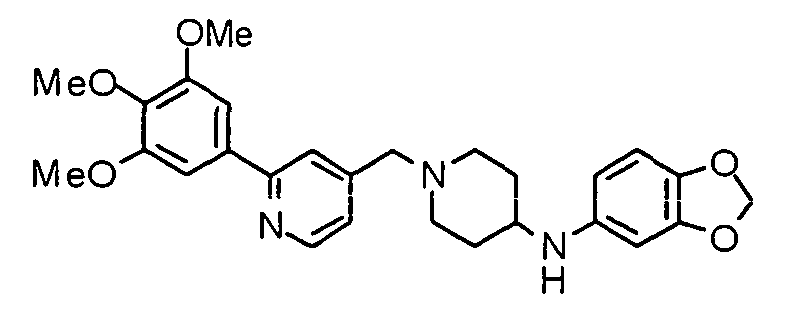
Yield: 810 mg (43%).
1H-NMR (400MHz, CDCl3) δ: 1.63 (br, 2H), 2.02-2.60 (m, 4H), 2.80-3.15 (m, 2H), 3.25 (br, 1H), 3.70 (br, 2H), 3.88 (s, 3H), 3.96 (s, 6H), 5.83 (s, 2H), 6.02 (d, 1H, J=8.3 Hz), 6.22 (s, 1H), 6.61 (d, 1H, J=8.3 Hz), 7.18-7.28 (m, 3H), 7.64 (br, 1H), 8.60 (d, 1H, J=4.9 Hz).
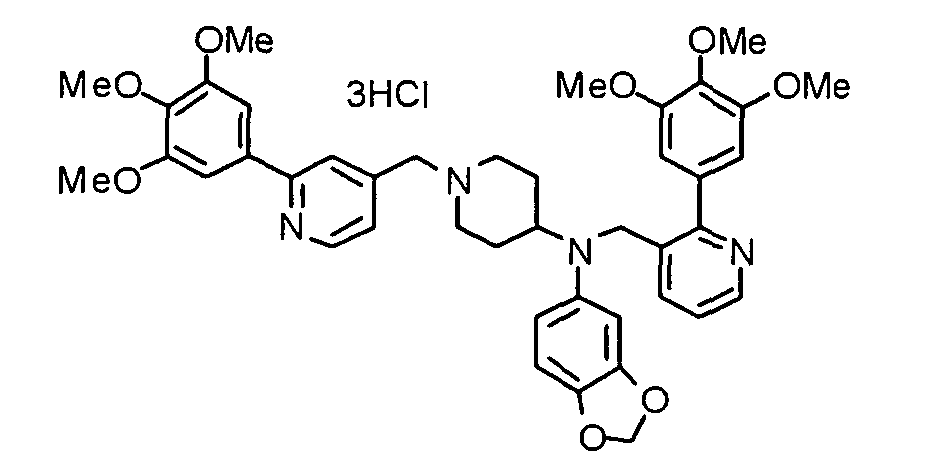
Yield: 30 mg (14%).
1H-NMR (400MHz, measured as a free base, CDCl3) δ: 1.45-2.25 (m, 6H), 2.90 (br, 2H), 3.40 (br, 1H), 3.55 (br, 2H), 3.87 (s, 3H), 3.88 (s, 9H), 3.93 (s, 6H), 4.28 (s, 2H), . 5.82 (s, 2H), 6.10 (br, 1H), 6.28 (s, 1H), 6.58 (d, 1H, J=8.4 Hz), 6.67 (s, 2H), 7.12-7.30 (m, 4H), 7.52 (br, 1H), 7.75 (br, 1H), 8.51 (br, 1H), 8.57 (br, 1H).
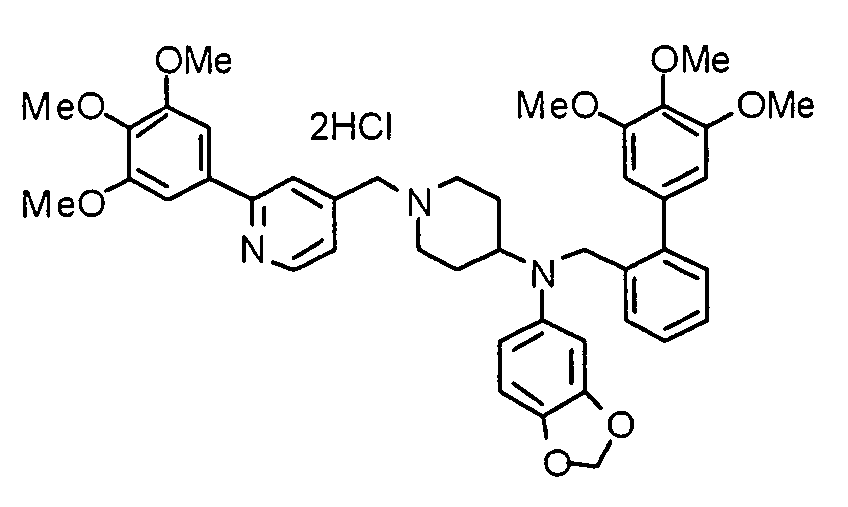
Yield: 13 mg (6%).
1H-NMR (400MHz, measured as a free base, CDCl3) δ: 1.61 (br, 2H), 1.78 (br, 2H), 2.10 (br, 2H), 2.91 (br, 2H), 3.50-3.54 (m, 3H), 3.87 (s, 6H), 3.90 (s, 3H), 3.92 (s, 3H), 3.99 (s, 6H), 4.26 (s, 2H), 5.82 (s, 2H), 6.12 (d, 1H, J=8.6 Hz), 6.32 (s, 1H), 6.53 (s, 2H), 6.62 (d, 1H, J=8.6 Hz), 7.17-7.26 (m, 6H), 7.42 (br, 1H), 7.55 (s, 1H), 8.58 (d, 1H, J=4.9 Hz).
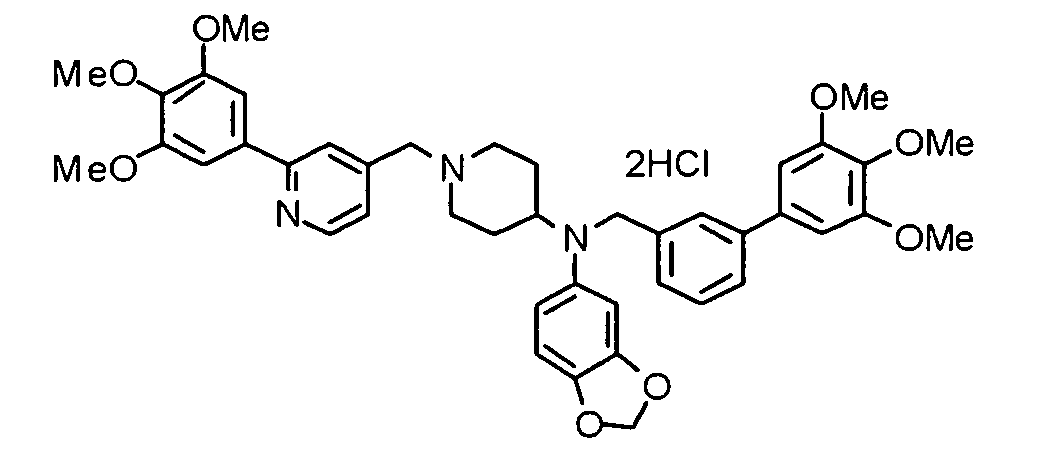
Yield: 52 mg (25%).
1H-NMR (400MHz, measured as a free base, CDCl3) δ: 1.60-1.95 (m, 4H), 2.20 (br, 2H), 3.00 (br, 2H), 3.58 (br, 3H), 3.86 (s, 3H), 3.87 (s, 3H), 3.91 (s, 6H), 3.94 (s, 6H), 4.41 (s, 2H), 5.82 (s, 2H), 6.17 (d, 1H, J=8.4 Hz), 6.39 (s, 1H), 6.62 (d, 1H, J=8.4 Hz), 7.12-7.13 (m, 3H), 7.18 (d, 1H, J=4.1 Hz), 7.23 (br, 2H), 7.54 (br, 2H), 8.51 (d, 1H, J=5.1 Hz), 8.57 (d, 1H, J=4.9 Hz).
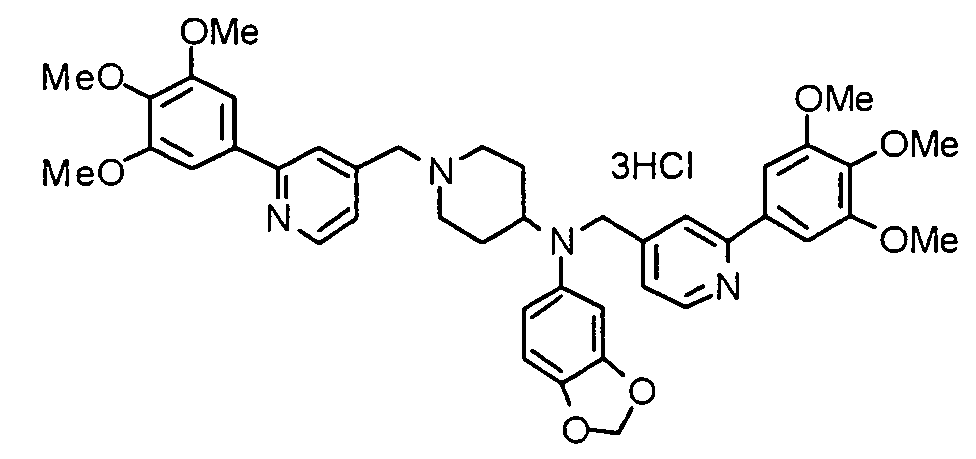
Yield: 58 mg (29%).
1H-NMR (400MHz, measured as a free base, CDCl3) δ: 1.60-1.97 (m, 4H), 2.15 (br, 2H), 3.00 (br, 2H), 3.58 (br, 3H), 3.86 (s, 3H), 3.88 (s, 9H), 3.94 (s, 6H), 4.43 (s, 2H), 5.81 (s, 2H), 6.21 (br, 1H), 6.42 (s, 1H), 6.62 (d, 1H, J=8.4 Hz), 6.69 (s, 2H), 7.18 (d, 1H, J=4.9 Hz), 7.22-7.39 (m, 6H), 7.60 (br, 1H), 8.57 (d, 1H, J=4.9 Hz).
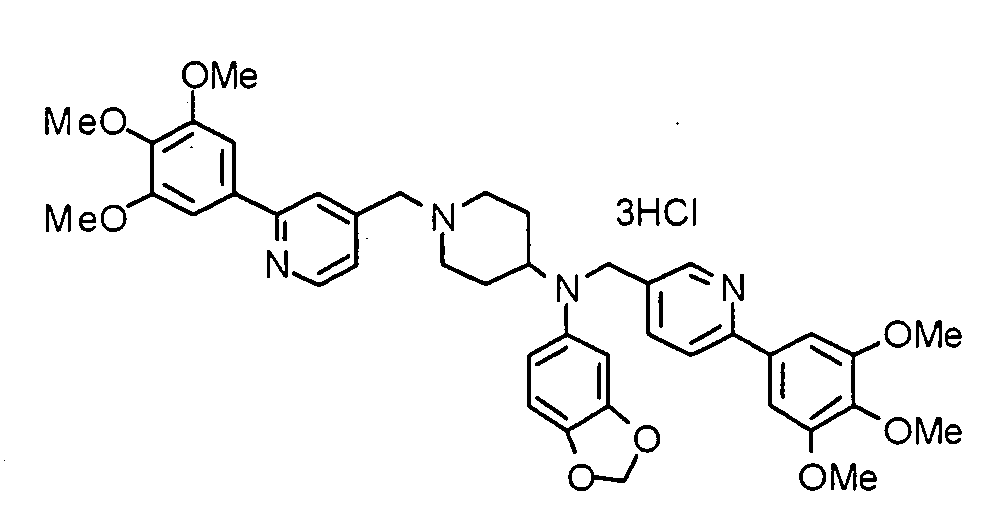
Yield: 69 mg (27%).
1H-NMR (400MHz, measured as a free base, CDCl3) δ: 1.71-1.88 (m, 4H), 2.14 (d, 2H, J=11.2 Hz), 2.97 (d, 2H, J=11.5 Hz), 3.45-3.52 (m, 1H), 3.56 (s, 2H), 3.89 (s, 3H), 3.90 (s, 3H), 3.94 (s, 6H), 3.96 (s, 6H), 4.12 (s, 2H), 5.85 (s, 2H), 6.24 (dd, 1H, J=8.5 Hz, 2.5 Hz), 6.45 (d, 1H, J=2.4 Hz), 6.64 (d, 1H, J=8.5 Hz), 7.20-7.21 (m, 1H), 7.21 (s, 2H), 7.23 (s, 2H), 7.58-7.65 (m, 3H), 8.57 (d, 1H, J=1.5 Hz), 8.59 (d, 1H, J=4.9 Hz).
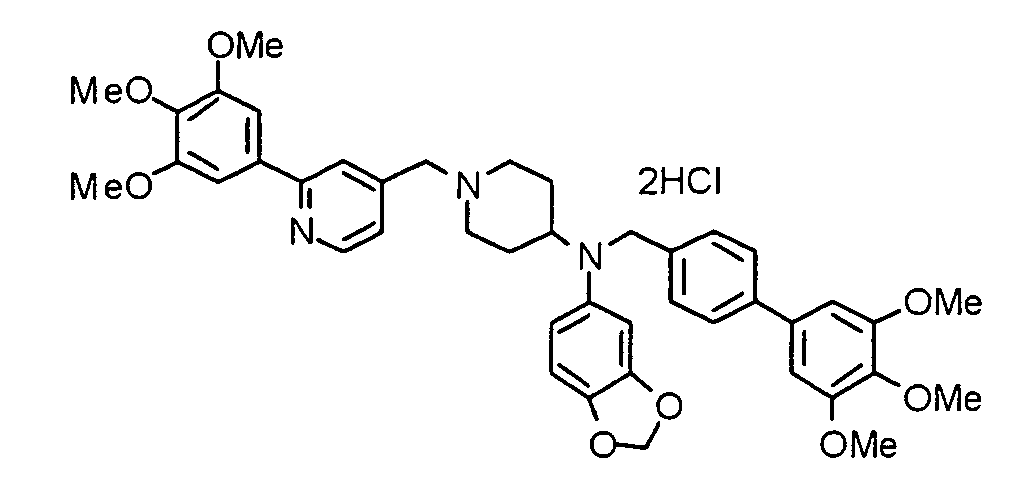
Yield: 29 mg (14%).
1H-NMR (400 MHz, measured as a free base, CDCl3) δ; 1.62-2.00 (m, 4H), 2.20 (br, 2H), 2.99 (br, 2H), 3.58 (br, 3H), 3.86 (s, 3H), 3.87 (s, 3H), 3.88 (s, 6H), 3.89 (s, 6H), 4.41 (s, 2H), 5.82 (s, 2H), 6.19 (d, 1H, J=8.6 Hz), 6.39 (s, 1H), 6.63 (d, 1H, J=8.4 Hz), 6.72 (s, 2H), 7.18 (d, 1H, J=5.1 Hz), 7.23 (s, 2H), 7.29 (d, 2H, J=8.0 Hz), 7.43 (d, 2H, J=8.2 Hz), 7.60 (br, 1H), 8.57 (d, 1H, J=4.9 Hz).
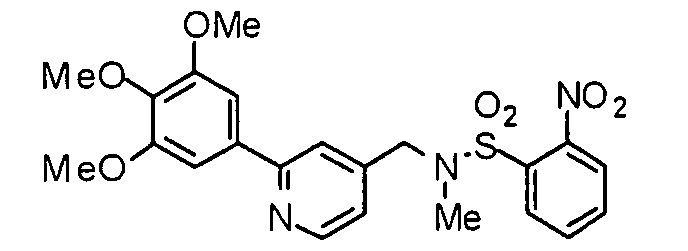
Yield: 362 mg (97.0%).

Yield: 356 mg (84%).
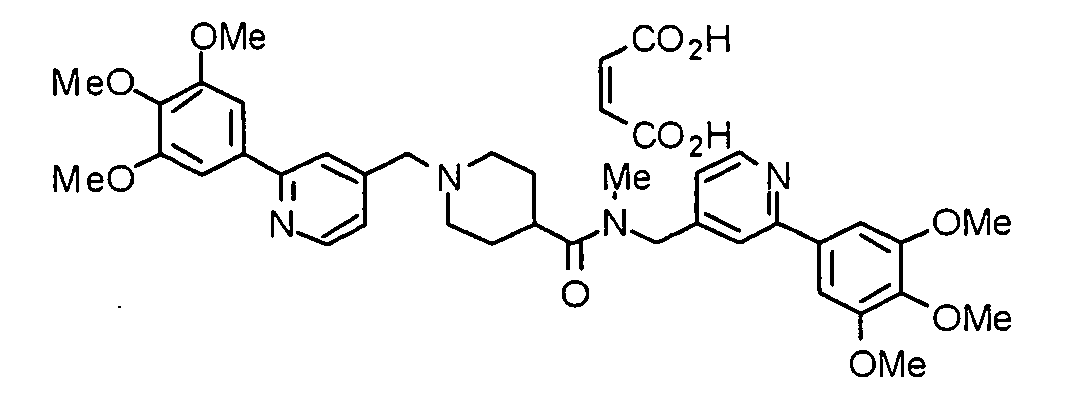
Yield: 145 mg (75%).
1H-NMR (400 MHz, measured as a maleate, DMSO-d6)δ: 1.89-1.97 (m, 4H), 2.75-2.96 (m, 3H), 3.03 (s, 3H), 3.27 (d, 2H, J=12.0 Hz), 3.78 (s, 3H), 3.79 (s, 3H), 3.87 (s, 6H), 3.90 (s, 6H), 4.09 (s, 2H), 4.64 (s, 2H), 6.14 (s, 2H), 7.09 (d, 1H, J=5.0 Hz), 7.33 (s, 2H), 7.37 (d, 1H, J=5.0 Hz), 7.38 (s, 2H), 7.65 (s, 1H), 7.90 (s, 1H), 8.57 (d, 1H, J=5.0 Hz), 8.67 (d, 1H, J=5.0 Hz).
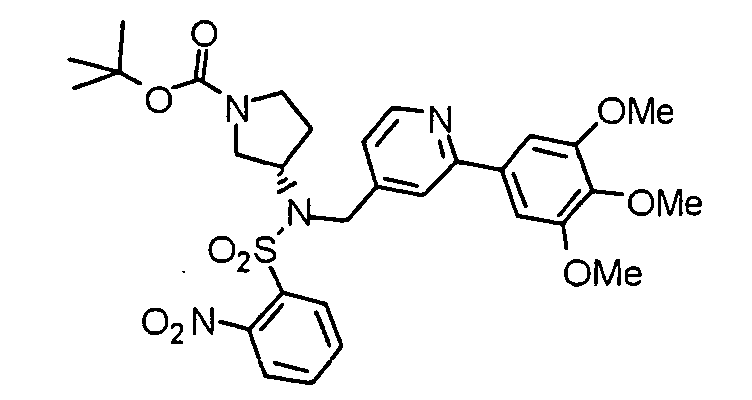
Yield:103 mg (85%).
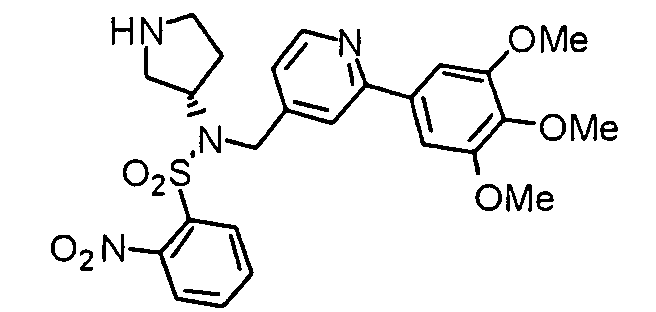
Yield: 72 mg (84%).
1H-NMR (400 MHz, CDCl3)δ: 1.66-1.75 (m, 1H), 2.03-2.05 (m, 1H), 2.78-2.85 (m, 2H), 3.00-3.10 (m, 2H), 3.39 (br, 1H), 3.90 (s, 3H), 3.96 (s, 6H), 4.59-4.67 (m, 1H), 4.70 (s, 2H), 7.13-7.18 (m, 1H), 7.20 (s, 2H), 7.52-7.64 (m, 4H), 7.95 (dd, 1H, J=7.9 Hz, 1.1 Hz), 8.52 (d, 1H, J=5.1 Hz).

Yield: 97 mg (91%).
1H-NMR (400 MHz, CDCl3)δ: 1.59 (br, 1H), 1.80-1.90 (m, 1H), 2.20-2.30 (m, 2H), 2.55 (dd, 1H, J=10.5 Hz, 8.2 Hz), 2.78 (dd, 1H, J=10.6 Hz, 3.2 Hz), 2.87 (t, 1H, J=7.2 Hz), 3.50 (d, 1H, J=13.7 Hz), 3.64 (d, 1H, J=13.7 Hz), 3.89 (s, 3H), 3.90 (s, 3H), 3.92 (s, 6H), 3.93 (s, 6H), 4.83 (d, 2H, J=4.5 Hz), 7.07 (d, 1H, J=5.1 Hz), 7.10 (d, 1H, J=4.9 Hz), 7.15 (s, 2H), 7.17 (s, 2H), 7.41-7.45 (m, 1H), 7.50-7.55 (m, 3H), 7.61 (s, 1H), 7.81 (d, 1H, J=7.4 Hz), 8.45 (d, 1H, J=4.9 Hz), 8.51 (d, 1H, J=5.1 Hz).
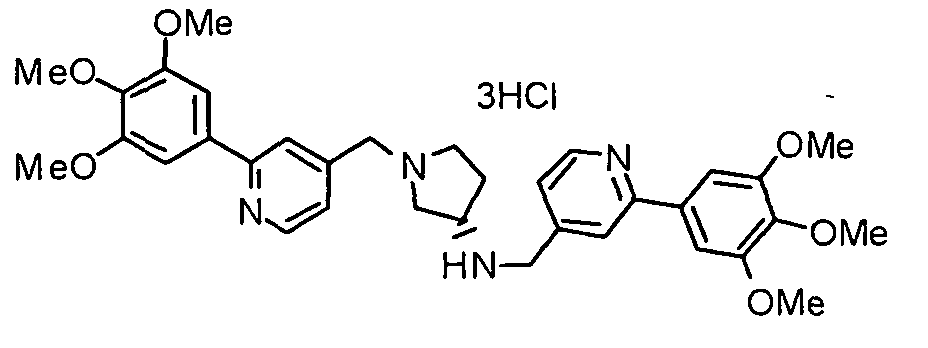
Yield: 80mg (89%).
1H-NMR (400 MHz, measured as a free base, CDCl3)δ: 1.71 (br, 2H), 2.19-2.21 (m, 1H), 2.52-2.55 (m, 2H), 2.73-2.77 (m, 2H), 3.39 (br, 1H), 3.66 (d, 1H, J=13.7 Hz), 3.71 (d, 1H, J=13.7 Hz), 3.82 (s, 2H), 3.90 (s, 6H), 3.95 (s, 12H), 7.18-7.21 (m, 2H), 7.23 (s, 2H), 7.24 (s, 2H), 7.63 (s, 2H), 8.59 (d, 1H, J=4.3 Hz), 8.60 (d, 1H, J=4.3 Hz).
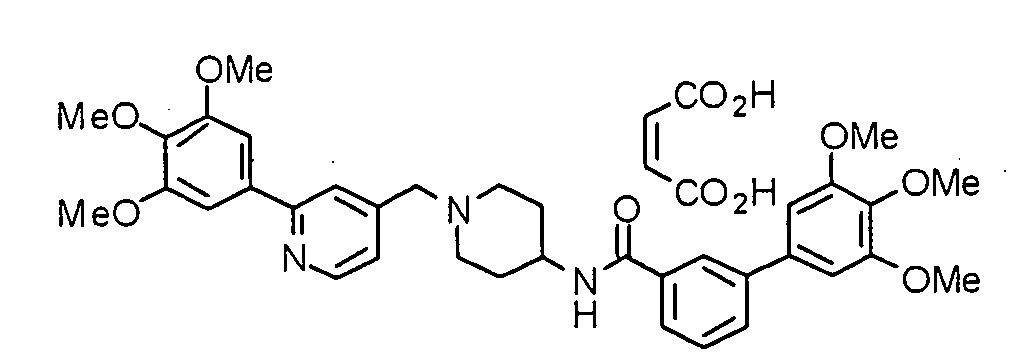
Yield: 100 mg (56%)
1H-NMR (400 MHz, measured as a maleate, DMSO-d6)δ: 1.85-2.10 (m, 4H), 2.77-2.93 (m, 2H), 3.20-3.31 (m, 2H), 3.77 (s, 3H, 3.79 (s, 3H), 3.89 (s, 6H), 3.91 (s, 6H), 3.98-4.07 (m, 1H), 4.13 (s, 2H), 6.15 (s, 2H), 6.94 (s, 2H), 7.40-7.52 (m, 4H), 7.73-7.80 (m, 2H), 8.02-8.10 (m, 3H), 8.67-8.68 (m, 1H).
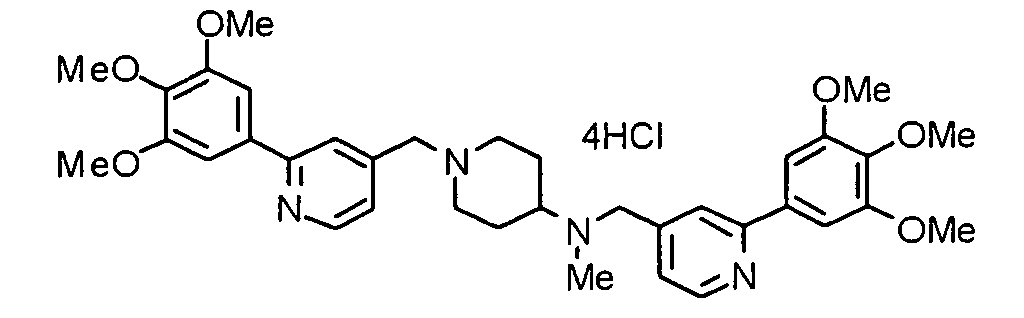
Yield: 2.55 g (46%).
1H-NMR (400 MHz, measured as a free base, CDCl3)δ: 1.66-1.74 (m, 2H), 1.82 (d, 2H, J=10.7 Hz), 2.04 (t, 2H, J=11.0 Hz), 2.25 (s, 3H), 2.45-2.51 (m, 1H), 2.98 (d, 2H, J=11.7 Hz), 3.55 (s, 2H), 3.66 (s, 2H), 3.90 (s, 3H), 3.91 (s, 3H), 3.96 (s, 6H), 3.97 (s, 6H), 7.21-7.23 (m, 2H), 7.24 (s, 2H), 7.25 (s, 2H), 7.62 (s, 1H), 7.63 (s, 1H), 8.59 (d, 1H, J=5.1 Hz), 8.60 (d, 1H, J=5.3 Hz).

Yield: 438 mg (theoretical yield).
1H-NMR (400 MHz, CDCl3)δ: 1.25 (t, 3H, J=7.1 Hz), 1.27-1.34 (m, 2H), 1.60 (br, 1H), 1.90 (d, 2H, J=10.9 Hz), 2.67-2.72 (m, 1H), 2.87 (t, 2H, J=11.5 Hz), 3.90 (s, 3H), 3.91 (br, 2H), 3.96 (s, 6H), 4.09 (br, 2H), 4.12 (q, 2H, J=7.0 Hz), 7.21 (d, 1H, J=3.5 Hz), 7.24 (s, 2H), 7.65 (s, 1H), 8.59 (d, 1H, J=4.9 Hz).
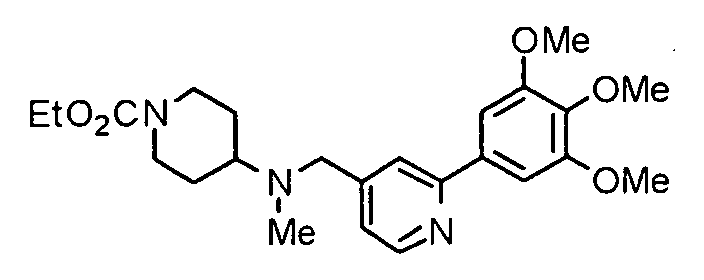
Yeld: 235mg (52%).
1H-NMR (400 MHz, CDCl3)δ: 1.26 (t, 3H, J=7.1 Hz), 1.42-1.57 (m, 2H), 1.82 (d, 2H, J=11.9 Hz), 2.24 (s, 3H), 2.59-2.65 (m, 1H), 2.75 (t, 2H, J=12.0 Hz), 3.65 (s, 2H), 3.90 (s, 3H), 3.97 (s, 6H), 4.13 (q, 2H, J=7.0 Hz), 4.23 (br, 2H), 7,22 (dd, 1H, J=5.0 Hz, 1.3 Hz), 7.24 (s, 2H), 7.63 (s, 1H), 8.59 (d, 1H, J=4.5 Hz).
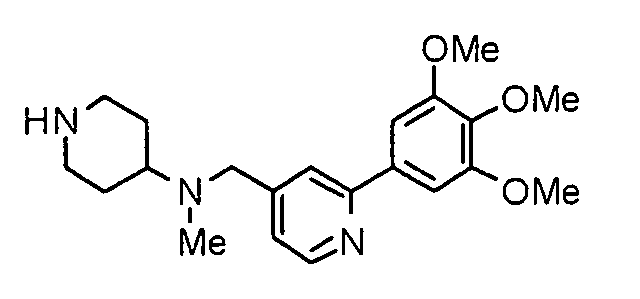
Yeld: 73 mg (88%).
1H-NMR (400 MHz, CDCl3)δ: 1.50-1.55 (m, 2H), 1.84 (d, 2H, J=12.0 Hz), 1.99 (br, 1H), 2.25 (s, 3H), 2.55-2.63 (m, 3H), 3.16 (d, 2H, J=12.2 Hz), 3.65 (s, 2H), 3.90 (s, 3H), 3.97 (s, 6H), 7.22 (d, 1H, J=6.1 Hz), 7.24 (s, 2H), 7.64 (s, 1H), 8.58 (d, 1H, J=5.1 Hz).
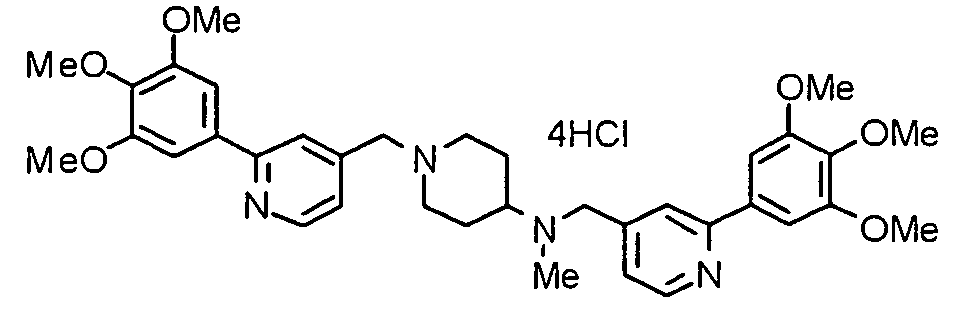
Yield: 126 mg (84%).
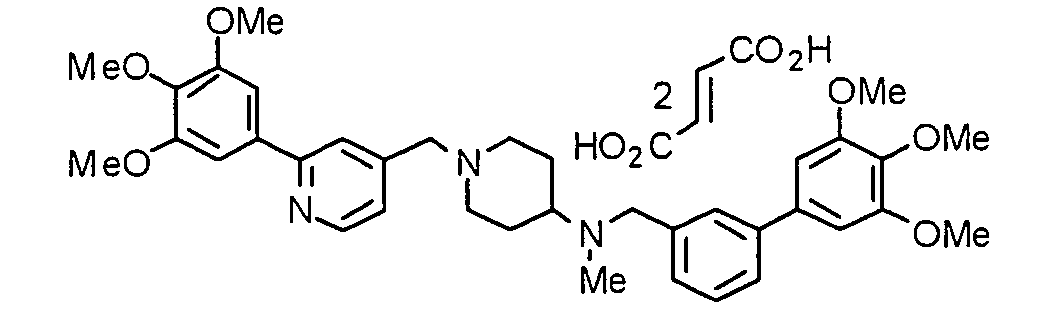
Yield: 59 mg (23%).
1H-NMR (400 MHz, measured as a free base, CDCl3)δ: 1.70-1.77 (m, 2H), 1.85-1.87 (m, 2H), 2.03-2.08 (m, 2H), 2.27 (s, 3H), 2.55-2.59 (m, 1H), 2.98 (d, 2H, J=11.3 Hz), 3.56 (s, 2H), 3.69 (s, 2H), 3.89 (s, 3H), 3.90 (s, 3H), 3.93 (s, 6H), 3.98 (s, 6H), 6.79 (s, 2H), 7.22 (d, 1H, J=4.9 Hz), 7.28 (s, 2H), 7.31 (d, 1H, J=7.6 Hz), 7.38 (t, 1H, J=7.4 Hz), 7.45 (d, 1H, J=7.6 Hz), 7.51 (s, 1H), 7.63 (s, 1H), 8.60 (d, 1H, J=5.1 Hz).

Yield: 50 mg (52.3%).
1H-NMR (400 MHz, measured as a free base, CDCl3)δ: 1.68-1.89 (m, 4H), 2.03-2.12 (m, 2H), 2.26 (s, 3H), 2.48-2.60 (m, 1H), 2.98-3.05 (m, 2H), 3.57 (s, 2H), 3.65 (s, 2H), 3.94 (s, 6H), 3.95 (s, 6H), 7.16-7.19 (m, 2H), 7.26 (s, 2H), 7.27 (s, 2H), 7.62-7.68 (m, 2H), 8.56 (d, 1H, J=5.3 Hz), 8.58 (d, 1H, J=5.2 Hz).

Yield: 242 mg (57%).
1H-NMR (400 MHz, CDCl3)δ: 1.04 (t, 3H, J=7.1 Hz), 1.25 (t, 3H, J=7.1 Hz), 1.43-1.52 (m, 2H), 1.79 (d, 2H, J=11.5 Hz), 2.60 (q, 2H, J=7.0 Hz), 2.66-2.76 (m, 3H), 3.70 (s, 2H), 3.90 (s, 3H), 3.97 (s, 6H), 4.12 (q, 2H, J=7.0 Hz), 4.20 (br, 2H), 7.23 (s, 2H), 7.26 (d, 1H, J=5.7 Hz), 7.67 (s, 1H), 8.58 (d, 1H, J= 4.9 Hz).
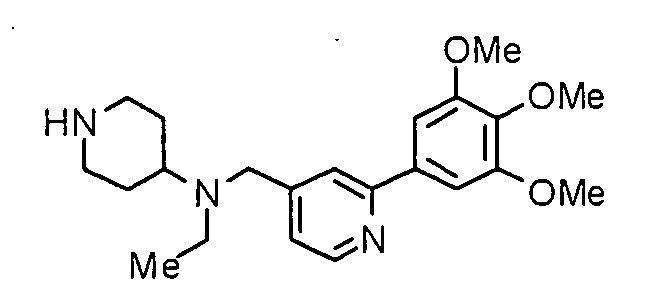
Yield: 150 mg (74%).
1H-NMR (400 MHz, CDCl3)δ: 1.02 (t, 3H, J=7.0 Hz), 1.43-1.52 (m, 2H), 1.70 (br, 1H), 1.79 (d, 2H, J=12.3 Hz), 2.53-2.67 (m, 5H), 3.13 (d, 2H, J=11.9 Hz), 3.71 (s, 2H), 3.90 (s, 3H), 3.97 (s, 6H), 7.24 (s, 2H), 7.27 (d, 1H, J=5.1 Hz), 7.68 (s, 1H), 8.57 (d, 1H, J= 4.3 Hz).

Yield: 121 mg (90%).
1H-NMR (400 MHz, measured as a free base, CDCl3)δ: 1.03 (t, 3H, J=7.1 Hz), 1.64-1.69 (m, 2H), 1.77 (d, 2H, J=10.7 Hz), 2.01 (t, 2H, J=10.8 Hz), 2.55-2.64 (m, 3H), 2.95 (d, 2H, J=11.1 Hz), 3.53 (s, 2H), 3.71 (s, 2H), 3.90 (s, 6H), 3.97 (s, 12H), 7.20-7.27 (m, 6H), 7.60 (s, 1H), 7.68 (s, 1H), 8.57 (d, 1H, J= 4.9 Hz), 8.59 (d, 1H, J= 5.1 Hz).
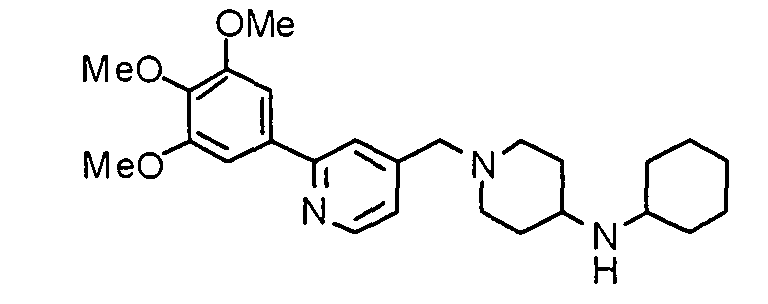
Yield: 342 mg (69%).
1H-NMR (400 MHz, CDCl3) δ: 1.05-1.30 (m, 6H), 1.38-1.52 (m, 2H), 1.53-1.80 (m, 3H), 1.87 (br, 4H), 2.07 (t, 2H, J=10.7 Hz), 2.59(br, 2H), 2.86 (br, 2H), 3.54 (s, 2H), 3.90 (s, 3H), 3.97 (s, 6H), 7.19 (d, 1H, J=4.9 Hz), 7.24 (s, 2H), 7.64 (s, 1H), 8.58 (d, 1H, J=4.9 Hz).

Yield: 55 mg (8%).
1H-NMR (400 MHz, measured as a free base, CDCl3)δ: 1.00-1.39 (m, 6H), 1.58-1.88 (m, 8H), 2.07 (br, 2H), 2.61 (br, 2H), 2.96 (br, 2H), 3.57 (br, 2H), 3.85 (s, 2H), 3.90 (s, 3H), 3.91 (s, 3H), 3.97 (s, 12H), 7.19-7.28 (m, 6H), 7.70 (br, 2H), 8.56 (d, 1H, J=5.1 Hz), 8.60 (d, 1H, J=5.1 Hz).

Yield: 1.09 g (81%).
1H-NMR (400 MHz, CDCl3)δ: 1.53 (br, 2H), 2.02-2.13 (m, 2H), 2.16-2.32 (m, 2H), 2.86 (br, 2H), 3.32 (br, 1H), 3.59 (s, 2H), 3.88 (s, 3H), 3.95 (s, 6H), 6.57 (d, 2H, J=8.6 Hz), 6.66 (t, 1H, J=7.3 Hz), 7.14 (t, 2H, J=7.9 Hz), 7.20-7.24 (m, 5H), 7.65 (br, 1H), 8.59 (d, 1H, J=5.1 Hz).
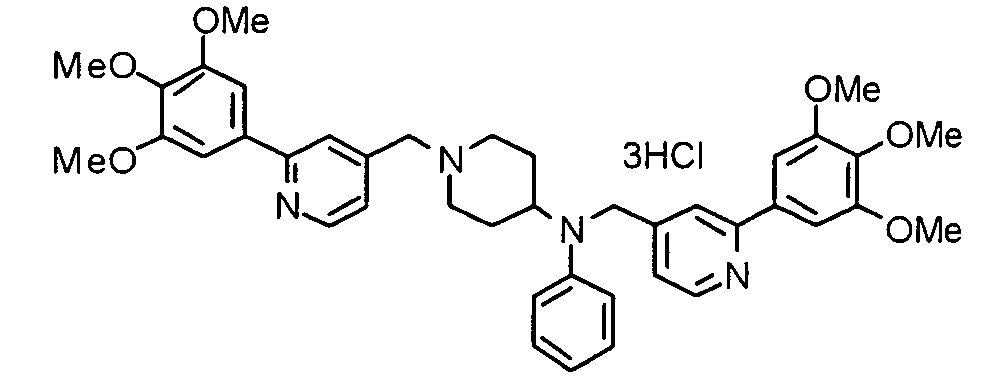
Yield: 635 mg (20%).
1H-NMR (400 MHz, measured as a free base, CDCl3)δ: 1.60-2.00 (m, 4H), 2.10-2.35 (m, 2H), 2.99 (br, 2H), 3.58 (br, 3H), 3.86 (s, 3H), 3.88 (s, 3H), 3.90 (s, 6H), 3.94 (s, 6H), 4.52 (s, 2H), 6.66-6.78 (m, 3H), 7.13-7.28 (m, 8H), 7.54 (br, 2H), 8.53 (d, 1H, J=5.1 Hz), 8.58 (d, 1H, J=4.9 Hz).

Yield: 1.67 g (theoretical amount).
1H-NMR (400 MHz, CDCl3)δ: 1.78 (t, 4H, J=5.6 Hz), 2.58 (br, 4H), 3.61 (s, 2H), 3.67 (s, 4H), 4.02 (s, 6H), 7.25-7.29 (m, 3H), 7.68 (s, 1H), 8.61 (d, 1H, J=4.9 Hz).
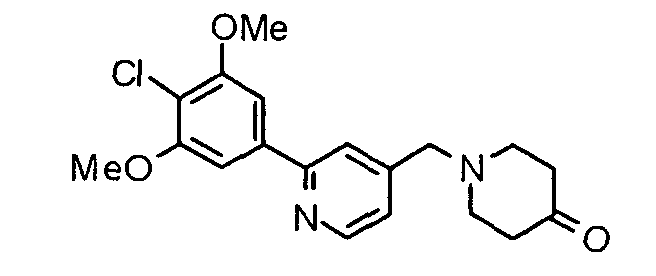
Yield: 1.29 g (89%).
1H-NMR (400 MHz, CDCl3) δ: 2.50 (t, 4H, J=5.8 Hz), 2.81 (t, 4H, J=5.8 Hz), 3.71 (s, 2H), 4.02 (s, 6H), 7.26 (s, 2H), 7.33 (d, 1H, J=4.3 Hz), 7.70 (s, 1H), 8.66 (d, 1H, J=4.9 Hz).

Yield: 465 mg (63%).
1H-NMR (400 MHz, CDCl3)δ: 1.49-1.69 (m, 2H), 2.08 (d, 2H, J=7.8 Hz), 2.23 (t, 2H, J=9.3 Hz), 2.87 (d, 2H, J=7.8 Hz), 3.34 (br, 1H), 3.60 (s, 2H), 4.02 (s, 6H), 6.60 (d, 2H, J=7.6 Hz), 6.69 (t, 1H, J=7.3 Hz), 7.10-7.20 (m, 2H), 7.20-7.30 (m, 3H), 7.67 (s, 1H), 8.62 (d, 1H, J=5.2 Hz).

Yield: 104 mg (24%).
1H-NMR (400 MHz, measured as a free base, CDCl3)δ: 1.70-1.85 (m, 4H), 2.20 (t, 2H, J=2.3 Hz), 3.00 (d, 2H, J=1.3 Hz), 3.59 (s, 2H), 3.96 (s, 6H), 4.00 (s, 6H), 4.56 (s, 2H), 6.65-6.78 (m, 3H), 7.16 (s, 2H), 7.18-7.28 (m, 6H), 7.59 (s, 1H), 7.62 (s,1H), 8.57 (d, 1H, J=5.1 Hz), 8.57 (d, 1H, J=4.8 Hz).

Yield: 646 mg (72%).
1H-NMR (400 MHz, CDCl3)δ: 1.45-1.55 (m, 2H), 2.05 (d, 2H, J=11.7 Hz), 2.20 (t, 2H, J=11.2 Hz), 2.87 (d, 2H, J=11.7 Hz), 3.20-3.35 (m, 1H), 3.59 (s, 2H), 3.74 (s, 3H), 4.02 (s, 6H), 6.58 (d, 2H, J=8.7 Hz), 6.77 (d, 2H, J=8.7 Hz), 7.25-7.28 (m, 3H), 7.67 (s, 1H), 8.62 (d, 1H, J=4.9 Hz).
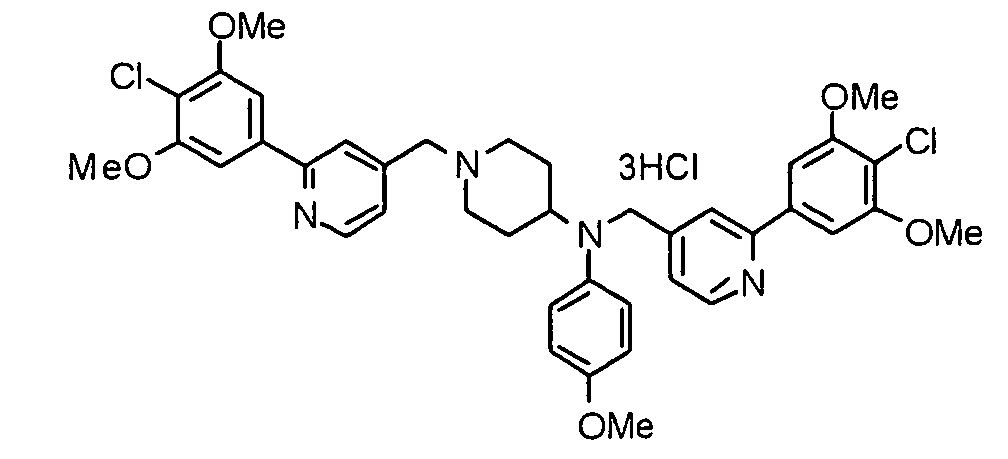
Yield: 324 mg (67%).
1H-NMR (400 MHz, measured as a free base, CDCl3)δ: 1.65-1.90 (m, 4H), 2.16 (t, 2H, J=10.4 Hz), 2.97 (d, 2H, J=7.5 Hz), 3.54-3.60 (m, 1H), 3.58 (s, 2H), 3.73 (s, 3H), 3.97 (s, 6H), 4.00 (s, 6H), 4.46 (s, 2H), 6.74 (d, 2H, J=9.4 Hz), 6.79 (d, 2H, J=9.4 Hz), 7.16 (s, 2H), 7.20-7.29 (m, 4H), 7.59 (s, 1H), 7.62 (s, 1H), 8.56 (d, 1H, J=4.8 Hz), 8.60 (d, 1H, J=4.8 Hz).

Yield: 1.01 g (54%).
1H-NMR (400 MHz, CDCl3)δ: 1.44-1.60 (m, 2H), 1.98-2.10 (m, 2H), 2.23 (br, 2H), 2.42 (s, 3H), 2.88 (br, 2H), 3.30 (br, 1H), 3.59 (s, 2H), 3.88 (s, 3H), 3.95 (s, 6H), 6.35 (d, 1H, J=7.6 Hz), 6.47 (s, 1H), 6.55 (d, 1H, J=8.6 Hz), 7.05 (t, 1H, J=7.9 Hz), 7.20 (d, 1H, J=4.9 Hz), 7.24 (s, 2H), 7.68 (br, 1H), 8.58 (d, 1H, J=4.9 Hz).

Yield: 45 mg (18%).
1H-NMR (400 MHz, measured as a free base, CDCl3)δ: 1.58-1.71 (s, 2H), 1.79 (d, 2H, J=10.7 Hz), 2.16 (t, 2H, J=11.2 Hz), 2.38 (s, 3H), 2.96 (d, 2H, J=11.2 Hz), 3.56 (s, 3H), 3.68-3.97 (m, 1H), 3.90 (s, 3H), 3.92 (s, 9H), 3.96 (s, 9H), 4.42 (s, 2H), 6.45 (d, 1H, J=8.3 Hz), 6.52 (s, 1H), 6.61 (d, 1H, J=7.3 Hz), 6.74 (s, 2H), 7.11 (t, 1H, J=8.1 Hz), 7.15-7.26 (m, 4H), 7.54 (s, 1H), 7.68 (d, 1H, J=7.8 Hz), 8.53 (d, 1H, J=3.2 Hz), 8.59 (d, 1H, J=4.8 Hz).
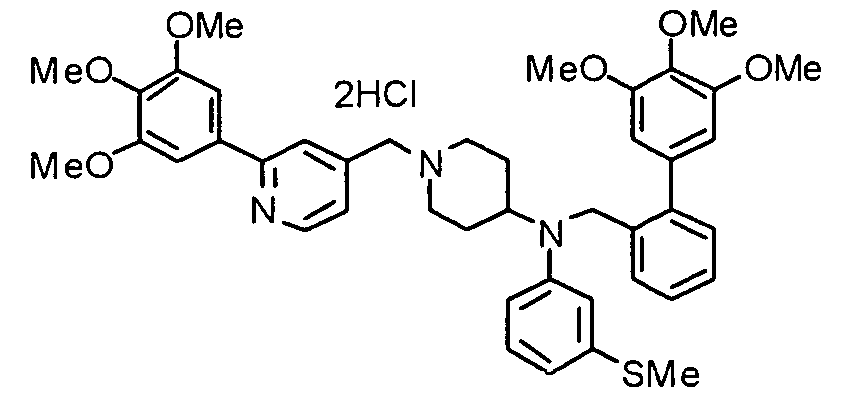
Yield: 51 mg (23%).
1H-NMR (400 MHz, measured as a free base, CDCl3)δ: 1.56-1.73 (m, 2H), 1.78-1.87 (m, 2H), 2.10-2.20 (m, 2H), 2.38 (s, 3H), 2.91-2.98 (m, 2H), 3.55 (s, 2H), 3.70-3.80 (m, 1H), 3.88 (s, 6H), 3.90 (s, 3H), 3.92 (s, 3H), 3.96 (s, 6H), 4.35 (s, 2H), 6.47 (d, 1H, J=8.2 Hz), 6.53-6.62 (m, 5H), 7.09 (t, 1H, J=8.0 Hz), 7.18-7.40 (m, 6H), 7.54 (s, 1H), 8.58 (d, 1H, J=4.7 Hz).
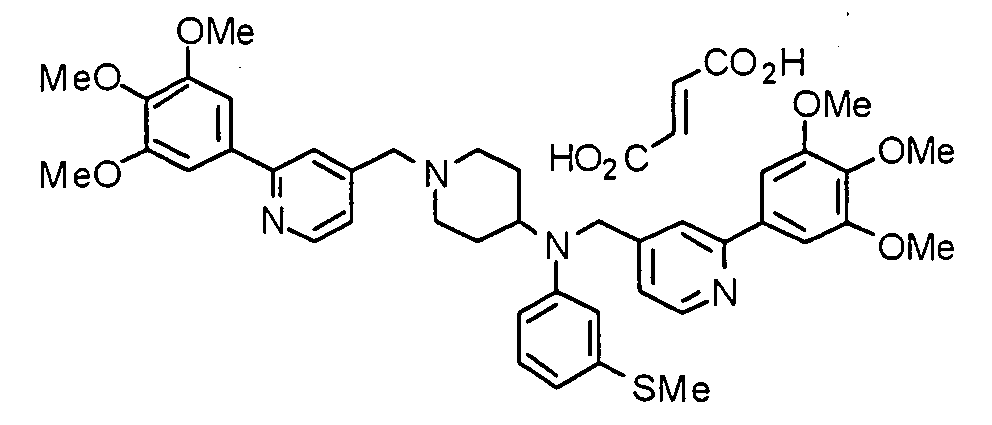
Yield: 14 mg (5%).
1H-NMR (400 MHz, measured as a free base, CDCl3)δ: 1.76-1.86 (m, 5H), 2.17-2.23 (m, 2H), 2.39 (s, 3H), 2.97-3.00 (m, 2H), 3.58 (s, 2H), 3.89 (s, 3H), 3.90 (s, 3H), 3.93 (s, 6H), 3.96 (s, 6H), 4.54 (s, 2H), 6.47-6.50 (m, 1H), 6.63 (s, 1H), 6.64 (s, 1H), 7.10-7.15 (m, 2H), 7.15 (s, 2H), 7.20-7.21 (m, 1H), 7.22 (s, 2H), 7.55 (s, 1H), 7.59 (s, 1H), 8.56 (d, 1H, J=5.1 Hz), 8.59 (d, 1H, J=5.1 Hz).
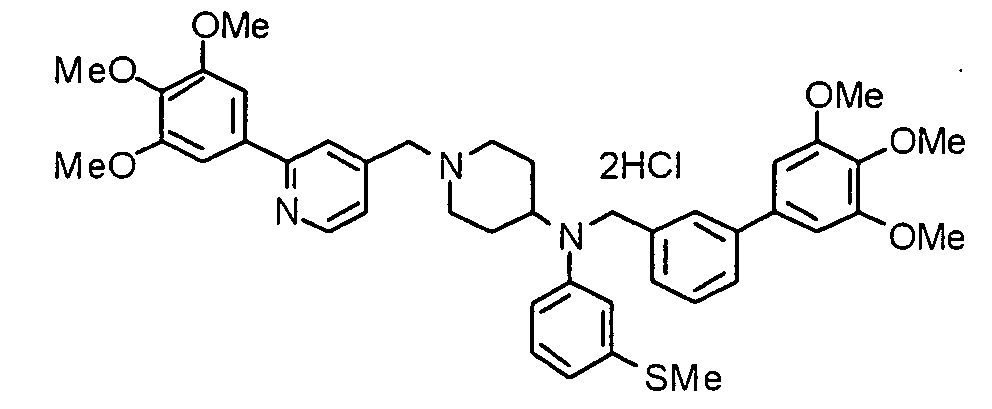
Yield: 60 mg (24%).
1H-NMR (400 MHz, measured as a free base, CDCl3)δ: 1.65-1.91 (m, 4H), 2.18 (t, 2H, J=10.5 Hz), 2.38 (s, 3H), 2.97 (d, 2H, J=10.9 Hz), 3.58 (s, 2H), 3.70-3.85 (m, 1H), 3.88 (s, 3H), 3.89 (s, 6H), 3.90 (s, 3H), 3.96 (s, 6H), 4.56 (s, 2H), 6.52 (d, 1H, J=8.4 Hz), 6.59 (d, 1H, J=7.6 Hz), 6.65 (s, 1H), 6.72 (s, 2H), 7.10 (t, 2H, J=8.0 Hz), 7.19-7.25 (m, 4H), 7.31-7.42 (m, 3H), 7.60 (s, 1H), 8.59 (d, 1H, J=7.8 Hz).
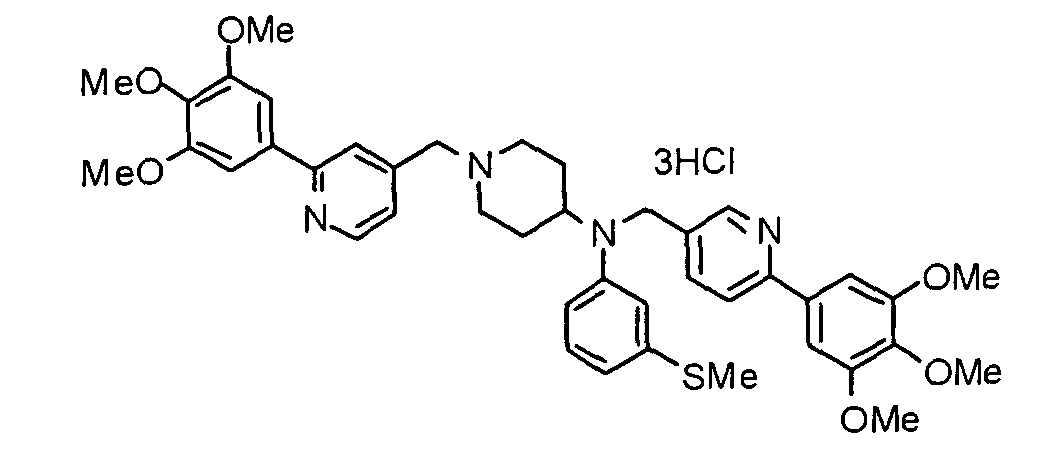
Yield: 22 mg (9%).
1H-NMR (400 MHz, measured as a free base, CDCl3)δ: 1.50-2.05 (m, 4H), 2.20 (br, 2H), 2.37 (s, 3H), 3.05 (br, 2H), 3.50-3.70 (br, 3H), 3.86 (s, 3H), 3.87 (s, 3H), 3.92 (s, 6H), 3.95 (s, 6H), 4.52 (s, 2H), 6.49 (d, 1H, J=8.3 Hz), 6.62 (br, 2H), 7.09 (t, 1H, J=8.2 Hz), 7.18-7.30 (m, 6H), 7.58 (s, 2H), 8.54 (br, 1H), 8.60 (br, 1H).
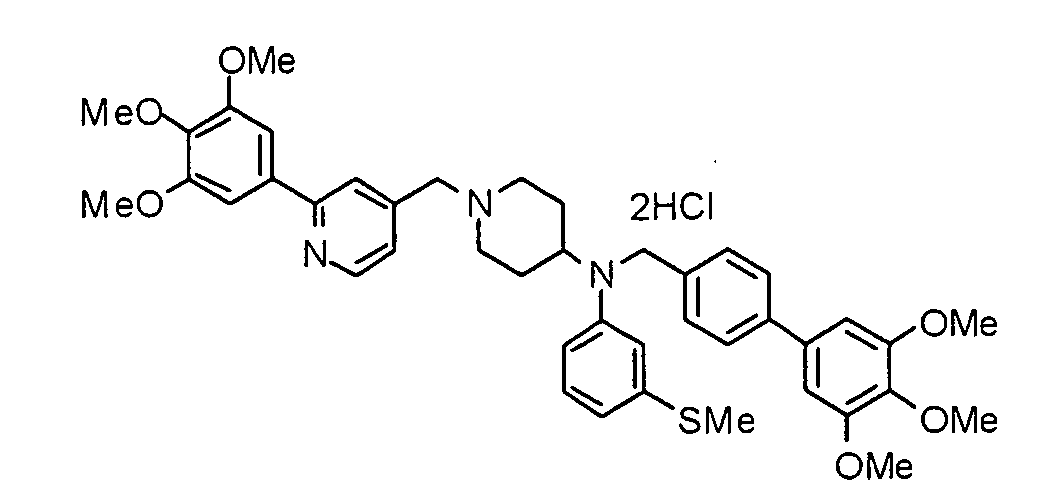
Yield: 57 mg (22%).
1H-NMR (400 MHz, measured as a free base, CDCl3)δ: 1.58-1.83 (m, 4H), 2.20 (t, 2H, J=11.3 Hz), 2.39 (s, 3H), 2.98 (d, 2H, J=11.1 Hz), 3.58 (s, 2H), 3.88 (s, 3H), 3.90 (s, 3H), 3.91 (s, 6H), 3.96 (s, 6H), 4.53 (s, 2H), 6.51 (dd, 1H, J=8.4 Hz, 2.4 Hz), 6.60 (d, 1H, J=8.0 Hz), 6.64 (s, 1H), 6.75 (s, 2H), 7.10 (t, 1H, J=8.1 Hz), 7.24-7.33 (m, 4H), 7.47 (d, 2H, J=8.0 Hz), 7.61 (s, 1H), 8.59 (d, 1H, J=5.0 Hz).
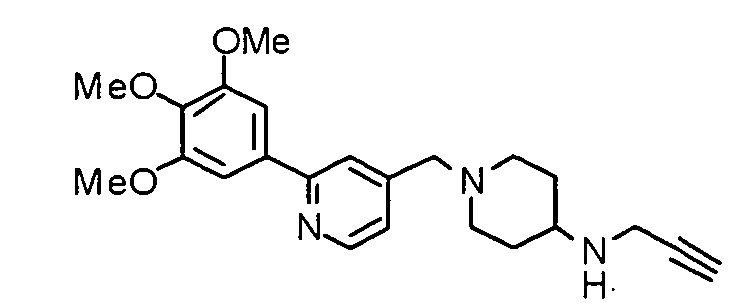
Yield: 227 mg (63%).
1H-NMR (400 MHz, CDCl3)δ: 1.38-1.51 (m, 2H), 1.83-1.86 (m, 3H), 2.10-2.15 (m, 2H), 2.21 (s, 1H), 2.74 (br, 1H), 2.83-2.87 (m, 2H), 3.45 (s, 2H), 3.56 (s, 2H), 3.89 (s, 3H), 3.96 (s, 6H), 7.19 (d, 1H, J=4.9 Hz), 7.24 (s, 2H), 7.65 (s, 1H), 8.58 (d, 1H, J=4.9 Hz).
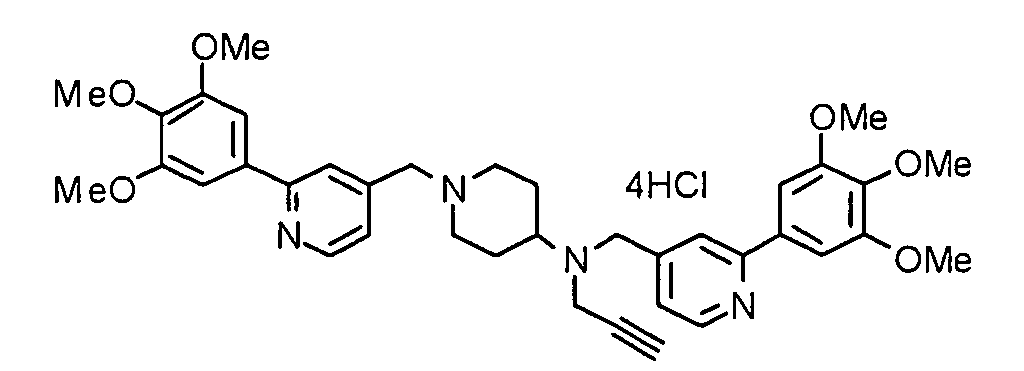
Yield: 128 mg (23%).
1H-NMR (400 MHz, measured as a free base, CDCl3)δ: 1.48-2.40 (m, 7H), 2.72 (br, 1H), 3.02 (br, 2H), 3.39 (s, 2H), 3.64 (br, 2H), 3.84 (s, 2H), 3.91 (s, 6H), 3.98 (s, 6H), 3.99 (s, 6H), 7.22-7.29 (m, 6H), 7.66 (br, 2H), 8.60 (d, 1H, J=4.9 Hz), 8.62 (d, 1H, J=4.9 Hz).
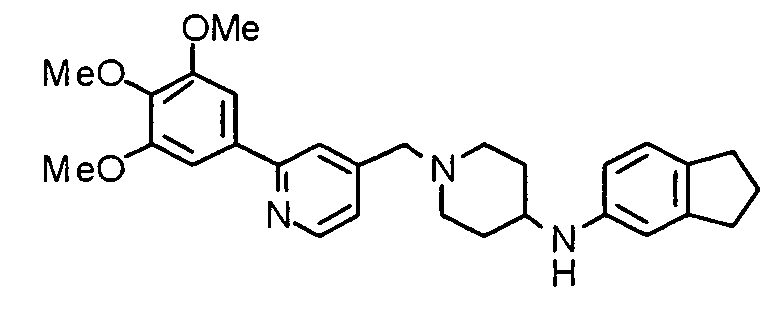
Yield: 1.22 g (59%).
1H-NMR (400 MHz, CDCl3)δ: 1.40-1.57 (m, 2H), 2.00-2.15 (m, 5H), 2.19-2.25 (m, 2H), 2.77-2.93 (m, 6H), 3.30 (br, 1H), 3.58 (s, 2H), 3.91 (s, 3H), 3.97 (s, 6H), 6.41 (d, 1H, J=8.0 Hz), 6.52 (s, 1H), 7.01 (d, 1H, J=8.0 Hz), 7.21-7.26 (m, 3H), 7.64 (s, 1H), 8.60 (d, 1H, J=4.9 Hz).

Yield: 90 mg (41 %).
1H-NMR (400 MHz, measured as a free base, CDCl3)δ: 1.54-1.67 (m, 2H), 1.74-1.83 (m, 2H), 1.98-2.07 (m, 2H), 2.09-2.98 (m, 2H), 3.55 (s, 2H), 3.64-3.74 (m, 1H), 3.90 (s, 3H), 3.91 (s, 6H), 3.92 (s, 3H), 3.96 (s, 6H), 4.41 (s, 2H), 6.49 (dd, 1H, J=8.2 Hz, 2.4 Hz), 6.59 (s, 1H), 6.74 (s, 2H), 7.04 (d, 1H, J=8.2 Hz), 7.15-7.20 (m, 2H), 7.22 (s, 2H), 7.54 (s, 1H), 7.77 (dd, 1H, J=7.8 Hz, 1.4 Hz), 8.52 (dd, 1H, J=4.7 Hz, 1.8 Hz), 8.59 (d, 1H, J=5.1 Hz).

Yield: 115 mg (47%).
1H-NMR (400 MHz, measured as a free base, CDCl3)δ: 1.56-1.66 (m, 2H), 1.80-1.83 (m, 2H), 2.00-2.05 (m, 2H), 2.11-2.18 (m, 2H), 2.77-2.83 (m, 4H), 2.92-2.95 (m, 2H), 3.55 (s, 2H), 3.72 (br, 1H), 3.87 (s, 6H), 3.90 (s, 3H), 3.92 (s, 3H), 3.96 (s, 6H), 4.34 (s, 2H), 6.49 (d, 1H, J=8.3 Hz), 6.56 (s, 2H), 6.60 (s, 1H), 7.02 (d, 1H, J=8.3 Hz), 7.17-7.27 (m, 5H), 7.42-7.45 (m, 1H), 7.54 (s, 1H), 8.58 (d, 1H, J=4.9 Hz).

Yield: 23 mg (9%).
1H-NMR (400 MHz, measured as a free base, CDCl3)δ: 1.60-1.95 (m, 4H), 2.00 (quint, 2H, J=7.3 Hz), 2.20 (br, 2H), 2.75-2.81 (m, 4H), 2.99 (br, 2H), 3.58 (br, 2H), 3.77(s, 1H), 3.86 (s, 3H), 3.87 (s, 3H), 3.91 (s, 6H), 3.94 (s, 6H), 4.49 (s, 2H), 6.51 (d, 1H, J=8.3 Hz), 6.62 (s, 1H), 7.02 (d, 1H, J=8.0 Hz), 7.16 (s, 2H), 7.18-7.22 (m, 4H), 7.57 (br, 2H), 8.52 (d, 1H, J=4.9 Hz), 8.57 (d, 1H, J=4.9 Hz).
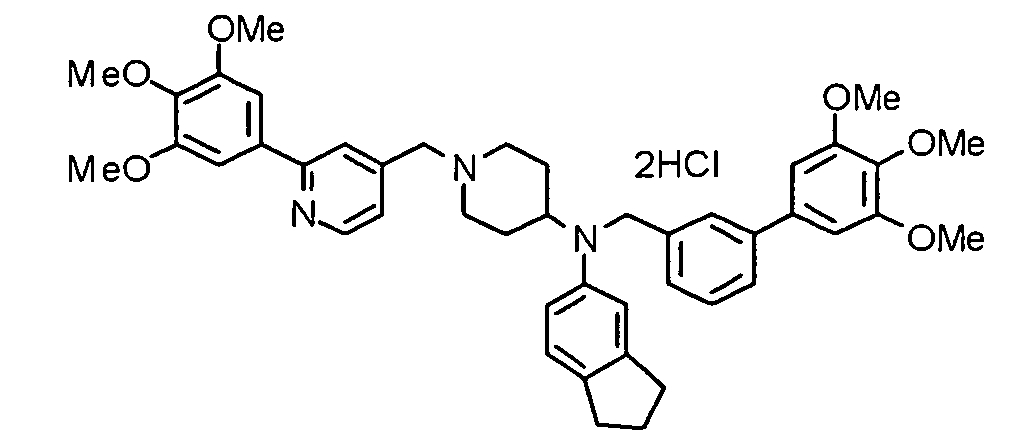
Yield: 18 mg (19%).
1H-NMR (400 MHz, measured as a free base, CDCl3)δ: 1.60-1.95 (m, 4H), 2.00 (quint, 2H, J=7.2 Hz), 2.20 (br, 2H), 2.75-2.81 (m, 4H), 2.95 (br, 2H), 3.60 (br, 2H), 3.85 (br, 1H), 3.86 (s, 3H), 3.87 (s, 6H), 3.88 (s, 3H), 3.94 (s, 6H), 4.51 (s, 2H), 6.54 (d, 1H, J=8.2 Hz), 6.66 (s, 1H), 6.70 (s, 2H), 7.01 (d, 1H, J=8.4 Hz), 7.19 (d, 1H, J=4.9 Hz), 7.19-7.42 (m, 6H), 7.60 (br, 1H), 8.59 (br, 1H).
Yield: 138 mg (63%).
1H-NMR (400 MHz, measured as a free base, CDCl3)δ: 1.71-1.91 (m, 4H), 1.98-2.06 (m, 2H), 2.13-2.22 (m, 2H), 2.76-2.84 (m, 4H), 2.94-3.05 (m, 2H), 3.57 (s, 2H), 3.69-3.78 (m, 1H), 3.89 (s, 3H), 3.90 (s, 3H), 3.94 (s, 6H), 3.96 (s, 6H), 4.50 (s, 2H), 6.57 (dd, 1H, J=8.2 Hz, 2.3 Hz), 6.67 (s, 1H), 7.04 (d, 1H, J=8.4 Hz), 7.20-7.22 (m, 1H), 7.22 (s, 2H), 7.23 (s, 2H), 7.57-7.62 (m, 1H), 7.60 (s, 1H), 7.65 (dd, 1H, J=8.2 Hz, 2.2 Hz), 8.58-8.62 (m, 2H).

Yield: 95 mg (39%).
1H-NMR (400 MHz, measured as a free base, CDCl3)δ: 1.74-1.90 (m, 4H), 2.01-2.06 (m, 2H), 2.16-2.22 (m, 2H), 2.78-2.84 (m, 4H), 2.96-2.99 (m, 2H), 3.58 (s, 2H), 3.72 (br, 1H), 3.88 (s, 3H), 3.90 (s, 3H), 3.91 (s, 6H), 3.96 (s, 6H), 4.51 (s, 2H), 6.55 (d, 1H, J=8.3 Hz), 6.67 (s, 1H), 6.72 (s, 2H), 7.04 (d, 1H, J=8.3 Hz), 7.20 (d, 1H, J=5.1 Hz), 7.23 (s, 2H), 7.35 (d, 2H, J=8.1 Hz), 7.47 (d, 2H, J=8.1 Hz), 7.61 (s, 1H), 8.59 (d, 1H, J=4.9 Hz).
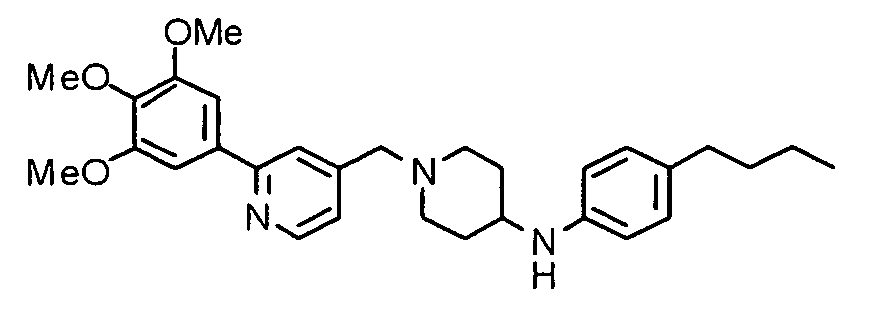
Yield: 1.23 g (72%).
1H-NMR (400 MHz, CDCl3)δ: 0.82 (t, 3H, J=7.3 Hz), 1.20-1.30 (m, 2H), 1.38-1.50 (m, 4H), 1.92-2.25 (m, 4H), 2.40 (t, 2H, J=7.7 Hz), 2.77 (br, 2H), 3.21 (br, 1H), 3.50 (s, 2H), 3.82 (s, 3H), 3.89 (s, 6H), 6.45 (d, 2H, J=7.8 Hz), 6.89 (d, 2H, J=8.0 Hz), 7.13 (d, 1H, J=4.9 Hz), 7.18 (s, 2H), 7.58 (s, 1H), 8.52 (d, 1H, J=4.9 Hz).
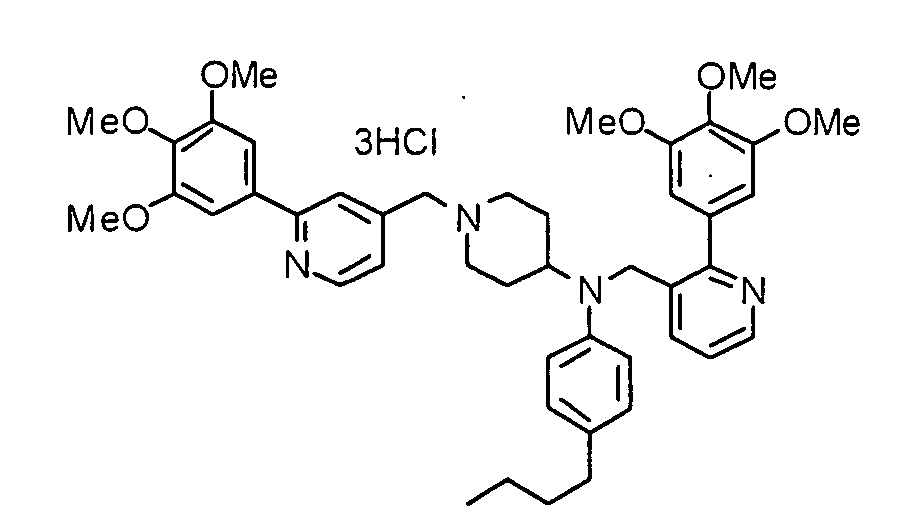
Yield: 58 mg (27%).
1H-NMR (400 MHz, measured as a free base, CDCl3)δ: 0.91 (t, 3H, J=7.3 Hz), 1.32-1.35 (m, 2H), 1.50-1.70 (m, 4H), 1.75 (br, 2H), 2.10-2.20 (m, 2H), 2.49 (t, 2H, J=7.6 Hz), 2.95 (br, 2H), 3.55 (s, 2H), 3.70 (br, 1H), 3.90 (s, 3H), 3.91 (s, 6H), 3.92 (s, 3H), 3.96 (s, 6H), 4.41 (s, 2H), 6.59 (d, 2H, J=8.8 Hz), 6.74 (s, 2H), 7.00 (d, 2H, J=8.6 Hz), 7.16-7.17 (m, 1H), 7.19 (d, 1H, J=4.9 Hz), 7.22 (s, 2H), 7.54 (s, 1H), 8.59 (d, 1H, J=7.5 Hz), 8.52 (br, 1H), 8.59 (d, 1H, J=4.9 Hz).
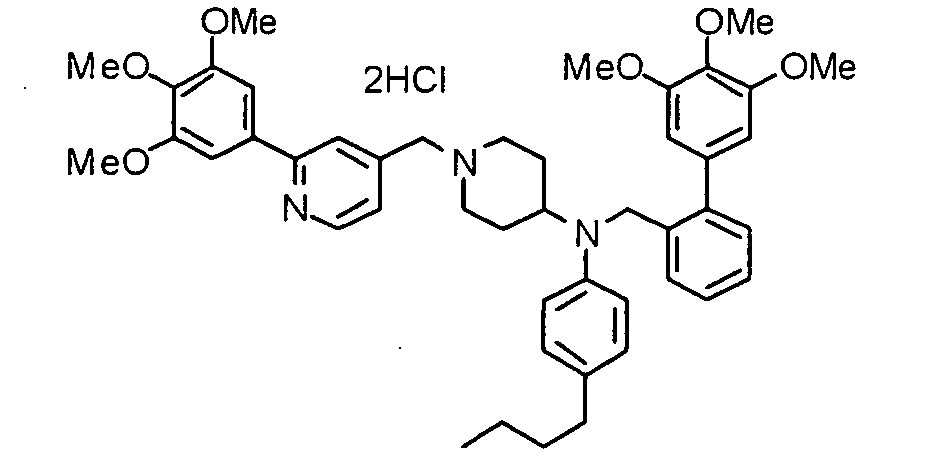
Yield: 59 mg (24%).
1H-NMR (400 MHz, measured as a free base, CDCl3)δ: 0.90 (t, 3H, J=7.4 Hz), 1.25-1.41 (m, 2H), 1.48-1.75 (m, 4H), 1.81 (d, 2H, J=11.7 Hz), 2.13 (t, 2H, J=11.2 Hz), 2.48 (t, 2H, J=7.5 Hz), 2.93 (d, 2H, J=11.2 Hz), 3.55 (s, 2H), 3.65-3.80 (m, 1H), 3.87 (s, 6H), 3.90 (s, 3H), 3.92 (s, 1H), 3.96 (s, 6H), 4.33 (s, 2H), 6.56 (s, 2H), 6.60 (d, 2H, J=8.5 Hz), 6.98 (d, 2H, J=8.5 Hz), 7.18 (d, 1H, J=4.9 Hz), 7.21 (s, 2H), 7.20-7.37 (m, 3H), 7.41 (br, 1H), 7.54 (s, 1H), 8.58 (d, 1H, J=4.9 Hz).

Yeld: 20 mg (6%).
1H-NMR (400 MHz, measured as a free base, CDCl3)δ: 0.88 (t, 3H, J=7.3 Hz), 1.20-1.35 (m, 2H), 1.49-1.60 (m, 2H), 1.62-2.02 (m, 4H), 2.20 (br, 2H), 2.46 (t, 2H, J=7.3 Hz), 3.05 (br, 2H), 3.60 (br, 3H), 3.87 (s, 3H), 3.88 (s, 3H), 3.90 (s, 6H), 3.94 (s, 6H), 4.49 (s, 2H), 6.62 (d, 2H, J=8.3 Hz), 6.98 (d, 2H, J=8.3 Hz), 7.13 (s, 2H), 7.15-7.40 (m, 4H), 7.55 (br, 2H), 8.52 (d, 1H, J=4.9 Hz), 8.60 (br, 1H).
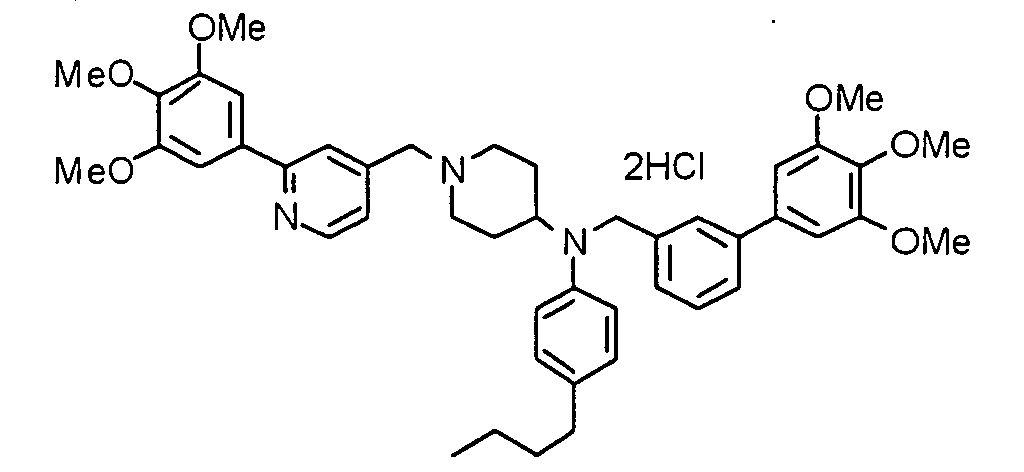
Yield: 102 mg (42%).
1H-NMR (400 MHz, measured as a free base, CDCl3)δ: 0.90 (t, 3H, J=7.4 Hz), 1.30-1.36 (m, 2H), 1.48-1.56 (m, 2H), 1.76-1.89 (m, 4H), 2.19 (br, 2H), 2.48 (t, 2H, J=7.8 Hz), 2.97 (br, 2H), 3.58 (s, 2H), 3.86 (br, 1H), 3.88 (s, 3H), 3.58 (s, 2H), 3.86 (br, 1H), 3.88 (s, 3H), 3.90 (s, 3H), 3.95 (s, 6H), 4.54 (s, 2H), 6.68 (d, 2H, J=8.6 Hz), 6.72 (s, 2H), 7.00 (d, 2H, J=8.6 Hz), 7.20-7.27 (m, 2H), 7.23 (s, 2H), 7.32-7.40 (m, 2H), 7.44 (s, 1H), 7.62 (s, 1H), 8.59 (d, 1H, J=5.1 Hz).
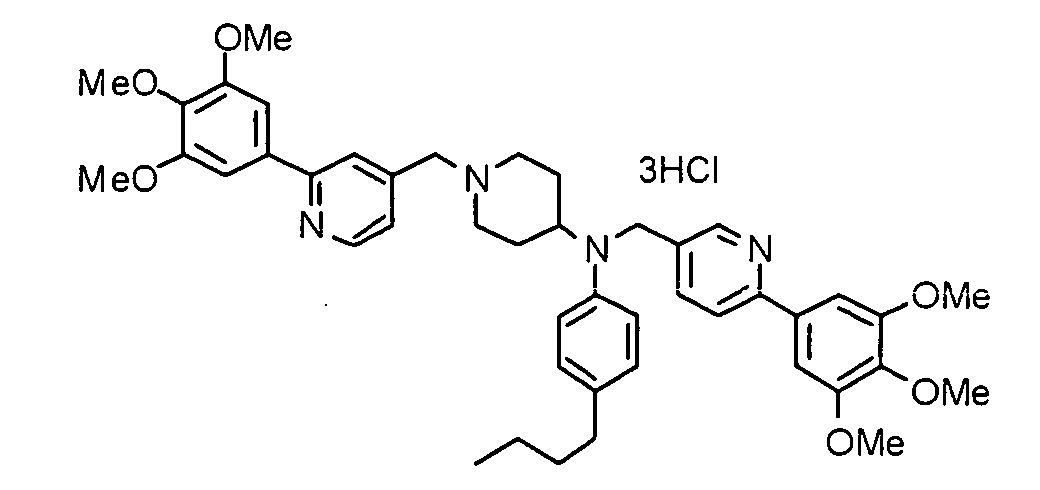
Yield: 65 mg (21%).
1H-NMR (400 MHz, measured as a free base, CDCl3)δ: 0.90 (t, 3H, J=7.3 Hz), 1.32-1.36 (m, 2H), 1.50-1.54 (m, 2H), 1.70-1.95 (m, 4H), 2.17 (br, 2H), 2.49 (t, 2H, J=7.7 Hz), 2.96 (br, 2H), 3.58 (s, 2H), 3.75 (br, 1H), 3.89 (s, 3H), 3.90 (s, 3H), 3.94 (s, 6H), 3.96 (s, 6H), 4.50 (s, 2H), 6.68 (d, 2H, J=8.6 Hz), 7.00 (d, 2H, J=8.6 Hz), 7.20-7.22 (m, 3H), 7.23 (s, 2H), 7.58-7.66 (m, 3H), 8.59 (br, 1H), 8.60 (br, 1H).

Yield: 82 mg (33%).
1H-NMR (400 MHz, measured as a free base, CDCl3)δ: 0.90 (t, 3H, J=7.3 Hz), 1.30-1.36 (m, 2H), 1.51-1.55 (m, 2H), 1.79-1.90 (m, 4H), 2.18 (br, 2H), 2.48 (t, 2H, J=7.7 Hz), 2.98 (d, 2H, J=10.7 Hz), 3.57 (s, 2H), 3.72-3.85 (m, 1H), 3.88 (s, 3H), 3.90 (s, 3H), 3.91 (s, 6H), 3.96 (s, 6H), 4.50 (s, 2H), 6.66 (d, 2H, J=8.8 Hz), 6.75 (s, 2H), 7.00 (d, 2H, J=8.8 Hz), 7.20 (d, 1H, J=4.9 Hz), 7.22 (s, 2H), 7.33 (d, 2H, J=8.2 Hz), 7.47 (d, 2H, J=8.2 Hz), 7.61 (s, 1H), 8.59 (d, 1H, J=5.1 Hz).

Yield: 870 mg (92%).
1H-NMR (400 MHz, CDCl3)δ: 2.46 (t, 4H, J=5.9 Hz), 2.74 (t, 4H, J=6.2 Hz), 3.61 (s, 2H), 7.29 (d, 2H, J=6.2 Hz), 8.55 (dd, 2H, J=6.2 Hz, 1.1 Hz).
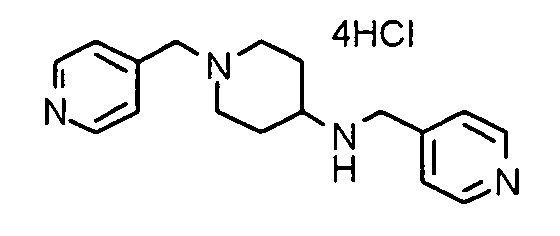
Yield: 363 mg (19%).
1H-NMR (400 MHz, measured as a free base, CDCl3)δ: 1.37-1.51 (m, 2H), 1.82-1.90 (m, 2H), 2.04 (dt, 2H, J=11.6 Hz, 2.7 Hz), 2.44-2.55 (m, 1H), 2.76-2.82 (m, 2H), 3.47 (s, 2H), 3.82 (s, 2H), 7.23-7.26 (m, 4H), 8.50-8.53 (m, 4H).

Yield: 125 g (74%).
1H-NMR (400 MHz, CDCl3) δ: 1.23-1.35 (m, 2H), 1.46 (s, 9H), 1.96-2.06 (m, 2H), 2.83-2.96 (m, 2H), 3.27-3.38 (m, 1H), 3.74 (s, 9H), 3.94-4.12 (m, 2H), 6.58 (d, 2H, J=9.0 Hz), 6.77 (d, 2H, J=9.0 Hz).
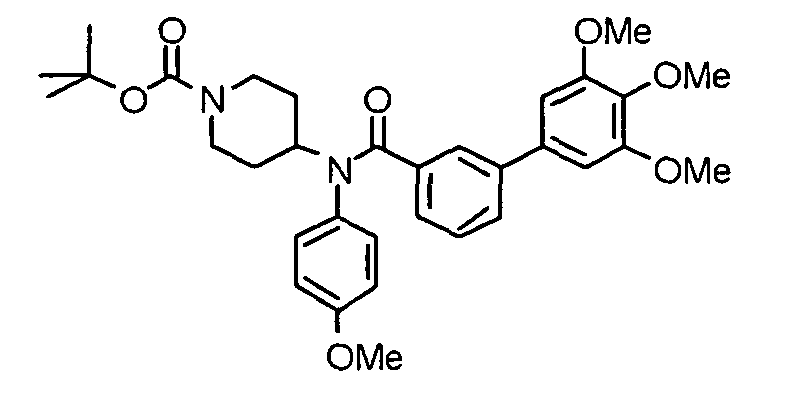
Yield: 416 mg (36%).

Yield: 315 mg (85%)
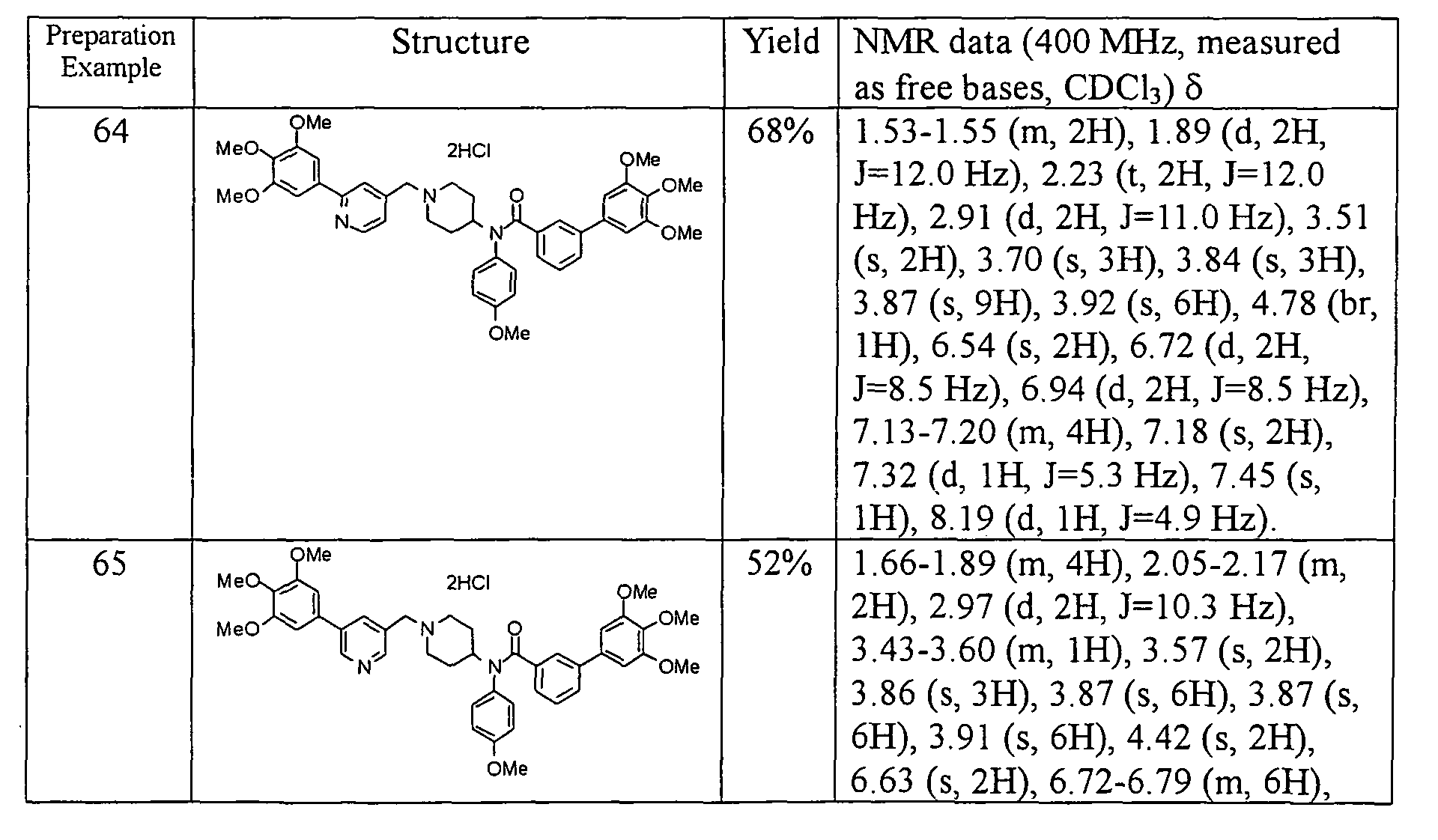
Yield: 3.76 g (93%)
1H-NMR (400 MHz, CDCl3) δ: 1.40-1.64 (m, 2H), 1.44 (s, 9H), 1.82-1.91 (m, 2H), 2.71-2.84 (m, 2H), 3.62-3.73 (m, 1H), 3.74 (s, 3H), 3.89 (s, 3H), 3.94 (s, 6H), 4.10-4.30 (m, 2H), 4.40 (s, 2H), 6.76 (d, 2H, J=9.4 Hz), 6.79 (d, 2H, J=9.8 Hz), 7.14-7.19 (m, 3H), 7.56 (s, 1H), 8.55 (d, 1H, J=5.1 Hz).

Yield: 3.77 g (theoretical yield).
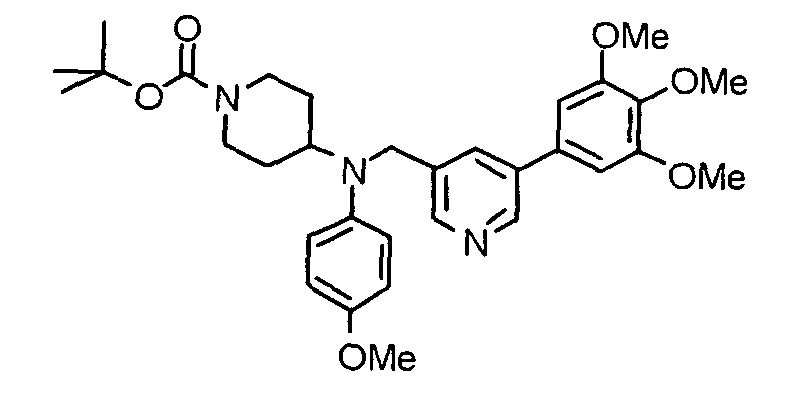
Yield: 159 mg (14%).
1H-NMR (400 MHz, CDCl3) δ: 1.44 (s, 9H), 1.50-1.65 (m, 2H), 1.83-1.91 (m, 2H), 2.70-2.84 (m, 2H), 3.53-3.62 (m, 1H), 3.73 (s, 3H), 3.89 (s, 3H), 3.91 (s, 6H), 4.10-4.29 (m, 2H), 4.41 (s, 2H), 6.66 (s, 2H), 6.76-6.84 (m, 4H), 7.70 (s, 1H), 8.49 (s, 1H), 8.63 (d, 1H, J=2.1 Hz).
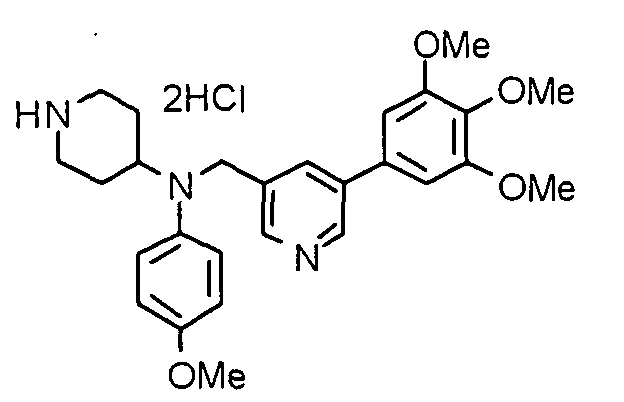
Yield: 142 mg (94%).
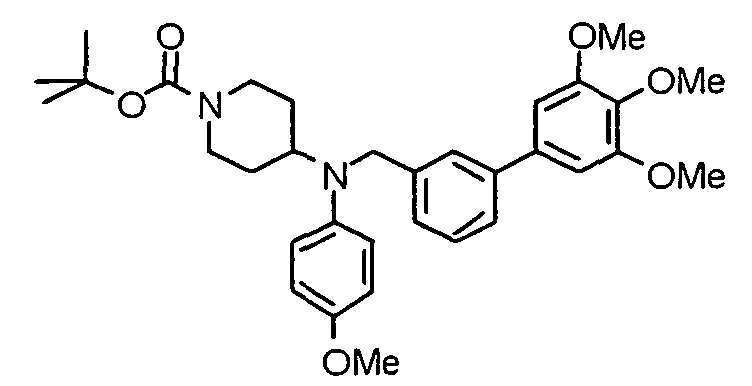
Yield: 1.12 g (90%).
1H-NMR (400 MHz, CDCl3) δ: 1.44 (s, 9H), 1.50-1.63 (m, 2H), 1.82-1.91 (m, 2H), 2.71-2.83 (m, 2H), 3.69 (tt, 1H, J=11.5 Hz, 3.5 Hz), 3.73 (s, 3H), 3.88 (s, 3H), 3.90 (s, 6H), 4.10-4.28 (m, 2H), 4.42 (s, 2H), 6.71 (s, 2H), 6.78 (s, 4H), 7.24-7.28 (m, 1H), 7.31-7.40 (m, 2H), 7.42 (s, 1H).

Yield: 980 mg (99%).


Yield: 7.00 g (91%).
1H-NMR (400 MHz, CDCl3) δ: 1.21-1.31 (m, 2H), 1.37 (t, 3H, J=7.0 Hz), 1.46 (s, 9H), 1.97-2.05 (m, 2H), 2.84-2.95 (m, 2H), 3.28-3.37 (m, 1H), 3.96 (q, 2H, J=7.0 Hz), 3.99-4.10 (m, 2H), 6.57 (d, 2H, J=8.8 Hz), 6.77 (d, 2H, J=9.0 Hz).

Yield: 2.08 g (94%).
1H-NMR (400 MHz, CDCl3) δ: 1.36 (t, 3H, J=7.9 Hz), 1.44 (s, 9H), 1.49-1.58 (m, 2H), 1.82-1.92 (m, 2H), 2.70-2.85 (m, 2H), 3.62-3.72 (m, 1H), 3.89 (s, 3H), 3.94 (s, 6H), 4.12-4.29 (m, 2H), 4.39 (s, 2H), 6.75 (d, 2H, J=9.2 Hz), 6.78 (d, 2H, J=9.6 Hz), 7.14-7.18 (m, 3H), 7.55 (s, 1H), 8.54 (d, 1H, J=5.1 Hz).
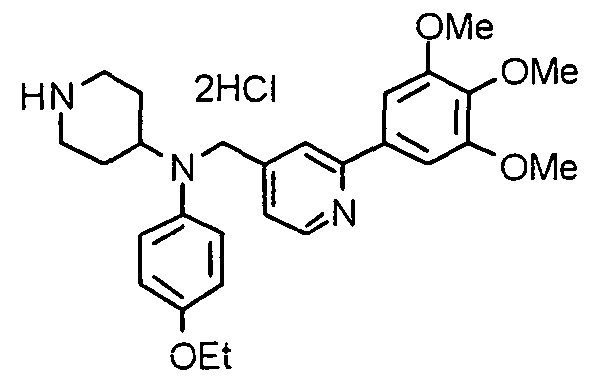
Yield: 1.01 g (98%).

Yield: 452 mg (39%).
1H-NMR (400 MHz, CDCl3) δ: 1.36 (t, 3H, J=6.8 Hz), 1.44 (s, 9H), 1.50-1.60 (m, 2H), 1.82-1.90 (m, 1H), 2.68-2.82 (m, 2H), 3.52-3.61 (m, 1H), 3.88 (s, 3H), 3.90 (s, 6H), 3.94 (q, 2H, J=7.0 Hz), 4.10-4.25 (m, 2H), 4.40 (s, 2H), 6.66 (s, 2H), 6.77 (d, 2H, J=9.2 Hz), 6.81 (d, 2H, J=9.2 Hz), 7.67 (s, 1H), 8.49 (d, 1H, J=2.0 Hz), 8.62 (d, 1H, J=2.1 Hz).

Yield: 380 mg (88%).
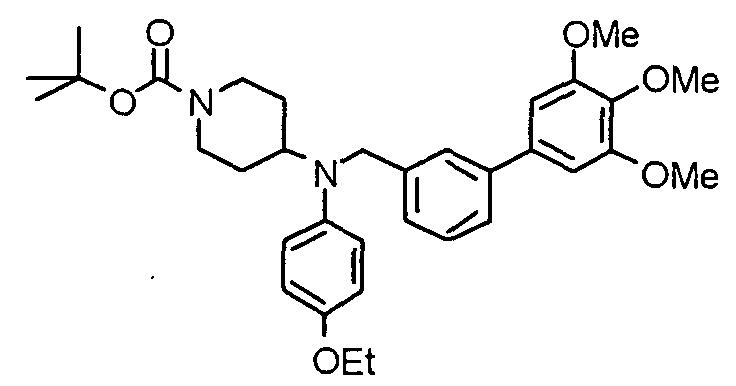
Yield: 1.06 g (92%).
1H-NMR (400 MHz, CDCl3) δ: 1.36 (t, 3H, J=7.0 Hz), 1.44 (s, 9H), 1.53-1.59 (m, 2H), 1.83-1.91 (m, 2H), 2.70-2.83 (m, 2H), 3.64-3.73 (m, 1H), 3.88 (s, 3H), 3.90 (s, 6H), 3.94 (q, 2H, J=7.0 Hz), 4.10-4.29 (m, 2H), 4.41 (s, 2H), 6.71 (s, 2H), 6.76 (s, 4H), 7.26 (d, 1H, J=7.9 Hz), 7.33 (dd, 1H, J=7.4 Hz, 7.4 Hz), 7.38 (d, 1H, J=7.6 Hz), 7.42 (s, 1H).
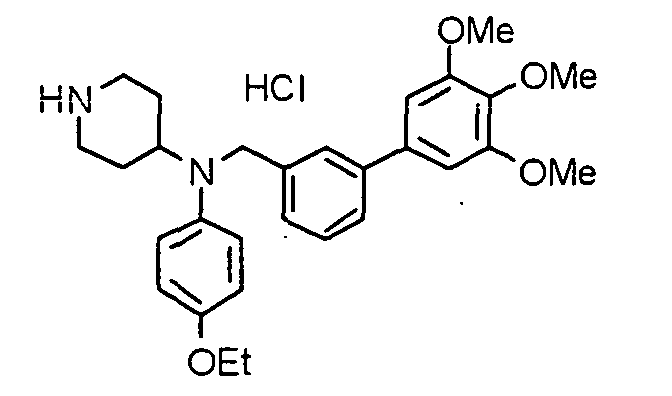
Yield: 913 mg (97%).
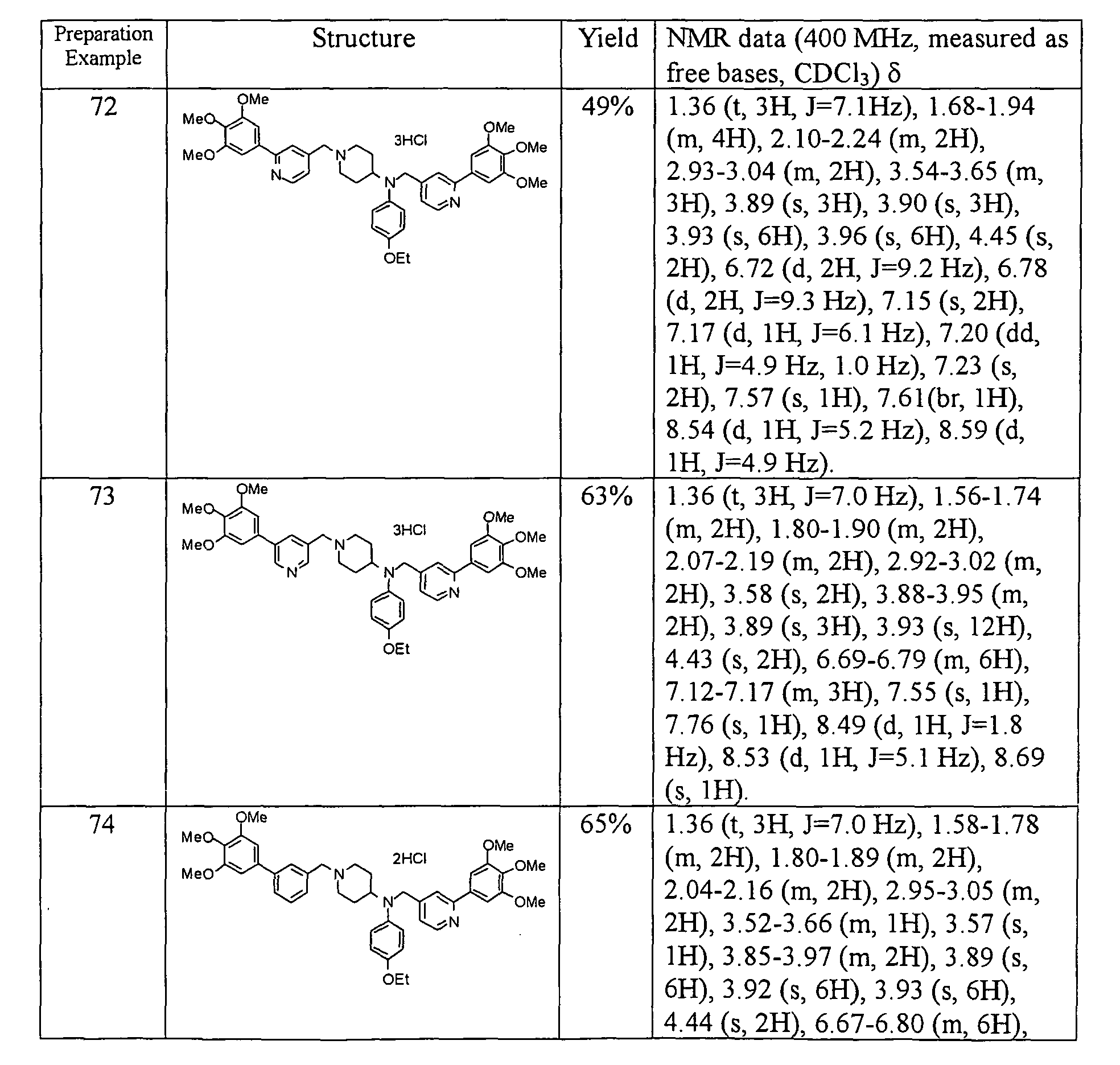

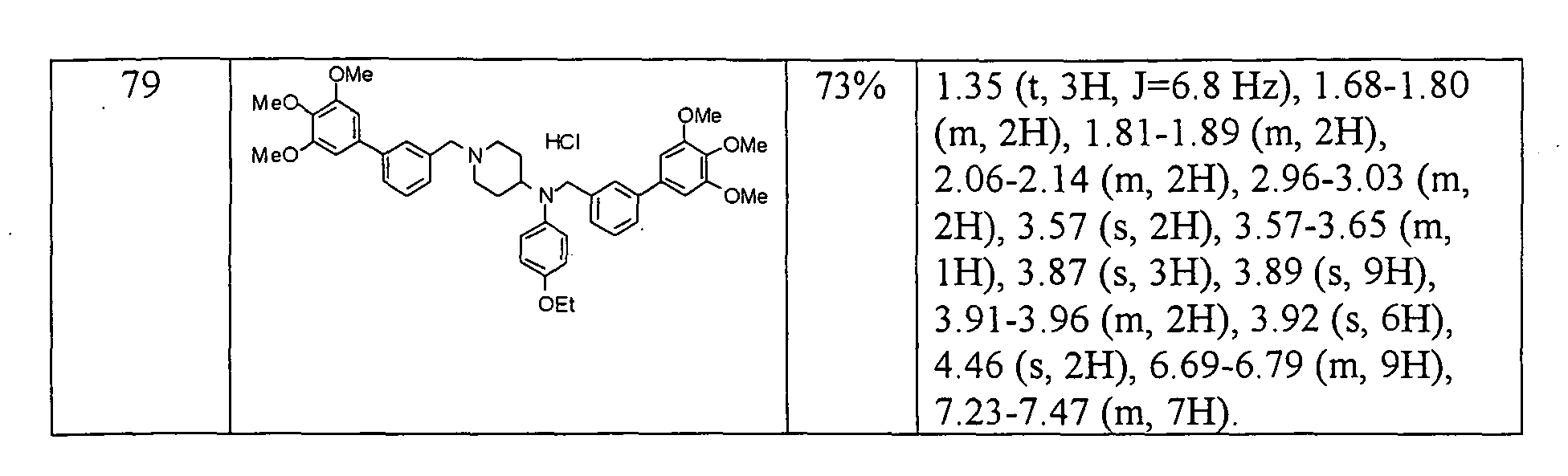
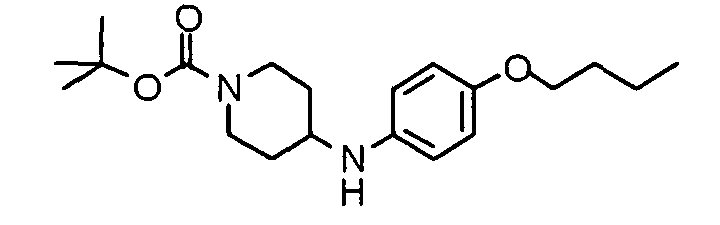
Yield: 6.91 g (83%).
1H-NMR (400 MHz, CDCl3) δ: 0.96 (t, 3H, J=7.2 Hz), 1.23-1.35 (m, 2H), 1.42-1.53 (m, 2H), 1.46 (s, 9H), 1.68-1.76 (m, 2H), 1.97-2.05 (m, 2H), 2.84-2.95 (m, 2H), 3.28-3.37 (m, 1H), 3.88 (t, 2H, J=6.6 Hz), 3.96-4.12 (m, 2H), 6.57 (d, 2H, J=9.0 Hz), 6.77 (d, 2H, J=8.8 Hz).
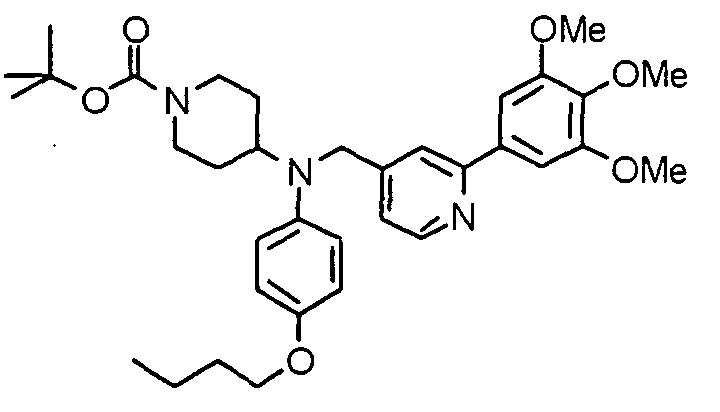
Yield: 980 mg (81%).
1H-NMR (400 MHz, CDCl3) δ: 0.95 (t, 3H, J=7.4 Hz), 1.40-1.50 (m, 2H), 1.44 (s, 9H), 1.67-1.76 (m, 2H), 1.82-1.90 (m, 2H), 1.82-1.90 (m, 2H), 2.70-2.82 (m, 2H), 3.61-3.71 (m, 1H), 3.84-3.90 (m, 5H), 3.94 (s, 6H), 4.10-4.28 (m, 2H), 4.39 (s, 2H), 6.74 (d, 2H, J=9.4 Hz), 6.78 (d, 2H, J=9.4 Hz), 7.14-7.18 (m, 3H), 7.56 (s, 1H), 8.54 (d, 1H, J=5.1 Hz).

Yield: 926 mg (99%).
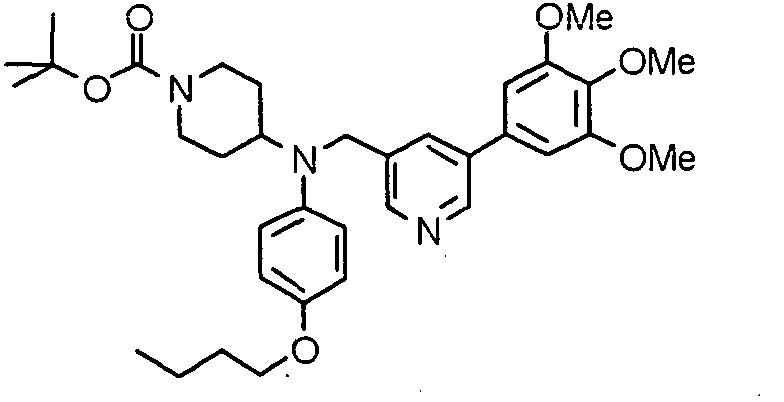
Yield: 485 mg (40%).
1H-NMR (400 MHz, CDCl3) δ: 0.95 (t, 3H, J=7.4 Hz), 1.40-1.57 (m, 2H), 1.44 (s, 9H), 1.67-1.75 (m, 2H), 1.82-1.90 (m, 2H), 2.69-2.81 (m, 2H), 3.51-3.60 (m, 1H), 3.87 (q, 2H, J=6.6 Hz), 3.88 (s, 3H), 3.90 (s, 6H), 4.06-4.23 (m, 2H), 4.39 (s, 2H), 6.66 (s, 2H), 6.77 (d, 2H, J=9.2 Hz), 6.81 (d, 2H, J=9.2 Hz), 6.81 (d, 2H, J=9.4 Hz), 7.67 (s, 1H), 8.49 (d, 1H, J=1.8 Hz), 8.62 (d, 1H, J=2.2 Hz).
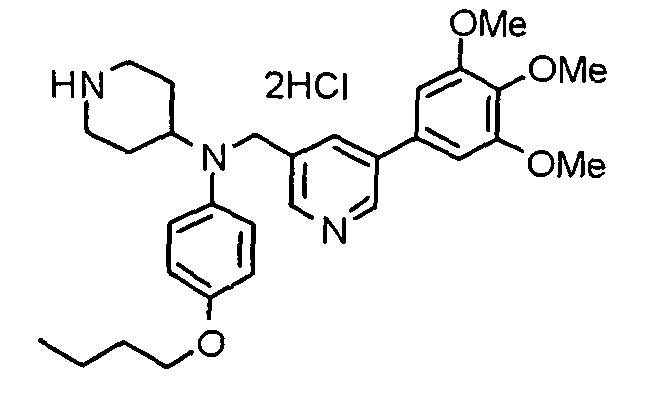
Yield: 456 mg (98%).

Yield: 1.17 g (97%).
1H-NMR (400 MHz, CDCl3) δ: 0.95 (t, 3H, J=7.3 Hz), 1.40-1.61 (m, 4H), 1.44 (s, 9H), 1.67-1.75 (m, 2H), 1.83-1.90 (m, 2H), 2.70-2.83 (m, 2H), 3.63-3.72 (m, 2H), 3.87 (q, 2H, J=6.6 Hz), 3.88 (s, 3H), 3.90 (s, 6H), 4.09-4.28 (m, 2H), 4.41 (s, 2H), 6.70 (s, 2H), 6.76 (s, 4H), 7.26 (d, 2H, J=8.0 Hz), 7.33 (t, 1H, J=7.6 Hz), 7.38 (d, 1H, J=7.3 Hz), 7.42 (s, 1H).

Yield: 1.02 g (98%).
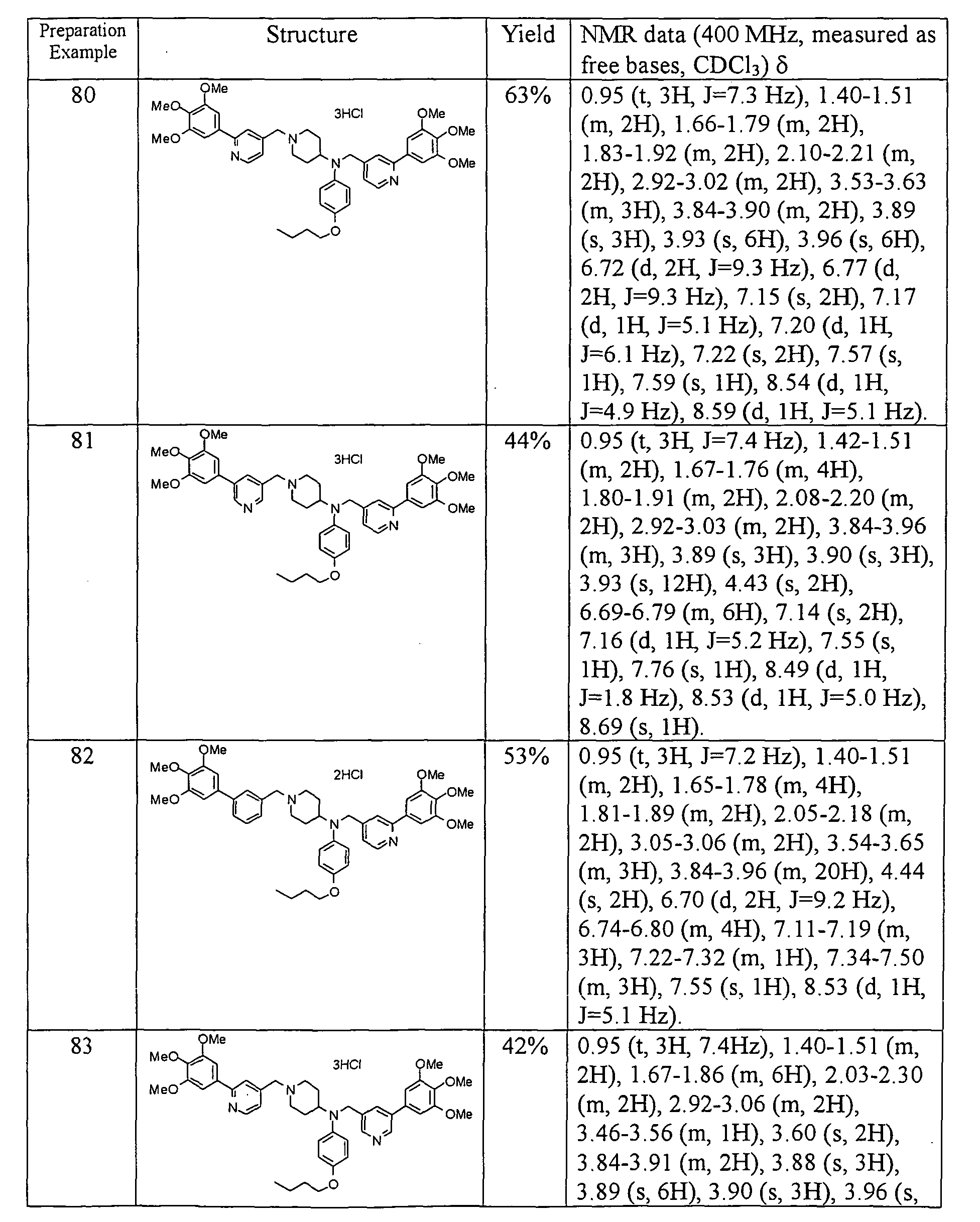


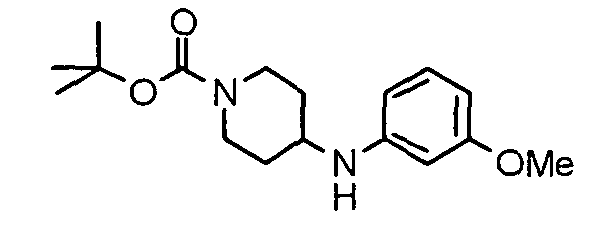
Yield: 4.83 g (66%).
1H-NMR (400 MHz, CDCl3) δ: 1.20-1.39 (m, 2H), 1.44 (s, 9H), 1.99-2.05 (m, 2H), 2.89 (dt, 2H, J=13.5 Hz, 2.2 Hz), 3.33-3.44 (m, 1H), 3.75 (s, 3H), 3.96-4.07 (m, 2H), 6.14 (t, 1H, J=2.2 Hz), 6.18-6.29 (m, 2H), 7.05 (t, 1H, J=8.1 Hz).

Yield: 789 mg (70%).
1H-NMR (400 MHz, CDCl3) δ: 1.45 (s, 9H), 1.50-1.67 (m, 2H), 1.82-1.91 (m, 2H), 2.74-2.87 (m, 2H), 3.74 (s, 3H), 3.88-3.98 (m, 1H), 3.89 (s, 3H), 3.94 (s, 6H), 4.14-4.32 (m, 2H), 4.48 (s, 2H), 6.28 (dd, 1H, J=2.2 Hz, 2.2 Hz), 6.31-6.37 (m, 2H), 7.10-7.15 (m, 2H), 7.16 (s, 2H), 7.55 (s, 1H), 8.56 (d, 1H, J=5.1 Hz).

Yield: 710 mg (95%).

Yield: 396 mg (35%).
1H-NMR (400 MHz, CDCl3) δ: 1.45 (s, 9H), 1.54-1.66 (m, 2H), 1.81-1.91 (m, 2H), 2.73-2.87 (m, 2H), 3.74 (s, 3H), 3.87-3.93 (m, 1H), 3.88 (s, 3H), 3.90 (s, 6H), 4.14-4.29 (m, 2H), 4.51 (s, 2H), 6.30-6.35 (m, 2H), 6.38 (d, 1H, J=7.2 Hz), 6.68 (s, 2H), 7.12 (dd, 1H, J=8.8 Hz, 8.88 Hz), 7.66 (s, 1H), 8.49 (d, 1H, J=2.0 Hz), 8.66 (d, 1H, J=2.2 Hz).

Yield: 348 mg (92%).

Yield: 1.01 g (90%).
1H-NMR (400 MHz, CDCl3) δ: 1.44 (s, 9H), 1.56-1.67 (m, 2H), 1.83-1.91 (m, 2H), 2.72-2.86 (m, 2H), 3.73 (s, 3H), 3.85-3.98 (m, 1H), 3.88 (s, 3H), 3.90 (s, 6H), 4.12-4.30 (m, 2H), 4.50 (s, 2H), 6.27-6.34 (m, 2H), 6.38 (dd, 1H, J=8.2 Hz, 2.4 Hz), 6.72 (s, 2H), 7.10 (dd, 1H, J=8.2 Hz, 8.2 Hz), 7.21-7.27 (m, 1H), 7.32-7.43 (m, 3H).
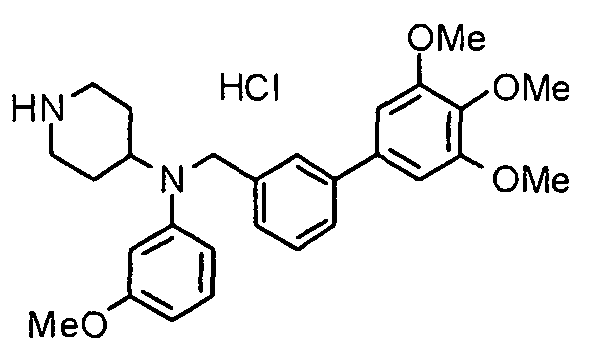
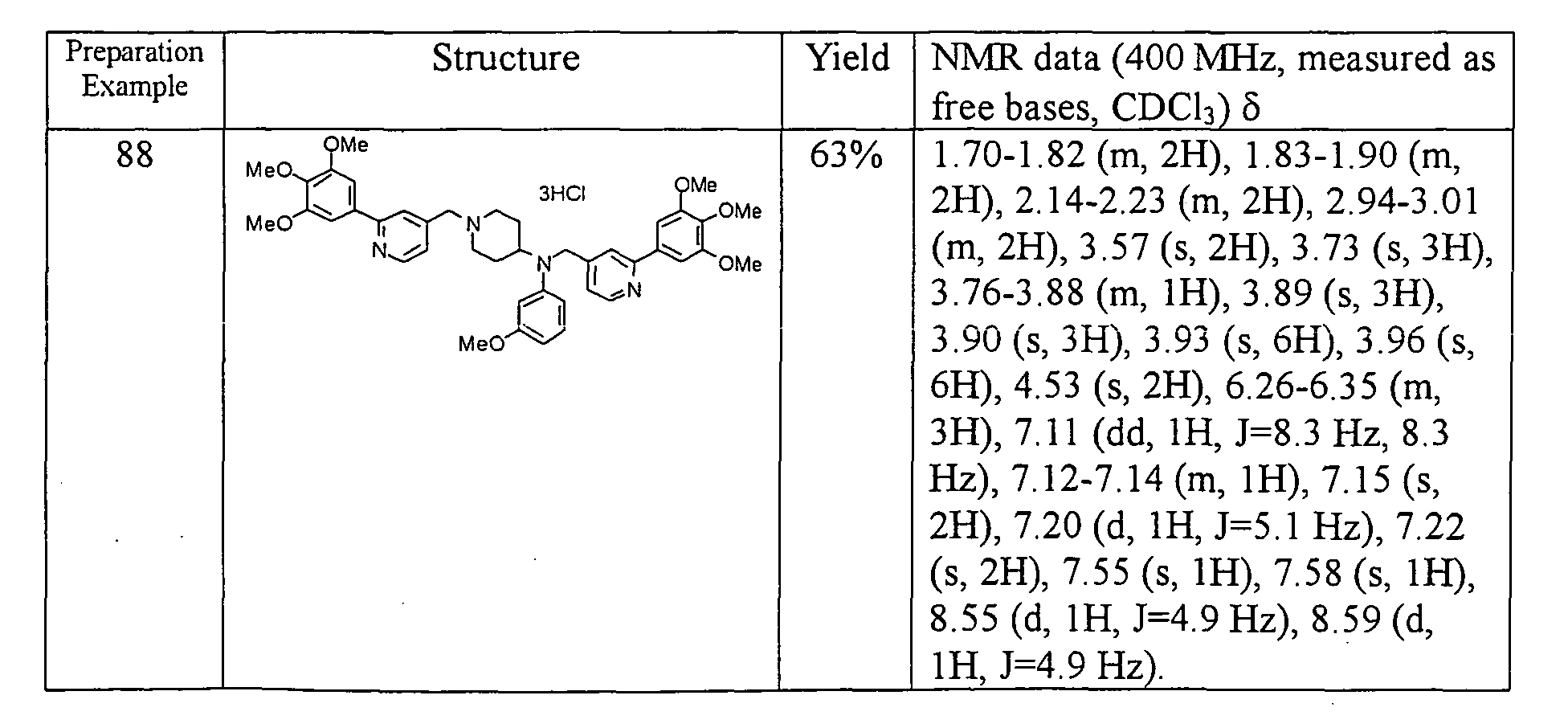


Yield: 2.61 g (36%).
1H-NMR (400 MHz, CDCl3) 5: 1.31-1.41 (m, 2H), 1.47 (s, 9H), 2.00-2.08 (m, 2H), 2.90-3.01 (m, 2H), 3.38-3.47 (m, 1H), 3.83 (s, 3H), 4.00-4.21 (m, 2H), 6.60-6.69 (m, 2H), 6.76-6.89 (m, 2H).
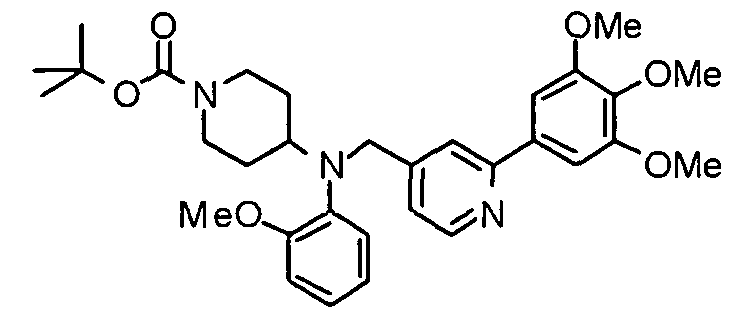
Yield: 763 mg (68%).
1H-NMR (400 MHz, CDCl3) δ: 1.41-1.58 (m, 2H), 1.44 (s, 9H), 1.81-1.91 (m, 2H), 2.62-2.78 (m, 2H), 3.29 (tt, 1H, J=7.6 Hz, 3.7 Hz), 3.86 (s, 3H), 3.89 (s, 3H), 3.95 (s, 6H), 4.06-4.16 (m, 2H), 4.37 (s, 2H), 6.80 (ddd, 1H, J=7.6 Hz, 7.6 Hz, 1.2 Hz), 6.87 (dd, 1H, J=8.5 Hz, 1.0 Hz), 7.00-7.06 (m, 2H), 7.14 (s, 2H), 7.20 (dd, 1H, J=4.9 Hz, 1.0 Hz), 7.61 (s, 1H), 8.49 (d, 1H, J=4.9 Hz).

Yield: 701 mg (97%).

Yield: 353 mg (31%).
1H-NMR (400 MHz, CDCl3) δ: 1.44 (s, 9H), 1.46-1.53 (m, 2H), 1.82-1.91 (m, 2H), 2.62-2.78 (m, 2H), 3.24-3.33 (m, 1H), 3.83 (s, 3H), 3.89 (s, 3H), 3.91 (s, 6H), 4.03-4.16 (m, 2H), 4.37 (s, 2H), 6.64 (s, 2H), 6.79 (ddd, 1H, J=7.6 Hz, 7.6 Hz, 1.2 Hz), 6.84 (dd, 1H, J=7.0 Hz, 1.2 Hz), 6.97-7.06 (m, 2H), 7.68 (dd, 1H, J=1.3 Hz, 1.3 Hz), 8.49 (d, 1H, J=2.0 Hz), 8.56 (d, 1H, J=2.2 Hz).
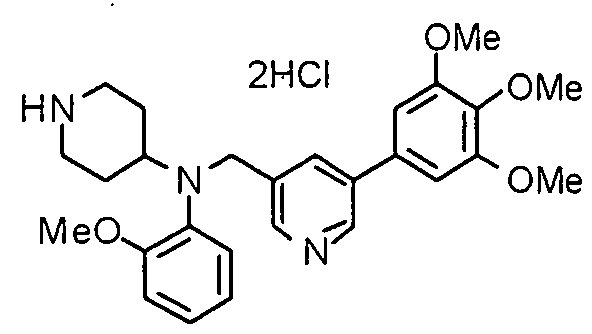
Yield: 312 mg (93%).
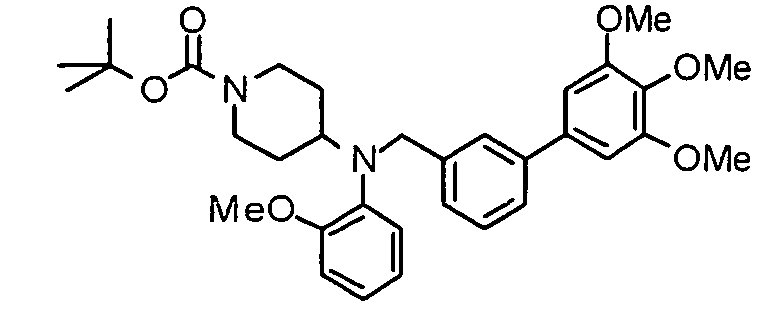
Yield: 1.12 g (100%).
1H-NMR (400 MHz, CDCl3) δ: 1.43 (s, 9H), 1.46-1.57 (m, 2H), 1.81-1.90 (m, 2H), 2.62-2.76 (m, 2H), 3.31 (tt, 1H, J=11.1 Hz, 3.3 Hz), 3.84 (s, 3H), 3.88 (s, 3H), 3.91 (s, 6H), 4.00-4.16 (m, 2H), 4.36 (s, 2H), 6.67 (s, 2H), 6.78 (t, 1H, J=7.3 Hz), 6.85 (d, 1H, J=7.9 Hz), 6.96-7.03 (m, 2H), 7.24-7.34 (m, 3H), 7.43 (s, 1H).

Yield: 987 mg (99%).
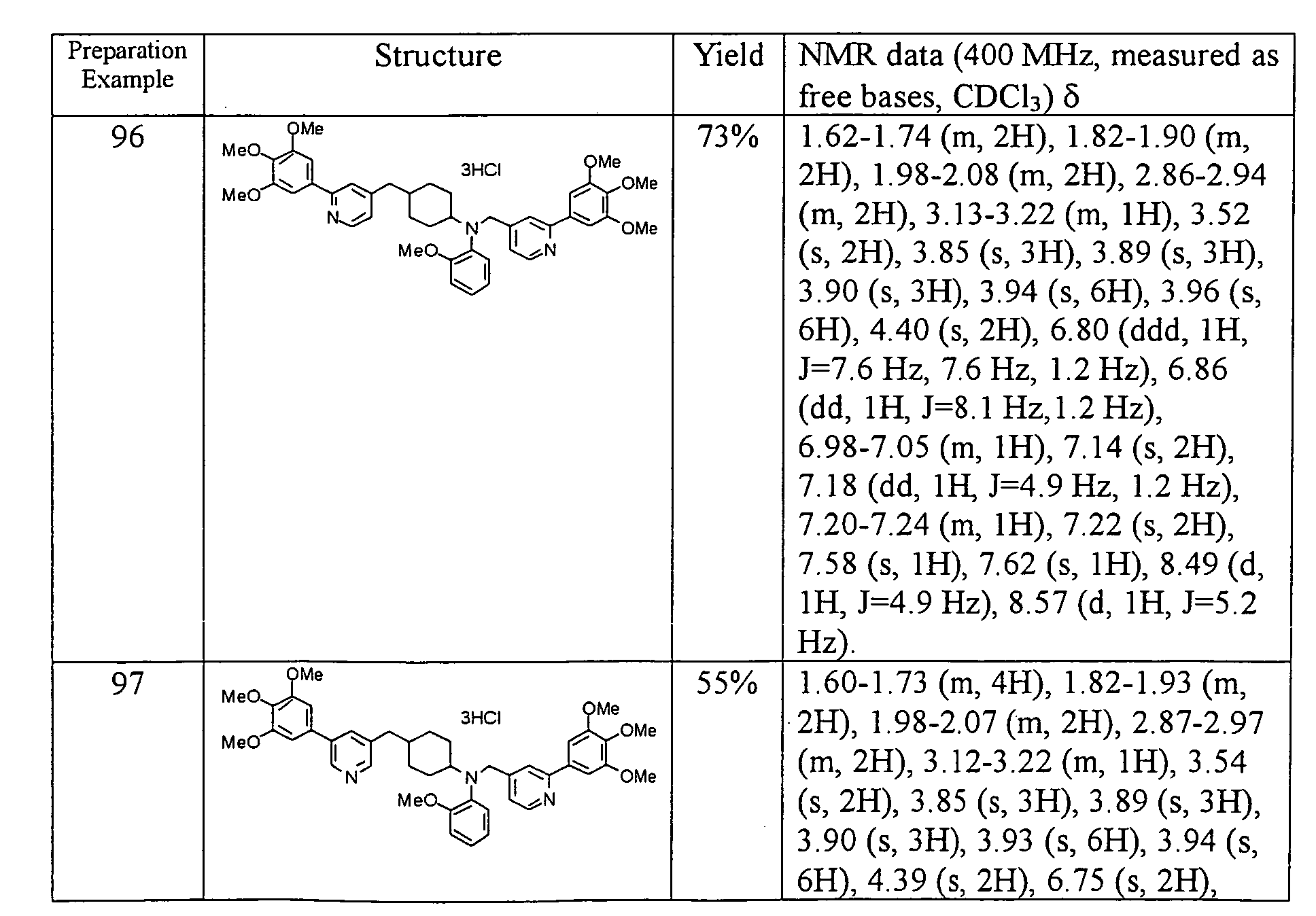
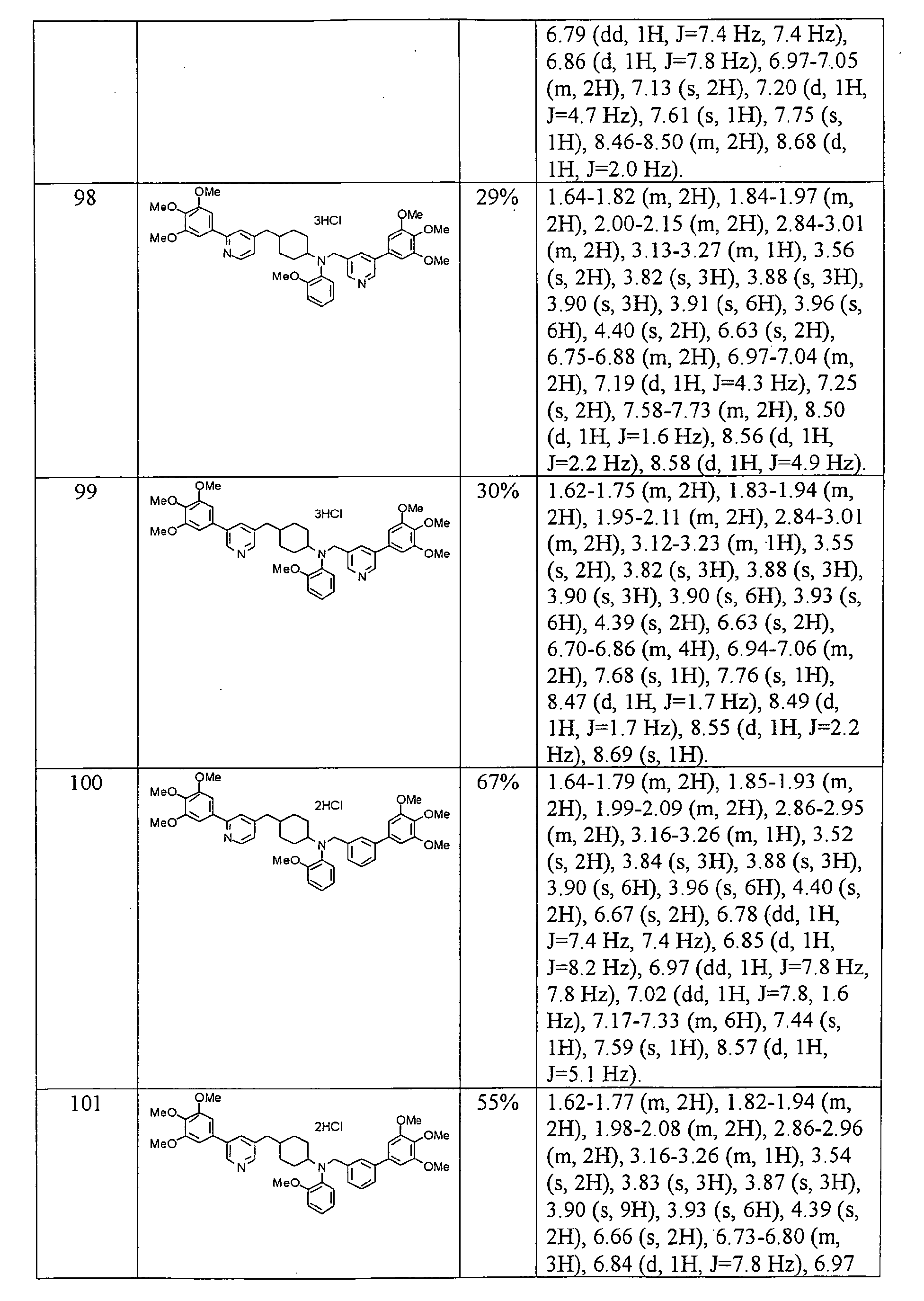


Yield: 3.18 g (39%).
1H-NMR (400 MHz, CDCl3) δ: 1.29-1.42 (m, 2H), 1.45 (s, 9H), 1.97-2.03 (m, 2H), 2.92 (dt, 2H, J=13.5 Hz, 2.2 Hz), 3.38 (dt, 1H, J=13.8 Hz, 4.1 Hz), 3.77 (s, 3H), 3.82 (s, 3H), 3.99-4.03 (m, 2H), 4.17 (m, 1H), 6.27-6.32 (m, 2H), 6.88 (t, 1H, J=8.4 Hz).

Yield: 613 mg (52%).
1H-NMR (400 MHz, CDCl3) δ: 1.45 (s, 9H), 1.56-1.70 (m, 2H), 1.84-1.91 (m, 2H), 2.62-2.76 (m, 2H), 3.58 (tt, 1H, J=11.8 Hz, 3.6 Hz), 3.83 (s, 3H), 3.89 (s, 6H), 3.93 (s, 6H), 4.08-4.25 (m, 2H), 4.35 (s, 2H), 6.56-6.63 (m, 2H), 6.86 (t, 1H, J=8.3 Hz), 7.14 (s, 2H), 7.17 (dd, 1H, J=5.1 Hz, 1.2 Hz), 7.62 (s, 1H), 8.50 (d, 1H, J=5.1 Hz).
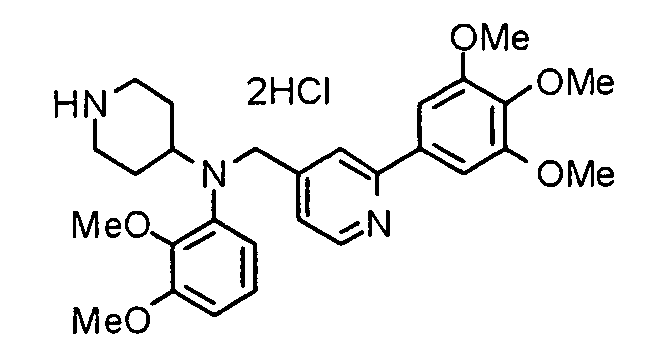
Yeld: 512 mg (88%).

Yield: 21 mg (12%).
1H-NMR (400 MHz, measured as a free base, CDCl3) δ: 1.76-1.96 (m, 4H), 2.00-2.13 (m, 2H), 2.86-3.00 (m, 2H), 3.42-3.60 (m, 1H), 3.54 (s, 2H), 3.82 (s, 3H), 3.88 (s, 3H), 3.90 (s, 3H), 3.97 (s, 6H), 4.41 (s, 2H), 6.57 (d, 1H, J=8.0 Hz), 6.62 (d, 1H, J=8.2 Hz), 6.85 (dd, 1H, J=8.4 Hz, 8.4 Hz), 7.11-7.29 (m, 6H), 7.59 (s, 1H), 7.63 (s, 1H), 8.50 (d, 1H, J=4.9 Hz), 8.59 (d, 1H, J=4.9 Hz).
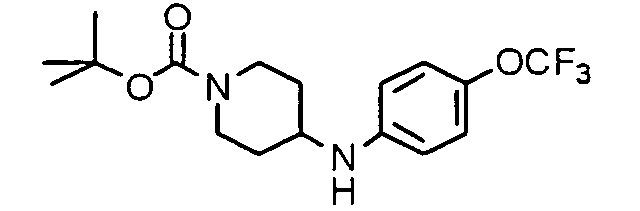
Yield: 5.22 g (60%).
1H-NMR (400 MHz, CDCl3) δ: 1.25-1.40 (m, 2H), 1.47 (s, 9H), 1.98-2.08 (m, 2H), 2.83-2.98 (m, 2H), 3.34-3.43 (m, 1H), 3.97-4.12 (m, 2H), 6.58 (d, 2H, J=8.8 Hz), 7.03 (d, 2H, J=8.8 Hz).

Yield: 543 mg (44%).
1H-NMR (400 MHz, CDCl3) δ: 1.45 (s, 9H), 1.52-1.66 (m, 2H), 1.81-1.91 (m, 2H), 2.73-2.88 (m, 2H), 3.88-3.99 (m, 1H), 3.89 (s, 3H), 3.93 (s, 6H), 4.15-4.34 (m, 2H), 4.48 (s, 2H), 6.68 (d, 2H, J=9.2 Hz), 7.07 (d, 2H, J=8.6 Hz), 7.12 (dd, 1H, J=5.2 Hz, 1.3 Hz), 7.15 (s, 2H), 7.52 (s, 1H), 8.58 (d, 1H, J=5.2 Hz).

Yield: 481 mg (93%).
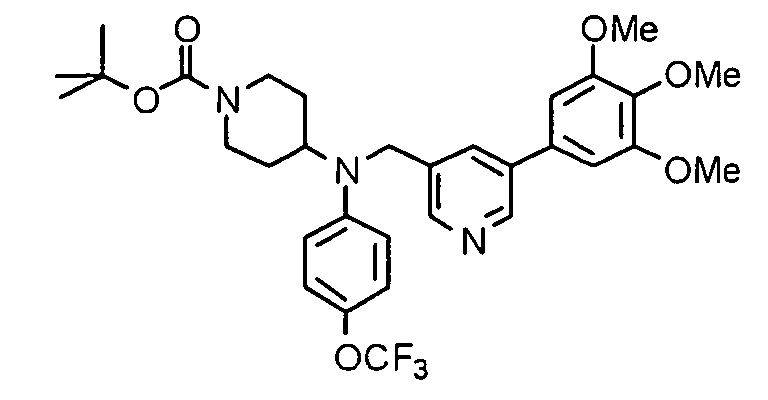
Yield: 201 mg (16%).
1H-NMR (400 MHz, CDCl3) δ: 1.45 (s, 9H), 1.54-1.67 (m, 2H), 1.82-1.90 (m, 2H), 2.74-2.86 (m, 2H), 3.84-3.91 (m, 1H), 3.88 (s, 3H), 3.89 (s, 6H), 4.16-4.30 (m, 2H), 4.52 (s, 2H), 6.67 (s, 2H), 6.72 (d, 2H, J=9.4 Hz), 7.06 (d, 2H; J=8.4 Hz), 7.64 (t, 1H, J=2.1 Hz), 8.49 (d, 1H, J=2.2 Hz), 8.68 (d, 1H, J=2.1 Hz).
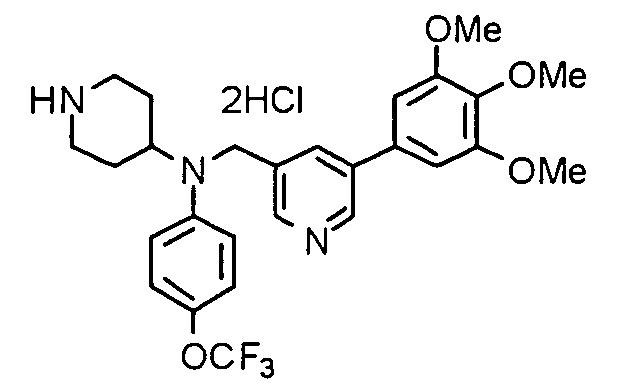
Yield: 185 mg (96%).
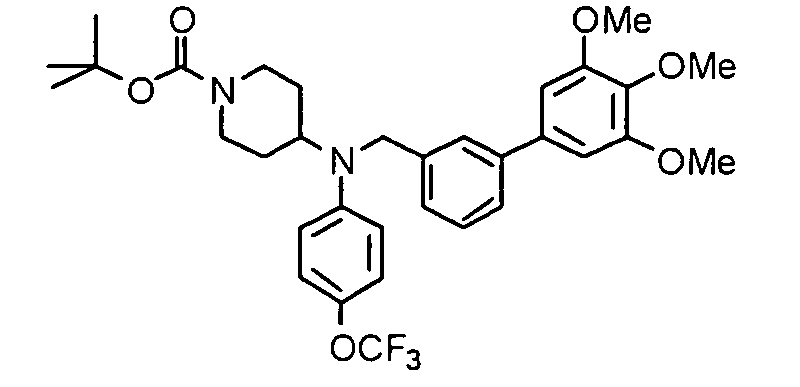
Yield: 1.06 mg (86%).
1H-NMR (400 MHz, CDCl3) δ: 1.45 (s, 9H), 1.56-1.68 (m, 2H), 1.83-1.90 (m, 2H), 2.71-2.86 (m, 2H), 3.87-3.90 (m, 1H), 3.88 (s, 3H), 3.89 (s, 6H), 4.16-4.29 (m, 2H), 4.51 (s, 2H), 6.70 (d, 2H, J=9.3 Hz), 6.70 (s; 2H), 7.04 (d, 2H, J=8.5 Hz), 7.22 (d, 1H, J=7.8 Hz), 7.34-7.44 (m, 3H).
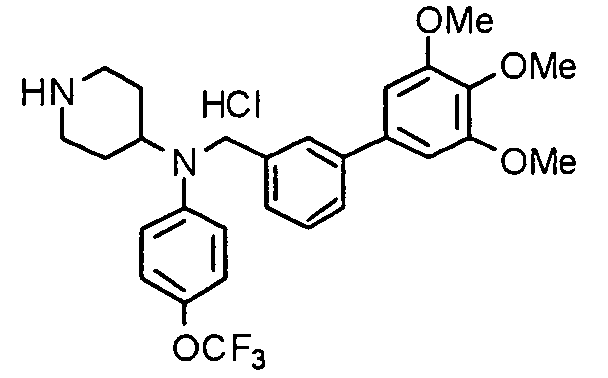
Yield: 795 mg (84%).

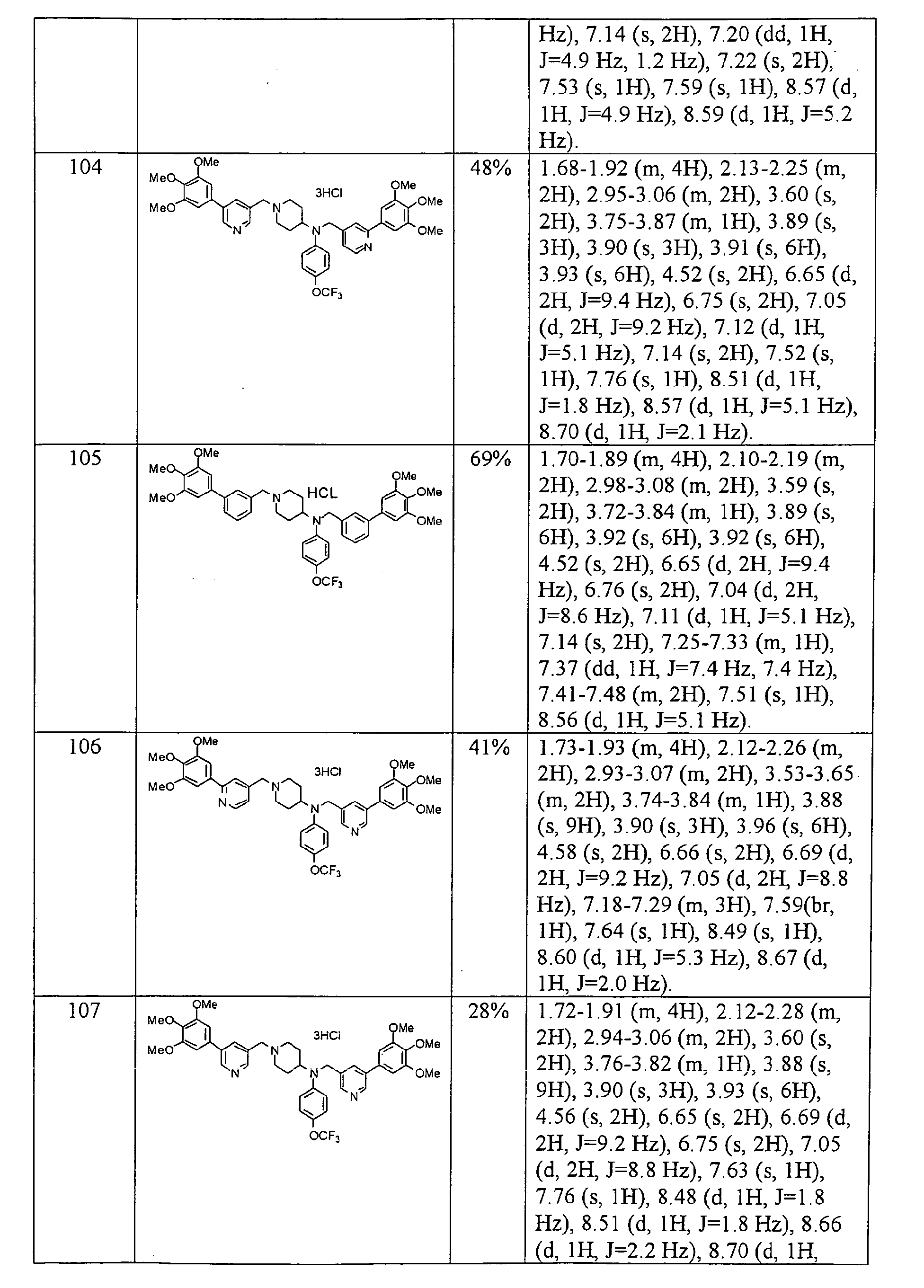

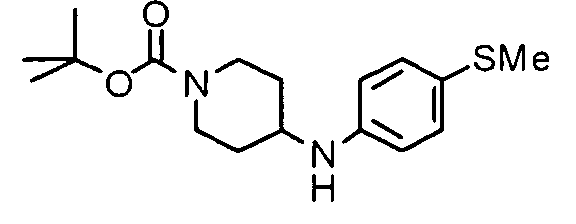
Yield: 3.80 g (49%).
1H-NMR (400 MHz, CDCl3) δ: 1.26-1.38 (m, 2H), 1.46 (s, 9H), 1.98-2.06 (m, 2H), 2.41 (s, 3H), 2.88-2.97 (m, 2H), 3.36-3.45 (m, 2H), 3.48-3.56 (br, 1H), 3.96-4.12 (m, 2H); 6.55 (d, 2H, J=8.8 Hz), 7.21 (d, 2H, J=8.8 Hz).
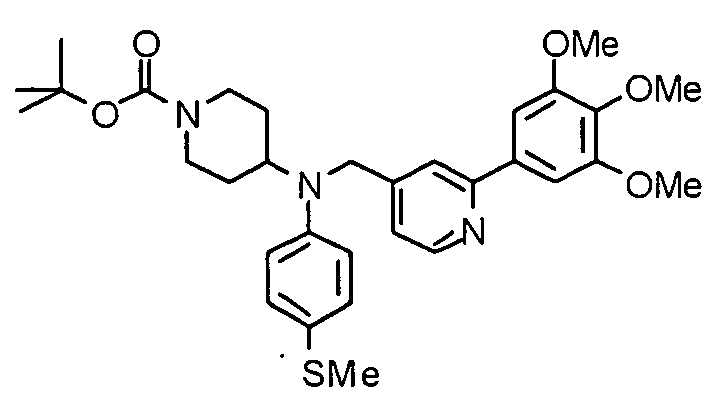
Yield: 671 mg (58%).
1H-NMR (400 MHz, CDCl3) δ: 1.45 (s, 9H), 1.50-1.66 (m, 2H), 1.81-1.89 (m, 2H), 2.40 (s, 3H), 2.74-2.87 (m, 2H), 3.88-3.94 (m, 1H), 3.90 (s, 3H), 3.94 (s, 6H), 4.15-4.29 (m, 2H), 4.48 (s, 2H), 6.67 (d, 2H, J=9.0 Hz), 7.11-7.18 (m, 1H), 7.16 (s, 2H), 7.22 (d, 2H, J=6.6 Hz), 7.54 (s, 1H), 8.57 (d, 1H, J=5.1 Hz).

Yeld: 602 mg (94%).
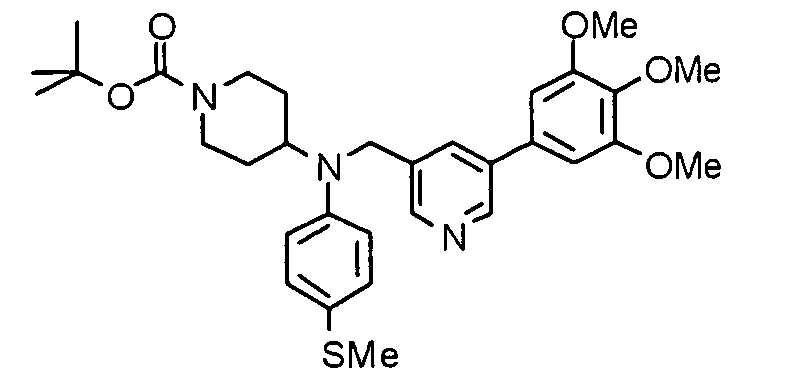
Yield: 312 mg (27%).
1H-NMR (400 MHz, CDCl3) δ: 1.45 (s, 9H), 1.53-1.63 (m, 2H), 1.83-1.89 (m, 2H), 2.40 (s, 3H), 2.73-2.85 (m, 2H), 3.87-3.91 (m, 1H), 3.88 (s, 3H), 3.90 (s, 6H), 4.16-4.30 (m, 2H), 4.50 (s, 2H), 6.67 (s, 2H), 6.71 (d, 2H, J=9.0 Hz), 7.21 (d, 2H, J=9.0 Hz), 7.64 (s, 1H), 8.48 (d, 1H, J=2.2 Hz), 8.66 (d, 1H, J=2.1 Hz).
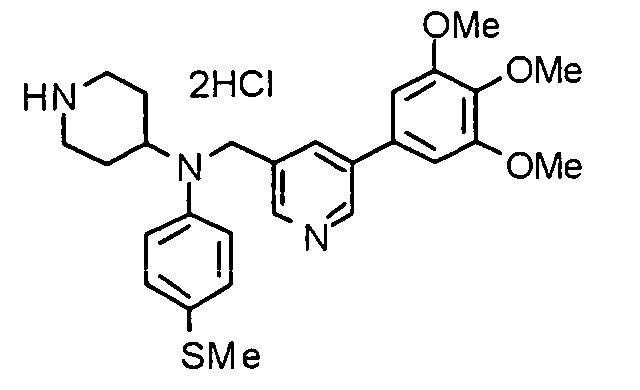
Yield: 251 mg (84%).
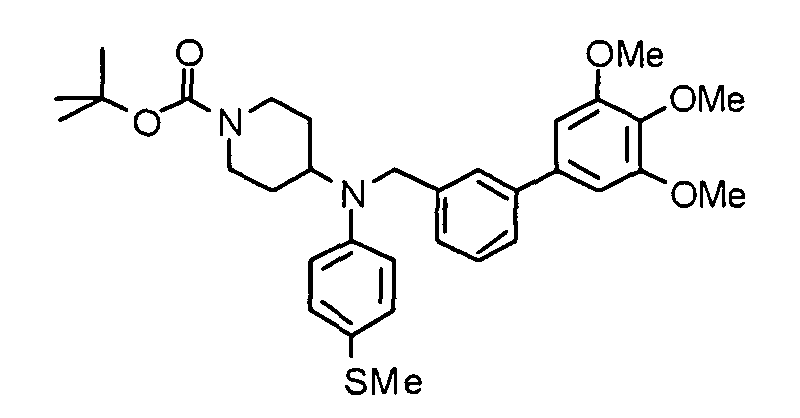
Yield: 1.10 g (95%).
1H-NMR (400 MHz, CDCl3) δ: 1.45 (s, 9H), 1.55-1.68 (m, 2H), 1.81-1.90 (m, 2H), 2.39 (s, 3H), 2.73-2.86 (m, 2H), 3.87-3.91 (m, 1H), 3.88 (s, 3H), 3.89 (s, 6H), 4.15-4.29(m, 2H), 4.50 (s, 2H), 6.68-6.73 (m, 4H), 7.19-7.24 (m, 3H), 7.33-7.43 (m, 3H).
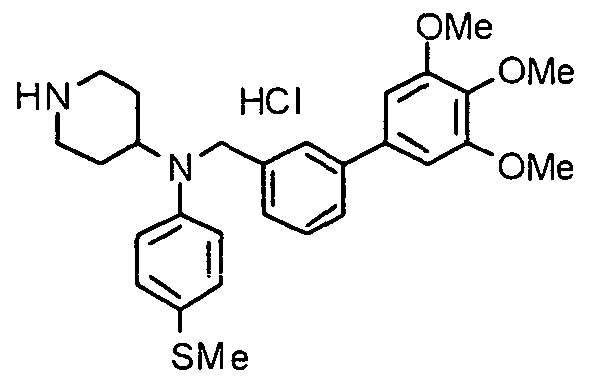

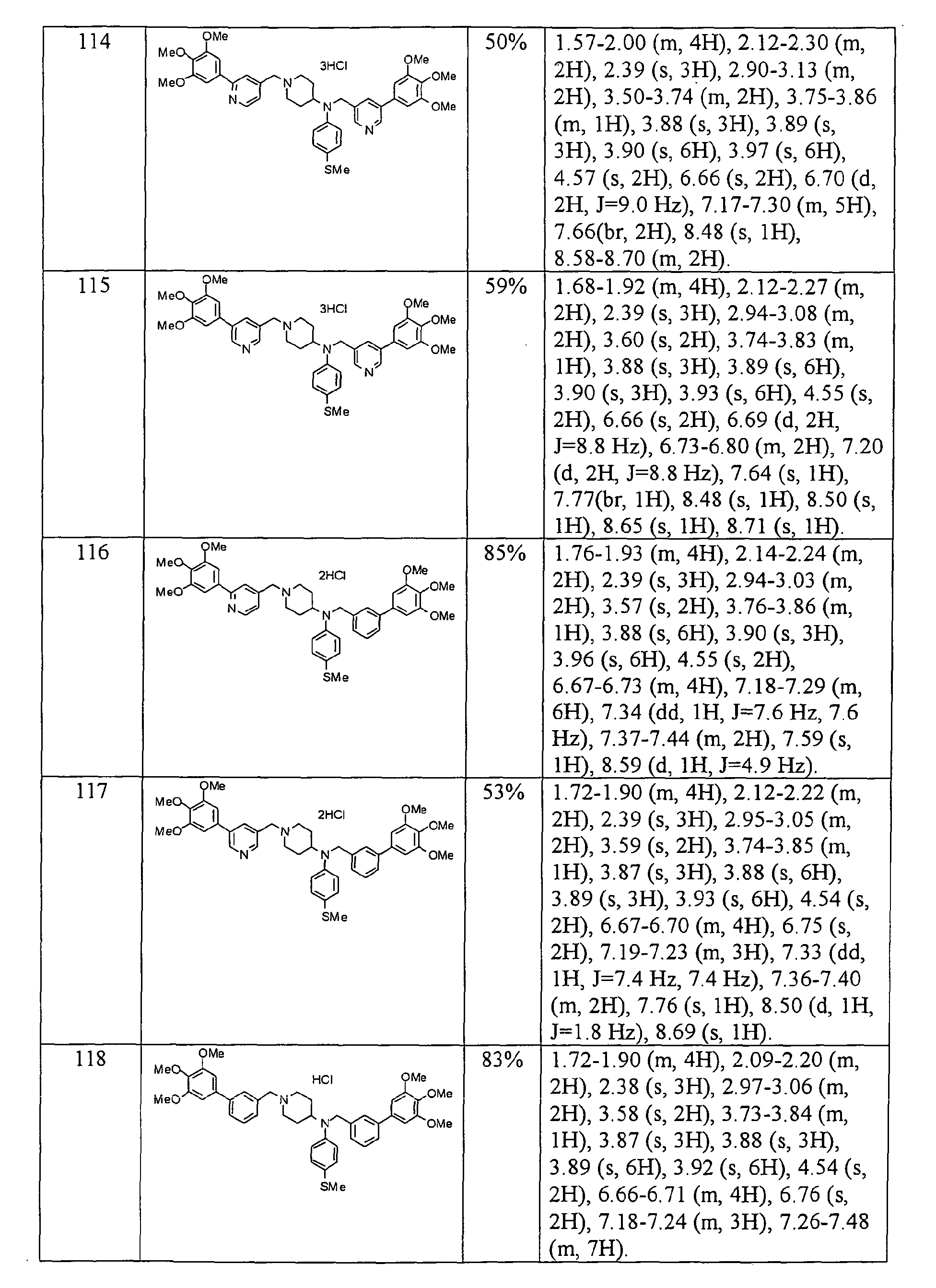
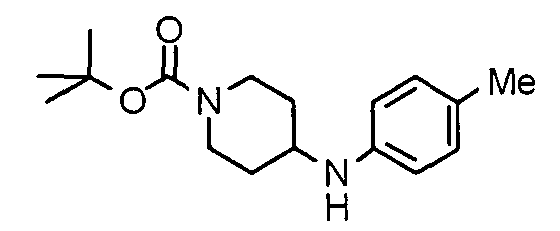
Yield: 5.79 g (83%).
1H-NMR (400 MHz, CDCl3) δ: 1.25-1.36 (m, 2H), 1.46 (s, 9H), 1.99-2.06 (m, 2H), 2.23 (s, 3H), 2.86-2.96 (m, 2H), 3.30-3.43 (m, 2H), 3.96-4.10 (m, 2H), 6.53 (d, 2H, J=8.4 Hz), 6.98 (d, 2H, J=8.0 Hz).
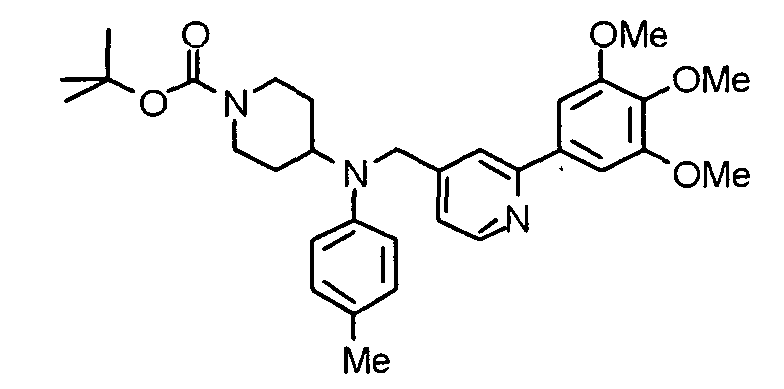
Yield: 1.00 g (91%).
1H-NMR (400 MHz, CDCl3) δ: 1.45 (s, 9H), 1.55-1.59 (m, 2H), 1.81-1.90 (m, 2H), 2.23 (s, 3H), 2.72-2.86 (m, 2H), 3.81-3.94 (m, 1H), 3.89 (s, 3H), 3.93 (s, 6H), 4.14-4.30 (m, 2H), 4.45 (s, 2H), 6.66 (d, 2H, J=8.6 Hz), 7.02 (d, 2H, J=8.2 Hz), 7.13-7.16 (m, 3H), 7.55 (s, 1H), 8.55 (d, 1H, J=8.1 Hz).
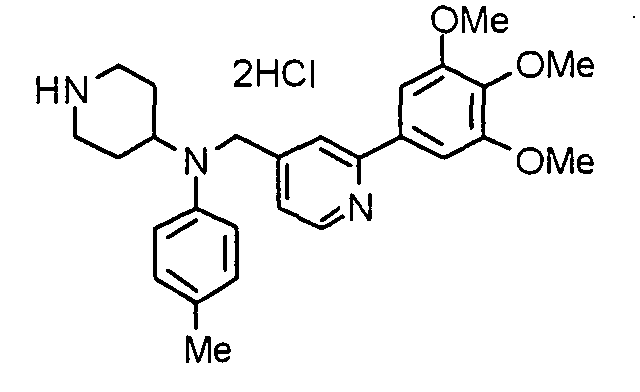
Yield: 924 mg (97%).
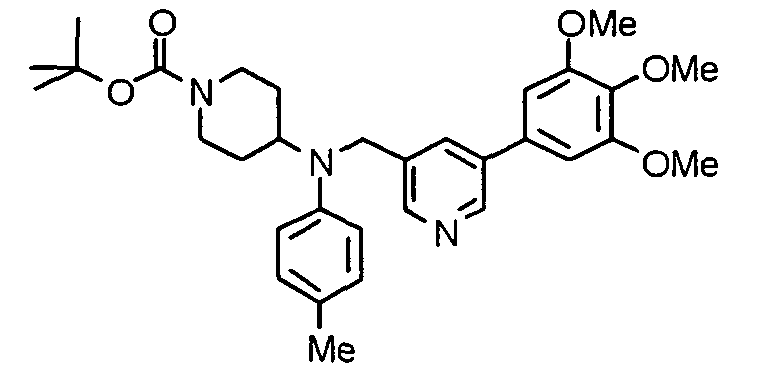
Yield: 426 mg (39%).
1H-NMR (400 MHz, CDCl3) δ: 1.45 (s, 9H), 1.52-1.70 (m, 2H), 1.82-1.90 (m, 2H), 2.23 (s, 3H), 2.72-2.86 (m, 2H), 3.77-3.86 (m, 1H), 3.88 (s, 3H), 3.90 (s, 6H), 4.10-4.28 (m, 2H), 4.47 (s, 2H), 6.67 (s, 2H), 6.70 (d, 2H, J=8.6 Hz), 7.01 (d, 2H, J=8.2 Hz), 7.67 (dd, 1H, J=2.1 Hz, 2.1 Hz), 8.50 (d, 1H, J=2.0 Hz), 8.64 (d, 1H, J=2.2 Hz).
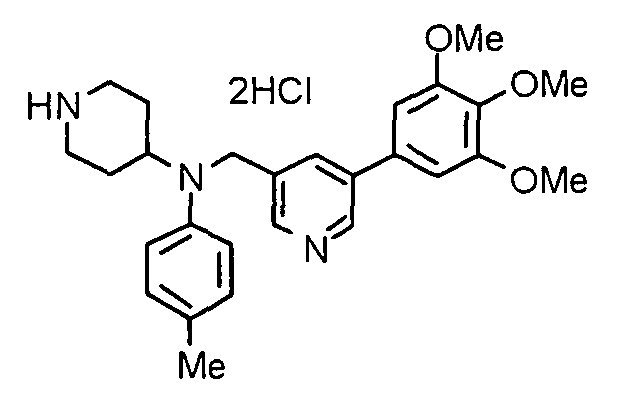
Yield: 400 mg (99%).

Yield: 1.03 g (94%).
1H-NMR (400 MHz, CDCl3) δ: 1.44 (s, 9H), 1.50-1.66 (m, 2H), 1.83-1.90 (m, 2H), 2.23 (s, 3H), 2.72-2.85 (m, 2H), 3.82-3.92 (m, 1H), 3.88 (s, 3H), 3.89 (s, 6H), 4.11-4.30 (m, 2H), 4.47 (s, 2H), 6.68 (d, 2H, J=8.6 Hz), 6.71 (s, 2H), 7.00 (d, 2H, J=8.8 Hz), 7.23-7.27 (m, 1H), 7.32-7.44 (m, 3H).
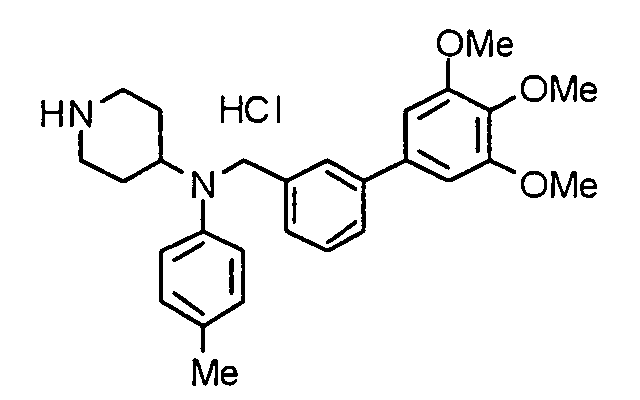
Yield: 882 mg (97%).

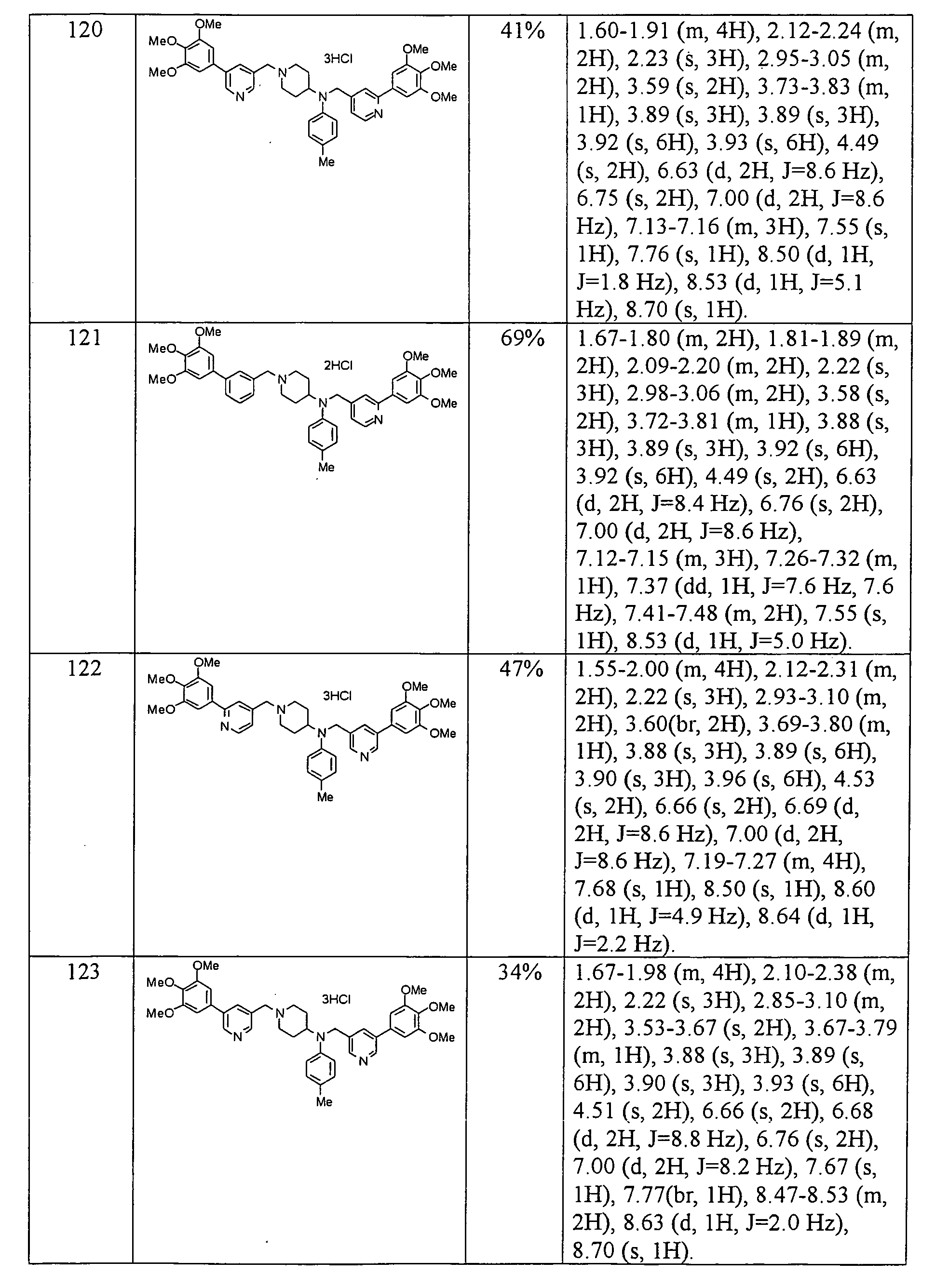
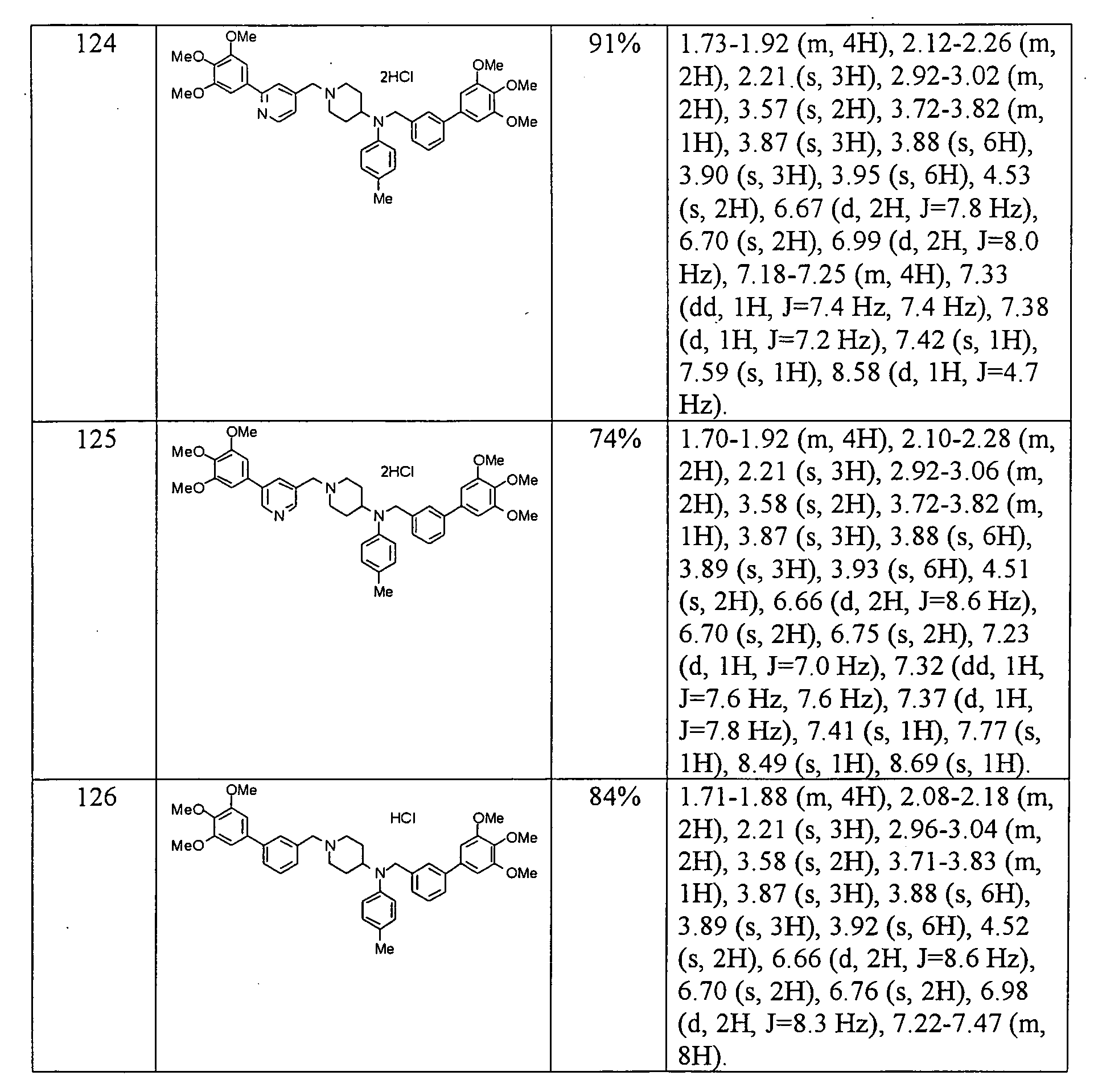

Yield: 3.30 g (40%).
1H-NMR (400 MHz, CDCl3) δ: 1.30-1.41 (m, 2H), 1.47 (s, 9H), 2.00-2.07 (m, 2H), 2.88-2.99 (m, 2H), 3.32-3.52 (m, 1H), 3.83-3.89 (m, 1H), 4.00-4.14 (m, 2H), 6.59 (d, 2H, J=8.4 Hz), 7.39 (d, 2H, J=8.4Hz).
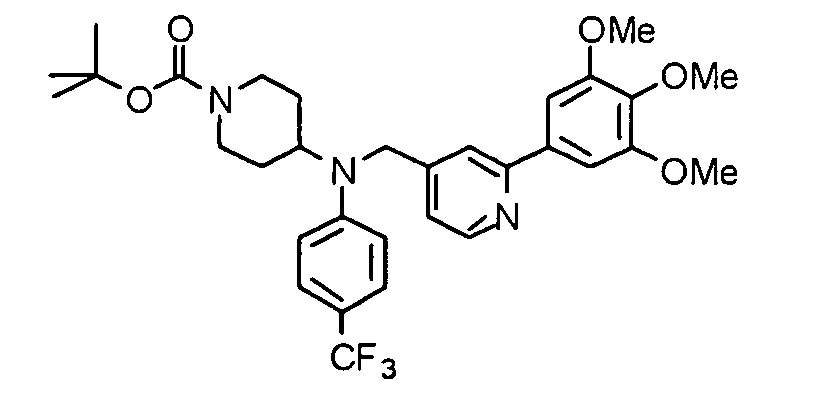
Yield: 412 mg (34%).
1H-NMR (400 MHz, CDCl3) δ: 1.45 (s, 9H), 1.54-1.68 (m, 2H), 1.81-1.90 (m, 2H), 2.77-2.90 (m, 2H), 3.89 (s, 3H), 3.92 (s, 6H), 3.98-4.07 (m, 1H), 4.18-4.33 (m, 2H), 4.55 (s, 2H), 6.73 (d, 2H, J=8.8 Hz), 7.09 (d, 1H, J=3.7 Hz), 7.13 (s, 2H), 7.44 (d, 2H, J=8.8 Hz), 7.49 (s, 1H), 8.58 (d, 1H, J=5.1 Hz).
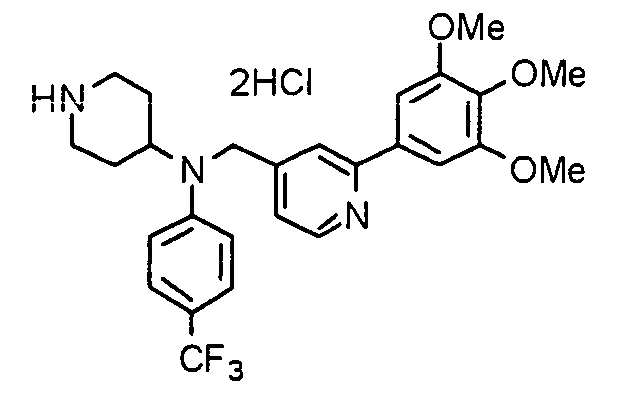
Yield: 359 mg (91%).
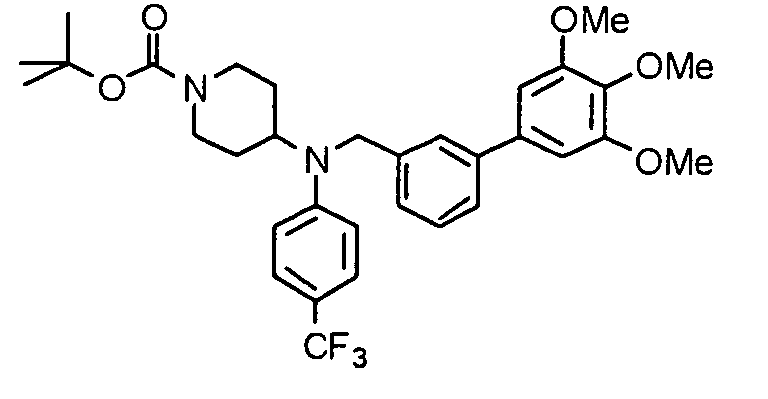
Yield: 522 mg (44%).
1H-NMR (400 MHz, CDCl3) δ: 1.45 (s, 9H), 1.58-1.70 (m, 2H), 1.83-1.90 (m, 2H), 2.76-2.87 (m, 2H), 3.87 (s, 6H), 3.88 (s, 3H), 3.96-4.06 (m, 1H), 4.15-4.30 (m, 2H), 4.58 (s, 2H), 6.68 (s, 2H), 6.76 (d, 2H, J=8.8 Hz), 7.19 (s, 1H, J=7.4 Hz), 7.33-7.44 (m, 5H).
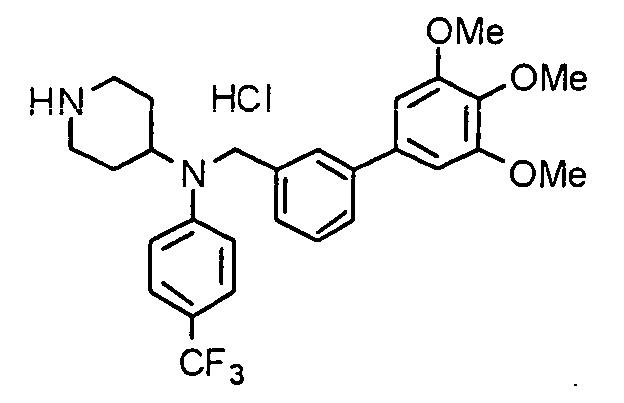
Yield: 460 mg (99%).


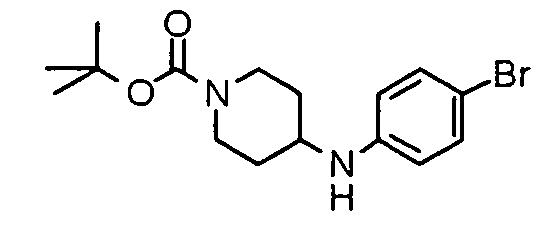
Yield: 3.09 g (36%).
1H-NMR (400 MHz, CDCl3) δ: 1.25-1.37 (m, 2H), 1.46 (s, 9H), 1.97-2.05 (m, 2H), 2.86-2.96 (m, 2H), 3.33-3.42 (m, 2H), 3.47-3.57 (m, 1H), 3.96-4.12 (m, 2H), 6.47 (d, 2H, J=8.8 Hz), 7.24 (d, 2H, J=9.0 Hz).
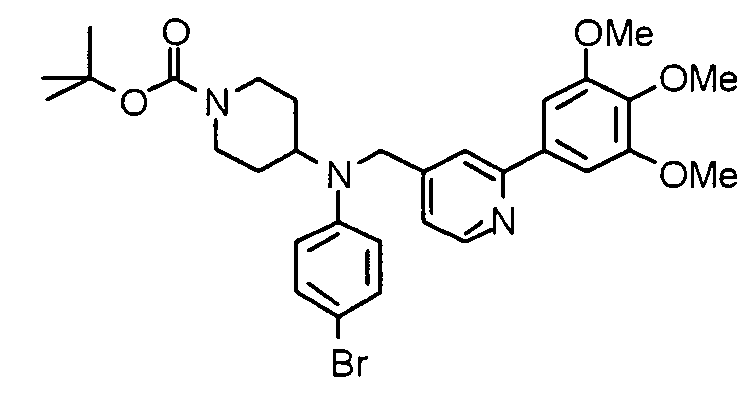
Yield: 607 mg (50%).
1H-NMR (400 MHz, CDCl3) δ: 1.45 (s, 9H), 1.50-1.64 (m, 2H), 1.81-1.88 (m, 2H), 2.74-2.88 (m, 2H), 3.86-3.94 (m, 1H), 3.89 (s, 3H), 3.93 (s, 6H), 4.14-4.32 (m, 2H), 4.46 (s, 2H), 6.59 (d, 2H, J=9.1 Hz), 7.10 (d, 1H, J=5.2 Hz), 7.14 (s, 2H), 7.28 (d, 2H, J=9.1 Hz), 7.50 (s, 1H), 8.57 (d, 1H, J=5.0 Hz).
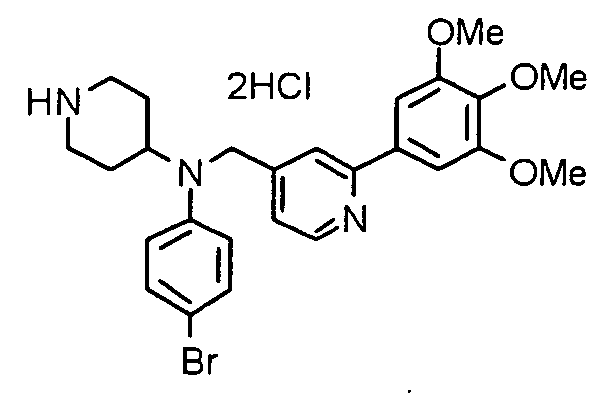
Yeld: 541 mg (93%).

Yield: 347 mg (28%).
1H-NMR (400 MHz, CDCl3) δ: 1.45 (s, 9H), 1.52-1.67 (m, 2H), 1.80-1.89 (m, 2H), 2.72-2.87 (m, 2H), 3.82-3.92 (m, 1H), 3.89 (s, 3H), 3.90 (s, 6H), 4.14-4.33 (m, 2H), 4.50 (s, 2H), 6.63 (d, 2H, J=9.2 Hz), 6.65 (s, 2H), 7.28 (d, 2H, J=9.4 Hz), 7.61 (s, 1H), 8.47 (d, 1H, J=2.0 Hz), 8.67 (d, 1H, J=2.2 Hz).

Yield: 302 mg (91%).
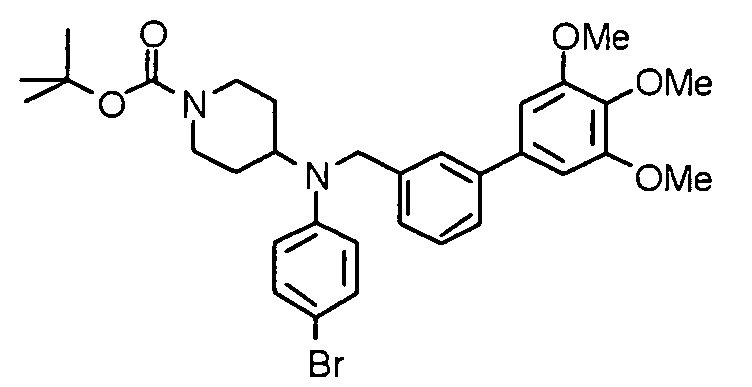
Yield: 1.14 g (93%).
1H-NMR (400 MHz, CDCl3) δ: 1.45 (s, 9H), 1.52-1.67 (m, 2H), 1.80-1.89 (m, 2H), 2.72-2.86 (m, 2H), 3.84-3.91 (m, 1H), 3.88 (s, 3H), 3.89 (s, 6H), 4.11-4.32 (m, 2H), 4.49 (s, 2H), 6.62 (d, 2H, J=9.2 Hz), 6.69 (s, 2H), 7.19 (d, 1H, J=7.6 Hz), 7.25 (d, 2H, J=5.5 Hz), 7.32-7.42 (m, 3H).
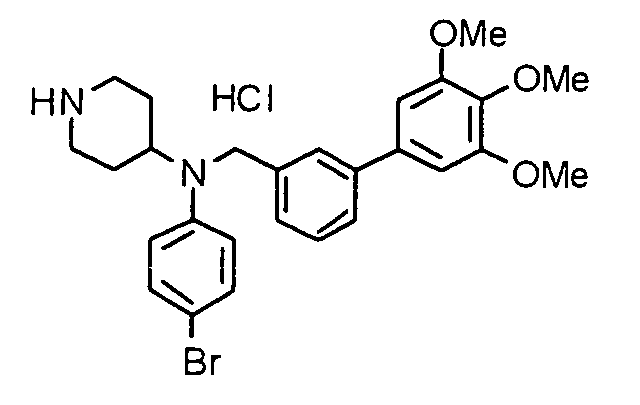
Yield: 973 mg (84%).
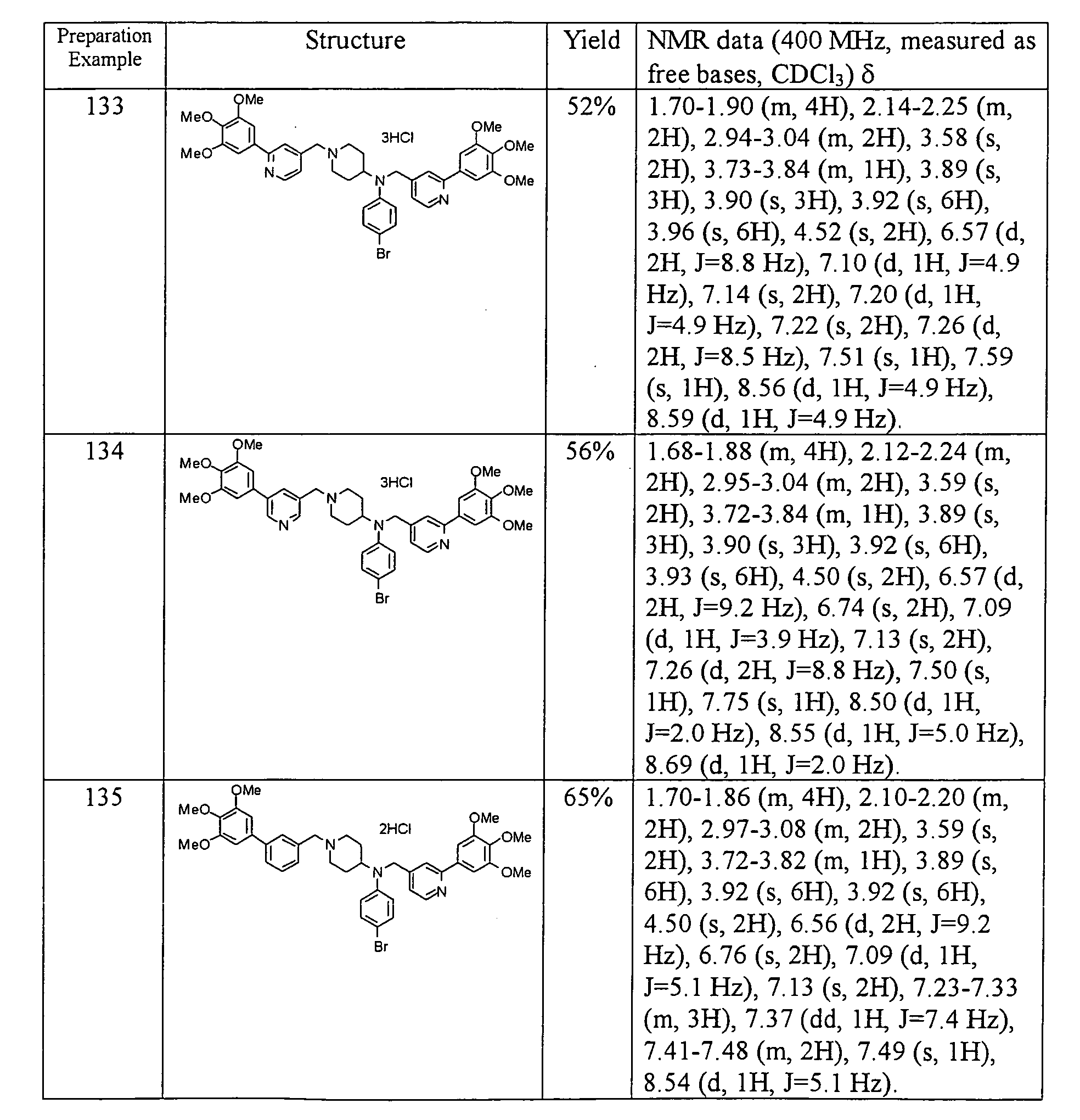
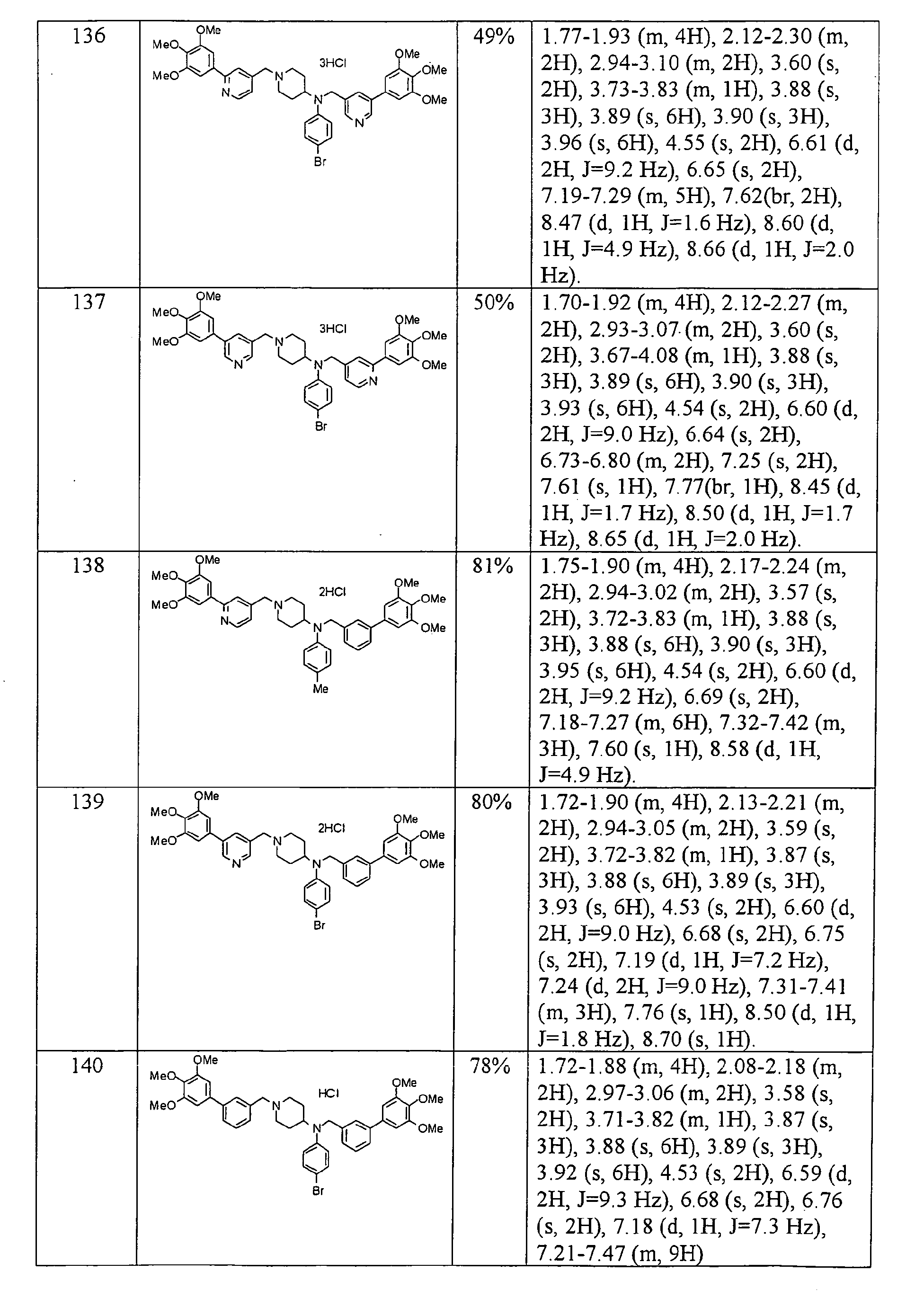
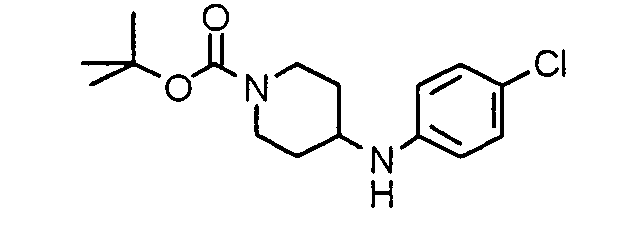
Yield: 3.80 g (49%).
1H-NMR (400 MHz, CDCl3) δ: 1.24-1.38 (m, 2H), 1.46 (s, 9H), 1.97-2.05 (m, 2H), 2.86-2.96 (m, 2H), 3.32-3.42 (m, 2H), 3.51 (br, 1H), 6.52 (d, 2H, J=9.0 Hz), 7.11 (d, 2H, J=9.0 Hz).

Yield: 789 mg (69%).
1H-NMR (400 MHz, CDCl3) δ: 1.45 (s, 9H), 1.51-1.68 (m, 2H), 1.80-1.89 (m, 2H), 2.72-2.86 (m, 2H), 3.87-3.90 (m, 1H), 3.89 (s, 3H), 3.93 (s, 6H), 4.64 (s, 2H), 6.64 (d, 2H, J=9.0 Hz), 7.14 (d, 1H, J=5.3 Hz), 7.15 (d, 2H, J=9.0 Hz), 7.51 (s, 2H), 8.57 (d, 2H, J=5.1 Hz).

Yield: 673 mg (90%).

Yield: 268 mg (24%).
1H-NMR (400 MHz, CDCl3) δ: 1.45 (s, 9H), 1.56-1.76 (m, 2H), 1.80-1.90 (m, 2H), 2.76-2.83 (m, 2H), 3.86-3.90 (m, 1H), 3.89 (s, 3H), 3.90 (s, 6H), 4.15-4.30 (m, 2H), 4.50 (s, 2H), 6.66 (s, 2H), 6.68 (d, 2H, J=9.2 Hz), 7.15 (d, 2H, J=9.0 Hz), 7.63 (s, 1H), 8.47 (d, 1H, J=2.0 Hz), 8.66 (d, 1H, J=2.0 Hz).

Yield: 233 mg (91%).
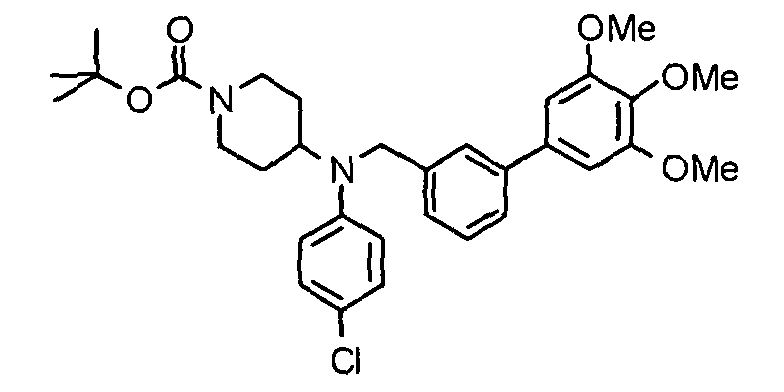
Yield: 1.04 g (92%).
1H-NMR (400 MHz, CDCl3) δ: 1.45 (s, 9H), 1.58-1.67 (m, 2H), 1.82-1.91 (m, 2H), 2.74-2.86 (m, 2H), 3.85-3.92 (m, 1H), 3.88 (s, 3H), 3.89 (s, 6H), 4.35-4.31 (m, 2H), 4.49 (s, 2H), 6.66 (d, 2H, J=9.2 Hz), 6.70 (s, 2H), 7.12 (d, 2H, J=9.0 Hz), 7.20 (d, 2H, J=7.3 Hz), 7.33-7.43 (m, 3H).

Yield: 899 mg (97%).
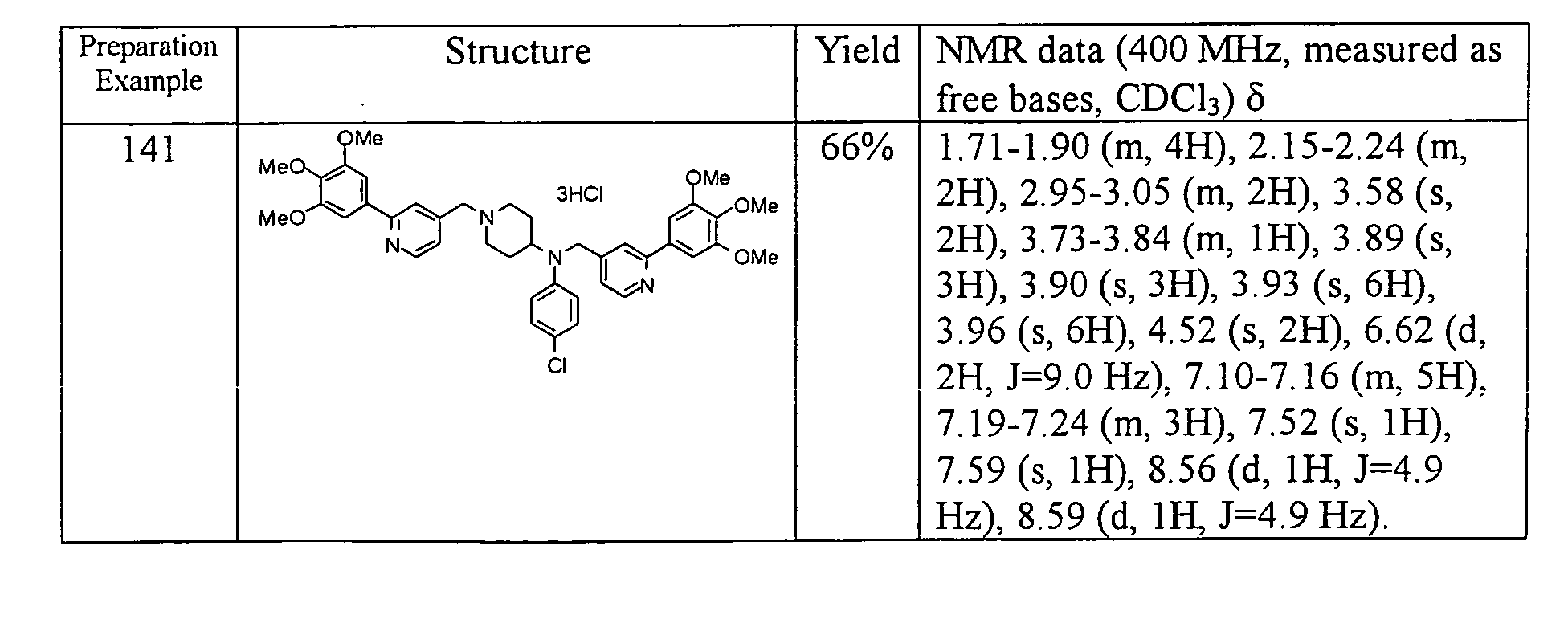

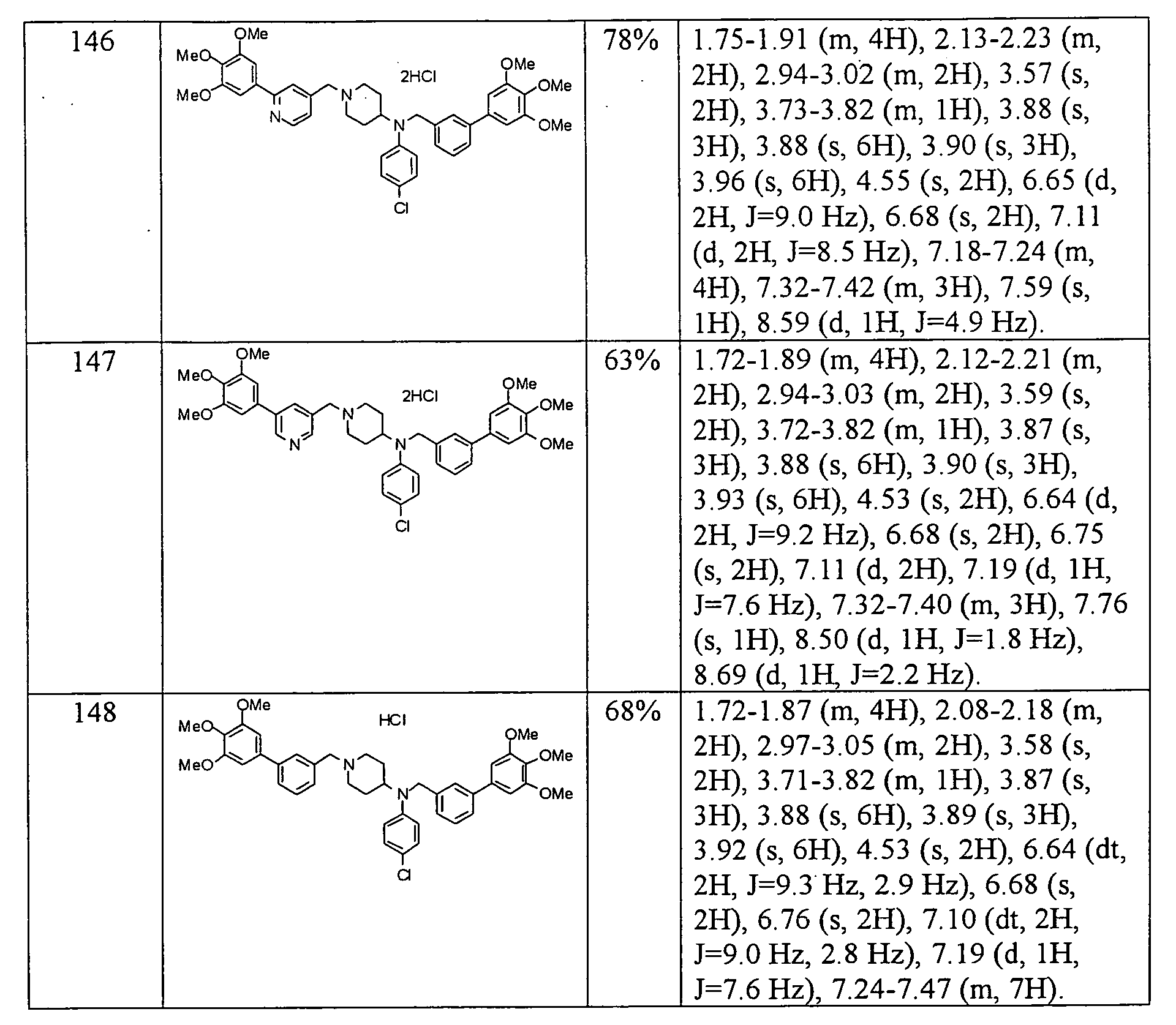

Yield: 4.66 g (62%).
1H-NMR (400 MHz, CDCl3) δ: 1.24-1.37 (m, 2H), 1.46 (s, 9H), 1.97-2.05 (m, 2H), 2.85-2.96 (m, 2H), 3.26-3.36 (m, 1H), 3.38-3.52 (m, 1H), 3.96-4.14 (m, 2H), 6.22-6.28 (m, 1H), 6.38 (ddd, 1H, J=12.7 Hz, 6.6 Hz, 2.9 Hz), 6.94 (dd, 1H, J=19.1 Hz, 9.0 Hz).

Yield: 534 mg (47%).
1H-NMR (400 MHz, CDCl3) δ: 1.45 (s, 9H), 1.50-1.70 (m, 2H), 1.82-1.90 (m, 2H), 2.73-2.88 (m, 2H), 3.90 (s, 3H), 3.94 (s, 6H), 4.15-4.30 (m, 2H), 4.43 (s, 2H), 6.33-6.39 (m, 1H), 6.52 (ddd, 1H, J=13.6 Hz, 6.4 Hz, 3.1 Hz), 6.98 (dd, 1H, J=19.1 Hz, 9.2 Hz), 7.11 (dd, 1H, J=5.0 Hz, 1.3 Hz), 7.16 (s, 2H), 7.51 (s, 1H), 8.58 (d, 1H, J=5.1 Hz).

Yield: 442 mg (87%).
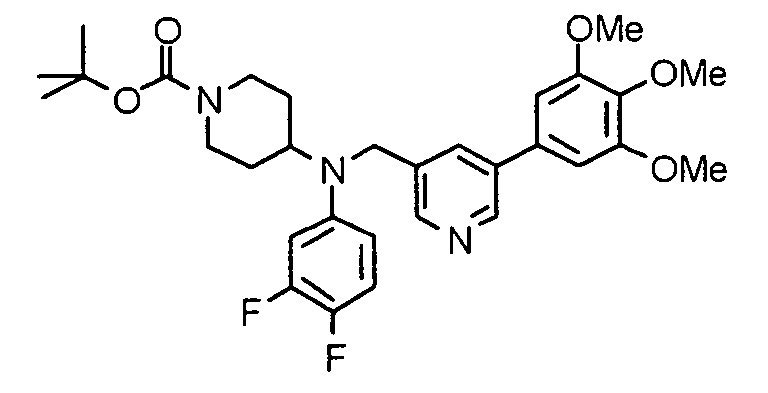
Yield: 350 mg (31%).
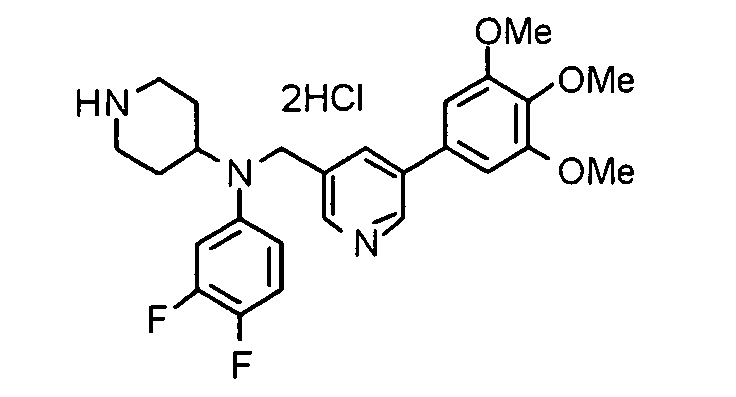
Yield: 305 mg (92%).

Yield: 1.04 g (92%).
1H-NMR (400 MHz, CDCl3) δ: 1.45 (s, 9H), 1.52-1.66 (m, 2H), 1.81-1.89 (m, 2H), 2.72-2.85 (m, 2H), 3.78 (tt, 1H, J=11.8 Hz, 3.8 Hz), 3.88 (s, 3H), 3.90 (s, 6H), 4.12-4.30 (m, 2H), 4.45 (s, 2H), 6.36-6.42 (m, 1H), 6.54 (ddd, 1H, J=13.9 Hz, 6.8 Hz, 2.9 Hz), 6.71 (s, 2H), 6.95 (dd, 1H, J=19.2 Hz, 9.2 Hz), 7.20 (d, 1H, J=7.4 Hz), 7.36-7.43 (m, 3H).

Yield: 819 mg (94%).


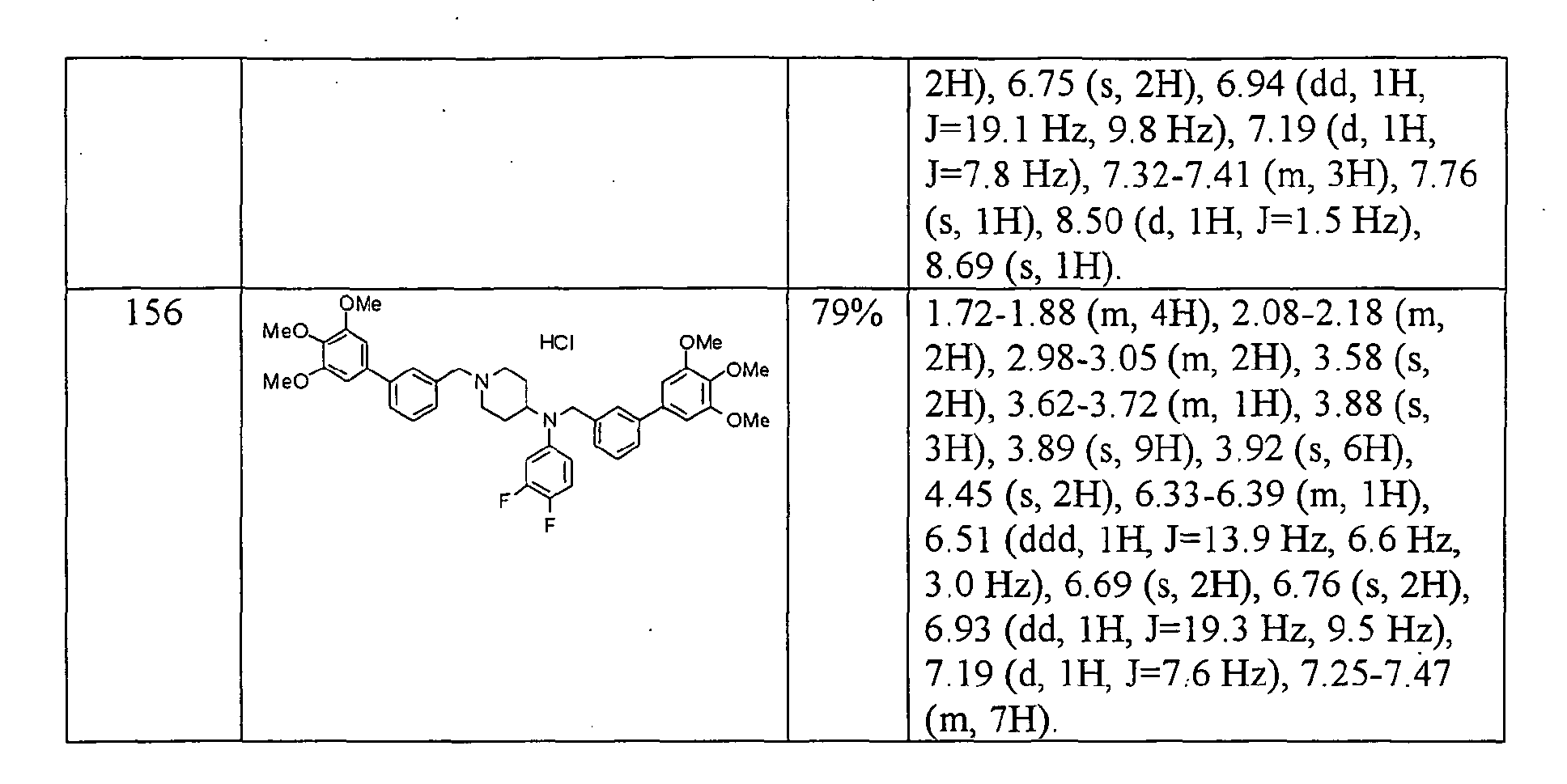
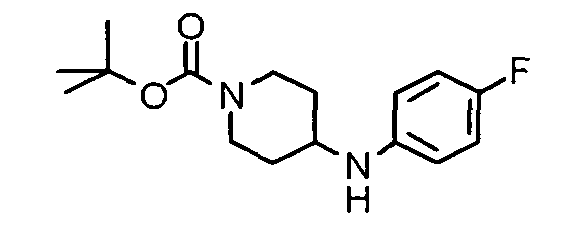
Yield: 4.99 g (71%).
1H-NMR (400 MHz, CDCl3) δ: 1.23-1.36 (m, 2H), 1.46 (s, 9H), 1.97-2.05 (m, 2H), 2.84-2.96 (m, 2H), 3.30-3.39 (m, 2H), 3.96-4.14 (m, 2H), 6.51-6.57 (m, 2H), 6.84-6.91 (m, 2H).

Yield: 702 mg (64%).
1H-NMR (400 MHz, CDCl3) δ: 1.45 (s, 9H), 1.48-1.64 (m, 2H), 1.81-1.90 (m, 2H), 2.72-2.85 (m, 2H), 3.69-3.98 (m, 1H), 3.89 (m, 3H), 3.94 (m, 6H), 4.16-4.28 (m, 2H), 4.43 (s, 2H), 6.66-6.73 (m, 2H), 6.91 (dd, 2H, J=9.2 Hz, 9.2 Hz), 7.12-7.16 (m, 3H), 7.53 (s, 1H).
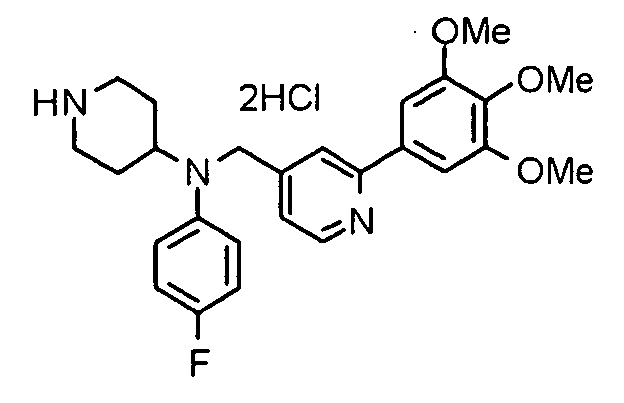
Yield: 561 mg (84%).

Yield: 190 mg (17%).
1H-NMR (400 MHz, CDCl3) δ: 1.45 (s, 9H), 1.50-1.73 (m, 2H), 1.82-1.90 (m, 2H), 2.71-2.85 (m, 2H), 3.71 (tt, 1H, J=11.7 Hz, 3.1 Hz), 3.89 (s, 3H), 3.90 (s, 6H), 4.12-4.30 (m, 2H), 4.45 (s, 2H), 6.66 (s, 2H), 6.73-6.78 (m, 2H), 6.91 (dd, 2H, J=9.2 Hz, 8.2 Hz), 7.65 (s, 1H), 8.49 (d, 1H, J=2.0 Hz), 8.65 (d, 1H, J=2.0 Hz).

Yield: 165 mg (91%).

Yield: 1.01 g (92%).
1H-NMR (400 MHz, CDCl3) δ: 1.44 (s, 9H), 1.51-1.65 (m, 2H), 1.82-1.90 (m, 2H), 2.82-2.84 (m, 2H), 3.78 (tt, 1H, J=11.7 Hz, 3.5 Hz), 3.88 (s, 3H), 3.90 (s, 6H), 4.10-4.30 (m, 2H), 4.45 (s, 2H), 6.68-6.73 (m, 4H), 6.89 (dd, 2H, J=9.2 Hz, 8.2 Hz), 7.21-7.25 (m, 1H), 7.32-7.41 (m, 3H).

Yield: 790 mg (88%).


Yield: 3.77 g (57%).
1H-NMR (400 MHz, CDCl3) δ: 1.25-1.38 (m, 2H), 1.47 (s, 9H), 2.00-2.07 (m, 2H), 2.87-2.97 (m, 2H), 3.38-3.53 (m, 2H), 3.96-4.14 (m, 2H), 6.57-6.52 (m, 2H), 6.70 (tt, 1H, J=6.2 Hz, 1.0 Hz), 7.17 (dd, 2H, J=8.6 Hz, 7.2 Hz).

Yeld: 760 mg (71%).
1H-NMR (400 MHz, CDCl3) δ: 1.45 (s, 9H), 1.53-1.63 (m, 2H), 1.83-1.91 (m, 2H), 2.76-2.90 (m, 2H), 3.86-3.97 (m, 1H), 3.89 (s, 3H), 3.93 (s, 6H), 4.14-4.32 (m, 2H), 4.49 (s, 2H), 6.71-6.78 (m, 3H), 7.14 (s, 1H), 7.15 (s, 2H), 7.21 (dd, 2H, J=8.8 Hz, 7.4 Hz), 7.55 (s, 1H), 8.56 (d, 1H, J=5.1 Hz).
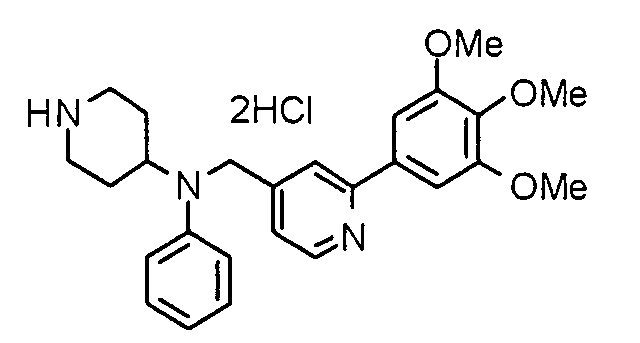
Yield: 652 mg (90%).

Yield: 222 mg (21%).
1H-NMR (400 MHz, CDCl3) δ: 1.45 (s, 9H), 1.52-1.67 (m, 2H), 1.82-1.91 (m, 2H), 2.74-2.87 (m, 2H), 3.88-3.90 (m, 1H), 3.88 (s, 3H), 3.89 (s, 6H), 4.14-4.31 (m, 2H), 4.53 (s, 2H), 6.67 (s, 2H), 6.74-6.80 (m, 3H), 7.21 (dd, 2H, J=8.8 Hz, 7.2 Hz), 7.67 (s, 1H), 8.50 (d, 1H, J=5.3 Hz, 2.2 Hz), 8.66 (d, 1H, J=2.1 Hz).

Yeld: 197 mg (94%).
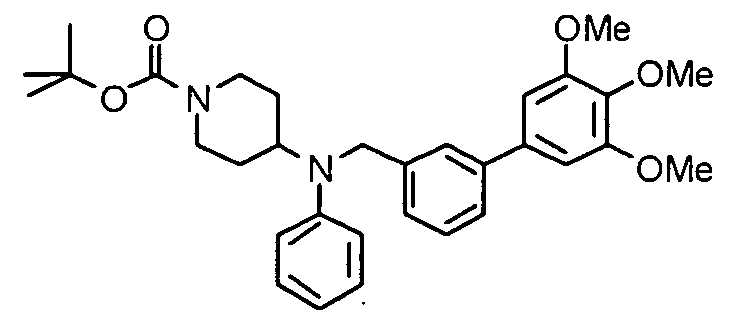
Yield: 1.06 g (100%).
1H-NMR (400 MHz, CDCl3) δ: 1.45 (s, 9H), 1.52-1.68 (m, 2H), 1.83-1.92 (m, 2H), 2.73-2.86 (m, 2H), 3.88 (s, 3H), 3.89 (s, 6H), 3.94 (tt, 1H, J=11.7 Hz, 3.3 Hz), 4.14-4.30 (m, 2H), 4.52 (s, 2H), 6.69-6.78 (m, 6H), 7.17-7.27 (m, 2H), 7.32-7.42 (m, 3H).

Yield: 909 mg (97%).

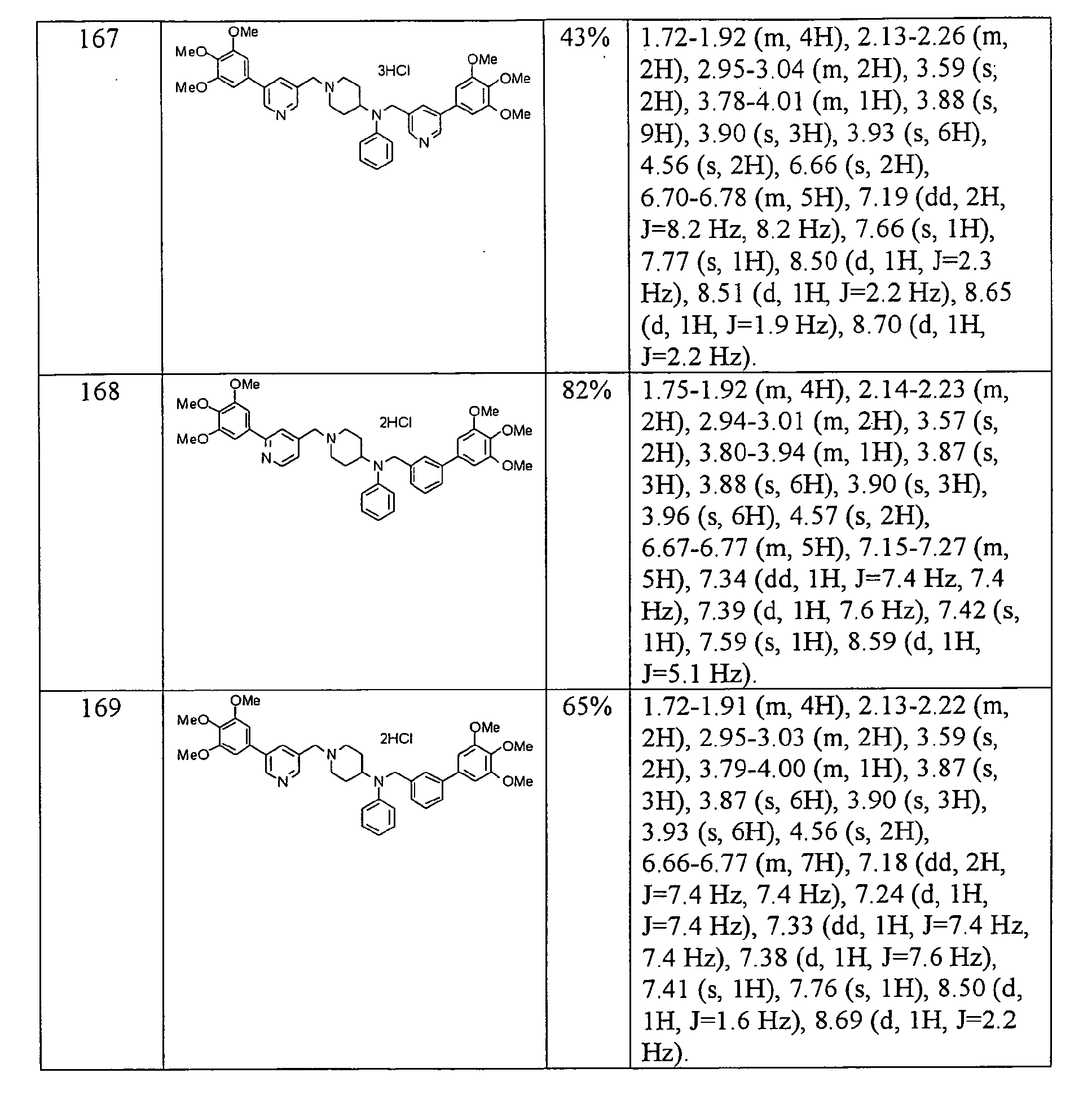
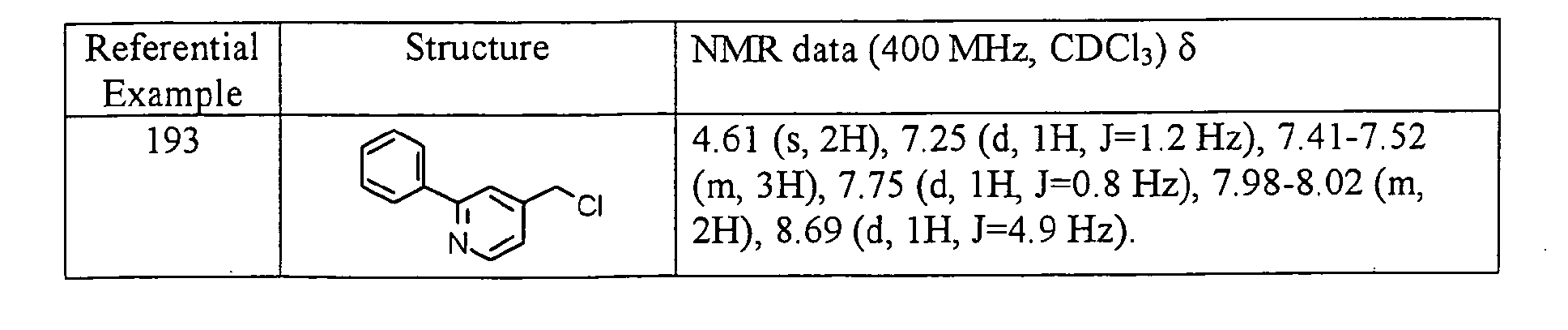
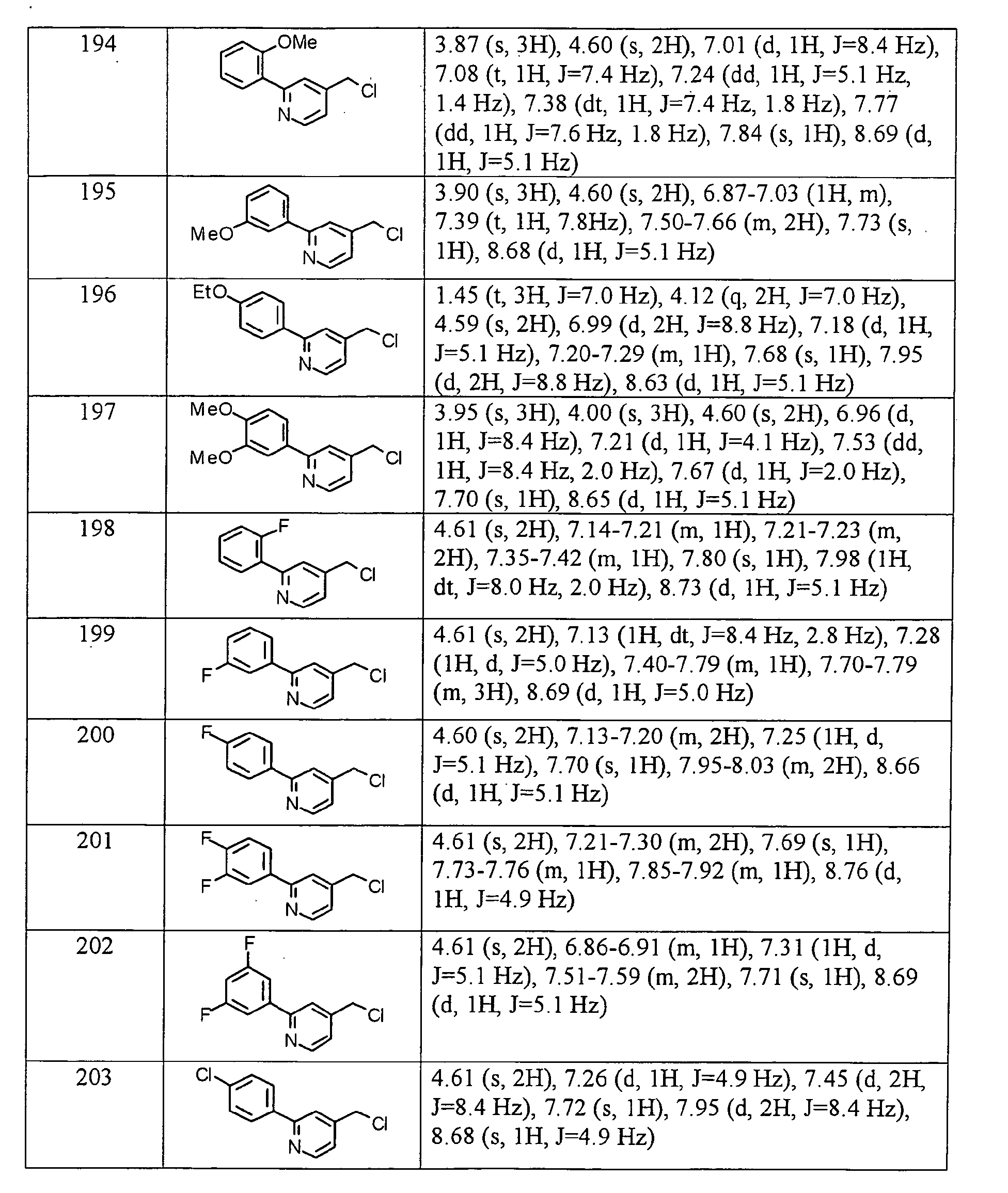

Yield: 407 mg (43%).
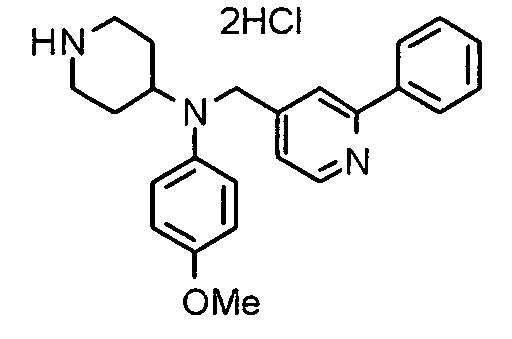
Yield: 365 mg (95%).
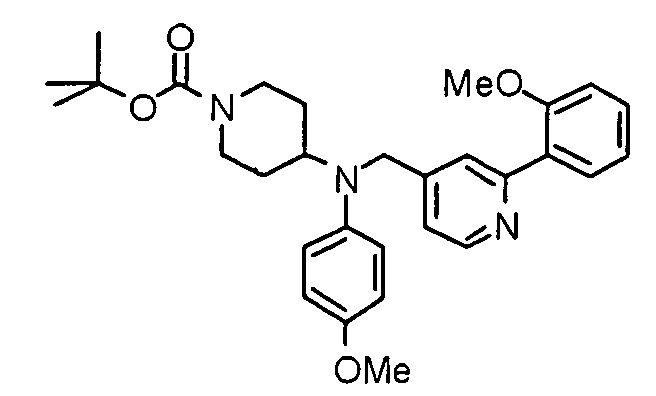
Yield: 237mg (72%).

Yield: 365mg (65%).

Yield: 550mg (theoretical yield).

Yield: 436g (85%).
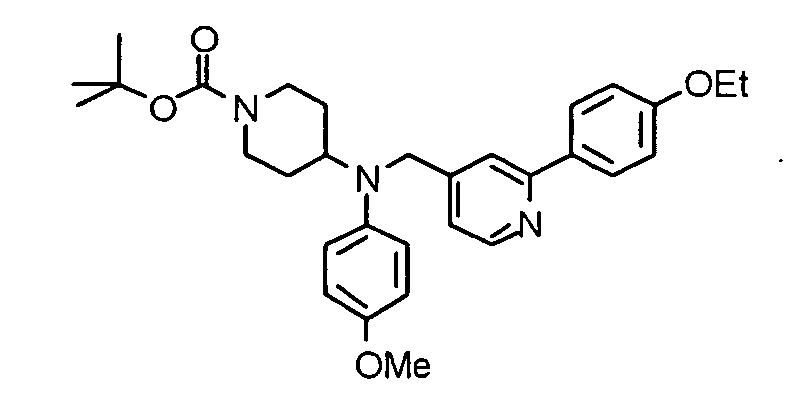
Yield: 515 mg (99%).

Yield: 418 mg (80%).
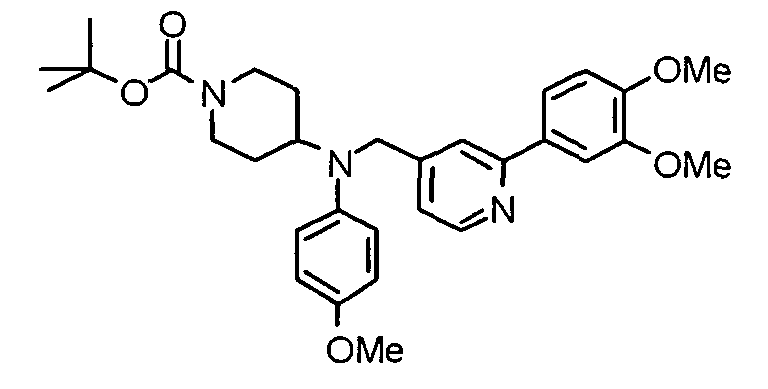
Yield: 600 mg (theoretical yield).
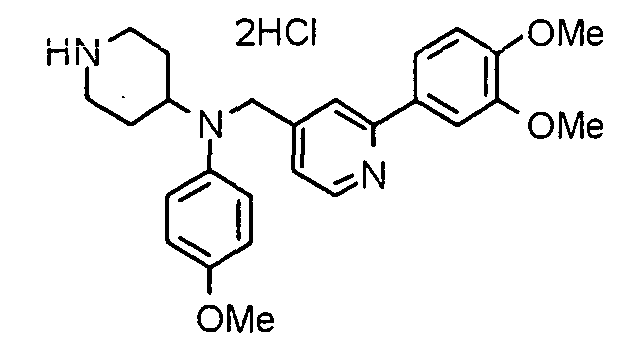
Yield: 416 mg (77%).
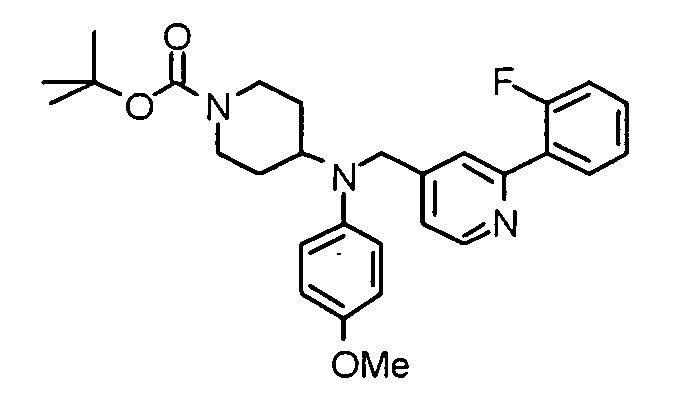
Yeld: 530 mg (theoretical yield).
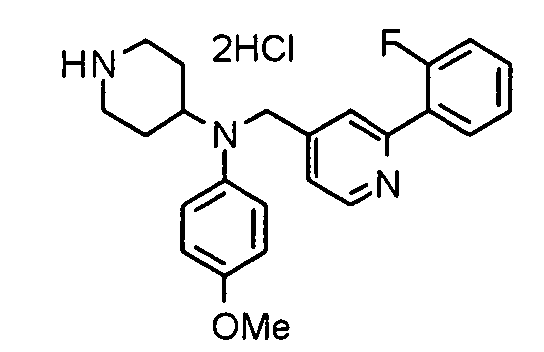
Yield: 423mg (85%).
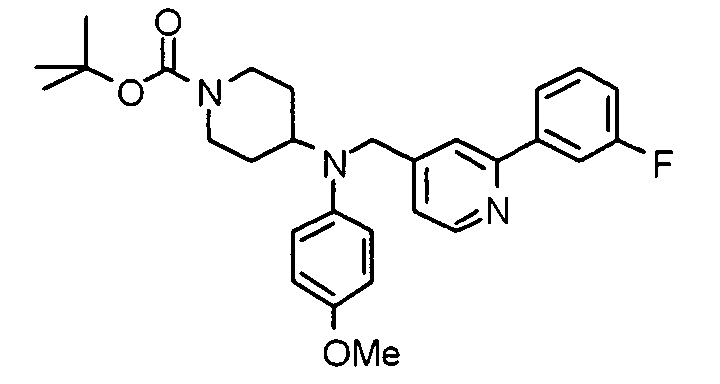
Yield: 270 mg (theoretical yield).
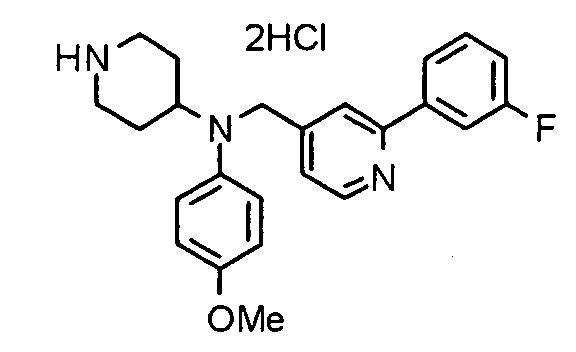
Yield: 193 mg (70%).

Yeld: 550 mg (theoretical yield).
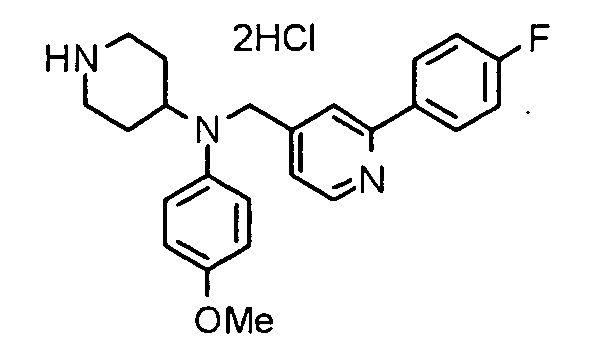
Yield: 439 mg (88%).
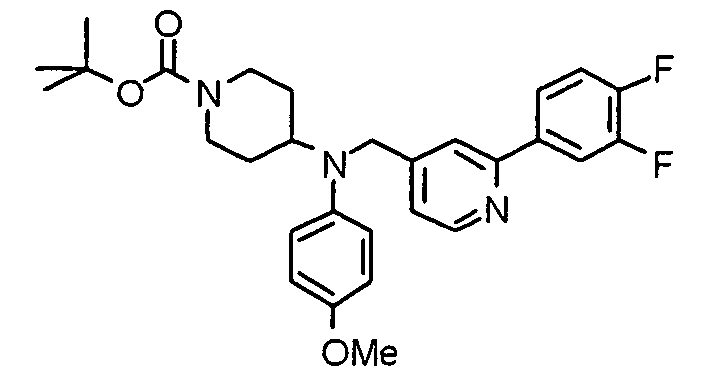
Yield: 590 mg (theoretical yield).
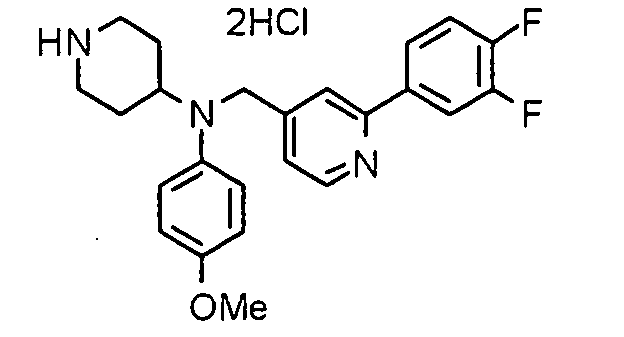
Yield: 483 mg (93%).
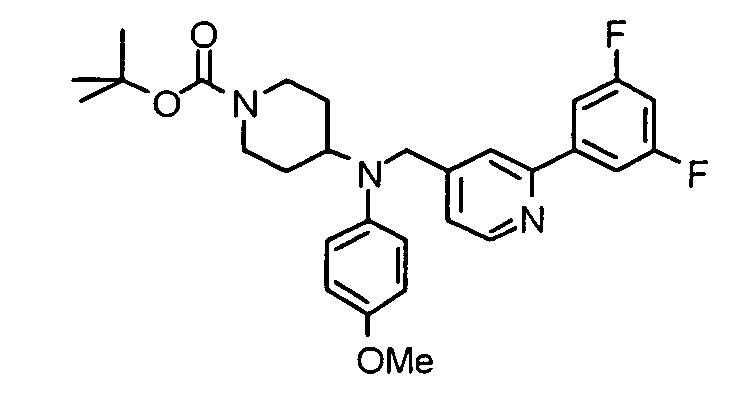
Yield: 530 mg (theoretical yield).
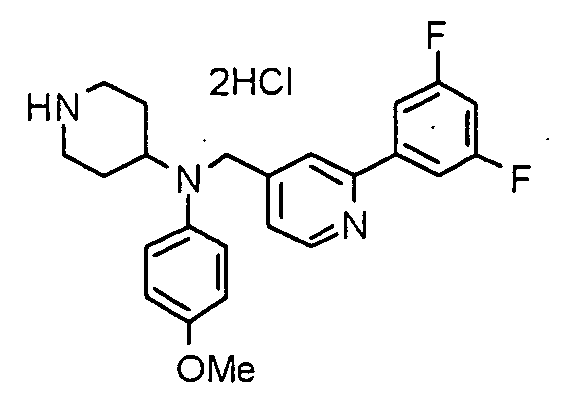
Yield: 418 mg (81%).
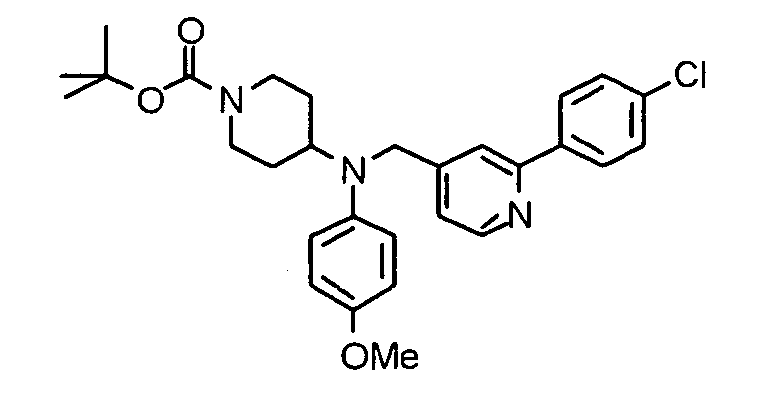
Yield: 600 mg (theoretical yield).
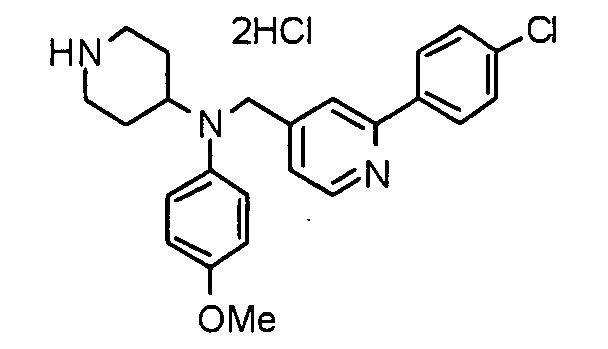
Yield: 447 mg (86%).
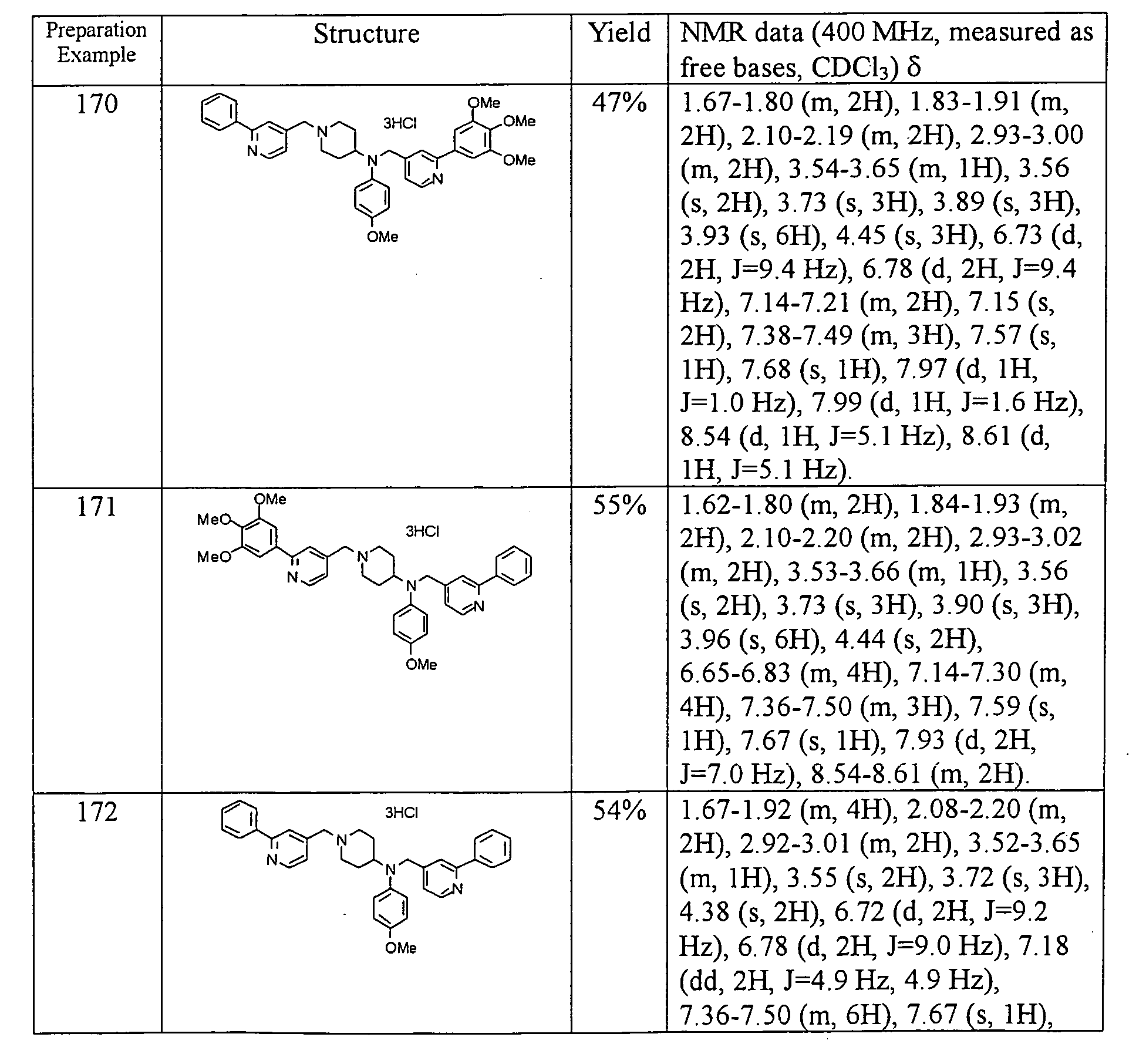
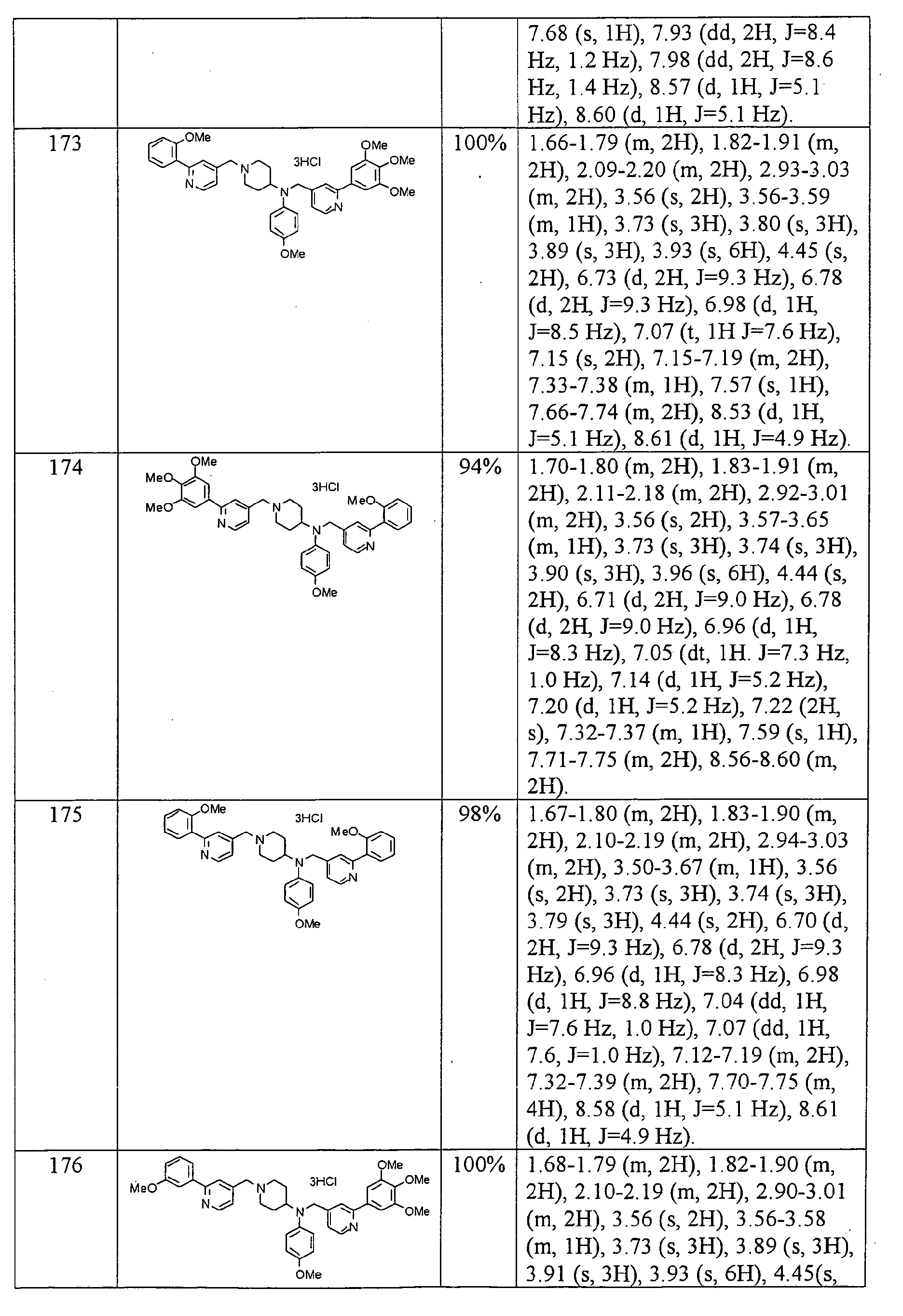
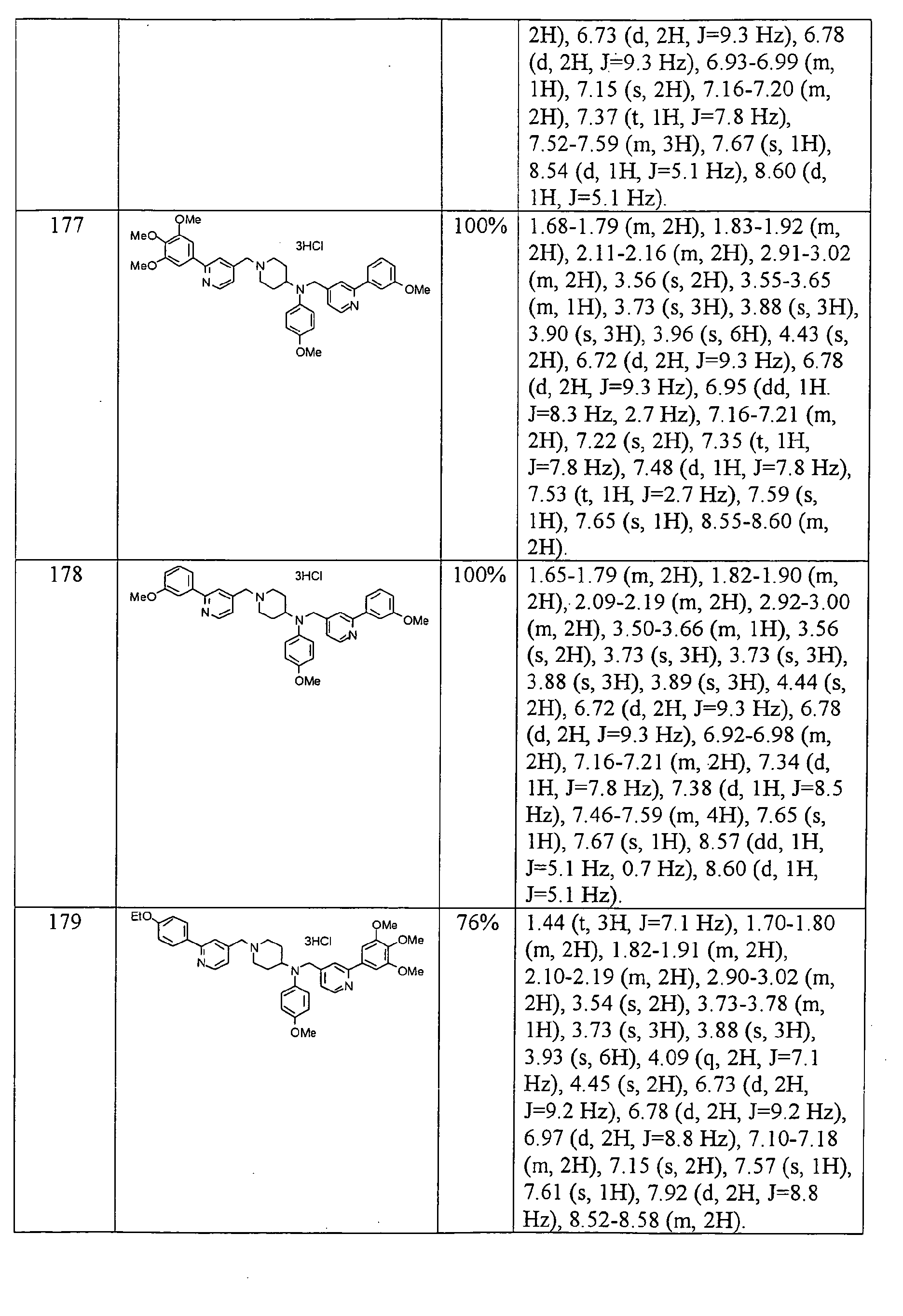

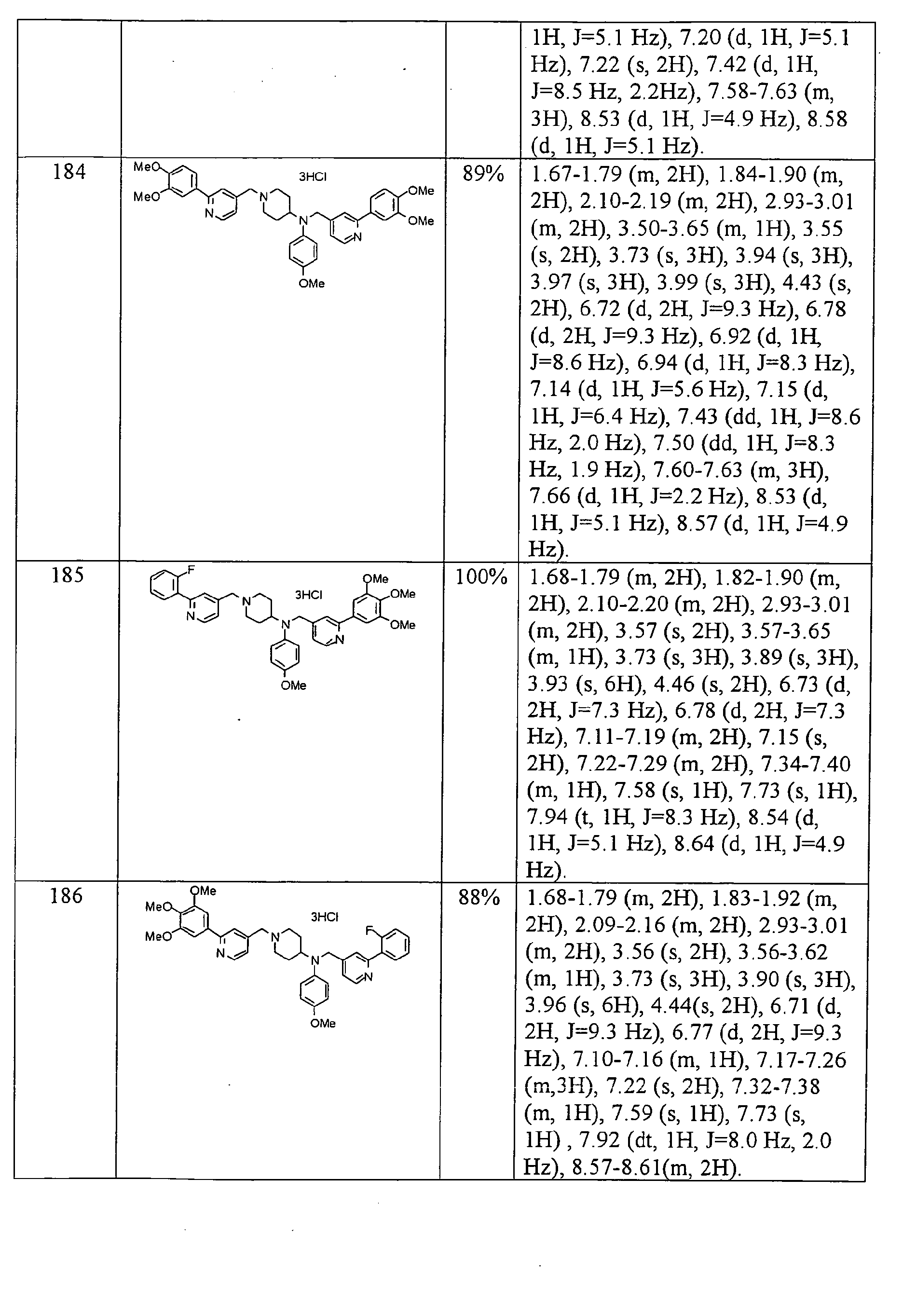
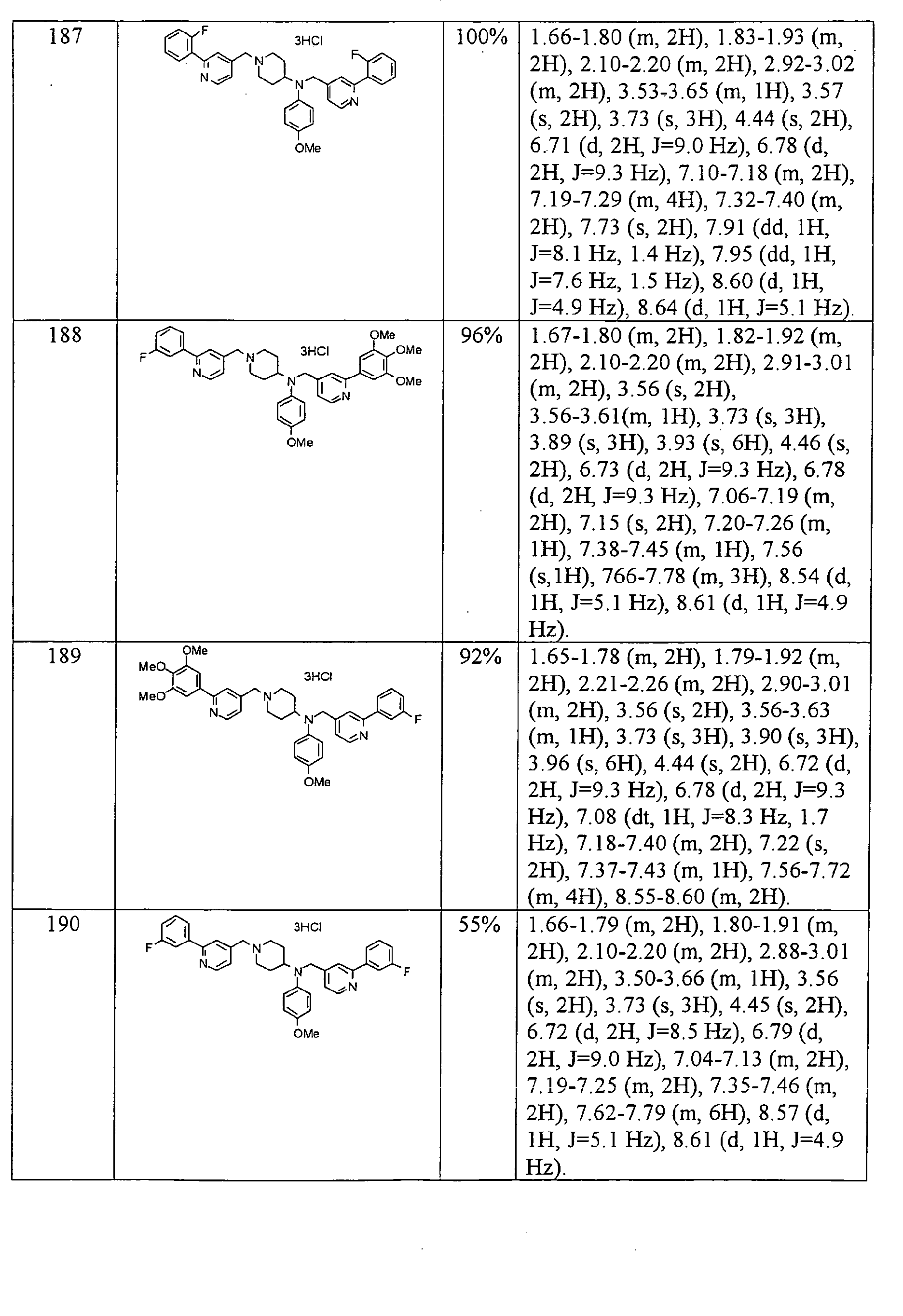
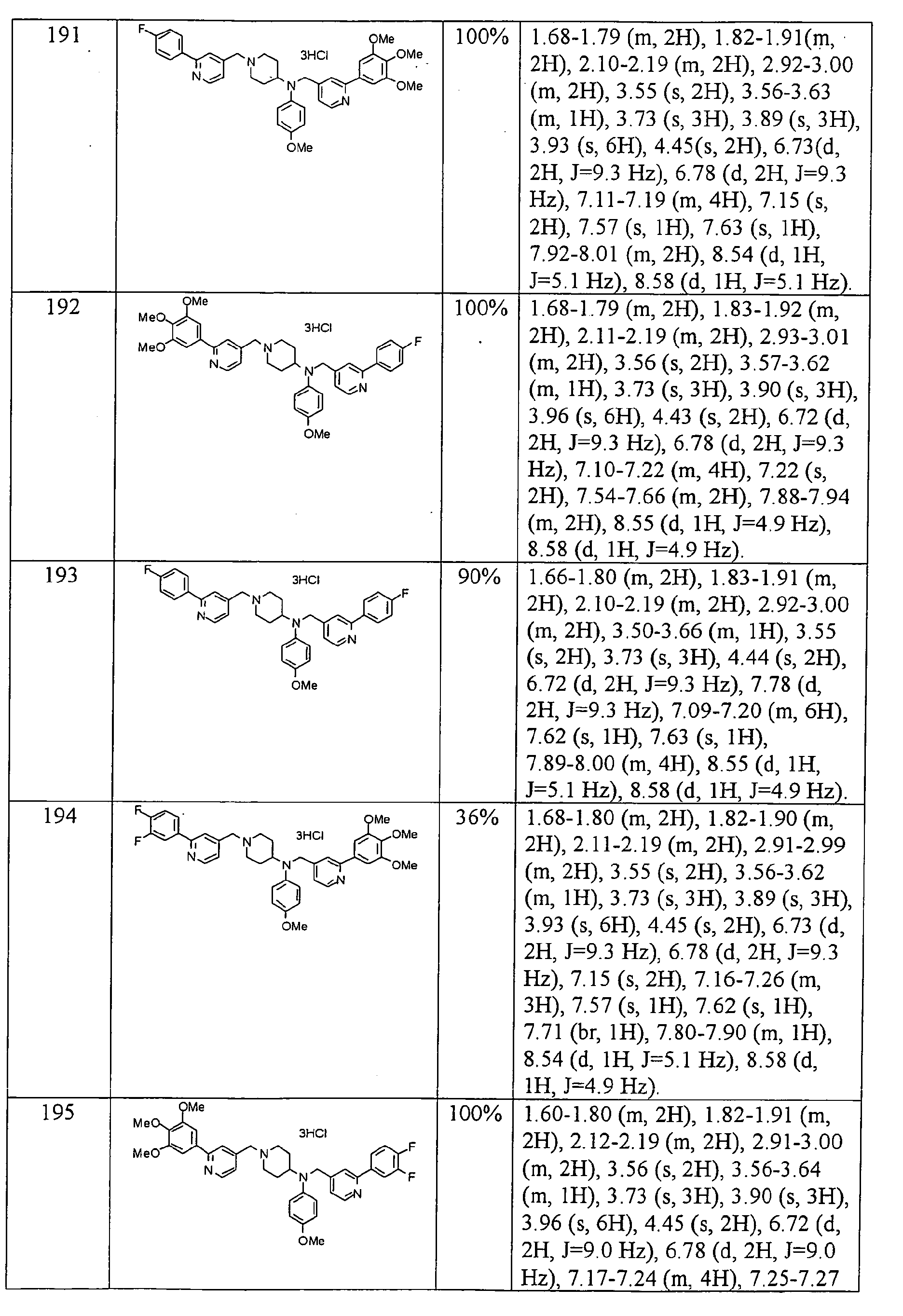

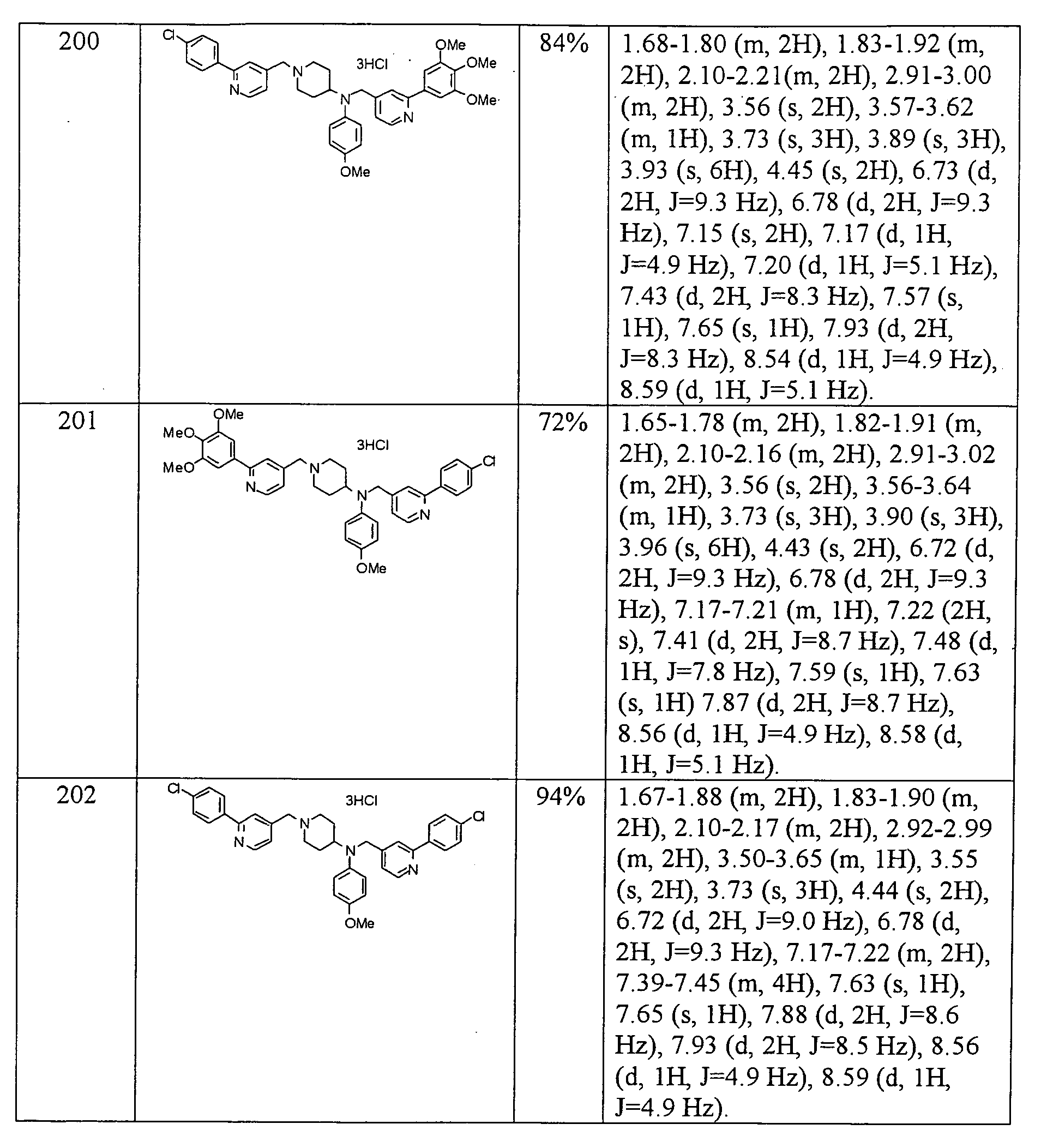
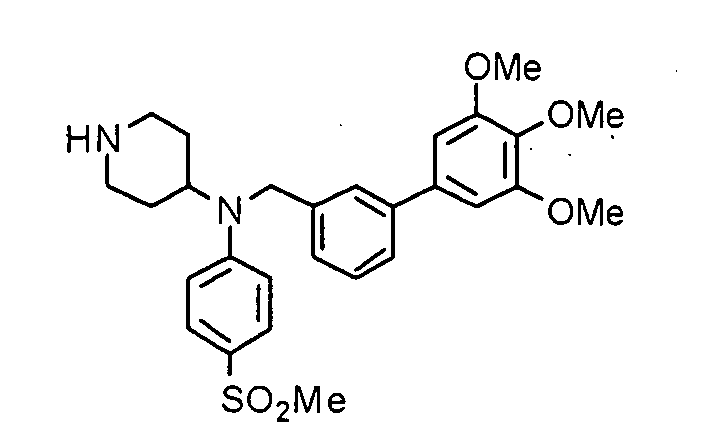

Yield: 23mg (26% in two steps)
1H-NMR(400MHz, measured as free base,CDCl3) δ:1.70-1.97(m,4H), 2.16-2.28(m,2H), 2.95-3.04(m,2H), 2.99(s,3H), 3.59(s,2H), 3.82(s,3H), 3.87-3.97(m,1H), 3.90(s,3H), 3.91(s,3H), 3.92(s,3H), 3.96(s,9H), 4.65(s,2H), 6.59(s,1H), 6.75(d,2H,J=9.3Hz), 7.19-7.30(m,7H), 7.39(dd,1H,J=7.6Hz,7.6Hz), 7.60(s,1H), 7.68(d,2H,J=9.0Hz), 8.60(d,1H,J=4.9Hz)
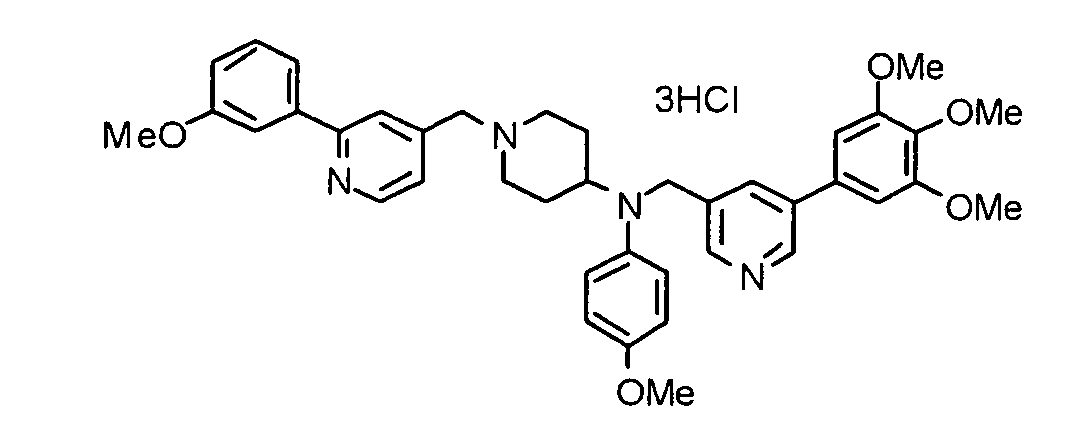
Yeld: 131mg (66%)
1H-NMR (400MHz, measured as a free base, CDCl3) δ:1.70-1.95(m,4H), 2.05-2.25(m,2H), 2.90-3.08(m,2H), 3.45-3.68(m,3H), 3.72(s,3H), 3.88(s,3), 3.90(s,9H), 4.46(s,2H), 6.70-6.85(m,4H), 6.96(d,1H,J=8.3Hz), 7.21(br,1H), 7.38(t,1H,J=7.8Hz), 7.55(t,1H,J=7.8Hz), 7.59(s,1H), 7.63-7.75(m,2H), 8.50(s,1H), 8.62(br,1H)
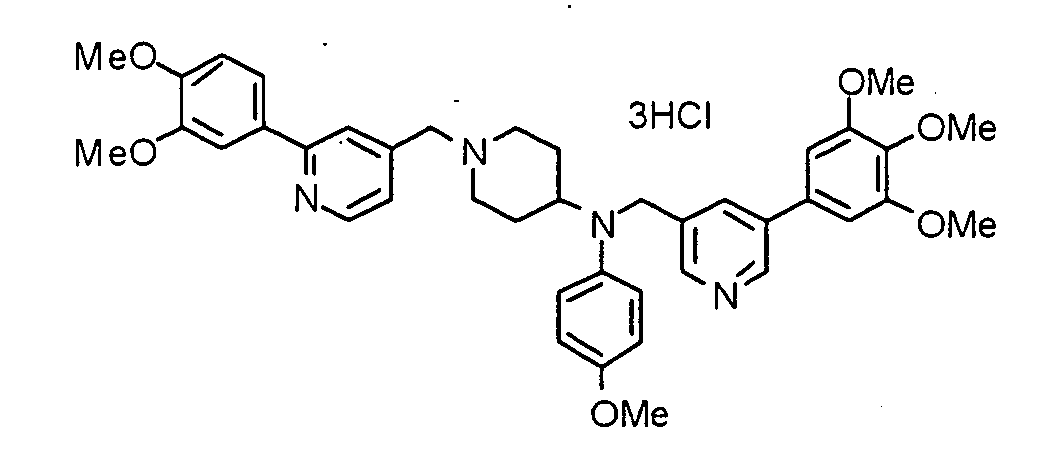
Yield: 139mg (67%)
1H-NMR(400MHz, measured as a free base, CDCl3) δ:1.70-1.95 (m,4H),2.05-2.20(m,2H), 2.90-3.05 (m,2H), 3.45-3.60 (m,3H),3.73(s,3H), 3.88(s,3H), 3.89 (s,6H), 3.94 (s,3H), 4.00 (s,3H), 4.46 (s,2H), 6.65 (s,2H), 6.74-6.82 (m,4H), 6.94 (d,1H,J=8.3Hz), 7.15 (br,1H), 7.52 (br,1H), 7.58-7.71 (m,3H), 8.50 (s,1H), 8.57 (d,1H,J=5.2Hz), 8.62 (br,1H)
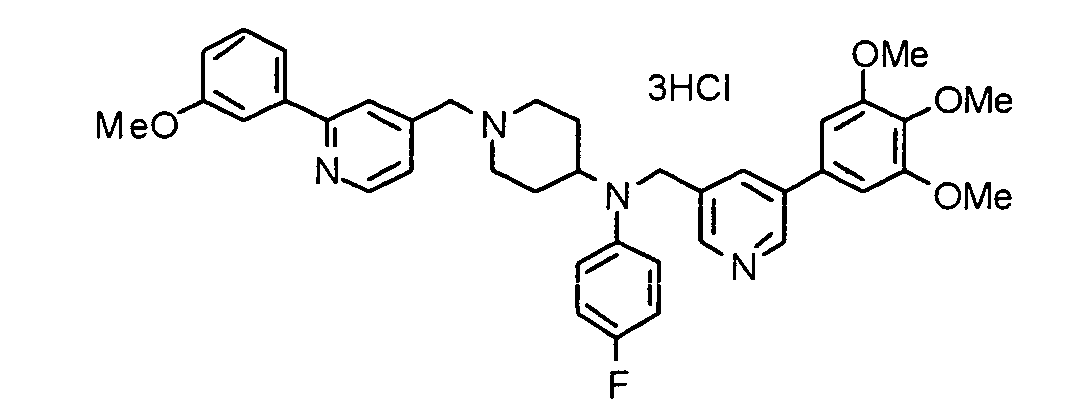
Yield: 178mg (92%)
1H-NMR(400MHz, measured as a free base, CDCl3) δ:1.73-1.95(m,4H), 2.10-2.25(m,2H), 2.93-3.05(m,2H), 3.57(s,2H), 3.64(br,1H),3.88(s,3H), 3.89(s,9H), 4.51(s,2H), 6.66(s,2H), 6.70-6.76(m,2H), 6.90(t,2H,J=8.3Hz), 6.96(d,1H,J=8.3Hz), 7.21(br,1H), 7.38(t,1H,J=8.0Hz), 7.54(d,1H,J=7.8Hz), 7.58(s,1H), 7.65(s,1H), 7.74(br,1H), 8.50(s,1H), 8.61(d,1H,J=5.1Hz), 8.65(br,1H)

Yield:195mg (96%)
1H-NMR(400MHz, measured as a free base, DCl3) δ:1.70-1.95(m,4H), 2.10-2.24(m,2H), 2.94-3.09(m,2H), 3.57(s,2H), 3.64(br,1H), 3.88(s,3H), 3.89(s,6H), 3.94(s,3H), 4.00(s,3H), 4.51(s,2H), 6.65(s,2H), 6.69-6.78(m,2H), 6.86-6.97(m,3H), 7.16(d,1H,J=4.9Hz), 7.51(d,1H,J=8.5Hz), 7.60-7.70(m,3H), 8.50(s,1H), 8.58(d,1H,J=4.9Hz), 8.65(s,1H)

Yield:130mg (57%)
1H-NMR(400MHz, measured as a free base, CDCl3) δ:1.73-1.90(m,4H), 2.01-2.24(m,2H), 2.92-3.05(m,2H), 3.57(s,2H), 3.67(br,1H), 3.88(s,3H), 3.89(s,3H), 3.90(s,6H), 4.52(s,2H), 6.36-6.42(m,1H), 6.50-6.58(m,1H), 6.67(s,2H), 6.93-7.01(m,2H), 7.20(br,1H), 7.38(t,1H,J=7.8Hz), 7.52-7.62(m,2H), 7.62-7.72(m,2H), 8.48(br,1H), 8.61(br,1H), 8.66(d,1H,J=2.0Hz)
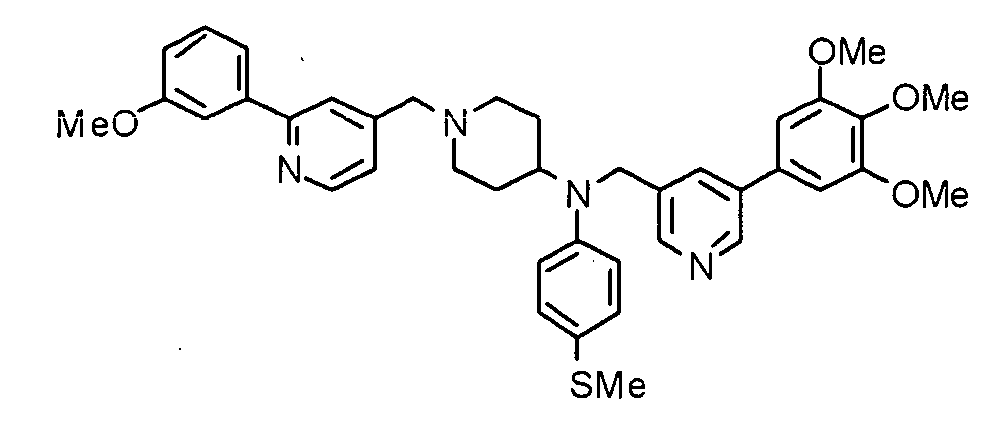
Yield: 71mg (44%)
1H-NMR(400MHz, measured as a free base, CDCl3) δ:1.72-1.83(m,4H), 2.12-2.20(m,2H), 2.37(s,3H), 2.97(d,2H,J=10.8Hz), 3.56(s,2H), 3.75-3.81(m,1H), 3.86(s,3H), 3.87(s,6H), 4.54(s,2H), 6.64-6.69(m,3H), 6.94(dd,1H,J=7.8Hz,1.9Hz), 7.17-7.26(m,4H), 7.35(t,1H,J=7.8Hz), 7.51-7.66(m,4H), 8.47(s,1H), 8.59(d,1H,J=4.6Hz), 8.63(s,1H)
| Increasing action of EPO production of each compound | ||||||
| Preparation Example No. | Control | 13 | 23 | 29 | 36 | 114 |
| mU/mgProtein | 8.1 | 18.2 | 13.9 | 10.5 | 10.0 | 14.9 |
In contrast thereto, the oral administration of Preparation Example 13 compound by 1 or 3 mg/kg/day improved to 37.5 ±2.5%, 37.5 ± 3.1 % (IL-1β) and 38.8 ±2.0%, 40.0 ± 2.7 % (TNF-α), respectively. Similarly on day 6, while Ht value of the control group was 46.4 ± 2.9 %, the administration of IL-1β or TNF-α provided significant reduction of 40.9± 1.5 %, 41.6± 1.8 %, respectively. In contrast, the oral administration of Preparation Example 13 compound by 1 or 3 mg/kg/day improved to of 42.6 ± 2.5 %, 43.3± 2.8 % (IL-1β), respectively, and 43.3± 2.5 %, 43.2± 2.2 % (TNF-α), respectively. In particular, it is observed that in the IL-1β administration group, the Ht value by the administration of Preparation Example 13 compound was significantly improved both in 1 and in 3 mg/kg/day.
Especially, with regard to the group of IL-1β administration, the improvement of EPO by administration of Preparation Example 13 compound was significant at 1 and 3 mg/kg/day. Similarly, on day 6, while EPO amount of control group was 24.8 ± 33.8 mU/mL, it was significantly reduced, by IL-1β administration or TNF-α administration, to 2.9 ± 5.0 mU/mL, 3.3 ± 6.0 mU/mL, respectively. In contrast thereto, the oral administration of Preparation Example 13 compound by 1 or 3 mg/kg/day significantly improved to 22.2 ± 32.8 mU/mL, 37.1 ± 31.1 mU/mL (IL-1β), and 57.4 ± 23.9 mU/mL, 69.9 ± 37.8 mU/mL (TNF-α), respectively. Especially, with regard to the group of TNF-α administration, the improvement of EPO by administration of Preparation Example 13 compound was significant at 1 and 3 mg/kg/day.
Claims (45)
- A preventive or therapeutic agent for pathological conditions caused by reduced production of erythropoietin, comprising as an active ingredient, a cyclic amine compound represented by the following formula (1):wherein,
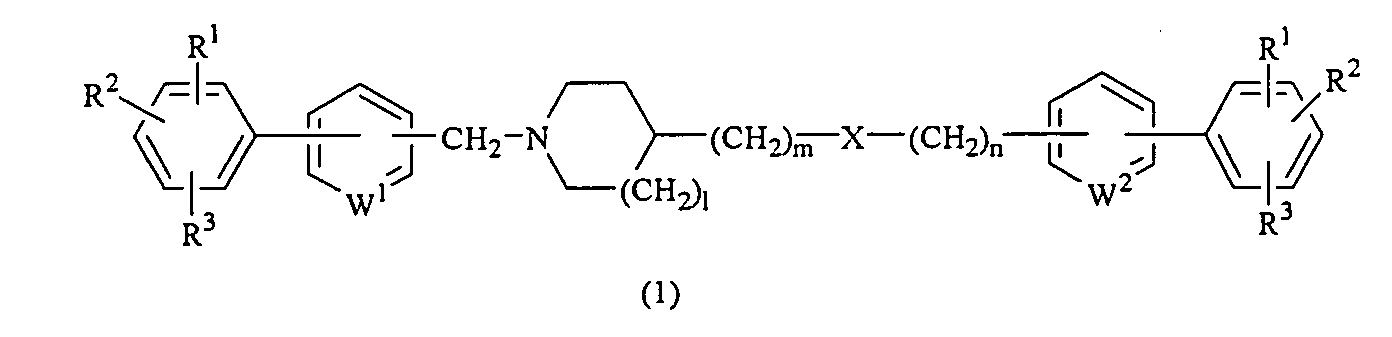
R1, R2 and R3 each independently represent a hydrogen atom, a halogen atom, or hydroxy, alkyl, halogen-substituted alkyl, alkoxy, alkylthio, carboxyl, alkoxycarbonyl or alkanoyl group;
W1 and W2 each independently represent N or CH;
X represents O, NR4, CONR4 or NR4CO;
R4 each represents a hydrogen atom, or an alkyl, alkenyl, alkynyl, substituted or unsubstituted aryl, substituted or unsubstituted heteroaryl, substituted or unsubstituted aralkyl, or substituted or unsubstituted heteroaralkyl group; and
l, m and n each represents a number of 0 or l, or a salt thereof or a solvate thereof. - The preventive or therapeutic agent according to claim 1, wherein R1, R2 and R3 are each a hydrogen atom, a halogen atom, a hydroxy group, a C1-C8-alkyl group, a halogen-substituted C1-C8-alkyl, an alkoxy group having a C1-C8-alkyl group, an alkylthio group having a C1-C8-alkyl group, a carboxyl group, an alkoxycarbonyl group having a C1-C6-alkyl group, or an alkanoyl group having a C1-C6-alkyl group.
- The preventive or therapeutic agent according to claim 1, wherein R4 each represents a hydrogen atom, a C1-C8-alkyl group, C3-C8-alkenyl group, C3-C8-alkynyl group, substituted or unsubstituted C6-C14-aryl group, substituted or unsubstituted heteroaryl group having 5- or 6-membered ring containing 1-4 nitrogen atoms, substituted or unsubstituted C6-C14-aryl-C1-C6-alkyl group, or C1-C6-alkyl group having heteroaryl group having 5- or 6-membered ring containing 1-4 nitrogen atoms.
- The preventive or therapeutic agent according to claim 3, wherein in R4, the substituent of an aryl group, an aryl group of aralkyl group, heteroaryl group, or heteroaryl group of heteroaralkyl group is 1-3 groups selected from the group consisting of alkyl group, alkoxy group, alkylthio group, a halogen atom, a nitro group, an amino group, an acetylamino group, trifluoromethyl group and alkylenedioxy group.
- The preventive or therapeutic agent according to claim 1, wherein the active ingredient is
4-[N-(4-methoxyphenyl)-N-[[5-(3,4,5-trimethoxyphenyl)pyridine-3-yl]methyl]amino]-1-[[2-(3,4,5-trimethoxyphenyl)pyridine-4-yl]methyl]piperidine;
4-[N-(3,5-dimethoxyphenyl)-N-[[2-(3,4,5-trimethoxyphenyl)piridine-4-yl]methyl] amino]-1-[[2-(3,4,5-trimethoxyphenyl)piridine-4-yl]methyl]piperidine;
4-[N-(3,4-methylenedioxyphenyl)-N-[[2-(3,4,5-trimethoxyphenyl)piridine-4-yl] methyl]amino]-1-[[2-(3,4,5-trimethoxyphenyl)piridine-4-yl]methyl]piperidine;
4-[N-methyl-N-[[2-(3,4,5-trimethoxyphenyl)piridine-4-yl]methyl]amino]-1-[[2-(3,4,5-trimethoxyphenyl)piridine-4-yl]methyl]piperidine;
4-[N-(4-(methylthio)phenyl)-N-[[5-(3,4,5-tromethoxyphenyl)piridine-3-yl]methyl] amino]-1-[[2-(3,4,5-tromethoxyphenyl)piridine-4-yl]methyl]piperidine; or a salt thereof. - A preventive or therapeutic agent for anemia, comprising as an active ingredient, a cyclic amine compound represented by the following formula (1):wherein,
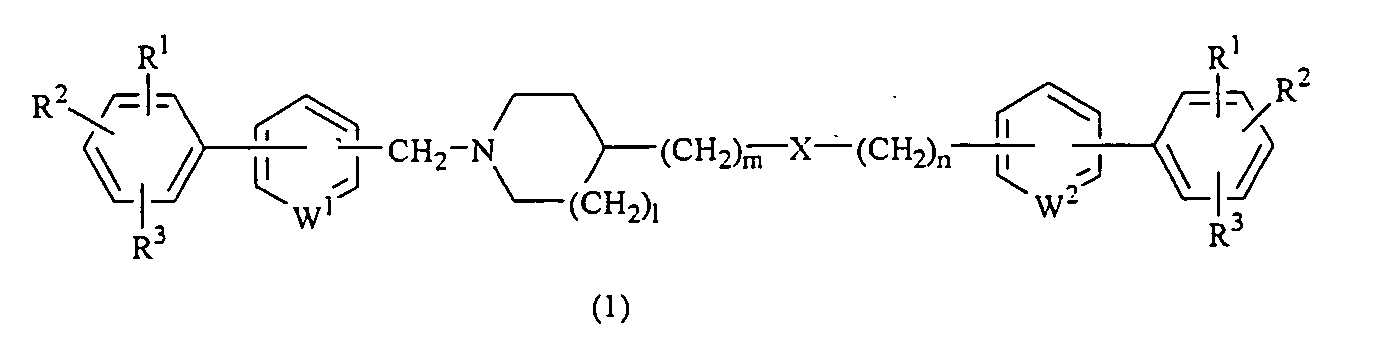
R1, R2 and R3 each independently represent a hydrogen atom, a halogen atom, or hydroxy, alkyl, halogen-substituted alkyl, alkoxy, alkylthio, carboxyl, alkoxycarbonyl or alkanoyl group;
W1 and W2 each independently represent N or CH;
X represents O, NR4, CONR4 or NR4CO;
R4 each represents a hydrogen atom, or an alkyl, alkenyl, alkynyl, substituted or unsubstituted aryl, substituted or unsubstituted heteroaryl, substituted or unsubstituted aralkyl, or substituted or unsubstituted heteroaralkyl group; and
l, m and n each represents a number of 0 or 1, or a salt thereof or a solvate thereof. - The preventive or therapeutic agent according to claim 6, wherein R1, R2 and R3 are each a hydrogen atom, a halogen atom, a hydroxy group, a C1-C8-alkyl group, a halogen-substituted C1-C8-alkyl, an alkoxy group having a C1-C8-alkyl group, an alkylthio group having a C1-C8-alkyl group, a carboxyl group, an alkoxycarbonyl group having a C1-C6-alkyl group, or an alkanoyl group having a C1-C6-alkyl group.
- The preventive or therapeutic agent according to claim 6, wherein R4 each represents a hydrogen atom, a C1-C8-alkyl group, C3-C8-alkenyl group, C3-C8-alkynyl group, substituted or unsubstituted C6-C14-aryl group, substituted or unsubstituted heteroaryl group having 5- or 6-membered ring containing 1-4 nitrogen atoms, substituted or unsubstituted C6-C14-aryl-C1-C6-alkyl group, or C1-C6-alkyl group having heteroaryl group having 5- or 6-membered ring containing 1-4 nitrogen atoms.
- The preventive or therapeutic agent according to claim 8, wherein in R4, the substituent of an aryl group, an aryl group of aralkyl group, heteroaryl group, or heteroaryl group of heteroaralkyl group is 1-3 groups selected from the group consisting of alkyl group, alkoxy group, alkylthio group, a halogen atom, a nitro group, an amino group, an acetylamino group, trifluoromethyl group and alkylenedioxy group.
- The preventive or therapeutic agent according to claim 6, wherein the active ingredient is
4-[N-(4-methoxyphenyl)-N-[[5-(3,4,5-trimethoxyphenyl)pyridine-3-yl]methyl]amino]-1-[[2-(3,4,5-trimethoxyphenyl)pyridine-4-yl]methyl]piperidine;
4-[N-(3,5-dimethoxyphenyl)-N-[[2-(3,4,5-trimethoxyphenyl)piridine-4-yl]methyl] amino]-I-[[2-(3,4,5-trimethoxyphenyl)piridine-4-yl]methyl]piperidine;
4-[N-(3,4-methylenedioxyphenyl)-N-[[2-(3,4, 5-trimethoxyphenyl)piridine-4-yl] methyl]amino]-1-[[2-(3,4,5-trimethoxyphenyl)piridine-4-yl]methyl]piperidine;
4-[N-methyl-N-[[2-(3,4,5-trimethoxyphenyl)piridine-4-yl]methyl]amino]-1-[[2-(3,4,5-trimethoxyphenyl)piridine-4-yl]methyl]piperidine;
4-[N-(4-(methylthio)phenyl)-N-[[5-(3,4,5-tromethoxyphenyl)piridine-3-yl]methyl] amino]-1-[[2-(3,4,5-tromethoxyphenyl)piridine-4-yl]methyl]piperidine; or a salt thereof. - A preventive or therapeutic agent for chronic anemia, renal anemia, anaplastic anemia or pure red cell aplasia, comprising as an active ingredient, a cyclic amine compound represented by the following formula (1):wherein,
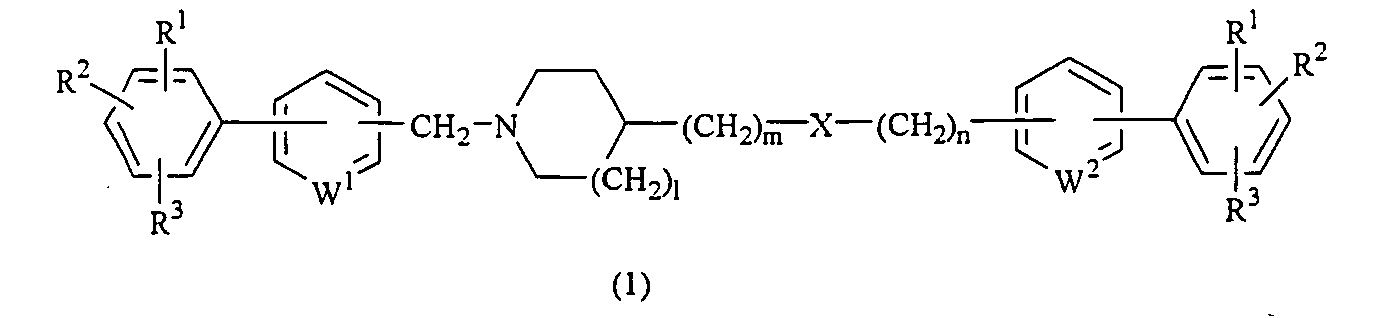
R1, R2 and R3 each independently represent a hydrogen atom, a halogen atom, or hydroxy, alkyl, halogen-substituted alkyl, alkoxy, alkylthio, carboxyl, alkoxycarbonyl or alkanoyl group;
W1 and W2 each independently represent N or CH;
X represents O, NR4, CONR4 or NR4CO;
R4 each represents a hydrogen atom, or an alkyl, alkenyl, alkynyl, substituted or unsubstituted aryl, substituted or unsubstituted heteroaryl, substituted or unsubstituted aralkyl, or substituted or unsubstituted heteroaralkyl group; and
l, m and n each represents a number of 0 or 1, or a salt thereof or a solvate thereof. - The preventive or therapeutic agent according to claim 11, wherein R1, R2 and R3 are each a hydrogen atom, a halogen atom, a hydroxy group, a C1-C8-alkyl group, a halogen-substituted C1-C8-alkyl, an alkoxy group having a C1-C8-alkyl group, an alkylthio group having a C1-C8-alkyl group, a carboxyl group, an alkoxycarbonyl group having a C1-C6-alkyl group, or an alkanoyl group having a C1-C6-alkyl group.
- The preventive or therapeutic agent according to claim 11, wherein R4 each represents a hydrogen atom, a C1-C8-alkyl group, C3-C8-alkenyl group, C3-C8-alkynyl group, substituted or unsubstituted C6-C14-aryl group, substituted or unsubstituted heteroaryl group having 5- or 6-membered ring containing 1-4 nitrogen atoms, substituted or unsubstituted C6-C14-aryl-C1-C6-alkyl group, or C1-C6-alkyl group having heteroaryl group having 5- or 6-membered ring containing 1-4 nitrogen atoms.
- The preventive or therapeutic agent according to claim 13, wherein in R4, the substituent of an aryl group, an aryl group of aralkyl group, heteroaryl group, or heteroaryl group of heteroaralkyl group is 1-3 groups selected from the group consisting of alkyl group, alkoxy group, alkylthio group, a halogen atom, a nitro group, an amino group, an acetylamino group, trifluoromethyl group and alkylenedioxy group.
- The preventive or therapeutic agent according to claim 11, wherein the active ingredient is
4-[N-(4-methoxyphenyl)-N-[[5-(3,4,5-trimethoxyphenyl)pyridine-3-yl]methyl]amino]-1-[[2-(3,4,5-trimethoxyphenyl)pyridine-4-yl]methyl]piperidine;
4-[N-(3,5-dimethoxyphenyl)-N-[[2-(3,4,5-trimethoxyphenyl)piridine-4-yl]methyl] amino]-1-[[2-(3,4,5-trimethoxyphenyl)piridine-4-yl]methyl]piperidine;
4-[N-(3,4-methylenedioxyphenyl)-N-[[2-(3,4,5-trimethoxyphenyl)piridine-4-yl] methyl]amino]-1-[[2-(3,4,5-trimethoxyphenyl)piridine-4-yl]methyl]piperidine;
4-[N-methyl-N-[[2-(3,4,5-trimethoxyphenyl)piridine-4-yl]methyl]amino]-1-[[2-(3,4,5-trimethoxyphenyl)piridine-4-yl]methyl]piperidine;
4-[N-(4-(methylthio)phenyl)-N-[[5-(3,4,5-tromethoxyphenyl)piridine-3-yl]methyl] amino]-1-[[2-(3,4,5-tromethoxyphenyl)piridine-4-yl]methyl]piperidine; or a salt thereof. - Use of a cyclic amine compound represented by the following formula (1):wherein,

R1, R2 and R3 each independently represent a hydrogen atom, a halogen atom, or hydroxy, alkyl, halogen-substituted alkyl, alkoxy, alkylthio, carboxyl, alkoxycarbonyl or alkanoyl group;
W1 and W2 each independently represent N or CH;
X represents O, NR4, CONR4 or NR4CO;
R4 each represents a hydrogen atom, or an alkyl, alkenyl, alkynyl, substituted or unsubstituted aryl, substituted or unsubstituted heteroaryl, substituted or unsubstituted aralkyl, or substituted or unsubstituted heteroaralkyl group; and
l, m and n each represents a number of 0 or 1, or a salt thereof or a solvate thereof for the manufacture of a preventive or therapeutic agent for pathological conditions caused by reduced production of erythropoietin. - The use according to claim 16, wherein R1, R2 and R3 are each a hydrogen atom, a halogen atom, a hydroxy group, a C1-C8-alkyl group, a halogen-substituted C1-C8-alkyl, an alkoxy group having a C1-C8-alkyl group, an alkylthio group having a C1-C8-alkyl group, a carboxyl group, an alkoxycarbonyl group having a C1-C6-alkyl group, or an alkanoyl group having a C1-C6-alkyl group.
- The use according to claim 16, wherein R4 each represents a hydrogen atom, a C1-C8-alkyl group, C3-C8-alkenyl group, C3-C8-alkynyl group, substituted or unsubstituted C6-C14-aryl group, substituted or unsubstituted heteroaryl group having 5- or 6-membered ring containing 1-4 nitrogen atoms, substituted or unsubstituted C6-C14-aryl-C1-C6-alkyl group, or C1-C6-alkyl group having heteroaryl group having 5-or 6-membered ring containing 1-4 nitrogen atoms.
- The use according to claim 18, wherein in R4, the substituent of an aryl group, an aryl group of aralkyl group, heteroaryl group, or heteroaryl group of heteroaralkyl group is 1-3 groups selected from the group consisting of alkyl group, alkoxy group, alkylthio group, a halogen atom, a nitro group, an amino group, an acetylamino group, trifluoromethyl group and alkylenedioxy group.
- The use according to claim 16, wherein the active ingredient is
4-[N-(4-methoxyphenyl)-N-[[5-(3,4,5'-trimethoxyphenyl)pyridine-3-yl]methyl]amino] -1-[[2-(3,4,5-trimethoxyphenyl)pyridine-4-yl]methyl]piperidine;
4-[N-(3,5-dimethoxyphenyl)-N-[[2-(3,4,5-trimethoxyphenyl)piridine-4-yl]methyl] amino]-1-[[2-(3,4,5-trimethoxyphenyl)piridine-4-yl]methyl]piperidine;
4-[N-(3,4-methylenedioxyphenyl)-N-[[2-(3,4,5-trimethoxyphenyl)piridine-4-yl] methyl]amino]-1-[[2-(3,4,5-trimethoxyphenyl)piridine-4-yl]methyl]piperidine;
4-[N-methyl-N-[[2-(3,4,5-trimethoxyphenyl)piridine-4-yl]methyl]amino]-1-[[2-(3,4,5-trimethoxyphenyl)piridine-4-yl]methyl]piperidine;
4-[N-(4-(methylthio)phenyl)-N-[[5-(3,4,5-tromethoxyphenyl)piridine-3-yl]methyl] amino]-1-[[2-(3,4,5-tromethoxyphenyl)piridine-4-yl]methyl]piperidine; or a salt thereof. - Use of a cyclic amine compound represented by the following formula (1):wherein,
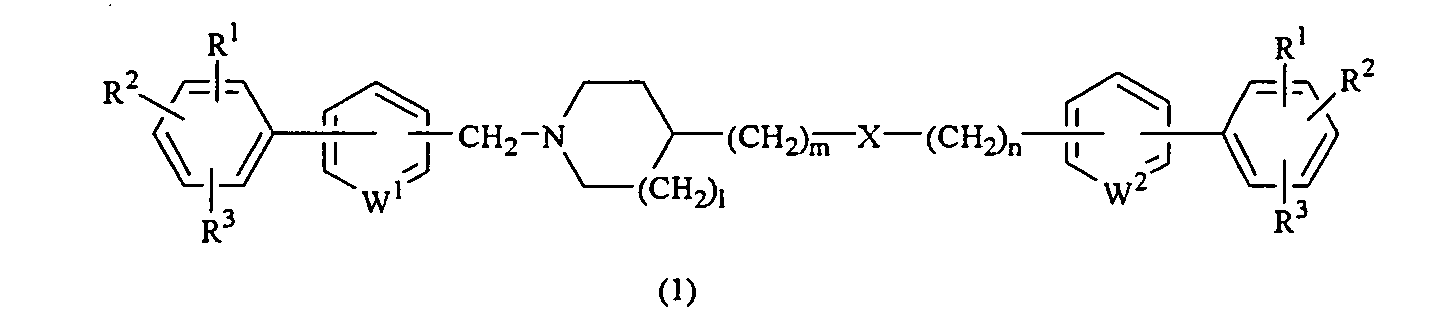
R1, R2 and R3 each independently represent a hydrogen atom, a halogen atom, or hydroxy, alkyl, halogen-substituted alkyl, alkoxy, alkylthio, carboxyl, alkoxycarbonyl or alkanoyl group;
W1 and W2 each independently represent N or CH;
X represents O, NR4, CONR4 or NR4CO;
R4 each represents a hydrogen atom, or an alkyl, alkenyl, alkynyl, substituted or unsubstituted aryl, substituted or unsubstituted heteroaryl, substituted or unsubstituted aralkyl, or substituted or unsubstituted heteroaralkyl group; and
l, m and n each represents a number of 0 or 1, or a salt thereof or a solvate thereof for the manufacture of a preventive or therapeutic agent for anemia. - The use according to claim 21, wherein R1, R2 and R3 are each a hydrogen atom, a halogen atom, a hydroxy group, a C1-C8-alkyl group, a halogen-substituted C1-C8-alkyl, an alkoxy group having a C1-C8-alkyl group, an alkylthio group having a C1-C8-alkyl group, a carboxyl group, an alkoxycarbonyl group having a C1-C6-alkyl group, or an alkanoyl group having a C1-C6-alkyl group.
- The use according to claim 21, wherein R4 each represents a hydrogen atom, a C1-C8-alkyl group, C3-C8-alkenyl group, C3-C8-alkynyl group, substituted or unsubstituted C6-C14-aryl group, substituted or unsubstituted heteroaryl group having 5- or 6-membered ring containing 1-4 nitrogen atoms, substituted or unsubstituted C6-C14-aryl-C1-C6-alkyl group, or C1-C6-alkyl group having heteroaryl group having 5- or 6-membered ring containing 1-4 nitrogen atoms.
- The use according to claim 23, wherein in R4, the substituent of an aryl group, an aryl group of aralkyl group, heteroaryl group, or heteroaryl group of heteroaralkyl group is 1-3 groups selected from the group consisting of alkyl group, alkoxy group, alkylthio group, a halogen atom, a nitro group, an amino group, an acetylamino group, trifluoromethyl group and alkylenedioxy group.
- The use according to claim 21, wherein the active ingredient is
4-[N-(4-methoxyphenyl)-N-[[5-(3,4,5-trimethoxyphenyl)pyridine-3-yl]methyl]amino]-1-[[2-(3,4,5-trimethoxyphenyl)pyridine-4-yl]methyl]piperidine;
4-[N-(3,5-dimethoxyphenyl)-N-[[2-(3,4,5-trimethoxyphenyl)piridine-4-yl]methyl] amino]-1-[[2-(3,4,5-trimethoxyphenyl)piridine-4-yl]methyl]piperidine;
4-[N-(3,4-methylenedioxyphenyl)-N-[[2-(3,4,5-trimethoxyphenyl)piridine-4-yl] methyl]amino]-1-[[2-(3,4,5-trimethoxyphenyl)piridine-4-yl]methyl]piperidine;
4-[N-methyl-N-[[2-(3,4,5-trimethoxyphenyl)piridine-4-yl]methyl]amino]-1-[[2-(3,4,5-trimethoxyphenyl)piridine-4-yl]methyl]piperidine;
4-[N-(4-(methylthio)phenyl)-N-[[5-(3,4,5-tromethoxyphenyl)piridine-3-yl]methyl] amino]-1-[[2-(3,4,5-tromethoxyphenyl)piridine-4-yl]methyl]piperidine; or a salt thereof. - Use of a cyclic amine compound represented by the following formula (1):wherein,

R1, R2 and R3 each independently represent a hydrogen atom, a halogen atom, or hydroxy, alkyl, halogen-substituted alkyl, alkoxy, alkylthio, carboxyl, alkoxycarbonyl or alkanoyl group;
W1 and W2 each independently represent N or CH;
X represents O, NR4, CONR4 or NR4CO;
R4 each represents a hydrogen atom, or an alkyl, alkenyl, alkynyl, substituted or unsubstituted aryl, substituted or unsubstituted heteroaryl, substituted or unsubstituted aralkyl, or substituted or unsubstituted heteroaralkyl group; and
l, m and n each represents a number of 0 or 1, or a salt thereof or a solvate thereof for the manufacture of a preventive or therapeutic agent for chronic anemia, renal anemia, aplastic anemia, or pure red cell aplasia. - The use according to claim 26, wherein R1, R2 and R3 are each a hydrogen atom, a halogen atom, a hydroxy group, a C1-C8-alkyl group, a halogen-substituted C1-C8-alkyl, an alkoxy group having a C1-C8-alkyl group, an alkylthio group having a C1-C8-alkyl group, a carboxyl group, an alkoxycarbonyl group having a C1-C6-alkyl group, or an alkanoyl group having a C1-C6-alkyl group.
- The use according to claim 26, wherein R4 each represents a hydrogen atom, a C1-C8-alkyl group, C3-C8-alkenyl group, C3-C8-alkynyl group, substituted or unsubstituted C6-C14-aryl group, substituted or unsubstituted heteroaryl group having 5- or 6-membered ring containing 1-4 nitrogen atoms, substituted or unsubstituted C6-C14-aryl-C1-C6-alkyl group, or C1-C6-alkyl group having heteroaryl group having 5- or 6-membered ring containing 1-4 nitrogen atoms.
- The use according to claim 28, wherein in R4, the substituent of an aryl group, an aryl group of aralkyl group, heteroaryl group, or heteroaryl group of heteroaralkyl group is 1-3 groups selected from the group consisting of alkyl group, alkoxy group, alkylthio group, a halogen atom, a nitro group, an amino group, an acetylamino group, trifluoromethyl group and alkylenedioxy group.
- The use according to claim 21, wherein the active ingredient is
4-[N-(4-methoxyphenyl)-N-[[5-(3,4,5-trimethoxyphenyl)pyridine-3-yl]methyl]amino]-1-[[2-(3,4,5-trimethoxyphenyl)pyridine-4-yl]methyl]piperidine;
4-[N-(3,5-dimethoxyphenyl)-N-[[2-(3,4,5-trimethoxyphenyl)piridine-4-yl]methyl] amino]-1-[[2-(3,4,5-trimethoxyphenyl)piridine-4-yl]methyl]piperidine;
4-[N-(3,4-methylenedioxyphenyl)-N-[[2-(3,4,5-trimethoxyphenyl)piridine-4-yl] methyl]amino]-1-[[2-(3,4,5-trimethoxyphenyl)piridine-4-yl]methyl]piperidine;
4-[N-methyl-N-[[2-(3,4,5-trimethoxyphenyl)piridine-4-yl]methyl]amino]-1-[[2-(3,4,5 trimethoxyphenyl)piridine-4-yl]methyl]piperidine;
4-[N-(4-(methylthio)phenyl)-N-[[5-(3,4,5-tromethoxyphenyl)piridine-3-yl]methyl] amino]-1-[[2-(3,4,5-tromethoxyphenyl)piridine-4-yl]methyl]piperidine; or a salt thereof. - A method of treating pathological conditions caused by reduced production of erythropoietin, comprising administering an effective amount of a cyclic amine compound represented by the following formula (1):wherein,
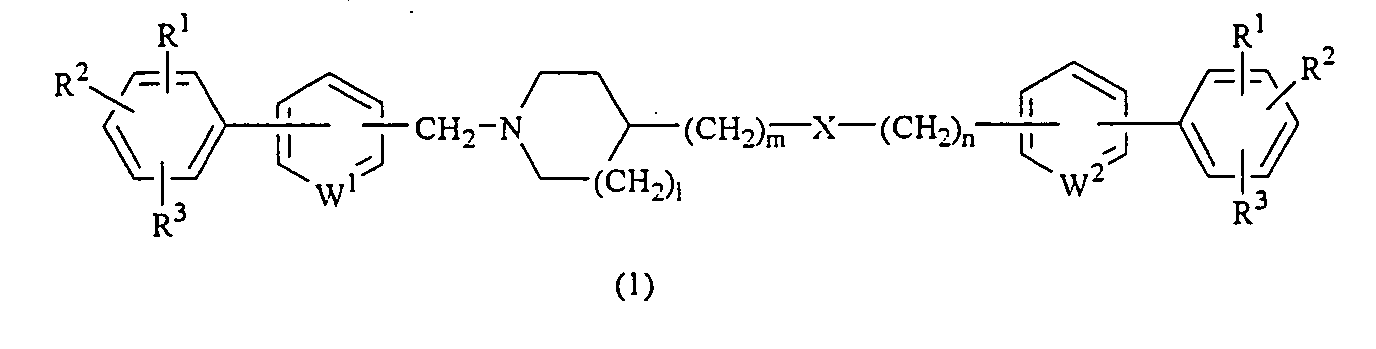
R1, R2 and R3 each independently represent a hydrogen atom, a halogen atom, or hydroxy, alkyl, halogen-substituted alkyl, alkoxy, alkylthio, carboxyl, alkoxycarbonyl or alkanoyl group;
W1 and W2 each independently represent N or CH;
X represents O, NR4, CONR4 or NR4CO;
R4 each represents a hydrogen atom, or an alkyl, alkenyl, alkynyl, substituted or unsubstituted aryl, substituted or unsubstituted heteroaryl, substituted or unsubstituted aralkyl, or substituted or unsubstituted heteroaralkyl group; and
l, m and n each represents a number of 0 or 1, or a salt thereof or a solvate thereof. - The method according to claim 31, wherein R1, R2 and R3 are each a hydrogen atom, a halogen atom, a hydroxy group, a C1-C8-alkyl group, a halogen-substituted C1-C8-alkyl, an alkoxy group having a C1-C8-alkyl group, an alkylthio group having a C1-C8-alkyl group, a carboxyl group, an alkoxycarbonyl group having a C1-C6-alkyl group, or an alkanoyl group having a C1-C6-alkyl group.
- The method according to claim 31, wherein R4 each represents a hydrogen atom, a C1-C8-alkyl group, C3-C8-alkenyl group, C3-C8-alkynyl group, substituted or unsubstituted C6-C14-aryl group, substituted or unsubstituted heteroaryl group having 5- or 6-membered ring containing 1-4 nitrogen atoms, substituted or unsubstituted C6-C14-aryl-C1-C6-alkyl group, or C1-C6-alkyl group having heteroaryl group having 5- or 6-membered ring containing 1-4 nitrogen atoms.
- The method according to claim 33, wherein in R4, the substituent of an aryl group, an aryl group of aralkyl group, heteroaryl group, or heteroaryl group of heteroaralkyl group is 1-3 groups selected from the group consisting of alkyl group, alkoxy group, alkylthio group, a halogen atom, a nitro group, an amino group, an acetylamino group, trifluoromethyl group and alkylenedioxy group.
- The method according to claim 31, wherein the active ingredient is
4-[N-(4-methoxyphenyl)-N-[[5-(3,4,5-trimethoxyphenyl)pyridine-3-yl]methyl]amino]-1-[[2-(3,4,5-trimethoxyphenyl)pyridine-4-yl]methyl]piperidine;
4-[N-(3,5-dimethoxyphenyl)-N-[[2-(3,4,5-trimethoxyphenyl)piridine-4-yl]methyl] amino]-1-[[2-(3,4,5-trimethoxyphenyl)piridine-4-yl]methyl]piperidine;
4-[N-(3,4-methylenedioxyphenyl)-N-[[2-(3,4,5-trimethoxyphenyl)piridine-4-yl] methyl]amino]-1-[[2-(3,4,5-trimethoxyphenyl)piridine-4-yl]methyl]piperidine;
4-[N-methyl-N-[[2-(3,4,5-trimethoxyphenyl)piridine-4-yl]methyl]amino]-1-[[2-(3,4,5-trimethoxyphenyl)piridine-4-yl]methyl]piperidine;
4-[N-(4-(methylthio)phenyl)-N-[[5-(3,4,5-tromethoxyphenyl)piridine-3-yl]methyl] amino]-1-[[2-(3,4,5-tromethoxyphenyl)piridine-4-yl]methyl]piperidine; or a salt thereof. - A method of treating anemia, comprising administering an effective amount of a cyclic amine compound represented by the following formula (1):wherein,

R1, R2 and R3 each independently represent a hydrogen atom, a halogen atom, or hydroxy, alkyl, halogen-substituted alkyl, alkoxy, alkylthio, carboxyl, alkoxycarbonyl or alkanoyl group;
W1 and W2 each independently represent N or CH;
X represents O, NR4, CONR4 or NR4CO;
R4 each represents a hydrogen atom, or an alkyl, alkenyl, alkynyl, substituted or unsubstituted aryl, substituted or unsubstituted heteroaryl, substituted or unsubstituted aralkyl, or substituted or unsubstituted heteroaralkyl group; and
l, m and n each represents a number of 0 or 1, or a salt thereof or a solvate thereof. - The method according to claim 36, wherein R1, R2 and R3 are each a hydrogen atom, a halogen atom, a hydroxy group, a C1-C8-alkyl group, a halogen-substituted C1-C8-alkyl, an alkoxy group having a C1-C8-alkyl group, an alkylthio group having a C1-C8-alkyl group, a carboxyl group, an alkoxycarbonyl group having a C1-C6-alkyl group, or an alkanoyl group having a C1-C6-alkyl group.
- The method according to claim 36, wherein R4 each represents a hydrogen atom, a C1-C8-alkyl group, C3-C8-alkenyl group, C3-C8-alkynyl group, substituted or unsubstituted C6-C14-aryl group, substituted or unsubstituted heteroaryl group having 5- or 6-membered ring containing 1-4 nitrogen atoms, substituted or unsubstituted C6-C14-aryl-C1-C6-alkyl group, or C1-C6-alkyl group having heteroaryl group having 5- or 6-membered ring containing 1-4 nitrogen atoms.
- The method according to claim 38, wherein in R4, the substituent of an aryl group, an aryl group of aralkyl group, heteroaryl group, or heteroaryl group of heteroaralkyl group is 1-3 groups selected from the group consisting of alkyl group, alkoxy group, alkylthio group, a halogen atom, a nitro group, an amino group, an acetylamino group, trifluoromethyl group and alkylenedioxy group.
- The method according to claim 36, wherein the active ingredient is
4-[N-(4-methoxyphenyl)-N-[[5-(3,4,5-trimethoxyphenyl)pyridine-3-yl]methyl]amino]-1-[[2-(3,4,5-trimethoxyphenyl)pyridine-4-yl]methyl]piperidine;
4-[N-(3,5-dimethoxyphenyl)-N-[[2-(3,4,5-trimethoxyphenyl)piridine-4-yl]methyl] amino]-1-[[2-(3,4,5-trimethoxyphenyl)piridine-4-yl]methyl]piperidine;
4-[N-(3,4-methylenedioxyphenyl)-N-[[2-(3,4,5-trimethoxyphenyl)piridine-4-yl] methyl]amino]-1-[[2-(3,4,5-trimethoxyphenyl)piridine-4-yl]methyl]piperidine;
4-[N-methyl-N-[[2-(3,4,5-trimethoxyphenyl)piridine-4-yl]methyl]amino]-1-[[2-(3,4,5-trimethoxyphenyl)piridine-4-yl]methyl]piperidine;
4-[N-(4-(methylthio)phenyl)-N-[[5-(3,4,5-tromethoxyphenyl)piridine-3-yl]methyl] amino]-1-[[2-(3,4,5-tromethoxyphenyl)piridine-4-yl]methyl]piperidine; or a salt thereof. - A method of treating chronic anemia, renal anemia, aplastic anemia, or pure red cell aplasia, comprising administering an effective amount of a cyclic amine compound represented by the following formula (1):wherein,

R1, R2 and R3 each independently represent a hydrogen atom, a halogen atom, or hydroxy, alkyl, halogen-substituted alkyl, alkoxy, alkylthio, carboxyl, alkoxycarbonyl or alkanoyl group;
W1 and W2 each independently represent N or CH;
X represents O, NR4, CONR4 or NR4CO;
R4 each represents a hydrogen atom, or an alkyl, alkenyl, alkynyl, substituted or unsubstituted aryl, substituted or unsubstituted heteroaryl, substituted or unsubstituted aralkyl, or substituted or unsubstituted heteroaralkyl group; and
l, m and n each represents a number of 0 or 1, or a salt thereof or a solvate thereof. - The method according to claim 41, wherein R1, R2 and R3 are each a hydrogen atom, a halogen atom, a hydroxy group, a C1-C8-alkyl group, a halogen-substituted C1-C8-alkyl, an alkoxy group having a C1-C8-alkyl group, an alkylthio group having a C1-C8-alkyl group, a carboxyl group, an alkoxycarbonyl group having a C1-C6-alkyl group, or an alkanoyl group having a C1-C6-alkyl group.
- The method according to claim 41, wherein R4 each represents a hydrogen atom, a C1-C8-alkyl group, C3-C8-alkenyl group, C3-C8-alkynyl group, substituted or unsubstituted C6-C14-aryl group, substituted or unsubstituted heteroaryl group having 5- or 6-membered ring containing 1-4 nitrogen atoms, substituted or unsubstituted C6-C14-aryl-C1-C6-alkyl group, or C1-C6-alkyl group having heteroaryl group having 5- or 6-membered ring containing 1-4 nitrogen atoms.
- The method according to claim 43, wherein in R4, the substituent of an aryl group, an aryl group of aralkyl group, heteroaryl group, or heteroaryl group of heteroaralkyl group is 1-3 groups selected from the group consisting of alkyl group, alkoxy group, alkylthio group, a halogen atom, a nitro group, an amino group, an acetylamino group, trifluoromethyl group and alkylenedioxy group.
- The method according to claim 41, wherein the active ingredient is
4-[N-(4-methoxyphenyl)-N-[[5-(3,4,5-trimethoxyphenyl)pyridine-3-yl]methyl]amino]-1-[[2-(3,4,5-trimethoxyphenyl)pyridine-4-yl]methyl]piperidine;
4-[N-(3,5-dimethoxyphenyl)-N-[[2-(3,4,5-trimethoxyphenyl)piridine-4-yl]methyl] amino]-1-[[2-(3,4,5-trimethoxyphenyl)piridine-4-yl]methyl]piperidine;
4-[N-(3,4-methylenedioxyphenyl)-N-[[2-(3,4,5-trimethoxyphenyl)piridine-4-yl] methyl]amino]-1-[[2-(3,4,5-trimethoxyphenyl)piridine-4-yl]methyl]piperidine;
4-[N-methyl-N-[[2-(3,4,5-trimethoxyphenyl)piridine-4-yl]methyl]amino]-1-[[2-(3,4,5-trimethoxyphenyl)piridine-4-yl]methyl]piperidine;
4-[N-(4-(methylthio)phenyl)-N-[[5-(3,4,5-tromethoxyphenyl)piridine-3-yl]methyl] amino]-1-[[2-(3,4,5-tromethoxyphenyl)piridine-4-yl]methyl]piperidine; or a salt thereof.
Applications Claiming Priority (3)
| Application Number | Priority Date | Filing Date | Title |
|---|---|---|---|
| US43123402P | 2002-12-06 | 2002-12-06 | |
| US431234P | 2002-12-06 | ||
| PCT/JP2003/015589 WO2004052859A1 (en) | 2002-12-06 | 2003-12-05 | Erythropoietin production accelerator |
Publications (2)
| Publication Number | Publication Date |
|---|---|
| EP1568691A1 true EP1568691A1 (en) | 2005-08-31 |
| EP1568691A4 EP1568691A4 (en) | 2010-08-25 |
Family
ID=32507685
Family Applications (1)
| Application Number | Title | Priority Date | Filing Date |
|---|---|---|---|
| EP03777283A Withdrawn EP1568691A4 (en) | 2002-12-06 | 2003-12-05 | ACCELERATOR FOR THE PRODUCTION OF ERYTHROPOIETINE |
Country Status (5)
| Country | Link |
|---|---|
| US (2) | US20060040986A1 (en) |
| EP (1) | EP1568691A4 (en) |
| JP (1) | JP4464280B2 (en) |
| AU (1) | AU2003289200A1 (en) |
| WO (1) | WO2004052859A1 (en) |
Cited By (5)
| Publication number | Priority date | Publication date | Assignee | Title |
|---|---|---|---|---|
| WO2011112828A1 (en) | 2010-03-12 | 2011-09-15 | Omeros Corporation | Pde10 inhibitors and related compositions and methods |
| US9493447B2 (en) | 2014-04-28 | 2016-11-15 | Omeros Corporation | Optically active PDE10 inhibitor |
| US9650368B2 (en) | 2014-04-28 | 2017-05-16 | Omeros Corporation | Processes and intermediates for the preparation of a PDE10 inhibitor |
| US9879002B2 (en) | 2015-04-24 | 2018-01-30 | Omeros Corporation | PDE10 inhibitors and related compositions and methods |
| US9920045B2 (en) | 2015-11-04 | 2018-03-20 | Omeros Corporation | Solid state forms of a PDE10 inhibitor |
Families Citing this family (12)
| Publication number | Priority date | Publication date | Assignee | Title |
|---|---|---|---|---|
| JP4634303B2 (en) * | 2003-10-10 | 2011-02-16 | 興和株式会社 | Angiogenesis inhibitor |
| US7371894B2 (en) | 2004-09-02 | 2008-05-13 | Eastman Chemical Company | Optimized liquid-phase oxidation |
| US20090042901A1 (en) * | 2005-02-02 | 2009-02-12 | Kowa Co., Ltd. | Agent for prevention/therapy of disease caused by keratinocyte growth |
| EP2080759A4 (en) | 2006-10-13 | 2011-01-12 | Kowa Co | INDUCER OF -GLOBINE GAMA |
| ES2569660T3 (en) | 2007-06-08 | 2016-05-12 | Mannkind Corporation | IRE-1alpha inhibitors |
| WO2009016812A1 (en) * | 2007-07-27 | 2009-02-05 | Kowa Company, Ltd. | Prophylactic and/or therapeutic agent for anemia comprising 2-phenylquinoline-4-carboxylic acid derivative as active ingredient |
| WO2009041072A1 (en) * | 2007-09-27 | 2009-04-02 | Kowa Company, Ltd. | Prophylactic and/or therapeutic agent for anemia, comprising tetrahydroquinoline compound as active ingredient |
| WO2009044553A1 (en) * | 2007-10-05 | 2009-04-09 | Kowa Company, Ltd. | Method for screening of therapeutic agent for anemia |
| JP5683489B2 (en) | 2009-01-12 | 2015-03-11 | アレイ バイオファーマ、インコーポレイテッド | Piperidine-containing compounds and uses thereof |
| CN102802628A (en) * | 2009-06-30 | 2012-11-28 | 默沙东公司 | Substituted 4-hydroxypyrimidine-5-carboxamides |
| WO2015175704A1 (en) * | 2014-05-14 | 2015-11-19 | The Regents Of The University Of California | Inhibitors of bacterial dna gyrase with efficacy against gram-negative bacteria |
| WO2016058544A1 (en) | 2014-10-16 | 2016-04-21 | Syros Pharmaceuticals, Inc. | Inhibitors of cyclin-dependent kinase 7 (cdk7) |
Family Cites Families (7)
| Publication number | Priority date | Publication date | Assignee | Title |
|---|---|---|---|---|
| JPH11171774A (en) * | 1997-12-05 | 1999-06-29 | Kyowa Hakko Kogyo Co Ltd | Hemocytosis agent |
| DE19929782A1 (en) * | 1999-06-29 | 2001-01-04 | Bayer Ag | 6-carboxyphenyl dihydropyridazinone derivatives and their use |
| US6395753B1 (en) * | 2001-08-30 | 2002-05-28 | Kowa Co., Ltd. | Cyclic amine compounds and pharmaceutical composition containing the same |
| US6605620B1 (en) * | 2001-08-30 | 2003-08-12 | Kowa Co., Ltd. | Cyclic amine compounds and pharmaceutical composition containing the same |
| US6867221B2 (en) * | 2001-08-30 | 2005-03-15 | Kowa Co., Ltd. | Cyclic amine compounds and pharmaceutical composition containing the same |
| MY134200A (en) * | 2002-04-12 | 2007-11-30 | Kowa Co | Method for treating cancer |
| WO2004002493A1 (en) * | 2002-06-28 | 2004-01-08 | Kowa Co., Ltd. | Erythropoietin production potentiator |
-
2003
- 2003-12-05 US US10/537,407 patent/US20060040986A1/en not_active Abandoned
- 2003-12-05 WO PCT/JP2003/015589 patent/WO2004052859A1/en not_active Ceased
- 2003-12-05 JP JP2004558420A patent/JP4464280B2/en not_active Expired - Fee Related
- 2003-12-05 EP EP03777283A patent/EP1568691A4/en not_active Withdrawn
- 2003-12-05 AU AU2003289200A patent/AU2003289200A1/en not_active Abandoned
-
2008
- 2008-12-02 US US12/326,204 patent/US20090143430A1/en not_active Abandoned
Non-Patent Citations (2)
| Title |
|---|
| No further relevant documents disclosed * |
| See also references of WO2004052859A1 * |
Cited By (9)
| Publication number | Priority date | Publication date | Assignee | Title |
|---|---|---|---|---|
| WO2011112828A1 (en) | 2010-03-12 | 2011-09-15 | Omeros Corporation | Pde10 inhibitors and related compositions and methods |
| US8343970B2 (en) | 2010-03-12 | 2013-01-01 | Omeros Corporation | PDE10 inhibitors and related compositions and methods |
| US8685975B2 (en) | 2010-03-12 | 2014-04-01 | Omeros Corporation | PDE10 inhibitors and related compositions and methods |
| US10106516B2 (en) | 2010-03-12 | 2018-10-23 | Omeros Corporation | PDE10 inhibitors and related compositions and methods |
| US9493447B2 (en) | 2014-04-28 | 2016-11-15 | Omeros Corporation | Optically active PDE10 inhibitor |
| US9650368B2 (en) | 2014-04-28 | 2017-05-16 | Omeros Corporation | Processes and intermediates for the preparation of a PDE10 inhibitor |
| US9850238B2 (en) | 2014-04-28 | 2017-12-26 | Omeros Corporation | Optically active PDE10 inhibitor |
| US9879002B2 (en) | 2015-04-24 | 2018-01-30 | Omeros Corporation | PDE10 inhibitors and related compositions and methods |
| US9920045B2 (en) | 2015-11-04 | 2018-03-20 | Omeros Corporation | Solid state forms of a PDE10 inhibitor |
Also Published As
| Publication number | Publication date |
|---|---|
| AU2003289200A1 (en) | 2004-06-30 |
| JP4464280B2 (en) | 2010-05-19 |
| WO2004052859A1 (en) | 2004-06-24 |
| US20090143430A1 (en) | 2009-06-04 |
| EP1568691A4 (en) | 2010-08-25 |
| US20060040986A1 (en) | 2006-02-23 |
| JPWO2004052859A1 (en) | 2006-04-13 |
Similar Documents
| Publication | Publication Date | Title |
|---|---|---|
| US20090143430A1 (en) | Erythropoietin production accelerator | |
| CA2753434C (en) | Soluble guanylate cyclase activators | |
| EP1396487B1 (en) | Phenylpyridine carbonyl piperazine derivative | |
| KR100728665B1 (en) | Nitrogen-containing heterocyclic compounds and pharmaceuticals thereof | |
| JP4980928B2 (en) | G protein-coupled receptor (GPR116) agonist and use thereof for the treatment of obesity and diabetes | |
| EP1736467A1 (en) | Novel sulfonamide derivative | |
| HUP0301187A2 (en) | Novel benzyl-piperidine-derivatives, process for their preparation and pharmaceutical compositions containing them | |
| EP1747210B1 (en) | 3- or 4-monosubstituted phenol and thiophenol derivatives useful as h3 ligands | |
| CA2734415A1 (en) | Picolinamide derivatives as kinase inhibitors | |
| WO2002083134A1 (en) | Aryl and biaryl piperidines used as mch antagonists | |
| WO1999016747A1 (en) | Sulfonyl derivatives | |
| EP1870405A1 (en) | Carbonylated (Aza)cyclohexanes as dopamine D3 receptor ligands | |
| CN100406441C (en) | Cyclic amine compound | |
| US20050176764A1 (en) | Medicine for treating cancer | |
| EP1716135B1 (en) | Piperidinylcarbonyl-pyrrolidines and their use as melanocortin agonists | |
| CN114728170A (en) | Compounds active on nuclear receptors | |
| EP2657227A1 (en) | Novel substituted isoquinoline derivative | |
| JP4276070B2 (en) | Cyclic amine compound | |
| WO2004041282A1 (en) | Receptor regulator | |
| US6605620B1 (en) | Cyclic amine compounds and pharmaceutical composition containing the same | |
| RU2299207C2 (en) | Cyclic amine compounds | |
| HK1073312B (en) | Cyclic amine compound | |
| KR20040030114A (en) | Cyclic amine compound | |
| HK40077526A (en) | Compounds active towards nuclear receptors | |
| EP1593679A1 (en) | 3- Or 4-monosubstituted phenol derivatives useful as H3 ligands |
Legal Events
| Date | Code | Title | Description |
|---|---|---|---|
| PUAI | Public reference made under article 153(3) epc to a published international application that has entered the european phase |
Free format text: ORIGINAL CODE: 0009012 |
|
| 17P | Request for examination filed |
Effective date: 20050531 |
|
| AK | Designated contracting states |
Kind code of ref document: A1 Designated state(s): AT BE BG CH CY CZ DE DK EE ES FI FR GB GR HU IE IT LI LU MC NL PT RO SE SI SK TR |
|
| AX | Request for extension of the european patent |
Extension state: AL LT LV MK |
|
| DAX | Request for extension of the european patent (deleted) | ||
| RIN1 | Information on inventor provided before grant (corrected) |
Inventor name: OHKUCHI, MASAO Inventor name: TAMURA, MASAHIRO Inventor name: DOI, TAKESHI Inventor name: IMAGAWA, SHIGEHIKO |
|
| RIN1 | Information on inventor provided before grant (corrected) |
Inventor name: OHKUCHI, MASAO Inventor name: TAMURA, MASAHIRO Inventor name: DOI, TAKESHI Inventor name: IMAGAWA, SHIGEHIKO |
|
| A4 | Supplementary search report drawn up and despatched |
Effective date: 20100726 |
|
| STAA | Information on the status of an ep patent application or granted ep patent |
Free format text: STATUS: THE APPLICATION HAS BEEN WITHDRAWN |
|
| 18W | Application withdrawn |
Effective date: 20110204 |