EP1567574B1 - Stable aqueous dispersions of non-ionic blocked polyisocyanates - Google Patents
Stable aqueous dispersions of non-ionic blocked polyisocyanates Download PDFInfo
- Publication number
- EP1567574B1 EP1567574B1 EP03796068A EP03796068A EP1567574B1 EP 1567574 B1 EP1567574 B1 EP 1567574B1 EP 03796068 A EP03796068 A EP 03796068A EP 03796068 A EP03796068 A EP 03796068A EP 1567574 B1 EP1567574 B1 EP 1567574B1
- Authority
- EP
- European Patent Office
- Prior art keywords
- ionic
- aqueous dispersions
- blocked polyisocyanates
- weight
- preparation
- Prior art date
- Legal status (The legal status is an assumption and is not a legal conclusion. Google has not performed a legal analysis and makes no representation as to the accuracy of the status listed.)
- Expired - Lifetime
Links
- 239000006185 dispersion Substances 0.000 title claims abstract description 61
- 239000005056 polyisocyanate Substances 0.000 title claims abstract description 57
- 229920001228 polyisocyanate Polymers 0.000 title claims abstract description 57
- 238000006243 chemical reaction Methods 0.000 claims abstract description 26
- 239000004753 textile Substances 0.000 claims abstract description 24
- 238000000034 method Methods 0.000 claims abstract description 20
- 238000002360 preparation method Methods 0.000 claims abstract description 17
- 239000002981 blocking agent Substances 0.000 claims abstract description 15
- 239000005871 repellent Substances 0.000 claims abstract description 13
- 150000002009 diols Chemical class 0.000 claims abstract description 11
- 239000000203 mixture Substances 0.000 claims description 37
- XLYOFNOQVPJJNP-UHFFFAOYSA-N water Substances O XLYOFNOQVPJJNP-UHFFFAOYSA-N 0.000 claims description 21
- CSCPPACGZOOCGX-UHFFFAOYSA-N Acetone Chemical compound CC(C)=O CSCPPACGZOOCGX-UHFFFAOYSA-N 0.000 claims description 20
- 239000007787 solid Substances 0.000 claims description 16
- 238000003756 stirring Methods 0.000 claims description 14
- 125000002496 methyl group Chemical group [H]C([H])([H])* 0.000 claims description 9
- 125000001495 ethyl group Chemical group [H]C([H])([H])C([H])([H])* 0.000 claims description 8
- IQPQWNKOIGAROB-UHFFFAOYSA-N isocyanate group Chemical group [N-]=C=O IQPQWNKOIGAROB-UHFFFAOYSA-N 0.000 claims description 8
- -1 ethoxyl groups Chemical group 0.000 claims description 7
- WHIVNJATOVLWBW-PLNGDYQASA-N (nz)-n-butan-2-ylidenehydroxylamine Chemical compound CC\C(C)=N/O WHIVNJATOVLWBW-PLNGDYQASA-N 0.000 claims description 6
- ZWEHNKRNPOVVGH-UHFFFAOYSA-N 2-Butanone Chemical compound CCC(C)=O ZWEHNKRNPOVVGH-UHFFFAOYSA-N 0.000 claims description 6
- 229920000642 polymer Polymers 0.000 claims description 6
- 239000011541 reaction mixture Substances 0.000 claims description 6
- SDXAWLJRERMRKF-UHFFFAOYSA-N 3,5-dimethyl-1h-pyrazole Chemical compound CC=1C=C(C)NN=1 SDXAWLJRERMRKF-UHFFFAOYSA-N 0.000 claims description 5
- ZJCCRDAZUWHFQH-UHFFFAOYSA-N Trimethylolpropane Chemical compound CCC(CO)(CO)CO ZJCCRDAZUWHFQH-UHFFFAOYSA-N 0.000 claims description 5
- RRAMGCGOFNQTLD-UHFFFAOYSA-N hexamethylene diisocyanate Chemical compound O=C=NCCCCCCN=C=O RRAMGCGOFNQTLD-UHFFFAOYSA-N 0.000 claims description 5
- DVKJHBMWWAPEIU-UHFFFAOYSA-N toluene 2,4-diisocyanate Chemical compound CC1=CC=C(N=C=O)C=C1N=C=O DVKJHBMWWAPEIU-UHFFFAOYSA-N 0.000 claims description 5
- 229940008841 1,6-hexamethylene diisocyanate Drugs 0.000 claims description 4
- 239000007795 chemical reaction product Substances 0.000 claims description 4
- JHIVVAPYMSGYDF-UHFFFAOYSA-N cyclohexanone Chemical compound O=C1CCCCC1 JHIVVAPYMSGYDF-UHFFFAOYSA-N 0.000 claims description 4
- 125000000959 isobutyl group Chemical group [H]C([H])([H])C([H])(C([H])([H])[H])C([H])([H])* 0.000 claims description 4
- 125000001449 isopropyl group Chemical group [H]C([H])([H])C([H])(*)C([H])([H])[H] 0.000 claims description 4
- 125000004108 n-butyl group Chemical group [H]C([H])([H])C([H])([H])C([H])([H])C([H])([H])* 0.000 claims description 4
- 125000004123 n-propyl group Chemical group [H]C([H])([H])C([H])([H])C([H])([H])* 0.000 claims description 4
- 239000002798 polar solvent Substances 0.000 claims description 4
- ZFSLODLOARCGLH-UHFFFAOYSA-N isocyanuric acid Chemical compound OC1=NC(O)=NC(O)=N1 ZFSLODLOARCGLH-UHFFFAOYSA-N 0.000 claims description 3
- 238000010790 dilution Methods 0.000 claims description 2
- 239000012895 dilution Substances 0.000 claims description 2
- 150000002894 organic compounds Chemical class 0.000 claims description 2
- 239000003795 chemical substances by application Substances 0.000 claims 1
- 239000004744 fabric Substances 0.000 description 28
- 238000005406 washing Methods 0.000 description 16
- 239000004721 Polyphenylene oxide Substances 0.000 description 15
- 229920000570 polyether Polymers 0.000 description 15
- XEKOWRVHYACXOJ-UHFFFAOYSA-N Ethyl acetate Chemical compound CCOC(C)=O XEKOWRVHYACXOJ-UHFFFAOYSA-N 0.000 description 12
- 238000012360 testing method Methods 0.000 description 12
- QTBSBXVTEAMEQO-UHFFFAOYSA-N Acetic acid Chemical compound CC(O)=O QTBSBXVTEAMEQO-UHFFFAOYSA-N 0.000 description 9
- 238000010998 test method Methods 0.000 description 7
- SECXISVLQFMRJM-UHFFFAOYSA-N N-Methylpyrrolidone Chemical compound CN1CCCC1=O SECXISVLQFMRJM-UHFFFAOYSA-N 0.000 description 6
- 239000012299 nitrogen atmosphere Substances 0.000 description 6
- 239000002245 particle Substances 0.000 description 6
- 229920000742 Cotton Polymers 0.000 description 5
- 239000004971 Cross linker Substances 0.000 description 5
- IAYPIBMASNFSPL-UHFFFAOYSA-N Ethylene oxide Chemical group C1CO1 IAYPIBMASNFSPL-UHFFFAOYSA-N 0.000 description 5
- 241000786363 Rhampholeon spectrum Species 0.000 description 5
- QGZKDVFQNNGYKY-UHFFFAOYSA-N Ammonia Chemical compound N QGZKDVFQNNGYKY-UHFFFAOYSA-N 0.000 description 4
- 150000001875 compounds Chemical class 0.000 description 4
- 239000000839 emulsion Substances 0.000 description 4
- NBVXSUQYWXRMNV-UHFFFAOYSA-N fluoromethane Chemical compound FC NBVXSUQYWXRMNV-UHFFFAOYSA-N 0.000 description 4
- DCAYPVUWAIABOU-UHFFFAOYSA-N hexadecane Chemical compound CCCCCCCCCCCCCCCC DCAYPVUWAIABOU-UHFFFAOYSA-N 0.000 description 4
- 239000004094 surface-active agent Substances 0.000 description 4
- 238000009736 wetting Methods 0.000 description 4
- DEXFNLNNUZKHNO-UHFFFAOYSA-N 6-[3-[4-[2-(2,3-dihydro-1H-inden-2-ylamino)pyrimidin-5-yl]piperidin-1-yl]-3-oxopropyl]-3H-1,3-benzoxazol-2-one Chemical compound C1C(CC2=CC=CC=C12)NC1=NC=C(C=N1)C1CCN(CC1)C(CCC1=CC2=C(NC(O2)=O)C=C1)=O DEXFNLNNUZKHNO-UHFFFAOYSA-N 0.000 description 3
- IMNFDUFMRHMDMM-UHFFFAOYSA-N N-Heptane Chemical compound CCCCCCC IMNFDUFMRHMDMM-UHFFFAOYSA-N 0.000 description 3
- NIXOWILDQLNWCW-UHFFFAOYSA-N acrylic acid group Chemical group C(C=C)(=O)O NIXOWILDQLNWCW-UHFFFAOYSA-N 0.000 description 3
- 230000000052 comparative effect Effects 0.000 description 3
- 230000003750 conditioning effect Effects 0.000 description 3
- 239000003599 detergent Substances 0.000 description 3
- 150000002148 esters Chemical class 0.000 description 3
- 239000000178 monomer Substances 0.000 description 3
- 239000003960 organic solvent Substances 0.000 description 3
- 239000000047 product Substances 0.000 description 3
- 239000000126 substance Substances 0.000 description 3
- 238000009988 textile finishing Methods 0.000 description 3
- KAKZBPTYRLMSJV-UHFFFAOYSA-N Butadiene Chemical compound C=CC=C KAKZBPTYRLMSJV-UHFFFAOYSA-N 0.000 description 2
- JIGUQPWFLRLWPJ-UHFFFAOYSA-N Ethyl acrylate Chemical compound CCOC(=O)C=C JIGUQPWFLRLWPJ-UHFFFAOYSA-N 0.000 description 2
- UFHFLCQGNIYNRP-UHFFFAOYSA-N Hydrogen Chemical group [H][H] UFHFLCQGNIYNRP-UHFFFAOYSA-N 0.000 description 2
- RRHGJUQNOFWUDK-UHFFFAOYSA-N Isoprene Chemical compound CC(=C)C=C RRHGJUQNOFWUDK-UHFFFAOYSA-N 0.000 description 2
- 229920000877 Melamine resin Polymers 0.000 description 2
- 239000004640 Melamine resin Substances 0.000 description 2
- CERQOIWHTDAKMF-UHFFFAOYSA-M Methacrylate Chemical compound CC(=C)C([O-])=O CERQOIWHTDAKMF-UHFFFAOYSA-M 0.000 description 2
- BAPJBEWLBFYGME-UHFFFAOYSA-N Methyl acrylate Chemical compound COC(=O)C=C BAPJBEWLBFYGME-UHFFFAOYSA-N 0.000 description 2
- PPBRXRYQALVLMV-UHFFFAOYSA-N Styrene Chemical compound C=CC1=CC=CC=C1 PPBRXRYQALVLMV-UHFFFAOYSA-N 0.000 description 2
- 238000005299 abrasion Methods 0.000 description 2
- YRKCREAYFQTBPV-UHFFFAOYSA-N acetylacetone Chemical compound CC(=O)CC(C)=O YRKCREAYFQTBPV-UHFFFAOYSA-N 0.000 description 2
- 229910021529 ammonia Inorganic materials 0.000 description 2
- 230000015556 catabolic process Effects 0.000 description 2
- DIOQZVSQGTUSAI-UHFFFAOYSA-N decane Chemical compound CCCCCCCCCC DIOQZVSQGTUSAI-UHFFFAOYSA-N 0.000 description 2
- 238000006731 degradation reaction Methods 0.000 description 2
- 125000005442 diisocyanate group Chemical group 0.000 description 2
- 238000001035 drying Methods 0.000 description 2
- 230000000694 effects Effects 0.000 description 2
- 238000010438 heat treatment Methods 0.000 description 2
- 229920001519 homopolymer Polymers 0.000 description 2
- 239000001257 hydrogen Chemical group 0.000 description 2
- 229910052739 hydrogen Chemical group 0.000 description 2
- TVMXDCGIABBOFY-UHFFFAOYSA-N octane Chemical compound CCCCCCCC TVMXDCGIABBOFY-UHFFFAOYSA-N 0.000 description 2
- 150000002923 oximes Chemical class 0.000 description 2
- PNJWIWWMYCMZRO-UHFFFAOYSA-N pent‐4‐en‐2‐one Natural products CC(=O)CC=C PNJWIWWMYCMZRO-UHFFFAOYSA-N 0.000 description 2
- 150000003217 pyrazoles Chemical class 0.000 description 2
- 238000004062 sedimentation Methods 0.000 description 2
- 239000007921 spray Substances 0.000 description 2
- BGHCVCJVXZWKCC-UHFFFAOYSA-N tetradecane Chemical compound CCCCCCCCCCCCCC BGHCVCJVXZWKCC-UHFFFAOYSA-N 0.000 description 2
- BQCIDUSAKPWEOX-UHFFFAOYSA-N 1,1-Difluoroethene Chemical compound FC(F)=C BQCIDUSAKPWEOX-UHFFFAOYSA-N 0.000 description 1
- OVSKIKFHRZPJSS-UHFFFAOYSA-N 2,4-D Chemical compound OC(=O)COC1=CC=C(Cl)C=C1Cl OVSKIKFHRZPJSS-UHFFFAOYSA-N 0.000 description 1
- SMZOUWXMTYCWNB-UHFFFAOYSA-N 2-(2-methoxy-5-methylphenyl)ethanamine Chemical compound COC1=CC=C(C)C=C1CCN SMZOUWXMTYCWNB-UHFFFAOYSA-N 0.000 description 1
- OEPOKWHJYJXUGD-UHFFFAOYSA-N 2-(3-phenylmethoxyphenyl)-1,3-thiazole-4-carbaldehyde Chemical compound O=CC1=CSC(C=2C=C(OCC=3C=CC=CC=3)C=CC=2)=N1 OEPOKWHJYJXUGD-UHFFFAOYSA-N 0.000 description 1
- JKNCOURZONDCGV-UHFFFAOYSA-N 2-(dimethylamino)ethyl 2-methylprop-2-enoate Chemical compound CN(C)CCOC(=O)C(C)=C JKNCOURZONDCGV-UHFFFAOYSA-N 0.000 description 1
- GOXQRTZXKQZDDN-UHFFFAOYSA-N 2-Ethylhexyl acrylate Chemical compound CCCCC(CC)COC(=O)C=C GOXQRTZXKQZDDN-UHFFFAOYSA-N 0.000 description 1
- VHSHLMUCYSAUQU-UHFFFAOYSA-N 2-hydroxypropyl methacrylate Chemical compound CC(O)COC(=O)C(C)=C VHSHLMUCYSAUQU-UHFFFAOYSA-N 0.000 description 1
- UPMLOUAZCHDJJD-UHFFFAOYSA-N 4,4'-Diphenylmethane Diisocyanate Chemical compound C1=CC(N=C=O)=CC=C1CC1=CC=C(N=C=O)C=C1 UPMLOUAZCHDJJD-UHFFFAOYSA-N 0.000 description 1
- JLBJTVDPSNHSKJ-UHFFFAOYSA-N 4-Methylstyrene Chemical compound CC1=CC=C(C=C)C=C1 JLBJTVDPSNHSKJ-UHFFFAOYSA-N 0.000 description 1
- WDJHALXBUFZDSR-UHFFFAOYSA-N Acetoacetic acid Natural products CC(=O)CC(O)=O WDJHALXBUFZDSR-UHFFFAOYSA-N 0.000 description 1
- HRPVXLWXLXDGHG-UHFFFAOYSA-N Acrylamide Chemical compound NC(=O)C=C HRPVXLWXLXDGHG-UHFFFAOYSA-N 0.000 description 1
- NLHHRLWOUZZQLW-UHFFFAOYSA-N Acrylonitrile Chemical compound C=CC#N NLHHRLWOUZZQLW-UHFFFAOYSA-N 0.000 description 1
- LFQSCWFLJHTTHZ-UHFFFAOYSA-N Ethanol Chemical compound CCO LFQSCWFLJHTTHZ-UHFFFAOYSA-N 0.000 description 1
- 229910016850 F2n+1SO2 Inorganic materials 0.000 description 1
- WOBHKFSMXKNTIM-UHFFFAOYSA-N Hydroxyethyl methacrylate Chemical compound CC(=C)C(=O)OCCO WOBHKFSMXKNTIM-UHFFFAOYSA-N 0.000 description 1
- 239000005058 Isophorone diisocyanate Substances 0.000 description 1
- OFOBLEOULBTSOW-UHFFFAOYSA-N Malonic acid Chemical class OC(=O)CC(O)=O OFOBLEOULBTSOW-UHFFFAOYSA-N 0.000 description 1
- CERQOIWHTDAKMF-UHFFFAOYSA-N Methacrylic acid Chemical compound CC(=C)C(O)=O CERQOIWHTDAKMF-UHFFFAOYSA-N 0.000 description 1
- VVQNEPGJFQJSBK-UHFFFAOYSA-N Methyl methacrylate Chemical compound COC(=O)C(C)=C VVQNEPGJFQJSBK-UHFFFAOYSA-N 0.000 description 1
- GYCMBHHDWRMZGG-UHFFFAOYSA-N Methylacrylonitrile Chemical compound CC(=C)C#N GYCMBHHDWRMZGG-UHFFFAOYSA-N 0.000 description 1
- CNCOEDDPFOAUMB-UHFFFAOYSA-N N-Methylolacrylamide Chemical compound OCNC(=O)C=C CNCOEDDPFOAUMB-UHFFFAOYSA-N 0.000 description 1
- 239000004952 Polyamide Substances 0.000 description 1
- XTXRWKRVRITETP-UHFFFAOYSA-N Vinyl acetate Chemical compound CC(=O)OC=C XTXRWKRVRITETP-UHFFFAOYSA-N 0.000 description 1
- BZHJMEDXRYGGRV-UHFFFAOYSA-N Vinyl chloride Chemical compound ClC=C BZHJMEDXRYGGRV-UHFFFAOYSA-N 0.000 description 1
- 150000001252 acrylic acid derivatives Chemical class 0.000 description 1
- 239000002671 adjuvant Substances 0.000 description 1
- 150000001298 alcohols Chemical class 0.000 description 1
- 125000000217 alkyl group Chemical group 0.000 description 1
- XYLMUPLGERFSHI-UHFFFAOYSA-N alpha-Methylstyrene Chemical compound CC(=C)C1=CC=CC=C1 XYLMUPLGERFSHI-UHFFFAOYSA-N 0.000 description 1
- 239000011230 binding agent Substances 0.000 description 1
- 230000015572 biosynthetic process Effects 0.000 description 1
- FUSUHKVFWTUUBE-UHFFFAOYSA-N buten-2-one Chemical class CC(=O)C=C FUSUHKVFWTUUBE-UHFFFAOYSA-N 0.000 description 1
- CQEYYJKEWSMYFG-UHFFFAOYSA-N butyl acrylate Chemical compound CCCCOC(=O)C=C CQEYYJKEWSMYFG-UHFFFAOYSA-N 0.000 description 1
- YACLQRRMGMJLJV-UHFFFAOYSA-N chloroprene Chemical compound ClC(=C)C=C YACLQRRMGMJLJV-UHFFFAOYSA-N 0.000 description 1
- 239000011248 coating agent Substances 0.000 description 1
- 238000000576 coating method Methods 0.000 description 1
- 238000009833 condensation Methods 0.000 description 1
- 230000005494 condensation Effects 0.000 description 1
- 239000007859 condensation product Substances 0.000 description 1
- 238000007796 conventional method Methods 0.000 description 1
- 229920001577 copolymer Polymers 0.000 description 1
- XCJYREBRNVKWGJ-UHFFFAOYSA-N copper(II) phthalocyanine Chemical compound [Cu+2].C12=CC=CC=C2C(N=C2[N-]C(C3=CC=CC=C32)=N2)=NC1=NC([C]1C=CC=CC1=1)=NC=1N=C1[C]3C=CC=CC3=C2[N-]1 XCJYREBRNVKWGJ-UHFFFAOYSA-N 0.000 description 1
- FWLDHHJLVGRRHD-UHFFFAOYSA-N decyl prop-2-enoate Chemical compound CCCCCCCCCCOC(=O)C=C FWLDHHJLVGRRHD-UHFFFAOYSA-N 0.000 description 1
- 239000013530 defoamer Substances 0.000 description 1
- WOWBFOBYOAGEEA-UHFFFAOYSA-N diafenthiuron Chemical compound CC(C)C1=C(NC(=S)NC(C)(C)C)C(C(C)C)=CC(OC=2C=CC=CC=2)=C1 WOWBFOBYOAGEEA-UHFFFAOYSA-N 0.000 description 1
- 239000002270 dispersing agent Substances 0.000 description 1
- 238000004821 distillation Methods 0.000 description 1
- SNRUBQQJIBEYMU-UHFFFAOYSA-N dodecane Chemical compound CCCCCCCCCCCC SNRUBQQJIBEYMU-UHFFFAOYSA-N 0.000 description 1
- 239000003995 emulsifying agent Substances 0.000 description 1
- AFSIMBWBBOJPJG-UHFFFAOYSA-N ethenyl octadecanoate Chemical compound CCCCCCCCCCCCCCCCCC(=O)OC=C AFSIMBWBBOJPJG-UHFFFAOYSA-N 0.000 description 1
- UIWXSTHGICQLQT-UHFFFAOYSA-N ethenyl propanoate Chemical compound CCC(=O)OC=C UIWXSTHGICQLQT-UHFFFAOYSA-N 0.000 description 1
- SUPCQIBBMFXVTL-UHFFFAOYSA-N ethyl 2-methylprop-2-enoate Chemical compound CCOC(=O)C(C)=C SUPCQIBBMFXVTL-UHFFFAOYSA-N 0.000 description 1
- 238000011156 evaluation Methods 0.000 description 1
- 239000002657 fibrous material Substances 0.000 description 1
- 238000009472 formulation Methods 0.000 description 1
- VOZRXNHHFUQHIL-UHFFFAOYSA-N glycidyl methacrylate Chemical compound CC(=C)C(=O)OCC1CO1 VOZRXNHHFUQHIL-UHFFFAOYSA-N 0.000 description 1
- YCOZIPAWZNQLMR-UHFFFAOYSA-N heptane - octane Natural products CCCCCCCCCCCCCCC YCOZIPAWZNQLMR-UHFFFAOYSA-N 0.000 description 1
- 229930195733 hydrocarbon Natural products 0.000 description 1
- 150000002430 hydrocarbons Chemical class 0.000 description 1
- 125000004435 hydrogen atom Chemical group [H]* 0.000 description 1
- 150000002460 imidazoles Chemical class 0.000 description 1
- 150000003949 imides Chemical class 0.000 description 1
- 238000005470 impregnation Methods 0.000 description 1
- 150000008040 ionic compounds Chemical class 0.000 description 1
- 125000003010 ionic group Chemical group 0.000 description 1
- NIMLQBUJDJZYEJ-UHFFFAOYSA-N isophorone diisocyanate Chemical compound CC1(C)CC(N=C=O)CC(C)(CN=C=O)C1 NIMLQBUJDJZYEJ-UHFFFAOYSA-N 0.000 description 1
- PBOSTUDLECTMNL-UHFFFAOYSA-N lauryl acrylate Chemical compound CCCCCCCCCCCCOC(=O)C=C PBOSTUDLECTMNL-UHFFFAOYSA-N 0.000 description 1
- 239000007788 liquid Substances 0.000 description 1
- 229940057995 liquid paraffin Drugs 0.000 description 1
- 238000004519 manufacturing process Methods 0.000 description 1
- 150000002734 metacrylic acid derivatives Chemical class 0.000 description 1
- FQPSGWSUVKBHSU-UHFFFAOYSA-N methacrylamide Chemical compound CC(=C)C(N)=O FQPSGWSUVKBHSU-UHFFFAOYSA-N 0.000 description 1
- 229940094933 n-dodecane Drugs 0.000 description 1
- HMZGPNHSPWNGEP-UHFFFAOYSA-N octadecyl 2-methylprop-2-enoate Chemical compound CCCCCCCCCCCCCCCCCCOC(=O)C(C)=C HMZGPNHSPWNGEP-UHFFFAOYSA-N 0.000 description 1
- 239000012860 organic pigment Substances 0.000 description 1
- 239000003973 paint Substances 0.000 description 1
- 229920000058 polyacrylate Polymers 0.000 description 1
- 229920002647 polyamide Polymers 0.000 description 1
- 229920000728 polyester Polymers 0.000 description 1
- 229920005862 polyol Polymers 0.000 description 1
- 150000003077 polyols Chemical class 0.000 description 1
- PNXMTCDJUBJHQJ-UHFFFAOYSA-N propyl prop-2-enoate Chemical compound CCCOC(=O)C=C PNXMTCDJUBJHQJ-UHFFFAOYSA-N 0.000 description 1
- 230000002940 repellent Effects 0.000 description 1
- 230000002441 reversible effect Effects 0.000 description 1
- 239000000243 solution Substances 0.000 description 1
- 239000002904 solvent Substances 0.000 description 1
- 238000010561 standard procedure Methods 0.000 description 1
- 238000003786 synthesis reaction Methods 0.000 description 1
- 238000007669 thermal treatment Methods 0.000 description 1
- 239000002562 thickening agent Substances 0.000 description 1
- RUELTTOHQODFPA-UHFFFAOYSA-N toluene 2,6-diisocyanate Chemical compound CC1=C(N=C=O)C=CC=C1N=C=O RUELTTOHQODFPA-UHFFFAOYSA-N 0.000 description 1
- 229920001567 vinyl ester resin Polymers 0.000 description 1
- 125000000391 vinyl group Chemical group [H]C([*])=C([H])[H] 0.000 description 1
- 229920002554 vinyl polymer Polymers 0.000 description 1
Classifications
-
- D—TEXTILES; PAPER
- D06—TREATMENT OF TEXTILES OR THE LIKE; LAUNDERING; FLEXIBLE MATERIALS NOT OTHERWISE PROVIDED FOR
- D06P—DYEING OR PRINTING TEXTILES; DYEING LEATHER, FURS OR SOLID MACROMOLECULAR SUBSTANCES IN ANY FORM
- D06P1/00—General processes of dyeing or printing textiles, or general processes of dyeing leather, furs, or solid macromolecular substances in any form, classified according to the dyes, pigments, or auxiliary substances employed
- D06P1/44—General processes of dyeing or printing textiles, or general processes of dyeing leather, furs, or solid macromolecular substances in any form, classified according to the dyes, pigments, or auxiliary substances employed using insoluble pigments or auxiliary substances, e.g. binders
- D06P1/52—General processes of dyeing or printing textiles, or general processes of dyeing leather, furs, or solid macromolecular substances in any form, classified according to the dyes, pigments, or auxiliary substances employed using insoluble pigments or auxiliary substances, e.g. binders using compositions containing synthetic macromolecular substances
- D06P1/5264—Macromolecular compounds obtained otherwise than by reactions involving only unsaturated carbon-to-carbon bonds
- D06P1/5285—Polyurethanes; Polyurea; Polyguanides
-
- C—CHEMISTRY; METALLURGY
- C08—ORGANIC MACROMOLECULAR COMPOUNDS; THEIR PREPARATION OR CHEMICAL WORKING-UP; COMPOSITIONS BASED THEREON
- C08G—MACROMOLECULAR COMPOUNDS OBTAINED OTHERWISE THAN BY REACTIONS ONLY INVOLVING UNSATURATED CARBON-TO-CARBON BONDS
- C08G18/00—Polymeric products of isocyanates or isothiocyanates
- C08G18/06—Polymeric products of isocyanates or isothiocyanates with compounds having active hydrogen
- C08G18/70—Polymeric products of isocyanates or isothiocyanates with compounds having active hydrogen characterised by the isocyanates or isothiocyanates used
- C08G18/81—Unsaturated isocyanates or isothiocyanates
-
- C—CHEMISTRY; METALLURGY
- C08—ORGANIC MACROMOLECULAR COMPOUNDS; THEIR PREPARATION OR CHEMICAL WORKING-UP; COMPOSITIONS BASED THEREON
- C08G—MACROMOLECULAR COMPOUNDS OBTAINED OTHERWISE THAN BY REACTIONS ONLY INVOLVING UNSATURATED CARBON-TO-CARBON BONDS
- C08G18/00—Polymeric products of isocyanates or isothiocyanates
- C08G18/06—Polymeric products of isocyanates or isothiocyanates with compounds having active hydrogen
- C08G18/08—Processes
- C08G18/10—Prepolymer processes involving reaction of isocyanates or isothiocyanates with compounds having active hydrogen in a first reaction step
-
- C—CHEMISTRY; METALLURGY
- C08—ORGANIC MACROMOLECULAR COMPOUNDS; THEIR PREPARATION OR CHEMICAL WORKING-UP; COMPOSITIONS BASED THEREON
- C08G—MACROMOLECULAR COMPOUNDS OBTAINED OTHERWISE THAN BY REACTIONS ONLY INVOLVING UNSATURATED CARBON-TO-CARBON BONDS
- C08G18/00—Polymeric products of isocyanates or isothiocyanates
- C08G18/06—Polymeric products of isocyanates or isothiocyanates with compounds having active hydrogen
- C08G18/28—Polymeric products of isocyanates or isothiocyanates with compounds having active hydrogen characterised by the compounds used containing active hydrogen
- C08G18/40—High-molecular-weight compounds
- C08G18/48—Polyethers
-
- C—CHEMISTRY; METALLURGY
- C08—ORGANIC MACROMOLECULAR COMPOUNDS; THEIR PREPARATION OR CHEMICAL WORKING-UP; COMPOSITIONS BASED THEREON
- C08G—MACROMOLECULAR COMPOUNDS OBTAINED OTHERWISE THAN BY REACTIONS ONLY INVOLVING UNSATURATED CARBON-TO-CARBON BONDS
- C08G18/00—Polymeric products of isocyanates or isothiocyanates
- C08G18/06—Polymeric products of isocyanates or isothiocyanates with compounds having active hydrogen
- C08G18/28—Polymeric products of isocyanates or isothiocyanates with compounds having active hydrogen characterised by the compounds used containing active hydrogen
- C08G18/40—High-molecular-weight compounds
- C08G18/48—Polyethers
- C08G18/4833—Polyethers containing oxyethylene units
-
- C—CHEMISTRY; METALLURGY
- C08—ORGANIC MACROMOLECULAR COMPOUNDS; THEIR PREPARATION OR CHEMICAL WORKING-UP; COMPOSITIONS BASED THEREON
- C08G—MACROMOLECULAR COMPOUNDS OBTAINED OTHERWISE THAN BY REACTIONS ONLY INVOLVING UNSATURATED CARBON-TO-CARBON BONDS
- C08G18/00—Polymeric products of isocyanates or isothiocyanates
- C08G18/06—Polymeric products of isocyanates or isothiocyanates with compounds having active hydrogen
- C08G18/28—Polymeric products of isocyanates or isothiocyanates with compounds having active hydrogen characterised by the compounds used containing active hydrogen
- C08G18/40—High-molecular-weight compounds
- C08G18/48—Polyethers
- C08G18/4833—Polyethers containing oxyethylene units
- C08G18/4837—Polyethers containing oxyethylene units and other oxyalkylene units
-
- C—CHEMISTRY; METALLURGY
- C08—ORGANIC MACROMOLECULAR COMPOUNDS; THEIR PREPARATION OR CHEMICAL WORKING-UP; COMPOSITIONS BASED THEREON
- C08G—MACROMOLECULAR COMPOUNDS OBTAINED OTHERWISE THAN BY REACTIONS ONLY INVOLVING UNSATURATED CARBON-TO-CARBON BONDS
- C08G18/00—Polymeric products of isocyanates or isothiocyanates
- C08G18/06—Polymeric products of isocyanates or isothiocyanates with compounds having active hydrogen
- C08G18/70—Polymeric products of isocyanates or isothiocyanates with compounds having active hydrogen characterised by the isocyanates or isothiocyanates used
- C08G18/703—Isocyanates or isothiocyanates transformed in a latent form by physical means
- C08G18/705—Dispersions of isocyanates or isothiocyanates in a liquid medium
- C08G18/706—Dispersions of isocyanates or isothiocyanates in a liquid medium the liquid medium being water
-
- C—CHEMISTRY; METALLURGY
- C08—ORGANIC MACROMOLECULAR COMPOUNDS; THEIR PREPARATION OR CHEMICAL WORKING-UP; COMPOSITIONS BASED THEREON
- C08G—MACROMOLECULAR COMPOUNDS OBTAINED OTHERWISE THAN BY REACTIONS ONLY INVOLVING UNSATURATED CARBON-TO-CARBON BONDS
- C08G18/00—Polymeric products of isocyanates or isothiocyanates
- C08G18/06—Polymeric products of isocyanates or isothiocyanates with compounds having active hydrogen
- C08G18/70—Polymeric products of isocyanates or isothiocyanates with compounds having active hydrogen characterised by the isocyanates or isothiocyanates used
- C08G18/72—Polyisocyanates or polyisothiocyanates
- C08G18/80—Masked polyisocyanates
- C08G18/8003—Masked polyisocyanates masked with compounds having at least two groups containing active hydrogen
- C08G18/8006—Masked polyisocyanates masked with compounds having at least two groups containing active hydrogen with compounds of C08G18/32
- C08G18/8009—Masked polyisocyanates masked with compounds having at least two groups containing active hydrogen with compounds of C08G18/32 with compounds of C08G18/3203
- C08G18/8022—Masked polyisocyanates masked with compounds having at least two groups containing active hydrogen with compounds of C08G18/32 with compounds of C08G18/3203 with polyols having at least three hydroxy groups
- C08G18/8029—Masked aromatic polyisocyanates
-
- D—TEXTILES; PAPER
- D06—TREATMENT OF TEXTILES OR THE LIKE; LAUNDERING; FLEXIBLE MATERIALS NOT OTHERWISE PROVIDED FOR
- D06M—TREATMENT, NOT PROVIDED FOR ELSEWHERE IN CLASS D06, OF FIBRES, THREADS, YARNS, FABRICS, FEATHERS OR FIBROUS GOODS MADE FROM SUCH MATERIALS
- D06M15/00—Treating fibres, threads, yarns, fabrics, or fibrous goods made from such materials, with macromolecular compounds; Such treatment combined with mechanical treatment
- D06M15/19—Treating fibres, threads, yarns, fabrics, or fibrous goods made from such materials, with macromolecular compounds; Such treatment combined with mechanical treatment with synthetic macromolecular compounds
- D06M15/21—Macromolecular compounds obtained by reactions only involving carbon-to-carbon unsaturated bonds
- D06M15/263—Macromolecular compounds obtained by reactions only involving carbon-to-carbon unsaturated bonds of unsaturated carboxylic acids; Salts or esters thereof
- D06M15/277—Macromolecular compounds obtained by reactions only involving carbon-to-carbon unsaturated bonds of unsaturated carboxylic acids; Salts or esters thereof containing fluorine
-
- D—TEXTILES; PAPER
- D06—TREATMENT OF TEXTILES OR THE LIKE; LAUNDERING; FLEXIBLE MATERIALS NOT OTHERWISE PROVIDED FOR
- D06M—TREATMENT, NOT PROVIDED FOR ELSEWHERE IN CLASS D06, OF FIBRES, THREADS, YARNS, FABRICS, FEATHERS OR FIBROUS GOODS MADE FROM SUCH MATERIALS
- D06M15/00—Treating fibres, threads, yarns, fabrics, or fibrous goods made from such materials, with macromolecular compounds; Such treatment combined with mechanical treatment
- D06M15/19—Treating fibres, threads, yarns, fabrics, or fibrous goods made from such materials, with macromolecular compounds; Such treatment combined with mechanical treatment with synthetic macromolecular compounds
- D06M15/37—Macromolecular compounds obtained otherwise than by reactions only involving carbon-to-carbon unsaturated bonds
- D06M15/564—Polyureas, polyurethanes or other polymers having ureide or urethane links; Precondensation products forming them
- D06M15/568—Reaction products of isocyanates with polyethers
-
- D—TEXTILES; PAPER
- D06—TREATMENT OF TEXTILES OR THE LIKE; LAUNDERING; FLEXIBLE MATERIALS NOT OTHERWISE PROVIDED FOR
- D06M—TREATMENT, NOT PROVIDED FOR ELSEWHERE IN CLASS D06, OF FIBRES, THREADS, YARNS, FABRICS, FEATHERS OR FIBROUS GOODS MADE FROM SUCH MATERIALS
- D06M2200/00—Functionality of the treatment composition and/or properties imparted to the textile material
- D06M2200/10—Repellency against liquids
- D06M2200/11—Oleophobic properties
-
- D—TEXTILES; PAPER
- D06—TREATMENT OF TEXTILES OR THE LIKE; LAUNDERING; FLEXIBLE MATERIALS NOT OTHERWISE PROVIDED FOR
- D06M—TREATMENT, NOT PROVIDED FOR ELSEWHERE IN CLASS D06, OF FIBRES, THREADS, YARNS, FABRICS, FEATHERS OR FIBROUS GOODS MADE FROM SUCH MATERIALS
- D06M2200/00—Functionality of the treatment composition and/or properties imparted to the textile material
- D06M2200/10—Repellency against liquids
- D06M2200/12—Hydrophobic properties
Definitions
- the present invention relates to a process for the preparation of stable aqueous dispersions of non-ionic blocked polyisocyanates and to the dispersions obtained thereby.
- the aqueous dispersions of the invention are especially useful in combination with organic perfluorinated polymeric compounds in the oil- and/or water-repellent finishing of textiles, as they provide an excellent fixing of the organic perfluorinated polymers on textiles and high washing stability of the treatment.
- the proce ss of the invention provides aqueous dispersions of non-ionic blocked polyisocyanates that, unlike the analogous ionic compounds, possess a good compatibility with other adjuvants normally used in textile finishing, independently from their ionicity.
- aqueous dispersions of the invention are useful as cross-linkers for textile printing pastes.
- the process according to the invention allows the obtainment of highly stable aqueous dispersions of non-ionic blocked polyisocyanates.
- stable dispersions we mean dispersions having average particle diameters lower than 1000 nm and that do not show sedimentation after seven days at room temperature.
- these dispersions are usually co-formulated with other products, mainly with fluorocarbon emulsions and/or dispersions and applied onto the article by thermal treatment.
- the blocked polyisocyanate dissociates so that the isocyanate groups become available to react with the active hydrogen atoms that are contained in the fibrous material and/or in the perfluorinated polymer.
- the dispersions of ionically stabilised blocked polyisocyanates have the disadvantage that they are not necessarily compatible with other products of opposite ionicity that are generally used in the finishing of textiles, and therefore they can not be applied in combination with them.
- WO 9952961 describes the use and production of non-ionic blocked polyisocyanates that unfortunately have the disadvantage to be unstable after being dispersed in water and cannot be easily used in industrial application.
- US 5,693,737 describes the simultaneous presence of an ionic group (given by a sulfonate diol) and of an alkoxylated monofunctional long chain alcohol to stabilise the aqueous dispersions of blocked polyisocyanates; unfortunately the sulfonate diols used in US 5,693,737 are not easily available on the market and their synthesis is not simple.
- EP 60430 reports the condensation products of polyether dials with di- or polyisocyanates but it does not describe aqueous dispersions of non-ionic blocked polyisocyanates.
- the preferred non-ionic alkoxylated diols of the invention have the general formula I: R 1 CH 2 O-(-CH 2 CH 2 O)n-(CH 2 CHCH 3 O)m-R 2 (I) wherein: R 2 is methyl, R 3 is ethyl, n is a number from 15 to 30 and m is a number from 0 to 10; examples of said diols are the commercially available Tegomer ® D-3403 and Tegomer ® D-3123 from Th. Goldschmidt AG (DE).
- the stability of the aqueous dispersions of the present invention is the more unexpected as the use of the analogue mono-functional alcohols, instead of the non-ionic alkoxylated diols, leads to the obtainment of unstable dispersions that are not suited for the industrial use.
- the polyisocyanates utilisable according to the present invention are those commercially available and containing from 2 to 10 isocyanate groups per molecule and may be either of the aromatic, or the aliphatic, or the cycloaliphatic or the mixed type.
- Suitable polyisocyanates include:
- the preferred polyisocyanates are the isocyanurate obtained from 1,6-hexamethylenediisocyanate and the reaction product of trimethylol propane and toluenediisocyanate (its isomers 2,4 and 2,6 being in a weight ratio of 80:20).
- the blocking agents useful for the realisation of the invention are the normally used blocking agents of the reversible kind, thermally deblockable, such as the compounds containing active methylenic groups (such as the derivatives of malonic acid and its esters, acetylacetone, acetoacetic acid and its esters); oximes; ⁇ -caprolactames and lactames; pyrazoles; imidazoles.
- the blocking agents are the ones de-blockable at a temperature of 90°-160°C.
- oximes and pyrazoles Particularly useful for the realisation of the present invention are oximes and pyrazoles, and more specifically butanone oxime and 3,5-dimethylpyrazole.
- the process for the preparation of the aqueous dispersions of non-ionic blocked polyisocyanates comprises the following steps:
- step b. of the process according to the invention may be preceded by dilution of the reaction mixture obtained in a. with from 0.10 to 0.50 parts by weight of a water mixable polar solvent, said solvent being removed by distillation after completing of step c.;
- the preferred water mixable polar solvents are aliphatic ketones, such as methyl ethyl ketone, acetone, cyclohexanone.
- the process of the invention allows the direct preparation of non-ionic blocked polyisocyanates which are stable for at least six months at ambient temperature, without the need of emulsifiers, surfactants or external dispersants.
- the dispersions obtained according to the process of the invention can advantageously be used in the preparation of textile finishing aids, and particularly in the preparation of compositions for the oil- and/or water-repellent finishing of textiles containing organic perfluorinated polymeric compounds.
- Said polymeric compounds are those normally used for these applications; among them we cite:
- the dispersions of the invention are normally used in an amount of from 0.1 to 10% by weight on the total weight of the composition.
- the weight ratio between the solid fraction of the dispersion of the invention and the perfluorinated polymeric organic compounds of the oil- and/or water-repellent compositions is comprised between 1:1 and 1:15, more preferably between 1:2 and 1:7.
- the finishing step can be performed by using the conventional techniques, for example by impregnation or spray technique, at a temperature of from 80° to 110°C followed by heat treatment at 130°-200°C for 0.5 -6 minutes.
- compositions for the oil- and/or water-repellent finishing of texiles containing the aqueous dispersions of the invention are stable and the textiles treated therewith exhibit high washing stability of the finishing.
- aqueous dispersions of the invention are moreover particularly useful as cross-linkers for textile printing pastes.
- the textiles printed with the printing pastes including the aqueous dispersions of the invention as cross-linkers show high colour and washing fastness.
- the aqueous dispersion of the invention are used in an amount of from 0.3 to 5% by weight, preferably of from 1 to 3.5% by weight, on the total weight of the paste.
- a reaction vessel equipped with internal thermometer, stirrer and cooler, is filled, under nitrogen atmosphere and at room temperature with 200.0 g (609.756 meq) of Polyisocyanate 1 and 43.4 g of N-methylpyrrolidone, then 67.0 g (109.756 meq) of Polyether 1 are added under stirring.
- the reaction temperature is brought to 60°C and maintained at 60°-65°C for about two hours, until the titrimetric determination of the free NCO-groups still present gives a value of 6.8% by weight (value determined in this example as well as in the other examples according to the standard method ASTM D2572).
- reaction mixture is diluted with 100.0 g of acetone and subsequently 52.2. g (600.000 meq) of butanone oxime are added dropwise over a period of about 1 hour, the reaction temperature not exceeding 70°C.
- the prepolymer is checked to be NCO-negative according to the I.R. spectrum and, at about 60 °C, 564.3 g of demineralised water are added at a high stirring speed.
- the organic solvents ethyl acetate and acetone are distilled off in vacuum. A stable finely divided dispersion is obtained, with solids content of 30% by weight, pH 5.58, average particle diameters of 41.4 nm (determined by Coulter N4 Plus).
- Percentage by weight of ethylene oxide groups related to the solids 25% IR (cm -1 ): 3278, 2921, 1727, 1671, 1600, 1536, 1224, 1073, 997, 954, 893, 819, 766, 635, 471.
- a reaction vessel equipped with internal thermometer, stirrer and cooler, is filled, under nitrogen atmosphere and at room temperature with 200.0 g (609.756 meq) of Polyisocyanate 1 and 43.0 g of N-methylpyrrolidone, then 64.8 g (109,756 meq) of Polyether 2 are added under stirring.
- reaction temperature is brought to 60°C and maintained at 60°-65°C for about two hours, until the titrimetric determination of the free NCO-groups still present gives a value of 6.8% by weight.
- reaction mixture is then diluted with 100.0 g of acetone and subsequently 52.2 g (600.000 meq) of butanone oxime are added dropwise over a period of about 1 hour, the reaction temperature not exceeding 70°C.
- the prepolymer is checked to be NCO-negative according to the I.R. spectrum and, at about 60 °C, 559.6 g of demineralised water are added at a high stirring speed.
- the organic solvents ethyl acetate and acetone are distilled off in vacuum.
- a stable milky dispersion is obtained, with solids content of 30% by weight, pH 4.86, average particle diameters of 59.7 nm (measured by Coulter N4 Plus).
- a reaction vessel equipped with internal thermometer, stirrer and cooler, is filled, under nitrogen atmosphere and at room temperature with 200.0 g (609.756 meq) of Polyisocyanate 1 and 44.2 g of N-methylpyrrolidone, then 67.0 g (109.756 meq) of Polyether 1 are added under stirring.
- reaction temperature is brought to 60°C and maintained at 60°-65°C for about two hours, until the titrimetric determination of the free NCO-groups still present gives a value of 6.8% by weight.
- reaction mixture is then diluted with 100.0 g of acetone and subsequently 48.0 g (500.000 meq) of 3,5-dimethylpyrazole are added.
- the prepolymer is checked to be NCO-negative according to the I.R. spectrum and 574.0 g of demineralised water are added at a high stirring speed.
- the organic solvents ethyl acetate and acetone are distilled off in vacuum.
- a stable milky dispersion is obtained, with solids content of 30%, pH 5.84, average particle diameters of 287.4 nm (measured by Coulter N4 Plus).
- Percentage by weight of ethylene oxide groups related to the solids 25% IR (cm -1 ): 3270, 2921, 1727, 1669, 1601, 1534, 1451, 1413, 1376, 1346, 1283, 1225, 1086, 1001, 968, 883, 817, 764, 744, 678, 658, 624, 508, 473,457,426.
- a reaction vessel equipped with internal thermometer, stirrer and cooler, is filled, under nitrogen atmosphere and at room temperature with 200.0 g (609.756 meq) of Polyisocyanate 1 and 57.9 g of N-methylpyrrolidone, then 153.7 g (109.756 meq) of Polyether 3 are added under stirring.
- the reaction temperature is brought to 60°C and maintained at 60°-65°C.
- a reaction vessel equipped with internal thermometer, stirrer and cooler, is filled, under nitrogen atmosphere and at room temperature with 150.0 g (819.672 meq) of Polyisocyanate 2 and 49.7 g of N-methylpyrrolidone, then 90.0 g (147.541 meq) of Polyether 1 are added under stirring.
- reaction temperature is brought to 60°C and maintained at 60°-65°C for about two hours, until the titrimetric determination of the free NCO-groups still present gives a value of 9.8% by weight. Subsequently 64.3 g (739.344 meq) of butanone oxime are added dropwise over a period of about 1 hour, the reaction temperature not exceeding 70°C.
- the prepolymer After 1 hour of reaction the prepolymer is checked to be NCO-negative according to the I.R. spectrum and the reaction mixture is dispersed in 640.9 g of demineralised water at a high stirring speed.
- a dispersion is obtained with solids content of 30%, pH 5.58, average particle diameters of 275.9 nm (measured by Coulter N4 Plus).
- a reaction vessel equipped with internal thermometer, stirrer and cooler, is filled, under nitrogen atmosphere and at room temperature with 75.0 g (409.836 meq) of Polyisocyanate 2 and 42.5 g of N-methylpyrrolidone, then 147.5 g (73.770 meq) of Polyether 4 are added under stirring.
- reaction temperature is brought to 60°C and mantained at 60°-65°C for about two hours, until the titrimetric determination of the free NCO-groups still present gives a value of 5.3% by weight.
- the prepolymer After 1 hour of reaction the prepolymer is checked to be NCO-negative according to the I.R. spectrum and 552.1 g of demineralised water are added at a high stirring speed.
- a coarse milky dispersion is obtained, with solids content of 30% and pH 6.19.
- Examples 7-9 resume the data obtained from the application tests conducted with the compositions for the oil- and water-repellent finishing of textiles, prepared with the dispersions described in the Examples 1, 2, 3, 5.
- the oil- and water-repellent effect was determined using the test methods described below.
- Water-repellency the textile samples are evaluated according to AATCC-22 (Spray-test).
- the water-repellency values are given according to the following scale: 100 No wetting, nor water drops on the surface 90 No wetting, but small water drops on the surface 80 Surface wetted on spray points 70 Surface partially wet 50 Surface totally wet 0 Wetting on the entire surface and back
- Oil-repellency the textile samples are evaluated according to AATCC-118.
- Oil-repellency values are attributed according to the following scale, this test method being based on the resistance to wetting of the finished fabric by eight different liquid hydrocarbons of varying surface tension; the assessment scale in this test method covers grades from 1 to 8, grade 8 being the best (greatest repellent effect).
- Oil repellency Composition 1 Liquid paraffin (Kaydol) 2 65:35- Nujol : n-hexadecane 3 n-hexadecane 4 n-tetradecane 5 n-dodecane 6 n-decane 7 n-octane 8 n-heptane
- Example 10 reports the results obtained from the application tests conducted on textile samples printed with the printing pastes prepared using as cross-linkers the aqueous dispersions of the Examples 1, 2, 5.
- the colour fastness of the prints was determined according to UNI 5153, that describes a method to establish the colour fastness of prints on fabrics of every nature when abraded and the consequent discharge of colour onto other fabrics.
- the colour fastness was also determined according to UNI 7639, that describes a method to establish the colour fastness of a print on fabrics of different nature under the action of an artificial light source.
- UNI 5153 describes a test where abrasion is produced by means of a dry fabric and another test where abrasion is produced by means of a wet fabric.
- An elevated value means a great colour fastness of the print according to both tests.
- the values are from 1 to 5 according to UNI 5153 and from 1 to 8 according to UNI 7639.
- the washing fastness was also determined.
- the textile samples were washed 3 times at 40 °C (household washing), without intermediate drying and visually evaluated.
- Cotton fabrics are impregnated at Foulard with the following aqueous compositions for the oil- and water-repellent finishing of fabrics (Table 2, values expressed as g/l), squeezed in the padding mangle to an approximately 50% liquor pick-up, dried and baked at 150 °C for 1.5 minutes.
- Table 2 Comp. A Comp. B Comp. C Comp. D Comp. E UNIDYNE®TG470 (1) 27 27 27 27 27 MADEOL® NRW3 (2) 1 1 1 1 1 1 Acetic acid (water sol. 10%) 1 1 1 1 1 1 Example 1 5
- Example 2 5 5
- Washes were performed at 40° C in a domestic washing machine, using a domestic detergent and dried in tumbler at about 80° C for 60 min after each washing cycle.
- Table 3 Test method No. of washes 0 1 3 5 Composition A AATCC 22 100 90 70/80 0 AATCC 118 4 4 2 2 Composition B AATCC 22 100 100 100 100 100 AATCC 118 4 6 4 3/4 Composition C AATCC 22 100 100 100 100 100 AATCC 118 4 6 3/4 4 Composition D AATCC 22 100 100 100 100 100 AATCC 118 4 6 3/4 3/4 Composition E AATCC 22 100 100 90 70 AATCC 118 3/4 4 3 2
- Polyester fabrics are impregnated at Foulard with the following aqueous compositions for the oil- and water-repellent finishing of fabrics (Table 6, values expressed as g/l), squeezed in the padding mangle to an approximately 30% liquor pick-up, dried and baked at 150 °C for 1.5 minutes.
- Example 2 5 5
- Example 3 5 Example 5 5
- fluorocarbon emulsion commercialised by DAIKIN INDUSTRIES LTD (JP) (2) surfactant commercialised by Cesalpinia Chemicals SpA (Italy)
- Table 7 Finish Test method After washes 0 1 3 5 Composition A AATCC 22 80 0 0 0 AATCC 118 4 1 0 0 Composition B AATCC 22 100 90 80 70 AATCC 118 3/4 2 1/2 1 Composition C AATCC 22 100 90/80 80 70/50 AATCC 118 3/4 1 1 0 Composition D AATCC 22 100 90/80 70 70/50 AATCC 118 3 1 1 0 Composition E AATCC 22 90 70 0 0 AATCC 118 1 1 1 0
- the printing pastes (paste A, B, C and D) were prepared according to the compositions listed in Table 8.
- the thus obtained printing pastes were used for silkscreen printing on four cotton fabrics.
- the cotton fabrics printed with the printing pastes prepared with the dispersions of this invention exhibit a washing fastness that is equal to that of the fabric printed with Paste A, which contains as cross-linker a standard melamine resin; they exhibit therefore a good washing fastness.
Landscapes
- Chemical & Material Sciences (AREA)
- Chemical Kinetics & Catalysis (AREA)
- Polymers & Plastics (AREA)
- Organic Chemistry (AREA)
- Health & Medical Sciences (AREA)
- Medicinal Chemistry (AREA)
- Textile Engineering (AREA)
- Engineering & Computer Science (AREA)
- Dispersion Chemistry (AREA)
- Polyurethanes Or Polyureas (AREA)
- Treatments For Attaching Organic Compounds To Fibrous Goods (AREA)
- Paints Or Removers (AREA)
- Emulsifying, Dispersing, Foam-Producing Or Wetting Agents (AREA)
- Compositions Of Macromolecular Compounds (AREA)
Abstract
Description
- The present invention relates to a process for the preparation of stable aqueous dispersions of non-ionic blocked polyisocyanates and to the dispersions obtained thereby. The aqueous dispersions of the invention are especially useful in combination with organic perfluorinated polymeric compounds in the oil- and/or water-repellent finishing of textiles, as they provide an excellent fixing of the organic perfluorinated polymers on textiles and high washing stability of the treatment.
- The proce ss of the invention provides aqueous dispersions of non-ionic blocked polyisocyanates that, unlike the analogous ionic compounds, possess a good compatibility with other adjuvants normally used in textile finishing, independently from their ionicity.
- Moreover, the aqueous dispersions of the invention are useful as cross-linkers for textile printing pastes.
- One of the problem often encountered in the formulation of aqueous dispersions of non-ionic blocked polyisocyanates is their poor stability.
- The process according to the invention allows the obtainment of highly stable aqueous dispersions of non-ionic blocked polyisocyanates.
- In the present text with the expression "stable dispersions" we mean dispersions having average particle diameters lower than 1000 nm and that do not show sedimentation after seven days at room temperature.
- The use of aqueous dispersions of blocked polyisocyanates in textile, paint and coating industry is well known.
- In the textile industry, and especially in the finishing of textiles, these dispersions are usually co-formulated with other products, mainly with fluorocarbon emulsions and/or dispersions and applied onto the article by thermal treatment.
- During the heating step, the blocked polyisocyanate dissociates so that the isocyanate groups become available to react with the active hydrogen atoms that are contained in the fibrous material and/or in the perfluorinated polymer.
- As reported in
WO 9952961 - To overcome this problem,
WO 9952961 -
US 5,693,737 describes the simultaneous presence of an ionic group (given by a sulfonate diol) and of an alkoxylated monofunctional long chain alcohol to stabilise the aqueous dispersions of blocked polyisocyanates; unfortunately the sulfonate diols used inUS 5,693,737 are not easily available on the market and their synthesis is not simple. -
EP 60430 - It has now surprisingly been found that the aqueous dispersions of non-ionic blocked polysocyanates obtained from the reaction of a polyisocyanate, a thermally de-blockable -N=C=O blocking agent which is de-blockable at a temperature of 90°C -160°C and a non-ionic alkoxylated diol having general formula I:
R1CH2O-(-CH2CH2O)n-(CH2CHCH3O)m-R2 (I)
wherein: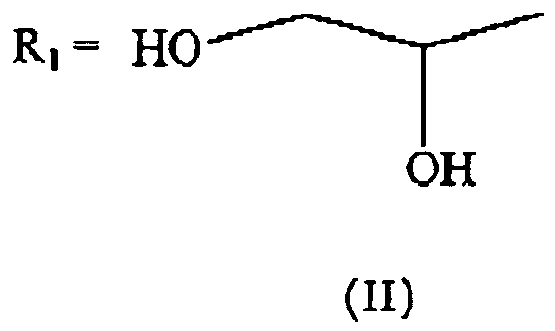

methyl, ethyl, n-propyl, i-propyl, n-butyl, i-butyl;
n is a number from 0 to 40;
m is a number from 0 to 40;
n + m is a number from 20 to 80, preferably from 20 to 40,
are stable and particularly suited for the use in the textile field. - The preferred non-ionic alkoxylated diols of the invention have the general formula I:
R1CH2O-(-CH2CH2O)n-(CH2CHCH3O)m-R2 (I)
wherein:
- The stability of the aqueous dispersions of the present invention is the more unexpected as the use of the analogue mono-functional alcohols, instead of the non-ionic alkoxylated diols, leads to the obtainment of unstable dispersions that are not suited for the industrial use.
- The polyisocyanates utilisable according to the present invention are those commercially available and containing from 2 to 10 isocyanate groups per molecule and may be either of the aromatic, or the aliphatic, or the cycloaliphatic or the mixed type.
- Examples of suitable polyisocyanates include:
- A) diisocyanates, such as 1,6-hexamethylenediisocyanate, 1-isocyanate-3-isocyanate-methyl-3,5,5-trimethyl-cyclohexane (or isophoronediisocyanate), 4,4'-dicyciohexyl-methanediisocyanate, 2,4-toluenediisocyanate either alone or in admixture with 2,6-toluenediisocyanate, 4,4'-diphenyl-methanediisocyanate, metatetramethylxilylenediisocyanate or mixtures thereof;
- B) tri- and higher-functionalised polyisocyanates, such as the compounds obtained by condensation of trimethylol propane or other polyols having functionality higher than three, and the diisocyanates of point A);
- C) compounds obtained by trimerisation, biuretisation, urethanisation or allophanation of the polyisocyanates of the points A) and B), containing at least three isocyanate groups per molecule.
- For the realisation of the present invention the preferred polyisocyanates are the isocyanurate obtained from 1,6-hexamethylenediisocyanate and the reaction product of trimethylol propane and toluenediisocyanate (its isomers 2,4 and 2,6 being in a weight ratio of 80:20).
- The blocking agents useful for the realisation of the invention are the normally used blocking agents of the reversible kind, thermally deblockable, such as the compounds containing active methylenic groups (such as the derivatives of malonic acid and its esters, acetylacetone, acetoacetic acid and its esters); oximes; ε-caprolactames and lactames; pyrazoles; imidazoles.
- The blocking agents are the ones de-blockable at a temperature of 90°-160°C.
- Particularly useful for the realisation of the present invention are oximes and pyrazoles, and more specifically butanone oxime and 3,5-dimethylpyrazole.
- According to a fundamental aspect of the invention the process for the preparation of the aqueous dispersions of non-ionic blocked polyisocyanates comprises the following steps:
- a. a polyisocyanate and a non-ionic alkoxylated diol of the general formula
R1CH2O-(-CH2CH2O)n-(CH2CHCH3O)m-R2 (I)
wherein

n is a number from 0 to 40;
m is a number from 0 to 40;
n + m is a number from 20 to 80, preferably from 20 to 40
are reacted at a temperature of 0°-120°C, their equivalent ratio being such that the percentage of free isocyanate groups in the resulting oligomer is from 3 to 10 and the percentage in weight of ethoxyl groups is from 10 to 40%, preferably from 20 to 30%; - b. the thus obtained oligomer is reacted with an amount of blocking agent such that the equivalent ratio of the isocyanate groups of the oligomer and the blocking agent is from 1:0.98 to 1:1.30, preferably from 1:1 to 1:1,20;
- c. the thus obtained mixture is dispersed into water under vigorous stirring to obtain a dispersion having a solid content of from 20 to 40% by weight, preferably from 25 to 35% by weight.
- Advantageously, step b. of the process according to the invention may be preceded by dilution of the reaction mixture obtained in a. with from 0.10 to 0.50 parts by weight of a water mixable polar solvent, said solvent being removed by distillation after completing of step c.; the preferred water mixable polar solvents are aliphatic ketones, such as methyl ethyl ketone, acetone, cyclohexanone.
- The process of the invention allows the direct preparation of non-ionic blocked polyisocyanates which are stable for at least six months at ambient temperature, without the need of emulsifiers, surfactants or external dispersants.
- The dispersions obtained according to the process of the invention can advantageously be used in the preparation of textile finishing aids, and particularly in the preparation of compositions for the oil- and/or water-repellent finishing of textiles containing organic perfluorinated polymeric compounds.
- Said polymeric compounds are those normally used for these applications; among them we cite:
- 1) homopolymers of acrylic monomers having general formula:
CnF2n+1CH2CH2OC(O)-C(R)=CH2
wherein:- R is methyl or hydrogen and n is a number from 5 to 12;
- 2) homopolymers of acrylic monomers having general formula:
CnF2n+1SO2N(R')CH2CH2OC(O)-C(R)=CH2
wherein:- R and R' are an alkyl group or hydrogen and n is a number from 5 to 12.
- 3) copolymers of the above cited fluorinated acrylic monomers with: butadiene, isoprene, chloroprene, styrene, α-methylstyrene, p-methylstyrene, vinyl halides (such as vinyl chloride, vinylidene chloride, vinylidene fluoride), vinyl esters (such as vinyl acetate, vinyl propionate, vinyl stearate), vinyl methyl ketones, esters or acrylic or methacrylic acid (such as methyl acrylate, methyl methacrylate, ethyl acrylate, ethyl methacrylate, propyl acrylate, butyl acrylate, 2-ethylhexyl acrylate or methacrylate, decyl acrylate, lauryl acrylate or methacrylate, stearyl methacrylate, N,N-dimethylaminoethyl methacrylate, 2-hydroxyethyl methacrylate, 2-hydroxypropyl methacrylate or glycidyl methacrylate), acrylamide, methacrylamide, N-methylol acrylamide, acrylonitrile, methacrylonitrile, N-substituted maleic imides, acrylates or methacrylates of ethoxylated alcohols having molecular weight smaller than 2000 daltons or mixture thereof.
- For the preparation of the compositions useful for the oil- and/or water-repellent finishing of textiles, the dispersions of the invention are normally used in an amount of from 0.1 to 10% by weight on the total weight of the composition.
- Advantageously the weight ratio between the solid fraction of the dispersion of the invention and the perfluorinated polymeric organic compounds of the oil- and/or water-repellent compositions is comprised between 1:1 and 1:15, more preferably between 1:2 and 1:7.
- The finishing step can be performed by using the conventional techniques, for example by impregnation or spray technique, at a temperature of from 80° to 110°C followed by heat treatment at 130°-200°C for 0.5 -6 minutes.
- The compositions for the oil- and/or water-repellent finishing of texiles containing the aqueous dispersions of the invention are stable and the textiles treated therewith exhibit high washing stability of the finishing.
- The aqueous dispersions of the invention are moreover particularly useful as cross-linkers for textile printing pastes.
- The textiles printed with the printing pastes including the aqueous dispersions of the invention as cross-linkers show high colour and washing fastness.
- For the preparation of the printing pastes, the aqueous dispersion of the invention are used in an amount of from 0.3 to 5% by weight, preferably of from 1 to 3.5% by weight, on the total weight of the paste.
- The examples that follow are presented to better illustrate the invention.
- In the examples the following compounds are used:
- Polyether 1 = Tegomer ® D-3403, ethoxylated diol according to the invention, having molecular weight 1220 g/mol and general formula I wherein R1 is (III), R2 is methyl, R3 is ethyl, m=0; commercialised by Th. Goldschmidt AG (DE);
- Polyether 2 = Tegomer® D-3123, ethoxylated and propoxylated diol according to the invention (EO/PO: 85/15), having molecular weight 1180 g/mol and general formula I wherein R1 is (III), R2 is methyl, R3 is ethyl; commercialised by Th. Goldschmidt AG (DE);
- Polyether 3 = polyether mono-alcohol obtained by ethoxylation of butanol, having molecular weight 1400 g/mol;
- Polyether 4 = polyether mono-alcohol obtained by ethoxylation of butanol, having molecular weight 2000 g/mol;
- Polyisocyanate 1 = Polurene® AD, reaction product of trimethylol propane and toluenediisocyanate (mixture of the isomers 2,4 and 2,6 in a ratio 80:20 by weight), having a NCO content of 13.0 ± 0,5% by weight, in ethyl acetate (with an active content of 75% by weight); commercialised by S.A.P.I.C.I. S.p.A. (Italy);
- Polyisocyanate 2 = Tolonate® HDT LV2, product of isocyanuration of 1,6-diisocyanatohexane, with an NCO content of 23.0 ± 1% by weight (active content of 100% by weight); commercialised by Rhodia (France).
- A reaction vessel, equipped with internal thermometer, stirrer and cooler, is filled, under nitrogen atmosphere and at room temperature with 200.0 g (609.756 meq) of Polyisocyanate 1 and 43.4 g of N-methylpyrrolidone, then 67.0 g (109.756 meq) of Polyether 1 are added under stirring. The reaction temperature is brought to 60°C and maintained at 60°-65°C for about two hours, until the titrimetric determination of the free NCO-groups still present gives a value of 6.8% by weight (value determined in this example as well as in the other examples according to the standard method ASTM D2572).
- The reaction mixture is diluted with 100.0 g of acetone and subsequently 52.2. g (600.000 meq) of butanone oxime are added dropwise over a period of about 1 hour, the reaction temperature not exceeding 70°C.
- After 1 hour of reaction the prepolymer is checked to be NCO-negative according to the I.R. spectrum and, at about 60 °C, 564.3 g of demineralised water are added at a high stirring speed.
- The organic solvents (ethyl acetate and acetone) are distilled off in vacuum. A stable finely divided dispersion is obtained, with solids content of 30% by weight, pH 5.58, average particle diameters of 41.4 nm (determined by Coulter N4 Plus).
- Percentage by weight of ethylene oxide groups related to the solids = 25% IR (cm-1): 3278, 2921, 1727, 1671, 1600, 1536, 1224, 1073, 997, 954, 893, 819, 766, 635, 471.
- A reaction vessel, equipped with internal thermometer, stirrer and cooler, is filled, under nitrogen atmosphere and at room temperature with 200.0 g (609.756 meq) of Polyisocyanate 1 and 43.0 g of N-methylpyrrolidone, then 64.8 g (109,756 meq) of Polyether 2 are added under stirring.
- The reaction temperature is brought to 60°C and maintained at 60°-65°C for about two hours, until the titrimetric determination of the free NCO-groups still present gives a value of 6.8% by weight.
- The reaction mixture is then diluted with 100.0 g of acetone and subsequently 52.2 g (600.000 meq) of butanone oxime are added dropwise over a period of about 1 hour, the reaction temperature not exceeding 70°C.
- After 1 hour of reaction the prepolymer is checked to be NCO-negative according to the I.R. spectrum and, at about 60 °C, 559.6 g of demineralised water are added at a high stirring speed.
- The organic solvents (ethyl acetate and acetone) are distilled off in vacuum.
- A stable milky dispersion is obtained, with solids content of 30% by weight, pH 4.86, average particle diameters of 59.7 nm (measured by Coulter N4 Plus).
- Percentage by weight of ethylene oxide groups related to the solids = 21%
- A reaction vessel, equipped with internal thermometer, stirrer and cooler, is filled, under nitrogen atmosphere and at room temperature with 200.0 g (609.756 meq) of Polyisocyanate 1 and 44.2 g of N-methylpyrrolidone, then 67.0 g (109.756 meq) of Polyether 1 are added under stirring.
- The reaction temperature is brought to 60°C and maintained at 60°-65°C for about two hours, until the titrimetric determination of the free NCO-groups still present gives a value of 6.8% by weight.
- The reaction mixture is then diluted with 100.0 g of acetone and subsequently 48.0 g (500.000 meq) of 3,5-dimethylpyrazole are added.
- After 1 hour of reaction the prepolymer is checked to be NCO-negative according to the I.R. spectrum and 574.0 g of demineralised water are added at a high stirring speed.
- The organic solvents (ethyl acetate and acetone) are distilled off in vacuum.
- A stable milky dispersion is obtained, with solids content of 30%, pH 5.84, average particle diameters of 287.4 nm (measured by Coulter N4 Plus).
- Percentage by weight of ethylene oxide groups related to the solids = 25% IR (cm-1): 3270, 2921, 1727, 1669, 1601, 1534, 1451, 1413, 1376, 1346, 1283, 1225, 1086, 1001, 968, 883, 817, 764, 744, 678, 658, 624, 508, 473,457,426.
- A reaction vessel, equipped with internal thermometer, stirrer and cooler, is filled, under nitrogen atmosphere and at room temperature with 200.0 g (609.756 meq) of Polyisocyanate 1 and 57.9 g of N-methylpyrrolidone, then 153.7 g (109.756 meq) of Polyether 3 are added under stirring.
- The reaction temperature is brought to 60°C and maintained at 60°-65°C.
- During the reaction the viscosity of the solution increases more and more, leading to gelification; the addition of 100.0 g of acetone reduces the viscosity only temporary, and the reaction is inevitably stopped.
- A reaction vessel, equipped with internal thermometer, stirrer and cooler, is filled, under nitrogen atmosphere and at room temperature with 150.0 g (819.672 meq) of Polyisocyanate 2 and 49.7 g of N-methylpyrrolidone, then 90.0 g (147.541 meq) of Polyether 1 are added under stirring.
- The reaction temperature is brought to 60°C and maintained at 60°-65°C for about two hours, until the titrimetric determination of the free NCO-groups still present gives a value of 9.8% by weight. Subsequently 64.3 g (739.344 meq) of butanone oxime are added dropwise over a period of about 1 hour, the reaction temperature not exceeding 70°C.
- After 1 hour of reaction the prepolymer is checked to be NCO-negative according to the I.R. spectrum and the reaction mixture is dispersed in 640.9 g of demineralised water at a high stirring speed.
- A dispersion is obtained with solids content of 30%, pH 5.58, average particle diameters of 275.9 nm (measured by Coulter N4 Plus).
- Percentage by weight of ethylene oxide groups related to the solids = 30%
- A reaction vessel, equipped with internal thermometer, stirrer and cooler, is filled, under nitrogen atmosphere and at room temperature with 75.0 g (409.836 meq) of Polyisocyanate 2 and 42.5 g of N-methylpyrrolidone, then 147.5 g (73.770 meq) of Polyether 4 are added under stirring.
- The reaction temperature is brought to 60°C and mantained at 60°-65°C for about two hours, until the titrimetric determination of the free NCO-groups still present gives a value of 5.3% by weight.
- Subsequently 32.3 g (336.066 meq) of 3,5-dimethylpyrazole are added slowly, the reaction temperature not exceeding 70°C.
- After 1 hour of reaction the prepolymer is checked to be NCO-negative according to the I.R. spectrum and 552.1 g of demineralised water are added at a high stirring speed.
- A coarse milky dispersion is obtained, with solids content of 30% and pH 6.19.
- After 24 hours an evident sedimentation occurs and the average particle diameters can not be measured as it exceed s the upper limit of the instrument (3000 nm).
- Percentage by weight of ethylene oxide groups related to the solids = 58%. For easy of consultation the most significant parameters of the dispersions obtained in the Example 1-6 are resumed in the following Table (Table 1).
Table 1 EX. POLYISOCYANATE POLYETHER REQ NCO/OH BLOCKING AGENT % NCO1) DISPERSION STABILITY 1 Polyisocyanate 1 Polyether 1 10/1.8 MEKO3) 8.1 YES 2 Polyisocyanate 1 Polyether 2 10/1.8 MEKO3) 8.1 YES 3 Polyisocyanate 1 Polyether 1 10/1.8 3,5-DMP4) 7.9 YES 4 Polyisocyanate 1 Polyether 3 10/1.8 MEKO3) 6.1 NO 5 Polyisocyanate 2 Polyether 1 10/1.8 MEKO3) 9.5 YES 6 Polyisocyanate 2 Polyether 4 10/1.8 3,5-DMP4) 5.5 NO2) 1) Calculated as % of available isocyanate groups after de-blocking
2) after about 2 months the dispersion is completely separated
3) Butanone oxime
4) 3,5-dimethylpirazole - Examples 7-9 resume the data obtained from the application tests conducted with the compositions for the oil- and water-repellent finishing of textiles, prepared with the dispersions described in the Examples 1, 2, 3, 5.
- The oil- and water-repellent effect was determined using the test methods described below.
- Water-repellency: the textile samples are evaluated according to AATCC-22 (Spray-test).
- The water-repellency values are given according to the following scale:
100 No wetting, nor water drops on the surface 90 No wetting, but small water drops on the surface 80 Surface wetted on spray points 70 Surface partially wet 50 Surface totally wet 0 Wetting on the entire surface and back - Oil-repellency: the textile samples are evaluated according to AATCC-118.
- The oil-repellency values are attributed according to the following scale, this test method being based on the resistance to wetting of the finished fabric by eight different liquid hydrocarbons of varying surface tension; the assessment scale in this test method covers grades from 1 to 8, grade 8 being the best (greatest repellent effect).
Oil repellency Composition 1 Liquid paraffin (Kaydol) 2 65:35- Nujol : n-hexadecane 3 n-hexadecane 4 n-tetradecane 5 n-dodecane 6 n-decane 7 n-octane 8 n-heptane - Example 10 reports the results obtained from the application tests conducted on textile samples printed with the printing pastes prepared using as cross-linkers the aqueous dispersions of the Examples 1, 2, 5.
- The colour fastness of the prints was determined according to UNI 5153, that describes a method to establish the colour fastness of prints on fabrics of every nature when abraded and the consequent discharge of colour onto other fabrics.
- The colour fastness was also determined according to UNI 7639, that describes a method to establish the colour fastness of a print on fabrics of different nature under the action of an artificial light source.
- UNI 5153 describes a test where abrasion is produced by means of a dry fabric and another test where abrasion is produced by means of a wet fabric. An elevated value means a great colour fastness of the print according to both tests.
- The values are from 1 to 5 according to UNI 5153 and from 1 to 8 according to UNI 7639. The washing fastness was also determined. The textile samples were washed 3 times at 40 °C (household washing), without intermediate drying and visually evaluated.
- Cotton fabrics are impregnated at Foulard with the following aqueous compositions for the oil- and water-repellent finishing of fabrics (Table 2, values expressed as g/l), squeezed in the padding mangle to an approximately 50% liquor pick-up, dried and baked at 150 °C for 1.5 minutes.
Table 2 Comp. A Comp. B Comp. C Comp. D Comp. E UNIDYNE®TG470(1) 27 27 27 27 27 MADEOL® NRW3(2) 1 1 1 1 1 Acetic acid (water sol. 10%) 1 1 1 1 1 Example 1 5 Example 2 5 Example 3 5 Example 5 5 (1) fluorocarbon emulsion commercialised by DAIKIN INDUSTRIES LTD (JP)
(2) surfactant commercialised by Cesalpinia Chemicals SpA (Italy) - After 24 hours of conditioning at room temperature the fabrics are tested with the oil- and water-repellency tests.
- The fabrics were also tested after repeated washing cycles.
- Washes were performed at 40° C in a domestic washing machine, using a domestic detergent and dried in tumbler at about 80° C for 60 min after each washing cycle.
- The test results are listed in the following table (Table 3).
Table 3 Test method No. of washes 0 1 3 5 Composition A AATCC 22 100 90 70/80 0 AATCC 118 4 4 2 2 Composition B AATCC 22 100 100 100 100 AATCC 118 4 6 4 3/4 Composition C AATCC 22 100 100 100 100 AATCC 118 4 6 3/4 4 Composition D AATCC 22 100 100 100 100 AATCC 118 4 6 3/4 3/4 Composition E AATCC 22 100 100 90 70 AATCC 118 3/4 4 3 2 - Polyamide fabrics are impregnated at Foulard with the following aqueous compositions for the oil- and water-repellent finishing of fabrics (Table 4, values expressed as g/l), squeezed in the padding mangle to an approximately 40% liquor pick-up, dried and baked at 150 °C for 1.5 min.
Table 4 Comp. A Comp. B Comp. C Comp. D Comp. E UNIDYNE®TG470(1) 27 27 27 27 27 MADEOLO NRW3(2) 1 1 1 1 1 Acetic acid (water solution10%) 1 1 1 1 1 Example 1 5 Example 2 5 Example 3 5 Example 5 5 (1) fluorocarbon emulsion commercialised by DAIKIN INDUSTRIES LTD (JP)
(2) surfactant commercialised by Cesalpinia Chemicals SpA (Italy) - After 24 hours of conditioning at room temperature the fabrics are tested in the oil and water repellence tests.
- The fabrics were also tested after repeated washing cycles. Washes were performed at 40 °C in a domestic washing machine, using a domestic detergent and dried in tumbler at about 80° C for 60 min. after each washing cycle. The test results are listed in the following table (Table 5).
Table 5 Test method No. of washes 0 1 3 5 Composition A AATCC 22 100 100 100 100/90 AATCC 118 3 2 1 0 Composition B AATCC 22 100 100 100 100 AATCC 118 3/4 2/3 1/2 1/2 Composition C AATCC 22 100 100 100 100 AATCC 118 3/4 2/3 1 0 Composition D AATCC 22 100 100 100 100 AATCC 118 3 1/2 1 1/2 Composition E AATCC 22 100 100 100 100 AATCC 118 2 1 1 1 - Polyester fabrics are impregnated at Foulard with the following aqueous compositions for the oil- and water-repellent finishing of fabrics (Table 6, values expressed as g/l), squeezed in the padding mangle to an approximately 30% liquor pick-up, dried and baked at 150 °C for 1.5 minutes.
Table 6 Composition Comp. A Comp. B Comp. C Comp. D Comp. E UNIDYNE®TG470(1) 27 27 27 27 27 MADEOL NRW3(2) 1 1 1 1 1 Acetic acid (water sol.10%) 1 1 1 1 1 Example 1 5 Example 2 5 Example 3 5 Example 5 5 (1) fluorocarbon emulsion commercialised by DAIKIN INDUSTRIES LTD (JP)
(2) surfactant commercialised by Cesalpinia Chemicals SpA (Italy) - After 24 hours of conditioning at room temperature the fabrics are tested in the oil- and water-repellency tests. The fabrics were also tested after repeated washing cycles. Washes were performed at 40°C in a domestic washing machine, using a domestic detergent and dried in tumbler at about 80° C for 60 min. after each washing cycle.
- The test results are listed in the following table (Table 7).
Table 7 Finish Test method After washes 0 1 3 5 Composition A AATCC 22 80 0 0 0 AATCC 118 4 1 0 0 Composition B AATCC 22 100 90 80 70 AATCC 118 3/4 2 1/2 1 Composition C AATCC 22 100 90/80 80 70/50 AATCC 118 3/4 1 1 0 Composition D AATCC 22 100 90/80 70 70/50 AATCC 118 3 1 1 0 Composition E AATCC 22 90 70 0 0 AATCC 118 1 1 1 0 - The printing pastes (paste A, B, C and D) were prepared according to the compositions listed in Table 8.
- The thus obtained printing pastes were used for silkscreen printing on four cotton fabrics.
- Printing was performed onto the Zimmer magnetic table with a 55 wires/cm screen, by means of a 6 mm roller, at a rate of 50 (grades 10÷100), a pressure of 3 (grades 1÷6), in a single step.
- After drying at 80°C, the prints were subsequently fixed at 160 °C for 3 min.
- The colour fastness of the four cotton fabrics printed with the printing pastes A-D are listed in the following Table 9.
Table 8 9 Paste A Paste B Paste C Paste D water 782 782 782 782 DEFOMEX SI (1) 3 3 3 3 Ammonia 28 Bè 5 5 5 5 Binder Neoprint L 45(2) 150 150 150 150 Clear DP-GP(3) 20 20 20 20 Blue Neoprint LBS(4) 40 40 40 40 Lerisene VHF(5) 15 Example 1 25 Example 2 25 Example 5 25 (1) Defoamer commercialised by Lamberti S.p.A (Italy)
(2) Ethyl-acrylate aqueous dispersion having an active content of 45% commercialised by Lamberti S.p.A. (Italy)
(3) Syntethic polyacrylate thickener partially neutralised with ammonia; commercialised by Lamberti S.p.A. (Italy)
(4) Water dispersion of an organic pigment (C.I. Pigment Blue 15: 1); commercialised by Lamberti S.p.A. (Italy)
(5) Melamine resin with solids content of 50%; commercialised by Lamberti S.p.A. (Italy)Table 9 Test method Evaluation Fabric printed with Paste A (comparative) UNI 5153 Dry Wet 1/2 4 UNI7639 >6* Fabric printed with Paste B UNI 5153 Dry Wet 3/4 3/4 UNI 7639 >6* Fabric printed with Paste C UNI 5153 Dry Wet 3/4 4 UNI7639 >6* Fabric printed with Paste D UNI 5153 Dry Wet 4 4 UNI 7639 >6* *After 141h of exposition the degradation of the fabric n° 6 of the blue scale begins, while the cotton fabrics printed with the Paste A-D do not show any visible degradation. - The cotton fabrics printed with the printing pastes prepared with the dispersions of this invention (Paste B, C and D) exhibit a washing fastness that is equal to that of the fabric printed with Paste A, which contains as cross-linker a standard melamine resin; they exhibit therefore a good washing fastness.
Claims (17)
- Aqueous dispersions of non-ionic -N=C=O blocked polyisocyanates obtained from the reaction of:(i) a polyisocyanate;(ii) a thermally de-blockable -N=C=O blocking agent which is deblockable at a temperature of 90°-160°C; and(iii) a non-ionic alkoxylated diol having general formula I:
R1CH2O-(-CH2CH2O)n-(CH2CHCH3O)m-R2 (I)
wherein:

methyl, ethyl, n-propyl, i-propyl, n-butyl, i-butyl;
n is a number from 0 to 40;
m is a number from 0 to 40;
n + m is a number from 20 to 80. - Aqueous dispersions of non-ionic -N=C=O blocked polyisocyanates according to claim 12, wherein n + m is a number from 20 to 40.
- Aqueous dispersions of non-ionic -N=C=O blocked polyisocyanates according to claim 12 or 22, wherein the non-ionic alkoxylated diol (iii) has the general formula I:
R1CH2O-(-CH2CH2O)n-(CH2CHCH3O)m-R2 (I)
wherein:
- Aqueous dispersions of non-ionic -N=C=O blocked polyisocyanates according to any of the preceding claims, wherein the polyisocyanate (i) is the isocyanurate obtained from 1,6-hexamethylenediisocyanate and the reaction product of trimethylol propane and toluenediisocyanate (its isomers 2,4 and 2,6 being in a weight ratio of 80:20).
- Aqueous dispersions of non-ionic -N=C=O blocked polyisocyanates according to any of the preceding claims, wherein the blocking agent (ii) is 3,5-dimethylpyrazole.
- Process for the preparation of the aqueous dispersions of non-ionic -N=C=O blocked polyisocyanates of claims from 1 to 5 comprising the following steps:a. a polyisocyanate (i) and a non-ionic alkoxylated diol (iii) of the general
R1CH2O-(-CH2CH2O)n-(CH2CHCH3O)m-R2 formula (I)
wherein

n is a number from 0 to 40;
m is a number from 0 to 40;
n + m is a number from 20 to 80,
are reacted at a temperature of 30°-120°C, their equivalent ratio being such that the percentage of free isocyanate groups in the resulting oligomer is from 3 to 10 and the percentage in weight of ethoxyl groups is from 10 to 40%;b. the thus obtained oligomer is reacted with an amount of a thermally de-blockable blocking agent which is deblockable at a temperature of 90°-160°C (ii) such that the equivalent ratio of the isocyanate groups of the oligomer and the blocking agent (ii) is from 1:0,98 to 1:1.30;c. the thus obtained mixture is dispersed into water under vigorous stirring to obtain a dispersion having a solid content of from 20 to 40% by weight. - Process for the preparation of aqueous dispersions of non-ionic -N=C=O blocked polyisocyanates according to claim 62, wherein the non-ionic alkoxylated diols (iii) have the general formula I:
R1CH2O-(-CH2CH2O)n-(CH2CHCH3O)m-R2 (I)
wherein:
- Process for the preparation of aqueous dispersions of non-ionic -N=C=O blocked polyisocyanates according to claim 62, or 72, wherein the polyisocyanate (i) is the isocyanurate obtained from 1,6-hexamethylenediisocyanate and the reaction product of trimethylol propane and toluenediisocyanate (its isomers 2,4 and 2,6 being in a weight ratio of 80:20).
- Process for the preparation of aqueous dispersions of non-ionic -N=C=O blocked polyisocyanates according to claim 62, 72, or 82, wherein the step b. is preceded by dilution of the reaction mixture obtained in a. with from 0.10 to 0.50 parts by weight of a water mixable polar solvent.
- Process for the preparation of aqueous dispersions of non-ionic -N=C=O blocked polyisocyanates according to claim 92, wherein the water mixable polar solvent is chosen among methyl ethyl ketone, acetone, cyclohexanone.
- Process for the preparation of aqueous dispersions of non-ionic -N=C=O blocked polyisocyanates according to any of the claims from 62 to 102, wherein in step a. the equivalent ratio of polyisocyanate (i) and alkoxylated diol (iii) is such that the percentage in weight of ethoxyl groups is from 20 to 30%.
- Process for the preparation of aqueous dispersions of non-ionic -N=C=O blocked polyisocyanates according to any of the claims from 62 to 112, wherein the blocking agent (ii) is chosen from butanone oxime and 3,5-dimethylpyrazole.
- process for the preparation of aqueous dispersions of non-ionic -N=C=O blocked polyisocyanates according to any of the claims from 62 to 122, wherein the amount of blocking agent (ii) is such that the equivalent ratio of the isocyanate groups of the oligomer and the blocking agent (ii) is from 1:1 to 1:1.2.
- Process for the preparation of aqueous dispersions of non-ionic -N=C=O blocked polyisocyanates according to any of the claims from 62 to 132, wherein in step c. the mixture is dispersed into water under vigorous stirring to obtain a dispersion having a solid content of from 25 to 35% by weight.
- Procedure for the oil- and/or water-repellent finishing of textiles, characterised by the fact that, as finishing agent, an aqueous composition is used, said aqueous composition comprising at least an organic perfluorinated polymeric compounds and from 0.1 to 10% by weight, on the total weight of the composition, of an aqueous dispersion of non-ionic -N=C=O blocked polyisocyanates according to any of claims from 12 to 52, the weight ratio between the solid fraction of the aqueous dispersion and the perfluorinated polymeric organic compounds being comprised between 1:1 and 1:15.
- Textile printing pastes characterised by the fact that they contain from 0.3 to 5% by weight of an aqueous dispersion according to any of claims from 12 to 5.
- Textile printing pastes characterised by the fact that they contain from 1 to 3.5% by weight of an aqueous dispersion according to any of claims from 12 to 5.
Applications Claiming Priority (3)
| Application Number | Priority Date | Filing Date | Title |
|---|---|---|---|
| IT000064A ITVA20020064A1 (en) | 2002-12-02 | 2002-12-02 | STABLE WATER DISPERSIONS OF BLOCKED NON-IONIC POLYISOCYANATES. |
| ITVA20020064 | 2002-12-02 | ||
| PCT/EP2003/050909 WO2004050736A1 (en) | 2002-12-02 | 2003-11-28 | Stable aqueous dispersions of non-ionic blocked polyisocyanates |
Publications (2)
| Publication Number | Publication Date |
|---|---|
| EP1567574A1 EP1567574A1 (en) | 2005-08-31 |
| EP1567574B1 true EP1567574B1 (en) | 2012-01-18 |
Family
ID=29766088
Family Applications (1)
| Application Number | Title | Priority Date | Filing Date |
|---|---|---|---|
| EP03796068A Expired - Lifetime EP1567574B1 (en) | 2002-12-02 | 2003-11-28 | Stable aqueous dispersions of non-ionic blocked polyisocyanates |
Country Status (13)
| Country | Link |
|---|---|
| US (1) | US20060167204A1 (en) |
| EP (1) | EP1567574B1 (en) |
| JP (1) | JP4879491B2 (en) |
| KR (1) | KR101072096B1 (en) |
| CN (1) | CN1286873C (en) |
| AT (1) | ATE541876T1 (en) |
| AU (1) | AU2003298334A1 (en) |
| BR (1) | BR0316845B1 (en) |
| CA (1) | CA2505971A1 (en) |
| ES (1) | ES2378534T3 (en) |
| IT (1) | ITVA20020064A1 (en) |
| MX (1) | MXPA05005828A (en) |
| WO (1) | WO2004050736A1 (en) |
Families Citing this family (17)
| Publication number | Priority date | Publication date | Assignee | Title |
|---|---|---|---|---|
| US20050209428A1 (en) * | 2002-06-19 | 2005-09-22 | Krishnan Tamareselvy | Breathable polyurethanes, blends, and articles |
| EP1541643B1 (en) * | 2003-12-10 | 2013-03-13 | Rohm And Haas Company | Nonionic associative thickener containing condensation polymer backbone |
| JP5042241B2 (en) * | 2006-02-24 | 2012-10-03 | チバ ホールディング インコーポレーテッド | New polyurethane dispersant |
| KR100785346B1 (en) * | 2006-06-02 | 2007-12-18 | 구자은 | Nonionic Water Dispersed Polyurethane for Leather |
| ITTO20060512A1 (en) * | 2006-07-13 | 2008-01-14 | Bridgestone Corp | WATER-BASED ADHESIVE COMPOUND FOR THE PRODUCTION OF TIRES |
| ITVA20070066A1 (en) * | 2007-07-26 | 2009-01-27 | Lamberti Spa | HYDROSPEED COMPOSITIONS OF POLYESOCYANATES |
| ES2371371T3 (en) * | 2008-10-30 | 2011-12-30 | Bridgestone Corporation | WATER BASED CEMENT TO PRODUCE TIRES. |
| IT1396614B1 (en) * | 2009-11-19 | 2012-12-14 | Stazione Sperimentale Per La Seta | PROCEDURE FOR TREATING FIBERS, IN PARTICULAR TEXTILE FIBERS, THROUGH FUNCTIONALIZATION WITH AQUEOUS NANODISPERSIONS OF URETHANE PREPOLYMERS. |
| JP5789090B2 (en) | 2010-07-30 | 2015-10-07 | 日華化学株式会社 | Water / oil repellent composition, functional fiber product and method for producing functional fiber product |
| JP5480930B2 (en) * | 2011-03-31 | 2014-04-23 | ダイキン工業株式会社 | Composition containing fluorine-containing copolymer |
| JP6328875B2 (en) * | 2012-09-26 | 2018-05-23 | 旭化成株式会社 | Aqueous block polyisocyanate, fiber treating agent composition, and fiber |
| ITUB20160513A1 (en) * | 2016-01-18 | 2017-07-18 | Lamberti Spa | INKJET WATER BASED INKS FOR INKJET PRINTING |
| CN111886271A (en) * | 2018-03-23 | 2020-11-03 | 科思创有限公司 | Aqueous curable compositions comprising dispersed uretdione prepolymers, reactants, and azoles |
| CN109517139B (en) * | 2018-11-09 | 2021-01-05 | 五邑大学 | Water dispersible polyisocyanate composition and preparation method thereof |
| JP7287795B2 (en) * | 2019-03-07 | 2023-06-06 | 旭化成株式会社 | Block polyisocyanate composition, water-based coating composition and coating film |
| EP3875511A1 (en) * | 2020-03-05 | 2021-09-08 | Covestro Deutschland AG | High temperature cross-linking dispersion |
| IT202300002157A1 (en) | 2023-02-09 | 2024-08-09 | Lamberti Spa | BLOCKED POLYISOCYANATES |
Citations (1)
| Publication number | Priority date | Publication date | Assignee | Title |
|---|---|---|---|---|
| EP0319709A1 (en) * | 1987-11-11 | 1989-06-14 | BASF Lacke + Farben AG | Method of making cathode-depositing binder dispersions with cross-linkers based on hydroxy group-blocked polyisocyanates |
Family Cites Families (17)
| Publication number | Priority date | Publication date | Assignee | Title |
|---|---|---|---|---|
| DE2314512C3 (en) * | 1973-03-23 | 1980-10-09 | Bayer Ag, 5090 Leverkusen | Thermoplastic, nonionic, water dispersible substantially linear polyurethane elastomers |
| DE3109699A1 (en) * | 1981-03-13 | 1982-09-23 | Th. Goldschmidt Ag, 4300 Essen | Process for the preparation of polymers containing pendant polyalkylene oxide chains |
| DE3267968D1 (en) * | 1981-03-13 | 1986-01-30 | Goldschmidt Ag Th | Method for the preparation of polymers containing polyoxyalkylene side chains |
| JPS6216454A (en) * | 1985-07-15 | 1987-01-24 | Dainippon Ink & Chem Inc | Blocked polyisocyanate compound, water and oil-repellent agent and treatment therewith |
| EP0498370A3 (en) * | 1991-02-04 | 1992-12-09 | Dai-Ichi Kogyo Seiyaku Co., Ltd. | Polyurethane type curable coating composition |
| US5508370A (en) * | 1991-10-17 | 1996-04-16 | Bayer Aktiengesellschaft | Water-dispersible blocked isocyanates, method of manufacture, and use thereof |
| JP2975950B2 (en) * | 1991-12-27 | 1999-11-10 | 日本メクトロン株式会社 | Water and oil repellent |
| US5700867A (en) * | 1993-10-01 | 1997-12-23 | Toyo Ink Manufacturing Co., Ltd. | Aqueous dispersion of an aqueous hydrazine-terminated polyurethane |
| DE19615116A1 (en) * | 1996-04-17 | 1997-10-23 | Bayer Ag | Aqueous or water-dilutable blocked polyisocyanates for the production of aqueous 1-component PUR clearcoats with significantly reduced thermal yellowing |
| US5789518A (en) * | 1996-05-16 | 1998-08-04 | China Textile Institute | Method for aqueous polyurethane blocking reaction |
| EP0835891B1 (en) * | 1996-10-08 | 2004-03-31 | Nippon Polyurethane Industry Co. Ltd. | Water-dispersible blocked isocyanate composition, and water-base paint composition and water base adhesive composition using the same |
| JPH10176030A (en) * | 1996-10-15 | 1998-06-30 | Sanyo Chem Ind Ltd | Production of hydrophilic polyurethane resin, and molded product and solution of the resin |
| DE19715416A1 (en) * | 1997-04-14 | 1998-10-15 | Ciba Sc Pfersee Gmbh | Reaction products of isocyanates with hydroxy compounds for textile finishing |
| ES2248987T3 (en) * | 1998-04-09 | 2006-03-16 | Clariant Finance (Bvi) Limited | BLOCKED OLIGOMER ISOCIANATES, ITS PRODUCTION AND USE. |
| DE10033097A1 (en) * | 2000-07-07 | 2002-01-17 | Degussa | Process for the production of highly reactive (semi) crystalline and amorphous blocked polyisocyanates |
| DE10042738A1 (en) * | 2000-08-31 | 2002-03-14 | Bayer Ag | Aromatic polyisocyanates blocked with pyrazole or pyrazole derivatives, process for their preparation and use |
| DE10047762A1 (en) * | 2000-09-27 | 2002-04-11 | Degussa | Powdery, water-dispersible blocked polyisocyanate adducts, a process for their preparation and their use |
-
2002
- 2002-12-02 IT IT000064A patent/ITVA20020064A1/en unknown
-
2003
- 2003-11-28 WO PCT/EP2003/050909 patent/WO2004050736A1/en not_active Ceased
- 2003-11-28 AU AU2003298334A patent/AU2003298334A1/en not_active Abandoned
- 2003-11-28 EP EP03796068A patent/EP1567574B1/en not_active Expired - Lifetime
- 2003-11-28 US US10/537,425 patent/US20060167204A1/en not_active Abandoned
- 2003-11-28 KR KR1020057010003A patent/KR101072096B1/en not_active Expired - Fee Related
- 2003-11-28 BR BRPI0316845-0A patent/BR0316845B1/en active IP Right Grant
- 2003-11-28 JP JP2004556341A patent/JP4879491B2/en not_active Expired - Fee Related
- 2003-11-28 CA CA002505971A patent/CA2505971A1/en not_active Abandoned
- 2003-11-28 MX MXPA05005828A patent/MXPA05005828A/en active IP Right Grant
- 2003-11-28 CN CNB2003801045743A patent/CN1286873C/en not_active Expired - Fee Related
- 2003-11-28 ES ES03796068T patent/ES2378534T3/en not_active Expired - Lifetime
- 2003-11-28 AT AT03796068T patent/ATE541876T1/en active
Patent Citations (1)
| Publication number | Priority date | Publication date | Assignee | Title |
|---|---|---|---|---|
| EP0319709A1 (en) * | 1987-11-11 | 1989-06-14 | BASF Lacke + Farben AG | Method of making cathode-depositing binder dispersions with cross-linkers based on hydroxy group-blocked polyisocyanates |
Also Published As
| Publication number | Publication date |
|---|---|
| BR0316845B1 (en) | 2014-01-28 |
| JP2006508226A (en) | 2006-03-09 |
| ATE541876T1 (en) | 2012-02-15 |
| ITVA20020064A1 (en) | 2004-06-03 |
| WO2004050736A1 (en) | 2004-06-17 |
| BR0316845A (en) | 2005-10-18 |
| MXPA05005828A (en) | 2005-08-29 |
| CA2505971A1 (en) | 2004-06-17 |
| AU2003298334A1 (en) | 2004-06-23 |
| CN1717426A (en) | 2006-01-04 |
| CN1286873C (en) | 2006-11-29 |
| US20060167204A1 (en) | 2006-07-27 |
| JP4879491B2 (en) | 2012-02-22 |
| KR20050085301A (en) | 2005-08-29 |
| ES2378534T3 (en) | 2012-04-13 |
| KR101072096B1 (en) | 2011-10-10 |
| EP1567574A1 (en) | 2005-08-31 |
| ITVA20020064A0 (en) | 2002-12-02 |
Similar Documents
| Publication | Publication Date | Title |
|---|---|---|
| US20060167204A1 (en) | Stable aqueous dispersions of non-ionic blocked polyisocyanates | |
| JP6435320B2 (en) | Urethane polymer extenders for compositions that modify the surface properties of substrates | |
| US5019428A (en) | Modified polyurethanes containing perfluoroaliphatic groups and use thereof | |
| US6387999B1 (en) | Compositions for the oil and water repellent finishing of fiber materials | |
| DE69909919T2 (en) | Water dispersible water and oil repellent composition | |
| EP1174484B1 (en) | Water-and-oil repellant composition and process for producing the same | |
| EP4083078A1 (en) | Water repellent composition, method for producing water repellent composition, and textile product | |
| WO2001032800A1 (en) | Aqueous dispersion for water-and-oil repellant and process for producing the same | |
| JPH06279687A (en) | Antifouling processing agent | |
| EP1595932B1 (en) | Water repellent oil repellent agent water base composition | |
| JP2006508226A5 (en) | ||
| EP3580254B1 (en) | Polymers for the hydrophobic and oleophobic finishing of textiles | |
| WO2012133622A1 (en) | Composition containing fluorinated copolymer | |
| US7037440B2 (en) | Compositions comprising polysiloxanes and further polymers | |
| EP1414882B1 (en) | Compositions of polysiloxanes, fluoropolymers and extenders | |
| DE69310156T2 (en) | DIRT REPELLENT FLUORCARBAMATE | |
| WO2024165570A1 (en) | Blocked polyisocyanates | |
| JP7469695B2 (en) | Urethane Compounds | |
| WO2024012662A1 (en) | Extender compounds for durable water repellence | |
| US20070265412A1 (en) | Extenders for fluorochemical treatment of fibrous substrates | |
| MXPA00009551A (en) | Compositions for the oil-and water repulsive finishing of textile materials | |
| JP2000129246A (en) | Water / oil repellent composition | |
| MXPA00003121A (en) | Liquid urethane compositions for textile coatings |
Legal Events
| Date | Code | Title | Description |
|---|---|---|---|
| PUAI | Public reference made under article 153(3) epc to a published international application that has entered the european phase |
Free format text: ORIGINAL CODE: 0009012 |
|
| 17P | Request for examination filed |
Effective date: 20050511 |
|
| AK | Designated contracting states |
Kind code of ref document: A1 Designated state(s): AT BE BG CH CY CZ DE DK EE ES FI FR GB GR HU IE IT LI LU MC NL PT RO SE SI SK TR |
|
| AX | Request for extension of the european patent |
Extension state: AL LT LV MK |
|
| DAX | Request for extension of the european patent (deleted) | ||
| RIN1 | Information on inventor provided before grant (corrected) |
Inventor name: CONTI, DARIO Inventor name: LI BASSI, GIUSEPPE Inventor name: DI COSMO, ANNA Inventor name: ALANZO, VITO |
|
| 17Q | First examination report despatched |
Effective date: 20070308 |
|
| REG | Reference to a national code |
Ref country code: DE Ref legal event code: R079 Ref document number: 60339786 Country of ref document: DE Free format text: PREVIOUS MAIN CLASS: C08G0018480000 Ipc: C08G0018100000 |
|
| GRAP | Despatch of communication of intention to grant a patent |
Free format text: ORIGINAL CODE: EPIDOSNIGR1 |
|
| RIC1 | Information provided on ipc code assigned before grant |
Ipc: D06M 15/568 20060101ALI20110824BHEP Ipc: C08G 18/70 20060101ALI20110824BHEP Ipc: D06P 1/52 20060101ALI20110824BHEP Ipc: D06M 15/277 20060101ALI20110824BHEP Ipc: C08G 18/80 20060101ALI20110824BHEP Ipc: C08G 18/10 20060101AFI20110824BHEP Ipc: C08G 18/48 20060101ALI20110824BHEP |
|
| GRAS | Grant fee paid |
Free format text: ORIGINAL CODE: EPIDOSNIGR3 |
|
| GRAA | (expected) grant |
Free format text: ORIGINAL CODE: 0009210 |
|
| AK | Designated contracting states |
Kind code of ref document: B1 Designated state(s): AT BE BG CH CY CZ DE DK EE ES FI FR GB GR HU IE IT LI LU MC NL PT RO SE SI SK TR |
|
| REG | Reference to a national code |
Ref country code: GB Ref legal event code: FG4D |
|
| REG | Reference to a national code |
Ref country code: CH Ref legal event code: EP |
|
| REG | Reference to a national code |
Ref country code: AT Ref legal event code: REF Ref document number: 541876 Country of ref document: AT Kind code of ref document: T Effective date: 20120215 Ref country code: IE Ref legal event code: FG4D |
|
| REG | Reference to a national code |
Ref country code: DE Ref legal event code: R096 Ref document number: 60339786 Country of ref document: DE Effective date: 20120315 |
|
| REG | Reference to a national code |
Ref country code: ES Ref legal event code: FG2A Ref document number: 2378534 Country of ref document: ES Kind code of ref document: T3 Effective date: 20120413 |
|
| REG | Reference to a national code |
Ref country code: NL Ref legal event code: T3 |
|
| PG25 | Lapsed in a contracting state [announced via postgrant information from national office to epo] |
Ref country code: BG Free format text: LAPSE BECAUSE OF FAILURE TO SUBMIT A TRANSLATION OF THE DESCRIPTION OR TO PAY THE FEE WITHIN THE PRESCRIBED TIME-LIMIT Effective date: 20120418 |
|
| PG25 | Lapsed in a contracting state [announced via postgrant information from national office to epo] |
Ref country code: PT Free format text: LAPSE BECAUSE OF FAILURE TO SUBMIT A TRANSLATION OF THE DESCRIPTION OR TO PAY THE FEE WITHIN THE PRESCRIBED TIME-LIMIT Effective date: 20120518 Ref country code: FI Free format text: LAPSE BECAUSE OF FAILURE TO SUBMIT A TRANSLATION OF THE DESCRIPTION OR TO PAY THE FEE WITHIN THE PRESCRIBED TIME-LIMIT Effective date: 20120118 Ref country code: GR Free format text: LAPSE BECAUSE OF FAILURE TO SUBMIT A TRANSLATION OF THE DESCRIPTION OR TO PAY THE FEE WITHIN THE PRESCRIBED TIME-LIMIT Effective date: 20120419 |
|
| REG | Reference to a national code |
Ref country code: AT Ref legal event code: MK05 Ref document number: 541876 Country of ref document: AT Kind code of ref document: T Effective date: 20120118 |
|
| PG25 | Lapsed in a contracting state [announced via postgrant information from national office to epo] |
Ref country code: CY Free format text: LAPSE BECAUSE OF FAILURE TO SUBMIT A TRANSLATION OF THE DESCRIPTION OR TO PAY THE FEE WITHIN THE PRESCRIBED TIME-LIMIT Effective date: 20120118 |
|
| PG25 | Lapsed in a contracting state [announced via postgrant information from national office to epo] |
Ref country code: SE Free format text: LAPSE BECAUSE OF FAILURE TO SUBMIT A TRANSLATION OF THE DESCRIPTION OR TO PAY THE FEE WITHIN THE PRESCRIBED TIME-LIMIT Effective date: 20120118 Ref country code: RO Free format text: LAPSE BECAUSE OF FAILURE TO SUBMIT A TRANSLATION OF THE DESCRIPTION OR TO PAY THE FEE WITHIN THE PRESCRIBED TIME-LIMIT Effective date: 20120118 Ref country code: SI Free format text: LAPSE BECAUSE OF FAILURE TO SUBMIT A TRANSLATION OF THE DESCRIPTION OR TO PAY THE FEE WITHIN THE PRESCRIBED TIME-LIMIT Effective date: 20120118 Ref country code: CZ Free format text: LAPSE BECAUSE OF FAILURE TO SUBMIT A TRANSLATION OF THE DESCRIPTION OR TO PAY THE FEE WITHIN THE PRESCRIBED TIME-LIMIT Effective date: 20120118 Ref country code: EE Free format text: LAPSE BECAUSE OF FAILURE TO SUBMIT A TRANSLATION OF THE DESCRIPTION OR TO PAY THE FEE WITHIN THE PRESCRIBED TIME-LIMIT Effective date: 20120118 Ref country code: DK Free format text: LAPSE BECAUSE OF FAILURE TO SUBMIT A TRANSLATION OF THE DESCRIPTION OR TO PAY THE FEE WITHIN THE PRESCRIBED TIME-LIMIT Effective date: 20120118 |
|
| PLBE | No opposition filed within time limit |
Free format text: ORIGINAL CODE: 0009261 |
|
| STAA | Information on the status of an ep patent application or granted ep patent |
Free format text: STATUS: NO OPPOSITION FILED WITHIN TIME LIMIT |
|
| PG25 | Lapsed in a contracting state [announced via postgrant information from national office to epo] |
Ref country code: SK Free format text: LAPSE BECAUSE OF FAILURE TO SUBMIT A TRANSLATION OF THE DESCRIPTION OR TO PAY THE FEE WITHIN THE PRESCRIBED TIME-LIMIT Effective date: 20120118 |
|
| 26N | No opposition filed |
Effective date: 20121019 |
|
| PG25 | Lapsed in a contracting state [announced via postgrant information from national office to epo] |
Ref country code: AT Free format text: LAPSE BECAUSE OF FAILURE TO SUBMIT A TRANSLATION OF THE DESCRIPTION OR TO PAY THE FEE WITHIN THE PRESCRIBED TIME-LIMIT Effective date: 20120118 |
|
| REG | Reference to a national code |
Ref country code: DE Ref legal event code: R097 Ref document number: 60339786 Country of ref document: DE Effective date: 20121019 |
|
| REG | Reference to a national code |
Ref country code: CH Ref legal event code: PL |
|
| GBPC | Gb: european patent ceased through non-payment of renewal fee |
Effective date: 20121128 |
|
| PG25 | Lapsed in a contracting state [announced via postgrant information from national office to epo] |
Ref country code: CH Free format text: LAPSE BECAUSE OF NON-PAYMENT OF DUE FEES Effective date: 20121130 Ref country code: LI Free format text: LAPSE BECAUSE OF NON-PAYMENT OF DUE FEES Effective date: 20121130 |
|
| REG | Reference to a national code |
Ref country code: FR Ref legal event code: ST Effective date: 20130731 |
|
| REG | Reference to a national code |
Ref country code: IE Ref legal event code: MM4A |
|
| PG25 | Lapsed in a contracting state [announced via postgrant information from national office to epo] |
Ref country code: IE Free format text: LAPSE BECAUSE OF NON-PAYMENT OF DUE FEES Effective date: 20121128 |
|
| PG25 | Lapsed in a contracting state [announced via postgrant information from national office to epo] |
Ref country code: GB Free format text: LAPSE BECAUSE OF NON-PAYMENT OF DUE FEES Effective date: 20121128 Ref country code: FR Free format text: LAPSE BECAUSE OF NON-PAYMENT OF DUE FEES Effective date: 20121130 |
|
| PG25 | Lapsed in a contracting state [announced via postgrant information from national office to epo] |
Ref country code: MC Free format text: LAPSE BECAUSE OF NON-PAYMENT OF DUE FEES Effective date: 20121130 Ref country code: TR Free format text: LAPSE BECAUSE OF FAILURE TO SUBMIT A TRANSLATION OF THE DESCRIPTION OR TO PAY THE FEE WITHIN THE PRESCRIBED TIME-LIMIT Effective date: 20120118 |
|
| PG25 | Lapsed in a contracting state [announced via postgrant information from national office to epo] |
Ref country code: LU Free format text: LAPSE BECAUSE OF NON-PAYMENT OF DUE FEES Effective date: 20121128 |
|
| PG25 | Lapsed in a contracting state [announced via postgrant information from national office to epo] |
Ref country code: HU Free format text: LAPSE BECAUSE OF FAILURE TO SUBMIT A TRANSLATION OF THE DESCRIPTION OR TO PAY THE FEE WITHIN THE PRESCRIBED TIME-LIMIT Effective date: 20031128 |
|
| PGFP | Annual fee paid to national office [announced via postgrant information from national office to epo] |
Ref country code: NL Payment date: 20211014 Year of fee payment: 19 |
|
| PGFP | Annual fee paid to national office [announced via postgrant information from national office to epo] |
Ref country code: DE Payment date: 20211005 Year of fee payment: 19 Ref country code: ES Payment date: 20211203 Year of fee payment: 19 |
|
| PGFP | Annual fee paid to national office [announced via postgrant information from national office to epo] |
Ref country code: IT Payment date: 20211018 Year of fee payment: 19 Ref country code: BE Payment date: 20211018 Year of fee payment: 19 |
|
| REG | Reference to a national code |
Ref country code: DE Ref legal event code: R119 Ref document number: 60339786 Country of ref document: DE |
|
| REG | Reference to a national code |
Ref country code: NL Ref legal event code: MM Effective date: 20221201 |
|
| REG | Reference to a national code |
Ref country code: BE Ref legal event code: MM Effective date: 20221130 |
|
| PG25 | Lapsed in a contracting state [announced via postgrant information from national office to epo] |
Ref country code: NL Free format text: LAPSE BECAUSE OF NON-PAYMENT OF DUE FEES Effective date: 20221201 |
|
| PG25 | Lapsed in a contracting state [announced via postgrant information from national office to epo] |
Ref country code: IT Free format text: LAPSE BECAUSE OF NON-PAYMENT OF DUE FEES Effective date: 20221128 Ref country code: DE Free format text: LAPSE BECAUSE OF NON-PAYMENT OF DUE FEES Effective date: 20230601 |
|
| PG25 | Lapsed in a contracting state [announced via postgrant information from national office to epo] |
Ref country code: BE Free format text: LAPSE BECAUSE OF NON-PAYMENT OF DUE FEES Effective date: 20221130 |
|
| REG | Reference to a national code |
Ref country code: ES Ref legal event code: FD2A Effective date: 20240102 |
|
| PG25 | Lapsed in a contracting state [announced via postgrant information from national office to epo] |
Ref country code: ES Free format text: LAPSE BECAUSE OF NON-PAYMENT OF DUE FEES Effective date: 20221129 |
|
| PG25 | Lapsed in a contracting state [announced via postgrant information from national office to epo] |
Ref country code: ES Free format text: LAPSE BECAUSE OF NON-PAYMENT OF DUE FEES Effective date: 20221129 |