EP1566950A1 - Folding electronic device with pair of speakers and state dependent allocation of right and left channel - Google Patents
Folding electronic device with pair of speakers and state dependent allocation of right and left channel Download PDFInfo
- Publication number
- EP1566950A1 EP1566950A1 EP05075348A EP05075348A EP1566950A1 EP 1566950 A1 EP1566950 A1 EP 1566950A1 EP 05075348 A EP05075348 A EP 05075348A EP 05075348 A EP05075348 A EP 05075348A EP 1566950 A1 EP1566950 A1 EP 1566950A1
- Authority
- EP
- European Patent Office
- Prior art keywords
- speakers
- pair
- output
- switch
- amplifiers
- Prior art date
- Legal status (The legal status is an assumption and is not a legal conclusion. Google has not performed a legal analysis and makes no representation as to the accuracy of the status listed.)
- Granted
Links
Images


Classifications
-
- H—ELECTRICITY
- H04—ELECTRIC COMMUNICATION TECHNIQUE
- H04M—TELEPHONIC COMMUNICATION
- H04M1/00—Substation equipment, e.g. for use by subscribers
- H04M1/02—Constructional features of telephone sets
- H04M1/0202—Portable telephone sets, e.g. cordless phones, mobile phones or bar type handsets
- H04M1/0206—Portable telephones comprising a plurality of mechanically joined movable body parts, e.g. hinged housings
- H04M1/0241—Portable telephones comprising a plurality of mechanically joined movable body parts, e.g. hinged housings using relative motion of the body parts to change the operational status of the telephone set, e.g. switching on/off, answering incoming call
- H04M1/0245—Portable telephones comprising a plurality of mechanically joined movable body parts, e.g. hinged housings using relative motion of the body parts to change the operational status of the telephone set, e.g. switching on/off, answering incoming call using open/close detection
-
- H—ELECTRICITY
- H04—ELECTRIC COMMUNICATION TECHNIQUE
- H04M—TELEPHONIC COMMUNICATION
- H04M1/00—Substation equipment, e.g. for use by subscribers
- H04M1/02—Constructional features of telephone sets
- H04M1/03—Constructional features of telephone transmitters or receivers, e.g. telephone hand-sets
-
- H—ELECTRICITY
- H04—ELECTRIC COMMUNICATION TECHNIQUE
- H04M—TELEPHONIC COMMUNICATION
- H04M1/00—Substation equipment, e.g. for use by subscribers
- H04M1/02—Constructional features of telephone sets
- H04M1/0202—Portable telephone sets, e.g. cordless phones, mobile phones or bar type handsets
- H04M1/0206—Portable telephones comprising a plurality of mechanically joined movable body parts, e.g. hinged housings
- H04M1/0208—Portable telephones comprising a plurality of mechanically joined movable body parts, e.g. hinged housings characterized by the relative motions of the body parts
- H04M1/0214—Foldable telephones, i.e. with body parts pivoting to an open position around an axis parallel to the plane they define in closed position
-
- H—ELECTRICITY
- H04—ELECTRIC COMMUNICATION TECHNIQUE
- H04M—TELEPHONIC COMMUNICATION
- H04M1/00—Substation equipment, e.g. for use by subscribers
- H04M1/72—Mobile telephones; Cordless telephones, i.e. devices for establishing wireless links to base stations without route selection
- H04M1/724—User interfaces specially adapted for cordless or mobile telephones
- H04M1/72403—User interfaces specially adapted for cordless or mobile telephones with means for local support of applications that increase the functionality
- H04M1/72442—User interfaces specially adapted for cordless or mobile telephones with means for local support of applications that increase the functionality for playing music files
-
- H—ELECTRICITY
- H04—ELECTRIC COMMUNICATION TECHNIQUE
- H04M—TELEPHONIC COMMUNICATION
- H04M2250/00—Details of telephonic subscriber devices
- H04M2250/12—Details of telephonic subscriber devices including a sensor for measuring a physical value, e.g. temperature or motion
-
- H—ELECTRICITY
- H04—ELECTRIC COMMUNICATION TECHNIQUE
- H04M—TELEPHONIC COMMUNICATION
- H04M2250/00—Details of telephonic subscriber devices
- H04M2250/16—Details of telephonic subscriber devices including more than one display unit
-
- H—ELECTRICITY
- H04—ELECTRIC COMMUNICATION TECHNIQUE
- H04R—LOUDSPEAKERS, MICROPHONES, GRAMOPHONE PICK-UPS OR LIKE ACOUSTIC ELECTROMECHANICAL TRANSDUCERS; ELECTRIC HEARING AIDS; PUBLIC ADDRESS SYSTEMS
- H04R2205/00—Details of stereophonic arrangements covered by H04R5/00 but not provided for in any of its subgroups
- H04R2205/024—Positioning of loudspeaker enclosures for spatial sound reproduction
-
- H—ELECTRICITY
- H04—ELECTRIC COMMUNICATION TECHNIQUE
- H04R—LOUDSPEAKERS, MICROPHONES, GRAMOPHONE PICK-UPS OR LIKE ACOUSTIC ELECTROMECHANICAL TRANSDUCERS; ELECTRIC HEARING AIDS; PUBLIC ADDRESS SYSTEMS
- H04R2499/00—Aspects covered by H04R or H04S not otherwise provided for in their subgroups
- H04R2499/10—General applications
- H04R2499/11—Transducers incorporated or for use in hand-held devices, e.g. mobile phones, PDA's, camera's
-
- H—ELECTRICITY
- H04—ELECTRIC COMMUNICATION TECHNIQUE
- H04R—LOUDSPEAKERS, MICROPHONES, GRAMOPHONE PICK-UPS OR LIKE ACOUSTIC ELECTROMECHANICAL TRANSDUCERS; ELECTRIC HEARING AIDS; PUBLIC ADDRESS SYSTEMS
- H04R5/00—Stereophonic arrangements
- H04R5/02—Spatial or constructional arrangements of loudspeakers
-
- H—ELECTRICITY
- H04—ELECTRIC COMMUNICATION TECHNIQUE
- H04S—STEREOPHONIC SYSTEMS
- H04S1/00—Two-channel systems
- H04S1/002—Non-adaptive circuits, e.g. manually adjustable or static, for enhancing the sound image or the spatial distribution
Definitions
- the present invention relates to a folding electronic device and, more particularly, to a folding electronic device including left- and right-channel speakers which can be driven independently.
- cellular phones For the purpose of improving portability, most types of portable electronic devices (to be also simply referred to as electronic devices hereinafter) such as cellular phones are configured such that a display unit which displays character information or image information and an operation unit on which keys for information input are arranged are integrated into a foldable unit.
- a display unit which displays character information or image information
- an operation unit on which keys for information input are arranged are integrated into a foldable unit.
- some current folding cellular phones have a music function as well as a telephone function.
- cellular phones with a music function popular cellular phones are those which include left- and right-channel speakers which can be driven independently and are designed to improve acoustic quality by outputting stereo sounds.
- a folding cellular phone having such an arrangement allows the user to enjoy stereo sounds while watching images on the display unit by driving the left- and right-channel speakers even in the closed state of the cellular phone in which it is folded as well as in the opened state in which the cellular phone is not folded.
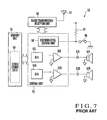
- a conventional folding cellular phone 50 having left- and right-channel speakers which can be driven independently includes a radio transmission/reception unit 52 which transmits/receives radio signals through an extendible transmission/reception antenna 51, a control unit 53 which forms the main part of the cellular phone 50, a memory unit 55 which stores external sound source data downloaded through the radio transmission/reception unit 52, internal sound source data, and the like as sound source data 54, a detection switch 56 which detects the opened or closed state of the cellular phone 50, and a left(L)-channel speaker 57L and right(R)-channel speaker 57R which can be driven independently.
- a radio transmission/reception unit 52 which transmits/receives radio signals through an extendible transmission/reception antenna 51
- a control unit 53 which forms the main part of the cellular phone 50
- a memory unit 55 which stores external sound source data downloaded through the radio transmission/reception unit 52, internal sound source data, and the like as sound source data 54
- a detection switch 56 which detects the opened or closed state
- the control unit 53 is comprised of a switching control unit 58 formed of a CPU (Central Processing Unit) which controls the switching operation of a switch (to be described later) in accordance with the detection result obtained by the detection switch 56, a left-channel DA (Digital to Analog) converter 59L and right-channel DA converter 59R which convert the sound source data 54 stored in the memory unit 55 into analog data, and a left-channel amplifier 60L and right-channel amplifier 60R which respectively amplify outputs from the DA converters 59L and 59R.
- Reference numeral 61 denotes a pull-up resistor connected to a power supply; and 62L and 62R, capacitors.
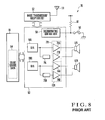
- FIG. 8 shows another conventional cellular phone having left- and right-channel amplifiers formed of BTL (Balanced Transformerless Amplifier) amplifiers.
- a folding cellular phone 70 includes a left-channel BTL amplifier 72L and right-channel BTL amplifier 72R.
- the BTL amplifier 72L is comprised of first and second amplifiers 71A and 71B which amplify an output from the left-channel DA converter 59L.
- the BTL amplifier 72R is comprised of third and fourth amplifiers 74A and 74B which amplify an output from the right-channel DA converter 59R.
- Phase inversion circuits 75L and 75R are respectively connected to the input terminals of the amplifier 71B of the BTL amplifier 72L and the amplifier 74B of the BTL amplifier 72R. Except for this, the arrangement of this cellular phone is almost the same as that shown in Fig. 7. Therefore, the same reference numerals as in Fig. 7 denote the same components in Fig. 8, and a description thereof will be
- sounds output from the speakers 57L and 57R flow in laterally opposite directions in the opened state and closed state.
- stereo sounds are output from the speakers 57L and 57R in synchronism with images on the display unit, and hence natural sounds can be produced in terms of human hearing sense like sounds produced when a car passes by.
- output stereo sounds are not synchronized with images. For this reason, the sounds inevitably become unnatural in terms of human hearing sense.
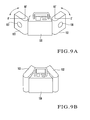
- a main body 100 includes left and right speaker boxes 103 and 102 respectively housing speakers 107 and 106, which are provided on side surfaces of the main body so as to be pivotal in the back-and-forth direction as indicated by the arrows.
- This audio set is provided with an angle detection means (not shown) for detecting a state in which the boxes 103 and 102 pivot backward through 90° or more as shown in Fig. 9B.
- the angle detection means detects that both the left and right speaker boxes 103 and 102 have pivoted backward through 90° or more, drive signals to the speakers 107 and 106 are interchanged.
- the speaker boxes 103 and 102 are configured to pivot backward through 90° or more from the open state to the closed state. For this reason, only when the speaker boxes 103 and 102 have pivoted through 90° or more, drive signals to the speakers 107 and 106 must be interchanged. This complicates the control.
- the audio set disclosed in reference 2 is directed to an electronic device which is not required to have portability in terms of size, weight, and the like and allowed to include the speaker boxes 103 and 102 housing the speakers 107 and 106. It is difficult for an electronic device required to satisfy conditions for excellent portability in terms of size, weight, and the like to include the speaker boxes 103 and 102 housing the speakers 107 and 106. Even if a device includes the speaker boxes 103 and 102, it is practically impossible to pivot the speaker boxes 103 and 102 to the back side of the main body.
- a folding electronic device comprising an operation unit on which a plurality of information input keys are arranged, a display unit which is integrated with the operation unit so as to be foldable, and displays at least image information, a memory unit in which sound source data is stored, a pair of speakers for a left channel and a right channel which can be driven in a closed state in which the display unit is folded, a detection switch which detects an open state in which the display unit is not folded or the closed state in which the display unit is folded, and a switch which switches paths through which the sound source data stored in the memory unit is output to the pair of speakers on the basis of an output from the detection switch.
- a folding electronic device according to the first embodiment of the present invention will be described with reference to Figs. 1 to 3.
- a cellular phone will be described as an example of the electronic device.
- a folding cellular phone 10 includes a radio transmission/reception unit 2 which transmits/receives radio signals through an extendible transmission/reception antenna 1, a control unit 3 which forms the main part of the folding cellular phone 10, a memory unit 5 which stores external sound source data downloaded by the radio transmission/reception unit 2, internal sound source data, and the like as sound source data 4, a detection switch 6 which detects the opened state or closed state of the cellular phone 10, and a left(L)-channel speaker 7L and right(R)-channel speaker 7R which are provided on the left and right sides of the lower portion of a display unit (to be described later) and can be driven independently.
- a radio transmission/reception unit 2 which transmits/receives radio signals through an extendible transmission/reception antenna 1
- a control unit 3 which forms the main part of the folding cellular phone 10
- a memory unit 5 which stores external sound source data downloaded by the radio transmission/reception unit 2, internal sound source data, and the like as sound source data 4
- a detection switch 6 which detects
- the control unit 3 is comprised of a switching control unit 8 formed of a CPU which controls the switching operation of a switch (to be described later) in accordance with the detection result obtained by the detection switch 6, a left-channel DA converter 9L and right-channel DA converter 9R which convert the sound source data 4 stored in the memory unit 5 into analog data, a left-channel amplifier 11L and right-channel amplifier 11R which respectively amplify outputs from the DA converters 9L and 9R, and a switch 12 which is controlled by the switching control unit 8 to perform switching operation of selectively connecting the outputs of the amplifiers 11L and 11R to the speakers 7L and 7R or the speakers 7R and 7L.
- a switching control unit 8 formed of a CPU which controls the switching operation of a switch (to be described later) in accordance with the detection result obtained by the detection switch 6, a left-channel DA converter 9L and right-channel DA converter 9R which convert the sound source data 4 stored in the memory unit 5 into analog data, a left-channel amplifier 11L
- the switch 12 is connected between the amplifiers 11L and 11R and the speakers 7L and 7R and includes a first movable contact piece 12A which is normally connected to the speaker 7L, and a second movable contact piece 12B which is normally connected to the speaker 7R.
- Reference numeral 13 denotes a pull-up resistor connected to a power supply; 14L, a left-channel capacitor connected between the movable contact piece 12A and the speaker 7L; and 14R, a right-channel capacitor connected between the movable contact piece 12B and the speaker 7R.
- the switching control unit 8 performs control to connect the movable contact pieces 12A and 12B of the switch 12 to the amplifiers 11L and 11R, respectively.
- the folding cellular phone 10 of this embodiment is configured such that a display unit 15 and operation unit 16 are integrated into a foldable unit, and includes the speakers 7L and 7R which can be driven independently, as described above.
- the foldable display unit 15 has two display surfaces 15a and 15b on the inner surface side (the inner side in the folded state) and the outer surface side (the outer side in the folded state). Identical images are simultaneously displayed or switched/displayed on the display surfaces 15a and 15b. In this case, the images on the display surfaces 15a and 15b are rightside left.
- the switching control unit 8 When the detection switch 6 detects the closed state of the cellular phone, the switching control unit 8 performs control to connect the movable contact pieces 12A and 12B of the switch 12 to the amplifiers 11R and 11L, respectively. This forms a path through which the output of the DA converter 9L is connected to the speaker 7R through the amplifier 11L and the movable contact piece 12B of the switch 12. A path is also formed through which the output of the DA converter 9R is connected to the speaker 7L through the amplifier 11R and the movable contact piece 12A of the switch 12.
- the folding cellular phone of this embodiment is configured such that the display unit and operation unit are integrated into a foldable unit, and includes the left- and right-channel speakers which can be driven independently. According to this embodiment, since outputs from the speakers 7L and 7R are laterally switched in the opened state and the closed state, stereo sounds synchronized with images are output even in the closed state as in the open state. Therefore, natural sounds can be produced in terms of human hearing sense.
- FIG. 4 A folding electronic device according to the second embodiment of the present invention will be described next with reference to Fig. 4.
- the folding electronic device of this embodiment differs from that of the first embodiment in that a switch is connected between DA converters 9L and 9R and amplifiers 11L and 11R.
- a cellular phone will be described as an example of the electronic device.
- a switch 12 is connected to the input stages of the channel amplifiers 11L and 11R. That is, the switch 12 switches and connects the DA converters 9L and 9R to the amplifiers 11L and 11R under the control of the switching control unit 8. With this operation, outputs from the DA converters 9L and 9R are switched and output from speakers 7L and 7R through the amplifiers 11L and 11R.
- a folding electronic device according to the third embodiment of the present invention will be described next with reference to Fig. 5.
- the folding electronic device of this embodiment differs from that of the first embodiment in that amplifiers are formed of BTL amplifiers.
- a folding cellular phone 30 includes a left-channel BTL amplifier 18L comprised of a pair of parallel-connected amplifiers 17A and 17B which amplify an output from a DA converter 9L, and a right-channel BTL amplifier 18R comprised of a pair of parallel-connected amplifiers 19A and 19B which amplify an output from a DA converter 9R.
- Phase inversion circuits 22L and 22R are respectively connected to the input stage of the parallel-connected amplifier 17B of the BTL amplifier 18L and the input stage of the parallel-connected amplifier 19B of the BTL amplifier 18R.
- a switch 23 controlled by a switching control unit 8 has a first movable contact piece 23A and second movable contact piece 23B which are normally connected to a speaker 7L, and a third movable contact piece 23C and fourth movable contact piece 23D which are normally connected to a speaker 7R.
- the movable contact pieces 23A and 23C are switched to select either the amplifier 17A of the BTL amplifier 18L or the amplifier 19A of the BTL amplifier 18L.
- the movable contact pieces 23B and 23D are switched to select either the amplifier 17B of the BTL amplifier 18L or the amplifier 19B of the BTL amplifier 18R.
- the amplifiers 18L and 18R voltages applied to the loads are doubled according to the driving scheme for the amplifiers. Therefore, the amplifiers can supply four-fold output power. This makes it possible to obtain a large output with a low power supply voltage.
- the switching control unit 8 when a detection switch 6 detects the open state of the cellular phone, the switching control unit 8 performs control to connect the movable contact pieces 23A and 23B of the switch 23 to the amplifiers 17A and 17B of the BTL amplifier 18L, respectively.
- the switching control unit 8 also performs control to connect the movable contact pieces 23C and 23D to the amplifiers 19A and 19B of the BTL amplifier 18R.
- This forms a path through which the output of the DA converter 9L is connected to the speaker 7L through the BTL amplifier 18L and the movable contact pieces 23A and 23B of the switch 23.
- a path is also formed through which the output of the DA converter 9R is connected to the speaker 7R through the BTL amplifier 18R and the movable contact pieces 23C and 23D of the switch 23.
- left- and right-channel sounds are output from the speakers 7L and 7R, respectively, in synchronism with images on a display surface 15a of a display unit 15. Since stereo sounds matching images can be obtained from the speakers 7L and 7R in this manner, natural sounds can be produced in terms of human hearing sense.
- the switching control unit 8 When a detection switch 6 detects the closed state of the cellular phone, the switching control unit 8 performs control to connect the movable contact pieces 23A and 23B of the switch 23 to the amplifiers 19A and 19B of the BTL amplifier 18R, respectively. The switching control unit 8 also performs control to connect the movable contact pieces 23C and 23D to the amplifiers 17A and 17B of the BTL amplifier 18L. This forms a path through which the output of the DA converter 9L is connected to the speaker 7R through the BTL amplifier 18L and the movable contact pieces 23C and 23D of the switch 23. A path is also formed through which the output of the DA converter 9R is connected to the speaker 7L through the BTL amplifier 18R and the movable contact pieces 23A and 23B of the switch 23.
- a folding electronic device according to the fourth embodiment of the present invention will be described next with reference to Fig. 6.
- the folding electronic device differs from that of the third embodiment in that a switch is connected to the input stage of each amplifier.
- a switch 12 is connected to the input stages of BTL amplifiers 18L and 18R. That is, the switch 12 switches and connects DA converters 9L and 9R to the BTL amplifiers 18L and 18R under the control of a switching control unit 8. With this operation, outputs from the DA converters 9L and 9R are switched and output to speakers 7L and 7R through the BTL amplifiers 18L and 18R.
- the present invention is applied to a cellular phone.
- the present invention is not limited to cellular phones and can be applied to electronic devices in general, e.g., PDAs (Personal Digital Assistants) and portable GPS (Global Positioning Systems).
- an electronic device which is configured such that a display unit and operation unit are integrated into a foldable unit, and includes left- and right-channel speakers which can be driven independently, stereo sounds synchronized with images on a display surface are output even in the closed state in the same manner as in the open state, thereby producing natural sounds in terms of human hearing sense.
Landscapes
- Engineering & Computer Science (AREA)
- Signal Processing (AREA)
- Telephone Function (AREA)
- Circuit For Audible Band Transducer (AREA)
- Stereophonic Arrangements (AREA)
- Telephone Set Structure (AREA)
- Details Of Audible-Bandwidth Transducers (AREA)
Abstract
Description
Claims (10)
- A folding electronic device characterized by comprising:an operation unit (16) on which a plurality of information input keys are arranged;a display unit (15) which is integrated with said operation unit so as to be foldable, and displays at least image information;a memory unit (5) in which sound source data is stored;a pair of speakers (7L, 7R) for a left channel and a right channel which can be driven in a closed state in which said display unit is folded;a detection switch (6) which detects an open state in which said display unit is not folded or the closed state in which said display unit is folded; anda switch (12, 23) which switches paths through which the sound source data stored in said memory unit is output to said pair of speakers on the basis of an output from said detection switch.
- A device according to claim 1, further comprising a switching control unit which receives an output from said detection switch and controls switching operation of said switch in accordance with a detection result obtained by said detection switch.
- A device according to claim 1, further comprising:a pair of DA converters (9L, 9R) which convert the sound source.data stored in said memory unit into data for the left channel and the right channel; anda pair of amplifiers (11L, 11R) which amplify outputs from said pair of DA converters and output the outputs to said pair of speakers, respectively.
- A device according to claim 3, wherein said switch is connected between said pair of amplifiers and said pair of speakers.
- A device according to claim 3, wherein said switch is connected between said pair of DA converters and said pair of amplifiers.
- A device according to claim 2, wherein said switch includes a first movable contact piece (12A) which is normally connected to one of said pair of speakers, and a second movable contact piece (12B) which is normally connected to the other of said pair of speakers.
- A device according to claim 6, wherein when said detection switch detects the open state of said display unit, said switching control controls said switch to form a path through which an output from one of said DA converters which corresponds to the left channel is output, through the first movable contact piece, to one of said speakers which corresponds to the left channel, and to form a path through which an output from the other of said DA converters which corresponds to the right channel is output, through the second movable contact piece, to the other of said speakers which corresponds to the right channel.
- A device according to claim 6, wherein said switching control unit detects the closed state of said display unit, said switching control controls said switch to form a path through which an output from one of said DA converters which corresponds to the left channel is output, through the second movable contact piece, to one of said speakers which corresponds to the right channel, and to form a path through which an output from the other of said DA converters which corresponds to the right channel is output, through the first movable contact piece, to the other of said speakers which corresponds to the left channel.
- A device according to claim 3, wherein each of said amplifiers comprises a balanced transformerless (BTL) amplifier (18L, 18R) having a pair of parallel-connected amplifiers (17A, 17B; 19A, 19B)..
- A device according to claim 9, further comprising a pair of phase inversion circuits (22L, 22R) connected to one of said parallel-connected amplifiers which form said BTL amplifier corresponding to the left channel, and one of said parallel-connected amplifiers which form said BTL amplifier corresponding to the right channel.
Applications Claiming Priority (2)
| Application Number | Priority Date | Filing Date | Title |
|---|---|---|---|
| JP2004045362A JP3990365B2 (en) | 2004-02-20 | 2004-02-20 | Foldable electronics |
| JP2004045362 | 2004-02-20 |
Publications (2)
| Publication Number | Publication Date |
|---|---|
| EP1566950A1 true EP1566950A1 (en) | 2005-08-24 |
| EP1566950B1 EP1566950B1 (en) | 2006-11-08 |
Family
ID=34709165
Family Applications (1)
| Application Number | Title | Priority Date | Filing Date |
|---|---|---|---|
| EP05075348A Expired - Lifetime EP1566950B1 (en) | 2004-02-20 | 2005-02-09 | Folding electronic device with pair of speakers and state dependent allocation of right and left channel |
Country Status (5)
| Country | Link |
|---|---|
| US (1) | US7668324B2 (en) |
| EP (1) | EP1566950B1 (en) |
| JP (1) | JP3990365B2 (en) |
| CN (1) | CN100438534C (en) |
| DE (1) | DE602005000232T8 (en) |
Cited By (2)
| Publication number | Priority date | Publication date | Assignee | Title |
|---|---|---|---|---|
| EP1773030A3 (en) * | 2006-01-04 | 2007-07-18 | Samsung Electronics Co., Ltd. | Foldable portable terminal with a hinge which allows several angle positions of the two housings |
| EP3748490A1 (en) * | 2019-06-03 | 2020-12-09 | Nokia Technologies Oy | Controlling audio processing |
Families Citing this family (8)
| Publication number | Priority date | Publication date | Assignee | Title |
|---|---|---|---|---|
| US20070047748A1 (en) * | 2005-08-29 | 2007-03-01 | Del Rusher | Cycle sound system |
| TWM327610U (en) * | 2007-07-13 | 2008-02-21 | Princeton Technology Corp | Audio control apparatus |
| CN103517187B (en) * | 2012-06-29 | 2015-09-23 | 联想(北京)有限公司 | A method and electronic device for controlling sound output |
| US9543913B2 (en) * | 2013-01-09 | 2017-01-10 | Osc, Llc | Programmably configured switchmode audio amplifier |
| WO2016060303A1 (en) * | 2014-10-17 | 2016-04-21 | 크레신 주식회사 | Stereo automatic conversion audio output device |
| JP7204440B2 (en) * | 2018-11-21 | 2023-01-16 | 株式会社東芝 | power amplifier |
| CN109462800A (en) * | 2018-12-28 | 2019-03-12 | 北京小米移动软件有限公司 | A kind of electronic equipment with two-channel |
| CN110581907B (en) * | 2019-08-27 | 2021-07-20 | Oppo广东移动通信有限公司 | Electronic device and sound transmission method thereof |
Citations (5)
| Publication number | Priority date | Publication date | Assignee | Title |
|---|---|---|---|---|
| US5214514A (en) * | 1989-08-07 | 1993-05-25 | Ottmar Haberkern | Compact video/sound apparatus with foldable screen |
| JP2001177609A (en) * | 1999-12-21 | 2001-06-29 | Yamaha Corp | Portable telephone set |
| JP2002078073A (en) * | 2000-08-25 | 2002-03-15 | Kenwood Corp | All-in-one audio set |
| JP2003198696A (en) * | 2001-12-26 | 2003-07-11 | Foster Electric Co Ltd | Mobile phone |
| JP2004056408A (en) * | 2002-07-19 | 2004-02-19 | Hitachi Ltd | Mobile phone terminals |
Family Cites Families (7)
| Publication number | Priority date | Publication date | Assignee | Title |
|---|---|---|---|---|
| KR100206333B1 (en) | 1996-10-08 | 1999-07-01 | 윤종용 | Device and method for the reproduction of multichannel audio using two speakers |
| US5986634A (en) * | 1996-12-11 | 1999-11-16 | Silicon Light Machines | Display/monitor with orientation dependent rotatable image |
| CA2376034A1 (en) * | 1999-07-09 | 2001-01-18 | Louis L. Walker | Polymerization of alkylene oxides using metal cyanide catalysts and unsaturated initiator compounds |
| JP3636057B2 (en) | 2000-10-13 | 2005-04-06 | ソニー株式会社 | Portable information processing apparatus, information processing method in portable information processing apparatus, and program storage medium in portable information processing apparatus |
| JP4516248B2 (en) | 2001-08-31 | 2010-08-04 | 株式会社日立製作所 | Mobile device |
| JP4422941B2 (en) | 2002-01-18 | 2010-03-03 | 株式会社ケンウッド | Sound field adjustment device |
| JP4283074B2 (en) | 2003-09-11 | 2009-06-24 | 京セラ株式会社 | Mobile phone |
-
2004
- 2004-02-20 JP JP2004045362A patent/JP3990365B2/en not_active Expired - Fee Related
-
2005
- 2005-02-09 DE DE602005000232T patent/DE602005000232T8/en active Active
- 2005-02-09 EP EP05075348A patent/EP1566950B1/en not_active Expired - Lifetime
- 2005-02-10 US US11/054,425 patent/US7668324B2/en not_active Expired - Fee Related
- 2005-02-18 CN CNB200510009464XA patent/CN100438534C/en not_active Expired - Fee Related
Patent Citations (5)
| Publication number | Priority date | Publication date | Assignee | Title |
|---|---|---|---|---|
| US5214514A (en) * | 1989-08-07 | 1993-05-25 | Ottmar Haberkern | Compact video/sound apparatus with foldable screen |
| JP2001177609A (en) * | 1999-12-21 | 2001-06-29 | Yamaha Corp | Portable telephone set |
| JP2002078073A (en) * | 2000-08-25 | 2002-03-15 | Kenwood Corp | All-in-one audio set |
| JP2003198696A (en) * | 2001-12-26 | 2003-07-11 | Foster Electric Co Ltd | Mobile phone |
| JP2004056408A (en) * | 2002-07-19 | 2004-02-19 | Hitachi Ltd | Mobile phone terminals |
Non-Patent Citations (4)
| Title |
|---|
| PATENT ABSTRACTS OF JAPAN vol. 2000, no. 23 10 February 2001 (2001-02-10) * |
| PATENT ABSTRACTS OF JAPAN vol. 2002, no. 07 3 July 2002 (2002-07-03) * |
| PATENT ABSTRACTS OF JAPAN vol. 2003, no. 11 5 November 2003 (2003-11-05) * |
| PATENT ABSTRACTS OF JAPAN vol. 2003, no. 12 5 December 2003 (2003-12-05) * |
Cited By (3)
| Publication number | Priority date | Publication date | Assignee | Title |
|---|---|---|---|---|
| EP1773030A3 (en) * | 2006-01-04 | 2007-07-18 | Samsung Electronics Co., Ltd. | Foldable portable terminal with a hinge which allows several angle positions of the two housings |
| EP3748490A1 (en) * | 2019-06-03 | 2020-12-09 | Nokia Technologies Oy | Controlling audio processing |
| US11487496B2 (en) | 2019-06-03 | 2022-11-01 | Nokia Technologies Oy | Controlling audio processing |
Also Published As
| Publication number | Publication date |
|---|---|
| CN100438534C (en) | 2008-11-26 |
| US7668324B2 (en) | 2010-02-23 |
| DE602005000232T8 (en) | 2007-12-06 |
| DE602005000232T2 (en) | 2007-08-23 |
| JP2005236811A (en) | 2005-09-02 |
| US20050187645A1 (en) | 2005-08-25 |
| DE602005000232D1 (en) | 2006-12-21 |
| CN1658629A (en) | 2005-08-24 |
| EP1566950B1 (en) | 2006-11-08 |
| JP3990365B2 (en) | 2007-10-10 |
Similar Documents
| Publication | Publication Date | Title |
|---|---|---|
| US7050767B2 (en) | Mobile computing devices having rotationally exposed user interface devices | |
| US7047052B2 (en) | Cellular phone terminal | |
| JP2003032351A (en) | Cradle device and audio reproduction method thereof | |
| EP1566950B1 (en) | Folding electronic device with pair of speakers and state dependent allocation of right and left channel | |
| GB2381167A (en) | Display control in a dual display foldable mobile terminal | |
| WO2003079650A1 (en) | Speaker system | |
| KR20030059524A (en) | Apparatus and method of sound signal output of mobile station | |
| EP0651546A1 (en) | Cellular radio telephone set | |
| US20050249373A1 (en) | Portable device | |
| JP3631119B2 (en) | Wireless information terminal | |
| US20060067547A1 (en) | Stereo portable electronic device | |
| CN1816218B (en) | Mobile terminal with at least two transducers | |
| JP2004056188A (en) | Foldable mobile telephone | |
| CN117119089A (en) | Foldable electronic device and sound leakage cancellation method | |
| JP4055816B1 (en) | Signal adapter | |
| JP4437437B2 (en) | Mobile communication terminal | |
| JP2004096573A (en) | Folding portable telephone | |
| KR100705031B1 (en) | Mobile terminal | |
| KR100652555B1 (en) | Portable audio output device | |
| JP2003348205A (en) | Portable radio | |
| EP1355510A2 (en) | Loudspeaker arrangement and switching apparatus therefor | |
| KR100877269B1 (en) | Speaker-receiver-microphone integrated device and mode switching method of mobile communication terminal and mobile communication terminal using same | |
| JP2003273989A (en) | Portable telephone set | |
| KR20060088295A (en) | Terminal equipped with sound reproducing means and stereoscopic sound reproducing method | |
| JP2005223507A (en) | Portable telephone device |
Legal Events
| Date | Code | Title | Description |
|---|---|---|---|
| PUAI | Public reference made under article 153(3) epc to a published international application that has entered the european phase |
Free format text: ORIGINAL CODE: 0009012 |
|
| AK | Designated contracting states |
Kind code of ref document: A1 Designated state(s): AT BE BG CH CY CZ DE DK EE ES FI FR GB GR HU IE IS IT LI LT LU MC NL PL PT RO SE SI SK TR |
|
| AX | Request for extension of the european patent |
Extension state: AL BA HR LV MK YU |
|
| 17P | Request for examination filed |
Effective date: 20050723 |
|
| GRAP | Despatch of communication of intention to grant a patent |
Free format text: ORIGINAL CODE: EPIDOSNIGR1 |
|
| AKX | Designation fees paid |
Designated state(s): DE FR GB IT |
|
| GRAS | Grant fee paid |
Free format text: ORIGINAL CODE: EPIDOSNIGR3 |
|
| GRAA | (expected) grant |
Free format text: ORIGINAL CODE: 0009210 |
|
| AK | Designated contracting states |
Kind code of ref document: B1 Designated state(s): DE FR GB IT |
|
| REG | Reference to a national code |
Ref country code: GB Ref legal event code: FG4D |
|
| REF | Corresponds to: |
Ref document number: 602005000232 Country of ref document: DE Date of ref document: 20061221 Kind code of ref document: P |
|
| ET | Fr: translation filed | ||
| PLBE | No opposition filed within time limit |
Free format text: ORIGINAL CODE: 0009261 |
|
| STAA | Information on the status of an ep patent application or granted ep patent |
Free format text: STATUS: NO OPPOSITION FILED WITHIN TIME LIMIT |
|
| 26N | No opposition filed |
Effective date: 20070809 |
|
| REG | Reference to a national code |
Ref country code: GB Ref legal event code: 732E Free format text: REGISTERED BETWEEN 20141023 AND 20141029 |
|
| REG | Reference to a national code |
Ref country code: FR Ref legal event code: TP Owner name: LENOVO INNOVATIONS LIMITED (HONG KONG), HK Effective date: 20141119 |
|
| REG | Reference to a national code |
Ref country code: FR Ref legal event code: PLFP Year of fee payment: 12 |
|
| PGFP | Annual fee paid to national office [announced via postgrant information from national office to epo] |
Ref country code: IT Payment date: 20160222 Year of fee payment: 12 |
|
| PGFP | Annual fee paid to national office [announced via postgrant information from national office to epo] |
Ref country code: GB Payment date: 20160203 Year of fee payment: 12 Ref country code: FR Payment date: 20160108 Year of fee payment: 12 |
|
| PGFP | Annual fee paid to national office [announced via postgrant information from national office to epo] |
Ref country code: DE Payment date: 20170131 Year of fee payment: 13 |
|
| GBPC | Gb: european patent ceased through non-payment of renewal fee |
Effective date: 20170209 |
|
| REG | Reference to a national code |
Ref country code: FR Ref legal event code: ST Effective date: 20171031 |
|
| PG25 | Lapsed in a contracting state [announced via postgrant information from national office to epo] |
Ref country code: FR Free format text: LAPSE BECAUSE OF NON-PAYMENT OF DUE FEES Effective date: 20170228 |
|
| PG25 | Lapsed in a contracting state [announced via postgrant information from national office to epo] |
Ref country code: GB Free format text: LAPSE BECAUSE OF NON-PAYMENT OF DUE FEES Effective date: 20170209 Ref country code: IT Free format text: LAPSE BECAUSE OF NON-PAYMENT OF DUE FEES Effective date: 20170209 |
|
| REG | Reference to a national code |
Ref country code: DE Ref legal event code: R119 Ref document number: 602005000232 Country of ref document: DE |
|
| PG25 | Lapsed in a contracting state [announced via postgrant information from national office to epo] |
Ref country code: DE Free format text: LAPSE BECAUSE OF NON-PAYMENT OF DUE FEES Effective date: 20180901 |