EP1566423A1 - Low viscosity hot-melt adhesive composition for non-wovens - Google Patents
Low viscosity hot-melt adhesive composition for non-wovens Download PDFInfo
- Publication number
- EP1566423A1 EP1566423A1 EP04100665A EP04100665A EP1566423A1 EP 1566423 A1 EP1566423 A1 EP 1566423A1 EP 04100665 A EP04100665 A EP 04100665A EP 04100665 A EP04100665 A EP 04100665A EP 1566423 A1 EP1566423 A1 EP 1566423A1
- Authority
- EP
- European Patent Office
- Prior art keywords
- weight
- block
- range
- parts
- styrene
- Prior art date
- Legal status (The legal status is an assumption and is not a legal conclusion. Google has not performed a legal analysis and makes no representation as to the accuracy of the status listed.)
- Withdrawn
Links
- 239000000203 mixture Substances 0.000 title claims abstract description 72
- 239000004831 Hot glue Substances 0.000 title claims abstract description 19
- 239000004745 nonwoven fabric Substances 0.000 title description 2
- 229920001400 block copolymer Polymers 0.000 claims abstract description 51
- KAKZBPTYRLMSJV-UHFFFAOYSA-N Butadiene Chemical compound C=CC=C KAKZBPTYRLMSJV-UHFFFAOYSA-N 0.000 claims abstract description 47
- RRHGJUQNOFWUDK-UHFFFAOYSA-N Isoprene Chemical compound CC(=C)C=C RRHGJUQNOFWUDK-UHFFFAOYSA-N 0.000 claims abstract description 47
- -1 poly(styrene) Polymers 0.000 claims abstract description 35
- 229920002223 polystyrene Polymers 0.000 claims abstract description 20
- 229920000642 polymer Polymers 0.000 claims abstract description 16
- 229920005989 resin Polymers 0.000 claims abstract description 16
- 239000011347 resin Substances 0.000 claims abstract description 16
- 239000003963 antioxidant agent Substances 0.000 claims abstract description 11
- 239000004014 plasticizer Substances 0.000 claims abstract description 11
- 230000008878 coupling Effects 0.000 claims abstract description 6
- 238000010168 coupling process Methods 0.000 claims abstract description 6
- 238000005859 coupling reaction Methods 0.000 claims abstract description 6
- 238000007334 copolymerization reaction Methods 0.000 claims abstract description 4
- 230000000712 assembly Effects 0.000 claims abstract description 3
- 238000000429 assembly Methods 0.000 claims abstract description 3
- 239000003381 stabilizer Substances 0.000 claims abstract description 3
- 239000000853 adhesive Substances 0.000 claims description 30
- 230000001070 adhesive effect Effects 0.000 claims description 30
- 239000012943 hotmelt Substances 0.000 claims description 20
- PPBRXRYQALVLMV-UHFFFAOYSA-N Styrene Chemical compound C=CC1=CC=CC=C1 PPBRXRYQALVLMV-UHFFFAOYSA-N 0.000 claims description 19
- 229920002554 vinyl polymer Polymers 0.000 claims description 10
- 239000013032 Hydrocarbon resin Substances 0.000 claims description 9
- 229920006270 hydrocarbon resin Polymers 0.000 claims description 9
- 125000000391 vinyl group Chemical group [H]C([*])=C([H])[H] 0.000 claims description 8
- 239000004793 Polystyrene Substances 0.000 claims description 6
- 206010021639 Incontinence Diseases 0.000 claims description 3
- 238000006116 polymerization reaction Methods 0.000 claims description 2
- 239000000178 monomer Substances 0.000 description 14
- KUBDPQJOLOUJRM-UHFFFAOYSA-N 2-(chloromethyl)oxirane;4-[2-(4-hydroxyphenyl)propan-2-yl]phenol Chemical compound ClCC1CO1.C=1C=C(O)C=CC=1C(C)(C)C1=CC=C(O)C=C1 KUBDPQJOLOUJRM-UHFFFAOYSA-N 0.000 description 9
- 239000007822 coupling agent Substances 0.000 description 7
- 238000000034 method Methods 0.000 description 7
- 239000003921 oil Substances 0.000 description 7
- 235000019198 oils Nutrition 0.000 description 7
- GYZLOYUZLJXAJU-UHFFFAOYSA-N diglycidyl ether Chemical compound C1OC1COCC1CO1 GYZLOYUZLJXAJU-UHFFFAOYSA-N 0.000 description 6
- 230000015572 biosynthetic process Effects 0.000 description 5
- 229920001519 homopolymer Polymers 0.000 description 5
- 239000007788 liquid Substances 0.000 description 5
- 238000004519 manufacturing process Methods 0.000 description 5
- 238000002360 preparation method Methods 0.000 description 5
- 230000008569 process Effects 0.000 description 5
- XDTMQSROBMDMFD-UHFFFAOYSA-N Cyclohexane Chemical compound C1CCCCC1 XDTMQSROBMDMFD-UHFFFAOYSA-N 0.000 description 4
- LFQSCWFLJHTTHZ-UHFFFAOYSA-N Ethanol Chemical compound CCO LFQSCWFLJHTTHZ-UHFFFAOYSA-N 0.000 description 4
- 241000765083 Ondina Species 0.000 description 4
- 238000012545 processing Methods 0.000 description 4
- YMWUJEATGCHHMB-UHFFFAOYSA-N Dichloromethane Chemical compound ClCCl YMWUJEATGCHHMB-UHFFFAOYSA-N 0.000 description 3
- BGYHLZZASRKEJE-UHFFFAOYSA-N [3-[3-(3,5-ditert-butyl-4-hydroxyphenyl)propanoyloxy]-2,2-bis[3-(3,5-ditert-butyl-4-hydroxyphenyl)propanoyloxymethyl]propyl] 3-(3,5-ditert-butyl-4-hydroxyphenyl)propanoate Chemical compound CC(C)(C)C1=C(O)C(C(C)(C)C)=CC(CCC(=O)OCC(COC(=O)CCC=2C=C(C(O)=C(C=2)C(C)(C)C)C(C)(C)C)(COC(=O)CCC=2C=C(C(O)=C(C=2)C(C)(C)C)C(C)(C)C)COC(=O)CCC=2C=C(C(O)=C(C=2)C(C)(C)C)C(C)(C)C)=C1 BGYHLZZASRKEJE-UHFFFAOYSA-N 0.000 description 3
- 229920001577 copolymer Polymers 0.000 description 3
- 229920000359 diblock copolymer Polymers 0.000 description 3
- 238000005227 gel permeation chromatography Methods 0.000 description 3
- 239000004615 ingredient Substances 0.000 description 3
- 238000002156 mixing Methods 0.000 description 3
- 239000000243 solution Substances 0.000 description 3
- MYRTYDVEIRVNKP-UHFFFAOYSA-N 1,2-Divinylbenzene Chemical compound C=CC1=CC=CC=C1C=C MYRTYDVEIRVNKP-UHFFFAOYSA-N 0.000 description 2
- WQONPSCCEXUXTQ-UHFFFAOYSA-N 1,2-dibromobenzene Chemical compound BrC1=CC=CC=C1Br WQONPSCCEXUXTQ-UHFFFAOYSA-N 0.000 description 2
- 238000005160 1H NMR spectroscopy Methods 0.000 description 2
- QRLSTWVLSWCGBT-UHFFFAOYSA-N 4-((4,6-bis(octylthio)-1,3,5-triazin-2-yl)amino)-2,6-di-tert-butylphenol Chemical compound CCCCCCCCSC1=NC(SCCCCCCCC)=NC(NC=2C=C(C(O)=C(C=2)C(C)(C)C)C(C)(C)C)=N1 QRLSTWVLSWCGBT-UHFFFAOYSA-N 0.000 description 2
- IJGRMHOSHXDMSA-UHFFFAOYSA-N Atomic nitrogen Chemical compound N#N IJGRMHOSHXDMSA-UHFFFAOYSA-N 0.000 description 2
- HEDRZPFGACZZDS-UHFFFAOYSA-N Chloroform Chemical compound ClC(Cl)Cl HEDRZPFGACZZDS-UHFFFAOYSA-N 0.000 description 2
- 229920002633 Kraton (polymer) Polymers 0.000 description 2
- 239000005062 Polybutadiene Substances 0.000 description 2
- 239000004698 Polyethylene Substances 0.000 description 2
- HEDRZPFGACZZDS-MICDWDOJSA-N Trichloro(2H)methane Chemical compound [2H]C(Cl)(Cl)Cl HEDRZPFGACZZDS-MICDWDOJSA-N 0.000 description 2
- 229920006271 aliphatic hydrocarbon resin Polymers 0.000 description 2
- 230000003078 antioxidant effect Effects 0.000 description 2
- 125000003118 aryl group Chemical group 0.000 description 2
- IISBACLAFKSPIT-UHFFFAOYSA-N bisphenol A Chemical compound C=1C=C(O)C=CC=1C(C)(C)C1=CC=C(O)C=C1 IISBACLAFKSPIT-UHFFFAOYSA-N 0.000 description 2
- 229910052799 carbon Inorganic materials 0.000 description 2
- 230000015556 catabolic process Effects 0.000 description 2
- 238000006731 degradation reaction Methods 0.000 description 2
- BYLOHCRAPOSXLY-UHFFFAOYSA-N dichloro(diethyl)silane Chemical compound CC[Si](Cl)(Cl)CC BYLOHCRAPOSXLY-UHFFFAOYSA-N 0.000 description 2
- 229920001971 elastomer Polymers 0.000 description 2
- 239000003292 glue Substances 0.000 description 2
- 239000003999 initiator Substances 0.000 description 2
- WGOPGODQLGJZGL-UHFFFAOYSA-N lithium;butane Chemical compound [Li+].CC[CH-]C WGOPGODQLGJZGL-UHFFFAOYSA-N 0.000 description 2
- VNWKTOKETHGBQD-UHFFFAOYSA-N methane Chemical compound C VNWKTOKETHGBQD-UHFFFAOYSA-N 0.000 description 2
- OJMIONKXNSYLSR-UHFFFAOYSA-N phosphorous acid Chemical class OP(O)O OJMIONKXNSYLSR-UHFFFAOYSA-N 0.000 description 2
- 229920002857 polybutadiene Polymers 0.000 description 2
- 229920000573 polyethylene Polymers 0.000 description 2
- 239000005060 rubber Substances 0.000 description 2
- 239000002904 solvent Substances 0.000 description 2
- 238000001228 spectrum Methods 0.000 description 2
- 238000003786 synthesis reaction Methods 0.000 description 2
- LFQCEHFDDXELDD-UHFFFAOYSA-N tetramethyl orthosilicate Chemical compound CO[Si](OC)(OC)OC LFQCEHFDDXELDD-UHFFFAOYSA-N 0.000 description 2
- 229920000428 triblock copolymer Polymers 0.000 description 2
- AONKGGMHQHWMSM-UHFFFAOYSA-N 1,1,1-tribromopropane Chemical compound CCC(Br)(Br)Br AONKGGMHQHWMSM-UHFFFAOYSA-N 0.000 description 1
- UOCLXMDMGBRAIB-UHFFFAOYSA-N 1,1,1-trichloroethane Chemical compound CC(Cl)(Cl)Cl UOCLXMDMGBRAIB-UHFFFAOYSA-N 0.000 description 1
- AVGQTJUPLKNPQP-UHFFFAOYSA-N 1,1,1-trichloropropane Chemical compound CCC(Cl)(Cl)Cl AVGQTJUPLKNPQP-UHFFFAOYSA-N 0.000 description 1
- SCYULBFZEHDVBN-UHFFFAOYSA-N 1,1-Dichloroethane Chemical compound CC(Cl)Cl SCYULBFZEHDVBN-UHFFFAOYSA-N 0.000 description 1
- APQIUTYORBAGEZ-UHFFFAOYSA-N 1,1-dibromoethane Chemical compound CC(Br)Br APQIUTYORBAGEZ-UHFFFAOYSA-N 0.000 description 1
- ATWLRNODAYAMQS-UHFFFAOYSA-N 1,1-dibromopropane Chemical compound CCC(Br)Br ATWLRNODAYAMQS-UHFFFAOYSA-N 0.000 description 1
- QLLUAUADIMPKIH-UHFFFAOYSA-N 1,2-bis(ethenyl)naphthalene Chemical compound C1=CC=CC2=C(C=C)C(C=C)=CC=C21 QLLUAUADIMPKIH-UHFFFAOYSA-N 0.000 description 1
- KNKRKFALVUDBJE-UHFFFAOYSA-N 1,2-dichloropropane Chemical compound CC(Cl)CCl KNKRKFALVUDBJE-UHFFFAOYSA-N 0.000 description 1
- NVZWEEGUWXZOKI-UHFFFAOYSA-N 1-ethenyl-2-methylbenzene Chemical compound CC1=CC=CC=C1C=C NVZWEEGUWXZOKI-UHFFFAOYSA-N 0.000 description 1
- IGGDKDTUCAWDAN-UHFFFAOYSA-N 1-vinylnaphthalene Chemical compound C1=CC=C2C(C=C)=CC=CC2=C1 IGGDKDTUCAWDAN-UHFFFAOYSA-N 0.000 description 1
- 238000001644 13C nuclear magnetic resonance spectroscopy Methods 0.000 description 1
- BTOVVHWKPVSLBI-UHFFFAOYSA-N 2-methylprop-1-enylbenzene Chemical compound CC(C)=CC1=CC=CC=C1 BTOVVHWKPVSLBI-UHFFFAOYSA-N 0.000 description 1
- JLBJTVDPSNHSKJ-UHFFFAOYSA-N 4-Methylstyrene Chemical compound CC1=CC=C(C=C)C=C1 JLBJTVDPSNHSKJ-UHFFFAOYSA-N 0.000 description 1
- VXEGSRKPIUDPQT-UHFFFAOYSA-N 4-[4-(4-methoxyphenyl)piperazin-1-yl]aniline Chemical compound C1=CC(OC)=CC=C1N1CCN(C=2C=CC(N)=CC=2)CC1 VXEGSRKPIUDPQT-UHFFFAOYSA-N 0.000 description 1
- PNEYBMLMFCGWSK-UHFFFAOYSA-N Alumina Chemical compound [O-2].[O-2].[O-2].[Al+3].[Al+3] PNEYBMLMFCGWSK-UHFFFAOYSA-N 0.000 description 1
- OKTJSMMVPCPJKN-OUBTZVSYSA-N Carbon-13 Chemical compound [13C] OKTJSMMVPCPJKN-OUBTZVSYSA-N 0.000 description 1
- 239000004593 Epoxy Substances 0.000 description 1
- 238000005481 NMR spectroscopy Methods 0.000 description 1
- IGFHQQFPSIBGKE-UHFFFAOYSA-N Nonylphenol Natural products CCCCCCCCCC1=CC=C(O)C=C1 IGFHQQFPSIBGKE-UHFFFAOYSA-N 0.000 description 1
- JKIJEFPNVSHHEI-UHFFFAOYSA-N Phenol, 2,4-bis(1,1-dimethylethyl)-, phosphite (3:1) Chemical compound CC(C)(C)C1=CC(C(C)(C)C)=CC=C1OP(OC=1C(=CC(=CC=1)C(C)(C)C)C(C)(C)C)OC1=CC=C(C(C)(C)C)C=C1C(C)(C)C JKIJEFPNVSHHEI-UHFFFAOYSA-N 0.000 description 1
- 239000004820 Pressure-sensitive adhesive Substances 0.000 description 1
- ATJFFYVFTNAWJD-UHFFFAOYSA-N Tin Chemical compound [Sn] ATJFFYVFTNAWJD-UHFFFAOYSA-N 0.000 description 1
- 229910021626 Tin(II) chloride Inorganic materials 0.000 description 1
- 229910021627 Tin(IV) chloride Inorganic materials 0.000 description 1
- 239000007983 Tris buffer Substances 0.000 description 1
- 230000006978 adaptation Effects 0.000 description 1
- 150000001335 aliphatic alkanes Chemical class 0.000 description 1
- 125000001931 aliphatic group Chemical group 0.000 description 1
- 150000001336 alkenes Chemical class 0.000 description 1
- XYLMUPLGERFSHI-UHFFFAOYSA-N alpha-Methylstyrene Chemical compound CC(=C)C1=CC=CC=C1 XYLMUPLGERFSHI-UHFFFAOYSA-N 0.000 description 1
- 238000010539 anionic addition polymerization reaction Methods 0.000 description 1
- 150000001491 aromatic compounds Chemical class 0.000 description 1
- 229920006272 aromatic hydrocarbon resin Polymers 0.000 description 1
- 230000008901 benefit Effects 0.000 description 1
- WPYMKLBDIGXBTP-UHFFFAOYSA-N benzoic acid group Chemical group C(C1=CC=CC=C1)(=O)O WPYMKLBDIGXBTP-UHFFFAOYSA-N 0.000 description 1
- 229940106691 bisphenol a Drugs 0.000 description 1
- DBKNQKMXXOSIOX-UHFFFAOYSA-N butyl(dichloro)silane Chemical compound CCCC[SiH](Cl)Cl DBKNQKMXXOSIOX-UHFFFAOYSA-N 0.000 description 1
- FYDLBBUBQFJOJT-UHFFFAOYSA-L butyl(dichloro)tin Chemical compound CCCC[Sn](Cl)Cl FYDLBBUBQFJOJT-UHFFFAOYSA-L 0.000 description 1
- 238000001460 carbon-13 nuclear magnetic resonance spectrum Methods 0.000 description 1
- 238000006243 chemical reaction Methods 0.000 description 1
- YACLQRRMGMJLJV-UHFFFAOYSA-N chloroprene Chemical compound ClC(=C)C=C YACLQRRMGMJLJV-UHFFFAOYSA-N 0.000 description 1
- XEHUIDSUOAGHBW-UHFFFAOYSA-N chromium;pentane-2,4-dione Chemical compound [Cr].CC(=O)CC(C)=O.CC(=O)CC(C)=O.CC(=O)CC(C)=O XEHUIDSUOAGHBW-UHFFFAOYSA-N 0.000 description 1
- 230000015271 coagulation Effects 0.000 description 1
- 238000005345 coagulation Methods 0.000 description 1
- 230000000052 comparative effect Effects 0.000 description 1
- 238000013329 compounding Methods 0.000 description 1
- 150000001875 compounds Chemical class 0.000 description 1
- 239000000470 constituent Substances 0.000 description 1
- 230000003247 decreasing effect Effects 0.000 description 1
- LIQOCGKQCFXKLF-UHFFFAOYSA-N dibromo(dimethyl)silane Chemical compound C[Si](C)(Br)Br LIQOCGKQCFXKLF-UHFFFAOYSA-N 0.000 description 1
- XKBAVCUSVIEVHR-UHFFFAOYSA-N dibromo(methyl)silane Chemical compound C[SiH](Br)Br XKBAVCUSVIEVHR-UHFFFAOYSA-N 0.000 description 1
- FJBFPHVGVWTDIP-UHFFFAOYSA-N dibromomethane Chemical compound BrCBr FJBFPHVGVWTDIP-UHFFFAOYSA-N 0.000 description 1
- VJIYRPVGAZXYBD-UHFFFAOYSA-N dibromosilane Chemical compound Br[SiH2]Br VJIYRPVGAZXYBD-UHFFFAOYSA-N 0.000 description 1
- NJKDOKBDBHYMAH-UHFFFAOYSA-N dibutyl(dichloro)silane Chemical compound CCCC[Si](Cl)(Cl)CCCC NJKDOKBDBHYMAH-UHFFFAOYSA-N 0.000 description 1
- QSHZUFRQHSINTB-UHFFFAOYSA-L dibutyltin(2+);dibromide Chemical compound CCCC[Sn](Br)(Br)CCCC QSHZUFRQHSINTB-UHFFFAOYSA-L 0.000 description 1
- YFAXVVMIXZAKSR-UHFFFAOYSA-L dichloro(diethyl)stannane Chemical compound CC[Sn](Cl)(Cl)CC YFAXVVMIXZAKSR-UHFFFAOYSA-L 0.000 description 1
- NRAYZPGATNMOSB-UHFFFAOYSA-N dichloro(dihexyl)silane Chemical compound CCCCCC[Si](Cl)(Cl)CCCCCC NRAYZPGATNMOSB-UHFFFAOYSA-N 0.000 description 1
- PKKGKUDPKRTKLJ-UHFFFAOYSA-L dichloro(dimethyl)stannane Chemical compound C[Sn](C)(Cl)Cl PKKGKUDPKRTKLJ-UHFFFAOYSA-L 0.000 description 1
- PFMKUUJQLUQKHT-UHFFFAOYSA-N dichloro(ethyl)silicon Chemical compound CC[Si](Cl)Cl PFMKUUJQLUQKHT-UHFFFAOYSA-N 0.000 description 1
- SYAXPJDYXAPBDK-UHFFFAOYSA-L dichloro(ethyl)tin Chemical compound CC[Sn](Cl)Cl SYAXPJDYXAPBDK-UHFFFAOYSA-L 0.000 description 1
- NYKYPUSQZAJABL-UHFFFAOYSA-N dichloro(hexyl)silane Chemical compound CCCCCC[SiH](Cl)Cl NYKYPUSQZAJABL-UHFFFAOYSA-N 0.000 description 1
- NENHTYKSUUMRCM-UHFFFAOYSA-L dichloro(hexyl)tin Chemical compound CCCCCC[Sn](Cl)Cl NENHTYKSUUMRCM-UHFFFAOYSA-L 0.000 description 1
- KTQYJQFGNYHXMB-UHFFFAOYSA-N dichloro(methyl)silicon Chemical compound C[Si](Cl)Cl KTQYJQFGNYHXMB-UHFFFAOYSA-N 0.000 description 1
- BQWHLOCBVNERCO-UHFFFAOYSA-L dichloro(methyl)tin Chemical compound C[Sn](Cl)Cl BQWHLOCBVNERCO-UHFFFAOYSA-L 0.000 description 1
- MROCJMGDEKINLD-UHFFFAOYSA-N dichlorosilane Chemical compound Cl[SiH2]Cl MROCJMGDEKINLD-UHFFFAOYSA-N 0.000 description 1
- 150000001993 dienes Chemical class 0.000 description 1
- 238000000113 differential scanning calorimetry Methods 0.000 description 1
- LIKFHECYJZWXFJ-UHFFFAOYSA-N dimethyldichlorosilane Chemical compound C[Si](C)(Cl)Cl LIKFHECYJZWXFJ-UHFFFAOYSA-N 0.000 description 1
- 238000009826 distribution Methods 0.000 description 1
- 238000001035 drying Methods 0.000 description 1
- 238000005516 engineering process Methods 0.000 description 1
- 125000001495 ethyl group Chemical group [H]C([H])([H])C([H])([H])* 0.000 description 1
- 230000005284 excitation Effects 0.000 description 1
- 239000012530 fluid Substances 0.000 description 1
- 238000009472 formulation Methods 0.000 description 1
- 230000009477 glass transition Effects 0.000 description 1
- 238000010438 heat treatment Methods 0.000 description 1
- 239000000463 material Substances 0.000 description 1
- 238000002844 melting Methods 0.000 description 1
- 230000008018 melting Effects 0.000 description 1
- 239000004200 microcrystalline wax Substances 0.000 description 1
- 235000019808 microcrystalline wax Nutrition 0.000 description 1
- 229910052757 nitrogen Inorganic materials 0.000 description 1
- 239000012299 nitrogen atmosphere Substances 0.000 description 1
- SNQQPOLDUKLAAF-UHFFFAOYSA-N nonylphenol Chemical compound CCCCCCCCCC1=CC=CC=C1O SNQQPOLDUKLAAF-UHFFFAOYSA-N 0.000 description 1
- JRZJOMJEPLMPRA-UHFFFAOYSA-N olefin Natural products CCCCCCCC=C JRZJOMJEPLMPRA-UHFFFAOYSA-N 0.000 description 1
- 239000012188 paraffin wax Substances 0.000 description 1
- 235000019809 paraffin wax Nutrition 0.000 description 1
- LGOPTUPXVVNJFH-UHFFFAOYSA-N pentadecanethioic s-acid Chemical compound CCCCCCCCCCCCCCC(O)=S LGOPTUPXVVNJFH-UHFFFAOYSA-N 0.000 description 1
- 235000019271 petrolatum Nutrition 0.000 description 1
- 150000002989 phenols Chemical class 0.000 description 1
- 229920001084 poly(chloroprene) Polymers 0.000 description 1
- 229920001083 polybutene Polymers 0.000 description 1
- 229920001195 polyisoprene Polymers 0.000 description 1
- 239000011541 reaction mixture Substances 0.000 description 1
- 238000011160 research Methods 0.000 description 1
- 238000012827 research and development Methods 0.000 description 1
- 150000004756 silanes Chemical class 0.000 description 1
- AIFMYMZGQVTROK-UHFFFAOYSA-N silicon tetrabromide Chemical compound Br[Si](Br)(Br)Br AIFMYMZGQVTROK-UHFFFAOYSA-N 0.000 description 1
- 239000005049 silicon tetrachloride Substances 0.000 description 1
- 239000007787 solid Substances 0.000 description 1
- 230000006641 stabilisation Effects 0.000 description 1
- 238000011105 stabilization Methods 0.000 description 1
- 230000000087 stabilizing effect Effects 0.000 description 1
- 235000011150 stannous chloride Nutrition 0.000 description 1
- 238000003860 storage Methods 0.000 description 1
- 229920006132 styrene block copolymer Polymers 0.000 description 1
- 150000003440 styrenes Chemical class 0.000 description 1
- 150000003505 terpenes Chemical class 0.000 description 1
- 235000007586 terpenes Nutrition 0.000 description 1
- 238000010998 test method Methods 0.000 description 1
- AXZWODMDQAVCJE-UHFFFAOYSA-L tin(II) chloride (anhydrous) Chemical compound [Cl-].[Cl-].[Sn+2] AXZWODMDQAVCJE-UHFFFAOYSA-L 0.000 description 1
- HPGGPRDJHPYFRM-UHFFFAOYSA-J tin(iv) chloride Chemical compound Cl[Sn](Cl)(Cl)Cl HPGGPRDJHPYFRM-UHFFFAOYSA-J 0.000 description 1
- YFRLQYJXUZRYDN-UHFFFAOYSA-K trichloro(methyl)stannane Chemical compound C[Sn](Cl)(Cl)Cl YFRLQYJXUZRYDN-UHFFFAOYSA-K 0.000 description 1
- 235000015112 vegetable and seed oil Nutrition 0.000 description 1
- 239000008158 vegetable oil Substances 0.000 description 1
- 239000002699 waste material Substances 0.000 description 1
- XLYOFNOQVPJJNP-UHFFFAOYSA-N water Substances O XLYOFNOQVPJJNP-UHFFFAOYSA-N 0.000 description 1
Classifications
-
- C—CHEMISTRY; METALLURGY
- C09—DYES; PAINTS; POLISHES; NATURAL RESINS; ADHESIVES; COMPOSITIONS NOT OTHERWISE PROVIDED FOR; APPLICATIONS OF MATERIALS NOT OTHERWISE PROVIDED FOR
- C09J—ADHESIVES; NON-MECHANICAL ASPECTS OF ADHESIVE PROCESSES IN GENERAL; ADHESIVE PROCESSES NOT PROVIDED FOR ELSEWHERE; USE OF MATERIALS AS ADHESIVES
- C09J153/00—Adhesives based on block copolymers containing at least one sequence of a polymer obtained by reactions only involving carbon-to-carbon unsaturated bonds; Adhesives based on derivatives of such polymers
- C09J153/02—Vinyl aromatic monomers and conjugated dienes
-
- C—CHEMISTRY; METALLURGY
- C08—ORGANIC MACROMOLECULAR COMPOUNDS; THEIR PREPARATION OR CHEMICAL WORKING-UP; COMPOSITIONS BASED THEREON
- C08F—MACROMOLECULAR COMPOUNDS OBTAINED BY REACTIONS ONLY INVOLVING CARBON-TO-CARBON UNSATURATED BONDS
- C08F297/00—Macromolecular compounds obtained by successively polymerising different monomer systems using a catalyst of the ionic or coordination type without deactivating the intermediate polymer
-
- C—CHEMISTRY; METALLURGY
- C08—ORGANIC MACROMOLECULAR COMPOUNDS; THEIR PREPARATION OR CHEMICAL WORKING-UP; COMPOSITIONS BASED THEREON
- C08F—MACROMOLECULAR COMPOUNDS OBTAINED BY REACTIONS ONLY INVOLVING CARBON-TO-CARBON UNSATURATED BONDS
- C08F297/00—Macromolecular compounds obtained by successively polymerising different monomer systems using a catalyst of the ionic or coordination type without deactivating the intermediate polymer
- C08F297/02—Macromolecular compounds obtained by successively polymerising different monomer systems using a catalyst of the ionic or coordination type without deactivating the intermediate polymer using a catalyst of the anionic type
- C08F297/04—Macromolecular compounds obtained by successively polymerising different monomer systems using a catalyst of the ionic or coordination type without deactivating the intermediate polymer using a catalyst of the anionic type polymerising vinyl aromatic monomers and conjugated dienes
-
- C—CHEMISTRY; METALLURGY
- C09—DYES; PAINTS; POLISHES; NATURAL RESINS; ADHESIVES; COMPOSITIONS NOT OTHERWISE PROVIDED FOR; APPLICATIONS OF MATERIALS NOT OTHERWISE PROVIDED FOR
- C09J—ADHESIVES; NON-MECHANICAL ASPECTS OF ADHESIVE PROCESSES IN GENERAL; ADHESIVE PROCESSES NOT PROVIDED FOR ELSEWHERE; USE OF MATERIALS AS ADHESIVES
- C09J153/00—Adhesives based on block copolymers containing at least one sequence of a polymer obtained by reactions only involving carbon-to-carbon unsaturated bonds; Adhesives based on derivatives of such polymers
-
- C—CHEMISTRY; METALLURGY
- C08—ORGANIC MACROMOLECULAR COMPOUNDS; THEIR PREPARATION OR CHEMICAL WORKING-UP; COMPOSITIONS BASED THEREON
- C08L—COMPOSITIONS OF MACROMOLECULAR COMPOUNDS
- C08L2666/00—Composition of polymers characterized by a further compound in the blend, being organic macromolecular compounds, natural resins, waxes or and bituminous materials, non-macromolecular organic substances, inorganic substances or characterized by their function in the composition
- C08L2666/02—Organic macromolecular compounds, natural resins, waxes or and bituminous materials
Definitions
- block copolymers comprising terminal poly(styrene) blocks and one or more central poly(isoprene) blocks and more in particular triblock copolymers, are used in hot melt adhesive compositions for the manufacture of disposable articles. More in particular triblock copolymers having a poly(styrene) content of from 25 to 35 wt% and having a total apparent molecular weight of from 140.000 to 145.000, like KRATON® D-1165 block copolymer, are used in hot-melt adhesive compositions in the diaper industry with two functions:
- block copolymers like KRATON D-1165 block copolymer, show an acceptable hot-melt viscosity/temperature profile, i.e. a sufficient low viscosity at the usually applied hot-melt temperatures of up to 150°C to enable efficient processing, there is still a need for lower viscosities of such hot-melt compositions for economical reasons.
- Problems which normally cause said cost price increase may be for example adhesive degradation, damage to the polyethylene film or formation of char.
- thermoplastic adhesive compositions which show a significantly decreased viscosity at temperatures in the range of from 110°C to 150°C in order to avoid the hereinbefore mentioned problems.
- Another object of the present invention is formed by sanitary articles, comprising at least one non-woven layer and manufactured by means of said improved hot-melt adhesive compositions.
- linear block copolymers comprising at least two terminal, predominantly poly(styrene) blocks and at least one central (I/B) block, and having corresponding molecular parameters as the until now preferably applied S-I-S block copolymers, show a lower hot-melt viscosity in adhesive compositions at temperatures to be preferably applied in the diaper industry, i.e. in the range of from 110 to 150°C, than the conventional adhesive compositions based on S-I-S block copolymer.
- hot melt adhesive compositions comprising said S-(I/B)-S block copolymers have been found to show an increased cohesion.
- the present invention relates to a low hot-melt viscosity adhesive composition used in non-woven assemblies, comprising:
- Said adhesive compositions comprising for instance 25 wt% of block copolymer in its formulation have appeared to show a hot-melt viscosity at about 130°C, which is at least 25% lower (e.g. 20 Pas) than a corresponding adhesive composition having the same composition, but comprising a corresponding block copolymer of the S-I-S type.
- compositions of the present invention enable either processing at lower temperatures (i.e. in the range of from 110 to 130°C) or faster processing.
- disposable articles such as infant and adult diapers, sanitary napkins, incontinent pads, bed pads, feminine pads, panty shields, comprising at least one non-woven element and assembled by the use of the hereinbefore specified low hot melt viscosity adhesive compositions, and by the specific block copolymers to be used therein.
- a particular aspect of the present invention is formed by feminine pads, using the hereinbefore specified low hot melt viscosity compositions as positioning adhesive.
- the main block copolymer used in the adhesive composition is a
- a block copolymer having a structure represented by the general formula S-(I/B)-S, optionally mixed with a diblock copolymer S-(I/B), wherein S represents a predominantly poly(styrene) block, (I/B) represents a block of a randomly copolymerized mixture of predominantly isoprene and butadiene, wherein the weight ratio between isoprene and butadiene is in the range of from 70:30 to 30:70 (or in a mole/mole ratio of from 1.1/0.55 to 0.45/1.3).
- Preferred weight ratios between isoprene and butadiene are in the range of from 60:40 to 40:60 (or in a molar ratio of from 0.89/0.75 to 0.75/0.89). More preferred weight ratios of isoprene and butadiene are in the range of from 55:45 to 45:55.
- poly(styrene) and “mixtures of predominantly isoprene and butadiene” are meant that in addition to the main monomer, i.e. styrene on the one hand and on the other hand isoprene and butadiene, one or more other minor comonomers may be present in the starting monomer in small amounts, i.e. up to 5 wt% of copolymerizable monomer. However, preferably substantially pure (co)monomers may be used for the preparation of the respective blocks.
- minor comonomers of used in addition to styrene are alphamethylstyrene, p-methylstyrene, o-methylstyrene, p-tert.butylstyrene, dimethylstyrene and vinyl naphthalene or mixtures thereof.
- the mixed polymer midblock (I/B) is made of butadiene and isoprene as copolymerizing monomers, although it too may contain minor amounts of other comonomers, e.g. up to 5 wt% of a copolymerizable monomer such as styrene (based on the weight of the total block), but mixtures of substantially pure isoprene and butadiene are preferred.
- Additional examples of comonomers used in addition to the isoprene/butadiene mixture include the aforementioned comonomers of styrene as well as neoprene or chloroprene.
- the poly(styrene) content (which may include optional comonomers) is in the range of 25-40 wt%, preferably 30-34 wt%, based on the total block copolymer.
- the proportion of bound butadiene is 18-80 wt%, preferably 40-70 wt% in total.
- the proportion of bound isoprene is 15-70 wt%, preferably 30-70 wt%.
- These polymer blocks S preferably have a true molecular weight in the range from 9,500 to 25,000 and more preferably from 14,000 to 15,000.
- the block copolymers to be applied in the adhesive compositions according to the present invention each preferably have a weight average molecular weight (Mw, expressed in terms of polystyrene) ranging from 120,000 to 150,000, more preferably from 124,000 to 145,000 as determined by Gel Permeation Chromatography (GPC, analogous to the method described in ASTM D5296-97).
- Mw weight average molecular weight
- GPC Gel Permeation Chromatography
- the block copolymers to be applied in the adhesive compositions according to the present invention each preferably contain 1,2-vinyl bonds and/or 3,4-vinyl bonds in a proportion in the range of from 4 to 10 wt%, based on the weight of the conjugated diene (or in the range of from 00.08 to 0.70 mole/mole %).
- the (I/B) block has a vinyl content in the polymerized butadiene in the range of from 7 to 9 wt% and a vinyl content in the polymerized isoprene in the range of from 4 to 6 wt%.
- Said block copolymers to be applied as main component (a) in the adhesive composition have a randomly copolymerized block (I/B), which means that the mixed midblock shows no significant single homopolymer block formation.
- polymers having midblocks may be defined as having average homopolymer block lengths of less than 100 monomer units, preferably less than 50 monomer units, more preferably less than 20 monomer units.
- Average homopolymer block length may be determined by carbon-13 NMR, as described in detail in WO 02057386 , which is herein incorporated by reference.
- the block copolymers according to the present invention can be made e.g. by coupling living diblock copolymer prepared by anionic polymerization with a coupling agent.
- tin coupling agents such as tin dichloride, monomethyltin dichloride, dimethyltin dichloride, monoethyltin dichloride, diethyltin dichloride, methyltin trichloride, monobutyltin dichloride, dibutyltin dibromide, monohexyltin dichloride and tin tetrachloride; halogenated silicon coupling agents such as dichlorosilane, monomethyldichlorosilane, dimethyldichlorosilane, monoethyldichlorosilane, diethyldichlorosilane, monobutyldichlorosilane, dibutyldichlorosilane, monohexyldichlorosilane, dihexyldichlorosilane, dibromosilane, monomethyldibromosilane, dimethyldibromosilane, silicon t
- EPON 825 and EPON 826 diglycidyl ether, dibromobenzene, tetramethoxysilane or other tetra(alkoxy)silanes are preferred.
- a more preferred coupling agent is EPON 826 diglycidyl ether.
- the main block copolymer in component (a) may hence comprise a mixture of the coupled polymer according to the general formulae S-(I/B)-S and of the intermediate diblock S-(I/B), e.g. in a weight ratio of 100/0 to 60/40, and preferably from 100/0 to 70/30.
- main block copolymer component (a) may also be formed by a block copolymer obtained by sequential polymerization of batches of the respective monomers (e.g. styrene and mixtures of butadiene/isoprene, optionally in combination with reinitiation, if additional diblock copolymer is desired.
- the respective monomers e.g. styrene and mixtures of butadiene/isoprene, optionally in combination with reinitiation, if additional diblock copolymer is desired.
- the main block copolymer component (a) can be made by mere adaptation of common processes used for the preparation of S-B-S type block copolymers and/or S-I-S type block copolymers, using a mixture of butadiene/isoprene instead.
- Of importance in the preparation of the block copolymers to be used according to the present invention is to avoid homopolymer block formation to ensure the desired (I/B) ratio.
- the tackifying resins to be used in the hot-melt adhesive compositions of the present invention can be selected from a great variety of resins known to be applicable in hot-melt adhesives.
- modified aliphatic hydrocarbon resins such as modified C5 hydrocarbon resins (C5/C9 resins), styrenated terpene resins, fully or partially hydrogenated C9 hydrocarbon resins, hydrogenated cycloaliphatic hydrocarbon resins, hydrogenated aromatic modified cycloaliphatic hydrocarbon resins, and mixtures thereof.
- resins to be used as component (b) are: water white hydrocarbon resins of the ESCOREZ resin series, such as ESCOREZ 5600, ESCOREZ 5400, ESCOREZ 5300 and the like, or hydrocarbon resins of the REGALITE resin series such as REGALITE-1090, REGALITE-7100 and REGALITE S-5100 resins and the like, or the ARKON resin series, like ARKON P and M resin.
- ESCOREZ, REGALITE and ARKON are trademarks.
- Preferred solid tackifying resins will have Ring and Ball softening points in the range of from 90°C to 105°C and will have an aromatic H-NMR content between 0 and 16 % and more preferably between 0 and 12 %.
- the component (b) is applied in amounts of from 250 to 280 parts by weight of tackifying resin per 100 parts by weight of block copolymer components (a) and (b).
- Suitable plasticizers include predominantly plasticizing oils that are paraffinic or naphthenic in character (carbon aromatic distribution ⁇ 5%, preferably ⁇ 2%, more preferably 0% as determined according to DIN 51378) and a glass transition temperature lower than -55°C as measured by Differential Scanning Calorimetry. Those products are commercially available from the Royal Dutch/Shell Group of companies, like SHELLFLEX, CATENEX, and ONDINA oils. Other oils include KAYDOL oil from Witco, or TUFFLO oils from Arco or NYPLAST from NYNAS. Other plasticizers include compatible liquid tackifying resins like REGALREZ R-1018 or WINGTACK 10. (SHELLFLEX, CATENEX, ONDINA, KAYDOL, TUFFLO, REGALREZ, WINGTACK, NYPLAST are trademarks).
- plasticizers may also be added, like olefin oligomers; low molecular weight polymers ( ⁇ 30,000 g/mol) like liquid polybutene, liquid polyisoprene copolymers, liquid styrene/isoprene copolymers or liquid hydrogenated styrene/conjugated diene copolymers; vegetable oils and their derivatives; or paraffin and microcrystalline waxes.
- the hot-melt adhesive composition according to the present invention comprises a plasticizer in a weight proportion of from 11 to 27 wt%, relative to the weight of the complete composition and of from 5 to 150 parts by weight of plasticizer per 100 parts by weight of block copolymer constituent (a).
- the hot-melt adhesive composition comprises from 100 to 125 parts by weight of plasticizer per 100 parts by weight of block copolymer.
- each block copolymer of component (a) may be pre-blended with a small amount of plasticizer by the manufacturer of said copolymer.
- Antioxidants and other stabilizing ingredients can also be added to protect the adhesive from degradation induced by heat, light and processing or during storage.
- Several types of antioxidants can be used, either primary antioxidants like hindered phenols or secondary antioxidants like phosphite derivatives or blends thereof.
- antioxidants examples include IRGANOX 565 from Ciba-Geigy (2.4-bis-(n-octylthio)-6-(4-hydroxy-3,5-di-tertiary-butyl anilino)-1,3,5-triazine), IRGANOX 1010 from Ciba-Geigy (tetrakis-ethylene-(3,5-di-tertiary-butyl-4-hydroxy-hydrocinnamate)methane) and POLYGARD HR from Uniroyal (tris-(2,4-di-tertiary-butyl-phenyl)phosphite).
- antioxidants developed to protect the gelling of the polybutadiene segments can also be use, like the SUMILIZER GS from Sumitomo (2[1-(2-hydroxy-3,5-di-ter-pentylphenyl)ethyl)]-4,6-di-tert-pentylphenylacrylate); SUMILIZER T-PD from Sumitomo (pentaerythrythyltetrakis(3-dodecylthiopropionate)); or mixtures thereof. (IRGANOX, POLYGARD and SUMILIZER are trademarks).
- any process such as a mechanically mixing process making use of rolls, a Banbury mixer or a Dalton kneader, a hot-melt process characterized in that heating and mixing are conducted by using a melting kettle equipped with a stirrer, like a turbo-mixer, a high shear Z-blade mixer or a single- or twin-screw extruder, or a solvent process in which the compounding components are poured in a suitable solvent and stirred, thereby obtaining an intimate solution of the pressure sensitive adhesive composition.
- a mechanically mixing process making use of rolls a Banbury mixer or a Dalton kneader
- a hot-melt process characterized in that heating and mixing are conducted by using a melting kettle equipped with a stirrer, like a turbo-mixer, a high shear Z-blade mixer or a single- or twin-screw extruder, or a solvent process in which the compounding components are poured in a suitable solvent and stirred, thereby obtaining an intimate
- Hot-melt adhesive compositions according to the present invention are efficiently applied as assembly adhesive composition or as attachment adhesive composition for assembling sanitary articles and in particular diapers, comprising a polyethylene framework and at least one non-woven lining element.
- Cyclohexane, styrene, butadiene and isoprene were purified by activated aluminumoxide and stored at 4°C under a nitrogen atmosphere.
- EPON 826 diglycidyl ether was used as coupling agent.
- a monomer mixture of butadiene and isoprene (at a weight/weight ratio given in Table 1) was prepared and stored under nitrogen at 4°C. This mixture was used as such.
- reaction mixture was cooled to 40°C, transported to a blending vessel and a stabilization package was added (comprising IRGANOX 565 and tris(nonylphenol)phosphite 0.08/0.35 phr as a cyclohexane solution) and stirred at RT. Dry rubber was obtained by steam coagulation finishing, followed by drying in an oven.
- a stabilization package comprising IRGANOX 565 and tris(nonylphenol)phosphite 0.08/0.35 phr as a cyclohexane solution
- Table 1 lists the amounts in which the components A and B have been used.
- the polymers were analyzed by GPC and the results thereof are in Table 2.
- Polymers A, C, D, E, F, G, and H have been coupled with EPON 826.
- the viscosity of hot-melt adhesive compositions comprising the ingredients as specified hereafter was measured at different temperatures.
- composition comprised:
- the viscosity of hot-melt adhesive compositions comprising the ingredients as specified hereafter was measured at different temperatures.
- composition comprised:
- the present invention relates to a low hot-melt viscosity adhesive composition for non-wovens.
- the present invention relates to a low hot-melt viscosity adhesive composition for the manufacture of sanitary articles such as infant and adult diapers, sanitary napkins, incontinent pads, bed pads, feminine pads, panty shields, and the like, comprising at least one element of non-woven material.
Landscapes
- Chemical & Material Sciences (AREA)
- Chemical Kinetics & Catalysis (AREA)
- Organic Chemistry (AREA)
- Inorganic Chemistry (AREA)
- Health & Medical Sciences (AREA)
- Medicinal Chemistry (AREA)
- Polymers & Plastics (AREA)
- Adhesives Or Adhesive Processes (AREA)
- Absorbent Articles And Supports Therefor (AREA)
- Graft Or Block Polymers (AREA)
Abstract
Low hot-melt adhesive compositions used in non-woven assemblies, comprising:
Description
It is generally known in the art, e.g. from WO 9102039 , EP 0532831 A
and EP 0802251 A that block copolymers, comprising terminal
poly(styrene) blocks and one or more central poly(isoprene) blocks and
more in particular triblock copolymers, are used in hot melt adhesive
compositions for the manufacture of disposable articles. More in particular
triblock copolymers having a poly(styrene) content of from 25 to 35 wt%
and having a total apparent molecular weight of from 140.000 to 145.000,
like KRATON® D-1165 block copolymer, are used in hot-melt adhesive
compositions in the diaper industry with two functions:
Although said block copolymers like KRATON D-1165 block copolymer,
show an acceptable hot-melt viscosity/temperature profile, i.e. a sufficient
low viscosity at the usually applied hot-melt temperatures of up to 150°C to
enable efficient processing, there is still a need for lower viscosities of
such hot-melt compositions for economical reasons.
It will be appreciated that relatively low hot-melt viscosity enables a high
production speed in a diaper manufacturing line without significant
amounts of products which are out of specification and which have actually
to be regarded as waste, which increases the cost price per unit.
Problems which normally cause said cost price increase may be for
example adhesive degradation, damage to the polyethylene film or
formation of char.
Due to the still existing need to improve the economics of the diaper
manufacture and to lower the cost price per unit, significant research and
development efforts have been and are made to reach these goals.
Therefore, it is an object of the present invention to provide hot-melt
adhesive compositions which show a significantly decreased viscosity at
temperatures in the range of from 110°C to 150°C in order to avoid the
hereinbefore mentioned problems.
Another object of the present invention is formed by sanitary articles,
comprising at least one non-woven layer and manufactured by means of
said improved hot-melt adhesive compositions.
As result of extensive research and experimentation it has now
surprisingly been found that linear block copolymers comprising at least
two terminal, predominantly poly(styrene) blocks and at least one central
(I/B) block, and having corresponding molecular parameters as the until
now preferably applied S-I-S block copolymers, show a lower hot-melt
viscosity in adhesive compositions at temperatures to be preferably
applied in the diaper industry, i.e. in the range of from 110 to 150°C, than
the conventional adhesive compositions based on S-I-S block copolymer.
Moreover, hot melt adhesive compositions comprising said S-(I/B)-S
block copolymers have been found to show an increased cohesion.
Accordingly the present invention relates to a low hot-melt viscosity
adhesive composition used in non-woven assemblies, comprising:
Said adhesive compositions comprising for instance 25 wt% of block
copolymer in its formulation have appeared to show a hot-melt viscosity at
about 130°C, which is at least 25% lower (e.g. 20 Pas) than a
corresponding adhesive composition having the same composition, but
comprising a corresponding block copolymer of the S-I-S type.
It will be appreciated that a significant advantage therefore has been
reached, as the compositions of the present invention enable either
processing at lower temperatures (i.e. in the range of from 110 to 130°C)
or faster processing.
Other aspects of the present invention are formed by disposable articles
such as infant and adult diapers, sanitary napkins, incontinent pads, bed
pads, feminine pads, panty shields, comprising at least one non-woven
element and assembled by the use of the hereinbefore specified low hot
melt viscosity adhesive compositions, and by the specific block
copolymers to be used therein.
A particular aspect of the present invention is formed by feminine pads,
using the hereinbefore specified low hot melt viscosity compositions as
positioning adhesive.
The main block copolymer used in the adhesive composition is
A block copolymer, having a structure represented by the general formula
S-(I/B)-S, optionally mixed with a diblock copolymer S-(I/B), wherein S
represents a predominantly poly(styrene) block, (I/B) represents a block of
a randomly copolymerized mixture of predominantly isoprene and
butadiene, wherein the weight ratio between isoprene and butadiene is in
the range of from 70:30 to 30:70 (or in a mole/mole ratio of from 1.1/0.55
to 0.45/1.3).
Preferred weight ratios between isoprene and butadiene are in the range
of from 60:40 to 40:60 (or in a molar ratio of from 0.89/0.75 to 0.75/0.89).
More preferred weight ratios of isoprene and butadiene are in the range of
from 55:45 to 45:55.
With the terms "predominantly poly(styrene)" and "mixtures of
predominantly isoprene and butadiene" are meant that in addition to the
main monomer, i.e. styrene on the one hand and on the other hand
isoprene and butadiene, one or more other minor comonomers may be
present in the starting monomer in small amounts, i.e. up to 5 wt% of
copolymerizable monomer. However, preferably substantially pure
(co)monomers may be used for the preparation of the respective blocks.
Examples of minor comonomers of used in addition to styrene are alphamethylstyrene,
p-methylstyrene, o-methylstyrene, p-tert.butylstyrene,
dimethylstyrene and vinyl naphthalene or mixtures thereof.
The mixed polymer midblock (I/B) is made of butadiene and isoprene as
copolymerizing monomers, although it too may contain minor amounts of
other comonomers, e.g. up to 5 wt% of a copolymerizable monomer such
as styrene (based on the weight of the total block), but mixtures of
substantially pure isoprene and butadiene are preferred. Additional
examples of comonomers used in addition to the isoprene/butadiene
mixture include the aforementioned comonomers of styrene as well as
neoprene or chloroprene.
In the block copolymers according to the present invention, the
poly(styrene) content (which may include optional comonomers) is in the
range of 25-40 wt%, preferably 30-34 wt%, based on the total block
copolymer. The proportion of bound butadiene is 18-80 wt%, preferably
40-70 wt% in total. The proportion of bound isoprene is 15-70 wt%,
preferably 30-70 wt%. These amounts of bound monomers (plus
copolymerizable monomers, if any) add up to 100 wt%.
These polymer blocks S preferably have a true molecular weight in the
range from 9,500 to 25,000 and more preferably from 14,000 to 15,000.
The block copolymers to be applied in the adhesive compositions
according to the present invention each preferably have a weight average
molecular weight (Mw, expressed in terms of polystyrene) ranging from
120,000 to 150,000, more preferably from 124,000 to 145,000 as
determined by Gel Permeation Chromatography (GPC, analogous to the
method described in ASTM D5296-97).
The block copolymers to be applied in the adhesive compositions
according to the present invention each preferably contain 1,2-vinyl bonds
and/or 3,4-vinyl bonds in a proportion in the range of from 4 to 10 wt%,
based on the weight of the conjugated diene (or in the range of from 00.08
to 0.70 mole/mole %).
Preferably the (I/B) block has a vinyl content in the polymerized butadiene
in the range of from 7 to 9 wt% and a vinyl content in the polymerized
isoprene in the range of from 4 to 6 wt%.
Said block copolymers to be applied as main component (a) in the
adhesive composition, have a randomly copolymerized block (I/B), which
means that the mixed midblock shows no significant single homopolymer
block formation.
They can be prepared as described in WO 02057386 .
More in particular, polymers having midblocks may be defined as having
average homopolymer block lengths of less than 100 monomer units,
preferably less than 50 monomer units, more preferably less than 20
monomer units.
Average homopolymer block length may be determined by carbon-13
NMR, as described in detail in WO 02057386 , which is herein
incorporated by reference.
Although the hereinbefore mentioned publication WO 02057386 disclosed
adhesive compositions comprising one or more styrenic block copolymers
comprising a central (I/B) block, a tackifier resin and one or more
plasticizers, there was not any teaching to a person skilled in the art as to
the presently found decrease in viscosity of hot-melt adhesive
compositions in comparison to the conventional S-I-S block copolymer
containing hot-melt adhesive compositions.
In this respect particular reference is made to page 19, Table 2, and to
page 28, Table 9, from which only higher viscosities of similar hot-melt
adhesive compositions were known, if structurally related block
copolymers, having an apparent molecular weight of more than 150,000,
were applied therein.
The block copolymers according to the present invention can be made e.g.
by coupling living diblock copolymer prepared by anionic polymerization
with a coupling agent.
As examples of the coupling agent, may be mentioned tin coupling agents
such as tin dichloride, monomethyltin dichloride, dimethyltin dichloride,
monoethyltin dichloride, diethyltin dichloride, methyltin trichloride,
monobutyltin dichloride, dibutyltin dibromide, monohexyltin dichloride and
tin tetrachloride; halogenated silicon coupling agents such as
dichlorosilane, monomethyldichlorosilane, dimethyldichlorosilane,
monoethyldichlorosilane, diethyldichlorosilane, monobutyldichlorosilane,
dibutyldichlorosilane, monohexyldichlorosilane, dihexyldichlorosilane,
dibromosilane, monomethyldibromosilane, dimethyldibromosilane, silicon
tetrachloride and silicon tetrabromide; alkoxysilanes such as
tetramethoxysilane; divinyl aromatic compounds such as divinylbenzene
and divinylnaphthalene; halogenated alkanes such as dichloroethane,
dibromoethane, methylene chloride, dibromomethane, dichloropropane,
dibromopropane, chloroform, trichloroethane, trichloropropane and
tribromopropane; halogenated aromatic compounds such as
dibromobenzene; epoxy compounds such as the diglycidyl ether of
bisphenol-A and the like (e.g., EPON 825 and EPON 826 diglycidyl ether,
trademark) and other coupling agents such as benzoic esters, CO, 2and 1-chloro-I,3-butadiene.
Of these, EPON 825 and EPON 826 diglycidyl ether,
dibromobenzene, tetramethoxysilane or other tetra(alkoxy)silanes are
preferred. A more preferred coupling agent is EPON 826 diglycidyl ether.
The main block copolymer in component (a) may hence comprise a
mixture of the coupled polymer according to the general formulae S-(I/B)-S
and of the intermediate diblock S-(I/B), e.g. in a weight ratio of 100/0 to
60/40, and preferably from 100/0 to 70/30.
It will be appreciated that the main block copolymer component (a) may
also be formed by a block copolymer obtained by sequential
polymerization of batches of the respective monomers (e.g. styrene and
mixtures of butadiene/isoprene, optionally in combination with reinitiation,
if additional diblock copolymer is desired.
The main block copolymer component (a) can be made by mere
adaptation of common processes used for the preparation of S-B-S type
block copolymers and/or S-I-S type block copolymers, using a mixture of
butadiene/isoprene instead. Of importance in the preparation of the block
copolymers to be used according to the present invention is to avoid
homopolymer block formation to ensure the desired (I/B) ratio.
It will be appreciated that another aspect of the present invention is formed
by the block copolymers specified herein before and in the claims.
The tackifying resins to be used in the hot-melt adhesive compositions of
the present invention can be selected from a great variety of resins known
to be applicable in hot-melt adhesives.
They can be selected from modified aliphatic hydrocarbon resins such as
modified C5 hydrocarbon resins (C5/C9 resins), styrenated terpene resins,
fully or partially hydrogenated C9 hydrocarbon resins, hydrogenated
cycloaliphatic hydrocarbon resins, hydrogenated aromatic modified
cycloaliphatic hydrocarbon resins, and mixtures thereof.
More preferred examples of resins to be used as component (b) are: water
white hydrocarbon resins of the ESCOREZ resin series, such as
ESCOREZ 5600, ESCOREZ 5400, ESCOREZ 5300 and the like, or
hydrocarbon resins of the REGALITE resin series such as REGALITE-1090,
REGALITE-7100 and REGALITE S-5100 resins and the like, or the
ARKON resin series, like ARKON P and M resin. ESCOREZ, REGALITE
and ARKON are trademarks.
Preferred solid tackifying resins will have Ring and Ball softening points in
the range of from 90°C to 105°C and will have an aromatic H-NMR content
between 0 and 16 % and more preferably between 0 and 12 %.
In preferred low hot- melt viscosity adhesive compositions of the present
invention the component (b) is applied in amounts of from 250 to 280 parts
by weight of tackifying resin per 100 parts by weight of block copolymer
components (a) and (b).
Suitable plasticizers include predominantly plasticizing oils that are
paraffinic or naphthenic in character (carbon aromatic distribution ≤ 5%,
preferably ≤ 2%, more preferably 0% as determined according to DIN
51378) and a glass transition temperature lower than -55°C as measured
by Differential Scanning Calorimetry. Those products are commercially
available from the Royal Dutch/Shell Group of companies, like
SHELLFLEX, CATENEX, and ONDINA oils. Other oils include KAYDOL oil
from Witco, or TUFFLO oils from Arco or NYPLAST from NYNAS. Other
plasticizers include compatible liquid tackifying resins like REGALREZ R-1018
or WINGTACK 10. (SHELLFLEX, CATENEX, ONDINA, KAYDOL,
TUFFLO, REGALREZ, WINGTACK, NYPLAST are trademarks).
Other plasticizers may also be added, like olefin oligomers; low molecular
weight polymers (≤ 30,000 g/mol) like liquid polybutene, liquid
polyisoprene copolymers, liquid styrene/isoprene copolymers or liquid
hydrogenated styrene/conjugated diene copolymers; vegetable oils and
their derivatives; or paraffin and microcrystalline waxes.
The hot-melt adhesive composition according to the present invention
comprises a plasticizer in a weight proportion of from 11 to 27 wt%,
relative to the weight of the complete composition and of from 5 to 150
parts by weight of plasticizer per 100 parts by weight of block copolymer
constituent (a). Preferably the hot-melt adhesive composition comprises
from 100 to 125 parts by weight of plasticizer per 100 parts by weight of
block copolymer.
It will be appreciated that each block copolymer of component (a) may be
pre-blended with a small amount of plasticizer by the manufacturer of said
copolymer.
Other rubber components may be incorporated into the adhesive
compositions according to the present invention. It is also known in the art
that various other components can be added to modify the tack, the odour,
the colour of the adhesives.
Antioxidants and other stabilizing ingredients can also be added to protect
the adhesive from degradation induced by heat, light and processing or
during storage. Several types of antioxidants can be used, either primary
antioxidants like hindered phenols or secondary antioxidants like
phosphite derivatives or blends thereof.
Examples of commercially available antioxidants are IRGANOX 565 from
Ciba-Geigy (2.4-bis-(n-octylthio)-6-(4-hydroxy-3,5-di-tertiary-butyl anilino)-1,3,5-triazine),
IRGANOX 1010 from Ciba-Geigy (tetrakis-ethylene-(3,5-di-tertiary-butyl-4-hydroxy-hydrocinnamate)methane)
and POLYGARD HR
from Uniroyal (tris-(2,4-di-tertiary-butyl-phenyl)phosphite). Other
antioxidants developed to protect the gelling of the polybutadiene
segments can also be use, like the SUMILIZER GS from Sumitomo (2[1-(2-hydroxy-3,5-di-ter-pentylphenyl)ethyl)]-4,6-di-tert-pentylphenylacrylate);
SUMILIZER T-PD from Sumitomo (pentaerythrythyltetrakis(3-dodecylthiopropionate));
or mixtures thereof. (IRGANOX, POLYGARD and
SUMILIZER are trademarks).
No particular limitation is imposed on the preparation process of the
adhesive composition. Therefore, there may be used any process such as
a mechanically mixing process making use of rolls, a Banbury mixer or a
Dalton kneader, a hot-melt process characterized in that heating and
mixing are conducted by using a melting kettle equipped with a stirrer, like
a turbo-mixer, a high shear Z-blade mixer or a single- or twin-screw
extruder, or a solvent process in which the compounding components are
poured in a suitable solvent and stirred, thereby obtaining an intimate
solution of the pressure sensitive adhesive composition.
Hot-melt adhesive compositions according to the present invention are
efficiently applied as assembly adhesive composition or as attachment
adhesive composition for assembling sanitary articles and in particular
diapers, comprising a polyethylene framework and at least one non-woven
lining element.
The present invention will hereinafter be illustrated more specifically by the
following examples, however without restricting its scope to these specific
embodiments.
- Polystyrene content was determined by 1H-NMR.
- Average homopolymer block lengths were determined by 13C NMR, using the method described hereinbefore. 13C NMR spectra were obtained by using a BRUKER AMX-500 FT spectiometer operating at 125 MHz. Quantitative proton-decoupled spectra were recorded with a 90C 13C excitation pulse and a repetition rate of 10 s. Polymer solutions in CDCl3, having a concentration of 10 % (w/w) were used. To improve the relaxation time 0.1 mol/l chromium acetyl acetonate was added. The applied broadening was 2 Hz. The spectra were referred such that the aliphatic carbons of trans-polybutadiene were 31.9 ppm.
- Hot-melt viscosity is measured with a rotational viscometer following ASTM D-3236-78. The viscosity is measured by the torque required to rotate a spindle at constant speed while immersed in a fluid. A sample is placed in a RVTDV-II equipped with a Brookfield Thermocell and the hot-melt viscosity is measured in a temperature range of 110°C to 160°C. Results are expressed in Pascal.second (Pa.s).
Cyclohexane, styrene, butadiene and isoprene were purified by activated
aluminumoxide and stored at 4°C under a nitrogen atmosphere. EPON
826 diglycidyl ether was used as coupling agent. Prior to synthesis, a
monomer mixture of butadiene and isoprene (at a weight/weight ratio
given in Table 1) was prepared and stored under nitrogen at 4°C. This
mixture was used as such.
An autoclave, equipped with a helical stirrer was charged with
cyclohexane and the content was heated to 50 to 60°C. As initiator sec-BuLi
was dosed immediately followed by styrene monomer, which was
allowed to polymerize to completion. The reaction temperature was
increased to 70°C, at which temperature a butadiene/isoprene monomer
mixture (B/I) was dosed and reacted. The resulting diblock was coupled
with an excess EPON 826 diglycidyl ether or EDB. This excess was
optionally scavenged with sec-BuLi and followed by addition of ethanol as
terminator. The reaction mixture was cooled to 40°C, transported to a
blending vessel and a stabilization package was added (comprising
IRGANOX 565 and tris(nonylphenol)phosphite 0.08/0.35 phr as a
cyclohexane solution) and stirred at RT. Dry rubber was obtained by
steam coagulation finishing, followed by drying in an oven.
Table 1 lists the amounts in which the components A and B have been
used. The polymers were analyzed by GPC and the results thereof are in
Table 2.
Polymers A, C, D, E, F, G, and H have been coupled with EPON 826.
Polymer B, included as comparative with a MW greater than 150,000, has
been coupled with EDB.
These polymers can also be polymerized with the hereinbefore described
sequential/reinitiation technology.
| Polymer | A | B |
| Cyclohexane (I) | 77 | 6 |
| Initiator (mmol) | 20.5 | 17.5 |
| Styrene (gram) | 638 | 256.7 |
| B/I (ratio) | 1 | 1 |
| B/I (gram) | 1490 | 598.1 |
| EPON 826 (gram) | 0.24 | |
| EDB (mol%) | 21 | |
| Ethanol (ml) | 1 | 1.2 |
| Polymer | A | B | C | D | E | F | G | H |
| Mw Polystyrene*103 | 14.2 | 14.8 | 14.4 | 13.7 | 14.2 | 13.9 | 14.2 | 14.6 |
| Total Mw*103 | 143 | 153 | 137 | 138 | 142 | 124 | 128 | 130 |
| Coupling efficiency % | 81 | 81 | 80 | 79 | 73 | 73 | 81 | 79 |
| Polystyrene content wt% | 31 | 30 | 30 | 30 | 31 | 34 | 34 | 33 |
| Bd/Ip ratio wt/wt | 1 | 1 | 1 | 1.45 | 0.98 | 0.69 | 0.72 | 0.99 |
| vinyl in Bd wt % | 8 | 8 | 8 | 8 | 8 | 8 | 8 | 8 |
| vinyl in Ip wt% | 5 | 5 | 5 | 5 | 5 | 5 | 5 | 5 |
Further components used in the tested adhesive compositions have been
listed in Table 3.

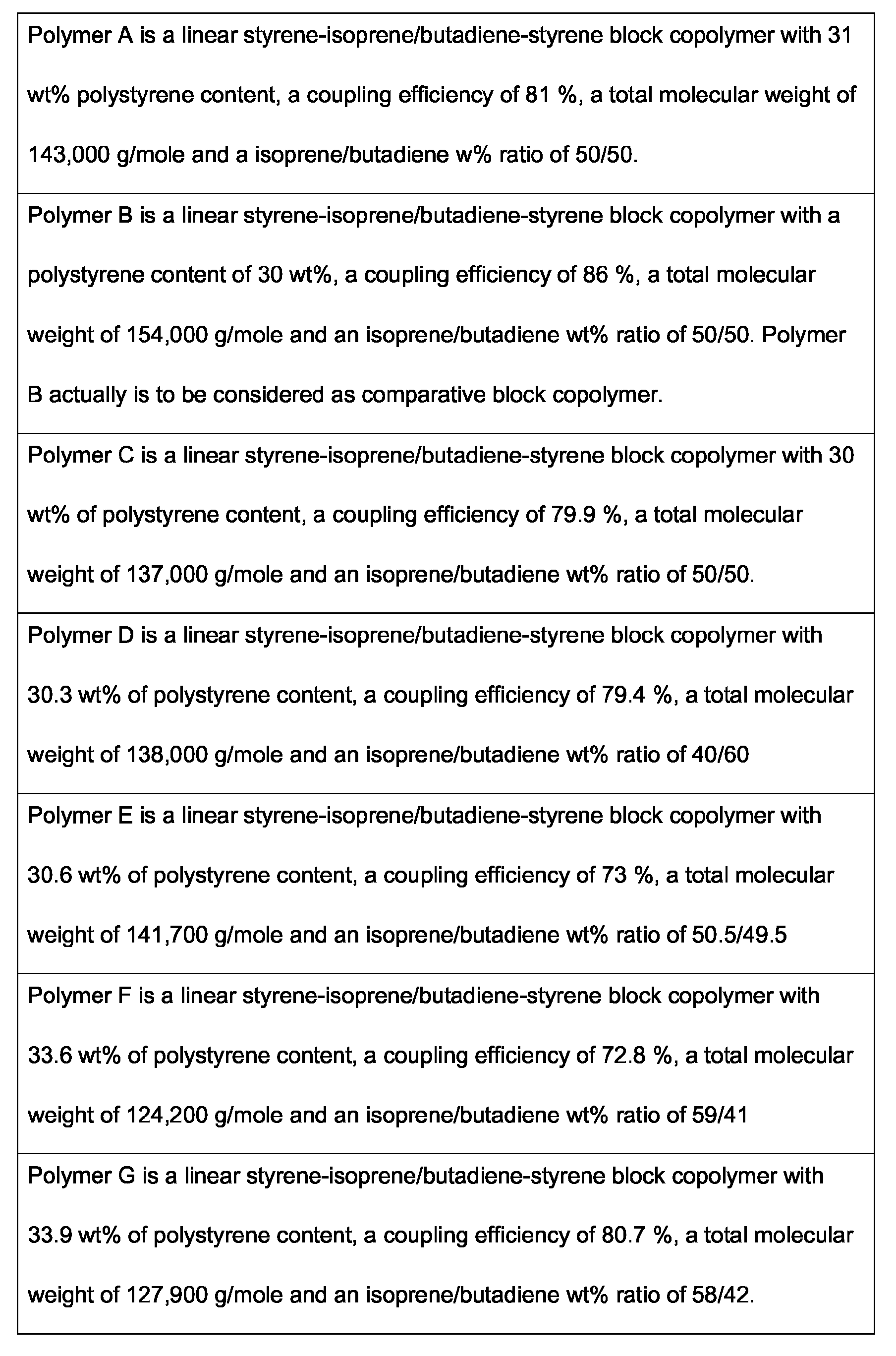
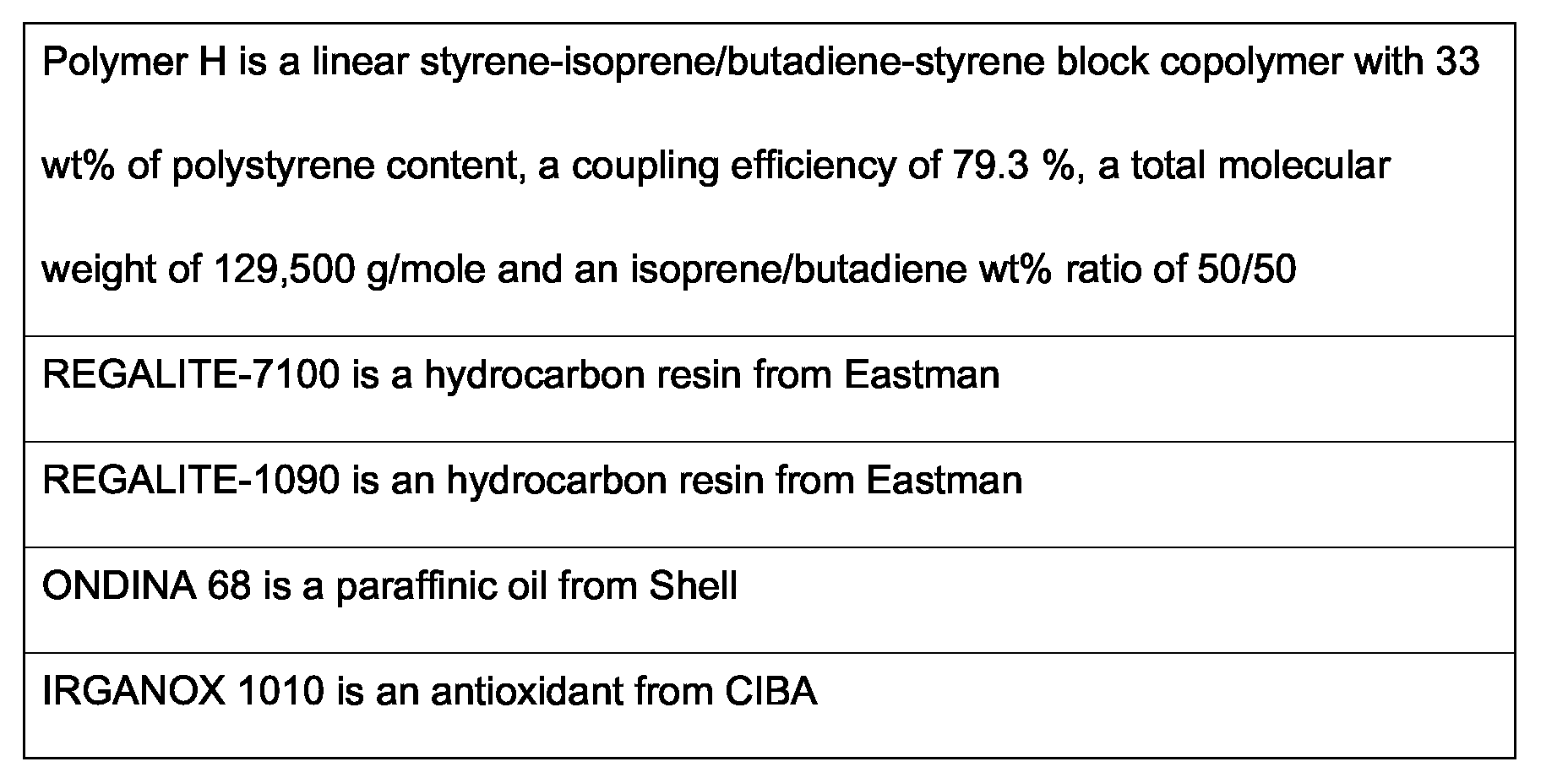
The viscosity of hot-melt adhesive compositions comprising the
ingredients as specified hereafter was measured at different temperatures.
Each composition comprised:
| (Viscosities in Pa.s) | |||||||||
| Temp. | D-1165 | A | B | C | D | E | F | G | H |
| 130°C | 79.4 | 25.7 | 110 | 25 | 33.4 | 31 | 16.3 | 29.4 | 23.4 |
| 140°C | 20.7 | 10.2 | 26.6 | 11.1 | 14.7 | 12.8 | 6.9 | 11.4 | 10.7 |
| 150°C | 7.6 | 5.5 | 12 | 6.8 | 8.3 | 7.2 | 3.8 | 6 | 6.1 |
| 160°C | 3.6 | 3.6 | 8.2 | 4.4 | 5.3 | 4.6 | 2.4 | 3.6 | 4 |
The viscosity of hot-melt adhesive compositions comprising the
ingredients as specified hereafter was measured at different temperatures.
Each composition comprised:
| (Viscosities in Pa.s) | |||
| Temperature | D-1164 | D-1165 | A |
| 110°C | 26.6 | 42.3 | 20.4 |
| 120°C | 11.32 | 13.7 | 9.45 |
| 130°C | 5.51 | 6.27 | 5.0 |
| 140°C | 3.22 | 3.38 | 3 |
| 150°C | 2.02 | 2.07 | 2 |
| 160°C | 1.33 | 1.38 | 1.38 |
The present invention relates to a low hot-melt viscosity adhesive
composition for non-wovens.
More in particular the present invention relates to a low hot-melt viscosity
adhesive composition for the manufacture of sanitary articles such as
infant and adult diapers, sanitary napkins, incontinent pads, bed pads,
feminine pads, panty shields, and the like, comprising at least one element
of non-woven material.
Claims (10)
- Low hot-melt adhesive composition used in non-woven assemblies, comprisinga) 100 parts by weight of a block copolymer of the formula S-(I/B)-S, wherein S represents a predominantly poly(styrene) block and (I/B) represents a polymer block obtained by at random copolymerization of a mixture of predominantly isoprene and butadiene in a weight ratio in the range of from 70:30 to 30:70, wherein the total block copolymer has an apparent molecular weight in the range of from 120.000 to 150.000 and has a poly(styrene) content of from 25 to 40 wt% and a coupling efficiency of from 60 to 100 %,b) from 250 to 300 parts by weight of a tackifying resin,c) from 5 to 150 parts by weight of a plasticizer , andd) from 1 to 3 parts by weight of auxiliaries, such as stabilizers and/or antioxidants.
- Low hot-melt viscosity adhesive composition according to claim 1, wherein the block (I/B) has been obtained by at random polymerization of a mixture of butadiene and isoprene in a weight ratio of from 60:40 to 40:60.
- Low hot-melt viscosity adhesive composition according to claim 1, wherein the (I/B) block has a vinyl content in the polymerized butadiene in the range of from 7 to 9 wt% and a vinyl content in the polymerized isoprene in the range of from 4 to 6 wt%.
- Low hot-melt viscosity adhesive composition according to claim 1, wherein the block copolymer S-(I/B)-S has a polystyrene content of from 30 to 34 wt%.
- Low hot-melt viscosity adhesive composition according to claim 1, wherein from 250 to 280 parts by weight of hydrocarbon resin per 100 parts by weight of block copolymer have been included.
- Disposable articles such as infant and adult diapers or sanitary napkins, incontinent pads, bed pads, feminine pads, panty shields, comprising at least one non-woven element and assembled by the use of the low hot-melt viscosity adhesive composition according to claims 1-6.
- Block copolymers of the formula S-(I/B)-S, wherein S represents a predominantly poly(styrene) block and (I/B) represents a polymer block obtained by at random copolymerization of a mixture of predominantly isoprene and butadiene in a weight ratio in the range of from 60:40 to 40:60, wherein the total block copolymer has an apparent molecular weight in the range of from 124.000 to 145.000 and has a poly(styrene) content of from 25 to 40 wt% and a coupling efficiency of from 70 to 100 %.
- Block copolymers according to claim 7, wherein the S blocks have been derived from pure styrene.
- Block copolymers according to claim 7, wherein the (I/B) block has a vinyl content in the polymerized butadiene in the range of from 7 to 9 wt% and a vinyl content in the polymerized isoprene in the range of from 4 to 6 wt%.
- Block copolymers according to claim 7, wherein the block copolymer S-(I/B)-S has a polystyrene content of from 30 to 34 wt%.
Priority Applications (9)
| Application Number | Priority Date | Filing Date | Title |
|---|---|---|---|
| EP04100665A EP1566423A1 (en) | 2004-02-19 | 2004-02-19 | Low viscosity hot-melt adhesive composition for non-wovens |
| BRPI0507871-7A BRPI0507871A (en) | 2004-02-19 | 2005-02-11 | low viscosity thermosetting adhesive composition used in nonwoven assemblies, disposable articles, and block copolymers |
| PCT/EP2005/050614 WO2005080523A1 (en) | 2004-02-19 | 2005-02-11 | Low viscosity hot-melt adhesive composition for non-wovens |
| CNA2005800090914A CN1934210A (en) | 2004-02-19 | 2005-02-11 | Low viscosity hot-melt adhesive composition for non-wovens |
| US10/589,703 US20070249781A1 (en) | 2004-02-19 | 2005-02-11 | Low Hot-Melt Viscosity Adhesive Composition for Non-Wovens |
| JP2006553584A JP2007523244A (en) | 2004-02-19 | 2005-02-11 | Low viscosity hot melt adhesive composition for nonwoven articles |
| EP05716669A EP1718712A1 (en) | 2004-02-19 | 2005-02-11 | Low viscosity hot-melt adhesive composition for non-wovens |
| KR1020067018767A KR20060126822A (en) | 2004-02-19 | 2005-02-11 | Low Viscosity Hot Melt Adhesive Compositions for Nonwovens |
| TW094104894A TW200602451A (en) | 2004-02-19 | 2005-02-18 | Low hot-melt viscosity adhesive composition for non-wovens |
Applications Claiming Priority (1)
| Application Number | Priority Date | Filing Date | Title |
|---|---|---|---|
| EP04100665A EP1566423A1 (en) | 2004-02-19 | 2004-02-19 | Low viscosity hot-melt adhesive composition for non-wovens |
Publications (1)
| Publication Number | Publication Date |
|---|---|
| EP1566423A1 true EP1566423A1 (en) | 2005-08-24 |
Family
ID=34707389
Family Applications (2)
| Application Number | Title | Priority Date | Filing Date |
|---|---|---|---|
| EP04100665A Withdrawn EP1566423A1 (en) | 2004-02-19 | 2004-02-19 | Low viscosity hot-melt adhesive composition for non-wovens |
| EP05716669A Withdrawn EP1718712A1 (en) | 2004-02-19 | 2005-02-11 | Low viscosity hot-melt adhesive composition for non-wovens |
Family Applications After (1)
| Application Number | Title | Priority Date | Filing Date |
|---|---|---|---|
| EP05716669A Withdrawn EP1718712A1 (en) | 2004-02-19 | 2005-02-11 | Low viscosity hot-melt adhesive composition for non-wovens |
Country Status (8)
| Country | Link |
|---|---|
| US (1) | US20070249781A1 (en) |
| EP (2) | EP1566423A1 (en) |
| JP (1) | JP2007523244A (en) |
| KR (1) | KR20060126822A (en) |
| CN (1) | CN1934210A (en) |
| BR (1) | BRPI0507871A (en) |
| TW (1) | TW200602451A (en) |
| WO (1) | WO2005080523A1 (en) |
Cited By (8)
| Publication number | Priority date | Publication date | Assignee | Title |
|---|---|---|---|---|
| EP1788058A2 (en) | 2005-11-21 | 2007-05-23 | National Starch and Chemical Investment Holding Corporation | Adhesive containing block copolymers |
| US7307124B2 (en) | 2004-02-19 | 2007-12-11 | Kraton Polymers U.S. Llc | Hot-melt adhesive composition for non-wovens |
| US7560512B2 (en) | 2005-03-11 | 2009-07-14 | Kraton Polymers U.S. Llc | Adhesive compositions comprising mixtures of block copolymers |
| WO2009155126A1 (en) * | 2008-06-18 | 2009-12-23 | Dow Global Technologies Inc. | Low chloride polybutadiene |
| US7872065B2 (en) | 2005-03-11 | 2011-01-18 | Kraton Polymers U.S. Llc | Adhesive compositions comprising mixtures of block copolymers |
| EP2826831A1 (en) * | 2013-07-16 | 2015-01-21 | IP & Patent Management UG (haftungsbeschränkt) | Hot-melt adhesive for the collation of containers and bottles for beverages or food into shelf ready packs of various items |
| WO2016100725A1 (en) * | 2014-12-17 | 2016-06-23 | H.B. Fuller Company | Hot melt adhesive composition for bonding packs of plastic containers |
| US10351298B2 (en) | 2014-12-17 | 2019-07-16 | H.B. Fuller Company | Hot melt adhesive composition for bonding packs of metal containers |
Families Citing this family (8)
| Publication number | Priority date | Publication date | Assignee | Title |
|---|---|---|---|---|
| US20060205876A1 (en) * | 2005-03-11 | 2006-09-14 | Kraton Polymers U.S. Llc | Block copolymers comprising a mixed block derived from isoprene and butadiene and compositions comprising them |
| US20070088116A1 (en) * | 2005-10-14 | 2007-04-19 | Fabienne Abba | Low application temperature hot melt adhesive |
| MY146014A (en) † | 2006-02-03 | 2012-06-15 | Mitsui Chemicals Inc | Nonwoven fabric laminate, moisture-permeable nonwoven fabric laminated sheet using nonwoven fabric laminate, and sanitary products using them |
| US7704676B2 (en) * | 2007-09-04 | 2010-04-27 | Kraton Polymers U.S. Llc | Block copolymers having distinct isoprene and butadiene midblocks, method for making same, and uses for such block copolymers |
| DE102008063723A1 (en) * | 2008-12-19 | 2010-06-24 | Henkel Ag & Co. Kgaa | Contact adhesive based on metallocene-catalyzed olefin-C3-C20-olefin copolymers |
| KR101025778B1 (en) * | 2011-01-12 | 2011-04-04 | (주)베이스코리아 | Low viscosity solvent type adhesive composition and its manufacturing method |
| WO2018145257A1 (en) * | 2017-02-08 | 2018-08-16 | Avery Dennison Corporation | Hotmelt pressure sensitive adhesive for clear on clear labels |
| CN110157366A (en) * | 2019-06-11 | 2019-08-23 | 恩平市盈嘉丰胶粘制品有限公司 | A kind of environmentally-friendly sanitary articles hot-fusible pressure-sensitive adhesive and preparation method thereof |
Citations (3)
| Publication number | Priority date | Publication date | Assignee | Title |
|---|---|---|---|---|
| DE2942128A1 (en) * | 1979-10-18 | 1981-04-30 | Basf Ag, 6700 Ludwigshafen | Melt adhesive contg. block co-polymer - of vinyl:aromatic monomer and butadiene!- isoprene copolymer block, giving heat resistant bond |
| JPH05345885A (en) * | 1992-06-15 | 1993-12-27 | Kuraray Co Ltd | Adhesive / adhesive composition |
| WO2002057386A2 (en) * | 2001-01-18 | 2002-07-25 | Kraton Polymers Research B.V. | Adhesive composition |
Family Cites Families (20)
| Publication number | Priority date | Publication date | Assignee | Title |
|---|---|---|---|---|
| US4704110A (en) * | 1986-06-20 | 1987-11-03 | National Starch And Chemical Corporation | Hot melt pressure sensitive positioning adhesives |
| JPS63207875A (en) * | 1987-02-25 | 1988-08-29 | Asahi Chem Ind Co Ltd | Hot-melt tacky adhesive composition for sanitary material |
| JP2733267B2 (en) * | 1988-11-16 | 1998-03-30 | 株式会社クラレ | Composition with excellent vibration damping performance |
| JP2703288B2 (en) * | 1988-10-07 | 1998-01-26 | 株式会社クラレ | Block copolymer excellent in vibration damping performance and composition containing the same |
| US5399627A (en) * | 1989-08-11 | 1995-03-21 | The Dow Chemical Company | Radial styrene-isoprene-butadiene multi-armed block copolymers and compositions and articles containing block copolymers |
| JP3309438B2 (en) * | 1992-09-04 | 2002-07-29 | 日本ゼオン株式会社 | Block copolymer |
| JP3339170B2 (en) * | 1994-02-28 | 2002-10-28 | 日本ゼオン株式会社 | Block copolymer and pressure-sensitive adhesive composition |
| JP3387612B2 (en) * | 1994-02-28 | 2003-03-17 | 日本ゼオン株式会社 | Block copolymer composition and pressure-sensitive adhesive composition |
| JP3388011B2 (en) * | 1994-02-28 | 2003-03-17 | 日本ゼオン株式会社 | Block copolymer composition and pressure-sensitive adhesive composition |
| US5547766A (en) * | 1995-07-28 | 1996-08-20 | Minnesota Mining And Manufacturing Company | Non-yellowing tape article |
| BR9707862A (en) * | 1996-02-23 | 1999-07-27 | Ato Findley Inc | Improved label pressure sensitive adhesive |
| DE19639767A1 (en) * | 1996-09-27 | 1998-04-02 | Du Pont Deutschland | Flexographic printing forms for UV curable printing inks |
| US6833404B2 (en) * | 1998-06-30 | 2004-12-21 | H.B. Fuller Licensing & Financing Inc. | Hot melts utilizing a high glass transition temperature substantially aliphatic tackifying resin |
| US6657000B1 (en) * | 1999-06-25 | 2003-12-02 | Kraton Polymers U.S. Llc | Hot melt pressure sensitive positioning adhesive (III) |
| DE10128061A1 (en) * | 2000-06-23 | 2002-01-24 | Henkel Kgaa | Hot-melt contact adhesive, contains olefinically unsaturated polymer and particles of inorganic compound with rutile-type crystal structure |
| US20030195272A1 (en) * | 2001-02-01 | 2003-10-16 | Michael Harwell | Scented hot melt adhesives |
| CN1226352C (en) * | 2001-08-13 | 2005-11-09 | 日本弹性体股份有限公司 | block copolymer composition |
| KR20040032488A (en) * | 2002-10-10 | 2004-04-17 | 금호석유화학 주식회사 | Ternary block copolymer and menufacturing method of the same |
| DE602004023241D1 (en) * | 2003-02-21 | 2009-10-29 | Kraton Polymers Res Bv | Label roll with improved cutting performance |
| US7307124B2 (en) * | 2004-02-19 | 2007-12-11 | Kraton Polymers U.S. Llc | Hot-melt adhesive composition for non-wovens |
-
2004
- 2004-02-19 EP EP04100665A patent/EP1566423A1/en not_active Withdrawn
-
2005
- 2005-02-11 KR KR1020067018767A patent/KR20060126822A/en not_active Ceased
- 2005-02-11 US US10/589,703 patent/US20070249781A1/en not_active Abandoned
- 2005-02-11 BR BRPI0507871-7A patent/BRPI0507871A/en not_active IP Right Cessation
- 2005-02-11 JP JP2006553584A patent/JP2007523244A/en not_active Withdrawn
- 2005-02-11 WO PCT/EP2005/050614 patent/WO2005080523A1/en not_active Ceased
- 2005-02-11 EP EP05716669A patent/EP1718712A1/en not_active Withdrawn
- 2005-02-11 CN CNA2005800090914A patent/CN1934210A/en active Pending
- 2005-02-18 TW TW094104894A patent/TW200602451A/en unknown
Patent Citations (3)
| Publication number | Priority date | Publication date | Assignee | Title |
|---|---|---|---|---|
| DE2942128A1 (en) * | 1979-10-18 | 1981-04-30 | Basf Ag, 6700 Ludwigshafen | Melt adhesive contg. block co-polymer - of vinyl:aromatic monomer and butadiene!- isoprene copolymer block, giving heat resistant bond |
| JPH05345885A (en) * | 1992-06-15 | 1993-12-27 | Kuraray Co Ltd | Adhesive / adhesive composition |
| WO2002057386A2 (en) * | 2001-01-18 | 2002-07-25 | Kraton Polymers Research B.V. | Adhesive composition |
Non-Patent Citations (1)
| Title |
|---|
| DATABASE WPI Section Ch Week 199405, Derwent World Patents Index; Class A18, AN 1994-040113, XP002216588 * |
Cited By (16)
| Publication number | Priority date | Publication date | Assignee | Title |
|---|---|---|---|---|
| US7307124B2 (en) | 2004-02-19 | 2007-12-11 | Kraton Polymers U.S. Llc | Hot-melt adhesive composition for non-wovens |
| US7872065B2 (en) | 2005-03-11 | 2011-01-18 | Kraton Polymers U.S. Llc | Adhesive compositions comprising mixtures of block copolymers |
| US7560512B2 (en) | 2005-03-11 | 2009-07-14 | Kraton Polymers U.S. Llc | Adhesive compositions comprising mixtures of block copolymers |
| JP2007138170A (en) * | 2005-11-21 | 2007-06-07 | Natl Starch & Chem Investment Holding Corp | Adhesive containing block copolymer |
| EP1788058A3 (en) * | 2005-11-21 | 2007-06-13 | National Starch and Chemical Investment Holding Corporation | Adhesive containing block copolymers |
| EP1788058A2 (en) | 2005-11-21 | 2007-05-23 | National Starch and Chemical Investment Holding Corporation | Adhesive containing block copolymers |
| US8481644B2 (en) | 2008-06-18 | 2013-07-09 | Styron Europe Gmbh | Low chloride polybutadiene |
| KR20110041477A (en) * | 2008-06-18 | 2011-04-21 | 스타이런 유럽 게엠베하 | Low chloride polybutadiene |
| WO2009155126A1 (en) * | 2008-06-18 | 2009-12-23 | Dow Global Technologies Inc. | Low chloride polybutadiene |
| RU2510401C2 (en) * | 2008-06-18 | 2014-03-27 | Стирон Юроп Гмбх | Polybutadiene with low chloride content |
| EP2826831A1 (en) * | 2013-07-16 | 2015-01-21 | IP & Patent Management UG (haftungsbeschränkt) | Hot-melt adhesive for the collation of containers and bottles for beverages or food into shelf ready packs of various items |
| WO2015007785A3 (en) * | 2013-07-16 | 2015-03-19 | Ip & Patent Management Ug (Haftungsbeschränkt) | Hot-melt adhesive and use thereof |
| US11312826B2 (en) | 2013-07-16 | 2022-04-26 | Khs Gmbh | Hot-melt adhesive and use thereof |
| WO2016100725A1 (en) * | 2014-12-17 | 2016-06-23 | H.B. Fuller Company | Hot melt adhesive composition for bonding packs of plastic containers |
| US9902884B2 (en) | 2014-12-17 | 2018-02-27 | H.B. Fuller Company | Hot melt adhesive composition for bonding packs of plastic containers |
| US10351298B2 (en) | 2014-12-17 | 2019-07-16 | H.B. Fuller Company | Hot melt adhesive composition for bonding packs of metal containers |
Also Published As
| Publication number | Publication date |
|---|---|
| CN1934210A (en) | 2007-03-21 |
| EP1718712A1 (en) | 2006-11-08 |
| US20070249781A1 (en) | 2007-10-25 |
| TW200602451A (en) | 2006-01-16 |
| WO2005080523A1 (en) | 2005-09-01 |
| BRPI0507871A (en) | 2007-07-24 |
| KR20060126822A (en) | 2006-12-08 |
| JP2007523244A (en) | 2007-08-16 |
Similar Documents
| Publication | Publication Date | Title |
|---|---|---|
| EP1720921B1 (en) | Hot-melt adhesive composition for non-wovens | |
| KR100856602B1 (en) | Adhesive composition | |
| AU702857B2 (en) | Low viscosity hot melt disposables adhesive composition | |
| US7651765B2 (en) | Adhesive composition and tapes and labels derived therefrom | |
| JP4847515B2 (en) | Adhesive composition comprising a mixture of block copolymers | |
| US20070249781A1 (en) | Low Hot-Melt Viscosity Adhesive Composition for Non-Wovens | |
| EP1702017B1 (en) | Low viscosity, hot-melt stable adhesive compositions | |
| EP1449898A1 (en) | Adhesive composition and tapes and labels derived therefrom |
Legal Events
| Date | Code | Title | Description |
|---|---|---|---|
| PUAI | Public reference made under article 153(3) epc to a published international application that has entered the european phase |
Free format text: ORIGINAL CODE: 0009012 |
|
| AK | Designated contracting states |
Kind code of ref document: A1 Designated state(s): AT BE BG CH CY CZ DE DK EE ES FI FR GB GR HU IE IT LI LU MC NL PT RO SE SI SK TR |
|
| AX | Request for extension of the european patent |
Extension state: AL LT LV MK |
|
| AKX | Designation fees paid | ||
| REG | Reference to a national code |
Ref country code: DE Ref legal event code: 8566 |
|
| STAA | Information on the status of an ep patent application or granted ep patent |
Free format text: STATUS: THE APPLICATION IS DEEMED TO BE WITHDRAWN |
|
| 18D | Application deemed to be withdrawn |
Effective date: 20060225 |