EP1566379A1 - QUINOLINE DERIVATIVES AND QUINAZOLINE DERIVATIVES INHIBITING AUTOPHOSPHORYLATION OF Flt3 AND MEDICINAL COMPOSITIONS CONTAINING THE SAME - Google Patents
QUINOLINE DERIVATIVES AND QUINAZOLINE DERIVATIVES INHIBITING AUTOPHOSPHORYLATION OF Flt3 AND MEDICINAL COMPOSITIONS CONTAINING THE SAME Download PDFInfo
- Publication number
- EP1566379A1 EP1566379A1 EP03769958A EP03769958A EP1566379A1 EP 1566379 A1 EP1566379 A1 EP 1566379A1 EP 03769958 A EP03769958 A EP 03769958A EP 03769958 A EP03769958 A EP 03769958A EP 1566379 A1 EP1566379 A1 EP 1566379A1
- Authority
- EP
- European Patent Office
- Prior art keywords
- alkyl
- alkoxy
- optionally substituted
- hydroxyl
- represent
- Prior art date
- Legal status (The legal status is an assumption and is not a legal conclusion. Google has not performed a legal analysis and makes no representation as to the accuracy of the status listed.)
- Withdrawn
Links
- 0 *c1c(*)c(O)c(*)c(*)c1N Chemical compound *c1c(*)c(O)c(*)c(*)c1N 0.000 description 4
- CUEWJRMIUDPDDY-MBYWUEIMSA-N CCNC(N/C(/C(Cl)=C)=C/C=C(\C)/O/C(/C(/C)=C/C(/OC)=C(\C=C)/OCCC1NCCCC1)=C/C=N\C)=O Chemical compound CCNC(N/C(/C(Cl)=C)=C/C=C(\C)/O/C(/C(/C)=C/C(/OC)=C(\C=C)/OCCC1NCCCC1)=C/C=N\C)=O CUEWJRMIUDPDDY-MBYWUEIMSA-N 0.000 description 1
Classifications
-
- C—CHEMISTRY; METALLURGY
- C07—ORGANIC CHEMISTRY
- C07D—HETEROCYCLIC COMPOUNDS
- C07D215/00—Heterocyclic compounds containing quinoline or hydrogenated quinoline ring systems
- C07D215/02—Heterocyclic compounds containing quinoline or hydrogenated quinoline ring systems having no bond between the ring nitrogen atom and a non-ring member or having only hydrogen atoms or carbon atoms directly attached to the ring nitrogen atom
- C07D215/16—Heterocyclic compounds containing quinoline or hydrogenated quinoline ring systems having no bond between the ring nitrogen atom and a non-ring member or having only hydrogen atoms or carbon atoms directly attached to the ring nitrogen atom with hetero atoms or with carbon atoms having three bonds to hetero atoms with at the most one bond to halogen, e.g. ester or nitrile radicals, directly attached to ring carbon atoms
- C07D215/20—Oxygen atoms
- C07D215/22—Oxygen atoms attached in position 2 or 4
- C07D215/233—Oxygen atoms attached in position 2 or 4 only one oxygen atom which is attached in position 4
-
- A—HUMAN NECESSITIES
- A61—MEDICAL OR VETERINARY SCIENCE; HYGIENE
- A61K—PREPARATIONS FOR MEDICAL, DENTAL OR TOILETRY PURPOSES
- A61K31/00—Medicinal preparations containing organic active ingredients
- A61K31/33—Heterocyclic compounds
- A61K31/395—Heterocyclic compounds having nitrogen as a ring hetero atom, e.g. guanethidine or rifamycins
- A61K31/435—Heterocyclic compounds having nitrogen as a ring hetero atom, e.g. guanethidine or rifamycins having six-membered rings with one nitrogen as the only ring hetero atom
- A61K31/47—Quinolines; Isoquinolines
-
- A—HUMAN NECESSITIES
- A61—MEDICAL OR VETERINARY SCIENCE; HYGIENE
- A61K—PREPARATIONS FOR MEDICAL, DENTAL OR TOILETRY PURPOSES
- A61K31/00—Medicinal preparations containing organic active ingredients
- A61K31/33—Heterocyclic compounds
- A61K31/395—Heterocyclic compounds having nitrogen as a ring hetero atom, e.g. guanethidine or rifamycins
- A61K31/435—Heterocyclic compounds having nitrogen as a ring hetero atom, e.g. guanethidine or rifamycins having six-membered rings with one nitrogen as the only ring hetero atom
- A61K31/47—Quinolines; Isoquinolines
- A61K31/4709—Non-condensed quinolines and containing further heterocyclic rings
-
- A—HUMAN NECESSITIES
- A61—MEDICAL OR VETERINARY SCIENCE; HYGIENE
- A61K—PREPARATIONS FOR MEDICAL, DENTAL OR TOILETRY PURPOSES
- A61K31/00—Medicinal preparations containing organic active ingredients
- A61K31/33—Heterocyclic compounds
- A61K31/395—Heterocyclic compounds having nitrogen as a ring hetero atom, e.g. guanethidine or rifamycins
- A61K31/495—Heterocyclic compounds having nitrogen as a ring hetero atom, e.g. guanethidine or rifamycins having six-membered rings with two or more nitrogen atoms as the only ring heteroatoms, e.g. piperazine or tetrazines
- A61K31/496—Non-condensed piperazines containing further heterocyclic rings, e.g. rifampin, thiothixene or sparfloxacin
-
- A—HUMAN NECESSITIES
- A61—MEDICAL OR VETERINARY SCIENCE; HYGIENE
- A61K—PREPARATIONS FOR MEDICAL, DENTAL OR TOILETRY PURPOSES
- A61K31/00—Medicinal preparations containing organic active ingredients
- A61K31/33—Heterocyclic compounds
- A61K31/395—Heterocyclic compounds having nitrogen as a ring hetero atom, e.g. guanethidine or rifamycins
- A61K31/495—Heterocyclic compounds having nitrogen as a ring hetero atom, e.g. guanethidine or rifamycins having six-membered rings with two or more nitrogen atoms as the only ring heteroatoms, e.g. piperazine or tetrazines
- A61K31/505—Pyrimidines; Hydrogenated pyrimidines, e.g. trimethoprim
- A61K31/517—Pyrimidines; Hydrogenated pyrimidines, e.g. trimethoprim ortho- or peri-condensed with carbocyclic ring systems, e.g. quinazoline, perimidine
-
- A—HUMAN NECESSITIES
- A61—MEDICAL OR VETERINARY SCIENCE; HYGIENE
- A61K—PREPARATIONS FOR MEDICAL, DENTAL OR TOILETRY PURPOSES
- A61K31/00—Medicinal preparations containing organic active ingredients
- A61K31/33—Heterocyclic compounds
- A61K31/395—Heterocyclic compounds having nitrogen as a ring hetero atom, e.g. guanethidine or rifamycins
- A61K31/535—Heterocyclic compounds having nitrogen as a ring hetero atom, e.g. guanethidine or rifamycins having six-membered rings with at least one nitrogen and one oxygen as the ring hetero atoms, e.g. 1,2-oxazines
- A61K31/5375—1,4-Oxazines, e.g. morpholine
- A61K31/5377—1,4-Oxazines, e.g. morpholine not condensed and containing further heterocyclic rings, e.g. timolol
-
- A—HUMAN NECESSITIES
- A61—MEDICAL OR VETERINARY SCIENCE; HYGIENE
- A61K—PREPARATIONS FOR MEDICAL, DENTAL OR TOILETRY PURPOSES
- A61K31/00—Medicinal preparations containing organic active ingredients
- A61K31/33—Heterocyclic compounds
- A61K31/395—Heterocyclic compounds having nitrogen as a ring hetero atom, e.g. guanethidine or rifamycins
- A61K31/55—Heterocyclic compounds having nitrogen as a ring hetero atom, e.g. guanethidine or rifamycins having seven-membered rings, e.g. azelastine, pentylenetetrazole
-
- A—HUMAN NECESSITIES
- A61—MEDICAL OR VETERINARY SCIENCE; HYGIENE
- A61P—SPECIFIC THERAPEUTIC ACTIVITY OF CHEMICAL COMPOUNDS OR MEDICINAL PREPARATIONS
- A61P35/00—Antineoplastic agents
-
- A—HUMAN NECESSITIES
- A61—MEDICAL OR VETERINARY SCIENCE; HYGIENE
- A61P—SPECIFIC THERAPEUTIC ACTIVITY OF CHEMICAL COMPOUNDS OR MEDICINAL PREPARATIONS
- A61P35/00—Antineoplastic agents
- A61P35/02—Antineoplastic agents specific for leukemia
-
- A—HUMAN NECESSITIES
- A61—MEDICAL OR VETERINARY SCIENCE; HYGIENE
- A61P—SPECIFIC THERAPEUTIC ACTIVITY OF CHEMICAL COMPOUNDS OR MEDICINAL PREPARATIONS
- A61P37/00—Drugs for immunological or allergic disorders
- A61P37/02—Immunomodulators
-
- A—HUMAN NECESSITIES
- A61—MEDICAL OR VETERINARY SCIENCE; HYGIENE
- A61P—SPECIFIC THERAPEUTIC ACTIVITY OF CHEMICAL COMPOUNDS OR MEDICINAL PREPARATIONS
- A61P37/00—Drugs for immunological or allergic disorders
- A61P37/02—Immunomodulators
- A61P37/06—Immunosuppressants, e.g. drugs for graft rejection
-
- A—HUMAN NECESSITIES
- A61—MEDICAL OR VETERINARY SCIENCE; HYGIENE
- A61P—SPECIFIC THERAPEUTIC ACTIVITY OF CHEMICAL COMPOUNDS OR MEDICINAL PREPARATIONS
- A61P43/00—Drugs for specific purposes, not provided for in groups A61P1/00-A61P41/00
-
- C—CHEMISTRY; METALLURGY
- C07—ORGANIC CHEMISTRY
- C07D—HETEROCYCLIC COMPOUNDS
- C07D215/00—Heterocyclic compounds containing quinoline or hydrogenated quinoline ring systems
- C07D215/02—Heterocyclic compounds containing quinoline or hydrogenated quinoline ring systems having no bond between the ring nitrogen atom and a non-ring member or having only hydrogen atoms or carbon atoms directly attached to the ring nitrogen atom
- C07D215/16—Heterocyclic compounds containing quinoline or hydrogenated quinoline ring systems having no bond between the ring nitrogen atom and a non-ring member or having only hydrogen atoms or carbon atoms directly attached to the ring nitrogen atom with hetero atoms or with carbon atoms having three bonds to hetero atoms with at the most one bond to halogen, e.g. ester or nitrile radicals, directly attached to ring carbon atoms
- C07D215/20—Oxygen atoms
- C07D215/22—Oxygen atoms attached in position 2 or 4
-
- C—CHEMISTRY; METALLURGY
- C07—ORGANIC CHEMISTRY
- C07D—HETEROCYCLIC COMPOUNDS
- C07D401/00—Heterocyclic compounds containing two or more hetero rings, having nitrogen atoms as the only ring hetero atoms, at least one ring being a six-membered ring with only one nitrogen atom
- C07D401/02—Heterocyclic compounds containing two or more hetero rings, having nitrogen atoms as the only ring hetero atoms, at least one ring being a six-membered ring with only one nitrogen atom containing two hetero rings
- C07D401/12—Heterocyclic compounds containing two or more hetero rings, having nitrogen atoms as the only ring hetero atoms, at least one ring being a six-membered ring with only one nitrogen atom containing two hetero rings linked by a chain containing hetero atoms as chain links
Definitions
- the present invention relates to quinoline derivatives and quinazoline derivatives for inhibiting the autophosphorylation of Flt3. More particularly, the present invention relates to quinoline derivatives and quinazoline derivatives useful for the treatment of hematopoietic malignancies such as acute myelocytic leukemia and myelodysplastic syndrome, and immunological diseases caused by abnormal proliferation of B cells, dendritic cells, or natural killer cells.
- FMS-like tyrosine kinase 3 (hereinafter referred to as "Flt3"), together with KIT, FMS, and PDGF receptors or the like, is one of proteins belonging to class III of receptor-type tyrosine kinases and is considered to be involved in a hematopoietic system.
- the present inventors have now found that a certain group of quinoline derivatives and quinazoline derivatives have inhibitory activity against autophosphorylation of Flt3 and/or autophosphorylation of somatic cell variants of Flt3 (hereinafter referred to as "Flt3-ITD").
- the present inventors have further found that a certain group of quinoline derivatives and quinazoline derivatives have antiproliferative effect against certain Flt3 expressing cells and/or Flt3-ITD expressing cells.
- the present inventors have also found that a certain group of quinoline derivatives and quinazoline derivatives have antitumor effects against in nonhuman animals to which certain Flt3 expressing cancer cells and/or Flt3-ITD expressing cancer cells have been transplanted.
- Some of the quinoline derivatives and quinazoline derivatives showed excellent physical stability and/or excellent water solubility and/or metabolic stability. The present invention has been made based on such finding.
- An object of the present invention is to provide compounds and pharmaceuticals useful for the treatment and prevention of diseases where the inhibition of autophosphorylatinon of Flt3 and/or Flt3-ITD is therapeutically or prophylactically effective.
- R 101 and R 104 represent a hydrogen atom
- alkyl alkoxy
- alkenyl alkynyl
- alkynyl straight chain or branched chain alkyl, alkoxy, alkenyl, and alkynyl.
- C 1-6 alkyl is preferably C 1-4 alkyl.
- C 1-6 alkoxy is preferably C 1-4 alkoxy.
- C 2-6 alkenyl is preferably C 2-4 alkenyl.
- C 2-6 alkynyl is preferably C 2-4 alkynyl.
- C 1-6 alkyl examples include methyl, ethyl, n-propyl, isopropyl, n-butyl, i-butyl, s-butyl, t-butyl, n-pentyl, and n-hexyl.
- C 1-6 alkoxy examples include methoxy, ethoxy, n-propoxy, i-propoxy, n-butoxy, i-butoxy, s-butoxy, and t-butoxy.
- C 2-6 alkenyl examples include allyl, butenyl, pentenyl, and hexenyl.
- C 2-6 alkynyl examples include 2-propynyl, butynyl, pentynyl, and hexynyl.
- alkyl optionally substituted by refers to alkyl, in which one or more hydrogen atoms on the alkyl group have been substituted by one or more substituents which may be the same or different, and unsubstituted alkyl. It will be apparent to one skilled in the art that the maximum number of substituents may be determined depending upon the number of substitutable hydrogen atoms on the alkyl group. This is applicable to groups having a substituent other than the alkyl group.
- halogen atom means fluorine, chlorine, bromine, and iodine atoms.
- the saturated or unsaturated three- to eight-membered carbocyclic ring is preferably a four- to seven-membered, more preferably five- or six-membered, saturated or unsaturated carbocyclic ring.
- saturated or unsaturated three- to eight-membered carbocyclic rings include phenyl, cyclopropyl, cyclobutyl, cyclopentyl, cyclohexyl, and cycloheptyl.
- the saturated or unsaturated three- to eight-membered heterocyclic ring contains at least one hetero-atom selected from oxygen, nitrogen, and sulfur atoms.
- the saturated or unsaturated three- to eight-membered heterocyclic ring preferably contains one, two or three hetero-atoms with the remaining ring-constituting atoms being carbon atoms.
- the saturated or unsaturated three- to eight-membered heterocyclic ring is preferably a saturated or unsaturated four- to seven-membered heterocyclic ring, more preferably a saturated or unsaturated five- or six-membered heterocyclic ring.
- saturated or unsaturated three- to eight-membered heterocyclic groups include thienyl, pyridyl, 1,2,3-triazolyl, thiazolyl, imidazolyl, isoxazolyl, pyrazolyl, piperazinyl, piperazino, piperidyl, piperidino, morpholinyl, morpholino, homopiperazinyl, homopiperazino, thiomorpholinyl, thiomorpholino, tetrahydropyrrolyl, and azepanyl.
- the saturated or unsaturated carboxylic and heterocyclic groups may condense with another saturated or unsaturated five- to seven-membered carbocyclic or heterocyclic ring to form a bicyclic group, preferably a saturated or unsaturated nine- to twelve-membered bicyclic carbocyclic or heterocyclic group.
- Such bicyclic groups include naphthyl, quinolyl, 1,2,3,4-tetrahydroquinolyl, 1,4-benzoxanyl, indanyl, indolyl, 1,2,3,4-tetrahydronaphthyl, and phthalimide.
- carbocyclic or heterocyclic group When the carbocyclic or heterocyclic group is substituted by two C 1-6 alkyl groups, the two alkyl groups may combine together to form an alkylene chain, preferably a C 1-3 alkylene chain.
- Carbocyclic or heterocyclic groups having this crosslinked structure include azabicyclo[2.2.2]octanyl, bicyclo[2.2.2]octanyl and norbornanyl.
- R 1 preferably represents a hydrogen atom.
- R 2 and R 3 preferably represent a group other than a hydrogen atom, more preferably may be the same or different and represent optionally substituted C 1-6 alkoxy.
- R 1 represents a hydrogen atom and both R 2 and R 3 represent unsubstituted C 1-6 alkoxy, or alternatively any one of R 2 and R 3 represents substituted C 1-6 alkoxy and the other represents unsubstituted C 1-6 alkoxy.
- R 1 represents a hydrogen atom and, at the same time, both R 2 and R 3 represent -O-(CH 2 )p-H, or alternatively R 1 represents a hydrogen atom and, at the same time, any one of R 2 and R 3 represents -O-(CH 2 )p-H with the other representing -O-(CH 2 )p-R 12 wherein R 12 represents a group other than a hydrogen atom.
- R 5 , R 6 , R 7 , and R 8 represent a hydrogen atom, or alternatively any one or two of R 5 , R 6 , R 7 , and R 8 represent a halogen atom with all the remaining groups represening a hydrogen atom.
- R 5 , R 6 , R 7 , and R 8 represent a hydrogen atom; or R 6 represents a fluorine atom, and R 5 , R 7 , and R 8 represent a hydrogen atom; or R 5 represents a halogen atom, C 1-4 alkyl, C 1-4 alkoxy, nitro, or amino (preferably a halogen atom or C 1-4 alkyl or C 1-4 alkoxy) and R 6 , R 7 , and R 8 represent a hydrogen atom; or R 5 and R 7 represent a halogen atom, C 1-4 alkyl, C 1-4 alkoxy, nitro, or amino (preferably a halogen atom or C 1-4 alkyl or C 1-4 alkoxy), and R 6 and R 8 represent a hydrogen atom.
- R 9 represents -(CH 2 )s-R 51 wherein s is an integer of 1 to 4, and R 51 represents a saturated three- to seven-membered carbocyclic group; i-propyl optionally substituted by hydroxyl; t-butyl optionally substituted by hydroxyl; C 1-4 alkoxy; or -NR 52 R 53 wherein R 52 and R 53 , which may be the same or different, represent a hydrogen atom, or C 1-4 alkyl optionally substituted by hydroxyl, or R 52 and R 53 may combine with a nitrogen atom attached thereto to form a saturated five- or six-membered heterocyclic group, or R 9 represents a saturated five- to seven-membered carbocyclic group optionally substituted by one to three C 1-4 alkyl groups.
- R 9 represents -(CH 2 )s-R 51 , wherein s is an integer of 1 to 4, and R 51 represents a saturated five- to seven-membered carbocyclic group; i-propyl; t-butyl optionally substituted by hydroxyl; C 1-4 alkoxy; or -NR 52 R 53 wherein R 52 and R 53 , which may be the same or different, represent C 1-4 alkyl, or R 9 represents a five- to seven-membered carbocyclic group optionally substituted by 1 to 3 C 1-4 alkyl groups.
- R 9 represents -(CH 2 )s-R 51 , wherein s is an integer of 2 or 3 and R 51 represents a saturated five- to seven-membered carbocyclic group or t-butyl, or R 9 represents a five- to seven-membered carbocyclic group optionally substituted by 1 to 3 C 1-4 alkyls.
- X represents CH or N
- Z represents O or S
- the compounds represented by formula (I) are preferably compounds represented by formula (Ia).
- R 102 and R 103 which may be the same or different, represent C 1-6 alkoxy and the C 1-6 alkoxy is optionally substituted by hydroxyl; a halogen atom; C 1-4 alkoxy; -NR 116 R 117 wherein R 116 and R 117 , which may be the same or different, represent a hydrogen atom or C 1-4 alkyl and the alkyl group is further optionally substituted by hydroxyl or C 1-4 alkoxy; or a saturated or unsaturated three- to eight-membered carbocyclic or heterocyclic group in which the cyclic group is optionally substituted by hydroxyl, a halogen atom, C 1-4 alkyl, or C 1-4 alkoxy.
- R 102 and R 103 which may be the same or different, represent C 1-6 alkoxy in which the alkoxy group is optionally substituted by a saturated or unsaturated three- to eight-membered carbocyclic or heterocyclic group and the cyclic group is further optionally substituted by hydroxyl, a halogen atom, C 1-4 alkyl, or C 1-4 alkoxy.
- R 102 and R 103 which may be the same or different, represent C 1-4 alkoxy in which the alkoxy group is optionally substituted by a saturated five- to seven-membered heterocyclic group and the cyclic group is further optionally substituted by C 1-4 alkyl.
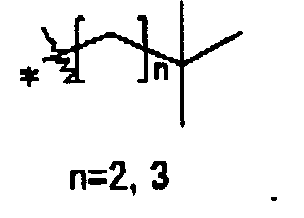
- substituted C 1-4 alkoxy represented by R 102 and R 103 preferably represents a group represented by more preferably n is 2, or a group represented by more preferably n is 2.
- R 102 and R 103 represent unsubstituted C 1-6 alkoxy and the other represents substituted C 1-6 alkoxy. More preferably, R 102 represents unsubstituted C 1-6 alkoxy (more preferably methoxy) and R 103 represents substituted C 1-6 alkoxy.
- X represents CH.
- Z represents O
- R 105 , R 106 , R 107 , and R 108 represent a hydrogen atom, or alternatively any one or two of R 105 , R 106 , R 107 , and R 108 represent C 1-4 alkyl, C 1-4 alkoxy, or a halogen atom with all the remaining groups representing a hydrogen atom.
- R 105 represents methoxy
- R 106 , R 107 , and R 108 represent a hydrogen atom.
- R 105 represents methyl
- R 106 , R 107 , and R 108 represent a hydrogen atom
- R 105 represents a halogen atom (still more preferably a chlorine or fluorine atom, most preferably a fluorine atom), and R 106 , R 107 , and 108 represent a hydrogen atom.
- R 105 , R 106 , R 107 , and R 108 represent a hydrogen atom.
- R 109 is a group represented by (more preferably, n is 2), or a group represented by (more preferably, n is 2).
- the compounds represented by formula (I) are preferably compounds represented by formula (II).
- both R 15 and R 16 represent -O-(CH 2 )r-H, or alternatively any one of R 15 and R 16 represents -O-(CH 2 )r-H with the other representing -O-(CH 2 )r-R 22 wherein R 22 represents a group other than a hydrogen atom, preferably optionally substituted amino or an optionally substituted saturated three- to eight-membered heterocyclic group.
- R 22 represents a group other than a hydrogen atom, preferably optionally substituted amino or an optionally substituted saturated three- to eight-membered heterocyclic group.
- r is 0 (zero)
- -(CH 2 )r- represents a bond.
- -(CH 2 )r- is preferably unsubstituted.
- r is preferably an integer of 1 to 4.
- R 17 , R 18 , R 19 , and R 20 represent a hydrogen atom, or alternatively R 18 represents a fluorine atom, and R 17 , R 19 , and R 20 represents a hydrogen atom; or R 17 represents halogen atom, C 1-4 alkyl, C 1-4 alkoxy, nitro, or amino (preferably a halogen atom, C 1-4 alkyl, or C 1-4 alkoxy), and R 18 , R 19 , and R 20 represent a hydrogen atom; or R 17 and R 19 represent a halogen atom, C 1-4 alkyl, C 1-4 alkoxy, nitro, or amino (preferably a halogen atom, C 1-4 alkyl, or C 1-4 alkoxy), and R 18 and R 20 represent a hydrogen atom.
- R 21 represents -(CH 2 )t-R 61 , wherein t is an integer of 1 to 4, and R 61 represents a saturated five- to seven-membered carbocyclic group; i-propyl; t-butyl optionally substituted by hydroxyl; C 1-4 alkoxy; or -NR 62 R 63 wherein R 62 and R 63 , which may be the same or different, represents C 1-4 alkyl, or R 21 represents a five- to seven-membered carbocyclic group optionally substituted by one to three C 1-4 alkyl groups.
- R 21 represents -(CH 2 )t-R 61 , wherein t is an integer of 2 or 3, and R 61 represents a saturated five- to seven-membered carbocyclic group or t-butyl, or R 21 represents a five- to seven-membered carbocyclic group optionally substituted by one to three C 1-4 alkyl groups.
- Preferred compounds represented by formula (II) include compounds in which R 15 and R 16 represent -O-(CH 2 )r-H wherein r is an integer of 1 to 4 and the -(CH 2 )r- part is unsubstituted, or alternatively any one of R 15 and R 16 represents -O-(CH 2 )r-H wherein r is an integer of 1 to 4 and the -(CH 2 )r- part is unsubstituted with the other representing -O-(CH 2 )r-R 22 wherein r is an integer of 1 to 4, the -(CH 2 )r- part is unsubstituted, and R 22 represents optionally substituted amino or an optionally substituted saturated three- to eight-membered heterocyclic group, all of R 17 , R 18 , R 19 , and R 20 represent a hydrogen atom, or alternatively any one or two of R 17 , R 18 , R 19 , and R 20 represent a halogen atom, C 1-4 alky
- More preferred examples of compounds represented by formula (II) include compounds in which R 15 and R 16 represent -O-(CH 2 )r-H wherein r is an integer of 1 to 4 and the -(CN 2 )r- part is unsubstituted, or alternatively any one of R 15 and R 16 represents -O-(CH 2 )r-H wherein r is an integer of 1 to 4 and the -(CH 2 )r- part is unsubstituted with the other representing -O-(CH 2 )r-R 22 wherein r is an integer of 1 to 4, the -(CH 2 )r- part is unsubstituted, and R 22 represents optionally substituted amino or an optionally substituted saturated three- to eight-membered heterocyclic group, all of R 17 , R 18 , R 19 , and R 20 represent a hydrogen atom; or R 16 represents a fluorine atom, and R 17 , R 19 , and R 20 represent a hydrogen atom; or R 17 represents
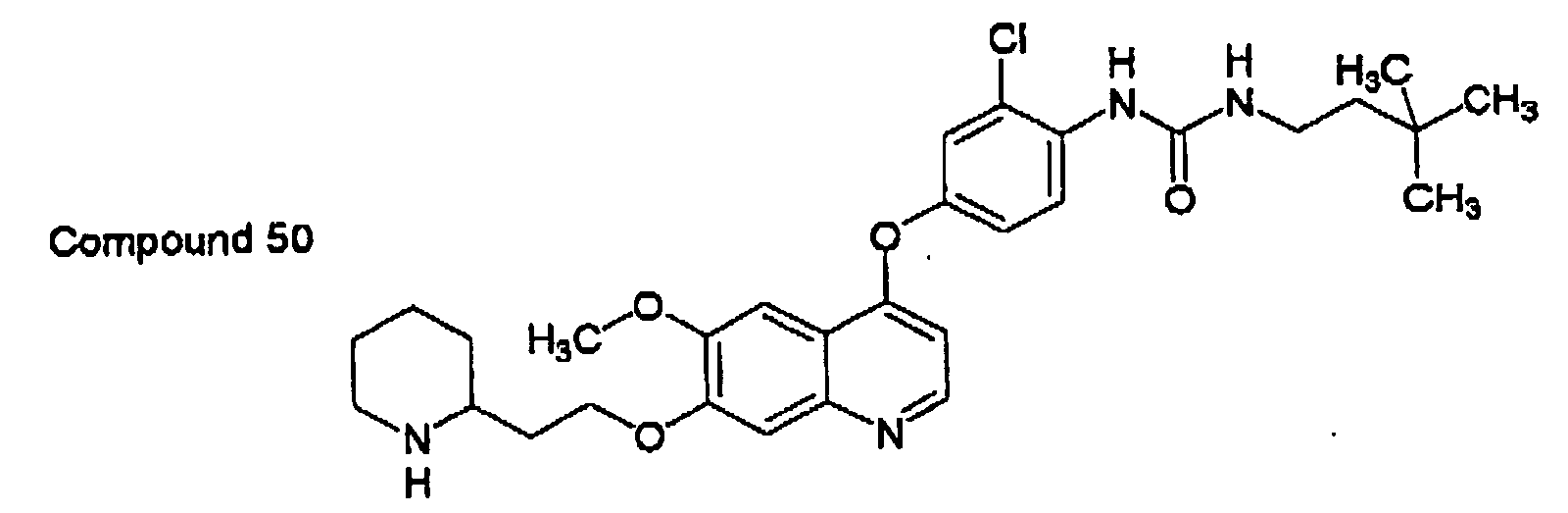
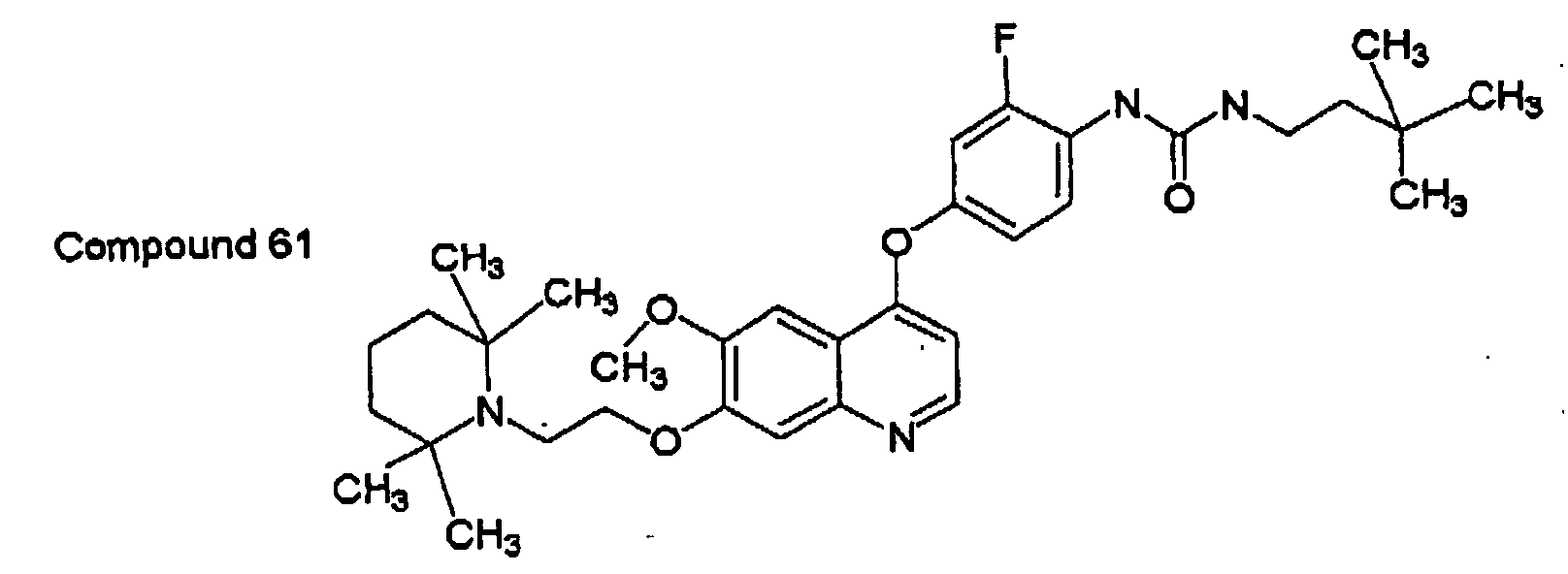
- Preferred examples of compounds represented by formula (I) include compounds 1 to 77 described in the working examples.
- the compounds represented by formula (I), the compounds represented by formula (Ia), and the compounds represented by formula (II) may form pharmaceutically acceptable salts thereof.
- Preferred examples of such salts include: alkali metal or alkaline earth metal salts such as sodium salts, potassium salts or calcium salts; hydrohalogenic acid salts such as hydrofluoride salts, hydrochloride salts, hydrobromide salts, or hydroiodide salts; inorganic acid salts such as nitric acid salts, perchloric acid salts, sulfuric acid salts, or phosphoric acid salts; lower alkylsulfonic acid salts such as methanesulfonic acid salts, trifluoromethanesulfonic acid salts, or ethanesulfonic acid salts; arylsulfonic acid salts such as benzenesulfonic acid salts or p-toluenesulfonic acid salts; organic acid salts such as fumaric acid salts, succ
- the compounds represented by formula (I), the compounds represented by formula (Ia), and the compounds represented by formula (II) may form solvates.
- Such solvates include, for example, hydrates, alcoholates, for example, ethanolates, and etherates.
- a 4-chloroquinoline derivative can be produced according to scheme 1.
- a 4-chloroquinoline derivative may be synthesized by conventional means described, for example, in Org. Synth. Col. Vol. 3, 272 (1955), Acta Chim. Hung., 112, 241 (1983) and WO 98/47873.
- a quinolone derivative is produced by reacting a 2-aminoacetophenone derivative in a suitable solvent, for example, tetrahydrofuran, with a formic ester, for example, ethyl formate, in the presence of a base, for example, sodium methoxide.
- a 4-chloroquinoline derivative is produced by allowing the quinolone derivative to react in the presence of a chlorinating agent, for example, phosphorus oxychloride.
- the 4-chloroquinazoline derivative may be produced, for example, as follows.
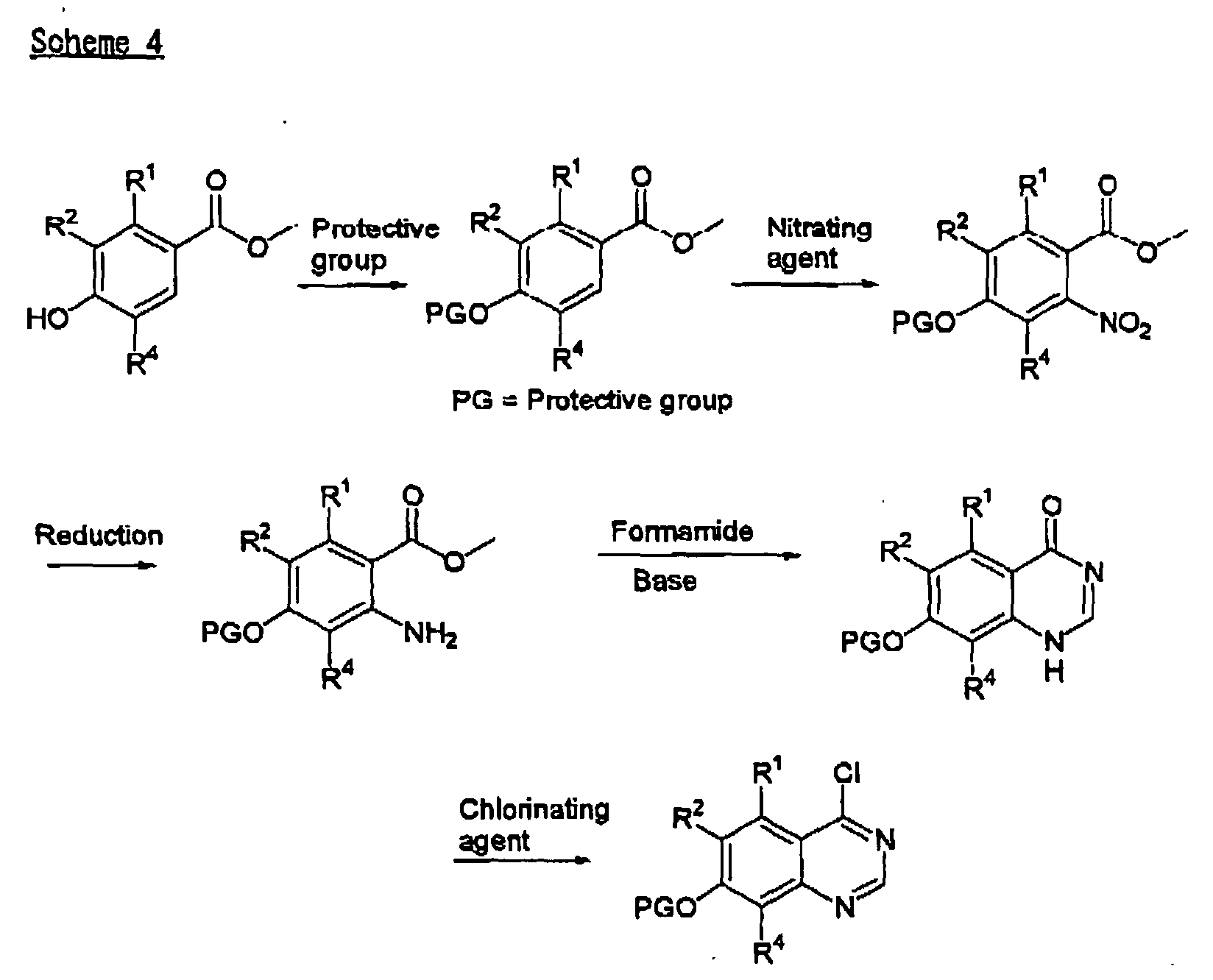
- a quinazolone derivative is produced by reacting a 2-aminobenzoic ester derivative in a suitable solvent, for example, a mixed solvent composed of N,N-dimethylformamide and methanol, in the presence of formamide and a base, for example, sodium methoxide.
- a 4-chloroquinazoline derivative is produced by reacting the quinazolone derivative in the presence of a chlorinating agent, for example, phosphorus oxychloride.
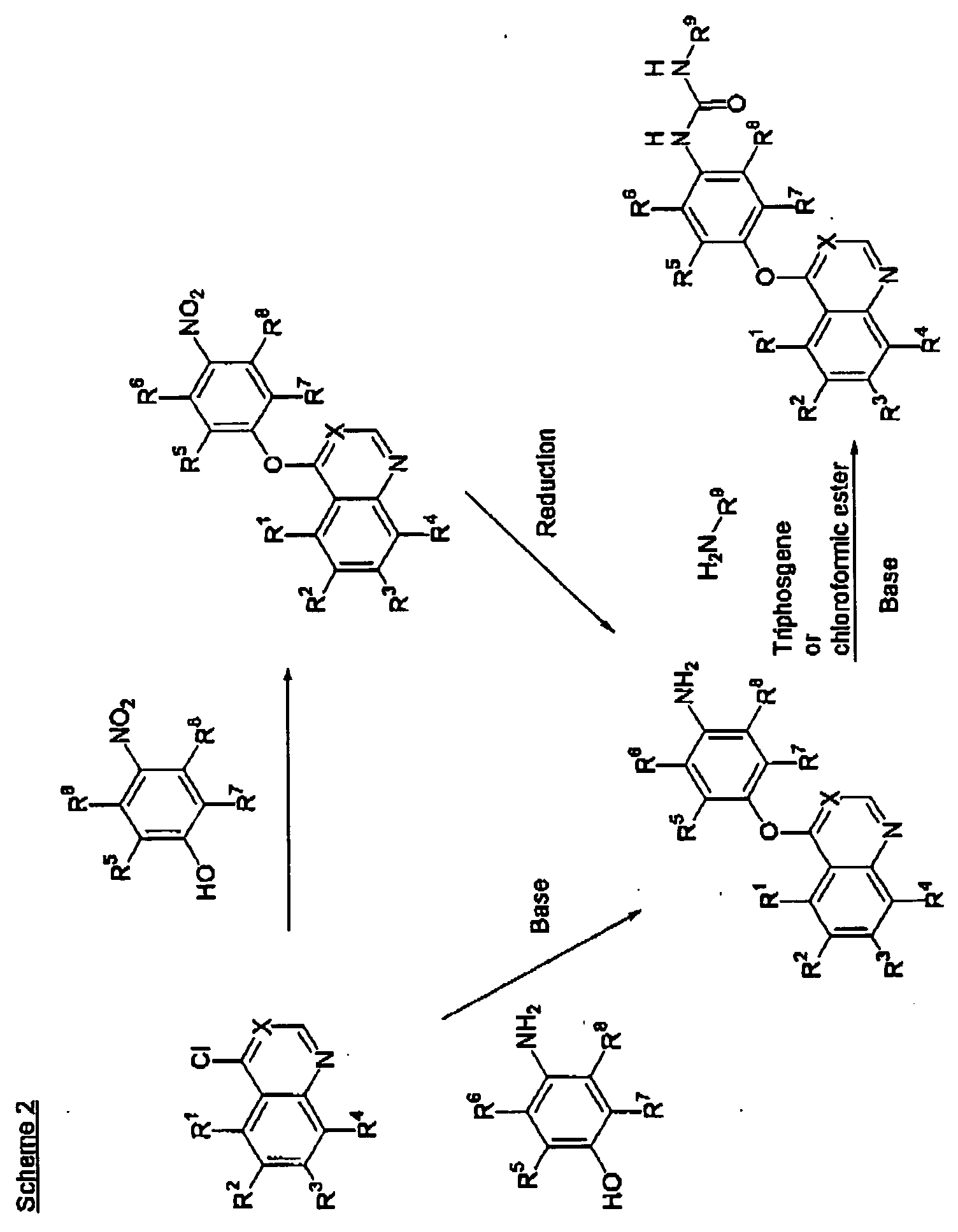
- a urea derivative having a quinoline or quinazoline ring can be synthesized, for example, according to scheme 2.
- a 4-(aminophenoxy)quinoline derivative or a corresponding quinazoline derivative is produced by reacting a nitrophenol derivative with a 4-chloroquinoline derivative or a corresponding quinazoline derivative in a suitable solvent, for example, chlorobenzene to synthesize a 4-(nitrophenoxy)quinoline derivative or a corresponding quinazoline derivative and then allowing a reaction to proceed in a suitable solvent, for example, N,N-dimethylformamide in the presence of a catalyst, for example, palladium hydroxide-carbon or palladium-carbon, under a hydrogen atmosphere.
- a catalyst for example, palladium hydroxide-carbon or palladium-carbon, under a hydrogen atmosphere.
- the nitro group may also be reduced by zinc, iron or the like.
- a 4-(aminophenoxy)quinoline derivative or a corresponding quinazoline derivative may be produced by reacting an aminophenol derivative with a 4-chloroquinoline derivative or a corresponding quinazoline derivative in a suitable solvent, for example, dimethylsulfoxide in the presence of a base, for example, sodium hydride.
- the 4-(aminophenoxy)quinazoline derivative may also be produced by dissolving an aminophenol derivative in an aqueous sodium hydroxide solution and reacting the solution with a 4-chloroquinazoline derivative dissolved in a suitable organic solvent, for example, ethyl methyl ketone, in the presence of a phase transfer catalyst, for example, tetra-n-butylammonium chloride or in the absence of a catalyst by a two-phase reaction.
- a phase transfer catalyst for example, tetra-n-butylammonium chloride or in the absence of a catalyst by a two-phase reaction.
- a quinoline- or quinazoline-substituted urea derivative can be produced by dissolving the 4-(aminophenoxy)quinoline derivative or corresponding quinazoline derivative in a suitable solvent, for example, chloroform, adding triphosgene or a chloroformic ester in the presence of a suitable base, for example, triethylamine, and reacting the solution with a suitable alkylamine.
- a suitable solvent for example, chloroform
- triphosgene or a chloroformic ester in the presence of a suitable base, for example, triethylamine
- An intermediate for synthesizing a derivative containing a specific substituent in the quinoline ring at its 7-position may be produced, for example, according to scheme 3.
- a nitro group can be introduced by protecting a commercially available 4'-hydroxyacetophenone derivative by a suitable substituent, for example, benzyl, and then reacting the protected compound with a nitrating agent, for example, fuming nitric acid-acetic acid. Thereafter, the same procedure as in scheme 1 is repeated. Specifically, the nitro group is reduced to an amino group, and the compound is then reacted with a formic ester in the presence of a base to form a quinolone ring. Subsequently, a 4-chloroquinoline derivative can be produced by reacting the compound with a chlorinating agent. In this chlorination reaction, when phosphorus oxychloride is used as the chlorinating agent, the addition of a base, for example, N,N-diisopropylethylamine, can further improve the yield.
- a suitable substituent for example, benzyl
- a nitrating agent for example, fuming nitric acid-ace
- An intermediate for synthesizing a derivative containing a specific substituent in the quinoline ring at its 6-position may be produced in the same manner as in the quinoline ring at its 7-position, except that a 3'-hydroxyacetophenone derivative is used instead of the 4'-hydroxyacetophenone derivative.
- An intermediate for synthesizing a derivative containing a specific substituent in the quinazoline ring at its 7-position may be produced, for example, according to scheme 4.
- a nitro group can be introduced by protecting a hydroxyl group in a commercially available 4'-hydroxybenzoic ester derivative by a suitable substituent, for example, benzyl, and then reacting the protected compound with a nitrating agent, for example, fuming nitric acid-acetic acid. Thereafter, the same procedure as in scheme 1 is repeated. Specifically, the nitro group is reduced to an amino group, and the compound is then reacted with formamide in the presence of a base to form a quinazolone ring. Subsequently, a 4-chloroquinazoline derivative can be produced by reacting the compound with a chlorinating agent. In this chlorination reaction, when phosphorus oxychloride is used as the chlorinating agent, the addition of a base, for example, N,N-diisopropylethylamine, can further improve the yield.
- a suitable substituent for example, benzyl
- a nitrating agent for example, fuming
- An intermediate for synthesizing a derivative containing a specific substituent in the quinazoline ring at its 6-position may be produced in the same manner as in the quinazoline ring at its 7-position, except that a 3'-hydroxybenzoic ester derivative is used instead of the 4'-hydroxybenzoic ester derivative.
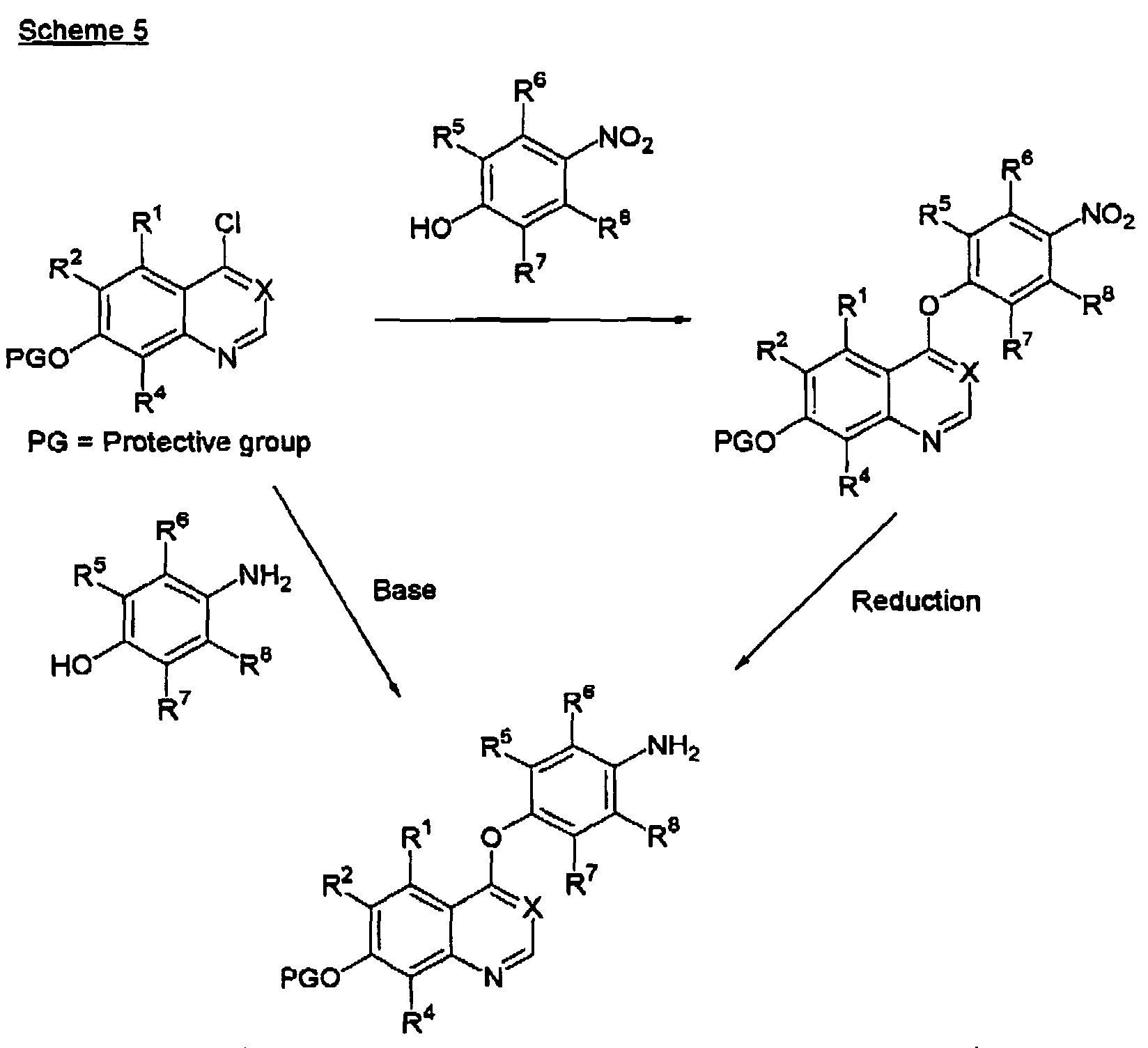
- An aniline derivative containing a specific substituent in the quinoline or quinazoline ring at its 7-position may be produced, for example, according to scheme 5.
- a 4-(aminophenoxy)quinoline derivative or a corresponding quinazoline derivative is produced by reacting the 4-chloroquinoline derivative or quinazoline derivative produced in scheme 3 or 4 with a nitrophenol derivative in a suitable solvent, for example, chlorobenzene to synthesize a 4-(nitrophenoxy)quinoline derivative or a corresponding quinazoline derivative and then allowing a reaction to proceed in a suitable solvent, for example, N,N-dimethylformamide in the presence of a catalyst, for example, palladium hydroxide-carbon or palladium-carbon, under a hydrogen atmosphere.
- a catalyst for example, palladium hydroxide-carbon or palladium-carbon, under a hydrogen atmosphere.
- the nitro group may also be reduced by zinc, iron or the like.
- a 4-(aminophenoxy)quinoline derivative or a corresponding quinazoline derivative may be produced by reacting an aminophenol derivative with a 4-chloroquinoline derivative or a corresponding quinazoline derivative in a suitable solvent, for example, dimethylsulfoxide in the presence of a base, for example, sodium hydride.
- the 4-(aminophenoxy)quinazoline derivative may also be produced by dissolving an aminophenol derivative in an aqueous sodium hydroxide solution and reacting the solution with a 4-chloroquinazoline derivative dissolved in a suitable organic solvent, for example, ethyl methyl ketone, in the presence of a phase transfer catalyst, for example, tetra-n-butylammonium chloride or in the absence of a catalyst by a two-phase reaction.
- Scheme 5 depicts a process for synthesizing a compound according to the present invention containing a substituent in the quinoline ring or quinazoline ring at its 7-position.
- a compound according to the present invention containing a substituent in the quinoline ring or quinazoline ring at its 6-position may be synthesized by using, as a starting compound, a quinoline derivative or quinazoline derivative with a protective group introduced into the 6-position thereof.
- the quinoline derivative with a protective group introduced into the 6-position used as the starting compound may be synthesized, for example, according to scheme 6 (for details, see Production Examples).
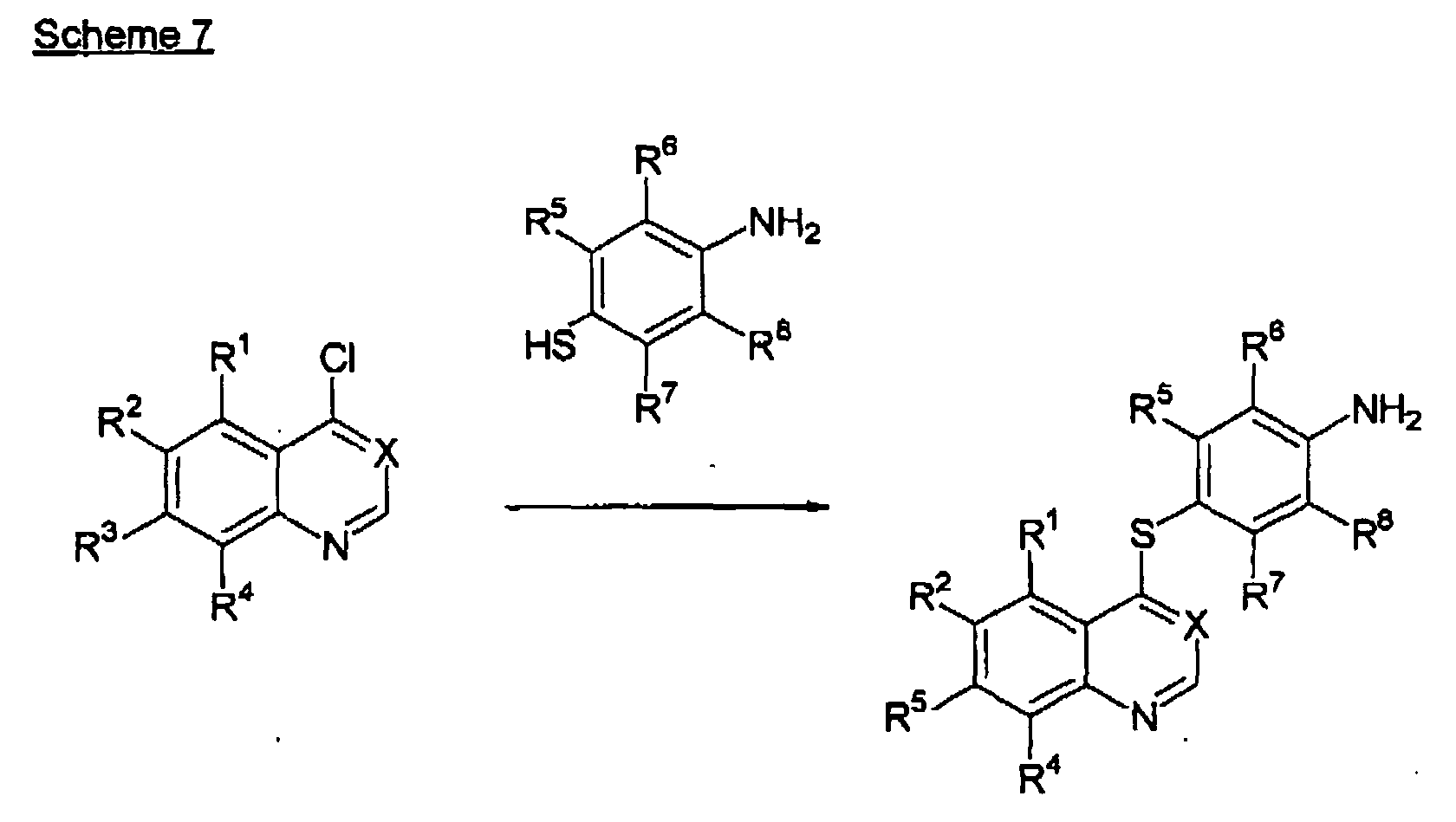
- a 4-(quinolylsulfanyl)aniline derivative or a 4-(quinazolinyisulfanyl)aniline derivative may be produced by reacting an aminothiophenol derivative with a 4-chloroquinoline derivative or a corresponding quinazoline derivative in a suitable solvent, for example, chlorobenzene).
- a urea derivative containing a sulfur atom in the quinoline or quinazoline ring at its 4-position can be produced from this derivative according to scheme 2.
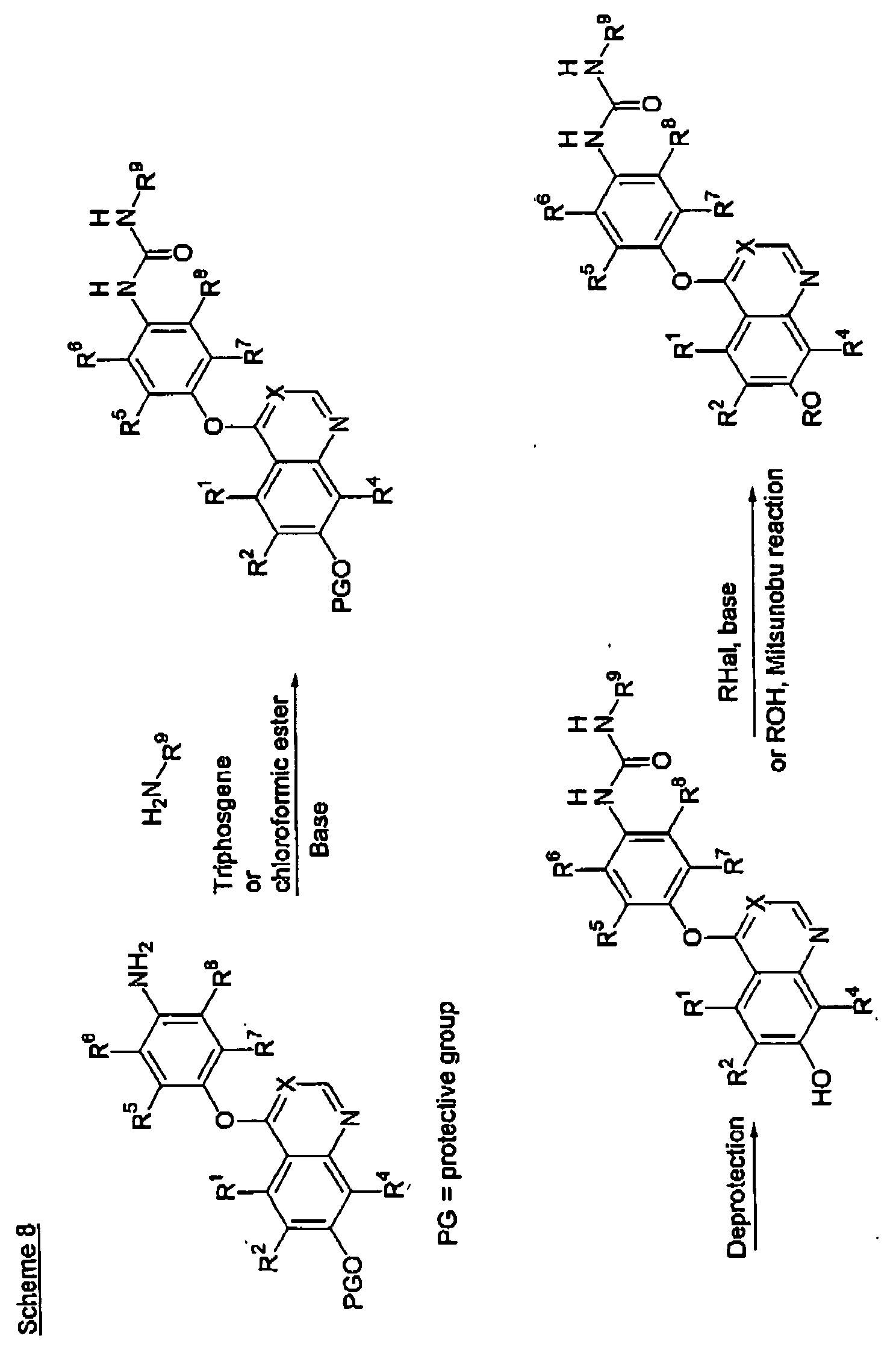
- a urea derivative containing a specific substitutent in the quinoline ring or quinazoline ring at its 7-position can be synthesized, for example, according to scheme 8.
- a urea derivative containing a protected hydroxyl group in quinoline or quinazoline at its 7-position can be produced by dissolving the 4-(aminophenoxy)quinoline derivative or corresponding quinazoline derivative prepared in scheme 5 in a suitable solvent, for example, chloroform, adding triphosgene or a chloroformic ester in the presence of a suitable base, for example, triethylamine, and reacting the solution with a suitable alkylamine.
- a suitable solvent for example, chloroform
- triphosgene or a chloroformic ester in the presence of a suitable base, for example, triethylamine, and reacting the solution with a suitable alkylamine.
- a 7-hydroxyquinoline derivative or a corresponding quinazoline derivative can be produced by deprotecting the hydroxyl group in the urea derivative under suitable conditions.
- a reaction is allowed to proceed, for example, in N,N-dimethylformamide in the presence of palladium hydroxide-carbon or palladium-carbon under a hydrogen atmosphere.
- a urea derivative containing a specific substituent in quinoline or quinazoline at its 7-position can be produced by alkylating the 7-hydroxyquinoline derivative or corresponding quinazoline derivative under suitable conditions, for example, by a reaction with an alkyl halide (RHal) in N,N-dimethylformamide in the presence of potassium carbonate, or by a reaction with an alkyl alcohol (ROH) utilizing the Mitsunobu reaction).
- RHal alkyl halide
- ROH alkyl alcohol
- a urea derivative containing a specific substituent in the quinoline ring or quinazoline ring at its 6- or 7-position may be synthesized, for example, as follows.
- a quinoline derivative or corresponding quinazoline derivative containing a hydroxyl group in quinoline or quinazoline at its 6- or 7-position can be produced by dissolving a 6,7-dimethoxy-4-(nitrophenoxy)quinoline derivative or corresponding quinazoline derivative in a suitable solvent, for example, chloroform, and heating the solution under reflux in the presence of a suitable Lewis acid, for example, trialuminum chloride.
- a 4-(nitrophenoxy)quinoline derivative or corresponding quinazoline derivative which has been protected at its 6- or 7-position can be produced by protecting the hydroxyl group in this derivative under suitable conditions and separating and purifying the product.
- the hydroxyl group may be protected, for example, by a benzyl group.
- the benzyl group may be introduced by reacting the derivative with benzyl chloride in N,N-dimethylformamide in the presence of potassium carbonate.
- a 4-(aminophenoxy)quinoline derivative or corresponding quinazoline derivative can be derived from the resultant derivative in the same manner as in the method according to scheme 5.
- a urea derivative containing a specific substituent in the quinoline or quinazoline ring at its 6- or 7-position can be produced from this derivative in the same manner as in scheme 8 (for more details, see scheme 11).
- the urea derivative containing a specific substituent in the quinoline or quinazoline ring at its 7-position may also be synthesized according to the method described in WO 00/43366.
- Flt3 is reported to be highly expressed in brains, placentae, livers and hematopoietic stem cells (Shibuya et al., Oncogene, 5: 519-524, 1990; O. Rosnet et al., Genomics, 9: 380-385, 1991; O. Rosnet et al., Oncogene, 6: 1641-1650, 1991; O. Ronsnet et al., Oncogene, 6: 1641-1650, 1991; W. Matthews et al., Cell, 65: 1143-1152, 1991).
- CML chronic myelocytic leukemia
- Flt3-ITD somatic cell variants of Flt3
- AML acute myelocytic leukemia
- ITD internal tandem duplication
- Flt3-ITD Flt3-ITD
- the abnormality of the signal transduction system through Flt3 and/or Flt3-ITD is related to abnormality of growth and differentiation of haemopoietic cells and immune disorder. Accordingly, diseases caused by the abnormality of the signal transduction system through Flt3 and/or Flt3-ITD, particularly an enhancement in signal transfer system through Flt3 and/or Flt3-ITD, can be treated and prevented by inhibiting the autophosphorylation of Flt3.
- compounds of formula (I) and pharmaceutically acceptable salts and solvates thereof are effective for the treatment and prevention of diseases where the inhibition of autophosphorylation of Flt3 and/or Flt3-ITD is therapeutically or prophylactically effective.
- hematopoietic malignancies for example, acute myelocytic leukemia and myelodysplastic syndrome, and immune diseases caused by abnormal growth of B cells, dendritic cells, or natural killer cells.
- a pharmaceutical composition for use in the treatment or prevention of a hematopoietic organ malignant tumor which comprises a compound represented by formula (Ia), a compound represented by formula (II), or a pharmaceutically acceptable salt or solvate thereof.
- a method for the treatment or prevention of a disease where the inhibition of autophosphorylation of Flt3 and/or Flt3-ITD is therapeutically or prophylactically effective which comprises the step of administering a compound represented by formula (I) or a pharmaceutically acceptable salt or solvate thereof together with a pharmaceutically acceptable carrier, to a mammal.
- a compound represented by formula (I) or a pharmaceutically acceptable salt or solvate thereof for the manufacture of a medicament used in the treatment or prevention of diseases where the inhibition of autophosphorylation of Flt3 and/or Flt3-ITD is therapeutically or prophylactically effective.
- the compounds according to the present invention can be administered to human and non-human animals either orally or parenterally by administration routes, for example, intravenous administration, intramuscular administration, subcutaneous administration, rectal administration, or percutaneous administration. Therefore, the pharmaceutical composition comprising the compound according to the present invention as an active ingredient is formulated into suitable dosage forms according to the administration routes.
- oral preparations include tablets, capsules, powders, granules, and syrups
- parental preparations include injections, suppositories, tapes, and ointments.
- compositions may be prepared by conventional methods, for example, with commonly used excipients, disintegrants, binders, lubricants, colorants, and diluents.
- Excipients include, for example, lactose, glucose, corn starch, sorbit, and crystalline cellulose.
- Disintegrants include, for example, starch, sodium alginate, gelatin powder, calcium carbonate, calcium citrate, and dextrin.
- Binders include, for example, dimethylcellulose, polyvinyl alcohol, polyvinyl ether, methylcellulose, ethylcellulose, gum arabic, gelatin, hydroxypropylcellulose, and polyvinyl pyrrolidone.
- Lubricants include, for example, talc, magnesium stearate, polyethylene glycol, and hydrogenated vegetable oils.
- buffers for example, buffers, pH adjustors, stabilizers, tonicity agents, and preservatives may be added.
- the content of the compound according to the present invention in the pharmaceutical composition according to the present invention may vary depending upon the dosage form. In general, however, the content is 0.5 to 50% by weight, preferably 1 to 20% by weight, based on the whole composition.
- the dose may be appropriately determined in consideration of, for example, the age, weight, sex, difference in diseases, and severity of condition of individual patients, preferably, in the range of 1 to 100 mg/kg. This dose is administered at a time daily or divided doses of several times daily.
- the compound according to the present invention may be administered in combination with other medicament, for example, a carcinostatic agent.
- the compound according to the present invention may be administered simultaneously with or after or before the administration of other medicament.
- the type, administration intervals and the like of the carcinostatic agent may be determined depending upon the type of cancer and the condition of patients.
- Chloroform was added to dissolve the resultant solid.
- the reaction solution was extracted twice with chloroform, and the extract was washed with saturated brine, was dried over sodium sulfate, and was then concentrated and dried.
- Ethanol was added to the solid, and the mixture was heated to 100°C for dissolution.
- Water (20 ml), ammonium chloride (21.1 g), and zinc powder (112 g) were added thereto, and the mixture was stirred at 100°C for one hr.
- the reaction solution was filtered while hot and was washed with a chloroform-methanol mixed solution.
- the mother liquor was concentrated, ethyl acetate and 10% sodium hydroxide were added to the residue, and the mixture was vigorously stirred. The insolubles were then removed by filtration.
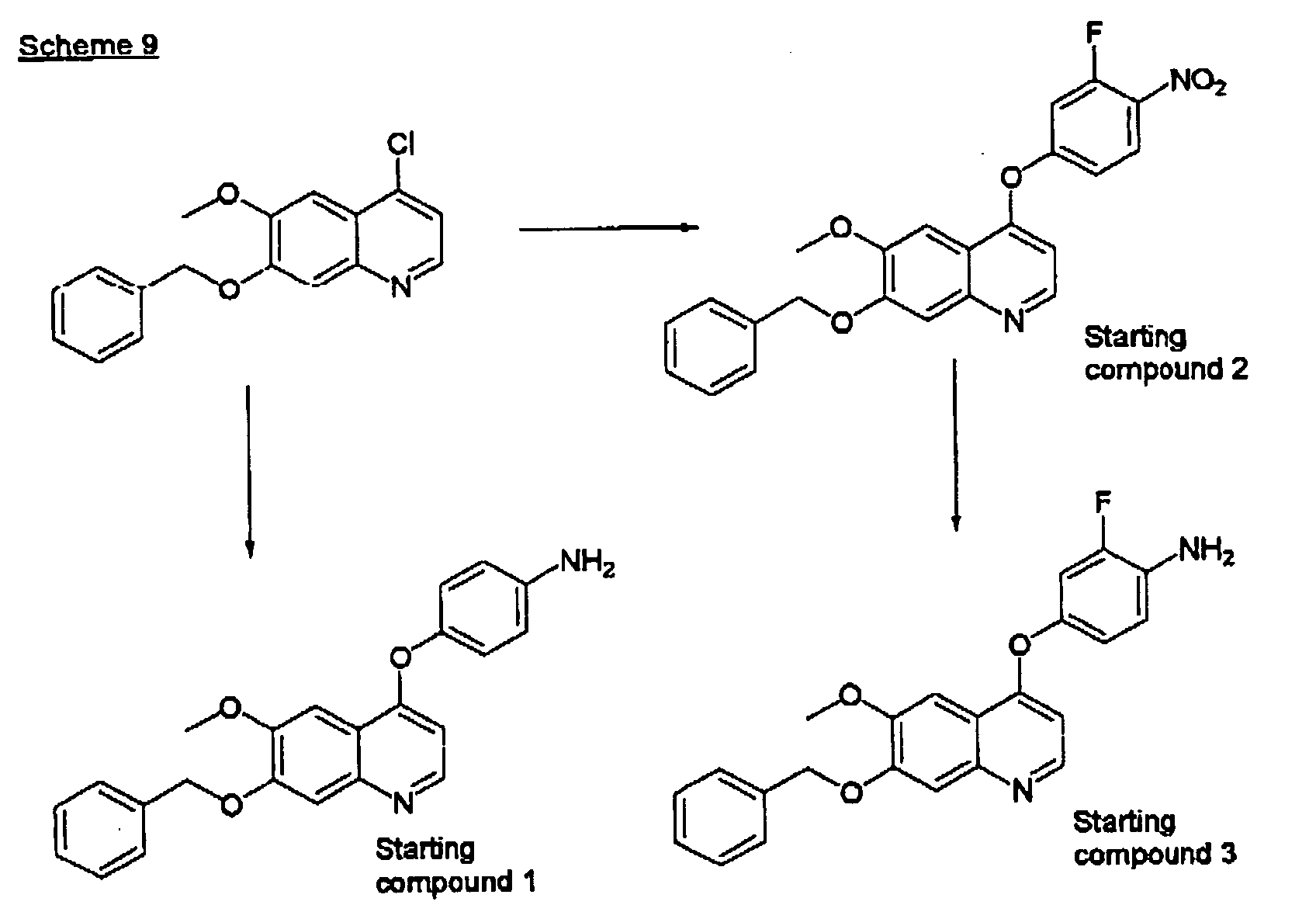
- Production Example 7 Production of 6-benzyloxy-4-chloro-7-methoxyquinoline (starting compound 7)
- 6-Benzyloxy-7-methoxy-4-quinolone (2.4 g), diisopropylamine (7.4 ml), and phosphorus oxychloride (2.0 ml) were added, and the mixture was stirred at 110°C for one hr.
- the reaction solution was concentrated under the reduced pressure, and chloroform and ice water were then added to the concentrate.
- the mixture was weakly acidified by the addition of 28% aqueous ammonia and was extracted with chloroform. The extract was washed with saturated brine and was dried over sodium sulfate, and the solvent was then removed by distillation under the reduced pressure.
- Production Example 8 Production of 4-[(6-benzyloxy-7-methoxy-4-quinolyl)oxy]-3-fluoro-nitrobenzene (starting compound 8)
- reaction solution was extracted with ethyl acetate, the extract was then washed with saturated brine and was dried over anhydrous sodium sulfate, and the solvent was removed by distillation under the reduced pressure.
- the residue was purified by column chromatography on silica gel, and the title compound was obtained from n-hexane : ethyl acetate (1 : 4) fraction (1.4 g, yield 27%).
- 2,2,6,6-Tetramethylpiperidine (2.78 g) was dissolved in anhydrous chloroform (80 ml), and triethylamine (10.1 g) was added thereto. Subsequently, chloroglyoxylic acid ethyl ester (5.40 g) dissolved in anhydrous chloroform (5 ml) was added at 0°C, and the mixture was stirred at room temperature for 20 hr. A saturated aqueous sodium hydrogencarbonate solution was added thereto, and the organic layer was separated. The organic layer was washed with saturated brine and was dried over anhydrous sodium sulfate, and the solvent was removed by distillation under the reduced pressure.
- N-(Glyoxylic ethyl ester)-2,2,6,6-tetramethylpiperidine (4.50 g) was dissolved in tetrahydrofuran (100 ml), lithium aluminium hydride (2.14 g) was added thereto at 0°C, and the mixture was then heated under reflux for one hr. The excess reagent was decomposed with sodium sulfate decahydrate, followed by filtration through Celite. The filtrate was concentrated under the reduced pressure to give the title compound (3.40 g, yield 100%).
- the crude product was dissolved in dimethylformamide (100 ml), potassium carbonate (18 g) and 1-bromo-2-chloroethane (starting compound C) (11 g) were added thereto, and the mixture was stirred at room temperature for 20 hr.
- the reaction solution was extracted with ethyl acetate, and the extract was then washed with saturated brine and was dried over anhydrous sodium sulfate. The solvent was removed by distillation under the reduced pressure.
- N,N-Dimethylformamide (80 ml) was added to 1- ⁇ 4-[7-(2-chloroethoxy)-6-methoxy-quinolin-4-yloxy]-2-fluorophenyl ⁇ -3-(3,3-dimethyl-butyl)urea (1.98 g) prepared above, potassium carbonate (2.82 g), and piperidine (starting compound D) (2.02 ml), and the mixture was stirred at 70 to 75°C for 17 hr. Piperidine (starting compound D) (0.8 ml) was added, and the mixture was further stirred at 70 to 75°C for 23 hr.
- reaction solution was extracted with ethyl acetate, the organic layer was washed with saturated brine and was dried over anhydrous sodium sulfate, and the solvent was then removed by distillation under the reduced pressure.
- the residue was purified by column chromatography on silica gel, eluting with methanol : ethyl acetate (1 : 99) mixed solvent to give 4-(3-fluoro-4-nitrophenoxy)-6-methoxy-7-[2-(2,2,6,6-tetramethylpiperidino)ethoxy]quinoline (315 mg, yield 49%).
- Compound 70 1-(3-Chloro-4- ⁇ 7-[2-(2,6-dimethyl-morpholin-4-yl)-ethoxy]-6-methoxy-quinolin-4-yloxy ⁇ -phenyl)-3-(3,3-dimethyl-butyl)-urea
- Human leukemia cells MV4-11 (ATCC number: CRL-9591) were cultured in an IMDM medium containing 10% fetal calf serum (purchased from SIGMA) within a 5% carbon dioxide incubator until 50 to 90% confluent.
- the harvested cells were seeded into 96-wells, plates, containing an IMDM medium containing 0.1% fetal calf serum, in a 96-well multiscreen plate in an amount of 5.0 ⁇ 10 5 per well, a solution of the test compound in dimethyl sulfoxide was added to each well, and the cultivation was continued at 37°C for one hr. The medium was removed, followed by washing with phosphate buffered saline.
- a lysis buffer (60 ⁇ l) (20 mM HEPES (pH 7.4), 150 mM NaCl, 0.2% Triton X-100, 10% glycerol, 5 mM sodium orthovanadylate, 5 mM disodium ethylenediaminetetraacetate, and 2 mM Na 4 P 2 O 7 ) was then added thereto. The mixture was shaken at 4°C for 2 hr to prepare a cell extracts.
- phosphate buffered saline 50 ⁇ l, pH 7.4 containing 5 ⁇ g/ml of anti-phospho-tyrosine antibody (PY20; purchased from Transduction Laboratories) was added to a 96-well microplate for ELISA (Maxisorp; purchased from NUNC), followed by standing at 4°C overnight to form a solid phase on the wells. After washing of the plate, 250 ⁇ l of a blocking solution was added, followed by standing at room temperature for 3 hr to perform blocking. After washing, the whole quantity of the cell extract was transferred to the wells, and the plate was then allowed to stand at 4°C overnight.
- PY20 anti-phospho-tyrosine antibody
- an anti-FLT3 antibody (Flt3/Flk2 (C-20), purchased from Santa Cruz Biotechnology) was allowed to react at room temperature for 2 hr, and, after washing, a peroxidase-labeled anti-rabbit Ig antibody (purchased from Amersham) was allowed to react at room temperature for one hr.
- a chromophoric substrate for peroxidase (purchased from Sumitomo Bakelite Co., Ltd.) was added thereto to initiate a reaction. After a suitable level of color development, a reaction termination solution was added to stop the reaction, and the absorbance at 450 nm was measured with a microplate reader.
- the FLT3-phosphorylation activity for each well was determined by presuming the absorbance without the addition of the medicament to be 100% FLT3-phosphorylation activity and the absorbance with the addition of a large excess of a positive control (Compound 1, 10 ⁇ M) to be 0% FLT3-phosphorylation activity.
- the concentration of the test compound was varied on several levels, the FLT3-phosphorylation inhibitory activity was determined for each case, and the concentration of the test compound necessary for inhibiting 50% of FLT3-phosphorylation (IC 50 ) was calculated.
- the results were as shown in Table 1.
- Compound No. IC50 (nM) 1 2 3 7 6 109 8 ⁇ 1 10 ⁇ 1 40 93 41 308 43 216 44 200
- MV4-11 (ATCC number: CRL-9591) as human leukemia cells was seeded in an amount of 3 ⁇ 10 3 using a DMEM medium containing 10% fetal calf serum (purchased from GIBCO) in a 96-well flat bottom plate.
- a solution of a test compound in dimethyl sulfoxide was added to each well and was cultured in a 5% carbon dioxide incubator for 3 days.
- 10 ⁇ l of a WST-1 solution in Cell Counting Kit (purchased from Wako Pure Chemical Industries, Ltd.) was added to each well for a color reaction.
- the absorbance was measured with a microplate reader under conditions of measurement wavelength 450 nm and reference wavelength 650 nm.
- the growth ratio for each well was determined by presuming the absorbance without the addition of the medicament to be 100% growth ratio and the absorbance of the well without seeding of the cells to be 0% growth ratio.
- the concentration of the test compound was varied on several levels, the cell growth ratio for each case was determined, and the concentration of the test compound necessary for inhibiting 50% of cell growth ratio (IC 50 ) was calculated. The results were as shown in Table 2.
- Human leukemia cell line MOLM13 (subdivided from Hayashibara Biochemical Laboratories, Inc.) was cultured in an RPMI medium containing 10% fetal calf serum (purchased from Asahi Techno Glass Corporation) within a 5% carbon dioxide incubator until the cell density reached 50 to 90% of the maximum cell density. These cells were seeded into wells, containing an RPMI medium containing 10% fetal calf serum, in a 96-well flat bottom plate in an amount of 2 ⁇ 10 4 per well. The amount of the solution of the medium in each well was brought to 100 ⁇ l, and a test compound was added thereto to 500 ng, 100 ng, 20 ng, and 4 ng per ml.
- absorbance at 550 nm was measured using 620 nm as a reference wavelength with a microplate reader (DIGISCAN) (It is regarded that, in the MTT method, the viable cell count is reflected, and linearity is observed in a cell count per well range of 5 ⁇ 10 5 to 2 ⁇ 10 2 cells).
- DIGISCAN microplate reader
- the absorbance of only the medium free from cells was subtracted from the absorbance of the well without the addition of the test compound to determine a value which was presumed to be 100%.
- the absorbance with the addition of the compound was expressed in terms of % growth.
- the concentration of the test compound necessary for inhibiting 50% of the cell growth ratio was calculated from the average of values obtained from three wells, The results are shown in Table 3.
- Compound No. IC 50 (nM) 1 24.4 5 93.1 6 12.4 8 13.3 10 20.8 12 5.37 13 3.87 14 5.13 15 9.5 16 18.8 17 20.5 18 40.3 26 31.3 41 34.8 43 32.5 44 19.3 45 255 46 76.8 47 135 53 16.7 54 19.7 55 36.8 56 11.3 57 120 58 51.6 60 108 62 26.5 63 47.8 64 195 65 24.6 67 16.1 68 13.3 69 17.7 70 29.6 72 54.5 73 21.5
- Human leukemia cells MOLM13 (subdivided from Hayashibara Biochemical Laboratories, Inc.) were seeded in an amount of 3 ⁇ 10 3 using a DMEM medium containing 10% fetal calf serum (purchased from GIBCO) in a 96-well flat bottom plate.
- a solution of a test compound in dimethyl sulfoxide was added to each well and was cultured in a 5% carbon dioxide incubator for 3 days.
- 10 ⁇ l of a WST-1 solution in Cell Counting Kit purchasedd from Wako Pure Chemical Industries, Ltd. was added to each well for a color reaction.
- the absorbance was measured with a microplate reader under conditions of measurement wavelength 450 nm and reference wavelength 650 nm.
- the growth ratio for each well was determined by presuming the absorbance without the addition of the medicament to be 100% growth ratio and the absorbance of the well without seeding of the cells to be 0% growth ratio.
- the concentration of the test compound was varied on several levels, the cell growth ratio for each case was determined, and the concentration of the test compound necessary for inhibiting 50% of cell growth ratio (IC 50 ) was calculated. The results were as shown in Table 4.
- IC 50 (nM) IC 50 (nM) Compound No. MOLM13 Compound No.
- MOLM13 1 1.0 40 2.0 2 770.0 41 75.0 3 3.0 42 273.0 4 653,0 43 22.0 5 36.0 44 3.0 6 21.0 45 140.0 7 593.0 46 123.0 8 3.0 47 60.0 9 24.0 38 222.0 10 2.0 49 224.0 11 416.0 50 243.0 12 6.0 51 216.0 13 21.0 52 188.0 14 3.0 53 13.0 15 22.0 54 10.0 16 7.0 55 25.0 17 27.0 56 26.0 18 2.0 57 29.0 19 10.0 58 17.0 20 39.0 59 4.0 21 22.0 60 59.0 22 7.0 61 138.0 23 4.0 62 7.0 24 24.0 63 22.0 25 258.0 64 19.0 26 18.0 65 9.0 27 45.0 66 ⁇ 1 28 26.0 67 4.0 29 3.0 68 1.0 30 8.0 69 8.0 31 2.0 70 3.0 32 314.0 71 27.0 33 4.0 72 8.0 34 2.0 73 20.0 35 3.0 74 244.0 36 2.0 75 ⁇ 1 37 38.0 39 3.0
- mice Human leukemia cells MOLM13 (subdivided from Hayashibara Biochemical Laboratories, Inc.) were subcutaneously transplanted into nude mice. When the tumor volume became about 100 mm 3 , the mice were grouped so that the groups each consisted of four mice and had an even average tumor volume. The test compound suspended or dissolved in 0.5% methylcellulose was orally administered at a dose of 0.1 ml per 10 g body weight once a day for 9 days. For the control group, only vehicle was administered.
- the tumor growth inhibition rate (TGIR) was calculated as follows:
- the tumor growth inhibition rate (TGIR) (1 - TX/CX) ⁇ 100 wherein CX represents the volume of tumor at day X for the control group when the tumor volume at the day of the start of the administration (day 1) was presumed to be 1; and TX represents the volume of tumor at day X for test compound administration groups.
- TGIR tumor growth inhibition rate
- Dose TGIR (%) (measurement date) 1 50 mg/kg 53.8% (day 11) 10 50 mg/kg 84.8% (day 10) 12 50 mg/kg 93.7% (day 10) 13 50 mg/kg 84.8% (day 10) 14 50 mg/kg 96.1% (day 10) 15 50 mg/kg 89.4% (day 10) 43 50 mg/kg 98.1% (day 10) 44 25 mg/kg 99.8% (day 9) 44 12.5 mg/kg 99.6% (day 9) 75 50 mg/kg 94.1% (day 9) 76 50 mg/kg 34.3% (day 9) 77 50 mg/kg 70.4% (day 9)
Landscapes
- Health & Medical Sciences (AREA)
- Chemical & Material Sciences (AREA)
- Organic Chemistry (AREA)
- Life Sciences & Earth Sciences (AREA)
- Pharmacology & Pharmacy (AREA)
- Animal Behavior & Ethology (AREA)
- General Health & Medical Sciences (AREA)
- Public Health (AREA)
- Veterinary Medicine (AREA)
- Medicinal Chemistry (AREA)
- Epidemiology (AREA)
- Nuclear Medicine, Radiotherapy & Molecular Imaging (AREA)
- Immunology (AREA)
- Chemical Kinetics & Catalysis (AREA)
- General Chemical & Material Sciences (AREA)
- Engineering & Computer Science (AREA)
- Bioinformatics & Cheminformatics (AREA)
- Oncology (AREA)
- Hematology (AREA)
- Transplantation (AREA)
- Pharmaceuticals Containing Other Organic And Inorganic Compounds (AREA)
- Quinoline Compounds (AREA)
- Plural Heterocyclic Compounds (AREA)
Abstract
Description

X represents CH or N,
Z represents O or S,
R1, R2, and R3, which may be the same or different, represent
a hydrogen atom,
hydroxyl,
a halogen atom,
nitro,
cyano,
amino,
C1-6 alkyl,
C2-6 alkenyl,
C2-6 alkynyl,
C1-6 alkoxy,
-(C=O)ORc wherein Rc represents a hydrogen atom or C1-4 alkyl, or
-(C=O)NRdRe wherein Rd and Re, which may be the same or different, represent a hydrogen atom or C1-4 alkyl,
the C1-6 alkyl, C2-6 alkenyl, C2-6 alkynyl, and C1-6 alkoxy groups, which may be represented by R1, R2, and R3, are optionally substituted by hydroxyl; a halogen atom; C1-6 alkoxy; C1-6 alkylcarbonyl; carboxyl; C1-6 alkoxycarbonyl; -(C=O)-NR10R11 wherein R10 and R11, which may be the same or different, represent a hydrogen atom or C1-4 alkyl optionally substituted by hydroxyl, or R10 and R11 may combine with a nitrogen atom attached thereto to form a saturated five- or six-membered heterocyclic group; amino in which one or two hydrogen atoms on the amino group are optionally substituted by C1-6 alkyl or a saturated or unsaturated three- to eight-membered carbocyclic or heterocyclic group, and the C1-6 alkyl group is further optionally substituted by hydroxyl, C1-6 alkoxy, or a saturated or unsaturated three- to eight-membered carbocyclic or heterocyclic group; or a saturated or unsaturated three- to eight-membered carbocyclic or heterocyclic group in which the carbocyclic or heterocyclic group is optionally substituted by hydroxyl, an oxygen atom, a halogen atom, C1-6 alkyl, C2-6 alkenyl, C2-6 alkynyl, C1-6 alkoxy, C1-6 alkoxycarbonyl, or a saturated or unsaturated three- to eight-membered carbocyclic or heterocyclic group, the C1-6 alkyl, C2-6 alkenyl, and C2-6 alkynyl groups are further optionally substituted by hydroxyl, C1-6 alkoxy, or a saturated or unsaturated three- to eight-membered carbocyclic or heterocyclic group, and, when the carbocyclic or heterocyclic group is substituted by two C1-6 alkyl groups, the two alkyl groups may combine together to form an alkylene chain, or the carbocyclic or heterocyclic group may be a bicyclic group condensed with another saturated or unsaturated five- to seven-membered carbocyclic or heterocyclic group;
one or two hydrogen atoms on the amino group, which may be represented by R1, R2, and R3, are optionally substituted by C1-6 alkyl which is further optionally substituted by hydroxyl or C1-6 alkoxy;
R4 represents a hydrogen atom;
all of R5, R6, R7, and R8 represent a hydrogen atom, or any one or two of R5, R6, R7, and R8 represent a halogen atom, C1-4 alkyl, C1-4 alkoxy, nitro, amino, or hydroxyl with all the remaining groups representing a hydrogen atom, and
R9 represents C1-4 alkyl substituted by a substituent selected from the group consisting of a saturated three- to nine-membered (preferably three- to seven-membered) carbocyclic group optionally substituted by C1-4 alkyl, C1-4 alkoxy, or hydroxyl; i-propyl optionally substituted by C1-4 alkyl, C1-4 alkoxy, or hydroxyl; t-butyl optionally substituted by C1-4 alkyl, C1-4 alkoxy, or hydroxyl; C1-4 alkoxy; and -NRaRb wherein Ra and Rb, which may be the same or different, represent a hydrogen atom or C1-4 alkyl optionally substituted by hydroxyl, or Ra and Rb may combine with a nitrogen atom attached thereto to form a saturated five- or six-membered heterocyclic group, or R9 represents a saturated three- to nine-membered (preferably five- to seven-membered) carbocyclic group optionally substituted by one to three C1-4 alkyl group.
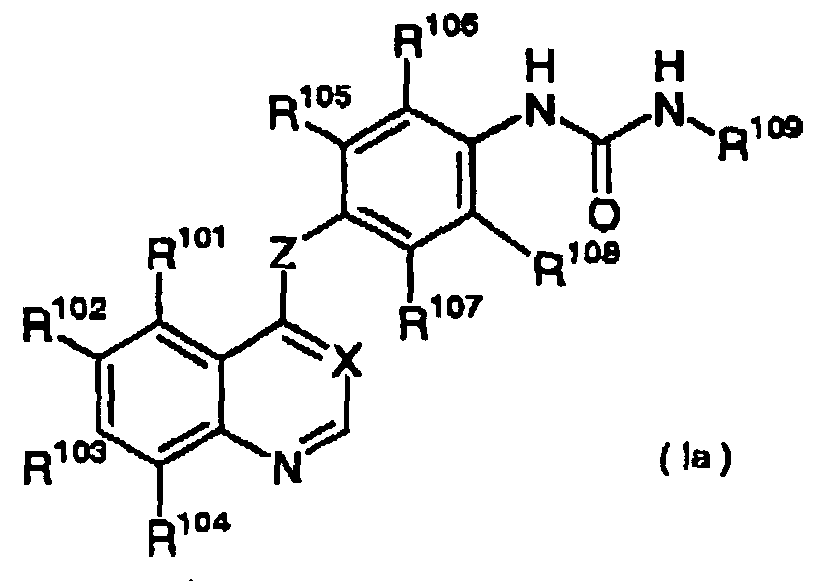
X represents CH or N,
Z represents O or S,
R101 and R104 represent a hydrogen atom,
R102 and R103, which may be the same or different, represent
a hydrogen atom,
hydroxyl,
a halogen atom,
nitro,
cyano,
-NR111R112 wherein R111 and R112, which may be the same or different, represent a hydrogen atom or C1-4 alkyl,
-(C=O)OR113 wherein R113 represents a hydrogen atom or C1-4 alkyl,
-(C=O)NR114R115 wherein R114 and R115, which may be the same or different, represent a hydrogen atom or C1-4 alkyl,
C1-6 alkoxy,
C1-6 alkyl,
C1-6 alkenyl, or
C1-6 alkynyl,
the C1-6 alkoxy, C1-6 alkyl, C1-6 alkenyl, or C1-6 alkynyl are optionally substituted by hydroxyl; a halogen atom; C1-4 alkoxy; -NR116R117 wherein R116 and R117, which may be the same or different, represent a hydrogen atom or C1-4 alkyl and the alkyl group is further optionally substituted by hydroxyl or C1-4 alkoxy; or a saturated or unsaturated three- to eight-membered carbocylic or heterocyclic group in which the cyclic group is optionally substituted by hydroxyl, a halogen atom, C1-4 alkyl, or C1-4 alkoxy,
all of R105, R106, R107, and R108 represent a hydrogen atom, or any one or two of R105, R106, R107, and R108 represent hydroxyl, C1-4 alkyl, C1-4 alkoxy, amino, nitro, or a halogen atom with all the remaining groups representing a hydrogen atom,
R109 represents -(CH2)n-R110 wherein n is 2, 3, or 4, and R110 represents i-propyl optionally substituted by C1-4 alkyl, C1-4 alkoxy, or hydroxyl; t-butyl optionally substituted by C1-4 alkyl, C1-4 alkoxy, or hydroxyl; or a three- to nine-membered saturated carbocyclic group optionally substituted by C1-4 alkyl, C1-4 alkoxy, or hydroxyl.

R15 and R16, which may be the same or different, represent -O-(CH2)r-R22 wherein r is an integer of 0 to 6, -(CH2)r- is optionally substituted by C1-6 alkyl, hydroxyl, or a halogen atom, and R22 represents a hydrogen atom; hydroxyl; a halogen atom; C1-6 alkoxy; C1-6 alkylcarbonyl; carboxyl; C1-6 alkoxycarbonyl; -(C=O)-NR23R24 wherein R23 and R24, which may be the same or different, represent a hydrogen atom or C1-4 alkyl optionally substituted by hydroxyl, or R23 and R24 may combine with a nitrogen atom attached thereto to form a saturated five- or six-membered heterocyclic group; amino in which one or two hydrogen atoms on the amino group are optionally substituted by C1-6 alkyl or a saturated or unsaturated three- to eight-membered carbocyclic or heterocyclic group, and the C1-6 alkyl group is further optionally substituted by hydroxyl, C1-6 alkoxy, or a saturated or unsaturated three- to eight-membered carbocyclic or heterocyclic group; or a saturated or unsaturated three- to eight-membered carbocyclic or heterocyclic group in which the carbocyclic or heterocyclic group is optionally substituted by hydroxyl, an oxygen atom, C1-6 alkyl, C2-6 alkenyl, C2-6 alkynyl, C1-6 alkoxy, C1-6 alkoxycarbonyl, or a saturated or unsaturated three- to eight-membered carbocyclic or heterocyclic group, the C1-6 alkyl, C2-6 alkenyl, and C2-6 alkynyl groups are further optionally substituted by hydroxyl, C1-6 alkoxy, or a saturated or unsaturated three- to eight-membered carbocyclic or heterocyclic group, and, when the carbocyclic or heterocyclic group is substituted by two C1-6 alkyl groups, the two alkyl groups may combine together to form an alkylene chain, or the carbocyclic or heterocyclic group may be a bicyclic group condensed with another saturated or unsaturated five- to seven-membered carbocyclic or heterocyclic ring,
all of R17, R18, R19, and R20 represent a hydrogen atom, or any one or two of R17, R18, R19, and R20 represent a halogen atom, C1-4 alkyl, C1-4 alkoxy, nitro, or amino with all the remaining groups representing a hydrogen atom, and
R21 represents -(CH2)t-R61 wherein t is an integer of 1 to 4 and R61 represents a saturated three- to seven-membered carbocyclic group; i-propyl optionally substituted by hydroxyl; t-butyl optionally substituted by hydroxyl; C1-4 alkoxy; or -NR62R63 wherein R62 and R63, which may be the same or different, represent a hydrogen atom, or C1-4 alkyl optionally substituted by hydroxyl, or R62 and R63 may combine with a nitrogen atom attached thereto to form a saturated five- or six-membered heterocyclic group, or R21 represents a saturated five- to seven-membered carbocyclic group optionally substituted by one to three C1-4 alkyl groups.
X represents CH or N,
Z represents O or S,
R1, R2, and R3, which may be the same or different, represent
a hydrogen atom,
hydroxyl,
a halogen atom,
nitro,
amino,
C1-6 alkyl,
C2-6 alkenyl,
C2-6 alkynyl, or
C1-6 alkoxy,
the C1-6 alkyl, C2-6 alkenyl, C2-6 alkynyl, and C1-6 alkoxy groups, which may be represented by R1, R2, and R3, are optionally substituted by hydroxyl; a halogen atom; C1-6 alkoxy; C1-6 alkylcarbonyl; carboxyl; C1-6 alkoxycarbonyl; -(C=O)-NR10R11 wherein R10 and R11, which may be the same or different, represent a hydrogen atom or C1-4 alkyl optionally substituted by hydroxyl, or alternatively R10 and R11 may combine with a nitrogen atom attached thereto to form a saturated five- or six-membered heterocyclic group; amino in which one or two hydrogen atoms on the amino group are optionally substituted by C1-6 alkyl or a saturated or unsaturated three- to eight-membered carbocyclic or heterocyclic group, and the C1-6 alkyl group is further optionally substituted by hydroxyl, C1-6 alkoxy, or a saturated or unsaturated three- to eight-membered carbocyclic or heterocyclic group; or a saturated or unsaturated three- to eight-membered carbocyclic or heterocyclic group in which the carbocyclic or heterocyclic group is optionally substituted by hydroxyl, an oxygen atom, C1-6 alkyl, C2-6 alkenyl, C2-6 alkynyl, C1-6 alkoxy, C1-6 alkoxycarbonyl, or a saturated or unsaturated three- to eight-membered carbocyclic or heterocyclic group, the C1-6 alkyl, C2-6 alkenyl, and C2-6 alkynyl groups are further optionally substituted by hydroxyl, C1-6 alkoxy, or a saturated or unsaturated three- to eight-membered carbocyclic or heterocyclic group, and, when the carbocyclic or heterocyclic group is substituted by two C1-6 alkyl groups, the two alkyl groups may combine together to form an alkylene chain, or alternatively, the carbocyclic or heterocyclic group may be a bicyclic group condensed with another saturated or unsaturated five- to seven-membered carbocyclic or heterocyclic ring;
one or two hydrogen atoms on the amino group, which may be represented by R1, R2, and R3, are optionally substituted by C1-6 alkyl which is further optionally substituted by hydroxyl or C1-6 alkoxy;
R4 represents a hydrogen atom;
all of R5, R6, R7, and R8 represent a hydrogen atom, or any one or two of R5, R6, R7, and R8 represent a halogen atom, C1-4 alkyl, C1-4 alkoxy, nitro, or amino with all the remaining groups representing a hydrogen atom, and
R8 represents C1-4 alkyl substituted by a substituent selected from the group consisting of a saturated three- to seven-membered carbocyclic group; i-propyl optionally substituted by hydroxyl; t-butyl optionally substituted by hydroxyl; C1-4 alkoxy; and -NRaRb wherein Ra and Rb, which may be the same or different, represent a hydrogen atom or C1-4 alkyl optionally substituted by hydroxyl, or alternatively Ra and Rb may combine with a nitrogen atom attached thereto to form a saturated five- or six-membered heterocyclic group, or R9 represents a saturated five- to seven-membered carbocyclic group optionally substituted by one to three C1-4 alkyl groups.

or a group represented by


or a group represented by
R15 and R16 represent -O-(CH2)r-H wherein r is an integer of 1 to 4 and the -(CH2)r- part is unsubstituted, or alternatively any one of R15 and R16 represents -O-(CH2)r-H wherein r is an integer of 1 to 4 and the -(CH2)r- part is unsubstituted with the other representing -O-(CH2)r-R22 wherein r is an integer of 1 to 4, the -(CH2)r- part is unsubstituted, and R22 represents optionally substituted amino or an optionally substituted saturated three- to eight-membered heterocyclic group,
all of R17, R18, R19, and R20 represent a hydrogen atom, or alternatively any one or two of R17, R18, R19, and R20 represent a halogen atom, C1-4 alkyl, C1-4 alkoxy, nitro, or amino with all the remaining groups representing a hydrogen atom, and
R21 represents -(CH2)t-R61, wherein t is an integer of 1 to 4 and R61 represents a saturated five- to seven-membered carbocyclic group; i-propyl; t-butyl optionally substituted by hydroxyl; C1-4 alkoxy; or -NR62R63 wherein R62 and R63, which may be the same or different, represent C1-4 alkyl, or R21 represents a five- to seven-membered carbocyclic group optionally substituted by one to three C1-4 alkyl groups.
R15 and R16 represent -O-(CH2)r-H wherein r is an integer of 1 to 4 and the -(CN2)r- part is unsubstituted, or alternatively any one of R15 and R16 represents -O-(CH2)r-H wherein r is an integer of 1 to 4 and the -(CH2)r- part is unsubstituted with the other representing -O-(CH2)r-R22 wherein r is an integer of 1 to 4, the -(CH2)r- part is unsubstituted, and R22 represents optionally substituted amino or an optionally substituted saturated three- to eight-membered heterocyclic group,
all of R17, R18, R19, and R20 represent a hydrogen atom; or R16 represents a fluorine atom, and R17, R19, and R20 represent a hydrogen atom; or R17 represents a halogen atom, C1-4 alkyl, or C1-4 alkoxy, and R18, R19, and R20 represent a hydrogen atom; or R17 and R19 represent a halogen atom, C1-4 alkyl, or C1-4 alkoxy, and R18 and R20 represent a hydrogen atom, and
R21 represents -(CH2)t-R61, wherein t is an integer of 2 or 3 and R61 represents a saturated five- to seven-membered carbocyclic group or t-butyl, or R21 represents a five- to seven-membered carbocyclic group optionally substituted by one to three C1-4 alkyl groups.





1H-NMR (CDCl3, 400 MHz): 2.39 (s, 3H), 3.89 (s, 3H), 5.05 (s, 2H), 6.25 (s, 1 H), 7.15 (s, 1 H), 7.29 - 7.45 (m, 5H)
1H-NMR (CDCl3, 400 MHz): δ 3.97 (s, 3H), 5.19 (s, 2H), 6.28 (d, J = 7.3 Hz, 1H), 7.02 (s, 1 H), 7.29 - 7.41 (m, 3H), 7.47 - 7.51 (m, 2H), 7.71 (s, 1H), 7.86 (d, J = 7.3 Hz, 1H)
1H-NMR (CDCl3, 400 MHz): δ 4.04 (s, 3H), 5.32 (s, 2H), 7.32 - 7.44 (m, 4H), 7.45 (s, 1 H), 7.49 (s, 1H), 7.51 - 7.55 (m, 2H), 8.57 (d, J = 4.9 Hz, 1 H)
Mass spectrometric value (ESI-MS, m/z): 300 (M+1)
1H-NMR (CDCl3, 400 MHz): 4.04 (s, 3H), 5.26 (s, 2H), 6.57 (d, J = 5.1 Hz, 1 H), 7.15 - 7.47 (m, 6H), 7.33 (s, 1H), 7.47 (s, 1 H), 8.02 - 8.05 (m, 1 H), 8.13 - 8.16 (m, 1 H), 8.57 (d, J = 5.1 Hz, 1H)
1H-NMR (CDCl3, 400 MHz): 0.85 (t, J = 6.8 Hz, 3H), 1.46 (s, 12H), 1.67 (s, 3H), 4.25 (q, J = 6.8 Hz, 2H)
1H-NMR (CDCl3, 400 MHz): 1.02 (s, 12H), 1.41 - 1.65 (m, 6H), 2.68 - 2.72 (m, 2H), 2.95 (br s, 1 H), 3.41 - 3.45 (m, 2H)
1H-NMR (CDCl3, 400 MHz): 0.93 (s, 9H), 1.42 - 1.46 (m, 2H), 3.27 - 3.32 (m, 2H), 4.03 (s, 3H), 4.03 (s, 3H), 5.03 (br, 1H), 6.44 (d, J = 5.3 Hz, 1H), 7.11 (d, J = 9.0 Hz, 2H), 7.41 (s, 1H), 7.43 (d, J = 8.8 Hz, 2H), 7.55 (s, 1 H), 8.46 (d, J = 5.1 Hz, 1 H), 8.84 (br, 1H)
Mass spectrometric value (ESI-MS, m/z): 424 (M++1)
1H-NMR (CDCl3, 400 MHz): 0.92 (s, 9H), 1.45 - 1.49 (m, 2H), 3.24 - 3.30 (m, 2H), 4.10 (s, 3H), 4.14 (s, 3H), 5.98 (br, 1H), 6.48 (d, J = 6.6 Hz, 1H), 7.02 (d, J = 9.0 Hz, 2H), 7.65 (s, 1 H), 7.72 (d, J = 9.0 Hz, 2H), 7.88 (s, 1H), 8.18 (d, J = 6.6 Hz, 1H), 8.84 (br, 1 H)
Mass spectrometric value (ESI-MS, m/z): 424 (M++1)
1H-NMR (CDCl3, 400 MHz): 0.93 (s, 9H), 1.43 - 1.47 (m, 2H)3.26 - 3.31 (m, 2H), 4.01 (s, 3H), 4.78 (br s, 1H), 5.30 (s, 2H), 6.45 (d, J = 5.4 Hz, 1H), 6.57 (br s, 1 H), 6.88 - 6.95 (m, 2H), 7.28 - 7.49 (m, 5H), 7.44 (s, 1H), 7.50 (s, 1H), 8.14 (t, J = 8.8 Hz, 1H), 8.45 (d, J = 5.4 Hz, 1 H)
1H-NMR (CDCl3+CD3OD, 400 MHz): 0.96 (s, 9H), 1.45 - 1.51 (m, 2H), 2.72 (br, 4H), 3.02 (t, J = 5.6 Hz, 2H), 3.28 - 3.34 (m, 2H), 3.78 - 3.81 (m, 4H), 4.02 (s, 3H), 4.40 (t, J = 5.6 Hz, 2H), 5.16 (br, 1H), 6.51 (d, J = 5.6 Hz, 1H), 6.89 (dd, J = 2.7, 11.2 Hz, 1H), 6.91 (br, 1H), 6.95 - 6.97 (m, 1H), 7.52 (s, 1H), 7.55 (s, 1H), 8.24 (dd, J = 9.0, 9.0 Hz, 1H), 8.46 (d, J = 5.6 Hz, 1H)
Mass spectrometric value (ESI-MS, m/z): 541 (M+ +1)
1H-NMR (CDCl3+CD3OD, 400 MHz): 0.96 (s, 9H), 1.45 - 1.51 (m, 2H), 3.22 - 3.32 (m, 4H), 3.71 - 3.80 (m, 4H), 4.00 - 4.10 (m, 5H), 4.18 - 4.28 (m, 2H), 4.94 (br, 2H), 6.84 (d, J = 5.1 Hz, 1H), 6.97 (d, J = 9.0 Hz, 2H), 7.64 (s, 1 H), 8.01 (s, 1H), 8.38 (t, J = 9.0 Hz, 1H), 8.57 (d, J = 4.6 Hz, 1 H)
Mass spectrometric value (ESI-MS, m/z): 563 (M+Na)+
1H-NMR (CDCl3, 400 MHz): 0.94 (s, 3H), 1.44 - 1.48 (m, 2H), 3.26 - 3.32 (m, 2H), 3.91 - 3.95 (m, 2H), 4.01 (s, 3H), 4.41 - 4.45 (m, 2H), 4.79 - 4.81 (m, 1 H), 6.47 (d, J = 5.4 Hz, 1H), 6.55 - 6.57 (m, 1H), 6.89 - 6.96 (m, 2H), 7.40 (s, 1 H), 7.51 (s, 1 H), 8.10 (t, J = 8.8 Hz, 1H), 8.47 (d, J = 5.4 Hz, 1H)
1H-NMR (CDCl3, 400 MHz): δ 0.95 (s, 9H), 1.43 - 1.52 (m, 4H), 1.62 - 1.70 (m, 4H), 2.53 - 2.62 (m, 4H), 2.92 (t, J = 5.9 Hz, 2H), 3.24 - 3.31 (m, 2H), 4.02 (s, 3H), 4.32 (t, J = 5.9 Hz, 2H), 6.48 (d, J = 5.4 Hz, 1H), 6.87 - 6.97 (m, 2H), 7.38 (s, 1H), 7.52 (s, 1 H), 8.19 - 8.26 (m, 1 H), 8.43 (d, J = 5.4 Hz, 1 H)
Mass spectrometric value (ESI-MS, m/z): 539 (M+1)
1H-NMR (CDCl3, 400 MHz): δ 0.93 (s, 9H), 1.46 - 1.52 (m, 2H), 1.78-1.96 (m, 4H), 2.13 - 2.27 (m, 2H), 3.03 - 3.12 (m, 2H), 3.21 - 3.27 (m, 2H), 3.68 - 3.83 (m, 4H), 4.05 (s, 3H), 4.87 - 4.94 (m, 2H), 6.82 (d, J = 6.6 Hz, 1H), 6.87 - 6.96 (m, 2H), 7.58 (s, 1H), 7.97 (s, 1 H), 8.30 - 8.33 (m, 1H), 8.56 (d, J = 6.8 Hz, 1H)
Mass spectrometric value (ESI-MS, m/z): 539 (M+1)
Mass spectrometric value (ESI-MS, m/z): 556 (M++1)
1H-NMR (CDCl3, 400 MHz): 0.88 (s, 9H), 1.12 (s, 12H), 1.32 - 1.52 (m, 8H), 2.95 - 3.00 (m, 2H), 3.21 - 3.27 (m, 2H), 3.96 (s, 3H), 4.00 - 4.17 (m, 2H), 5.03 - 5.06 (m, 1H), 6.39 (d, J = 5.4 Hz, 1H), 6.77 - 6.93 (m, 3H), 7.36 (s, 1H), 7.42 (s, 1H), 8.11 (t, J = 9.0 Hz, 1H), 8.41 (d, J = 5.4 Hz, 1H)
Mass spectrometric value (ESI-MS, m/z): 595 (M++1)


| Compound No. | Name of compound |
| 2 | 1-[4-(6,7-Dimethoxy-quinolin-4-yloxy)-2-methyl-phenyl]-3-(3,3-dimethyl-butyl)-urea |
| 3 | 1-[4-(6,7-Dimethoxy-quinolin-4-yloxy)-3-methyl-phenyl-3-(3,3-dimethyl-butyl)-urea |
| 4 | 1-[4-(6,7-Dimethoxy-quinolin-4-yloxy)-2-methoxy-phenyl]-3-(3,3-dimethyl-butyl)-urea |
| 5 | 1-[4-(6,7-Dimethoxy-quinolin-4-yloxy)-3-methoxy-phenyl]-3-(3,3-dimethyl-butyl)-urea |
| 6 | 1-[3,5-Dichloro-4-(6,7-dimethoxy-quinolin-4-yloxy)-phenyl]-3-(3,3-dimethyl-butyl)-urea |
| 7 | 1-[4-(6,7-Dimethoxy-quinolin-4-yloxy)-2,3-dimethyl-phenyl]-3-(3,3-dimethyl-butyl)-urea |
| 8 | 1-[3-Chloro-4-(6,7-dimethoxy-quinolin-4-yloxy)-phenyl]-3-(3,3-dimethyl-butyl)-urea |
| 9 | 1-[4-(6,7-Dimethoxy-quinolin-4-yloxy)-2-fluoro-phenyl]-3-(3,3-dimethyl-butyl)-urea hydrochloride |
| 10 | 1-[4-(6,7-Dimethoxy-quinolin-4-yloxy)-3-fluoro-phenyl]-3-(3,3-dimethyl-butyl)-urea hydrochloride |
| 11 | 1-[2-Chloro-4-(6,7-dimethoxy-quinolin-4-yloxy)-phenyl]-3-(3,3-dimethyl-butyl)-urea |
| 12 | 1-[3-Chloro-4-(6,7-dimethoxy-quinolin-4-yloxy)-phenyl]-3-(3,3-dimethyl-cyclohexyl)-urea hydrochloride |
| 13 | 1-[3-Chloro-4-(6,7-dimethoxy-quinolin-4-yloxy)-phenyl]-3-(3,3,5-trimethyl-cyclohexyl)-urea |
| 14 | 1-[4-(6,7-Dimethoxy-quinolin-4-yloxy)-3-fluoro-phenyl]-3-(3,3-dimethyl-cyclohexyl)-urea |
| 15 | 1-[4-(6,7-Dimethoxy-quinolin-4-yloxy)-3-fluoro-phenyl]-3-(3,3,5-trimethyl-cyclohexyl)-urea |
| 16 | 1-(2-Cyclohexyl-ethyl)-3-[4-(6,7-dimethoxy-quinolin-4-yloxy)-3-fluoro-phenyl]-urea |
| 17 | 1-[3-Chloro-4-(6,7-dimethoxy-quinolin-4-yloxy)-phenyl]-3-(2-cyclohexyl-ethyl)-urea |
| 18 | 1-(2-Cyclopentyl-ethyl)-3-[4-(6,7-dimethoxy-quinolin-4-yloxy)-3-fluoro-phenyl]-urea |
| 19 | 1-Butyl 3-[4-(6,7-dimethoxy-quinolin-4-yloxy)-phenyl]-urea |
| 20 | 1-[4-(6,7-Dimethoxy-quinolin-4-yloxy)-phenyl]-3-isopropyl-urea |
| 21 | 1-[4-(6,7-Dimethoxy-quinolin-4-yloxy)-phenyl]-3-propyl-urea |
| 22 | 1-[4-(6,7-Dimethoxy-quinolin-4-yloxy)-phenyl]-3-hexyl-urea |
| 23 | 1-[4-(6,7-Dimethoxy-quinolin-4-yloxy)-phenyl]-3-pentyl-urea |
| 24 | 1-[4-(6,7-Dimethoxy-quinolin-4-yloxy)-phenyl]-3-(3-methoxy-propyl)-urea |
| 25 | 1-[4-(6,7-Dimethoxy-quinolin-4-yloxy)-phenyl]-3-(2-dimethylamino-ethyl)-urea |
| 26 | 1-Cyclohexyl-3-[4-(6,7-dimethoxy-quinolin-4-yloxy)-phenyl]-urea |
| 27 | 1-[4-(6,7-Dimethoxy-quinolin-4-yloxy)-phenyl]-3-methyl-urea |
| 28 | 1-[4-(6,7-Dimethoxy-quinolin-4-yloxy)-phenyl]-3-ethyl-urea |
| 29 | 1-[4-(6,7-Dimethoxy-quinolin-4-yloxy)-phenyl]-3-(3-methyl-butyl)-urea |
| 30 | 1-Cyclohexylmethyl-3-[4-(6,7-dimethoxy-quinolin-4-yloxy)-phenyl]-urea |
| 31 | 1-(2-Cyclohexyl-ethyl)-3-[4-(6,7-dimethoxy-quinolin-4-yloxy)-phenyl]-urea |
| 32 | 1-[4-(6,7-Dimethoxy-quinolin-4-yloxy)-phenyl]-3-(2,2-dimethyl-propyl)-urea |
| 33 | 1-(3-Cyclohexyl-propyl)-3-[4-(6,7-dimethoxy-quinolin-4-yloxy)-phenyl]-urea |
| 34 | 1-[4-(6,7-Dimethoxy-quinolin-4-yloxy)-phenyl]-3-(4-methyl-pentyl)-urea |
| 35 | 1-[4-(6,7-Dimethoxy-quinolin-4-yloxy)-phenyl]-3-(4,4-dimethyl-pentyl)-urea |
| 36 | 1-[4-(6,7-Dimethoxy-quinazolin-4-yloxy)-phenyl]-3-(3,3-dimethyl-butyl)-urea |
| 37 | 1-[2-Nitro-4-(6,7-dimethoxy-quinolin-4-yloxy)-phenyl]-3-(3, 3-dimethyl-butyl)-urea |
| 39 | 1-[4-(6,7-Dimethoxy-quinolin-4-yloxy)-phenyl]-3-(4-hydroxy-3,3-dimethyl-butyl)-urea |
| 40 | 1-{4-[6-Methoxy-7-(2-piperidin-1-yl-ethoxy)-quinolin-4-yloxy]-phenyl}-3-(3,3-dimethyl-butyl)-urea hydrochloride |
| 42 | 1-{2-Chloro-4-[6-methoxy-7-(2-piperidin-1-yl-ethoxy)-quinolin-4-yloxy]-phenyl}-3-(3,3-dimethyl-butyl)-urea |
| 44 | 1-(3,3-Dimethyl-butyl)-3-{3-fluoro-4-[6-methoxy-7-(2-piperidin-1-yl-ethoxy)-quinolin-4-yloxy]-phenyl}-urea |
| 45 | 1-{2-Chloro-4-[6-methoxy-7-(3-pyrrolidin-1-yl-propoxy)-quinolin-4-yloxy]-phenyl}-3-(3,3-dimethyl-butyl)-urea |
| 46 | 1-{2-Chloro-4-[6-methoxy-7-(3-piperidin-1-yl-propoxy)-quinolin-4-yloxy]-phenyl}-3-(3,3-dimethyl-butyl)-urea |
| 47 | 1-{2-Chloro-4-[7-(3-diethylamino-propoxy)-6-methoxy-quinolin-4-yloxy]-phenyl}-3-(3,3-dimethyl-butyl)-urea |
| 48 | 1-{2-Chloro-4-[6-methoxy-7-(2-pyrrolidin-1-yl-ethoxy)-quinolin-4-yloxy]-phenyl}-3-(3,3-dimethyl-butyl)-urea |
| 49 | 1-{2-Chloro-4-[6-methoxy-7-(2-piperidin-4-yl-ethoxy)-quinolin-4-yloxy]-phenyl}-3-(3,3-dimethyl-butyl)-urea |
| 51 | 1-(2-Chloro-4-{6-methoxy-7-[2-(4-methyl-piperidin-1-yl)-ethoxy]-quinolin-4-yloxy}-phenyl)-3-(3,3-dimethyl-butyl)-urea |
| 52 | 1-(2-Chloro-4-{6-methoxy-7-[3-(4-methyl-piperidin-1-yl)-propoxy]-quinolin-4-yloxy}-phenyl)-3-(3,3-dimethyl-butyl)-urea |
| 53 | 1-(3,3-Dimethyl-butyl)-3-(4-{7-[2-(3,5-dimethyl-piperidin-1-yl)-ethoxy]-6-methoxy-quinolin-4-yloxy}-phenyl)-urea |
| 54 | 1-(3,3-Dimethyl-butyl)-3-(4-{7-[3-(3,5-dimethyl-piperidin-1-yl)-propoxy]-6-methoxy-quinolin-4-yloxy}-phenyl)-urea |
| 55 | 1-(3,3-Dimethyl-cyclohexyl)-3-{3-fluoro-4-[6-methoxy-7-(2-piperidin-1-yl-ethoxy)-quinolin-4-yloxy]-phenyl}-urea |
| 56 | 1-{3-Fluoro-4-[6-methoxy-7-(2-piperidin-1-yl-ethoxy)-quinolin-4-yloxy]-phenyl}-3-(3,3,5-trimethyl-cyclohexyl)-urea |
| 57 | 1-{2-Fluoro-4-[6-methoxy-7-(2-piperidin-1-yl-ethoxy)-quinolin-4-yloxy]-phenyl}-3-(3,3,5-trimethyl-cyclohexyl)-urea |
| 58 | 1-(2-Cyclohexyl-ethyl)-3-{3-fluoro-4-[6-methoxy-7-(2-piperidin-1-yl-ethoxy)-quinolin-4-yloxy]-phenyl}-urea |
| 59 | 1-(2-Cyclopentyl-ethyl)-3-{3-fluoro-4-[6-methoxy-7-(2-piperidin-1-yl-ethoxy)-quinolin-4-yloxy]-phenyl}-urea |
| 60 | 1-(3,3-Dimethyl-butyl)-3-(4-{7-[2-(2,6-dimethyl-piperidin-1-yl)-ethoxy]-6-methoxy-quinolin-4-yloxy}-2-fluoro-phenyl)-urea |
| 62 | 1-(3,3-Dimethyl-butyl)-3-(4-{7-[2-(2,6-dimethyl-piperidin-1-yl)-ethoxy]-6-methoxy-quinolin-4-yloxy}-3-fluoro-phenyl)-urea |
| 63 | 1-{2-Fluoro-4-[6-methoxy-7-(2-piperidin-1-yl-ethoxy)-quinolin-4-yloxy]-phenyl}-3-(4-hydroxy-3,3-dimethyl-butyl)-urea |
| 64 | 1-(2-Cyclohexyl-ethyl)-3-{2-fluoro-4-[6-methoxy-7-(2-piperidin-1-yl-ethoxy)-quinolin-4-yloxy]-phenyl}-urea |
| 65 | 1-(2-Cyclopentyl-ethyl)-3-{2-fluoro-4-[6-methoxy-7-(2-piperidin-1-yl-ethoxy)-quinolin-4-yloxy]-phenyl}-urea |
| 66 | 1-(3,3-Dimethyl-butyl)-3-{4-[6-methoxy-7-(2-morpholin-4-yl-ethoxy)-quinolin-4-yloxy]-phenyl}-urea |
| 67 | 1-(3,3-Dimethyl-butyl)-3-{2-fluoro-4-[6-methoxy-7-(2-morpholin-4-yl-ethoxy)-quinolin-4-yloxy]-phenyl}-urea |
| 68 | 1-(3,3-Dimethyl-butyl)-3-{4-[7-methoxy-6-(2-morpholin-4-yl-ethoxy)-quinolin-4-yloxy]-phenyl}-urea |
| 69 | 1-(3,3-Dimethyl-cyclohexyl)-3-{2-fluoro-4-[6-methoxy-7-(2-morpholin-4-yl-ethoxy)-quinolin-4-yloxy]-phenyl}-urea |
| 70 | 1-(3-Chloro-4-{7-[2-(2,6-dimethyl-morpholin-4-yl)-ethoxy]-6-methoxy-quinolin-4-yloxy}-phenyl)-3-(3,3-dimethyl-butyl)-urea |
| 71 | 1-(2-Cycloheptyl-ethyl)-3-(4-{7-[2-(2,6-dimethyl-morpholin-4-yl)-ethoxy]-6-methoxy-quinolin-4-yloxy}-2-fluoro-phenyl)-urea |
| 72 | 1-(2-Cyclohexyl-ethyl)-3-{2-fluoro-4-[6-methoxy-7-(2-morpholin-4-yl-ethoxy)-quinolin-4-yloxy]-phenyl}-urea |
| 73 | 1-{2-Fluoro-4-[6-methoxy-7-(2-morpholin-4-yl-ethoxy)-quinolin-4-yloxy]-phenyl}-3-(3-methyl-butyl)-urea |
| 74 | 1-{4-[7-(2-Azepan-1-yl-ethoxy)-6-methoxy-quinolin-4-yloxy]-2-chloro-phenyl}-3-(3,3-dimethyl-butyl)-urea |
| 75 | 1-(3,3-Dimethyl-butyl)-3-(4-{6-methoxy-7-[3-(4-methyl-piperazin-1-yl)-propoxy]-quinolin-4-yloxy}-phenyl)-urea hydrochloride |
| 76 | 1-(3,3-Dimethyl-butyl)-3-(2-fluoro-4-{6-methoxy-7-[3-(4-methyl-piperazin-1-yl)-propoxy]-quinolin-4-yloxy}-phenyl)-urea |
| 77 | 1-(3,3-Dimethyl-butyl)-3-(3-chloro-4-{6-methoxy-7-[3-(4-methyl-piperazin-1-yl)-propoxy]-quinolin-4-yloxy}-phenyl)-urea |
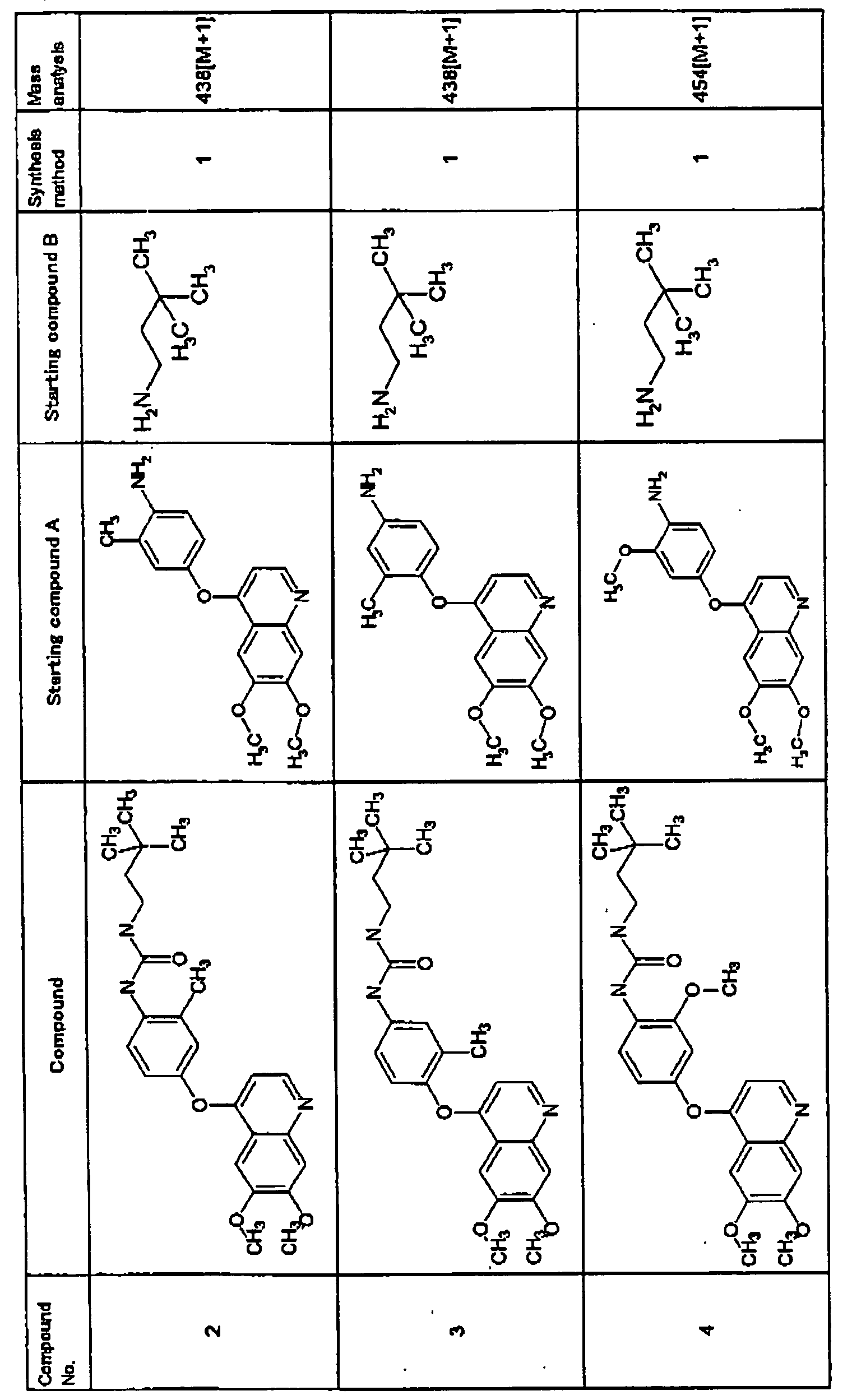


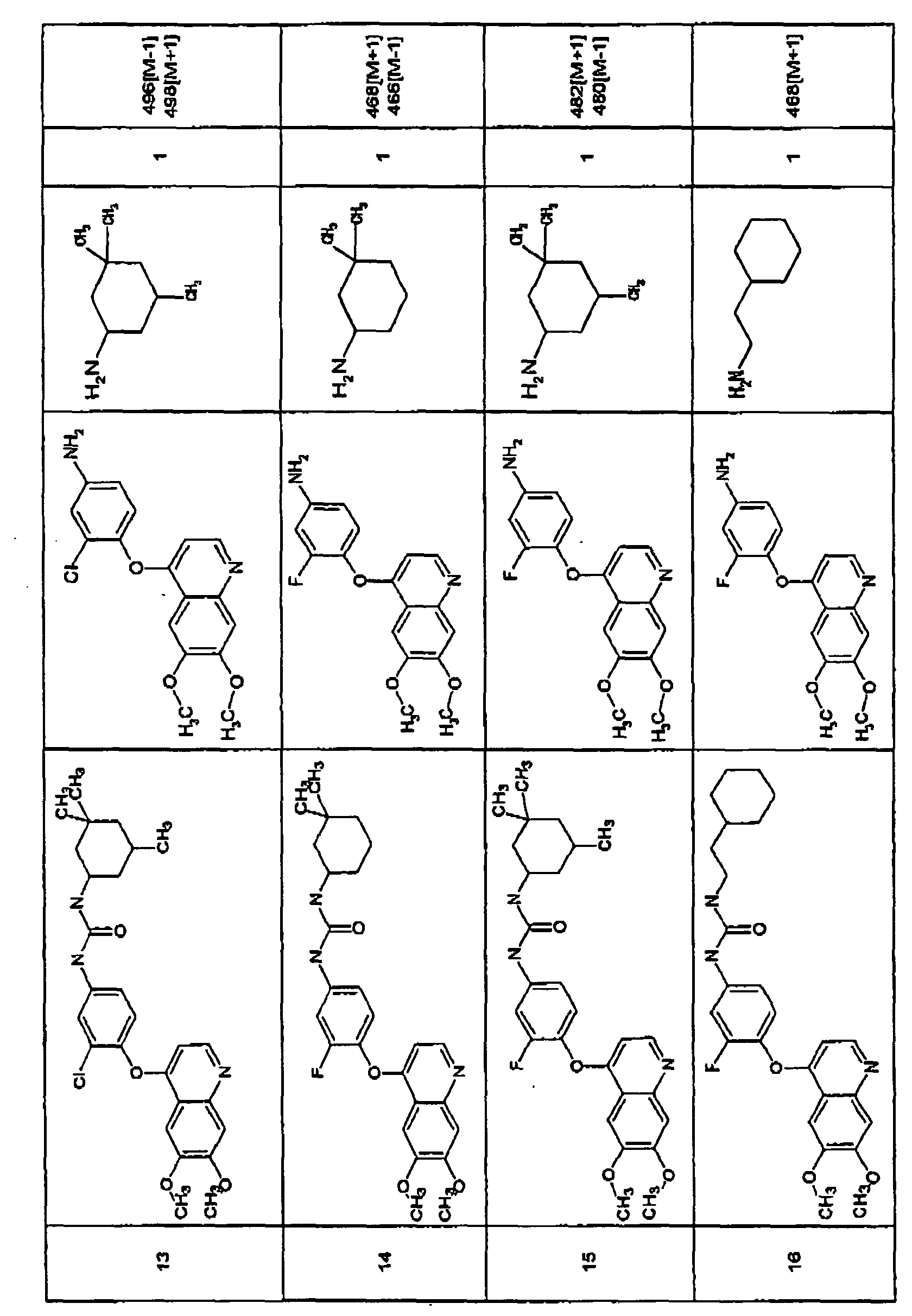
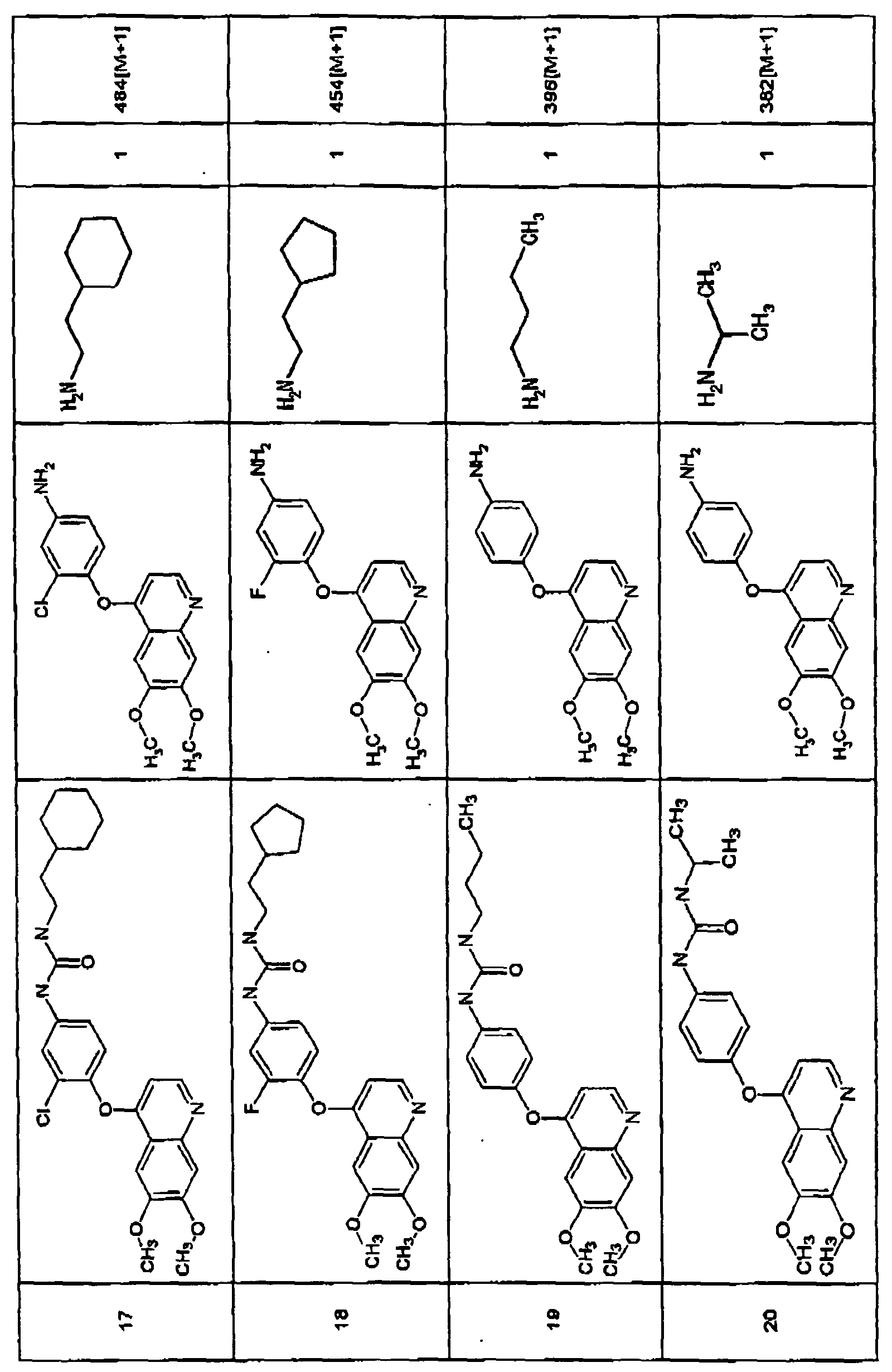

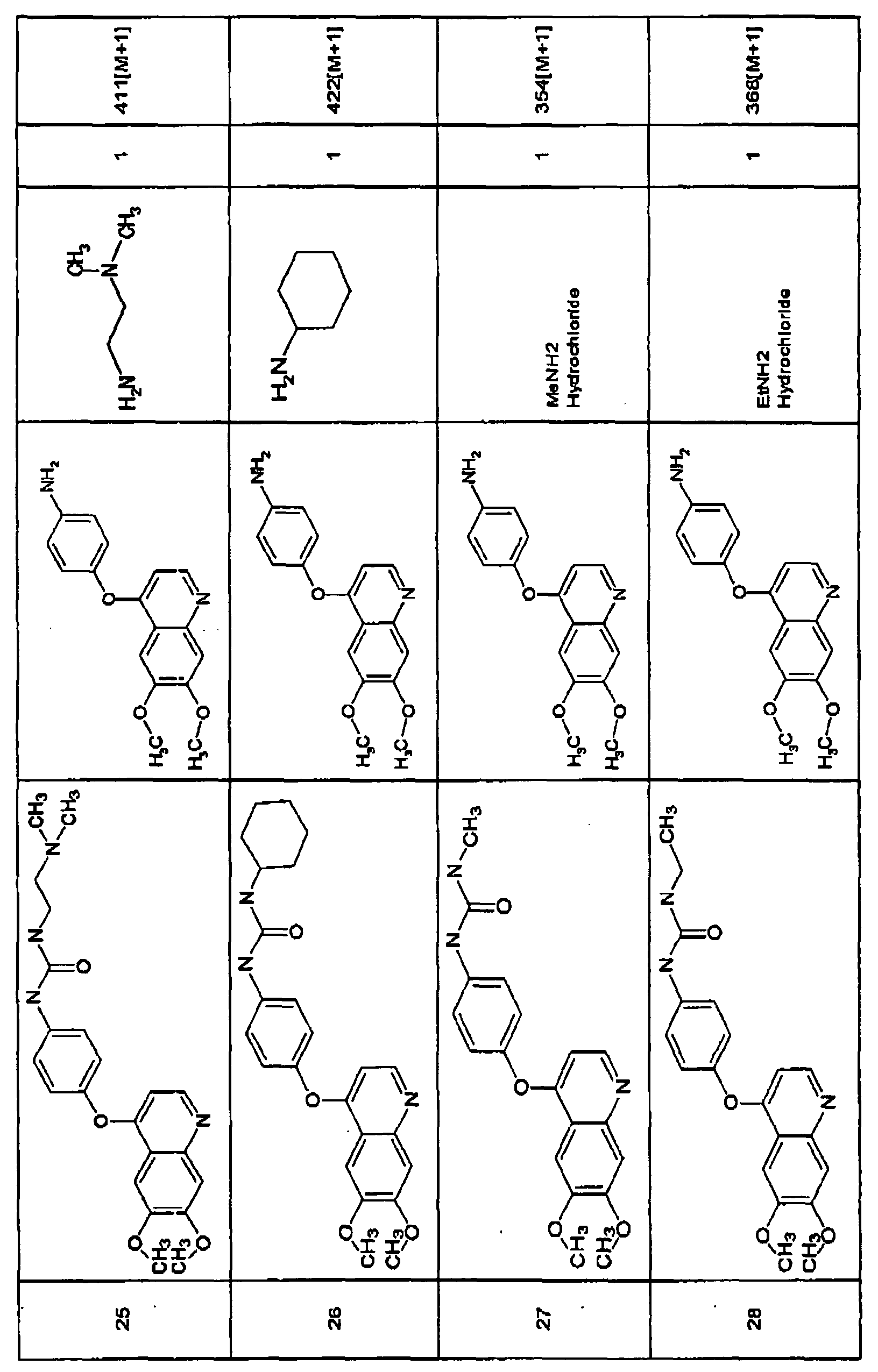
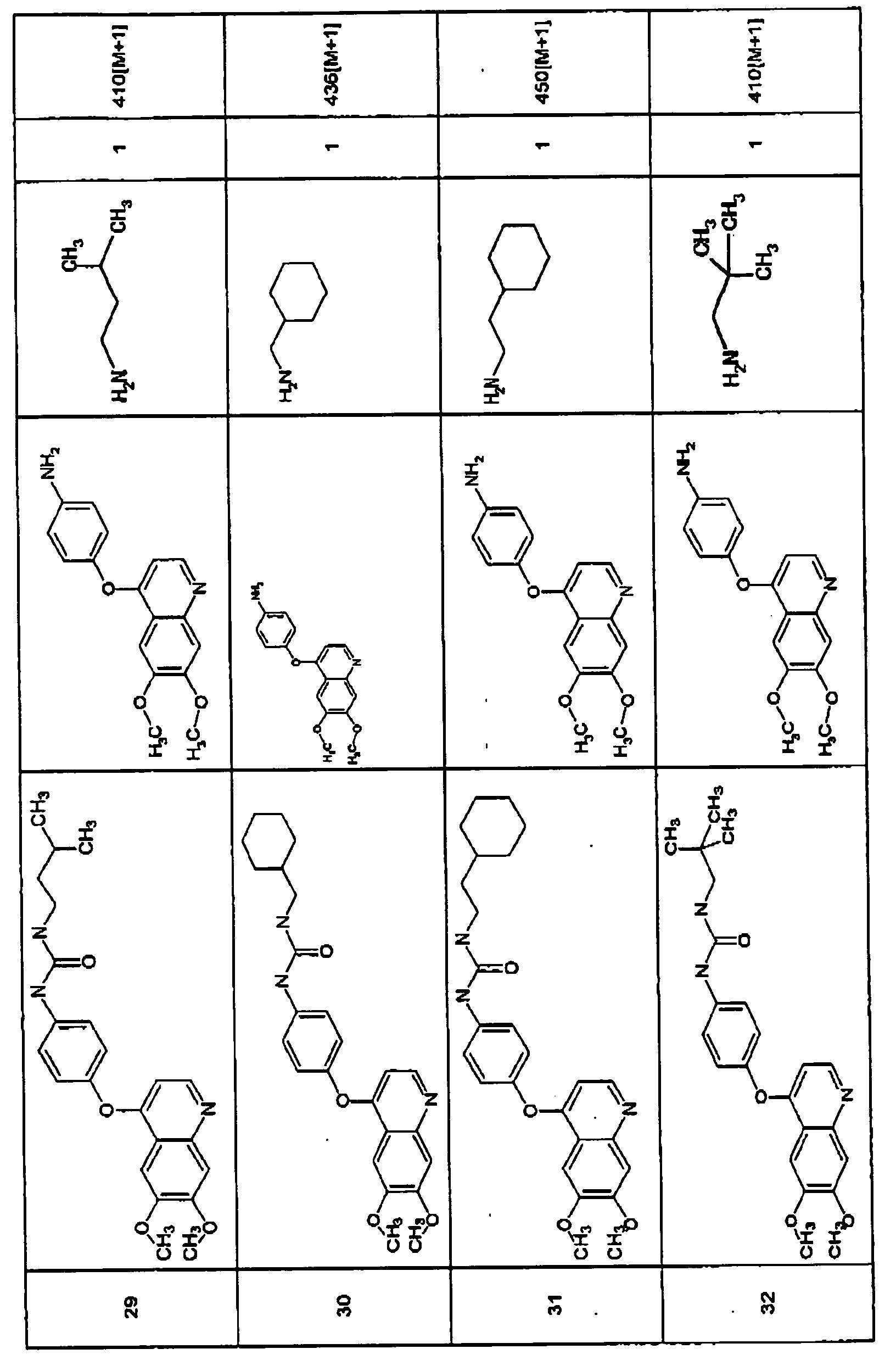
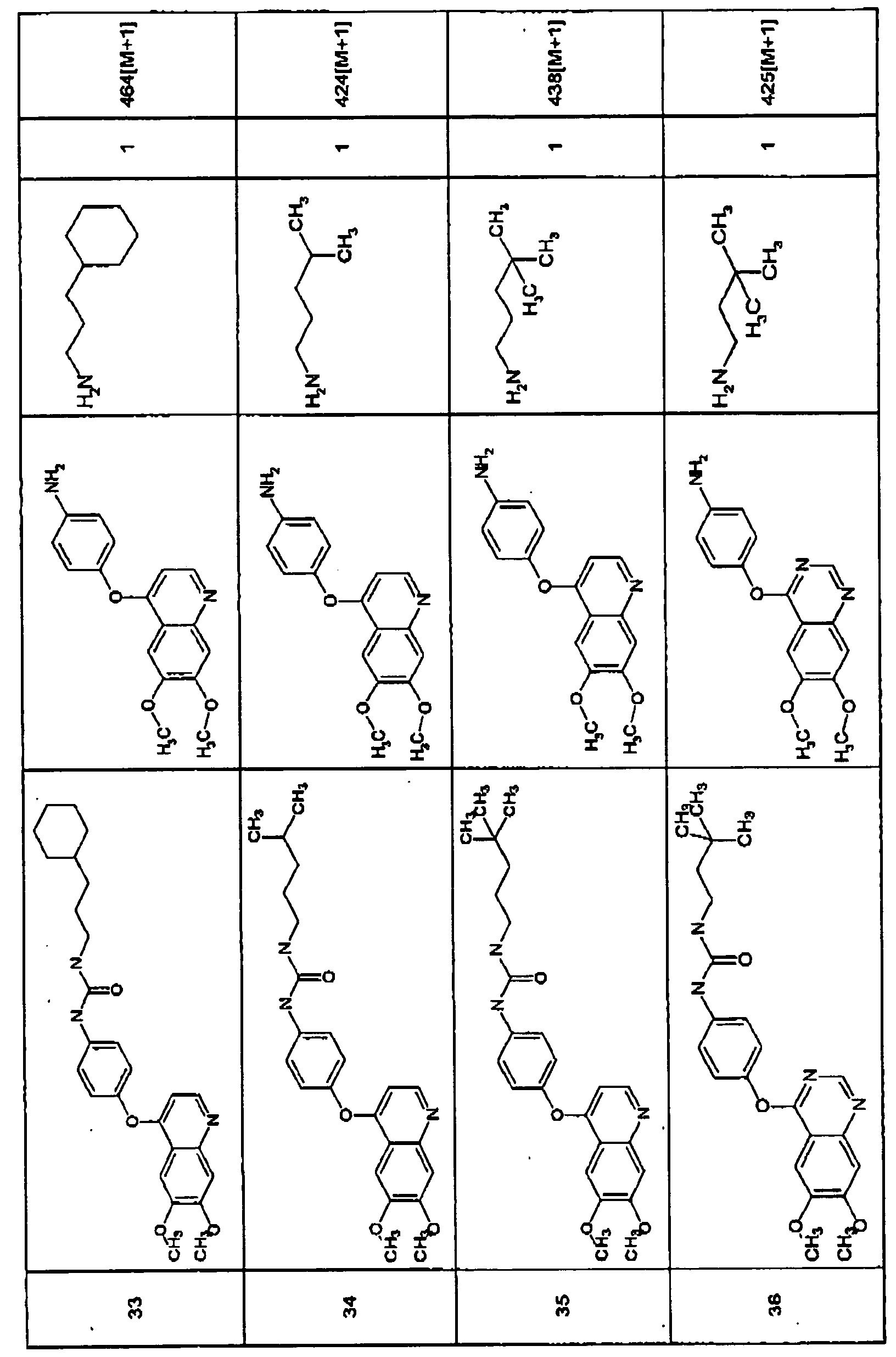
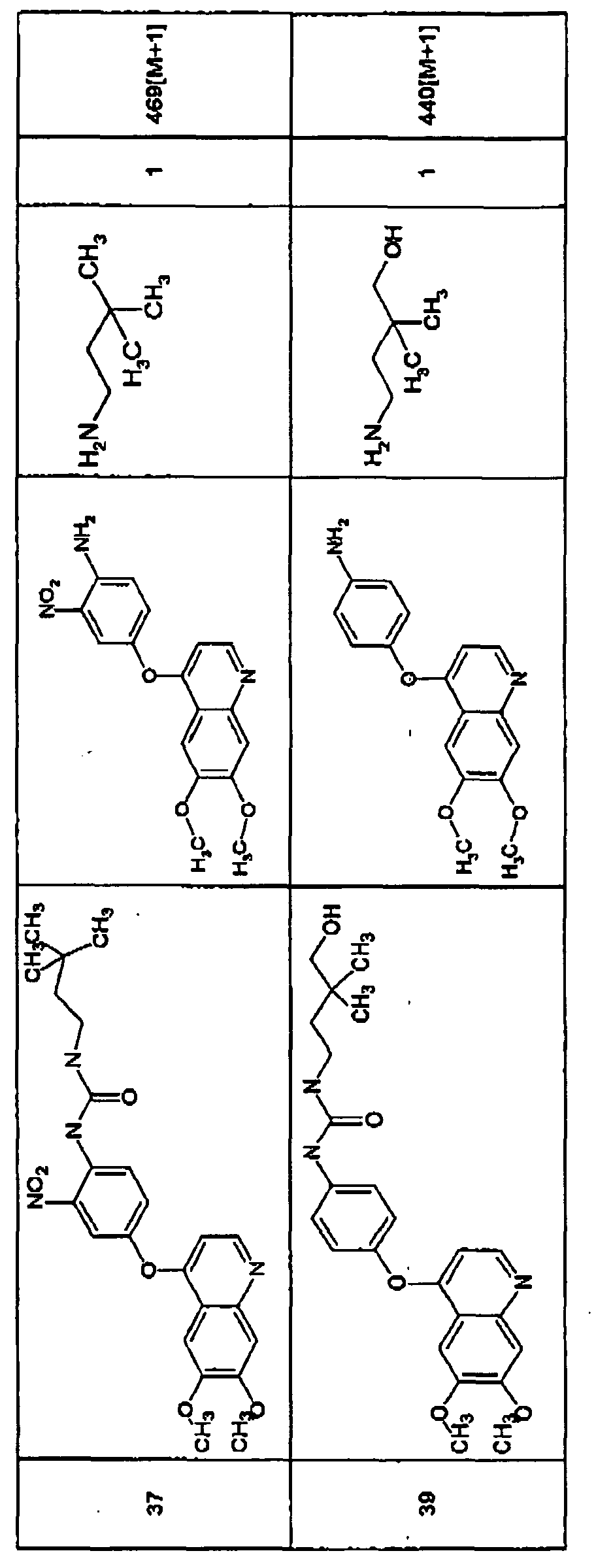
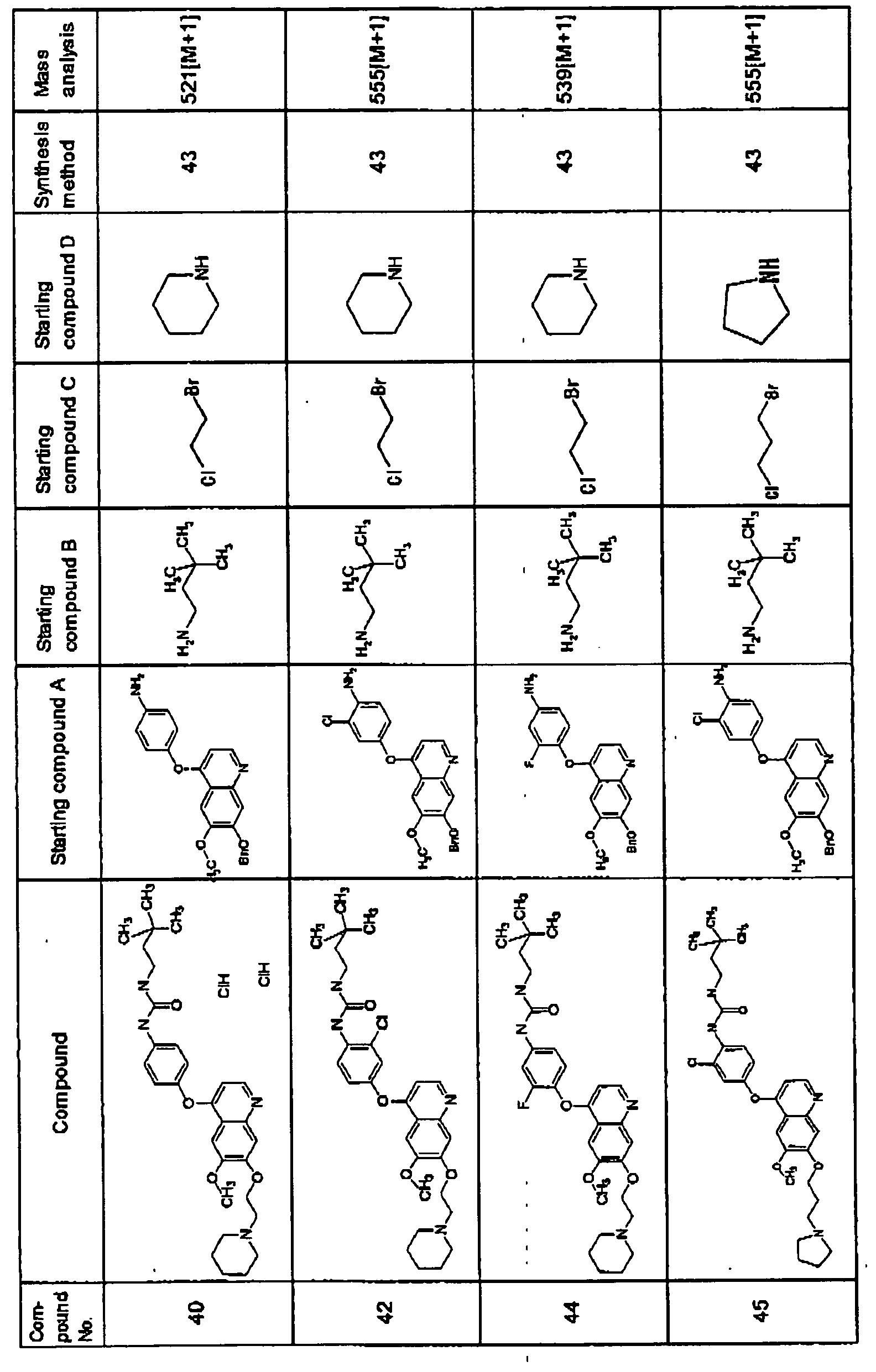


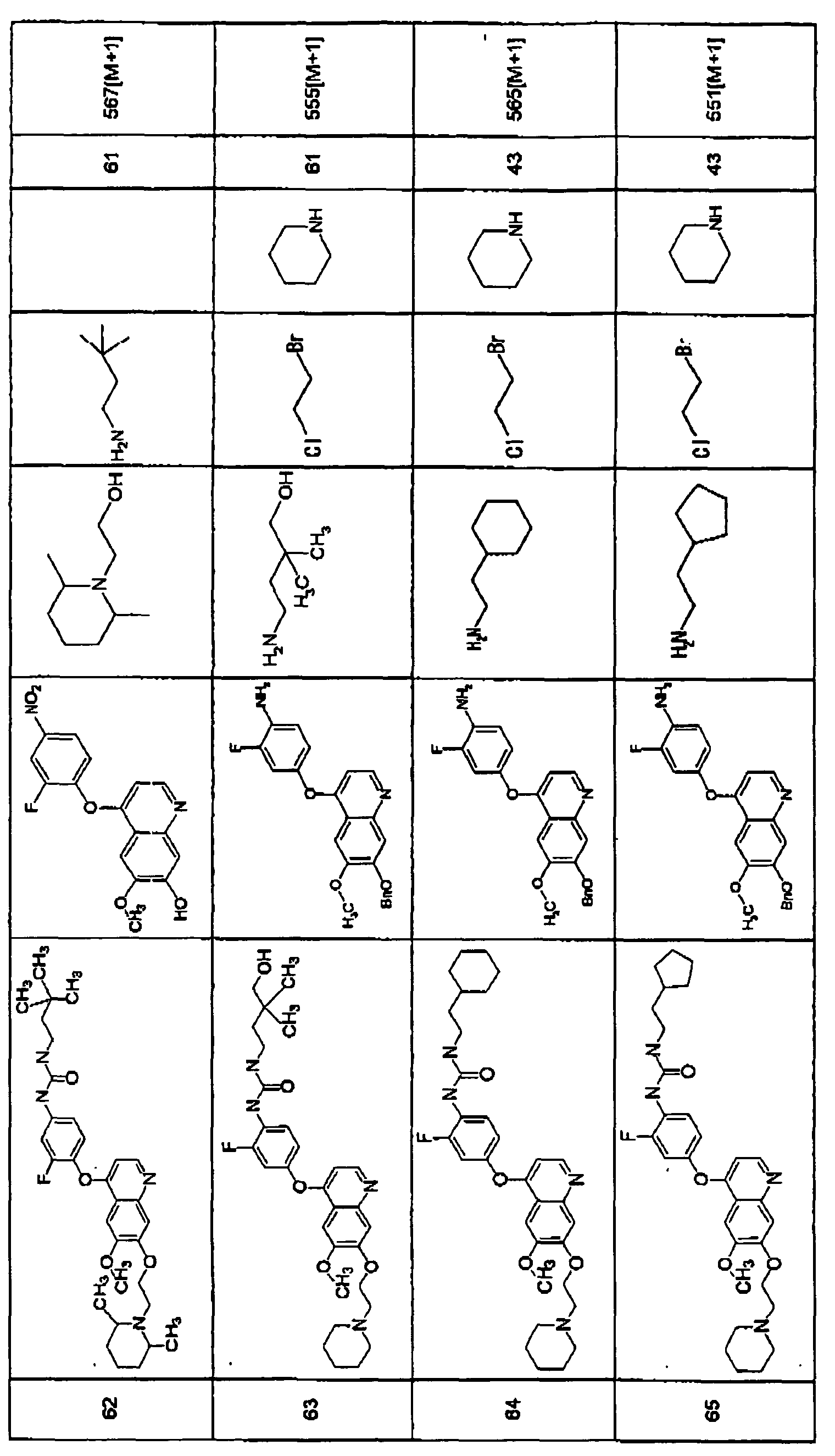
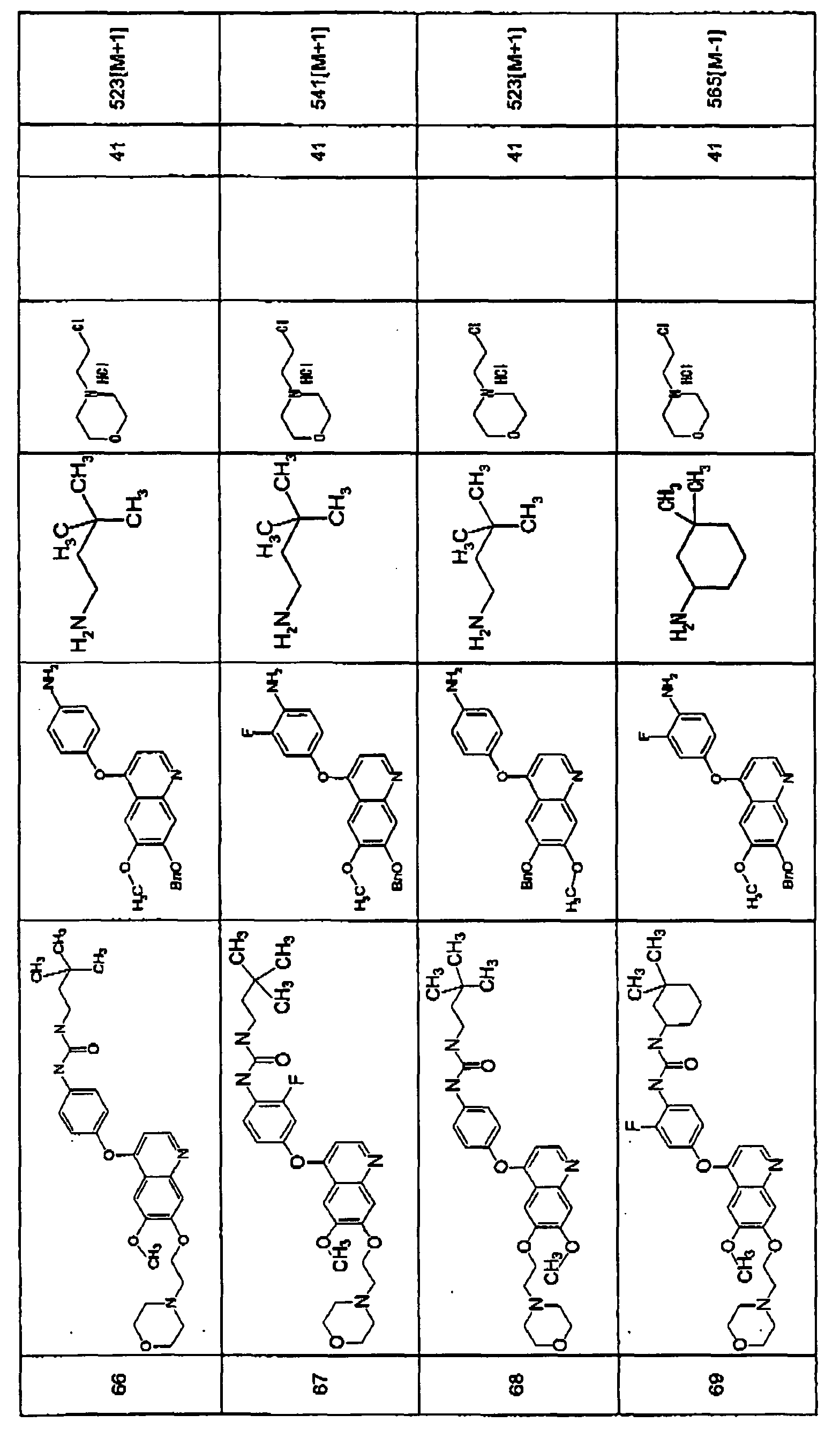
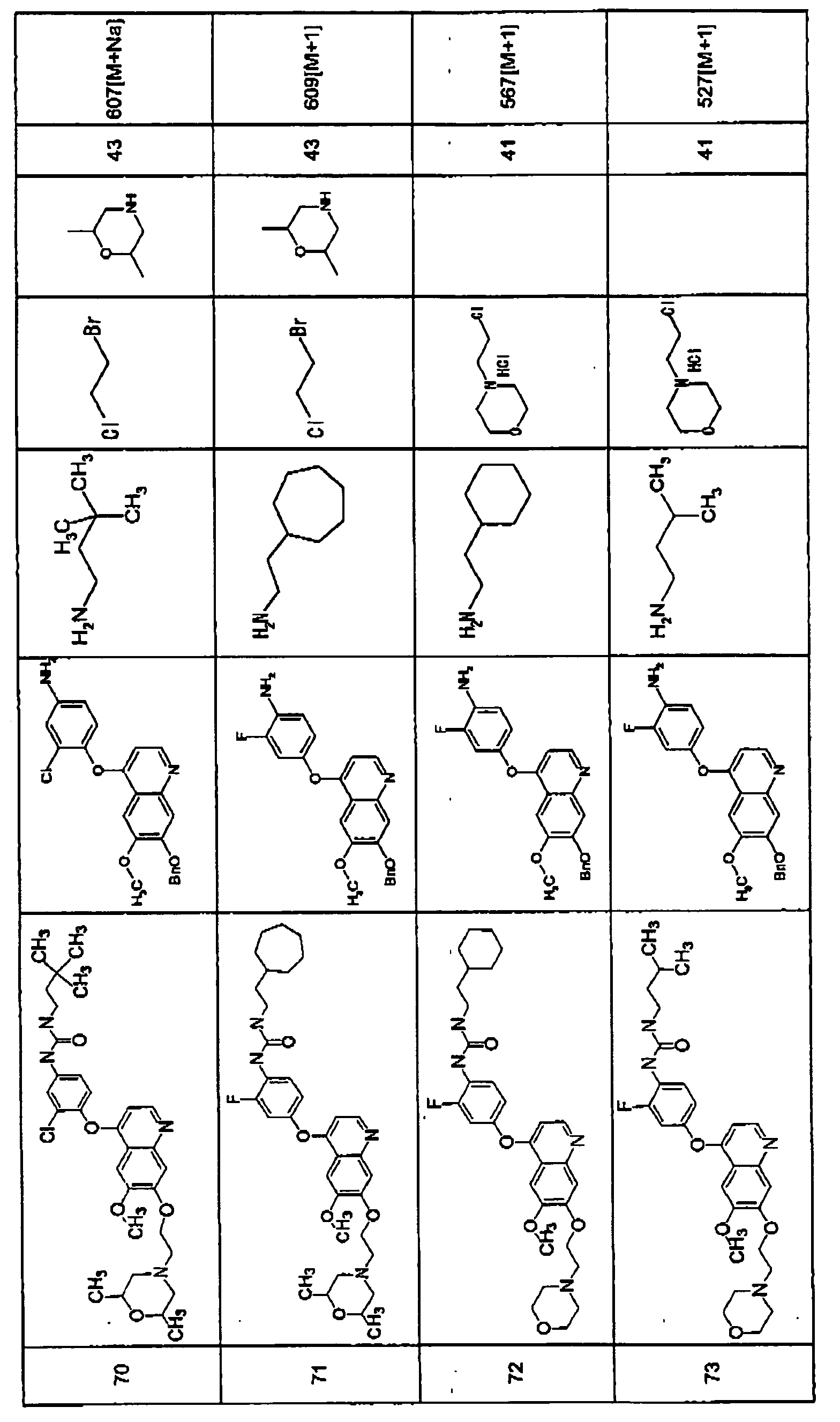

Mass spectrometric value (ESI-MS, m/z): 458 (M++1)
ESI-MS: m/z = 484 (M+1), 482 (M - 1)
ESI-MS: m/z = 498 (M+1), 496 (M - 1)
ESI-MS: m/z = 468 (M+1), 466 (M-1)
ESI-MS: m/z = 482 (M+1), 480 (M-1)
Mass spectrometric value (ESI-MS, m/z): 521 (M++1)
Mass spectrometric value (ESI-MS, m/z): 555 (M++1)
Mass spectrometric value (ESI-MS, m/z): 539 (M+1)
Mass spectrometric value (ESI-MS, m/z): 549 (M+1), 547 (M-1)
Mass spectrometric value (ESI-MS, m/z): 567 (M++1)
Mass spectrometric value (ESI-MS, m/z): 567 (M++1)
Mass spectrometric value (ESI-MS, m/z): 523 (M++1)
Mass spectrometric value (ESI-MS, m/z): 523 (M+1)
Mass spectrometric value (ESI-MS, m/z): 565 (M-1)
Mass spectrometric value (ESI-MS, m/z): 607 (M+Na)+
Mass spectrometric value (ESI-MS, m/z): 568 (M+1)+
Mass spectrometric value (ESI-MS, m/z): 584 (M)+
| Compound No. | IC50 (nM) |
| 1 | 2 |
| 3 | 7 |
| 6 | 109 |
| 8 | < 1 |
| 10 | < 1 |
| 40 | 93 |
| 41 | 308 |
| 43 | 216 |
| 44 | 200 |
| Compound No. | MV4-11 |
| 1 | < 1 |
| 2 | 395.0 |
| 3 | 2.0 |
| 4 | 889.0 |
| 5 | 23.0 |
| 6 | 8.0 |
| 7 | 558.0 |
| 8 | 1.0 |
| 9 | 8.0 |
| 10 | < 1 |
| 11 | 300.0 |
| 12 | 5.0 |
| 13 | 18.0 |
| 14 | 2.0 |
| 15 | 11.0 |
| 16 | 4.0 |
| 17 | 17.0 |
| 18 | 1.0 |
| 19 | 6.0 |
| 20 | 31.0 |
| 21 | 31.0 |
| 22 | 4.0 |
| 23 | 2.0 |
| 24 | 18.0 |
| 25 | 66.0 |
| 26 | 12.0 |
| 27 | 32.0 |
| 28 | 19.0 |
| 29 | 1.0 |
| 30 | 4.0 |
| 31 | 2.0 |
| 32 | 201.0 |
| 33 | 8.0 |
| 34 | < 1 |
| 35 | < 1 |
| 36 | < 1 |
| 37 | 47.0 |
| 39 | < 1 |
| 40 | 1.0 |
| 41 | 25.0 |
| 42 | 235.0 |
| 43 | 12.0 |
| 44 | 2.0 |
| 45 | 118.0 |
| 46 | 145.0 |
| 47 | 51.0 |
| 48 | 217.0 |
| 49 | 207.0 |
| 50 | 224.0 |
| 51 | 211.0 |
| 52 | 184.0 |
| 53 | 4.0 |
| 54 | 3.0 |
| 55 | 6.0 |
| 56 | 14.0 |
| 57 | 19.0 |
| 58 | 4.0 |
| 59 | 2.0 |
| 60 | 33.0 |
| 61 | 57.0 |
| 62 | 4.0 |
| 63 | 10.0 |
| 64 | 13.0 |
| 65 | 4.0 |
| 66 | < 1 |
| 67 | 2.0 |
| 68 | < 1 |
| 69 | 2.0 |
| 70 | 2.0 |
| 71 | 15.0 |
| 72 | 3.0 |
| 73 | 6.0 |
| 74 | 255.0 |
| 75 | < 1 |
| Compound No. | IC50(nM) |
| 1 | 24.4 |
| 5 | 93.1 |
| 6 | 12.4 |
| 8 | 13.3 |
| 10 | 20.8 |
| 12 | 5.37 |
| 13 | 3.87 |
| 14 | 5.13 |
| 15 | 9.5 |
| 16 | 18.8 |
| 17 | 20.5 |
| 18 | 40.3 |
| 26 | 31.3 |
| 41 | 34.8 |
| 43 | 32.5 |
| 44 | 19.3 |
| 45 | 255 |
| 46 | 76.8 |
| 47 | 135 |
| 53 | 16.7 |
| 54 | 19.7 |
| 55 | 36.8 |
| 56 | 11.3 |
| 57 | 120 |
| 58 | 51.6 |
| 60 | 108 |
| 62 | 26.5 |
| 63 | 47.8 |
| 64 | 195 |
| 65 | 24.6 |
| 67 | 16.1 |
| 68 | 13.3 |
| 69 | 17.7 |
| 70 | 29.6 |
| 72 | 54.5 |
| 73 | 21.5 |
| IC50(nM) | IC50(nM) | ||
| Compound No. | MOLM13 | Compound No. | MOLM13 |
| 1 | 1.0 | 40 | 2.0 |
| 2 | 770.0 | 41 | 75.0 |
| 3 | 3.0 | 42 | 273.0 |
| 4 | 653,0 | 43 | 22.0 |
| 5 | 36.0 | 44 | 3.0 |
| 6 | 21.0 | 45 | 140.0 |
| 7 | 593.0 | 46 | 123.0 |
| 8 | 3.0 | 47 | 60.0 |
| 9 | 24.0 | 38 | 222.0 |
| 10 | 2.0 | 49 | 224.0 |
| 11 | 416.0 | 50 | 243.0 |
| 12 | 6.0 | 51 | 216.0 |
| 13 | 21.0 | 52 | 188.0 |
| 14 | 3.0 | 53 | 13.0 |
| 15 | 22.0 | 54 | 10.0 |
| 16 | 7.0 | 55 | 25.0 |
| 17 | 27.0 | 56 | 26.0 |
| 18 | 2.0 | 57 | 29.0 |
| 19 | 10.0 | 58 | 17.0 |
| 20 | 39.0 | 59 | 4.0 |
| 21 | 22.0 | 60 | 59.0 |
| 22 | 7.0 | 61 | 138.0 |
| 23 | 4.0 | 62 | 7.0 |
| 24 | 24.0 | 63 | 22.0 |
| 25 | 258.0 | 64 | 19.0 |
| 26 | 18.0 | 65 | 9.0 |
| 27 | 45.0 | 66 | <1 |
| 28 | 26.0 | 67 | 4.0 |
| 29 | 3.0 | 68 | 1.0 |
| 30 | 8.0 | 69 | 8.0 |
| 31 | 2.0 | 70 | 3.0 |
| 32 | 314.0 | 71 | 27.0 |
| 33 | 4.0 | 72 | 8.0 |
| 34 | 2.0 | 73 | 20.0 |
| 35 | 3.0 | 74 | 244.0 |
| 36 | 2.0 | 75 | <1 |
| 37 | 38.0 | ||
| 39 | 3.0 |
| Compound No. | Dose | TGIR (%) (measurement date) |
| 1 | 50 mg/kg | 53.8% (day 11) |
| 10 | 50 mg/kg | 84.8% (day 10) |
| 12 | 50 mg/kg | 93.7% (day 10) |
| 13 | 50 mg/kg | 84.8% (day 10) |
| 14 | 50 mg/kg | 96.1% (day 10) |
| 15 | 50 mg/kg | 89.4% (day 10) |
| 43 | 50 mg/kg | 98.1% (day 10) |
| 44 | 25 mg/kg | 99.8% (day 9) |
| 44 | 12.5 mg/kg | 99.6% (day 9) |
| 75 | 50 mg/kg | 94.1% (day 9) |
| 76 | 50 mg/kg | 34.3% (day 9) |
| 77 | 50 mg/kg | 70.4% (day 9) |
Claims (53)
- A pharmaceutical composition for use in the treatment or prevention of diseases where the inhibition of autophosphorylation of FMS-like tyrosine kinase 3 (Flt3) and/or its somatic cell variant (Flt3-ITD) is therapeutically or prophylactically effective, which comprises a compound represented by formula (I) or a pharmaceutically acceptable salt or solvate thereof:wherein
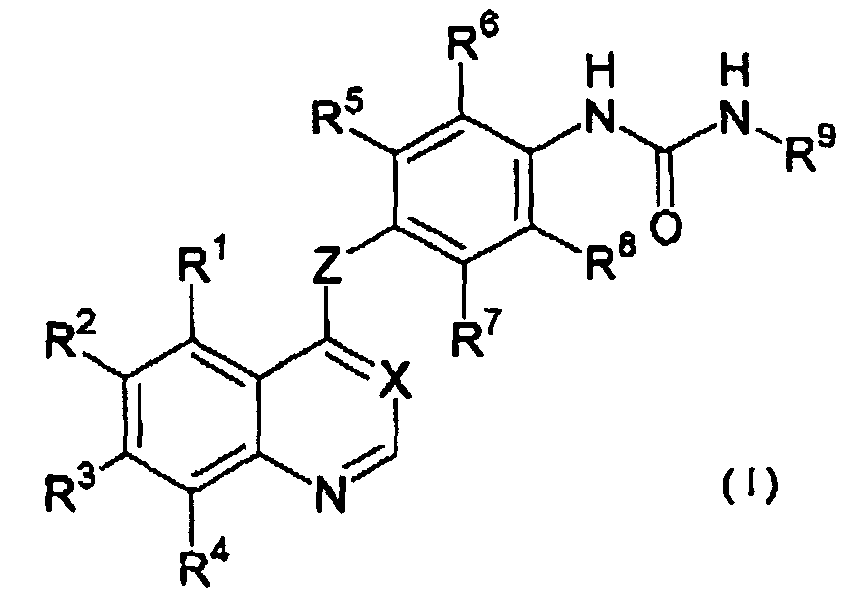
X represents CH or N,
Z represents O or S,
R1, R2, and R3, which may be the same or different, represent
a hydrogen atom,
hydroxyl,
a halogen atom,
nitro,
cyano,
amino,
C1-6 alkyl,
C2-6 alkenyl,
C2-6 alkynyl,
C1-6 alkoxy,
-(C=O)ORc wherein Rc represents a hydrogen atom or C1-4 alkyl, or
-(C=O)NRdRe wherein Rd and Re, which may be the same or different, represent a hydrogen atom or C1-4 alkyl,
the C1-6 alkyl, C2-6 alkenyl, C2-6 alkynyl, and C1-6 alkoxy groups, which may be represented by R1, R2, and R3, are optionally substituted by hydroxyl; a halogen atom; C1-6 alkoxy; C1-6 alkylcarbonyl; carboxyl; C1-6 alkoxycarbonyl; -(C=O)-NR10R11 wherein R10 and R11, which may be the same or different, represent a hydrogen atom or C1-4 alkyl optionally substituted by hydroxyl, or R10 and R11 may combine with a nitrogen atom attached thereto to form a saturated five- or six-membered heterocyclic group; amino in which one or two hydrogen atoms on the amino group are optionally substituted by C1-6 alkyl or a saturated or unsaturated three- to eight-membered carbocyclic or heterocyclic group, and the C1-6 alkyl group is further optionally substituted by hydroxyl, C1-6 alkoxy, or a saturated or unsaturated three- to eight-membered carbocyclic or heterocyclic group; or a saturated or unsaturated three- to eight-membered carbocyclic or heterocyclic group in which the carbocyclic or heterocyclic group is optionally substituted by hydroxyl, an oxygen atom, a halogen atom, C1-6 alkyl, C2-6 alkenyl, C2-6 alkynyl, C1-6 alkoxy, C1-6 alkoxycarbonyl, or a saturated or unsaturated three- to eight-membered carbocyclic or heterocyclic group, the C1-6 alkyl, C2-6 alkenyl, and C2-6 alkynyl groups are further optionally substituted by hydroxyl, C1-6 alkoxy, or a saturated or unsaturated three- to eight-membered carbocyclic or heterocyclic group, and, when the carbocyclic or heterocyclic group is substituted by two C1-6 alkyl groups, the two alkyl groups may combine together to form an alkylene chain, or the carbocyclic or heterocyclic group may be a bicyclic group condensed with another saturated or unsaturated five- to seven-membered carbocyclic or heterocyclic group;
one or two hydrogen atoms on the amino group, which may be represented by R1, R2, and R3, are optionally substituted by C1-6 alkyl which is further optionally substituted by hydroxyl or C1-6 alkoxy;
R4 represents a hydrogen atom;
all of R5, R6, R7, and R8 represent a hydrogen atom, or any one or two of R5, R6, R7, and R8 represent a halogen atom, C1-4 alkyl, C1-4 alkoxy, nitro, amino, or hydroxyl with all the remaining groups representing a hydrogen atom, and
R9 represents C1-4 alkyl substituted by a substituent selected from the group consisting of a saturated three- to nine-membered carbocyclic group optionally substituted by C1-4 alkyl, C1-4 alkoxy, or hydroxyl; i-propyl optionally substituted by C1-4 alkyl, C1-4 alkoxy, or hydroxyl; t-butyl optionally substituted by C1-4 alkyl, C1-4 alkoxy, or hydroxyl; C1-4 alkoxy; and -NRaRb wherein Ra and Rb, which may be the same or different, represent a hydrogen atom or C1-4 alkyl optionally substituted by hydroxyl, or Ra and Rb may combine with a nitrogen atom attached thereto to form a saturated five- or six-membered heterocyclic group, or R9 represents a saturated three- to nine-membered carbocyclic group optionally substituted by one to three C1-4 alkyl groups. - The pharmaceutical composition according to claim 1, wherein the disease where the inhibition of autophosphorylation of Flt3 and/or Flt3-ITD is therapeutically or prophylactically effective is hematopoietic malignancy.
- The pharmaceutical composition according to claim 2, wherein the hematopoietic malignancy is acute myelocytic leukemia or myelodysplastic syndrome.
- The pharmaceutical composition according to claim 1, wherein the disease where the inhibition of autophosphorylation of Flt3 and/or Flt3-ITD is therapeutically or prophylactically effective is an immunological disease caused by abnormal proliferation of B cells, dendritic cells, or natural killer cells.
- The pharmaceutical composition according to claim 1, which is used in the treatment or prevention of diseases where the inhibition of autophosphorylation of Flt3 is therapeutically or prophylactically effective.
- The pharmaceutical composition according to claim 5, wherein the disease where the inhibition of autophosphorylation of Flt3 is therapeutically or prophylactically effective is hematopoietic malignancy.
- The pharmaceutical composition according to claim 6, wherein the hematopoietic malignancy is acute myelocytic leukemia or myelodysplastic syndrome.
- The pharmaceutical composition according to claim 5, wherein the disease where the inhibition of autophosphorylation of Flt3 is therapeutically or prophylactically effective is an immunological disease caused by abnormal proliferation of B cells, dendritic cells, or natural killer cells.
- The pharmaceutical composition according to claim 1, which is used in the treatment or prevention of diseases where the inhibition of autophosphorylation of Flt3-ITD is therapeutically or prophylactically effective.
- The pharmaceutical composition according to claim 9, wherein the disease where the inhibition of autophosphorylation of Flt3-ITD is therapeutically or prophylactically effective is hematopoietic malignancy.
- The pharmaceutical composition according to claim 10, wherein the hematopoietic malignancy is acute myelocytic leukemia or myelodysplastic syndrome.
- The pharmaceutical composition according to claim 9, wherein the disease where the inhibition of autophosphorylation of Flt3-ITD is therapeutically or prophylactically effective is an immunological disease caused by abnormal proliferation of B cells, dendritic cells, or natural killer cells.
- The pharmaceutical composition according to any one of claims 1 to 12, wherein X represents CH and Z represents O.
- The pharmaceutical composition according to any one of claims 1 to 13, wherein R1 represents a hydrogen atom and R2 and R3, which may be the same or different, represent optionally substituted C1-6 alkoxy.
- The pharmaceutical composition according to any one of claims 1 to 14, wherein R1 represents a hydrogen atom, R2 and R3, which may be the same or different, represent -O-(CH2)p-R12 wherein p is an integer of 0 to 6, -(CH2)p- is optionally substituted by C1-6 alkyl, hydroxyl, or a halogen atom, and R12 represents a hydrogen atom; hydroxyl; a halogen atom; C1-6 alkoxy; C1-6 alkylcarbonyl; carboxyl; C1-6 alkoxycarbonyl; -(C=O)-NR13R14 wherein R13 and R14, which may be the same or different, represent a hydrogen atom or C1-4 alkyl optionally substituted by hydroxyl, or R13 and R14 may combine with a nitrogen atom attached thereto to form a saturated five- or six-membered heterocyclic group; amino in which one or two hydrogen atoms on the amino group are optionally substituted by C1-6 alkyl or a saturated or unsaturated three- to eight-membered carbocyclic or heterocyclic group, and the C1-6 alkyl group is further optionally substituted by hydroxyl, C1-6 alkoxy, or a saturated or unsaturated three- to eight-membered carbocyclic or heterocyclic group; or a saturated or unsaturated three- to eight-membered carbocyclic or heterocyclic group in which the carbocyclic or heterocyclic group is optionally substituted by hydroxyl, an oxygen atom, C1-6 alkyl, C2-6 alkenyl, C2-6 alkynyl, C1-6 alkoxy, C1-6 alkoxycarbonyl, or a saturated or unsaturated three- to eight-membered carbocyclic or heterocyclic group, the C1-6 alkyl, C2-6 alkenyl, and C2-6 alkynyl groups are further optionally substituted by hydroxyl, C1-6 alkoxy, or a saturated or unsaturated three- to eight-membered carbocyclic or heterocyclic group, and, when the carbocyclic or heterocyclic group is substituted by two C1-6 alkyl groups, the two alkyl groups may combine together to form an alkylene chain, or the carbocyclic or heterocyclic group may be a bicyclic group condensed with another saturated or unsaturated five- to seven-membered carbocyclic or heterocyclic ring.
- The pharmaceutical composition according to any one of claims 1 to 15, wherein all of R5, R6, R7, and R8 represent a hydrogen atom; or R6 represents a fluorine atom, and R5, R7, and R8 represent a hydrogen atom; or R5 represents a halogen atom, C1-4 alkyl, C1-4 alkoxy, nitro, or amino, and R6, R7, and R8 represent a hydrogen atom; or R5 and R7 represent a halogen atom, C1-4 alkyl, C1-4 alkoxy, nitro, or amino, and R6 and R8 represent a hydrogen atom.
- The pharmaceutical composition according to any one of claims 1 to 16, wherein R9 represents -(CH2)s-R51 wherein s is an integer of 1 to 4, and R51 represents a saturated three- to seven-membered carbocyclic group; i-propyl optionally substituted by hydroxyl; t-butyl optionally substituted by hydroxyl; C1-4 alkoxy; or -NR52R53 wherein R52 and R53, which may be the same or different, represent a hydrogen atom, or C1-4 alkyl optionally substituted by hydroxyl, or R52 and R53 may combine with a nitrogen atom attached thereto to form a saturated five- or six-membered heterocyclic group, or R9 represents a saturated five- to seven-membered carbocyclic group optionally substituted by one to three C1-4 alkyl groups.
- The pharmaceutical composition according to claim 1, wherein
X represents CH or N,
Z represents O or S,
R1, R2, and R3, which may be the same or different, represent
a hydrogen atom,
hydroxyl,
a halogen atom,
nitro,
amino,
C1-6 alkyl,
C2-6 alkenyl,
C2-6 alkynyl, or
C1-6 alkoxy,
the C1-6 alkyl, C2-6 alkenyl, C2-6 alkynyl, and C1-6 alkoxy groups, which may be represented by R1, R2, and R3, are optionally substituted by hydroxyl; a halogen atom; C1-6 alkoxy; C1-6 alkylcarbonyl; carboxyl; C1-6 alkoxycarbonyl; -(C=O)-NR10R11 wherein R10 and R11, which may be the same or different, represent a hydrogen atom or C1-4 alkyl optionally substituted by hydroxyl, or R10 and R11 may combine with a nitrogen atom attached thereto to form a saturated five- or six-membered heterocyclic group; amino in which one or two hydrogen atoms on the amino group are optionally substituted by C1-6 alkyl or a saturated or unsaturated three- to eight-membered carbocyclic or heterocyclic group, and the C1-6 alkyl group is further optionally substituted by hydroxyl, C1-6 alkoxy, or a saturated or unsaturated three- to eight-membered carbocyclic or heterocyclic group; or a saturated or unsaturated three- to eight-membered carbocyclic or heterocyclic group in which the carbocyclic or heterocyclic group is optionally substituted by hydroxyl, an oxygen atom, C1-6 alkyl, C2-6 alkenyl, C2-6 alkynyl, C1-6 alkoxy, C1-6 alkoxycarbonyl, or a saturated or unsaturated three- to eight-membered carbocyclic or heterocyclic group, the C1-6 alkyl, C2-6 alkenyl, and C2-6 alkynyl groups are further optionally substituted by hydroxyl, C1-6 alkoxy, or a saturated or unsaturated three- to eight-membered carbocyclic or heterocyclic group, and, when the carbocyclic or heterocyclic group is substituted by two C1-6 alkyl groups, the two alkyl groups may combine together to form an alkylene chain, or the carbocyclic or heterocyclic group may be a bicyclic group condensed with another saturated or unsaturated five- to seven-membered carbocyclic or heterocyclic ring;
one or two hydrogen atoms on the amino group, which may be represented by R1, R2, and R3, are optionally substituted by C1-6 alkyl which is further optionally substituted by hydroxyl or C1-6 alkoxy;
R4 represents a hydrogen atom;
all of R5, R6, R7, and R8 represent a hydrogen atom, or any one or two of R5, R6, R7, and R8 represent a halogen atom, C1-4 alkyl, C1-4 alkoxy, nitro, or amino with all the remaining groups representing a hydrogen atom, and
R9 represents C1-4 alkyl substituted by a substituent selected from the group consisting of a saturated three- to seven-membered carbocyclic group; i-propyl optionally substituted by hydroxyl; t-butyl optionally substituted by hydroxyl; C1-4 alkoxy; and -NRaRb wherein Ra and Rb, which may be the same or different, represent a hydrogen atom or C1-4 alkyl optionally substituted by hydroxyl, or Ra and Rb may combine with a nitrogen atom attached thereto to form a saturated five- or six-membered heterocyclic group, or R9 represents a saturated five- to seven-membered carbocyclic group optionally substituted by one to three C1-4 alkyl groups. - The pharmaceutical composition according to claim 1, wherein said compound represented by formula (I) is represented by formula (Ia):wherein
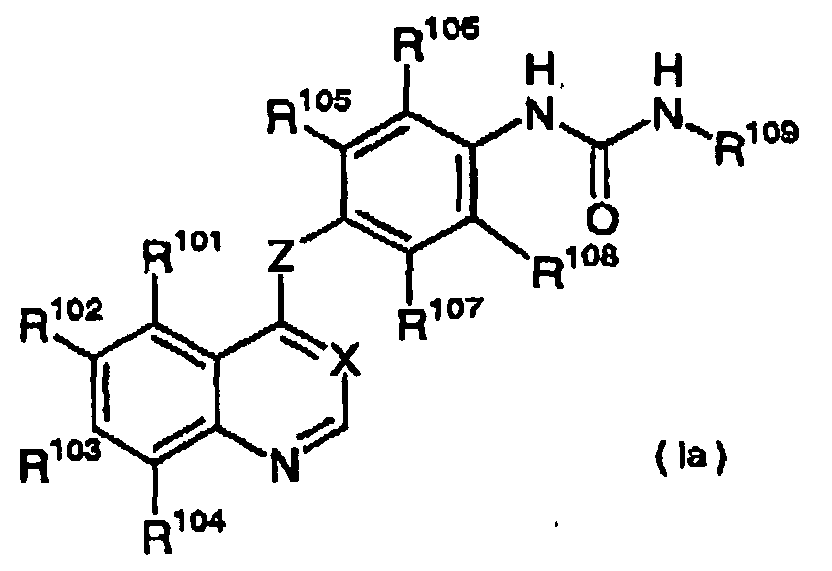
X represents CH or N,
Z represents O or S,
R101 and R104 represent a hydrogen atom,
R102 and R103, which may be the same or different, represent
a hydrogen atom,
hydroxyl,
a halogen atom,
nitro,
cyano,
-NR111R112 wherein R111 and R112, which may be the same or different, represent a hydrogen atom or C1-4 alkyl,
-(C=O)OR113 wherein R113 represents a hydrogen atom or C1-4 alkyl,
-(C=O)NR114R115 wherein R114 and R115, which may be the same or different, represent a hydrogen atom or C1-4 alkyl,
C1-6 alkoxy,
C1-6 alkyl,
C1-6 alkenyl, or
C1-6 alkynyl,
the C1-6 alkoxy, C1-6 alkyl, C1-6 alkenyl, or C1-6 alkynyl are optionally substituted by hydroxyl; a halogen atom; C1-4 alkoxy; -NR116R117 wherein R116 and R117, which may be the same or different, represent a hydrogen atom or C1-4 alkyl and the alkyl group is further optionally substituted by hydroxyl or C1-4 alkoxy; or a saturated or unsaturated three- to eight-membered carbocylic or heterocyclic group in which the cyclic group is optionally substituted by hydroxyl, a halogen atom, C1-4 alkyl, or C1-4 alkoxy,
all of R105, R106, R107, and R108 represent a hydrogen atom, or any one or two of R105, R106, R107, and R108 represent hydroxyl, C1-4 alkyl, C1-4 alkoxy, amino, nitro, or a halogen atom with all the remaining groups representing a hydrogen atom,
R109 represents -(CH2)n-R110 wherein n is 2, 3, or 4, and R110 represents i-propyl optionally substituted by C1-4 alkyl, C1-4 alkoxy, or hydroxyl; t-butyl optionally substituted by C1-4 alkyl, C1-4 alkoxy, or hydroxyl; or a three- to nine-membered saturated carbocyclic group optionally substituted by C1-4 alkyl, C1-4 alkoxy, or hydroxyl. - The pharmaceutical composition according to claim 19, wherein R102 and R103, which may be the same or different, represent C1-6 alkoxy and the C1-6 alkoxy is optionally substituted by hydroxyl; a halogen atom; C1-4 alkoxy; -NR116R117 wherein R116 and R117, which may be the same or different, represent a hydrogen atom or C1-4 alkyl and the alkyl group is further optionally substituted by hydroxyl or C1-4 alkoxy; or a saturated or unsaturated three- to eight-membered carbocylic or heterocyclic group in which the cyclic group is optionally substituted by hydroxyl, halogen atom, C1-4 alkyl, or C1-4 alkoxy.
- The pharmaceutical composition according to claim 20, wherein R102 and R103, which may be the same or different, represent C1-6 alkoxy in which the alkoxy group is optionally substituted by a saturated or unsaturated three- to eight-membered carbocylic or heterocyclic group and the cyclic group is further optionally substituted by hydroxyl, a halogen atom, C1-4 alkyl, or C1-4 alkoxy.
- The pharmaceutical composition according to claim 21, wherein R102 and R103, which may be the same or different, represent C1-4 alkoxy in which the alkoxy group is optionally substituted by a saturated five- to seven-membered heterocyclic group and the cyclic group is further optionally substituted by C1-4 alkyl.
- The pharmaceutical composition according to claim 22, wherein said substituted C1-4 alkoxy group is a group represented by

- The pharmaceutical composition according to claim 23, wherein n is 2.
- The pharmaceutical composition according to claim 22, wherein said substituted C1-4 alkoxy group is a group represented by
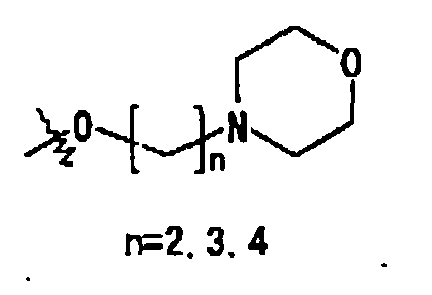
- The pharmaceutical composition according to claim 25, wherein n is 2.
- The pharmaceutical composition according to any one of claims 19 to 26, wherein one of R102 and R103 represents unsubstituted C1-6 alkoxy and the other represents substituted C1-6 alkoxy.
- The pharmaceutical composition according to claim 27, wherein R102 represents unsubstituted C1-6 alkoxy and R103 represents substituted C1-6 alkoxy.
- The pharmaceutical composition according to claim 28, wherein R102 represents methoxy.
- The pharmaceutical composition according to any one of claims 19 to 29, wherein X represents CH.
- The pharmaceutical composition according to any one of claims 19 to 30, wherein Z represents O.
- The pharmaceutical composition according to any one of claims 19 to 31, wherein all of R105, R106, R107, and R108 represent a hydrogen atom, or any one or two of R105, R106, R107, and R108 represent C1-4 alkyl, C1-4 alkoxy, or a halogen atom with all the remaining groups representing a hydrogen atom.
- The pharmaceutical composition according to claim 32, wherein R105 represents methoxy and R106, R107, and R108 represent a hydrogen atom.
- The pharmaceutical composition according to claim 32, wherein R105 represents methyl and R106, R107, and R108 represent a hydrogen atom.
- The pharmaceutical composition according to claim 32, wherein R105 represents a halogen atom and R106, R107, and R108 represent a hydrogen atom.
- The pharmaceutical composition according to claim 35, wherein the halogen atom represents a chlorine or fluorine atom.
- The pharmaceutical composition according to claim 35, wherein the halogen atom represents a fluorine atom.
- The pharmaceutical composition according to claim 32, wherein all of R105, R106, R107, and R108 represent a hydrogen atom.
- The pharmaceutical composition according to any one of claims 19 to 38, wherein R109 is a group represented by
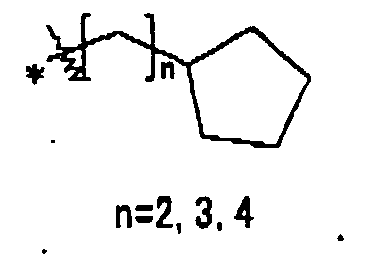
- The pharmaceutical composition according to claim 39, wherein n is 2.
- The pharmaceutical composition according to any one of claims19 to 38, wherein R109 is a group represented by
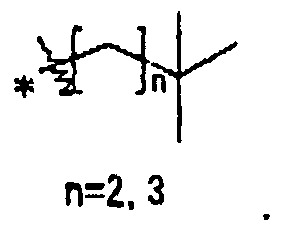
- The pharmaceutical composition according to claim 41, wherein n is 2.
- The pharmaceutical composition according to claim 19, wherein the compound represented by formula (Ia) is 1-(3,3-dimethylbutyl)-3-{3-fluoro-4-[6-methoxy-7-(2-piperidin-1-yl-ethoxy)-quinolin-4-yloxy]-phenyl}-urea.
- The pharmaceutical composition according to claim 19, wherein the compound represented by formula (Ia) is 1-(2-cyclopentylethyl)-3-{3-fluoro-4-[6-methoxy-7-(2-piperidin-1-yl-ethoxy)-quinolin-4-yloxy]-phenyl}-urea.
- The pharmaceutical composition according to claim 19, wherein the compound represented by formula (Ia) is 1-(2-cyclopentylethyl)-3-{2-fluoro-4-[6-methoxy-7-(2-piperidin-1-yl-ethoxy)-quinolin-4-yloxy]-phenyl}-urea.
- The pharmaceutical composition according to claim 1, wherein the compound represented by formula (I) is represented by formula (II):wherein

R15 and R16, which may be the same or different, represent -O-(CH2)r-R22 wherein r is an integer of 0 to 6, -(CH2)r- is optionally substituted by C1-6 alkyl, hydroxyl, or a halogen atom, and R22 represents a hydrogen atom; hydroxyl; a halogen atom; C1-6 alkoxy; C1-6 alkylcarbonyl; carboxyl; C1-6 alkoxycarbonyl; -(C=O)-NR23R24 wherein R23 and R24, which may be the same or different, represent a hydrogen atom or C1-4 alkyl optionally substituted by hydroxyl, or R23 and R24 may combine with a nitrogen atom attached thereto to form a saturated five- or six-membered heterocyclic group; amino in which one or two hydrogen atoms on the amino group are optionally substituted by C1-6 alkyl or a saturated or unsaturated three- to eight-membered carbocyclic or heterocyclic group, and the C1-6 alkyl group is further optionally substituted by hydroxyl, C1-6 alkoxy, or a saturated or unsaturated three- to eight-membered carbocyclic or heterocyclic group; or a saturated or unsaturated three- to eight-membered carbocyclic or heterocyclic group in which the carbocyclic or heterocyclic group is optionally substituted by hydroxyl, an oxygen atom, C1-6 alkyl, C2-6 alkenyl, C2-6 alkynyl, C1-6 alkoxy, C1-6 alkoxycarbonyl, or a saturated or unsaturated three- to eight-membered carbocyclic or heterocyclic group, the C1-6 alkyl, C2-6 alkenyl, and C2-6 alkynyl groups are further optionally substituted by hydroxyl, C1-6 alkoxy, or a saturated or unsaturated three- to eight-membered carbocyclic or heterocyclic group, and, when the carbocyclic or heterocyclic group is substituted by two C1-6 alkyl groups, the two alkyl groups may combine together to form an alkylene chain, or the carbocyclic or heterocyclic group may be a bicyclic group condensed with another saturated or unsaturated five- to seven-membered carbocyclic or heterocyclic ring,
all of R17, R18, R19, and R20 represent a hydrogen atom, or any one or two of R17, R18, R19, and R20 represent a halogen atom, C1-4 alkyl, C1-4 alkoxy, nitro, or amino with all the remaining groups representing a hydrogen atom, and
R21 represents -(CH2)t-R61 wherein t is an integer of 1 to 4 and R61 represents a saturated three- to seven-membered carbocyclic group; i-propyl optionally substituted by hydroxyl; t-butyl optionally substituted by hydroxyl; C1-4 alkoxy; or -NR62R63 wherein R62 and R63, which may be the same or different, represent a hydrogen atom, or C1-4 alkyl optionally substituted by hydroxyl, or R62 and R63 may combine with a nitrogen atom attached thereto to form a saturated five- or six-membered heterocyclic group, or R21 represents a saturated five- to seven-membered carbocyclic group optionally substituted by one to three C1-4 alkyl groups. - The pharmaceutical composition according to claim 46, wherein R15 and R16 represent -O-(CH2)r-H wherein r is an integer of 1 to 4 and the -(CH2)r- part is unsubstituted, or any one of R15 and R16 repersents -O-(CH2)r-H wherein r is an integer of 1 to 4 and the -(CH2)r- part is unsubstituted with the other representing -O-(CH2)r-R22 wherein r is an integer of 1 to 4, the -(CH2)r- part is unsubstituted, and R22 represents optionally substituted amino or an optionally substituted saturated three- to eight-membered heterocyclic group,
all of R17, R18, R19, and R20 represent a hydrogen atom, or any one or two of R17, R18, R19, and R20 represent a halogen atom, C1-4 alkyl, C1-4 alkoxy, nitro, or amino with all the remaining groups representing a hydrogen atom, and
R21 represents -(CH2)t-R61, wherein t is an integer of 1 to 4 and R61 represents a saturated five- to seven-membered carbocyclic group; i-propyl; t-butyl optionally substituted by hydroxyl; C1-4 alkoxy; or -NR62R63 wherein R62 and R63, which may be the same or different, represent C1-4 alkyl, or R21 represents a five- to seven-membered carbocyclic group optionally substituted by 1 to 3 C1-4 alkyl groups. - The pharmaceutical composition according to claim 46, wherein R15 and R16 represent -O-(CH2)r-H wherein r is an integer of 1 to 4 and the -(CH2)r- part is unsubstituted, or any one of R15 and R16 represents -O-(CH2)r-H wherein r is an integer of 1 to 4 and the -(CH2)r- part is unsubstituted with the other representing -O-(CH2)r-R22 wherein r is an integer of 1 to 4, the -(CH2)r- part is unsubstituted, and R22 represents optionally substituted amino or an optionally substituted saturated three- to eight-membered heterocyclic group,
all of R17, R18, R19, and R20 represent a hydrogen atom; or R18 represents a fluorine atom, and R17, R19, and R20 represent a hydrogen atom; or R17 represents a halogen atom, C1-4 alkyl, or C1-4 alkoxy, and R18, R19, and R20 represent a hydrogen atom; or R17 and R19 represent a halogen atom, C1-4 alkyl, or C1-4 alkoxy, and R18 and R20 represent a hydrogen atom, and
R21 represents -(CH2)t-R61, wherein t is an integer of 2 or 3 and R61 represents a saturated five- to seven-membered carbocyclic group or t-butyl, or R21 represents a five- to seven-membered carbocyclic group optionally substituted by one to three C1-4 alkyl groups. - A method for treating or preventing a disease where the inhibition of autophosphorylation of Flt3 and/or Flt3-ITD is therapeutically or prophylactically effective, which comprises the step of administering a compound or a pharmaceutically acceptable salt or solvate thereof according to any one of claims 1 to 48 together with a pharmaceutically acceptable carrier, to a mammal.
- Use of a compound or a pharmaceutically acceptable salt or solvate thereof according to any one of claims 1 to 48, for the manufacture of a medicament used in the treatment or prevention of diseases where the inhibition of autophosphorylation of Flt3 and/or Flt3-ITD is therapeutically or prophylactically effective.
- A compound represented by formula (Ia) or a pharmaceutically acceptable salt or solvate thereof:wherein X, Z, R101, R102, R103, R104, R105, R106, R107, R108, and R109 are as defined in claim 19.

- A compound represented by formula (II) or a pharmaceutically acceptable salt or solvate thereof:wherein R15, R16, R17, R18, R19, R20, and R21 are as defined in claim 46.

- A pharmaceutical composition comprising a compound according to claim 51 or 52 or a pharmaceutically acceptable salt or solvate thereof.
Applications Claiming Priority (3)
| Application Number | Priority Date | Filing Date | Title |
|---|---|---|---|
| JP2002314670 | 2002-10-29 | ||
| JP2002314670 | 2002-10-29 | ||
| PCT/JP2003/013848 WO2004039782A1 (en) | 2002-10-29 | 2003-10-29 | QUINOLINE DERIVATIVES AND QUINAZOLINE DERIVATIVES INHIBITING AUTOPHOSPHORYLATION OF Flt3 AND MEDICINAL COMPOSITIONS CONTAINING THE SAME |
Publications (2)
| Publication Number | Publication Date |
|---|---|
| EP1566379A1 true EP1566379A1 (en) | 2005-08-24 |
| EP1566379A4 EP1566379A4 (en) | 2005-11-09 |
Family
ID=32211620
Family Applications (1)
| Application Number | Title | Priority Date | Filing Date |
|---|---|---|---|
| EP03769958A Withdrawn EP1566379A4 (en) | 2002-10-29 | 2003-10-29 | QUINOLINE AND QUINAZOLINE DERIVATIVES INHIBITING THE AUTOPHOSPHORYLATION OF FLT3 AND MEDICAL COMPOSITIONS CONTAINING SAME |
Country Status (5)
| Country | Link |
|---|---|
| US (1) | US20080207617A1 (en) |
| EP (1) | EP1566379A4 (en) |
| JP (1) | JPWO2004039782A1 (en) |
| AU (1) | AU2003280599A1 (en) |
| WO (1) | WO2004039782A1 (en) |
Cited By (32)
| Publication number | Priority date | Publication date | Assignee | Title |
|---|---|---|---|---|
| WO2006135639A1 (en) * | 2005-06-10 | 2006-12-21 | Janssen Pharmaceutica N.V. | Thiξnopyrimidine and thienopyridine derivatives as flt-3 kinase inhibitors |
| EP1780202A4 (en) * | 2004-08-04 | 2009-06-17 | Meiji Seika Kaisha | QUINOLINE DERIVATIVE AND INSECTICIDE CONTAINING CELLUI-CI AS ACTIVE INGREDIENT |
| US7795279B2 (en) | 2005-10-18 | 2010-09-14 | Janssen Pharmaceutica Nv | Method of inhibiting FLT3 kinase |
| US7825244B2 (en) | 2005-06-10 | 2010-11-02 | Janssen Pharmaceutica Nv | Intermediates useful in the synthesis of alkylquinoline and alkylquinazoline kinase modulators, and related methods of synthesis |
| US7973160B2 (en) | 2000-10-20 | 2011-07-05 | Eisai R&D Management Co., Ltd. | Nitrogen-containing aromatic derivatives |
| US7994159B2 (en) | 2003-03-10 | 2011-08-09 | Eisai R&D Management Co., Ltd. | c-Kit kinase inhibitor |
| US8058474B2 (en) | 2003-11-11 | 2011-11-15 | Eisai R&D Management Co., Ltd. | Urea derivative and process for preparing the same |
| US8071768B2 (en) | 2005-06-10 | 2011-12-06 | Janssen Pharmaceutica, N.V. | Alkylquinoline and alkylquinazoline kinase modulators |
| CN102977014A (en) * | 2012-11-05 | 2013-03-20 | 沈阳药科大学 | New quinoline compounds and uses thereof |
| US8481564B2 (en) | 2006-04-20 | 2013-07-09 | Janssen Pharmaceutica, N.V. | Inhibitors of c-fms kinase |
| US8497376B2 (en) | 2007-10-17 | 2013-07-30 | Janssen Pharmaceutica N.V. | Inhibitors of c-fms kinase |
| EP2626073A1 (en) | 2012-02-13 | 2013-08-14 | Harmonic Pharma | Compound for use in the prevention and/or treatment of a neurogenerative disease or a disease involving an activation of phosphodiesterase-4 (PDE4) |
| US8557847B2 (en) | 2005-06-10 | 2013-10-15 | Janssen Pharmaceutica, N.V. | Synergistic modulation of FLT3 kinase using a FLT3 inhibitor and a farnesyl transferase inhibitor |
| US8697716B2 (en) | 2006-04-20 | 2014-04-15 | Janssen Pharmaceutica Nv | Method of inhibiting C-KIT kinase |
| US8722718B2 (en) | 2006-04-20 | 2014-05-13 | Janssen Pharmaceutica Nv | Inhibitors of C-FMS kinase |
| WO2014127335A1 (en) * | 2013-02-15 | 2014-08-21 | Kala Pharmaceuticals, Inc. | Therapeutic compounds and uses thereof |
| WO2014127214A1 (en) * | 2013-02-15 | 2014-08-21 | Kala Pharmaceuticals, Inc. | Therapeutic compounds and uses thereof |
| US9029352B2 (en) | 2012-08-07 | 2015-05-12 | Janssen Pharmaceutica Nv | Process for the preparation of C-FMS kinase inhibitors |
| US9303046B2 (en) | 2012-08-07 | 2016-04-05 | Janssen Pharmaceutica Nv | Process for the preparation of heterocyclic ester derivatives |
| US9945862B2 (en) | 2011-06-03 | 2018-04-17 | Eisai R&D Management Co., Ltd. | Biomarkers for predicting and assessing responsiveness of thyroid and kidney cancer subjects to lenvatinib compounds |
| CN108530455A (en) * | 2017-03-01 | 2018-09-14 | 北京赛特明强医药科技有限公司 | Aromatic ring Lian dioxanes simultaneously quinazoline compounds or pharmaceutical salts or hydrate and the application as tyrosine kinase inhibitor of urea substitution |
| US10259791B2 (en) | 2014-08-28 | 2019-04-16 | Eisai R&D Management Co., Ltd. | High-purity quinoline derivative and method for manufacturing same |
| US10517861B2 (en) | 2013-05-14 | 2019-12-31 | Eisai R&D Management Co., Ltd. | Biomarkers for predicting and assessing responsiveness of endometrial cancer subjects to lenvatinib compounds |
| CN110862398A (en) * | 2018-08-27 | 2020-03-06 | 北京赛特明强医药科技有限公司 | Urea substituted aromatic ring-linked dioxane quinazoline or quinoline compound, composition and application thereof |
| US11090386B2 (en) | 2015-02-25 | 2021-08-17 | Eisai R&D Management Co., Ltd. | Method for suppressing bitterness of quinoline derivative |
| US11369623B2 (en) | 2015-06-16 | 2022-06-28 | Prism Pharma Co., Ltd. | Anticancer combination of a CBP/catenin inhibitor and an immune checkpoint inhibitor |
| US11479559B2 (en) | 2018-02-11 | 2022-10-25 | Beijing Scitech-Mq Pharmaceuticals Limited | Urea-substituted aromatic ring-linked dioxinoquinoline compounds, preparation method and uses thereof |
| US11547705B2 (en) | 2015-03-04 | 2023-01-10 | Merck Sharp & Dohme Llc | Combination of a PD-1 antagonist and a VEGF-R/FGFR/RET tyrosine kinase inhibitor for treating cancer |
| US12220398B2 (en) | 2015-08-20 | 2025-02-11 | Eisai R&D Management Co., Ltd. | Tumor therapeutic agent |
| US12226409B2 (en) | 2017-05-16 | 2025-02-18 | Eisai R&D Management Co., Ltd. | Treatment of hepatocellular carcinoma |
| US12303505B2 (en) | 2017-02-08 | 2025-05-20 | Eisai R&D Management Co., Ltd. | Tumor-treating pharmaceutical composition |
| US12508313B2 (en) | 2009-08-19 | 2025-12-30 | Eisai R&D Management Co., Ltd. | Quinoline derivative-containing pharmaceutical composition |
Families Citing this family (42)
| Publication number | Priority date | Publication date | Assignee | Title |
|---|---|---|---|---|
| CA2361057C (en) * | 1999-01-22 | 2010-04-06 | Kazuo Kubo | Quinoline derivatives and quinazoline derivatives |
| AU2013204031B2 (en) * | 2003-09-26 | 2016-10-27 | Exelixis, Inc. | c-Met modulators and methods of use |
| CA2744997A1 (en) | 2003-09-26 | 2005-04-07 | Exelixis, Inc. | C-met modulators and method of use |
| KR100839554B1 (en) * | 2003-12-25 | 2008-06-20 | 에자이 알앤드디 매니지먼트 가부시키가이샤 | Determination of salts of 4- (3-chloro-4- (cyclopropylaminocarbonyl) aminophenoxy) -7-methoxy-6-quinolinecarboxamide or solvates thereof and preparation method thereof |
| ATE428421T1 (en) * | 2004-09-17 | 2009-05-15 | Eisai R&D Man Co Ltd | MEDICAL COMPOSITION WITH IMPROVED STABILITY AND REDUCED GELING PROPERTIES |
| EP1925676A4 (en) | 2005-08-02 | 2010-11-10 | Eisai R&D Man Co Ltd | METHOD FOR ANALYZING THE EFFECT OF A VASCULARIZATION INHIBITOR |
| CN101316590B (en) | 2005-11-07 | 2011-08-03 | 卫材R&D管理有限公司 | combined use of angiogenesis inhibitor and c-kit kinase inhibitor |
| WO2007136103A1 (en) | 2006-05-18 | 2007-11-29 | Eisai R & D Management Co., Ltd. | Antitumor agent for thyroid cancer |
| KR101472600B1 (en) | 2006-08-28 | 2014-12-15 | 에자이 알앤드디 매니지먼트 가부시키가이샤 | Antitumor agent for undifferentiated gastric cancer |
| EP2119707B1 (en) | 2007-01-29 | 2015-01-14 | Eisai R&D Management Co., Ltd. | Composition for treatment of undifferentiated-type of gastric cancer |
| CN101848895B (en) | 2007-11-09 | 2013-10-23 | 卫材R&D管理有限公司 | Combined use of angiogenesis inhibitory substance and antitumor platinum complex |
| JP5746015B2 (en) * | 2008-04-16 | 2015-07-08 | マックス プランク ゲゼルシャフト ツゥアー フェデルゥン デル ヴィッセンシャフテン エー フォー | Quinoline derivatives as AXL kinase inhibitors |
| EA038195B1 (en) | 2009-01-16 | 2021-07-22 | Экселиксис, Инк. | SMALL SALT N- (4 - {[6,7-BIS- (METHYLOXY) QUINOLIN-4-YL] OXY} PHENYL) -N '- (4-FLUOROPHENYL) CYCLOPROPAN-1,1-DICARBOXAMIDE AND ITS USE FOR CANCER TREATMENT KIDNEY AND LIVER |
| UA108618C2 (en) | 2009-08-07 | 2015-05-25 | APPLICATION OF C-MET-MODULATORS IN COMBINATION WITH THEMOSOLOMID AND / OR RADIATION THERAPY FOR CANCER TREATMENT | |
| HUE045270T2 (en) | 2010-01-05 | 2019-12-30 | Inst Nat Sante Rech Med | Flt3 receptor antagonists for the treatment or the prevention of pain disorders |
| TWI523852B (en) | 2010-01-12 | 2016-03-01 | Ab科學公司 | Substituted azole derivatives, compositions comprising the same and uses thereof |
| CA2802644C (en) | 2010-06-25 | 2017-02-21 | Eisai R & D Management Co., Ltd. | Antitumor agent using compounds having kinase inhibitory effect in combination |
| US20130225581A1 (en) | 2010-07-16 | 2013-08-29 | Kyowa Hakko Kirin Co., Ltd | Nitrogen-containing aromatic heterocyclic derivative |
| DK2621481T4 (en) | 2010-09-27 | 2023-01-09 | Exelixis Inc | Dual inhibitors of MET and VEGF for the treatment of castration-resistant prostate cancer and osteoblastic bone metastases |
| CN102093421B (en) | 2011-01-28 | 2014-07-02 | 北京康辰药业有限公司 | Phosphorus substituent group-containing quinoline compound and preparation method of quinoline compound as well as pharmaceutical composition containing quinoline compound and application of pharmaceutical composition |
| EP2700403B1 (en) | 2011-04-18 | 2015-11-25 | Eisai R&D Management Co., Ltd. | Therapeutic agent for tumor |
| CN102408411B (en) | 2011-09-19 | 2014-10-22 | 北京康辰药业股份有限公司 | Hydroximic acid compound containing quinolyl and preparation method thereof, and drug composition containing the compound and use thereof |
| BR112014007622A2 (en) | 2011-09-30 | 2017-04-04 | Oncodesign Sa | macrocyclic flt3 kinase inhibitors |
| CN102643268B (en) * | 2011-12-30 | 2014-05-21 | 沈阳药科大学 | Quinolines and cinnolines and their applications |
| AR090151A1 (en) * | 2012-03-07 | 2014-10-22 | Lilly Co Eli | RAF INHIBITING COMPOUNDS |
| JP6407504B2 (en) | 2012-09-21 | 2018-10-17 | アログ・ファーマシューティカルズ・インコーポレイテッドArog Pharmaceuticals,Inc. | Method for inhibiting constitutively active phosphorylated FLT3 kinase |
| AU2013364953A1 (en) | 2012-12-21 | 2015-04-30 | Eisai R&D Management Co., Ltd. | Amorphous form of quinoline derivative, and method for producing same |
| BR112015016282A2 (en) | 2013-01-07 | 2017-07-11 | Arog Pharmaceuticals, Inc. | crenolanib for treatment of mutated flt3 proliferative disorders |
| US10463658B2 (en) | 2013-10-25 | 2019-11-05 | Videra Pharmaceuticals, Llc | Method of inhibiting FLT3 kinase |
| BR112017002001B1 (en) | 2014-07-31 | 2022-10-25 | INSERM (Institut National de la Santé et de la Recherche Médicale) | COMPOUNDS AND PHARMACEUTICAL COMPOSITION |
| US20190112317A1 (en) | 2015-10-05 | 2019-04-18 | The Trustees Of Columbia University In The City Of New York | Activators of autophagic flux and phospholipase d and clearance of protein aggregates including tau and treatment of proteinopathies |
| EP3254698A1 (en) | 2016-06-08 | 2017-12-13 | Universite De Montpellier | Flt3 receptor inhibitor at low dosage for the treatment of neuropathic pain |
| US12534764B2 (en) | 2016-11-02 | 2026-01-27 | Arog Pharmaceuticals, Inc. | Crenolanib for treating FLT3 mutated proliferative disorders associated mutations |
| EP3359155A4 (en) | 2016-11-02 | 2019-05-22 | Arog Pharmaceuticals, Inc. | USE OF CRENOLANIB TO TREAT MUTATIONS ASSOCIATED WITH FLT3 MUTATION PROLIFERATIVE DISORDERS |
| JP2020519665A (en) | 2017-05-17 | 2020-07-02 | アンセルム(アンスティテュト ナショナル ド ラ サンテ エ ド ラ ルシェルシュ メディカル) | FLT3 inhibitors for improving opioid pain management |
| WO2019057649A1 (en) | 2017-09-19 | 2019-03-28 | INSERM (Institut National de la Santé et de la Recherche Médicale) | Methods and pharmaceutical compositions for the treatment of acute myeloid leukemia |
| CN109824587A (en) * | 2017-11-23 | 2019-05-31 | 上海翔锦生物科技有限公司 | The preparation method of tyrosine kinase inhibitor XJF007 and its intermediate |
| CN111303024B (en) * | 2018-12-12 | 2023-03-28 | 安徽中科拓苒药物科学研究有限公司 | Quinoline-structured pan-KIT kinase inhibitor and application thereof |
| WO2022019998A1 (en) | 2020-07-20 | 2022-01-27 | Arog Pharmaceuticals, Inc. | Crystal forms of crenolanib and methods of use thereof |
| KR102490434B1 (en) | 2020-09-25 | 2023-01-19 | 한양대학교 에리카산학협력단 | Novel quinazoline derivatives having FLT3-inhibitory activity and use thereof |
| US11969420B2 (en) | 2020-10-30 | 2024-04-30 | Arog Pharmaceuticals, Inc. | Combination therapy of crenolanib and apoptosis pathway agents for the treatment of proliferative disorders |
| WO2022090547A1 (en) | 2020-10-30 | 2022-05-05 | Dsm Ip Assets B.V. | Production of carotenoids by fermentation |
Family Cites Families (10)
| Publication number | Priority date | Publication date | Assignee | Title |
|---|---|---|---|---|
| WO1997017329A1 (en) * | 1995-11-07 | 1997-05-15 | Kirin Beer Kabushiki Kaisha | Quinoline derivatives and quinazoline derivatives inhibiting autophosphorylation of growth factor receptor originating in platelet and pharmaceutical compositions containing the same |
| CA2361057C (en) * | 1999-01-22 | 2010-04-06 | Kazuo Kubo | Quinoline derivatives and quinazoline derivatives |
| US7135466B2 (en) * | 1999-12-24 | 2006-11-14 | Kirin Beer Kabushiki Kaisha | Quinoline and quinazoline derivatives and drugs containing the same |
| JP2002030083A (en) * | 2000-07-18 | 2002-01-29 | Kirin Brewery Co Ltd | N- (2-chloro-4-{[6-methoxy-7- (3-pyridylmethoxy) -4-quinolyl] oxy} phenyl) -N'-propylurea dihydrochloride |
| EP1415987B1 (en) * | 2000-10-20 | 2007-02-28 | Eisai R&D Management Co., Ltd. | Nitrogenous aromatic ring compounds as anti cancer agents |
| DE60208364T2 (en) * | 2001-04-27 | 2006-09-28 | Kirin Beer K.K. | CHINOLINE DERIVATIVES WITH AN AZOLYL GROUP AND CHINAZOLINE DERIVATIVES |
| CA2454538A1 (en) * | 2001-06-22 | 2003-01-03 | Kirin Beer Kabushiki Kaisha | Quinoline derivatives and quinazoline derivatives capable of inhibiting autophosphorylation of hepatocyte growth factor receptors, and pharmaceutical composition comprising the same |
| WO2003033472A1 (en) * | 2001-10-17 | 2003-04-24 | Kirin Beer Kabushiki Kaisha | Quinoline or quinazoline derivatives inhibiting auto- phosphorylation of fibroblast growth factor receptors |
| US7598258B2 (en) * | 2002-05-01 | 2009-10-06 | Kirin Beer Kabushiki Kaisha | Quinoline derivatives and quinazoline derivatives inhibiting autophosphorylation of macrophage colony stimulating factor receptor |
| AU2003284001A1 (en) * | 2002-10-07 | 2004-05-04 | Bristol-Myers Squibb Company | Triazolone and triazolethione derivatives |
-
2003
- 2003-10-29 EP EP03769958A patent/EP1566379A4/en not_active Withdrawn
- 2003-10-29 JP JP2004548068A patent/JPWO2004039782A1/en not_active Withdrawn
- 2003-10-29 AU AU2003280599A patent/AU2003280599A1/en not_active Abandoned
- 2003-10-29 WO PCT/JP2003/013848 patent/WO2004039782A1/en not_active Ceased
- 2003-10-29 US US10/533,081 patent/US20080207617A1/en not_active Abandoned
Non-Patent Citations (2)
| Title |
|---|
| No further relevant documents disclosed * |
| See also references of WO2004039782A1 * |
Cited By (59)
| Publication number | Priority date | Publication date | Assignee | Title |
|---|---|---|---|---|
| US7973160B2 (en) | 2000-10-20 | 2011-07-05 | Eisai R&D Management Co., Ltd. | Nitrogen-containing aromatic derivatives |
| US8372981B2 (en) | 2000-10-20 | 2013-02-12 | Eisai R&D Management Co., Ltd. | Nitrogen-containing aromatic derivatives |
| US7994159B2 (en) | 2003-03-10 | 2011-08-09 | Eisai R&D Management Co., Ltd. | c-Kit kinase inhibitor |
| US8058474B2 (en) | 2003-11-11 | 2011-11-15 | Eisai R&D Management Co., Ltd. | Urea derivative and process for preparing the same |
| EP1780202A4 (en) * | 2004-08-04 | 2009-06-17 | Meiji Seika Kaisha | QUINOLINE DERIVATIVE AND INSECTICIDE CONTAINING CELLUI-CI AS ACTIVE INGREDIENT |
| US7880006B2 (en) | 2004-08-04 | 2011-02-01 | Meiji Seika Kaisha, Ltd. | Quinoline derivatives and insecticide comprising thereof as active ingredient |
| WO2006135639A1 (en) * | 2005-06-10 | 2006-12-21 | Janssen Pharmaceutica N.V. | Thiξnopyrimidine and thienopyridine derivatives as flt-3 kinase inhibitors |
| US7825244B2 (en) | 2005-06-10 | 2010-11-02 | Janssen Pharmaceutica Nv | Intermediates useful in the synthesis of alkylquinoline and alkylquinazoline kinase modulators, and related methods of synthesis |
| US8071768B2 (en) | 2005-06-10 | 2011-12-06 | Janssen Pharmaceutica, N.V. | Alkylquinoline and alkylquinazoline kinase modulators |
| US8557847B2 (en) | 2005-06-10 | 2013-10-15 | Janssen Pharmaceutica, N.V. | Synergistic modulation of FLT3 kinase using a FLT3 inhibitor and a farnesyl transferase inhibitor |
| US7795279B2 (en) | 2005-10-18 | 2010-09-14 | Janssen Pharmaceutica Nv | Method of inhibiting FLT3 kinase |
| US8815867B2 (en) | 2006-04-20 | 2014-08-26 | Janssen Pharmaceutica Nv | Inhibitors of c-fms kinase |
| US9526731B2 (en) | 2006-04-20 | 2016-12-27 | Janssen Pharmaceutica Nv | Method of inhibiting C-KIT kinase |
| US8481564B2 (en) | 2006-04-20 | 2013-07-09 | Janssen Pharmaceutica, N.V. | Inhibitors of c-fms kinase |
| US9266866B2 (en) | 2006-04-20 | 2016-02-23 | Janssen Pharmaceutica Nv | Inhibitors of C-FMS kinase |
| US9394289B2 (en) | 2006-04-20 | 2016-07-19 | Janssen Pharmaceutica Nv | Inhibitors of c-fms kinase |
| US8697716B2 (en) | 2006-04-20 | 2014-04-15 | Janssen Pharmaceutica Nv | Method of inhibiting C-KIT kinase |
| US8722718B2 (en) | 2006-04-20 | 2014-05-13 | Janssen Pharmaceutica Nv | Inhibitors of C-FMS kinase |
| US8759347B2 (en) | 2006-04-20 | 2014-06-24 | Janssen Pharmaceutica Nv | Inhibitors of C-FMS kinase |
| US9403804B2 (en) | 2006-04-20 | 2016-08-02 | Janssen Pharmaceutica Nv | Inhibitors of c-fms kinase |
| US8933091B2 (en) | 2006-04-20 | 2015-01-13 | Janssen Pharmaceutica Nv | Method of inhibiting C-KIT kinase |
| US9296726B2 (en) | 2006-04-20 | 2016-03-29 | Janssen Pharmaceutica Nv | Inhibitors of c-fms kinase |
| US8859602B2 (en) | 2006-04-20 | 2014-10-14 | Janssen Pharmaceutica Nv | Inhibitors of c-fms kinase |
| US8895584B2 (en) | 2006-04-20 | 2014-11-25 | Janssen Pharmaceutica Nv | Inhibitors of c-fms kinase |
| US8497376B2 (en) | 2007-10-17 | 2013-07-30 | Janssen Pharmaceutica N.V. | Inhibitors of c-fms kinase |
| US12508313B2 (en) | 2009-08-19 | 2025-12-30 | Eisai R&D Management Co., Ltd. | Quinoline derivative-containing pharmaceutical composition |
| US9945862B2 (en) | 2011-06-03 | 2018-04-17 | Eisai R&D Management Co., Ltd. | Biomarkers for predicting and assessing responsiveness of thyroid and kidney cancer subjects to lenvatinib compounds |
| US11598776B2 (en) | 2011-06-03 | 2023-03-07 | Eisai R&D Management Co., Ltd. | Biomarkers for predicting and assessing responsiveness of thyroid and kidney cancer subjects to lenvatinib compounds |
| EP2626073A1 (en) | 2012-02-13 | 2013-08-14 | Harmonic Pharma | Compound for use in the prevention and/or treatment of a neurogenerative disease or a disease involving an activation of phosphodiesterase-4 (PDE4) |
| WO2013120896A1 (en) | 2012-02-13 | 2013-08-22 | Harmonic Pharma | Compound for use in the prevention and/or treatment of a neurogenerative disease or a disease involving an activation of phosphodiesterase-4 (pde4) |
| US9303046B2 (en) | 2012-08-07 | 2016-04-05 | Janssen Pharmaceutica Nv | Process for the preparation of heterocyclic ester derivatives |
| US9029352B2 (en) | 2012-08-07 | 2015-05-12 | Janssen Pharmaceutica Nv | Process for the preparation of C-FMS kinase inhibitors |
| TWI473792B (en) * | 2012-11-05 | 2015-02-21 | Univ Shenyang Pharmaceutical | New quinoline compounds and their use |
| CN102977014A (en) * | 2012-11-05 | 2013-03-20 | 沈阳药科大学 | New quinoline compounds and uses thereof |
| WO2014127214A1 (en) * | 2013-02-15 | 2014-08-21 | Kala Pharmaceuticals, Inc. | Therapeutic compounds and uses thereof |
| US9827248B2 (en) | 2013-02-15 | 2017-11-28 | Kala Pharmaceuticals, Inc. | Therapeutic compounds and uses thereof |
| US9877970B2 (en) | 2013-02-15 | 2018-01-30 | Kala Pharmaceuticals, Inc. | Therapeutic compounds and uses thereof |
| WO2014127335A1 (en) * | 2013-02-15 | 2014-08-21 | Kala Pharmaceuticals, Inc. | Therapeutic compounds and uses thereof |
| US9353122B2 (en) | 2013-02-15 | 2016-05-31 | Kala Pharmaceuticals, Inc. | Therapeutic compounds and uses thereof |
| US10398703B2 (en) | 2013-02-15 | 2019-09-03 | Kala Pharmaceuticals, Inc. | Therapeutic compounds and uses thereof |
| US10966987B2 (en) | 2013-02-15 | 2021-04-06 | Kala Pharmaceuticals, Inc. | Therapeutic compounds and uses thereof |
| US10517861B2 (en) | 2013-05-14 | 2019-12-31 | Eisai R&D Management Co., Ltd. | Biomarkers for predicting and assessing responsiveness of endometrial cancer subjects to lenvatinib compounds |
| US10822307B2 (en) | 2014-08-28 | 2020-11-03 | Eisai R&D Management Co., Ltd. | High-purity quinoline derivative and method for manufacturing same |
| US10407393B2 (en) | 2014-08-28 | 2019-09-10 | Eisai R&D Management Co., Ltd. | High-purity quinoline derivative and method for manufacturing same |
| US11186547B2 (en) | 2014-08-28 | 2021-11-30 | Eisai R&D Management Co., Ltd. | High-purity quinoline derivative and method for manufacturing same |
| US10259791B2 (en) | 2014-08-28 | 2019-04-16 | Eisai R&D Management Co., Ltd. | High-purity quinoline derivative and method for manufacturing same |
| US11090386B2 (en) | 2015-02-25 | 2021-08-17 | Eisai R&D Management Co., Ltd. | Method for suppressing bitterness of quinoline derivative |
| US11547705B2 (en) | 2015-03-04 | 2023-01-10 | Merck Sharp & Dohme Llc | Combination of a PD-1 antagonist and a VEGF-R/FGFR/RET tyrosine kinase inhibitor for treating cancer |
| US12083112B2 (en) | 2015-03-04 | 2024-09-10 | Eisai R&D Management Co., Ltd. | Combination of a PD-1 antagonist and a VEGFR/FGFR/RET tyrosine kinase inhibitor for treating cancer |
| US11369623B2 (en) | 2015-06-16 | 2022-06-28 | Prism Pharma Co., Ltd. | Anticancer combination of a CBP/catenin inhibitor and an immune checkpoint inhibitor |
| US12220398B2 (en) | 2015-08-20 | 2025-02-11 | Eisai R&D Management Co., Ltd. | Tumor therapeutic agent |
| US12303505B2 (en) | 2017-02-08 | 2025-05-20 | Eisai R&D Management Co., Ltd. | Tumor-treating pharmaceutical composition |
| US10980809B2 (en) | 2017-03-01 | 2021-04-20 | Beijing Scitech-Mq Pharmaceuticals Limited | Urea-substituted aromatic ring-linked dioxane-quinazoline and -linked dioxane-quinoline compounds, preparation method therefor and use thereof |
| CN108530455B (en) * | 2017-03-01 | 2021-01-12 | 北京赛特明强医药科技有限公司 | Urea substituted aromatic ring connecting dioxane and quinazoline compound or medicinal salt or hydrate and application as tyrosine kinase inhibitor |
| CN108530455A (en) * | 2017-03-01 | 2018-09-14 | 北京赛特明强医药科技有限公司 | Aromatic ring Lian dioxanes simultaneously quinazoline compounds or pharmaceutical salts or hydrate and the application as tyrosine kinase inhibitor of urea substitution |
| US12226409B2 (en) | 2017-05-16 | 2025-02-18 | Eisai R&D Management Co., Ltd. | Treatment of hepatocellular carcinoma |
| US11479559B2 (en) | 2018-02-11 | 2022-10-25 | Beijing Scitech-Mq Pharmaceuticals Limited | Urea-substituted aromatic ring-linked dioxinoquinoline compounds, preparation method and uses thereof |
| CN110862398A (en) * | 2018-08-27 | 2020-03-06 | 北京赛特明强医药科技有限公司 | Urea substituted aromatic ring-linked dioxane quinazoline or quinoline compound, composition and application thereof |
| CN110862398B (en) * | 2018-08-27 | 2021-04-06 | 北京赛特明强医药科技有限公司 | Urea substituted aromatic ring-linked dioxane quinazoline or quinoline compound, composition and application thereof |
Also Published As
| Publication number | Publication date |
|---|---|
| WO2004039782A1 (en) | 2004-05-13 |
| US20080207617A1 (en) | 2008-08-28 |
| JPWO2004039782A1 (en) | 2006-03-02 |
| EP1566379A4 (en) | 2005-11-09 |
| AU2003280599A1 (en) | 2004-05-25 |
Similar Documents
| Publication | Publication Date | Title |
|---|---|---|
| US20080207617A1 (en) | Quinoline Derivatives and Quinazoline Derivatives Inhibiting Autophosphrylation of Flt3 and Medicinal Compositions Containing the Same | |
| EP2258366B1 (en) | Quinoline derivatives capable of inhibiting autophosphorylation of hepatocyte growth factor receptors, and pharmaceutical composition comprising the same | |
| JP4383870B2 (en) | Quinoline derivatives and quinazoline derivatives that inhibit fibroblast growth factor receptor autophosphorylation and pharmaceutical compositions containing them | |
| CN113717156B (en) | EGFR inhibitor, its preparation method and use | |
| EP1382604B1 (en) | Quinoline derivative having azolyl group and quinazoline derivative | |
| US6638945B1 (en) | Quinoline derivatives as inhibitors of MEK enzymes | |
| JP6141568B1 (en) | Novel pyrazolo [3,4-d] pyrimidine compound or salt thereof | |
| EP3173412B1 (en) | 2,4-disubstituted 7h-pyrrolo[2,3-d]pyrimidine derivative, preparation method and medicinal use thereof | |
| US6809106B1 (en) | Quinoline derivatives as inhibitors of MEK enzymes | |
| BG108325A (en) | Novel 4-anilinoquinoline-3-carboxamides | |
| CN111763215B (en) | A kind of compound with nitrogen-containing heterocyclic structure and preparation method and use thereof | |
| US20250129086A1 (en) | Compound for degrading egfr protein and use thereof | |
| US20170008856A1 (en) | Substituted pyrimidines useful as egfr-t790m kinase inhibitors | |
| EP1870414A1 (en) | Thienopyridine derivative, or quinoline derivative, or quinazoline derivative, having c-met autophosphorylation inhibiting potency | |
| JP2025081599A (en) | Compounds for inhibiting egfr kinase, preparation methods and uses thereof | |
| WO2021121146A1 (en) | Crystal form a of aminopyrimidine mesylate compound, preparation method therefor, and application thereof | |
| CN1854130B (en) | Chinazoline derivative, its production, medicinal composition and use | |
| US9296730B2 (en) | Aurora kinase inhibitors | |
| CN102060875A (en) | Novel quinazoline derivative, and preparation method and application thereof | |
| WO2024099229A1 (en) | 2-aminopyrimidine compound and use thereof | |
| EP4067354A1 (en) | Novel triazolopyridine derivative and pharmaceutical composition comprising same | |
| HK1071136B (en) | Quinoline derivative and quinazoline derivative and medicinal composition containing the same |
Legal Events
| Date | Code | Title | Description |
|---|---|---|---|
| PUAI | Public reference made under article 153(3) epc to a published international application that has entered the european phase |
Free format text: ORIGINAL CODE: 0009012 |
|
| 17P | Request for examination filed |
Effective date: 20050527 |
|
| AK | Designated contracting states |
Kind code of ref document: A1 Designated state(s): AT BE BG CH CY CZ DE DK EE ES FI FR GB GR HU IE IT LI LU MC NL PT RO SE SI SK TR |
|
| AX | Request for extension of the european patent |
Extension state: AL LT LV MK |
|
| A4 | Supplementary search report drawn up and despatched |
Effective date: 20050928 |
|
| DAX | Request for extension of the european patent (deleted) | ||
| 17Q | First examination report despatched |
Effective date: 20070320 |
|
| RAP1 | Party data changed (applicant data changed or rights of an application transferred) |
Owner name: KIRIN PHARMA KABUSHIKI KAISHA |
|
| RAP1 | Party data changed (applicant data changed or rights of an application transferred) |
Owner name: KYOWA HAKKO KIRIN CO., LTD. |
|
| GRAP | Despatch of communication of intention to grant a patent |
Free format text: ORIGINAL CODE: EPIDOSNIGR1 |
|
| STAA | Information on the status of an ep patent application or granted ep patent |
Free format text: STATUS: THE APPLICATION IS DEEMED TO BE WITHDRAWN |
|
| 18D | Application deemed to be withdrawn |
Effective date: 20100330 |