EP1566314A1 - Method of manufacturing an airbag cover and corresponding ultrasonic processing device - Google Patents
Method of manufacturing an airbag cover and corresponding ultrasonic processing device Download PDFInfo
- Publication number
- EP1566314A1 EP1566314A1 EP05003437A EP05003437A EP1566314A1 EP 1566314 A1 EP1566314 A1 EP 1566314A1 EP 05003437 A EP05003437 A EP 05003437A EP 05003437 A EP05003437 A EP 05003437A EP 1566314 A1 EP1566314 A1 EP 1566314A1
- Authority
- EP
- European Patent Office
- Prior art keywords
- airbag cover
- processing
- ultrasonic
- ultrasonic processing
- teaching
- Prior art date
- Legal status (The legal status is an assumption and is not a legal conclusion. Google has not performed a legal analysis and makes no representation as to the accuracy of the status listed.)
- Granted
Links
- 238000012545 processing Methods 0.000 title claims abstract description 251
- 238000004519 manufacturing process Methods 0.000 title claims abstract description 30
- 238000006073 displacement reaction Methods 0.000 claims description 19
- 238000000034 method Methods 0.000 claims description 7
- 238000005259 measurement Methods 0.000 claims description 5
- 238000005516 engineering process Methods 0.000 abstract description 8
- 238000011282 treatment Methods 0.000 description 9
- 238000010586 diagram Methods 0.000 description 7
- 238000011960 computer-aided design Methods 0.000 description 6
- 230000033001 locomotion Effects 0.000 description 6
- 238000001514 detection method Methods 0.000 description 5
- 238000013461 design Methods 0.000 description 4
- 239000000463 material Substances 0.000 description 4
- 230000007246 mechanism Effects 0.000 description 4
- 230000008569 process Effects 0.000 description 3
- 239000004743 Polypropylene Substances 0.000 description 2
- 230000006870 function Effects 0.000 description 2
- 238000012805 post-processing Methods 0.000 description 2
- 238000012790 confirmation Methods 0.000 description 1
- 238000012937 correction Methods 0.000 description 1
- 230000001419 dependent effect Effects 0.000 description 1
- 238000012986 modification Methods 0.000 description 1
- 230000004048 modification Effects 0.000 description 1
- 238000000465 moulding Methods 0.000 description 1
- 229920006124 polyolefin elastomer Polymers 0.000 description 1
- -1 polypropylene Polymers 0.000 description 1
- 229920001155 polypropylene Polymers 0.000 description 1
- 239000011347 resin Substances 0.000 description 1
- 229920005989 resin Polymers 0.000 description 1
- 238000012546 transfer Methods 0.000 description 1
- 238000013519 translation Methods 0.000 description 1
Images


Classifications
-
- B—PERFORMING OPERATIONS; TRANSPORTING
- B29—WORKING OF PLASTICS; WORKING OF SUBSTANCES IN A PLASTIC STATE IN GENERAL
- B29C—SHAPING OR JOINING OF PLASTICS; SHAPING OF MATERIAL IN A PLASTIC STATE, NOT OTHERWISE PROVIDED FOR; AFTER-TREATMENT OF THE SHAPED PRODUCTS, e.g. REPAIRING
- B29C59/00—Surface shaping of articles, e.g. embossing; Apparatus therefor
- B29C59/007—Forming single grooves or ribs, e.g. tear lines, weak spots
-
- B—PERFORMING OPERATIONS; TRANSPORTING
- B29—WORKING OF PLASTICS; WORKING OF SUBSTANCES IN A PLASTIC STATE IN GENERAL
- B29C—SHAPING OR JOINING OF PLASTICS; SHAPING OF MATERIAL IN A PLASTIC STATE, NOT OTHERWISE PROVIDED FOR; AFTER-TREATMENT OF THE SHAPED PRODUCTS, e.g. REPAIRING
- B29C37/00—Component parts, details, accessories or auxiliary operations, not covered by group B29C33/00 or B29C35/00
- B29C2037/90—Measuring, controlling or regulating
- B29C2037/903—Measuring, controlling or regulating by means of a computer
-
- B—PERFORMING OPERATIONS; TRANSPORTING
- B29—WORKING OF PLASTICS; WORKING OF SUBSTANCES IN A PLASTIC STATE IN GENERAL
- B29L—INDEXING SCHEME ASSOCIATED WITH SUBCLASS B29C, RELATING TO PARTICULAR ARTICLES
- B29L2031/00—Other particular articles
- B29L2031/30—Vehicles, e.g. ships or aircraft, or body parts thereof
- B29L2031/3005—Body finishings
- B29L2031/3008—Instrument panels
-
- B—PERFORMING OPERATIONS; TRANSPORTING
- B60—VEHICLES IN GENERAL
- B60R—VEHICLES, VEHICLE FITTINGS, OR VEHICLE PARTS, NOT OTHERWISE PROVIDED FOR
- B60R21/00—Arrangements or fittings on vehicles for protecting or preventing injuries to occupants or pedestrians in case of accidents or other traffic risks
- B60R21/02—Occupant safety arrangements or fittings, e.g. crash pads
- B60R21/16—Inflatable occupant restraints or confinements designed to inflate upon impact or impending impact, e.g. air bags
- B60R21/20—Arrangements for storing inflatable members in their non-use or deflated condition; Arrangement or mounting of air bag modules or components
- B60R21/215—Arrangements for storing inflatable members in their non-use or deflated condition; Arrangement or mounting of air bag modules or components characterised by the covers for the inflatable member
- B60R21/2165—Arrangements for storing inflatable members in their non-use or deflated condition; Arrangement or mounting of air bag modules or components characterised by the covers for the inflatable member characterised by a tear line for defining a deployment opening
Definitions
- the present invention relates to a technology of manufacturing an airbag cover for covering a vehicle airbag.
- an airbag cover for covering a vehicle airbag is commonly provided.
- a tear line (linear groove) is provided in its inner wall surface. Accordingly, at the time of a vehicle collision, the tear line is ripped open, and then the vehicle airbag is allowed to be deployed and expanded outside the airbag cover.
- a technology for providing the tear line in the airbag cover by means of a post processing for example, a technology which uses laser cuts is well known (for example, see PCT Japanese Translation Patent Publication No. 2001-502996). In this document, it is suggested that the tear line can be formed using the laser cuts.
- mass-producing the airbag cover however, a technology which is effective for conveniently forming the tear line in the airbag cover at low cost is highly demanded.
- the present invention is made in consideration of the above problem, and it is an object of the present invention to provide a manufacturing technology capable of suitably manufacturing an airbag cover for covering a vehicle airbag.
- the invention is a technology which can be applied to manufacture airbags for various vehicles such as a car, a trolley car, a motorcycle (a vehicle equipped with a motorcycle seat), an aircraft, a vessel and the like.
- a method of manufacturing an airbag cover according to the invention relates to a method of manufacturing an airbag cover for covering a vehicle airbag installed in various vehicles.
- an airbag cover is processed by means of ultrasonic processing means such that a linear groove is consecutively formed in the airbag cover.
- a processing is performed using the ultrasonic processing means, thereby forming the linear groove.
- the linear groove means that a groove having a depth in a range of the plate thickness of a plate-shaped airbag cover is consecutively formed.
- the linear groove has a thickness relatively smaller than other portions of the airbag cover, and is referred to as a so-called tear line. At the time of a vehicle collision, the airbag cover is ripped open along the tear line such that the vehicle airbag is deployed and expanded.
- the method of manufacturing an airbag cover of the present invention relates to a method of processing the airbag cover by means of the ultrasonic processing means, and comprises at least a profiling teaching step and a processing step.
- a profiling teaching step and a processing step In the present invention, in addition to the profiling teaching step and the processing step, other steps may be incorporated into the method of manufacturing an airbag cover.
- the ultrasonic processing device' or 'the ultrasonic processing means' described in the present specification broadly includes a device having a configuration which is capable of transferring (providing) ultrasonic waves to a workpiece, thereby processing the workpiece.
- the ultrasonic processing means includes a configuration which, by directing a blade-shaped member (ultrasonic processing blade) onto the workpiece, performs an ultrasonic processing (grinding processing) on the workpiece.
- ultrasonic processing means having a bar shape or a plate shape may be used.
- a device having a configuration in which motions by the ultrasonic processing blade with which the ultrasonic waves are provided are controlled by a processing robot may be exemplified. If so, the processing motions by the ultrasonic processing blade are controlled to follow a desired trace.
- a processing trace corresponding to the linear groove is formed in an airbag cover side member, and simultaneously, based on profiling data obtained by profiling an teaching object along the processing trace, processing data is taught to the ultrasonic processing means or learned by the ultrasonic processing means.
- processing data is taught to the ultrasonic processing means.
- the airbag cover side member' in which the processing trace is formed the airbag cover itself may be used or a supporting member for supporting the airbag cover from its bottom may be used. More specifically, the processing trace is formed in a processing surface of the airbag cover or an airbag cover supporting surface of the supporting member such that the teaching object profiles along the processing trace.
- the teaching object profiles along the processing trace
- the teaching object is made to move in a consecutive shape such that the front end portion of the teaching object slides on the processing trace
- the teaching object which performs the profiling teaching may be comprised of the ultrasonic processing means itself such as the processing blade which is used for the ultrasonic processing.
- the ultrasonic processing means may be changed for the member.
- profiling data obtained by the profiling motion of the teaching object is stored in a control unit of the ultrasonic processing means.
- profiling data may be stored automatically in the control unit of the ultrasonic processing means according to the profiling motion of the teaching object.
- profiling data may be substituted with a predetermined program language and directly input to the control unit.
- processing data such as a position, an angle, a moving trace, or a grinding pattern of the ultrasonic processing means such as the processing blade is used.
- Processing data may accord with profiling data.
- processing data is modified data to be obtained by modifying the profiling data. More specifically, in the case in which the supporting member is used as the airbag cover side member, modified data to be obtained by modifying profiling data with respect to the thickness of the airbag cover is used as processing data.
- the linear groove is formed in the airbag cover.
- the linear groove having a depth in a range of the plate thickness of the airbag cover is formed with respect to the airbag cover for covering the vehicle airbag.
- processing data of the airbag cover is created.
- processing data is obtained by profiling an actual object, it is effective in simplifying a teaching sequence for teaching the ultrasonic processing means.
- An embodiment of the present invention for solving the above problem relates to a method of manufacturing an airbag cover.
- the profiling teaching step of the present invention comprises at least the following first to fourth steps.
- each of the first to fourth steps may be further subdivided.
- the first step is a step of profiling the teaching object along the processing trace which is formed on the airbag cover supporting surface of the airbag cover supporting member serving as the airbag cover side member, thereby obtaining profiling data.
- the airbag cover supporting member for supporting the airbag cover from its bottom is used as the airbag cover side member, and, at the time of the profiling motion of the teaching object, the processing trace is formed in the airbag cover supporting surface of the airbag cover supporting member.
- the second step is a step of modifying profiling data obtained in the first step with respect to the thickness of the airbag cover and teaching modified data to the ultrasonic processing means.
- the airbag cover supporting surface of the airbag cover supporting member serves as a reference surface for the profiling teaching.
- modified data is obtained by offsetting data by a predetermined thickness of the airbag cover from the airbag cover supporting surface.
- a position which is offset by a thickness in a bottom of the linear groove upward from the airbag cover supporting surface (the reference surface) is used as an assumed processing position of the airbag cover.
- the third step is a step of controlling the ultrasonic processing means based on the modified data taught in the second step to manufacture a trial airbag cover product.
- the trial airbag cover product is manufactured as actual processed goods based on the modified data.
- the fourth step is a step of measuring the dimensions of the trial airbag cover product manufactured in the third step and correcting the modified data based on measurement results to generate processing data.
- the dimensions of the respective portions of the trial airbag cover product manufactured based on the modified data are measured, and the modified data is corrected based on the measurement.
- the modified data itself is used as processing data.
- the correction of the modified data is needed, data after the modified data is corrected is used as processing data.
- a desired linear groove can be formed in the airbag cover by controlling the ultrasonic processing means based on processing data.
- the present invention is particularly effective in the case of mass-producing the airbag cover having the linear groove.
- the ultrasonic processing device for manufacturing an airbag cover for covering an vehicle airbag comprises a driving unit and a control unit.
- the driving unit includes a driving arm, an ultrasonic amplitude element, an teaching object or an ultrasonic processing blade, an ultrasonic oscillator, displacement meters and an image examining camera.
- the ultrasonic processing blade is replaced by the teaching object which profiles the teaching line formed in the airbag cover supporting surface in order to obtain the processing data.
- the ultrasonic processing device performs an ultrasonic processing of the airbag cover based on the obtained processing data, the teaching object having been replaced by the ultrasonic processing blade before.
- the ultrasonic processing device may be configured to implement the methods of manufacturing an airbag cover described above.
- the processing trace corresponding to the linear groove is formed in the airbag cover side member, and simultaneously, processing data is obtained by profiling the teaching object along the processing trace.
- the present embodiment relates to a technology for forming a tear line 102 in a cover back surface 101 of an airbag cover 100, which covers a vehicle airbag, using an ultrasonic processing.
- the airbag cover 100 corresponds to 'an airbag cover' in the present invention.
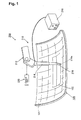
- Fig. 1 is a diagram showing the configurations of the airbag cover 100 and the ultrasonic processing device 200, which is used to process the airbag cover 100, according to the present embodiment. Also, Fig. 1 shows a state of an ultrasonic processing of the airbag cover 100, the ultrasonic processing being performed using the ultrasonic processing device 200.
- the airbag cover 100 shown in Fig. 1 has a three-dimensional plate shape and is made of a resin material such as a PP (polypropylene) material or a TPO (olefin-based elastomer) material.
- a resin material such as a PP (polypropylene) material or a TPO (olefin-based elastomer) material.
- the cover back surface 101 of the airbag cover 100 is defined as a surface of a back side thereof.
- the tear line 102 is a thinned portion which is provided to allow the airbag cover 100 to be ripped open when the vehicle airbag (a vehicle airbag 150 described below) is deployed and expanded.
- the tear line 102 is comprised of a linear groove which is formed in the cover back surface 101 of the airbag cover 100.
- the tear line 102 corresponds to 'a linear groove' in the present invention.
- the ultrasonic processing device 200 comprises a driving unit 210 including a driving arm 212, an ultrasonic amplitude element 214, an ultrasonic processing blade 216 and an ultrasonic oscillator 218, and a control unit 220. Further, the ultrasonic processing device 200 of the present embodiment comprises displacement meters 221 and 222 described below, and an image examining camera 223. The ultrasonic processing device 200 corresponds to 'an ultrasonic processing means' in the present invention.
- the driving arm 212 is provided to configure a portion of a processing robot and is controlled based on an input signal from the control unit 220, such that a position, an angle, a processing trace, or the like of a blade front end 216a of the ultrasonic processing blade 216 can be adjusted.
- the ultrasonic amplitude element 214 has a function of transferring ultrasonic waves oscillated in the ultrasonic oscillator 218 to the ultrasonic processing blade 216.
- the ultrasonic processing blade 216 is a processing blade which is used to form the tear line 102 in the cover back surface 101 of the airbag cover 100.
- a processing blade having a blade width of 1 mm may be used.
- a member transfers (provides) the ultrasonic waves to a workpiece such that the processing of the workpiece may be performed.
- a blade-shaped member such as the ultrasonic processing blade 216
- a bar-shaped member or a plate-shaped member may be used.
- the ultrasonic oscillator 218 is an oscillator having a function capable of oscillating an ultrasonic wave of a predetermined frequency.
- an oscillator having a configuration capable of oscillating an ultrasonic wave of a frequency of 22 kHz may be used.
- the control unit 220 is configured to store processing data obtained by the ultrasonic processing blade 216.
- processing data data regarding a position, an angle, a moving trace, etc. of the driving arm 212 or a grinding pattern at the time of the ultrasonic processing, which are obtained in 'a profiling teaching step' described below is included.
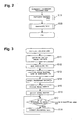
- Fig. 2 shows a flowchart of an ultrasonic processing treatment step by means of the ultrasonic processing device 200 of the present embodiment.
- 'the ultrasonic processing treatment step' according to the processing of the airbag cover 100 of the present embodiment is broadly divided into 'a profiling teaching step' (Step S10) in which processing data before the processing is analyzed, and 'a processing step' (Step S20) in which the processing is actually performed using the ultrasonic processing device.
- steps S11 to s18 shown in Fig. 3 are sequentially performed
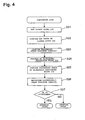
- steps S21 to S27 shown in Fig. 4 are sequentially performed.
- the profiling teaching step is a step of obtaining data, regarding a position, an angle, or a moving trace of the ultrasonic processing blade 216 at the time of the ultrasonic processing, as processing data, before an actual ultrasonic processing of the airbag cover 100 (tear line processing) is performed.
- Fig. 3 shows a flowchart of the profiling teaching step in Fig. 2.
- a design is performed by CAD (computer-aided design) based on design information of the airbag cover 100, and then CAD data is created.
- design information which is previously stored in a computer is displayed on a graphic display, and a user performs the design while viewing the screen.
- an airbag cover supporting jig 130 having a shape which is suitable for the ultrasonic processing of the airbag cover 100 (tear line processing) is manufactured.
- Fig. 5 schematically shows a treatment state in the step S13 of Fig. 3.
- the airbag cover supporting jig 130 manufactured in the step S13 of Fig. 3 has an airbag cover supporting surface 131 for supporting the airbag cover 100 from its bottom.
- the airbag cover supporting surface 131 of the airbag cover supporting jig 130 has a shape corresponding to a front surface of the airbag cover 100.
- an air suction mechanism which is not shown, is mounted on the airbag cover supporting jig 130. The suction mechanism is operated, such that the airbag cover 100 is maintained in a suction state on the airbag cover supporting surface 131.
- suction pressure detecting means (not shown) capable of detecting a suction pressure is provided.
- the airbag cover supporting jig 130 corresponds to 'the airbag cover supporting member' or 'the airbag cover side member' in the present invention.
- a teaching line 132 is formed in the airbag cover supporting surface 131 of the airbag cover supporting jig 130.
- the teaching line 132 is a processing trace corresponding to the tear line 102, and, in the present invention, it corresponds to 'the processing trace'.
- the profiling teaching is performed with respect to the control unit 220. More specifically, a teaching member 219 profiles the teaching line 132 formed in the airbag cover supporting surface 131, such that profiling data regarding a position, an angle or a moving trace of the ultrasonic processing blade 216 at the time of the processing is obtained.
- the teaching member 219 is a member which follows the ultrasonic processing blade 216 and which is installed in the driving arm 212, instead of the ultrasonic processing blade 216, when the profiling teaching is performed.
- the teaching member 219 moves such that a front end portion 219a thereof sequentially presses a plurality of teaching press points 132a on the teaching line 132, and thus the profiling teaching is made with respect to the control unit 220. And then, profiling data is automatically stored in the control unit 220. Moreover, the teaching member 219 may be made to move in a consecutive shape such that the front end portion 219a slides on the teaching line 132, thereby performing the profiling teaching.
- the teaching member 219 corresponds to 'the teaching object' in the present invention.
- the step S13 is a step of profiling the teaching member 219 along the teaching line 132 formed in the airbag cover supporting surface 131 of the airbag cover supporting jig 130, thereby obtaining (deriving) profiling data.
- the step S13 corresponds to 'the first step' in the present invention.
- profiling data obtained by the profiling teaching is changed into modified data modified by a processing thickness of the airbag cover 100 in the step S14. That is, in the step S13, the airbag cover supporting surface 131 of the airbag cover supporting jig 130 serves as the reference surface for the profiling teaching. Thus, on the assumption that the airbag cover 100 is actually set on the airbag cover supporting surface 131 (the reference surface), data which is offset by a predetermined thickness of the airbag cover 100 from the airbag cover supporting surface 131 is made into modified data (in the present invention, corresponding to 'modified data').
- the step S14 is a step of modifying profiling data obtained in the step S13 with respect to the thickness of the airbag cover 100 and teaching modified data to the control unit 220, and, in the present invention, corresponds to 'the second step'.
- the driving arm 212 is controlled via the control unit 220, and a trial product of the airbag cover 100 (in the present invention, corresponding to 'the trial airbag cover product') is actually manufactured.
- the teaching member 219 used for the profiling teaching is changed for the ultrasonic processing blade 216.
- the manufacture of the trial airbag cover product is performed when an input signal corresponding to modified data obtained in the step S14 is transferred from the control unit 220 to the driving arm 212.
- the step S15 is a step of controlling the driving arm 212 based on modified data taught in the step S14 to manufacture the trial product of the airbag cover 100, and, in the present invention, it corresponds to 'the third step'.
- step S16 actual dimensions of the trial airbag cover product manufactured in the previous step S15 are measured.
- step S17 it is determined whether or not there is a need for correcting processing data of the driving arm 212, based on dimension measurement results of the trial product in the step S16. If it is determined that there is a need for correcting data (YES in the step S17), data is corrected in the step S18, and the process returns to the step S17. That is, modified data stored in the control unit 220 in the step S14 is updated into corrected data obtained in the step S18 and corrected data is taught to the control unit 220 as processing data.
- the steps S16 to S18 are steps of measuring dimensions of the trial product of the airbag cover 100 manufactured in the step S15 and correcting modified data based on measurement results to generate processing data.
- the steps S16 to S18 correspond to 'the fourth step'.
- the profiling teaching step of the present embodiment is a step of forming the teaching line 132 corresponding to the tear line 102 in the airbag cover supporting jig 130, and simultaneously, based on profiling data obtained by profiling the teaching member 219 along the teaching line 132, teaching processing data to the control unit 220.
- this step corresponds to 'the profiling teaching step'.
- the processing step is a step of performing an actual ultrasonic processing (tear line processing) of the airbag cover 100, based on processing data obtained in the above-mentioned profiling teaching step (the steps S11 to S18).
- Fig. 4 shows a flowchart of the processing step in Fig. 2.
- the airbag cover 100 is set on the airbag cover supporting surface 131 of the airbag cover supporting jig 130 in Fig. 5.
- the suction mechanism (not shown) of the airbag cover supporting jig 130 is operated.
- a set state of the airbag cover 100 is confirmed.
- an adhesion state between the airbag cover 100 and the airbag cover supporting jig 130 is confirmed by means of the suction pressure which is detected by the suction pressure detecting means (not shown). Further, as shown in Fig. 6, by using the image examining camera 223, a positional variation of the airbag cover 100 is confirmed. Thus, it is possible for an operator to confirm the set state of the airbag cover 100.
- a processing start position (origin) of the ultrasonic processing blade 216 before the processing is confirmed.
- the laser-type displacement meters 221 and 222 are used.
- the displacement meter 221 is provided at a base, and the displacement meter 222 is provided at the ultrasonic processing blade 216 of the driving unit 210.
- a height H1 (distance) from an upper surface of a reference block 120 up to the blade front end 216a of the ultrasonic processing blade 216 is detected by means of the displacement meter 221.
- a height H2 (distance) from the upper surface of the reference block 120 up to the displacement meter 222 is detected by means of the displacement meter 222. And then, by calculating a difference (H2 - H1) between the height H1 and the height H2 detected, a height H3 from the displacement meter 222 up to the blade front end 216a of the ultrasonic processing blade 216 is obtained (derived). Thus, the processing start position (the origin) of the ultrasonic processing blade 216 is determined.
- the number of detection points of the height H1 by means of the displacement meter 221 and the height H2 by means of the displacement meter 222 in the step S23 may be set in consideration of a shape of the airbag cover 100 or the like.
- the shape of the airbag cover 100 is complex, it is preferable to increase the number of the detection points of the heights H1 and H2.
- the actual ultrasonic processing is started by means of the ultrasonic processing blade 216.
- the processing is performed when an input signal corresponding to processing data obtained in the step S14 or processing data updated in the step S18 is transferred from the control unit 220 to the driving arm 212.
- the ultrasonic oscillator 218 oscillates ultrasonic waves of frequencies of 22 kHz, and the ultrasonic waves are transferred to the ultrasonic processing blade 216 via the ultrasonic amplitude element 214.
- the driving arm 212 is controlled, and the position, the angle or the moving trace of the blade front end 216a of the ultrasonic processing blade 216 is adjusted.
- a processing speed by the ultrasonic processing blade 216 can be set to, for example, 30 mm/sec. Such a processing speed is one and a half times faster than a processing speed by a laser processing, that is, 20 mm/sec. Therefore, it is effective in improving production efficiency of the airbag cover 100.
- processing conditions such as the frequency of the ultrasonic wave to be oscillated from the ultrasonic oscillator 218 or the processing speed of the ultrasonic processing blade 216, can be suitably set based on conditions of the workpiece, such as the material of the airbag cover or a plate thickness.
- step S25 at the time of the ultrasonic processing by means of the ultrasonic processing blade 216 in the step S24 (during processing), a processing state by means of the ultrasonic processing blade 216 is confirmed.
- a height H4 (distance) from the cover back surface 101 of the airbag cover 100 up to the displacement meter 222 is detected by means of the displacement meter 222.
- a processing depth (grinding depth) H5 of the tear line 102 is obtained (derived).
- the processing depth H5 of the tear line 102 is not directly detected. Instead, the processing depth H5 of the tear line 102 is indirectly inferred based on other detection information. Further, based on the processing depth H5 and data regarding controls of the control unit 220, it is possible to confirm a remaining thickness of the airbag cover 100 at any positions of the tear line 102.
- the airbag cover 100 in which the tear line 102 having a desired processing depth is consecutively formed is manufactured.
- the shape of the airbag cover as the workpiece is three-dimensionally complex, there may be a case in which it is difficult to detect directly the processing depth H5 of the tear line 102.
- information regarding the processing depth H5 of the tear line 102 is detected hourly, and thus the processing depth H5 is derived with high reliability. Therefore, it is effective in reliably processing the tear line 102 having a desired depth, in particular, with respect to the three-dimensionally molded airbag cover.
- the number of detection points of the height H4 by means of the displacement meter 222 may be suitably set in consideration of the shape of the airbag cover 100 or the like.
- the shape of the airbag cover 100 is complex, it is possible to increase the number of the detection points of the height H4.
- the processing trace of the tear line 102 is confirmed.
- step S26 the processing start position (the origin) of the ultrasonic processing blade 216 is reconfirmed by the same operation as that of the step S23.
- step S27 it is determined whether or not the ultrasonic processing of the airbag cover 100 is acceptable. If it is determined that the ultrasonic processing of the airbag cover 100 is acceptable (YES in the step S27), the airbag cover 100 is referred to as 'superior goods'. To the contrary, if it is determined that the ultrasonic processing of the airbag cover 100 is not acceptable (NO in the step S27), the airbag cover 100 is referred to as 'inferior goods'.
- the airbag covers 100 in each of which the tear line 102 is formed in the cover back surface 101 by means of the ultrasonic processing are mass-produced.
- the processing step of the present embodiment is a step of controlling the ultrasonic processing device 200 based on processing data taught in the profiling teaching step, and forming the tear line 102 to the airbag cover 100.
- this step corresponds to 'the processing step'.
- processing data of the airbag cover 100 is created by means of the profiling teaching step in which the teaching member 219 profiles the airbag cover supporting jig 130.
- the profiling teaching step in which the teaching member 219 profiles the airbag cover supporting jig 130.
- the desired tear line 102 can be formed in the airbag cover 100 by controlling the driving arm 212 based on processing data.
- the ultrasonic processing device 200 of the present embodiment is particularly effective in the case of mass-producing the airbag covers 100 each having the tear line 102.
- an airbag module comprises the airbag cover 100, an instrument panel 140 in which the airbag cover 100 is disposed, a vehicle airbag 150 (in the present invention, corresponds to 'the vehicle airbag'), a housing (retainer) 142 in which the vehicle 150 is housed in a folded state, and gas supply means 144 which is embedded in the housing 142 and supplies an expansion gas to the vehicle airbag 150.
- the gas supply means 144 is operated, and then, by means of the expansion gas supplied from the gas supply means 144, the vehicle airbag 150 is deployed.
- the airbag cover 100 is ripped open along the tear line 102.
- a pair of deploying doors 101a is disposed toward a cover front surface in a double-swinging manner.
- the vehicle airbag 150 is deployed via the deploying doors 100a in deployed states to the outside of the airbag cover 100, and deployed and expanded while projecting toward a passenger protection region 160 which is formed in front of a passenger.
- the present invention is not limited only to the above-mentioned embodiment, but various modifications or applications can be made.
- the following embodiments to which the above-mentioned embodiment is applied may be implemented.
- the teaching line 132 for the profiling teaching which corresponds to the tear line 102 is formed in the airbag cover supporting surface 131 of the airbag cover supporting jig 130.
- the teaching line of the profiling teaching may be formed in the airbag cover 100 itself.
- the ultrasonic processing blade 216 instead of the ultrasonic processing blade 216, the teaching member 219 is used for the profiling teaching is described.
- the ultrasonic processing blade 216 itself may be used for the profiling teaching.
- profiling data obtained by profiling the teaching member 219 along the teaching line 132 is automatically stored in the control unit 220 is described.
- profiling data obtained by profiling the teaching member 219 along the teaching line 132 may be substituted with other program language and may be directly stored in the control unit 220.
Landscapes
- Engineering & Computer Science (AREA)
- Mechanical Engineering (AREA)
- Air Bags (AREA)
- Instrument Panels (AREA)
Abstract
Description
Claims (7)
- A method of manufacturing an airbag cover (100) for covering a vehicle airbag (150), in which a linear groove (102) having a depth in a range of the plate thickness of the airbag cover (100) is formed by means of ultrasonic processing means (200), the method comprising:a profiling teaching step (S10) of forming a processing trace (132) corresponding to the linear groove (102) in an airbag cover side member (130) and of teaching processing data to the ultrasonic processing means (200) based on profiling data which is obtained by moving a teaching object (219) along the processing trace; anda processing step (S20) of forming the linear groove (102) in the airbag cover (100) by controlling the ultrasonic processing means based on the processing data taught in the profiling teaching step (S10).
- The method of manufacturing an airbag cover according to Claim 1,
wherein the profiling teaching step (S10) comprises:a first step (S13) of moving the teaching member (219) along the processing trace formed on an airbag cover supporting surface (131) of an airbag cover supporting member serving as the airbag cover side member (130) to obtain profiling data;a second step (S14) of modifying profiling data obtained in the first step (S13) with respect to the thickness of the airbag cover (100) and teaching modified data to the ultrasonic processing means (200);a third step (S15) of manufacturing a trial airbag cover product by controlling the ultrasonic processing means (200) based on the modified data taught in the second step (S14); anda fourth step (S16-S18) of measuring dimensions of the trial airbag cover product manufactured in the third step (S15) and correcting the modified data based on the measurement to generate processing data. - An ultrasonic processing device for manufacturing an airbag cover (100) for covering a vehicle airbag (150), comprising
an ultrasonic oscillator (218) for generating an ultrasonic wave of a predetermined frequency,
an ultrasonic processing blade (216) for performing an ultrasonic processing of the airbag cover (100),
an ultrasonic amplitude element (214) for transferring ultrasonic waves generated by the ultrasonic oscillator (218) to the ultrasonic processing plate (216),
a driving unit (210) including driving means (212) for adjusting the ultrasonic processing plate (216), and
a control unit (220),
wherein the ultrasonic processing device (200) is configured such that a teaching member (219) is moved by said driving unit (210) along a teaching line (132) formed in an airbag cover supporting surface (131) in order to obtain processing data, and
wherein the ultrasonic processing device (200) is configured such that an ultrasonic processing of the airbag cover (100) is performed by said ultrasonic processing plate (216) based on the obtained processing data. - The ultrasonic processing device according to Claim 3,
wherein the driving means comprises a driving arm (212). - The ultrasonic processing device according to Claim 3 or Claim 4,
wherein the ultrasonic processing device (200) further comprises displacement measuring means (221, 222, 223) for detecting a displacement of the ultrasonic processing plate (216). - The ultrasonic processing device according to Claim 5,
wherein the displacement measuring means comprise a displacement meter (221, 222) and an image examining camera (223) . - The ultrasonic processing device according to any one of Claims 3-6,
wherein the ultrasonic processing device (200) is configured to carry out the method according to Claim 1 or Claim 2.
Applications Claiming Priority (2)
| Application Number | Priority Date | Filing Date | Title |
|---|---|---|---|
| JP2004042540A JP4439940B2 (en) | 2004-02-19 | 2004-02-19 | Manufacturing method of airbag cover |
| JP2004042540 | 2004-02-19 |
Publications (2)
| Publication Number | Publication Date |
|---|---|
| EP1566314A1 true EP1566314A1 (en) | 2005-08-24 |
| EP1566314B1 EP1566314B1 (en) | 2010-05-26 |
Family
ID=34709110
Family Applications (1)
| Application Number | Title | Priority Date | Filing Date |
|---|---|---|---|
| EP05003437A Expired - Lifetime EP1566314B1 (en) | 2004-02-19 | 2005-02-17 | Method of manufacturing an airbag cover and corresponding ultrasonic processing device |
Country Status (5)
| Country | Link |
|---|---|
| US (1) | US20050200049A1 (en) |
| EP (1) | EP1566314B1 (en) |
| JP (1) | JP4439940B2 (en) |
| CN (1) | CN1657268B (en) |
| DE (1) | DE602005021415D1 (en) |
Cited By (1)
| Publication number | Priority date | Publication date | Assignee | Title |
|---|---|---|---|---|
| WO2020089210A1 (en) * | 2018-10-29 | 2020-05-07 | Frimo Group Gmbh | Cutting apparatus and cutting method |
Families Citing this family (4)
| Publication number | Priority date | Publication date | Assignee | Title |
|---|---|---|---|---|
| WO2008050555A1 (en) * | 2006-10-23 | 2008-05-02 | Kamiita Seiki Seisakusho Co., Ltd. | Method for producing casting die and die model |
| EP2627551B1 (en) * | 2010-10-14 | 2016-09-28 | Inteva Products LLC | Instrument panel with integral hidden door cover and method of manufacture thereof |
| JP5941685B2 (en) * | 2012-02-03 | 2016-06-29 | 本田技研工業株式会社 | Method for correcting teaching line of machining means |
| US10604259B2 (en) | 2016-01-20 | 2020-03-31 | Amsafe, Inc. | Occupant restraint systems having extending restraints, and associated systems and methods |
Citations (2)
| Publication number | Priority date | Publication date | Assignee | Title |
|---|---|---|---|---|
| EP1162054A1 (en) * | 1999-11-17 | 2001-12-12 | Pearl Kogyo Co., Ltd | Methods of forming linear groove in car skin and measuring/recording residual wall thickness and device therefor |
| EP1493548A1 (en) * | 2003-06-30 | 2005-01-05 | Takata Corporation | Airbag cover, airbag module, and method of producing the airbag cover |
Family Cites Families (5)
| Publication number | Priority date | Publication date | Assignee | Title |
|---|---|---|---|---|
| DE69313590T2 (en) * | 1992-06-29 | 1998-04-02 | Matsushita Electric Ind Co Ltd | Method for controlling the operation of a robotic arm |
| US5883356A (en) * | 1996-05-13 | 1999-03-16 | Tip Engineering Group, Inc. | Laser scoring process and apparatus |
| JPH10233426A (en) * | 1997-02-20 | 1998-09-02 | Tokyo Electron Ltd | Automatic teaching method |
| GB9714114D0 (en) * | 1997-07-03 | 1997-09-10 | Sanko Gosei Uk Ltd | Air bag |
| JP3234983B2 (en) * | 1999-11-17 | 2001-12-04 | パール工業株式会社 | Method and apparatus for processing linear grooves on airbag portion of automobile skin |
-
2004
- 2004-02-19 JP JP2004042540A patent/JP4439940B2/en not_active Expired - Fee Related
-
2005
- 2005-02-05 CN CN2005100079160A patent/CN1657268B/en not_active Expired - Fee Related
- 2005-02-17 EP EP05003437A patent/EP1566314B1/en not_active Expired - Lifetime
- 2005-02-17 DE DE602005021415T patent/DE602005021415D1/en not_active Expired - Lifetime
- 2005-02-18 US US11/061,549 patent/US20050200049A1/en not_active Abandoned
Patent Citations (2)
| Publication number | Priority date | Publication date | Assignee | Title |
|---|---|---|---|---|
| EP1162054A1 (en) * | 1999-11-17 | 2001-12-12 | Pearl Kogyo Co., Ltd | Methods of forming linear groove in car skin and measuring/recording residual wall thickness and device therefor |
| EP1493548A1 (en) * | 2003-06-30 | 2005-01-05 | Takata Corporation | Airbag cover, airbag module, and method of producing the airbag cover |
Cited By (1)
| Publication number | Priority date | Publication date | Assignee | Title |
|---|---|---|---|---|
| WO2020089210A1 (en) * | 2018-10-29 | 2020-05-07 | Frimo Group Gmbh | Cutting apparatus and cutting method |
Also Published As
| Publication number | Publication date |
|---|---|
| JP4439940B2 (en) | 2010-03-24 |
| CN1657268A (en) | 2005-08-24 |
| CN1657268B (en) | 2010-05-12 |
| JP2005231478A (en) | 2005-09-02 |
| EP1566314B1 (en) | 2010-05-26 |
| US20050200049A1 (en) | 2005-09-15 |
| DE602005021415D1 (en) | 2010-07-08 |
Similar Documents
| Publication | Publication Date | Title |
|---|---|---|
| US7284975B2 (en) | Manufacturing apparatus for airbag cover | |
| JP4659382B2 (en) | Manufacturing method of airbag cover | |
| JP4227851B2 (en) | Manufacturing method of airbag cover | |
| US7604251B2 (en) | Airbag module | |
| EP1918162B1 (en) | Airbag cover, instrument panel, and airbag apparatus | |
| US7168731B2 (en) | Airbag apparatus for automobile | |
| JP2013033312A (en) | Image processing device | |
| EP1566314B1 (en) | Method of manufacturing an airbag cover and corresponding ultrasonic processing device | |
| JP2017178263A (en) | Crew protection device | |
| CN107953808A (en) | System and method for component adjustment | |
| JP2007137088A (en) | Method and device for forming breakage expected portion of airbag door | |
| US9061648B2 (en) | Method of forming tear line of airbag using in-mold blade | |
| JP2013095344A (en) | Method for manufacturing interior automotive trim skin | |
| JP5947669B2 (en) | Leather for airbags and airbag covers | |
| JP2007118893A (en) | Method and device for forming fracture scheduled part of airbag door | |
| EP1719668B1 (en) | Method for quality inspection of an automative interior design part having a weakening line | |
| JP2008073820A (en) | Tierline processing apparatus and processing method | |
| JP2000326397A (en) | A cabin-side member having a skin and an airbag door, and a method of manufacturing the cabin-side member |
Legal Events
| Date | Code | Title | Description |
|---|---|---|---|
| PUAI | Public reference made under article 153(3) epc to a published international application that has entered the european phase |
Free format text: ORIGINAL CODE: 0009012 |
|
| AK | Designated contracting states |
Kind code of ref document: A1 Designated state(s): AT BE BG CH CY CZ DE DK EE ES FI FR GB GR HU IE IS IT LI LT LU MC NL PL PT RO SE SI SK TR |
|
| AX | Request for extension of the european patent |
Extension state: AL BA HR LV MK YU |
|
| 17P | Request for examination filed |
Effective date: 20060203 |
|
| AKX | Designation fees paid |
Designated state(s): DE FR GB SE |
|
| GRAP | Despatch of communication of intention to grant a patent |
Free format text: ORIGINAL CODE: EPIDOSNIGR1 |
|
| GRAS | Grant fee paid |
Free format text: ORIGINAL CODE: EPIDOSNIGR3 |
|
| GRAA | (expected) grant |
Free format text: ORIGINAL CODE: 0009210 |
|
| AK | Designated contracting states |
Kind code of ref document: B1 Designated state(s): DE FR GB SE |
|
| REG | Reference to a national code |
Ref country code: GB Ref legal event code: FG4D |
|
| REF | Corresponds to: |
Ref document number: 602005021415 Country of ref document: DE Date of ref document: 20100708 Kind code of ref document: P |
|
| PG25 | Lapsed in a contracting state [announced via postgrant information from national office to epo] |
Ref country code: SE Free format text: LAPSE BECAUSE OF FAILURE TO SUBMIT A TRANSLATION OF THE DESCRIPTION OR TO PAY THE FEE WITHIN THE PRESCRIBED TIME-LIMIT Effective date: 20100526 |
|
| PLBE | No opposition filed within time limit |
Free format text: ORIGINAL CODE: 0009261 |
|
| STAA | Information on the status of an ep patent application or granted ep patent |
Free format text: STATUS: NO OPPOSITION FILED WITHIN TIME LIMIT |
|
| 26N | No opposition filed |
Effective date: 20110301 |
|
| REG | Reference to a national code |
Ref country code: DE Ref legal event code: R097 Ref document number: 602005021415 Country of ref document: DE Effective date: 20110228 |
|
| REG | Reference to a national code |
Ref country code: FR Ref legal event code: ST Effective date: 20111102 |
|
| PG25 | Lapsed in a contracting state [announced via postgrant information from national office to epo] |
Ref country code: FR Free format text: LAPSE BECAUSE OF NON-PAYMENT OF DUE FEES Effective date: 20110228 |
|
| PGFP | Annual fee paid to national office [announced via postgrant information from national office to epo] |
Ref country code: GB Payment date: 20130213 Year of fee payment: 9 |
|
| GBPC | Gb: european patent ceased through non-payment of renewal fee |
Effective date: 20140217 |
|
| PG25 | Lapsed in a contracting state [announced via postgrant information from national office to epo] |
Ref country code: GB Free format text: LAPSE BECAUSE OF NON-PAYMENT OF DUE FEES Effective date: 20140217 |
|
| REG | Reference to a national code |
Ref country code: DE Ref legal event code: R082 Ref document number: 602005021415 Country of ref document: DE Representative=s name: KRAUS & WEISERT PATENTANWAELTE PARTGMBB, DE Ref country code: DE Ref legal event code: R081 Ref document number: 602005021415 Country of ref document: DE Owner name: JOYSON SAFETY SYSTEMS JAPAN K.K., JP Free format text: FORMER OWNER: TAKATA CORP., TOKIO/TOKYO, JP |
|
| PGFP | Annual fee paid to national office [announced via postgrant information from national office to epo] |
Ref country code: DE Payment date: 20190219 Year of fee payment: 15 |
|
| REG | Reference to a national code |
Ref country code: DE Ref legal event code: R119 Ref document number: 602005021415 Country of ref document: DE |
|
| PG25 | Lapsed in a contracting state [announced via postgrant information from national office to epo] |
Ref country code: DE Free format text: LAPSE BECAUSE OF NON-PAYMENT OF DUE FEES Effective date: 20200901 |