EP1565572B1 - Porcine polymorphisms associated with resistance to enterotoxigenic e. coli and methods for detecting them - Google Patents
Porcine polymorphisms associated with resistance to enterotoxigenic e. coli and methods for detecting them Download PDFInfo
- Publication number
- EP1565572B1 EP1565572B1 EP03773594A EP03773594A EP1565572B1 EP 1565572 B1 EP1565572 B1 EP 1565572B1 EP 03773594 A EP03773594 A EP 03773594A EP 03773594 A EP03773594 A EP 03773594A EP 1565572 B1 EP1565572 B1 EP 1565572B1
- Authority
- EP
- European Patent Office
- Prior art keywords
- seq
- pig
- etec
- dna
- resistance
- Prior art date
- Legal status (The legal status is an assumption and is not a legal conclusion. Google has not performed a legal analysis and makes no representation as to the accuracy of the status listed.)
- Expired - Lifetime
Links
- 238000000034 method Methods 0.000 title claims abstract description 75
- 241000588724 Escherichia coli Species 0.000 title claims abstract description 74
- 230000000688 enterotoxigenic effect Effects 0.000 title claims abstract description 10
- 102000054765 polymorphisms of proteins Human genes 0.000 title description 19
- 239000000523 sample Substances 0.000 claims abstract description 54
- 241000282887 Suidae Species 0.000 claims abstract description 45
- 210000000582 semen Anatomy 0.000 claims abstract description 5
- 241000282898 Sus scrofa Species 0.000 claims description 318
- 108020004414 DNA Proteins 0.000 claims description 265
- 150000007523 nucleic acids Chemical class 0.000 claims description 96
- 206010071602 Genetic polymorphism Diseases 0.000 claims description 93
- 108700028369 Alleles Proteins 0.000 claims description 74
- 102000039446 nucleic acids Human genes 0.000 claims description 70
- 108020004707 nucleic acids Proteins 0.000 claims description 70
- 108090000623 proteins and genes Proteins 0.000 claims description 61
- 239000002773 nucleotide Substances 0.000 claims description 46
- 125000003729 nucleotide group Chemical group 0.000 claims description 46
- 239000012634 fragment Substances 0.000 claims description 28
- 230000000295 complement effect Effects 0.000 claims description 23
- 108091092878 Microsatellite Proteins 0.000 claims description 21
- 210000000349 chromosome Anatomy 0.000 claims description 21
- 206010012735 Diarrhoea Diseases 0.000 claims description 20
- 101150059949 MUC4 gene Proteins 0.000 claims description 17
- 230000003321 amplification Effects 0.000 claims description 15
- 238000012217 deletion Methods 0.000 claims description 15
- 230000037430 deletion Effects 0.000 claims description 15
- 238000003199 nucleic acid amplification method Methods 0.000 claims description 15
- 238000012163 sequencing technique Methods 0.000 claims description 14
- 108091008146 restriction endonucleases Proteins 0.000 claims description 11
- 238000009396 hybridization Methods 0.000 claims description 10
- 239000000463 material Substances 0.000 claims description 10
- 230000000968 intestinal effect Effects 0.000 claims description 9
- 102220095031 rs876660930 Human genes 0.000 claims description 9
- 108091081062 Repeated sequence (DNA) Proteins 0.000 claims description 8
- 208000028774 intestinal disease Diseases 0.000 claims description 8
- 102000004169 proteins and genes Human genes 0.000 claims description 8
- 102220277026 rs1553356579 Human genes 0.000 claims description 8
- 102220014277 rs397517012 Human genes 0.000 claims description 8
- 102220014285 rs397517016 Human genes 0.000 claims description 8
- 210000001519 tissue Anatomy 0.000 claims description 7
- 206010000050 Abdominal adhesions Diseases 0.000 claims description 6
- 210000004369 blood Anatomy 0.000 claims description 6
- 239000008280 blood Substances 0.000 claims description 6
- 238000007894 restriction fragment length polymorphism technique Methods 0.000 claims description 6
- 244000309720 Escherichia coli F4 Species 0.000 claims description 4
- 238000003780 insertion Methods 0.000 claims description 4
- 230000037431 insertion Effects 0.000 claims description 4
- 230000035772 mutation Effects 0.000 claims description 4
- 230000008707 rearrangement Effects 0.000 claims description 4
- 244000309724 Escherichia coli F41 Species 0.000 claims description 3
- 244000309719 Escherichia coli F5 Species 0.000 claims description 3
- 244000309718 Escherichia coli F6 Species 0.000 claims description 3
- 101150048676 FUT1 gene Proteins 0.000 claims description 3
- 238000001514 detection method Methods 0.000 claims description 3
- 238000000338 in vitro Methods 0.000 claims description 3
- 210000003800 pharynx Anatomy 0.000 claims description 3
- 210000003296 saliva Anatomy 0.000 claims description 3
- 238000007844 allele-specific PCR Methods 0.000 claims description 2
- 238000003491 array Methods 0.000 claims description 2
- 238000009402 cross-breeding Methods 0.000 claims description 2
- 238000001502 gel electrophoresis Methods 0.000 claims description 2
- 238000001840 matrix-assisted laser desorption--ionisation time-of-flight mass spectrometry Methods 0.000 claims description 2
- 238000005259 measurement Methods 0.000 claims description 2
- 238000002844 melting Methods 0.000 claims description 2
- 230000008018 melting Effects 0.000 claims description 2
- 238000012175 pyrosequencing Methods 0.000 claims description 2
- 238000005096 rolling process Methods 0.000 claims description 2
- 230000001488 breeding effect Effects 0.000 abstract description 13
- 238000009395 breeding Methods 0.000 abstract description 12
- 229940079593 drug Drugs 0.000 abstract description 4
- 239000003814 drug Substances 0.000 abstract description 4
- 102000053602 DNA Human genes 0.000 description 261
- 238000003752 polymerase chain reaction Methods 0.000 description 52
- 101000972286 Homo sapiens Mucin-4 Proteins 0.000 description 38
- 108010008699 Mucin-4 Proteins 0.000 description 34
- 239000003550 marker Substances 0.000 description 34
- 241001465754 Metazoa Species 0.000 description 33
- 102000007270 Mucin-4 Human genes 0.000 description 33
- 102000054766 genetic haplotypes Human genes 0.000 description 25
- 210000004436 artificial bacterial chromosome Anatomy 0.000 description 23
- 238000013507 mapping Methods 0.000 description 18
- 238000012360 testing method Methods 0.000 description 17
- 239000000872 buffer Substances 0.000 description 13
- 238000011144 upstream manufacturing Methods 0.000 description 13
- 238000004458 analytical method Methods 0.000 description 11
- 238000000137 annealing Methods 0.000 description 11
- 230000000052 comparative effect Effects 0.000 description 11
- 241000894006 Bacteria Species 0.000 description 10
- 210000004027 cell Anatomy 0.000 description 10
- 241000282414 Homo sapiens Species 0.000 description 9
- 238000003205 genotyping method Methods 0.000 description 9
- 108700024394 Exon Proteins 0.000 description 8
- 201000010099 disease Diseases 0.000 description 8
- 208000037265 diseases, disorders, signs and symptoms Diseases 0.000 description 8
- 101000743430 Homo sapiens Vacuolar protein sorting-associated protein 8 homolog Proteins 0.000 description 7
- 101000654430 Homo sapiens Vesicle-trafficking protein SEC22a Proteins 0.000 description 7
- 108091028043 Nucleic acid sequence Proteins 0.000 description 7
- 239000002299 complementary DNA Substances 0.000 description 7
- 229920002477 rna polymer Polymers 0.000 description 7
- YBJHBAHKTGYVGT-ZKWXMUAHSA-N (+)-Biotin Chemical compound N1C(=O)N[C@@H]2[C@H](CCCCC(=O)O)SC[C@@H]21 YBJHBAHKTGYVGT-ZKWXMUAHSA-N 0.000 description 6
- 102100036409 Activated CDC42 kinase 1 Human genes 0.000 description 6
- 101000928956 Homo sapiens Activated CDC42 kinase 1 Proteins 0.000 description 6
- TWRXJAOTZQYOKJ-UHFFFAOYSA-L Magnesium chloride Chemical compound [Mg+2].[Cl-].[Cl-] TWRXJAOTZQYOKJ-UHFFFAOYSA-L 0.000 description 6
- 238000004519 manufacturing process Methods 0.000 description 6
- 208000024191 minimally invasive lung adenocarcinoma Diseases 0.000 description 6
- 101000676246 Homo sapiens 60S ribosomal protein L29 Proteins 0.000 description 5
- 101000684189 Homo sapiens ADP-ribosylation factor 4 Proteins 0.000 description 5
- 101001128911 Homo sapiens Neutral cholesterol ester hydrolase 1 Proteins 0.000 description 5
- 101000727821 Homo sapiens RING1 and YY1-binding protein Proteins 0.000 description 5
- 101000582404 Homo sapiens Replication factor C subunit 4 Proteins 0.000 description 5
- 101000666385 Homo sapiens Transcription factor Dp-2 Proteins 0.000 description 5
- 238000004925 denaturation Methods 0.000 description 5
- 230000036425 denaturation Effects 0.000 description 5
- 210000002919 epithelial cell Anatomy 0.000 description 5
- 239000013612 plasmid Substances 0.000 description 5
- 108091060211 Expressed sequence tag Proteins 0.000 description 4
- 102100023093 Kalirin Human genes 0.000 description 4
- 238000003556 assay Methods 0.000 description 4
- 230000008901 benefit Effects 0.000 description 4
- 230000002068 genetic effect Effects 0.000 description 4
- 102000056048 human MUC4 Human genes 0.000 description 4
- 210000003917 human chromosome Anatomy 0.000 description 4
- 230000005855 radiation Effects 0.000 description 4
- 210000000813 small intestine Anatomy 0.000 description 4
- 102000004190 Enzymes Human genes 0.000 description 3
- 108090000790 Enzymes Proteins 0.000 description 3
- 108091092195 Intron Proteins 0.000 description 3
- HEMHJVSKTPXQMS-UHFFFAOYSA-M Sodium hydroxide Chemical compound [OH-].[Na+] HEMHJVSKTPXQMS-UHFFFAOYSA-M 0.000 description 3
- 102100038324 Vacuolar protein sorting-associated protein 8 homolog Human genes 0.000 description 3
- 102100031495 Vesicle-trafficking protein SEC22a Human genes 0.000 description 3
- 239000011543 agarose gel Substances 0.000 description 3
- 229960002685 biotin Drugs 0.000 description 3
- 235000020958 biotin Nutrition 0.000 description 3
- 239000011616 biotin Substances 0.000 description 3
- 238000006243 chemical reaction Methods 0.000 description 3
- -1 chromosomes Proteins 0.000 description 3
- 210000001072 colon Anatomy 0.000 description 3
- 230000002559 cytogenic effect Effects 0.000 description 3
- 210000003608 fece Anatomy 0.000 description 3
- 239000000499 gel Substances 0.000 description 3
- 229910001629 magnesium chloride Inorganic materials 0.000 description 3
- 235000013372 meat Nutrition 0.000 description 3
- 239000000203 mixture Substances 0.000 description 3
- 230000006798 recombination Effects 0.000 description 3
- 238000005215 recombination Methods 0.000 description 3
- 238000003757 reverse transcription PCR Methods 0.000 description 3
- 230000002441 reversible effect Effects 0.000 description 3
- 238000003307 slaughter Methods 0.000 description 3
- 239000003053 toxin Substances 0.000 description 3
- 231100000765 toxin Toxicity 0.000 description 3
- 108700012359 toxins Proteins 0.000 description 3
- KCXVZYZYPLLWCC-UHFFFAOYSA-N EDTA Chemical compound OC(=O)CN(CC(O)=O)CCN(CC(O)=O)CC(O)=O KCXVZYZYPLLWCC-UHFFFAOYSA-N 0.000 description 2
- 102000003886 Glycoproteins Human genes 0.000 description 2
- 108090000288 Glycoproteins Proteins 0.000 description 2
- 101000893710 Homo sapiens Galactoside alpha-(1,2)-fucosyltransferase 2 Proteins 0.000 description 2
- 101001014936 Homo sapiens Glutathione peroxidase 1 Proteins 0.000 description 2
- 101100086726 Homo sapiens RCC2 gene Proteins 0.000 description 2
- 102100039972 Protein RCC2 Human genes 0.000 description 2
- FAPWRFPIFSIZLT-UHFFFAOYSA-M Sodium chloride Chemical compound [Na+].[Cl-] FAPWRFPIFSIZLT-UHFFFAOYSA-M 0.000 description 2
- 101100244894 Sus scrofa PR39 gene Proteins 0.000 description 2
- 102000004338 Transferrin Human genes 0.000 description 2
- 108090000901 Transferrin Proteins 0.000 description 2
- 239000000853 adhesive Substances 0.000 description 2
- 230000001070 adhesive effect Effects 0.000 description 2
- 229960000723 ampicillin Drugs 0.000 description 2
- AVKUERGKIZMTKX-NJBDSQKTSA-N ampicillin Chemical compound C1([C@@H](N)C(=O)N[C@H]2[C@H]3SC([C@@H](N3C2=O)C(O)=O)(C)C)=CC=CC=C1 AVKUERGKIZMTKX-NJBDSQKTSA-N 0.000 description 2
- 238000012512 characterization method Methods 0.000 description 2
- 239000003153 chemical reaction reagent Substances 0.000 description 2
- 230000002759 chromosomal effect Effects 0.000 description 2
- 238000010367 cloning Methods 0.000 description 2
- 238000010276 construction Methods 0.000 description 2
- 239000013256 coordination polymer Substances 0.000 description 2
- 238000005520 cutting process Methods 0.000 description 2
- 238000002405 diagnostic procedure Methods 0.000 description 2
- 230000000694 effects Effects 0.000 description 2
- 238000001962 electrophoresis Methods 0.000 description 2
- 230000000369 enteropathogenic effect Effects 0.000 description 2
- RQFCJASXJCIDSX-UUOKFMHZSA-N guanosine 5'-monophosphate Chemical group C1=2NC(N)=NC(=O)C=2N=CN1[C@@H]1O[C@H](COP(O)(O)=O)[C@@H](O)[C@H]1O RQFCJASXJCIDSX-UUOKFMHZSA-N 0.000 description 2
- 210000004754 hybrid cell Anatomy 0.000 description 2
- 210000003405 ileum Anatomy 0.000 description 2
- 238000011534 incubation Methods 0.000 description 2
- 208000015181 infectious disease Diseases 0.000 description 2
- 210000002490 intestinal epithelial cell Anatomy 0.000 description 2
- 210000001630 jejunum Anatomy 0.000 description 2
- 238000000386 microscopy Methods 0.000 description 2
- 210000000110 microvilli Anatomy 0.000 description 2
- 231100000252 nontoxic Toxicity 0.000 description 2
- 230000003000 nontoxic effect Effects 0.000 description 2
- 239000006174 pH buffer Substances 0.000 description 2
- 230000036961 partial effect Effects 0.000 description 2
- 230000008569 process Effects 0.000 description 2
- 238000006467 substitution reaction Methods 0.000 description 2
- 235000000346 sugar Nutrition 0.000 description 2
- 150000008163 sugars Chemical class 0.000 description 2
- 239000012581 transferrin Substances 0.000 description 2
- 229960005486 vaccine Drugs 0.000 description 2
- 238000010200 validation analysis Methods 0.000 description 2
- 239000013598 vector Substances 0.000 description 2
- 239000011534 wash buffer Substances 0.000 description 2
- JKMHFZQWWAIEOD-UHFFFAOYSA-N 2-[4-(2-hydroxyethyl)piperazin-1-yl]ethanesulfonic acid Chemical compound OCC[NH+]1CCN(CCS([O-])(=O)=O)CC1 JKMHFZQWWAIEOD-UHFFFAOYSA-N 0.000 description 1
- 108020005065 3' Flanking Region Proteins 0.000 description 1
- 108020005345 3' Untranslated Regions Proteins 0.000 description 1
- BZTDTCNHAFUJOG-UHFFFAOYSA-N 6-carboxyfluorescein Chemical compound C12=CC=C(O)C=C2OC2=CC(O)=CC=C2C11OC(=O)C2=CC=C(C(=O)O)C=C21 BZTDTCNHAFUJOG-UHFFFAOYSA-N 0.000 description 1
- 102100021671 60S ribosomal protein L29 Human genes 0.000 description 1
- 102100023826 ADP-ribosylation factor 4 Human genes 0.000 description 1
- 102100032161 Adenylate cyclase type 5 Human genes 0.000 description 1
- 240000006108 Allium ampeloprasum Species 0.000 description 1
- 235000005254 Allium ampeloprasum Nutrition 0.000 description 1
- 102100029945 Beta-galactoside alpha-2,6-sialyltransferase 1 Human genes 0.000 description 1
- BTBUEUYNUDRHOZ-UHFFFAOYSA-N Borate Chemical compound [O-]B([O-])[O-] BTBUEUYNUDRHOZ-UHFFFAOYSA-N 0.000 description 1
- 108020004635 Complementary DNA Proteins 0.000 description 1
- 108091035707 Consensus sequence Proteins 0.000 description 1
- 241000699800 Cricetinae Species 0.000 description 1
- 238000001712 DNA sequencing Methods 0.000 description 1
- 108010014303 DNA-directed DNA polymerase Proteins 0.000 description 1
- 102000016928 DNA-directed DNA polymerase Human genes 0.000 description 1
- 108010054576 Deoxyribonuclease EcoRI Proteins 0.000 description 1
- 101000809889 Dinoponera quadriceps M-poneratoxin-Dq4e Proteins 0.000 description 1
- 101710146739 Enterotoxin Proteins 0.000 description 1
- 241000588722 Escherichia Species 0.000 description 1
- 238000000729 Fisher's exact test Methods 0.000 description 1
- 102100039835 Galactoside alpha-(1,2)-fucosyltransferase 1 Human genes 0.000 description 1
- 102100040837 Galactoside alpha-(1,2)-fucosyltransferase 2 Human genes 0.000 description 1
- 206010053759 Growth retardation Diseases 0.000 description 1
- 239000007995 HEPES buffer Substances 0.000 description 1
- 101710121697 Heat-stable enterotoxin Proteins 0.000 description 1
- 241000282412 Homo Species 0.000 description 1
- 101000775478 Homo sapiens Adenylate cyclase type 5 Proteins 0.000 description 1
- 101000863864 Homo sapiens Beta-galactoside alpha-2,6-sialyltransferase 1 Proteins 0.000 description 1
- 101001132266 Homo sapiens DNA repair protein RAD51 homolog 4 Proteins 0.000 description 1
- 101001050038 Homo sapiens Kalirin Proteins 0.000 description 1
- 101100292629 Homo sapiens MUC4 gene Proteins 0.000 description 1
- 101000735456 Homo sapiens Protein mono-ADP-ribosyltransferase PARP3 Proteins 0.000 description 1
- DGAQECJNVWCQMB-PUAWFVPOSA-M Ilexoside XXIX Chemical compound C[C@@H]1CC[C@@]2(CC[C@@]3(C(=CC[C@H]4[C@]3(CC[C@@H]5[C@@]4(CC[C@@H](C5(C)C)OS(=O)(=O)[O-])C)C)[C@@H]2[C@]1(C)O)C)C(=O)O[C@H]6[C@@H]([C@H]([C@@H]([C@H](O6)CO)O)O)O.[Na+] DGAQECJNVWCQMB-PUAWFVPOSA-M 0.000 description 1
- 102000018697 Membrane Proteins Human genes 0.000 description 1
- 108010052285 Membrane Proteins Proteins 0.000 description 1
- 241000699666 Mus <mouse, genus> Species 0.000 description 1
- 102100032087 Neutral cholesterol ester hydrolase 1 Human genes 0.000 description 1
- 101710163270 Nuclease Proteins 0.000 description 1
- 108091034117 Oligonucleotide Proteins 0.000 description 1
- 238000009004 PCR Kit Methods 0.000 description 1
- 238000012408 PCR amplification Methods 0.000 description 1
- 108091093037 Peptide nucleic acid Proteins 0.000 description 1
- 241001441752 Philesturnus carunculatus Species 0.000 description 1
- 241000255969 Pieris brassicae Species 0.000 description 1
- 102100034935 Protein mono-ADP-ribosyltransferase PARP3 Human genes 0.000 description 1
- 238000012181 QIAquick gel extraction kit Methods 0.000 description 1
- 102100029760 RING1 and YY1-binding protein Human genes 0.000 description 1
- 102100030542 Replication factor C subunit 4 Human genes 0.000 description 1
- 108010032838 Sialoglycoproteins Proteins 0.000 description 1
- 102000007365 Sialoglycoproteins Human genes 0.000 description 1
- 108010090804 Streptavidin Proteins 0.000 description 1
- 108010006785 Taq Polymerase Proteins 0.000 description 1
- RYYWUUFWQRZTIU-UHFFFAOYSA-N Thiophosphoric acid Chemical compound OP(O)(S)=O RYYWUUFWQRZTIU-UHFFFAOYSA-N 0.000 description 1
- 102100038312 Transcription factor Dp-2 Human genes 0.000 description 1
- 239000007983 Tris buffer Substances 0.000 description 1
- JLCPHMBAVCMARE-UHFFFAOYSA-N [3-[[3-[[3-[[3-[[3-[[3-[[3-[[3-[[3-[[3-[[3-[[5-(2-amino-6-oxo-1H-purin-9-yl)-3-[[3-[[3-[[3-[[3-[[3-[[5-(2-amino-6-oxo-1H-purin-9-yl)-3-[[5-(2-amino-6-oxo-1H-purin-9-yl)-3-hydroxyoxolan-2-yl]methoxy-hydroxyphosphoryl]oxyoxolan-2-yl]methoxy-hydroxyphosphoryl]oxy-5-(5-methyl-2,4-dioxopyrimidin-1-yl)oxolan-2-yl]methoxy-hydroxyphosphoryl]oxy-5-(6-aminopurin-9-yl)oxolan-2-yl]methoxy-hydroxyphosphoryl]oxy-5-(6-aminopurin-9-yl)oxolan-2-yl]methoxy-hydroxyphosphoryl]oxy-5-(6-aminopurin-9-yl)oxolan-2-yl]methoxy-hydroxyphosphoryl]oxy-5-(6-aminopurin-9-yl)oxolan-2-yl]methoxy-hydroxyphosphoryl]oxyoxolan-2-yl]methoxy-hydroxyphosphoryl]oxy-5-(5-methyl-2,4-dioxopyrimidin-1-yl)oxolan-2-yl]methoxy-hydroxyphosphoryl]oxy-5-(4-amino-2-oxopyrimidin-1-yl)oxolan-2-yl]methoxy-hydroxyphosphoryl]oxy-5-(5-methyl-2,4-dioxopyrimidin-1-yl)oxolan-2-yl]methoxy-hydroxyphosphoryl]oxy-5-(5-methyl-2,4-dioxopyrimidin-1-yl)oxolan-2-yl]methoxy-hydroxyphosphoryl]oxy-5-(6-aminopurin-9-yl)oxolan-2-yl]methoxy-hydroxyphosphoryl]oxy-5-(6-aminopurin-9-yl)oxolan-2-yl]methoxy-hydroxyphosphoryl]oxy-5-(4-amino-2-oxopyrimidin-1-yl)oxolan-2-yl]methoxy-hydroxyphosphoryl]oxy-5-(4-amino-2-oxopyrimidin-1-yl)oxolan-2-yl]methoxy-hydroxyphosphoryl]oxy-5-(4-amino-2-oxopyrimidin-1-yl)oxolan-2-yl]methoxy-hydroxyphosphoryl]oxy-5-(6-aminopurin-9-yl)oxolan-2-yl]methoxy-hydroxyphosphoryl]oxy-5-(4-amino-2-oxopyrimidin-1-yl)oxolan-2-yl]methyl [5-(6-aminopurin-9-yl)-2-(hydroxymethyl)oxolan-3-yl] hydrogen phosphate Polymers Cc1cn(C2CC(OP(O)(=O)OCC3OC(CC3OP(O)(=O)OCC3OC(CC3O)n3cnc4c3nc(N)[nH]c4=O)n3cnc4c3nc(N)[nH]c4=O)C(COP(O)(=O)OC3CC(OC3COP(O)(=O)OC3CC(OC3COP(O)(=O)OC3CC(OC3COP(O)(=O)OC3CC(OC3COP(O)(=O)OC3CC(OC3COP(O)(=O)OC3CC(OC3COP(O)(=O)OC3CC(OC3COP(O)(=O)OC3CC(OC3COP(O)(=O)OC3CC(OC3COP(O)(=O)OC3CC(OC3COP(O)(=O)OC3CC(OC3COP(O)(=O)OC3CC(OC3COP(O)(=O)OC3CC(OC3COP(O)(=O)OC3CC(OC3COP(O)(=O)OC3CC(OC3COP(O)(=O)OC3CC(OC3COP(O)(=O)OC3CC(OC3CO)n3cnc4c(N)ncnc34)n3ccc(N)nc3=O)n3cnc4c(N)ncnc34)n3ccc(N)nc3=O)n3ccc(N)nc3=O)n3ccc(N)nc3=O)n3cnc4c(N)ncnc34)n3cnc4c(N)ncnc34)n3cc(C)c(=O)[nH]c3=O)n3cc(C)c(=O)[nH]c3=O)n3ccc(N)nc3=O)n3cc(C)c(=O)[nH]c3=O)n3cnc4c3nc(N)[nH]c4=O)n3cnc4c(N)ncnc34)n3cnc4c(N)ncnc34)n3cnc4c(N)ncnc34)n3cnc4c(N)ncnc34)O2)c(=O)[nH]c1=O JLCPHMBAVCMARE-UHFFFAOYSA-N 0.000 description 1
- UDMBCSSLTHHNCD-KQYNXXCUSA-N adenosine 5'-monophosphate Chemical group C1=NC=2C(N)=NC=NC=2N1[C@@H]1O[C@H](COP(O)(O)=O)[C@@H](O)[C@H]1O UDMBCSSLTHHNCD-KQYNXXCUSA-N 0.000 description 1
- 108010016828 adenylyl sulfate-ammonia adenylyltransferase Proteins 0.000 description 1
- 125000003275 alpha amino acid group Chemical group 0.000 description 1
- 239000003242 anti bacterial agent Substances 0.000 description 1
- 230000000692 anti-sense effect Effects 0.000 description 1
- 229940088710 antibiotic agent Drugs 0.000 description 1
- 239000000427 antigen Substances 0.000 description 1
- 108091007433 antigens Proteins 0.000 description 1
- 102000036639 antigens Human genes 0.000 description 1
- 244000052616 bacterial pathogen Species 0.000 description 1
- 238000010804 cDNA synthesis Methods 0.000 description 1
- 230000004700 cellular uptake Effects 0.000 description 1
- 239000013599 cloning vector Substances 0.000 description 1
- 238000004590 computer program Methods 0.000 description 1
- 239000012141 concentrate Substances 0.000 description 1
- 238000007796 conventional method Methods 0.000 description 1
- OPTASPLRGRRNAP-UHFFFAOYSA-N cytosine Natural products NC=1C=CNC(=O)N=1 OPTASPLRGRRNAP-UHFFFAOYSA-N 0.000 description 1
- 229940104302 cytosine Drugs 0.000 description 1
- 238000007405 data analysis Methods 0.000 description 1
- 238000013500 data storage Methods 0.000 description 1
- 230000003247 decreasing effect Effects 0.000 description 1
- 238000003936 denaturing gel electrophoresis Methods 0.000 description 1
- 238000003935 denaturing gradient gel electrophoresis Methods 0.000 description 1
- 238000011161 development Methods 0.000 description 1
- 235000005911 diet Nutrition 0.000 description 1
- 230000037213 diet Effects 0.000 description 1
- 230000004069 differentiation Effects 0.000 description 1
- 231100000676 disease causative agent Toxicity 0.000 description 1
- 210000001842 enterocyte Anatomy 0.000 description 1
- 239000000147 enterotoxin Substances 0.000 description 1
- 231100000655 enterotoxin Toxicity 0.000 description 1
- ZMMJGEGLRURXTF-UHFFFAOYSA-N ethidium bromide Chemical compound [Br-].C12=CC(N)=CC=C2C2=CC=C(N)C=C2[N+](CC)=C1C1=CC=CC=C1 ZMMJGEGLRURXTF-UHFFFAOYSA-N 0.000 description 1
- 229960005542 ethidium bromide Drugs 0.000 description 1
- 238000010195 expression analysis Methods 0.000 description 1
- 239000012530 fluid Substances 0.000 description 1
- 230000003325 follicular Effects 0.000 description 1
- 108010079306 galactoside 2-alpha-L-fucosyltransferase Proteins 0.000 description 1
- 210000001035 gastrointestinal tract Anatomy 0.000 description 1
- 238000012215 gene cloning Methods 0.000 description 1
- 102000054767 gene variant Human genes 0.000 description 1
- 230000007614 genetic variation Effects 0.000 description 1
- 231100000001 growth retardation Toxicity 0.000 description 1
- 231100000640 hair analysis Toxicity 0.000 description 1
- 230000002163 immunogen Effects 0.000 description 1
- 238000011065 in-situ storage Methods 0.000 description 1
- 230000016507 interphase Effects 0.000 description 1
- 210000004347 intestinal mucosa Anatomy 0.000 description 1
- 210000000936 intestine Anatomy 0.000 description 1
- 231100000518 lethal Toxicity 0.000 description 1
- 230000001665 lethal effect Effects 0.000 description 1
- 230000000670 limiting effect Effects 0.000 description 1
- 244000144972 livestock Species 0.000 description 1
- 230000004807 localization Effects 0.000 description 1
- 230000007246 mechanism Effects 0.000 description 1
- 108020004999 messenger RNA Proteins 0.000 description 1
- 230000031864 metaphase Effects 0.000 description 1
- 239000003068 molecular probe Substances 0.000 description 1
- 210000004877 mucosa Anatomy 0.000 description 1
- 210000004400 mucous membrane Anatomy 0.000 description 1
- 238000007857 nested PCR Methods 0.000 description 1
- 239000008194 pharmaceutical composition Substances 0.000 description 1
- PTMHPRAIXMAOOB-UHFFFAOYSA-L phosphoramidate Chemical compound NP([O-])([O-])=O PTMHPRAIXMAOOB-UHFFFAOYSA-L 0.000 description 1
- 101150011590 pigE gene Proteins 0.000 description 1
- 238000013492 plasmid preparation Methods 0.000 description 1
- 239000013600 plasmid vector Substances 0.000 description 1
- 229920002401 polyacrylamide Polymers 0.000 description 1
- 229920000642 polymer Polymers 0.000 description 1
- 238000012257 pre-denaturation Methods 0.000 description 1
- 238000002360 preparation method Methods 0.000 description 1
- 230000002265 prevention Effects 0.000 description 1
- 238000012545 processing Methods 0.000 description 1
- 230000035755 proliferation Effects 0.000 description 1
- 230000002285 radioactive effect Effects 0.000 description 1
- 239000011541 reaction mixture Substances 0.000 description 1
- 238000003753 real-time PCR Methods 0.000 description 1
- 102000005962 receptors Human genes 0.000 description 1
- 108020003175 receptors Proteins 0.000 description 1
- 230000002829 reductive effect Effects 0.000 description 1
- 150000003839 salts Chemical class 0.000 description 1
- 238000012216 screening Methods 0.000 description 1
- 238000005204 segregation Methods 0.000 description 1
- 229910052708 sodium Inorganic materials 0.000 description 1
- 239000011734 sodium Substances 0.000 description 1
- 239000011780 sodium chloride Substances 0.000 description 1
- 230000000392 somatic effect Effects 0.000 description 1
- 210000000952 spleen Anatomy 0.000 description 1
- 238000001356 surgical procedure Methods 0.000 description 1
- ZFXYFBGIUFBOJW-UHFFFAOYSA-N theophylline Chemical compound O=C1N(C)C(=O)N(C)C2=C1NC=N2 ZFXYFBGIUFBOJW-UHFFFAOYSA-N 0.000 description 1
- 238000001890 transfection Methods 0.000 description 1
- 238000012546 transfer Methods 0.000 description 1
- 230000009261 transgenic effect Effects 0.000 description 1
- LENZDBCJOHFCAS-UHFFFAOYSA-N tris Chemical compound OCC(N)(CO)CO LENZDBCJOHFCAS-UHFFFAOYSA-N 0.000 description 1
- XLYOFNOQVPJJNP-UHFFFAOYSA-N water Substances O XLYOFNOQVPJJNP-UHFFFAOYSA-N 0.000 description 1
Images



Classifications
-
- C—CHEMISTRY; METALLURGY
- C12—BIOCHEMISTRY; BEER; SPIRITS; WINE; VINEGAR; MICROBIOLOGY; ENZYMOLOGY; MUTATION OR GENETIC ENGINEERING
- C12Q—MEASURING OR TESTING PROCESSES INVOLVING ENZYMES, NUCLEIC ACIDS OR MICROORGANISMS; COMPOSITIONS OR TEST PAPERS THEREFOR; PROCESSES OF PREPARING SUCH COMPOSITIONS; CONDITION-RESPONSIVE CONTROL IN MICROBIOLOGICAL OR ENZYMOLOGICAL PROCESSES
- C12Q1/00—Measuring or testing processes involving enzymes, nucleic acids or microorganisms; Compositions therefor; Processes of preparing such compositions
- C12Q1/68—Measuring or testing processes involving enzymes, nucleic acids or microorganisms; Compositions therefor; Processes of preparing such compositions involving nucleic acids
- C12Q1/6876—Nucleic acid products used in the analysis of nucleic acids, e.g. primers or probes
- C12Q1/6883—Nucleic acid products used in the analysis of nucleic acids, e.g. primers or probes for diseases caused by alterations of genetic material
-
- A—HUMAN NECESSITIES
- A61—MEDICAL OR VETERINARY SCIENCE; HYGIENE
- A61P—SPECIFIC THERAPEUTIC ACTIVITY OF CHEMICAL COMPOUNDS OR MEDICINAL PREPARATIONS
- A61P43/00—Drugs for specific purposes, not provided for in groups A61P1/00-A61P41/00
-
- C—CHEMISTRY; METALLURGY
- C12—BIOCHEMISTRY; BEER; SPIRITS; WINE; VINEGAR; MICROBIOLOGY; ENZYMOLOGY; MUTATION OR GENETIC ENGINEERING
- C12Q—MEASURING OR TESTING PROCESSES INVOLVING ENZYMES, NUCLEIC ACIDS OR MICROORGANISMS; COMPOSITIONS OR TEST PAPERS THEREFOR; PROCESSES OF PREPARING SUCH COMPOSITIONS; CONDITION-RESPONSIVE CONTROL IN MICROBIOLOGICAL OR ENZYMOLOGICAL PROCESSES
- C12Q1/00—Measuring or testing processes involving enzymes, nucleic acids or microorganisms; Compositions therefor; Processes of preparing such compositions
- C12Q1/68—Measuring or testing processes involving enzymes, nucleic acids or microorganisms; Compositions therefor; Processes of preparing such compositions involving nucleic acids
- C12Q1/6876—Nucleic acid products used in the analysis of nucleic acids, e.g. primers or probes
- C12Q1/6888—Nucleic acid products used in the analysis of nucleic acids, e.g. primers or probes for detection or identification of organisms
-
- A—HUMAN NECESSITIES
- A01—AGRICULTURE; FORESTRY; ANIMAL HUSBANDRY; HUNTING; TRAPPING; FISHING
- A01K—ANIMAL HUSBANDRY; AVICULTURE; APICULTURE; PISCICULTURE; FISHING; REARING OR BREEDING ANIMALS, NOT OTHERWISE PROVIDED FOR; NEW BREEDS OF ANIMALS
- A01K2227/00—Animals characterised by species
- A01K2227/10—Mammal
- A01K2227/108—Swine
-
- C—CHEMISTRY; METALLURGY
- C12—BIOCHEMISTRY; BEER; SPIRITS; WINE; VINEGAR; MICROBIOLOGY; ENZYMOLOGY; MUTATION OR GENETIC ENGINEERING
- C12Q—MEASURING OR TESTING PROCESSES INVOLVING ENZYMES, NUCLEIC ACIDS OR MICROORGANISMS; COMPOSITIONS OR TEST PAPERS THEREFOR; PROCESSES OF PREPARING SUCH COMPOSITIONS; CONDITION-RESPONSIVE CONTROL IN MICROBIOLOGICAL OR ENZYMOLOGICAL PROCESSES
- C12Q2600/00—Oligonucleotides characterized by their use
- C12Q2600/156—Polymorphic or mutational markers
-
- C—CHEMISTRY; METALLURGY
- C12—BIOCHEMISTRY; BEER; SPIRITS; WINE; VINEGAR; MICROBIOLOGY; ENZYMOLOGY; MUTATION OR GENETIC ENGINEERING
- C12Q—MEASURING OR TESTING PROCESSES INVOLVING ENZYMES, NUCLEIC ACIDS OR MICROORGANISMS; COMPOSITIONS OR TEST PAPERS THEREFOR; PROCESSES OF PREPARING SUCH COMPOSITIONS; CONDITION-RESPONSIVE CONTROL IN MICROBIOLOGICAL OR ENZYMOLOGICAL PROCESSES
- C12Q2600/00—Oligonucleotides characterized by their use
- C12Q2600/172—Haplotypes
Definitions
- the present invention relates in its broadest aspect to identification of a pig as resistant or non-resistant to enterotoxigenic E. coli (ETEC). Particularly, there are provided methods, probes and DNA molecules involved in identifying a pig as resistant or non-resistant to ETEC. The present invention further relates to methods for breeding pigs using the information of resistance/non-resistance.
- ETEC enterotoxigenic E. coli
- ETEC enterotoxigenic strains of E. coli
- F18 and F4 refer to fimbriae types of the ETEC and are used to distinguished the different strains.
- the adhesive fimbriae mediate the colonisation of E. coli in the intestine. Colonisation depends on the adherence of the bacteria to the enterocytes and subsequent proliferation and toxin production of the ETEC will cause the diarrhoea.
- the disease develops after the ETECs are introduced into the intestinal tract of the piglets.
- the ETEC bacteria adhere to the wall of the small intestine through their surface protein antigens (fimbriae), multiply there in large numbers and transfer their toxins directly to the intestinal epithelial cells. Due to the effect exerted by the toxins, the fluid-absorbing activity of intestinal epithelial cells will cease and the cells will secrete a large volume of fluid into the intestinal lumen resulting in the development of more or less severe diarrhoeas.
- US 4,761,372 discloses a plasmid comprising genes coding for an immunogenic, non-toxic, heat labile enterotoxin and/or a non-toxic, heat stable enterotoxin and an E. coli containing this plasmid for use as a live vaccine for vaccinating humans and animals against diarrheal diseases.
- WO 00/58476 describes a method of producing a live, orally applicable E. coli vaccine for the prevention of postweaning diarrhoea in pigs.
- An enterotoxin-free strain of E. coli which produces two adhesive fimbriae (F4 and F18) are administered to the young pigs in an attempt to provide local protection.
- the application relates to a method for differentiating between pigs that are either resistant or susceptible to F18 E. coli related diseases.
- the differentiation is performed using a DNA test for DNA polymorphisms in the alpha (1,2) fucosyltransferase 1 (FUT1) gene on the porcine chromosome 6.
- ETEC Enterotoxigenic Escherichia coli cells
- F4ab or F4ac fimbriae are major causes of diarrhoea and death in neonatal and young pigs ( Wilson and Francis , 1986).
- ETEC F4 is present in about 25% of the reported diarrhoea cases (Ojeniyi et al., 1994).
- the present invention relates to the applications of newly discovered genetic polymorphisms linked to resistance to E. coli and located in the region between and including the markers SW2196 and SW225 on the porcine chromosome (SSC) 13.
- Some of the advantages of the present Invention include ease of use, non-invasive testing and fast test result. Seen from a broader perspective the advantages of the various aspects of the present invention are e.g. an environmentally safer meat production with a reduced consumption of antibiotics, better economy of the meat production and healthier animals in the production.
- the present invention pertains to an isolated nucleic acid (NA) molecule, comprising an allele of a genetic polymorphism associated with resistance to enterotoxigenic E. coli (ETEC), wherein said Isolated NA molecule comprises a NA sequence that distinguishes pigs which are resistant to ETEC from pigs which are non-resistant to ETEC and which is identical or has at least 90 % homology to a sequence selected from the group of sequences consisting of SEQ ID NO 6, SEQ ID NO 8, SEQ ID NO 67, SEQ ID NO 68, SEQ ID NO 82, SEQ ID NO 83 and their complementary sequences and any fragments thereof.
- SEQ ID NO 6 SEQ ID NO 8
- SEQ ID NO 67 SEQ ID NO 68
- SEQ ID NO 82 SEQ ID NO 83
- NA probe which comprises a NA sequence that is homologous to a fragment of an isolated NA molecule according to claim 1, said NA probe being specific for an allele of at least one SNP selected from the group of SNPs consisting of A1059G in SEQ ID NO 6, T1125G in SEQ ID NO 6, A1134G in SEQ ID NO 6, C1138G in SEQ ID NO 6, C1849G in SEQ ID NO 8, C2129T In SEQ ID NO 8, A4847G in SEQ ID NO 82, T4913G in SEQ ID NO 82, A4922G in SEQ ID NO 82, C4926G in SEQ ID NO 82, A1659T in SEQ ID NO 83, T1666G in SEQ ID NO 83, C1684A in SEQ ID NO 83, T1740A in SEQ ID NO 83, C1795T in SEQ ID NO 83, T1820G in SEQ ID NO 83, C1912T in SEQ ID NO 83, G
- Yet another aspect of the present invention relates to a method for identifying if a pig is resistant to ETEC, the method comprising
- a further aspect of the present invention relates to the use of the isolated NA molecule and/or the NA probe, as a probe for in vitro detection of a porcine allele of a genetic polymorphism associated with resistant to ETEC.
- Still another aspect of the present invention relates to the use of a pair of NA molecules for primers in a PCR-based method for identifying whether a pig is resistant or non-resistant to ETEC, said pair of NA molecules being selected from the group consisting of SEQ ID NO 18 and SEQ ID NO 19, SEQ ID NO 20 and SEQ ID NO 21, SEQ ID NO 22 and SEQ ID NO 23, SEQ ID NO 24 and SEQ ID NO 25, SEQ ID NO 26 and SEQ ID NO 27, SEQ ID NO 28 and SEQ ID NO 29, SEQ ID NO 30 and SEQ ID NO 31, SEQ ID NO 32 and SEQ ID NO 33, SEQ ID NO 34 and SEQ ID NO 35, SEQ ID NO 36 and SEQ ID NO 37, SEQ ID NO 38 and SEQ ID NO 39, SEQ ID NO 40 and SEQ ID NO 41, SEQ ID NO 42 and SEQ ID NO 43, SEQ ID NO 44 and SEQ ID NO 45, SEQ ID NO 46 and SEQ ID NO 47, SEQ ID NO 48 and SEQ ID NO 49, SEQ ID NO 50 and SEQ
- kits for determining if a pig is homozygous, heterozygous or non-carrier of an allele of a genetic polymorphism being associated with resistance to ETEC comprising a first component selected from the group consisting of NA probe according to the invention, a NA molecule according to the invention, a pair of PCR-primers selected from the group consisting of SEQ ID NO 18 and SEQ ID NO 19, SEQ ID NO 20 and SEQ ID NO 21, SEQ ID NO 22 and SEQ ID NO 23, SEQ ID NO 24 and SEQ ID NO 25, SEQ ID NO 26 and SEQ ID NO 27, SEQ ID NO 28 and SEQ ID NO 29, SEQ ID NO 30 and SEQ ID NO 31, SEQ ID NO 32 and SEQ ID NO 33, SEQ ID NO 34 and SEQ ID NO 35, SEQ ID NO 36 and SEQ ID NO 37, SEQ ID NO 38 and SEQ ID NO 39, SEQ ID NO 40 and SEQ ID NO 41, SEQ ID NO 42 and SEQ ID NO 43, SEQ ID NO
- Yet another aspect of the present disclosure relates to a method for breeding pigs that are resistant to ETEC, the method comprising
- the invention provides a pair of NA molecules being selected from the group consisting of SEQ ID NO 18 and SEQ ID NO 19, SEQ ID NO 20 and SEQ ID NO 21, SEQ ID NO 22 and SEQ ID NO 23, SEQ ID NO 24 and SEQ ID NO 25, SEQ ID NO 26 and SEQ ID NO 27, SEQ ID NO 28 and SEQ ID NO 29, SEQ ID NO 30 and SEQ ID NO 31, SEQ ID NO 32 and SEQ ID NO 33, SEQ ID NO 34 and SEQ ID NO 35, SEQ ID NO 36 and SEQ ID NO 37, SEQ ID NO 38 and SEQ ID NO 39, SEQ ID NO 40 and SEQ ID NO 41, SEQ ID NO 42 and SEQ ID NO 43, SEQ ID NO 44 and SEQ ID NO 45, SEQ ID NO 46 and SEQ ID NO 47, SEQ ID NO 48 and SEQ ID NO 49, SEQ ID NO 50 and SEQ ID NO 51, SEQ ID NO 52 and SEQ ID NO 53, SEQ ID NO 54 and SEQ ID NO 55, SEQ ID NO 56 and SEQ ID NO
- the present invention also pertains to an isolated NA sequence selected from the group consisting of SEQ ID NO 28, SEQ ID NO 29, SEQ ID NO 40, SEQ ID NO 41, SEQ ID NO 48, SEQ ID NO 49, SEQ ID NO 52, SEQ ID NO 53, SEQ ID NO 54, SEQ ID NO 55, SEQ ID NO 56, SEQ ID NO 57, SEQ ID NO 58, SEQ ID NO 59, SEQ ID NO 60, SEQ ID NO 61, SEQ ID NO 62, SEQ ID NO 63, SEQ ID NO 64, SEQ ID NO 65 and SEQ ID NO: 66.
- nucleic acid molecule refers in the present context to an oligomer or polymer of ribonucleic acid (RNA) or deoxyribonucleic acid (DNA) or mimetics thereof. This term includes molecules composed of naturally-occurring nucleobases, sugars and covalent internucleoside (backbone) linkages as well as molecules having non-naturally occurring nucleobases, sugars and covalent internucleoside (backbone) linkages which function similarly or combinations thereof.
- nucleic acid analogues or " nucleic acid mimics”.
- nucleic acid mimetics are peptide nucleic acid (PNA-), Locked Nucleic Acid (LNA-), xylo-LNA-, phosphorothioate-, 2'-methoxy-, 2'-methoxyethoxy-, morpholino- and phosphoramidate-containing molecules or the like.
- ETEC refers to bacteria from genus Escherichia and species Escherichia coli which are enterotoxigenic and/or enteropathogenic E. coli (ETEC) bacteria.
- the ETEC are distinguished by their fimbriae type and the ETEC group includes but are not limited to E. coli F4 (formerly known as K88) such as E. coli F4ab/F4ac, E. coli F4ab, E. coli F4ac, E. coli F4ad, E. coli 0149, E. coli F5 (formerly known as K99), E. coli F6 (formerly known as 987P), E. coli F41, E. coli F18, E. coli F18ab, E. coli F107, F18ac, E. coli 2134P, E. coli Av24, and any combinations thereof.
- allele of the genetic polymorphism associated with resistance to ETEC relates to the NA sequence that is observed in connection with resistance to ETEC and the term “allele of the genetic polymorphism associated with non-resistance to ETEC” is a nucleotide sequence that is observed in connection with non-resistance to ETEC.
- NA sequence may be employed to designate a nucleic acid molecule. More precisely, the expression “NA sequence” encompasses the nucleic material itself and is thus not restricted to the sequence information (i.e. the succession of letters chosen among the four bases) that biochemically characterises a specific DNA or RNA molecule.
- the term "homology" indicates a quantitative measure of the degree of homology between two amino acid sequences of equal length or between two nucleotide sequences of equal length. If the two sequences to be compared are not of equal length, they must be aligned to the best possible fit.
- the sequence identity can be calculated as ((Nref-Ndif)100)/(Nref), wherein Ndif is the total number of non-identical residues in the two sequences when aligned, and wherein Nref is the number of residues in one of the sequences.
- Sequence identity can alternatively be calculated by the BLAST program, e.g. the BLASTP program (Pearson & Lipman (1988) (www.ncbi.nlm.nih.gov/cgi-bin/BLAST).
- alignment is performed with the global align algorithm with default parameters as described by Huang & Miller (1991), available at http://www.ch.embnet.org/software/LALIGN_form.html.
- homologous means that one single-stranded nucleic acid sequence may hybridise to a complementary single-stranded nucleic acid sequence.
- the degree of hybridisation may depend on a number of factors including the amount of identity between the sequences and the hybridisation conditions such as temperature and salt concentration.
- Lod score has the following meaning: In order to determine if an allele of genetic polymorphism is associated with resistance to ETEC, a lod score can be applied.
- a lod score which is also sometimes referred to as Z max , indicates the probability (the logarithm of the ratio of the likelihood) that a genetic marker locus and a specific gene locus are linked at a particular distance.
- Lod scores may e.g. be calculated by applying a computer programme such as the MLINK programme of the LINKAGE package ( Lathrop et al. , 1 985).
- a lod score greater than 3.0 is considered to be significant evidence for linkage between the genetic polymorphism and the resistance to ETEC or gene locus.
- fragment relates to a subset of larger NA molecule, wherein said subset comprises at least 10 nucleotides, such as at least 11, 12, 13, 14, 15, 16, 17, 18, 19, 20, 21, 22, 23, 24, 25, 30, 35, 40, 50, 60, 70, 80, 90, 100, 150, 200, 250, 300, 400, 500, 1000, 2000, 5000 such as at least 10000 nucleotides.
- the subset comprises from 10-30 nucleotides and even more preferred from 15-23 nucleotides, such as 15, 16, 17, 18, 19, 20, 21, 22 or 23 nucleotides.
- genetic polymorphism relates to a variable nucleotide sequence (polymorphic) that may be present in porcine genomic DNA on a chromosome.
- Genetic polymorphisms include polymorphisms selected from the group consisting of a single nucleotide polymorphism (SNP), a variable number tandem repeat polymorphism, an interspersed repetitive DNA, insertions, duplications, deletions, amplifications, rearrangements, a combination of SNP's, short tandem repeats, dinucleotide repeats, interspersed repetitive DNA and any combination of these.
- Variable nucleotide sequence may e.g. be distinguishable by nucleic acid amplification and observation of a difference in size or sequence of nucleotides due to the polymorphism.
- pig comprises all members of the family Suidae species Sus scrofa.
- there are 10 breeds of swine which are recognised and can be registered as pure-bred in the United States. These are Berkshire, Chester White, Duroc, Hampshire, Landrace, Poland China, Spot, Yorkshire, Hereford and Tamworth.
- the method of the present invention may be used to identify resistant animals from any crossbreeding of any of the pig families and breeds mentioned above.
- genomic material should in the present context be interpreted in its broadest aspect and may comprise one or more components selected from the group consisting of genomic DNA, such as chromosomes, mRNA, and fragments and/or digests of these molecules.
- genomic DNA should be interpreted in its broadest aspect and may comprise one or more components selected from the group consisting of genomic DNA, such as chromosomes, and fragments and/or digests of these molecules.
- an isolated nucleic acid (NA) molecule comprising an allele of a genetic polymorphism associated with resistance to enterotoxigenic E. coli (ETEC), wherein said isolated NA molecule comprises a NA sequence that distinguishes pigs which are resistant to ETEC from pigs which are non-resistant to ETEC and which is identical or has at least 90 % homology to a sequence selected from the group of sequences consisting of SEQ ID NO 6, SEQ ID NO 8, SEQ ID NO 67, SEQ ID NO 68, SEQ ID NO 82, SEQ ID NO 83 and their complementary sequences and any fragments thereof.
- ETEC enterotoxigenic E. coli
- the isolated NA molecule is a NA molecule, which is in complete or nearly complete linkage disequilibrium with any of the NA molecules described above.
- Alleles at two or more neighbouring loci show linkage disequilibrium when they occur together in frequencies significantly different from those predicted from the individual allele frequencies.
- Complete linkage disequilibrium generally occurs when two NA sequences (e.g. a genetic polymorphism and the porcine MUC4 gene) are physically very close to each other on the chromosome and where the opportunities for recombination have been limited. Where the two NA sequences are in linkage equilibrium then it is essential to determine the linkage phase (i.e. how the alleles are associated) in each pedigree before the markers can be used to predict genotypes at the gene of interest. Genetic polymorphisms that are in partial, but not complete, linkage disequilibrium with the gene of interest may have some utility in predictive tests.
- the NA molecule comprise a site for a genetic polymorphism such as e.g. A1059G in SEQ ID NO 6, T1125G in SEQ ID NO 6, A1134G in SEQ ID NO 6, C1138G in SEQ ID NO 6, C1849G in SEQ ID NO 8, C2129T in SEQ ID NO 8, A4847G in SEQ ID NO 82, T4913G in SEQ ID NO 82, A4922G in SEQ ID NO 82, C4926G in SEQ ID NO 82, A1659T in SEQ ID NO 83, T1666G in SEQ ID NO 83, C1684A in SEQ ID NO 83, T1740A in SEQ ID NO 83, C1795T in SEQ ID NO 83, T1820G in SEQ ID NO 83, C1912T in SEQ ID NO 83, G2997A in SEQ ID NO 83, G3277C in SEQ ID NO 83 or any of their complementary sequences.
- the NA molecule may be selected so as to comprise a site for genetic polymorphism such as the variation found at position 1726 of SEQ ID NO 83 where the nucleotides AACGTG In are present in a resistant pig and a 6 basepair deletion is observed in an ETEC susceptible pig; the variation found at position 2009 of SEQ ID NO 83, where pigs either dislay a T or a deletion of the T; the variation found at position 332 of SEQ ID NO 87, where a SNP shifting between G and A is present; or the variation found at position 3530 of SEQ ID NO 88, where a SNP shifting between G and A is present.
- these three genetic polymorphisms are believed to be associated to resistance ETEC.
- the invention provides in a second aspect a NA probe, which comprises a NA sequence that is homologous to a fragment of an isolated NA molecule as described above, said NA probe being specific for an allele of at least one SNP selected from the group of SNPs consisting of A1059G in SEQ ID NO 6, T1125G in SEQ ID NO 6, A1134G in SEQ ID NO 6, C1138G in SEQ ID NO 6, C1849G in SEQ ID NO 8, C2129T in SEQ ID NO 8, A4847G in SEQ ID NO 82, T4913G in SEQ ID NO 82, A4922G in SEQ ID NO 82, C4926G in SEQ ID NO 82, A1659T in SEQ ID NO 83, T1666G in SEQ ID NO 83, C1684A in SEQ ID NO 83, T1740A in SEQ ID NO 83, C1795T in SEQ ID NO 83, T1820G in SEQ ID NO 83, C1912T in SEQ ID NO
- a NA probe may be specific for an allele of at least one genetic polymorphism comprising the variation found at position 1726 of SEQ ID NO 83 where the nucleotides AACGTG in are present in a resistant pig and a 6 basepair deletion is observed in an ETEC susceptible pig.
- a NA probe may be specific for an allele of at least one genetic polymorphism comprising the variation found at position 2009 of SEQ ID NO 83, where pigs either dislay a T or a deletion of the T; the variation found at position 332 of SEQ ID NO 87, where a SNP shifting between G and A is present; and the variation found at position 3530 of SEQ ID NO 88, where a SNP shifting between G and A is present.
- these three genetic polymorphisms are believed to be associated to resistance ETEC.
- the NA probe is capable of hybridising to a part of the allele which comprises the genetic polymorphism or to a NA sequence which is complementary to the part of the allele which comprises the genetic polymorphism.
- the NA probe may be specific for an allele of a genetic polymorphism linked to resistance to ETEC, said allele of a genetic polymorphism linked to resistance to ETEC being linked to resistance to ETEC at a lod score of at least 3.0 including at least 4.0, 5.0, 6.0, 7.0, 8.0 or 9.0, 10 such as at least 50.
- the NA probe may also in an interesting embodiment comprise a NA sequence that is homologous to the NA sequence of SEQ ID NO 66 or its complementary sequence.
- the NA probe comprises at least 10 nucleotides, such as at least 11, 12, 13, 14, 15, 16, 17, 18, 19, 20, 21, 22, 23, 24, 25, 30, 35, 40, 50, 60, 70, 80, 90, 100, 150, 200, 250, 300, 400, such as at least 500 nucleotides.
- a presently preferred NA probe comprises from 10 to 30 nucleotides, such as from 15 to 23 nucleotides.
- the NA probe comprises 15 nucleotides such as 16, 17, 18, 19, 20, 21, 22 or 23 nucleotides.
- the method further comprises identifying if the pig is non-resistance to ETEC and a carrier or a non-carrier of resistance, said method further comprises
- the genetic polymorphism is not located within the porcine chromosome 6. In a further embodiment, the genetic polymorphism is not located in the porcine alpha- (1,2) fucosyl-transferase gene (FUT1 gene).
- the genetic polymorphism is located in the region flanked by and including the markers SW207 and S0075.
- microsatellites e.g. SW2196, SW225, SW207 and S0075 and the other markers of Table 1 below
- the core of the marker is a tandemly-repeated sequence of two (usually) or a small number of nucleotides, where different alleles are distinguished by having different numbers of repeats.
- the polymerase chain reaction PCR is used to amplify a small DNA sample and provides the first step in identifying alternative alleles (i.e. genotyping).
- Unique PCR primers are used to ensure that only alleles of the specific marker of interest are amplified from the DNA sample of an individual animal.
- PCR products are then separated by electrophoresis and can be visualised, for example via use of radioactive or fluorescent labels.
- the use of PCR on DNA-based markers means that genotyping can be performed on very small samples of DNA, which can be relatively easily collected at any time. Hence animals can be genotyped as soon as they are born using DNA isolated from blood, ear notches or other material.
- the genetic polymorphism may be any genetic polymorphism located in the region between and including the markers SW2196 and SW225 on the porcine chromosome 13, wherein the allele of the genetic polymorphism linked to resistance to ETEC is linked to resistance to ETEC at a lod score of at least 3.0, including at least 4.0, 5.0, 6.0, 7.0, 8.0, 9.0 or 10.0, such as at least 50.
- the genetic polymorphism is located in the porcine MUC4 gene and/or in the adjacent genomic sequences at 3' and/or 5' end of the MUC4 gene.
- the adjacent genomic sequences may be the at less than 500 kb (kilobases) such as less than 300 kb or even less than 100kb.
- the genetic polymorphism is located in a genomic sequence corresponding to SEQ ID NO 6 and/or SEQ ID NO 8. These sequences are believed to be a part of the porcine MUC4 gene.
- the genetic polymorphism may also be located in a genomic sequence corresponding to a nucleotide sequence selected from the group of SEQ ID NO 1, SEQ ID NO 2, SEQ ID NO 3, SEQ ID NO 4, SEQ ID NO 5, SEQ ID NO 7, SEQ ID NO 9, SEQ ID NO 10, SEQ ID NO 11, SEQ ID NO 12, SEQ ID NO 13, SEQ ID NO 14, SEQ ID NO 15, SEQ ID NO 16, SEQ ID NO 17, SEQ ID NO 81, SEQ ID NO 82, SEQ ID NO 83, SEQ ID NO 84, SEQ ID NO 85, SEQ ID NO 86, SEQ ID NO 87, SEQ ID NO 88, SEO ID NO 89, SEQ ID NO 90, SEQ ID NO 91, SEQ ID NO 92, SEQ ID NO 93, SEQ ID NO 85, SEQ ID NO
- the genetic polymorphism is located in the porcine MUC4 gene.
- the genetic polymorphism comprises genetic polymorphisms that is in complete or nearly complete linkage disequilibrium with genetic polymorphisms mentioned above.
- the genetic polymorphisms according to the present invention may be identified as described in the Examples, e.g. in Example 6.
- resistant to ETEC or “resistance to ETEC” relates in the present context to a pig being resistant to one or more levels of E. coli infection, e.g. resistant to intestinal adhesion by ETEC, resistant to intestinal colonisation by ETEC, resistant to intestinal disorders, such as diarrhoea, caused by ETEC and any combination thereof.
- a pig resistant to a certain ETEC strain will be less susceptible to intestinal adhesion by ETEC and/or intestinal colonisation by ETEC and/or intestinal disorders caused by ETEC than a pig, which is non-resistant, when the two pigs are exposed to a similar dose of ETEC.
- the resistant pig is not susceptible to the ETEC at all.
- resistance vs. non-resistance is determined using the Adhesion test as described in Sellwood et al., 1975.
- the Adhesion test may be performed in the following fashion: Epithelial cells from the upper part of the small intestine are obtained from specimens collected after slaughter of the pig.
- the animal is considered to be resistant to intestinal adhesion by the respective ETEC (in this case to E. coli F4ab and E. coli F4ac).
- the pig may be considered to be resistant to intestinal adhesion by ETEC if the score is either 1 or 2.
- resistance vs. non-resistance may be determined e.g. using an ETEC cell count in a faeces sample from the pig or by determining the concentration of ETEC related fimbrie in the faeces sample.
- a resistant, infected pig will have a significantly lowered number of ETEC or concentration of ETEC related fimbrie in the faeces sample than a non-resistant, infected pig.
- resistance vs. non-resistance may be determined e.g. by feeding the pig a dose of ETEC and observe whether it develops an intestinal disease caused by the ETEC. If the pig develops the disease it is non-resistant. If the pig does not develop the disease it may either mean that the pig is resistant or that the pig is non-resistant, but for some reason it has not developed the intestinal disease. Administering drugs or special diets that compensate for non-resistance to the pig, might result in that a non-resistant pig does not develop the intestinal disease upon ETEC exposure.
- the pig may either be male or female, and may have any age at the time of either determination and/or use of the identification of resistance or non-resistance.
- the pig may be selected from the group consisting of a boar, a sow, a suckling piglet, a weaned pig, a grower pig and a finisher pig.
- the pig may be unborn or have an age of 1 day to 1 month, 1-2 months, 2-3 months, 3-4 months, 4-5 months, 5-6 months, 6-7 months, 7-8 months, 8-9 months, 9-10 months, 10-11 months, 11-12 months, 12-14 months, 14-16 months, 16-18 months, 18-20 months, 20-24 months, 2-3 years, 3-4 years, 3-4 years, 4-5 years, 5-6 years, 6-7 years, 7-8 years or 8-10 years.
- the pig has a known pedigree, e.g. with known ancestors at least 1 generation back, such as at least 2 generations back, including at least 3, 4, 5, 6, 7, 8, 9, 10, or 15, such as at least 20 generations back.
- the pig may be a highly inbred animal and may have a pedigree certificate.
- the genetic polymorphism is a SNP or a combination of SNPs.
- the SNP may e.g. be a single nucleotide G/C polymorphism.
- a presently preferred SNP may be selected from the group consisting of A1059G in SEQ ID NO 6, T1125G in SEQ ID NO 6, A1134G in SEQ ID NO 6, C1138G in SEQ ID NO 6, C1849G in SEQ ID NO 8, C2129T in SEQ ID NO 8, A4847G in SEQ ID NO 82, T4913G in SEQ ID NO 82, A4922G in SEQ ID NO 82, C4926G in SEQ ID NO 82, A1659T in SEQ ID NO 83, T1666G in SEQ ID NO 83, C1684A in SEQ ID NO 83, T1740A in SEQ ID NO 83, C1795T in SEQ ID NO 83, T1820G in SEQ ID NO 83, C1912T in SEQ ID NO 83, G2997A in SEQ ID NO 83 and G3277C in SEQ ID NO 83.
- the used syntax is "X position Y in SEQ ID NO ZZ", where position is the nucleotide number of the SNP in SEQ ID NO ZZ and where X is the nucleotide of the non-resistant haplotype and Y is the nucleotide in the resistant haplotype.
- A1059G in SEQ ID NO 6 means that there is a SNP in nucleotide number 1059 of the nucleotide sequence of SEQ ID NO 6, and further that nucleotide number 1059 is an adenosine monophosphate group if the pig is non-resistant and that nucleotide number 1059 is a guanosine monophosphate group if the pig is resistant.
- X/Y SNP When making a more general reference to a SNP the syntax "X/Y SNP" is used. This refers to SNP where the non-resistant pig has a X nucleotide at the SNP position and the resistant pig has a Y nucleotide at the SNP position.
- a G/C SNP means a guanosine monophosphate group if the pig is resistant and a cytosine monophosphate group if the pig is non-resistant.
- the SNP may be any single nucleotide polymorphism, such as a G/C single nucleotide polymorphism, a G/A single nucleotide polymorphism, a T/C single nucleotide polymorphism, a G/T single nucleotide polymorphism, an A/T single nucleotide polymorphism or a C/A single nucleotide polymorphism
- the method further comprising
- the at least second genetic polymorphism may comprise at least 3 genetic polymorphisms, such as at least 4, 5, 6, 7, 10, 20, 30 or at least 50 genetic polymorphisms.
- the at least second genetic polymorphism is a genetic polymorphism selected from the group consisting of a single nucleotide polymorphism (SNP), a variable number tandem repeat polymorphism, an interspersed repetitive DNA, insertions, deletions, amplifications, rearrangements, a combination of SNP's, short tandem repeats, dinucleotide repeats, interspersed repetitive DNA and any combination of these.
- SNP single nucleotide polymorphism
- variable number tandem repeat polymorphism an interspersed repetitive DNA
- insertions, deletions, amplifications, rearrangements a combination of SNP's, short tandem repeats, dinucleotide repeats, interspersed repetitive DNA and any combination of these.
- the at least second polymorphism may be a SNP selected from the group consisting of A1059G in SEQ ID NO 6, T1125G in SEQ ID NO 6, A1134G in SEQ ID NO 6, C1138G in SEQ ID NO 6, C1849G in SEQ ID NO 8, C2129T in SEQ ID NO 8, A4847G in SEQ ID NO 82, T4913G in SEQ ID NO 82, A4922G in SEQ ID NO 82, C4926G in SEQ ID NO 82, A1659T in SEQ ID NO 83, T1666G in SEQ ID NO 83, C1684A in SEQ ID NO 83, T1740A in SEQ ID NO 83, C1795T in SEQ ID NO 83, T1820G in SEQ ID NO 83, C1912T in SEQ ID NO 83, G2997A in SEQ ID NO 83 and G3277C in SEQ ID NO 83.
- the at least second genetic polymorphism is located in the porcine FUT1 gene.
- the sample obtained from the pig may be selected from the group consisting of a material comprising DNA and/or RNA, blood, saliva, tissue, throat swap, semen, and combinations thereof.
- the method according to the invention includes providing a sample comprising genetic material.
- porcine DNA material comprises porcine DNA material, which may be provided by any conventional method or means.
- porcine DNA material may e.g. be extracted, isolated and purified from blood (e.g., fresh or frozen), tissue samples (e.g., spleen, buccal smears), hair samples containing follicular cells and semen.
- the sample may comprise blood, partly or fully hydrolysed blood, saliva, tissue, throat swap, semen or combinations thereof.
- the determination whether the pig is homozygous, heterozygous or non-carrier of the allele of the genetic polymorphism associated with resistance to ETEC may be performed using a technique selected from the group consisting of allele specific PCR, mini sequencing, primer extension, pyrosequencing, PCR-RFLP, allele-specific rolling circle amplification, ARMS (Amplification Refracting Mutation System), hybridisation e.g. to DNA arrays, DASH (Dynamic Allele-Specific Hybridisation), melting curve measurement, and primer extension followed by MALDI-TOF mass spectrometry and any combinations thereof.
- Example 4 illustrates the use of PCR and DASH, respectively, for determining whether the pig is homozygous, heterozygous or non-carrier of the allele of the genetic polymorphism associated with resistance to ETEC.
- SSCP single strand conformation polymorphism
- DGGE denaturing gradient gel electrophoresis
- CDGE constant denaturing gel electrophoresis
- the determination of whether the pig is homozygous, heterozygous or non-carrier of the allele of the genetic polymorphism associated with resistance to ETEC may be performed using a method which comprises at least one of the following steps
- the method of determination may be performed in the sequence a), b), c), d), e) and f).
- the restriction enzyme may be an enzyme such as Aat II, Bam HI, BgI II, Cla I (Bsu 151), Dpn I, Eco RI, Eco RV, Esp I (Bpu 1102I), Hind III, Nco I, Nde I, Not I, Pae I (Sph I), Pau I, Pst I, Pvu I, Sac I, Sal I, Sma I, Xba I or Xho I.
- restriction enzyme Xba I is preferred when the allele of the genetic polymorphism linked to resistance to ETEC is the SNP C1849G.
- the ETEC is selected from the group consisting of E. coli F4ab/F4ac, E. coli 0149, E. coli F4, E. coli F18, E . coli F5, E. coli F6, E. coli 987P, E. coli F41, E. coli F18ab, E. coli F107, E. coli F18ac, E. coli 2134P and E. coli Av24, and any combinations of these organisms.
- the present invention further relates to the use of the isolated NA molecule as described herein and/or the NA probe as described herein, as a probe for in vitro detection of a porcine allele of a genetic polymorphism associated with resistance to ETEC
- a further aspect of the present invention relates to the use of a pair of NA molecules for primers in a PCR-based method for identifying whether a pig is resistant or non-resistant to ETEC, said pair of NA molecules being selected from the group consisting of SEQ ID NO 18 and SEQ ID NO 19, SEQ ID NO 20 and SEQ ID NO 21, SEQ ID NO 22 and SEQ ID NO 23, SEQ ID NO 24 and SEQ ID NO 25, SEQ ID NO 26 and SEQ ID NO 27, SEQ ID NO 28 and SEQ ID NO 29, SEQ ID NO 30 and SEQ ID NO 31, SEQ ID NO 32 and SEQ ID NO 33, SEQ ID NO 34 and SEQ ID NO 35, SEQ ID NO 36 and SEQ ID NO 37, SEQ ID NO 38 and SEQ ID NO 39, SEQ ID NO 40 and SEQ ID NO 41, SEQ ID NO 42 and SEQ ID NO 43, SEQ ID NO 44 and SEQ ID NO 45, SEQ ID NO 46 and SEQ ID NO 47, SEQ ID NO 48 and SEQ ID NO 49, SEQ ID NO 50 and SEQ
- the present invention is not restricted to using the pairs mentioned herein, thus the NA sequences in SEQ ID NO 18, SEQ ID NO 19, SEQ ID NO 20, SEQ ID NO 21, SEQ ID NO 22, SEQ ID NO 23, SEQ ID NO 24, SEQ ID NO 25, SEQ ID NO 26, SEQ ID NO 27, SEQ ID NO 28, SEQ ID NO 29, SEQ ID NO 30, SEQ ID NO 31, SEQ ID NO 32, SEQ ID NO 33, SEQ ID NO 34, SEQ ID NO 35, SEQ ID NO 36, SEQ ID NO 37, SEQ ID NO 38, SEQ ID NO 39, SEQ ID NO 40, SEQ ID NO 41, SEQ ID NO 42, SEQ ID NO 43, SEQ ID NO 44, SEQ ID NO 45, SEQ ID NO 46, SEQ ID NO 47, SEQ ID NO 48, SEQ ID NO 49, SEQ ID NO 50, SEQ ID NO 51, SEQ ID NO 52, SEQ ID NO 53, SEQ ID NO 54, SEQ ID NO 55, SEQ ID NO 56, SEQ ID NO 57, SEQ ID NO 58,
- the pair of NA molecules for primers in a PCR-based method may comprise a NA molecules being selected from the group consisting of SEQ ID NO 18 and SEQ ID NO 19, SEQ ID NO 20 and SEQ ID NO 21, SEQ ID NO 22 and SEQ ID NO 23, SEQ ID NO 24 and SEQ ID NO 25, SEQ ID NO 26 and SEQ ID NO 27, SEQ ID NO 28 and SEQ ID NO 29, SEQ ID NO 30 and SEQ ID NO 31, SEQ ID NO 32 and SEQ ID NO 33, SEQ ID NO 34 and SEQ ID NO 35, SEQ ID NO 36 and SEQ ID NO 37, SEQ ID NO 38 and SEQ ID NO 39, SEQ ID NO 40 and SEQ ID NO 41, SEQ ID NO 42 and SEQ ID NO 43, SEQ ID NO 44 and SEQ ID NO 45, SEQ ID NO 46 and SEQ ID NO 47, SEQ ID NO 48 and SEQ ID NO 49, SEQ ID NO 50 and SEQ ID NO 51, SEQ ID NO 52 and SEQ ID NO 53, SEQ ID NO 54 and SEQ ID NO 55, SEQ ID
- At least one primer of the pairs of primers may comprise a NA sequence or a fragment of a NA sequence, said NA sequence being selected from the group consisting of SEQ ID NO 18, SEQ ID NO 19, SEQ ID NO 20, SEQ ID NO 21, SEQ ID NO 22, SEQ ID NO 23, SEQ ID NO 24, SEQ ID NO 25, SEQ ID NO 26, SEQ ID NO 27, SEQ ID NO 28, SEQ ID NO 29, SEQ ID NO 30, SEQ ID NO 31, SEQ ID NO 32, SEQ ID NO 33, SEQ ID NO 34, SEQ ID NO 35, SEQ ID NO 36, SEQ ID NO 37, SEQ ID NO 38, SEQ ID NO 39, SEQ ID NO 40, SEQ ID NO 41, SEQ ID NO 42, SEQ ID NO 43, SEQ ID NO 44, SEQ ID NO 45, SEQ ID NO 46, SEQ ID NO 47, SEQ ID NO 48, SEQ ID NO 49, SEQ ID NO 50, SEQ ID NO 51, SEQ ID NO 52, SEQ ID NO 53, SEQ ID NO 54, SEQ ID NO 55, SEQ ID
- a useful primer may comprise a fragment of a NA sequence selected from the group consisting of SEQ ID NO 1, SEQ ID NO 2, SEQ ID NO 3, SEQ ID NO 4, SEQ ID NO 5, SEQ ID NO 7, SEQ ID NO 9, SEQ ID NO 10, SEQ ID NO 11, SEQ ID NO 12, SEQ ID NO 13, SEQ ID NO 14, SEQ ID NO 15, SEQ ID NO 16, SEQ ID NO 17, SEQ ID NO 81, SEQ ID NO 82, SEQ ID NO 83, SEQ ID NO 84, SEQ ID NO 85, SEQ ID NO 86, SEQ ID NO 87, SEQ ID NO 88, SEQ ID NO 89, SEQ ID NO 90, SEQ ID NO 91, SEQ ID NO 92, SEQ ID NO 93, SEQ ID NO 94, SEQ ID NO 95, SEQ ID NO 96, SEQ ID NO 97, SEQ ID NO 98, SEQ ID NO 99, SEQ ID NO 100.
- SEQ ID NO 101 SEQ ID NO 102, SEQ ID NO 103, SEQ ID NO 104, SEQ ID NO 105, SEQ ID NO 106, SEQ ID NO 107, SEQ ID NO 108, SEQ ID NO 109, SEQ ID NO 110, SEQ ID NO 111, SEQ ID NO 112, SEQ ID NO 113, SEQ ID NO 114, SEQ ID NO 115, SEQ ID NO 116, SEQ ID NO 117.
- Preferred primers may comprise a fragment of a NA sequence selected from the group consisting of SEQ ID NO 1, SEQ ID NO 2, SEQ ID NO 3, SEQ ID NO 4, SEQ ID NO 5, SEQ ID NO 7, SEQ ID NO 9, SEQ ID NO 10, SEQ ID NO 11, SEQ ID NO 12, SEQ ID NO 13, SEQ ID NO 14, SEQ ID NO 15, SEQ ID NO 16, SEQ ID NO 17, SEQ ID NO 81, SEQ ID NO 82, SEQ ID NO 83, SEQ ID NO 84, SEQ ID NO 85, SEQ ID NO 86, SEQ ID NO 87, SEQ ID NO 88, SEQ ID NO 89, SEQ ID NO 90, SEQ ID NO 91, SEQ ID NO 92, SEQ ID NO 93, SEQ ID NO 94, SEQ ID NO 95, SEQ ID NO 96, SEQ ID NO 97, SEQ ID NO 98, SEQ ID NO 99, SEQ ID NO 100, SEQ ID NO 101,
- a useful pair of primers may comprise two primers as defined above. Preferably, one of these primers is complementary to the NA sequences of the mentioned SEQ ID NOs.
- primer pairs SEQ ID NO 62 and SEQ ID NO 63 or SEQ ID NO 64 and SEQ ID NO 65 are used as the amplify parts of the porcine MUC4 gene.
- kits for determining if a pig is homozygous, heterozygous or non-carrier of an allele of a genetic polymorphism associated with resistance to ETEC comprising a first component selected from the group consisting of a NA probe as described herein, a NA molecule as described herein, a pair of PCR-primers selected from the group consisting of SEQ ID NO 18 and SEQ ID NO 19, SEQ ID NO 20 and SEQ ID NO 21, SEQ ID NO 22 and SEQ ID NO 23, SEQ ID NO 24 and SEQ ID NO 25, SEQ ID NO 26 and SEQ ID NO 27, SEQ ID NO 28 and SEQ ID NO 29, SEQ ID NO 30 and SEQ ID NO 31, SEQ ID NO 32 and SEQ ID NO 33, SEQ ID NO 34 and SEQ ID NO 35, SEQ ID NO 36 and SEQ ID NO 37, SEQ ID NO 38 and SEQ ID NO 39, SEQ ID NO 40 and SEQ ID NO 41, SEQ ID NO 42 and SEQ ID NO 43
- the kit may further comprise a restriction enzyme.
- the kit may further comprise at least a second component selected from the group consisting of a restriction enzyme, a pH-buffer, a gel, a washing buffer and an incubation buffer, or any combination thereof.
- the kit may even further comprise an at least third component selected from the group consisting of a restriction enzyme, a pH-buffer, a gel, a washing buffer, an incubation buffer, and any combination thereof.
- an at least third component selected from the group consisting of a restriction enzyme, a pH-buffer, a gel, a washing buffer, an incubation buffer, and any combination thereof.
- the present disclosure relates to a method for breeding pigs that are resistant to ETEC, the method comprising
- the method may be performed by breeding a first pig, which is identified as resistant to ETEC using a method described herein, with a second pig.
- the pig progeny obtained thereby will have a greater probability of being resistant to ETEC than progeny from randomly chosen parent pigs.
- the resistance/non-resistance of the second pig need not to be known.
- the second pig is a pig chosen among pigs that are identified as resistant to ETEC using a method of identification as described herein.
- a physical marking of a pig for identifying the pig as resistant or non-resistant to ETEC.
- the physical marking could comprise a sign to be read by the human eye, a barcode, a marking device capable of transmitting the information of resistance/non-resistance wireless to a receiving device.
- a physical marking of a pig for identifying the pig as resistant or non-resistant to ETEC.
- the physical marking could comprise a sign to be read by the human eye, a barcode, a marking device capable of transmitting the information of resistance/non-resistance wireless to a receiving device.
- the information of the presence or absence of the genetic polymorphism in a pig may conveniently be stored on a data storage medium.
- Such information of resistance/non-resistance in a data processing system may be used e.g. to control feeding, medication or breeding of the pigs.
- Yet another aspect of the present invention provides a pair of NA molecules being selected from the group consisting of SEQ ID NO 18 and SEQ ID NO 19, SEQ ID NO 20 and SEQ ID NO 21, SEQ ID NO 22 and SEQ ID NO 23, SEQ ID NO 24 and SEQ ID NO 25, SEQ ID NO 26 and SEQ ID NO 27, SEQ ID NO 28 and SEQ ID NO 29, SEQ ID NO 30 and SEQ ID NO 31, SEQ ID NO 32 and SEQ ID NO 33, SEQ ID NO 34 and SEQ ID NO 35, SEQ ID NO 36 and SEQ ID NO 37, SEQ ID NO 38 and SEQ ID NO 39, SEQ ID NO 40 and SEQ ID NO 41, SEQ ID NO 42 and SEQ ID NO 43, SEQ ID NO 44 and SEQ ID NO 45, SEQ ID NO 46 and SEQ ID NO 47, SEQ ID NO 48 and SEQ ID NO 49, SEQ ID NO 50 and SEQ ID NO 51, SEQ ID NO 52 and SEQ ID NO 53, SEQ ID NO 54 and SEQ ID NO 55, SEQ ID NO 56 and SEQ ID NO
- a final aspect of the present invention provides an isolated NA sequence selected from the group consisting of SEQ ID NO 28, SEQ ID NO 29, SEQ ID NO 40, SEQ ID NO 41, SEQ ID NO 48, SEQ ID NO 49, SEQ ID NO 52, SEQ ID NO 53, SEQ ID NO 54, SEQ ID NO 55, SEQ ID NO 56, SEQ ID NO 57, SEQ ID NO 58, SEQ ID NO 59, SEQ ID NO 60, SEQ ID NO 61, SEQ ID NO 62, SEQ ID NO 63, SEQ ID NO 64, SEQ ID NO 65 and SEQ ID NO: 66.
- Epithelial cells from the upper part of the small intestine were obtained from specimens collected after slaughter of all animals.
- the adhesion test was performed by incubating the epithelial cells with E. coli F4ab and E. coli F4ac, respectively.
- Microsatellite markers i.e. markers where the core of the marker is a tandemly-repeated sequence of two (usually) or a small number of nucleotides, where different alleles are distinguished by having different numbers of repeats
- markers for linkage mapping were used as markers for linkage mapping.
- microsatellites markers from the porcine chromosome 13 were selected from the USDA linkage map (Rohrer et al. 1996; http://www.marc.usda.gov/).
- PCR primers from each of the 60 markers were fluorescently labelled with either 6-FAM, HEX or TET (Applied Biosystems, Foster City, CA, USA) and Polymerase Chain Reaction (PCR) was carried out in a PE9600 thermocycler (Applied Biosystems, Foster City, CA, USA) or an ABI877 (Applied Biosystems, Foster City, CA, USA) using 10 ⁇ l reaction volume containing 25 ng genomic DNA, 1 ⁇ PCR buffer, 1.5-2.0 mM MgCl 2 , 200 ⁇ M of each dNTP, 0.35 ⁇ M of each primer, and 0.25 units AmpliTaq Gold DNA polymerase (Applied Biosystems, Foster City, CA, USA).
- Thermocycling conditions were: pre-denaturation for 10 min at 95°C, followed by 10 cycles with decreasing annealing temperatures (15 sec at 95°C, 30 sec at 64°-55°C, 60 sec at 72°C), 25 cycles of reaction with a fixed annealing temperature (15 sec at 89°C, 30 sec at 55°C, 60 sec at 72°C), and extension at 72°C for 1 hour.
- PCR products were loaded on 4.25% polyacrylamide denaturing sequencing gel, and run on an ABI PRISM 377 DNA sequencer. The PCR products were analyzed using the GeneScan 2 software (Applied Biosystems, Foster City, CA, USA). Markers that amplified well, that were easy to score and showed heterozygosity in the F1-generation of the pedigree were selected for the linkage mapping in all 236 animals. In alphabetical order the following markers were used:
- genotyping data was managed using the GEMMA software (Iannuccelli, 1996). The genotyping data were used for the construction of a SSC13 linkage map. The linkage analysis was performed using CRIMAP version 2.4 (Green et al. 1990). Initially, the option TWOPOINT was used to find linkage between the markers with a lod score higher than three. Subsequently, the option BUILD was used to construct the framework map and the remaining markers were incorporated using the option ALL. Finally, the genotypes were checked using the option CHROMPIC and the data was scrutinized for any unlikely double-recombinants.
- BAC bacterial artificial chromosome
- Roslin pigE BAC library which consists of approximately 100,000 independent BAC clones stored as individual clones in 96-well and 384-well microplates was used. This library provides an approximately five fold coverage of the pig genome.
- the BAC clones were identified using PCR primers from markers Sw207, S0283, S0075, Sw1876 and Sw225 on DNA pools from the BAC clones.
- Qiagen Plasmid Midiprep kit Qiagen, Germany
- biotin-14-dATP or digoxigenin-11-dUTP Boehringer-Mannheim, Germany
- Genomic pig DNA showing similarity to the human Mucin 4 gene exon 4 (GenBank acc. No. AJ430033).
- Genomic pig DNA showing similarity to the human Mucin 4 gene intron 6 (GenBank acc. No. AJ430034).
- 8 Genomic pig DNA showing similarity to the human Mucin 4 gene intron 7, exon 8, intron 8 (GenBank acc. No. AJ430034).
- Genomic pig DNA showing similarity to the human Mucin 4 gene intron 17 (GenBank acc. No. AJ430034).
- 11 Genomic pig DNA showing similarity to the human Mucin 4 gene intron 18 (GenBank acc. No. AJ430034).
- 12 Genomic pig DNA showing similarity to the human Mucin 4 gene exon 20 (GenBank acc. No. AJ430034).
- 14 Genomic pig DNA showing similarity to the human Mucin 4 gene exon 23 (GenBank acc. No. AJ430034).
- Genomic pig DNA showing similarity to the human Mucin 4 gene intron 23 (GenBank acc. No. AJ430034). 16 Genomic pig DNA showing similarity to the human Mucin 4 gene exon 24 (GenBank acc. No. AJ430034). 17 Porcine cDNA sequence showing similarity to Homo sapiens MUC4 gene, 3' flanking region (Genbank acc. no. AJ010901).
- Variant base in Xba I polymorphism is G in the resistant, non-digested, type. 68 Sequence surrounding the Xba I polymorphism. Variant base in XbaI polymorphism is C in the non-resistant, Xba I- digested, type. 69 Upstream primer for the SW2196 microsatellite marker (Alexander et al. (1996) Animal Genetics 27: 137-148) 70 Dovnstream primer for the SW2196 microsatellite marker (Alexander et al. (1996) Animal Genetics 27: 137-148) 71 Upstream primer for the SW207 microsatellite marker (Rohrer et al. (1994) Genetics 136:231-45).
- Genomic pig DNA showing similarity to the human Mucin 4 gene, intron 11, exon 12, intron 12, exon 13, intron 13, exon 14, intron 14 (GenBank acc. No. AJ430034).
- Genomic pig DNA showing similarity to the human Mucin 4 gene, intron 13, exon 14, intron 14 (GenBank acc. No. AJ430034).
- Genomic pig DNA showing similarity to the human Mucin 4 gene, intron 14, exon 15, intron 15 (GenBank acc. No. AJ430034). Variation found at position 332 G/A, Not in linkage disequilibrium.
- DNA from the FISH verified BACs were digested using Sau3AI and the fragments were ligated into the BamHI site of pUC19 and transformed into Epicurian Coli XL1-BLUE cells (Stratagene). The transformants were plated out on LB ampicillin plates and around 100 subclones were picked at random. Plasmid DNA was isolated from the subclones using a Qiaprep spin miniprep kit (Qiagen, Germany). The inserts cloned in the plasmid vectors were sequenced using T3 and T7 primers and BigDye terminator sequencing (Applied Biosystems, Foster City, CA, USA) and electrophoresed on an ABI377 (Applied Biosystems, Foster City, CA, USA). The generated sequences were BLASTed against the non-redundant nucleotide database at NCBI website (http://www.ncbi.nlm.nih.gov/).
- the human data were taken from the Entrez Genome view build 30 at http://www.ncbi.nlm.nih.gov/cgi-bin/Entrez/map_search. Details of the human genes (e.g. TRAD) found in these searches of the DNA sequence database can be found on several Web sites including (LOCUSLINK at http://www.ncbi.nlm.nih.gov/ and Ensembl at http://www.ensembl.org/). Note that SSC13 is the porcine chromosome 13 and that HSA3 is the human chromosome 3.
- ESTs expressed sequence tags predicted to map to SSC13 on the basis of sequence similarity to genes and ESTs known to map to the homologous human chromosome (HSA3) were selected from our resource of porcine small intestine ESTs (Winter ⁇ et al., 1996; Winter ⁇ & Fredholm, unpublished).
- Criteria for selection were that the 5' cDNA sequences of the respective clones had significant sequence identity (expectation values ⁇ e -6 ) with the human orthologous genes using BLAST network service against the non-redundant nucleotide database.
- Primers were designed in the 3' UTR region of the selected clones (see Table 4) in order to increase pig specificity.
- a pig somatic cell hybrid panel (Yerle et al., 1996) and a pig radiation hybrid panel (IMpRH) (Yerle et al., 1998) were used for regional assignment and mapping.
- PCR conditions were optimized using pig, mouse and hamster genomic DNA. The PCR was performed on 10 ng and 25 ng of DNA from each hybrid line for the somatic and radiation panels, respectively.
- the PCR conditions were: 0.35 ⁇ M of each primer, from 2 to 4 mM of Mg 2+ and 0.05 units of HotStartTaq (Qiagen, Germany) in a 10 ⁇ l reaction volume, during 35 cycles with touch down (TD) 60 or 64 .
- the PCR was performed using 15 min. initial denaturation at 95°C and subsequently 95°C for 15 sec. in the additional cycles. Extension was carried out at 72°C for 1 min.
- the touchdown was performed by lowering the annealing temperature by 1°C after each cycle in the first 10 cycles, starting at 64°C or 60°C for TD64 and TD60, respectively.
- the last 25 cycles were performed at annealing temperatures 54°C or 50°C for TD64 and TD60, respectively.
- the amplification products were resolved in 2 % agarose gels and manually scored.
- the PCR results were directly introduced into the SCH and RH data analysis programs at http://www.toulouse.inra.fr/lgc/pig/pcr/pcr.htm and http://imprh.toulouse.inra.fr/, respectively.
- Regional assignment was achieved by using the computer program developed by Chevalet et al. (1997).
- the results of the radiation hybrid PCR products were analysed with the IMpRH mapping tool developed by Milan et al. (2000).
- the genes and their localisations are shown in Table 4.
- Plasmid S1325 containing a 3229 bp RACE PCR fragment of the human MUC4 cDNA was obtained from prof. J.P. Aubert. The fragment was synthetised using total RNA from human colon mucosa. AdvantageTM RT-for-PCR kit (Clontech, Heidelberg, Germany) was used to synthesize first-strand cDNA from 1 ⁇ g of RNA using the oligo (dT)-anchor primer of the 5'/3'-RACE kit (Boehringer Mannheim, Roche Diagnostics, Meylan, France).
- Expand long PCR was performed using ExpandTM Long Template PCR System (Boehringer Mannheim) with the sense primer NAU 491 (5'-AGCAGGCCGAGTCTTGGATTA-3', SEQ ID NO. 50), and as antisense primer the PCR anchor primer of the 5'/3'-RACE kit was used.
- the PCR amplification reaction mixture (50 ⁇ l) contained 5 ⁇ l of cDNA, 10 mM sodium dNTPs, 0.4 ⁇ M of each primer, 5 ⁇ l of 10 ⁇ ExpandTM Long Template PCR buffer 3, 0.75 mM MgCl 2 and 2.5 units of enzyme mixture.
- the PCR was performed using a Perkin-Elmer Thermal Cycler Gene Amp ® PCR System 9700.
- PCR parameters were 94 °C for 2 min, followed by 30 cycles at 94 °C for 30 s, annealing at 60 °C for 45 s and elongation at 71 °C for 4 min, of which the 20 last cycles had their elongation time extended by 40 s for each new cycle, followed by a final elongation at 71 °C for 15 min.
- Nested PCR was carried out using NAU 483 (5'-CTGTTTCTCTACCAGAGCGGT-3', SEQ ID NO. 51) and the PCR anchor primer.
- High density gridded filters of a Pig BAC library (Anderson et al., 2000) provided by UK HGMP Resource Centre (http://www.hgmp.mrc.ac.uk/geneservice/reagents/products/descriptions/pig_BAC.shtml) was hybridised with the human MUC4 probe.
- the ends of the four MUC4 pig E BAC clones along with subclones from each of the four MUC4 pig E BAC clones were sequenced using BigDye terminator chemistry and sequence tagged sites (STSs) were derived.
- STSs sequence tagged sites
- PigEBAC250f16 contained a 5'-truncation of the MUC4 gene.
- PigEBACs 53f14 and 222b07 contained a gene upstream to MUC4, namely ACK1 and thus these clones are good candidates for containing the entire pig genomic MUC4 sequence. Due to its the smaller size clone 222b07 was selected for further sequencing.
- BAC DNA was prepared using the Qiagen Large-construct kit (Qiagen, Germany) and the BAC DNA was subcloned using the TOPO shotgun subcloning kit (Invitrogen, CA, USA). Clones were plated on LB ampicillin plates and 1536 clones were picked into four 384-well plates. Plasmid preparations were performed using Qiaprep spin miniprep kit (Qiagen, Germany). The inserts were sequenced using T3 and T7 primers and BigDye terminator sequencing (Applied Biosystems, Foster City, CA, USA) and electrophoresed on an ABI3100 (Applied Biosystems, Foster City, CA, USA).
- the generated tracefiles were base called and quality checked using PHRED (Ewing et al., 1998), vector sequences were masked out using CROSS MATCH (http://www.phrap.org/), sequences were assembled into contigs using PHRAP (http://www.phrap.org/) and viewed using CONSED (Gordon et al. 1998). All generated sequences (ie. contigs and singlet) The sequences were BLAST-searched against the non-redundant nucleotide database at NCBI website (http://www.ncbi.nlm.nih.gov/). In addition FASTA33 searches using the human MUC4 genomic sequences (GenBank accession AJ430032, AJ430033, AJ430034) was performed.
- the pedigree used in the linkage analysis was genotyped for the XbaI polymorphism and complete co-segregation with the F4ab/F4ac was shown. Multi-point analysis firmly localised MUC4 to the interval between Sw207 and S0075, showing no recombination with the F4ab/F4ac locus.
- Complementary DNA was synthesised from RNA isolated from mucosal tissue of jejunum, ileum and colon.
- the SSMUC4_ex4U/SSMUC4_ex8L primers were used in PCR on 5 ng of cDNA from the different tissues in a total volume of 20 :1 using 1 ⁇ PCR buffer, 200 :M of each dNTP, 0.4 :M of each primer and 0.25 units HotStarTaq (Qiagen, USA).
- Thermocycling was performed using 15 min initial denaturation at 95°C and subsequently 95°C for 15 s in the additional cycles. Extension was carried out at 72°C for 1 min. Touchdown was performed lowering the annealing temperature by 1°C after each cycle in the first 10 cycles, starting at 60°C. The last 25 cycles were performed at annealing temperature 50°C.
- Electrophoresis in 2% agarose gel revealed a RT-PCR product of around 600 bp in all three tissues.
- genomic sequences were generated of pigs with known F4ab/F4ac genotypes from the used pedigree. Seventeen polymorphisms in the genomic sequence of the MUC4-gene were found. In the region exon 5 to exon 8 two MUC4-haplotypes, which differ by at least 14 single nucleotide substitutions and a 6 bp deletion, can be described. One of these haplotypes is consistent with the resistance allele towards E . coli F4ab/F4ac diarrhoea and the other haplotype with the susceptibility towards E . coli F4ab/F4ac diarrhoea in our family material. In Fig 5 . the current sequencing status is shown using the genomic organisation of the human MUC4 as a scaffold.
- Tables 7A-D the differences between the two haplotypes are shown.
- Table 7A Positions of polymorphisms. The positions are related to the two sequences of SEO ID NO 6 and SEQ ID NO 8. The polymorphisms of SEQ ID NO 6 are present in a part of the sequence that shows similarity of intron 5 of the human MUC4 gene. The polymorphisms of SEQ ID NO 8 are present in a part of the sequence that shows similarity of intron 7 of the human MUC4 gene. Sequence SEQ ID NO 6 SEQ ID NO 8 Position in sequence 1059 1125 1134 1138 1849 2129 Resistant haplotype G G G G T Susceptible haplotype A T A C C Table 7B .
- Positions of polymorphisms The positions are related to the sequences of SEQ ID NO 82.
- the polymorphisms are present in a part of SEQ ID NO 82 that shows similarity of intron 5 of the human MUC4 gene.
- Sequence SEQ ID NO 82 Position in sequence 4847 4913 4922 4926 Resistant haplotype G G G G Susceptible haplotype A T A C Table 7C .
- Positions of polymorphisms. The positions are related to the sequences of SEQ ID NO 83.
- the polymorphisms are present in a part of SEQ ID NO 83 that shows similaritv of intron 6 of the human MUC4 gene.
- Sequence SEQ ID NO 83 Position in sequence 1659 1666 1684 1726 1740 1795 1820 1912 2009 Resistant haplotype T G A AACGTG A T G T T/deletion not in linkage disequilibrium Susceptible haplotype A T C deletion T C T C Table 7D. Positions of polymorphisms. The positions are related to the sequences of SEQ ID NOs 83, 87 and 88. The two polymorphisms of SEQ ID NO 83 are present in a part of the sequence that shows similarity of intron 7 of the human MUC4 gene. Accordingly, the polymorphisms of SEQ ID NO 87 and 88 are present in parts of the sequences related to intron 15 and Exon 18, respectively.
- the first SNP discovered was at the 1849 position in sequence #8 (intron 7). This SNP results in an XbaI restrictionsite in the resistant allele.
- the SNP was discovered using long-range PCR-RFLP (see Example 3) and after further characterisation a simple PCR-based test to allow more rapid genotyping was developed.
- a Dynamic allele-specific hybridisation assay to allow genotyping of crude DNA preparations was developed. The consensus sequence around the position 1849 SNP is shown in Fig. 6 and 7 .
- Thermocycling was performed using 15 min initial denaturation at 95°C and subsequently 95°C for 15 s in the additional cycles. Extension was carried out at 72°C for 1 min. Touchdown was performed lowering the annealing temperature by 1°C after each cycle in the first 10 cycles, starting at 60°C. The last 25 cycles were performed at annealing temperature 50°C.
- the PCR product obtained from pig genomic DNA is 367 bp and 10 ⁇ l of the PCR product is used for XbaI digest as recommended by the supplier (New England Biolabs, MA, USA). After digest with XbaI the fragments are: Resistant allele : 367 bp Susceptible allele : 151 bp, 216 bp
- Resistant 367 bp Susceptible heterozygote : 151 bp, 216 bp, 367 bp Susceptible homozygote : 151 bp, 216 bp
- Thermocycling was performed using 15 min initial denaturation at 95°C and subsequently 95°C for 15 s in the additional cycles. Extension is carried out at 72°C for 1 min. Touchdown was performed lowering the annealing temperature by 1°C after each cycle in the first 10 cycles, starting at 60°C. The last 25 cycles were performed at annealing temperature 50°C.
- Samples was heated to 85°C and let to cool down to between 20°C and 25°C in less than 10 min. Samples was washed with 50 ⁇ l HEN buffer and 50 ⁇ l DASH buffer was added. DASH was performed using heat rate set at 0.03 and heat range 35°C to 90°C.
- the F4ab/F4ac locus has been firmly positioned by linkage analysis and Mucin 4 was a strong positional candidate gene.
- Expression analysis by the use of RT-PCR clearly showed that MUC4 is expressed in intestinal mucosa in the pig.
- Polymorphisms in introns 5 and 7 of Mucin 4 have been discovered and two haplotypes of the gene are presented. The difference between the two haplotypes shows at least 14 substitutions and this indicate haplotypes with different origins, ie. Asian and European.
- the two founder wild boars in the family material are homozygous resistant for ETEC F4ab/F4ac and they share the same haplotype for the MUC4-gene.
- Regions flanking the Mucin 4 gene will also be sequenced and SNPs in these region is tested for linkage disequilibrium.
- the region showing maximal linkage disequilibrium will be characterised using SNPs flanking the Mucin 4 region on pig chromosome 13.
Landscapes
- Chemical & Material Sciences (AREA)
- Life Sciences & Earth Sciences (AREA)
- Organic Chemistry (AREA)
- Proteomics, Peptides & Aminoacids (AREA)
- Health & Medical Sciences (AREA)
- Analytical Chemistry (AREA)
- Engineering & Computer Science (AREA)
- Zoology (AREA)
- Wood Science & Technology (AREA)
- Genetics & Genomics (AREA)
- General Health & Medical Sciences (AREA)
- Bioinformatics & Cheminformatics (AREA)
- Biotechnology (AREA)
- Molecular Biology (AREA)
- Microbiology (AREA)
- Biochemistry (AREA)
- Immunology (AREA)
- General Engineering & Computer Science (AREA)
- Biophysics (AREA)
- Physics & Mathematics (AREA)
- Pathology (AREA)
- General Chemical & Material Sciences (AREA)
- Medicinal Chemistry (AREA)
- Nuclear Medicine, Radiotherapy & Molecular Imaging (AREA)
- Pharmacology & Pharmacy (AREA)
- Animal Behavior & Ethology (AREA)
- Public Health (AREA)
- Veterinary Medicine (AREA)
- Chemical Kinetics & Catalysis (AREA)
- Measuring Or Testing Involving Enzymes Or Micro-Organisms (AREA)
- Investigating Or Analysing Biological Materials (AREA)
- Medicines That Contain Protein Lipid Enzymes And Other Medicines (AREA)
- Pharmaceuticals Containing Other Organic And Inorganic Compounds (AREA)
Abstract
Description
- The present invention relates in its broadest aspect to identification of a pig as resistant or non-resistant to enterotoxigenic E. coli (ETEC). Particularly, there are provided methods, probes and DNA molecules involved in identifying a pig as resistant or non-resistant to ETEC. The present invention further relates to methods for breeding pigs using the information of resistance/non-resistance.
- In breeding of pigs a major problem is to keep the new-born, and in particular post weaning young pigs, disease-free. In that respect intestinal disorders are among the most widespread and serious problems, and swine breeding and production farms all over the world suffer sizeable losses of livestock each year from outbreak of these diseases. Further losses arise from the costs of medication, growth retardation and other consequences of the diseases, which may be more substantial than direct damage due to mortality.
- It is known that the causative agents responsible for a significant number of the diarrhoeas in young pigs are enterotoxigenic strains of E. coli, ETEC. Several ETEC have been isolated from infected animals and types of E. coli strains, such as E. coli F18, and E. coli F4 (formerly known as K88), are among the major lethal strains found in young pigs.
- The designations F18 and F4 refer to fimbriae types of the ETEC and are used to distinguished the different strains. The adhesive fimbriae mediate the colonisation of E. coli in the intestine. Colonisation depends on the adherence of the bacteria to the enterocytes and subsequent proliferation and toxin production of the ETEC will cause the diarrhoea.
- The disease develops after the ETECs are introduced into the intestinal tract of the piglets. The ETEC bacteria adhere to the wall of the small intestine through their surface protein antigens (fimbriae), multiply there in large numbers and transfer their toxins directly to the intestinal epithelial cells. Due to the effect exerted by the toxins, the fluid-absorbing activity of intestinal epithelial cells will cease and the cells will secrete a large volume of fluid into the intestinal lumen resulting in the development of more or less severe diarrhoeas.
- In the art, efforts have been made in order to control diarrhoea in animals, such as pigs, caused by ETEC.
US 4,443,549 describes a method of producing monoclonal antibodies against adhesion of a pathogenic bacterium, which adhesion mediates attachment of the bacterium to mucocutaneous tissue. The antibodies may be used in a pharmaceutical composition suitable for oral administration to animals. -
US 4,761,372 discloses a plasmid comprising genes coding for an immunogenic, non-toxic, heat labile enterotoxin and/or a non-toxic, heat stable enterotoxin and an E. coli containing this plasmid for use as a live vaccine for vaccinating humans and animals against diarrheal diseases. - Additionally,
WO 00/58476 - However, not all pigs succumb to E. coli infections. Susceptibility to adhesion, i.e. expression of receptors in pigs for binding of particular fimbriae, has been shown to be genetically controlled by the host. The mechanism for resistance appears to be that intestinal borders in resistant animals are not colonised by E. coli i.e., the bacteria do not adhere to the intestinal walls of resistant animals.
- An attempt to detect E. coli resistance is reported in
WO 98/53101 porcine chromosome 6. - Enterotoxigenic Escherichia coli cells (ETEC) that expresses the F4ab or F4ac fimbriae (formerly know as K88ab and K88ac) are major causes of diarrhoea and death in neonatal and young pigs (Wilson and Francis, 1986). In Denmark, ETEC F4 is present in about 25% of the reported diarrhoea cases (Ojeniyi et al., 1994).
- In 1975 Sellwood and co-workers published a paper describing the existence of two pig phenotypes in relation to ETEC F4, namely resistant pigs and susceptible pigs, respectively. In 1977, Gibbons et al. showed that ETEC F4ac resistance was inherited as an autosomal recessive Mendelian trait and linkage to the transferrin locus (TF) was suggested and later confirmed (Guérin et al. 1993). Linkage mapping of the porcine loci responsible for susceptibility towards ETEC F4ac and F4ab led to the hypothesis that a potential candidate gene was located on pig chromosome 13 (Edfors-Lilja et al., 1995), but no candidate gene was found or suggested. This means that the only available diagnostic test for this type of ETEC F4 resistance is the adhesion test developed by Sellwood et al. in 1975. Since the adhesion test either demands major intestinal surgery or slaughter of the pig and the fact that it is very laborious makes it difficult to incorporate it into breeding programs.
- The prerequisites that need to be fulfilled in order to incorporate a diagnostic test into a breeding program is that it needs to be quick, easy to use and allowing precise genotyping of live animals; however, so far no suitable method fulfils this need.
- The present invention relates to the applications of newly discovered genetic polymorphisms linked to resistance to E. coli and located in the region between and including the markers SW2196 and SW225 on the porcine chromosome (SSC) 13.
- Some of the advantages of the present Invention include ease of use, non-invasive testing and fast test result. Seen from a broader perspective the advantages of the various aspects of the present invention are e.g. an environmentally safer meat production with a reduced consumption of antibiotics, better economy of the meat production and healthier animals in the production.
- Accordingly, in a first aspect the present invention pertains to an isolated nucleic acid (NA) molecule, comprising an allele of a genetic polymorphism associated with resistance to enterotoxigenic E. coli (ETEC), wherein said Isolated NA molecule comprises a NA sequence that distinguishes pigs which are resistant to ETEC from pigs which are non-resistant to ETEC and which is identical or has at least 90 % homology to a sequence selected from the group of sequences consisting of
SEQ ID NO 6,SEQ ID NO 8, SEQ ID NO 67, SEQ ID NO 68, SEQ ID NO 82, SEQ ID NO 83 and their complementary sequences and any fragments thereof. - Another aspect of the invention provides a NA probe, which comprises a NA sequence that is homologous to a fragment of an isolated NA molecule according to
claim 1, said NA probe being specific for an allele of at least one SNP selected from the group of SNPs consisting of A1059G inSEQ ID NO 6, T1125G inSEQ ID NO 6, A1134G inSEQ ID NO 6, C1138G inSEQ ID NO 6, C1849G inSEQ ID NO 8, C2129T InSEQ ID NO 8, A4847G in SEQ ID NO 82, T4913G in SEQ ID NO 82, A4922G in SEQ ID NO 82, C4926G in SEQ ID NO 82, A1659T in SEQ ID NO 83, T1666G in SEQ ID NO 83, C1684A in SEQ ID NO 83, T1740A in SEQ ID NO 83, C1795T in SEQ ID NO 83, T1820G in SEQ ID NO 83, C1912T in SEQ ID NO 83, G2997A in SEQ ID NO 83, G3277C in SEQ ID NO 83 and their complementary sequences. - Yet another aspect of the present invention relates to a method for identifying if a pig is resistant to ETEC, the method comprising
- i) determining on a sample obtained from said pig, said sample comprising genetic material, if the pig is homozygous for an allele of a genetic polymorphism associated with resistance to ETEC, said genetic polymorphism being located in the region between and including the markers SW207 and SW225 on the
porcine chromosome SSC 13, and - ii) identifying the pig as resistant to ETEC if the pig is homozygous for the allele of genetic polymorphism associated with resistance.
- A further aspect of the present invention relates to the use of the isolated NA molecule and/or the NA probe, as a probe for in vitro detection of a porcine allele of a genetic polymorphism associated with resistant to ETEC.
- Still another aspect of the present invention relates to the use of a pair of NA molecules for primers in a PCR-based method for identifying whether a pig is resistant or non-resistant to ETEC, said pair of NA molecules being selected from the group consisting of
SEQ ID NO 18 andSEQ ID NO 19,SEQ ID NO 20 andSEQ ID NO 21,SEQ ID NO 22 andSEQ ID NO 23,SEQ ID NO 24 andSEQ ID NO 25,SEQ ID NO 26 andSEQ ID NO 27, SEQ ID NO 28 andSEQ ID NO 29,SEQ ID NO 30 andSEQ ID NO 31,SEQ ID NO 32 and SEQ ID NO 33,SEQ ID NO 34 and SEQ ID NO 35,SEQ ID NO 36 and SEQ ID NO 37, SEQ ID NO 38 and SEQ ID NO 39,SEQ ID NO 40 andSEQ ID NO 41,SEQ ID NO 42 and SEQ ID NO 43,SEQ ID NO 44 andSEQ ID NO 45,SEQ ID NO 46 andSEQ ID NO 47,SEQ ID NO 48 andSEQ ID NO 49,SEQ ID NO 50 and SEQ ID NO 51, SEQ ID NO 52 and SEQ ID NO 53, SEQ ID NO 54 and SEQ ID NO 55, SEQ ID NO 56 and SEQ ID NO 57, SEQ ID NO 58 and SEQ ID NO 59,SEQ ID NO 60 and SEQ ID NO 61, SEQ ID NO 62 and SEQ ID NO 63, SEQ ID NO 64 and SEQ ID NO 65 and their complementary sequences. - Another aspect of the present invention provides a kit for determining if a pig is homozygous, heterozygous or non-carrier of an allele of a genetic polymorphism being associated with resistance to ETEC, said kit comprising a first component selected from the group consisting of NA probe according to the invention, a NA molecule according to the invention, a pair of PCR-primers selected from the group consisting of
SEQ ID NO 18 andSEQ ID NO 19,SEQ ID NO 20 andSEQ ID NO 21,SEQ ID NO 22 andSEQ ID NO 23,SEQ ID NO 24 andSEQ ID NO 25,SEQ ID NO 26 andSEQ ID NO 27, SEQ ID NO 28 andSEQ ID NO 29,SEQ ID NO 30 andSEQ ID NO 31,SEQ ID NO 32 and SEQ ID NO 33,SEQ ID NO 34 and SEQ ID NO 35,SEQ ID NO 36 and SEQ ID NO 37, SEQ ID NO 38 and SEQ ID NO 39,SEQ ID NO 40 andSEQ ID NO 41,SEQ ID NO 42 and SEQ ID NO 43,SEQ ID NO 44 andSEQ ID NO 45,SEQ ID NO 46 andSEQ ID NO 47,SEQ ID NO 48 andSEQ ID NO 49,SEQ ID NO 50 and SEQ ID NO 51, SEQ ID NO 52 and SEQ ID NO 53, SEQ ID NO 54 and SEQ ID NO 55, SEQ ID NO 56 and SEQ ID NO 57, SEQ ID NO 58 and SEQ ID NO 59,SEQ ID NO 60 and SEQ ID NO 61, SEQ ID NO 62 and SEQ ID NO 63, SEQ ID NO 64 and SEQ ID NO 65 and their complementary sequences, and any combination thereof. - Yet another aspect of the present disclosure relates to a method for breeding pigs that are resistant to ETEC, the method comprising
- i) identifying a first pig as resistant to ETEC using a method according to the invention;
- ii) selecting said first pig; and
- iii) breeding said first pig with a second pig,
- In a still further aspect, the invention provides a pair of NA molecules being selected from the group consisting of
SEQ ID NO 18 andSEQ ID NO 19,SEQ ID NO 20 andSEQ ID NO 21,SEQ ID NO 22 andSEQ ID NO 23,SEQ ID NO 24 andSEQ ID NO 25,SEQ ID NO 26 andSEQ ID NO 27, SEQ ID NO 28 andSEQ ID NO 29,SEQ ID NO 30 andSEQ ID NO 31,SEQ ID NO 32 and SEQ ID NO 33,SEQ ID NO 34 and SEQ ID NO 35,SEQ ID NO 36 and SEQ ID NO 37, SEQ ID NO 38 and SEQ ID NO 39,SEQ ID NO 40 andSEQ ID NO 41,SEQ ID NO 42 and SEQ ID NO 43,SEQ ID NO 44 andSEQ ID NO 45,SEQ ID NO 46 andSEQ ID NO 47,SEQ ID NO 48 andSEQ ID NO 49,SEQ ID NO 50 and SEQ ID NO 51, SEQ ID NO 52 and SEQ ID NO 53, SEQ ID NO 54 and SEQ ID NO 55, SEQ ID NO 56 and SEQ ID NO 57, SEQ ID NO 58 and SEQ ID NO 59,SEQ ID NO 60 and SEQ ID NO 61, SEQ ID NO 62 and SEQ ID NO 63, SEQ ID NO 64 and SEQ ID NO 65 and their complementary sequences. - The present invention also pertains to an isolated NA sequence selected from the group consisting of SEQ ID NO 28,
SEQ ID NO 29,SEQ ID NO 40,SEQ ID NO 41,SEQ ID NO 48,SEQ ID NO 49, SEQ ID NO 52, SEQ ID NO 53, SEQ ID NO 54, SEQ ID NO 55, SEQ ID NO 56, SEQ ID NO 57, SEQ ID NO 58, SEQ ID NO 59,SEQ ID NO 60, SEQ ID NO 61, SEQ ID NO 62, SEQ ID NO 63, SEQ ID NO 64, SEQ ID NO 65 and SEQ ID NO: 66. - The term "nucleic acid molecule" or "NA molecule" refers in the present context to an oligomer or polymer of ribonucleic acid (RNA) or deoxyribonucleic acid (DNA) or mimetics thereof. This term includes molecules composed of naturally-occurring nucleobases, sugars and covalent internucleoside (backbone) linkages as well as molecules having non-naturally occurring nucleobases, sugars and covalent internucleoside (backbone) linkages which function similarly or combinations thereof. Such modified or substituted nucleic acids are often preferred over native forms because of desirable properties such as, for example, enhanced cellular uptake, enhanced affinity for nucleic acid target and increased stability in the presence of nucleases and other enzymes, and are in the present context described by the terms " nucleic acid analogues" or " nucleic acid mimics". Preferred examples of nucleic acid mimetics are peptide nucleic acid (PNA-), Locked Nucleic Acid (LNA-), xylo-LNA-, phosphorothioate-, 2'-methoxy-, 2'-methoxyethoxy-, morpholino- and phosphoramidate-containing molecules or the like.
- As used herein, the term "ETEC" refers to bacteria from genus Escherichia and species Escherichia coli which are enterotoxigenic and/or enteropathogenic E. coli (ETEC) bacteria. The ETEC are distinguished by their fimbriae type and the ETEC group includes but are not limited to E. coli F4 (formerly known as K88) such as E. coli F4ab/F4ac, E. coli F4ab, E. coli F4ac, E. coli F4ad, E. coli 0149, E. coli F5 (formerly known as K99), E. coli F6 (formerly known as 987P), E. coli F41, E. coli F18, E. coli F18ab, E. coli F107, F18ac, E. coli 2134P, E. coli Av24, and any combinations thereof.
- The term "allele of the genetic polymorphism associated with resistance to ETEC" relates to the NA sequence that is observed in connection with resistance to ETEC and the term "allele of the genetic polymorphism associated with non-resistance to ETEC" is a nucleotide sequence that is observed in connection with non-resistance to ETEC.
- The term "NA sequence" may be employed to designate a nucleic acid molecule. More precisely, the expression "NA sequence" encompasses the nucleic material itself and is thus not restricted to the sequence information (i.e. the succession of letters chosen among the four bases) that biochemically characterises a specific DNA or RNA molecule.
- The term "homology " indicates a quantitative measure of the degree of homology between two amino acid sequences of equal length or between two nucleotide sequences of equal length. If the two sequences to be compared are not of equal length, they must be aligned to the best possible fit. The sequence identity can be calculated as ((Nref-Ndif)100)/(Nref), wherein Ndif is the total number of non-identical residues in the two sequences when aligned, and wherein Nref is the number of residues in one of the sequences. Hence, the DNA sequence AGTCAGTC will have a sequence identity of 75% with the sequence AATCAATC (Ndif=2 and Nref=8). A gap is counted as non-identity of the specific residue(s), i.e. the DNA sequence AGTGTC will have a sequence identity of 75% with the DNA sequence AGTCAGTC (Ndif=2 and Nref=8). Sequence identity can alternatively be calculated by the BLAST program, e.g. the BLASTP program (Pearson & Lipman (1988) (www.ncbi.nlm.nih.gov/cgi-bin/BLAST). In one embodiment of the invention, alignment is performed with the global align algorithm with default parameters as described by Huang & Miller (1991), available at http://www.ch.embnet.org/software/LALIGN_form.html.
- The term "homologous" means that one single-stranded nucleic acid sequence may hybridise to a complementary single-stranded nucleic acid sequence. The degree of hybridisation may depend on a number of factors including the amount of identity between the sequences and the hybridisation conditions such as temperature and salt concentration.
- The term "lod score" has the following meaning: In order to determine if an allele of genetic polymorphism is associated with resistance to ETEC, a lod score can be applied. A lod score, which is also sometimes referred to as Zmax, indicates the probability (the logarithm of the ratio of the likelihood) that a genetic marker locus and a specific gene locus are linked at a particular distance. Lod scores may e.g. be calculated by applying a computer programme such as the MLINK programme of the LINKAGE package (Lathrop et al., 1985). A lod score greater than 3.0 is considered to be significant evidence for linkage between the genetic polymorphism and the resistance to ETEC or gene locus.
- The term "fragment" relates to a subset of larger NA molecule, wherein said subset comprises at least 10 nucleotides, such as at least 11, 12, 13, 14, 15, 16, 17, 18, 19, 20, 21, 22, 23, 24, 25, 30, 35, 40, 50, 60, 70, 80, 90, 100, 150, 200, 250, 300, 400, 500, 1000, 2000, 5000 such as at least 10000 nucleotides. When a fragment of a NA molecule is used as a primer for a PCR-based method it is preferred that the subset comprises from 10-30 nucleotides and even more preferred from 15-23 nucleotides, such as 15, 16, 17, 18, 19, 20, 21, 22 or 23 nucleotides.
- The term "genetic polymorphism" relates to a variable nucleotide sequence (polymorphic) that may be present in porcine genomic DNA on a chromosome. Genetic polymorphisms include polymorphisms selected from the group consisting of a single nucleotide polymorphism (SNP), a variable number tandem repeat polymorphism, an interspersed repetitive DNA, insertions, duplications, deletions, amplifications, rearrangements, a combination of SNP's, short tandem repeats, dinucleotide repeats, interspersed repetitive DNA and any combination of these. Variable nucleotide sequence may e.g. be distinguishable by nucleic acid amplification and observation of a difference in size or sequence of nucleotides due to the polymorphism.
- The term "pig" comprises all members of the family Suidae species Sus scrofa. Today a large number of relatively well characterised breeds of pigs exists and many of these breeds are susceptible to variable degrees to enterotoxigenic or enteropathogenic E. coli strains. It is evident that a method according to present invention wherein the pig is selected from the group of pigs consisting of a descender of Sus scrofa could result in a breed wherein the animals were resistant to ETEC. At present, there are 10 breeds of swine, which are recognised and can be registered as pure-bred in the United States. These are Berkshire, Chester White, Duroc, Hampshire, Landrace, Poland China, Spot, Yorkshire, Hereford and Tamworth.
- In the highly industrialised animal production of today four breeds being Landrace, Yorkshire, Duroc and Hampshire are particular important. Individuals from all four breeds may be non-resistant to ETEC and all populations could benefit from a breeding programme comprising the method disclosed in the present invention.
- Other examples of pig breeds are Landrace, Hampshire, Duroc, Yorkshire, Danish Yorkshire, Danish Duroc, Landrace, Danish Landrace, White Danish Landrace, Blackspotted (Sortbroget) Danish Landrace, Hampshire, Danish Hampshire, Poland China, Hereford American Landrace, American Yorkshire, Arapawa Island, Ba Xuyen, Bantu, Bazna, Beijing Black, Belarus Black Pied, Belgian Landrace, Berkshire, British Landrace, British Lop, Bulgarian White, Cantonese, Chester White, Czech Improved White, Dermantsi Pied, Dutch Landrace, Fengjing, Finnish Landrace, French Landrace, German Landrace, Gloucestershire Old Spots, Guinea Hog, Hezuo, Iberian, Italian Landrace, Jinhua, Kele, Krskopolje, Kunekune, Lacombe, Large Black, Large Black-white, Large White, Lithuanian Native, Meishan, Middle White, Minzhu, Mong Cai, Mukota, Mora Romagnola, Moura, Mulefoot, Neijiang, Ningxiang, Norwegian Landrace, Ossabaw Island, Oxford Sandy and Black, Philippine Native, Pietrain, Red Wattle, Saddleback, Spots, Swedish Landrace, Swallow Belied Mangalitza, Tamworth, Thuoc Nhieu, Tibetan, Turopolje, Vietnamese Potbelly, Welsh and Wuzhishan.
- It should further be noted that the method of the present invention may be used to identify resistant animals from any crossbreeding of any of the pig families and breeds mentioned above.
- The term "genetic material" should in the present context be interpreted in its broadest aspect and may comprise one or more components selected from the group consisting of genomic DNA, such as chromosomes, mRNA, and fragments and/or digests of these molecules.
- The term "genomic DNA" should be interpreted in its broadest aspect and may comprise one or more components selected from the group consisting of genomic DNA, such as chromosomes, and fragments and/or digests of these molecules.
- It should be emphasised that all terms, embodiments and features described herein may be used with all of the aspects mentioned herein.
- In a first aspect of the present invention there is provided an isolated nucleic acid (NA) molecule, comprising an allele of a genetic polymorphism associated with resistance to enterotoxigenic E. coli (ETEC), wherein said isolated NA molecule comprises a NA sequence that distinguishes pigs which are resistant to ETEC from pigs which are non-resistant to ETEC and which is identical or has at least 90 % homology to a sequence selected from the group of sequences consisting of
SEQ ID NO 6,SEQ ID NO 8, SEQ ID NO 67, SEQ ID NO 68, SEQ ID NO 82, SEQ ID NO 83 and their complementary sequences and any fragments thereof. - In another embodiment of the present invention, the isolated NA molecule is a NA molecule, which is in complete or nearly complete linkage disequilibrium with any of the NA molecules described above.
- Alleles at two or more neighbouring loci show linkage disequilibrium when they occur together in frequencies significantly different from those predicted from the individual allele frequencies. Complete linkage disequilibrium generally occurs when two NA sequences (e.g. a genetic polymorphism and the porcine MUC4 gene) are physically very close to each other on the chromosome and where the opportunities for recombination have been limited. Where the two NA sequences are in linkage equilibrium then it is essential to determine the linkage phase (i.e. how the alleles are associated) in each pedigree before the markers can be used to predict genotypes at the gene of interest. Genetic polymorphisms that are in partial, but not complete, linkage disequilibrium with the gene of interest may have some utility in predictive tests.
- In a preferred embodiment of the invention, the NA molecule comprise a site for a genetic polymorphism such as e.g. A1059G in
SEQ ID NO 6, T1125G inSEQ ID NO 6, A1134G inSEQ ID NO 6, C1138G inSEQ ID NO 6, C1849G inSEQ ID NO 8, C2129T inSEQ ID NO 8, A4847G in SEQ ID NO 82, T4913G in SEQ ID NO 82, A4922G in SEQ ID NO 82, C4926G in SEQ ID NO 82, A1659T in SEQ ID NO 83, T1666G in SEQ ID NO 83, C1684A in SEQ ID NO 83, T1740A in SEQ ID NO 83, C1795T in SEQ ID NO 83, T1820G in SEQ ID NO 83, C1912T in SEQ ID NO 83, G2997A in SEQ ID NO 83, G3277C in SEQ ID NO 83 or any of their complementary sequences. - The NA molecule may be selected so as to comprise a site for genetic polymorphism such as the variation found at position 1726 of SEQ ID NO 83 where the nucleotides AACGTG In are present in a resistant pig and a 6 basepair deletion is observed in an ETEC susceptible pig; the variation found at position 2009 of SEQ ID NO 83, where pigs either dislay a T or a deletion of the T; the variation found at position 332 of SEQ ID NO 87, where a SNP shifting between G and A is present; or the variation found at position 3530 of SEQ ID NO 88, where a SNP shifting between G and A is present. Without being bound by theory, these three genetic polymorphisms are believed to be associated to resistance ETEC.
- The invention provides In a second aspect a NA probe, which comprises a NA sequence that is homologous to a fragment of an isolated NA molecule as described above, said NA probe being specific for an allele of at least one SNP selected from the group of SNPs consisting of A1059G in
SEQ ID NO 6, T1125G inSEQ ID NO 6, A1134G inSEQ ID NO 6, C1138G inSEQ ID NO 6, C1849G inSEQ ID NO 8, C2129T inSEQ ID NO 8, A4847G in SEQ ID NO 82, T4913G in SEQ ID NO 82, A4922G in SEQ ID NO 82, C4926G in SEQ ID NO 82, A1659T in SEQ ID NO 83, T1666G in SEQ ID NO 83, C1684A in SEQ ID NO 83, T1740A in SEQ ID NO 83, C1795T in SEQ ID NO 83, T1820G in SEQ ID NO 83, C1912T in SEQ ID NO 83, G2997A in SEQ ID NO 83, G3277C in SEQ ID NO 83 and their complementary sequences. - A NA probe may be specific for an allele of at least one genetic polymorphism comprising the variation found at position 1726 of SEQ ID NO 83 where the nucleotides AACGTG in are present in a resistant pig and a 6 basepair deletion is observed in an ETEC susceptible pig.
- A NA probe may be specific for an allele of at least one genetic polymorphism comprising the variation found at position 2009 of SEQ ID NO 83, where pigs either dislay a T or a deletion of the T; the variation found at position 332 of SEQ ID NO 87, where a SNP shifting between G and A is present; and the variation found at position 3530 of SEQ ID NO 88, where a SNP shifting between G and A is present. Without being bound by theory, these three genetic polymorphisms are believed to be associated to resistance ETEC.
- In an preferred embodiment of the present invention, the NA probe is capable of hybridising to a part of the allele which comprises the genetic polymorphism or to a NA sequence which is complementary to the part of the allele which comprises the genetic polymorphism.
- The NA probe may be specific for an allele of a genetic polymorphism linked to resistance to ETEC, said allele of a genetic polymorphism linked to resistance to ETEC being linked to resistance to ETEC at a lod score of at least 3.0 including at least 4.0, 5.0, 6.0, 7.0, 8.0 or 9.0, 10 such as at least 50.
- The NA probe may also in an interesting embodiment comprise a NA sequence that is homologous to the NA sequence of SEQ ID NO 66 or its complementary sequence.
- In useful embodiments, the NA probe comprises at least 10 nucleotides, such as at least 11, 12, 13, 14, 15, 16, 17, 18, 19, 20, 21, 22, 23, 24, 25, 30, 35, 40, 50, 60, 70, 80, 90, 100, 150, 200, 250, 300, 400, such as at least 500 nucleotides. A presently preferred NA probe comprises from 10 to 30 nucleotides, such as from 15 to 23 nucleotides. In further useful embodiments, the NA probe comprises 15 nucleotides such as 16, 17, 18, 19, 20, 21, 22 or 23 nucleotides.
- In a further aspect of the present invention there is provided a method for identifying if a pig is resistance to ETEC, the method comprising
- i) determining on a sample obtained from said pig, said sample comprising genetic material if the pig is homozygous for an allele of a genetic polymorphism associated with resistance to ETEC, said genetic polymorphism being located in the region between and including the markers SW207 and SW225 on the
porcine chromosome 13; and - iii) identifying the pig as resistant to ETEC if the pig is homozygous for the allele of genetic polymorphism associated with resistance.
- In one embodiment of the invention, the method further comprises identifying if the pig is non-resistance to ETEC and a carrier or a non-carrier of resistance, said method further comprises
- iv) determining by use of said sample if the pig is heterozygous or non-carrier of the allele of the genetic polymorphism associated with resistance to ETEC; and
- v) identifying
- a) the pig as non-resistant to ETEC and a non-carrier of resistance, if the pig is a non-carrier of the allele of the genetic polymorphism associated with resistance; or that
- b) the pig as non-resistant to ETEC but a carrier of resistance if the pig is heterozygous for the allele of the genetic polymorphism associated with resistance to ETEC.
- In another embodiment of the invention, the genetic polymorphism is not located within the
porcine chromosome 6. In a further embodiment, the genetic polymorphism is not located in the porcine alpha- (1,2) fucosyl-transferase gene (FUT1 gene). - In a preferred embodiment, the genetic polymorphism is located in the region flanked by and including the markers SW207 and S0075.
- The most commonly used genetic markers for linkage mapping in pigs are microsatellites (e.g. SW2196, SW225, SW207 and S0075 and the other markers of Table 1 below), where the core of the marker is a tandemly-repeated sequence of two (usually) or a small number of nucleotides, where different alleles are distinguished by having different numbers of repeats. For microsatellites (and for many of the other possible marker types), the polymerase chain reaction (PCR) is used to amplify a small DNA sample and provides the first step in identifying alternative alleles (i.e. genotyping). Unique PCR primers are used to ensure that only alleles of the specific marker of interest are amplified from the DNA sample of an individual animal. The PCR products are then separated by electrophoresis and can be visualised, for example via use of radioactive or fluorescent labels. The use of PCR on DNA-based markers means that genotyping can be performed on very small samples of DNA, which can be relatively easily collected at any time. Hence animals can be genotyped as soon as they are born using DNA isolated from blood, ear notches or other material.
- The genetic polymorphism may be any genetic polymorphism located in the region between and including the markers SW2196 and SW225 on the
porcine chromosome 13, wherein the allele of the genetic polymorphism linked to resistance to ETEC is linked to resistance to ETEC at a lod score of at least 3.0, including at least 4.0, 5.0, 6.0, 7.0, 8.0, 9.0 or 10.0, such as at least 50. - In another embodiment, the genetic polymorphism is located in the porcine MUC4 gene and/or in the adjacent genomic sequences at 3' and/or 5' end of the MUC4 gene. The adjacent genomic sequences may be the at less than 500 kb (kilobases) such as less than 300 kb or even less than 100kb.
- In a presently preferred embodiment of the invention the genetic polymorphism is located in a genomic sequence corresponding to
SEQ ID NO 6 and/orSEQ ID NO 8. These sequences are believed to be a part of the porcine MUC4 gene. However, the genetic polymorphism may also be located in a genomic sequence corresponding to a nucleotide sequence selected from the group of SEQ ID NO 1, SEQ ID NO 2, SEQ ID NO 3, SEQ ID NO 4, SEQ ID NO 5, SEQ ID NO 7, SEQ ID NO 9, SEQ ID NO 10, SEQ ID NO 11, SEQ ID NO 12, SEQ ID NO 13, SEQ ID NO 14, SEQ ID NO 15, SEQ ID NO 16, SEQ ID NO 17, SEQ ID NO 81, SEQ ID NO 82, SEQ ID NO 83, SEQ ID NO 84, SEQ ID NO 85, SEQ ID NO 86, SEQ ID NO 87, SEQ ID NO 88, SEO ID NO 89, SEQ ID NO 90, SEQ ID NO 91, SEQ ID NO 92, SEQ ID NO 93, SEQ ID NO 94, SEQ ID NO 95, SEQ ID NO 96, SEQ ID NO 97, SEQ ID NO 98, SEQ ID NO 99, SEQ ID NO 100, SEQ ID NO 101, SEQ ID NO 102, SEQ ID NO 103, SEQ ID NO 104, SEQ ID NO 105, SEQ ID NO 106, SEQ ID NO 107, SEQ ID NO 108, SEQ ID NO 109, SEQ ID NO 110, SEQ ID NO 111, SEQ ID NO 112, SEQ ID NO 113, SEQ ID NO 114, SEQ ID NO 115, SEQ ID NO 116, SEQ ID NO 117, SEQ ID NO 118, SEQ ID NO 119, SEQ ID NO 120, SEQ ID NO 121, SEQ ID NO 122, SEQ ID NO 123, SEQ ID NO 124, SEQ ID NO 125, SEQ ID NO 126, SEQ ID NO 127, SEQ ID NO 128, SEQ ID NO 129, SEQ ID NO 130, SEQ ID NO 131, SEQ ID NO 132, SEQ ID NO 133, SEQ ID NO 134, SEQ ID NO 135, SEQ ID NO 136, SEQ ID NO 137, SEQ ID NO 138, SEQ ID NO 139, SEQ ID NO 140, SEQ ID NO 141, SEQ ID NO 142, SEQ ID NO 143, SEQ ID NO 144, SEQ ID NO 145, SEQ ID NO 146, SEQ ID NO 147, SEQ ID NO 148, SEQ ID NO 149, SEQ ID NO 150, SEQ ID NO 151, SEQ ID NO 152, SEQ ID NO 153, SEQ ID NO 154, SEQ ID NO 155, SEQ ID NO 156, SEQ ID NO 157, SEQ ID NO 158, SEQ ID NO 159, SEQ ID NO 160, SEQ ID NO 161, SEQ ID NO 162, SEQ ID NO 163, SEQ ID NO 164, SEQ ID NO 165, SEQ ID NO 166, SEQ ID NO 167, SEQ ID NO 168, SEQ ID NO 169, SEQ ID NO 170, SEQ ID NO 171, SEQ ID NO 172, SEQ ID NO 173, SEQ ID NO 174, SEQ ID NO 175, SEQ ID NO 176, SEQ ID NO 177, SEQ ID NO 178, SEQ ID NO 179, SEQ ID NO 180, SEQ ID NO 181, SEQ ID NO 182, SEQ ID NO 183, SEQ ID NO 184, SEQ ID NO 185, SEQ ID NO 186, SEQ ID NO 187, SEQ ID NO 188, SEQ ID NO 189, SEQ ID NO 190, SEQ ID NO 191, SEQ ID NO 192, SEQ ID NO 193, SEQ ID NO 194, SEQ ID NO 195, SEQ ID NO 196, SEQ ID NO 197, any fragments thereof and any combinations thereof. - In an embodiment of the present invention, the genetic polymorphism is located in the porcine MUC4 gene.
- Also, the genetic polymorphism comprises genetic polymorphisms that is in complete or nearly complete linkage disequilibrium with genetic polymorphisms mentioned above. The genetic polymorphisms according to the present invention may be identified as described in the Examples, e.g. in Example 6.
- The terms "resistant to ETEC" or "resistance to ETEC" relates in the present context to a pig being resistant to one or more levels of E. coli infection, e.g. resistant to intestinal adhesion by ETEC, resistant to intestinal colonisation by ETEC, resistant to intestinal disorders, such as diarrhoea, caused by ETEC and any combination thereof. A pig resistant to a certain ETEC strain will be less susceptible to intestinal adhesion by ETEC and/or intestinal colonisation by ETEC and/or intestinal disorders caused by ETEC than a pig, which is non-resistant, when the two pigs are exposed to a similar dose of ETEC. In an useful embodiment of the present invention, the resistant pig is not susceptible to the ETEC at all.
- In the case of intestinal adhesion, resistance vs. non-resistance is determined using the Adhesion test as described in Sellwood et al., 1975.
- Briefly described, the Adhesion test may be performed in the following fashion: Epithelial cells from the upper part of the small intestine are obtained from specimens collected after slaughter of the pig. The adhesion test is performed by incubating the epithelial cells with e.g. E. coli F4ab and E. coli F4ac, respectively. Samples containing e.g. 10 to 20 epithelial cells may be examined for adhesion of both E. coli F4ab and E. coli F4ac by interference contrast microscopy. The results may be scored from 1 to 4, where 1 = no bacteria adhering to the intestinal cells and 4 = bacteria adhering to the whole brush border of all cells. If the score is 1, then the animal is considered to be resistant to intestinal adhesion by the respective ETEC (in this case to E. coli F4ab and E. coli F4ac). Alternatively, the pig may be considered to be resistant to intestinal adhesion by ETEC if the score is either 1 or 2.
- In the case of intestinal colonisation by ETEC, resistance vs. non-resistance may be determined e.g. using an ETEC cell count in a faeces sample from the pig or by determining the concentration of ETEC related fimbrie in the faeces sample. A resistant, infected pig will have a significantly lowered number of ETEC or concentration of ETEC related fimbrie in the faeces sample than a non-resistant, infected pig.
- In the case of intestinal disease by ETEC, resistance vs. non-resistance may be determined e.g. by feeding the pig a dose of ETEC and observe whether it develops an intestinal disease caused by the ETEC. If the pig develops the disease it is non-resistant. If the pig does not develop the disease it may either mean that the pig is resistant or that the pig is non-resistant, but for some reason it has not developed the intestinal disease. Administering drugs or special diets that compensate for non-resistance to the pig, might result in that a non-resistant pig does not develop the intestinal disease upon ETEC exposure.
- The pig may either be male or female, and may have any age at the time of either determination and/or use of the identification of resistance or non-resistance. Thus, the pig may be selected from the group consisting of a boar, a sow, a suckling piglet, a weaned pig, a grower pig and a finisher pig. At the time of either determination and/or use of the identification of resistance or non-resistance, the pig may be unborn or have an age of 1 day to 1 month, 1-2 months, 2-3 months, 3-4 months, 4-5 months, 5-6 months, 6-7 months, 7-8 months, 8-9 months, 9-10 months, 10-11 months, 11-12 months, 12-14 months, 14-16 months, 16-18 months, 18-20 months, 20-24 months, 2-3 years, 3-4 years, 3-4 years, 4-5 years, 5-6 years, 6-7 years, 7-8 years or 8-10 years.
- In an embodiment of the invention, the pig has a known pedigree, e.g. with known ancestors at least 1 generation back, such as at least 2 generations back, including at least 3, 4, 5, 6, 7, 8, 9, 10, or 15, such as at least 20 generations back. The pig may be a highly inbred animal and may have a pedigree certificate. In a presently preferred embodiment of the invention, the genetic polymorphism is a SNP or a combination of SNPs. The SNP may e.g. be a single nucleotide G/C polymorphism.
- A presently preferred SNP may be selected from the group consisting of A1059G in
SEQ ID NO 6, T1125G inSEQ ID NO 6, A1134G inSEQ ID NO 6, C1138G inSEQ ID NO 6, C1849G inSEQ ID NO 8, C2129T inSEQ ID NO 8, A4847G in SEQ ID NO 82, T4913G in SEQ ID NO 82, A4922G in SEQ ID NO 82, C4926G in SEQ ID NO 82, A1659T in SEQ ID NO 83, T1666G in SEQ ID NO 83, C1684A in SEQ ID NO 83, T1740A in SEQ ID NO 83, C1795T in SEQ ID NO 83, T1820G in SEQ ID NO 83, C1912T in SEQ ID NO 83, G2997A in SEQ ID NO 83 and G3277C in SEQ ID NO 83. - When referring to a SNP, the used syntax is "XpositionY in SEQ ID NO ZZ", where position is the nucleotide number of the SNP in SEQ ID NO ZZ and where X is the nucleotide of the non-resistant haplotype and Y is the nucleotide in the resistant haplotype. For example A1059G in
SEQ ID NO 6, means that there is a SNP in nucleotide number 1059 of the nucleotide sequence ofSEQ ID NO 6, and further that nucleotide number 1059 is an adenosine monophosphate group if the pig is non-resistant and that nucleotide number 1059 is a guanosine monophosphate group if the pig is resistant. - When making a more general reference to a SNP the syntax "X/Y SNP" is used. This refers to SNP where the non-resistant pig has a X nucleotide at the SNP position and the resistant pig has a Y nucleotide at the SNP position. Thus, a G/C SNP means a guanosine monophosphate group if the pig is resistant and a cytosine monophosphate group if the pig is non-resistant.
- According to the present invention the SNP may be any single nucleotide polymorphism, such as a G/C single nucleotide polymorphism, a G/A single nucleotide polymorphism, a T/C single nucleotide polymorphism, a G/T single nucleotide polymorphism, an A/T single nucleotide polymorphism or a C/A single nucleotide polymorphism
- In an embodiment of the present invention, the method further comprising
- in step ii), determining in the sample if the pig in addition to the allele of the first genetic polymorphism associated with resistance to ETEC, is homozygous, heterozygous or non-carrier for an allele of an at least second genetic polymorphism associated with resistance to ETEC, and
- in step iii) identifying the pig as resistant to ETEC if the pig is homozygous for the first allele of the genetic polymorphism associated with resistance to ETEC and/or for the at least second allele of the genetic polymorphism associated with resistance to ETEC.
- The at least second genetic polymorphism may comprise at least 3 genetic polymorphisms, such as at least 4, 5, 6, 7, 10, 20, 30 or at least 50 genetic polymorphisms.
- In preferred embodiments, the at least second genetic polymorphism is a genetic polymorphism selected from the group consisting of a single nucleotide polymorphism (SNP), a variable number tandem repeat polymorphism, an interspersed repetitive DNA, insertions, deletions, amplifications, rearrangements, a combination of SNP's, short tandem repeats, dinucleotide repeats, interspersed repetitive DNA and any combination of these.
- The at least second polymorphism may be a SNP selected from the group consisting of A1059G in
SEQ ID NO 6, T1125G inSEQ ID NO 6, A1134G inSEQ ID NO 6, C1138G inSEQ ID NO 6, C1849G inSEQ ID NO 8, C2129T inSEQ ID NO 8, A4847G in SEQ ID NO 82, T4913G in SEQ ID NO 82, A4922G in SEQ ID NO 82, C4926G in SEQ ID NO 82, A1659T in SEQ ID NO 83, T1666G in SEQ ID NO 83, C1684A in SEQ ID NO 83, T1740A in SEQ ID NO 83, C1795T in SEQ ID NO 83, T1820G in SEQ ID NO 83, C1912T in SEQ ID NO 83, G2997A in SEQ ID NO 83 and G3277C in SEQ ID NO 83. - In another embodiment of the invention, the at least second genetic polymorphism is located in the porcine FUT1 gene.
- According to the method of the present invention, the sample obtained from the pig may be selected from the group consisting of a material comprising DNA and/or RNA, blood, saliva, tissue, throat swap, semen, and combinations thereof.
- The method according to the invention includes providing a sample comprising genetic material. Such material comprises porcine DNA material, which may be provided by any conventional method or means. The porcine DNA material may e.g. be extracted, isolated and purified from blood (e.g., fresh or frozen), tissue samples (e.g., spleen, buccal smears), hair samples containing follicular cells and semen. The sample may comprise blood, partly or fully hydrolysed blood, saliva, tissue, throat swap, semen or combinations thereof.
- The determination whether the pig is homozygous, heterozygous or non-carrier of the allele of the genetic polymorphism associated with resistance to ETEC may be performed using a technique selected from the group consisting of allele specific PCR, mini sequencing, primer extension, pyrosequencing, PCR-RFLP, allele-specific rolling circle amplification, ARMS (Amplification Refracting Mutation System), hybridisation e.g. to DNA arrays, DASH (Dynamic Allele-Specific Hybridisation), melting curve measurement, and primer extension followed by MALDI-TOF mass spectrometry and any combinations thereof.
- The below Example 4 illustrates the use of PCR and DASH, respectively, for determining whether the pig is homozygous, heterozygous or non-carrier of the allele of the genetic polymorphism associated with resistance to ETEC.
- A number of methods exist that can be used to detect single base mutations and other types of polymorphisms. Detailed description of useful methods may be found in Ausubel et al. (2000) and in Sambrook et al. (1989). Among the more important methods are: DNA sequencing; single strand conformation polymorphism (SSCP) method; denaturing gradient gel electrophoresis (DGGE) method; dideoxy fingerprinting, restriction endonuclease fingerprinting and constant denaturing gel electrophoresis (CDGE). Mutations can also be detected by specific hybridisation of oligonucleotides to the nucleic acid to be analysed.
- The determination of whether the pig is homozygous, heterozygous or non-carrier of the allele of the genetic polymorphism associated with resistance to ETEC may be performed using a method which comprises at least one of the following steps
- a) extracting genomic DNA from a sample obtained from a pig, said sample comprising genetic materials
- b) amplifying at least a fragment of the genomic DNA to obtain an amplification product;
- c) contacting the amplification product with a restriction enzyme;
- d) separating the resulting fragments by gel electrophoresis;
- e) determining the respective numbers and lengths of fragments; and
- f) determining from the number and lengths which polymorphism is present.
- The method of determination may be performed in the sequence a), b), c), d), e) and f).
- The restriction enzyme may be an enzyme such as Aat II, Bam HI, BgI II, Cla I (Bsu 151), Dpn I, Eco RI, Eco RV, Esp I (Bpu 1102I), Hind III, Nco I, Nde I, Not I, Pae I (Sph I), Pau I, Pst I, Pvu I, Sac I, Sal I, Sma I, Xba I or Xho I.
- The restriction enzyme XbaI is preferred when the allele of the genetic polymorphism linked to resistance to ETEC is the SNP C1849G.
- In preferred embodiments, the ETEC is selected from the group consisting of E. coli F4ab/F4ac, E. coli 0149, E. coli F4, E. coli F18, E. coli F5, E. coli F6, E. coli 987P, E. coli F41, E. coli F18ab, E. coli F107, E. coli F18ac, E. coli 2134P and E. coli Av24, and any combinations of these organisms.
- The present invention further relates to the use of the isolated NA molecule as described herein and/or the NA probe as described herein, as a probe for in vitro detection of a porcine allele of a genetic polymorphism associated with resistance to ETEC
- A further aspect of the present invention relates to the use of a pair of NA molecules for primers in a PCR-based method for identifying whether a pig is resistant or non-resistant to ETEC, said pair of NA molecules being selected from the group consisting of SEQ ID NO 18 and SEQ ID NO 19, SEQ ID NO 20 and SEQ ID NO 21, SEQ ID NO 22 and SEQ ID NO 23, SEQ ID NO 24 and SEQ ID NO 25, SEQ ID NO 26 and SEQ ID NO 27, SEQ ID NO 28 and SEQ ID NO 29, SEQ ID NO 30 and SEQ ID NO 31, SEQ ID NO 32 and SEQ ID NO 33, SEQ ID NO 34 and SEQ ID NO 35, SEQ ID NO 36 and SEQ ID NO 37, SEQ ID NO 38 and SEQ ID NO 39, SEQ ID NO 40 and SEQ ID NO 41, SEQ ID NO 42 and SEQ ID NO 43, SEQ ID NO 44 and SEQ ID NO 45, SEQ ID NO 46 and SEQ ID NO 47, SEQ ID NO 48 and SEQ ID NO 49, SEQ ID NO 50 and SEQ ID NO 51, SEQ ID NO 52 and SEQ ID NO 53, SEQ ID NO 54 and SEQ ID NO 55, SEQ ID NO 56 and SEQ ID NO 57, SEQ ID NO 58 and SEQ ID NO 59, SEQ ID NO 60 and SEQ ID NO 61, SEQ ID NO 62 and SEQ ID NO 63, SEQ ID NO 64 and SEQ ID NO 65 and their complementary sequences.
- The present invention is not restricted to using the pairs mentioned herein, thus the NA sequences in SEQ ID NO 18, SEQ ID NO 19, SEQ ID NO 20, SEQ ID NO 21, SEQ ID NO 22, SEQ ID NO 23, SEQ ID NO 24, SEQ ID NO 25, SEQ ID NO 26, SEQ ID NO 27, SEQ ID NO 28, SEQ ID NO 29, SEQ ID NO 30, SEQ ID NO 31, SEQ ID NO 32, SEQ ID NO 33, SEQ ID NO 34, SEQ ID NO 35, SEQ ID NO 36, SEQ ID NO 37, SEQ ID NO 38, SEQ ID NO 39, SEQ ID NO 40, SEQ ID NO 41, SEQ ID NO 42, SEQ ID NO 43, SEQ ID NO 44, SEQ ID NO 45, SEQ ID NO 46, SEQ ID NO 47, SEQ ID NO 48, SEQ ID NO 49, SEQ ID NO 50, SEQ ID NO 51, SEQ ID NO 52, SEQ ID NO 53, SEQ ID NO 54, SEQ ID NO 55, SEQ ID NO 56, SEQ ID NO 57, SEQ ID NO 58, SEQ ID NO 59, SEQ ID NO 60, SEQ ID NO 61, SEQ ID NO 62, SEQ ID NO 63, SEQ ID NO 64 and SEQ ID NO 65 may all be used for primers in a PCR-based process, said PCR-based process being a step in a method for identifying whether a pig is resistant or non-resistant to ETEC.
- Also, the pair of NA molecules for primers in a PCR-based method may comprise a NA molecules being selected from the group consisting of SEQ ID NO 18 and SEQ ID NO 19, SEQ ID NO 20 and SEQ ID NO 21, SEQ ID NO 22 and SEQ ID NO 23, SEQ ID NO 24 and SEQ ID NO 25, SEQ ID NO 26 and SEQ ID NO 27, SEQ ID NO 28 and SEQ ID NO 29, SEQ ID NO 30 and SEQ ID NO 31, SEQ ID NO 32 and SEQ ID NO 33, SEQ ID NO 34 and SEQ ID NO 35, SEQ ID NO 36 and SEQ ID NO 37, SEQ ID NO 38 and SEQ ID NO 39, SEQ ID NO 40 and SEQ ID NO 41, SEQ ID NO 42 and SEQ ID NO 43, SEQ ID NO 44 and SEQ ID NO 45, SEQ ID NO 46 and SEQ ID NO 47, SEQ ID NO 48 and SEQ ID NO 49, SEQ ID NO 50 and SEQ ID NO 51, SEQ ID NO 52 and SEQ ID NO 53, SEQ ID NO 54 and SEQ ID NO 55, SEQ ID NO 56 and SEQ ID NO 57, SEQ ID NO 58 and SEQ ID NO 59, SEQ ID NO 60 and SEQ ID NO 61, SEQ ID NO 62 and SEQ ID NO 63, SEQ ID NO 64 and SEQ ID NO 65 and their complementary sequences.
- At least one primer of the pairs of primers may comprise a NA sequence or a fragment of a NA sequence, said NA sequence being selected from the group consisting of SEQ ID NO 18, SEQ ID NO 19, SEQ ID NO 20, SEQ ID NO 21, SEQ ID NO 22, SEQ ID NO 23, SEQ ID NO 24, SEQ ID NO 25, SEQ ID NO 26, SEQ ID NO 27, SEQ ID NO 28, SEQ ID NO 29, SEQ ID NO 30, SEQ ID NO 31, SEQ ID NO 32, SEQ ID NO 33, SEQ ID NO 34, SEQ ID NO 35, SEQ ID NO 36, SEQ ID NO 37, SEQ ID NO 38, SEQ ID NO 39, SEQ ID NO 40, SEQ ID NO 41, SEQ ID NO 42, SEQ ID NO 43, SEQ ID NO 44, SEQ ID NO 45, SEQ ID NO 46, SEQ ID NO 47, SEQ ID NO 48, SEQ ID NO 49, SEQ ID NO 50, SEQ ID NO 51, SEQ ID NO 52, SEQ ID NO 53, SEQ ID NO 54, SEQ ID NO 55, SEQ ID NO 56, SEQ ID NO 57, SEQ ID NO 58, SEQ ID NO 59, SEQ ID NO 60, SEQ ID NO 61, SEQ ID NO 62, SEQ ID NO 63, SEQ ID NO 64 and SEQ ID NO 65.
- A useful primer may comprise a fragment of a NA sequence selected from the group consisting of
SEQ ID NO 1,SEQ ID NO 2,SEQ ID NO 3,SEQ ID NO 4,SEQ ID NO 5,SEQ ID NO 7,SEQ ID NO 9,SEQ ID NO 10,SEQ ID NO 11,SEQ ID NO 12,SEQ ID NO 13,SEQ ID NO 14,SEQ ID NO 15,SEQ ID NO 16,SEQ ID NO 17, SEQ ID NO 81, SEQ ID NO 82, SEQ ID NO 83, SEQ ID NO 84, SEQ ID NO 85, SEQ ID NO 86, SEQ ID NO 87, SEQ ID NO 88, SEQ ID NO 89,SEQ ID NO 90, SEQ ID NO 91, SEQ ID NO 92, SEQ ID NO 93, SEQ ID NO 94, SEQ ID NO 95, SEQ ID NO 96, SEQ ID NO 97, SEQ ID NO 98, SEQ ID NO 99,SEQ ID NO 100. SEQ ID NO 101, SEQ ID NO 102, SEQ ID NO 103, SEQ ID NO 104, SEQ ID NO 105, SEQ ID NO 106, SEQ ID NO 107, SEQ ID NO 108, SEQ ID NO 109,SEQ ID NO 110, SEQ ID NO 111, SEQ ID NO 112, SEQ ID NO 113, SEQ ID NO 114, SEQ ID NO 115, SEQ ID NO 116, SEQ ID NO 117. SEQ ID NO 118, SEQ ID NO 119, SEQ ID NO 120, SEQ ID NO 121, SEQ ID NO 122, SEQ ID NO 123, SEQ ID NO 124, SEQ ID NO 125, SEQ ID NO 126, SEQ ID NO 127, SEQ ID NO 128, SEQ ID NO 129, SEQ ID NO 130, SEQ ID NO 131, SEQ ID NO 132, SEQ ID NO 133, SEQ ID NO 134, SEQ ID NO 135, SEQ ID NO 136, SEQ ID NO 137, SEQ ID NO 138, SEQ ID NO 139, SEO ID NO 140, SEQ ID NO 141, SEQ ID NO 142, SEQ ID NO 143, SEQ ID NO 144, SEQ ID NO 145, SEQ ID NO 146, SEQ ID NO 147, SEQ ID NO 148, SEQ ID NO 149, SEQ ID NO 150, SEQ ID NO 151, SEQ ID NO 152, SEQ ID NO 153, SEQ ID NO 154, SEQ ID NO 155, SEQ ID NO 156, SEQ ID NO 157, SEQ ID NO 158, SEQ ID NO 159, SEQ ID NO 160, SEQ ID NO 161, SEQ ID NO 162, SEQ ID NO 163, SEQ ID NO 164, SEQ ID NO 165, SEQ ID NO 166, SEQ ID NO 167, SEQ ID NO 168, SEQ ID NO 169, SEQ ID NO 170, SEQ ID NO 171, SEQ ID NO 172, SEQ ID NO 173, SEQ ID NO 174, SEQ ID NO 175, SEQ ID NO 176, SEQ ID NO 177, SEQ ID NO 178, SEQ ID NO 179, SEQ ID NO 180, SEQ ID NO 181, SEQ ID NO 182, SEQ ID NO 183, SEQ ID NO 184, SEQ ID NO 185, SEQ ID NO 186, SEQ ID NO 187, SEQ ID NO 188, SEQ ID NO 189, SEQ ID NO 190, SEQ ID NO 191, SEQ ID NO 192, SEQ ID NO 193, SEQ ID NO 194, SEQ ID NO 195, SEQ ID NO 196, SEQ ID NO 197, and their complementary sequences. - Preferred primers may comprise a fragment of a NA sequence selected from the group consisting of
SEQ ID NO 1,SEQ ID NO 2,SEQ ID NO 3,SEQ ID NO 4,SEQ ID NO 5,SEQ ID NO 7,SEQ ID NO 9,SEQ ID NO 10,SEQ ID NO 11,SEQ ID NO 12,SEQ ID NO 13,SEQ ID NO 14,SEQ ID NO 15,SEQ ID NO 16,SEQ ID NO 17, SEQ ID NO 81, SEQ ID NO 82, SEQ ID NO 83, SEQ ID NO 84, SEQ ID NO 85, SEQ ID NO 86, SEQ ID NO 87, SEQ ID NO 88, SEQ ID NO 89,SEQ ID NO 90, SEQ ID NO 91, SEQ ID NO 92, SEQ ID NO 93, SEQ ID NO 94, SEQ ID NO 95, SEQ ID NO 96, SEQ ID NO 97, SEQ ID NO 98, SEQ ID NO 99,SEQ ID NO 100, SEQ ID NO 101, - A useful pair of primers may comprise two primers as defined above. Preferably, one of these primers is complementary to the NA sequences of the mentioned SEQ ID NOs.
- In a preferred embodiment the primer pairs SEQ ID NO 62 and SEQ ID NO 63 or SEQ ID NO 64 and SEQ ID NO 65, are used as the amplify parts of the porcine MUC4 gene.
- In accordance with the present invention there is also provided a kit for determining if a pig is homozygous, heterozygous or non-carrier of an allele of a genetic polymorphism associated with resistance to ETEC, said kit comprising a first component selected from the group consisting of a NA probe as described herein, a NA molecule as described herein, a pair of PCR-primers selected from the group consisting of SEQ ID NO 18 and SEQ ID NO 19, SEQ ID NO 20 and SEQ ID NO 21, SEQ ID NO 22 and SEQ ID NO 23, SEQ ID NO 24 and SEQ ID NO 25, SEQ ID NO 26 and SEQ ID NO 27, SEQ ID NO 28 and SEQ ID NO 29, SEQ ID NO 30 and SEQ ID NO 31, SEQ ID NO 32 and SEQ ID NO 33, SEQ ID NO 34 and SEQ ID NO 35, SEQ ID NO 36 and SEQ ID NO 37, SEQ ID NO 38 and SEQ ID NO 39, SEQ ID NO 40 and SEQ ID NO 41, SEQ ID NO 42 and SEQ ID NO 43, SEQ ID NO 44 and SEQ ID NO 45, SEQ ID NO 46 and SEQ ID NO 47, SEQ ID NO 48 and SEQ ID NO 49, SEQ ID NO 50 and SEQ ID NO 51, SEQ ID NO 52 and SEQ ID NO 53, SEQ ID NO 54 and SEQ ID NO 55, SEQ ID NO 56 and SEQ ID NO 57, SEQ ID NO 58 and SEQ ID NO 59, SEQ ID NO 60 and SEQ ID
- NO 61, SEQ ID NO 62 and SEQ ID NO 63, SEQ ID NO 64 and SEQ ID NO 65 and their complementary sequences, and any combination thereof.
- The kit may further comprise a restriction enzyme.
- The kit may further comprise at least a second component selected from the group consisting of a restriction enzyme, a pH-buffer, a gel, a washing buffer and an incubation buffer, or any combination thereof.
- The kit may even further comprise an at least third component selected from the group consisting of a restriction enzyme, a pH-buffer, a gel, a washing buffer, an incubation buffer, and any combination thereof.
- In a further aspect, the present disclosure relates to a method for breeding pigs that are resistant to ETEC, the method comprising
- i) identifying a first pig as resistant to ETEC using a method described herein;
- ii) selecting said first pig and
- ii) breeding said first pig with a second pig,
- Also, the method may be performed by breeding a first pig, which is identified as resistant to ETEC using a method described herein, with a second pig. The pig progeny obtained thereby will have a greater probability of being resistant to ETEC than progeny from randomly chosen parent pigs. The resistance/non-resistance of the second pig need not to be known.
- However, in a preferred embodiment, the second pig is a pig chosen among pigs that are identified as resistant to ETEC using a method of identification as described herein.
- In accordance with the present invention, it may be useful to use a physical marking of a pig for identifying the pig as resistant or non-resistant to ETEC. The physical marking could comprise a sign to be read by the human eye, a barcode, a marking device capable of transmitting the information of resistance/non-resistance wireless to a receiving device.
- In accordance with the present invention, it may be useful to use a physical marking of a pig for identifying the pig as resistant or non-resistant to ETEC. The physical marking could comprise a sign to be read by the human eye, a barcode, a marking device capable of transmitting the information of resistance/non-resistance wireless to a receiving device.
- It will be understood, that the information of the presence or absence of the genetic polymorphism in a pig may conveniently be stored on a data storage medium. Such information of resistance/non-resistance in a data processing system may be used e.g. to control feeding, medication or breeding of the pigs.
- Yet another aspect of the present invention provides a pair of NA molecules being selected from the group consisting of SEQ ID NO 18 and SEQ ID NO 19, SEQ ID NO 20 and SEQ ID NO 21, SEQ ID NO 22 and SEQ ID NO 23, SEQ ID NO 24 and SEQ ID NO 25, SEQ ID NO 26 and SEQ ID NO 27, SEQ ID NO 28 and SEQ ID NO 29, SEQ ID NO 30 and SEQ ID NO 31, SEQ ID NO 32 and SEQ ID NO 33, SEQ ID NO 34 and SEQ ID NO 35, SEQ ID NO 36 and SEQ ID NO 37, SEQ ID NO 38 and SEQ ID NO 39, SEQ ID NO 40 and SEQ ID NO 41, SEQ ID NO 42 and SEQ ID NO 43, SEQ ID NO 44 and SEQ ID NO 45, SEQ ID NO 46 and SEQ ID NO 47, SEQ ID NO 48 and SEQ ID NO 49, SEQ ID NO 50 and SEQ ID NO 51, SEQ ID NO 52 and SEQ ID NO 53, SEQ ID NO 54 and SEQ ID NO 55, SEQ ID NO 56 and SEQ ID NO 57, SEQ ID NO 58 and SEQ ID NO 59, SEQ ID NO 60 and SEQ ID NO 61, SEQ ID NO 62 and SEQ ID NO 63, SEQ ID NO 64 and SEQ ID NO 65 and their complementary sequences.
- A final aspect of the present invention provides an isolated NA sequence selected from the group consisting of SEQ ID NO 28,
SEQ ID NO 29,SEQ ID NO 40,SEQ ID NO 41,SEQ ID NO 48,SEQ ID NO 49, SEQ ID NO 52, SEQ ID NO 53, SEQ ID NO 54, SEQ ID NO 55, SEQ ID NO 56, SEQ ID NO 57, SEQ ID NO 58, SEQ ID NO 59,SEQ ID NO 60, SEQ ID NO 61, SEQ ID NO 62, SEQ ID NO 63, SEQ ID NO 64, SEQ ID NO 65 and SEQ ID NO: 66. - The invention is further illustrated in the following non-limiting examples and in the figures, wherein
-
Fig 1 . illustrates the linkage map showing the location of the F4ab/F4ac locus (in bold) -
Fig 2 . shows a comparative mapping of the porcine chromosome 13 (SSC13) and the human chromosome 3 (HSA3) with the BAC sequences; -
Fig 3 . shows a comparative map between SSC13 and HSA3 using the mapping results in this application; -
Fig 4 . illustrates contig of the MUC4 pigEBACs; -
Fig 5 . illustrates the sequencing status along with the SNP information using thehuman Mucin 4 genme as scaffold. The aligned porcine sequences are indicated by the solid lines over exons, vertical bars indicate exons; -
Fig 6 . shows the sequence surrounding the XbaI polymorphism (SEQ ID NO. 67). The SNP of the resistant allele is shown in bold and underlined; and -
Fig 7 . shows the sequence surrounding the XbaI polymorphism (SEQ ID NO. 68). The SNP of the sensitive allele is shown in bold and underline. - In order to characterise the gene responsible for resistance towards E. coli F4ab/F4ac diarrhoea it was decided to rely on the so-called 'positional candidate gene cloning' strategy (Collins 1995). The starting point was the work described by Edfors-Lilja and co-workers in 1995. This study was significantly expanded by increasing the DNA-marker density on the pig chromosome 13 (SSC13) linkage map in the same intercross pedigree that was used in the Edfors-Lilja analysis. In addition the gene mapping in the chromosomal area where the gene responsible for resistance towards ETEC F4ab/F4ac is localised were significantly improved.
- In the following the work is described that was carried out in order to identify candidate genes and resulted in the identification of polymorphisms in a candidate gene showing strong linkage disequilibrium with ETEC F4ab/F4ac status in pigs.
- In the linkage analysis we used the pedigree described by Edfors-Lilja et al. (1995). The parental generation comprised two European Wild boars each mated to four Swedish Yorkshire sows. The F1 generation was intercrossed (four sires and 22 dams) to generate 200 F2 offspring. In order to obtain large full-sib families, the maitings were repeated, and the offspring were consequently born in two parities.
- Epithelial cells from the upper part of the small intestine were obtained from specimens collected after slaughter of all animals. The adhesion test was performed by incubating the epithelial cells with E. coli F4ab and E. coli F4ac, respectively. Samples containing 10 to 20 cells were examined for adhesion of both E. coli F4ab and E. coli F4ac by interference contrast microscopy. The results were scored from 1 to 4, where 1 = no bacteria and 4 = bacteria adhering to the whole brush border of all cells (Edfors-Lilja et al., 1996)
- Microsatellite markers (i.e. markers where the core of the marker is a tandemly-repeated sequence of two (usually) or a small number of nucleotides, where different alleles are distinguished by having different numbers of repeats) were used as genetic markers for linkage mapping.
- In the
present work 60 microsatellites markers from the porcine chromosome 13 (SSC13) were selected from the USDA linkage map (Rohrer et al. 1996;
http://www.marc.usda.gov/). - One PCR primer from each of the 60 markers were fluorescently labelled with either 6-FAM, HEX or TET (Applied Biosystems, Foster City, CA, USA) and Polymerase Chain Reaction (PCR) was carried out in a PE9600 thermocycler (Applied Biosystems, Foster City, CA, USA) or an ABI877 (Applied Biosystems, Foster City, CA, USA) using 10 µl reaction volume containing 25 ng genomic DNA, 1×PCR buffer, 1.5-2.0 mM MgCl2, 200 µM of each dNTP, 0.35 µM of each primer, and 0.25 units AmpliTaq Gold DNA polymerase (Applied Biosystems, Foster City, CA, USA). Thermocycling conditions were: pre-denaturation for 10 min at 95°C, followed by 10 cycles with decreasing annealing temperatures (15 sec at 95°C, 30 sec at 64°-55°C, 60 sec at 72°C), 25 cycles of reaction with a fixed annealing temperature (15 sec at 89°C, 30 sec at 55°C, 60 sec at 72°C), and extension at 72°C for 1 hour.
- PCR products were loaded on 4.25% polyacrylamide denaturing sequencing gel, and run on an ABI PRISM 377 DNA sequencer. The PCR products were analyzed using the
GeneScan 2 software (Applied Biosystems, Foster City, CA, USA). Markers that amplified well, that were easy to score and showed heterozygosity in the F1-generation of the pedigree were selected for the linkage mapping in all 236 animals. In alphabetical order the following markers were used: - CP, EST24F05, PR39, S0075, S0076, S0215, S0219, S0222, S0281, S0282, S0291, SW1030, SW1056, SW1864, SW1898, SW207, SW2196, SW225, SW2412, SW398, SW458, SW698, SW769, SW864, SW873, SW882, SW937, SW955, SWR1008, SWR428, SWR926, and TF.
- Detailed descriptions of the genetic markers can be found on the Web site of the USDA Meat Animal Research Center (http://www.marc.usda.gov/) and in the pig genome database (http://www.thearkdb.org/pig).
- Alleles were assigned and genotyping data was managed using the GEMMA software (Iannuccelli, 1996). The genotyping data were used for the construction of a SSC13 linkage map. The linkage analysis was performed using CRIMAP version 2.4 (Green et al. 1990). Initially, the option TWOPOINT was used to find linkage between the markers with a lod score higher than three. Subsequently, the option BUILD was used to construct the framework map and the remaining markers were incorporated using the option ALL. Finally, the genotypes were checked using the option CHROMPIC and the data was scrutinized for any unlikely double-recombinants.
- The results of the linkage analysis map is shown in Table 1.
- When the data for the F4ab/F4ac locus (the location of the gene conferring resistance/susceptibility to ETEC F4 induced disease) are added the most likely position for this locus is proximal to S0075 and it is supported by a lod score of 1.91 in comparison to the next best order where ETEC F4ab/F4ac locus is located distal to S0075. So the conclusion from the linkage analysis is the following position of F4ab/F4ac is CEN-SW207-F4ab/F4ac-S0075-TEL. The linkage map showing the position of the F4ab/F4ac locus is shown in
Fig. 1 Table 1. The generated linkage map (sex averaged) Marker Recombination cM Kosambi cM 50282 0.07 6.7 0.0 S0219 0.20 21.8 6.7 SWR428 0.14 14.3 28.5 S0076 0.15 15.6 42.9 PR39 0.04 4.4 58.4 SW458 0.04 3.8 62.9 SW864 0.00 0.0 66.7 EST24F05 0.09 9.2 66.7 S0222 0.01 0.9 75.9 SWR1008 0.03 3.3 76.8 SW1864 0.02 2.1 80.1 SW2412 0.02 1.6 82.1 SW937 0.02 1.5 83.7 SW882 0.00 0.0 85.2 SWR926 0.01 0.6 85.2 S0281 0.03 2.5 85.8 TF 0.01 1.1 88.4 CP 0.03 2.9 89.4 SW1898 0.01 1.0 92.4 SW2196 0.01 1.2 93.4 SW207 0.05 4.9 94.6 S0075 0.02 2.2 99.4 SW225 0.01 0.8 101.6 SW955 0.02 1.8 102.5 SW873 0.01 0.5 104.3 SW1030 0.02 2.0 104.8 SW698 0.04 3.8 106.8 SW398 0.16 16.7 110.6 SW1056 0.16 17.1 127.3 SW769 0.03 3.4 144.4 S0215 0.12 12.3 147.8 S0291 160.1 - To obtain a physical map of the region containing the gene responsible for resistance towards E. coli F4ab/F4ac diarrhoea microsatellites markers surrounding the F4ab/F4ac locus were used to screen a pig BAC library (Anderson et al. 2000). The pig BAC library is a collection of large fragments of pig genomic DNA (average size = 150,000 base pairs) in which each fragment is maintained in a bacterial artificial chromosome (BAC) cloning vector immortalised in a clone of E. coli bacteria.
- In the present study the Roslin pigE BAC library, which consists of approximately 100,000 independent BAC clones stored as individual clones in 96-well and 384-well microplates was used. This library provides an approximately five fold coverage of the pig genome. The BAC clones were identified using PCR primers from markers Sw207, S0283, S0075, Sw1876 and Sw225 on DNA pools from the BAC clones.
- DNA was extracted from the marker-positive BAC clones using the Qiagen Plasmid Midiprep kit (Qiagen, Germany) and the BACs were individually labelled with biotin-14-dATP or digoxigenin-11-dUTP (Boehringer-Mannheim, Germany) both single-colour and dual-colour fluorescent in situ hybridisation (FISH) analysis to porcine metaphase and interphase chromosomes (as described in Chowdhary et al., 1995).
- The physical order of the markers were shown to be in accordance with the linkage data namely CEN-Sw207-S0283-S0075-Sw1876-Sw225-TEL. BACs containing markers Sw207, 50283 and S0075 were all hybridising to
pig chromosome 13 band q41 indicating that this is the candidate region. Primers for amplifying the markers mentioned herein are listed in Table 2.Table 2 Sequences related to the invention SEQ ID NO Description of sequence 1 Genomic pig DNA showing similarity to the human Mucin 4 gene exon 2 (GenBank acc. No. AJ430032).2 Genomic pig DNA showing similarity to the human Mucin 4gene intron 3, exon 4 (GenBank acc. No. AJ430033).3 Genomic pig DNA showing similarity to the human Mucin 4 gene exon 4 (GenBank acc. No. AJ430033).4 Genomic pig DNA showing similarity to the human Mucin 4gene intron 4, exon 5 (GenBank acc. No. AJ430034).5 Genomic pig DNA showing similarity to the human Mucin 4gene exon 5, intron 5 (GenBank acc. No. AJ430034).6 Genomic pig DNA showing similarity to the human Mucin 4gene exon 5, intron 5 (GenBank acc. No. AJ430034).Variation found at position 1059: G in resistant, A in susceptible Variation found at position 1125: G in resistant, T in susceptible Variation found at position 1134: G in resistant, A in susceptible Variation found at position 1138: G in resistant, C in susceptible 7 Genomic pig DNA showing similarity to the human Mucin 4 gene intron 6 (GenBank acc. No. AJ430034).8 Genomic pig DNA showing similarity to the human Mucin 4gene intron 7,exon 8, intron 8 (GenBank acc. No. AJ430034). Variation found at position 1849: G in resistant, C in susceptible Variation found at position 2129: T in resistant, C in susceptible9 Genomic pig DNA showing similarity to the human Mucin 4 gene exon 17 (GenBank acc. No. AJ430034).10 Genomic pig DNA showing similarity to the human Mucin 4 gene intron 17 (GenBank acc. No. AJ430034).11 Genomic pig DNA showing similarity to the human Mucin 4 gene intron 18 (GenBank acc. No. AJ430034).12 Genomic pig DNA showing similarity to the human Mucin 4 gene exon 20 (GenBank acc. No. AJ430034).13 Genomic pig DNA showing similarity to the human Mucin 4 gene exon 22 (GenBank acc. No. AJ430034).14 Genomic pig DNA showing similarity to the human Mucin 4 gene exon 23 (GenBank acc. No. AJ430034).15 Genomic pig DNA showing similarity to the human Mucin 4 gene intron 23 (GenBank acc. No. AJ430034).16 Genomic pig DNA showing similarity to the human Mucin 4 gene exon 24 (GenBank acc. No. AJ430034).17 Porcine cDNA sequence showing similarity to Homo sapiens MUC4 gene, 3' flanking region (Genbank acc. no. AJ010901). 18 upper primer related to gene ADPRLT3 19 lower primer related to gene ADPRLT3 20 upper primer related to gene ARF4 21 lower primer related to gene ARF4 22 upper primer related to gene ARP 23 lower primer related to gene ARP 24 upper primer related to gene DKFZp434P0721 25 lower primer related to gene DKFZp434P0721 26 upper primer related to gene GP×1 27 lower primer related to gene GP×1 28 upper primer related to gene KIAA0804 29 lower primer related to gene KIAA0804 30 upper primer related to gene KIAA1363 31 lower primer related to gene KIAA1363 32 upper primer related to gene MME 33 lower primer related to gene MME 34 upper primer related to gene RFC4 35 lower primer related to gene RFC4 36 upper primer related to gene RPL29 37 lower primer related to gene RPL29 38 upper primer related to gene RYBP 39 lower primer related to gene RYBP 40 upper primer related to gene SEC22A 41 lower primer related to gene SEC22A 42 upper primer related to gene SST 43 lower primer related to gene SST 44 upper primer related to gene TFDP2 45 lower primer related to gene TFDP2 46 upper primer related to gene TFG 47 lower primer related to gene TFG 48 upper primer related to gene TRAD 49 lower primer related to gene TRAD 50 sense primer NAU 491 51 primer NAU 483 52 upper ACK1 primer 53 lower ACK1 primer 54 upper MUC4 primer 55 lower MUC4 primer 56 upper STR01 primer 57 lower STR01 primer 58 upper STR02 primer 59 lower STR02 primer 60 SSMUC4_ex4U primer 61 SSMUC4_ex8L primer 62 Muc4_in7u primer 63 Muc4_in7I primer 64 Biotin labelled forward primer flanking the position 1849 SNP 65 reverse primer flanking the position 1849 SNP 66 probe specific for C allele of 1849 SNP 67 Sequence surrounding the XbaI polymorphism. Variant base in XbaI polymorphism is G in the resistant, non-digested, type. 68 Sequence surrounding the XbaI polymorphism. Variant base in XbaI polymorphism is C in the non-resistant, XbaI- digested, type. 69 Upstream primer for the SW2196 microsatellite marker (Alexander et al. (1996) Animal Genetics 27: 137-148) 70 Dovnstream primer for the SW2196 microsatellite marker (Alexander et al. (1996) Animal Genetics 27: 137-148) 71 Upstream primer for the SW207 microsatellite marker (Rohrer et al. (1994) Genetics 136:231-45). 72 Downstream primer for the SW207 microsatellite marker (Rohrer et al. (1994) Genetics 136:231-45). 73 Upstream primer for the S0283 microsatellite marker (Davies et al. (1994) Mammalian Genome 5:707-711). 74 Downstream primer for the S0283 microsatellite marker (Davies et al. (1994) Mammalian Genome 5:707-711). 75 Upstream primer for the S0075 microsatellite marker (Winterø and Fredholm (1995) Animal Genetics 26:125-126). 76 Downstream primer for the S0075 microsatellite marker (Winterø and Fredholm (1995) Animal Genetics 26:125-126). 77 Upstream primer for the SW1876 microsatellite marker (Alexander et al. (1996) Animal Genetics 27: 137-148). 78 Downstream primer for the SW1876 microsatellite marker (Alexander et al. (1996) Animal Genetics 27: 137-148). 79 Upstream primer for the SW225 microsatellite marker (Rohrer et al. (1994) Genetics 136:231-45). 80 Downstream primer for the SW225 microsatellite marker (Rohrer et al. (1994) Genetics 136:231-45). 81 Genomic pig DNA showing similarity to the human Mucin 4 gene, exon 1 (GenBank acc. No. AJ000281).82 Genomic pig DNA showing similarity to the human Mucin 4 gene,exon 1,intron 1,exon 2,intron 2,exon 3,intron 3,exon 4,intron 4,exon 5,intron 5, exon 6 (GenBank acc. Nos. AJ000281, AJ430032, AJ430033, AJ430034)Variation found at position 4847: G in resistant, A in susceptible Variation found at position 4913: G in resistant, T in susceptible Variation found at position 4922: G in resistant, A in susceptible Variation found at position 4926: G in resistant, C in susceptible 83 Genomic pig DNA showing similarity to the human Mucin 4 gene,intron 4,exon 5,intron 5,exon 6,intron 6,exon 7,intron 7,exon 8,intron 8,exon 9, intron, 9,exon 10,intron 10,exon 11, intron 11 (GenBank acc. No. AJ430034).Variation found at position 1659: T in resistant, A in susceptible Variation found at position 1666: G in resistant, T in susceptible Variation found at position 1684: A in resistant, C in susceptible Variation found at position 1726: AACGTG in resistant, 6 bp deletion in susceptible Variation found at position 1740: A in resistant, T in susceptible Variation found at position 1795: T in resistant, C in susceptible Variation found at position 1820: G in resistant, T in susceptible Variation found at position 1912: T in resistant, C in susceptible Variation found at position 2009: T / deletion, not in linkage disequilibrium Variation found at position 2997: A in resistant, G in susceptible Variation found at position 3277: C in resistant, G in susceptible 84 Genomic pig DNA showing similarity to the human Mucin 4 gene,intron 11,exon 12, intron 12 (GenBank acc. No. AJ430034).85 Genomic pig DNA showing similarity to the human Mucin 4 gene,intron 11,exon 12,intron 12,exon 13,intron 13,exon 14, intron 14 (GenBank acc. No. AJ430034).86 Genomic pig DNA showing similarity to the human Mucin 4 gene,intron 13,exon 14, intron 14 (GenBank acc. No. AJ430034).87 Genomic pig DNA showing similarity to the human Mucin 4 gene,intron 14,exon 15, intron 15 (GenBank acc. No. AJ430034).Variation found at position 332 G/A, Not in linkage disequilibrium. 88 Genomic pig DNA showing similarity to the human Mucin 4 gene,intron 15,exon 16,intron 16,exon 17,intron 17,exon 18,intron 18,exon 19, intron 19 (GenBank acc. No. AJ430034)..Variation found at position 3530 G/A, Not in linkage disequilibrium 89 Genomic pig DNA showing similarity to the human Mucin 4 gene,intron 19,exon 20,intron 20,exon 21,intron 21,exon 22,intron 22,exon 23, intron 23 (GenBank acc. No. AJ430034).90 Genomic pig DNA showing similarity to the human Mucin 4 gene,intron 22,exon 23,intron 23,exon 24, intron 24(GenBank acc. No. AJ430034).91 Genomic pig DNA showing similarity to the human Mucin 4 gene,exon 92 contig2 93 contig3 94 contig4 95 contig9 96 contig10 97 contig15 98 contig20 99 contig21 100 contig23 101 contig24 102 contig25 103 contig26 104 contig27 105 contig28 106 contig29 107 contig30 108 contig31 109 contig32 110 contig33 111 contig34 112 contig35 113 contig36 114 contig37 115 contig38 116 contig39 117 contig40 118 contig41 119 contig42 120 contig44 121 contig45 122 contig49 123 contig50 124 contig51 125 contig52 126 contig53 127 contig54 128 contig55 129 contig56 130 contig57 131 contig58 132 contig59 133 contig60 134 contig61 135 contig62 136 contig63 137 contig64 138 contig65 139 contig66 140 contig67 141 contig68 142 contig69 143 contig70 144 contig71 145 contig72 146 contig73 147 contig75 148 contig76 149 contig77 150 contig78 151 contig79 152 contig80 153 contig81 154 contig82 155 contig84 156 contig85 157 contig86 158 contig88 159 contig89 160 contig90 161 contig92 162 contig93 163 contig94 164 contig97 165 contig98 166 contig100 167 contig101 168 contig102 169 contig103 170 contig104 171 contig105 172 contig106 173 contig107 174 contig108 175 contig109 176 contig110 177 contigs111 178 contig112 179 contig113 180 contig114 181 contig115 182 contig116 183 contig117 184 contig118 185 contig119 186 contig120 187 contig121 188 contig122 189 contig123 190 contig126 191 contig127 192 contig129 193 contig131 194 contig132 195 40_11.60T7.ab1 196 bac104001a21.g1_A02_02.ab1 197 bac104001b18.g1_H03_15.ab1 - To facilitate the search for the gene responsible for resistance towards E. coli F4ab/F4ac diarrhoea, is was decided to take advantage of the vast amount of sequence information presented by the sequence of the total human genome.
- In order to exploit this information a comparative mapping of the genes on the relevant part of the porcine chromosome 13 (SSC13) and the human chromosome 3 (HSA3) was performed.
- DNA from the FISH verified BACs were digested using Sau3AI and the fragments were ligated into the BamHI site of pUC19 and transformed into Epicurian Coli XL1-BLUE cells (Stratagene). The transformants were plated out on LB ampicillin plates and around 100 subclones were picked at random. Plasmid DNA was isolated from the subclones using a Qiaprep spin miniprep kit (Qiagen, Germany). The inserts cloned in the plasmid vectors were sequenced using T3 and T7 primers and BigDye terminator sequencing (Applied Biosystems, Foster City, CA, USA) and electrophoresed on an ABI377 (Applied Biosystems, Foster City, CA, USA). The generated sequences were BLASTed against the non-redundant nucleotide database at NCBI website (http://www.ncbi.nlm.nih.gov/).
- The genes identified in the shot-gun sequencing of the BACs are listed in Table 3.
Table 3. Genes identified in the isolated BAC clones. Marker BAC id. Cytogenetic position on 5sc13 Identified genes HSA3 position Sw207 PigEBAC169o10 q41 KIAA0804 181 Mbp (q28) 50283 PigEBAC177o11 q41 TRAD 121 Mbp (q21.3) S0075 PigEBAC169f15 q41 ADCY5, SEC22A 120 Mbp (q21.2) Sw1876 PigEBAC242a21 na none Sw225 PigEBAC76g23 q44 FU22763 106 Mbp (q13) - The human data were taken from the Entrez
Genome view build 30 at http://www.ncbi.nlm.nih.gov/cgi-bin/Entrez/map_search. Details of the human genes (e.g. TRAD) found in these searches of the DNA sequence database can be found on several Web sites including (LOCUSLINK at http://www.ncbi.nlm.nih.gov/ and Ensembl at http://www.ensembl.org/). Note that SSC13 is theporcine chromosome 13 and that HSA3 is thehuman chromosome 3. - Based on the matches between the sequences derived from the pig BAC clones and the human genomic sequence a comparative map between SSC13 and HSA3 was drawn, see
Fig 2 . - In order to further improve the comparative map between SSC13 and HSA3, the sequences obtained by shotgun-sequencing that showed similarity to KIAA0804, TRAD and SEC22A were selected. In addition expressed sequence tags (ESTs) predicted to map to SSC13 on the basis of sequence similarity to genes and ESTs known to map to the homologous human chromosome (HSA3) were selected from our resource of porcine small intestine ESTs (Winterø et al., 1996; Winterø & Fredholm, unpublished).
- Criteria for selection were that the 5' cDNA sequences of the respective clones had significant sequence identity (expectation values < e-6) with the human orthologous genes using BLAST network service against the non-redundant nucleotide database.
- Primers were designed in the 3' UTR region of the selected clones (see Table 4) in order to increase pig specificity. Primer3 website at http://www-genome.wi.mit.edu/cgi-bin/primer/primer3_www.cgi (Rozen and Skaletsky, 2000) was used for designing primers. A pig somatic cell hybrid panel (Yerle et al., 1996) and a pig radiation hybrid panel (IMpRH) (Yerle et al., 1998) were used for regional assignment and mapping. PCR conditions were optimized using pig, mouse and hamster genomic DNA. The PCR was performed on 10 ng and 25 ng of DNA from each hybrid line for the somatic and radiation panels, respectively. The PCR conditions were: 0.35 µM of each primer, from 2 to 4 mM of Mg2+ and 0.05 units of HotStartTaq (Qiagen, Germany) in a 10 µl reaction volume, during 35 cycles with touch down (TD) 60 or 64 .The PCR was performed using 15 min. initial denaturation at 95°C and subsequently 95°C for 15 sec. in the additional cycles. Extension was carried out at 72°C for 1 min. The touchdown was performed by lowering the annealing temperature by 1°C after each cycle in the first 10 cycles, starting at 64°C or 60°C for TD64 and TD60, respectively. The last 25 cycles were performed at annealing temperatures 54°C or 50°C for TD64 and TD60, respectively.
- The amplification products were resolved in 2 % agarose gels and manually scored. The PCR results were directly introduced into the SCH and RH data analysis programs at http://www.toulouse.inra.fr/lgc/pig/pcr/pcr.htm and http://imprh.toulouse.inra.fr/, respectively. Regional assignment was achieved by using the computer program developed by Chevalet et al. (1997). The results of the radiation hybrid PCR products were analysed with the IMpRH mapping tool developed by Milan et al. (2000). The genes and their localisations are shown in Table 4.
- A comparative map between SSC13 and HSA3 using the mapping results from 4 is shown in
Fig 3 . - When previously reported comparative data were added (Sun et al. 1999; Van Poucke et al. 1999, Pinton et al. 2000, Van Poucke et al. 2001) to the data generated in this study a comprehensive comparative map between SSC13 and HSA3 was compiled. When zooming in on the candidate region (SCC13q41) it became evident that the candidate regions on HSA3 are q21 and q28-qtel.
- When scanning the literature for possible candidate genes for the ETEC F4ab/F4ac status in pigs there have been several reports of proteins associated with susceptibility towards ETEC F4ab/F4ac (Metcalfe et al., 1991; Grange and Mouricout, 1996; Francis et al., 1998; Grange et al., 1998). One report indicates that it is a 74-kDa glycoprotein that belongs to the transferrin family (Grange and Mouricout, 1996), one group suggests glycoproteins of 40 kDa (Metcalfe et al., 1991) and more recent studies points to mucin-type sialoglycoproteins (Francis et al. 1998; Grange et al. 1998). When we considered these reports it became clear that the search for a gene should concentrate on either transferrin-like-genes or mucin-like genes. If the linkage and comparative data was added one gene from the candidate regions of HSA3 became the positional candidate, namely Mucin 4 (MUC4) at Hsa3q29.
Table 4. List of genes selected for hybrid cell mapping Gene symbol (E-value) Clone (labid.) Accession number (GenBank ) Human cytogenet ic position Pig cytogenetic position Closest marker on the pig RH map (lod score) PCR primers Upper Lower ADPRTL3 3p22.2- (6e-13) c16b04 AJ508800 21.1 13q21-q22 SSC24F05 (9.65) 5-CCAGCCATGCTAGGACTAA 5-AGATTCGCCTCTGAGGTGTC ARF4 13(q21-q22 or (le-133) cllf10 AJ508808 3p21.1 q23-1/2q41) SWR2054(6.7) 5'-ACCAAAAGCAACATGCAACA 5'-CAGGGAATGCTCCAAAACAC ARP I 3(q21-q22 or (2e-74) c15g08 AJ508798 3p21.1 q23-1/2q41) SSC24F05 (6.95) 5'TAGTGAAACCCGCAACAGA 5'-AACAGTTCATCTGTGCTTC DKFZp434P07 21 (2e-43) c18g08 AJ508802 3q24 13q23-1/2q41 SW882 (16.16) 5'-ACAGCATGAAAAGTGCCTGA 5'-TCCATATCTGTGTCTCATAAAAA GPXI I 13(q21-q22 or (le-6) c17d11 AJ508799 3p21.3 q23-1/2q41) SSC24F05 (16.6) 5'-TAGTGAGGAACTGTGGTCTG 5'-ATATCGAGCCTGACATCGAA KIAA0804 PigEBAC (3e-49) 169o10 AY156078 3q27 13q41 SW207 (15.41) 5'-CTATGTGCCCATGTGCATTC 5'-4ACCTGAGAGCATCGGTCAC KIAA1363 3q26.3- (le-64) c03b02 AJ508907 q27 13q23-1/2q41 S0084(9.3) 5'-TCAAGAGGGGCTCAACACTT 5'-TGGAATCATCTACGCAAAGC MME 3q25.1- (2e-77) c14c07 AJ508801 25.2 13q23-1/2q41 SW1495 (4.4) 5'-CATATCCACTCCAGGGACAC 5'-ACCAAGACAGTTATGAACCA RFC4 13(1/2q46- (7e-30) c18a0a AJ508811 3q27 q49) SIAT1 (20.63) 5'-GGGTGCTTTGGTCATTTTTA 5'-TGCTTAGCTGATGGTGCTGA RPL29 3q21.3- (3e-80) c11b05 AJ508797 p21.2 13q21-q41 SW864(7.01) 5'-GACAGATCCTGAGGCAGGTT 5'-CAGGTTCTGCCGGCCAAAGT RYBP SWR1008 (7e-43) c17g07 AJ508795 3p12.3 13q23-1/2q41 (11.21) 5'-AAGCAGAGCAGGTCAATTAAGG 5'-TATTCAGCGGCACAGTAAGC SEC22A PigEBAC (2e-60) 169f15 AY156080 3q21.2 13q41 S0075(20.84) 5'-CCAGCCGGTGTAGTAGACAAG 5'-CCCTTTTAAGGTGTGGAGCTT SST 13(1/2q41 or (le-131) c09c04 AJ508810 3q28 1/2q46-q49) SIATI(13.44) 5'-TTTGGAGGAGAGAAATTGGA 5'-TGGAGCCTGAAGATTTGTCC TFDP2 (3e-83) c13g02 AJ508806 3q23 13q23-1/2q41 SW2459(11.56) 5'-ATAGTAAAACGCGGGTTTGC 5'-GCTGAAGTGGCCTTAGCAAC TFG (6e-64) cl7b07 AJ508803 3q11-q12 13q42-1/2q46 SWR1306(5) 5'-AGATGACTGAACTTCAACCTAGCA 5'-AGCAGCTTCCTAGTTACTTTGG TRAD PigEBAC (5e-76) 177o11 AY156082 3q21.9 13q41 S0075 (13.99) 5'-CAGGAAGAGCCCCCTAAATC 5'-CAGCAAAGGCAGAAACCTTC - In order to investigate if the MUC4 gene indeed is the gene responsible for resistance towards E. coli ETEC F4ab/F4ac diarrhoea, large portions of the gene were cloned and sequenced.
- Plasmid S1325 containing a 3229 bp RACE PCR fragment of the human MUC4 cDNA (Moniaux et al., 1999) was obtained from prof. J.P. Aubert. The fragment was synthetised using total RNA from human colon mucosa. Advantage™ RT-for-PCR kit (Clontech, Heidelberg, Germany) was used to synthesize first-strand cDNA from 1 µg of RNA using the oligo (dT)-anchor primer of the 5'/3'-RACE kit (Boehringer Mannheim, Roche Diagnostics, Meylan, France). Expand long PCR was performed using Expand™ Long Template PCR System (Boehringer Mannheim) with the sense primer NAU 491 (5'-AGCAGGCCGAGTCTTGGATTA-3', SEQ ID NO. 50), and as antisense primer the PCR anchor primer of the 5'/3'-RACE kit was used. The PCR amplification reaction mixture (50 µl) contained 5 µl of cDNA, 10 mM sodium dNTPs, 0.4 µM of each primer, 5 µl of 10×Expand™ Long
Template PCR buffer 3, 0.75 mM MgCl2 and 2.5 units of enzyme mixture. The PCR was performed using a Perkin-Elmer Thermal Cycler Gene Amp® PCR System 9700. PCR parameters were 94 °C for 2 min, followed by 30 cycles at 94 °C for 30 s, annealing at 60 °C for 45 s and elongation at 71 °C for 4 min, of which the 20 last cycles had their elongation time extended by 40 s for each new cycle, followed by a final elongation at 71 °C for 15 min. Nested PCR was carried out using NAU 483 (5'-CTGTTTCTCTACCAGAGCGGT-3', SEQ ID NO. 51) and the PCR anchor primer. The amplified product was electrophoresed on 1% TBE (1 × TBE = 45 mM Tris/borate/1 mM EDTA) agarose gel and stained with ethidium bromide. The band was cut out, purified using QIAquick Gel Extraction Kit (Qiagen), and subcloned into the Original TA Cloning® Kit (Invitrogen, Leek, The Netherlands). The insert was purified and randomly labelled using 32P-dCTP. - High density gridded filters of a Pig BAC library (Anderson et al., 2000) provided by UK HGMP Resource Centre (http://www.hgmp.mrc.ac.uk/geneservice/reagents/products/descriptions/pig_BAC.shtml) was hybridised with the human MUC4 probe.
- Four positive BAC clones were selected and these are listed in Table 5.
Table 5 Mucin 4 positive Pig EBAC clonesClone name PigEBAC53f14 PigEBAC104b01 PigEBAC222b07 PigEBAC250f16 - The ends of the four MUC4 pig E BAC clones along with subclones from each of the four MUC4 pig E BAC clones were sequenced using BigDye terminator chemistry and sequence tagged sites (STSs) were derived. The STSs are listed in Table 6.
Table 6 STSs used for BAC contig Name Upper primer SEQ ID NO Lower primer SEQ ID NO ACK1 5'-CGTGACGACCTCAACGTTAC 52 5'-CTGCCGATCTTCAGGTC 53 MUC4 5'-CTACTCCAACCCTCCCCTCA 54 5'-GAAATCAGCATCATCCCAGAA 55 STR01 5'-CACACATGTTCATACAGTGCTGA 56 5'-CCAGGCACTTCTGGCTCTTA 57 STR02 5'-CAATGTGCCAATTTCCACTG 58 5'-ATACGGGGAGTTTGGGGTTA 59 - This allowed a partial determination of how the BAC clones overlap. The contig is shown in
Fig. 4 . - From the BAC end sequence it was shown that PigEBAC250f16 contained a 5'-truncation of the MUC4 gene. PigEBACs 53f14 and 222b07 contained a gene upstream to MUC4, namely ACK1 and thus these clones are good candidates for containing the entire pig genomic MUC4 sequence. Due to its the smaller size clone 222b07 was selected for further sequencing.
- BAC DNA was prepared using the Qiagen Large-construct kit (Qiagen, Germany) and the BAC DNA was subcloned using the TOPO shotgun subcloning kit (Invitrogen, CA, USA). Clones were plated on LB ampicillin plates and 1536 clones were picked into four 384-well plates. Plasmid preparations were performed using Qiaprep spin miniprep kit (Qiagen, Germany). The inserts were sequenced using T3 and T7 primers and BigDye terminator sequencing (Applied Biosystems, Foster City, CA, USA) and electrophoresed on an ABI3100 (Applied Biosystems, Foster City, CA, USA).
- The generated tracefiles were base called and quality checked using PHRED (Ewing et al., 1998), vector sequences were masked out using CROSS MATCH (http://www.phrap.org/), sequences were assembled into contigs using PHRAP (http://www.phrap.org/) and viewed using CONSED (Gordon et al. 1998). All generated sequences (ie. contigs and singlet) The sequences were BLAST-searched against the non-redundant nucleotide database at NCBI website (http://www.ncbi.nlm.nih.gov/). In addition FASTA33 searches using the human MUC4 genomic sequences (GenBank accession AJ430032, AJ430033, AJ430034) was performed.
- Around 1200 subclones have been sequenced and sequences from all 25 exons of the porcine MUC4 have been identified by comparison of the pig sequences with the sequence of the human MUC4 gene. We have full sequence information from all exons except
exons introns - To identify possible genetic variations in the porcine MUC4 gene that links to resistance towards E. coli ETEC F4ab/F4ac diarrhoea the sequence information obtained in example 2 was exploited as described.
- After having generated the sequences of
exons - SSMUC4_ex4U : 5'- GAC TTC ACC TCG CCA CTC TT (SEQ ID NO. 60)
- SSMUC4_ex8L : 5'- CGA TAC TTC TCC CAC ACT GG (SEQ ID NO. 61)
- Using these primers on pig genomic DNA we generated an approximately 4 kb long range PCR product using Elongase (Invitrogen, CA, USA). Initial denaturation was 94°C for 2 min and 35 cycles 94°
C 30 s, 60°C 1 min, 68°C 10 min. After amplification different restriction enzymes were tested on amplified fragments from animals with known F4ab/F4ac genotype and a XbaI polymorphism was discovered. - The pedigree used in the linkage analysis was genotyped for the XbaI polymorphism and complete co-segregation with the F4ab/F4ac was shown. Multi-point analysis firmly localised MUC4 to the interval between Sw207 and S0075, showing no recombination with the F4ab/F4ac locus.
- In the 10 parental animals of the
linkage mapping pedigree 18 chromosomes have known F4ab/F4ac status (ie. The chromosomal region is known to be either susceptible or resistant). The haplotypes surrounding the F4ab/F4ac locus show maximal linkage disequilibrium with MUC4. The probability of such observation using Fisher's exact test is P=0.00005. None of the other markers in the region are showing the same degree of linkage disequilibrium. - Complementary DNA was synthesised from RNA isolated from mucosal tissue of jejunum, ileum and colon. The SSMUC4_ex4U/SSMUC4_ex8L primers were used in PCR on 5 ng of cDNA from the different tissues in a total volume of 20 :1 using 1× PCR buffer, 200 :M of each dNTP, 0.4 :M of each primer and 0.25 units HotStarTaq (Qiagen, USA).
- Thermocycling was performed using 15 min initial denaturation at 95°C and subsequently 95°C for 15 s in the additional cycles. Extension was carried out at 72°C for 1 min. Touchdown was performed lowering the annealing temperature by 1°C after each cycle in the first 10 cycles, starting at 60°C. The last 25 cycles were performed at annealing
temperature 50°C. - Electrophoresis in 2% agarose gel revealed a RT-PCR product of around 600 bp in all three tissues.
- The result clearly showed that
Mucin 4 was expressed in jejunum, ileum and colon in pigs. - By using PCR and sequencing of PCR products, genomic sequences were generated of pigs with known F4ab/F4ac genotypes from the used pedigree. Seventeen polymorphisms in the genomic sequence of the MUC4-gene were found. In the
region exon 5 toexon 8 two MUC4-haplotypes, which differ by at least 14 single nucleotide substitutions and a 6 bp deletion, can be described. One of these haplotypes is consistent with the resistance allele towards E. coli F4ab/F4ac diarrhoea and the other haplotype with the susceptibility towards E. coli F4ab/F4ac diarrhoea in our family material. InFig 5 . the current sequencing status is shown using the genomic organisation of the human MUC4 as a scaffold. - In Tables 7A-D the differences between the two haplotypes are shown.
Table 7A. Positions of polymorphisms. The positions are related to the two sequences of SEO ID NO 6 andSEQ ID NO 8. The polymorphisms of SEQ ID NO 6 are present in a part of the sequence that shows similarity ofintron 5 of the human MUC4 gene. The polymorphisms of SEQ ID NO 8 are present in a part of the sequence that shows similarity ofintron 7 of the human MUC4 gene.Sequence SEQ ID NO 6SEQ ID NO 8Position in sequence 1059 1125 1134 1138 1849 2129 Resistant haplotype G G G G G T Susceptible haplotype A T A C C C Table 7B. Positions of polymorphisms. The positions are related to the sequences of SEQ ID NO 82. The polymorphisms are present in a part of SEQ ID NO 82 that shows similarity of intron 5 of the human MUC4 gene.Sequence SEQ ID NO 82 Position in sequence 4847 4913 4922 4926 Resistant haplotype G G G G Susceptible haplotype A T A C Table 7C. Positions of polymorphisms. The positions are related to the sequences of SEQ ID NO 83. The polymorphisms are present in a part of SEQ ID NO 83 that shows similaritv of intron 6 of the human MUC4 gene.Sequence SEQ ID NO 83 Position in sequence 1659 1666 1684 1726 1740 1795 1820 1912 2009 Resistant haplotype T G A AACGTG A T G T T/deletion not in linkage disequilibrium Susceptible haplotype A T C deletion T C T C Table 7D. Positions of polymorphisms. The positions are related to the sequences of SEQ ID NOs 83, 87 and 88. The two polymorphisms of SEQ ID NO 83 are present in a part of the sequence that shows similarity of intron 7 of the human MUC4 gene. Accordingly, the polymorphisms of SEQ ID NO 87 and 88 are present in parts of the sequences related tointron 15 andExon 18, respectively.Sequence/SEQ ID NO Intron 7/ SEQ ID NO 83Intron 15/SEQ ID NO 87Exon 18/SEQ ID NO 88Position in sequence 2997 3277 332 3530 Resistant haplotype A C G/A not in linkage disequilibrium G/A not in linkage disequilibrium Susceptible haplotype G G - In order to facilitate the validation of the MUC4 polymorphism different tests to discriminate between the resistant and susceptible alleles in the MUC4-gene were developed. The first SNP discovered was at the 1849 position in sequence #8 (intron 7). This SNP results in an XbaI restrictionsite in the resistant allele. The SNP was discovered using long-range PCR-RFLP (see Example 3) and after further characterisation a simple PCR-based test to allow more rapid genotyping was developed. Furthermore, a Dynamic allele-specific hybridisation assay to allow genotyping of crude DNA preparations was developed. The consensus sequence around the position 1849 SNP is shown in
Fig. 6 and7 . - In the PCR-RFLP assay we performed PCR on 25 ng genomic DNA from pig in a total volume of 20 :I using 1× PCR buffer, 200 :M of each dNTP, 0.4 :M of each primer and 0.25 units HotStarTaq (Qiagen, USA). The primer sequences are as follows:
Muc4_in7u : 5'-GTG CCT TGG GTG AGA GGT TA -3' (SEQ ID NO. 62) Muc4_in7l : 5'-CAC TCT GCC GTT CTC TTT CC -3' (SEQ ID NO. 63) - Thermocycling was performed using 15 min initial denaturation at 95°C and subsequently 95°C for 15 s in the additional cycles. Extension was carried out at 72°C for 1 min. Touchdown was performed lowering the annealing temperature by 1°C after each cycle in the first 10 cycles, starting at 60°C. The last 25 cycles were performed at annealing
temperature 50°C. The PCR product obtained from pig genomic DNA is 367 bp and 10 µl of the PCR product is used for XbaI digest as recommended by the supplier (New England Biolabs, MA, USA). After digest with XbaI the fragments are:Resistant allele : 367 bp Susceptible allele : 151 bp, 216 bp - The following patterns are observed from the three different genotypes:
Resistant : 367 bp Susceptible heterozygote : 151 bp, 216 bp, 367 bp Susceptible homozygote : 151 bp, 216 bp - DASH was carried out as described in Howell et al. (1999) and by the use of primers flanking the position 1849 SNP, the conditions were as follows:
Biotin labelled forward primer: - 5'-biotin-GGCAATGACTTATCTATTTGTACC-3' (SEQ ID NO. 64)
- Reverse primer: 5'-GTATATTACAACAACCCCATGAAGG-3' (SEQ ID NO. 65)
- Probe specific for the C allele: 5'-CCATTCTAGAGATACAG-3' (SEQ ID NO. 66)
- Thermocycling was performed using 15 min initial denaturation at 95°C and subsequently 95°C for 15 s in the additional cycles. Extension is carried out at 72°C for 1 min. Touchdown was performed lowering the annealing temperature by 1°C after each cycle in the first 10 cycles, starting at 60°C. The last 25 cycles were performed at annealing
temperature 50°C. - After
PCR 10 µl of HEN buffer (0.1 M HEPES, 50 mM NaCl, 10 mM EDTA pH=8.0) and 10 µl of PCR product were added to each well of a streptavidin coated microtiter plate and incubated for 16 hours at +4°C. The PCR mixture was removed and 50 µl of 0.1 M NaOH was added and incubated for 1-5 min. and removed. The plate was then washed with 50 µl of HEN buffer. DASH buffer (1 µl SybrGreen (Molecular Probes, OR, USA) in 10 µl HEN buffer) (49 µl) and 1 µl of the allele specific probe (30 pmol/µl) was added to each well. Samples was heated to 85°C and let to cool down to between 20°C and 25°C in less than 10 min. Samples was washed with 50 µl HEN buffer and 50 µl DASH buffer was added. DASH was performed using heat rate set at 0.03 and heat range 35°C to 90°C. - The tests were verified on the pig pedigree material and as described previously that maximal linkage disequilibrium between F4ab/F4ac and MUC4 were found. In
addition 13 unrelated pigs were tested with score 4 (i.e. strong adhesion) in the adhesion test and they all had at least one copy of the susceptible haplotype. Twenty piglets with E. coli 0149, F4ac diarrhoea have also been genotyped in the MUC4 locus and all carried the susceptible haplotype. Nine resistant animals were tested and all animals showed either no or weak adhesion. In order to test previous report that the Chinese pig breed Meishan is resistant two sows were tested and both were shown to be homozygous for the resistant haplotype. - The long range PCR-RFLP test was used in a limited number of animals from the four main commercial breeds in Denmark. The estimated frequencies of the E. coli F4ab/F4ac susceptibility allele are shown in Table 8.
Table 8. Frequencies of the position 1849 C allele (ETEC F4ab/F4ac susceptible) No. Animals f(pos 1849 C) Duroc 17 0,06 Hampshire 9 0,00 Landrace 14 0,96 Yorkshire 19 0,58 Total 59 0,44 - The F4ab/F4ac locus has been firmly positioned by linkage analysis and
Mucin 4 was a strong positional candidate gene. Expression analysis by the use of RT-PCR clearly showed that MUC4 is expressed in intestinal mucosa in the pig. Polymorphisms inintrons Mucin 4 have been discovered and two haplotypes of the gene are presented. The difference between the two haplotypes shows at least 14 substitutions and this indicate haplotypes with different origins, ie. Asian and European. The two founder wild boars in the family material are homozygous resistant for ETEC F4ab/F4ac and they share the same haplotype for the MUC4-gene. Two of the Yorkshire sows were heterozygous ETEC F4ab/F4ac susceptible and these two sows had both the resistant and susceptible haplotypes. The remaining Yorkshire sows were homozygous and all had the same haplotype of the MUC4-gene. Sequencing of unrelated commercial pigs has not contributed extra haplotypes. Genotyping of Chinese Meishan pigs was in agreement with this breed being resistant towards E. coli F4ab/F4ac. - Given the technical means that are provided with the present invention new genetic polymorphisms are easily identified by the following procedure.
- Shot-gun sequencing is continued and the entire PigEBAC222b07 is assembled into one contig. The entire genomic sequence of
porcine Mucin 4 will be revealed and PCR primers flanking each of the 25 exons is designed. The 25 exons are sequenced in animals with thedifferent Mucin 4 genotypes. Comparisons of the exon sequences will reveal coding SNPs and these is tested in the pedigree used for linkage mapping and in additional unrelated animals. - Regions flanking the
Mucin 4 gene will also be sequenced and SNPs in these region is tested for linkage disequilibrium. - The region showing maximal linkage disequilibrium will be characterised using SNPs flanking the
Mucin 4 region onpig chromosome 13. - Real time RT-PCR will be used to evaluate MUC4 expression profiles in all three
different Mucin 4 haplotypes. - Transfection studies and the use of transgenic animals using
different porcine Mucin 4 gene variants will be used to prove the association betweenMucin 4 variants and ETEC F4ab/F4ac status. -
- Anderson SI, Lopez-Corrales NL, Gorick B, Archibald AL. (2000). A large-fragment porcine genomic library resource in a BAC vector. Mammalian Genome. 11(9): 811-814
- Ausubel et al. (2000). Current protocols in molecular biology. John Wiley and Sons, Inc., N.Y.
- Chevalet C, Gouzy J, SanCristobal-Gaudy M (1997) Regional assignment of genetic markers using a somatic cell hybrid panel: a WWW interactive program available for the pig genome. Comput Appl Biosci. 13, 69-73
- Chowdhary BP, de la Sena C, Habitz I, Eriksson L, Gustavsson I. (1995). FISH on metaphase and interphase chromosomes demonstrates the physical order of the genes fro GPI, CRC, and LIPE in pigs. Cytogenetics and Cell Genetics 71, 175-178.
- Collins FS (1995) Positional cloning moves from perditional to traditional. Nature Genetics 9: 347-350.
- Edfors-Lilja I, Gustafsson U, Duval-Iflah Y, Ellegren H, Johansson M, Juneja RK, Marklund L, Andersson L. (1995) The porcine intestinal receptor for Escherichia coli K88ab, K88ac: regional localization on .
- Edfors-Lilja I, Petersson H, Gahne B (1996). Performance of pigs with or without the itesinal receptor for Escherichia coli K88.
- Ewing B, Hillier L, Wendl MC, Green P (1998) Base-calling of automated sequencer traces using phred. I. Accuracy assessment. .
- Francis DH, Grange PA, Zeman DH, Baker DR, Sun R, Erickson AK. (1998) Expression of mucin-type glycoprotein K88 receptors strongly correlates with piglet susceptibility to K88+ enterotoxigenic Escherichia coli, but adhesion of this bacterium to brush borders does not. Infection and Immunity 66, 4050-4055.
- Gibbons RA, Sellwood R, Burrows M, Hunter PA. (1977). Inheritance of resistance to neonatal diarrhoea in the pig: examination of the genetic system. Theoretical and applied genetics 81: 65-70.
- Grange PA, Erickson AK, Anderson TJ, Francis DH (1998) Characterization of the carbohydrate moiety of intesinal mucin-type sialoglycoprotein receptors for the K88ac fimbrial adhesin of Escherichia coli. Infection and Immunity 66, 1613-1621.
- Grange PA, Mouricout, MA. (1996) Transferrin associated with the porcine intestinal mucosa is a receptor specific for K88ab fimbriae of Escherichia coli. Infection and Immunity 64, 606-610.
- Green, P., Falls, K., Crooks, S. (1990). Documentation for CRI-MAP, version 2.4 (3/26/90).
- Gordon D, Abajian C, Green P. (1998) Consed: a graphical tool for sequence finishing. .
- Guérin G, Duval-Iflah Y, Bonneau M, Bertaud M, Guillaume P, Ollivier L (1993). Evidence for linkage between K88ab, K88ac intesinal receptors to Escherichia coli and transferrin loci in pigs. .
- Howell WM, Jobs M, Gyllensten U and Brookes AJ (1999) Dynamic Allele-Specific Hybridisation : A New Method for Scoring Single Nucleotide Polymorphisms.
- Iannuccelli E., Woloszyn N, Arhainx J, Gellin J, Milan D. (1996). GEMMA: a database to manage and automate microsatellite genotyping. .
- Lathrop GM, Lalouel JM, Julier C, Ott J (1985) Multilocus linkage analysis in humans: detection of linkage and estimation of recombination. Am J Hum Genet 37, 482-498
- Metcalfe JW, Krogsfelt KA, Krivan HC, Cohen PS, Laux DC. (1991) Characterization and identification of a porcine small intestine mucus receptor for the K88ab fimbrial adhesin. Infection nad immunity 59, 91-96.
- Milan D, Hawken R, Cabau C, Leroux S, Genet C (2000) IMpRH server: an RH mapping server available on the Web. .
- Moniaux N, Nollet S, Porchet N, Degand P, Laine A, Aubert JP. (1999) Complete sequence of the human mucin MUC4: a putative cell membrane-associated mucin. Biochemical Journal 338, 325-33.
- Ojeniyi B, Ahrens P, Meylin A. (1994). Detection of fimbrial and toxin genes in Escherichia coli and their prevalence in piglets with diarrhoea. The application of colony hybridzation assay, polymerase chain reaction and phenotypic assays. Journal of veterinary medicine series B. 41: 49-59.
- Pinton P, Schibler L, Cribiu E, Gellin J, Yerle M (2000) Localization of 113 anchor loci in pigs: improvement of the comparative map for humans, pigs, and goats. .
- Van Poucke M, Törnsten A, Mattheeuws M, Van Zeveren A, Peelmann U, Chowdhary BP. (1999). Comparative mapping between .
- Van Poucke, Yerle M, Tuggle C, Piumi F, Genêt C, Van Zeveren, Peelman U. (2001) Integration of .
- Rohrer GA, Alexander U, Hu Z, Smith TP, Keele JW, Beattie CW. (1996) A comprehensive map of the porcine genome. Genome Research 6(5):371-91
- Rozen S, Skaletsky H (2000) Primer3 on the WWW for general users and for biologist programmers. Methods Mol Biol. 132, 365-386.
- Sambrook et al. 1989. Molecular Cloning, A Laboratory Manual, 2nd Edition. Cold Spring Harbor Laboratory Press, Cold Spring Harbor, N.Y.
- Sellwood R, Gibbons RA, Jones GW, Rutter JM. (1975). Adhesion of enteropathogenic escherichia coli to pig intestinal brush borders: the existence of two pig phenotypes. Journal of medical microbiology 8: 405-411.
- Sun H-FS, Ernst CW, Yerle M, Pinton P, Rothschild MF, Chardon P, Rogel-Gaillard C, Tuggle CK (1999). .
- Wilson RA, Francis DH. (1986) Fimbrial and enterotoxins associated with E. coli serotypes isolated from clinical cases of porcine colibacillosis. American Journal of Veterinary Research. 47:213-217.
- Winterø AK, Fredholm M, Davies W (1996) Evaluation and characterization of a porcine small intestine cDNA library: analysis of 839 clones. .
- Yerle M, Echard G, Robic A, Mairal A, Dubut-Fontana C et al. (1996) A somatic cell hybrid panel for pig regional gene mapping characterized by molecular cytogenetics. Cytogenet Cell Genet 73, 194-202.
- Yerle M, Pinton P, Robic A, Alfonso A, Palvadeau Y et al .(1998) Construction of a whole-genome radiation hybrid panel for high-resolution gene mapping in pigs. Cytogenet Cell Genet 82, 182-188.
-
- <110> The Royal Veterinary and Agricultural University of Denmark Claus Bøttcher Jørgensen
Susanna Cirera
Alan Archibald
Leif Andersson
Merete Fredholm
Inger Edfors-Lilja - <120> Porcine polymorphisms and methods for detecting them
- <130> P32179PC01
- <150> PA 2002 01819
<151> 2002-11-25 - <160> 197
- <170> FastSEQ for Windows Version 4.0
- <210> 1
<211> 712
<212> DNA
<213> Sus scrofa - <400> 1

- <210> 2
<211> 449
<212> DNA
<213> Sus scrofa - <400> 2

- <210> 3
<211> 555
<212> DNA
<213> Sus scrofa - <400> 3

- <210> 4
<211> 566
<212> DNA
<213> Sus scrofa - <400> 4

- <210> 5
<211> 453
<212> DNA
<213> Sus scrofa - <400> 5

- <210> 6
<211> 1491
<212> DNA
<213> Sus scrofa - <220>
<221> variation
<222> 1059
<223> Variation found at position 1059: G in resistant, A in susceptible - <221> variation
<222> 1125
<223> Variation found at position 1125: G in resistant, T in susceptible - <221> variation
<222> 1134
<223> Variation found at position 1134: G in resistant, A in susceptible - <221> variation
<222> 1138
<223> Variation found at position 1138: G in resistant, C in susceptible - <400> 6

- <210> 7
<211> 305
<212> DNA
<213> Sus scrofa - <400> 7


- <210> 8
<211> 2222
<212> DNA
<213> Sus scrofa - <220>
<221> variation
<222> 1849
<223> Variation found at position 1849: G in resistant, C in susceptible - <221> variation
<222> 2129
<223> Variation found at position 2129: T in resistant, C in susceptible - <400> 8


- <210> 9
<211> 450
<212> DNA
<213> Sus scrofa - <400> 9

- <210> 10
<211> 424
<212> DNA
<213> Sus scrofa - <400> 10

- <210> 11
<211> 155
<212> DNA
<213> Sus scrofa - <400> 11

- <210> 12
<211> 1011
<212> DNA
<213> Sus scrofa - <400> 12


- <210> 13
<211> 342
<212> DNA
<213> Sus scrofa - <400> 13

- <210> 14
<211> 846
<212> DNA
<213> Sus scrofa - <400> 14

- <210> 15
<211> 603
<212> DNA
<213> Sus scrofa - <400> 15


- <210> 16
<211> 433
<212> DNA
<213> Sus scrofa - <400> 16
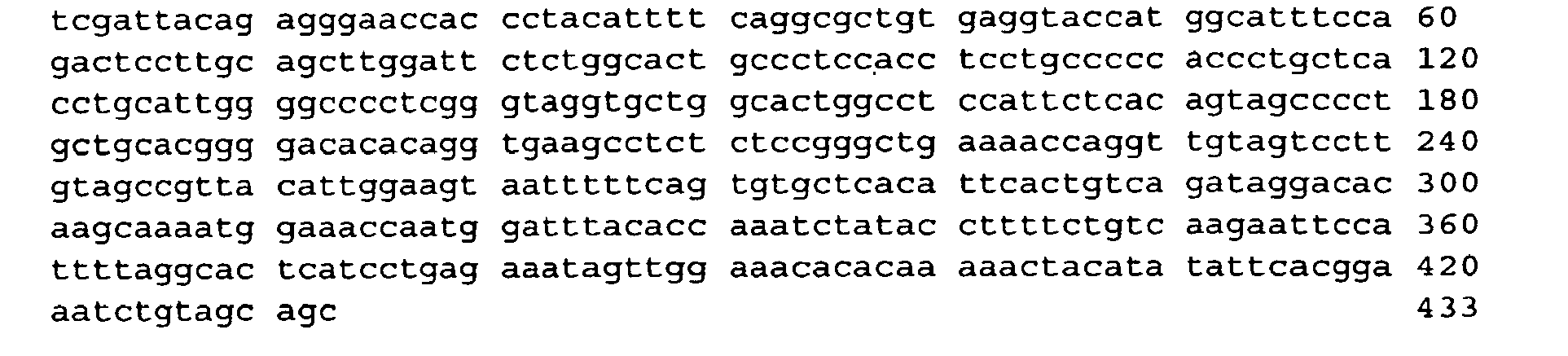
- <210> 17
<211> 568
<212> DNA
<213> Sus scrofa - <400> 17

- <210> 18
<211> 20
<212> DNA
<213> Artificial Sequence - <220>
<223> upper primer related to gene ADPRLT3 - <400> 18
cccagccatg ctaggactaa 20 - <210> 19
<211> 20
<212> DNA
<213> Artificial Sequence - <220>
<223> lower primer related to gene ADPRLT3 - <400> 19
agattcgcct ctgaggtgtc 20 - <210> 20
<211> 20
<212> DNA
<213> Artificial Sequence - <220>
<223> upper primer related to gene ARF4 - <400> 20
accaaaagca acatgcaaca 20 - <210> 21
<211> 20
<212> DNA
<213> Artificial Sequence - <220>
<223> lower primer related to gene ARF4 - <400> 21
cagggaatgc tccaaaacac 20 - <210> 22
<211> 20
<212> DNA
<213> Artificial Sequence - <220>
<223> upper primer related to gene ARP - <400> 22
tagtgtaaac ccgcaacaga 20 - <210> 23
<211> 20
<212> DNA
<213> Artificial Sequence - <220>
<223> lower primer related to gene ARP - <400> 23
aacagttcat ctgtgtcttc 20 - <210> 24
<211> 20
<212> DNA
<213> Artificial Sequence - <220>
<223> upper primer related to gene DKFZp434P0721 - <400> 24
acagcatgaa aagtgcctga 20 - <210> 25
<211> 23
<212> DNA
<213> Artificial Sequence - <220>
<223> lower primer related to gene DKFZp434P0721 - <400> 25
tccatatctg tgtctcataaaaa 23 - <210> 26
<211> 20
<212> DNA
<213> Artificial Sequence - <220>
<223> upper primer related to gene GPX1 - <400> 26
tagtgaggaa ctgtggtctg 20 - <210> 27
<211> 20
<212> DNA
<213> Artificial Sequence - <220>
<223> lower primer related to gene GPX1 - <400> 27
atatcgagcc tgacatcgaa 20 - <210> 28
<211> 20
<212> DNA
<213> Artificial Sequence - <220>
<223> upper primer related to gene KIAA0804 - <400> 28
ctatgtgccc atgtgcattc 20 - <210> 29
<211> 20
<212> DNA
<213> Artificial Sequence - <220>
<223> lower primer related to gene KIAA0804 - <400> 29
aacctgagag catcggtcac 20 - <210> 30
<211> 20
<212> DNA
<213> Artificial Sequence - <220>
<223> upper primer related to gene KIAA1363 - <400> 30
tcaagagggg ctcaacactt 20 - <210> 31
<211> 20
<212> DNA
<213> Artificial Sequence - <220>
<223> lower primer related to gene KIAA1363 - <400> 31
tggaatcatg tacgcaaagc 20 - <210> 32
<211> 20
<212> DNA
<213> Artificial Sequence - <220>
<223> upper primer related to gene MME - <400> 32
catatccact ccagggacac 20 - <210> 33
<211> 20
<212> DNA
<213> Artificial Sequence - <220>
<223> lower primer related to gene MME - <400> 33
accaagacag ttatgaacca 20 - <210> 34
<211> 20
<212> DNA
<213> Artificial Sequence - <220>
<223> upper primer related to gene RFC4 - <400> 34
cggtgctttg gtcattttta 20 - <210> 35
<211> 20
<212> DNA
<213> Artificial Sequence - <220>
<223> lower primer related to gene RFC4 - <400> 35
tgcttagctg atggtgctga 20 - <210> 36
<211> 20
<212> DNA
<213> Artificial Sequence - <220>
<223> upper primer related to gene RPL29 - <400> 36
gacagatcct gaggcaggtt 20 - <210> 37
<211> 20
<212> DNA
<213> Artificial Sequence - <220>
<223> lower primer related to gene RPL29 - <400> 37
caggttctgc cggccaaagt 20 - <210> 38
<211> 22
<212> DNA
<213> Artificial Sequence - <220>
<223> upper primer related to gene RYBP - <400> 38
aagcagagca ggtcaattaa gg 22 - <210> 39
<211> 20
<212> DNA
<213> Artificial Sequence - <220>
<223> lower primer related to gene RYBP - <400> 39
tattcagcgg cacagtaagc 20 - <210> 40
<211> 21
<212> DNA
<213> Artificial Sequence - <220>
<223> upper primer related to gene SEC22A - <400> 40
ccagccggtg tagtagacaag 21 - <210> 41
<211> 21
<212> DNA
<213> Artificial Sequence - <220>
<223> lower primer related to gene SEC22A - <400> 41
cccttttaag gtgtggagct t 21 - <210> 42
<211> 20
<212> DNA
<213> Artificial Sequence - <220>
<223> upper primer related to gene SST - <400> 42
tttggaggag aggaattgga 20 - <210> 43
<211> 20
<212> DNA
<213> Artificial Sequence - <220>
<223> lower primer related to gene SST - <400> 43
tggagcctga agatttgtcc 20 - <210> 44
<211> 20
<212> DNA
<213> Artificial Sequence - <220>
<223> upper primer related to gene TFDP2 - <400> 44
atagtaaaac gcgggtttgc 20 - <210> 45
<211> 20
<212> DNA
<213> Artificial Sequence - <220>
<223> lower primer related to gene TFDP2 - <400> 45
gctgaagtgg ccttagcaac 20 - <210> 46
<211> 24
<212> DNA
<213> Artificial Sequence - <220>
<223> upper primer related to gene TFG - <400> 46
agatgactga acttcaacct agca 24 - <210> 47
<211> 22
<212> DNA
<213> Artificial Sequence - <220>
<223> lower primer related to gene TFG - <400> 47
agcagcttcc tagttacttt gg 22 - <210> 48
<211> 20
<212> DNA
<213> Artificial Sequence - <220>
<223> upper primer related to gene TRAD - <400> 48
caggaagagc cccctaaatc 20 - <210> 49
c211> 20
<212> DNA
<213> Artificial Sequence - <220>
<223> lower primer related to gene TRAD - <400> 49
cagcaaaggc agaaaccttc 20 - <210> 50
<211> 21
<212> DNA
<213> Artificial Sequence - <220>
<223> sense primer NAU 491 - <400> 50
agcaggccga gtcttggatt a 21 - <210> 51
<211> 21
<212> DNA
<213> Artificial Sequence - <220>
<223> primer NAU 483 - <400> 51
ctgtttctct accagagcggt 21 - <210> 52
<211> 20
<212> DNA
<213> Artificial Sequence - <220>
<223> upper ACK1 primer - <400> 52
cgtgacgacc tcaacgttac 20 - <210> 53
<211> 17
<212> DNA
<213> Artificial Sequence - <220>
<223> lower ACK1 primer - <400> 53
ctgccgatct tcaggtc 17 - <210> 54
<211> 20
<212> DNA
<213> Artificial Sequence - <220>
<223> upper MUC4 primer - <400> 54
ctactccaac cctcccctca 20 - <210> 55
<211> 21
<212> DNA
<213> Artificial Sequence - <220>
<223> lower MUC4 primer - <400> 55
gaaatcagca tcatcccaga a 21 - <210> 56
<211> 23
<212> DNA
<213> Artificial Sequence - <220>
<223> upper STR01 primer - <400> 56
cacacatgtt catacagtgc tga 23 - <210> 57
<211> 20
<212> DNA
<213> Artificial Sequence - <220>
<223> lower STR01 primer - <400> 57
ccaggcactt ctggctctta 20 - <210> 58
<211> 20
<212> DNA
<213> Artificial Sequence - <220>
<223> upper STR02 primer - <400> 58
caatgtgcca atttccactg 20 - <210> 59
<211> 20
<212> DNA
<213> Artificial Sequence - <220>
<223> lower STR02 primer - <400> 59
atacggggag tttggggtta 20 - <210> 60
<211> 20
<212> DNA
<213> Artificial Sequence - <220>
<223> SSMUC4_ex4U primer - <400> 60
gacttcacct cgccactctt 20 - <210> 61
<211> 20
<212> DNA
<213> Artificial Sequence - <220>
<223> SSMUC4_ex8L primer - <400> 61
cgatacttct cccacactgg 20 - <210> 62
<211> 20
<212> DNA
<213> Artificial Sequence - <220>
<223> Muc4_in7u primer - <400> 62
gtgccttggg tgagaggtta 20 - <210> 63
<211> 20
<212> DNA
<213> Artificial Sequence - <220>
<223> Muc4_in71 primer - <400> 63
cactctgccg ttctctttcc 20 - <210> 64
<211> 24
<212> DNA
<213> Artificial Sequence - <220>
<223> Biotin labelled forward primer flanking the position 1849 SNP - <221> modified_base
<222> 1
<223> biotinylated - <400> 64
ggcaatgact tatctatttg tacc 24 - <210> 65
<211> 25
<212> DNA
<213> Artificial Sequence - <220>
<223> 1849 SNP reverse primer - <400> 65
gtatattaca acaaccccat gaagg 25 - <210> 66
<211> 17
<212> DNA
<213> Artificial Sequence - <220>
<223> probe specific for C allele - <400> 66
ccattctaga gatacag 17 - <210> 67
<211> 500
<212> DNA
<213> Sus scrofa - <220>
<221> variation
<222> 249
<223> variant base in XbaI polymorphism, G in the resistant, non-cutting, type - <400> 67

- <210> 68
<211> 500
<212> DNA
<213> Sus scrofa - <220>
<221> variation
<222> 249
<223> variant base in XbaI polymorphism, C in the non-resistant, XbaI-cutting, type - <400> 68

- <210> 69
<211> 22
<212> DNA
<213> Artificial Sequence - <220>
<223> Upstream primer for the SW2196 marker - <400> 69
gctctgtatt gagtacccct gg 22 - <210> 70
<211> 20
<212> DNA
<213> Artificial Sequence - <220>
<223> Dovnstream primer for the SW2196 marker - <400> 70
acttggttgg attgctgagc 20 - <210> 71
<211> 21
<212> DNA
<213> Artificial Sequence - <220>
<223> Upstream primer for the SW207 marker - <400> 71
cgcttcacaa aataagttggg 21 - <210> 72
<211> 22
<212> DNA
<213> Artificial Sequence - <220>
<223> Downstream primer for the SW207 marker - <400> 72
gttgttactc ccaaaaaggt gc 22 - <210> 73
<211> 24
<212> DNA
<213> Artificial Sequence - <220>
<223> Upstream primer for the S0283 marker - <400> 73
agcagcccta gaaatagcaa gcgc 24 - <210> 74
<211> 22
<212> DNA
<213> Artificial Sequence - <220>
<223> Downstream primer for the S0283 marker - <400> 74
ctctctgttc ctggcacctg gg 22 - <210> 75
<211> 20
<212> DNA
<213> Artificial Sequence - <220>
<223> Upstream primer for the S0075 marker - <400> 75
ggatccaagt gccagcaatg 20 - <210> 76
<211> 18
<212> DNA
<213> Artificial Sequence - <220>
<223> Downstream primer for the S0075 marker - <400> 76
ttgtccaccc tgggaggg 18 - <210> 77
<211> 20
<212> DNA
<213> Artificial Sequence - <220>
<223> Upstream primer for the SW1876 marker - <400> 77
tgtcactgct gtggcttagg 20 - <210> 78
<211> 21
<212> DNA
<213> Artificial Sequence - <220>
<223> Downstream primer for the SW1876 marker - <400> 78
ctggctactc caagacattgg 21 - <210> 79
<211> 20
<212> DNA
<213> Artificial Sequence - <220>
<223> Upstream primer for the SW225 marker - <400> 79
aggacccacc aagagttacc 20 - <210> 80
<211> 21
<212> DNA
<213> Artificial Sequence - <220>
<223> Downstream primer for the SW225 marker - <400> 80
tgctggtaat gggtgattagg 21 - <210> 81
<211> 3235
<212> DNA
<213> Sus scrofa - <220>
<221> misc_feature
<222> (1)...(3235)
<223> n = A,T,C or G - <400> 81

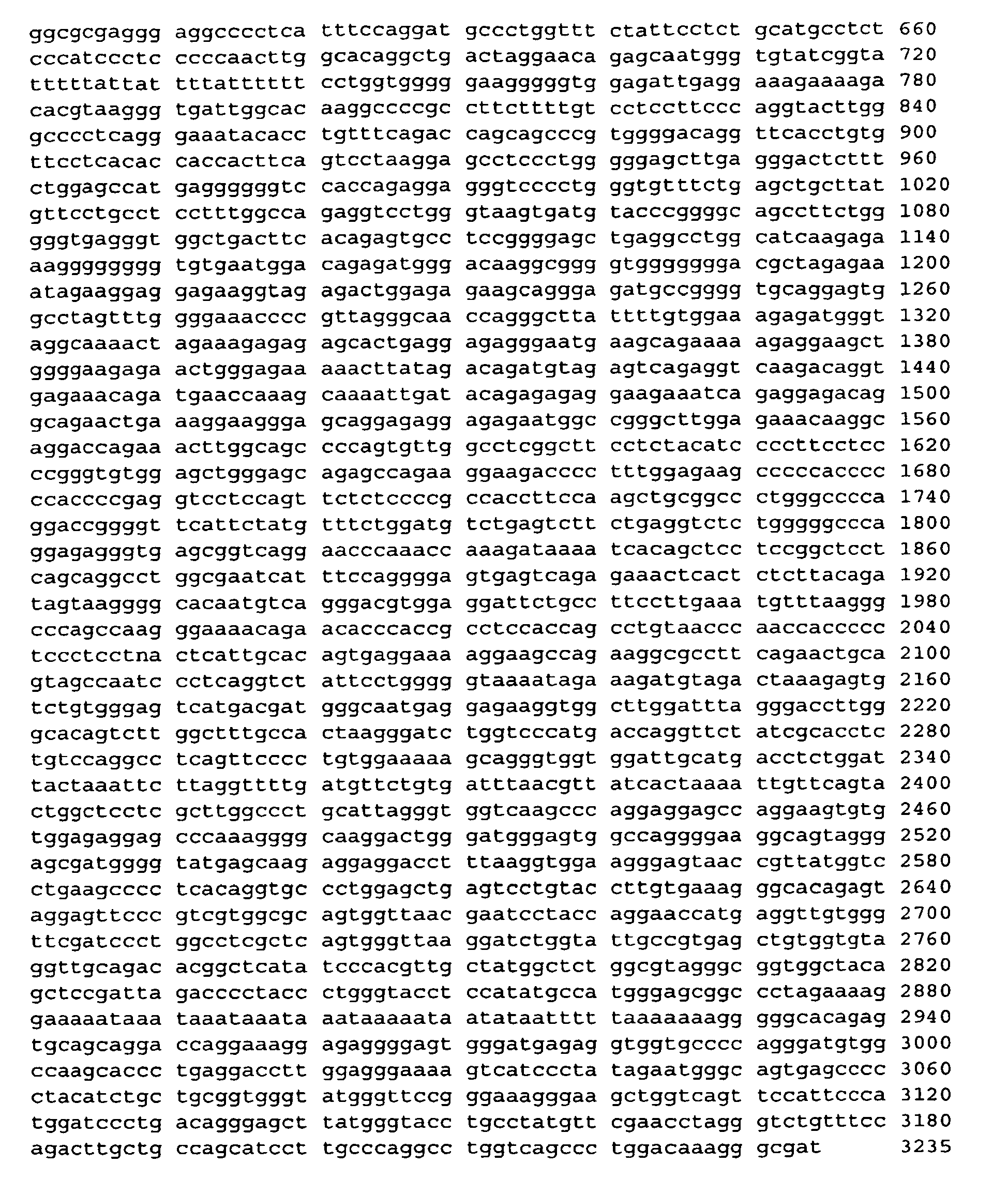
- <210> 82
<211> 5277
<212> DNA
<213> Sus scrofa - <220>
<221> variation
<222> 4847
<223> Variation found at position 4847: G in resistant, A in susceptible - <221> variation
<222> 4913
<223> Variation found at position 4913: G in resistant, T in susceptible - <221> variation
<222> 4922
<223> Variation found at position 4922: G in resistant, A in susceptible - <221> variation
<222> 4926
<223> Variation found at position 4926: G in resistant, C in susceptible - <400> 82


- <210> 83
<211> 7904
<212> DNA
<213> Sus scrofa - <220>
<221> variation
<222> 1659
<223> Variation found at position 1659: T in resistant, A in susceptible - <221> variation
<222> 1666
<223> Variation found at position 1666: G in resistant, T in susceptible - <221> variation
<222> 1684
<223> Variation found at position 1684: A in resistant, C in susceptible - <221> variation
<222> 1726
<223> Variation found at position 1726: AACGTG in resistant, 6 bp deletion in susceptible - <221> variation
<222> 1740
<223> Variation found at position 1740: A in resistant, T in susceptible - <221> variation
<222> 1795
<223> Variation found at position 1795: T in resistant, C in susceptible - <221> variation
<222> 1820
<223> Variation found at position 1820: G in resistant, T in susceptible - <221> variation
<222> 1912
<223> Variation found at position 1912: T in resistant, C in susceptible - <221> variation
<222> 2009
<223> Variation found at position 2009: T / deletion, not in linkage disequilibrium - <221> variation
<222> 2997
<223> Variation found at position 2997: A in resistant, G in susceptible - <221> variation
<222> 3277
<223> Variation found at position 3277: C in resistant, G in susceptible - <400> 83
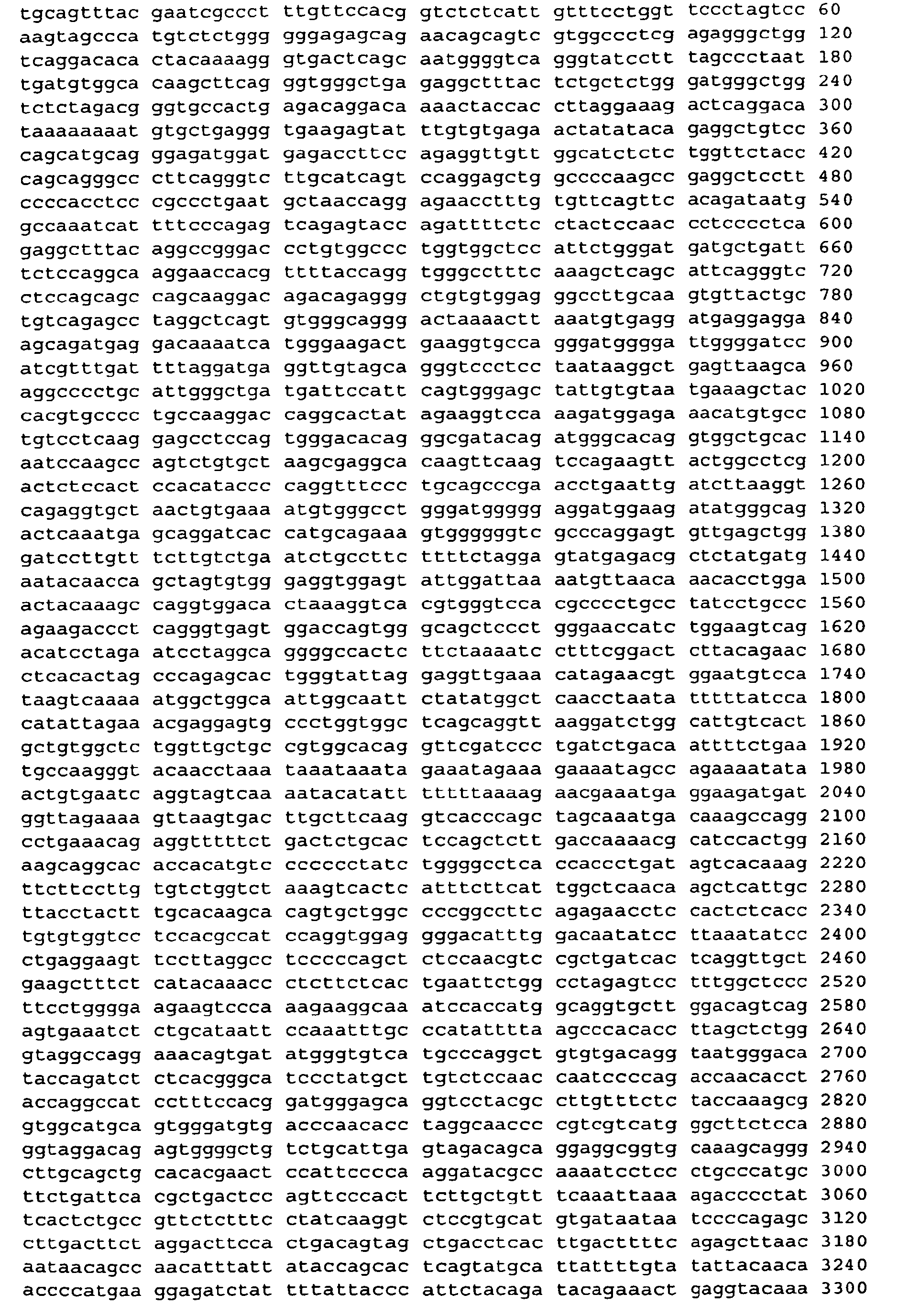


- <210> 84
<211> 712
<212> DNA
<213> Sus scrofa - <400> 84

- <210> 85
<211> 1302
<212> DNA
<213> Sus scrofa - <220>
<221> misc_feature
<222> (1)...(1302)
<223> n = A,T,C or G - <400> 85


- <210> 86
<211> 937
<212> DNA
<213> Sus scrofa - <220>
<221> misc_feature
<222> (1)...(937)
<223> n = A,T,C or G - <400> 86

- <210> 87
<211> 738
<212> DNA
<213> Sus scrofa - <220>
<221> variation
<222> 332
<223> >Variation found at position 332 G/A, Not in linkage disequilibrium - <221> misc_feature
<222> (1)...(738)
<223> n = A,T,C or G - <400> 87

- <210> 88
<211> 6041
<212> DNA
<213> Sus scrofa - <220>
<221> variation
<222> 3530
<223> Variation found at position 3530 G/A, Not in linkage disequilibrium - <400> 88

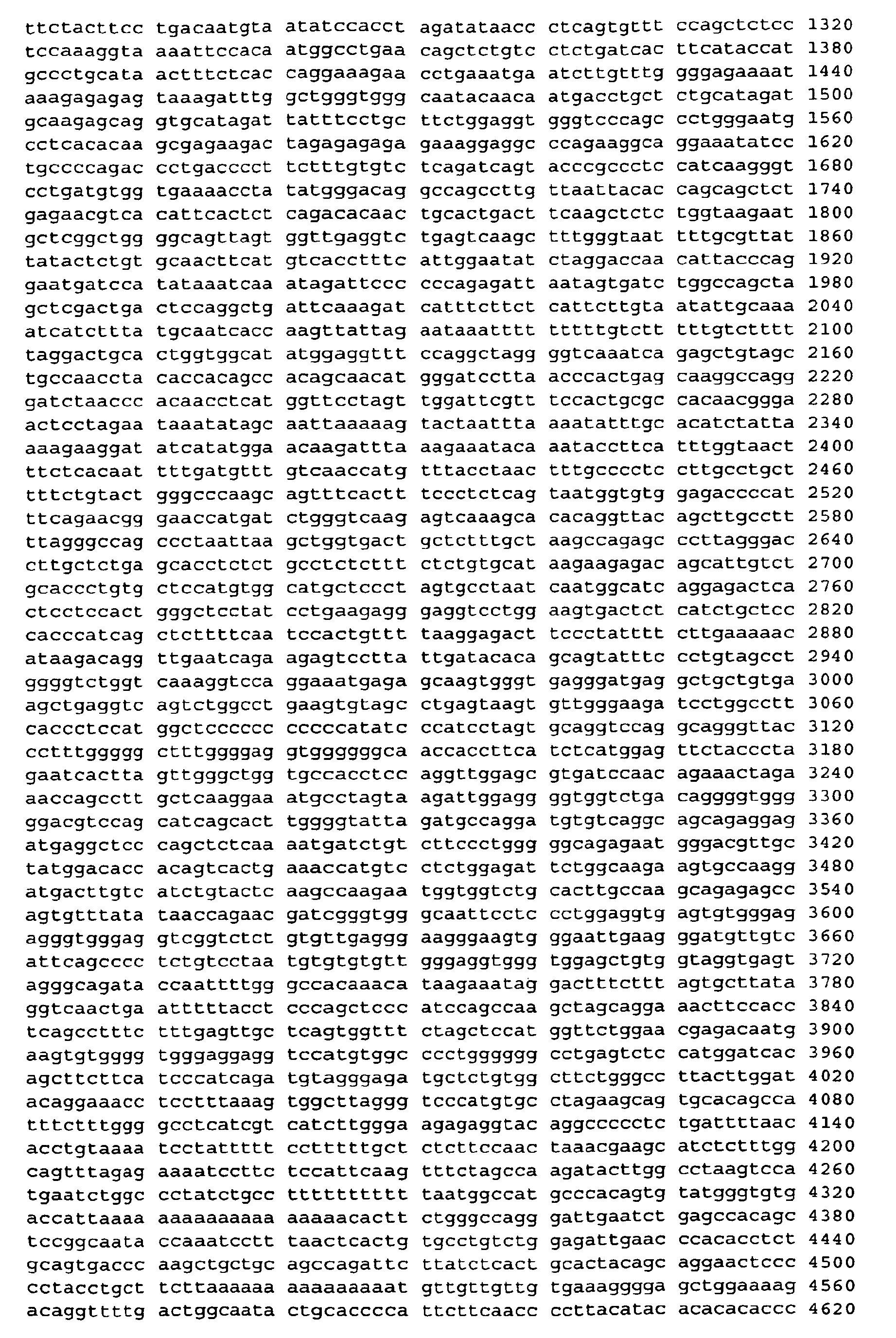

- <210> 89
<211> 4254
<212> DNA
<213> Sus scrofa - <400> 89


- <210> 90
<211> 3461
<212> DNA
<213> Sus scrofa - <400> 90



- <210> 91
<211> 1402
<212> DNA
<213> Sus scrofa - <400> 91

- <210> 92
<211> 764
<212> DNA
<213> Sus scrofa - <220>
<221> misc_feature
<222> (1)...(764)
<223> n = A, T, C or G - <400> 92


- <210> 93
<211> 314
<212> DNA
<213> Sus scrofa - <400> 93

- <210> 94
<211> 573
<212> DNA
<213> Sus scrofa - <400> 94

- <210> 95
<211> 671
<212> DNA
<213> Sus scrofa - <220>
<221> misc_feature
<222> (1)...(671)
<223> n = A,T,C or G - <400> 95

- <210> 96
<211> 615
<212> DNA
<213> Sus scrofa - <220>
<221> misc_feature
<222> (1)...(615)
<223 > n = A,T,C or G - <400> 96

- <210> 97
<211> 671
<212> DNA
<213> Sus scrofa - <400> 97

- <210> 98
<211> 459
<212> DNA
<213> Sus scrofa - <400> 98

- <210> 99
<211> 461
<212> DNA
<213> Sus scrofa - <400> 99

- <210> 100
<211> 966
<212> DNA
<213> Sus scrofa - <220>
<221> misc_feature
<222> (1)...(966)
<223> n = A,T,C or G - <400> 100

- <210> 101
<211> 732
<212> DNA
<213> Sus scrofa - <400> 101


- <210> 102
<211> 521
<212> DNA
<213> Sus scrofa - <400> 102

- <210> 103
<211> 679
<212> DNA
<213> Sus scrofa - <220>
<221> misc_feature
<222> (1)...(679)
<223> n = A,T,C or G - <400> 103

- <210> 104
<211> 890
<212> DNA
<213> Sus scrofa - <400> 104


- <210> 105
<211> 919
<212> DNA
<213> Sus scrofa - <400> 105

- <210> 106
<211> 898
<212> DNA
<213> Sus scrofa - <400> 106


- <210> 107
<211> 893
<212> DNA
<213> Sus scrofa - <220>
<221> misc_feature
<222> (1) ... (893)
<223> n = A,T,C or G - <400> 107

- <210> 108
<211> 527
<212> DNA
<213> Sus scrofa - <400> 108

- <210> 109
<211> 678
<212> DNA
<213> Sus scrofa - <400> 109


- <210> 110
<211> 372
<212> DNA
<213> Sus scrofa - <400> 110

- <210> 111
<211> 470
<212> DNA
<213> Sus scrofa - <400> 111

- <210> 112
<211> 681
<212> DNA
<213> Sus scrofa - <220>
<221> misc_feature
<222> (1) ... (681)
<223> n = A,T,C or G - <400> 112


- <210> 113
<211> 754
<212> DNA
<213> Sus scrofa - <400> 113

- <210> 114
<211> 417
<212> DNA
<213> Sus scrofa - <400> 114

- <210> 115
<211> 470
<212> DNA
<213> Sus scrofa - <400> 115
<210> 116

<211> 462
<212> DNA
<213> Sus scrofa - <400> 116

- <210> 117
<211> 487
<212> DNA
<213> Sus scrofa - <400> 117

- <210> 118
<211> 726
<212> DNA
<213> Sus scrofa - <400> 118

- <210> 119
<211> 371
<212> DNA
<213> Sus scrofa - <400> 119

- <210> 120
<211> 501
<212> DNA
<213> Sus scrofa - <400> 120

- <210> 121
<211> 403
<212> DNA
<213> Sus scrofa - <400> 121

- <210> 122
<211> 1042
<212> DNA
<213> Sus scrofa - <400> 122


- <210> 123
<211> 924
<212> DNA
<213> Sus scrofa - <220>
<221> misc_feature
<222> (1) ... (924)
<223> n = A,T,C or G - <400> 123

- <210> 124
<211> 1384
<212> DNA
<213> Sus scrofa - <400> 124


- <210> 125
<211> 1089
<212> DNA
<213> Sus scrofa - <400> 125

- <210> 126
<211> 819
<212> DNA
<213> Sus scrofa - <400> 126


- <210> 127
<211> 421
<212> DNA
<213> Sus scrofa - <400> 127

- <210> 128
<211> 976
<212> DNA
<213> Sus scrofa - <400> 128

- <210> 129
<211> 707
<212> DNA
<213> Sus scrofa - <400> 129


- <210> 130
<211> 380
<212> DNA
<213> Sus scrofa - <400> 130

- <210> 131
<211> 1298
<212> DNA
<213> Sus scrofa - <400> 131

- <210> 132
<211> 1422
<212> DNA
<213> Sus scrofa - <400> 132


- <210> 133
<211> 1019
<212> DNA
<213> Sus scrofa - <400> 133

- <210> 134
<211> 801
<212> DNA
<213> Sus scrofa - <400> 134


- <210> 135
<211> 1502
<212> DNA
<213> Sus scrofa - <220>
<221> misc_feature
<222> (1) ... (1502)
<223> n = A,T,C or G - <400> 135
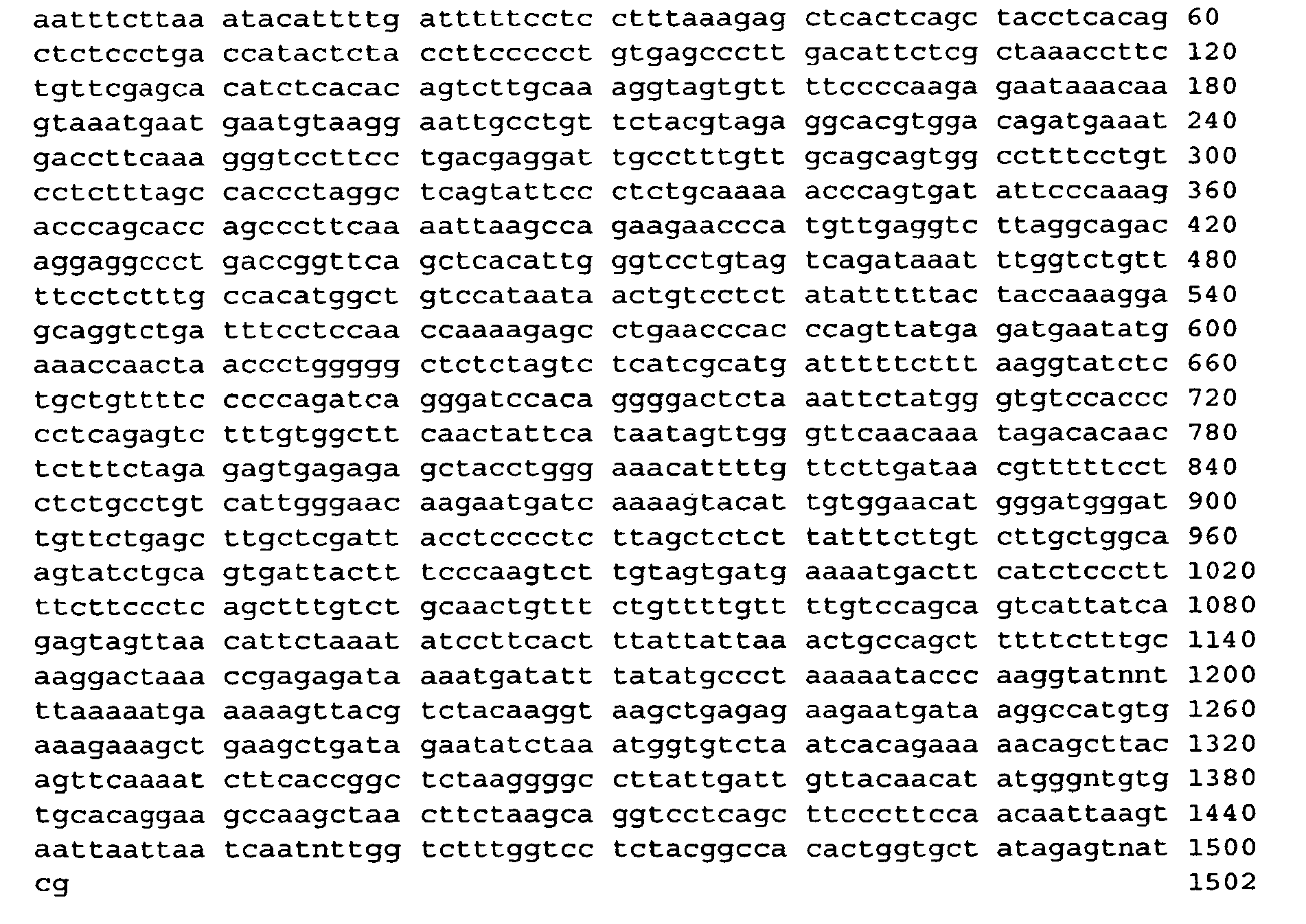
- <210> 136
<211> 229
<212> DNA
<213> Sus scrofa - <400> 136


- <210> 137
<211> 1273
<212> DNA
<213> Sus scrofa - <400> 137

- <210> 138
<211> 1113
<212> DNA
<213> Sus scrofa - <400> 138


- <210> 139
<211> 946
<212> DNA
<213> Sus scrofa - <400> 139

- <210> 140
<211> 1045
<212> DNA
<213> Sus scrofa - <400> 140

- <210> 141
<211> 604
<212> DNA
<213> Sus scrofa - <400> 141

- <210> 142
<211> 261
<212> DNA
<213> Sus scrofa - <400> 142

- <210> 143
<211> 402
<212> DNA
<213> Sus scrofa - <400> 143

- <210> 144
<211> 472
<212> DNA
<213> Sus scrofa - <400> 144

- <210> 145
- <211> 441
<212> DNA
<213> Sus scrofa - <400> 145

- <210> 146
<211> 578
<212> DNA
<213> Sus scrofa - <220>
<221> misc_feature
<222> (1)...(578)
<223> n = A,T,C or G - <400> 146

- <210> 147
<211> 1196
<212> DNA
<213> Sus scrofa - <220>
<221> misc_feature
<222> (1)...(1196)
<223> n = A,T,C or G - <400> 147
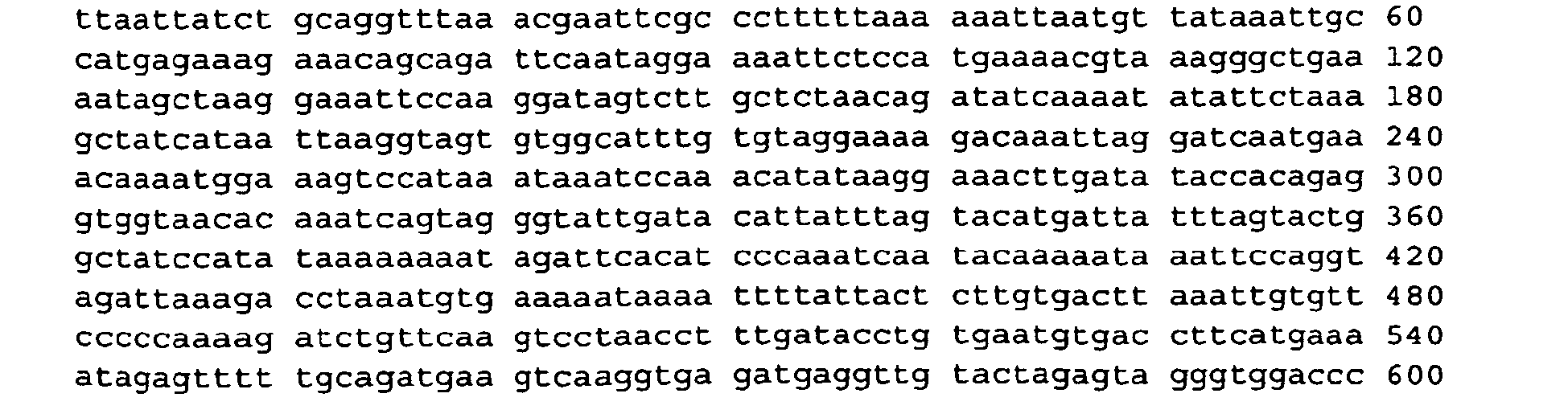

- <210> 148
<211> 1244
<212> DNA
<213> Sus scrofa - <220>
<221> misc_feature
<222> (1)...(1244)
<223> n = A,T,C or G - <400> 148

- <210> 149
<211> 962
<212> DNA
<213> Sus scrofa - <400> 149


- <210> 150
<211> 550
<212> DNA
<213> Sus scrofa - <400> 150
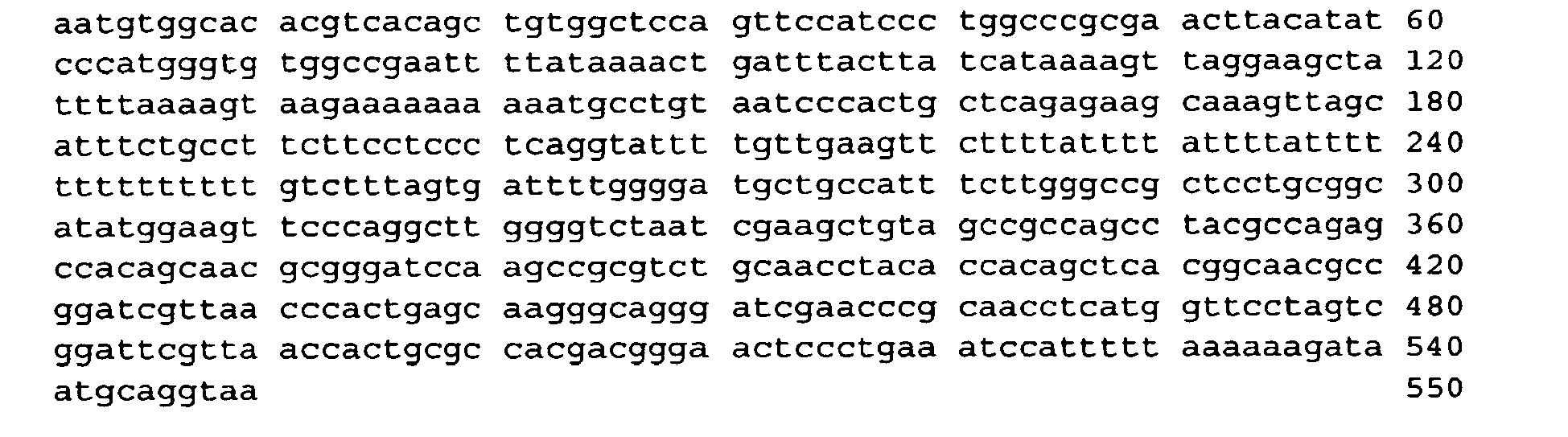
- <210> 151
<211> 1296
<212> DNA
<213> Sus scrofa - <220>
<221> misc_feature
<222> (1) ... (1296)
<223> n = A,T,C or G - <400> 151


- <210> 152
<211> 1026
<212> DNA
<213> Sus scrofa - <400> 152

- <210> 153
<211> 1830
<212> DNA
<213> Sus scrofa - <400> 153


- <210> 154
<211> 1301
<212> DNA
<213> Sus scrofa - <220>
<221> misc_feature
<222> (1)...(1301)
<223> n = A,T,C or G - <400> 154

- <210> 155
<211> 845
<212> DNA
<213> Sus scrofa - <400> 155


- <210> 156
<211> 386
<212> DNA
<213> Sus scrofa - <400> 156

- <210> 157
<211> 1753
<212> DNA
<213> Sus scrofa - <400> 157


- <210> 158
<211> 1815
<212> DNA
<213> Sus scrofa - <400> 158

- <210> 159
<211> 496
<212> DNA
<213> Sus scrofa - <400> 159


- <210> 160
<211> 1336
<212> DNA
<213> Sus scrofa - <220>
<221> misc_feature
<222> (1)...(1336)
<223> n = A,T,C or G - <400> 160

- <210> 161
<211> 1125
<212> DNA
<213> Sus scrofa - <400> 161


- <210> 162
<211> 427
<212> DNA
<213> Sus scrofa - <400> 162

- <210> 163
<211> 2628
<212> DNA
<213> Sus scrofa - <400> 163


- <210> 164
<211> 2460
<212> DNA
<213> Sus scrofa - <400> 164


- <210> 165
<211> 1273
<212> DNA
<213> Sus scrofa - <400> 165

- <210> 166
<211> 2207
<212> DNA
<213> Sus scrofa - <220>
<221> misc_feature
<222> (1)...(2207)
<223> n = A,T,C or G - <400> 166


- <210> 167
<211> 2361
<212> DNA
<213> Sus scrofa - <220>
<221> misc_feature
<222> (1)...(2361)
<223> n = A,T,C or G - <400> 167


- <210> 168
<211> 1939
<212> DNA
<213> Sus scrofa - <220>
<221> misc_feature
<222> (1)...(1939)
<223> n = A,T,C or G - <400> 168


- <210> 169
<211> 528
<212> DNA
<213> Sus scrofa - <400> 169

- <210> 170
<211> 2023
<212> DNA
<213> Sus scrofa - <220>
<221> misc_feature
<222> (1)...(2023)
<223> n = A,T,C or G - <400> 170


- <210> 171
<211> 382
<212> DNA
<213> Sus scrofa - <400> 171

- <210> 172
<211> 1961
<212> DNA
<213> Sus scrofa - <220>
<221> misc_feature
<222> (1)...(1961)
<223> n = A,T,C or G - <400> 172


- <210> 173
<211> 2052
<212> DNA
<213> Sus scrofa - <220>
<221> misc_feature
<222> (1)...(2052)
<223> n = A,T,C or G - <400> 173
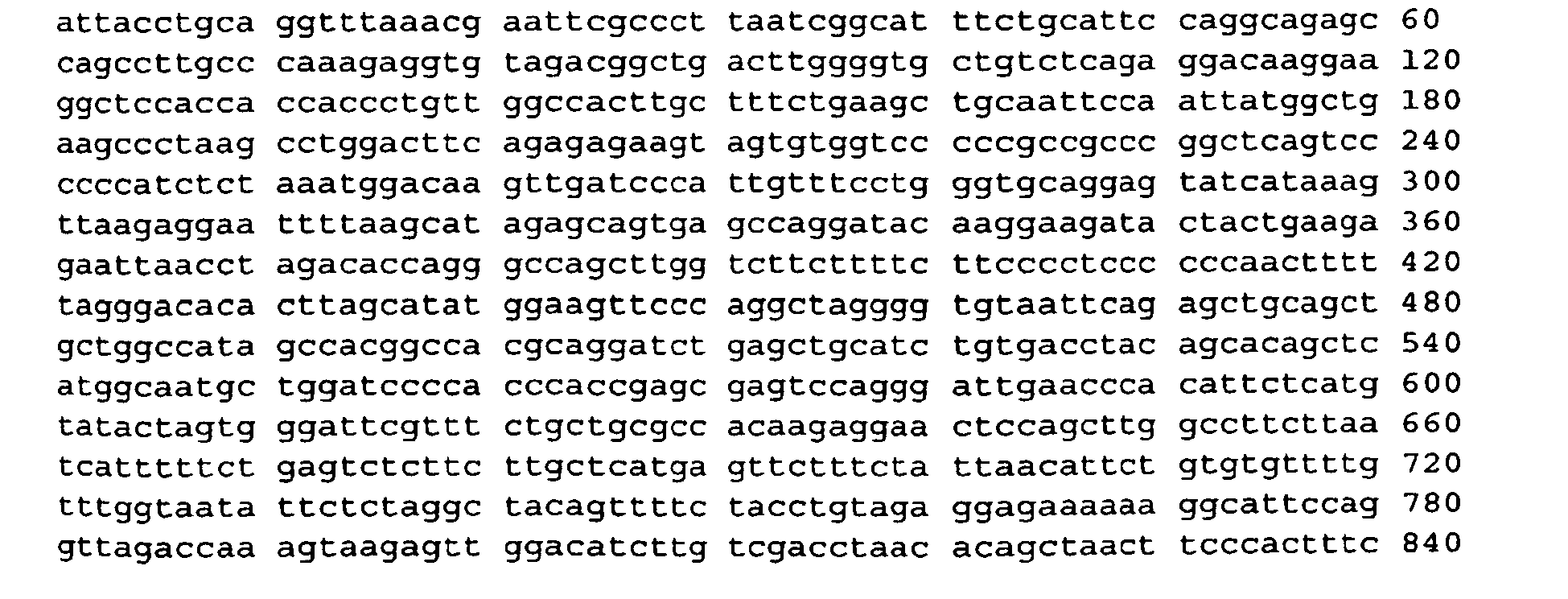

- <210> 174
<211> 1674
<212> DNA
<213> Sus scrofa - <400> 174

- <210> 175
<211> 655
<212> DNA
<213> Sus scrofa - <220>
<221> misc_feature
<222> (1)...(655)
<223> n = A,T,C or G - <400> 175

- <210> 176
<211> 3312
<212> DNA
<213> Sus scrofa - <220>
<221> misc_feature
<222> (1)...(3312)
<223> n = A,T,C or G - <400> 176


- <210> 177
<211> 3765
<212> DNA
<213> Sus scrofa - <400> 177


- <210> 178
<211> 2723
<212> DNA
<213> Sus scrofa - <400> 178

- <210> 179
<211> 729
<212> DNA
<213> Sus scrofa - <220>
<221> misc_feature
<222> (1)...(729)
<223> n = A,T,C or G - <400> 179

- <210> 180
<211> 2840
<212> DNA
<213> Sus scrofa - <400> 180


- <210> 181
<211> 726
<212> DNA
<213> Sus scrofa - <220>
<221> misc_feature
<222> (1)...(726)
<223> n = A,T,C or G - <400> 181

- <210> 182
<211> 1913
<212> DNA
<213> Sus scrofa - <400> 182


- <210> 183
<211> 4479
<212> DNA
<213> Sus scrofa - <220>
<221> misc_feature
<222> (1)...(4479)
<223> n = A,T,C or G - <400> 183


- <210> 184
<211> 4479
<212> DNA
<213> Sus scrofa - <220>
<221> misc_feature
<222> (1)...(4479)
<223> n = A,T,C or G - <400> 184


- <210> 185
<211> 3564
<212> DNA
<213> Sus scrofa - <400> 185


- <210> 186
<211> 4331
<212> DNA
<213> Sus scrofa - <400> 186


- <210> 187
<211> 5460
<212> DNA
<213> Sus scrofa - <220>
<221> misc_feature
<222> (1)...(5460)
<223> n = A,T,C or G - <400> 187


- <210> 188
<211> 3594
<212> DNA
<213> Sus scrofa - <400> 188


- <210> 189
<211> 4054
<212> DNA
<213> Sus scrofa - <400> 189
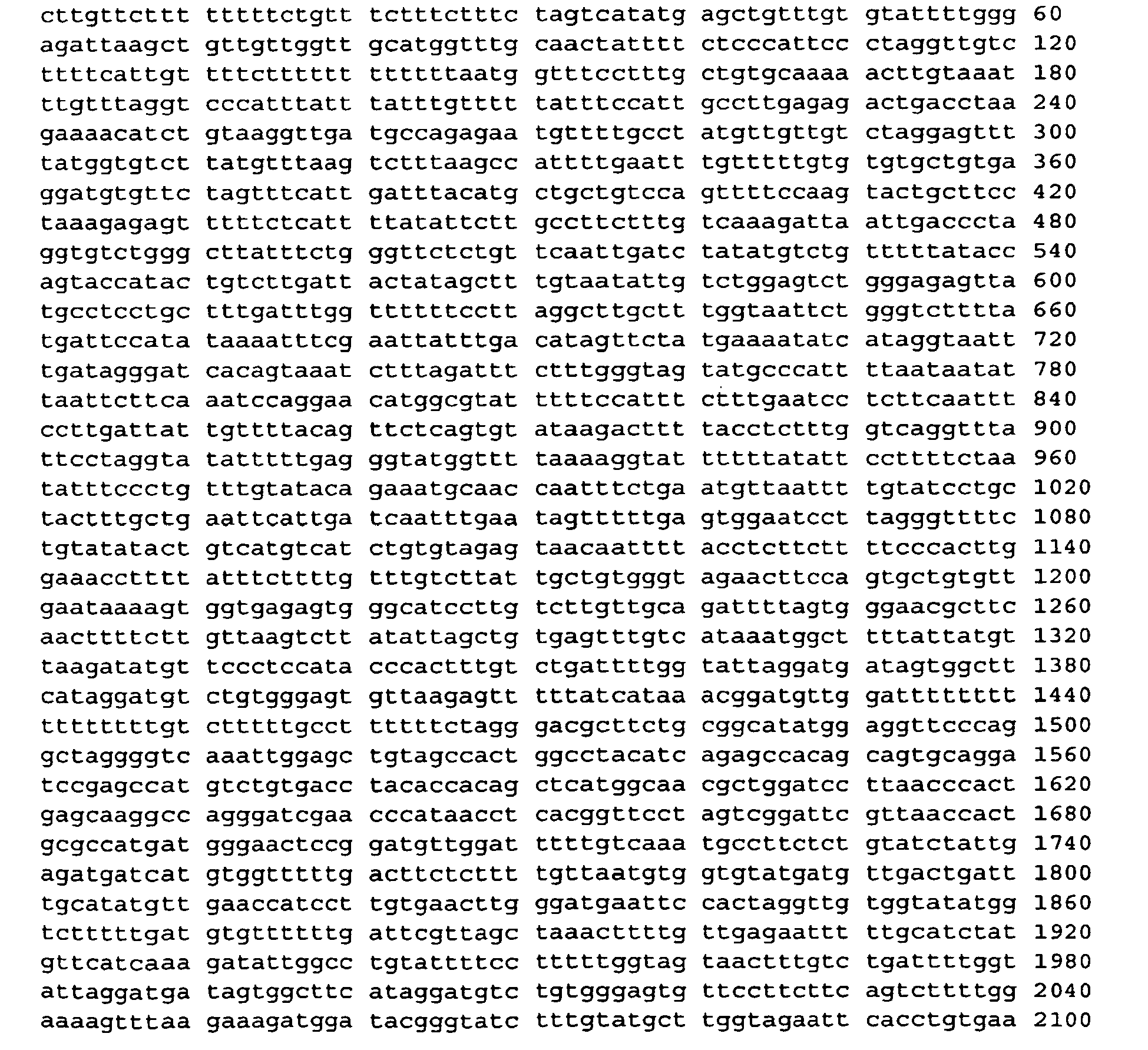
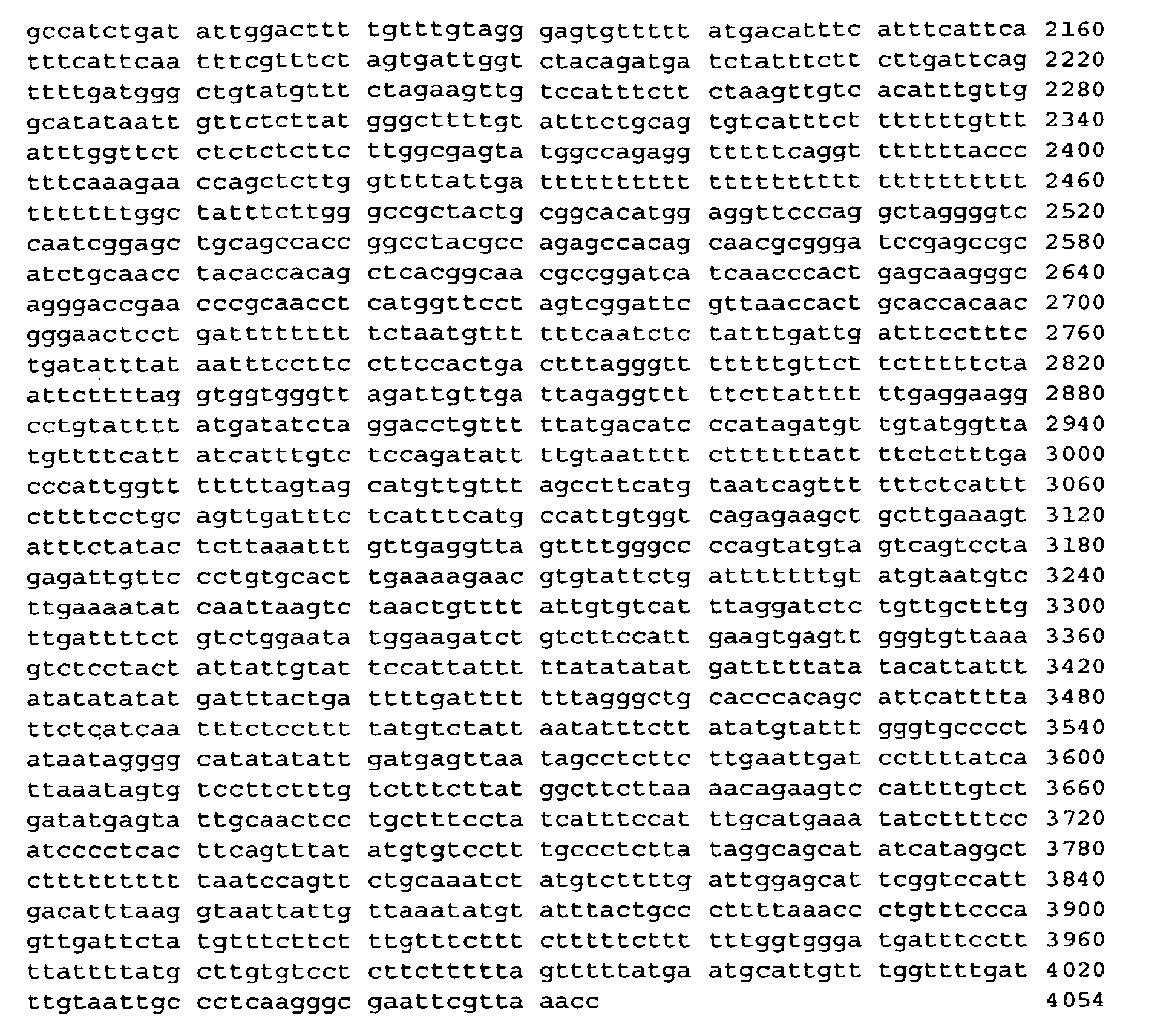
- <210> 190
<211> 5588
<212> DNA
<213> Sus scrofa - <220>
<221> misc_feature
<222> (1)...(5588)
<223> n = A,T,C or G - <400> 190


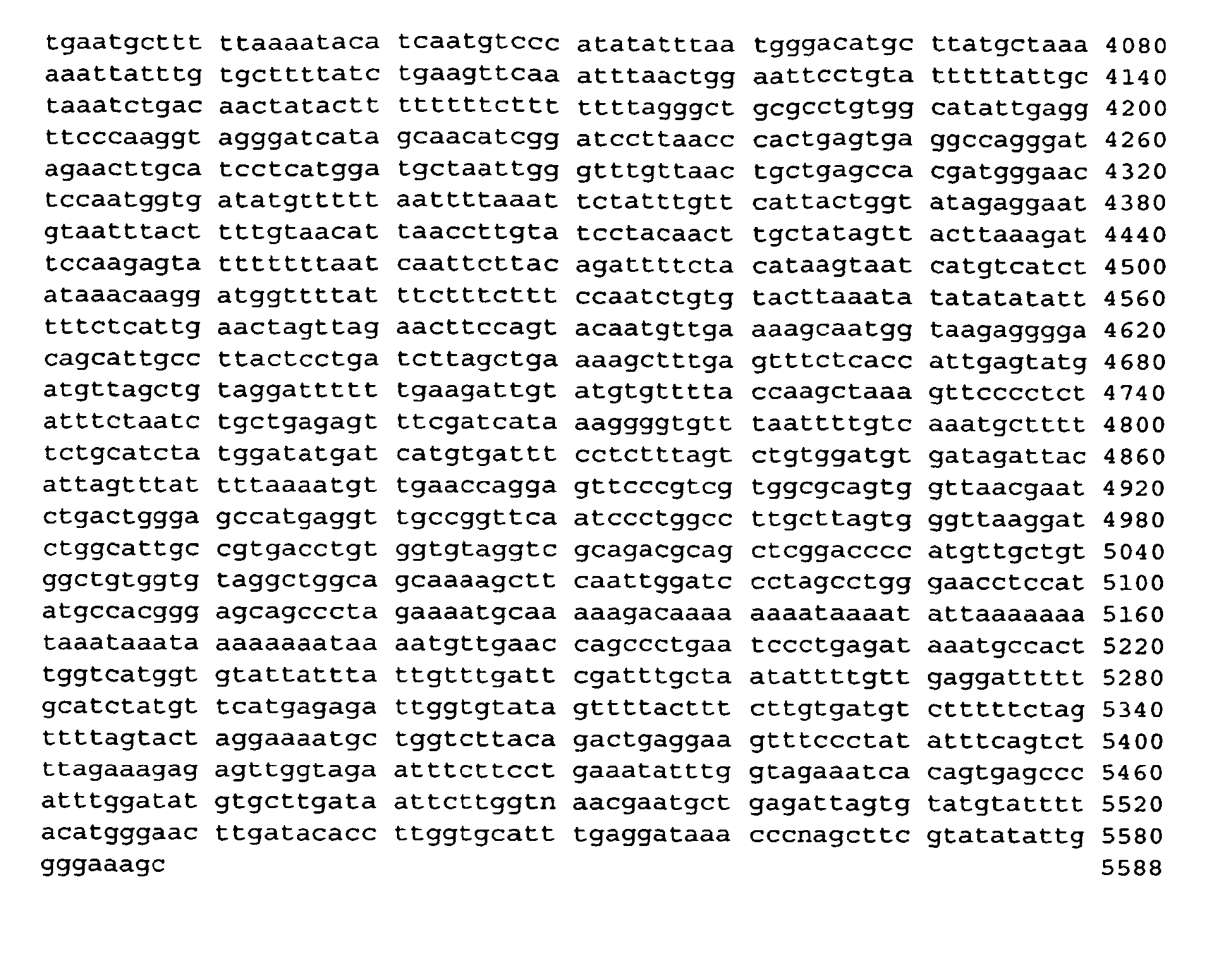
- <210> 191
<211> 2253
<212> DNA
<213> Sus scrofa - <220>
<221> misc_feature
<222> (1)...(2253)
<223> n = A,T,C or G - <400> 191


- <210> 192
<211> 7933
<212> DNA
<213> Sus scrofa - <400> 192


- <210> 193
<211> 6041
<212> DNA
<213> Sus scrofa - <400> 193


- <210> 194
<211> 9163
<212> DNA
<213> Sus scrofa - <400> 194


- <210> 195
<211> 819
<212> DNA
<213> Sus scrofa - <400> 195


- <210> 196
<211> 715
<212> DNA
<213> Sus scrofa - <220>
<221> misc_feature
<222> (1)...(715)
<223> n = A,T,C or G - <400> 196

- <210> 197
<211> 706
<212> DNA
<213> Sus scrofa - <220>
<221> misc_feature
<222> (1)...(706)
<223> n = A,T,C or G - <400> 197


PCR was performed in 20 µl using the following reagents:
| Water | 13.52 µl |
| MgCl2 (25mM) | 0.80 µl |
| 10 x PCR buffer | 2.00 µl |
| Biotin-labelled forward primer (2,5 pmol/µl) | 0.80 µl |
| Non-labelled revers primer (15 pmol/µl) | 0.80 µl |
| Taq polymerase (5 units/µl) | 0.08 µl |
| DNA (10-25 ng/µl) | 1.00 µl |
| dNTP mix (4 mM each) | 1.00 µl |
| Total | 20.00 µl |
Claims (31)
- An isolated nucleic acid (NA) molecule, comprising an allele of a genetic polymorphism associated with resistance to enterotoxigenic E. coli (ETEC), wherein said isolated NA molecule comprises a NA sequence that distinguishes pigs which are resistant to ETEC from pigs which are non-resistant to ETEC and which is identical or has at least 90 % homology to a sequence selected from the group of sequences consisting of SEQ ID NO 6, SEQ ID NO 8, SEQ ID NO 67, SEQ ID NO 68, SEQ ID NO 82, SEQ ID NO 83 and their complementary sequences and any fragments thereof.
- A NA probe, which comprises a NA sequence that is homologous to a fragment of an isolated NA molecule according to claim 1, said NA probe being specific for an allele of at least one SNP selected from the group of SNPs consisting of A1059G in SEQ ID NO 6, T1125G in SEQ ID NO 6, A1134G in SEQ ID NO 6, C1138G in SEQ ID NO 6, C1849G in SEQ ID NO 8, C2129T in SEQ ID NO 8, A4847G in SEQ ID NO 82, T4913G in SEQ ID NO 82, A4922G in SEQ ID NO 82, C4926G in SEQ ID NO 82, A1659T in SEQ ID NO 83, T1666G in SEQ ID NO 83, C1684A in SEQ ID NO 83, T1740A in SEQ ID NO 83, C1795T in SEQ ID NO 83, T1820G in SEQ ID NO 83, C1912T in SEQ ID NO 83, G2997A in SEQ ID NO 83, G3277C in SEQ ID NO 83 and their complementary sequences.
- The NA probe according to claim 2, comprising a NA sequence that is homologous to the NA sequence of SEQ ID NO 66 or its complementary sequence.
- A method for identifying if a pig is resistant to ETEC, the method comprisingi) determining on a sample obtained from said pig, said sample comprising genetic material, if the pig is homozygous for an allele of a genetic polymorphism associated with resistance to ETEC, said genetic polymorphism being located in the region between and including the markers SW207 and SW225 on the porcine chromosome SSC 13, andii) identifying the pig as resistant to ETEC if the pig is homozygous for the allele of genetic polymorphism associated with resistance.
- The method according to claim 4, said method further comprising identifying if the pig is non-resistant to ETEC and a carrier or a non-carrier of resistance, said method further comprisingiv) determining by use of said sample if the pig is heterozygous or non-carrier of the allele of the genetic polymorphism associated with resistance to ETEC, andv) identifying thata) the pig is non-resistant to ETEC and a non-carrier of resistance, if the pig is a non-carrier of the allele of the genetic polymorphism associated with resistance; or thatb) the pig is non-resistant to ETEC but a carrier of resistance if the pig is heterozygous for the allele of the genetic polymorphism associated with resistance to ETEC.
- The method according to claims 4 or 5, wherein the genetic polymorphism associated with resistance to ETEC is located in the region flanked by and including the markers SW207 and S0075.
- The method according to any of the claims 4 to 6, wherein the genetic polymorphism is associated with resistance to ETEC at a lod score of at least 3.0.
- The method according to any of the claims 4 to 7, wherein the genetic polymorphism is located in the porcine MUC4 gene.
- The method according to any of the claims 4 to 8, wherein the resistance to ETEC is a resistance selected from the group consisting of resistance to intestinal adhesion by ETEC, resistance to intestinal colonisation by ETEC, resistance to intestinal disorders, such as diarrhoea, caused by ETEC and any combination thereof.
- The method according to any of the claims 4 to 9, wherein the pig is selected from the group of pigs consisting of sus scrofa (Suidae), Yorkshire, Danish Yorkshire, Danish Duroc, Landrace, Danish Landrace, White Danish Landrace, Blackspotted Danish Landrace, Hampshire, Danish Hampshire, Poland China, Hereford and any cross-breedings thereof.
- The method according to any of the claims 4 to 10, wherein the pig is selected from the group consisting of a boar, a sow, a suckling piglet, a weaned pig, a grower pig and a finisher pig.
- The method according to any of the claims 4 to 11, wherein the genetic polymorphism is a genetic polymorphism selected from the group consisting of a single nucleotide polymorphism (SNP), a variable number tandem repeat polymorphism, an interspersed repetitive DNA, insertions, deletions, amplifications, rearrangements, a combination of SNP's, short tandem repeats, dinucleotide repeats, interspaced repetitive DNA and any combination of these.
- The method according to any of claims 4 to 11, wherein the genetic polymorphism is a SNP or a combination of SNPs.
- The method according to claim 13, wherein the SNP is a single nucleotide G/C polymorphism.
- The method according to claim 13, wherein the SNP is selected from the group consisting of A1059G in SEQ ID NO 6, T1125G in SEQ ID NO 6, A1134G in SEQ ID NO 6, C1138G in SEQ ID NO 6, C1849G in SEQ ID NO 8, C2129T in SEQ ID NO 8, A4847G in SEQ ID NO 82, T4913G in SEQ ID NO 82, A4922G in SEQ ID NO 82, C4926G in SEQ ID NO 82, A1659T in SEQ ID NO 83, T1666G in SEQ ID NO 83, C1684A in SEQ ID NO 83, T1740A in SEQ ID NO 83, C1795T in SEQ ID NO 83, T1820G in SEQ ID NO 83, C1912T in SEQ ID NO 83, G2997A in SEQ ID NO 83 and G3277C in SEQ ID NO 83.
- The method according to any of the claims 4 to 15, further comprising
in step ii) of claim 4, determining in the sample if the pig in addition to the allele of the first genetic polymorphism associated with resistance to ETEC, is homozygous, heterozygous or non-carrier for an allele of an at least second genetic polymorphism associated with resistance to ETEC, and
in step iii) of claim 4, identifying the pig as resistant to ETEC if the pig is homozygous for the first allele of genetic polymorphism associated with resistance to ETEC and/or for the at least second allele of genetic polymorphism associated with resistance to ETEC. - The method according to claim 16, wherein the at least second genetic polymorphism comprises at least 3 genetic polymorphisms, such as at least 4, 5, 6, 7, 10, 20, 50 or at least 50 genetic polymorphisms.
- The method according to claims 16 or 17, wherein the at least second genetic polymorphism is a genetic polymorphism selected from the group consisting of a single nucleotide polymorphism (SNP), a variable number tandem repeat polymorphism, an interspersed repetitive DNA, insertions, deletions, amplifications, rearrangements, a combination of SNP's, short tandem repeats, dinucleotide repeats, interspaced repetitive DNA and any combination of these.
- The method according to claim 18, wherein the at least second polymorphism is a SNP selected from the group consisting of A1059G in SEQ ID NO 6, T1125G in SEQ ID NO 6, A1134G in SEQ ID NO 6, C1138G in SEQ ID NO 6, C1849G in SEQ ID NO 8, C2129T in SEQ ID NO 8, A4847G in SEQ ID NO 82, T4913G in SEQ ID NO 82, A4922G in SEQ ID NO 82, C4926G in SEQ ID NO 82, A1659T in SEQ ID NO 83, T1666G in SEQ ID NO 83, C1684A in SEQ ID NO 83, T1740A in SEQ ID NO 83, C1795T in SEQ ID NO 83, T1820G in SEQ ID NO 83, C1912T in SEQ ID NO 83, G2997A in SEQ ID NO 83 and G3277C in SEQ ID NO 83.
- The method according to claims 16 to 18, wherein the at least second genetic polymorphism is located in the porcine FUT1 gene.
- The method according to any of the claims 4 to 20, wherein the sample is selected from the group consisting of a material comprising DNA and/or RNA, blood, saliva, tissue, throat swap, semen, and combinations thereof.
- The method according to any of the claims 4 to 21, wherein the step of determining if the pig is homozygous, heterozygous or non-carrier of the allele of the genetic polymorphism associated with resistance to ETEC can be performed using a technique selected from the group consisting of allele specific PCR, mini sequencing, primer extension, pyro-sequencing, PCR-RFLP, allele-specific rolling circle amplification, ARMS (Amplification Refracting Mutation System), hybridisation e.g. to DNA arrays, DASH (Dynamic Allele-Specific Hybridisation), melting curve measurement, primer extension followed by MALDI-TOF mass spectrometry and any combinations thereof.
- The method according to any of the claims 4 to 22, wherein the step of determining if a pig is homozygous, heterozygous or non-carrier of the allele of the genetic polymorphism associated with resistance to ETEC, comprises at least one of the following stepsi) extracting genomic DNA from a sample obtained from a pig, said sample comprising genetic material;ii) amplifying at least a fragment of the genomic DNA to obtain an amplification product;iii) contacting the amplification product with a restriction enzyme;iv) separating the resulting fragments by gel electrophoresis;v) determining the respective numbers and lengths of fragments; andvi) determining from the number and lengths which polymorphism is present.
- The method according to claim 23, wherein the restriction enzyme is XbaI.
- The method according to any of the claims 4 to 24, wherein the ETEC is selected from the group consisting of E. coli F4ab/F4ac, E. coli 0149, E. coli F4, E. coli F18, E. coli F5, E. coli F6, E. coli 987P, E. coli F41, E. coli F18ab, E. coli F107, E. coli F18ac, E. coli 2134P and E. coli Av24, and any combinations of these organisms.
- Use of the isolated NA molecule according to claim 1 and/or the NA probe according to any of the claims 2 to 3, as a probe for in vitro detection of a porcine allele of a genetic polymorphism associated with resistance to ETEC.
- Use of a pair of NA molecules for primers in a PCR-based method for identifying whether a pig is resistant or non-resistant to ETEC, said pair of NA molecules being selected from the group consisting of SEQ ID NO 18 and SEQ ID NO 19, SEQ ID NO 20 and SEQ ID NO 21, SEQ ID NO 22 and SEQ ID NO 23, SEQ ID NO 24 and SEQ ID NO 25, SEQ ID NO 26 and SEQ ID NO 27, SEQ ID NO 28 and SEQ ID NO 29, SEQ ID NO 30 and SEQ ID NO 31, SEQ ID NO 32 and SEQ ID NO 33, SEQ ID NO 34 and SEQ ID NO 35, SEQ ID NO 36 and SEQ ID NO 37, SEQ ID NO 38 and SEQ ID NO 39, SEQ ID NO 40 and SEQ ID NO 41, SEQ ID NO 42 and SEQ ID NO 43, SEQ ID NO 44 and SEQ ID NO 45, SEQ ID NO 46 and SEQ ID NO 47, SEQ ID NO 48 and SEQ ID NO 49, SEQ ID NO 50 and SEQ ID NO 51, SEQ ID NO 52 and SEQ ID NO 53, SEQ ID NO 54 and SEQ ID NO 55, SEQ ID NO 56 and SEQ ID NO 57, SEQ ID NO 58 and SEQ ID NO 59, SEQ ID NO 60 and SEQ ID NO 61, SEQ ID NO 62 and SEQ ID NO 63, SEQ ID NO 64 and SEQ ID NO 65 and their complementary sequences.
- A kit for determining if a pig is homozygous, heterozygous or non-carrier of an allele of a genetic polymorphism being associated with resistance to ETEC, said kit comprising a first component selected from the group consisting of NA probe according to claims 2 to 3, a NA molecule according to claim 1, a pair of PCR-primers selected from the group consisting of SEQ ID NO 18 and SEQ ID NO 19, SEQ ID NO 20 and SEQ ID NO 21, SEQ ID NO 22 and SEQ ID NO 23, SEQ ID NO 24 and SEQ ID NO 25, SEQ ID NO 26 and SEQ ID NO 27, SEQ ID NO 28 and SEQ ID NO 29, SEQ ID NO 30 and SEQ ID NO 31, SEQ ID NO 32 and SEQ ID NO 33, SEQ ID NO 34 and SEQ ID NO 35, SEQ ID NO 36 and SEQ ID NO 37, SEQ ID NO 38 and SEQ ID NO 39, SEQ ID NO 40 and SEQ ID NO 41, SEQ ID NO 42 and SEQ ID NO 43, SEQ ID NO 44 and SEQ ID NO 45, SEQ ID NO 46 and SEQ ID NO 47, SEQ ID NO 48 and SEQ ID NO 49, SEQ ID NO 50 and SEQ ID NO 51, SEQ ID NO 52 and SEQ ID NO 53, SEQ ID NO 54 and SEQ ID NO 55, SEQ ID NO 56 and SEQ ID NO 57, SEQ ID NO 58 and SEQ ID NO 59, SEQ ID NO 60 and SEQ ID NO 61, SEQ ID NO 62 and SEQ ID NO 63, SEQ ID NO 64 and SEQ ID NO 65 and their complementary sequences, and any combination thereof.
- The kit according to claim 28, wherein the kit further comprising a restriction enzyme.
- A pair of NA molecules being selected from the group consisting of SEQ ID NO 18 and SEQ ID NO 19, SEQ ID NO 20 and SEQ ID NO 21, SEQ ID NO 22 and SEQ ID NO 23, SEQ ID NO 24 and SEQ ID NO 25, SEQ ID NO 26 and SEQ ID NO 27, SEQ ID NO 28 and SEQ ID NO 29, SEQ ID NO 30 and SEQ ID NO 31, SEQ ID NO 32 and SEQ ID NO 33, SEQ ID NO 34 and SEQ ID NO 35, SEQ ID NO 36 and SEQ ID NO 37, SEQ ID NO 38 and SEQ ID NO 39, SEQ ID NO 40 and SEQ ID NO 41, SEQ ID NO 42 and SEQ ID NO 43, SEQ ID NO 44 and SEQ ID NO 45, SEQ ID NO 46 and SEQ ID NO 47, SEQ ID NO 48 and SEQ ID NO 49, SEQ ID NO 50 and SEQ ID NO 51, SEQ ID NO 52 and SEQ ID NO 53, SEQ ID NO 54 and SEQ ID NO 55, SEQ ID NO 56 and SEQ ID NO 57, SEQ ID NO 58 and SEQ ID NO 59, SEQ ID NO 60 and SEQ ID NO 61, SEQ ID NO 62 and SEQ ID NO 63, SEQ ID NO 64 and SEQ ID NO 65 and their complementary sequences.
- An isolated NA sequence selected from the group consisting of SEQ ID NO 28, SEQ ID NO 29, SEQ ID NO 40, SEQ ID NO 41, SEQ ID NO 48, SEQ ID NO 49, SEQ ID NO 52, SEQ ID NO 53, SEQ ID NO 54, SEQ ID NO 55, SEQ ID NO 56, SEQ ID NO 57, SEQ ID NO 58, SEQ ID NO 59, SEQ ID NO 60, SEQ ID NO 61, SEQ ID NO 62, SEQ ID NO 63, SEQ ID NO 64, SEQ ID NO 65 and SEQ ID NO: 66.
Applications Claiming Priority (5)
| Application Number | Priority Date | Filing Date | Title |
|---|---|---|---|
| US42873802P | 2002-11-25 | 2002-11-25 | |
| US428738P | 2002-11-25 | ||
| DKPA200201819 | 2002-11-25 | ||
| DK200201819 | 2002-11-25 | ||
| PCT/DK2003/000807 WO2004048606A2 (en) | 2002-11-25 | 2003-11-25 | Porcine polymorphisms and methods for detecting them |
Publications (2)
| Publication Number | Publication Date |
|---|---|
| EP1565572A2 EP1565572A2 (en) | 2005-08-24 |
| EP1565572B1 true EP1565572B1 (en) | 2011-05-11 |
Family
ID=32395324
Family Applications (1)
| Application Number | Title | Priority Date | Filing Date |
|---|---|---|---|
| EP03773594A Expired - Lifetime EP1565572B1 (en) | 2002-11-25 | 2003-11-25 | Porcine polymorphisms associated with resistance to enterotoxigenic e. coli and methods for detecting them |
Country Status (11)
| Country | Link |
|---|---|
| US (1) | US7785778B2 (en) |
| EP (1) | EP1565572B1 (en) |
| JP (1) | JP2006506991A (en) |
| AU (1) | AU2003281988B2 (en) |
| CA (1) | CA2507469C (en) |
| EA (1) | EA011240B1 (en) |
| MX (1) | MXPA05005541A (en) |
| NO (1) | NO20053073L (en) |
| NZ (1) | NZ540631A (en) |
| PL (1) | PL377387A1 (en) |
| WO (1) | WO2004048606A2 (en) |
Families Citing this family (18)
| Publication number | Priority date | Publication date | Assignee | Title |
|---|---|---|---|---|
| WO2005071080A2 (en) * | 2004-01-20 | 2005-08-04 | Isis Pharmaceuticals, Inc. | Modulation of glucocorticoid receptor expression |
| GB0803076D0 (en) | 2008-02-20 | 2008-03-26 | Univ Ghent | Mucosal Membrane Receptor and uses thereof |
| CN101372712B (en) * | 2008-06-19 | 2010-07-07 | 江西农业大学 | A MUC4 molecular marker and its application to identify susceptibility/resistance to diarrhea in F4 weaned piglets of western pig breeds |
| AU2012328680A1 (en) | 2011-10-25 | 2014-05-01 | Ionis Pharmaceuticals, Inc. | Antisense modulation of GCCR expression |
| WO2014033313A1 (en) | 2012-09-03 | 2014-03-06 | Vib Vzw | Protective anti-etec antibody |
| FR3042121A1 (en) | 2015-10-08 | 2017-04-14 | Jean-Marc Limacher | ANTI-TUMOR COMPOSITION |
| CN105994147A (en) * | 2016-05-30 | 2016-10-12 | 高启忠 | Method for cultivating robust pig specialized strain by means of yulan black pigs |
| CN107079874B (en) * | 2017-04-24 | 2020-12-08 | 浙江美保龙种猪育种有限公司 | Breeding method for improving oestrus rate of replacement gilts of American line Bai |
| CN107711577A (en) * | 2017-12-01 | 2018-02-23 | 新希望六和股份有限公司 | One broad sow lactation backing plate |
| CN109258572A (en) * | 2018-11-21 | 2019-01-25 | 兰坪县建浩农业科技发展有限责任公司 | A kind of drawing horse pig mates method with Duroc |
| CN109811061B (en) * | 2019-02-20 | 2023-05-09 | 新疆农业大学 | Detection method and application of COIL gene-specific SNP markers, litter size traits of Hetian Qiaoda red sheep |
| KR102438017B1 (en) * | 2020-11-09 | 2022-08-31 | 대한민국 | Method and Kit for Identifying F18 encoding enterotoxigenic and shigatoxin-producing Escherichia coli in Pigs using PNA probe |
| CN112266968B (en) * | 2020-11-30 | 2022-06-24 | 华南农业大学 | Copy number variation molecular marker influencing weight age in days and daily gain on pig chromosome 13 and application |
| KR102520374B1 (en) * | 2020-12-07 | 2023-04-20 | 대한민국 | Method and Kit for Identifying the serotype of Actinobacillus pleuropneumoniae causing pneumonia in Pigs using PNA probe |
| WO2023201950A1 (en) * | 2022-04-22 | 2023-10-26 | 中国农业大学 | Snp molecular marker combination for beijing black pig genotyping, chip, and preparation method therefor and use thereof |
| CN115850405B (en) * | 2022-12-12 | 2024-02-02 | 中国动物卫生与流行病学中心 | Antigen fusion protein and application thereof in preparation of vaccine |
| FR3160186A1 (en) | 2024-03-13 | 2025-09-19 | Odimma Therapeutics | NON-VIRAL VECTOR FOR ENHANCED TRANSCRIPTION |
| FR3171450A1 (en) | 2025-01-17 | 2026-07-24 | Odimma Therapeutics | Enveloped virus for transfection of exogenous nucleic acids. |
Family Cites Families (15)
| Publication number | Priority date | Publication date | Assignee | Title |
|---|---|---|---|---|
| US4136167A (en) * | 1975-06-12 | 1979-01-23 | Internationale Octrooi Maatschappij "Octropa" B.V. | Process for reducing the incidence of neonatal diarrhoea in pigs |
| US4761372A (en) | 1981-01-12 | 1988-08-02 | New York University | Mutant enterotoxin of E. coli |
| WO1982003088A1 (en) | 1981-03-09 | 1982-09-16 | Corp Cetus | Vaccines |
| US4443549A (en) | 1981-10-19 | 1984-04-17 | Molecular Genetics, Inc. | Production of monoclonal antibodies against bacterial adhesins |
| NZ205392A (en) | 1982-09-02 | 1987-03-06 | Unilever Plc | Preparation of immunoglobulins against e.coli pili |
| DK41885A (en) | 1985-01-31 | 1986-11-13 | Slagteriernes Forskningsinst | 987P-FIMBRIE-PRODUCING MICROORGANISM, VACCINE FOR IMMUNIZATION OF PIGS, AND PROCEDURE FOR PREPARING THE VACCINE |
| US6582908B2 (en) * | 1990-12-06 | 2003-06-24 | Affymetrix, Inc. | Oligonucleotides |
| AU5715194A (en) | 1992-12-04 | 1994-07-04 | N.V. Innogenetics S.A. | New polypeptides, nucleic acid sequences encoding them, and their use to prevent the adhesion of f107-fimbriated bacteria |
| PL195890B1 (en) | 1997-05-20 | 2007-11-30 | Biotechnology Res & Dev | Methods for the identification of the pig with immunity against e. coli f18 intestine colonization or intestine disorders related to e. coli f18, isolated dna molecules, a polypeptide, a polynucleotide, molecular determination for the detection of the e. coli f18 receptors, a kit for the detection of the e. coli f18 receptors and use of mutant form of the alpha-1,2-fucosyl transferase 1 gene of pig |
| US6355859B1 (en) * | 1997-05-20 | 2002-03-12 | Biotechnology Research And Development Corporation | Interactions between genotype and diet in swine that prevent E. coli associated intestinal disease |
| HU221664B1 (en) | 1999-03-31 | 2002-12-28 | MTA Állatorvostudományi Kutatóintézete | Strain suitable for preparing live oral escherichia coli vaccine for preventing postweaning diarrhoea of pigs, and method for producing that strain |
| EP1222275A2 (en) | 1999-10-22 | 2002-07-17 | The Board of Regents of the University of Nebraska | Serum amyloid a isoform from colostrum |
| JP4771576B2 (en) | 2000-06-12 | 2011-09-14 | 譲治 稲澤 | GASC1 gene |
| US20040097440A1 (en) | 2002-11-11 | 2004-05-20 | Isis Pharmaceuticals Inc. | Modulation of jumonji expression |
| JP5078901B2 (en) | 2005-10-28 | 2012-11-21 | ザ・ユニヴァーシティ・オヴ・ノース・キャロライナ・アト・チャペル・ヒル | Protein demethylase containing JmjC domain |
-
2003
- 2003-11-25 AU AU2003281988A patent/AU2003281988B2/en not_active Ceased
- 2003-11-25 PL PL377387A patent/PL377387A1/en not_active Application Discontinuation
- 2003-11-25 EA EA200500851A patent/EA011240B1/en not_active IP Right Cessation
- 2003-11-25 US US10/536,184 patent/US7785778B2/en not_active Expired - Lifetime
- 2003-11-25 EP EP03773594A patent/EP1565572B1/en not_active Expired - Lifetime
- 2003-11-25 MX MXPA05005541A patent/MXPA05005541A/en unknown
- 2003-11-25 JP JP2004554245A patent/JP2006506991A/en active Pending
- 2003-11-25 NZ NZ540631A patent/NZ540631A/en unknown
- 2003-11-25 CA CA2507469A patent/CA2507469C/en not_active Expired - Lifetime
- 2003-11-25 WO PCT/DK2003/000807 patent/WO2004048606A2/en not_active Ceased
-
2005
- 2005-06-23 NO NO20053073A patent/NO20053073L/en not_active Application Discontinuation
Also Published As
| Publication number | Publication date |
|---|---|
| NO20053073L (en) | 2005-08-25 |
| EA200500851A1 (en) | 2006-02-24 |
| NO20053073D0 (en) | 2005-06-23 |
| NZ540631A (en) | 2006-12-22 |
| WO2004048606A2 (en) | 2004-06-10 |
| CA2507469C (en) | 2015-04-28 |
| JP2006506991A (en) | 2006-03-02 |
| EA011240B1 (en) | 2009-02-27 |
| AU2003281988A1 (en) | 2004-06-18 |
| US20060275763A1 (en) | 2006-12-07 |
| CA2507469A1 (en) | 2004-06-10 |
| US7785778B2 (en) | 2010-08-31 |
| EP1565572A2 (en) | 2005-08-24 |
| WO2004048606A3 (en) | 2004-07-15 |
| AU2003281988B2 (en) | 2008-06-12 |
| PL377387A1 (en) | 2006-02-06 |
| MXPA05005541A (en) | 2006-02-13 |
Similar Documents
| Publication | Publication Date | Title |
|---|---|---|
| US7785778B2 (en) | Porcine polymorphisms and methods for detecting them | |
| Meijerink et al. | Two α (1, 2) fucosyltransferase genes on porcine chromosome 6q11 are closely linked to the blood group inhibitor (S) and Escherichia coli F18 receptor (ECF18R) loci | |
| EP1071710B1 (en) | Genomic sequence of the 5-lipoxygenase-activating protein (flap), polymorphic markers thereof and methods for detection of asthma | |
| Roberts et al. | Autosomal dominant canine malignant hyperthermia is caused by a mutation in the gene encoding the skeletal muscle calcium release channel (RYR1) | |
| Vögeli et al. | Co‐segregation of the malignant hyperthermia and the Arg615‐Cys615 mutation in the skeletal muscle calcium release channel protein in five European Landrace and Pietrain pig breeds | |
| US6965022B2 (en) | Methods to identify swine genetically resistant to F18 E. coli associated diseases | |
| CN100406572C (en) | Genetic tests for identifying carriers of bovine spondylotic syndrome | |
| US20170058362A1 (en) | Method of identifying the presence of foreign alleles in a desired haplotype | |
| EP1235936A2 (en) | Nucleic acids containing single nucleotide polymorphisms and methods of use thereof | |
| EP1282726A2 (en) | Nucleic acids containing single nucleotide polymorphisms and methods of use thereof | |
| EP1310570B1 (en) | Methods and compositions to identify swine genetically resistant to F18 E. Coli associated diseases | |
| AU2004203849B2 (en) | Nucleic Acids Containing Single Nucleotide Polymorphisms and Methods of Use Thereof | |
| WO2001038586A2 (en) | Nucleic acids containing single nucleotide polymorphisms and methods of use thereof | |
| Malek et al. | POSITIONAL CANDIDATE GENE ANALYSIS OF QUANTITATIVE TRAIT LOCI FOR MEAT QUALITY ON PORCINE CHROMOSOME 5. | |
| US20030009016A1 (en) | Nucleic acids containing single nucleotide polymorphisms and methods of use thereof | |
| Janss et al. | Gene expression-phenotype associations using eQTL based gene sets | |
| WO2001047942A2 (en) | Nucleic acids containing single nucleotide polymorphisms and methods of use thereof | |
| WO2001090161A2 (en) | Nucleic acids containing single nucleotide polymorphisms and methods of use thereof |
Legal Events
| Date | Code | Title | Description |
|---|---|---|---|
| PUAI | Public reference made under article 153(3) epc to a published international application that has entered the european phase |
Free format text: ORIGINAL CODE: 0009012 |
|
| 17P | Request for examination filed |
Effective date: 20050530 |
|
| AK | Designated contracting states |
Kind code of ref document: A2 Designated state(s): AT BE BG CH CY CZ DE DK EE ES FI FR GB GR HU IE IT LI LU MC NL PT RO SE SI SK TR |
|
| AX | Request for extension of the european patent |
Extension state: AL LT LV MK |
|
| RAP1 | Party data changed (applicant data changed or rights of an application transferred) |
Owner name: UNIVERSITY OF COPENHAGEN |
|
| 17Q | First examination report despatched |
Effective date: 20051116 |
|
| GRAP | Despatch of communication of intention to grant a patent |
Free format text: ORIGINAL CODE: EPIDOSNIGR1 |
|
| RTI1 | Title (correction) |
Free format text: PORCINE POLYMORPHISMS ASSOCIATED WITH RESISTANCE TO ENTEROTOXIGENIC R. COLI AND METHODS FOR DETECTING THEM |
|
| RIN1 | Information on inventor provided before grant (corrected) |
Inventor name: FREDHOLM, MERETE Inventor name: ARCHIBALD, ALAN Inventor name: ANDERSSON, LEIF Inventor name: JORGENSEN, CLAUS, BOTTCHER Inventor name: CIRERA, SUSANNA Inventor name: EDFORS-LILJA, INGER |
|
| GRAS | Grant fee paid |
Free format text: ORIGINAL CODE: EPIDOSNIGR3 |
|
| GRAA | (expected) grant |
Free format text: ORIGINAL CODE: 0009210 |
|
| RIN1 | Information on inventor provided before grant (corrected) |
Inventor name: EDFORS-LILJA, INGER Inventor name: FREDHOLM, MERETE Inventor name: ARCHIBALD, ALAN Inventor name: JORGENSEN, CLAUS, BOTTCHER Inventor name: CIRERA, SUSANNA Inventor name: ANDERSSON, LEIF |
|
| RTI1 | Title (correction) |
Free format text: PORCINE POLYMORPHISMS ASSOCIATED WITH RESISTANCE TO ENTEROTOXIGENIC E. COLI AND METHODS FOR DETECTING THEM |
|
| AK | Designated contracting states |
Kind code of ref document: B1 Designated state(s): AT BE BG CH CY CZ DE DK EE ES FI FR GB GR HU IE IT LI LU MC NL PT RO SE SI SK TR |
|
| AX | Request for extension of the european patent |
Extension state: AL LT LV MK |
|
| REG | Reference to a national code |
Ref country code: GB Ref legal event code: FG4D |
|
| REG | Reference to a national code |
Ref country code: CH Ref legal event code: EP |
|
| REG | Reference to a national code |
Ref country code: IE Ref legal event code: FG4D |
|
| REG | Reference to a national code |
Ref country code: DE Ref legal event code: R096 Ref document number: 60337095 Country of ref document: DE Effective date: 20110622 |
|
| REG | Reference to a national code |
Ref country code: DK Ref legal event code: T3 |
|
| REG | Reference to a national code |
Ref country code: NL Ref legal event code: T3 |
|
| REG | Reference to a national code |
Ref country code: SE Ref legal event code: TRGR |
|
| REG | Reference to a national code |
Ref country code: DE Ref legal event code: R082 Ref document number: 60337095 Country of ref document: DE Representative=s name: PLOUGMANN & VINGTOFT A/S, DK Ref country code: DE Ref legal event code: R082 Ref document number: 60337095 Country of ref document: DE Representative=s name: PLOUGMANN VINGTOFT A/S, DK |
|
| LTIE | Lt: invalidation of european patent or patent extension |
Effective date: 20110511 |
|
| PG25 | Lapsed in a contracting state [announced via postgrant information from national office to epo] |
Ref country code: PT Free format text: LAPSE BECAUSE OF FAILURE TO SUBMIT A TRANSLATION OF THE DESCRIPTION OR TO PAY THE FEE WITHIN THE PRESCRIBED TIME-LIMIT Effective date: 20110912 |
|
| PG25 | Lapsed in a contracting state [announced via postgrant information from national office to epo] |
Ref country code: FI Free format text: LAPSE BECAUSE OF FAILURE TO SUBMIT A TRANSLATION OF THE DESCRIPTION OR TO PAY THE FEE WITHIN THE PRESCRIBED TIME-LIMIT Effective date: 20110511 Ref country code: GR Free format text: LAPSE BECAUSE OF FAILURE TO SUBMIT A TRANSLATION OF THE DESCRIPTION OR TO PAY THE FEE WITHIN THE PRESCRIBED TIME-LIMIT Effective date: 20110812 Ref country code: CY Free format text: LAPSE BECAUSE OF FAILURE TO SUBMIT A TRANSLATION OF THE DESCRIPTION OR TO PAY THE FEE WITHIN THE PRESCRIBED TIME-LIMIT Effective date: 20110511 Ref country code: AT Free format text: LAPSE BECAUSE OF FAILURE TO SUBMIT A TRANSLATION OF THE DESCRIPTION OR TO PAY THE FEE WITHIN THE PRESCRIBED TIME-LIMIT Effective date: 20110511 Ref country code: ES Free format text: LAPSE BECAUSE OF FAILURE TO SUBMIT A TRANSLATION OF THE DESCRIPTION OR TO PAY THE FEE WITHIN THE PRESCRIBED TIME-LIMIT Effective date: 20110822 Ref country code: SI Free format text: LAPSE BECAUSE OF FAILURE TO SUBMIT A TRANSLATION OF THE DESCRIPTION OR TO PAY THE FEE WITHIN THE PRESCRIBED TIME-LIMIT Effective date: 20110511 |
|
| PG25 | Lapsed in a contracting state [announced via postgrant information from national office to epo] |
Ref country code: EE Free format text: LAPSE BECAUSE OF FAILURE TO SUBMIT A TRANSLATION OF THE DESCRIPTION OR TO PAY THE FEE WITHIN THE PRESCRIBED TIME-LIMIT Effective date: 20110511 Ref country code: CZ Free format text: LAPSE BECAUSE OF FAILURE TO SUBMIT A TRANSLATION OF THE DESCRIPTION OR TO PAY THE FEE WITHIN THE PRESCRIBED TIME-LIMIT Effective date: 20110511 |
|
| PG25 | Lapsed in a contracting state [announced via postgrant information from national office to epo] |
Ref country code: SK Free format text: LAPSE BECAUSE OF FAILURE TO SUBMIT A TRANSLATION OF THE DESCRIPTION OR TO PAY THE FEE WITHIN THE PRESCRIBED TIME-LIMIT Effective date: 20110511 Ref country code: RO Free format text: LAPSE BECAUSE OF FAILURE TO SUBMIT A TRANSLATION OF THE DESCRIPTION OR TO PAY THE FEE WITHIN THE PRESCRIBED TIME-LIMIT Effective date: 20110511 |
|
| PLBE | No opposition filed within time limit |
Free format text: ORIGINAL CODE: 0009261 |
|
| STAA | Information on the status of an ep patent application or granted ep patent |
Free format text: STATUS: NO OPPOSITION FILED WITHIN TIME LIMIT |
|
| 26N | No opposition filed |
Effective date: 20120214 |
|
| PG25 | Lapsed in a contracting state [announced via postgrant information from national office to epo] |
Ref country code: IT Free format text: LAPSE BECAUSE OF FAILURE TO SUBMIT A TRANSLATION OF THE DESCRIPTION OR TO PAY THE FEE WITHIN THE PRESCRIBED TIME-LIMIT Effective date: 20110511 |
|
| REG | Reference to a national code |
Ref country code: DE Ref legal event code: R097 Ref document number: 60337095 Country of ref document: DE Effective date: 20120214 |
|
| PG25 | Lapsed in a contracting state [announced via postgrant information from national office to epo] |
Ref country code: MC Free format text: LAPSE BECAUSE OF NON-PAYMENT OF DUE FEES Effective date: 20111130 |
|
| REG | Reference to a national code |
Ref country code: CH Ref legal event code: PL |
|
| PG25 | Lapsed in a contracting state [announced via postgrant information from national office to epo] |
Ref country code: LI Free format text: LAPSE BECAUSE OF NON-PAYMENT OF DUE FEES Effective date: 20111130 Ref country code: CH Free format text: LAPSE BECAUSE OF NON-PAYMENT OF DUE FEES Effective date: 20111130 |
|
| REG | Reference to a national code |
Ref country code: IE Ref legal event code: MM4A |
|
| PG25 | Lapsed in a contracting state [announced via postgrant information from national office to epo] |
Ref country code: IE Free format text: LAPSE BECAUSE OF NON-PAYMENT OF DUE FEES Effective date: 20111125 |
|
| PG25 | Lapsed in a contracting state [announced via postgrant information from national office to epo] |
Ref country code: LU Free format text: LAPSE BECAUSE OF NON-PAYMENT OF DUE FEES Effective date: 20111125 |
|
| PG25 | Lapsed in a contracting state [announced via postgrant information from national office to epo] |
Ref country code: BG Free format text: LAPSE BECAUSE OF FAILURE TO SUBMIT A TRANSLATION OF THE DESCRIPTION OR TO PAY THE FEE WITHIN THE PRESCRIBED TIME-LIMIT Effective date: 20110811 |
|
| PG25 | Lapsed in a contracting state [announced via postgrant information from national office to epo] |
Ref country code: TR Free format text: LAPSE BECAUSE OF FAILURE TO SUBMIT A TRANSLATION OF THE DESCRIPTION OR TO PAY THE FEE WITHIN THE PRESCRIBED TIME-LIMIT Effective date: 20110511 |
|
| PG25 | Lapsed in a contracting state [announced via postgrant information from national office to epo] |
Ref country code: HU Free format text: LAPSE BECAUSE OF FAILURE TO SUBMIT A TRANSLATION OF THE DESCRIPTION OR TO PAY THE FEE WITHIN THE PRESCRIBED TIME-LIMIT Effective date: 20110511 |
|
| REG | Reference to a national code |
Ref country code: FR Ref legal event code: PLFP Year of fee payment: 13 |
|
| REG | Reference to a national code |
Ref country code: FR Ref legal event code: PLFP Year of fee payment: 14 |
|
| REG | Reference to a national code |
Ref country code: FR Ref legal event code: PLFP Year of fee payment: 15 |
|
| PGFP | Annual fee paid to national office [announced via postgrant information from national office to epo] |
Ref country code: FR Payment date: 20201120 Year of fee payment: 18 Ref country code: GB Payment date: 20201120 Year of fee payment: 18 Ref country code: DK Payment date: 20201123 Year of fee payment: 18 |
|
| REG | Reference to a national code |
Ref country code: DK Ref legal event code: EBP Effective date: 20211130 |
|
| GBPC | Gb: european patent ceased through non-payment of renewal fee |
Effective date: 20211125 |
|
| PG25 | Lapsed in a contracting state [announced via postgrant information from national office to epo] |
Ref country code: GB Free format text: LAPSE BECAUSE OF NON-PAYMENT OF DUE FEES Effective date: 20211125 Ref country code: DK Free format text: LAPSE BECAUSE OF NON-PAYMENT OF DUE FEES Effective date: 20211130 |
|
| PG25 | Lapsed in a contracting state [announced via postgrant information from national office to epo] |
Ref country code: FR Free format text: LAPSE BECAUSE OF NON-PAYMENT OF DUE FEES Effective date: 20211130 |
|
| PGFP | Annual fee paid to national office [announced via postgrant information from national office to epo] |
Ref country code: SE Payment date: 20221118 Year of fee payment: 20 Ref country code: NL Payment date: 20221118 Year of fee payment: 20 Ref country code: DE Payment date: 20221123 Year of fee payment: 20 |
|
| PGFP | Annual fee paid to national office [announced via postgrant information from national office to epo] |
Ref country code: BE Payment date: 20221118 Year of fee payment: 20 |
|
| REG | Reference to a national code |
Ref country code: DE Ref legal event code: R071 Ref document number: 60337095 Country of ref document: DE |
|
| REG | Reference to a national code |
Ref country code: NL Ref legal event code: MK Effective date: 20231124 |
|
| REG | Reference to a national code |
Ref country code: BE Ref legal event code: MK Effective date: 20231125 |
|
| REG | Reference to a national code |
Ref country code: SE Ref legal event code: EUG |