EP1565413B1 - High performance concretes that do not contain additions with latent hydraulic activity - Google Patents
High performance concretes that do not contain additions with latent hydraulic activity Download PDFInfo
- Publication number
- EP1565413B1 EP1565413B1 EP02803408A EP02803408A EP1565413B1 EP 1565413 B1 EP1565413 B1 EP 1565413B1 EP 02803408 A EP02803408 A EP 02803408A EP 02803408 A EP02803408 A EP 02803408A EP 1565413 B1 EP1565413 B1 EP 1565413B1
- Authority
- EP
- European Patent Office
- Prior art keywords
- cement
- solid mixture
- mixture according
- mpa
- concrete
- Prior art date
- Legal status (The legal status is an assumption and is not a legal conclusion. Google has not performed a legal analysis and makes no representation as to the accuracy of the status listed.)
- Expired - Lifetime
Links
Images






Classifications
-
- C—CHEMISTRY; METALLURGY
- C04—CEMENTS; CONCRETE; ARTIFICIAL STONE; CERAMICS; REFRACTORIES
- C04B—LIME, MAGNESIA; SLAG; CEMENTS; COMPOSITIONS THEREOF, e.g. MORTARS, CONCRETE OR LIKE BUILDING MATERIALS; ARTIFICIAL STONE; CERAMICS; REFRACTORIES; TREATMENT OF NATURAL STONE
- C04B14/00—Use of inorganic materials as fillers, e.g. pigments, for mortars, concrete or artificial stone; Treatment of inorganic materials specially adapted to enhance their filling properties in mortars, concrete or artificial stone
- C04B14/02—Granular materials, e.g. microballoons
- C04B14/26—Carbonates
- C04B14/28—Carbonates of calcium
-
- C—CHEMISTRY; METALLURGY
- C04—CEMENTS; CONCRETE; ARTIFICIAL STONE; CERAMICS; REFRACTORIES
- C04B—LIME, MAGNESIA; SLAG; CEMENTS; COMPOSITIONS THEREOF, e.g. MORTARS, CONCRETE OR LIKE BUILDING MATERIALS; ARTIFICIAL STONE; CERAMICS; REFRACTORIES; TREATMENT OF NATURAL STONE
- C04B28/00—Compositions of mortars, concrete or artificial stone, containing inorganic binders or the reaction product of an inorganic and an organic binder, e.g. polycarboxylate cements
- C04B28/02—Compositions of mortars, concrete or artificial stone, containing inorganic binders or the reaction product of an inorganic and an organic binder, e.g. polycarboxylate cements containing hydraulic cements other than calcium sulfates
-
- C—CHEMISTRY; METALLURGY
- C04—CEMENTS; CONCRETE; ARTIFICIAL STONE; CERAMICS; REFRACTORIES
- C04B—LIME, MAGNESIA; SLAG; CEMENTS; COMPOSITIONS THEREOF, e.g. MORTARS, CONCRETE OR LIKE BUILDING MATERIALS; ARTIFICIAL STONE; CERAMICS; REFRACTORIES; TREATMENT OF NATURAL STONE
- C04B40/00—Processes, in general, for influencing or modifying the properties of mortars, concrete or artificial stone compositions, e.g. their setting or hardening ability
- C04B40/06—Inhibiting the setting, e.g. mortars of the deferred action type containing water in breakable containers ; Inhibiting the action of active ingredients
- C04B40/0608—Dry ready-made mixtures, e.g. mortars at which only water or a water solution has to be added before use
-
- C—CHEMISTRY; METALLURGY
- C04—CEMENTS; CONCRETE; ARTIFICIAL STONE; CERAMICS; REFRACTORIES
- C04B—LIME, MAGNESIA; SLAG; CEMENTS; COMPOSITIONS THEREOF, e.g. MORTARS, CONCRETE OR LIKE BUILDING MATERIALS; ARTIFICIAL STONE; CERAMICS; REFRACTORIES; TREATMENT OF NATURAL STONE
- C04B2111/00—Mortars, concrete or artificial stone or mixtures to prepare them, characterised by specific function, property or use
- C04B2111/00034—Physico-chemical characteristics of the mixtures
- C04B2111/00068—Mortar or concrete mixtures with an unusual water/cement ratio
-
- C—CHEMISTRY; METALLURGY
- C04—CEMENTS; CONCRETE; ARTIFICIAL STONE; CERAMICS; REFRACTORIES
- C04B—LIME, MAGNESIA; SLAG; CEMENTS; COMPOSITIONS THEREOF, e.g. MORTARS, CONCRETE OR LIKE BUILDING MATERIALS; ARTIFICIAL STONE; CERAMICS; REFRACTORIES; TREATMENT OF NATURAL STONE
- C04B2111/00—Mortars, concrete or artificial stone or mixtures to prepare them, characterised by specific function, property or use
- C04B2111/00034—Physico-chemical characteristics of the mixtures
- C04B2111/00103—Self-compacting mixtures
-
- C—CHEMISTRY; METALLURGY
- C04—CEMENTS; CONCRETE; ARTIFICIAL STONE; CERAMICS; REFRACTORIES
- C04B—LIME, MAGNESIA; SLAG; CEMENTS; COMPOSITIONS THEREOF, e.g. MORTARS, CONCRETE OR LIKE BUILDING MATERIALS; ARTIFICIAL STONE; CERAMICS; REFRACTORIES; TREATMENT OF NATURAL STONE
- C04B2111/00—Mortars, concrete or artificial stone or mixtures to prepare them, characterised by specific function, property or use
- C04B2111/10—Compositions or ingredients thereof characterised by the absence or the very low content of a specific material
-
- C—CHEMISTRY; METALLURGY
- C04—CEMENTS; CONCRETE; ARTIFICIAL STONE; CERAMICS; REFRACTORIES
- C04B—LIME, MAGNESIA; SLAG; CEMENTS; COMPOSITIONS THEREOF, e.g. MORTARS, CONCRETE OR LIKE BUILDING MATERIALS; ARTIFICIAL STONE; CERAMICS; REFRACTORIES; TREATMENT OF NATURAL STONE
- C04B2201/00—Mortars, concrete or artificial stone characterised by specific physical values
- C04B2201/50—Mortars, concrete or artificial stone characterised by specific physical values for the mechanical strength
-
- Y—GENERAL TAGGING OF NEW TECHNOLOGICAL DEVELOPMENTS; GENERAL TAGGING OF CROSS-SECTIONAL TECHNOLOGIES SPANNING OVER SEVERAL SECTIONS OF THE IPC; TECHNICAL SUBJECTS COVERED BY FORMER USPC CROSS-REFERENCE ART COLLECTIONS [XRACs] AND DIGESTS
- Y02—TECHNOLOGIES OR APPLICATIONS FOR MITIGATION OR ADAPTATION AGAINST CLIMATE CHANGE
- Y02W—CLIMATE CHANGE MITIGATION TECHNOLOGIES RELATED TO WASTEWATER TREATMENT OR WASTE MANAGEMENT
- Y02W30/00—Technologies for solid waste management
- Y02W30/50—Reuse, recycling or recovery technologies
- Y02W30/91—Use of waste materials as fillers for mortars or concrete
Definitions
- the present invention relates to the making of high performance concrete that can be obtained without significant quantities of additional material with latent hydraulic activity, in particular silica fume.
- high performance currently refers to a relatively wide range of usage properties for cementitious mixtures and in particular the rheological and mechanical performances.
- a high performance concrete is usually required to be at least thixotropic or, preferably, self-compacting.
- high performance refers to a wide range of mechanical strengths. According to Aitcin (High performance concrete (E& FN SPON - Modern Concrete Technology 5 - page 163 Ed. 1998) these types of concrete can be divided into five different categories, each of which is defined by compressive strength values that correspond to those that can be considered to be a technological range in the present state of the art. Table I Classification of high performance concretes as proposed by Aitcin Compressive strength MPa 50 75 100 125 150 Category of high performance concrete I II III IV V
- Concretes having compressive strength that is higher than 100 MPa are commercially available.
- Types of concrete with mechanical properties that are much higher than those foreseen by the current design codes are also currently available (e.g. Ductal® - BSI see WO99/28267).
- binder here is intended as Portland cement and any other suitable material
- binder that is usually higher than the one required for normal level strength concretes (4, 5, 6, 7, 8, 9);
- EN 206 The current European regulations on concrete (EN 206) permit the addition of ultrafine materials to concrete with the aim of obtaining or improving some properties.
- EN 206 regulation considers two types of addition:
- silica fume particles can also act as nucleation sites and at the same time improve the homogeneity and the fineness of the hydration products (Nehdi, 1995, "The microfiller effect in high performance concrete” Research proposal, department of civil engineering, University of British Columbia.)
- silica fume speeds up the cement's hydration reaction by encouraging the creation of nucleation sites for Ca(OH) 2 crystals even during the initial minutes after the start of the hydration reaction.
- Metha (1987-Proc. Int. Workshop on condensed silica fume in concrete, Ed. V.M. Malhotra, Montreal.) too maintains that the silica fume particles could act as nucleation sites for the precipitation of Portland cement and that the formation of several small-sized crystals in place of a few large ones could improve the mechanical properties of the cementitious paste.
- JP11147750 and JP06199549 discloses cement compositions comprising Portland cement, limestone powder and silica fume; JP2001181008 disclose compositions for making concrete containing cement and limestone.
- Self-compacting concrete is a special concrete that can run into the formworks just by the effect of its own weight and flow around any obstacles such as reinforcement bars without stopping and without causing any separation phenomena of its elements. Its rheological properties must be preserved until the setting and hardening process begins.
- the Applicant has surprisingly found a solid mixture for the preparation of concretes with a mechanical strength after 28 days that is greater than or equal to 110 MPa comprising cement, such as cement that is compliant to the European regulation 197-1, calcareous aggregates and admixtures characterised by the fact that any additions with latent hydraulic activity are less than 5% by weight compared to the cement.
- a further object of the present invention is to perfect a formula of a self-compacting concrete satisfying the characteristics as set out in points a), b) and c) described above.
- Another object of the invention is to obtain fibre-reinforced concretes with rapid hardening, without significant quantities of type II additions, for example silica fume.
- cement and hydraulic binder are synonyms.
- cements to prepare the solid mixture according to the present invention all cements or hydraulic binder in general, and more specifically those according to the EN 197-1 regulation, can be used.
- the cement in the solid mixture is CEM I 52.5 R or CEM III A 52.5 R, with a slag content of 40% by weight compared to the clinker.
- the cement is present from 25% to 50% by weight, preferably from 30% to 35% by weight compared to the total solid mixture.
- the calcareous aggregates are crushed calcareous aggregates with a CaCO 3 content that is greater than or equal to 95% by weight compared to the total weight of the aggregate.
- the solid mixture according to the present invention has the calcareous aggregates with a D Max (maximum Diameter) from 2 mm to 12 mm, preferably from 4 to 8 mm or from 8 to 12 mm, most preferably of 9.5 mm.
- the admixtures in the solid mixture are either acrylic or naphthalenesulfonate admixtures, in particular the acrylic admixtures are present from 0.4% to 1.2% by weight, preferably from 0.5% to 0.8% by weight, compared to the weight of the cement; the naphthalenesulfonate admixtures are present from 1.9% to 2.5% by weight compared to the weight of the cement.
- the solid mixture according to the present invention, it further comprises metal fibres.
- the aggregate of mainly calcareous type is limestone.
- a CEM cement type I category 52.5R and a CEM cement type III, 52.5R were used, both compliant with the regulation EN 197-1 and with a Blaine fineness of 4900 cm 2 /g.
- the limestone used was characterised by a compact crystalline structure, coming from the Rezzato (BS) quarry, and with a chemical composition as indicated in table IV, and the same table shows the average value of water absorption.
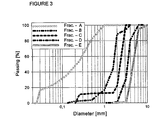
- the cumulative particle-size distribution i.e. the particle-size distributions of the three fractions (fraction 0, fraction1 and fraction 3) or the particle-size distributions of the five fractions (fraction A, fraction B, fraction C, fraction D, fraction E) are shown in figure 2 and figure 3 respectively.
- Table IV Chemical composition and average value of water absorption of the a1 type limestone aggregate CaC0 3 98.61% Mg CO 3 0.87% SiO 2 0.13% Al 2 O 3 0.01% Fe 2 O 3 0.03% Na 2 O 0.12% K 2 O 0.07% T.O.C. 1 0.02 % Absorption H 2 O 0.28 % 1 T.O.C. stands for: Total Organic Carbon
- Table V contains the chemical composition and the average value of water absorption for the aggregate a2.
- Table V Chemical composition and average value of water absorption of the limestone aggregate "Halips" CaCO 3 97.5% Mg CO 3 0.87% SiO 2 0.30% Al 2 O 3 0.14% Fe 2 O 3 0.12% Na 2 O ⁇ 0.08% K 2 O ⁇ 0.04% T.O.C. 1 0.025% Absorption H 2 O 0.18% T.O.C. stands for: Total Organic Carbon
- the concrete mix composition according to the invention comprises:
- the limestone aggregate preferably has a CaCO 3 content that is greater than or at least equal to 95% by weight compared to the aggregate mass.
- the typical mixture cement plus calcareous aggregate according to the invention the one in which the calcareous aggregate is type a1 is considered herein.
- Figure 6 shows the particle-size distribution of the above-mentioned solid CO mixture and the particle-size distribution curve according to equation [2] for reference.
- D max for the aggregate fractions is 9.5 mm.
- composition of the mixture was as follows: TABLE IX Composition of the solid C1 mixture Cement 52.5 R type I 32%. Calcareous aggregate (limestone) in a single size 68%
- a mixture of silica-calcareous aggregate and CEM I52.5 R cement was prepared with the composition shown in table X: TABLE X.
- Composition of the C2 mixture (CEM 52.5R and silica-calcareous aggregate). Sataf 113 aggregate 10.86% Sataf 103 aggregate 16.85% Sataf 117R aggregate 37.29% CEM I 52.5R 33%
- a solid mixture was prepared for a fibre-reinforced concrete mix.
- Table XII Composition of the solid C4 mixture Cement 52.5 R type III/A* 45% Aggregate fraction 0 18% Aggregate fraction 1 28% Aggregate fraction 2 9% * the cement used in this solid mixture contains anhydrite, as an activator, as an amount of 3% by weight on the cement.
- the mixes were prepared used a highly effective "HOBART" mixer.
- the anchor was turned at the minimum number of rotations 140 ⁇ 5 rpm for 60 seconds, slowly adding water and the admixture; the mixing was continued until a pasty consistency ( ⁇ 3') was obtained.
- the mixing was faster (285 ⁇ 10 rpm) for another 30".
- the mixture was then rested for 90" and then the mixture was mixed again at a higher speed for 120".
- Metal filters were added for the mix with the solid C4 mixture, after the first mixing cycle.
- test pieces packed in metal moulds 40x40x160 mm in size, were dislodged from the moulds 24 hours after casting and were placed for seasoning in water at 20 ⁇ 2°C until the pre-set deadline. It proved necessary to extend the keeping of the test pieces in the mould for 48 hours instead of 24 hours solely for the test pieces identified as IC3 (Ductal® ) as that they did not show clear signs of hardening (the deadline of 48 hours is the one indicated in the already quoted patent WO 99/28267.
- the adhesion of the fibres to the cementitious matrix is usually entrusted to the mechanical anchoring that, as is known, depends on the length (or more precisely on the length/diameter ratio) of the fibres and their shape. For this reason, the steel fibres usually have a suitable shape (hook, wavy, tapered at the ends etc) to ensure adequate mechanical bonding.
- the use of shaped fibres, or fibres with high aspect ratios can however lead to a higher penalisation of the rheological performance of the mixes.
- non-shaped fibres were preferred, which were 16 mm long and with a diameter of 0.13 mm, so as not to compromise the rheological performance of the mixture.
- Table XIX Compressive strength values in MPa found according to EN 196.1 for the mix IC4-A containing fibres. Mix 24 hours 2 days 7 days 28 days IC4 A 99.1 102.6 141.3 152.0 (fibres present as 1% in volume)
- Table XX Flexural strength values in MPa found according to the EN 196.1 for the mix IC4-A containing fibres. Mix 24 hours 2 days 7 days 28 days IC4-A 15.7 20.0 23.7 27.4 (fibres present as 1% in volume)
Landscapes
- Chemical & Material Sciences (AREA)
- Engineering & Computer Science (AREA)
- Ceramic Engineering (AREA)
- Materials Engineering (AREA)
- Structural Engineering (AREA)
- Organic Chemistry (AREA)
- Civil Engineering (AREA)
- Chemical Kinetics & Catalysis (AREA)
- Inorganic Chemistry (AREA)
- Curing Cements, Concrete, And Artificial Stone (AREA)
- On-Site Construction Work That Accompanies The Preparation And Application Of Concrete (AREA)
Abstract
Description
- The present invention relates to the making of high performance concrete that can be obtained without significant quantities of additional material with latent hydraulic activity, in particular silica fume.
- Before describing the present invention in detail, it is appropriate to define the meaning of some terms and to refer to the state of the art that can be deduced from technical and patent literature on the subject.
- The expression "high performance" currently refers to a relatively wide range of usage properties for cementitious mixtures and in particular the rheological and mechanical performances.
- With regards to the rheological performance, a high performance concrete is usually required to be at least thixotropic or, preferably, self-compacting.
- With regards to mechanical performance, the expression "high performance" refers to a wide range of mechanical strengths. According to Aitcin (High performance concrete (E& FN SPON - Modern Concrete Technology 5 - page 163 Ed. 1998) these types of concrete can be divided into five different categories, each of which is defined by compressive strength values that correspond to those that can be considered to be a technological range in the present state of the art.
Table I Classification of high performance concretes as proposed by Aitcin Compressive strength MPa 50 75 100 125 150 Category of high performance concrete I II III IV V - Even though there is currently no universally accepted definition of high performance concrete, a study of literature allows us to state that the essential property that qualifies a concrete as being high performance is its mechanical compressive strength that is, however, measured later than or at 28 days, while the other usage properties, which also contribute to classifying concrete at a high performance material, are not considered to be essential as they are additional specific requirements.
- Concretes having compressive strength that is higher than 100 MPa are commercially available. Types of concrete with mechanical properties that are much higher than those foreseen by the current design codes are also currently available (e.g. Ductal® - BSI see WO99/28267).
- It is well-known that in order to obtain high strength concrete it is necessary to adopt a reduced water/binder ratio (binder here is intended as Portland cement and any other suitable material) and a quantity of binder that is usually higher than the one required for normal level strength concretes (4, 5, 6, 7, 8, 9);
- 4 - Zeghib, R. et al "Study and formulation of high performance concrete with ultrafine admixtures" Fifth ACI/CANMET Conference on superplasticisers and Chemical admixtures in Concrete.
Supplementary papers, Rome 1997 pages 286-293; - 5 - Lang, E et al. "Use of Blast Furnace slag cement with high slag content for high performance concrete" - 4th International symposium on Utilisation of high Performance Concrete, Paris 1996, pages 213-222;
- 6 - Novokshchenov, V. "Factors Controlling the compressive strength of silica fume concrete in the range of 100-150 MPa" Magazine of Concrete Research, 1992, N. 158, pages 53-61;
- 7 - Shah, S.P. et al. "High Performance Concrete: Properties and applications" 1994, Mc Graw Hill, Inc, London 403 page;
- 8 - Gjorv, O. E. "High Strength Concrete" In "Advance in Concrete Technology" Ed. CANMET, Edition Malhotra, 1994 pages 19-82;
- 9 - De Larrard "Formulation et proprietes des betons a tres hautes performances. Rapport de recherche Du Laboratoire Central de Ponts et Chaussées, Paris N. 149, 1988, 350 page
- The current European regulations on concrete (EN 206) permit the addition of ultrafine materials to concrete with the aim of obtaining or improving some properties. The EN 206 regulation considers two types of addition:
- Almost inert addition (type I) one of which may be limestone;
- Pozzolan type or latent hydraulic activity additions (type II) are fly ash which is compliant with the EN 450 regulation and silica fume compliant with the p.r. EN 13263:1998.
- It is known that high performance concretes belonging to categories I and II with a compressive strength up to 100 MPa as set out in the table above can be produced from a large variety of cementitious systems such as:
- Pure Portland cement;
- Portland cement and Fly ash;
- Portland cement and silica fume;
- Portland cement, slag and silica fume;
- According to Aitcin (1999, pages 190-191), based on data taken from literature, it appears that almost all high performance concretes in category III (from 100 to 125 MPa) contain silica fume, except for very few types of concrete that are produced using Portland cement, whose strength values fall into a area below this category.
- Again according to Aitcin (E& FN SPON - Modern Concrete Technology 5 - pages 190-191 Ed. 1999) all the high performance concretes that currently belong to categories IV and V, have all been produced using silica fume.
- Several studies have looked at the effects of silica fume on the hydration reactions of the cementitious systems. Below there is brief summary of the main results of these studies. It is known that the action of silica fume reveals itself as both a pozzolan addition and as a filler. Silica fume acting as a granular filler between the cement particles can be explained by its extremely reduced dimensions (from 30 to 100 times smaller than that of Portland cement). It has-been established that it is possible to replace silica fume with Carbon black and obtain similar strengths (Derweiler and Mehta -1989 - "Chemical and Physical effect of silica fume on the mechanical behaviour of concrete" ACI Material Journal Vol. 86 n. 6 pp 609-614).
- The silica fume particles can also act as nucleation sites and at the same time improve the homogeneity and the fineness of the hydration products (Nehdi, 1995, "The microfiller effect in high performance concrete" Research proposal, department of civil engineering, University of British Columbia.)
- According to Cheng Yi and Feldman (1985 Cement and Concrete Research vol. 4 pages 585-592) silica fume speeds up the cement's hydration reaction by encouraging the creation of nucleation sites for Ca(OH)2 crystals even during the initial minutes after the start of the hydration reaction. Metha (1987-Proc. Int. Workshop on condensed silica fume in concrete, Ed. V.M. Malhotra, Montreal.) too maintains that the silica fume particles could act as nucleation sites for the precipitation of Portland cement and that the formation of several small-sized crystals in place of a few large ones could improve the mechanical properties of the cementitious paste.
- In contrast to the advantages coming from the use of such an addition material, however, it is necessary to point out that the silica fume addition in some cases seems to cause an increase in shrinkage during the plastic phase and can lead to significant phenomena of micro - flaws /SP 186-39 page 671 (E& FN SPON - Modern Concrete Technology 5 - 4 page 191 Ed. 1998) e (S. Rols et al. "Influence of Ultra Fine Particle Type on Properties of Very - High strength Concrete ACI SP 186 pages 671-685- Proceedings of Second CANMET/ACI International
- Conference, RS, Brazil, 1999). It must also be pointed out that the use of silica fume is particularly costly. Again according to Aitcin, this explains why concrete manufacturers tend to avoid using silica fume for the production of high performance concretes that belong to categories I and II. The cost of a type of concrete can almost double when passing from a 90 MPa concrete to a 100 MPa one; concrete with a design strength of 90 MPa can actually easily be produced without silica fume, whereas to currently produce a 100 MPa concrete, about 10% of the mixture must be made up of silica fume. (E& FN SPON - Modern Concrete Technology 5 - page 163 Ed. 1998).
- While analysing the performances of high performance cementitious materials, it is necessary to highlight the increase in mechanical strength that arises from the presence of steel micro-fibres. It is appropriate to point out that a correct comparison between the performances of cementitious matrixes with different compositions must be made by materials without fibre reinforcement. Finally, the following is deduced from literature:
- no cementitious matrix, seasoned in water or in a cloud chamber (20°C, 95% U.R) is capable of achieving such strengths after 28 days that it can be included in category V of table I;
- the workability data are not usually included and after examination of literature, however, no published works have been found that refer to concretes (cementitious matrixes) in category IV with self-compacting properties.
- No data is available on the development of strength at the first deadlines (24 and 48 hours).
- As far as the calcareous filler is concerned, it has long been considered to be inert. Although it cannot be considered as a pozzolanic addition material, many studies have shown that it has a considerable mid and long-term reactivity. S. Sprung, E. Siebel "..." Zement Kalk Gibs 1991, N. 1, pages 1-11 put forward the theory that in addition to its main role as a matrix filler, the calcareous filler may also present a certain chemical reactivity towards the aluminate which allows the formation of calcium aluminates to take place. Ramachandran et al. (Ramachandran et al. In "Durability of Buildings Materials", 4 1986) observed that adding CaCO3 to C3S (tricalcium silicate) accelerates hydration. They also discovered that cement hydration is faster due to the calcareous filler. In the cement mixture, CaCO3 would give rise to calcium aluminates that would be incorporated in phases C3S and C3A (tricalcium aluminate) during hydration. S.P. JIANG et al. ("Effect of fillers (Fine particles) on the Kinetics of Cement Hydration 3rd Beijing International Symposium on Cement and Concrete, 1993,3) also showed that the formation of calcium aluminates is advantageous as it would improve strength and accelerate the hydration process. Jiang et al. (S.P. Jiang et al. 9th International Congress of Cem. Chem. New Delhi, 1992) maintained that calcareous filler acts on the kinetics of cement hydration. According to these authors, rather than being attributed to the description above, the acceleration of hydration may instead be attributed to a multiplication of the inter-particle contacts effect and to the nature of these contacts on the calcareous filler surface.
- Escadeillas (G. Escadeillas, Les ciments aux fillers calcaires: Contribution a leur optimisation par l'etude des propietés mecaniques et physiques des betons fillerisées, Ph Thesis, Université P Sabatier (1988) 143 p.) observed that in the first few hours of hydration, the heat release from cement containing calcareous filler is greater than that coming from cement without filler and this is even more true the finer the calcareous filler. This is probably due to the acceleration in the hydration of the C3S.
- JP11147750 and JP06199549 discloses cement compositions comprising Portland cement, limestone powder and silica fume; JP2001181008 disclose compositions for making concrete containing cement and limestone.
- With regards to high performance from a rheological point of view, the importance that self-compacting concrete is gaining is well known.
- Self-compacting concrete (SCC) is a special concrete that can run into the formworks just by the effect of its own weight and flow around any obstacles such as reinforcement bars without stopping and without causing any separation phenomena of its elements. Its rheological properties must be preserved until the setting and hardening process begins.
- According to the AFGC (Association Française de Genie Civil) self-compacting concretes must meet the following requirements when fresh:
- a) The spreading values of the Slump Flows (slump cone) must usually fall within the field 60 - 75 cm (with no visible segregation at the end of the test, i.e. no lactim aureola along the outer perimeter and no concentration in the centre);
- b) The filling ratio of the equipment named L-Box must be greater than 80%;
- c) the concrete must not give rise to segregation and must present limited sweating.
- At the current state of knowledge, no high performance concretes have been produces without silica fume in category IV or V with self-compacting properties. M. Sari et al. (Cem. Conc. Research n. 29 (1999), for example, obtained a self-compacting high performance concrete with a slump flow of 61.5 cm. The mixtures considered contained 30 kg/m3 of silica fume and presented a 70 MPa strength after 28 days.
- From an analysis of the bibliography reviewed, no data or information was found on the possibility of preparing high strength concrete (at least in category III) without silica fume and with the rheological properties that are typical of a self-compacting concrete.
- The Applicant has surprisingly found a solid mixture for the preparation of concretes with a mechanical strength after 28 days that is greater than or equal to 110 MPa comprising cement, such as cement that is compliant to the European regulation 197-1, calcareous aggregates and admixtures characterised by the fact that any additions with latent hydraulic activity are less than 5% by weight compared to the cement.
-
- Figure 1 shows the reference curves corresponding to the equations [1] wherein A=0.75 and [2]; they are compared with the other curves normally used as reference curves for the system: aggregate + cement, i.e. more specifically the well-known Fuller and Bolomey curves are shown. With regards to the Bolomey curve, the two curves whose parameter AB depending on the aggregate form, takes on the two limit values of 8 and 14 have been considered.
The variance between the curves of the prior art and the curves of the invention can clearly be seen. - Figure 2 shows the experimental curves of the particle-size distribution of the three fractions of calcareous aggregate al (
fraction 0,fraction 1 and fraction 2). - Figure 3 shows the experimental curves of the particle-size distribution of the five fractions of calcareous aggregate al (fraction A, fraction B, fraction C, fraction D and fraction E).
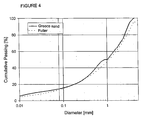
- Figure 4 shows the experimental curves of the particle-size distribution of the sole fraction of comparative calcareous aggregate a2. As can be seen, the curve is near to the Fuller curve.
- Figure 5 shows the experimental curves of the particle-size distribution of the three commercial silica-calcareous aggregate fractions b (Sataf 113, Sataf 103, Sataf 117 R respectively).
- Figure 6 shows the cumulative distribution curve of the cement in relation to its maximum content in the solid mixture (21%); the reference (according to equation [2] ) and actual particle-size distribution curves of the solid mixture of the invention CO are also shown. It can be seen that the distribution curve joins with the cement curve without causing particularities, it also has a flex point of x=0.315 mm.
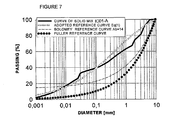
- Figure 7 shows the particle-size distribution of the above-mentioned solid CO1 mixture, the particle-size distribution curve according to equation [1] wherein A=0.822 compared with the other curves normally used as reference curves for the system: aggregate + cement, i.e. more specifically the well-known Fuller and Bolomey curves are shown. With regards to the Bolomey curve, parameter AB takes on the
limit value 14, has been considered. - Figure 8 describes the particle-size distribution curve of the solid mixture C1 compared to the reference curve corresponding to the equation [1] wherein A=0.75.
If one looks at figure 8, the considerable variance from the reference curve Eq.[1] wherein A=0.75, in the upper region of the typical particle-size field of CEM 52.5R, can clearly be seen. - Figure 9 shows the particle-size distribution curve of the solid mixture C2 for comparison. Figure 9 shows that the mixture made from CEM 52.5R and calcareous aggregate has a considerable variance from the reference curve Eq.[2], and tends to resemble the Bolomey curve by As =14.
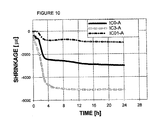
- Figure 10 shows the behaviour of the ICO-A mix and ICO1-A mix characterised by a much more limited shrinkage during the plastic phase than that found in the quartz aggregate and vitreous silica based mix IC3-A.
- The object of the present invention is to perfect a concrete formula with the following characteristics:
- 1) absence of significant quantities of type II additions (for example silica fume)
- 2) a mechanical strength after 28 days that is greater than 110 MPa and/or a development of compressive strength to the extent that it ensures the values contained in table II below.
- The expression: "without significant quantities of additions with a latent hydraulic activity" is intended to mean that these additions must be less than 5% by weight compared to the cement, and preferably less than 2%.
- A further object of the present invention is to perfect a formula of a self-compacting concrete satisfying the characteristics as set out in points a), b) and c) described above.
- Another object of the invention is to obtain fibre-reinforced concretes with rapid hardening, without significant quantities of type II additions, for example silica fume.
- It has been surprisingly found out that it is possible to achieve the aims described above, to the contrary of the bias expressed by the prior art, by using an optimal particle-size composition of the solid cement mixture and calcareous aggregate. In particular, it was found that if such a particle-size composition is used that the passing percentage composition according to the diameter of the particles follows that of the curve constructed according to table III below, it is possible to obtain a high performance concrete with development of mechanical strength in time as indicated in Table II, without significant quantities of pozzolanic type additions.
TABLE III Diameter (mm) Passing % 0.002 5-12 0.005 10-13 0.01 15-20 0.1 30-40 0.2 40-60 0.4 50-75 0.7 60-85 1 70-90 2 85-95 - The particle-size composition of the solid mixture can be more appropriately described by the curve that is represented by the equation:

- Where:
- P%= cumulative passing;
- x= diameter of the solid particles in mm;
- A = experimental parameter which has the following values: 0.75 or 0.822;
- Dmax= maximum diameter of aggregate in mm;
- Another possible curve is as follows:

- Where:
- P%= cumulative passing;
- x= diameter of the solid particles in mm;
- C, D= experimental parameters (C= 0.315 [mm], D= 0.486);
- Figure 1 contains the reference curves that correspond to the equations [1] and [2]; they are compared with the other curves normally used as reference curves for the system: aggregate + cement; more specifically, the well-known Fuller and Bolomey curves have been included, which respectively have the equation:

- Where:
- P%= cumulative passing;
- x= diameter in mm;
- Dmax= maximum dimension of aggregate;

- Where:
- P%= cumulative passing;
- x= diameter in mm;
- Dmax= maximum dimension of aggregate;
- AB= Bolomey parameter (typically takes on the two limit values of 8 and 14 depending on the aggregate shape)
- Some of the preferred embodiments according to the present invention are as follows:
- A solid mixture for the preparation of concrete with a mechanical strength after 28 days that is greater than or equal to 110 MPa , comprising cement, such as cement that is compliant with the European regulation 197-1, calcareous aggregates and admixtures, characterised by the fact that the possible latent hydraulic activity additions are less than 5% in weight compared to the cement;
- A solid mixture for the preparation of concrete with a mechanical strength after 28 days that is greater than or equal to 110 MPa , comprising cement, calcareous aggregates and admixtures, characterised by the fact that the possible latent hydraulic activity additions are less than 2% in weight compared to the cement.
- A solid mixture for the preparation of concrete that over time has the following development of mechanical strength: after one day: ≥ 50 MPa; after 2 days: ≥ 80 MPa; after 28 days: ≥ 110 MPa; and comprising cement, such as cement that is compliant with the European regulations 197-1, calcareous aggregates and admixtures, characterised by the fact that any latent hydraulic activity additions are less than 5% in weight compared to the cement.
- A solid mixture for the preparation of concrete that over time has the following development of strengths: After one day: ≥ 50 MPa; after 2 days: ≥ 80 MPa; after 28 days: ≥ 110 MPa; and comprising cement, such as cement that is compliant with the European regulations 197-1, calcareous aggregates and admixtures, characterised by the fact that any latent hydraulic activity additions are less than 2% in weight compared to the cement.
- According to the present invention cement and hydraulic binder are synonyms.
- As cements to prepare the solid mixture according to the present invention, all cements or hydraulic binder in general, and more specifically those according to the EN 197-1 regulation, can be used.
- More over according to the present invention as a further preferred embodiment the cement in the solid mixture is CEM I 52.5 R or CEM III A 52.5 R, with a slag content of 40% by weight compared to the clinker. In general the cement is present from 25% to 50% by weight, preferably from 30% to 35% by weight compared to the total solid mixture. Furthermore in a preferred embodiment of the present invention the calcareous aggregates are crushed calcareous aggregates with a CaCO3 content that is greater than or equal to 95% by weight compared to the total weight of the aggregate.
- The solid mixture according to the present invention has the calcareous aggregates with a DMax (maximum Diameter) from 2 mm to 12 mm, preferably from 4 to 8 mm or from 8 to 12 mm, most preferably of 9.5 mm.
- As a further preferred embodiment the admixtures in the solid mixture are either acrylic or naphthalenesulfonate admixtures, in particular the acrylic admixtures are present from 0.4% to 1.2% by weight, preferably from 0.5% to 0.8% by weight, compared to the weight of the cement; the naphthalenesulfonate admixtures are present from 1.9% to 2.5% by weight compared to the weight of the cement. As a further preferred embodiments the solid mixture, according to the present invention, it further comprises metal fibres.
- Further preferred embodiments according to the solid mixture which is the common inventive concept of the present invention are as follows:
- A cementitious mix for the preparation of concrete with a mechanical strength after 28 days that is greater than or equal to 110 MPa comprising a solid mixture according to the present invention, characterised by the fact that any additions with latent hydraulic activity are less than 5% by weight compared to the cement and that have a water/cement ratio from 0.2 to 0.3, preferably from 0.24 to 0.26.
- A concrete with a mechanical strength after 28 days that is greater than or equal to 110 MPa comprising a solid mixture according to the present invention, characterised by the fact that any additions with latent hydraulic activity are less than 5% by weight, preferably less than 2% by weight, compared to the cement.
- The concrete according to claim 22 with a mechanical strength after 28 days that is greater than or equal to 110 MPa comprising a solid mixture according to
claim 1, characterised by the fact that any additions with latent hydraulic activity are compared to the cement. - A solid mixture based on cement and aggregate of mainly calcareous type, containing an addition with latent hydraulic activity in quantities less than 5 % by weight, characterised by the fact that the particle-size distribution of the mixture is shown on the graph of the cumulative percentage of passing material according to the size of the particles in mm, from a curve that substantially corresponds to the values shown in table III.
- Preferably, the aggregate of mainly calcareous type is limestone.
- The following examples are conveyed by way of indication, not of limitation, of the present invention.
- The materials used for the experiment were:
- A CEM cement type I category 52.5R and a CEM cement type III, 52.5R were used, both compliant with the regulation EN 197-1 and with a Blaine fineness of 4900 cm2/g.
- Commercial acrylic admixtures (Superflux® AC 2003) and naphthalenesulfonate admixtures (Superflux NF® ), were used.
- A type of mixing water was-used that is compliant with pr EN 1008:1997.
- The following aggregates were used:
- a) type a1 and a2 crushed limestone;
- b) Tondo di fiume of a silica-calcareous nature;
- c) Pure crushed quartzite;
- The limestone used was characterised by a compact crystalline structure, coming from the Rezzato (BS) quarry, and with a chemical composition as indicated in table IV, and the same table shows the average value of water absorption. The cumulative particle-size distribution, i.e. the particle-size distributions of the three fractions (
fraction 0, fraction1 and fraction 3) or the particle-size distributions of the five fractions (fraction A, fraction B, fraction C, fraction D, fraction E) are shown in figure 2 and figure 3 respectively.Table IV Chemical composition and average value of water absorption of the a1 type limestone aggregate CaC03 98.61% Mg CO3 0.87% SiO2 0.13% Al2O3 0.01% Fe2O3 0.03% Na2O 0.12% K2O 0.07% T.O.C.1 0.02 % Absorption H2O 0.28 % 1T.O.C. stands for: Total Organic Carbon - For comparison purposes an a2 crushed limestone aggregate from the Halips quarry (Greece) was used, that is characterised by the fact that is was supplied in a single size with a maximum diameter of 4.5 mm (substantially the same as that of the
fraction 2 of the a1 limestone aggregate). The cumulative particle-size distribution is shown in figure 4. - If we examine the afore-mentioned figure, it is possible to observe that this distribution is close to that of the well-known particle-size curve Fuller (II calcestruzzo- Materiali e tecnologia di Vito Alunno Rossetti- Mc Graw-Hill 1995 pp 103-104).
- Table V contains the chemical composition and the average value of water absorption for the aggregate a2.
Table V Chemical composition and average value of water absorption of the limestone aggregate "Halips" CaCO3 97.5% Mg CO3 0.87% SiO2 0.30% Al2O3 0.14% Fe2O3 0.12% Na2O <0.08% K2O <0.04% T.O.C.1 0.025% Absorption H2O 0.18% T.O.C. stands for: Total Organic Carbon - On comparing the data contained in table IV and the data contained in table V, it can reasonably be stated that the two calcareous aggregates a1 and a2 have the same chemical composition and water absorption characteristics.
- For comparison reasons, an aggregate of river origin b was used with the composition shown in table VI, while the cumulative particle-size distribution of the three commercial particle-size fractions (Sataf 113, Sataf 103, and Sataf 117R respectively) is shown in figure 5.
Table VI Chemical composition and water absorption of the silica-calcareous aggregate CaCO3 9.20% MgCO3 15.86% SiO2 71.08% Al2O3 6.46% Fe2O3 3.12% Na2O 1.05% K2O 1.23% T.O.C.1 - Absorption. H2O 0.33% 1T.O.C. stands for: Total Organic Carbon - For comparison purposes pure crushed quartzite was used as an aggregate, according to the patent WO 99/28267.
- Berkert ON 13 straight steel fibres were used
- The concrete mix composition according to the invention comprises:
- from 25% to 50% by weight and preferably 30÷33% of
type 1 CEM 52.5R cement; - silica fume less than 5% by weight and preferably less than 2 %, compared to the cement weight,
- crushed limestone aggregate with Dmax (maximum diameter) from 2 mm to 12 mm, preferably with Dmax (maximum diameter) from 4 mm to 8 mm, also preferably with Dmax (maximum diameter) from 8 mm to 12 mm, most preferably with a Dmax (maximum diameter) of 9.5 mm in quantities as a complement to 100 compared to the cement.
- acrylic-based super fluidifying agent from 0.4% to 1.2% by weight (preferably 0.5
- 0.8%) or naphthalenesulfonate-based from 1.9 to 2.5% by weight expressed as a dry substance on the cement
- water/cement ratio: 0,2-0,3 (preferably 0.24-0.26).
- The above-stated percentages of cement and aggregate refer to the total mixture of solids.
- The limestone aggregate preferably has a CaCO3 content that is greater than or at least equal to 95% by weight compared to the aggregate mass.
- As the typical mixture cement plus calcareous aggregate according to the invention, the one in which the calcareous aggregate is type a1 is considered herein.
- The CO mixture: cement plus calcareous aggregate that is best adapts to the optimal curve, following the equation [1] wherein A=0.75 is the one below, indicated as "CO mixture", and which has the composition shown in table VII.
TABLE VII Composition of the CO mixture Aggregate fraction 0 22.8 % Aggregate fraction 1 35.2 % Aggregate fraction 2 10% CEM I 52.5R 32% - Figure 6 shows the particle-size distribution of the above-mentioned solid CO mixture and the particle-size distribution curve according to equation [2] for reference.
- The CO1 mixture: cement plus calcareous aggregate that is best adapts to the optimal curve, following the equation [1] wherein A=0.822 is the one below, indicated as "CO1 mixture", and which has the composition shown in table VIII.
TABLE VIII Composition of the CO1 mixture Aggregate fraction A 30.0% Aggregate fraction B 15.4% Aggregate fraction C 4.68% Aggregate fraction D 10.25% Aggregate fraction E 10.67% CEM I 52.5R 29.0% - Figure 7 shows the particle-size distribution of the above-mentioned solid CO1 mixture, the particle-size distribution curve according to equation [1] wherein A=0.822 and the Fuller and Bolomey curves for reference.
- In particular, Dmax for the aggregate fractions is 9.5 mm.
- For comparison purposes with the optimised mixture, a mixture was produced that was made up of CEM I 52.5R and limestone in a single size which had a particle-size distribution as shown in figure 8 for the solid C1 mixture, by comparison with the reference curve following the Eq. [1] wherein A=0.75.
- The composition of the mixture was as follows:
TABLE IX Composition of the solid C1 mixture Cement 52.5 R type I 32%. Calcareous aggregate (limestone) in a single size 68% - If one examines figure 8, the considerable variance from the reference curve can be seen in the upper region of the typical particle-size curve of the CEM 52.5R, whose cumulative curve is shown, in relation to its content in the mixture.
- A mixture of silica-calcareous aggregate and CEM I52.5 R cement was prepared with the composition shown in table X:
TABLE X. Composition of the C2 mixture (CEM 52.5R and silica-calcareous aggregate). Sataf 113 aggregate 10.86% Sataf 103 aggregate 16.85% Sataf 117R aggregate 37.29% CEM I 52.5R 33% - Figure 9 demonstrates that the mixture made up of CEM I 52.5R and silica calcareous aggregate has a significant variance from the reference curve, following the equation [1] wherein A=0.75, and tends to resemble the Bolomey by AB=14.
- In order to compare the performances of the calcareous cementitious mixture and a quartz-based cementitious mixture, the basic mixture (without any fibre reinforcement) known commercially as DUCTAL® , whose solid materials composition is shown in table XI, was examined.
Table XI. Composition of the Ductal® solid mixture (*) Cement with a high content of silica (C 3 S>75%) Cement 52.5R HTS (*) 32.74% Vitreous Silica SEPR (Silica Fume) 10.66% Quartz flour 9.81 % Quartz sand (D max = 0.5 mm) 46.79% - A solid mixture was prepared for a fibre-reinforced concrete mix.
Table XII. Composition of the solid C4 mixture Cement 52.5 R type III/A* 45 % Aggregate fraction 0 18 % Aggregate fraction 1 28 % Aggregate fraction 2 9% * the cement used in this solid mixture contains anhydrite, as an activator, as an amount of 3% by weight on the cement. - Various mixes were prepared with the solid mixtures described in the previous paragraphs.
TABLE XIII Composition of the mixes Mix Solid Mixture Water/binder ratio Hyper-fluidifying admixture ICO-A CO 0.26 Acrylic-based admixture 0.6%** ICO1- A CO1 0.276 Acrylic-based admixture 0.65%** ICO-N CO 0.30 Naphthalenesulphonate-based admixture 2.5%** IC1-A C1 0.26 Acrylic-based admixture 0.6%** IC1-N C1 0.30 Naphthalenesulphonate-based admixture 1.9%** IC2-A C2 0.26 Acrylic-based admixture 0.6%** IC2-N C2 0.30 Naphthalenesulphonate-based admixture 2.5%** IC3-A C3 0.21 Acrylic-based admixture 1.8%** IC4-A C4 0.22 Acrylic-based admixture 0.6% ** admixture as a dry substance in % on the binder
A = acrylic-based admixture (Superflux 2003)
N = naphthalenesulfonate-based admixture (Superflux NF) - The mixes were prepared used a highly effective "HOBART" mixer. During the first mixing stage, the anchor was turned at the minimum number of rotations 140 ± 5 rpm for 60 seconds, slowly adding water and the admixture; the mixing was continued until a pasty consistency (≅3') was obtained. After this stage, the mixing was faster (285±10 rpm) for another 30". The mixture was then rested for 90" and then the mixture was mixed again at a higher speed for 120". Metal filters were added for the mix with the solid C4 mixture, after the first mixing cycle.
- The following table XIV contains the flow% values [Uni 7044] found on the mixes indicated in table XIII.
TABLE XIV Rheological properties of the examined mixes. Identification no. Flow % Notes ICO-A 170 Self-compacting ICO-N 182 Self-compacting IC1-A 130 Thixotropic IC1-N 190 Self-compacting IC2-A 130 Thixotropic IC2-N >200 Self-compacting IC3-A >200 Thixotropic IC4 A >200 Self-compacting A = acrylic-based admixture
N = naphthalenesulfonate-based admixture
ICO = invention - For the mixes ICO-A and ICO1-A, also believed to be the most promising with regards to the development of mechanical strength, rheological characterisation were extended to the purpose of checking the requisites of self-compacting concrete. The results obtained can be seen in table XV and table XVI respectively.
TABLE XV Rheological characterisation of the mix ICO-A Test Result Notes Slump-flow 760 mm Positive result L-box Complete filling (100%) Positive result U-box At the end of the test, the difference in level between the two chambers was zero Positive result Funnel ≅30" Accentuated cohesion/viscosity properties TABLE XVI Rheological characterisation of the mix ICO1-A TEST TEST RESULT Reference values (UNI Draft) FLOW T500= 12" ≤12" Dmax= 750mm >600mm L-box h2/h1=1 h2/h1>0.80 U-box Δh=0mm Δh≤ 30mm Flow time 20" 4-12" - As there are no Italian or European regulations, the tests shown above were carried out according to the descriptions given in "M. Ouchi, History of Development and Applications of SCC in Japan - Proceedings of the first international workshop on seif-compacting concrete - University of Technology, Kochi, Japan, 1998.
- All the test pieces, packed in metal moulds 40x40x160 mm in size, were dislodged from the
moulds 24 hours after casting and were placed for seasoning in water at 20 ± 2°C until the pre-set deadline. It proved necessary to extend the keeping of the test pieces in the mould for 48 hours instead of 24 hours solely for the test pieces identified as IC3 (Ductal® ) as that they did not show clear signs of hardening (the deadline of 48 hours is the one indicated in the already quoted patent WO 99/28267. - Shrinkage tests during the plastic phase were carried out on some of the mixes indicated in table XIII (ICO-A, ICO1-A and IC3-A).
- The behaviour of the ICO-A mix, and more over for the ICO1-A mix, were highlighted, characterised by a much more limited shrinkage during the plastic phase than that found in the quartz aggregate and vitreous silica based mix IC3-A (see figure 10).
-
Table XVII. Compressive strength values [MPa] found according to EN. 196.1 for the mixes prepared with an acrylic admixture Mix 24 hours 2 days 7 days 28 days ICO-A 79.45 99.18 122.4 138.37 IC1-A 49.7 61.92 76.71 83.17 IC2-A 51.7 84.76 98.7 108.0 IC3-A 91.5 98.4 125 136.3 Note. The deadline dates of the mix IC3-A should actually be moved by two days (e.g. the 1 day value was actually taken 1 day after removal from the mould and therefore 3 days after mixing) - On examining the data contained in tables XIV and XVII the following conclusions can be made:
- 1) When using the acrylic admixture, with an equal water/cement ratio, only the ICO-A mix allows self-compacting concretes to be obtained.
- 2) The development of mechanical strength over time for the concrete from the ICO-A mix of the invention is certainly better than that of the comparison mixes IC1-A, IC2-A and IC3-A. Note in particular the marked differences in mechanical strength for the mixes made from the dry matrixes C0 and C1 for which the chemical compositions and the shape or morphology of the aggregates are the same.
- 3) It is possible to obtain concrete, without a pozzolanic addition, that has a mechanical strength close to 140 MPa after 28 days.
- On examining the data contained in table XVI, the following conclusions can be made:
- 1) The development of mechanical strength over time for the concrete from the ICO-N mix of the invention is certainly better than that of the comparison mixes IC1-N and IC2-N. Note in particular the marked differences in mechanical strength for the mixes made from the dry matrixes C0 and C1 for which the chemical compositions and the shape or morphology of the aggregates are the same.
- 2) It is possible to obtain a concrete, without a pozzolanic addition, that has a mechanical strength exceeding 100 MPa after 28 days.
- It is a known fact that the reinforcement action carried out by a steel fibres system on a cementitious matrix depends, in equal conditions, on the bonding between the fibres and the matrix itself.
- The adhesion of the fibres to the cementitious matrix is usually entrusted to the mechanical anchoring that, as is known, depends on the length (or more precisely on the length/diameter ratio) of the fibres and their shape. For this reason, the steel fibres usually have a suitable shape (hook, wavy, tapered at the ends etc) to ensure adequate mechanical bonding. The use of shaped fibres, or fibres with high aspect ratios can however lead to a higher penalisation of the rheological performance of the mixes.
- For this reason in the specific case, non-shaped fibres were preferred, which were 16 mm long and with a diameter of 0.13 mm, so as not to compromise the rheological performance of the mixture.
Table XIX. Compressive strength values in MPa found according to EN 196.1 for the mix IC4-A containing fibres. Mix 24 hours 2 days 7 days 28 days IC4 A 99.1 102.6 141.3 152.0 (fibres present as 1% in volume) Table XX. Flexural strength values in MPa found according to the EN 196.1 for the mix IC4-A containing fibres. Mix 24 hours 2 days 7 days 28 days IC4-A 15.7 20.0 23.7 27.4 (fibres present as 1% in volume) - As can be seen, the addition of steel fibres determines a substantial increase in mechanical strength, as the mechanical strength values are already near to 100
MPa 24 hours after the mix is made up.Table XXI. Mechanical strength values in MPa found according to the corresponding EN directive, for the mix ICO1-A. TIME Compressive Flexural Strength Modulus of Elasticity* [d] strength [MPa] (dynamic) [MPa] [MPa] 1 85 10,8 43 491 2 92 15,2 44 900 7 103 18,9 46 000 28 118,5 20,6 48 100 * Modulus of Elasticity according to UNI 9771.
| | 1 | 2 | 28 |
| [days] | |||
| Rc [MPa] | ≥50 | ≥80 | ≥110 |
| Mix |
| 24 | 2 days | 7 | 28 days | |
| ICO-N | 54.6 | 80.71 | 98.06 | 112.92 |
| IC1-N | 44.66 | 60.7 | 76.36 | 88.74 |
| IC2-N | 32.4 | 72.52 | 89.52 | 101.84 |
Claims (25)
- A solid mixture for the preparation of concrete with a mechanical strength after 28 days that is greater than or equal to 110 MPa , comprising cement, calcareous aggregates and admixture, and possible latent hydraulic activity additions in amount less than 5% by weight compared to the cement, wherein the particle-size distribution of the mixture is shown on the graph of the cumulative percentage of passing material according to the size of the particles in mm, from a curve that substantially corresponds to the values shown in the following table:
Diameter (mm) Undersize % 0.002 5-12 0.005 10-13 0.01 15-20 0.1 30-40 0.2 40-60 0.4 50-75 0.7 60-85 1 70-90 2 85-95 - The solid mixture according to claim 1 wherein the cement is a cement that is compliant with the European regulation 197-1.
- The solid mixture according to claim 1 for the preparation of concrete with a mechanical strength after 28 days that is greater than or equal to 110 MPa, characterised by the fact that the possible latent hydraulic activity additions are less than 2% by weight compared to the cement.
- The solid mixture according to claim 1 for the preparation of concrete that over time has the following development of mechanical strength: after one day:≥ 50 MPa; after 2 days:≥ 80 MPa; after 28 days:≥ 110 MPa.
- The solid mixture according to claim 3 for the preparation of concrete that over time has the following development of strengths: after one day:≥ 50 MPa; after 2 days: ≥ 80 MPa; after 28 days: ≥ 110 MPa.
- The solid mixture according to the claim1 wherein the cement is CEM I 52.5 R.
- The solid mixture according to claim 1 wherein the cement is CEM III A 52.5 R, with a slag content of 40% by weight compared to the clinker.
- The solid mixture according to claim 1 wherein the cement is present from 25% to 50% by weight compared to the total solid mixture.
- The solid mixture according to the claim 8 wherein the cement is present from 30% to 35% by weight compared to the total solid mixture.
- The solid mixture according to claim 1 wherein the calcareous aggregates are crushed calcareous aggregates with a CaCO3 content that is greater than or equal to 95% by weight compared to the total weight of the aggregate.
- The solid mixture according to claim 1 wherein the calcareous aggregates have a DMax (maximum Diameter) from 2 mm to 12 mm.
- The solid mixture according to claim 11 wherein the calcareous aggregates have a DMax (maximum Diameter) from 4 to 8 mm.
- The solid mixture according to claim 11 wherein the calcareous aggregates have a DMax (maximum Diameter) from 8 to 12 mm.
- The solid mixture according to claim 11 wherein the calcareous aggregates have a DMax (maximum Diameter) of 9.5 mm.
- The solid mixture according to claim 1 wherein the admixtures are either acrylic or naphthalenesulfonate admixtures.
- The solid mixture according to claim 15 wherein the acrylic admixtures are present from 0.4% to 1.2% by weight compared to the weight of the cement.
- The solid mixture according to claim 16 wherein the acrylic admixtures are present from 0.5% to 0.8% by weight compared to the weight of the cement.
- The solid mixture according to claim 15 wherein the naphthalenesulfonate admixtures are present from 1.9% to 2.5% by weight compared to the weight of the cement.
- The solid mixture according to claim 1 further comprising metal fibres.
- A cementitious mix for the preparation of concrete with a mechanical strength after 28 days that is greater than or equal to 110 MPa comprising a solid mixture according to claim 1 characterised by the fact that any additions with latent hydraulic activity are less than 5% by weight compared to the cement and that have a water/cement ratio from 0.2 to 0.3.
- The cementitious mix according to claim 20 characterised by the fact that the water/cement ratio is from 0.24 to 0.26.
- A concrete with a mechanical strength after 28 days that is greater than or equal to 110 MPa comprising a solid mixture according to claim 1, characterised by the fact that any additions with latent hydraulic activity are less than 5% by weight compared to the cement.
- The concrete according to claim 22 with a mechanical strength after 28 days that is greater than or equal to 110 MPa comprising a solid mixture according to claim 1, characterised by the fact that any additions with latent hydraulic activity are less than 2% by weight compared to the cement.
- A solid mixture for the preparation of concrete with a mechanical strength at 28 days that is ≥ 110 MPa, based on cement and aggregate of mainly calcareous type, containing an addition with latent hydraulic activity in quantities less than 5 % by weight compared to the cement, characterised by the fact that the particle-size distribution of the mixture is shown on the graph of the cumulative percentage of passing material according to the size of the particles in mm, from a curve that substantially corresponds to the values shown in the following table:
Diameter (mm) Undersize % 0.002 5-12 0.005 10-13 0.01 15-20 0.1 30-40 0.2 40-60 0.4 50-75 0.7 60-85 1 70-90 2 85-95 - The solid mixture based on cement and aggregate of mainly calcareous type according to claim 24 wherein the aggregate of mainly calcareous type is limestone.
Applications Claiming Priority (3)
| Application Number | Priority Date | Filing Date | Title |
|---|---|---|---|
| ITMI20012480 | 2001-11-23 | ||
| IT2001MI002480A ITMI20012480A1 (en) | 2001-11-23 | 2001-11-23 | HIGH PERFORMANCE CONCRETE NOT CONTAINING ADDITIONAL MATERIALS FOR LATENT HYDRAULIC ACTIVITY |
| PCT/EP2002/013167 WO2003043947A2 (en) | 2001-11-23 | 2002-11-22 | High performance concretes that do not contain additions with latent hydraulic activity |
Publications (2)
| Publication Number | Publication Date |
|---|---|
| EP1565413A2 EP1565413A2 (en) | 2005-08-24 |
| EP1565413B1 true EP1565413B1 (en) | 2006-09-27 |
Family
ID=11448629
Family Applications (1)
| Application Number | Title | Priority Date | Filing Date |
|---|---|---|---|
| EP02803408A Expired - Lifetime EP1565413B1 (en) | 2001-11-23 | 2002-11-22 | High performance concretes that do not contain additions with latent hydraulic activity |
Country Status (12)
| Country | Link |
|---|---|
| US (1) | US7316743B2 (en) |
| EP (1) | EP1565413B1 (en) |
| AT (1) | ATE340776T1 (en) |
| AU (1) | AU2002356712A1 (en) |
| CA (1) | CA2468430C (en) |
| CY (1) | CY1105875T1 (en) |
| DE (1) | DE60215059T2 (en) |
| DK (1) | DK1565413T3 (en) |
| ES (1) | ES2274126T3 (en) |
| IT (1) | ITMI20012480A1 (en) |
| PT (1) | PT1565413E (en) |
| WO (1) | WO2003043947A2 (en) |
Families Citing this family (11)
| Publication number | Priority date | Publication date | Assignee | Title |
|---|---|---|---|---|
| ITMI20050913A1 (en) | 2005-05-19 | 2006-11-20 | Italcementi Spa | HIGH PERFORMANCE CONCRETE AND QUICK DEVELOPMENT OF RESISTANCES NOT CONTAINING ADDED MATERIALS TO LATENT HYDRAULIC ACTIVITY |
| WO2007009408A1 (en) * | 2005-07-16 | 2007-01-25 | Rode Betontechnologie Gmbh | Mixture for producing self-compacting concrete |
| EP1958926A1 (en) | 2007-01-24 | 2008-08-20 | Lafarge | New concrete composition |
| ES2360003B1 (en) * | 2009-10-20 | 2012-04-13 | Universitat Politècnica De Catalunya | ULTRA HIGH RESISTANCE CONCRETE REINFORCED WITH STEEL FIBERS |
| US9328027B2 (en) * | 2012-12-21 | 2016-05-03 | Hanson Aggregates LLC | Fast-curing pervious concrete mix |
| ES2502690B1 (en) * | 2013-04-02 | 2015-08-11 | Arraela, S.L. | Thermal energy storage material |
| US11117836B2 (en) | 2017-11-07 | 2021-09-14 | Mitek Holdings, Inc. | Ultra stable structural laminate |
| US12454487B2 (en) | 2017-11-07 | 2025-10-28 | Mitek Holdings, Inc. | Ultra stable structural laminate |
| US10167232B1 (en) | 2017-11-07 | 2019-01-01 | Jet Products, Llc | Process for making an ultra stable cementitious construction material |
| IT201800002168A1 (en) * | 2018-01-30 | 2019-07-30 | Istituto Scient Di Chimica E Biochimica Giuliana Ronzoni | Composition based on calcium carbonate for use as cement |
| CH714982B1 (en) * | 2018-05-09 | 2022-08-15 | Kibag Baustoffe Schollberg Ag | Ultra high performance concrete. |
Family Cites Families (14)
| Publication number | Priority date | Publication date | Assignee | Title |
|---|---|---|---|---|
| FR919256A (en) * | 1942-06-02 | 1947-03-04 | Process for the manufacture of construction elements | |
| CN1019099B (en) * | 1985-08-06 | 1992-11-18 | 电气化学工业株式会社 | High Strength Hydraulic Composite |
| JPH06199549A (en) * | 1992-12-28 | 1994-07-19 | Sumitomo Cement Co Ltd | Cement composition for high strength concrete |
| FR2729658B1 (en) * | 1995-01-25 | 1997-04-04 | Lafarge Nouveaux Materiaux | COMPOSITE CONCRETE |
| JPH11147750A (en) * | 1997-11-11 | 1999-06-02 | Mitsubishi Materials Corp | Cement composition |
| FR2771406B1 (en) | 1997-11-27 | 2000-02-11 | Bouygues Sa | METAL FIBER CONCRETE, CEMENT MATRIX AND PREMIXES FOR THE PREPARATION OF THE MATRIX AND CONCRETE |
| JPH11302056A (en) * | 1998-04-24 | 1999-11-02 | Taiheiyo Cement Corp | Low shrinkage, high strength, high fluidity concrete composition and its hardened body |
| FR2778654B1 (en) * | 1998-05-14 | 2000-11-17 | Bouygues Sa | CONCRETE COMPRISING ORGANIC FIBERS DISPERSED IN A CEMENTITIOUS MATRIX, CONCRETE CEMENTITIOUS MATRIX AND PREMIXES |
| JP2000128616A (en) * | 1998-10-16 | 2000-05-09 | Sumitomo Osaka Cement Co Ltd | Method for producing cement composition |
| JP2000211956A (en) * | 1999-01-25 | 2000-08-02 | Mitsubishi Materials Corp | Cement composition |
| JP2001181008A (en) * | 1999-12-22 | 2001-07-03 | Tokuyama Corp | Concrete composition |
| FR2804952B1 (en) * | 2000-02-11 | 2002-07-26 | Rhodia Chimie Sa | ULTRA HIGH PERFORMANCE FIRE RESISTANT CONCRETE COMPOSITION |
| DE10028123B4 (en) * | 2000-02-24 | 2005-12-08 | Hochtief Ag | Self-compacting mixed concrete mix |
| CN1275895C (en) * | 2001-05-29 | 2006-09-20 | 太平洋水泥株式会社 | water curable composition |
-
2001
- 2001-11-23 IT IT2001MI002480A patent/ITMI20012480A1/en unknown
-
2002
- 2002-11-22 AT AT02803408T patent/ATE340776T1/en active
- 2002-11-22 PT PT02803408T patent/PT1565413E/en unknown
- 2002-11-22 ES ES02803408T patent/ES2274126T3/en not_active Expired - Lifetime
- 2002-11-22 DE DE60215059T patent/DE60215059T2/en not_active Expired - Lifetime
- 2002-11-22 DK DK02803408T patent/DK1565413T3/en active
- 2002-11-22 WO PCT/EP2002/013167 patent/WO2003043947A2/en not_active Ceased
- 2002-11-22 US US10/496,728 patent/US7316743B2/en not_active Expired - Fee Related
- 2002-11-22 EP EP02803408A patent/EP1565413B1/en not_active Expired - Lifetime
- 2002-11-22 AU AU2002356712A patent/AU2002356712A1/en not_active Abandoned
- 2002-11-22 CA CA2468430A patent/CA2468430C/en not_active Expired - Fee Related
-
2006
- 2006-12-21 CY CY20061101840T patent/CY1105875T1/en unknown
Also Published As
| Publication number | Publication date |
|---|---|
| ES2274126T3 (en) | 2007-05-16 |
| AU2002356712A8 (en) | 2003-06-10 |
| CA2468430C (en) | 2012-02-07 |
| US20040244332A1 (en) | 2004-12-09 |
| DK1565413T3 (en) | 2007-01-29 |
| ATE340776T1 (en) | 2006-10-15 |
| ITMI20012480A1 (en) | 2003-05-23 |
| DE60215059T2 (en) | 2007-05-03 |
| PT1565413E (en) | 2007-01-31 |
| EP1565413A2 (en) | 2005-08-24 |
| WO2003043947A3 (en) | 2003-11-27 |
| AU2002356712A1 (en) | 2003-06-10 |
| US7316743B2 (en) | 2008-01-08 |
| DE60215059D1 (en) | 2006-11-09 |
| CY1105875T1 (en) | 2011-02-02 |
| CA2468430A1 (en) | 2003-05-30 |
| WO2003043947A2 (en) | 2003-05-30 |
Similar Documents
| Publication | Publication Date | Title |
|---|---|---|
| AU601137B2 (en) | An improved rice hull ash concrete admixture | |
| CN101265066B (en) | High folding resistance road concrete material and preparing method thereof | |
| JP3058446B2 (en) | Durable cement products containing siliceous ash | |
| CN112142406A (en) | Soil stabilizer for high fluidity stabilized soil | |
| CN1185178C (en) | Composite low-heat-release high-active superfine powder concrete admixture and making method thereof | |
| CA2731199A1 (en) | Aqueous formulations | |
| US7316743B2 (en) | Performance concretes that do not contain additions with latent hydraulic activity | |
| Karim et al. | Strength development of mortar and concrete containing fly ash: A review | |
| WO2022203641A2 (en) | Production method of geopolymer concrete | |
| CN109095802B (en) | Expansive agent for concrete, concrete and preparation method thereof | |
| CN1108280C (en) | High-activity fine steelslag powder as additive of concrete and process for preparing concrete | |
| WO1990013524A1 (en) | Shaped article with a cement-bound matrix and method and composition for the preparation thereof | |
| RU2186043C2 (en) | Binding agent | |
| Li et al. | A study of high-performance slag-based composite admixtures | |
| CN114249572A (en) | High-strength concrete pipe pile | |
| EP1888480B1 (en) | High performance concrete with a quick resistance development lacking added materials with latent hydraulic activity | |
| Feng et al. | Shale ash concrete | |
| JP3082861B2 (en) | Hydraulic composition for high-strength concrete and method for producing high-strength mortar or concrete | |
| Yoobanpot et al. | Combined recycling of white rice husk ash as cement replacement and metal furnace slag as coarse-aggregate replacement to produce self-consolidating concrete | |
| JP4086328B2 (en) | Noro reducing material, centrifugal force molded body using the same, and method for producing the same | |
| Huynh et al. | Physical-durable performance of concrete incorporating high loss on ignition-fly ash | |
| CN112110669A (en) | Recycled aggregate reinforcing agent, preparation method thereof and recycled aggregate concrete | |
| CN110563403A (en) | A combination of superfine sand pumping concrete raw materials prepared by super-mixing technology | |
| MAKUL et al. | MECHANICAL PROPERTIES AND DURABILITY OF GREEN MORTARS PREPARED BY GRADED DIATOMITE POWDER INCORPORATING LIMESTONE POWDER. | |
| Saini et al. | Performance Evaluation of Concrete using Ultra Fine Calcium Carbonate Powder |
Legal Events
| Date | Code | Title | Description |
|---|---|---|---|
| PUAI | Public reference made under article 153(3) epc to a published international application that has entered the european phase |
Free format text: ORIGINAL CODE: 0009012 |
|
| 17P | Request for examination filed |
Effective date: 20040621 |
|
| AK | Designated contracting states |
Kind code of ref document: A2 Designated state(s): AT BE BG CH CY CZ DE DK EE ES FI FR GB GR IE IT LI LU MC NL PT SE SK TR |
|
| GRAP | Despatch of communication of intention to grant a patent |
Free format text: ORIGINAL CODE: EPIDOSNIGR1 |
|
| RTI1 | Title (correction) |
Free format text: HIGH PERFORMANCE CONCRETES THAT DO NOT CONTAIN ADDITIONS WITH LATENT HYDRAULIC ACTIVITY |
|
| GRAS | Grant fee paid |
Free format text: ORIGINAL CODE: EPIDOSNIGR3 |
|
| GRAA | (expected) grant |
Free format text: ORIGINAL CODE: 0009210 |
|
| AK | Designated contracting states |
Kind code of ref document: B1 Designated state(s): AT BE BG CH CY CZ DE DK EE ES FI FR GB GR IE IT LI LU MC NL PT SE SK TR |
|
| PG25 | Lapsed in a contracting state [announced via postgrant information from national office to epo] |
Ref country code: CZ Free format text: LAPSE BECAUSE OF FAILURE TO SUBMIT A TRANSLATION OF THE DESCRIPTION OR TO PAY THE FEE WITHIN THE PRESCRIBED TIME-LIMIT Effective date: 20060927 Ref country code: SK Free format text: LAPSE BECAUSE OF FAILURE TO SUBMIT A TRANSLATION OF THE DESCRIPTION OR TO PAY THE FEE WITHIN THE PRESCRIBED TIME-LIMIT Effective date: 20060927 Ref country code: IT Free format text: LAPSE BECAUSE OF FAILURE TO SUBMIT A TRANSLATION OF THE DESCRIPTION OR TO PAY THE FEE WITHIN THE PRESCRIBED TIME-LIMIT;WARNING: LAPSES OF ITALIAN PATENTS WITH EFFECTIVE DATE BEFORE 2007 MAY HAVE OCCURRED AT ANY TIME BEFORE 2007. THE CORRECT EFFECTIVE DATE MAY BE DIFFERENT FROM THE ONE RECORDED. Effective date: 20060927 |
|
| REG | Reference to a national code |
Ref country code: GB Ref legal event code: FG4D |
|
| REG | Reference to a national code |
Ref country code: CH Ref legal event code: EP |
|
| REG | Reference to a national code |
Ref country code: IE Ref legal event code: FG4D |
|
| REF | Corresponds to: |
Ref document number: 60215059 Country of ref document: DE Date of ref document: 20061109 Kind code of ref document: P |
|
| REG | Reference to a national code |
Ref country code: SE Ref legal event code: TRGR |
|
| REG | Reference to a national code |
Ref country code: GR Ref legal event code: EP Ref document number: 20060404465 Country of ref document: GR |
|
| REG | Reference to a national code |
Ref country code: DK Ref legal event code: T3 |
|
| REG | Reference to a national code |
Ref country code: PT Ref legal event code: SC4A Free format text: AVAILABILITY OF NATIONAL TRANSLATION Effective date: 20061221 |
|
| REG | Reference to a national code |
Ref country code: CH Ref legal event code: NV Representative=s name: N&G PATENT SERVICES SA |
|
| ET | Fr: translation filed | ||
| REG | Reference to a national code |
Ref country code: ES Ref legal event code: FG2A Ref document number: 2274126 Country of ref document: ES Kind code of ref document: T3 |
|
| PLBE | No opposition filed within time limit |
Free format text: ORIGINAL CODE: 0009261 |
|
| STAA | Information on the status of an ep patent application or granted ep patent |
Free format text: STATUS: NO OPPOSITION FILED WITHIN TIME LIMIT |
|
| 26N | No opposition filed |
Effective date: 20070628 |
|
| PG25 | Lapsed in a contracting state [announced via postgrant information from national office to epo] |
Ref country code: EE Free format text: LAPSE BECAUSE OF FAILURE TO SUBMIT A TRANSLATION OF THE DESCRIPTION OR TO PAY THE FEE WITHIN THE PRESCRIBED TIME-LIMIT Effective date: 20060927 |
|
| PG25 | Lapsed in a contracting state [announced via postgrant information from national office to epo] |
Ref country code: IT Free format text: LAPSE BECAUSE OF NON-PAYMENT OF DUE FEES Effective date: 20071122 |
|
| PGRI | Patent reinstated in contracting state [announced from national office to epo] |
Ref country code: IT Effective date: 20110616 |
|
| PGFP | Annual fee paid to national office [announced via postgrant information from national office to epo] |
Ref country code: LU Payment date: 20121018 Year of fee payment: 11 |
|
| PGFP | Annual fee paid to national office [announced via postgrant information from national office to epo] |
Ref country code: DK Payment date: 20121018 Year of fee payment: 11 |
|
| PGFP | Annual fee paid to national office [announced via postgrant information from national office to epo] |
Ref country code: FI Payment date: 20121018 Year of fee payment: 11 Ref country code: MC Payment date: 20121019 Year of fee payment: 11 Ref country code: IE Payment date: 20121018 Year of fee payment: 11 |
|
| PGFP | Annual fee paid to national office [announced via postgrant information from national office to epo] |
Ref country code: TR Payment date: 20121012 Year of fee payment: 11 |
|
| PGFP | Annual fee paid to national office [announced via postgrant information from national office to epo] |
Ref country code: NL Payment date: 20121018 Year of fee payment: 11 |
|
| REG | Reference to a national code |
Ref country code: NL Ref legal event code: V1 Effective date: 20140601 |
|
| REG | Reference to a national code |
Ref country code: DK Ref legal event code: EBP Effective date: 20131130 |
|
| PG25 | Lapsed in a contracting state [announced via postgrant information from national office to epo] |
Ref country code: MC Free format text: LAPSE BECAUSE OF NON-PAYMENT OF DUE FEES Effective date: 20131202 |
|
| REG | Reference to a national code |
Ref country code: IE Ref legal event code: MM4A |
|
| PG25 | Lapsed in a contracting state [announced via postgrant information from national office to epo] |
Ref country code: NL Free format text: LAPSE BECAUSE OF NON-PAYMENT OF DUE FEES Effective date: 20140601 Ref country code: FI Free format text: LAPSE BECAUSE OF NON-PAYMENT OF DUE FEES Effective date: 20131122 |
|
| PG25 | Lapsed in a contracting state [announced via postgrant information from national office to epo] |
Ref country code: DK Free format text: LAPSE BECAUSE OF NON-PAYMENT OF DUE FEES Effective date: 20131130 Ref country code: IE Free format text: LAPSE BECAUSE OF NON-PAYMENT OF DUE FEES Effective date: 20131122 |
|
| PG25 | Lapsed in a contracting state [announced via postgrant information from national office to epo] |
Ref country code: LU Free format text: LAPSE BECAUSE OF NON-PAYMENT OF DUE FEES Effective date: 20131122 |
|
| PG25 | Lapsed in a contracting state [announced via postgrant information from national office to epo] |
Ref country code: TR Free format text: LAPSE BECAUSE OF NON-PAYMENT OF DUE FEES Effective date: 20131122 |
|
| REG | Reference to a national code |
Ref country code: FR Ref legal event code: PLFP Year of fee payment: 14 |
|
| REG | Reference to a national code |
Ref country code: FR Ref legal event code: PLFP Year of fee payment: 15 |
|
| REG | Reference to a national code |
Ref country code: FR Ref legal event code: PLFP Year of fee payment: 16 |
|
| PGFP | Annual fee paid to national office [announced via postgrant information from national office to epo] |
Ref country code: PT Payment date: 20171122 Year of fee payment: 16 Ref country code: SE Payment date: 20171113 Year of fee payment: 16 |
|
| PGFP | Annual fee paid to national office [announced via postgrant information from national office to epo] |
Ref country code: CY Payment date: 20171113 Year of fee payment: 16 |
|
| REG | Reference to a national code |
Ref country code: FR Ref legal event code: PLFP Year of fee payment: 17 |
|
| PGFP | Annual fee paid to national office [announced via postgrant information from national office to epo] |
Ref country code: AT Payment date: 20181025 Year of fee payment: 17 Ref country code: GR Payment date: 20181029 Year of fee payment: 17 Ref country code: DE Payment date: 20181106 Year of fee payment: 17 |
|
| PGFP | Annual fee paid to national office [announced via postgrant information from national office to epo] |
Ref country code: IT Payment date: 20181023 Year of fee payment: 17 Ref country code: CH Payment date: 20181115 Year of fee payment: 17 Ref country code: FR Payment date: 20181026 Year of fee payment: 17 Ref country code: ES Payment date: 20181203 Year of fee payment: 17 Ref country code: BE Payment date: 20181015 Year of fee payment: 17 Ref country code: GB Payment date: 20181121 Year of fee payment: 17 Ref country code: BG Payment date: 20181030 Year of fee payment: 17 |
|
| REG | Reference to a national code |
Ref country code: SE Ref legal event code: EUG |
|
| PG25 | Lapsed in a contracting state [announced via postgrant information from national office to epo] |
Ref country code: PT Free format text: LAPSE BECAUSE OF NON-PAYMENT OF DUE FEES Effective date: 20190522 Ref country code: SE Free format text: LAPSE BECAUSE OF NON-PAYMENT OF DUE FEES Effective date: 20181123 Ref country code: CY Free format text: LAPSE BECAUSE OF NON-PAYMENT OF DUE FEES Effective date: 20181122 |
|
| REG | Reference to a national code |
Ref country code: DE Ref legal event code: R119 Ref document number: 60215059 Country of ref document: DE |
|
| REG | Reference to a national code |
Ref country code: CH Ref legal event code: PL |
|
| PG25 | Lapsed in a contracting state [announced via postgrant information from national office to epo] |
Ref country code: CH Free format text: LAPSE BECAUSE OF NON-PAYMENT OF DUE FEES Effective date: 20191130 Ref country code: GR Free format text: LAPSE BECAUSE OF NON-PAYMENT OF DUE FEES Effective date: 20200609 Ref country code: LI Free format text: LAPSE BECAUSE OF NON-PAYMENT OF DUE FEES Effective date: 20191130 |
|
| REG | Reference to a national code |
Ref country code: AT Ref legal event code: MM01 Ref document number: 340776 Country of ref document: AT Kind code of ref document: T Effective date: 20191122 |
|
| REG | Reference to a national code |
Ref country code: BE Ref legal event code: MM Effective date: 20191130 |
|
| PG25 | Lapsed in a contracting state [announced via postgrant information from national office to epo] |
Ref country code: BG Free format text: LAPSE BECAUSE OF NON-PAYMENT OF DUE FEES Effective date: 20200531 |
|
| GBPC | Gb: european patent ceased through non-payment of renewal fee |
Effective date: 20191122 |
|
| PG25 | Lapsed in a contracting state [announced via postgrant information from national office to epo] |
Ref country code: IT Free format text: LAPSE BECAUSE OF NON-PAYMENT OF DUE FEES Effective date: 20191122 Ref country code: GB Free format text: LAPSE BECAUSE OF NON-PAYMENT OF DUE FEES Effective date: 20191122 Ref country code: DE Free format text: LAPSE BECAUSE OF NON-PAYMENT OF DUE FEES Effective date: 20200603 Ref country code: FR Free format text: LAPSE BECAUSE OF NON-PAYMENT OF DUE FEES Effective date: 20191130 |
|
| PG25 | Lapsed in a contracting state [announced via postgrant information from national office to epo] |
Ref country code: BE Free format text: LAPSE BECAUSE OF NON-PAYMENT OF DUE FEES Effective date: 20191130 Ref country code: AT Free format text: LAPSE BECAUSE OF NON-PAYMENT OF DUE FEES Effective date: 20191122 |
|
| REG | Reference to a national code |
Ref country code: ES Ref legal event code: FD2A Effective date: 20210528 |
|
| PG25 | Lapsed in a contracting state [announced via postgrant information from national office to epo] |
Ref country code: ES Free format text: LAPSE BECAUSE OF NON-PAYMENT OF DUE FEES Effective date: 20191123 |