EP1564832A1 - A non-aqueous electrolyte for a rechargeable electrochemical cell and non-aqueous electrolyte rechargeable electrochemical cell - Google Patents
A non-aqueous electrolyte for a rechargeable electrochemical cell and non-aqueous electrolyte rechargeable electrochemical cell Download PDFInfo
- Publication number
- EP1564832A1 EP1564832A1 EP04006038A EP04006038A EP1564832A1 EP 1564832 A1 EP1564832 A1 EP 1564832A1 EP 04006038 A EP04006038 A EP 04006038A EP 04006038 A EP04006038 A EP 04006038A EP 1564832 A1 EP1564832 A1 EP 1564832A1
- Authority
- EP
- European Patent Office
- Prior art keywords
- lithium
- electrolyte
- carbonate
- vol
- pyridine
- Prior art date
- Legal status (The legal status is an assumption and is not a legal conclusion. Google has not performed a legal analysis and makes no representation as to the accuracy of the status listed.)
- Withdrawn
Links
- 239000011255 nonaqueous electrolyte Substances 0.000 title claims abstract description 11
- 239000003792 electrolyte Substances 0.000 claims abstract description 41
- 239000000654 additive Substances 0.000 claims abstract description 20
- 239000000203 mixture Substances 0.000 claims abstract description 20
- -1 alkali metal salt Chemical class 0.000 claims abstract description 16
- 230000000996 additive effect Effects 0.000 claims abstract description 15
- 229910052783 alkali metal Inorganic materials 0.000 claims abstract description 11
- KAESVJOAVNADME-UHFFFAOYSA-N Pyrrole Chemical compound C=1C=CNC=1 KAESVJOAVNADME-UHFFFAOYSA-N 0.000 claims abstract description 8
- RUOJZAUFBMNUDX-UHFFFAOYSA-N propylene carbonate Chemical compound CC1COC(=O)O1 RUOJZAUFBMNUDX-UHFFFAOYSA-N 0.000 claims abstract description 8
- PAYRUJLWNCNPSJ-UHFFFAOYSA-N Aniline Chemical compound NC1=CC=CC=C1 PAYRUJLWNCNPSJ-UHFFFAOYSA-N 0.000 claims abstract description 6
- QJGQUHMNIGDVPM-UHFFFAOYSA-N nitrogen group Chemical group [N] QJGQUHMNIGDVPM-UHFFFAOYSA-N 0.000 claims abstract description 5
- CTSZPNIMMLSKDV-UHFFFAOYSA-N 2-methyl-1-pyrroline Chemical compound CC1=NCCC1 CTSZPNIMMLSKDV-UHFFFAOYSA-N 0.000 claims abstract description 4
- 150000001875 compounds Chemical class 0.000 claims abstract description 3
- 229910001290 LiPF6 Inorganic materials 0.000 claims description 29
- IEJIGPNLZYLLBP-UHFFFAOYSA-N dimethyl carbonate Chemical compound COC(=O)OC IEJIGPNLZYLLBP-UHFFFAOYSA-N 0.000 claims description 29
- JUJWROOIHBZHMG-UHFFFAOYSA-N Pyridine Chemical compound C1=CC=NC=C1 JUJWROOIHBZHMG-UHFFFAOYSA-N 0.000 claims description 23
- KMTRUDSVKNLOMY-UHFFFAOYSA-N Ethylene carbonate Chemical compound O=C1OCCO1 KMTRUDSVKNLOMY-UHFFFAOYSA-N 0.000 claims description 22
- BSKHPKMHTQYZBB-UHFFFAOYSA-N 2-methylpyridine Chemical compound CC1=CC=CC=N1 BSKHPKMHTQYZBB-UHFFFAOYSA-N 0.000 claims description 10
- 229910052744 lithium Inorganic materials 0.000 claims description 10
- UMJSCPRVCHMLSP-UHFFFAOYSA-N pyridine Natural products COC1=CC=CN=C1 UMJSCPRVCHMLSP-UHFFFAOYSA-N 0.000 claims description 10
- WHXSMMKQMYFTQS-UHFFFAOYSA-N Lithium Chemical compound [Li] WHXSMMKQMYFTQS-UHFFFAOYSA-N 0.000 claims description 9
- OIFBSDVPJOWBCH-UHFFFAOYSA-N Diethyl carbonate Chemical compound CCOC(=O)OCC OIFBSDVPJOWBCH-UHFFFAOYSA-N 0.000 claims description 8
- JBTWLSYIZRCDFO-UHFFFAOYSA-N ethyl methyl carbonate Chemical compound CCOC(=O)OC JBTWLSYIZRCDFO-UHFFFAOYSA-N 0.000 claims description 8
- BVKZGUZCCUSVTD-UHFFFAOYSA-L Carbonate Chemical compound [O-]C([O-])=O BVKZGUZCCUSVTD-UHFFFAOYSA-L 0.000 claims description 7
- ITQTTZVARXURQS-UHFFFAOYSA-N 3-methylpyridine Chemical compound CC1=CC=CN=C1 ITQTTZVARXURQS-UHFFFAOYSA-N 0.000 claims description 6
- IIPYXGDZVMZOAP-UHFFFAOYSA-N lithium nitrate Chemical compound [Li+].[O-][N+]([O-])=O IIPYXGDZVMZOAP-UHFFFAOYSA-N 0.000 claims description 6
- 229910001413 alkali metal ion Inorganic materials 0.000 claims description 5
- YEJRWHAVMIAJKC-UHFFFAOYSA-N 4-Butyrolactone Chemical compound O=C1CCCO1 YEJRWHAVMIAJKC-UHFFFAOYSA-N 0.000 claims description 4
- KFDVPJUYSDEJTH-UHFFFAOYSA-N 4-ethenylpyridine Chemical compound C=CC1=CC=NC=C1 KFDVPJUYSDEJTH-UHFFFAOYSA-N 0.000 claims description 4
- FKNQCJSGGFJEIZ-UHFFFAOYSA-N 4-methylpyridine Chemical compound CC1=CC=NC=C1 FKNQCJSGGFJEIZ-UHFFFAOYSA-N 0.000 claims description 4
- XTHFKEDIFFGKHM-UHFFFAOYSA-N Dimethoxyethane Chemical compound COCCOC XTHFKEDIFFGKHM-UHFFFAOYSA-N 0.000 claims description 4
- PSHKMPUSSFXUIA-UHFFFAOYSA-N n,n-dimethylpyridin-2-amine Chemical compound CN(C)C1=CC=CC=N1 PSHKMPUSSFXUIA-UHFFFAOYSA-N 0.000 claims description 4
- KGIGUEBEKRSTEW-UHFFFAOYSA-N 2-vinylpyridine Chemical compound C=CC1=CC=CC=N1 KGIGUEBEKRSTEW-UHFFFAOYSA-N 0.000 claims description 3
- 229910001537 lithium tetrachloroaluminate Inorganic materials 0.000 claims description 3
- 229910001496 lithium tetrafluoroborate Inorganic materials 0.000 claims description 3
- QSZMZKBZAYQGRS-UHFFFAOYSA-N lithium;bis(trifluoromethylsulfonyl)azanide Chemical compound [Li+].FC(F)(F)S(=O)(=O)[N-]S(=O)(=O)C(F)(F)F QSZMZKBZAYQGRS-UHFFFAOYSA-N 0.000 claims description 3
- ZZXUZKXVROWEIF-UHFFFAOYSA-N 1,2-butylene carbonate Chemical compound CCC1COC(=O)O1 ZZXUZKXVROWEIF-UHFFFAOYSA-N 0.000 claims description 2
- AVFZOVWCLRSYKC-UHFFFAOYSA-N 1-methylpyrrolidine Chemical compound CN1CCCC1 AVFZOVWCLRSYKC-UHFFFAOYSA-N 0.000 claims description 2
- JWUJQDFVADABEY-UHFFFAOYSA-N 2-methyltetrahydrofuran Chemical compound CC1CCCO1 JWUJQDFVADABEY-UHFFFAOYSA-N 0.000 claims description 2
- LPEKGGXMPWTOCB-UHFFFAOYSA-N 8beta-(2,3-epoxy-2-methylbutyryloxy)-14-acetoxytithifolin Natural products COC(=O)C(C)O LPEKGGXMPWTOCB-UHFFFAOYSA-N 0.000 claims description 2
- 229910010937 LiGaCl4 Inorganic materials 0.000 claims description 2
- RJUFJBKOKNCXHH-UHFFFAOYSA-N Methyl propionate Chemical compound CCC(=O)OC RJUFJBKOKNCXHH-UHFFFAOYSA-N 0.000 claims description 2
- AHVYPIQETPWLSZ-UHFFFAOYSA-N N-methyl-pyrrolidine Natural products CN1CC=CC1 AHVYPIQETPWLSZ-UHFFFAOYSA-N 0.000 claims description 2
- 229910019142 PO4 Inorganic materials 0.000 claims description 2
- FWBMVXOCTXTBAD-UHFFFAOYSA-N butyl methyl carbonate Chemical compound CCCCOC(=O)OC FWBMVXOCTXTBAD-UHFFFAOYSA-N 0.000 claims description 2
- 239000006184 cosolvent Substances 0.000 claims description 2
- ODQWQRRAPPTVAG-GZTJUZNOSA-N doxepin Chemical compound C1OC2=CC=CC=C2C(=C/CCN(C)C)/C2=CC=CC=C21 ODQWQRRAPPTVAG-GZTJUZNOSA-N 0.000 claims description 2
- 239000011263 electroactive material Substances 0.000 claims description 2
- 229910001547 lithium hexafluoroantimonate(V) Inorganic materials 0.000 claims description 2
- MHCFAGZWMAWTNR-UHFFFAOYSA-M lithium perchlorate Chemical compound [Li+].[O-]Cl(=O)(=O)=O MHCFAGZWMAWTNR-UHFFFAOYSA-M 0.000 claims description 2
- 229940057867 methyl lactate Drugs 0.000 claims description 2
- 229940017219 methyl propionate Drugs 0.000 claims description 2
- KKQAVHGECIBFRQ-UHFFFAOYSA-N methyl propyl carbonate Chemical compound CCCOC(=O)OC KKQAVHGECIBFRQ-UHFFFAOYSA-N 0.000 claims description 2
- 229910003002 lithium salt Inorganic materials 0.000 claims 3
- 159000000002 lithium salts Chemical class 0.000 claims 3
- JZVUAOCDNFNSGQ-UHFFFAOYSA-N 7-methoxy-2-phenyl-1h-quinolin-4-one Chemical compound N=1C2=CC(OC)=CC=C2C(O)=CC=1C1=CC=CC=C1 JZVUAOCDNFNSGQ-UHFFFAOYSA-N 0.000 claims 1
- BTBUEUYNUDRHOZ-UHFFFAOYSA-N Borate Chemical compound [O-]B([O-])[O-] BTBUEUYNUDRHOZ-UHFFFAOYSA-N 0.000 claims 1
- MUBZPKHOEPUJKR-UHFFFAOYSA-N Oxalic acid Chemical compound OC(=O)C(O)=O MUBZPKHOEPUJKR-UHFFFAOYSA-N 0.000 claims 1
- CHHOPPGAFVFXFS-UHFFFAOYSA-M [Li+].[O-]S(F)(=O)=O Chemical compound [Li+].[O-]S(F)(=O)=O CHHOPPGAFVFXFS-UHFFFAOYSA-M 0.000 claims 1
- 125000002015 acyclic group Chemical group 0.000 claims 1
- 229910003473 lithium bis(trifluoromethanesulfonyl)imide Inorganic materials 0.000 claims 1
- LZONLCGERJITMP-UHFFFAOYSA-M lithium;1,1,2,2,2-pentafluoroethanesulfonate Chemical compound [Li+].[O-]S(=O)(=O)C(F)(F)C(F)(F)F LZONLCGERJITMP-UHFFFAOYSA-M 0.000 claims 1
- NGLDXHRMQJKWDK-UHFFFAOYSA-M lithium;2,3,4,5,6-pentafluorobenzenesulfonate Chemical compound [Li+].[O-]S(=O)(=O)C1=C(F)C(F)=C(F)C(F)=C1F NGLDXHRMQJKWDK-UHFFFAOYSA-M 0.000 claims 1
- ZJZXSOKJEJFHCP-UHFFFAOYSA-M lithium;thiocyanate Chemical compound [Li+].[S-]C#N ZJZXSOKJEJFHCP-UHFFFAOYSA-M 0.000 claims 1
- MCVFFRWZNYZUIJ-UHFFFAOYSA-M lithium;trifluoromethanesulfonate Chemical compound [Li+].[O-]S(=O)(=O)C(F)(F)F MCVFFRWZNYZUIJ-UHFFFAOYSA-M 0.000 claims 1
- MPDOUGUGIVBSGZ-UHFFFAOYSA-N n-(cyclobutylmethyl)-3-(trifluoromethyl)aniline Chemical compound FC(F)(F)C1=CC=CC(NCC2CCC2)=C1 MPDOUGUGIVBSGZ-UHFFFAOYSA-N 0.000 claims 1
- OKTJSMMVPCPJKN-UHFFFAOYSA-N Carbon Chemical compound [C] OKTJSMMVPCPJKN-UHFFFAOYSA-N 0.000 abstract description 18
- 230000002427 irreversible effect Effects 0.000 abstract description 16
- 229910001416 lithium ion Inorganic materials 0.000 abstract description 16
- 229910002804 graphite Inorganic materials 0.000 abstract description 11
- 239000010439 graphite Substances 0.000 abstract description 11
- 229910052799 carbon Inorganic materials 0.000 abstract description 7
- 239000010405 anode material Substances 0.000 abstract description 5
- 238000004299 exfoliation Methods 0.000 abstract description 3
- 230000016507 interphase Effects 0.000 abstract description 3
- 239000007784 solid electrolyte Substances 0.000 abstract description 3
- RWRDLPDLKQPQOW-UHFFFAOYSA-N tetrahydropyrrole Substances C1CCNC1 RWRDLPDLKQPQOW-UHFFFAOYSA-N 0.000 abstract description 2
- UVAJCDOUVGWEFK-UHFFFAOYSA-N 1-methyl-2,3-dihydropyrrole Chemical compound CN1CCC=C1 UVAJCDOUVGWEFK-UHFFFAOYSA-N 0.000 abstract 1
- 150000002894 organic compounds Chemical class 0.000 abstract 1
- 239000002904 solvent Substances 0.000 description 14
- 230000001351 cycling effect Effects 0.000 description 5
- 150000001340 alkali metals Chemical class 0.000 description 4
- 230000015572 biosynthetic process Effects 0.000 description 4
- 239000010406 cathode material Substances 0.000 description 3
- VHYFNPMBLIVWCW-UHFFFAOYSA-N 4-Dimethylaminopyridine Chemical compound CN(C)C1=CC=NC=C1 VHYFNPMBLIVWCW-UHFFFAOYSA-N 0.000 description 2
- 239000003513 alkali Substances 0.000 description 2
- 150000005676 cyclic carbonates Chemical class 0.000 description 2
- 230000001419 dependent effect Effects 0.000 description 2
- 230000006872 improvement Effects 0.000 description 2
- 150000002500 ions Chemical class 0.000 description 2
- 239000005486 organic electrolyte Substances 0.000 description 2
- 238000002161 passivation Methods 0.000 description 2
- 230000009257 reactivity Effects 0.000 description 2
- 239000002000 Electrolyte additive Substances 0.000 description 1
- 229910003063 Li1−xCoO2 Inorganic materials 0.000 description 1
- 229910013458 LiC6 Inorganic materials 0.000 description 1
- 229910000552 LiCF3SO3 Inorganic materials 0.000 description 1
- 229910010940 LiFSO3 Inorganic materials 0.000 description 1
- HBBGRARXTFLTSG-UHFFFAOYSA-N Lithium ion Chemical compound [Li+] HBBGRARXTFLTSG-UHFFFAOYSA-N 0.000 description 1
- WHNWPMSKXPGLAX-UHFFFAOYSA-N N-Vinyl-2-pyrrolidone Chemical compound C=CN1CCCC1=O WHNWPMSKXPGLAX-UHFFFAOYSA-N 0.000 description 1
- 230000003213 activating effect Effects 0.000 description 1
- 230000009286 beneficial effect Effects 0.000 description 1
- 238000006243 chemical reaction Methods 0.000 description 1
- 150000004292 cyclic ethers Chemical class 0.000 description 1
- 238000000354 decomposition reaction Methods 0.000 description 1
- 238000007599 discharging Methods 0.000 description 1
- 239000007772 electrode material Substances 0.000 description 1
- 150000002148 esters Chemical class 0.000 description 1
- 230000007717 exclusion Effects 0.000 description 1
- 238000002474 experimental method Methods 0.000 description 1
- 238000005562 fading Methods 0.000 description 1
- 239000007770 graphite material Substances 0.000 description 1
- 238000006138 lithiation reaction Methods 0.000 description 1
- 229910001540 lithium hexafluoroarsenate(V) Inorganic materials 0.000 description 1
- 229910001486 lithium perchlorate Inorganic materials 0.000 description 1
- 230000007774 longterm Effects 0.000 description 1
- 238000004519 manufacturing process Methods 0.000 description 1
- 238000000034 method Methods 0.000 description 1
- 238000012986 modification Methods 0.000 description 1
- 230000004048 modification Effects 0.000 description 1
- 230000001590 oxidative effect Effects 0.000 description 1
- 230000010287 polarization Effects 0.000 description 1
- 230000008569 process Effects 0.000 description 1
- 150000003839 salts Chemical class 0.000 description 1
- 239000000126 substance Substances 0.000 description 1
- 239000002344 surface layer Substances 0.000 description 1
Images





Classifications
-
- H—ELECTRICITY
- H01—ELECTRIC ELEMENTS
- H01M—PROCESSES OR MEANS, e.g. BATTERIES, FOR THE DIRECT CONVERSION OF CHEMICAL ENERGY INTO ELECTRICAL ENERGY
- H01M10/00—Secondary cells; Manufacture thereof
- H01M10/05—Accumulators with non-aqueous electrolyte
- H01M10/056—Accumulators with non-aqueous electrolyte characterised by the materials used as electrolytes, e.g. mixed inorganic/organic electrolytes
- H01M10/0564—Accumulators with non-aqueous electrolyte characterised by the materials used as electrolytes, e.g. mixed inorganic/organic electrolytes the electrolyte being constituted of organic materials only
- H01M10/0566—Liquid materials
- H01M10/0567—Liquid materials characterised by the additives
-
- H—ELECTRICITY
- H01—ELECTRIC ELEMENTS
- H01M—PROCESSES OR MEANS, e.g. BATTERIES, FOR THE DIRECT CONVERSION OF CHEMICAL ENERGY INTO ELECTRICAL ENERGY
- H01M10/00—Secondary cells; Manufacture thereof
- H01M10/05—Accumulators with non-aqueous electrolyte
- H01M10/056—Accumulators with non-aqueous electrolyte characterised by the materials used as electrolytes, e.g. mixed inorganic/organic electrolytes
- H01M10/0564—Accumulators with non-aqueous electrolyte characterised by the materials used as electrolytes, e.g. mixed inorganic/organic electrolytes the electrolyte being constituted of organic materials only
- H01M10/0566—Liquid materials
- H01M10/0568—Liquid materials characterised by the solutes
-
- H—ELECTRICITY
- H01—ELECTRIC ELEMENTS
- H01M—PROCESSES OR MEANS, e.g. BATTERIES, FOR THE DIRECT CONVERSION OF CHEMICAL ENERGY INTO ELECTRICAL ENERGY
- H01M10/00—Secondary cells; Manufacture thereof
- H01M10/05—Accumulators with non-aqueous electrolyte
- H01M10/056—Accumulators with non-aqueous electrolyte characterised by the materials used as electrolytes, e.g. mixed inorganic/organic electrolytes
- H01M10/0564—Accumulators with non-aqueous electrolyte characterised by the materials used as electrolytes, e.g. mixed inorganic/organic electrolytes the electrolyte being constituted of organic materials only
- H01M10/0566—Liquid materials
- H01M10/0569—Liquid materials characterised by the solvents
-
- H—ELECTRICITY
- H01—ELECTRIC ELEMENTS
- H01M—PROCESSES OR MEANS, e.g. BATTERIES, FOR THE DIRECT CONVERSION OF CHEMICAL ENERGY INTO ELECTRICAL ENERGY
- H01M4/00—Electrodes
- H01M4/02—Electrodes composed of, or comprising, active material
- H01M4/36—Selection of substances as active materials, active masses, active liquids
- H01M4/58—Selection of substances as active materials, active masses, active liquids of inorganic compounds other than oxides or hydroxides, e.g. sulfides, selenides, tellurides, halogenides or LiCoFy; of polyanionic structures, e.g. phosphates, silicates or borates
- H01M4/583—Carbonaceous material, e.g. graphite-intercalation compounds or CFx
- H01M4/587—Carbonaceous material, e.g. graphite-intercalation compounds or CFx for inserting or intercalating light metals
-
- Y—GENERAL TAGGING OF NEW TECHNOLOGICAL DEVELOPMENTS; GENERAL TAGGING OF CROSS-SECTIONAL TECHNOLOGIES SPANNING OVER SEVERAL SECTIONS OF THE IPC; TECHNICAL SUBJECTS COVERED BY FORMER USPC CROSS-REFERENCE ART COLLECTIONS [XRACs] AND DIGESTS
- Y02—TECHNOLOGIES OR APPLICATIONS FOR MITIGATION OR ADAPTATION AGAINST CLIMATE CHANGE
- Y02E—REDUCTION OF GREENHOUSE GAS [GHG] EMISSIONS, RELATED TO ENERGY GENERATION, TRANSMISSION OR DISTRIBUTION
- Y02E60/00—Enabling technologies; Technologies with a potential or indirect contribution to GHG emissions mitigation
- Y02E60/10—Energy storage using batteries
Definitions
- the invention relates to a non-aqueous electrolyte for a rechargeable electrochemical cell. Further, the invention relates to a non-aqueous electrolyte rechargeable electrochemical cell.
- Alkali metal rechargeable cells such as the cell disclosed in the European patent application EP 1 215 746 typically comprise a carbonaceous anode electrode and a lithiated cathode electrode. Due to the high potential of the cathode material (up to 4.3 V vs. Li/Li + for Li 1-x CoO 2 ) and the low potential of the carbonaceous anode material (0.01 V vs. Li/Li + for graphite) in a fully charged lithium ion cell, the choice of the electrolyte solvent system is limited.
- carbonate solvents have high oxidative stability toward typically used lithiated cathode materials and good kinetic stability toward carbonaceous anode materials, they are generally used in lithium ion cell electrolytes.
- solvent systems containing a mixture of a cyclic carbonate (high dielectric constant solvent) and a linear carbonate (low viscosity solvent) are typically used in commercial secondary cells.
- Cells with carbonate based electrolytes are known to deliver more than 1,000 charge/discharge cycles at room temperature.
- a typical electrolyte involves the provision of ethylene carbonate (EC), dimethyl carbonate (DMC), ethyl methyl carbonate (EMC) and/or diethyl carbonate (DEC) as the solvent system for the activating electrolyte.
- EC ethylene carbonate
- DMC dimethyl carbonate
- EMC ethyl methyl carbonate
- DEC diethyl carbonate
- lithium ion cell design generally involves a trade off in one area for a necessary improvement in another, depending on the targeted cell application.
- lithium ion cells are generally cathode limited. Since all of the lithium ions, which shuttle between the anode and the cathode during charging and discharging originally come from the lithiated cathode, the larger the first cycle irreversible capacity, the lower the cell capacity in subsequent cycles and the lower the cell efficiency. Thus, it is desirable to minimize or even eliminate the first cycle irreversible capacity in lithium ion cells while at the same time maintaining the low temperature cycling capability of such cells.
- the formation of a surface film is unavoidable for alkali metal systems, and in particular, lithium metal anodes and lithium intercalated carbon anodes due to the relatively low potential and high reactivity of lithium toward organic electrolytes.
- the surface film known as the solid-electrolyte interphase (SEI), ideally should be electronically insulating and ionically conducting. While most alkali metal, alkali ion, and in particular, lithium (ion) electrochemical systems comprising one of several known electrolytes meet the first requirement, the second requirement is difficult to achieve.
- the composition of the electrolyte has a significant influence on the charge/discharge efficiency of alkali metal systems, and particularly both the first irreversible capacity loss and subsequent permanent capacity loss in secondary cells.
- the first cycle irreversible capacity is approximately 35 mAh/g of graphite.
- lithium ion cells activated with the binary solvent electrolyte of ethylene carbonate and dimethyl carbonate cannot be cycled at temperatures less than about -11°C.
- the quaternary solvent electrolyte of EC, DMC, EMC and DEC which enables lithium ion cells to cycle at much lower temperatures, is a compromise in terms of providing a wider temperature application with acceptable cycling efficiencies.
- this invention may be generalized to other nonaqueous organic electrolyte systems, such as binary solvent and ternary solvent systems, as well as the electrolyte systems containing solvents other than mixtures of linear or cyclic carbonates.
- linear or cyclic ethers or esters may also be included as electrolyte components.
- the carbonate additive competes with the existing electrolyte components to react on the carbon anode surface during initial lithiation to form a beneficial SEI film.
- the thusly formed SEI film is electronically more insulating than the film formed without the carbonate additive and, as a consequence, the lithiated carbon electrode is better protected from reactions with other electrolyte components. Therefore, lower first cycle irreversible capacity is obtained.
- a non-aqueous electrolyte for a rechargeable electrochemical cell comprising
- a non-aqueous electrolyte for a rechargeable electrochemical cell comprising
- these additives have the properties of causing and/or supporting the immediate generation of superior solid electrolyte interphases on the carbon/graphite anode in order to suppress its exfoliation, in particular when propylene carbonate is used as the main electrolyte component.
- an electrochemical cell equipped with this electrolyte maintains its capacity over a comparably high number of charge/discharge cycles with capacity losses typically far below 0.5% per cycle.
- the film forming organic component may be selected from a group containing 1,2-dimethoxyethane, 2-methyl-tetrahydrofuran, ethylene carbonate, propylene carbonate, butylene carbonate, gamma-butyro lactone, methyl propionate and methyl lactate.
- an organic co-solvent is comprised selected from a group containing acyclic organic carbonates, such as dimethyl carbonate, ethyl methyl carbonate, diethyl carbonate, methyl propyl carbonate, butyl methyl carbonate and its isomers, and others, or mixtures thereof.
- Suitable alkali metal salts are selected from a group containing LiPF 6 , LiClO 4 , LiAsF 6 , LiBF 4 , LiCF 3 SO 3 , LiN(CF 3 SO 2 ) 2 , LiSbF 6 , LiAlCl 4 , LiGaCl 4 , LiNO 3 , LiSCN, LiO 3 SCF 2 CF 3 , LiC 6 F 5 SO 3 , LiO 2 CCF 3 , LiFSO 3 , LiB(C 6 H 5 ) 4 , LiB(C 2 O 4 ) 2 , and lithium fluoroalkyl-phosphates, and others, or mixtures thereof.
- Suitable salt concentrations typically range between 0.1 molar and the physical solubility limits, preferably about 0.5 to 2 molar.
- Suitable additives from the nitrogen-containing aromate type and/or its derivatives can be selected from a group containing pyridine, 2-picoline, 3-picoline, 4-picoline, 2-vinylpyridine, 4-vinylpyridine, and dimethylamino-pyridine (DMAP) and borane-pyridine-complex and, of course, mixtures thereof.
- the amount of the additive may range between about 0.05 to 10 vol%.
- Superior electrolyte composition may comprise 20 to 70 vol% of ethylene carbonate and/or 20 to 70 vol% of dimethyl carbonate, lithium-hexafluorophosphate in the range of 0.5 to 2 mol/l, and 0.1 to 2.5 vol% of an additive, preferably 1 vol% 2-picoline.
- Another superior electrolyte composition may comprise propylene carbonate, lithium-hexafluorophosphate in the range of 0.5 to 2 mol/l, and 0.2 to 5 vol% of an additive, preferably 2 vol% pyridine.
- This electrolyte overcomes a preconception known in the art insofar as the prior art teaches that the use of propylene carbonate without an additional content of a film forming component inevitably leads to the exfoliation of the graphite anode.
- an inventive non-aqueous electrolyte rechargeable electrochemical cell such as an alkali metal ion accumulator, will comprise an anode, a cathode and an electrolyte,
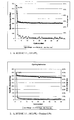
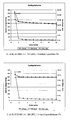
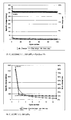
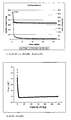
- Fig. 1 to 21 show the cycling behaviour for twenty-one different compositions of the electrolyte and eventually different anode and cathode materials.
- Fig. 22 shows a comparison of the first cycles of three cells (no. 1, 2 , and 5) .
- the figures 1 to 17 and 19 to 21 show with respect to the abscissa the number of charge/discharge cycles.
- the left ordinate gives the specific charge of the electroactive material in Ah/kg and the graph for charge and discharge cycles are the line having square symbols and rhombus symbols resp.
- the right ordinate gives the irreversible charge loss and the graph for this is the line having asterisk symbols.
- the figures 18 and 22 show with respect to the abscissa the specific charge of the cell in Ah/kg.
- the ordinate gives the voltage of the cell in V vs. Li/Li + .
Landscapes
- Chemical & Material Sciences (AREA)
- Inorganic Chemistry (AREA)
- Chemical Kinetics & Catalysis (AREA)
- Electrochemistry (AREA)
- General Chemical & Material Sciences (AREA)
- Physics & Mathematics (AREA)
- Condensed Matter Physics & Semiconductors (AREA)
- General Physics & Mathematics (AREA)
- Engineering & Computer Science (AREA)
- Manufacturing & Machinery (AREA)
- Secondary Cells (AREA)
Abstract
It is the aim of the present invention to retain the benefits
of a lithium ion cell capable of operating at temperatures
down to as low as about -40°C while minimizing the permanent
cycle capacity loss under the circumstance of establishing the
first cycle irreversible capacity loss at a tolerable level.
This aim is achieved by a non-aqueous electrolyte for a
rechargeable electrochemical cell, comprising
Surprisingly, these additives have the properties of
supporting the immediate generation of superior solid
electrolyte interphases on the carbon/graphite anode in order
to suppress its exfoliation when propylene carbonate is used
as a main organic compound. Depending on the choice for the
anode material which significantly has an impact on the
irreversible first cycle capacity loss, an electrochemical
cell equipped with this electrolyte maintains its capacity
over a comparably high number of charge/discharge cycles with
capacity losses far below 0.5% per cycle.
Description
- The invention relates to a non-aqueous electrolyte for a rechargeable electrochemical cell. Further, the invention relates to a non-aqueous electrolyte rechargeable electrochemical cell.
- Alkali metal rechargeable cells (named also alkali ion cells) such as the cell disclosed in the European
patent application EP 1 215 746 typically comprise a carbonaceous anode electrode and a lithiated cathode electrode. Due to the high potential of the cathode material (up to 4.3 V vs. Li/Li+ for Li1-xCoO2) and the low potential of the carbonaceous anode material (0.01 V vs. Li/Li+ for graphite) in a fully charged lithium ion cell, the choice of the electrolyte solvent system is limited. Since carbonate solvents have high oxidative stability toward typically used lithiated cathode materials and good kinetic stability toward carbonaceous anode materials, they are generally used in lithium ion cell electrolytes. To achieve optimum cell performance (high rate capability and long cycle life), solvent systems containing a mixture of a cyclic carbonate (high dielectric constant solvent) and a linear carbonate (low viscosity solvent) are typically used in commercial secondary cells. Cells with carbonate based electrolytes are known to deliver more than 1,000 charge/discharge cycles at room temperature. - A typical electrolyte involves the provision of ethylene carbonate (EC), dimethyl carbonate (DMC), ethyl methyl carbonate (EMC) and/or diethyl carbonate (DEC) as the solvent system for the activating electrolyte. However, lithium ion cell design generally involves a trade off in one area for a necessary improvement in another, depending on the targeted cell application. The achievement of a lithium-ion cell capable of low temperature cycleability by use of, e.g., the quaternary solvent electrolyte 1.0 M LiPF6/EC:DMC:EMC:DEC = 45:22:24.8:8.2 (as described in
EP 1 215 746), in place of a typically used binary solvent electrolyte (such as 1.0 M LiPF6/EC:DMC = 30:70, v/v which freezes at -11°C), is obtained at the expense of increased first cycle irreversible capacity during the initial charging (approximately 65 mAh/g graphite for 1.0 M LiPF6/EC:DMC:EMC:DEC = 45:22:24.8:8.2 vs. 35 mAh/g graphite for 1.0 M LiPF6/EC:DMC = 30:70). - Due to the existence of this first cycle irreversible capacity, lithium ion cells are generally cathode limited. Since all of the lithium ions, which shuttle between the anode and the cathode during charging and discharging originally come from the lithiated cathode, the larger the first cycle irreversible capacity, the lower the cell capacity in subsequent cycles and the lower the cell efficiency. Thus, it is desirable to minimize or even eliminate the first cycle irreversible capacity in lithium ion cells while at the same time maintaining the low temperature cycling capability of such cells.
- Therefore, it is commonly known that when an electrical potential is initially applied to lithium ion cells constructed with a carbon anode in a discharged condition to charge the cell, some permanent capacity loss occurs due to the anode surface passivation film formation. This permanent capacity loss is called first cycle irreversible capacity. The film formation process, however, is highly dependent on the reactivity of the electrolyte components at the cell charging potentials. The electrochemical properties of the passivation film are also dependent on the chemical composition of the surface film.
- The formation of a surface film is unavoidable for alkali metal systems, and in particular, lithium metal anodes and lithium intercalated carbon anodes due to the relatively low potential and high reactivity of lithium toward organic electrolytes. The surface film, known as the solid-electrolyte interphase (SEI), ideally should be electronically insulating and ionically conducting. While most alkali metal, alkali ion, and in particular, lithium (ion) electrochemical systems comprising one of several known electrolytes meet the first requirement, the second requirement is difficult to achieve. The resistance of these films is not negligible, and as a result, impedance builds up inside the cell due to this surface layer formation which induces unacceptable polarization during the charge and discharge of the lithium ion cell, especially at low temperature. On the other hand, if the SEI film is electronically conductive, the electrolyte decomposition reaction on the anode surface does not stop due to the low potential of the lithiated carbon electrode.
- Long term stability of the SEI film is another issue. If electrolyte components are able to penetrate through the SEI film, a constant loss of usable capacity, known as fading, occurs, limiting the life-time of the electrochemical system.
- Hence, the composition of the electrolyte has a significant influence on the charge/discharge efficiency of alkali metal systems, and particularly both the first irreversible capacity loss and subsequent permanent capacity loss in secondary cells. For example, when 1.0 M LiPF6/EC:DMC = 30:70 is used to activate a secondary cell, the first cycle irreversible capacity is approximately 35 mAh/g of graphite. However, under the same cycling conditions, the first cycle irreversible capacity is found to be approximately 65 mAh/g of graphite when 1.0 M LiPF6/EC:DMC:EMC:DEC = 45:22:24.8:8.2 is used as the electrolyte. In contrast, lithium ion cells activated with the binary solvent electrolyte of ethylene carbonate and dimethyl carbonate cannot be cycled at temperatures less than about -11°C. The quaternary solvent electrolyte of EC, DMC, EMC and DEC, which enables lithium ion cells to cycle at much lower temperatures, is a compromise in terms of providing a wider temperature application with acceptable cycling efficiencies.
- According to
EP 1 215 746, these objectives are achieved by adding a carbonate additive in the above described quaternary solvent electrolytes. In addition, this invention may be generalized to other nonaqueous organic electrolyte systems, such as binary solvent and ternary solvent systems, as well as the electrolyte systems containing solvents other than mixtures of linear or cyclic carbonates. For example, linear or cyclic ethers or esters may also be included as electrolyte components. Although the exact reason for the observed improvement is not clear, it is hypothesized that the carbonate additive competes with the existing electrolyte components to react on the carbon anode surface during initial lithiation to form a beneficial SEI film. The thusly formed SEI film is electronically more insulating than the film formed without the carbonate additive and, as a consequence, the lithiated carbon electrode is better protected from reactions with other electrolyte components. Therefore, lower first cycle irreversible capacity is obtained. - Unfortunately, even the cell comprising this type of improved electrolyte shows a non-negligible permanent capacity loss which is distressing since these losses occur significantly in the subsequent cycles following the first irreversible cycle loss event.
- Therefore, it is the aim of the present invention to retain the benefits of a lithium ion cell capable of operating at temperatures down to as low as about -40°C while minimizing the permanent cycle capacity loss under the circumstance to establish the first cycle irreversible capacity loss at a tolerable level.
- This aim is achieved according to the present invention by a non-aqueous electrolyte for a rechargeable electrochemical cell, comprising
- a) a film forming organic component;
- b) an alkali metal salt; and
- c) as additive a nitrogen-containing hetero-aromate and/or its derivatives and/or mixtures thereof.
-
- Alternatively or additionally, this aim is achieved according to the present invention by a non-aqueous electrolyte for a rechargeable electrochemical cell, comprising
- a) a film forming organic component;
- b) an alkali metal salt; and
- c) as additive a compound selected from a group containing aniline, pyrrole, 2-methyl-1-pyrroline, 1-methylpyrrolidine and 1-vinyle-2-pyrrolidine and/or mixtures thereof.
-
- Surprisingly, these additives have the properties of causing and/or supporting the immediate generation of superior solid electrolyte interphases on the carbon/graphite anode in order to suppress its exfoliation, in particular when propylene carbonate is used as the main electrolyte component. Depending on the choice for the anode material which significantly has an impact on the irreversible first cycle capacity loss, an electrochemical cell equipped with this electrolyte maintains its capacity over a comparably high number of charge/discharge cycles with capacity losses typically far below 0.5% per cycle.
- With respect to an advanced covering of the anode with the SEI, the film forming organic component may be selected from a group containing 1,2-dimethoxyethane, 2-methyl-tetrahydrofuran, ethylene carbonate, propylene carbonate, butylene carbonate, gamma-butyro lactone, methyl propionate and methyl lactate.
- In order to design the desired broad range of operating temperatures what in detail implies to design a proper viscosity for enhanced conductivity, beside the film forming organic component an organic co-solvent is comprised selected from a group containing acyclic organic carbonates, such as dimethyl carbonate, ethyl methyl carbonate, diethyl carbonate, methyl propyl carbonate, butyl methyl carbonate and its isomers, and others, or mixtures thereof.
- Suitable alkali metal salts are selected from a group containing LiPF6, LiClO4, LiAsF6, LiBF4, LiCF3SO3, LiN(CF3SO2)2, LiSbF6, LiAlCl4, LiGaCl4, LiNO3, LiSCN, LiO3SCF2CF3, LiC6F5SO3, LiO2CCF3, LiFSO3, LiB(C6H5)4, LiB(C2O4)2, and lithium fluoroalkyl-phosphates, and others, or mixtures thereof. Suitable salt concentrations typically range between 0.1 molar and the physical solubility limits, preferably about 0.5 to 2 molar.
- Suitable additives from the nitrogen-containing aromate type and/or its derivatives can be selected from a group containing pyridine, 2-picoline, 3-picoline, 4-picoline, 2-vinylpyridine, 4-vinylpyridine, and dimethylamino-pyridine (DMAP) and borane-pyridine-complex and, of course, mixtures thereof. Thereby, the amount of the additive may range between about 0.05 to 10 vol%.
- Superior electrolyte composition may comprise 20 to 70 vol% of ethylene carbonate and/or 20 to 70 vol% of dimethyl carbonate, lithium-hexafluorophosphate in the range of 0.5 to 2 mol/l, and 0.1 to 2.5 vol% of an additive, preferably 1 vol% 2-picoline.
- Another superior electrolyte composition may comprise propylene carbonate, lithium-hexafluorophosphate in the range of 0.5 to 2 mol/l, and 0.2 to 5 vol% of an additive, preferably 2 vol% pyridine. This electrolyte overcomes a preconception known in the art insofar as the prior art teaches that the use of propylene carbonate without an additional content of a film forming component inevitably leads to the exfoliation of the graphite anode. This exclusion is completely diametrally opposed against the existing request that the use of propylene carbonate would be highly appreciated due to its superior low and high temperature behaviour and to the desired use of un-expensive high-crystalline natural or synthetic graphites, which are by about a
factor 5 to 10 cheaper than carbons typically used in recent cell production. - Subsequently, an inventive non-aqueous electrolyte rechargeable electrochemical cell, such as an alkali metal ion accumulator, will comprise an anode, a cathode and an electrolyte,
- a) said anode comprises a carbonaceous electrode;
- b) said cathode comprises an electrode material containing alkali metal ions and/or being able to accommodate alkali metal ions; and
- c) said electrolyte having a composition according to any of
the
subsequent claims 1 to 10. -
- Examples of the invention are described in detail according to the drawings which show in a combined manner the cycling behaviour of distinct electrolyte compositions comprising the additives according to the present invention. For a person skilled in the art it is apparent that various variations and modifications are within the scope of the present invention.
- Fig. 1 to 21 show the cycling behaviour for twenty-one different compositions of the electrolyte and eventually different anode and cathode materials.
- Fig. 22 shows a comparison of the first cycles of three cells (no. 1, 2 , and 5) .
- The tables 1 and 2 below give an overview over the specific cell parameters of the 21 cells considered hereafter:
Specifications of graphite materials used Graphite BET [m2/g] d90 [µm] A 2 40 B 20 6 C 4.2 50.3 D 17 6.22 Specific cell parameters No. Graphite electrode Counter electrode Electrolyte Additive 1 A Li EC/DMC 1:1 , 1M LiPF6 --- 2 A Li EC/DMC 1:1 , 1M LiPF6 Pyridine, 0.5 % 3 A + B (10:1) Li EC/DMC 1:1 , 1M LiPF6 --- 4 A + B (10:1) Li EC/DMC 1:1 , 1M LiPF6 Pyridine, 1.0 % 5 A + B (10:1) Li EC/DMC 1:1 , 1M LiPF6 2-Picoline 1.0 % 6 A + B (10:1) Li EC/DMC 1:1 , 1M LiPF6 3-Picoline 1.0 % 7 A + B (10:1) Li EC/DMC 1:1 , 1M LiPF6 2-Vinylpyridine 0.2 % 8 A + B (10:1) Li EC/DMC 1:1 , 1M LiPF6 4-Vinylpyridine 1.0 % 9 A + B (10:1) Li EC/DMC 1:1 , 1M LiPF6 4-Vinylpyridine 0.2 % 10 A + B (10:1) Li EC/DMC 1:1 , 1M LiPF6 Pyrrole 0.2 % 11 A + B (10:1) Li EC/DMC 1:1 , 1M LiPF6 2-Methyl-1-pyrroline 3.0 % 12 A + B (10:1) Li EC/DMC 1:1 , 1M LiPF6 1-Vinyl-2-pyrrolidinone 1.0 % 13 A + B (10:1) Li EC/DMC 1:1 , 1M LiPF6 4-Dimethylamino-pyridine 1.0 % 14 C Li EC/DMC 1:1 , 1M LiPF6 --- 15 C Li EC/DMC 1:1 , 1M LiPF6 Pyridine 1.0 % 16 C Li EC/PC, 1M LiPF6 --- 17 C Li EC/PC, 1M LiPF6 Pyridine 2.0 % 18 D Li PC, 1M LiPF6 --- 19 D Li PC, 1M LiPF6 Pyridine 2.0 % 20 C LoCoO2 EC/DMC 1:1 , 1M LiPF6 --- 21 C LoCoO2 EC/DMC 1:1 , 1M LiPF6 Pyridine 1.0 % 22 Comparison of the first cycles of three cells (no. 1, 2, and 5) - The figures 1 to 17 and 19 to 21 show with respect to the abscissa the number of charge/discharge cycles. The left ordinate gives the specific charge of the electroactive material in Ah/kg and the graph for charge and discharge cycles are the line having square symbols and rhombus symbols resp. The right ordinate gives the irreversible charge loss and the graph for this is the line having asterisk symbols.
- The figures 18 and 22 show with respect to the abscissa the specific charge of the cell in Ah/kg. The ordinate gives the voltage of the cell in V vs. Li/Li+.
- Without going too much into detail, all graphs for experiments with additives show for the specific charge a relatively constant course in the region of about 350 to 370 Ah/kg what is extraordinary in comparison to the theoretical normative value of 372 Ah/kg for graphite. Additionally, all the curves for the irreversible loss show a course generally far below 1%. Some of the extraordinary results indicate losses which are hardly to observe due to convergence of the graph with the 0%-line.
Claims (11)
- A non-aqueous electrolyte for a rechargeable electrochemical cell, comprisinga) a film forming organic component;b) an alkali metal salt; andc) as additive a nitrogen-containing hetero-aromate and/or its derivatives and/or mixtures thereof.
- A non-aqueous electrolyte for a rechargeable electrochemical cell, comprisinga) a film forming organic component;b) an alkali metal salt; andc) an additive selected from a group containing aniline, pyrrole, 2-methyl-1-pyrroline, 1-methylpyrrolidine and 1-vinyle-2-pyrrolidinone.
- The electrolyte according to claim 1,
characterized in that
the nitrogen-containing aromate and/or its derivatives are selected from a group containing pyridine, 2-picoline, 3-picoline, 4-picoline, 2-alkyl-pyridine, 3-alkyl-pyridine, 4-alkyl-pyridine, 2-vinylpyridine, 4-vinylpyridine, and dimethylamino-pyridine (DMAP), and boran-pyridine-complex or mixtures thereof. - The electrolyte according to any of the preceding claims, characterized in that
the amount of the additive range from 0.05 to 10 vol%, preferably from 0.1 to 5 vol%. - The electrolyte according to any of the preceding claims, characterized in that
the film forming organic component is one or more compound selected from a group containing 1,2-dimethoxyethane, 2-methyl tetrahydrofuran, ethylene carbonate and propylene carbonate, butylene carbonate, gamma-butyro lactone, methyl propionate and methyl lactate. - The electrolyte according to any of the preceding claims, characterized in that
beside the film forming organic component an organic co-solvent is comprised, preferably selected from a group containing acyclic organic carbonates, such as dimethyl carbonate, ethyl methyl carbonate, diethyl carbonate, methyl propyl carbonate, butyl methyl carbonate or its isomers, or others, or mixtures thereof. - The electrolyte according to any of the preceding claims, characterized in that
the alkali metal salt is selected from a group containing lithium hexafluorophosphate (LiPF6), lithium perchlorate (LiClO4), lithium hexafluoroarsenate (LiAsF6), lithium hexafluorostibate(LiSbF6), lithium tetrachloroaluminate (LiAlCl4), lithium tetrachlorogallate (LiGaCl4), lithium nitrate (LiNO3), lithium thiocyanate (LiSCN), lithium pentafluoroethanesulfonate (LiO3SCF2CF3), lithium pentafluorobenzensulfonate (LiC6F5SO3), lithium trifluoroacetate (LiO2CCF3), lithium fluorosulfonate (LiFSO3), lithium tetraphenylborate (LiB(C6H5)4), lithium tetrafluoroborate (LiBF4), lithium trifluoromethanesulfonate (LiCF3SO3) and lithium bis(trifluoromethanesulfonyl)imide (LiN(CF3SO2)2), lithium organoborates (e.g. litium-bis (oxalate)borate (LiB(C2O4)2)), lithium fluoroalkyl-phosphates, or mixtures thereof. - The electrolyte according to claim 7,
characterized in that
the concentration of the lithium salt is in the range starting at 0.1 molar up to the physical solubility limit, preferably 0.5 to 2 molar. - The electrolyte according to any of the preceding claims, characterized in that
comprised are: 20 to 70 vol% of ethylene carbonate and/or 20 to 70 vol% of an acyclic carbonate, a lithium salt, preferably lithium hexafluorophoshate, in the range of 0.5 to 2 mol/l, and 0.1 to 2.5 vol% of the additive, preferably 1 vol% 2-picoline. - The electrolyte according to any of the preceding claims 1 to 8, characterized in that
comprised are: propylene carbonate, a lithium salt, preferably lithium hexafluorophosphate, in the range of 0.5 to 2 mol/l, and 0.2 to 5 vol% of the additive, preferably 2 vol% pyridine. - A non-aqueous electrolyte rechargeable electrochemical cell, such as an alkali metal ion accumulator, comprising an anode, a cathode and an electrolyte,a) said anode comprises a carbonaceous electrode;b) said cathode comprises an electroactive material containing and/or accommodating alkali metal ions;c) said electrolyte having a composition according to any of the preceding claims 1 to 10.
Priority Applications (2)
| Application Number | Priority Date | Filing Date | Title |
|---|---|---|---|
| EP04006038A EP1564832A1 (en) | 2004-02-13 | 2004-03-13 | A non-aqueous electrolyte for a rechargeable electrochemical cell and non-aqueous electrolyte rechargeable electrochemical cell |
| PCT/EP2004/014405 WO2005081355A1 (en) | 2004-02-13 | 2004-12-17 | A non-aqueous electrolyte for a rechargeable electrochemical cell and non-aqueous electrolyte rechargeable electrochemical cell |
Applications Claiming Priority (3)
| Application Number | Priority Date | Filing Date | Title |
|---|---|---|---|
| EP04003250 | 2004-02-13 | ||
| EP04003250 | 2004-02-13 | ||
| EP04006038A EP1564832A1 (en) | 2004-02-13 | 2004-03-13 | A non-aqueous electrolyte for a rechargeable electrochemical cell and non-aqueous electrolyte rechargeable electrochemical cell |
Publications (1)
| Publication Number | Publication Date |
|---|---|
| EP1564832A1 true EP1564832A1 (en) | 2005-08-17 |
Family
ID=34702380
Family Applications (1)
| Application Number | Title | Priority Date | Filing Date |
|---|---|---|---|
| EP04006038A Withdrawn EP1564832A1 (en) | 2004-02-13 | 2004-03-13 | A non-aqueous electrolyte for a rechargeable electrochemical cell and non-aqueous electrolyte rechargeable electrochemical cell |
Country Status (2)
| Country | Link |
|---|---|
| EP (1) | EP1564832A1 (en) |
| WO (1) | WO2005081355A1 (en) |
Cited By (2)
| Publication number | Priority date | Publication date | Assignee | Title |
|---|---|---|---|---|
| JP2019073433A (en) * | 2017-10-11 | 2019-05-16 | ダイキン工業株式会社 | Method for producing lithium fluorosulfonate |
| US20230223595A1 (en) * | 2022-01-11 | 2023-07-13 | U.S. Army DEVCOM, Army Research Laboratory | Heterocyclic Electrolyte Additives for Rechargeable Metal Batteries |
Citations (8)
| Publication number | Priority date | Publication date | Assignee | Title |
|---|---|---|---|---|
| JPS62160671A (en) * | 1986-01-07 | 1987-07-16 | Toshiba Corp | Nonaqueous solvent secondary battery |
| JPH06349523A (en) * | 1993-06-10 | 1994-12-22 | Fuji Photo Film Co Ltd | Nonaqueous battery |
| JPH0765863A (en) * | 1993-08-24 | 1995-03-10 | Fuji Photo Film Co Ltd | Nonaqueous battery |
| EP0785586A1 (en) * | 1996-01-17 | 1997-07-23 | Fuji Photo Film Co., Ltd. | Non-aqueous-electrolyte secondary battery |
| EP0980108A1 (en) * | 1998-08-13 | 2000-02-16 | Wilson Greatbatch Limited | Nonaqueous organic electrolytes for low temperature discharge of rechargeable electrochemical cells |
| EP0996187A1 (en) * | 1998-10-22 | 2000-04-26 | Wilson Greatbatch Ltd. | Organic carbonate additives for nonaqueous electrolyte rechargeable cells |
| EP1215746A1 (en) * | 2000-12-15 | 2002-06-19 | Wilson Greatbatch Ltd. | Organic carbonate additives for nonaqueous electrolyte rechargeable electrochemical cells |
| JP2004071577A (en) * | 2003-08-22 | 2004-03-04 | Ube Ind Ltd | Non-aqueous electrolyte |
-
2004
- 2004-03-13 EP EP04006038A patent/EP1564832A1/en not_active Withdrawn
- 2004-12-17 WO PCT/EP2004/014405 patent/WO2005081355A1/en not_active Ceased
Patent Citations (8)
| Publication number | Priority date | Publication date | Assignee | Title |
|---|---|---|---|---|
| JPS62160671A (en) * | 1986-01-07 | 1987-07-16 | Toshiba Corp | Nonaqueous solvent secondary battery |
| JPH06349523A (en) * | 1993-06-10 | 1994-12-22 | Fuji Photo Film Co Ltd | Nonaqueous battery |
| JPH0765863A (en) * | 1993-08-24 | 1995-03-10 | Fuji Photo Film Co Ltd | Nonaqueous battery |
| EP0785586A1 (en) * | 1996-01-17 | 1997-07-23 | Fuji Photo Film Co., Ltd. | Non-aqueous-electrolyte secondary battery |
| EP0980108A1 (en) * | 1998-08-13 | 2000-02-16 | Wilson Greatbatch Limited | Nonaqueous organic electrolytes for low temperature discharge of rechargeable electrochemical cells |
| EP0996187A1 (en) * | 1998-10-22 | 2000-04-26 | Wilson Greatbatch Ltd. | Organic carbonate additives for nonaqueous electrolyte rechargeable cells |
| EP1215746A1 (en) * | 2000-12-15 | 2002-06-19 | Wilson Greatbatch Ltd. | Organic carbonate additives for nonaqueous electrolyte rechargeable electrochemical cells |
| JP2004071577A (en) * | 2003-08-22 | 2004-03-04 | Ube Ind Ltd | Non-aqueous electrolyte |
Non-Patent Citations (6)
| Title |
|---|
| J.ELECTROCHEM.SOC., vol. 144, no. 6, 1997, London, pages 1944 - 1948, XP002330863 * |
| PATENT ABSTRACTS OF JAPAN vol. 011, no. 400 (E - 569) 26 December 1987 (1987-12-26) * |
| PATENT ABSTRACTS OF JAPAN vol. 1995, no. 03 28 April 1995 (1995-04-28) * |
| PATENT ABSTRACTS OF JAPAN vol. 1995, no. 06 31 July 1995 (1995-07-31) * |
| PATENT ABSTRACTS OF JAPAN vol. 2003, no. 12 5 December 2003 (2003-12-05) * |
| YOSHIHARU MATSUDA ET AL: "ORGANIC ADDITIVES FOR THE ELECTROLYTES OF RECHARGEABLE LITHIUM BATTERIES", 16 May 1989, JOURNAL OF POWER SOURCES, ELSEVIER SEQUOIA S.A. LAUSANNE, CH, PAGE(S) 579-583, ISSN: 0378-7753, XP000235220 * |
Cited By (2)
| Publication number | Priority date | Publication date | Assignee | Title |
|---|---|---|---|---|
| JP2019073433A (en) * | 2017-10-11 | 2019-05-16 | ダイキン工業株式会社 | Method for producing lithium fluorosulfonate |
| US20230223595A1 (en) * | 2022-01-11 | 2023-07-13 | U.S. Army DEVCOM, Army Research Laboratory | Heterocyclic Electrolyte Additives for Rechargeable Metal Batteries |
Also Published As
| Publication number | Publication date |
|---|---|
| WO2005081355A1 (en) | 2005-09-01 |
Similar Documents
| Publication | Publication Date | Title |
|---|---|---|
| KR100536196B1 (en) | A non-aqueous electrolyte and a lithium secondary battery comprising the same | |
| US7524579B1 (en) | Non-aqueous solvent electrolyte battery with additive alkali metal salt of a mixed anhydride combination of oxalic acid and boric acid | |
| KR101822064B1 (en) | Nonaqueous electrolyte and lithium secondary battery comprising the same | |
| EP3648233B1 (en) | Non-aqueous electrolyte solution for lithium secondary battery and lithium secondary battery comprising the same | |
| EP2206189B1 (en) | Non-aqueous electrolyte lithium secondary battery | |
| EP3076472B1 (en) | Nonaqueous electrolyte solution and lithium secondary battery containing same | |
| US8338030B2 (en) | Non-aqueous electrolyte secondary battery | |
| EP2490292B1 (en) | Electrolyte for a rechargeable lithium battery, and rechargeable lithium battery including the same | |
| KR20190054973A (en) | Electrolyte for lithium secondary battery, and lithium secondary battery comprising the same | |
| US9865900B2 (en) | Solid electrolyte interphase film-suppression additives | |
| EP2733780A2 (en) | Nonaqueous electrolyte and lithium secondary battery using same | |
| EP4303980A1 (en) | Electrolyte solution for secondary battery, and secondary battery comprising same | |
| US20060194119A1 (en) | Lithium secondary battery with high performance | |
| US8586249B2 (en) | Electrolyte for lithium ion secondary battery and lithium ion secondary battery including the same | |
| KR102736128B1 (en) | Non-aqueous electrolyte for lithium secondary battery and lithium secondary battery comprising the same | |
| US20110207000A1 (en) | Nitrile additive for non-aqueous electrolyte rechargeable electrochemical cells | |
| Ehteshami et al. | Ethylene carbonate-free, adiponitrile-based electrolytes compatible with graphite anodes | |
| EP3783722B1 (en) | Non-aqueous electrolyte for lithium secondary battery and lithium secondary battery comprising same | |
| EP1564832A1 (en) | A non-aqueous electrolyte for a rechargeable electrochemical cell and non-aqueous electrolyte rechargeable electrochemical cell | |
| US20050053838A1 (en) | Non-aqueous electrolyte secondary battery | |
| EP4037053B1 (en) | Non-aqueous electrolyte for lithium secondary battery and lithium secondary battery comprising same | |
| KR20200041171A (en) | Non-aqueous electrolyte solution and lithium secondary battery comprising the same | |
| KR20190033004A (en) | Electrolyte agent and lithium secondary battery comprising the same | |
| KR20230129746A (en) | Nonaqueous electrolyte composition and lithium secondary battery containing the same | |
| KR100370384B1 (en) | Non-aqueous electrolyte solution for lithium battery |
Legal Events
| Date | Code | Title | Description |
|---|---|---|---|
| PUAI | Public reference made under article 153(3) epc to a published international application that has entered the european phase |
Free format text: ORIGINAL CODE: 0009012 |
|
| AK | Designated contracting states |
Kind code of ref document: A1 Designated state(s): AT BE BG CH CY CZ DE DK EE ES FI FR GB GR HU IE IT LI LU MC NL PL PT RO SE SI SK TR |
|
| AX | Request for extension of the european patent |
Extension state: AL LT LV MK |
|
| AKX | Designation fees paid | ||
| STAA | Information on the status of an ep patent application or granted ep patent |
Free format text: STATUS: THE APPLICATION IS DEEMED TO BE WITHDRAWN |
|
| 18D | Application deemed to be withdrawn |
Effective date: 20060220 |
|
| REG | Reference to a national code |
Ref country code: DE Ref legal event code: 8566 |