EP1564636A1 - Tape drive apparatus for storing boot image data and for booting the system. - Google Patents
Tape drive apparatus for storing boot image data and for booting the system. Download PDFInfo
- Publication number
- EP1564636A1 EP1564636A1 EP04106650A EP04106650A EP1564636A1 EP 1564636 A1 EP1564636 A1 EP 1564636A1 EP 04106650 A EP04106650 A EP 04106650A EP 04106650 A EP04106650 A EP 04106650A EP 1564636 A1 EP1564636 A1 EP 1564636A1
- Authority
- EP
- European Patent Office
- Prior art keywords
- data
- boot image
- image data
- storage location
- tape
- Prior art date
- Legal status (The legal status is an assumption and is not a legal conclusion. Google has not performed a legal analysis and makes no representation as to the accuracy of the status listed.)
- Granted
Links
Images

Classifications
-
- G—PHYSICS
- G06—COMPUTING OR CALCULATING; COUNTING
- G06F—ELECTRIC DIGITAL DATA PROCESSING
- G06F9/00—Arrangements for program control, e.g. control units
- G06F9/06—Arrangements for program control, e.g. control units using stored programs, i.e. using an internal store of processing equipment to receive or retain programs
- G06F9/44—Arrangements for executing specific programs
- G06F9/4401—Bootstrapping
-
- G—PHYSICS
- G06—COMPUTING OR CALCULATING; COUNTING
- G06F—ELECTRIC DIGITAL DATA PROCESSING
- G06F11/00—Error detection; Error correction; Monitoring
- G06F11/07—Responding to the occurrence of a fault, e.g. fault tolerance
- G06F11/14—Error detection or correction of the data by redundancy in operations
- G06F11/1446—Point-in-time backing up or restoration of persistent data
Definitions
- the present invention relates to the field of data backup and recovery, and more particularly without limitation to tape drives.
- Backup application software which executes on the computer system typically provides the functions for enabling such computer system data to be both backed-up to, and restored from, tape media, which is written to and read from by a tape drive.
- Well-known backup application software includes 'Replica TM, from Stac, 'ArcServe TM, from Computer Associates, 'BackupExec TM, from Veritas and 'Data Protector TM, from HP.
- Well-known tape drives include DDS TM and LTO TM compliant tape drives, both available from HP.
- a priority is to rebuild a working system as soon as possible. This requires the computer hardware to be restored to the same state as it was before the disaster, which can take hours or even days, even before the file system can be restored. Generally, a significant amount of human intervention is required to complete this process.
- a backup application software provides a so-called disaster recovery (DR) solution, which enables a computer system to be restored in an expedited manner to a state which existed before a disaster occurred.
- DR disaster recovery
- Such a scheme typically involves at least installing and configuring a minimal operating system, tape drivers and the backup application software (or the requisite parts thereof) itself.
- DR floppy disks may be used to boot the computer system, when it is not possible to boot from the hard disk drive, and execute application software for recovering a backed-up copy of the file system from tape media.
- the DR floppy disks typically load and execute a minimal version of the operating system along with components of application software comprising DR functionality, thus providing sufficient functionality, for example, for the computer to build new disk partitions, access a tape drive and restore the data from tape media.
- the DR operating system is required to reflect the exact hardware configuration of the computer system on which it is to be installed, otherwise it would not be possible to communicate with storage devices such as tape drives.
- DR floppy disks need to be regenerated by a user whenever the system hardware configuration changes, and particularly when a SCSI (Small Computer Systems Interface) configuration changes. For example, if a new SCSI Host Bus Adaptor (HBA) is added to a server, with a respective new device driver, this device driver needs to be added to the DR floppy disks so that the new SCSI HBA is recognised when rebuilding the computer system.
- HBA Host Bus Adaptor
- IPLD 'initial program load devices'
- BAIDS BIOS Aware Initial Program Load Devices
- an IPLD can be virtually any device that has the ability to load and execute a PC operating system.
- the 'El Torito' bootable CD-ROM Format Specification provides the ability to catalogue boot images and to selectively boot from any single image stored on a CD-ROM.
- a BIOS with multiple boot-image capability can access any one of a number of bootable disc images listed in the booting catalogue stored on the CD-ROM.
- the boot-catalogue is a collection of 20 byte entries including a validation entry, an initial/default entry, a section entry, and section entry extension.
- the boot catalogue allows a computer system to pick a proper boot image and then to boot from the selected image.
- US 5,727,213 specifies that, to read boot record data from a CD-ROM, read commands directed to the floppy disk drive need to be re-directed to the CD-ROM drive during a read data part of the boot process.
- a modified SCSI driver of the PC needs to convert the 512 byte sectors conventionally used by hard disk and floppy disk into 2 Kbytes sectors conventionally used by a CD-ROM drive.
- WO00/08561 the entirety of which is herein incorporated by reference shows a tape drive configured to operate as a bootable device for a PC.
- the tape drive has two modes of operation: the first mode in which it operates as a normal tape drive and the second in which it emulates a bootable CD-ROM drive.
- Firmware provides both the normal mode of operation, in which the tape drive behaves as a tape drive, and the disaster recovery (DR) mode of operation, in which the tape drive is arranged to emulate a CD-ROM drive.
- the CD-ROM drive emulation is achieved in part by configuring the tape drive to identify itself to the PC as a CD-ROM drive.
- the tape drive can act as an 'initial program load device' (IPLD).
- Whether the tape drive operates in normal mode or DR mode is determined by user selection.
- the user selection of mode may be performed without the need for any additional tape drive hardware by using the tape drive eject button; when the tape drive is powered on the eject button held down, the DR mode of operation is selected, otherwise the normal mode is selected.
- DR mode can be selected by holding the eject button down for a long time period (such as 5 seconds), when the tape drive is already powered on, by the firmware which checks the length of the period the eject button is held down to determine whether the operation is an eject or the user selecting DR mode.
- US patent application publication number 2002/00163760A1 shows a tape drive with control electronics adapted to determine that a tape cartridge is write-protected.
- the tape drive is configured as a bootable device in response to a disaster recovery request.
- This has the drawback that any write-protected tape cartridge is classified as containing bootable data even if this is not the case.
- Another disadvantage is that a disaster recovery request is required.
- the present invention provides for a sequential storage device and a method of storing boot image data using a sequential storage device, such as a tape drive.
- Boot image data that is received by the sequential storage device is transferred to a sequential storage medium.
- Further indicator data indicative that the data transferred to the sequential storage medium is boot image data is transferred to a non-volatile storage location.
- the sequential storage medium itself is used as the non-volatile memory for storing of the data indicative of the boot image data.
- a cartridge memory of the sequential storage medium is used for storing the data indicative of the boot image data.
- the data indicative of the boot image data is stored in a predefined storage location of the non-volatile memory.
- backup data is received from a computer, such as a media server computer or directly from the computer having a primary storage to be backed up.
- the sequential storage device makes a determination whether the backup data is boot image data or not. In case the backup data is in fact boot image data a corresponding tag or flag is stored in the predetermined storage location of the non-volatile memory.
- the data indicative of the boot image data is stored in the non-volatile memory in response to an external command.
- the external command is sent from a backup application program in order to set the tag or flag on the predetermined storage location of the non-volatile memory.
- the invention provides for a method of booting from a sequential storage device.
- the non-volatile memory of the sequential storage medium loaded in the sequential storage device is read in order to determine whether boot image data is stored on the sequential storage medium. If this is the case the sequential storage device starts emulating a bootable device.
- a tape library comprises at least one tape drive apparatus of the invention.
- the individual tape drives are often not conveniently accessible.
- the eject button of a tape drive in a tape library may not be conveniently accessible by a user.
- the present invention is particularly advantageous in that it facilitates use of a tape drive as a bootable device without any manual intervention by a user in a tape library.
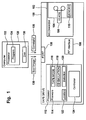
- Figure 1 shows tape drive 100 having tape mechanism 102 that loads and ejects tape media 104 and winds the tape media 104 forwards or backwards as required for reading and writing data.
- tape drive 100 In an LTO (Linear Tape Open) tape drive, the tape is moved past the read/write heads 106 in a linear recording motion known as serpentine recording.
- Tape drive 100 has RF interface 108 that serves to communicate with cartridge memory 110 of tape media 104.
- RF interface 108 is compliant with the LTO specification.
- Firmware 114 comprises instructions 116 for providing the normal mode of operation in which the tape drive 100 behaves as a tape drive, and instructions 118 for emulation of a bootable device.
- instructions 118 provide an emulation of a CD-ROM drive in accordance with the 'El Torito' specification.
- firmware 114 comprises instructions 120 for detecting of boot image data stored on tape media 104.
- a location indication 122 that identifies a predetermined storage location is also comprised in firmware 114.
- location indication 122 can be a offset in order to indicate a position on the tape media where the tag indicating the presence of boot image data is stored.
- location indication 122 points to a storage location of cartridge memory 110.
- Further processor 112 runs control program 124 that controls operation of tape drive 100.
- Tape drive 100 has port 126 for coupling of tape drive 100 to computer 128.
- Computer 128 has primary storage provided by disk 130 that requires backup.
- Further computer 128 has processor 132 that runs backup application program 134.
- tape media 104 is loaded into mechanism 102 of tape drive 100.
- Backup application program 134 reads data stored on disk 130 in order to provide boot image data 136 to tape drive 100.
- Tape drive 100 receives boot image data 136 at its port 126.
- tape drive 100 is in its default tape drive mode instructions 116 are executed which sequentially store boot image data 136 on tape media 104. Further backup application program 134 sends command 138 to tape drive 100 that is also received at port 126. In response to command 138 instructions 116 store a tag on the storage location as indicated by location indication 122.
- This tag marks tape media 104 as containing boot image data.
- location indication 122 points to a location on the tape the tag is stored on this tape location. If location indication 122 points to a location of cartridge memory 110 the tag is stored in cartridge memory 110, in the case of LTO by means of RF interface 108.
- command 138 instructions 116 examine the backup data received from backup application program 134 for the presence of boot image data 136. If boot image data 136 is identified in the data stream received from backup application program 134 the tag is stored on the location as indicated by location indication 122. In this instance it is not necessary that backup application program 134 sends command 138 as tape drive 100 itself makes a determination whether it receives normal backup data or boot image data from backup application program 134. In either case, as a result tape media 104 is obtained that stores boot image data 136.
- disk 130 In case the data stored on disk 130 of computer 128 is lost, e.g. due to a failure of disk 130, disk 130 is replaced by a new disk.
- tape media 104 with the stored boot image 136 is loaded into tape drive 100. Loading of tape media 104 invokes instructions 120 that read the memory location as defined by location indication 122.
- tape media 104 is read as at an offset position given by location indication 122 or a memory location of cartridge memory 110 is read by means of RF interface 108.
- boot image data 136 has been stored on tape media 104 instructions 120 detect the corresponding tag.
- tape drive 100 appears like a CD-ROM drive at its port 126.
- Next computer 128 is switched on. When computer 128 boots it checks its local disk 130 for the presence of a boot image. As disk 130 has been replaced no such bootable data is found. As a consequence computer 128 goes on and checks the emulated CD-ROM device at port 126 for the presence of a boot image. In response to the corresponding inquiry command the bootable data is read by tape drive 100 from tape media 104. The bootable data is output at port 126 by the CD-ROM emulation provided by instructions 118 such that computer 128 can boot from tape drive 100.
- tape media 104 is compliant with the ULTRIUM LTO standard.
- Such tape cartridges are commercially available from Hewlett Packard (www.hp.com/go/ultrium).
- cartridge memory 110 is implemented as an intelligent memory chip embedded in the cartridge, referred to as the LTO-CM. It uses RF interface 108 that eliminates the need for a physical power or signal or connection between tape media 104 and tape drive 100.
- the LTO-CM is used for storing information which in other tape formats may be stored in the header at the beginning of the tape.
- computer 128 can be a media server computer. In this instance computer 128 receives backup data from other computers connected to it which computer 128 then provides as bootable data to tape drive 100.
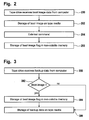
- FIG 2 shows a flowchart illustrating one method of operating tape drive 100 of Figure 1.
- the tape drive receives boot image data from a computer that is connected to it.
- the boot image data is stored on tape media loaded into the tape drive.
- the tape drive receives an external command from the computer.
- the external command indicates that boot image data has been provided in step 200.
- the tape drive stores a tag that indicates the presence of boot image data on the tape media.
- the tag is stored in non-volatile memory associated with the tape media, e.g. on the tape media itself or the cartridge memory of the tape media (step 206).
- FIG. 3 shows an alternative method.
- backup data is received by the tape drive.
- the tape drive checks whether the backup data is normal backup data or boot image data. This determination can be performed based on the format of the received backup data. If the backup data is not boot image data the control goes to step 306 where the backup data is stored on the tape media. In case the backup data is in fact boot image data the control goes to step 304.
- a tag is stored in non-volatile memory, e.g. on the tape media itself or the cartridge memory of the tape media.
- step 306 is performed in order to store the backup data containing the boot image data on the tape media.
- Figure 4 illustrates a disaster recovery operation. For example a computer is lost or stolen and needs replacement.
- the replacement computer is connected to the tape drive.
- the tape media is loaded into the tape drive.
- the tape media stores the boot image that has been created in accordance with the methods of Figure 2 or 3.
- step 404 the tape drive checks whether the boot image tag in the non-volatile memory is set or not. If the boot image tag is not set the tape drive continues to operate in its normal tape drive mode (step 406). However, in the case considered here the tape media does in fact contain boot image data and the boot image tag is thus set. As a consequence the tape drive starts emulation of an initial program load device (IPLD), such as a CD-ROM (step 408). This way the boot image data stored on the tape media is provided to the replacement computer in step 410 in order to perform the disaster recovery.
- IPLD initial program load device
Landscapes
- Engineering & Computer Science (AREA)
- Theoretical Computer Science (AREA)
- Software Systems (AREA)
- Physics & Mathematics (AREA)
- General Engineering & Computer Science (AREA)
- General Physics & Mathematics (AREA)
- Computer Security & Cryptography (AREA)
- Quality & Reliability (AREA)
- Stored Programmes (AREA)
Abstract
Description
- Figure 1
- is a schematic block diagram showing a tape drive coupled to a computer,
- Figure 2
- is a flow diagram illustrating the steps involved in storing a boot image on tape media,
- Figure 3
- is a flow diagram illustrating an alternative embodiment for storing a boot image on tape media,
- Figure 4
- is a flow diagram illustrating the steps involved in booting from the tape drive.
- 100
- tape drive
- 102
- tape mechanism
- 104
- tape media
- 106
- read/write heads
- 108
- RF interface
- 110
- cartridge memory
- 112
- processor
- 114
- firmware
- 116
- instructions
- 118
- instructions
- 120
- instructions
- 122
- location indication
- 124
- control program
- 126
- port
- 128
- computer
- 130
- disk
- 132
- processor
- 134
- backup application program
- 136
- boot image data
- 138
- command
Claims (35)
Applications Claiming Priority (2)
| Application Number | Priority Date | Filing Date | Title |
|---|---|---|---|
| GB0329574A GB2409328A (en) | 2003-12-20 | 2003-12-20 | Boot indicator for sequential access storage device |
| GB0329574 | 2003-12-20 |
Publications (2)
| Publication Number | Publication Date |
|---|---|
| EP1564636A1 true EP1564636A1 (en) | 2005-08-17 |
| EP1564636B1 EP1564636B1 (en) | 2008-09-10 |
Family
ID=30776199
Family Applications (1)
| Application Number | Title | Priority Date | Filing Date |
|---|---|---|---|
| EP04106650A Expired - Lifetime EP1564636B1 (en) | 2003-12-20 | 2004-12-16 | Tape drive apparatus for storing boot image data and for booting the system |
Country Status (4)
| Country | Link |
|---|---|
| US (1) | US20050166010A1 (en) |
| EP (1) | EP1564636B1 (en) |
| DE (1) | DE602004016453D1 (en) |
| GB (1) | GB2409328A (en) |
Families Citing this family (6)
| Publication number | Priority date | Publication date | Assignee | Title |
|---|---|---|---|---|
| US7814260B2 (en) * | 2005-03-09 | 2010-10-12 | Bakbone Software, Inc. | Tape image on non-tape storage device |
| GB2431748B (en) | 2005-10-31 | 2010-12-22 | Hewlett Packard Development Co | Data back-up and recovery |
| US8131263B2 (en) * | 2006-12-06 | 2012-03-06 | Microsoft Corporation | Backup media with wireless identifications tags |
| TWI386847B (en) * | 2009-02-04 | 2013-02-21 | Novatek Microelectronics Corp | Method of safe and recoverable firmware update and device using the same |
| US8909914B2 (en) | 2010-08-27 | 2014-12-09 | Raytheon Company | Controller and a method for controlling a boot process |
| CN109460241A (en) * | 2018-11-14 | 2019-03-12 | 深圳市网心科技有限公司 | A kind of pre-installation method, system, electronic equipment and the storage medium of operating system |
Citations (4)
| Publication number | Priority date | Publication date | Assignee | Title |
|---|---|---|---|---|
| US5727213A (en) * | 1993-09-10 | 1998-03-10 | Compaq Computer Corp. | Computer system capable of booting from CD-ROM and tape |
| EP0978785A1 (en) * | 1998-08-07 | 2000-02-09 | Hewlett-Packard Company | Data backup and recovery |
| US20020163760A1 (en) * | 2001-05-07 | 2002-11-07 | Lindsey Alan M. | Disaster recovery tape drive |
| GB2379060A (en) * | 1997-11-03 | 2003-02-26 | Iomega Corp | Computer recovery system using removable high capacity media |
Family Cites Families (2)
| Publication number | Priority date | Publication date | Assignee | Title |
|---|---|---|---|---|
| JP3994532B2 (en) * | 1998-07-24 | 2007-10-24 | ソニー株式会社 | Tape drive device |
| JP2002203210A (en) * | 2000-11-06 | 2002-07-19 | Sony Corp | Communication device for contactless semiconductor memory |
-
2003
- 2003-12-20 GB GB0329574A patent/GB2409328A/en not_active Withdrawn
-
2004
- 2004-12-16 DE DE602004016453T patent/DE602004016453D1/en not_active Expired - Lifetime
- 2004-12-16 EP EP04106650A patent/EP1564636B1/en not_active Expired - Lifetime
- 2004-12-20 US US11/015,866 patent/US20050166010A1/en not_active Abandoned
Patent Citations (4)
| Publication number | Priority date | Publication date | Assignee | Title |
|---|---|---|---|---|
| US5727213A (en) * | 1993-09-10 | 1998-03-10 | Compaq Computer Corp. | Computer system capable of booting from CD-ROM and tape |
| GB2379060A (en) * | 1997-11-03 | 2003-02-26 | Iomega Corp | Computer recovery system using removable high capacity media |
| EP0978785A1 (en) * | 1998-08-07 | 2000-02-09 | Hewlett-Packard Company | Data backup and recovery |
| US20020163760A1 (en) * | 2001-05-07 | 2002-11-07 | Lindsey Alan M. | Disaster recovery tape drive |
Also Published As
| Publication number | Publication date |
|---|---|
| US20050166010A1 (en) | 2005-07-28 |
| DE602004016453D1 (en) | 2008-10-23 |
| EP1564636B1 (en) | 2008-09-10 |
| GB0329574D0 (en) | 2004-01-28 |
| GB2409328A (en) | 2005-06-22 |
Similar Documents
| Publication | Publication Date | Title |
|---|---|---|
| JP4518672B2 (en) | System backup and restoration | |
| US8549236B2 (en) | Storage subsystem with multiple non-volatile memory arrays to protect against data losses | |
| KR101115486B1 (en) | Apparatus and method for controlling booting of computer system | |
| US8549237B2 (en) | Method and apparatus for use in data transfer | |
| JP2006164162A (en) | Copy control apparatus and method | |
| US7624243B2 (en) | Apparatus and method for protecting system data on computer hard-disk | |
| EP1564636B1 (en) | Tape drive apparatus for storing boot image data and for booting the system | |
| EP1596312A2 (en) | Tape drive apparatus, method and computer program product | |
| US20050114387A1 (en) | Data backup and recovery | |
| US7469261B2 (en) | Apparatus and method for protecting system data on computer hard-disk | |
| EP1528469B1 (en) | Tape Drive Apparatus | |
| US8914665B2 (en) | Reading or storing boot data in auxiliary memory of a tape cartridge | |
| JP3951808B2 (en) | Hard disk drive subsystem | |
| US7490196B2 (en) | Data backup using both tape and disk storage | |
| CN103700388A (en) | File recording apparatus, file system management method, file recovery method, and changer drive | |
| JP2006185374A (en) | Information processing apparatus capable of constructing array apparatus and disk drive recognition method in the apparatus | |
| JP3714145B2 (en) | Auxiliary storage device backup method | |
| JP2000020249A (en) | Data protecting method of disk device, disk device, and recording medium | |
| US20100142070A1 (en) | Storage system and operation method thereof | |
| JP2004021318A (en) | Disk array device and control method therefor | |
| JPH05127830A (en) | Multiplexing controller for hard disk |
Legal Events
| Date | Code | Title | Description |
|---|---|---|---|
| PUAI | Public reference made under article 153(3) epc to a published international application that has entered the european phase |
Free format text: ORIGINAL CODE: 0009012 |
|
| AK | Designated contracting states |
Kind code of ref document: A1 Designated state(s): AT BE BG CH CY CZ DE DK EE ES FI FR GB GR HU IE IS IT LI LT LU MC NL PL PT RO SE SI SK TR |
|
| AX | Request for extension of the european patent |
Extension state: AL BA HR LV MK YU |
|
| 17P | Request for examination filed |
Effective date: 20050727 |
|
| AKX | Designation fees paid |
Designated state(s): DE FR GB |
|
| GRAP | Despatch of communication of intention to grant a patent |
Free format text: ORIGINAL CODE: EPIDOSNIGR1 |
|
| RTI1 | Title (correction) |
Free format text: TAPE DRIVE APPARATUS FOR STORING BOOT IMAGE DATA AND FOR BOOTING THE SYSTEM |
|
| GRAS | Grant fee paid |
Free format text: ORIGINAL CODE: EPIDOSNIGR3 |
|
| GRAA | (expected) grant |
Free format text: ORIGINAL CODE: 0009210 |
|
| AK | Designated contracting states |
Kind code of ref document: B1 Designated state(s): DE FR GB |
|
| REG | Reference to a national code |
Ref country code: GB Ref legal event code: FG4D |
|
| REF | Corresponds to: |
Ref document number: 602004016453 Country of ref document: DE Date of ref document: 20081023 Kind code of ref document: P |
|
| PLBE | No opposition filed within time limit |
Free format text: ORIGINAL CODE: 0009261 |
|
| STAA | Information on the status of an ep patent application or granted ep patent |
Free format text: STATUS: NO OPPOSITION FILED WITHIN TIME LIMIT |
|
| 26N | No opposition filed |
Effective date: 20090611 |
|
| PGFP | Annual fee paid to national office [announced via postgrant information from national office to epo] |
Ref country code: FR Payment date: 20100106 Year of fee payment: 6 |
|
| REG | Reference to a national code |
Ref country code: FR Ref legal event code: ST Effective date: 20110831 |
|
| PG25 | Lapsed in a contracting state [announced via postgrant information from national office to epo] |
Ref country code: FR Free format text: LAPSE BECAUSE OF NON-PAYMENT OF DUE FEES Effective date: 20110103 |
|
| PGFP | Annual fee paid to national office [announced via postgrant information from national office to epo] |
Ref country code: GB Payment date: 20121227 Year of fee payment: 9 |
|
| PGFP | Annual fee paid to national office [announced via postgrant information from national office to epo] |
Ref country code: DE Payment date: 20121231 Year of fee payment: 9 |
|
| REG | Reference to a national code |
Ref country code: DE Ref legal event code: R119 Ref document number: 602004016453 Country of ref document: DE |
|
| GBPC | Gb: european patent ceased through non-payment of renewal fee |
Effective date: 20131216 |
|
| REG | Reference to a national code |
Ref country code: DE Ref legal event code: R119 Ref document number: 602004016453 Country of ref document: DE Effective date: 20140701 |
|
| PG25 | Lapsed in a contracting state [announced via postgrant information from national office to epo] |
Ref country code: DE Free format text: LAPSE BECAUSE OF NON-PAYMENT OF DUE FEES Effective date: 20140701 |
|
| PG25 | Lapsed in a contracting state [announced via postgrant information from national office to epo] |
Ref country code: GB Free format text: LAPSE BECAUSE OF NON-PAYMENT OF DUE FEES Effective date: 20131216 |