EP1564489A1 - Spark igniter for gas turbine engine - Google Patents
Spark igniter for gas turbine engine Download PDFInfo
- Publication number
- EP1564489A1 EP1564489A1 EP05250729A EP05250729A EP1564489A1 EP 1564489 A1 EP1564489 A1 EP 1564489A1 EP 05250729 A EP05250729 A EP 05250729A EP 05250729 A EP05250729 A EP 05250729A EP 1564489 A1 EP1564489 A1 EP 1564489A1
- Authority
- EP
- European Patent Office
- Prior art keywords
- electrode
- igniter
- plasma
- gas turbine
- insulator
- Prior art date
- Legal status (The legal status is an assumption and is not a legal conclusion. Google has not performed a legal analysis and makes no representation as to the accuracy of the status listed.)
- Withdrawn
Links
- 239000012212 insulator Substances 0.000 claims abstract description 28
- 230000003628 erosive effect Effects 0.000 claims abstract description 24
- 239000007787 solid Substances 0.000 claims abstract description 14
- 238000009413 insulation Methods 0.000 claims abstract description 13
- 238000000034 method Methods 0.000 claims description 18
- 239000000446 fuel Substances 0.000 claims description 13
- 230000015556 catabolic process Effects 0.000 claims description 6
- 230000004044 response Effects 0.000 claims description 4
- 238000001514 detection method Methods 0.000 abstract description 3
- 239000007789 gas Substances 0.000 description 15
- 230000005684 electric field Effects 0.000 description 14
- RLQJEEJISHYWON-UHFFFAOYSA-N flonicamid Chemical compound FC(F)(F)C1=CC=NC=C1C(=O)NCC#N RLQJEEJISHYWON-UHFFFAOYSA-N 0.000 description 5
- 239000003574 free electron Substances 0.000 description 5
- 150000002500 ions Chemical class 0.000 description 5
- 239000000463 material Substances 0.000 description 4
- 230000015572 biosynthetic process Effects 0.000 description 3
- 230000008859 change Effects 0.000 description 3
- 239000000203 mixture Substances 0.000 description 3
- QVGXLLKOCUKJST-UHFFFAOYSA-N atomic oxygen Chemical compound [O] QVGXLLKOCUKJST-UHFFFAOYSA-N 0.000 description 2
- 239000001301 oxygen Substances 0.000 description 2
- 229910052760 oxygen Inorganic materials 0.000 description 2
- 230000004888 barrier function Effects 0.000 description 1
- 238000010891 electric arc Methods 0.000 description 1
- 238000009434 installation Methods 0.000 description 1
- 238000012423 maintenance Methods 0.000 description 1
- 238000004519 manufacturing process Methods 0.000 description 1
- 239000003550 marker Substances 0.000 description 1
- 239000002245 particle Substances 0.000 description 1
- 230000008569 process Effects 0.000 description 1
- 238000001228 spectrum Methods 0.000 description 1
Images


Classifications
-
- F—MECHANICAL ENGINEERING; LIGHTING; HEATING; WEAPONS; BLASTING
- F23—COMBUSTION APPARATUS; COMBUSTION PROCESSES
- F23Q—IGNITION; EXTINGUISHING-DEVICES
- F23Q3/00—Igniters using electrically-produced sparks
- F23Q3/006—Details
-
- F—MECHANICAL ENGINEERING; LIGHTING; HEATING; WEAPONS; BLASTING
- F02—COMBUSTION ENGINES; HOT-GAS OR COMBUSTION-PRODUCT ENGINE PLANTS
- F02C—GAS-TURBINE PLANTS; AIR INTAKES FOR JET-PROPULSION PLANTS; CONTROLLING FUEL SUPPLY IN AIR-BREATHING JET-PROPULSION PLANTS
- F02C7/00—Features, components parts, details or accessories, not provided for in, or of interest apart form groups F02C1/00 - F02C6/00; Air intakes for jet-propulsion plants
- F02C7/26—Starting; Ignition
- F02C7/264—Ignition
- F02C7/266—Electric
-
- H—ELECTRICITY
- H01—ELECTRIC ELEMENTS
- H01T—SPARK GAPS; OVERVOLTAGE ARRESTERS USING SPARK GAPS; SPARKING PLUGS; CORONA DEVICES; GENERATING IONS TO BE INTRODUCED INTO NON-ENCLOSED GASES
- H01T13/00—Sparking plugs
- H01T13/50—Sparking plugs having means for ionisation of gap
Definitions
- the invention relates to gas turbine engines, and igniters therein.
- FIG. 1 is a highly schematic illustration of a gas turbine engine 3, containing a combustor 6.
- Fuel 9 is sprayed into the combustor.
- An igniter 12 which functions in a roughly analogous manner to a spark plug in an automobile, produces a spark, or plasma discharge (not shown), which initially ignites the jet fuel.
- the igniter 12 can be repeatedly sparked thereafter, primarily as a safety measure. That is, in a modern engine, under normal circumstances, it is extremely unlikely for a flame-out to occur in the combustor 6. However, unexpected situations, such as an abrupt cross-wind, can affect the environment within the combustor, and resulting loss of flame.
- the igniter 12 may be activated when the aircraft enters a rain squall, or other situation which may disturb steady-state conditions in the combustor 6.
- the igniters 12 like all mechanical components, have useful lives which eventually expire, at which time the igniters must be replaced. However, this expiration-and-replacement can create a situation in aircraft which is expensive.
- a primary reason is that the approach of an igniter to the end of its lifetime is not marked by readily detectable events. That is, at some point, the igniter completely ceases to generate a plasma, or spark. However, prior to that point, the igniter may sporadically generate sparks.
- the sparking is not, in general, required to maintain the combustor flame. Consequently, the sporadic sparking would only be noticed if an actual flame-out occurred, and if the sporadic sparking were ineffective to induce a re-light. Since such a combination of events is seen as unlikely, the sporadic sparking is not readily noticed. The impending expiration of the useful life of the igniter is similarly not noticed.
- the aircraft in which the igniter is being replaced represents a revenue source measured in thousands of dollars per hour. If the aircraft is rendered non-functional for, say, two hours during replacement of an igniter, the revenue lost during that time is substantial.
- an auxiliary ground electrode is embedded within that insulator, and the erosion eventually exposes the auxiliary electrode.
- the igniter is designed so that the exposure occurs at the time when the igniter should be replaced.
- the exposed auxiliary ground electrode can be detected by the fact that, when a spark occurs, a small current travels through the auxiliary ground electrode. When that current is detected, its presence indicates the exposure. Alternately, the exposed auxiliary ground electrode can be visually detected by a human observer, perhaps by using a borescope.
- FIG. 2 illustrates an igniter 12 used in the prior art.
- An electrical connector (not shown) is threaded onto threads 21, and contains an electrical contact (not shown) which mates with the end 24 of electrode 27.
- Insulator 30 isolates electrode 27 from the shell 33 of the igniter 12.
- End E of the igniter 12 is shown in Figures 3 and 4. A very simplified explanation of the physics involved in plasma generation will be given.
- a high voltage is applied to the electrode 27, thereby creating a voltage difference, or potential difference, V between points P1 and P2 in Figure 3.
- the electric field in that region equals the potential difference V divided by the distance D between the points P1 and P2. For example, if the voltage is 20,000 volts and the distance D is 10 millimeters, or 0.01 meter, then the electric field equals 20,000/0.01, or 2 million volts per meter.
- the electric field is designed to exceed the dielectric breakdown strength of the material, or medium, lying between points P1 and P2. That material is a mixture of air plus fuel. However, the field does not exceed the breakdown strength of insulator 30, and that strength exceeds that of the air-fuel mixture.
- the electric field strips electrons away from the atoms in the medium, producing positively charged ions and free electrons.
- the electric field drives the free electrons in a direction parallel with the electric field. However, during that movement, those temporarily free electrons will collide with other ions. Also, thermal motion of the ions and electrons will also bring them together in collisions.
- the electrons will be captured by the ions, and will drop to a lower energy state, releasing heat and light, in the form of an electric arc which is called a plasma, which is indicated as lightning bolt 40 in Figure 4. This process continues as long as the electric field is present.
- the insulator 30 becomes eroded from the phantom shape 50 to the curved shape 53.
- the electrode 27 becomes eroded from the phantom shape 56 to the solid shape 59. Corners 33A also become eroded.
- One agency is the corrosive nature of the plasma: free electrons are very reactive, and seek to bind to any available atoms or ions which are nearby. Also, the generation of free electrons from oxygen, which is present in the air, creates ionized oxygen, which is also highly reactive.
- a third agency is that the plasma creates a high-temperature environment.
- a high temperature by definition, represents agitated atoms and molecules with high velocities. High-velocity atoms and molecules react more readily with stationary objects when they collide with the objects.
- the plasma generates high-frequency photons, in the ultra-violet, UV, and perhaps into the X-ray regions of the spectrum. It is well known that UV and X-radiation can damage numerous types of material.
- distance D2 is 20 millimeters, then the electric field becomes 20,000/0.020, or one million volts per meter, half its original value. Eventually, distance D2 becomes so great that the electric field does not reliably exceed the dielectric breakdown strength of the air-fuel mixture, and ionization ceases to occur.
- FIG. 7 illustrates one form of the invention.
- An auxiliary electrode 72 is embedded in the insulator 75.
- the tip 78 is covered by the insulator-material in region 81, as indicated by the insert 84.
- Auxiliary electrode 72 may be connected to the shell 33, as at region 90.
- Path P5 runs to the shell 33, in the usual manner.
- Path P6 runs to the now-exposed auxiliary electrode 72.
- path P5 in Figure 9 initially can be represented by distance D in Figure 6.
- path P5 in Figure 9 will be represented by distance D2 in Figure 6, and, as explained above, no plasma will be generated along path P5 when distance D2 becomes sufficiently large.
- auxiliary plasma path P6 is still available in Figure 9 at this time. A plasma can still be generated, and the lifetime of the igniter has been increased.
- auxiliary electrode 72 in Figure 7 in the form of a rod.
- Figure 10 illustrates such a rod in perspective view, surrounded by insulator 75.
- FIG 11 is a cut-away view of one embodiment.
- Central electrode 27 is surrounded by an insulator 100, which itself is surrounded by a conductive tube or cylinder 103, which is then surrounded by another layer of insulator 105.
- Figure 12 illustrates the system in cross-sectional view, with similar numbering.
- Figure 13 illustrates the insulator 100 in its initial configuration, after manufacture or just after installation.
- a tip 110 of central electrode 27 is exposed, and surrounded by the conical surface 113 of the insulator 100.
- Cylindrical auxiliary electrode 103 is embedded within the insulator 100, and no tip or edge is exposed, as indicated by distance D8 in Figure 12.
- auxiliary electrode 72 may be connected at region 90 in Figure 7.
- the auxiliary electrode 72 of Figure 14 is also connected to ground, but through a detector 150.
- Detector 150 looks for a current in auxiliary electrode 72. Current detectors are well known.
- auxiliary electrode 72 is still embedded within insulator 75, as in Figure 7, and is electrically isolated from central electrode 27.
- auxiliary electrode has become exposed through erosion, as in Figure 9.
- the detected current is attributed to a plasma following path P6.
- detector 150 issues a signal, sets a flag, or otherwise indicates the inference that erosion has exposed auxiliary electrode. A human technician at that time, or a prescribed time afterward, replaces the igniter.
- An alternate mode of detection is to remove the igniter and visually examine the end corresponding to end E in Figure 2. If a smooth surface of the insulator 100 is seen, as in Figure 13, then it is concluded that the igniter is still functional. However, if the auxiliary electrode 72 is seen, as in Figure 8, then it is concluded that replacement may be required.
- the auxiliary electrode is designed to become exposed, and then to erode rapidly.
- Figure 15 viewed left-to-right, illustrates first a newly installed igniter 160. After a period of usage, igniter 165 exposes its auxiliary electrode 72. Now a plasma P6 extends to the auxiliary electrode 72.
- the auxiliary electrode 72 is designed to erode rapidly.
- the auxiliary electrode 72 is fabricated with a pointed end.
- Plasma 6 causes the pointed end to become rapidly eroded, as indicated by the small particles in frame 170. This operation causes a specific sequence of two events.
- the occurrence of the two events just described occurs prior to the termination of the lifetime of the igniter.
- that termination is signalled by the occurrence of a current through the auxiliary electrode 72, followed by a termination of that current.
- the onset of the current indicates the approach of the termination of the lifetime, but with time remaining to operate the engine.
- the subsequent termination of the current indicates that less time remains, and that replacement of the igniter becomes more important.
- Figure 17 illustrates one embodiment of the auxiliary electrode 72.
- a neck, or groove, 190 is provided, which facilitates the breakage schematically illustrated in the insert 170 in Figure 15.
- the groove 190 is a region of mechanical weakness intentionally built into the auxiliary electrode 72. Prior to the erosion indicated in Figure 8, that weakness is not important, because mechanical support to the electrode is supplied by the insulator 75.
Landscapes
- Engineering & Computer Science (AREA)
- Chemical & Material Sciences (AREA)
- Combustion & Propulsion (AREA)
- Mechanical Engineering (AREA)
- General Engineering & Computer Science (AREA)
- Spark Plugs (AREA)
- Plasma Technology (AREA)
- Ignition Installations For Internal Combustion Engines (AREA)
Abstract
Description
- This Application is related to subject matter in the following patent applications, which are of common inventorship and filed concurrently herewith:
- SENSOR FOR DETECTION OF SPARK IN IGNITER IN GAS TURBINE ENGINE, SN 10/775,887;
- METHOD OF INFORMING PILOT OF AIRCRAFT OF SPARK DETECTED IN GAS TURBINE ENGINE, SN 10/775,864;
- PASSIVE, HIGH-TEMPERATURE AMPLIFIER FOR AMPLIFYING SPARK SIGNALS DETECTED IN IGNITER IN GAS TURBINE ENGINE, SN 10/775,876;
- INTEGRAL SPARK DETECTOR IN FITTING WHICH SUPPORTS IGNITER IN GAS TURBINE ENGINE, SN 10/__,__; and
- DETECTING SPARK IN IGNITER OF GAS TURBINE ENGINE BY DETECTING SIGNALS IN GROUNDED RF SHIELDING, SN 10/775,847.
-
- The invention relates to gas turbine engines, and igniters therein.
- This Background will explain why the lack of absolute certainty in lifetimes of igniters used in gas turbine aircraft engines can impose significant costs on the owners of the aircraft utilizing the engines.
- Figure 1 is a highly schematic illustration of a
gas turbine engine 3, containing a combustor 6.Fuel 9 is sprayed into the combustor. Anigniter 12, which functions in a roughly analogous manner to a spark plug in an automobile, produces a spark, or plasma discharge (not shown), which initially ignites the jet fuel. - After initial ignition, the
igniter 12 can be repeatedly sparked thereafter, primarily as a safety measure. That is, in a modern engine, under normal circumstances, it is extremely unlikely for a flame-out to occur in the combustor 6. However, unexpected situations, such as an abrupt cross-wind, can affect the environment within the combustor, and resulting loss of flame. - In addition, certain flight conditions make the unlikely event of a flame-out slightly more probable. Thus, for example, the
igniter 12 may be activated when the aircraft enters a rain squall, or other situation which may disturb steady-state conditions in the combustor 6. - The
igniters 12, like all mechanical components, have useful lives which eventually expire, at which time the igniters must be replaced. However, this expiration-and-replacement can create a situation in aircraft which is expensive. - A primary reason is that the approach of an igniter to the end of its lifetime is not marked by readily detectable events. That is, at some point, the igniter completely ceases to generate a plasma, or spark. However, prior to that point, the igniter may sporadically generate sparks.
- As explained above, the sparking is not, in general, required to maintain the combustor flame. Consequently, the sporadic sparking would only be noticed if an actual flame-out occurred, and if the sporadic sparking were ineffective to induce a re-light. Since such a combination of events is seen as unlikely, the sporadic sparking is not readily noticed. The impending expiration of the useful life of the igniter is similarly not noticed.
- Another reason is that, while all igniters may be constructed as identically as possible, nevertheless, those igniters do not all possess the same lifetimes. Nor do all igniters experience identical events during their lifetimes. Thus, it is not known exactly when a given igniter will expire.
- Thus, the point in time when an igniter must be replaced is not known with certainty. One approach to solving this problem is to perform preventative maintenance, by replacing the igniters when they are still functioning. While the cost of a new igniter and the manpower required to install it is not great, the early replacement does impose another cost, which can be significant.
- The aircraft in which the igniter is being replaced represents a revenue source measured in thousands of dollars per hour. If the aircraft is rendered non-functional for, say, two hours during replacement of an igniter, the revenue lost during that time is substantial.
- Therefore, the uncertain lifetimes of igniters in gas turbine aircraft engines can impose significant losses in revenue.
- Normal operation of an igniter in a gas turbine engine causes erosion of an insulator inside the igniter. In one form of the invention, an auxiliary ground electrode is embedded within that insulator, and the erosion eventually exposes the auxiliary electrode. The igniter is designed so that the exposure occurs at the time when the igniter should be replaced.
- The exposed auxiliary ground electrode can be detected by the fact that, when a spark occurs, a small current travels through the auxiliary ground electrode. When that current is detected, its presence indicates the exposure. Alternately, the exposed auxiliary ground electrode can be visually detected by a human observer, perhaps by using a borescope.
- The invention will now be described in greater detail, by way of example, with reference to the drawings, in which:-
- Figure 1 is a simplified schematic of a gas turbine engine.
- Figure 2 illustrates an
igniter 12, shown in Figure 1. - Figures 3 and 4 are enlarged views of end E in Figure 2.
- Figures 5 and 6 illustrate changes in geometry of end E which the Inventors have observed.
- Figure 7 illustrates one form of the invention.
- Figures 8 and 9 are
views resembling insert 84 in Figure 7. - Figure 10 is a perspective view of part of Figure 7.
- Figure 11 is a perspective, cut-away view of one form of the invention.
- Figure 12 is a cross-sectional view of the apparatus of Figure 11.
- Figure 13 is a perspective view of the apparatus of Figure 11.
- Figure 14 illustrates one form of the invention.
- Figure 15 illustrates a sequence of events occurring in one form of the invention.
- Figure 16 illustrates two distances D9 and D10, over which two electric fields are generated.
- Figure 17 illustrates one mode of constructing
auxiliary electrode 72 in Figure 15. -
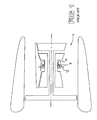
- Figure 2 illustrates an
igniter 12 used in the prior art. An electrical connector (not shown) is threaded ontothreads 21, and contains an electrical contact (not shown) which mates with theend 24 ofelectrode 27.Insulator 30isolates electrode 27 from theshell 33 of theigniter 12. - End E of the
igniter 12 is shown in Figures 3 and 4. A very simplified explanation of the physics involved in plasma generation will be given. - In operation, a high voltage is applied to the
electrode 27, thereby creating a voltage difference, or potential difference, V between points P1 and P2 in Figure 3. The electric field in that region equals the potential difference V divided by the distance D between the points P1 and P2. For example, if the voltage is 20,000 volts and the distance D is 10 millimeters, or 0.01 meter, then the electric field equals 20,000/0.01, or 2 million volts per meter. - The electric field is designed to exceed the dielectric breakdown strength of the material, or medium, lying between points P1 and P2. That material is a mixture of air plus fuel. However, the field does not exceed the breakdown strength of
insulator 30, and that strength exceeds that of the air-fuel mixture. - When breakdown occurs, the electric field strips electrons away from the atoms in the medium, producing positively charged ions and free electrons. The electric field drives the free electrons in a direction parallel with the electric field. However, during that movement, those temporarily free electrons will collide with other ions. Also, thermal motion of the ions and electrons will also bring them together in collisions.
- In the collisions, the electrons will be captured by the ions, and will drop to a lower energy state, releasing heat and light, in the form of an electric arc which is called a plasma, which is indicated as
lightning bolt 40 in Figure 4. This process continues as long as the electric field is present. - The Inventors have observed one result of the operation just described. As indicated in Figure 5, the
insulator 30 becomes eroded from thephantom shape 50 to thecurved shape 53. In addition, theelectrode 27 becomes eroded from thephantom shape 56 to thesolid shape 59.Corners 33A also become eroded. - The Inventors believe that one or more of the following agencies are responsible for the erosion. One agency is the corrosive nature of the plasma: free electrons are very reactive, and seek to bind to any available atoms or ions which are nearby. Also, the generation of free electrons from oxygen, which is present in the air, creates ionized oxygen, which is also highly reactive.
- A third agency is that the plasma creates a high-temperature environment. A high temperature, by definition, represents agitated atoms and molecules with high velocities. High-velocity atoms and molecules react more readily with stationary objects when they collide with the objects.
- Possibly a fourth agency is the fact that the plasma generates high-frequency photons, in the ultra-violet, UV, and perhaps into the X-ray regions of the spectrum. It is well known that UV and X-radiation can damage numerous types of material.
- Irrespective of the precise causes of the erosion, the erosion illustrated in Figure 5 eventually causes the
igniter 12 to eventually stop functioning. A primary reason is illustrated in Figure 6. Previously, prior to the erosion, voltage was applied between points P1 and P2 in Figure 6. However, after the erosion, point P2 has effectively moved to point P3. Distance D has now become longer distance D2. The electric field, which causes the ionization and thus the plasma, is now weaker. - Continuing the example given above, if distance D2 is 20 millimeters, then the electric field becomes 20,000/0.020, or one million volts per meter, half its original value. Eventually, distance D2 becomes so great that the electric field does not reliably exceed the dielectric breakdown strength of the air-fuel mixture, and ionization ceases to occur.
- Figure 7 illustrates one form of the invention. An
auxiliary electrode 72 is embedded in theinsulator 75. Thetip 78 is covered by the insulator-material inregion 81, as indicated by theinsert 84.Auxiliary electrode 72 may be connected to theshell 33, as atregion 90. - Initially, current enters
electrode 27 as indicated byarrow 84, jumps to theshell 33 through theplasma 85, and exits theshell 33 into the engine, through multiple paths, such as through its mounting threads, as indicated byarrow 86. - As erosion occurs, the
insulator 75 departs from its initial shape indicated byphantom lines 92 in Figure 8.Tip 78 of theauxiliary electrode 72 now becomes exposed. Now, when a high voltage is applied to the igniter, two paths exist for a plasma to follow. One is the usual path P5 in Figure 9. The other path is indicated as P6 of Figure 9, and runs from thecentral electrode 27 to the now-exposedauxiliary electrode 72. - Restated, two current-return-paths are available to the
central electrode 72. Path P5 runs to theshell 33, in the usual manner. Path P6 runs to the now-exposedauxiliary electrode 72. - Eventually, further erosion will lengthen path P5, and cause plasma formation along that path to terminate. That is, path P5 in Figure 9 initially can be represented by distance D in Figure 6. After sufficient erosion, path P5 in Figure 9 will be represented by distance D2 in Figure 6, and, as explained above, no plasma will be generated along path P5 when distance D2 becomes sufficiently large.
- However, auxiliary plasma path P6 is still available in Figure 9 at this time. A plasma can still be generated, and the lifetime of the igniter has been increased.
- The preceding discussion presented the
auxiliary electrode 72 in Figure 7 in the form of a rod. Figure 10 illustrates such a rod in perspective view, surrounded byinsulator 75. - In an alternate embodiment, a cylinder is used. Figure 11 is a cut-away view of one embodiment.
Central electrode 27 is surrounded by aninsulator 100, which itself is surrounded by a conductive tube orcylinder 103, which is then surrounded by another layer ofinsulator 105. Figure 12 illustrates the system in cross-sectional view, with similar numbering. - Figure 13 illustrates the
insulator 100 in its initial configuration, after manufacture or just after installation. A tip 110 ofcentral electrode 27 is exposed, and surrounded by theconical surface 113 of theinsulator 100. Cylindricalauxiliary electrode 103 is embedded within theinsulator 100, and no tip or edge is exposed, as indicated by distance D8 in Figure 12. - The preceding discussion stated that the
auxiliary electrode 72 may be connected atregion 90 in Figure 7. In another embodiment, theauxiliary electrode 72 of Figure 14 is also connected to ground, but through adetector 150.Detector 150 looks for a current inauxiliary electrode 72. Current detectors are well known. - If no current is detected, it is inferred that the
auxiliary electrode 72 is still embedded withininsulator 75, as in Figure 7, and is electrically isolated fromcentral electrode 27. - In contrast, if a current is detected, it is inferred that the auxiliary electrode has become exposed through erosion, as in Figure 9. The detected current is attributed to a plasma following path P6. When the current is detected,
detector 150 issues a signal, sets a flag, or otherwise indicates the inference that erosion has exposed auxiliary electrode. A human technician at that time, or a prescribed time afterward, replaces the igniter. - An alternate mode of detection is to remove the igniter and visually examine the end corresponding to end E in Figure 2. If a smooth surface of the
insulator 100 is seen, as in Figure 13, then it is concluded that the igniter is still functional. However, if theauxiliary electrode 72 is seen, as in Figure 8, then it is concluded that replacement may be required. - In another embodiment, the auxiliary electrode is designed to become exposed, and then to erode rapidly. Figure 15, viewed left-to-right, illustrates first a newly installed
igniter 160. After a period of usage,igniter 165 exposes itsauxiliary electrode 72. Now a plasma P6 extends to theauxiliary electrode 72. - However, as stated above, the
auxiliary electrode 72 is designed to erode rapidly. For example, as insert 170 indicates, theauxiliary electrode 72 is fabricated with a pointed end. Plasma 6 causes the pointed end to become rapidly eroded, as indicated by the small particles in frame 170. This operation causes a specific sequence of two events. - One is that, when the auxiliary electrode becomes first exposed, a current passes through the it. The current is detected, as by
detector 150 in Figure 14. Next, after the auxiliary electrode fractures or erodes, no current passes through it. - One reason for this sequence is illustrated in Figure 16. Initially, the voltage V spans distance D9, creating an electric field equal to V/D9. After fracture or erosion, the same voltage V spans distance D10. The electric field equals V/D10, a smaller value. The latter electric field is insufficient to create a plasma, while the former is.
- In one embodiment, the occurrence of the two events just described occurs prior to the termination of the lifetime of the igniter. Thus, that termination is signalled by the occurrence of a current through the
auxiliary electrode 72, followed by a termination of that current. The onset of the current indicates the approach of the termination of the lifetime, but with time remaining to operate the engine. The subsequent termination of the current indicates that less time remains, and that replacement of the igniter becomes more important. - Figure 17 illustrates one embodiment of the
auxiliary electrode 72. A neck, or groove, 190 is provided, which facilitates the breakage schematically illustrated in the insert 170 in Figure 15. Thegroove 190 is a region of mechanical weakness intentionally built into theauxiliary electrode 72. Prior to the erosion indicated in Figure 8, that weakness is not important, because mechanical support to the electrode is supplied by theinsulator 75. - The discussion above stated that a high voltage is applied to
electrode 27. It is possible that a low voltage applied to theelectrode 27 can accomplish the same function of generating a plasma. - For the sake of good order, various aspects of the invention are set out in the following clauses: -
- 1. Method of operating a fuel igniter (12) in an engine, comprising:
- a) generating a first plasma (85) near a first end of a first electrode (27);
- b) maintaining a second electrode (72) having a second end (78);
- c) initially surrounding the second end (78) with a solid insulation (75); and
- d) eroding the solid insulation (75), to expose the second end (78), and then generating a second plasma (P6) between the first (27) and second (72) electrodes.
- 2. Method according to
clause 1, wherein the first plasma (85) is a cause of eroding the solid insulation (75). - 3. Method according to
clause 1, wherein the first plasma (85) is generated within a medium and the solid insulation (75) has a higher breakdown strength than the medium. - 4. Method according to
clause 1, wherein a current in the second electrode (72) accompanies the second plasma (P6), and further comprising: - e) detecting the current and issuing a signal in response.
- 5. Method according to clause 4, and further comprising:
- f) replacing the fuel igniter (12) with a different fuel igniter in response to the signal.
- 6. Method according to clause 5, and further comprising:
- g) in the different fuel igniter,
- i) generating a first plasma near a first end of a first electrode;
- ii) maintaining a second electrode having a second end;
- iii) initially maintaining a solid insulation completely surrounding the second end; and
- iv) eroding the solid insulation, to expose the second end, and then generating a second plasma between the first and second electrodes.
- 7. Method according to
clause 1, wherein the engine comprises a gas turbine (3). - 8. Method according to clause 6, wherein the engine comprises a gas turbine (3).
- 9. An igniter (12) for a gas turbine engine (3), comprising:
- a) a first electrode (27) having a tip;
- b) a second electrode (33) which cooperates with the tip to generate a plasma (85); and
- c) a third electrode (72) having no exposure to the tip when the igniter (12) is newly installed, but which develops exposure to the tip after a period of operation.
- 10. Igniter according to
clause 9, and further comprising: - d) an insulator (75) surrounding the first electrode (27).
- 11. Igniter according to clause 10, wherein the second electrode (33) surrounds the insulator (75).
- 12. Igniter according to
clause 11, wherein the third electrode (72) is insulated from both the first (27) and second (33) electrodes. - 13. Igniter according to
clause 9, and further comprising a sensor (150) connected to the third electrode (72), for detecting current in the third electrode (72). - 14. An igniter (12) for a gas turbine engine (3), comprising:
- a) a first electrode (27) having a tip;
- b) an insulator (75) surrounding the first electrode (27);
- c) a second electrode (33) surrounding the insulator (75), and having an edge (P1) which cooperates with the tip (P2) to generate a plasma; and
- d) a third electrode (72) embedded in the insulator (75), having no part exposed to the first electrode (27).
- 15. Igniter (12) according to clause 14, wherein operation of the igniter (12) causes part of the insulator (75) to erode, thereby causing part of the third electrode (72) to become exposed to the tip.
- 16. Igniter according to clause 14, and further comprising a sensor (150) connected to the third electrode (72), for detecting current in the third electrode (72).
- 17. Igniter according to clause 14, wherein the third electrode (72) comprises a cylinder (103), and surrounds the first electrode (27).
- 18. An igniter (12) for a gas turbine engine (3), comprising:
- a) a first electrode (27);
- b) a second electrode (33) which cooperates with the first electrode (27) to generate a plasma (P6);
- c) a third electrode (72);
- d) a barrier (75) between the third electrode (72) and the first electrode
(27) which
- i) blocks auxiliary plasma formation between the first and third electrodes at a time T1, and
- ii) erodes after T1, to enable said auxiliary plasma formation.
- 19. An igniter (12) for a gas turbine engine (3), comprising:
- a) first (27) and second (33) electrodes which
- i) cooperate to generate a plasma (P6); and
- ii) wherein plasma generation is accompanied by a change which inhibits later plasma generation; and
- b) a third electrode (72) which
- i) becomes available with said change; and
- ii) cooperates with either the first (27) or second (33) electrode to generate a plasma.
- 20. An igniter (12) for a gas turbine engine (3), comprising:
- a) a first electrode (27);
- b) a second electrode (33) which cooperates with the first electrode (27) to generate a plasma (P6); and
- c) a third electrode (72) which
- i) is separated from the first electrode (27) by an erodible shield (75); and
- ii) cooperates with the first electrode (27) to generate a plasma when sufficient erosion of the shield (75) occurs.
- 21. Igniter (12) according to clause 20, wherein both the second (33) and third (72) electrodes cooperate with the first electrode (27) to generate a plasma after predetermined erosion occurs.
- 22. An igniter (12) for a gas turbine engine (3), comprising:
- a) a first electrode (27), rod-like in configuration, coaxial with an axis;
- b) an insulator (75) surrounding the first electrode (27), except at a tip of the first electrode, where said tip is exposed;
- c) a second electrode (33), generally cylindrical in configuration, coaxial with said axis, and surrounding the insulator (75) and the first electrode (27);
- d) a third electrode (72) having a distal end, embedded in the insulator (75) and completely surrounded by the insulator (75).
- 23. An igniter (12) for a gas turbine engine (3), comprising:
- a) a first electrode (27) which changes in size during operation; and
- b) a marker (78) which becomes visible when a predetermined change in size occurs.
-
Claims (10)
- Method of operating a fuel igniter (12) in an engine, comprising:a) generating a first plasma (85) near a first end of a first electrode (27);b) maintaining a second electrode (72) having a second end (78);c) initially surrounding the second end (78) with a solid insulation (75); andd) eroding the solid insulation (75), to expose the second end (78), and then generating a second plasma (P6) between the first (27) and second (72) electrodes.
- Method according to claim 1, wherein the first plasma (85) is a cause of eroding the solid insulation (75).
- Method according to claim 1, wherein the first plasma (85) is generated within a medium and the solid insulation (75) has a higher breakdown strength than the medium.
- Method according to claim 1, wherein a current in the second electrode (72) accompanies the second plasma (P6), and further comprising:e) detecting the current and issuing a signal in response.
- Method according to claim 4, and further comprising:f) replacing the fuel igniter (12) with a different fuel igniter in response to the signal.
- Method according to claim 5, and further comprising:g) in the different fuel igniter,i) generating a first plasma near a first end of a first electrode;ii) maintaining a second electrode having a second end;iii) initially maintaining a solid insulation completely surrounding the second end; andiv) eroding the solid insulation, to expose the second end, and then generating a second plasma between the first and second electrodes.
- Method according to claim 1, wherein the engine comprises a gas turbine (3).
- Method according to claim 6, wherein the engine comprises a gas turbine (3).
- An igniter (12) for a gas turbine engine (3), comprising:a) a first electrode (27) having a tip;b) a second electrode (33) which cooperates with the tip to generate a plasma (85); andc) a third electrode (72) having no exposure to the tip when the igniter (12) is newly installed, but which develops exposure to the tip after a period of operation.
- Igniter according to claim 9, and further comprising:d) an insulator (75) surrounding the first electrode (27).
Applications Claiming Priority (2)
| Application Number | Priority Date | Filing Date | Title |
|---|---|---|---|
| US775846 | 1991-10-15 | ||
| US10/775,846 US7093421B2 (en) | 2004-02-10 | 2004-02-10 | Spark igniter for gas turbine engine |
Publications (1)
| Publication Number | Publication Date |
|---|---|
| EP1564489A1 true EP1564489A1 (en) | 2005-08-17 |
Family
ID=34701342
Family Applications (1)
| Application Number | Title | Priority Date | Filing Date |
|---|---|---|---|
| EP05250729A Withdrawn EP1564489A1 (en) | 2004-02-10 | 2005-02-09 | Spark igniter for gas turbine engine |
Country Status (4)
| Country | Link |
|---|---|
| US (1) | US7093421B2 (en) |
| EP (1) | EP1564489A1 (en) |
| JP (1) | JP4544582B2 (en) |
| CN (1) | CN1782345B (en) |
Families Citing this family (13)
| Publication number | Priority date | Publication date | Assignee | Title |
|---|---|---|---|---|
| FR2919672B1 (en) * | 2007-07-30 | 2014-02-14 | Snecma | FUEL INJECTOR IN A TURBOMACHINE COMBUSTION CHAMBER |
| CN101560139B (en) * | 2009-05-26 | 2014-02-05 | 自贡鸿鹤化工股份有限公司 | Tetracarp producing device with automatic igniter |
| MX341495B (en) | 2010-01-14 | 2016-08-23 | Neptco Inc * | WIND TURBINE ROTOR BLADE COMPONENTS AND METHODS FOR THE MANUFACTURE OF THE SAME. |
| US10137542B2 (en) | 2010-01-14 | 2018-11-27 | Senvion Gmbh | Wind turbine rotor blade components and machine for making same |
| US8720257B2 (en) * | 2011-01-10 | 2014-05-13 | General Electric Company | Methods, systems and apparatus for detecting material defects in combustors of combustion turbine engines |
| CN102721083B (en) * | 2012-06-26 | 2014-06-11 | 哈尔滨工程大学 | Plasma-catalysis gaseous swirl nozzle |
| CN102721081B (en) * | 2012-06-26 | 2014-06-25 | 哈尔滨工程大学 | Nozzle for enhancing atomization by plasma |
| US9822708B2 (en) | 2014-05-06 | 2017-11-21 | Woodward, Inc. | Igniter event conductor for conducting igniter events from a combustion chamber to a sensor |
| CN104747321B (en) * | 2015-01-19 | 2017-01-25 | 西安航天动力研究所 | High back pressure plasma igniter high pressure trigger |
| CN110226033A (en) | 2016-11-22 | 2019-09-10 | Ic有限责任公司 | Spark plug burning ionization transducer |
| RU179846U1 (en) * | 2017-09-11 | 2018-05-28 | Акционерное общество "ОДК-Климов" | GAS TURBINE ENGINE CANDLE |
| CN107816387A (en) * | 2017-10-24 | 2018-03-20 | 哈尔滨工业大学 | A kind of three electrode is expanded discharge channel size device and is expanded the method for discharge channel size using the device |
| KR102939752B1 (en) * | 2021-02-24 | 2026-03-16 | 아큐트로닉 터바인스, 아이엔씨. | Plasma ignition and combustion assist systems for gas turbine engines |
Citations (3)
| Publication number | Priority date | Publication date | Assignee | Title |
|---|---|---|---|---|
| EP0328333A2 (en) | 1988-02-10 | 1989-08-16 | Westinghouse Electric Corporation | Process for producing ceramic superconductors |
| EP0328833A1 (en) * | 1988-02-16 | 1989-08-23 | Champion Spark Plug Company | Igniter with wear indicator |
| US5456241A (en) * | 1993-05-25 | 1995-10-10 | Combustion Electromagnetics, Inc. | Optimized high power high energy ignition system |
Family Cites Families (18)
| Publication number | Priority date | Publication date | Assignee | Title |
|---|---|---|---|---|
| US2969500A (en) * | 1957-08-02 | 1961-01-24 | Frank S Andert | Spark plug and ignition indicator system therefor |
| US3967149A (en) * | 1973-07-05 | 1976-06-29 | Champion Spark Plug Company | Spark plug |
| US4284054A (en) * | 1979-07-23 | 1981-08-18 | Tokai Trw & Co. Ltd. | Lean air-fuel mixture attraction method and attraction electrode plug in engine |
| JPH0831352B2 (en) * | 1987-08-04 | 1996-03-27 | 株式会社日本自動車部品総合研究所 | Spark plug |
| US5523691A (en) | 1990-07-26 | 1996-06-04 | Unison Industries Limited Partnership | Diagnostic device for gas turbine ignition system |
| US5155437A (en) | 1990-07-26 | 1992-10-13 | Unison Industries Limited Partnership | Diagnostic device for gas turbine ignition system |
| NL9101257A (en) * | 1991-07-17 | 1993-02-16 | Deltec Fuel Systems Bv | SPARK BRACKET ELECTRODES MEASURING AND MONITORING DEVICE. |
| US5194813A (en) | 1991-09-16 | 1993-03-16 | Hannah Kenneth H | Spark ignition analyzer |
| US5508618A (en) * | 1993-07-15 | 1996-04-16 | Simmonds Precision Engine Systems | Coreless detector for ignition dischage current |
| US5587630A (en) * | 1993-10-28 | 1996-12-24 | Pratt & Whitney Canada Inc. | Continuous plasma ignition system |
| DE4422939C2 (en) | 1994-06-30 | 2000-05-31 | Bosch Gmbh Robert | Spark plug for an internal combustion engine |
| US5606118A (en) | 1995-09-05 | 1997-02-25 | Ford Motor Company | System and method for detecting misfire in an internal combustion engine |
| US5892319A (en) | 1996-01-04 | 1999-04-06 | Rossi; Paul | Top and side firing spark plug |
| JPH10300635A (en) * | 1997-04-24 | 1998-11-13 | Nippon Soken Inc | Combustion state detector |
| DE19818214A1 (en) | 1998-04-24 | 1999-10-28 | Bosch Gmbh Robert | Spark plug for combustion engine |
| DE19905771A1 (en) | 1999-02-12 | 2000-08-17 | Bosch Gmbh Robert | spark plug |
| US6505605B2 (en) | 2000-03-29 | 2003-01-14 | Ngk Spark Plug Co., Ltd. | Control system for an internal combustion engine and method carried out by the same |
| JP2002130105A (en) * | 2000-10-20 | 2002-05-09 | Nissan Motor Co Ltd | Apparatus for detecting combustion state of internal combustion engine and apparatus for avoiding misfire |
-
2004
- 2004-02-10 US US10/775,846 patent/US7093421B2/en not_active Expired - Fee Related
-
2005
- 2005-02-08 CN CN2005100094739A patent/CN1782345B/en not_active Expired - Fee Related
- 2005-02-09 JP JP2005032419A patent/JP4544582B2/en not_active Expired - Fee Related
- 2005-02-09 EP EP05250729A patent/EP1564489A1/en not_active Withdrawn
Patent Citations (3)
| Publication number | Priority date | Publication date | Assignee | Title |
|---|---|---|---|---|
| EP0328333A2 (en) | 1988-02-10 | 1989-08-16 | Westinghouse Electric Corporation | Process for producing ceramic superconductors |
| EP0328833A1 (en) * | 1988-02-16 | 1989-08-23 | Champion Spark Plug Company | Igniter with wear indicator |
| US5456241A (en) * | 1993-05-25 | 1995-10-10 | Combustion Electromagnetics, Inc. | Optimized high power high energy ignition system |
Also Published As
| Publication number | Publication date |
|---|---|
| US20050172636A1 (en) | 2005-08-11 |
| CN1782345B (en) | 2011-10-05 |
| JP4544582B2 (en) | 2010-09-15 |
| US7093421B2 (en) | 2006-08-22 |
| CN1782345A (en) | 2006-06-07 |
| JP2005226989A (en) | 2005-08-25 |
Similar Documents
| Publication | Publication Date | Title |
|---|---|---|
| US7093421B2 (en) | Spark igniter for gas turbine engine | |
| US7093422B2 (en) | Detecting spark in igniter of gas turbine engine by detecting signals in grounded RF shielding | |
| EP3361587B1 (en) | Protection and fault detection for high voltage power lines on aircraft | |
| CN113054535B (en) | Spark plug for high frequency ignition system | |
| CN110226033A (en) | Spark plug burning ionization transducer | |
| EP3300193B1 (en) | Corona ignition with hermetic combustion seal | |
| CN100523454C (en) | Method of informing pilot of aircraft of spark detected in gasturbine engine | |
| EP1564490B1 (en) | Integral spark detector in fitting which supports igniter in gas turbine engine | |
| US7188466B2 (en) | Passive, high-temperature amplifier for amplifying spark signals detected in igniter in gas turbine engine | |
| EP0560603A2 (en) | A misfire detector device for use in internal combustion engine | |
| US7015698B2 (en) | Sensor for detection of spark in igniter in gas turbine engine | |
| US7500350B1 (en) | Elimination of lifetime limiting mechanism of hall thrusters | |
| CN109690892A (en) | Gap with the excitation of triple point electron emission | |
| BR102017017632A2 (en) | SCIENTIFICER AND METHOD FOR GENERATING A PLASMA DRIVER | |
| US6078130A (en) | Spark plug with specific construction to avoid unwanted surface discharge | |
| MacPhee et al. | Electrostatic modelling of a trigatron spark gap | |
| US11769991B2 (en) | Glow discharge tube with a set of electrodes within a gas-sealed envelope |
Legal Events
| Date | Code | Title | Description |
|---|---|---|---|
| PUAI | Public reference made under article 153(3) epc to a published international application that has entered the european phase |
Free format text: ORIGINAL CODE: 0009012 |
|
| AK | Designated contracting states |
Kind code of ref document: A1 Designated state(s): AT BE BG CH CY CZ DE DK EE ES FI FR GB GR HU IE IS IT LI LT LU MC NL PL PT RO SE SI SK TR |
|
| AX | Request for extension of the european patent |
Extension state: AL BA HR LV MK YU |
|
| 17P | Request for examination filed |
Effective date: 20060217 |
|
| AKX | Designation fees paid |
Designated state(s): DE FR GB |
|
| 17Q | First examination report despatched |
Effective date: 20120208 |
|
| STAA | Information on the status of an ep patent application or granted ep patent |
Free format text: STATUS: THE APPLICATION IS DEEMED TO BE WITHDRAWN |
|
| 18D | Application deemed to be withdrawn |
Effective date: 20140829 |