EP1564192A1 - Method of forming thin film on glass substrate and glass substrate coated with thin film - Google Patents
Method of forming thin film on glass substrate and glass substrate coated with thin film Download PDFInfo
- Publication number
- EP1564192A1 EP1564192A1 EP03770010A EP03770010A EP1564192A1 EP 1564192 A1 EP1564192 A1 EP 1564192A1 EP 03770010 A EP03770010 A EP 03770010A EP 03770010 A EP03770010 A EP 03770010A EP 1564192 A1 EP1564192 A1 EP 1564192A1
- Authority
- EP
- European Patent Office
- Prior art keywords
- glass substrate
- thin film
- forming
- coating solution
- glass
- Prior art date
- Legal status (The legal status is an assumption and is not a legal conclusion. Google has not performed a legal analysis and makes no representation as to the accuracy of the status listed.)
- Withdrawn
Links
- 239000000758 substrate Substances 0.000 title claims abstract description 132
- 239000011521 glass Substances 0.000 title claims abstract description 110
- 239000010409 thin film Substances 0.000 title claims abstract description 90
- 238000000034 method Methods 0.000 title claims abstract description 74
- 238000000576 coating method Methods 0.000 claims abstract description 79
- 239000011248 coating agent Substances 0.000 claims abstract description 75
- LFQSCWFLJHTTHZ-UHFFFAOYSA-N Ethanol Chemical compound CCO LFQSCWFLJHTTHZ-UHFFFAOYSA-N 0.000 claims abstract description 30
- 238000005507 spraying Methods 0.000 claims abstract description 30
- XLYOFNOQVPJJNP-UHFFFAOYSA-N water Substances O XLYOFNOQVPJJNP-UHFFFAOYSA-N 0.000 claims abstract description 29
- 239000002904 solvent Substances 0.000 claims abstract description 27
- 229910044991 metal oxide Inorganic materials 0.000 claims abstract description 17
- 150000004706 metal oxides Chemical class 0.000 claims abstract description 17
- 239000005357 flat glass Substances 0.000 claims abstract description 14
- 239000006060 molten glass Substances 0.000 claims abstract description 12
- GWEVSGVZZGPLCZ-UHFFFAOYSA-N Titan oxide Chemical compound O=[Ti]=O GWEVSGVZZGPLCZ-UHFFFAOYSA-N 0.000 claims description 16
- VYPSYNLAJGMNEJ-UHFFFAOYSA-N Silicium dioxide Chemical compound O=[Si]=O VYPSYNLAJGMNEJ-UHFFFAOYSA-N 0.000 claims description 13
- OGIDPMRJRNCKJF-UHFFFAOYSA-N titanium oxide Inorganic materials [Ti]=O OGIDPMRJRNCKJF-UHFFFAOYSA-N 0.000 claims description 10
- -1 titanium alkoxide Chemical class 0.000 claims description 7
- 239000002994 raw material Substances 0.000 claims description 6
- 229910052814 silicon oxide Inorganic materials 0.000 claims description 6
- 239000010936 titanium Substances 0.000 claims description 4
- 229910052710 silicon Inorganic materials 0.000 claims description 3
- 239000010703 silicon Substances 0.000 claims description 3
- 229910052719 titanium Inorganic materials 0.000 claims description 2
- 239000010419 fine particle Substances 0.000 claims 2
- 238000010276 construction Methods 0.000 abstract description 7
- 239000000243 solution Substances 0.000 description 65
- OKKJLVBELUTLKV-UHFFFAOYSA-N Methanol Chemical compound OC OKKJLVBELUTLKV-UHFFFAOYSA-N 0.000 description 27
- 239000010408 film Substances 0.000 description 25
- 238000010438 heat treatment Methods 0.000 description 9
- 239000007788 liquid Substances 0.000 description 9
- 239000007787 solid Substances 0.000 description 7
- 238000001704 evaporation Methods 0.000 description 6
- 239000000203 mixture Substances 0.000 description 6
- XOLBLPGZBRYERU-UHFFFAOYSA-N tin dioxide Chemical compound O=[Sn]=O XOLBLPGZBRYERU-UHFFFAOYSA-N 0.000 description 6
- 230000015572 biosynthetic process Effects 0.000 description 5
- 150000001875 compounds Chemical class 0.000 description 5
- 230000008020 evaporation Effects 0.000 description 5
- 239000002245 particle Substances 0.000 description 5
- 239000005329 float glass Substances 0.000 description 4
- 238000004519 manufacturing process Methods 0.000 description 4
- 238000002156 mixing Methods 0.000 description 4
- 239000005416 organic matter Substances 0.000 description 4
- 229910001887 tin oxide Inorganic materials 0.000 description 4
- KFZMGEQAYNKOFK-UHFFFAOYSA-N Isopropanol Chemical compound CC(C)O KFZMGEQAYNKOFK-UHFFFAOYSA-N 0.000 description 3
- 238000009792 diffusion process Methods 0.000 description 3
- 238000007598 dipping method Methods 0.000 description 3
- 239000000377 silicon dioxide Substances 0.000 description 3
- 150000004703 alkoxides Chemical class 0.000 description 2
- 239000007864 aqueous solution Substances 0.000 description 2
- 238000009835 boiling Methods 0.000 description 2
- 229910052681 coesite Inorganic materials 0.000 description 2
- 238000004040 coloring Methods 0.000 description 2
- 229910052906 cristobalite Inorganic materials 0.000 description 2
- 230000000694 effects Effects 0.000 description 2
- 230000005611 electricity Effects 0.000 description 2
- 229910052751 metal Inorganic materials 0.000 description 2
- 239000002184 metal Substances 0.000 description 2
- 229920002050 silicone resin Polymers 0.000 description 2
- 238000004528 spin coating Methods 0.000 description 2
- 229910052682 stishovite Inorganic materials 0.000 description 2
- LLZRNZOLAXHGLL-UHFFFAOYSA-J titanic acid Chemical compound O[Ti](O)(O)O LLZRNZOLAXHGLL-UHFFFAOYSA-J 0.000 description 2
- 229910052905 tridymite Inorganic materials 0.000 description 2
- VEXZGXHMUGYJMC-UHFFFAOYSA-N Hydrochloric acid Chemical compound Cl VEXZGXHMUGYJMC-UHFFFAOYSA-N 0.000 description 1
- BOTDANWDWHJENH-UHFFFAOYSA-N Tetraethyl orthosilicate Chemical compound CCO[Si](OCC)(OCC)OCC BOTDANWDWHJENH-UHFFFAOYSA-N 0.000 description 1
- ATJFFYVFTNAWJD-UHFFFAOYSA-N Tin Chemical compound [Sn] ATJFFYVFTNAWJD-UHFFFAOYSA-N 0.000 description 1
- 238000001354 calcination Methods 0.000 description 1
- 229910000420 cerium oxide Inorganic materials 0.000 description 1
- 238000004140 cleaning Methods 0.000 description 1
- 239000008119 colloidal silica Substances 0.000 description 1
- 239000000084 colloidal system Substances 0.000 description 1
- 230000000052 comparative effect Effects 0.000 description 1
- 238000001816 cooling Methods 0.000 description 1
- 230000003247 decreasing effect Effects 0.000 description 1
- 238000001035 drying Methods 0.000 description 1
- 239000000428 dust Substances 0.000 description 1
- 238000007667 floating Methods 0.000 description 1
- 230000000873 masking effect Effects 0.000 description 1
- 229910000000 metal hydroxide Inorganic materials 0.000 description 1
- 150000004692 metal hydroxides Chemical class 0.000 description 1
- BMMGVYCKOGBVEV-UHFFFAOYSA-N oxo(oxoceriooxy)cerium Chemical compound [Ce]=O.O=[Ce]=O BMMGVYCKOGBVEV-UHFFFAOYSA-N 0.000 description 1
- FMLYSTGQBVZCGN-UHFFFAOYSA-N oxosilicon(2+) oxygen(2-) titanium(4+) Chemical compound [O-2].[Ti+4].[Si+2]=O.[O-2].[O-2] FMLYSTGQBVZCGN-UHFFFAOYSA-N 0.000 description 1
- 230000001699 photocatalysis Effects 0.000 description 1
- 230000002265 prevention Effects 0.000 description 1
- 230000002940 repellent Effects 0.000 description 1
- 239000005871 repellent Substances 0.000 description 1
- 230000001846 repelling effect Effects 0.000 description 1
- 239000007921 spray Substances 0.000 description 1
- 239000000126 substance Substances 0.000 description 1
- 238000005406 washing Methods 0.000 description 1
- 229910052726 zirconium Inorganic materials 0.000 description 1
Images
Classifications
-
- C—CHEMISTRY; METALLURGY
- C03—GLASS; MINERAL OR SLAG WOOL
- C03C—CHEMICAL COMPOSITION OF GLASSES, GLAZES OR VITREOUS ENAMELS; SURFACE TREATMENT OF GLASS; SURFACE TREATMENT OF FIBRES OR FILAMENTS MADE FROM GLASS, MINERALS OR SLAGS; JOINING GLASS TO GLASS OR OTHER MATERIALS
- C03C17/00—Surface treatment of glass, not in the form of fibres or filaments, by coating
- C03C17/006—Surface treatment of glass, not in the form of fibres or filaments, by coating with materials of composite character
- C03C17/007—Surface treatment of glass, not in the form of fibres or filaments, by coating with materials of composite character containing a dispersed phase, e.g. particles, fibres or flakes, in a continuous phase
-
- B—PERFORMING OPERATIONS; TRANSPORTING
- B05—SPRAYING OR ATOMISING IN GENERAL; APPLYING FLUENT MATERIALS TO SURFACES, IN GENERAL
- B05D—PROCESSES FOR APPLYING FLUENT MATERIALS TO SURFACES, IN GENERAL
- B05D7/00—Processes, other than flocking, specially adapted for applying liquids or other fluent materials to particular surfaces or for applying particular liquids or other fluent materials
-
- B—PERFORMING OPERATIONS; TRANSPORTING
- B05—SPRAYING OR ATOMISING IN GENERAL; APPLYING FLUENT MATERIALS TO SURFACES, IN GENERAL
- B05D—PROCESSES FOR APPLYING FLUENT MATERIALS TO SURFACES, IN GENERAL
- B05D7/00—Processes, other than flocking, specially adapted for applying liquids or other fluent materials to particular surfaces or for applying particular liquids or other fluent materials
- B05D7/24—Processes, other than flocking, specially adapted for applying liquids or other fluent materials to particular surfaces or for applying particular liquids or other fluent materials for applying particular liquids or other fluent materials
-
- C—CHEMISTRY; METALLURGY
- C03—GLASS; MINERAL OR SLAG WOOL
- C03C—CHEMICAL COMPOSITION OF GLASSES, GLAZES OR VITREOUS ENAMELS; SURFACE TREATMENT OF GLASS; SURFACE TREATMENT OF FIBRES OR FILAMENTS MADE FROM GLASS, MINERALS OR SLAGS; JOINING GLASS TO GLASS OR OTHER MATERIALS
- C03C17/00—Surface treatment of glass, not in the form of fibres or filaments, by coating
- C03C17/001—General methods for coating; Devices therefor
- C03C17/002—General methods for coating; Devices therefor for flat glass, e.g. float glass
-
- C—CHEMISTRY; METALLURGY
- C03—GLASS; MINERAL OR SLAG WOOL
- C03C—CHEMICAL COMPOSITION OF GLASSES, GLAZES OR VITREOUS ENAMELS; SURFACE TREATMENT OF GLASS; SURFACE TREATMENT OF FIBRES OR FILAMENTS MADE FROM GLASS, MINERALS OR SLAGS; JOINING GLASS TO GLASS OR OTHER MATERIALS
- C03C17/00—Surface treatment of glass, not in the form of fibres or filaments, by coating
- C03C17/22—Surface treatment of glass, not in the form of fibres or filaments, by coating with other inorganic material
- C03C17/23—Oxides
- C03C17/25—Oxides by deposition from the liquid phase
-
- C—CHEMISTRY; METALLURGY
- C03—GLASS; MINERAL OR SLAG WOOL
- C03C—CHEMICAL COMPOSITION OF GLASSES, GLAZES OR VITREOUS ENAMELS; SURFACE TREATMENT OF GLASS; SURFACE TREATMENT OF FIBRES OR FILAMENTS MADE FROM GLASS, MINERALS OR SLAGS; JOINING GLASS TO GLASS OR OTHER MATERIALS
- C03C17/00—Surface treatment of glass, not in the form of fibres or filaments, by coating
- C03C17/22—Surface treatment of glass, not in the form of fibres or filaments, by coating with other inorganic material
- C03C17/23—Oxides
- C03C17/25—Oxides by deposition from the liquid phase
- C03C17/256—Coating containing TiO2
-
- C—CHEMISTRY; METALLURGY
- C03—GLASS; MINERAL OR SLAG WOOL
- C03C—CHEMICAL COMPOSITION OF GLASSES, GLAZES OR VITREOUS ENAMELS; SURFACE TREATMENT OF GLASS; SURFACE TREATMENT OF FIBRES OR FILAMENTS MADE FROM GLASS, MINERALS OR SLAGS; JOINING GLASS TO GLASS OR OTHER MATERIALS
- C03C2217/00—Coatings on glass
- C03C2217/20—Materials for coating a single layer on glass
- C03C2217/21—Oxides
-
- C—CHEMISTRY; METALLURGY
- C03—GLASS; MINERAL OR SLAG WOOL
- C03C—CHEMICAL COMPOSITION OF GLASSES, GLAZES OR VITREOUS ENAMELS; SURFACE TREATMENT OF GLASS; SURFACE TREATMENT OF FIBRES OR FILAMENTS MADE FROM GLASS, MINERALS OR SLAGS; JOINING GLASS TO GLASS OR OTHER MATERIALS
- C03C2217/00—Coatings on glass
- C03C2217/20—Materials for coating a single layer on glass
- C03C2217/21—Oxides
- C03C2217/213—SiO2
-
- C—CHEMISTRY; METALLURGY
- C03—GLASS; MINERAL OR SLAG WOOL
- C03C—CHEMICAL COMPOSITION OF GLASSES, GLAZES OR VITREOUS ENAMELS; SURFACE TREATMENT OF GLASS; SURFACE TREATMENT OF FIBRES OR FILAMENTS MADE FROM GLASS, MINERALS OR SLAGS; JOINING GLASS TO GLASS OR OTHER MATERIALS
- C03C2217/00—Coatings on glass
- C03C2217/20—Materials for coating a single layer on glass
- C03C2217/21—Oxides
- C03C2217/23—Mixtures
-
- C—CHEMISTRY; METALLURGY
- C03—GLASS; MINERAL OR SLAG WOOL
- C03C—CHEMICAL COMPOSITION OF GLASSES, GLAZES OR VITREOUS ENAMELS; SURFACE TREATMENT OF GLASS; SURFACE TREATMENT OF FIBRES OR FILAMENTS MADE FROM GLASS, MINERALS OR SLAGS; JOINING GLASS TO GLASS OR OTHER MATERIALS
- C03C2217/00—Coatings on glass
- C03C2217/40—Coatings comprising at least one inhomogeneous layer
- C03C2217/43—Coatings comprising at least one inhomogeneous layer consisting of a dispersed phase in a continuous phase
- C03C2217/44—Coatings comprising at least one inhomogeneous layer consisting of a dispersed phase in a continuous phase characterized by the composition of the continuous phase
- C03C2217/45—Inorganic continuous phases
-
- C—CHEMISTRY; METALLURGY
- C03—GLASS; MINERAL OR SLAG WOOL
- C03C—CHEMICAL COMPOSITION OF GLASSES, GLAZES OR VITREOUS ENAMELS; SURFACE TREATMENT OF GLASS; SURFACE TREATMENT OF FIBRES OR FILAMENTS MADE FROM GLASS, MINERALS OR SLAGS; JOINING GLASS TO GLASS OR OTHER MATERIALS
- C03C2217/00—Coatings on glass
- C03C2217/40—Coatings comprising at least one inhomogeneous layer
- C03C2217/43—Coatings comprising at least one inhomogeneous layer consisting of a dispersed phase in a continuous phase
- C03C2217/46—Coatings comprising at least one inhomogeneous layer consisting of a dispersed phase in a continuous phase characterized by the dispersed phase
- C03C2217/47—Coatings comprising at least one inhomogeneous layer consisting of a dispersed phase in a continuous phase characterized by the dispersed phase consisting of a specific material
- C03C2217/475—Inorganic materials
- C03C2217/477—Titanium oxide
-
- C—CHEMISTRY; METALLURGY
- C03—GLASS; MINERAL OR SLAG WOOL
- C03C—CHEMICAL COMPOSITION OF GLASSES, GLAZES OR VITREOUS ENAMELS; SURFACE TREATMENT OF GLASS; SURFACE TREATMENT OF FIBRES OR FILAMENTS MADE FROM GLASS, MINERALS OR SLAGS; JOINING GLASS TO GLASS OR OTHER MATERIALS
- C03C2217/00—Coatings on glass
- C03C2217/40—Coatings comprising at least one inhomogeneous layer
- C03C2217/43—Coatings comprising at least one inhomogeneous layer consisting of a dispersed phase in a continuous phase
- C03C2217/46—Coatings comprising at least one inhomogeneous layer consisting of a dispersed phase in a continuous phase characterized by the dispersed phase
- C03C2217/47—Coatings comprising at least one inhomogeneous layer consisting of a dispersed phase in a continuous phase characterized by the dispersed phase consisting of a specific material
- C03C2217/475—Inorganic materials
- C03C2217/478—Silica
-
- C—CHEMISTRY; METALLURGY
- C03—GLASS; MINERAL OR SLAG WOOL
- C03C—CHEMICAL COMPOSITION OF GLASSES, GLAZES OR VITREOUS ENAMELS; SURFACE TREATMENT OF GLASS; SURFACE TREATMENT OF FIBRES OR FILAMENTS MADE FROM GLASS, MINERALS OR SLAGS; JOINING GLASS TO GLASS OR OTHER MATERIALS
- C03C2217/00—Coatings on glass
- C03C2217/70—Properties of coatings
- C03C2217/71—Photocatalytic coatings
-
- C—CHEMISTRY; METALLURGY
- C03—GLASS; MINERAL OR SLAG WOOL
- C03C—CHEMICAL COMPOSITION OF GLASSES, GLAZES OR VITREOUS ENAMELS; SURFACE TREATMENT OF GLASS; SURFACE TREATMENT OF FIBRES OR FILAMENTS MADE FROM GLASS, MINERALS OR SLAGS; JOINING GLASS TO GLASS OR OTHER MATERIALS
- C03C2218/00—Methods for coating glass
- C03C2218/10—Deposition methods
- C03C2218/11—Deposition methods from solutions or suspensions
- C03C2218/112—Deposition methods from solutions or suspensions by spraying
-
- C—CHEMISTRY; METALLURGY
- C03—GLASS; MINERAL OR SLAG WOOL
- C03C—CHEMICAL COMPOSITION OF GLASSES, GLAZES OR VITREOUS ENAMELS; SURFACE TREATMENT OF GLASS; SURFACE TREATMENT OF FIBRES OR FILAMENTS MADE FROM GLASS, MINERALS OR SLAGS; JOINING GLASS TO GLASS OR OTHER MATERIALS
- C03C2218/00—Methods for coating glass
- C03C2218/10—Deposition methods
- C03C2218/11—Deposition methods from solutions or suspensions
- C03C2218/113—Deposition methods from solutions or suspensions by sol-gel processes
-
- C—CHEMISTRY; METALLURGY
- C03—GLASS; MINERAL OR SLAG WOOL
- C03C—CHEMICAL COMPOSITION OF GLASSES, GLAZES OR VITREOUS ENAMELS; SURFACE TREATMENT OF GLASS; SURFACE TREATMENT OF FIBRES OR FILAMENTS MADE FROM GLASS, MINERALS OR SLAGS; JOINING GLASS TO GLASS OR OTHER MATERIALS
- C03C2218/00—Methods for coating glass
- C03C2218/30—Aspects of methods for coating glass not covered above
- C03C2218/36—Underside coating of a glass sheet
Definitions
- the present invention relates to a process of forming a uniform thin film on the surface of a large size glass substrate, which is used for construction or the like, and a glass substrate coated with a thin film formed by the above process.
- a thin film has been formed on the surface of a large size glass substrate, which is used for construction or the like, so as to add various functions, such as UV shielding, heat shielding, electricity conducting, stainproofing, hydrophilization, water repelling and coloring, to the glass substrate.
- processes of forming such a functional thin film there have been known two types of processes: dry processes in which a solid thin film is directly formed on a substrate; and wet processes in which a thin film is formed in such a manner as to coat a coating solution on a substrate, dry the resultant liquid film, and heat treat the dried film.
- wet processes which use coating solutions capable of having various compositions, are used very often as attractive processes.
- a spin coating method, a roll coating method, a flow coating method, a dipping method, and a spraying method are known as typical examples of wet processes.
- the spin coating method is a process of forming a thin film on the surface of a glass substrate by dropping a coating solution onto the substrate while rotating the same at high frequency to uniformly spread the solution onto the surface of the glass substrate.
- This process cannot be substantially used to apply a coating onto a large size glass substrate, which is used for construction, because to provide a coating on a large size glass substrate, the size of apparatus used must be large, and moreover, to rotate a glass at high frequency while holding the same, large-scale holding equipment is required and safety measures must be taken.
- the roll coating method is a process of forming a thin film on the surface of a glass substrate by bringing a coating roll in contact with the surface of the substrate while conveying the substrate.
- the surface level of the substrate must be kept constant so that the entire coating roll can come in contact with the glass substrate.
- the width of the coating roll used becomes large, and therefore the coating applied is largely affected by the distortion of the coating roll or the like and is likely to be a non-uniform thin film.
- the flow coating method is a process of forming a thin film on a glass substrate by dropping a coating solution uniformly across the width of the glass substrate while conveying the glass substrate.
- the coating solution is required to have high viscosity. If the viscosity of the coating solution is low, non-uniformity occurs across the width of the substrate or in the direction in which the substrate is conveyed. Thus, coating solutions applicable are limited.
- the dipping method is a process of forming a thin film on a glass substrate by dipping the glass substrate into a coating solution and withdrawing the same.
- control of withdrawing speed, prevention of vibration, control of atmosphere, etc. are indispensable at the time of withdrawing operation.
- this process has a problem of low productivity because the withdrawing speed cannot be very high and, when the substrate requires a coating only on one side, a masking step is required.
- the spraying method is a process of forming a thin film on a glass substrate by spraying a coating solution on the surface of the glass substrate while conveying the same.
- This process is most suitable for forming a film on a large size glass substrate, which is used for construction or the like from the viewpoint of productivity.
- it is difficult to spray a uniform amount of coating solution throughout the substrate surface, and therefore appearance non-uniformity often occurs.
- it is important to control the surface temperature of the glass substrate.
- the object of the present invention is to provide a process of forming a functional thin film uniformly on a surface of a large size glass substrate, which is used for construction or the like, and a glass substrate coated with a thin film formed by the above process.
- the first aspect of a process of forming a thin film on a glass substrate in accordance with the present invention is a process of forming a thin film on a large size glass substrate by spraying, the process comprising the steps of preparing, as the large size glass substrate, plate glass produced by a float bath process in which molten glass is poured into an Sn bath and gradually hardened, applying a coating solution containing an alcohol as a solvent onto the bottom surface of the plate glass, which is formed by bringing the molten glass into contact with the Sn bath, by spraying, and forming a metal oxide thin film.
- the second aspect of a process of forming a thin film on a glass substrate in accordance with the present invention is a process of forming a thin film on a large size glass substrate by spraying, the process comprising the steps of applying a coating solution containing an alcohol as a solvent and water of from 5% by mass to 15% by mass onto the large size glass substrate by spraying, while controlling the wettability of the coating solution on the glass substrate, and forming a metal oxide thin film.
- the third aspect of a process of forming a thin film on a glass substrate in accordance with the present invention is a process of forming a thin film on a large size glass substrate by spraying, the process comprising the steps of preparing, as the large size glass substrate, plate glass produced by a float bath process in which molten glass is poured into an Sn bath and gradually hardened, applying a coating solution containing an alcohol as a solvent and water of from 5% by mass to 15% by mass onto the bottom surface of the plate glass, which is formed by bringing the molten glass into contact with the Sn bath, by spraying, while controlling the wettability of the coating solution on the glass substrate, and forming a metal oxide thin film.
- the water contained in the coating solution is added after an alcohol solution of a metal oxide raw material is prepared. This makes non-uniformity less likely to occur in the resultant thin film.
- the above metal oxide thin film is a thin film that comprises titanium oxide and/or silicon oxide
- stainproof function can be added to the glass substrate.
- spray coating of the above coating solution is performed while keeping the temperature of the glass substrate at 35°C or lower and then the temperature of the glass substrate surface is raised to 100°C to 300°C.
- the glass substrate coated with a thin film of the present invention produced in such a manner can be used in various applications depending on the kind of the function of the thin film.
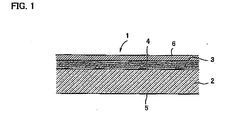
- FIG. 1 is a cross-sectional view of one example of a glass substrate produced by a float bath process.
- a glass substrate 1 is formed by floating a continuous stream of molten glass on a tin (Sn) bath and slowly hardening the same, and therefore there exists a tin-oxide diffusion layer 4 on the bottom surface 3 of a float glass 2, which is formed by bringing the molten glass into contact with the Sn bath.
- the diffusion layer 4 is such that the concentration of tin oxide (SnO 2 ) is highest on its bottom surface and the concentration of the same becomes lower at deeper portions of the float glass.
- the SnO 2 concentration is about 30% by weight at portions 1 to 2 nm apart from the bottom surface, about 5% by weight at portions 100 nm apart from the bottom surface and about 1% by weight at portions 2000 nm apart from the bottom surface.
- top surface also referred to as a forged surface
- spray coating is performed on the bottom surface of the float glass in the present invention.
- Most of the glass substrates produced are large size ones whose width is 2 m or more.
- the first aspect of a process of forming a thin film on a glass substrate in accordance with the present invention is a process in which a metal oxide thin film 6 is formed on the bottom surface 3 by spray coating the same with a coating solution containing an alcohol as a solvent. Spray coating the bottom surface with a coating solution containing an alcohol as a solvent makes the resultant thin film 6 more likely to be uniform.
- the mechanism of producing a uniform thin film is probably as follows. Droplets of a coating solution sprayed on the surface of a substrate spread on the substrate, and are joined to each other to be a uniform liquid film. The film is dried and solidified to form a thin film having uniform thickness and appearance. In other words, wettability (contact angle) of a coating solution on a substrate largely affects the uniformity of the resultant thin film.
- the contact angle is too small
- the droplets of the coating solution spread out immediately after they reach the substrate and their surface area is rapidly increased.
- the solvent evaporates rapidly, and the droplets are solidified before they are joined to each other, which results in production of a thin film having non-uniform thickness and appearance.
- the wettability of a coating solution on a substrate is too low (the contact angle is too large)
- the droplets of the coating solution spread too slow to form a uniform liquid film, which results in production of a thin film having non-uniform thickness and appearance.
- the coating solution and substrate are in a certain wettable relation, the speed of droplets' spread and the speed of solvent' evaporation are well balanced, whereby a uniform liquid film is formed, resulting in production of a thin film having uniform thickness and appearance.
- the bottom surface 3 has a tin oxide diffusion layer 4 formed on it, and therefore the concentration of tin oxide is high there. This means the wettability of water, alcohol, etc. on the bottom surface 3 is lower than that on the top surface 5 (the contact angle is larger). Thus, the wettability of the coating solution is properly controlled, and a uniform coating is attained
- the second aspect of a process of forming a thin film on a glass substrate in accordance with the present invention is a process in which a metal oxide thin film is formed on the glass substrate by spray coating the same with a coating solution containing an alcohol as a solvent and water of from 5% by mass to 15% by mass while controlling the wettability of the coating solution on the glass substrate.
- a coating solution containing an alcohol as a solvent and water of from 5% by mass to 15% by mass while controlling the wettability of the coating solution on the glass substrate.
- the content of water in the coating solution that contains alcohol as a solvent is from 5% by mass to 15% by mass. If the amount of water added is less than 5% by mass, the wettability of the coating solution on the glass substrate becomes too high; as a result, the droplets of the coating solution spread out on the glass substrate immediately after they come in contact with the substrate. And the sol-gel solution coated in a small amount on the glass substrate so as to form a thin film on the substrate rapidly evaporates, which results in formation of a non-uniform thin film on the surface of the glass substrate. Thus, the amount of water added less than 5% by mass is not preferable.
- the amount is more than 15% by mass, the wettability of the sol-gel solution on the glass substrate becomes too low, the droplets of the coating solution does not sufficiently spread on the substrate even after they come in contact with the glass substrate, and the solvent evaporates in the non-uniform liquid film state, which results in formation of a non-uniform thin film.
- the amount of water added more than 15% by mass is not preferable, either.
- the coating solution used in the present invention contains an alcohol such as methanol, ethanol or 2-propanol, as a solvent, and any one of metal alkoxide, a metal hydroxide colloid and metal oxide particles or the mixture thereof, as a metal oxide source.
- Coating solutions containing metal alkoxide include: for example, a solution for silicon oxide film formation, "Lixon Coat” by Chisso Corporation, that contains 6% by mass of silicon alkoxide and methanol as a solvent; and a solution for titanium oxide-silicon oxide film formation, "CG-19Ti” by DAIHACHI CHEMICAL INDUSTRY CO., LTD., whose (Ti/Si) molar ratio is (20/80) and whose solid content is 10% by mass. Titanium oxide particles may be dispersed in these coating solutions so as to increase the amount of titanium oxide.
- a coating solution which contains methanol, as a solvent, and a Ti compound such as titanium alkoxide and/or a Si compound such as silicon alkoxide.
- a thin film 6 containing titanium oxide and/or silicon oxide is formed by applying such a coating solution onto the glass substrate and calcining the resultant liquid film. If a glass substrate having a thin film containing titanium oxide and/or silicon oxide formed on its surface is used for window glass etc., the window glass performs what is called the self-cleaning function (stainproofing function), the function of washing away dirt and dust stains adhering to the window glass with rainfall, the stains can be removed.
- the self-cleaning function stainproofing function
- the third aspect of a process of forming a thin film on a glass substrate in accordance with the present invention is a combination of the first and the second processes in which a metal oxide thin film is formed on the bottom surface 3 by spray coating the same with a coating solution containing an alcohol as a solvent, and besides, water of from 5% by mass to 15% by mass while controlling the wettability of the coating solution on the glass substrate.
- any one of the above-described processes of forming a thin film on a glass substrate it is preferable to add water to be contained in the coating solution after a solution of a metal oxide raw material in alcohol has been prepared. Following this order makes non-uniformity less likely to occur in the resultant thin film.
- any one of the above-described processes of forming a thin film on a glass substrate it is preferable to remove organic matter adhering to the surface of the glass substrate before spray coating the same with a coating solution.
- One example of methods for removing such organic matter is to wash the surface of the glass substrate with cerium oxide etc. Removing organic matter adhering to the surface of the glass substrate makes the wettability of the coating solution stable, and besides, makes it easy to form a uniform thin film throughout the substrate.
- the coating solution is applied by spraying onto the glass substrate while keeping the temperature of the substrate surface at 35°C or lower and preferably at 10 to 30°C. If the temperature of the glass substrate surface is higher than 35°C, the evaporation speed of the solvent in the coating solution becomes so high that a uniform thin film cannot sometimes be produced Keeping the temperature of the substrate at 35°C or lower inhibits the non-uniformity of the evaporation speed of the solvent and makes it easy to form a uniform thin film.
- This heating enhances the strength of the resultant thin film and makes the film more durable.
- Heating temperature lower than 100°C is not preferable because under such low temperatures, the effect of heating is small; as a result, a film having sufficient strength cannot be obtained and the adhesion strength between the glass substrate and the film becomes low.
- Heating temperature higher than 300°C is not preferable, either, because heating at such high temperatures often causes the glass substrate to break during the cooling operation after the heating.
- Heating can be performed by any of known methods. Such methods include: for example, infrared heating using an electric furnace or a gas furnace.
- the thin film-coated glass substrate of the present invention produced in the above described manner has a functional film preferably 50 to 500 nm thick uniformly formed on its large size glass substrate.
- functional films include: for example, hydrophilic or photocatalytic films aimed at stainproofing; UV shielding films; heat shielding films; electricity conducting films; water repellent films; and coloring films.
- the process of forming a thin film on a glass substrate in accordance with the present invention is: a process in which a thin film is formed by spray coating the bottom surface of a large size glass substrate with a coating solution containing an alcohol, as a solvent, a process in which a thin film is formed by spray coating the bottom surface of a large size glass substrate with a coating solution containing an alcohol, as a solvent, together with water, or the combination thereof.
- Removing organic matter adhering to the glass surface, as pretreatment operation, and adjusting the temperature of the glass substrate, as a coating conditions, to 35°C or lower make it possible to form a more uniform thin film.
- the thin film-coated glass substrate of the present invention obtained by the above described process of forming a thin film is of large size and has uniform appearance and functions, and therefore it can be suitably used in various applications such as window glasses for high-rise buildings or average homes or daylighting glasses.
Landscapes
- Chemical & Material Sciences (AREA)
- Life Sciences & Earth Sciences (AREA)
- Engineering & Computer Science (AREA)
- Materials Engineering (AREA)
- General Chemical & Material Sciences (AREA)
- Geochemistry & Mineralogy (AREA)
- Chemical Kinetics & Catalysis (AREA)
- Organic Chemistry (AREA)
- Dispersion Chemistry (AREA)
- Composite Materials (AREA)
- Wood Science & Technology (AREA)
- Surface Treatment Of Glass (AREA)
- Application Of Or Painting With Fluid Materials (AREA)
Abstract
A process of forming a functional thin film uniformly on the surface of a large
size glass substrate, which is used for construction or the like, and a glass substrate
coated with a thin film formed by the above process are provided. A uniform metal
oxide thin film is formed by: using large size plate glass produced by the float bath
process, in which molten glass is poured into an Sn bath and gradually hardened; and
applying by spraying a coating solution containing an alcohol as a solvent and 5% by
mass to 15% by mass of water onto the bottom surface of the large size plate glass,
which is formed by bringing the molten glass into contact with the Sn bath, while
controlling the wettability of the coating solution on the glass substrate.
Description
The present invention relates to a process of forming a uniform thin film on
the surface of a large size glass substrate, which is used for construction or the like,
and a glass substrate coated with a thin film formed by the above process.
A thin film has been formed on the surface of a large size glass substrate,
which is used for construction or the like, so as to add various functions, such as UV
shielding, heat shielding, electricity conducting, stainproofing, hydrophilization,
water repelling and coloring, to the glass substrate. As processes of forming such a
functional thin film, there have been known two types of processes: dry processes in
which a solid thin film is directly formed on a substrate; and wet processes in which
a thin film is formed in such a manner as to coat a coating solution on a substrate, dry
the resultant liquid film, and heat treat the dried film. In the formation of a
functional thin film, wet processes, which use coating solutions capable of having
various compositions, are used very often as attractive processes. A spin coating
method, a roll coating method, a flow coating method, a dipping method, and a
spraying method are known as typical examples of wet processes.
The spin coating method is a process of forming a thin film on the surface of a
glass substrate by dropping a coating solution onto the substrate while rotating the
same at high frequency to uniformly spread the solution onto the surface of the glass
substrate. This process, however, cannot be substantially used to apply a coating
onto a large size glass substrate, which is used for construction, because to provide a
coating on a large size glass substrate, the size of apparatus used must be large, and
moreover, to rotate a glass at high frequency while holding the same, large-scale
holding equipment is required and safety measures must be taken.
The roll coating method is a process of forming a thin film on the surface of a
glass substrate by bringing a coating roll in contact with the surface of the substrate
while conveying the substrate. In this case, the surface level of the substrate must
be kept constant so that the entire coating roll can come in contact with the glass
substrate. However, when handling a large size glass substrate, the width of the
coating roll used becomes large, and therefore the coating applied is largely affected
by the distortion of the coating roll or the like and is likely to be a non-uniform thin
film.
The flow coating method is a process of forming a thin film on a glass
substrate by dropping a coating solution uniformly across the width of the glass
substrate while conveying the glass substrate. In this process, to form a uniform
thin film, the coating solution is required to have high viscosity. If the viscosity of
the coating solution is low, non-uniformity occurs across the width of the substrate or
in the direction in which the substrate is conveyed. Thus, coating solutions
applicable are limited.
The dipping method is a process of forming a thin film on a glass substrate by
dipping the glass substrate into a coating solution and withdrawing the same. To
form a uniform thin film by this process, control of withdrawing speed, prevention of
vibration, control of atmosphere, etc. are indispensable at the time of withdrawing
operation. Besides, this process has a problem of low productivity because the
withdrawing speed cannot be very high and, when the substrate requires a coating
only on one side, a masking step is required.
The spraying method is a process of forming a thin film on a glass substrate
by spraying a coating solution on the surface of the glass substrate while conveying
the same. This process is most suitable for forming a film on a large size glass
substrate, which is used for construction or the like from the viewpoint of
productivity. However, in a large size glass substrate, it is difficult to spray a
uniform amount of coating solution throughout the substrate surface, and therefore
appearance non-uniformity often occurs. To obtain a uniform thin film, it is
important to control the surface temperature of the glass substrate.
There is disclosed a process of forming a titanium oxide film on a glass
substrate by spraying an aqueous solution of titanic acid on the surface of a glass
ribbon between the outlet of a float bath and the end of the forming process and
using the heat possessed by the glass substrate (Japanese Patent Laid-Open No.
2001-80939). However, the aqueous solution of titanic acid rapidly evaporates
since the temperature of the glass substrate is high, whereby it is difficult to form a
thin film of uniform thickness.
As described so far, a uniform thin film has been difficult to form on the
surface of a large size glass substrate, which is used for construction or the like, by
wet processes.
Accordingly, the object of the present invention is to provide a process of
forming a functional thin film uniformly on a surface of a large size glass substrate,
which is used for construction or the like, and a glass substrate coated with a thin
film formed by the above process.
The first aspect of a process of forming a thin film on a glass substrate in
accordance with the present invention is a process of forming a thin film on a large
size glass substrate by spraying, the process comprising the steps of preparing, as the
large size glass substrate, plate glass produced by a float bath process in which
molten glass is poured into an Sn bath and gradually hardened, applying a coating
solution containing an alcohol as a solvent onto the bottom surface of the plate glass,
which is formed by bringing the molten glass into contact with the Sn bath, by
spraying, and forming a metal oxide thin film.
The second aspect of a process of forming a thin film on a glass substrate in
accordance with the present invention is a process of forming a thin film on a large
size glass substrate by spraying, the process comprising the steps of applying a
coating solution containing an alcohol as a solvent and water of from 5% by mass to
15% by mass onto the large size glass substrate by spraying, while controlling the
wettability of the coating solution on the glass substrate, and forming a metal oxide
thin film.
The third aspect of a process of forming a thin film on a glass substrate in
accordance with the present invention is a process of forming a thin film on a large
size glass substrate by spraying, the process comprising the steps of preparing, as the
large size glass substrate, plate glass produced by a float bath process in which
molten glass is poured into an Sn bath and gradually hardened, applying a coating
solution containing an alcohol as a solvent and water of from 5% by mass to 15% by
mass onto the bottom surface of the plate glass, which is formed by bringing the
molten glass into contact with the Sn bath, by spraying, while controlling the
wettability of the coating solution on the glass substrate, and forming a metal oxide
thin film.
In the above-described processes of forming a thin film, it is preferable that
the water contained in the coating solution is added after an alcohol solution of a
metal oxide raw material is prepared. This makes non-uniformity less likely to
occur in the resultant thin film.
When the above metal oxide thin film is a thin film that comprises titanium
oxide and/or silicon oxide, stainproof function can be added to the glass substrate.
And preferably, spray coating of the above coating solution is performed while
keeping the temperature of the glass substrate at 35°C or lower and then the
temperature of the glass substrate surface is raised to 100°C to 300°C. The glass
substrate coated with a thin film of the present invention produced in such a manner
can be used in various applications depending on the kind of the function of the thin
film.
The embodiments of the present invention will be described with reference to
the accompanying drawing.
Figure 1 is a cross-sectional view of one example of a glass substrate
produced by a float bath process. A glass substrate 1 is formed by floating a
continuous stream of molten glass on a tin (Sn) bath and slowly hardening the same,
and therefore there exists a tin-oxide diffusion layer 4 on the bottom surface 3 of a
float glass 2, which is formed by bringing the molten glass into contact with the Sn
bath. The diffusion layer 4 is such that the concentration of tin oxide (SnO2) is
highest on its bottom surface and the concentration of the same becomes lower at
deeper portions of the float glass. Typically, the SnO2 concentration is about 30%
by weight at portions 1 to 2 nm apart from the bottom surface, about 5% by weight at
portions 100 nm apart from the bottom surface and about 1% by weight at portions
2000 nm apart from the bottom surface.
The surface opposite to the bottom surface 3 is referred to as a top surface
(also referred to as a forged surface) 5, where the float glass 2 is exposed. When
viewed as an apparatus for use in a float bath process, the drawing of figure 1 is
upside down; however, the present inventors intentionally do it, since spray coating
is performed on the bottom surface of the float glass in the present invention. Most
of the glass substrates produced are large size ones whose width is 2 m or more.
The first aspect of a process of forming a thin film on a glass substrate in
accordance with the present invention is a process in which a metal oxide thin film 6
is formed on the bottom surface 3 by spray coating the same with a coating solution
containing an alcohol as a solvent. Spray coating the bottom surface with a coating
solution containing an alcohol as a solvent makes the resultant thin film 6 more
likely to be uniform.
The mechanism of producing a uniform thin film is probably as follows.
Droplets of a coating solution sprayed on the surface of a substrate spread on the
substrate, and are joined to each other to be a uniform liquid film. The film is dried
and solidified to form a thin film having uniform thickness and appearance. In
other words, wettability (contact angle) of a coating solution on a substrate largely
affects the uniformity of the resultant thin film.
If the wettability of a coating solution on a substrate is too high (the contact
angle is too small), the droplets of the coating solution spread out immediately after
they reach the substrate and their surface area is rapidly increased. As a result, the
solvent evaporates rapidly, and the droplets are solidified before they are joined to
each other, which results in production of a thin film having non-uniform thickness
and appearance. On the other hand, if the wettability of a coating solution on a
substrate is too low (the contact angle is too large), the droplets of the coating
solution spread too slow to form a uniform liquid film, which results in production of
a thin film having non-uniform thickness and appearance.
When the coating solution and substrate are in a certain wettable relation, the
speed of droplets' spread and the speed of solvent' evaporation are well balanced,
whereby a uniform liquid film is formed, resulting in production of a thin film having
uniform thickness and appearance.
The bottom surface 3 has a tin oxide diffusion layer 4 formed on it, and
therefore the concentration of tin oxide is high there. This means the wettability of
water, alcohol, etc. on the bottom surface 3 is lower than that on the top surface 5
(the contact angle is larger). Thus, the wettability of the coating solution is properly
controlled, and a uniform coating is attained
The second aspect of a process of forming a thin film on a glass substrate in
accordance with the present invention is a process in which a metal oxide thin film is
formed on the glass substrate by spray coating the same with a coating solution
containing an alcohol as a solvent and water of from 5% by mass to 15% by mass
while controlling the wettability of the coating solution on the glass substrate.
Addition of the above described amount of water to alcohol allows the speed of
droplets' spread and the speed of solvent' evaporation to be balanced, whereby a
uniform liquid film is formed, resulting in production of a thin film having uniform
thickness and appearance.
Addition of water to an alcohol solvent, such as methanol or ethanol, whose
boiling point is lower than that of water raises the apparent boiling point of the
solvent, there preventing the solvent from rapidly evaporating on the glass substrate.
Further, addition of water increases the surface tension of the coating liquid, thereby
decreasing the wettability of the coating solution on the glass substrate, which
inhibits the droplets of the coating solution from rapidly spread on the glass substrate.
These two effects allow the coating solution having been sprayed on the glass
substrate to form a uniform liquid film, whereby a thin film having uniform thickness
and appearance is formed. An alcohol such as methanol or ethanol and water are
uniformly miscible with each other, and non-uniformity between them never occurs
in the coating solution. Thus, addition of water to an alcohol solvent is preferably
employed.
The content of water in the coating solution that contains alcohol as a solvent
is from 5% by mass to 15% by mass. If the amount of water added is less than 5%
by mass, the wettability of the coating solution on the glass substrate becomes too
high; as a result, the droplets of the coating solution spread out on the glass substrate
immediately after they come in contact with the substrate. And the sol-gel solution
coated in a small amount on the glass substrate so as to form a thin film on the
substrate rapidly evaporates, which results in formation of a non-uniform thin film on
the surface of the glass substrate. Thus, the amount of water added less than 5% by
mass is not preferable. On the other hand, if the amount is more than 15% by mass,
the wettability of the sol-gel solution on the glass substrate becomes too low, the
droplets of the coating solution does not sufficiently spread on the substrate even
after they come in contact with the glass substrate, and the solvent evaporates in the
non-uniform liquid film state, which results in formation of a non-uniform thin film.
Thus the amount of water added more than 15% by mass is not preferable, either.
The coating solution used in the present invention contains an alcohol such as
methanol, ethanol or 2-propanol, as a solvent, and any one of metal alkoxide, a metal
hydroxide colloid and metal oxide particles or the mixture thereof, as a metal oxide
source. Coating solutions containing metal alkoxide include: for example, a
solution for silicon oxide film formation, "Lixon Coat" by Chisso Corporation, that
contains 6% by mass of silicon alkoxide and methanol as a solvent; and a solution for
titanium oxide-silicon oxide film formation, "CG-19Ti" by DAIHACHI
CHEMICAL INDUSTRY CO., LTD., whose (Ti/Si) molar ratio is (20/80) and
whose solid content is 10% by mass. Titanium oxide particles may be dispersed in
these coating solutions so as to increase the amount of titanium oxide.
To form a hydrophilic thin film which is aimed at stainproofing, for example,
a coating solution is used which contains methanol, as a solvent, and a Ti compound
such as titanium alkoxide and/or a Si compound such as silicon alkoxide. A thin
film 6 containing titanium oxide and/or silicon oxide is formed by applying such a
coating solution onto the glass substrate and calcining the resultant liquid film. If a
glass substrate having a thin film containing titanium oxide and/or silicon oxide
formed on its surface is used for window glass etc., the window glass performs what
is called the self-cleaning function (stainproofing function), the function of washing
away dirt and dust stains adhering to the window glass with rainfall, the stains can be
removed.
The third aspect of a process of forming a thin film on a glass substrate in
accordance with the present invention is a combination of the first and the second
processes in which a metal oxide thin film is formed on the bottom surface 3 by
spray coating the same with a coating solution containing an alcohol as a solvent, and
besides, water of from 5% by mass to 15% by mass while controlling the wettability
of the coating solution on the glass substrate.
In any one of the above-described processes of forming a thin film on a glass
substrate, it is preferable to add water to be contained in the coating solution after a
solution of a metal oxide raw material in alcohol has been prepared. Following this
order makes non-uniformity less likely to occur in the resultant thin film.
In any one of the above-described processes of forming a thin film on a glass
substrate, it is preferable to remove organic matter adhering to the surface of the
glass substrate before spray coating the same with a coating solution. One example
of methods for removing such organic matter is to wash the surface of the glass
substrate with cerium oxide etc. Removing organic matter adhering to the surface
of the glass substrate makes the wettability of the coating solution stable, and besides,
makes it easy to form a uniform thin film throughout the substrate.
Preferably, the coating solution is applied by spraying onto the glass substrate
while keeping the temperature of the substrate surface at 35°C or lower and
preferably at 10 to 30°C. If the temperature of the glass substrate surface is higher
than 35°C, the evaporation speed of the solvent in the coating solution becomes so
high that a uniform thin film cannot sometimes be produced Keeping the
temperature of the substrate at 35°C or lower inhibits the non-uniformity of the
evaporation speed of the solvent and makes it easy to form a uniform thin film.
It is also preferable to apply by spraying the coating solution onto the glass
substrate while keeping the temperature of the substrate surface at 35°C or lower and
then raise the temperature of the glass substrate surface to 100°C to 300°C. This
heating enhances the strength of the resultant thin film and makes the film more
durable. Heating temperature lower than 100°C is not preferable because under
such low temperatures, the effect of heating is small; as a result, a film having
sufficient strength cannot be obtained and the adhesion strength between the glass
substrate and the film becomes low. Heating temperature higher than 300°C is not
preferable, either, because heating at such high temperatures often causes the glass
substrate to break during the cooling operation after the heating. And if the glass
substrate having been heated at such high temperatures is annealed under such
conditions that do not cause the breaking of the substrate, the productivity is lowered.
Heating can be performed by any of known methods. Such methods include: for
example, infrared heating using an electric furnace or a gas furnace.
The thin film-coated glass substrate of the present invention produced in the
above described manner has a functional film preferably 50 to 500 nm thick
uniformly formed on its large size glass substrate. Types of functional films
include: for example, hydrophilic or photocatalytic films aimed at stainproofing; UV
shielding films; heat shielding films; electricity conducting films; water repellent
films; and coloring films.
In the following the present invention will be described by examples, however,
it is to be understood that the following examples are not intended to limit the present
invention. Examples and Comparative Examples are summarized in a Table.

In the above table, the raw materials for the solution, the mixing ratio of the
raw materials and the mixing procedure of the same are as follows.
(e.g.) a zol of titanium oxide in water (solid content 20% by weight)
(e.g.) tetraethoxysilane + methanol + water + diluted hydrochloride
→ 60°C/2hr heating → average molecular weight 950
(e.g.) Zr(OC4H9)3(C5H7O2), Zr(OC4H9)(C5H7O2)(C6H9O)2
(e.g.) a zol of silica in methanol (solid content 20% by weight)
The process of forming a thin film on a glass substrate in accordance with the
present invention is: a process in which a thin film is formed by spray coating the
bottom surface of a large size glass substrate with a coating solution containing an
alcohol, as a solvent, a process in which a thin film is formed by spray coating the
bottom surface of a large size glass substrate with a coating solution containing an
alcohol, as a solvent, together with water, or the combination thereof. By any of the
above processes, the evaporation speed and the spread speed of the coating solution
are properly controlled and a uniform thin film can be formed.
Removing organic matter adhering to the glass surface, as pretreatment
operation, and adjusting the temperature of the glass substrate, as a coating
conditions, to 35°C or lower make it possible to form a more uniform thin film.
The thin film-coated glass substrate of the present invention obtained by the
above described process of forming a thin film is of large size and has uniform
appearance and functions, and therefore it can be suitably used in various
applications such as window glasses for high-rise buildings or average homes or
daylighting glasses.
Claims (10)
- A process of forming a thin film on a large size glass substrate by spraying comprising the steps of:preparing, as the large size glass substrate, plate glass produced by a float bath process in which molten glass is poured into an Sn bath and gradually hardened;applying a coating solution containing an alcohol as a solvent onto the bottom surface of the plate glass, which is formed by bringing the molten glass into contact with the Sn bath, by spraying; andforming a metal oxide thin film.
- A process of forming a thin film on a large size glass substrate by spraying comprising the steps of:applying a coating solution containing an alcohol as a solvent and water of from 5% by mass to 15% by mass onto the large size glass substrate by spraying; andforming a metal oxide thin film.
- A process of forming a thin film on a large size glass substrate by spraying comprising the steps of:preparing, as the large size glass substrate, plate glass produced by a float bath process in which molten glass is poured into an Sn bath and gradually hardened;applying a coating solution containing an alcohol as a solvent and water of from 5% by mass to 15% by mass onto the bottom surface of the plate glass, which is formed by bringing the molten glass into contact with the Sn bath, by spraying; andforming a metal oxide thin film.
- The process of forming a thin film on a glass substrate according to any one of claims 1 to 3, wherein among the water contained in the coating solution, the water of from 5% by mass to 10% by mass with respect to the total coating solution is added after an alcohol solution of a metal oxide raw material is prepared.
- The process of forming a thin film on a glass substrate according to any one of claims 1 to 4, wherein the metal oxide thin film comprises titanium oxide and/or silicon oxide.
- The process of forming a thin film on a glass substrate according to any one of claims 1 to 4, wherein the coating solution comprises titanium alkoxide and/or silicon alkoxide.
- The process of forming a thin film on a glass substrate according to any one of claims 1 to 6, wherein the coating solution comprises titanium oxide fine particles and/or silicon oxide fine particles.
- The process of forming a thin film on a glass substrate according to any one of claims 1 to 7, wherein the coating solution is applied by spraying onto the glass substrate while keeping the surface temperature of the glass substrate at 35°C or lower.
- The process of forming a thin film on a glass substrate according to any one of claims 1 to 8, wherein the coating solution is applied by spraying onto the glass substrate while keeping the surface temperature of the glass substrate at 35°C or lower and then the surface temperature of the glass substrate is raised to 100°C to 300°C.
- A glass substrate coated with a thin film, wherein the substrate is produced by the process according to any one of claims 1 to 9.
Applications Claiming Priority (3)
| Application Number | Priority Date | Filing Date | Title |
|---|---|---|---|
| JP2002315258A JP2004149347A (en) | 2002-10-30 | 2002-10-30 | Method for forming thin film on glass substrate and thin film-coated glass substrate |
| JP2002315258 | 2002-10-30 | ||
| PCT/JP2003/013905 WO2004039739A1 (en) | 2002-10-30 | 2003-10-30 | Method of forming thin film on glass substrate and glass substrate coated with thin film |
Publications (1)
| Publication Number | Publication Date |
|---|---|
| EP1564192A1 true EP1564192A1 (en) | 2005-08-17 |
Family
ID=32211646
Family Applications (1)
| Application Number | Title | Priority Date | Filing Date |
|---|---|---|---|
| EP03770010A Withdrawn EP1564192A1 (en) | 2002-10-30 | 2003-10-30 | Method of forming thin film on glass substrate and glass substrate coated with thin film |
Country Status (7)
| Country | Link |
|---|---|
| US (1) | US20060096320A1 (en) |
| EP (1) | EP1564192A1 (en) |
| JP (1) | JP2004149347A (en) |
| KR (1) | KR20050084913A (en) |
| CN (1) | CN1732134A (en) |
| AU (1) | AU2003280633A1 (en) |
| WO (1) | WO2004039739A1 (en) |
Cited By (1)
| Publication number | Priority date | Publication date | Assignee | Title |
|---|---|---|---|---|
| CN103524046A (en) * | 2013-09-29 | 2014-01-22 | 南京中电熊猫液晶显示科技有限公司 | On-line repairing equipment and method of alignment film |
Families Citing this family (6)
| Publication number | Priority date | Publication date | Assignee | Title |
|---|---|---|---|---|
| JP2011173312A (en) * | 2010-02-24 | 2011-09-08 | Touch Panel Kenkyusho:Kk | Glass substrate laminated structure |
| CN104354412A (en) * | 2014-11-03 | 2015-02-18 | 大连爱瑞德纳米科技有限公司 | Solar heat insulation film and method for continuously preparing solar heat insulation films |
| CN105906375B (en) * | 2016-04-20 | 2019-06-04 | 长沙学院 | A kind of preparation method of transparent mesoporous titanium dioxide hydrophobic/superhydrophilic functional film |
| EP4082891A4 (en) * | 2019-12-27 | 2024-02-07 | Nippon Sheet Glass Company, Limited | Transparent laminate |
| CN116282946B (en) * | 2023-02-14 | 2023-12-22 | 江阴市恒峰塑玻有限公司 | Self-cleaning coated glass and processing technology thereof |
| CN115969031B (en) * | 2023-02-14 | 2024-12-03 | 上海交通大学 | Preparation method of food-grade hydrogel with multi-stage layered structure |
Family Cites Families (3)
| Publication number | Priority date | Publication date | Assignee | Title |
|---|---|---|---|---|
| JPH07110773B2 (en) * | 1990-03-16 | 1995-11-29 | 日本パーカライジング株式会社 | Glass surface treatment method |
| JP2000143293A (en) * | 1998-11-06 | 2000-05-23 | Central Glass Co Ltd | Glass with photo-catalyst film and its preparation |
| JP2000219875A (en) * | 1999-02-01 | 2000-08-08 | Nippon Sheet Glass Co Ltd | Production of water repellent film coated article, water repellent film coated article and composition for water repellent film coated article |
-
2002
- 2002-10-30 JP JP2002315258A patent/JP2004149347A/en active Pending
-
2003
- 2003-10-30 KR KR1020057007721A patent/KR20050084913A/en not_active Withdrawn
- 2003-10-30 EP EP03770010A patent/EP1564192A1/en not_active Withdrawn
- 2003-10-30 WO PCT/JP2003/013905 patent/WO2004039739A1/en not_active Ceased
- 2003-10-30 AU AU2003280633A patent/AU2003280633A1/en not_active Abandoned
- 2003-10-30 CN CNA200380108086XA patent/CN1732134A/en active Pending
- 2003-10-30 US US10/532,875 patent/US20060096320A1/en not_active Abandoned
Non-Patent Citations (1)
| Title |
|---|
| See references of WO2004039739A1 * |
Cited By (1)
| Publication number | Priority date | Publication date | Assignee | Title |
|---|---|---|---|---|
| CN103524046A (en) * | 2013-09-29 | 2014-01-22 | 南京中电熊猫液晶显示科技有限公司 | On-line repairing equipment and method of alignment film |
Also Published As
| Publication number | Publication date |
|---|---|
| WO2004039739A1 (en) | 2004-05-13 |
| KR20050084913A (en) | 2005-08-29 |
| CN1732134A (en) | 2006-02-08 |
| US20060096320A1 (en) | 2006-05-11 |
| AU2003280633A8 (en) | 2004-05-25 |
| AU2003280633A1 (en) | 2004-05-25 |
| JP2004149347A (en) | 2004-05-27 |
Similar Documents
| Publication | Publication Date | Title |
|---|---|---|
| US5413865A (en) | Water-repellent metal oxide film and method of forming same on glass substrate | |
| AU2010219836B2 (en) | Slot die coating process | |
| US5394269A (en) | Reflectance reducing film and method of forming same on glass substrate | |
| AU748451B2 (en) | Process for depositing optical layers | |
| US10600923B2 (en) | Low-reflection coating, glass sheet, glass substrate, and photoelectric conversion device | |
| SK119299A3 (en) | Photocatalytically-activated self-cleaning article and method of making same | |
| JPH10231146A (en) | Antifogging and antifouling glass article | |
| CN100503029C (en) | Method for preparing chemical adsorption film and solution for preparing chemical adsorption film for use therein | |
| US9012354B2 (en) | Photocatalytic film, method for forming photocatalytic film and photocatalytic film coated product | |
| CN1931448A (en) | Method of forming hydrophobic transparent film on the surface of different substrates | |
| US20060096320A1 (en) | Process of forming thin film on glass substrate and glass substrate coated with thin film | |
| EP3225600B1 (en) | Glass plate with low-reflection coating | |
| CN106660863B (en) | Low-reflection coating, substrate with low-reflection coating, and photoelectric conversion device | |
| KR100572438B1 (en) | Coating method of automotive side mirror coated with photocatalyst oxide | |
| JP3391972B2 (en) | Film forming method | |
| JP5537986B2 (en) | Amorphous titanium oxide dispersion and method for producing the same | |
| JP2003277041A (en) | Method for producing silica thin film on substrate surface having arbitrary surface characteristics and surface shape, and composite structure | |
| JP2015074588A (en) | Method for producing hydrophilized glass substrate | |
| JP4175880B2 (en) | Sol-gel film having a convex, concave or concave surface shape, coating liquid and production method | |
| CN100451054C (en) | Organic thin film manufacturing method | |
| JP7359999B2 (en) | Method for producing hydrophilic coating agent and method for forming coating film | |
| KR20190033172A (en) | Composition for hydrophobic and self-healing thin film and hydrophobic thin film made from the same | |
| JP2001019494A (en) | Anti-fog glass articles | |
| JP2018104218A (en) | Manufacturing method of substrate with coating film, and substrate with coating film | |
| KR0183428B1 (en) | Low reflection treatment method of glass products |
Legal Events
| Date | Code | Title | Description |
|---|---|---|---|
| PUAI | Public reference made under article 153(3) epc to a published international application that has entered the european phase |
Free format text: ORIGINAL CODE: 0009012 |
|
| 17P | Request for examination filed |
Effective date: 20050527 |
|
| AK | Designated contracting states |
Kind code of ref document: A1 Designated state(s): AT BE BG CH CY CZ DE DK EE ES FI FR GB GR HU IE IT LI LU MC NL PT RO SE SI SK TR |
|
| AX | Request for extension of the european patent |
Extension state: AL LT LV MK |
|
| DAX | Request for extension of the european patent (deleted) | ||
| RBV | Designated contracting states (corrected) |
Designated state(s): DE FR GB |
|
| STAA | Information on the status of an ep patent application or granted ep patent |
Free format text: STATUS: THE APPLICATION HAS BEEN WITHDRAWN |
|
| 18W | Application withdrawn |
Effective date: 20071107 |