EP1562365A1 - Procédé et système d'établissement d'un tramage par zone d'une image adapté pour utiliser des variantes de chemin de diffusion d'erreur - Google Patents
Procédé et système d'établissement d'un tramage par zone d'une image adapté pour utiliser des variantes de chemin de diffusion d'erreur Download PDFInfo
- Publication number
- EP1562365A1 EP1562365A1 EP05290255A EP05290255A EP1562365A1 EP 1562365 A1 EP1562365 A1 EP 1562365A1 EP 05290255 A EP05290255 A EP 05290255A EP 05290255 A EP05290255 A EP 05290255A EP 1562365 A1 EP1562365 A1 EP 1562365A1
- Authority
- EP
- European Patent Office
- Prior art keywords
- data
- pixel
- error
- pixels
- block
- Prior art date
- Legal status (The legal status is an assumption and is not a legal conclusion. Google has not performed a legal analysis and makes no representation as to the accuracy of the status listed.)
- Withdrawn
Links
- 238000000034 method Methods 0.000 title claims abstract description 31
- 238000009792 diffusion process Methods 0.000 title claims description 102
- 238000012545 processing Methods 0.000 claims abstract description 68
- 238000003860 storage Methods 0.000 claims description 74
- 230000015654 memory Effects 0.000 claims description 59
- 239000000872 buffer Substances 0.000 claims description 31
- 238000009826 distribution Methods 0.000 claims description 29
- 238000000605 extraction Methods 0.000 claims description 17
- 238000011282 treatment Methods 0.000 claims description 17
- 230000008569 process Effects 0.000 claims description 13
- 230000006870 function Effects 0.000 claims description 8
- 238000009432 framing Methods 0.000 claims description 7
- 230000037361 pathway Effects 0.000 claims description 6
- 230000000295 complement effect Effects 0.000 claims description 4
- 238000012546 transfer Methods 0.000 claims description 3
- 238000012216 screening Methods 0.000 abstract description 13
- 235000021183 entrée Nutrition 0.000 description 8
- 238000012550 audit Methods 0.000 description 4
- 238000003384 imaging method Methods 0.000 description 4
- 241000948268 Meda Species 0.000 description 3
- 230000008901 benefit Effects 0.000 description 3
- YQYUWUKDEVZFDB-UHFFFAOYSA-N mmda Chemical compound COC1=CC(CC(C)N)=CC2=C1OCO2 YQYUWUKDEVZFDB-UHFFFAOYSA-N 0.000 description 3
- 230000007480 spreading Effects 0.000 description 3
- 238000003892 spreading Methods 0.000 description 3
- 238000013459 approach Methods 0.000 description 2
- 238000010586 diagram Methods 0.000 description 2
- 239000011159 matrix material Substances 0.000 description 2
- 241001269238 Data Species 0.000 description 1
- 241000135309 Processus Species 0.000 description 1
- 230000003139 buffering effect Effects 0.000 description 1
- 230000006835 compression Effects 0.000 description 1
- 238000007906 compression Methods 0.000 description 1
- 238000010276 construction Methods 0.000 description 1
- 238000005520 cutting process Methods 0.000 description 1
- 230000003247 decreasing effect Effects 0.000 description 1
- 238000013461 design Methods 0.000 description 1
- 230000000977 initiatory effect Effects 0.000 description 1
- 239000000203 mixture Substances 0.000 description 1
- 239000003607 modifier Substances 0.000 description 1
- 230000000644 propagated effect Effects 0.000 description 1
Images



Classifications
-
- H—ELECTRICITY
- H04—ELECTRIC COMMUNICATION TECHNIQUE
- H04N—PICTORIAL COMMUNICATION, e.g. TELEVISION
- H04N1/00—Scanning, transmission or reproduction of documents or the like, e.g. facsimile transmission; Details thereof
- H04N1/40—Picture signal circuits
- H04N1/405—Halftoning, i.e. converting the picture signal of a continuous-tone original into a corresponding signal showing only two levels
- H04N1/4051—Halftoning, i.e. converting the picture signal of a continuous-tone original into a corresponding signal showing only two levels producing a dispersed dots halftone pattern, the dots having substantially the same size
- H04N1/4052—Halftoning, i.e. converting the picture signal of a continuous-tone original into a corresponding signal showing only two levels producing a dispersed dots halftone pattern, the dots having substantially the same size by error diffusion, i.e. transferring the binarising error to neighbouring dot decisions
Definitions
- the present invention applies to the field of electronics and more particularly to the establishment of signals representative of frames of a image to allow their printing by a printing device or their display by display means (LCD, CRT or plasma screens).
- the present invention relates to a method for establishing a screening by zone of an image implemented by a system adapted to use error diffusion path variants.
- a frame is a set of successive lines consisting of successive points (or pixels) whose representative values of two-dimensional arrangement and chromatic compositions and / or luminance define an image. Dithering corresponds to the attribution a color and / or a luminance to each of the pixels of the frame.
- the image frame is generally constituted in the prior art of swept lines from left to right then from right to left for lines following inferiors and then from left to right and so on, in reiterating this type of operation in a similar way to the scanning of television monitors.
- the present invention aims to overcome certain disadvantages of the prior art by proposing a method for establishing a screening by area of an image, which is suitable for different broadcast paths error.
- the invention allows the construction of a frame using advantageously blocks of pixels and by traversing these blocks of pixels according to paths that can be modified.
- the course path the block is taken into account to correct the error reports and to modify the directions and error transfer coefficients so that when the blocks pixels are placed next to each other to form a frame, obtain a suitable result.
- said treatment step further comprises, for each of the blocks, an error distribution step to add said error diffusion data, on the one hand to pixels adjacent to said input pixel within the corresponding area by a first error distribution unit, and on the other hand to pixels adjacent to said input pixel outside the corresponding area by a second error distribution unit.
- the first memory step comprises division into a plurality of blocks of pixels of the data input, made by the input storage means, the blocks of pixels being dimensioned to form rows of blocks of uniform height, these rows of blocks being treated according to a left horizontal scan to the right.
- the reading step in the table of decisions includes a linear reading of the data corresponding to the pixel current.
- the reading step in the table of decisions is reiterated for each of the pixels traveled successively in a block according to the determined path of travel and includes reading coordinates of the next pixel to extract from the block, commands from multiplexing means to indicate the orientation of the route path as well as write or read addresses for storing errors.
- the extraction step consists in extracting from the input storage means a first predetermined pixel of a block of pixels, then extract the following pixels as you go path orientation commands read at each pixel treaty.
- the diffusion orientations are programmed by an incremental-descrambling addressing module coordinates of the current pixel as a function of data from the decision table, addressing data indicating the coordinates of the first pixel extracted from a block being provided to the module to initialize the programming of the dissemination guidelines, the determined path with four to eight orientations distinct.
- the error diffusion step provides error diffusion data representative of error coefficients at spread defined based on order data from the table of decisions, the output pixel produced during the error diffusion step being sent by pixel output means in storage means of output storing the output pixels for display or printing.
- multiplexing conditions of the error to be reported on the current pixel as well as conditions of multiplexing data representative of a memory trace of storage of the current pixel are defined during the second step of memory in the commands of multiplexing means, information on the multiplexing conditions of the error to be reported on the current pixel being transmitted to first multiplexing means for spread the error on the current pixel, while information about data multiplexing conditions representative of a trace of storage memory of the current pixel are transmitted to seconds multiplexing means forming said first and second units of error distribution.
- the error diffusion step provides error diffusion data produced by a calculation module having of at least a first output link to the second means of multiplexing as well as an additional link to a unit of temporary storage, buffering and temporarily storing error diffusion data, information about the conditions of multiplexing the storage memory trace of the current pixel being used by the second multiplexing means so as to send the error diffusion data produced by the computation module in a internal memory if it is an error to broadcast in the same block or otherwise in a memory external to the processing circuit.
- the first memory step comprises a division, made by the input storage means, of input data into a plurality of blocks of pixels of uniform width dimensioned to form columns of blocks, the scanning of the blocks horizontal being replaced by a vertical sweep.
- the first memory step includes storing a plurality of components for each of the pixels of a block of pixels, each component being processed so independent when processing blocks of pixels.
- Another object of the invention is to propose a system that can be used on an image taking apparatus or an image representation apparatus (for example a printer), overcoming the disadvantages of the prior art.
- the specific programming memory stores each of the decision tables as a succession of data representative of processing decisions for a current pixel, stacked according to an order defined by the determined path of travel pixels of the block, the reading module being able to read in a linear manner the data corresponding to the current pixel in the decision table.
- the reading module is designed to repeat a reading in the decision table for each of the pixels traveled successively in a block according to the path determined, the read data including coordinates of the next pixel at extract from the block, multiplexing means commands to indicate the orientation of the path of travel as well as the addresses of writing or reading for storing errors.
- the extraction module is able to extract from the input storage means a first predetermined pixel of a block of pixels, then extract the following pixels as you go path orientation commands read for each pixel processed by the reading module.
- the processing circuit comprises a addressing module arranged to program the broadcast orientations by incrementation-desincrementation of the coordinates of the current pixel in function of data from the decision table, addressing data to indicate the coordinates of the first pixel extracted from a block being supplied to the addressing module to initialize the programming of dissemination guidelines, the determined path of four to eight distinct orientations.
- the error diffusion means are designed to provide error diffusion data representative of error coefficients to be broadcast defined according to order data of the decision table, the error diffusion means being connected to pixel output means for the output pixel output to be sent to output storage means storing the output pixels for display or printing.
- the error diffusion means include first means of multiplexing to broadcast the error on the current pixel according to information defined in said commands multiplexing means and relating to multiplexing conditions of the error to be reported on the current pixel.
- the error distribution means include second multiplexing means, forming the first and the second error distribution unit, to add said data of error diffusion according to information defined in said multiplexing means commands and relating to conditions of multiplexing data representative of a memory trace of storage of the current pixel.
- the processing circuit comprises a calculation module designed to produce the error diffusion data, said calculation module having at least a first output link to the second multiplexing means as well as an additional link to a temporary storage unit, forming a buffer and storing temporarily error diffusion data, said second means the multiplexing system being able to use the information on the conditions of multiplexing the storage memory trace of the current pixel, so to send the error diffusion data produced by the calculation module in an internal memory if it is an error to broadcast in the same block or otherwise in a memory external to the processing circuit.
- the input storage means are arranged to divide the input data into a plurality of pixel blocks of uniform height dimensioned to form rows of blocks of way to allow a horizontal scan of the pixel blocks by the unit of selection.
- the input storage means are arranged to divide the input data into a plurality of pixel blocks of uniform width dimensioned to form columns of blocks of way to allow vertical scanning of blocks of pixels by the unit of selection.
- FIG. 1 schematically represents the dithering architecture used by the frame setting system according to the invention, with use of a decision table to follow one or more varied paths of the pixels of a block of the frame.
- the frame is a representation of the image in the form of a matrix of pixels, stored in storage means of the image to be processed.
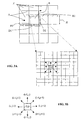
- the pixel matrix is according to the invention decomposed into a plurality of blocks of pixels (B), as shown in FIG. 3A.
- the error of a processed pixel is scattered on the next and neighboring pixels in the frame, i.e. on the one following this pixel treated in the same line as well as those finding on the next line and surrounding this processed pixel.
- Error diffusion produced according to the invention is different from this conventional diffusion scheme because the propagation of errors to the limits of the block meets criteria different and on the other hand the pathway inside a block of pixels (B) can be sinuous or nonlinear.
- the invention proposes a system for establishing a screening by area of an image that is particularly suitable for performing a block processing with error diffusion path variants. These variants are adapted according to the path of the block of pixels (B).
- This system comprises a processing circuit (2), means image input means (1) adapted to provide input to the processing circuit (2) input data, to be displayed or printed, representative pixels of a digital image in correspondence with an image current entry.
- image input means (1) include input storage means (10) to divide and store the input data into a plurality of blocks of pixels (B). These blocks (B), representative of an area of the image, are dimensioned to form rows of blocks of uniform height (H), as shown in Figure 3A.
- the input image can thus be processed block by block so sequential in the direction of the arrow (A) shown in Figure 3A.
- the blocks (B) are not necessarily the same size but their height remains constant for the same row of pixel blocks (B).
- the successive processing block by block each of the zones is not done by a horizontal sweep but by a vertical scanning.
- the input storage means (10) can indeed arranged to divide the input data into blocks of pixels (B) of uniform width, sized to form block columns, so to allow vertical scanning of pixel blocks (B).
- a selection unit (20) is for example provided in the circuit of treatment (2) to select and allow the successive processing block by block each of the areas according to a horizontal image sweep or vertical.
- the size of the block can be for example 32x32 pixels as shown in Figure 1 or 16x24 pixels or any other convenient format of cutting.
- a pixel can have a plurality of different components (color, brightness components).
- the size of a buffer to store a block of pixels (B) may be, but not limited to, 32x32x6 bits.
- the selection unit (20) can also allow the selection of the decision table (3) corresponding to the block of pixels (B) to be processed.
- Component treatment by component can naturally be realized according to the invention, each component being treated independently in the processing of blocks of pixels (B).
- the system the establishment of a zone screening has a specific memory of programming (300) for storing decision tables (3), each associated with areas of the image.
- Each decision table (3) includes data representative of treatment decisions at least one determined path, of a non-linear type, of pixels corresponding to the treated area of the image.
- the path of pixels inside the area includes between three and eight orientations distinct, and preferably between four and eight distinct orientations.
- incrementation or desincrementation of each of the coordinates [i, j] of a current pixel can be carried out according to the path followed for the path of the pixels of the block (B).
- the programming specific memory (300) stores each of the decision tables (3) in the form of a data series (30) representative of processing decisions for a common pixel, stacked following an order defined by the determined path of the pixels of the block (B).
- Data (30) corresponding to treatment decisions may contain all the information necessary for the treatment of a pixel.
- These data (30) are particularly representative in the first place error spreading and path guidance commands for the current pixel and secondly, addressing indications associated with this current pixel. As shown in Figure 2A, the format of these data (30) can distinguish first data (31) of type commands and second data (32) of type addresses in memory.
- the first data (31) comprise in a first field (311) a indication of course direction and in a second field (312) the identifier of a set of coefficients serving for error diffusion.
- the set of coefficients in the second field corresponds to the set of error diffusion coefficients to be taken into account for the dissemination of the mistake.
- the indication in the first field makes it possible to know the coordinates of the next pixel and whether we can use the buffer of row or column to store the errors already calculated.
- the first data (31) of the commands type comprise also dictionary (meda) addresses for storing addresses error multiplexing command as well as addresses (mmda) of dictionary to store multiplexing command addresses from memory. It is thus planned a third (meda) and a fourth field (mmda) for defining the multiplexing conditions respectively the error to be reported on the pixel, and the multiplexing conditions of data representative of a trace of the storage memory of the pixel treaty. Dictionaries are used to store the commands of multiplexers. These dictionaries can advantageously depend on path and allow for compression at the level of the encoding multiplexer commands in the instruction. The multiplexers make it possible to indicate to which memory it is necessary to send the errors found for the current pixel. Data (30) corresponding to the processing decisions are for example provided in a 64-bit instruction of which at least 16 bits are used by the first data (31) of the type orders.
- the second data (32) setting addresses in memory can be coded on the part remaining instruction.
- the second data (32) can correspond in particular to addressing data for reading (rm1, rm2, rm3) and write addressing data (wm1, wm2, wm3).
- Read access data 61, 62, 63
- write data 64, 65, 66
- buffers m1, m2, m3, figure 8 are provided for storing errors.
- One of the buffers (m1) can be provided to store "external" errors to the block of pixels (B) treated.
- One or more fields (60) may be provided in association with the addressing data (61, 64) relating to this buffer (m1) for differentiate a first case in which the error is to be broadcast in block (B) processed and a second case in which the error is to be broadcast in a neighboring block.
- the system for establishing a screening per zone is provided with an extraction module (21) for extracting from said input storage means (10) of the data representative of a pixel current on said path of travel.
- This extraction module (21) can make part of the processing circuit (2) or be connected thereto.
- Each pixel of a pixel block (B) extracted can then be processed by the processing circuit (2).
- the system also comprises a reading module (22) belonging to the processing circuit (2) and adapted to read, in the decision table (3) corresponding to the block (B), the data (30) corresponding to the decisions treatment. Reading these data (30) provides the coordinates of the next pixel to extract from the block, the multiplexing means commands to indicate the orientation of the path and the addresses write or read error storage.
- the decision table (3) is, for example, the size of the block of pixels (B) associated, so as to store command / decision data allowing the processing of each of the pixels of the block (B).
- the module reading (22) is designed to reiterate a reading of the decision table (3) for each of the pixels successively traversed in a block (B) according to the determined path.
- the data corresponding to the current pixel in the decision table (3) are read linearly by the reading module and give a sequence representing the direction of the path path of the block of pixels (B). In variant embodiments, this sequence can also be arranged to match several distinct and complementary paths.
- the extraction module (21) incorporates an addressing module (210) as shown in Figure 6.
- This module addressing (210) will define the incrementation or desincrementation of coordinates [i, j] of the pixel.
- this addressing module (210) makes it possible to define addresses (Acompo) of coordinate components that serve as pixel extraction address next.
- addresses (Acompo) of coordinate components that serve as pixel extraction address next.
- the data direction provided by the first field (311) will control each of the two multiplexers (211, 212) for incrementing or decrementing the coordinate i, respectively j, and by addition generate the components (compo) of coordinates to get the address of the pixel to extract.
- the data addresses from the decision tables (3) which make it possible to indicate the coordinates of the first pixel extracted from a block of pixels (B), are provided to the addressing module (210) for initializing the programming of the orientations of diffusion.
- the extraction module (21) is able to provide the extraction address from the input storage means (10) of a first predetermined pixel belonging to a block of pixels (B), then extracting as and when following pixels according to the orientation commands of the path of read paths for each pixel processed by the read module (22).
- a single continuous path can cover all the pixels inside a block of pixels (B).
- the order in which the pixels are processed is indicated by the arrows.
- the path proposed by Jan P. Allebach and Ti-chiun Chang in the document "Memory Efficient Error Diffusion ", Color Imaging VIII: Processing, Hardcopy, and Applications, Reiner Eschbach, Gabriel G. Marcu, Editors, Proceedings of SPIE-IS & T Electronic Imaging, SPIE Vol. 5008 (2003), can naturally be used, like any other suitable route path allowing cover a block of pixels (B).
- the system the establishment of an area framing comprises means of diffusion error messages (23) designed to subject the current pixel to error diffusion of the treated area according to the data (30) of the decision table (3), to produce an output pixel and error diffusion data.
- the block of pixels (B) being processed has two areas (R1, R2) for which errors have been broadcast. recovered during the processing of the preceding blocks (Z).
- This block of pixels (B) in process is further adjacent to two other areas (D1, D2) pixels not yet processed. These two adjacent zones (D1, D2) must receive errors that have not yet been released.
- the errors associated with the adjacent zone (D1) situated in a different block row are sent to external memory, thanks to the temporary buffer storage unit (200).
- Associated errors adjacent area (D2) in the next block of pixels are sent to the internal memory, for example in a specific buffer (m1, FIG. 8).
- each pixel receives errors from its neighboring pixels.
- the resulting error is stored in a first buffer (m1), whereas when the errors are not complete, they are stored in the second and third buffer (m2, m3). It is possible in some other cases to send errors on three different pixels at once, using all three buffers simultaneously (m1, m2, m3).
- the use of decision tables (3) has the advantage that the dissemination data will be in line with the path complex in the block of pixels (B).
- the error diffusion means (23) are designed to provide representative error diffusion data error coefficients to broadcast. These coefficients are defined according to control data of the decision table (3).
- the processing circuit (2) comprises a module of calculation (230) designed to produce the error diffusion data. This module (230) is available to the error diffusion means (23). said calculation module (230) for example comprises an output link to the temporary buffer storage unit (200). Data from error broadcast can be stored as and when buffer (200).
- the means of error diffusion (23) are connected to pixel output means (24) for that the output pixel produced is sent in storage means of output (4) storing the output pixels for display or printing.
- Reading by the reading module (22) of the data (30) representative processing decisions can provide multiplexing means commands to error diffusion means (23) to indicate the orientation of the path and the addresses write or read for storing errors.
- the means of error diffusion (23) can indeed comprise first means of multiplexing (14) to diffuse the error on the current pixel according to the information defined in said multiplexing means commands. These commands make it possible to establish the multiplexing conditions of the error to be reported on the current pixel.
- Figures 4 and 5 illustrate error diffusion orientations (7) which are a function of the position of the pixel current in the block (B) and in particular the orientation of the path at this current pixel.
- the field (311) it is not only possible to define, by the field (311), the directions and the direction of the travel path, but still it is advantageously defined in the field (312) a set of coefficients, each coefficient being associated with each of the orientations and used to reflect errors. Some of the coefficients will be zero, so that the error is not spread in all directions. It is then the use of these coefficients which will allow the obtaining of the values and the way of spreading errors around the processed pixel. As represented in FIGS. 4 and 5, there can be for a processed pixel only 2 to 4 error dissemination guidelines (7), which are defined via the coefficients. This diffusion process can naturally be used to each of the components associated with a pixel of the block of pixels (B).
- Data representative of the coefficient values can be loaded into registers, to undergo addition operations and to be used in multiplexing operations, in order to adjust the distribution of errors as will be explained below for Figure 8.
- the system the establishment of an area framing comprises distribution means error to add said error diffusion data, on the one hand to pixels adjacent to said input pixel within the area corresponding to the block of pixels (B) being processed, and secondly to pixels adjacent to said input pixel and lying outside that area.
- a first error distribution unit can be provided for the distribution of errors inside the pixel block (B), while a second unit of error distribution can be used to distribute errors to pixels other blocks.
- the first error distribution unit has for example one or more memories internal to the processing circuit (2), to which are disseminated the errors to be broadcast inside the block (B) in course of treatment.
- the second error distribution unit is connected to least a memory external to the processing circuit (2) for storing the data corresponding to errors to be broadcast on the border areas (D1) external blocks of pixels (B) untreated.
- error data say external devices, which can be stored in the temporary storage unit forming buffer (200) as shown in FIG. returned to processing circuit (2) when processing blocks (B) following.
- FIG. 8 represents an exemplary embodiment of architecture of a circuit, incorporating the calculation module (230), allowing calculation and then storage of errors to broadcast.
- the means of error distribution comprise second multiplexing means (12), forming the first and the second error distribution unit, to add said error diffusion data according to defined information in said multiplexing means commands.
- This information is on the conditions for multiplexing the storage memory trace of the current pixel. This trace corresponds to all the addresses of reading and writing used for the three buffers (m1, m2 m3) illustrated in These addresses are obtained at the generation of the instructions by a compiler or equivalent module that takes into account the characteristics path and coefficient sets. As represented in FIG.
- the calculation module (230) may comprise a plurality of operators (11) taking into account each, on the one hand the respective coefficients (71, 72, 73, 74) of the coefficient set provided in the second field (312) of first data (31) of commands, and secondly an error data (e) current for each operator (11) relating to pixels neighboring the pixel treaty.
- a specific buffer for example external and connected to the circuit of processing (2), can be provided for storing and supplying the coefficients (71, 72, 73, 74) as functions of the data (30) from the decision table (3).
- Buffers (m1, m2, m3) also connected to the processing circuit (2), may be provided to receive error data to be broadcast that does not can not be stored in the temporary storage means (13) or in the outer buffer (200).
- This unit (200) serves for example only to store the so-called external errors, that is, errors that must be broadcast in another block of pixels than the current block (B) treatment.
- the accesses read / write in the block (B) being processed can be realized, for each component, in the form of read / write access to parallel in the dedicated buffers (m1, m2 and m3).
- the processing can have read access to the external temporary storage unit (200).
- the processing may include one or more write access in the external storage unit (200), a data being sent for each of the pixel components in said unit (200).
- Each output of an operator (11) is sent to an input of a adder (15) receiving at its second input the output of each of the multiplexer circuits forming the first multiplexing means (14).
- Each multiplexer circuit of the first multiplexing means (14) determines, based on the error multiplexing data (me) provided in the fourth field of the control shown in FIG. 2B, the value of the error to be used among those (e2, e3) resulting from the means of temporary storage (13) or those (c1, c2) read in error buffers (m2, m3) according to read address data (rm2, rm3).
- the calculation module (230) for example calculates up to four errors (e1, e2, e3, e4) for each pixel component.
- Figure 7 illustrates the fact that some pixels inside the block correspond to four orientations to diffuse these errors (e1, e2, e3, e4), while other pixels (in gray) different) correspond to a lower number of broadcast orientation.
- control bits or any other type of data representative of the departure or continuity of the path through the pixel in processing are added for each pixel to the data (30) of the decision tables (3).
- the area can be traveled starting with a first start (41) of course, continuing with a second start (42) a different pathway to cover the left side of the the area and then ending with a third departure (43) from different route used to cover pixels of the right part of the area.
- the using decision tables (3) makes it possible to consider very many possibilities of course to realize the framing by zone.
- the fact of incorporating in the data (31) commands, first place of dictionary address data for error multiplexing (meda), and secondly dictionary address data for memory multiplexing (mmda), can generate commands necessary (me, mm) to control the multiplexing of the multiplexers used in the invention.
- the calculation module (230) has, at least a first output link to second means of multiplexing (12).
- the second multiplexing means (12) are suitable for use the information about the multiplexing conditions of the trace of storing memory of the current pixel, so as to send the data of error diffusion produced by the calculation module (230) in a memory internal (m1, m2, m3) if it is an error to broadcast in the same block (B) or otherwise in a memory buffer (200) external to the circuit of treatment (2).
- An additional link is provided to connect for example this calculation module (230) to the temporary storage unit forming a buffer (200).
- the second multiplexing means (12) form both the first and second error distribution units, since they allow for example, to distribute errors within the pixel block (B), in sending "internal" error data to the processed block (B) in the buffers (m1, m2, m3) and errors outside the pixel block (B) in sending "external” error data to the processed block (B) in the buffer (200) formed by said temporary storage unit.
- the module of calculation (230) also has a second output link for storing the coefficients of repercussion of errors in means of temporary storage (13). As illustrated in FIG. 8, three errors (e1, e2, e3) can be stored, via a loop, in the storage means temporary (13) and can be used by a multiplexer (16).
- This multiplexer (16) initially transmits two errors for the pixel current (e2, e3) and an error (e1 ') to broadcast on the next pixel.
- the data (me) from the fourth field of the control shown in Figure 2B are used to obtain order data which must be used for the first means of multiplexing (14).
- Partial errors (c1, c2), from the buffers (m2, m3) for storing error data "internal" to the processed block, can also be used by the first multiplexing means (14), as shown in Figure 8.
- the addresses (Acompo) of the pixel coordinate components obtained according to the embodiment of Figure 6 are for example used to define the memory addressing to be performed according to the coordinates of the pixel to be processed.
- Data (compo) representative of the pixel component being processed are used to compute the addresses writing in the buffers (m1, m2, m3).
- Some data (d) from data (30) from the decision table (3) are also used to define the write addresses in the buffers (m1, m2, m3).
- Datas read (401) or written (402) relative to the output pixel are read or written to level of the output storage means (4).
- the screening method according to the invention is advantageously based on the use of a decision table (3) to follow one or more paths course.
- Specific registers allow to code several departures (41, 42, 43) path in a block of pixels (B).
- the method according to the invention is iterated for all the pixels of the frame.
- the method of establishing a framing by zone, in diffusion mode error of image data to be displayed or printed, is set work through the processing circuit (2).
- Input data representative of pixels of a digital image, are provided as input to this processing circuit (2) in correspondence with an input image common.
- the process starts with a first step (50) of storage for storing input data in input storage means (10), in the form of blocks of pixels (B) representative of an area of the image.
- a second storage step (6) is also performed for storing in a specific programming memory (300) decisions (3).
- This step (6) consists of storing each of the decision tables in the form of a succession of data representative of processing decisions for a common pixel, stacked following an order defined by the determined path of the pixels of the block.
- the data (30) stored in these tables (3) are therefore representative of the error propagation processing decisions in function of the path or paths of the pixels in the block (B).
- the extraction step (51) may consist in extracting from the means input storage (10) a first predetermined pixel of a block of pixels (B), and then extract the following pixels according to the path orientation commands read at each processed pixel. These orientation commands are defined in the first field (311) such as shown in Figure 2A. When there are several paths, like represented in FIG. 7, then the extraction resets at each departure from path.
- the error diffusion step (53) provides broadcast data of error representative of error coefficients to be broadcast. These coefficients are defined according to the control data (31) of the table of decisions (3).
- the output pixel produced during step (53) of diffusion error is sent by the pixel output means (24) in means output storage (4) storing the output pixels for display or impression.
- One of the advantages of the invention lies in the adaptability to many types of paths to perform zone screening.
- the invention makes it possible to use the block error diffusion method very efficiently, following one or more complex broadcast paths.
- method according to the invention is implemented on an integrated circuit which remains of reasonable complexity.
Landscapes
- Engineering & Computer Science (AREA)
- Multimedia (AREA)
- Signal Processing (AREA)
- Image Processing (AREA)
Abstract
Description
- une deuxième étape de mémorisation pour stocker dans une mémoire spécifique de programmation des tables de décisions, associées chacune à des zones de l'image, incluant des données représentatives de décisions de traitement fonction d'au moins un chemin de parcours déterminé de type non linéaire des pixels correspondant à une zone de l'image, la deuxième étape de mémorisation comprenant une pluralité d'opérations de stockage, dans la mémoire spécifique de programmation, pour stocker chacune des tables de décisions sous la forme d'une succession de données représentatives de décisions de traitement pour un pixel courant, empilées suivant un ordre défini par ledit chemin de parcours déterminé des pixels du bloc,
- une étape de traitement successif bloc par bloc de chacune des zones par balayage horizontal, incluant pour chacun des blocs une étape d'extraction de données représentatives d'un pixel courant sur ledit chemin de parcours, une étape de lecture dans la table de décisions correspondante au bloc, utilisant un module de lecture pour lire des données notamment représentatives en premier lieu de commandes de diffusion d'erreur et d'orientation du chemin de parcours pour le pixel courant et en second lieu, d'indications d'adressage associées à ce pixel courant, ainsi qu'une étape de diffusion d'erreur fonction des données de la table de décisions pour soumettre à une diffusion d'erreur le pixel courant de la zone traitée afin de produire un pixel de sortie et des données de diffusion d'erreur, ledit chemin de parcours à l'intérieur d'une zone comprenant au moins quatre orientations distinctes, et
- une étape de prise en compte du cheminement de parcours d'un bloc pour ajuster les reports d'erreur et modifier les directions et coefficients de report d'erreurs en fonction des orientations dudit chemin de parcours de façon à produire une image convenable.
- des moyens de stockage d'entrée conçus pour diviser et stocker les données d'entrée en une pluralité de blocs de pixels représentatifs d'une zone de l'image;
- une mémoire spécifique de programmation permettant de stocker des tables de décisions, associées chacune à des zones de l'image, les tables de décisions incluant des données représentatives de décisions de traitement fonction d'au moins un chemin de parcours déterminé de type non linéaire des pixels correspondant à une zone de l'image, ledit chemin de parcours à l'intérieur d'une zone comprenant au moins quatre orientations distinctes ;
- une unité de sélection dans le circuit de traitement pour sélectionner et permettre le traitement successif bloc par bloc de chacune des zones selon un balayage de l'image horizontal ou vertical ;
- un module d'extraction pour extraire depuis lesdits moyens de stockage d'entrée des données représentatives d'un pixel courant sur ledit chemin de parcours ;
- un module de lecture dans le circuit de traitement conçu pour lire, dans la table de décisions correspondante au bloc, des données notamment représentatives en premier lieu de commandes de diffusion d'erreur et d'orientation du chemin de parcours pour le pixel courant et en second lieu, d'indications d'adressage associées à ce pixel courant ;
- des moyens de diffusion d'erreur conçus pour soumettre à une diffusion d'erreur le pixel courant de la zone traitée en fonction des données de la table de décisions, afin de produire un pixel de sortie et des données de diffusion d'erreur ;
- des moyens de répartition d'erreur pour ajouter lesdites données de diffusion d'erreur, d'une part à des pixels adjacents audit pixel d'entrée à l'intérieur de la zone correspondante par une première unité de répartition d'erreur, et d'autre part à des pixels adjacents audit pixel d'entrée à l'extérieur de la zone correspondante par une deuxième unité de répartition d'erreur.
- la figure 1 représente un schéma de principe général du fonctionnement du système selon l'invention,
- la figure 2A représente la structure des commandes de la table de décision avec un seul départ de chemin dans le bloc,
- la figure 2B représente la structure des commandes de la table de décision avec plusieurs départs de chemin dans le bloc
- la figure 3A représente le découpage de l'image en blocs et le découpage des blocs en pixels,
- la figure 3B illustre les orientations possibles de chemin de parcours selon la présente invention pour un pixel courant d'un bloc de pixels,
- les figures 4 et 5 représente deux exemples différents de parcours de tous les pixels d'un bloc selon l'invention, suivant un chemin de parcours continu,
- la figure 6 représente un exemple de module d'adressage par incrémentation-désincrémentation des coordonnées de pixel selon l'évolution d'un chemin de parcours à l'intérieur d'un bloc,
- la figure 7 représente un type de tramage à chemins multiples pour un bloc de pixels, chaque chemin ayant au moins 4 orientations distinctes,
- la figure 8 représente un exemple de réalisation d'architecture permettant le calcul des erreurs à diffuser ainsi que le stockage de ces erreurs,
- la figure 9 représente un logigramme de déroulement des étapes du processus selon l'invention.
- avec 00, les coordonnées initiales du chemin de parcours ;
- avec 01, le nouveau jeu de coordonnées associé au départ d'un nouveau chemin de parcours ;
- avec 11, utiliser le champ (311) qui indique l'orientation à suivre pour continuer le chemin en cours, pour calculer le jeu suivant de cordonnées de pixel.
- définir l'entrée du pixel à traiter ;
- réaliser les calculs d'adressage en mémoire ;
- définir l'accès en mémoire ;
- "seuiller" chaque composante pour définir le résultat de la diffusion d'erreur.
- une étape (51) d'extraction de données représentatives d'un pixel courant sur le chemin de parcours ;
- une étape (52) de lecture, dans la table de décisions (3) correspondante au bloc de pixels (B), de données notamment représentatives en premier lieu de commandes de diffusion d'erreur et d'orientation du chemin de parcours pour le pixel courant et en second lieu, d'indications d'adressage associées à ce pixel courant définissant le multiplexage d'erreur (me) et le multiplexage mémoire (mm) ;
- une étape (53) de diffusion d'erreur fonction des données de la table de décisions (3) pour soumettre à une diffusion d'erreur le pixel courant dans le bloc (B) traité afin de produire un pixel de sortie et des données de diffusion d'erreur ;
- une étape (54) de répartition d'erreur permettant d'ajouter lesdites données de diffusion d'erreur, d'une part à des pixels adjacents audit pixel d'entrée à l'intérieur du bloc de pixels (B) par une première unité de répartition d'erreur, et d'autre part à des pixels adjacents audit pixel d'entrée à l'extérieur de la zone correspondante par une deuxième unité de répartition d'erreur.
Claims (24)
- Procédé d'établissement d'un tramage par zone en mode diffusion d'erreur de données d'image devant être affichées ou imprimées, dans lequel des données d'entrée représentatives de pixels d'une image numérique sont fournies en entrée d'un circuit de traitement (2) en correspondance avec une image d'entrée courante, comportant une première étape (50) de mémorisation pour stocker des données d'entrée, dans des moyens de stockage d'entrée (10), sous la forme de blocs de pixels (B) représentatifs d'une zone de l'image, ledit procédé étant caractérisé en ce qu'il comprend :une deuxième étape (6) de mémorisation pour stocker dans une mémoire spécifique de programmation (300) des tables de décisions (3), associées chacune à des zones de l'image, incluant des données (30) représentatives de décisions de traitement fonction d'au moins un chemin de parcours déterminé de type non linéaire des pixels correspondant à une zone de l'image, la deuxième étape (6) de mémorisation comprenant une pluralité d'opérations de stockage, dans la mémoire spécifique de programmation (300), pour stocker chacune des tables de décisions (3) sous la forme d'une succession de données (30) représentatives de décisions de traitement pour un pixel courant, empilées suivant un ordre défini par ledit chemin de parcours déterminé des pixels du bloc (B),une étape (500) de traitement successif bloc par bloc de chacune des zones par balayage horizontal, incluant pour chacun des blocs une étape (51) d'extraction de données représentatives d'un pixel courant sur ledit chemin de parcours, une étape (52) de lecture dans la table de décisions (3) correspondante au bloc (B), utilisant un module de lecture (22) pour lire des données notamment représentatives en premier lieu de commandes de diffusion d'erreur et d'orientation du chemin de parcours pour le pixel courant et en second lieu, d'indications d'adressage associées à ce pixel courant, ainsi qu'une étape (53) de diffusion d'erreur fonction des données (30) de la table de décisions (3) pour soumettre à une diffusion d'erreur le pixel courant de la zone traitée afin de produire un pixel de sortie et des données de diffusion d'erreur, ledit chemin de parcours à l'intérieur d'une zone comprenant au moins quatre orientations distinctes, etune étape de prise en compte du cheminement de parcours d'un bloc pour ajuster les reports d'erreur et modifier les directions et coefficients de report d'erreurs en fonction des orientations dudit chemin de parcours de façon à produire une image convenable.
- Procédé selon la revendication 1, dans lequel ladite étape (500) de traitement comprend en outre, pour chacun des blocs, une étape (54) de répartition d'erreur permettant d'ajouter lesdites données de diffusion d'erreur, d'une part à des pixels adjacents audit pixel d'entrée à l'intérieur de la zone correspondante par une première unité de répartition d'erreur, et d'autre part à des pixels adjacents audit pixel d'entrée à l'extérieur de la zone correspondante par une deuxième unité de répartition d'erreur.
- Procédé selon la revendication 1 ou 2, dans lequel la première étape (50) de mémorisation comprend une division en une pluralité de blocs de pixels (B) des données d'entrée, réalisée par les moyens de stockage d'entrée (10), les blocs de pixels (B) étant dimensionnés pour former des rangées de blocs (B) de hauteur (H) uniforme, ces rangées de blocs (B) étant traitées selon un balayage horizontal de gauche à droite.
- Procédé selon une des revendications 1 à 3, dans lequel l'étape (52) de lecture dans la table de décisions (3) comprend une lecture linéaire des données correspondant au pixel courant.
- Procédé selon l'une quelconque des revendications 1 à 3, dans lequel l'étape (52) de lecture dans la table de décisions (3) est réitérée pour chacun des pixels parcourus successivement dans un bloc (B) selon le chemin de parcours déterminé et comprend la lecture des coordonnées du pixel suivant à extraire du bloc (B), de commandes de moyens de multiplexage pour indiquer l'orientation du chemin de parcours ainsi que d'adresses d'écriture ou de lecture pour le stockage des erreurs.
- Procédé selon l'une quelconque des revendications 1 à 5, dans lequel l'étape (51) d'extraction consiste à extraire depuis les moyens de stockage d'entrée (10) un premier pixel prédéterminé d'un bloc de pixels (B), puis extraire au fur et à mesure les pixels suivants en fonction des commandes d'orientation du chemin de parcours lues à chaque pixel traité.
- Procédé selon l'une quelconque des revendications 1 à 6, dans lequel les orientations de diffusion sont programmées par un module d'adressage (210) par incrémentation-désincrémentation des coordonnées du pixel courant en fonction des données (30) de la table de décisions (3), des données d'adressage indiquant les coordonnées du premier pixel extrait d'un bloc (B) étant fournies au module d'adressage (210) pour initialiser la programmation des orientations de diffusion, le chemin de parcours déterminé comprenant de quatre à huit orientations distinctes.
- Procédé selon l'une quelconque des revendications 1 à 7, dans lequel l'étape (53) de diffusion d'erreur fournit des données de diffusion d'erreur représentatives de coefficients d'erreur à diffuser définis en fonction de données de commande (31) de la table de décisions (3), le pixel de sortie produit lors de l'étape (53) de diffusion d'erreur étant envoyé par des moyens (24) de sortie de pixel dans des moyens de stockage de sortie (4) stockant les pixels de sortie pour affichage ou impression.
- Procédé selon l'une quelconque des revendications 6 à 8, dans lequel des conditions de multiplexage de l'erreur à reporter sur le pixel courant ainsi que des conditions de multiplexage de données représentatives d'une trace de mémoire de stockage du pixel courant sont définies au cours de la deuxième étape (6) de mémorisation dans les commandes de moyens de multiplexage, des informations sur les conditions de multiplexage de l'erreur à reporter sur le pixel courant étant transmises à des premiers moyens de multiplexage (14) pour diffuser l'erreur sur le pixel courant, tandis que des informations sur les conditions de multiplexage de données représentatives d'une trace de mémoire de stockage du pixel courant sont transmises à des seconds moyens de multiplexage (12) formant lesdites première et deuxième unités de répartition d'erreur.
- Procédé selon la revendication 9, dans lequel l'étape (53) de diffusion d'erreur fournit des données de diffusion d'erreur produites par un module de calcul (230) disposant d'au moins une première liaison de sortie vers les seconds moyens de multiplexage (12) ainsi que d'une liaison supplémentaire vers une unité de stockage temporaire, formant tampon (200) et stockant temporairement des données de diffusion d'erreur, les informations sur les conditions de multiplexage de la trace de mémoire de stockage du pixel courant étant utilisées par les seconds moyens de multiplexage (12) de façon à envoyer les données de diffusion d'erreur produites par le module de calcul (230) dans une mémoire interne (m1, m2, m3) s'il s'agit d'erreur à diffuser dans le même bloc (B) ou sinon dans une mémoire externe au circuit de traitement (2).
- Procédé selon l'une quelconque des revendications 1 à 10, caractérisé en ce que la première étape (50) de mémorisation comporte une division, réalisée par les moyens de stockage d'entrée (10), des données d'entrée en une pluralité de blocs de pixels (B) de largeur uniforme dimensionnés pour former des colonnes de blocs (B), le balayage des blocs (B) horizontal étant remplacé par un balayage vertical.
- Procédé selon l'une quelconque des revendications 1 à 11, dans lequel plusieurs chemins de parcours complémentaires, ayant des coordonnées de départ distinctes, sont utilisés pour couvrir une zone de l'image correspondant à un bloc de pixels (B), les données (30) des tables de décisions (3) comprenant pour chacun des pixels des données représentatives du départ ou de la continuité du chemin de parcours passant par ce pixel.
- Procédé selon l'une quelconque des revendications 1 à 12, dans lequel la première étape (50) de mémorisation comprend le stockage d'une pluralité de composantes pour chacun des pixels d'un bloc de pixels (B), chaque composante étant traitée de manière indépendante lors du traitement des blocs de pixels (B).
- Système d'établissement d'un tramage par zone d'une image adapté pour utiliser des variantes de chemin de diffusion d'erreur, comportant un circuit de traitement (2), des moyens d'entrée d'image (1) conçus pour fournir en entrée du circuit de traitement (2) des données d'entrée devant être affichées ou imprimées représentatives de pixels d'une image numérique en correspondance avec une image d'entrée courante, caractérisé en ce qu'il comprend :des moyens de stockage d'entrée (10) conçus pour diviser et stocker les données d'entrée en une pluralité de blocs de pixels (B) représentatifs d'une zone de l'image ;une mémoire spécifique de programmation (300) permettant de stocker des tables de décisions (3), associées chacune à des zones de l'image, les tables de décisions (3) incluant des données (30) représentatives de décisions de traitement fonction d'au moins un chemin de parcours déterminé de type non linéaire des pixels correspondant à une zone de l'image, la mémoire spécifique de programmation (300) stockant chacune des tables de décisions (3) sous la forme d'une succession de données (30) représentatives de décisions de traitement pour un pixel courant, empilées suivant un ordre défini par le chemin de parcours déterminé des pixels du bloc, ledit chemin de parcours à l'intérieur d'une zone comprenant au moins quatre orientations distinctes ;une unité de sélection (20) dans le circuit de traitement (2) pour sélectionner et permettre le traitement successif bloc par bloc de chacune des zones selon un balayage de l'image horizontal ou vertical ;un module d'extraction (21) pour extraire depuis lesdits moyens de stockage d'entrée (10) des données représentatives d'un pixel courant sur ledit chemin de parcours ;un module de lecture (22) dans le circuit de traitement (2) conçu pour lire, dans la table de décisions (3) correspondante au bloc (B), des données notamment représentatives en premier lieu de commandes de diffusion d'erreur et d'orientation du chemin de parcours pour le pixel courant et en second lieu, d'indications (32) d'adressage associées à ce pixel courant ;des moyens de diffusion d'erreur (23) conçus pour soumettre à une diffusion d'erreur le pixel courant de la zone traitée en fonction des données (30) de la table de décisions (3), afin de produire un pixel de sortie et des données de diffusion d'erreur ;des moyens de répartition d'erreur pour ajouter lesdites données de diffusion d'erreur, d'une part à des pixels adjacents audit pixel d'entrée à l'intérieur de la zone correspondante par une première unité de répartition d'erreur, et d'autre part à des pixels adjacents audit pixel d'entrée à l'extérieur de la zone correspondante par une deuxième unité de répartition d'erreur.
- Système selon la revendication 14, dans lequel le module de lecture (22) est agencé pour lire de manière linéaire les données correspondant au pixel courant dans la table de décisions (3).
- Système selon la revendication 14 ou 15, dans lequel le module de lecture (22) est conçu pour réitérer une lecture dans la table de décisions (3) pour chacun des pixels parcourus successivement dans un bloc (B) selon le chemin de parcours déterminé, les données lues comprenant des coordonnées du pixel suivant à extraire du bloc (B), des commandes de moyens de multiplexage pour indiquer l'orientation du chemin de parcours ainsi que des adresses d'écriture ou de lecture pour le stockage des erreurs.
- Système selon l'une des revendications 14 à 16, dans lequel le module d'extraction (21) est apte à extraire depuis les moyens de stockage d'entrée (10) un premier pixel prédéterminé d'un bloc de pixels (B), puis extraire au fur et à mesure les pixels suivants en fonction des commandes d'orientation du chemin de parcours lues pour chaque pixel traité par le module de lecture (22).
- Système selon l'une quelconque des revendications 14 à 17, dans lequel le circuit de traitement (2) comprend un module d'adressage (210) agencé pour programmer les orientations de diffusion par incrémentation-désincrémentation des coordonnées du pixel courant en fonction des données (30) de la table de décisions (3), des données d'adressage permettant d'indiquer les coordonnées du premier pixel extrait d'un bloc (B) étant fournies au module d'adressage (210) pour initialiser la programmation des orientations de diffusion, le chemin de parcours déterminé comprenant de quatre à huit orientations distinctes.
- Système selon l'une quelconque des revendications 14 à 18, dans lequel les moyens de diffusion d'erreur (23) sont conçus pour fournir des données de diffusion d'erreur représentatives de coefficients d'erreur à diffuser définis en fonction de données (31) de commande de la table de décisions (3), les moyens de diffusion d'erreur (23) étant reliés à des moyens de sortie de pixel (24) pour que le pixel de sortie produit soit envoyé dans des moyens de stockage de sortie (4) stockant les pixels de sortie pour affichage ou impression.
- Système selon l'une quelconque des revendications 16 à 19, dans lequel les moyens de diffusion d'erreur (23) comprennent des premiers moyens de multiplexage (14) pour diffuser l'erreur sur le pixel courant en fonction d'informations définies dans lesdites commandes de moyens de multiplexage et relatives à des conditions de multiplexage de l'erreur à reporter sur le pixel courant.
- Système selon la revendication 20, dans lequel les moyens de répartition d'erreur comprennent des seconds moyens de multiplexage (12), formant la première et la deuxième unité de répartition d'erreur, pour ajouter lesdites données de diffusion d'erreur en fonction d'informations définies dans lesdites commandes de moyens de multiplexage et relatives à des conditions de multiplexage de données représentatives d'une trace de mémoire de stockage du pixel courant.
- Système selon la revendication 21, dans lequel le circuit de traitement (2) comporte un module de calcul (230) conçu pour produire les données de diffusion d'erreur, ledit module de calcul (230) disposant d'au moins une première liaison de sortie vers les seconds moyens de multiplexage (12) ainsi que d'une liaison supplémentaire vers une unité de stockage temporaire, formant tampon (200) et stockant temporairement des données de diffusion d'erreur, lesdits seconds moyens de multiplexage (12) étant aptes à utiliser les informations sur les conditions de multiplexage de la trace de mémoire de stockage du pixel courant, de façon à envoyer les données de diffusion d'erreur produites par le module de calcul (230) dans une mémoire interne (m1, m2, m3) s'il s'agit d'erreur à diffuser dans le même bloc (B) ou sinon dans une mémoire externe au circuit de traitement (2).
- Système selon l'une quelconque des revendications 14 à 22, dans lequel les moyens de stockage d'entrée (10) sont agencés pour diviser les données d'entrée en une pluralité de blocs de pixels (B) de hauteur (H) uniforme dimensionnés pour former des rangées de blocs (B) de façon à permettre un balayage horizontal des blocs de pixels (B) par l'unité de sélection (20).
- Système selon l'une quelconque des revendications 14 à 22, dans lequel les moyens de stockage d'entrée (10) sont agencés pour diviser les données d'entrée en une pluralité de blocs de pixels (B) de largeur uniforme dimensionnés pour former des colonnes de blocs (B) de façon à permettre un balayage vertical des blocs de pixels (B) par l'unité de sélection (20).
Applications Claiming Priority (2)
| Application Number | Priority Date | Filing Date | Title |
|---|---|---|---|
| FR0401132 | 2004-02-06 | ||
| FR0401132A FR2866177B1 (fr) | 2004-02-06 | 2004-02-06 | Procede et systeme d'etablissement d'un tramage par zone d'une image adapte pour utiliser des variantes de chemin de diffusion d'erreur |
Publications (1)
| Publication Number | Publication Date |
|---|---|
| EP1562365A1 true EP1562365A1 (fr) | 2005-08-10 |
Family
ID=34673903
Family Applications (1)
| Application Number | Title | Priority Date | Filing Date |
|---|---|---|---|
| EP05290255A Withdrawn EP1562365A1 (fr) | 2004-02-06 | 2005-02-04 | Procédé et système d'établissement d'un tramage par zone d'une image adapté pour utiliser des variantes de chemin de diffusion d'erreur |
Country Status (2)
| Country | Link |
|---|---|
| EP (1) | EP1562365A1 (fr) |
| FR (1) | FR2866177B1 (fr) |
-
2004
- 2004-02-06 FR FR0401132A patent/FR2866177B1/fr not_active Expired - Fee Related
-
2005
- 2005-02-04 EP EP05290255A patent/EP1562365A1/fr not_active Withdrawn
Non-Patent Citations (6)
| Title |
|---|
| ASANO T ED - INSTITUTE OF ELECTRICAL AND ELECTRONICS ENGINEERS: "Digital halftoning algorithm based on random space-filling curve", PROCEEDINGS OF THE INTERNATIONAL CONFERENCE ON IMAGE PROCESSING (ICIP) LAUSANNE, SEPT. 16 - 19, 1996, NEW YORK, IEEE, US, vol. VOL. 1, 16 September 1996 (1996-09-16), pages 545 - 548, XP010202123, ISBN: 0-7803-3259-8 * |
| G. B. UNAL, Y. YARDIMCI, O. ARIKAN, A. E. CETIN: "QR-RLS algorithm for error diffusion of color images", SOCIETY OF PHOTO-OPTICAL INSTRUMENTATION ENGINEERS, vol. 39, no. 11, November 2000 (2000-11-01), pages 2860 - 2866, XP002296654 * |
| L. VELHO, J. M. GOMES: "Digital halftoning with space filling curves", COMPUTER GRAPHICS, vol. 25, no. 4, July 1991 (1991-07-01), pages 81 - 90, XP002296656 * |
| P. LI AND J. P. ALLEBACH: "Block Interlaced Pinwheel Error Diffusion", IS-T PICS 02, April 2002 (2002-04-01), pages 245 - 249, XP002296655 * |
| TI-CHIUN CHANG ET AL: "Memory efficient error diffusion", IEEE TRANSACTIONS ON IMAGE PROCESSING IEEE USA, vol. 12, 11 November 2003 (2003-11-11), pages 1352 - 1366, XP002296652 * |
| TI-CHIUN CHANG ET AL: "Memory efficient error diffusion", IEEE TRANSACTIONS ON IMAGE PROCESSING IEEE USA, vol. 12, no. 11, 11 November 2003 (2003-11-11), pages 1352 - 1366, XP002296652, ISSN: 1057-7149 * |
Also Published As
| Publication number | Publication date |
|---|---|
| FR2866177A1 (fr) | 2005-08-12 |
| FR2866177B1 (fr) | 2006-06-23 |
Similar Documents
| Publication | Publication Date | Title |
|---|---|---|
| DE69933929T2 (de) | Bereitstellen von digitalen Audio- und Videoprodukten | |
| DE102015003525B4 (de) | Überauflösungs-Anzeige unter Benutzung von kaskadierten Tafeln | |
| EP0492702B1 (fr) | Dispositif de correlation | |
| US8149229B2 (en) | Image apparatus for processing 3D images and method of controlling the same | |
| FR2661585A1 (fr) | Procede et dispositif d'embrouillage-desembrouillage de donnees d'images numeriques. | |
| FR2640791A2 (fr) | Afficheur a diodes a lueurs et matrices a points pour la construction d'un grand ensemble d'affichage a diodes a lueurs et matrices a points | |
| FR2565014A1 (fr) | Systeme de memoire rapide et procede de traitement de donnees pour produire une trame d'elements d'image, et segment de memoire rapide | |
| US20030206662A1 (en) | Method and apparatus for improving perceived digital image quality | |
| FR2701186A1 (fr) | Système pour comprimer et décomprimer des données numériques d'images. | |
| CH618283A5 (fr) | ||
| FR2651629A1 (fr) | Procede de multiplexage d'un signal de sequences sonores dans un signal d'image video analogique et systeme de distribution d'images fixes sonorisees. | |
| FR2511826A1 (fr) | Procede et appareil pour transmettre des informations numeriques par canal de television | |
| DE69631415T2 (de) | System und verfahren zur stochastischen rasterung mit mehreren dichtepegeln | |
| EP0619552B1 (fr) | Procédé et dispositif d'estimation de mouvement d'objets dans des images successives animées subdivisées en blocs bidimensionnels d'éléments d'image | |
| FR2678462A1 (fr) | Dispositif temps reel de presentation d'images de type television sur un ecran de visualisation. | |
| FR2866177A1 (fr) | Procede et systeme d'etablissement d'un tramage par zone d'une image adapte pour utiliser des variantes de chemin de diffusion d'erreur | |
| DE102009041328A1 (de) | Verfahren und Vorrichtung zum Erzeugen von Teilansichten und/oder einer Raumbildvorlage aus einer 2D-Ansicht für eine stereoskopische Wiedergabe | |
| US7460275B2 (en) | Odd/even error diffusion filter | |
| EP0472463B1 (fr) | Procédé de présentation d'images sur un écran matriciel et système pour la mise en oeuvre du procédé | |
| EP0378780A1 (fr) | Images en demi-teintes avec propagation d'erreurs avec décalage de phase variant dans le temps | |
| US20150169986A1 (en) | Method of processing images, notably from night vision systems and associated system | |
| EP3776522B1 (fr) | Procédé de transmission d'une image numérique monochrome via une interface de transmission comportant une pluralité de canaux de transmission | |
| CN111382772B (zh) | 一种图像处理方法、装置及终端设备 | |
| DE1816276C3 (de) | Verfahren und Schaltungsanordnung zur Kontraststeigerung bei Wiederaufzeichnung von punkt- und zeilenweise abgetasteten Bildvorlagen | |
| US11087442B1 (en) | Mask-based spatio-temporal dithering |
Legal Events
| Date | Code | Title | Description |
|---|---|---|---|
| PUAI | Public reference made under article 153(3) epc to a published international application that has entered the european phase |
Free format text: ORIGINAL CODE: 0009012 |
|
| AK | Designated contracting states |
Kind code of ref document: A1 Designated state(s): AT BE BG CH CY CZ DE DK EE ES FI FR GB GR HU IE IS IT LI LT LU MC NL PL PT RO SE SI SK TR |
|
| AX | Request for extension of the european patent |
Extension state: AL BA HR LV MK YU |
|
| RAP1 | Party data changed (applicant data changed or rights of an application transferred) |
Owner name: SAGEM COMMUNICATION |
|
| 17P | Request for examination filed |
Effective date: 20060202 |
|
| AKX | Designation fees paid |
Designated state(s): DE ES GB IT |
|
| RAP1 | Party data changed (applicant data changed or rights of an application transferred) |
Owner name: SAGEM COMMUNICATIONS SAS |
|
| RAP1 | Party data changed (applicant data changed or rights of an application transferred) |
Owner name: SAGEM COMMUNICATIONS |
|
| RAP1 | Party data changed (applicant data changed or rights of an application transferred) |
Owner name: SAGEM COMMUNICATIONS SAS |
|
| STAA | Information on the status of an ep patent application or granted ep patent |
Free format text: STATUS: THE APPLICATION IS DEEMED TO BE WITHDRAWN |
|
| 18D | Application deemed to be withdrawn |
Effective date: 20100612 |