EP1561375A1 - Improved pasture, forage and seed production technology through pod and leaf retention on annuals of the medicago genus (annual medics) - Google Patents
Improved pasture, forage and seed production technology through pod and leaf retention on annuals of the medicago genus (annual medics) Download PDFInfo
- Publication number
- EP1561375A1 EP1561375A1 EP05250580A EP05250580A EP1561375A1 EP 1561375 A1 EP1561375 A1 EP 1561375A1 EP 05250580 A EP05250580 A EP 05250580A EP 05250580 A EP05250580 A EP 05250580A EP 1561375 A1 EP1561375 A1 EP 1561375A1
- Authority
- EP
- European Patent Office
- Prior art keywords
- trait
- plants
- pod
- population
- annual
- Prior art date
- Legal status (The legal status is an assumption and is not a legal conclusion. Google has not performed a legal analysis and makes no representation as to the accuracy of the status listed.)
- Granted
Links
- 241000219823 Medicago Species 0.000 title claims abstract description 41
- 230000014759 maintenance of location Effects 0.000 title claims abstract description 9
- 238000004519 manufacturing process Methods 0.000 title claims description 3
- 239000004459 forage Substances 0.000 title description 2
- 241000196324 Embryophyta Species 0.000 claims abstract description 110
- 238000000034 method Methods 0.000 claims abstract description 27
- 108090000623 proteins and genes Proteins 0.000 claims abstract description 25
- 238000009402 cross-breeding Methods 0.000 claims abstract description 21
- 239000003471 mutagenic agent Substances 0.000 claims abstract description 5
- 230000035772 mutation Effects 0.000 claims description 12
- 108700005079 Recessive Genes Proteins 0.000 claims description 4
- 102000052708 Recessive Genes Human genes 0.000 claims description 4
- 230000006578 abscission Effects 0.000 abstract description 4
- 230000015572 biosynthetic process Effects 0.000 abstract description 3
- 238000003306 harvesting Methods 0.000 description 6
- 230000002068 genetic effect Effects 0.000 description 5
- 238000012360 testing method Methods 0.000 description 5
- 238000009395 breeding Methods 0.000 description 4
- 230000001488 breeding effect Effects 0.000 description 4
- 241001277643 Medicago littoralis Species 0.000 description 3
- ZDXLFJGIPWQALB-UHFFFAOYSA-M disodium;oxido(oxo)borane;chlorate Chemical compound [Na+].[Na+].[O-]B=O.[O-]Cl(=O)=O ZDXLFJGIPWQALB-UHFFFAOYSA-M 0.000 description 3
- 230000000694 effects Effects 0.000 description 3
- 230000005855 radiation Effects 0.000 description 3
- 238000005204 segregation Methods 0.000 description 3
- PXIPVTKHYLBLMZ-UHFFFAOYSA-N Sodium azide Chemical compound [Na+].[N-]=[N+]=[N-] PXIPVTKHYLBLMZ-UHFFFAOYSA-N 0.000 description 2
- 230000018109 developmental process Effects 0.000 description 2
- 235000021374 legumes Nutrition 0.000 description 2
- 231100000350 mutagenesis Toxicity 0.000 description 2
- 238000002703 mutagenesis Methods 0.000 description 2
- 238000009394 selective breeding Methods 0.000 description 2
- 239000000126 substance Substances 0.000 description 2
- GUTLYIVDDKVIGB-OUBTZVSYSA-N Cobalt-60 Chemical compound [60Co] GUTLYIVDDKVIGB-OUBTZVSYSA-N 0.000 description 1
- 241001277645 Medicago tornata Species 0.000 description 1
- 241000219828 Medicago truncatula Species 0.000 description 1
- 241001464837 Viridiplantae Species 0.000 description 1
- 230000009286 beneficial effect Effects 0.000 description 1
- 238000004140 cleaning Methods 0.000 description 1
- 230000001747 exhibiting effect Effects 0.000 description 1
- 230000035558 fertility Effects 0.000 description 1
- 239000000446 fuel Substances 0.000 description 1
- 239000007954 growth retardant Substances 0.000 description 1
- 238000009396 hybridization Methods 0.000 description 1
- 238000002955 isolation Methods 0.000 description 1
- 239000000463 material Substances 0.000 description 1
- 235000015097 nutrients Nutrition 0.000 description 1
- 238000003976 plant breeding Methods 0.000 description 1
- 230000000717 retained effect Effects 0.000 description 1
- 230000010153 self-pollination Effects 0.000 description 1
- 238000000926 separation method Methods 0.000 description 1
- 241000894007 species Species 0.000 description 1
Images
Classifications
-
- A—HUMAN NECESSITIES
- A01—AGRICULTURE; FORESTRY; ANIMAL HUSBANDRY; HUNTING; TRAPPING; FISHING
- A01H—NEW PLANTS OR NON-TRANSGENIC PROCESSES FOR OBTAINING THEM; PLANT REPRODUCTION BY TISSUE CULTURE TECHNIQUES
- A01H5/00—Angiosperms, i.e. flowering plants, characterised by their plant parts; Angiosperms characterised otherwise than by their botanic taxonomy
- A01H5/10—Seeds
-
- A—HUMAN NECESSITIES
- A01—AGRICULTURE; FORESTRY; ANIMAL HUSBANDRY; HUNTING; TRAPPING; FISHING
- A01H—NEW PLANTS OR NON-TRANSGENIC PROCESSES FOR OBTAINING THEM; PLANT REPRODUCTION BY TISSUE CULTURE TECHNIQUES
- A01H5/00—Angiosperms, i.e. flowering plants, characterised by their plant parts; Angiosperms characterised otherwise than by their botanic taxonomy
- A01H5/12—Leaves
-
- A—HUMAN NECESSITIES
- A01—AGRICULTURE; FORESTRY; ANIMAL HUSBANDRY; HUNTING; TRAPPING; FISHING
- A01H—NEW PLANTS OR NON-TRANSGENIC PROCESSES FOR OBTAINING THEM; PLANT REPRODUCTION BY TISSUE CULTURE TECHNIQUES
- A01H6/00—Angiosperms, i.e. flowering plants, characterised by their botanic taxonomy
- A01H6/54—Leguminosae or Fabaceae, e.g. soybean, alfalfa or peanut
Definitions
- the present invention relates to improved cultivars of annual pasture and forage legumes of the Medicago genus (annual medics).
- the present inventors have had extensive experience and success in the breeding and development of cultivars of pasture legume, in particular cultivars of annuals of the Medicago genus. Some years ago, they recognised that a major impediment to adoption and use of Medicago cultivars was seed cost, and that a major component of that seed cost related to the difficulty of harvesting and cleaning the seed. This is because, at maturity, the seed pods are dropped from the plant, and harvesting of seed entails vacuum harvesting the pods off the ground. The harvesting process is therefore slow, and requires specialised and powerful equipment, with large fuel inputs.
- the present inventors sought to develop a medic that does not drop its seed pods and therefore can be harvested cheaply and efficiently with conventional harvesting equipment. This pod holding characteristic has never been recorded in naturally occurring annual medics.
- Pod shedding is a result of growth of a layer of cells across the pedicel (pod stalk) at the base of the pod, which cuts off nutrient flows into the maturing pod and leads to effective separation of the pod from the pedicel. At the slightest disturbance, the pod then drops to the ground under its own weight and, by the time the plant has itself matured, the pod has been shed. Research has indicated that control of development of this abscission layer of cells is genetically controlled.
- the present invention relates to improved cultivars, varieties, lines or plants of annual medics (Medicago genus) wherein the majority of seed pods, upon reaching maturity, remain attached to their respective pedicels (this being referred to as the "pod holding" trait).
- the present invention relates to improved cultivars, varieties, lines or plants of annual medics (Medicago genus), having a mutant form of the gene for pod shedding (ie for formation of an abscission layer between maturing seed pods and their respective pedicels), thereby resulting in the aforementioned "pod holding" trait.
- seed from known cultivars or wild-type varieties of annual medics are subjected to treatment with a mutagenic agent, and improved cultivars, varieties, lines or plants having the aforementioned "pod holding" trait are isolated, eg by a selective breeding program.
- the mutated seeds are selected for the aforesaid "pod holding" trait (eg by growing the treated seeds, or descendants thereof, to maturity, assessing whether this trait is present, and selecting plants displaying this trait), and plants of the next generation are in turn grown from seeds of those selected plants, and then assessed.
- This process is repeated to isolate cultivars, varieties, lines or plants wherein the "pod holding" trait is stable and heritable.
- the mutagenic agent is, in particular, gamma radiation.
- selective breeding commenced with the M2 generation.
- the M2 seed was grown to maturity, and assessed for the "pod holding” trait.
- Plants of the M3 generation were in turn grown from seeds of selected plants of the M2 generation, and then assessed. This selective breeding process was repeated until the "pod holding" mutation was shown to be stable and heritable.
- a yet further aspect of the invention relates to a method of transferring the "pod holding" trait from a cultivar, variety, line or plant having this trait to another annual medic of the genus Medicago by a process of controlled cross-breeding of said cultivar, variety, line or plant with said other annual medic and selection of progeny or descendants having the "pod holding" trait.
- the method can include the following steps:
- a still further aspect of the invention relates to a method of obtaining plants having the "pod holding" trait from a population of annual medics of the genus Medicago. That population is derived by controlled or natural cross-breeding of annual medics, where one or more of the population parents carries one or more copies of the gene conferring the "pod holding" trait, and individual plants, progeny or descendants of the said population having the "pod holding” trait are selected.
- the method can include the following steps:
- progeny or descendants created by either of the aforesaid methods may also be selected for improved mature leaf retention, this being a trait directly associated with the "pod holding" trait.
- M1 plants were sent to the aforesaid Laboratories for treatment, and then returned to Australia, where greenhouse testing confirmed levels of treatment-induced mortality, and related growth retardant effects, on surviving M1 (first generation grown after the mutation treatment) plants. These M1 plants numbered about 700 and were derived from about 10gm of treated seed.
- the surviving M1 plants were grown and multiplied to produce about 500gm of M2 seed. As expected, fertility rates were also significantly reduced as a result of the radiation treatment. Seed harvested from the M1 plants was then sown into the field, to produce 40 to 50,000 plants of generation M2. These were monitored for mutation effects and, in particular, for plants that held onto their pods at maturity.
- the pod holding mutation was found to significantly retard pod shedding in medics, with most pods being held on the vine long after the plant is mature and dried off. Because of the fragile nature of the pedicel and the weight of the pod, some pod shedding can be induced by mechanical disturbance, which is in itself an aid to harvesting, as the pod needs to be separated from the vine.
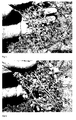
- Fig 1 shows the normal type of annual medic, with no mature pods or leaves left on the plant.
- Fig 2 shows the mutant (ph gene) type, with mature, semi-mature and green pods and leaves still on the plant.
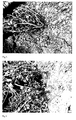
- Fig 3 shows the normal type of annual medic.
- the ground underneath the plant has both leaves and pods shed from the plant.
- Fig 4 shows the mutant (ph gene) type.
- the ground underneath the plant has very little pod or leaf material.
- pod holding trait can be transferred between different annual medics through hybridisation and selection, and that the mutant gene behaves similarly to other nuclear genes within the plant. This enables new pod holding cultivars to be developed through cross breeding and selection.
- F1 plants were then allowed to naturally self-pollinate and set seed. This seed was sown to produce an F2 generation. Individual plants were then assessed for pod and leaf holding. Plants with levels of mature pod and leaf holding that were similar to the pod holding parent, and in strong contrast to the pod and leaf shedding parent, all the F1 plants, and their sibling but non-pod holding F2 plants, were readily identifiable in this F2 generation. Approximately one quarter of individuals of the F2 population had this pod holding characteristic. In addition, all individual plants that exhibited either the mature pod holding or the mature leaf holding trait exhibited both traits together in the same plant.
- Progeny derived from natural self-pollination of these selected pod and leaf holding plants were pure breeding for that characteristic; ie 100% of plants from subsequent (naturally self-pollinated) generations of the pod and leaf holding selections exhibited the pod and leaf holding trait.
- mutant gene will therefore occur more or less randomly within hybrid populations that have at least one parent carrying the mutant ph gene in either the heterozygous or the homozygous state
- new pod holding cultivars are developed by selection of different plants with the pod and leaf holding phenotype from within these populations. Plants exhibiting this trait are homozygous for the mutant gene and, being naturally self-pollinating, are thus pure breeding for the pod and leaf holding characteristic.
Landscapes
- Life Sciences & Earth Sciences (AREA)
- Health & Medical Sciences (AREA)
- Physiology (AREA)
- Botany (AREA)
- Developmental Biology & Embryology (AREA)
- Environmental Sciences (AREA)
- Natural Medicines & Medicinal Plants (AREA)
- Breeding Of Plants And Reproduction By Means Of Culturing (AREA)
- Fodder In General (AREA)
Abstract
Description
- The present invention relates to improved cultivars of annual pasture and forage legumes of the Medicago genus (annual medics).
- The present inventors have had extensive experience and success in the breeding and development of cultivars of pasture legume, in particular cultivars of annuals of the Medicago genus. Some years ago, they recognised that a major impediment to adoption and use of Medicago cultivars was seed cost, and that a major component of that seed cost related to the difficulty of harvesting and cleaning the seed. This is because, at maturity, the seed pods are dropped from the plant, and harvesting of seed entails vacuum harvesting the pods off the ground. The harvesting process is therefore slow, and requires specialised and powerful equipment, with large fuel inputs.
- Accordingly, the present inventors sought to develop a medic that does not drop its seed pods and therefore can be harvested cheaply and efficiently with conventional harvesting equipment. This pod holding characteristic has never been recorded in naturally occurring annual medics.
- Pod shedding is a result of growth of a layer of cells across the pedicel (pod stalk) at the base of the pod, which cuts off nutrient flows into the maturing pod and leads to effective separation of the pod from the pedicel. At the slightest disturbance, the pod then drops to the ground under its own weight and, by the time the plant has itself matured, the pod has been shed. Research has indicated that control of development of this abscission layer of cells is genetically controlled.
- The present invention relates to improved cultivars, varieties, lines or plants of annual medics (Medicago genus) wherein the majority of seed pods, upon reaching maturity, remain attached to their respective pedicels (this being referred to as the "pod holding" trait). In particular, the present invention relates to improved cultivars, varieties, lines or plants of annual medics (Medicago genus), having a mutant form of the gene for pod shedding (ie for formation of an abscission layer between maturing seed pods and their respective pedicels), thereby resulting in the aforementioned "pod holding" trait.
- In a further aspect of the invention, seed from known cultivars or wild-type varieties of annual medics (Medicago genus) are subjected to treatment with a mutagenic agent, and improved cultivars, varieties, lines or plants having the aforementioned "pod holding" trait are isolated, eg by a selective breeding program. In particular, the mutated seeds are selected for the aforesaid "pod holding" trait (eg by growing the treated seeds, or descendants thereof, to maturity, assessing whether this trait is present, and selecting plants displaying this trait), and plants of the next generation are in turn grown from seeds of those selected plants, and then assessed. This process is repeated to isolate cultivars, varieties, lines or plants wherein the "pod holding" trait is stable and heritable. The mutagenic agent is, in particular, gamma radiation.
- In the embodiment described below, selective breeding commenced with the M2 generation. The M2 seed was grown to maturity, and assessed for the "pod holding" trait. Plants of the M3 generation were in turn grown from seeds of selected plants of the M2 generation, and then assessed. This selective breeding process was repeated until the "pod holding" mutation was shown to be stable and heritable.
- A yet further aspect of the invention relates to a method of transferring the "pod holding" trait from a cultivar, variety, line or plant having this trait to another annual medic of the genus Medicago by a process of controlled cross-breeding of said cultivar, variety, line or plant with said other annual medic and selection of progeny or descendants having the "pod holding" trait. In particular, the method can include the following steps:
- (i) cross-breeding said cultivar, variety, line or plant with said other annual medic, and collecting hybrid seed resulting from this cross-breeding;
- (ii) planting said hybrid seed and producing F1 hybrid (first generation) plants therefrom;
- (iii) allowing the F1 plants to self-pollinate and set seed;
- (iv) planting the seed from the F1 plants and producing F2 (second generation) plants therefrom;
- (v) assessing the F2 or any later generation of plants for said "pod holding" trait and selecting said F2 or later generation plants having this trait.
-
- A still further aspect of the invention relates to a method of obtaining plants having the "pod holding" trait from a population of annual medics of the genus Medicago. That population is derived by controlled or natural cross-breeding of annual medics, where one or more of the population parents carries one or more copies of the gene conferring the "pod holding" trait, and individual plants, progeny or descendants of the said population having the "pod holding" trait are selected. In particular, the method can include the following steps:
- (i) obtaining a population derived from controlled or natural cross-breeding of an annual medic where one or more parents of said population have the "pod holding" trait or are progeny or descendants of controlled or natural cross-breeding involving one or more parents having the "pod holding" trait;
- (ii) growing plants of the population;
- (iii) assessing plants of the population or plants grown from seed harvested from any descendant generation of the population for said "pod holding" trait and selecting plants having this trait.
-
- The progeny or descendants created by either of the aforesaid methods may also be selected for improved mature leaf retention, this being a trait directly associated with the "pod holding" trait.
- As a base cultivar for mutation treatment, Herald (M. littoralis) was used. A description of this base cultivar can be found in Plant Varieties Journal, 1996, Volume 9, Issue 2, page 49.
- Chemical mutagenesis, using various doses of sodium azide (as suggested in the scientific literature), was initially trialled. However, after about a year, it was concluded that this treatment was insufficiently effective, as it resulted in high mortality rates, but low rates of mutation, at effective dosages. It was then decided to try irradiation.
- Preliminary tests, carried out under the direction of the inventors by the International Atomic Energy Agency Plant Breeding Laboratories, Siebersdorf, Austria, showed that treatment of desiccated seed with between 200 and 300 Gy of gamma radiation (source: Cobalt 60) gave acceptably high levels of mutation, associated with low mortality. The gamma irradiated seed therefore showed higher treatment effects with respect to mutation, at lower rates of mortality, than was the case with chemical mutagenesis; this was confirmed in field trials (as described below).
- Accordingly, seed was sent to the aforesaid Laboratories for treatment, and then returned to Australia, where greenhouse testing confirmed levels of treatment-induced mortality, and related growth retardant effects, on surviving M1 (first generation grown after the mutation treatment) plants. These M1 plants numbered about 700 and were derived from about 10gm of treated seed.
- The surviving M1 plants were grown and multiplied to produce about 500gm of M2 seed. As expected, fertility rates were also significantly reduced as a result of the radiation treatment. Seed harvested from the M1 plants was then sown into the field, to produce 40 to 50,000 plants of generation M2. These were monitored for mutation effects and, in particular, for plants that held onto their pods at maturity.
- This resulted in the isolation of approximately 40 plants with various degrees of pod holding. Nearly all (bar three) of these 40 plants exhibited relatively poor pod holding capabilities, but all were progeny tested to test the genetic nature and heritability of the observed pod holding.
- All three of the good pod holding M2 plants showed very high heritability of the trait in the M3 and subsequent generations, with clear differences in this trait from all other medic plants, including other selected M2 progenies. There were also lesser differences observed in the strength of pod holding among the three good pod holders and their respective (cross-bred and self-pollinated) progenies. One plant and its self-pollinated progeny consistently showed stronger pod holding compared to the other two, and this plant also yielded higher strength pod holders from its cross-bred progeny.
- Further testing showed that this pod holding characteristic is recessive and almost certainly due to mutation of a single gene, with the variation in the strength of characteristic expression which was observed in different plants and progenies indicating different mutations of the same gene in the original selections.
- Seeds from a cultivar of Medicago littoralis having the "pod holding" trait have been deposited on 28th January 2005 at the Australian Medicago Genetic Resources Centre Collection, GPO Box 397, Adelaide SA 5001, Australia, under the deposit number SA 42 891.
- The pod holding mutation was found to significantly retard pod shedding in medics, with most pods being held on the vine long after the plant is mature and dried off. Because of the fragile nature of the pedicel and the weight of the pod, some pod shedding can be induced by mechanical disturbance, which is in itself an aid to harvesting, as the pod needs to be separated from the vine.
- This trait forms a clear contrast with all other annual medics, where pods are shed even while the plants (and even the pods themselves) are still green, and hence the trait is clearly and easily observed in the field.
- As a further and beneficial effect of the mutated gene [hereinafter referred to as the "ph" (for "pod holding") gene], older leaves are also retained on the vine. This is because leaf shedding occurs by the same mechanism, with formation of an abscission layer at the base of each leaflet of the medic trifoliate, leading to leaf drop once the trifoliate is mature. Again, this leaf drop is very pronounced in the normal type of annual medic, with even old or slightly diseased leaves on relatively immature plants being frequently shed. As with pods, leaf drop on mature medics is virtually total once the plant is mature and dried off.
- As with pod retention, mature leaf retention on plants with the ph trait is easily seen in the field, and is in marked contrast to leaf shed without the ph trait. The ph trait is readily seen in ph plants, not only in the retention of dead leaves on green plants, but also in their retention on the mature and dried off vine. By way of contrast, plants without the ph trait are left as leafless and pod-less stalks in the dried off state.
- The pod holding and leaf holding traits are illustrated in the accompanying photographs (Figures 1 to 4), which compare plants which are nearly isogenic (ie nearly genetically identical), except for the mutant ph gene. The photographs were all taken on the same date on plants with identical treatment.
- Fig 1 shows the normal type of annual medic, with no mature pods or leaves left on the plant.
- Fig 2 shows the mutant (ph gene) type, with mature, semi-mature and green pods and leaves still on the plant.
- Fig 3 shows the normal type of annual medic. The ground underneath the plant has both leaves and pods shed from the plant.
- Fig 4 shows the mutant (ph gene) type. The ground underneath the plant has very little pod or leaf material.
- Our field trials have indicated that any substantial mutation of the naturally occurring form of the ph gene, being sufficient to disrupt production of the expression product of that gene, results in at least some degree of the pod holding trait. Cultivars with a sufficient degree of the pod holding trait, and with sufficient heritability of the characteristic, can then be selected, eg by a selective breeding program.
- Further, testing has shown that the pod holding trait can be transferred between different annual medics through hybridisation and selection, and that the mutant gene behaves similarly to other nuclear genes within the plant. This enables new pod holding cultivars to be developed through cross breeding and selection.
- Hand crosses between normal pod shedding plants and pod holding selections containing the mutant ph gene were made. Hybrid seed was planted and the F1 hybrid (first generation) plants which were produced all shed both mature pod and leaf in the same way as the normal pod shedding plants.
- These F1 plants were then allowed to naturally self-pollinate and set seed. This seed was sown to produce an F2 generation. Individual plants were then assessed for pod and leaf holding. Plants with levels of mature pod and leaf holding that were similar to the pod holding parent, and in strong contrast to the pod and leaf shedding parent, all the F1 plants, and their sibling but non-pod holding F2 plants, were readily identifiable in this F2 generation. Approximately one quarter of individuals of the F2 population had this pod holding characteristic. In addition, all individual plants that exhibited either the mature pod holding or the mature leaf holding trait exhibited both traits together in the same plant.
- Progeny derived from natural self-pollination of these selected pod and leaf holding plants were pure breeding for that characteristic; ie 100% of plants from subsequent (naturally self-pollinated) generations of the pod and leaf holding selections exhibited the pod and leaf holding trait.
- These observations are all consistent with the genetic segregation expected from a cross between two parents that are genetically homozygous and pure breeding for the pod (and leaf) shedding, and the mutant pod (and leaf) holding, characteristics respectively, where the mutant pod (and leaf) holding characteristic is determined by a single recessive gene.
- This has been further confirmed by selection within populations created by cross-breeding plants that do not themselves exhibit the "pod holding" trait, but are derived from hybrids or descendants thereof wherein at least one parent of the hybrid exhibits the "pod holding" trait. When these populations are allowed to self-pollinate and the seed is harvested and re-sown, individual progeny plants with the "pod holding" trait are found in subsequent generations. The frequency of occurrence of plants with the "pod holding" trait within these subsequent generations is again consistent with the genetic segregation expected if one of the original parents of the population carried the trait in the heterozygous state as a single recessive (ie unexpressed) gene. Expression of the "pod holding" characteristic in descendant generations of this population arises in those individuals where the recessive gene conferring the "pod holding" trait occurs in the homozygous condition, such occurrence arising through natural genetic segregation within the population.
- As the mutant gene will therefore occur more or less randomly within hybrid populations that have at least one parent carrying the mutant ph gene in either the heterozygous or the homozygous state, new pod holding cultivars are developed by selection of different plants with the pod and leaf holding phenotype from within these populations. Plants exhibiting this trait are homozygous for the mutant gene and, being naturally self-pollinating, are thus pure breeding for the pod and leaf holding characteristic.
- Using these methods of cross-breeding and selection, we have succeeded in transferring the "pod holding" trait of the present invention from the Medicago littoralis cultivar, into which the trait was first introduced, into plants of the species M. truncatula and M. tornata.
- It should be noted that, while the present invention has been exemplified in terms of particular species of annual medic, the methods should be applicable to any annual medic of the genus Medicago.
Claims (13)
- A cultivar, variety, line or plant of an annual medic of the genus Medicago, said cultivar, variety, line or plant characterized in having a mutant form of the gene for pod shedding whereby the majority of seed pods, upon reaching maturity, remain attached to their respective pedicels.
- A cultivar, variety, line or plant according to claim 1, having substantially improved mature leaf retention as compared to a corresponding annual medic which does not have a mutant form of said gene.
- A cultivar, variety, line or plant according to claim 1 or claim 2, wherein the mutant gene is a single recessive gene.
- A cultivar, variety, line or plant according to any one of claims 1 to 3, wherein the mutation in said gene results from gamma irradiation.
- A method for producing a cultivar, variety, line or plant of an annual medic of the genus Medicago characterized in having a "pod holding" trait whereby the majority of seed pods, upon reaching maturity, remain attached to their respective pedicels, said method comprising:(i) subjecting a known cultivar or wild-type variety of an annual medic of the genus Medicago to treatment by a mutagenic agent; and(ii) selecting for the aforesaid "pod holding" trait.
- A method according to claim 5 wherein, in step (i), seed of a known cultivar or wild-type variety of an annual medic of the genus Medicago is subjected to treatment by a mutagenic agent.
- A method according to claim 5 or claim 6 wherein, in step (i), said treatment is gamma irradiation.
- A method according to any one of claims 5 to 7, wherein the cultivar, variety, line or plant produced thereby has substantially improved mature leaf retention as compared to the parent cultivar or variety.
- A method of transferring a "pod holding" trait, whereby the majority of seed pods, upon reaching maturity, remain attached to their respective pedicels, from a cultivar, variety, line or plant according to any one of claims 1 to 4 to another annual medic of the genus Medicago, said method entailing controlled cross-breeding of said cultivar, variety, line or plant with said other annual medic and selection of progeny or descendants having said "pod holding" trait.
- A method according to claim 9, including the following steps:(i) cross-breeding said cultivar, variety, line or plant with said other annual medic, and collecting hybrid seed resulting from this cross-breeding;(ii) planting said hybrid seed and producing F1 hybrid (first generation) plants therefrom;(iii) allowing the F1 plants to self-pollinate and set seed;(iv) planting the seed from the F1 plants and producing F2 (second generation) plants therefrom;(v) assessing the F2 or any later generation of plants for said "pod holding" trait and selecting said F2 or later generation plants having this trait.
- A method of obtaining cultivars, varieties, lines or plants of an annual medic having a "pod holding" trait, whereby the majority of seed pods, upon reaching maturity, remain attached to their respective pedicels, from a population of annual medics of the genus Medicago, said population characterized in that one or more of the population parents carries one or more copies of the gene conferring the "pod holding" trait, said method including the steps of deriving said population by controlled or natural cross-breeding of annual medics, and selecting individual plants, progeny or descendants of said population having said "pod holding" trait.
- A method according to claim 11, including the following steps:(i) obtaining a population derived from controlled or natural cross-breeding of an annual medic where one or more parents of said population have said "pod holding" trait or are progeny or descendants of controlled or natural cross-breeding involving one or more parents having said "pod holding" trait;(ii) growing plants of said population;(iii) assessing plants of said population or plants grown from seed harvested from any descendant generation of said population for said "pod holding" trait and selecting plants having this trait.
- A method according to any one of claims 5 to 12, wherein the "pod holding" trait is conferred by a single recessive gene.
Priority Applications (1)
| Application Number | Priority Date | Filing Date | Title |
|---|---|---|---|
| PL05250580T PL1561375T3 (en) | 2004-02-04 | 2005-02-02 | Improved pasture, forage and seed production technology through pod and leaf retention on annuals of the medicago genus (annual medics) |
Applications Claiming Priority (2)
| Application Number | Priority Date | Filing Date | Title |
|---|---|---|---|
| AU2004900498A AU2004900498A0 (en) | 2004-02-04 | Improved agricultural production technology | |
| AU2004900498 | 2004-02-04 |
Related Child Applications (1)
| Application Number | Title | Priority Date | Filing Date |
|---|---|---|---|
| EP10168555.0 Division-Into | 2010-07-06 |
Publications (2)
| Publication Number | Publication Date |
|---|---|
| EP1561375A1 true EP1561375A1 (en) | 2005-08-10 |
| EP1561375B1 EP1561375B1 (en) | 2011-08-31 |
Family
ID=34658497
Family Applications (1)
| Application Number | Title | Priority Date | Filing Date |
|---|---|---|---|
| EP05250580A Expired - Lifetime EP1561375B1 (en) | 2004-02-04 | 2005-02-02 | Improved pasture, forage and seed production technology through pod and leaf retention on annuals of the medicago genus (annual medics) |
Country Status (5)
| Country | Link |
|---|---|
| US (2) | US7700839B2 (en) |
| EP (1) | EP1561375B1 (en) |
| AT (1) | ATE522132T1 (en) |
| CA (1) | CA2495937A1 (en) |
| PL (1) | PL1561375T3 (en) |
Families Citing this family (2)
| Publication number | Priority date | Publication date | Assignee | Title |
|---|---|---|---|---|
| PL1561375T3 (en) * | 2004-02-04 | 2012-01-31 | Pristine Forage Tech Pty Ltd | Improved pasture, forage and seed production technology through pod and leaf retention on annuals of the medicago genus (annual medics) |
| US9288548B1 (en) * | 2007-05-15 | 2016-03-15 | Tivo Inc. | Multimedia content search system |
Family Cites Families (1)
| Publication number | Priority date | Publication date | Assignee | Title |
|---|---|---|---|---|
| PL1561375T3 (en) * | 2004-02-04 | 2012-01-31 | Pristine Forage Tech Pty Ltd | Improved pasture, forage and seed production technology through pod and leaf retention on annuals of the medicago genus (annual medics) |
-
2005
- 2005-02-02 PL PL05250580T patent/PL1561375T3/en unknown
- 2005-02-02 EP EP05250580A patent/EP1561375B1/en not_active Expired - Lifetime
- 2005-02-02 US US11/049,619 patent/US7700839B2/en not_active Expired - Lifetime
- 2005-02-02 AT AT05250580T patent/ATE522132T1/en not_active IP Right Cessation
- 2005-02-03 CA CA002495937A patent/CA2495937A1/en not_active Abandoned
-
2010
- 2010-03-12 US US12/661,200 patent/US8183435B2/en not_active Expired - Lifetime
Non-Patent Citations (15)
| Title |
|---|
| CANADIAN JOURNAL OF PLANT SCIENCE, vol. 76, no. 3, 1996, pages 447 - 456, ISSN: 0008-4220 * |
| DATABASE BIOSIS [online] BIOSCIENCES INFORMATION SERVICE, PHILADELPHIA, PA, US; 1981, KHANGIL'DIN V V: "INVESTIGATION OF NEW MUTANT GENES IN THE PEA 1. GENES DEF LE LM FN FNA AND THEIR INFLUENCE ON SEED PRODUCTIVITY", XP002326721, Database accession no. PREV198274068546 * |
| DATABASE BIOSIS [online] BIOSCIENCES INFORMATION SERVICE, PHILADELPHIA, PA, US; 1988, KHANGIL'DIN V V ET AL: "IDENTIFICATION OF NEW MUTANT GENES IN THE PEA III. THE EFFECT OF DEF GENE STIPULATING THE NONSHATTERING ON COMBINING ABILITY SEED PRODUCTIVITY AND HOMEOSTASIS IN THE SYSTEM OF TESTER CROSSES", XP002326720, Database accession no. PREV198886102586 * |
| DATABASE BIOSIS [online] BIOSCIENCES INFORMATION SERVICE, PHILADELPHIA, PA, US; 1993, EL-MONEIM A M ABD: "Selection for non-shattering common vetch, Vicia sativa L", XP002326719, Database accession no. PREV199395126813 * |
| DATABASE BIOSIS [online] BIOSCIENCES INFORMATION SERVICE, PHILADELPHIA, PA, US; 1996, GRANT WILLIAM F: "Seed pod shattering in the genus Lotus (Fabaceae): A synthesis of diverse evidence", XP002326718, Database accession no. PREV199699178334 * |
| DATABASE BIOSIS [online] BIOSCIENCES INFORMATION SERVICE, PHILADELPHIA, PA, US; 1997, BAILEY M A ET AL: "Pod dehiscence of soybean: Identification of quantitative trait loci", XP002326717, Database accession no. PREV199799518392 * |
| DATABASE BIOSIS [online] BIOSCIENCES INFORMATION SERVICE, PHILADELPHIA, PA, US; December 2000 (2000-12-01), MORGAN C L ET AL: "Breeding oilseed rape for pod shattering resistance", XP002326716, Database accession no. PREV200100091778 * |
| DATABASE BIOSIS [online] BIOSCIENCES INFORMATION SERVICE, PHILADELPHIA, PA, US; November 2001 (2001-11-01), BHAT S R ET AL: "Induction of mutations for cytoplasmic male sterility and some rare phenotypes in Indian mustard (Brassica juncea L.)", XP002326715, Database accession no. PREV200100565583 * |
| GENETIKA, vol. 17, no. 11, 1981, pages 2004 - 2012, ISSN: 0016-6758 * |
| GENETIKA, vol. 24, no. 2, 1988, pages 298 - 305, ISSN: 0016-6758 * |
| INDIAN JOURNAL OF GENETICS AND PLANT BREEDING, vol. 61, no. 4, November 2001 (2001-11-01), pages 335 - 340, ISSN: 0019-5200 * |
| JOURNAL OF AGRICULTURAL SCIENCE, vol. 135, no. 4, December 2000 (2000-12-01), pages 347 - 359, ISSN: 0021-8596 * |
| JOURNAL OF HEREDITY, vol. 88, no. 2, 1997, pages 152 - 154, ISSN: 0022-1503 * |
| OBA S ET AL: "Pod-shedding habit in Medicago species, evaluated by breaking strength of pedicels", FIELD CROPS RESEARCH, vol. 66, no. 3, June 2000 (2000-06-01), pages 269 - 276, XP002326714, ISSN: 0378-4290 * |
| PLANT BREEDING, vol. 110, no. 2, 1993, pages 168 - 171, ISSN: 0179-9541 * |
Also Published As
| Publication number | Publication date |
|---|---|
| US8183435B2 (en) | 2012-05-22 |
| EP1561375B1 (en) | 2011-08-31 |
| US20100199372A1 (en) | 2010-08-05 |
| US7700839B2 (en) | 2010-04-20 |
| CA2495937A1 (en) | 2005-08-04 |
| PL1561375T3 (en) | 2012-01-31 |
| US20050172362A1 (en) | 2005-08-04 |
| ATE522132T1 (en) | 2011-09-15 |
Similar Documents
| Publication | Publication Date | Title |
|---|---|---|
| US20060005269A1 (en) | Brassica with resistance to an AHAS-inhibitor herbicide and blackleg disease | |
| Oselebe et al. | Ploidy variation of Musa hybrids from crosses | |
| Carvalho et al. | The breeding of arabica coffee | |
| US8183435B2 (en) | Pasture, forage and seed production technology through pod and leaf retention on annuals of the Medicago genus (annual medics) | |
| AU2005200437B2 (en) | Improved pasture, forage and seed production technology through pod and leaf retention on annuals of the medicago genus (annual medics) | |
| MX2014009658A (en) | Triploid watermelon plants with a bush growth habit. | |
| Yerk et al. | 2n pollen in eleven 2x, 2EBN wild species and their haploid x wild species hybrids | |
| US9655316B2 (en) | Cotton variety ST 5032GLT | |
| US9578839B2 (en) | Cotton variety FM 2322GL | |
| Burton | Breeding improved turfgrasses | |
| Pedersen et al. | Genetic manipulation of tall fescue | |
| Shaver | Perennialism in Zea | |
| US20120324783A1 (en) | Jatropha hybrids through female only trait | |
| US10412910B2 (en) | Small seeded corn salad (Valerianella locusta) | |
| US9615523B2 (en) | Cotton variety FM 1830GLT | |
| US9441218B2 (en) | Salt tolerant lucerne | |
| Acuna | Bahiagrass Germplasm Reproductive Characterization and Breeding at the Tetraploid Level | |
| Camadro | Mode of origin and evolution of wild polyploid Solanums and the development of internal barriers to hybridization | |
| US10051803B2 (en) | Cotton variety ST 4747GLB2 | |
| US9655314B2 (en) | Cotton variety FM 2334GLT | |
| US9650645B2 (en) | Cucumber with increased number of fruits | |
| Burton et al. | GENETIC AND CYTOGENETIC ANALYSIS OF THE EFFECTS OF RECURRENT IRRADIATION AND CHEMICAL MUTAGENS ON GENERAL AND SPECIFIC COMBINING ABILITY IN PEARL MILLET, PENNISETUM TYPHOIDES. Progress Report, May 1, 1970--April 30, 1971. | |
| Djordjevic et al. | Afila gene effects on total yield of dry pea seed | |
| US20190174696A1 (en) | Cotton variety fm 1953gltp | |
| Pedersen | Cross-Pollinated Perennial Grasses |
Legal Events
| Date | Code | Title | Description |
|---|---|---|---|
| PUAI | Public reference made under article 153(3) epc to a published international application that has entered the european phase |
Free format text: ORIGINAL CODE: 0009012 |
|
| AK | Designated contracting states |
Kind code of ref document: A1 Designated state(s): AT BE BG CH CY CZ DE DK EE ES FI FR GB GR HU IE IS IT LI LT LU MC NL PL PT RO SE SI SK TR |
|
| AX | Request for extension of the european patent |
Extension state: AL BA HR LV MK YU |
|
| 17P | Request for examination filed |
Effective date: 20060127 |
|
| AKX | Designation fees paid |
Designated state(s): AT BE BG CH CY CZ DE DK EE ES FI FR GB GR HU IE IS IT LI LT LU MC NL PL PT RO SE SI SK TR |
|
| RAP1 | Party data changed (applicant data changed or rights of an application transferred) |
Owner name: PRISTINE FORAGE TECHNOLOGIES PTY LTD |
|
| APBN | Date of receipt of notice of appeal recorded |
Free format text: ORIGINAL CODE: EPIDOSNNOA2E |
|
| APBR | Date of receipt of statement of grounds of appeal recorded |
Free format text: ORIGINAL CODE: EPIDOSNNOA3E |
|
| APAF | Appeal reference modified |
Free format text: ORIGINAL CODE: EPIDOSCREFNE |
|
| APBT | Appeal procedure closed |
Free format text: ORIGINAL CODE: EPIDOSNNOA9E |
|
| GRAP | Despatch of communication of intention to grant a patent |
Free format text: ORIGINAL CODE: EPIDOSNIGR1 |
|
| GRAS | Grant fee paid |
Free format text: ORIGINAL CODE: EPIDOSNIGR3 |
|
| GRAA | (expected) grant |
Free format text: ORIGINAL CODE: 0009210 |
|
| AK | Designated contracting states |
Kind code of ref document: B1 Designated state(s): AT BE BG CH CY CZ DE DK EE ES FI FR GB GR HU IE IS IT LI LT LU MC NL PL PT RO SE SI SK TR |
|
| REG | Reference to a national code |
Ref country code: GB Ref legal event code: FG4D Ref country code: CH Ref legal event code: EP |
|
| REG | Reference to a national code |
Ref country code: IE Ref legal event code: FG4D |
|
| REG | Reference to a national code |
Ref country code: DE Ref legal event code: R096 Ref document number: 602005029837 Country of ref document: DE Effective date: 20111027 |
|
| REG | Reference to a national code |
Ref country code: NL Ref legal event code: T3 |
|
| LTIE | Lt: invalidation of european patent or patent extension |
Effective date: 20110831 |
|
| PG25 | Lapsed in a contracting state [announced via postgrant information from national office to epo] |
Ref country code: IS Free format text: LAPSE BECAUSE OF FAILURE TO SUBMIT A TRANSLATION OF THE DESCRIPTION OR TO PAY THE FEE WITHIN THE PRESCRIBED TIME-LIMIT Effective date: 20111231 Ref country code: FI Free format text: LAPSE BECAUSE OF FAILURE TO SUBMIT A TRANSLATION OF THE DESCRIPTION OR TO PAY THE FEE WITHIN THE PRESCRIBED TIME-LIMIT Effective date: 20110831 Ref country code: SE Free format text: LAPSE BECAUSE OF FAILURE TO SUBMIT A TRANSLATION OF THE DESCRIPTION OR TO PAY THE FEE WITHIN THE PRESCRIBED TIME-LIMIT Effective date: 20110831 Ref country code: LT Free format text: LAPSE BECAUSE OF FAILURE TO SUBMIT A TRANSLATION OF THE DESCRIPTION OR TO PAY THE FEE WITHIN THE PRESCRIBED TIME-LIMIT Effective date: 20110831 |
|
| REG | Reference to a national code |
Ref country code: PL Ref legal event code: T3 |
|
| REG | Reference to a national code |
Ref country code: AT Ref legal event code: MK05 Ref document number: 522132 Country of ref document: AT Kind code of ref document: T Effective date: 20110831 |
|
| PG25 | Lapsed in a contracting state [announced via postgrant information from national office to epo] |
Ref country code: GR Free format text: LAPSE BECAUSE OF FAILURE TO SUBMIT A TRANSLATION OF THE DESCRIPTION OR TO PAY THE FEE WITHIN THE PRESCRIBED TIME-LIMIT Effective date: 20111201 Ref country code: AT Free format text: LAPSE BECAUSE OF FAILURE TO SUBMIT A TRANSLATION OF THE DESCRIPTION OR TO PAY THE FEE WITHIN THE PRESCRIBED TIME-LIMIT Effective date: 20110831 Ref country code: SI Free format text: LAPSE BECAUSE OF FAILURE TO SUBMIT A TRANSLATION OF THE DESCRIPTION OR TO PAY THE FEE WITHIN THE PRESCRIBED TIME-LIMIT Effective date: 20110831 Ref country code: CY Free format text: LAPSE BECAUSE OF FAILURE TO SUBMIT A TRANSLATION OF THE DESCRIPTION OR TO PAY THE FEE WITHIN THE PRESCRIBED TIME-LIMIT Effective date: 20110831 |
|
| PG25 | Lapsed in a contracting state [announced via postgrant information from national office to epo] |
Ref country code: BE Free format text: LAPSE BECAUSE OF FAILURE TO SUBMIT A TRANSLATION OF THE DESCRIPTION OR TO PAY THE FEE WITHIN THE PRESCRIBED TIME-LIMIT Effective date: 20110831 |
|
| PG25 | Lapsed in a contracting state [announced via postgrant information from national office to epo] |
Ref country code: CZ Free format text: LAPSE BECAUSE OF FAILURE TO SUBMIT A TRANSLATION OF THE DESCRIPTION OR TO PAY THE FEE WITHIN THE PRESCRIBED TIME-LIMIT Effective date: 20110831 Ref country code: SK Free format text: LAPSE BECAUSE OF FAILURE TO SUBMIT A TRANSLATION OF THE DESCRIPTION OR TO PAY THE FEE WITHIN THE PRESCRIBED TIME-LIMIT Effective date: 20110831 |
|
| PG25 | Lapsed in a contracting state [announced via postgrant information from national office to epo] |
Ref country code: PT Free format text: LAPSE BECAUSE OF FAILURE TO SUBMIT A TRANSLATION OF THE DESCRIPTION OR TO PAY THE FEE WITHIN THE PRESCRIBED TIME-LIMIT Effective date: 20120102 Ref country code: EE Free format text: LAPSE BECAUSE OF FAILURE TO SUBMIT A TRANSLATION OF THE DESCRIPTION OR TO PAY THE FEE WITHIN THE PRESCRIBED TIME-LIMIT Effective date: 20110831 Ref country code: RO Free format text: LAPSE BECAUSE OF FAILURE TO SUBMIT A TRANSLATION OF THE DESCRIPTION OR TO PAY THE FEE WITHIN THE PRESCRIBED TIME-LIMIT Effective date: 20110831 |
|
| PG25 | Lapsed in a contracting state [announced via postgrant information from national office to epo] |
Ref country code: DK Free format text: LAPSE BECAUSE OF FAILURE TO SUBMIT A TRANSLATION OF THE DESCRIPTION OR TO PAY THE FEE WITHIN THE PRESCRIBED TIME-LIMIT Effective date: 20110831 |
|
| PLBE | No opposition filed within time limit |
Free format text: ORIGINAL CODE: 0009261 |
|
| STAA | Information on the status of an ep patent application or granted ep patent |
Free format text: STATUS: NO OPPOSITION FILED WITHIN TIME LIMIT |
|
| 26N | No opposition filed |
Effective date: 20120601 |
|
| REG | Reference to a national code |
Ref country code: DE Ref legal event code: R097 Ref document number: 602005029837 Country of ref document: DE Effective date: 20120601 |
|
| PG25 | Lapsed in a contracting state [announced via postgrant information from national office to epo] |
Ref country code: MC Free format text: LAPSE BECAUSE OF NON-PAYMENT OF DUE FEES Effective date: 20120229 |
|
| REG | Reference to a national code |
Ref country code: CH Ref legal event code: PL |
|
| PG25 | Lapsed in a contracting state [announced via postgrant information from national office to epo] |
Ref country code: LI Free format text: LAPSE BECAUSE OF NON-PAYMENT OF DUE FEES Effective date: 20120229 Ref country code: CH Free format text: LAPSE BECAUSE OF NON-PAYMENT OF DUE FEES Effective date: 20120229 |
|
| REG | Reference to a national code |
Ref country code: IE Ref legal event code: MM4A |
|
| PG25 | Lapsed in a contracting state [announced via postgrant information from national office to epo] |
Ref country code: IE Free format text: LAPSE BECAUSE OF NON-PAYMENT OF DUE FEES Effective date: 20120202 |
|
| PG25 | Lapsed in a contracting state [announced via postgrant information from national office to epo] |
Ref country code: ES Free format text: LAPSE BECAUSE OF FAILURE TO SUBMIT A TRANSLATION OF THE DESCRIPTION OR TO PAY THE FEE WITHIN THE PRESCRIBED TIME-LIMIT Effective date: 20111211 |
|
| PG25 | Lapsed in a contracting state [announced via postgrant information from national office to epo] |
Ref country code: BG Free format text: LAPSE BECAUSE OF FAILURE TO SUBMIT A TRANSLATION OF THE DESCRIPTION OR TO PAY THE FEE WITHIN THE PRESCRIBED TIME-LIMIT Effective date: 20111130 |
|
| PG25 | Lapsed in a contracting state [announced via postgrant information from national office to epo] |
Ref country code: TR Free format text: LAPSE BECAUSE OF FAILURE TO SUBMIT A TRANSLATION OF THE DESCRIPTION OR TO PAY THE FEE WITHIN THE PRESCRIBED TIME-LIMIT Effective date: 20110831 |
|
| PG25 | Lapsed in a contracting state [announced via postgrant information from national office to epo] |
Ref country code: LU Free format text: LAPSE BECAUSE OF NON-PAYMENT OF DUE FEES Effective date: 20120202 |
|
| PG25 | Lapsed in a contracting state [announced via postgrant information from national office to epo] |
Ref country code: HU Free format text: LAPSE BECAUSE OF FAILURE TO SUBMIT A TRANSLATION OF THE DESCRIPTION OR TO PAY THE FEE WITHIN THE PRESCRIBED TIME-LIMIT Effective date: 20050202 |
|
| REG | Reference to a national code |
Ref country code: FR Ref legal event code: PLFP Year of fee payment: 12 |
|
| REG | Reference to a national code |
Ref country code: FR Ref legal event code: PLFP Year of fee payment: 13 |
|
| PGFP | Annual fee paid to national office [announced via postgrant information from national office to epo] |
Ref country code: PL Payment date: 20170117 Year of fee payment: 13 |
|
| PGFP | Annual fee paid to national office [announced via postgrant information from national office to epo] |
Ref country code: IT Payment date: 20170221 Year of fee payment: 13 |
|
| REG | Reference to a national code |
Ref country code: FR Ref legal event code: PLFP Year of fee payment: 14 |
|
| PG25 | Lapsed in a contracting state [announced via postgrant information from national office to epo] |
Ref country code: IT Free format text: LAPSE BECAUSE OF NON-PAYMENT OF DUE FEES Effective date: 20180202 |
|
| PGFP | Annual fee paid to national office [announced via postgrant information from national office to epo] |
Ref country code: DE Payment date: 20190228 Year of fee payment: 15 |
|
| PGFP | Annual fee paid to national office [announced via postgrant information from national office to epo] |
Ref country code: NL Payment date: 20190228 Year of fee payment: 15 |
|
| PG25 | Lapsed in a contracting state [announced via postgrant information from national office to epo] |
Ref country code: PL Free format text: LAPSE BECAUSE OF NON-PAYMENT OF DUE FEES Effective date: 20180202 |
|
| REG | Reference to a national code |
Ref country code: DE Ref legal event code: R119 Ref document number: 602005029837 Country of ref document: DE |
|
| REG | Reference to a national code |
Ref country code: NL Ref legal event code: MM Effective date: 20200301 |
|
| PG25 | Lapsed in a contracting state [announced via postgrant information from national office to epo] |
Ref country code: NL Free format text: LAPSE BECAUSE OF NON-PAYMENT OF DUE FEES Effective date: 20200301 |
|
| PG25 | Lapsed in a contracting state [announced via postgrant information from national office to epo] |
Ref country code: DE Free format text: LAPSE BECAUSE OF NON-PAYMENT OF DUE FEES Effective date: 20200901 |
|
| PGFP | Annual fee paid to national office [announced via postgrant information from national office to epo] |
Ref country code: GB Payment date: 20231221 Year of fee payment: 20 |
|
| PGFP | Annual fee paid to national office [announced via postgrant information from national office to epo] |
Ref country code: FR Payment date: 20240208 Year of fee payment: 20 |
|
| REG | Reference to a national code |
Ref country code: GB Ref legal event code: PE20 Expiry date: 20250201 |
|
| PG25 | Lapsed in a contracting state [announced via postgrant information from national office to epo] |
Ref country code: GB Free format text: LAPSE BECAUSE OF EXPIRATION OF PROTECTION Effective date: 20250201 |