EP1560357A2 - Method and apparatus for detecting a three-state signal in a base station in a wireless communications system - Google Patents
Method and apparatus for detecting a three-state signal in a base station in a wireless communications system Download PDFInfo
- Publication number
- EP1560357A2 EP1560357A2 EP05250277A EP05250277A EP1560357A2 EP 1560357 A2 EP1560357 A2 EP 1560357A2 EP 05250277 A EP05250277 A EP 05250277A EP 05250277 A EP05250277 A EP 05250277A EP 1560357 A2 EP1560357 A2 EP 1560357A2
- Authority
- EP
- European Patent Office
- Prior art keywords
- symbol
- transmitted
- decision
- cost
- received signal
- Prior art date
- Legal status (The legal status is an assumption and is not a legal conclusion. Google has not performed a legal analysis and makes no representation as to the accuracy of the status listed.)
- Granted
Links
Images


Classifications
-
- H—ELECTRICITY
- H04—ELECTRIC COMMUNICATION TECHNIQUE
- H04L—TRANSMISSION OF DIGITAL INFORMATION, e.g. TELEGRAPHIC COMMUNICATION
- H04L1/00—Arrangements for detecting or preventing errors in the information received
- H04L1/12—Arrangements for detecting or preventing errors in the information received by using return channel
- H04L1/16—Arrangements for detecting or preventing errors in the information received by using return channel in which the return channel carries supervisory signals, e.g. repetition request signals
- H04L1/1607—Details of the supervisory signal
-
- H—ELECTRICITY
- H04—ELECTRIC COMMUNICATION TECHNIQUE
- H04L—TRANSMISSION OF DIGITAL INFORMATION, e.g. TELEGRAPHIC COMMUNICATION
- H04L1/00—Arrangements for detecting or preventing errors in the information received
- H04L1/12—Arrangements for detecting or preventing errors in the information received by using return channel
- H04L1/16—Arrangements for detecting or preventing errors in the information received by using return channel in which the return channel carries supervisory signals, e.g. repetition request signals
- H04L1/18—Automatic repetition systems, e.g. Van Duuren systems
- H04L1/1812—Hybrid protocols; Hybrid automatic repeat request [HARQ]
-
- H—ELECTRICITY
- H04—ELECTRIC COMMUNICATION TECHNIQUE
- H04L—TRANSMISSION OF DIGITAL INFORMATION, e.g. TELEGRAPHIC COMMUNICATION
- H04L1/00—Arrangements for detecting or preventing errors in the information received
- H04L1/12—Arrangements for detecting or preventing errors in the information received by using return channel
- H04L2001/125—Arrangements for preventing errors in the return channel
Definitions
- This invention relates to wireless communications, and more particularly, to the processing of a signal received at a base station in a wireless communications system.
- An acknowledge channel is used on the reverse channel in a wireless communications system operating in accordance with CDMA2000 standards to signal the base station whether a data packet transmitted on the downlink channel has been received by the mobile terminal.
- the mobile terminal sends an ACK symbol (+1) when it has successfully recovered the downlink data packet, a NACK symbol (-1) when it has received the packet data but has not recovered it successfully, and a NULL symbol (0) when the mobile terminal doesn't receive anything and remains quiet and sends nothing.
- a base station receiver in such a system thus needs to recover the symbol (ACK, NACK, or NULL) sent on the acknowledge channel in order to determine whether it needs to retransmit the data packet again.
- a receiver thus comprises a three-state detector that makes a decision whether an ACK, a NACK, or a NULL has been transmitted by the mobile terminal on the acknowledge channel.
- the performance of the three-state detector directly impacts the network throughput.
- a three-state detector is designed to minimize the average probability of detection errors. Such a detector treats the error of detecting an ACK when a NACK was actually sent the same as the error of detecting a NACK when an ACK was actually sent, and so on.
- step 101 a determination is made whether R is greater than a threshold T1 (step 102). If it is, then the decision is made that ACK was the symbol that was sent (step 103). If R it isn't greater than threshold T1, then R is compared with another threshold T2 (step 104). If R is less than T2, then the decision is made that NACK was the symbol that was sent (step 105). If, however R is greater than T2, then the decision is made that NULL was the symbol that was sent (step 106).
- this prior art method does not provide optimal network performance in terms of network throughput.
- a three-state detector that aims at optimizing the network throughput is therefore desirable.
- a decision as to whether a mobile terminal has transmitted an ACK, a NACK or a NULL from a received signal at a base station is made by successively eliminating one of the three possible transmitted symbols by sequentially applying decision rules that maximize network throughput by minimizing the sum of the weighted costs of making a decision based on the magnitude of the received signal.
- the cost of making a decision is based on the effect on overall performance due to choosing a particular symbol as the most likely transmitted symbol when the same or a different symbol was actually transmitted. Each such cost is then weighted by the a priori probability that a particular symbol was actually sent multiplied by the a posteri conditional probability of a decision made on the received signal based on its received magnitude.
- the present invention can be applied in any type of communications system in which a multi-state signal is transmitted and in which the overall system performance is affected differently by different combinations of decision errors and in which costs to system performance can be attributed to such decision errors.
- FIG. 2 illustrates data communication between a base station 201 and a mobile terminal 202.
- the mobile terminal 202 first sends a request for data to the base station 201.
- Base station 201 then responds by transmitting a data packet to the mobile terminal 202.
- the mobile terminal 202 then responds by sending the base station 201 either an ACK, a NACK or a NULL. If the mobile terminal 202 successfully receives the data (i.e., it received the packet and the packet passed a cyclic redundancy check [CRC]), it sends an ACK.
- CRC cyclic redundancy check
- the mobile terminal 202 sends the base station a NACK. If the base station 201 receives an ACK after sending a data packet, it sends a new packet. If it receives a NACK, it resends either the entire packet again or a part of it. If, after a while, it doesn't receive anything from the mobile terminal, the base station treats that occurrence as a NULL and retransmits the entire packet.
- Different "costs” can be attributed to making an error in detecting from a received signal what symbol was actually sent by the mobile terminal. For example, if the mobile terminal sends an ACK, but the base station receiver detects it as a NACK or a NULL, the result will "cost" throughput degradation since the base station in response to the NACK or NULL will be resending the mobile terminal a data packet that the mobile terminal already has. This is a waste of resources and the base station could be transmitting a newer data packet to the mobile terminal instead of a data packet that the mobile terminal didn't need to receive again. A worse situation arises when the mobile terminal sends a NACK and the base station detects it as an ACK.
- the base station decides that the mobile terminal has received the transmitted data packet and moves on to transmit a new data packet to the mobile station.
- the mobile terminal will then lose synchronization and eventually much more data will need to be retransmitted by the base station in order for the mobile terminal to regain synchronization. If the mobile terminal transmits a NACK and the base station detects the received signal as a NULL, then if the entire packet would be sent anyway for a NACK, there is no "loss". If, however, the base station normally only transmits a portion of a packet upon receiving a NACK and a full packet upon receiving a NULL, then throughput is affected.
- the base station If the mobile terminal transmits a NULL and the base station detects the received signal as an ACK, then if the base station had already sent something and the mobile terminal didn't receive it, the base station will assume that what it sent was received and will then send a new data packet, causing synchronization problems at noted above. If the mobile terminal transmits a NULL and the base station detects the received signal as a NACK, the base station will either resend the entire packet or only part of the packet, depending on the base station's philosophy in responding to a NULL and a NACK.
- the target is to minimize the following risk:
- the Risk is thus a sum of the weighted costs of making each possible decision. It is equal to the sum, for each possible combination of detected symbol and transmitted symbol, of the cost of a choosing a symbol as the most likely transmitted symbol when the same or a different symbol was actually sent multiplied by the a priori probability that a particular symbol was transmitted multiplied by the a posteri conditional probability of a decision on the transmitted symbol given the magnitude of the received signal.
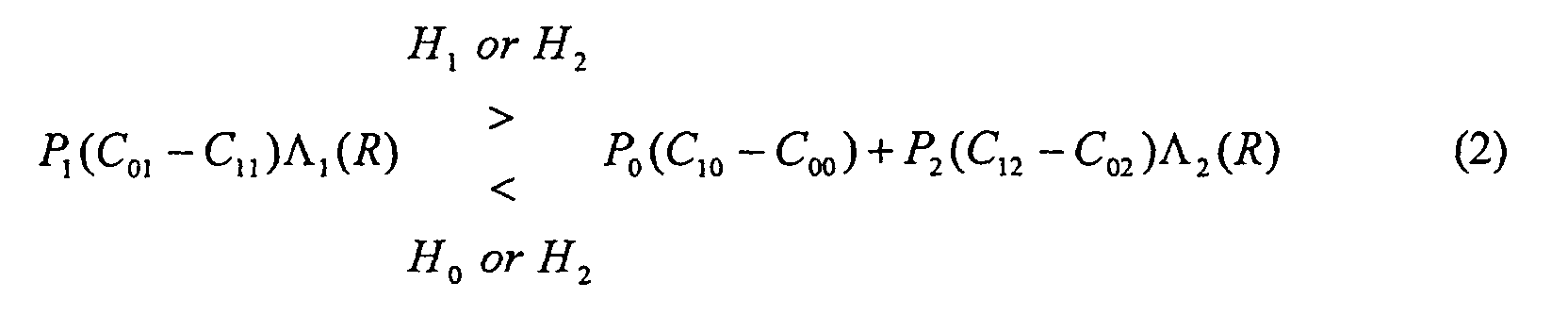
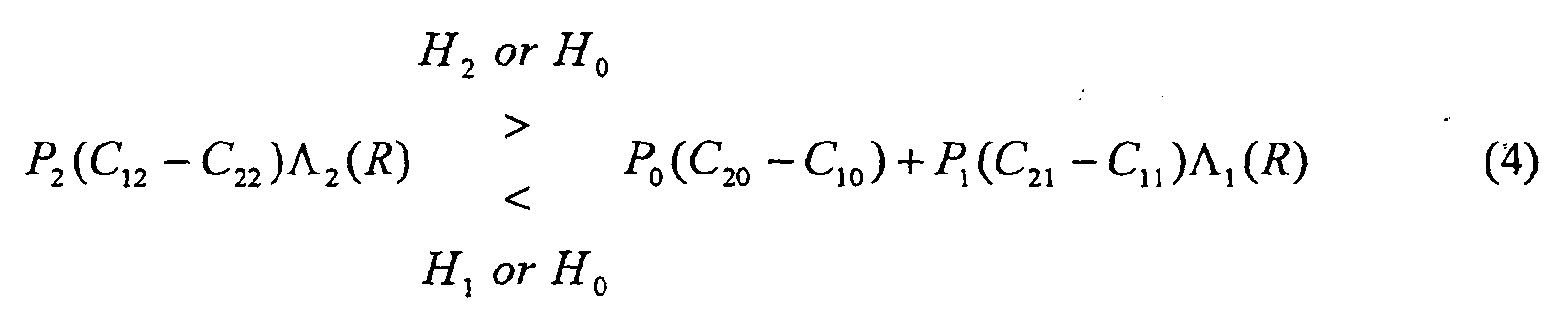
- Risk will be minimized by applying the following decision rules at the base station to decide upon what symbol was transmitted by the mobile terminal given the magnitude R of the received signal r: where means that if X>Y then the decision should be H 2 or H 0 , H 1 or H 0 otherwise it should be H 1 or H 0 .
- H 1 ) p ( r R
- H 0 ) , and ⁇ 2 ( R ) ⁇ p ( r R
- H 2 ) p ( r R
- one transmitted symbol can be eliminated as a possible transmitted symbol from the set of three possible transmitted symbols at each comparison.
- the most likely transmitted symbol can be determined. Further, by applying these decision rules in this manner, the Risk that takes into account the cost of making a wrong decision on the system throughput is minimized.
- K 1 and K 2 are dependent on the system design, including such factors as the receiver's automatic gain control (AGC) setting.
- K 2 2 ⁇ AGC gain ⁇ Transmitted _ ACK _ amplitude ⁇ 2 noise
- K 2 - K 1 .
- ⁇ 2 noise is the energy of the thermal noise and the interference caused by other users. Both AGC gain and ⁇ 2 noise are measurable quantities.
- a 1 P(C 01 -C 11 ) ⁇ 1 (R)
- a 2 P 0 (C 10 -C 00 )+P 2 (C 12 -C 02 ) ⁇ 2 R)
- B 1 P 2 (C 02 -C 21 ) ⁇ 2 (R)
- B 2 P 0 (C 20 -C 00 )+P 1 (C 21 -C 01 ) ⁇ 1 (R)
- C 1 P 2 (C 12 -C 22 ) ⁇ 2 (R)
- C 2 P 0 (C 20 -C 10 )+P 1 (C 21 -C 11 ) ⁇ 1 (R)
- FIG. 3 shows an embodiment of the methodology of the three-state detector of the present invention in which the decision rules defined by equation (2) through (5) are sequentially applied to the received signal in order to decide the most likely symbol sent by the mobile terminal so that the Risk, as defined by equation (1) is minimized.
- the signal r is received having magnitude R .
- a 1 , A 2 , B 1 , B 2 , C 1 and C 2 are calculated.
- the decision rule defined by equation (2) is applied by comparing A 1 with A 2 . If A 1 is greater than A 2 , then, in accordance with this decision rule, NULL can eliminated as a possible transmitted symbol, leaving ACK or NACK as the remaining possibilities for the transmitted symbol.
- a 1 is less than or equal to A 2 , then, as per this decision rule, NACK can be eliminated as a possible transmitted symbol, leaving ACK or NULL as the remaining possibilities for the transmitted symbol. If NACK is eliminated as a possible transmitted symbol at step 303, then, at step 304, the decision rule of equation (3) is applied to the remaining possibilities, ACK and NULL. Thus, B 1 and B 2 are compared with each other in accordance with the decision rule in equation (3). If B 1 is greater than B 2 , then, in accordance with this decision rule of equation (3), NULL is eliminated as a possible transmitted symbol, leaving, at step 305, the ultimate decision of the most likely transmitted symbol to thus be ACK.
- FIG. 4 illustrates the calculation of A1, A2, B1, B2, C1 and C3 from a received input signal r of magnitude R at step 400.
- a 1 , B 2 , and C 2 are then determined using the calculated ⁇ 1 ( R ) in equations (17), (20) and (22) at steps 403, 404 and 405, respectively.
- a 2 , B 1 and C 1 are determined using the calculated ⁇ 2 ( R ) in equation (18), (19) and (21) at steps 406, 407 and 408, respectively.
- the cost C ij associated with each wrong decision, in the range [0, 1], as well as the a priori probabilities, P 0 , P 1 and P 2 , associated with each of the three possible transmitted symbols, are supplied by the system based on either system level simulations and/or field measurements.
- the present invention can be applied in any type of communications system in which a multi-state signal is transmitted and in which the overall system performance is affected differently by different combinations of decision errors and in which costs to system performance can be attributed to such decision errors.
- the present invention could be readily applied to any multi-state system. Consequently, the invention may be implemented in different locations, such as at a base station, a base station controller and/or mobile switching center, or elsewhere depending upon in what type of system the invention is employed.
- processing circuitry required to implement and use the described invention may be implemented in application specific integrated circuits, software-driven processing circuitry, firmware, programmable logic devices, hardware, discrete components or arrangements of the above components as would be understood by one of ordinary skill in the art with the benefit of this disclosure.
- processing circuitry required to implement and use the described invention may be implemented in application specific integrated circuits, software-driven processing circuitry, firmware, programmable logic devices, hardware, discrete components or arrangements of the above components as would be understood by one of ordinary skill in the art with the benefit of this disclosure.
- Those skilled in the art will readily recognize that these and various other modifications, arrangements and methods can be made to the present invention without strictly following the exemplary applications illustrated and described herein and without departing from the spirit and scope of the present invention. It is therefore contemplated that the appended claims will cover any such modifications or embodiments as fall within the true scope of the invention.
Landscapes
- Engineering & Computer Science (AREA)
- Computer Networks & Wireless Communication (AREA)
- Signal Processing (AREA)
- Mobile Radio Communication Systems (AREA)
Abstract
Description

(unprocessed) signal r conditioned on Hj having been sent, j=0, 1, 2;


Claims (10)
- A method of determining from a received signal a most likely transmitted symbol from among a plurality of possible transmitted symbols, the method characterized by the step of:successively eliminating as the determined transmitted symbol at least one of the plurality of possible transmitted symbols by sequentially applying to the received signal a plurality of decision rules that maximize network throughput by minimizing a sum of weighted costs of making a decision based on a magnitude of the received signal, the cost of making a decision being associated with the effect on overall throughput performance due to choosing a particular symbol as the most likely transmitted symbol when the same or a different symbol was actually transmitted.
- The method of claim 1 wherein in the sum each cost is weighted by an a priori probability that a particular symbol was actually sent multiplied by an a posteri conditional probability of a decision made on the received signal based on its received magnitude.
- The method of claim 1 wherein the possible transmitted symbols are an ACK, a NACK and a NULL received by a base station from a mobile terminal in a wireless communication system.
- The method of claim 1 wherein each cost is normalized to be between 0 and 1.
- The method of claim 4 wherein the cost of deciding upon a transmitted symbol when that symbol was actually transmitted is zero.
- A multi-state detector for determining a most likely transmitted symbol from among a plurality of possible transmitted symbols comprising:means (301) for receiving a signal representing one of the possible transmitted symbols, characterized in that the detector further comprises:means (303, 304, 307) for successively eliminating as the determined transmitted symbol at least one of the plurality of possible transmitted symbols by sequentially applying to the received signal a plurality of decision rules that maximize network throughput by minimizing a sum of weighted costs of making a decision based on a magnitude of the received signal, the cost of making a decision being associated with the effect on overall throughput performance due to choosing a particular symbol as the most likely transmitted symbol when the same or a different symbol was actually transmitted.
- The detector of claim 6 wherein in the sum each such cost is weighted by an a priori probability that a particular symbol was actually sent multiplied by an a posteri conditional probability of a decision made on the received signal based on its received magnitude.
- The detector of claim 6 wherein the possible transmitted symbols are an ACK, a NACK and a NULL received by a base station from a mobile terminal in a wireless communication system.
- The detector of claim 6 wherein each cost is normalized to be between 0 and 1.
- The detector of claim 8 wherein the cost of deciding upon a transmitted symbol when that symbol was actually transmitted is zero.
Applications Claiming Priority (2)
| Application Number | Priority Date | Filing Date | Title |
|---|---|---|---|
| US770028 | 2004-02-02 | ||
| US10/770,028 US7356749B2 (en) | 2004-02-02 | 2004-02-02 | Method and apparatus for detecting a three-state signal in a base station in a wireless communications system |
Publications (3)
| Publication Number | Publication Date |
|---|---|
| EP1560357A2 true EP1560357A2 (en) | 2005-08-03 |
| EP1560357A3 EP1560357A3 (en) | 2005-09-07 |
| EP1560357B1 EP1560357B1 (en) | 2006-06-21 |
Family
ID=34654398
Family Applications (1)
| Application Number | Title | Priority Date | Filing Date |
|---|---|---|---|
| EP05250277A Expired - Lifetime EP1560357B1 (en) | 2004-02-02 | 2005-01-20 | Method and apparatus for detecting a three-state signal in a base station in a wireless communications system |
Country Status (4)
| Country | Link |
|---|---|
| US (1) | US7356749B2 (en) |
| EP (1) | EP1560357B1 (en) |
| KR (1) | KR20050078641A (en) |
| DE (1) | DE602005000021T2 (en) |
Cited By (2)
| Publication number | Priority date | Publication date | Assignee | Title |
|---|---|---|---|---|
| EP2326037A1 (en) * | 2009-11-18 | 2011-05-25 | Telefonaktiebolaget L M Ericsson (publ) | Method and base station for detecting a HARQ-ACK codeword |
| EP2117247A4 (en) * | 2007-03-01 | 2014-04-09 | Ntt Docomo Inc | BASE STATION DEVICE AND COMMUNICATION CONTROL METHOD |
Families Citing this family (8)
| Publication number | Priority date | Publication date | Assignee | Title |
|---|---|---|---|---|
| US6988667B2 (en) * | 2001-05-31 | 2006-01-24 | Alien Technology Corporation | Methods and apparatuses to identify devices |
| US7193504B2 (en) * | 2001-10-09 | 2007-03-20 | Alien Technology Corporation | Methods and apparatuses for identification |
| US8102244B2 (en) | 2003-08-09 | 2012-01-24 | Alien Technology Corporation | Methods and apparatuses to identify devices |
| US7716160B2 (en) * | 2003-11-07 | 2010-05-11 | Alien Technology Corporation | Methods and apparatuses to identify devices |
| WO2005109726A1 (en) * | 2004-05-06 | 2005-11-17 | Koninklijke Philips Electronics N.V. | Method, system and station for communicating data packets using arq |
| US7936720B2 (en) * | 2005-04-29 | 2011-05-03 | Nortel Networks Limited | Active set management enhancement for reliable soft handoff in 1xEV-DO system |
| US7933901B2 (en) * | 2007-01-04 | 2011-04-26 | Brian Kolo | Name characteristic analysis software and methods |
| US7885238B2 (en) * | 2007-08-03 | 2011-02-08 | Alcatel-Lucent Usa Inc. | Methods for detecting acknowledgement channels using probabilities |
Family Cites Families (8)
| Publication number | Priority date | Publication date | Assignee | Title |
|---|---|---|---|---|
| CA2161847A1 (en) * | 1995-10-31 | 1997-05-01 | Wayne D. Grover | Method for preconfiguring a network to withstand anticipated failures |
| US6184863B1 (en) * | 1998-10-13 | 2001-02-06 | The George Washington University | Direct pointing apparatus and method therefor |
| KR100322002B1 (en) | 1998-10-15 | 2002-07-02 | 윤종용 | Radio Link Protocol Communication Device and Method in Mobile Communication System |
| US7379434B2 (en) * | 2001-10-19 | 2008-05-27 | Koninklijke Philips Electronics N.V. | Radio communication system |
| EP1449311B1 (en) * | 2001-11-16 | 2017-12-13 | Koninklijke Philips N.V. | Radio communication system |
| KR100850989B1 (en) * | 2002-01-05 | 2008-08-12 | 엘지전자 주식회사 | A method for controlling power for response signals ACK or NACK in an ARQ system |
| US7346018B2 (en) | 2003-01-16 | 2008-03-18 | Qualcomm, Incorporated | Margin control in a data communication system |
| US7331008B2 (en) * | 2003-08-21 | 2008-02-12 | Lucent Technologies Inc. | Erasure decoding optimization of acknowledgment/negative acknowledgment information in a wireless communication system |
-
2004
- 2004-02-02 US US10/770,028 patent/US7356749B2/en not_active Expired - Fee Related
-
2005
- 2005-01-20 EP EP05250277A patent/EP1560357B1/en not_active Expired - Lifetime
- 2005-01-20 DE DE602005000021T patent/DE602005000021T2/en not_active Expired - Lifetime
- 2005-01-28 KR KR1020050008127A patent/KR20050078641A/en not_active Withdrawn
Cited By (6)
| Publication number | Priority date | Publication date | Assignee | Title |
|---|---|---|---|---|
| EP2117247A4 (en) * | 2007-03-01 | 2014-04-09 | Ntt Docomo Inc | BASE STATION DEVICE AND COMMUNICATION CONTROL METHOD |
| EP2124472A4 (en) * | 2007-03-01 | 2014-04-30 | Ntt Docomo Inc | BASE STATION DEVICE AND COMMUNICATION CONTROL METHOD |
| EP2326037A1 (en) * | 2009-11-18 | 2011-05-25 | Telefonaktiebolaget L M Ericsson (publ) | Method and base station for detecting a HARQ-ACK codeword |
| WO2011062547A1 (en) * | 2009-11-18 | 2011-05-26 | Telefonaktiebolaget L M Ericsson (Publ) | Method and base station for detecting a harq-ack codeword |
| US20120230218A1 (en) * | 2009-11-18 | 2012-09-13 | Telefonaktiebolaget Lm Ericsson (Publ) | Method and Base Station for Detecting a HARQ-ACK Codeword |
| US8750214B2 (en) * | 2009-11-18 | 2014-06-10 | Telefonaktiebolaget L M Ericsson (Publ) | Method and base station for detecting a HARQ-ACK codeword |
Also Published As
| Publication number | Publication date |
|---|---|
| DE602005000021T2 (en) | 2006-11-30 |
| KR20050078641A (en) | 2005-08-05 |
| EP1560357B1 (en) | 2006-06-21 |
| DE602005000021D1 (en) | 2006-08-03 |
| EP1560357A3 (en) | 2005-09-07 |
| US7356749B2 (en) | 2008-04-08 |
| US20050169405A1 (en) | 2005-08-04 |
Similar Documents
| Publication | Publication Date | Title |
|---|---|---|
| US7236740B2 (en) | Data retransmission apparatus and method in a mobile communication system employing HARQ technique | |
| CN101223759B (en) | Transmission device, information communication method | |
| KR100954746B1 (en) | Method and apparatus for providing biasing criteria for binary decisions employed by a base station (bs) in wireless communications to enhance protection | |
| US8248938B2 (en) | Preamble miss detection in transmission of multi-slot packets | |
| JP4607519B2 (en) | Optimization of erasure decoding of acknowledgment / negative acknowledgment information in wireless communication systems | |
| EP1560357B1 (en) | Method and apparatus for detecting a three-state signal in a base station in a wireless communications system | |
| EP1018816A1 (en) | Accumulative ARQ method and system | |
| CN113728671B (en) | Improved method and apparatus for discontinuous transmission Detection (DTX) of small block code signals | |
| CN118157818A (en) | Hybrid automatic retransmission method and related equipment based on self-organizing network | |
| EP1745583B1 (en) | Method, system and station for communicating data packets using arq | |
| KR100587559B1 (en) | Method and apparatus for transmitting data frame to improve utilization of wireless channel | |
| JP2006217092A (en) | Method and device for detecting three-state signal at base station of radio communication system | |
| WO2016092443A1 (en) | Enhanced performance hybrid-arq | |
| CN1951056B (en) | Method, system and station for transmitting data packets using ARQ | |
| WO2018077430A1 (en) | Devices, methods and computer programs for grant-free wireless communication | |
| EP1826921A1 (en) | Method for biasing criteria in a wireless system | |
| HK1108524A (en) | Method for biasing criteria in a wireless system | |
| CN103227701A (en) | Receiving device |
Legal Events
| Date | Code | Title | Description |
|---|---|---|---|
| PUAI | Public reference made under article 153(3) epc to a published international application that has entered the european phase |
Free format text: ORIGINAL CODE: 0009012 |
|
| PUAL | Search report despatched |
Free format text: ORIGINAL CODE: 0009013 |
|
| 17P | Request for examination filed |
Effective date: 20050204 |
|
| AK | Designated contracting states |
Kind code of ref document: A2 Designated state(s): AT BE BG CH CY CZ DE DK EE ES FI FR GB GR HU IE IS IT LI LT LU MC NL PL PT RO SE SI SK TR |
|
| AX | Request for extension of the european patent |
Extension state: AL BA HR LV MK YU |
|
| AK | Designated contracting states |
Kind code of ref document: A3 Designated state(s): AT BE BG CH CY CZ DE DK EE ES FI FR GB GR HU IE IS IT LI LT LU MC NL PL PT RO SE SI SK TR |
|
| AX | Request for extension of the european patent |
Extension state: AL BA HR LV MK YU |
|
| GRAP | Despatch of communication of intention to grant a patent |
Free format text: ORIGINAL CODE: EPIDOSNIGR1 |
|
| GRAS | Grant fee paid |
Free format text: ORIGINAL CODE: EPIDOSNIGR3 |
|
| GRAA | (expected) grant |
Free format text: ORIGINAL CODE: 0009210 |
|
| AKX | Designation fees paid |
Designated state(s): DE FR GB |
|
| AK | Designated contracting states |
Kind code of ref document: B1 Designated state(s): DE FR GB |
|
| REG | Reference to a national code |
Ref country code: GB Ref legal event code: FG4D |
|
| REF | Corresponds to: |
Ref document number: 602005000021 Country of ref document: DE Date of ref document: 20060803 Kind code of ref document: P |
|
| ET | Fr: translation filed | ||
| PLBE | No opposition filed within time limit |
Free format text: ORIGINAL CODE: 0009261 |
|
| STAA | Information on the status of an ep patent application or granted ep patent |
Free format text: STATUS: NO OPPOSITION FILED WITHIN TIME LIMIT |
|
| 26N | No opposition filed |
Effective date: 20070322 |
|
| REG | Reference to a national code |
Ref country code: FR Ref legal event code: CD Owner name: ALCATEL-LUCENT USA INC. Effective date: 20131122 |
|
| REG | Reference to a national code |
Ref country code: FR Ref legal event code: GC Effective date: 20140410 |
|
| REG | Reference to a national code |
Ref country code: FR Ref legal event code: RG Effective date: 20141015 |
|
| REG | Reference to a national code |
Ref country code: FR Ref legal event code: PLFP Year of fee payment: 11 |
|
| REG | Reference to a national code |
Ref country code: FR Ref legal event code: PLFP Year of fee payment: 12 |
|
| REG | Reference to a national code |
Ref country code: FR Ref legal event code: PLFP Year of fee payment: 13 |
|
| REG | Reference to a national code |
Ref country code: FR Ref legal event code: PLFP Year of fee payment: 14 |
|
| REG | Reference to a national code |
Ref country code: DE Ref legal event code: R081 Ref document number: 602005000021 Country of ref document: DE Owner name: WSOU INVESTMENTS, LLC, LOS ANGELES, US Free format text: FORMER OWNER: LUCENT TECHNOLOGIES INC., MURRAY HILL, N.J., US |
|
| REG | Reference to a national code |
Ref country code: DE Ref legal event code: R082 Ref document number: 602005000021 Country of ref document: DE Representative=s name: METACOM LEGAL RECHTSANWAELTE, DE Ref country code: DE Ref legal event code: R082 Ref document number: 602005000021 Country of ref document: DE Representative=s name: METACOM LEGAL, DE |
|
| P01 | Opt-out of the competence of the unified patent court (upc) registered |
Effective date: 20230606 |
|
| PGFP | Annual fee paid to national office [announced via postgrant information from national office to epo] |
Ref country code: GB Payment date: 20240627 Year of fee payment: 20 |
|
| PGFP | Annual fee paid to national office [announced via postgrant information from national office to epo] |
Ref country code: DE Payment date: 20240627 Year of fee payment: 20 |
|
| PGFP | Annual fee paid to national office [announced via postgrant information from national office to epo] |
Ref country code: FR Payment date: 20240625 Year of fee payment: 20 |
|
| REG | Reference to a national code |
Ref country code: DE Ref legal event code: R071 Ref document number: 602005000021 Country of ref document: DE |
|
| REG | Reference to a national code |
Ref country code: GB Ref legal event code: PE20 Expiry date: 20250119 |
|
| PG25 | Lapsed in a contracting state [announced via postgrant information from national office to epo] |
Ref country code: GB Free format text: LAPSE BECAUSE OF EXPIRATION OF PROTECTION Effective date: 20250119 |