EP1560161A2 - Method and system for searching for events in video surveillance - Google Patents
Method and system for searching for events in video surveillance Download PDFInfo
- Publication number
- EP1560161A2 EP1560161A2 EP05001600A EP05001600A EP1560161A2 EP 1560161 A2 EP1560161 A2 EP 1560161A2 EP 05001600 A EP05001600 A EP 05001600A EP 05001600 A EP05001600 A EP 05001600A EP 1560161 A2 EP1560161 A2 EP 1560161A2
- Authority
- EP
- European Patent Office
- Prior art keywords
- similarity
- snapshot
- change
- interest
- snapshots
- Prior art date
- Legal status (The legal status is an assumption and is not a legal conclusion. Google has not performed a legal analysis and makes no representation as to the accuracy of the status listed.)
- Granted
Links
Images


Classifications
-
- G—PHYSICS
- G06—COMPUTING OR CALCULATING; COUNTING
- G06T—IMAGE DATA PROCESSING OR GENERATION, IN GENERAL
- G06T7/00—Image analysis
- G06T7/20—Analysis of motion
- G06T7/254—Analysis of motion involving subtraction of images
-
- G—PHYSICS
- G06—COMPUTING OR CALCULATING; COUNTING
- G06V—IMAGE OR VIDEO RECOGNITION OR UNDERSTANDING
- G06V20/00—Scenes; Scene-specific elements
- G06V20/50—Context or environment of the image
- G06V20/52—Surveillance or monitoring of activities, e.g. for recognising suspicious objects
Definitions
- the invention is directed to the detection and characterization of events in a long video sequence.
- a video or animation sequence can be perceived as being a slow sequence, a fast paced sequence, an action sequence, and so forth.
- high activity examples include scenes such as goal scoring in a soccer match, scoring in a basketball game, a high speed car chase.
- scenes such as news reader shot, an interview scene, or a still shot are perceived as low action shots.
- a still shot is one where there is little change in the activity frame-to-frame.
- Video content in general spans the gamut from high to low activity. It would also be useful to be able to identify unusual events in a video related to observed activities. The unusual event could be a sudden increase or decrease in activity, or other temporal variations in activity depending on the application.
- Exemplary embodiments of the invention as described herein generally include methods and systems for efficiently searching for events in a video surveillance sequence.
- Disclosed herein are methods for detecting object appearance/disappearance in the presence of illumination changes, and in the presence of occlusion either before or after disappearance, and occlusion before or after appearance of an object.
- the video surveillance sequences can be either indoor or outdoor sequences.
- a method for detecting events in a video sequence including the steps of providing a video sequence, sampling the video sequence at regular intervals to form a series of snapshots of the sequence, measuring a similarity of each snapshot, measuring a similarity change between successive pairs of snapshots, wherein if a similarity change magnitude is greater than a predetermined threshold, a change event has been detected, verifying the change event to exclude a false positive, and completing the processing of the snapshot incorporating the verified change event.
- the sampling interval is from a few seconds to a few minutes.
- the method comprises defining one or more windows-of-interest in each snapshot, and measuring the similarity in each window-of-interest in each snapshot.
- the similarity measure for a window-of-interest in a snapshot is defined as where x t represents the pixel intensity for a pixel in a window-of-interest W of snapshot t , and x t is a spatial intensity average in the window for the snapshot.
- the similarity measure is normalized to the spatial intensity scale of the window-of-interest according to the formula
- the change in the similarity measure is determined from the time derivative of the similarity measure.
- a false positive includes an occlusion.
- h ( x ) ⁇ x 2 a false positive includes a change of illumination.
- the predetermined threshold is based on an analysis of the fluctuations in the similarity change between successive pairs of snapshots. In a further aspect of the invention, the threshold is more than three standard deviations greater than the mean fluctuation magnitude of the similarity change between successive pairs of snapshots.
- a program storage device readable by a computer, tangibly embodying a program of instructions executable by the computer to perform the method steps for detecting events in a video sequence
- Exemplary embodiments of the invention as described herein generally include systems and methods for detecting events in a video surveillance recording. In the interest of clarity, not all features of an actual implementation which are well known to those of skill in the art are described in detail herein.
- a video surveillance in a parking lot would be to monitor individual parking spaces, to see when an empty space is occupied by a vehicle, or when an occupied space is vacated.
- the appearance/disappearance of a vehicle represents a significant change in the image recorded in the video surveillance data, and the time scale over which such an event occurs is relatively short when compared to the duration of the recording, i.e., on the order of a minute in a recording that is on the order of one or more hours in duration.
- FIG. 1 An overview of an event detection method according to one embodiment of the invention is presented in FIG. 1.
- an original video surveillance tape 10 of some duration, the tape is sampled at discrete intervals to form a set of snapshots of the surveillance tape.
- the original video sequence can be either analog or digital, however, the resulting snapshots are digital images.
- the sampling interval is chosen sufficiently far apart so that significant events, rather than small changes, are detectable.
- a subset 12 of the original video that contains change events of interest is selected for further analysis.
- These selected changes are analyzed 13 using change verification methods according to an embodiment of the present invention, after which one or more events 14 are selected for fine processing to extract information 15.
- Methods for fine processing of images such as background modeling, are well known in the art, and can be applied to the selected event to confirm detection 16 of an event.
- a method for detecting change in a video sequence includes the steps of providing a video sequence for analysis 200, sampling the sequence 201, determining a measure of similarity 202, detecting change 203, and verifying that a change occurred 204. Once the change has been verified, the image processing can be completed 205 according to other methods as needed and as are known in the art.
- a first step 201 of the method is a regular sampling, to create a series of digital images to form snapshots of the video sequence. Within the snapshots are one or more windows-of-interest (WOIs) wherein attention is focused.
- the sampling removes all smooth changes in the WOIs, like the progressive appearance or disappearance of an object.
- the sampling interval can be from a few seconds to a few minutes.
- a useful measure of similarity in accordance with an embodiment of the invention is determined at step 202 from the image intensity variance within a WOI of a particular snapshot: where x t represents the pixel intensity for a pixel in the window W at time (i.e. snapshot) t , and x t is the spatial intensity average in the window for the snapshot.
- This variance is invariant to any intensity shift, and can be used for handling both static and moving objects. Note that moving objects are considered only within a WOI.
- a more robust similarity measure, according to another embodiment of the invention is a variance normalized to the spatial intensity scale: This variance is invariant to any affine intensity scale changes.
- a threshold is defined so that a derivative magnitude greater than the threshold signifies a potential event of interest, and the corresponding snapshots are selected for further analysis.
- a suitable threshold can be determined from an analysis of the fluctuations of the similarity measure time derivative.
- the threshold is defined so that a fluctuation whose magnitude is more than three standard deviations greater than the mean fluctuation magnitude is indicative of a change event of interest.
- This definition is exemplary and other definitions of a fluctuation threshold are within the scope of the invention.
- FIG. 3 A result of applying these change detection methods to a video sequence of a parking lot is depicted in FIG. 3.
- the event sought is whether a vehicle parks in a particular space.
- the left image of FIG. 3 is a snapshot of the beginning of the video sequence, the middle image is the snapshot just before the event, and the right image is the snapshot just after the event.
- the box outlined in the lower center of the left image is the WOI. As can be seen, this WOI is an empty space, and is still empty in the middle image. The parking space is occupied by a car in the right image.
- FIG. 3 A 72 minute video sequence of a parking lot, with some illumination changes, was sampled at 30 second intervals.
- the event sought is whether a vehicle parks in a particular space.
- the left image of FIG. 3 is a snapshot of the beginning of the video sequence, the middle image is the snapshot just before the event, and
- the variance time derivative (the fluctuating line with a peak) for this series of snapshots, along with the threshold (the straight line).
- the variance time derivative exhibits a spike, whose magnitude is well above the threshold, that can be correlated to the appearance of the car in the parking space.
- the computations involved can be completed within three seconds.
- the change is verified to exclude false positives.
- One source of false positives resulting from the change detection methods of the present invention is occlusion, that is, the sudden blocking of the video image due to, for example, a blockage in front of the camera lens. This could result from a person walking through the field of view of the video camera, or even a bird flying in front of the camera lens.
- occlusion is likely to change the overall intensity profile of the WOI.
- the window of interest should be similar before and after the occlusion.
- w i , w j are corresponding WOIs in a pair of successive snapshots
- [ n 1 , n 2 ] is the duration neighborhood about the snapshot incorporating the occlusion over which similarity is being sought
- hist is a histogram of spatial intensities in the WOI, where the similarity is computed using a histogram comparison.
- duration neighborhood is meant the set of snapshots preceding the occlusion and subsequent to the occlusion.
- any function satisfying the criteria for h can be used, such as an exponential function or a power function.
- h ( x ) ⁇ x 2 . If the neighborhood used is small, then the time between the compared windows can be made small, on the order of a few minutes. In that case, the change in illumination should be small, and should not have any significant effect on the detection of occlusion.
- the weighting function thus defined is a penalty function, in that an event due to an occlusion is penalized by having the magnitude of the similarity measure time derivative reduced.
- FIG. 5 depicts the result of using an interval similarity weighting to detect occlusion.
- the top left of FIG. 5 is the first image of a sequence.
- the top center image of the figure shows the appearance event image (the appearance of a chair), while the top right image of the figure shows the occlusion event image.
- the WOI is indicated by the box outlined in the lower left of the image.
- the bottom left of FIG. 5 is a graph of S ⁇ w ( t ), where event 1 is the appearance of the chair at time 41 and event 2 at time 55 is the occlusion. Note that the spike in the similarity derivative for the occlusion is much greater in magnitude than that of event 1.
- f w ( t ) g ( t )* S ⁇ w ( t ), indicating how the weighting function has magnified the magnitude of the appearance event spike, while reducing that of the occlusion spike.
- the weighted similarity derivative function f removes the occlusion by increasing the spike corresponding to the real appearance at time 41 on the horizontal axis while reducing that of the occlusion.
- Another source of false positives is a change of illumination.
- a method such as that disclosed in United States Patent Application No. 2003/0228058, incorporated herein by reference in its entirety, can be used.
- any processing method as is known in the art can be applied at step 205 to complete the processing of the image sequences.
- a background modeling technique can be used to remove the background and isolate the event of interest.
- FIG. 6 presents an example of background modeling results, according to an embodiment of the invention.
- the left image of the figure depicts a parking lot at the beginning of a video sequence, with the WOI denoted by the box outline.
- the middle image shows the WOI before a change event, with background modeling applied to the image, while the right image shows the WOI after a change event, with background modeling applied to the image.
- the result is that irrelevant detail is removed from the final image.
- the embodiments of the present invention can be implemented in various forms of hardware, software, firmware, special purpose processes, or a combination thereof.
- the present invention can be implemented in software as an application program tangible embodied on a computer readable program storage device.
- the application program can be uploaded to, and executed by, a machine comprising any suitable architecture.
- a computer system 701 for implementing the present invention can comprise, inter alia , a central processing unit (CPU) 702, a memory 703 and an input/output (I/O) interface 704.
- the computer system 701 is generally coupled through the I/O interface 704 to a display 705 and various input devices 706 such as a mouse and a keyboard.
- the support circuits can include circuits such as cache, power supplies, clock circuits, and a communication bus.
- the memory 703 can include random access memory (RAM), read only memory (ROM), disk drive, tape drive, etc., or a combinations thereof.
- the present invention can be implemented as a routine 707 that is stored in memory 703 and executed by the CPU 702 to process the signal from the signal source 708.
- the computer system 701 is a general purpose computer system that becomes a specific purpose computer system when executing the routine 707 of the present invention.
- the computer system 701 also includes an operating system and micro instruction code.
- the various processes and functions described herein can either be part of the micro instruction code or part of the application program (or combination thereof) which is executed via the operating system.
- various other peripheral devices can be connected to the computer platform such as an additional data storage device and a printing device.
Landscapes
- Engineering & Computer Science (AREA)
- Physics & Mathematics (AREA)
- General Physics & Mathematics (AREA)
- Multimedia (AREA)
- Theoretical Computer Science (AREA)
- Computer Vision & Pattern Recognition (AREA)
- Image Analysis (AREA)
- Closed-Circuit Television Systems (AREA)
Abstract
Description
- This application claims priority from "Efficient search of events for video surveillance", U.S. Provisional Application No. 60/540,102 of Imad Zoghlami, et al., filed January 27, 2004, the contents of which are incorporated herein by reference.
- The invention is directed to the detection and characterization of events in a long video sequence.
- In various applications of machine vision it is important to be able to detect changes and events by interpreting a temporal sequence of digital images. The resulting sequences of imaged changes can then be made available for further scene analysis evaluation by either a person or an intelligent system. A practical system for detecting events must be able to distinguish object motions from other dynamic processes.
- Examples of applications of such methods are found in video-based systems for monitoring and control functions, for example in production engineering or in road traffic control and instrumentation (intelligent traffic light control). The determination of spatial structures and the analysis of spatial movements is of the highest significance for applications in robotics, as well as for aims in autonomous navigation. For the purpose of supporting vehicle drivers, there is a need for systems which are capable, with the aid of one or more video cameras and of the vehicle speed determined by the tachometer, and with the aid of other data such as measured distance data, for example, of detecting moving objects in the environment of the vehicle, the spatial structure of the vehicle environment and the intrinsic movement of the vehicle in the environment, and of tracking the movement of detected objects. Finally, in communication technology the reduction of image data for purposes of transmission and storage of image data is steadily gaining in significance. Precisely in the case of coding temporal image sequences, analysis of movements delivers the key to a decisive reduction in datasets or data rates.
- Current research has focused on extraction of motion information, and using the motion information for low level applications such as detecting scene changes. There still is a need to extract features for higher level applications. For example, there is a need to extract features that are indicative of the nature of the activity and unusual events in a video sequence. A video or animation sequence can be perceived as being a slow sequence, a fast paced sequence, an action sequence, and so forth.
- Examples of high activity include scenes such as goal scoring in a soccer match, scoring in a basketball game, a high speed car chase. On the other hand, scenes such as news reader shot, an interview scene, or a still shot are perceived as low action shots. A still shot is one where there is little change in the activity frame-to-frame. Video content in general spans the gamut from high to low activity. It would also be useful to be able to identify unusual events in a video related to observed activities. The unusual event could be a sudden increase or decrease in activity, or other temporal variations in activity depending on the application.
- Exemplary embodiments of the invention as described herein generally include methods and systems for efficiently searching for events in a video surveillance sequence. Disclosed herein are methods for detecting object appearance/disappearance in the presence of illumination changes, and in the presence of occlusion either before or after disappearance, and occlusion before or after appearance of an object. The video surveillance sequences can be either indoor or outdoor sequences.
- In one aspect of the invention, there is provided a method for detecting events in a video sequence including the steps of providing a video sequence, sampling the video sequence at regular intervals to form a series of snapshots of the sequence, measuring a similarity of each snapshot, measuring a similarity change between successive pairs of snapshots, wherein if a similarity change magnitude is greater than a predetermined threshold, a change event has been detected, verifying the change event to exclude a false positive, and completing the processing of the snapshot incorporating the verified change event. In a further aspect of the invention, the sampling interval is from a few seconds to a few minutes. In a further aspect of the invention, the method comprises defining one or more windows-of-interest in each snapshot, and measuring the similarity in each window-of-interest in each snapshot. In a further aspect of the invention, the similarity measure for a window-of-interest in a snapshot is defined aswhere xt represents the pixel intensity for a pixel in a window-of-interest W of snapshot t, and

x t is a spatial intensity average in the window for the snapshot. In a further aspect of the invention, the similarity measure is normalized to the spatial intensity scale of the window-of-interest according to the formulaIn a further aspect of the invention, the change in the similarity measure is determined from the time derivative of the similarity measure. In a further aspect of the invention, a false positive includes an occlusion. In a further aspect of the invention, the method comprises eliminating an occlusion by weighting a time derivative of the similarity measure according to the definition wherein
 and wherein S ˙w (t) is the similarity measure time derivative, wi , wj are corresponding windows-of-interest in a pair of successive snapshots, [n 1,n 2] is the duration neighborhood about the snapshot incorporating the occlusion over which similarity is being sought, h is a positive increasing function with h(1) = 1, and hist is a histogram of spatial intensity values in the window-of-interest. In a further aspect of the invention, h(x)∝x 2. In a further aspect of the invention, a false positive includes a change of illumination. In a further aspect of the invention, the predetermined threshold is based on an analysis of the fluctuations in the similarity change between successive pairs of snapshots. In a further aspect of the invention, the threshold is more than three standard deviations greater than the mean fluctuation magnitude of the similarity change between successive pairs of snapshots.
- In another aspect of the invention, there is provided a program storage device readable by a computer, tangibly embodying a program of instructions executable by the computer to perform the method steps for detecting events in a video sequence
-
- FIG. 1 presents an overview of an event detection method according to one embodiment of the invention.
- FIG. 2 presents a flow chart of an event detection method according to one embodiment of the invention.
- FIG. 3 presents a result of applying a change detection method according to one embodiment of the invention to a video sequence of a parking lot
- FIG. 4 depicts a graph of the variance time derivative for the video sequence of FIG. 3, along with the threshold.
- FIG. 5 depicts the result of using an interval similarity weighting to detect occlusion, according to one embodiment of the invention.
- FIG. 6 presents an example of the background modeling results, according to one embodiment of the invention.
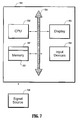
- FIG. 7 presents a schematic block diagram of a system that can implement the methods of the invention.
-
- Exemplary embodiments of the invention as described herein generally include systems and methods for detecting events in a video surveillance recording. In the interest of clarity, not all features of an actual implementation which are well known to those of skill in the art are described in detail herein.
- In order to quickly detect and characterize an event in a long video surveillance recording, one is frequently seeking to detect significant changes in the video images. For example, one purpose of a video surveillance in a parking lot would be to monitor individual parking spaces, to see when an empty space is occupied by a vehicle, or when an occupied space is vacated. The appearance/disappearance of a vehicle represents a significant change in the image recorded in the video surveillance data, and the time scale over which such an event occurs is relatively short when compared to the duration of the recording, i.e., on the order of a minute in a recording that is on the order of one or more hours in duration.
- An overview of an event detection method according to one embodiment of the invention is presented in FIG. 1. Starting with an original
video surveillance tape 10 of some duration, the tape is sampled at discrete intervals to form a set of snapshots of the surveillance tape. The original video sequence can be either analog or digital, however, the resulting snapshots are digital images. The sampling interval is chosen sufficiently far apart so that significant events, rather than small changes, are detectable. Uponapplication 11 of the change detection methods according to an embodiment of the present invention, asubset 12 of the original video that contains change events of interest is selected for further analysis. These selected changes are analyzed 13 using change verification methods according to an embodiment of the present invention, after which one ormore events 14 are selected for fine processing to extractinformation 15. Methods for fine processing of images, such as background modeling, are well known in the art, and can be applied to the selected event to confirmdetection 16 of an event. - Referring now to the flow chart of FIG. 2, according to an embodiment of the invention, a method for detecting change in a video sequence includes the steps of providing a video sequence for
analysis 200, sampling thesequence 201, determining a measure ofsimilarity 202, detectingchange 203, and verifying that a change occurred 204. Once the change has been verified, the image processing can be completed 205 according to other methods as needed and as are known in the art. Given the video sequence, afirst step 201 of the method is a regular sampling, to create a series of digital images to form snapshots of the video sequence. Within the snapshots are one or more windows-of-interest (WOIs) wherein attention is focused. To help with the detection of significant changes, the sampling removes all smooth changes in the WOIs, like the progressive appearance or disappearance of an object. According to one embodiment of the invention, the sampling interval can be from a few seconds to a few minutes. - A useful measure of similarity in accordance with an embodiment of the invention is determined at
step 202 from the image intensity variance within a WOI of a particular snapshot:where xt represents the pixel intensity for a pixel in the window W at time (i.e. snapshot) t, and
x t is the spatial intensity average in the window for the snapshot. This variance is invariant to any intensity shift, and can be used for handling both static and moving objects. Note that moving objects are considered only within a WOI. A more robust similarity measure, according to another embodiment of the invention, is a variance normalized to the spatial intensity scale:This variance is invariant to any affine intensity scale changes.
- Changes are detected across time at
step 203 by looking for large changes in the magnitude of the similarity measure between images adjacent in time. More precisely, the time derivative of the similarity measure is computed: - A result of applying these change detection methods to a video sequence of a parking lot is depicted in FIG. 3. A 72 minute video sequence of a parking lot, with some illumination changes, was sampled at 30 second intervals. The event sought is whether a vehicle parks in a particular space. The left image of FIG. 3 is a snapshot of the beginning of the video sequence, the middle image is the snapshot just before the event, and the right image is the snapshot just after the event. The box outlined in the lower center of the left image is the WOI. As can be seen, this WOI is an empty space, and is still empty in the middle image. The parking space is occupied by a car in the right image. FIG. 4 depicts a graph of the variance time derivative (the fluctuating line with a peak) for this series of snapshots, along with the threshold (the straight line). The variance time derivative exhibits a spike, whose magnitude is well above the threshold, that can be correlated to the appearance of the car in the parking space. The computations involved can be completed within three seconds.
- At
step 204, the change is verified to exclude false positives. One source of false positives resulting from the change detection methods of the present invention is occlusion, that is, the sudden blocking of the video image due to, for example, a blockage in front of the camera lens. This could result from a person walking through the field of view of the video camera, or even a bird flying in front of the camera lens. Unlike an illumination change, occlusion is likely to change the overall intensity profile of the WOI. To assist in the detection of a change due to occlusion, the window of interest should be similar before and after the occlusion. According to an embodiment of the invention, an interval similarity is computed at each time t and is weighted according to the definitionand Here, wi, wj are corresponding WOIs in a pair of successive snapshots, [n 1, n 2] is the duration neighborhood about the snapshot incorporating the occlusion over which similarity is being sought, h is a positive increasing function with h(1) = 1, and hist is a histogram of spatial intensities in the WOI, where the similarity is computed using a histogram comparison. By duration neighborhood is meant the set of snapshots preceding the occlusion and subsequent to the occlusion. For example, if an occlusion occurred in the 20th snapshot (i.e., t=20 in the equation for g(t), above), [n1 ,n2 ] could indicate the 17th snapshot through the 22rd snapshot (i.e. n1 = 3, n2 = 2). Note that any function satisfying the criteria for h can be used, such as an exponential function or a power function. According to one embodiment of the invention, h(x) ∝ x 2. If the neighborhood used is small, then the time between the compared windows can be made small, on the order of a few minutes. In that case, the change in illumination should be small, and should not have any significant effect on the detection of occlusion. The weighting function thus defined is a penalty function, in that an event due to an occlusion is penalized by having the magnitude of the similarity measure time derivative reduced.
- FIG. 5 depicts the result of using an interval similarity weighting to detect occlusion. In the top left of FIG. 5 is the first image of a sequence. The top center image of the figure shows the appearance event image (the appearance of a chair), while the top right image of the figure shows the occlusion event image. The WOI is indicated by the box outlined in the lower left of the image. The bottom left of FIG. 5 is a graph of S ˙w (t), where
event 1 is the appearance of the chair at time 41 andevent 2 at time 55 is the occlusion. Note that the spike in the similarity derivative for the occlusion is much greater in magnitude than that ofevent 1. The bottom right of FIG. 5 is a graph of fw (t)=g(t)*S ˙w (t), indicating how the weighting function has magnified the magnitude of the appearance event spike, while reducing that of the occlusion spike. As shown in the figure, the weighted similarity derivative function f removes the occlusion by increasing the spike corresponding to the real appearance at time 41 on the horizontal axis while reducing that of the occlusion. - Another source of false positives is a change of illumination. To verify if a detected event is due to a change of illumination, a method such as that disclosed in United States Patent Application No. 2003/0228058, incorporated herein by reference in its entirety, can be used.
- Finally, after the event selection, any processing method as is known in the art can be applied at
step 205 to complete the processing of the image sequences. For example, a background modeling technique can be used to remove the background and isolate the event of interest. FIG. 6 presents an example of background modeling results, according to an embodiment of the invention. The left image of the figure depicts a parking lot at the beginning of a video sequence, with the WOI denoted by the box outline. The middle image shows the WOI before a change event, with background modeling applied to the image, while the right image shows the WOI after a change event, with background modeling applied to the image. The result is that irrelevant detail is removed from the final image. - It is to be understood that the embodiments of the present invention can be implemented in various forms of hardware, software, firmware, special purpose processes, or a combination thereof. In one embodiment, the present invention can be implemented in software as an application program tangible embodied on a computer readable program storage device. The application program can be uploaded to, and executed by, a machine comprising any suitable architecture.
- Referring now to FIG. 7, according to an embodiment of the present invention, a
computer system 701 for implementing the present invention can comprise, inter alia, a central processing unit (CPU) 702, amemory 703 and an input/output (I/O)interface 704. Thecomputer system 701 is generally coupled through the I/O interface 704 to adisplay 705 andvarious input devices 706 such as a mouse and a keyboard. The support circuits can include circuits such as cache, power supplies, clock circuits, and a communication bus. Thememory 703 can include random access memory (RAM), read only memory (ROM), disk drive, tape drive, etc., or a combinations thereof. The present invention can be implemented as a routine 707 that is stored inmemory 703 and executed by theCPU 702 to process the signal from thesignal source 708. As such, thecomputer system 701 is a general purpose computer system that becomes a specific purpose computer system when executing the routine 707 of the present invention. Thecomputer system 701 also includes an operating system and micro instruction code. The various processes and functions described herein can either be part of the micro instruction code or part of the application program (or combination thereof) which is executed via the operating system. In addition, various other peripheral devices can be connected to the computer platform such as an additional data storage device and a printing device. - It is to be further understood that since the exemplary systems and methods described herein can be implemented in software, the actual method steps may differ depending upon the manner in which the present invention is programmed. Given the teachings herein, one of ordinary skill in the related art will be able to contemplate these and similar implementations or configurations of the present invention. Indeed, while the invention is susceptible to various modifications and alternative forms, specific embodiments thereof have been shown by way of example in the drawings and are herein described in detail. It should be understood, however, that the description herein of specific embodiments is not intended to limit the invention to the particular forms disclosed, but on the contrary, the intention is to cover all modifications, equivalents, and alternatives falling within the spirit and scope of the invention as defined by the appended claims.
Claims (32)
- A method for detecting events in a video sequence, said method comprising the steps of:providing a video sequence;sampling the video sequence at regular intervals to form a series of snapshots of the sequence;measuring a similarity of each snapshot;measuring a similarity change between successive pairs of snapshots, wherein if a similarity change magnitude is greater than a predetermined threshold, a change event has been detected;verifying the change event to exclude a false positive; andcompleting the processing of the snapshot incorporating the verified change event.
- The method of claim 1, wherein the sampling interval is from a few seconds to a few minutes.
- The method of claim 1, further comprising defining one or more windows-of-interest in each snapshot, and measuring the similarity in each window-of-interest in each snapshot.
- The method of claim 3, wherein the similarity measure for a window-of-interest in a snapshot is defined aswhere xt represents the pixel intensity for a pixel in a window-of-interest W of snapshot t, and

x t is a spatial intensity average in the window for the snapshot. - The method of claim 4, wherein the similarity measure is normalized to the spatial intensity scale of the window-of-interest according to the formula

- The method of claim 1, wherein the change in the similarity measure is determined from the time derivative of the similarity measure.
- The method of claim 1, wherein a false positive includes an occlusion.
- The method of claim 7, further comprising eliminating an occlusion by weighting a time derivative of the similarity measure according to the definitionwherein
 and wherein S ˙w (t) is the similarity measure time derivative, wi, wj are corresponding windows-of-interest in a pair of successive snapshots, [n 1,n 2] is the duration neighborhood about the snapshot incorporating the occlusion over which similarity is being sought, h is a positive increasing function with h(1) = 1, and hist is a histogram of spatial intensity values in the window-of-interest.
- The method of claim 8, wherein h(x)∝x 2.
- The method of claim 1, wherein a false positive includes a change of illumination.
- The method of claim 1, wherein the predetermined threshold is based on an analysis of the fluctuations in the similarity change between successive pairs of snapshots.
- The method of claim 11, wherein the threshold is more than three standard deviations greater than the mean fluctuation magnitude of the similarity change between successive pairs of snapshots.
- A method for searching for events in a video sequence, said method comprising the steps of:where xt represents the pixel intensity for a pixel in a window-of-interest W of snapshot t, andproviding a series of snapshots of a video sequence;defining one or more windows-of-interest in each snapshot;measuring a similarity of each window-of-interest in a snapshot according to the formula
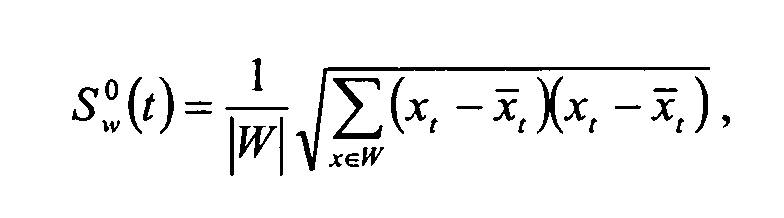
x t is a spatial intensity average in the window for the snapshot; and
measuring a similarity change between successive pairs of snapshots from a time derivative of the similarity measure, wherein if a similarity change magnitude is greater than a predetermined threshold, a change event has been detected, wherein the threshold is based on an analysis of the fluctuations in the similarity change between successive pairs of snapshots. - The method of claim 13, wherein the video sequence was sampled at regular intervals to form the series of snapshots.
- The method of claim 14, wherein the sampling interval is from a few seconds to a few minutes.
- The method of claim 13, wherein the similarity measure is normalized to the spatial intensity scale of the window-of-interest according to the formula

- The method of claim 13, further comprising the steps of verifying the change event to eliminate a false positive, wherein a false positive includes an occlusion and a change of illumination, and completing the processing of the snapshot incorporating the verified change event.
- The method of claim 17, further comprising eliminating an occlusion by weighting the time derivative of the similarity measure according to the definitionwherein
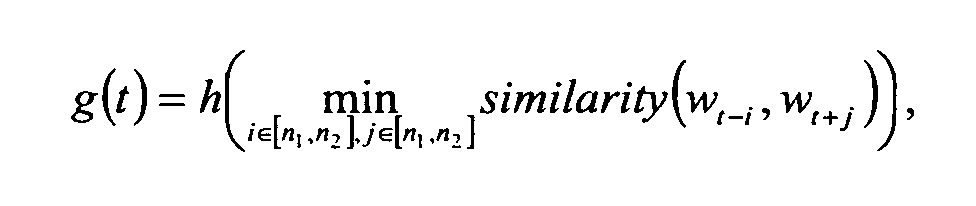 and wherein S ˙w (t) is the similarity measure time derivative, wi , wj are corresponding windows-of-interest in a pair of successive snapshots, [n 1,n 2] is the duration neighborhood about the snapshot incorporating the occlusion over which similarity is being sought, h is a positive increasing function with h(1) = 1, and hist is a histogram of spatial intensity values in the window-of-interest.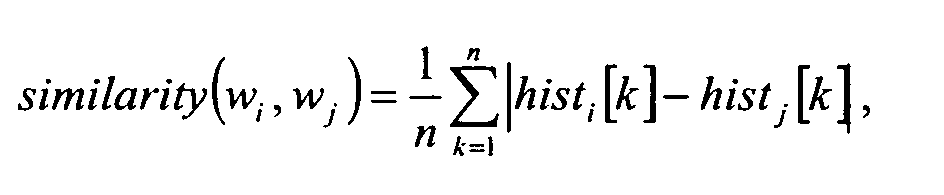
- The method of claim 18, wherein h(x)∝x 2.
- The method of claim 13, wherein the threshold is more than three standard deviations greater than the mean fluctuation magnitude of the similarity change between successive pairs of snapshots.
- A program storage device readable by a computer, tangibly embodying a program of instructions executable by the computer to perform the method steps for detecting events in a video sequence, said method comprising the steps of:providing a video sequence;sampling the video sequence at regular intervals to form a series of snapshots of the sequence;measuring a similarity of each snapshot;measuring a similarity change between successive pairs of snapshots, wherein if a similarity change magnitude is greater than a predetermined threshold, a change event has been detected;verifying the change event to exclude a false positive; andcompleting the processing of the snapshot incorporating the verified change event.
- The computer readable program storage device of claim 21, wherein the sampling interval is from a few seconds to a few minutes.
- The computer readable program storage device of claim 21, wherein the method further comprises defining one or more windows-of-interest in each snapshot, and measuring the similarity in each window-of-interest in each snapshot.
- The computer readable program storage device of claim 23, wherein the similarity measure for a window-of-interest in a snapshot is defined aswhere xt represents the pixel intensity for a pixel in a window-of-interest W of snapshot t, and
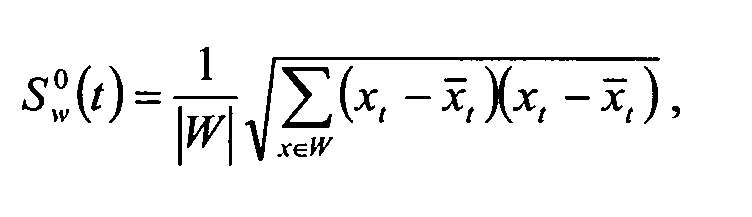
x t is a spatial intensity average in the window for the snapshot. - The computer readable program storage device of claim 24, wherein the similarity measure is normalized to the spatial intensity scale of the window-of-interest according to the formula

- The computer readable program storage device of claim 21, wherein the change in the similarity measure is determined from the time derivative of the similarity measure.
- The computer readable program storage device of claim 21, wherein a false positive includes an occlusion.
- The computer readable program storage device of claim 27, wherein the method further comprises eliminating an occlusion by weighting a time derivative of the similarity measure according to the definitionwherein
 and wherein S ˙w (t) is the similarity measure time derivative, wi, wj are corresponding windows-of-interest in a pair of successive snapshots, [n 1, n 2] is the duration neighborhood about the snapshot incorporating the occlusion over which similarity is being sought, h is a positive increasing function with h(1) = 1, and hist is a histogram of spatial intensity values in the window-of-interest.
- The computer readable program storage device of claim 28, wherein h(x)∝x 2.
- The computer readable program storage device of claim 21, wherein a false positive includes a change of illumination.
- The computer readable program storage device of claim 21, wherein the predetermined threshold is based on an analysis of the fluctuations in the similarity change between successive pairs of snapshots.
- The computer readable program storage device of claim 31, wherein the threshold is more than three standard deviations greater than the mean fluctuation magnitude of the similarity change between successive pairs of snapshots.
Applications Claiming Priority (2)
| Application Number | Priority Date | Filing Date | Title |
|---|---|---|---|
| US54010204P | 2004-01-27 | 2004-01-27 | |
| US540102P | 2004-01-27 |
Publications (3)
| Publication Number | Publication Date |
|---|---|
| EP1560161A2 true EP1560161A2 (en) | 2005-08-03 |
| EP1560161A3 EP1560161A3 (en) | 2011-05-04 |
| EP1560161B1 EP1560161B1 (en) | 2013-10-02 |
Family
ID=34652509
Family Applications (1)
| Application Number | Title | Priority Date | Filing Date |
|---|---|---|---|
| EP05001600.5A Expired - Lifetime EP1560161B1 (en) | 2004-01-27 | 2005-01-26 | Method and system for searching for events in video surveillance |
Country Status (2)
| Country | Link |
|---|---|
| US (1) | US7555046B2 (en) |
| EP (1) | EP1560161B1 (en) |
Cited By (2)
| Publication number | Priority date | Publication date | Assignee | Title |
|---|---|---|---|---|
| EP1833240A3 (en) * | 2006-03-09 | 2009-06-10 | DResearch Digital Media Systems GmbH | Method and assembly for detecting the first occurrence of one or more sustained signals and corresponding computer program and corresponding computer-readable storage medium |
| CN114040244A (en) * | 2021-10-14 | 2022-02-11 | 北京激浊扬清文化科技有限公司 | Method, system, device and medium for reducing error events in edge vision scene |
Families Citing this family (22)
| Publication number | Priority date | Publication date | Assignee | Title |
|---|---|---|---|---|
| US7826674B1 (en) * | 2004-09-10 | 2010-11-02 | Koplar Interactive Systems International, L.L.C. | Content signal analysis |
| US8457793B2 (en) * | 2008-09-10 | 2013-06-04 | Enlighted, Inc. | Intelligent lighting management and building control system |
| JP5218168B2 (en) * | 2009-03-11 | 2013-06-26 | ソニー株式会社 | Imaging device, moving object detection method, moving object detection circuit, program, and monitoring system |
| US8320671B1 (en) | 2010-06-11 | 2012-11-27 | Imad Zoghlami | Method for ranking image similarity and system for use therewith |
| KR101372171B1 (en) * | 2012-10-11 | 2014-03-07 | 현대자동차주식회사 | Apparatus and method for determining parking area |
| US20150086071A1 (en) * | 2013-09-20 | 2015-03-26 | Xerox Corporation | Methods and systems for efficiently monitoring parking occupancy |
| US9349288B2 (en) | 2014-07-28 | 2016-05-24 | Econolite Group, Inc. | Self-configuring traffic signal controller |
| US11700178B2 (en) | 2020-10-30 | 2023-07-11 | Nutanix, Inc. | System and method for managing clusters in an edge network |
| US11374807B2 (en) | 2020-10-30 | 2022-06-28 | Nutanix, Inc. | Handling dynamic command execution in hybrid cloud environments |
| US11290330B1 (en) | 2020-10-30 | 2022-03-29 | Nutanix, Inc. | Reconciliation of the edge state in a telemetry platform |
| US11789999B2 (en) | 2020-12-02 | 2023-10-17 | International Business Machines Corporation | Heuristic video searching |
| US12047253B2 (en) | 2022-02-11 | 2024-07-23 | Nutanix, Inc. | System and method to provide priority based quality of service for telemetry data |
| US11765065B1 (en) | 2022-03-23 | 2023-09-19 | Nutanix, Inc. | System and method for scalable telemetry |
| CN115661494B (en) * | 2022-06-14 | 2026-07-17 | 青岛云天励飞科技有限公司 | Method, device and equipment for constructing cluster connection graph and readable storage medium |
| US12705892B2 (en) | 2022-10-21 | 2026-08-11 | Cisco Technology, Inc. | Explainability for event alerts in video data |
| US12608938B2 (en) | 2022-11-14 | 2026-04-21 | Cisco Technology, Inc. | Self-supervised learning for video analytics |
| US12518529B2 (en) | 2022-11-15 | 2026-01-06 | Cisco Technology, Inc. | Reflection detection in video analytics |
| US12524670B2 (en) | 2022-12-23 | 2026-01-13 | Cisco Technology, Inc. | Automated ground truth generation using a neuro-symbolic metamodel |
| US12548371B2 (en) | 2023-02-09 | 2026-02-10 | Cisco Technology, Inc. | Behavioral group analytics for video |
| US12536800B2 (en) | 2023-02-23 | 2026-01-27 | Cisco Technology, Inc. | Privacy preserving person reidentification |
| CN117112831A (en) * | 2023-06-09 | 2023-11-24 | 青岛尘元科技信息有限公司 | Massive video comparison method, device and equipment based on video event information network |
| US12646319B2 (en) | 2023-09-08 | 2026-06-02 | Cisco Technology, Inc. | Automatic labeling and event detection for video analytics using hybrid AI |
Family Cites Families (3)
| Publication number | Priority date | Publication date | Assignee | Title |
|---|---|---|---|---|
| US7006128B2 (en) * | 2002-05-30 | 2006-02-28 | Siemens Corporate Research, Inc. | Object detection for sudden illumination changes using order consistency |
| US20040080615A1 (en) * | 2002-08-21 | 2004-04-29 | Strategic Vista Intenational Inc. | Digital video security system |
| US7483484B2 (en) * | 2003-10-09 | 2009-01-27 | Samsung Electronics Co., Ltd. | Apparatus and method for detecting opaque logos within digital video signals |
-
2005
- 2005-01-25 US US11/042,694 patent/US7555046B2/en not_active Expired - Fee Related
- 2005-01-26 EP EP05001600.5A patent/EP1560161B1/en not_active Expired - Lifetime
Non-Patent Citations (1)
| Title |
|---|
| MENG J. ET AL., SCENE CHANGE DETECTION IN A MPEG COMPRESSED VIDEO SEQUENCE, 7 February 1995 (1995-02-07) |
Cited By (3)
| Publication number | Priority date | Publication date | Assignee | Title |
|---|---|---|---|---|
| EP1833240A3 (en) * | 2006-03-09 | 2009-06-10 | DResearch Digital Media Systems GmbH | Method and assembly for detecting the first occurrence of one or more sustained signals and corresponding computer program and corresponding computer-readable storage medium |
| CN114040244A (en) * | 2021-10-14 | 2022-02-11 | 北京激浊扬清文化科技有限公司 | Method, system, device and medium for reducing error events in edge vision scene |
| CN114040244B (en) * | 2021-10-14 | 2024-01-05 | 北京激浊扬清文化科技有限公司 | Method, system, equipment and medium for reducing error event in edge vision scene |
Also Published As
| Publication number | Publication date |
|---|---|
| EP1560161A3 (en) | 2011-05-04 |
| US7555046B2 (en) | 2009-06-30 |
| US20050180603A1 (en) | 2005-08-18 |
| EP1560161B1 (en) | 2013-10-02 |
Similar Documents
| Publication | Publication Date | Title |
|---|---|---|
| EP1560161B1 (en) | Method and system for searching for events in video surveillance | |
| US11670086B2 (en) | System and process for detecting, tracking and counting human objects of interest | |
| JP6488083B2 (en) | Hybrid method and system of video and vision based access control for parking space occupancy determination | |
| CN111259868B (en) | Reverse vehicle detection method, system and medium based on convolutional neural network | |
| KR101375583B1 (en) | Object Density Estimation in Video | |
| Calderara et al. | Reliable background suppression for complex scenes | |
| JP6650657B2 (en) | Method and system for tracking moving objects in video using fingerprints | |
| CN110738150B (en) | Camera linkage snapshot method and device and computer storage medium | |
| JP5218168B2 (en) | Imaging device, moving object detection method, moving object detection circuit, program, and monitoring system | |
| KR102217253B1 (en) | Apparatus and method for analyzing behavior pattern | |
| CA2723613A1 (en) | System and process for detecting, tracking and counting human objects of interest | |
| JP5106302B2 (en) | Moving object tracking device | |
| WO2014192441A1 (en) | Image processing system, image processing method, and program | |
| CN111428644A (en) | Zebra crossing region monitoring method, system and medium based on deep neural network | |
| KR101454644B1 (en) | Loitering Detection Using a Pedestrian Tracker | |
| Kawakatsu et al. | Traffic surveillance system for bridge vibration analysis | |
| CN114898288A (en) | Region monitoring method and device, electronic equipment and storage medium | |
| US20190180112A1 (en) | Method, device, and non-transitory computer readable medium for searching video event | |
| US20080198237A1 (en) | System and method for adaptive pixel segmentation from image sequences | |
| JP7753808B2 (en) | Traffic congestion determination device, traffic congestion determination method, and program | |
| JP7354752B2 (en) | Image anonymization device, image anonymization method, and program | |
| CN119919884A (en) | Parking monitoring processing method and vehicle | |
| CN111046788A (en) | Method, device and system for detecting staying personnel | |
| CN100546380C (en) | A Nocturnal Object Detection and Tracking Method Based on Visual Features | |
| CN113326820B (en) | Driving environment sensing method and device, electronic equipment and storage medium |
Legal Events
| Date | Code | Title | Description |
|---|---|---|---|
| PUAI | Public reference made under article 153(3) epc to a published international application that has entered the european phase |
Free format text: ORIGINAL CODE: 0009012 |
|
| AK | Designated contracting states |
Kind code of ref document: A2 Designated state(s): AT BE BG CH CY CZ DE DK EE ES FI FR GB GR HU IE IS IT LI LT LU MC NL PL PT RO SE SI SK TR |
|
| AX | Request for extension of the european patent |
Extension state: AL BA HR LV MK YU |
|
| RAP1 | Party data changed (applicant data changed or rights of an application transferred) |
Owner name: SIEMENS SCHWEIZ AG |
|
| PUAL | Search report despatched |
Free format text: ORIGINAL CODE: 0009013 |
|
| AK | Designated contracting states |
Kind code of ref document: A3 Designated state(s): AT BE BG CH CY CZ DE DK EE ES FI FR GB GR HU IE IS IT LI LT LU MC NL PL PT RO SE SI SK TR |
|
| AX | Request for extension of the european patent |
Extension state: AL BA HR LV MK YU |
|
| RIC1 | Information provided on ipc code assigned before grant |
Ipc: G06T 7/20 20060101AFI20050414BHEP Ipc: G06K 9/00 20060101ALI20110328BHEP |
|
| 17P | Request for examination filed |
Effective date: 20110919 |
|
| AKX | Designation fees paid |
Designated state(s): AT BE BG CH CY CZ DE DK EE ES FI FR GB GR HU IE IS IT LI LT LU MC NL PL PT RO SE SI SK TR |
|
| 17Q | First examination report despatched |
Effective date: 20121108 |
|
| GRAP | Despatch of communication of intention to grant a patent |
Free format text: ORIGINAL CODE: EPIDOSNIGR1 |
|
| INTG | Intention to grant announced |
Effective date: 20130423 |
|
| GRAS | Grant fee paid |
Free format text: ORIGINAL CODE: EPIDOSNIGR3 |
|
| GRAA | (expected) grant |
Free format text: ORIGINAL CODE: 0009210 |
|
| AK | Designated contracting states |
Kind code of ref document: B1 Designated state(s): AT BE BG CH CY CZ DE DK EE ES FI FR GB GR HU IE IS IT LI LT LU MC NL PL PT RO SE SI SK TR |
|
| REG | Reference to a national code |
Ref country code: GB Ref legal event code: FG4D |
|
| REG | Reference to a national code |
Ref country code: CH Ref legal event code: EP Ref country code: AT Ref legal event code: REF Ref document number: 634952 Country of ref document: AT Kind code of ref document: T Effective date: 20131015 |
|
| REG | Reference to a national code |
Ref country code: IE Ref legal event code: FG4D |
|
| REG | Reference to a national code |
Ref country code: DE Ref legal event code: R096 Ref document number: 602005041361 Country of ref document: DE Effective date: 20131205 |
|
| REG | Reference to a national code |
Ref country code: NL Ref legal event code: T3 |
|
| REG | Reference to a national code |
Ref country code: AT Ref legal event code: MK05 Ref document number: 634952 Country of ref document: AT Kind code of ref document: T Effective date: 20131002 |
|
| PG25 | Lapsed in a contracting state [announced via postgrant information from national office to epo] |
Ref country code: SI Free format text: LAPSE BECAUSE OF FAILURE TO SUBMIT A TRANSLATION OF THE DESCRIPTION OR TO PAY THE FEE WITHIN THE PRESCRIBED TIME-LIMIT Effective date: 20131002 |
|
| REG | Reference to a national code |
Ref country code: LT Ref legal event code: MG4D |
|
| PG25 | Lapsed in a contracting state [announced via postgrant information from national office to epo] |
Ref country code: CZ Free format text: LAPSE BECAUSE OF FAILURE TO SUBMIT A TRANSLATION OF THE DESCRIPTION OR TO PAY THE FEE WITHIN THE PRESCRIBED TIME-LIMIT Effective date: 20131002 Ref country code: LT Free format text: LAPSE BECAUSE OF FAILURE TO SUBMIT A TRANSLATION OF THE DESCRIPTION OR TO PAY THE FEE WITHIN THE PRESCRIBED TIME-LIMIT Effective date: 20131002 Ref country code: IS Free format text: LAPSE BECAUSE OF FAILURE TO SUBMIT A TRANSLATION OF THE DESCRIPTION OR TO PAY THE FEE WITHIN THE PRESCRIBED TIME-LIMIT Effective date: 20140202 Ref country code: SE Free format text: LAPSE BECAUSE OF FAILURE TO SUBMIT A TRANSLATION OF THE DESCRIPTION OR TO PAY THE FEE WITHIN THE PRESCRIBED TIME-LIMIT Effective date: 20131002 Ref country code: FI Free format text: LAPSE BECAUSE OF FAILURE TO SUBMIT A TRANSLATION OF THE DESCRIPTION OR TO PAY THE FEE WITHIN THE PRESCRIBED TIME-LIMIT Effective date: 20131002 Ref country code: BE Free format text: LAPSE BECAUSE OF FAILURE TO SUBMIT A TRANSLATION OF THE DESCRIPTION OR TO PAY THE FEE WITHIN THE PRESCRIBED TIME-LIMIT Effective date: 20131002 |
|
| PG25 | Lapsed in a contracting state [announced via postgrant information from national office to epo] |
Ref country code: ES Free format text: LAPSE BECAUSE OF FAILURE TO SUBMIT A TRANSLATION OF THE DESCRIPTION OR TO PAY THE FEE WITHIN THE PRESCRIBED TIME-LIMIT Effective date: 20131002 Ref country code: CY Free format text: LAPSE BECAUSE OF FAILURE TO SUBMIT A TRANSLATION OF THE DESCRIPTION OR TO PAY THE FEE WITHIN THE PRESCRIBED TIME-LIMIT Effective date: 20131002 Ref country code: AT Free format text: LAPSE BECAUSE OF FAILURE TO SUBMIT A TRANSLATION OF THE DESCRIPTION OR TO PAY THE FEE WITHIN THE PRESCRIBED TIME-LIMIT Effective date: 20131002 Ref country code: PL Free format text: LAPSE BECAUSE OF FAILURE TO SUBMIT A TRANSLATION OF THE DESCRIPTION OR TO PAY THE FEE WITHIN THE PRESCRIBED TIME-LIMIT Effective date: 20131002 |
|
| PG25 | Lapsed in a contracting state [announced via postgrant information from national office to epo] |
Ref country code: PT Free format text: LAPSE BECAUSE OF FAILURE TO SUBMIT A TRANSLATION OF THE DESCRIPTION OR TO PAY THE FEE WITHIN THE PRESCRIBED TIME-LIMIT Effective date: 20140203 |
|
| REG | Reference to a national code |
Ref country code: DE Ref legal event code: R097 Ref document number: 602005041361 Country of ref document: DE |
|
| PG25 | Lapsed in a contracting state [announced via postgrant information from national office to epo] |
Ref country code: EE Free format text: LAPSE BECAUSE OF FAILURE TO SUBMIT A TRANSLATION OF THE DESCRIPTION OR TO PAY THE FEE WITHIN THE PRESCRIBED TIME-LIMIT Effective date: 20131002 |
|
| PLBE | No opposition filed within time limit |
Free format text: ORIGINAL CODE: 0009261 |
|
| STAA | Information on the status of an ep patent application or granted ep patent |
Free format text: STATUS: NO OPPOSITION FILED WITHIN TIME LIMIT |
|
| PG25 | Lapsed in a contracting state [announced via postgrant information from national office to epo] |
Ref country code: SK Free format text: LAPSE BECAUSE OF FAILURE TO SUBMIT A TRANSLATION OF THE DESCRIPTION OR TO PAY THE FEE WITHIN THE PRESCRIBED TIME-LIMIT Effective date: 20131002 Ref country code: MC Free format text: LAPSE BECAUSE OF FAILURE TO SUBMIT A TRANSLATION OF THE DESCRIPTION OR TO PAY THE FEE WITHIN THE PRESCRIBED TIME-LIMIT Effective date: 20131002 Ref country code: LU Free format text: LAPSE BECAUSE OF FAILURE TO SUBMIT A TRANSLATION OF THE DESCRIPTION OR TO PAY THE FEE WITHIN THE PRESCRIBED TIME-LIMIT Effective date: 20140126 Ref country code: RO Free format text: LAPSE BECAUSE OF FAILURE TO SUBMIT A TRANSLATION OF THE DESCRIPTION OR TO PAY THE FEE WITHIN THE PRESCRIBED TIME-LIMIT Effective date: 20131002 Ref country code: IT Free format text: LAPSE BECAUSE OF FAILURE TO SUBMIT A TRANSLATION OF THE DESCRIPTION OR TO PAY THE FEE WITHIN THE PRESCRIBED TIME-LIMIT Effective date: 20131002 |
|
| REG | Reference to a national code |
Ref country code: CH Ref legal event code: PL |
|
| 26N | No opposition filed |
Effective date: 20140703 |
|
| PG25 | Lapsed in a contracting state [announced via postgrant information from national office to epo] |
Ref country code: DK Free format text: LAPSE BECAUSE OF FAILURE TO SUBMIT A TRANSLATION OF THE DESCRIPTION OR TO PAY THE FEE WITHIN THE PRESCRIBED TIME-LIMIT Effective date: 20131002 |
|
| REG | Reference to a national code |
Ref country code: DE Ref legal event code: R097 Ref document number: 602005041361 Country of ref document: DE Effective date: 20140703 |
|
| PG25 | Lapsed in a contracting state [announced via postgrant information from national office to epo] |
Ref country code: LI Free format text: LAPSE BECAUSE OF NON-PAYMENT OF DUE FEES Effective date: 20140131 Ref country code: CH Free format text: LAPSE BECAUSE OF NON-PAYMENT OF DUE FEES Effective date: 20140131 |
|
| REG | Reference to a national code |
Ref country code: FR Ref legal event code: ST Effective date: 20140930 |
|
| REG | Reference to a national code |
Ref country code: IE Ref legal event code: MM4A |
|
| PG25 | Lapsed in a contracting state [announced via postgrant information from national office to epo] |
Ref country code: FR Free format text: LAPSE BECAUSE OF NON-PAYMENT OF DUE FEES Effective date: 20140131 |
|
| PG25 | Lapsed in a contracting state [announced via postgrant information from national office to epo] |
Ref country code: IE Free format text: LAPSE BECAUSE OF NON-PAYMENT OF DUE FEES Effective date: 20140126 |
|
| PG25 | Lapsed in a contracting state [announced via postgrant information from national office to epo] |
Ref country code: BG Free format text: LAPSE BECAUSE OF FAILURE TO SUBMIT A TRANSLATION OF THE DESCRIPTION OR TO PAY THE FEE WITHIN THE PRESCRIBED TIME-LIMIT Effective date: 20131002 |
|
| PG25 | Lapsed in a contracting state [announced via postgrant information from national office to epo] |
Ref country code: GR Free format text: LAPSE BECAUSE OF FAILURE TO SUBMIT A TRANSLATION OF THE DESCRIPTION OR TO PAY THE FEE WITHIN THE PRESCRIBED TIME-LIMIT Effective date: 20140103 |
|
| PG25 | Lapsed in a contracting state [announced via postgrant information from national office to epo] |
Ref country code: TR Free format text: LAPSE BECAUSE OF FAILURE TO SUBMIT A TRANSLATION OF THE DESCRIPTION OR TO PAY THE FEE WITHIN THE PRESCRIBED TIME-LIMIT Effective date: 20131002 Ref country code: HU Free format text: LAPSE BECAUSE OF FAILURE TO SUBMIT A TRANSLATION OF THE DESCRIPTION OR TO PAY THE FEE WITHIN THE PRESCRIBED TIME-LIMIT; INVALID AB INITIO Effective date: 20050126 |
|
| PGFP | Annual fee paid to national office [announced via postgrant information from national office to epo] |
Ref country code: DE Payment date: 20170320 Year of fee payment: 13 |
|
| PGFP | Annual fee paid to national office [announced via postgrant information from national office to epo] |
Ref country code: NL Payment date: 20180109 Year of fee payment: 14 |
|
| PGFP | Annual fee paid to national office [announced via postgrant information from national office to epo] |
Ref country code: GB Payment date: 20180108 Year of fee payment: 14 |
|
| REG | Reference to a national code |
Ref country code: DE Ref legal event code: R119 Ref document number: 602005041361 Country of ref document: DE |
|
| PG25 | Lapsed in a contracting state [announced via postgrant information from national office to epo] |
Ref country code: DE Free format text: LAPSE BECAUSE OF NON-PAYMENT OF DUE FEES Effective date: 20180801 |
|
| REG | Reference to a national code |
Ref country code: NL Ref legal event code: MM Effective date: 20190201 |
|
| GBPC | Gb: european patent ceased through non-payment of renewal fee |
Effective date: 20190126 |
|
| PG25 | Lapsed in a contracting state [announced via postgrant information from national office to epo] |
Ref country code: NL Free format text: LAPSE BECAUSE OF NON-PAYMENT OF DUE FEES Effective date: 20190201 |
|
| PG25 | Lapsed in a contracting state [announced via postgrant information from national office to epo] |
Ref country code: GB Free format text: LAPSE BECAUSE OF NON-PAYMENT OF DUE FEES Effective date: 20190126 |