EP1560009A1 - Temperature indicating display device - Google Patents
Temperature indicating display device Download PDFInfo
- Publication number
- EP1560009A1 EP1560009A1 EP03703372A EP03703372A EP1560009A1 EP 1560009 A1 EP1560009 A1 EP 1560009A1 EP 03703372 A EP03703372 A EP 03703372A EP 03703372 A EP03703372 A EP 03703372A EP 1560009 A1 EP1560009 A1 EP 1560009A1
- Authority
- EP
- European Patent Office
- Prior art keywords
- temperature
- layer
- display device
- detecting agent
- temperature detecting
- Prior art date
- Legal status (The legal status is an assumption and is not a legal conclusion. Google has not performed a legal analysis and makes no representation as to the accuracy of the status listed.)
- Withdrawn
Links
Images




Classifications
-
- G—PHYSICS
- G01—MEASURING; TESTING
- G01K—MEASURING TEMPERATURE; MEASURING QUANTITY OF HEAT; THERMALLY-SENSITIVE ELEMENTS NOT OTHERWISE PROVIDED FOR
- G01K3/00—Thermometers giving results other than momentary value of temperature
- G01K3/005—Circuits arrangements for indicating a predetermined temperature
-
- B—PERFORMING OPERATIONS; TRANSPORTING
- B65—CONVEYING; PACKING; STORING; HANDLING THIN OR FILAMENTARY MATERIAL
- B65D—CONTAINERS FOR STORAGE OR TRANSPORT OF ARTICLES OR MATERIALS, e.g. BAGS, BARRELS, BOTTLES, BOXES, CANS, CARTONS, CRATES, DRUMS, JARS, TANKS, HOPPERS, FORWARDING CONTAINERS; ACCESSORIES, CLOSURES, OR FITTINGS THEREFOR; PACKAGING ELEMENTS; PACKAGES
- B65D79/00—Kinds or details of packages, not otherwise provided for
- B65D79/02—Arrangements or devices for indicating incorrect storage or transport
-
- G—PHYSICS
- G01—MEASURING; TESTING
- G01K—MEASURING TEMPERATURE; MEASURING QUANTITY OF HEAT; THERMALLY-SENSITIVE ELEMENTS NOT OTHERWISE PROVIDED FOR
- G01K11/00—Measuring temperature based upon physical or chemical changes not covered by groups G01K3/00, G01K5/00, G01K7/00 or G01K9/00
- G01K11/06—Measuring temperature based upon physical or chemical changes not covered by groups G01K3/00, G01K5/00, G01K7/00 or G01K9/00 using melting, freezing, or softening
-
- G—PHYSICS
- G09—EDUCATION; CRYPTOGRAPHY; DISPLAY; ADVERTISING; SEALS
- G09F—DISPLAYING; ADVERTISING; SIGNS; LABELS OR NAME-PLATES; SEALS
- G09F3/00—Labels, tag tickets, or similar identification or indication means; Seals; Postage or like stamps
- G09F3/02—Forms or constructions
- G09F3/0291—Labels or tickets undergoing a change under particular conditions, e.g. heat, radiation, passage of time
-
- G—PHYSICS
- G09—EDUCATION; CRYPTOGRAPHY; DISPLAY; ADVERTISING; SEALS
- G09F—DISPLAYING; ADVERTISING; SIGNS; LABELS OR NAME-PLATES; SEALS
- G09F3/00—Labels, tag tickets, or similar identification or indication means; Seals; Postage or like stamps
- G09F3/02—Forms or constructions
- G09F3/0291—Labels or tickets undergoing a change under particular conditions, e.g. heat, radiation, passage of time
- G09F3/0294—Labels or tickets undergoing a change under particular conditions, e.g. heat, radiation, passage of time where the change is not permanent, e.g. labels only readable under a special light, temperature indicating labels and the like
Definitions
- the present invention relates to a temperature indicating display device capable of displaying a temperature history by causing an irreversible shift upon exposing to a predetermined temperature. More specifically, the invention relates to such a temperature indicating display device that contains an information recording film layer having information recorded therein, an information record holding layer for holding the information, and a temperature detecting agent layer containing a substance changing its state depending on temperature, characterized in that the substance in the temperature detecting agent layer is shifted in state upon exposing a predetermined temperature, so as to change the display state of the information recorded in the information recording film layer, and also relates to a laminated body thereof, a container having the device installed therein, and a temperature indicating display label obtained by forming the device into a label form.
- various kinds of foods can be maintained in safety for a long period of time. Furthermore, according to the progress of the low temperature transportation technique, such as the cold chain system, various kinds of cryopreservation foods are available as commercial products.
- bacteria upon preservation of foods at a low temperature, bacteria would grow exponentially and thus the safety standard is often not satisfied if the temperature is not sufficiently controlled during production, transportation and distribution of foods. For example, it is said that E. coli grows exponentially in each 2 hours if the temperature rises from 3°C to 10°C. Furthermore, upon rising of the temperature, water contained in the foods is expanded to form voids within the foods, and nutrients of the foods are exuded along with water through the voids to the surface of the foods due to a capillary effect, which results to supply the nutrients for the bacterial growth.
- the foods when the foods are re-chilled, bacteria on the surface of the foods are infiltrated into the foods with the extruded water to expand the bacterial contamination into the interior of the foods.
- the growth rate of bacteria is suppressed by re-chilling, the growth rate may greatly increase compared to the ordinary case due to the counteraction when the temperature rises after chilling.
- JP-A-10-287863 discloses an invention relating to a temperature history display material that is irreversibly colored through reaction of plural substances at a predetermined temperature, and the temperature history display material has a coloring agent layer, a temperature detecting agent layer and a developer layer.
- the coloring agent layer and the developer layer are delimited with the temperature detecting agent layer, and the temperature detecting agent layer melts at a predetermined temperature to color by contacting the coloring agent layer and the developer layer. Since the coloring reaction occurs irreversibly, the coloring of the temperature history display material shows whether or not the material suffers the predetermined temperature.
- the system uses an irreversible reaction and is effective, but requires the coloring agent and the developer, the complicated structure of the temperature history display material and high cost, which makes the system practically difficult to be used.
- an object of the invention is to provide a display material with a simple structure that can reliably and irreversibly display a temperature history of a predetermined temperature or higher.
- the present invention also provides a laminated body having a temperature detecting agent layer and an information recording film layer.
- the temperature detecting agent layer containing a substance of which physical state is shifted at a predetermined temperature adjacent to the information recording film layer enables to melt or diffuse the substance constituting the information recording film layer in accordance with the shift of physical state of the substance in the temperature detecting agent layer, whereby the information recorded in the information recording film layer can be irreversibly destroyed, or the information recording layer can be irreversibly made opaque or transparent in accordance with the shift of physical state of the substance in the temperature detecting agent layer.
- the present invention relates to a temperature indicating display device containing an information recording film layer having information recorded therein, and a temperature detecting agent layer containing a substance of which the state shift dependently on temperature, wherein the state of substance in the temperature detecting agent layer is shifted upon undergoing a predetermined temperature, so as to change a display of the information recorded in the information recording film layer, and also relates to a container having the device installed therein.
- the invention also relates to a laminated body for temperature indicating display containing a temperature detecting agent layer, an information recording film layer and an information record holding layer, or to a laminated body for temperature indicating display containing a temperature detecting agent layer, a diffusion layer, an information recording film layer and an information record holding layer.
- the invention also relates to a temperature indicating display label containing a substrate, a separator containing a temperature detecting agent layer containing a substance of which the state shifts dependently on temperature, and an information record holding layer containing an information recording layer recorded therein.
- the invention relates to the following items.
- a label having printed information such as a barcode is attached to various kinds of consumer products, such as foods, and is used for management of distribution and products.
- the inventors have noted the label, and have developed a label capable of displaying a temperature history.
- a practical temperature indicating display device can be provided at low cost in a simple measure by the combination of an information recording film having the information recorded by printing, and the temperature detecting agent.
- a major characteristic feature of the invention resides in the combination of the information recording film and the temperature detecting agent, whereby a practical temperature indicating display device capable of reliably and irreversibly displaying temperature indication to a predetermined temperature is provided at low cost without using a coloring agent or a temperature-sensitive coloring material having been conventionally used.
- temperature indication means the presence or absence of a temperature history to a predetermined temperature.
- a major characteristic feature of the present invention resides in the combination of the information recording film and the temperature detecting agent, and specific embodiments of the invention based on the combination can be roughly classified into the following four types. However, the invention is not limited to the embodiments, and any embodiment that includes the combination of the information recording film and the temperature detecting agent is encompassed by the present invention.
- a side type can be exemplified as an application of the dissolution type or the infiltration type. See Figs. 5 and 8.
- Fig. 1 schematically shows the dissolution type embodiment of the present invention, which contains a separator 3 placed on a substrate 1 wherein a temperature detecting agent layer is set on the central part of the separator 3, and an information record holding layer 4 having an information recording film layer having information recorded on the lower surface thereof wherein the temperature detecting agent layer and the information recording film layer are disposed to be closely adjacent to each other.
- This assembly is protected by covering with a laminate seal 5.
- the substrate 1 has an adhesive layer on the back surface thereof, whereby the device can be fixed to a container or the like.
- the temperature detecting agent in the temperature detecting agent layer melts, whereby a printing ink or the like in the information recording film layer, which is disposed to be closely adjacent to the temperature detecting agent layer melts to destroy the recorded contents.
- the recorded contents once destroyed cannot be restored, and thus the accrual of the destruction of the recorded contents indicate the temperature history that the device undergoes the predetermined temperature or higher.
- Fig. 2 schematically shows the infiltration type embodiment of the invention, which contains a separator 3 placed on a substrate 1 wherein a temperature detecting agent layer is set on the central part of the separator 3, a diffusion layer 2 placed on the separator 3 and an information record holding layer 4 placed on the diffusion layer 2.
- the information record holding layer has an information recording film layer having information recorded on the lower surface thereof, and the diffusion layer is disposed to be closely adjacent to both the temperature detecting agent layer and the information recording film layer.
- This assembly is protected by covering with a laminate seal 5.
- the substrate 1 has an adhesive layer on the back surface thereof, whereby the device can be fixed to a container or the like.
- the temperature detecting agent in the temperature detecting agent layer melts or softened to be infiltrated into the diffusion layer, which is disposed to be closely adjacent to the temperature detecting agent layer, and in a state where the temperature detecting agent is sufficiently infiltrated, the temperature detecting agent reaches the information recording film layer through the diffusion layer and melts a printing ink or the like in the information recording film layer to destroy the recorded contents.
- the recorded contents once destroyed cannot be restored, and thus the accrual of the destruction of the recorded contents indicate the temperature history that the device undergoes the predetermined temperature or higher.
- Fig. 3 schematically shows the solid dispersion type embodiment of the invention, which contains an information record holding layer 4 having an information recording film layer having information recorded on the upper surface thereof, and a separator 3 placed on the layer 4 wherein a temperature detecting agent layer is set on the central part of the separator 3, and the assembly is protected by covering with a laminate seal 5.
- the information record holding layer 4 has an adhesive layer on the back surface thereof, whereby the device can be fixed to a container or the like.
- the temperature detecting agent layer having been in a heterogeneous phase in the temperature detecting agent layer is increased in flowability to be in a homogeneous phase.
- the temperature detecting agent layer can maintain transparency since the solid is localized, but the solid melts or softens upon exposing to the predetermined temperature or higher to form a homogeneous phase, so as to become totally opaque.
- the information recorded on the information record holding layer 4 by printing or the like is unreadable when the temperature detecting agent layer becomes opaque.
- the temperature detecting agent layer once being in a heterogeneous phase cannot be restored to a transparent homogeneous phase, and thus the impossibility of reading the recorded contents indicate the temperature history that the device undergoes the predetermined temperature or higher.
- Fig. 4 schematically shows the dressing type embodiment of the invention, which contains an information record holding layer 4 having an information recording film layer having information recorded on the upper surface thereof, and a separator 3 having a temperature detecting agent layer on the central part thereof placed on the layer 4, and this assembly is protected by covering with a laminate seal 5.
- the information record holding layer 4 has an adhesive layer on the back surface thereof, whereby the device can be fixed to a container or the like.
- the minute bubbles or particles uniformly dispersed in and fixed to the temperature detecting agent layer are aggregated through increase in fluidity of the surrounding substance to form a separated heterogeneous system, preferably a two phase system, and as a result, the temperature detecting agent layer having been opaque with the minute particles or bubbles becomes transparent, whereby the information recorded on the information record holding layer 4 by printing or the like becomes readable through the laminate seal 5.
- the temperature detecting agent layer once being aggregated to form the phase cannot be restored to an opaque state, and thus the possibility of reading the recorded contents recorded on the information record holding layer 4 indicate the temperature history that the device undergoes the predetermined temperature or higher.
- a side type temperature indicating display device examples of a side type temperature indicating display device are shown in Figs. 5 and 8.
- Fig. 5 shows an example of the side type, in which the part for recording information, such as a barcode, on the surface of the information display member is large, and the part capable of being made in contact with the diffusion layer is small.
- Fig. 8 shows an example, in which the area having information recorded therein is small, and substantially the entire of a forming part which forms the temperature detecting agent placing part can be placed on the information display member.
- the first example of the side type temperature indicating display device of the present invention is shown in Fig. 5.
- the temperature indicating display device 10 has a temperature detecting agent placing part 12, a forming part 11 for forming the same, a diffusion layer 13 which touches the temperature detecting agent, an information display member 14 which touches the other end of the diffusion layer 13, and a protective sheet 15 for protecting the above components.
- the information display member 14 may be those having been used, such as a barcode label, and those attached to a product, a container of a product, or a transporting container for transporting a product.
- Fig. 6 shows a cross sectional view on the plane A-A' of the temperature indicating display device 10 shown in Fig. 5.
- the temperature detecting agent in the temperature detecting agent placing part 12 melts to be eluted or infiltrated into the diffusion layer 13, which is disposed to be closely adjacent to the temperature detecting agent placing part 12, and when the temperature detecting agent is sufficiently eluted or infiltrated, the temperature detecting agent reaches the information recording film layer 141 through the diffusion layer 13 and melts a printing ink or the like in the information recording film layer to destroy the recorded contents.
- the recorded contents once destroyed cannot be restored, and thus the destruction of the recorded contents indicate the temperature history that the device undergoes the predetermined temperature or higher.
- Fig. 7 shows a cross sectional view of the forming part 11 having the temperature detecting agent placing part 12 formed in the side type temperature indicating display device 10 of the present invention upon storing.
- This type could be a blister pack in which a hollow part for housing the temperature detecting agent is provided on the central part.
- An adhesive layer 110 is provided on an outer periphery of the bottom part, which is sealed with a barrier part 17.
- a liquid or solid temperature detecting agent is placed in the hollow part and sealed with the barrier part 17, whereby the temperature detecting agent can be stored at room temperature.
- the temperature detecting agent are solidified by chilling at a low temperature, then the barrier part 17 is removed to make closely into contact with the diffusion layer 13.
- a temperature indicating display device 20 shown in Fig. 8 can be exemplified.
- the device has the same principal as the temperature indicating display device shown in Fig. 5 but is different therefrom in such a point that substantially the entire part of the diffusion layer 23 and the temperature detecting agent placing part 22 can be provided on the information display member 24.
- the side type temperature indicating display device of the present invention has such a characteristic feature that an information display member that has been conventionally used, such as a barcode label, can be used as it is, and also has such a significant feature that the temperature detecting agent placing part and the diffusion layer can be independently produced, distributed and stored. Therefore, the temperature indicating display device of the present invention forms an independent temperature indicating device containing a temperature detecting agent placing part having a temperature detecting agent placed therein, and a diffusion layer. Furthermore, the temperature detecting agent placing part having a temperature detecting agent placed therein, and the diffusion layer can be independently produced, distributed and stored, and thus production, distribution, storage and transfer of them as a part of the temperature indicating device are also encompassed in the scope of the invention.
- the temperature detecting agent in the temperature detecting agent layer in the "dissolution type” or “infiltration type” embodiment or the side type embodiment of the invention is preferably one or more kinds of substances that becomes a liquid or a sol by melting or softening at a predetermined temperature or higher and can melt or diffuse a substance recording information, such as printing ink.
- Specific examples of the preferred temperature detecting agent include a thermal melting agent, such as paraffin, a higher fatty acid, a higher fatty acid ester and a higher alcohol.
- the temperature detecting agent may have a melting point around the target predetermined temperature and can melt or diffuse a substance recording information, such as printing ink.
- a substance having a high melting point may be employed, and in the case of a product that should not be exposed to room temperature or higher, such as a medicinal product, a substance having a melting point around room temperature may be employed.
- a substance having a relatively low melting point may be employed.
- the melting point of the substance can be selected from a range of about from -50 to 100°C for an industrial product, can be selected from a range of about from 10 to 80°C for a medicinal product and a product stored at ordinary temperature, and can be selected from a range of about from -30 to 50°C for foods.
- the temperature detecting agent may contain only one kind of substance or may be a mixture of two or more kinds of substances.
- An additive such as a lubricating agent, a thickening agent and a coloring agent, may be added thereto depending on necessity.
- the melting point can be set at the predetermined temperature by mixing two or more substances for utilizing the melting point depression function.
- the temperature detecting agent include, but not limited to, a paraffin compound having from 10 to 30 carbon atoms, preferably from 12 to 20 carbon atoms, more preferably from 12 to 18 carbon atoms; a substituted or unsubstituted higher fatty acid having from 10 to 30 carbon atoms, preferably 12 to 20 carbon atoms, more preferably from 12 to 18 carbon atoms, such as lauric acid, stearic acid and 2-oxymyristic acid; an ester of the higher fatty acid, such as ethyl myristate, stearyl laurate and dioctyl phthalate; a substituted or unsubstituted higher alcohol having from 6 to 30 carbon atoms, preferably from 6 to 20 carbon atoms, and more preferably from 10 to 18 carbon atoms, such as n-cetyl alcohol, oleyl alcohol, n-octyl alcohol and tetradecanol; a ketone, such as methyl hexyl alcohol
- the temperature detecting agent component is preferably a paraffin compound, a higher fatty acid, a higher fatty acid ester, a higher alcohol and the like under consideration of cost.
- the "solid dispersion type” or “dressing type” embodiment of the invention utilizes a shift of the state of substances based on fluidity of plural, preferably two kinds of substances.
- the temperature detecting agent layer becomes opaque due to the shift of the state upon exposing to a predetermined temperature or higher
- the temperature detecting agent layer becomes transparent due to the shift of the state upon exposing to a predetermined temperature or higher.
- a salad dressing contains an aqueous phase and an oily phase and becomes opaque by mixing well since the phases are mixed as minute liquid droplets, but is separated into two phases through phase separation by aggregating the aqueous phase and the oily phase, respectively, after allowing to stand for a certain period of time.
- the "dressing type" embodiment of the invention has a characteristic feature that the opaque state is fixed under a low temperature.
- the temperature detecting agent layer is in a state maintaining opacity by fixing at a low temperature, and upon exposing to a predetermined temperature or higher, they are increased in fluidity to release the fixed state, whereby for example, the aqueous phase and the oily phase are separated to each other to produce transparency.
- the information recorded under the layer becomes readable by optical means or the like.
- the substance in the "dressing type" embodiment of the invention may be such a combination of substances that are not mutually dissolved and thus form an opaque state where the substances are mixed as minute bubbles or particles at a low temperature, which becomes transparent at a predetermined temperature or higher through phase separation or mutual dissolution of the substances.
- Examples thereof include a combination of water and an oil mixed as minute particles by ultrasonic agitation, which is fixed at a low temperature, and a combination of a liquid, such as water or glycerin, with a gas, such as air, minutely bubbled therein, which is fixed.
- Examples of the combination of substances include but not limited to water and an oil, and water and glycol, such as glycerin.
- the proportion of the components is not limited and is preferably about from 1/1 to 1/100.
- An additive such as a lubricating agent, a thickening agent and a coloring agent, may be added thereto if necessary.
- the solid substance in the "solid dispersion type" embodiment of the present invention may be one or more kinds of substance that is melted at a predetermined temperature.
- the substance is dispersed as minute powder in a substance as a transparent carrier at a temperature equal to or lower than the melting point thereof to form the temperature detecting agent layer.
- the solid substance Upon exposing the temperature detecting agent layer to a predetermined temperature or higher, the solid substance is melted and aggregated through liquefaction to form an opaque phase, whereby the temperature detecting agent layer becomes opaque.
- the solid substance may be such a substance that is melted at a predetermined temperature to form an opaque phase after melting, to which a coloring agent, a scattering substance or the like may be added to ensure the opacity after melting.
- the solid substance include a fatty acid, such as oleic acid, an ester thereof, and paraffin.
- a desired melting point could not be provided by using one substance at the predetermined temperature, two or more kinds of substances may be mixed.
- the substance as a transparent carrier may be a transparent material having fluidity, and examples thereof include water and an alcohol, such as methanol, ethanol and glycerin.
- the proportion of the solid substance is not limited, and is preferably about from 1/0.1 to 1/100 with respect to the liquid component.
- An additive such as a lubricating agent, a thickening agent and a coloring agent, may be added thereto if necessary.
- More preferred embodiments of the invention include the "dissolution type” and "infiltration type” embodiments. These embodiments directly act on a recording substance, such as a printing ink, having information recorded thereby, and thus a temperature indicating display device having a simpler structure can be provided.
- a recording substance such as a printing ink
- the transparency can be changed independently from the characteristics of the recording substance having information recorded thereby, and thus is preferred for the case where a peculiar recording substance is used.
- the structure thereof becomes complicated due to the multiphase system thereof in comparison to the "dissolution type” and "infiltration type” embodiment and the side type embodiment.
- the information recorded in the information recording layer is not limited and is preferably information that can be optically read. Examples thereof include a barcode for a product, and a sign with warning for temperature indication.
- the temperature detecting agent layer of the present invention can be prepared in a form of ply of sheet or sheet having a necessary size surrounded by frame in order to improve its workability.
- the temperature detecting agent layer having such a frame is referred to as a "separator".
- the frame may have a hollow center or a concave at the center thereof. In the case of the frame having concave, the temperature detecting agent is set into the concave.
- the frame is preferably transparent, but it is not necessarily transparent depending on embodiments.
- the temperature detecting agent layer is provided adjacent to the information recording film layer, and thus the temperature detecting agent layer, the information recording film layer and the information record holding layer are consecutively disposed.
- the diffusion layer is provided between the information recording film layer and the temperature detecting agent layer, and thus the temperature detecting agent layer, the diffusion layer, the information recording film layer and the information record holding layer are consecutively arranged.
- the diffusion layer may be such a layer that the temperature detecting agent exposed to a predetermined temperature or higher can be infiltrated or passed therein, so as to act on the information recording film layer, and a porous substance, such as paper, and a resin having minute pores formed therein may be used.
- the layers are arranged in the aforementioned manners, whereby a temperature history can be displayed.
- the temperature detecting agent layer is disposed on the information recording film layer, and the temperature detecting agent layer, the information recording film layer and the information record holding layer are consecutively arranged.
- the layers are arranged in the aforementioned manners, whereby a temperature history can be displayed.
- the invention provides a laminated body having the aforementioned structures.
- the temperature indicating display device of the present invention can be formed into a label.
- the temperature indicating display device of the invention is attached to a substrate for forming a label through adhesion or lamination to form a label. While the temperature indicating display device of the present invention may be fixed as it is to various containers, it is preferably fixed after forming into a label.
- the fixing means to a container is not particularly limited, and various means may be used, such as adhesion, lamination, insertion into a slot provided on a container, and attachment with a sucking disk.
- the temperature indicating display device of the invention may be fixed with a sticker covering the entire thereof.
- a printed recording film such as a barcode printed on a container
- the temperature detecting agent layer of the present invention can be fixed on a printed part of a preexisting container after removing a protective member on the printed part if necessary, whereby the temperature indicating display device of the present invention can be produced.
- the temperature detecting agent layer of the temperature indicating display device of the present invention can be produced and used as an independent product. Therefore, the present invention also relates to such a temperature detecting agent composition containing a substance of which the state shifts dependently on temperature that is capable of forming the temperature detecting agent layer of the temperature indicating display device of the invention.
- the temperature detecting agent composition of the invention may contain only the aforementioned substance changing its state depending on temperature, and an additive, such as solvent, a thickening agent, a lubricating agent and a coloring agent, may be added thereto.
- the temperature detecting agent composition is placed in a forming part having a temperature detecting agent placing part (for example, a case for a temperature detecting agent), and is sealed with a barrier part, such as a metallic thin film, to produce a product.
- a diffusion layer member may be attached to the temperature detecting agent member to provide a temperature indicating member according to the present invention.
- Examples of the container in the invention include a container for a product that requires indication of a temperature history thereof, such as a packing container and a transporting container or the like.
- Specific examples thereof include a container for beverage, such as milk, tea and coffee, a container for various foods, such as lunchbox, sweets and sandwich, and a container for a medicinal product and a cosmetic, and further include an industrial product that should not be exposed to a high temperature, such as a semiconductor material and an aerosol product, and a container therefor, and a product that should be transported at a low temperature and a container therefor.
- the temperature indicating display device of the invention may be attached not only to the containers but also to a packing for the container and a transporting container for the product.
- the temperature indicating display device of the invention may be attached upon shipping from a factory, upon transporting, or upon selling at a store.
- the temperature indicating display device of the present invention may be attached thereto upon starting of the transportation, and may be attached to a container upon selling, for example, in the case of sweets.
- the temperature indicating display device of the invention is attached to cryopreservation foods and industrial products or containers therefor, whereby a consumer can view the temperature history of the products through the state of the temperature indicating display device upon purchasing or consuming the cryopreservation products.
- the appropriateness of the temperature history can be mechanically determined by a distributor or a manufacturer upon reading a barcode, since the barcode cannot be read with a barcode reader due to destruction of the barcode.
- a conventional information display member such as a barcode label
- a conventional information display member can be applied to the side type temperature indicating display device of the present invention, so as to produce the temperature indicating display device of the present invention with simple materials.
- the temperature indicating device of the present invention containing a temperature detecting agent housing member and a diffusion layer can be produced, distributed and stored independently from the information display member, such as a barcode label.
- the temperature indicating device of the present invention can be present independently from the information display member, and thus the conventional information display member, such as a barcode label, can be used as it is.
- the temperature indicating device of the invention can be produced, distributed and stored at ordinary temperature owing to the barrier part provided, and thus it can be conveniently handled without any special apparatus.
- Oleic acid was used as a temperature detecting agent. Oleic acid was heated to 30 to 40°C, and it was then quenched with liquid nitrogen and cut into a thin film form to obtain a temperature indicating agent. Oleic acid in a liquid state can be quenched into a thin film form to obtain a temperature indicating agent in a thin film form.
- the temperature indicating agent had a critical temperature (predetermined temperature) of about 10°C.
- the resulting temperature detecting agent having a thickness of about 0.5 mm was placed in a frame having a concave to obtain a separator.
- a layer having information recorded therein containing a transparent plastic film (information record holding layer) having a barcode (information recording film layer) printed thereon was disposed on the separator in such a manner that the information recording film layer was closely in contact with the temperature detecting agent layer.
- the entire of the temperature indicating display device thus obtained was sealed with a laminating material (polypropylene).
- a temperature detecting agent layer was produced in the same manner as in Example 1.
- the resulting temperature detecting agent having a thickness of about 0.5 mm was placed in a frame having a concave to obtain a separator, on which paper having a thickness of about 0.5 mm was placed to form a diffusion layer, and a layer having information recorded therein containing a transparent plastic film (information record holding layer) having a barcode (information recording film layer) printed thereon was disposed on the diffusion layer in such a manner that the information recording film layer was closely in contact with the diffusion layer.
- the entire of the temperature indicating display device thus obtained was sealed with a laminating material (polypropylene).
- the resulting temperature detecting agent layer having a thickness of about 0.5 mm was placed in a frame to obtain a separator.
- a layer having information recorded therein containing a transparent plastic film (information record holding layer) having a barcode (information recording film layer) printed thereon was placed under the separator to obtain a temperature indicating display device.
- the barcode could be viewed at a temperature of 10°C or lower, but when it was allowed to stand at room temperature (about 20°C) for 20 minutes, the information of the barcode could not be visually recognized.
- the temperature detecting agent had a critical temperature (predetermined temperature) of about 18°C.
- the resulting temperature detecting agent having a thickness of about 0.5 mm was placed in a frame to obtain a separator, and a layer having information recorded therein containing a transparent plastic film (information record holding layer) having a barcode (information recording film layer) printed thereon was placed under the separator to obtain a temperature indicating display device.
- the barcode could not be viewed at a temperature of 15°C or lower, but when the device is placed at room temperature (about 20°C) for 30 minutes, the information of the barcode could be visually recognized.
- the side type temperature indicating display device shown in Fig. 5 was produced.
- Oleyl alcohol (Wako Pure Chemical Industries, Ltd., purity: 65%) was used as the temperature detecting agent.
- a blister pack produced by Kanae Co., Ltd. was used as a case for the temperature detecting agent, and aluminum was used as a seal part.
- a package having an interior content of 0.3 mL was used.
- the side type temperature indicating display device shown in Fig. 8 was produced in the same manner as in Example 5 except that the using amount of oleyl alcohol was decreased.
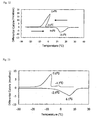
- the temperature-sensitive materials were analyzed with a differential scanning calorimeter (DSC) under the measuring conditions below.
- DSC differential scanning calorimeter
- Apparatus DSC-3200S Container aluminum bowl with 6.5 in diameter Standard sample alumina (40 mg) Temperature increasing rate 3°C per minute Sample (1) 65% oleyl alcohol 38.2 mg (2) 85% oleyl alcohol 54.6 mg (3) 95% oleyl alcohol 39.8 mg (4) 65% oleyl alcohol and ethyl cellulose (thickening agent) 37.2 mg (5) 97% pentadecane 37.8 mg (6) oleic acid 38.5 mg
- the intended purpose of the temperature-sensitive material is mainly for temperature management of perishable foods, and those having less harmful properties, such as dangerousness and toxicity, are selected and analyzed. It was found that pentadecane and oleic acid were suitable in view of temperature characteristics, but under consideration of affinity with heat-sensitive paper, alcohol reagents were preferred to use mainly in view of difficulty of selection of a heat-sensitive agent.
- the materials for the diffusion layer were investigated.
- Various kinds of paper as the materials for the diffusion layer were investigated for optical micrographs thereof to investigate actually the diffusion capabilities of the paper.
- a structure like nonwoven fabric, such as waxed paper and grease absorbing paper was suitable.
- the response characteristics of the temperature indicating tag at 10°C, 14°C, 18°C and 23°C were investigated with the temperature indicating device using 65% oleyl alcohol as a temperature-sensitive material and waxed paper as a diffusion layer.
- the time (second) when the reading was disabled was designated as a response time.
- Fig. 16 The results obtained are shown in Fig. 16.
- the abscissa indicates the temperature (°C), and the ordinate indicates the average response time (sec).
- the temperature indicating display device of the invention can reliably and irreversibly display as to whether or not the device suffers a predetermined temperature limitation with a simple structure. For example, it can be visually determined easily as to whether or not cryopreservation foods are stored and distributed at a predetermined temperature or lower, and it can be mechanically determined since the recorded information is destroyed.
- the temperature indicating display device of the invention can be widely applied to various kinds of industrial products that should not be exposed to a predetermined temperature or higher, and deterioration of the product due to a temperature history on preservation and distribution can be reliably avoided by visual inspection or mechanical reading. With respect to foods, the extent of putrefaction of the foods due to exposure to a high temperature can be recognized with the temperature indicating display device of the invention.
Landscapes
- Physics & Mathematics (AREA)
- General Physics & Mathematics (AREA)
- Engineering & Computer Science (AREA)
- Theoretical Computer Science (AREA)
- Mechanical Engineering (AREA)
- Measuring Temperature Or Quantity Of Heat (AREA)
- Details Of Rigid Or Semi-Rigid Containers (AREA)
- Bag Frames (AREA)
- Cartons (AREA)
Abstract
A temperature indicating display device capable of displaying a thermo-history
above a predetermined temperature reliably and irreversibly. Moreover, it is possible to
provide a laminated body having a temperature detecting layer and an information recording
film layer. When the temperature indicating display device is exposed to a predetermined
temperature, an irreversible shift is caused and the temperature history can be displayed.
Moreover, the temperature indicating display device includes an information recording film
layer containing information, an information record holding layer for holding the information,
and a temperature detection agent layer composed of a material whose state is shifted
according to a temperature and is characterized in that when a predetermined temperature is
detected, the material of the temperature detection agent layer is changed so as to change the
display state of information recorded in the information recording layer. A laminated body
using the temperature indicating display device, a vessel containing the device, and a labeled
temperature indicating display device are also disclosed. Furthermore, the present invention
provides a side-type temperature indicating display device in which a conventional
information display member can be used as it is.
Description
The present invention relates to a temperature indicating display device capable of
displaying a temperature history by causing an irreversible shift upon exposing to a
predetermined temperature. More specifically, the invention relates to such a temperature
indicating display device that contains an information recording film layer having information
recorded therein, an information record holding layer for holding the information, and a
temperature detecting agent layer containing a substance changing its state depending on
temperature, characterized in that the substance in the temperature detecting agent layer is
shifted in state upon exposing a predetermined temperature, so as to change the display state of
the information recorded in the information recording film layer, and also relates to a
laminated body thereof, a container having the device installed therein, and a temperature
indicating display label obtained by forming the device into a label form.
According to the progress of the freezing technique and the refrigeration technique,
various kinds of foods can be maintained in safety for a long period of time. Furthermore,
according to the progress of the low temperature transportation technique, such as the cold
chain system, various kinds of cryopreservation foods are available as commercial products.
In recent years, on the other hand, the safety of foods comes to a major issue. It is
said that ten thousand or more people suffer food intoxication per one year, and the number of
the people is increasing from year to year although the preservation technique of foods has
been improved.
As the reason therefore, it is noted that persons with weak resistance to bacteria are
increased in number, but the reason also resides in the handling of foods.
It is noted in general that a healthy person is not affected if the number of bacteria is
105 or less per 1 g of a food, and various methods have been practiced for suppressing the
growth of bacteria upon preservation of foods. For example, in order to suppress the growth
of bacteria upon preservation of foods, such means are provided that a chemical, such as an
antiseptic, is added, or the salt content is increased. However, these means influence the taste
and the quality of foods, and thus it is apparent that preservation of food at a low temperature
is excellent. Furthermore, there is such a tendency that the use of additives is avoided as far
as possible owing to the health-consciousness in recent years, and thus the preservation at a
low temperature receives increasing attention.
However, upon preservation of foods at a low temperature, bacteria would grow
exponentially and thus the safety standard is often not satisfied if the temperature is not
sufficiently controlled during production, transportation and distribution of foods. For
example, it is said that E. coli grows exponentially in each 2 hours if the temperature rises
from 3°C to 10°C. Furthermore, upon rising of the temperature, water contained in the foods
is expanded to form voids within the foods, and nutrients of the foods are exuded along with
water through the voids to the surface of the foods due to a capillary effect, which results to
supply the nutrients for the bacterial growth. Moreover, when the foods are re-chilled,
bacteria on the surface of the foods are infiltrated into the foods with the extruded water to
expand the bacterial contamination into the interior of the foods. Though the growth rate of
bacteria is suppressed by re-chilling, the growth rate may greatly increase compared to the
ordinary case due to the counteraction when the temperature rises after chilling.
Thus, fluctuations in temperature are considerably large issues for foods preserved at
a low temperature from the standpoint of hygienic supervision.
Although there is no large difficulty to maintain a temperature of 3°C or lower within
food factories during production of foods, it is not so easy to maintain a temperature of 3°C or
lower on transportation after shipment from the factories and on distribution in retail stores,
such as supermarkets and convenience stores.
It is the current situation that a consumer cannot know the temperature history of
foods before consuming the foods by the consumer. There have been various ideas for
indicating the temperature history of foods to a consumer, and as one example thereof, a
temperature history display material has been developed. For example, JP-A-10-287863
discloses an invention relating to a temperature history display material that is irreversibly
colored through reaction of plural substances at a predetermined temperature, and the
temperature history display material has a coloring agent layer, a temperature detecting agent
layer and a developer layer. In the present invention, the coloring agent layer and the
developer layer are delimited with the temperature detecting agent layer, and the temperature
detecting agent layer melts at a predetermined temperature to color by contacting the coloring
agent layer and the developer layer. Since the coloring reaction occurs irreversibly, the
coloring of the temperature history display material shows whether or not the material suffers
the predetermined temperature.
The system uses an irreversible reaction and is effective, but requires the coloring
agent and the developer, the complicated structure of the temperature history display material
and high cost, which makes the system practically difficult to be used.
Other conventional temperature history display materials also have a
temperature-sensitive coloring material or coloring agent and thus the materials are not
practically used.
Therefore, an object of the invention is to provide a display material with a simple
structure that can reliably and irreversibly display a temperature history of a predetermined
temperature or higher. The present invention also provides a laminated body having a
temperature detecting agent layer and an information recording film layer.
As a result of earnest investigations made by the inventors in view of the
aforementioned problems associated with the conventional techniques, it has been found that
information such as characters and barcodes recorded on an information recording film layer
can be irreversibly destroyed or made into an unreadable or readable state by setting a physical
state of a substance in a temperature detecting agent layer being shifted at a predetermined
temperature, and which led to the present invention of a simple device capable of irreversibly
displaying the temperature history.
It has been found, for example, that disposing the temperature detecting agent layer
containing a substance of which physical state is shifted at a predetermined temperature
adjacent to the information recording film layer enables to melt or diffuse the substance
constituting the information recording film layer in accordance with the shift of physical state
of the substance in the temperature detecting agent layer, whereby the information recorded in
the information recording film layer can be irreversibly destroyed, or the information
recording layer can be irreversibly made opaque or transparent in accordance with the shift of
physical state of the substance in the temperature detecting agent layer.
Accordingly, the present invention relates to a temperature indicating display device
containing an information recording film layer having information recorded therein, and a
temperature detecting agent layer containing a substance of which the state shift dependently
on temperature, wherein the state of substance in the temperature detecting agent layer is
shifted upon undergoing a predetermined temperature, so as to change a display of the
information recorded in the information recording film layer, and also relates to a container
having the device installed therein.
The invention also relates to a laminated body for temperature indicating display
containing a temperature detecting agent layer, an information recording film layer and an
information record holding layer, or to a laminated body for temperature indicating display
containing a temperature detecting agent layer, a diffusion layer, an information recording film
layer and an information record holding layer.
Furthermore, the invention also relates to a temperature indicating display label
containing a substrate, a separator containing a temperature detecting agent layer containing a
substance of which the state shifts dependently on temperature, and an information record
holding layer containing an information recording layer recorded therein.
More specifically, the invention relates to the following items.
In recent years, a label having printed information such as a barcode is attached to
various kinds of consumer products, such as foods, and is used for management of distribution
and products. The inventors have noted the label, and have developed a label capable of
displaying a temperature history.
That is, it has been found that a practical temperature indicating display device can
be provided at low cost in a simple measure by the combination of an information recording
film having the information recorded by printing, and the temperature detecting agent. A
major characteristic feature of the invention resides in the combination of the information
recording film and the temperature detecting agent, whereby a practical temperature indicating
display device capable of reliably and irreversibly displaying temperature indication to a
predetermined temperature is provided at low cost without using a coloring agent or a
temperature-sensitive coloring material having been conventionally used.
The term "temperature indication" referred in the invention means the presence or
absence of a temperature history to a predetermined temperature.
The symbols in Figs. 1 to 9 mean the following.
A major characteristic feature of the present invention resides in the combination of
the information recording film and the temperature detecting agent, and specific embodiments
of the invention based on the combination can be roughly classified into the following four
types. However, the invention is not limited to the embodiments, and any embodiment that
includes the combination of the information recording film and the temperature detecting
agent is encompassed by the present invention.
A side type can be exemplified as an application of the dissolution type or the
infiltration type. See Figs. 5 and 8.
The four embodiments of the invention are shown in Figs. 1 to 4, respectively. Fig.
1 schematically shows the dissolution type embodiment of the present invention, which
contains a separator 3 placed on a substrate 1 wherein a temperature detecting agent layer is
set on the central part of the separator 3, and an information record holding layer 4 having an
information recording film layer having information recorded on the lower surface thereof
wherein the temperature detecting agent layer and the information recording film layer are
disposed to be closely adjacent to each other. This assembly is protected by covering with a
laminate seal 5. The substrate 1 has an adhesive layer on the back surface thereof, whereby
the device can be fixed to a container or the like.
Upon exposing the device to a predetermined temperature, the temperature detecting
agent in the temperature detecting agent layer melts, whereby a printing ink or the like in the
information recording film layer, which is disposed to be closely adjacent to the temperature
detecting agent layer melts to destroy the recorded contents. The recorded contents once
destroyed cannot be restored, and thus the accrual of the destruction of the recorded contents
indicate the temperature history that the device undergoes the predetermined temperature or
higher.
Fig. 2 schematically shows the infiltration type embodiment of the invention, which
contains a separator 3 placed on a substrate 1 wherein a temperature detecting agent layer is
set on the central part of the separator 3, a diffusion layer 2 placed on the separator 3 and an
information record holding layer 4 placed on the diffusion layer 2. In this type, the
information record holding layer has an information recording film layer having information
recorded on the lower surface thereof, and the diffusion layer is disposed to be closely adjacent
to both the temperature detecting agent layer and the information recording film layer. This
assembly is protected by covering with a laminate seal 5. The substrate 1 has an adhesive
layer on the back surface thereof, whereby the device can be fixed to a container or the like.
Upon exposing the device to a predetermined temperature, the temperature detecting
agent in the temperature detecting agent layer melts or softened to be infiltrated into the
diffusion layer, which is disposed to be closely adjacent to the temperature detecting agent
layer, and in a state where the temperature detecting agent is sufficiently infiltrated, the
temperature detecting agent reaches the information recording film layer through the diffusion
layer and melts a printing ink or the like in the information recording film layer to destroy the
recorded contents. The recorded contents once destroyed cannot be restored, and thus the
accrual of the destruction of the recorded contents indicate the temperature history that the
device undergoes the predetermined temperature or higher.
Fig. 3 schematically shows the solid dispersion type embodiment of the invention,
which contains an information record holding layer 4 having an information recording film
layer having information recorded on the upper surface thereof, and a separator 3 placed on the
layer 4 wherein a temperature detecting agent layer is set on the central part of the separator 3,
and the assembly is protected by covering with a laminate seal 5. The information record
holding layer 4 has an adhesive layer on the back surface thereof, whereby the device can be
fixed to a container or the like.
Upon exposing the device to a predetermined temperature or higher, the temperature
detecting agent layer having been in a heterogeneous phase in the temperature detecting agent
layer is increased in flowability to be in a homogeneous phase. At the time when the
temperature detecting agent layer is in a heterogeneous phase, the temperature detecting agent
layer can maintain transparency since the solid is localized, but the solid melts or softens upon
exposing to the predetermined temperature or higher to form a homogeneous phase, so as to
become totally opaque. The information recorded on the information record holding layer 4
by printing or the like is unreadable when the temperature detecting agent layer becomes
opaque. The temperature detecting agent layer once being in a heterogeneous phase cannot
be restored to a transparent homogeneous phase, and thus the impossibility of reading the
recorded contents indicate the temperature history that the device undergoes the predetermined
temperature or higher.
Fig. 4 schematically shows the dressing type embodiment of the invention, which
contains an information record holding layer 4 having an information recording film layer
having information recorded on the upper surface thereof, and a separator 3 having a
temperature detecting agent layer on the central part thereof placed on the layer 4, and this
assembly is protected by covering with a laminate seal 5. The information record holding
layer 4 has an adhesive layer on the back surface thereof, whereby the device can be fixed to a
container or the like.
Upon exposing the device to a predetermined temperature or higher, the minute
bubbles or particles uniformly dispersed in and fixed to the temperature detecting agent layer
are aggregated through increase in fluidity of the surrounding substance to form a separated
heterogeneous system, preferably a two phase system, and as a result, the temperature
detecting agent layer having been opaque with the minute particles or bubbles becomes
transparent, whereby the information recorded on the information record holding layer 4 by
printing or the like becomes readable through the laminate seal 5. The temperature detecting
agent layer once being aggregated to form the phase cannot be restored to an opaque state, and
thus the possibility of reading the recorded contents recorded on the information record
holding layer 4 indicate the temperature history that the device undergoes the predetermined
temperature or higher.
As an application of the dissolution type and the infiltration type, examples of a side
type temperature indicating display device are shown in Figs. 5 and 8.
Fig. 5 shows an example of the side type, in which the part for recording information,
such as a barcode, on the surface of the information display member is large, and the part
capable of being made in contact with the diffusion layer is small. Fig. 8 shows an example,
in which the area having information recorded therein is small, and substantially the entire of a
forming part which forms the temperature detecting agent placing part can be placed on the
information display member.
The first example of the side type temperature indicating display device of the
present invention is shown in Fig. 5. The temperature indicating display device 10 has a
temperature detecting agent placing part 12, a forming part 11 for forming the same, a
diffusion layer 13 which touches the temperature detecting agent, an information display
member 14 which touches the other end of the diffusion layer 13, and a protective sheet 15 for
protecting the above components. The information display member 14 may be those having
been used, such as a barcode label, and those attached to a product, a container of a product, or
a transporting container for transporting a product. One end of the diffusion layer 13 is made
to touch a part of the surface of the information display member 14 where information, such as
a barcode, is not printed, and the forming part 11 for the temperature detecting agent placing
part 12 is provided on the other end of the diffusion layer 13. The above components are
covered with the transparent protective sheet 15 having an adhesive layer inside for fixing
them. Fig. 6 shows a cross sectional view on the plane A-A' of the temperature indicating
display device 10 shown in Fig. 5.
Upon exposing the temperature indicating display device shown in Fig. 5 to a
predetermined temperature or higher, the temperature detecting agent in the temperature
detecting agent placing part 12 melts to be eluted or infiltrated into the diffusion layer 13,
which is disposed to be closely adjacent to the temperature detecting agent placing part 12, and
when the temperature detecting agent is sufficiently eluted or infiltrated, the temperature
detecting agent reaches the information recording film layer 141 through the diffusion layer 13
and melts a printing ink or the like in the information recording film layer to destroy the
recorded contents. The recorded contents once destroyed cannot be restored, and thus the
destruction of the recorded contents indicate the temperature history that the device undergoes
the predetermined temperature or higher.
Fig. 7 shows a cross sectional view of the forming part 11 having the temperature
detecting agent placing part 12 formed in the side type temperature indicating display device
10 of the present invention upon storing. This type could be a blister pack in which a hollow
part for housing the temperature detecting agent is provided on the central part. An adhesive
layer 110 is provided on an outer periphery of the bottom part, which is sealed with a barrier
part 17. A liquid or solid temperature detecting agent is placed in the hollow part and sealed
with the barrier part 17, whereby the temperature detecting agent can be stored at room
temperature. Upon using the temperature detecting agent, the temperature detecting agent are
solidified by chilling at a low temperature, then the barrier part 17 is removed to make closely
into contact with the diffusion layer 13.
As another example of the side type temperature indicating display device of the
present invention, a temperature indicating display device 20 shown in Fig. 8 can be
exemplified. The device has the same principal as the temperature indicating display device
shown in Fig. 5 but is different therefrom in such a point that substantially the entire part of
the diffusion layer 23 and the temperature detecting agent placing part 22 can be provided on
the information display member 24.
The side type temperature indicating display device of the present invention has such
a characteristic feature that an information display member that has been conventionally used,
such as a barcode label, can be used as it is, and also has such a significant feature that the
temperature detecting agent placing part and the diffusion layer can be independently
produced, distributed and stored. Therefore, the temperature indicating display device of the
present invention forms an independent temperature indicating device containing a
temperature detecting agent placing part having a temperature detecting agent placed therein,
and a diffusion layer. Furthermore, the temperature detecting agent placing part having a
temperature detecting agent placed therein, and the diffusion layer can be independently
produced, distributed and stored, and thus production, distribution, storage and transfer of
them as a part of the temperature indicating device are also encompassed in the scope of the
invention.
The temperature detecting agent in the temperature detecting agent layer in the
"dissolution type" or "infiltration type" embodiment or the side type embodiment of the
invention is preferably one or more kinds of substances that becomes a liquid or a sol by
melting or softening at a predetermined temperature or higher and can melt or diffuse a
substance recording information, such as printing ink. Specific examples of the preferred
temperature detecting agent include a thermal melting agent, such as paraffin, a higher fatty
acid, a higher fatty acid ester and a higher alcohol. The temperature detecting agent may
have a melting point around the target predetermined temperature and can melt or diffuse a
substance recording information, such as printing ink. In the case of a product that should
not be exposed to a relatively high temperature, such as an industrial product, a substance
having a high melting point may be employed, and in the case of a product that should not be
exposed to room temperature or higher, such as a medicinal product, a substance having a
melting point around room temperature may be employed. In the case of a product that
should not be exposed to a relatively low temperature, such as foods, a substance having a
relatively low melting point may be employed. The melting point of the substance can be
selected from a range of about from -50 to 100°C for an industrial product, can be selected
from a range of about from 10 to 80°C for a medicinal product and a product stored at ordinary
temperature, and can be selected from a range of about from -30 to 50°C for foods.
The temperature detecting agent may contain only one kind of substance or may be a
mixture of two or more kinds of substances. An additive, such as a lubricating agent, a
thickening agent and a coloring agent, may be added thereto depending on necessity.
In the case where no suitable substance having a melting point around the
predetermined temperature can be found, the melting point can be set at the predetermined
temperature by mixing two or more substances for utilizing the melting point depression
function.
Specific examples of the temperature detecting agent include, but not limited to, a
paraffin compound having from 10 to 30 carbon atoms, preferably from 12 to 20 carbon atoms,
more preferably from 12 to 18 carbon atoms; a substituted or unsubstituted higher fatty acid
having from 10 to 30 carbon atoms, preferably 12 to 20 carbon atoms, more preferably from
12 to 18 carbon atoms, such as lauric acid, stearic acid and 2-oxymyristic acid; an ester of the
higher fatty acid, such as ethyl myristate, stearyl laurate and dioctyl phthalate; a substituted or
unsubstituted higher alcohol having from 6 to 30 carbon atoms, preferably from 6 to 20 carbon
atoms, and more preferably from 10 to 18 carbon atoms, such as n-cetyl alcohol, oleyl alcohol,
n-octyl alcohol and tetradecanol; a ketone, such as methyl hexyl ketone and benzophenone; a
higher ether, such as diphenyl ether and distearyl ether; a higher fatty acid amide, such as oleic
acid amide, stearic acid amide, lauric acid N-octylamide and caproic acid anilide; an aromatic
hydrocarbon compound, such as isopropylbenzene, dodecylbenzene, biphenyl,
trimethylbiphenyl, diphenylethane, dibenzyltoluene and propylnaphthalene; and various
organic solvents, such as dimethylsulfoxide (DMSO).
The temperature detecting agent component is preferably a paraffin compound, a
higher fatty acid, a higher fatty acid ester, a higher alcohol and the like under consideration of
cost.
The "solid dispersion type" or "dressing type" embodiment of the invention utilizes a
shift of the state of substances based on fluidity of plural, preferably two kinds of substances.
In the "solid dispersion type", the temperature detecting agent layer becomes opaque due to
the shift of the state upon exposing to a predetermined temperature or higher, and in the
"dressing type", the temperature detecting agent layer becomes transparent due to the shift of
the state upon exposing to a predetermined temperature or higher. For example, a salad
dressing contains an aqueous phase and an oily phase and becomes opaque by mixing well
since the phases are mixed as minute liquid droplets, but is separated into two phases through
phase separation by aggregating the aqueous phase and the oily phase, respectively, after
allowing to stand for a certain period of time. That is, the system becomes transparent
because each of the phases is transparent. The "dressing type" embodiment of the invention
has a characteristic feature that the opaque state is fixed under a low temperature. The
temperature detecting agent layer is in a state maintaining opacity by fixing at a low
temperature, and upon exposing to a predetermined temperature or higher, they are increased
in fluidity to release the fixed state, whereby for example, the aqueous phase and the oily
phase are separated to each other to produce transparency. As a result of development of
transparency of the temperature detecting agent layer, the information recorded under the layer
becomes readable by optical means or the like.
The substance in the "dressing type" embodiment of the invention may be such a
combination of substances that are not mutually dissolved and thus form an opaque state
where the substances are mixed as minute bubbles or particles at a low temperature, which
becomes transparent at a predetermined temperature or higher through phase separation or
mutual dissolution of the substances. Examples thereof include a combination of water and
an oil mixed as minute particles by ultrasonic agitation, which is fixed at a low temperature,
and a combination of a liquid, such as water or glycerin, with a gas, such as air, minutely
bubbled therein, which is fixed. Upon exposing the combination to a predetermined
temperature of more, one or both of the substances are increased in fluidity to aggregate the
minute bubbles or particles, so as to form a transparent phase. Examples of the combination
of substances include but not limited to water and an oil, and water and glycol, such as
glycerin. The proportion of the components is not limited and is preferably about from 1/1 to
1/100. An additive, such as a lubricating agent, a thickening agent and a coloring agent, may
be added thereto if necessary.
As the solid substance in the "solid dispersion type" embodiment of the present
invention may be one or more kinds of substance that is melted at a predetermined temperature.
The substance is dispersed as minute powder in a substance as a transparent carrier at a
temperature equal to or lower than the melting point thereof to form the temperature detecting
agent layer. Upon exposing the temperature detecting agent layer to a predetermined
temperature or higher, the solid substance is melted and aggregated through liquefaction to
form an opaque phase, whereby the temperature detecting agent layer becomes opaque. The
solid substance may be such a substance that is melted at a predetermined temperature to form
an opaque phase after melting, to which a coloring agent, a scattering substance or the like
may be added to ensure the opacity after melting. Preferred examples of the solid substance
include a fatty acid, such as oleic acid, an ester thereof, and paraffin. In the case where a
desired melting point could not be provided by using one substance at the predetermined
temperature, two or more kinds of substances may be mixed. The substance as a transparent
carrier may be a transparent material having fluidity, and examples thereof include water and
an alcohol, such as methanol, ethanol and glycerin. The proportion of the solid substance is
not limited, and is preferably about from 1/0.1 to 1/100 with respect to the liquid component.
An additive, such as a lubricating agent, a thickening agent and a coloring agent, may be
added thereto if necessary.
More preferred embodiments of the invention include the "dissolution type" and
"infiltration type" embodiments. These embodiments directly act on a recording substance,
such as a printing ink, having information recorded thereby, and thus a temperature indicating
display device having a simpler structure can be provided. In the "solid dispersion type" and
"dressing type" embodiments of the present invention, the transparency can be changed
independently from the characteristics of the recording substance having information recorded
thereby, and thus is preferred for the case where a peculiar recording substance is used.
However, the structure thereof becomes complicated due to the multiphase system thereof in
comparison to the "dissolution type" and "infiltration type" embodiment and the side type
embodiment.
The information recorded in the information recording layer is not limited and is
preferably information that can be optically read. Examples thereof include a barcode for a
product, and a sign with warning for temperature indication.
The temperature detecting agent layer of the present invention can be prepared in a
form of ply of sheet or sheet having a necessary size surrounded by frame in order to improve
its workability. In the specification, the temperature detecting agent layer having such a
frame is referred to as a "separator". The frame may have a hollow center or a concave at the
center thereof. In the case of the frame having concave, the temperature detecting agent is set
into the concave. The frame is preferably transparent, but it is not necessarily transparent
depending on embodiments.
In the "dissolution type" embodiment of the present invention, the temperature
detecting agent layer is provided adjacent to the information recording film layer, and thus the
temperature detecting agent layer, the information recording film layer and the information
record holding layer are consecutively disposed. In the "infiltration type" embodiment of the
present invention, the diffusion layer is provided between the information recording film layer
and the temperature detecting agent layer, and thus the temperature detecting agent layer, the
diffusion layer, the information recording film layer and the information record holding layer
are consecutively arranged. The diffusion layer may be such a layer that the temperature
detecting agent exposed to a predetermined temperature or higher can be infiltrated or passed
therein, so as to act on the information recording film layer, and a porous substance, such as
paper, and a resin having minute pores formed therein may be used. The layers are arranged
in the aforementioned manners, whereby a temperature history can be displayed.
In the "solid dispersion type" and "dressing type" embodiment of the invention, the
temperature detecting agent layer is disposed on the information recording film layer, and the
temperature detecting agent layer, the information recording film layer and the information
record holding layer are consecutively arranged. The layers are arranged in the
aforementioned manners, whereby a temperature history can be displayed.
Accordingly, the invention provides a laminated body having the aforementioned
structures.
The temperature indicating display device of the present invention can be formed
into a label. The temperature indicating display device of the invention is attached to a
substrate for forming a label through adhesion or lamination to form a label. While the
temperature indicating display device of the present invention may be fixed as it is to various
containers, it is preferably fixed after forming into a label.
The fixing means to a container is not particularly limited, and various means may be
used, such as adhesion, lamination, insertion into a slot provided on a container, and
attachment with a sucking disk. The temperature indicating display device of the invention
may be fixed with a sticker covering the entire thereof.
Furthermore, a printed recording film, such as a barcode printed on a container, may
be used as the information recording film layer in the present invention. That is, the
temperature detecting agent layer of the present invention can be fixed on a printed part of a
preexisting container after removing a protective member on the printed part if necessary,
whereby the temperature indicating display device of the present invention can be produced.
In the embodiment, such as the aforementioned example of the side type embodiment, the
temperature detecting agent layer of the temperature indicating display device of the present
invention can be produced and used as an independent product. Therefore, the present
invention also relates to such a temperature detecting agent composition containing a
substance of which the state shifts dependently on temperature that is capable of forming the
temperature detecting agent layer of the temperature indicating display device of the invention.
The temperature detecting agent composition of the invention may contain only the
aforementioned substance changing its state depending on temperature, and an additive, such
as solvent, a thickening agent, a lubricating agent and a coloring agent, may be added thereto.
It is also encompassed in the scope of the present invention that the temperature
detecting agent composition is placed in a forming part having a temperature detecting agent
placing part (for example, a case for a temperature detecting agent), and is sealed with a
barrier part, such as a metallic thin film, to produce a product. A diffusion layer member may
be attached to the temperature detecting agent member to provide a temperature indicating
member according to the present invention.
Examples of the container in the invention include a container for a product that
requires indication of a temperature history thereof, such as a packing container and a
transporting container or the like.
Specific examples thereof include a container for beverage, such as milk, tea and
coffee, a container for various foods, such as lunchbox, sweets and sandwich, and a container
for a medicinal product and a cosmetic, and further include an industrial product that should
not be exposed to a high temperature, such as a semiconductor material and an aerosol product,
and a container therefor, and a product that should be transported at a low temperature and a
container therefor. The temperature indicating display device of the invention may be
attached not only to the containers but also to a packing for the container and a transporting
container for the product.
The temperature indicating display device of the invention may be attached upon
shipping from a factory, upon transporting, or upon selling at a store. For example, in the
case of a product to be transported at a low temperature, the temperature indicating display
device of the present invention may be attached thereto upon starting of the transportation, and
may be attached to a container upon selling, for example, in the case of sweets.
Therefore, the temperature indicating display device of the invention is attached to
cryopreservation foods and industrial products or containers therefor, whereby a consumer can
view the temperature history of the products through the state of the temperature indicating
display device upon purchasing or consuming the cryopreservation products. In addition to
the visual observation of the temperature history of the product, the appropriateness of the
temperature history can be mechanically determined by a distributor or a manufacturer upon
reading a barcode, since the barcode cannot be read with a barcode reader due to destruction of
the barcode.
Furthermore, a conventional information display member, such as a barcode label,
can be applied to the side type temperature indicating display device of the present invention,
so as to produce the temperature indicating display device of the present invention with simple
materials. The temperature indicating device of the present invention containing a
temperature detecting agent housing member and a diffusion layer can be produced,
distributed and stored independently from the information display member, such as a barcode
label. The temperature indicating device of the present invention can be present
independently from the information display member, and thus the conventional information
display member, such as a barcode label, can be used as it is. The temperature indicating
device of the invention can be produced, distributed and stored at ordinary temperature owing
to the barrier part provided, and thus it can be conveniently handled without any special
apparatus.
The contents disclosed in the specification of Japanese Patent Application No.
2002-309457 are incorporated herein by reference.
The invention will be more specifically described with reference to the following
examples, but the invention is not construed as being limited to the examples.
Oleic acid was used as a temperature detecting agent. Oleic acid was heated to 30
to 40°C, and it was then quenched with liquid nitrogen and cut into a thin film form to obtain a
temperature indicating agent. Oleic acid in a liquid state can be quenched into a thin film
form to obtain a temperature indicating agent in a thin film form. The temperature indicating
agent had a critical temperature (predetermined temperature) of about 10°C.
The resulting temperature detecting agent having a thickness of about 0.5 mm was
placed in a frame having a concave to obtain a separator. A layer having information
recorded therein containing a transparent plastic film (information record holding layer)
having a barcode (information recording film layer) printed thereon was disposed on the
separator in such a manner that the information recording film layer was closely in contact
with the temperature detecting agent layer.
The entire of the temperature indicating display device thus obtained was sealed with
a laminating material (polypropylene).
When the display device was allowed to stand at room temperature (about 20°C) for
20 minutes, the information of the barcode could not be visually recognized.
A temperature detecting agent layer was produced in the same manner as in Example
1.
The resulting temperature detecting agent having a thickness of about 0.5 mm was
placed in a frame having a concave to obtain a separator, on which paper having a thickness of
about 0.5 mm was placed to form a diffusion layer, and a layer having information recorded
therein containing a transparent plastic film (information record holding layer) having a
barcode (information recording film layer) printed thereon was disposed on the diffusion layer
in such a manner that the information recording film layer was closely in contact with the
diffusion layer.
The entire of the temperature indicating display device thus obtained was sealed with
a laminating material (polypropylene).
When the display device was allowed to stand at room temperature (about 20°C) for
20 minutes, the information of the barcode could not be visually recognized.
10 g of oleic acid was heated to 30 to 40°C, with which 10 mL of water was mixed,
followed by sufficiently agitating, and the mixture was further agitated with ultrasonic wave.
The mixed solution was quenched with liquid nitrogen to produce minute solids of oleic acid
in water. The mixture was gradually heated to obtain a solid dispersion liquid having only
water melted, to which a small amount of alkaline substance was added to obtain a
temperature detecting agent. The temperature detecting agent was sealed with a transparent
film to obtain a temperature detecting agent layer having a thickness of about 0.5 mm. The
temperature detecting agent had a critical temperature (predetermined temperature) of about
10°C. The resulting temperature detecting agent layer having a thickness of about 0.5 mm
was placed in a frame to obtain a separator. A layer having information recorded therein
containing a transparent plastic film (information record holding layer) having a barcode
(information recording film layer) printed thereon was placed under the separator to obtain a
temperature indicating display device.
In the display device, the barcode could be viewed at a temperature of 10°C or lower,
but when it was allowed to stand at room temperature (about 20°C) for 20 minutes, the
information of the barcode could not be visually recognized.
10 mL of glycerin was agitated in the presence of air with an ultrasonic agitator.
The solution having minute bubbles generated was quenched with liquid nitrogen to fix the
minute bubbles. The resulting temperature detecting agent was sealed with a transparent film
to obtain a temperature detecting agent layer having a thickness of about 0.5 mm. The
temperature detecting agent had a critical temperature (predetermined temperature) of about
18°C.
The resulting temperature detecting agent having a thickness of about 0.5 mm was
placed in a frame to obtain a separator, and a layer having information recorded therein
containing a transparent plastic film (information record holding layer) having a barcode
(information recording film layer) printed thereon was placed under the separator to obtain a
temperature indicating display device.
In the display device, the barcode could not be viewed at a temperature of 15°C or
lower, but when the device is placed at room temperature (about 20°C) for 30 minutes, the
information of the barcode could be visually recognized.
It was confirmed from the aforementioned experimental results that in the case where
the temperature indicating display device of the invention was allowed to stand at a critical
temperature (predetermined temperature), the information recorded in the information
recording film layer was destroyed, or the information recorded in the information recording
film layer could not be visually read or could be visually read.
The side type temperature indicating display device shown in Fig. 5 was produced.
Oleyl alcohol (Wako Pure Chemical Industries, Ltd., purity: 65%) was used as the temperature
detecting agent. A blister pack produced by Kanae Co., Ltd. was used as a case for the
temperature detecting agent, and aluminum was used as a seal part. A package having an
interior content of 0.3 mL was used. Waxed paper, Kichinto-san, was used as the diffusion
paper.
Conventional heat-sensitive paper was used as the information display member. An
OHP sheet was used as the transparent protective sheet.
The side type temperature indicating display device shown in Fig. 8 was produced in
the same manner as in Example 5 except that the using amount of oleyl alcohol was decreased.
The temperature-sensitive materials were analyzed with a differential scanning
calorimeter (DSC) under the measuring conditions below.
| Apparatus | DSC-3200S | |
| Container | aluminum bowl with 6.5 in diameter | |
| Standard sample | alumina (40 mg) | |
| |
3°C per minute | |
| Sample | ||
| (1) | 65% oleyl alcohol | 38.2 mg |
| (2) | 85% oleyl alcohol | 54.6 mg |
| (3) | 95% oleyl alcohol | 39.8 mg |
| (4) | 65% oleyl alcohol and | |
| ethyl cellulose (thickening agent) | 37.2 mg | |
| (5) | 97% pentadecane | 37.8 mg |
| (6) | oleic acid | 38.5 mg |
The results are shown in Fig. 10 (sample (1)), Fig. 11 (sample (2)), Fig. 12 (sample
(3)), Fig. 13 (sample (4)), Fig. 14 (sample (5)) and Fig. 15 (sample (6)), respectively. In the
figures, the abscissa indicates the temperature (°C), and the ordinate indicates the differential
calorie (mcal/sec). The negative value means endotherm.
The intended purpose of the temperature-sensitive material is mainly for temperature
management of perishable foods, and those having less harmful properties, such as
dangerousness and toxicity, are selected and analyzed. It was found that pentadecane and
oleic acid were suitable in view of temperature characteristics, but under consideration of
affinity with heat-sensitive paper, alcohol reagents were preferred to use mainly in view of
difficulty of selection of a heat-sensitive agent.
The materials for the diffusion layer were investigated. Various kinds of paper as
the materials for the diffusion layer were investigated for optical micrographs thereof to
investigate actually the diffusion capabilities of the paper. As a result, it was found that a
structure like nonwoven fabric, such as waxed paper and grease absorbing paper, was suitable.
With respect to infiltration of the temperature-sensitive material in the temperature
indicating display device shown in Fig. 5, the response characteristics of the temperature
indicating tag at 10°C, 14°C, 18°C and 23°C were investigated with the temperature indicating
device using 65% oleyl alcohol as a temperature-sensitive material and waxed paper as a
diffusion layer. Upon reading the barcode with a barcode reader at those temperatures, the
time (second) when the reading was disabled was designated as a response time.
The results obtained are shown in Fig. 16. In Fig. 16, the abscissa indicates the
temperature (°C), and the ordinate indicates the average response time (sec).
The temperature indicating display device of the invention can reliably and
irreversibly display as to whether or not the device suffers a predetermined temperature
limitation with a simple structure. For example, it can be visually determined easily as to
whether or not cryopreservation foods are stored and distributed at a predetermined
temperature or lower, and it can be mechanically determined since the recorded information is
destroyed.
The temperature indicating display device of the invention can be widely applied to
various kinds of industrial products that should not be exposed to a predetermined temperature
or higher, and deterioration of the product due to a temperature history on preservation and
distribution can be reliably avoided by visual inspection or mechanical reading. With respect
to foods, the extent of putrefaction of the foods due to exposure to a high temperature can be
recognized with the temperature indicating display device of the invention.
Claims (34)
- A temperature indicating display device comprising an information recording film layer having information recorded therein and a temperature detecting agent layer containing a substance of which a state shifts dependently on temperature, wherein the state of substance in the temperature detecting agent layer shifts upon undergoing a predetermined temperature, so as to change a display of the information recorded in the information recording film layer.
- The temperature indicating display device as claimed in claim 1, wherein the substance of which the state shifts dependently on temperature contained in the temperature detecting agent layer is a substance that melts at a predetermined temperature or higher.
- The temperature indicating display device as claimed in claim 2, wherein a substance forming a recording film of the information recording film layer is a substance that melts or disperses into the melted state of which the state shifts dependently on temperature contained in the temperature detecting agent layer.
- The temperature indicating display device as claimed in claims 1 to 3, wherein the substance of which the state shifts dependently on temperature in the temperature detecting agent layer comprises at least one heat melting agent selected from the group consisting of a paraffin, a higher fatty acid, a higher fatty acid ester and a higher alcohol.
- The temperature indicating display device as claimed in claim 1, wherein the substance of which the state shifts dependently on temperature contained in the temperature detecting agent layer comprises two or more substances forming a heterogeneous phase, which becomes a homogeneous phase to change a light transmittance at a predetermined temperature or higher.
- The temperature indicating display device as claimed in claims 1 to 5, wherein the temperature detecting agent layer is adjacent to the information recording film layer.
- The temperature indicating display device as claimed in claims 1 to 4, wherein the temperature indicating display device further comprises a diffusion layer.
- The temperature indicating display device as claimed in claim 7, wherein the diffusion layer comprises a porous substance.
- The temperature indicating display device as claimed in claim 7 or 8, wherein the diffusion layer comprises a paper.
- The temperature indicating display device as claimed in claim 7 to 9, wherein the diffusion layer is disposed between the information recording film layer and the temperature detecting agent layer.
- The temperature indicating display device as claimed in claims 1 to 10, wherein the substance of which the state shifts dependently on temperature contained in the temperature detecting agent layer is placed in a separator having a concave shape on a central part thereof.
- The temperature indicating display device as claimed in claims 1 to 11, wherein the temperature indicating display device is in a form of a sticker.
- The temperature indicating display device as claimed in claims 1 to 12, wherein the temperature indicating display device further comprises an adhesive layer and is capable of being attached.
- A temperature indicating device comprising a temperature detecting agent placing part having a substance of which the state shifts dependently on temperature therein, and a diffusion layer is disposed to touch the placing part.
- The temperature indicating device as claimed in claim 14, wherein the substance of which the state shifts dependently on temperature set in the temperature detecting agent placing part is a substance that melts at a predetermined temperature or higher, and a substance forming a recording film of an information recording film layer comprises a substance that melts or disperses into a melted state of which the state shifts dependently on temperature placed in the temperature detecting agent placing part.
- The temperature indication devise as claimed in claim 14 or 15, wherein the temperature detecting agent placing part has a barrier layer.
- A temperature indicating display device comprising a structure wherein at least a part of the diffusion layer of the temperature indicating display as claimed in claim 14 or 15 touches a part of an information recording film layer of an information display member having an information recording film layer and the temperature detecting agent is capable of flowing or permeating into the information recording film layer through the diffusion layer upon melting the agent.
- The temperature indicating display device as claimed in claim 17, wherein the temperature indicating device as claimed in claims 14 or 15 and the information display member having the information recording film layer are totally covered with a transparent protective sheet.
- A temperature detecting agent being capable of forming the temperature detecting agent layer comprising a substance of which the state shifts dependently on temperature in the temperature indicating display device as claimed in claims 1 to 18.
- The temperature detecting agent as claimed in claim 19, wherein the temperature detecting agent is at least one kind of a heat melting agent selected from the group consisting of paraffin, a higher fatty acid, a higher fatty acid ester and a higher alcohol.
- A container comprising the temperature indicating display device as claimed in one of claims 1 to 13 and claims 17 to 18.
- The container as claimed in claim 21, wherein the container is a food container.
- The container as claimed in claim 21, wherein the container is a packing container.
- The container as claimed in claim 21, wherein the container is a transporting container.
- A temperature indicating display label comprising a substrate, a separator containing a temperature detecting agent layer containing a substance of which the state shifts dependently on temperature, and an information record holding layer containing an information recording layer having information recorded therein.
- The label as claimed in claim 25, wherein the information record holding layer comprises a transparent material.
- The label as claimed in claim 25 or 26, wherein the separator comprises a transparent material.
- The label as claimed in claims 25 to 27, wherein the temperature detecting agent layer contained in the separator and the information recording film layer recorded in the information recording holding layer are adjacent to each other.
- The label as claimed in one of claims 25 to 28, wherein the label further comprises a porous plate capable of forming a diffusion layer.
- The label as claimed in one of claims 25 to 29, wherein the label further comprises an adhesive layer on a back surface of the substrate, whereby the label is capable of being adhered.
- The label as claimed in one of claims 25 to 30, wherein the label further comprises a protective plate.
- The label as claimed in one of claims 25 to 31, wherein information of the information recording film layer is printing.
- A laminated body comprising layers comprising a temperature detecting agent layer containing a substance of which the state shifts dependently on temperature, an information recording film layer, and an information record holding layer.
- The laminated body as claimed in claim 33, wherein the laminated body further comprises a diffusion layer between the information recording film layer and the temperature detecting agent layer.
Applications Claiming Priority (3)
| Application Number | Priority Date | Filing Date | Title |
|---|---|---|---|
| JP2002309457 | 2002-10-24 | ||
| JP2002309457 | 2002-10-24 | ||
| PCT/JP2003/002048 WO2004038353A1 (en) | 2002-10-24 | 2003-02-25 | Temperature indicating display device |
Publications (2)
| Publication Number | Publication Date |
|---|---|
| EP1560009A1 true EP1560009A1 (en) | 2005-08-03 |
| EP1560009A4 EP1560009A4 (en) | 2007-08-15 |
Family
ID=32171008
Family Applications (1)
| Application Number | Title | Priority Date | Filing Date |
|---|---|---|---|
| EP03703372A Withdrawn EP1560009A4 (en) | 2002-10-24 | 2003-02-25 | Temperature indicating display device |
Country Status (5)
| Country | Link |
|---|---|
| US (1) | US20060032427A1 (en) |
| EP (1) | EP1560009A4 (en) |
| JP (1) | JPWO2004038353A1 (en) |
| AU (1) | AU2003207120A1 (en) |
| WO (1) | WO2004038353A1 (en) |
Cited By (14)
| Publication number | Priority date | Publication date | Assignee | Title |
|---|---|---|---|---|
| WO2009019698A3 (en) * | 2007-08-08 | 2009-06-18 | Semi Conductor Devices An Elbi | Thermography based system and method for detecting counterfeit drugs |
| DE102009027862A1 (en) * | 2009-07-21 | 2011-01-27 | Endress + Hauser Wetzer Gmbh + Co. Kg | Data carrier with machine-readable coding and method for detecting extreme and / or instantaneous values of a temperature |
| WO2012148986A1 (en) * | 2011-04-26 | 2012-11-01 | Becton, Dickinson And Company | Adhesive patch and method of use in a packaging system |
| DE102012013221A1 (en) | 2012-07-04 | 2014-01-09 | Man Truck & Bus Ag | Exhaust after-treatment system for internal combustion engines |
| WO2013138595A3 (en) * | 2012-03-15 | 2014-04-10 | Crown Packaging Technology, Inc. | Device, system and method for facilitating interaction between a wireless communication device and a package |
| US9008408B2 (en) | 2009-02-05 | 2015-04-14 | D.I.R. Technologies (Detection Ir) Ltd. | Method and system for determining the quality of pharmaceutical products |
| DE102014104901B3 (en) * | 2014-04-07 | 2015-05-13 | Bundesrepublik Deutschland, Vertreten Durch Den Bundesminister Für Wirtschaft Und Energie, Dieser Vertreten Durch Den Präsidenten Der Bundesanstalt Für Materialforschung Und -Prüfung (Bam) | Temperature indicator for detecting the exceeding of an upper temperature threshold within a cooling chain |
| US9058341B2 (en) | 2012-03-15 | 2015-06-16 | Crown Packaging Technology, Inc. | Device and system for providing a visual representation of product contents within a package |
| CN106687786A (en) * | 2014-09-12 | 2017-05-17 | 日清食品控股株式会社 | Thermal-history-change-type indicator |
| WO2017186333A1 (en) * | 2016-04-27 | 2017-11-02 | Fraunhofer-Gesellschaft zur Förderung der angewandten Forschung e.V. | Sample container for a cryogenically preserved biological sample, method for producing the sample container, method for monitoring the temperature of a cryogenically preserved sample |
| US11085834B2 (en) | 2016-04-27 | 2021-08-10 | Fraunhofer-Gesellschaft Zur Foerderung Der Angewandten Forschung E. V. | Device and method for monitoring the temperature of a cryogenically preserved biological sample |
| US11166454B2 (en) | 2016-04-27 | 2021-11-09 | Fraunhofer-Gesellschaft Zur Foerderung Der Angewandten Forschung E. V. | Method and device for the temperature monitoring of a cryopreserved biological sample |
| US11549851B2 (en) | 2016-04-27 | 2023-01-10 | Fraunhofer-Gesellschaft Zur Foerderung Der Angewandten Forschung E. V. | Device and method for monitoring the temperature of a cryopreserved biological sample |
| US11606952B2 (en) | 2016-04-27 | 2023-03-21 | Fraunhofer-Gesellschaft Zur Foerderung Der Angewandten Forschung E.V. | Method and device for the temperature monitoring of a cryopreserved biological sample |
Families Citing this family (35)
| Publication number | Priority date | Publication date | Assignee | Title |
|---|---|---|---|---|
| US9835498B2 (en) * | 2003-11-20 | 2017-12-05 | Freshpoint Quality Assurance Ltd. | Method and system for determining the condition of a time-temperature indicator |
| US20070076779A1 (en) * | 2003-11-20 | 2007-04-05 | Dietrich Haarer | Method and system for determining the condition of a time-temperature indicator |
| US7890395B2 (en) * | 2004-05-19 | 2011-02-15 | Turnberry Partners, LP | Method and system for processing tax pertaining to a goods and services transaction |
| KR20070085841A (en) | 2004-11-08 | 2007-08-27 | 프레쉬포인트 홀딩스 에스아 | Time-temperature display |
| SE528869C2 (en) * | 2005-07-08 | 2007-03-06 | Tempix Ab | Label, method and apparatus for providing a temperature monitoring function in a product package |
| EP2024863B1 (en) | 2006-05-07 | 2018-01-10 | Varcode Ltd. | A system and method for improved quality management in a product logistic chain |
| US7562811B2 (en) | 2007-01-18 | 2009-07-21 | Varcode Ltd. | System and method for improved quality management in a product logistic chain |
| JP2010501087A (en) * | 2006-08-16 | 2010-01-14 | シラ・テクノロジーズ・インコーポレイテッド | Identification and condition detection system |
| SE529900C2 (en) * | 2007-01-03 | 2007-12-27 | Tempix Ab | Accessory device comprising adhesive label supply and thermal printer, used for labelling machine, comprises feed mechanism for transferring covers from web to individual labels |
| JP5351044B2 (en) | 2007-01-11 | 2013-11-27 | フレッシュポイント・ホールディングス・ソシエテ・アノニム | Time-temperature indicator |
| EP2156369B1 (en) | 2007-05-06 | 2015-09-02 | Varcode Ltd. | A system and method for quality management utilizing barcode indicators |
| WO2009063465A2 (en) * | 2007-11-14 | 2009-05-22 | Varcode Ltd. | A system and method for quality management utilizing barcode indicators |
| US11704526B2 (en) | 2008-06-10 | 2023-07-18 | Varcode Ltd. | Barcoded indicators for quality management |
| US8968662B2 (en) * | 2008-06-23 | 2015-03-03 | Freshpoint Quality Assurance Ltd. | Time temperature indicator |
| JP5675053B2 (en) * | 2009-03-25 | 2015-02-25 | 日油技研工業株式会社 | Process management indicator and process management method using the same |
| US8091503B2 (en) * | 2009-08-27 | 2012-01-10 | Xerox Corporation | Label configured to indicate an object reaching a predetermined temperature |
| WO2011125837A1 (en) | 2010-03-31 | 2011-10-13 | 日油技研工業株式会社 | Temperature management indicator and structure having the same attached |
| DK3521209T3 (en) | 2010-07-22 | 2020-04-27 | K Fee System Gmbh | BOTTLE COOKING COVER |
| JP6090835B2 (en) | 2010-12-20 | 2017-03-08 | Necソリューションイノベータ株式会社 | Detection tool and detection system |
| US20140122184A1 (en) * | 2012-10-29 | 2014-05-01 | Elwha Llc | Food Supply Chain Automation Grocery Information System And Method |
| US8807422B2 (en) | 2012-10-22 | 2014-08-19 | Varcode Ltd. | Tamper-proof quality management barcode indicators |
| AU2013360017A1 (en) * | 2012-12-10 | 2015-07-09 | Mti Group Pty Ltd | Temperature sensitive indicia for dangerous goods |
| EP3100031A4 (en) * | 2014-01-27 | 2017-09-20 | Jp Laboratories, Inc. | Indicating devices based on lateral diffusion of a mobile phase through a non-porous stationary phase |
| CA2985160C (en) | 2015-05-18 | 2023-09-05 | Varcode Ltd. | Thermochromic ink indicia for activatable quality labels |
| PT3307647T (en) | 2015-06-10 | 2019-10-28 | K Fee System Gmbh | Capsule with a three layer fleece |
| WO2017006326A1 (en) | 2015-07-07 | 2017-01-12 | Varcode Ltd. | Electronic quality indicator |
| KR20180030626A (en) | 2015-07-13 | 2018-03-23 | 카-페 시스템 게엠베하 | Filter element with cutout |
| US10989700B2 (en) | 2015-09-03 | 2021-04-27 | Hitachi, Ltd. | Temperature history indicator |
| EP3350101B1 (en) | 2015-09-18 | 2019-10-30 | K-fee System GmbH | Adapter for a single serve capsule |
| CN105698960B (en) * | 2016-03-19 | 2018-03-30 | 金陵科技学院 | A kind of industry security facility maintenance inspection temperature measuring equipment and method for inspecting |
| KR102491513B1 (en) | 2018-07-27 | 2023-01-27 | 지씨에스 게르만 캡슐 솔루션 게엠베하 | A method for preparing a portion capsule for preparing a beverage in a beverage making machine, a portion capsule, and a method for preparing a beverage with a beverage making machine and a portion capsule |
| US12459728B2 (en) | 2018-11-22 | 2025-11-04 | Gcs German Capsule Solution Gmbh | Seal for a single serve capsule |
| JP7441127B2 (en) * | 2020-06-12 | 2024-02-29 | 株式会社前川製作所 | gas cylinder |
| US12235164B2 (en) * | 2022-04-06 | 2025-02-25 | Antonio Mure | Temperature monitoring assembly |
| EP4522953A1 (en) * | 2022-05-11 | 2025-03-19 | Shockwatch, Inc. | Temperature indicator |
Family Cites Families (22)
| Publication number | Priority date | Publication date | Assignee | Title |
|---|---|---|---|---|
| US1623666A (en) * | 1926-08-10 | 1927-04-05 | Karl A Ferkel | Temperature-indicating means |
| US3967579A (en) * | 1975-10-29 | 1976-07-06 | Stanton H. Kaye | Telltale device |
| US4408557A (en) * | 1979-06-18 | 1983-10-11 | Micro-Circuits Co., Inc. | Timer and storage condition indicator |
| US4333339A (en) * | 1980-03-21 | 1982-06-08 | Akzona Incorporated | Steam trap monitor |
| EP0138741B1 (en) * | 1983-09-05 | 1990-11-07 | Matsumoto Kosan Kabushiki Kaisha | Temperature-indicating sheet |
| JPS60190825A (en) * | 1984-03-10 | 1985-09-28 | Matsumoto Kosan Kk | Temperature indicating sheet set |
| JPS6115532U (en) * | 1984-07-04 | 1986-01-29 | 三島製紙株式会社 | temperature detection label |
| JPS61130835A (en) * | 1984-11-30 | 1986-06-18 | Nippon Oil & Fats Co Ltd | Temperature measurement indicator |
| US5057434A (en) * | 1989-08-29 | 1991-10-15 | Lifelines Technology, Inc. | Multifunctional time-temperature indicator |
| WO1991009287A1 (en) * | 1989-12-14 | 1991-06-27 | Food Guardian Limited | Time-temperature indicator |
| JP2521629B2 (en) * | 1993-02-09 | 1996-08-07 | 朝日印刷紙器株式会社 | Temperature time management identification tool |
| US5622137A (en) * | 1994-03-24 | 1997-04-22 | Trans World Services | Temperature sensors |
| US5667303A (en) * | 1995-03-10 | 1997-09-16 | Minnesota Mining And Manufacturing Company | Time-temperature integrating indicator device |
| US5779364A (en) * | 1995-04-27 | 1998-07-14 | Cannelongo; Joseph F. | Temperature sensitive device for medicine containers |
| US6042264A (en) * | 1995-10-23 | 2000-03-28 | Lifelines Technology, Inc. | Time-temperature indicator device and method of manufacture |
| GB9801138D0 (en) * | 1998-01-20 | 1998-03-18 | Eastman Kodak Co | Time temperature indicator devices |
| GB9801137D0 (en) * | 1998-01-20 | 1998-03-18 | Eastman Kodak Co | Time-temparature indicator devices |
| GB9902817D0 (en) * | 1999-02-10 | 1999-03-31 | Temp Tell Limited | Identification of temperature exposure |
| DE19912529A1 (en) * | 1999-03-19 | 2000-09-28 | Nikolaus Vogels | Device for documenting overheating of cold store or deep-frozen products; has layer of thermo-indicator that undergoes irreversible reaction to produce colour change, or display symbol or message |
| US6786638B1 (en) * | 1999-04-28 | 2004-09-07 | Cordis Corporation | In-situ standard for temperature indicating labels |
| JP3426546B2 (en) * | 1999-09-17 | 2003-07-14 | 株式会社ジークエスト | Temperature display label |
| US6564742B2 (en) * | 2001-08-03 | 2003-05-20 | Hewlett-Packard Development Company, Llp | Over-temperature warning device |
-
2003
- 2003-02-25 AU AU2003207120A patent/AU2003207120A1/en not_active Abandoned
- 2003-02-25 WO PCT/JP2003/002048 patent/WO2004038353A1/en not_active Ceased
- 2003-02-25 JP JP2004546389A patent/JPWO2004038353A1/en active Pending
- 2003-02-25 EP EP03703372A patent/EP1560009A4/en not_active Withdrawn
- 2003-02-25 US US10/532,169 patent/US20060032427A1/en not_active Abandoned
Cited By (26)
| Publication number | Priority date | Publication date | Assignee | Title |
|---|---|---|---|---|
| US8186874B2 (en) | 2007-08-08 | 2012-05-29 | Semi-Conductor Devices—An Elbit Systems-Rafael Partnership | Thermally based system and method for detecting counterfeit drugs |
| US8586928B2 (en) | 2007-08-08 | 2013-11-19 | Semi-Conductor Devices—An Elbit Systems-Rafael Partnership | Thermography based system and method for detecting counterfeit drugs |
| WO2009019698A3 (en) * | 2007-08-08 | 2009-06-18 | Semi Conductor Devices An Elbi | Thermography based system and method for detecting counterfeit drugs |
| US9008408B2 (en) | 2009-02-05 | 2015-04-14 | D.I.R. Technologies (Detection Ir) Ltd. | Method and system for determining the quality of pharmaceutical products |
| DE102009027862A1 (en) * | 2009-07-21 | 2011-01-27 | Endress + Hauser Wetzer Gmbh + Co. Kg | Data carrier with machine-readable coding and method for detecting extreme and / or instantaneous values of a temperature |
| WO2012148986A1 (en) * | 2011-04-26 | 2012-11-01 | Becton, Dickinson And Company | Adhesive patch and method of use in a packaging system |
| US11396412B2 (en) | 2011-04-26 | 2022-07-26 | Becton, Dickinson And Company | Adhesive patch and method of use in a packaging system |
| US10661955B2 (en) | 2011-04-26 | 2020-05-26 | Becton, Dickinson And Company | Adhesive patch and method of use in a packaging system |
| US9058341B2 (en) | 2012-03-15 | 2015-06-16 | Crown Packaging Technology, Inc. | Device and system for providing a visual representation of product contents within a package |
| WO2013138595A3 (en) * | 2012-03-15 | 2014-04-10 | Crown Packaging Technology, Inc. | Device, system and method for facilitating interaction between a wireless communication device and a package |
| EP3018310A1 (en) | 2012-07-04 | 2016-05-11 | MAN Truck & Bus AG | Waste gas treatment system for combustion engines |
| EP3018308A1 (en) | 2012-07-04 | 2016-05-11 | MAN Truck & Bus AG | Waste gas treatment system for combustion engines |
| EP3018309A1 (en) | 2012-07-04 | 2016-05-11 | MAN Truck & Bus AG | Waste gas treatment system for combustion engines |
| DE102012013221B4 (en) | 2012-07-04 | 2023-09-21 | Man Truck & Bus Se | Exhaust gas aftertreatment system for internal combustion engines |
| DE102012013221A1 (en) | 2012-07-04 | 2014-01-09 | Man Truck & Bus Ag | Exhaust after-treatment system for internal combustion engines |
| EP2711513A2 (en) | 2012-07-04 | 2014-03-26 | MAN Truck & Bus AG | Waste gas treatment system for combustion engines |
| DE102014104901B3 (en) * | 2014-04-07 | 2015-05-13 | Bundesrepublik Deutschland, Vertreten Durch Den Bundesminister Für Wirtschaft Und Energie, Dieser Vertreten Durch Den Präsidenten Der Bundesanstalt Für Materialforschung Und -Prüfung (Bam) | Temperature indicator for detecting the exceeding of an upper temperature threshold within a cooling chain |
| CN106687786B (en) * | 2014-09-12 | 2019-10-29 | 日清食品控股株式会社 | Thermal history change type instruction device |
| US10545056B2 (en) | 2014-09-12 | 2020-01-28 | Nissin Foods Holdings Co., Ltd. | Thermal history change type indicator |
| EP3193147A4 (en) * | 2014-09-12 | 2018-06-27 | Nissin Foods Holdings Co., Ltd. | Thermal-history-change-type indicator |
| CN106687786A (en) * | 2014-09-12 | 2017-05-17 | 日清食品控股株式会社 | Thermal-history-change-type indicator |
| US11085834B2 (en) | 2016-04-27 | 2021-08-10 | Fraunhofer-Gesellschaft Zur Foerderung Der Angewandten Forschung E. V. | Device and method for monitoring the temperature of a cryogenically preserved biological sample |
| US11166454B2 (en) | 2016-04-27 | 2021-11-09 | Fraunhofer-Gesellschaft Zur Foerderung Der Angewandten Forschung E. V. | Method and device for the temperature monitoring of a cryopreserved biological sample |
| WO2017186333A1 (en) * | 2016-04-27 | 2017-11-02 | Fraunhofer-Gesellschaft zur Förderung der angewandten Forschung e.V. | Sample container for a cryogenically preserved biological sample, method for producing the sample container, method for monitoring the temperature of a cryogenically preserved sample |
| US11549851B2 (en) | 2016-04-27 | 2023-01-10 | Fraunhofer-Gesellschaft Zur Foerderung Der Angewandten Forschung E. V. | Device and method for monitoring the temperature of a cryopreserved biological sample |
| US11606952B2 (en) | 2016-04-27 | 2023-03-21 | Fraunhofer-Gesellschaft Zur Foerderung Der Angewandten Forschung E.V. | Method and device for the temperature monitoring of a cryopreserved biological sample |
Also Published As
| Publication number | Publication date |
|---|---|
| WO2004038353A1 (en) | 2004-05-06 |
| US20060032427A1 (en) | 2006-02-16 |
| JPWO2004038353A1 (en) | 2006-03-02 |
| AU2003207120A1 (en) | 2004-05-13 |
| EP1560009A4 (en) | 2007-08-15 |
Similar Documents
| Publication | Publication Date | Title |
|---|---|---|
| US20060032427A1 (en) | Temperature indicating display device | |
| CN101365933B (en) | Combination freezer indicator | |
| US11435293B2 (en) | Dual-function heat indicator and method of manufacture | |
| EP0930487A1 (en) | Improved time-temperature indicator device and method of manufacture | |
| US6787108B2 (en) | Plural intrinsic expiration initiation application indicators | |
| US20100024714A1 (en) | Freeze indicators, flexible freeze indicators, combination indicators and manufacturing methods | |
| JP2003525464A (en) | Activable time-temperature indicator system | |
| EP0250217A2 (en) | Temperature-sensitive devices | |
| US3967579A (en) | Telltale device | |
| AU2005276116B2 (en) | Indicating device for temperature sensitive products | |
| JP2003065862A (en) | Temperature display | |
| JP2004257828A (en) | Heat sensitive device showing thermal history to specified temperature | |
| DE69817138T2 (en) | Improved time-temperature indicator and process for its manufacture | |
| CN110470411B (en) | Cold chain transportation time temperature indicator | |
| CN102252771B (en) | Combination freeze indicators | |
| HK1160922A (en) | Combination freeze indicators | |
| HK1160922B (en) | Combination freeze indicators | |
| IL181530A (en) | Method for indicating time and temperature history for perishable products |
Legal Events
| Date | Code | Title | Description |
|---|---|---|---|
| PUAI | Public reference made under article 153(3) epc to a published international application that has entered the european phase |
Free format text: ORIGINAL CODE: 0009012 |
|
| 17P | Request for examination filed |
Effective date: 20050519 |
|
| AK | Designated contracting states |
Kind code of ref document: A1 Designated state(s): AT BE BG CH CY CZ DE DK EE ES FI FR GB GR HU IE IT LI LU MC NL PT SE SI SK TR |
|
| AX | Request for extension of the european patent |
Extension state: AL LT LV MK RO |
|
| DAX | Request for extension of the european patent (deleted) | ||
| A4 | Supplementary search report drawn up and despatched |
Effective date: 20070716 |
|
| STAA | Information on the status of an ep patent application or granted ep patent |
Free format text: STATUS: THE APPLICATION IS DEEMED TO BE WITHDRAWN |
|
| 18D | Application deemed to be withdrawn |
Effective date: 20060301 |
|
| R18D | Application deemed to be withdrawn (corrected) |
Effective date: 20071013 |