EP1559617A1 - A load-detecting device for an object on a seat - Google Patents
A load-detecting device for an object on a seat Download PDFInfo
- Publication number
- EP1559617A1 EP1559617A1 EP05250308A EP05250308A EP1559617A1 EP 1559617 A1 EP1559617 A1 EP 1559617A1 EP 05250308 A EP05250308 A EP 05250308A EP 05250308 A EP05250308 A EP 05250308A EP 1559617 A1 EP1559617 A1 EP 1559617A1
- Authority
- EP
- European Patent Office
- Prior art keywords
- load
- control unit
- seat
- signals
- sensors
- Prior art date
- Legal status (The legal status is an assumption and is not a legal conclusion. Google has not performed a legal analysis and makes no representation as to the accuracy of the status listed.)
- Granted
Links
- 238000012545 processing Methods 0.000 claims abstract description 37
- 238000000034 method Methods 0.000 claims abstract description 10
- 238000004891 communication Methods 0.000 claims abstract description 5
- 238000012360 testing method Methods 0.000 claims description 7
- 206010039203 Road traffic accident Diseases 0.000 description 2
- 238000007664 blowing Methods 0.000 description 2
- 238000009434 installation Methods 0.000 description 2
- 238000013461 design Methods 0.000 description 1
- 238000010586 diagram Methods 0.000 description 1
- 230000007257 malfunction Effects 0.000 description 1
Images




Classifications
-
- A—HUMAN NECESSITIES
- A47—FURNITURE; DOMESTIC ARTICLES OR APPLIANCES; COFFEE MILLS; SPICE MILLS; SUCTION CLEANERS IN GENERAL
- A47G—HOUSEHOLD OR TABLE EQUIPMENT
- A47G21/00—Table-ware
- A47G21/18—Drinking straws or the like
- A47G21/187—Drinking straws or the like with means for cooling the liquid
-
- B—PERFORMING OPERATIONS; TRANSPORTING
- B60—VEHICLES IN GENERAL
- B60R—VEHICLES, VEHICLE FITTINGS, OR VEHICLE PARTS, NOT OTHERWISE PROVIDED FOR
- B60R21/00—Arrangements or fittings on vehicles for protecting or preventing injuries to occupants or pedestrians in case of accidents or other traffic risks
- B60R21/01—Electrical circuits for triggering passive safety arrangements, e.g. airbags, safety belt tighteners, in case of vehicle accidents or impending vehicle accidents
- B60R21/015—Electrical circuits for triggering passive safety arrangements, e.g. airbags, safety belt tighteners, in case of vehicle accidents or impending vehicle accidents including means for detecting the presence or position of passengers, passenger seats or child seats, and the related safety parameters therefor, e.g. speed or timing of airbag inflation in relation to occupant position or seat belt use
- B60R21/01512—Passenger detection systems
- B60R21/01516—Passenger detection systems using force or pressure sensing means
-
- B—PERFORMING OPERATIONS; TRANSPORTING
- B60—VEHICLES IN GENERAL
- B60N—SEATS SPECIALLY ADAPTED FOR VEHICLES; VEHICLE PASSENGER ACCOMMODATION NOT OTHERWISE PROVIDED FOR
- B60N2/00—Seats specially adapted for vehicles; Arrangement or mounting of seats in vehicles
- B60N2/002—Seats provided with an occupancy detection means mounted therein or thereon
- B60N2/0021—Seats provided with an occupancy detection means mounted therein or thereon characterised by the type of sensor or measurement
- B60N2/0024—Seats provided with an occupancy detection means mounted therein or thereon characterised by the type of sensor or measurement for identifying, categorising or investigation of the occupant or object on the seat
- B60N2/0025—Seats provided with an occupancy detection means mounted therein or thereon characterised by the type of sensor or measurement for identifying, categorising or investigation of the occupant or object on the seat by using weight measurement
-
- B—PERFORMING OPERATIONS; TRANSPORTING
- B60—VEHICLES IN GENERAL
- B60N—SEATS SPECIALLY ADAPTED FOR VEHICLES; VEHICLE PASSENGER ACCOMMODATION NOT OTHERWISE PROVIDED FOR
- B60N2/00—Seats specially adapted for vehicles; Arrangement or mounting of seats in vehicles
- B60N2/002—Seats provided with an occupancy detection means mounted therein or thereon
- B60N2/0021—Seats provided with an occupancy detection means mounted therein or thereon characterised by the type of sensor or measurement
- B60N2/003—Seats provided with an occupancy detection means mounted therein or thereon characterised by the type of sensor or measurement characterised by the sensor mounting location in or on the seat
- B60N2/0031—Seats provided with an occupancy detection means mounted therein or thereon characterised by the type of sensor or measurement characterised by the sensor mounting location in or on the seat mounted on the frame
-
- B—PERFORMING OPERATIONS; TRANSPORTING
- B60—VEHICLES IN GENERAL
- B60N—SEATS SPECIALLY ADAPTED FOR VEHICLES; VEHICLE PASSENGER ACCOMMODATION NOT OTHERWISE PROVIDED FOR
- B60N2/00—Seats specially adapted for vehicles; Arrangement or mounting of seats in vehicles
- B60N2/002—Seats provided with an occupancy detection means mounted therein or thereon
- B60N2/0021—Seats provided with an occupancy detection means mounted therein or thereon characterised by the type of sensor or measurement
- B60N2/0035—Seats provided with an occupancy detection means mounted therein or thereon characterised by the type of sensor or measurement characterised by the sensor data transmission, e.g. wired connections or wireless transmitters therefor; characterised by the sensor data processing, e.g. seat sensor signal amplification or electric circuits for providing seat sensor information
-
- B—PERFORMING OPERATIONS; TRANSPORTING
- B60—VEHICLES IN GENERAL
- B60R—VEHICLES, VEHICLE FITTINGS, OR VEHICLE PARTS, NOT OTHERWISE PROVIDED FOR
- B60R21/00—Arrangements or fittings on vehicles for protecting or preventing injuries to occupants or pedestrians in case of accidents or other traffic risks
- B60R21/01—Electrical circuits for triggering passive safety arrangements, e.g. airbags, safety belt tighteners, in case of vehicle accidents or impending vehicle accidents
- B60R21/015—Electrical circuits for triggering passive safety arrangements, e.g. airbags, safety belt tighteners, in case of vehicle accidents or impending vehicle accidents including means for detecting the presence or position of passengers, passenger seats or child seats, and the related safety parameters therefor, e.g. speed or timing of airbag inflation in relation to occupant position or seat belt use
- B60R21/01512—Passenger detection systems
- B60R21/01516—Passenger detection systems using force or pressure sensing means
- B60R21/0152—Passenger detection systems using force or pressure sensing means using strain gauges
-
- G—PHYSICS
- G01—MEASURING; TESTING
- G01G—WEIGHING
- G01G19/00—Weighing apparatus or methods adapted for special purposes not provided for in the preceding groups
- G01G19/40—Weighing apparatus or methods adapted for special purposes not provided for in the preceding groups with provisions for indicating, recording, or computing price or other quantities dependent on the weight
- G01G19/413—Weighing apparatus or methods adapted for special purposes not provided for in the preceding groups with provisions for indicating, recording, or computing price or other quantities dependent on the weight using electromechanical or electronic computing means
- G01G19/414—Weighing apparatus or methods adapted for special purposes not provided for in the preceding groups with provisions for indicating, recording, or computing price or other quantities dependent on the weight using electromechanical or electronic computing means using electronic computing means only
- G01G19/4142—Weighing apparatus or methods adapted for special purposes not provided for in the preceding groups with provisions for indicating, recording, or computing price or other quantities dependent on the weight using electromechanical or electronic computing means using electronic computing means only for controlling activation of safety devices, e.g. airbag systems
-
- B—PERFORMING OPERATIONS; TRANSPORTING
- B60—VEHICLES IN GENERAL
- B60N—SEATS SPECIALLY ADAPTED FOR VEHICLES; VEHICLE PASSENGER ACCOMMODATION NOT OTHERWISE PROVIDED FOR
- B60N2210/00—Sensor types, e.g. for passenger detection systems or for controlling seats
- B60N2210/40—Force or pressure sensors
- B60N2210/42—Strain gauges
-
- B—PERFORMING OPERATIONS; TRANSPORTING
- B60—VEHICLES IN GENERAL
- B60N—SEATS SPECIALLY ADAPTED FOR VEHICLES; VEHICLE PASSENGER ACCOMMODATION NOT OTHERWISE PROVIDED FOR
- B60N2230/00—Communication or electronic aspects
- B60N2230/30—Signal processing of sensor data
-
- B—PERFORMING OPERATIONS; TRANSPORTING
- B60—VEHICLES IN GENERAL
- B60R—VEHICLES, VEHICLE FITTINGS, OR VEHICLE PARTS, NOT OTHERWISE PROVIDED FOR
- B60R21/00—Arrangements or fittings on vehicles for protecting or preventing injuries to occupants or pedestrians in case of accidents or other traffic risks
- B60R21/01—Electrical circuits for triggering passive safety arrangements, e.g. airbags, safety belt tighteners, in case of vehicle accidents or impending vehicle accidents
- B60R2021/0104—Communication circuits for data transmission
- B60R2021/01102—Transmission method
- B60R2021/01115—Transmission method specific data frames
Definitions
- a load-detecting sensor for high load is used at a position on the seat where a relative high load is applied
- a load-detecting sensor for low-load is used at a position on the seat where a relative low load is applied, so as to reduce cost.
- first identical load-detecting sensors for low load are used at the right and left side of the forward portion of the seat (the supporting member)
- second identical load-detecting sensors for high load are used at the right and left side of the backward portion of the seat (the supporting member).
- the first and second load-detecting sensors are different from each other in specific character, but are same as each other in shape. It has to be avoided to incorrectly install the first and second load-detecting sensors on the seat, since incorrect installation of the sensors leads to incorrect judgment of the occupant at the control unit.
- Fig. 8 shows another port arrangement of the central processing unit.
- the seat 1 is equipped with four load-detecting sensors 21 through 24 at forward and backward portion on both right and left side of the seat 1.
- strain gauges or thick film sensor
- the strain gauges electrically detects deflection amount of the curved portions 7c,7c and 8c,8c, respectively, due to the load applied on the seat cushion 9.
- Signal processing circuits 31 through 34 are integrally installed nearby the strain gauges 21 through 24, respectively.
- Each of the circuits 31 through 34 comprises a noise filter circuit (not shown) and an amplifier circuit (not shown). The noise filter circuit controls and/or removes noise on each analog output signal of the strain gauges 21 through 24.
- a load signal having the unique ID No.3 a corresponding connected port is assigned as port P3 so that the port is used for inputting and outputting a signal between the rear-left load-detecting sensor 24 and control unit 25.
- a load signal having the unique ID No.4 a corresponding connected port is assigned as port P4 so that the port is used for inputting and outputting a signal between the front-left load-detecting sensor 22 and control unit 25.
Landscapes
- Engineering & Computer Science (AREA)
- Mechanical Engineering (AREA)
- Aviation & Aerospace Engineering (AREA)
- Transportation (AREA)
- Physics & Mathematics (AREA)
- Mathematical Physics (AREA)
- Theoretical Computer Science (AREA)
- Computer Networks & Wireless Communication (AREA)
- General Physics & Mathematics (AREA)
- Seats For Vehicles (AREA)
Abstract
Description
- The present invention relates to a load-detecting device for an object on a seat. More particularly, the present invention pertains to a load-detecting device for an object on a seat, comprising a plurality of load-detecting sensors and a control unit for processing output signals of the sensors.
- It is necessary in the automobile industry to improve safety performance of a driver, a co-driver and guests in an automobile. Conventionally, a so-called air bag system is used for protecting them as the occupant on a seat at a traffic accident. Blowing volume, power and/or speed of the air bag is controlled since occupants' physique is different between an adult and a child. It is, therefore, significant to correctly judge whether an adult or a child occupies the seat, especially the co-driver's seat.
- According to the device described in JP2002-240613A, four load-detecting sensors (eg. thick film sensor and/or strain gauges) are fixed on a supporting member to support a seat on an interior floor of the automobile. Each of the four sensors is fixed at the right and left side of the forward and backward portion of the supporting member so as to correctly detect the occupant's weight (load) on the seat.
- A strain gauge is usually employed as the load-detecting sensor because of its low cost. The output signal of the strain gauge is generally weak when a control unit is installed or located far from the strain gauge under the seat. An amplifier is necessary to amplify the output signal so as to reliably transmit the weak signal to the control unit. A signal-processing unit is installed near to the strain gauges to amplify the output signal. In addition, the unit controls and removes any noise on the output signal. Finally the unit transmits the signal to the control unit.
- When the occupant sits on the seat, the load is not uniformly applied on the entire seat. Each load received at the four sensors is also not uniform. A load-detecting sensor for high load is used at a position on the seat where a relative high load is applied, and a load-detecting sensor for low-load is used at a position on the seat where a relative low load is applied, so as to reduce cost. Taking account of load distribution on the entire seat, first identical load-detecting sensors for low load are used at the right and left side of the forward portion of the seat (the supporting member), while second identical load-detecting sensors for high load are used at the right and left side of the backward portion of the seat (the supporting member). The first and second load-detecting sensors are different from each other in specific character, but are same as each other in shape. It has to be avoided to incorrectly install the first and second load-detecting sensors on the seat, since incorrect installation of the sensors leads to incorrect judgment of the occupant at the control unit.
- A pair of connectors is arranged between the signal processing unit and the control unit. Each of the connectors corresponding to four sensors is able to comprise a unique lib for discrimination of the connectors. Indeed it is useful to avoid the incorrect installation of the sensors, but it brings higher cost.
- In light of the foregoing, the present invention provides load-detecting device for an object on a seat of an automobile comprising a plurality of load sensors for generating output signals corresponding to an object on the seat, a plurality of signal processing circuits for processing the output signals so as to provide load signals with unique IDs corresponding to each of the sensors, and a control unit including a plurality of ports in communication with the signal processing circuits so as to load the load signals in the control unit, wherein the control unit executes an initialization process so that the ports is assigned in relation to the signal processing circuits based on the unique IDs included in the load signals.
- The foregoing and additional features and characteristics of the present invention will become more apparent from the following detailed description when considered with reference to the accompanying drawings, wherein:
- Fig. 1 is a perspective view of a seat for an automobile;
- Fig. 2 is a side view of the seat with a load-detecting device for an object on the seat;
- Fig. 3 is a perspective view of a front bracket applied on the seat;
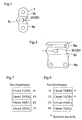
- Fig. 4 is a perspective view of a rear bracket applied on the seat;
- Fig. 5 is block diagram of the load-detecting device;
- Figs. 6 is a flowchart showing a program executed by a central processing unit in the load-detecting device; and
- Fig. 7 shows the port arrangement of the central processing unit; and
- Fig. 8 shows another port arrangement of the central processing unit.
- Embodiments of the present invention will be explained with reference to illustrations of the drawing figures as follows.
- As shown in Figs. 1 and 2, a
seat 1 is fixed on aninside room floor 11 of an automobile via a pair of supportingframes brackets lower rails upper rails frames lower rails upper rails brackets frames frames lower rails brackets frames lower rails lower rails - The
upper rails lower rails upper rails lower arms front brackets rear brackets seat 1. - As shown in Fig.3, the
front bracket upper fixing portion 7a and alower fixing portion 7b at the upper and lower ends of thebracket curved portion 7c of thebracket 7 is formed by presswork between theportions fixing portion 7a is fixed at the forward portion of thelower arm 16 by a fixing member, while thefixing portion 7b is fixed at the forward portion of theupper rail 6 by a fixing member. Front-right and front-left load-detectingsensors curved portion 7c of thefront bracket - As shown in Fig. 4, the
rear bracket upper fixing portion 8a and alower fixing portion 8b at the upper and lower ends of thebracket curved portion 8c of thebracket portions fixing portion 8a is fixed at the backward portion of thelower arm 16 by a fixing member, while thefixing portion 8b is fixed at the backward portion of theupper rail 6 by a fixing member. Rear-right and rear-left load-detectingsensors curved portion 8c of thefront bracket - Consequently, the
seat 1 is equipped with four load-detectingsensors 21 through 24 at forward and backward portion on both right and left side of theseat 1. As shown in Fig. 5, strain gauges (or thick film sensor) 21 through 24 are employed assensors 21 through 24, respectively, because of its lower cost. The strain gauges electrically detects deflection amount of thecurved portions seat cushion 9.Signal processing circuits 31 through 34 are integrally installed nearby thestrain gauges 21 through 24, respectively. Each of thecircuits 31 through 34 comprises a noise filter circuit (not shown) and an amplifier circuit (not shown). The noise filter circuit controls and/or removes noise on each analog output signal of thestrain gauges 21 through 24. The amplifier circuit amplifies the amplitude of the analog output signal and transforms the analog signal into a digital signal (a load signal) with a unique ID corresponding to each of thestrain gauges 21 through 24. In consideration of load distribution on theentire seat 1, the load-detecting sensors detecting sensors - The
control unit 25 is driven by a battery 35 (eg. 12V) of the automobile. Theunit 25 comprises Input/Output (I/O)circuits constant voltage circuit 27 and anoutput circuit 28. The I/O circuit 19 establishes two-way communication between ports P1, P2, P3 and P4 of theCPU 26 and thesignal processing circuits O circuit 29 establishes both-way communication with atest apparatus 40. Each digital load signal of thesignal processing circuit CPU 26, respectively. TheCPU 26 comprises ROM and RAM (not shown) as well as a timer (not shown). The ROM stores a program and the RAM temporally stores a necessary data for processing the program. It will be appreciated that other forms of volatile or non-volatile memory may be used. Theconstant voltage circuit 27 generates a constant voltage (eg. 5V) so as to be supplied to theCPU 26. Theoutput circuit 28 outputs control signal to an air-bag control unit 30. - In order to initialize the
control unit 25, thetest apparatus 40 is employed so as to be electrically connected with theCPU 26 through the I/O circuit 29. The initialization of theunit 25 is executed when theunit 25 is firstly booted by electrical connection between theunit 25 and thebattery 35, when an apparatus including theunit 25 is shipped from a factory and/or when the strain gauges 21 through 24 and/or theunit 25 are replaced due to its malfunction. Thetest apparatus 40 provides theCPU 26 with an initialization request through thecircuit 29 so that memorized contents in theCPU 26 is able to be re-written. The re-writable contents in theCPU 26 is port arrangement or port sequence for assigning the ports P1 through P4 corresponding to thecircuit 31 through 34. - The
output circuit 28 is electrically connected with the air-bag control unit 30 that controls the air-bag actuation for safely protecting the occupant in the automobile at a traffic accident. TheCPU 26 judges whether the occupant is adult or child based on the digital load signal of thesignal processing circuit 31 through 34. The air-bag control unit 30 controls air-bag actuation as well as blowing volume, power and/or speed of the air bag. Thecontroller 30 allows use of the air bag when the occupant is adult, while thecontroller 30 prohibits the use of the air bag when the occupant is child. - Referring to Fig. 6, the operation of the
control unit 25 carried out by the software in theCPU 26 is described, as follows: - When the automobile is switched on, the
CPU 26 is booted at the step S0 and processes initial check at the step S1. Namely, theCPU 26 checks possible error of the ROM and RAM in theCPU 26 as well as outside devices connected to thecontrol unit 25. At the step S2, theCPU 26 judges whether an initialization request is executed by thetest apparatus 40. Namely, it is judged whether thetest apparatus 40 is connected with thecontrol unit 25 so as to make an initialization request of thecontrol unit 25. If the initialization request is not confirmed at the step S2, theCPU 26 processes the step S6. - If the initialization request is confirmed, the
CPU 26 processes the step S3. At the step S3, theCPU 26 provides thecircuits 31 through 34 with a signal output request. The digital load signals of theoutput circuits CPU 26 based on the unique IDs. The ports P1, P2, P3 and P4 are assigned in relation to thecircuits CPU 26 is provided with the load signal of thecircuit 31 corresponding to the front-right load-detectingsensor 21. The port P2 of theCPU 26 is provided with the load signal of thecircuit 33 corresponding to the rear-right load-detectingsensor 23. The port P3 of theCPU 26 is provided with the load signal of thecircuit 34 corresponding to the rear-left load-detectingsensor 24. The port P4 of theCPU 26 is provided with the load signal of thecircuit 32 corresponding to the front-left load-detectingsensor 22. Each of the digital load signals of thecircuits 31 through 34 comprises a frame with 15 bits (a start bit, two unique ID bits, 10 load data bits, a parity bit and a stop bit). - At the step S4, the
CPU 26 checks the unique IDs from the load signals of thecircuits CPU 26. A unique ID No. 1 is applied to thesignal processing circuit 31 for the front-right load-detectingsensor 21. A unique ID No. 2 is applied to thesignal processing circuit 33 for the rear-right load-detectingsensor 23. A unique ID No. 3 is applied to thesignal processing circuit 34 for the rear-left load-detectingsensor 24. A unique ID No. 4 is applied to thesignal processing circuit 32 for the front-left load-detectingsensor 22. - Next, at the step S5, the port arrangement of the port P1, P2, P3 and P4 are assigned in consideration of the unique IDs included in the load signals of the
signal processing circuits CPU 26, at the step S5. Namely, if a load signal having the unique ID No.1, a corresponding connected port is assigned as port P1 so that the port is used for inputting and outputting a signal between the front-right load-detectingsensor 21 andcontrol unit 25. If a load signal having the unique ID No.2, a corresponding connected port is assigned as port P2 so that the port is used for inputting and outputting a signal between the rear-right load-detectingsensor 23 andcontrol unit 25. If a load signal having the unique ID No.3, a corresponding connected port is assigned as port P3 so that the port is used for inputting and outputting a signal between the rear-left load-detectingsensor 24 andcontrol unit 25. If a load signal having the unique ID No.4, a corresponding connected port is assigned as port P4 so that the port is used for inputting and outputting a signal between the front-left load-detectingsensor 22 andcontrol unit 25. These port assignments are achieved since the port arrangement corresponding to the unique IDs is pre-memorized in the CPU, as shown in Fig. 7. - At the step S6, the
CPU 26 provides thecircuits 31 through 34 with a signal output request. The digital load signals of theoutput circuits CPU 26 based on the unique IDs. At the step S7, theCPU 26 calculates a total load value based on the digital load signals of the signal-processing circuits 31 through 34, for example. Namely, the total load value is calculated by a sum of load values corresponding to the digital load signals of the signal-processing circuits 31 through 34 for thesensors 21 through 24. - Usually, the
signal processing circuits sensors circuit 31 is connected with the port P2 and thecircuit 33 is connected with the port P1, theCPU 26 assigns the port P2 as port P1 and the port P1 as port P2 at the step S5, as mentioned the above. The port arrangement is corrected, as shown in Fig. 8, so that theCPU 26 appropriately corrects the calculation. - At the step S8, the
CPU 26 judges whether the occupant is adult or child according to the total load value. So-called filter processing is used for removing unusual load value during the judgment. If the total load value exceeds a pre-determined value Y at the step S8, the occupant is judged as adult at the step S9 and theCPU 26 processes the step S2. Meanwhile, if the total load value is less than a pre-determined value Y at the step S8, the occupant is judged as child at the step S10 and theCPU 26 processes the step S2. TheCPU 26 repeats from the step S2 through S10 at a pre-determined interval. - The above embodiment shows four
sensors 21 through 24, but the number of the sensors applied to a seat is not restricted to four but decided to arbitrary according to necessary design. If the output signals of thesensors 21 through 24 are not so weak or the output signals have high tolerance, thesignal processing circuits 31 through 34 are able to be omitted or separately located from thesensors 21 through 24. On the former occasion, the unique IDs are appropriately added to the output signals. Meanwhile, even if thetest apparatus 40 is not used, the port assignment for the load signals of thesignal processing circuits 31 through 34 and the ports P1 through P4 is able to be automatically achieved when thecontrol unit 25 is firstly connected with thebattery 35. - The principles, preferred embodiment and mode of operation of the present invention have been described in the foregoing specification. However, the invention which is intended to be protected is not to be construed as limited to the particular embodiments disclosed. Further, the embodiments described herein are to be regarded as illustrative rather than restrictive. Variations and changes may be made by others, and equivalents employed, without departing from the spirit of the present invention. Accordingly, it is expressly intended that all such variations, changes and equivalents that fall within the spirit and scope of the present invention as defined in the claims, be embraced thereby.
Claims (6)
- A load-detecting device for an object on a seat of an automobile comprising:wherein the control unit is operable to execute an initialization process so that the ports are assigned in relation to the signal processing circuits based on the unique IDs included in the load signals.a plurality of load sensors for generating output signals corresponding to an object on the seat, at least two of the load sensors being different in character;a plurality of signal processing circuits for processing the output signals so as to provide load signals with unique IDs corresponding to each of the sensors; anda control unit including a plurality of ports in communication with the signal processing circuits so as to load the load signals in the control unit;
- The load-detecting device according to the claim 1, wherein
the control unit is operable to execute an initialization process when a test apparatus is electrically connected with the control unit. - The load-detecting device according to claim 1 or 2, wherein
the control unit includes a memory for storing a port assignment and the port assignment is re-written upon the initialization process. - The load-detecting device according to claim 1, 2 or 3, wherein
the control unit judges that an occupant on the seat is an adult when the sum of the load value of the load signals exceeds a pre-determined value, and that an occupant on the seat is a child when the sum of the load value of the load signals is less than the pre-determined value. - The load-detecting device according to any one of claims 1 to 4, wherein
the load sensors are arranged between the seat and an interior floor of the automobile. - The load-detecting device according to any one of claims 1 to 5, wherein
the load signals are digital signals and the signal processing circuits provides the digital load signals responsive to a signal output request from the control unit.
Applications Claiming Priority (2)
| Application Number | Priority Date | Filing Date | Title |
|---|---|---|---|
| JP2004020297 | 2004-01-28 | ||
| JP2004020297 | 2004-01-28 |
Publications (2)
| Publication Number | Publication Date |
|---|---|
| EP1559617A1 true EP1559617A1 (en) | 2005-08-03 |
| EP1559617B1 EP1559617B1 (en) | 2006-11-02 |
Family
ID=34650800
Family Applications (1)
| Application Number | Title | Priority Date | Filing Date |
|---|---|---|---|
| EP05250308A Expired - Lifetime EP1559617B1 (en) | 2004-01-28 | 2005-01-21 | A load-detecting device for an object on a seat |
Country Status (4)
| Country | Link |
|---|---|
| US (1) | US20050165538A1 (en) |
| EP (1) | EP1559617B1 (en) |
| KR (1) | KR20050077495A (en) |
| DE (1) | DE602005000210T2 (en) |
Citations (4)
| Publication number | Priority date | Publication date | Assignee | Title |
|---|---|---|---|---|
| DE4037143A1 (en) * | 1990-11-22 | 1992-05-27 | Bosch Gmbh Robert | CONTROL SYSTEM |
| DE4205911A1 (en) * | 1992-02-26 | 1993-09-02 | Uwatec Ag | CONTROL DEVICE FOR THE AIR PRESSURE OF AIR TIRED VEHICLE WHEELS |
| EP1114986A2 (en) * | 1999-12-24 | 2001-07-11 | Aisin Seiki Kabushiki Kaisha | Vehicle seat |
| US20020118104A1 (en) * | 2001-02-16 | 2002-08-29 | Morio Sakai | Passenger determination device |
Family Cites Families (3)
| Publication number | Priority date | Publication date | Assignee | Title |
|---|---|---|---|---|
| US5964815A (en) * | 1997-10-21 | 1999-10-12 | Trw Inc. | Occupant restraint system having serially connected devices, a method for providing the restraint system and a method for using the restraint system |
| US6636792B2 (en) * | 2000-09-29 | 2003-10-21 | Siemens Vdo Automotive Corporation | Weight classification system |
| US6493620B2 (en) * | 2001-04-18 | 2002-12-10 | Eaton Corporation | Motor vehicle occupant detection system employing ellipse shape models and bayesian classification |
-
2005
- 2005-01-21 US US11/038,523 patent/US20050165538A1/en not_active Abandoned
- 2005-01-21 EP EP05250308A patent/EP1559617B1/en not_active Expired - Lifetime
- 2005-01-21 DE DE602005000210T patent/DE602005000210T2/en not_active Expired - Fee Related
- 2005-01-28 KR KR1020050008191A patent/KR20050077495A/en not_active Withdrawn
Patent Citations (4)
| Publication number | Priority date | Publication date | Assignee | Title |
|---|---|---|---|---|
| DE4037143A1 (en) * | 1990-11-22 | 1992-05-27 | Bosch Gmbh Robert | CONTROL SYSTEM |
| DE4205911A1 (en) * | 1992-02-26 | 1993-09-02 | Uwatec Ag | CONTROL DEVICE FOR THE AIR PRESSURE OF AIR TIRED VEHICLE WHEELS |
| EP1114986A2 (en) * | 1999-12-24 | 2001-07-11 | Aisin Seiki Kabushiki Kaisha | Vehicle seat |
| US20020118104A1 (en) * | 2001-02-16 | 2002-08-29 | Morio Sakai | Passenger determination device |
Also Published As
| Publication number | Publication date |
|---|---|
| US20050165538A1 (en) | 2005-07-28 |
| KR20050077495A (en) | 2005-08-02 |
| DE602005000210T2 (en) | 2007-09-06 |
| EP1559617B1 (en) | 2006-11-02 |
| DE602005000210D1 (en) | 2006-12-14 |
Similar Documents
| Publication | Publication Date | Title |
|---|---|---|
| US6810984B2 (en) | Occupant judging apparatus | |
| US6735508B2 (en) | Hardware independent mapping of multiple sensor configurations for classification of persons | |
| EP1114986B1 (en) | Vehicle seat | |
| US20080109140A1 (en) | Seat apparatus for vehicle | |
| EP1190916B1 (en) | Weight detector for vehicle seat | |
| US20010033074A1 (en) | Passenger discriminating apparatus | |
| US6774804B2 (en) | Passenger determination device | |
| US7009509B2 (en) | Occupant weight detecting device | |
| US6876299B2 (en) | Occupant determining device | |
| EP1559617B1 (en) | A load-detecting device for an object on a seat | |
| US7216894B2 (en) | Occupant determination device | |
| US9329075B2 (en) | Seat occupancy determination device and seat occupancy determination method | |
| US7266471B2 (en) | Seat occupant identifying apparatus designed to establish high accuracy occupant identification | |
| US6963287B2 (en) | Occupant weight detecting device | |
| US7023355B2 (en) | Occupant determination device | |
| JP2000302004A (en) | Vehicle occupant weight detection device | |
| JP2006123835A (en) | Occupant detection device | |
| US7584037B2 (en) | Occupant determining device | |
| JP3664986B2 (en) | Crew determination device | |
| JP3918576B2 (en) | Abnormality judgment method of weight detection sensor | |
| KR100718395B1 (en) | Vehicle occupancy classification system and its operation method | |
| JP2005241632A (en) | Seat load detection device | |
| KR100718394B1 (en) | Vehicle occupancy classification system and its operation method | |
| JPH09301113A (en) | Control system for side airbag system | |
| JP2006226768A (en) | Occupant detector |
Legal Events
| Date | Code | Title | Description |
|---|---|---|---|
| PUAI | Public reference made under article 153(3) epc to a published international application that has entered the european phase |
Free format text: ORIGINAL CODE: 0009012 |
|
| AK | Designated contracting states |
Kind code of ref document: A1 Designated state(s): AT BE BG CH CY CZ DE DK EE ES FI FR GB GR HU IE IS IT LI LT LU MC NL PL PT RO SE SI SK TR |
|
| AX | Request for extension of the european patent |
Extension state: AL BA HR LV MK YU |
|
| 17P | Request for examination filed |
Effective date: 20050607 |
|
| GRAP | Despatch of communication of intention to grant a patent |
Free format text: ORIGINAL CODE: EPIDOSNIGR1 |
|
| GRAS | Grant fee paid |
Free format text: ORIGINAL CODE: EPIDOSNIGR3 |
|
| AKX | Designation fees paid |
Designated state(s): DE FR GB |
|
| GRAA | (expected) grant |
Free format text: ORIGINAL CODE: 0009210 |
|
| AK | Designated contracting states |
Kind code of ref document: B1 Designated state(s): DE FR GB |
|
| REG | Reference to a national code |
Ref country code: GB Ref legal event code: FG4D |
|
| REF | Corresponds to: |
Ref document number: 602005000210 Country of ref document: DE Date of ref document: 20061214 Kind code of ref document: P |
|
| ET | Fr: translation filed | ||
| PLBE | No opposition filed within time limit |
Free format text: ORIGINAL CODE: 0009261 |
|
| STAA | Information on the status of an ep patent application or granted ep patent |
Free format text: STATUS: NO OPPOSITION FILED WITHIN TIME LIMIT |
|
| 26N | No opposition filed |
Effective date: 20070803 |
|
| PGFP | Annual fee paid to national office [announced via postgrant information from national office to epo] |
Ref country code: DE Payment date: 20080117 Year of fee payment: 4 |
|
| PGFP | Annual fee paid to national office [announced via postgrant information from national office to epo] |
Ref country code: FR Payment date: 20080108 Year of fee payment: 4 |
|
| GBPC | Gb: european patent ceased through non-payment of renewal fee |
Effective date: 20090121 |
|
| PG25 | Lapsed in a contracting state [announced via postgrant information from national office to epo] |
Ref country code: DE Free format text: LAPSE BECAUSE OF NON-PAYMENT OF DUE FEES Effective date: 20090801 |
|
| REG | Reference to a national code |
Ref country code: FR Ref legal event code: ST Effective date: 20091030 |
|
| PG25 | Lapsed in a contracting state [announced via postgrant information from national office to epo] |
Ref country code: GB Free format text: LAPSE BECAUSE OF NON-PAYMENT OF DUE FEES Effective date: 20090121 |
|
| PG25 | Lapsed in a contracting state [announced via postgrant information from national office to epo] |
Ref country code: FR Free format text: LAPSE BECAUSE OF NON-PAYMENT OF DUE FEES Effective date: 20090202 |