EP1558577B1 - Substituted 4-phenyl-piperidin-amides as tachykinin antagonists and serotonin reptake inhibitors - Google Patents
Substituted 4-phenyl-piperidin-amides as tachykinin antagonists and serotonin reptake inhibitors Download PDFInfo
- Publication number
- EP1558577B1 EP1558577B1 EP03762615A EP03762615A EP1558577B1 EP 1558577 B1 EP1558577 B1 EP 1558577B1 EP 03762615 A EP03762615 A EP 03762615A EP 03762615 A EP03762615 A EP 03762615A EP 1558577 B1 EP1558577 B1 EP 1558577B1
- Authority
- EP
- European Patent Office
- Prior art keywords
- methyl
- phenyl
- methylacetamide
- sub
- fluoro
- Prior art date
- Legal status (The legal status is an assumption and is not a legal conclusion. Google has not performed a legal analysis and makes no representation as to the accuracy of the status listed.)
- Expired - Lifetime
Links
- 102000003141 Tachykinin Human genes 0.000 title claims description 9
- 108060008037 tachykinin Proteins 0.000 title claims description 9
- 239000005557 antagonist Substances 0.000 title description 12
- QZAYGJVTTNCVMB-UHFFFAOYSA-N serotonin Chemical compound C1=C(O)C=C2C(CCN)=CNC2=C1 QZAYGJVTTNCVMB-UHFFFAOYSA-N 0.000 title 2
- FZOKXDNYTHYNPE-UHFFFAOYSA-N 4-phenylpiperidine-1-carboxamide Chemical class C1CN(C(=O)N)CCC1C1=CC=CC=C1 FZOKXDNYTHYNPE-UHFFFAOYSA-N 0.000 title 1
- 239000003112 inhibitor Substances 0.000 title 1
- 229940076279 serotonin Drugs 0.000 title 1
- -1 cyclic amine Chemical class 0.000 claims abstract description 143
- 229910052739 hydrogen Inorganic materials 0.000 claims abstract description 50
- 239000001257 hydrogen Substances 0.000 claims abstract description 50
- 125000000217 alkyl group Chemical group 0.000 claims abstract description 24
- 229910052736 halogen Inorganic materials 0.000 claims abstract description 24
- 150000002367 halogens Chemical group 0.000 claims abstract description 24
- 238000000034 method Methods 0.000 claims abstract description 23
- 150000003839 salts Chemical class 0.000 claims abstract description 21
- 125000004093 cyano group Chemical group *C#N 0.000 claims abstract description 20
- 125000002023 trifluoromethyl group Chemical group FC(F)(F)* 0.000 claims abstract description 15
- UFHFLCQGNIYNRP-UHFFFAOYSA-N Hydrogen Chemical compound [H][H] UFHFLCQGNIYNRP-UHFFFAOYSA-N 0.000 claims abstract description 10
- 239000000460 chlorine Substances 0.000 claims abstract description 10
- 229910052801 chlorine Inorganic materials 0.000 claims abstract description 10
- 238000002360 preparation method Methods 0.000 claims abstract description 10
- 230000005764 inhibitory process Effects 0.000 claims abstract description 8
- 239000012453 solvate Substances 0.000 claims abstract description 8
- 125000000876 trifluoromethoxy group Chemical group FC(F)(F)O* 0.000 claims abstract description 6
- 230000001404 mediated effect Effects 0.000 claims abstract description 5
- 230000008569 process Effects 0.000 claims abstract description 5
- 230000000697 serotonin reuptake Effects 0.000 claims abstract description 4
- 108010078791 Carrier Proteins Proteins 0.000 claims abstract description 3
- 125000000449 nitro group Chemical group [O-][N+](*)=O 0.000 claims abstract description 3
- 125000002887 hydroxy group Chemical group [H]O* 0.000 claims abstract 2
- 150000001875 compounds Chemical class 0.000 claims description 361
- VEXZGXHMUGYJMC-UHFFFAOYSA-N Hydrochloric acid Chemical compound Cl VEXZGXHMUGYJMC-UHFFFAOYSA-N 0.000 claims description 114
- 125000002496 methyl group Chemical group [H]C([H])([H])* 0.000 claims description 34
- 238000006243 chemical reaction Methods 0.000 claims description 23
- 125000004178 (C1-C4) alkyl group Chemical group 0.000 claims description 22
- 125000004435 hydrogen atom Chemical group [H]* 0.000 claims description 19
- PXGOKWXKJXAPGV-UHFFFAOYSA-N Fluorine Chemical compound FF PXGOKWXKJXAPGV-UHFFFAOYSA-N 0.000 claims description 13
- 125000001495 ethyl group Chemical group [H]C([H])([H])C([H])([H])* 0.000 claims description 13
- 229910052731 fluorine Inorganic materials 0.000 claims description 13
- 239000011737 fluorine Substances 0.000 claims description 13
- 150000001412 amines Chemical class 0.000 claims description 12
- 125000006272 (C3-C7) cycloalkyl group Chemical group 0.000 claims description 9
- ZAMOUSCENKQFHK-UHFFFAOYSA-N Chlorine atom Chemical compound [Cl] ZAMOUSCENKQFHK-UHFFFAOYSA-N 0.000 claims description 9
- CUBGFICHXDHDKU-UHFFFAOYSA-N n-[1-(3,5-dibromophenyl)ethyl]-2-[4-(4-fluorophenyl)-1-methylpiperidin-4-yl]-n-methylacetamide Chemical compound C=1C(Br)=CC(Br)=CC=1C(C)N(C)C(=O)CC1(C=2C=CC(F)=CC=2)CCN(C)CC1 CUBGFICHXDHDKU-UHFFFAOYSA-N 0.000 claims description 9
- HBAQYPYDRFILMT-UHFFFAOYSA-N 8-[3-(1-cyclopropylpyrazol-4-yl)-1H-pyrazolo[4,3-d]pyrimidin-5-yl]-3-methyl-3,8-diazabicyclo[3.2.1]octan-2-one Chemical class C1(CC1)N1N=CC(=C1)C1=NNC2=C1N=C(N=C2)N1C2C(N(CC1CC2)C)=O HBAQYPYDRFILMT-UHFFFAOYSA-N 0.000 claims description 8
- WKBOTKDWSSQWDR-UHFFFAOYSA-N Bromine atom Chemical group [Br] WKBOTKDWSSQWDR-UHFFFAOYSA-N 0.000 claims description 8
- GDTBXPJZTBHREO-UHFFFAOYSA-N bromine Chemical group BrBr GDTBXPJZTBHREO-UHFFFAOYSA-N 0.000 claims description 8
- 229910052794 bromium Inorganic materials 0.000 claims description 8
- 125000000229 (C1-C4)alkoxy group Chemical group 0.000 claims description 7
- 239000003814 drug Substances 0.000 claims description 7
- KIVIARGCODRSTP-UHFFFAOYSA-N n-[1-(3,5-dibromophenyl)ethyl]-2-[4-(4-fluorophenyl)piperidin-4-yl]-n-methylacetamide Chemical compound C=1C(Br)=CC(Br)=CC=1C(C)N(C)C(=O)CC1(C=2C=CC(F)=CC=2)CCNCC1 KIVIARGCODRSTP-UHFFFAOYSA-N 0.000 claims description 7
- QJGQUHMNIGDVPM-UHFFFAOYSA-N nitrogen group Chemical group [N] QJGQUHMNIGDVPM-UHFFFAOYSA-N 0.000 claims description 7
- QDZOEBFLNHCSSF-PFFBOGFISA-N (2S)-2-[[(2R)-2-[[(2S)-1-[(2S)-6-amino-2-[[(2S)-1-[(2R)-2-amino-5-carbamimidamidopentanoyl]pyrrolidine-2-carbonyl]amino]hexanoyl]pyrrolidine-2-carbonyl]amino]-3-(1H-indol-3-yl)propanoyl]amino]-N-[(2R)-1-[[(2S)-1-[[(2R)-1-[[(2S)-1-[[(2S)-1-amino-4-methyl-1-oxopentan-2-yl]amino]-4-methyl-1-oxopentan-2-yl]amino]-3-(1H-indol-3-yl)-1-oxopropan-2-yl]amino]-1-oxo-3-phenylpropan-2-yl]amino]-3-(1H-indol-3-yl)-1-oxopropan-2-yl]pentanediamide Chemical compound C([C@@H](C(=O)N[C@H](CC=1C2=CC=CC=C2NC=1)C(=O)N[C@@H](CC(C)C)C(=O)N[C@@H](CC(C)C)C(N)=O)NC(=O)[C@@H](CC=1C2=CC=CC=C2NC=1)NC(=O)[C@H](CCC(N)=O)NC(=O)[C@@H](CC=1C2=CC=CC=C2NC=1)NC(=O)[C@H]1N(CCC1)C(=O)[C@H](CCCCN)NC(=O)[C@H]1N(CCC1)C(=O)[C@H](N)CCCNC(N)=N)C1=CC=CC=C1 QDZOEBFLNHCSSF-PFFBOGFISA-N 0.000 claims description 6
- 101800003906 Substance P Proteins 0.000 claims description 6
- VCJNUKLCJUZPER-UHFFFAOYSA-N n-[(3,5-dichlorophenyl)methyl]-2-[3-fluoro-4-(4-fluoro-2-methylphenyl)azepin-4-yl]-n-methylacetamide Chemical compound C1=CC=NC=C(F)C1(C=1C(=CC(F)=CC=1)C)CC(=O)N(C)CC1=CC(Cl)=CC(Cl)=C1 VCJNUKLCJUZPER-UHFFFAOYSA-N 0.000 claims description 6
- XGIULTTWQOPCSJ-UHFFFAOYSA-N n-[1-(3,5-dibromophenyl)ethyl]-n-methyl-2-(1-methyl-4-phenylpiperidin-4-yl)acetamide Chemical compound C=1C(Br)=CC(Br)=CC=1C(C)N(C)C(=O)CC1(C=2C=CC=CC=2)CCN(C)CC1 XGIULTTWQOPCSJ-UHFFFAOYSA-N 0.000 claims description 6
- YBMUHVZBGHSLDW-UHFFFAOYSA-N n-[[3,5-bis(trifluoromethyl)phenyl]methyl]-2-[3-fluoro-4-(4-fluoro-2-methylphenyl)azepin-4-yl]-n-methylacetamide Chemical compound C1=CC=NC=C(F)C1(C=1C(=CC(F)=CC=1)C)CC(=O)N(C)CC1=CC(C(F)(F)F)=CC(C(F)(F)F)=C1 YBMUHVZBGHSLDW-UHFFFAOYSA-N 0.000 claims description 6
- CBCZFQUWFWZMNV-UHFFFAOYSA-N 2-[4-(3-chlorophenyl)piperidin-4-yl]-n-[1-(3,5-dibromophenyl)ethyl]-n-methylacetamide Chemical compound C=1C(Br)=CC(Br)=CC=1C(C)N(C)C(=O)CC1(C=2C=C(Cl)C=CC=2)CCNCC1 CBCZFQUWFWZMNV-UHFFFAOYSA-N 0.000 claims description 5
- OLOCSAMKFGITFZ-UHFFFAOYSA-N n-[1-(3,5-dibromophenyl)ethyl]-2-[4-(3-fluorophenyl)-1-methylpiperidin-4-yl]-n-methylacetamide Chemical compound C=1C(Br)=CC(Br)=CC=1C(C)N(C)C(=O)CC1(C=2C=C(F)C=CC=2)CCN(C)CC1 OLOCSAMKFGITFZ-UHFFFAOYSA-N 0.000 claims description 5
- LPGKLBRZOSQCQG-UHFFFAOYSA-N n-[1-(3,5-dibromophenyl)ethyl]-2-[4-(4-fluoro-3-methylphenyl)piperidin-4-yl]-n-methylacetamide Chemical compound C=1C(Br)=CC(Br)=CC=1C(C)N(C)C(=O)CC1(C=2C=C(C)C(F)=CC=2)CCNCC1 LPGKLBRZOSQCQG-UHFFFAOYSA-N 0.000 claims description 5
- KQRTULUMOKTQES-UHFFFAOYSA-N n-[1-(3,5-dichlorophenyl)ethyl]-2-[4-(4-fluorophenyl)-1-methylpiperidin-4-yl]-n-methylacetamide Chemical compound C=1C(Cl)=CC(Cl)=CC=1C(C)N(C)C(=O)CC1(C=2C=CC(F)=CC=2)CCN(C)CC1 KQRTULUMOKTQES-UHFFFAOYSA-N 0.000 claims description 5
- PUMQASALSAPJEO-UHFFFAOYSA-N 2-[4-(3-chlorophenyl)-1-methylpiperidin-4-yl]-n-[1-(3,5-dibromophenyl)ethyl]-n-methylacetamide Chemical compound C=1C(Br)=CC(Br)=CC=1C(C)N(C)C(=O)CC1(C=2C=C(Cl)C=CC=2)CCN(C)CC1 PUMQASALSAPJEO-UHFFFAOYSA-N 0.000 claims description 4
- 150000001732 carboxylic acid derivatives Chemical class 0.000 claims description 4
- 125000001559 cyclopropyl group Chemical group [H]C1([H])C([H])([H])C1([H])* 0.000 claims description 4
- JKMBTCHEQYHODT-UHFFFAOYSA-N n-[1-(3,5-dibromophenyl)ethyl]-2-[4-(3,4-difluorophenyl)-1-methylpiperidin-4-yl]-n-methylacetamide Chemical compound C=1C(Br)=CC(Br)=CC=1C(C)N(C)C(=O)CC1(C=2C=C(F)C(F)=CC=2)CCN(C)CC1 JKMBTCHEQYHODT-UHFFFAOYSA-N 0.000 claims description 4
- SXJGDTYHOHCOCK-UHFFFAOYSA-N n-[1-(3,5-dibromophenyl)ethyl]-2-[4-(3,4-difluorophenyl)piperidin-4-yl]-n-methylacetamide Chemical compound C=1C(Br)=CC(Br)=CC=1C(C)N(C)C(=O)CC1(C=2C=C(F)C(F)=CC=2)CCNCC1 SXJGDTYHOHCOCK-UHFFFAOYSA-N 0.000 claims description 4
- OXGUVKBVGBHGCD-UHFFFAOYSA-N n-[1-(3,5-dibromophenyl)ethyl]-2-[4-(4-fluoro-3-methylphenyl)-1-methylpiperidin-4-yl]-n-methylacetamide Chemical compound C=1C(Br)=CC(Br)=CC=1C(C)N(C)C(=O)CC1(C=2C=C(C)C(F)=CC=2)CCN(C)CC1 OXGUVKBVGBHGCD-UHFFFAOYSA-N 0.000 claims description 4
- IBFWKPCDEAEHPF-UHFFFAOYSA-N n-[1-(3,5-dibromophenyl)ethyl]-n-methyl-2-(4-phenylpiperidin-4-yl)acetamide Chemical compound C=1C(Br)=CC(Br)=CC=1C(C)N(C)C(=O)CC1(C=2C=CC=CC=2)CCNCC1 IBFWKPCDEAEHPF-UHFFFAOYSA-N 0.000 claims description 4
- GDQICJDTYOYKRA-UHFFFAOYSA-N n-[1-(3,5-dichlorophenyl)ethyl]-2-[4-(4-fluorophenyl)piperidin-4-yl]-n-methylacetamide Chemical compound C=1C(Cl)=CC(Cl)=CC=1C(C)N(C)C(=O)CC1(C=2C=CC(F)=CC=2)CCNCC1 GDQICJDTYOYKRA-UHFFFAOYSA-N 0.000 claims description 4
- KXHRKAVQKDLHBQ-UHFFFAOYSA-N n-[1-[3,5-bis(trifluoromethyl)phenyl]ethyl]-2-[4-(4-fluorophenyl)piperidin-4-yl]-n-methylacetamide Chemical compound C=1C(C(F)(F)F)=CC(C(F)(F)F)=CC=1C(C)N(C)C(=O)CC1(C=2C=CC(F)=CC=2)CCNCC1 KXHRKAVQKDLHBQ-UHFFFAOYSA-N 0.000 claims description 4
- 239000008194 pharmaceutical composition Substances 0.000 claims description 4
- 239000000546 pharmaceutical excipient Substances 0.000 claims description 4
- OYWUUEUHGOENKD-UHFFFAOYSA-N 2-[1-(cyclopropylmethyl)-4-(4-fluorophenyl)piperidin-4-yl]-n-[(3,5-dibromophenyl)methyl]-n-methylacetamide Chemical compound C1CN(CC2CC2)CCC1(C=1C=CC(F)=CC=1)CC(=O)N(C)CC1=CC(Br)=CC(Br)=C1 OYWUUEUHGOENKD-UHFFFAOYSA-N 0.000 claims description 3
- OEEFNSQUTAISGV-UHFFFAOYSA-N 2-[4-(3-chlorophenyl)piperidin-4-yl]-n-[(3,5-dibromophenyl)methyl]-n-methylacetamide Chemical compound C1CNCCC1(C=1C=C(Cl)C=CC=1)CC(=O)N(C)CC1=CC(Br)=CC(Br)=C1 OEEFNSQUTAISGV-UHFFFAOYSA-N 0.000 claims description 3
- PYDSTENQHKZPJA-UHFFFAOYSA-N 2-[4-(3-chlorophenyl)piperidin-4-yl]-n-[1-(3,5-dichlorophenyl)ethyl]-n-methylacetamide Chemical compound C=1C(Cl)=CC(Cl)=CC=1C(C)N(C)C(=O)CC1(C=2C=C(Cl)C=CC=2)CCNCC1 PYDSTENQHKZPJA-UHFFFAOYSA-N 0.000 claims description 3
- PZVMFKKTUMOFEO-UHFFFAOYSA-N 2-[4-(4-cyanophenyl)piperidin-4-yl]-n-[1-(3,5-dibromophenyl)ethyl]-n-methylacetamide Chemical compound C=1C(Br)=CC(Br)=CC=1C(C)N(C)C(=O)CC1(C=2C=CC(=CC=2)C#N)CCNCC1 PZVMFKKTUMOFEO-UHFFFAOYSA-N 0.000 claims description 3
- KBGITZDEJWREGG-UHFFFAOYSA-N n-[(3,5-dibromophenyl)methyl]-2-[1-ethyl-4-(4-fluorophenyl)piperidin-4-yl]-n-methylacetamide Chemical compound C1CN(CC)CCC1(C=1C=CC(F)=CC=1)CC(=O)N(C)CC1=CC(Br)=CC(Br)=C1 KBGITZDEJWREGG-UHFFFAOYSA-N 0.000 claims description 3
- FTLVICBKHBUZKS-UHFFFAOYSA-N n-[(3,5-dibromophenyl)methyl]-2-[4-(3,4-difluorophenyl)-1-methylpiperidin-4-yl]-n-methylacetamide Chemical compound C1CN(C)CCC1(C=1C=C(F)C(F)=CC=1)CC(=O)N(C)CC1=CC(Br)=CC(Br)=C1 FTLVICBKHBUZKS-UHFFFAOYSA-N 0.000 claims description 3
- LABGAISISHWSFW-UHFFFAOYSA-N n-[(3,5-dibromophenyl)methyl]-2-[4-(3,4-difluorophenyl)piperidin-4-yl]-n-methylacetamide Chemical compound C1CNCCC1(C=1C=C(F)C(F)=CC=1)CC(=O)N(C)CC1=CC(Br)=CC(Br)=C1 LABGAISISHWSFW-UHFFFAOYSA-N 0.000 claims description 3
- TWCRITRSWQJWKA-UHFFFAOYSA-N n-[(3,5-dibromophenyl)methyl]-2-[4-(3-fluorophenyl)-1-methylpiperidin-4-yl]-n-methylacetamide Chemical compound C1CN(C)CCC1(C=1C=C(F)C=CC=1)CC(=O)N(C)CC1=CC(Br)=CC(Br)=C1 TWCRITRSWQJWKA-UHFFFAOYSA-N 0.000 claims description 3
- UMAXDBLPJXAGBO-UHFFFAOYSA-N n-[(3,5-dibromophenyl)methyl]-2-[4-(3-fluorophenyl)piperidin-4-yl]-n-methylacetamide Chemical compound C1CNCCC1(C=1C=C(F)C=CC=1)CC(=O)N(C)CC1=CC(Br)=CC(Br)=C1 UMAXDBLPJXAGBO-UHFFFAOYSA-N 0.000 claims description 3
- LAZGFGUCJYBTJM-UHFFFAOYSA-N n-[(3,5-dibromophenyl)methyl]-2-[4-(4-fluoro-2-methylphenyl)-1-methylpiperidin-4-yl]-n-methylacetamide Chemical compound C1CN(C)CCC1(C=1C(=CC(F)=CC=1)C)CC(=O)N(C)CC1=CC(Br)=CC(Br)=C1 LAZGFGUCJYBTJM-UHFFFAOYSA-N 0.000 claims description 3
- OHBATSBWDOWIHA-UHFFFAOYSA-N n-[(3,5-dibromophenyl)methyl]-2-[4-(4-fluoro-2-methylphenyl)piperidin-4-yl]-n-methylacetamide Chemical compound C1CNCCC1(C=1C(=CC(F)=CC=1)C)CC(=O)N(C)CC1=CC(Br)=CC(Br)=C1 OHBATSBWDOWIHA-UHFFFAOYSA-N 0.000 claims description 3
- KLBWSLPBLMGIMR-UHFFFAOYSA-N n-[(3,5-dibromophenyl)methyl]-2-[4-(4-fluoro-3-methylphenyl)-1-methylpiperidin-4-yl]-n-methylacetamide Chemical compound C1CN(C)CCC1(C=1C=C(C)C(F)=CC=1)CC(=O)N(C)CC1=CC(Br)=CC(Br)=C1 KLBWSLPBLMGIMR-UHFFFAOYSA-N 0.000 claims description 3
- APVVVQYIXSHNFF-UHFFFAOYSA-N n-[(3,5-dibromophenyl)methyl]-2-[4-(4-fluoro-3-methylphenyl)piperidin-4-yl]-n-methylacetamide Chemical compound C1CNCCC1(C=1C=C(C)C(F)=CC=1)CC(=O)N(C)CC1=CC(Br)=CC(Br)=C1 APVVVQYIXSHNFF-UHFFFAOYSA-N 0.000 claims description 3
- FPJNDGJGAPYRPL-UHFFFAOYSA-N n-[(3,5-dibromophenyl)methyl]-2-[4-(4-fluorophenyl)-1-methylazepan-4-yl]-n-methylacetamide Chemical compound C1CCN(C)CCC1(C=1C=CC(F)=CC=1)CC(=O)N(C)CC1=CC(Br)=CC(Br)=C1 FPJNDGJGAPYRPL-UHFFFAOYSA-N 0.000 claims description 3
- JMGILTGHFIRXNO-UHFFFAOYSA-N n-[(3,5-dibromophenyl)methyl]-2-[4-(4-fluorophenyl)azepan-4-yl]-n-methylacetamide Chemical compound C1CCNCCC1(C=1C=CC(F)=CC=1)CC(=O)N(C)CC1=CC(Br)=CC(Br)=C1 JMGILTGHFIRXNO-UHFFFAOYSA-N 0.000 claims description 3
- IEGOVDNNVDRMGV-UHFFFAOYSA-N n-[(3,5-dibromophenyl)methyl]-2-[4-(4-fluorophenyl)piperidin-4-yl]-n-methylacetamide Chemical compound C1CNCCC1(C=1C=CC(F)=CC=1)CC(=O)N(C)CC1=CC(Br)=CC(Br)=C1 IEGOVDNNVDRMGV-UHFFFAOYSA-N 0.000 claims description 3
- CLKKHXPWZNLYTD-UHFFFAOYSA-N n-[(3,5-dibromophenyl)methyl]-n-methyl-2-(1-methyl-4-phenylpiperidin-4-yl)acetamide Chemical compound C1CN(C)CCC1(C=1C=CC=CC=1)CC(=O)N(C)CC1=CC(Br)=CC(Br)=C1 CLKKHXPWZNLYTD-UHFFFAOYSA-N 0.000 claims description 3
- APJWCTJEVJXCJW-UHFFFAOYSA-N n-[(3,5-dibromophenyl)methyl]-n-methyl-2-(4-phenylpiperidin-4-yl)acetamide Chemical compound C1CNCCC1(C=1C=CC=CC=1)CC(=O)N(C)CC1=CC(Br)=CC(Br)=C1 APJWCTJEVJXCJW-UHFFFAOYSA-N 0.000 claims description 3
- GVTWZLHSPZKANJ-UHFFFAOYSA-N n-[(3,5-dibromophenyl)methyl]-n-methyl-2-[1-methyl-4-[3-(trifluoromethyl)phenyl]piperidin-4-yl]acetamide Chemical compound C1CN(C)CCC1(C=1C=C(C=CC=1)C(F)(F)F)CC(=O)N(C)CC1=CC(Br)=CC(Br)=C1 GVTWZLHSPZKANJ-UHFFFAOYSA-N 0.000 claims description 3
- PIFWJDNYKCFACK-UHFFFAOYSA-N n-[(3,5-dibromophenyl)methyl]-n-methyl-2-[4-(2-methylphenyl)piperidin-4-yl]acetamide Chemical compound C1CNCCC1(C=1C(=CC=CC=1)C)CC(=O)N(C)CC1=CC(Br)=CC(Br)=C1 PIFWJDNYKCFACK-UHFFFAOYSA-N 0.000 claims description 3
- SGTNQKCATRFTST-UHFFFAOYSA-N n-[(3,5-dibromophenyl)methyl]-n-methyl-2-[4-[3-(trifluoromethyl)phenyl]piperidin-4-yl]acetamide Chemical compound C1CNCCC1(C=1C=C(C=CC=1)C(F)(F)F)CC(=O)N(C)CC1=CC(Br)=CC(Br)=C1 SGTNQKCATRFTST-UHFFFAOYSA-N 0.000 claims description 3
- QCFKFTAAYXDMST-UHFFFAOYSA-N n-[(3,5-dichlorophenyl)methyl]-2-[3-fluoro-4-(4-fluorophenyl)piperidin-4-yl]-n-methylacetamide Chemical compound C1CNCC(F)C1(C=1C=CC(F)=CC=1)CC(=O)N(C)CC1=CC(Cl)=CC(Cl)=C1 QCFKFTAAYXDMST-UHFFFAOYSA-N 0.000 claims description 3
- PCIYLGYWJDFXTM-UHFFFAOYSA-N n-[(3,5-dichlorophenyl)methyl]-2-[4-(4-fluoro-2-methylphenyl)-1-methylpiperidin-4-yl]-n-methylacetamide Chemical compound C1CN(C)CCC1(C=1C(=CC(F)=CC=1)C)CC(=O)N(C)CC1=CC(Cl)=CC(Cl)=C1 PCIYLGYWJDFXTM-UHFFFAOYSA-N 0.000 claims description 3
- YUBBKGKCZNBWFN-UHFFFAOYSA-N n-[(3,5-dichlorophenyl)methyl]-2-[4-(4-fluoro-2-methylphenyl)azepin-4-yl]-n-methylacetamide Chemical compound C1=CC=NC=CC1(C=1C(=CC(F)=CC=1)C)CC(=O)N(C)CC1=CC(Cl)=CC(Cl)=C1 YUBBKGKCZNBWFN-UHFFFAOYSA-N 0.000 claims description 3
- WHAURRGDIYUJKM-UHFFFAOYSA-N n-[(3,5-dichlorophenyl)methyl]-2-[4-(4-fluorophenyl)-1-methylpiperidin-4-yl]-n-methylacetamide Chemical compound C1CN(C)CCC1(C=1C=CC(F)=CC=1)CC(=O)N(C)CC1=CC(Cl)=CC(Cl)=C1 WHAURRGDIYUJKM-UHFFFAOYSA-N 0.000 claims description 3
- JKGMQZIBWKUSPD-UHFFFAOYSA-N n-[(3,5-dichlorophenyl)methyl]-2-[4-(4-fluorophenyl)piperidin-4-yl]-n-methylacetamide Chemical compound C1CNCCC1(C=1C=CC(F)=CC=1)CC(=O)N(C)CC1=CC(Cl)=CC(Cl)=C1 JKGMQZIBWKUSPD-UHFFFAOYSA-N 0.000 claims description 3
- XFEFBFOPLLPADO-UHFFFAOYSA-N n-[(3-bromo-5-cyanophenyl)methyl]-2-[4-(4-fluorophenyl)-1-methylpiperidin-4-yl]-n-methylacetamide Chemical compound C1CN(C)CCC1(C=1C=CC(F)=CC=1)CC(=O)N(C)CC1=CC(Br)=CC(C#N)=C1 XFEFBFOPLLPADO-UHFFFAOYSA-N 0.000 claims description 3
- ZQMQUKLVAUQUEA-UHFFFAOYSA-N n-[(3-bromo-5-cyanophenyl)methyl]-2-[4-(4-fluorophenyl)piperidin-4-yl]-n-methylacetamide Chemical compound C1CNCCC1(C=1C=CC(F)=CC=1)CC(=O)N(C)CC1=CC(Br)=CC(C#N)=C1 ZQMQUKLVAUQUEA-UHFFFAOYSA-N 0.000 claims description 3
- GURNMMQXHJFSIY-UHFFFAOYSA-N n-[1-(3,5-dibromophenyl)ethyl]-2-[4-(3-fluorophenyl)piperidin-4-yl]-n-methylacetamide Chemical compound C=1C(Br)=CC(Br)=CC=1C(C)N(C)C(=O)CC1(C=2C=C(F)C=CC=2)CCNCC1 GURNMMQXHJFSIY-UHFFFAOYSA-N 0.000 claims description 3
- FNMPPDILEUAQPF-UHFFFAOYSA-N n-[1-(3,5-dichlorophenyl)ethyl]-2-[4-(4-fluoro-3-methylphenyl)piperidin-4-yl]-n-methylacetamide Chemical compound C=1C(Cl)=CC(Cl)=CC=1C(C)N(C)C(=O)CC1(C=2C=C(C)C(F)=CC=2)CCNCC1 FNMPPDILEUAQPF-UHFFFAOYSA-N 0.000 claims description 3
- ZGHMSACBXSLVOL-UHFFFAOYSA-N n-[1-[3,5-bis(trifluoromethyl)phenyl]ethyl]-2-[4-(4-fluorophenyl)-1-methylpiperidin-4-yl]-n-methylacetamide Chemical compound C=1C(C(F)(F)F)=CC(C(F)(F)F)=CC=1C(C)N(C)C(=O)CC1(C=2C=CC(F)=CC=2)CCN(C)CC1 ZGHMSACBXSLVOL-UHFFFAOYSA-N 0.000 claims description 3
- SUFHNAMRRNNRQH-UHFFFAOYSA-N n-[2-(3,5-dibromophenyl)propan-2-yl]-2-[4-(4-fluorophenyl)-1-methylpiperidin-4-yl]-n-methylacetamide Chemical compound C=1C(Br)=CC(Br)=CC=1C(C)(C)N(C)C(=O)CC1(C=2C=CC(F)=CC=2)CCN(C)CC1 SUFHNAMRRNNRQH-UHFFFAOYSA-N 0.000 claims description 3
- MFDSKCSKNADMNN-UHFFFAOYSA-N n-[[3,5-bis(trifluoromethyl)phenyl]methyl]-2-[4-(4-fluoro-2-methylphenyl)-1-methylpiperidin-4-yl]-n-methylacetamide Chemical compound C1CN(C)CCC1(C=1C(=CC(F)=CC=1)C)CC(=O)N(C)CC1=CC(C(F)(F)F)=CC(C(F)(F)F)=C1 MFDSKCSKNADMNN-UHFFFAOYSA-N 0.000 claims description 3
- CSDPVWAEZWNOTA-UHFFFAOYSA-N n-[[3,5-bis(trifluoromethyl)phenyl]methyl]-2-[4-(4-fluoro-2-methylphenyl)-1-methylpiperidin-4-yl]acetamide Chemical compound C1CN(C)CCC1(C=1C(=CC(F)=CC=1)C)CC(=O)NCC1=CC(C(F)(F)F)=CC(C(F)(F)F)=C1 CSDPVWAEZWNOTA-UHFFFAOYSA-N 0.000 claims description 3
- QKFZHLZCWOPTOG-UHFFFAOYSA-N n-[[3,5-bis(trifluoromethyl)phenyl]methyl]-2-[4-(4-fluoro-2-methylphenyl)azepin-4-yl]-n-methylacetamide Chemical compound C1=CC=NC=CC1(C=1C(=CC(F)=CC=1)C)CC(=O)N(C)CC1=CC(C(F)(F)F)=CC(C(F)(F)F)=C1 QKFZHLZCWOPTOG-UHFFFAOYSA-N 0.000 claims description 3
- PMQOKIJVNXYECQ-UHFFFAOYSA-N n-[[3,5-bis(trifluoromethyl)phenyl]methyl]-2-[4-(4-fluoro-2-methylphenyl)piperidin-4-yl]acetamide Chemical compound CC1=CC(F)=CC=C1C1(CC(=O)NCC=2C=C(C=C(C=2)C(F)(F)F)C(F)(F)F)CCNCC1 PMQOKIJVNXYECQ-UHFFFAOYSA-N 0.000 claims description 3
- VLOOJIHMDCCLTG-UHFFFAOYSA-N n-[[3,5-bis(trifluoromethyl)phenyl]methyl]-2-[4-(4-fluorophenyl)-1-methylpiperidin-4-yl]-n-methylacetamide Chemical compound C1CN(C)CCC1(C=1C=CC(F)=CC=1)CC(=O)N(C)CC1=CC(C(F)(F)F)=CC(C(F)(F)F)=C1 VLOOJIHMDCCLTG-UHFFFAOYSA-N 0.000 claims description 3
- RCHLCQLYGBYPGS-UHFFFAOYSA-N n-[[3,5-bis(trifluoromethyl)phenyl]methyl]-2-[4-(4-fluorophenyl)azepin-4-yl]-n-methylacetamide Chemical compound C1=CC=NC=CC1(C=1C=CC(F)=CC=1)CC(=O)N(C)CC1=CC(C(F)(F)F)=CC(C(F)(F)F)=C1 RCHLCQLYGBYPGS-UHFFFAOYSA-N 0.000 claims description 3
- 125000002147 dimethylamino group Chemical group [H]C([H])([H])N(*)C([H])([H])[H] 0.000 claims description 2
- 239000003937 drug carrier Substances 0.000 claims description 2
- PNDPGZBMCMUPRI-UHFFFAOYSA-N iodine Chemical compound II PNDPGZBMCMUPRI-UHFFFAOYSA-N 0.000 claims description 2
- SKXVHKHMWJBQCP-UHFFFAOYSA-N n-[(3,5-dibromophenyl)methyl]-2-[1-[2-(dimethylamino)-2-oxoethyl]-4-(4-fluorophenyl)piperidin-4-yl]-n-methylacetamide Chemical compound C1CN(CC(=O)N(C)C)CCC1(C=1C=CC(F)=CC=1)CC(=O)N(C)CC1=CC(Br)=CC(Br)=C1 SKXVHKHMWJBQCP-UHFFFAOYSA-N 0.000 claims description 2
- YOQJLRIIOAJDKZ-UHFFFAOYSA-N n-[(3,5-dibromophenyl)methyl]-2-[4-(3,4-dimethylphenyl)piperidin-4-yl]-n-methylacetamide Chemical compound C1CNCCC1(C=1C=C(C)C(C)=CC=1)CC(=O)N(C)CC1=CC(Br)=CC(Br)=C1 YOQJLRIIOAJDKZ-UHFFFAOYSA-N 0.000 claims description 2
- SBIHQWGCVPZYOK-UHFFFAOYSA-N n-[(3,5-dibromophenyl)methyl]-2-[4-(4-fluorophenyl)-1-methylpiperidin-4-yl]-n-methylacetamide Chemical compound C1CN(C)CCC1(C=1C=CC(F)=CC=1)CC(=O)N(C)CC1=CC(Br)=CC(Br)=C1 SBIHQWGCVPZYOK-UHFFFAOYSA-N 0.000 claims description 2
- XFFVKJZYZIKSAB-UHFFFAOYSA-N n-[(3,5-dibromophenyl)methyl]-n-methyl-2-[1-methyl-4-(2-methylphenyl)piperidin-4-yl]acetamide Chemical compound C1CN(C)CCC1(C=1C(=CC=CC=1)C)CC(=O)N(C)CC1=CC(Br)=CC(Br)=C1 XFFVKJZYZIKSAB-UHFFFAOYSA-N 0.000 claims description 2
- UKVZBBOFTAACDW-UHFFFAOYSA-N n-[(3,5-dichlorophenyl)methyl]-2-[4-(4-fluoro-2-methylphenyl)piperidin-4-yl]-n-methylacetamide Chemical compound C1CNCCC1(C=1C(=CC(F)=CC=1)C)CC(=O)N(C)CC1=CC(Cl)=CC(Cl)=C1 UKVZBBOFTAACDW-UHFFFAOYSA-N 0.000 claims description 2
- ZZEDIURUGGTDOH-UHFFFAOYSA-N n-[1-[3,5-bis(trifluoromethyl)phenyl]ethyl]-2-[4-(4-fluoro-2-methylphenyl)piperidin-4-yl]-n-methylacetamide Chemical compound C=1C(C(F)(F)F)=CC(C(F)(F)F)=CC=1C(C)N(C)C(=O)CC1(C=2C(=CC(F)=CC=2)C)CCNCC1 ZZEDIURUGGTDOH-UHFFFAOYSA-N 0.000 claims description 2
- VKVNFXAMDMLNKV-UHFFFAOYSA-N n-[1-[3,5-bis(trifluoromethyl)phenyl]ethyl]-2-[4-(4-fluorophenyl)-1-methylazepan-4-yl]-n-methylacetamide Chemical compound C=1C(C(F)(F)F)=CC(C(F)(F)F)=CC=1C(C)N(C)C(=O)CC1(C=2C=CC(F)=CC=2)CCCN(C)CC1 VKVNFXAMDMLNKV-UHFFFAOYSA-N 0.000 claims description 2
- LEILNUMLEXGOOI-UHFFFAOYSA-N n-[1-[3,5-bis(trifluoromethyl)phenyl]ethyl]-2-[4-(4-fluorophenyl)azepan-4-yl]-n-methylacetamide Chemical compound C=1C(C(F)(F)F)=CC(C(F)(F)F)=CC=1C(C)N(C)C(=O)CC1(C=2C=CC(F)=CC=2)CCCNCC1 LEILNUMLEXGOOI-UHFFFAOYSA-N 0.000 claims description 2
- PPKADJAJJQNDAR-UHFFFAOYSA-N n-[1-[3,5-bis(trifluoromethyl)phenyl]ethyl]-n-methyl-2-(1-methyl-4-phenylpiperidin-4-yl)acetamide Chemical compound C=1C(C(F)(F)F)=CC(C(F)(F)F)=CC=1C(C)N(C)C(=O)CC1(C=2C=CC=CC=2)CCN(C)CC1 PPKADJAJJQNDAR-UHFFFAOYSA-N 0.000 claims description 2
- VZHSEYRKQIMGOP-UHFFFAOYSA-N n-[1-[3,5-bis(trifluoromethyl)phenyl]ethyl]-n-methyl-2-(4-phenylpiperidin-4-yl)acetamide Chemical compound C=1C(C(F)(F)F)=CC(C(F)(F)F)=CC=1C(C)N(C)C(=O)CC1(C=2C=CC=CC=2)CCNCC1 VZHSEYRKQIMGOP-UHFFFAOYSA-N 0.000 claims description 2
- ZNYREVKCPQKHSI-UHFFFAOYSA-N n-[2-(3,5-dibromophenyl)propan-2-yl]-2-[4-(4-fluorophenyl)piperidin-4-yl]-n-methylacetamide Chemical compound C=1C(Br)=CC(Br)=CC=1C(C)(C)N(C)C(=O)CC1(C=2C=CC(F)=CC=2)CCNCC1 ZNYREVKCPQKHSI-UHFFFAOYSA-N 0.000 claims description 2
- 238000002560 therapeutic procedure Methods 0.000 claims description 2
- 102100024304 Protachykinin-1 Human genes 0.000 claims 1
- 125000006431 methyl cyclopropyl group Chemical group 0.000 claims 1
- 150000002431 hydrogen Chemical class 0.000 abstract description 19
- ZCYVEMRRCGMTRW-UHFFFAOYSA-N 7553-56-2 Chemical compound [I] ZCYVEMRRCGMTRW-UHFFFAOYSA-N 0.000 abstract description 11
- 239000011630 iodine Substances 0.000 abstract description 11
- 229910052740 iodine Inorganic materials 0.000 abstract description 11
- 125000003545 alkoxy group Chemical group 0.000 abstract description 6
- 125000000753 cycloalkyl group Chemical group 0.000 abstract 4
- 125000001309 chloro group Chemical group Cl* 0.000 abstract 1
- OKKJLVBELUTLKV-UHFFFAOYSA-N Methanol Chemical compound OC OKKJLVBELUTLKV-UHFFFAOYSA-N 0.000 description 552
- 239000000243 solution Substances 0.000 description 485
- YMWUJEATGCHHMB-UHFFFAOYSA-N Dichloromethane Chemical compound ClCCl YMWUJEATGCHHMB-UHFFFAOYSA-N 0.000 description 334
- 239000000543 intermediate Substances 0.000 description 274
- 239000000203 mixture Substances 0.000 description 253
- XEKOWRVHYACXOJ-UHFFFAOYSA-N Ethyl acetate Chemical compound CCOC(C)=O XEKOWRVHYACXOJ-UHFFFAOYSA-N 0.000 description 232
- 239000012299 nitrogen atmosphere Substances 0.000 description 181
- RTZKZFJDLAIYFH-UHFFFAOYSA-N Diethyl ether Chemical compound CCOCC RTZKZFJDLAIYFH-UHFFFAOYSA-N 0.000 description 180
- 238000001819 mass spectrum Methods 0.000 description 175
- 238000001514 detection method Methods 0.000 description 141
- 238000003818 flash chromatography Methods 0.000 description 137
- HEMHJVSKTPXQMS-UHFFFAOYSA-M Sodium hydroxide Chemical compound [OH-].[Na+] HEMHJVSKTPXQMS-UHFFFAOYSA-M 0.000 description 135
- UIIMBOGNXHQVGW-UHFFFAOYSA-M Sodium bicarbonate Chemical class [Na+].OC([O-])=O UIIMBOGNXHQVGW-UHFFFAOYSA-M 0.000 description 134
- XLYOFNOQVPJJNP-UHFFFAOYSA-N water Chemical compound O XLYOFNOQVPJJNP-UHFFFAOYSA-N 0.000 description 132
- FEMOMIGRRWSMCU-UHFFFAOYSA-N ninhydrin Chemical compound C1=CC=C2C(=O)C(O)(O)C(=O)C2=C1 FEMOMIGRRWSMCU-UHFFFAOYSA-N 0.000 description 130
- WSFSSNUMVMOOMR-UHFFFAOYSA-N Formaldehyde Chemical compound O=C WSFSSNUMVMOOMR-UHFFFAOYSA-N 0.000 description 129
- WYURNTSHIVDZCO-UHFFFAOYSA-N Tetrahydrofuran Chemical compound C1CCOC1 WYURNTSHIVDZCO-UHFFFAOYSA-N 0.000 description 114
- 239000003921 oil Substances 0.000 description 106
- 235000019198 oils Nutrition 0.000 description 106
- ZMXDDKWLCZADIW-UHFFFAOYSA-N dimethylformamide Substances CN(C)C=O ZMXDDKWLCZADIW-UHFFFAOYSA-N 0.000 description 97
- JGFZNNIVVJXRND-UHFFFAOYSA-N N,N-Diisopropylethylamine (DIPEA) Chemical compound CCN(C(C)C)C(C)C JGFZNNIVVJXRND-UHFFFAOYSA-N 0.000 description 94
- 239000007787 solid Substances 0.000 description 84
- HEDRZPFGACZZDS-MICDWDOJSA-N Trichloro(2H)methane Chemical compound [2H]C(Cl)(Cl)Cl HEDRZPFGACZZDS-MICDWDOJSA-N 0.000 description 78
- VHUUQVKOLVNVRT-UHFFFAOYSA-N Ammonium hydroxide Chemical compound [NH4+].[OH-] VHUUQVKOLVNVRT-UHFFFAOYSA-N 0.000 description 72
- 239000011734 sodium Substances 0.000 description 70
- QTBSBXVTEAMEQO-UHFFFAOYSA-N Acetic acid Chemical compound CC(O)=O QTBSBXVTEAMEQO-UHFFFAOYSA-N 0.000 description 66
- WEVYAHXRMPXWCK-UHFFFAOYSA-N Acetonitrile Chemical compound CC#N WEVYAHXRMPXWCK-UHFFFAOYSA-N 0.000 description 64
- 239000012044 organic layer Substances 0.000 description 64
- IAZDPXIOMUYVGZ-WFGJKAKNSA-N Dimethyl sulfoxide Chemical compound [2H]C([2H])([2H])S(=O)C([2H])([2H])[2H] IAZDPXIOMUYVGZ-WFGJKAKNSA-N 0.000 description 62
- DTQVDTLACAAQTR-UHFFFAOYSA-N Trifluoroacetic acid Chemical class OC(=O)C(F)(F)F DTQVDTLACAAQTR-UHFFFAOYSA-N 0.000 description 58
- 239000012074 organic phase Substances 0.000 description 57
- 239000010410 layer Substances 0.000 description 51
- 235000017557 sodium bicarbonate Nutrition 0.000 description 51
- 229910000030 sodium bicarbonate Inorganic materials 0.000 description 51
- OFBQJSOFQDEBGM-UHFFFAOYSA-N Pentane Chemical compound CCCCC OFBQJSOFQDEBGM-UHFFFAOYSA-N 0.000 description 48
- 238000003756 stirring Methods 0.000 description 48
- 239000000284 extract Substances 0.000 description 44
- 239000006260 foam Substances 0.000 description 44
- 238000005191 phase separation Methods 0.000 description 41
- 239000004743 Polypropylene Substances 0.000 description 40
- 229920001155 polypropylene Polymers 0.000 description 40
- 239000002904 solvent Substances 0.000 description 38
- QAOWNCQODCNURD-UHFFFAOYSA-N sulfuric acid Substances OS(O)(=O)=O QAOWNCQODCNURD-UHFFFAOYSA-N 0.000 description 37
- YXFVVABEGXRONW-UHFFFAOYSA-N Toluene Chemical compound CC1=CC=CC=C1 YXFVVABEGXRONW-UHFFFAOYSA-N 0.000 description 36
- 239000012267 brine Substances 0.000 description 33
- HPALAKNZSZLMCH-UHFFFAOYSA-M sodium;chloride;hydrate Chemical compound O.[Na+].[Cl-] HPALAKNZSZLMCH-UHFFFAOYSA-M 0.000 description 33
- DYHSDKLCOJIUFX-UHFFFAOYSA-N tert-butoxycarbonyl anhydride Chemical compound CC(C)(C)OC(=O)OC(=O)OC(C)(C)C DYHSDKLCOJIUFX-UHFFFAOYSA-N 0.000 description 32
- LFQSCWFLJHTTHZ-UHFFFAOYSA-N Ethanol Chemical compound CCO LFQSCWFLJHTTHZ-UHFFFAOYSA-N 0.000 description 27
- 239000000725 suspension Substances 0.000 description 25
- 210000004027 cell Anatomy 0.000 description 24
- DGAQECJNVWCQMB-PUAWFVPOSA-M Ilexoside XXIX Chemical compound C[C@@H]1CC[C@@]2(CC[C@@]3(C(=CC[C@H]4[C@]3(CC[C@@H]5[C@@]4(CC[C@@H](C5(C)C)OS(=O)(=O)[O-])C)C)[C@@H]2[C@]1(C)O)C)C(=O)O[C@H]6[C@@H]([C@H]([C@@H]([C@H](O6)CO)O)O)O.[Na+] DGAQECJNVWCQMB-PUAWFVPOSA-M 0.000 description 23
- 229910052708 sodium Inorganic materials 0.000 description 23
- 239000012321 sodium triacetoxyborohydride Substances 0.000 description 22
- IJGRMHOSHXDMSA-UHFFFAOYSA-N Atomic nitrogen Chemical compound N#N IJGRMHOSHXDMSA-UHFFFAOYSA-N 0.000 description 20
- 201000006549 dyspepsia Diseases 0.000 description 19
- ZMANZCXQSJIPKH-UHFFFAOYSA-N Triethylamine Chemical compound CCN(CC)CC ZMANZCXQSJIPKH-UHFFFAOYSA-N 0.000 description 18
- NLXLAEXVIDQMFP-UHFFFAOYSA-N Ammonia chloride Chemical class [NH4+].[Cl-] NLXLAEXVIDQMFP-UHFFFAOYSA-N 0.000 description 17
- 238000010828 elution Methods 0.000 description 17
- 238000010992 reflux Methods 0.000 description 16
- VLKZOEOYAKHREP-UHFFFAOYSA-N n-Hexane Chemical compound CCCCCC VLKZOEOYAKHREP-UHFFFAOYSA-N 0.000 description 15
- 239000012071 phase Substances 0.000 description 15
- KWYUFKZDYYNOTN-UHFFFAOYSA-M Potassium hydroxide Chemical compound [OH-].[K+] KWYUFKZDYYNOTN-UHFFFAOYSA-M 0.000 description 14
- 230000027455 binding Effects 0.000 description 14
- 238000009739 binding Methods 0.000 description 14
- 239000000872 buffer Substances 0.000 description 14
- 125000000999 tert-butyl group Chemical group [H]C([H])([H])C(*)(C([H])([H])[H])C([H])([H])[H] 0.000 description 14
- UHOVQNZJYSORNB-UHFFFAOYSA-N Benzene Chemical compound C1=CC=CC=C1 UHOVQNZJYSORNB-UHFFFAOYSA-N 0.000 description 12
- 239000008346 aqueous phase Substances 0.000 description 12
- GBRBMTNGQBKBQE-UHFFFAOYSA-L copper;diiodide Chemical compound I[Cu]I GBRBMTNGQBKBQE-UHFFFAOYSA-L 0.000 description 12
- 230000014759 maintenance of location Effects 0.000 description 12
- TYJJADVDDVDEDZ-UHFFFAOYSA-M potassium hydrogencarbonate Chemical class [K+].OC([O-])=O TYJJADVDDVDEDZ-UHFFFAOYSA-M 0.000 description 12
- 230000004907 flux Effects 0.000 description 11
- URWOCSLKFKSBFR-UHFFFAOYSA-N 1-(3,5-dibromophenyl)-n-methylmethanamine;hydrochloride Chemical compound Cl.CNCC1=CC(Br)=CC(Br)=C1 URWOCSLKFKSBFR-UHFFFAOYSA-N 0.000 description 10
- FYYHWMGAXLPEAU-UHFFFAOYSA-N Magnesium Chemical compound [Mg] FYYHWMGAXLPEAU-UHFFFAOYSA-N 0.000 description 10
- 208000037265 diseases, disorders, signs and symptoms Diseases 0.000 description 10
- 208000021302 gastroesophageal reflux disease Diseases 0.000 description 10
- 229910052757 nitrogen Inorganic materials 0.000 description 10
- 102000019208 Serotonin Plasma Membrane Transport Proteins Human genes 0.000 description 9
- 108010012996 Serotonin Plasma Membrane Transport Proteins Proteins 0.000 description 9
- 239000002253 acid Substances 0.000 description 9
- 208000002193 Pain Diseases 0.000 description 8
- 206010047700 Vomiting Diseases 0.000 description 8
- 208000024798 heartburn Diseases 0.000 description 8
- 238000000338 in vitro Methods 0.000 description 8
- 238000002329 infrared spectrum Methods 0.000 description 8
- HQKMJHAJHXVSDF-UHFFFAOYSA-L magnesium stearate Chemical compound [Mg+2].CCCCCCCCCCCCCCCCCC([O-])=O.CCCCCCCCCCCCCCCCCC([O-])=O HQKMJHAJHXVSDF-UHFFFAOYSA-L 0.000 description 8
- 102000005962 receptors Human genes 0.000 description 8
- 108020003175 receptors Proteins 0.000 description 8
- YLQBMQCUIZJEEH-UHFFFAOYSA-N tetrahydrofuran Natural products C=1C=COC=1 YLQBMQCUIZJEEH-UHFFFAOYSA-N 0.000 description 8
- 210000000170 cell membrane Anatomy 0.000 description 7
- 235000019439 ethyl acetate Nutrition 0.000 description 7
- 238000004128 high performance liquid chromatography Methods 0.000 description 7
- 239000011777 magnesium Substances 0.000 description 7
- 229910052749 magnesium Inorganic materials 0.000 description 7
- 125000002924 primary amino group Chemical group [H]N([H])* 0.000 description 7
- 208000020401 Depressive disease Diseases 0.000 description 6
- BAVYZALUXZFZLV-UHFFFAOYSA-N Methylamine Chemical compound NC BAVYZALUXZFZLV-UHFFFAOYSA-N 0.000 description 6
- 239000004480 active ingredient Substances 0.000 description 6
- 238000004296 chiral HPLC Methods 0.000 description 6
- 239000013078 crystal Substances 0.000 description 6
- 208000035475 disorder Diseases 0.000 description 6
- 235000019441 ethanol Nutrition 0.000 description 6
- 238000002347 injection Methods 0.000 description 6
- 239000007924 injection Substances 0.000 description 6
- 208000024714 major depressive disease Diseases 0.000 description 6
- 239000012528 membrane Substances 0.000 description 6
- FDPIMTJIUBPUKL-UHFFFAOYSA-N pentan-3-one Chemical compound CCC(=O)CC FDPIMTJIUBPUKL-UHFFFAOYSA-N 0.000 description 6
- 239000011541 reaction mixture Substances 0.000 description 6
- ROUYFJUVMYHXFJ-UHFFFAOYSA-N tert-butyl 4-oxopiperidine-1-carboxylate Chemical compound CC(C)(C)OC(=O)N1CCC(=O)CC1 ROUYFJUVMYHXFJ-UHFFFAOYSA-N 0.000 description 6
- 238000007514 turning Methods 0.000 description 6
- 0 *CCC*N(*)C* Chemical compound *CCC*N(*)C* 0.000 description 5
- FAPWRFPIFSIZLT-UHFFFAOYSA-M Sodium chloride Chemical compound [Na+].[Cl-] FAPWRFPIFSIZLT-UHFFFAOYSA-M 0.000 description 5
- 102400000096 Substance P Human genes 0.000 description 5
- 239000007864 aqueous solution Substances 0.000 description 5
- 239000011324 bead Substances 0.000 description 5
- 125000004432 carbon atom Chemical group C* 0.000 description 5
- 125000003178 carboxy group Chemical group [H]OC(*)=O 0.000 description 5
- ZIUSEGSNTOUIPT-UHFFFAOYSA-N ethyl 2-cyanoacetate Chemical compound CCOC(=O)CC#N ZIUSEGSNTOUIPT-UHFFFAOYSA-N 0.000 description 5
- 238000010438 heat treatment Methods 0.000 description 5
- 230000002401 inhibitory effect Effects 0.000 description 5
- INQOMBQAUSQDDS-UHFFFAOYSA-N iodomethane Chemical compound IC INQOMBQAUSQDDS-UHFFFAOYSA-N 0.000 description 5
- BRKADVNLTRCLOW-UHFFFAOYSA-M magnesium;fluorobenzene;bromide Chemical compound [Mg+2].[Br-].FC1=CC=[C-]C=C1 BRKADVNLTRCLOW-UHFFFAOYSA-M 0.000 description 5
- 239000000463 material Substances 0.000 description 5
- 125000006239 protecting group Chemical group 0.000 description 5
- 238000000746 purification Methods 0.000 description 5
- JKMHFZQWWAIEOD-UHFFFAOYSA-N 2-[4-(2-hydroxyethyl)piperazin-1-yl]ethanesulfonic acid Chemical compound OCC[NH+]1CCN(CCS([O-])(=O)=O)CC1 JKMHFZQWWAIEOD-UHFFFAOYSA-N 0.000 description 4
- USFZMSVCRYTOJT-UHFFFAOYSA-N Ammonium acetate Chemical compound N.CC(O)=O USFZMSVCRYTOJT-UHFFFAOYSA-N 0.000 description 4
- 239000005695 Ammonium acetate Substances 0.000 description 4
- 239000004254 Ammonium phosphate Substances 0.000 description 4
- KZMGYPLQYOPHEL-UHFFFAOYSA-N Boron trifluoride etherate Chemical compound FB(F)F.CCOCC KZMGYPLQYOPHEL-UHFFFAOYSA-N 0.000 description 4
- 229920000168 Microcrystalline cellulose Polymers 0.000 description 4
- WCUXLLCKKVVCTQ-UHFFFAOYSA-M Potassium chloride Chemical compound [Cl-].[K+] WCUXLLCKKVVCTQ-UHFFFAOYSA-M 0.000 description 4
- VYPSYNLAJGMNEJ-UHFFFAOYSA-N Silicium dioxide Chemical compound O=[Si]=O VYPSYNLAJGMNEJ-UHFFFAOYSA-N 0.000 description 4
- 235000019257 ammonium acetate Nutrition 0.000 description 4
- 229940043376 ammonium acetate Drugs 0.000 description 4
- 229910000148 ammonium phosphate Inorganic materials 0.000 description 4
- 235000019289 ammonium phosphates Nutrition 0.000 description 4
- 208000010668 atopic eczema Diseases 0.000 description 4
- 239000002585 base Substances 0.000 description 4
- ZPUCINDJVBIVPJ-LJISPDSOSA-N cocaine Chemical compound O([C@H]1C[C@@H]2CC[C@@H](N2C)[C@H]1C(=O)OC)C(=O)C1=CC=CC=C1 ZPUCINDJVBIVPJ-LJISPDSOSA-N 0.000 description 4
- 238000007796 conventional method Methods 0.000 description 4
- MNNHAPBLZZVQHP-UHFFFAOYSA-N diammonium hydrogen phosphate Chemical compound [NH4+].[NH4+].OP([O-])([O-])=O MNNHAPBLZZVQHP-UHFFFAOYSA-N 0.000 description 4
- 201000010099 disease Diseases 0.000 description 4
- 230000000694 effects Effects 0.000 description 4
- 230000003628 erosive effect Effects 0.000 description 4
- 229960004801 imipramine Drugs 0.000 description 4
- 238000011534 incubation Methods 0.000 description 4
- 235000019359 magnesium stearate Nutrition 0.000 description 4
- BDAGIHXWWSANSR-UHFFFAOYSA-N methanoic acid Natural products OC=O BDAGIHXWWSANSR-UHFFFAOYSA-N 0.000 description 4
- 239000008108 microcrystalline cellulose Substances 0.000 description 4
- 229940016286 microcrystalline cellulose Drugs 0.000 description 4
- 235000019813 microcrystalline cellulose Nutrition 0.000 description 4
- BQJCRHHNABKAKU-KBQPJGBKSA-N morphine Chemical compound O([C@H]1[C@H](C=C[C@H]23)O)C4=C5[C@@]12CCN(C)[C@@H]3CC5=CC=C4O BQJCRHHNABKAKU-KBQPJGBKSA-N 0.000 description 4
- 125000001997 phenyl group Chemical group [H]C1=C([H])C([H])=C(*)C([H])=C1[H] 0.000 description 4
- BWHMMNNQKKPAPP-UHFFFAOYSA-L potassium carbonate Chemical compound [K+].[K+].[O-]C([O-])=O BWHMMNNQKKPAPP-UHFFFAOYSA-L 0.000 description 4
- 238000002953 preparative HPLC Methods 0.000 description 4
- 239000012047 saturated solution Substances 0.000 description 4
- 229940124834 selective serotonin reuptake inhibitor Drugs 0.000 description 4
- CDBYLPFSWZWCQE-UHFFFAOYSA-L sodium carbonate Substances [Na+].[Na+].[O-]C([O-])=O CDBYLPFSWZWCQE-UHFFFAOYSA-L 0.000 description 4
- 239000000126 substance Substances 0.000 description 4
- 239000000375 suspending agent Substances 0.000 description 4
- 238000012360 testing method Methods 0.000 description 4
- CMIBUZBMZCBCAT-HZPDHXFCSA-N (2r,3r)-2,3-bis[(4-methylbenzoyl)oxy]butanedioic acid Chemical compound C1=CC(C)=CC=C1C(=O)O[C@@H](C(O)=O)[C@H](C(O)=O)OC(=O)C1=CC=C(C)C=C1 CMIBUZBMZCBCAT-HZPDHXFCSA-N 0.000 description 3
- CMIBUZBMZCBCAT-HOTGVXAUSA-N (2s,3s)-2,3-bis[(4-methylbenzoyl)oxy]butanedioic acid Chemical compound C1=CC(C)=CC=C1C(=O)O[C@H](C(O)=O)[C@@H](C(O)=O)OC(=O)C1=CC=C(C)C=C1 CMIBUZBMZCBCAT-HOTGVXAUSA-N 0.000 description 3
- YMCOTVZJEIJWKV-UHFFFAOYSA-N (3,5-dichlorophenyl)methyl-methylazanium;chloride Chemical compound Cl.CNCC1=CC(Cl)=CC(Cl)=C1 YMCOTVZJEIJWKV-UHFFFAOYSA-N 0.000 description 3
- KWTSXDURSIMDCE-QMMMGPOBSA-N (S)-amphetamine Chemical compound C[C@H](N)CC1=CC=CC=C1 KWTSXDURSIMDCE-QMMMGPOBSA-N 0.000 description 3
- ZMZUDHKTYXFEJQ-UHFFFAOYSA-N 1-(3,5-dibromophenyl)-n-methylethanamine Chemical compound CNC(C)C1=CC(Br)=CC(Br)=C1 ZMZUDHKTYXFEJQ-UHFFFAOYSA-N 0.000 description 3
- BCBZBYWWNAMKIH-UHFFFAOYSA-N 1-(3,5-dichlorophenyl)-n-methylethanamine Chemical compound CNC(C)C1=CC(Cl)=CC(Cl)=C1 BCBZBYWWNAMKIH-UHFFFAOYSA-N 0.000 description 3
- ASOKPJOREAFHNY-UHFFFAOYSA-N 1-Hydroxybenzotriazole Chemical compound C1=CC=C2N(O)N=NC2=C1 ASOKPJOREAFHNY-UHFFFAOYSA-N 0.000 description 3
- RJPNVPITBYXBNB-UHFFFAOYSA-N 1-bromo-4-fluoro-2-methylbenzene Chemical compound CC1=CC(F)=CC=C1Br RJPNVPITBYXBNB-UHFFFAOYSA-N 0.000 description 3
- FPQQSJJWHUJYPU-UHFFFAOYSA-N 3-(dimethylamino)propyliminomethylidene-ethylazanium;chloride Chemical compound Cl.CCN=C=NCCCN(C)C FPQQSJJWHUJYPU-UHFFFAOYSA-N 0.000 description 3
- 208000008811 Agoraphobia Diseases 0.000 description 3
- 208000019901 Anxiety disease Diseases 0.000 description 3
- 239000004215 Carbon black (E152) Substances 0.000 description 3
- 241000699802 Cricetulus griseus Species 0.000 description 3
- 229920002785 Croscarmellose sodium Polymers 0.000 description 3
- IAZDPXIOMUYVGZ-UHFFFAOYSA-N Dimethylsulphoxide Chemical compound CS(C)=O IAZDPXIOMUYVGZ-UHFFFAOYSA-N 0.000 description 3
- LYCAIKOWRPUZTN-UHFFFAOYSA-N Ethylene glycol Chemical compound OCCO LYCAIKOWRPUZTN-UHFFFAOYSA-N 0.000 description 3
- 102000002002 Neurokinin-1 Receptors Human genes 0.000 description 3
- 108010040718 Neurokinin-1 Receptors Proteins 0.000 description 3
- 208000028017 Psychotic disease Diseases 0.000 description 3
- DPXJVFZANSGRMM-UHFFFAOYSA-N acetic acid;2,3,4,5,6-pentahydroxyhexanal;sodium Chemical compound [Na].CC(O)=O.OCC(O)C(O)C(O)C(O)C=O DPXJVFZANSGRMM-UHFFFAOYSA-N 0.000 description 3
- 230000000172 allergic effect Effects 0.000 description 3
- 235000011114 ammonium hydroxide Nutrition 0.000 description 3
- 239000000010 aprotic solvent Substances 0.000 description 3
- 229910052799 carbon Inorganic materials 0.000 description 3
- 150000001721 carbon Chemical group 0.000 description 3
- 208000010877 cognitive disease Diseases 0.000 description 3
- 238000001816 cooling Methods 0.000 description 3
- 229960001681 croscarmellose sodium Drugs 0.000 description 3
- 235000010947 crosslinked sodium carboxy methyl cellulose Nutrition 0.000 description 3
- 239000002270 dispersing agent Substances 0.000 description 3
- 150000002148 esters Chemical class 0.000 description 3
- 238000009472 formulation Methods 0.000 description 3
- 229930195733 hydrocarbon Natural products 0.000 description 3
- 150000002430 hydrocarbons Chemical class 0.000 description 3
- 208000027866 inflammatory disease Diseases 0.000 description 3
- 238000001802 infusion Methods 0.000 description 3
- 239000003446 ligand Substances 0.000 description 3
- 239000002674 ointment Substances 0.000 description 3
- 210000001672 ovary Anatomy 0.000 description 3
- 208000033808 peripheral neuropathy Diseases 0.000 description 3
- JTJMJGYZQZDUJJ-UHFFFAOYSA-N phencyclidine Chemical compound C1CCCCN1C1(C=2C=CC=CC=2)CCCCC1 JTJMJGYZQZDUJJ-UHFFFAOYSA-N 0.000 description 3
- 229950010883 phencyclidine Drugs 0.000 description 3
- 238000001556 precipitation Methods 0.000 description 3
- 239000003755 preservative agent Substances 0.000 description 3
- 230000002265 prevention Effects 0.000 description 3
- 238000002821 scintillation proximity assay Methods 0.000 description 3
- 239000003381 stabilizer Substances 0.000 description 3
- ADNPLDHMAVUMIW-CUZNLEPHSA-N substance P Chemical compound C([C@@H](C(=O)NCC(=O)N[C@@H](CC(C)C)C(=O)N[C@@H](CCSC)C(N)=O)NC(=O)[C@H](CC=1C=CC=CC=1)NC(=O)[C@H](CCC(N)=O)NC(=O)[C@H](CCC(N)=O)NC(=O)[C@H]1N(CCC1)C(=O)[C@H](CCCCN)NC(=O)[C@H]1N(CCC1)C(=O)[C@@H](N)CCCN=C(N)N)C1=CC=CC=C1 ADNPLDHMAVUMIW-CUZNLEPHSA-N 0.000 description 3
- JMWUNWRWJHGOSS-UHFFFAOYSA-N tert-butyl 4-[2-[1-(3,5-dibromophenyl)ethyl-methylamino]-2-oxoethyl]-4-(4-fluorophenyl)piperidine-1-carboxylate Chemical compound C=1C(Br)=CC(Br)=CC=1C(C)N(C)C(=O)CC1(C=2C=CC(F)=CC=2)CCN(C(=O)OC(C)(C)C)CC1 JMWUNWRWJHGOSS-UHFFFAOYSA-N 0.000 description 3
- 238000000825 ultraviolet detection Methods 0.000 description 3
- VCGRFBXVSFAGGA-UHFFFAOYSA-N (1,1-dioxo-1,4-thiazinan-4-yl)-[6-[[3-(4-fluorophenyl)-5-methyl-1,2-oxazol-4-yl]methoxy]pyridin-3-yl]methanone Chemical compound CC=1ON=C(C=2C=CC(F)=CC=2)C=1COC(N=C1)=CC=C1C(=O)N1CCS(=O)(=O)CC1 VCGRFBXVSFAGGA-UHFFFAOYSA-N 0.000 description 2
- IPOAQLGRQPKMAR-FYZOBXCZSA-N (1r)-1-[3,5-bis(trifluoromethyl)phenyl]-n-methylethanamine;hydrochloride Chemical compound Cl.CN[C@H](C)C1=CC(C(F)(F)F)=CC(C(F)(F)F)=C1 IPOAQLGRQPKMAR-FYZOBXCZSA-N 0.000 description 2
- ZHIAARPZLAPMHX-LURJTMIESA-N (1s)-1-[3,5-bis(trifluoromethyl)phenyl]-n-methylethanamine Chemical compound CN[C@@H](C)C1=CC(C(F)(F)F)=CC(C(F)(F)F)=C1 ZHIAARPZLAPMHX-LURJTMIESA-N 0.000 description 2
- OEGPRYNGFWGMMV-UHFFFAOYSA-N (3,4-dimethoxyphenyl)methanol Chemical compound COC1=CC=C(CO)C=C1OC OEGPRYNGFWGMMV-UHFFFAOYSA-N 0.000 description 2
- SSTJQZMMDIIKBR-UHFFFAOYSA-N 1-(3,5-dichlorophenyl)-n-methylmethanamine Chemical compound CNCC1=CC(Cl)=CC(Cl)=C1 SSTJQZMMDIIKBR-UHFFFAOYSA-N 0.000 description 2
- QSEXPEXXHIAOFV-UHFFFAOYSA-N 2-[4-(3-chlorophenyl)-1-methylpiperidin-4-yl]-n-[1-(3,5-dichlorophenyl)ethyl]-n-methylacetamide Chemical compound C=1C(Cl)=CC(Cl)=CC=1C(C)N(C)C(=O)CC1(C=2C=C(Cl)C=CC=2)CCN(C)CC1 QSEXPEXXHIAOFV-UHFFFAOYSA-N 0.000 description 2
- UFNGWCNFLKJAJL-UHFFFAOYSA-N 2-[4-(4-cyanophenyl)-1-methylpiperidin-4-yl]-n-[1-(3,5-dibromophenyl)ethyl]-n-methylacetamide Chemical compound C=1C(Br)=CC(Br)=CC=1C(C)N(C)C(=O)CC1(C=2C=CC(=CC=2)C#N)CCN(C)CC1 UFNGWCNFLKJAJL-UHFFFAOYSA-N 0.000 description 2
- OFCNTYBPPAQCRE-UHFFFAOYSA-N 3-(2-aminoethyl)-3h-indol-5-ol Chemical compound C1=C(O)C=C2C(CCN)C=NC2=C1 OFCNTYBPPAQCRE-UHFFFAOYSA-N 0.000 description 2
- OSWFIVFLDKOXQC-UHFFFAOYSA-N 4-(3-methoxyphenyl)aniline Chemical compound COC1=CC=CC(C=2C=CC(N)=CC=2)=C1 OSWFIVFLDKOXQC-UHFFFAOYSA-N 0.000 description 2
- CYJRNFFLTBEQSQ-UHFFFAOYSA-N 8-(3-methyl-1-benzothiophen-5-yl)-N-(4-methylsulfonylpyridin-3-yl)quinoxalin-6-amine Chemical compound CS(=O)(=O)C1=C(C=NC=C1)NC=1C=C2N=CC=NC2=C(C=1)C=1C=CC2=C(C(=CS2)C)C=1 CYJRNFFLTBEQSQ-UHFFFAOYSA-N 0.000 description 2
- IKHGUXGNUITLKF-UHFFFAOYSA-N Acetaldehyde Chemical compound CC=O IKHGUXGNUITLKF-UHFFFAOYSA-N 0.000 description 2
- DLFVBJFMPXGRIB-UHFFFAOYSA-N Acetamide Chemical compound CC(N)=O DLFVBJFMPXGRIB-UHFFFAOYSA-N 0.000 description 2
- 206010002383 Angina Pectoris Diseases 0.000 description 2
- OYPRJOBELJOOCE-UHFFFAOYSA-N Calcium Chemical compound [Ca] OYPRJOBELJOOCE-UHFFFAOYSA-N 0.000 description 2
- 241000700199 Cavia porcellus Species 0.000 description 2
- 206010064012 Central pain syndrome Diseases 0.000 description 2
- HEDRZPFGACZZDS-UHFFFAOYSA-N Chloroform Chemical compound ClC(Cl)Cl HEDRZPFGACZZDS-UHFFFAOYSA-N 0.000 description 2
- XDTMQSROBMDMFD-UHFFFAOYSA-N Cyclohexane Chemical compound C1CCCCC1 XDTMQSROBMDMFD-UHFFFAOYSA-N 0.000 description 2
- 206010012289 Dementia Diseases 0.000 description 2
- 206010012374 Depressed mood Diseases 0.000 description 2
- AOJJSUZBOXZQNB-TZSSRYMLSA-N Doxorubicin Chemical compound O([C@H]1C[C@@](O)(CC=2C(O)=C3C(=O)C=4C=CC=C(C=4C(=O)C3=C(O)C=21)OC)C(=O)CO)[C@H]1C[C@H](N)[C@H](O)[C@H](C)O1 AOJJSUZBOXZQNB-TZSSRYMLSA-N 0.000 description 2
- 239000004150 EU approved colour Substances 0.000 description 2
- 208000001640 Fibromyalgia Diseases 0.000 description 2
- 239000007821 HATU Substances 0.000 description 2
- 239000012981 Hank's balanced salt solution Substances 0.000 description 2
- 206010020601 Hyperchlorhydria Diseases 0.000 description 2
- 206010061218 Inflammation Diseases 0.000 description 2
- 229910021380 Manganese Chloride Inorganic materials 0.000 description 2
- GLFNIEUTAYBVOC-UHFFFAOYSA-L Manganese chloride Chemical compound Cl[Mn]Cl GLFNIEUTAYBVOC-UHFFFAOYSA-L 0.000 description 2
- 208000019695 Migraine disease Diseases 0.000 description 2
- 208000019022 Mood disease Diseases 0.000 description 2
- NWIBSHFKIJFRCO-WUDYKRTCSA-N Mytomycin Chemical compound C1N2C(C(C(C)=C(N)C3=O)=O)=C3[C@@H](COC(N)=O)[C@@]2(OC)[C@@H]2[C@H]1N2 NWIBSHFKIJFRCO-WUDYKRTCSA-N 0.000 description 2
- 102400000097 Neurokinin A Human genes 0.000 description 2
- 101800000399 Neurokinin A Proteins 0.000 description 2
- HEAUFJZALFKPBA-YRVBCFNBSA-N Neurokinin A Chemical compound C([C@@H](C(=O)N[C@H](C(=O)NCC(=O)N[C@@H](CC(C)C)C(=O)N[C@@H](CCSC)C(N)=O)C(C)C)NC(=O)[C@H](CO)NC(=O)[C@H](CC(O)=O)NC(=O)[C@@H](NC(=O)[C@H](CCCCN)NC(=O)[C@@H](N)CC=1NC=NC=1)C(C)O)C1=CC=CC=C1 HEAUFJZALFKPBA-YRVBCFNBSA-N 0.000 description 2
- 102000046798 Neurokinin B Human genes 0.000 description 2
- NHXYSAFTNPANFK-HDMCBQFHSA-N Neurokinin B Chemical compound C([C@@H](C(=O)N[C@H](C(=O)NCC(=O)N[C@@H](CC(C)C)C(=O)N[C@@H](CCSC)C(N)=O)C(C)C)NC(=O)[C@H](CC=1C=CC=CC=1)NC(=O)[C@H](CC(O)=O)NC(=O)[C@H](CC=1N=CNC=1)NC(=O)[C@H](CCSC)NC(=O)[C@@H](N)CC(O)=O)C1=CC=CC=C1 NHXYSAFTNPANFK-HDMCBQFHSA-N 0.000 description 2
- 101800002813 Neurokinin-B Proteins 0.000 description 2
- 208000027030 Premenstrual dysphoric disease Diseases 0.000 description 2
- 208000003251 Pruritus Diseases 0.000 description 2
- JUJWROOIHBZHMG-UHFFFAOYSA-N Pyridine Chemical compound C1=CC=NC=C1 JUJWROOIHBZHMG-UHFFFAOYSA-N 0.000 description 2
- 101100041796 Rattus norvegicus Slc6a4 gene Proteins 0.000 description 2
- 206010067171 Regurgitation Diseases 0.000 description 2
- 206010041250 Social phobia Diseases 0.000 description 2
- PMZURENOXWZQFD-UHFFFAOYSA-L Sodium Sulfate Chemical compound [Na+].[Na+].[O-]S([O-])(=O)=O PMZURENOXWZQFD-UHFFFAOYSA-L 0.000 description 2
- 102000007124 Tachykinin Receptors Human genes 0.000 description 2
- 108010072901 Tachykinin Receptors Proteins 0.000 description 2
- DDQAGDLHARKUFX-UHFFFAOYSA-N acetic acid;methanamine Chemical compound [NH3+]C.CC([O-])=O DDQAGDLHARKUFX-UHFFFAOYSA-N 0.000 description 2
- RJURFGZVJUQBHK-UHFFFAOYSA-N actinomycin D Natural products CC1OC(=O)C(C(C)C)N(C)C(=O)CN(C)C(=O)C2CCCN2C(=O)C(C(C)C)NC(=O)C1NC(=O)C1=C(N)C(=O)C(C)=C2OC(C(C)=CC=C3C(=O)NC4C(=O)NC(C(N5CCCC5C(=O)N(C)CC(=O)N(C)C(C(C)C)C(=O)OC4C)=O)C(C)C)=C3N=C21 RJURFGZVJUQBHK-UHFFFAOYSA-N 0.000 description 2
- 230000001154 acute effect Effects 0.000 description 2
- PNEYBMLMFCGWSK-UHFFFAOYSA-N aluminium oxide Inorganic materials [O-2].[O-2].[O-2].[Al+3].[Al+3] PNEYBMLMFCGWSK-UHFFFAOYSA-N 0.000 description 2
- 235000019270 ammonium chloride Nutrition 0.000 description 2
- 239000000908 ammonium hydroxide Substances 0.000 description 2
- 229940025084 amphetamine Drugs 0.000 description 2
- 230000036506 anxiety Effects 0.000 description 2
- 239000002249 anxiolytic agent Substances 0.000 description 2
- 230000000949 anxiolytic effect Effects 0.000 description 2
- 239000012131 assay buffer Substances 0.000 description 2
- 230000015572 biosynthetic process Effects 0.000 description 2
- RYYVLZVUVIJVGH-UHFFFAOYSA-N caffeine Chemical compound CN1C(=O)N(C)C(=O)C2=C1N=CN2C RYYVLZVUVIJVGH-UHFFFAOYSA-N 0.000 description 2
- 239000011575 calcium Substances 0.000 description 2
- 229910052791 calcium Inorganic materials 0.000 description 2
- 239000002775 capsule Substances 0.000 description 2
- 239000003795 chemical substances by application Substances 0.000 description 2
- 238000004587 chromatography analysis Methods 0.000 description 2
- 230000001684 chronic effect Effects 0.000 description 2
- 238000000576 coating method Methods 0.000 description 2
- 229960003920 cocaine Drugs 0.000 description 2
- 239000006071 cream Substances 0.000 description 2
- 229940079593 drug Drugs 0.000 description 2
- 230000009977 dual effect Effects 0.000 description 2
- 208000024732 dysthymic disease Diseases 0.000 description 2
- 239000003995 emulsifying agent Substances 0.000 description 2
- 239000000839 emulsion Substances 0.000 description 2
- 230000001667 episodic effect Effects 0.000 description 2
- 150000002170 ethers Chemical class 0.000 description 2
- YVPJCJLMRRTDMQ-UHFFFAOYSA-N ethyl diazoacetate Chemical compound CCOC(=O)C=[N+]=[N-] YVPJCJLMRRTDMQ-UHFFFAOYSA-N 0.000 description 2
- 238000002474 experimental method Methods 0.000 description 2
- 235000013305 food Nutrition 0.000 description 2
- 235000019253 formic acid Nutrition 0.000 description 2
- 125000005843 halogen group Chemical group 0.000 description 2
- 230000004054 inflammatory process Effects 0.000 description 2
- UEXQBEVWFZKHNB-UHFFFAOYSA-N intermediate 29 Natural products C1=CC(N)=CC=C1NC1=NC=CC=N1 UEXQBEVWFZKHNB-UHFFFAOYSA-N 0.000 description 2
- 125000000959 isobutyl group Chemical group [H]C([H])([H])C([H])(C([H])([H])[H])C([H])([H])* 0.000 description 2
- 125000001449 isopropyl group Chemical group [H]C([H])([H])C([H])(*)C([H])([H])[H] 0.000 description 2
- 210000003734 kidney Anatomy 0.000 description 2
- 239000007788 liquid Substances 0.000 description 2
- 239000006210 lotion Substances 0.000 description 2
- YAMQOOCGNXAQGW-UHFFFAOYSA-M magnesium;methylbenzene;bromide Chemical compound [Mg+2].[Br-].CC1=CC=CC=[C-]1 YAMQOOCGNXAQGW-UHFFFAOYSA-M 0.000 description 2
- 206010025482 malaise Diseases 0.000 description 2
- 239000011565 manganese chloride Substances 0.000 description 2
- 235000012054 meals Nutrition 0.000 description 2
- 206010027599 migraine Diseases 0.000 description 2
- 239000002480 mineral oil Substances 0.000 description 2
- 235000010446 mineral oil Nutrition 0.000 description 2
- XONPDZSGENTBNJ-UHFFFAOYSA-N molecular hydrogen;sodium Chemical class [Na].[H][H] XONPDZSGENTBNJ-UHFFFAOYSA-N 0.000 description 2
- 229960005181 morphine Drugs 0.000 description 2
- 208000010125 myocardial infarction Diseases 0.000 description 2
- UGPFLVWKAQRSJW-UHFFFAOYSA-N n-[(3,5-dichlorophenyl)methyl]-2-[4-(4-fluoro-2-methylphenyl)-1-(2-methoxyethyl)piperidin-4-yl]-n-methylacetamide Chemical compound C1CN(CCOC)CCC1(C=1C(=CC(F)=CC=1)C)CC(=O)N(C)CC1=CC(Cl)=CC(Cl)=C1 UGPFLVWKAQRSJW-UHFFFAOYSA-N 0.000 description 2
- RZLXJZBRVPPHQE-UHFFFAOYSA-N n-[1-(3,5-dibromophenyl)ethyl]-2-[4-(3,4-difluorophenyl)-1-methylpiperidin-4-yl]-n-methylacetamide;hydrochloride Chemical compound Cl.C=1C(Br)=CC(Br)=CC=1C(C)N(C)C(=O)CC1(C=2C=C(F)C(F)=CC=2)CCN(C)CC1 RZLXJZBRVPPHQE-UHFFFAOYSA-N 0.000 description 2
- HOLPKIBDSPOTMW-UHFFFAOYSA-N n-[1-(3,5-dibromophenyl)ethyl]-2-[4-(4-fluorophenyl)-1-methylpiperidin-4-yl]-n-methylacetamide;hydrochloride Chemical compound Cl.C=1C(Br)=CC(Br)=CC=1C(C)N(C)C(=O)CC1(C=2C=CC(F)=CC=2)CCN(C)CC1 HOLPKIBDSPOTMW-UHFFFAOYSA-N 0.000 description 2
- 201000001119 neuropathy Diseases 0.000 description 2
- 230000007823 neuropathy Effects 0.000 description 2
- 239000002858 neurotransmitter agent Substances 0.000 description 2
- 230000007935 neutral effect Effects 0.000 description 2
- 230000000422 nocturnal effect Effects 0.000 description 2
- 230000009871 nonspecific binding Effects 0.000 description 2
- 229940005483 opioid analgesics Drugs 0.000 description 2
- 238000007911 parenteral administration Methods 0.000 description 2
- 239000008188 pellet Substances 0.000 description 2
- 239000003208 petroleum Substances 0.000 description 2
- YBYRMVIVWMBXKQ-UHFFFAOYSA-N phenylmethanesulfonyl fluoride Chemical compound FS(=O)(=O)CC1=CC=CC=C1 YBYRMVIVWMBXKQ-UHFFFAOYSA-N 0.000 description 2
- 235000013855 polyvinylpyrrolidone Nutrition 0.000 description 2
- 229920000036 polyvinylpyrrolidone Polymers 0.000 description 2
- 208000028173 post-traumatic stress disease Diseases 0.000 description 2
- 229910000027 potassium carbonate Inorganic materials 0.000 description 2
- 239000001103 potassium chloride Substances 0.000 description 2
- 235000011164 potassium chloride Nutrition 0.000 description 2
- 239000000843 powder Substances 0.000 description 2
- 230000002335 preservative effect Effects 0.000 description 2
- 108090000765 processed proteins & peptides Proteins 0.000 description 2
- 230000002285 radioactive effect Effects 0.000 description 2
- 230000000306 recurrent effect Effects 0.000 description 2
- 206010039073 rheumatoid arthritis Diseases 0.000 description 2
- 201000000980 schizophrenia Diseases 0.000 description 2
- 239000000932 sedative agent Substances 0.000 description 2
- 239000012363 selectfluor Substances 0.000 description 2
- 239000000741 silica gel Substances 0.000 description 2
- 229910002027 silica gel Inorganic materials 0.000 description 2
- XGVXKJKTISMIOW-ZDUSSCGKSA-N simurosertib Chemical compound N1N=CC(C=2SC=3C(=O)NC(=NC=3C=2)[C@H]2N3CCC(CC3)C2)=C1C XGVXKJKTISMIOW-ZDUSSCGKSA-N 0.000 description 2
- 239000012279 sodium borohydride Substances 0.000 description 2
- 229910000033 sodium borohydride Inorganic materials 0.000 description 2
- 229910000029 sodium carbonate Inorganic materials 0.000 description 2
- 239000011780 sodium chloride Substances 0.000 description 2
- 210000002784 stomach Anatomy 0.000 description 2
- JZNWQLLPLOQGOI-UHFFFAOYSA-N tert-butyl 3-fluoro-4-oxopiperidine-1-carboxylate Chemical compound CC(C)(C)OC(=O)N1CCC(=O)C(F)C1 JZNWQLLPLOQGOI-UHFFFAOYSA-N 0.000 description 2
- XETKVBFWAASQLM-UHFFFAOYSA-N tert-butyl 4-[2-[1-(3,5-dibromophenyl)ethyl-methylamino]-2-oxoethyl]-4-phenylpiperidine-1-carboxylate Chemical compound C=1C(Br)=CC(Br)=CC=1C(C)N(C)C(=O)CC1(C=2C=CC=CC=2)CCN(C(=O)OC(C)(C)C)CC1 XETKVBFWAASQLM-UHFFFAOYSA-N 0.000 description 2
- KCKOSLQXIAZFSZ-UHFFFAOYSA-N tert-butyl 4-[2-[1-(3,5-dichlorophenyl)ethyl-methylamino]-2-oxoethyl]-4-(4-fluorophenyl)piperidine-1-carboxylate Chemical compound C=1C(Cl)=CC(Cl)=CC=1C(C)N(C)C(=O)CC1(C=2C=CC(F)=CC=2)CCN(C(=O)OC(C)(C)C)CC1 KCKOSLQXIAZFSZ-UHFFFAOYSA-N 0.000 description 2
- 239000002562 thickening agent Substances 0.000 description 2
- FYSNRJHAOHDILO-UHFFFAOYSA-N thionyl chloride Chemical compound ClS(Cl)=O FYSNRJHAOHDILO-UHFFFAOYSA-N 0.000 description 2
- 239000003053 toxin Substances 0.000 description 2
- 231100000765 toxin Toxicity 0.000 description 2
- 108700012359 toxins Proteins 0.000 description 2
- 230000000472 traumatic effect Effects 0.000 description 2
- FTVLMFQEYACZNP-UHFFFAOYSA-N trimethylsilyl trifluoromethanesulfonate Chemical compound C[Si](C)(C)OS(=O)(=O)C(F)(F)F FTVLMFQEYACZNP-UHFFFAOYSA-N 0.000 description 2
- ONDSBJMLAHVLMI-UHFFFAOYSA-N trimethylsilyldiazomethane Chemical compound C[Si](C)(C)[CH-][N+]#N ONDSBJMLAHVLMI-UHFFFAOYSA-N 0.000 description 2
- 239000003981 vehicle Substances 0.000 description 2
- 238000005406 washing Methods 0.000 description 2
- SNICXCGAKADSCV-JTQLQIEISA-N (-)-Nicotine Chemical compound CN1CCC[C@H]1C1=CC=CN=C1 SNICXCGAKADSCV-JTQLQIEISA-N 0.000 description 1
- ZHIAARPZLAPMHX-ZCFIWIBFSA-N (1r)-1-[3,5-bis(trifluoromethyl)phenyl]-n-methylethanamine Chemical compound CN[C@H](C)C1=CC(C(F)(F)F)=CC(C(F)(F)F)=C1 ZHIAARPZLAPMHX-ZCFIWIBFSA-N 0.000 description 1
- FDKXTQMXEQVLRF-ZHACJKMWSA-N (E)-dacarbazine Chemical compound CN(C)\N=N\c1[nH]cnc1C(N)=O FDKXTQMXEQVLRF-ZHACJKMWSA-N 0.000 description 1
- NLCATMNGDMWCBP-UHFFFAOYSA-N 1-(3,5-dibromophenyl)-n-methylmethanamine Chemical compound CNCC1=CC(Br)=CC(Br)=C1 NLCATMNGDMWCBP-UHFFFAOYSA-N 0.000 description 1
- NHFJDRRYVMJBRJ-UHFFFAOYSA-N 1-(3,5-dibromophenyl)ethanone Chemical compound CC(=O)C1=CC(Br)=CC(Br)=C1 NHFJDRRYVMJBRJ-UHFFFAOYSA-N 0.000 description 1
- YKPAICVWOBWQTG-UHFFFAOYSA-N 1-(3,5-dichlorophenyl)ethanamine;hydrochloride Chemical compound Cl.CC(N)C1=CC(Cl)=CC(Cl)=C1 YKPAICVWOBWQTG-UHFFFAOYSA-N 0.000 description 1
- JGMBBKVZFUHCJC-UHFFFAOYSA-N 1-(3,5-dichlorophenyl)ethanone Chemical compound CC(=O)C1=CC(Cl)=CC(Cl)=C1 JGMBBKVZFUHCJC-UHFFFAOYSA-N 0.000 description 1
- ADTNSTHKMIPKIJ-UHFFFAOYSA-N 1-[3,5-bis(trifluoromethyl)phenyl]-n-methylmethanamine Chemical compound CNCC1=CC(C(F)(F)F)=CC(C(F)(F)F)=C1 ADTNSTHKMIPKIJ-UHFFFAOYSA-N 0.000 description 1
- YZUPZGFPHUVJKC-UHFFFAOYSA-N 1-bromo-2-methoxyethane Chemical compound COCCBr YZUPZGFPHUVJKC-UHFFFAOYSA-N 0.000 description 1
- QSSXJPIWXQTSIX-UHFFFAOYSA-N 1-bromo-2-methylbenzene Chemical compound CC1=CC=CC=C1Br QSSXJPIWXQTSIX-UHFFFAOYSA-N 0.000 description 1
- NNMBNYHMJRJUBC-UHFFFAOYSA-N 1-bromo-3-(trifluoromethyl)benzene Chemical compound FC(F)(F)C1=CC=CC(Br)=C1 NNMBNYHMJRJUBC-UHFFFAOYSA-N 0.000 description 1
- JRGGUPZKKTVKOV-UHFFFAOYSA-N 1-bromo-3-chlorobenzene Chemical compound ClC1=CC=CC(Br)=C1 JRGGUPZKKTVKOV-UHFFFAOYSA-N 0.000 description 1
- QDFKKJYEIFBEFC-UHFFFAOYSA-N 1-bromo-3-fluorobenzene Chemical compound FC1=CC=CC(Br)=C1 QDFKKJYEIFBEFC-UHFFFAOYSA-N 0.000 description 1
- IIZPXYDJLKNOIY-JXPKJXOSSA-N 1-palmitoyl-2-arachidonoyl-sn-glycero-3-phosphocholine Chemical compound CCCCCCCCCCCCCCCC(=O)OC[C@H](COP([O-])(=O)OCC[N+](C)(C)C)OC(=O)CCC\C=C/C\C=C/C\C=C/C\C=C/CCCCC IIZPXYDJLKNOIY-JXPKJXOSSA-N 0.000 description 1
- HORQAOAYAYGIBM-UHFFFAOYSA-N 2,4-dinitrophenylhydrazine Chemical compound NNC1=CC=C([N+]([O-])=O)C=C1[N+]([O-])=O HORQAOAYAYGIBM-UHFFFAOYSA-N 0.000 description 1
- AEWQTYNMMINIIB-UHFFFAOYSA-N 2-(3,5-dibromophenyl)-2-methylpropanoic acid Chemical compound OC(=O)C(C)(C)C1=CC(Br)=CC(Br)=C1 AEWQTYNMMINIIB-UHFFFAOYSA-N 0.000 description 1
- NTQNLWCPZSORSR-UHFFFAOYSA-N 2-(3,5-dibromophenyl)acetic acid Chemical compound OC(=O)CC1=CC(Br)=CC(Br)=C1 NTQNLWCPZSORSR-UHFFFAOYSA-N 0.000 description 1
- DSYZHRWHIIRRQX-UHFFFAOYSA-N 2-[1-[(2-methylpropan-2-yl)oxycarbonyl]-4-[3-(trifluoromethyl)phenyl]piperidin-4-yl]acetic acid Chemical compound C1CN(C(=O)OC(C)(C)C)CCC1(CC(O)=O)C1=CC=CC(C(F)(F)F)=C1 DSYZHRWHIIRRQX-UHFFFAOYSA-N 0.000 description 1
- MNEWTCPUQNWKOA-UHFFFAOYSA-N 2-[2-(4-fluoro-2-methylphenyl)-1-[(2-methylpropan-2-yl)oxycarbonyl]piperidin-4-yl]acetic acid Chemical compound CC1=CC(F)=CC=C1C1N(C(=O)OC(C)(C)C)CCC(CC(O)=O)C1 MNEWTCPUQNWKOA-UHFFFAOYSA-N 0.000 description 1
- WZXFXCTXRQYFKJ-UHFFFAOYSA-N 2-[2-(4-fluorophenyl)-1-[(2-methylpropan-2-yl)oxycarbonyl]piperidin-4-yl]acetic acid Chemical compound CC(C)(C)OC(=O)N1CCC(CC(O)=O)CC1C1=CC=C(F)C=C1 WZXFXCTXRQYFKJ-UHFFFAOYSA-N 0.000 description 1
- QNIQRWILQRCXPY-UHFFFAOYSA-N 2-[3-fluoro-4-(4-fluorophenyl)-1-[(2-methylpropan-2-yl)oxycarbonyl]piperidin-4-yl]acetic acid Chemical compound FC1CN(C(=O)OC(C)(C)C)CCC1(CC(O)=O)C1=CC=C(F)C=C1 QNIQRWILQRCXPY-UHFFFAOYSA-N 0.000 description 1
- WDYLPDWQDNEXNW-UHFFFAOYSA-N 2-[4-(2-methylphenyl)-1-[(2-methylpropan-2-yl)oxycarbonyl]piperidin-4-yl]acetic acid Chemical compound CC1=CC=CC=C1C1(CC(O)=O)CCN(C(=O)OC(C)(C)C)CC1 WDYLPDWQDNEXNW-UHFFFAOYSA-N 0.000 description 1
- VYEAHPVMUWQZME-UHFFFAOYSA-N 2-[4-(3,4-dimethylphenyl)-1-[(2-methylpropan-2-yl)oxycarbonyl]piperidin-4-yl]acetic acid Chemical compound C1=C(C)C(C)=CC=C1C1(CC(O)=O)CCN(C(=O)OC(C)(C)C)CC1 VYEAHPVMUWQZME-UHFFFAOYSA-N 0.000 description 1
- AZWWQWVGDHILFO-UHFFFAOYSA-N 2-[4-(3-chlorophenyl)-1-[(2-methylpropan-2-yl)oxycarbonyl]piperidin-4-yl]acetic acid Chemical compound C1CN(C(=O)OC(C)(C)C)CCC1(CC(O)=O)C1=CC=CC(Cl)=C1 AZWWQWVGDHILFO-UHFFFAOYSA-N 0.000 description 1
- LLRROMDFBSRNOG-UHFFFAOYSA-N 2-[4-(3-chlorophenyl)-1-methylpiperidin-4-yl]-n-[(3,5-dibromophenyl)methyl]-n-methylacetamide Chemical compound C1CN(C)CCC1(C=1C=C(Cl)C=CC=1)CC(=O)N(C)CC1=CC(Br)=CC(Br)=C1 LLRROMDFBSRNOG-UHFFFAOYSA-N 0.000 description 1
- ZPWIUYJEHMJPBQ-UHFFFAOYSA-N 2-[4-(3-chlorophenyl)-1-methylpiperidin-4-yl]-n-[1-(3,5-dichlorophenyl)ethyl]-n-methylacetamide;hydrochloride Chemical compound Cl.C=1C(Cl)=CC(Cl)=CC=1C(C)N(C)C(=O)CC1(C=2C=C(Cl)C=CC=2)CCN(C)CC1 ZPWIUYJEHMJPBQ-UHFFFAOYSA-N 0.000 description 1
- OZBUIMBNWRVJCF-UHFFFAOYSA-N 2-[4-(4-cyanophenyl)-1-[(2-methylpropan-2-yl)oxycarbonyl]piperidin-4-yl]acetic acid Chemical compound C1CN(C(=O)OC(C)(C)C)CCC1(CC(O)=O)C1=CC=C(C#N)C=C1 OZBUIMBNWRVJCF-UHFFFAOYSA-N 0.000 description 1
- MGMYZVBIGHDBAX-UHFFFAOYSA-N 2-[4-(4-fluoro-3-methylphenyl)-1-[(2-methylpropan-2-yl)oxycarbonyl]piperidin-4-yl]acetic acid Chemical compound C1=C(F)C(C)=CC(C2(CC(O)=O)CCN(CC2)C(=O)OC(C)(C)C)=C1 MGMYZVBIGHDBAX-UHFFFAOYSA-N 0.000 description 1
- PNBPVJDCWJZOAU-UHFFFAOYSA-N 2-[4-(4-fluorophenyl)azepin-4-yl]acetic acid Chemical compound C=1C=C(F)C=CC=1C1(CC(=O)O)C=CC=NC=C1 PNBPVJDCWJZOAU-UHFFFAOYSA-N 0.000 description 1
- SKXJLPJQIMYTDK-UHFFFAOYSA-N 2-[4-[1-[(2-methylpropan-2-yl)oxycarbonyl]piperidin-2-yl]phenyl]acetic acid Chemical compound CC(C)(C)OC(=O)N1CCCCC1C1=CC=C(CC(O)=O)C=C1 SKXJLPJQIMYTDK-UHFFFAOYSA-N 0.000 description 1
- QKNYBSVHEMOAJP-UHFFFAOYSA-N 2-amino-2-(hydroxymethyl)propane-1,3-diol;hydron;chloride Chemical compound Cl.OCC(N)(CO)CO QKNYBSVHEMOAJP-UHFFFAOYSA-N 0.000 description 1
- XBPPLECAZBTMMK-UHFFFAOYSA-N 2-chloro-n,n-dimethylacetamide Chemical compound CN(C)C(=O)CCl XBPPLECAZBTMMK-UHFFFAOYSA-N 0.000 description 1
- ZLDMZIXUGCGKMB-UHFFFAOYSA-N 3,5-dibromobenzaldehyde Chemical compound BrC1=CC(Br)=CC(C=O)=C1 ZLDMZIXUGCGKMB-UHFFFAOYSA-N 0.000 description 1
- QDEPCRANUYFKRR-UHFFFAOYSA-N 3-bromo-5-(methylamino)benzonitrile Chemical compound CNC1=CC(Br)=CC(C#N)=C1 QDEPCRANUYFKRR-UHFFFAOYSA-N 0.000 description 1
- FKGQJUAOTNPVFD-UHFFFAOYSA-N 3-bromo-5-formylbenzonitrile Chemical compound BrC1=CC(C=O)=CC(C#N)=C1 FKGQJUAOTNPVFD-UHFFFAOYSA-N 0.000 description 1
- MHJLWWIDDQSEME-UHFFFAOYSA-N 3-fluoroazepin-4-one;hydrochloride Chemical compound Cl.FC1=CN=CC=CC1=O MHJLWWIDDQSEME-UHFFFAOYSA-N 0.000 description 1
- CSDQQAQKBAQLLE-UHFFFAOYSA-N 4-(4-chlorophenyl)-4,5,6,7-tetrahydrothieno[3,2-c]pyridine Chemical compound C1=CC(Cl)=CC=C1C1C(C=CS2)=C2CCN1 CSDQQAQKBAQLLE-UHFFFAOYSA-N 0.000 description 1
- WWHJLVMBXXXUFO-UHFFFAOYSA-N 4-(chloromethyl)-1,2-dimethoxybenzene Chemical compound COC1=CC=C(CCl)C=C1OC WWHJLVMBXXXUFO-UHFFFAOYSA-N 0.000 description 1
- YMQPKONILWWJQG-UHFFFAOYSA-N 4-bromo-1,2-difluorobenzene Chemical compound FC1=CC=C(Br)C=C1F YMQPKONILWWJQG-UHFFFAOYSA-N 0.000 description 1
- QOGHRLGTXVMRLM-UHFFFAOYSA-N 4-bromo-1,2-dimethylbenzene Chemical compound CC1=CC=C(Br)C=C1C QOGHRLGTXVMRLM-UHFFFAOYSA-N 0.000 description 1
- HQSCPPCMBMFJJN-UHFFFAOYSA-N 4-bromobenzonitrile Chemical compound BrC1=CC=C(C#N)C=C1 HQSCPPCMBMFJJN-UHFFFAOYSA-N 0.000 description 1
- 208000030507 AIDS Diseases 0.000 description 1
- 206010000234 Abortion spontaneous Diseases 0.000 description 1
- 206010001297 Adjustment disorder with depressed mood Diseases 0.000 description 1
- 241000478345 Afer Species 0.000 description 1
- 235000019489 Almond oil Nutrition 0.000 description 1
- 208000031091 Amnestic disease Diseases 0.000 description 1
- 208000025978 Athletic injury Diseases 0.000 description 1
- 208000008035 Back Pain Diseases 0.000 description 1
- 208000020925 Bipolar disease Diseases 0.000 description 1
- 108010006654 Bleomycin Proteins 0.000 description 1
- 206010006458 Bronchitis chronic Diseases 0.000 description 1
- PAHVRKNMJASASO-UHFFFAOYSA-N CC1(C)OC2(CC2)CCO1 Chemical compound CC1(C)OC2(CC2)CCO1 PAHVRKNMJASASO-UHFFFAOYSA-N 0.000 description 1
- 206010058019 Cancer Pain Diseases 0.000 description 1
- DLGOEMSEDOSKAD-UHFFFAOYSA-N Carmustine Chemical compound ClCCNC(=O)N(N=O)CCCl DLGOEMSEDOSKAD-UHFFFAOYSA-N 0.000 description 1
- 208000009810 Catatonic Schizophrenia Diseases 0.000 description 1
- 208000001387 Causalgia Diseases 0.000 description 1
- 206010008874 Chronic Fatigue Syndrome Diseases 0.000 description 1
- 208000000094 Chronic Pain Diseases 0.000 description 1
- 208000006561 Cluster Headache Diseases 0.000 description 1
- 206010009900 Colitis ulcerative Diseases 0.000 description 1
- 208000027932 Collagen disease Diseases 0.000 description 1
- 208000023890 Complex Regional Pain Syndromes Diseases 0.000 description 1
- 208000013586 Complex regional pain syndrome type 1 Diseases 0.000 description 1
- 206010010774 Constipation Diseases 0.000 description 1
- 229920002261 Corn starch Polymers 0.000 description 1
- 206010011224 Cough Diseases 0.000 description 1
- 208000011231 Crohn disease Diseases 0.000 description 1
- CMSMOCZEIVJLDB-UHFFFAOYSA-N Cyclophosphamide Chemical compound ClCCN(CCCl)P1(=O)NCCCO1 CMSMOCZEIVJLDB-UHFFFAOYSA-N 0.000 description 1
- UHDGCWIWMRVCDJ-CCXZUQQUSA-N Cytarabine Chemical compound O=C1N=C(N)C=CN1[C@H]1[C@@H](O)[C@H](O)[C@@H](CO)O1 UHDGCWIWMRVCDJ-CCXZUQQUSA-N 0.000 description 1
- 108010092160 Dactinomycin Proteins 0.000 description 1
- 206010012335 Dependence Diseases 0.000 description 1
- 201000004624 Dermatitis Diseases 0.000 description 1
- 208000032131 Diabetic Neuropathies Diseases 0.000 description 1
- QOSSAOTZNIDXMA-UHFFFAOYSA-N Dicylcohexylcarbodiimide Chemical compound C1CCCCC1N=C=NC1CCCCC1 QOSSAOTZNIDXMA-UHFFFAOYSA-N 0.000 description 1
- 208000005171 Dysmenorrhea Diseases 0.000 description 1
- KCXVZYZYPLLWCC-UHFFFAOYSA-N EDTA Chemical compound OC(=O)CN(CC(O)=O)CCN(CC(O)=O)CC(O)=O KCXVZYZYPLLWCC-UHFFFAOYSA-N 0.000 description 1
- 241000792859 Enema Species 0.000 description 1
- GHASVSINZRGABV-UHFFFAOYSA-N Fluorouracil Chemical compound FC1=CNC(=O)NC1=O GHASVSINZRGABV-UHFFFAOYSA-N 0.000 description 1
- 238000005033 Fourier transform infrared spectroscopy Methods 0.000 description 1
- 208000007882 Gastritis Diseases 0.000 description 1
- 208000018522 Gastrointestinal disease Diseases 0.000 description 1
- 206010017964 Gastrointestinal infection Diseases 0.000 description 1
- 206010061974 Gastrointestinal obstruction Diseases 0.000 description 1
- 206010017999 Gastrointestinal pain Diseases 0.000 description 1
- 208000011688 Generalised anxiety disease Diseases 0.000 description 1
- 208000021965 Glossopharyngeal Nerve disease Diseases 0.000 description 1
- WQZGKKKJIJFFOK-GASJEMHNSA-N Glucose Natural products OC[C@H]1OC(O)[C@H](O)[C@@H](O)[C@@H]1O WQZGKKKJIJFFOK-GASJEMHNSA-N 0.000 description 1
- 201000005569 Gout Diseases 0.000 description 1
- 239000007995 HEPES buffer Substances 0.000 description 1
- 206010019233 Headaches Diseases 0.000 description 1
- GVGLGOZIDCSQPN-PVHGPHFFSA-N Heroin Chemical compound O([C@H]1[C@H](C=C[C@H]23)OC(C)=O)C4=C5[C@@]12CCN(C)[C@@H]3CC5=CC=C4OC(C)=O GVGLGOZIDCSQPN-PVHGPHFFSA-N 0.000 description 1
- 206010063491 Herpes zoster oticus Diseases 0.000 description 1
- 241000282412 Homo Species 0.000 description 1
- CPELXLSAUQHCOX-UHFFFAOYSA-N Hydrogen bromide Chemical class Br CPELXLSAUQHCOX-UHFFFAOYSA-N 0.000 description 1
- VSNHCAURESNICA-UHFFFAOYSA-N Hydroxyurea Chemical compound NC(=O)NO VSNHCAURESNICA-UHFFFAOYSA-N 0.000 description 1
- XQFRJNBWHJMXHO-RRKCRQDMSA-N IDUR Chemical compound C1[C@H](O)[C@@H](CO)O[C@H]1N1C(=O)NC(=O)C(I)=C1 XQFRJNBWHJMXHO-RRKCRQDMSA-N 0.000 description 1
- 208000022559 Inflammatory bowel disease Diseases 0.000 description 1
- 208000027601 Inner ear disease Diseases 0.000 description 1
- 206010049949 Intercostal neuralgia Diseases 0.000 description 1
- 208000003618 Intervertebral Disc Displacement Diseases 0.000 description 1
- LPHGQDQBBGAPDZ-UHFFFAOYSA-N Isocaffeine Natural products CN1C(=O)N(C)C(=O)C2=C1N(C)C=N2 LPHGQDQBBGAPDZ-UHFFFAOYSA-N 0.000 description 1
- FBOZXECLQNJBKD-ZDUSSCGKSA-N L-methotrexate Chemical compound C=1N=C2N=C(N)N=C(N)C2=NC=1CN(C)C1=CC=C(C(=O)N[C@@H](CCC(O)=O)C(O)=O)C=C1 FBOZXECLQNJBKD-ZDUSSCGKSA-N 0.000 description 1
- GUBGYTABKSRVRQ-QKKXKWKRSA-N Lactose Natural products OC[C@H]1O[C@@H](O[C@H]2[C@H](O)[C@@H](O)C(O)O[C@@H]2CO)[C@H](O)[C@@H](O)[C@H]1O GUBGYTABKSRVRQ-QKKXKWKRSA-N 0.000 description 1
- 235000010643 Leucaena leucocephala Nutrition 0.000 description 1
- 240000007472 Leucaena leucocephala Species 0.000 description 1
- WHXSMMKQMYFTQS-UHFFFAOYSA-N Lithium Chemical compound [Li] WHXSMMKQMYFTQS-UHFFFAOYSA-N 0.000 description 1
- GQYIWUVLTXOXAJ-UHFFFAOYSA-N Lomustine Chemical compound ClCCN(N=O)C(=O)NC1CCCCC1 GQYIWUVLTXOXAJ-UHFFFAOYSA-N 0.000 description 1
- 208000008930 Low Back Pain Diseases 0.000 description 1
- 235000019759 Maize starch Nutrition 0.000 description 1
- 102400001132 Melanin-concentrating hormone Human genes 0.000 description 1
- 101800002739 Melanin-concentrating hormone Proteins 0.000 description 1
- 208000026139 Memory disease Diseases 0.000 description 1
- 208000027530 Meniere disease Diseases 0.000 description 1
- 201000009906 Meningitis Diseases 0.000 description 1
- AFVFQIVMOAPDHO-UHFFFAOYSA-N Methanesulfonic acid Chemical class CS(O)(=O)=O AFVFQIVMOAPDHO-UHFFFAOYSA-N 0.000 description 1
- BZLVMXJERCGZMT-UHFFFAOYSA-N Methyl tert-butyl ether Chemical compound COC(C)(C)C BZLVMXJERCGZMT-UHFFFAOYSA-N 0.000 description 1
- 206010028391 Musculoskeletal Pain Diseases 0.000 description 1
- 229920002274 Nalgene Polymers 0.000 description 1
- 206010028813 Nausea Diseases 0.000 description 1
- 206010028980 Neoplasm Diseases 0.000 description 1
- 208000021384 Obsessive-Compulsive disease Diseases 0.000 description 1
- 206010068106 Occipital neuralgia Diseases 0.000 description 1
- 235000019502 Orange oil Nutrition 0.000 description 1
- 229910019142 PO4 Inorganic materials 0.000 description 1
- 208000004983 Phantom Limb Diseases 0.000 description 1
- 206010056238 Phantom pain Diseases 0.000 description 1
- 240000006711 Pistacia vera Species 0.000 description 1
- 206010036376 Postherpetic Neuralgia Diseases 0.000 description 1
- 208000004550 Postoperative Pain Diseases 0.000 description 1
- ZLMJMSJWJFRBEC-UHFFFAOYSA-N Potassium Chemical compound [K] ZLMJMSJWJFRBEC-UHFFFAOYSA-N 0.000 description 1
- 201000004681 Psoriasis Diseases 0.000 description 1
- 201000001263 Psoriatic Arthritis Diseases 0.000 description 1
- 208000036824 Psoriatic arthropathy Diseases 0.000 description 1
- 101000631928 Rattus norvegicus Sodium-dependent serotonin transporter Proteins 0.000 description 1
- 201000001947 Reflex Sympathetic Dystrophy Diseases 0.000 description 1
- 206010038776 Retching Diseases 0.000 description 1
- 208000025747 Rheumatic disease Diseases 0.000 description 1
- 206010049002 Scar pain Diseases 0.000 description 1
- 208000036754 Schizophrenia, catatonic type Diseases 0.000 description 1
- 208000036753 Schizophrenia, disorganised type Diseases 0.000 description 1
- 208000036752 Schizophrenia, paranoid type Diseases 0.000 description 1
- 208000036750 Schizophrenia, residual type Diseases 0.000 description 1
- 208000008765 Sciatica Diseases 0.000 description 1
- 206010039710 Scleroderma Diseases 0.000 description 1
- 206010040744 Sinus headache Diseases 0.000 description 1
- 208000013738 Sleep Initiation and Maintenance disease Diseases 0.000 description 1
- DBMJMQXJHONAFJ-UHFFFAOYSA-M Sodium laurylsulphate Chemical compound [Na+].CCCCCCCCCCCCOS([O-])(=O)=O DBMJMQXJHONAFJ-UHFFFAOYSA-M 0.000 description 1
- 239000004141 Sodium laurylsulphate Substances 0.000 description 1
- 239000004133 Sodium thiosulphate Substances 0.000 description 1
- 101710114597 Sodium-dependent serotonin transporter Proteins 0.000 description 1
- 206010041738 Sports injury Diseases 0.000 description 1
- 208000013200 Stress disease Diseases 0.000 description 1
- 208000032851 Subarachnoid Hemorrhage Diseases 0.000 description 1
- 206010042496 Sunburn Diseases 0.000 description 1
- 206010043269 Tension headache Diseases 0.000 description 1
- 208000008548 Tension-Type Headache Diseases 0.000 description 1
- 208000031674 Traumatic Acute Stress disease Diseases 0.000 description 1
- OKJPEAGHQZHRQV-UHFFFAOYSA-N Triiodomethane Natural products IC(I)I OKJPEAGHQZHRQV-UHFFFAOYSA-N 0.000 description 1
- 239000007983 Tris buffer Substances 0.000 description 1
- 201000006704 Ulcerative Colitis Diseases 0.000 description 1
- 208000000921 Urge Urinary Incontinence Diseases 0.000 description 1
- 208000024780 Urticaria Diseases 0.000 description 1
- 208000001407 Vascular Headaches Diseases 0.000 description 1
- 201000004810 Vascular dementia Diseases 0.000 description 1
- 208000012886 Vertigo Diseases 0.000 description 1
- JXLYSJRDGCGARV-WWYNWVTFSA-N Vinblastine Natural products O=C(O[C@H]1[C@](O)(C(=O)OC)[C@@H]2N(C)c3c(cc(c(OC)c3)[C@]3(C(=O)OC)c4[nH]c5c(c4CCN4C[C@](O)(CC)C[C@H](C3)C4)cccc5)[C@@]32[C@H]2[C@@]1(CC)C=CCN2CC3)C JXLYSJRDGCGARV-WWYNWVTFSA-N 0.000 description 1
- 229940122803 Vinca alkaloid Drugs 0.000 description 1
- DHVHORCFFOSRBP-UHFFFAOYSA-N [3,5-bis(trifluoromethyl)phenyl]methanamine Chemical compound NCC1=CC(C(F)(F)F)=CC(C(F)(F)F)=C1 DHVHORCFFOSRBP-UHFFFAOYSA-N 0.000 description 1
- 210000001015 abdomen Anatomy 0.000 description 1
- 206010000210 abortion Diseases 0.000 description 1
- 231100000176 abortion Toxicity 0.000 description 1
- 150000001242 acetic acid derivatives Chemical class 0.000 description 1
- CSCPPACGZOOCGX-WFGJKAKNSA-N acetone d6 Chemical compound [2H]C([2H])([2H])C(=O)C([2H])([2H])[2H] CSCPPACGZOOCGX-WFGJKAKNSA-N 0.000 description 1
- QOMNQGZXFYNBNG-UHFFFAOYSA-N acetyloxymethyl 2-[2-[2-[5-[3-(acetyloxymethoxy)-2,7-difluoro-6-oxoxanthen-9-yl]-2-[bis[2-(acetyloxymethoxy)-2-oxoethyl]amino]phenoxy]ethoxy]-n-[2-(acetyloxymethoxy)-2-oxoethyl]-4-methylanilino]acetate Chemical compound CC(=O)OCOC(=O)CN(CC(=O)OCOC(C)=O)C1=CC=C(C)C=C1OCCOC1=CC(C2=C3C=C(F)C(=O)C=C3OC3=CC(OCOC(C)=O)=C(F)C=C32)=CC=C1N(CC(=O)OCOC(C)=O)CC(=O)OCOC(C)=O QOMNQGZXFYNBNG-UHFFFAOYSA-N 0.000 description 1
- RJURFGZVJUQBHK-IIXSONLDSA-N actinomycin D Chemical compound C[C@H]1OC(=O)[C@H](C(C)C)N(C)C(=O)CN(C)C(=O)[C@@H]2CCCN2C(=O)[C@@H](C(C)C)NC(=O)[C@H]1NC(=O)C1=C(N)C(=O)C(C)=C2OC(C(C)=CC=C3C(=O)N[C@@H]4C(=O)N[C@@H](C(N5CCC[C@H]5C(=O)N(C)CC(=O)N(C)[C@@H](C(C)C)C(=O)O[C@@H]4C)=O)C(C)C)=C3N=C21 RJURFGZVJUQBHK-IIXSONLDSA-N 0.000 description 1
- 230000009471 action Effects 0.000 description 1
- 150000001266 acyl halides Chemical class 0.000 description 1
- 239000000654 additive Substances 0.000 description 1
- 239000000443 aerosol Substances 0.000 description 1
- 229910052783 alkali metal Inorganic materials 0.000 description 1
- 150000001340 alkali metals Chemical class 0.000 description 1
- 125000004453 alkoxycarbonyl group Chemical group 0.000 description 1
- 229940100198 alkylating agent Drugs 0.000 description 1
- 239000002168 alkylating agent Substances 0.000 description 1
- 239000008168 almond oil Substances 0.000 description 1
- 208000008445 altitude sickness Diseases 0.000 description 1
- 229940035676 analgesics Drugs 0.000 description 1
- 238000004458 analytical method Methods 0.000 description 1
- 150000008064 anhydrides Chemical class 0.000 description 1
- 238000010171 animal model Methods 0.000 description 1
- 208000022531 anorexia Diseases 0.000 description 1
- 239000000730 antalgic agent Substances 0.000 description 1
- 230000000454 anti-cipatory effect Effects 0.000 description 1
- 230000001430 anti-depressive effect Effects 0.000 description 1
- 239000002260 anti-inflammatory agent Substances 0.000 description 1
- 229940121363 anti-inflammatory agent Drugs 0.000 description 1
- 230000000340 anti-metabolite Effects 0.000 description 1
- 239000000935 antidepressant agent Substances 0.000 description 1
- 229940005513 antidepressants Drugs 0.000 description 1
- 229940100197 antimetabolite Drugs 0.000 description 1
- 239000002256 antimetabolite Substances 0.000 description 1
- 239000002246 antineoplastic agent Substances 0.000 description 1
- 239000003972 antineoplastic antibiotic Substances 0.000 description 1
- 229940005530 anxiolytics Drugs 0.000 description 1
- 239000008135 aqueous vehicle Substances 0.000 description 1
- 206010003074 arachnoiditis Diseases 0.000 description 1
- 230000002917 arthritic effect Effects 0.000 description 1
- 125000003118 aryl group Chemical group 0.000 description 1
- 125000005002 aryl methyl group Chemical group 0.000 description 1
- 125000004391 aryl sulfonyl group Chemical group 0.000 description 1
- 238000003556 assay Methods 0.000 description 1
- 208000006673 asthma Diseases 0.000 description 1
- JQEJOIHBPADVSY-UHFFFAOYSA-N azepin-4-one;hydrochloride Chemical compound Cl.O=C1C=CC=NC=C1 JQEJOIHBPADVSY-UHFFFAOYSA-N 0.000 description 1
- 230000001580 bacterial effect Effects 0.000 description 1
- 229940049706 benzodiazepine Drugs 0.000 description 1
- 125000003310 benzodiazepinyl group Chemical class N1N=C(C=CC2=C1C=CC=C2)* 0.000 description 1
- 125000001797 benzyl group Chemical group [H]C1=C([H])C([H])=C(C([H])=C1[H])C([H])([H])* 0.000 description 1
- 239000011230 binding agent Substances 0.000 description 1
- 208000028683 bipolar I disease Diseases 0.000 description 1
- 208000025307 bipolar depression Diseases 0.000 description 1
- 229960001561 bleomycin Drugs 0.000 description 1
- OYVAGSVQBOHSSS-UAPAGMARSA-O bleomycin A2 Chemical compound N([C@H](C(=O)N[C@H](C)[C@@H](O)[C@H](C)C(=O)N[C@@H]([C@H](O)C)C(=O)NCCC=1SC=C(N=1)C=1SC=C(N=1)C(=O)NCCC[S+](C)C)[C@@H](O[C@H]1[C@H]([C@@H](O)[C@H](O)[C@H](CO)O1)O[C@@H]1[C@H]([C@@H](OC(N)=O)[C@H](O)[C@@H](CO)O1)O)C=1N=CNC=1)C(=O)C1=NC([C@H](CC(N)=O)NC[C@H](N)C(N)=O)=NC(N)=C1C OYVAGSVQBOHSSS-UAPAGMARSA-O 0.000 description 1
- 210000003461 brachial plexus Anatomy 0.000 description 1
- 206010006451 bronchitis Diseases 0.000 description 1
- 239000000337 buffer salt Substances 0.000 description 1
- 239000007853 buffer solution Substances 0.000 description 1
- FGNLEIGUMSBZQP-UHFFFAOYSA-N cadaverine dihydrochloride Chemical compound Cl.Cl.NCCCCCN FGNLEIGUMSBZQP-UHFFFAOYSA-N 0.000 description 1
- 229960001948 caffeine Drugs 0.000 description 1
- VJEONQKOZGKCAK-UHFFFAOYSA-N caffeine Natural products CN1C(=O)N(C)C(=O)C2=C1C=CN2C VJEONQKOZGKCAK-UHFFFAOYSA-N 0.000 description 1
- FUFJGUQYACFECW-UHFFFAOYSA-L calcium hydrogenphosphate Chemical compound [Ca+2].OP([O-])([O-])=O FUFJGUQYACFECW-UHFFFAOYSA-L 0.000 description 1
- 201000011510 cancer Diseases 0.000 description 1
- 125000002915 carbonyl group Chemical group [*:2]C([*:1])=O 0.000 description 1
- PFKFTWBEEFSNDU-UHFFFAOYSA-N carbonyldiimidazole Chemical compound C1=CN=CN1C(=O)N1C=CN=C1 PFKFTWBEEFSNDU-UHFFFAOYSA-N 0.000 description 1
- 125000002843 carboxylic acid group Chemical group 0.000 description 1
- 229960005243 carmustine Drugs 0.000 description 1
- 206010007776 catatonia Diseases 0.000 description 1
- 229920002678 cellulose Polymers 0.000 description 1
- 239000001913 cellulose Substances 0.000 description 1
- 235000010980 cellulose Nutrition 0.000 description 1
- 208000015114 central nervous system disease Diseases 0.000 description 1
- 230000002490 cerebral effect Effects 0.000 description 1
- 150000001793 charged compounds Chemical class 0.000 description 1
- 238000002512 chemotherapy Methods 0.000 description 1
- 210000000038 chest Anatomy 0.000 description 1
- 210000004978 chinese hamster ovary cell Anatomy 0.000 description 1
- 229960004630 chlorambucil Drugs 0.000 description 1
- JCKYGMPEJWAADB-UHFFFAOYSA-N chlorambucil Chemical compound OC(=O)CCCC1=CC=C(N(CCCl)CCCl)C=C1 JCKYGMPEJWAADB-UHFFFAOYSA-N 0.000 description 1
- 208000007451 chronic bronchitis Diseases 0.000 description 1
- 230000002060 circadian Effects 0.000 description 1
- DQLATGHUWYMOKM-UHFFFAOYSA-L cisplatin Chemical compound N[Pt](N)(Cl)Cl DQLATGHUWYMOKM-UHFFFAOYSA-L 0.000 description 1
- 229960004316 cisplatin Drugs 0.000 description 1
- 150000001860 citric acid derivatives Chemical class 0.000 description 1
- 208000018912 cluster headache syndrome Diseases 0.000 description 1
- 229940110456 cocoa butter Drugs 0.000 description 1
- 235000019868 cocoa butter Nutrition 0.000 description 1
- 230000019771 cognition Effects 0.000 description 1
- 230000001149 cognitive effect Effects 0.000 description 1
- 238000004040 coloring Methods 0.000 description 1
- 208000014439 complex regional pain syndrome type 2 Diseases 0.000 description 1
- 238000013270 controlled release Methods 0.000 description 1
- DOBRDRYODQBAMW-UHFFFAOYSA-N copper(i) cyanide Chemical compound [Cu+].N#[C-] DOBRDRYODQBAMW-UHFFFAOYSA-N 0.000 description 1
- 239000007822 coupling agent Substances 0.000 description 1
- 238000002425 crystallisation Methods 0.000 description 1
- 230000008025 crystallization Effects 0.000 description 1
- 230000001186 cumulative effect Effects 0.000 description 1
- 125000004122 cyclic group Chemical group 0.000 description 1
- 125000001995 cyclobutyl group Chemical group [H]C1([H])C([H])([H])C([H])(*)C1([H])[H] 0.000 description 1
- 125000000582 cycloheptyl group Chemical group [H]C1([H])C([H])([H])C([H])([H])C([H])([H])C([H])(*)C([H])([H])C1([H])[H] 0.000 description 1
- 125000000113 cyclohexyl group Chemical group [H]C1([H])C([H])([H])C([H])([H])C([H])(*)C([H])([H])C1([H])[H] 0.000 description 1
- 125000001511 cyclopentyl group Chemical group [H]C1([H])C([H])([H])C([H])([H])C([H])(*)C1([H])[H] 0.000 description 1
- 229960004397 cyclophosphamide Drugs 0.000 description 1
- 201000003146 cystitis Diseases 0.000 description 1
- 229960000684 cytarabine Drugs 0.000 description 1
- 230000001086 cytosolic effect Effects 0.000 description 1
- 229960003901 dacarbazine Drugs 0.000 description 1
- 229960000640 dactinomycin Drugs 0.000 description 1
- 230000006378 damage Effects 0.000 description 1
- 206010061428 decreased appetite Diseases 0.000 description 1
- 230000003247 decreasing effect Effects 0.000 description 1
- 239000003405 delayed action preparation Substances 0.000 description 1
- 230000003111 delayed effect Effects 0.000 description 1
- 230000000994 depressogenic effect Effects 0.000 description 1
- 238000010511 deprotection reaction Methods 0.000 description 1
- 229960000632 dexamfetamine Drugs 0.000 description 1
- 239000008121 dextrose Substances 0.000 description 1
- 206010012601 diabetes mellitus Diseases 0.000 description 1
- 229960002069 diamorphine Drugs 0.000 description 1
- 235000019700 dicalcium phosphate Nutrition 0.000 description 1
- ZBCBWPMODOFKDW-UHFFFAOYSA-N diethanolamine Chemical compound OCCNCCO ZBCBWPMODOFKDW-UHFFFAOYSA-N 0.000 description 1
- 208000019836 digestive system infectious disease Diseases 0.000 description 1
- 238000010790 dilution Methods 0.000 description 1
- 239000012895 dilution Substances 0.000 description 1
- MKRTXPORKIRPDG-UHFFFAOYSA-N diphenylphosphoryl azide Chemical compound C=1C=CC=CC=1P(=O)(N=[N+]=[N-])C1=CC=CC=C1 MKRTXPORKIRPDG-UHFFFAOYSA-N 0.000 description 1
- 239000007884 disintegrant Substances 0.000 description 1
- 208000002173 dizziness Diseases 0.000 description 1
- 239000002552 dosage form Substances 0.000 description 1
- 231100000673 dose–response relationship Toxicity 0.000 description 1
- 229960004679 doxorubicin Drugs 0.000 description 1
- 206010013663 drug dependence Diseases 0.000 description 1
- 229940047652 ear drops Drugs 0.000 description 1
- 201000003104 endogenous depression Diseases 0.000 description 1
- 239000007920 enema Substances 0.000 description 1
- 229940079360 enema for constipation Drugs 0.000 description 1
- 238000005516 engineering process Methods 0.000 description 1
- 239000003623 enhancer Substances 0.000 description 1
- 230000002327 eosinophilic effect Effects 0.000 description 1
- BEFDCLMNVWHSGT-UHFFFAOYSA-N ethenylcyclopentane Chemical compound C=CC1CCCC1 BEFDCLMNVWHSGT-UHFFFAOYSA-N 0.000 description 1
- NUVBSKCKDOMJSU-UHFFFAOYSA-N ethylparaben Chemical compound CCOC(=O)C1=CC=C(O)C=C1 NUVBSKCKDOMJSU-UHFFFAOYSA-N 0.000 description 1
- VJJPUSNTGOMMGY-MRVIYFEKSA-N etoposide Chemical compound COC1=C(O)C(OC)=CC([C@@H]2C3=CC=4OCOC=4C=C3[C@@H](O[C@H]3[C@@H]([C@@H](O)[C@@H]4O[C@H](C)OC[C@H]4O3)O)[C@@H]3[C@@H]2C(OC3)=O)=C1 VJJPUSNTGOMMGY-MRVIYFEKSA-N 0.000 description 1
- 229960005420 etoposide Drugs 0.000 description 1
- 229940012356 eye drops Drugs 0.000 description 1
- 208000006275 fascioliasis Diseases 0.000 description 1
- 239000003925 fat Substances 0.000 description 1
- 235000019197 fats Nutrition 0.000 description 1
- 239000000945 filler Substances 0.000 description 1
- 238000001914 filtration Methods 0.000 description 1
- 239000000796 flavoring agent Substances 0.000 description 1
- 239000012530 fluid Substances 0.000 description 1
- 229960002949 fluorouracil Drugs 0.000 description 1
- 235000003599 food sweetener Nutrition 0.000 description 1
- 239000012458 free base Substances 0.000 description 1
- VZCYOOQTPOCHFL-OWOJBTEDSA-L fumarate(2-) Chemical class [O-]C(=O)\C=C\C([O-])=O VZCYOOQTPOCHFL-OWOJBTEDSA-L 0.000 description 1
- 238000002825 functional assay Methods 0.000 description 1
- 230000005176 gastrointestinal motility Effects 0.000 description 1
- 210000001035 gastrointestinal tract Anatomy 0.000 description 1
- 239000000499 gel Substances 0.000 description 1
- 239000007903 gelatin capsule Substances 0.000 description 1
- 239000003349 gelling agent Substances 0.000 description 1
- 238000007429 general method Methods 0.000 description 1
- 230000008570 general process Effects 0.000 description 1
- 201000011349 geniculate herpes zoster Diseases 0.000 description 1
- 239000011521 glass Substances 0.000 description 1
- 201000005442 glossopharyngeal neuralgia Diseases 0.000 description 1
- 125000005456 glyceride group Chemical group 0.000 description 1
- 239000000380 hallucinogen Substances 0.000 description 1
- 150000005826 halohydrocarbons Chemical class 0.000 description 1
- 231100000869 headache Toxicity 0.000 description 1
- 125000000623 heterocyclic group Chemical group 0.000 description 1
- 150000004677 hydrates Chemical class 0.000 description 1
- 150000003840 hydrochlorides Chemical class 0.000 description 1
- XMBWDFGMSWQBCA-UHFFFAOYSA-N hydrogen iodide Chemical compound I XMBWDFGMSWQBCA-UHFFFAOYSA-N 0.000 description 1
- 230000002209 hydrophobic effect Effects 0.000 description 1
- 125000004356 hydroxy functional group Chemical group O* 0.000 description 1
- 229960001330 hydroxycarbamide Drugs 0.000 description 1
- 239000001866 hydroxypropyl methyl cellulose Substances 0.000 description 1
- 235000010979 hydroxypropyl methyl cellulose Nutrition 0.000 description 1
- 229920003088 hydroxypropyl methyl cellulose Polymers 0.000 description 1
- UFVKGYZPFZQRLF-UHFFFAOYSA-N hydroxypropyl methyl cellulose Chemical compound OC1C(O)C(OC)OC(CO)C1OC1C(O)C(O)C(OC2C(C(O)C(OC3C(C(O)C(O)C(CO)O3)O)C(CO)O2)O)C(CO)O1 UFVKGYZPFZQRLF-UHFFFAOYSA-N 0.000 description 1
- 239000003326 hypnotic agent Substances 0.000 description 1
- 230000000147 hypnotic effect Effects 0.000 description 1
- BCGWQEUPMDMJNV-UHFFFAOYSA-N imipramine Chemical compound C1CC2=CC=CC=C2N(CCCN(C)C)C2=CC=CC=C21 BCGWQEUPMDMJNV-UHFFFAOYSA-N 0.000 description 1
- 238000002513 implantation Methods 0.000 description 1
- 238000001727 in vivo Methods 0.000 description 1
- 208000015181 infectious disease Diseases 0.000 description 1
- 206010022000 influenza Diseases 0.000 description 1
- 206010022437 insomnia Diseases 0.000 description 1
- 230000003834 intracellular effect Effects 0.000 description 1
- 208000001286 intracranial vasospasm Diseases 0.000 description 1
- 238000010255 intramuscular injection Methods 0.000 description 1
- 239000007927 intramuscular injection Substances 0.000 description 1
- 239000003456 ion exchange resin Substances 0.000 description 1
- 229920003303 ion-exchange polymer Polymers 0.000 description 1
- 208000002551 irritable bowel syndrome Diseases 0.000 description 1
- 238000002955 isolation Methods 0.000 description 1
- 150000003893 lactate salts Chemical class 0.000 description 1
- 239000008101 lactose Substances 0.000 description 1
- 239000000787 lecithin Substances 0.000 description 1
- 235000010445 lecithin Nutrition 0.000 description 1
- 229940067606 lecithin Drugs 0.000 description 1
- UBJFKNSINUCEAL-UHFFFAOYSA-N lithium;2-methylpropane Chemical compound [Li+].C[C-](C)C UBJFKNSINUCEAL-UHFFFAOYSA-N 0.000 description 1
- 238000011068 loading method Methods 0.000 description 1
- 229960002247 lomustine Drugs 0.000 description 1
- 239000000314 lubricant Substances 0.000 description 1
- 150000002688 maleic acid derivatives Chemical class 0.000 description 1
- 150000004701 malic acid derivatives Chemical class 0.000 description 1
- 235000002867 manganese chloride Nutrition 0.000 description 1
- 240000004308 marijuana Species 0.000 description 1
- 210000004086 maxillary sinus Anatomy 0.000 description 1
- ORRDHOMWDPJSNL-UHFFFAOYSA-N melanin concentrating hormone Chemical compound N1C(=O)C(C(C)C)NC(=O)C(CCCNC(N)=N)NC(=O)CNC(=O)C(C(C)C)NC(=O)C(CCSC)NC(=O)C(NC(=O)C(CCCNC(N)=N)NC(=O)C(NC(=O)C(NC(=O)C(N)CC(O)=O)C(C)O)CCSC)CSSCC(C(=O)NC(CC=2C3=CC=CC=C3NC=2)C(=O)NC(CCC(O)=O)C(=O)NC(C(C)C)C(O)=O)NC(=O)C2CCCN2C(=O)C(CCCNC(N)=N)NC(=O)C1CC1=CC=C(O)C=C1 ORRDHOMWDPJSNL-UHFFFAOYSA-N 0.000 description 1
- GXHFUVWIGNLZSC-UHFFFAOYSA-N meldrum's acid Chemical compound CC1(C)OC(=O)CC(=O)O1 GXHFUVWIGNLZSC-UHFFFAOYSA-N 0.000 description 1
- 238000002844 melting Methods 0.000 description 1
- 230000008018 melting Effects 0.000 description 1
- 206010027175 memory impairment Diseases 0.000 description 1
- 208000030159 metabolic disease Diseases 0.000 description 1
- 229960001252 methamphetamine Drugs 0.000 description 1
- MYWUZJCMWCOHBA-VIFPVBQESA-N methamphetamine Chemical compound CN[C@@H](C)CC1=CC=CC=C1 MYWUZJCMWCOHBA-VIFPVBQESA-N 0.000 description 1
- 229960000485 methotrexate Drugs 0.000 description 1
- SRABMCWDSXFCJG-UHFFFAOYSA-N methyl 2-(3,5-dibromophenyl)-2-methylpropanoate Chemical compound COC(=O)C(C)(C)C1=CC(Br)=CC(Br)=C1 SRABMCWDSXFCJG-UHFFFAOYSA-N 0.000 description 1
- UAHBKRHFZXQOJY-UHFFFAOYSA-N methyl 2-(3,5-dibromophenyl)acetate Chemical compound COC(=O)CC1=CC(Br)=CC(Br)=C1 UAHBKRHFZXQOJY-UHFFFAOYSA-N 0.000 description 1
- 235000010270 methyl p-hydroxybenzoate Nutrition 0.000 description 1
- 238000001471 micro-filtration Methods 0.000 description 1
- 150000007522 mineralic acids Chemical class 0.000 description 1
- 208000015994 miscarriage Diseases 0.000 description 1
- 229960004857 mitomycin Drugs 0.000 description 1
- 230000004048 modification Effects 0.000 description 1
- 238000012986 modification Methods 0.000 description 1
- 239000002808 molecular sieve Substances 0.000 description 1
- 201000003152 motion sickness Diseases 0.000 description 1
- 201000006417 multiple sclerosis Diseases 0.000 description 1
- 208000029766 myalgic encephalomeyelitis/chronic fatigue syndrome Diseases 0.000 description 1
- ZZEDIURUGGTDOH-MRXNPFEDSA-N n-[(1r)-1-[3,5-bis(trifluoromethyl)phenyl]ethyl]-2-[4-(4-fluoro-2-methylphenyl)piperidin-4-yl]-n-methylacetamide Chemical compound CN([C@H](C)C=1C=C(C=C(C=1)C(F)(F)F)C(F)(F)F)C(=O)CC1(C=2C(=CC(F)=CC=2)C)CCNCC1 ZZEDIURUGGTDOH-MRXNPFEDSA-N 0.000 description 1
- LEILNUMLEXGOOI-ADRQNKRLSA-N n-[(1r)-1-[3,5-bis(trifluoromethyl)phenyl]ethyl]-2-[4-(4-fluorophenyl)azepan-4-yl]-n-methylacetamide Chemical compound CN([C@H](C)C=1C=C(C=C(C=1)C(F)(F)F)C(F)(F)F)C(=O)CC1(C=2C=CC(F)=CC=2)CCCNCC1 LEILNUMLEXGOOI-ADRQNKRLSA-N 0.000 description 1
- XXMVLFKFNAZXPI-UHFFFAOYSA-N n-[(3,5-dibromophenyl)methyl]-2-[4-(3,4-dimethylphenyl)-1-methylpiperidin-4-yl]-n-methylacetamide Chemical compound C1CN(C)CCC1(C=1C=C(C)C(C)=CC=1)CC(=O)N(C)CC1=CC(Br)=CC(Br)=C1 XXMVLFKFNAZXPI-UHFFFAOYSA-N 0.000 description 1
- OYLOWTASDJVTAO-UHFFFAOYSA-N n-[(3,5-dibromophenyl)methyl]-2-[4-(3,4-dimethylphenyl)piperidin-1-yl]-n-methylacetamide Chemical compound C1CC(C=2C=C(C)C(C)=CC=2)CCN1CC(=O)N(C)CC1=CC(Br)=CC(Br)=C1 OYLOWTASDJVTAO-UHFFFAOYSA-N 0.000 description 1
- ODKSLDPMMLEJIT-UHFFFAOYSA-N n-[(3,5-dibromophenyl)methyl]-2-[4-(4-fluorophenyl)-1-methylpiperidin-4-yl]-n-methylacetamide;hydrochloride Chemical compound Cl.C1CN(C)CCC1(C=1C=CC(F)=CC=1)CC(=O)N(C)CC1=CC(Br)=CC(Br)=C1 ODKSLDPMMLEJIT-UHFFFAOYSA-N 0.000 description 1
- QUFSSHFHUAIYIJ-UHFFFAOYSA-N n-[(3,5-dichlorophenyl)methyl]-2-[3-fluoro-4-(4-fluorophenyl)piperidin-4-yl]-n-methylacetamide;hydrochloride Chemical compound Cl.C1CNCC(F)C1(C=1C=CC(F)=CC=1)CC(=O)N(C)CC1=CC(Cl)=CC(Cl)=C1 QUFSSHFHUAIYIJ-UHFFFAOYSA-N 0.000 description 1
- AQLFOBKVXGBKGD-UHFFFAOYSA-N n-[(3,5-dichlorophenyl)methyl]-2-[4-(4-fluoro-2-methylphenyl)-1-(2-methoxyethyl)piperidin-4-yl]-n-methylacetamide;hydrochloride Chemical compound Cl.C1CN(CCOC)CCC1(C=1C(=CC(F)=CC=1)C)CC(=O)N(C)CC1=CC(Cl)=CC(Cl)=C1 AQLFOBKVXGBKGD-UHFFFAOYSA-N 0.000 description 1
- RPIWKWAVRASRFY-UHFFFAOYSA-N n-[(3,5-dichlorophenyl)methyl]-2-[4-(4-fluoro-2-methylphenyl)piperidin-4-yl]-n-methylacetamide;hydrochloride Chemical compound Cl.C1CNCCC1(C=1C(=CC(F)=CC=1)C)CC(=O)N(C)CC1=CC(Cl)=CC(Cl)=C1 RPIWKWAVRASRFY-UHFFFAOYSA-N 0.000 description 1
- CDLMQZVSUSGVNH-UHFFFAOYSA-N n-[(3,5-dichlorophenyl)methyl]-2-[4-(4-fluorophenyl)piperidin-4-yl]-n-methylacetamide;hydrochloride Chemical compound Cl.C1CNCCC1(C=1C=CC(F)=CC=1)CC(=O)N(C)CC1=CC(Cl)=CC(Cl)=C1 CDLMQZVSUSGVNH-UHFFFAOYSA-N 0.000 description 1
- HKVRQIGCMHJHGD-UHFFFAOYSA-N n-[1-(3,5-dibromophenyl)ethyl]-2-[4-(3-fluorophenyl)-1-methylpiperidin-4-yl]-n-methylacetamide;hydrochloride Chemical compound Cl.C=1C(Br)=CC(Br)=CC=1C(C)N(C)C(=O)CC1(C=2C=C(F)C=CC=2)CCN(C)CC1 HKVRQIGCMHJHGD-UHFFFAOYSA-N 0.000 description 1
- NTYHEYNWDDTTRW-UHFFFAOYSA-N n-[1-(3,5-dibromophenyl)ethyl]-2-[4-(4-fluoro-3-methylphenyl)-1-methylpiperidin-4-yl]-n-methylacetamide;hydrochloride Chemical compound Cl.C=1C(Br)=CC(Br)=CC=1C(C)N(C)C(=O)CC1(C=2C=C(C)C(F)=CC=2)CCN(C)CC1 NTYHEYNWDDTTRW-UHFFFAOYSA-N 0.000 description 1
- GOIVRXDRQIVLFK-UHFFFAOYSA-N n-[1-(3,5-dibromophenyl)ethyl]-2-[4-(4-fluorophenyl)piperidin-4-yl]-n-methylacetamide;hydrochloride Chemical compound Cl.C=1C(Br)=CC(Br)=CC=1C(C)N(C)C(=O)CC1(C=2C=CC(F)=CC=2)CCNCC1 GOIVRXDRQIVLFK-UHFFFAOYSA-N 0.000 description 1
- MUWWYFNEJZLEJP-UHFFFAOYSA-N n-[1-(3,5-dibromophenyl)ethyl]-n-methyl-2-(1-methyl-4-phenylpiperidin-4-yl)acetamide;hydrochloride Chemical compound Cl.C=1C(Br)=CC(Br)=CC=1C(C)N(C)C(=O)CC1(C=2C=CC=CC=2)CCN(C)CC1 MUWWYFNEJZLEJP-UHFFFAOYSA-N 0.000 description 1
- NDUFCIHYDGVGLC-UHFFFAOYSA-N n-[1-(3,5-dichlorophenyl)ethyl]-2-[4-(3,4-difluorophenyl)-1-methylpiperidin-4-yl]-n-methylacetamide Chemical compound C=1C(Cl)=CC(Cl)=CC=1C(C)N(C)C(=O)CC1(C=2C=C(F)C(F)=CC=2)CCN(C)CC1 NDUFCIHYDGVGLC-UHFFFAOYSA-N 0.000 description 1
- ZAPMFHAUYAPLAS-UHFFFAOYSA-N n-[1-(3,5-dichlorophenyl)ethyl]-2-[4-(3,4-difluorophenyl)-1-methylpiperidin-4-yl]-n-methylacetamide;hydrochloride Chemical compound Cl.C=1C(Cl)=CC(Cl)=CC=1C(C)N(C)C(=O)CC1(C=2C=C(F)C(F)=CC=2)CCN(C)CC1 ZAPMFHAUYAPLAS-UHFFFAOYSA-N 0.000 description 1
- AFKGBXQGPYLXHP-UHFFFAOYSA-N n-[1-(3,5-dichlorophenyl)ethyl]-2-[4-(3,4-difluorophenyl)piperidin-4-yl]-n-methylacetamide Chemical compound C=1C(Cl)=CC(Cl)=CC=1C(C)N(C)C(=O)CC1(C=2C=C(F)C(F)=CC=2)CCNCC1 AFKGBXQGPYLXHP-UHFFFAOYSA-N 0.000 description 1
- RXERWPNJACXOLV-UHFFFAOYSA-N n-[1-(3,5-dichlorophenyl)ethyl]-2-[4-(3-fluorophenyl)-1-methylpiperidin-4-yl]-n-methylacetamide;hydrochloride Chemical compound Cl.C=1C(Cl)=CC(Cl)=CC=1C(C)N(C)C(=O)CC1(C=2C=C(F)C=CC=2)CCN(C)CC1 RXERWPNJACXOLV-UHFFFAOYSA-N 0.000 description 1
- FNNFEYLKKOBKHA-UHFFFAOYSA-N n-[1-(3,5-dichlorophenyl)ethyl]-2-[4-(3-fluorophenyl)piperidin-4-yl]-n-methylacetamide Chemical compound C=1C(Cl)=CC(Cl)=CC=1C(C)N(C)C(=O)CC1(C=2C=C(F)C=CC=2)CCNCC1 FNNFEYLKKOBKHA-UHFFFAOYSA-N 0.000 description 1
- RPRLVLHFBIZFJK-UHFFFAOYSA-N n-[1-(3,5-dichlorophenyl)ethyl]-2-[4-(4-fluoro-3-methylphenyl)-1-methylpiperidin-4-yl]-n-methylacetamide Chemical compound C=1C(Cl)=CC(Cl)=CC=1C(C)N(C)C(=O)CC1(C=2C=C(C)C(F)=CC=2)CCN(C)CC1 RPRLVLHFBIZFJK-UHFFFAOYSA-N 0.000 description 1
- XLLSDCSSXPZDSJ-UHFFFAOYSA-N n-[1-(3,5-dichlorophenyl)ethyl]-2-[4-(4-fluoro-3-methylphenyl)-1-methylpiperidin-4-yl]-n-methylacetamide;hydrochloride Chemical compound Cl.C=1C(Cl)=CC(Cl)=CC=1C(C)N(C)C(=O)CC1(C=2C=C(C)C(F)=CC=2)CCN(C)CC1 XLLSDCSSXPZDSJ-UHFFFAOYSA-N 0.000 description 1
- KAOZQYGBMOHOFB-UHFFFAOYSA-N n-[1-(3,5-dichlorophenyl)ethyl]-2-[4-(4-fluorophenyl)-1-methylpiperidin-4-yl]-n-methylacetamide;hydrochloride Chemical compound Cl.C=1C(Cl)=CC(Cl)=CC=1C(C)N(C)C(=O)CC1(C=2C=CC(F)=CC=2)CCN(C)CC1 KAOZQYGBMOHOFB-UHFFFAOYSA-N 0.000 description 1
- RZMUBZUVXDNXJN-UHFFFAOYSA-N n-[[3,5-bis(trifluoromethyl)phenyl]methyl]-2-[4-(4-fluoro-2-methylphenyl)-1-methylpiperidin-4-yl]-n-methylacetamide;hydrochloride Chemical compound Cl.C1CN(C)CCC1(C=1C(=CC(F)=CC=1)C)CC(=O)N(C)CC1=CC(C(F)(F)F)=CC(C(F)(F)F)=C1 RZMUBZUVXDNXJN-UHFFFAOYSA-N 0.000 description 1
- BYJGQEONIVVMOE-UHFFFAOYSA-N n-[[3,5-bis(trifluoromethyl)phenyl]methyl]-2-[4-(4-fluorophenyl)azepin-4-yl]-n-methylacetamide;hydrochloride Chemical compound Cl.C1=CC=NC=CC1(C=1C=CC(F)=CC=1)CC(=O)N(C)CC1=CC(C(F)(F)F)=CC(C(F)(F)F)=C1 BYJGQEONIVVMOE-UHFFFAOYSA-N 0.000 description 1
- CRBAKRZNEZAUPI-UHFFFAOYSA-N n-[[3,5-bis(trifluoromethyl)phenyl]methyl]-2-[4-(4-fluorophenyl)piperidin-4-yl]-n-methylacetamide Chemical compound C1CNCCC1(C=1C=CC(F)=CC=1)CC(=O)N(C)CC1=CC(C(F)(F)F)=CC(C(F)(F)F)=C1 CRBAKRZNEZAUPI-UHFFFAOYSA-N 0.000 description 1
- 125000004108 n-butyl group Chemical group [H]C([H])([H])C([H])([H])C([H])([H])C([H])([H])* 0.000 description 1
- 201000003631 narcolepsy Diseases 0.000 description 1
- 229940100662 nasal drops Drugs 0.000 description 1
- 230000008693 nausea Effects 0.000 description 1
- 208000019382 nerve compression syndrome Diseases 0.000 description 1
- 208000004296 neuralgia Diseases 0.000 description 1
- 208000021722 neuropathic pain Diseases 0.000 description 1
- 208000025319 neurotic depression Diseases 0.000 description 1
- 208000015238 neurotic disease Diseases 0.000 description 1
- 229960002715 nicotine Drugs 0.000 description 1
- SNICXCGAKADSCV-UHFFFAOYSA-N nicotine Natural products CN1CCCC1C1=CC=CN=C1 SNICXCGAKADSCV-UHFFFAOYSA-N 0.000 description 1
- 125000006502 nitrobenzyl group Chemical group 0.000 description 1
- 239000000041 non-steroidal anti-inflammatory agent Substances 0.000 description 1
- 229940021182 non-steroidal anti-inflammatory drug Drugs 0.000 description 1
- 239000002687 nonaqueous vehicle Substances 0.000 description 1
- 210000001331 nose Anatomy 0.000 description 1
- 238000000655 nuclear magnetic resonance spectrum Methods 0.000 description 1
- 239000000014 opioid analgesic Substances 0.000 description 1
- 229940006093 opthalmologic coloring agent diagnostic Drugs 0.000 description 1
- 230000003287 optical effect Effects 0.000 description 1
- 239000010502 orange oil Substances 0.000 description 1
- 150000007524 organic acids Chemical class 0.000 description 1
- 201000008482 osteoarthritis Diseases 0.000 description 1
- 125000004430 oxygen atom Chemical group O* 0.000 description 1
- 208000019906 panic disease Diseases 0.000 description 1
- 208000002851 paranoid schizophrenia Diseases 0.000 description 1
- 230000007310 pathophysiology Effects 0.000 description 1
- 210000001428 peripheral nervous system Anatomy 0.000 description 1
- 206010034674 peritonitis Diseases 0.000 description 1
- ANRQGKOBLBYXFM-UHFFFAOYSA-M phenylmagnesium bromide Chemical compound Br[Mg]C1=CC=CC=C1 ANRQGKOBLBYXFM-UHFFFAOYSA-M 0.000 description 1
- 208000019899 phobic disease Diseases 0.000 description 1
- 235000021317 phosphate Nutrition 0.000 description 1
- 150000003013 phosphoric acid derivatives Chemical class 0.000 description 1
- DHRLEVQXOMLTIM-UHFFFAOYSA-N phosphoric acid;trioxomolybdenum Chemical compound O=[Mo](=O)=O.O=[Mo](=O)=O.O=[Mo](=O)=O.O=[Mo](=O)=O.O=[Mo](=O)=O.O=[Mo](=O)=O.O=[Mo](=O)=O.O=[Mo](=O)=O.O=[Mo](=O)=O.O=[Mo](=O)=O.O=[Mo](=O)=O.O=[Mo](=O)=O.OP(O)(O)=O DHRLEVQXOMLTIM-UHFFFAOYSA-N 0.000 description 1
- 230000035479 physiological effects, processes and functions Effects 0.000 description 1
- 125000003386 piperidinyl group Chemical group 0.000 description 1
- 239000004033 plastic Substances 0.000 description 1
- 229920003023 plastic Polymers 0.000 description 1
- 231100000614 poison Toxicity 0.000 description 1
- 239000002574 poison Substances 0.000 description 1
- 239000001267 polyvinylpyrrolidone Substances 0.000 description 1
- 230000002980 postoperative effect Effects 0.000 description 1
- 239000011591 potassium Substances 0.000 description 1
- 229910052700 potassium Inorganic materials 0.000 description 1
- 229920001592 potato starch Polymers 0.000 description 1
- 239000002244 precipitate Substances 0.000 description 1
- 230000035935 pregnancy Effects 0.000 description 1
- CPTBDICYNRMXFX-UHFFFAOYSA-N procarbazine Chemical compound CNNCC1=CC=C(C(=O)NC(C)C)C=C1 CPTBDICYNRMXFX-UHFFFAOYSA-N 0.000 description 1
- 229960000624 procarbazine Drugs 0.000 description 1
- 102000004196 processed proteins & peptides Human genes 0.000 description 1
- 239000000047 product Substances 0.000 description 1
- 125000001436 propyl group Chemical group [H]C([*])([H])C([H])([H])C([H])([H])[H] 0.000 description 1
- 235000010232 propyl p-hydroxybenzoate Nutrition 0.000 description 1
- QELSKZZBTMNZEB-UHFFFAOYSA-N propylparaben Chemical class CCCOC(=O)C1=CC=C(O)C=C1 QELSKZZBTMNZEB-UHFFFAOYSA-N 0.000 description 1
- 102000004169 proteins and genes Human genes 0.000 description 1
- 108090000623 proteins and genes Proteins 0.000 description 1
- 208000020016 psychiatric disease Diseases 0.000 description 1
- UMJSCPRVCHMLSP-UHFFFAOYSA-N pyridine Natural products COC1=CC=CN=C1 UMJSCPRVCHMLSP-UHFFFAOYSA-N 0.000 description 1
- 230000005855 radiation Effects 0.000 description 1
- 238000001959 radiotherapy Methods 0.000 description 1
- 239000002464 receptor antagonist Substances 0.000 description 1
- 229940044551 receptor antagonist Drugs 0.000 description 1
- 230000009467 reduction Effects 0.000 description 1
- 230000002829 reductive effect Effects 0.000 description 1
- 239000013557 residual solvent Substances 0.000 description 1
- 206010039083 rhinitis Diseases 0.000 description 1
- 208000022610 schizoaffective disease Diseases 0.000 description 1
- 229940125723 sedative agent Drugs 0.000 description 1
- 230000001624 sedative effect Effects 0.000 description 1
- 239000012896 selective serotonin reuptake inhibitor Substances 0.000 description 1
- 238000000926 separation method Methods 0.000 description 1
- 238000010898 silica gel chromatography Methods 0.000 description 1
- 239000000377 silicon dioxide Substances 0.000 description 1
- 208000017520 skin disease Diseases 0.000 description 1
- 201000002859 sleep apnea Diseases 0.000 description 1
- 208000019116 sleep disease Diseases 0.000 description 1
- URGAHOPLAPQHLN-UHFFFAOYSA-N sodium aluminosilicate Chemical compound [Na+].[Al+3].[O-][Si]([O-])=O.[O-][Si]([O-])=O URGAHOPLAPQHLN-UHFFFAOYSA-N 0.000 description 1
- WRIKHQLVHPKCJU-UHFFFAOYSA-N sodium bis(trimethylsilyl)amide Chemical compound C[Si](C)(C)N([Na])[Si](C)(C)C WRIKHQLVHPKCJU-UHFFFAOYSA-N 0.000 description 1
- 239000001509 sodium citrate Substances 0.000 description 1
- NLJMYIDDQXHKNR-UHFFFAOYSA-K sodium citrate Chemical compound O.O.[Na+].[Na+].[Na+].[O-]C(=O)CC(O)(CC([O-])=O)C([O-])=O NLJMYIDDQXHKNR-UHFFFAOYSA-K 0.000 description 1
- 235000019333 sodium laurylsulphate Nutrition 0.000 description 1
- 229940080313 sodium starch Drugs 0.000 description 1
- 229910052938 sodium sulfate Inorganic materials 0.000 description 1
- 235000011152 sodium sulphate Nutrition 0.000 description 1
- AKHNMLFCWUSKQB-UHFFFAOYSA-L sodium thiosulfate Chemical compound [Na+].[Na+].[O-]S([O-])(=O)=S AKHNMLFCWUSKQB-UHFFFAOYSA-L 0.000 description 1
- 235000019345 sodium thiosulphate Nutrition 0.000 description 1
- 239000008259 solid foam Substances 0.000 description 1
- 235000010199 sorbic acid Nutrition 0.000 description 1
- 239000004334 sorbic acid Substances 0.000 description 1
- 229940075582 sorbic acid Drugs 0.000 description 1
- 239000000600 sorbitol Substances 0.000 description 1
- 235000010356 sorbitol Nutrition 0.000 description 1
- 238000001228 spectrum Methods 0.000 description 1
- 208000005198 spinal stenosis Diseases 0.000 description 1
- 208000000995 spontaneous abortion Diseases 0.000 description 1
- 230000003019 stabilising effect Effects 0.000 description 1
- 150000003890 succinate salts Chemical class 0.000 description 1
- 150000003467 sulfuric acid derivatives Chemical class 0.000 description 1
- 239000000829 suppository Substances 0.000 description 1
- 239000002511 suppository base Substances 0.000 description 1
- 230000001629 suppression Effects 0.000 description 1
- 239000003765 sweetening agent Substances 0.000 description 1
- 238000003786 synthesis reaction Methods 0.000 description 1
- 239000006188 syrup Substances 0.000 description 1
- 235000020357 syrup Nutrition 0.000 description 1
- 201000000596 systemic lupus erythematosus Diseases 0.000 description 1
- 239000000454 talc Substances 0.000 description 1
- 229910052623 talc Inorganic materials 0.000 description 1
- 150000003892 tartrate salts Chemical class 0.000 description 1
- ZCSSZECZKKREBQ-UHFFFAOYSA-N tert-butyl 4-(1-cyano-2-ethoxy-2-oxoethyl)-3-fluoro-4-(4-fluorophenyl)piperidine-1-carboxylate Chemical compound C=1C=C(F)C=CC=1C1(C(C#N)C(=O)OCC)CCN(C(=O)OC(C)(C)C)CC1F ZCSSZECZKKREBQ-UHFFFAOYSA-N 0.000 description 1
- SBHRSDNUBNVYND-UHFFFAOYSA-N tert-butyl 4-(1-cyano-2-ethoxy-2-oxoethyl)-3-fluoroazepine-1-carboxylate Chemical compound CCOC(=O)C(C#N)C1=CC=CN(C(=O)OC(C)(C)C)C=C1F SBHRSDNUBNVYND-UHFFFAOYSA-N 0.000 description 1
- YQHOCZLSGGZPML-UHFFFAOYSA-N tert-butyl 4-(1-cyano-2-ethoxy-2-oxoethyl)-4-(2-methylphenyl)piperidine-1-carboxylate Chemical compound C=1C=CC=C(C)C=1C1(C(C#N)C(=O)OCC)CCN(C(=O)OC(C)(C)C)CC1 YQHOCZLSGGZPML-UHFFFAOYSA-N 0.000 description 1
- ZWBUZXUFSOLWTP-UHFFFAOYSA-N tert-butyl 4-(1-cyano-2-ethoxy-2-oxoethyl)-4-(3,4-difluorophenyl)piperidine-1-carboxylate Chemical compound C=1C=C(F)C(F)=CC=1C1(C(C#N)C(=O)OCC)CCN(C(=O)OC(C)(C)C)CC1 ZWBUZXUFSOLWTP-UHFFFAOYSA-N 0.000 description 1
- OMOMPFPBHALVAC-UHFFFAOYSA-N tert-butyl 4-(1-cyano-2-ethoxy-2-oxoethyl)-4-(3,4-dimethylphenyl)piperidine-1-carboxylate Chemical compound C=1C=C(C)C(C)=CC=1C1(C(C#N)C(=O)OCC)CCN(C(=O)OC(C)(C)C)CC1 OMOMPFPBHALVAC-UHFFFAOYSA-N 0.000 description 1
- VHOAGEUVSCHHEQ-UHFFFAOYSA-N tert-butyl 4-(1-cyano-2-ethoxy-2-oxoethyl)-4-(4-fluoro-2-methylphenyl)piperidine-1-carboxylate Chemical compound C=1C=C(F)C=C(C)C=1C1(C(C#N)C(=O)OCC)CCN(C(=O)OC(C)(C)C)CC1 VHOAGEUVSCHHEQ-UHFFFAOYSA-N 0.000 description 1
- MHXKGFASMMAKCJ-UHFFFAOYSA-N tert-butyl 4-(1-cyano-2-ethoxy-2-oxoethyl)-4-(4-fluoro-3-methylphenyl)piperidine-1-carboxylate Chemical compound C=1C=C(F)C(C)=CC=1C1(C(C#N)C(=O)OCC)CCN(C(=O)OC(C)(C)C)CC1 MHXKGFASMMAKCJ-UHFFFAOYSA-N 0.000 description 1
- QUUZNNWMLOWFSA-UHFFFAOYSA-N tert-butyl 4-(1-cyano-2-ethoxy-2-oxoethyl)-4-(4-fluorophenyl)piperidine-1-carboxylate Chemical compound C=1C=C(F)C=CC=1C1(C(C#N)C(=O)OCC)CCN(C(=O)OC(C)(C)C)CC1 QUUZNNWMLOWFSA-UHFFFAOYSA-N 0.000 description 1
- JYKROLLURPGKRO-UHFFFAOYSA-N tert-butyl 4-(1-cyano-2-ethoxy-2-oxoethyl)-4-[3-(trifluoromethyl)phenyl]piperidine-1-carboxylate Chemical compound C=1C=CC(C(F)(F)F)=CC=1C1(C(C#N)C(=O)OCC)CCN(C(=O)OC(C)(C)C)CC1 JYKROLLURPGKRO-UHFFFAOYSA-N 0.000 description 1
- RDTBSWDCUPHWQW-UHFFFAOYSA-N tert-butyl 4-(1-cyano-2-ethoxy-2-oxoethyl)-4-phenylpiperidine-1-carboxylate Chemical compound C=1C=CC=CC=1C1(C(C#N)C(=O)OCC)CCN(C(=O)OC(C)(C)C)CC1 RDTBSWDCUPHWQW-UHFFFAOYSA-N 0.000 description 1
- GBXZXIHVIBHLJU-UHFFFAOYSA-N tert-butyl 4-(1-cyano-2-ethoxy-2-oxoethylidene)-3-fluoropiperidine-1-carboxylate Chemical compound CCOC(=O)C(C#N)=C1CCN(C(=O)OC(C)(C)C)CC1F GBXZXIHVIBHLJU-UHFFFAOYSA-N 0.000 description 1
- RRXGMLNYWVUAAD-UHFFFAOYSA-N tert-butyl 4-(2,2-dimethyl-4,6-dioxo-1,3-dioxan-5-yl)-4-(4-fluorophenyl)piperidine-1-carboxylate Chemical compound C1CN(C(=O)OC(C)(C)C)CCC1(C=1C=CC(F)=CC=1)C1C(=O)OC(C)(C)OC1=O RRXGMLNYWVUAAD-UHFFFAOYSA-N 0.000 description 1
- HTNIQTXRQKOORC-UHFFFAOYSA-N tert-butyl 4-(2,2-dimethyl-4,6-dioxo-1,3-dioxan-5-ylidene)piperidine-1-carboxylate Chemical compound C1CN(C(=O)OC(C)(C)C)CCC1=C1C(=O)OC(C)(C)OC1=O HTNIQTXRQKOORC-UHFFFAOYSA-N 0.000 description 1
- JGFRRXXVAJMNFF-UHFFFAOYSA-N tert-butyl 4-(3-chlorophenyl)-4-(1-cyano-2-ethoxy-2-oxoethyl)piperidine-1-carboxylate Chemical compound C=1C=CC(Cl)=CC=1C1(C(C#N)C(=O)OCC)CCN(C(=O)OC(C)(C)C)CC1 JGFRRXXVAJMNFF-UHFFFAOYSA-N 0.000 description 1
- QZBFPRKYRBQZOC-UHFFFAOYSA-N tert-butyl 4-(3-chlorophenyl)-4-[2-[1-(3,5-dibromophenyl)ethyl-methylamino]-2-oxoethyl]piperidine-1-carboxylate Chemical compound C=1C(Br)=CC(Br)=CC=1C(C)N(C)C(=O)CC1(C=2C=C(Cl)C=CC=2)CCN(C(=O)OC(C)(C)C)CC1 QZBFPRKYRBQZOC-UHFFFAOYSA-N 0.000 description 1
- FHITVDDTYDIVOZ-UHFFFAOYSA-N tert-butyl 4-(4-cyanophenyl)-4-(2,2-dimethyl-4,6-dioxo-1,3-dioxan-5-yl)piperidine-1-carboxylate Chemical compound C1CN(C(=O)OC(C)(C)C)CCC1(C=1C=CC(=CC=1)C#N)C1C(=O)OC(C)(C)OC1=O FHITVDDTYDIVOZ-UHFFFAOYSA-N 0.000 description 1
- LHYRMKCCAFDYOY-UHFFFAOYSA-N tert-butyl 4-(4-cyanophenyl)-4-[2-[1-(3,5-dibromophenyl)ethyl-methylamino]-2-oxoethyl]piperidine-1-carboxylate Chemical compound C=1C(Br)=CC(Br)=CC=1C(C)N(C)C(=O)CC1(C=2C=CC(=CC=2)C#N)CCN(C(=O)OC(C)(C)C)CC1 LHYRMKCCAFDYOY-UHFFFAOYSA-N 0.000 description 1
- WPEQYDIWXRJDPV-UHFFFAOYSA-N tert-butyl 4-[2-(1-cyanoethoxy)-2-oxoethylidene]piperidine-1-carboxylate Chemical compound N#CC(C)OC(=O)C=C1CCN(C(=O)OC(C)(C)C)CC1 WPEQYDIWXRJDPV-UHFFFAOYSA-N 0.000 description 1
- CIPNSYVGOBVATG-UHFFFAOYSA-N tert-butyl 4-[2-[(3,5-dibromophenyl)methyl-methylamino]-2-oxoethyl]-4-(2-methylphenyl)piperidine-1-carboxylate Chemical compound C1CN(C(=O)OC(C)(C)C)CCC1(C=1C(=CC=CC=1)C)CC(=O)N(C)CC1=CC(Br)=CC(Br)=C1 CIPNSYVGOBVATG-UHFFFAOYSA-N 0.000 description 1
- PNCSILAZDCLHKD-UHFFFAOYSA-N tert-butyl 4-[2-[(3,5-dibromophenyl)methyl-methylamino]-2-oxoethyl]-4-(3,4-difluorophenyl)piperidine-1-carboxylate Chemical compound C1CN(C(=O)OC(C)(C)C)CCC1(C=1C=C(F)C(F)=CC=1)CC(=O)N(C)CC1=CC(Br)=CC(Br)=C1 PNCSILAZDCLHKD-UHFFFAOYSA-N 0.000 description 1
- SCEZVDBPDHSDBL-UHFFFAOYSA-N tert-butyl 4-[2-[(3,5-dibromophenyl)methyl-methylamino]-2-oxoethyl]-4-(3,4-dimethylphenyl)piperidine-1-carboxylate Chemical compound C1CN(C(=O)OC(C)(C)C)CCC1(C=1C=C(C)C(C)=CC=1)CC(=O)N(C)CC1=CC(Br)=CC(Br)=C1 SCEZVDBPDHSDBL-UHFFFAOYSA-N 0.000 description 1
- ZHKKVMSQZKKOQE-UHFFFAOYSA-N tert-butyl 4-[2-[(3,5-dibromophenyl)methyl-methylamino]-2-oxoethyl]-4-(4-fluoro-2-methylphenyl)piperidine-1-carboxylate Chemical compound C1CN(C(=O)OC(C)(C)C)CCC1(C=1C(=CC(F)=CC=1)C)CC(=O)N(C)CC1=CC(Br)=CC(Br)=C1 ZHKKVMSQZKKOQE-UHFFFAOYSA-N 0.000 description 1
- HTCPZDPMSXTBDD-UHFFFAOYSA-N tert-butyl 4-[2-[(3,5-dibromophenyl)methyl-methylamino]-2-oxoethyl]-4-(4-fluoro-3-methylphenyl)piperidine-1-carboxylate Chemical compound C1CN(C(=O)OC(C)(C)C)CCC1(C=1C=C(C)C(F)=CC=1)CC(=O)N(C)CC1=CC(Br)=CC(Br)=C1 HTCPZDPMSXTBDD-UHFFFAOYSA-N 0.000 description 1
- NJZLVIBMHIZQSI-UHFFFAOYSA-N tert-butyl 4-[2-[(3,5-dibromophenyl)methyl-methylamino]-2-oxoethyl]-4-(4-fluorophenyl)azepane-1-carboxylate Chemical compound C1CCN(C(=O)OC(C)(C)C)CCC1(C=1C=CC(F)=CC=1)CC(=O)N(C)CC1=CC(Br)=CC(Br)=C1 NJZLVIBMHIZQSI-UHFFFAOYSA-N 0.000 description 1
- WEDJMSRXPCLDRH-UHFFFAOYSA-N tert-butyl 4-[2-[(3,5-dibromophenyl)methyl-methylamino]-2-oxoethyl]-4-[3-(trifluoromethyl)phenyl]piperidine-1-carboxylate Chemical compound C1CN(C(=O)OC(C)(C)C)CCC1(C=1C=C(C=CC=1)C(F)(F)F)CC(=O)N(C)CC1=CC(Br)=CC(Br)=C1 WEDJMSRXPCLDRH-UHFFFAOYSA-N 0.000 description 1
- NDQMAGKTPSCQIG-UHFFFAOYSA-N tert-butyl 4-[2-[(3,5-dichlorophenyl)methyl-methylamino]-2-oxoethyl]-3-fluoro-4-(4-fluorophenyl)piperidine-1-carboxylate Chemical compound C1CN(C(=O)OC(C)(C)C)CC(F)C1(C=1C=CC(F)=CC=1)CC(=O)N(C)CC1=CC(Cl)=CC(Cl)=C1 NDQMAGKTPSCQIG-UHFFFAOYSA-N 0.000 description 1
- UNOWPLCASFNNDD-UHFFFAOYSA-N tert-butyl 4-[2-[(3-bromo-5-cyanophenyl)methyl-methylamino]-2-oxoethyl]-4-(4-fluorophenyl)piperidine-1-carboxylate Chemical compound C1CN(C(=O)OC(C)(C)C)CCC1(C=1C=CC(F)=CC=1)CC(=O)N(C)CC1=CC(Br)=CC(C#N)=C1 UNOWPLCASFNNDD-UHFFFAOYSA-N 0.000 description 1
- LPWATNOXGRNNME-UHFFFAOYSA-N tert-butyl 4-[2-[1-(3,5-dibromophenyl)ethyl-methylamino]-2-oxoethyl]-4-(3,4-difluorophenyl)piperidine-1-carboxylate Chemical compound C=1C(Br)=CC(Br)=CC=1C(C)N(C)C(=O)CC1(C=2C=C(F)C(F)=CC=2)CCN(C(=O)OC(C)(C)C)CC1 LPWATNOXGRNNME-UHFFFAOYSA-N 0.000 description 1
- SXLBAOHKBNPSKI-UHFFFAOYSA-N tert-butyl 4-[2-[1-(3,5-dibromophenyl)ethyl-methylamino]-2-oxoethyl]-4-(4-fluoro-3-methylphenyl)piperidine-1-carboxylate Chemical compound C=1C(Br)=CC(Br)=CC=1C(C)N(C)C(=O)CC1(C=2C=C(C)C(F)=CC=2)CCN(C(=O)OC(C)(C)C)CC1 SXLBAOHKBNPSKI-UHFFFAOYSA-N 0.000 description 1
- WMAOGMTYAJOFNX-UHFFFAOYSA-N tert-butyl 4-[2-[1-(3,5-dichlorophenyl)ethyl-methylamino]-2-oxoethyl]-4-(3,4-difluorophenyl)piperidine-1-carboxylate Chemical compound C=1C(Cl)=CC(Cl)=CC=1C(C)N(C)C(=O)CC1(C=2C=C(F)C(F)=CC=2)CCN(C(=O)OC(C)(C)C)CC1 WMAOGMTYAJOFNX-UHFFFAOYSA-N 0.000 description 1
- ICNZNTCBSFIPRV-UHFFFAOYSA-N tert-butyl 4-[2-[1-(3,5-dichlorophenyl)ethylamino]-2-oxoethyl]-4-(4-fluorophenyl)piperidine-1-carboxylate Chemical compound C=1C(Cl)=CC(Cl)=CC=1C(C)NC(=O)CC1(C=2C=CC(F)=CC=2)CCN(C(=O)OC(C)(C)C)CC1 ICNZNTCBSFIPRV-UHFFFAOYSA-N 0.000 description 1
- OCYOFDYFXNTUBH-UHFFFAOYSA-N tert-butyl 4-[2-[2-(3,5-dibromophenyl)ethylamino]-2-oxoethyl]-4-(4-fluorophenyl)piperidine-1-carboxylate Chemical compound C1CN(C(=O)OC(C)(C)C)CCC1(C=1C=CC(F)=CC=1)CC(=O)NCCC1=CC(Br)=CC(Br)=C1 OCYOFDYFXNTUBH-UHFFFAOYSA-N 0.000 description 1
- HUZRGNSANCFLCW-UHFFFAOYSA-N tert-butyl 4-[2-[2-(3,5-dibromophenyl)ethylamino]-2-oxoethyl]-4-phenylpiperidine-1-carboxylate Chemical compound C1CN(C(=O)OC(C)(C)C)CCC1(C=1C=CC=CC=1)CC(=O)NCCC1=CC(Br)=CC(Br)=C1 HUZRGNSANCFLCW-UHFFFAOYSA-N 0.000 description 1
- BHDPBKSVTROEFX-UHFFFAOYSA-N tert-butyl 4-[2-[2-(3,5-dibromophenyl)propan-2-yl-methylamino]-2-oxoethyl]-4-(4-fluorophenyl)piperidine-1-carboxylate Chemical compound C=1C(Br)=CC(Br)=CC=1C(C)(C)N(C)C(=O)CC1(C=2C=CC(F)=CC=2)CCN(C(=O)OC(C)(C)C)CC1 BHDPBKSVTROEFX-UHFFFAOYSA-N 0.000 description 1
- NFOBVXUZVGSTKZ-UHFFFAOYSA-N tert-butyl 4-[2-[2-(3,5-dibromophenyl)propan-2-ylamino]-2-oxoethyl]-4-(4-fluorophenyl)piperidine-1-carboxylate Chemical compound C1CN(C(=O)OC(C)(C)C)CCC1(C=1C=CC(F)=CC=1)CC(=O)NC(C)(C)C1=CC(Br)=CC(Br)=C1 NFOBVXUZVGSTKZ-UHFFFAOYSA-N 0.000 description 1
- IQCBSCYZENITMW-UHFFFAOYSA-N tert-butyl 4-[2-[2-(3,5-dichlorophenyl)ethylamino]-2-oxoethyl]-4-(4-fluoro-2-methylphenyl)piperidine-1-carboxylate Chemical compound CC1=CC(F)=CC=C1C1(CC(=O)NCCC=2C=C(Cl)C=C(Cl)C=2)CCN(C(=O)OC(C)(C)C)CC1 IQCBSCYZENITMW-UHFFFAOYSA-N 0.000 description 1
- RJZVQBGGQRRIJN-UHFFFAOYSA-N tert-butyl 4-[2-[2-(3,5-dichlorophenyl)ethylamino]-2-oxoethyl]-4-(4-fluorophenyl)piperidine-1-carboxylate Chemical compound C1CN(C(=O)OC(C)(C)C)CCC1(C=1C=CC(F)=CC=1)CC(=O)NCCC1=CC(Cl)=CC(Cl)=C1 RJZVQBGGQRRIJN-UHFFFAOYSA-N 0.000 description 1
- MFQUSWJCKZXGAP-UHFFFAOYSA-N tert-butyl 4-[2-[2-[3,5-bis(trifluoromethyl)phenyl]ethylamino]-2-oxoethyl]-4-(4-fluoro-2-methylphenyl)piperidine-1-carboxylate Chemical compound CC1=CC(F)=CC=C1C1(CC(=O)NCCC=2C=C(C=C(C=2)C(F)(F)F)C(F)(F)F)CCN(C(=O)OC(C)(C)C)CC1 MFQUSWJCKZXGAP-UHFFFAOYSA-N 0.000 description 1
- YBWOQOHPCWZQAV-LJQANCHMSA-N tert-butyl 4-[2-[[(1r)-1-[3,5-bis(trifluoromethyl)phenyl]ethyl]-methylamino]-2-oxoethyl]-4-(4-fluoro-2-methylphenyl)piperidine-1-carboxylate Chemical compound CN([C@H](C)C=1C=C(C=C(C=1)C(F)(F)F)C(F)(F)F)C(=O)CC1(C=2C(=CC(F)=CC=2)C)CCN(C(=O)OC(C)(C)C)CC1 YBWOQOHPCWZQAV-LJQANCHMSA-N 0.000 description 1
- LCWREXKXTHTQOC-OJQMSQGESA-N tert-butyl 4-[2-[[(1r)-1-[3,5-bis(trifluoromethyl)phenyl]ethyl]-methylamino]-2-oxoethyl]-4-(4-fluorophenyl)azepane-1-carboxylate Chemical compound CN([C@H](C)C=1C=C(C=C(C=1)C(F)(F)F)C(F)(F)F)C(=O)CC1(C=2C=CC(F)=CC=2)CCCN(C(=O)OC(C)(C)C)CC1 LCWREXKXTHTQOC-OJQMSQGESA-N 0.000 description 1
- PCXZLXAJYSRMPI-UHFFFAOYSA-N tert-butyl 4-[2-[[3,5-bis(trifluoromethyl)phenyl]methyl-methylamino]-2-oxoethyl]-4-(4-fluorophenyl)piperidine-1-carboxylate Chemical compound C1CN(C(=O)OC(C)(C)C)CCC1(C=1C=CC(F)=CC=1)CC(=O)N(C)CC1=CC(C(F)(F)F)=CC(C(F)(F)F)=C1 PCXZLXAJYSRMPI-UHFFFAOYSA-N 0.000 description 1
- RXKMXDATBGSDTR-UHFFFAOYSA-N tert-butyl 4-[2-[[3,5-bis(trifluoromethyl)phenyl]methylamino]-2-oxoethyl]-4-(4-fluoro-2-methylphenyl)piperidine-1-carboxylate Chemical compound CC1=CC(F)=CC=C1C1(CC(=O)NCC=2C=C(C=C(C=2)C(F)(F)F)C(F)(F)F)CCN(C(=O)OC(C)(C)C)CC1 RXKMXDATBGSDTR-UHFFFAOYSA-N 0.000 description 1
- 230000008719 thickening Effects 0.000 description 1
- 238000004809 thin layer chromatography Methods 0.000 description 1
- 150000007970 thio esters Chemical class 0.000 description 1
- JOXIMZWYDAKGHI-UHFFFAOYSA-N toluene-4-sulfonic acid Chemical class CC1=CC=C(S(O)(=O)=O)C=C1 JOXIMZWYDAKGHI-UHFFFAOYSA-N 0.000 description 1
- 208000004371 toothache Diseases 0.000 description 1
- 238000011200 topical administration Methods 0.000 description 1
- 230000000699 topical effect Effects 0.000 description 1
- 206010044652 trigeminal neuralgia Diseases 0.000 description 1
- LENZDBCJOHFCAS-UHFFFAOYSA-N tris Chemical compound OCC(N)(CO)CO LENZDBCJOHFCAS-UHFFFAOYSA-N 0.000 description 1
- 125000002221 trityl group Chemical group [H]C1=C([H])C([H])=C([H])C([H])=C1C([*])(C1=C(C(=C(C(=C1[H])[H])[H])[H])[H])C1=C([H])C([H])=C([H])C([H])=C1[H] 0.000 description 1
- 206010046494 urge incontinence Diseases 0.000 description 1
- 230000002455 vasospastic effect Effects 0.000 description 1
- 235000015112 vegetable and seed oil Nutrition 0.000 description 1
- 239000008158 vegetable oil Substances 0.000 description 1
- 231100000889 vertigo Toxicity 0.000 description 1
- 208000027491 vestibular disease Diseases 0.000 description 1
- 229960003048 vinblastine Drugs 0.000 description 1
- JXLYSJRDGCGARV-XQKSVPLYSA-N vincaleukoblastine Chemical compound C([C@@H](C[C@]1(C(=O)OC)C=2C(=CC3=C([C@]45[C@H]([C@@]([C@H](OC(C)=O)[C@]6(CC)C=CCN([C@H]56)CC4)(O)C(=O)OC)N3C)C=2)OC)C[C@@](C2)(O)CC)N2CCC2=C1NC1=CC=CC=C21 JXLYSJRDGCGARV-XQKSVPLYSA-N 0.000 description 1
- OGWKCGZFUXNPDA-XQKSVPLYSA-N vincristine Chemical compound C([N@]1C[C@@H](C[C@]2(C(=O)OC)C=3C(=CC4=C([C@]56[C@H]([C@@]([C@H](OC(C)=O)[C@]7(CC)C=CCN([C@H]67)CC5)(O)C(=O)OC)N4C=O)C=3)OC)C[C@@](C1)(O)CC)CC1=C2NC2=CC=CC=C12 OGWKCGZFUXNPDA-XQKSVPLYSA-N 0.000 description 1
- 229960004528 vincristine Drugs 0.000 description 1
- OGWKCGZFUXNPDA-UHFFFAOYSA-N vincristine Natural products C1C(CC)(O)CC(CC2(C(=O)OC)C=3C(=CC4=C(C56C(C(C(OC(C)=O)C7(CC)C=CCN(C67)CC5)(O)C(=O)OC)N4C=O)C=3)OC)CN1CCC1=C2NC2=CC=CC=C12 OGWKCGZFUXNPDA-UHFFFAOYSA-N 0.000 description 1
- 230000003612 virological effect Effects 0.000 description 1
- 230000009278 visceral effect Effects 0.000 description 1
- 208000009935 visceral pain Diseases 0.000 description 1
- 230000008673 vomiting Effects 0.000 description 1
- 230000004580 weight loss Effects 0.000 description 1
- 239000000080 wetting agent Substances 0.000 description 1
Classifications
-
- C—CHEMISTRY; METALLURGY
- C07—ORGANIC CHEMISTRY
- C07D—HETEROCYCLIC COMPOUNDS
- C07D211/00—Heterocyclic compounds containing hydrogenated pyridine rings, not condensed with other rings
- C07D211/04—Heterocyclic compounds containing hydrogenated pyridine rings, not condensed with other rings with only hydrogen or carbon atoms directly attached to the ring nitrogen atom
- C07D211/06—Heterocyclic compounds containing hydrogenated pyridine rings, not condensed with other rings with only hydrogen or carbon atoms directly attached to the ring nitrogen atom having no double bonds between ring members or between ring members and non-ring members
- C07D211/08—Heterocyclic compounds containing hydrogenated pyridine rings, not condensed with other rings with only hydrogen or carbon atoms directly attached to the ring nitrogen atom having no double bonds between ring members or between ring members and non-ring members with hydrocarbon or substituted hydrocarbon radicals directly attached to ring carbon atoms
- C07D211/18—Heterocyclic compounds containing hydrogenated pyridine rings, not condensed with other rings with only hydrogen or carbon atoms directly attached to the ring nitrogen atom having no double bonds between ring members or between ring members and non-ring members with hydrocarbon or substituted hydrocarbon radicals directly attached to ring carbon atoms with substituted hydrocarbon radicals attached to ring carbon atoms
- C07D211/34—Heterocyclic compounds containing hydrogenated pyridine rings, not condensed with other rings with only hydrogen or carbon atoms directly attached to the ring nitrogen atom having no double bonds between ring members or between ring members and non-ring members with hydrocarbon or substituted hydrocarbon radicals directly attached to ring carbon atoms with substituted hydrocarbon radicals attached to ring carbon atoms with hydrocarbon radicals, substituted by carbon atoms having three bonds to hetero atoms with at the most one bond to halogen, e.g. ester or nitrile radicals
-
- A—HUMAN NECESSITIES
- A61—MEDICAL OR VETERINARY SCIENCE; HYGIENE
- A61P—SPECIFIC THERAPEUTIC ACTIVITY OF CHEMICAL COMPOUNDS OR MEDICINAL PREPARATIONS
- A61P25/00—Drugs for disorders of the nervous system
- A61P25/18—Antipsychotics, i.e. neuroleptics; Drugs for mania or schizophrenia
-
- A—HUMAN NECESSITIES
- A61—MEDICAL OR VETERINARY SCIENCE; HYGIENE
- A61P—SPECIFIC THERAPEUTIC ACTIVITY OF CHEMICAL COMPOUNDS OR MEDICINAL PREPARATIONS
- A61P25/00—Drugs for disorders of the nervous system
- A61P25/22—Anxiolytics
-
- A—HUMAN NECESSITIES
- A61—MEDICAL OR VETERINARY SCIENCE; HYGIENE
- A61P—SPECIFIC THERAPEUTIC ACTIVITY OF CHEMICAL COMPOUNDS OR MEDICINAL PREPARATIONS
- A61P25/00—Drugs for disorders of the nervous system
- A61P25/24—Antidepressants
-
- A—HUMAN NECESSITIES
- A61—MEDICAL OR VETERINARY SCIENCE; HYGIENE
- A61P—SPECIFIC THERAPEUTIC ACTIVITY OF CHEMICAL COMPOUNDS OR MEDICINAL PREPARATIONS
- A61P43/00—Drugs for specific purposes, not provided for in groups A61P1/00-A61P41/00
-
- C—CHEMISTRY; METALLURGY
- C07—ORGANIC CHEMISTRY
- C07D—HETEROCYCLIC COMPOUNDS
- C07D211/00—Heterocyclic compounds containing hydrogenated pyridine rings, not condensed with other rings
- C07D211/04—Heterocyclic compounds containing hydrogenated pyridine rings, not condensed with other rings with only hydrogen or carbon atoms directly attached to the ring nitrogen atom
- C07D211/06—Heterocyclic compounds containing hydrogenated pyridine rings, not condensed with other rings with only hydrogen or carbon atoms directly attached to the ring nitrogen atom having no double bonds between ring members or between ring members and non-ring members
- C07D211/36—Heterocyclic compounds containing hydrogenated pyridine rings, not condensed with other rings with only hydrogen or carbon atoms directly attached to the ring nitrogen atom having no double bonds between ring members or between ring members and non-ring members with hetero atoms or with carbon atoms having three bonds to hetero atoms with at the most one bond to halogen, e.g. ester or nitrile radicals, directly attached to ring carbon atoms
- C07D211/60—Carbon atoms having three bonds to hetero atoms with at the most one bond to halogen, e.g. ester or nitrile radicals
- C07D211/62—Carbon atoms having three bonds to hetero atoms with at the most one bond to halogen, e.g. ester or nitrile radicals attached in position 4
- C07D211/64—Carbon atoms having three bonds to hetero atoms with at the most one bond to halogen, e.g. ester or nitrile radicals attached in position 4 having an aryl radical as the second substituent in position 4
-
- C—CHEMISTRY; METALLURGY
- C07—ORGANIC CHEMISTRY
- C07D—HETEROCYCLIC COMPOUNDS
- C07D223/00—Heterocyclic compounds containing seven-membered rings having one nitrogen atom as the only ring hetero atom
- C07D223/02—Heterocyclic compounds containing seven-membered rings having one nitrogen atom as the only ring hetero atom not condensed with other rings
- C07D223/04—Heterocyclic compounds containing seven-membered rings having one nitrogen atom as the only ring hetero atom not condensed with other rings with only hydrogen atoms, halogen atoms, hydrocarbon or substituted hydrocarbon radicals, directly attached to ring carbon atoms
-
- C—CHEMISTRY; METALLURGY
- C07—ORGANIC CHEMISTRY
- C07D—HETEROCYCLIC COMPOUNDS
- C07D223/00—Heterocyclic compounds containing seven-membered rings having one nitrogen atom as the only ring hetero atom
- C07D223/02—Heterocyclic compounds containing seven-membered rings having one nitrogen atom as the only ring hetero atom not condensed with other rings
- C07D223/06—Heterocyclic compounds containing seven-membered rings having one nitrogen atom as the only ring hetero atom not condensed with other rings with hetero atoms or with carbon atoms having three bonds to hetero atoms with at the most one bond to halogen, e.g. ester or nitrile radicals, directly attached to ring carbon atoms
Definitions
- the present invention relates to cyclic amine derivatives, to processes for their preparation, to pharmaceutical compositions containing them and to their medical use.
- WO 9413639 discloses inter alia compounds of formula(A) as tachykinin antagonists wherein
- WO 02083134 describes inter alia aryl and biaryl piperidine compounds of formula(B) having activity as antagonists for melanin concentrating hormone, in which Ar 1 and R 5 defined as a phenyl group optionally substituted and R 2 is alkyl or hydrogen.
- Suitable pharmaceutically acceptable salts of the compounds of general formula (I) include acid addition salts formed with pharmaceutically acceptable organic or inorganic acids, for example hydrochlorides, hydrobromides, sulphates, alkyl- or arylsulphonates (e.g. methanesulphonates or p-toluenesulphonates), phosphates, trifluoroacetates, acetates, citrates, succinates, tartrates, lactates, malates, fumarates and maleates.
- pharmaceutically acceptable organic or inorganic acids for example hydrochlorides, hydrobromides, sulphates, alkyl- or arylsulphonates (e.g. methanesulphonates or p-toluenesulphonates), phosphates, trifluoroacetates, acetates, citrates, succinates, tartrates, lactates, malates, fumarates and maleates.
- the solvates may, for example, be hydrates.
- references hereinafter to a compound according to the invention include both compounds of formula (I) and their pharmaceutically acceptable acid addition salts and their pharmaceutically acceptable solvates.
- the wedge bond indicates that the bond is above the plane of the paper.
- the broken bond indicates that the bond is below the plane of the paper.
- At least two asymmetyric carbon atoms are present in the compounds of formula (I) when R 1 is different from hydrogen (namely the carbon atom shown as * in formula (I) and the carbon atom to which the group R1 is attached) and may be represented by formula (1a) (1b) (1c) and (1d).
- C 1-4 alkyl as used herein as a group or a part of the group refers to a straight or branched alkyl group containing from 1 to 4 carbon atoms; examples of such groups include methyl, ethyl, propyl, isopropyl, n-butyl, isobutyl, tert-butyl, 1 methylethyl or 2-methyl propyl.
- halogen refers to fluorine, chlorine, bromine or iodine.
- C 3-7 cycloalkyl group means a non aromatic monocyclic hydrocarbon ring of 3 to 7 carbon atoms such as, for example, cyclopropyl, cyclobutyl, cyclopentyl, cyclohexyl or cycloheptyl.
- C 1-4 alkoxy group may be a straight chain or a branched chain alkoxy group, for example methoxy, ethoxy, propoxy, prop-2-oxy, butoxy, but-2-oxy or methylprop-2-oxy.
- a preferred class of compounds of the invention is that wherein n is 1..
- a further preferred class of compounds of formula (I) is that wherein R is C 1-4 alkyl, halogen (i.e chlorine or fluorine), trifluoromethyl or cyano; R 1 is hydrogen, methyl, ethyl or halogen (e.g. fluorine), R 2 is a methyl or hydrogen, R 3 and R 4 are independently hydrogen or methyl, R 5 is trifluoromethyl, cyano, methyl, chlorine, bromine or fluorine, R 6 hydrogen, methyl, ethyl methylcyclopropyl (CH 2 ) 2 OCH 3 or CH 2 C(O)N(CH 3 ) 2 , p is 0 or an integer from 1 to 2, n is 1 or 2, q is 1 or 2.
- R is C 1-4 alkyl, halogen (i.e chlorine or fluorine), trifluoromethyl or cyano
- R 1 is hydrogen, methyl, ethyl or halogen (e.g. fluorine)
- R 2 is
- a further preferred class of compounds of formula (I) is that wherein R is C 1-4 alkyl and/or halogen (i.e chlorine or fluorine), R 1 is hydrogen, methyl, ethyl or halogen (e.g. fluorine), R 2 is a methyl or hydrogen, R 3 and R 4 are independently hydrogen or methyl, R 5 is trifluoromethyl, cyano, methyl, chlorine, bromine or fluorine, R 6 hydrogen, methyl, ethyl methylcyclopropyl or CH 2 C(O)N(CH 3 ), p is 0 or an integer from 1 to 2, n is 1 or 2, q is 1 or 2.
- R is C 1-4 alkyl and/or halogen (i.e chlorine or fluorine)
- R 1 is hydrogen, methyl, ethyl or halogen (e.g. fluorine)
- R 2 is a methyl or hydrogen
- R 3 and R 4 are independently hydrogen or methyl
- R 5 is trifluor
- Preferred compounds according to the invention are:
- Tachykinins are a family of peptides that share a common carboxyl-terminal sequence (Phe-X-Gly-Leu-Met-NH2). They are actively involved in the physiology of both lower and advanced lifeforms. In mammalian lifeforms the main tachykinins are subtance P (SP), Neurokinin A (NKA) and Neurokinin B (NKB) which act as neurotransmitters and neuromodulators. Mammalian tachykinins may contribute to the pathophysiology of a number of human diseases.
- NK1 tachykinins receptors
- SP-preferring NK1(SP-preferring)
- NK2 NKA-preferring
- NK3 NKB-preferring
- the compounds of the invention are antagonists of the NK1 receptor.
- the compounds of the present invention also have activity as selective serotonin reuptake inhibitors (hereinafter referred to as SSRIs) and are thus of use in the treatment of conditions mediated by selective inhibition of the serotonin reuptake transporter protein.
- SSRIs selective serotonin reuptake inhibitors
- the compounds of the present invention combine dual activity as tachykinin antagonists, including substance P and other neurokinins and as SSRIs.
- the compounds of the invention combine dual activity as NK1 receptor antagonists and as SSRIs.
- NK 1 -receptor binding affinity has been determined in vitro by measuring the compounds' ability to displace [3H] - substance P (SP) from recombinant human NK 1 receptors expressed in Chinese Hamster Ovary (CHO) cell membranes.
- SP substance P
- CHO cell membranes were prepared by using a modification of the method described by Beattie D.T. et al. (Br. J. Pharmacol, 116:3149-3157, 1995 ). Briefly, ligand binding was performed in 0.2 ml of 50 mM HEPES, pH 7.4, containing 3 mM MnCl 2 , 0.02% BSA, 0.5 nM [ 3 H]-Substance P (30ö56 Ci/mmol, Amersham), a final membrane concentration of 20 ö30 ⁇ g of protein/ml, and the test compounds. The incubation proceeded at room temperature for 40 min and stopped by filtration. Non-specific binding was determined using excess of substance P (1 ⁇ M) and represents about 6ö10% of the total binding.
- NK 1 -receptor binding affinity has been also determined in vitro in a binding Scintillation proximity assay (SPA) by measuring compounds' ability to displace [125I]Tyr8-Substance P (SP) from recombinant human NK 1 receptors expressed in Chinese Hamster Ovary (CHO) cell membrane prepared as described above. Briefly, polystrene Leadseeker WGA-SPA beads (Amersham Biosciences) was mixed with cell membrane in a bead/membrane ratio of 100:1 (w/w) in assay buffer (75 mM Tris pH 7.8, 75 mM NaCl, 4 mM MnCl2, 1 mM EDTA, 0.05% Chaps, 1 mM PMSF).
- assay buffer 75 mM Tris pH 7.8, 75 mM NaCl, 4 mM MnCl2, 1 mM EDTA, 0.05% Chaps, 1 mM PMSF.
- Compounds of the invention were further characterised in a functional assay for the determination of their effect to inhibit the intracellular calcium increase induced by SP in Human-NK 1 -CHO cells using FLIPR technology. Briefly, after 30min incubation with the cytoplasmic calcium indicator Fluo-4 AM (2 ⁇ M), cells were washed and incubated in the absence or presence of three different concentrations of antagonist for 60min, at 37°C in Hank's balanced salts with 20mM Hepes and then non-cumulative concentration-response curves of SP (2pM-300nM) was performed. The potency of the antagonist (pK B value) was calculated from Schild's analysis.
- the ability to bind at the serotonin transporter may be determined using one of the following conventional binding or uptake assays.
- the binding activity of the compounds of the invention at the human Serotonin Transporter (hSERT) binding affinity has been determined in vitro by the compounds' ability to displace [ 3 H]- Imipramine from human serotonin transporter expressed in Human Embryonic Kidney HEK293 cell membranes (Receptor Biology Inc.).
- 4 nM of [ 3 H]- Imipramine (703 GBq/mmol, Amersham) were incubated with 0.02 mg/ml of cell membrane and the compound to be tested at different concentrations (7 concentration points) in 50 mM Tris HCl, pH 7.5, 120 mM of NaCl and 5 mM KCl.
- the reaction was performed for 60 min at 4°C and was terminated by through GF/B Unifilter (pre-soaked in 0.5 % PEI) using a Cell Harvester (Packard). Scintillation fluid was added to each filtered spot and radioactivity was determined using a scintillation counter (TopCount (Packard)). Non-specific binding was determined using Imipramine (100 ⁇ M) and represents about 5% of the total binding. Competition experiments were conducted with duplicate determination for each point.
- Msat601 software package was used to elaborate the competition binding data.
- IC 50 values were converted to K i values using Cheng-Prusoff equation.
- the inhibitory activity of the compounds at the human Serotonin Transporter(hSERT) has been determined in vitro using hSERT-LLCPK cells (LLCPK cells tranfected with the h SERT).
- the cells have been plated onto 96-well plates (10000 cells/well). After 24 hr, cells have been washed in uptake buffer (Hank's balanced salt solution + 20 mM Hepes) and pre-incubated for 10 min at RT with 50 ⁇ l of buffer containing the test compounds. 50 ⁇ l of 50 nM [3H] Serotonin (5HT) solution (final concentration: 25 nM [3H] 5HT) have been added and plates have been incubated for 7 min at RT, during which cells take up radiolabelled 5HT. Aspirating the solution and rapidly washing the cells with cold buffer has terminated the uptake.
- the amount of radioactive 5HT incorporated in the cells has been then measured by adding the scintillation cocktail directly onto the cells and reading the plate in the Top
- the data have been digitally processed to obtain the pIC50 values of the antagonists.
- the inhibitory activity of the compounds at the rat Serotonin Transporter(rSERT) has been determined in vitro using rSERT-LLCPK cells (LLCPK cells tranfected with the rat SERT). The cells have been plated onto 96-well plates (60000 cells/well). After 24 hr, cells have been washed in uptake buffer (Hank's balanced salt solution + 20 mM Hepes) and pre-incubated for 10 min at RT with 50 ⁇ l of buffer containing the test compounds.
- the amount of radioactive 5HT incorporated in the cells has been then measured by adding the scintillation cocktail directly onto the cells and reading the plate in the Top Count.
- the data have been digitally processed to obtain the pIC50 values of the antagonists.
- the pKi values have been calculated using the Chen-Prusoff equation.
- the action of the compounds of the invention at the NK 1 receptor and/or serotonin transporter may be determined by using conventional animal models.
- the ability to bind at the NK 1 receptor and/or serotonin transporter was determined using the guinea pig pup isolation calls model as described by Pettijohn, Psychol. Rep., 1979 and Rupniak et al., Neuropharmacology, 2000 .
- Compounds of the invention are useful in the treatment of CNS disorders and psychotic disorders, in particular in the treatment or prevention of depressive states and /or in the treatment of anxiety as defined in, but not restricted to, Diagnostic Statistical of Mental Disorder (DSM) IV edition edit by American Psychiatric Association and International Classification Diseases 10th revision ( ICD10 ).
- DSM Diagnostic Statistical of Mental Disorder
- depressive states include Major Depressive Disorders (MDD), including bipolar depression, unipolar depression, single or recurrent major depressive episodes, recurrent brief depression, with or without psychotic features, catatonic features, melancholic features including anorexia, weight loss, atypical features, anxious depression, cyclothymic or postpartum onset.
- MDD Major Depressive Disorders
- Major depressive disorders include dysthymic disorders with early or late onset and with or without atypical features, neurotic depression, post-traumatic stress disorders and social phobia; dementia of the Alzheimer's type, with early or late onset, with depressed mood; vascular dementia with depressed mood; mood disorders induced by alcohol, amphetamines, cocaine, hallucinogens, inhalants, opioids, phencyclidine, sedatives, hypnotics, anxiolytics and other substances; schizoaffective disorder of the depressed type; and adjustment disorder with depressed mood.
- Major depressive disorders may also result from a general medical condition including, but not limited to, myocardial infarction, diabetes, miscarriage or abortion, etc.
- anxiety includes anxiety disorders, such as panic disorders with or without agoraphobia, agoraphobia, phobias, for example, social phobias or agoraphobia, obsessive-compulsive disorder, stress disorders including post-traumatic stress disorders, generalised anxiety disorders, acute stress disorders and mixed anxiety-depression disorders.
- Compounds of the invention are useful as analgesics.
- they are useful in the treatment of traumatic pain such as postoperative pain; traumatic avulsion pain such as brachial plexus; chronic pain such as arthritic pain such as occurring in osteo-, rheumatoid or psoriatic arthritis; neuropathic pain such as post-herpetic neuralgia, trigeminal neuralgia, segmental or intercostal neuralgia, fibromyalgia, causalgia, peripheral neuropathy, diabetic neuropathy, chemotherapy-induced neuropathy, AIDS related neuropathy, occipital neuralgia, geniculate neuralgia, glossopharyngeal neuralgia, reflex sympathetic dystrophy, phantom limb pain; various forms of headache such as migraine, acute or chronic tension headache, temporomandibular pain, maxillary sinus pain, cluster headache; odontalgia; cancer pain; pain of visceral origin; gastrointestinal pain; nerve entrapment
- Compounds of the invention are also useful in the treatment of sleep disorders including dysomnia, insomnia, sleep apnea, narcolepsy, and circadianrudic disorders.
- Cognitive disorders include dementia, amnestic disorders and cognitive disorders not otherwise specified.
- compounds of the invention are also useful as memory and/or cognition enhancers in healthy humans with no cognitive and/or memory deficit.
- Compounds of the invention are also useful in the treatment of tolerance to and dependence on a number of substances. For example, they are useful in the treatment of dependence on nicotine, alcohol, caffeine, phencyclidine (phencyclidine like compounds) or in the treatment of tolerance to and dependence on opiates (e.g. cannabis, heroin, morphine) or benzodiazepines; in the treatment of addiction to cocaine, sedative ipnotic, amphetamine or amphetamine-related drugs (e.g. dextroamphetamine, methylamphetamine) or a combination thereof.
- opiates e.g. cannabis, heroin, morphine
- amphetamine or amphetamine-related drugs e.g. dextroamphetamine, methylamphetamine
- Compounds of the invention are also useful as anti-inflammatory agents.
- they are useful in the treatment of inflammation in asthma, influenza, chronic bronchitis and rheumatoid arthritis; in the treatment of inflammatory diseases of the gastrointestinal tract such as Crohn's disease, ulcerative colitis, inflammatory bowel disease and non-steroidal anti-inflammatory drug induced damage; inflammatory diseases of the skin such as herpes and eczema; inflammatory diseases of the bladder such as cystitis and urge incontinence; and eye and dental inflammation.
- Compounds of the invention are also useful in the treatment of allergic disorders, in particular allergic disorders of the skin such as urticaria, and allergic disorders of the airways such as rhinitis.
- Compounds of the invention are also useful in the treatment or prevention of schizophrenic disorders including paranoid schizophrenia, disorganised schizophrenia, catatonic schizophrenia, undifferentiated schizophrenia, residual schizophrenia.
- Emesis i.e. nausea, retching and vomiting.
- Emesis includes acute emesis, delayed emesis and anticipatory emesis.
- the compounds of the invention are useful in the treatment of emesis however induced.
- emesis may be induced by drugs such as cancer chemotherapeutic agents such as alkylating agents, e.g. cyclophosphamide, carmustine, lomustine and chlorambucil; cytotoxic antibiotics, e.g. dactinomycin, doxorubicin, mitomycin-C and bleomycin; anti-metabolites, e.g.
- cytarabine methotrexate and 5-fluorouracil
- vinca alkaloids e.g. etoposide, vinblastine and vincristine
- others such as cisplatin, dacarbazine, procarbazine and hydroxyurea; and combinations thereof
- radiation sickness e.g. irradiation of the thorax or abdomen, such as in the treatment of cancer
- poisons toxins
- toxins such as toxins caused by metabolic disorders or by infection, e.g. gastritis, or released during bacterial or viral gastrointestinal infection
- pregnancy vestibular disorders, such as motion sickness, vertigo, dizziness and
- GSD gastro-oesophageal reflux disease
- Compounds of the invention are also useful in the treatment of gastrointestinal disorders such as irritable bowel syndrome, gastro-oesophageal reflux disease (GERD) such as erosive GERD and symptomatic GERD or non erosive GERD, acid indigestion, over-indulgence of food or drink, acid stomach, sour stomach, waterbrash/regurgitation, heartburn, such as episodic heartburn, nocturnal heartburn, and meal-induced heartburn, dyspepsia and functional dyspepsia (such as ulcer-like dyspepsia, dysmotility-like dyspepsia and unspecified dyspepsia) chronic constipation; skin disorders such as psoriasis, pruritis and sunburn; vasospastic diseases such as angina, vascular headache and Reynaud's disease; cerebral ischeamia such as cerebral vasospasm following subarachnoid haemorrhage; fibrosing and collagen
- the compounds of the invention are also useful in premenstrual dysphoric disorder (PMDD), in chronic fatigue syndrome and Multiple sclerosis.
- PMDD premenstrual dysphoric disorder
- the invention therefore provides a compound of formula (I) or a pharmaceutically acceptable salt or solvate thereof for use in therapy, in particular in human medicine.
- a compound of formula (I) or a pharmaceutically acceptable salt or solvate thereof in the preparation of a medicament for use in the treatment of conditions mediated by tachykinins (including substance P and other neurokinins) and/or by selective inhibition of serotonin reuptake.
- the invention also provides a pharmaceutical composition which comprises at least one compound of formula (I) or a pharmaceutically acceptable salt thereof and formulated for administration by any convenient route.
- a pharmaceutical composition which comprises at least one compound of formula (I) or a pharmaceutically acceptable salt thereof and formulated for administration by any convenient route.
- Such compositions are preferably in a form adapted for use in medicine, in particular human medicine, and can conveniently be formulated in a conventional manner using one or more pharmaceutically acceptable carriers or excipients.
- compounds of formula (I) may be formulated for oral, buccal, parenteral, topical (including ophthalmic and nasal), depot or rectal administration or in a form suitable for administration by inhalation or insufflation (either through the mouth or nose).
- the pharmaceutical compositions may take the form of, for example, tablets or capsules prepared by conventional means with pharmaceutically acceptable excipients such as binding agents (e.g. pregelatinised maize starch, polyvinylpyrrolidone or hydroxypropyl methylcellulose); fillers (e.g. lactose, microcrystalline cellulose or calcium hydrogen phosphate); lubricants (e.g. magnesium stearate, talc or silica); disintegrants (e.g. potato starch or sodium starch glycollate); or wetting agents (e.g. sodium lauryl sulphate).
- binding agents e.g. pregelatinised maize starch, polyvinylpyrrolidone or hydroxypropyl methylcellulose
- fillers e.g. lactose, microcrystalline cellulose or calcium hydrogen phosphate
- lubricants e.g. magnesium stearate, talc or silica
- disintegrants e.g. potato starch or sodium starch glycollate
- Liquid preparations for oral administration may take the form of, for example, solutions, syrups or suspensions, or they may be presented as a dry product for constitution with water or other suitable vehicle before use.
- Such liquid preparations may be prepared by conventional means with pharmaceutically acceptable additives such as suspending agents (e.g. sorbitol syrup, cellulose derivatives or hydrogenated edible fats); emulsifying agents (e.g. lecithin or acacia); non-aqueous vehicles (e.g. almond oil, oily esters, ethyl alcohol or fractionated vegetable oils); and preservatives (e.g. methyl or propyl-p-hydroxybenzoates or sorbic acid).
- the preparations may also contain buffer salts, flavouring, colouring and sweetening agents as appropriate.
- Preparations for oral administration may be suitably formulated to give controlled release of the active compound.
- composition may take the form of tablets or formulated in conventional manner.
- the compounds of the invention may be formulated for parenteral administration by bolus injection or continuous infusion.
- Formulations for injection may be presented in unit dosage form e.g. in ampoules or in multi-dose containers, with an added preservative.
- the compositions may take such forms as suspensions, solutions or emulsions in oily or aqueous vehicles, and may contain formulatory agents such as suspending, stabilising and/or dispersing agents.
- the active ingredient may be in powder form for constitution with a suitable vehicle, e.g. sterile pyrogen-free water, before use.
- the compounds of the invention may be formulated for topical administration in the form of ointments, creams, gels, lotions, pessaries, aerosols or drops (e.g. eye, ear or nose drops).
- Ointments and creams may, for example, be formulated with an aqueous or oily base with the addition of suitable thickening and/or gelling agents.
- Ointments for administration to the eye may be manufactured in a sterile manner using sterilised components.
- Lotions may be formulated with an aqueous or oily base and will in general also contain one or more emulsifying agents, stabilising agents, dispersing agents, suspending agents, thickening agents, or colouring agents. Drops may be formulated with an aqueous or non-aqueous base also comprising one or more dispersing agents, stabilising agents, solubilising agents or suspending agents. They may also contain a preservative.
- the compounds of the invention may also be formulated in rectal compositions such as suppositories or retention enemas, e.g. containing conventional suppository bases such as cocoa butter or other glycerides.
- the compounds of the invention may also be formulated as depot preparations. Such long acting formulations may be administered by implantation (for example subcutaneously or intramuscularly) or by intramuscular injection.
- the compounds of the invention may be formulated with suitable polymeric or hydrophobic materials (for example as an emulsion in an acceptable oil) or ion exchange resins, or as sparingly soluble derivatives, for example, as a sparingly soluble salt.
- the compounds of the invention may be formulated as solutions for administration via a suitable metered or unitary dose device or alternatively as a powder mix with a suitable carrier for administration using a suitable delivery device.
- a proposed dose of the compounds of the invention is 1 to about 1000mg per day. It will be appreciated that it may be necessary to make routine variations to the dosage, depending on the age and condition of the patient and the precise dosage will be ultimately at the discretion of the attendant physician or veterinarian. The dosage will also depend on the route of administration and the particular compound selected.
- a daily dose will typically be in the range of 1 to about 100 mg, preferably 1 to 80 mg per day.
- a daily dose will typically be within the range 1 to 300 mg e.g. 1 to 100 mg.
- Compounds of formula (I) may be prepared by reaction of an activated derivative of the carboxylic acid (II), wherein R 6 is a nitrogen protecting group or (CH2)rR 7 , with amine (III) wherein R 2 is hydrogen, C 1-4 alkyl or a nitrogen protecting group, followed where necessary by removal of any nitrogen protecting group.
- Suitable activated derivatives of the carboxyl group include the acyl halide, mixed anhydride, activated ester such as thioester or the derivative formed between the carboxylic acid group and a coupling agent such as that used in peptide chemistry, for example carbonyl diimidazole or dicyclohexylcarbodiimide.
- the reaction is preferably carried out in an aprotic solvent such as hydrocarbon, halohydrocarbon such as dichloromethane or an ether such as tetrahydrofuran.
- an aprotic solvent such as hydrocarbon, halohydrocarbon such as dichloromethane or an ether such as tetrahydrofuran.
- the activated derivatives of the carboxylic acid (II) may be prepared by conventional means.
- a particular suitable activated derivative for use in this reaction is O-(Benzotriazol-1-yl) -N,N,N',N'-tetramethyluronium tetrafluoroborate or O-(7-Azabenzotriazol-1-yl)-N,N,N'N'-tetramethyluroniumhexafluorophosphate.
- the reaction is suitably carried out in a solvent such as NN-dimethylformamide or dichloromethane.
- Compounds of formula(I), wherein R 2 is C 1-4 alkyl may be prepared by reaction of a compound of formula(Ia), in which R 2 is hydrogen, with (C 1-4 alkyl)L wherein L is a suitable leaving group selected from iodine, bromine.
- reaction is conveniently carried out in a solvent such as NN-dimethylformamide or tetrahydrofuran.
- Compounds of formula (II), may be prepared by reaction of a derivative (IV), wherein R 10 is (CH 2 ) m-1 CH(CN)CO 2 R 11 in which R 11 is a suitable carboxyl protecting group, with an acid such as for example concentrated sulfuric acid. acid, followed (if it is still necessary) by removal of the carboxyl protecting group R 11 .
- the reaction is conveniently carried out in a solvent such as acetic acid and heating the reaction mixture up to 150°.
- compounds of formula(II), may be prepared by reaction of a derivative (IV) wherein R 10 is the group (XI) in 3-pentanone and water by heating the reaction mixture to reflux.
- the reaction can be carried out in the presence of an acid such as for example hydrochloric acid and a solvent such as tetrahydrofuran by heating the reaction mixture to reflux.
- Compounds of formula (IV), wherein R 10 is (CH 2 ) m-1 CH(CN)CO 2 R 11 , in which R 11 is a suitable carboxyl protecting group, may be prepared by reaction of a compound of formula (VI) with a compound of formula (VII) , wherein L is a halogen group (i.e bromine).
- the reaction conveniently takes place in an aprotic solvent such as a hydrocarbon (e.g toluene), ethers (e.g tetrahydrofuran) and at a temperature within the range 0-25°C, optionally in the presence of Cupper(I) salts such as for example Cupper lodide.
- aprotic solvent such as a hydrocarbon (e.g toluene), ethers (e.g tetrahydrofuran) and at a temperature within the range 0-25°C, optionally in the presence of Cupper(I) salts such as for example Cupper lodide.
- Suitable carboxyl protecting groups R 11 for use in the above reactions include alkyl, such as methyl or ethyl, trichloroalkyl, trialkylsilylalkyl, or arylmethyl groups such as benzyl, nitrobenzyl or trityl.
- Compounds of formula (IV), wherein R 10 is the group (XI) may be prepared by reaction of a compound of formula (VIII) with a compound of formula (VII) , wherein L is a halogen group (i.e bromine). or a compound of formula(VIIa) in which W is an alkali metal base such as for example litium or magnesium.
- the reaction conveniently takes place in an aprotic solvent such as a hydrocarbon (e.g toluene), ethers (e.g tetrahydrofuran) and at a temperature within the range -80-25°C, optionally in the presence of Cupper(I) salts such as for example Cupper Iodide.
- aprotic solvent such as a hydrocarbon (e.g toluene), ethers (e.g tetrahydrofuran) and at a temperature within the range -80-25°C, optionally in the presence of Cupper(I) salts such as for example Cupper Iodide.
- R 6 and/or R 2 are a nitrogen protecting group
- suitable groups include alkoxycarbonyl e.g. t-butoxycarbonyl, benryloxycarbonyl, arylsulphonyl e.g. phenysulphonyl or 2-trimethylsilylethoxymethyl.
- Protection and deprotection may be effected using conventional techniques such as those described in " Protective Groups in Organic Synthesis 2nd Ed.” by T.W. Greene and P. G. M. Wuts (John Wiley and Sons. 1991 ) and as described in the examples hereinafter.
- enantiomers of a compound of general formula (I) may be synthesised from the appropriate optically active intermediates using any of the general processes described herein.
- the enantiomers of the compound of formula (I) may be prepared by reaction of a chiral amine (III) using any of the processes described above for preparing compounds of formula (I) from amine (III).
- the chiral amine (III) may be prepared from the corresponding racemic amine (III) using any conventional procedures such as salt formation with a suitable optically active acid such as for example di-p-toluoyl-D-tartaric acid or di-p-toluoyl-L-tartaric acid, or using chiral HPLC procedure.
- a suitable optically active acid such as for example di-p-toluoyl-D-tartaric acid or di-p-toluoyl-L-tartaric acid, or using chiral HPLC procedure.
- a compound of formula (I) as a salt
- a pharmaceutically acceptable salt this may be achieved by reacting a compound of formula (I) in the form of the free base with an appropriate amount of suitable acid and in a suitable solvent such as an alcohol (e.g. ethanol or methanol), an ester (e.g. ethyl acetate) or an ether (e.g. diethyl ether, tert -butylmethyl ether or tetrahydrofuran).
- a suitable solvent such as an alcohol (e.g. ethanol or methanol), an ester (e.g. ethyl acetate) or an ether (e.g. diethyl ether, tert -butylmethyl ether or tetrahydrofuran).
- Infrared spectra were measured in chloroform or nujol solutions on a FT-IR instrument.
- Proton Magnetic Resonance (NMR) spectra were recorded on Varian instruments at 300, 400 or 500 MHz, on Bruker instrument at 300 MHz, chemical shifts are reported in ppm ( ⁇ ) using the residual solvent line as internal standard. Splitting patterns are designed as s, singlet; d, double; t, triple; q, quartet; m, multiplet; b, broad.
- the NMR spectra were recorded at temperature ranging from 25 to 90°C; when more than one conformer were detected the chemical shifts for the most abundat one is reported.
- Anti isomer means a compound of the invention or intermediate thereof wherein the group R1 is different from hydrogen and with reference to the plane of paper it is on the opposite site of the phenyl attached to the cyclic amine ring.
- Ethyl cyanoacetate (13.9 mL), ammonium acetate (4.64 g) and acetic acid (6.9 mL) were added, under a Nitrogen atmosphere, to a solution of tert -butyl-4-oxo-1-piperidine carboxylate (20 g) in anhydrous toluene (200 mL) in a round bottom flask equipped with a Dean Stark apparatus.
- the mixture was heated to 110°C for 2 hours, then to 85°C overnight and finally to 130°C for 4 hours.
- the mixture was allowed to cool to r.t. and washed with 1 M sodium hydroxide solution, water and brine.
- Trimethylsilyl trifluoromethanesulfonate (2.17 mL) was added to a solution of tert -butyl-4-oxo-1-piperidine carboxylate (2.0 g) and TEA (3.34 mL) in anhydrous DCM (20 mL) previously cooled to -30°C under a Nitrogen atmosphere. The mixture was stirred at this temperature for 1 hour, then it was quickly treated with cold saturated sodium hydrogen carbonate solution (20 mL).
- DIPEA 43 ⁇ L
- O-(benzotriazol-1-yl)-N,N,N'N'-tetramethyluronium tetrafluoroborate 34.3 mg
- 3,5-(bis-trifluoromethylbenzyl)-methylamine hydrochloride 25.5 mg
- the mixture was stirred at r.t. overnight, then it was diluted with AcOEt (10 mL) and washed with water (10 mL) and a saturated sodium hydrogen carbonate solution (10 mL).
- Trimethylsilyl trifluoromethanesulfonate (2.17 mL) was added to a solution of tert -butyl-4-oxo-1-piperidine carboxylate (2.0 g) and TEA (3.34 mL) in anhydrous DCM (20 mL) previously cooled to -30°C under a Nitrogen atmosphere. The mixture was stirred at this temperature for 1 hour, then it was quickly treated with cold saturated sodium hydrogen carbonate solution (20 mL).
- DIPEA 0.5 mL
- O-(benzotriazol-1-yl)-N,N,N'N'-tetramethyluronium tetrafluoroborate 392 mg
- 3,5-dibromobenzyl-methylamine hydrochloride 296 mg was added.
- the mixture was stirred at r.t. 30 hours, then it was diluted with DCM (12 mL) and saturated sodium hydrogen carbonate solution (14 mL).
- DIPEA 0.5 mL
- O-(benzotriazol-1-yl)-N,N,N'N'-tetramethyluronium tetrafluoroborate 392 mg
- a solution of intermediate 51 300 mg
- anhydrous DMF 4.5 mL
- Nitrogen atmosphere After stirring for 30 minutes [1-( S )-(3,5-bis-trifluoromethyl-phenyl)-ethyl]-methyl-amine (255 mg) was added.
- the mixture was stirred at r.t. 30 hours, then it was diluted with DCM (12 mL) and saturated sodium hydrogen carbonate solution (14 mL).
- DIPEA (0.24 ml) and O-(benzotriazol-1-yl)-N,N,N'N'-tetramethyluronium tetrafluoroborate (192.6 mg) were added to a solution of intermediate 28 (80 mg) in anhydrous DMF (6.4 mL) under a Nitrogen atmosphere. After stirring for 30 minutes, 3,5-dibromobenzyl-methylamine (139.8 mg) was added. The mixture was stirred at r.t. overnight, then it was diluted with AcOEt and washed with 5% sodium hydrogen carbonate solution and brine.
- DIPEA 0.2 ml
- O-(benzotriazol-1-yl)-N,N,N'N'-tetramethyluronium tetrafluoroborate 119 mg
- a solution of intermediate 28 100 mg
- anhydrous DMF 8.3 mL
- Nitrogen atmosphere After stirring for 30 minutes, ⁇ [3,5-bis(trifluoromethyl)phenyl]methyl ⁇ amine (104 mg) was added.
- the mixture was stirred at r.t. for 2 hours, then it was diluted with AcOEt and washed with 5% sodium hydrogen carbonate solution and brine.
- a 0.6M solution of 2-methylphenyl magnesium bromide was prepared by adding drop-wise a solution of 2-bromo-toluene (4.91 mL) in anydrous THF (35 mL) to magnesium turnings (1.1g) and a cristalline of iodine in anydrous THF (28 mL) under Nitrogen athmosphere, and stirring at reflux for 0.5 hours.
- a solution of 2-methylphenyl magnesium bromide (0.6M in THF, 25.5 mL) was added drop-wise to a mixture of intermediate 1 (2.5 g) and copper iodide (490 mg) in anhydrous THF (20 mL) previously cooled to 0°C under a Nitrogen atmosphere.
- Intermediate 83 was added to a solution of triethylamine (90 ⁇ L), O-(7-Azabenzotriazol-1-yl)-N,N,N'N'-tetramethyluroniumhexafluorophosphate (105 mg) and intermediate 3 (71 mg) in anhydrous DCM (3 mL) at r.t. under a Nitrogen atmosphere. After stirring the mixture for 1 hour intermediate 83 (48 mg) was added, the resulting mixture stirred at r.t. overnight, and then diluted with a saturated sodium hydrogen carbonate solution (3 mL). The organic layer was passed through a phase separation cartridge with polypropylene frit and concentrated in vacuo .
- DIPEA (0.202 mL) and O-(benzotriazol-1-yl)-N,N,N'N'-tetramethyluronium tetrafluoroborate (162 mg) were added to a solution of intermediate 86 (150 mg) in anhydrous DMF (6 mL) under a Nitrogen atmosphere. After stirring for 15 minutes, [(3,5-dibromophenyl)methyl]methylamine hydrochloride (134 mg) was added. The mixture was stirred at r.t. for 3 days, then it was diluted with AcOEt and washed with ice cold water.
- DIPEA (87 ⁇ L) and O-(benzotriazol-1-yl)-N,N,N'N'-tetramethyluronium tetrafluoroborate (102 mg) were added to a solution of intermediate 95 (87 mg) in anhydrous DMF (3 mL) under a Nitrogen atmosphere. After stirring for 15 minutes, intemediate 54 (50 mg) was added. The mixture was stirred at r.t. for 2 days, then it was diluted with DCM (12 mL), washed with 5% sodium hydrogen carbonate solution (12 mL), and passed through a phase separation cartridge with polypropylene frit and concentrated in vacuo .
- DIPEA 149 ⁇ L
- Q-(benzotriazol-1-yl)-N,N,N'N'-tetramethyluronium tetrafluoroborate 119 mg
- Trimethylsilyldiazomethane (2M in hexane - 9.25 mL) was added to a solution of 3,5-dibromophenylacetic acid (2.72 g) and anhydrous MeOH (0.41 mL) in anhydrous toluene (25 mL) previously cooled to 0°C under Nitrogen atmosphere. The solution was stirred at 0°C for 20 minutes, then it was concentrated in vacuo to give the title compound (2.9 g) as a yellow oil.
- T.I.c.: CH/AcOEt 7:3, Rf 0.80 (UV detection).
- Example 7 The compound of Example 7 (19 mg) was dissolved in Et2O (0.2 mL), cooled to 0°C and treated with hydrochloric acid (1M in Et2O - 54 ⁇ L). The mixture was stirred at 0°C for 10 minutes, then it was concentrated in vacuo and the residue was triturated with pentane to give the title compound (19.3 mg) as a white solid.
- example 14a (6 mg) and example 14b (5.8 mg) were obtained.
- Example 15a (4.9 mg) and example 15b (6.6 mg) were obtained.
- Example 16 Sodium triacethoxyborohydride (966 mg) was added to a solution of Example 16 (760 mg) in anhydrous CH 3 CN (30 mL) with formaldehyde in water (37% w/w, 460 ⁇ L) under a Nitrogen atmosphere. The mixture was stirred at r.t. for 2 hours, then the solvent was removed in vacuo and the residue was dissolved in 5% sodium hydrogen carbonate solution (10 mL) and extracted with DCM (2 x 15mL). The organic layer was dried, concentrated in vacuo and the residue was purified by flash chromatography (DCM, DCM/MeOH from 9:1 to 1:1) to give the title compound (512 mg) as a white solid.
- Example 17 The compound of Example 17 (512 mg) was dissolved in Et2O (15 mL), cooled to 0°C and treated with hydrochloric acid (1 M in Et2O - 1.1 mL). The mixture was stirred at 0°C for 30 minutes, then it was filtered under N 2 athmosphere and the precipitate was triturated with pentane to give the title compound (360 mg) as a white solid.
- Example 19 Sodium triacethoxyborohydride (99 mg) was added to a solution of Example 19 (100 mg) in anhydrous CH 3 CN (5.6 mL) with formaldehyde in water (37% w/w, 47 ⁇ L) under a Nitrogen atmosphere. The mixture was stirred at r.t. 3.5 hours, then it was diluted with water (5 mL), AcOEt (10 mL) and washed with brine (10 mL). The organic layer was dried, concentrated in vacuo and the residue was purified by flash chromatography (DCM, DCM/MeOH from 9:1 to 1:1) to give the title compound (93.5 mg) as a white solid.
- Example 21 Sodium triacethoxyborohydride (126 mg) was added to a solution of Example 21 (100 mg) in anhydrous CH 3 CN (5 mL) with a solution of formaldehyde in water (37% w/w, 60 ⁇ L) under a Nitrogen atmosphere. The mixture was stirred at r.t. for 2 hours, then the solvent was removed in vacuo and the residue was dissolved in 5% sodium hydrogen carbonate solution (5 mL) and extracted with DCM (2 x 8 mL), which was passed through a phase separation cartridge with polypropylene frit and concentrated in vacuo. The residue was purified by flash chromatography (DCM, DCM/MeOH from 95:5 to 1:1) to give the title compound (68 mg) as a white solid.
- Example 23 Sodium triacethoxyborohydride (126 mg) was added to a solution of Example 23 (100 mg) in anhydrous CH 3 CN (5 mL) with a solution of formaldehyde in water (37% w/w, 60 ⁇ L) under a Nitrogen atmosphere. The mixture was stirred at r.t. for 2 hours, then the solvent was removed in vacuo and the residue was dissolved in 5% sodium hydrogen carbonate solution (5 mL) and extracted with DCM (2 x 8 mL), which was passed through a phase separation cartridge with polypropylene frit and concentrated in vacuo . The residue was purified by flash chromatography (DCM, DCM/MeOH from 95:5 to 1:1) to give the title compound (59 mg) as a white solid.
- Example 26 Sodium triacethoxyborohydride (126 mg) was added to a solution of Example 26 (100 mg) in anhydrous CH 3 CN (5 mL) with a solution of formaldehyde in water (37% w/w, 60 ⁇ L) under a Nitrogen atmosphere. The mixture was stirred at r.t. for 2 hours, then the solvent was removed in vacuo and the residue was dissolved in 5% sodium hydrogen carbonate solution (5 mL) and extracted with DCM (2 x 8 mL), which was passed through a phase separation cartridge with polypropylene frit and concentrated in vacuo . The residue was purified by flash chromatography (DCM, DCM/MeOH from 95:5 to 1:1) to give the title compound (46 mg) as a white solid.
- Example 28 Sodium triacethoxyborohydride (152 mg) was added to a solution of Example 28 (100 mg) in anhydrous CH 3 CN (5.7 mL) with a solution of formaldehyde in water (37% w/w, 70 ⁇ L) under a Nitrogen atmosphere. The mixture was stirred at r.t. 5 hours, then it was diluted with water (5 mL) and washed with 5% sodium hydrogen carbonate solution (10 mL) and extracted with DCM. The organic layer was dried, concentrated in vacuo and the residue was purified by flash chromatography (DCM, DCM/MeOH from 9:1 to 6:4) to give the title compound (82.8 mg) as a white solid.
- Example 30 Sodium triacethoxyborohydride (102 mg) was added to a solution of Example 30 (70 mg) in anhydrous CH 3 CN (3.8 mL) with a solution of formaldehyde in water (37% w/w, 48 ⁇ L) under a Nitrogen atmosphere. The mixture was stirred at r.t. 5 hours, then it was diluted with water (5 mL) and washed with 5% sodium hydrogen carbonate solution (10 mL) and extracted with DCM. The organic layer was dried, concentrated in vacuo and the residue was purified by flash chromatography (DCM, DCM/MeOH from 9:1 to 6:4) to give the title compound (60.1 mg) as a white solid.
- Example 33 The compound of Example 33 (246 mg) was dissolved in dry Et2O (8 mL), cooled to 0°C and treated with hydrochloric acid (1 M in Et2O - 514 ⁇ L). The mixture was stirred at 0°C for 1.5 hours, then it was filtered under a nitrogen atmopsphere in a dry box. The solid was washed with Et2O (2 x 4 mL), and then pentane (3 x 8 mL) to give the title compound (200 mg) as a white solid.
- Example 36 The compound of Example 36 (220 mg) was dissolved in dry Et2O (8 mL), cooled to 0°C and treated with hydrochloric acid (1M in Et2O - 460 ⁇ L). The mixture was stirred at 0°C for 30 minutes, then it was filtered under a nitrogen atmopsphere in a dry box. The solid was washed with Et2O (2 x 5 mL), Et2O/pentane 1:1 (2 x 6 mL) and pentane (2 x 3 mL) to give the title compound (190 mg) as a white solid.
- Example 38 Sodium triacethoxyborohydride (276 mg) was added to a solution of Example 38 (215 mg) in anhydrous CH 3 CN (10 mL) with a solution of formaldehyde in water (37% w/w, 130 ⁇ L) under a Nitrogen atmosphere. The mixture was stirred at r.t. for 1 hour, then the solvent was removed in vacuo and the residue was dissolved in 5% sodium hydrogen carbonate solution (5 mL) and extracted with DCM (2x10 mL). The organic layer was dried, concentrated in vacuo and the residue was purified by flash chromatography (DCM, DCM/MeOH from 9:1 to 8:2 containing 0.5% of conc.
- Example 39 The compound of Example 39 (160 mg) was dissolved in Et2O (6 mL), cooled to 0°C and treated with hydrochloric acid (1 M in Et2O - 350 ⁇ L). The mixture was stirred at 0°C for 30 minutes, then the solvent was removed in vacuo and the residue was triturated with pentane to give the title compound (160 mg) as a white solid.
- Example 42 The compound of Example 42 (185 mg) was dissolved in dry Et2O (6 mL), cooled to 0°C and treated with hydrochloric acid (1M in Et2O - 465 ⁇ L). The mixture was stirred at 0°C for 1.5 hours, then it was filtered under a Nitrogen atmopsphere in a dry box. The solid was washed with Et2O (2 x 4 mL), and then pentane (3 x 8 mL) to give the title compound (150 mg) as a white solid.
- Example 7 A solution of formaldehyde in water (37% w/w; 10.2 ⁇ L) was added to a stirred solution of Example 7 (29 mg) in CH 3 CN (2 ml) under a Nitrogen atmosphere at 23°C. After 30 minutes sodium triacetoxyborohydride (22 mg) was added. The mixture was stirred for further 2 hours then it was quenched with water and extracted with AcOEt (2 x 10 mL).
- Example 47 A solution of formaldehyde in water (37% w/w; 0.5 mL) was added to a stirred solution of Example 47 (210 mg) in DCM (10 mL) under a Nitrogen atmosphere at 23°C. After 5 minutes sodium triacetoxyborohydride (130 mg) was added. The mixture was stirred for 18 hours then it was quenched with water (5 mL) and the layers separated. The organic layer was washed with brine (10 mL), dried and concentrated in vacuo and the residue was triturated with Et2O (10 mL).
- Example 54 Sodium triacethoxyborohydride (50 mg) was added to a solution of Example 54 (50 mg) in anhydrous CH 3 CN (6 mL) with formaldehyde in water (37% w/w, 25 ⁇ L) under a Nitrogen atmosphere. The mixture was stirred at r.t. for 2 hours, then the solvent was removed in vacuo and the residue was dissolved in 5% sodium hydrogen carbonate solution (10 mL) and extracted with DCM (2 x 15mL). The organic layer was dried, concentrated in vacuo and the residue was purified by flash chromatography (DCM, DCM/MeOH from 9:1 to 1:1) to give the title compound (14 mg) as a white solid.
- Example 1 A solution of formaldehyde in water (37% w/w; 100 ⁇ L) was added to a stirred solution of Example 1 (20.1 mg) in DCM (1 mL) under a Nitrogen atmosphere at 23°C. After 5 minutes sodium triacetoxyborohydride (14.3 mg) was added. The mixture was stirred for 18 hours then it was diluted with DCM (5 mL), washed with saturated potassium carbonate solution (5 mL) and brine (5 mL).
- Example 57 Sodium triacethoxyborohydride (126 mg) was added to a solution of Example 57 (100 mg) in anhydrous CH 3 CN (5 mL) with a solution of formaldehyde in water (37% w/w, 60 ⁇ L) under a Nitrogen atmosphere. The mixture was stirred at r.t. for 2 hours, then the solvent was removed in vacuo and the residue was dissolved in 5% sodium hydrogen carbonate solution (5 mL) and extracted with DCM (2 x 8 mL), which was passed through a phase separation cartridge with polypropylene frit and concentrated in vacuo .
- Example 59 Sodium triacethoxyborohydride (126 mg) was added to a solution of Example 59 (105 mg) in anhydrous CH 3 CN (5 mL) with a solution of formaldehyde in water (37% w/w, 60 ⁇ L) under a Nitrogen atmosphere. The mixture was stirred at r.t. for 2 hours, then the solvent was removed in vacuo and the residue was dissolved in 5% sodium hydrogen carbonate solution (5 mL) and extracted with DCM (2 x 8 mL), which was passed through a phase separation cartridge with polypropylene frit and concentrated in vacuo. The residue was purified by flash chromatography (DCM, DCM/MeOH from 95:5 to 1:1) to give the title compound (51 mg) as a white solid.
- Example 61 Sodium triacethoxyborohydride (126 mg) was added to a solution of Example 61 (100 mg) in anhydrous CH 3 CN (5 mL) with a solution of formaldehyde in water (37% w/w, 60 ⁇ L) under a Nitrogen atmosphere. The mixture was stirred at r.t. for 2 hours, then the solvent was removed in vacuo and the residue was dissolved in 5% sodium hydrogen carbonate solution (5 mL) and extracted with DCM (2 x 8 mL), which was passed through a phase separation cartridge with polypropylene frit and concentrated in vacuo.
- Example 16 Sodium triacethoxyborohydride (32 mg) was added to a solution of Example 16 (50 mg) in anhydrous CH 3 CN (3 mL) with cyclopropylcarboxyaldehyde (15 ⁇ L) under a Nitrogen atmosphere. The mixture was stirred at r.t. for 1.5 h, then the solvent was removed in vacuo and the residue was dissolved in 5% sodium hydrogen carbonate solution (5 mL) and extracted with DCM (2 x 8 mL), which was passed through a phase separation cartridge with polypropylene frit and concentrated in vacuo. The residue was purified by flash chromatography (DCM, DCM/MeOH 95:5) to give the title compound (24 mg) as a white solid.
- Example 16 Sodium triacethoxyborohydride (32 mg) was added to a solution of Example 16 (50 mg) in anhydrous CH 3 CN (3 mL) with acetaldehyde (11 ⁇ L) under a Nitrogen atmosphere. The mixture was stirred at r.t. for 1.5 hour, then the solvent was removed in vacuo and the residue was dissolved in 5% sodium hydrogen carbonate solution (5 mL) and extracted with DCM (2 x 8 mL), which was passed through a phase separation cartridge with polypropylene frit and concentrated in vacuo.
- Example 68 A solution of formaldehyde in water (37% w/w; 30 ⁇ L) was added to a stirred solution of Example 68 (102.6 mg) in CH 3 CN (5 mL) under a Nitrogen atmosphere at 23°C. After 10 minutes sodium triacetoxyborohydride (63.6 mg) was added. The mixture was stirred for 3 hours, then a solution of formaldehyde in water (37% w/w; 30 ⁇ L) and sodium triacetoxyborohydride (63.6 mg) in CH 3 CN (5 mL) were added. After stirring for 1 hour, the mixture was quenched with a saturated sodium hydrogen carbonate solution (0.5 mL) and solvent evaporated in vacuo.
- Example 32 The compound of Example 32 (261 mg) was dissolved in dry Et2O (5 mL), cooled to 0°C and treated with hydrochloric acid (1 M in Et2O - 560 ⁇ L). The mixture was stirred at 0°C for 1 hour, then the solvent was removed in vacuo and the residue was triturated with pentane (5 x 1 mL) to give the title compound (135 mg) as a white solid.
- Example 71 Sodium triacethoxyborohydride (25 mg) was added to a solution of Example 71 (31 mg) in anhydrous CH 3 CN (3.8 mL) with a solution of formaldehyde in water (37% w/w, 50 ⁇ L) under a Nitrogen atmosphere. The mixture was stirred at r.t. 3 hours, then it was diluted with saturated sodium hydrogen carbonate solution and DCM and the organic layer passed through a phase separation cartridge with polypropylene frit and concentrated in vacuo . The residue was purified by SCX cartridge (load with MeOH and elution with NH 3 0.25M in MeOH) to give the title compound (17 mg) as a white solid.
- Example 73 Sodium triacethoxyborohydride (210 mg) was added to a solution of Example 73 (205 mg) in anhydrous CH 3 CN (7.5 mL) with formaldehyde in water (37% w/w, 110 ⁇ L) under a Nitrogen atmosphere. The mixture was stirred at r.t. overnight, then the solvent was removed in vacuo and the residue was dissolved in 5% sodium hydrogen carbonate solution (15 mL) and extracted with DCM (2 x 15mL). The organic layer was dried, concentrated in vacuo and the residue was purified by flash chromatography (DCM, DCM/MeOH from 9:1 to 8:2 containing 0.5% of conc. NH 4 OH to give the title compound (152 mg) as a white solid.
- Example 75 A solution of formaldehyde in water (37% w/w; 94 ⁇ L) was added to a stirred solution of Example 75 (215 mg) in CH 3 CN (8.5 mL) under a Nitrogen atmosphere at 23°C. After 30 minutes sodium triacetoxyborohydride (179 mg) was added. The mixture was stirred for 24 hours then a solution of formaldehyde in water (37% w/w; 31 ⁇ L) and sodium triacetoxyborohydride (60 mg) were added. The mixture was stirred at 23°C for 5 hours then the solvent was removed in vacuo and the residue was dissolved in a saturated sodium hydrogen carbonate solution (5 mL) and extracted with DCM.
- Example 77 Sodium triacethoxyborohydride (167 mg) was added to a solution of Example 77 (116 mg) in anhydrous CH 3 CN (5 mL) with a solution of formaldehyde in water (37% w/w, 78 ⁇ L) under a Nitrogen atmosphere. The mixture was stirred at r.t. for 2 hours, then the solvent was removed in vacuo and the residue was dissolved in 5% sodium hydrogen carbonate solution (5 mL) and extracted with DCM (2 x 8 mL), which was passed through a phase separation cartridge with polypropylene frit and concentrated in vacuo.
- Example 80 Sodium triacethoxyborohydride (126 mg) was added to a solution of Example 80 (84 mg) in anhydrous CH 3 CN (5 mL) with a solution of formaldehyde in water (37% w/w, 60 ⁇ L) under a Nitrogen atmosphere. The mixture was stirred at r.t. for 2 hours, then the solvent was removed in vacuo and the residue was dissolved in 5% sodium hydrogen carbonate solution (5 mL) and extracted with DCM (2 x 8 mL), which was passed through a phase separation cartridge with polypropylene frit and concentrated in vacuo. The residue was purified by flash chromatography (DCM, DCM/MeOH from 95:5 to 1:1) to give the title compound (50 mg) as a white solid.
- Example 84 The compound of Example 84 (153 mg) was dissolved in dry Et2O (4 mL), cooled to 0°C and treated with hydrochloric acid (1M in Et2O - 310 ⁇ L). The mixture was stirred at 0°C for 1.5 hours, then Et2O was evaporated under Nitrogen flux and the residue was triturated in pentane (3 x 4 mL) and filtered to give the title compound (153 mg) as a white solid.
- Example 87 The compound of Example 87 (142 mg) was dissolved in dry Et2O (4 mL), cooled to 0°C and treated with hydrochloric acid (1M in Et2O - 290 ⁇ L). The mixture was stirred at 0°C for 1.5 hours, then Et2O was evaporated under Nitrogen flux and the residue was triturated in pentane (3 x 4 mL) and filtered to give the title compound (142 mg) as a white solid.
- Example 90 The compound of Example 90 (152 mg) was dissolved in dry Et2O (4 mL), cooled to 0°C and treated with hydrochloric acid (1M in Et2O - 310 ⁇ L). The mixture was stirred at 0°C for 1.5 hours, then Et2O was evaporated under Nitrogen flux and the residue was triturated in pentane (3 x 4 mL) and filtered to give the title compound (146 mg) as a white solid.
- Example 93 The compound of Example 93 (125 mg) was dissolved in dry Et2O (4 mL), cooled to 0°C and treated with hydrochloric acid (1 M in Et2O - 260 ⁇ L). The mixture was stirred at 0°C for 1.5 hours, then Et2O was evaporated under Nitrogen flux and the residue was triturated in pentane (3 x 4 mL) and filtered to give the title compound (112 mg) as a white solid.
- Example 96 The compound of Example 96 (120 mg) was dissolved in dry Et2O (4 mL), cooled to 0°C and treated with hydrochloric acid (1M in Et2O - 250 ⁇ L). The mixture was stirred at 0°C for 1.5 hours, then Et2O was evaporated under Nitrogen flux and the residue was triturated in pentane (3 x 4 mL) and filtered to give the title compound (100 mg) as a white solid.
- Example 99 The compound of Example 99 (60 mg) was dissolved in dry Et2O (2.6 mL), cooled to 0°C and treated with hydrochloric acid (1 M in Et2O -146 ⁇ L). The mixture was stirred at 0°C for 1.5 hours, then the solvent was removed in vacuo and the residue was triturated with pentane (3 x 3 ml) to give the title compound (60.4 mg) as a white solid.
- MS (ES/+): m/z 453 [MH-HCl] + .
- Example 101 A solution of formaldehyde in water (37% w/w; 35 ⁇ L) was added to a stirred solution of Example 101 (120 mg) in CH 3 CN (5 mL) under a Nitrogen atmosphere at 23°C. After 15 minutes sodium triacetoxyborohydride (74 mg) was added. The mixture was stirred for 1 hour then a solution of formaldehyde in water (37% w/w; 35 ⁇ L) and sodium triacethoxyborohydride (74 mg) were added and the mixture was stirred at r.t. for additional 2 hours. The solvent was removed in vacuo and the residue was dissolved in saturated sodium hydrogen carbonate solution (5 mL) and extracted with DCM (2 x 15mL).
- Example 104 The compound of Example 104 (57 mg) was dissolved in dry Et2O (2.5 mL), cooled to 0°C and treated with hydrochloric acid (1 M in Et2O - 140 ⁇ L). The mixture was stirred at 0°C for 1.5 hours, then the solvent was removed in vacuo and the residue was triturated with pentane (3 x 3 ml) to give the title compound (54 mg) as a white solid.
- MS (ES/+): m/z 451 [MH-HCl] + .
- Example 106 A solution of formaldehyde in water (37% w/w; 56 ⁇ L) was added to a stirred solution of Example 106 (128 mg) in CH 3 CN (5 mL) under a Nitrogen atmosphere at 23°C. After 15 minutes sodium triacetoxyborohydride (106 mg) was added. The mixture was stirred at r.t. overnight. The solvent was removed in vacuo and the residue was dissolved in saturated sodium hydrogen carbonate solution (5 mL) and extracted with DCM (2 x 15mL). The collected organic layers were dried, concentrated in vacuo and the residue was purified by flash chromatography (DCM, DCM/MeOH from 95:5 to 8:2) to give the title compound (87 mg) as a pale yellow foam.
- Example 108 Sodium triacethoxyborohydride (264 mg) was added to a solution of Example 108 (207 mg) in anhydrous CH 3 CN (10 mL) with a solution of formaldehyde in water (37% w/w, 124 ⁇ L) under a Nitrogen atmosphere. The mixture was stirred at r.t. for 1 hour, then the solvent was removed in vacuo and the residue was dissolved in 5% sodium hydrogen carbonate solution (5 mL) and extracted with DCM (2 x 10 mL), which was passed through a phase separation cartridge with polypropylene frit and concentrated in vacuo. The residue was purified by flash chromatography (DCM/MeOH from 9:1 to 8:2 containing 0.5% of conc.
- Example 110 Sodium triacethoxyborohydride (210 mg) was added to a solution of Example 110 (170 mg) in anhydrous CH 3 CN (8 mL) with a solution of formaldehyde in water (37% w/w, 110 ⁇ L) under a Nitrogen atmosphere. The mixture was stirred at r.t. for 1 hour, then the solvent was removed in vacuo and the residue was dissolved in 5% sodium hydrogen carbonate solution (5 mL) and extracted with DCM (2 x 10 mL), which was passed through a phase separation cartridge with polypropylene frit and concentrated in vacuo. The residue was purified by flash chromatography (DCM/MeOH from 9:1 to 8:2 containing 0.5% of conc.
- Example 112 Sodium triacethoxyborohydride (17 mg) was added to a solution of Example 112 (13 mg) in anhydrous CH 3 CN (5 mL) with a solution of formaldehyde in water (37% w/w, 8 ⁇ L) under a Nitrogen atmosphere. The mixture was stirred at r.t. for 2 hours, then the solvent was removed in vacuo and the residue was dissolved in 5% sodium hydrogen carbonate solution (5 mL) and extracted with DCM (2 x 5 mL), which was passed through a phase separation cartridge with polypropylene frit and concentrated in vacuo. The residue was purified by flash chromatography (DCM, DCM/MeOH from 95:5 to 7:3) to give the title compound (7 mg) as a white solid.
- the active ingredient is blended with the other excipients.
- the blend can be used to fill gelatin capsules or compressed to form tablets using appropriate punches.
- the tablets can be coated using conventional techniques and coatings.
- the active ingredient is blended with microcrystalline cellulose and croscarmellose sodium. Magnesium stearate is then added to the previous blend. The mixture thus obtained can be compressed using appropriate punches and the tablets coated using conventional techniques and coatings.
- the formulation may be packed in glass vials or plastic bag.
- the affinity of the compound of the invention for the NK 1 receptor was determined using the NK 1 receptor binding affinity method measuring in vitro by the compounds' ability to displace [3H] - substance P (SP) from recombinant human NK 1 receptors expressed in Chinese Hamster Ovary (CHO) cell membranes.
- SP displace [3H] - substance P
- the affinity values are expressed as negative logarithm of the inhibition constant (Ki) of displacer ligands (pKi).
- the pKi values obtained as the average of at least two determinations with representative compounds of the invention are within the range of 9.79 to 6.52.
- the affinity of the compound of the invention for the serotonin transporter was determined using the hSERT binding affinity method and measuring in vitro the compounds' ability to displace [ 3 H] - Imipramine from recombinant human serotonin transporter expressed in Human Embryonic Kidney HEK293 cell membranes.
- the affinity values are expressed as negative logarithm of the inhibition constant (Ki) of displacer ligands (pKi).
- the pKi values obtained as the average of at least two determinations with representative compounds of the invention are within the range of 9.50 to 6.89.
- the inhibitory activity of the compound of the invention at the human serotonin transporter was determined using the hSERT uptake affinity method and measuring the compounds' ability to inhibit uptake of [3H] 5HT in hSERT-LLCPK cells.
- the data have been digitally processed to obtain the pIC50 values of the antagonists.
- the pIC50 values obtained as the average of at least two determinations with representative compounds of the invention are within the range of 8.50 to 4.80.
- the inhibitory activity of the compound of the invention at the rat serotonin transporter was determined using the rSERT uptake affinity method and measuring the compounds' ability to inhibit uptake of [3H] 5HT in rSERT-LLCPK cells.
- the data have been digitally processed to obtain the pIC50 values of the antagonists.
- the pIC50 values obtained as the average of at least two determinations with representative compounds of the invention are within the range of 7.50 to 5.30.
- Particularly preferred compounds of the invention have shown a NK1 receptor binding affinity (pki) greater than 8 and an inhibitory activity (pIC50) at the hSERT greater than 7.
Landscapes
- Organic Chemistry (AREA)
- Chemical & Material Sciences (AREA)
- Health & Medical Sciences (AREA)
- Bioinformatics & Cheminformatics (AREA)
- Engineering & Computer Science (AREA)
- General Health & Medical Sciences (AREA)
- Veterinary Medicine (AREA)
- Nuclear Medicine, Radiotherapy & Molecular Imaging (AREA)
- General Chemical & Material Sciences (AREA)
- Pharmacology & Pharmacy (AREA)
- Life Sciences & Earth Sciences (AREA)
- Animal Behavior & Ethology (AREA)
- Chemical Kinetics & Catalysis (AREA)
- Public Health (AREA)
- Medicinal Chemistry (AREA)
- Biomedical Technology (AREA)
- Neurology (AREA)
- Neurosurgery (AREA)
- Psychiatry (AREA)
- Pain & Pain Management (AREA)
- Pharmaceuticals Containing Other Organic And Inorganic Compounds (AREA)
- Hydrogenated Pyridines (AREA)
- Plural Heterocyclic Compounds (AREA)
- Other In-Based Heterocyclic Compounds (AREA)
Abstract
Description
- The present invention relates to cyclic amine derivatives, to processes for their preparation, to pharmaceutical compositions containing them and to their medical use.
-
WO 9413639 
- X is inter alia NR4 in which R4 is hydrogen or C 1-6 alkyl ;
- R2 and R5 represent interalia phenyl optionally substituted by 1,2 or 3 groups;
- R7 and R8 may together represent an oxygen atom;
- R5 and R6 represent interalia hydrogen or C 1-6 alkyl.
-
WO 02083134 
- However, the compounds claimed according to the present invention are neither specifically disclosed nor suggested in the above cited documents.
- The present invention thus provides compounds of formula (I)

- R represents halogen, C1-4 alkyl, cyano, C1-4 alkoxy, trifluoromethyl or trifluoromethoxy;
- R1 represents hydrogen, halogen, C3-7cycloalkyl, hydroxy, nitro, cyano or C1-4 alkyl optionally substituted by halogen, cyano or C1-4 alkoxy;
- R2 represents hydrogen or C1-4 alkyl;
- R3 and R4 independently represent hydrogen, cyano, c1-4 alkyl or R3 together with R4 represents C3-7 cycloalkyl;
- R5 represents trifluoromethyl, S(O)t C 1-4 alkyl, C1-4 alkyl, C1-4 alkoxy, trifluoromethoxy, halogen or cyano;
- R6 represents hydrogen or (CH2)rR7;
- R7 represents hydrogen, C3-7cycloalkyl, NH(C1-4alkylOC1-4alkoxy), NH(C1-4alkyl), N(C1-4alkyl)2, OC(O)NR9R8, NR8 C(O) R9 or C(O)NR9R8;
- R9 and R8 independently represent hydrogen, C1-4 alkyl or C3-7 cycloalkyl;
- m represents 1
- n represents 1 or 2;
- p is zero or an integer from 1 to 3;
- q is an integer from 1 to 3;
- r is an integer from 1 to 4;
- t is 0 , 1 or 2;
and pharmaceutically acceptable salts and solvates thereof. - Suitable pharmaceutically acceptable salts of the compounds of general formula (I) include acid addition salts formed with pharmaceutically acceptable organic or inorganic acids, for example hydrochlorides, hydrobromides, sulphates, alkyl- or arylsulphonates (e.g. methanesulphonates or p-toluenesulphonates), phosphates, trifluoroacetates, acetates, citrates, succinates, tartrates, lactates, malates, fumarates and maleates.
- The solvates may, for example, be hydrates.
- References hereinafter to a compound according to the invention include both compounds of formula (I) and their pharmaceutically acceptable acid addition salts and their pharmaceutically acceptable solvates.
- It will be appreciated by those skilled in the art that the compounds of formula (I) provided that when n is 1 and R1 is not hydrogen or n is 2 contain at least one chiral centre (namely the carbon atom shown as * in formula (I)) and may be represented by formula (1a) and (1 b).

- The wedge bond indicates that the bond is above the plane of the paper. The broken bond indicates that the bond is below the plane of the paper.
- At least two asymmetyric carbon atoms are present in the compounds of formula (I) when R1 is different from hydrogen (namely the carbon atom shown as * in formula (I) and the carbon atom to which the group R1 is attached) and may be represented by formula (1a) (1b) (1c) and (1d).


- The configuration of the chiral carbon atoms of the compounds shown in formulae 1a and 1d is hereinafter referred to as syn configuration and in formulae 1b and 1c as the anti configuration.
- Further asymmetric carbon atoms are possible when R3 and R4 are not the same group.
- It is to be understood that all stereoisomeric forms including all enantiomers and mixtures thereof are encompassed within the scope of the present invention and the reference to compound of formula (I) include all stereisomeric forms unless otherwise stated.
- The term C1-4 alkyl as used herein as a group or a part of the group refers to a straight or branched alkyl group containing from 1 to 4 carbon atoms; examples of such groups include methyl, ethyl, propyl, isopropyl, n-butyl, isobutyl, tert-butyl, 1 methylethyl or 2-methyl propyl.
- The term halogen refers to fluorine, chlorine, bromine or iodine.
- The term C3-7 cycloalkyl group means a non aromatic monocyclic hydrocarbon ring of 3 to 7 carbon atoms such as, for example, cyclopropyl, cyclobutyl, cyclopentyl, cyclohexyl or cycloheptyl.
- The term C1-4 alkoxy group may be a straight chain or a branched chain alkoxy group, for example methoxy, ethoxy, propoxy, prop-2-oxy, butoxy, but-2-oxy or methylprop-2-oxy.
- In the compounds of formula (I) wherein n is 1 the group R1 may be in position 2, 3, 5 or 6 of the piperidine ring as represented in formula (Ia)

- In the compounds of formula (I) wherein n is 2 the group R1 may be in position 2, 3, 5, 6 or 7 of the ring as represented in formula (Ib)

- R is preferably halogen (e.g. fluorine or chlorine), cyano, trifluoromethyl or a C1-4 alkyl (e.g. methyl) group and within this class p is preferably 0 or an integer from 1 to 2.
- R1 is preferably hydrogen, halogen (e.g. fluorine) or methyl.
- R2 is preferably hydrogen or methyl.
- R3 is preferably hydrogen or methyl.
- R4 is preferably hydrogen, methyl or together with R3 is cyclopropyl.
- R5 is preferably trifluoromethyl, cyano, methyl or halogen and, within this class q, is preferably an integer from 1 to 2.
- R6 is preferably hydrogen or (CH2)rR7 in which r is 1 or 2 and R7 is hydrogen, cyclopropyl, C(O)N(C 1-4 alkyl)2, C(O)NH(C 1-4 alkyl) or C 1-4 alkoxy.
- A preferred class of compounds of the invention is that wherein n is 1..
- A further preferred class of compounds of formula (I) is that wherein R is C1-4 alkyl, halogen (i.e chlorine or fluorine), trifluoromethyl or cyano; R1 is hydrogen, methyl, ethyl or halogen (e.g. fluorine), R2 is a methyl or hydrogen, R3 and R4 are independently hydrogen or methyl, R5 is trifluoromethyl, cyano, methyl, chlorine, bromine or fluorine, R6 hydrogen, methyl, ethyl methylcyclopropyl (CH2)2OCH3 or CH2C(O)N(CH3)2, p is 0 or an integer from 1 to 2, n is 1 or 2, q is 1 or 2.
- A further preferred class of compounds of formula (I) is that wherein R is C1-4 alkyl and/or halogen (i.e chlorine or fluorine), R1 is hydrogen, methyl, ethyl or halogen (e.g. fluorine), R2 is a methyl or hydrogen, R3 and R4 are independently hydrogen or methyl, R5 is trifluoromethyl, cyano, methyl, chlorine, bromine or fluorine, R6 hydrogen, methyl, ethyl methylcyclopropyl or CH2C(O)N(CH3), p is 0 or an integer from 1 to 2, n is 1 or 2, q is 1 or 2.
- Preferred compounds according to the invention are:
- N-(3,5-Dichlorobenzyl)-2-[4-(4-fluorophenyl)-piperidin-4-yl]-N-methyl-acetamide;
- N-(3,5-Dichlorobenzyl)-2-[3-fluoro-4-(4-fluorophenyl)-piperidin-4-yl]-N-methyl-acetamide ;
- N-(3,5-Bis-trifluoromethyl)-benzyl-2-[(4-fluoro-2-methyl-phenyl)-piperidin-4-yl]-N-methylacetamide;
- N-(3,5-Dichlorobenzyl)-2-[4-(4-fluoro-2-methyl-phenyl)-piperidin-4-yl]-N-methyl-acetamide;
- N-(3,5-Bis-trifluoromethyl-benzyl)-2-[4-(4-fluorophenyl)-azepin-4-yl]-N-methyl-acetamide;
- N-(3,5-Bis-trifluoromethyl-benzyl)-2-[4-(4-fluoro-2-methyl-phenyl)-azepin-4-yl]-N-methylacetamide;
- N-(3,5-Dichlorobenzyl)-2-[4-(4-fluoro-2-methyl-phenyl)-azepin-4-yl]-N-methyl-acetamide;
- N-(3,5-Bis-trifluoromethyl-benzyl)-2-[3-fluoro-4-(4-fluoro-2-methyl-phenyl)-azepin-4-yl]-N-methyl-acetamide;
- N-(3,5-Dichlorobenzyl)-2-[3-fluoro-4-(4-fluoro-2-methyl-phenyl)-azepin-4-yl]-N-methylacetamide;
- N-(3,5-Dichlorobenzyl)-2-[3-fluoro4-(4-fluoro-2-methyl-phenyl)-azepin4-yl]-N-methylacetamide;
- N-(3,5-Bis-trifluoromethyl-benzyl)-2-[3-fluoro-4-(4-fluoro-2-methyl-phenyl)-azepin-4-yl]-N-methyl-acetamide;
- N-(3,5-Dibromobenzyl)-2-[4-(4-fluorophenyl)-piperidin-4-yl]-N-methyl-acetamide;
- N-(3,5-Dibromo-benzyl)-2-[4-(4-fluoro-phenyl)-1-methyl-piperidin-4-yl]-N-methylacetamide;
- N-(3,5-Dibromobenzyl)-2-(4-phenyl-piperidin-4-yl)-N-methyl-acetamide;
- N-(3,5-Dibromo-benzyl)-2-(4-phenyl-1-methyl-piperidin-4-yl)-N-methyl-acetamide;
- N-[1-(3,5-Dichloro-phenyl)-ethyl]-2-[4-(4-fluoro-phenyl)-piperidin-4-yl]-N-methyl-acetamide;
- N-[1-(3,5-Dichloro-phenyl)-ethyl]-2-[4-(4-fluoro-phenyl)-1-methyl-piperidin-4-yl]-N-methylacetamide;
- N-[1-(3,5-Bis-trifluoromethyl-phenyl)-ethyl]-2-[4-(4-fluoro-phenyl)-piperidin-4-yl]-N-methylacetamide;
- N-[1-(3,5-Bis-trifluoromethyl-phenyl)-ethyl]-2-[4-(4-fluoro-phenyl)-1-methyl-piperidin-4-yl]-N-methyl-acetamide;
- N-[1-(3,5-Dibromo-phenyl)-ethyl]-2-[4-(4-fluoro-phenyl)-piperidin-4-yl]-N-methylacetamide;
- N-[1-(3,5-Dibromo-phenyl)-ethyl]-2-[4-(4-fluoro-phenyl)-1-methyl-piperidin-4-yl]-N-methylacetamide;
- N-[1-(3,5-Bis-trifluoromethyl-phenyl)-ethyl]-2-(4-phenyl-piperidin-4-yl)-N-methylacetamide;
- N-[1-(3,5- Bis-trifluoromethyl-phenyl)-ethyl]-2-(4-phenyl-1-methyl-piperidin-4-yl)-N-methylacetamide;
- N-[1-(3,5-Dibromo-phenyl)-ethyl]-2-(4-phenyl-piperidin-4-yl)-N-methyl-acetamide;
- N-[1-(3,5-Dibromo-phenyl)-ethyl]-2-(4-phenyl-1-methyl-piperidin-4-yl)-N-methylacetamide;
- N-[1-(3,5-Dibromo-phenyl)-ethyl]-2-[4-(4-fluoro-phenyl)-piperidin-4-yl]-N-methylacetamide;
- N-[1-(3,5-Dibromo-phenyl)-ethyl]-2-[4-(4-fluoro-phenyl)-1-methyl-piperidin-4-yl]-N-methylacetamide;
- N-[(3,5-Dichlorophenyl)methyl]-2-{4-(4-fluoro-2-methylphenyl)-1-[2-(methyloxy)ethyl]-4-piperidinyl}-N-methylacetamide;
- N-{1-[3,5-Bis(trifluoromethyl)phenyl]ethyl}-2-[4-(4-fluoro-2-methylphenyl)-4-piperidinyl]-N-methylacetamide;
- N-[(3,5-Dibromophenyl)methyl]-2-[4-(4-fluoro-2-methylphenyl)-4-piperidinyl]-N-methylacetamide;
- N-{[3,5-Bis(trifluoromethyl)phenyl]methyl}-2-[4-(4-fluoro-2-methylphenyl)-1-methyl-4-piperidinyl]-N-methylacetamide;
- N-[(3,5-Dichlorophenyl)methyl]-2-[4-(4-fluoro-2-methylphenyl)-1-methyl-4-piperidinyl]-N-methylacetamide;
- N-{[3,5-Bis(trifluoromethyl)phenyl]methyl}-2-[4-(4-fluoro-2-methylphenyl)-4-piperidinyl]acetamide;
- N-{[3,5-Bis(trifluoromethyl)phenyl]methyl}-2-[4-(4-fluoro-2-methylphenyl)-1-methyl-4-piperidinyl]acetamide;
- N-[(3,5-Dibromophenyl)methyl]-2-[4-(4-fluoro-2-methylphenyl)-1-methyl-4-piperidinyl]-N-methylacetamide;
- N-[(3,5-Dibromophenyl)methyl]-N-methyl-2-[4-(2-methylphenyl)-4-piperidinyl]acetamide;
- N-[(3,5-Dibromophenyl)methyl]-N-methyl-2-[1-methyl-4-(2-methylphenyl)-4-piperidinyl]acetamide;
- N-[(3,5-Dichlorophenyl)methyl]-2-[4-(4-fluorophenyl)-1-methyl-4-piperidinyl]-N-methylacetamide;
- N-{[3,5-Bis(trifluoromethyl)phenyl]methyl}-2-[4-(4-fluorophenyl)-1-methyl-4-piperidinyl]-N-methylacetamide;
- N-[1-(3,5-Dibromophenyl)-1-methylethyl]-2-[4-(4-fluorophenyl)-4-piperidinyl]-N-methylacetamide;
- N-[1-(3,5-Dibromophenyl)-1-methylethyl]-2-[4-(4-fluorophenyl)-1-methyl-4-piperidinyl]-N-methylacetamide;
- N-[1-(3,5-Bis-trifluoromethyl-phenyl)-ethyl]-2-[4-(4-fluoro-phenyl)-piperidin-4-yl]-N-methylacetamide ;
- N-[1-(3,5-Bis-trifluoromethyl-phenyl)-ethyl]-2-[4-(4-fluoro-phenyl)-1-methyl-piperidin-4-yl]-N-methyl-acetamide;
- 2-[1-(Cyclopropylmethyl)-4-(4-fluorophenyl)-4-piperidinyl]-N-[(3,5-dibromophenyl)methyl]-N-methylacetamide;
- 2-[4-{2-[(3,5-Dibromophenyl)methyl](methyl)aminol-2-oxoethyl}-4-(4-fluorophenyl)-1-piperidinyl]-N,N-dimethylacetamide;
- N-[(3,5-Dibromophenyl)methyl]-2-[1-ethyl-4-(4-fluorophenyl)-4-piperidinyl]-N-methylacetamide;
- N-{1-[3,5-Bis(trifluoromethyl)phenyl]ethyl}-2-[4-(4-fluorophenyl)hexahydro-1H-azepin-4-yl]-N-methylacetamide;
- N-{1-[3,5-Bis(trifluoromethyl)phenyl]ethyl}-2-[4-(4-fluorophenyl)-1-methylhexahydro-1H-azepin-4-yl]-N-methylacetamide,
- N-[(3,5-Dibromophenyl)methyl]-2-[4-(4-fluorophenyl)hexahydro-1H-azepin-4-yl]-N-methylacetamide;
- N-[(3,5-Dibromophenyl)methyl]-2-[4-(4-fluorophenyl)-1-methylhexahydro-1H-azepin-4-yl]-N-methylacetamide;
- N-[(3-Bromo-5-cyanophenyl)methyl]-2-[4-(4-fluorophenyl)-4-piperidinyl]-N-methylacetamide;
- N-[(3-Bromo-5-cyanophenyl)methyl]-2-[4-(4-fluorophenyl)-1-methyl-4-piperidinyl]-N-methylacetamide;
- N-[(3,5-Dibromophenyl)methyl]-N-methyl-2-{4-[3-(trifluoromethyl)phenyl]-4-piperidinyl}acetamide;
- N-[(3,5-Dibromophenyl)methyl]-N-methyl-2-{1-methyl-4-[3-(trifluoromethyl)phenyl]-4-piperidinyl}acetamide;
- N-[(3,5-Dibromophenyl)methyl]-2-[4-(3,4-dimethylphenyl)-4-piperidinyl]-N-methylacetamide;
- N-[1-(3,5-Dibromophenyl)ethyl]-2-[4-(3-fluorophenyl)-1-methyl-4-piperidinyl]-N-methylacetamide;
- N-[1-(3,5-Dibromophenyl)ethyl]-2-[4-(4-fluoro-3-methylphenyl)-4-piperidinyl]-N-methylacetamide;
- N-[1-(3,5-Dibromophenyl)ethyl]-2-[4-(4-fluoro-3-methylphenyl)-1-methyl-4-piperidinyl]-N-methylacetamide;
- 2-[4-(3-Chlorophenyl)-4-piperidinyl]-N-[1-(3,5-dibromophenyl)ethyl]-N-methylacetamide;
- N-[1-(3,5-Dibromophenyl)ethyl]-2-[4-(3,4-difluorophenyl)-4-piperidinyl]-N-methylacetamide;
- N-[1-(3,5-Dibromophenyl)ethyl]-2-[4-(3,4-difluorophenyl)-1-methyl-4-piperidinyl]-N-methylacetamide;
- N-[1-(3,5-Dibromophenyl)ethyl]-2-[4-(3-fluorophenyl)-4-piperidinyl]-N-methylacetamide ;
- N-[1-(3,5-Dibromophenyl)ethyl]-2-[4-(3-fluorophenyl)-1-methyl-4-piperidinyl]-N-methylacetamide;
- N-[1-(3,5-Dibromophenyl)ethyl]-2-[4-(4-fluoro-3-methylphenyl)-4-piperidinyl]-N-methylacetamide;
- N-[1-(3,5-Dibromophenyl)ethyl]-2-[4-(4-fluoro-3-methylphenyl)-1-methyl-4-piperidinyl]-N-methylacetamide;
- 2-[4-(3-Chlorophenyl)-4-piperidinyl]-N-[1-(3,5-dibromophenyl)ethyl]-N-methylacetamide;
- 2-[4-(3-Chlorophenyl)-1-methyl-4-piperidinyl]-N-[1-(3,5-dibromophenyl)ethyl]-N-methylacetamide;
- 2-[4-(3-Chlorophenyl)-4-piperidinyl]-N-[1-(3,5-dichlorophenyl)ethyl]-N-methylacetamide;
- 2-[4-(3-Chlorophenyl)-1-methyl-4-piperidinyl]-N-[1-(3,5-dichlorophenyl)ethyl]-N-methylacetamide;
- 2-[4-(3-Chlorophenyl)-4-piperidinyl]-N-[(3,5-dibromophenyl)methyl]-N-methylacetamide;
- N-[1-(3,5-Dichlorophenyl)ethyl]-2-[4-(4-fluoro-3-methylphenyl)-4-piperidinyl]-N-methylacetamide;
- N-[(3,5-Dibromophenyl)methyl]-2-[4-(4-fluoro-3-methylphenyl)-4-piperidinyl]-N-methylacetamide;
- N-[(3,5-Dibromophenyl)methyl]-2-[4-(4-fluoro-3-methylphenyl)-1-methyl-4-piperidinyl]-N-methylacetamide ;
- N-[(3,5-Dibromophenyl)methyl]-2-[4-(3-fluorophenyl)-4-piperidinyl]-N-methylacetamide;
- N-[(3,5-Dibromophenyl)methyl]-2-[4-(3-fluorophenyl)-1-methyl-4-piperidinyl]-N-methylacetamide;
- N-[(3,5-Dibromophenyl)methyl]-2-[4-(3,4-difluorophenyl)-4-piperidinyl]-N-methylacetamide;
- N-[(3,5-Dibromophenyl)methyl]-2-[4-(3,4-difluorophenyl)-1-methyl-4-piperidinyl]-N-methylacetamide;
- 2-[4-(4-Cyanophenyl)-4-piperidinyl]-N-[1-(3,5-dibromophenyl)ethyl]-N-methylacetamide;
- 2-[4-(4-Cyanophenyl)-1-methyl-4-piperidinyl]-N-[1-(3,5-dibromophenyl)ethyl]-N-methylacetamide; diastereoisomers or enantiomers thereof and pharmaceutically acceptable salts thereof (e.g. hydrochloride).
- Particularly preferred compounds of the invention are
- [N-(3,5-Dibromo-benzyl)-2-[4-(4-fluoro-phenyl)-1-methyl-piperidin-4-yl]-N-methylacetamide;
- N-[1-(S)-1-(3,5-Bis-trifluoromethyl-phenyl)-ethyl]-2-[4-(4-fluoro-phenyl)-1-methyl-piperidin-4-yl]-N-methyl-acetamide;
- N-[1-(3,5-Dibromo-phenyl)-ethyl]-2-[4-(4-fluoro-phenyl)-1-methyl-piperidin-4-yl]-N-methylacetamide (enantiomer 1);
- N-[1-(3,5-Dibromo-phenyl)-ethyl]-2-(1-methyl-4-phenyl-piperidin-4-yl)-N-methyl-acetamide (enantiomer 1);
- N-[1-(3,5-Dichloro-phenyl)-ethyl]-2-[4-(4-fluoro-phenyl)-1-methyl-piperidin-4-yl]-N-methylacetamide (enantiomer 1);
and pharmaceutically acceptable salts thereof (e.g. hydrochloride). The compounds of the invention are antagonists of tachykinin receptors, including substance P and other neurokinins, both in vitro and in vivo and are thus of use in the treatment of conditions mediated by tachykinins, including substance P and other neurokinins. - Tachykinins are a family of peptides that share a common carboxyl-terminal sequence (Phe-X-Gly-Leu-Met-NH2). They are actively involved in the physiology of both lower and advanced lifeforms. In mammalian lifeforms the main tachykinins are subtance P (SP), Neurokinin A (NKA) and Neurokinin B (NKB) which act as neurotransmitters and neuromodulators. Mammalian tachykinins may contribute to the pathophysiology of a number of human diseases.
- Three types of tachykinins receptors have been identified, namely NK1(SP-preferring), NK2 (NKA-preferring) and NK3 (NKB-preferring) which are widely distributed throughout the central nervous (CNS) and peripheral nervous system.
- Particularly, the compounds of the invention are antagonists of the NK1 receptor.
- The compounds of the present invention also have activity as selective serotonin reuptake inhibitors (hereinafter referred to as SSRIs) and are thus of use in the treatment of conditions mediated by selective inhibition of the serotonin reuptake transporter protein.
- Thus, the compounds of the present invention combine dual activity as tachykinin antagonists, including substance P and other neurokinins and as SSRIs. In particular, the compounds of the invention combine dual activity as NK1 receptor antagonists and as SSRIs.
- NK1-receptor binding affinity has been determined in vitro by measuring the compounds' ability to displace [3H] - substance P (SP) from recombinant human NK1 receptors expressed in Chinese Hamster Ovary (CHO) cell membranes.
- CHO cell membranes were prepared by using a modification of the method described by Beattie D.T. et al. (Br. J. Pharmacol, 116:3149-3157, 1995). Briefly, ligand binding was performed in 0.2 ml of 50 mM HEPES, pH 7.4, containing 3 mM MnCl2, 0.02% BSA, 0.5 nM [3H]-Substance P (30ö56 Ci/mmol, Amersham), a final membrane concentration of 20 ö30 µg of protein/ml, and the test compounds. The incubation proceeded at room temperature for 40 min and stopped by filtration. Non-specific binding was determined using excess of substance P (1 µM) and represents about 6ö10% of the total binding.
- NK1-receptor binding affinity has been also determined in vitro in a binding Scintillation proximity assay (SPA) by measuring compounds' ability to displace [125I]Tyr8-Substance P (SP) from recombinant human NK1 receptors expressed in Chinese Hamster Ovary (CHO) cell membrane prepared as described above. Briefly, polystrene Leadseeker WGA-SPA beads (Amersham Biosciences) was mixed with cell membrane in a bead/membrane ratio of 100:1 (w/w) in assay buffer (75 mM Tris pH 7.8, 75 mM NaCl, 4 mM MnCl2, 1 mM EDTA, 0.05% Chaps, 1 mM PMSF). The mixture was placed on ice for 30 minutes to allow the formation of membrane/bead complex before BSA was added to a final concentration of 1%. After another 30 minutes incubation on ice, the bead/membrane complex was washed twice and suspended in assay buffer. [125I]Tyr8-Substance P (2200 Ci/mmol, PerkinElmer) was then added to the bead/membrane complex with a final concentration of 0.4 nM. 30 ul of the resulting mixture was then dispensed to each well of Nalgen NUNC 384-well plate with 1 ul compound pre-dispensed in DMSO. The plates were then sealed and pulse spin at 1100 rpm. After 3 hours incubation at room temperature with shaking, the plates were spin for 2 min at 1100 rpm and measured in Viewlux imager (PerkinElmer) for 5 minutes with a 618-nm filter. Inhibition of [125I]Tyr8-Substance P binding to NK1-receptor was measured by the reduction of luminescent signal. IC50 of each compound was determined by an 11-point 3x-dilution inhibition curve. pKi was calculated using Kd of [125I]Tyr8-Substance P determined in a separate experiment.
- Compounds of the invention were further characterised in a functional assay for the determination of their effect to inhibit the intracellular calcium increase induced by SP in Human-NK1-CHO cells using FLIPR technology. Briefly, after 30min incubation with the cytoplasmic calcium indicator Fluo-4 AM (2µM), cells were washed and incubated in the absence or presence of three different concentrations of antagonist for 60min, at 37°C in Hank's balanced salts with 20mM Hepes and then non-cumulative concentration-response curves of SP (2pM-300nM) was performed. The potency of the antagonist (pKB value) was calculated from Schild's analysis.
- The ability to bind at the serotonin transporter may be determined using one of the following conventional binding or uptake assays.
- The binding activity of the compounds of the invention at the human Serotonin Transporter (hSERT) binding affinity has been determined in vitro by the compounds' ability to displace [3H]- Imipramine from human serotonin transporter expressed in Human Embryonic Kidney HEK293 cell membranes (Receptor Biology Inc.). For the binding reaction, 4 nM of [3H]- Imipramine (703 GBq/mmol, Amersham) were incubated with 0.02 mg/ml of cell membrane and the compound to be tested at different concentrations (7 concentration points) in 50 mM Tris HCl, pH 7.5, 120 mM of NaCl and 5 mM KCl. The reaction was performed for 60 min at 4°C and was terminated by through GF/B Unifilter (pre-soaked in 0.5 % PEI) using a Cell Harvester (Packard). Scintillation fluid was added to each filtered spot and radioactivity was determined using a scintillation counter (TopCount (Packard)). Non-specific binding was determined using Imipramine (100µM) and represents about 5% of the total binding. Competition experiments were conducted with duplicate determination for each point.
- Msat601 software package was used to elaborate the competition binding data.
- IC50 values were converted to Ki values using Cheng-Prusoff equation.
- The inhibitory activity of the compounds at the human Serotonin Transporter(hSERT) has been determined in vitro using hSERT-LLCPK cells (LLCPK cells tranfected with the h SERT). The cells have been plated onto 96-well plates (10000 cells/well). After 24 hr, cells have been washed in uptake buffer (Hank's balanced salt solution + 20 mM Hepes) and pre-incubated for 10 min at RT with 50 µl of buffer containing the test compounds. 50 µl of 50 nM [3H] Serotonin (5HT) solution (final concentration: 25 nM [3H] 5HT) have been added and plates have been incubated for 7 min at RT, during which cells take up radiolabelled 5HT. Aspirating the solution and rapidly washing the cells with cold buffer has terminated the uptake.
- The amount of radioactive 5HT incorporated in the cells has been then measured by adding the scintillation cocktail directly onto the cells and reading the plate in the Top
- Count. The data have been digitally processed to obtain the pIC50 values of the antagonists.
- The inhibitory activity of the compounds at the rat Serotonin Transporter(rSERT) has been determined in vitro using rSERT-LLCPK cells (LLCPK cells tranfected with the rat SERT). The cells have been plated onto 96-well plates (60000 cells/well). After 24 hr, cells have been washed in uptake buffer (Hank's balanced salt solution + 20 mM Hepes) and pre-incubated for 10 min at RT with 50 µl of buffer containing the test compounds. 50 µl of 50 nM [3H] Serotonin (5HT) solution (final concentration: 25 nM [3H] 5HT) have been added and plates have been incubated for 7 min at RT, during which cells take up radiolabelled 5HT. Aspirating the solution and rapidly washing the cells with cold buffer has terminated the uptake.
- The amount of radioactive 5HT incorporated in the cells has been then measured by adding the scintillation cocktail directly onto the cells and reading the plate in the Top Count. The data have been digitally processed to obtain the pIC50 values of the antagonists. The pKi values have been calculated using the Chen-Prusoff equation.
- The action of the compounds of the invention at the NK1 receptor and/or serotonin transporter may be determined by using conventional animal models. Thus, the ability to bind at the NK1 receptor and/or serotonin transporter was determined using the guinea pig pup isolation calls model as described by Pettijohn, Psychol. Rep., 1979 and Rupniak et al., Neuropharmacology, 2000.
- Compounds of the invention are useful in the treatment of CNS disorders and psychotic disorders, in particular in the treatment or prevention of depressive states and /or in the treatment of anxiety as defined in, but not restricted to, Diagnostic Statistical of Mental Disorder (DSM) IV edition edit by American Psychiatric Association and International Classification Diseases 10th revision ( ICD10).
- Thus, for example, depressive states include Major Depressive Disorders (MDD), including bipolar depression, unipolar depression, single or recurrent major depressive episodes, recurrent brief depression, with or without psychotic features, catatonic features, melancholic features including anorexia, weight loss, atypical features, anxious depression, cyclothymic or postpartum onset.
- Other mood disorders encompassed within the term major depressive disorders include dysthymic disorders with early or late onset and with or without atypical features, neurotic depression, post-traumatic stress disorders and social phobia; dementia of the Alzheimer's type, with early or late onset, with depressed mood; vascular dementia with depressed mood; mood disorders induced by alcohol, amphetamines, cocaine, hallucinogens, inhalants, opioids, phencyclidine, sedatives, hypnotics, anxiolytics and other substances; schizoaffective disorder of the depressed type; and adjustment disorder with depressed mood. Major depressive disorders may also result from a general medical condition including, but not limited to, myocardial infarction, diabetes, miscarriage or abortion, etc.
- The term anxiety includes anxiety disorders, such as panic disorders with or without agoraphobia, agoraphobia, phobias, for example, social phobias or agoraphobia, obsessive-compulsive disorder, stress disorders including post-traumatic stress disorders, generalised anxiety disorders, acute stress disorders and mixed anxiety-depression disorders.
- Compounds of the invention are useful as analgesics. In particular, they are useful in the treatment of traumatic pain such as postoperative pain; traumatic avulsion pain such as brachial plexus; chronic pain such as arthritic pain such as occurring in osteo-, rheumatoid or psoriatic arthritis; neuropathic pain such as post-herpetic neuralgia, trigeminal neuralgia, segmental or intercostal neuralgia, fibromyalgia, causalgia, peripheral neuropathy, diabetic neuropathy, chemotherapy-induced neuropathy, AIDS related neuropathy, occipital neuralgia, geniculate neuralgia, glossopharyngeal neuralgia, reflex sympathetic dystrophy, phantom limb pain; various forms of headache such as migraine, acute or chronic tension headache, temporomandibular pain, maxillary sinus pain, cluster headache; odontalgia; cancer pain; pain of visceral origin; gastrointestinal pain; nerve entrapment pain; sport's injury pain; dysmennorrhoea; menstrual pain; meningitis; arachnoiditis; musculoskeletal pain; low back pain e.g. spinal stenosis; prolapsed disc; sciatica; angina; ankylosing spondyolitis; gout; bums; scar pain; itch and thalamic pain such as post stroke thalamic pain.
- Compounds of the invention are also useful in the treatment of sleep disorders including dysomnia, insomnia, sleep apnea, narcolepsy, and circadian ritmic disorders.
- Compounds of the invention are also useful in the treatment or prevention of the cognitive disorders. Cognitive disorders include dementia, amnestic disorders and cognitive disorders not otherwise specified.
- Furthermore, compounds of the invention are also useful as memory and/or cognition enhancers in healthy humans with no cognitive and/or memory deficit.
- Compounds of the invention are also useful in the treatment of tolerance to and dependence on a number of substances. For example, they are useful in the treatment of dependence on nicotine, alcohol, caffeine, phencyclidine (phencyclidine like compounds) or in the treatment of tolerance to and dependence on opiates (e.g. cannabis, heroin, morphine) or benzodiazepines; in the treatment of addiction to cocaine, sedative ipnotic, amphetamine or amphetamine-related drugs (e.g. dextroamphetamine, methylamphetamine) or a combination thereof.
- Compounds of the invention are also useful as anti-inflammatory agents. In particular, they are useful in the treatment of inflammation in asthma, influenza, chronic bronchitis and rheumatoid arthritis; in the treatment of inflammatory diseases of the gastrointestinal tract such as Crohn's disease, ulcerative colitis, inflammatory bowel disease and non-steroidal anti-inflammatory drug induced damage; inflammatory diseases of the skin such as herpes and eczema; inflammatory diseases of the bladder such as cystitis and urge incontinence; and eye and dental inflammation.
- Compounds of the invention are also useful in the treatment of allergic disorders, in particular allergic disorders of the skin such as urticaria, and allergic disorders of the airways such as rhinitis.
- Compounds of the invention are also useful in the treatment or prevention of schizophrenic disorders including paranoid schizophrenia, disorganised schizophrenia, catatonic schizophrenia, undifferentiated schizophrenia, residual schizophrenia.
- Compounds of the invention are also useful in the treatment of emesis, i.e. nausea, retching and vomiting. Emesis includes acute emesis, delayed emesis and anticipatory emesis. The compounds of the invention are useful in the treatment of emesis however induced. For example, emesis may be induced by drugs such as cancer chemotherapeutic agents such as alkylating agents, e.g. cyclophosphamide, carmustine, lomustine and chlorambucil; cytotoxic antibiotics, e.g. dactinomycin, doxorubicin, mitomycin-C and bleomycin; anti-metabolites, e.g. cytarabine, methotrexate and 5-fluorouracil; vinca alkaloids, e.g. etoposide, vinblastine and vincristine; and others such as cisplatin, dacarbazine, procarbazine and hydroxyurea; and combinations thereof; radiation sickness; radiation therapy, e.g. irradiation of the thorax or abdomen, such as in the treatment of cancer; poisons; toxins such as toxins caused by metabolic disorders or by infection, e.g. gastritis, or released during bacterial or viral gastrointestinal infection; pregnancy; vestibular disorders, such as motion sickness, vertigo, dizziness and
- Meniere's disease; post-operative sickness; gastrointestinal obstruction; reduced gastrointestinal motility; visceral pain, e.g. myocardial infarction or peritonitis; migraine; increased intercranial pressure; decreased intercranial pressure (e.g. altitude sickness); opioid analgesics, such as morphine; and gastro-oesophageal reflux disease (GERD) such as erosive GERD and symptomatic GERD or non erosive GERD, acid indigestion, over-indulgence of food or drink, acid stomach, sour stomach, waterbrash/regurgitation, heartburn, such as episodic heartburn, nocturnal heartburn, and meal-induced heartburn, dyspepsia and functional dyspepsia.
- Compounds of the invention are also useful in the treatment of gastrointestinal disorders such as irritable bowel syndrome, gastro-oesophageal reflux disease (GERD) such as erosive GERD and symptomatic GERD or non erosive GERD, acid indigestion, over-indulgence of food or drink, acid stomach, sour stomach, waterbrash/regurgitation, heartburn, such as episodic heartburn, nocturnal heartburn, and meal-induced heartburn, dyspepsia and functional dyspepsia (such as ulcer-like dyspepsia, dysmotility-like dyspepsia and unspecified dyspepsia) chronic constipation; skin disorders such as psoriasis, pruritis and sunburn; vasospastic diseases such as angina, vascular headache and Reynaud's disease; cerebral ischeamia such as cerebral vasospasm following subarachnoid haemorrhage; fibrosing and collagen diseases such as scleroderma and eosinophilic fascioliasis; disorders related to immune enhancement or suppression such as systemic lupus erythematosus and rheumatic diseases such as fibrositis; and cough.
- The compounds of the invention are also useful in premenstrual dysphoric disorder (PMDD), in chronic fatigue syndrome and Multiple sclerosis.
- Compounds of the invention have been found to exhibit anxiolytic and antidepressant activity in conventional tests. For example, in Guinea pig pups separation-induced vocalisations (Molewijk et al., 1996).
- The invention therefore provides a compound of formula (I) or a pharmaceutically acceptable salt or solvate thereof for use in therapy, in particular in human medicine.
- There is also provided as a further aspect of the invention the use of a compound of formula (I) or a pharmaceutically acceptable salt or solvate thereof in the preparation of a medicament for use in the treatment of conditions mediated by tachykinins (including substance P and other neurokinins) and/or by selective inhibition of serotonin reuptake.
- Accordingly, the invention also provides a pharmaceutical composition which comprises at least one compound of formula (I) or a pharmaceutically acceptable salt thereof and formulated for administration by any convenient route. Such compositions are preferably in a form adapted for use in medicine, in particular human medicine, and can conveniently be formulated in a conventional manner using one or more pharmaceutically acceptable carriers or excipients.
- Thus, compounds of formula (I) may be formulated for oral, buccal, parenteral, topical (including ophthalmic and nasal), depot or rectal administration or in a form suitable for administration by inhalation or insufflation (either through the mouth or nose).
- For oral administration, the pharmaceutical compositions may take the form of, for example, tablets or capsules prepared by conventional means with pharmaceutically acceptable excipients such as binding agents (e.g. pregelatinised maize starch, polyvinylpyrrolidone or hydroxypropyl methylcellulose); fillers (e.g. lactose, microcrystalline cellulose or calcium hydrogen phosphate); lubricants (e.g. magnesium stearate, talc or silica); disintegrants (e.g. potato starch or sodium starch glycollate); or wetting agents (e.g. sodium lauryl sulphate). The tablets may be coated by methods well known in the art. Liquid preparations for oral administration may take the form of, for example, solutions, syrups or suspensions, or they may be presented as a dry product for constitution with water or other suitable vehicle before use. Such liquid preparations may be prepared by conventional means with pharmaceutically acceptable additives such as suspending agents (e.g. sorbitol syrup, cellulose derivatives or hydrogenated edible fats); emulsifying agents (e.g. lecithin or acacia); non-aqueous vehicles (e.g. almond oil, oily esters, ethyl alcohol or fractionated vegetable oils); and preservatives (e.g. methyl or propyl-p-hydroxybenzoates or sorbic acid). The preparations may also contain buffer salts, flavouring, colouring and sweetening agents as appropriate.
- Preparations for oral administration may be suitably formulated to give controlled release of the active compound.
- For buccal administration the composition may take the form of tablets or formulated in conventional manner.
- The compounds of the invention may be formulated for parenteral administration by bolus injection or continuous infusion. Formulations for injection may be presented in unit dosage form e.g. in ampoules or in multi-dose containers, with an added preservative. The compositions may take such forms as suspensions, solutions or emulsions in oily or aqueous vehicles, and may contain formulatory agents such as suspending, stabilising and/or dispersing agents. Alternatively, the active ingredient may be in powder form for constitution with a suitable vehicle, e.g. sterile pyrogen-free water, before use.
- The compounds of the invention may be formulated for topical administration in the form of ointments, creams, gels, lotions, pessaries, aerosols or drops (e.g. eye, ear or nose drops). Ointments and creams may, for example, be formulated with an aqueous or oily base with the addition of suitable thickening and/or gelling agents. Ointments for administration to the eye may be manufactured in a sterile manner using sterilised components.
- Lotions may be formulated with an aqueous or oily base and will in general also contain one or more emulsifying agents, stabilising agents, dispersing agents, suspending agents, thickening agents, or colouring agents. Drops may be formulated with an aqueous or non-aqueous base also comprising one or more dispersing agents, stabilising agents, solubilising agents or suspending agents. They may also contain a preservative.
- The compounds of the invention may also be formulated in rectal compositions such as suppositories or retention enemas, e.g. containing conventional suppository bases such as cocoa butter or other glycerides.
- The compounds of the invention may also be formulated as depot preparations. Such long acting formulations may be administered by implantation (for example subcutaneously or intramuscularly) or by intramuscular injection. Thus, for example, the compounds of the invention may be formulated with suitable polymeric or hydrophobic materials (for example as an emulsion in an acceptable oil) or ion exchange resins, or as sparingly soluble derivatives, for example, as a sparingly soluble salt.
- For intranasal administration, the compounds of the invention may be formulated as solutions for administration via a suitable metered or unitary dose device or alternatively as a powder mix with a suitable carrier for administration using a suitable delivery device.
- A proposed dose of the compounds of the invention is 1 to about 1000mg per day. It will be appreciated that it may be necessary to make routine variations to the dosage, depending on the age and condition of the patient and the precise dosage will be ultimately at the discretion of the attendant physician or veterinarian. The dosage will also depend on the route of administration and the particular compound selected.
- Thus, for parenteral administration a daily dose will typically be in the range of 1 to about 100 mg, preferably 1 to 80 mg per day. For oral administration a daily dose will typically be within the range 1 to 300 mg e.g. 1 to 100 mg.
- Compounds of formula (I), and salts and solvates thereof, may be prepared by the general methods outlined hereinafter. In the following description, the groups R, R1 R2, R3, R4, R5, R6, R7, R8, R9, m, n, p, q, r and t have the meaning as previously defined for compounds of formula (I) unless otherwise stated.
- Compounds of formula (I) may be prepared by reaction of an activated derivative of the carboxylic acid (II), wherein R6 is a nitrogen protecting group or (CH2)rR7, with amine (III)

- Suitable activated derivatives of the carboxyl group include the acyl halide, mixed anhydride, activated ester such as thioester or the derivative formed between the carboxylic acid group and a coupling agent such as that used in peptide chemistry, for example carbonyl diimidazole or dicyclohexylcarbodiimide.
- The reaction is preferably carried out in an aprotic solvent such as hydrocarbon, halohydrocarbon such as dichloromethane or an ether such as tetrahydrofuran.
- The activated derivatives of the carboxylic acid (II) may be prepared by conventional means. A particular suitable activated derivative for use in this reaction is O-(Benzotriazol-1-yl) -N,N,N',N'-tetramethyluronium tetrafluoroborate or O-(7-Azabenzotriazol-1-yl)-N,N,N'N'-tetramethyluroniumhexafluorophosphate.
The reaction is suitably carried out in a solvent such as NN-dimethylformamide or dichloromethane. - Compounds of formula(I), wherein R2 is C1-4 alkyl may be prepared by reaction of a compound of formula(Ia), in which R2 is hydrogen, with (C 1-4 alkyl)L wherein L is a suitable leaving group selected from iodine, bromine.
- The reaction is conveniently carried out in a solvent such as NN-dimethylformamide or tetrahydrofuran.

- Compounds of formula (II), may be prepared by reaction of a derivative (IV), wherein R10 is (CH2)m-1CH(CN)CO2R11 in which R11 is a suitable carboxyl protecting group, with
an acid such as for example concentrated sulfuric acid.
The reaction is conveniently carried out in a solvent such as acetic acid and heating the reaction mixture up to 150°. - Alternatively compounds of formula(II),, may be prepared by reaction of a derivative (IV) wherein R10 is the group (XI)

- Compounds of formula (IV), wherein R10 is (CH2)m-1CH(CN)CO2R11, in which R11 is a suitable carboxyl protecting group, may be prepared by reaction of a compound of formula (VI) with a compound of formula (VII) , wherein L is a halogen group (i.e bromine).

- The reaction conveniently takes place in an aprotic solvent such as a hydrocarbon (e.g toluene), ethers (e.g tetrahydrofuran) and at a temperature within the range 0-25°C, optionally in the presence of Cupper(I) salts such as for example Cupper lodide.
- Suitable carboxyl protecting groups R11 for use in the above reactions include alkyl, such as methyl or ethyl, trichloroalkyl, trialkylsilylalkyl, or arylmethyl groups such as benzyl, nitrobenzyl or trityl.
- Compounds of formula (IV), wherein R10 is the group (XI) may be prepared by reaction of a compound of formula (VIII)
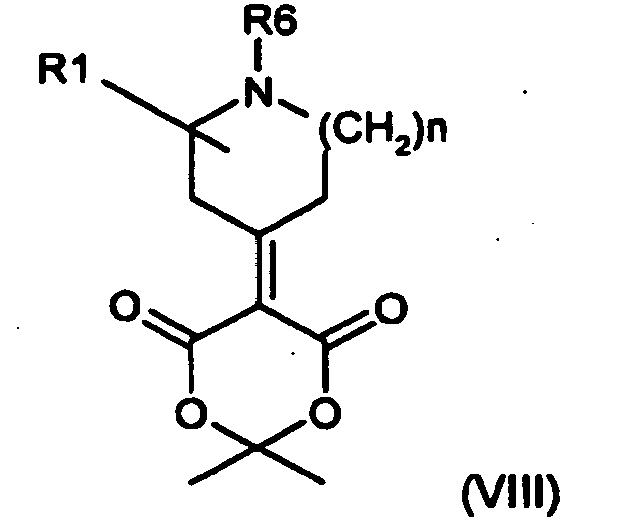

- The reaction conveniently takes place in an aprotic solvent such as a hydrocarbon (e.g toluene), ethers (e.g tetrahydrofuran) and at a temperature within the range -80-25°C, optionally in the presence of Cupper(I) salts such as for example Cupper Iodide.
- Compounds of formula (VI) may be prepared by reaction of a compound of formula (IX) with a cyano derivative (X) wherein R11 has the meaning defined above.

CN(CH2)mCO2R11 (X)
- Compounds of formula (VIII) may be prepared by reaction of a compound of formula (IX) with the derivative (XI).
- Compounds of formulae (V) and (IX) may be prepared with analogous methods to those used for known compounds. Thus, compounds of formula (V) may be prepared according to the procedure described in Cammack et al., Heterocyclic 23,73 (1986) and compounds of formula (IX) may be prepared according to the procedure described in
WO 2001/000206 . - When R6 and/or R2 are a nitrogen protecting group, examples of suitable groups include alkoxycarbonyl e.g. t-butoxycarbonyl, benryloxycarbonyl, arylsulphonyl e.g. phenysulphonyl or 2-trimethylsilylethoxymethyl.
- Protection and deprotection may be effected using conventional techniques such as those described in "Protective Groups in Organic Synthesis 2nd Ed." by T.W. Greene and P. G. M. Wuts (John Wiley and Sons. 1991) and as described in the examples hereinafter.
- When a specific enantiomer of a compound of general formula (I) is required, this may be obtained for example by resolution of a corresponding enantiomeric mixture of a compound of formula (I) using conventional methods.
- Thus, for example, specific enantiomers of the compounds of formula (I) may be obtained from the corresponding enantiomeric mixture of a compound of formula (I) using chiral HPLC procedure.
- Alternatively, enantiomers of a compound of general formula (I) may be synthesised from the appropriate optically active intermediates using any of the general processes described herein.
- Thus, in one embodiment of the invention the enantiomers of the compound of formula (I) may be prepared by reaction of a chiral amine (III) using any of the processes described above for preparing compounds of formula (I) from amine (III).
- The chiral amine (III) may be prepared from the corresponding racemic amine (III) using any conventional procedures such as salt formation with a suitable optically active acid such as for example di-p-toluoyl-D-tartaric acid or di-p-toluoyl-L-tartaric acid, or using chiral HPLC procedure.
- Where it is desired to isolate a compound of formula (I) as a salt, for example a pharmaceutically acceptable salt, this may be achieved by reacting a compound of formula (I) in the form of the free base with an appropriate amount of suitable acid and in a suitable solvent such as an alcohol (e.g. ethanol or methanol), an ester (e.g. ethyl acetate) or an ether (e.g. diethyl ether, tert-butylmethyl ether or tetrahydrofuran).
- Melting points (m.p.) were determined on a Buchi m.p. apparatus and are uncorrected. R.T. or r.t. refer to room temperature.
- Infrared spectra (IR) were measured in chloroform or nujol solutions on a FT-IR instrument. Proton Magnetic Resonance (NMR) spectra were recorded on Varian instruments at 300, 400 or 500 MHz, on Bruker instrument at 300 MHz, chemical shifts are reported in ppm (δ) using the residual solvent line as internal standard. Splitting patterns are designed as s, singlet; d, double; t, triple; q, quartet; m, multiplet; b, broad. The NMR spectra were recorded at temperature ranging from 25 to 90°C; when more than one conformer were detected the chemical shifts for the most abundat one is reported. Mass spectra (MS) were taken on a VG Quattro mass spectrometer. In the mass spectra only one peak in the molecular ion cluster is reported. Optical rotations were determined at 20°C with a Jasco DIP360 instrument (I=10 cm, cell volume = 1 mL, λ = 589 nm). Flash silica gel chromatography was carried out over silica gel 230-400 mesh supplied by Merck AG Darmstadt, Germany. T.I.c. refers to thin layer chromatography on 0.25 mm silica gel plates (60F-254 Merck) and visualized with UV light. For phase separations performed by using microfiltration device: phase separation cartridge with polypropylene frit by Whatman and Alltech. For purifications carried out by using SCX: SCX-cartridges (loading 0.75mmol\g) by Varian.
- Solutions were dried over anhydrous sodium sulphate.
- Methylene chloride was redistilled over calcium hydride and tetrahydrofuran was redistilled over sodium.
- The following abbreviations are used in the text: AcOEt = ethyl acetate, CH = cyclohexane, DCM = methylene chloride, DIPEA = N,N-diisopropylethylamine, DMF = N,N'-dimethylformamide, Et2O = diethyl ether, EtOH = ethanol, MeOH = methanol TEA = triethylamine, THF = tetrahydrofuran, TFA = trifluoroacetic acid.
Enantiomer 1 or enantiomer 2 means a compound of the invention or an intermediate thereof as a single enantiomer whose configuration was not determined. - Anti isomer means a compound of the invention or intermediate thereof wherein the group R1 is different from hydrogen and with reference to the plane of paper it is on the opposite site of the phenyl attached to the cyclic amine ring.
- A round bottom flask equipped with a Dean Stark apparatus was charged with tert-butyl-4-oxo-1-piperidine carboxylate (1.0 g), ethyl cyanoacetate (0.587 mL), ammonium acetate (0.193 g) and acetic acid (0.286 mL) in anhydrous benzene (20 mL). The mixture was heated to reflux overnight, then it was allowed to cool to r.t. and washed with water (20 mL). The aqueous layer was extracted with AcOEt (2 x 10 mL). The combined organic extracts were washed with a 1M sodium hydroxide solution (10 mL), dried and concentrated in vacuo to a residue, which was purified by flash chromatography (CH/AcOEt 8:2) to give the title compound (1.5 g) as a yellow oil.
- Ethyl cyanoacetate (13.9 mL), ammonium acetate (4.64 g) and acetic acid (6.9 mL) were added, under a Nitrogen atmosphere, to a solution of tert-butyl-4-oxo-1-piperidine carboxylate (20 g) in anhydrous toluene (200 mL) in a round bottom flask equipped with a Dean Stark apparatus. The mixture was heated to 110°C for 2 hours, then to 85°C overnight and finally to 130°C for 4 hours. The mixture was allowed to cool to r.t. and washed with 1 M sodium hydroxide solution, water and brine. The organic layer was dried and concentrated in vacuo to a residue, which was purified by flash chromatography (CH/AcOEt 8:2) to give the title compound (15.54 g) as a yellow oil. T.I.c.: CH/AcOEt 8:2, Rf=0.35 (detection with ninhydrine).
IR (nujol, cm-1): 2229 (C≡N), 1720 and 1694 (C=O).
NMR (CDCl3): δ (ppm) 4.29 (q, 2H); 3.61 (t, 2H); 3.55 (t, 2H); 3.13 (t, 2H); 2.78 (t, 2H); 1.49 (s, 9H); 1.36 (t, 3H).
MS (ES/+): m/z=295 [M+H]+. - A solution of intermediate 1 (1.5 g) in anhydrous toluene (15 mL) was dropped over 30 minutes into a solution of 4-fluorophenyl magnesium bromide (2M in Et2O - 6.1 mL) in anhydrous Et2O (50 mL) previously cooled to 0°C under a Nitrogen atmosphere. The mixture was allowed to warm to r.t. and left at this temperature for 2 days. The mixture was treated with 3N sulfuric acid solution (5 mL), water (30 mL) and AcOEt (10 mL). The layers were separated and the aqueous phase was extracted with further AcOEt (2 x 30 mL). The combined organic layers were washed with a saturated sodium hydrogen carbonate solution (60 mL) and water (60 mL), then dried and concentrated in vacuo. The residue was purified by flash chromatography (CH/AcOEt 8:2) to give the title compound (0.448 g) as a yellow oil.
- A solution of 4-fluorophenyl magnesium bromide (1.0M in THF, 49 mL) was added drop-wise to a mixture of intermediate 1 (8 g) and copper iodide (1.57 g) in anhydrous THF (65 mL) previously cooled to 0°C under a Nitrogen atmosphere. The mixture was stirred under these conditions for 1 hour and then allowed to warm to r.t. and stirred at 23°C for 2 hours. The mixture was cooled to 0°C, treated with 3M hydrochloric acid solution until pH=5 and extracted with AcOEt (3 x 100 mL). The combined organic extracts were washed with a saturated ammonium chloride solution (200 mL), dried and concentrated in vacuo. The residue was purified by flash chromatography (CH/AcOEt 85:15) to give the title compound (9.8 g) as a yellow oil.
T.I.c.: CH/AcOEt 6:4, Rf=0.35 (detection with ninhydrine).
NMR (CDCl3): δ (ppm) 7.31 (dd, 2H); 7.06 (t, 2H); 3.95 (q, 2H); 3.87 (bs, 2H); 3.54 (t, 1H); 2.85 (bt, 2H); 2.53 (dt, 2H); 1.9 (m, 2H); 1.4 (s, 9H); 1.02 (t, 3H).
MS (ES/+): m/z=391 [M+H]+. - A mixture of intermediate 2 (0.448 g) in acetic acid (2 mL), conc. sulfuric acid (1 mL) and water (1 mL) was heated to 140°C overnight. The solution was allowed to cool to r.t. and dropped into a 2.5M sodium hydroxide solution (50 mL). Then, di-tert-butyl-dicarbonate (500 mg) was added and the resulting mixture was stirred at r.t. for 5 hours. It was cooled to 0°C and treated with 6M hydrochloric acid solution until pH=1 and then extracted with AcOEt (20 mL). The organic phase was dried, concentrated in vacuo and the residue was purified by flash chromatography (CH/AcOEt 7:3) to give the title compound (210 mg) as a pale yellow foam.
- A mixture of intermediate 113 (0.045 g) in 3-pentanone (2 mL), and water (1 mL) was heated to 102°C for 1 day. The mixture was allowed to cool to r.t and concentrated in vacuo. The residue was purified by preparative HPLC (column: Supelcosil ABZ+Plus 5 µm, 100 x 21.2 mm; mobile phase: A: H2O+0.1% Formic acid; B: CH3CN+0.1% Formic acid; gradient: 5% (B) for 1 min, from 5% (B) to 95% (B) in 10 min, from 95% (B) to 100% (B) in 3 min.; flow rate=20 mL/min; detection: λ=210-400 nm) to give the title compound (0.007 g) as white solid.
- T.I.c.: CH/AcOEt 1:1, Rf=0.25 (detection with ninhydrine).
- NMR (d6-DMSO): δ (ppm) 11.78 (bs, 1H); 7.4 (dd, 2H); 7.15 (t, 2H); 3.45 (m, 2H); 3.11 (m, 2H); 2.54 (s, 2H); 2.04 (m, 2H); 1.89 (m, 2H); 1.37 (s, 9H).
- MS (ES/-): m/z=336 [M-H]-.
- 3,5-Dichlorobenzyl-methylamine (37 mg), 1-(3-dimethylaminopropyl)-3-ethylcarbodiimide hydrochloride (37 mg) and 1-hydroxybenzotriazole (26 mg) were added to a solution of intermediate 3 (60 mg) in anhydrous DMF (2 mL) under a Nitrogen atmosphere. The mixture was stirred at r.t. overnight, then it was diluted with AcOEt (10 mL) and washed with water (10 mL), 0.005M hydrochloric acid solution (15 mL) and a saturated sodium hydrogen carbonate solution (15 mL). The organic layer was dried, concentrated in vacuo and the residue was purified by flash chromatography (CH/AcOEt 6:4) to give the title compound (80 mg) as a colourless oil.
T.I.c.: CH/AcOEt 1:1, Rf=0.35 (detection with ninhydrine).
NMR (d6-DMSO - 70°C): δ (ppm) 7.37 (m, 3H); 7.03 (m, 4H); 4.28 (bs, 2H); 3.48 (m, 2H);
3.12 (m, 2H); 2.71 (bs, 2H); 2.57 (s, 3H); 2.2-1.9 (m, 4H); 1.38 (s, 9H). - Trimethylsilyl trifluoromethanesulfonate (2.17 mL) was added to a solution of tert-butyl-4-oxo-1-piperidine carboxylate (2.0 g) and TEA (3.34 mL) in anhydrous DCM (20 mL) previously cooled to -30°C under a Nitrogen atmosphere. The mixture was stirred at this temperature for 1 hour, then it was quickly treated with cold saturated sodium hydrogen carbonate solution (20 mL). The layers were separated and the the organic phase was dried and concentrated in vacuo to give 1-(tert-butoxycarbonyl)-1,2,3,6-tetrahydro-4-pyridinyl-trifluoromethanesulfonate as a yellow oil, which was dissolved in anhydrous acetonitrile (80 mL) and the resulting solution was treated with Selectfluor (3.89 g). The mixture was stirred at r.t. for 1 hour, then it was concentrated in vacuo and the residue was dissolved in AcOEt (50 mL). The organic layer was washed with a saturated sodium hydrogen solution (30 mL), dried and concentrated in vacuo to a residue, which was purified by chromatography on neutral Alumina Brochmann type 1 (initially AcOEt then AcOEt/MeOH 95:5) to give the title compound (0.99 g) as a colourless oil.
T.I.c.: CH/AcOEt 1:1, Rf=0.3 (detection with ninhydrine).
NMR (d6-DMSO): δ (ppm) 5.08 (dd, 1 H); 4.32 (bm, 1H); 4.0 (bm, 1 H); 3.19 (m, 2H); 2.56 (m, 1H); 2.36 (m, 1H); 1.43 (s, 9H). - A round bottom flask equipped with a Dean Stark apparatus was charged with intermediate 5 (0.99 g), ethyl cyanoacetate (0.534 mL), ammonium acetate (0.176 g) and acetic acid (0.261 mL) in anhydrous benzene (20 mL). The mixture was heated to reflux overnight, then it was allowed to cool to r.t. and washed with water (20 mL). The aqueous layer was extracted with AcOEt (2 x 10 mL). The combined organic extracts were washed with a 1 M sodium hydroxide solution, dried and concentrated in vacuo to a residue, which was purified by flash chromatography (CH/AcOEt 8:2) to give the title compound (0.696 g - cis/trans mixture) as a yellow oil.
T.I.c.: CH/AcOEt 7:3, Rf=0.45 (detection with ninhydrine).
NMR (CDCl3): δ (ppm) 6.49 and 5.55 (2bd, 1H); 4.54 (bm, 1H); 4.34 (bm, 3H); 3.72 (m, 1H); 3.12 (bm, 1H); 2.9 (bm, 1H); 2.74 (m, 1H); 1.49 (s, 9H); 1.38 (t, 3H). - A solution of intermediate 6 (0.696 g) in anhydrous toluene (5 mL) was dropped over 30 minutes into a solution of 4-fluorophenyl magnesium bromide (2M in Et2O - 2.67 mL) in anhydrous Et2O (15 mL) previously cooled to 0°C under a Nitrogen atmosphere. The mixture was allowed to warm to r.t. and stirred at this temperature overnight. The mixture was treated with 3N sulfuric acid solution (3 mL), water (10 mL) and AcOEt (25 mL). The layers were separated and the aqueous phase was extracted with further AcOEt (2 x 30 mL). The combined organic layers were washed with a saturated sodium hydrogen carbonate solution (60 mL) and water (60 mL), then dried and concentrated in vacuo. The residue was purified by flash chromatography (CH/AcOEt 8:2) to give the title compound (0.383 g) as a yellow oil.
T.I.c.: CH/AcOEt 8:2, Rf=0.27 (detection with ninhydrine).
NMR (CDCl3): δ (ppm) 7.5-6.8 (m, 4H); 4.8 (bm, 2H); 4.5-3.5 (bm; 3H); 3.85 (s, 1H); 3.2-2.4 (bm, 2H); 2.2 (bm, 2H); 1.4 (s, 9H); 1.05 (2t, 3H). - A mixture of intermediate 7 (0.383 g) in acetic acid (2 mL), conc. sulfuric acid (1 mL) and water (1 mL) was heated to 140°C overnight. The solution was allowed to cool to r.t. and dropped into a 3M sodium hydroxide solution (50 mL). Then, di-tert-butyl-dicarbonate (409 mg) was added and the resulting mixture was stirred at r.t. overnight. It was cooled to 0°C and treated with 3M hydrochloric acid solution until pH=1 and then extracted with AcOEt (20 mL). The organic phase was dried, concentrated in vacuo and the residue was purified by flash chromatography (CH/AcOEt 7:3) to give the title compound (96 mg) as a pale yellow oil.
T.I.c.: CH/AcOEt 1:1, Rf=0.5 (detection with ninhydrine).
NMR (d6-DMSO): δ (ppm) 11.89 (bs, 1H); 7.46 (dd, 2H); 7.16 (t, 2H); 5.36 (dd, 1H); 3.96 (bm, 1H); 3.75 (bm, 1H); 3.2-2.6 (bm, 3H); 2.5 (m, 1H); 2.36 (bd, 1H); 1.93 (bm, 1H); 1.38 (s, 9H). - 3,5-Dichlorobenzyl-methylamine (53 mg), 1-(3-dimethylaminopropyl)-3-ethylcarbodiimide hydrochloride (53 mg) and 1-hydroxybenzotriazole (38 mg) were added to a solution of intermediate 8 (90 mg) in anhydrous DMF (4 mL) under a Nitrogen atmosphere. The mixture was stirred at r.t. overnight, then it was diluted with AcOEt (20 mL) and washed with water (15 mL), 0.005M hydrochloric acid solution (15 mL) and a saturated sodium hydrogen carbonate solution (15 mL). The organic layer was dried, concentrated in vacuo and the residue was purified by flash chromatography (CH/AcOEt 8:2) to give the title compound (62 mg) as a white foam.
T.I.c.: CH/AcOEt 7:3, Rf=0.30 (detection with ninhydrine).
NMR (d6-DMSO - 60°C): δ (ppm) 7.42 (m, 3H); 7.08 (m, 2H); 6.98 (bs, 2H); 5.58-5.5 (bd, 1H); 4.28 (m, 2H); 3.99 (m, 1H); 3.75 (bm, 1H); 3.0 (bm, 1H); 2.89 (d, 1 H); 2.79 (bm, 1H); 2.68 (d, 1H); 2.64-2.57 (2bs, 1H); 2.4 (bm, 1H); 2.04-1.98 (2bm, 1 H); 1.38 (s, 9H). - A solution of 3,4-dimethoxy-benzyl alcohol (1.5 g) in anhydrous DCM (5 mL) was dropped into a solution of thionyl chloride (1.3 mL) in anhydrous DCM (6 mL) under a Nitrogen atmosphere. The solution was heated to reflux for 1 hour, then allowed to cool to r.t. and concentrated in vacuo. The residue was purified by flash chromatography (CH/AcOEt 6:4) to give the title compound (1.63 g) as a white solid.
T.I.c.: CH/AcOEt 6:4, R=0.63.
NMR (CDCl3): δ (ppm) 7.94 (dd, 1H); 6.92 (d, 1H); 6.83 (d, 1H); 4.57 (s, 2H); 3.9 (s, 3H); 3.89 (s, 3H).
MS (EI/+): m/z=186 [MS]+. - Intermediate 10 (1.38 g) was added to a mixture of diethanolamine (0.71 mL) and potassium carbonate (1.12 g) in anhydrous toluene (13 mL) previously heated to 60°C under a Nitrogen atmosphere. The resulting mixture was heated to reflux for 1 hour, then allowed to cool to r.t., filtered off and the organic phase was concentrated in vacuo to give the title compound (1.87 g) as a yellow oil.
NMR (CDCl3): δ (ppm) 6.85 (dd, 1H); 6.8 (d, 2H); 3.9 (2s, 6H); 3.6 (s, 2H); 3.55 (dd, 4H); 2.6-2.7 (d, 4H). - A solution of 2-bromo-5-fluorotoluene (10.8 mL) in anhydrous THF (40.5 mL) was dropped into a suspension of magnesium turning (2.2 g) and few crystals of iodine in anhydrous THF (21.5 mL) under a Nitrogen atmosphere. The mixture refluxed for 30 minutes, then it was allowed to cool to r.t. and added drop-wise to a mixture of intermediate 1 (8 g) and copper iodide (1.6 g) in anhydrous THF (66 mL) previously cooled to 0°C under a Nitrogen atmosphere. The mixture was allowed to warm to r.t. and stirred at 23°C for 1.5 hours. The mixture was cooled to 0°C, treated with 3M hydrochloric acid solution until pH=5 and extracted with AcOEt (3 x 100 mL). The combined organic extracts were washed with a saturated ammonium chloride solution (200 mL), dried and concentrated in vacuo. The residue was purified by flash chromatography (CH/AcOEt 8:2) to give the title compound (6.71 g) as a white foam.
T.I.c.: CH/AcOEt 8:2, Rf=0.17(detection with ninhydrine).
NMR (CDCl3): δ (ppm) 7.33 (dd, 1H); 7.07 (t, 1H); 7.0 (td, 1H); 4.48 (s, 1H); 3.99-3.81 (m, 4H); 2.72-2.53 (m, 4H); 2.46 (s, 3H); 1.86-1.74 (m, 2H); 1.36 (s, 9H); 0.94 (t, 3H).
MS (ES/+): m/z=427 [M+Na]+. - A mixture of intermediate 27 (298 mg) in acetic acid (4.3 mL), conc. sulfuric acid (1.1 mL) and water (1.1 mL) was heated to 140°C for 5 hours. The solution was allowed to cool to r.t. and dropped into a 2.5M sodium hydroxide solution (38 mL). Then, di-tert-butyl-dicarbonate (217.6 mg) was added and the resulting mixture was stirred at r.t. over week end. It was cooled to 0°C and treated with 6M hydrochloric acid solution until pH=6-7 and then extracted with AcOEt (3 x 20 mL). The organic phase was washed with brine, dried and concentrated in vacuo. The residue was purified by flash chromatography (CH/AcOEt from 8:2 to 6:4) to give the title compound (131 mg) as a white solid.
T.I.c.: CH/AcOEt 6:4, Rf=0.12 (detection with ninhydrine).
NMR (d6-DMSO): δ (ppm) 11.8 (bs, 1H); 7.28 (dd, 2H); 6.96 (dd, 1H); 6.91 (td, 1H); 3.4 (bm, 2H); 3.22 (bm, 2H); 2.7 (s, 2H); 2.47 (s, 3H); 2.1 (m, 2H); 2.01 (m, 2H); 1.37 (s, 9H).
MS (ES/+): m/z=374 [M+Na]+. - DIPEA (91 µL) and O-(benzotriazol-1-yl)-N,N,N'N'-tetramethyluronium tetrafluoroborate (54.6 mg) were added to a solution of intermediate 28 (46 mg) in anhydrous DMF (3.8 mL) under a Nitrogen atmosphere. After stirring for 30 minutes, 3,5-dichlorobenzyl-methylamine hydrochloride (59.3 mg) was added. The mixture was stirred at r.t. overnight, then it was diluted with AcOEt and washed with 5% sodium hydrogen carbonate solution and brine. The organic layer was dried, concentrated in vacuo and the residue was purified by flash chromatography (CH/AcOEt from 9:1 to 6:4) to give the title compound (34 mg) as a colourless oil.
T.I.c.: CH/AcOEt 6:4, Rf=0.16 (detection with ninhydrine). IR (nujol, cm-1): 1699 and 1643 (C=O).
NMR (d6-DMSO): δ (ppm) 7.42 (dd, 1H); 7.24 (dd, 1H); 6.98 (d, 2H); 6.88 (dd, 1H); 6.83 (td, 1H); 4.26 (s, 2H); 3.45-3.08 (m, 4H); 2.23-1.99 (m, 4H); 2.81 (s, 3H); 2.58 (s, 2H); 2.41 (s, 3H); 1.33 (s, 9H).
MS (ES/+): m/z=545 [M+Na]+. - DIPEA (241 µL) and O-(benzotriazol-1-yl)-N,N,N'N'-tetramethyluronium tetrafluoroborate (144.4 mg) were added to a solution of intermediate 28 (122 mg) in anhydrous DMF (10 mL) under a Nitrogen atmosphere. After stirring for 30 minutes, 3,5-(bis-trifluoromethylbenzyl)-methylamine hydrochloride (293.5 mg) was added. The mixture was stirred at r.t. for 2 hours, then it was diluted with AcOEt and washed with 5% sodium hydrogen carbonate solution and brine. The organic layer was dried, concentrated in vacuo and the residue was purified by flash chromatography (CH/AcOEt from 9:1 to 1:1) to give the title compound (159 mg) as a colourless oil.
T.I.c.: CH/AcOEt 6:4, Rf=0.1 (detection with ninhydrine).
IR (nujol, cm-1): 1737 and 1638 (C=O).
NMR (d6-DMSO): δ (ppm) 7.98 (s, 1H); 7.74 (s, 1H); 7.21 (dd, 1H); 6.87 (dd, 1 H); 6.74 (td, 1H); 4.47 (s, 2H); 3.49 (m, 2H); 3.1 (m, 2H); 2.87 (s, 2H); 2.67 (s, 3H); 2.42 (s, 3H); 2.23 (m, 2H); 2.02 (m, 2H); 1.36 (s, 9H).
MS (ES/+): m/z=613 [M+Na]+. - Ethyl diazoacetate (6.84 mL) and boron trifluoride diethyl etherate (6.34 mL) were added simultaneously over 1 hour to a suspension of tert-butyl-4-oxo-1-piperidine carboxylate (10.0 g) in dry Et2O (60 mL) previously cooled to -25°C under a Nitrogen atmosphere.
- The solution obtained was stirred at -25°C for 1 hour, then it was allowed to warm to 0°C and stirred at 0°C for 1 hour. The solution was treated with a saturated potassium carbonate solution (10 mL). The layers were separated; the organic phase was dried and concentrated in vacuo to a residue, which was purified by flash chromatography (petroleum/Et2O 6:4) to give the title compound (11.58 g) as a colourless oil.
T.I.c.: petroleum/Et2O 1:1, Rf=0.48 (detection with phosphomolybdic acid).
IR (nujol, cm-1): 1744 and 1695 (C=O). NMR (d6-DMSO): δ (ppm) 4.08 (q, 3H); 3.82-3.64 (m, 2H); 3.38 (m, 2H); 2.64 (m, 2H); 1.9-1.64 (m, 2H); 1.36 (s, 9H); 1.16 (t, 3H).
MS (ES/+): m/z=286 [MH]+. - A suspension of intermediate 31 (11.58 g) in 3M hydrochloric acid (60 mL) was heated to reflux for 7 hours. The mixture was allowed to cool to r.t. and concentrated in vacuo. The residue was triturated with abs. EtOH (10 mL) to give the title compound (4.54 g) as a white solid.
M.p.: 189-191°C.
NMR (d6-DMSO): δ (ppm) 9.17 (bs, 2H); 3.3 (m, 2H); 3.22 (m, 2H); 2.75 (m, 2H); 2.62 (m,
2H); 1.93 (m, 2H). - Di tert-butyl dicarbonate (0.7 g) was added to a suspension of intermediate 32 (0.4 g) and TEA (0.45 mL) in anhydrous DCM (5 mL) previously cooled to 0°C under a Nitrogen atmosphere. The mixture was stirred for 1 hour at 0°C then it was allowed to reach r.t..
- The mixture was treated with a saturated ammonium chloride solution (10 mL) and extracted with further DCM (2 x 10 mL). The combined organic extracts were washed with water, dried and concentrated in vacuo. The residue was purified by flash chromatography (CH/AcOEt 7:3) to give the title compound (528 mg) as a colourless oil.
- T.I.c.: CH/AcOEt 6:4, Rf=0.3 (detection with ninhydrine).
NMR (d6-DMSO): δ (ppm) 3.53 (bm, 2H); 3.45 (bm, 2H); 2.58 (m, 2H); 2.52 (m, 2H); 1.61 (bm, 3H); 1.37 (s, 9H). - A round bottom flask equipped with a Dean Stark apparatus was charged with intermediate 33 (1.87 g), ethyl cyanoacetate (1.03 mL), methyl ammonium acetate (0.339 g) and acetic acid (0.5 mL) in anydrous benzene (15 mL). The mixture was heated to reflux overnight, then it was allowed to cool to r.t. and washed with water (10 mL). The aqueous layer was extracted with AcOEt (2 x 10 mL). The combined organic extracts were washed with a 1M sodium hydroxide solution (10 mL), dried and concentrated in vacuo to a residue, which was purified by flash chromatography (CH/AcOEt 8:2) to give the title compound (2.49 g - cis/trans mixture) as a colourless oil.
T.I.c.: CH/AcOEt 8:2, Rf=0.25 (detection with ninhydrine). NMR (d6-DMSO): δ (ppm) 4.23 (q, 2H); 3.57 (t, 1H); 3.51 (t, 1 H); 3.37 (m, 2H); 3.18 (t,
1H); 2.96 (m, 2H); 2.77 (m, 1H); 1.7 (m, 2H); 1.39-1.36 (m, 9H); 1.28-1.21 (m, 6H). - A solution of intermediate 34 (0.5 g) in anhydrous toluene (5 mL) was dropped over 30 minutes into a solution of 4-fluorophenyl magnesium bromide (2M in Et2O - 1.95 mL) in anhydrous Et2O (15 mL) previously cooled to 0°C under a Nitrogen atmosphere. The mixture was allowed to warm to r.t. and left at this temperature for 2 days. The mixture was treated with 3N sulfuric acid solution (5 mL), water (10 mL) and AcOEt (15 mL). The layers were separated and the aqueous phase was extracted with further AcOEt (2 x 15 mL). The combined organic layers were washed with a saturated sodium hydrogen carbonate solution (30 mL) and water (30 mL), then dried and concentrated in vacuo. The residue was purified by flash chromatography (CH/AcOEt 8:2) to give the title compound (331 mg) as a colourless oil.
T.I.c.: CH/AcOEt 8:2, Rf=0.30 (detection with ninhydrine).
NMR (CDCl3): δ (ppm) 7.3 (m, 2H); 7.05 (m, 2H); 4.0 (bm, 2H); 4.2-2.5 (bm, 4H); 3.4 (s, 1H); 2.4-1.5 (bm, 6H); 1.4 (s + t, 12H). - A mixture of intermediate 35 (0.33 g) and a 15% potassium hydroxide solution in ethylene glycol (7 mL) was heated to 180°C overnight. The solution was allowed to cool to r.t., diluted with water (5 mL), cooled at 0°C and acidified with 15% hydrochloric acid until pH=1. The glycol-aqueous phase was distilled off (70°C/2 mbar) to leave a brown residue which was further dried (140°C/2 mbar for 1 hour) to give a mixture of 4-carboxymethyl-4-(4-fluorophenyl)-azepine and potassium chloride (700 mg).
- Sodium hydroxide (24 mg) and di-tert-butyl-dicarbonate (60 mg) were added to a part of this material (80 mg) suspended in water (5 mL). The solution was stirred at r.t. overnight, then it was cooled to 0°C and treated with 0.1 M hydrochloric acid solution until pH=1 and extracted with Et2O (20 mL). The organic phase was dried, concentrated in vacuo and the residue was purified by flash chromatography (CH/AcOEt 1:1) to give the title compound (17 mg) as a colourless oil.
- T.I.c.: CH/AcOEt 1:1, Rf=0.25 (detection with ninhydrine).
- NMR (CDCl3): δ (ppm) 7.25 (m, 2H); 6.95 (t, 2H); 3.8-3.4 (m, 2H); 3.2 (m, 2H); 2.6 (s, 2H);2.5 (m, 3H); 2.3 (m, 1 H); 2.0-1.5 (m, 2H); 1.4 (bs, 9H).
- 3,5-(Bis-trifluoromethyl-benzyl)-methylamine (14 mg), 1-(3-dimethylaminopropyl)-3-ethylcarbodiimide hydrochloride (10 mg) and 1-hydroxybenzotriazole (7 mg) were added to a solution of intermediate 36 (17 mg) in anhydrous DMF (2 mL) under a Nitrogen atmosphere. The mixture was stirred at r.t. overnight, then it was diluted with AcOEt (10 mL) and washed with water (10 mL), 0.005M hydrochloric acid solution (10 mL) and a saturated sodium hydrogen carbonate solution (10 mL). The organic layer was dried, concentrated in vacuo and the residue was purified by flash chromatography (CH/AcOEt 6:4) to give the title compound (18 mg) as a colourless oil.
T.I.c.: CH/AcOEt 6:4, Rf=0.4.
NMR (d6-DMSO - 70°C): δ (ppm) 7.93 (bs, 1H); 7.78 (bs, 2H); 7.31 (m, 2H); 6.97 (bt, 2H); 4.51 (m, 2H); 3.51 (bm, 1H); 3.35 (bm, 1 H); 3.15 (m, 2H); 2.71 (s, 3H); 2.7 (m, 2H); 2.48 (m, 1H); 2.26 (m, 1 H); 2.04 (m, 1H); 1.87 (m, 1 H); 1.69 (m, 1H); 1.51 (1 H); 1.35 (s, 9H). - A small amount of iodine and 3 drops of methyl iodide were added to a suspension of magnesium turnings (655 mg) in dry Et2O (15 mL), at r.t., under a Nitrogen atmosphere, then the mixture was vigorously refluxed. 2-Bromo-5-fluoro-toluene (3.1 mL) was added over 1 hour to this mixture followed by further Et2O (5 mL). The suspension was heated under vigorous reflux for 1.5 hours, then further Et2O (40 mL) was added. A solution of intermediate 34 (2.5 g) in anhydrous Et2O (10 mL) was added to the solution of Grignard so obtained over 30 minutes. The resulting solution was refluxed for further 30 minutes then it was cooled to 0°C, a 3M sulfuric acid solution (15 mL) and water (25 mL) were added and the aqueous layer was extracted with AcOEt (2 x 30 mL).
The combined organic extracts were washed with a saturated sodium hydrogen carbonate solution (50 mL) and concentrated in vacuo. The residue was purified by flash chromatography (CH/AcOEt from 8:2 to 6:4) to give the title compound (531 mg) as a white foam.
T.I.c.: CH/AcOEt 1:1, Rf=0.76 (detection with ninhydrine).
NMR (CDCl3): δ (ppm) 7.3 (m, 2H); 7.05 (m,2H); 4.0 (bm, 2H); 4.2-2.5 (bm, 4H); 3.4 (s, 1H); 2.4-1.5 (bm, 6H); 1.4 (s + t, 12H). - A mixture of intermediate 38 (0.531 g) in acetic acid (3 mL), conc. sulfuric acid (1 mL) and water (1 mL) was heated to 140°C overnight. The solution was allowed to cool to r.t. and dropped into a 2.5M sodium hydroxide solution (50 mL). Then, di-tert-butyl-dicarbonate (277 mg) was added and the resulting mixture was stirred at r.t. for 5 hours. It was cooled to 0°C and treated with 6M hydrochloric acid solution until pH=1 and then extracted with AcOEt (20 mL). The organic phase was dried, concentrated in vacuo and the residue was purified by flash chromatography (CH/AcOEt 7:3) to give the title compound (60 mg) as a pale yellow oil.
T.I.c.: CH/AcOEt 1:1, Rf=0.35 (detection with ninhydrine).
NMR (d6-DMSO): δ (ppm) 11.88 (bs, 1H); 7.3 (m, 1H); 6.99 (m, 1H); 6.91 (m, 1H); 3.6-3.0 (m, 4H); 2.6-2.4 (m, 2H); 2.45 (s, 3H); 2.6-2.4 (m, 2H); 2.05-1.9 (m, 2H); 1.8-1.4 (m, 2H); 1.3 (s, 9H). - DIPEA (43 µL) and O-(benzotriazol-1-yl)-N,N,N'N'-tetramethyluronium tetrafluoroborate (34.3 mg) were added to a solution of intermediate 39 (30 mg) in anhydrous DMF (3 mL) under a Nitrogen atmosphere. After stirring for 10 minutes, 3,5-(bis-trifluoromethylbenzyl)-methylamine hydrochloride (25.5 mg), was added. The mixture was stirred at r.t. overnight, then it was diluted with AcOEt (10 mL) and washed with water (10 mL) and a saturated sodium hydrogen carbonate solution (10 mL). The organic layer was dried, concentrated in vacuo and the residue was purified by flash chromatography (CH/AcOEt 6:4) to give the title compound (30 mg) as a colourless oil.
T.I.c.: CH/AcOEt 1:1, Rf=0.4.
NMR (d6-DMSO - 60°C): δ (ppm) 7.94 (s, 1H); 7.8 (s, 2H); 7.16 (m, 1H); 6.89 (m, 1H); 6.75 (m, 1H); 4.54 (s, 2H); 3.6-3.0 (m, 4H); 2.7 (s, 3H); 2.8-2.4 (m, 4H); 2.44 (s, 3H); 1.98 (m, 1H); 1.74 (m, 2H); 1.49 (m, 1H); 1.3 (bs, 9H). - DIPEA (34.3 µL) and O-(benzotriazol-1-yl)-N,N,N'N'-tetramethyluronium tetrafluoroborate (34.3 mg) were added to a solution of intermediate 39 (30 mg) in anhydrous DMF (3 mL) under a Nitrogen atmosphere. After stirring for 10 minutes, 3,5-dichlorobenzyl-methylamine hydrochloride (20.5 mg) was added. The mixture was stirred at r.t. overnight, then it was diluted with AcOEt (10 mL) and washed with water (10 mL) and a saturated sodium hydrogen carbonate solution (10 mL). The organic layer was dried, concentrated in vacuo and the residue was purified by flash chromatography (CH/AcOEt 6:4) to give the title compound (30 mg) as a colourless oil.
T.I.c.: CH/AcOEt 1:1, Rf=0.4.
NMR (d6-DMSO): δ (ppm) 7.55-7.45 (m, 1H); 7.25-7.15 (m, 1H); 7.11 (s, 1H); 7.08 (s, 1H); 7.0-6.8 (m, 2H); 4.45-4.3 (m, 2H); 3.6-3.0 (m, 4H); 2.85-2.4 (m, 4H); 2.69 (s, 3H); 2.44 (s, 3H); 2.0-1.8 (m, 1H); 1.72 (m, 2H); 1.5-1.4 (m, 1H); 1.3 (bs, 9H). - Trimethylsilyl trifluoromethanesulfonate (2.17 mL) was added to a solution of tert-butyl-4-oxo-1-piperidine carboxylate (2.0 g) and TEA (3.34 mL) in anhydrous DCM (20 mL) previously cooled to -30°C under a Nitrogen atmosphere. The mixture was stirred at this temperature for 1 hour, then it was quickly treated with cold saturated sodium hydrogen carbonate solution (20 mL). The layers were separated and the organic phase was dried and concentrated in vacuo to give 1-(tert-butoxycarbonyl)-1,2,3,6-tetrahydro-4-pyridinyl-trifluoromethanesulfonate as a yellow oil, which was dissolved in anhydrous acetonitrile (80 mL) and the resulting solution was treated with Selectfluor (3.89 g). The mixture was stirred at r.t. for 1 hour, then it was concentrated in vacuo and the residue was dissolved in AcOEt (50 mL). The organic layer was washed with a saturated sodium hydrogen solution (30 mL), dried and concentrated in vacuo to a residue, which was purified by chromatography on neutral Alumina Brochmann type 1 (initially AcOEt then AcOEt/MeOH 95:5) to give the title compound (0.99 g) as a colourless oil.
T.I.c.: CH/AcOEt 1:1, Rf=0.3.
NMR (d6-DMSO): δ (ppm) 5.08 (dd, 1H); 4.32 (bm, 1H); 4.0 (bm, 1H); 3.19 (m, 2H); 2.56 (m, 1 H); 2.36 (m, 1H); 1.43 (s, 9H). - Ethyl diazoacetate (7.8 mL) and boron trifluoride diethyl etherate (7.2 mL) were added simultaneously over 50 minutes to a suspension of intermediate 42 (12.39 g) in dry Et2O (250 mL) previously cooled to -20°C under a Nitrogen atmosphere. The solution obtained was stirred at -20°C for 1 hour, then it was allowed to warm to 0°C, and treated with a saturated potassium carbonate solution (200 mL). The layers were separated and the organic phase was dried and concentrated in vacuo. The residue was purified by flash chromatography (CH/AcOEt 9:1) to give the title compound (5.42 g) as a yellow oil.
T.I.c.: CH/AcOEt 85:15, Rf=0.1 (detection with ninhydrine).
NMR (CDCl3): δ (ppm) 5.06 (dt, 1H); 4.3-4.1 (m, 2H); 3.53 (m, 1H); 4.0-3.2 (bs, 4H); 2.2-2.0 (m, 2H); 1.4 (s, 9H); 1.3-1.2 (t, 3H).
MS (ES/+): m/z=304 [MH]+. - A suspension of intermediate 43 (100 mg) in 3M hydrochloric acid (5 mL) was heated to reflux for 6 hours. The mixture was concentrated in vacuo to give the 3-fluoro-azepin-4-one hydrochloride (60.5 mg) as a whitish solid.
Di tert-butyl dicarbonate (86 mg) was added to a suspension of this compound (60.5 mg) and TEA (0.1 mL) in anhydrous DCM (5 mL) under a Nitrogen atmosphere. The mixture was stirred at r.t. overnight. The mixture was treated with a saturated ammonium chloride solution (10 mL) and extracted with further DCM (2 x 10 mL) The combined organic extracts were dried and concentrated in vacuo. The residue was purified by flash chromatography (CH/AcOEt 7:3) to give the title compound (50 mg) as a colourless oil.
T.I.c.: CH/AcOEt 7:3, Rf=0.23 (detection with ninhydrine).
NMR (d6-DMSO - 70°C): δ (ppm) 5.15 (dt, 1H); 3.76 (m, 2H); 3.53 (bm, 1H); 3.23 (bm, 1 H); 2.54 (m, 1H); 2.43 (m, 1H); 1.71 (m, 1H); 1.64 (m, 1 H); 1.35 (s, 9H). - A round bottom flask equipped with a Dean Stark apparatus was charged with intermediate 44 (1.136 g), ethyl cyanoacetate (0.576 mL), methyl ammonium acetate (0.189 g) and acetic acid (0.281 mL) in anydrous benzene (9 mL). The mixture was heated to reflux overnight, then it was allowed to cool to r.t. and washed with water (20 mL). The aqueous layer was extracted with AcOEt (2 x 20 mL). The combined organic extracts were washed with 1M sodium hydroxide solution (20 mL) and a saturated ammonium chloride solution (20 mL), dried and concentrated in vacuo. The residue was purified by flash chromatography (CH/AcOEt 8:2) to give the title compound (0.873 g - cis/trans mixture) as a colourless oil.
T.I.c.: CH/AcOEt 7:3, Rf=0.28 (detection with ninhydrine).
MS (ES/+): m/z= 326 [MH]+. - A small amount of iodine and 3 drops of methyl iodide were added to a suspension of magnesium turnings (215 mg) in dry Et2O (5 mL), at r.t., under a Nitrogen atmosphere, then the mixture was vigorously refluxed. 2-Bromo-5-fluoro-toluene (1.016 mL) was added over 1 hour to this mixture followed by further Et2O (2 mL). The suspension was heated under vigorous reflux for 1 hour. A solution of intermediate 45 (0.873 g) in anhydrous Et2O (3 mL) was added to the solution of Grignard so obtained over 30 minutes. The resulting mixture was refluxed for further 30 minutes then it was cooled to 0°C, a 3M sulfuric acid solution (3 mL) was added and the aqueous layer was extracted with AcOEt (2 x 30 mL).
- The combined organic layers were washed with a saturated sodium hydrogen carbonate solution (30 mL) and water (15 mL), then dried and concentrated in vacuo. The residue was purified by flash chromatography (CH/AcOEt from 9:1 to 8:2) to give the title compound (308.4 mg) as a colourless oil.
T.I.c.: CH/AcOEt 8:2, Rf=0.21 (detection with ninhydrine).
NMR (d6-DMSO - 70°C): δ (ppm) 7.34-7.27 (2m, 2H); 7.05-6.96 (bm, 2H); 5.8 (2bd, 1H); 4.58-4.33 (2s, 1 H); 4.07 (m, 2H); 3.8-3.5 (bm, 2H); 3.4-3.0 (bm, 2H); 2.7-2.3 (bm, 1H); 1.8 (1.6 (bm, 1H); 1.8-1.6 (bm, 1H); 1.5-1.2 (bm, 1H); 1.23 (bs, 9H); 1.13-0.96 (2t, 3H).
MS (ES/+): m/z= 437 [MH]+. - A mixture of intermediate 46 (0.29 g) in acetic acid (3 mL), conc. sulfuric acid (1 mL) and water (1 mL) was heated to 140°C for 6 hours. The solution was allowed to cool to r.t. and dropped into a 2.5M sodium hydroxide solution (30 mL). Then, di-tert-butyl-dicarbonate (145 mg) was added and the resulting mixture was stirred at r.t. overnight. It was cooled to 0°C and treated with 6M hydrochloric acid solution until pH=1 and then extracted with AcOEt (20 mL). The organic phase was dried, concentrated in vacuo and the residue was purified by flash chromatography (CH/AcOEt from 8:2 to 6:4) to give the title compound (79.7 mg) as a pale yellow oil.
T.I.c.: CH/AcOEt 7:3, Rf=0.18 (detection with ninhydrine).
NMR (d6-DMSO - 70°C): δ (ppm) 11.64 (bs, 1H); 7.25 (dd, 1H); 6.96 (dd, 1H); 5.57 (dt, 1H); 3.78 (bm, 2H); 3.18 (bt, 2H); 2.83 (d, 1H); 2.68 (d, 1H); 2.47 (s, 3H); 2.33 (m, 1H); 2.09 (m, 1H); 1.79 (m, 1H); 1.59 (m, 1H); 1.31 (s, 9H).
MS (ES/+): m/z= 384 [MH]+. - DIPEA (50 µL) and O-(benzotriazol-1-yl)-N,N,N'N'-tetramethyluronium tetrafluoroborate (37 mg) were added to a solution of intermediate 47 (34 mg) in anhydrous DMF (5 mL) under a Nitrogen atmosphere. After stirring for 10 minutes, 3,5-(bis-trifluoromethylbenzyl)-methylamine hydrochloride (28.7 mg), was added. The mixture was stirred at r.t. overnight, then it was diluted with AcOEt (10 mL) and washed with water (10 mL). The organic layer was dried, concentrated in vacuo and the residue was purified by flash chromatography (CH/AcOEt 7:3) to give the title compound (37.1 mg) as a colourless oil.
T.I.c.: CH/AcOEt 7:3, Rf=0.19.
NMR (d6-DMSO): δ (ppm) 8.04-7.88 (2bs, 1H); 7.77-7.72 (2bs, 2H); 7.12 (m, 1H); 6.91 (m, 1H); 6.73 (m, 1H); 5.8-5.62 (2bd, 1H); 4.8-4.4 (m, 2H); 3.9-3.5 (bm, 2H); 3.13 (bm, 2H); 2.92 (bm, 2H); 2.83-2.81 (2bs, 3H); 2.44-2.42 (2bs, 3H); 2.35-2.0 (bm, 2H); 1.67 (bm,
1H); 1.48 (bm, 1 H); 1.28 (s, 9H). - DIPEA (50 µL) and O-(benzotriazol-1-yl)-N,N,N'N'-tetramethyluronium tetrafluoroborate (36.2 mg) were added to a solution of intermediate 47 (33.2 mg) in anhydrous DMF (5 mL) under a Nitrogen atmosphere. After stirring for 10 minutes, 3,5-dichlorobenzyl-methylamine hydrochloride (21.6 mg), was added. The mixture was stirred at r.t. overnight, then it was diluted with AcOEt (10 mL) and washed with water (10 mL). The organic layer was dried, concentrated in vacuo and the residue was purified by flash chromatography (CH/AcOEt 75:25) to give the title compound (38.4 mg) as a colourless oil. T.I.c.: CH/AcOEt 7:3, Rf=0.21.
NMR (d6-DMSO): δ (ppm) 7.49-7.42 (2t, 1H); 7.13 (m, 1H); 7.02 (d, 2H); 6.85 (m, 2H); 5.81-5.65 (2bd, 1H); 4.41-4.28 (2m, 2H); 3.9-3.5 (m, 2H); 3.08 (bm, 2H); 2.86 (m, 2H); 2.72-2.7 (2s, 3H); 2.41-2.4 (2s, 3H); 2.35-2.0 (bm, 2H); 1.65 (bm, 1H); 1.45 (bm, 1H); 1.25 (s, 9H). - A solution of phenyl magnesium bromide (1.0M in THF - 37 mL) was added drop-wise to a mixture of intermediate 1 (6 g) and copper iodide (1.18 g) in anhydrous THF (48 mL) previously cooled to 0°C under a Nitrogen atmosphere. The mixture was allowed to warm to r.t. and stirred at 23°C for 40 minutes. The mixture was cooled to 0°C, treated with 3M hydrochloric acid solution until pH=5 and extracted with AcOEt (3 x 50 mL). The combined organic extracts were washed with a saturated ammonium chloride solution (100 mL), dried and concentrated in vacuo. The residue was purified by flash chromatography (CH/AcOEt 85:15) to give the title compound (5.2 g) as a colourless oil.
T.I.c.: CH/AcOEt 8:2, Rf=0.24 (detection with ninhydrine). - A mixture of intermediate 50 (5.2 g) in acetic acid (59 mL), conc. sulfuric acid (19.5 mL) and water (19.5 mL) was heated to 140°C for 12 hours. The solution was allowed to cool to r.t., a 2.5M sodium hydroxide solution added, followed by sodium hydroxide pellets until pH 8. Then, di-tert-butyl-dicarbonate (5.9 g) was added and the resulting mixture was stirred at r.t. for 2 days. It was cooled to 0°C and treated with 6M hydrochloric acid solution until pH=6-7 and then extracted with AcOEt (3 x 50 mL). The organic phase was washed with brine, dried and concentrated in vacuo. The residue was purified by flash chromatography (CH/AcOEt 8:2 ) to give the title compound (2.15 g) as a white solid.
- T.I.c.: CH/AcOEt 1:1, Rf=0.18 (detection with ninhydrine).
- MS (ES/+): m/z= 342 [M+Na]+.
- Methylamine (2M solution in MeOH - 13 mL) was added to a solution of 3,5-dichloroacetophenone (500 mg) in MeOH (26 mL) under a Nitrogen atmosphere. The mixture was stirred at r.t. for 18 hours, then it was cooled to 0°C and sodium borohydride (98 mg) was added. The mixture was stirred at 0°C for 2 hours, then it was quenched with water and extracted with DCM. The organic layer was dried and concentrated in vacuo to give the title compound (340 mg) as an yellow oil.
T.I.c.: CH/AcOEt 1:1, Rf=0.15.
NMR (CDCl3): δ (ppm) 7.3 (m, 3H); 3.6 (q, 1H); 2.3 (s, 3H); 1.35 (d, 3H).
MS (ES/+): m/z=204 [M+H]+. - Methylamine (2M solution in MeOH - 138 mL) was added to a solution of 3,5-dibromoacetophenone (7.7 g) in MeOH (138 mL) under a Nitrogen atmosphere. The mixture was stirred at r.t. overnight, then it was cooled to 0°C and sodium borohydride (1.57 g) was added. The mixture was allowed to reach r.t. in 3 hours, then it was concentrated in vacuo, the residue was dissolved in Et2O and washed with water and brine. The organic layer was dried and concentrated in vacuo to give the title compound (7.8 g) as an orange oil.
T.I.c.: DCM/MeOH 9:1, Rf=0.32.
MS (ES/+): m/z=294 [M+H]+. - To a solution of intermediate 52 (759 mg) in dry THF (4 mL), a solution of di-p-toluoyl-D-tartaric acid (1.3 g) in dry THF (4 mL) was added. The solution was stirred at r. t. overnight. The suspension obtained was filtered and the solid residue washed with dry THF (13 mL). The solid (1.8 g) was crystallised from dry THF (15 mL) by heating to reflux for 1 hour, cooling to r.t. and stirring for 2 hours. The suspension was filtered and the solid residue (1 g) washed with dry THF (15 mL) and recristallised as described above twice to give [1-(3,5-dichloro-phenyl)-ethyl]-methylamine di-p-toluoyl-D-tartrate salt (690 mg). The solid was stirred in a mixture of saturated sodium hydrogen carbonate solution (20 mL) and DCM (20 mL). The organic phase was washed with water (20 mL), dried and concentrated in vacuo to give the title compound intermediate 55 (230 mg) as colourless oil.
- The mother liquors from the precipitation and crystallizations were collected, concentrated in vacuo, treated with saturated sodium hydrogen carbonate solution (20 mL) and extracted with DCM (20 mL). The colourless oil thus obtained (550 g) was processed with di-p-toluoyl-L-tartaric acid (1.04 g) in dry THF as described above (one precipitation and three recristallisations) to give [1-(3,5-dichloro-phenyl)-ethyl]-methylamine di-p-toluoyl-L-tartrate salt (820 mg). The solid was stirred in a mixture of saturated sodium hydrogen carbonate solution (20 mL) and DCM (20 mL). The organic phase was washed with water (20 mL), dried and concentrated in vacuo to give the title compound intermediate 54 (238 mg) as colourless oil.
-
- NMR (CDCl3): δ (ppm) 7.3 (m, 3H); 3.6 (q, 1H); 2.3 (s, 3H); 1.35 (d, 3H).
- MS (ES/+): m/z=204 [M+H]+.
- HPLC (column: Chiral-AGP 15cm x 2mm, 5µm; injection volume=1µL; mobile phase: ammonium phosphate buffer 100mM pH=4.4 / CH3CN isocratic 96/4 % v/v; flow rate= 0.13 mL/min; detection: λ=210 nm): retention time = 5.2 minutes; purity (a/a %) 100%.
-
- NMR (CDCl3): δ (ppm) 7.3 (m, 3H); 3.6 (q, 1H); 2.3 (s, 3H); 1.35 (d, 3H).
- MS (ES/+): m/z=204 [M+H]+.
- HPLC (column: Chiral-AGP 15cm x 2mm, 5µm; injection volume=1µL; mobile phase: ammonium phosphate buffer 100mM pH=4.4 / CH3CN isocratic 96/4 % v/v; flow rate= 0.13 mL/min; detection: λ=210 nm): retention time = 5.5 minutes; purity (a/a %) 98.5%.
- To a solution of intermediate 53 (1.3 g) in dry THF (7 mL), a solution of di-p-toluoyl-D-tartaric acid (1.7 g) in dry THF (7 mL) was added. The solution was stirred at r.t. overnight. The suspension obtained was filtered and the solid residue washed with dry THF (2 x 10 mL). The solid obtained (1.2 g) was crystallised from dry THF (15 mL) by heating to reflux for 1 hour, cooling to r.t. and stirring for 2 hours. The suspension was filtered and the solid residue (0.88 g) washed with dry THF (15 mL) and recristallised as described above twice to give [1-(3,5-dibromo-phenyl)-ethyl]-methylamine di-p-toluoyl-D-tartrate salt (542 mg). The solid was stirred in a mixture of saturated sodium hydrogen carbonate solution (20 mL) and DCM (20mL). The organic phase was washed with water (20 mL), dried and concentrated in vacuo to give the title compound intermediate 57 (180mg) as colourless oil.
- The two first mother liquors were collected, concentrated in vacuo and treated with saturated sodium hydrogen carbonate solution (20 mL) and extracted with DCM (20 mL). The colourless oil thus obtained (880 mg) was processed with di-p-toluoyl-L-tartaric acid (1.16 g) in dry THF as described above (one precipitation and three recristallisations) to give the [1-(3,5-dibromo-phenyl)-ethyl]-methylamine di-p-toluoyl-L-tartrate salt (603 mg). The solid was stirred in a mixture of saturated sodium hydrogen carbonate solution (20 mL) and DCM (20 mL). The organic phase was washed with water (20 mL), dried and concentrated in vacuo to give the title compound intermediate 56 (225 mg) as colourless oil.
-
- NMR (CDCl3): δ (ppm) 7.6 (t, 1H); 7.4 (d, 2H); 3.6 (q, 1H); 2.3 (s, 3H); 1.3 (d, 3H).
- MS (ES/+): m/z=294 [M+H]+.
- HPLC (column: Chiral-AGP 15cm x 2mm, 5µm; injection volume=1µL; mobile phase: ammonium phosphate buffer 100mM pH=4.4 / acetonitrile isocratic 96/4 % v/v; flow rate= 0.13 mL/min; detection: λ=210 nm): retention time = 7.7 minutes; purity (a/a %) 98.2%.
-
- NMR (CDCl3): δ (ppm) 7.6 (t, 1H); 7.4 (d, 2H); 3.6 (q, 1H); 2.3 (s, 3H); 1.3 (d, 3H).
- MS (ES/+): m/z=294 [M+H]+.
- HPLC (column: Chiral-AGP 15cm x 2mm, 5µm; injection volume=1µL; mobile phase: ammonium phosphate buffer 100mM pH=4.4 / acetonitrile isocratic 96/4 % v/v; flow rate= 0.13 mL/min; detection: λ=210 nm): retention time = 9.1 minutes; purity (a/a %) 99.3%.
- DIPEA (1.3 mL) and O-(benzotriazol-1-yl)-N,N,N'N'-tetramethyluronium tetrafluoroborate (1.05g) were added to a solution of intermediate 3 (850 mg) in anhydrous DMF (12 mL) under a Nitrogen atmosphere. After stirring for 15 minutes, 3,5-dibromobenzyl-methylamine hydrochloride (794 mg) was added. The mixture was stirred at r.t. for 48 hours, then it was diluted with DCM and washed with 5% sodium hydrogen carbonate solution and brine. The organic layer was dried, concentrated in vacuo and the residue was purified by flash chromatography (CH/AcOEt from 7:3 to 1:1) to give the title compound (1.38 g) as a colourless oil.
T.I.c.: CH/AcOEt 1:1, Rf=0.35 (detection with ninhydrine).
MS (ES/+): m/z=621 [M+Na]+. - DIPEA (675 µL) and O-(benzotriazol-1-yl)-N,N,N'N'-tetramethyluronium tetrafluoroborate (525 mg) were added to a solution of intermediate 3 (426 mg) in anhydrous DMF (6 mL) under a Nitrogen atmosphere. After stirring for 15 minutes, 1-(3,5-dichloro-phenyl)-ethylamine hydrochloride (283 mg) was added. The mixture was stirred at r.t. for 48 hours, then it was diluted with DCM (14 mL), washed with 5% sodium hydrogen carbonate solution (12 mL), and passed through a phase separation cartridge with polypropylene frit and concentrated in vacuo. The residue was purified by flash chromatography (CH/AcOEt 7:3) to give the title compound (343 mg) as a colourless oil.
T.I.c.: CH/AcOEt 1:1, Rf=0.28 (detection with ninhydrine).
MS (ES/+): m/z=531 [M+Na]+. - DIPEA (675 µL) and O-(benzotriazol-1-yl)-N,N,N'N'-tetramethyluronium tetrafluoroborate (525 mg) were added to a solution of intermediate 3 (426 mg) in anhydrous DMF (6 mL) under a Nitrogen atmosphere. After stirring for 15 minutes, [1-(S)-(3,5-bis-trifluoromethylphenyl)-ethyl]-methyl-amine (341 mg) was added. The mixture was stirred at r.t. for 48 hours, then it was diluted with DCM (14 mL), washed with 5% sodium hydrogen carbonate solution (12 mL), and passed through a phase separation cartridge with polypropylene frit and concentrated in vacuo. The residue was purified by SCX cartridge (load with DCM and elution with MeOH, NH3 0.2M in MeOH) to give the title compound (590 mg ) as a yellow oil.
T.I.c.: CH/AcOEt 1:1, Rf=0.59 (detection with ninhydrine).
MS (ES/+): m/z 613 [M+Na]+. - DIPEA (675 µL) and O-(benzotriazol-1-yl)-N,N,N'N'-tetramethyluronium tetrafluoroborate (525 mg) were added to a solution of intermediate 3 (426 mg) in anhydrous DMF (6 mL) under a Nitrogen atmosphere. After stirring for 15 minutes, intermediate 53 (369 mg) was added. The mixture was stirred at r.t. for 48 hours, then it was diluted with DCM (14 mL), washed with 5% sodium hydrogen carbonate solution (12 mL), and passed through a phase separation cartridge with polypropylene frit and concentrated in vacuo. The residue was purified by SCX Cartridge (load with DCM and elution with MeOH, NH3 0.2M in MeOH) to give the title compound (390 mg ) as a yellow oil.
T.I.c.: CH/AcOEt 6:4, Rf=0.3 (detection with ninhydrine).
MS (ES/+): m/z=635 [M+Na]+. - DIPEA (236 µL) and O-(benzotriazol-1-yl)-N,N,N'N'-tetramethyluronium tetrafluoroborate (285 mg) were added to a solution of intermediate 3 (230 mg) in anhydrous DMF (5 mL) under a Nitrogen atmosphere. After stirring for 30 minutes intermediate 56 (220 mg) was added. The mixture was stirred at r.t. overnight, then it was taken up with AcOEt (30 mL) and washed with water (4 x 30 mL) and brine (2 x 10 mL). The organic layer was dried, concentrated in vacuo and the residue was purified by flash chromatography (CH/AcOEt 9/1 then CH/AcOEt 8/2) to give the title compound (380 mg) as a white foam.
T.I.c.: CH/AcOEt 6:4, Rf=0.3 (detection with ninhydrine).
MS (ES/+): m/z=635 [M+Na]+. - DIPEA (195 µL) and O-(benzotriazol-1-yl)-N,N,N'N'-tetramethyluronium tetrafluoroborate (232 mg) were added to a solution of intermediate 3 (188 mg) in anhydrous DMF (5 mL) under a Nitrogen atmosphere. After stirring for 30 minutes intermediate 57 (180 mg) was added. The mixture was stirred at r.t. overnight, then it was taken up with AcOEt (30 mL) and washed with water (4 x 5 mL) and brine (2 x 5 mL). The organic layer was dried, concentrated in vacuo and the residue was purified by flash chromatography (CH/AcOEt 7/3) to give the title compound (320 mg) as a white foam.
T.I.c.: CH/AcOEt 6:4, Rf=0.3 (detection with ninhydrine).
MS (ES/+): m/z=635 [M+Na]+. - DIPEA (206 µL) and O-(benzotriazol-1-yl)-N,N,N'N'-tetramethyluronium tetrafluoroborate (248 mg) were added to a solution of intermediate 3 (200 mg) in anhydrous DMF (5 mL) under a Nitrogen atmosphere. After stirring for 30 minutes intermediate 54 (124 mg) was added. The mixture was stirred at r.t. overnight, then it was taken up with AcOEt (30 mL) and washed with water (3 x 30 mL) and brine (2 x 10 mL). The organic layer was dried, concentrated in vacuo and the residue was purified by flash chromatography (CH/AcOEt 9/1 then CH/AcOEt 8/2) to give the title compound (290 mg) as a white foam.
T.I.c.: CH/AcOEt 6:4, Rf=0.27 (detection with ninhydrine).
MS (ES/+): m/z=545 [M+Na]+. - DIPEA (0.5 mL) and O-(benzotriazol-1-yl)-N,N,N'N'-tetramethyluronium tetrafluoroborate (392 mg) were added to a solution of intermediate 51 (300 mg) in anhydrous DMF (4.5 mL) under a Nitrogen atmosphere. After stirring for 30 minutes 3,5-dibromobenzyl-methylamine hydrochloride (296 mg) was added. The mixture was stirred at r.t. 30 hours, then it was diluted with DCM (12 mL) and saturated sodium hydrogen carbonate solution (14 mL). The organic layer was dried, concentrated in vacuo and the residue was purified by SCX cartridge (load with MeOH/DCM 1:1 and elution with NH3 0.2M in MeOH) to give the title compound (521 mg) as a yellow oil.
T.I.c.: CH/AcOEt 8:2, Rf=0.14 (detection with ninhydrine). MS (ES/+): m/z=603 [M+Na]+. - DIPEA (0.5 mL) and O-(benzotriazol-1-yl)-N,N,N'N'-tetramethyluronium tetrafluoroborate (392 mg) were added to a solution of intermediate 51 (300 mg) in anhydrous DMF (4.5 mL) under a Nitrogen atmosphere. After stirring for 30 minutes [1-(S)-(3,5-bis-trifluoromethyl-phenyl)-ethyl]-methyl-amine (255 mg) was added. The mixture was stirred at r.t. 30 hours, then it was diluted with DCM (12 mL) and saturated sodium hydrogen carbonate solution (14 mL). The organic layer was dried, concentrated in vacuo and the residue was purified by SCX cartridge (load with MeOH/DCM 1:1 and elution with NH3 0.2M in MeOH) to give the title compound (465 mg) as a yellow oil.
T.I.c.: CH/AcOEt 8:2, Rf=0.12 (detection with ninhydrine).
MS (ES/+): m/z= 595 [M+Na]+. - DIPEA (100 µL) and O-(benzotriazol-1-yl)-N,N,N'N'-tetramethyluronium tetrafluoroborate (78.5 mg) were added to a solution of intermediate 51 (60 mg) in anhydrous DMF (0.9 mL) under a Nitrogen atmosphere. After stirring for 30 minutes, intermediate 53 (55 mg) was added. The mixture was stirred at r.t. 30 hours, then it was diluted with DCM (12 mL) and saturated sodium hydrogen carbonate solution (14 mL). The organic layer was dried, concentrated in vacuo and the residue was purified by SCX cartridge (load with MeOH/DCM 1:1 and elution with NH3 0.2M in MeOH) to give the title compound (107 mg) as a yellow oil.
T.I.c.: CH/AcOEt 8:2, Rf=0.17 (detection with ninhydrine). - DIPEA (200 µL) and O-(benzotriazol-1-yl)-N,N,N'N'-tetramethyluronium tetrafluoroborate (234 mg) were added to a solution of intermediate 51 (180 mg) in anhydrous DMF (8 mL) under a Nitrogen atmosphere. After stirring for 30 minutes intermediate 56 (182 mg) was added. The mixture was stirred at r.t. overnight, then it was diluted with AcOEt and washed with ice/water and brine. The organic layer was dried, concentrated in vacuo and the residue was purified by flash chromatography (CH/AcOEt from 8:2 to 6:4) to give the title compound (320 mg) as a colourless oil.
T.I.c.: CH/AcOEt 1:1, Rf=0.53 (detection with ninhydrine).
MS (ES/+): m/z= 617 [M+Na]+. - Intermediate 59 ( 493 mg) was dissolved in dry THF (15 mL) under a Nitrogen athmosphere and NaH (60% supsension in mineral oil, 116 mg) was added in small portions. The reaction mixture was stirred under these conditions for 10 minutes then methyl iodide (363 µL) was added, and the reaction was heated up to 50°C and kept at this temperature for 7 hours. Then it was diluted with AcOEt (15 x 2 mL), washed with water (15 mL),and the dried organic phase was concentrated in vacuo. The residue was purified by flash chromatography (CH/AcOEt from 8:2 to 1:1) to give the title compound (300 mg) as a white solid.
T.I.c. : CH/AcOEt 1:1, Rf=0.43 (detection with ninhydrine).
MS (ES/+): m/z=523 [M+H]+. - DIPEA (80 µl) and O-(benzotriazol-1-yl)-N,N,N'N'-tetramethyluronium tetrafluoroborate (96 mg) were added to a solution of intermediate 28 (80 mg) in anhydrous DMF (6.4 mL) under a Nitrogen atmosphere. After stirring for 30 minutes, [1-(R)-(3,5-bis-trifluoromethylphenyl)-ethyl]-methyl-amine (67.8 mg) was added. The mixture was stirred at r.t. for 5 hours, then it was diluted with AcOEt and washed with 5% sodium hydrogen carbonate solution and brine. The organic layer was dried, concentrated in vacuo and the residue was purified by flash chromatography (DCM/AcOEt from 95:5 to 9:1) to give the title compound (64.4 mg) as a colourless oil.
NMR (CDCl3): δ (ppm) 7.77 (s, 1H); 7.56 (s, 2H); 7.27 (m, 1H); 6.83 (d, 2H); 6.00 (q, 1H); 3.72 (d, 2H); 3.17 (t, 2H); 2.81 (d, 2H); 2.53 (m, 2H); 2.50 (s, 3H); 2.25 (s, 3H); 2.05 (t, 2H); 1.45 (s, 9H); 1.32 (d, 3H).
MS (ES/+): m/z=605 [M+H]+. - DIPEA (0.24 ml) and O-(benzotriazol-1-yl)-N,N,N'N'-tetramethyluronium tetrafluoroborate (192.6 mg) were added to a solution of intermediate 28 (80 mg) in anhydrous DMF (6.4 mL) under a Nitrogen atmosphere. After stirring for 30 minutes, 3,5-dibromobenzyl-methylamine (139.8 mg) was added. The mixture was stirred at r.t. overnight, then it was diluted with AcOEt and washed with 5% sodium hydrogen carbonate solution and brine. The organic layer was dried, concentrated in vacuo and the residue was purified by flash chromatography (DCM/AcOEt 9:1) to give the title compound (31 mg) as a yellow oil.
NMR (d6-DMSO - 80°C): δ (ppm) 7.64 (s, 1H); 7.30 (m, 1H); 7.24 (s, 2H); 6.9-6.8 (m, 2H); 4.31 (s, 2H); 3.5 (m, 2H); 3.14 (m, 2H); 2.83 (s, 2H); 2.66 (s, 3H); 2.44 (s, 3H); 2.3 (m, 2H); 2.05 (m, 2H); 1.39 (s, 9H).
MS (ES/+): m/z=611 [M+H]+.
Intermediate 72 - DIPEA (0.2 ml) and O-(benzotriazol-1-yl)-N,N,N'N'-tetramethyluronium tetrafluoroborate (119 mg) were added to a solution of intermediate 28 (100 mg) in anhydrous DMF (8.3 mL) under a Nitrogen atmosphere. After stirring for 30 minutes, {[3,5-bis(trifluoromethyl)phenyl]methyl}amine (104 mg) was added. The mixture was stirred at r.t. for 2 hours, then it was diluted with AcOEt and washed with 5% sodium hydrogen carbonate solution and brine. The organic layer was dried, concentrated in vacuo and the residue was purified by flash chromatography (CH, then CH/AcOEt from 9:1 to 1:1) to give the title compound (153 mg) as a yellow oil.
T.I.c.: CH/AcOEt 1:1, Rf=0.26 (detection with ninhydrine). - A 0.6M solution of 2-methylphenyl magnesium bromide was prepared by adding drop-wise a solution of 2-bromo-toluene (4.91 mL) in anydrous THF (35 mL) to magnesium turnings (1.1g) and a cristalline of iodine in anydrous THF (28 mL) under Nitrogen athmosphere, and stirring at reflux for 0.5 hours. A solution of 2-methylphenyl magnesium bromide (0.6M in THF, 25.5 mL) was added drop-wise to a mixture of intermediate 1 (2.5 g) and copper iodide (490 mg) in anhydrous THF (20 mL) previously cooled to 0°C under a Nitrogen atmosphere. The mixture was allowed to warm to r.t. and stirred under these conditions for 2 hours. The mixture was cooled to 0°C, treated with 3M hydrochloric acid solution until pH=5 and extracted with AcOEt (2 x 100 mL). The combined organic extracts were washed with a saturated ammonium chloride solution (200 mL), dried and concentrated in vacuo. The residue was purified by flash chromatography (CH/AcOEt 9:1 to 8:2) to give the title compound (2.55 g) as a yellow oil.
T.I.c.: CH/AcOEt 8:2, Rf=0.27 (detection with ninhydrine).
MS (ES/+): m/z=409 [M+Na]+. - A mixture of intermediate 73 (2.5 g) in acetic acid (28 mL), conc. sulfuric acid (9.25 mL) and water (9.25 mL) was heated to 140°C for 5 hours. The solution was allowed to cool to r.t., a 2.5M sodium hydroxide solution added, followed by sodium hydroxide pellets until pH 12. Then, di-tert-butyl-dicarbonate (2.0 g) was added and the resulting mixture was stirred at r.t. for 2 days. It was cooled to 0°C and treated with 6M hydrochloric acid solution until pH=6-7 and then extracted with AcOEt (3 x 30 mL). The organic phase was washed with brine, dried and concentrated in vacuo. The residue was purified by flash chromatography (CH/AcOEt 7:3) to give the title compound (1.05 g) as a pale yellow foam.
T.I.c.: CH/AcOEt 1:1, Rf=0.36 (detection with ninhydrine).
MS (ES/+): m/z=356 [M+Na]+. - DIPEA (240 µL) and O-(benzotriazol-1-yl)-N,N,N'N'-tetramethyluronium tetrafluoroborate (188 mg) were added to a solution of intermediate 74 (150 mg) in anhydrous DMF (3 mL) under a Nitrogen atmosphere. After stirring for 15 minutes, 3,5-dibromobenzyl-methylamine hydrochloride (156 mg) was added. The mixture was stirred at r.t. overnight, then it was diluted with AcOEt (10 mL) and washed with water (10 mL) and brine (10 mL). The organic layer was dried, concentrated in vacuo and the residue was purified by flash chromatography (CH/AcOEt 8:2) to give the title compound (235 mg) as a colourless oil.
T.I.c.: CH/AcOEt 1:1, Rf=0.51.
MS (ES/+): m/z=617 [M+Na]+. - DIPEA (675 µL) and O-(benzotriazol-1-yl)-N,N,N'N'-tetramethyluronium tetrafluoroborate (525 mg) were added to a solution of intermediate 3 (426 mg) in anhydrous DMF (6 mL) under a Nitrogen atmosphere. After stirring for 15 minutes, {[3,5-bis(trifluoromethyl)phenyl]methyl}methylamine (370 mg) was added. The mixture was stirred at r.t. for 2 days, then it was diluted with DCM (14 mL), washed with 5% sodium hydrogen carbonate solution (12 mL), and passed through a phase separation cartridge with polypropylene frit and concentrated in vacuo. The residue was purified by SCX cartridge (load with DCM and elution with MeOH, NH3 0.2M in MeOH) to give the title compound (590 mg) as a yellow oil.
T.I.c.: CH/AcOEt 1:1, Rf=0.28 (detection with ninhydrine). - DIPEA (493 µL) and O-(benzotriazol-1-yl)-N,N,N'N'-tetramethyluronium tetrafluoroborate (383 mg) were added to a solution of intermediate 3 (310 mg) in anhydrous DMF (5 mL) under a Nitrogen atmosphere. After stirring for 15 minutes, intermediate 120 (303 mg) was added. The mixture was stirred at r.t. for 2 days, then it was diluted with DCM (12 mL), washed with 5% sodium hydrogen carbonate solution (12 mL), and passed through a phase separation cartridge with polypropylene frit and concentrated in vacuo. The residue was purified by flash chromatography (CH/AcOEt from 8:2 to 1:1) to give the title compound (312 mg) as a colourless oil.
T.I.c.: CH/AcOEt 1:1, Rf=0.35 (detection with ninhydrine).
MS (ES/+): m/z=635 [M+Na]+. - Intermediate 77 (502 mg) was dissolved in dry THF (15 mL) under a Nitrogen atmosphere and NaH (60% suspension in mineral oil, 131 mg) was added in small portions. The reaction mixture was stirred under these conditions for 10 minutes then methyl iodide ( 460 µL) was added, and the reaction was heated up to 50°C and kept at this temperature for total 30 hours. Then it was diluted with AcOEt (15 x 2 mL), washed with water (15 mL), the collected organic phases dried and concentrated in vacuo. The residue was purified by flash chromatography (CH/AcOEt from 8:2 to 7:3) to give the title compound (314 mg) as a white solid.
T.I.c.: CH/AcOEt 1:1, Rf=0.43 (detection with ninhydrine).
MS (ES/+): m/z=627 [M+H]+. - DIPEA (675 µL) and O-(benzotriazol-1-yl)-N,N,N'N'-tetramethyluronium tetrafluoroborate (525 mg) were added to a solution of intermediate 3 (426 mg) in anhydrous DMF (6 mL) under a Nitrogen atmosphere. After stirring for 15 minutes, [1-(R)-(3,5-bis-trifluoromethylphenyl)-ethyl]-methyl-amine hydrochloride (387 mg) was added. The mixture was stirred at r.t. for 2 days, then it was diluted with DCM (14 mL), washed with 5% sodium hydrogen carbonate solution (12 mL), and passed through a phase separation cartridge with polypropylene frit and concentrated in vacuo. The residue was purified by SCX cartridge (load with DCM and elution with MeOH, NH3 0.2M in MeOH) to give the title compound (700 mg) as a yellow oil.
T.I.c.: CH/AcOEt 1:1, Rf=0.59 (detection with ninhydrine). - DIPEA (223 µL) and O-(benzotriazol-1-yl)-N,N,N'N'-tetramethyluronium tetrafluoroborate (180 mg) were added to a solution of intermediate 36 (150 mg) in anhydrous DMF (5 mL) under a Nitrogen atmosphere at r. t. After stirring for 30 minutes [1-(R)-(3,5-bis-trifluoromethyl-phenyl)-ethyl]-methyl-amine hydrochloride (150 mg) was added. The mixture was stirred at r.t. overnight, then it was taken up with AcOEt (30 mL), washed with water (4 x 5 mL) and brine (2 x 5 mL). The organic layer was dried, concentrated in vacuo and the residue was purified by flash chromatography (CH/AcOEt 7:3) to give the title compound (210 mg) as a white foam.
T.I.c.: CH/AcOEt 6:4, Rf=0.3 (detection with ninhydrine).
MS (ES/+): m/z=627 [M+Na]+. - DIPEA (150 □L) and O-(benzotriazol-1-yl)-N,N,N'N'-tetramethyluronium tetrafluoroborate (120 mg) were added to a solution of intermediate 36 (100 mg) in anhydrous DMF (5 mL) under a Nitrogen atmosphere at r.t. After stirring for 30 minutes [(3,5-dibromophenyl)methyl]methylamine hydrochloride (100 mg) was added. The mixture was stirred at r.t. overnight, then it was taken up with AcOEt (30 mL) and washed with water (4 x 5 mL) and brine (2 x 5 mL). The organic layer was dried, concentrated in vacuo and the residue was purified by flash chromatography (CH/AcOEt 7:3) to give the title compound (170 mg) as a white foam.
T.I.c.: CH/AcOEt 7:3, Rf=0.3 (detection with ninhydrine).
MS (ES/+): m/z=635 [M+Na]+. - A mixture of 3,5-dibromobenzaldehyde (1 g), copper cyanide (0.331 g) and pyridine (0.3 mL) in DMF (30 mL) was heated to 140°C overnight. The solution was allowed to cool to r.t. and dropped into water (30 ml), then exctracted with Et2O (15 mL). The organic phase was dried, concentrated in vacuo and the residue was purified by flash chromatography (CH, CH/AcOEt from 95:5 to 80:20) to give the title compound (64 mg) as a yellow oil.
T.I.c.: CH/AcOEt 8:2, Rf=0.52 (detection with 2,4-dinitrophenylhydrazine).
NMR (CDCl3): δ (ppm) 10.0 (s, 1H); 8.20 (s, 1H); 8.10 (s, 1H); 8.00 (s, 1H).
IR (nujol, cm-1): 2235.70 (C≡N); 1700.14 (C=O). - A solution of methylamine (2M in MeOH - 1.5 mL) was dropped into a solution of intermediate 82 (0.640 g) in anhydrous MeOH (3 mL) under a Nitrogen atmosphere. The mixture was stirred at r. t. for 2 hours, then after cooling at 0 °C, potassium borohydride (0.160 mg) was added stepwise. The solvent was removed in vacuo, the residue diluted with water (5 mL) and extracted with AcOEt (2 x 5 mL). The organic phase was dried, concentrated in vacuo and the residue was purified by SCX cartridge (load with MeOH and elution with NH3 0.25M in MeOH) to give the title compound (48 mg) as a yellow oil.
T.I.c.: DCM/MeOH 8:2, Rf=0.61 (detection with ninhydrine).
MS (ES/+): m/z=225 [M+H]+. - Intermediate 83 was added to a solution of triethylamine (90 µL), O-(7-Azabenzotriazol-1-yl)-N,N,N'N'-tetramethyluroniumhexafluorophosphate (105 mg) and intermediate 3 (71 mg) in anhydrous DCM (3 mL) at r.t. under a Nitrogen atmosphere. After stirring the mixture for 1 hour intermediate 83 (48 mg) was added, the resulting mixture stirred at r.t. overnight, and then diluted with a saturated sodium hydrogen carbonate solution (3 mL). The organic layer was passed through a phase separation cartridge with polypropylene frit and concentrated in vacuo. The residue was purified by SCX cartridge (load with MeOH and elution with NH3 0.25M in MeOH) to give the title compound (54 mg) as a yellow oil.
T.I.c.: CH/AcOEt 3:7, Rf=0.19 (detection with ninhydrine).
MS (ES/+): m/z=568 [M+Na]+. - A solution of 1-bromo-3-(trifluoromethyl)benzene (2.8 mL) in anhydrous THF (5.5 mL) was dropped into a suspension of magnesium turning (0.55 g) and few crystals of iodine in anhydrous THF (10 mL) under a Nitrogen atmosphere. The mixture was refluxed for 30 minutes, then it was allowed to cool to r.t. and added dropwise to a mixture of intermediate 1 (2 g) and copper iodide (0.77 g) in anhydrous THF (16.5 mL) previously cooled to 0°C under a Nitrogen atmosphere. The mixture was stirred under these conditions for 1 hour and then allowed to warm to r.t. and stirred at 23°C for 2 hours. The mixture was cooled to 0°C, treated with 3M hydrochloric acid solution and extracted with AcOEt (3 x 200 mL). The combined organic extracts were washed with a saturated ammonium chloride solution (200 mL), dried and concentrated in vacuo. The residue was purified by flash chromatography (CH/toluene/AcOEt 7:1:2) to give the title compound (2.0 g) as a colourless oil.
MS (ES/+): m/z=463 [M+Na]+. - A mixture of intermediate 85 (1.95 g) in acetic acid (21.6 mL), conc. sulfuric acid (7 mL) and water (7.2 mL) was heated to 140°C overnight. The solution was allowed to cool to 0°C and 2.5 M sodium hydroxide solution was dropped until pH reached 14. Then, di-tert-butyl-dicarbonate (1.4 g) was added and the resulting mixture was stirred at r.t. overnight.
- It was extracted with Et2O (2 x 20 mL). Then the aqueous solution was treated with pH 3 buffer and 6M hydrochloric acid solution to pH=4, extracted with AcOEt then washed with brine. The organic phase was dried, concentrated in vacuo and the residue was purified by flash chromatography (CH/AcOEt from 95:5 to 1:1) to give the title compound (1 g) as a dark yellow foam.
T.I.c.: AcOEt, Rf=0.7 (detection with ninhydrine).
MS (ES/+): m/z=410 [M+Na]+. - DIPEA (0.202 mL) and O-(benzotriazol-1-yl)-N,N,N'N'-tetramethyluronium tetrafluoroborate (162 mg) were added to a solution of intermediate 86 (150 mg) in anhydrous DMF (6 mL) under a Nitrogen atmosphere. After stirring for 15 minutes, [(3,5-dibromophenyl)methyl]methylamine hydrochloride (134 mg) was added. The mixture was stirred at r.t. for 3 days, then it was diluted with AcOEt and washed with ice cold water.
The organic layer was dried, concentrated in vacuo and the residue was purified by flash chromatography (CH/AcOEt 1:1) to give the title compound (270 mg) as a colourless oil.
T.I.c.: CH/AcOEt 1:1, Rf=0.6 (detection with ninhydrine).
MS (ES/+): m/z=671 [M+Na]+. - A solution of 4-bromo-1,2-dimethylbenzene (2.75 mL) in anhydrous THF (5.5 mL) was dropped into a suspension of magnesium turning (0.55 g) and few crystals of iodine in anhydrous THF (10 mL) under a Nitrogen atmosphere. The mixture was refluxed for 30 minutes, then it was allowed to cool to r.t. and added dropwise to a mixture of intermediate 1 (2 g) and copper iodide (0.77 g) in anhydrous THF (16.5 mL) previously cooled to 0°C under a Nitrogen atmosphere. The mixture was stirred under these conditions for 1 hour and then allowed to warm to r.t. and stirred at 23°C for 2 hours. The mixture was cooled to 0°C, treated with 3M hydrochloric acid solution and extracted with AcOEt (3 x 200 mL). The combined organic extracts were washed with a saturated ammonium chloride solution (200 mL), dried and concentrated in vacuo. The residue was purified by flash chromatography (CH/toluene/AcOEt 7:1:2) to give the title compound (2.7 g).
MS (ES/+): m/z=423 [M+Na]+. - A mixture of intermediate 88 (2.65 g) in acetic acid (29.4 mL), conc. sulfuric acid (9.5 mL) and water (9.8 mL) was heated to 140°C overnight. The solution was allowed to cool to 0°C and 2.5M sodium hydroxide solution was dropped until pH reached 14. Then, di-tert-butyl-dicarbonate (2.1 g) was added and the resulting mixture was stirred at r.t. overnight. It was extracted with Et2O (2 x 20 mL). Then the aqueous solution was treated with pH 3 buffer and 6M hydrochloric acid solution to pH=5, extracted with AcOEt then washed with brine solution. The organic phase was dried, concentrated in vacuo and the residue was purified by flash chromatography (CH/AcOEt from 95:5 to 1:1) to give the title compound (1.4 g) as brownish oil.
T.I.c.: AcOEt, Rf=0.8 (detection with ninhydrine).
MS (ES/+): m/z=348 [M+H]+. - DIPEA (0.226 mL) and O-(benzotriazol-1-yl)-N,N,N'N'-tetramethyluronium tetrafluoroborate (180 mg) were added to a solution of intermediate 89 (150 mg) in anhydrous DMF (6 mL) under a Nitrogen atmosphere. After stirring for 15 minutes, [(3,5-dibromophenyl)methyl]methylamine hydrochloride (150 mg) was added. The mixture was stirred at r.t. for 3 days, then it was diluted with AcOEt and washed with ice-cold water.
The organic layer was dried, concentrated in vacuo and the residue was purified by flash chromatography (CH/AcOEt 1:1) to give the title compound (262 mg) as a colourless oil.
T.I.c.: CH/AcOEt 1:1, Rf=0.5 (detection with ninhydrine).
MS (ES/+): m/z=631 [M+Na]+. - A solution of 1-bromo-3-fluorobenzene (2.24 mL) in anhydrous THF (5.5 mL) was dropped into a suspension of magnesium turning (0.55 g) and few crystals of iodine in anhydrous THF (10 mL) under a Nitrogen atmosphere. The mixture was refluxed for 30 minutes, then it was allowed to cool to r.t. and added dropwise to a mixture of intermediate 1 (2 g) and copper iodide (0.776 g) in anhydrous THF (16.5 mL) previously cooled to 0°C under a Nitrogen atmosphere. The mixture was stirred under these conditions for 1 hour and then allowed to warm to r.t. and stirred at 23°C for 2 hours. The mixture was cooled to 0°C, treated with 3M hydrochloric acid solution and extracted with AcOEt (3 x 200 mL). The combined organic extracts were washed with a saturated ammonium chloride solution (200 mL), dried and concentrated in vacuo. The residue was purified by flash chromatography (CH/AcOEt from 9:1 to 6:4) to give the title compound (1.86 g).
MS (ES/+): m/z=413 [M+Na]+. - A mixture of intermediate 91 (1.86 g) in acetic acid (3.6 mL), conc. sulfuric acid (1.2 mL) and water (1.2 mL) was heated to 140°C for 13 hours. The solution was allowed to cool to 0°C and 2.5M sodium hydroxide solution was dropped until pH reached 14. Then, di-tert-butyl-dicarbonate (2.01 g) was added and the resulting mixture was stirred at r.t. overnight. It was extracted with Et2O (2 x 20 mL). Then the aqueous solution was treated with pH 3 buffer and 6M hydrochloric acid solution to pH=4, extracted with AcOEt then washed with brine solution. The organic phase was dried, concentrated in vacuo and the residue was purified by flash chromatography (CH/AcOEt 6:4) to give the title compound (1.13 g) as an off-white oil.
T.I.c.: CH/AcOEt 1:1, Rf=0.4 (detection with ninhydrine).
MS (ES/+): m/z=360 [M+Na]+. - DIPEA (87 µL) and O-(benzotriazol-1-yl)-N,N,N'N'-tetramethyluronium tetrafluoroborate (102 mg) were added to a solution of intermediate 92 (92 mg) in anhydrous DMF (3 mL) under a Nitrogen atmosphere. After stirring for 15 minutes intermediate 54 (50 mg) was added. The mixture was stirred at r.t. for 2 days, then it was diluted with DCM (12 mL), washed with 5% sodium hydrogen carbonate solution (12 mL), and passed through a phase separation cartridge with polypropylene frit and concentrated in vacuo. The residue was purified by flash chromatography (CH/AcOEt from 8:2 to 1:1) to give the title compound (135 mg) as a colourless oil. T.I.c.: CH/AcOEt 1:1, Rf=0.73 (detection with ninhydrine).
MS (ES/+): m/z=545 [M+Na]+. - A solution of 4-bromo-1,2-difluorobenzene (2.304 mL) in anhydrous THF (5.5 mL) was dropped into a suspension of magnesium turning (0.55 g) and few crystals of iodine in anhydrous THF (10 mL) under a Nitrogen atmosphere. The mixture was refluxed for 30 minutes, then it was allowed to cool to r.t. and added dropwise to a mixture of intermediate 1 (2 g) and copper iodide (0.776 g) in anhydrous THF (16.5 mL) previously cooled to 0°C under a Nitrogen atmosphere. The mixture was stirred under these conditions for 1 hour and then allowed to warm to r.t. and stirred at 23°C for 2 hours. The mixture was cooled to 0°C, treated with 3M hydrochloric acid solution and extracted with AcOEt (3 x 200 mL). The combined organic extracts were washed with a saturated ammonium chloride solution (200 mL), dried and concentrated in vacuo. The residue was purified by flash chromatography (CH/AcOEt from 9:1 to 6:4) to give the title compound (2.33 g).
MS (ES/+): m/z=431 [M+Na]+. - A mixture of intermediate 91 (2.33 g) in acetic acid (4.5 mL), conc. sulfuric acid (1.5 mL) and water (1.5 mL) was heated to 140°C for 13 hours. The solution was allowed to cool to 0°C and 2.5M sodium hydroxide solution was dropped until pH reached 14. Then, di-tert-butyl-dicarbonate (2.407 g) was added and the resulting mixture was stirred at r.t. overnight. It was extracted with Et2O (2 x 20 mL). Then the aqueous solution was treated with pH 3 buffer and 6M hydrochloric acid solution to pH=4, extracted with AcOEt then washed with brine solution. The organic phase was dried, concentrated in vacuo and the residue was purified by flash chromatography (CH/AcOEt 6:4) to give the title compound (1.6 g) as brownish oil.
T.I.c.: CH/AcOEt 1:1, Rf=0.4 (detection with ninhydrine).
MS (ES/+): m/z=378 [M+Na]+. - DIPEA (87 µL) and O-(benzotriazol-1-yl)-N,N,N'N'-tetramethyluronium tetrafluoroborate (102 mg) were added to a solution of intermediate 95 (87 mg) in anhydrous DMF (3 mL) under a Nitrogen atmosphere. After stirring for 15 minutes, intemediate 54 (50 mg) was added. The mixture was stirred at r.t. for 2 days, then it was diluted with DCM (12 mL), washed with 5% sodium hydrogen carbonate solution (12 mL), and passed through a phase separation cartridge with polypropylene frit and concentrated in vacuo. The residue was purified by flash chromatography (CH/AcOEt from 8:2 to 1:1) to give the title compound (135 mg) as a colourless oil.
T.I.c.: CH/AcOEt 1:1, Rf=0.69 (detection with ninhydrine).
MS (ES/+): m/z=563 [M+Na]+. - DIPEA (117 µL) and O-(benzotriazol-1-yl)-N,N,N'N'-tetramethyluronium tetrafluoroborate (130 mg) were added to a solution of intermediate 95 (120 mg) in anhydrous DMF (4 mL) under a Nitrogen atmosphere. After stirring for 30 minutes intermediate 56 (100 mg) was added. The mixture was stirred at r.t. overnight, then it was taken up with AcOEt (20 mL) and washed with water (4 x 20 mL). The organic layer was dried, concentrated in vacuo and the residue was purified by flash chromatography (CH/AcOEt 85/15, then 70/30) to give the title compound (197 mg) as a white foam.
T.I.c.: CH/AcOEt 6:4, Rf=0.48 (detection with ninhydrine). MS (ES/+): m/z=653 [M+Na]+. - DIPEA (117 µL) and O-(benzotriazot-1-yl)-N,N,N'N'-tetramethyluronium tetrafluoroborate (130 mg) were added to a solution of intermediate 95 (120 mg) in anhydrous DMF (4 mL) under a Nitrogen atmosphere. After stirring for 30 minutes intermediate 57 (100 mg) was added. The mixture was stirred at r.t. overnight, then it was taken up with AcOEt (20 mL) and washed with water (4 x 20 mL). The organic layer was dried, concentrated in vacuo and the residue was purified by flash chromatography (CH/AcOEt 85/15, then 70/30) to give the title compound (188 mg) as a white foam.
T.I.c.: CH/AcOEt 6:4, Rf=0.48 (detection with ninhydrine).
MS (ES/+): m/z=653 [M+Na]+. - DIPEA (124 µL) and O-(benzotriazol-1-yl)-N,N,N'N'-tetramethyluronium tetrafluoroborate (137 mg) were added to a solution of intermediate 92 (120 mg) in anhydrous DMF (4 mL) under a Nitrogen atmosphere. After stirring for 30 minutes intermediate 56 (106 mg) was added. The mixture was stirred at r.t. overnight, then it was taken up with AcOEt (20 mL) and washed with water (4 x 20 mL). The organic layer was dried, concentrated in vacuo and the residue was purified by flash chromatography (CH/AcOEt 85/15, then 70/30) to give the title compound (219 mg) as a white foam.
T.I.c.: CH/AcOEt 6:4, Rf=0.48 (detection with ninhydrine).
MS (ES/+): m/z=635 [M+Na]+. - A solution of 4-fluoro 3-methylphenyl magnesium bromide (1M in THF, 20.38 mL) was added drop-wise to a mixture of intermediate 1 (2 g) and copper iodide (0.77 g) in anhydrous THF (17 mL) previously cooled to 0°C under a Nitrogen atmosphere. The mixture was stirred under these conditions for 1 hour and then allowed to warm to r.t. and stirred at 23°C for 2 hours. The mixture was cooled to 0°C, treated with saturated ammonium chloride solution and few drops of conc. NH4OH solution and extracted with AcOEt (3 x 200 mL). The combined organic extracts were dried and concentrated in vacuo. The residue was purified by flash chromatography (CH/AcOEt 8:2) to give the title compound (2.13 g) as a yellow oil.
T.I.c.: CH/AcOEt 8:2, Rf=0.3 (detection with ninhydrine).
MS (ES/+): m/z=427 [M+Na]+. - A mixture of intermediate 100 (2.16 g) in acetic acid (4.5 mL), conc. sulfuric acid (1.5 mL) and water (1.5 mL) was heated to 140°C overnight. The solution was cooled to 0°C and a 2.5M sodium hydroxide solution was dropped until pH reached 14. Then, di-tert-butyl-dicarbonate (1.75 g) was added and the resulting mixture was stirred at r.t. overnight. It was treated with a saturated sodium hydrogen carbonate solution and then extracted with Et2O. Aqueous solution was treated with hydrochloric acid 2.5 M to pH 4 and extracted with AcOEt. The organic phase was dried, concentrated in vacuo and the residue was purified by flash chromatography (CH/AcOEt 7:3) to give the title compound (450 mg) as a white solid.
T.I.c.: AcOEt, Rf=0.7 (detection with ninhydrine).
MS (ES/-): m/z=350 [M-H]-. - DIPEA (109 µL) and O-(benzotriazol-1-yl)-N,N,N'N'-tetramethyluronium tetrafluoroborate (120 mg) were added to a solution of intermediate 101 (110 mg) in anhydrous DMF (4 mL) under a Nitrogen atmosphere. After stirring for 30 minutes intermediate 56 (94 mg) was added. The mixture was stirred at r.t. overnight, then it was taken up with AcOEt (20 mL) and washed with water (4 x 20 mL). The organic layer was dried, concentrated in vacuo and the residue was purified by flash chromatography (CH/AcOEt 85/15, 70/30) to give the title compound (160 mg) as a white foam.
T.I.c.: CH/AcOEt 6:4, Rf=0.45 (detection with ninhydrine).
MS (ES/+): m/z=649 [M+Na]+. - A solution of 1-bromo-3-chlorobenzene (2.39 mL) in anhydrous THF (11.5 mL) was dropped into a suspension of magnesium turning (0.55 g) and few crystals of iodine in anhydrous THF (5 mL) under a Nitrogen atmosphere. The mixture refluxed for 30 minutes, then it was allowed to cool to r.t. and added drop-wise to a mixture of intermediate 1 (2 g) and copper iodide (0.77 g) in anhydrous THF (17 mL) previously cooled to 0°C under a Nitrogen atmosphere. The mixture was stirred under these conditions for 1 hour and then allowed to warm to r.t. and stirred at 23°C for 2 hours. The mixture was cooled to 0°C, treated with saturated ammonium chloride solution and few drops of conc. NH4OH solution and extracted with AcOEt (3 x 200 mL). The combined organic extracts were concentrated in vacuo. The residue was purified by flash chromatography (CH/AcOEt 8:2) to give the title compound (2.06 g) as a yellow oil.
T.I.c.: CH/AcOEt 8:2, Rf=0.2 (detection with ninhydrine).
MS (ES/+): m/z=429 [M+Na]+. - A mixture of intermediate 103 (2.06 g) in acetic acid (4.5 mL), conc. sulfuric acid (1.5 mL) and water (1.5 mL) was heated to 140°C for 10 hours. The solution was allowed to cool to 0°C and a 2.5M sodium hydroxide solution was dropped until pH reached 14. Then, di-tert-butyl-dicarbonate (1.66 g) was added and the resulting mixture was stirred at r.t. overnight. It was treated with saturated sodium hydrogen carbonate solution and then extracted with Et2O. The aqueous phase was treated with 2.5M hydrochloric acid to pH 4 and extracted with AcOEt. The organic phase was dried, concentrated in vacuo and the residue was purified by flash chromatography (CH/AcOEt 7:3) to give the title compound (380 mg) as a white solid.
T.I.c.: AcOEt, Rf=0.64 (detection with ninhydrine).
MS (ES/-): m/z=352 [M-H]-. - DIPEA (90 µL) and O-(benzotriazol-1-yl)-N,N,N'N'-tetramethyluronium tetrafluoroborate (98 mg) were added to a solution of intermediate 104 (90 mg) in anhydrous DMF (4 mL) under a Nitrogen atmosphere. After stirring for 30 minutes intermediate 56 (76 mg) was added. The mixture was stirred at r.t. overnight, then it was taken up with AcOEt (20 mL) and washed with water (4 x 20 mL). The organic layer was dried, concentrated in vacuo and the residue was purified by flash chromatography (CH/AcOEt 85:1.5, then 70:30) to give the title compound (147 mg) as a white foam.
T.I.c.: CH/AcOEt 6:4, Rf=0.49 (detection with ninhydrine).
MS (ES/+): m/z=651 [M+Na]+. - DIPEA (80 µL) and O-(benzotriazol-1-yl)-N,N,N'N'-tetramethyluronium tetrafluoroborate (96 mg) were added to a solution of intermediate 104 (80 mg) in anhydrous DMF (3 mL) under a Nitrogen atmosphere. After stirring for 20 minutes intermediate 54 (52 mg) was added. The mixture was stirred at r.t. overnight, then it was diluted with AcOEt and washed with ice/water and brine. The organic layer was dried, concentrated in vacuo and the residue was purified by flash chromatography (CH/AcOEt 8:2) to give the title compound (100 mg) as a colourless oil.
T.I.c.: CH/AcOEt 6:4, Rf=0.53 (detection with ninhydrine).
MS (ES/+): m/z= 561 [M+Na]+. - DIPEA (148 µL) and O-(benzotriazol-1-yl)-N,N,N'N'-tetramethyluronium tetrafluoroborate (118 mg) were added to a solution of intermediate 104 (100 mg) in anhydrous DMF (4 mL) under a Nitrogen atmosphere. After stirring for 15 minutes, [(3,5-dibromophenyl)methyl]methylamine hydrochloride (98 mg) was added. The mixture was stirred at r.t. overnight, then it was diluted with AcOEt and washed with ice cold water.
- The organic layer was dried, concentrated in vacuo and the residue was purified by flash chromatography (CH/AcOEt from 95:5 to 70:30) to give the title compound (170 mg) as a pale yellow foam.
T.I.c.: CH/AcOEt 7:3, Rf=0.25 (detection with ninhydrine).
MS (ES/+): m/z=637 [M+Na]+. - DIPEA (104 µL) and O-(benzotriazol-1-yl)-N,N,N'N'-tetramethyluronium tetrafluoroborate (145 mg) were added to a solution of intermediate 101 (105 mg) in anhydrous DMF (3 mL) under a Nitrogen atmosphere. After stirring for 20 minutes intermediate 54 (68 mg) was added. The mixture was stirred at r.t. overnight, then it was diluted with AcOEt and washed with ice/water and brine. The organic layer was dried, concentrated in vacuo and the residue was purified by flash chromatography (CH/AcOEt 8:2) to give the title compound (103 mg) as a colourtess oil.
T.I.c.: CH/AcOEt 6:4, Rf=0.43 (detection with ninhydrine).
MS (ES/+): 559 [M+Na]+. - DIPEA (149 µL) and Q-(benzotriazol-1-yl)-N,N,N'N'-tetramethyluronium tetrafluoroborate (119 mg) were added to a solution of intermediate 101 (100 mg) in anhydrous DMF (4 mL) under a Nitrogen atmosphere. After stirring for 15 minutes, [(3,5-dibromophenyl)methyl]methylamine hydrochloride (99 mg) was added. The mixture was stirred at r.t. overnight, then it was diluted with AcOEt and washed with ice-cold water. The organic layer was dried, concentrated in vacuo and the residue was purified by flash chromatography (CH/AcOEt from 95:5 to 70:30) to give the title compound (167 mg) as a yellow foam.
T.I.c.: CH/AcOEt 7:3, Rf=0.13 (detection with ninhydrine).
MS (ES/+): m/z=635 [M+Na]+. - DIPEA (238 µL) and O-(benzotriazol-1-yl)-N,N,N'N'-tetramethyluronium tetrafluoroborate (186 mg) were added to a solution of intermediate 92 (150 mg) in anhydrous DMF (4 mL) under a Nitrogen atmosphere. After stirring for 15 minutes, [(3,5-dibromophenyl)methyl]methylamine hydrochloride (140 mg) was added. The mixture was stirred at r.t. for 2 days, then it was diluted with DCM (12 mL), washed with 5% sodium hydrogen carbonate solution (12 mL), and passed through a phase separation cartridge with polypropylene frit and concentrated in vacuo. The residue was purified by flash chromatography (CH/AcOEt from 8:2 to 6:4) to give the title compound (270 mg) as a colourtess oil.
T.I.c.: CH/AcOEt 1:1, Rf=0.38 (detection with ninhydrine).
MS (ES/+): m/z=621 [M+Na]+. - DIPEA (226 µL) and O-(benzotriazol-1-yl)-N,N,N'N'-tetramethyluronium tetrafluoroborate (176 mg) were added to a solution of intermediate 95 (150 mg) in anhydrous DMF (4 mL) under a Nitrogen atmosphere. After stirring for 15 minutes, [(3,5-dibromophenyl)methyl]methylamine hydrochloride (133 mg) was added. The mixture was stirred at r.t. for 2 days, then it was diluted with DCM (12 mL), washed with 5% sodium hydrogen carbonate solution (12 mL), and passed through a phase separation cartridge with polypropylene frit and concentrated in vacuo. The residue was purified by flash chromatography (CH/AcOEt from 8:2 to 6:4) to give the title compound (240 mg) as a colourless oil.
T.I.c.: CH/AcOEt 1:1, Rf=0.33 (detection with ninhydrine).
MS (ES/+): m/z=639 [M+Na]+. - A round bottom flask was charged with tert-butyl-4-oxo-1-piperidine carboxylate (5.0 g), 2,2-dimethyl-1,3-dioxane-4,6-diorie (Meldrum's acid) (3.65 g), ammonium acetate (0.100 g) and acetic acid (0.300 mL) in anhydrous toluene (20 mL) over molecular sieves (3A, 3.65 g). The mixture was stirred for 3 days at r.t. then sieves were filtered off and washed with AcOEt (300 mL). The organic solution was dried and concentrated in vacuo to a residue, which was purified by flash chromatography (DCM, DCM/MeOH 99:1) to give the title compound (2.6 g) as a white solid.
T.I.c.: DCM/MeOH 99:1, Rf=0.4 (detection with ninhydrine).
NMR (CDCl3): δ (ppm) 3.6 (t, 4H); 3.1 (t, 4H); 1.7 (s, 6H); 1.45 (s, 9H).
MS (ES/-): m/z=324 [M-H]-. - A solution of 4-fluorophenyl magnesium bromide (1M in THF - 2.7 mL) was added drop-wise to a mixture of intermediate 112 (0.30 g) and copper iodide (0.10 g) in anhydrous THF (3 mL) previously cooled to 0°C under a Nitrogen atmosphere. The mixture was stirred under these conditions for 1 hour and then allowed to warm to r.t. and stirred at 23°C for 2 hours. The mixture was cooled to 0°C, treated with ammonium chloride saturated solution and few drops of conc. NH4OH solution and extracted with AcOEt (3 x 20 mL). The combined organic extracts were dried and concentrated in vacuo. The residue was purified by flash chromatography (DCM/MeOH 99:1) to give the title compound (0.17 g) as a off-white solid.
T.I.c.: CH/AcOEt 1:1, Rf=0.4 (detection with ninhydrine).
NMR (CDCl3): δ (ppm) 7.3-7.2 (m, 2H); 7.1-7.0 (t, 2H); 3.85-3.65 (m, 2H); 3.45 (s, 1H); 3.15-3.00 (td, 2H); 2.60-2.35 (m, 2H); 2.30-2.10 (td, 2H); 1.60 (s, 6H); 1.4 (s, 9H).
MS (ES/-): m/z=420 [M-H]-. - A solution of t-BuLi (1.5M in pentane - 113 µL) was added drop-wise to 4-bromobenzonitrile (29.4 mg) in anhydrous THF (1.25 mL) previously cooled to -80°C under a Nitrogen atmosphere. Afer stirring at -80°C for 10 minutes, copper iodide (15.4 mg) and intermediate 112 (50 mg) in anhydrous THF (1.25 mL) were added drop-wise to the reaction mixture. The resulting mixture was stirred at -80°C for 1 hour and then allowed to warm to r.t. and stirred at 23°C for 2 hours. The mixture was cooled to 0°C, treated with ammonium chloride saturated solution and few drops of conc. NH4OH solution and extracted with AcOEt (3 x 20 mL). The combined organic extracts were dried and concentrated in vacuo. The residue was purified by flash chromatography (CH/AcOEt from 3:7 to 1:9, then AcOEt) to give the title compound (20 mg) as a white solid.
T.I.c.: CH/AcOEt 3:7, Rf=0.12 (detection with ninhydrine).
MS (ES/-): m/z=427 [M-H]-. - A mixture of intermediate 114 (25 mg) in 3-pentanone (4 mL), and water (2 mL) was heated to 102°C for 14 hours. The solution was allowed to cool to r.t and the organic phase was separated. The aqueous phase was acidified to pH=4.5 and extracted with AcOEt (10 mL).
- The combined organic phases were dried and concentrated in vacuo to give the title compound (25 mg) as a yellow oil used as crude in the next step without further purification.
T.I.c.: DCM/MeOH 9:1, Rf=0.54 (detection with ninhydrine).
MS (ES/-): m/z=343 [M-H]- - DIPEA (30 µL) and O-(benzotriazol-1-yi)-N,N,N'N'-tetramethyluronium tetrafluoroborate (35 mg) were added to a solution of intermediate 115 (28 mg) in anhydrous DMF (2 mL) under a Nitrogen atmosphere. After stirring for 15 minutes, intermediate 56 (22 mg) was added. The mixture was stirred at r.t. for 2 days, then it was diluted with DCM (12 mL), washed with 5% sodium hydrogen carbonate solution (12 mL), and passed through a phase separation cartridge with polypropylene frit and concentrated in vacuo. The residue was purified by flash chromatography (CH/AcOEt from 8:2 to 1:1) to give the title compound (17 mg) as a colourless oil.
T.I.c.: CH/AcOEt 1:1, Rf=0.38 (detection with ninhydrine).
\MS (ES/+): m/z=642 [M+Na]+. - Trimethylsilyldiazomethane (2M in hexane - 9.25 mL) was added to a solution of 3,5-dibromophenylacetic acid (2.72 g) and anhydrous MeOH (0.41 mL) in anhydrous toluene (25 mL) previously cooled to 0°C under Nitrogen atmosphere. The solution was stirred at 0°C for 20 minutes, then it was concentrated in vacuo to give the title compound (2.9 g) as a yellow oil.
T.I.c.: CH/AcOEt 7:3, Rf=0.80 (UV detection). - Sodium bis(trimethylsilyl)amide (1M in THF - 24 mL) was added over 15 minutes to a solution of intermediate 117 (2.84 g) in anhydrous THF (28 mL) previously cooled to - 10°C under Nitrogen atmosphere. The orange solution was stirred at 0°C for 20 minutes, then iodomethane (3.5 mL) was dropped over 5 minutes. The resulting brown solution was stirred at room temperature for 1.5 hours becoming an orange suspension. The mixture was quenched with 5% hydrochloric acid solution (50 mL) and extracted with Et20 (2 x 100 mL). The combined organic extracts were washed with 20% sodium thiosulphate solution (100 mL) and brine (100 mL), dried and concentrated in vacuo. The residue was purified by flash chromatography (CH, then CH/AcOEt 98/2) to give the title compound (2.6 g) as a yellow oil.
T.I.c.: CH/AcOEt 9:1, Rf=0.67 (UV detection). - Potassium hydroxide (1.7 g) was added to a solution of intermediate 118 in MeOH (25 mL). The resulting yellow mixture was stirred at 70°C for 2 hours, then it was concentrated in vacuo. The residue was dissolved in water (30 mL) and washed with Et2O (30 mL). The aqueous layer was then acidified at 0°C until pH=1 with 10% hydrochloric acid solution.
- The mixture was extracted with AcOEt (2 x 100 mL). The combined organic extracts were washed with brine (100 mL), dried and concentrated in vacuo to give the title compound (2.23 g) as a white solid.
T.I.c.: CH/AcOEt 7:3, Rf=0.19 (UV detection). - Diphenylphosphorylazide (0.5 mL) was added to a solution of intermediate 119 (0.6 g) and TEA (0.65 mL) in anhydrous toluene (20 mL) under a Nitrogen atmosphere. The resulting pale yellow mixture was stirred at 23°C for 6 hours, then it was washed with a saturated potassium carbonate solution (20 mL). The organic layer was dried and concentrated in vacuo to give a yellow oil (0.79 g). This material was treated with 5M hydrochloric acid solution (30 mL) and the mixture was heated to reflux for 18 hours. The mixture was cooled to r.t., basified with 10% sodium hydroxide solution until pH=13 and extracted with AcOEt (2 x 40 mL). The combined organic extracts were dried and concentrated in vacuo to give a yellow oil (0.79 g).
This material was dissolved in anhydrous Et2O (6 mL) and treated at 0°C with hydrochloric acid (1M in Et2O - 2.2 mL). The suspension was stirred at 0°C for 20 minutes, then the precipitated formed was filtered and washed with pentane (4 x 4 mL) to give the title compound (0.49 g) as a white solid.
T.I.c.: CH/AcOEt 7:3, Rf=0.04 (detection with ninhydrine).
NMR (d6-DMSO): δ (ppm) 8.70 (bs, 3H); 7.80 (s, 1H); 7.70 (s, 2H); 1.6 (s, 6H). MS (ES/+): m/z=277 [MH-HCl-NH3]+. - TFA (0.5 mL) was added to a solution of intermediate 4 (80 mg) in DCM (2 mL) under a Nitrogen atmosphere. The resulting solution was stirred at r.t. for 30 minutes, then a saturated potassium hydroxide solution was added until pH=9. The aqueous layer was extracted with DCM (2 x 15 mL). The combined organic extracts were dried, concentrated in vacuo and the residue was purified by flash chromatography (AcOEt/MeOH 1:1 containing 0.5% of conc. ammonium hydroxide solution) to give the N-(3,5-dichlorobenzyl)-2-[4-(4-fluorophenyl)-piperidin-4-yl]-N-methyl-acetamide (40 mg) as a pale yellow oil (T.I.c.: AcOEt/MeOH 1:1 containing 0.5% of conc. NH4OH, Rf=0.03).
- This compound (40 mg) was dissolved in anhydrous Et2O (1 mL) and treated with hydrochloric acid (1M in Et2O - 0.195 mL) at 0°C under a Nitrogen atmosphere. The mixture was stirred at 0°C for 30 minutes, then it was concentrated in vacuo and the residue was triturated with pentane (2 x 1 mL) to give the title compound (40 mg) as a white solid.
NMR (d6-DMSO - 70°C): δ (ppm) 8.48 (bs, 2H); 7.52-7.47 (2bs, 1H); 7.41 (m, 2H); 7.15-7.11 (2t, 2H); 7.02-7.0 (2s, 2H); 4.29-4.19 (s, 2H); 3.21 (m, 2H); 2.88 (m, 2H); 2.79-2.75 (2s, 3H); 2.54 (s, 3H); 2.4-2.2 (m, 4H). - TFA (0.5 mL) was added to a solution of intermediate 9 (60 mg) in DCM (2 mL) under a Nitrogen atmosphere. The resulting solution was stirred at r.t. for 30 minutes, then a saturated potassium hydroxide solution was added until pH=9. The aqueous layer was extracted with DCM (2 x 15 mL). The combined organic extracts were dried, concentrated in vacuo and the residue was purified by flash chromatography (AcOEt/MeOH 8:2) to give the N-(3,5-dichlorobenzyl)-2-[3-fluoro-4-(4-fluorophenyl)-piperidin-4-yl]-N-methylacetamide (45 mg) as a pale yellow oil (T.I.c.: AcOEt/MeOH 8:2, Rf=0.1).
This compound was dissolved in anhydrous Et2O (1 mL) and treated with hydrochloric acid (1M in Et2O - 0.21 mL) at 0°C under a Nitrogen atmosphere. The mixture was stirred at 0°C for 30 minutes, then it was concentrated in vacuo and the residue was triturated with pentane (2 x 1 mL) to give the title compound (42 mg) as a white solid.
NMR (d6-DMSO - 70°C): δ (ppm) 8.95 (bs, 2H); 7.46 (m, 2H); 7.39 (bs, 1H); 7.13 (t, 2H); - 6.99 (bs, 2H); 5.86 (bd, 1H); 4.3 (m, 2H); 3.48 (m, 1H); 3.18 (m, 1H); 2.99 (m, 1H); 2.94 (d, 1 H); 2.76 (d, 1 H); 2.75 (m, 1 H); 2.69 (m, 1H); 2.66 (s, 3H); 2.27 (bm, 1 H). - TFA (1.9 mL) was added to a solution of intermediate 30 (144 mg) in anhydrous DCM (2.5 mL) under a Nitrogen atmosphere. The solution was stirred at 23°C for 3 hours, then it was diluted with DCM and washed with saturated potassium carbonate solution and brine.
- The organic layer was dried and concentrated in vacuo to a residue which was purified by flash chromatography (from AcOEt/MeOH 1:1 to AcOEt/MeOH 3:7 containing 3% of conc.
- NH4OH, then MeOH containing 4% of conc. NH4OH) to give the title compound (94 mg) as colourless oil. , T.I.c.: AcOEt/MeOH 1:1 containing 1% of conc. NH4OH, Rf=0.08 (detection with ninhydrine).
NMR (d6-DMSO): δ (ppm) 7.98 (bs, 1H); 7.74 (bs, 2H); 7.17 (dd, 1H); 6.84 (dd, 1H); 6.7 (dt, 1H); 4.46 (s, 2H); 2.83 (s, 2H); 2.79 (bt, 2H); 2.62 (s, 3H); 2.56 (bt, 2H); 2.41 (s, 3H); 2.15 (m, 2H); 1.97 (m, 2H).
MS (ES/+): m/z=491 [M+H]+. - TFA (0.4 mL) was added to a solution of intermediate 29 (30 mg) in anhydrous DCM (0.5 mL) under a Nitrogen atmosphere. The solution was stirred at 23°C for 1 hour, then it was diluted with DCM and washed with saturated potassium carbonate solution and brine. The organic layer was dried and concentrated in vacuo to a residue which was purified by flash chromatography (from AcOEt/MeOH 1:1 to AcOEt/MeOH 3:7 containing 3% of conc. NH4OH) to give the title compound (23.5 mg) as colourless oil. T.I.c.: AcOEt/MeOH 3:7 containing 3% of conc. NH4OH, Rf=0.12 (detection with ninhydrine).
NMR (d6-DMSO): δ (ppm) 7.45 (s, 1H); 7.25 (dd, 1H); 7.02 (s, 2H); 7.0-6.8 (m, 2H); 4.28 (s, 2H); 2.81-2.78 (s + m, 4H); 2.55-2.57 (m, 5H); 2.43 (s, 3H); 2.17 (m, 2H); 1.99 (m, 2H). MS (ES/+): m/z=423 [M+H]+. - The compound of Example 7 (19 mg) was dissolved in Et2O (0.2 mL), cooled to 0°C and treated with hydrochloric acid (1M in Et2O - 54 µL). The mixture was stirred at 0°C for 10 minutes, then it was concentrated in vacuo and the residue was triturated with pentane to give the title compound (19.3 mg) as a white solid. NMR (d6-DMSO): δ (ppm) 8.46 (bd, 2H); 7.4 (s, 1H); 73 (m, 1H); 7.02 (s, 2H); 6.94 (m, 2H); 4.31 (s, 2H); 3.23-2.9 (m, 4H); 2.88 (m, 2H); 2.63 (s, 3H); 2.5 (s, 3); 2.5-2.3 (m, 4H).
- TFA (0.5 mL) was added to a solution of intermediate 37 (16 mg) in DCM (2 mL) under a Nitrogen atmosphere. The resulting solution was stirred at r.t. for 30 minutes, then a saturated potassium hydroxide solution was added until pH=9. The aqueous layer was extracted with DCM (2 x 15 mL). The combined organic extracts were dried, concentrated in vacuo and the residue was purified by flash chromatography (DCM/MeOH 8:2) to give N-(3,5-bis-trifluoromethyl-benzyl)-2-[4-(4-fluorophenyl)-azepin-4-yl]-N-methyl-acetamide (12 mg - T.I.c.: DCM/MeOH 8:2 containing 0.5% of conc. NH4OH, Rf=0.4).
This compound (12 mg) was dissolved in anhydrous Et2O (1 mL) and treated with hydrochloric acid (1M in Et2O - 0.05 mL) at 0°C under a Nitrogen atmosphere. The mixture was stirred at 0°C for 30 minutes, then it was concentrated in vacuo and the residue was triturated with pentane (2 x 1 mL) to give the title compound (10 mg) as a white solid.
NMR (d6-DMSO): δ (ppm) 8.41 (bs, 2H); 7.92 (s, 1H); 7.74 (s, 2H); 7.33 (dd, 2H); 7.01 (bt, 2H); 4.5 (m, 2H); 3.27 (dd, 1H); 3.07 (m, 2H); 2.91 (dd, 1H); 2.72 (bs, 3H); 2.81-2.65 (m, 2H); 2.56 (m, 1H); 2.42-2.29 (m, 2H); 2.05 (dd, 1H); 1.86 (bm, 1H); 1.6 (bm, 1 H). - TFA (0.5 mL) was added to a solution of intermediate 40 (30 mg) in DCM (2 mL) under a Nitrogen atmosphere. The resulting solution was stirred at r.t. for 30 minutes, then a saturated potassium hydroxide solution was added until pH=9. The aqueous layer was extracted with DCM (2 x 15 mL). The combined organic extracts were dried, concentrated in vacuo and the residue was purified by flash chromatography (DCM/MeOH 8:2) to give the title compound (17 mg) as a pale yellow oil.
T.I.c.: DCM/MeOH 8:2, Rf=0.5.
NMR (d6-DMSO): δ (ppm) 8.06-8.0 (2bs, 1H); 7.8-7.76 (2bs, 2H); 7.23-7.15 (2m, 1H); 6.91 (m, 1H); 6.76 (m, 1H); 4.69 (bs, 1H); 4.53 (m, 1H); 3.0-2.3 (m, 11H); 2.43 (s, 3H); 2.01 (m, 2H); 1.66 (m, 1H); 1.41 (m, 1H). - TFA (0.5 mL) was added to a solution of intermediate 41 (30 mg) in DCM (2 mL) under a Nitrogen atmosphere. The resulting solution was stirred at r.t. for 30 minutes, then a saturated potassium hydroxide solution was added until pH=9. The aqueous layer was extracted with DCM (2 x 15 mL). The combined organic extracts were dried, concentrated in vacuo and the residue was purified by flash chromatography (DCM/MeOH 8:2) to give the title compound (20 mg) as a pale yellow oil.
T.I.c.: DCM/MeOH 8:2, Rf=0.5.
NMR (d6-DMSO): δ (ppm) 7.53-7.47 (2t, 1H); 7.24-7.2 (2dd, 1H); 7.1 (d, 2H); 6.88 (m, 2H); 4.46-4.34 (s + m, 2H); 3.0-2.3 (m, 11H); 2.44 (s, 3H); 2.01 (m, 2H); 1.67 (bm, 1H); 1.39 (bm, 1 H). - TFA (0.5 mL) was added to a solution of intermediate 48 (35 mg) in DCM (2 mL) under a Nitrogen atmosphere. The resulting solution was stirred at r.t: for 30 minutes, then a saturated potassium hydroxide solution was added until pH=9. The aqueous layer was extracted with DCM (4 x 15 mL). The combined organic extracts were dried, concentrated in vacuo and the residue was purified by flash chromatography (AcOEt/MeOH 8:2) to give the title compound (25.1 mg) as a pale yellow oil.
T.I.c.: AcOEt/MeOH 8:2, Rf=0.14.
NMR (d6-DMSO): δ (ppm) 8.06-7.97 (2bs, 1H); 7.76 (bs, 2H); 7.17-7.13 (2dd, 1H); 6.89 (dd, 1H); 6.78 (dt, 1H); 5.53-5.4 (2bd, 1H); 4.76-4.53 (2m, 2H); 3.25-2.85 (m, 4H); 2.68 (m, 2H); 2.91-2.72 (2s, 3H); 2.44-2.28 (2s, 3H); 2.2 (m, 2H); 1.57 (bm, 1H); 1.3 (bm, 1H). - TFA (0.5 mL) was added to a solution of intermediate 49 (36.1 mg) in DCM (2 mL) under a Nitrogen atmosphere. The resulting solution was stirred at r.t. for 30 minutes, then a saturated potassium hydroxide solution was added until pH=9. The aqueous layer was extracted with DCM (4 x 15 mL). The combined organic extracts were dried, concentrated in vacuo and the residue was purified by flash chromatography (AcOEt/MeOH 8:2) to give the title compound (20.5 mg) as a pale yellow oil.
T.I.c.: AcOEt/MeOH 8:2, Rf=0.08.
NMR (d6-DMSO): δ (ppm) 7.54-7.46 (2t, 1H); 7.16 (m, 1H); 7.11-7.07 (2d, 2H); 6.94 (dd, 1H); 6.87 (m, 1 H); 5.6-5.49 (2bd, 1H); 4.55-4.35 (2m, 2H); 3.25-2.88 (m, 2H); 3.05 (m, 2H); 2.85-2.69 (2s, 3H); 2.7 (m, 1H); 2.65-2.35 (m, 1H); 2.46 (2s, 3H); 2.35-2.1 (m, 2H) 1.62-1.5 (2bm, 1H); 1.33-1.23 (bm, 1H). - The compound of example 13 (16 mg) was separated into the enantiomers via preparative HPLC (Column: Chiralpack AD 25 x 2 cm; mobile phase: n-hexane/EtOH 8:2; flux=7.5 mUmin; λ 225 nm). Thus, example 14a (6 mg) and example 14b (5.8 mg) were obtained.
- Chiral HPLC: Column Chiralpack AD 25cm x 4.6mm x 5µm, mobile phase n-hexane/EtOH 8:2, flux=1 mUmin, λ 225 nm; retention time 12.2 minutes. Ratio 14a/14b=100:0.
- Chiral HPLC: Column Chiralpack AD 25cm x 4.6mm x 5µ, mobile phase n-hexane/EtOH 8:2, flux=1 mL/min, λ 225 nm; retention time 14.05 minutes. Ratio 14a/14b=0:100.
- The compound of Example 12 (21 mg) was separated into the enantiomers via preparative HPLC (Column: Chiralpack AD 25 x 2 cm; mobile phase: n-hexane/EtOH 92:8; flux=7.5 mL/min; λ 225 nm). Thus, example 15a (4.9 mg) and example 15b (6.6 mg) were obtained.
- Chiral HPLC: Column Chiralpack AD 25cm x 4.6mm x 5µm, mobile phase n-hexane/EtOH 85:15, flux=1 mL/min, λ 225 nm; retention time 7.37 minutes. Ratio 15a/15b=6:4.
- Chiral HPLC: Column Chiralpack AD 25cm x 4.6mm x 5µm, mobile phase n-hexane/EtOH 92:8, flux=1 mL/min, λ 225 nm; retention time 8.04 minutes. Ratio 15a/15b=2:98.
- TFA (12 mL) was added to a solution of intermediate 58 (1.38 g) in DCM (48 mL) previously cooled to 0°C under a Nitrogen atmosphere. The resulting solution was stirred in these conditions for 1 hour, then a 10% sodium hydroxide solution was added until pH=12. The aqueous layer was extracted with DCM (2 x 15 mL). The combined organic extracts were dried, concentrated in vacuo and the residue was purified by flash chromatography (AcOEt/MeOH 9:1 to 7:3 containing 0.5% of conc. NH4OH) to give the title compound (800 mg) as a white foam.
T.I.c.: DCM/MeOH 8:2 containing 0.5% of conc. NH4OH, Rf=0.07.
NMR (d6-acetone): δ (ppm) 7.52 (s, 1H); 7.29 (dd, 2H); 7.21 (s, 2H); 6.89 (t, 2H); 4.24 (s, 2H); 2.77 (dd, 2H); 2.64-2.54 (m, 4H); 2.08-1.9 (mm, 4H); 2.62 (s, 3H).
MS (ES/+): m/z=499 [M+H]+. - Sodium triacethoxyborohydride (966 mg) was added to a solution of Example 16 (760 mg) in anhydrous CH3CN (30 mL) with formaldehyde in water (37% w/w, 460 µL) under a Nitrogen atmosphere. The mixture was stirred at r.t. for 2 hours, then the solvent was removed in vacuo and the residue was dissolved in 5% sodium hydrogen carbonate solution (10 mL) and extracted with DCM (2 x 15mL). The organic layer was dried, concentrated in vacuo and the residue was purified by flash chromatography (DCM, DCM/MeOH from 9:1 to 1:1) to give the title compound (512 mg) as a white solid. T.I.c.: DCM/MeOH 8:2 containing 0.5% of conc. NH4OH, Rf=0.62 (detection with ninhydrine).
MS (ES/+): m/z=513 [M+H]+. - The compound of Example 17 (512 mg) was dissolved in Et2O (15 mL), cooled to 0°C and treated with hydrochloric acid (1 M in Et2O - 1.1 mL). The mixture was stirred at 0°C for 30 minutes, then it was filtered under N2 athmosphere and the precipitate was triturated with pentane to give the title compound (360 mg) as a white solid.
NMR (d6-DMSO): δ (ppm) 10.0-9.6 (m, 1 H); 7.70 (s, 1H); 7.43 (7.36) (dd, 2H); 7.24 (7.21) (s, 2H): 7.18-7.06 (m (t), 2H); 4.27 (s, 2H); 3.38 (s, 3H); 3.31 (m, 2H); 2.79 (q, 2H); 2.62 (bs, 4H); 2.53 (s, 3); 2.05-1.90 (t/t, 1/1 H). - TFA (6 mL) was added to a solution of intermediate 65 (518 mg) in anhydrous DCM (24 mL) under a Nitrogen atmosphere. The solution was cooled at -4°C overnight, then it was treated with 10% sodium hydroxide solution until pH= 8-9 and extracted with DCM. The organic layer was dried and concentrated in vacuo to give the title compound (335 mg) as colourless oil.
T.I.c.: DCM/MeOH 8:2, containing 2.5% of conc. NH4OH, Rf=0.39 (detection with ninhydrine).
MS (ES/+): m/z= 481 [M+H]+. - Sodium triacethoxyborohydride (99 mg) was added to a solution of Example 19 (100 mg) in anhydrous CH3CN (5.6 mL) with formaldehyde in water (37% w/w, 47 µL) under a Nitrogen atmosphere. The mixture was stirred at r.t. 3.5 hours, then it was diluted with water (5 mL), AcOEt (10 mL) and washed with brine (10 mL). The organic layer was dried, concentrated in vacuo and the residue was purified by flash chromatography (DCM, DCM/MeOH from 9:1 to 1:1) to give the title compound (93.5 mg) as a white solid.
T.I.c.: DCM/MeOH 8:2, Rf=0.12 (detection with ninhydrine).
NMR (d6-DMSO ): δ (ppm) 7.70 (s, 1H); 7.314-7.10 (m, 7H); 4.28 (s, 2H); 2.63 (s, 3H); 2.5-2.1 (m, 8H); 2.33 (s, 2H); 2.07 (s, 3H). - TFA (3 mL) was added to a solution of intermediate 69 (300 mg) in DCM (12 mL) previously cooled to 0°C under a Nitrogen atmosphere. The resulting solution was stirred in these conditions for 2 hours, then a 10% sodium hydroxide solution was added until pH=12. The aqueous layer was extracted with DCM (2 x 15 mL) which was passed through a phase separation cartridge with polypropylene frit and concentrated in vacuo.The residue was purified by SCX cartridge (load with DCM and elution with MeOH, NH3 0.2M in MeOH) to give the title compound (118 mg) as a white foam.
T.I.c.: DCM/MeOH 8:2 containing 1 % of conc. NH4OH, Rf=0.07.
MS (ES/+): m/z=423 [M+H]+. - Sodium triacethoxyborohydride (126 mg) was added to a solution of Example 21 (100 mg) in anhydrous CH3CN (5 mL) with a solution of formaldehyde in water (37% w/w, 60 µL) under a Nitrogen atmosphere. The mixture was stirred at r.t. for 2 hours, then the solvent was removed in vacuo and the residue was dissolved in 5% sodium hydrogen carbonate solution (5 mL) and extracted with DCM (2 x 8 mL), which was passed through a phase separation cartridge with polypropylene frit and concentrated in vacuo. The residue was purified by flash chromatography (DCM, DCM/MeOH from 95:5 to 1:1) to give the title compound (68 mg) as a white solid.
T.I.c.: DCM/MeOH 8:2 containing 1% of conc. NH4OH, Rf=0.38 (detection with ninhydrine).
NMR (d6-DMSO): δ (ppm) 7.24 (dd, 2H); 7.16 (t, 1H); 6.93 (t, 2H); 6.87 (s, 2H); 5.77 (q, 1 H); 2.58-2.02 (m, 10H); 2.17 (s, 3H); 2.02 (s, 3H); 1.14 (d, 3H).
MS (ES/+): m/z=437 [M+H]+. - TFA (6 mL) was added to a solution of intermediate 60 (590 mg) in DCM (24 mL) previously cooled to 0°C under a Nitrogen atmosphere. The resulting solution was stirred in these conditions for 2 hours, then a 10% sodium hydroxide solution was added until pH=12. The aqueous layer was extracted with DCM (2 x 15 mL) which was passed through a phase separation cartridge with polypropylene frit and concentrated in vacuo.
- The residue was purified by SCX Cartridge (load with DCM and elution with MeOH, NH3 0.2M in MeOH) to give the title compound (517 mg) as a white foam.
T.I.c.: DCM/MeOH 8:2 containing 0.5% of conc. NH4OH, Rf=0.15.
MS (ES/+): m/z=491 [M+H]+. - Sodium triacethoxyborohydride (126 mg) was added to a solution of Example 23 (100 mg) in anhydrous CH3CN (5 mL) with a solution of formaldehyde in water (37% w/w, 60 µL) under a Nitrogen atmosphere. The mixture was stirred at r.t. for 2 hours, then the solvent was removed in vacuo and the residue was dissolved in 5% sodium hydrogen carbonate solution (5 mL) and extracted with DCM (2 x 8 mL), which was passed through a phase separation cartridge with polypropylene frit and concentrated in vacuo. The residue was purified by flash chromatography (DCM, DCM/MeOH from 95:5 to 1:1) to give the title compound (59 mg) as a white solid.
T.I.c.: DCM/MeOH 8:2 containing 0.5% of conc. NH4OH, Rf=0.42 (detection with ninhydrine).
NMR (d6-DMSO): δ (ppm) 7.97 (s, 1H); 7.67 (s, 2H); 7.30 (dd, 2H); 7.94 (t, 2H); 5.70 (q, 1H); 2.62-2.03 (m, 10H); 2.34 (s, 3H); 2.05 (s, 3H); 1.26 (d, 3H).
MS (ES/+): m/z=505 [M+H]+. - The compound of Example 24 (20 mg) was dissolved in Et2O (1 mL), cooled to 0°C and treated with hydrochloric acid (1M in Et2O - 44 µL). The mixture was stirred at 0°C for 30 minutes, then the solvent was removed in vacuo and the residue was triturated with pentane to give the title compound (20 mg) as a white solid.
MS (ES/+): m/z=505 [MH-HCl]+. - TFA (6 mL) was added to a solution of intermediate 61 (390 mg) in DCM (24 mL) previously cooled to 0°C under a Nitrogen atmosphere. The resulting solution was stirred in these conditions for 2 hours, then a 10% sodium hydroxide solution was added until pH=12. The aqueous layer was extracted with DCM (2 x 15 mL) which was passed through a phase separation cartridge with polypropylene frit and concentrated in vacuo.The residue was purified by SCX cartridge (load with DCM and elution with MeOH, NH3 0.2M in MeOH) to give the title compound (290 mg) as a white foam.
T.I.c.: DCM/MeOH 8:2 containing 1% of conc. NH4OH, Rf=0.15.
MS (ES/+): m/z=513 [M+H]+. - Sodium triacethoxyborohydride (126 mg) was added to a solution of Example 26 (100 mg) in anhydrous CH3CN (5 mL) with a solution of formaldehyde in water (37% w/w, 60 µL) under a Nitrogen atmosphere. The mixture was stirred at r.t. for 2 hours, then the solvent was removed in vacuo and the residue was dissolved in 5% sodium hydrogen carbonate solution (5 mL) and extracted with DCM (2 x 8 mL), which was passed through a phase separation cartridge with polypropylene frit and concentrated in vacuo. The residue was purified by flash chromatography (DCM, DCM/MeOH from 95:5 to 1:1) to give the title compound (46 mg) as a white solid. T.I.c.: DCM/MeOH 8:2 containing 1% of conc. NH4OH, Rf=0.65 (detection with ninhydrine).
NMR (CDCl3): δ (ppm) 7.53 (t, 1H); 7.31 (dd, 2H); 7.15 (s, 2H); 7.00 (t, 2H); 5.84 (q, 1H); 2.64-2.07 (m, 10H); 2.24 (s, 3H); 2.07 (s, 3H); 1.19 (d, 3H).
MS (ES/+): m/z=527 [M+H]+. - TFA (6 mL) was added to a solution of intermediate 66 (463 mg) in anhydrous DCM (24 mL) under a Nitrogen atmosphere. The solution was cooled at -4°C and keeped at this temperature overnight, then it was treated with 10% sodium hydroxide solution until pH= 8-9 and extracted with DCM. The organic layer was dried and concentrated in vacuo to give the title compound (348.2 mg) as colourless oil.
T.I.c.: DCM/MeOH 8:2 containing 2.5% of conc. NH4OH, Rf=0.39 (detection with ninhydrine).
MS (ES/+): m/z= 473 [M+H]+. - Sodium triacethoxyborohydride (152 mg) was added to a solution of Example 28 (100 mg) in anhydrous CH3CN (5.7 mL) with a solution of formaldehyde in water (37% w/w, 70 µL) under a Nitrogen atmosphere. The mixture was stirred at r.t. 5 hours, then it was diluted with water (5 mL) and washed with 5% sodium hydrogen carbonate solution (10 mL) and extracted with DCM. The organic layer was dried, concentrated in vacuo and the residue was purified by flash chromatography (DCM, DCM/MeOH from 9:1 to 6:4) to give the title compound (82.8 mg) as a white solid.
T.I.c.: DCM/MeOH 8:2, Rf=0.17 (detection with ninhydrine).
NMR (CDCl3): δ (ppm) 7.74 (s, 1H); 7.54 (s, 2H); 7.32-7.10 (m, 5H); 5.98 (q, 1H); 2.70-2.10 (m, 10H); 2.23 (s, 3H); 1.99 (s, 3H); 1.26 (d, 3H). - TFA (2.5 mL) was added to a solution of intermediate 67 (105 mg) in anhydrous DCM (10 mL) under a Nitrogen atmosphere. The solution was cooled at -4°C and keeped at this temperature overnight, then it was treated with 10% sodium hydroxide solution until pH= 8-9 and extracted with DCM. The organic layer was dried and concentrated in vacuo to give the title compound (78.8 mg) as colourless oil.
T.I.c.: DCM/MeOH 8:2 containing 2.5% of conc. NH4OH: Rf=0.39 (detection with ninhydrine).
MS (ES/+): m/z= 495 [M+H]+. - Sodium triacethoxyborohydride (102 mg) was added to a solution of Example 30 (70 mg) in anhydrous CH3CN (3.8 mL) with a solution of formaldehyde in water (37% w/w, 48 µL) under a Nitrogen atmosphere. The mixture was stirred at r.t. 5 hours, then it was diluted with water (5 mL) and washed with 5% sodium hydrogen carbonate solution (10 mL) and extracted with DCM. The organic layer was dried, concentrated in vacuo and the residue was purified by flash chromatography (DCM, DCM/MeOH from 9:1 to 6:4) to give the title compound (60.1 mg) as a white solid.
T.I.c.: DCM/MeOH 8:2, Rf=0.12 (detection with ninhydrine).
NMR (CDCl3 ): δ (ppm) 7.51 (s, 1H); 7.36-7.18 (m, 5H); 7.14 (s, 2H); 5.83 (q, 1H); 2.70-2.10 (m, 10H); 2.23 (s, 3H); 1.96 (s, 3H); 1.16 (d, 3H). - TFA (2.8 mL) was added to a solution of intermediate 62 (370 mg) in anhydrous DCM (12 mL) previously cooled at 0°C, under a Nitrogen atmosphere. The solution was stirred at 0°C for 2 hours, then it was treated at 0°C with a 10% sodium hydroxide solution until pH=10. The aqueous layer was extracted with DCM (2 x 10 mL). The combined organic extracts were dried, concentrated in vacuo to give the title compound as a white foam (370 mg) used as crude in the next step without further purification.
T.I.c.: DCM/MeOH 8:2, containing 1% of conc. NH4OH, Rf=0.15 (detection with ninhydrine).
MS (ES/+): m/z=513 [M+H]+. - A solution of formaldehyde in water (37% w/w; 110 µL) was added to a stirred solution of Example 32 in CH3CN (8 mL) under a Nitrogen atmosphere at 23°C. After 10 minutes sodium triacetoxyborohydride (230 mg) was added. The mixture was stirred for further 2 hours then it was quenched with a 5% sodium hydrogen carbonate solution (10 mL) and extracted with EtOAc (3 x 30 mL). The combined organic phases were dried and concentrated in vacuo, and the residue was purified by flash chromatography (DCM/MeOH from 9:1 to 8:2, then from 8:2 containing 3% of conc. NH4OH to 7:3 containing 3% of conc. NH4OH) to give the title compound (260 mg) as a white solid. T.I.c.: DCM/MeOH 8:2 containing 1% of conc. NH4OH, Rf=0.65 (detection with ninhydrine).
MS (ES/+): m/z = 527 [M+H]+. - The compound of Example 33 (246 mg) was dissolved in dry Et2O (8 mL), cooled to 0°C and treated with hydrochloric acid (1 M in Et2O - 514 µL). The mixture was stirred at 0°C for 1.5 hours, then it was filtered under a nitrogen atmopsphere in a dry box. The solid was washed with Et2O (2 x 4 mL), and then pentane (3 x 8 mL) to give the title compound (200 mg) as a white solid.
NMR (d6-DMSO): δ (ppm) 10.02 (bs, 1H); 7.71 (s, 1H); 7.37 (dd, 2H); 7.20 (s, 2H); 7.13 (m, 2H); 5,58 (q, 1H); 3.35 (bm, 2H); 2.96 (d, 1H); 2.9 (d, 1H); 2.82 (dd, 1H); 2.79 (d, 3H); 2.64 (dd, 1H); 2.7-2.5 (m, 2H); 2.25 (s, 3H); 2.07 (dd, 1H); 1.92 (m, 1H); 1.18 (d, 3H).
MS (ES/+): m/z=527 [MH-HCl]+.
[α]D: - 49.1 (0.5% in MeOH).
HPLC (column: XTerra MSC18 50x4.6mm, 5 µm; mobile phase: H2O+0.1% TFA/CH3CN+0.1 TFA from 90/10 to 10/90 in 12 min.; flow rate=1 mL/min; detection: λ=200-400 nm, ES+: 100-900): retention time = 8.56 minutes; purity (a/a %) >99%. - TFA (1.5 mL) was added to a solution of intermediate 63 (310 mg) in anhydrous DCM (6 mL) previously cooled at 0°C, under a Nitrogen atmosphere. The solution was stirred at 0°C for 2 hours, then it was concentrated in vacuo at 0°C. The residue was taken up with a saturated solution of potassium carbonate (10 mL) and diluited with EtOAc (50 mL). The organic phase was separated and the aqueous layer was extracted with EtOAc (2 x 50 mL). The collected organic phases were dried and concentrated in vacuo to give the title compound as a white foam (300 mg) used as crude in the next step without further purification.
T.I.c.: DCM/MeOH 8:2, containing 1% of conc. NH4OH, Rf=0.15 (detection with ninhydrine).
MS (ES/+): m/z=513 [M+H]+. - A solution of formaldehyde in water (37% w/w; 92 µL) was added to a stirred solution of Example 35 in CH3CN (6 mL) under a nitrogen atmosphere at 23°C. After 30 minutes sodium triacetoxyborohydride (181 mg) was added. The mixture was stirred for further 2 hours then it was quenched with a saturated solution of sodium hydrogen carbonate (5 mL) and extracted with EtOAc (3 x 50 mL). The combined organic phases were dried and concentrated in vacuo, and the residue was purified by flash chromatography (DCM/MeOH from 9:1 to 8:2, then from 8:2 containing 3% of conc. NH4OH to 7:3 containing 3% of conc. NH4OH) to give the title compound (225 mg) as a white solid. T.I.c.: DCM/MeOH 8:2 containing 1% of conc. NH4OH, Rf=0.65 (detection with ninhydrine).
MS (ES/+): m/z=527 [M+H]+. - The compound of Example 36 (220 mg) was dissolved in dry Et2O (8 mL), cooled to 0°C and treated with hydrochloric acid (1M in Et2O - 460 µL). The mixture was stirred at 0°C for 30 minutes, then it was filtered under a nitrogen atmopsphere in a dry box. The solid was washed with Et2O (2 x 5 mL), Et2O/pentane 1:1 (2 x 6 mL) and pentane (2 x 3 mL) to give the title compound (190 mg) as a white solid.
NMR (d6-DMSO): δ (ppm) 10.02 (bs, 1H); 7.71 (s, 1H); 7.37 (dd, 2H); 7.20 (s, 2H); 7.13 (m, 2H); 5,58 (q, 1 H); 3.35 (bm, 2H); 2.96 (d, 1H); 2.9 (d, 1 H); 2.82 (dd, 1H); 2.79 (d, 3H); 2.64 (dd, 1H); 2.7-2.5 (m, 2H); 2.25 (s, 3H); 2.07 (dd, 1H); 1.92 (m, 1H); 1.18 (d, 3H).
MS (ES/+): m/z=527 [MH-HCl]+.
[α]D: +50.6 (0.5% in MeOH).
HPLC (column: XTerra MSC18 50x4.6mm, 5µm; mobile phase: H2O+0.1% TFA/CH3CN+0.1 TFA from 90/10 to 10/90 in 12 min.; flow rate=1 mL/min; detection: λ=200-400 nm, ES+: 100-900): retention time = 8.56 minutes; purity (a/a %) >99%. - TFA (3 mL) was added to a solution of intermediate 68 (320 mg) in DCM (12 mL) previously cooled to 0°C under a Nitrogen atmosphere. The resulting solution was stirred in these conditions for 1 hour, then a 10% sodium hydroxide solution was added until pH=12. The aqueous layer was extracted with DCM (2 x 10 mL). The combined organic extracts were dried, concentrated in vacuo to give the title compound (215 mg) as a white foam.
T.I.c.: DCM/MeOH 8:2 containing 0.5% of conc. NH4OH, Rf=0.09.
MS (ES/+): m/z=495 [M+H]+. - Sodium triacethoxyborohydride (276 mg) was added to a solution of Example 38 (215 mg) in anhydrous CH3CN (10 mL) with a solution of formaldehyde in water (37% w/w, 130 µL) under a Nitrogen atmosphere. The mixture was stirred at r.t. for 1 hour, then the solvent was removed in vacuo and the residue was dissolved in 5% sodium hydrogen carbonate solution (5 mL) and extracted with DCM (2x10 mL). The organic layer was dried, concentrated in vacuo and the residue was purified by flash chromatography (DCM, DCM/MeOH from 9:1 to 8:2 containing 0.5% of conc. NH4OH) to give the title compound (162 mg) as a white solid.
T.I.c.: DCM/MeOH 8:2 containing 0.5% of conc. NH4OH, Rf=0.43 (detection with ninhydrine).
MS (ES/+): m/z=509 [M+H]+. - The compound of Example 39 (160 mg) was dissolved in Et2O (6 mL), cooled to 0°C and treated with hydrochloric acid (1 M in Et2O - 350 µL). The mixture was stirred at 0°C for 30 minutes, then the solvent was removed in vacuo and the residue was triturated with pentane to give the title compound (160 mg) as a white solid. NMR (d6-DMSO): δ (ppm) 9.75 (bs, 1H) 7.69 (s, 1H); 7.45-7.08 (m, 7H); 5.56 (q, 1H); 3.3 (b, 2H); 3.0-1.8 (m, 14); 1.12 (d, 3H).
- MS (ES/+): m/z=505 [MH-HCl]+.
- TFA (3 mL) was added to a solution of intermediate 64 (270 mg) in anhydrous DCM (12 mL) previously cooled at 0°C, under a Nitrogen atmosphere. The solution was stirred at 0°C for 2 hours, then it was treated at 0°C with a 10% sodium hydroxide solution until pH=10. The aqueous layer was extracted with DCM (2 x 10 mL). The combined organic extracts were dried, concentrated in vacuo to give the title compound as a colourless oil (227 mg) used as crude in the next step without further purification. T.I.c.: DCM/MeOH 8:2, containing 1% of conc. NH4OH, Rf=0.07 (detection with ninhydrine).
MS (ES/+): m/z=423 [M+H]+. - A solution of formaldehyde in water (37% w/w; 80 µL) was added to a stirred solution of Example 41 (227 mg) in CH3CN (8 mL) under a Nitrogen atmosphere at 23°C. After 10 minutes sodium triacetoxyborohydride (170 mg) was added. The mixture was stirred for further 2 hours then it was quenched with a 5% sodium hydrogen carbonate solution (15 mL) and extracted with EtOAc (3 x 20 mL). The combined organic phases were dried and concentrated in vacuo, and the residue was purified by flash chromatography (DCM/MeOH from 95:5 to 80:20) to give the title compound (190 mg) as a white solid.
- T.I.c.: DCM/MeOH 8:2 containing 1% of conc. NH4OH, Rf=0.38 (detection with ninhydrine).
MS (ES/+): m/z=437 [M+H]+. - The compound of Example 42 (185 mg) was dissolved in dry Et2O (6 mL), cooled to 0°C and treated with hydrochloric acid (1M in Et2O - 465 µL). The mixture was stirred at 0°C for 1.5 hours, then it was filtered under a Nitrogen atmopsphere in a dry box. The solid was washed with Et2O (2 x 4 mL), and then pentane (3 x 8 mL) to give the title compound (150 mg) as a white solid.
NMR (d6-DMSO): δ (ppm) 10.13 (bs, 1H); 7.43 (s, 1H); 7.36 (dd, 2H); 7.10 (t, 2H); 6.95 (s, 2H); 5,54 (q, 1H); 2.89 (d, 1H); 2.83 (d, 1H); 2.57 (s, 3H); 2.9-2.5 (m, 4H); 2.23 (s, 3H); 2.1-1.8 (m, 4H); 1.14 (d, 3H).
MS (ES/+): m/z=437 [MH-HCl]+.
HPLC (column: XTerra MSC18 50x4.6mm, 5µm; mobile phase: H2O+0.1% TFA/CH3CN+0.1 TFA from 90/10 to 10/90 in 12 min.; flow rate=1 mL/min; detection: λ=200-400 nm, ES+: 100-900): retention time = 8.4 minutes; purity (a/a %) >99%. - 2-Bromoethyl methyl ether (2 µl) and DIPEA (13 µl) were added to a stirred solution of Example 8 (8.6 mg) in CH3CN (0.5 mL) under a Nitrogen atmosphere. The mixture was heated to 80 °C for 4 hours, DIPEA (13 µL) was added and heated for additional 7 hours, then left to stirr at 23°C for 16 hours. The solvent was removed in vacuo, DCM (10 mL) and a 5% sodium hydrogen carbonate solution (10 mL) were added, and the aqueous extracted with DCM (2 x 10 mL). The combined organic phases were dried and concentrated in vacuo, and the residue was purified by flash chromatography (AcOEt/MeOH from 9:1 to 4:6) to give the title compound (5.7 mg) as a white solid.
T.I.c.: AcOEt/MeOH 6:4 containing, Rf=0.1 (detection with ninhydrine).
NMR (d6-DMSO): δ (ppm) 7.45 (s, 1H); 7.26 (dd, 1H); 7.02 (s, 2H); 6.92-6.80 (m, 2H); 4.32 (s, 2H); 3.38 (m, 2H); 3.20 (s, 3H); 2.79 (s, 2H); 2.57 (s, 3H); 2.44 (s, 3H); 2.60-2.00 (bm, 10H).
MS (ES/+): m/z=481 [M+H]+. - The compound of Example 44 (2.8 mg) was dissolved in dry Et2O (0.2 mL), cooled to 0°C and treated with hydrochloric acid (1 M in Et2O - 6.5 µL). The mixture was stirred at 0°C for 5 minutes, then the solvent was removed in vacuo and the residue was triturated with Et2O (2 x 0.2 mL), then with pentane (1 x 0.5 mL) to give the title compound (3 mg) as a white solid.
MS (ES/+): m/z=481 [MH-HCl]+. - TFA (0.75 mL) was added to a solution of intermediate 70 (52.1 mg) in DCM (2.25 mL) under a Nitrogen atmosphere. The resulting solution was stirred at r.t. for 30 minutes, then 5% sodium hydrogen carbonate solution was added. The aqueous layer was extracted with AcOEt (2 x 5 mL). The combined organic extracts were dried, concentrated in vacuo and the residue was purified by flash chromatography (AcOEt, AcOEt/MeOH from 9:1 to 1:9, then MeOH) to give the title compound (34 mg) as a colourless oil.
NMR (d6-DMSO - 60°C): δ (ppm) 7.92 (bs, 1H); 7.68 (s, 2H); 7.26 (m, 1H); 6.9 (m, 1 H); 6.8 (m, 1H); 5.71 (m, 1H); 2.81 (bs, 5H); 2.60 (m, 2H); 2.45-2.35 (m, 2H); 2.42 (s, 3H); 2.0 (m, 2H); 2.19 (m, 2H); 1.34 (d, 3H).
MS (ES/+): m/z=505 [M+H]+. - TFA (1 mL) was added to a solution of intermediate 71 (26.5 mg) in DCM (4 mL) under a Nitrogen atmosphere. The resulting solution was stirred at r.t. for 30 minutes, then a 5% sodium hydrogen carbonate solution was added. The aqueous layer was extracted with AcOEt (2 x 5 mL). The combined organic extracts were dried, concentrated in vacuo and the residue was purified by flash chromatography (AcOEt, AcOEt/MeOH from 9:1 to 1:9, then MeOH) to give the title compound (12.5 mg) as a colourless oil.
NMR (CDCl3): δ (ppm) 7.55 (bs, 1H); 7.14 (s, 2H); 7.27 (m, 1H); 6.9-6.7 (m, 2H); 5.5-5.3 (b, 1H); 4.32 (s, 2H); 3.06 (m, 2H); 2.82 (bs, 3H); 2.73 (s, 2H); 2.85 (m, 2H); 2.56 (m, 2H);
2.48 (s, 3H); 2.14 (m, 2H).
MS (ES/+): m/z=511 [M+H]+ - A solution of formaldehyde in water (37% w/w: 9 µL) was added to a stirred solution of Example 6 (30 mg) in CH3CN (1.7 mL) under a Nitrogen atmosphere at 23°C. After 20 minutes sodium triacetoxyborohydride (19.4 mg) was added. The mixture was stirred for further 3 hours then it was quenched with water and extracted with AcOEt (3 x 10 mL). The combined organic phases were dried and concentrated in vacuo, and the residue was purified by flash chromatography (DCM, DCM/MeOH from 95:5 to 70:30) to give the title compound (19 mg) as a colourless oil.
NMR (d6-DMSO): δ (ppm) 7.98 (s, 1H); 7.73 (s, 2H); 7.19 (t, 1H); 6.90 (d, 1H); 6.76 (t, 1H); 4.45 (s, 2H); 3.15-2.43 (m, 6H); 3.15-2.43 (m, 4H); 2.62 (s, 3H); 2.5 (s, 3H); 2.43 (s, 3H).
MS (ES/+): m/z=505 [M+H]+. - The Example 48 (15 mg) was dissolved in anhydrous Et2O (1 mL) and treated with hydrochloric acid (1M in Et2O - 0.327 mL) at 0°C under a Nitrogen atmosphere. The mixture was stirred at 0°C for 30 minutes, then it was concentrated in vacuo and the residue was triturated with pentane (3 x 1 mL) to give the title compound (10.3 mg) as a white solid.
MS (ES/+): m/z=505 [MH-HCl]+. - A solution of formaldehyde in water (37% w/w; 10.2 µL) was added to a stirred solution of Example 7 (29 mg) in CH3CN (2 ml) under a Nitrogen atmosphere at 23°C. After 30 minutes sodium triacetoxyborohydride (22 mg) was added. The mixture was stirred for further 2 hours then it was quenched with water and extracted with AcOEt (2 x 10 mL).
- The combined organic phases were dried and concentrated in vacuo, and the residue was purified by flash chromatography (DCM, DCM/MeOH from 9:1 to 1:1) to give the title compound (16 mg) as a colourless oil.
NMR (d6-DMSO): δ (ppm) 7.45 (s, 1H); 7.26 (dd, 1H); 7.01 (s, 2H); 6.93/6.84 (m, 2H); 4.28 (s, 2H); 2.84/2.26 (m, 6H); 2.57 (s, 3H); 2.5 (s, 3H); 2.45 (s, 3H); 2.84-2.26 (m, 4H).
MS (ES/+): m/z=437 [M+H]+. - TFA (0.5 mL) was added to a solution of intermediate 72 (153 mg) in DCM (2 mL) under a Nitrogen atmosphere. The resulting solution was stirred at r.t. for 30 minutes, then a satured potassium carbonate solution was added. The aqueous layer was extracted with AcOEt (2 x 10 mL). The combined organic extracts were dried, concentrated in vacuo and the residue was purified by flash chromatography (DCM, DCM/MeOH from 9:1 to 1:9, then MeOH) to give the title compound (113 mg) as a colourless oil.
NMR (d6-DMSO): δ (ppm) 8.20 (t, 1H); 7.93 (s, 1H); 7.74 (s, 2H); 7.15 (dd, 1H); 6.79 (dd, 1H); 6.75 (td, 1H); 4.22 (d, 2H); 2.74 (m, 2H); 2.56 (s, 2H); 2.54 (bm, 2H); 2.42 (s, 3H); 2.09 (bm, 2H); 1.94 (bm, 2H).
MS (ES/+): m/z= 477 [M+H]+ - A solution of formaldehyde in water (37% w/w; 9.1 µL) was added to a stirred solution of Example 51 (29 mg) in CH3CN (1.6 mL) under a Nitrogen atmosphere at 23°C. After 30 minutes sodium triacetoxyborohydride (19 mg) was added. The mixture was stirred for further 1 hour then it was quenched with water and extracted with AcOEt (2 x 10 mL). The combined organic phases were dried and concentrated in vacuo, and the residue was purified by flash chromatography (DCM, DCM/MeOH from 9:1 to 1:1) to give the title compound (15 mg) as a colourless oil.
NMR (CDCl3): δ (ppm) 7.77 (s, 1H); 7.53 (s, 2H); 7.17 (dd, 1H); 6.81 (dd, 1H); 6.71 (t, 1H); 5.00 (m, 1H); 4.23 (d, 2H); 2.72-2.12 (m, 10H); 2.5 (s, 3H); 2.26 (s, 3H).
MS (ES/+): m/z= 491 [M+H]+. - A solution of formaldehyde in water (37% w/w; 0.5 mL) was added to a stirred solution of Example 47 (210 mg) in DCM (10 mL) under a Nitrogen atmosphere at 23°C. After 5 minutes sodium triacetoxyborohydride (130 mg) was added. The mixture was stirred for 18 hours then it was quenched with water (5 mL) and the layers separated. The organic layer was washed with brine (10 mL), dried and concentrated in vacuo and the residue was triturated with Et2O (10 mL). The material was dissolved in DCM (10 mL), washed with a saturated potassium carbonate solution (2 x 10 mL), dried and concentrated in vacuo to yield the title compound (84 mg) as a white foam.
NMR (d6-DMSO): δ (ppm) 7.69 (s, 1H); 7.23 (m, 3H); 6.89 (bd, 1H); 6.84 (bt, 1H); 4.30 (s, 2H); 2.79 (bs, 2H); 2.6-2.0 (m, 8H); 2.44 (s, 3H); 2.54 (s, 3H); 2.07 (s, 3H).
MS (ES/+): m/z=527 [M+H]+ - TFA (4 mL) was added to a solution of intermediate 75 (230 mg) in DCM (16 mL) under a Nitrogen atmosphere. The resulting solution was stirred at -20°C overnight, then a 10% potassium hydroxide solution was added until pH=9. The aqueous layer was extracted with DCM (2 x 20 mL). The combined organic extracts were dried, concentrated in vacuo and the residue was purified by flash chromatography (AcOEt/MeOH from 8:2 to1:1 containing 0.5% of conc. ammonium hydroxide solution) to give the title compound (156 mg) as a colourless oil.
T.I.c.: DCM/MeOH 8:2 containing 0.5% of conc. NH4OH, Rf=0.09.
NMR (CDCl3): δ (ppm) 7.7-7.5 (m, 1H); 7.27 (dd, 1H); 7.2-6.96 (m, 5H); 4.27 (s, 2H);3.04-2.94 (m, 2H); 2.78 (s, 2H); 2.78 (m, 2H); 2.68 (s, 3H); 2.38 (s, 3H); 2.55 (m, 2H); 2.06 (m, 2H).
MS (ES/+): m/z=495 [M+H]+. - Sodium triacethoxyborohydride (50 mg) was added to a solution of Example 54 (50 mg) in anhydrous CH3CN (6 mL) with formaldehyde in water (37% w/w, 25 µL) under a Nitrogen atmosphere. The mixture was stirred at r.t. for 2 hours, then the solvent was removed in vacuo and the residue was dissolved in 5% sodium hydrogen carbonate solution (10 mL) and extracted with DCM (2 x 15mL). The organic layer was dried, concentrated in vacuo and the residue was purified by flash chromatography (DCM, DCM/MeOH from 9:1 to 1:1) to give the title compound (14 mg) as a white solid. T.I.c.: DCM/MeOH 8:2 containing 0.5% of conc. NH4OH, Rf=0.72 (detection with ninhydrine).
NMR (CDCl3): δ (ppm) 7.7-7.5 (m, 1H); 7.32 (dd, 1H); 7.2-6.96 (m, 5H); 4.25 (s, 2H);2.8-2.5 (bs, 6H); 2.26 (s, 3H); 2.29 (s, 3H); 2.19 (s, 3H); 2.3 (bs, 2H); 2.2-2.1 (bs, 2H).
MS (ES/+): m/z=509 [M+H]+. - A solution of formaldehyde in water (37% w/w; 100 µL) was added to a stirred solution of Example 1 (20.1 mg) in DCM (1 mL) under a Nitrogen atmosphere at 23°C. After 5 minutes sodium triacetoxyborohydride (14.3 mg) was added. The mixture was stirred for 18 hours then it was diluted with DCM (5 mL), washed with saturated potassium carbonate solution (5 mL) and brine (5 mL). The organic phase was dried and concentrated in vacuo, and the residue was resubmit to reaction with a solution of formaldehyde in water (37% w/w; 100 µL) and triacetoxyborohydride (14.3 mg) in DCM (1 mL) under a Nitrogen atmosphere at 23°C. The mixture was stirred for 18 hours then it was diluted with DCM (5 mL), washed with saturated potassium carbonate solution (5 mL) and brine (5 mL). The organic phase was dried and concentrated in vacuo to give the title compound (12.7 mg) as a yellow oil.
MS (ES/+): m/z=423 [M+H]+ - TFA (6 mL) was added to a solution of intermediate 76 (590 mg) in DCM (24 mL) previously cooled to 0°C under a Nitrogen atmosphere. The resulting solution was stirred under these conditions for 2 hours, then a 10% sodium hydroxide solution was added until pH=12. The aqueous layer was extracted with DCM (2 x 15 mL) which was passed through a phase separation cartridge with polypropylene frit and concentrated in vacuo.
- The residue was purified by SCX cartridge (load with DCM and elution with MeOH, NH3 0.2M in MeOH) to give the title compound (348 mg) as a white foam.
T.I.c.: DCM/MeOH 8:2 containing 0.5% of conc. NH4OH, Rf=0.07.
MS (ES/+): m/z=477 [M+H]+. - Sodium triacethoxyborohydride (126 mg) was added to a solution of Example 57 (100 mg) in anhydrous CH3CN (5 mL) with a solution of formaldehyde in water (37% w/w, 60 µL) under a Nitrogen atmosphere. The mixture was stirred at r.t. for 2 hours, then the solvent was removed in vacuo and the residue was dissolved in 5% sodium hydrogen carbonate solution (5 mL) and extracted with DCM (2 x 8 mL), which was passed through a phase separation cartridge with polypropylene frit and concentrated in vacuo. The residue was purified by flash chromatography (DCM, DCM/MeOH from 95:5 to 1:1) to give the title compound (32 mg) as a white solid. T.I.c.: DCM/MeOH 8:2 containing 0.5% of conc. NH4OH, Rf=0.61 (detection with ninhydrine).
NMR (d6-DMSO): δ (ppm) 7.97 (s, 1H); 7.73 (s, 2H); 7.27 (dd, 2H); 6.89 (t, 2H); 4.41 (s, 2H); 2.65-2.10 (m, 10H); 2.50 (s, 3H); 2.05 (s, 3H).
MS (ES/+): m/z=491 [M+H]+. - TFA (3 mL) was added to a solution of intermediate 78 (265 mg) in DCM (12 mL) previously cooled to 0°C under a Nitrogen atmosphere. The resulting solution was stirred under these conditions for 2 hours, then a 10% sodium hydroxide solution was added until pH=12. The aqueous layer was extracted with DCM (2 x 15 mL) which was passed through a phase separation cartridge with polypropylene frit and concentrated in vacuo.
The residue was purified by SCX cartridge (load with DCM and elution with MeOH, NH3 0.2M in MeOH) to give the title compound (118 mg) as a white foam.
T.I.c.: DCM/MeOH 8:2 containing 0.5% of conc. NH4OH, Rf=0.11.
MS (ES/+): m/z=527 [M+H]+. - Sodium triacethoxyborohydride (126 mg) was added to a solution of Example 59 (105 mg) in anhydrous CH3CN (5 mL) with a solution of formaldehyde in water (37% w/w, 60 µL) under a Nitrogen atmosphere. The mixture was stirred at r.t. for 2 hours, then the solvent was removed in vacuo and the residue was dissolved in 5% sodium hydrogen carbonate solution (5 mL) and extracted with DCM (2 x 8 mL), which was passed through a phase separation cartridge with polypropylene frit and concentrated in vacuo. The residue was purified by flash chromatography (DCM, DCM/MeOH from 95:5 to 1:1) to give the title compound (51 mg) as a white solid.
T.I.c.: DCM/MeOH 8:2 containing 0.5% of conc. NH4OH, Rf=0.50 (detection with ninhydrine).
NMR (d6-DMSO): δ (ppm) 7.52 (s, 1H); 7.32 (dd, 2H); 7.21 (s, 2H); 7.11 (t, 2H); 2.60 (s, 3H); 2.35 (bs, 2H); 2.2-2.0 (m, 6H); 1.91 (m, 2H); 2.49 (s, 3H); 1.30 (s, 6H).
MS (ES/+): m/z=541 [M+H]+. - TFA (6 mL) was added to a solution of intermediate 79 (700 mg) in DCM (24 mL) previously cooled to 0°C under a Nitrogen atmosphere. The resulting solution was stirred under these conditions for 2 hours, then a 10% sodium hydroxide solution was added until pH=12. The aqueous layer was extracted with DCM (2 x 15 mL) which was passed through a phase separation cartridge with polypropylene frit and concentrated in vacuo.
The residue was purified by SCX cartridge (load with DCM and elution with MeOH, NH3 0.2M in MeOH) to give the title compound (469 mg) as a white foam.
T.I.c.: DCM/MeOH 8:2 containing 0.5% of conc. NH4OH, Rf=0.15. MS (ES/+): m/z=491 [M+H]+. - Sodium triacethoxyborohydride (126 mg) was added to a solution of Example 61 (100 mg) in anhydrous CH3CN (5 mL) with a solution of formaldehyde in water (37% w/w, 60 µL) under a Nitrogen atmosphere. The mixture was stirred at r.t. for 2 hours, then the solvent was removed in vacuo and the residue was dissolved in 5% sodium hydrogen carbonate solution (5 mL) and extracted with DCM (2 x 8 mL), which was passed through a phase separation cartridge with polypropylene frit and concentrated in vacuo. The residue was purified by flash chromatography (DCM, DCM/MeOH from 95:5 to 8:2) to give the title compound (44 mg) as a white solid.
T.I.c.: OCM/MeOH 8:2 containing 0.5% of conc. NH4OH, Rf=0.49 (detection with ninhydrine).
NMR (COCl3): δ (ppm) 7.73 (s, 1H); 7.52 (s, 2H); 7.26 (dd, 2H); 6.93 (t, 2H); 5.95 (q, 1H); 2.76 (bs, 2H); 2.56-2.20 (m, 6H); 2.65 (s, 2H); 2.32 (s, 3H); 2.15 (s, 3H); 1.32 (d, 3H).
MS (ES/+): m/z=505 [M+H]+. - Sodium triacethoxyborohydride (32 mg) was added to a solution of Example 16 (50 mg) in anhydrous CH3CN (3 mL) with cyclopropylcarboxyaldehyde (15 µL) under a Nitrogen atmosphere. The mixture was stirred at r.t. for 1.5 h, then the solvent was removed in vacuo and the residue was dissolved in 5% sodium hydrogen carbonate solution (5 mL) and extracted with DCM (2 x 8 mL), which was passed through a phase separation cartridge with polypropylene frit and concentrated in vacuo. The residue was purified by flash chromatography (DCM, DCM/MeOH 95:5) to give the title compound (24 mg) as a white solid.
T.I.c.: DCM/MeOH 8:2 containing 1% of conc. NH4OH, Rf=0.94 (detection with ninhydrine).
NMR (CDCl3): δ (ppm) 7.56 (s, 1 H);7.30 (dd, 2H); 7.16 (s, 2H); 7.00 (t, 2H); 4.30 (s, 2H); 2.80 (bs, 2H); 2.65 (s, 3H); 2.36 (bs, 2H); 2.5-2.1 (bs, 8H); 0.88 (bs, 1H); 0.52 (d, 2H).; 0.08 (d, 2H).
MS (ES/+): m/z=553 [M+H]+. - 2-Chloro-N,N-dimethylacetamide (17 µL) was added to a solution of Example 16 (50 mg) in anhydrous CH3CN (3 mL) with DIPEA (17 µL) under a Nitrogen atmosphere. The mixture was stirred at r.t. for 52 h, then 5% sodium hydrogen carbonate solution (5 mL) was added and extracted with AcOEt (2 x 8 mL). The organic phase was then separated, dried and concentrated in vacuo. The residue was purified by flash chromatography (DCM, DCM/MeOH from 95:5 to 9:1) to give the title compound (16 mg) as a white foam.
- T.I.c.: DCM/MeOH 8:2 containing 1% of conc. NH4OH, Rf=0.72 (detection with ninhydrine).
NMR (CDCl3): δ (ppm) 7.52 (s,1H);7.24 (dd, 2H); 7.13 (s, 2H); 6.95 (t, 2H); 4.30 (s, 2H); 3.12 (s, 2H); 3.06(s, 3H); 2.94 (s, 3H); 2.72 (s, 2H);2.64 (s, 2H); 2.36 (bs, 4H);2.36 (s, 3H);2.18 (t, 2H).
MS (ES/+): m/z=584 [M+H]+. - Sodium triacethoxyborohydride (32 mg) was added to a solution of Example 16 (50 mg) in anhydrous CH3CN (3 mL) with acetaldehyde (11 µL) under a Nitrogen atmosphere. The mixture was stirred at r.t. for 1.5 hour, then the solvent was removed in vacuo and the residue was dissolved in 5% sodium hydrogen carbonate solution (5 mL) and extracted with DCM (2 x 8 mL), which was passed through a phase separation cartridge with polypropylene frit and concentrated in vacuo. The residue was purified by preparative HPLC (column: X Terra MS C18 50x4.6mm, 5µm; mobile phase: A: H2O+0.1% TFA; B: CH3CN+0.1% TFA; gradient: 30% (B) for 3 min, from 30% (B) to 70% (B) in 10 min.; flow rate=17 mL/min; detection: A=200-400 nm); the solution recovered was concentrated in vacuo, and the residue was dissolved in 5% sodium hydrogen carbonate solution (5 mL) and extracted with DCM (2 x 8 mL), which was passed through a phase separation cartridge with polypropylene frit and concentrated in vacuo, to give the title compound (12 mg) as white foam.
T.I.c.: DCM/MeOH 8:2 containing 1% of conc. NH4OH, Rf=0.24 (detection with ninhydrine).
NMR (d6-DMSO): □ (ppm) 7.72 (s, 1H); 7.36 (dd, 2H); 7.26 (s, 2H); 7.04 (t, 2H); 4.27 (s, 2H); 2.67 (s, 2H); 2.45-2.55 (bm, 2H); 2.49 (s, 3H); 2.23 (q, 2H); 2.1-2.3 (bm, 2H); 2.3-2.0 (bm, 4H); 0.96 (t, 3H).
MS (ES/+): m/z=527 [M+H]+. - TFA (1.5 mL) was added to a solution of intermediate 80 (200 mg) in anhydrous DCM (6 mL) previously cooled at 0°C, under a Nitrogen atmosphere. The solution was stirred at 0°C for 2 hours, then it was concentrated in vacuo at 0°C. The residue was taken up with a saturated potassium carbonate solution (10 mL) and diluited with AcOEt (50 mL). The organic phase was separated and the aqueous layer was extracted with AcOEt (2 x 50 mL). The collected organic phases were dried and concentrated in vacuo to give the title compound (180 mg) as a white foam.
T.I.c.: DCM/MeOH 8:2, containing 0.3% of conc. NH4OH, Rf=0.15 (detection with ninhydrine).
MS (ES/+): m/z=505 [M+H]+. - A solution of formaldehyde in water (37% w/w; 40 µL) was added to a stirred solution of Example 66 (90 mg) in CH3CN (3 mL) under a Nitrogen atmosphere at 23°C. After 30 minutes sodium triacetoxyborohydride (40 mg) was added. The mixture was stirred for further 2 hours, then it was quenched with a saturated sodium hydrogen carbonate solution (5 mL) and extracted with AcOEt (3 x 50 mL). The combined organic phases were dried and concentrated in vacuo, and the residue was purified by flash chromatography (DCM/MeOH from 9:1 to 8:2, then from 8:2 containing 0.3% of conc. NH4OH to 7:3 containing 0.3% of conc. NH4OH) to give the title compound (75 mg) as a white solid foam.
T.I.c.: DCM/MeOH 8:2 containing 1% of conc. NH4OH, Rf=0.65 (detection with ninhydrine).
NMR (CDCl3): δ (ppm) 7.7 (s, 1H), 7.51 (s, 2H), 7.27 (dd, 2H), 6.92 (t, 2H), 5.9 (q, 1H), 2.65 (m, 3H), 2.4 (m, 3H), 2.25 (bm, 2H), 2.3 (s, 2H), 2.2 (s, 3H), 2.15 (s, 3H), 1.7 (m, 2H), 1.35 (d, 3H).
MS (ES/+): m/z=519 [M+H]+. - TFA (1.5 mL) was added to a solution of intermediate 81 (160 mg) in anhydrous DCM (6 mL) previously cooled at 0°C, under a Nitrogen atmosphere. The solution was stirred at 0°C for 2 hours, then it was concentrated in vacuo at 0°C. The residue was taken up with a 10% hydrogen sodium carbonate solution (10 mL) and diluited with DCM (10 mL). The organic phase was separated and the aqueous layer was extracted with DCM (3 x 10 mL). The collected organic phases were washed with a 5% hydrogen sodium carbonate solution (10 mL) and brine (5 mL), dried and concentrated in vacuo to give the title compound (110 mg) as a white foam.
T.I.c.: DCM/MeOH 6:4, containing 0.5% of conc. NH4OH, Rf=0.12 (detection with ninhydrine).
MS (ES/+): m/z=513 [M+H]+. - A solution of formaldehyde in water (37% w/w; 30 µL) was added to a stirred solution of Example 68 (102.6 mg) in CH3CN (5 mL) under a Nitrogen atmosphere at 23°C. After 10 minutes sodium triacetoxyborohydride (63.6 mg) was added. The mixture was stirred for 3 hours, then a solution of formaldehyde in water (37% w/w; 30 µL) and sodium triacetoxyborohydride (63.6 mg) in CH3CN (5 mL) were added. After stirring for 1 hour, the mixture was quenched with a saturated sodium hydrogen carbonate solution (0.5 mL) and solvent evaporated in vacuo. The residue was taken up with AcOEt (20 mL), washed with a saturated sodium hydrogen carbonate solution (10 mL) and the aqueous phase extracted woth AcOEt (2 x 10 mL). The combined organic phases were dried and concentrated in vacuo, and the residue was purified by flash chromatography (DCM/MeOH from 9:1 to 8:2, then 6:4 containing 0.5% of conc. NH4OH) to give the title compound (78.7 mg) as a white foam.
T.I.c.: DCM/MeOH 6:4 containing 1% of conc. NH4OH, Rf=0.36 (detection with ninhydrine).
NMR (CDCl3): δ (ppm) 7.56 (s, 1H); 7.28-7.04 (m, 2H); 7.17 (s, 2H); 6.99 (t, 2H), 4.33 (s, 2H), 2.52 (s, 3H), 2.42 (s, 3H), 2.81-1.68 (bm, 12H).
MS (ES/+): m/z=527 [M+H]+. - The compound of Example 32 (261 mg) was dissolved in dry Et2O (5 mL), cooled to 0°C and treated with hydrochloric acid (1 M in Et2O - 560 µL). The mixture was stirred at 0°C for 1 hour, then the solvent was removed in vacuo and the residue was triturated with pentane (5 x 1 mL) to give the title compound (135 mg) as a white solid.
NMR (d6-DMSO): δ (ppm) 8.65-8.55 (bm, 2H); 7.72 (s, 1H); 7.43 (dd, 2H); 7.24 (s, 2H); 5.60 (q, 1H); 3.22 (bm, 2H); 2.88 (bm, 2H); 2.78 (d, 1H); 2.73 (d, 1H); 2.2-2.4 (bm, 4H); 2.21 (s, 3H); 1.21 (d, 3H).
MS (ES/+): m/z=513 [MH-HCl]+. - TFA (0.5 mL) was added to a solution of intermediate 84 (54 mg) in DCM (2 mL) previously cooled at 0°C under a Nitrogen atmosphere. The resulting solution was stirred at r.t. for 2 hours, then a saturated sodium hydrogen carbonate solution was added. The organic layer was passed through a phase separation cartridge with polypropylene frit and concentrated in vacuo, the residue was purified by SCX cartridge (load with MeOH and elution with NH3 0.25M in MeOH) to give the title compound (39 mg) as a white foam.
NMR (CDCl3): δ (ppm) 8.02 (s, 1H); 7.56 (s, 1H); 7.46 (s,1H); 7.35 (dd, 2H); 7.05 (t, 2H); 4.30 (s, 2H); 6.0-5.0 (vbs, 1 H); 3.0 (t, 2H); 2.8 (t, 2H); 2.6 (s, 2H); 2.4 (m, 5H); 2.1 (m, 2H).
IR (nujol, cm-1): 1634.96 (C=O), 2232.28 (C≡N). - Sodium triacethoxyborohydride (25 mg) was added to a solution of Example 71 (31 mg) in anhydrous CH3CN (3.8 mL) with a solution of formaldehyde in water (37% w/w, 50 µL) under a Nitrogen atmosphere. The mixture was stirred at r.t. 3 hours, then it was diluted with saturated sodium hydrogen carbonate solution and DCM and the organic layer passed through a phase separation cartridge with polypropylene frit and concentrated in vacuo. The residue was purified by SCX cartridge (load with MeOH and elution with NH3 0.25M in MeOH) to give the title compound (17 mg) as a white solid.
NMR (CDCl3): δ (ppm) 8.04 (s, 1H); 7.58 (s, 1H); 7.48 (s, 1H); 7.36 (dd, 2H); 7.04 (dd, 2H); 4.31 (s,2H); 2.68 (s, 2H); 2.51 (s, 3H); 2.4-2.6 (bm, 2H); 2.0-2.3 (bm, 2H); 2.0-2.3 (bm, 4H); 2.11 (s, 3H).
MS (ES/+): m/z=458 [M+H]+. - TFA (3 mL) was added to a solution of intermediate 87 (270 mg) in DCM (12 mL) previously cooled at 0°C under a Nitrogen atmosphere. The resulting solution was stirred at 0°C for 1 hour, then a 10% potassium hydroxide solution was added until pH=9. The aqueous layer was extracted with DCM (2 x 20 mL). The combined organic extracts were dried, concentrated in vacuo to give the title compound (205 mg) as a colourless oil.
MS (ES/+): m/z=549 [M+H]+. - Sodium triacethoxyborohydride (210 mg) was added to a solution of Example 73 (205 mg) in anhydrous CH3CN (7.5 mL) with formaldehyde in water (37% w/w, 110 µL) under a Nitrogen atmosphere. The mixture was stirred at r.t. overnight, then the solvent was removed in vacuo and the residue was dissolved in 5% sodium hydrogen carbonate solution (15 mL) and extracted with DCM (2 x 15mL). The organic layer was dried, concentrated in vacuo and the residue was purified by flash chromatography (DCM, DCM/MeOH from 9:1 to 8:2 containing 0.5% of conc. NH4OH to give the title compound (152 mg) as a white solid.
T.I.c.: DCM/MeOH 8:2 containing 0.5% of conc. NH4OH, Rf=0.67 (detection with ninhydrine).
NMR (d6-DMSO): δ (ppm) 7.7-7.4 (m, 5H); 7.15 (s, 2H); 4.19 (s, 2H); 2.73 (s, 2H); 2.52 (bm, 2H); 2.06 (s, 3H); 2.5-2.0 (m, 8H).
MS (ES/+): m/z=563 [M+H]+. - TFA (3 mL) was added to a solution of intermediate 90 (262 mg) in DCM (12 mL) previously cooled at 0°C under a Nitrogen atmosphere. The resulting solution was stirred at 0°C for 1 hour, then a 10% potassium hydroxide solution was added until pH=9. The aqueous layer was extracted with DCM (2 x 20 mL). The combined organic extracts were dried, concentrated in vacuo to give the title compound (215 mg) as a colourless oil
MS (ES/+): m/z=509 [M+H]+. - A solution of formaldehyde in water (37% w/w; 94 µL) was added to a stirred solution of Example 75 (215 mg) in CH3CN (8.5 mL) under a Nitrogen atmosphere at 23°C. After 30 minutes sodium triacetoxyborohydride (179 mg) was added. The mixture was stirred for 24 hours then a solution of formaldehyde in water (37% w/w; 31 µL) and sodium triacetoxyborohydride (60 mg) were added. The mixture was stirred at 23°C for 5 hours then the solvent was removed in vacuo and the residue was dissolved in a saturated sodium hydrogen carbonate solution (5 mL) and extracted with DCM. The combined organic phases were dried and concentrated in vacuo, and the residue was purified by flash chromatography (DCM/MeOH from 95:5 to 8:2), to give the title compound (139 mg) as a vitreous solid.
NMR (CDCl3): δ (ppm) 7.51 (s, 1H); 7.17 (s, 2H); 7.2-6.9 (m, 3H); 4.24 (s, 2H); 2.58 (s, 3H); 2.65-2.0 (m, 19H).
MS (ES/+): m/z=523 [M+H]+. - TFA (1.5 mL) was added to a solution of intermediate 93 (135 mg) in DCM (6 mL) previously cooled to 0°C under a Nitrogen atmosphere. The resulting solution was stirred in these conditions for 2 hours, then a 10% sodium hydroxide solution was added until pH=12. The aqueous layer was extracted with DCM (2 x 8 mL) which was passed through a phase separation cartridge with polypropylene frit and concentrated in vacuo. to give the title compound (116 mg) as a white foam.
T.I.c.: DCM/MeOH 8:2 containing 0.5% of conc. NH4OH, Rf=0.46.
MS (ES/+): m/z=423 [M+H]+. - Sodium triacethoxyborohydride (167 mg) was added to a solution of Example 77 (116 mg) in anhydrous CH3CN (5 mL) with a solution of formaldehyde in water (37% w/w, 78 µL) under a Nitrogen atmosphere. The mixture was stirred at r.t. for 2 hours, then the solvent was removed in vacuo and the residue was dissolved in 5% sodium hydrogen carbonate solution (5 mL) and extracted with DCM (2 x 8 mL), which was passed through a phase separation cartridge with polypropylene frit and concentrated in vacuo. The residue was purified by flash chromatography (DCM, DCM/MeOH from 95:5 to 1:1) to give the title compound (80 mg) as a white solid.
T.I.c.: DCM/MeOH 8:2 containing 0.5% of conc. NH4OH, Rf=0.61 (detection with ninhydrine).
NMR (d6-DMSO): δ (ppm) 7.44 (s,1H);7.28 (q, 1H); 7.17-7.12 (m, 2H); 7.00-6.97 (s, 2H); 7.00-6.97 (m, 1H); 5.56 (q, 1 H); 2.60 (s, 3H); 2.7-2.0 (m, 8H); 2.2 (s, 3H); 2.1 (s, 2H); 1.2 (d, 3H).
MS (ES/+): m/z=437 [M+H]+. - Example 78 (69 mg) was dissolved in anhydrous Et2O (1.5 mL) and treated with hydrochloric acid (1M in Et2O - 174 µL) at 0°C under a Nitrogen atmosphere. The mixture was stirred at 0°C for 30 minutes, then it was concentrated in vacuo and the residue was triturated with pentane (2 x 1 mL) to give the title compound (60 mg) as a white solid.
MS (ES/+): m/z=437 [MH-HCl]+. - TFA (1.5 mL) was added to a solution of intermediate 96 (105 mg) in DCM (6 mL) previously cooled to 0°C under a Nitrogen atmosphere. The resulting solution was stirred under these conditions for 2 hours, then a 10% sodium hydroxide solution was added until pH=12. The aqueous layer was extracted with DCM (2 x 8 mL) which was passed through a phase separation cartridge with polypropylene frit and concentrated in vacuo to give the title compound (84 mg) as a white foam.
T.I.c.: DCM/MeOH 8:2 containing 0.5% of conc. NH4OH, Rf=0.34.
MS (ES/+): m/z=441 [M+H]+. - Sodium triacethoxyborohydride (126 mg) was added to a solution of Example 80 (84 mg) in anhydrous CH3CN (5 mL) with a solution of formaldehyde in water (37% w/w, 60 µL) under a Nitrogen atmosphere. The mixture was stirred at r.t. for 2 hours, then the solvent was removed in vacuo and the residue was dissolved in 5% sodium hydrogen carbonate solution (5 mL) and extracted with DCM (2 x 8 mL), which was passed through a phase separation cartridge with polypropylene frit and concentrated in vacuo. The residue was purified by flash chromatography (DCM, DCM/MeOH from 95:5 to 1:1) to give the title compound (50 mg) as a white solid.
T.I.c.: DCM/MeOH 8:2 containing 0.5% of conc. NH4OH, Rf=0.72 (detection with ninhydrine).
NMR (d6-DMSO): δ (ppm) 7.44 (s,1H); 7.37 (m, 1 H); 7.27 (q, 1H); 7.16 (m, 1H); 6.98 (s, 2H); 5.56 (q, 1H); 2.60 (s, 3H); 2.7-2.0 (m, 8H); 2.2 (s, 3H); 2.1 (s, 2H); 1.2 (d, 3H).
MS (ES/+): m/z=455 [M+H]+. - Example 81 (45 mg) was dissolved in anhydrous Et2O (1.2 mL) and treated with hydrochloric acid (1M in Et2O -110 µL) at 0°C under a Nitrogen atmosphere. The mixture was stirred at 0°C for 30 minutes, then it was concentrated in vacuo and the residue was triturated with pentane (2 x 1 mL) to give the title compound (43 mg) as a white solid.
MS (ES/+): m/z=455 [MH-HCl]+. - TFA (1 mL) was added to a solution of intermediate 97 (197 mg) in anhydrous DCM (4 mL) previously cooled at 0°C, under a Nitrogen atmosphere. The solution was stirred at 0°C for 2 hours, then it was treated at 0°C with a 10% sodium hydroxide solution until pH=10. The aqueous layer was extracted with DCM (3 x 8 mL). The combined organic extracts were dried, concentrated in vacuo to give the title compound (183 mg) as a colourless oil.
T.I.c.: DCM/MeOH 8:2, containing 1% of conc. NH4OH, Rf=0.09 (detection with ninhydrine).
MS (ES/+): m/z=531 [M+H]+. - A solution of formaldehyde in water (37% w/w; 51 µL) was added to a stirred solution of Example 83 (183 mg) in CH3CN (4 mL) under a Nitrogen atmosphere at 23°C. After 10 minutes sodium triacetoxyborohydride (109 mg) was added. The mixture was stirred for further 2 hours then it was quenched with a 5% sodium hydrogen carbonate solution (8 mL). Solvent was evaporated under vacuo and the aqueous phase was extracted with DCM (3 x 10 mL). The combined organic phases were dried and concentrated in vacuo, and the residue was purified by flash chromatography (DCM/MeOH 8:2) to give the title compound (153 mg) as a white solid.
T.I.c.: DCM/MeOH 8:2, Rf=0.44 (detection with ninhydrine).
MS (ES/+): m/z = 545 [M+H]+. - The compound of Example 84 (153 mg) was dissolved in dry Et2O (4 mL), cooled to 0°C and treated with hydrochloric acid (1M in Et2O - 310 µL). The mixture was stirred at 0°C for 1.5 hours, then Et2O was evaporated under Nitrogen flux and the residue was triturated in pentane (3 x 4 mL) and filtered to give the title compound (153 mg) as a white solid. NMR (d6-DMSO): δ (ppm) 9.94/9.79 (2bs, 1H); 7.69 (s, 1H); 7.53-7.25 (m, 3H); 7.19 (2s, 2H); 5,56 (q, 1H); 3.4-1.8 (m, 10H); 2.60 (s, 3H); 2.31 (s, 3H); 1.18 (d, 3H).
MS (ES/+): m/z=545 [MH-HCl]+. - TFA (1 mL) was added to a solution of intermediate 98 (188 mg) in anhydrous DCM (4 mL) previously cooled at 0°C, under a Nitrogen atmosphere. The solution was stirred at 0°C for 2 hours, then it was treated at 0°C with a 10% sodium hydroxide solution until pH=10. The aqueous layer was extracted with DCM (3 x 8 mL). The combined organic extracts were dried, concentrated in vacuo to give the title compound (172 mg) as a colourless oil.
T.I.c.: DCM/MeOH 8:2, containing 1% of conc. NH4OH, Rf=0.09 (detection with ninhydrine).
MS (ES/+): m/z=531 [M+H]+. - A solution of formaldehyde in water (37% w/w; 51 µL) was added to a stirred solution of Example 86 (172 mg) in CH3CN (4 mL) under a Nitrogen atmosphere at 23°C. After 10 minutes sodium triacetoxyborohydride (103 mg) was added. The mixture was stirred for further 2 hours then it was quenched with a 5% sodium hydrogen carbonate solution (8 mL). Solvent was evaporated under vacuo and the aqueous phase was extracted with DCM (3 x 10 mL). The combined organic phases were dried and concentrated in vacuo, and the residue was purified by flash chromatography (DCM/MeOH 8:2) to give the title compound (142 mg) as a white solid.
T.I.c.: DCM/MeOH 8:2, Rf=0.44 (detection with ninhydrine).
MS (ES/+): m/z = 545 [M+H]+. - The compound of Example 87 (142 mg) was dissolved in dry Et2O (4 mL), cooled to 0°C and treated with hydrochloric acid (1M in Et2O - 290 µL). The mixture was stirred at 0°C for 1.5 hours, then Et2O was evaporated under Nitrogen flux and the residue was triturated in pentane (3 x 4 mL) and filtered to give the title compound (142 mg) as a white solid.
NMR (d6-DMSO): δ (ppm) 9.84/9.69 (2bs, 1H); 7.69 (s, 1H); 7.53-7.25 (m, 3H); 7.19 (2s, 2H); 5,56 (q, 1H); 3.35-1.85 (m, 10H); 2.61 (s, 3H); 2.31 (s, 3H); 1.18 (d, 3H).
MS (ES/+): m/z=545 [MH-HCl]+. - TFA (1 mL) was added to a solution of intermediate 99 (217 mg) in anhydrous DCM (4 mL) previously cooled at 0°C, under a Nitrogen atmosphere. The solution was stirred at 0°C for 2 hours, then it was treated at 0°C with a 10% sodium hydroxide solution until pH=10. The aqueous layer was extracted with DCM (3 x 8 mL). The combined organic extracts were dried, concentrated in vacuo to give the title compound (200 mg) as a colourless oil.
T.I.c.: DCM/MeOH 8:2, containing 1% of conc. NH4OH, Rf=0.08 (detection with ninhydrine).
MS (ES/+): m/z=513 [M+H]+. - A solution of formaldehyde in water (37% w/w; 60 µL) was added to a stirred solution of Example 89 (200 mg) in CH3CN (4 mL) under a Nitrogen atmosphere at 23°C. After 10 minutes sodium triacetoxyborohydride (124 mg) was added. The mixture was stirred for further 2 hours then it was quenched with a 5% sodium hydrogen carbonate solution (8 mL). Solvent was evaporated under vacuo and the aqueous phase was extracted with DCM (3 x 10 mL). The combined organic phases were dried and concentrated in vacuo, and the residue was purified by flash chromatography (DCM/MeOH 8:2) to give the title compound (152 mg) as a white solid.
T.I.c.: DCM/MeOH 8:2, Rf=0.46 (detection with ninhydrine).
MS (ES/+): m/z = 527 [M+H]+. - The compound of Example 90 (152 mg) was dissolved in dry Et2O (4 mL), cooled to 0°C and treated with hydrochloric acid (1M in Et2O - 310 µL). The mixture was stirred at 0°C for 1.5 hours, then Et2O was evaporated under Nitrogen flux and the residue was triturated in pentane (3 x 4 mL) and filtered to give the title compound (146 mg) as a white solid.
NMR (d6-DMSO): δ (ppm) 9.79/9.69 (2bs, 1H); 7.69 (s, 1H); 7.53-7.06 (m, 4H); 7.19 (bs, 2H); 5,56 (q, 1H); 3.5-1.8 (m, 10H); 2.62 (s, 3H); 2.29 (s, 3H); 1.15 (d, 3H).
MS (ES/+): m/z=527 [MH-HCl]+. - TFA (0.8 mL) was added to a solution of intermediate 102 (160 mg) in anhydrous DCM (4 mL) previously cooled at 0°C, under a Nitrogen atmosphere. The solution was stirred at 0°C for 2 hours, then it was treated at 0°C with a 10% sodium hydroxide solution until pH=10. The aqueous layer was extracted with DCM (3 x 8 mL). The combined organic extracts were dried, concentrated in vacuo to give the title compound (139 mg) as a colourless oil.
T.I.c.: DCM/MeOH 8:2, containing 1% of conc. NH4OH, Rf=0.06 (detection with ninhydrine).
MS (ES/+): m/z=527 [M+H]+. - A solution of formaldehyde in water (37% w/w; 40 µL) was added to a stirred solution of Example 92 (139 mg) in CH3CN (4 mL) under a Nitrogen atmosphere at 23°C. After 10 minutes sodium triacetoxyborohydride (84 mg) was added. The mixture was stirred for further 2 hours then it was quenched with a 5% sodium hydrogen carbonate solution (8 mL). Solvent was evaporated under vacuo and the aqueous phase was extracted with DCM (3 x 10 mL). The combined organic phases were dried and concentrated in vacuo, and the residue was purified by flash chromatography (DCM/MeOH 8:2) to give the title compound (125 mg) as a white solid.
T.I.c.: DCM/MeOH 8:2, Rf=0.38 (detection with ninhydrine).
MS (ES/+): m/z = 541 [M+H]+. - The compound of Example 93 (125 mg) was dissolved in dry Et2O (4 mL), cooled to 0°C and treated with hydrochloric acid (1 M in Et2O - 260 µL). The mixture was stirred at 0°C for 1.5 hours, then Et2O was evaporated under Nitrogen flux and the residue was triturated in pentane (3 x 4 mL) and filtered to give the title compound (112 mg) as a white solid.
NMR (d6-DMSO): 8 (ppm) 9.80/9.71 (2bs, 1H); 7.69 (s, 1H); 7.4-7.0 (m, 3H); 7.20 (2s, 2H); 5,57 (q, 1H); 3.4-1.7 (m, 10H); 2.61 (s, 3H); 2.19 (s, 6H); 1.15 (d, 3H).
MS (ES/+): m/z=541 [MH-HCl]+. - TFA (0.7 mL) was added to a solution of intermediate 105 (147 mg) in anhydrous DCM (4 mL) previously cooled at 0°C, under a Nitrogen atmosphere. The solution was stirred at 0°C for 2 hours, then it was treated at 0°C with a 10% sodium hydroxide solution until pH=10. The aqueous layer was extracted with DCM (3 x 8 mL). The combined organic extracts were dried, concentrated in vacuo to give the title compound (129 mg) as a colourless oil.
T.I.c.: DCM/MeOH 8:2, containing 1% of conc. NH4OH, Rf=0.07 (detection with ninhydrine).
MS (ES/+): m/z=529 [M+H]+. - A solution of formaldehyde in water (37% w/w: 36 µL) was added to a stirred solution of Example 95 (129 mg) in CH3CN (4 mL) under a Nitrogen atmosphere at 23°C. After 10 minutes sodium triacetoxyborohydride (78 mg) was added. The mixture was stirred for further 2 hours then it was quenched with a 5% sodium hydrogen carbonate solution (8 mL). Acetonitrile was evaporated under vacuo and the aqueous phase was extracted with DCM (3 x 10 mL). The combined organic phases were dried and concentrated in vacuo, and the residue was purified by flash chromatography (DCM/MeOH 8:2) to give the title compound (120 mg) as a white solid.
T.I.c.: DCM/MeOH 8:2, Rf=0.50 (detection with ninhydrine).
MS (ES/+): m/z = 543 [M+H]+. - The compound of Example 96 (120 mg) was dissolved in dry Et2O (4 mL), cooled to 0°C and treated with hydrochloric acid (1M in Et2O - 250 µL). The mixture was stirred at 0°C for 1.5 hours, then Et2O was evaporated under Nitrogen flux and the residue was triturated in pentane (3 x 4 mL) and filtered to give the title compound (100 mg) as a white solid.
NMR (d6-DMSO): δ (ppm) 9.64 (bm, 1H); 7.69 (s, 1H); 7.46-7.31 (m, 4H); 7.19 (s, 2H); 5,55 (q, 1H); 3.5-1.7 (m, 10H); 2.64 (s, 3H); 2.29 (s, 3H); 1.15 (d, 3H).
MS (ES/+): m/z=543 [MH-HCl]+. - TFA (2.3 mL) was added to a solution of intermediate 106 (100 mg) in anhydrous DCM (10 mL) previously cooled to 0°C under a Nitrogen atmosphere. The solution was stirred at 0°C for 1 hour, then it was concentrated in vacuo. The residue was dissolved in DCM (10 mL) and washed with saturated sodium carbonate solution (10 mL). The organic layer was dried and concentrated in vacuo to give the title compound (90 mg) as a white solid.
T.I.c.: DCM/MeOH 7:3, Rf=0.29 (detection with ninhydrine).
MS (ES/+): m/z=439 [M+H]+. - A solution of formaldehyde in water (37% w/w; 33 µL) was added to a stirred solution of Example 98 (95 mg) in CH3CN (3.5 mL) under a Nitrogen atmosphere at 23°C. After 10 minutes sodium triacetoxyborohydride (73 mg) was added. The mixture was stirred for further 2 hours then it was quenched with a 5% sodium hydrogen carbonate solution (5 mL) and extracted with AcOEt (3 x 10 mL). The combined organic phases were dried and concentrated in vacuo, and the residue was purified by flash chromatography (DCM/MeOH 8:2) to give the title compound (60 mg) as a white solid.
T.I.c.: DCM/MeOH 7:3, Rf=0.48 (detection with ninhydrine).
MS (ES/+): m/z = 453 [M+H]+. - The compound of Example 99 (60 mg) was dissolved in dry Et2O (2.6 mL), cooled to 0°C and treated with hydrochloric acid (1 M in Et2O -146 µL). The mixture was stirred at 0°C for 1.5 hours, then the solvent was removed in vacuo and the residue was triturated with pentane (3 x 3 ml) to give the title compound (60.4 mg) as a white solid.
NMR (d6-DMSO): δ (ppm) 10.0-9.7 (bs, 1H); 7.46 (s, 1H); 7.00 (s, 2H); 7.30 (m, 4H); 5.56 (q, 1H); 3.2-1.8 (m, 16H); 1.17 (d, 3H).
MS (ES/+): m/z= 453 [MH-HCl]+. - Intermediate 107 (170 mg) was dissolved in anhydrous DCM (7 mL), cooled at 0°C under a Nitrogen atmosphere and treated with TFA (1.8 mL). The solution was stirred at 0°C for 2 hours, then it was concentrated in vacuo at 0°C. The residue was taken up with a saturated potassium carbonate solution (10 mL) and diluted with DCM (50 mL). The organic phase was separated, dried and concentrated in vacuo to give the title compound (120 mg) as a white foam.
MS (ES/+): m/z=515 [M+H]+. - A solution of formaldehyde in water (37% w/w; 35 µL) was added to a stirred solution of Example 101 (120 mg) in CH3CN (5 mL) under a Nitrogen atmosphere at 23°C. After 15 minutes sodium triacetoxyborohydride (74 mg) was added. The mixture was stirred for 1 hour then a solution of formaldehyde in water (37% w/w; 35 µL) and sodium triacethoxyborohydride (74 mg) were added and the mixture was stirred at r.t. for additional 2 hours. The solvent was removed in vacuo and the residue was dissolved in saturated sodium hydrogen carbonate solution (5 mL) and extracted with DCM (2 x 15mL). The organic layer was dried, concentrated in vacuo and the residue was purified by flash chromatography (DCM, DCM/MeOH from 95:5 to 8:2) to give the title compound (60 mg) as a white foam.
T.I.c.: DCM/MeOH 7:3 Rf=0.2 (detection with ninhydrine).
NMR (CDCl3): δ (ppm) 7.55 (s, 1H); 7.33-7.01 (m, 6H); 4.30 (s, 2H); 2.64 (s, 3H); 2.7-2.1 (m, 8H); 2.36 (s, 2H); 2.25 (s, 3H).
MS (ES/+): m/z=529 [M+H]+. - TFA (2.3 mL) was added to a solution of intermediate 108 (103 mg) in anhydrous DCM (10 mL) previously cooled to 0°C under a Nitrogen atmosphere. The solution was stirred at 0°C for 1 hour, then it was concentrated in vacuo. The residue was dissolved in DCM (10 mL) and washed with saturated sodium carbonate solution (10 mL). The organic layer was dried and concentrated in vacuo to give the title compound (95 mg) as a white solid.
T.I.c.: DCM/MeOH 7:3, Rf=0.22 (detection with ninhydrine).
MS (ES/+): m/z= 437 [M+H]+. - A solution of formaldehyde in water (37% w/w; 30 µL) was added to a stirred solution of Example 103 (90 mg) in CH3CN (3.5 mL) under a Nitrogen atmosphere at 23°C. After 10 minutes sodium triacetoxyborohydride (70 mg) was added. The mixture was stirred for further 2 hours then it was quenched with a 5% sodium hydrogen carbonate solution (5 mL) and extracted with AcOEt (3 x 10 mL). The combined organic phases were dried and concentrated in vacuo, and the residue was purified by flash chromatography (DCM/MeOH 8:2) to give the title compound (57 mg) as a white solid.
T.I.c.: DCM/MeOH 7:3, Rf=0.43 (detection with ninhydrine).
MS (ES/+): m/z = 451 [M+H]+. - The compound of Example 104 (57 mg) was dissolved in dry Et2O (2.5 mL), cooled to 0°C and treated with hydrochloric acid (1 M in Et2O - 140 µL). The mixture was stirred at 0°C for 1.5 hours, then the solvent was removed in vacuo and the residue was triturated with pentane (3 x 3 ml) to give the title compound (54 mg) as a white solid.
NMR (d6-DMSO): δ (ppm) 9.9-9.7 (bs, 1H); 7.46 (s, 1H); 7.02 (s, 2H); 7.35-6.85 (m, 3H); 5.57 (q, 1H); 3.0-1.7 (m, 16H); 1.16 (d, 3H).
MS (ES/+): m/z= 451 [MH-HCl]+. - Intermediate 109 (167 mg) was dissolved in anhydrous DCM (7.5 mL), cooled at 0°C, under a Nitrogen atmosphere and treated with TFA (1.8 mL). The solution was stirred at 0°C for 1 hour, then it was concentrated in vacuo at 0°C. The residue was taken up with a saturated potassium carbonate solution (10 mL) and diluited with DCM (50 mL). The organic phase was separated, dried and concentrated in vacuo to give the title compound (140 mg) as a white foam.
MS (ES/+): m/z=513 [M+H]+. - A solution of formaldehyde in water (37% w/w; 56 µL) was added to a stirred solution of Example 106 (128 mg) in CH3CN (5 mL) under a Nitrogen atmosphere at 23°C. After 15 minutes sodium triacetoxyborohydride (106 mg) was added. The mixture was stirred at r.t. overnight. The solvent was removed in vacuo and the residue was dissolved in saturated sodium hydrogen carbonate solution (5 mL) and extracted with DCM (2 x 15mL). The collected organic layers were dried, concentrated in vacuo and the residue was purified by flash chromatography (DCM, DCM/MeOH from 95:5 to 8:2) to give the title compound (87 mg) as a pale yellow foam.
T.I.c.: DCM/MeOH 7:3, containing 1% of conc. NH4OH, Rf=0.45 (detection with ninhydrine).
NMR (CDCl3): δµ (ppm) 7.53 (s, 1H); 7.14 (s, 2H); 7.1-6.85 (m, 3H); 4.25 (s, 1 H); 3.7 (s, 1H); 2.7-2.1 (m, 19H).
MS (ES/+): m/z=527 [M+H]+. - TFA (3 mL) was added to a solution of intermediate 110 (270 mg) in DCM (12 mL) previously cooled to 0°C under a Nitrogen atmosphere. The resulting solution was stirred at -20°C overnight, then a 10% sodium hydroxide solution was added until pH=12. The aqueous layer was extracted with DCM (2 x 8 mL) which was passed through a phase separation cartridge with polypropylene frit and concentrated in vacuo to give the title compound (207 mg) as a white foam.
MS (ES/+): m/z=499 [M+H]+. - Sodium triacethoxyborohydride (264 mg) was added to a solution of Example 108 (207 mg) in anhydrous CH3CN (10 mL) with a solution of formaldehyde in water (37% w/w, 124 µL) under a Nitrogen atmosphere. The mixture was stirred at r.t. for 1 hour, then the solvent was removed in vacuo and the residue was dissolved in 5% sodium hydrogen carbonate solution (5 mL) and extracted with DCM (2 x 10 mL), which was passed through a phase separation cartridge with polypropylene frit and concentrated in vacuo. The residue was purified by flash chromatography (DCM/MeOH from 9:1 to 8:2 containing 0.5% of conc. NH4OH) to give the title compound (152 mg) as a white solid.
NMR (CDCl3): δ (ppm) 7.52-6.85 (m, 7H); 4.26 (s, 2H); 2.60 (s, 3H); 2.65-2.5 (bm, 2H); 2.32 (s, 3H); 2.4-2.05 (m, 8H).
MS (ES/+): m/z=513 [M+H]+. - TFA (3 mL) was added to a solution of intermediate 111 (240 mg) in DCM (12 mL) previously cooled to 0°C under a Nitrogen atmosphere. The resulting solution was stirred at -20°C overnight, then a 10% sodium hydroxide solution was added until pH=12. The aqueous layer was extracted with DCM (2 x 8 mL) which was passed through a phase separation cartridge with polypropylene frit and concentrated in vacuo to give the title compound (170 mg) as a white foam.
MS (ES/+): m/z=517 [M+H]+. - Sodium triacethoxyborohydride (210 mg) was added to a solution of Example 110 (170 mg) in anhydrous CH3CN (8 mL) with a solution of formaldehyde in water (37% w/w, 110 µL) under a Nitrogen atmosphere. The mixture was stirred at r.t. for 1 hour, then the solvent was removed in vacuo and the residue was dissolved in 5% sodium hydrogen carbonate solution (5 mL) and extracted with DCM (2 x 10 mL), which was passed through a phase separation cartridge with polypropylene frit and concentrated in vacuo. The residue was purified by flash chromatography (DCM/MeOH from 9:1 to 8:2 containing 0.5% of conc. NH4OH) to give the title compound (132 mg) as a white solid.
NMR (CDCl3): δ (ppm) 7.52-6.95 (m, 6H); 4.28 (s, 2H); 2.60 (s, 3H); 2.65-2.45 (bm, 2H); 2.21 (s, 3H);2.4-2.05 (m, 8H).
MS (ES/+): m/z=531 [M+H]+. - TFA (0.3 mL) was added to a solution of intermediate 116 (17 mg) in DCM (1.2 mL) previously cooled to 0°C under a Nitrogen atmosphere. The resulting solution was stirred under these conditions for 2 hours, then a 10% sodium hydroxide solution was added until pH=12. The aqueous layer was extracted with DCM (2 x 5 mL) which was passed through a phase separation cartridge with polypropylene frit and concentrated in vacuo to give the title compound (116 mg) as a white foam.
- T.I.c.: DCM/MeOH 8:2 containing 0.5% of conc. NH4OH, Rf=0.09 (detection with ninhydrine).
MS (ES/+): m/z=520 [M+H]+. - Sodium triacethoxyborohydride (17 mg) was added to a solution of Example 112 (13 mg) in anhydrous CH3CN (5 mL) with a solution of formaldehyde in water (37% w/w, 8 µL) under a Nitrogen atmosphere. The mixture was stirred at r.t. for 2 hours, then the solvent was removed in vacuo and the residue was dissolved in 5% sodium hydrogen carbonate solution (5 mL) and extracted with DCM (2 x 5 mL), which was passed through a phase separation cartridge with polypropylene frit and concentrated in vacuo. The residue was purified by flash chromatography (DCM, DCM/MeOH from 95:5 to 7:3) to give the title compound (7 mg) as a white solid.
T.I.c.: DCM/MeOH 8:2 containing 0.5% of conc. NH4OH, Rf=0.6 (detection with ninhydrine).
NMR (CDCl3): δ (ppm) 7.57 (d, 2H); 7.48 (s, 1H); 7.42 (d, 2H); 7.05 (s, 2H); 5.73 (q, 1H); 2.64 (d,1H );2.61 (s, 3H); 2.59 (d, 1H); 2.65-2.5 (bm, 2H); 2.18 (s, 3H); 2.35-2.05 (bm, 6H); 1.15 (d, 3H).
MS (ES/+): m/z=534 [M+H]+. -
Active ingredient 25.0mg PVP 2.5mg Microcrystalline Cellulose 198.5mg Croscarmellose Sodium 2.5mg Magnesium Stearate 1.5mg - The active ingredient is blended with the other excipients. The blend can be used to fill gelatin capsules or compressed to form tablets using appropriate punches. The tablets can be coated using conventional techniques and coatings.
-
Active ingredient 25.0mg Microcrystalline Cellulose 264.0mg Croscarmellose Sodium 10.0mg Magnesium Stearate 1.0mg - The active ingredient is blended with microcrystalline cellulose and croscarmellose sodium. Magnesium stearate is then added to the previous blend. The mixture thus obtained can be compressed using appropriate punches and the tablets coated using conventional techniques and coatings.
-
Active ingredient 2-50 mg/ml Buffer solution pH 4.5 suitable for infusion qs to 100ml (e.g. sodium citrate in NaCl 0.9% or 5% dextrose) - The formulation may be packed in glass vials or plastic bag.
- The affinity of the compound of the invention for the NK1 receptor was determined using the NK1 receptor binding affinity method measuring in vitro by the compounds' ability to displace [3H] - substance P (SP) from recombinant human NK1 receptors expressed in Chinese Hamster Ovary (CHO) cell membranes. The affinity values are expressed as negative logarithm of the inhibition constant (Ki) of displacer ligands (pKi).
- The pKi values obtained as the average of at least two determinations with representative compounds of the invention are within the range of 9.79 to 6.52.
- The affinity of the compound of the invention for the serotonin transporter was determined using the hSERT binding affinity method and measuring in vitro the compounds' ability to displace [3H] - Imipramine from recombinant human serotonin transporter expressed in Human Embryonic Kidney HEK293 cell membranes. The affinity values are expressed as negative logarithm of the inhibition constant (Ki) of displacer ligands (pKi).
- The pKi values obtained as the average of at least two determinations with representative compounds of the invention are within the range of 9.50 to 6.89.
- The inhibitory activity of the compound of the invention at the human serotonin transporter was determined using the hSERT uptake affinity method and measuring the compounds' ability to inhibit uptake of [3H] 5HT in hSERT-LLCPK cells. The data have been digitally processed to obtain the pIC50 values of the antagonists. The pIC50 values obtained as the average of at least two determinations with representative compounds of the invention are within the range of 8.50 to 4.80.
- The inhibitory activity of the compound of the invention at the rat serotonin transporter was determined using the rSERT uptake affinity method and measuring the compounds' ability to inhibit uptake of [3H] 5HT in rSERT-LLCPK cells. The data have been digitally processed to obtain the pIC50 values of the antagonists. The pIC50 values obtained as the average of at least two determinations with representative compounds of the invention are within the range of 7.50 to 5.30.
- Particularly preferred compounds of the invention have shown a NK1 receptor binding affinity (pki) greater than 8 and an inhibitory activity (pIC50) at the hSERT greater than 7.
Claims (11)
- A compound of formula (I)
 R represents halogen, C1-4 alkyl, cyano, C1-4 alkoxy, trifluoromethyl or trifluoromethoxy;R1 represents hydrogen, halogen, C3-7cycloalkyl, hydroxy, nitro, cyano or C1-4 alkyl optionally substituted by halogen, cyano or C1-4 alkoxy;R2 represents hydrogen or C1-4 alkyl;R3 and R4 independently represent hydrogen, cyano, C1-4 alkyl or R3 together with R4 represents C3-7 cycloalkyl;R5 represents trifluoromethyl, S(O)t C 1-4 alkyl, C1-4 alkyl, C1-4 alkoxy, trifluoromethoxy, halogen or cyano;R6 represents hydrogen or (CH2)rR7;R7 represents hydrogen, C3-7 cycloalkyl, NH(C1-4alkylOC1-4alkoxy), NH(C1-4alkyl), N(C1-4alkyl)2 , OC(O)NR9R8 , NR8C(O)R9 or C(O)NR9R8;R9 and R8 independently represent hydrogen, C1-4 alkyl or C3-7 cycloalkyl;m represents 1 ;n represents 1 or 2;p is zero or an integer from 1 to 3;q is an integer from 1 to 3;r is an integer from 1 to 4;t is 0 , 1 or 2 ;
and pharmaceutically acceptable salts and solvates thereof. - A compound as claimed in claim 1 wherein R is halogen (e.g. fluorine or chlorine), cyano, trifluoromethyl or a C1-4 alkyl (e.g. methyl) group and p is 0 or an integer from 1 to 2.
- A compound as claimed in claims 1 or 2 wherein R5 is trifluoromethyl, cyano, methyl or halogen and q is an integer from 1 to 2.
- A compound as claimed in any claims 1 to 3 wherein R6 is hydrogen or (CH2)rR7 in which r is 1 or 2 and R7 is hydrogen, cyclopropyl, C(O)N(C 1-4 alkyl)2 or C(O)NH(C 1-4 alkyl).
- A compound as claimed in any claims 1 to 4 wherein R is C1-4 alkyl, halogen (i.e chlorine or fluorine), trifluoromethyl or cyano; R1 is hydrogen, methyl, ethyl or halogen (e.g. fluorine), R2 is methyl or hydrogen, R3 and R4 are independently hydrogen or methyl, R5 is trifluoromethyl, cyano, methyl, chlorine, bromine or fluorine, R6 is hydrogen, methyl, ethyl, methylcyclopropyl or CH2C(O)N(CH3)2, p is 0 or an integer from 1 to 2, m is 1, n is 1 or 2, q is 1 or 2.
- A compound according to claim 1 selected from:N-(3,5-Dichlorobenzyl)-2-[4-(4-fluorophenyl)-piperidin-4-yl]-N-methyl-acetamide;N-(3,5-Dichlorobenzyl)-2-[3-fluoro-4-(4-fluorophenyl)-piperidin-4-yl]-N-methyl-acetamide ;N-(3,5-Bis-trifluoromethyl)-benzyl-2-[(4-fluoro-2-methyl-phenyl)-piperidin-4-yl]-N-methylacetamide;N-(3,5-Dichlorobenzyl)-2-[4-(4-fluoro-2-methyl-phenyl)-piperidin-4-yl]-N-methyl-acetamide;N-(3,5-Bis-trifluoromethyl-benzyl)-2-[4-(4-fluorophenyl)-azepin-4-yl]-N-methyl-acetamide;N-(3,5-Bis-trifluoromethyl-benzyl)-2-[4-(4-fluoro-2-methyl-phenyl)-azepin-4-yl]-N-methylacetamide;N-(3,5-Dichlorobenzyl)-2-[4-(4-fluoro-2-methyl-phenyl)-azepin-4-yl]-N-methyl-acetamide;N-(3,5-Bis-trifluoromethyl-benzyl)-2-[3-fluoro-4-(4-fluoro-2-methyl-phenyl)-azepin-4-yl]-N-methyl-acetamide;N-(3,5-Dichlorobenzyl)-2-[3-fluoro-4-(4-fluoro-2-methyl-phenyl)-azepin-4-yl]-N-methylacetamide;N-(3,5-Dichlorobenzyl)-2-[3-fluoro-4-(4-fluoro-2-methyl-phenyl)-azepin-4-yl]-N-methylacetamide;N-(3,5-Bis-trifluoromethyl-benzyl)-2-[3-fluoro-4-(4-fluoro-2-methyl-phenyl)-azepin-4-yl]-N-methyl-acetamide;N-(3,5-Dibromobenzyl)-2-[4-(4-fluorophenyl)-piperidin-4-yl]-N-methyl-acetamide;N-(3,5-Dibromo-benzyl)-2-[4-(4-fluoro-phenyl)-1-methyl-piperidin-4-yl]-N-methylacetamide;N-(3,5-Dibromobenzyl)-2-(4-phenyl-piperidin-4-yl)-N-methyl-acetamide;N-(3,5-Dibromo-benzyl)-2-(4-phenyl-1-methyl-piperidin-4-yl)-N-methyl-acetamide;N-[1-(3,5-Dichloro-phenyl)-ethyl]-2-[4-(4-fluoro-phenyl)-piperidin-4-yl]-N-methylacetamide;N-[1-(3,5-Dichloro-phenyl)-ethyl]-2-[4-(4-fluoro-phenyl)-1-methyl-piperidin-4-yl]-N-methylacetamide;N-[1-(3,5-Bis-trifluoromethyl-phenyl)-ethyl]-2-[4-(4-fluoro-phenyl)-piperidin4-yl]-N-methylacetamide;N-[1-(3,5-Bis-trifluoromethyl-phenyl)-ethyl]-2-[4-(4-fluoro-phenyl)-1-methyl-piperidin-4-yl]-N-methyl-acetamide;N-[1-(3,5-Dibromo-phenyl)-ethyl]-2-[4-(4-fluoro-phenyl)-piperidin-4-yl]-N-methylacetamide;N-[1-(3,5-Dibromo-phenyl)-ethyl]-2-[4-(4-fluoro-phenyl)-1-methyl-piperidin-4-yl]-N-methylacetamide;N-[1-(3,5-Bis-trifluoromethyl-phenyl)-ethyl]-2-(4-phenyl-piperidin-4-yl)-N-methyl-acetamide;N-[1-(3,5- Bis-trifluoromethyl-phenyl)-ethyl]-2-(4-phenyl-1-methyl-piperidin-4-yl)-N-methylacetamide;N-[1-(3,5-Dibromo-phenyl)-ethyl]-2-(4-phenyl-piperidin-4-yl)-N-methyl-acetamide;N-[1-(3,5-Dibromo-phenyl)-ethyl]-2-(4-phenyl-1-methyl-piperidin-4-yl)-N-methylacetamide;N-[1-(3,5-Dibromo-phenyl)-ethyl]-2-[4-(4-fluoro-phenyl)-piperidin-4-yl]-N-methylacetamide;N-[1-(3,5-Dibromo-phenyl)-ethyl]-2-[4-(4-fluoro-phenyl)-1-methyl-piperidin-4-yl]-N-methylacetamide;N-{1-[3,5-Bis(trifluoromethyl)phenyl]ethyl}-2-[4-(4-fluoro-2-methylphenyl)-4-piperidinyl]-N-methylacetamide;N-[(3,5-Dibromophenyl)methyl]-2-[4-(4-fluoro-2-methylphenyl)-4-piperidinyl]-N-methylacetamide;N-{[3,5-Bis(trifluoromethyl)phenyl]methyl}-2-[4-(4-fluoro-2-methylphenyl)-1-methyl-4-piperidinyl]-N-methylacetamide;N-[(3,5-Dichlorophenyl)methyl]-2-[4-(4-fluoro-2-methylphenyl)-1-methyl-4-piperidinyl]-N-methylacetamide;N-{[3,5-Bis(trifluoromethyl)phenyl]methyl}-2-[4-(4-fluoro-2-methylphenyl)-4-piperidinyl]acetamide;N-{[3,5-Bis(trifluoromethyl)phenyl]methyl}-2-[4-(4-fluoro-2-methylphenyl)-1-methyl-4-piperidinyl]acetamide;N-[(3,5-Dibromophenyl)methyl]-2-[4-(4-fluoro-2-methylphenyl)-1-methyl-4-piperidinyl]-N-methylacetamide;N-[(3,5-Dibromophenyl)methyl]-N-methyl-2-[4-(2-methylphenyl)-4-piperidinyl]acetamide;N-[(3,5-Dibromophenyl)methyl]-N-methyl-2-[1-methyl-4-(2-methylphenyl)-4-piperidinyl]acetamide;N-[(3,5-Dichlorophenyl)methyl]-2-[4-(4-fluorophenyl)-1-methyl-4-piperidinyl]-N-methylacetamide;N-{[3,5-Bis(trifluoromethyl)phenyl]methyl}-2-[4-(4-fluorophenyl)-1-methyl-4-piperidinyl]-N-methylacetamide;N-[1-(3,5-Dibromophenyl)-1-methylethyl]-2-[4-(4-fluorophenyl)-4-piperidinyl]-N-methylacetamide;N-[1-(3,5-Dibromophenyl)-1-methylethyl]-2-[4-(4-fluorophenyl)-1-methyl-4-piperidinyl]-N-methylacetamide;N-[1-(3,5-Bis-trifluoromethyl-phenyl)-ethyl]-2-[4-(4-fluoro-phenyl)-piperidin-4-yl]-N-methylacetamide ;N-[1-(3,5-Bis-trifluoromethyl-phenyl)-ethyl]-2-[4-(4-fluoro-phenyl)-1-methyl-pipeidin-4-yl]-N-methyl-acetamide;2-[1-(Cyclopropylmethyl)-4-(4-fluorophenyl)-4-piperidinyl]-N-[(3,5-dibromophenyl)methyl]-N-methylacetamide;2-[4-{2-[[(3,5-Dibromophenyl)methyl](methyl)amino]-2-oxoethyl}-4-(4-fluorophenyl)-1-piperidinyl]-N,N-dimethylacetamide;N-[(3,5-Dibromophenyl)methyl]-2-[1-ethyl-4-(4-fluorophenyl)-4-piperidinyl]-N-methylacetamide;N-{1-[3,5-Bis(trifluoromethyl)phenyl]ethyl}-2-[4-(4-fluorophenyl)hexahydro-1H-azepin-4-yl]-N-methylacetamide;N-{1-[3,5-Bis(trifluoromethyl)phenyl]ethyl}-2-[4-(4-fluorophenyl)-1-methylhexahydro-1H-azepin-4-yl]-N-methylacetamide;N-[(3,5-Dibromophenyl)methyl]-2-[4-(4-fluorophenyl)hexahydro-1H-azepin-4-yl]-N-methylacetamide;N-[(3,5-Dibromophenyl)methyl]-2-[4-(4-fluorophenyl)-1-methylhexahydro-1H-azepin-4-yl]-N-methylacetamide;N-[(3-Bromo-5-cyanophenyl)methyl]-2-[4-(4-fluorophenyl)-4-piperidinyl]-N-methylacetamide;N-[(3-Bromo-5-cyanophenyl)methyl]-2-[4-(4-fluorophenyl)-1-methyl-4-piperidinyl]-N-methylacetamide;N-[(3,5-Dibromophenyl)methyl]-N-methyl-2-{4-[3-(trifluoromethyl)phenyl]-4-piperidinyl}acetamide;N-[(3,5-Dibromophenyl)methyl]-N-methyl-2-{1-methyl-4-[3-(trifluoromethyl)phenyl]-4-piperidinyl}acetamide;N-[(3,5-Dibromophenyl)methyl]-2-[4-(3,4-dimethylphenyl)-4-piperidinyl]-N-methylacetamide;N-[1-(3,5-Dibromophenyl)ethyl]-2-[4-(3-fluorophenyl)-1-methyl-4-piperidinyl]-N-methylacetamide;N-[1-(3,5-Dibromophenyl)ethyl]-2-[4-(4-fluoro-3-methylphenyl)-4-piperidinyl]-N-methylacetamide;N-[1-(3,5-Dibromophenyl)ethyl]-2-[4-(4-fluoro-3-methylphenyl)-1-methy-4-piperidinyl]-N-methylacetamide;2-[4-(3-Chlorophenyl)-4-piperidinyl]-N-[1-(3,5-dibromophenyl)ethyl]-N-methylacetamide;N-[1-(3,5-Dibromophenyl)ethyl]-2-[4-(3,4-difluorophenyl)-4-piperidinyl]-N-methylacetamide;N-[1-(3,5-Dibromophenyl)ethyl]-2-[4-(3,4-difluorophenyl)-1-methyl-4-piperidinyl]-N-methylacetamide;N-[1-(3,5-Dibromophenyl)ethyl]-2-[4-(3-fluorophenyl)-4-piperidinyl]-N-methylacetamide ;N-[1-(3,5-Dibromophenyl)ethyl]-2-[4-(3-fluorophenyl)-1-methyl-4-piperidinyl]-N-methylacetamide;N-[1-(3,5-Dibromophenyl)ethyl]-2-[4-(4-fluoro-3-methylphenyl)-4-piperidinyl]-N-methylacetamide;N-[1-(3,5-Dibromophenyl)ethyl]-2-[4-(4-fluoro-3-methylphenyl)-1-methyl-4-piperidinyl]-N-methylacetamide;2-[4-(3-Chlorophenyl)-4-piperidinyl]-N-[1-(3,5-dibromophenyl)ethyl]-N-methylacetamide;2-[4-(3-Chlorophenyl)-1-methyl-4-piperidinyl]-N-[1-(3,5-dibromophenyl)ethyl]-N-methylacetamide;2-[4-(3-Chlorophenyl)-4-piperidinyl]-N-[1-(3,5-dichlorophenyl)ethyl]-N-methylacetamide;2-[4-(3-Chlorophenyl)-1-methyl-4-pipeidinyl]-N-[1-(3,5-dichlorophenyl)ethyl]-N-methylacetamide;2-[4-(3-Chlorophenyl)-4-piperidinyl]-N-[(3,5-dibromophenyl)methyl]-N-methylacetamide;.N-[1-(3,5-Dichlorophenyl)ethyl]-2-[4-(4-fluoro-3-methylphenyl)-4-piperidinyl]-N-m ethylacetamide;N-[(3,5-Dibromophenyl)methyl]-2-[4-(4-fluoro-3-methylphenyl)-4-piperidinyl]-N-methylacetamide;N-[(3,5-Dibromophenyl)methyl]-2-[4-(4-fluoro-3-methylphenyl)-1-methyl-4-piperidinyl]-N-methylacetamide ;N-[(3,5-Dibromophenyl)methyl]-2-[4-(3-fluorophenyl)-4-piperidinyl]-N-methylacetamide;N-[(3,5-Dibromophenyl)methyl]-2-[4-(3-fluorophenyl)-1-methyl-4-piperidinyl]-N-methylacetamide;N-[(3,5-Dibromophenyl)methyl]-2-[4-(3,4-difluorophenyl)-4-piperidinyl]-N-methylacetamide;N-[(3,5-Dibromophenyl)methyl]-2-[4-(3,4-difluorophenyl)-1-methyl-4-piperidinyl]-N-methylacetamide;2-[4-(4-Cyanophenyl)-4-piperidinyl]-N-[1-(3,5-dibromophenyl)ethyl]-N-methylacetamide; diastereoisomers or enantiomers thereof and pharmaceutically acceptable salts (e.g. hydrochloride) thereof .
- A compound according to claim 1 selected from[N-(3,5-Dibromo-benzyl)-2-[4-(4-fluoro-phenyl)-1-methyl-piperidin-4-yl]-N-methylacetamide;N-[1-(S)-1-(3,5-Bis-trifluoromethyl-phenyl)-ethyl]-2-[4-(4-fluoro-phenyl)-1-methyl-piperidin-4-yl]-N-methyl-acetamide;N-[1-(3,5-Dibromo-phenyl)-ethyl]-2-[4-(4-fluoro-phenyl)-1-methyl-piperidin-4-yl]-N-methylacetamide (enantiomer 1);N-[1-(3,5-Dibromo-phenyl)-ethyl]-2-(1-methyl-4-phenyl-piperidin-4-yl)-N-methyl-acetamide (enantiomer 1);N-[1-(3,5-Dichloro-phenyl)-ethyl]-2-[4-(4-fluoro-phenyl)-1-methyl-piperidin-4-yl]-N-methylacetamide (enantiomer 1);
and pharmaceutically acceptable salts thereof (e.g. hydrochloride). - A process (A) for the preparation of a compound as claimed in claim 1 which comprises reacting an activated derivative of the carboxylic acid of formula (II) wherein R6 is a nitrogen protecting group or (CH2)rR7 , with amine (III)


- A compound as claimed in any claims 1 to 7 for use in therapy.
- The use of a compound as claimed in any claims 1 to 7 in the preparation of a medicament for use in the treatment of conditions mediated by tachykinins (including substance P and other neurokinins) and/or by selective inhibition of the serotonin reuptake transporter protein.
- A pharmaceutical composition comprising a compound as claimed in any claims 1 to 7 in admixture with one or more pharmaceutically acceptable carriers or excipients.
Applications Claiming Priority (5)
| Application Number | Priority Date | Filing Date | Title |
|---|---|---|---|
| GB0215393A GB0215393D0 (en) | 2002-07-03 | 2002-07-03 | Chemical compounds |
| GB0215393 | 2002-07-03 | ||
| GB0306454 | 2003-03-20 | ||
| GB0306454A GB0306454D0 (en) | 2003-03-20 | 2003-03-20 | Chemical compounds |
| PCT/EP2003/007127 WO2004005256A2 (en) | 2002-07-03 | 2003-07-02 | Substituted 4-phenyl-piperidin-amides as tachykinin antagonists and serotonin reptake inhibitors |
Publications (2)
| Publication Number | Publication Date |
|---|---|
| EP1558577A2 EP1558577A2 (en) | 2005-08-03 |
| EP1558577B1 true EP1558577B1 (en) | 2009-12-30 |
Family
ID=30117089
Family Applications (1)
| Application Number | Title | Priority Date | Filing Date |
|---|---|---|---|
| EP03762615A Expired - Lifetime EP1558577B1 (en) | 2002-07-03 | 2003-07-02 | Substituted 4-phenyl-piperidin-amides as tachykinin antagonists and serotonin reptake inhibitors |
Country Status (7)
| Country | Link |
|---|---|
| US (1) | US20060128752A1 (en) |
| EP (1) | EP1558577B1 (en) |
| JP (1) | JP2005535650A (en) |
| AT (1) | ATE453621T1 (en) |
| AU (1) | AU2003257433A1 (en) |
| DE (1) | DE60330794D1 (en) |
| WO (1) | WO2004005256A2 (en) |
Families Citing this family (10)
| Publication number | Priority date | Publication date | Assignee | Title |
|---|---|---|---|---|
| GB0310724D0 (en) * | 2003-05-09 | 2003-06-11 | Glaxo Group Ltd | Chemical compounds |
| GB0412865D0 (en) | 2004-06-09 | 2004-07-14 | Glaxo Group Ltd | Chemical compounds |
| US7276631B2 (en) | 2004-07-20 | 2007-10-02 | Bristol-Myers Squibb Company | Cyclopentylamine and cyclohexylamine derivatives as NK-1/SSRI antagonists |
| US7138423B2 (en) | 2004-07-20 | 2006-11-21 | Bristol-Myers Squibb Company | Arylpyrrolidine derivatives as NK-1 /SSRI antagonists |
| US7098203B2 (en) | 2004-07-20 | 2006-08-29 | Bristol-Myers Squibb Company | Homopiperidine derivatives as NK-1 antagonists |
| US7494986B2 (en) | 2004-07-20 | 2009-02-24 | Bristol-Myers Squibb Company | Cycloalkylamine derivatives as NK-1/SSRI antagonists |
| US7179926B2 (en) | 2004-07-26 | 2007-02-20 | Bristol-Myers Squibb Company | Aryloxyalkylamine NK-1/SSRI inhibitors |
| JP2014159375A (en) * | 2011-06-15 | 2014-09-04 | Takeda Chem Ind Ltd | Azepane compound |
| ES2672099T3 (en) | 2011-07-04 | 2018-06-12 | Irbm - Science Park S.P.A. | NK-1 receptor antagonists for the treatment of corneal neovascularization |
| CN106278924B (en) * | 2016-06-08 | 2018-08-17 | 长沙理工大学 | A method of using replace Michaelis acid as acylating agent water phase in prepare N- aryl teritary amides |
Family Cites Families (10)
| Publication number | Priority date | Publication date | Assignee | Title |
|---|---|---|---|---|
| US3087209A (en) * | 1959-07-13 | 1963-04-30 | Foremost Dairies Inc | Container sterilizing apparatus |
| NL262366A (en) * | 1960-03-14 | |||
| US3097029A (en) * | 1961-07-07 | 1963-07-09 | Whirlpool Co | Broiler drawer door |
| GB1356117A (en) * | 1970-12-16 | 1974-06-12 | Searle & Co | 1-3-cyano-3,3-diphenylpropyl-4-phenylpiperidine-4-carboxylic acid derivatives |
| EP0673367A1 (en) * | 1992-12-14 | 1995-09-27 | MERCK SHARP & DOHME LTD. | 4-aminomethyl/thiomethyl/sulfonylmethyl-4-phenylpiperidines as tachykinin receptor antagonists |
| PT1077942E (en) * | 1998-05-15 | 2005-03-31 | Aventis Pharma Inc | CARBOXYLATE DERIVATIVES SUBSTITUTED WITH CARBOXYL AS ANTAGONISTS FROM THE TAQUIQUININE RECEPTOR |
| US6423519B1 (en) * | 1998-07-15 | 2002-07-23 | Gpc Biotech Inc. | Compositions and methods for inhibiting fungal growth |
| FR2784377B3 (en) * | 1998-10-09 | 2000-11-17 | Sanofi Sa | NOVEL COMPOUNDS DERIVED FROM UREIDOPIPERIDINE, SELECTIVE ANTAGONISTS OF HUMAN NK3 RECEPTORS, PROCESS FOR THEIR PRODUCTION AND PHARMACEUTICAL COMPOSITIONS CONTAINING THEM |
| ATE460163T1 (en) * | 2001-04-12 | 2010-03-15 | Pharmacopeia Llc | ARLY AND DIARYL PIPERIDINE DERIVATIVES USABLE AS MCH INHIBITORS |
| ES2278065T3 (en) * | 2001-10-15 | 2007-08-01 | Janssen Pharmaceutica N.V. | NEW DERIVATIVES OF 4-PHENYL-4- (1H-IMIDAZOL-2-IL) -PIPERIDINE REPLACED AND ITS USE AS SELECTED AGONISTS OF DELTA OPIOIDS NOT PEPTIDED. |
-
2003
- 2003-07-02 US US10/520,143 patent/US20060128752A1/en not_active Abandoned
- 2003-07-02 DE DE60330794T patent/DE60330794D1/en not_active Expired - Fee Related
- 2003-07-02 JP JP2004518696A patent/JP2005535650A/en active Pending
- 2003-07-02 AU AU2003257433A patent/AU2003257433A1/en not_active Abandoned
- 2003-07-02 EP EP03762615A patent/EP1558577B1/en not_active Expired - Lifetime
- 2003-07-02 AT AT03762615T patent/ATE453621T1/en not_active IP Right Cessation
- 2003-07-02 WO PCT/EP2003/007127 patent/WO2004005256A2/en not_active Ceased
Also Published As
| Publication number | Publication date |
|---|---|
| EP1558577A2 (en) | 2005-08-03 |
| JP2005535650A (en) | 2005-11-24 |
| WO2004005256A2 (en) | 2004-01-15 |
| ATE453621T1 (en) | 2010-01-15 |
| AU2003257433A1 (en) | 2004-01-23 |
| US20060128752A1 (en) | 2006-06-15 |
| WO2004005256A3 (en) | 2004-10-14 |
| AU2003257433A8 (en) | 2004-01-23 |
| DE60330794D1 (en) | 2010-02-11 |
Similar Documents
| Publication | Publication Date | Title |
|---|---|---|
| EP1921064B1 (en) | Pharmaceutical composition | |
| EP1666465B1 (en) | Composition comprising a tachykinin receptor antagonist and a selective serotonin reuptake inhibitor | |
| AU2001295723A1 (en) | Chemical compounds | |
| EP1423117B1 (en) | 2-substituted 1-arylpiperazines as tachykinin antagonists and/or serotonin reuptake inhibitors | |
| US20090192194A1 (en) | Cyclic Amine Derivatives, Processes For Their Preparation, And Pharmaceutical Compositions Containing Them | |
| US7276509B2 (en) | Piperidine derivatives and their use as antagonists of tachykinins | |
| US20060128752A1 (en) | Chemical compounds | |
| EP1517894B1 (en) | N-benzyl-3-phenyl-3-heterocyclyl-propionamide compounds as tachykinin antagonists and/or serotonin reuptake inhibitors | |
| US7482365B2 (en) | Piperidylcarboxamide derivatives and their use in the treatment of tachykinin-mediated diseases | |
| US7196077B2 (en) | Tachykinin antagonists | |
| WO2007009777A1 (en) | Chemical compounds | |
| HK1089752A (en) | Composition comprising a tachykinin receptor antagonist and a selective serotonin reuptake inhibitor | |
| HK1072251B (en) | Piperidine derivatives | |
| HK1058788B (en) | Chemical compounds | |
| HK1103398A (en) | Pharmaceutical composition | |
| HK1118554A (en) | Pharmaceutical composition | |
| HK1075889B (en) | Pharmaceutical composition |
Legal Events
| Date | Code | Title | Description |
|---|---|---|---|
| PUAI | Public reference made under article 153(3) epc to a published international application that has entered the european phase |
Free format text: ORIGINAL CODE: 0009012 |
|
| 17P | Request for examination filed |
Effective date: 20041202 |
|
| AK | Designated contracting states |
Kind code of ref document: A2 Designated state(s): AT BE BG CH CY CZ DE DK EE ES FI FR GB GR HU IE IT LI LU MC NL PT RO SE SI SK TR |
|
| AX | Request for extension of the european patent |
Extension state: AL LT LV MK |
|
| RAX | Requested extension states of the european patent have changed |
Extension state: LV Payment date: 20041202 Extension state: LT Payment date: 20041202 |
|
| 17Q | First examination report despatched |
Effective date: 20060222 |
|
| GRAJ | Information related to disapproval of communication of intention to grant by the applicant or resumption of examination proceedings by the epo deleted |
Free format text: ORIGINAL CODE: EPIDOSDIGR1 |
|
| GRAP | Despatch of communication of intention to grant a patent |
Free format text: ORIGINAL CODE: EPIDOSNIGR1 |
|
| GRAS | Grant fee paid |
Free format text: ORIGINAL CODE: EPIDOSNIGR3 |
|
| GRAA | (expected) grant |
Free format text: ORIGINAL CODE: 0009210 |
|
| AK | Designated contracting states |
Kind code of ref document: B1 Designated state(s): AT BE BG CH CY CZ DE DK EE ES FI FR GB GR HU IE IT LI LU MC NL PT RO SE SI SK TR |
|
| AX | Request for extension of the european patent |
Extension state: LT LV |
|
| REG | Reference to a national code |
Ref country code: GB Ref legal event code: FG4D |
|
| REG | Reference to a national code |
Ref country code: CH Ref legal event code: EP |
|
| REG | Reference to a national code |
Ref country code: IE Ref legal event code: FG4D |
|
| REF | Corresponds to: |
Ref document number: 60330794 Country of ref document: DE Date of ref document: 20100211 Kind code of ref document: P |
|
| PG25 | Lapsed in a contracting state [announced via postgrant information from national office to epo] |
Ref country code: SE Free format text: LAPSE BECAUSE OF FAILURE TO SUBMIT A TRANSLATION OF THE DESCRIPTION OR TO PAY THE FEE WITHIN THE PRESCRIBED TIME-LIMIT Effective date: 20091230 Ref country code: FI Free format text: LAPSE BECAUSE OF FAILURE TO SUBMIT A TRANSLATION OF THE DESCRIPTION OR TO PAY THE FEE WITHIN THE PRESCRIBED TIME-LIMIT Effective date: 20091230 |
|
| REG | Reference to a national code |
Ref country code: NL Ref legal event code: VDEP Effective date: 20091230 |
|
| LTIE | Lt: invalidation of european patent or patent extension |
Effective date: 20091230 |
|
| PG25 | Lapsed in a contracting state [announced via postgrant information from national office to epo] |
Ref country code: SI Free format text: LAPSE BECAUSE OF FAILURE TO SUBMIT A TRANSLATION OF THE DESCRIPTION OR TO PAY THE FEE WITHIN THE PRESCRIBED TIME-LIMIT Effective date: 20091230 |
|
| PG25 | Lapsed in a contracting state [announced via postgrant information from national office to epo] |
Ref country code: AT Free format text: LAPSE BECAUSE OF FAILURE TO SUBMIT A TRANSLATION OF THE DESCRIPTION OR TO PAY THE FEE WITHIN THE PRESCRIBED TIME-LIMIT Effective date: 20091230 |
|
| PG25 | Lapsed in a contracting state [announced via postgrant information from national office to epo] |
Ref country code: RO Free format text: LAPSE BECAUSE OF FAILURE TO SUBMIT A TRANSLATION OF THE DESCRIPTION OR TO PAY THE FEE WITHIN THE PRESCRIBED TIME-LIMIT Effective date: 20091230 Ref country code: PT Free format text: LAPSE BECAUSE OF FAILURE TO SUBMIT A TRANSLATION OF THE DESCRIPTION OR TO PAY THE FEE WITHIN THE PRESCRIBED TIME-LIMIT Effective date: 20100430 Ref country code: NL Free format text: LAPSE BECAUSE OF FAILURE TO SUBMIT A TRANSLATION OF THE DESCRIPTION OR TO PAY THE FEE WITHIN THE PRESCRIBED TIME-LIMIT Effective date: 20091230 Ref country code: BG Free format text: LAPSE BECAUSE OF FAILURE TO SUBMIT A TRANSLATION OF THE DESCRIPTION OR TO PAY THE FEE WITHIN THE PRESCRIBED TIME-LIMIT Effective date: 20100330 Ref country code: ES Free format text: LAPSE BECAUSE OF FAILURE TO SUBMIT A TRANSLATION OF THE DESCRIPTION OR TO PAY THE FEE WITHIN THE PRESCRIBED TIME-LIMIT Effective date: 20100410 Ref country code: EE Free format text: LAPSE BECAUSE OF FAILURE TO SUBMIT A TRANSLATION OF THE DESCRIPTION OR TO PAY THE FEE WITHIN THE PRESCRIBED TIME-LIMIT Effective date: 20091230 |
|
| PG25 | Lapsed in a contracting state [announced via postgrant information from national office to epo] |
Ref country code: CZ Free format text: LAPSE BECAUSE OF FAILURE TO SUBMIT A TRANSLATION OF THE DESCRIPTION OR TO PAY THE FEE WITHIN THE PRESCRIBED TIME-LIMIT Effective date: 20091230 Ref country code: SK Free format text: LAPSE BECAUSE OF FAILURE TO SUBMIT A TRANSLATION OF THE DESCRIPTION OR TO PAY THE FEE WITHIN THE PRESCRIBED TIME-LIMIT Effective date: 20091230 Ref country code: BE Free format text: LAPSE BECAUSE OF FAILURE TO SUBMIT A TRANSLATION OF THE DESCRIPTION OR TO PAY THE FEE WITHIN THE PRESCRIBED TIME-LIMIT Effective date: 20091230 |
|
| PG25 | Lapsed in a contracting state [announced via postgrant information from national office to epo] |
Ref country code: CY Free format text: LAPSE BECAUSE OF FAILURE TO SUBMIT A TRANSLATION OF THE DESCRIPTION OR TO PAY THE FEE WITHIN THE PRESCRIBED TIME-LIMIT Effective date: 20091230 Ref country code: GR Free format text: LAPSE BECAUSE OF FAILURE TO SUBMIT A TRANSLATION OF THE DESCRIPTION OR TO PAY THE FEE WITHIN THE PRESCRIBED TIME-LIMIT Effective date: 20100331 |
|
| PLBE | No opposition filed within time limit |
Free format text: ORIGINAL CODE: 0009261 |
|
| STAA | Information on the status of an ep patent application or granted ep patent |
Free format text: STATUS: NO OPPOSITION FILED WITHIN TIME LIMIT |
|
| 26N | No opposition filed |
Effective date: 20101001 |
|
| PG25 | Lapsed in a contracting state [announced via postgrant information from national office to epo] |
Ref country code: DK Free format text: LAPSE BECAUSE OF FAILURE TO SUBMIT A TRANSLATION OF THE DESCRIPTION OR TO PAY THE FEE WITHIN THE PRESCRIBED TIME-LIMIT Effective date: 20091230 |
|
| PG25 | Lapsed in a contracting state [announced via postgrant information from national office to epo] |
Ref country code: MC Free format text: LAPSE BECAUSE OF NON-PAYMENT OF DUE FEES Effective date: 20100731 |
|
| REG | Reference to a national code |
Ref country code: CH Ref legal event code: PL |
|
| GBPC | Gb: european patent ceased through non-payment of renewal fee |
Effective date: 20100702 |
|
| PG25 | Lapsed in a contracting state [announced via postgrant information from national office to epo] |
Ref country code: IT Free format text: LAPSE BECAUSE OF FAILURE TO SUBMIT A TRANSLATION OF THE DESCRIPTION OR TO PAY THE FEE WITHIN THE PRESCRIBED TIME-LIMIT Effective date: 20091230 |
|
| REG | Reference to a national code |
Ref country code: FR Ref legal event code: ST Effective date: 20110331 |
|
| PG25 | Lapsed in a contracting state [announced via postgrant information from national office to epo] |
Ref country code: CH Free format text: LAPSE BECAUSE OF NON-PAYMENT OF DUE FEES Effective date: 20100731 Ref country code: LI Free format text: LAPSE BECAUSE OF NON-PAYMENT OF DUE FEES Effective date: 20100731 Ref country code: DE Free format text: LAPSE BECAUSE OF NON-PAYMENT OF DUE FEES Effective date: 20110201 |
|
| REG | Reference to a national code |
Ref country code: DE Ref legal event code: R119 Ref document number: 60330794 Country of ref document: DE Effective date: 20110201 |
|
| PG25 | Lapsed in a contracting state [announced via postgrant information from national office to epo] |
Ref country code: FR Free format text: LAPSE BECAUSE OF NON-PAYMENT OF DUE FEES Effective date: 20100802 |
|
| PG25 | Lapsed in a contracting state [announced via postgrant information from national office to epo] |
Ref country code: IE Free format text: LAPSE BECAUSE OF NON-PAYMENT OF DUE FEES Effective date: 20100702 Ref country code: GB Free format text: LAPSE BECAUSE OF NON-PAYMENT OF DUE FEES Effective date: 20100702 |
|
| PG25 | Lapsed in a contracting state [announced via postgrant information from national office to epo] |
Ref country code: LU Free format text: LAPSE BECAUSE OF NON-PAYMENT OF DUE FEES Effective date: 20100702 Ref country code: HU Free format text: LAPSE BECAUSE OF FAILURE TO SUBMIT A TRANSLATION OF THE DESCRIPTION OR TO PAY THE FEE WITHIN THE PRESCRIBED TIME-LIMIT Effective date: 20100701 |
|
| PG25 | Lapsed in a contracting state [announced via postgrant information from national office to epo] |
Ref country code: TR Free format text: LAPSE BECAUSE OF FAILURE TO SUBMIT A TRANSLATION OF THE DESCRIPTION OR TO PAY THE FEE WITHIN THE PRESCRIBED TIME-LIMIT Effective date: 20091230 |