EP1557971A1 - Methods and equipment for encrypting/decrypting, and identification systems - Google Patents
Methods and equipment for encrypting/decrypting, and identification systems Download PDFInfo
- Publication number
- EP1557971A1 EP1557971A1 EP05008651A EP05008651A EP1557971A1 EP 1557971 A1 EP1557971 A1 EP 1557971A1 EP 05008651 A EP05008651 A EP 05008651A EP 05008651 A EP05008651 A EP 05008651A EP 1557971 A1 EP1557971 A1 EP 1557971A1
- Authority
- EP
- European Patent Office
- Prior art keywords
- characteristic information
- physical characteristic
- component
- decrypting
- predetermined
- Prior art date
- Legal status (The legal status is an assumption and is not a legal conclusion. Google has not performed a legal analysis and makes no representation as to the accuracy of the status listed.)
- Ceased
Links
Images






Classifications
-
- H—ELECTRICITY
- H04—ELECTRIC COMMUNICATION TECHNIQUE
- H04L—TRANSMISSION OF DIGITAL INFORMATION, e.g. TELEGRAPHIC COMMUNICATION
- H04L63/00—Network architectures or network communication protocols for network security
- H04L63/04—Network architectures or network communication protocols for network security for providing a confidential data exchange among entities communicating through data packet networks
- H04L63/0428—Network architectures or network communication protocols for network security for providing a confidential data exchange among entities communicating through data packet networks wherein the data content is protected, e.g. by encrypting or encapsulating the payload
-
- H—ELECTRICITY
- H04—ELECTRIC COMMUNICATION TECHNIQUE
- H04L—TRANSMISSION OF DIGITAL INFORMATION, e.g. TELEGRAPHIC COMMUNICATION
- H04L9/00—Cryptographic mechanisms or cryptographic arrangements for secret or secure communications; Network security protocols
- H04L9/08—Key distribution or management, e.g. generation, sharing or updating, of cryptographic keys or passwords
-
- H—ELECTRICITY
- H04—ELECTRIC COMMUNICATION TECHNIQUE
- H04L—TRANSMISSION OF DIGITAL INFORMATION, e.g. TELEGRAPHIC COMMUNICATION
- H04L9/00—Cryptographic mechanisms or cryptographic arrangements for secret or secure communications; Network security protocols
- H04L9/08—Key distribution or management, e.g. generation, sharing or updating, of cryptographic keys or passwords
- H04L9/0816—Key establishment, i.e. cryptographic processes or cryptographic protocols whereby a shared secret becomes available to two or more parties, for subsequent use
- H04L9/0819—Key transport or distribution, i.e. key establishment techniques where one party creates or otherwise obtains a secret value, and securely transfers it to the other(s)
- H04L9/0822—Key transport or distribution, i.e. key establishment techniques where one party creates or otherwise obtains a secret value, and securely transfers it to the other(s) using key encryption key
-
- H—ELECTRICITY
- H04—ELECTRIC COMMUNICATION TECHNIQUE
- H04L—TRANSMISSION OF DIGITAL INFORMATION, e.g. TELEGRAPHIC COMMUNICATION
- H04L9/00—Cryptographic mechanisms or cryptographic arrangements for secret or secure communications; Network security protocols
- H04L9/32—Cryptographic mechanisms or cryptographic arrangements for secret or secure communications; Network security protocols including means for verifying the identity or authority of a user of the system or for message authentication, e.g. authorization, entity authentication, data integrity or data verification, non-repudiation, key authentication or verification of credentials
-
- H—ELECTRICITY
- H04—ELECTRIC COMMUNICATION TECHNIQUE
- H04L—TRANSMISSION OF DIGITAL INFORMATION, e.g. TELEGRAPHIC COMMUNICATION
- H04L9/00—Cryptographic mechanisms or cryptographic arrangements for secret or secure communications; Network security protocols
- H04L9/32—Cryptographic mechanisms or cryptographic arrangements for secret or secure communications; Network security protocols including means for verifying the identity or authority of a user of the system or for message authentication, e.g. authorization, entity authentication, data integrity or data verification, non-repudiation, key authentication or verification of credentials
- H04L9/3226—Cryptographic mechanisms or cryptographic arrangements for secret or secure communications; Network security protocols including means for verifying the identity or authority of a user of the system or for message authentication, e.g. authorization, entity authentication, data integrity or data verification, non-repudiation, key authentication or verification of credentials using a predetermined code, e.g. password, passphrase or PIN
- H04L9/3231—Biological data, e.g. fingerprint, voice or retina
Definitions
- the present invention relates to encryption/decryption methods and equipment adapted for physical characteristic information such as fingerprints, voiceprints, palm patterns, facial appearances, or signatures or signatures representing a characteristic inherent to an individual, and to remote identification systems for identifying a person through a network according to the physical characteristic information.
- physical characteristic information such as fingerprints, voiceprints, palm patterns, facial appearances, or signatures or signatures representing a characteristic inherent to an individual
- the fingerprints, voiceprint, iris patterns or the like are characteristics inherent to an individual and are invariable for the life of the individual so that they are excellent as information for identifying a person and are utilized in various identification systems such as an admission controlling system.
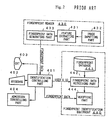
- Fig. 1 of the accompanying drawings is a diagram showing a construction of a remote identification system of the prior art through a network.
- the remote identification system shown in Fig. 1 is constructed such that a client-side identification equipment 410 sends authenticating information through the network, and such that a server-side identification equipment 420 identifies the person of the client-side identification equipment 410, according to the result of comparison between the received authenticating information and the registered authenticating information.
- the end user's personal computer is the client-side identification equipment
- the host computer of a service provider is the server-side identification equipment.
- the authenticating information is generated by a request controlling part 412 and is sent to the network by a transmission controlling part 413.
- the aforementioned password is encrypted by an encrypting part 414, and this encrypted password is used in the request controlling part 412 to generate the authenticating information so that the password can be safely transferred through the network to the server-side identification equipment 420.
- the aforementioned encrypted password is received by a transmission controlling part 422 and transferred to a decrypting part 421. Accordingly, the decrypting part 421 decrypts the encrypted password and transfers the password to an identification controlling part 423.
- the aforementioned user's ID is received by the transmission controlling part 422 and then transferred to the identification controlling part 423.
- the identification controlling part 423 retrieves the registered password from a password database 424, and compares this password with the password restored by the decrypting part 421.
- the request controlling part 412 generates a message indicating the identification result and informs the person of the fact that the permission was acknowledged, by a display (CRT) 415.
- the encrypting part 414 may encrypt the password by using the current time on the system, as received from the digital timing unit 416, and the decrypting part 421 may decrypt the encrypted password by using the current time on the system, as received from a digital timing unit 425.
- the password inputted by the person can be converted into a different cryptogram each time so that it can be safely sent and received through the network.
- the inputted password is the information for identifying the person so that the password has to be properly managed by each person so as to identify the person reliably to exclude others.
- the physical characteristic information is inherent to an individual and is excellent as one for the identification so that it is utilized as the authenticating information for the persons in the admission controlling system, for example.
- Fig. 2 is a diagram showing an example of the construction of the identification system utilizing the physical characteristic information.
- Fig. 2 shows the case in which the information representing a feature of a fingerprint is used as the physical characteristic information.
- This identification system is constructed to include a fingerprint reader 430 and fingerprint identification equipment 440.
- the fingerprint reader 430 acquires the information featuring the fingerprint of a person being present at the site as a series of numeric data and inputs the aforementioned information to the fingerprint identification equipment 440 through an identification controlling part 401.
- a set of numeric data representing the feature of a fingerprint will be referred to as the "fingerprint data”.
- a feature extracting part 431 receives the image data read by an image inputting part 432, and extracts the feature of the fingerprint appearing in that image.
- the features, as extracted by the feature extracting part 431, are arrayed according to a predetermined format by a fingerprint data generating part 433, and the fingerprint data thus generated are transferred to the identification controlling part 401.
- a fingerprint database 441 is registered with the user's ID given to an individual having an admission and fingerprint data (hereunder referred to as "reference data") obtained by measuring the related individuals.
- the user's ID inputted from a keyboard 402 is transferred to a fingerprint data retrieving part 442 by the identification controlling part 401, so that the related fingerprint data are retrieved from the aforementioned fingerprint database 411 by the fingerprint data retrieving part 442 based on that user's ID and subjected to the processing of a verifying part 444.
- the numeric data obtained by measuring the physical characteristic information including fingerprints generally fluctuate at each measurement by the condition for the measurement.
- the pressure to be applied to a finger when the finger is pushed to the image inputting part 432 the temperature of the finger or the ambient humidity, for example, the image data to be read change in a subtle way. Accordingly, the patterns of ridge flows in an image of the fingerprint and the distributions of the ridge points or the ridge bifurcations fluctuate.
- the verifying part 444 decides whether or not the inputted fingerprint data belong to the eligible person, depending upon whether or not components in a predetermined area of the inputted fingerprint data are equivalent to the components in the corresponding area of the reference data.
- Fig. 3 is a diagram for explaining a processing for comparing the physical characteristic information.
- the verifying part 444 may compare a limited portion of the inputted fingerprint data with the reference data, as illustrated as a observing area in Fig. 3A, and may inform the identification controlling part 401 whether or not the variance of all the components contained in the observing area is within a predetermined allowable range.
- the verifying part 444 informs the identification controlling part 401 of the fact that the inputted fingerprint data and the reference data are equivalent.
- the identification controlling part 401 may identify the person, have a displaying part 403 display that the person is admitted, and perform the necessary controls such as unlocking the door by utilizing the function of the admission controlling part 404.
- the verifying part 444 may inform that the reference data and the inputted fingerprint data are not equivalent.
- the identification controlling part 401 may perform the controls necessary for denying the admission of the person.
- a misidentification of about one to one hundred may occur, but the possibility of excluding the person can be lowered even if the condition for measuring the fingerprint data is poor.
- the possibility of the misidentification can be lowered, but the possibility that even the person able to be admitted may be denied because of having slight dirtiness of the fingertip will rise. This is because the wider the observing area the larger the possibility that the variance between the individual components of the inputted fingerprint data and the individual components of the reference data may exceed the allowable range.
- the DES method is a cryptographic method for dividing the information to be encrypted into blocks of a unit of 64 bits and for converting the individual blocks by combining a substitution cipher and a transposition cipher complicatedly.
- the DES method is called the "block encryption" because the conversion unit is the block.
- the password or the information for providing the identity is basically left to the management of an individual.
- the password In order to block the plagiarism of the password, on the other hand, it is required that the password has a sufficient length, be a meaningless string of characters and be frequently changed. This makes it difficult for the individual to manage the password properly.
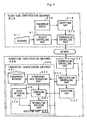
- Fig. 4 shows an example of the construction of the remote identification system utilizing the physical characteristic information.
- the fingerprint data obtained by the fingerprint reader 430 are encrypted by the encrypting part 414, and the obtained cryptogram is sent in place of the password to the network by the transmission controlling part 413.
- This cryptogram is received by the transmission controlling part 422 provided in the server-side identification equipment 420 and is then transferred to the decrypting part 421 by the identification controlling part 401.
- the decrypting part 421 decrypts the aforementioned cryptogram to restore the original fingerprint data, which are transferred together with the user's ID to the fingerprint identification equipment 440.
- the physical characteristic information contains fluctuations and noises
- that physical characteristic information is judged to have been plagiarized. Then, the attack using the plagiarized authenticating information can be blocked, making it possible to send and receive the information more safely.
- the attack to break the protection of the remote identification system by using the plagiarized authenticating information will be referred to as "replay attack”.
- the replay attack is partially blocked by storing the fingerprint database 441 with not only the reference data related to each user's ID but also the registered fingerprint data that is previously inputted, by comparing the inputted fingerprint data with the reference data and the registered fingerprint data by a comparing part 445 provided in a verifying part 444, and by subjecting the result of comparison to the processings of a fraud detecting part 446 and of a recognizing deciding part 447.
- the fraud detecting part 446 shown in Fig. 4 decides whether or not all the numeric data comprising the inputted fingerprint data and the corresponding numeric data of the reference data or the registered fingerprint data completely match, and informs, if they match, the recognizing deciding part 447 of the detection of the replay attack.
- the recognizing deciding part 447 decides whether or not the variance between the individual components of the inputted fingerprint data and the individual components of the reference data is within a predetermined allowable range, and further whether or not the inputted fingerprint data belong to the eligible person, according to the decision result and the detection result of the fraud detecting part 446, and informs this result of decision as the result of recognition to the identification controlling part 401.
- the cryptographic technique of the prior art as represented by the aforementioned DES method, regards the difficulty at the time of restoring the original information from the cryptogram as important, and converts the original information by a complicated cryptographic algorithm. This makes it seriously difficult to decrypt the encrypted physical characteristic information to obtain the original physical characteristic information.
- the decrypted physical characteristic information may satisfy the conditions necessary for identification described above by the influence of the alteration upon the decrypted physical characteristic information.
- the fingerprint data having been encrypted by the aforementioned encrypting part 414 using the block encrypting method such as the DES method are decrypted for each block as in the encryption by the decrypting part 421 so that the influence of the alteration of the encrypted physical characteristic information is exerted only locally on the portion which is obtained by decrypting the altered portion, but not on the other portion.
- pseudo fluctuations can be synthesized in the decrypted fingerprint data by fraudulently acquiring the encrypted fingerprint data in the network and by altering a portion (as hatched in Fig. 5) of the encrypted fingerprint data to input as new authenticating information.
- the fingerprint data obtained by the decrypting part 421 are different at the decryption result of the altered portion from the corresponding portion of the original fingerprint data but are completely equivalent in the observing area to the original fingerprint data.
- the decryption result obtained from the altered encrypted fingerprint data is equivalent over the observing area to the reference data but does not completely match either the reference data or the registered fingerprint data.
- the variance, caused in the decryption result by altering the encrypted fingerprint data, from the original fingerprint data is regarded as the fluctuations of the fingerprint data by the recognizing deciding part 447, and the fraudulent attack using the altered encrypted fingerprint data may be allowed.
- any simple application of the cryptographic technique of the prior art could not enable the system for the identifying by sending and receiving the physical characteristic information through the network, to improve the security, which is expected by utilizing the physical characteristic information.
- a cryptographic method comprising the steps of: receiving physical characteristic information representing a characteristic inherent to an individual; arithmetically converting each component of said physical characteristic information by using a predetermined function concerning said each component and a plurality of components having a predetermined relationship with said each component, to scramble said physical characteristic information; and encrypting the scrambled physical characteristic information by using the predetermined cryptographic key.
- the depending relationship can be established between each block of the encrypted physical characteristic information and a plurality of blocks comprising the physical characteristic information, irrespective of the length of each unit of process in the encryption.
- a decryption method comprising the steps of: receiving a cryptogram which is an encryption of scrambled physical characteristic information; decrypting said cryptogram by using the predetermined cryptographic key and obtaining said scrambled physical characteristic information; and descrambling said scrambled physical characteristic information by removing each element from each component constructing the result of decryption, in which each element is effected at the time of scrambling, by a plurality of components that has a predetermined relationship with said each component.
- the result of decryption can be descrambled to restore the original physical characteristic information.
- the block obtained by decrypting the altered portion is different from that to be intrinsically obtained. Because this difference influences the descrambled result over a plurality of blocks having a depending relationship with such block, so that the original physical characteristic information cannot be restored irrespective of the length of each unit of processing in the decryption.
- a cryptographic equipment comprising: an inputting section for inputting physical characteristic information representing a characteristic inherent to an individual; a scrambling section for arithmetically converting each component of said physical characteristic information by using a predetermined function concerning said each component and a plurality of components having a predetermined relationship with said each component, to scramble said physical characteristic information; and an encrypting section for encrypting the scrambled physical characteristic information by using the predetermined cryptographic key.
- each block comprising the cryptogram depends upon the information included in a plurality of blocks comprising the physical characteristic information. Therefore, the restoration of the original physical characteristic information can be assured, as long as the cryptogram is subjected as it is to the decrypting processing, but the restoration can be blocked if the cryptogram is altered even partially.
- a decrypting equipment comprising: a decrypting section for decrypting a received cryptogram which is an encryption of a scrambled physical characteristic information, by a predetermined cryptographic key and obtaining said scrambled physical characteristic information and a descrambling section for descrambling said scrambled physical characteristic information.
- the block obtained by decrypting the altered portion is different from that to be intrinsically obtained. Because this difference influences the descrambled result over a plurality of blocks having a depending relationship with such block, the original physical characteristic information cannot be restored irrespective of the length of each unit of processing in the decryption.
- a storage medium storing a program to be executed by a computer, the program comprising: an inputting procedure for inputting physical characteristic information representing a characteristic inherent to an individual; a scrambling procedure for arithmetically converting each component of said physical characteristic information by using a predetermined function concerning said each component and a plurality of components having a predetermined relationship with said each component, to scramble said physical characteristic information; and an encrypting procedure for encrypting the scrambled physical characteristic information by using the predetermined cryptographic key.
- each block comprising the cryptogram depends upon the information included in a plurality of blocks comprising the physical characteristic information. Therefore, the restoration of the original physical characteristic information can be assured, as long as the cryptogram is subjected as it is to the decrypting processing, but the restoration can be blocked when the cryptogram is altered even partially.
- a storage medium storing a program to be executed by a computer, the program comprising: a decrypting procedure for decrypting a received cryptogram which is an encryption of a scrambled physical characteristic information, by a predetermined cryptographic key and obtaining said scrambled physical characteristic information and a descrambling procedure for descrambling said scrambled physical characteristic information.
- the scramble made on the result of decryption can be descrambled to restore the original physical characteristic information when the cryptogram generated in the encrypting procedure is received as it is.
- the block obtained by decrypting the altered portion is different from that to be intrinsically obtained. Because this difference influences the descrambled result over a plurality of blocks having a depending relationship with such block, the original physical characteristic information cannot be restored irrespective of the length of each unit of processing in the decryption.
- the invention also provides computer programs as described above in any of the storage medium aspects of the invention.
- a cryptogram including the encrypted physical characteristic information and an auxiliary code are received.
- a numeric key restoring procedure a numeric key for the generation of a cryptographic key is restored according to the encrypted physical characteristic information and the auxiliary code.
- a cryptographic key is generated according to the numeric key and a predetermined primary key.
- the decrypting procedure the encrypted physical characteristic information is decrypted by using the cryptographic key.
- the numeric key is restored by the numeric key restoring procedure, and the cryptographic key is generated by the key generating procedure according to the numeric key.
- the cryptographic key used in the encryption can be restored and subjected to the decrypting procedure only when both the encrypted physical characteristic information and the auxiliary code are correct.
- Fig. 6A shows the principle of a cryptographic method according to one aspect of the present invention.
- the cryptographic method is constructed to include an inputting step (S31), a scrambling step (S32) and an encrypting step (S33).
- each component comprising the physical characteristic information is arithmetically converted by using a predetermined function concerning the each component and a plurality of components having a predetermined relationship with the each component, to be the physical characteristic information scrambled.
- the scrambled physical characteristic information is encrypted by using a predetermined cryptographic key.
- the physical characteristic information received at the receiving step (S31) is scrambled at the scrambling step (S32) by using the predetermined function and is encrypted at the encrypting step (S33).
- the scrambled result reflecting each unit information (hereunder referred to as "block") comprising the original physical characteristic information and a plurality of blocks having the predetermined relationship with that block is subjected to an encrypting processing at the encrypting step (S32).
- Fig. 6B shows the principle of a decryption method according to another aspect of the present invention.
- the decryption method is constructed to include a receiving step (S41), a decrypting step (S42) and a descrambling step (S43).
- a cryptogram which is an encryption of scrambled physical characteristic information is received.
- the cryptogram is decrypted by using a predetermined cryptographic key.
- the descrambling step (S43) the result of decryption is descrambled by separating each element from each component constructing the result of decryption, in which each element is affected at the time of scrambling by a plurality of components that have a predetermined relationship with the each component.
- the cryptogram is received at the receiving step (S41) and decrypted at the decrypting step (S442) and is then descrambled at the descrambling step (S43).
- the result of descrambling varies over a plurality of blocks having the depending relationship with that block. Irrespective of the length of a processing unit in the decrypting processing at the decrypting step (S42), therefore, the original physical characteristic information can be made seriously damaged by the alteration applied to the encrypted physical characteristic information.
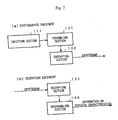
- Fig. 7A shows a block diagram showing the principle of a cryptographic equipment according to another aspect of the present invention.
- the cryptographic equipment as shown in Fig. 7A, is constructed to include the inputting section 111, scrambling section 131 and encrypting section 132.
- the inputting section 111 inputs physical characteristic information representing a characteristic inherent to an individual.
- the scrambling section 131 arithmetically converts each component comprising the physical characteristic information by using a predetermined function concerning the each component and a plurality of components having a predetermined relationship with the each component, to scramble the physical characteristic information.
- the encrypting section 132 encrypts the scrambled physical characteristic information by using a predetermined cryptographic key.
- each block comprising the physical characteristic information inputted by the inputting section 111 is arithmetically converted by the scrambling section 131 together with the information included in a plurality of blocks having the predetermined relationship with that block and is then encrypted by the encrypting section 132.
- Fig. 7B is a block diagram showing the principle of a decrypting equipment according to another aspect of the present invention.
- the decrypting equipment as shown in Fig. 7B, is constructed to include decrypting section 135 and descrambling section 136.
- the decrypting section 135 decrypts a received cryptogram that is an encryption of scrambled physical characteristic information by using a predetermined cryptographic key, and obtains the scrambled physical characteristic information.
- the descrambling section 136 descrambles the scrambled physical characteristic information.
- the cryptogram inputted to the decrypting equipment is decrypted by the decrypting section 135 and is then descrambled by the descrambling section 136.
- This scrambling section 131 arithmetically converts the elements derived from all the components comprising the information to be converted, by using a function reflecting them on the values of the individual components converted.
- the area in which the individual blocks of the encrypted physical characteristic information have a depending relationship can be extended to all the blocks of the original physical characteristic information.
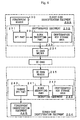
- Fig. 8 illustrates an embodiment of the invention.
- a client-side identification equipment 203 and a server-side identification equipment 204 construct a remote identification system.
- the fingerprint data measured by the fingerprint reader 430 are encrypted by a cryptographic equipment 230, and the result of encryption obtained are written as authenticating information in an IC card by an IC card writer 234.
- authenticating information obtained by an IC card reader 235 having read the IC card.
- This authenticating information is decrypted by decrypting equipment 240, and this result of decryption is subjected to the processing of the fingerprint identification equipment 440.
- a discrete Fourier transformation (DFT) part 231 discretely Fourier-transforms the fingerprint data received from the fingerprint reader 430, and subjects the result of transformation to the processing in a block encrypting part 232.
- DFT discrete Fourier transformation
- a cryptographic key storage area 233 shown in Fig. 8 stores a cryptographic key inherent to each registered client-side identification equipment respectively.
- the block encrypting unit 232 encrypts the result of transformation by the discrete Fourier transformation part 231 for each block by using that cryptographic key. So the encrypted transformation result is subjected to a writing processing by the IC card writer 234.
- the discrete Fourier transformation part 231 Fourier-transforms the fingerprint data so that the influences caused by the individual components constructing the fingerprint data are exerted upon the entirety of the result of Fourier transformation, as illustrated in Figs. 9A and 9B. Therefore, the individual blocks or the encryption units by the block encrypting part 232 are dependent upon all the components constructing the fingerprint data (see Fig. 9C).
- the information of the individual blocks constructs the result of encryption is dependent upon all the components constructing the fingerprint data.
- the individual parts of the cryptographic equipment shown in Fig. 8 operate, as described above, the physical characteristic information can be encrypted by the cryptographic method to generate the cryptogram composed of components depending upon all the components of the physical characteristic information.
- the authenticated information read by the IC card reader 235 are transferred to a block decrypting part 241.
- the block decrypting part 241 sequentially decrypts the individual components of the authenticating information, by using the cryptographic key stored in a cryptographic key storage area 242. And the result of decryption is subjected to the processing of an inverse Fourier transformation (or inverse DFT) part 243.
- the cryptographic key used in the encryption may be stored in the cryptographic key storage area 242 so that the block decrypting part 241 may decrypt the individual blocks of the authenticating information in accordance with the data encrypting standard method.
- the result of decryption by the block decrypting part 241 is identical to the result of transformation by the discrete Fourier transformation part 231 during the cryptographic processing (see fig. 9E).
- the inverse Fourier transformation part 243 can perform the inverse Fourier transformation to put the elements derived from the individual components comprising the original fingerprint data, as scattered into the individual components constructing the scrambled result together, thereby to restore the original fingerprint data (see Fig. 9F).
- the individual parts constructing the decrypting equipment 240 can perform the aforementioned operations to restore the original physical characteristic information completely by using the decryption method described above. So the restored physical characteristic information can be subjected to the identifying processing of the fingerprint identification equipment 440 or the like.
- the elements derived from the altered component of cryptogram diffuse all over the descrambled result (see Figs. 9H and 9J) when the result of decryption by the block decrypting part 241 is to be inversely Fourier-transformed by the inverse Fourier transformation part 342. Therefore the result of conversion to be obtained is considerably different from the original fingerprint data.
- the program can realize the functions of the individual parts constructing the cryptographic equipment 230 shown in Fig. 8.
- the system for encrypting the physical characteristic information safely by using the cryptographic method can be provided for users of wide range.
- the program can realize the functions of the individual parts constructing the decryption equipment 240 shown in Fig. 8.
- the program can realize the functions of the individual parts constructing the decryption equipment 240 shown in Fig. 8.
- the system for decrypting only the proper authenticating information correctly by using the decryption method to restore the physical characteristic information and to subject it to the identifying processing.
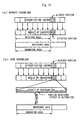
- the area for the result of decryption to be compared with the reference data that is, the observing area can be discriminated, as illustrated in Fig. 10A, by observing whether or not the access by that authenticating information is received.
- the aforementioned method cannot analyze the data structure of the physical characteristic information.
- the client-side identification equipment 203 may be constructed to include a transmission controlling part in place of the IC card writer 234 shown in Fig. 8, and the server-side identification equipment 204 may be constructed to include a transmission controlling part in place of the IC card reader 235, so that the authenticating information may be sent and received through the network.
- the physical characteristic information such as the fingerprint data contains the fluctuation elements varying with the conditions of measurement so that the improvement in the recognition rate is limited. If the observing area is narrowed, as has been described with reference to Fig. 3, for example, another fingerprint data may be misidentified as that of the eligible person's.
- the method for identifying the person with the password can ensure the identification by combining the password and the user's ID, but the safety of the entire remote identification system depends upon whether or not the individual can manage the password strictly, so that the burden on the individual is increased.
Landscapes
- Engineering & Computer Science (AREA)
- Computer Security & Cryptography (AREA)
- Computer Networks & Wireless Communication (AREA)
- Signal Processing (AREA)
- Computing Systems (AREA)
- General Engineering & Computer Science (AREA)
- Computer Hardware Design (AREA)
- Health & Medical Sciences (AREA)
- Life Sciences & Earth Sciences (AREA)
- Biodiversity & Conservation Biology (AREA)
- Biomedical Technology (AREA)
- General Health & Medical Sciences (AREA)
- Storage Device Security (AREA)
Abstract
Description
- The present invention relates to encryption/decryption methods and equipment adapted for physical characteristic information such as fingerprints, voiceprints, palm patterns, facial appearances, or signatures or signatures representing a characteristic inherent to an individual, and to remote identification systems for identifying a person through a network according to the physical characteristic information.
- The fingerprints, voiceprint, iris patterns or the like are characteristics inherent to an individual and are invariable for the life of the individual so that they are excellent as information for identifying a person and are utilized in various identification systems such as an admission controlling system.
- As an information-related device such as a personal computer spreads, on the other hand, a variety of information are vigorously sent and received through a network between end users to enhance the importance of commerce through the network and transmissions of documents.
- In order to perform the commerce and the exchanges of important documents properly through the network, there has been needed a technique for sending and receiving information to prove each other through the network and for identifying the persons reliably between each other. So the physical characteristic information has been noted as the information for identifying the persons.
- Fig. 1 of the accompanying drawings is a diagram showing a construction of a remote identification system of the prior art through a network.
- The remote identification system shown in Fig. 1 is constructed such that a client-
side identification equipment 410 sends authenticating information through the network, and such that a server-side identification equipment 420 identifies the person of the client-side identification equipment 410, according to the result of comparison between the received authenticating information and the registered authenticating information. - When a personal computer communication service is utilized, for example, the end user's personal computer is the client-side identification equipment, and the host computer of a service provider is the server-side identification equipment.
- In this case, according to a user's ID and a password inputted through a keyboard 411, the authenticating information is generated by a request controlling part 412 and is sent to the network by a
transmission controlling part 413. - At this time, the aforementioned password is encrypted by an encrypting part 414, and this encrypted password is used in the request controlling part 412 to generate the authenticating information so that the password can be safely transferred through the network to the server-
side identification equipment 420. - In the server-
side identification equipment 420 shown in Fig. 1, the aforementioned encrypted password is received by a transmission controlling part 422 and transferred to adecrypting part 421. Accordingly, thedecrypting part 421 decrypts the encrypted password and transfers the password to an identification controlling part 423. - On the other hand, the aforementioned user's ID is received by the transmission controlling part 422 and then transferred to the identification controlling part 423. According to this user's ID, the identification controlling part 423 retrieves the registered password from a
password database 424, and compares this password with the password restored by thedecrypting part 421. - In this case, if the restored password and the registered password match each other, the identification result having confirmed the identity is informed to the client-
side identification equipment 410 by the transmission controlling part 422. Accordingly, the request controlling part 412 generates a message indicating the identification result and informs the person of the fact that the permission was acknowledged, by a display (CRT) 415. - As shown in Fig. 1, on the other hand, the encrypting part 414 may encrypt the password by using the current time on the system, as received from the
digital timing unit 416, and thedecrypting part 421 may decrypt the encrypted password by using the current time on the system, as received from a digital timing unit 425. - In this case, the password inputted by the person can be converted into a different cryptogram each time so that it can be safely sent and received through the network.
- In this remote identification system, the inputted password is the information for identifying the person so that the password has to be properly managed by each person so as to identify the person reliably to exclude others.
- On the other hand, the physical characteristic information is inherent to an individual and is excellent as one for the identification so that it is utilized as the authenticating information for the persons in the admission controlling system, for example.
- Fig. 2 is a diagram showing an example of the construction of the identification system utilizing the physical characteristic information.
- Fig. 2 shows the case in which the information representing a feature of a fingerprint is used as the physical characteristic information. This identification system is constructed to include a
fingerprint reader 430 andfingerprint identification equipment 440. - In this identification system, the
fingerprint reader 430 acquires the information featuring the fingerprint of a person being present at the site as a series of numeric data and inputs the aforementioned information to thefingerprint identification equipment 440 through an identification controlling part 401. - A set of numeric data representing the feature of a fingerprint will be referred to as the "fingerprint data".
- In the
fingerprint reader 430 shown in Fig. 2, a feature extracting part 431 receives the image data read by an image inputting part 432, and extracts the feature of the fingerprint appearing in that image. - The features, as extracted by the feature extracting part 431, are arrayed according to a predetermined format by a fingerprint data generating part 433, and the fingerprint data thus generated are transferred to the identification controlling part 401.
- In the
fingerprint identification equipment 440 shown in Fig. 2, afingerprint database 441 is registered with the user's ID given to an individual having an admission and fingerprint data (hereunder referred to as "reference data") obtained by measuring the related individuals. On the other hand, the user's ID inputted from akeyboard 402 is transferred to a fingerprintdata retrieving part 442 by the identification controlling part 401, so that the related fingerprint data are retrieved from the aforementioned fingerprint database 411 by the fingerprintdata retrieving part 442 based on that user's ID and subjected to the processing of averifying part 444. - Here, the numeric data obtained by measuring the physical characteristic information including fingerprints generally fluctuate at each measurement by the condition for the measurement.
- By the pressure to be applied to a finger when the finger is pushed to the image inputting part 432, the temperature of the finger or the ambient humidity, for example, the image data to be read change in a subtle way. Accordingly, the patterns of ridge flows in an image of the fingerprint and the distributions of the ridge points or the ridge bifurcations fluctuate.
- According to the recognition rate required, therefore, the verifying
part 444 decides whether or not the inputted fingerprint data belong to the eligible person, depending upon whether or not components in a predetermined area of the inputted fingerprint data are equivalent to the components in the corresponding area of the reference data. - Fig. 3 is a diagram for explaining a processing for comparing the physical characteristic information.
- For an application to allow a misidentification of about one to one hundred, for example, the
verifying part 444 may compare a limited portion of the inputted fingerprint data with the reference data, as illustrated as a observing area in Fig. 3A, and may inform the identification controlling part 401 whether or not the variance of all the components contained in the observing area is within a predetermined allowable range. - If the variance between the individual components of the reference data and the individual components of the inputted fingerprint data is within the allowable range in the hatched area of Fig. 3A, for example, the verifying
part 444 informs the identification controlling part 401 of the fact that the inputted fingerprint data and the reference data are equivalent. - In response to this, the identification controlling part 401 may identify the person, have a displaying
part 403 display that the person is admitted, and perform the necessary controls such as unlocking the door by utilizing the function of theadmission controlling part 404. - If the variance of a portion of the component included in the aforementioned observing area exceeds the allowable range, as illustrated in Fig. 3B, the
verifying part 444 may inform that the reference data and the inputted fingerprint data are not equivalent. In response to this, the identification controlling part 401 may perform the controls necessary for denying the admission of the person. - Here, if the fingerprint data are recognized by using the relatively narrow area as the observing area, as illustrated in Fig. 3A, a misidentification of about one to one hundred may occur, but the possibility of excluding the person can be lowered even if the condition for measuring the fingerprint data is poor.
- For an application requiring a misidentification of about one to ten thousands, on the other hand, most of the fingerprint data has to be confined in the observing area, as illustrated in Fig. 3C.
- In this case, the possibility of the misidentification can be lowered, but the possibility that even the person able to be admitted may be denied because of having slight dirtiness of the fingertip will rise. This is because the wider the observing area the larger the possibility that the variance between the individual components of the inputted fingerprint data and the individual components of the reference data may exceed the allowable range.
- As the technique for transmitting the information safely through the network, there was already practiced the RSA algorithm for realizing the public key system or the DES (Data Encryption Standard) method applying the common key system.
- The DES method is a cryptographic method for dividing the information to be encrypted into blocks of a unit of 64 bits and for converting the individual blocks by combining a substitution cipher and a transposition cipher complicatedly. The DES method is called the "block encryption" because the conversion unit is the block.
- In the aforementioned remote identification system of the prior art, the password or the information for providing the identity is basically left to the management of an individual.
- In order to block the plagiarism of the password, on the other hand, it is required that the password has a sufficient length, be a meaningless string of characters and be frequently changed. This makes it difficult for the individual to manage the password properly.
- This is because a person finds it difficult to memorize the meaningless string of characters or symbols, and because the necessity of frequent change is too heavy a burden for the person.
- As a matter of fact, most users register such passwords as can be easily analogized from the personal information being opened to the public or the kind of information to be preferably accessed to, record and carry the memorandum of the password or forget to change the password for a long time.
- In the remote identification system using only the password as the information for identifying the person, therefore, it is difficult to ensure the safety necessary for the e-commerce or for sending and receiving the important information.
- By introducing the remote identification system using the physical characteristic information in place of the password as the information for the identification, it is possible to block fraudulent access. So important information can be sent and received safely through the network.
- Fig. 4 shows an example of the construction of the remote identification system utilizing the physical characteristic information.
- In the client-
side identification equipment 410 shown in Fig. 4, the fingerprint data obtained by thefingerprint reader 430 are encrypted by the encrypting part 414, and the obtained cryptogram is sent in place of the password to the network by thetransmission controlling part 413. - This cryptogram is received by the transmission controlling part 422 provided in the server-
side identification equipment 420 and is then transferred to thedecrypting part 421 by the identification controlling part 401. In response to this, thedecrypting part 421 decrypts the aforementioned cryptogram to restore the original fingerprint data, which are transferred together with the user's ID to thefingerprint identification equipment 440. - Premising that the physical characteristic information contains fluctuations and noises, when exactly the same physical characteristic information as the previously inputted one is inputted, that physical characteristic information is judged to have been plagiarized. Then, the attack using the plagiarized authenticating information can be blocked, making it possible to send and receive the information more safely.
- The attack to break the protection of the remote identification system by using the plagiarized authenticating information will be referred to as "replay attack".
- Here will be described an example of the remote identification system considering that replay attack.
- In the remote identification system shown in Fig. 4, the replay attack is partially blocked by storing the
fingerprint database 441 with not only the reference data related to each user's ID but also the registered fingerprint data that is previously inputted, by comparing the inputted fingerprint data with the reference data and the registered fingerprint data by a comparing part 445 provided in a verifyingpart 444, and by subjecting the result of comparison to the processings of afraud detecting part 446 and of a recognizing decidingpart 447. - Here, according to the comparison result received from the comparing part 445, the
fraud detecting part 446 shown in Fig. 4 decides whether or not all the numeric data comprising the inputted fingerprint data and the corresponding numeric data of the reference data or the registered fingerprint data completely match, and informs, if they match, the recognizing decidingpart 447 of the detection of the replay attack. - According to the comparison result received from the comparing part 445, on the other hand, the recognizing deciding
part 447 decides whether or not the variance between the individual components of the inputted fingerprint data and the individual components of the reference data is within a predetermined allowable range, and further whether or not the inputted fingerprint data belong to the eligible person, according to the decision result and the detection result of thefraud detecting part 446, and informs this result of decision as the result of recognition to the identification controlling part 401. - In this case, it is conditions necessary for identifying a person that the inputted fingerprint data are equivalent to the reference data over the area covering the observing area, as illustrated in Fig.4, and that all the numeric data comprising the inputted fingerprint data are not completely equal to the corresponding numeric data contained in the reference data or the registered fingerprint data.
- Here, the cryptographic technique of the prior art, as represented by the aforementioned DES method, regards the difficulty at the time of restoring the original information from the cryptogram as important, and converts the original information by a complicated cryptographic algorithm. This makes it seriously difficult to decrypt the encrypted physical characteristic information to obtain the original physical characteristic information.
- Since the physical characteristic information itself is inherent to each person, on the other hand, the information is extremely difficult to plagiarize or forge so long as it is properly managed.
- Since the process for the encrypted physical characteristic information to be transmitted through the network has almost no protection, however, it is relatively easy to acquire that information fraudulently.
- When the encrypted physical characteristic information fraudulently acquired by the wiretapping method or the like is utilized as it is, it can naturally be excluded as the replay attack, as has been described above.
- When the fraudulently acquired encrypted physical characteristic information is partially altered, however, the decrypted physical characteristic information may satisfy the conditions necessary for identification described above by the influence of the alteration upon the decrypted physical characteristic information.
- Because the fingerprint data having been encrypted by the aforementioned encrypting part 414 using the block encrypting method such as the DES method are decrypted for each block as in the encryption by the decrypting
part 421 so that the influence of the alteration of the encrypted physical characteristic information is exerted only locally on the portion which is obtained by decrypting the altered portion, but not on the other portion. - As illustrated in Fig. 5, therefore, pseudo fluctuations can be synthesized in the decrypted fingerprint data by fraudulently acquiring the encrypted fingerprint data in the network and by altering a portion (as hatched in Fig. 5) of the encrypted fingerprint data to input as new authenticating information.
- When a portion of the encrypted fingerprint data derived from the portion other than the observing area is altered, as illustrated in Fig. 5, the fingerprint data obtained by the decrypting
part 421 are different at the decryption result of the altered portion from the corresponding portion of the original fingerprint data but are completely equivalent in the observing area to the original fingerprint data. - In other words, the decryption result obtained from the altered encrypted fingerprint data is equivalent over the observing area to the reference data but does not completely match either the reference data or the registered fingerprint data.
- In this case, the variance, caused in the decryption result by altering the encrypted fingerprint data, from the original fingerprint data is regarded as the fluctuations of the fingerprint data by the recognizing deciding
part 447, and the fraudulent attack using the altered encrypted fingerprint data may be allowed. - Therefore, any simple application of the cryptographic technique of the prior art could not enable the system for the identifying by sending and receiving the physical characteristic information through the network, to improve the security, which is expected by utilizing the physical characteristic information.
- It is desirable to provide an elementary technique capable of restoring original physical characteristic information so as to block attacks against the security system by re-utilizing encrypted information.
- It is desirable to provide an identification system utilizing the authenticating information generated according to the physical characteristic information.
- According to the present invention there is provided a cryptographic method comprising the steps of: receiving physical characteristic information representing a characteristic inherent to an individual; arithmetically converting each component of said physical characteristic information by using a predetermined function concerning said each component and a plurality of components having a predetermined relationship with said each component, to scramble said physical characteristic information; and encrypting the scrambled physical characteristic information by using the predetermined cryptographic key.
- By reflecting the contents of a plurality of blocks having the predetermined relationships with each block which are components comprising the physical characteristic information, upon the result of encryption obtained for each block, according to the cryptographic method, the depending relationship can be established between each block of the encrypted physical characteristic information and a plurality of blocks comprising the physical characteristic information, irrespective of the length of each unit of process in the encryption.
- According to another aspect of the present invention there is provided a decryption method comprising the steps of: receiving a cryptogram which is an encryption of scrambled physical characteristic information; decrypting said cryptogram by using the predetermined cryptographic key and obtaining said scrambled physical characteristic information; and descrambling said scrambled physical characteristic information by removing each element from each component constructing the result of decryption, in which each element is effected at the time of scrambling, by a plurality of components that has a predetermined relationship with said each component.
- In this decryption method, when the cryptogram generated by the encrypting processing is received as it is, the result of decryption can be descrambled to restore the original physical characteristic information.
- When the cryptogram is altered, on the other hand, the block obtained by decrypting the altered portion is different from that to be intrinsically obtained. Because this difference influences the descrambled result over a plurality of blocks having a depending relationship with such block, so that the original physical characteristic information cannot be restored irrespective of the length of each unit of processing in the decryption.
- According to another aspect of the present invention there is provided a cryptographic equipment comprising: an inputting section for inputting physical characteristic information representing a characteristic inherent to an individual; a scrambling section for arithmetically converting each component of said physical characteristic information by using a predetermined function concerning said each component and a plurality of components having a predetermined relationship with said each component, to scramble said physical characteristic information; and an encrypting section for encrypting the scrambled physical characteristic information by using the predetermined cryptographic key.
- In this cryptographic equipment, there can be obtained the cryptogram, in which each block comprising the cryptogram depends upon the information included in a plurality of blocks comprising the physical characteristic information. Therefore, the restoration of the original physical characteristic information can be assured, as long as the cryptogram is subjected as it is to the decrypting processing, but the restoration can be blocked if the cryptogram is altered even partially.
- According to another aspect of the present invention there is provided a decrypting equipment comprising: a decrypting section for decrypting a received cryptogram which is an encryption of a scrambled physical characteristic information, by a predetermined cryptographic key and obtaining said scrambled physical characteristic information and a descrambling section for descrambling said scrambled physical characteristic information.
- In this decrypting equipment, when the cryptogram sent by the cryptographic equipment is received as it is, the original physical characteristic information can be restored by descrambling the result of decryption.
- When the cryptogram is altered, on the other hand, the block obtained by decrypting the altered portion is different from that to be intrinsically obtained. Because this difference influences the descrambled result over a plurality of blocks having a depending relationship with such block, the original physical characteristic information cannot be restored irrespective of the length of each unit of processing in the decryption.
- According to another aspect of the invention there is provided a storage medium storing a program to be executed by a computer, the program comprising: an inputting procedure for inputting physical characteristic information representing a characteristic inherent to an individual; a scrambling procedure for arithmetically converting each component of said physical characteristic information by using a predetermined function concerning said each component and a plurality of components having a predetermined relationship with said each component, to scramble said physical characteristic information; and an encrypting procedure for encrypting the scrambled physical characteristic information by using the predetermined cryptographic key.
- By using this storage media stored with such program, there can be obtained the result of encryption, in which each block comprising the cryptogram depends upon the information included in a plurality of blocks comprising the physical characteristic information. Therefore, the restoration of the original physical characteristic information can be assured, as long as the cryptogram is subjected as it is to the decrypting processing, but the restoration can be blocked when the cryptogram is altered even partially.
- According to another aspect of the present invention there is provided a storage medium storing a program to be executed by a computer, the program comprising: a decrypting procedure for decrypting a received cryptogram which is an encryption of a scrambled physical characteristic information, by a predetermined cryptographic key and obtaining said scrambled physical characteristic information and a descrambling procedure for descrambling said scrambled physical characteristic information.
- By using this storage media stored with the program, the scramble made on the result of decryption can be descrambled to restore the original physical characteristic information when the cryptogram generated in the encrypting procedure is received as it is.
- When the cryptogram is altered, on the other hand, the block obtained by decrypting the altered portion is different from that to be intrinsically obtained. Because this difference influences the descrambled result over a plurality of blocks having a depending relationship with such block, the original physical characteristic information cannot be restored irrespective of the length of each unit of processing in the decryption.
- The invention also provides computer programs as described above in any of the storage medium aspects of the invention.
- Preferred features of the present invention will now be described, purely by way of example, with reference to the accompanying drawings, in which:
- Fig. 1 is a diagram showing an example of the construction of a remote identification system of the prior art;
- Fig. 2 is a diagram showing an example of the construction of the identification system of the prior art, utilizing the physical characteristic information;
- Fig. 3 is a diagram for explaining the comparing processing on physical characteristics;
- Fig. 4 is a diagram showing an example of the construction of the remote identification system utilizing the physical characteristic information;
- Fig. 5 is a diagram for explaining effects from alterations of the physical characteristic information;
- Fig. 6 is a diagram illustrating the principles of a cryptographic method and a decrypting method according to one of the preferred embodiments of the invention;
- Fig. 7 is a block diagram illustrating the principles of a cryptographic equipment and a decrypting equipment according to one of the preferred embodiments of the invention;
- Fig. 8 is a diagram showing a second embodiment of the invention;
- Fig. 9 is a diagram for explaining an effect of scrambling;
- Fig. 10 is a diagram for explaining an effect of preventing analysis of a processing for recognition on physical characteristic information; and
- Fig. 11 is a diagram for explaining effect of preventing structural analysis in terms of physical characteristic information.
-
- The principle of the decryption program according to an embodiment of the invention will be described in the following:
- In the receiving procedure, a cryptogram including the encrypted physical characteristic information and an auxiliary code are received. In the numeric key restoring procedure, a numeric key for the generation of a cryptographic key is restored according to the encrypted physical characteristic information and the auxiliary code. In the key generating procedure, a cryptographic key is generated according to the numeric key and a predetermined primary key. In the decrypting procedure, the encrypted physical characteristic information is decrypted by using the cryptographic key.
- The operations of the decryption program thus constructed will be described in the following.
- According to the encrypted physical characteristic information and the auxiliary code received in the receiving procedure, the numeric key is restored by the numeric key restoring procedure, and the cryptographic key is generated by the key generating procedure according to the numeric key.
- By utilizing a depending relationship between the encrypted physical characteristic information and the auxiliary code, therefore, the cryptographic key used in the encryption can be restored and subjected to the decrypting procedure only when both the encrypted physical characteristic information and the auxiliary code are correct.
- Fig. 6A shows the principle of a cryptographic method according to one aspect of the present invention.
- The cryptographic method, as shown in Fig. 6A, is constructed to include an inputting step (S31), a scrambling step (S32) and an encrypting step (S33).
- In the receiving step (S31), a physical characteristic information representing a characteristic inherent to an individual is received. In the scrambling step (S32), each component comprising the physical characteristic information is arithmetically converted by using a predetermined function concerning the each component and a plurality of components having a predetermined relationship with the each component, to be the physical characteristic information scrambled. In the encrypting step (S33), the scrambled physical characteristic information is encrypted by using a predetermined cryptographic key.
- The operations of the cryptographic method thus constructed will be described in the following.
- The physical characteristic information received at the receiving step (S31) is scrambled at the scrambling step (S32) by using the predetermined function and is encrypted at the encrypting step (S33).
- In this case, therefore, the scrambled result reflecting each unit information (hereunder referred to as "block") comprising the original physical characteristic information and a plurality of blocks having the predetermined relationship with that block is subjected to an encrypting processing at the encrypting step (S32).
- On the encrypted result obtained for each block comprising the physical characteristic information, therefore, there are reflected the contents of a plurality of blocks having the predetermined relationship with that block.
- Fig. 6B shows the principle of a decryption method according to another aspect of the present invention.
- The decryption method, as shown in Fig. 6B, is constructed to include a receiving step (S41), a decrypting step (S42) and a descrambling step (S43).
- In the receiving step (S41), a cryptogram which is an encryption of scrambled physical characteristic information is received. In the decrypting step (S42), the cryptogram is decrypted by using a predetermined cryptographic key. In the descrambling step (S43), the result of decryption is descrambled by separating each element from each component constructing the result of decryption, in which each element is affected at the time of scrambling by a plurality of components that have a predetermined relationship with the each component.
- The operations of the decryption method thus constructed will be described in the following.
- The cryptogram is received at the receiving step (S41) and decrypted at the decrypting step (S442) and is then descrambled at the descrambling step (S43).
- If a variance is established between the block obtained as a result of decryption and the block to be intrinsically obtained, therefore, the result of descrambling varies over a plurality of blocks having the depending relationship with that block. Irrespective of the length of a processing unit in the decrypting processing at the decrypting step (S42), therefore, the original physical characteristic information can be made seriously damaged by the alteration applied to the encrypted physical characteristic information.
- Fig. 7A shows a block diagram showing the principle of a cryptographic equipment according to another aspect of the present invention.
- The cryptographic equipment, as shown in Fig. 7A, is constructed to include the inputting section 111, scrambling section 131 and encrypting section 132.
- The inputting section 111 inputs physical characteristic information representing a characteristic inherent to an individual. The scrambling section 131 arithmetically converts each component comprising the physical characteristic information by using a predetermined function concerning the each component and a plurality of components having a predetermined relationship with the each component, to scramble the physical characteristic information. The encrypting section 132 encrypts the scrambled physical characteristic information by using a predetermined cryptographic key.
- The operations of the cryptographic equipment thus constructed will be described in the following.
- The information included in each block comprising the physical characteristic information inputted by the inputting section 111 is arithmetically converted by the scrambling section 131 together with the information included in a plurality of blocks having the predetermined relationship with that block and is then encrypted by the encrypting section 132.
- On each block of the result of encryption obtained for each block of the physical characteristic information, therefore, there is reflected the information which is included in a plurality of blocks having the predetermined relationship with that block.
- Fig. 7B is a block diagram showing the principle of a decrypting equipment according to another aspect of the present invention.
- The decrypting equipment, as shown in Fig. 7B, is constructed to include decrypting
section 135 anddescrambling section 136. - The
decrypting section 135 decrypts a received cryptogram that is an encryption of scrambled physical characteristic information by using a predetermined cryptographic key, and obtains the scrambled physical characteristic information. Thedescrambling section 136 descrambles the scrambled physical characteristic information. - The operations of the decrypting equipment thus constructed will be described in the following.
- The cryptogram inputted to the decrypting equipment is decrypted by the
decrypting section 135 and is then descrambled by thedescrambling section 136. - If the cryptogram is altered, therefore, the result obtained is considerably different from that of descrambling to be intrinsically obtained, so that the restoration of the original physical characteristic information is completely impossible.
- The principle of the scrambling section 131 provided in the cryptographic equipment shown in Fig. 7A will be described in the following.
- This scrambling section 131 arithmetically converts the elements derived from all the components comprising the information to be converted, by using a function reflecting them on the values of the individual components converted.
- The operations of the scrambling section 131 having these features will be described in the following.
- By executing the arithmetic conversion by the scrambling section 131, the area in which the individual blocks of the encrypted physical characteristic information have a depending relationship can be extended to all the blocks of the original physical characteristic information.
- In other words, by subjecting the scrambled result obtained by that scrambling section 131 to the processing the encrypting section 132, therefore, it is possible to generate the encrypted physical characteristic information in which the individual blocks depend upon the entire physical characteristic information.
- Fig. 8 illustrates an embodiment of the invention.
- In Fig. 8, a client-
side identification equipment 203 and a server-side identification equipment 204 construct a remote identification system. - In this client-
side identification equipment 203, the fingerprint data measured by thefingerprint reader 430 are encrypted by acryptographic equipment 230, and the result of encryption obtained are written as authenticating information in an IC card by an IC card writer 234. - In the server-
side identification equipment 204 shown in Fig. 8, on the other hand, authenticating information obtained by anIC card reader 235 having read the IC card. This authenticating information is decrypted by decryptingequipment 240, and this result of decryption is subjected to the processing of thefingerprint identification equipment 440. - In the
cryptographic equipment 230 shown in Fig. 8, a discrete Fourier transformation (DFT) part 231 discretely Fourier-transforms the fingerprint data received from thefingerprint reader 430, and subjects the result of transformation to the processing in a block encrypting part 232. - On the other hand, a cryptographic
key storage area 233 shown in Fig. 8 stores a cryptographic key inherent to each registered client-side identification equipment respectively. And the block encrypting unit 232 encrypts the result of transformation by the discrete Fourier transformation part 231 for each block by using that cryptographic key. So the encrypted transformation result is subjected to a writing processing by the IC card writer 234. - Storing a cryptographic key of 56 bits in the cryptographic
key storage area 233 and adopting the data encryption standard method in the block encrypting part 232, for example, it is possible to obtain the encrypted fingerprint data which are extremely hard to decrypt. - Here, the discrete Fourier transformation part 231 Fourier-transforms the fingerprint data so that the influences caused by the individual components constructing the fingerprint data are exerted upon the entirety of the result of Fourier transformation, as illustrated in Figs. 9A and 9B. Therefore, the individual blocks or the encryption units by the block encrypting part 232 are dependent upon all the components constructing the fingerprint data (see Fig. 9C).
- Therefore, when the fingerprint data are encrypted after Fourier-transformed, as described above, the information of the individual blocks constructs the result of encryption is dependent upon all the components constructing the fingerprint data.
- In other words, the individual parts of the cryptographic equipment shown in Fig. 8 operate, as described above, the physical characteristic information can be encrypted by the cryptographic method to generate the cryptogram composed of components depending upon all the components of the physical characteristic information.
- In the
decrypting equipment 240 shown in Fig. 8, on the other hand, the authenticated information read by theIC card reader 235 are transferred to a block decrypting part 241. In response to this, the block decrypting part 241 sequentially decrypts the individual components of the authenticating information, by using the cryptographic key stored in a cryptographickey storage area 242. And the result of decryption is subjected to the processing of an inverse Fourier transformation (or inverse DFT)part 243. - When the data encryption standard method is adopted in the encryption, as described above, the cryptographic key used in the encryption may be stored in the cryptographic
key storage area 242 so that the block decrypting part 241 may decrypt the individual blocks of the authenticating information in accordance with the data encrypting standard method. - When the authenticating information by the
aforementioned cryptographic equipment 230 arrive as they are at thedecrypting equipment 240, as illustrated in Fig. 10D, the result of decryption by the block decrypting part 241 is identical to the result of transformation by the discrete Fourier transformation part 231 during the cryptographic processing (see fig. 9E). - In response to an input of the result of decryption by the block decrypting part 241, therefore, the inverse
Fourier transformation part 243 can perform the inverse Fourier transformation to put the elements derived from the individual components comprising the original fingerprint data, as scattered into the individual components constructing the scrambled result together, thereby to restore the original fingerprint data (see Fig. 9F). - When the authenticating information obtained by the cryptographic method described above is thus inputted as it is to the
decrypting equipment 240 shown in Fig. 8, the individual parts constructing thedecrypting equipment 240 can perform the aforementioned operations to restore the original physical characteristic information completely by using the decryption method described above. So the restored physical characteristic information can be subjected to the identifying processing of thefingerprint identification equipment 440 or the like. - If the partially altered authenticating information are inputted as illustrated in Fig. 9G, on the other hand, the elements derived from the altered component of cryptogram diffuse all over the descrambled result (see Figs. 9H and 9J) when the result of decryption by the block decrypting part 241 is to be inversely Fourier-transformed by the inverse Fourier transformation part 342. Therefore the result of conversion to be obtained is considerably different from the original fingerprint data.
- Thus, in response to the alteration of the cryptogram as the authenticating information, the depending relationship between the corresponding component of cryptogram and the entire original fingerprint data is automatically broken. In order to restore the original fingerprint data in the decryption, therefore, it is necessary that all the blocks constructing the cryptogram not to be altered. It is possible to block the attack to alter and utilize the authenticating information which was fraudulently acquired on the network.
- On the other hand, the program can realize the functions of the individual parts constructing the
cryptographic equipment 230 shown in Fig. 8. By recording the program in the storage media and distributing it, the system for encrypting the physical characteristic information safely by using the cryptographic method can be provided for users of wide range. - Likewise, the program can realize the functions of the individual parts constructing the
decryption equipment 240 shown in Fig. 8. By recording the program in the storage media and distributing it, there can be provided the system for decrypting only the proper authenticating information correctly by using the decryption method to restore the physical characteristic information and to subject it to the identifying processing. - When the cryptographic method and the decryption method described above are applied, moreover, it is possible to enjoy the effect to block an attack to analyze the identifying processing of the physical characteristic information and the effect to block an attack to analyze the data structure of the physical characteristic information itself.
- First of all, the former effect will be described with reference to Fig. 10.
- When no scrambling processing is performed in the encryption, the influence by the alteration of the encrypted data is exerted upon only a portion of the result of decryption so long as the block encrypting method is adopted, no matter how excellent the cryptographic method might be.
- When the individual blocks of the authenticating information are sequentially altered, therefore, the area for the result of decryption to be compared with the reference data, that is, the observing area can be discriminated, as illustrated in Fig. 10A, by observing whether or not the access by that authenticating information is received.
- When the scrambling and the block encryption are combined, on the other hand, the influence of alteration is propagated to the entire descrambled result by the descrambling processing conducted subsequent to the decryption even if the authenticating information is altered slightly. As a result, a variance exceeding the allowable error occurs also in the observing area, so that the result of comparison with the reference data never fails to mismatch.
- Therefore, the aforementioned method cannot analyze the recognizing processing of the physical characteristic information.
- With reference to Fig. 11, here will be described the effect to prevent the data structure analysis of the physical characteristic information itself.
- In the case of no scrambling processing in the encryption, the change in the content of each of the component constructing the physical characteristic information is reflected directly on the content of the corresponding block included in the encrypted data.
- When a circled portion in the image data of a fingerprint is altered from a ridge point to a ridge bifurcation, as illustrated in Fig. 11A, a change to appear in the encrypted data is accordingly observed. Then, it is possible to grasp at what portion of the fingerprint data the feature of the aforementioned portion is described.
- When the scrambling and the block encryption are combined, on the other hand, the contribution of the portion describing the individual features in the fingerprint data, as illustrated in Fig. 11A, is scattered over all the blocks constructing the encrypted data by the effect of the scrambling, as illustrated by different kinds of hatching in Fig. 11b.
- As a result, the aforementioned method cannot analyze the data structure of the physical characteristic information.
- By thus combining the scrambling and the encryption, it is possible to block the fraudulent access that was tried by simply altering the encrypted physical characteristic information and to make remarkably difficult an attack to forge the physical characteristic information itself.
- As a result, it is possible to considerably improve the safety of the identification system.
- On the other hand, the client-
side identification equipment 203 may be constructed to include a transmission controlling part in place of the IC card writer 234 shown in Fig. 8, and the server-side identification equipment 204 may be constructed to include a transmission controlling part in place of theIC card reader 235, so that the authenticating information may be sent and received through the network. - Here, the physical characteristic information such as the fingerprint data contains the fluctuation elements varying with the conditions of measurement so that the improvement in the recognition rate is limited. If the observing area is narrowed, as has been described with reference to Fig. 3, for example, another fingerprint data may be misidentified as that of the eligible person's.
- On the other hand, the method for identifying the person with the password can ensure the identification by combining the password and the user's ID, but the safety of the entire remote identification system depends upon whether or not the individual can manage the password strictly, so that the burden on the individual is increased.
- The invention is not limited to the above embodiments and various modifications may be made without departing from the scope of the invention. Any improvement may be made in part or all of the components.
Claims (6)
- A cryptographic method comprising the steps of:receiving physical characteristic information representing a characteristic inherent to an individual;arithmetically converting each component of said physical characteristic information by using a predetermined function concerning said each component and a plurality of components having a predetermined relationship with said each component, to scramble said physical characteristic information; andencrypting the scrambled physical characteristic information by using the predetermined cryptographic key.
- A decryption method comprising the steps of:receiving a cryptogram by using the predetermined cryptographic key and obtaining said scrambled physical characteristic information; anddescrambling said scrambled physical characteristic information by removing each element from each component constructing the result of decryption, in which each element is effected at the time of scrambling, by a plurality of components that has a predetermined relationship with said each component.
- A cryptographic equipment comprising:inputting means for inputting physical characteristic information representing a characteristic inherent to an individual;scrambling means for arithmetically converting each component of said physical characteristic information by using a predetermined function concerning said each component and a plurality of components having a predetermined relationship with said each component, to scramble said physical characteristic information; andencrypting means for encrypting the scrambled physical characteristic information by using the predetermined cryptographic key.
- A decryption equipment comprising decrypting means for decrypting a received cryptogram which is an encryption of a scrambled physical characteristic information, by a predetermined cryptographic key and obtaining said scrambled physical characteristic information and
descrambling means for descrambling said scrambled physical characteristic information. - A storage media for storing a program to be executed by a computer, comprising:an inputting procedure for inputting physical characteristic information representing a characteristic inherent to an individual;a scrambling procedure for arithmetically converting each component of said physical characteristic information by using a predetermined function concerning said each component and a plurality of components having a predetermined relationship with said each component, to scramble said physical characteristic information; andan encrypting procedure for encrypting the scrambled physical characteristic information by using the predetermined cryptographic key.
- A storage media for storing a program to be executed by a computer, comprising a decrypting procedure for decrypting a received cryptogram which is an encryption of a scrambled physical characteristic information, by a predetermined cryptographic key and obtaining said scrambled physical characteristic information and
a descrambling procedure for descrambling said scrambled physical characteristic information.
Applications Claiming Priority (3)
| Application Number | Priority Date | Filing Date | Title |
|---|---|---|---|
| JP17464899A JP4519963B2 (en) | 1999-06-21 | 1999-06-21 | Biometric information encryption / decryption method and apparatus, and personal authentication system using biometric information |
| JP17464899 | 1999-06-21 | ||
| EP00304560A EP1063812B1 (en) | 1999-06-21 | 2000-05-30 | Methods and equipment for encrypting/decrypting, and indentification systems |
Related Parent Applications (1)
| Application Number | Title | Priority Date | Filing Date |
|---|---|---|---|
| EP00304560A Division EP1063812B1 (en) | 1999-06-21 | 2000-05-30 | Methods and equipment for encrypting/decrypting, and indentification systems |
Publications (1)
| Publication Number | Publication Date |
|---|---|
| EP1557971A1 true EP1557971A1 (en) | 2005-07-27 |
Family
ID=15982278
Family Applications (3)
| Application Number | Title | Priority Date | Filing Date |
|---|---|---|---|
| EP05008652A Expired - Lifetime EP1562319B1 (en) | 1999-06-21 | 2000-05-30 | Methods and equipment for encrypting/decrypting, and identification systems |
| EP05008651A Ceased EP1557971A1 (en) | 1999-06-21 | 2000-05-30 | Methods and equipment for encrypting/decrypting, and identification systems |
| EP00304560A Expired - Lifetime EP1063812B1 (en) | 1999-06-21 | 2000-05-30 | Methods and equipment for encrypting/decrypting, and indentification systems |
Family Applications Before (1)
| Application Number | Title | Priority Date | Filing Date |
|---|---|---|---|
| EP05008652A Expired - Lifetime EP1562319B1 (en) | 1999-06-21 | 2000-05-30 | Methods and equipment for encrypting/decrypting, and identification systems |
Family Applications After (1)
| Application Number | Title | Priority Date | Filing Date |
|---|---|---|---|
| EP00304560A Expired - Lifetime EP1063812B1 (en) | 1999-06-21 | 2000-05-30 | Methods and equipment for encrypting/decrypting, and indentification systems |
Country Status (4)
| Country | Link |
|---|---|
| US (2) | US7200549B1 (en) |
| EP (3) | EP1562319B1 (en) |
| JP (1) | JP4519963B2 (en) |
| DE (2) | DE60036424T2 (en) |
Families Citing this family (59)
| Publication number | Priority date | Publication date | Assignee | Title |
|---|---|---|---|---|
| DE19940341A1 (en) * | 1999-08-25 | 2001-03-01 | Kolja Vogel | Data protection procedures |
| US6754823B1 (en) * | 2000-10-24 | 2004-06-22 | Kurzweil Cyberart Technologies | Technique for distributing software |
| US6915338B1 (en) | 2000-10-24 | 2005-07-05 | Microsoft Corporation | System and method providing automatic policy enforcement in a multi-computer service application |
| US20040111625A1 (en) * | 2001-02-14 | 2004-06-10 | Duffy Dominic Gavan | Data processing apparatus and method |
| GB0113255D0 (en) * | 2001-05-31 | 2001-07-25 | Scient Generics Ltd | Number generator |
| TWI246028B (en) * | 2001-06-28 | 2005-12-21 | Trek 2000 Int Ltd | A portable device having biometrics-based authentication capabilities |
| NO316489B1 (en) * | 2001-10-01 | 2004-01-26 | Genkey As | System, portable device and method for digital authentication, encryption and signing by generating volatile but consistent and repeatable crypton keys |
| JP2005505069A (en) * | 2001-10-03 | 2005-02-17 | コーニンクレッカ フィリップス エレクトロニクス エヌ ヴィ | Memory encryption |
| US7966497B2 (en) | 2002-02-15 | 2011-06-21 | Qualcomm Incorporated | System and method for acoustic two factor authentication |
| WO2003083715A1 (en) * | 2002-03-28 | 2003-10-09 | Nokia Corporation | Providing personalized services for mobile users |
| GB0228434D0 (en) * | 2002-12-05 | 2003-01-08 | Scient Generics Ltd | Error correction |
| US7401224B2 (en) | 2002-05-15 | 2008-07-15 | Qualcomm Incorporated | System and method for managing sonic token verifiers |
| EP1520369B1 (en) * | 2002-05-31 | 2006-10-18 | Scientific Generics Limited | Biometric authentication system |
| AU2003298616A1 (en) * | 2002-11-06 | 2004-06-03 | International Business Machines Corporation | Confidential data sharing and anonymous entity resolution |
| WO2004061668A1 (en) * | 2002-12-31 | 2004-07-22 | International Business Machines Corporation | Authorized anonymous authentication |
| WO2004066296A1 (en) | 2003-01-24 | 2004-08-05 | Koninklijke Philips Electronics N.V. | Reliable storage medium access control method and device |
| JP2005074772A (en) * | 2003-08-29 | 2005-03-24 | Kyocera Mita Corp | Printing device and method |
| US7272245B1 (en) * | 2004-05-13 | 2007-09-18 | The United States Of America As Represented By The National Security Agency | Method of biometric authentication |
| JP4522767B2 (en) * | 2004-07-09 | 2010-08-11 | 大日本印刷株式会社 | How to issue and use electronic tickets |
| US20060123239A1 (en) * | 2004-12-07 | 2006-06-08 | Emin Martinian | Biometric based user authentication with syndrome codes |
| EP1999713A2 (en) * | 2006-03-21 | 2008-12-10 | Phone1, Inc. | Financial transactions using a communication device |
| JP4961214B2 (en) | 2006-03-29 | 2012-06-27 | 株式会社日立情報制御ソリューションズ | Biometric authentication method and system |
| US8417960B2 (en) * | 2006-09-06 | 2013-04-09 | Hitachi, Ltd. | Method for generating an encryption key using biometrics authentication and restoring the encryption key and personal authentication system |
| US8204831B2 (en) * | 2006-11-13 | 2012-06-19 | International Business Machines Corporation | Post-anonymous fuzzy comparisons without the use of pre-anonymization variants |
| US7916863B2 (en) | 2007-11-30 | 2011-03-29 | Hewlett-Packard Development Company, L.P. | Security printing method and system for enhancing security printing |
| DE102008041392A1 (en) * | 2008-08-20 | 2010-02-25 | Psylock Gmbh | Cryptography method and identification method based on biometric data |
| US8370640B2 (en) | 2008-12-01 | 2013-02-05 | Research In Motion Limited | Simplified multi-factor authentication |
| US8542823B1 (en) * | 2009-06-18 | 2013-09-24 | Amazon Technologies, Inc. | Partial file encryption |
| US8745405B2 (en) * | 2010-02-17 | 2014-06-03 | Ceelox Patents, LLC | Dynamic seed and key generation from biometric indicia |
| JP5633269B2 (en) * | 2010-09-16 | 2014-12-03 | 富士ゼロックス株式会社 | Information processing apparatus and program |
| US9158525B1 (en) | 2010-10-04 | 2015-10-13 | Shoretel, Inc. | Image upgrade |
| US20130208990A1 (en) * | 2010-10-22 | 2013-08-15 | Nec Corporation | Image comparison device, image comparison method, image comparison system, server, terminal, terminal control method, and terminal control program |
| CN102064935B (en) * | 2010-11-04 | 2012-08-22 | 珠海艾派克微电子有限公司 | Decryption display method and system and related equipment |
| JP5496410B2 (en) | 2011-02-22 | 2014-05-21 | 三菱電機株式会社 | Similarity calculation system, similarity calculation device, computer program, and similarity calculation method |
| FR2975249B1 (en) | 2011-05-11 | 2013-05-17 | Univ D Avignon Et Des Pays De Vaucluse | METHOD, SERVER AND BIOMETRIC AUTHENTICATION SYSTEM |
| JP6323338B2 (en) | 2012-12-14 | 2018-05-16 | 日本電気株式会社 | Bit string collation system, method and program |
| JP5963936B2 (en) | 2013-02-25 | 2016-08-03 | 三菱電機株式会社 | Server device, secret search program, recording medium, and secret search system |
| US8943559B2 (en) * | 2013-03-08 | 2015-01-27 | Nvidia Corporation | Access authentication method and system |
| WO2015001637A1 (en) * | 2013-07-03 | 2015-01-08 | A・Tコミュニケーションズ株式会社 | Authentication server, authentication system, authentication method, and program |
| US8965066B1 (en) | 2013-09-16 | 2015-02-24 | Eye Verify LLC | Biometric template security and key generation |
| US9390327B2 (en) | 2013-09-16 | 2016-07-12 | Eyeverify, Llc | Feature extraction and matching for biometric authentication |
| JP2016039506A (en) * | 2014-08-07 | 2016-03-22 | 西日本電信電話株式会社 | Distribution system, distribution device, server, distribution method, authentication method, and computer program |
| JP6460765B2 (en) * | 2014-12-09 | 2019-01-30 | キヤノン株式会社 | Information processing apparatus, control method for information processing apparatus, and program |
| PH12018500541B1 (en) | 2015-09-11 | 2024-04-12 | Jumio Corp | Method and system for determining a quality metric in biometric authentication |
| TWI554908B (en) * | 2015-11-03 | 2016-10-21 | 澧達科技股份有限公司 | Data Encryption System |
| CN105703901B (en) * | 2016-03-25 | 2019-05-03 | Oppo广东移动通信有限公司 | Encrypted data input method and encrypted data input device |
| US9985964B2 (en) * | 2016-03-28 | 2018-05-29 | Black Gold Coin, Inc. | Systems and methods for providing block chain-based multifactor personal identity verification |
| CN105809004B (en) * | 2016-03-30 | 2019-05-17 | 上海星地通讯工程研究所 | A kind of communication means and system of the encryption technology based on comprehensive identification |
| CN105787329B (en) * | 2016-03-30 | 2019-06-25 | 上海越满网络科技有限公司 | A kind of encryption method and system based on comprehensive identification |
| CN105868595A (en) * | 2016-03-30 | 2016-08-17 | 宁波三博电子科技有限公司 | Improved encryption method and system based on comprehensive recognition |
| JP6810348B2 (en) | 2016-12-16 | 2021-01-06 | 富士通株式会社 | Cryptographic data processing method, cryptographic data processing device and cryptographic data processing program |
| CN110688638B (en) * | 2018-07-04 | 2021-07-06 | 中国移动通信有限公司研究院 | A business authentication method, apparatus, medium and equipment |
| WO2020047281A1 (en) * | 2018-08-30 | 2020-03-05 | Ideola, Inc. | System and method for memetic authentication and identification |
| EP3699856A1 (en) * | 2019-02-21 | 2020-08-26 | INL - International Iberian Nanotechnology Laboratory | Tagging of an object |
| US11934524B2 (en) | 2019-06-21 | 2024-03-19 | Analog Devices, Inc. | Secure fingerprint image system |
| CN110544098B (en) * | 2019-08-01 | 2023-04-07 | 张桓 | Novel payment method and device applying vein recognition |
| CN111624934B (en) * | 2020-04-28 | 2021-04-27 | 郑州信大捷安信息技术股份有限公司 | PLC application program data protection system and method |
| KR102406186B1 (en) * | 2020-11-16 | 2022-06-10 | 주식회사 바이오로그디바이스 | Fingerprint Sensing System for Encryption of Fingerprint Image Data |
| JP2023173879A (en) * | 2022-05-26 | 2023-12-07 | シミックホールディングス株式会社 | Authentication system, control device, and computer program |
Citations (3)
| Publication number | Priority date | Publication date | Assignee | Title |
|---|---|---|---|---|
| US5535275A (en) | 1993-07-08 | 1996-07-09 | Sony Corporation | Apparatus and method for producing scrambled digital video signals |
| US5546461A (en) | 1993-04-09 | 1996-08-13 | Matsushita Electric Industrial Co., Ltd. | Scramble system for use in digital video signal recording and reproducing system or transmission and receiving system, comprising scramble apparatus and descramble apparatus |
| WO1998048538A2 (en) | 1997-04-21 | 1998-10-29 | Mytec Technologies Inc. | Method for secure key management using a biometric |
Family Cites Families (30)
| Publication number | Priority date | Publication date | Assignee | Title |
|---|---|---|---|---|
| JPS6112186A (en) * | 1984-06-28 | 1986-01-20 | Toshiba Corp | Cipher system |
| JPH0227389A (en) * | 1988-07-15 | 1990-01-30 | Sony Corp | Enciphering method and enciphering device/decoding device using enciphering method concerned |
| US4993068A (en) * | 1989-11-27 | 1991-02-12 | Motorola, Inc. | Unforgeable personal identification system |
| JPH03189756A (en) * | 1989-12-19 | 1991-08-19 | Nippondenso Co Ltd | User confirming device for computer equipment |
| BR9203471A (en) * | 1991-09-06 | 1993-04-13 | Motorola Inc | WIRELESS COMMUNICATIONS SYSTEM, AND PROCESS TO ENABLE DISMANTLING DEMONSTRATION MODE IN COMMUNICATIONS DEVICE |
| US5594790A (en) * | 1993-01-14 | 1997-01-14 | Davox Corporation | Method for selecting and controlling the automatic dialing of a call record campaign |
| GB2283349A (en) * | 1993-10-29 | 1995-05-03 | Ibm | Transaction processing system |
| WO1995015633A1 (en) * | 1993-12-01 | 1995-06-08 | William Michael Raike | A non-deterministic public key encryption system |
| US5541994A (en) * | 1994-09-07 | 1996-07-30 | Mytec Technologies Inc. | Fingerprint controlled public key cryptographic system |
| US5680460A (en) * | 1994-09-07 | 1997-10-21 | Mytec Technologies, Inc. | Biometric controlled key generation |
| US5737420A (en) * | 1994-09-07 | 1998-04-07 | Mytec Technologies Inc. | Method for secure data transmission between remote stations |
| US5613012A (en) * | 1994-11-28 | 1997-03-18 | Smarttouch, Llc. | Tokenless identification system for authorization of electronic transactions and electronic transmissions |
| JPH08335040A (en) * | 1995-06-02 | 1996-12-17 | Fujitsu Ltd | Encryption processing method |
| US5724427A (en) * | 1995-08-17 | 1998-03-03 | Lucent Technologies Inc. | Method and apparatus for autokey rotor encryption |
| US5790668A (en) * | 1995-12-19 | 1998-08-04 | Mytec Technologies Inc. | Method and apparatus for securely handling data in a database of biometrics and associated data |
| US6094499A (en) * | 1996-08-26 | 2000-07-25 | Yamatake-Honeywell Co., Ltd. | Pattern collation apparatus |
| US6268788B1 (en) * | 1996-11-07 | 2001-07-31 | Litronic Inc. | Apparatus and method for providing an authentication system based on biometrics |
| AUPO441796A0 (en) * | 1996-12-30 | 1997-01-23 | Commonwealth Bank Of Australia | Transaction key generation system |
| US5812764A (en) * | 1997-01-30 | 1998-09-22 | International Business Machines | Password management system over a communications network |
| JP3746146B2 (en) * | 1997-02-07 | 2006-02-15 | 株式会社東芝 | Encryption information generation and decryption method and transmission and reception apparatus |
| CA2203212A1 (en) * | 1997-04-21 | 1998-10-21 | Vijayakumar Bhagavatula | Methodology for biometric encryption |
| JPH1173103A (en) * | 1997-08-30 | 1999-03-16 | Nec Corp | Method of controlling encoding and recording medium having recorde program readable by machine |
| GB2329499B (en) * | 1997-09-19 | 2001-05-30 | Ibm | Method for controlling access to electronically provided services and system for implementing such method |
| WO1999023538A1 (en) * | 1997-10-28 | 1999-05-14 | Georgia Tech Research Corporation | Adaptive data security system and method |
| US6185316B1 (en) * | 1997-11-12 | 2001-02-06 | Unisys Corporation | Self-authentication apparatus and method |
| US6035398A (en) * | 1997-11-14 | 2000-03-07 | Digitalpersona, Inc. | Cryptographic key generation using biometric data |
| JP2950307B2 (en) * | 1997-11-28 | 1999-09-20 | 日本電気株式会社 | Personal authentication device and personal authentication method |
| US6615350B1 (en) * | 1998-03-23 | 2003-09-02 | Novell, Inc. | Module authentication and binding library extensions |
| US6397369B1 (en) * | 1998-11-06 | 2002-05-28 | Acorn Technologies, Inc. | Device for using information about the extent of errors in a signal and method |
| US6567566B1 (en) * | 1999-04-27 | 2003-05-20 | The United States Of America As Represented By The Secretary Of The Air Force | Techniques to improve binary joint transform correlator, particularly for fingerprint recognition |
-
1999
- 1999-06-21 JP JP17464899A patent/JP4519963B2/en not_active Expired - Fee Related
-
2000
- 2000-05-30 EP EP05008652A patent/EP1562319B1/en not_active Expired - Lifetime
- 2000-05-30 DE DE60036424T patent/DE60036424T2/en not_active Expired - Lifetime
- 2000-05-30 EP EP05008651A patent/EP1557971A1/en not_active Ceased
- 2000-05-30 DE DE60029390T patent/DE60029390T2/en not_active Expired - Lifetime
- 2000-05-30 EP EP00304560A patent/EP1063812B1/en not_active Expired - Lifetime
- 2000-05-31 US US09/583,882 patent/US7200549B1/en not_active Expired - Fee Related
-
2005
- 2005-06-07 US US11/145,925 patent/US7962754B2/en not_active Expired - Fee Related
Patent Citations (3)
| Publication number | Priority date | Publication date | Assignee | Title |
|---|---|---|---|---|
| US5546461A (en) | 1993-04-09 | 1996-08-13 | Matsushita Electric Industrial Co., Ltd. | Scramble system for use in digital video signal recording and reproducing system or transmission and receiving system, comprising scramble apparatus and descramble apparatus |
| US5535275A (en) | 1993-07-08 | 1996-07-09 | Sony Corporation | Apparatus and method for producing scrambled digital video signals |
| WO1998048538A2 (en) | 1997-04-21 | 1998-10-29 | Mytec Technologies Inc. | Method for secure key management using a biometric |
Also Published As
| Publication number | Publication date |
|---|---|
| EP1562319B1 (en) | 2007-09-12 |
| DE60029390T2 (en) | 2006-11-16 |
| EP1562319A1 (en) | 2005-08-10 |
| US20050229009A1 (en) | 2005-10-13 |
| US7962754B2 (en) | 2011-06-14 |
| DE60029390D1 (en) | 2006-08-31 |
| DE60036424T2 (en) | 2008-02-14 |
| EP1063812B1 (en) | 2006-07-19 |
| DE60036424D1 (en) | 2007-10-25 |
| EP1063812A2 (en) | 2000-12-27 |
| JP4519963B2 (en) | 2010-08-04 |
| JP2001007802A (en) | 2001-01-12 |
| US7200549B1 (en) | 2007-04-03 |
| EP1063812A3 (en) | 2004-07-14 |
Similar Documents
| Publication | Publication Date | Title |
|---|---|---|
| EP1557971A1 (en) | Methods and equipment for encrypting/decrypting, and identification systems | |
| EP1489551B1 (en) | Biometric authentication system employing various types of biometric data | |
| US6202151B1 (en) | System and method for authenticating electronic transactions using biometric certificates | |
| US20050210269A1 (en) | Method and a system for biometric identification or verification | |
| JP4511684B2 (en) | Biometrics identity verification service provision system | |
| EP1815637B1 (en) | Securely computing a similarity measure | |
| US6185316B1 (en) | Self-authentication apparatus and method | |
| US8352746B2 (en) | Authorized anonymous authentication | |
| US4993068A (en) | Unforgeable personal identification system | |
| US7017182B2 (en) | Method of securely transmitting information | |
| KR20060127080A (en) | User Authentication Method and Related Structure Based on the Use of Biometric Technology | |
| Ratha et al. | Biometrics break-ins and band-aids | |
| KR20070095908A (en) | Method and device for authenticating a computer program | |
| JP2007200367A (en) | System for providing biometrics individual confirmation service | |
| Aanjanadevi et al. | Face Attribute Convolutional Neural Network System for Data Security with Improved Crypto Biometrics. | |
| KR100974815B1 (en) | Dual Biometric Authentication System | |
| JP2001052182A (en) | Recording medium recording personal authentication method and personal authentication program | |
| JP2006262333A (en) | Living body authentication system | |
| JP4843146B2 (en) | Secret information storage method, secret information restoration method, data encryption / decryption device, and data decryption device | |
| CN121336377A (en) | Controlled privacy in biometric identification | |
| JPH09204401A (en) | Data base retrieval system and data base protection method | |
| JP2002132731A (en) | User authentication method and system using biological information and data recording medium, and program recording medium | |
| JP5301365B2 (en) | Authentication card, card authentication terminal, card authentication server, and card authentication system | |
| Babu et al. | Cloud Data security enhancements through the biometric and encryption system | |
| JP2004272551A (en) | Authentication certificate and terminal device |
Legal Events
| Date | Code | Title | Description |
|---|---|---|---|
| PUAI | Public reference made under article 153(3) epc to a published international application that has entered the european phase |
Free format text: ORIGINAL CODE: 0009012 |
|
| AC | Divisional application: reference to earlier application |
Ref document number: 1063812 Country of ref document: EP Kind code of ref document: P |
|
| AK | Designated contracting states |
Kind code of ref document: A1 Designated state(s): AT BE CH CY DE DK ES FI FR GB GR IE IT LI LU MC NL PT SE |
|
| AX | Request for extension of the european patent |
Extension state: AL LV MK |
|
| 17P | Request for examination filed |
Effective date: 20060123 |
|
| AKX | Designation fees paid |
Designated state(s): DE FR GB |
|
| 17Q | First examination report despatched |
Effective date: 20060407 |
|
| STAA | Information on the status of an ep patent application or granted ep patent |
Free format text: STATUS: THE APPLICATION HAS BEEN REFUSED |
|
| 18R | Application refused |
Effective date: 20160406 |