RELATED APPLICATIONS
-
This application makes reference to, claims priority to, and claims the benefit of
United States Provisional Patent Application Serial No. 60/538,556, entitled
"Convolutional Coding Method For Multi-Band Communications" (Attorney Docket
15454US01 BP-3466), filed January 23, 2004, the complete subject matter of which is
hereby incorporated herein by reference, in its entirety.
FEDERALLY SPONSORED RESEARCH OR DEVELOPMENT
-
[Not Applicable]
[MICROFICHE/COPYRIGHT REFERENCE]
-
[Not Applicable]
BACKGROUND OF THE INVENTION
-
Punctured convolutional codes have been widely used for many years. A
punctured convolutional code is a convolutional code in which selected bits are removed,
or "punctured", to increase the data rate. For example, a rate 1/2 convolutional code
produces two coded bits for every one data bit. If this code is punctured by removing one
out of every 4 coded bits, the resulting code rate is 2/3. Such codes are useful because the
same encoder and decoder can be used for different code rates.
-
A punctured convolutional code is uniquely defined by its generator polynomial
and a "puncturing" or "perforation" pattern. The generator polynomial defines the
relationship between the input bits and the coded bits (before puncturing). The
puncturing pattern specifies the pattern in which coded bits are removed. Finding the
optimal puncturing pattern can be a difficult task, especially for coding rates in which the
number of possibilities is large. Optimal codes have been found for a large number of
data rates. However, optimal codes for other data rates remain undiscovered. Optimal
codes permit operation at a lower signal-to-noise ratio (SNR) for a given data arte and bit-error
probability.
-
The current Multiband OFDM Alliance (MBOA) proposal uses a generator
polynomial of G=[133 145 175]8. The MBOA proposal specifies four puncturing patterns
for code rates of R = 11/32, 1/2, 5/8, and 3/4, using quadrature phase shift keying
(QPSK). Additional modes with code rates R = 1/3 and R = 3/8 are also being
considered. An alternate code using a generator polynomial G = [133 145 175]8 and new
puncturing patterns with better properties that the MBOA proposal has been suggested for
code rates R = 5/8 and R = 3/4. A description of how the bits are encoded and punctured
may be found in the Multiband OFDM Alliance (MBOA) draft specification for Ultra-Wide-Band
(UWB) communications. The details of the draft specification for the IEEE
802.15.3a standard may be found in the document "Multi-band OFDM Physical Layer
Proposal for IEEE 802.15 Task Group 3a", document IEEE P802.15-03/268r0, dated July
21, 2003, by the Institute of Electrical and Electronics Engineers, Inc., which draft
specification is hereby incorporated herein by reference, in its entirety.
-
The Multi-band OFDM Physical Layer Proposal for IEEE 802.15 Task Group 3a,
dated July 21, 2003 specifies a convolutional code and perforation patterns for a number
of different code rates. For example, code rates of 1/3, 11/32, 1/2, and 3/4 are provided
using a generator polynomial for an original 1/3 rate code, and designated perforation
patterns. The performance of the original convolutional codes as proposed in the MBOA
draft specification has been found to be sub-optimal.
-
Further limitations and disadvantages of conventional and traditional approaches
will become apparent to one of ordinary skill in the art through comparison of such
systems with the present invention as set forth in the remainder of the present application
with reference to the drawings.
BRIEF SUMMARY OF THE INVENTION
-
Aspects of the present invention may be seen in a convolutional encoder
comprising an input for receiving a stream of data bits, and first, second, and third data
paths for modifying the stream of data bits. The first path may modify the stream of data
bits according to a first generator polynomial, and may produce a first stream of encoded
data bits. The second data path may modify the stream of data bits according to a second
generator polynomial, and may produce a second stream of encoded data bits. The third
data path may modify the stream of data bits according to a third generator polynomial,
and may produce a third stream of encoded data bits. The encoder may also comprise
signal processing circuitry for passing, in a repeating order, one encoded data bit from
each of the streams of encoded data bits to produce an encoded stream of output bits
having a native code rate R = 1/3. The signal processing circuitry may be capable of
omitting encoded data bits from the encoded stream of output bits according to a
predefined puncturing pattern. In various embodiments in accordance with the present
invention, the predefined puncturing pattern may result in a code rate R = 11/32, 3/8, 1/2,
5/8, and 3/4. The predefined puncturing pattern may be represented in a matrix format, or
equivalents thereof, and each row of the matrix may be associated with one of the streams
of encoded data bits. Each value in each row of the matrix may represent output, if a 1
(one), or omission, if a 0 (zero), of a corresponding data bit of the associated stream of
encoded data bits in the encoded stream of output bits. The first, second, and third
generator polynomials, and the predefined puncturing pattern may be employed in bitwise
time-reversed order.
-
Other aspects of the present invention may be found in an encoder circuit for
convolutionally encoding a bit stream according to a generator polynomial. The circuit
may produce an encoded bit stream subject to a predefined puncturing pattern, and the
encoder may have a native code rate R = 1/3. In various embodiments of the present
invention, the predefined puncturing pattern may result in a code rate R = 11/32, 3/8, 1/2,
5/8, and 3/4. The predefined puncturing pattern may be represented by a matrix, or
equivalents thereof, and each value in each row of the matrix may represent output, if a 1
(one), or omission, if a 0 (zero), of an encoded data bit in the encoded bit stream. The
generator polynomial and the predefined puncturing pattern may be employed in bitwise
time-reversed order.
-
Further aspects of the present invention may be observed in a method of
convolutionally encoding a bit stream. Such a method may comprise receiving the bit
stream, encoding the received bit stream according to a generator polynomial, and
outputting the encoded bit stream. The encoding may produce an encoded bit stream.
The method may also comprise puncturing the encoded bit sequence according to a
predefined puncturing pattern. In various embodiments in accordance with the present
invention, the predefined puncturing pattern may result in a code rate R = 11/32, 3/8, 1/2,
5/8, and 3/4. The predefined puncturing pattern may be represented by a matrix, or
equivalents thereof, and each value in each row of the matrix may represent output, if a 1
(one), or omission, if a 0 (zero), of an encoded data bit in the encoded bit stream. The
generator polynomial and the predefined puncturing pattern may be employed in bitwise
time-reversed order.
-
Still other aspects of the present invention may be seen in a system for
convolutionally encoding a bit stream. Such a system may comprise at least one
processor capable of receiving the bit stream, and the at least one processor may be
capable of encoding the received bit stream according to a generator polynomial. The
encoding may produce an encoded bit stream, and the at least one processor may be
capable of outputting the encoded bit stream. The at least one processor may also be
capable of puncturing the encoded bit sequence according to a predefined puncturing
pattern. In various embodiments of the present invention, the predefined puncturing
pattern may result in a code rate R = 11/32, 3/8, 1/2, 5/8, and 3/4. The predefined
puncturing pattern may be represented by a matrix, or equivalents thereof, and each value
in each row of the matrix may represent output, if a 1 (one), or omission, if a 0 (zero), of
an encoded data bit in the encoded bit stream. The generator polynomial and the
predefined puncturing pattern may be employed in bitwise time-reversed order.
-
According to an aspect of the invention, a convolutional encoder is provided comprising:
- an input for receiving a stream of data bits;
- a first data path for modifying the stream of data bits according to a first
generator polynomial G1 = 133 octal, the first data path producing a first stream of
encoded data bits;
- a second data path for modifying the stream of data bits according to a
second generator polynomial G2 = 165 octal, the second data path producing a second
stream of encoded data bits;
- a third data path for modifying the stream of data bits according to a third
generator polynomial G3 = 171 octal, the third data path producing a third stream of
encoded data bits; and
- signal processing circuitry for passing, in a repeating order, one encoded
data bit from each of the streams of encoded data bits to produce an encoded stream of
output bits having a native code rate R = 1/3, the signal processing circuitry capable of
omitting encoded data bits from the encoded stream of output bits according to a
predefined puncturing pattern.
-
-
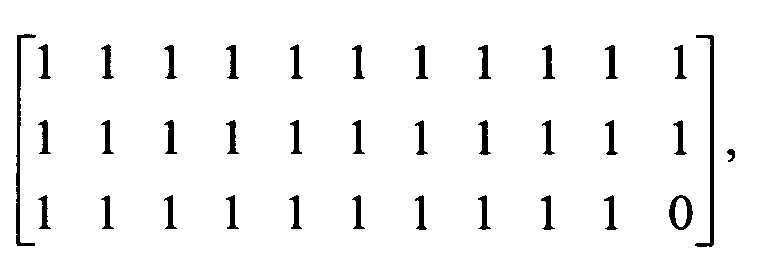
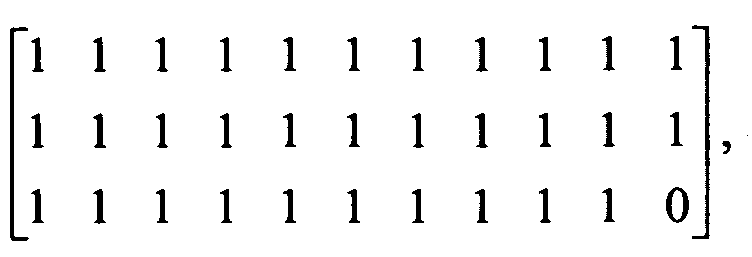
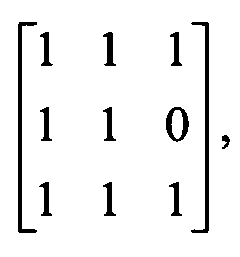
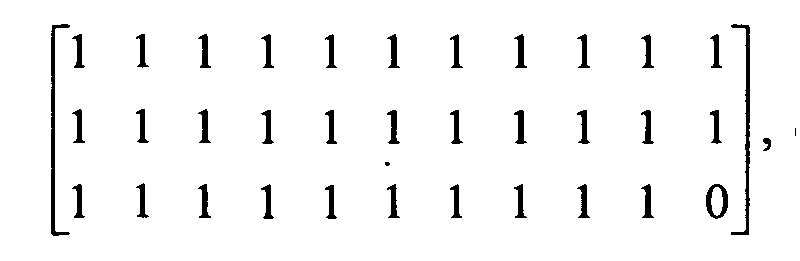
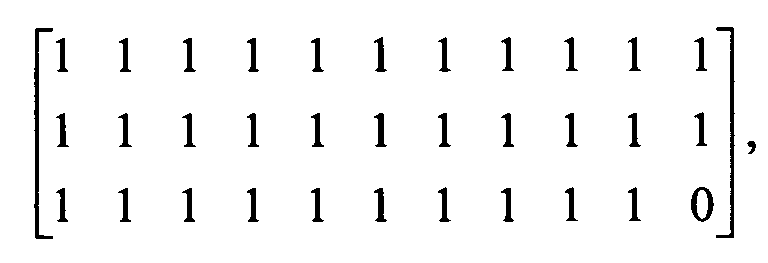
Advantageously, the predefined puncturing pattern results in a code rate R =
11/32, and may be represented in a matrix format as
or equivalents thereof, wherein the first row of the matrix is associated with the first
stream of encoded data bits, the second row of the matrix is associated with the second
stream of encoded data bits, the third row of the matrix is associated with the third stream
of encoded data bits, each row of the matrix is in left to right order of advancing time, and
wherein each value in each row of the matrix represents output, if a 1 (one), or omission,
if a 0 (zero), of a corresponding data bit of the associated stream of encoded data bits in
the encoded stream of output bits.
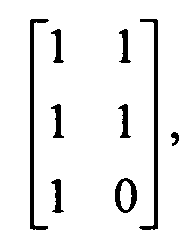
-
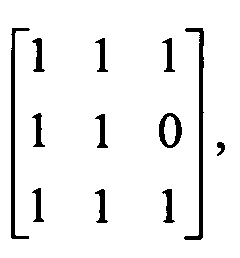
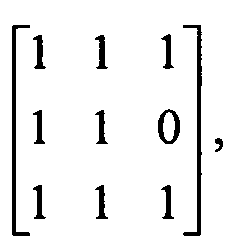
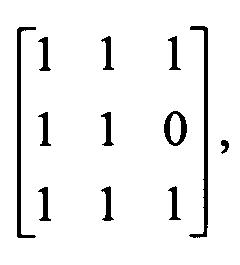
Advantageously, the predefined puncturing pattern results in a code rate R = 3/8,
and may be represented in a matrix format as
or equivalents thereof, wherein
the first row of the matrix is associated with the first stream of encoded data bits, the
second row of the matrix is associated with the second stream of encoded data bits, the
third row of the matrix is associated with the third stream of encoded data bits, each row
of the matrix is in left to right order of advancing time, and wherein each value in each
row of the matrix represents output, if a 1 (one), or omission, if a 0 (zero), of a
corresponding data bit of the associated sequence of encoded data bits in the encoded
stream of output bits.
-
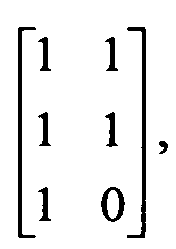
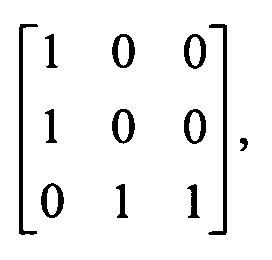
Advantageously, the predefined puncturing pattern results in a code rate R = 2/5,
and may be represented in a matrix format as
or equivalents thereof, wherein the
first row of the matrix is associated with the first stream of encoded data bits, the second
row of the matrix is associated with the second stream of encoded data bits, the third row
of the matrix is associated with the third stream of encoded data bits, each row of the
matrix is in left to right order of advancing time, and wherein each value in each row of
the matrix represents output, if a 1 (one), or omission, if a 0 (zero), of a corresponding
data bit of the associated sequence of encoded data bits in the encoded stream of output
bits.
-
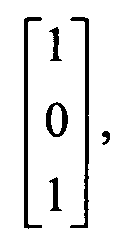
Advantageously, the predefined puncturing pattern results in a code rate R = 1/2,
and may be represented in a matrix format as
or equivalents thereof, wherein the
first row of the matrix is associated with the first stream of encoded data bits, the second
row of the matrix is associated with the second stream of encoded data bits, the third row
of the matrix is associated with the third stream of encoded data bits, each row of the
matrix is in left to right order of advancing time, and wherein each value in each row of
the matrix represents output, if a 1 (one), or omission, if a 0 (zero), of a corresponding
data bit of the associated sequence of encoded data bits in the encoded stream of output
bits.
-
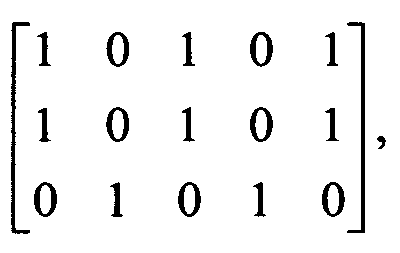
Advantageously, the predefined puncturing pattern results in a code rate R = 5/8,
and may be represented in a matrix format as
or equivalents thereof,
wherein the first row of the matrix is associated with the first stream of encoded data bits,
the second row of the matrix is associated with the second stream of encoded data bits,
the third row of the matrix is associated with the third stream of encoded data bits, each
row of the matrix is in left to right order of advancing time, and wherein each value in
each row of the matrix represents output, if a 1 (one), or omission, if a 0 (zero), of a
corresponding data bit of the associated sequence of encoded data bits in the encoded
stream of output bits.
-
Advantageously, the predefined puncturing pattern results in a code rate R = 3/4,
and may be represented in a matrix format as
or equivalents thereof, wherein
the first row of the matrix is associated with the first stream of encoded data bits, the
second row of the matrix is associated with the second stream of encoded data bits, the
third row of the matrix is associated with the third stream of encoded data bits, each row
of the matrix is in left to right order of advancing time, and wherein each value in each
row of the matrix represents output, if a 1 (one), or omission, if a 0 (zero), of a
corresponding data bit of the associated sequence of encoded data bits in the encoded
stream of output bits.
-
Advantageously, the first, second, and third generator polynomials, and the
predefined puncturing pattern are employed in bitwise time-reversed order.
-
According to an aspect of the invention, an encoder circuit is provided for
convolutionally encoding a bit stream according to a generator polynomial G = [133 165
171]8, the circuit producing an encoded bit stream subject to a predefined puncturing
pattern, the encoder having a native code rate R = 1/3.
-
Advantageously, the predefined puncturing pattern results in a code rate R = 11/32
and may be represented by a matrix as
or equivalents
thereof, wherein the first row of the matrix is associated with the first element of the
generator polynomial, the second row of the matrix is associated with the second element
of the generator polynomial, the third row of the matrix is associated with the third
element of the generator polynomial, and each row of the matrix is in left to right order of
advancing time, and wherein each value in each row of the matrix represents output, if a 1
(one), or omission, if a 0 (zero), of an encoded data bit in the encoded bit stream.
-
Advantageously, the predefined puncturing pattern results in a code rate R = 3/8
and may be represented by a matrix as
or equivalents thereof, wherein the first
row of the matrix is associated with the first element of the generator polynomial, the
second row of the matrix is associated with the second element of the generator
polynomial, the third row of the matrix is associated with the third element of the
generator polynomial, and each row of the matrix is in left to right order of advancing
time, and wherein each value in each row of the matrix represents output, if a 1 (one), or
omission, if a 0 (zero), of an encoded data bit in the encoded bit stream.
-
Advantageously, the predefined puncturing pattern results in a code rate R = 2/5
and may be represented by a matrix as
or equivalents thereof, wherein the first
row of the matrix is associated with the first element of the generator polynomial, the
second row of the matrix is associated with the second element of the generator
polynomial, the third row of the matrix is associated with the third element of the
generator polynomial, and each row of the matrix is in left to right order of advancing
time, and wherein each value in each row of the matrix represents output, if a 1 (one), or
omission, if a 0 (zero), of an encoded data bit in the encoded bit stream.
-
Advantageously, the predefined puncturing pattern results in a code rate R = 1/2
and may be represented by a matrix as
or equivalents thereof, wherein the first row
of the matrix is associated with the first element of the generator polynomial, the second
row of the matrix is associated with the second element of the generator polynomial, the
third row of the matrix is associated with the third element of the generator polynomial,
and each row of the matrix is in left to right order of advancing time, and wherein each
value in each row of the matrix represents output, if a 1 (one), or omission, if a 0 (zero),
of an encoded data bit in the encoded bit stream.
-
Advantageously, the predefined puncturing pattern results in a code rate R = 5/8
and may be represented by a matrix as
or equivalents thereof, wherein
the first row of the matrix is associated with the first element of the generator polynomial,
the second row of the matrix is associated with the second element of the generator
polynomial, the third row of the matrix is associated with the third element of the
generator polynomial, and each row of the matrix is in left to right order of advancing
time, and wherein each value in each row of the matrix represents output, if a 1 (one), or
omission, if a 0 (zero), of an encoded data bit in the encoded bit stream.
-
Advantageously, the predefined puncturing pattern results in a code rate R = 3/4
and may be represented by a matrix as
or equivalents thereof, wherein the
first row of the matrix is associated with the first element of the generator polynomial, the
second row of the matrix is associated with the second element of the generator
polynomial, the third row of the matrix is associated with the third element of the
generator polynomial, and each row of the matrix is in left to right order of advancing
time, and wherein each value in each row of the matrix represents output, if a 1 (one), or
omission, if a 0 (zero), of an encoded data bit in the encoded bit stream.
-
Advantageously, the generator polynomial and the predefined puncturing pattern
are employed in bitwise time-reversed order.
-
According to an aspect of the invention, a method of convolutionally encoding a
bit stream is provided, the method comprising:
- receiving the bit stream;
- encoding the received bit stream according to a generator polynomial G =
[133 165 171]8, the encoding producing an encoded bit stream; and
- outputting the encoded bit stream.
-
-
Advantageously, the method further comprises:
- puncturing the encoded bit sequence according to a predefined puncturing
pattern.
-
-
Advantageously, the predefined puncturing pattern results in a code rate R = 11/32
and may be represented by a matrix as
, or equivalents
thereof, wherein the first row of the matrix is associated with the first element of the
generator polynomial, the second row of the matrix is associated with the second element
of the generator polynomial, the third row of the matrix is associated with the third
element of the generator polynomial, and each row of the matrix is in left to right order of
advancing time, and wherein each value in each row of the matrix represents output, if a 1
(one), or omission, if a 0 (zero), of an encoded data bit in the encoded bit stream.
-
Advantageously, the predefined puncturing pattern results in a code rate R = 3/8
and may be represented by a matrix as
or equivalents thereof, wherein the first
row of the matrix is associated with the first element of the generator polynomial, the
second row of the matrix is associated with the second element of the generator
polynomial, the third row of the matrix is associated with the third element of the
generator polynomial, and each row of the matrix is in left to right order of advancing
time, and wherein each value in each row of the matrix represents output, if a 1 (one), or
omission, if a 0 (zero), of an encoded data bit in the encoded bit stream.
-
Advantageously, the predefined puncturing pattern results in a code rate R = 2/5
and may be represented by a matrix as
or equivalents thereof, wherein the first
row of the matrix is associated with the first element of the generator polynomial, the
second row of the matrix is associated with the second element of the generator
polynomial, the third row of the matrix is associated with the third element of the
generator polynomial, and each row of the matrix is in left to right order of advancing
time, and wherein each value in each row of the matrix represents output, if a 1 (one), or
omission, if a 0 (zero), of an encoded data bit in the encoded bit stream.
-
Advantageously, the predefined puncturing pattern results in a code rate R = 1/2
and may be represented by a matrix as
or equivalents thereof, wherein the first row
of the matrix is associated with the first element of the generator polynomial, the second
row of the matrix is associated with the second element of the generator polynomial, the
third row of the matrix is associated with the third element of the generator polynomial,
and each row of the matrix is in left to right order of advancing time, and wherein each
value in each row of the matrix represents output, if a 1 (one), or omission, if a 0 (zero),
of an encoded data bit in the encoded bit stream.
-
Advantageously, the predefined puncturing pattern results in a code rate R = 5/8
and may be represented by a matrix as
or equivalents thereof, wherein
the first row of the matrix is associated with the first element of the generator polynomial,
the second row of the matrix is associated with the second element of the generator
polynomial, the third row of the matrix is associated with the third element of the
generator polynomial, and each row of the matrix is in left to right order of advancing
time, and wherein each value in each row of the matrix represents output, if a 1 (one), or
omission, if a 0 (zero), of an encoded data bit in the encoded bit stream.
-
Advantageously, the predefined puncturing pattern results in a code rate R = 3/4
and may be represented by a matrix as
, or equivalents thereof, wherein the
first row of the matrix is associated with the first element of the generator polynomial, the
second row of the matrix is associated with the second element of the generator
polynomial, the third row of the matrix is associated with the third element of the
generator polynomial, and each row of the matrix is in left to right order of advancing
time, and wherein each value in each row of the matrix represents output, if a 1 (one), or
omission, if a 0 (zero), of an encoded data bit in the encoded bit stream.
-
Advantageously, the generator polynomial and the predefined puncturing pattern
are employed in bitwise time-reversed order.
-
According to an aspect of the invention, a system for convolutionally encoding a
bit stream is provided, the system comprising:
- at least one processor capable of receiving the bit stream;
- the at least one processor capable of encoding the received bit stream
according to a generator polynomial G = [133 165 171]8, the encoding producing an
encoded bit stream; and
- the at least one processor capable of outputting the encoded bit stream.
-
-
Advantageously, the system further comprises:
- the at least one processor capable of puncturing the encoded bit sequence
according to a predefined puncturing pattern.
-
-
Advantageously, the predefined puncturing pattern results in a code rate R = 11/32
and may be represented by a matrix as
or equivalents
thereof, wherein the first row of the matrix is associated with the first element of the
generator polynomial, the second row of the matrix is associated with the second element
of the generator polynomial, the third row of the matrix is associated with the third
element of the generator polynomial, and each row of the matrix is in left to right order of
advancing time, and wherein each value in each row of the matrix represents output, if a 1
(one), or omission, if a 0 (zero), of an encoded data bit in the encoded bit stream.
-
Advantageously, the predefined puncturing pattern results in a code rate R = 3/8
and may be represented by a matrix as
or equivalents thereof, wherein the first
row of the matrix is associated with the first element of the generator polynomial, the
second row of the matrix is associated with the second element of the generator
polynomial, the third row of the matrix is associated with the third element of the
generator polynomial, and each row of the matrix is in left to right order of advancing
time, and wherein each value in each row of the matrix represents output, if a 1 (one), or
omission, if a 0 (zero), of an encoded data bit in the encoded bit stream.
-
Advantageously, the predefined puncturing pattern results in a code rate R = 2/5
and may be represented by a matrix as
or equivalents thereof, wherein the first
row of the matrix is associated with the first element of the generator polynomial, the
second row of the matrix is associated with the second element of the generator
polynomial, the third row of the matrix is associated with the third element of the
generator polynomial, and each row of the matrix is in left to right order of advancing
time, and wherein each value in each row of the matrix represents output, if a 1 (one), or
omission, if a 0 (zero), of an encoded data bit in the encoded bit stream.
-
Advantageously, the predefined puncturing pattern results in a code rate R = 1/2
and may be represented by a matrix as
or equivalents thereof, wherein the first row
of the matrix is associated with the first element of the generator polynomial, the second
row of the matrix is associated with the second element of the generator polynomial, the
third row of the matrix is associated with the third element of the generator polynomial,
and each row of the matrix is in left to right order of advancing time, and wherein each
value in each row of the matrix represents output, if a 1 (one), or omission, if a 0 (zero),
of an encoded data bit in the encoded bit stream.
-
Advantageously, the predefined puncturing pattern results in a code rate R = 5/8
and may be represented by a matrix as
or equivalents thereof, wherein
the first row of the matrix is associated with the first element of the generator polynomial,
the second row of the matrix is associated with the second element of the generator
polynomial, the third row of the matrix is associated with the third element of the
generator polynomial, and each row of the matrix is in left to right order of advancing
time, and wherein each value in each row of the matrix represents output, if a 1 (one), or
omission, if a 0 (zero), of an encoded data bit in the encoded bit stream.
-
Advantageously, the predefined puncturing pattern results in a code rate R = 3/4
and may be represented by a matrix as
or equivalents thereof, wherein the
first row of the matrix is associated with the first element of the generator polynomial, the
second row of the matrix is associated with the second element of the generator
polynomial, the third row of the matrix is associated with the third element of the
generator polynomial, and each row of the matrix is in left to right order of advancing
time, and wherein each value in each row of the matrix represents output, if a 1 (one), or
omission, if a 0 (zero), of an encoded data bit in the encoded bit stream.
-
Advantageously, the generator polynomial and the predefined puncturing pattern
are employed in bitwise time-reversed order.
-
These and other features and advantages of the present invention may be
appreciated from a review of the following detailed description of the present invention,
along with the accompanying figures in which like reference numerals refer to like parts
throughout.
BRIEF DESCRIPTION OF SEVERAL VIEWS OF THE DRAWINGS
-
Figure 1 illustrates a communication network in which an embodiment of the
present invention may be practiced.
-
Figure 2 shows a block diagram of an exemplary communication system that may
correspond to the OFDM transmitters shown in Figure 1, in accordance with a
representative embodiment of the present invention.
-
Figure 3 shows a block diagram of the configuration of a exemplary convolutional
encoder that may correspond to the convolutional encoder of Figure 2, in accordance with
a representative embodiment of the present invention.
-
Figure 4A shows an illustration of an exemplary puncturing pattern for use with a
convolutional encoder having a generator polynomial G = [133 165 171]8 such as, for
example, the convolutional encoder of Fig.3, to produce a code of rate R = 11/32, in
accordance with a representative embodiment of the present invention.
-
Figure 4B shows an illustration of an exemplary puncturing pattern for use with a
convolutional encoder having a generator polynomial G = [133 165 171]8 such as, for
example, the convolutional encoder of Fig.3, to produce a code of rate R = 3/8, in
accordance with a representative embodiment of the present invention.
-
Figure 4C shows an illustration of an exemplary puncturing pattern for use with a
convolutional encoder having a generator polynomial G = [133 165 171]8 such as, for
example, the convolutional encoder of Fig.3, to produce a code of rate R = 2/5, in
accordance with a representative embodiment of the present invention.
-
Figure 4D shows an illustration of an exemplary puncturing pattern for use with a
convolutional encoder having a generator polynomial G = [133 165 171]8 such as, for
example, the convolutional encoder of Fig.3, to produce a code of rate R = 1/2, in
accordance with a representative embodiment of the present invention.
-
Figure 4E shows an illustration of an exemplary puncturing pattern for use with a
convolutional encoder having a generator polynomial G = [133 165 171]8 such as, for
example, the convolutional encoder of Fig.3, to produce a code of rate R = 5/8, in
accordance with a representative embodiment of the present invention.
-
Figure 4F shows an illustration of an exemplary puncturing pattern for use with a
convolutional encoder having a generator polynomial G = [133 165 171]8 such as, for
example, the convolutional encoder of Fig.3, to produce a code of rate R = 3/4, in
accordance with a representative embodiment of the present invention.
-
Figures 5A and 5B illustrate two exemplary puncturing patterns for use with the
generator polynomial G = [133 165 171]8 of the convolutional encoder of Figure 3, in
accordance with a representative embodiment of the present invention.
-
Figures 5C and 5D illustrate two additional exemplary puncturing patterns for use
with the generator polynomial G = [ 133 165 171]8 of the convolutional encoder of Figure
3, in accordance with a representative embodiment of the present invention.
-
Figure 6A shows a table comparing the performance of the codes of the MBOA
proposal to the performance of the codes generated using the generator polynomial G =
[133 165 171]8 at the native rate R = 1/3, and when used with the puncturing patterns of
Figures 4A through 4C for rates R = 11/32, 3/8, and 2/5, in accordance with a
representative embodiment of the present invention.
-
Figure 6B shows a table comparing the performance of the codes of the MBOA
proposal to the performance of the codes generated using the generator polynomial G =
[133 165 171]8 and the puncturing patterns of Figures 4D, 4E, and 4F for rates R = 1/2,
5/8, and 3/4, in accordance with a representative embodiment of the present invention.
DETAILED DESCRIPTION OF THE INVENTION
-
Aspects of the present invention relate generally to methods of coding information
for transmission over communication links prone to errors. More specifically, the present
invention relates to methods of using a predetermined convolutional code and selected
perforation patterns to improve communication system performance. Although the
following discussion illustrates aspects of the present invention with regard to a particular
communication system, the utility of the present invention is not limited to the
representative embodiments provided herein.
-
Figure 1 illustrates a communication network 100 in which an embodiment of the
present invention may be practiced. The communication network 100 of Figure 1
comprises orthogonal frequency division multiplex (OFDM) communication systems
110, 120 communicatively coupled via RF path 140. The OFDM communication systems
110, 120 may be used to communicate data from one location to the other using, for
example, an ultra-wideband radio frequency communication protocol such as that
described in the Multi-band OFDM Physical Layer Proposal for IEEE 802.15 Task Group
3a, dated July 21, 2003, prepared by the Institute of Electrical and Electronics Engineers,
Inc.. The OFDM communication system 110 comprises an OFDM transmitter 112 and an
OFDM receiver 114. The OFDM transmitter 112 and OFDM receiver 114 are
communicatively coupled to antenna 119 to enable the exchange of radio frequency
signals via RF path 140. Although in the illustration of Figure 1 the antenna 119 is shown
as a single antenna connected to both OFDM transmitter 112 and OFDM receiver 114,
the antenna 119 may comprise two or more antennas connected in various arrangements
to the OFDM transmitter 112 and OFDM receiver 114. Likewise, the OFDM
communication system 120 comprises an OFDM transmitter 122 and an OFDM receiver
124. The OFDM transmitter 124 and OFDM receiver 122 are communicatively coupled
to antenna 129 to enable the exchange of radio frequency signals via RF path 140. In a
manner similar to antenna 119, the antenna 129 is shown as a single antenna connected
to both OFDM transmitter 124 and OFDM receiver 122. The antenna 129 may, however,
comprise two or more antennas connected in various arrangements to the OFDM
transmitter 124 and OFDM receiver 122.
-
The OFDM communication system 110 receives transmit data 115 for
transmission to OFDM communication system 120. The transmit data 115 is reproduced
at OFDM communication system 120 as receive data 127. Similarly, the OFDM
communication system 120 receives transmit data 125 for transmission to OFDM
communication system 110. The transmit data 125 is reproduced at OFDM
communication system 110 as receive data 117. Although the illustration shows only two
OFDM communication systems 110, 120, the communication network 100 may comprise
a greater number of OFDM communication systems 110, 120 without departing from the
spirit of the present invention. Each of the OFDM communication systems 110, 120 may
operate in a number of frequency bands, and communicate within the frequency band
using a number of sub-carrier or "tone" frequencies.
-
The RF path 140 of Figure 1 may be subject to sources of interference including,
for example, natural terrestrial and cosmic sources, thermal noise, and other RF
transmitters having a transmitter portion such as the transmitter portions of OFDM
communication systems 110, 120, operating on the radio frequencies used by the OFDM
communication systems 110, 120. The primary sources of interference in OFDM systems
such as those shown in Fig. 1 are thermal noise and multi-path interference. Multi-path
interference causes frequency-selected fading. In a dense multi-path environment, the
frequency-selective fading follows a Rayleigh distribution. This is known as Rayleigh
fading. To enable the OFDM communication systems 110, 120 to communicate more
effectively in the presence of such interference (e.g., with a lower occurrence of data
errors), the OFDM communication systems 110, 120 may encode the transmit data 115
and transmit data 125 before transmission, by employing convolutional codes. The
OFDM communication systems 110, 120 may, for example, be ultra-wideband
communication systems.
-
Figure 2 shows a block diagram of an exemplary communication system 200 that
may correspond to the OFDM transmitters 112, 122 shown in Figure 1, in accordance
with a representative embodiment of the present invention. As illustrated in Figure 2, the
communications system 200 comprises a series of functional blocks including a
convolutional encoder block 210, an interleaver block 220, a bit-to-symbol mapper block
230, a pilot and guard tone insertion block 235, an inverse fast Fourier transform (IFFT)
block 240, a prefix insertion block 245, and an I/Q modulator block 250. It is a function
of the communication system 200 of Figure 2 to process the transmit data 205 into an
orthogonal frequency division multiplex (OFDM) signal 255 for transmission via a radio
frequency carrier, such as the RF path 140 of Figure 1.
-
Figure 3 shows a block diagram of the configuration of a exemplary
convolutional encoder 310 that may correspond to the convolutional encoder 210 of
Figure 2, in accordance with a representative embodiment of the present invention. The
transmit data 305 in Figure 3 may, for example, correspond to the transmit data 205 of
Figure 2, and the encoded data 315 may, for example, correspond to the encoded data 215
of Figure 2. As illustrated in Figure 3, the convolutional encoder 310 comprises three
signal paths that process the transmit data 305 in parallel, according to a generator
polynomial, G, having three parts G1 = 1338, G2 = 1658, and G3 = 1718. The generator
polynomial G may also be denoted as G = [133 165 171]8. As the illustration of Figure 3
shows, the convolutional encoder 310 produces up to three bits of encoded data 315 for
each bit of un-encoded transmit data 305. In a representative embodiment of the present
invention, a puncturing block 314 may function to perform puncturing of data from the
three signal paths output data A 311, output data B 312, and output data C 313, according
to a puncturing pattern of the present invention. The result is the stream of encoded and
punctured encoded data 315.
-
Figure 4A shows an illustration of an exemplary puncturing pattern for use with a
convolutional encoder having a generator polynomial G = [133 165 171]8 such as, for
example, the convolutional encoder 310 of Fig.3, to produce a code of rate R = 11/32, in
accordance with a representative embodiment of the present invention. In the exemplary
convolutional encoder 310 of Fig. 3, the first or top row of the puncturing pattern shown
in Fig. 4A may be applied to the stream of output data A 311, the second or middle row
of the puncturing pattern shown in Fig. 4A may be applied to the stream of output data B
312, and the third or bottom row of the puncturing pattern shown in Fig. 4A may be
applied to the stream of output data C 313. Each of the rows of the puncturing pattern
shown in Fig. 4A is arranged in a left-to-right order of advancing time. The shaded boxes
in Figure 4A represent punctured bits, i.e., those bits that are not transmitted across the
communication channel. Using the puncturing patterns shown in Figure 4A, selected bits
are removed from the three coded output streams output data A 311, output data B 312,
and output data C 313 of the convolutional coder 310 shown in Figure 3, for rates other
than the native code rate of R = 1/3. When used in combination with the generator
polynomial G = [133 165 171]8 of the present invention, the puncturing pattern of Figure
4A results in a code rate R = 11/32. That is, for each 11 bits of transmit data, 32 coded
bits are produced at encoded data 315.
-
Figure 4B shows an illustration of an exemplary puncturing pattern for use with a
convolutional encoder having a generator polynomial G = [133 165 171]8 such as, for
example, the convolutional encoder 310 of Fig.3, to produce a code of rate R = 3/8, in
accordance with a representative embodiment of the present invention. The puncturing
pattern of Figure 4B when used in combination with the generator polynomial G = [133
165 171]8 of the present invention, results in a code rate R = 3/8. That is, for each three
bits of transmit data, eight coded bits are produced.
-
Figure 4C shows an illustration of an exemplary puncturing pattern for use with a
convolutional encoder having a generator polynomial G = [133 165 171]8 such as, for
example, the convolutional encoder 310 of Fig.3, to produce a code of rate R = 2/5, in
accordance with a representative embodiment of the present invention. The puncturing
pattern of Figure 4C when used in combination with the generator polynomial G = [133
165 171]8 of the present invention, results in a code rate R = 2/5. That is, for each two
bits of transmit data, five coded bits are produced.
-
Figure 4D shows an illustration of an exemplary puncturing pattern for use with a
convolutional encoder having a generator polynomial G = [133 165 171]8 such as, for
example, the convolutional encoder 310 of Fig.3, to produce a code of rate R = 1/2, in
accordance with a representative embodiment of the present invention. The puncturing
pattern of Figure 4D when used in combination with the generator polynomial G = [133
165 171]8 of the present invention, results in a code rate R = 1/2. That is, for each bit of
transmit data, two coded bits are produced.
-
Figure 4E shows an illustration of an exemplary puncturing pattern for use with a
convolutional encoder having a generator polynomial G = [133 165 171]8 such as, for
example, the convolutional encoder 310 of Fig.3, to produce a code of rate R = 5/8, in
accordance with a representative embodiment of the present invention. The puncturing
pattern of Figure 4E when used in combination with the generator polynomial G = [133
165 171]8 of the present invention, results in a code rate R = 5/8. That is, for each five
bits of transmit data, eight coded bits are produced.
-
Figure 4F shows an illustration of an exemplary puncturing pattern for use with a
convolutional encoder having a generator polynomial G = [133 165 171]8 such as, for
example, the convolutional encoder 310 of Fig.3, to produce a code of rate R = 3/4, in
accordance with a representative embodiment of the present invention. The puncturing
pattern of Figure 4F when used in combination with the generator polynomial G = [133
165 171]8 of the present invention, results in a code rate R = 3/4. That is, for each three
bits of transmit data, four coded bits are produced.
-
In various representative embodiments of the present invention, the codes
produced by the combination of the generator polynomial G = [133 165 171]8 and the
puncturing patterns of Figures 4A through 4E, outperform both the original MB-OFDM
proposal described above, and currently known alternate proposals, at all coding rates. In
various representative embodiments, codes for code rates R = 11/32, 3/8, 2/5, 5/8, and 3/4
may be used. Code produced by the generator polynomial of the present invention has
better behavior than the code of the MBOA proposal, described above, in a three-band
system at the native code rate R = 1/3, when one band is erased (e.g., severely impaired).
A code according to a representative embodiment of the present invention as described
herein has no known disadvantages.
-
Figures 5A and 5B illustrate two exemplary puncturing patterns for use with the
generator polynomial G = [133 165 171]8 of the convolutional encoder 310 of Figure 3, in
accordance with an embodiment of the present invention. The puncturing patterns shown
in Figures 5A and 5B both result in a rate R = 5/8 code, and exhibit equivalent
performance. The puncturing pattern shown in Figure 5A is the same as that shown in
Figure 4D. The puncturing pattern illustrated in Figure 5B is one example of a family of
puncturing patterns that result from cyclic shifts of the puncturing pattern shown in
Figure 5A. The performance of codes that result from the use of the generator
polynomial G = [133 165 171]8 of the present invention, with the puncturing pattern of
Figure 5B, or other cyclically shifted forms of the puncturing pattern of Figure 5A, is
equivalent to that of the generator polynomial of the present invention in combination
with the puncturing pattern of Figure 5A.
-
The same holds true for the puncturing patterns shown in Figures 4A through 4C
and 4E. For example, Figures 5C and 5D illustrate two additional exemplary puncturing
patterns for use with the generator polynomial G = [133 165 171]8 of the convolutional
encoder 310 of Figure 3, in accordance with an embodiment of the present invention.
The puncturing patterns shown in Figures 5C and 5D both result in a rate R = 3/4 code,
and exhibit equivalent performance, in accordance with an embodiment of the present
invention. The puncturing pattern shown in Figure 5C is the same as that shown in
Figure 4E. The puncturing pattern illustrated in Figure 5D is one example of a family of
puncturing patterns that result from cyclic shifts of the puncturing pattern shown in
Figure 5C. The performance of codes that result from the use of the generator polynomial
G = [133 165 171]8 of the present invention with the puncturing pattern of Figure 5D, or
other cyclically shifted forms of the puncturing pattern of Figure 5C, is equivalent to that
of the generator polynomial of the present invention with the puncturing pattern of Figure
5C.
-
A code in accordance with an embodiment of the present invention may be
represented in several different ways. For example, cyclic rotations or shifts of a
puncturing pattern do not change the properties of the code. Such variations on a code
are considered to be the same code. It should also be noted that time-reversing both the
puncturing pattern and the generator polynomial, together, does not change the properties
of the resulting code. For example, the time-reversal of [133 165 171]8 is [155 127 117]8.
In addition, re-ordering the rows of the puncturing pattern together with the order of the
output streams of the encoder does not change the properties of the code. All of these
variations are considered to be the same code.
-
In general, a convolutional code may be characterized by its weight spectrum.
The weight spectrum of a code may be defined by:
- an = the number of incorrect paths of Hamming weight, n, and
- cn = the total number of bit errors on all incorrect paths of Hamming
weight, n.
-
-
The free distance, df, is the minimum weight, n, for which an > 0. One method
that may be used to find the code with the best performance is to choose the code with the
largest free distance, df, and the fewest neighbors at that distance. A more precise
approach is to find the signal-to-noise ratio (SNR) at which the error curve for the code
crosses a target error rate, using higher-order elements of the weight spectrum in the error
curves. The probability of error curve, Pe, is determined by an - (useful when any error
results in a retransmission). The bit-error-rate curve, Pb , is determined by cn (useful when
bit errors can be corrected at a higher layer).
-
For non-fading (i.e. flat) channels with AWGN (additive white Gaussian noise),
the error event rate,
Pe, and bit error probability,
Pb, may be accurately estimated using
the Union Bound:
-
The performance on dense multi-path channels may be estimated by assuming
independent Rayleigh fading. Close examination of the IEEE 802.15 TG3a channel
models shows that all channel models exhibit frequency-selective Rayleigh fading.
Because of the high ratio of signal bandwidth to coherence bandwidth, individual
channels exhibit relative little deviation from this distribution. Assuming a well-designed
interleaver, independent Rayleigh fading may be assumed.
-
An upper bound on the bit error probability for Rayleigh fading channels is
described in the document "New Bounds on Convolutional Code Performance over
Fading Channels", by R.D. Cideciyan and E. Eleftheriou, IEEE Transactions on
Communications, Vol. 37, No. 11, Nov 1989, the complete subject matter of which is
hereby incorporated herein, in its entirety. The following bounds may be used to
determine limits on the error event rate,
Pe, and bit error probability,
Pb:
where
df is the free distance of a rate R =
k/
n convolutional code; a
n is the number of
incorrect paths of Hamming weight
n;
cn is the total number of non-zero information bits
on all weight
n paths; Γ(.) is the gamma function; and γ
s is the symbol energy to noise
power spectral density ratio, i.e., γ
s = SNR/2. For modes without frequency-spreading,
the Rayleigh-fading bound may be used directly. For modes with frequency-spreading
(i.e., diversity), the code weight may be multiplied by the diversity factor, and the same
equation may be used (e.g., for two-path diversity, n should be replaced by 2n in all
occurrences of n to the right of a
n or c
n in the above bounds for P
e and P
b, respectively.)
-
Figure 6A shows a table comparing the performance of the codes of the MBOA
proposal to the performance of the codes generated using the generator polynomial G =
[133 165 171]8 at the native rate R = 1/3, and when used with the puncturing patterns of
Figures 4A through 4C for rates R = 11/32, 3/8, and 2/5, in accordance with a
representative embodiment of the present invention. Although not included in the
original MB-OFDM proposal, the rate R = 3/8 and R = 2/5 codes and puncturing patterns
are shown in the table of Figure 6A for purposes of comparison. Figure 6B shows a table
comparing the performance of the codes of the MBOA proposal to the performance of the
codes generated using the generator polynomial G = [133 165 171]8 and the puncturing
patterns of Figures 4D, 4E, and 4F for rates R = 1/2, 5/8, and 3/4, in accordance with a
representative embodiment of the present invention. The puncturing pattern, P, is
represented in the tables of Figures 6A and 6B as a binary matrix, where zeros correspond
to punctured bits. These tables also give the weight spectrum of the code, following the
notation used in the document "High-Rate Punctured Convolutional Codes for Viterbi
and Sequential Decoding", by David Haccoun and Guy Begin, IEEE Transactions on
Communications, Vol. 37, No. 11, Nov 1989, the complete subject matter of which is
hereby incorporated herein, in its entirety. The above reference by Haccoun and Begin
may be consulted for additional information concerning the weight spectrum of a code.
-
The three right-most columns of Figures 6A and 6B tabulate the performance of
each code under different fading conditions. These columns indicate the signal-to-noise
ratio (Eb/N0) required to operate at the target error rate (i.e., Pe = le-5). The code with the
best performance under a given set of operating conditions is that code with the lowest
signal-to-noise ratio. Although the performance of codes in accordance with an
embodiment of the present invention are better than the corresponding code from the MB-OFDM
proposal and known alternate proposals, as shown in the rows of Figure 6A for
code rates R = 1/3 (610), 11/32 (620), 3/8 (630), and 2/5 (640) at all code rates, it can be
seen from Figure 6B that the difference of the performance of an embodiment of the
present invention and the prior art is especially significant for code rates R = 1/2 (650),
5/8 (660), and R = 3/4 (670).
-
The largest improvements in code performance for embodiments of the present
invention occur at the highest data rates. For example, at 480 megabits per second
(Mbps), with the rate R = 3/4 code of the present invention, and no diversity, the code in
accordance with an embodiment of the present invention gains 0.71 dB when compared to
the originally proposed MB-OFDM code, 0.36 dB when compared to a time-reversed
version of the originally proposed MB-OFDM code, and 0.24 dB compared to the
alternate code proposal previously discussed. Using a somewhat lower data rate of 400
Mbps and the rate R = 5/8 code of the present invention (with no diversity), the code in
accordance with an embodiment of the present invention gains 0.36 dB when compared to
the originally proposed MB-OFDM code, 0.08 dB when compared to the time-reversed
version of the originally proposed MB-OFDM code, and 0.16 dB when compared to the
alternate ("other") code proposal. Using a still lower data rate of 200 Mbps and the rate R
= 5/8 code of the present invention (with two-path diversity), the code in accordance with
an embodiment of the present invention gains 0.25 dB when compared to the originally
proposed MB-OFDM code, 0.04 dB when compared to the MB-OFDM time-reversed
code, and 0.11 dB when compared to the alternate code proposal.
-
In a three-band system, which is the mandatory operating mode of the original
MB-OFDM proposal, with a code rate R = 1/3, each of the three output bit-streams are
mapped to a different frequency band. If one frequency band experiences severe
impairment (e.g. due to interference), this has the effect of puncturing the code to a code
rate R = 1/2. With the original MB-OFDM proposal, the three possibilities for the
generator polynomial are G = [133 145]8, G = [133 175]8, and G = [145 175]8. The
generator polynomial G = [145 175]8 is known to exhibit particularly poor behavior. In
contrast, the code for rate R = 1/2 in accordance with an embodiment of the present
invention is well-behaved in all three cases where one frequency band is lost (i.e., G =
[133 165]8, G = [133 171]8, and G = [165 171]8.). This results in robust immunity to
interference for the code rate R = 1/3, in an embodiment in accordance with the present
invention.
-
As discussed above, a representative embodiment of the present invention
achieves better performance than existing codes at all data rates, with substantial gains in
performance over prior codes at higher data dates. In addition, an embodiment of the
present invention is well-behaved in a three band system at a rate R = 1/3, when one band
suffers severe impairment.
-
The present invention may be realized in hardware, software, or a combination of
hardware and software. The present invention may be realized in a centralized fashion in
at least one computer system, or in a distributed fashion where different elements are
spread across several interconnected computer systems. Any kind of computer system or
other apparatus adapted for carrying out the methods described herein is suited. A typical
combination of hardware and software may be a general-purpose computer system with a
computer program that, when being loaded and executed, controls the computer system
such that it carries out the methods described herein.
-
The present invention may also be embedded in a computer program product,
which comprises all the features enabling the implementation of the methods described
herein, and which when loaded in a computer system is able to carry out these methods.
Computer program in the present context means any expression, in any language, code or
notation, of a set of instructions intended to cause a system having an information
processing capability to perform a particular function either directly or after either or both
of the following: a) conversion to another language, code or notation; b) reproduction in
a different material form.
-
While the present invention has been described with reference to certain
embodiments, it will be understood by those skilled in the art that various changes may be
made and equivalents may be substituted without departing from the scope of the present
invention. In addition, many modifications may be made to adapt a particular situation or
material to the teachings of the present invention without departing from its scope.
Therefore, it is intended that the present invention not be limited to the particular
embodiment disclosed, but that the present invention will include all embodiments falling
within the scope of the appended claims.