EP1557926A1 - Rechargeable electrical power supply unit for an electronic device of a bicycle - Google Patents
Rechargeable electrical power supply unit for an electronic device of a bicycle Download PDFInfo
- Publication number
- EP1557926A1 EP1557926A1 EP04425029A EP04425029A EP1557926A1 EP 1557926 A1 EP1557926 A1 EP 1557926A1 EP 04425029 A EP04425029 A EP 04425029A EP 04425029 A EP04425029 A EP 04425029A EP 1557926 A1 EP1557926 A1 EP 1557926A1
- Authority
- EP
- European Patent Office
- Prior art keywords
- power supply
- supply unit
- recharging
- connector
- battery
- Prior art date
- Legal status (The legal status is an assumption and is not a legal conclusion. Google has not performed a legal analysis and makes no representation as to the accuracy of the status listed.)
- Granted
Links
Images



Classifications
-
- H—ELECTRICITY
- H02—GENERATION; CONVERSION OR DISTRIBUTION OF ELECTRIC POWER
- H02J—ELECTRIC POWER NETWORKS; CIRCUIT ARRANGEMENTS OR SYSTEMS FOR SUPPLYING OR DISTRIBUTING ELECTRIC POWER; SYSTEMS FOR STORING ELECTRIC ENERGY
- H02J7/00—Circuit arrangements for charging or discharging batteries or for supplying loads from batteries
- H02J7/50—Circuit arrangements for charging or discharging batteries or for supplying loads from batteries acting upon multiple batteries simultaneously or sequentially
- H02J7/575—Parallel/serial switching of connection of batteries to charge or load circuit
-
- H—ELECTRICITY
- H02—GENERATION; CONVERSION OR DISTRIBUTION OF ELECTRIC POWER
- H02J—ELECTRIC POWER NETWORKS; CIRCUIT ARRANGEMENTS OR SYSTEMS FOR SUPPLYING OR DISTRIBUTING ELECTRIC POWER; SYSTEMS FOR STORING ELECTRIC ENERGY
- H02J7/00—Circuit arrangements for charging or discharging batteries or for supplying loads from batteries
- H02J7/14—Circuit arrangements for charging or discharging batteries or for supplying loads from batteries for charging batteries from dynamo-electric generators driven at varying speed, e.g. on vehicle
- H02J7/1407—Circuit arrangements for charging or discharging batteries or for supplying loads from batteries for charging batteries from dynamo-electric generators driven at varying speed, e.g. on vehicle on vehicles not being driven by a motor, e.g. bicycles
Definitions
- the present invention refers to a rechargeable electrical power supply unit for an electronic device of a bicycle.
- Electronic devices for bicycles are known, used, for example, for the management and control of an electronic gearshift or the management of a device for acquiring and displaying the functions of the bicycle, commonly known as cycle computer.
- Such types of devices normally foresee a central unit for data acquiring, processing and controlling, realised with integrated electronic devices, with which a power supply unit which supplies the energy necessary for its operation is associated.
- the power supply unit can consist of one or more batteries of a rechargeable type periodically subjected, when necessary, to the recharging operation through suitable battery chargers.
- the desired power supply voltage for the operation of the electronic devices for example 12 Volts, is normally obtained through a series connection of many lower voltage batteries, for example three series-connected rechargeable batteries each of 4 Volts.
- Such a solution therefore accomplishes a battery pack with two terminals where the desired voltage is made available.
- the recharging of the battery pack is accomplished through the electrical connection of a battery charger which supplies the charging current to the aforementioned two terminals and therefore to the individual series connected batteries in the battery pack.
- a first drawback consists in that the recharging of the entire battery pack does not allow adequate control of the recharging status of the individual batteries of which the pack is made up. This can cause an inhomogeneous recharging level among the individual batteries which make up the battery pack, with a consequent decrease in the lifetime of the battery pack and a worsening of the electrical characteristics of voltage and current stability, if not even a damage of the batteries during recharging.
- Another drawback lies in the impossibility of accomplishing a diagnosis and a check of the recharging status of the individual batteries before or during the recharging itself. It is therefore impossible to detect important parameters, like for example the charging current of the individual batteries, or to detect possible failures due, for example, to overheating.
- the object of the present invention is to overcome said drawbacks.
- a first object of the invention is to realise a rechargeable electrical power supply unit for an electronic device of a bicycle which allows a more efficient and quicker recharging with respect to known power supply units.
- Another object of the invention is to create a recharging device for a rechargeable electrical power supply unit for an electronic device of a bicycle which allows the parameters of each battery to be checked during recharging.
- a rechargeable electrical power supply unit for an electronic device of a bicycle comprising at least two battery elements with a positive and a negative pole, characterised in that said battery elements are arranged in such a way that through switching means it is possible to realise a first operating configuration in which said battery elements are connected in series to supply energy to said electronic device and a second operating configuration in which said battery elements are connected not in series to a recharging device.
- the power supply unit supplies the suitable voltage for the operation of the electronic device through the connection in series of the battery elements whereas in the second operating configuration, i.e. during recharging, the individual battery elements are recharged individually and in a controlled manner by the recharging device.
- the power supply unit and the electronic device are fixedly connected to each other, whereas the recharging step is accomplished by connecting the recharging device to the aforementioned assembly through a connector.
- the power supply unit and the electronic device are disconnectable, whereby the power supply unit can advantageously be disconnected and recharged separately, whereas the electronic device may possibly be supplied through another spare power supply unit.
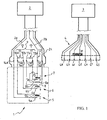
- the electrical power supply unit of the invention is represented in figure 1, where it is globally indicated with 1.
- the power supply unit 1 is associated with an electronic device, globally indicated with 2, and both are suitably fastened to the frame of a bicycle, not represented in the figures.
- a recharging device 3 is represented, better described hereafter, which has a first connector 4 provided with seven electrical contacts 4a-4g.
- the power supply unit 1 comprises three battery elements 5, 6 and 7 consisting of lithium-ion rechargeable accumulators with polymeric electrolyte, of a nominal voltage of 3.7 Volts.
- Each accumulator element 5, 6 and 7 is provided with a respective positive terminal 5a, 6a, 7a and a negative terminal 5b, 6b, 7b.
- the battery elements 5, 6, 7 in different embodiments can consist of a different type of rechargeable accumulator, like for example Nickel-Metal Hydrate (Ni-MH) accumulators.
- Ni-MH Nickel-Metal Hydrate
- a temperature detector 8 is arranged, for example a PTC (Positive Temperature Coefficient) thermistor, with respective terminals 8a and 8b, wherein terminal 8b is electrically connected to terminal 7b of the battery element 7.
- PTC Positive Temperature Coefficient
- the power supply unit 1 makes up a single body with the electronic device 2, since they are mechanically and electrically fixed to each other in the manufacture step or, alternatively, in the assembly step on the bicycle.
- the power supply unit 1 has switching means, globally indicated with 9, consisting of two switches 10, 11 of the normally-closed type, having respective terminals 10a, 10b and 11a, 11b.
- the switch 10 when closed, creates an electrical bridge between the negative terminal 5b of battery element 5 and the positive terminal 6a of battery element 6, whereas the switch 11, when closed, creates an electrical bridge between the negative terminal 6b of battery element 6 and the positive terminal 7a of battery element 7.
- the three battery elements 5, 6 and 7 are therefore connected in series, and between the positive terminal 5a of battery element 5 and the negative terminal 7b of battery element 7 there is a voltage equal to the sum of the voltages of the three battery elements 5, 6 and 7, i.e. 11.1 Volts in the case of lithium-ion accumulators of the type mentioned above.
- a different number of battery elements can be provided, connected in series with each other and possibly of different nominal voltages, according to the preferred combination.
- the aforementioned total voltage of the series is applied to the electronic device 2 between its two power supply lines 2a and 2b.
- a normally-closed switch 12 is arranged between the negative terminal 7b of battery element 7 and the power supply line 2b of electronic device 2.
- a further line 2c provides to the electronic device 2 the temperature signal coming from the terminal 8a of the temperature detector 8.
- the power supply unit 1 has seven electrical contacts 14a-14g electrically connected to the positive 5a, 6a, 7a and negative 5b, 6b, 7b terminals of battery elements 5, 6 and 7 and to the terminal 8a of the temperature detector 8.
- the three switches 10, 11, 12 are preferably, but not necessarily, of the Reed switch type, therefore susceptible to being actuated to open by a magnet arranged close to them.
- a magnetic element 13 is arranged in the first connector 4 of the recharging device 3 and, as shall be further discussed later on, shall be able to keeping the magnetic switches 10, 11, 12 open.
- the electronic device 2 when the battery elements 5, 6, and 7 are charged and the electronic device 2 carries out its functions on board of the bicycle, it is in the configuration of fig. 1 in which the switches 10, 11 and 12 are closed, the three battery elements 5, 6 and 7 are connected in series, and the electronic device 2 is supplied with the desired voltage, given by the sum of the three voltages of the battery elements 5, 6, 7.
- the first connector 4 is connected to the power supply unit 1 through the electrical connection of its contacts 4a-4g with the corresponding contacts 14a-14g of the power supply unit 1.
- the connection of the first connector 4 causes the magnetic element 13 to approach the switches 10, 11 and 12 and makes them open.
- the battery elements 5, 6 and 7 are electrically insulated from the electronic device 2 and are disconnected from each other (or in a configuration not in series), and each individual battery element is connected to a respective recharging source of the recharging device 3. This allows, as shall be better seen hereafter, optimal management of the recharging step of the battery elements 5, 6 and 7.
- the first connector 4 is disconnected and the magnetic element 13 is therefore moved away from the magnetic switches 10, 11, 12. They go back into closed position and the electronic device 2 is once again supplied by the voltage resulting from the series of three battery elements 5, 6, and 7.
- Reed switches can be replaced with other equivalent magnetic or electromagnetic devices, such as other types of mobile equipment relay or Hall sensor relay, or else switches controlled through another type of signal, such as an optical or radio frequency signal, or other types of sensors or proximity devices suitable for causing the switching of a remotely arranged switch.
- the magnetic switches arranged on the power supply unit 1 and the magnetic element 13 arranged on the first connector 4 create a proximity switching device which is actuated to switch when the recharging device 3 is connected to the power supply unit 1, namely when the first connector 4 is connected to the power supply unit 1.
- a proximity switching device which is actuated to switch when the recharging device 3 is connected to the power supply unit 1, namely when the first connector 4 is connected to the power supply unit 1.
- Such a device can be embodied in a functionally equivalent way in many different forms.
- the modified embodiments represented in figures 2 to 4 differ from the preferred solution described with reference to figure 1, mainly in that the power supply unit 1 and the electronic device 2 are connected to each other in a disconnectable manner.
- the electronic device 2 is fastened to the bicycle, whereas the power supply unit 1, when it has to be subjected to the recharging operation, can be disconnected from the electronic device 2 and be arranged in a remote position more convenient for recharging.
- the power supply unit 1 terminates with a second connector 20, and the electronic device 2 terminates with a third connector 21, the second and the third connector 20, 21 being able to be connected disconnected to/from each other.
- the recharging device 3 has a first connector 22 which can be connected to the second connector 20, and thus of a similar type to the third connector 21.
- the second connector 20 consists of a female multipolar socket
- the first and second connector 22, 21 consist of male plugs. It is clear, however, that such connectors can be of a different type and possibly inverted as far as the male-female configuration is concerned.
- the terminals 5a, 5b, 6a, 6b, 7a, 7b of the battery elements 5, 6 and 7 are brought to the second connector 20 and terminate in the respective electrical contacts 20a-20f in open configuration.
- the electrical contact 20g is connected to the terminal 8a of the temperature detector 8.
- the third connector 21 has seven electrical contacts 21a-21g able to be connected to the corresponding electrical contacts 20a-20g of the second connector 20.
- a first electrical bridge 23 is created between the second electrical contact 21b and the third electrical contact 21c of the third connector 21 , whereas between the fourth electrical contact 21d and the fifth electrical contact 21e a second electrical bridge 24 is created.
- the two bridges 23 and 24 are fixed and physically consist, for example, of two copper tracks formed in a printed circuit or simply through a piece of electrical cable welded between the two respective electrical contacts 21b and 21c, 21d and 21e.
- the first connector 22 of the recharging device 3 has seven free electrical contacts 22a-22g able to be connected to the corresponding free electrical contacts 20a-20g of the second connector 20.
- the second connector 20 is connected to the third connector 21, and the electronic device 2 is supplied between the two power supply lines 2a and 2b by the sum voltage of the three voltages of the battery elements 5, 6 and 7, thus carrying out its functions on board of the bicycle.
- the first bridge 23 electrically connects the negative terminal 5b of battery element 5 and the positive terminal 6a of battery element 6, whereas the second bridge 24 electrically connects the negative terminal 6b of battery element 6 and the positive terminal 7a of battery element 7, connecting the three battery elements 5, 6 and 7 in series.
- the desired voltage equal to the sum of the voltages of the three battery elements 5, 6 and 7.
- the second connector 20 is disconnected from the third connector 21 and is connected to the first connector 22 of the recharging device 3.
- the battery elements 5, 6 and 7 are disconnected from each other (or in the configuration not in series) and every single battery element is connected to a respective recharging source of the recharging device 3.
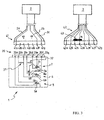
- Figure 3 represents a variant of fig. 2.
- the power supply unit 1 differs from the power supply unit of fig. 2 in that it has two normally-closed magnetic switches 31, 32 arranged in the proximity of the second connector 20. In a modified embodiment such switches 31, 32 could also be arranged in the second connector 20 itself.
- the three battery elements 5, 6 and 7 are therefore connected in series and between the positive terminal 5a of battery element 5 and the negative terminal 7b of battery element 7 there is a voltage equal to the sum of the voltages of the three battery elements 5, 6 and 7.
- the third connector 41 of the electronic device 2 has seven electrical contacts 41a-41g, wherein the first 41a and the sixth 41f contact are connected to the respective supply lines 2a, 2b of the electronic device 2 and the electrical contact 41g is connected to the line 2c for the temperature control signal.
- the first connector 42 of the recharging device 3 has seven free electrical contacts 42a-42g and also has a magnetic element 43 which keeps the magnetic switches 31, 32 open when it is arranged in their proximity.
- the second connector 20 is connected to the third connector 41 and the electronic device 2 is supplied between the two power supply lines 2a and 2b by the sum voltage of the three voltages of the battery elements 5, 6 and 7, thus carrying out its functions on board of the bicycle.
- the first switch 31 is closed and creates the electrical bridge between the negative terminal 5b of battery element 5 and the positive terminal 6a of battery element 6, whereas the second switch 32, also closed, creates the electrical bridge between the negative terminal 6b of battery element 6 and the positive terminal 7a of battery element 7, connecting the three battery elements 5, 6 and 7 in series.
- the desired voltage equal to the sum of the voltages of the three battery elements 5, 6 and 7.
- the second connector 20 is disconnected from the third connector 41 and is connected to the first connector 42 through the electrical connection of the contacts 42a-42g with the corresponding contacts 20a-20g of the second connector 20.
- the connection of the first connector 42 causes the magnetic element 43 to approach the switches 31 and 32 and makes them open.
- the battery elements 5, 6 and 7 are disconnected from each other (or in the configuration not in series) and every single battery element is connected to a respective recharging source of the recharging device 3.
- the first connector 42 can be disconnected and the magnetic element 13 therefore moved away from the magnetic switches 31, 32. They go back into the closed position, and the power supply unit 1 can once again be connected to the electronic device 2.
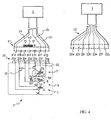
- Figure 4 represents another variant of fig. 2.
- the power supply unit 1 differs from the power supply unit of fig. 2 in that it has two normally-open magnetic switches 51, 52 arranged in the proximity of the second connector 20. In a modified embodiment such switches 51, 52 could also be arranged in the second connector 20 itself.
- the first switch 51 when closed, creates an electrical bridge between the negative terminal 5b of battery element 5 and the positive terminal 6a of battery element 6, whereas the second switch 52, when closed, creates an electrical bridge between the negative terminal 6b of battery element 6 and the positive terminal 7a of battery element 7.
- the third connector 61 of the electronic device 2 has seven electrical contacts 61a-61g, wherein the first 61a and the sixth 61f contacts are connected to the respective power supply lines 2a, 2b of the electronic device 2 and the electrical contact 61g is connected to the line 2c for the temperature control signal.
- the remaining electrical contacts 41b-41e are free.
- There is also a magnetic element 63 which, when arranged in their proximity, keeps the magnetic switches 51, 52 closed.
- the first connector 22 of the recharging device 3 is equal to the first connector 20 represented in fig. 2, and has seven free electrical contacts 62a-62g.
- the second connector 20 is connected to the third connector 61.
- Such a connection causes the magnetic element 63 to approach the switches 51 and 52 and makes them close, and the electronic device is supplied between the two power supply lines 2a and 2b by the sum voltage of the three voltages of the battery elements 5, 6 and 7, thus carrying out its functions on board of the bicycle.
- the second connector 20 is disconnected from the third connector 61 and the magnetic element 63 is therefore moved away from the magnetic switches 51, 52. They go back into open position, and the power supply unit 1 with the second connector 20 can be connected to the first connector 22 through the electrical connection of the contacts 22a-22g with the corresponding contacts 20a-20g of the second connector 20.
- the battery elements 5, 6 and 7 are disconnected from each other (or in the configuration not in series) and every single battery element is connected to a respective recharging source of the recharging device 3.
- the represented recharging device globally indicated with 3, has a first connector 22 of the type previously described with reference to figures 2 and 4.
- a different first connector for example of the type described in figures 1 and 3, associated, in such a case, with the corresponding embodiments as far as the power supply unit 1 and the electronic device 2 are concerned.
- the recharging device 3 consists of three independent recharging sources 81, 82, 83, a supervision and monitoring unit 84, and a power supply unit 85 of the recharging sources 81, 82, 83.
- Each recharging source 81, 82, 83 is independent of the others, and is provided with a first pair of charging terminals 81a, 81b, 82a, 82b, 83a, 83b which are electrically connected to the respective pairs of electrical contacts 22a, 22b, 22c, 22d, 22e, 22f of the first connector 22.
- a second pair of power supply terminals 81c, 81d, 82c, 82d, 83c, 83d connect each source 81, 82, 83 to the power supply unit 85 which is in turn connected to the power supply mains, for example to the 220 V ac monophase mains, through power supply cables 85a, 85b.
- the supervision and monitoring unit 84 is electrically connected to each charging source 81, 82, 83 through respective control lines 84a, 84b, 84c.
- a further input line 84d connects the supervision and monitoring unit 84 to the electrical contact 22g of the first connector 22.
- the three recharging sources 81, 82, 83 are directly connected in an independent way, through the pairs of charging terminals 81a, 81b, 82a, 82b, 83a, 83b, to the respective terminals 5a, 5b, 6a, 6b, 7a, 7b of the battery elements 5, 6, 7.
- the temperature signal coming from the temperature detector 8 is acquired by the supervision and monitoring unit 84 through the input line 84d.
- Such a configuration allows the separate recharging of each battery element 5, 6, 7 through the corresponding recharging source 81, 82, 83 under the supervision of the supervision and monitoring unit 84.
- the supervision and monitoring unit 84 acquires the recharging parameters of the battery elements through communication with the individual recharging sources 81, 82, 83.
- the signal coming from the input line 84 allows a temperature control to be accomplished during recharging. This allows the simultaneous, and therefore quicker, charging of each battery element 5, 6, 7 to be managed with control and diagnosis of the recharging status.
- the reaching of the final charging status and/or the detection of possible failures of one of the battery elements, for example following overheating, is then indicated through suitable display means, for example through luminous LEDs.
- Block 100 indicates the start of the recharging procedure which takes place when the recharging device 3 is connected to the power supply unit 1, and thus each recharging source 81, 82, 83 carries out the recharging of a respective battery element 5, 6 and 7.
- the voltage V bat of the battery element is compared with the value of the foreseen complete charge voltage V cc . If the voltage V bat is not less than V cc , the battery element is charged and a waiting status is entered, identified by block 102. If the voltage V bat is less than V cc , i.e. the battery element is not totally charged, block 103 is entered, where it is checked whether the voltage V bat of the battery element is below a minimum threshold voltage V low . If the comparison gives a negative outcome, block 108 of start of the normal recharging step is entered. If the comparison gives a positive outcome, block 104 is instead entered, where a pre-conditioning step begins.
- Such a step consists of the application of a current to the battery element until the battery voltage V bat reaches a predetermined value, in a pre-conditioning time T pc .
- a pre-conditioning time T pc it is checked whether the voltage V bat of the battery element is less than the minimum threshold voltage V low . If the comparison is positive, block 106 is entered, in which it is checked whether the pre-conditioning time T pc has passed. If the pre-conditioning time T pc has passed, it means that the battery element has not reached the minimum threshold voltage V low during the pre-conditioning step, and therefore block 107 is entered, where it is foreseen to suspend the recharging operation and to indicate the failure of the battery element.
- the normal charging step provides for a first charging step with constant current I c and a second step with constant voltage V c for a total charging time t tot .
- the temperature Te of the battery element being charged is compared with a predetermined operating limit temperature value T lim . If T e is not less than T lim , block 110 is entered, in which the charging is suspended and an overheating signal error is displayed.
- block 111 is entered, in which it is checked whether the recharging time has reached a predetermined recharging maximum time limit t lim . In the positive case, block 107 is entered, in which charging is suspended and a battery element failure error is indicated.
- block 112 is entered, in which it is checked whether the voltage V bat of the battery element is less than the minimum threshold voltage V low . If the comparison is positive, the comparison block 103 is returned to, to once again start the recharging cycle.
- block 113 is entered, in which the detected charging current I cr is compared with the expected end of charging current I fc . If such a comparison is positive, the final block 116 of the end of charging with indication of the end of charging is entered. If, on the other hand, the comparison is negative, the charging is not yet complete and block 114 is entered, in which it is checked whether the detected current has a predetermined value of the start of a final charging step I ffc . If such a comparison is negative, block 109 is returned to, to continue the recharging cycle, if it is positive, block 115 is entered. In 115 it is checked whether a predetermined time for the final recharging step T fc has passed. In the affirmative case the recharging is complete and final block 116 is entered, otherwise block 109 is returned to, to continue the recharging cycle.
- the described method is relative to a recharging cycle of a recharging source of the recharging device of fig. 5.
- the described method can, however, also be used in modified embodiments of the recharging device in which its is foreseen, for example, that the recharging source is just one and that the battery elements are connected, in the recharging step, in parallel. This can be obtained by providing that in the third connector there are electrical bridges which connect all of the positive terminals of the battery elements together, and all of the negative terminals of the battery elements together, the two groups then being connected to the two recharging lines of the single recharging source.
Landscapes
- Engineering & Computer Science (AREA)
- Power Engineering (AREA)
- Charge And Discharge Circuits For Batteries Or The Like (AREA)
- Secondary Cells (AREA)
Abstract
Description
- The present invention refers to a rechargeable electrical power supply unit for an electronic device of a bicycle.
- Electronic devices for bicycles are known, used, for example, for the management and control of an electronic gearshift or the management of a device for acquiring and displaying the functions of the bicycle, commonly known as cycle computer.
- Such types of devices normally foresee a central unit for data acquiring, processing and controlling, realised with integrated electronic devices, with which a power supply unit which supplies the energy necessary for its operation is associated.
- The power supply unit can consist of one or more batteries of a rechargeable type periodically subjected, when necessary, to the recharging operation through suitable battery chargers.
- The desired power supply voltage for the operation of the electronic devices, for example 12 Volts, is normally obtained through a series connection of many lower voltage batteries, for example three series-connected rechargeable batteries each of 4 Volts. Such a solution therefore accomplishes a battery pack with two terminals where the desired voltage is made available.
- The recharging of the battery pack is accomplished through the electrical connection of a battery charger which supplies the charging current to the aforementioned two terminals and therefore to the individual series connected batteries in the battery pack.
- The described solution, nevertheless, has some drawbacks.
- A first drawback consists in that the recharging of the entire battery pack does not allow adequate control of the recharging status of the individual batteries of which the pack is made up. This can cause an inhomogeneous recharging level among the individual batteries which make up the battery pack, with a consequent decrease in the lifetime of the battery pack and a worsening of the electrical characteristics of voltage and current stability, if not even a damage of the batteries during recharging.
- Another drawback lies in the impossibility of accomplishing a diagnosis and a check of the recharging status of the individual batteries before or during the recharging itself. It is therefore impossible to detect important parameters, like for example the charging current of the individual batteries, or to detect possible failures due, for example, to overheating.
- The object of the present invention is to overcome said drawbacks.
- A first object of the invention is to realise a rechargeable electrical power supply unit for an electronic device of a bicycle which allows a more efficient and quicker recharging with respect to known power supply units.
- Another object of the invention is to create a recharging device for a rechargeable electrical power supply unit for an electronic device of a bicycle which allows the parameters of each battery to be checked during recharging.
- Such objects are accomplished through a rechargeable electrical power supply unit for an electronic device of a bicycle, comprising at least two battery elements with a positive and a negative pole, characterised in that said battery elements are arranged in such a way that through switching means it is possible to realise a first operating configuration in which said battery elements are connected in series to supply energy to said electronic device and a second operating configuration in which said battery elements are connected not in series to a recharging device.
- Advantageously, in the first operating configuration the power supply unit supplies the suitable voltage for the operation of the electronic device through the connection in series of the battery elements whereas in the second operating configuration, i.e. during recharging, the individual battery elements are recharged individually and in a controlled manner by the recharging device.
- According to a first preferred embodiment, the power supply unit and the electronic device are fixedly connected to each other, whereas the recharging step is accomplished by connecting the recharging device to the aforementioned assembly through a connector.
- According to another preferred embodiment, the power supply unit and the electronic device are disconnectable, whereby the power supply unit can advantageously be disconnected and recharged separately, whereas the electronic device may possibly be supplied through another spare power supply unit.
- Further characteristics and advantages of the invention shall become clearer from the description of some preferred embodiments, given with reference to the attached drawings, wherein:
- fig. 1 represents a schematic view of the electrical power supply unit of the invention associated with an electronic device of a bicycle and a recharging device according to a first preferred embodiment;
- figures 2 to 4 represent modified embodiments of fig. 1;
- fig. 5 represents a schematic view of a battery charger device for the electrical power supply unit illustrated in figures 1 to 4;
- fig. 6 represents the block diagram of the operation of the recharging device for the power supply unit of the invention.
- The electrical power supply unit of the invention is represented in figure 1, where it is globally indicated with 1.
- The power supply unit 1 is associated with an electronic device, globally indicated with 2, and both are suitably fastened to the frame of a bicycle, not represented in the figures.
- Still with reference to figure 1, a
recharging device 3 is represented, better described hereafter, which has afirst connector 4 provided with seven electrical contacts 4a-4g. - The power supply unit 1 comprises three
battery elements accumulator element positive terminal negative terminal battery elements - Between the
battery elements temperature detector 8 is arranged, for example a PTC (Positive Temperature Coefficient) thermistor, withrespective terminals terminal 8b is electrically connected toterminal 7b of thebattery element 7. - As can be seen in the figure, the power supply unit 1 makes up a single body with the
electronic device 2, since they are mechanically and electrically fixed to each other in the manufacture step or, alternatively, in the assembly step on the bicycle. - The power supply unit 1 has switching means, globally indicated with 9, consisting of two
switches respective terminals - The
switch 10, when closed, creates an electrical bridge between thenegative terminal 5b ofbattery element 5 and thepositive terminal 6a ofbattery element 6, whereas theswitch 11, when closed, creates an electrical bridge between thenegative terminal 6b ofbattery element 6 and thepositive terminal 7a ofbattery element 7. - With the
switches battery elements positive terminal 5a ofbattery element 5 and thenegative terminal 7b ofbattery element 7 there is a voltage equal to the sum of the voltages of the threebattery elements electronic device 2 is different, a different number of battery elements can be provided, connected in series with each other and possibly of different nominal voltages, according to the preferred combination. - The aforementioned total voltage of the series is applied to the
electronic device 2 between its twopower supply lines - A normally-closed
switch 12 is arranged between thenegative terminal 7b ofbattery element 7 and thepower supply line 2b ofelectronic device 2. - A
further line 2c provides to theelectronic device 2 the temperature signal coming from theterminal 8a of thetemperature detector 8. - Finally, the power supply unit 1 has seven
electrical contacts 14a-14g electrically connected to the positive 5a, 6a, 7a and negative 5b, 6b, 7b terminals ofbattery elements terminal 8a of thetemperature detector 8. - The three
switches first connector 4 of therecharging device 3 and, as shall be further discussed later on, shall be able to keeping themagnetic switches - Operatively, when the
battery elements electronic device 2 carries out its functions on board of the bicycle, it is in the configuration of fig. 1 in which theswitches battery elements electronic device 2 is supplied with the desired voltage, given by the sum of the three voltages of thebattery elements - When the charging level of the three
battery elements first connector 4 is connected to the power supply unit 1 through the electrical connection of its contacts 4a-4g with thecorresponding contacts 14a-14g of the power supply unit 1. The connection of thefirst connector 4 causes the magnetic element 13 to approach theswitches battery elements electronic device 2 and are disconnected from each other (or in a configuration not in series), and each individual battery element is connected to a respective recharging source of therecharging device 3. This allows, as shall be better seen hereafter, optimal management of the recharging step of thebattery elements - At completion of the charging, the
first connector 4 is disconnected and the magnetic element 13 is therefore moved away from themagnetic switches electronic device 2 is once again supplied by the voltage resulting from the series of threebattery elements - From what has been stated it is clear that the Reed switches can be replaced with other equivalent magnetic or electromagnetic devices, such as other types of mobile equipment relay or Hall sensor relay, or else switches controlled through another type of signal, such as an optical or radio frequency signal, or other types of sensors or proximity devices suitable for causing the switching of a remotely arranged switch.
- Indeed, the magnetic switches arranged on the power supply unit 1 and the magnetic element 13 arranged on the
first connector 4 create a proximity switching device which is actuated to switch when therecharging device 3 is connected to the power supply unit 1, namely when thefirst connector 4 is connected to the power supply unit 1. Such a device can be embodied in a functionally equivalent way in many different forms. - As an example (and without in any way wanting to exhaust the range of possibilities) the following solutions can be mentioned:
- mechanical proximity switches,
- solid state proximity switches, such as photoemitter-photodetector
pairs or else photodetectors susceptible to
being exposed or blocked according to whether the
first connector 4 is connected to the power supply unit 1 or not, - electromagnetic field or ultrasound proximity sensors.
- The modified embodiments represented in figures 2 to 4 differ from the preferred solution described with reference to figure 1, mainly in that the power supply unit 1 and the
electronic device 2 are connected to each other in a disconnectable manner. In a first solution, theelectronic device 2 is fastened to the bicycle, whereas the power supply unit 1, when it has to be subjected to the recharging operation, can be disconnected from theelectronic device 2 and be arranged in a remote position more convenient for recharging. - With reference to the variant of fig. 2, the power supply unit 1 terminates with a
second connector 20, and theelectronic device 2 terminates with a third connector 21, the second and thethird connector 20, 21 being able to be connected disconnected to/from each other. - The
recharging device 3 has afirst connector 22 which can be connected to thesecond connector 20, and thus of a similar type to the third connector 21. Preferably, thesecond connector 20 consists of a female multipolar socket, whereas the first andsecond connector 22, 21 consist of male plugs. It is clear, however, that such connectors can be of a different type and possibly inverted as far as the male-female configuration is concerned. - Again with reference to the solution of fig. 2, the
terminals battery elements second connector 20 and terminate in the respectiveelectrical contacts 20a-20f in open configuration. Theelectrical contact 20g is connected to the terminal 8a of thetemperature detector 8. - The third connector 21 has seven
electrical contacts 21a-21g able to be connected to the correspondingelectrical contacts 20a-20g of thesecond connector 20. - Between the second
electrical contact 21b and the thirdelectrical contact 21c of thethird connector 21 a firstelectrical bridge 23 is created, whereas between the fourthelectrical contact 21d and the fifthelectrical contact 21e a second electrical bridge 24 is created. The twobridges 23 and 24 are fixed and physically consist, for example, of two copper tracks formed in a printed circuit or simply through a piece of electrical cable welded between the two respectiveelectrical contacts - There are also two
power supply lines electrical contacts third line 2c for the temperature control signal connected to theelectrical contact 21g, such lines being connected to theelectronic device 2. - Finally, the
first connector 22 of therecharging device 3 has seven freeelectrical contacts 22a-22g able to be connected to the corresponding freeelectrical contacts 20a-20g of thesecond connector 20. - Operatively, when the
battery elements second connector 20 is connected to the third connector 21, and theelectronic device 2 is supplied between the twopower supply lines battery elements first bridge 23 electrically connects thenegative terminal 5b ofbattery element 5 and thepositive terminal 6a ofbattery element 6, whereas the second bridge 24 electrically connects thenegative terminal 6b ofbattery element 6 and thepositive terminal 7a ofbattery element 7, connecting the threebattery elements positive terminal 5a ofbattery element 5 and thenegative terminal 7b ofbattery element 7 there is the desired voltage, equal to the sum of the voltages of the threebattery elements - When the charge level of the three
battery elements second connector 20 is disconnected from the third connector 21 and is connected to thefirst connector 22 of therecharging device 3. In such a configuration, like in the previous case, thebattery elements recharging device 3. - Figure 3 represents a variant of fig. 2.
- The power supply unit 1 differs from the power supply unit of fig. 2 in that it has two normally-closed
magnetic switches second connector 20. In a modified embodimentsuch switches second connector 20 itself. - The
first switch 31, when closed, creates an electrical bridge between thenegative terminal 5b ofbattery element 5 and thepositive terminal 6a ofbattery element 6, whereas thesecond switch 32, when closed, creates an electrical bridge between thenegative terminal 6b ofbattery element 6 and thepositive terminal 7a ofbattery element 7. - With the
switches battery elements positive terminal 5a ofbattery element 5 and thenegative terminal 7b ofbattery element 7 there is a voltage equal to the sum of the voltages of the threebattery elements - The
third connector 41 of theelectronic device 2 has sevenelectrical contacts 41a-41g, wherein the first 41a and the sixth 41f contact are connected to therespective supply lines electronic device 2 and the electrical contact 41g is connected to theline 2c for the temperature control signal. The remainingelectrical contacts 41b-41e, on the other hand, are free. - The
first connector 42 of therecharging device 3 has seven freeelectrical contacts 42a-42g and also has amagnetic element 43 which keeps themagnetic switches - Operatively, when the
battery elements second connector 20 is connected to thethird connector 41 and theelectronic device 2 is supplied between the twopower supply lines battery elements first switch 31 is closed and creates the electrical bridge between thenegative terminal 5b ofbattery element 5 and thepositive terminal 6a ofbattery element 6, whereas thesecond switch 32, also closed, creates the electrical bridge between thenegative terminal 6b ofbattery element 6 and thepositive terminal 7a ofbattery element 7, connecting the threebattery elements positive terminal 5a ofbattery element 5 and thenegative terminal 7b ofbattery element 7 there is the desired voltage, equal to the sum of the voltages of the threebattery elements - When the charge level of the three
battery elements second connector 20 is disconnected from thethird connector 41 and is connected to thefirst connector 42 through the electrical connection of thecontacts 42a-42g with the correspondingcontacts 20a-20g of thesecond connector 20. The connection of thefirst connector 42 causes themagnetic element 43 to approach theswitches battery elements recharging device 3. - Upon completion of the charging, the
first connector 42 can be disconnected and the magnetic element 13 therefore moved away from themagnetic switches electronic device 2. - Figure 4 represents another variant of fig. 2.
- The power supply unit 1 differs from the power supply unit of fig. 2 in that it has two normally-open
magnetic switches 51, 52 arranged in the proximity of thesecond connector 20. In a modified embodimentsuch switches 51, 52 could also be arranged in thesecond connector 20 itself. - The first switch 51, when closed, creates an electrical bridge between the
negative terminal 5b ofbattery element 5 and thepositive terminal 6a ofbattery element 6, whereas thesecond switch 52, when closed, creates an electrical bridge between thenegative terminal 6b ofbattery element 6 and thepositive terminal 7a ofbattery element 7. - With the
switches 51 and 52 closed, the threebattery elements positive terminal 5a ofbattery element 5 and thenegative terminal 7b ofbattery element 7 there is a voltage equal to the sum of the voltages of the threebattery elements - The third connector 61 of the
electronic device 2 has seven electrical contacts 61a-61g, wherein the first 61a and the sixth 61f contacts are connected to the respectivepower supply lines electronic device 2 and the electrical contact 61g is connected to theline 2c for the temperature control signal. The remainingelectrical contacts 41b-41e, on the other hand, are free. There is also amagnetic element 63 which, when arranged in their proximity, keeps themagnetic switches 51, 52 closed. - The
first connector 22 of therecharging device 3 is equal to thefirst connector 20 represented in fig. 2, and has seven free electrical contacts 62a-62g. - Operatively, when the
battery elements second connector 20 is connected to the third connector 61. Such a connection causes themagnetic element 63 to approach theswitches 51 and 52 and makes them close, and the electronic device is supplied between the twopower supply lines battery elements - When the charge level of the three
battery elements second connector 20 is disconnected from the third connector 61 and themagnetic element 63 is therefore moved away from themagnetic switches 51, 52. They go back into open position, and the power supply unit 1 with thesecond connector 20 can be connected to thefirst connector 22 through the electrical connection of thecontacts 22a-22g with the correspondingcontacts 20a-20g of thesecond connector 20. In such a configuration, thebattery elements recharging device 3. - In fig. 5 a preferred embodiment of a recharging device usable for the power supply unit 1 of the invention is schematically represented.
- The represented recharging device, globally indicated with 3, has a
first connector 22 of the type previously described with reference to figures 2 and 4. In different solutions, however, it can be foreseen to use a different first connector, for example of the type described in figures 1 and 3, associated, in such a case, with the corresponding embodiments as far as the power supply unit 1 and theelectronic device 2 are concerned. - The
recharging device 3 consists of threeindependent recharging sources monitoring unit 84, and apower supply unit 85 of therecharging sources source terminals electrical contacts first connector 22. - A second pair of
power supply terminals source power supply unit 85 which is in turn connected to the power supply mains, for example to the 220 Vac monophase mains, throughpower supply cables - The supervision and
monitoring unit 84 is electrically connected to each chargingsource respective control lines monitoring unit 84 to theelectrical contact 22g of thefirst connector 22. - During the recharging step, i.e. when the
first connector 22 is connected to thesecond connector 20 of the power supply unit 1, the three rechargingsources terminals respective terminals battery elements temperature detector 8 is acquired by the supervision andmonitoring unit 84 through the input line 84d. - Such a configuration allows the separate recharging of each
battery element corresponding recharging source monitoring unit 84. Through thecontrol lines monitoring unit 84 acquires the recharging parameters of the battery elements through communication with theindividual recharging sources input line 84 allows a temperature control to be accomplished during recharging. This allows the simultaneous, and therefore quicker, charging of eachbattery element - As far as the recharging operations of each recharging
source -
Block 100 indicates the start of the recharging procedure which takes place when therecharging device 3 is connected to the power supply unit 1, and thus each rechargingsource respective battery element - In
block 101, the voltage Vbat of the battery element is compared with the value of the foreseen complete charge voltage Vcc. If the voltage Vbat is not less than Vcc, the battery element is charged and a waiting status is entered, identified byblock 102. If the voltage Vbat is less than Vcc, i.e. the battery element is not totally charged, block 103 is entered, where it is checked whether the voltage Vbat of the battery element is below a minimum threshold voltage Vlow. If the comparison gives a negative outcome, block 108 of start of the normal recharging step is entered. If the comparison gives a positive outcome, block 104 is instead entered, where a pre-conditioning step begins. Such a step consists of the application of a current to the battery element until the battery voltage Vbat reaches a predetermined value, in a pre-conditioning time Tpc. In thenext block 105 it is checked whether the voltage Vbat of the battery element is less than the minimum threshold voltage Vlow. If the comparison is positive, block 106 is entered, in which it is checked whether the pre-conditioning time Tpc has passed. If the pre-conditioning time Tpc has passed, it means that the battery element has not reached the minimum threshold voltage Vlow during the pre-conditioning step, and therefore block 107 is entered, where it is foreseen to suspend the recharging operation and to indicate the failure of the battery element. - If the comparison in
block 105 is negative, i.e. the voltage Vbat of the battery element is not less than the minimum threshold voltage Vlow, then the pre-conditioning step was successful and fromblock 105, block 108 of start of the normal charging step is entered. - The normal charging step provides for a first charging step with constant current Ic and a second step with constant voltage Vc for a total charging time ttot.
- In
block 109, the temperature Te of the battery element being charged is compared with a predetermined operating limit temperature value Tlim. If Te is not less than Tlim, block 110 is entered, in which the charging is suspended and an overheating signal error is displayed. - If the operating temperature Te is less than the limit temperature Tlim, block 111 is entered, in which it is checked whether the recharging time has reached a predetermined recharging maximum time limit tlim. In the positive case, block 107 is entered, in which charging is suspended and a battery element failure error is indicated.
- If the recharging time has not reached the time limit tlim, block 112 is entered, in which it is checked whether the voltage Vbat of the battery element is less than the minimum threshold voltage Vlow. If the comparison is positive, the
comparison block 103 is returned to, to once again start the recharging cycle. - If, on the other hand, the comparison is negative, block 113 is entered, in which the detected charging current Icr is compared with the expected end of charging current Ifc. If such a comparison is positive, the
final block 116 of the end of charging with indication of the end of charging is entered. If, on the other hand, the comparison is negative, the charging is not yet complete and block 114 is entered, in which it is checked whether the detected current has a predetermined value of the start of a final charging step Iffc. If such a comparison is negative, block 109 is returned to, to continue the recharging cycle, if it is positive, block 115 is entered. In 115 it is checked whether a predetermined time for the final recharging step Tfc has passed. In the affirmative case the recharging is complete andfinal block 116 is entered, otherwise block 109 is returned to, to continue the recharging cycle. - The described method, as stated, is relative to a recharging cycle of a recharging source of the recharging device of fig. 5. The described method can, however, also be used in modified embodiments of the recharging device in which its is foreseen, for example, that the recharging source is just one and that the battery elements are connected, in the recharging step, in parallel. This can be obtained by providing that in the third connector there are electrical bridges which connect all of the positive terminals of the battery elements together, and all of the negative terminals of the battery elements together, the two groups then being connected to the two recharging lines of the single recharging source.
Claims (41)
- Rechargeable electrical power supply unit (1) for an electronic device (2) of a bicycle, comprising at least two battery elements (5, 6, 7) with a positive pole (5a, 6a, 7a) and a negative pole (5b, 6b, 7b), characterised in that said battery elements (5, 6, 7) are arranged in such a way that through switching means (9; 23, 24; 31, 32; 51, 52) it is possible to realise a first operating configuration in which said battery elements (5, 6, 7) are connected in series for the delivery of energy to said electronic device (2), and a second operating configuration in which said battery elements (5, 6, 7) are connected not in series to a recharging device (3).
- Power supply unit (1) according to claim 1, characterised in that in said second operating configuration said battery elements (5, 6, 7) are each individually connected to a respective recharging source (81, 82, 83) of said recharging device (3).
- Power supply unit (1) according to claim 1, characterised in that in said second operating configuration said battery elements (5, 6, 7) are all connected in parallel to a single recharging source of said recharging device (3).
- Power supply unit (1) according to claim 1, characterised in that said switching means (9; 31, 32; 51, 52) are included in the power supply unit (1).
- Power supply unit (1) according to claim 1, characterised in that said switching means (23, 24) are outside the power supply unit (1).
- Power supply unit (1) according to claims 4 or 5, characterised in that said switching means (9; 23, 24; 31, 32; 51, 52) comprise at least one electrical bridge suitable for electrically connecting the positive/negative pole (5a, 5b, 6a, 6b, 7a, 7b) of one of said battery elements (5, 6, 7) with the negative/positive pole (5b, 5a, 6b, 6a, 7b, 7a) of the battery element (5, 6, 7) which follows in said series.
- Power supply unit (1) according to claim 6,
characterised in that said at least one electrical bridge consists of a fixed connection (23, 24). - Power supply unit (1) according to claim 6, characterised in that said electrical bridge consists of a switch (10, 11; 31, 32; 51, 52).
- Power supply unit (1) according to claims 7 or 8, characterised by comprising a second electrical bridge consisting of a switch (12) arranged between said series of said battery elements (5, 6, 7) and said electronic device (2) .
- Power supply unit (1) according to claims 4 and 8, characterised in that it is connected to said electronic device (2) in a fixed manner, and in that said switch (10, 11) is normally closed.
- Power supply unit (1) according to claim 10, characterised in that said recharging device (3) comprises command means (13) for the opening of said switch (10, 11).
- Power supply unit (1) according to claim 1, characterised in that said recharging device (3) comprises a first connector (4; 22; 42) for the connection to said power supply unit (1).
- Power supply unit (1) according to claims 11 and 12, characterised in that said command means (13) are embodied in said first connector (4) of said recharging device (3).
- Power supply unit (1) according to claim 13, characterised in that said command means (13) act when said first connector (4) is connected to said power supply unit (1).
- Power supply unit (1) according to claim 6, characterised in that it comprises a second connector (20) and in that said electronic device (2) comprises a third connector (21; 41; 61) suitable for being connected to said second connector (20) to realise a disconnectable electrical connection.
- Power supply unit (1) according to claims 5 and 15, characterised in that said third connector (21) comprises said at least one bridge (23, 24) which realises said first operating configuration when said third connector (21) is connected to said second connector (20).
- Power supply unit (1) according to claim 16, characterised in that said at least one bridge (23, 24) is fixed.
- Power supply unit (1) according to claims 8 and 15, characterised in that said switch (31, 32; 51, 52) is embodied in said second connector (20).
- Power supply unit (1) according to claim 18, characterised in that said switch (31, 32) is of the normally-closed type.
- Power supply unit (1) according to claim 19, characterised in that said battery charging device (3) comprises command means (43) for opening said switch (31, 32).
- Power supply unit (1) according to claim 20, characterised in that said command means (43) are embodied in said first connector (42) of said recharging device (3).
- Power supply unit (1) according to claim 20, characterised in that said command means (43) act when said first connector (42) is connected to said power supply unit (1).
- Power supply unit (1) according to claim 18, characterised in that said switch (51, 52) is of the normally-open type.
- Power supply unit (1) according to claim 23, characterised in that said electronic device (2) comprises command means (63) for closing said switch (51, 52).
- Power supply unit (1) according to claim 24, characterised in that said command means (63) are embodied in said third connector (61) of said electronic device (2).
- Power supply unit (1) according to claim 25, characterised in that said command means (63) act when said third connector (61) is connected to said second connector (20) .
- Power supply unit (1) according to claims 8 or 9, characterised in that said switches are of a mechanical type.
- Power supply unit (1) according to claims 8 or 9, characterised in that said switches are of an electromechanical type.
- Power supply unit (1) according to claims 8 or 9, characterised in that said switches (10, 11, 12; 31, 32; 51, 52) are of a magnetic type.
- Power supply unit (1) according to claims 8 or 9, characterised in that said switches (10, 11, 12; 31, 32; 51, 52) are Reed switches actuable by a magnetic element (13; 43; 63).
- Power supply unit (1) according to claim 1, characterised by comprising a temperature detector (8) suitable for generating a signal for said electronic device (2) and/or said recharging device (3).
- Power supply unit (1) according to claim 1, characterised in that said battery elements (5, 6, 7) are of the Li-Ion or Li-Ion with polymeric electrolyte type.
- Recharging device (3) for the power supply unit (1) according to claim 2, characterised by comprising at least two recharging sources (81, 82, 83) for battery elements (5, 6, 7), and a supervision and monitoring unit (84) of said recharging sources (81, 82, 83).
- Device (3) according to claim 33, characterised in that said supervision and monitoring unit (84) comprise an input (84d) for the acquisition of a temperature signal.
- Device (3) according to claim 33, characterised by comprising a power supply unit (85) of said recharging sources (81, 82, 83) for the connection to a power supply mains.
- Device (3) according to claim 33, characterised by comprising display means of the charging status of each of said battery elements (5, 6, 7).
- Device (3) according to claim 36, characterised in that said display means consist of LEDs.
- Recharging method for the device (3) according to claim 33, characterised in that the recharging of each of said battery elements (5, 6, 7) comprises the following steps:checking the residual charge status of the connected battery element (5, 6, 7);charging said battery element (5, 6, 7) with a constant current for a given time;charging said battery element (5, 6, 7) with a constant voltage for a given time;detecting the completion of the charging.
- Method according to claim 38, characterised by comprising a further pre-conditioning step after the checking step of the residual charge status.
- Method according to claim 39, characterised in that said pre-conditioning step provides for applying a current to the battery element (5, 6, 7) until a battery voltage (Vbat) of predetermined value is reached.
- Method according to claim 38, characterised by further providing for a control of the temperature of each battery element (5, 6, 7) and an indication of possible overheating.
Priority Applications (7)
| Application Number | Priority Date | Filing Date | Title |
|---|---|---|---|
| AT04425029T ATE538525T1 (en) | 2004-01-20 | 2004-01-20 | RECHARGEABLE POWER SUPPLY UNIT FOR A BICYCLE |
| EP04425029A EP1557926B1 (en) | 2004-01-20 | 2004-01-20 | Rechargeable electrical power supply unit for an electronic device of a bicycle |
| TW094100185A TW200525855A (en) | 2004-01-20 | 2005-01-04 | Rechargeable electrical power supply unit for an electronic device of a bicycle |
| US11/036,277 US20050156567A1 (en) | 2004-01-20 | 2005-01-14 | Rechargeable electrical power supply unit for an electronic device of a bicycle |
| JP2005011380A JP2005210890A (en) | 2004-01-20 | 2005-01-19 | Rechargeable power supply for bicycle electronic devices |
| CN200510003864.XA CN1645666A (en) | 2004-01-20 | 2005-01-19 | Rechargeable electrical power supply unit for an electronic device of a bicycle |
| US12/058,009 US20080238367A1 (en) | 2004-01-20 | 2008-03-28 | Rechargeable electrical power supply unit for an electronic device of a bicycle |
Applications Claiming Priority (1)
| Application Number | Priority Date | Filing Date | Title |
|---|---|---|---|
| EP04425029A EP1557926B1 (en) | 2004-01-20 | 2004-01-20 | Rechargeable electrical power supply unit for an electronic device of a bicycle |
Publications (2)
| Publication Number | Publication Date |
|---|---|
| EP1557926A1 true EP1557926A1 (en) | 2005-07-27 |
| EP1557926B1 EP1557926B1 (en) | 2011-12-21 |
Family
ID=34626565
Family Applications (1)
| Application Number | Title | Priority Date | Filing Date |
|---|---|---|---|
| EP04425029A Expired - Lifetime EP1557926B1 (en) | 2004-01-20 | 2004-01-20 | Rechargeable electrical power supply unit for an electronic device of a bicycle |
Country Status (6)
| Country | Link |
|---|---|
| US (2) | US20050156567A1 (en) |
| EP (1) | EP1557926B1 (en) |
| JP (1) | JP2005210890A (en) |
| CN (1) | CN1645666A (en) |
| AT (1) | ATE538525T1 (en) |
| TW (1) | TW200525855A (en) |
Cited By (6)
| Publication number | Priority date | Publication date | Assignee | Title |
|---|---|---|---|---|
| EP2006760A2 (en) | 2007-04-12 | 2008-12-24 | CAMPAGNOLO S.r.l. | Apparatus and electronic system for a bicycle and related methods |
| US8143849B2 (en) | 2006-07-24 | 2012-03-27 | Campagnolo S.R.L. | Method and system for recharging a battery power supply unit for a bicycle electronic device |
| US8149098B2 (en) | 2007-01-30 | 2012-04-03 | Campagnolo S.R.L. | Human-bicycle interaction device |
| EP2595272A3 (en) * | 2011-11-16 | 2014-05-28 | Sondex Wireline Limited | Methods and systems for a reliable automatic reserve battery switch |
| US9469202B2 (en) | 2006-07-04 | 2016-10-18 | Campagnolo S.R.L. | Method for controlling and system for charging a battery power supply unit |
| US9634518B2 (en) | 2006-07-04 | 2017-04-25 | Campagnolo S.R.L. | Method and system for supplying electrical energy from a battery power supply unit to a heating element |
Families Citing this family (8)
| Publication number | Priority date | Publication date | Assignee | Title |
|---|---|---|---|---|
| JP5024811B2 (en) * | 2006-03-17 | 2012-09-12 | 国立大学法人静岡大学 | Electric vehicle power supply device |
| JP4966721B2 (en) * | 2007-04-17 | 2012-07-04 | 本田技研工業株式会社 | Rotating electric machine rotor and method of manufacturing the rotating electric machine rotor |
| CN102694404B (en) * | 2012-06-07 | 2014-10-22 | 中国科学技术大学 | Control method, control module and control system for power lithium battery pack |
| US9394030B2 (en) | 2012-09-27 | 2016-07-19 | Sram, Llc | Rear derailleur |
| US9676444B2 (en) | 2013-10-23 | 2017-06-13 | Sram, Llc | Electromechanical rear derailleur |
| US9771124B2 (en) * | 2015-02-25 | 2017-09-26 | Ford Global Technologies, Llc | Wheel rim-mounted regeneration coil-magnet system |
| CN109301929B (en) * | 2018-11-29 | 2024-01-19 | 邱宇鹏 | Quick switching charging system for external battery |
| US11772504B2 (en) * | 2019-08-22 | 2023-10-03 | Ioan Sasu | Fast rechargeable battery assembly and recharging equipment |
Citations (6)
| Publication number | Priority date | Publication date | Assignee | Title |
|---|---|---|---|---|
| US5418444A (en) * | 1993-06-22 | 1995-05-23 | Goldeneye Products, Inc. | Automatic battery charge and discharge control system |
| US5617004A (en) * | 1994-07-18 | 1997-04-01 | Integran, Inc. | Battery charging apparatus for series battery |
| US5744937A (en) * | 1995-10-12 | 1998-04-28 | Samsung Electronics Co., Ltd. | Dual battery charging device for charging nickel metal-hydride and lithium-ion batteries |
| US5811959A (en) * | 1996-12-27 | 1998-09-22 | Kejha; Joseph B. | Smart circuit board for multicell battery protection |
| DE20016669U1 (en) * | 2000-09-18 | 2000-12-28 | Braun, Peter, 10627 Berlin | Accu dynamo automatic |
| US6534951B2 (en) * | 2000-12-20 | 2003-03-18 | Nec Corporation | Battery charger |
Family Cites Families (12)
| Publication number | Priority date | Publication date | Assignee | Title |
|---|---|---|---|---|
| JPH0336931A (en) * | 1989-06-29 | 1991-02-18 | Sumitomo Electric Ind Ltd | Magnetic levitation vehicle charging device |
| US6031355A (en) * | 1997-08-16 | 2000-02-29 | Rich; Joe G. | Circuit utilizing current flowing from a high-potential battery bank to a low-potential battery bank |
| TW472426B (en) * | 1998-10-06 | 2002-01-11 | Hitachi Ltd | Battery apparatus and control system therefor |
| US6057670A (en) * | 1998-11-04 | 2000-05-02 | Saft America, Inc. | Smart connector for rechargeable battery |
| US6337555B1 (en) * | 1999-02-12 | 2002-01-08 | Se Kwang Oh | Manage system of rechargeable battery and a method for managing thereof |
| JP2001178008A (en) * | 1999-12-20 | 2001-06-29 | Nec Corp | Cell balance adjustment circuit, cell voltage abnormality detection circuit, cell balance adjustment method, and cell voltage abnormality detection method |
| GB2360148A (en) * | 2000-03-06 | 2001-09-12 | Richard Thomas Morgan | Individual charging of cells in a rechargeable battery |
| JP2001289886A (en) * | 2000-04-03 | 2001-10-19 | Sanyo Electric Co Ltd | Battery voltage measuring device |
| JP2002208495A (en) * | 2001-01-12 | 2002-07-26 | Matsushita Electric Works Ltd | Illumination system |
| JP2003173822A (en) * | 2001-12-07 | 2003-06-20 | Matsushita Electric Ind Co Ltd | Charge / discharge system and method of using the same |
| TW571452B (en) * | 2002-12-13 | 2004-01-11 | Quanta Comp Inc | Charging-type electrical potential balance device |
| US6873134B2 (en) * | 2003-07-21 | 2005-03-29 | The Boeing Company | Autonomous battery cell balancing system with integrated voltage monitoring |
-
2004
- 2004-01-20 EP EP04425029A patent/EP1557926B1/en not_active Expired - Lifetime
- 2004-01-20 AT AT04425029T patent/ATE538525T1/en active
-
2005
- 2005-01-04 TW TW094100185A patent/TW200525855A/en unknown
- 2005-01-14 US US11/036,277 patent/US20050156567A1/en not_active Abandoned
- 2005-01-19 CN CN200510003864.XA patent/CN1645666A/en active Pending
- 2005-01-19 JP JP2005011380A patent/JP2005210890A/en active Pending
-
2008
- 2008-03-28 US US12/058,009 patent/US20080238367A1/en not_active Abandoned
Patent Citations (6)
| Publication number | Priority date | Publication date | Assignee | Title |
|---|---|---|---|---|
| US5418444A (en) * | 1993-06-22 | 1995-05-23 | Goldeneye Products, Inc. | Automatic battery charge and discharge control system |
| US5617004A (en) * | 1994-07-18 | 1997-04-01 | Integran, Inc. | Battery charging apparatus for series battery |
| US5744937A (en) * | 1995-10-12 | 1998-04-28 | Samsung Electronics Co., Ltd. | Dual battery charging device for charging nickel metal-hydride and lithium-ion batteries |
| US5811959A (en) * | 1996-12-27 | 1998-09-22 | Kejha; Joseph B. | Smart circuit board for multicell battery protection |
| DE20016669U1 (en) * | 2000-09-18 | 2000-12-28 | Braun, Peter, 10627 Berlin | Accu dynamo automatic |
| US6534951B2 (en) * | 2000-12-20 | 2003-03-18 | Nec Corporation | Battery charger |
Cited By (7)
| Publication number | Priority date | Publication date | Assignee | Title |
|---|---|---|---|---|
| US9469202B2 (en) | 2006-07-04 | 2016-10-18 | Campagnolo S.R.L. | Method for controlling and system for charging a battery power supply unit |
| US9634518B2 (en) | 2006-07-04 | 2017-04-25 | Campagnolo S.R.L. | Method and system for supplying electrical energy from a battery power supply unit to a heating element |
| US8143849B2 (en) | 2006-07-24 | 2012-03-27 | Campagnolo S.R.L. | Method and system for recharging a battery power supply unit for a bicycle electronic device |
| US8149098B2 (en) | 2007-01-30 | 2012-04-03 | Campagnolo S.R.L. | Human-bicycle interaction device |
| EP2006760A2 (en) | 2007-04-12 | 2008-12-24 | CAMPAGNOLO S.r.l. | Apparatus and electronic system for a bicycle and related methods |
| US8217627B2 (en) | 2007-04-12 | 2012-07-10 | Campagnolo S.R.L. | System and method for managing power to an electronic apparatus on-board a bicycle |
| EP2595272A3 (en) * | 2011-11-16 | 2014-05-28 | Sondex Wireline Limited | Methods and systems for a reliable automatic reserve battery switch |
Also Published As
| Publication number | Publication date |
|---|---|
| CN1645666A (en) | 2005-07-27 |
| EP1557926B1 (en) | 2011-12-21 |
| US20050156567A1 (en) | 2005-07-21 |
| US20080238367A1 (en) | 2008-10-02 |
| TW200525855A (en) | 2005-08-01 |
| ATE538525T1 (en) | 2012-01-15 |
| JP2005210890A (en) | 2005-08-04 |
Similar Documents
| Publication | Publication Date | Title |
|---|---|---|
| US20080238367A1 (en) | Rechargeable electrical power supply unit for an electronic device of a bicycle | |
| CN100372167C (en) | Wireless Battery Pack Management System | |
| US10707686B2 (en) | Battery management | |
| AU2017263851B2 (en) | Battery state detection system and method | |
| EP1406340A1 (en) | Storage battery device and power source apparatus comprising it | |
| US9276416B2 (en) | Smart charging system | |
| KR102558030B1 (en) | Automated Robotic Battery Tug | |
| JP4381239B2 (en) | Power supply for vehicle | |
| US5811959A (en) | Smart circuit board for multicell battery protection | |
| US20140091751A1 (en) | System And Method Of Using High Energy Battery Packs | |
| CN109073712A (en) | Battery status detection system and method | |
| JP7586907B2 (en) | A battery charger having a temperature sensor for providing temperature compensation during charging and a method for measuring the temperature of a depleted or discharged battery to compensate for charging in the battery charger. | |
| CN104655907B (en) | Battery pack voltage check device | |
| CN115867816A (en) | A battery management system for accumulators of semi-modular components | |
| EP3848252B1 (en) | System for obtaining battery state information | |
| CN101325342B (en) | Charger for storage battery | |
| CN112703411B (en) | Method for detecting a switching fault in a battery pack and system for carrying out the method | |
| US6992487B1 (en) | Arrangement for testing battery while under load and charging | |
| US20110122558A1 (en) | Uninterruptible power supply module unit and uninterruptible power supply including the same | |
| EP3563640B1 (en) | Emergency lighting converter | |
| CN110224474B (en) | Photovoltaic battery system, street light and control method based on wireless discharge balancing | |
| EP4047779A1 (en) | Switching device for a charger | |
| JP2000341871A (en) | Charging device and charging method | |
| CN117239867A (en) | A mend electric circuit and mend electric equipment for battery package | |
| CN121693838A (en) | Battery charging management method |
Legal Events
| Date | Code | Title | Description |
|---|---|---|---|
| PUAI | Public reference made under article 153(3) epc to a published international application that has entered the european phase |
Free format text: ORIGINAL CODE: 0009012 |
|
| AK | Designated contracting states |
Kind code of ref document: A1 Designated state(s): AT BE BG CH CY CZ DE DK EE ES FI FR GB GR HU IE IT LI LU MC NL PT RO SE SI SK TR |
|
| AX | Request for extension of the european patent |
Extension state: AL LT LV MK |
|
| 17P | Request for examination filed |
Effective date: 20060112 |
|
| AKX | Designation fees paid |
Designated state(s): AT BE BG CH CY CZ DE DK EE ES FI FR GB GR HU IE IT LI LU MC NL PT RO SE SI SK TR |
|
| 17Q | First examination report despatched |
Effective date: 20070912 |
|
| GRAP | Despatch of communication of intention to grant a patent |
Free format text: ORIGINAL CODE: EPIDOSNIGR1 |
|
| RIN1 | Information on inventor provided before grant (corrected) |
Inventor name: GUDERZO, GIANFRANCO |
|
| GRAS | Grant fee paid |
Free format text: ORIGINAL CODE: EPIDOSNIGR3 |
|
| GRAA | (expected) grant |
Free format text: ORIGINAL CODE: 0009210 |
|
| AK | Designated contracting states |
Kind code of ref document: B1 Designated state(s): AT BE BG CH CY CZ DE DK EE ES FI FR GB GR HU IE IT LI LU MC NL PT RO SE SI SK TR |
|
| REG | Reference to a national code |
Ref country code: GB Ref legal event code: FG4D |
|
| REG | Reference to a national code |
Ref country code: CH Ref legal event code: EP |
|
| REG | Reference to a national code |
Ref country code: AT Ref legal event code: REF Ref document number: 538525 Country of ref document: AT Kind code of ref document: T Effective date: 20120115 |
|
| REG | Reference to a national code |
Ref country code: IE Ref legal event code: FG4D |
|
| REG | Reference to a national code |
Ref country code: DE Ref legal event code: R096 Ref document number: 602004035744 Country of ref document: DE Effective date: 20120301 |
|
| REG | Reference to a national code |
Ref country code: NL Ref legal event code: VDEP Effective date: 20111221 |
|
| PG25 | Lapsed in a contracting state [announced via postgrant information from national office to epo] |
Ref country code: SI Free format text: LAPSE BECAUSE OF FAILURE TO SUBMIT A TRANSLATION OF THE DESCRIPTION OR TO PAY THE FEE WITHIN THE PRESCRIBED TIME-LIMIT Effective date: 20111221 Ref country code: NL Free format text: LAPSE BECAUSE OF FAILURE TO SUBMIT A TRANSLATION OF THE DESCRIPTION OR TO PAY THE FEE WITHIN THE PRESCRIBED TIME-LIMIT Effective date: 20111221 Ref country code: SE Free format text: LAPSE BECAUSE OF FAILURE TO SUBMIT A TRANSLATION OF THE DESCRIPTION OR TO PAY THE FEE WITHIN THE PRESCRIBED TIME-LIMIT Effective date: 20111221 Ref country code: GR Free format text: LAPSE BECAUSE OF FAILURE TO SUBMIT A TRANSLATION OF THE DESCRIPTION OR TO PAY THE FEE WITHIN THE PRESCRIBED TIME-LIMIT Effective date: 20120322 |
|
| PG25 | Lapsed in a contracting state [announced via postgrant information from national office to epo] |
Ref country code: CY Free format text: LAPSE BECAUSE OF FAILURE TO SUBMIT A TRANSLATION OF THE DESCRIPTION OR TO PAY THE FEE WITHIN THE PRESCRIBED TIME-LIMIT Effective date: 20111221 Ref country code: BE Free format text: LAPSE BECAUSE OF FAILURE TO SUBMIT A TRANSLATION OF THE DESCRIPTION OR TO PAY THE FEE WITHIN THE PRESCRIBED TIME-LIMIT Effective date: 20111221 |
|
| PG25 | Lapsed in a contracting state [announced via postgrant information from national office to epo] |
Ref country code: SK Free format text: LAPSE BECAUSE OF FAILURE TO SUBMIT A TRANSLATION OF THE DESCRIPTION OR TO PAY THE FEE WITHIN THE PRESCRIBED TIME-LIMIT Effective date: 20111221 Ref country code: CZ Free format text: LAPSE BECAUSE OF FAILURE TO SUBMIT A TRANSLATION OF THE DESCRIPTION OR TO PAY THE FEE WITHIN THE PRESCRIBED TIME-LIMIT Effective date: 20111221 Ref country code: BG Free format text: LAPSE BECAUSE OF FAILURE TO SUBMIT A TRANSLATION OF THE DESCRIPTION OR TO PAY THE FEE WITHIN THE PRESCRIBED TIME-LIMIT Effective date: 20120321 Ref country code: EE Free format text: LAPSE BECAUSE OF FAILURE TO SUBMIT A TRANSLATION OF THE DESCRIPTION OR TO PAY THE FEE WITHIN THE PRESCRIBED TIME-LIMIT Effective date: 20111221 |
|
| PG25 | Lapsed in a contracting state [announced via postgrant information from national office to epo] |
Ref country code: MC Free format text: LAPSE BECAUSE OF NON-PAYMENT OF DUE FEES Effective date: 20120131 Ref country code: RO Free format text: LAPSE BECAUSE OF FAILURE TO SUBMIT A TRANSLATION OF THE DESCRIPTION OR TO PAY THE FEE WITHIN THE PRESCRIBED TIME-LIMIT Effective date: 20111221 Ref country code: PT Free format text: LAPSE BECAUSE OF FAILURE TO SUBMIT A TRANSLATION OF THE DESCRIPTION OR TO PAY THE FEE WITHIN THE PRESCRIBED TIME-LIMIT Effective date: 20120423 |
|
| REG | Reference to a national code |
Ref country code: CH Ref legal event code: PL |
|
| REG | Reference to a national code |
Ref country code: AT Ref legal event code: MK05 Ref document number: 538525 Country of ref document: AT Kind code of ref document: T Effective date: 20111221 |
|
| REG | Reference to a national code |
Ref country code: IE Ref legal event code: MM4A |
|
| PLBE | No opposition filed within time limit |
Free format text: ORIGINAL CODE: 0009261 |
|
| STAA | Information on the status of an ep patent application or granted ep patent |
Free format text: STATUS: NO OPPOSITION FILED WITHIN TIME LIMIT |
|
| PG25 | Lapsed in a contracting state [announced via postgrant information from national office to epo] |
Ref country code: CH Free format text: LAPSE BECAUSE OF NON-PAYMENT OF DUE FEES Effective date: 20120131 Ref country code: DK Free format text: LAPSE BECAUSE OF FAILURE TO SUBMIT A TRANSLATION OF THE DESCRIPTION OR TO PAY THE FEE WITHIN THE PRESCRIBED TIME-LIMIT Effective date: 20111221 Ref country code: LI Free format text: LAPSE BECAUSE OF NON-PAYMENT OF DUE FEES Effective date: 20120131 |
|
| 26N | No opposition filed |
Effective date: 20120924 |
|
| REG | Reference to a national code |
Ref country code: DE Ref legal event code: R097 Ref document number: 602004035744 Country of ref document: DE Effective date: 20120924 |
|
| PG25 | Lapsed in a contracting state [announced via postgrant information from national office to epo] |
Ref country code: IE Free format text: LAPSE BECAUSE OF NON-PAYMENT OF DUE FEES Effective date: 20120120 Ref country code: AT Free format text: LAPSE BECAUSE OF FAILURE TO SUBMIT A TRANSLATION OF THE DESCRIPTION OR TO PAY THE FEE WITHIN THE PRESCRIBED TIME-LIMIT Effective date: 20111221 |
|
| PG25 | Lapsed in a contracting state [announced via postgrant information from national office to epo] |
Ref country code: ES Free format text: LAPSE BECAUSE OF FAILURE TO SUBMIT A TRANSLATION OF THE DESCRIPTION OR TO PAY THE FEE WITHIN THE PRESCRIBED TIME-LIMIT Effective date: 20120401 |
|
| PG25 | Lapsed in a contracting state [announced via postgrant information from national office to epo] |
Ref country code: FI Free format text: LAPSE BECAUSE OF FAILURE TO SUBMIT A TRANSLATION OF THE DESCRIPTION OR TO PAY THE FEE WITHIN THE PRESCRIBED TIME-LIMIT Effective date: 20111221 |
|
| PG25 | Lapsed in a contracting state [announced via postgrant information from national office to epo] |
Ref country code: TR Free format text: LAPSE BECAUSE OF FAILURE TO SUBMIT A TRANSLATION OF THE DESCRIPTION OR TO PAY THE FEE WITHIN THE PRESCRIBED TIME-LIMIT Effective date: 20111221 |
|
| PG25 | Lapsed in a contracting state [announced via postgrant information from national office to epo] |
Ref country code: LU Free format text: LAPSE BECAUSE OF NON-PAYMENT OF DUE FEES Effective date: 20120120 |
|
| PG25 | Lapsed in a contracting state [announced via postgrant information from national office to epo] |
Ref country code: HU Free format text: LAPSE BECAUSE OF FAILURE TO SUBMIT A TRANSLATION OF THE DESCRIPTION OR TO PAY THE FEE WITHIN THE PRESCRIBED TIME-LIMIT Effective date: 20040120 |
|
| REG | Reference to a national code |
Ref country code: FR Ref legal event code: PLFP Year of fee payment: 13 |
|
| REG | Reference to a national code |
Ref country code: FR Ref legal event code: PLFP Year of fee payment: 14 |
|
| REG | Reference to a national code |
Ref country code: FR Ref legal event code: PLFP Year of fee payment: 15 |
|
| PGFP | Annual fee paid to national office [announced via postgrant information from national office to epo] |
Ref country code: GB Payment date: 20180129 Year of fee payment: 15 Ref country code: DE Payment date: 20180129 Year of fee payment: 15 |
|
| PGFP | Annual fee paid to national office [announced via postgrant information from national office to epo] |
Ref country code: IT Payment date: 20180122 Year of fee payment: 15 Ref country code: FR Payment date: 20180125 Year of fee payment: 15 |
|
| REG | Reference to a national code |
Ref country code: DE Ref legal event code: R119 Ref document number: 602004035744 Country of ref document: DE |
|
| GBPC | Gb: european patent ceased through non-payment of renewal fee |
Effective date: 20190120 |
|
| PG25 | Lapsed in a contracting state [announced via postgrant information from national office to epo] |
Ref country code: FR Free format text: LAPSE BECAUSE OF NON-PAYMENT OF DUE FEES Effective date: 20190131 Ref country code: DE Free format text: LAPSE BECAUSE OF NON-PAYMENT OF DUE FEES Effective date: 20190801 |
|
| PG25 | Lapsed in a contracting state [announced via postgrant information from national office to epo] |
Ref country code: GB Free format text: LAPSE BECAUSE OF NON-PAYMENT OF DUE FEES Effective date: 20190120 |
|
| PG25 | Lapsed in a contracting state [announced via postgrant information from national office to epo] |
Ref country code: IT Free format text: LAPSE BECAUSE OF NON-PAYMENT OF DUE FEES Effective date: 20190120 |