EP1557763A1 - Communication terminal and mail server - Google Patents
Communication terminal and mail server Download PDFInfo
- Publication number
- EP1557763A1 EP1557763A1 EP02788745A EP02788745A EP1557763A1 EP 1557763 A1 EP1557763 A1 EP 1557763A1 EP 02788745 A EP02788745 A EP 02788745A EP 02788745 A EP02788745 A EP 02788745A EP 1557763 A1 EP1557763 A1 EP 1557763A1
- Authority
- EP
- European Patent Office
- Prior art keywords
- destination
- electronic
- spam
- mail server
- Prior art date
- Legal status (The legal status is an assumption and is not a legal conclusion. Google has not performed a legal analysis and makes no representation as to the accuracy of the status listed.)
- Withdrawn
Links
Images



Classifications
-
- H—ELECTRICITY
- H04—ELECTRIC COMMUNICATION TECHNIQUE
- H04L—TRANSMISSION OF DIGITAL INFORMATION, e.g. TELEGRAPHIC COMMUNICATION
- H04L51/00—User-to-user messaging in packet-switching networks, transmitted according to store-and-forward or real-time protocols, e.g. e-mail
- H04L51/21—Monitoring or handling of messages
- H04L51/212—Monitoring or handling of messages using filtering or selective blocking
Definitions
- the present invention relates to a communication terminal which is used to provide communication services capable of transmitting and receiving electronic mails and to a mail server for performing the overall management relating to transmitting and receiving the electronic mails.
- 'a mobile communication terminal in which a mail address indicating a source of a spam mail is automatically extracted from the spam mail received by the terminal and stored and an electronic mail whose source has a mail address corresponding to the mail address stored in the terminal is refused' (hereinafter, simply referred to as 'related art') is known.
- the above-mentioned 'Assigned Mail Reception' or 'Assigned Mail Refusal' has some problems in terms of operation or convenience due to the following problems and thus the damages caused by the spam mail are not necessarily and surely prevented.
- the identification of the spam mail is performed by the mobile communication terminal, and thus the mobile communication terminal is charged with a fee for the transfer of the spam mail which is an identification object.
- the mobile communication terminal which is likely to be damaged by the spam mail has not necessarily good operational characteristics or convenience, and thus the damages are not sufficiently reduced or avoided.
- Patent Document 1
- JP-A-1 1-252252 (claims 1 and 2, and paragraphs 0018 to 0020 and 0024)
- a communication terminal which sets a source of a spam mail assigned under a human-machine interface as a destination and delivers to a mail server a return mail including predefined information indicating the spam mail.
- the above-mentioned source of the spam mail together with predefined information, is accurately notified to the mail server which accommodates the communication terminal damaged by the spam mail.
- a communication terminal which perform a human-machine interface relating to the assignment of a form of an action to be performed against a spam mail and appends a device form to a return mail to be delivered to a mail server.
- the mail server is notified of the form of the action to be performed against the spam mail under an operator's instruction, together with the source of the spam mail and predefined information.
- a communication terminal which appends predefined information to a mail address indicating a destination of a return mail in a predefined format.
- above-mentioned predefined information as well as the information other than the mail address indicating above-mentioned destination, among the information to be included in the return mail, is accurately notified to a mail server without any limitation on a word length, or the like.
- a communication terminal which delivers to a mail server a mail address which indicates a source of a spam mail assigned under a human-machine interface and predefined information indicating the spam mail.
- the source of the spam mail is accurately notified to the mail server which accommodates the communication terminal damaged by the spam mail, as a collection of information not falling under the return mail.
- a communication terminal which performs a human-machine interface relating to the assignment of a form of an action to be performed against a spam mail and notifies a mail server of the form of the action.
- the form of the action to be performed against the spam mail under an operator's instruction, together with the source of the spam mail and predefined information, is accurately notified to the mail server as a collection of information not falling under the return mail.
- a mail server which, when an electronic mail which includes predefined information therein and whose mail address indicating a destination of the electronic mail is registered in a database is received, discards the received electronic mail.
- the electronic mail which includes above-mentioned predefined information and whose destination is represented by any one of the mail addresses registered in the database is prevented from being transferred to the destination.
- a mail server which, when an electronic mail which includes predefined information therein and whose mail address indicating a destination is registered in a database, excludes the electronic mail from delivery targets to a communication device corresponding to the destination.
- the source of the electronic mail which includes above-mentioned predefined information therein and whose destination is indicated by any one of the mail addresses in the database is notified that the destination of the previously transmitted electronic mail does not exist or the spam mail is refused, based on a predefined mail transmission protocol.
- a mail server which registers a mail address indicating a destination of an electronic mail including predefined information in a database.
- the mail address indicating the destination of the electronic mail is suitably registered in the database.
- a mail server in which a database is common to a plurality of mail servers according to the present invention.
- the standard to be served for specification of the spam mail whose transfer to the destination is queried or which is to be discarded is unitarily managed.
- a mail server to which an electronic mail in which predefined information is appended to a mail address indicating the destination is delivered, when the mail server accommodates the destination.
- the standard to be served for specification of the spam mail whose transfer to the destination is queried or which is to be discarded is provided to the mail server which accommodates the communication terminal corresponding to the source of the spam mail.
- a mail server which discards the electronic mail, in a form fit for attributes of a source and/or a destination of an electronic mail which includes predefined information and whose mail address indicating the destination is registered in a database.
- the discard form of the spam mail is maintained in a form fit for the attributes of the source and/or the destination of the spam mail.
- a mail server which excludes the electronic mail from delivery targets to a communication device falling under the destination, in a form fit for attributes of a source and/or a destination of an electronic mail which includes predefined information and whose mail address indicating the destination is registered in a database.
- the form in which the spam mail is excluded from the delivery targets to the destination of the spam mail is maintained in a form fit for the attributes of the source and/or the destination of the spam mail.
- a mail server which registers a mail address indicating the destination of the electronic mail in a database, in a form fit for attributes of a source and/or a destination of an electronic mail including predefined information.
- the form in which the mail address indicating the destination of the spam mail is registered in the database is maintained in a form fit for the attributes of the source and/or the destination of the spam mail.
- a mail server to which the electronic mail is delivered when the mail server accommodates the destination, in a form fit for attributes of a source and/or a destination of the electronic mail in which predefined information is appended to a mail address indicating the destination.
- the form in which the spam mail is delivered to the mail server indicating the destination of the spam mail is maintained in a form fit for the attributes of the source and/or the destination of the spam mail.
- Fig. 1 is a principal block diagram of a communication terminal according to the present invention.
- the communication terminal shown in Fig. 1 has a mail acquiring section 12, a human-machine interfacing section 13, and spam mail responding sections 14 and 14A.
- the first principle of the communication terminal according to the present invention is as follows.
- the mail acquiring section 12 acquires an electronic mail received via a mail server 11.
- the human-machine interfacing section 13 performs a human-machine interface relating to an assignment of a spam mail within the electronic mail acquired by the mail acquiring section 12.
- the spam mail responding section 14 sets a destination to a source of the spam mail assigned via the human-machine interfacing section 13 and delivers a return mail including predefined information indicating the spam mail to the mail server 11.
- the source of the spam mail assigned under the above-mentioned human-machine interface, together with predefined information, is notified to the mail server which accommodates the communication terminal damaged by the spam mail.
- the mail server can surely obtain a standard to be served for identification of the spam mail which is transmitted again from a common source in a predefined information form and a moment of an action to be performed against the spam mail.
- the second principle of the communication terminal according to the present invention is as follows.
- the human-machine interfacing section 13 performs a human-machine interface relating to an assignment of a form of an action which the mail server 11 has to perform to another electronic mail transmitted from the source of the spam mail.
- the spam mail responding section 14 appends the form of the action assigned via the human-machine interfacing section 13 to a return mail to be delivered to the mail server 11.
- the mail server is accurately notified of the form of the action to be performed against the spam mail under an operator's instruction, together with the source of the spam mail and predefined information.
- the third principle of the communication terminal according to the present invention is as follows.
- Predefined information is appended to a mail address indicating a destination of a return mail in a predefined format.
- Such predefined information is accurately notified to a mail server without any limitation on a word length, or the like, even in case of the information except for a mail address which indicates the above-mentioned destination among the information included in the return mail.
- the mail server can obtain a standard to be served for identification of the spam mail and a moment of an action to be performed against the spam mail, without extremely limiting a format or a size of information which can be delivered between each of the accommodated communication terminals.
- the fourth principle of the communication terminal according to the present invention is as follows.
- the mail acquiring section 12 acquires an electronic mail received via the mail server 11.
- the human-machine interfacing section 13 performs a human-machine interface relating to an assignment of the spam mail within the electronic mail acquired by the mail acquiring section 12.
- the spam mail responding section 14A delivers to the mail server 11a mail address indicating a source of the spam mail which is assigned via the human-machine interfacing section 13 and predefined information indicating the spam mail.
- the source of the spam mail assigned under the above-mentioned human-machine interface, together with predefined information, is accurately notified as a collection of information not falling under the return mail to the mail server which accommodates a communication terminal damaged by the spam mail.
- the standard to be served for identification of the spam mail and the moment of the action to be performed against the spam mail are flexibly delivered from the above-mentioned communication terminal to the mail server based on a desired communication protocol.
- the fifth principle of the communication terminal according to the present invention is as follows.
- the human-machine interfacing section 13 performs a human-machine interface relating to an assignment of a form of an action which the mail server 11 has to perform to another electronic mail transmitted from the source of the spam mail.
- the spam mail responding section 14A notifies the mail server 11 of the form of the action assigned via the human-machine interfacing section 13.
- the form of the action to be performed against the spam mail under the operator's instruction, together with the source of the spam mail and predefined information, is accurately notified to the mail server as a collection of information not falling under the return mail.
- Fig. 2 is a principal block diagram of the mail server according to the present invention.
- the mail server shown in Fig. 2 has a received mail transfer section 21 and a transmitted mail transfer section 23.
- the first principle of the mail server according to the present invention is as follows.
- the received mail transfer section 21 delivers an electronic mail to a communication terminal corresponding to the destination of the electronic mail received, among the communication terminals 20-1 to 20-n.
- the transmitted mail transfer section 23 delivers an electronic mail to the destinations of plural electronic mails transmitted from the communication terminals 20-1 to 20-n or the mail server 22 accommodating the destinations.
- the received mail transfer section 21 discards an electronic mail whose mail address indicating the destination of the electronic mail including predefined information is registered in a database 24, among the electronic mails received.
- the electronic mail which includes above-mentioned predefined information and whose destination is represented by any one of the mail addresses registered in the database 24 is prevented from being transferred to the destination.
- the second principle of the mail server according to the present invention is as follows.
- the received mail transfer section 21 delivers an electronic mail to a communication terminal corresponding to the destination of the electronic mail received, among the communication terminals 20-1 to 20-n.
- the transmitted mail transfer section 23 delivers an electronic mail to the destinations of plural electronic mails transmitted from the communication terminals 20-1 to 20-n or the mail server 22 accommodating the destinations.
- the received mail transfer section 21 excludes an electronic mail, which includes predefined information and whose mail address indicating the destination is registered in the database 24, among the electronic mails received, from delivery targets to the communication terminal corresponding to the destination.
- the source of the electronic mail which includes above-mentioned predefined information and whose destination is represented by any one of the mail addresses registered in the database 24 is notified that the destination of the previously transmitted electronic mail does not exist or that the spam mail is refused, based on a predefined mail transfer protocol.
- the source of the spam mail is notified that the spam mail is not transferred to a desired destination, and thus a load can be reduced as compared to the case where the spam mail is simply discarded.
- the third principle of the mail server according to the present invention is as follows.
- the received mail transfer section 21 registers a mail address, which indicates a destination of an electronic mail including predefined information, in the database 24.
- the mail address indicating the destination of the electronic mail is suitably registered in the database 24.
- the standard to be served for identification of the spam mail whose transfer to the destination is queried or which is to be discarded is accurately updated according to a return mail which is transmitted by a communication terminal damaged by the spam mail.
- the fourth principle of the mail server according to the present invention is as follows.
- the database 24 is common to the mail server and other mail servers.
- the standard to be served for specification of the spam mail whose transfer to the destination is queried or which is to be discarded can be unitarily managed.
- the fifth principle of the mail server according to the present invention is as follows.
- the transmitted mail transfer section 23 delivers electronic mails, which are transmitted from the communication terminals 20-1 to 20-n and in each of which predefined information is appended to the mail address indicating the destination, to the mail server in which the destination is accommodated.
- the standard to be served for specification of the spam mail whose transfer to the destination is queried and which is to be discarded is provided to the mail server in which the communication terminal corresponding to the source of the spam mail is accommodated.
- the spam mail is prevented from being uselessly transferred to another mail server destination by means of the mail server.
- the sixth principle of the mail server according to the present invention is as follows.
- the received mail transfer section 21 delivers an electronic mail to a communication terminal corresponding to the destination of the electronic mail received, among the communication terminals 20-1 to 20-n.
- the transmitted mail transfer section 23 delivers an electronic mail to the destinations of plural electronic mails transmitted from the communication terminals 20-1 to 20-n or the mail server 22 accommodating the destinations.
- the transmitted mail transfer section 23 delivers the electronic mails, which are transmitted from the communication terminals 20-1 to 20-n and in each of which predefined information is appended to the mail address indicating the destination, to the mail server accommodating the destinations.
- the standard to be served for specification of the spam mail whose transfer to the destination is queried and which is to be discarded is provided to the mail server in which the communication terminal corresponding to the source of the spam mail is accommodated.
- the seventh principle of the mail server according to the present invention is as follows.
- the received mail transfer section 21 discards an electronic mail in a form fit for attributes of the source and/or the destination of the electronic mail which includes predefined information and whose mail address indicating the destination is registered in the database 24.
- the discard form of the spam mail is maintained in a form fit for the attributes of the source and/or the destination of the spam mail.
- the form of a configuration of a communication system or a service to be provided to the plural communication terminals can be flexibly adapted.
- the eighth principle of the mail server according to the present invention is as follows.
- the received mail transfer section 21 excludes an electronic mail from delivery targets to the communication terminal corresponding to the destination in a form fit for attributes of a source and/or a destination of an electronic mail which includes predefined information and whose mail address indicating the destination is registered in the database 24.
- the form of the spam mail which is excluded from the delivery targets to the destination of the spam mail is maintained in a form fit for the attributes of the source and/or the destination of the spam mail.
- the form of the configuration of the communication system or the service to be provided to the plural communication terminals can be flexibly adapted.
- the ninth principle of the mail server according to the present invention is as follows.
- the received mail transfer section 21 registers a mail address indicating a destination of an electronic mail into the database 24 in a form fit for attributes of a source and/or a destination of an electronic mail including predefined information.
- the form in which the mail address indicating the destination of the spam mail is registered in the database 24 is maintained in a form fit for the attributes of the source and/or the destination of the spam mail.
- the form of the configuration of the communication system or the service to be provided to the plural communication terminals can be flexibly adapted.
- the tenth principle of the main server according to the present invention is as follows.
- the transmitted mail transfer section 23 delivers electronic mails to the mail server accommodating the destinations in a form fit for attributes of sources and/or destinations of electronic mails which are transmitted from the communication terminals 20-1 to 20-n and in each of which predefined information is appended to the mail address indicating the destination.
- the form in which the spam mail is delivered to the mail server indicating the destination of the spam mail is maintained in a form fit for the attributes of the source and/or the destination of the spam mail.
- the form of the configuration of the communication system or the service to be provided to the plural communication terminals can be flexibly adapted.
- Fig. 3 is a diagram showing first to third embodiments of the present invention.
- a database 31 mail servers 32-A and 32-B, and mobile switches 33-A and 33-B are respectively arranged as nodes.
- a wireless base station 35-A which forms a wireless zone 34-A is connected, and a terminal 36-A is located at the wireless zone 34-A.
- a wireless base station 35-B which forms a wireless zone 34-B is connected, and a terminal 36-B is located at the wireless zone 34-B.
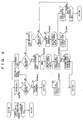
- Fig. 4 is an operational flowchart of the mail server in the first to third embodiments of the present invention.
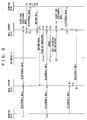
- Fig. 5 is a diagram illustrating operations of the first to third embodiments of the present invention.
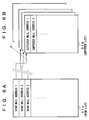
- the database 31 is provided with a spam mail 31U constructed by a collection of records in each of which any one of the following items is stored.
- the database 31 is provided with a sufferer list 31S composed of a collection of records which is constructed as described below.
- the mail addresses of the terminal 36-A and 36-B are assumed as 'a ⁇ a' and 'b ⁇ b', respectively, for simplicity.
- the electronic mail is transmitted to the terminal 36-B destination by the terminal 36-A ((1) in Fig. 5) and transferred to the mail server 32-A via the wireless base station 35-A, the mobile switch 33-A, and the network 30 ((1) of Fig. 4). And then, it is delivered to and temporarily stored in the mail server 32-B via the network 30 ((2) in Fig. 4 and (2) in Fig. 5).
- the mail server 32-B When identifying "query for 'an electronic mail whose destination is the terminal 36-B"' ((4) in Fig. 5), which is issued by the terminal 36-B via the wireless base station 35-B, the mobile switch 33-B, and the network 30 ((3) in Fig. 5), the mail server 32-B transfers an electronic mail fit for the query among the electronic mails previously stored (Fig. 7A) to the terminal 36-B ((3) in Fig. 4 and (5) in Fig. 5).
- the terminal 36-B displays the content of the electronic mail notified in such a manner (the mail address of the source 'a ⁇ a', the mail address of the destination 'b ⁇ b', and the text) as a predefined document ((6) in Fig. 5).
- the terminal 36-B when the displayed electronic mail is assigned as 'spam mail' ((7) in Fig. 5), the terminal 36-B generates 'the return mail', which is constructed as described below, based on the predefined human-machine interface (for example, press of a dedicated switch or operation based on a graphic user interface) ((8) in Fig. 5).
- the predefined human-machine interface for example, press of a dedicated switch or operation based on a graphic user interface
- the terminal 36-B transmits 'the return mail' to the mail server 32B via the wireless base station 35-B, the mobile switch 33-B, and the network 30 ((9) in Fig. 5).
- the mail server 32B discriminates whether or not the mail address indicating the destination of the return mail corresponds to the 'unusual mail address' (the predefined character'(' is appended to the head thereof) (hereinafter, referred to as 'mail discrimination') ((4) in Fig. 4 and (10) in Fig. 5).
- the mail server 32B transfers 'the return mail' corresponding to the mail server 32-A through the network 30 ((11) in Fig. 5). Accordingly, 'the return mail' can be received by the terminal 36-A.
- the mail server 32B delivers the mail addresses 'b ⁇ b' and '#a ⁇ a' (hereinafter, referred to as 'a pair of addresses') respectively indicating the source and the destination of 'the return mail' to the database 31 destination ((5) in Fig. 4 and (12) in Fig. 5).
- the database 31 When 'the pair of addresses' is identified, the database 31 performs the following processes ((13) in Fig. 5).
- a new electronic mail which is transmitted by the terminal 36-A ((14) in Fig. 5) and whose destination corresponds to the terminal 36-B is temporarily stored in the mail server 32-B as described above ((6) in Fig. 4 and (15) in Fig. 5).
- the mail server 32-B sends to the data base 31 a "'query' which is included in the corresponding new electronic mail and includes the mail addresses 'a ⁇ a' and 'b ⁇ b' respectively indicating the source and the destination of the electronic mail, prior to the process started according to the "query of 'the electronic mail whose destination is the terminal 36-B"' issued by the terminal 36-B as described above ((7) in Fig. 4 and (16) in Fig. 5).
- the database 31 discriminates whether or not all the following conditions are satisfied according to 'the query' (hereinafter, referred to as 'mail discrimination' ((17) in Fig. 5) and delivers 'mail discrimination result' indicating the result of the discrimination to the mail server 32-B ((18) in Fig. 5).
- the mail server 32-B identifies the corresponding new electronic mail as a formal mail and suitably transfers the electronic mail to the terminal 36-B according to the "query of the electronic mail whose destination is terminal 36-B'" ((8) and (9) in Fig. 4 and (19) in Fig. 5).
- the mail server 32-B excludes the corresponding new electronic mail from storage targets to a 'mail box to be served for storage of the electronic mail whose destination is the terminal 36-B' ((10) in Fig. 4 and (20) in Fig. 5).
- the pair of addresses of the source and the destination of the spam mail is automatically registered in the database 31 under 'the interface which is performed in the terminal 36-B corresponding to the destination and realizes an easy assignment of the spam mail'.
- the electronic mail including the pair of addresses registered in such a manner is automatically identified as the spam mail and discarded.
- the pair of addresses are divided for every source mail address, are registered as a collection of the mail addresses of the destinations corresponding to the mail addresses of the respective sources. In addition, they are unitarily managed in a manual manner.
- the configuration of the communication system which provides the mail service is not changed, except for software which realizes the processes, and thus compatibility with the protocol to be served for the mail service is basically not damaged.
- the spam mail is simply discarded and the form of the process to be performed against the spam mail or the forms of other processes is not specifically described.
- the forms of the processes may be changed according to information which is provided from the terminals 36-A and 36-B or a terminal to be served for the maintenance/operation, as well as office data of the mobile switches 33-A and 33-B or the mail servers 32-A and 32-B (including subscriber classes, service orders, or the like).
- the present embodiment has a feature that, when the 'mail discrimination result' is true, the process by the mail server 32-B is performed in the following sequence.
- the mail server 32-B regards the corresponding new electronic mail (spam mail) as 'an electronic mail whose destination is unknown' and excludes the electronic mail from the storage targets to 'the mail box to be served for storage of the corresponding electronic mail whose destination is the terminal 36-B' ((a) in Fig. 4 and (a) in Fig. 5).
- the above-mentioned spam mail is returned to the source of the spam mail based on the protocol which is applied to the mail server 32-B.
- a sender of the spam mail is actively notified 'that the destination of the spam mail does not exist' and is urged to be aware 'that the retransmission of the spam mail is ineffective'.
- the spam mail is simply returned to the source as 'the electronic mail whose destination is unknown'.
- the form of such a return (for example, a moment to be returned, the number of times, or information to be appended when returning (an alarm to the sender may be included)) may be assigned by the terminal corresponding to the destination of the spam mail or suitably set based on the attributes of the source and/or the destination of the spam mail.
- the present embodiment has a feature that the database 31 is common to the mail server 32-B and the mail server 32-A, and after the registration process is performed by the database 31 and when 'the new electronic mail (spam mail) whose destination corresponds to the terminal 36-B' is delivered from the terminal 36-A to the mail server 32-A ((A) in Fig. 5), the process by the mail server 32-A is performed in the following sequence.
- the mail server 32-A temporarily stores the electronic mail ((A) in Fig. 4) and performs the following processes.
- the spam mail is invalidated by the mail server 32-A in which the terminal 36-A corresponding to the source of the spam mail is accommodated, without being transferred to the network 30 or other mail servers.
- the present invention even in the case of a terminal whose source and the destination of the spam mail are accommodated in different mail servers, the increase in traffic due to the useless transfer of the spam mail through the network 30 can be avoided, and thus the load of the mail server concerned can be reduced.
- the database 31 performs 'the registration process' by the connection with the mail server 32-B in which the terminal 36-B corresponding to the destination of the spam mail is accommodated. Further, the database 31 performs the 'mail discrimination' by the connection with the mail server 32-B in which the terminal 36-A corresponding to the source of the spam mail is accommodated.
- the present invention is not limited to this configuration.
- 'the registration process' and 'the mail discrimination process' may be performed by connecting the mail server 32-A with the database 31.
- the process performed by the mail server 32-A is performed parallel to the process performed by the mail server 32-A in the first embodiment or second embodiment.
- the present invention is not limited to this configuration.
- the process performed by the mail server 32-A in the present embodiment may be performed such that the processes by the mail server 32-A in the above-mentioned first and second embodiments are not performed parallel to each other in any way.
- the database 31 allows both the mail servers 32-A and 32-B to access thereto through the network 30.
- the present invention is not limited to this configuration.
- the database 31 may be divided into a database which allows only the mail server 32-A to access thereto and a database which allows only the mail server 32-B to access thereto. These databases are integrated into the mail servers 32-A and 32-B respectively.
- the mail address indicating the destination of the return mail is composed of the pair of the mail address of the source of the spam mail and the character '#' appended to the head of the mail address.
- Such a character '#' may be appended to the text of the return mail or the mail address indicating the source of the return mail, for example, as long as the mail server identifies it as the return mail.
- the character '#' may be substituted with any character or symbol or may be constructed by 'a string of characters or symbols' as long as the mail server surely identifies it and the mail server does not uselessly interfere with the process to be inherently performed.
- the human-machine interface to be performed so as to append the character '#' to the mail address indicating the destination of the return mail is not described in detail.
- the human-machine interface is not necessarily implemented with a dedicated operating unit (for example, a press button switch or the like).
- the human-machine interface may be implemented by utilizing existing software capable of editing the mail address.
- the mail servers 32-A and 32-B when receiving the 'return mail', start the process which is to be performed to register the mail address of the source of 'the spam mail' in the database 31.
- the moment at which such a process is started may be the time when the electronic mail is sent to the mail server 32-B by the terminal 36-B and a control command or message instead of the above-mentioned 'return mail' is received.
- the spam list 31U and the sufferer list 31S may be constructed as a collection of any information as long as the spam mail to which the discard or other processes are to be performed is surely identified as the pair of mail addresses respectively indicating the source and the destination of the spam mail. Both of them may be merged.
- the sufferer list 31S in which 'the maximum number of mail addresses' which can be registered is common, is constructed as a collection of the records corresponding to the mail addresses registered in the spam list 31U.
- the sufferer list 31S may be constructed as a memory block in which a link is formed under a predetermined storage management (a resource management may be performed by an operating system) to 'the mail addresses registered in the spam list 31 U' or may be constructed as a collection of words.
- a resource management may be performed by an operating system
- both the source and the destination of 'the spam mail' correspond to the terminals of the mobile communication system.
- the source and the destination are not limited to the terminals of the mobile communication system.
- they may be vehicle-mounted or fixed terminals (including information terminals such as a personal computer, a PDA (personal digital assistant), or the like) as long as they transmit or receive an electronic mail through a predetermined mail server.
- information terminals such as a personal computer, a PDA (personal digital assistant), or the like
- the spam mail' having the common source and destination is automatically treated by connecting the terminals 36-A and 36-B, the mail servers 32-A and 32-B, and the database 31 as described above.
- the present invention is not limited to this configuration.
- the processes by the terminals 36-A and 36-B, the mail servers 32-A and 32-B, and the database 31 may be performed under load distribution or functional distribution of all or some of the wireless base stations 35-A and 35-B, the mobile switches 33-A and 33-B, and other devices which are included in the network 30 (including a base station control device, an exchange, a transfer device, and other nodes).
- the network 30 is not limited to a message switching network or a store and forward switching network.
- a circuit switching network may be used.
- the network 30 may be constructed by incorporating the circuit schemes in any way.
- the pair of mail addresses of the source and the destination of the spam mail' are simply and automatically registered and the electronic mail identified based on the pair is treated as 'the spam mail'.
- the present invention is not limited to this configuration.
- the process (including the human-machine interface) which enables 'that the pair of addresses registered in such manner are automatically registered as monitoring targets and, when necessary, provided to facilities concerned may be performed.
- the moment of the action to be performed against the spam mail, together with the standard to be served for the identification of the spam mail which is transmitted again from the common source in the predefined information form is surely provided to the mail server.
- the demand of the operator who is damaged by the spam mail can be flexibly adapted.
- the moment of the action to be performed against the spam mail, together with the standard to be served for the identification of the spam mail, is provided to the mail server, without extremely limiting the format or the size of information to be delivered with the communication terminals accommodated.
- the moment of the action to be performed against the spam mail is flexibly delivered to the mail server based on the desired communication protocol.
- the demand of the operator who is damaged by the spam mail can be flexibly adapted.
- the damages which are likely to be generated when the spam mail is transferred to the original destination with no regulation are automatically prevented, as long as the database is suitably updated.
- the source of the spam mail is notified that the spam mail is not transferred to the desired destination.
- the load can be reduced.
- the standard to be served for the specification of the spam mail whose transfer to the destination is queried and which is to be discarded is accurately updated according to the return mail which is transmitted by the communication terminal damaged by the spam mail.
- the fourth mail server according to the present invention as compared to the case where the standard is distributed into the plurality of databases, the useless load and the increase in traffic according to the connection or synchronization between the databases are avoided.
- the spam mail is prevented from being uselessly transferred to another mail server.
- the configuration of the communication system or the form of the service to be provided to the communication terminals can be flexibly adapted.
- the service quality and the reliability can be increased at low cost without drastically changing the configuration.
Landscapes
- Engineering & Computer Science (AREA)
- Computer Networks & Wireless Communication (AREA)
- Signal Processing (AREA)
- Information Transfer Between Computers (AREA)
- Data Exchanges In Wide-Area Networks (AREA)
Abstract
The present invention relates to a communication terminal capable of transmitting
and receiving electronic mails and to a mail server for performing the overall management
relating to transmitting and receiving the electronic mails. The object of the present
invention is to avoid damages caused by various spam mails flexibly and accurately without
forcing a subscriber to perform complex operations. To this end, the communication
terminal according to the present invention comprises a mail acquiring section acquiring
electronic mails received via mail servers, a human-machine interfacing section which
performs a human-machine interface relating to assignment of a spam mail among the
acquired electronic mails, and a spam mail responding section setting the source of the spam
mail assigned under the human-interface interface as a destination and delivering a return
mail including predefined information indicating the spam mail.
Description
The present invention relates to a communication terminal which is used to provide
communication services capable of transmitting and receiving electronic mails and to a mail
server for performing the overall management relating to transmitting and receiving the
electronic mails.
Recently, subscribers for a mobile communication system are drastically increasing
and these subscribers are provided with services capable of transmitting and receiving
electronic mails.
However, these services are likely to be improperly used to distribute the following
unfair electronic mails and to intentionally attack a specific subscriber.
- Electronic mails which are distributed for the purpose of lopsided invitations, sales, advertisements, or the like
- Chain mails
- Unsolicited mails which damage a recipient by unfairly using HTML (Hypertext Markup Language) tags
Conventionally, in order to reduce or avoid damages caused by these mails
(hereinafter, referred to as 'spam mails'), for example, countermeasures described below
have been used.
- 'Change of Mail Address' - In a mail address (for example, o...o@d...d.ne.jp) which is automatically given to each subscriber when a mail account is set, a portion (o...o) corresponding to a telephone number are changed into a character or symbol string under a predefined rule, but a domain (@d...d.ne.jp) peculiar to a carrier accommodating the subscriber is not changed.
- 'Assigned Mail Refusal' - 'An electronic mail whose source corresponds to a specific mail address stored in a terminal' is automatically refused by the terminal.
- 'Assigned Mail Reception' -'An electronic mail whose source corresponds to any one of mail addresses stored in the terminal' is automatically received by the terminal.
- 'Collective Mail Refusal' - An electronic mail whose source has a mail address including a specific domain stored in the terminal is automatically refused.
- 'Collective Unusual Mail Refusal' - An electronic mail having an unusual form (for example, an electronic mail causing 'the terminal to be used as a pager') is completely refused.
- 'Mail Filtering' - An electronic mail which does not include a code composed of a desired character or symbol string is automatically refused and a destination of the electronic mail is treated as an unknown.
Moreover, as a prior art relating to the present invention, for example, as disclosed in
JP-A-11-252252, 'a mobile communication terminal in which a mail address indicating a
source of a spam mail is automatically extracted from the spam mail received by the terminal
and stored and an electronic mail whose source has a mail address corresponding to the mail
address stored in the terminal is refused' (hereinafter, simply referred to as 'related art') is
known.
However, when 'Change of Mail Address' among the above-mentioned
countermeasures is applied, even after the mail address is changed as described above, spam
mails may be received, and thus the change of the mail address needs to be suitably
performed.
Further, the above-mentioned 'Assigned Mail Reception' or 'Assigned Mail Refusal'
has some problems in terms of operation or convenience due to the following problems and
thus the damages caused by the spam mail are not necessarily and surely prevented.
- The mail address of the source of the spam mail needs to be suitably registered or updated in a manual manner.
- The maximum number of the mail addresses of the sources which can be registered in parallel generally has a limitation.
- When the spam mails have the common source and the mail address of the source is frequently changed, the corresponding mail address needs to be added as an object for registration. Thus, the maximum number needs to be set to a large value. However, it is actually difficult to set the maximum number to be the sufficient large value due to power consumption and other limitations.
Further, in order to accurately perform rigid distinction between electronic mails to
be refused and other electronic mails, as for the above-mentioned 'Mail Filtering', 'Collective
Unusual Mail Refusal', and 'Collective Mail Refusal', complex operations or managements
relating to the setting or update of the mail address are forced upon an operator of the
terminal, but the operations or managements are actually difficult. Thus, an electronic mail
which does not correspond to the spam mail may be refused.
Further, in the above-mentioned 'related art', the identification of the spam mail is
performed by the mobile communication terminal, and thus the mobile communication
terminal is charged with a fee for the transfer of the spam mail which is an identification
object.
That is, in the prior art described above, the mobile communication terminal which is
likely to be damaged by the spam mail has not necessarily good operational characteristics or
convenience, and thus the damages are not sufficiently reduced or avoided.
JP-A-1 1-252252 ( claims 1 and 2, and paragraphs 0018 to 0020 and 0024)
It is an object of the present invention to provide a communication terminal and a
mail server which can avoid damages caused by various spam mails flexibly and accurately
without forcing complex operations upon a subscriber.
It is another object of the present invention to surely obtain a standard to be served
for identification of a spam mail which is transmitted again from a common source in a
predefined information form and a moment of an action to be performed against the spam
mail, through the mail server.
It is still another object of the present invention to flexibly adapt to a demand of an
operator who is damaged by the spam mail.
It is a further object of the present invention to obtain a standard to be served for
identification of a spam mail and a moment of an action to be performed against the spam
mail, without extremely limiting a format or size of information which can be delivered
between each of the accommodated communication terminals.
It is a still further object of the present invention to flexibly deliver a standard to be
served for identification of the spam mail in the mail server and a moment of an action to be
performed against the spam mail based on a desired communication protocol from the
communication terminal to the mail server.
It is another object of the present invention to flexibly adapt to a demand of an
operator who is damaged by the spam mail.
It is still another object of the present invention to automatically prevent damages
which are likely to be caused when the spam mail is transferred to an original destination with
no regulation, as long as a database is properly updated.
It is a further object of the present invention to reduce a load as compared to a case
where the source of the spam mail is notified that the spam mail is not transferred to a
desired destination and the spam mail is simply discarded.
It is a still further object of the present invention to accurately query the transfer of
the spam mail to the destination or to update a standard to be served for specification of the
spam mail to be discarded, in response to a return mail which is transmitted by the
communication terminal damaged by the spam mail.
It is another object of the present invention to prevent useless load and traffic
increase according to connection or synchronization between plural databases, as compared
to a case where the above-mentioned standard is distributed into the plural databases.
It is still another object of the present invention to prevent the spam mail from being
uselessly transferred from a mail server, in which a communication terminal as the source of
the spam mail is accommodated, to another mail server destination.
It is a further object of the present invention to flexibly adapt to a configuration of a
communication system or a service type to be provided to various communication terminals.
It is a still further object of the present invention to enhance service quality and
reliability of the communication system to which the present invention is applied, without
extremely changing the configuration.
The above-mentioned objects can be achieved by a communication terminal which
sets a source of a spam mail assigned under a human-machine interface as a destination and
delivers to a mail server a return mail including predefined information indicating the spam
mail.
In such a communication terminal, the above-mentioned source of the spam mail,
together with predefined information, is accurately notified to the mail server which
accommodates the communication terminal damaged by the spam mail.
Further, the above-mentioned objects can be achieved by a communication terminal
which perform a human-machine interface relating to the assignment of a form of an action
to be performed against a spam mail and appends a device form to a return mail to be
delivered to a mail server.
In such a communication terminal, the mail server is notified of the form of the
action to be performed against the spam mail under an operator's instruction, together with
the source of the spam mail and predefined information.
In addition, the above-mentioned objects can be achieved by a communication
terminal which appends predefined information to a mail address indicating a destination of a
return mail in a predefined format.
In such a communication terminal, above-mentioned predefined information as well
as the information other than the mail address indicating above-mentioned destination,
among the information to be included in the return mail, is accurately notified to a mail server
without any limitation on a word length, or the like.
Further, the above-mentioned objects can be achieved by a communication terminal
which delivers to a mail server a mail address which indicates a source of a spam mail
assigned under a human-machine interface and predefined information indicating the spam
mail.
In such a communication terminal, the source of the spam mail, together with
predefined information, is accurately notified to the mail server which accommodates the
communication terminal damaged by the spam mail, as a collection of information not falling
under the return mail.
Further, the above-mentioned objects can be achieved by a communication terminal
which performs a human-machine interface relating to the assignment of a form of an action
to be performed against a spam mail and notifies a mail server of the form of the action.
In such a communication terminal, the form of the action to be performed against
the spam mail under an operator's instruction, together with the source of the spam mail and
predefined information, is accurately notified to the mail server as a collection of information
not falling under the return mail.
Further, the above-mentioned objects can be achieved by a mail server which, when
an electronic mail which includes predefined information therein and whose mail address
indicating a destination of the electronic mail is registered in a database is received, discards
the received electronic mail.
In such a mail server, the electronic mail which includes above-mentioned
predefined information and whose destination is represented by any one of the mail
addresses registered in the database is prevented from being transferred to the destination.
In addition, the above-mentioned objects can be achieved by a mail server which,
when an electronic mail which includes predefined information therein and whose mail
address indicating a destination is registered in a database, excludes the electronic mail from
delivery targets to a communication device corresponding to the destination.
In such a mail server, the source of the electronic mail which includes
above-mentioned predefined information therein and whose destination is indicated by any
one of the mail addresses in the database is notified that the destination of the previously
transmitted electronic mail does not exist or the spam mail is refused, based on a predefined
mail transmission protocol.
Further, the above-mentioned objects can be achieved by a mail server which
registers a mail address indicating a destination of an electronic mail including predefined
information in a database.
In such a mail server, as long as above-mentioned predefined information is
included in the electronic mail which is transmitted by the communication terminal
accommodated into the mail server according to the present invention or which is delivered
from another mail server, the mail address indicating the destination of the electronic mail is
suitably registered in the database.
Further, the above-mentioned objects can be achieved by a mail server in which a
database is common to a plurality of mail servers according to the present invention.
In such a mail server, the standard to be served for specification of the spam mail
whose transfer to the destination is queried or which is to be discarded is unitarily managed.
Further, the above-mentioned objects can be achieved by a mail server to which an
electronic mail in which predefined information is appended to a mail address indicating the
destination is delivered, when the mail server accommodates the destination.
In such a mail server, the standard to be served for specification of the spam mail
whose transfer to the destination is queried or which is to be discarded is provided to the mail
server which accommodates the communication terminal corresponding to the source of the
spam mail.
Further, the above-mentioned objects can be achieved by a mail server which
discards the electronic mail, in a form fit for attributes of a source and/or a destination of an
electronic mail which includes predefined information and whose mail address indicating the
destination is registered in a database.
In such a mail server, the discard form of the spam mail is maintained in a form fit for
the attributes of the source and/or the destination of the spam mail.
Further, the above-mentioned objects can be achieved by a mail server which
excludes the electronic mail from delivery targets to a communication device falling under the
destination, in a form fit for attributes of a source and/or a destination of an electronic mail
which includes predefined information and whose mail address indicating the destination is
registered in a database.
In such a mail server, the form in which the spam mail is excluded from the delivery
targets to the destination of the spam mail is maintained in a form fit for the attributes of the
source and/or the destination of the spam mail.
In addition, the above-mentioned objects can be achieved by a mail server which
registers a mail address indicating the destination of the electronic mail in a database, in a
form fit for attributes of a source and/or a destination of an electronic mail including
predefined information.
In such a mail server, the form in which the mail address indicating the destination of
the spam mail is registered in the database is maintained in a form fit for the attributes of the
source and/or the destination of the spam mail.
Further, the above-mentioned objects can be achieved by a mail server to which the
electronic mail is delivered when the mail server accommodates the destination, in a form fit
for attributes of a source and/or a destination of the electronic mail in which predefined
information is appended to a mail address indicating the destination.
In such a mail server, the form in which the spam mail is delivered to the mail server
indicating the destination of the spam mail is maintained in a form fit for the attributes of the
source and/or the destination of the spam mail.
To begin with, a principle of a communication terminal according to the present
invention will be described with reference to Fig. 1.
Fig. 1 is a principal block diagram of a communication terminal according to the
present invention.
The communication terminal shown in Fig. 1 has a mail acquiring section 12, a
human-machine interfacing section 13, and spam mail responding sections 14 and 14A.
The first principle of the communication terminal according to the present invention
is as follows.
The mail acquiring section 12 acquires an electronic mail received via a mail server
11. The human-machine interfacing section 13 performs a human-machine interface
relating to an assignment of a spam mail within the electronic mail acquired by the mail
acquiring section 12. The spam mail responding section 14 sets a destination to a source of
the spam mail assigned via the human-machine interfacing section 13 and delivers a return
mail including predefined information indicating the spam mail to the mail server 11.
That is, the source of the spam mail assigned under the above-mentioned
human-machine interface, together with predefined information, is notified to the mail server
which accommodates the communication terminal damaged by the spam mail.
Therefore, the mail server can surely obtain a standard to be served for identification
of the spam mail which is transmitted again from a common source in a predefined
information form and a moment of an action to be performed against the spam mail.
The second principle of the communication terminal according to the present
invention is as follows.
The human-machine interfacing section 13 performs a human-machine interface
relating to an assignment of a form of an action which the mail server 11 has to perform to
another electronic mail transmitted from the source of the spam mail. The spam mail
responding section 14 appends the form of the action assigned via the human-machine
interfacing section 13 to a return mail to be delivered to the mail server 11.
That is, the mail server is accurately notified of the form of the action to be
performed against the spam mail under an operator's instruction, together with the source of
the spam mail and predefined information.
Therefore, it is possible to flexibly adapt to a demand of an operator who is damaged
by the spam mail.
The third principle of the communication terminal according to the present invention
is as follows.
Predefined information is appended to a mail address indicating a destination of a
return mail in a predefined format.
That is, such predefined information is accurately notified to a mail server without
any limitation on a word length, or the like, even in case of the information except for a mail
address which indicates the above-mentioned destination among the information included in
the return mail.
Therefore, the mail server can obtain a standard to be served for identification of the
spam mail and a moment of an action to be performed against the spam mail, without
extremely limiting a format or a size of information which can be delivered between each of
the accommodated communication terminals.
The fourth principle of the communication terminal according to the present
invention is as follows.
The mail acquiring section 12 acquires an electronic mail received via the mail server
11. The human-machine interfacing section 13 performs a human-machine interface
relating to an assignment of the spam mail within the electronic mail acquired by the mail
acquiring section 12. The spam mail responding section 14A delivers to the mail server 11a
mail address indicating a source of the spam mail which is assigned via the human-machine
interfacing section 13 and predefined information indicating the spam mail.
That is, the source of the spam mail assigned under the above-mentioned
human-machine interface, together with predefined information, is accurately notified as a
collection of information not falling under the return mail to the mail server which
accommodates a communication terminal damaged by the spam mail.
Therefore, in the mail server, the standard to be served for identification of the spam
mail and the moment of the action to be performed against the spam mail are flexibly
delivered from the above-mentioned communication terminal to the mail server based on a
desired communication protocol.
The fifth principle of the communication terminal according to the present invention
is as follows.
The human-machine interfacing section 13 performs a human-machine interface
relating to an assignment of a form of an action which the mail server 11 has to perform to
another electronic mail transmitted from the source of the spam mail. The spam mail
responding section 14A notifies the mail server 11 of the form of the action assigned via the
human-machine interfacing section 13.
That is, the form of the action to be performed against the spam mail under the
operator's instruction, together with the source of the spam mail and predefined information,
is accurately notified to the mail server as a collection of information not falling under the
return mail.
Therefore, it is possible to flexibly adapt to the demand of the operator who is
damaged by the spam mail.
Hereinafter, a principle of the mail server according to the present invention will be
described with reference to Fig. 2.
Fig. 2 is a principal block diagram of the mail server according to the present
invention.
The mail server shown in Fig. 2 has a received mail transfer section 21 and a
transmitted mail transfer section 23.
The first principle of the mail server according to the present invention is as follows.
The received mail transfer section 21 delivers an electronic mail to a communication
terminal corresponding to the destination of the electronic mail received, among the
communication terminals 20-1 to 20-n. The transmitted mail transfer section 23 delivers
an electronic mail to the destinations of plural electronic mails transmitted from the
communication terminals 20-1 to 20-n or the mail server 22 accommodating the
destinations. The received mail transfer section 21 discards an electronic mail whose mail
address indicating the destination of the electronic mail including predefined information is
registered in a database 24, among the electronic mails received.
That is, the electronic mail which includes above-mentioned predefined information
and whose destination is represented by any one of the mail addresses registered in the
database 24 is prevented from being transferred to the destination.
Therefore, damages which are caused when the electronic mail is transferred to an
original destination with no regulation are automatically prevented, as long as the database
24 is suitably updated.
The second principle of the mail server according to the present invention is as
follows.
The received mail transfer section 21 delivers an electronic mail to a communication
terminal corresponding to the destination of the electronic mail received, among the
communication terminals 20-1 to 20-n.
The transmitted mail transfer section 23 delivers an electronic mail to the
destinations of plural electronic mails transmitted from the communication terminals 20-1 to
20-n or the mail server 22 accommodating the destinations. The received mail transfer
section 21 excludes an electronic mail, which includes predefined information and whose
mail address indicating the destination is registered in the database 24, among the electronic
mails received, from delivery targets to the communication terminal corresponding to the
destination.
That is, the source of the electronic mail which includes above-mentioned
predefined information and whose destination is represented by any one of the mail
addresses registered in the database 24 is notified that the destination of the previously
transmitted electronic mail does not exist or that the spam mail is refused, based on a
predefined mail transfer protocol.
Therefore, the source of the spam mail is notified that the spam mail is not
transferred to a desired destination, and thus a load can be reduced as compared to the case
where the spam mail is simply discarded.
The third principle of the mail server according to the present invention is as follows.
The received mail transfer section 21 registers a mail address, which indicates a
destination of an electronic mail including predefined information, in the database 24.
That is, as long as above-mentioned predefined information is included in the
electronic mail transmitted by the communication terminal which is accommodated in the
mail server according to the present invention or the electronic mail delivered from another
mail server, the mail address indicating the destination of the electronic mail is suitably
registered in the database 24.
Therefore, the standard to be served for identification of the spam mail whose
transfer to the destination is queried or which is to be discarded is accurately updated
according to a return mail which is transmitted by a communication terminal damaged by the
spam mail.
The fourth principle of the mail server according to the present invention is as
follows.
The database 24 is common to the mail server and other mail servers.
That is, the standard to be served for specification of the spam mail whose transfer
to the destination is queried or which is to be discarded can be unitarily managed.
Therefore, as compared to the case where the standard is distributed and allocated
in plural databases, a useless load and traffic increase according to connection or
synchronization between the databases is avoided.
The fifth principle of the mail server according to the present invention is as follows.
The transmitted mail transfer section 23 delivers electronic mails, which are
transmitted from the communication terminals 20-1 to 20-n and in each of which predefined
information is appended to the mail address indicating the destination, to the mail server in
which the destination is accommodated.
That is, the standard to be served for specification of the spam mail whose transfer
to the destination is queried and which is to be discarded is provided to the mail server in
which the communication terminal corresponding to the source of the spam mail is
accommodated.
Therefore, the spam mail is prevented from being uselessly transferred to another
mail server destination by means of the mail server.
The sixth principle of the mail server according to the present invention is as follows.
The received mail transfer section 21 delivers an electronic mail to a communication
terminal corresponding to the destination of the electronic mail received, among the
communication terminals 20-1 to 20-n. The transmitted mail transfer section 23 delivers
an electronic mail to the destinations of plural electronic mails transmitted from the
communication terminals 20-1 to 20-n or the mail server 22 accommodating the
destinations. The transmitted mail transfer section 23 delivers the electronic mails, which
are transmitted from the communication terminals 20-1 to 20-n and in each of which
predefined information is appended to the mail address indicating the destination, to the mail
server accommodating the destinations.
That is, the standard to be served for specification of the spam mail whose transfer
to the destination is queried and which is to be discarded is provided to the mail server in
which the communication terminal corresponding to the source of the spam mail is
accommodated.
Therefore, the spam mail is prevented from being uselessly transferred from the mail
server to another mail server destination.
The seventh principle of the mail server according to the present invention is as
follows.
The received mail transfer section 21 discards an electronic mail in a form fit for
attributes of the source and/or the destination of the electronic mail which includes
predefined information and whose mail address indicating the destination is registered in the
database 24.
That is, the discard form of the spam mail is maintained in a form fit for the
attributes of the source and/or the destination of the spam mail.
Therefore, as compared to the case where the spam mail is simply discarded, the
form of a configuration of a communication system or a service to be provided to the plural
communication terminals can be flexibly adapted.
The eighth principle of the mail server according to the present invention is as
follows.
The received mail transfer section 21 excludes an electronic mail from delivery
targets to the communication terminal corresponding to the destination in a form fit for
attributes of a source and/or a destination of an electronic mail which includes predefined
information and whose mail address indicating the destination is registered in the database
24.
That is, the form of the spam mail which is excluded from the delivery targets to the
destination of the spam mail is maintained in a form fit for the attributes of the source and/or
the destination of the spam mail.
Therefore, as compared to the case where the spam mail is simply excluded from the
delivery targets to the destination, the form of the configuration of the communication
system or the service to be provided to the plural communication terminals can be flexibly
adapted.
The ninth principle of the mail server according to the present invention is as follows.
The received mail transfer section 21 registers a mail address indicating a
destination of an electronic mail into the database 24 in a form fit for attributes of a source
and/or a destination of an electronic mail including predefined information.
That is, the form in which the mail address indicating the destination of the spam
mail is registered in the database 24 is maintained in a form fit for the attributes of the source
and/or the destination of the spam mail.
Therefore, as compared to the case where the form is constant regardless of the
above-mentioned attributes, the form of the configuration of the communication system or
the service to be provided to the plural communication terminals can be flexibly adapted.
The tenth principle of the main server according to the present invention is as
follows.
The transmitted mail transfer section 23 delivers electronic mails to the mail server
accommodating the destinations in a form fit for attributes of sources and/or destinations of
electronic mails which are transmitted from the communication terminals 20-1 to 20-n and
in each of which predefined information is appended to the mail address indicating the
destination.
That is, the form in which the spam mail is delivered to the mail server indicating the
destination of the spam mail is maintained in a form fit for the attributes of the source and/or
the destination of the spam mail.
Therefore, as compared to the case where the form is constant regardless of the
above-mentioned attributes, the form of the configuration of the communication system or
the service to be provided to the plural communication terminals can be flexibly adapted.
Fig. 3 is a diagram showing first to third embodiments of the present invention.
Referring to Fig. 3, in a network 30, a database 31, mail servers 32-A and 32-B, and
mobile switches 33-A and 33-B are respectively arranged as nodes.
To the mobile switch 33-A, a wireless base station 35-A which forms a wireless zone
34-A is connected, and a terminal 36-A is located at the wireless zone 34-A.
To the mobile switch 33-B, a wireless base station 35-B which forms a wireless zone
34-B is connected, and a terminal 36-B is located at the wireless zone 34-B.
Fig. 4 is an operational flowchart of the mail server in the first to third embodiments
of the present invention.
Fig. 5 is a diagram illustrating operations of the first to third embodiments of the
present invention.
Hereinafter, the operation of the first embodiment of the present invention will be
described with reference to Fig. 3 to Fig. 5.
As shown in Fig. 6A, the database 31 is provided with a spam mail 31U constructed
by a collection of records in each of which any one of the following items is stored.
- A mail address indicating a source of a spam mail (hereinafter, referred to as 'spam address')
- A specific value indicating that any spam address is not stored (here, for simplicity, the value is assumed as '0')
In addition, as shown in Fig. 6B, the database 31 is provided with a sufferer list 31S
composed of a collection of records which is constructed as described below.
- Previously associated with the respective records of the spam mail 31U.
- Constructed as a string of the predefined number of fields in each of which the mail address of the terminal which assigns the electronic mail whose source is represented by the spam mail address stored in the corresponding record of the spam mail 31U as 'the spam mail' is stored.
Moreover, hereinafter, the mail addresses of the terminal 36-A and 36-B are
assumed as 'a···a' and 'b···b', respectively, for simplicity.
The electronic mail is transmitted to the terminal 36-B destination by the terminal
36-A ((1) in Fig. 5) and transferred to the mail server 32-A via the wireless base station 35-A,
the mobile switch 33-A, and the network 30 ((1) of Fig. 4). And then, it is delivered to and
temporarily stored in the mail server 32-B via the network 30 ((2) in Fig. 4 and (2) in Fig. 5).
When identifying "query for 'an electronic mail whose destination is the terminal
36-B"' ((4) in Fig. 5), which is issued by the terminal 36-B via the wireless base station 35-B,
the mobile switch 33-B, and the network 30 ((3) in Fig. 5), the mail server 32-B transfers an
electronic mail fit for the query among the electronic mails previously stored (Fig. 7A) to the
terminal 36-B ((3) in Fig. 4 and (5) in Fig. 5).
The terminal 36-B displays the content of the electronic mail notified in such a
manner (the mail address of the source 'a···a', the mail address of the destination 'b···b',
and the text) as a predefined document ((6) in Fig. 5).
In addition, when the displayed electronic mail is assigned as 'spam mail' ((7) in Fig.
5), the terminal 36-B generates 'the return mail', which is constructed as described below,
based on the predefined human-machine interface (for example, press of a dedicated switch
or operation based on a graphic user interface) ((8) in Fig. 5).
- The mail address 'b···b' of the destination of 'the spam mail' is set as 'the mail address indicating the source' ((1) in Fig. 7B).
- An unusual mail address which is constructed by the mail address 'a···a' of the source of 'the spam mail' and a predefined character '#' (hereinafter, for simplicity, it is assumed that it corresponds to a specific character or symbol which can not be understood as a portion of the mail address) appended to a head of the mail address is set to 'the mail address indicating the destination' ((2) in Fig. 7B).
- Any information is not included in the text ((3) in Fig. 7B) or predefined unusual information is appended.
In addition, the terminal 36-B transmits 'the return mail' to the mail server 32B via
the wireless base station 35-B, the mobile switch 33-B, and the network 30 ((9) in Fig. 5).
When 'the return mail' is identified, the mail server 32B discriminates whether or not
the mail address indicating the destination of the return mail corresponds to the 'unusual mail
address' (the predefined character'(' is appended to the head thereof) (hereinafter, referred to
as 'mail discrimination') ((4) in Fig. 4 and (10) in Fig. 5).
In addition, when the discrimination result is false, the mail server 32B transfers 'the
return mail' corresponding to the mail server 32-A through the network 30 ((11) in Fig. 5).
Accordingly, 'the return mail' can be received by the terminal 36-A.
However, when the discrimination result is true, the mail server 32B delivers the mail
addresses 'b···b' and '#a···a' (hereinafter, referred to as 'a pair of addresses') respectively
indicating the source and the destination of 'the return mail' to the database 31 destination
((5) in Fig. 4 and (12) in Fig. 5).
When 'the pair of addresses' is identified, the database 31 performs the following
processes ((13) in Fig. 5).
After the registration process is performed by the database 31, a new electronic mail
which is transmitted by the terminal 36-A ((14) in Fig. 5) and whose destination corresponds
to the terminal 36-B is temporarily stored in the mail server 32-B as described above ((6) in
Fig. 4 and (15) in Fig. 5).
In addition, whenever such a new electronic mail is stored, the mail server 32-B
sends to the data base 31 a "'query' which is included in the corresponding new electronic
mail and includes the mail addresses 'a···a' and 'b···b' respectively indicating the source
and the destination of the electronic mail, prior to the process started according to the "query
of 'the electronic mail whose destination is the terminal 36-B"' issued by the terminal 36-B as
described above ((7) in Fig. 4 and (16) in Fig. 5).
The database 31 discriminates whether or not all the following conditions are
satisfied according to 'the query' (hereinafter, referred to as 'mail discrimination' ((17) in Fig.
5) and delivers 'mail discrimination result' indicating the result of the discrimination to the
mail server 32-B ((18) in Fig. 5).
- The above-mentioned mail address 'a···a' is registered in a record (hereinafter, referred to as 'search record' of the spam list 31 U.
- The mail address 'b...b' is registered in a field of the record corresponding to the above-mentioned 'search record' among the records of the damage party list 31 S.
When the above-mentioned 'mail discrimination result' is false, the mail server 32-B
identifies the corresponding new electronic mail as a formal mail and suitably transfers the
electronic mail to the terminal 36-B according to the "query of the electronic mail whose
destination is terminal 36-B'" ((8) and (9) in Fig. 4 and (19) in Fig. 5).
However, when the 'mail discrimination result' is true, the mail server 32-B excludes
the corresponding new electronic mail from storage targets to a 'mail box to be served for
storage of the electronic mail whose destination is the terminal 36-B' ((10) in Fig. 4 and (20) in
Fig. 5).
That is, the pair of addresses of the source and the destination of the spam mail is
automatically registered in the database 31 under 'the interface which is performed in the
terminal 36-B corresponding to the destination and realizes an easy assignment of the spam
mail'. The electronic mail including the pair of addresses registered in such a manner is
automatically identified as the spam mail and discarded.
Further, as shown in Figs. 6A and 6B, the pair of addresses are divided for every
source mail address, are registered as a collection of the mail addresses of the destinations
corresponding to the mail addresses of the respective sources. In addition, they are unitarily
managed in a manual manner.
Further, in the present embodiment, the configuration of the communication system
which provides the mail service is not changed, except for software which realizes the
processes, and thus compatibility with the protocol to be served for the mail service is
basically not damaged.
Therefore, according to the present embodiment, complex operations are forced to
an operator of a terminal damaged by the spam mail, and damages caused by the spam mails
which are likely to be generated again and frequently are avoided at low cost and with high
accuracy.
Moreover, in the present embodiment, the spam mail is simply discarded and the
form of the process to be performed against the spam mail or the forms of other processes is
not specifically described.
However, as long as such processes are adapted to the maintenance or operation
which is performed by an operator of a system which implements a transfer service of an
electronic mail, processes of any forms may be performed.
Further, the forms of the processes may be changed according to information which
is provided from the terminals 36-A and 36-B or a terminal to be served for the
maintenance/operation, as well as office data of the mobile switches 33-A and 33-B or the
mail servers 32-A and 32-B (including subscriber classes, service orders, or the like).
Hereinafter, an operation of the second embodiment of the present invention will be
described with reference to Fig. 3 to Fig. 6.
The present embodiment has a feature that, when the 'mail discrimination result' is
true, the process by the mail server 32-B is performed in the following sequence.
When the 'mail discrimination result' is true, the mail server 32-B regards the
corresponding new electronic mail (spam mail) as 'an electronic mail whose destination is
unknown' and excludes the electronic mail from the storage targets to 'the mail box to be
served for storage of the corresponding electronic mail whose destination is the terminal
36-B' ((a) in Fig. 4 and (a) in Fig. 5).
That is, the above-mentioned spam mail is returned to the source of the spam mail
based on the protocol which is applied to the mail server 32-B.
Therefore, according to the present embodiment, as compared to the case where the
spam mail is simply discarded, a sender of the spam mail is actively notified 'that the
destination of the spam mail does not exist' and is urged to be aware 'that the retransmission
of the spam mail is ineffective'.
Moreover, in the present embodiment, the spam mail is simply returned to the
source as 'the electronic mail whose destination is unknown'.
However, the form of such a return (for example, a moment to be returned, the
number of times, or information to be appended when returning (an alarm to the sender may
be included)) may be assigned by the terminal corresponding to the destination of the spam
mail or suitably set based on the attributes of the source and/or the destination of the spam
mail.
Hereinafter, an operation of the third embodiment of the present invention will be
described with reference to Fig. 3 to Fig. 6.
The present embodiment has a feature that the database 31 is common to the mail
server 32-B and the mail server 32-A, and after the registration process is performed by the
database 31 and when 'the new electronic mail (spam mail) whose destination corresponds to
the terminal 36-B' is delivered from the terminal 36-A to the mail server 32-A ((A) in Fig. 5),
the process by the mail server 32-A is performed in the following sequence.
When the above-mentioned new electronic mail is delivered, the mail server 32-A
temporarily stores the electronic mail ((A) in Fig. 4) and performs the following processes.
- Acquire 'mail discrimination result' delivered from the
database 31 by connecting with thedatabase 31, similarly to the mail server 32-B in the first embodiment. - When the 'mail discrimination result' is false, identify the corresponding new electronic mail as a formal electronic mail and delivers the new electronic mail to the mail server 32-B through the network 30 ((C) in Fig. 4 and (B) in Fig. 5).
- When the 'mail discrimination result' is true, discard the corresponding new electronic mail or treat it as 'the electronic mail whose destination is unknown', similarly to the mail server 32-B in the first and second embodiment ((D) in Fig. 4 and (C) in Fig. 5).
That is, the spam mail is invalidated by the mail server 32-A in which the terminal
36-A corresponding to the source of the spam mail is accommodated, without being
transferred to the network 30 or other mail servers.
Therefore, according to the present invention, even in the case of a terminal whose
source and the destination of the spam mail are accommodated in different mail servers, the
increase in traffic due to the useless transfer of the spam mail through the network 30 can be
avoided, and thus the load of the mail server concerned can be reduced.
Moreover, in the present embodiment, the database 31 performs 'the registration
process' by the connection with the mail server 32-B in which the terminal 36-B
corresponding to the destination of the spam mail is accommodated. Further, the database
31 performs the 'mail discrimination' by the connection with the mail server 32-B in which the
terminal 36-A corresponding to the source of the spam mail is accommodated.
However, the present invention is not limited to this configuration. For example,
when the return mail or electronic mail is delivered from the mail server 32-B to the mail
server 32-A, 'the registration process' and 'the mail discrimination process' may be
performed by connecting the mail server 32-A with the database 31.
Further, in the present embodiment, the process performed by the mail server 32-A
is performed parallel to the process performed by the mail server 32-A in the first
embodiment or second embodiment.
However, the present invention is not limited to this configuration. For example,
the process performed by the mail server 32-A in the present embodiment may be performed
such that the processes by the mail server 32-A in the above-mentioned first and second
embodiments are not performed parallel to each other in any way.
Further, in the above-mentioned embodiments, the database 31 allows both the
mail servers 32-A and 32-B to access thereto through the network 30.
However, the present invention is not limited to this configuration. For example,
the database 31 may be divided into a database which allows only the mail server 32-A to
access thereto and a database which allows only the mail server 32-B to access thereto.
These databases are integrated into the mail servers 32-A and 32-B respectively.
Further, in the above-mentioned embodiments, the mail address indicating the
destination of the return mail is composed of the pair of the mail address of the source of the
spam mail and the character '#' appended to the head of the mail address.
However, such a character '#' may be appended to the text of the return mail or the
mail address indicating the source of the return mail, for example, as long as the mail server
identifies it as the return mail.
Further, the character '#' may be substituted with any character or symbol or may be
constructed by 'a string of characters or symbols' as long as the mail server surely identifies it
and the mail server does not uselessly interfere with the process to be inherently performed.
Further, in the above-mentioned embodiments, the human-machine interface to be
performed so as to append the character '#' to the mail address indicating the destination of
the return mail is not described in detail.
However, the human-machine interface is not necessarily implemented with a
dedicated operating unit (for example, a press button switch or the like). For example, the
human-machine interface may be implemented by utilizing existing software capable of
editing the mail address.
Further, in the above-mentioned embodiments, when receiving the 'return mail', the
mail servers 32-A and 32-B start the process which is to be performed to register the mail
address of the source of 'the spam mail' in the database 31.
However, for example, the moment at which such a process is started may be the
time when the electronic mail is sent to the mail server 32-B by the terminal 36-B and a
control command or message instead of the above-mentioned 'return mail' is received.
Further, in the above-mentioned embodiments, only the mail address indicating the
source of 'the spam mail' is registered in the spam list 31U and only the mail address of a
person who is damaged by 'the spam mail' is registered in the sufferer list 31S for every mail
address of the source of 'the spam mail'.
However, the spam list 31U and the sufferer list 31S may be constructed as a
collection of any information as long as the spam mail to which the discard or other processes
are to be performed is surely identified as the pair of mail addresses respectively indicating
the source and the destination of the spam mail. Both of them may be merged.
Further, in the above-mentioned embodiments, the sufferer list 31S, in which 'the
maximum number of mail addresses' which can be registered is common, is constructed as a
collection of the records corresponding to the mail addresses registered in the spam list 31U.
However, for example, the sufferer list 31S may be constructed as a memory block in
which a link is formed under a predetermined storage management (a resource management
may be performed by an operating system) to 'the mail addresses registered in the spam list
31 U' or may be constructed as a collection of words.
Further, in the above-mentioned embodiments, both the source and the destination
of 'the spam mail' correspond to the terminals of the mobile communication system.
However, the source and the destination are not limited to the terminals of the
mobile communication system. For example, they may be vehicle-mounted or fixed
terminals (including information terminals such as a personal computer, a PDA (personal
digital assistant), or the like) as long as they transmit or receive an electronic mail through a
predetermined mail server.
Further, to the communication system in which such a terminal is accommodated,
other communication protocols, communication schemes, transfer schemes (transfer modes),
source configurations, channel allocation, frequency allocation, modulation/demodulation
schemes, or the like may be applied as long as it can transmit and receive the electronic mail.
Further, in the above-mentioned embodiments, 'the spam mail' having the common
source and destination is automatically treated by connecting the terminals 36-A and 36-B,
the mail servers 32-A and 32-B, and the database 31 as described above.
However, the present invention is not limited to this configuration. For example,
the processes by the terminals 36-A and 36-B, the mail servers 32-A and 32-B, and the
database 31 may be performed under load distribution or functional distribution of all or
some of the wireless base stations 35-A and 35-B, the mobile switches 33-A and 33-B, and
other devices which are included in the network 30 (including a base station control device,
an exchange, a transfer device, and other nodes).
Further, in the above-mentioned embodiments, a switching scheme applied to the
network 30 is not described in detail.
However, the network 30 is not limited to a message switching network or a store
and forward switching network. For example, as long as the delivery of information required
for the processes and the connections is surely achieved, a circuit switching network may be
used. Further, the network 30 may be constructed by incorporating the circuit schemes in
any way.
Further, in the above-mentioned embodiments, the pair of mail addresses of the
source and the destination of the spam mail' are simply and automatically registered and the
electronic mail identified based on the pair is treated as 'the spam mail'.
However, the present invention is not limited to this configuration. For example,
the process (including the human-machine interface) which enables 'that the pair of
addresses registered in such manner are automatically registered as monitoring targets and,
when necessary, provided to facilities concerned may be performed.
Further, the present invention is not limited to the above-mentioned embodiments
and various modifications may be made without departing from the spirit and scope of the
present invention. Any improvement may be made in part or all of the components.
In the first communication terminal according to the present invention, the moment
of the action to be performed against the spam mail, together with the standard to be served
for the identification of the spam mail which is transmitted again from the common source in
the predefined information form is surely provided to the mail server.
In the second communication terminal according to the present invention, the
demand of the operator who is damaged by the spam mail can be flexibly adapted.
In the third communication terminal according to the present invention, the moment
of the action to be performed against the spam mail, together with the standard to be served
for the identification of the spam mail, is provided to the mail server, without extremely
limiting the format or the size of information to be delivered with the communication
terminals accommodated.
In the fourth communication terminal according to the present invention, the
moment of the action to be performed against the spam mail, together with the standard to
be served for the identification of the spam mail in the mail server, is flexibly delivered to the
mail server based on the desired communication protocol.
In the fifth communication terminal according to the present invention, the demand
of the operator who is damaged by the spam mail can be flexibly adapted.
In the first mail server according to the present invention, the damages which are
likely to be generated when the spam mail is transferred to the original destination with no
regulation are automatically prevented, as long as the database is suitably updated.
In the second mail server according to the present invention, the source of the spam
mail is notified that the spam mail is not transferred to the desired destination. Thus, as
compared to the case where the spam mail is simply discarded, the load can be reduced.
In the third mail server according to the present invention, the standard to be served
for the specification of the spam mail whose transfer to the destination is queried and which
is to be discarded is accurately updated according to the return mail which is transmitted by
the communication terminal damaged by the spam mail.
In the fourth mail server according to the present invention, as compared to the case
where the standard is distributed into the plurality of databases, the useless load and the
increase in traffic according to the connection or synchronization between the databases are
avoided.
In the fifth and sixth mail servers according to the present invention, by the mail
server which accommodates the communication terminal corresponding to the source of the
mail server, the spam mail is prevented from being uselessly transferred to another mail
server.
In the seventh to tenth mail servers according to the present invention, the
configuration of the communication system or the form of the service to be provided to the
communication terminals can be flexibly adapted.
Therefore, in the communication system to which the above-mentioned inventions
are applied, the service quality and the reliability can be increased at low cost without
drastically changing the configuration.
Claims (22)
- A communication terminal comprising:a mail acquiring section acquiring electronic mails received via a mail server;a human-machine interfacing section which performs a human-machine interface relating to assignment of a spam mail among the electronic mails acquired by said mail acquiring section; anda spam mail responding section delivering to the mail server a return mail in which a source of the spam mail assigned via said human-machine interfacing section is set as a destination and which includes predefined information indicating the spam mail.
- The communication terminal according to Claim 1, wherein:said human-machine interfacing section performs a human-machine interface relating to assignment of a form of an action which said mail server has to perform against another electronic mail transmitted from the source of said spam mail; andsaid spam mail responding section appends the form of the action assigned via said human-machine interfacing section to the return mail to be delivered to said mail server.
- The communication terminal according to Claim 1, wherein
said predefined information is appended to a mail address indicating a destination of said return mail in a predefined format. - The communication terminal according to Claim 2, wherein
said predefined information is appended to a mail address indicating a destination of said return mail in a predefined format. - A communication terminal comprising:a mail acquiring section acquiring electronic mails received via a mail server;a human-machine interfacing section which performs a human-machine interface relating to assignment of a spam mail among the electronic mails acquired by said mail acquiring section; anda spam mail responding section 14A delivering to said mail server a mail address which indicates a source of the spam mail assigned via said human-machine interfacing section and predefined information indicating the spam mail.
- The communication terminal according to Claim 5, wherein:said human-machine interfacing section performs a human-machine interface relating to assignment of a form of an action which said mail server has to perform against another electronic mail transmitted from the source of said spam mail; andsaid spam mail responding section notifies the mail server of the form of the action assigned via said human-machine interfacing section.
- A mail server comprising:a received mail transfer section delivering received electronic mails to communication terminals corresponding to destinations of the electronic mails; anda transmitted mail transfer section delivering electronic mails transmitted from said communication terminals to destinations of the respective electronic mails or a mail server accommodating the destinations, whereinsaid received mail transfer section discards an electronic mail whose mail address indicating a destination of an electronic mail including predefined information is registered in a database, among said received electronic mails.
- A mail server comprising:a received mail transfer section delivering received electronic mails to communication terminals corresponding to destinations of the electronic mails; anda transmitted mail transfer section delivering electronic mails transmitted from said communication terminals to destinations of the respective electronic mails or a mail server accommodating the destinations, whereinsaid received mail transfer section excludes among said received electronic mails an electronic mail, which includes predefined information and whose mail address indicating the destination is registered in a database, from delivery targets to a communication device corresponding to the destination.
- The mail server according to Claim 7, wherein
said received mail transfer section registers the mail address indicating the destination of the electronic mail including said predefined information into said database. - The mail server according to Claim 8, wherein
said received mail transfer section registers the mail address indicating the destination of the electronic mail including said predefined information into the database. - The mail server according to Claim 7, wherein
the database is common to mail servers other than said mail server. - The mail server according to Claim 8, wherein
the database is common to mail servers other than said mail server. - The mail server according to Claim 7, wherein
said transmitted mail transfer section delivers an electronic mail, which is transmitted from said communication terminal and in which said predefined information is appended to a mail address indicating a destination, to a mail server accommodating the destination. - The mail server according to Claim 8, wherein
said transmitted mail transfer section delivers an electronic mail, which is transmitted from said communication terminal and in which said predefined information is appended to a mail address indicating a destination, to a mail server accommodating the destination. - A mail server comprising:a received mail transfer section delivering received electronic mails to communication terminals corresponding to destinations of the electronic mails; anda transmitted mail transfer section delivering electronic mails transmitted from said communication terminals to destinations of the respective electronic mails or a mail server accommodating the destinations, whereinsaid transmitted mail transfer section delivers an electronic mail, which is transmitted from said communication terminal and in which said predefined information is appended to a mail address indicating a destination, to a mail server accommodating the destination.
- The mail server according to Claim 7, wherein
said received mail transfer section discards the electronic mail, in a form fit for attributes of the source and/or a destination of the electronic mail which includes predefined information and whose mail address indicating the destination is registered in the database. - The mail server according to Claim 8, wherein
said received mail transfer section excludes the electronic mail from delivery targets to a communication device corresponding to the destination, in a form fit for attributes of the source and/or a destination of the electronic mail which includes predefined information and whose mail address indicating the destination is registered in the database. - The mail server according to Claim 9, wherein
said received mail transfer section registers the mail address indicating the destination of the electronic mail including the predefined information into the database, in a form fit for attributes of the source and/or the destination of the electronic mail including said predefined information. - The mail server according to Claim 10, wherein
said received mail transfer section registers the mail address indicating the destination of the electronic mail including the predefined information into said database, in a form fit for attributes of the source and/or the destination of the electronic mail including said predefined information. - The mail server according to Claim 13, wherein
said transmitted mail transfer section delivers the electronic mail to the mail server accommodating the destination, in a form fit for attributes of the source and/or the destination of the electronic mail which is transmitted from said communication terminal and in which predefined information is appended to the mail address indicating the destination. - The mail server according to Claim 14, wherein
said transmitted mail transfer section delivers the electronic mail to the mail server accommodating the destination, in a form fit for attributes of the source and/or the destination of the electronic mail which is transmitted from said communication terminal and in which predefined information is appended to the mail address indicating the destination. - The mail server according to Claim 15, wherein
the transmitted mail transfer section delivers the electronic mail to the mail server accommodating the destination, in a form fit for attributes of the source and/or the destination of the electronic mail which is transmitted from said communication terminal and in which predefined information is appended to the mail address indicating the destination.
Applications Claiming Priority (1)
| Application Number | Priority Date | Filing Date | Title |
|---|---|---|---|
| PCT/JP2002/012817 WO2004053701A1 (en) | 2002-12-06 | 2002-12-06 | Communication terminal and mail server |
Publications (2)
| Publication Number | Publication Date |
|---|---|
| EP1557763A1 true EP1557763A1 (en) | 2005-07-27 |
| EP1557763A4 EP1557763A4 (en) | 2008-09-17 |
Family
ID=32500597
Family Applications (1)
| Application Number | Title | Priority Date | Filing Date |
|---|---|---|---|
| EP02788745A Withdrawn EP1557763A4 (en) | 2002-12-06 | 2002-12-06 | COMMUNICATION TERMINAL AND MESSAGING SERVER |
Country Status (3)
| Country | Link |
|---|---|
| EP (1) | EP1557763A4 (en) |
| JP (1) | JPWO2004053701A1 (en) |
| WO (1) | WO2004053701A1 (en) |
Family Cites Families (7)
| Publication number | Priority date | Publication date | Assignee | Title |
|---|---|---|---|---|
| JP3439330B2 (en) * | 1997-09-25 | 2003-08-25 | 日本電気株式会社 | Email server |
| US6868498B1 (en) * | 1999-09-01 | 2005-03-15 | Peter L. Katsikas | System for eliminating unauthorized electronic mail |
| AUPQ518000A0 (en) * | 2000-01-20 | 2000-02-10 | Odyssey Development Pty Ltd | E-mail spam filter |
| US6650890B1 (en) * | 2000-09-29 | 2003-11-18 | Postini, Inc. | Value-added electronic messaging services and transparent implementation thereof using intermediate server |
| JP2002207677A (en) * | 2001-01-12 | 2002-07-26 | Hitachi Electronics Service Co Ltd | Mail server, terminal equipment and method for regulating reception of electronic mail |
| JP2002271411A (en) * | 2001-03-13 | 2002-09-20 | Ricoh Co Ltd | Email system |
| JP2002335287A (en) * | 2001-05-07 | 2002-11-22 | Sun Corp | Mail sending and receiving device |
-
2002
- 2002-12-06 EP EP02788745A patent/EP1557763A4/en not_active Withdrawn
- 2002-12-06 JP JP2004558360A patent/JPWO2004053701A1/en active Pending
- 2002-12-06 WO PCT/JP2002/012817 patent/WO2004053701A1/en not_active Ceased
Also Published As
| Publication number | Publication date |
|---|---|
| WO2004053701A1 (en) | 2004-06-24 |
| JPWO2004053701A1 (en) | 2006-04-13 |
| EP1557763A4 (en) | 2008-09-17 |
Similar Documents
| Publication | Publication Date | Title |
|---|---|---|
| CN103139048B (en) | Group's message prompt method and system | |
| US6161129A (en) | Unlisted address messaging system | |
| US20030114174A1 (en) | Mobile telephone short text messaging with message thread identification | |
| US6101320A (en) | Electronic mail communication system and method | |
| JP3739260B2 (en) | Information distribution system and gateway device | |
| EP0918420A2 (en) | Wireless data transfer method and system | |
| CN101925045B (en) | Method and system for providing user service data | |
| EP2099243A1 (en) | Packet communication network and subcriber-associated-information delivery controller | |
| JPH11146011A (en) | Electronic mail system, electronic mail server and communication terminal | |
| US20030236769A1 (en) | Method and device for mobile communication | |
| US9185532B2 (en) | Method of transmitting electronic mail messages | |
| EP2446594B1 (en) | Method for transmitting an electronic short message to multiple receivers | |
| EP2456144B1 (en) | Method, device and system for identifying a service | |
| CN100474949C (en) | Electronic sign of multimedia news | |
| US20120178428A1 (en) | Method, device and system for identifying a service | |
| CN112637792B (en) | Method for realizing RDSS (remote desktop distribution service) instruction broadcasting of Beidou terminal | |
| US20050188042A1 (en) | Communication terminal and mail server | |
| CN1853369A (en) | Method and apparatus for providing separable billing services | |
| EP1557763A1 (en) | Communication terminal and mail server | |
| JP5071224B2 (en) | Billing system, spam mail information registration device and billing method | |
| US20130007196A1 (en) | Connectionless Operation in a Wireless Network | |
| KR100715645B1 (en) | Electronic mail charging system and electronic mail charging method | |
| KR100865334B1 (en) | Session management method and system using client session identifier | |
| CN100417144C (en) | Multi-message association system and method in message service | |
| CN120994891A (en) | Call detail record information filling |
Legal Events
| Date | Code | Title | Description |
|---|---|---|---|
| PUAI | Public reference made under article 153(3) epc to a published international application that has entered the european phase |
Free format text: ORIGINAL CODE: 0009012 |
|
| 17P | Request for examination filed |
Effective date: 20050323 |
|
| AK | Designated contracting states |
Kind code of ref document: A1 Designated state(s): AT BE BG CH CY CZ DE DK EE ES FI FR GB GR IE IT LI LU MC NL PT SE SK TR |
|
| RBV | Designated contracting states (corrected) |
Designated state(s): DE FR GB |
|
| A4 | Supplementary search report drawn up and despatched |
Effective date: 20080814 |
|
| STAA | Information on the status of an ep patent application or granted ep patent |
Free format text: STATUS: THE APPLICATION IS DEEMED TO BE WITHDRAWN |
|
| 18D | Application deemed to be withdrawn |
Effective date: 20080701 |