EP1557755A1 - Method for transferring data in a multiprocessor system, multiprocessor system and processor carrying out this method. - Google Patents
Method for transferring data in a multiprocessor system, multiprocessor system and processor carrying out this method. Download PDFInfo
- Publication number
- EP1557755A1 EP1557755A1 EP05100230A EP05100230A EP1557755A1 EP 1557755 A1 EP1557755 A1 EP 1557755A1 EP 05100230 A EP05100230 A EP 05100230A EP 05100230 A EP05100230 A EP 05100230A EP 1557755 A1 EP1557755 A1 EP 1557755A1
- Authority
- EP
- European Patent Office
- Prior art keywords
- processor
- delegating
- delegate
- function
- registers
- Prior art date
- Legal status (The legal status is an assumption and is not a legal conclusion. Google has not performed a legal analysis and makes no representation as to the accuracy of the status listed.)
- Withdrawn
Links
Images

Classifications
-
- G—PHYSICS
- G06—COMPUTING OR CALCULATING; COUNTING
- G06F—ELECTRIC DIGITAL DATA PROCESSING
- G06F9/00—Arrangements for program control, e.g. control units
- G06F9/06—Arrangements for program control, e.g. control units using stored programs, i.e. using an internal store of processing equipment to receive or retain programs
- G06F9/46—Multiprogramming arrangements
- G06F9/50—Allocation of resources, e.g. of the central processing unit [CPU]
-
- G—PHYSICS
- G06—COMPUTING OR CALCULATING; COUNTING
- G06F—ELECTRIC DIGITAL DATA PROCESSING
- G06F9/00—Arrangements for program control, e.g. control units
- G06F9/06—Arrangements for program control, e.g. control units using stored programs, i.e. using an internal store of processing equipment to receive or retain programs
- G06F9/30—Arrangements for executing machine instructions, e.g. instruction decode
- G06F9/30098—Register arrangements
- G06F9/3012—Organisation of register space, e.g. banked or distributed register file
-
- G—PHYSICS
- G06—COMPUTING OR CALCULATING; COUNTING
- G06F—ELECTRIC DIGITAL DATA PROCESSING
- G06F9/00—Arrangements for program control, e.g. control units
- G06F9/06—Arrangements for program control, e.g. control units using stored programs, i.e. using an internal store of processing equipment to receive or retain programs
- G06F9/30—Arrangements for executing machine instructions, e.g. instruction decode
- G06F9/30098—Register arrangements
- G06F9/3012—Organisation of register space, e.g. banked or distributed register file
- G06F9/30123—Organisation of register space, e.g. banked or distributed register file according to context, e.g. thread buffers
-
- G—PHYSICS
- G06—COMPUTING OR CALCULATING; COUNTING
- G06F—ELECTRIC DIGITAL DATA PROCESSING
- G06F9/00—Arrangements for program control, e.g. control units
- G06F9/06—Arrangements for program control, e.g. control units using stored programs, i.e. using an internal store of processing equipment to receive or retain programs
- G06F9/30—Arrangements for executing machine instructions, e.g. instruction decode
- G06F9/38—Concurrent instruction execution, e.g. pipeline or look ahead
- G06F9/3877—Concurrent instruction execution, e.g. pipeline or look ahead using a secondary processor, e.g. coprocessor
- G06F9/3879—Concurrent instruction execution, e.g. pipeline or look ahead using a secondary processor, e.g. coprocessor for non-native instruction execution, e.g. executing a command; for Java instruction set
Definitions
- the present invention relates to a data transfer method in a multiprocessor system, to a multiprocessor system and to a processor that implements this method, in particular for the processing of multimedia data.
- a multiprocessor system includes multiple processors and data transfer means amongst these processors.
- a processor 100 as illustrated in figure 1 of the appendix, known as the delegating processor, executes a program by using the functions executed by a second processor 102 known as the delegate processor to, for example, accelerate the execution of the whole program.
- each processor contains the necessary internal registers for executing the instructions that form each function.
- this set of registers contain a program counter, a stack pointer, a status register and work registers for processing data.
- the delegating processor 100 implements the procedure for execution of functions by the delegate processor 102 by establishing a base 110 of the necessary data for this execution, this base 110 being located between the delegating processor 100 and the delegate processor 102 to which the base is connected via a communication bus 104.
- the bus 104 is internal to the delegating processor 100 and/or it connects multiple delegating processors (not shown) to the base 110 and to the delegate processor 102.
- the base 110 can be created using different electronic components, such as:
- the delegate processor 102 then accesses the database 110 to extract, for example, an address or a symbol that is processed by an internal function decoder 106 of the delegate processor 102 to identify a function to execute.
- the internal function decoder 106 can identify the function called up in an external memory 108 containing all the functions that the delegate processor 102 can execute.
- the delegate processor 102 then consults the base 110 to obtain the parameters necessary for executing of the function called up, these parameters are then saved in an internal memory 112.
- a multiprocessor system according to prior art has the advantage of using standard electronic components - processors, bus, databases - that is, which do not require modifications for use in a multiprocessor system.
- a multiprocessor system enables the combination of the processing capacities that are specific to processors included in the system.
- data transfer between the delegating processor 100 and the delegate processor 102 notably includes the following steps:
- the delegate processor 102 finds such an execution request in the base 110, in the form of a symbol that is specific to this function or an address of one of the functions saved in its memory 108 for example, it executes this function.
- the delegate processor 102 must consult the base 110 again to access the parameters transmitted previously by the delegating processor 100.
- multimedia data images, audio, video
- multiprocessor systems the processing of multimedia data (images, audio, video) by multiprocessor systems is an application that requires extremely rapid execution as it is often implemented in real-time.
- a delegating processor 100 establishes a database 110 containing, amongst others elements, memory addresses corresponding to pixels to be processed and to processing parameters of the values associated with the pixels (for example, brightness and color) to enable the delegate processor 102 to execute a function.
- the present invention aims to overcome at least one of the disadvantages mentioned above by reducing the time for a delegate processor to access the data necessary for the execution of a function commanded by the delegate processor.
- the invention concerns a method for transferring data from a delegating processor, requiring the execution of functions, to a delegate processor that executes these functions, based on a function identifier and execution parameters associated with this function, where this identifier and these parameters are provided by the delegating processor, characterized in that the delegating processor accesses a bank of internal registers of the delegate processor to store in these registers the parameters associated with a function to be executed simultaneously with the execution by the delegate processor of another function.
- the program execution speed by a multiprocessor system is increased.
- the delegate processor begins to execute a function requested by the delegating processor, the delegate processor has immediate access to the parameters associated with this function that are already placed in its internal register bank.
- the functions and programs invoking a delegating and a delegate processor are shorter and faster to establish due to the absence of instructions relative to the consultation of parameters associated with a function executed by the delegate processor.
- the delegating processor accesses internal registers that are exclusively allocated to this delegating processor for data storage.
- an internal controller of the delegate processor orders the allocation of the registers, or memory space, of the registers bank to the delegating processor.
- the delegating processor prior to the allocation of memory space, requests an allocation of memory space by the delegate processor controller to store the parameters necessary to execute a function.
- this controller when the controller allocates a memory space to the delegating processor, this controller sends a memory space identifier allocated to the delegating processor, then this processor transfers the parameters for the execution of a function to the allocated memory space.
- the delegating processor transfers the data identifying the requested function to intermediate means between the delegate processor and the delegating processor, such as a FIFO random access memory.
- the delegate processor's internal registers bank is a memory containing registers sub-sets with at least one of the following characteristics:
- the parameters are stored in the registers containing work registers that are necessary for the different data processing operations executed by the delegate processor or the delegating processor.
- the invention also relates to a multiprocessor system containing at least one delegating processor, capable of requesting the execution of functions by a delegate processor that executes these functions based on a function identifier and execution parameters associated with this function, this identifier and these parameters being provided by the delegating processor, characterized in that it contains means for the delegating processor to access a bank of internal registers of the delegate processor to store, in these internal registers, parameters associated with a function to be executed simultaneously to the execution by the delegate processor of another function in accordance with a method compliant with at least one of the aforementioned embodiments.
- the multiprocessor system contains multiple delegating microprocessors that are connected to the same delegate microprocessor.
- the invention also relates to a delegate processor capable of executing functions based on a function identifier and execution parameters, associated with this function, this identifier and these parameters being provided by a delegating processor, characterized in that it contains means for the delegating processor to access a bank of internal registers of said delegate processor to store the parameters associated with a function simultaneously with the execution, by the delegate processor, of another function in accordance with a method compliant with at least one of the aforementioned embodiments.
- a delegate processor 202 (figure 2) contains an internal registers bank 216, that can be accessed by the instructions of this delegate processor 202 in write mode, via write port 220, and in read mode via a read port 218.
- This registers bank 216 can also be accessed by a delegating processor 200 in write mode, via a write port 212, and in read mode, via a port 214 using:
- the bank 216 is controlled by a controller 222, internal to the delegate processor 202. This controller 222 allocates clearly identified memory spaces in the bank 216 to the delegate processor 202 and to the delegating processor 200, so that these two processors can operate in parallel in the bank 216.
- the registers bank 216 contains memory spaces EM0 310 (figure 3), EM1 311, ...EMj 300, EM(j+1) 301, ..., EMi 302, ... EMn 304, each memory space being a set of independent registers that allows the delegate processor to execute all its functions in each memory space.
- Each memory space thus contains the work registers necessary for the different data processing operations executed by the delegate processor 202 or the delegating processor 200. Moreover, each memory space has its own write and read ports.
- the bank 216 comprises 4 portions including 16 registers each, thus constituting 64 registers.
- the delegate processor and the delegating processor always operate in different memory spaces using the controller 222, which prevents allocation conflicts by allocating memory spaces in a token ring buffer memory order.
- the delegate processor 202 is executing a function through the write and read ports 306 in the memory space 300 EMj while the delegating processor 200 is writing parameters necessary for the execution of another function in the memory space 302 EMi through the read and write ports 308.
- the delegate processor 202 has direct access to the parameters necessary for the execution of a function as they are already stored by the delegating processor 200 in its registers bank 216.
- the delegate processor 202 does not need to access these parameters in an external base, which significantly reduces the data consultation periods.
- a FIFO base 217 is used by the delegating processor 200 for transferring the data representing the function to be executed to the delegate processor 202.
- the delegating processor 200 and the delegate processor 202 are capable of interpreting the data representing the function to be executed, for example by means of a symbolic representation of the function to be executed, or an explicit address of the function in a memory 208 that is external to the delegate processor 202. In this case, these data are decoded using decoding means 206 of the delegate processor 202.
- the delegate processor 202 executes a function when it has the possibility to implement a new function.
- the processor 202 accesses the FIFO base 217, which determines the function to be executed, and at the same time, changes the memory space allocation in the registers bank 216 so that the new memory space allocated to this function corresponds to a memory space in which the parameters necessary for executing the new function are stored.
- the data transfer method is implemented in two steps, as follows, (figure 2 and 3):
- memory space is allocated by the controller 222 in the following manner:
- the delegating processor 200 When the delegating processor 200 requests an initial allocation of memory space, the first memory space EM0 310 is allocated. Then, when the delegating processor 200 requests a new memory space allocation after being allocated the EMi 302 memory space, the controller allocates the memory space 303 ⁇ EM(i+1) modulo n ⁇ to it, where n is a whole number, except where this new memory space ⁇ (EM(i+1) or EM0 ⁇ is already used by the delegate processor 202.
- This invention embodies several variants.
- several delegating processors access, simultaneously for instance, the internal register of the processor 202.
Landscapes
- Engineering & Computer Science (AREA)
- Software Systems (AREA)
- Theoretical Computer Science (AREA)
- Physics & Mathematics (AREA)
- General Engineering & Computer Science (AREA)
- General Physics & Mathematics (AREA)
- Multi Processors (AREA)
- Advance Control (AREA)
Abstract
Description
- The present invention relates to a data transfer method in a multiprocessor system, to a multiprocessor system and to a processor that implements this method, in particular for the processing of multimedia data.
- A multiprocessor system includes multiple processors and data transfer means amongst these processors. According to a known example of a multiprocessor system, a
processor 100, as illustrated in figure 1 of the appendix, known as the delegating processor, executes a program by using the functions executed by asecond processor 102 known as the delegate processor to, for example, accelerate the execution of the whole program. - In such a multiprocessor system, each processor contains the necessary internal registers for executing the instructions that form each function. In general, this set of registers contain a program counter, a stack pointer, a status register and work registers for processing data.
- Moreover, the delegating
processor 100 implements the procedure for execution of functions by thedelegate processor 102 by establishing abase 110 of the necessary data for this execution, thisbase 110 being located between the delegatingprocessor 100 and thedelegate processor 102 to which the base is connected via acommunication bus 104. - According to other variants, the
bus 104 is internal to the delegatingprocessor 100 and/or it connects multiple delegating processors (not shown) to thebase 110 and to thedelegate processor 102. - Furthermore, the
base 110 can be created using different electronic components, such as: - a buffer memory, shared between the delegating
processor 100 and thedelegate processor 102, of the Static Random Access Memory type or SRAM, a disk or a Flash memory, - communication devices that process data according to the order they arrive, or FIFO ('First In First Out'),
- other communication means such as serial communication devices.
- The
delegate processor 102 then accesses thedatabase 110 to extract, for example, an address or a symbol that is processed by aninternal function decoder 106 of thedelegate processor 102 to identify a function to execute. Theinternal function decoder 106 can identify the function called up in anexternal memory 108 containing all the functions that thedelegate processor 102 can execute. - Subsequently, the
delegate processor 102 then consults thebase 110 to obtain the parameters necessary for executing of the function called up, these parameters are then saved in aninternal memory 112. - Finally, the function called up can then execute itself in this
memory 112 and provide its result. - It appears that a multiprocessor system according to prior art has the advantage of using standard electronic components - processors, bus, databases - that is, which do not require modifications for use in a multiprocessor system. In other words, a multiprocessor system enables the combination of the processing capacities that are specific to processors included in the system.
- However, it has been observed that a known multiprocessor system has the disadvantage of requiring a significant amount of data access operations. For example, data transfer between the delegating
processor 100 and thedelegate processor 102 notably includes the following steps: - transmission, by the delegating
processor 100 to thebase 110, of the parameters necessary for the execution of a function by thedelegate processor 102, - transmission, by the delegating
processor 100 to thebase 110, of a request for the execution of a function by thedelegate processor 102, - access by the
delegate processor 102 to thebase 110 to determine whether there is a request for the execution of its functions to implement. - Subsequently, if the
delegate processor 102 finds such an execution request in thebase 110, in the form of a symbol that is specific to this function or an address of one of the functions saved in itsmemory 108 for example, it executes this function. - For this purpose, at the beginning of this execution of this function, the
delegate processor 102 must consult thebase 110 again to access the parameters transmitted previously by the delegatingprocessor 100. - This disadvantage implies that execution programs are complex and long as they include a significant quantity of access instructions (write or read) for data to transfer between the delegating
processor 100 and delegateprocessor 102. - For example, the processing of multimedia data (images, audio, video) by multiprocessor systems is an application that requires extremely rapid execution as it is often implemented in real-time.
- In this case, a delegating
processor 100 establishes adatabase 110 containing, amongst others elements, memory addresses corresponding to pixels to be processed and to processing parameters of the values associated with the pixels (for example, brightness and color) to enable thedelegate processor 102 to execute a function. - It thus appears, for a video use, that an estimated 10% to 15% of function execution time is required for data retrieval, this retrieval time is subsequently called "ineffective time" in terms of calculation or as the "Overhead".
- The present invention aims to overcome at least one of the disadvantages mentioned above by reducing the time for a delegate processor to access the data necessary for the execution of a function commanded by the delegate processor.
- For this reason, the invention concerns a method for transferring data from a delegating processor, requiring the execution of functions, to a delegate processor that executes these functions, based on a function identifier and execution parameters associated with this function, where this identifier and these parameters are provided by the delegating processor, characterized in that the delegating processor accesses a bank of internal registers of the delegate processor to store in these registers the parameters associated with a function to be executed simultaneously with the execution by the delegate processor of another function.
- Hence, thanks to the invention, the program execution speed by a multiprocessor system is increased. Indeed, when the delegate processor begins to execute a function requested by the delegating processor, the delegate processor has immediate access to the parameters associated with this function that are already placed in its internal register bank.
- In other words, there is no longer an "overhead" associated with external parameter read for function execution.
- Therefore, the functions and programs invoking a delegating and a delegate processor are shorter and faster to establish due to the absence of instructions relative to the consultation of parameters associated with a function executed by the delegate processor.
- In one embodiment, the delegating processor accesses internal registers that are exclusively allocated to this delegating processor for data storage.
- According to an embodiment, an internal controller of the delegate processor orders the allocation of the registers, or memory space, of the registers bank to the delegating processor.
- In one embodiment, prior to the allocation of memory space, the delegating processor requests an allocation of memory space by the delegate processor controller to store the parameters necessary to execute a function.
- According to one embodiment, when the controller allocates a memory space to the delegating processor, this controller sends a memory space identifier allocated to the delegating processor, then this processor transfers the parameters for the execution of a function to the allocated memory space.
- In one embodiment, the delegating processor transfers the data identifying the requested function to intermediate means between the delegate processor and the delegating processor, such as a FIFO random access memory.
- According to one embodiment, the delegate processor's internal registers bank is a memory containing registers sub-sets with at least one of the following characteristics:
- each registers sub-set has its own read and write ports,
- each registers sub-set has the same amount of registers and contains all the registers necessary for the operation of the delegate processor for executing all functions that the delegate processor is capable of executing,
- each sub-set can communicate with the delegating processor or the delegate processor.
- In one embodiment, the parameters are stored in the registers containing work registers that are necessary for the different data processing operations executed by the delegate processor or the delegating processor.
- The invention also relates to a multiprocessor system containing at least one delegating processor, capable of requesting the execution of functions by a delegate processor that executes these functions based on a function identifier and execution parameters associated with this function, this identifier and these parameters being provided by the delegating processor, characterized in that it contains means for the delegating processor to access a bank of internal registers of the delegate processor to store, in these internal registers, parameters associated with a function to be executed simultaneously to the execution by the delegate processor of another function in accordance with a method compliant with at least one of the aforementioned embodiments.
- In one embodiment, the multiprocessor system contains multiple delegating microprocessors that are connected to the same delegate microprocessor.
- The invention also relates to a delegate processor capable of executing functions based on a function identifier and execution parameters, associated with this function, this identifier and these parameters being provided by a delegating processor, characterized in that it contains means for the delegating processor to access a bank of internal registers of said delegate processor to store the parameters associated with a function simultaneously with the execution, by the delegate processor, of another function in accordance with a method compliant with at least one of the aforementioned embodiments.
- Other characteristics and advantages of the invention will emerge with the description made below, which is descriptive and non-restrictive, in reference to the figures herein where:
- figure 1, described previously, schematically represents data transfer in a multiprocessor system according to prior art,
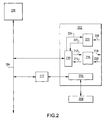
- figure 2 schematically represents data transfer in a multiprocessor system according to the invention, and
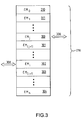
- figure 3 represents a register bank structure in a delegate processor according to the invention.
- In the preferred embodiment of the invention, a delegate processor 202 (figure 2) contains an
internal registers bank 216, that can be accessed by the instructions of thisdelegate processor 202 in write mode, via writeport 220, and in read mode via aread port 218. - This
registers bank 216 can also be accessed by a delegatingprocessor 200 in write mode, via awrite port 212, and in read mode, via a port 214 using: - a
communication bus 204, which may be internal or external to the delegatingprocessor 200, and may also connect other processors (not shown) - and an
interface 210 that is internal to thedelegate processor 202, which receives and sends data on thebus 204. - The
bank 216 is controlled by acontroller 222, internal to thedelegate processor 202. Thiscontroller 222 allocates clearly identified memory spaces in thebank 216 to thedelegate processor 202 and to the delegatingprocessor 200, so that these two processors can operate in parallel in thebank 216. - In this preferred embodiment, the
registers bank 216 contains memory spaces EM0 310 (figure 3), EM1 311, ...EMj 300, EM(j+1) 301, ..., EMi 302, ... EMn 304, each memory space being a set of independent registers that allows the delegate processor to execute all its functions in each memory space. - Each memory space thus contains the work registers necessary for the different data processing operations executed by the
delegate processor 202 or the delegatingprocessor 200. Moreover, each memory space has its own write and read ports. - In a practical example adapted to the current transfer rates capacities of the processors used, particularly in the image processing domain, the
bank 216 comprises 4 portions including 16 registers each, thus constituting 64 registers. - Hence, the delegate processor and the delegating processor always operate in different memory spaces using the
controller 222, which prevents allocation conflicts by allocating memory spaces in a token ring buffer memory order. - As the diagram in figure 3 shows, the
delegate processor 202 is executing a function through the write and readports 306 in thememory space 300 EMj while the delegatingprocessor 200 is writing parameters necessary for the execution of another function in thememory space 302 EMi through the read and writeports 308. - One of the advantages of this invention is thus noted, namely that the
delegate processor 202 has direct access to the parameters necessary for the execution of a function as they are already stored by the delegatingprocessor 200 in itsregisters bank 216. - In other words, the
delegate processor 202 does not need to access these parameters in an external base, which significantly reduces the data consultation periods. - A
FIFO base 217 is used by the delegatingprocessor 200 for transferring the data representing the function to be executed to thedelegate processor 202. - In fact, the delegating
processor 200 and thedelegate processor 202 are capable of interpreting the data representing the function to be executed, for example by means of a symbolic representation of the function to be executed, or an explicit address of the function in amemory 208 that is external to thedelegate processor 202. In this case, these data are decoded using decoding means 206 of thedelegate processor 202. - Hence, the
delegate processor 202 executes a function when it has the possibility to implement a new function. In this case, theprocessor 202 accesses theFIFO base 217, which determines the function to be executed, and at the same time, changes the memory space allocation in theregisters bank 216 so that the new memory space allocated to this function corresponds to a memory space in which the parameters necessary for executing the new function are stored. - In this preferred embodiment of the invention, when the delegating
processor 200 requires a function to be executed by thedelegate processor 202, the data transfer method is implemented in two steps, as follows, (figure 2 and 3): - According to a first step, the delegating
processor 200 transmits the parameters necessary for the embodiment of the function that it wants to be executed by thedelegate processor 202 and requests this function to be executed without interrupting any computation activity in thedelegate processor 202. To do so, the delegatingprocessor 200 requests memory space to be allocated from theinterface 210 of thedelegate processor 202 in itsregisters bank 216 and awaits response from thedata bus 204. Theinterface 210 transfers amessage 224 to thecontroller 222 requesting the allocation of memory space in the bank 216.When such an allocation is possible, the controller transfers the memory space identifier 226 allocated to the delegatingprocessor 200, for example EMi 302.Using this identifier, the delegatingprocessor 200 writes the parameters necessary for executing this function via theinterface 210 and the write and readports 212 / 214, into its memory space allocated EMi 302.Then theprocessor 200 transfers to theFIFO base 217 data representing the function to be executed, which are, for example, either a symbolic representation of the said function or an address from thememory 208. - According to a second step, when the
delegate processor 202 is ready to execute a new function requested by the delegatingprocessor 200, thedelegate processor 202 positions itself at the beginning of the instruction series forming the function requested by the delegatingprocessor 200 by using the parameters written to the allocated memory space for this new function, namelyEMi 302, so that the delegating processor can begin to execute the function immediately. - It should be pointed out that, in this preferred embodiment of the invention, memory space is allocated by the
controller 222 in the following manner: - When the
delegate processor 202 is enabled, no memory space is allocated to either the delegatingprocessor 200 or thedelegate processor 202. - When the delegating
processor 200 requests an initial allocation of memory space, the firstmemory space EM0 310 is allocated. Then, when the delegatingprocessor 200 requests a new memory space allocation after being allocated theEMi 302 memory space, the controller allocates the memory space 303 {EM(i+1) modulo n} to it, where n is a whole number, except where this new memory space {(EM(i+1) or EM0} is already used by thedelegate processor 202. - In this latter case, the delegating
processor 200 waits until this new memory space {EM(i+1) or EM0 if i=n+1} becomes available. - This invention embodies several variants. In particular, in one variant, several delegating processors access, simultaneously for instance, the internal register of the
processor 202.
Claims (11)
- Method for transferring data from a delegating processor (200), requiring the execution of functions, to a delegate processor (202), executing these functions based on a function identifier and execution parameters associated with this function, this identifier and these parameters being provided by the delegating processor, characterized in that the delegating processor (200) accesses an internal registers bank (216) (Em0 310, EM1 311,...EMj 300, EM(j+1) 301,..., EMi 302,... EMn 304) of the delegate processor (202) to store in these registers (Em0 310, EM1 311,...EMj 300, EM(j+1) 301,..., EMi 302,... EMn 304) the parameters associated with a function to be executed simultaneously with the execution by the delegate processor of another function .
- Method according to claim 1 characterized in that the delegating processor (200) accesses internal registers (Em0 310, EM1 311,...EMj 300, EM(j+1) 301,..., EMi 302,... EMn 304) exclusively allocated to this delegating processor for data storage.
- Method according to claim 1 or 2 characterized in that an internal controller (222) of the delegate processor (202) commands allocation of the registers (Em0 310, EM1 311,...EMj 300, EM(j+1) 301,..., EMi 302,... EMn 304) of the registers bank to the delegating processor (200).
- Method according to claim 3 characterized in that, prior to the allocation of memory space, the delegating processor (200) requests an allocation of memory space (Em0 310, EM1 311,...EMj 300, EM(j+1) 301,..., EMi 302,... EMn 304) from the controller (222) of the delegate processor (202) to store parameters necessary for executing a function.
- Method according to claim 4 characterized in that, when the controller (222) allocates a memory space (Em0 310, EM1 311,...EMj 300, EM(j+1)301,..., EMi 302,... EMn 304) to the delegating processor (200), this controller (222) sends a memory space identifier (226) allocated to the delegating processor (200) then the latter transfers the parameters for executing a function to the allocated memory space.
- Method according to one of the aforementioned claims characterized in that the delegating processor (200) transfers data identifying the function requested in means (217) lying between the delegate processor (202) and the delegating processor (200), such as a FIFO random access memory.
- Method according to one of the aforementioned claims characterized in that the internal registers bank (216) (Em0 310, EM1 311,...EMj 300, EM(j+1) 301,..., EMi 302,... EMn 304) of the delegate processor (202) is a memory containing registers sub-sets with at least one of the following characteristics:each registers sub-set has its own write and read ports,each registers sub-set has the same amount of registers and contains all the registers necessary for the operation of the delegate processor for executing all functions that the delegate processor is capable of executing,each sub-set can communicate with the delegating processor or the delegate processor.
- Method according to one of the aforementioned claims characterized in that the parameters are stored in registers (Em0 310, EM1 311,...EMj 300, EM(j+1) 301,..., EMi 302,... EMn 304) containing work registers necessary for the different data processing operations executed by the delegate processor or the delegating processor.
- Multiprocessor system containing at least one delegating processor (200), capable of requesting the execution of functions by a delegate processor (202), which executes these functions based on a function identifier and execution parameters associated with this function, this identifier and these parameters being provided by the delegating processor (200), characterized in that it contains means for the delegating processor (200) to access a bank (216) of internal registers (Em0 310, EM1 311,...EMj 300, EM(j+1) 301,..., EMi 302,... EMn 304) of the delegate processor (202) to store, in these internal registers (Em0 310, EM1 311,...EMj 300, EM(j+1) 301,..., EMi 302,... EMn 304), parameters associated with a function to be executed simultaneously to the execution by the delegate processor (202) of another function according to a method in accordance with at least one of the aforementioned claims.
- Multiprocessor system according to claim 9 characterized in that multiple delegating microprocessors are in contact with the same delegate microprocessor.
- Delegate processor (202) capable of executing functions based on a function identifier and execution parameters associated with this function, this identifier and these parameters being provided by a delegating processor (200), characterized in that it contains means for the delegating processor (200) to access an internal registers bank (216) of said delegate processor to store parameters associated with a function simultaneously with the execution, by said delegate processor, of another function in accordance with a method compliant with one of claims 1 to 8.
Applications Claiming Priority (2)
| Application Number | Priority Date | Filing Date | Title |
|---|---|---|---|
| FR0400528A FR2865291A1 (en) | 2004-01-21 | 2004-01-21 | METHOD OF TRANSFERRING DATA IN A MULTIPROCESSOR SYSTEM, MULTIPROCESSOR SYSTEM AND PROCESSOR EMPLOYING SAID METHOD |
| FR0400528 | 2004-01-21 |
Publications (1)
| Publication Number | Publication Date |
|---|---|
| EP1557755A1 true EP1557755A1 (en) | 2005-07-27 |
Family
ID=34630653
Family Applications (1)
| Application Number | Title | Priority Date | Filing Date |
|---|---|---|---|
| EP05100230A Withdrawn EP1557755A1 (en) | 2004-01-21 | 2005-01-17 | Method for transferring data in a multiprocessor system, multiprocessor system and processor carrying out this method. |
Country Status (7)
| Country | Link |
|---|---|
| US (1) | US20050172104A1 (en) |
| EP (1) | EP1557755A1 (en) |
| JP (1) | JP2005209206A (en) |
| KR (1) | KR20050076702A (en) |
| CN (1) | CN1645351A (en) |
| FR (1) | FR2865291A1 (en) |
| MX (1) | MXPA05000788A (en) |
Cited By (1)
| Publication number | Priority date | Publication date | Assignee | Title |
|---|---|---|---|---|
| WO2011028984A1 (en) * | 2009-09-03 | 2011-03-10 | Advanced Micro Devices, Inc. | An internal, processing-unit memory for general-purpose use |
Families Citing this family (6)
| Publication number | Priority date | Publication date | Assignee | Title |
|---|---|---|---|---|
| KR100759110B1 (en) * | 2006-10-26 | 2007-09-19 | 이상만 | Floor Dustproof Device |
| US7865697B2 (en) * | 2008-02-27 | 2011-01-04 | International Business Machines Corporation | Apparatus for and method of processor to processor communication for coprocessor functionality activation |
| CN102539864B (en) * | 2010-12-31 | 2016-01-20 | 北京普源精电科技有限公司 | Digital oscilloscope and signal measurement method |
| CN102693210B (en) * | 2011-03-21 | 2017-03-01 | 中兴通讯股份有限公司 | The method and device of Transfer Parameters between a kind of processor |
| US8880811B2 (en) * | 2011-06-27 | 2014-11-04 | Intel Mobile Communications GmbH | Data processing device and data processing arrangement for accelerating buffer synchronization |
| WO2019234686A1 (en) * | 2018-06-06 | 2019-12-12 | Enrico Maim | Secure transactional system in a p2p architecture |
Citations (3)
| Publication number | Priority date | Publication date | Assignee | Title |
|---|---|---|---|---|
| US6134653A (en) * | 1998-04-22 | 2000-10-17 | Transwitch Corp. | RISC processor architecture with high performance context switching in which one context can be loaded by a co-processor while another context is being accessed by an arithmetic logic unit |
| US20010040577A1 (en) * | 1992-01-30 | 2001-11-15 | A/N Inc. | External memory system having programmable graphics processor for use in a video game system or the like |
| US6397240B1 (en) * | 1999-02-18 | 2002-05-28 | Agere Systems Guardian Corp. | Programmable accelerator for a programmable processor system |
Family Cites Families (5)
| Publication number | Priority date | Publication date | Assignee | Title |
|---|---|---|---|---|
| US4648034A (en) * | 1984-08-27 | 1987-03-03 | Zilog, Inc. | Busy signal interface between master and slave processors in a computer system |
| US5038282A (en) * | 1988-05-11 | 1991-08-06 | Massachusetts Institute Of Technology | Synchronous processor with simultaneous instruction processing and data transfer |
| JP3327283B2 (en) * | 2000-03-10 | 2002-09-24 | ヤマハ株式会社 | Digital signal processor |
| US6822959B2 (en) * | 2000-07-31 | 2004-11-23 | Mindspeed Technologies, Inc. | Enhancing performance by pre-fetching and caching data directly in a communication processor's register set |
| US6957326B1 (en) * | 2001-06-28 | 2005-10-18 | Turin Networks | Methods and apparatuses for executing threads |
-
2004
- 2004-01-21 FR FR0400528A patent/FR2865291A1/en active Pending
-
2005
- 2005-01-17 EP EP05100230A patent/EP1557755A1/en not_active Withdrawn
- 2005-01-18 CN CNA2005100045304A patent/CN1645351A/en active Pending
- 2005-01-19 US US11/038,303 patent/US20050172104A1/en not_active Abandoned
- 2005-01-19 MX MXPA05000788A patent/MXPA05000788A/en not_active Application Discontinuation
- 2005-01-20 KR KR1020050005397A patent/KR20050076702A/en not_active Withdrawn
- 2005-01-21 JP JP2005013610A patent/JP2005209206A/en active Pending
Patent Citations (3)
| Publication number | Priority date | Publication date | Assignee | Title |
|---|---|---|---|---|
| US20010040577A1 (en) * | 1992-01-30 | 2001-11-15 | A/N Inc. | External memory system having programmable graphics processor for use in a video game system or the like |
| US6134653A (en) * | 1998-04-22 | 2000-10-17 | Transwitch Corp. | RISC processor architecture with high performance context switching in which one context can be loaded by a co-processor while another context is being accessed by an arithmetic logic unit |
| US6397240B1 (en) * | 1999-02-18 | 2002-05-28 | Agere Systems Guardian Corp. | Programmable accelerator for a programmable processor system |
Cited By (4)
| Publication number | Priority date | Publication date | Assignee | Title |
|---|---|---|---|---|
| WO2011028984A1 (en) * | 2009-09-03 | 2011-03-10 | Advanced Micro Devices, Inc. | An internal, processing-unit memory for general-purpose use |
| CN102597951A (en) * | 2009-09-03 | 2012-07-18 | 先进微装置公司 | An internal, processing-unit memory for general-purpose use |
| US8803897B2 (en) | 2009-09-03 | 2014-08-12 | Advanced Micro Devices, Inc. | Internal, processing-unit memory for general-purpose use |
| CN102597951B (en) * | 2009-09-03 | 2016-05-04 | 先进微装置公司 | The memory of the inter-process unit that general object is used |
Also Published As
| Publication number | Publication date |
|---|---|
| CN1645351A (en) | 2005-07-27 |
| KR20050076702A (en) | 2005-07-26 |
| JP2005209206A (en) | 2005-08-04 |
| MXPA05000788A (en) | 2005-08-29 |
| FR2865291A1 (en) | 2005-07-22 |
| US20050172104A1 (en) | 2005-08-04 |
Similar Documents
| Publication | Publication Date | Title |
|---|---|---|
| US7478390B2 (en) | Task queue management of virtual devices using a plurality of processors | |
| US7921151B2 (en) | Managing a plurality of processors as devices | |
| US7748006B2 (en) | Loading software on a plurality of processors | |
| US8549521B2 (en) | Virtual devices using a plurality of processors | |
| EP1247168B1 (en) | Memory shared between processing threads | |
| US7516456B2 (en) | Asymmetric heterogeneous multi-threaded operating system | |
| US7392511B2 (en) | Dynamically partitioning processing across plurality of heterogeneous processors | |
| US7653908B2 (en) | Grouping processors and assigning shared memory space to a group in a heterogeneous computer environment | |
| CN1496516B (en) | Resource dedication system and method for computer architecture for broadband networks | |
| JP4489399B2 (en) | Data processing method and data processing system in processor | |
| USRE41849E1 (en) | Parallel multi-threaded processing | |
| US8151275B2 (en) | Accessing copy information of MMIO register by guest OS in both active and inactive state of a designated logical processor corresponding to the guest OS | |
| US7849214B2 (en) | Packet receiving hardware apparatus for TCP offload engine and receiving system and method using the same | |
| EP1783609A1 (en) | Processing management device, computer system, distributed processing method, and computer program | |
| JP2004252990A (en) | Computer processor and processing device | |
| JPH05274252A (en) | Transaction execution method for computer system | |
| US20050172104A1 (en) | Method for transferring data in a multiprocessor system, multiprocessor system and processor carrying out this method | |
| JP2010061220A (en) | Data transfer apparatus, data transfer method and processor | |
| JP2008276322A (en) | Information processing apparatus, information processing system, and information processing method | |
| US8234651B2 (en) | Information processing method and apparatus using the same | |
| CN120929222B (en) | Data access method, cache device, chip product and computer equipment | |
| KR100195953B1 (en) | High-performance DME driving method of I / O processor | |
| JP2013069063A (en) | Communication unit and information processing method | |
| JP2008276321A (en) | Information processing system and method | |
| KR20020063365A (en) | Real time memory management method of multi processor system |
Legal Events
| Date | Code | Title | Description |
|---|---|---|---|
| PUAI | Public reference made under article 153(3) epc to a published international application that has entered the european phase |
Free format text: ORIGINAL CODE: 0009012 |
|
| AK | Designated contracting states |
Kind code of ref document: A1 Designated state(s): AT BE BG CH CY CZ DE DK EE ES FI FR GB GR HU IE IS IT LI LT LU MC NL PL PT RO SE SI SK TR |
|
| AX | Request for extension of the european patent |
Extension state: AL BA HR LV MK YU |
|
| RAP1 | Party data changed (applicant data changed or rights of an application transferred) |
Owner name: THOMSON LICENSING |
|
| 17P | Request for examination filed |
Effective date: 20060126 |
|
| AKX | Designation fees paid |
Designated state(s): DE ES FR GB IT TR |
|
| STAA | Information on the status of an ep patent application or granted ep patent |
Free format text: STATUS: THE APPLICATION IS DEEMED TO BE WITHDRAWN |
|
| 18D | Application deemed to be withdrawn |
Effective date: 20080605 |