EP1557560A1 - Circuit for dynamic control of a power transistor in applications for high voltage - Google Patents
Circuit for dynamic control of a power transistor in applications for high voltage Download PDFInfo
- Publication number
- EP1557560A1 EP1557560A1 EP04425035A EP04425035A EP1557560A1 EP 1557560 A1 EP1557560 A1 EP 1557560A1 EP 04425035 A EP04425035 A EP 04425035A EP 04425035 A EP04425035 A EP 04425035A EP 1557560 A1 EP1557560 A1 EP 1557560A1
- Authority
- EP
- European Patent Office
- Prior art keywords
- transistor
- terminal
- circuit
- jfet
- power transistor
- Prior art date
- Legal status (The legal status is an assumption and is not a legal conclusion. Google has not performed a legal analysis and makes no representation as to the accuracy of the status listed.)
- Granted
Links
- 238000005516 engineering process Methods 0.000 description 10
- 239000000758 substrate Substances 0.000 description 5
- 210000000746 body region Anatomy 0.000 description 4
- 238000004804 winding Methods 0.000 description 4
- 239000004065 semiconductor Substances 0.000 description 3
- XUIMIQQOPSSXEZ-UHFFFAOYSA-N Silicon Chemical compound [Si] XUIMIQQOPSSXEZ-UHFFFAOYSA-N 0.000 description 2
- 238000010586 diagram Methods 0.000 description 2
- 239000002184 metal Substances 0.000 description 2
- 229910052710 silicon Inorganic materials 0.000 description 2
- 239000010703 silicon Substances 0.000 description 2
- 238000004088 simulation Methods 0.000 description 2
- 239000011800 void material Substances 0.000 description 2
- 238000002485 combustion reaction Methods 0.000 description 1
- 230000007423 decrease Effects 0.000 description 1
- 230000010355 oscillation Effects 0.000 description 1
- 239000000700 radioactive tracer Substances 0.000 description 1
- 230000006641 stabilisation Effects 0.000 description 1
Images


Classifications
-
- H—ELECTRICITY
- H03—ELECTRONIC CIRCUITRY
- H03K—PULSE TECHNIQUE
- H03K17/00—Electronic switching or gating, i.e. not by contact-making and –breaking
- H03K17/08—Modifications for protecting switching circuit against overcurrent or overvoltage
- H03K17/082—Modifications for protecting switching circuit against overcurrent or overvoltage by feedback from the output to the control circuit
- H03K17/0828—Modifications for protecting switching circuit against overcurrent or overvoltage by feedback from the output to the control circuit in composite switches
-
- F—MECHANICAL ENGINEERING; LIGHTING; HEATING; WEAPONS; BLASTING
- F02—COMBUSTION ENGINES; HOT-GAS OR COMBUSTION-PRODUCT ENGINE PLANTS
- F02P—IGNITION, OTHER THAN COMPRESSION IGNITION, FOR INTERNAL-COMBUSTION ENGINES; TESTING OF IGNITION TIMING IN COMPRESSION-IGNITION ENGINES
- F02P3/00—Other installations
- F02P3/02—Other installations having inductive energy storage, e.g. arrangements of induction coils
- F02P3/04—Layout of circuits
- F02P3/0407—Opening or closing the primary coil circuit with electronic switching means
- F02P3/0435—Opening or closing the primary coil circuit with electronic switching means with semiconductor devices
-
- F—MECHANICAL ENGINEERING; LIGHTING; HEATING; WEAPONS; BLASTING
- F02—COMBUSTION ENGINES; HOT-GAS OR COMBUSTION-PRODUCT ENGINE PLANTS
- F02D—CONTROLLING COMBUSTION ENGINES
- F02D41/00—Electrical control of supply of combustible mixture or its constituents
- F02D41/20—Output circuits, e.g. for controlling currents in command coils
- F02D2041/2068—Output circuits, e.g. for controlling currents in command coils characterised by the circuit design or special circuit elements
- F02D2041/2075—Type of transistors or particular use thereof
Definitions
- the present invention relates to a circuit for dynamic control of a power transistor in applications for high voltage.
- the invention relates to a circuit for dynamic control of a power transistor in applications for high voltage comprising a power transistor with a conduction terminal connected to a load and a control terminal receiving a driving signal from a driver block activated by a trigger signal, received on a circuit input terminal.
- the invention particularly relates, but not exclusively, to a circuit for dynamic control of a power transistor of the IGBT type, in applications for high voltage, and the following description is made with reference to this field of application for convenience of illustration only.
- Microprocessor-driven control systems for electronic ignition are known. These systems, in their most general form, allow a spark to be generated on a sparking plug associated to an internal-combustion engine.
- control circuit for electronic ignition globally indicated with 1, is schematically shown in figure 1.
- the control circuit 1 receives a trigger pulse Vin produced for example by a microprocessor (not shown in the figure) and applied to an input terminal IN connected to a driving terminal of an operated switch SW1.
- the switch SW1 is inserted between a first voltage reference, particularly a supply voltage reference Vbat, and a second voltage reference, particularly a ground GND.
- the switch SW1 is also connected to a primary coil winding 1A, connected in turn to said supply voltage reference Vbat and to an ignition sparking plug 1B.
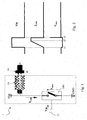
- the trigger pulse Vin determines the charging time of the primary coil winding 1A, closing the switch SW1 through which a current I COIL flows, as shown in figure 2.
- the trigger signal Vin has a low value and, consequently, the switch SW1 is open, keeping also the current value I COIL low and the voltage V sw1 is equal to the voltage Vbatt.
- the microprocessor brings the trigger signal Vin at a high value which, closing the switch SW1, allows the current I COIL to flow in the coil winding 1A.
- the trigger signal Vin is kept high until a time t3.
- the coil current I COIL increases with a slope trend until it reaches a maximum value in correspondence with a time t2 being lower than t3, remaining thus at this value until the time t3.
- the trigger signal Vin goes back to the low state and it consequently opens the switch SW1.
- the voltage V sw1 at the ends of the switch instantaneously reaches a high value.
- An overvoltage thus occurs on the primary coil winding 1A which, transferring to the secondary through the coil turn ratio, generates a spark on the sparking plug 1B.
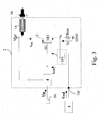
- control circuit 1 of figure 1 timed as described in figure 2, is shown in figure 3, wherein the switch SW1 is realised by means of a power element, particularly an IGBT transistor.
- the control circuit 2 for electronic ignition receives on a first input terminal IN1 the trigger pulse Vin produced by a microprocessor not shown in the figure.
- the control circuit 2 comprises a power element, particularly an IGBT transistor TR1 used as switch, comprised between the supply voltage reference Vbat and the ground GND.
- the transistor TR1 has a first conduction terminal, particularly the collector terminal C, coupled to a supply voltage reference Vbat by means of the coil 1A, a second conduction terminal, particularly the emitter terminal E, coupled to the ground GND by means of a sensing resistance Rsen, as well as a control terminal, particularly a gate terminal G1 connected, by means of a driver block 4, to the first input terminal of the control circuit 2.
- the driver block 4 is also connected to the supply voltage reference Vbat.
- the control circuit 2 also comprises a current limiting block 5 inserted between the control terminal G1 and the emitter terminal E of the transistor TR1 and essentially comprising an operational amplifier OP1.
- the operation amplifier OP1 is a fed-back non inverting amplifier having a non inverting input terminal (+) connected to the emitter terminal E, an inverting input terminal (-) connected to the reference voltage generator 3 and an output terminal connected to the control terminal G1 of the transistor TR1.
- the coil current value Icoil is then limited by means of the comparator OP1 reading the drop at the ends of the sensing resistance Rsen, being proportional to the coil current Icoil, comparing it with the reference voltage Vref and conveniently biasing the control terminal G1 of the transistor TR1, in order not to exceed a predetermined maximum current value.
- the resistance Rf prevents the voltage on the collector terminal C from reaching such a high desired value, since it would trigger, before reaching this value, a new turn-on of the IGBT power transistor TR1.
- the technical problem underlying the present invention is to provide a dynamic compensation circuit for a power transistor, like an IGBT transistor, having such structural and functional features as to be capable of operating at low voltage, overcoming the limits and/or drawbacks still affecting prior art circuits.
- the solution idea underlying the present invention is to use a JFET transistor integrated in the same power transistor structure, allowing a resistance with a non-linear feature to be integrated.
- a control circuit for a power transistor for example an IGBT transistor, which has been advantageously modified according to the invention with respect to the known solution of figure 4 and by inserting a JFET transistor TR2 in place of the resistance Rf of figure 4, is shown with 20.
- the circuit 20 is particularly, but not exclusively, suitable for applications in the automotive field for the electronic ignition in endothermic engines.
- the JFET transistor TR2 is connected, by means of a conduction terminal D thereof, particularly a Drain terminal, to a first conduction terminal, particularly a collector terminal C, of the IGBT transistor TR 1.
- the JFET transistor TR2 is also connected, by means of another conduction terminal S, particularly a source terminal, to the control terminal, i.e. the gate terminal G1, of said IGBT transistor TR1.
- the control terminal, i.e. the gate terminal G2, of said transistor TR2 is directly connected to a voltage reference, for example a ground GND.
- said JFET transistor TR2 is inserted in said control circuit 20, integrated in the same structure of said IGBT transistor TR1, allowing a driver for said IGBT transistor to be realised, using a low voltage technology.
- figure 7 schematically shows a sectional and enlarged-scale view of a structure of semiconductor-integrated electronic circuit 30 to realise in an integrated way the JFET transistor TR2 in the structure of said IGBT transistor TR1.
- Said structure 30 comprises a silicon substrate 32 having a first conductivity type N and associated to a metal electrode 31, as well as a plurality of silicon wells 33, 34 having a second conductivity type P, realised above said substrate 32.
- the well 33 is the body region of said JFET transistor TR2, while the well 34 is the active area of the JFET transistor.
- the structure 30 is covered by an oxide layer 35 with contact openings 36, 37 and 38 in correspondence with the wells 33 and 34.
- Metal layer ends 39 are overlapped to said layer 35 and in contact with said layer 32 through said opening 37, as well as with said well 33 through the opening 36 and with said well 34 through the opening 38.
- Figure 7 also shows, overlapped, the circuit equivalents of said layer 32 and of said JFET transistor TR2 represented by a resistance Re and a resistance Rj respectively.
- Figure 8 shows the typical curves of the circuit being implemented by the structure of figure 7.
- said JFET transistor TR2 is always conducting for a gate voltage equal to zero Volt and the current I JFET thereof decreases reverse-biasing the gate source junction, up to the pinch-off voltage value, equal to about -4V, for which said JFET transistor TR2 is completely inhibited.
- the circuit of figure 9 in order to feedback the collector voltage, can be modified as in figure 10, wherein components and signals being already in figure 9 will keep the same labels as in figure 9.
- a block A located in the box, has been inserted in figure 10, through which the source terminal S of said JFET transistor TR2 is not directly connected to the gate G1 of the IGBT transistor TR1, but to the collector terminal of a first diode-connected bipolar transistor Q 1 of the NPN type, having the emitter terminal connected to the ground and being also connected through its base to the base terminal of a second bipolar transistor Q2 of the NPN type used as current mirror.
- this voltage is almost constant, and thus said second JFET transistor TR2 is forced to operate on a predetermined output feature, allowing a constant resistance value to be obtained in the ohmic area.
- the collector terminal of said second bipolar transistor Q2 of the NPN type is connected to the collector terminal of a third bipolar transistor Q3 of the PNP type, being connected in turn, in a current mirror configuration, to a forth bipolar transistor Q4 of the PNP type.
- the pairs of transistors Q1, Q2 and Q3, Q4 are substantially two current mirrors.
- the collector current I MIRR outputted by said forth bipolar transistor Q4 will then be equal to said current I JFET supplied by said JFET transistor TR2.
- Figure 11a shows the results of the simulation of the circuit of figure 9 and figure 11b shows those related to the circuit of figure 10.
- Figure 11b relates to the simulation of the same circuit wherein the block A of figure 10 has been introduced.
- the voltage calculated on the gate terminal G1 of said IGBT transistor TR1 reaches about 4V, but said JFET transistor TR2 is not inhibited, since it always detects between the source terminal S and the gate terminal G2 a voltage being equal to the voltage calculated between the base and emitter terminals of said first bipolar transistor Q1 of the NPN type.
- the current I MIRR obtained by mirroring the current I JFET calculated in the source terminal S of the JFET transistor TR2, being not void, thus allows the feedback from the collector voltage required for the circuit stabilisation to be obtained.
- This feedback is also used to reduce the collector voltage overshoot occurring at the beginning of the current limitation step, when said IGBT transistor TR1 passes from the ohmic operation area thereof to the saturation area.
- a remarkable advantage of the JFET structure integrated inside an IGBT transistor is that of providing, with circuits realised by using low voltage technologies, all those circuit solutions previously requiring the use of high voltage technologies.
- the proposed solution provides that the feedback from the IGBT transistor collector voltage is obtained by realising an interface locating in the same IGBT transistor structure the high voltage area, in order to obtain a low voltage signal which can be operated by means of circuits which can be realised in any of the low voltage technologies.
- the proposed solution provides the realisation of an interface being capable to modify the feedback signal of the collector voltage, coming from the JFET transistor structure, to make it suitable for driving the IGBT transistor gate terminal G1.
- This circuit forces the JFET transistor to operate at a constant voltage (Vgs) calculated between the gate terminal and the source terminal, so that said transistor can be used on a predetermined output feature.
- Figure 5 shows an example of a possible exploitation of the ViPower technology to realise a control circuit for said IGBT transistor TR1, globally indicated with 18 in the figure, using said resistance Rf, globally indicated with 8 in the figure.
- the integrated structure 8 is effective to implement, with the ViPower technology, a high voltage resistance.
- the resistive structure 8 is integrated on a first semiconductor epitaxial layer 10 of a first conductivity type N, slightly doped (N-), located on a semiconductor substrate 9 of said first heavily doped conductivity type (N+); the resistive structure 8 comprised a plurality of buried and parallel regions 12, of a second conductivity type P, realised in the epitaxial layer 10.
- the resistive structure 8 also comprises two opposite end regions 13, always having said second heavily doped conductivity type (P+), in contact with the two buried end regions 12. At least a region 13 is laterally separated from a region 15 having a first heavily doped conductivity type (N+) by means of a portion 14 of the epitaxial layer 10.
- Said high voltage resistance being shown is capable to "throttle", considerably increasing the resistivity thereof, when the voltage at the ends exceeds a certain value, as shown in detail in the diagram of figure 6.
- the solution can be obtained by using also other high voltage technologies allowing a pinched resistance to be integrated.
- the IGBT transistor 18 comprises a semiconductor substrate 16 of said second heavily doped conductivity type (P ++ ), realising the bipolar transistor conduction electrodes, a region 21 of said second heavily doped conductivity type (P + ), called body region, realised in the first epitaxial layer 19 of said first slightly doped conductivity type (N-), while the driving terminal is realised in contact with the first epitaxial layer 19 itself.
- the vertical MOS transistor comprises said body region 21 wherein a source region 23 of said first heavily doped conductivity type (N + ), is integrated.
- a gate region 24 completes the IGBT transistor 18; a side portion of the region 21, wherein the source region 23 is integrated, can be used as body region 21b for the IGBT transistor.
- the resistance 8 is connected to the collector of the transistor 18 by placing the respective substrates 9 and 16 of the two dies on the same package frame 17, while the connection to the gate 24 of the transistor 18 is performed by means of an inner connection wire 25.
Landscapes
- Engineering & Computer Science (AREA)
- Chemical & Material Sciences (AREA)
- Combustion & Propulsion (AREA)
- Mechanical Engineering (AREA)
- General Engineering & Computer Science (AREA)
- Electronic Switches (AREA)
- Metal-Oxide And Bipolar Metal-Oxide Semiconductor Integrated Circuits (AREA)
Abstract
Description
- The present invention relates to a circuit for dynamic control of a power transistor in applications for high voltage.
- More specifically, the invention relates to a circuit for dynamic control of a power transistor in applications for high voltage comprising a power transistor with a conduction terminal connected to a load and a control terminal receiving a driving signal from a driver block activated by a trigger signal, received on a circuit input terminal. The invention particularly relates, but not exclusively, to a circuit for dynamic control of a power transistor of the IGBT type, in applications for high voltage, and the following description is made with reference to this field of application for convenience of illustration only.
- Microprocessor-driven control systems for electronic ignition are known. These systems, in their most general form, allow a spark to be generated on a sparking plug associated to an internal-combustion engine.
- In particular, a control circuit for electronic ignition, globally indicated with 1, is schematically shown in figure 1.
- The
control circuit 1 receives a trigger pulse Vin produced for example by a microprocessor (not shown in the figure) and applied to an input terminal IN connected to a driving terminal of an operated switch SW1. - The switch SW1 is inserted between a first voltage reference, particularly a supply voltage reference Vbat, and a second voltage reference, particularly a ground GND.
- The switch SW1 is also connected to a
primary coil winding 1A, connected in turn to said supply voltage reference Vbat and to anignition sparking plug 1B. - At the ends of the switch SW1, driven by the trigger pulse Vin, there is a voltage value Vsw1.
- The trigger pulse Vin determines the charging time of the primary coil winding 1A, closing the switch SW1 through which a current ICOIL flows, as shown in figure 2.
- In particular, for a time t<t1, the trigger signal Vin has a low value and, consequently, the switch SW1 is open, keeping also the current value ICOIL low and the voltage Vsw1 is equal to the voltage Vbatt.
- For t=t1, the microprocessor brings the trigger signal Vin at a high value which, closing the switch SW1, allows the current ICOIL to flow in the
coil winding 1A. - The trigger signal Vin is kept high until a time t3. In the interval t1<t<t3, in correspondence with the high value of the trigger signal Vin, the coil current ICOIL increases with a slope trend until it reaches a maximum value in correspondence with a time t2 being lower than t3, remaining thus at this value until the time t3.
- Therefore, the trigger signal Vin goes back to the low state and it consequently opens the switch SW1. At this time t3, the voltage Vsw1 at the ends of the switch instantaneously reaches a high value. An overvoltage thus occurs on the primary coil winding 1A which, transferring to the secondary through the coil turn ratio, generates a spark on the
sparking plug 1B. - An implementation of the
control circuit 1 of figure 1, timed as described in figure 2, is shown in figure 3, wherein the switch SW1 is realised by means of a power element, particularly an IGBT transistor. - The
control circuit 2 for electronic ignition receives on a first input terminal IN1 the trigger pulse Vin produced by a microprocessor not shown in the figure. - It also receives, on a second input terminal IN2, a reference voltage value Vref, produced by a convenient
reference voltage generator 3. - The
control circuit 2 comprises a power element, particularly an IGBT transistor TR1 used as switch, comprised between the supply voltage reference Vbat and the ground GND. - The transistor TR1 has a first conduction terminal, particularly the collector terminal C, coupled to a supply voltage reference Vbat by means of the
coil 1A, a second conduction terminal, particularly the emitter terminal E, coupled to the ground GND by means of a sensing resistance Rsen, as well as a control terminal, particularly a gate terminal G1 connected, by means of adriver block 4, to the first input terminal of thecontrol circuit 2. - The
driver block 4 is also connected to the supply voltage reference Vbat. - The
control circuit 2 also comprises a current limitingblock 5 inserted between the control terminal G1 and the emitter terminal E of the transistor TR1 and essentially comprising an operational amplifier OP1. - In particular, the operation amplifier OP1 is a fed-back non inverting amplifier having a non inverting input terminal (+) connected to the emitter terminal E, an inverting input terminal (-) connected to the
reference voltage generator 3 and an output terminal connected to the control terminal G1 of the transistor TR1. - The coil current value Icoil is then limited by means of the comparator OP1 reading the drop at the ends of the sensing resistance Rsen, being proportional to the coil current Icoil, comparing it with the reference voltage Vref and conveniently biasing the control terminal G1 of the transistor TR1, in order not to exceed a predetermined maximum current value.
- In practise, in order to stabilise a fed-back configuration as the one shown in figure 3, a convenient dynamic compensation mechanism must be provided.
- To this aim, it is known to use a compensation resistance Rf inserted between the collector terminal C and the control terminal G1 of the transistor TR1, as schematically shown in figure 4.
- Actually, this solution cannot be used in the case of a circuit which must operate at high voltage, as in the case of an electronic ignition application, wherein, in order to have a spark in the secondary, it is necessary that the voltage detected at the collector terminal C, upon the transistor TR1 turn-off by means of the trigger voltage Vin, reaches values of some hundreds of volts.
- In fact, in this case, the resistance Rf prevents the voltage on the collector terminal C from reaching such a high desired value, since it would trigger, before reaching this value, a new turn-on of the IGBT power transistor TR1.
- The technical problem underlying the present invention is to provide a dynamic compensation circuit for a power transistor, like an IGBT transistor, having such structural and functional features as to be capable of operating at low voltage, overcoming the limits and/or drawbacks still affecting prior art circuits.
- The solution idea underlying the present invention is to use a JFET transistor integrated in the same power transistor structure, allowing a resistance with a non-linear feature to be integrated.
- On the basis of this solution idea the technical problem is solved by a circuit as previously indicated and defined in the characterising part of
claim 1. - The features and advantages of the device according to the invention will be apparent from the following description of an embodiment thereof given by way of indicative and non-limiting example with reference to the attached drawings.
- In these drawings:
- Figure 1 schematically shows a control circuit for an electronic ignition system, realised according to the prior art;
- Figure 2 schematically shows the trend in time of inner signals of said circuit of figure 1, according to the prior art;
- Figure 3 shows, in greater detail, an embodiment of said control circuit of figure 1, according to the prior art;
- Figure 4 shows, in greater detail, an alternative embodiment of said control circuit of figure 1, according to the prior art;
- Figure 5 schematically shows an integrated structure according to the present invention to realise a control circuit for an IGBT transistor using an integrated resistance realised in the ViPower technology;
- Figure 6 shows the trend of the electric feature of said resistance of figure 5 according to the invention;
- Figure 7 schematically shows an integrated structure effective to implement a JFET transistor being integrated in the structure of said IGBT transistor, according to the invention;
- Figure 8 shows the trend of a typical curve of the JFET transistor of figure 7, according to the invention;
- Figure 9 shows a control circuit for a power transistor, for example an IGBT transistor realised according to the invention;
- Figure 10 shows an alternative embodiment of said control circuit of figure 9, according to the invention;
- Figures 11A and 11B show the trend of waveforms obtained by simulating said control circuit, according to the invention.
- With reference to these drawings, and particularly to the example of figure 9, a control circuit for a power transistor, for example an IGBT transistor, which has been advantageously modified according to the invention with respect to the known solution of figure 4 and by inserting a JFET transistor TR2 in place of the resistance Rf of figure 4, is shown with 20.
- The
circuit 20 is particularly, but not exclusively, suitable for applications in the automotive field for the electronic ignition in endothermic engines. - In figure 9 components and signals having the same structure and operation as the ones of figure 4 will keep the same reference numbers and acronyms.
- In particular, the JFET transistor TR2 is connected, by means of a conduction terminal D thereof, particularly a Drain terminal, to a first conduction terminal, particularly a collector terminal C, of the
IGBT transistor TR 1. - The JFET transistor TR2 is also connected, by means of another conduction terminal S, particularly a source terminal, to the control terminal, i.e. the gate terminal G1, of said IGBT transistor TR1.
- The control terminal, i.e. the gate terminal G2, of said transistor TR2 is directly connected to a voltage reference, for example a ground GND.
- Advantageously, according to the invention, said JFET transistor TR2 is inserted in said
control circuit 20, integrated in the same structure of said IGBT transistor TR1, allowing a driver for said IGBT transistor to be realised, using a low voltage technology. - In particular, figure 7 schematically shows a sectional and enlarged-scale view of a structure of semiconductor-integrated
electronic circuit 30 to realise in an integrated way the JFET transistor TR2 in the structure of said IGBT transistor TR1. - Said
structure 30 comprises asilicon substrate 32 having a first conductivity type N and associated to ametal electrode 31, as well as a plurality ofsilicon wells substrate 32. - The
well 33 is the body region of said JFET transistor TR2, while thewell 34 is the active area of the JFET transistor. - The
structure 30 is covered by anoxide layer 35 withcontact openings wells -
Metal layer ends 39 are overlapped to saidlayer 35 and in contact with saidlayer 32 through said opening 37, as well as with said well 33 through theopening 36 and with said well 34 through theopening 38. - Figure 7 also shows, overlapped, the circuit equivalents of said
layer 32 and of said JFET transistor TR2 represented by a resistance Re and a resistance Rj respectively. - Figure 8 shows the typical curves of the circuit being implemented by the structure of figure 7.
- As it can be noticed from the diagram of figure 8, said JFET transistor TR2 is always conducting for a gate voltage equal to zero Volt and the current IJFET thereof decreases reverse-biasing the gate source junction, up to the pinch-off voltage value, equal to about -4V, for which said JFET transistor TR2 is completely inhibited.
- With a low voltage technology it is thus possible to design control circuits of IGBT transistors such as said transistor TR1 which, in order to ensure the stability of the whole system, use a JFET transistor, in particular said JFET transistor TR2 is used as feedback resistance.
- When the JFET transistor TR2 is directly connected between the first conduction terminal, the collector C, and the control terminal, the gate G1 of the IGBT transistor TR1, a real feedback of the collector voltage does not occur since the voltage between the gate G2 and the source S of the transistor TR2 is equal to the voltage between the gate G1 and the ground GND and it can extinguish the current IJFET with subsequent circuit instability.
- Advantageously, according to the invention, in order to feedback the collector voltage, the circuit of figure 9 can be modified as in figure 10, wherein components and signals being already in figure 9 will keep the same labels as in figure 9.
- In particular, a block A, located in the box, has been inserted in figure 10, through which the source terminal S of said JFET transistor TR2 is not directly connected to the gate G1 of the IGBT transistor TR1, but to the collector terminal of a first diode-connected
bipolar transistor Q 1 of the NPN type, having the emitter terminal connected to the ground and being also connected through its base to the base terminal of a second bipolar transistor Q2 of the NPN type used as current mirror. - In this way the voltage between the gate terminal G2 and the source terminal S of said JFET transistor TR2, corresponding to the voltage drop between the base and the emitter of said first
bipolar transistor Q 1 of the NPN type with opposite sign, is always lower in absolute value than the pinch-off voltage. - Moreover, this voltage is almost constant, and thus said second JFET transistor TR2 is forced to operate on a predetermined output feature, allowing a constant resistance value to be obtained in the ohmic area.
- The collector terminal of said second bipolar transistor Q2 of the NPN type is connected to the collector terminal of a third bipolar transistor Q3 of the PNP type, being connected in turn, in a current mirror configuration, to a forth bipolar transistor Q4 of the PNP type.
- The pairs of transistors Q1, Q2 and Q3, Q4 are substantially two current mirrors.
- The collector current IMIRR outputted by said forth bipolar transistor Q4 will then be equal to said current IJFET supplied by said JFET transistor TR2.
- By connecting the collector terminal of said forth bipolar transistor Q4 to said first gate terminal G1 of said IGBT transistor TR1, a feedback occurs from the collector terminal C, which is independent from the value of the gate voltage calculated in said gate terminal G1.
- Figure 11a shows the results of the simulation of the circuit of figure 9 and figure 11b shows those related to the circuit of figure 10.
- In figure 11a, it can be seen that, by using the JFET transistor TR2 located as the prior art resistance Rf, i.e. by directly connecting it between said collector terminal C and said gate terminal G1 of the IGBT transistor TR1, the feedback current IJFET is void when the voltage of said gate terminal G1 increases, and oscillations thus arise on the collector voltage, being it impossible to stabilise the fed-back circuit.
- Figure 11b relates to the simulation of the same circuit wherein the block A of figure 10 has been introduced.
- In this case too, in the current limitation step, the voltage calculated on the gate terminal G1 of said IGBT transistor TR1 reaches about 4V, but said JFET transistor TR2 is not inhibited, since it always detects between the source terminal S and the gate terminal G2 a voltage being equal to the voltage calculated between the base and emitter terminals of said first bipolar transistor Q1 of the NPN type.
- The current IMIRR, obtained by mirroring the current IJFET calculated in the source terminal S of the JFET transistor TR2, being not void, thus allows the feedback from the collector voltage required for the circuit stabilisation to be obtained.
- This feedback is also used to reduce the collector voltage overshoot occurring at the beginning of the current limitation step, when said IGBT transistor TR1 passes from the ohmic operation area thereof to the saturation area.
- Advantages with respect to the prior art.
- A remarkable advantage of the JFET structure integrated inside an IGBT transistor is that of providing, with circuits realised by using low voltage technologies, all those circuit solutions previously requiring the use of high voltage technologies.
- In fact the prior art provided, for control circuits, for the realisation of high voltage structures being effective to directly interface with the IGBT transistor collector.
- On the contrary, the proposed solution provides that the feedback from the IGBT transistor collector voltage is obtained by realising an interface locating in the same IGBT transistor structure the high voltage area, in order to obtain a low voltage signal which can be operated by means of circuits which can be realised in any of the low voltage technologies.
- The proposed solution, of which a circuit embodiment can be seen in block A of figure 10, provides the realisation of an interface being capable to modify the feedback signal of the collector voltage, coming from the JFET transistor structure, to make it suitable for driving the IGBT transistor gate terminal G1.
- This circuit forces the JFET transistor to operate at a constant voltage (Vgs) calculated between the gate terminal and the source terminal, so that said transistor can be used on a predetermined output feature.
- Another embodiment of a control circuit for an IGBT transistor, using the resistance Rf of figure 4, is obtained by using a technology called ViPower.
- Figure 5 shows an example of a possible exploitation of the ViPower technology to realise a control circuit for said IGBT transistor TR1, globally indicated with 18 in the figure, using said resistance Rf, globally indicated with 8 in the figure.
- In particular, the
integrated structure 8 is effective to implement, with the ViPower technology, a high voltage resistance. - The
resistive structure 8 is integrated on a firstsemiconductor epitaxial layer 10 of a first conductivity type N, slightly doped (N-), located on asemiconductor substrate 9 of said first heavily doped conductivity type (N+); theresistive structure 8 comprised a plurality of buried andparallel regions 12, of a second conductivity type P, realised in theepitaxial layer 10. - The
resistive structure 8 also comprises twoopposite end regions 13, always having said second heavily doped conductivity type (P+), in contact with the two buriedend regions 12. At least aregion 13 is laterally separated from aregion 15 having a first heavily doped conductivity type (N+) by means of aportion 14 of theepitaxial layer 10. - Said high voltage resistance being shown is capable to "throttle", considerably increasing the resistivity thereof, when the voltage at the ends exceeds a certain value, as shown in detail in the diagram of figure 6.
- It can be noticed from this typical curve, realised by means of a curve tracer, that in the almost linear area thereof the resistance is used as feedback from the collector of the IGBT transistor TR1, in order to stabilise the system, while the feature thereof to pinch at high voltage is used when said IGBT transistor is turned off, since, when the collector voltage thereof increases, the current which can flow through the resistance cannot turn it on, as it would have happened instead with a linear-behaviour component.
- The solution can be obtained by using also other high voltage technologies allowing a pinched resistance to be integrated.
- On the contrary, the
IGBT transistor 18 comprises asemiconductor substrate 16 of said second heavily doped conductivity type (P++), realising the bipolar transistor conduction electrodes, aregion 21 of said second heavily doped conductivity type (P+), called body region, realised in thefirst epitaxial layer 19 of said first slightly doped conductivity type (N-), while the driving terminal is realised in contact with thefirst epitaxial layer 19 itself. - The vertical MOS transistor comprises said
body region 21 wherein asource region 23 of said first heavily doped conductivity type (N+), is integrated. - A
gate region 24 completes theIGBT transistor 18; a side portion of theregion 21, wherein thesource region 23 is integrated, can be used asbody region 21b for the IGBT transistor. - The
resistance 8 is connected to the collector of thetransistor 18 by placing therespective substrates same package frame 17, while the connection to thegate 24 of thetransistor 18 is performed by means of aninner connection wire 25.
Claims (9)
- A circuit (20) for dynamic control of a power transistor in applications for high voltage and of the type wherein a power transistor (TR1) has a conduction terminal (C) connected to a load and a control terminal (G1) receiving a driving signal from a driver block (4) activated by a trigger signal (Vin) received on a circuit input terminal (IN1), characterised in that it comprises a JFET component (TR2) inserted between the conduction (C) and control (G1) terminal of the power transistor (TR1) and equal to a resistance with non-linear feature.
- A circuit according to claim 1, characterised in that said JFET component (TR2) is a transistor having respective drain (D) and source (S) terminals connected to the conduction (C) and control (G1) terminals of said power transistor, as well as a gate terminal (G2) connected to a voltage reference (GND).
- A circuit according to claim 1, characterised in that said JFET component (TR2) is monolithically integrated in the structure of said power transistor (TR1).
- A circuit according to claim 1, characterised in that said JFET component (TR2) is a feedback resistance for the conduction terminal of said power transistor (TR1).
- A circuit according to claim 1, characterised in that said JFET component (TR2) is forced to operate in a predetermined output feature in the ohmic area with a constant resistance value.
- A circuit according to claim 2, characterised in that said JFET transistor (TR2) is associated to a circuit (A) adjusting the voltage drop between the gate (G2) and source (S) terminals of the JFET transistor to keep it lower than a pinch-off voltage.
- A circuit according to claim 6, characterised in that said circuit (A) is inserted between the source (S) terminal of the JFET transistor (TR2) and the control terminal (G1) of the power transistor (TR1) and it comprises a pair of current mirrors to supply the same current of said JFET transistor.
- A circuit according to claim 6, characterised in that said circuit (A) realises a feedback connection on said conduction terminal (C) of the power transistor (TR1) being independent from the voltage value on the control terminal (G1) of the same power transistor (TR1).
- A circuit according to claim 2, characterised in that said JFET component (TR2) operates in a constant voltage drop Vgs.
Priority Applications (3)
| Application Number | Priority Date | Filing Date | Title |
|---|---|---|---|
| EP04425035A EP1557560B1 (en) | 2004-01-22 | 2004-01-22 | Circuit for dynamic control of a power transistor in applications for high voltage |
| DE602004009524T DE602004009524T2 (en) | 2004-01-22 | 2004-01-22 | Dynamic control of a power transistor in high voltage applications |
| US11/042,469 US20050184793A1 (en) | 2004-01-22 | 2005-01-24 | Circuit for dynamic control of a power transistor in applications for high voltage |
Applications Claiming Priority (1)
| Application Number | Priority Date | Filing Date | Title |
|---|---|---|---|
| EP04425035A EP1557560B1 (en) | 2004-01-22 | 2004-01-22 | Circuit for dynamic control of a power transistor in applications for high voltage |
Publications (2)
| Publication Number | Publication Date |
|---|---|
| EP1557560A1 true EP1557560A1 (en) | 2005-07-27 |
| EP1557560B1 EP1557560B1 (en) | 2007-10-17 |
Family
ID=34626570
Family Applications (1)
| Application Number | Title | Priority Date | Filing Date |
|---|---|---|---|
| EP04425035A Expired - Lifetime EP1557560B1 (en) | 2004-01-22 | 2004-01-22 | Circuit for dynamic control of a power transistor in applications for high voltage |
Country Status (3)
| Country | Link |
|---|---|
| US (1) | US20050184793A1 (en) |
| EP (1) | EP1557560B1 (en) |
| DE (1) | DE602004009524T2 (en) |
Cited By (1)
| Publication number | Priority date | Publication date | Assignee | Title |
|---|---|---|---|---|
| FR2949630A1 (en) * | 2009-08-31 | 2011-03-04 | Hispano Suiza Sa | ELECTRONIC CONTROL MODULE FOR TRANSISTOR JFET |
Families Citing this family (2)
| Publication number | Priority date | Publication date | Assignee | Title |
|---|---|---|---|---|
| WO2015070347A1 (en) * | 2013-11-14 | 2015-05-21 | Tm4 Inc. | Commutation cell, power converter and compensation circuit having dynamically controlled voltage gains |
| US11131286B2 (en) * | 2018-03-20 | 2021-09-28 | Rohm Co., Ltd. | Igniter and vehicle provided with the same |
Citations (2)
| Publication number | Priority date | Publication date | Assignee | Title |
|---|---|---|---|---|
| EP0730347A2 (en) * | 1992-03-18 | 1996-09-04 | Fuji Electric Co., Ltd. | Semiconductor device |
| US6283104B1 (en) * | 1999-08-03 | 2001-09-04 | Hitachi, Ltd. | Ignition system for internal combustion engine |
Family Cites Families (6)
| Publication number | Priority date | Publication date | Assignee | Title |
|---|---|---|---|---|
| US5477175A (en) * | 1993-10-25 | 1995-12-19 | Motorola | Off-line bootstrap startup circuit |
| JP3477852B2 (en) * | 1994-11-04 | 2003-12-10 | 株式会社デンソー | IGBT drive circuit and ignition device |
| JP3373704B2 (en) * | 1995-08-25 | 2003-02-04 | 三菱電機株式会社 | Insulated gate transistor drive circuit |
| EP0814564A1 (en) * | 1996-06-20 | 1997-12-29 | ANSALDO INDUSTRIA S.p.A. | Electronic switching circuit with reduction of switching transients |
| JP3530714B2 (en) * | 1997-05-26 | 2004-05-24 | 株式会社日立製作所 | Ignition device for internal combustion engine |
| US6563724B2 (en) * | 2001-10-03 | 2003-05-13 | Bruce W. Carsten | Apparatus and method for turning off BJT used as synchronous rectifier |
-
2004
- 2004-01-22 DE DE602004009524T patent/DE602004009524T2/en not_active Expired - Fee Related
- 2004-01-22 EP EP04425035A patent/EP1557560B1/en not_active Expired - Lifetime
-
2005
- 2005-01-24 US US11/042,469 patent/US20050184793A1/en not_active Abandoned
Patent Citations (2)
| Publication number | Priority date | Publication date | Assignee | Title |
|---|---|---|---|---|
| EP0730347A2 (en) * | 1992-03-18 | 1996-09-04 | Fuji Electric Co., Ltd. | Semiconductor device |
| US6283104B1 (en) * | 1999-08-03 | 2001-09-04 | Hitachi, Ltd. | Ignition system for internal combustion engine |
Non-Patent Citations (1)
| Title |
|---|
| PATENT ABSTRACTS OF JAPAN vol. 1997, no. 11 28 November 1997 (1997-11-28) * |
Cited By (2)
| Publication number | Priority date | Publication date | Assignee | Title |
|---|---|---|---|---|
| FR2949630A1 (en) * | 2009-08-31 | 2011-03-04 | Hispano Suiza Sa | ELECTRONIC CONTROL MODULE FOR TRANSISTOR JFET |
| EP2293443A1 (en) * | 2009-08-31 | 2011-03-09 | Hispano Suiza | Electronic control module for a JFET transistor |
Also Published As
| Publication number | Publication date |
|---|---|
| US20050184793A1 (en) | 2005-08-25 |
| DE602004009524D1 (en) | 2007-11-29 |
| DE602004009524T2 (en) | 2008-07-31 |
| EP1557560B1 (en) | 2007-10-17 |
Similar Documents
| Publication | Publication Date | Title |
|---|---|---|
| US6194884B1 (en) | Circuitry for maintaining a substantially constant sense current to load current ratio through an electrical load driving device | |
| US10879894B2 (en) | Driver circuit, corresponding device and method | |
| US6100728A (en) | Coil current limiting feature for an ignition coil driver module | |
| EP0808024A2 (en) | Electrical load driving device including load current limiting circuitry | |
| JPS5874848A (en) | Electronic circuit for controller of automobile | |
| JPH08293774A (en) | Gate driving circuit | |
| US7190207B2 (en) | One way conductor | |
| JPH03185916A (en) | Adaptive gate charging circuit for power fet | |
| JPH07273608A (en) | Flip-flop circuit | |
| JP3707942B2 (en) | Semiconductor device and semiconductor circuit using the same | |
| EP0595404A2 (en) | A current sensing circuit | |
| JP4256476B2 (en) | Power device with short circuit detector | |
| EP1557560B1 (en) | Circuit for dynamic control of a power transistor in applications for high voltage | |
| JP2002157027A (en) | Power conversion device and semiconductor device | |
| US20060186818A1 (en) | Thermal protection device for an integrated power MOS | |
| JP2003078361A (en) | Power supply circuit and semiconductor device | |
| EP0757441B1 (en) | Voltage limiter integrated electronic circuit | |
| JP4106772B2 (en) | Switching C. Voltage control circuit | |
| US6535067B1 (en) | Power saturation control of class C bipolar amplifiers | |
| JP2003198277A (en) | Mos transistor output circuit | |
| JPH11234108A (en) | Switching device for switching inductive loads | |
| US4096400A (en) | Inductive load driving amplifier | |
| CN220190670U (en) | Power supply preprocessing circuit and device | |
| US20040255920A1 (en) | Multichannel electronic ignition device with high-voltage controller | |
| JP3570338B2 (en) | Power supply reverse connection protection circuit |
Legal Events
| Date | Code | Title | Description |
|---|---|---|---|
| PUAI | Public reference made under article 153(3) epc to a published international application that has entered the european phase |
Free format text: ORIGINAL CODE: 0009012 |
|
| AK | Designated contracting states |
Kind code of ref document: A1 Designated state(s): AT BE BG CH CY CZ DE DK EE ES FI FR GB GR HU IE IT LI LU MC NL PT RO SE SI SK TR |
|
| AX | Request for extension of the european patent |
Extension state: AL LT LV MK |
|
| 17P | Request for examination filed |
Effective date: 20060118 |
|
| AKX | Designation fees paid |
Designated state(s): DE FR GB IT |
|
| 17Q | First examination report despatched |
Effective date: 20060703 |
|
| GRAP | Despatch of communication of intention to grant a patent |
Free format text: ORIGINAL CODE: EPIDOSNIGR1 |
|
| GRAS | Grant fee paid |
Free format text: ORIGINAL CODE: EPIDOSNIGR3 |
|
| GRAA | (expected) grant |
Free format text: ORIGINAL CODE: 0009210 |
|
| AK | Designated contracting states |
Kind code of ref document: B1 Designated state(s): DE FR GB IT |
|
| REG | Reference to a national code |
Ref country code: GB Ref legal event code: FG4D |
|
| REF | Corresponds to: |
Ref document number: 602004009524 Country of ref document: DE Date of ref document: 20071129 Kind code of ref document: P |
|
| PGFP | Annual fee paid to national office [announced via postgrant information from national office to epo] |
Ref country code: IT Payment date: 20080122 Year of fee payment: 5 Ref country code: DE Payment date: 20080115 Year of fee payment: 5 |
|
| EN | Fr: translation not filed | ||
| PLBE | No opposition filed within time limit |
Free format text: ORIGINAL CODE: 0009261 |
|
| STAA | Information on the status of an ep patent application or granted ep patent |
Free format text: STATUS: NO OPPOSITION FILED WITHIN TIME LIMIT |
|
| 26N | No opposition filed |
Effective date: 20080718 |
|
| GBPC | Gb: european patent ceased through non-payment of renewal fee |
Effective date: 20080122 |
|
| PG25 | Lapsed in a contracting state [announced via postgrant information from national office to epo] |
Ref country code: FR Free format text: LAPSE BECAUSE OF FAILURE TO SUBMIT A TRANSLATION OF THE DESCRIPTION OR TO PAY THE FEE WITHIN THE PRESCRIBED TIME-LIMIT Effective date: 20080801 |
|
| PG25 | Lapsed in a contracting state [announced via postgrant information from national office to epo] |
Ref country code: GB Free format text: LAPSE BECAUSE OF NON-PAYMENT OF DUE FEES Effective date: 20080122 |
|
| PG25 | Lapsed in a contracting state [announced via postgrant information from national office to epo] |
Ref country code: DE Free format text: LAPSE BECAUSE OF NON-PAYMENT OF DUE FEES Effective date: 20090801 |
|
| PG25 | Lapsed in a contracting state [announced via postgrant information from national office to epo] |
Ref country code: IT Free format text: LAPSE BECAUSE OF NON-PAYMENT OF DUE FEES Effective date: 20090122 |