EP1557451A1 - Release film - Google Patents
Release film Download PDFInfo
- Publication number
- EP1557451A1 EP1557451A1 EP05075163A EP05075163A EP1557451A1 EP 1557451 A1 EP1557451 A1 EP 1557451A1 EP 05075163 A EP05075163 A EP 05075163A EP 05075163 A EP05075163 A EP 05075163A EP 1557451 A1 EP1557451 A1 EP 1557451A1
- Authority
- EP
- European Patent Office
- Prior art keywords
- layer
- weight
- group
- organopolysiloxane
- parts
- Prior art date
- Legal status (The legal status is an assumption and is not a legal conclusion. Google has not performed a legal analysis and makes no representation as to the accuracy of the status listed.)
- Granted
Links
- 239000000203 mixture Substances 0.000 claims abstract description 64
- 239000000758 substrate Substances 0.000 claims abstract description 27
- 239000002985 plastic film Substances 0.000 claims abstract description 15
- 229920006255 plastic film Polymers 0.000 claims abstract description 15
- 229920001296 polysiloxane Polymers 0.000 claims description 88
- 125000003342 alkenyl group Chemical group 0.000 claims description 26
- YXFVVABEGXRONW-UHFFFAOYSA-N Toluene Chemical compound CC1=CC=CC=C1 YXFVVABEGXRONW-UHFFFAOYSA-N 0.000 claims description 24
- BASFCYQUMIYNBI-UHFFFAOYSA-N platinum Chemical group [Pt] BASFCYQUMIYNBI-UHFFFAOYSA-N 0.000 claims description 17
- 229920006136 organohydrogenpolysiloxane Polymers 0.000 claims description 16
- 125000000391 vinyl group Chemical group [H]C([*])=C([H])[H] 0.000 claims description 14
- 229920002554 vinyl polymer Polymers 0.000 claims description 10
- 125000002496 methyl group Chemical group [H]C([H])([H])* 0.000 claims description 9
- 125000000217 alkyl group Chemical group 0.000 claims description 8
- 230000003197 catalytic effect Effects 0.000 claims description 8
- 150000001875 compounds Chemical class 0.000 claims description 7
- 125000004435 hydrogen atom Chemical group [H]* 0.000 claims description 7
- 229910052751 metal Inorganic materials 0.000 claims description 4
- 239000002184 metal Substances 0.000 claims description 4
- 125000001183 hydrocarbyl group Chemical group 0.000 claims 4
- 239000010410 layer Substances 0.000 abstract description 51
- 239000012790 adhesive layer Substances 0.000 abstract description 10
- 239000010408 film Substances 0.000 description 49
- -1 polypropylene Polymers 0.000 description 19
- 239000004820 Pressure-sensitive adhesive Substances 0.000 description 9
- 150000002430 hydrocarbons Chemical group 0.000 description 8
- 229920001577 copolymer Polymers 0.000 description 7
- 239000002253 acid Substances 0.000 description 6
- 125000004432 carbon atom Chemical group C* 0.000 description 5
- 230000000052 comparative effect Effects 0.000 description 5
- 238000012423 maintenance Methods 0.000 description 5
- 125000001997 phenyl group Chemical group [H]C1=C([H])C([H])=C(*)C([H])=C1[H] 0.000 description 5
- 239000002904 solvent Substances 0.000 description 5
- 239000000853 adhesive Substances 0.000 description 4
- 230000001070 adhesive effect Effects 0.000 description 4
- 125000001495 ethyl group Chemical group [H]C([H])([H])C([H])([H])* 0.000 description 4
- 238000010438 heat treatment Methods 0.000 description 4
- 125000001436 propyl group Chemical group [H]C([*])([H])C([H])([H])C([H])([H])[H] 0.000 description 4
- QYLFHLNFIHBCPR-UHFFFAOYSA-N 1-ethynylcyclohexan-1-ol Chemical compound C#CC1(O)CCCCC1 QYLFHLNFIHBCPR-UHFFFAOYSA-N 0.000 description 3
- ZWEHNKRNPOVVGH-UHFFFAOYSA-N 2-Butanone Chemical compound CCC(C)=O ZWEHNKRNPOVVGH-UHFFFAOYSA-N 0.000 description 3
- CSCPPACGZOOCGX-UHFFFAOYSA-N Acetone Chemical compound CC(C)=O CSCPPACGZOOCGX-UHFFFAOYSA-N 0.000 description 3
- XEKOWRVHYACXOJ-UHFFFAOYSA-N Ethyl acetate Chemical compound CCOC(C)=O XEKOWRVHYACXOJ-UHFFFAOYSA-N 0.000 description 3
- 230000001476 alcoholic effect Effects 0.000 description 3
- 125000003118 aryl group Chemical group 0.000 description 3
- 239000003054 catalyst Substances 0.000 description 3
- 125000004122 cyclic group Chemical group 0.000 description 3
- 229910052739 hydrogen Inorganic materials 0.000 description 3
- 239000001257 hydrogen Substances 0.000 description 3
- 238000002156 mixing Methods 0.000 description 3
- VLKZOEOYAKHREP-UHFFFAOYSA-N n-Hexane Chemical compound CCCCCC VLKZOEOYAKHREP-UHFFFAOYSA-N 0.000 description 3
- 239000003960 organic solvent Substances 0.000 description 3
- 229910052697 platinum Inorganic materials 0.000 description 3
- 229920000728 polyester Polymers 0.000 description 3
- 125000003903 2-propenyl group Chemical group [H]C([*])([H])C([H])=C([H])[H] 0.000 description 2
- 0 CCC(CC)(*(N)N)O Chemical compound CCC(CC)(*(N)N)O 0.000 description 2
- ISWSIDIOOBJBQZ-UHFFFAOYSA-N Phenol Chemical compound OC1=CC=CC=C1 ISWSIDIOOBJBQZ-UHFFFAOYSA-N 0.000 description 2
- 229910020487 SiO3/2 Inorganic materials 0.000 description 2
- 229910020485 SiO4/2 Inorganic materials 0.000 description 2
- VYPSYNLAJGMNEJ-UHFFFAOYSA-N Silicium dioxide Chemical compound O=[Si]=O VYPSYNLAJGMNEJ-UHFFFAOYSA-N 0.000 description 2
- 230000002378 acidificating effect Effects 0.000 description 2
- 230000002411 adverse Effects 0.000 description 2
- 230000032683 aging Effects 0.000 description 2
- 150000001336 alkenes Chemical class 0.000 description 2
- 125000004369 butenyl group Chemical group C(=CCC)* 0.000 description 2
- 239000007795 chemical reaction product Substances 0.000 description 2
- 239000003795 chemical substances by application Substances 0.000 description 2
- 125000005388 dimethylhydrogensiloxy group Chemical group 0.000 description 2
- 125000006038 hexenyl group Chemical group 0.000 description 2
- 238000000034 method Methods 0.000 description 2
- JRZJOMJEPLMPRA-UHFFFAOYSA-N olefin Natural products CCCCCCCC=C JRZJOMJEPLMPRA-UHFFFAOYSA-N 0.000 description 2
- 150000002897 organic nitrogen compounds Chemical class 0.000 description 2
- 150000002903 organophosphorus compounds Chemical class 0.000 description 2
- 125000002255 pentenyl group Chemical group C(=CCCC)* 0.000 description 2
- 238000002360 preparation method Methods 0.000 description 2
- 230000003578 releasing effect Effects 0.000 description 2
- 229910052703 rhodium Inorganic materials 0.000 description 2
- 239000010948 rhodium Substances 0.000 description 2
- MHOVAHRLVXNVSD-UHFFFAOYSA-N rhodium atom Chemical compound [Rh] MHOVAHRLVXNVSD-UHFFFAOYSA-N 0.000 description 2
- 229910052710 silicon Inorganic materials 0.000 description 2
- 238000012360 testing method Methods 0.000 description 2
- BFKJFAAPBSQJPD-UHFFFAOYSA-N tetrafluoroethene Chemical group FC(F)=C(F)F BFKJFAAPBSQJPD-UHFFFAOYSA-N 0.000 description 2
- WZJUBBHODHNQPW-UHFFFAOYSA-N 2,4,6,8-tetramethyl-1,3,5,7,2$l^{3},4$l^{3},6$l^{3},8$l^{3}-tetraoxatetrasilocane Chemical compound C[Si]1O[Si](C)O[Si](C)O[Si](C)O1 WZJUBBHODHNQPW-UHFFFAOYSA-N 0.000 description 1
- CEBKHWWANWSNTI-UHFFFAOYSA-N 2-methylbut-3-yn-2-ol Chemical compound CC(C)(O)C#C CEBKHWWANWSNTI-UHFFFAOYSA-N 0.000 description 1
- NECRQCBKTGZNMH-UHFFFAOYSA-N 3,5-dimethylhex-1-yn-3-ol Chemical compound CC(C)CC(C)(O)C#C NECRQCBKTGZNMH-UHFFFAOYSA-N 0.000 description 1
- MQSZOZMNAJHVML-UHFFFAOYSA-N 3-phenylbut-1-yn-1-ol Chemical compound OC#CC(C)C1=CC=CC=C1 MQSZOZMNAJHVML-UHFFFAOYSA-N 0.000 description 1
- HUTPRMNZNCWAAL-FNORWQNLSA-N CNC/C(/CN=C)=C/N=C=[NH+][NH-] Chemical compound CNC/C(/CN=C)=C/N=C=[NH+][NH-] HUTPRMNZNCWAAL-FNORWQNLSA-N 0.000 description 1
- SNRUBQQJIBEYMU-UHFFFAOYSA-N Dodecane Natural products CCCCCCCCCCCC SNRUBQQJIBEYMU-UHFFFAOYSA-N 0.000 description 1
- CTQNGGLPUBDAKN-UHFFFAOYSA-N O-Xylene Chemical compound CC1=CC=CC=C1C CTQNGGLPUBDAKN-UHFFFAOYSA-N 0.000 description 1
- 239000004698 Polyethylene Substances 0.000 description 1
- 239000004743 Polypropylene Substances 0.000 description 1
- XUIMIQQOPSSXEZ-UHFFFAOYSA-N Silicon Chemical compound [Si] XUIMIQQOPSSXEZ-UHFFFAOYSA-N 0.000 description 1
- 229910000831 Steel Inorganic materials 0.000 description 1
- NIXOWILDQLNWCW-UHFFFAOYSA-N acrylic acid group Chemical group C(C=C)(=O)O NIXOWILDQLNWCW-UHFFFAOYSA-N 0.000 description 1
- 238000007259 addition reaction Methods 0.000 description 1
- 239000002390 adhesive tape Substances 0.000 description 1
- 125000003710 aryl alkyl group Chemical group 0.000 description 1
- 125000004429 atom Chemical group 0.000 description 1
- 125000001797 benzyl group Chemical group [H]C1=C([H])C([H])=C(C([H])=C1[H])C([H])([H])* 0.000 description 1
- 239000012496 blank sample Substances 0.000 description 1
- 125000000484 butyl group Chemical group [H]C([*])([H])C([H])([H])C([H])([H])C([H])([H])[H] 0.000 description 1
- 239000006227 byproduct Substances 0.000 description 1
- 239000011248 coating agent Substances 0.000 description 1
- 238000000576 coating method Methods 0.000 description 1
- 238000009833 condensation Methods 0.000 description 1
- 230000005494 condensation Effects 0.000 description 1
- 230000001143 conditioned effect Effects 0.000 description 1
- 125000004093 cyano group Chemical group *C#N 0.000 description 1
- 125000000753 cycloalkyl group Chemical group 0.000 description 1
- 125000000113 cyclohexyl group Chemical group [H]C1([H])C([H])([H])C([H])([H])C([H])(*)C([H])([H])C1([H])[H] 0.000 description 1
- 230000003247 decreasing effect Effects 0.000 description 1
- 125000002704 decyl group Chemical group [H]C([H])([H])C([H])([H])C([H])([H])C([H])([H])C([H])([H])C([H])([H])C([H])([H])C([H])([H])C([H])([H])C([H])([H])* 0.000 description 1
- 239000004205 dimethyl polysiloxane Substances 0.000 description 1
- 235000013870 dimethyl polysiloxane Nutrition 0.000 description 1
- 125000003438 dodecyl group Chemical group [H]C([H])([H])C([H])([H])C([H])([H])C([H])([H])C([H])([H])C([H])([H])C([H])([H])C([H])([H])C([H])([H])C([H])([H])C([H])([H])C([H])([H])* 0.000 description 1
- 238000011156 evaluation Methods 0.000 description 1
- 238000009501 film coating Methods 0.000 description 1
- 229910052736 halogen Inorganic materials 0.000 description 1
- 125000005843 halogen group Chemical group 0.000 description 1
- UQEAIHBTYFGYIE-UHFFFAOYSA-N hexamethyldisiloxane Chemical compound C[Si](C)(C)O[Si](C)(C)C UQEAIHBTYFGYIE-UHFFFAOYSA-N 0.000 description 1
- 125000004051 hexyl group Chemical group [H]C([H])([H])C([H])([H])C([H])([H])C([H])([H])C([H])([H])C([H])([H])* 0.000 description 1
- 230000007062 hydrolysis Effects 0.000 description 1
- 238000006460 hydrolysis reaction Methods 0.000 description 1
- 125000002887 hydroxy group Chemical group [H]O* 0.000 description 1
- NYMPGSQKHIOWIO-UHFFFAOYSA-N hydroxy(diphenyl)silicon Chemical compound C=1C=CC=CC=1[Si](O)C1=CC=CC=C1 NYMPGSQKHIOWIO-UHFFFAOYSA-N 0.000 description 1
- 239000000463 material Substances 0.000 description 1
- 238000005259 measurement Methods 0.000 description 1
- QXLPXWSKPNOQLE-UHFFFAOYSA-N methylpentynol Chemical compound CCC(C)(O)C#C QXLPXWSKPNOQLE-UHFFFAOYSA-N 0.000 description 1
- 125000001421 myristyl group Chemical group [H]C([*])([H])C([H])([H])C([H])([H])C([H])([H])C([H])([H])C([H])([H])C([H])([H])C([H])([H])C([H])([H])C([H])([H])C([H])([H])C([H])([H])C([H])([H])C([H])([H])[H] 0.000 description 1
- 125000001624 naphthyl group Chemical group 0.000 description 1
- 230000003472 neutralizing effect Effects 0.000 description 1
- 125000002347 octyl group Chemical group [H]C([*])([H])C([H])([H])C([H])([H])C([H])([H])C([H])([H])C([H])([H])C([H])([H])C([H])([H])[H] 0.000 description 1
- 125000000913 palmityl group Chemical group [H]C([*])([H])C([H])([H])C([H])([H])C([H])([H])C([H])([H])C([H])([H])C([H])([H])C([H])([H])C([H])([H])C([H])([H])C([H])([H])C([H])([H])C([H])([H])C([H])([H])C([H])([H])C([H])([H])[H] 0.000 description 1
- 125000001147 pentyl group Chemical group C(CCCC)* 0.000 description 1
- 229920003023 plastic Polymers 0.000 description 1
- 239000004033 plastic Substances 0.000 description 1
- 229920000435 poly(dimethylsiloxane) Polymers 0.000 description 1
- 229920006267 polyester film Polymers 0.000 description 1
- 229920000573 polyethylene Polymers 0.000 description 1
- 229920000098 polyolefin Polymers 0.000 description 1
- 229920001155 polypropylene Polymers 0.000 description 1
- 239000000047 product Substances 0.000 description 1
- 230000009257 reactivity Effects 0.000 description 1
- 239000010703 silicon Substances 0.000 description 1
- 239000000377 silicon dioxide Substances 0.000 description 1
- 229920002050 silicone resin Polymers 0.000 description 1
- 229910001220 stainless steel Inorganic materials 0.000 description 1
- 239000010935 stainless steel Substances 0.000 description 1
- 125000004079 stearyl group Chemical group [H]C([*])([H])C([H])([H])C([H])([H])C([H])([H])C([H])([H])C([H])([H])C([H])([H])C([H])([H])C([H])([H])C([H])([H])C([H])([H])C([H])([H])C([H])([H])C([H])([H])C([H])([H])C([H])([H])C([H])([H])C([H])([H])[H] 0.000 description 1
- 239000010959 steel Substances 0.000 description 1
- 239000000126 substance Substances 0.000 description 1
- 125000001424 substituent group Chemical group 0.000 description 1
- 125000000547 substituted alkyl group Chemical group 0.000 description 1
- 239000010409 thin film Substances 0.000 description 1
- 125000003944 tolyl group Chemical group 0.000 description 1
- 238000005406 washing Methods 0.000 description 1
- XLYOFNOQVPJJNP-UHFFFAOYSA-N water Substances O XLYOFNOQVPJJNP-UHFFFAOYSA-N 0.000 description 1
- 239000008096 xylene Substances 0.000 description 1
Images

Classifications
-
- C—CHEMISTRY; METALLURGY
- C09—DYES; PAINTS; POLISHES; NATURAL RESINS; ADHESIVES; COMPOSITIONS NOT OTHERWISE PROVIDED FOR; APPLICATIONS OF MATERIALS NOT OTHERWISE PROVIDED FOR
- C09D—COATING COMPOSITIONS, e.g. PAINTS, VARNISHES OR LACQUERS; FILLING PASTES; CHEMICAL PAINT OR INK REMOVERS; INKS; CORRECTING FLUIDS; WOODSTAINS; PASTES OR SOLIDS FOR COLOURING OR PRINTING; USE OF MATERIALS THEREFOR
- C09D183/00—Coating compositions based on macromolecular compounds obtained by reactions forming in the main chain of the macromolecule a linkage containing silicon, with or without sulfur, nitrogen, oxygen, or carbon only; Coating compositions based on derivatives of such polymers
- C09D183/04—Polysiloxanes
-
- C—CHEMISTRY; METALLURGY
- C08—ORGANIC MACROMOLECULAR COMPOUNDS; THEIR PREPARATION OR CHEMICAL WORKING-UP; COMPOSITIONS BASED THEREON
- C08J—WORKING-UP; GENERAL PROCESSES OF COMPOUNDING; AFTER-TREATMENT NOT COVERED BY SUBCLASSES C08B, C08C, C08F, C08G or C08H
- C08J7/00—Chemical treatment or coating of shaped articles made of macromolecular substances
- C08J7/04—Coating
- C08J7/042—Coating with two or more layers, where at least one layer of a composition contains a polymer binder
-
- C—CHEMISTRY; METALLURGY
- C08—ORGANIC MACROMOLECULAR COMPOUNDS; THEIR PREPARATION OR CHEMICAL WORKING-UP; COMPOSITIONS BASED THEREON
- C08J—WORKING-UP; GENERAL PROCESSES OF COMPOUNDING; AFTER-TREATMENT NOT COVERED BY SUBCLASSES C08B, C08C, C08F, C08G or C08H
- C08J7/00—Chemical treatment or coating of shaped articles made of macromolecular substances
- C08J7/04—Coating
- C08J7/0427—Coating with only one layer of a composition containing a polymer binder
-
- C—CHEMISTRY; METALLURGY
- C09—DYES; PAINTS; POLISHES; NATURAL RESINS; ADHESIVES; COMPOSITIONS NOT OTHERWISE PROVIDED FOR; APPLICATIONS OF MATERIALS NOT OTHERWISE PROVIDED FOR
- C09J—ADHESIVES; NON-MECHANICAL ASPECTS OF ADHESIVE PROCESSES IN GENERAL; ADHESIVE PROCESSES NOT PROVIDED FOR ELSEWHERE; USE OF MATERIALS AS ADHESIVES
- C09J7/00—Adhesives in the form of films or foils
- C09J7/40—Adhesives in the form of films or foils characterised by release liners
- C09J7/401—Adhesives in the form of films or foils characterised by release liners characterised by the release coating composition
-
- C—CHEMISTRY; METALLURGY
- C08—ORGANIC MACROMOLECULAR COMPOUNDS; THEIR PREPARATION OR CHEMICAL WORKING-UP; COMPOSITIONS BASED THEREON
- C08J—WORKING-UP; GENERAL PROCESSES OF COMPOUNDING; AFTER-TREATMENT NOT COVERED BY SUBCLASSES C08B, C08C, C08F, C08G or C08H
- C08J2323/00—Characterised by the use of homopolymers or copolymers of unsaturated aliphatic hydrocarbons having only one carbon-to-carbon double bond; Derivatives of such polymers
- C08J2323/02—Characterised by the use of homopolymers or copolymers of unsaturated aliphatic hydrocarbons having only one carbon-to-carbon double bond; Derivatives of such polymers not modified by chemical after treatment
- C08J2323/10—Homopolymers or copolymers of propene
- C08J2323/12—Polypropene
-
- C—CHEMISTRY; METALLURGY
- C08—ORGANIC MACROMOLECULAR COMPOUNDS; THEIR PREPARATION OR CHEMICAL WORKING-UP; COMPOSITIONS BASED THEREON
- C08J—WORKING-UP; GENERAL PROCESSES OF COMPOUNDING; AFTER-TREATMENT NOT COVERED BY SUBCLASSES C08B, C08C, C08F, C08G or C08H
- C08J2367/00—Characterised by the use of polyesters obtained by reactions forming a carboxylic ester link in the main chain; Derivatives of such polymers
- C08J2367/02—Polyesters derived from dicarboxylic acids and dihydroxy compounds
-
- C—CHEMISTRY; METALLURGY
- C08—ORGANIC MACROMOLECULAR COMPOUNDS; THEIR PREPARATION OR CHEMICAL WORKING-UP; COMPOSITIONS BASED THEREON
- C08J—WORKING-UP; GENERAL PROCESSES OF COMPOUNDING; AFTER-TREATMENT NOT COVERED BY SUBCLASSES C08B, C08C, C08F, C08G or C08H
- C08J2483/00—Characterised by the use of macromolecular compounds obtained by reactions forming in the main chain of the macromolecule a linkage containing silicon with or without sulfur, nitrogen, oxygen, or carbon only; Derivatives of such polymers
- C08J2483/04—Polysiloxanes
-
- C—CHEMISTRY; METALLURGY
- C09—DYES; PAINTS; POLISHES; NATURAL RESINS; ADHESIVES; COMPOSITIONS NOT OTHERWISE PROVIDED FOR; APPLICATIONS OF MATERIALS NOT OTHERWISE PROVIDED FOR
- C09J—ADHESIVES; NON-MECHANICAL ASPECTS OF ADHESIVE PROCESSES IN GENERAL; ADHESIVE PROCESSES NOT PROVIDED FOR ELSEWHERE; USE OF MATERIALS AS ADHESIVES
- C09J2400/00—Presence of inorganic and organic materials
- C09J2400/20—Presence of organic materials
- C09J2400/22—Presence of unspecified polymer
- C09J2400/226—Presence of unspecified polymer in the substrate
-
- C—CHEMISTRY; METALLURGY
- C09—DYES; PAINTS; POLISHES; NATURAL RESINS; ADHESIVES; COMPOSITIONS NOT OTHERWISE PROVIDED FOR; APPLICATIONS OF MATERIALS NOT OTHERWISE PROVIDED FOR
- C09J—ADHESIVES; NON-MECHANICAL ASPECTS OF ADHESIVE PROCESSES IN GENERAL; ADHESIVE PROCESSES NOT PROVIDED FOR ELSEWHERE; USE OF MATERIALS AS ADHESIVES
- C09J2483/00—Presence of polysiloxane
- C09J2483/005—Presence of polysiloxane in the release coating
-
- Y—GENERAL TAGGING OF NEW TECHNOLOGICAL DEVELOPMENTS; GENERAL TAGGING OF CROSS-SECTIONAL TECHNOLOGIES SPANNING OVER SEVERAL SECTIONS OF THE IPC; TECHNICAL SUBJECTS COVERED BY FORMER USPC CROSS-REFERENCE ART COLLECTIONS [XRACs] AND DIGESTS
- Y10—TECHNICAL SUBJECTS COVERED BY FORMER USPC
- Y10T—TECHNICAL SUBJECTS COVERED BY FORMER US CLASSIFICATION
- Y10T428/00—Stock material or miscellaneous articles
- Y10T428/31504—Composite [nonstructural laminate]
- Y10T428/31652—Of asbestos
- Y10T428/31663—As siloxane, silicone or silane
-
- Y—GENERAL TAGGING OF NEW TECHNOLOGICAL DEVELOPMENTS; GENERAL TAGGING OF CROSS-SECTIONAL TECHNOLOGIES SPANNING OVER SEVERAL SECTIONS OF THE IPC; TECHNICAL SUBJECTS COVERED BY FORMER USPC CROSS-REFERENCE ART COLLECTIONS [XRACs] AND DIGESTS
- Y10—TECHNICAL SUBJECTS COVERED BY FORMER USPC
- Y10T—TECHNICAL SUBJECTS COVERED BY FORMER US CLASSIFICATION
- Y10T428/00—Stock material or miscellaneous articles
- Y10T428/31504—Composite [nonstructural laminate]
- Y10T428/31652—Of asbestos
- Y10T428/31667—Next to addition polymer from unsaturated monomers, or aldehyde or ketone condensation product
Definitions
- the present invention relates to a release film comprising a release layer and an adhesive layer wherein each layer is prepared from each specific silicone composition and the release layer is provided on a substrate film via the adhesive layer.
- the release film has a good release property and is useful to protect pressure sensitive adhesive of a tape or sheet coated with the pressure sensitive adhesive.
- a release paper or film is used to protect an adhesive layer of a pressure sensitive adhesive tape or sheet until just before the tape or sheet is put on an object.
- a silicone composition is widely used.
- a silicone composition containing a solvent is widely used because it gives a good release property and is applicable to relatively many kinds of substrates.
- a need for a composition free of solvents is increasing.
- silicone compositions are presented in JPA No. 63-27560, JPA No. 6-293881 and JPA No.2003-26925, which composition comprises a branched organoviylpolysiloxane.
- a release layer obtained by curing the aforesaid silicone compositions are adhered well to a plastic film, but it has a drawback that a force to peel off the pressure sensitive adhesive layer from the release layer, hereinafter referred to as a peel force, is too large.
- a purpose of the present invention is to provide a release film having a release layer which is prepared from a solvent-free composition, is capable of adhering to various kinds of plastic film substrates, and has a small peel force as defined above.
- a first layer 1 and the second layer 2 provided on the first layer 1 i.e., a first layer 1 and the second layer 2 provided on the first layer 1, and making the second layer 2 functions as a release layer and the first layer 1 as an adhesive layer to fix the second layer 2 on the substrate 3.
- the present invention is a release film comprising a plastic film substrate, a first layer provided on at least one side of the substrate, and a second layer provided on the first layer, characterized in that the first layer is prepared from a first silicone composition comprising the following components (A-1), (B-1), (C-1), and (D-1):
- the release layer i.e., the second layer
- the release layer is firmly fixed, by the first adhesive layer, on the plastic film substrate which has a poor adhesion to previous silicone compositions.
- the release property of the second layer can be easily adjusted to give a release film having a desired peel force.
- any known plastic film can be used, for example, polyolefin films such as a biaxially stretched polypropylene film, a polyethylene film, an ethylene/propylene copolymer film and a polyester films.
- a thickness of the film is not limited to a particular range, but typically is in a range of from 5 to 100 ⁇ m.
- the first silicone composition hereinafter referred to as silicone composition 1
- silicone composition 1 is applied on the film substrate to form the first layer.
- the silicone composition 1 as such is known from Japanese Patent Application Laid-open No.2003-26925. This publication teaches to use the composition to prepare a release layer. In contrast, the silicone composition 1 is used to prepare an adhesive layer in the present invention.
- the silicone composition 1 comprises the components (A-1), (B-1), (C-1), and (D-1). Each component will be explained below.
- the component (A-1) consists of one or more organopolysiloxanes (I) which is represented by the formula (1), wherein R 1 is an alkenyl group, R 2 may be the same with or different from each other and is a monovalent hydrocarbon group except an alkenyl group, R 3 is a hydrogen atom or an alkyl group, m and n are positive numbers, and p is zero or a positive number with 0.6 ⁇ (n+p)/m ⁇ 1.5, and 0 ⁇ p/(n+p) ⁇ 0.05, and m, n and p are selected so that a viscosity of the organopolysiloxane (I) ranges from 5 to 100 mPa.s at 25 degrees C.
- organopolysiloxanes (I) which is represented by the formula (1), wherein R 1 is an alkenyl group, R 2 may be the same with or different from each other and is a monovalent hydrocarbon group except an alkenyl group, R 3 is a
- R 1 is an alkenyl group, preferably having 2 to 8 carbon atoms, such as a vinyl, an allyl, a butenyl, a pentenyl and a hexenyl group.
- R 2 is a hydrocarbon group having 1 to 8 carbon atoms, for example, an alkyl group such as a methyl, an ethyl, and a propyl group; an aryl group such as a phenyl group; an aralkyl group such as benzyl group; and partly or wholly halogenated groups thereof.
- R 3 include alkyl groups having 1 to 6 carbon atoms such as a methyl, an ethyl and a propyl group.
- m and n are positive numbers and p is zero or a positive number with 0.6 ⁇ (n+p)/m ⁇ 1.5, preferably 0.8 ⁇ (n+p)/m ⁇ 1.2, and 0 ⁇ p/(n+p) ⁇ 0.05, preferably 0 ⁇ p/(n+p) ⁇ 0.03.
- adhesion to the plastic film may be too small.
- An organopolysiloxane having the value larger than the aforesaid upper limit may be difficult to prepare because of a higher ratio of R 2 SiO 3/2 in a molecule.
- An organopolysiloxane having the value, p/(n+p), larger than the aforesaid upper limit may not adhere to the film substrate well.
- the organopolysiloxane has a viscosity at 25 degrees C of from 5 to 100 mPa.s, preferably 10 to 50 mPa.s. If the viscosity is below the aforesaid lower limit, curing speed may be too slow. If it exceeds the aforesaid upper limit, adhesion to the film substrate may be too small.
- the organopolysiloxane has a vinyl value of from 0.5 to 2.25 mole/100g, preferably from 0.5 to 1.0 mole/100g.
- the organopolysiloxane(I) may be prepared by (1)subjecting trialkoxymethylsilane, dialkenyltetramethyldisiloxane and hexamethyldisiloxane to hydrolysis and condensation in the presence of an acidic catalyst in an alcoholic solvent followed by neutralizing the acidic catalyst , (2) removing the solvent and alcoholic byproduct, (3) washing the reaction products with water and (4) removing unreacted substances.
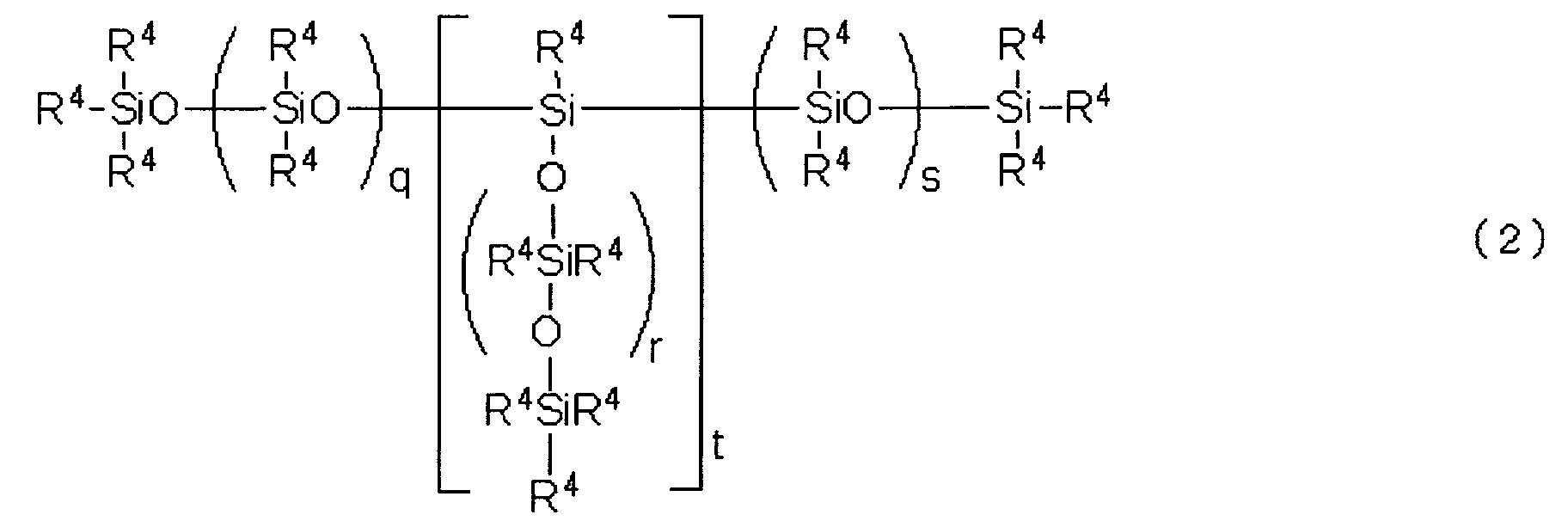
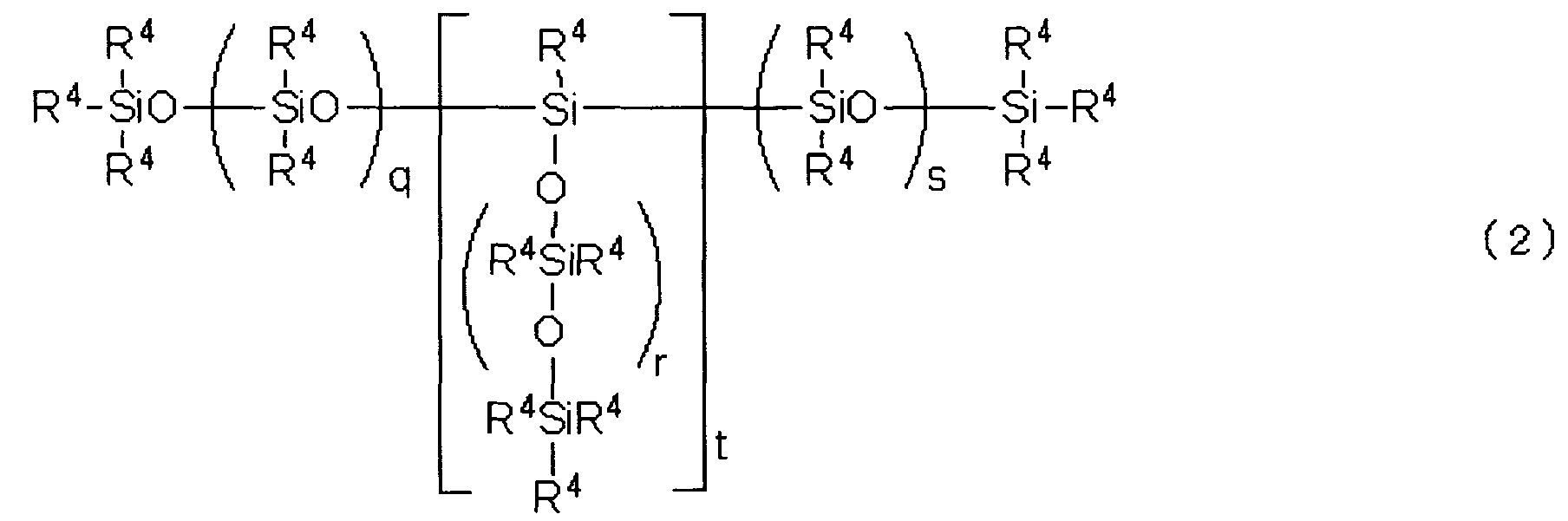
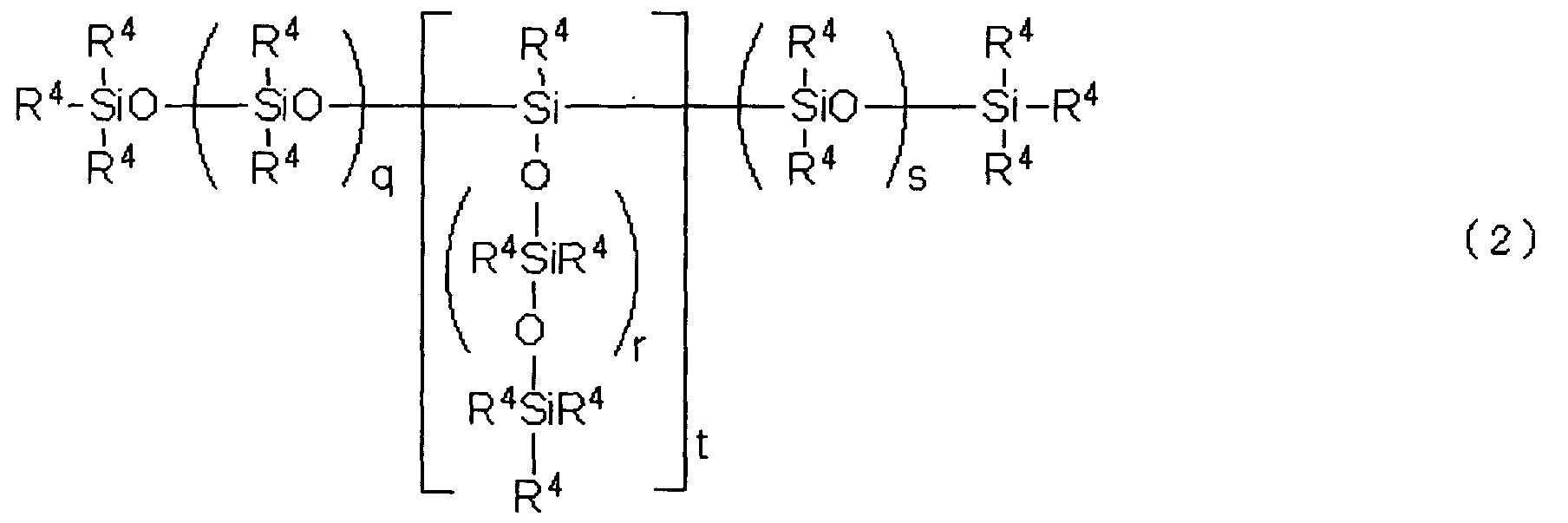
- the component (B-1) consists of one or more organopolysiloxanes(II) represented by the following formula(2).
- R 4 may be the same with or different from each other and is a monovalent hydrocarbon group, with at least two R 4 's in a molecule being alkenyl groups
- t is a number ranging from 0 to 15, each of q, r, and s is zero or a positive number
- t, q, r, and s are selected so that a 30 wt% of the organopolysiloxane(II) solution in toluene has a viscosity of from 100 to 20,000 mPa.s at 25 degrees C.
- each of t, q, r, and s is zero or a positive number and is selected so that a 30 wt% of the organopolysiloxane (II) solution in toluene has a viscosity at 25 degrees C of from 100 to 20, 000 mPa.s, preferably 200 to 5000 mPa.s with 0 ⁇ t ⁇ 15, preferably 0 ⁇ t ⁇ 6. If the viscosity is below the aforesaid lower limit, it may be difficult to prepare an adhesive layer having a uniform thickness. If the viscosity exceeds the aforesaid upper limit, operation efficiency of coating may be too low.
- the component (B-1) contains 10 to 50 wt%, based on a total weight of the component (B-1), of a organopolysiloxane(II) having a vinyl value of at least 0.02mol/100 g, preferably from 0.02 to 0.2 mol/100 g, more preferably from 0.02 to 0.08 mol/100 g.
- Remaining 90 to 50 wt% of the component (B-1) preferably consists of one or more organopolysiloxanes(II) having a viscosity at 25 degrees C in a 30 wt% toluene solution of from 200 to 1,000 mPa.s, and a vinyl value of from 0.01 to 0.10 mole/100 g.
- the component (B-1) is used in an amount of from 10 to 100 parts by weight, preferably 10 to 50 parts by weight, per 100 parts by weight of the component (A-1). If the amount is below the aforesaid lower limit, a viscosity of the silicone composition 1 may be too low to make a layer of a uniform thickness on the film substrate. If the amount exceeds the aforesaid upper limit, an adhesion of a cured film to the plastic film substrate may be too small.
- the component (C-1) consists of one or more organohydrogenpolysiloxanes having at least two, preferably 2 to 1000, SiH groups per molecule.
- the SiH groups react with alkenyl groups of the organopolysiloxane(I) and (II) to form a cured film.
- a molecular structure of the organohydrogenpolysiloxane may be linear, branched or cyclic.
- the organohydrogenpolysiloxane may be represented by the following formula (3).
- R 5 include alkyl groups such as a methyl, an ethyl, and a propyl group; an aryl group such as a phenyl group; and halogen substituted alkyl groups such as 3,3,3-trifluoropropyl group.
- at least 80% of R 5 in a molecule is methyl group.
- the numbers, a and b are positive with, 0.7 ⁇ a ⁇ 2.1, 0.001 ⁇ b ⁇ 1.0 and 0.8 ⁇ a+b ⁇ 2.6, preferably, 0.8 ⁇ a ⁇ 2.0, 0.01 ⁇ b ⁇ 1 and 1 ⁇ a+b ⁇ 2.4.
- a molecular structure of the organohydrogenpolysiloxane may be linear, branched or cyclic.
- the organohydrogenpolysiloxane may have a viscosity at 25 degrees C of from a few mPa.s to several tens of thousand mPa.s, preferably 1000 mPa.s or smaller, more preferably 400 mPa.s or smaller.
- organohydrogenpolysiloxane examples include 1,3,5,7-tetramethylcyclotetrasiloxane, a methylhydrogenpolysiloxane with both ends capped with trimethylsiloxy groups, a dimethylsiloxane/methyhydrogensiloxane copolymer with both ends capped with trimethylsiloxy groups, dimethylpolysiloxane with both ends capped with dimethylhydrogensiloxy groups, a dimethylsiloxane/methyhydrogensiloxane copolymer with both ends capped with dimethylhydrogensiloxy groups, a methyhydrogensiloxane/diphenylsiloxane copolymer with both ends capped with trimethylsiloxy groups, a methyhydrogensiloxane/diphenylsiloxane/dimethylsiloxane copolymer with both ends capped with trimethylsiloxy groups, a copolymer consisting
- An amount of the component (C-1) to be used may be adjusted according to an amount of alkenyl groups contained in the organopolysiloxane (I) and (II). Generally, the amount ranges from 30 to 100 parts by weight per 100 parts by weight of the component (A-1). If the amount is below the aforesaid lower limit, the cured adhesive layer may not be hard enough. If the amount exceeds the aforesaid upper limit, desired adhesion to the substrate may not be attained.
- the platinum metal compound of the component (D-1) is used to promote the addition reaction among the components (A-1), (B-1) and the component (C-1) to make a cured film.
- the platinum metal compound include platinum black, hydrogen chloroplatinic acid, a complex of hydrogen chloroplatinic acid with olefin, alcoholic solution of hydrogen chloroplatinic acid, rhodium, a complex of rhodium with olefin and a mixture thereof.
- the platinum metal compound is used in an amount effective as a catalyst which can be adjusted according to reactivities of the aforesaid components or a desired curing speed. Typically, the amount ranges from 1 to 1000 ppm, as platinum metal, based on a total amount of the components (A-1), (B-1) and (C-1) to economically obtain a cured film having good adhesion.
- the silicone composition 1 may preferably be prepared by thoroughly mixing the components (A-1), (B-1), (C-1) and an optional component as necessary and then adding the component (D-1).
- the optional component examples include catalytic activity inhibiters (E) such as various kinds of organic nitrogen compounds, organic phosphorous compounds, acetylenic compounds, and oxime compounds; and an agent to control adhesion strength such as silicone resins, silica, and organopolysiloxanes which does not have SiH groups or alkenyl groups.
- E catalytic activity inhibiters
- an agent to control adhesion strength such as silicone resins, silica, and organopolysiloxanes which does not have SiH groups or alkenyl groups.
- the optional component is added in such an amount that it does not adversely affect the present invention.
- any known catalytic activity inhibiters may be used, for example, acetylenic compounds such as 3-methyl-1-butyne-3-ol, 3,5-dimethyl-1-hexyne-3-ol, 3-methyl-1-pentyne-3-ol, ethynylcyclohexanol, and phenylbutynol; and reaction products of these acetylenic compounds with alkoxysilane, alkoxysiloxane, hydrogensilane or hydrogensiloxane; vinyl siloxanes such as cyclic tetramethylvinylsiloxane; organic nitrogen compounds such as bezotriazole, organic phosphorous compounds and oxime compounds.
- acetylenic compounds such as 3-methyl-1-butyne-3-ol, 3,5-dimethyl-1-hexyne-3-ol, 3-methyl-1-pentyne-3-ol, ethynylcyclohexanol, and
- the component (E) may be used in such an amount that a desired shelf life of the silicone composition 1 is obtained.
- the amount ranges from 0.01 to 10 parts by weight, preferably from 0.05 to 5 parts by weight per 100 parts by weight in total of the components (A-1) and (B-1).
- the silicone composition 1 can be free from solvent. However, a little amount of an organic solvent (F) may be used to improve application operability or adjust application amount.
- organic solvent (F) include organic solvents such as toluene, xylene, ethyl acetate, acetone, methylethyl ketone, and hexane.
- the silicone composition 1 thus prepared is applied to the aforesaid plastic film and cured by heating.
- An amount to be applied is not limited to a particular range but, typically, ranges from about 0.01 to about 2.0 g/m 2 .
- the curing may be performed preferably at a temperature of from 50 to 200 degrees C for 1 second to 5 minutes.
- a second layer is prepared from a second silicon composition, hereinafter referred to as silicone composition 2.
- the second layer is applied on the first layer to form a release layer.
- the silicone composition 2 as such is known. It is useful to adjust releasing property, but it does not adhere well to a plastic film substrate.
- the first layer bonds the second layer to the film substrate.
- the silicone composition 2 comprises the components (A-2), (C-2), and (D-2). Each component will be explained below.
- the component (A-2) consists of one or more organopolysiloxanes having an alkenyl group in an amount of at least two per molecule and of from 0.02 to 0.2 mole per 100 g of the polyorganosiloxan, and a viscosity at 25 degrees C of 50 to 100,000 mPa.
- Examples of the monovalent hydrocarbon group, R 6 include alkyl groups such as a methyl, an ethyl, a propyl, a butyl, a pentyl, a hexyl, an octyl, a decyl, a dodecyl, a tetradecyl, hexadecyl, and an octadecyl group; cycloalkyl groups such as a cyclohexyl group; aryl groups such as a phenyl, a naphthyl and a tolyl group; and partly or wholly halogenated, cyano or hydroxyl substituted groups thereof such as a 3,3,3-trifluoropropyl, a cyanopropyl, a phenol and a hindered phenol group.
- alkyl groups such as a methyl, an ethyl, a propyl, a butyl, a
- R 6 is an alkyl group having 1 to 8 carbon atoms or a phenyl group. More preferably, R 6 is a methyl group in an amount of at least 50 mole% based on a total content of the substituents, R 6 + R 7 , in a molecule of the organopolysiloxane.
- the organopolysiloxane may be linear or branched and preferably has the alkenyl group at a terminal.
- the organopolysiloxane has a viscosity at 25 degrees C of from 50 to 100,000 mPa.s, pereferably from 50 to 5,000 mPa.s
- any known organohydrogenpolysiloxane having at least two SiH groups in a molecule can be used.
- the same type of organohydrogenpolysiloxane as that of the component (C-1) may be used.
- An amount of the component (C-2) to be used can be adjusted according to a desired release property but, typically, is such that a molar amount of H atom bonded to Si atom is 0.5 to 5 times that of the alkenyl group in the component (A-2), which amount usually corresponds to 0.1 to 30 parts by weight, more typically 20 or smaller parts by weight per 100 parts by weight of the component (A-2).
- the platinum metal compound in the component (D-2) may be of the same type as the component (D-1).
- An amount of the component (D-2) to be used may be the same as that in the component (D-1), which amount usually ranges from 1 to 1000 ppm as platinum metal based on a total weight of the components (A-2) and (C-2).
- the silicone composition 2 may comprise optional components such as the catalytic activity inhibiter (E), and the agent to control releasing property in such an amount that they do not adversely affect the present invention.
- E catalytic activity inhibiter
- the silicone composition 2 is applied on the cured first silicone layer and then heat cured.
- An amount to be applied is not limited to a particular range, but usually ranges from about 0.03 to about 2.0 g/m 2 .
- the curing is preferably performed at a temperature of from 50 to 200 degrees C for 1 second to 5 minutes.
- Each layer can be applied by any known means such as a bar coater, roll coater, reverse coater, gravure coater, air knife coater and, for thin film coating, a high precision offset coater and multistep roll coater.
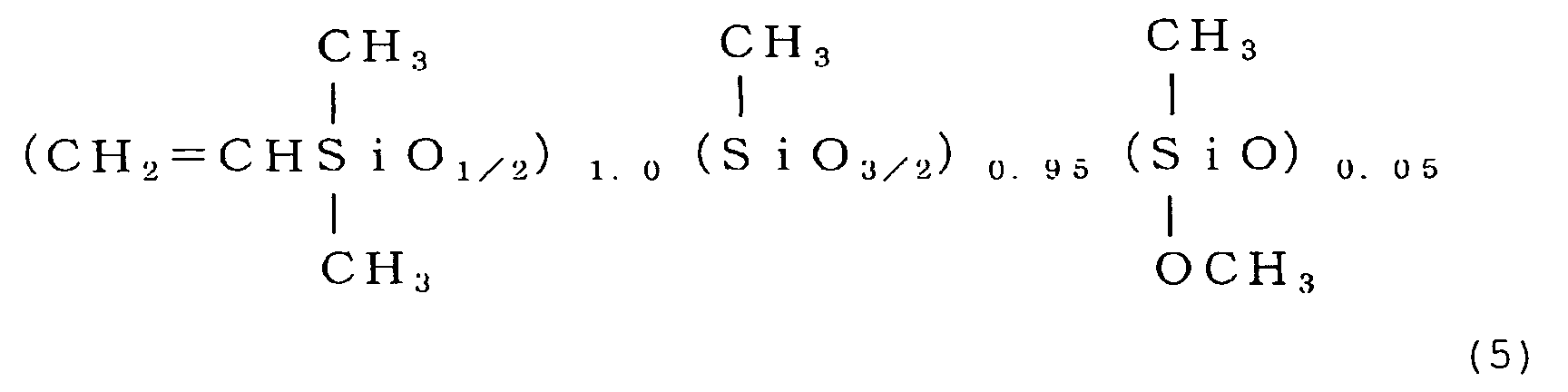
- silicone mixture 1 used to prepare a silicone composition 1 according to the invention was prepared by thoroughly mixing 50 parts by weight of an orgnopolysiloxane represented by the following formula (5) having a viscosity of 25 mPa.s at 25 degrees C and a vinyl value of 0.57 mole/100g,
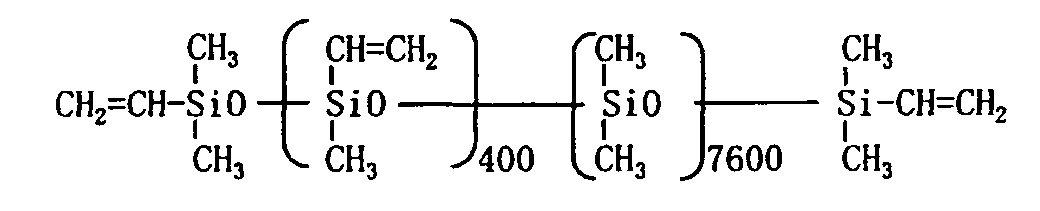
- silicone mixture 2 used to prepare a silicone composition 2 according to the invention was prepared by thoroughly mixing 97.6 parts by weight of an orgnopolysiloxane having a vinyl group at each of the both ends, a viscosity of 400 mPa.s at 25 degrees C, and a vinyl value of 0.02 mole/100g, 2.1 parts by weight of the organohydrogenpolysiloxane represented by the aforesaid formula (6), and 0.3 part by weight of ethynylcyclohexanol.
- silicone composition 1 To 100 parts by weight of the silicone mixture 1, 1 part by weight of a complex of chloroplatinic acid with vinylsiloxane, corresponding to 50 ppm as platinum, was added and well mixed to prepare a silicone composition 1.
- silicone mixture 2 2 parts by weight of the complex of chloroplatinic acid with vinylsiloxane, corresponding to 100 ppm as platinum, was added and well mixed to prepare a silicone composition 2.
- the silicone composition 1 was applied in the amount specified in Table 1 and then heated to 120 degrees C for 10 seconds in a hot-air dryer to form a silicone layer 1. Subsequently, a silicone layer 2 was formed by applying the silicone composition 2 on the cured silicone layer 1 in the amount shown in Table 1 and then heating to 120 degrees C for 30 seconds in the hot-air dryer to prepare a release film.
- a release film was prepared by applying the silicone composition 1 in the amount shown in Table 1 and then heating to 120 degrees C in the hot-air dryer for 30 seconds.
- a release film was prepared by applying the silicone composition 2 in the amount shown in Table 1 and then heating to 120 degrees C in the hot-air dryer for 30 seconds.
- a mixture of 70 parts by weight of the silicone mixture 1 and 30 parts by weight of the silicone mixture 2 was prepared, to which 2 parts by weight of a complex of chloroplatinic acid with vinylsiloxane, corresponding to 100 ppm as platinum, was added and well mixed.
- the mixture thus obtained was applied on the plastic film substrate shown in Table 1 and then heated to 120 degrees C for 30 seconds.
- an acrylic pressure sensitive adhesive BPS-5127, ex Toyo Ink Manufacturing Co. Ltd.
- a rubber pressure sensitive adhesive BPS-2411, ex Toyo Ink Manufacturing Co. Ltd.
- adhesion in the release film of Examples 1-3 is significantly larger than that of Comparative Example 2, indicating that the present release layer is firmly fixed on the plastic substrate. The adhesion hardly decreased by aging. Further, the release films of Examples 1-3 have significantly smaller peel force than that of Comparative Example 1. These properties of the present release film cannot be obtained by merely combining the two silicone compositions as shown in Referential Examples 1 and 2.
- the adhesive maintenance ratio indicates how much of the pressure sensitive adhesive is maintained in the adhesive tape after it is attached to a release film and then peeled off from the release film. As seen in Table 1, all of the release films of the present invention showed 100 % maintenance ratio within an error range and, thus, were proved to be useful for protecting pressure sensitive adhesive products.
Landscapes
- Chemical & Material Sciences (AREA)
- Organic Chemistry (AREA)
- Chemical Kinetics & Catalysis (AREA)
- Wood Science & Technology (AREA)
- Engineering & Computer Science (AREA)
- Materials Engineering (AREA)
- Life Sciences & Earth Sciences (AREA)
- Health & Medical Sciences (AREA)
- Medicinal Chemistry (AREA)
- Polymers & Plastics (AREA)
- Compositions Of Macromolecular Compounds (AREA)
- Laminated Bodies (AREA)
- Paints Or Removers (AREA)
- Adhesive Tapes (AREA)
Abstract
Description

- (A-2) 100 parts by weight of a polyorganosiloxane having alkenyl groups in an amount of at least two per molecule and from 0.02 to 0. 20 mole per 100 g of the polyorganosiloxane, and a viscosity of from 50 to 100,000 mPa.s at 25 degrees C,
- (C-2) an organohydrogenpolysiloxane having at least two SiH groups per molecule in such an amount that a molar amount of the SiH group in the component (C-2) is 0.5 to 5 times that of the alkenyl group contained in the component (A-2), and
- (D-2) a catalytic amount of a compound of a platinum group metal.



Claims (5)
- A release film comprising a plastic film substrate, a first layer provided on at least one side of the substrate, and a second layer provided on the first layer, characterized in that the first layer is prepared from a first silicone composition comprising the following components (A-1), (B-1), (C-1), and (D-1):and the second layer is prepared from a second silicone composition comprising the following components (A-2), (C-2) and (D-2):(A-1) 100 parts by weight of an organopolysiloxane(I) represented by the following formula (1),wherein R1 is an alkenyl group, R2 may be the same with or different from each other and is a monovalent hydrocarbon group except an alkenyl group, R3 is a hydrogen atom or an alkyl group, m and n are positive numbers, p is zero or a positive number with 0.6≦(n+p)/m≦1.5, and 0≦p/(n+p) ≦0.05, and m, n and p are selected so that the organopolysiloxane (I) has a viscosity of from 5 to 100 mPa.s at 25 degrees C,
 (B-1) 10 to 100 parts by weight of an organopolysiloxane(II) represented by the following formula (2),wherein R4 may be the same with or different from each other and is a monovalent hydrocarbon group with at least two R4's in a molecule being alkenyl groups, t is a number ranging from 0 to 15, each of q, r, and s is zero or a positive number, and t, q, r, and s are selected so that a 30 wt% of the organopolysiloxane(II) solution in toluene has a viscosity of from 100 to 20,000 mPa.s at 25 degrees C,
 (C-1) 30 to 100 parts by weight of an organohydrogenpolysiloxane having at least two SiH groups in a molecule, and(D-1) a catalytic amount of a compound of a platinum group metal;(A-2) 100 parts by weight of a polyorganosiloxane having alkenyl groups in an amount of at least two per molecule and from 0.02 to 0.20 mole per 100 g of the polyorganosiloxane, and a viscosity of from 50 to 100,000 mPa.s at 25 degrees C,(C-2) an organohydrogenpolysiloxane having at least two SiH groups per molecule in such an amount that a molar amount of the SiH group in the component (C-2) is 0.5 to 5 times that of the alkenyl group contained in the component (A-2), and(D-2) a catalytic amount of a compound of a platinum group metal.
 - The release film according to claim 1, wherein the component (B-1) comprises 10 to 50 wt%, based on a total weight of the component (B-1), of the organopolysiloxane (II) having a viscosity in a 30 wt% solution in toluene of from 1000 to 10, 000 mPa.s at 25 degrees C and a vinyl value of at least 0. 02 mole/100 g.
- The release film according to claim 1 or 2, wherein the organohydrogenpolysiloxane (C-1) is represented by the formula
- The release film according to any one of claims 1 to 3, wherein the polyorganosiloxane (A-2) is represented by the following formula (4),
- The release film according to any one of claims 1 to 4, wherein the first silicone composition further comprises a catalytic activity inhibiter (E) in an amount of from 0.01 to 10 parts by weight per a total 100 parts by weight of the organopolysiloxane (I) and the organopolysiloxane (II).
Applications Claiming Priority (4)
| Application Number | Priority Date | Filing Date | Title |
|---|---|---|---|
| JP2004015378 | 2004-01-23 | ||
| JP2004015378 | 2004-01-23 | ||
| JP2005007912 | 2005-01-14 | ||
| JP2005007912A JP2005231355A (en) | 2004-01-23 | 2005-01-14 | Release film |
Publications (2)
| Publication Number | Publication Date |
|---|---|
| EP1557451A1 true EP1557451A1 (en) | 2005-07-27 |
| EP1557451B1 EP1557451B1 (en) | 2011-04-06 |
Family
ID=34635692
Family Applications (1)
| Application Number | Title | Priority Date | Filing Date |
|---|---|---|---|
| EP20050075163 Ceased EP1557451B1 (en) | 2004-01-23 | 2005-01-21 | Release film |
Country Status (4)
| Country | Link |
|---|---|
| US (1) | US7374819B2 (en) |
| EP (1) | EP1557451B1 (en) |
| JP (1) | JP2005231355A (en) |
| DE (1) | DE602005027274D1 (en) |
Cited By (4)
| Publication number | Priority date | Publication date | Assignee | Title |
|---|---|---|---|---|
| EP1783186A3 (en) * | 2005-10-14 | 2007-09-05 | Shin-Etsu Chemical Co., Ltd. | Solvent-free silicone composition for release paper |
| WO2012028306A1 (en) * | 2010-08-31 | 2012-03-08 | Huhtamaki Forchheim Zweigniederlassung Der Huhtamaki Deutschland Gmbh & Co. Kg | Process for producing a polymeric film with a cured polysiloxane coating |
| EP2631277A1 (en) * | 2012-02-23 | 2013-08-28 | Shin-Etsu Chemical Co., Ltd. | Addition Curable Silicone Emulsion Release Composition and Release Film |
| WO2018184668A1 (en) | 2017-04-04 | 2018-10-11 | Wacker Chemie Ag | Reactive siloxanes and process for the production thereof |
Families Citing this family (5)
| Publication number | Priority date | Publication date | Assignee | Title |
|---|---|---|---|---|
| US7528209B2 (en) * | 2004-10-29 | 2009-05-05 | Shin-Etsu Chemical Co., Ltd. | Curable silicone release composition and sheet having a releasability using the same |
| JP4782046B2 (en) * | 2007-03-05 | 2011-09-28 | 信越化学工業株式会社 | Solvent-free silicone release agent composition for film and release film using the same |
| EP2103664B2 (en) * | 2008-03-18 | 2019-06-05 | The Procter and Gamble Company | Release sheet material |
| JP4994292B2 (en) * | 2008-04-09 | 2012-08-08 | 信越化学工業株式会社 | Solvent-free silicone release agent composition for film and release film using the same |
| JP4936013B2 (en) * | 2008-04-25 | 2012-05-23 | 信越化学工業株式会社 | Solvent-free curable silicone release agent composition for plastic film and peelable plastic film |
Citations (5)
| Publication number | Priority date | Publication date | Assignee | Title |
|---|---|---|---|---|
| EP0150772B1 (en) * | 1984-01-18 | 1989-07-12 | Oji Paper Company Limited | Release sheet |
| EP0563704B1 (en) * | 1992-03-31 | 1996-10-02 | E.I. Du Pont De Nemours And Company | Polymeric release film |
| EP1277802A1 (en) * | 2001-07-12 | 2003-01-22 | Shin-Etsu Chemical Co., Ltd. | Silicone composition and release film |
| EP1323796A2 (en) * | 2001-12-26 | 2003-07-02 | Shin-Etsu Chemical Co., Ltd. | Silicone emulsion composition adherent to plastic film substrates and release film |
| EP0882576B1 (en) * | 1996-10-03 | 2004-04-14 | Teijin Limited | Release film |
Family Cites Families (11)
| Publication number | Priority date | Publication date | Assignee | Title |
|---|---|---|---|---|
| GB1399885A (en) | 1972-05-01 | 1975-07-02 | Ici Ltd | Coating compositions |
| US4057596A (en) | 1973-06-11 | 1977-11-08 | Shinetsu Chemical Company | Anti-sticking silicone compositions of non-solvent type |
| US4071644A (en) | 1974-11-14 | 1978-01-31 | General Electric Company Silicone Products Department | Method for rendering flexible sheet material non-adherent |
| US4618522A (en) * | 1983-12-19 | 1986-10-21 | General Electric Company | Organosiloxane fabric coating compositions |
| JPS6327560A (en) | 1986-07-21 | 1988-02-05 | Shin Etsu Chem Co Ltd | Releasing silicone composition |
| JPH07292320A (en) * | 1994-04-22 | 1995-11-07 | Shin Etsu Chem Co Ltd | Primer composition and silicone laminate |
| JPH0977979A (en) * | 1995-09-18 | 1997-03-25 | Shin Etsu Chem Co Ltd | Organopolysiloxane composition and release paper |
| JP3098946B2 (en) * | 1995-09-21 | 2000-10-16 | 東レ・ダウコーニング・シリコーン株式会社 | Removable cured film-forming organopolysiloxane composition |
| JP3568148B2 (en) * | 1997-09-12 | 2004-09-22 | 信越化学工業株式会社 | Organopolysiloxane composition |
| JP4062386B2 (en) * | 1999-12-21 | 2008-03-19 | 信越化学工業株式会社 | Primer composition and silicone laminate |
| JP2002338890A (en) * | 2000-03-23 | 2002-11-27 | Shin Etsu Chem Co Ltd | Primer composition for silicone adhesive |
-
2005
- 2005-01-14 JP JP2005007912A patent/JP2005231355A/en active Pending
- 2005-01-21 EP EP20050075163 patent/EP1557451B1/en not_active Ceased
- 2005-01-21 US US11/038,130 patent/US7374819B2/en active Active
- 2005-01-21 DE DE200560027274 patent/DE602005027274D1/en not_active Expired - Lifetime
Patent Citations (6)
| Publication number | Priority date | Publication date | Assignee | Title |
|---|---|---|---|---|
| EP0150772B1 (en) * | 1984-01-18 | 1989-07-12 | Oji Paper Company Limited | Release sheet |
| EP0563704B1 (en) * | 1992-03-31 | 1996-10-02 | E.I. Du Pont De Nemours And Company | Polymeric release film |
| EP0882576B1 (en) * | 1996-10-03 | 2004-04-14 | Teijin Limited | Release film |
| EP1277802A1 (en) * | 2001-07-12 | 2003-01-22 | Shin-Etsu Chemical Co., Ltd. | Silicone composition and release film |
| JP2003026925A (en) * | 2001-07-12 | 2003-01-29 | Shin Etsu Chem Co Ltd | Silicone composition and release film using the same |
| EP1323796A2 (en) * | 2001-12-26 | 2003-07-02 | Shin-Etsu Chemical Co., Ltd. | Silicone emulsion composition adherent to plastic film substrates and release film |
Non-Patent Citations (1)
| Title |
|---|
| PATENT ABSTRACTS OF JAPAN vol. 2003, no. 05 12 May 2003 (2003-05-12) * |
Cited By (9)
| Publication number | Priority date | Publication date | Assignee | Title |
|---|---|---|---|---|
| EP1783186A3 (en) * | 2005-10-14 | 2007-09-05 | Shin-Etsu Chemical Co., Ltd. | Solvent-free silicone composition for release paper |
| US8039570B2 (en) | 2005-10-14 | 2011-10-18 | Shin-Etsu Chemical Co., Ltd. | Solvent-free silicone composition for release paper |
| WO2012028306A1 (en) * | 2010-08-31 | 2012-03-08 | Huhtamaki Forchheim Zweigniederlassung Der Huhtamaki Deutschland Gmbh & Co. Kg | Process for producing a polymeric film with a cured polysiloxane coating |
| US8940369B2 (en) | 2010-08-31 | 2015-01-27 | Huhtamaki Films Germany Gmbh & Co. Kg | Process for producing a polymeric film with a cured polysiloxane coating |
| AU2011297943B2 (en) * | 2010-08-31 | 2015-02-19 | Loparex Germany Gmbh & Co. Kg | Process for producing a polymeric film with a cured polysiloxane coating |
| RU2582398C2 (en) * | 2010-08-31 | 2016-04-27 | Инфиана Джермени ГмбХ унд Ко. КГ | Method for manufacturing polymer film coated with cured polysiloxane |
| EP2631277A1 (en) * | 2012-02-23 | 2013-08-28 | Shin-Etsu Chemical Co., Ltd. | Addition Curable Silicone Emulsion Release Composition and Release Film |
| US9321936B2 (en) | 2012-02-23 | 2016-04-26 | Shin-Etsu Chemical Co., Ltd. | Addition curable silicone emulsion release composition and release film |
| WO2018184668A1 (en) | 2017-04-04 | 2018-10-11 | Wacker Chemie Ag | Reactive siloxanes and process for the production thereof |
Also Published As
| Publication number | Publication date |
|---|---|
| US7374819B2 (en) | 2008-05-20 |
| US20050164017A1 (en) | 2005-07-28 |
| EP1557451B1 (en) | 2011-04-06 |
| DE602005027274D1 (en) | 2011-05-19 |
| JP2005231355A (en) | 2005-09-02 |
Similar Documents
| Publication | Publication Date | Title |
|---|---|---|
| JP5130995B2 (en) | Solvent-free silicone adhesive composition | |
| JP5060873B2 (en) | Silicone pressure-sensitive adhesive composition and pressure-sensitive adhesive tape or sheet | |
| CN101555353B (en) | Solvent-free siloxane release agent composition for film and releasing film using the composition | |
| KR101124996B1 (en) | Silicone Pressure Sensitive Adhesive and Adhesive Tape | |
| US6562469B2 (en) | Silicone composition for forming cured release coatings | |
| EP3575364B1 (en) | Silicone composition, release paper, and release film | |
| KR20080081832A (en) | Solvent-free silicone release agent composition for film and release film using same | |
| CN109415567B (en) | Silicone composition, release paper and release film | |
| EP1783186B1 (en) | Solvent-free silicone composition for release paper | |
| JP4761020B2 (en) | Solvent-free silicone adhesive composition | |
| EP1557451B1 (en) | Release film | |
| JP4936013B2 (en) | Solvent-free curable silicone release agent composition for plastic film and peelable plastic film | |
| US4983701A (en) | Silicone composition for rendering surfaces non-adherent | |
| EP1788033B1 (en) | Solvent-free silicone composition for release paper | |
| JPH01215857A (en) | Organopolysiloxane composition for release paper | |
| JP4093542B2 (en) | Curable silicone release agent composition and release paper using the same | |
| JP2007284685A (en) | Silicone release agent composition and release paper | |
| JPH04272959A (en) | Releasing silicone composition | |
| JP7851133B2 (en) | Solvent-free silicone adhesive composition | |
| WO2023146692A1 (en) | Pressure sensitive adhesive composition and methods for its preparation and use in flexible organic light emitting diode applications | |
| KR101266641B1 (en) | Solvent-free silicone composition for release paper |
Legal Events
| Date | Code | Title | Description |
|---|---|---|---|
| PUAI | Public reference made under article 153(3) epc to a published international application that has entered the european phase |
Free format text: ORIGINAL CODE: 0009012 |
|
| AK | Designated contracting states |
Kind code of ref document: A1 Designated state(s): AT BE BG CH CY CZ DE DK EE ES FI FR GB GR HU IE IS IT LI LT LU MC NL PL PT RO SE SI SK TR |
|
| AX | Request for extension of the european patent |
Extension state: AL BA HR LV MK YU |
|
| 17P | Request for examination filed |
Effective date: 20050905 |
|
| AKX | Designation fees paid |
Designated state(s): DE FR GB |
|
| GRAP | Despatch of communication of intention to grant a patent |
Free format text: ORIGINAL CODE: EPIDOSNIGR1 |
|
| GRAS | Grant fee paid |
Free format text: ORIGINAL CODE: EPIDOSNIGR3 |
|
| GRAA | (expected) grant |
Free format text: ORIGINAL CODE: 0009210 |
|
| AK | Designated contracting states |
Kind code of ref document: B1 Designated state(s): DE FR GB |
|
| REG | Reference to a national code |
Ref country code: GB Ref legal event code: FG4D |
|
| REF | Corresponds to: |
Ref document number: 602005027274 Country of ref document: DE Date of ref document: 20110519 Kind code of ref document: P |
|
| REG | Reference to a national code |
Ref country code: DE Ref legal event code: R096 Ref document number: 602005027274 Country of ref document: DE Effective date: 20110519 |
|
| PLBE | No opposition filed within time limit |
Free format text: ORIGINAL CODE: 0009261 |
|
| STAA | Information on the status of an ep patent application or granted ep patent |
Free format text: STATUS: NO OPPOSITION FILED WITHIN TIME LIMIT |
|
| 26N | No opposition filed |
Effective date: 20120110 |
|
| REG | Reference to a national code |
Ref country code: DE Ref legal event code: R097 Ref document number: 602005027274 Country of ref document: DE Effective date: 20120110 |
|
| REG | Reference to a national code |
Ref country code: FR Ref legal event code: PLFP Year of fee payment: 12 |
|
| REG | Reference to a national code |
Ref country code: FR Ref legal event code: PLFP Year of fee payment: 13 |
|
| REG | Reference to a national code |
Ref country code: DE Ref legal event code: R079 Ref document number: 602005027274 Country of ref document: DE Free format text: PREVIOUS MAIN CLASS: C09J0007020000 Ipc: C09J0007200000 |
|
| REG | Reference to a national code |
Ref country code: FR Ref legal event code: PLFP Year of fee payment: 14 |
|
| PGFP | Annual fee paid to national office [announced via postgrant information from national office to epo] |
Ref country code: FR Payment date: 20191216 Year of fee payment: 16 |
|
| PGFP | Annual fee paid to national office [announced via postgrant information from national office to epo] |
Ref country code: DE Payment date: 20200107 Year of fee payment: 16 Ref country code: GB Payment date: 20200113 Year of fee payment: 16 |
|
| REG | Reference to a national code |
Ref country code: DE Ref legal event code: R119 Ref document number: 602005027274 Country of ref document: DE |
|
| GBPC | Gb: european patent ceased through non-payment of renewal fee |
Effective date: 20210121 |
|
| PG25 | Lapsed in a contracting state [announced via postgrant information from national office to epo] |
Ref country code: FR Free format text: LAPSE BECAUSE OF NON-PAYMENT OF DUE FEES Effective date: 20210131 |
|
| PG25 | Lapsed in a contracting state [announced via postgrant information from national office to epo] |
Ref country code: DE Free format text: LAPSE BECAUSE OF NON-PAYMENT OF DUE FEES Effective date: 20210803 Ref country code: GB Free format text: LAPSE BECAUSE OF NON-PAYMENT OF DUE FEES Effective date: 20210121 |